Research Paper Computer Science
E-ISSN No : 2454-9916 | Volume : 5 | Issue : 9 | Sep 2019
SCLBA: CLB - COMPARATIVE ANALYSIS OF LOAD BALANCING ALGORITHMS IN CLOUD COMPUTING 1
2
Mr. E. K. Girisan | Mr. C. Rathish 1 2
Associate Professor, Computer Science, Sree Narayana Guru College , Coimbatore, India. M.Phil Scholar, Computer Science, Sree Narayana Guru College of Arts & Science, Coimbatore, India.
ABSTRACT The current era has witnessed great growth of the internet and numerous applications that are running over it. Cloud computing is most common internet based technology, highlighting its effectiveness and follows pay-as-you-go model, therefore turn out to be so popular with highest demanding features. Load balancing is most curious and prominent research areas in cloud computing, which has acquired a large attention recently. Users are demanding more services with better results. Numerous algorithms and methods are proposed by many researchers across the world, with the purpose of balancing the complete workload across given cloud servers, while achieving the greatest throughput and minimum time. In this paper, two recent algorithms of Slot based carton load balancing algorithm (SCLBA) and Central Load Balancer (CLB) method addressing the problem of load balancing in Cloud Computing are studied and compared to deliver an idea of the newest methods in this research area. KEYWORDS: Cloud Computing; Load balancing; Central Load balancer; VM allocation. INTRODUCTION: Cloud Computing is developing as a new model of large scale distributed computing. It has changed computing and information away from desktop to handy PCs into large data centers [1]. It has the capability to harness the power of Internet and wide area network to resources that are available remotely, thereby, providing cost effective solution to the most of the real life requirement. It offers the ascendable IT resources for example applications and service, in addition to infrastructure on which they function, over the Internet, as pay-per- use basis to alter the ability rapidly and simply. It helps to accommodate changes in demand. Thus cloud computing is a framework for enabling a suitable, and resource utility of the system. It also ensures for the fair distribution of work and resources. In order to manage the workloads, the environment require efficient load balancing approaches, which provides fair allocation of resources including bandwidth and resources. It is a technique of reassigning the entire load to the distinct nodes of the collaborative system to make resource utilization efficacious and to upgrade the response time of the a particular job, simultaneously removing a condition in which few nodes are over loaded while few others are under loaded. Load balancing is attained by using various resources that is, various servers that are capable of accomplish a request or by having several paths to a resource. Load balancing supports to attain a highest user satisfaction and efficient resource utilization. When one or more modules of any service fail, load balancing enables continuation of the service by employing fair-over, that is, it supports in provisioning and de-provisioning of instances of applications without fail. It also confirms that every computing resource is distributed efficiently and properly [2]. Fig.1 shows a framework under which numerous load balancing algorithms work in a cloud computing environment.
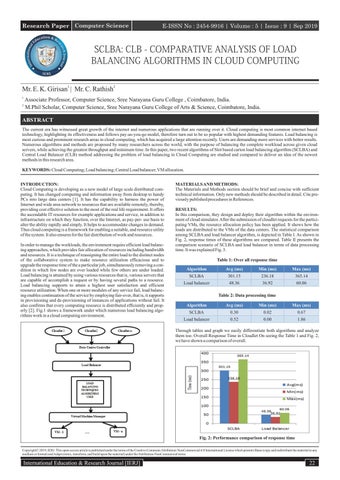
MATERIALS AND METHODS: The Materials and Methods section should be brief and concise with sufficient technical information. Only new methods should be described in detail. Cite previously published procedures in References. RESULTS: In this comparison, they design and deploy their algorithm within the environment of cloud simulator. After the submission of cloudlet requests for the participating VMs, the resource allocation policy has been applied. It shows how the loads are distributed to the VMs of the data centers. The statistical comparison among SCLBA and load balancer algorithm, is depicted in Table I. As shown in Fig. 2, response times of these algorithms are compared. Table II presents the comparison scenario of SCLBA and load balancer in terms of data processing time. It was explained Fig. 3. Table 1: Over all response time Algorithm
Avg (ms)
Min (ms)
Max (ms)
SCLBA
301.15
236.18
365.14
Load balancer
48.36
36.92
60.06
Table 2: Data processing time Algorithm
Avg (ms)
Min (ms)
Max (ms)
SCLBA
0.30
0.02
0.67
Load balancer
0.52
0.00
1.86
Through tables and graph we easily differentiate both algorithms and analyze them too. Overall Response Time in Cloudlet On seeing the Table 1 and Fig. 2, we have shown a comparison of overall.
Fig. 2: Performance comparison of response time Copyright© 2019, IERJ. This open-access article is published under the terms of the Creative Commons Attribution-NonCommercial 4.0 International License which permits Share (copy and redistribute the material in any medium or format) and Adapt (remix, transform, and build upon the material) under the Attribution-NonCommercial terms.
International Education & Research Journal [IERJ]
22
Research Paper
E-ISSN No : 2454-9916 | Volume : 5 | Issue : 9 | Sep 2019
Response time in both algorithms. It shows in average time in SCLBA took 301.15 and for same Load balancer took 48.36. We analyze respectively all Data Center and get the results given load balancer is more efficient compared to SCLBA in request servicing time.
toward Converging Technologies, Coimbatore, 2018. 5.
Nguyen Khac Chien, Nguyen Hong Son, Ho Dac Loc,” Load Balancing Algorithm Based on Estimating Finish Time of Services in Cloud Computing”, International Conference of Advanced Communications Technology, pp. 228-233, 2016.
In the Table 2 and Fig. 3 we have again shown a comparison in both algorithms with data processing time. It shows in average time in SCLBA is 0.3 and Max is 0.67, load balancer is 0.52 and Max is 1.86 and respectively. We analyze respectively all User Bases and get the results given by SCLBA are more efficient compared to load balancer in data processing time.
Fig. 3: Performance comparison of data processing time DISCUSSION: The load balancing algorithms and their corresponding consideration of different performance metrics are discussed in this section. These metrics indicate the performance of different load balancing approaches of SCLBA and Load balancer algorithm. These approaches are evaluated in terms of two metrics named as Overall Response Time, Data Processing Time. Overall response Time: This metric tells is defined as the time it takes for any workload to place a request for work on the virtual environment and for the virtual environment to complete the request. The expected response time can be determined by the following formula: (1) Or the processing time is the time of core processing, calculation speed is MIPS. Where, rl is the total number instruction of Job; core(p) is the number of cores, or processing elements required by Job; Capacity is the average processing capacity (in MIPS) of a core for job. CONCLUSIONS: One of the major issues in cloud computing is load balancing. It helps in the efficient utilization of resources and hence it enhances the performance of the system. The response time and data transfer cost is a key challenge issue in cloud environment it affects the performance in the cloud based sectors. The paper aims to compare the Load balancing algorithm in cloud environment. Here, SCLBA and center load Balancer algorithms are compared on the basis of same parameter as same cloudlet. The detail about the results obtained and compared in terms of response time and data processing time. From that analysis we could found that, SCLBA algorithm works superior in terms of data processing time and load balancer yields better result in response time. In future, further analysis can be carried out by implementing different algorithms in a separate experimental setting. Acknowledgments: The authors thanks for their help in reviewing this manuscript. REFERENCES: 1.
Nidhi Jain Kansal, Inderveer Chana, “Cloud Load balancing techniques:A step towards green computing”, IJCSI International Journal of Computer Science Issues, Vol. 9, Issue 1, No 1, January 2012.
2.
Tanveer Ahmed, Yogendra Singh, Analytic study of load balancing techniques using tool cloud analyst.
3.
Simranjit Kaur and Tejinder Sharma,” Efficient Load Balancing using Improved Central Load Balancing Technique”, 2nd International Conference on Inventive Systems and Control (ICISC), 2018, pp. 1-5.
4.
Dharavath Ramesh and Sweta Dey,” SCLBA-CC: Slot Based Carton Load Balancing Approach for Cloud Environment”, IEEE International Conference on Current Trends
23
International Education & Research Journal [IERJ]