Research Paper
Education
E-ISSN No : 2454-9916 | Volume : 5 | Issue : 4 | April 2019
DESIGN PATHS MADE BY COMBINATION EFFECT OF THINKING AND LEARNING STYLES IN FIRST YEAR ARCHITECTURE STUDENTS Ar. Anupama Chawla Architect and Academician ABSTRACT Designing by architecture students in an architecture studio is by and large due to the hard work and inspiration of a group of motivated academicians who broaden the vision of the students and try to bring out their creative talents by introspection and various studio exercises. However the concerted efforts of the faculties often fail to bring out the best in the students due to the differences in their personalities and the combination of their thinking and learning styles which may compel them to take different design paths. In a study conducted by the author across 3 different years of architecture students of the department of Architecture in an Architecture college in New Delhi, some combinations of thinking and learning styles made the same design paths in different design problems, bringing to notice the relationship between the two, irrespective of the college year. Research method was personal interviews and faculties assessment of the students work in studio. Honey and Mumford learning styles questionnaire and the Sternberg short thinking style inventory was used for the combination assessment. The results indicated an indicative link between the combinations to define certain design paths. Action research was then undertaken in the first year second semester and an extra design problem was given using modified design pedagogy. The paired t-test prove pretest-post test results and confirm the success of the intervention. KEYWORDS: Combination learning and thinking style, design path, design pedagogy intervention. INTRODUCTION: In various studies conducted separately on learning and the design studio environment and thinking styles and the design process, it has been found that there is no significant relationship between learning and studio design as such, and performance scores of students having different learning styles vary according to the content of various stages of studio process (O.O. Demirbas¸ and H. Demirkan, 2003). In another study conducted on thinking styles, it was found that the ideal designer should be both “legislative and judicial” as well as both” global and local” (Shyi-Jeng Tsai, Pei-Fen Chang, 2007). Further it has been studied and analyzed that the interactive method of teaching in the design studio can be something of a game changer as far as the first year students are concerned who are at once lost and confused in the formidable design paths (Amir Saeid M. Mahmoodi, 2001). Design itself is not a linear process as has been so effectively proven by many researchers (Badrinarayanan Srinivasan, 2011). It is best represented by a cylic, reviewing process more like a systems process (Pierre P. Leclercq & Mariette E. Locus, 2002). In view of all these and many more researchers' hard work, a pre test- post test action research was carried out in 2017 in the first year architecture students of Jamia Millia Islamia and the changes in design paths of the students so studied. Operational Definitions: Design Path: The direction and journey so undertaken by the designer to fulfil the goals of the design problem so given in the studio. Design Process: A five part sequential process consisting of- Fact finding, Problem Finding, Idea finding, Solution finding, Acceptance finding as the stages of Creative Problem solving (Alex Osborne and Sidney Parnes, 1977). Five part Design thinking process steps –Empathy, Define, Ideate, Prototype, Test (Kimbell,2009)
has his own style of mental self-government. These are of 13 types. Functions such as Legislative, Executive, Judicial; Forms such as Monarchic, Hierarchic, Oligarchic, Anarchic; Levels such as Global and local; scope that is external and internal and leanings such as Liberal or conservative. (Sternberg & Zhang, 2001) OBJECTIVES OF RESEARCH STUDY: a) To identify learning and thinking combinations in students which follow the same design path; b) To study the pretest design path taken by the students before action research in design pedagogy; c) to Study the post-test design path taken by the students after action research in design pedagogy; d) To analyse the findings and pave the way for future research in design pedagogy. HYPOTHESIS: H0: Null Hypothesis is that there will be no difference in knowledge and performance of the students before and after, the action research pedagogical intervention. H1: Alternate Hypothesis is that there will be a significant difference in the knowledge and performance of the students, before and after the action research pedagogical intervention. MATERIALS AND METHODS: 1) Learning Styles Questionnaire (LSQ) (Honey & Mumford 1986). 2) Sternberg-Zhang Thinking styles inventory (short TSI) (Sternberg & Zhang, 2001) 40 ques
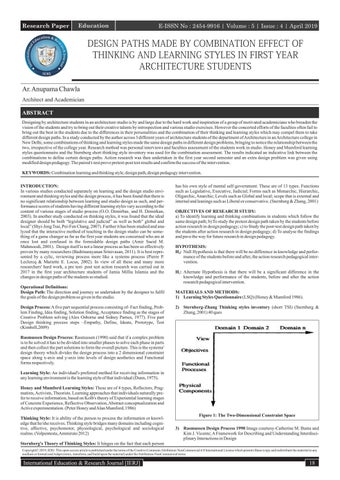
Rasmussen Design Process: Rasmussen (1990) said that if a complex problem is to be solved it has to be divided into smaller phases to solve each phase in parts and then collect the part solutions to form the overall picture. This is the systems' design theory which divides the design process into a 2 dimensional constraint space along x-axis and y-axis into levels of design aesthetics and Functional forms respectively. Learning Style: An individual's preferred method for receiving information in any learning environment is the learning style of that individual (Dunn, 1975). Honey and Mumford Learning Styles: These are of 4 types, Reflectors, Pragmatists, Activists, Theorists. Learning approaches that individuals naturally prefer to receive information, based on Kolb's theory of Experiential learning stages of Concrete Experience, Reflective Observation, Abstract conceptualization and Active experimentation. (Peter Honey and Alan Mumford, 1986) Thinking Style: It is ability of the person to process the information or knowledge that he/she receives. Thinking style bridges many domains including cognitive, affective, psychomotor, physiological, psychological and sociological realms. (Volpentesta, Ammirato 2012)
Figure 1: The Two-Dimensional Constraint Space 3) Rasmussen Design Process 1990 Image courtesy-Catherine M. Bums and Kim J. Vicente; A Framework for Describing and Understanding Interdisciplinary Interactions in Design
Sternberg's Theory of Thinking Styles: It hinges on the fact that each person Copyright© 2019, IERJ. This open-access article is published under the terms of the Creative Commons Attribution-NonCommercial 4.0 International License which permits Share (copy and redistribute the material in any medium or format) and Adapt (remix, transform, and build upon the material) under the Attribution-NonCommercial terms.
International Education & Research Journal [IERJ]
18
Research Paper
E-ISSN No : 2454-9916 | Volume : 5 | Issue : 4 | April 2019
4) Action Research by the author: Pedagogical Approach to cater to all the combination types, Reflector-Pragmatists, Activists-Theorists on global –local level along with Legislative-Judicial component of studio exercises given.
4.
Chart 4: Pragmatist learning- Legislative+local Thinking
Design Path
5.
Chart 5: Reflector learning-Judicial-global Thinking
Design Path
METHODOLOGY: Quasi-experimental Method. One Random sampling Group Pretest- posttest assessments done by co-faculties of the design studio for assessment and correlation of 10 students out of 40 students. Pretest Assessment done on Group of 3 Small submissions given: Submission Given of Design of a Toilet, College Campus Gate design and Kitchen Design. Post-test Assessment done on Pedagogical initiative Of an Action research intervention. Submission Given: Design of personal Room/Space- requirements-Sleeping/ Study/ Storage/ Leisure spaces. Context can be any place visited by you. Submission stages: 1. Collage of ideas with emphasis on overview (context) and details (items in room) with dimensions sketches of designed individual things in room. 2.
Functional zoning of usable and distinguished spaces, anthropometric sheet of isometric view, plans, elevations of furniture etc.
3.
Double line diagram of plans, sections and elevations of personal space/room with dimensions/details.
RESULTS AND DISCUSSION: Pretest- Posttest Design Path Results of 5 typical combination types: 1.
Chart 1: Reflector learning-Executive+Local thinking
Design Path DISCUSSIONS: It can be clearly seen the shift in design path that each combination of learning and thinking style takes after the pedagogical action research. The design path becomes linear and symmetric about the “x” and “y” axis causing the student to focus on the global and local aspects as well as maintain a legislative and judicial path, reaching the design goal faster and more competently. The stage wise performances of the students were also assessed using formative in-studio assessments of the co-faculties. Further a paired t-test was performed on their submission performance marks. Table 1: Comparison of the mean performance of the pretest and posttest assessments of the student sampling (n=10) Performance
2.
Chart 2: Reflector learning- Judicial+ local thinking
Design Path
Frequency
Mean value Mean “t”-test of marks Difference stat
Pretest marks
10
7
Posttest marks
10
8.5
1.5
9.3
“t” crit, α=0.025 2.26
Table 1 shows that the t-crit is lesser than and not equal to the t- test stat. Hence the null Hypothesis H0 is rejected that there is no significant difference in the mean performances of the student sampling. Paired t-test value shows a significant difference. There is a mean difference of 1.5 in the performance assessment. The alternate Hypothesis H1”there will be a significant difference in the knowledge and performance of the students, before and after the action research pedagogical intervention” is supported.
3.
Chart 3: Reflector learning- Legislative+local thinking
Design Path
CONCLUSIONS: There is a significant change in design path approach in all the candidates after the pedagogical Action research. The assessments of the performances of the students was done by a group of co-faculties. Total study was done over a period of 3-4 months. This is important because it shows the raise in class competency in results after their individual differences in learning and thinking styles have been addressed to make uniform overall progress. Teachers and academicians, who have understood this combination competency have raised the bar in their respective classes. However for further research, different design disciplines should be further studied and a uniform learning and thinking styles combination test should be researched and evolved for the design fraternity. REFERENCES:
19
1.
Adedapo A. Oluwatayo, Samuel O. Olademehin, 2016; Impact of the Architectural Design Process on students' performance in design studio projects; Published in Covenant University (NIGERIA)
2.
AMIR SAEID M. MAHMOODI, 2001; The Design process in Architecture-a pedagogic approach using interactive thinking; Published in THE UNIVERSITY OF LEEDS, UK
3.
Antonio P.Volpentesta, Salvatore Ammirato, Francesco Sofo, January 2012; Thinking Style Diversity and Collaborative Design Learning; published in International Journal of Engineering Education 28(4):948 – 958
4.
Aruna Venkatesh, 2011; A Study on the Revelation of Design Students Thinking Styles
International Education & Research Journal [IERJ]
Research Paper
E-ISSN No : 2454-9916 | Volume : 5 | Issue : 4 | April 2019
in Reflective Journals; Published in Hong Kong Polytechnic University. 5.
Ashraf M. Soliman, 2017; Appropriate teaching and learning strategies the architectural design process in pedagogic design studios; published by Elsevier.
6.
Badrinarayanan Srinivasan, 2011; Application of Kolb's Experiential Learning Theory to Teaching Architectural Design Principles; Published: DESIGN PRINCIPLES AND PRACTICES: AN INTERNATIONAL JOURNAL
7.
Dr. Eman Sabry Abdellatif Abo Wardah, 2016; Design Process & Strategic Thinking in Architecture; Published in International Conference on Architecture and Civil Engineering
8.
Ellina Yukhina, 2007; Cognitive Abilities & Learning Styles in Design Processes and Judgements of Architecture Students; Published in- Univ of Sydney
9.
Halime Demirkan, 2016; An Inquiry into the Learning-style and knowledge-building preferences of interior architecture students; published in Elsevier
10. Nik Lukman Nik Ibrahim, 2012; Learning in Architecture Design Studio; Published in Elsevier 11. O.O. Demirbas¸ and H. Demirkan, 2003; Focus on Architectural Design Process through learning styles; Published in Elsevier 12. Pierre P. LECLERCQ & Mariette E. LOCUS, 2002; Representation of an Architectural Design Process; Published in INTERNATIONAL DESIGN CONFERENCE DESIGN 2002 13. Shyi-Jeng Tsai, Pei-Fen Chang, 2007; A Study on the Roles of the Thinking Styles in the Design Behaviors; Published in INTERNATIONAL CONFERENCE ON ENGINEERING DESIGN, ICED'07
International Education & Research Journal [IERJ]
20