Research Paper
Commerce
E-ISSN No : 2454-9916 | Volume : 5 | Issue : 12 | Dec 2019
PROFITABILITY STATEMENT OF COMMERCIAL BANKS IN ODISHA : AN ANALYSIS 1
Dr. Sudhansu Sekhar Nayak | Mr. Prasenjeet Sarangi 1 2
2
Lecturer in Commerce, R.N.College, Dura, Berhampur-10, Ganjam, Odisha, India. P.G.T. (Commerce), Sai Valley World School, Vedavyasa, Rourkela, Odisha, India.
ABSTRACT The main aim of paper dissertation is to know the development performance of commercial bank in odisha. Orissa has typically been considered a backward state till some time back. Now it rules the A Commercial bank is a type of Bank / Financial Institution that provides services such as accepting deposits, making business loans, and offering basic investment products. "Commercial bank" can also refer to a bank, or a division of a large bank, which more specifically deals with deposit and loan services provided to corporations or large/middle-sized business - as opposed to individual members of the public/small business - Retail banking, or Merchant banks. The general role of commercial banks is to provide financial services to general public and business, ensuring economic and social stability and sustainable growth of the economy. In this respect, "credit creation" is the most significant function of commercial banks. While sanctioning a loan to a customer, they do not provide cash to the borrower. Instead, they open a deposit account from which the borrower can withdraw. In other words, while sanctioning a loan, they automatically create deposits, known as a “credit creation from commercial banks”. *Commercial banks accept various types of deposits from public especially from its clients, including saving account deposits, recurring account deposits, and fixed deposits. These deposits are payable after a certain time period *Commercial banks provide loans and advances of various forms, including an overdraft facility, cash credit, bill discounting, money at call etc. They also give demand and term loans to all types of clients against proper security. KEYWORDS: Dimension, Indicator, Hierarchy, Client, Empathy, Responsive. INTRODUCTION: Commercial banks, like any other type of bank, are subject to keep Bank reserves in their respective Central banks. Bank reserves or "central bank reserves" are banks' holdings of deposits in accounts with their central bank (for instance the European Central Bank or the Federal Reserve, in the latter case including federal funds), plus currency that is physically held in the bank's vault ("vault cash"). Some central banks set minimum reserve requirements, which require banks to hold deposits at the central bank equivalent to at least a specified percentage of their liabilities such as customer deposits. Even when there are no reserve requirements, banks often opt to hold some reserves — called desired reserves— against unexpected events such as unusually large net withdrawals by customers
or bank runs. OBJECTIVES OF THE STUDY: Commercial Bank During the workshop held with bankers to discuss the operational issues in implementation of interest subvention scheme, it transpired that 17 commercial banks and 2 RRBs have submitted claims to Nodal Bank (Canara Bank) over and above 7% interest to WSHGs. 12 commercial banks have submitted claims for 3% NRLM interest subvention for prompt payee WSHGs in category I districts. Concerned banks as well as other commercial banks and both the RRBs were advised to submit 2% OLM interest subvention claims immediately to Nodal Bank (UCO Bank), Odisha Government, Secretariat Branch.
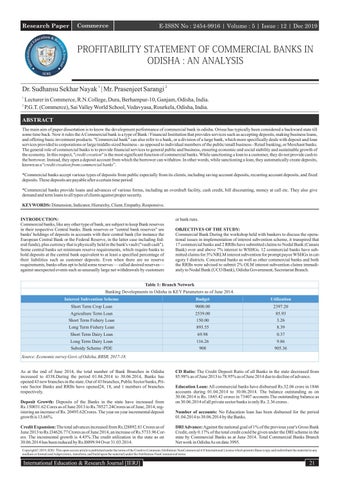
Table 1: Branch Network Banking Developments in Odisha in KEY Parameters as of June 2014. Interest Subvention Scheme
Budget
Utilization
Short Term Crop Loan
9000.00
2397.20
Agriculture Term Loan
85.93
Short Term Fishery Loan
2539.00 150.00
Long Term Fishery Loan
893.55
8.39
Short Term Dairy Loan
69.98
0.37
Long Term Dairy Loan
116.26
9.86
Subsidy Scheme -PDE
908
905.36
3.26
Source: Economic survey Govt. of Odisha, BBSR, 2017-18. As at the end of June 2014, the total number of Bank Branches in Odisha increased to 4338.During the period 01.04.2014 to 30.06.2014, Banks has opened 43 new branches in the state. Out of 43 branches, Public Sector banks, Private Sector Banks and RRBs have opened24, 18, and 1 numbers of branches respectively.
CD Ratio: The Credit Deposit Ratio of all Banks in the state decreased from 85.98% as of June 2013 to 78.95% as of June 2014 due to decline of advance. Education Loan: All commercial banks have disbursed Rs.32.06 crore in 1846 accounts during 01.04.2014 to 30.06.2014. The balance outstanding as on 30.06.2014 is Rs. 1845.42 crores in 73407 accounts.The outstanding balance as on 30.06.2014 of all private sector banks is only Rs. 2.36 crores .
Deposit Growth: Deposits of the Banks in the state have increased from Rs.150031.62 Cores as of June 2013 to Rs.70527.24Crores as of June, 2014, registering an increase of Rs. 20495.62Crores. The year on year incremental deposit growth is 13.66%.
Number of accounts: No Education loan has been disbursed for the period 01.04.2014 to 30.06.2014 by the Banks.
Credit Expansion: The total advances increased from Rs.l28892.81 Crores as of June 2013 to Rs.l34626.77 Crores as of June 2014, an increase of Rs.5733.96 Corers. The incremental growth is 4.45%.The credit utilization in the state as on 30.06.2014 has been reduced by Rs.l0099.94 Over 31.03.2014.
DRI Advance: Against the national goal of 1% of the previous year's Gross Bank Credit, only 0.17% of the total credit could be given under the DRI scheme in the state by Commercial Banks as at June 2014. Total Commercial Banks Branch Net work in Odisha As on date 3995.
Copyright© 2019, IERJ. This open-access article is published under the terms of the Creative Commons Attribution-NonCommercial 4.0 International License which permits Share (copy and redistribute the material in any medium or format) and Adapt (remix, transform, and build upon the material) under the Attribution-NonCommercial terms.
International Education & Research Journal [IERJ]
21
Research Paper
E-ISSN No : 2454-9916 | Volume : 5 | Issue : 12 | Dec 2019 Table 2: Major Key indicators (Commercial Banks)
Parameter
30.06.2012
30.06.2013
30.06.2014
Variation of growth over June 2013 in %
Variation of growth over June 2014 in %
No. of branches
3270
3501
3995
494
14.11
Deposit
127891.50
122592
164101.42
41509.42
33.05
Advances
96723.43
122592.08
127177.12
4585.04
3.74
CD Ratio
75.63
84.89
77.50
-7.39
****** *******
Investment
1192.69
1288.74
1119.79
-168.95
Credits-Investment to Deposit Ratio
76.56
82.23
78.18
-4.05
****
Priority Sector advances
36650.04
40283.46
44508.58
4225.12
10.48
Agril. advances MSME advances
15874.10 14171.53
18262.02 17130.69
20572.19 19322.06
2310.17 2191.37
12.65 12.79
Advance to Weaker section
8107.05
10323.19
11498.39
1175.20
11.38
Source: Economic survey Govt. of Odisha, BBSR, 2017-18.
Table 3: Major ratios (commercial bank) Sl. No
Ratios in %
RBI stipulation
As on 30.06.2012
As on 30.06.2013
As on 30.06.2014
1
CD Ratio
60
70.25
78.95
77.50
2
P.S. Advances
40
57.06
57.97
57.63
3
Agril. Advance
18
24.17
30.23
30.98
4
Weaker Section advance to P.S. Advance
25
22.88
32.87
34.06
Source: Economic survey Govt. of Odisha, BBSR, 2017-18.
LITERATURE REVIEW: Literature Review section comprises the literature on performance of banks, dimensions of the performance of banks as; customer satisfaction, employee efficiency & satisfaction, corporate social responsibility and performance indicator for measuring the financial aspect, and the analytical hierarchy process (AHP) model. Survey research approach' is followed for the collection of primary data and a direct personal interview of the respondent is conducted by filling up a proper arranged questionnaire form for the communication purpose. ROLE OF COMMERCIAL BANKS: The general role of commercial banks is to provide financial services to general public and business, ensuring economic and social stability and sustainable growth of the economy. In this respect, "credit creation" is the most significant function of commercial banks. While sanctioning a loan to a customer, they do not provide cash to the borrower. Instead, they open a deposit account from which the borrower can withdraw. In other words, while sanctioning a loan, they automatically create deposits, known as a "credit creation from commercial banks". Primary functions: Commercial banks accept various types of deposits from public especially from its clients, including saving account deposits, recurring account deposits, and fixed deposits. These deposits are payable after a certain time period Commercial banks provide loans and advances of various forms, including an overdraft facility, cash credit, bill discounting, money at call etc. They also give demand and term loans to all types of clients against proper security. Supervision Bank: Central banks are oversee the commercial banking system of their respective countries Reserves: Commercial banks, like any other type of bank, are subject to keep Bank reserves in their respective Central banks. Bank reserves or "central bank reserves" are banks' holdings of deposits in accounts with their central bank (for instance the European Central Bank or the Federal Reserve, in the latter case including federal funds), plus currency that is physically held in the bank's vault ("vault cash").Some central banks set minimum reserve requirements, which require banks to hold deposits at the central bank equivalent to at least a specified percentage of their liabilities such as customer deposits. Even when there are no reserve requirements, banks often opt to hold some reserves- called desired reserves-against unexpected events such as unusually large net withdrawals by customers or bank runs. Ÿ
I.
Core products and services: Accepting money on various types of Deposit accounts
Ÿ
Lending money in the form of Cash: by overdraft, instalment loan etc.
Ÿ
Lending money in Documentary form: Letters of Credit, Guarantees, Perfor-
22
mance bonds, securities, underwriting commitments and other forms of offbalance sheet exposure. Ÿ
Inter- Financial Institutions relationship
Ÿ
Cash management
Ÿ
Treasury management
Ÿ
Private Equity financing
Ÿ
Issuing Bank drafts and Bank cheques
Ÿ
Processing payments via telegraphic transfer, EFTPOS, internet banking, or other Traditionally, large commercial banks also underwrite bonds, and make markets in currency, interest rates, and credit-related securities, but today large commercial banks usually have an investment bank arm that is involved in the aforementioned activities.
II. Other functions: Along with core products and services, commercial banks perform several secondary functions. The secondary functions of commercial banks can be divided into agency functions and utility functions. III. Agency functions include: 1. To collect and clear cheques, dividends and interest warrant. 2.
To make payments of rent, insurance premium, etc.
3.
To deal in foreign exchange transactions.
4.
To purchase and sell securities.
5.
To act as trustee, attorney, correspondent and executor.
6.
To accept tax proceeds and tax returns.
EMPLOYEE EFFICIENCY & SATISFACTION: Banking sector is highly intellectually intensive, where the main asset of the banks is its human capital, as the expenses incurred on employees are the major operating expense in the banking Sector. The human capital is a key intellectual and strategic asset which increases the efficiency of banks. Performance of the banks depends upon the efficiency of its human resources. High Level of Human Capital Efficiency (HCE) leads to the high performance of the banks efficient employees is not a sufficient criterion to measure the performance of the banks. It should also be ensured that employees are efficient and satisfied both, because the dissatisfaction of employees may turn their efficiency into inefficiency at any time. Employee satisfaction is crucial in achieving quality and profitability in the
International Education & Research Journal [IERJ]
Research Paper
E-ISSN No : 2454-9916 | Volume : 5 | Issue : 12 | Dec 2019
service industry. Employee satisfaction leads to higher service quality and it influences customer satisfaction directly. Service quality and customer satisfaction eventually lead to financial gains. DISCUSSION: It is clear from the respondents regarding the overall satisfaction or dissatisfaction with the SBI banking services quality, that most of the customers, i.e. About more than 75% are not satisfied with the banking service quality provided by the bank, while very less nearly 30% customers are satisfied only. Important is that, customers who were dissatisfied consider the responsiveness and empathy to be more important than any other service quality dimensions. Next to responsiveness they are considering empathy as one of the important factor also for the banking Performance. However, on over all basis of the services quality the banking performance is not so much good as observed from the survey. CONCLUSION: Commercial Bank in odisha has achieved all national parameters. The public sector Bank and privet sector bank having low CD ratios below 60% are given below. The dissatisfied customers find responsiveness and empathy dimension as the twin concept that is lacked by the bank, so far as the satisfied customer are concerned there are exist a long gap between the expected service quality provided by the bank while very less nearly 30% customers are satisfied consider the responsibility and empathy to be more imported is that customers who were dissatisfied consider the responsiveness and empathy to be more important factor also for the banking performance. However on over all basic of the service quality the banking performance is not so much good as observed from the survey. REFERENCES: 1.
Brunner, Allan D.; Decressin, Jorg; Hardy, Daniel C. L.; Kudela, Beata (2004-06-21). "Germany's Three-Pillar Banking System: Cross-Country Perspectives in Europe". International Monetary Fund. ISBN 1-58906-348-1. ISSN 0251-6365. Abstract
2.
Khambata, Dara (1996). The practice of multinational banking: macro-policy issues and key international concepts (2nd ed.). New York: Quorum Books, p. 320. ISBN 9780-89930-971-2.
3.
Commercial Banks directory and guidelines Commercial Banks.
4.
Y. Chandra Shekhar "Indian banking challenging ahead" Chartered financial analyst.
5.
Parasuraman, A., Berry, L. L. and Zeithaml, V. A. (1988) SERVQUAL: A multiple -
6.
Item scale for measuring consumer perceptions of service quality. Journal of Retailing.
7.
Parasuraman, A.. Berry, L. L. and Zeithaml, V. A. (1993) More on Improving Service Quality Measurement. Journal of Retailing. 69(1), 140.
8.
Suh, Y., and Pedersen, P. (2010) Participants' Service Quality Perceptions of Fantasy Sports Websites: The Relationship Between Service Quality, Customer
9.
Satisfaction, Attitude, and Actual Usage. Sport Marketing Quarterly. 19(2), 78-87.
10. Avkiran, K, N. (1994) Developing an instrument to measure customer service quality in branch banking. The International Journal of Bank Marketing. 12(6), 10-19. 11. Bahia, K. and Nantel, J. (2000) A reliable and valid measurement scale for the perceived service quality of banks. The International Journal of Bank Marketing. 18(2), 84.
International Education & Research Journal [IERJ]
23