Research Paper
Medical Science
E-ISSN No : 2454-9916 | Volume : 4 | Issue : 11 | Nov 2018
AN ALTERNATIVE EXPLANATION OF REDSHIFT OF FAR GALAXIES LIGHT 1, 2
Jalil Omidian 1 2
Department of ophthalmology, Kermanshah Univercity of Medical Sciences. Department of ophthalmology, Baghiyyatollah Univercity of Medical Sciences.
ABSTRACT The far galaxies light has redshifts, so increasing in their distance led to increase in the redshift. According to the Doppler Effect, the redshift observation was interpreted as the galaxies and other components of the universe are moving away from each other quickly In this paper, a hypothesis has considered that can be explain the redshift without assuming the galaxies moving away from each other. Based on the Big Bang theory, the universe and the mass and energy densities were denser in the past. By regarding the general relativity theory, it is hypothesized that mass and energy densities caused space-time contraction in the past. Because of the more of the observed light are related to the past, and so related to the higher densities of mass and energy of faraway galaxies, resulting in further contraction and shortening of space-time. Since the observed light has been produced of far cosmic regions and it belonged to the past and shorter time relative to now due to the spacetime contraction in the past. However, when it reaches us, it is observed over a longer period of time because of the time expansion that is why the wavelength of the observed light extend to the higher wavelength. Generally, the longer the distance, the greater the redshift, because the light belongs to the further past. INTRODUCTION: In astronomical observations, the light received from far galaxies shifts to the higher wavelength (redshift) (Reddy et al., 2011). An increasing in the distance of galaxies led to increase the redshift. These observations are interpreted as galaxies receding based on the Doppler Effect, and the receding rate increases by increasing their distance from us (Mabkhout, 2016). At the same time, it has been assumed that there is a special kind of energy called dark energy that provides the thrust force, which has not yet been observed directly. Finally, scientist's belief that the components of the universe are moving away progressively from each other, and even gravity cannot stop this process (Friedman, 2014; Berti et al., 2015). Eventually, the whole of the universe will become empty, cold, and dark. In this paper, a hypothesis has explained alternatively the redshift of the far galaxies light. This hypothesis is arising from the general relativity theory. Based on this hypothesis, it is not necessary to consider the redshift light of faraway galaxies for explain the universe receding from each other. In general relativity theory, Einstein suggested that space-time becomes curved around heavy objects. This curvature causes the contraction of space-time, which results in observing the time expansion phenomenon for an observer that located far from the heavy mass. For this observer, the time interval between physical events will be longer in the vicinity of heavy masses. In other words from observer's view, watches are working slower near heavy-weight mass. In fact, general relativity theory trying to explain for two different points in mass and energy densities, the time-space will be different from each other (Turyshev, 2008; Pavlovic, 2017; Kragh, 2014). The accuracy of this theory has been shown in empirical observations. However, if we consider the universe as an integrated part, it is possible that the density of mass and energy varies over different periods of time. Therefore, based on the theory of relativity, there should be the same difference in the spacetime quantity of different time periods. For example, according to the Big Bang theory, the universe began by exploding a very small point to the size of the atomic nucleus or smaller than that, and then expanded and reached the current dimension (Gowan, 2011). Therefore, amount of mass and energy in the universe has been constant. So if we go back to the closer the Big Bang, the mass and energy densities are increased. According to the theory of general relativity, the mass and energy densities cause the contraction and shortening of time-space toward present time. Consequently, that densities of energy and mass should be close to the infinity at the start time of the Big Bang. The space-time quantity was close to zero, and practically there was no time-space. By releasing the energy, the expansion of the universe has begun and the space-time has created. In addition, by expanding the universe, the space-time quantity has increased to its current measurement. Therefore, there is an inverse relationship between mass (and energy densities) and space-time quantity. By considering the above discussion, the space-time quantity of the world is much higher compared to the past. Consequently, the light from far away universe reaches us with delayed, it which belongs to the past. That is why the time expansion occurs when it is viewed by an observer on the earth, which causes the redshift of its wavelength. METHOD AND RESULT: Space-time is a unique concept that refers to a unique physical reality (Fock, 2015). Space in three dimensions and time in one dimension are two aspects unique concept. Consequently, its quantity is unit and it can be expressed as the unit of space-time in meter or the time unit in second. Regardless of the unit of
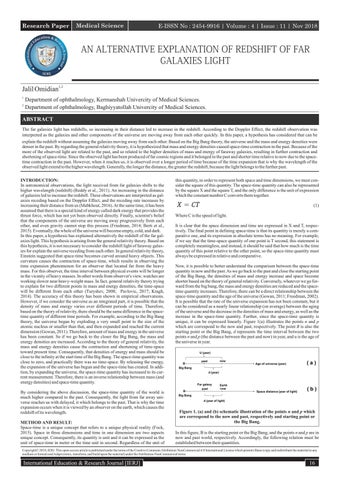
this quantity, in order to represent both space and time dimensions, we must consider the square of this quantity. The space-time quantity can also be represented by the square X and the square T, and the only difference is the unit of expression which the constant number C converts them together. (1) Where C is the speed of light. It is clear that the space dimension and time are expressed in X and T, respectively. The final point in defining space-time is that its quantity is merely a comparative one, and its expression in absolute terms has no meaning. For example, if we say that the time-space quantity of one point is T second, this statement is completely meaningless, and instead, it should be said that how much is the time quantity of this point relative to the other point, so the space-time quantity must always be expressed in relative and comparative. Now, it is possible to better understand the comparison between the space-time quantity in now and the past. As we go back to the past and close the starting point of the Big Bang, the densities of mass and energy increase and space become shorter based on the theory of general relativity. Conversely, whatever we go forward from the big bang, the mass and energy densities are reduced and the spacetime quantity increases. Therefore, there can be a direct relationship between the space-time quantity and the age of the universe (Gowan, 2011; Freedman, 2002). It is possible that the rate of the universe expansion has not been constant, but it can be considered as a nearly linear relationship (on average) between the aging of the universe and the decrease in the densities of mass and energy, as well as the increase in the space-time quantity. Further, since the space-time quantity is unique, it can be expressed linearly. Figure 1(a) illustrates the points n and p which are correspond to the now and past, respectively. The point B is also the starting point or the Big Bang, d represents the time interval between the two points n and p (the distance between the past and now) in year, and u is the age of the universe in year.
Figure 1. (a) and (b) schematic illustration of the points n and p which are correspond to the now and past, respectively and starting point or the Big Bang. In this figure, B is the starting point or the Big Bang, and the points n and p are in now and past world, respectively. Accordingly, the following relation must be established between their quantities.
Copyright© 2018, IERJ. This open-access article is published under the terms of the Creative Commons Attribution-NonCommercial 4.0 International License which permits Share (copy and redistribute the material in any medium or format) and Adapt (remix, transform, and build upon the material) under the Attribution-NonCommercial terms.
International Education & Research Journal [IERJ]
16
Research Paper
E-ISSN No : 2454-9916 | Volume : 4 | Issue : 11 | Nov 2018 (2) (6)
and are the space-time quantity of the universe in now and the past, respectively, d is years earlier than now. The above relation shows the ratio of the space-time quantity in two points n and p based on their time interval. Also, this quantity can be shown on the basis of the space distance. When the observer of the current time wants to observe the far distances of the universe, the light of the mentioned points reaches the observer with a delay; as a result, the reached light belongs to the past. As an example, when an observer on the earth wants to observe a galaxy in the distance d light-year from the earth, in fact, the earth is the point n and the far galaxy is the point p in Figure 1 (b), which is d years earlier than n and u is the age of the world. Therefore, the same relations (1) are satisfied for them. It is noteworthy that all parts of the current universe, which are in the same distance from the Big Bang, are in the same age. Thus, they have an equal spacetime quantity, and the space-time quantity of the point n is equal to the point p. However, since the light received from p is due to the time delay in the past, the time quantity which determines the physical property of that light, it is different from the point n and equation (2) holds true. Furthermore, because the age factor of the universe (u), which is related to the now world, equation (2) has an inaccuracy factor which has increased by d years since the light begins to travel from point p to reach the point n, this change must be considered a more accurate estimate of the age of the universe. Because the age of the universe varies from u to u+d during d years, the average of this value should be considered, i.e. half the sum of u and d should be take into account in equation (1) instead of u; next, the equation (2) should be given as follows:
Where Lp represents the wavelength produced at the point p (far galaxy) and Ln indicates the wavelength of the same light on the earth (point n). Equation (6) shows the redshift of light observed on the earth from a far galaxy. Based on the assumption of galaxies receding and recognizing the redshift of the light received from galaxies, as well as their distance, their speed is calculated according to equation (6) and it was experimentally found that for each mega parsec (3.6×10⁶ light years), depending the distance between these galaxies from the earth, the speed is 70 km/h, which is known as the Hubble constant, meaning that if the distance between the galaxy (point p) from the earth (point n) is equal to d light years, then, according to the receding assumption, its speed will be equal to 70 km/h for each mega-parsec. In the other words, V=70d / (3.6×10⁶ ) and equation (6) leads to:
(8)
If the age of the universe is 14×109, equation (6) will be the same as equation (5). Mathematically, the redshift of the far galaxy light can be obtained in a completely same procedure with the assumption of a difference in the space-time quantity of the past relative to now, as well as receding of these regions. In fact, Hubble's constant has an inverse relation with the age of the universe, which is equal to (Bolte & Hogan, 1995; Freedman, 2000):
(3) (9) Therefore, the space-time quantity of the point n (the observer on the earth) is increased relative to the point p (the galaxy that is away from the earth by d lightyears), which means that the time interval of each physical event at the point n relative to the point p increases by equation (4): (5) Where ∆tn represents the time interval of a particular physical event at the point n (earth) and ∆tp indicates the time interval of that physical event at the point p (far galaxy). Accordingly, we consider a specified light with a wavelength of Lp that is generated in a galaxy at a distance d light-years from the earth (i.e., point p), during the time interval of tp. When this light reaches the earth after d light years (point n), it is observed in the time interval tp. If the wavelength of this light is equal to Ln on the earth, due to the increase of the time interval on the earth, the observed wavelength of the point p (far galaxy) increases in relation to equation (5): (5) where ∆tp represents the time interval of the generated light in the far galaxy (point p), ∆tn indicates the time interval of the same generated light in the earth (point n), LP shows the wavelength produced at the point p (far galaxy), and Ln is the wavelength of the same light on the earth (point n). Equation (5) shows the redshift of the observed light from a galaxy which is at a distance of d light years away from the earth, and is obtained based on the hypothesis of this paper. In the above equation, u is the age of the universe and the above equation clearly shows that the more the d or the distance of the galaxy's distance from the earth, the greater the redshift of the observed light. In order to verify the accuracy of equation (5), it is sufficient to compare it with the classic relativistic Doppler equation and represent that both equations are similar because the accuracy of the relativistic Doppler equation is shown in empirical observations. The reason for the redshift of far galaxies is assumed to be their receding from the earth at a velocity of V km/h. Hence based on relativistic Doppler equation is that, it calculates the change in the wavelength of the light received from these galaxies based on the Doppler effect and the special relativity (because of the change in the time interval due to the receding speed) (Davis et al., 2004; Binney & Merrifield, 1998). If Ln is the wavelength of the light on the earth (point n) and Lp is the wavelength of the same light in far galaxy (point p), based on the assumption that the galaxy recedes from the earth at a velocity of V km/h, we have:
17
In this equation, C represents the speed of light in kilometer per second, d indicates the distance in km and U is the age of the universe in year, which indicates that the greater the age of the universe and the distance d, the higher the Hubble's constant becomes. As a result, the explanation of the redshift of far galaxies light is possible with both the assumption of their receding and the reduction of the space time, because of their belongingness to the past. However, as we will see in the following, only one of these assumptions can be correct. DISCUSSION: As explained, the description for the redshift of far galaxies light is possible with both hypotheses and the same results can be explained by assuming the galaxies receding, based on the Doppler effect, the theory of special relativity, and the hypothesis of this paper which is the reduction of the space-time quantity of the past relative to now. In either case, the results and equations represented the same redshift and consistent results with the empirical observations. Although both assumptions cannot be correct simultaneously and inevitably, one of them is correct. The author thinks that the hypothesis of this paper may have more power for acceptance because it is more compatible with the foundations of the theory of general relativity and our current knowledge of the world. According to today's theory, the expansion of the universe from a very small point to the current dimensions and the densities of mass and energy have been higher in the past than today. It caused the shortening and contraction of space-time in past relative to now. Therefore, it is not unreasonable to think that far galaxies light that actually belongs to the past, when it reaches us, as the observers of the now world, its wavelength increases due to the time expansion. While in order to explain the accelerated universe receding, there is a need to a huge energy that is much more than the world's known energy and it is very difficult to prove that such energy exists based on the current knowledge? However, the hypothesis of this paper believes to the expansion of the universe, an expansion that is the result of the release of initial energy from the Big Bang. Therefore, it has led to the world reach its current extent from a very small point. It should be noted that this expansion does not mean the receding of the components of the universe from each other, rather the space-time dimensions have increased in the form of a generalized and integrated. Thus, the components of the universe have not changed in terms of space or time dimension. As such, an observer anywhere in the world, which observes any point in the now world (not the past), does not see any changes. In other words, it is true that the world is growing, but we cannot understand this enlargement. Because of the space-time quantity is the same in all parts of the world; it is also true that the dimensions of the past world are less than that now, but the observer of the past world perceives the dimensions of the world the same as the observer of the now world. At that time, the dimensions of space-time quantity have been the same in all parts, and therefore, the dimensions of the universe are equally increasing (or decreasing). Consequently, regardless of the position in the now or in the past world, the observer fails to see a change in the dimensions of the universe as receding (or getting closer). More precisely, observing the change and movement by the observer is when there is a difference between the space-time of the observer and the space-
International Education & Research Journal [IERJ]
Research Paper
E-ISSN No : 2454-9916 | Volume : 4 | Issue : 11 | Nov 2018
time of the point which he/she observes, while all parts of the universe change equally in the expansion of the universe. Therefore, the observer, wherever he/she is, cannot see the change as receding (in the expansion of the universe) or getting closer (in the contraction of the universe). This is contrary to the local space-time difference of two points in which, due to the difference in mass and energy accumulation in two points of space, the spacetime difference is created, and based on general and special relativity, this difference causes movement (gravity and uniform movement) by one of the observers of these points, which will be seen as the movement of planets, objects, stars and galaxies close to each other. In fact, in the expansion of the universe (or the contraction of the universe), the space-time difference is between two intervals or two periods of time, and in the observed displacements of astronomical objects relative to each other, the spacetime difference is between two parts or two points of space at a time interval. According to the above explanations, it is perceived that although the expansion of the universe causes the redshift of far galaxies light, this shift is not due to their receding, but because this light was created in the past when the space-time was smaller than that now due to the higher density of the mass and energy. Since the redshift is observed in the current observation of any point in the universe, it can be concluded that the universe is in expanding status which is due to the release of the original energy from the Big Bang and apparently the gravity of the whole universe has not been dominated it. However, it is possible that gravity will eventually lead to the universe begin to contract. If this happens, mass and energy become congested, and the space-time contraction begins. In this case, the far parts of the universe which are in past relative to us, are still expanding and have greater space-time than ours. Finally, the observed light shifts to the blue. CONCLUSION: The far galaxies light shifts to the red just because it belongs to the past when the space-time quantity has been less than that now due to the mass and energy density. Generally, the longer the distances of these galaxies from us, they are related to further past. Therefore, their space-time will be reduced further and the observed redshift will be increased. REFERENCES: 1.
Berti, E., Barausse, E., Cardoso, V., Gualtieri, L., Pani, P., Sperhake, U., Stein, L.C., Wex, N., Yagi, K., Baker, T., Burgess, C.P., & Burgess, C. P. (2015). Testing general relativity with present and future astrophysical observations. Classical and Quantum Gravity, 32(24), 243001.
2.
Binney, J., & Merrifield, M. (1998). Galactic astronomy. Princeton University Press.
3.
Bolte, M., & Hogan, C. J. (1995). Conflict over the age of the Universe. Nature, 376(6539), 399.
4.
Davis, T. M., & Lineweaver, C. H. (2004). Expanding Confusion: common misconceptions of cosmological horizons and the superluminal expansion of the Universe. Publications of the Astronomical Society of Australia, 21(1), 97-109.
5.
Fock, V. (2015). The theory of space, time and gravitation. Elsevier.
6.
Friedman, M. (2014). Foundations of space-time theories: Relativistic physics and philosophy of science (Vol. 113). Princeton university press.
7.
Freedman, W. (2002). The expansion rate of the universe. Astronomy & Geophysics, 43(1), 1-
8.
Freedman, W. L. (2000). The Hubble constant and the expansion age of the Universe. Physics Reports, 333, 13-31.
9.
Gowan John, A. (2011). A Spacetime Map of the Universe: Implications for Cosmology and Inflation.
10. Kragh, H. (2014). Historical aspects of post-1850 cosmology. In AIP Conference Proceedings (Vol. 1632, No. 1, pp. 3-26). AIP. 11. Mabkhout, S. A. (2016). The Cosmological Redshift Manifests the Curvature and Interpreted as a Degree of Hyperbolicity of the Spacetime. Journal for Foundations and Applications of Physics, 3(1), 33-52. 12. Pavlovic, P., & Sossich, M. (2017). Cyclic cosmology in modified gravity. Physical Review D, 95(10), 103519. 13. Reddy, N., Dickinson, M., Elbaz, D., Morrison, G., Giavalisco, M., Ivison, R., Papovich, C., Scott, D., Buat, V., Burgarella, D., & Charmandaris, V. (2011). GOODSHerschel measurements of the dust attenuation of typical star-forming galaxies at high redshift: observations of ultraviolet-selected galaxies at z~ 2. The Astrophysical Journal, 744(2), 154. 14. Slipher, V. M. (1915). Spectrographic observations of nebulae. Popular astronomy, 23, 21-24. 15. Turyshev, S. G. (2008). Experimental tests of general relativity. Annual Review of Nuclear and Particle Science, 58, 207-248.
International Education & Research Journal [IERJ]
18