Research Paper
Education
E-ISSN No : 2454-9916 | Volume : 4 | Issue : 6 | June 2018
STUDENTS' PERCEPTION ON TEACHER BEHAVIOR AT COLLEGE LEVEL Joydip Golder Ph. D Research Scholar, Department of Education, Burdwan University, West Bengal. ABSTRACT The study sought to find out the relationship between how students perceive their teachers behavior. Stratified random sampling techniques were used 244 under graduate students studying at different college affiliated to Burdwan University, Burdwan, West Bengal. Students' Perception on teacher's behavior tool (SPTB) was used as tool for collecting data on students' perceptions on teacher behavior. A trial test of 40 students using split-half reliability test was carried out which yielded reliability coefficients of 0.72 for SPTB. Pearson Product Moment Correlation and t-statistics were used to answer the research questions and test the hypotheses. Findings show that the way students' perceive their teachers' in terms of knowledge of their subjects, personality, professional ethics ,communication ability, teaching methods and classroom management skills has a significant relationship with students' attitude towards subject. KEYWORDS: Teacher behavior, College, Perception. INTRODUCTION: Teaching is a very noble profession that shapes the character, caliber, and future of an individual. If the people remember me a good teacher, that will be the biggest honour for me. -A.P.J.Abdul Kalam. Great men of the world went through the hands of great teachers. Great teachers of the world turned the world upside down with their philosophies and great ideas. Teaching is one of the oldest professions. The Gurukula system where teachers interacted with students in an organized way. The teachers instructed the students in various disciplines, and the students did for their teachers. Education has been undergoing rapid change in the last several years. New modes of learning have been espoused and new communication techniques/strategies are being encouraged as alternative methods to the traditional classroom model. However, "the traditional view of education, a view that still prevails, holds that learners must submit themselves to teachers" (Menges, 1977, p.5.). Perception is considered to be a process that helps a person to become aware of things, situations and persons. "Perception" as the Oxford Dictionary suggests, can be classified as a mental impression, an intuitive understanding or insight of the way one may individually look at things in the world. It is more of a psychological process and can vary amongst individuals. The concepts dealing with the nature of individual are four. They are (i) individual difference; (ii) whole person; (iii) motivation and (iv) human dignity. From this particular point of view, the researcher had identified following objectives of the studyOBJECTIVES OF THE STUDY: i. To study college students’ perception on teacher’s behavior in respect of their gender. ii. To study college students’ perception on teacher’s behavior in respect of their age. iii. To find out whether there is significant difference between the Rural college and Urban college students in their perception on teacher’s behavior. HYPOTHESES OF THE STUDY: Following hypotheses were formulated in connection with the objectives stated in the present study: H01: There is no significant difference between boys and girls with regard to their perception on teacher’s behavior.
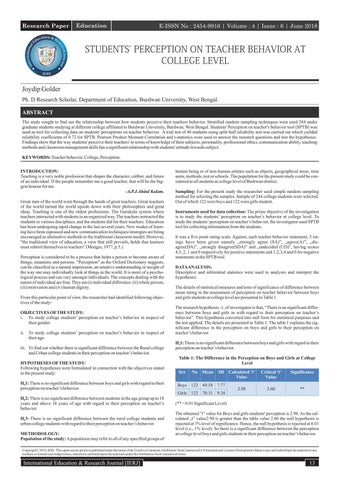
human being or of non-human entities such as objects, geographical areas, time units, methods, test or schools. The population for the present study could be considered as all students at college level of Budrwan district. Sampling: For the present study the researcher used simple random sampling method for selecting the samples. Sample of 244 college students were selected. Out of which 122 were boys and 122 were girls student. Instruments used for data collection: The prime objective of the investigation is to study the students’ perception on teacher’s behavior at college level. To study the students’ perception on teacher’s behavior, the investigator used SPTB tool for collecting information from the students. It was a five point rating scale. Against, each teacher behavior statement, 5 ratings have been given namely „strongly agree (SA)‟, „agree(A)‟, „disagree(DA)‟, „strongly disagree(SDA)‟ and „undecided (UD)‟, having scores 4,3, 2, 1 and 0 respectively for positive statements and 1,2,3,4 and 0 for negative statements in the SPTB tool. DATA ANALYSIS: Descriptive and inferential statistics were used to analyses and interpret the hypotheses: The details of statistical measures and tests of significance of difference between mean rating in the assessment of perception on teacher behavior between boys and girls students at college level are presented in Table 1. The research hypothesis -1, of investigator is that, “There is no significant difference between boys and girls in with regard to their perception on teacher’s behavior”. This hypothesis converted into null form for statistical purposes and the test applied. The details are presented in Table 1. The table 1 explains the significant difference in the perception on boys and girls to their perception on teacher’s behavior. H01: There is no significant difference between boys and girls with regard to their perception on teacher’s behavior. Table 1: The Difference in the Perception on Boys and Girls at College Level Sex
No
H03: There is no significant difference between the rural college students and urban college students with regard to their perception on teacher’s behavior. METHODOLOGY: Population of the study: A population may refer to all of any specified groups of
SD Calculated 't' Value
Boys 122 69.58 7.77 Girls 122
H02: There is no significant difference between students in the age group up to 18 years and above 18 years of age with regard to their perception on teacher’s behavior.
Mean
70.31 9.34
2.98
Critical 't' Value
Significance
2.60
**
(** = 0.01 Significant Level) The obtained ‟t‟ value for Boys and girls students' perception is 2.98. As the calculated „t‟ value2.98 is greater than the table value 2.60 the null hypothesis is rejected at 1% level of significance. Hence, the null hypothesis is rejected at 0.01 level (i.e., 1% level). So there is a significant difference between the perception at college level boys and girls students in their perception on teacher’s behavior.
Copyright© 2018, IERJ. This open-access article is published under the terms of the Creative Commons Attribution-NonCommercial 4.0 International License which permits Share (copy and redistribute the material in any medium or format) and Adapt (remix, transform, and build upon the material) under the Attribution-NonCommercial terms.
International Education & Research Journal [IERJ]
13
Research Paper
E-ISSN No : 2454-9916 | Volume : 4 | Issue : 6 | June 2018
ANALYSIS OF PERCEPTION ON TEACHER BEHAVIOUR BY THE COLLEGE STUDENTS' AGE WISE: The research hypothesis-2 of investigator is that, “There is no significant difference between college students of 18 years of age and above 18 years of age with regard to their perception on teacher behavior”. This hypothesis converted into null form for statistical purposes and the test applied. The details are presented in Table 2 and it explains the significant difference in the perception on teacher’s behavior on the basis of the age wise students.
Teacher Education for curriculum Renewal, NCERT publications, New Delhi, pp.6-8. J O U R N A L S: 8.
Rekha (2005), The Importance of Teacher Interpersonal Behavior for Secondary Science Students' Attitudes in Kashmir, Journal of Classroom Interaction, Vol..40, No .2, pp.5-19.
9.
Nachimuthu, K and Lakshamani. K (2006) “Students‟ Perception of their Teacher‟s Behavior”, Journal of Research and Reflection on Education, St.Xavier‟s College of Education, Palyamkottai, TN, Oct-Dec 2006, pp. 21-22 & 29.
H02: There is no significant difference between students in the age group up to 18 years and above 18 years of age with regard to their perception on teacher’s behavior. Table 2: The Difference in the Perception on Students in Respect of Their Age Age
No Mean
SD
Up to 18 Yrs 146 70.02 9.23 Above 18 Yrs 98
69.13 7.55
Calculated 't' Critical 't' Significant Value Value at 1% level 2.89
2.60
Significant
As the calculated „t‟ values 2.89 is greater than the table values 2.60; Hence the null hypothesis is rejected at 1% level of significance. The obtained ‟t‟ value for age wise students' perception is 2.89. As the calculated „t‟ value 2.89 is greater than the table value 2.60. So, the hypothesis is rejected at 0.01 level (i.e., 1% level). Hence, there is a significant difference between the perceptions on students with respect to their age wise in their perception on teacher behavior. ANALYSIS OF PERCEPTION ON TEACHER BEHAVIOUR BY THE COLLEGE AREA WISE: The research hypothesis-3, of investigator is that “There is no significant difference between the rural college students and urban college students with regard to their perception on teacher's behavior”. This hypothesis converted into null form for statistical purposes and the test applied. The details are presented in Table 3 and it explains the significant difference in the perception on teacher behavior on the basis of college area wise – Rural, Urban. H03: There is no significant difference between the rural college students and urban college students with regard to their perception on teacher's behavior. Table 3: The Difference in the Perception on Teacher Behavior by the College Area Wise Area
No
Mean
SD
Rural
147
70.01
9.22
Urban
97
69.12
7.55
Calculated 't' Value
Critical 't' Value
Significant at 1% level
2.87
2.60
Significant
The obtained ‟t‟ value for Boys and girls students' perception is 2.87. As the calculated „t‟ value2.87 is greater than the table value 2.60 the null hypothesis is rejected at 1% level of significance. Hence, the null hypothesis is rejected at 0.01 level (i.e., 1% level). So there is a significant difference in the perception on teacher behavior on the basis of college area wise – Rural, Urban. CONCLUSION OF THE STUDY: The teacher’s behavior does directly affect how pupils learn. His personality his philosophy, his ways of handling the pupils, his ways of instructing, all enter into the learning process and help to determine its directions and quality. In total students’ perception on teacher behavior at college level of Burdwan district of West Bengal state in India, for student’s perception, there is a significant difference in the students at college level in gender, age, class and institutes area wise. All the major areas which are highlighted by the investigator there is a significant difference between them for their wards perception on their teacher behavior. Above all the discursion the investigator suggests that teacher behavior as viewed by administrators at different levels of education can be planned and studied. REFERENCES: 1.
Aggarwal.J.C. (2001) Principles Methods and Techniques of Teaching, Vikas Publishing House Pvt. Ltd, New Delhi. P.13
2.
CBSE (2009). Teacher's Manual on CCE. New Delhi: CBSE.
3.
Devlin, M. (2002). An improved questionnaire for gathering student perceptions of teaching and learning. Higher Education Research and Development
4.
Young, S., Cantrell, P., & Shaw, G. (1999). Profiles of effective college and university teachers. The Journal of Higher Education.
5.
GUPTA.A (1979) A study of Learning Outcomes in Mathematics in Relation to the Attitude Towards Maths, Unpublished Ph.D. Thesis, Meerut University.
6.
Mangal, S.K. (1991) Educational Psychology, Parkash Brothers Educational Publishers,Lundhiana .
7.
Yadav,M.S.(1983),Need to enhance the professional of School Teacher Teachers,
14
International Education & Research Journal [IERJ]