Original Article
Medical Science
E-ISSN No : 2454-9916 | Volume : 5 | Issue : 2 | Feb 2019
MANAGEMENT OF GRADE I AND II HEMORRHOID BY SCLEROSANT INJECTION – A STUDY OF 100 CASES 1
Dr. Priya D Dhandore | Dr. N. N. Hombalkar 1 2
2
Assistant Professor, Department of General Surgery, Government Medical College, Miraj. Associate Professor, Department of General Surgery, Government Medical College, Miraj.
INTRODUCTION: For as long as man has been blessed with an anus, it is fair to assume that he has also been doubly blessed with haemorrhoids1 Haemorrhoids are one of the most common ailments to afflict mankind. Haemorrhoids have been defined differently over the years from oversimplified definition of varicosities of haemorrhoidal plexus to the more recently as specialized highly vascular cushions of discrete masses of thick submucosa containing blood vessels, smooth muscles, elastic and connective tissue which may slide down due to breakage of collagen and anchoring supporting connective tissue. The aetiology is still hypothesized as erect posture, constipation, straining during defecation, sedentary work, diet low in fibres, heredity and high resting anal pressure METHODOLOGY: Materials and Methods: In the present study, 100 cases of Grade I and Grade II internal haemorrhoids with complaints of bleeding per rectum, pain during defecation, prolapse, discharge and irritation were selected. Patients with Grade III haemorrhoids, thrombosed haemorrhoids were excluded from the study. A detailed history of each patient was obtained with personal history, family history and diet history. Thorough systemic examination was performed to know any associated disease and to rule out any cause predisposing factors. Local examination and proctoscopy was done. Inclusion criteria: Ÿ Patients with complaints of bleeding per rectum, mass per rectum, pain on defecation, irritation, discharge per rectum. Ÿ
Patients with Grade I and Grade II haemorrhoids.
Ÿ
Both Male and Female aged between 20 years to 60 years.
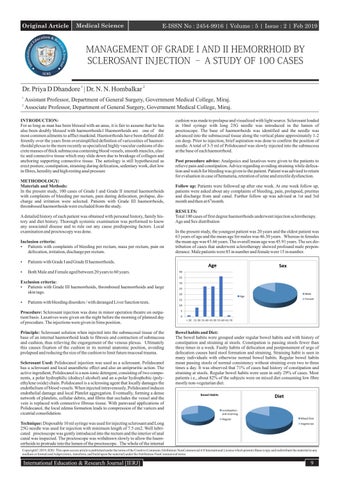
cushion was made to prolapse and visualized with light source. Sclerosant loaded in 10ml syringe with long 25G needle was introduced in the lumen of proctoscope. The base of haemorrhoids was identified and the needle was advanced into the submucosal tissue along the vertical plane approximately 1-2 cm deep. Prior to injection, brief aspiration was done to confirm the position of needle. A total of 3-5 ml of Polidocanol was slowly injected into the submucosa at the base of each haemorrhoid. Post procedure advice: Analgesics and laxatives were given to the patients to relieve pain and constipation. Advice regarding avoiding straining while defecation and watch for bleeding was given to the patient. Patient was advised to return for evaluation in case of hematuria, retention of urine and erectile dysfunction. Follow up: Patients were followed up after one week. At one week follow up, patients were asked about any complaints of bleeding, pain, prolapsed, pruritus and discharge from anal canal. Further follow up was advised at 1st and 3rd month and then at 6thmonth. RESULTS: Total 100 cases of first degree haemorrhoids underwent injection sclerotherapy. Age and Sex distribution In the present study, the youngest patient was 20 years and the eldest patient was 63 years of age and the mean age for males was 46.30 years. Whereas in females the mean age was 43.66 years. The overall mean age was 45.91 years. The sex distribution of cases that underwent sclerotherapy showed profound male preponderance. Male patients were 85 in number and female were 15 in number.
Exclusion criteria: Ÿ Patients with Grade III haemorrhoids, thrombosed haemorrhoids and large skin tags. Ÿ
Patients with bleeding disorders / with deranged Liver function tests.
Procedure: Sclerosant injection was done in minor operation theatre on outpatient basis. Laxatives were given on the night before the morning of planned day of procedure. The injections were given in Sims position. Principle: Sclerosant solution when injected into the submucosal tissue of the base of an internal haemorrhoid leads to fibrosis and contraction of submucosa and cushion, thus relieving the engorgement of the venous plexus. Ultimately this causes fixation of the cushion in its normal anatomic position, avoiding prolapsed and reducing the size of the cushion to limit future mucosal trauma. Sclerosant Used: Polidocanol injection was used as a sclerosant. Polidocanol has a sclerosant and local anaesthetic effect and also an antipruritic action. The active ingredient, Polidocanol is a non-ionic detergent, consisting of two components, a polar hydrophilic (dodecyl alcohol) and an a-polar hydrophobic (polyethylene oxide) chain. Polidocanol is a sclerosing agent that locally damages the endothelium of blood vessels. When injected intravenously, Polidocanol induces endothelial damage and local Platelet aggregation. Eventually, forming a dense network of platelets, cellular debris, and fibrin that occludes the vessel and the vein is replaced with connective fibrous tissue. With paravasal applications of Polidocanol, the local edema formation leads to compression of the varices and cicatrial consolidation.
Bowel habits and Diet: The bowel habits were grouped under regular bowel habits and with history of constipation and straining at stools. Constipation is passing stools fewer than three times in a week. Faulty habits of defecation and postponement of urge of defecation causes hard stool formation and straining. Straining habit is seen in many individuals with otherwise normal bowel habits. Regular bowel habits mean passing stools of normal consistency without straining even two to three times a day. It was observed that 71% of cases had history of constipation and straining at stools. Regular bowel habits were seen in only 29% of cases. Most patients i.e., about 82% of the subjects were on mixed diet consuming low fibre mostly non-vegetarian diet.
Technique: Disposable 10 ml syringe was used for injecting sclerosant and Long 25G needle was used for injection with minimum length of 7.5 cm2. Well lubricated proctoscope was gently introduced into the rectum and the interior of anal canal was inspected. The proctoscope was withdrawn slowly to allow the haemorrhoids to protrude into the lumen of the proctoscope. The whole of the internal Copyright© 2019, IERJ. This open-access article is published under the terms of the Creative Commons Attribution-NonCommercial 4.0 International License which permits Share (copy and redistribute the material in any medium or format) and Adapt (remix, transform, and build upon the material) under the Attribution-NonCommercial terms.
International Education & Research Journal [IERJ]
9
Original Article
E-ISSN No : 2454-9916 | Volume : 5 | Issue : 2 | Feb 2019
Occupation: Seventy seven percent (77 patients) of patients who underwent sclerotherapy were manual labourer whereas 23% (23 patients) were sedentary workers.
ciency State.
Presenting Symptoms: Bleeding was the predominant symptom (67%), followed by pain, irritation in 10% cases, and discharge in 5% cases and prolapse in 4% cases.
ASSOCIATION OF DIETARY HABITS WITH RECURRENT BLEEDING: In the present study, total number of patients having recurrent bleeding after one week are 6 %. Out of this 5% of patients having recurrent bleeding are consuming mixed diet and only 1 % of patients are consuming Vegetarian diet
Table 1: Presenting Symptoms of the study group
Table 5: Dietary Habits with Recurrent Bleeding
Presenting Symptoms
Number
%
Diet
Number of pts. with re-bleeding (n=100)
%
Bleeding
67
67 .0
Mixed diet
5
5%
Vegetarian diet
1
1%
Pain
53
53 .0
Prolapse
4
4 .0
Irritation
10
10 .0
Discharge
5
5.0
Immediate post procedure complications: Twenty percent of cases (20%) had discomfort; pain was seen in 12% of cases and bleeding in 7% of cases. Complications such as urinary retention and sepsis were not seen in the study.
DISCUSSION: Injection Sclerotherapy proved to be a simple technique to perform without any expertise. Sclerotherapy was done without major anesthesia, and pre-procedure elaborate work up and expensive equipments. Age distribution: In the present study, numbers of patients were in the age group from 20-70 years. The mean age of individual in the study is 45.91 years.
Table 2: Post Procedure Complications Symptoms
Number (n=100)
%
Discomfort
20
20.0
Pain
12
Bleeding
Table 6:
12.0
7
7.0
Urinary symptoms
-
-
Sepsis
-
-
SYMPTOMS AT FOLLOW UP: The effect of sclerotherapy on symptom improvement was assessed using parameters such as bleeding, pain, prolapse, irritation, discharge, anal stenosis and anal incontinence. Table 3: Effect Of Sclerotherapy on Symptom Improvement Symptoms
At presentation
At 1week
At 1month
At 3month
At 6month
Bleeding
67 (67%)
Pain
53 (53%)
6(6%)
-
4(4%)
3(3%)
8(8%)
5 (5%)
3(3%)
Prolapse
-
4 (4%)
-
-
-
-
Irritation
10 (10%)
-
1(1%)
-
-
Discharge
5 (5%)
-
-
-
-
Anal stenosis
-
-
-
-
-
Anal Incontinence
-
-
-
-
-
Study
Range of age (years)
Mean age(years)
Present study
20-70
45.91
Khoury3
20 and above
45.2
Takano4
20 and above
Santos G5
20-85
51
Gartell6
23-90
52
In the study of Khoury et al3, the mean age of individual was 45.2 years. And in the study by Takano et all 4 the age range was 20 and above. In the study of Santos G. et al 5, the mean age was 51 years and range of age was 20-80 years. In the study of Gartell et al 6, the mean age of individual was 52 years and range of age was 23-90 years. Sex distribution: The sex distribution in present study with male: female ratio of 85:15 was on higher side as compared with other studies of Khoury3 who showed male: female ratio 31:31, Kanellos 7 showed male: female ratio 154:86 and Santos G 5. who showed male : female ratio 106:83. Table 7: Study Present study Khoury 3 Santos G. 5 Kanellos 7
Male 85 31 106 154
Female 15 31 83 86
Etiology: As the etiology is not exactly defined some etiological factors were taken into consideration as occupation, diet and bowel habits. Taking the type of occupation into consideration cases were divided as manual labourer and sedentary worker. Haemorrhoidal preponderance in manual labourer was 77%. This observation is supported by William LJ 8 and Turell 9 who noted that occupational strain and stress played important role in precipitating haemorrhoids. Eighty two percent patients were on mixed diet and low in fibre. This finding is similar to studies which showed close relationship of haemorrhoids with western type of diet which is more refined and low in fibre. The low fibre diet causes increase in bowel transit time and forms hard stools. This causes constipation and straining of stools. Constipation and straining was seen in 71% of cases. Presenting symptoms: The principle presenting symptom in most studies was bleeding per-rectum seen in 67% in present study, 80% in Kanellos I et al 7, and 100% in study of Santos G et al 5. The next common symptom in present study was pain which was seen in 53% of cases and complains of prolapse in 10% cases of present study and in study of Kanellos I et al 7and Takano et al 4
PRESENT STUDY WITH OTHER ASSOCIATED DISEASES: Table 4: Associated Diseases Associated Disease
Number (n=100)
%
Portal hypertension
4
4.0
Immunodeficiency state
2
2.0
In the present study 4% patients of complaining bleeding per rectum were having associated Portal hypertension and 2% of patients were case of Immune Defi-
10
Immediate post procedure complication: The cases were observed for immediate complications and compared with studies of Tokunaga et al 10, Khoury et al3, Santos G et al 5, Kanellos 7 et al and Gartell et al 6. In the present study, 20% of cases were complaining of discomfort and mild discomfort after sclerotherapy was also mentioned in studies of Khoury 3 et al, Santos G et al 5, Kanellos et al 7 and Gartell et al 6. Pain was noted in 12 % in present study, 1.8% in Tokunaga et al 10 study and immediate bleeding was seen in 7% cases in present study which was stopped after applying pressure and packing
International Education & Research Journal [IERJ]
Original Article
E-ISSN No : 2454-9916 | Volume : 5 | Issue : 2 | Feb 2019 death were noted which required hospitalization.
in anal canal. Symptoms at follow up: The effect of sclerotherapy on symptom improvement was assessed using parameters as bleeding, pain, prolapse, purities, discharge, anal stenosis and incontinence. At one week post sclerotherapy, bleeding seen in 67% cases at presentation decreased to 6% which further decreased to 4% at 3 months and 3% at 6 months. Pain was seen in 53% cases at presentation decreased to 8% at one week and further decreased to 5% at 1 month and 3% at 3 months. Prolapse was seen in 4% of cases at presentation had disappeared completely.
Ÿ
Sclerotherapy was found effective in symptom improvement with 97 % patients symptom free at 6 months' follow up.
Ÿ
Post sclerotherapy complications are not much and they are less than 20 %. Discomfort and pain was relieved in 2-3 days without requiring analgesics and bleeding stopped spontaneously in one day.
Ÿ
Almost all patients were able to resume their daily routine on next day of procedure.
Table 8: Effect of Sclerotherapy on Symptom Improvement REFERENCES: Symptoms
At At At At At % of presentation 1week 1month 3month 6month improvement
Bleeding
67 (67%)
6(6%)
-
8(8%) 5 (5%)
4(4%)
3(3%)
1.
97%
2.
John Goligher Vol 1 Surgery of the Anus Rectum and Colon pp 108
3.
Khoury G., Winslet M. C., Lewis A. A. M. Santos G., Novell J. R., Long-term results of large-dose, single-session phenol injection sclerotherapy for hemorrhoids. Diseases of the Colon & Rectum. 1993;36(10):958–961. doi: 10.1007/bf02050633.)
4.
Takano M., Iwadare J., Ohba H., et al. Sclerosing therapy of internal hemorrhoids with a novel sclerosing agent: comparison with ligation and excision. International Journal of Colorectal Disease. 2006;21(1):44–51. doi: 10.1007/s00384-005-0771-0.
5.
Santos G., Novell J. R., Khoury G., Winslet M. C., Lewis A. A. M. Long-term results of large-dose, single-session phenol injection sclerotherapy for hemorrhoids. Diseases of the Colon & Rectum. 1993;36(10):958–961. doi: 10.1007/bf02050633
6.
Gartell P. C., Sheridan R. J., McGinn F. P. Out-patient treatment of haemorrhoids: a randomized clinical trial to compare rubber band ligation with phenol injection. British Journal of Surgery. 1985;72(6):478–479. doi: 10.1002/bjs.1800720624.
7.
I. Kanellos, I. Goulimaris, E. Christoforidis, T. Kelpis, and D. Betsis, “A comparison of the simultaneous application of sclerotherapy and rubber band ligation, with sclerotherapy and rubber band ligation applied separately, for the treatment of haemorrhoids: a prospective randomized trial,” Colorectal Disease, vol. 5, no. 2, pp. 133–138, 2003.
8.
Williams A , and M. R. Keighley, “A randomized trial to compare rubber band ligation with phenol injection for treatment of haemorrhoids,” British Journal of Surgery, vol. 68, no. 4, pp. 250–252, 1981.
9.
TURELL R. Injectional Treatment of Internal Hemorrhoids Am J Med Sci. 1947 Mar;213(3):350-3. PMID:20288163
Pain
53 (53%)
3(3%)
-
100%
Prolapse
4 (4%)
-
-
-
-
100%
Irritation
10 (10%)
-
1(1%)
-
-
100%
Discharge
5 (5%)
-
-
-
-
100%
Irritation and discharge was seen in 10% and 55 of cases respectively and symptom improvement is 100% at 6 months follow up in both symptoms. Comparison of success rate: Comparison of success rate of different studies was done with duration of each study. In the present study, the numbers of cases were 100 and duration of study was for 6 months with success rate of 97%. Gartell 6 et al did a similar study with 109 cases and duration of study was for 33 months with success rate of 67.8%. Table 9: Comparison of Success Rate of Different Studies Study
Total no. of Patients
No. of Patients Cured
No response
Duration of study (months)
%
Gartell et al 6
109
74
35
33
67.8
Cheng et al 11
30
24
6
12
80.0
Greca et al 12
33
23
10
12
69.6
Sim et al 13
24
18
6
12
75.0
Ambrose et al 14
42
31
11
12
73.8
35
31
4
48
88.5
100
97
3
6
97.0
Walker et al
15
Present study
Surgical Treatment of haemorrhoids Charles Mann Ed Surgical Treatment of Haemorrhoids S. Ellesmore and A.C.J. Windsor
Cheng et al 11 had 80% success rate with sclerotherapy. The numbers of cases were 30 and duration of study was for 12 months. Similar studies with small number of cases were done by Greca et al 12, Sim et al 13 and Ambrose et al 14 for 12 months with success rate of 69.6%, 75% and 73.8% respectively. Walker et al 15 did a study with 35 cases for 48 months and success rate was 88.5%. Serious complications: None of the cases in the present study had any serious complications as acute perianal sepsis, anal stenosis and fecal incontinence. But there have been studies showing some rare complications of sclerotherapy like recto urethral fistula, impotence, necrotizing fasciitis and adult respiratory distress syndrome.
10. Tokunaga Y., Sasaki H., Saito T. Evaluation of sclerotherapy with a new sclerosing agent and stapled hemorrhoidopexy for prolapsing internal hemorrhoids: retrospective comparison with hemorrhoidectomy. Digestive Surgery. 2010;27(6):469–472. doi: 10.1159/000320321 11. Cheng FC, Shum DW, Ong GB. The treatment of second degree haemorrhoids by injection, rubber band ligation, maximal anal dilatation and haemorrhoidectomy: a prospective clinical trial. Aust NZ J Surg. 1981;51(5):458-62. 12. Greca F., Hares M. M., Nevah E., Alexander-Williams J., Keighley M. R. A randomized trial to compare rubber band ligation with phenol injection for treatment of haemorrhoids. British Journal of Surgery. 1981;68(4):250–252. doi: 10.1002/bjs.18 00680410. 13. Sim AJ, Murie JA, Mackenzie I. Comparison of rubber band ligation and sclerosant injection for first and second-degree haemorrhoids-a prospective clinical trial. Acta Chir Scand 1981;147:717-20 14. Ambrose NS, Morris D, Alexander- Williams J, Keighley MR. A randomized Trial of Photocoagulation or injection therapy for the treatment of first and second degree hemorrhoids. Dis.Colon Rectum1985 Apr;28(4):238-40 15. Walker, R. J. Leicester, R. J. Nicholls, and C. V. Mann, “A prospective study of infrared coagulation, injection and rubber band ligation in the treatment of haemorrhoids,” International Journal of Colorectal Disease, vol. 5, no. 2, pp. 113–116, 1990.
Long term results: The present study followed up patients only for six months. There have been studies evaluating long term results of sclerotherapy by Walker A. J 15. who followed up the cases for 4 years and reported 88.5% cure rate. Another study by Kanellos 7 who followed up cases for 3 years with success rate of 20.2%. CONCLUSION: To conclude Polidocanal is an effective and safe sclerosant for the treatment of first and second- degree haemorrhoids. Injection sclerotherapy is an effective method of treatment of first and seconddegree hemorrhoids. This method is easy, safe, well tolerated in all age groups, convenient and cheap. It can be done at outpatient department without major anesthesia. Sclerotherapy is a simple outpatient treatment, and easy to expertise. Ÿ
Sclerotherapy is a short procedure consuming about 5-10 minutes and does not necessitate expensive equipment and can be done with minimal infrastructure without need for major operation theatre.
Ÿ
Sclerotherapy is beneficial procedure for initial symptom improvement in all grades of haemorrhoids who are unfit for surgery. And Multiple haemorrhoidal sclerotherapy injection can be done at single session.
Ÿ
After sclerotherapy, no severe complications including infection or sepsis or
International Education & Research Journal [IERJ]
11