Research Paper
Nursing
E-ISSN No : 2454-9916 | Volume : 6 | Issue : 1 | Jan 2020
PREVALENCE AND ADAPTIVE COPING BEHAVIOUR OF PREMENSTRUAL SYNDROME AMONG ADOLESCENT GIRLS 1
2
3
3
Dr. (Prof) Sudha A. Raddi | Mrs. Shubharani S. Muragod | Ms Sumedha Raikar | Mrs Gail Antao Carvalho 1
Dean, Faculty of Nursing, KAHER Institute of Nursing sciences, Belagavi, India. Asst. Professor, Dept Of OBG Nursing, KAHER Institute of Nursing Sciences, Belagavi, India. 3 rd 3 Year P.B. BSc (N), IGNOU Study Centre-1326P, KAHER Institute of Nursing Sciences, Belagavi, India. 2
ABSTRACT Introduction: Premenstrual syndrome (PMS) is a set of physical, emotional and behavioral symptoms that start week prior to menstruation and subsides when the menstrual flow begins. Materials and Methods: A quantitative research approach with descriptive cross sectional design was used for 150 B.Sc Nursing students in the age group of 18 to 20 years. The sample was drawn through purposive sampling method. Premenstrual rating scale and check list was use to collect the data. Data was analyzed by using descriptive and infertial statistics. Results: Among 150 students 58 (38.7%) had not experienced any symptoms of PMS, about 51 (33.5%) had mild symptoms, 30(20.4%)were having moderate premenstrual symptoms, 11(7.3 %) had severe premenstrual symptoms. Among 150 students Rest124 (82.66%) was the most common coping mechanism for the somatic symptoms followed by reduced caffeine intake54 (36%), exercise 31(20.66%) and analgesic 30 (20%). There was no association found between prevalence of PMS and selected demographic variables. KEY WORDS: Premenstrual syndrome, adolescent girls, prevalence, adaptive coping behavior.
INTRODUCTION: PMS is a condition of emotional, physical, psychological and behavioral disturbances that occur after ovulation and last till menstrual flow1. Premenstrual syndrome (PMS) is an important health problem in young women mostly in adolescence. A Systematic Review and Meta-Analysis Study conducted using 17 studies revealed that pooled prevalence of PMS was 47.8% (95% CI: 32.6-62.9). The frequency of premenstrual syndrome in India was 53% according to International Classification of Diseases -10 (ICD-10) criteria, among which 42% was mild, 18.2% moderate and 31.7% severe2. Girls with PMS report significant impairment in personal relationship compromised work levels and increased absence from social, academic and occupational activities. Still, it's possible not to let these problems control your life. Lifestyle adjustments can treat to reduce or manage the signs and symptoms of premenstrual syndrome. OBJECTIVES OF THE STUDY: 1. To estimate the prevalence of PMS among adolescent girls.
2.
To rank the common adaptive coping measures used during PMS among adolescent girls.
3.
To find out the association between prevalence of PMS among adolescent girls with their selected demographic variables.
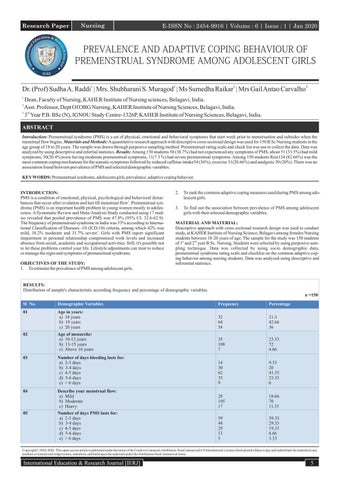
MATERIAL AND MATERIAL: Descriptive approach with cross sectional research design was used to conduct study, at KAHER Institute of Nursing Science, Belagavi among females Nursing students between 18-20 years of age. The sample for the study was 150 students of 1st and 2nd year B.Sc. Nursing. Students were selected by using purposive sampling technique. Data was collected by using socio demographic data, premenstrual syndrome rating scale and checklist on the common adaptive coping behavior among nursing students. Data was analyzed using descriptive and inferential statistics.
RESULTS: Distribution of sample's characteristic according frequency and percentage of demographic variables. n =150 Sl No.
Demographic Variables
Frequency
Percentage
01
Age in years: a) 18 years b) 19 years c) 20 years
32 64 54
21.3 42.66 36
Age of menarche: a) 10-12 years b) 13-15 years c) Above 16 years
35 108 7
23.33 72 4.66
Number of days bleeding lasts for: a) 2-3 days b) 3-4 days c) 4-5 days d) 5-6 days e) > 6 days
14 30 62 35 9
9.33 20 41.33 23.33 6
28 105 17
18.66 70 11.33
59 44 29 13 5
39.33 29.33 19.33 8.66 3.33
02
03
04
05
Describe your menstrual flow: a) Mild b) Moderate c) Heavy Number of days PMS lasts for: a) 2-3 days b) 3-4 days c) 4-5 days d) 5-6 days e) > 6 days
Copyright© 2020, IERJ. This open-access article is published under the terms of the Creative Commons Attribution-NonCommercial 4.0 International License which permits Share (copy and redistribute the material in any medium or format) and Adapt (remix, transform, and build upon the material) under the Attribution-NonCommercial terms.
International Education & Research Journal [IERJ]
5
Research Paper 06
07
E-ISSN No : 2454-9916 | Volume : 6 | Issue : 1 | Jan 2020
Mass media available at home: a) Television b) Newspaper c) Internet d) Radio Do you perform any relaxation techniques: a) Yes b) No
85 5 60 0
56.66 3.33 40 0
71 79
47.33 52.66
Estimation of prevalence of PMS among adolescent girls: NONE (0)
SYMPTOMS
MODERATE (2)
MILD (1)
SEVERE (3)
EMOTIONAL AND BEHAVIOURAL SYMPTOMS
freq
%
Freq
%
Freq
%
Freq
%
Tension & Anxiety
29
19.33
77
51.33
40
29.33
4
2.66
Depressed mood
40
26.66
64
42.66
34
22.66
12
8
Crying spells
75
50
40
26.66
32
21.33
3
2
Angry and irritability
30
20
43
28.66
55
36.66
22
14.66
Oversensitivity
50
33.33
64
42.66
25
16.66
11
7.33
Unhappiness
50
33.33
44
29.33
40
26.66
16
10.66
Food craving (Overeating)
81
54
43
28.66
20
13.33
6
4
Social withdrawal
71
47.33
49
32.66
26
17.33
4
2.66
Poor concentration
46
30.66
52
34.66
39
26
13
8.66
Joint and muscle pain
38
25.33
41
27.33
47
31.33
24
16
Headache
58
38.66
55
36.66
24
16
13
8.66
Fatigue
55
36.66
51
34
30
20
14
9.33
Weight gain from fluid retention
90
60
40
26.66
14
9.33
6
4
Abdominal bloating
48
32
54
36
33
22
15
10
Abdominal cramps
49
32.66
52
34.66
29
19.33
20
13.33
Breast tenderness
70
46.66
55
36.66
21
14
4
2.66
Acne flare-ups
71
47.33
50
33.33
21
14
8
5.33
Constipation or diarrhea
89
59.33
40
26.66
19
12.66
2
1.33
Sleep disturbance with sleeping too much or too less.
41
27.33
44
29.33
45
30
20
13.33
Appetite changes with overeating
81
54
48
32
18
12
3
2
PHYSICAL SIGNS & SYMPTOMS
According to the above given table the most common problems among emotional and behavioral symptoms was Food craving (Overeating) 81 (54%) and in physical signs & symptoms was Weight gain from fluid retention 90 (60%).
Frequency and percentage of coping Behavior adopted by nursing students: No
Yes ADAPTIVE COPING BEHAVIOUR Freq
%
Freq
%
Exercise
31
20.66
119
79.33
Avoid salt before the menstrual period
16
10.66
134
89.33
Reduce caffeine intake
54
36
96
64
Reduce intake of refined sugars
37
24.66
113
75.33
Increase of fiber intake
67
44.66
83
55.33
Adequate rest and sleep
124
82.66
26
17.33
Uses any vitamin supplements
39
26
111
74
Uses Analgesics
30
Frequency and percentage distribution of prevalence of PMS:
Majority 33.53% of the subjects were experiencing mild premenstrual symptoms, 20.4% were experiencing moderate premenstrual symptoms, 7.3 % were experiencing severe premenstrual symptoms and 38.73% students had no symptoms.
6
20
120
80
Uses hormonal pills (Oral contraceptives) 6
4
144
96
Uses any other remedies
19.33
121
80.66
29
Results showed that Adequate rest and sleep 124 (82.66%) was the most common coping mechanism for the somatic symptoms and only 6 (4%) had referred to medical care and was under use of hormonal pills.
International Education & Research Journal [IERJ]
Research Paper
E-ISSN No : 2454-9916 | Volume : 6 | Issue : 1 | Jan 2020
Results also showed that there was no association between prevalence of PMS and selected demographic variables (Age, age of menarche and menstrual flow). DISCUSSION: The findings of the study suggested that the most common problems among emotional and behavioral symptoms was Food craving (Overeating) 81 (54%) and in physical signs & symptoms was Weight gain from fluid retention 90 (60%). Similar study conducted in Purba Medinipur district of West Bengal from July to August 2014 showed contradicting results among 244 students, Results showed that PMS was reported by 62.7% girls reported depression and 70.5% girl’s anger. Irritability was reported to be as high as 84.8%. Anxiety and confusion were reported by 76.0% and 66.8% adolescent girls, respectively. Around onethird of girls experienced breast pain, and 55.3% of girls have also faced social rejection during that period. Headache and abdominal distension were reported by around 55% students. Only 14.7% of them reported limb swelling in premenstrual period3. The study conducted in Khon Kaen, Thailand on Premenstrual syndrome (PMS) among high school students showed that Forty-six (46.4%) of the participants in the PMS group reported that they self-administered treatment. The most common coping methods were analgesic drugs (38.4%) and recreational activities (26.3%). The participants also consulted their friends (33.9%) and their parents (22.8%) when they were suffering from these symptoms. Only 3% of them sought medical consultation4. In the present study majority 33.53% of the subjects were experiencing mild premenstrual symptoms, 20.4% were experiencing moderate premenstrual symptoms, 7.3% were experiencing severe premenstrual symptoms and 38.73% students had no symptoms. A descriptive-analytic study was conducted in Tehran, Iran showed contradicting that the severity of PMS in most of the participants (62.22%) was moderate, in 8.89% was mild and in 28.89% was sever5. Present study showed no any association between prevalence of PMS and selected demographic variables (Age, age of menarche and menstrual flow). Similar study conducted in Purba Medinipur district of West Bengal from July to August 2014 showed the contradicted the results by PMS was found to be associated with mother’s occupation, amount of blood flow during menstruation, and presence of dysmenorrhea (p < 0.05)3. REFERENCES: 1.
ACOG Practice Bulletin. Premenstrual syndrome. Clinical management guidelines for obstetrician – gynecologists. Number 15. J Obstet Gynecol. 2001;73:183–191
2.
Kelbessa B, Guteta B, Negese F at.al, Prevalence of Premenstrual Syndrome and Coping Mechanism among Female Students of Guder Preparatory School, West Shawa Zone, Oromia Regional State, Ethiopia: RRJMHS. December, 2017; 6(4):12-19
3.
SarkarA.P, Mandal R, Ghorai S. Premanstrual syndrome among adolescent girl students in a rural school of West Bengal, India. International journal of Medical Sciences and Public Health 2016;5(3):408-11.
4.
Taghizadeh Z, Shirmohammadi M, Arbabi M, Mehran A, The Effect of Premenstrual Syndrome on Quality of Life in Adolescent Girls: Iran J Psychiatry 2008; 3:105-109
5.
Brohi ZP, Haider G, Zehra N, Amna A. Frequency and Impact of premenstrual syndrome on quality of life. Pak J Med Sci 2011;27(2):396-400
6.
Wo r l d H e a l t h O r g a n i z a t i o n , A d o l e s c e n t h e a l t h a n d d e v e l o p m e n t www.searo.who.int/entity/child_adolescent/topics/adolescent_health/en/
7.
United Nations, Department of Economic and Social Affairs, Population Division. World Population Prospects: The 2010 Revision, Vol. I. Comprehensive Tables. ST/ESA/SER-A/313. 2011
8.
ACOG Practice Bulletin. Premenstrual syndrome. Clinical management guidelines for obstetrician – gynecologists. Number 15. J Obstet Gynecol. 2001;73:183–191
International Education & Research Journal [IERJ]
7