Research Paper
Pharmacy
E-ISSN No : 2454-9916 | Volume : 4 | Issue : 12 | Dec 2018
FORMULATION & EVALUATION OF CURCUMIN LOADED CHITOSAN TRIPOLYPHOSPHATE NANOPARTICLES 1
Shruti Madderla | Dr. P. Tripura Sundari 1
1
RBVRR Women's College of Pharmacy, Osmania University, Barkatpura, Hyderabad, India.
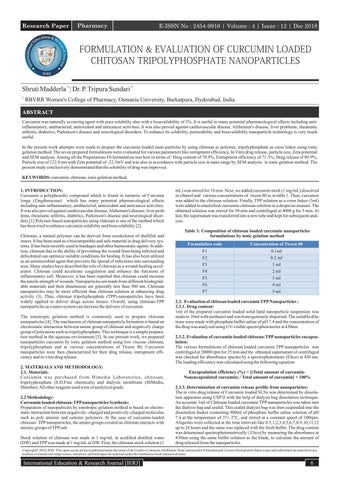
ABSTRACT Curcumin was naturally occurring agent with poor solubility also with a bioavailability of 3%. It is useful in many potential pharmacological effects including antiinflammatory, antibacterial, antioxidant and anticancer activities. It was also proved against cardiovascular disease, Alzheimer's disease, liver problems, rheumatic arthritis, diabetics, Parkinson's disease and neurological disorders. To enhance its solubility, permeability and bioavailability nanoparticle technology is very much useful. In the present work attempts were made to prepare the curcumin loaded nano-particles by using chitosan as polymer, tripolyphosphate as cross linker using ionic gelation method. The seven prepared formulations were evaluated for various parameters like entrapment efficiency, In Vitro drug release, particle size, Zeta potential and SEM analysis. Among all the Preparations F6 formulation was best in terms of Drug content of 70.9%, Entrapment efficiency of 71.3%, Drug release of 89.9%, Particle size of 122.8 nm with Zeta potential of -22.3mV and was also in accordance with particle size in nano range by SEM analysis in ionic gelation method. The present study conclusively demonstrated that the solubility of drug was improved. KEYWORDS: curcumin, chitosan, ionic gelation method. 1. INTRODUCTION: Curcumin a polyphenolic compound which is found in turmeric of Curcuma longa (Zingiberaceae) which has many potential pharmacological effects including anti-inflammatory, antibacterial, antioxidant and anticancer activities. It was also proved against cardiovascular disease, Alzheimer's disease, liver problems, rheumatic arthritis, diabetics, Parkinson's disease and neurological disorders.[1] Polymer-based nanoparticles using chitosan is one of the method which has been tried to enhance curcumin solubility and bioavailability [2]. Chitosan, a natural polymer can be derived from exoskeleton of shellfish and insect. It has been used as a biocompatible and safe material in drug delivery systems. It has been recently used in bandages and other haemostatic agents. In addition, chitosan due to the ability of preventing the wound from being infected and dehydrated can optimize suitable conditions for healing. It has also been utilized as an antimicrobial agent that prevents the spread of infections into surrounding area. Many studies have described the role of chitosan as a wound-healing accelerator. Chitosan could accelerate coagulation and enhance the functions of inflammatory cell. Moreover, it has been reported that chitosan could increase the tensile strength of wounds. Nanoparticles are made from different biodegradable materials and their dimensions are generally less than 500 nm. Chitosan nanoparticles may be more efficient than chitosan solution at enhancing drug activity (3). Thus, chitosan tripolyphosphate (TPP)-nanoparticles have been widely applied to deliver drugs across tissues. Overall, using chitosan-TPP nanoparticles as a nano-system can increase the delivery of curcumin. The ionotropic gelation method is commonly used to prepare chitosan nanoparticles [4]. The mechanism of chitosan nanoparticle formation is based on electrostatic interaction between amine group of chitosan and negatively charge group of polyanion such as tripolyphosphate. This technique is a simple preparation method in the aqueous environment [5]. In our present work, we prepared nanoparticles curcumin by ionic gelation method using low viscous chitosan, tripolyphosphate and at various concentrations of Tween 80, Curcumin nanoparticles were then characterized for their drug release, entrapment efficiency and in-vitro drug release. 2. MATERIALS AND METHODOLOGY: 2.1. Materials: Curcumin was purchased from Himedia Laboratories; chitosan, tripolyphosphate (S.D.Fine chemicals) and dialysis membrane (HiMedia, Mumbai). All other reagents used were of analytical grade. 2.2 Methodology: Curcumin-loaded chitosan-TPP nanoparticles Synthesis: Preparation of nanoparticles by ionotropic gelation method is based on electrostatic interaction between negatively- charged and positively-charged molecules such as poly anionic and cationic polymers. In the case of curcumin-loaded chitosan- TPP nanoparticles, the amino groups existed on chitosan interacts with anionic groups of TPP salt. Stock solution of chitosan was made at 1 mg/mL in acidified distilled water (DW) and TPP was made at 1 mg/mL in DW. First, the chitosan stock solution (1
mL) was stirred for 10 min. Next, we added curcumin stock (1 mg/mL) dissolved in ethanol and various concentrations of tween 80 as in table 1. Then, curcumin was added to the chitosan solution. Finally, TPP solution as a cross linker (3ml) were added to emulsified-curcumin-chitosan solution in a dropwise manner. The obtained solution was stirred for 30 min and centrifuged at 4000 g for 5 min. At last, the supernatant was transferred into a new tube and kept for subsequent analysis. Table 1: Composition of chitosan loaded curcumin nanoparticles formulations by ionic gelation method Formulation code
Concentration of Tween 80
F1 F2
0.1ml 0.2 ml
F3 F4 F5
1 ml 2 ml 3 ml
F6 F7
4 ml 5 ml
2.3. Evaluation of chitosan loaded curcumin TPP Nanoparticles : 2.3.1. Drug content: 1ml of the prepared curcumin loaded solid lipid nanoparticle suspension was made to 10ml with methanol and was homogenously dispersed. The suitable dilutions were made with phosphate buffer saline of pH 7.4 and the concentration of the drug was analyzed using UV-visible spectrophotometer at 430nm 2.3.2. Evaluation of curcumin-loaded chitosan-TPP nanoparticles encapsulation: The various formulations of chitosan loaded curcumin TPP nanoparticles was centrifuged at 20000 rpm for 25 min and the obtained supernatant of centrifuged was checked for absorbance spectra by a spectrophotometer (Elico) at 430 nm. The loading efficiency was calculated using the following equation: Encapsulation efficiency (%) = [(Total amount of curcuminNonencapsulated curcumin) / Total amount of curcumin] × 100% 2.3.3. Determination of curcumin release profile from nanoparticles: The in vitro drug release of Curcumin loaded SLNs was determined by dissolution apparatus using USP II with the help of dialysis bag dissolution technique. An accurate 1ml of Chitosan loaded curcumin TPP nanoparticles was taken into the dialysis bag and sealed. This sealed dialysis bag was then suspended into the dissolution basket containing 900ml of phosphate buffer saline solution of pH 7.4 at the temperature of 37± 2°C, and stirred at a constant speed of 100rpm. Aliquotes were collected at the time intervals like 0.5,1,2,3,4,5,6,7,8,9,10,11,12 up to 24 hours and the same was replaced with the fresh buffer. The drug content was determined spectrophotometrically ( Elico) by measuring the absorbance at 430nm using the same buffer solution as the blank, to calculate the amount of drug released from the nanoparticles.
Copyright© 2018, IERJ. This open-access article is published under the terms of the Creative Commons Attribution-NonCommercial 4.0 International License which permits Share (copy and redistribute the material in any medium or format) and Adapt (remix, transform, and build upon the material) under the Attribution-NonCommercial terms.
International Education & Research Journal [IERJ]
6
Research Paper
E-ISSN No : 2454-9916 | Volume : 4 | Issue : 12 | Dec 2018
3. RESULTS AND DISCUSSIONS: Evaluation Studies of curcumin loaded chitosan TPP Nanoparticles : 3.1 Drug content: The drug content of all seven formulations was evaluated. From the figure1, F6 formulation showed maximum drug content 70.9% compared to other formulations. Table 2: Drug content of curcumin loaded nanoparticles using ionic gelation method S. NO 1. 2. 3. 4. 5. 6. 7.
FORMULATION CODE F1 F2 F3 F4 F5 F6 F7
% DRUG CONTENT 43.95% 50.10% 61.43% 64.72% 45.31% 70.90% 38.24%
polymer matrix. Table 3: Entrappment efficiencies of curcumin loaded nanoparticles using ionic gelation method S. NO
FORMULATION CODE
% ENTRAPMENT EFFICIENCY
1.
F1
43.94%
2.
F2
52.13%
3.
F3
55.6%
4.
F4
62.70%
5.
F5
56.8%
6.
F6
71.30%
7.
F7
32.31%
Fig 2: Comparison of entrapment efficiencies of curcumin loaded chitosan nanoparticles by ionic gelation method Fig 1: Comparison of drug content of curcumin loaded chitosan nanoparticles by ionic gelation method The drug content of all formulations were found to be 43.95%, 50.10%, 61.43%, 64.72%,45.31%, 70.90% and 38.24%. Among all the formulations, F6 has shown greater drug content. Comparison of entrapment efficiencies of curcumin loaded nanoparticles: Entrappment efficiency defines the amount of drug that has been entrapped in the
The entrapment efficiencies of all formulations were found to be 43.94%, 52.13 %, 55.60%, 62.70%, 56.80%, 71.30% and 32.31%. Among all the formulations, F6 has shown greater entrapment efficiency. Invitro drug release studies of curcumin loaded nanoparticles: Invitro drug release studies were carried by dissolution apparatus using USP II (Paddle). Samples were collected at time intervals like 30min, 1, 2,4,6,8,10,12,24 hours. Medium used for dissolution was pH 7.4 phosphate buffered saline, temperature 37±2ºc, rpm of 100 at wave length of 430nm
Table 4: Invitro drug release studies of curcumin loaded chitosan nanoparticles with pure drug by ionic gelation method PERCENTAGE DRUG RELEASE Time interval (hr) F2 F3 F5 F1 F6 F7 F4 0 0 0 0 0 0 0 0 0.5 12.4±0.02 9.0±0.02 7.2±0.03 10.7±0.06 14.7±0.03 14.7±0.07 13.7±0.03 1 11.6±0.04 8.0±0.01 15.5±0.05 16.9±0.04 15.0±0.07 12.8±0.01 19.5±0.05 2 13.8±0.01 9.9±0.02 16.2±0.05 17.2±0.01 20.7±0.03 21.2±0.05 16.9±0.09 4 11.5±0.09 13.8±0.04 21.4±0.02 16.1±0.03 13.7±0.07 22.5±0.01 25.9±0.04 15.1±0.07 19.3±0.09 19.3±0.03 26.6±0.06 6 18.4±0.02 30.3±0.02 24.3±0.03 8 21.4±0.07 18.4±0.06 23.4±0.02 29.4±0.03 34.2±0.01 26.4±0.04 22.2±0.01 10 23.1±0.03 21.7±0.05 33.0±0.04 36.4±0.02 28.2±.02 29.9±0.03 25.2±0.01 26.6±0.01 41.1±0.05 31.6±0.05 35.9±0.07 50.8±0.05 12 24.3±0.03 30.1±0.01 62.9±0.04 71.2±0.05 58.2±0.02 52.8±0.04 49.7±0.04 80.0±0.02 89.9±0.06 24
P.D 0 0.1±0.08 0.5±0.01 5.3±0.03 7.5±0.05 9.6±0.07 13.0±0.06 15.1±0.01 17.8±0.03 33.7±0.04
In vitro release studies were performed for a period of 24hrs. The percentage drug release for the prepared formulations was calculated. The drug release of prepared formulations were found to be 52.8 %, 49.7%, 80.0%, 62.9%, 71.2%, 89.6% and 58.2%. Among all the formulations, F6 was found to be the best formulation as it controlled the drug release upto 24hours with 89.9% Comparison of invitro drug release of curcumin loaded chitosan nanoparticles:
Fig 3: Comparison of invitro drug release of curcumin loaded chitosan nanoparticles with pure drug by ionic gelation method
7
International Education & Research Journal [IERJ]
Research Paper
E-ISSN No : 2454-9916 | Volume : 4 | Issue : 12 | Dec 2018
DETERMINATION OF PARTICLE SIZE OF FORMULATION F6: Among the seven prepared formulations, the particle size of the F6 was considered as the best formulation with the particles of size of 122.8nm. Particle size analysis was determined by MALVERN nanoparticle analyser. Thus it was observed that formulation was fund to be in nano range.
Fig 4 : particle size report F6 formulation of curcumin loaded nanoparticle by using ionic gelation method DETERMINATION OF ZETA POTENTIAL OF FORMULATION F6: The zeta potential value indicates the stability of nanoparticles. It was determined by MALVERN nanoparticle analyzer. The formulation F6 showed the zeta potential value of -22.3mV.
Fig 5: Zeta potential report C4 formulation of curcumin loaded SLN by Hot homogenization method Table 4: Kinetic release data for optimized formulation F6 SEM ANALYSIS OF FORMULATION F6:
Formulation
Zero order (R²)
First order ( R²)
Higuchi plot (R²)
Peppas plot (n)
F6
0.857
0.885
0.896
1.257
According to the kinetic plots, the optimized formulation- F6 was following the First order release with non-fickian diffusion mechanism.
Fig 6: SEM images of formulation F6 The sample was analysed for SEM to know the surface morphology. SEM results are also in accordance with particle size and zeta potential values. FITTING DATA INTO KINETIC PLOTS OF CURCUMIN LOADED NANOPARTICLES FOR OPTIMISED FORMULATION: The drug release data was fitted in various kinetic plots (Zero order, First order, Higuchi and Korsmeyer Peppas plots) which were drawn for the optimised formulation F6 in order to determine the order and mode of drug release. KINETIC PLOTS OF FORMULATION F6:
4. CONCLUSION: In the present research, the different formulations were prepared by using chitosan, Tween 80 and TPP. The results of in-vitro drug release studies demonstrated significantly controlled release of Curcumin from prepared curcumin loaded chitosan nanoparticles. Among all the Preparations F6 formulation was best in terms of drug content of 70.9%, Entrapment efficiency of 71.3 % and % Drug release of 89.9% in Hot Homogenization with a particle size of 122.8nm and a zeta potential of – 22.3mV. SEM results were also in accordance with particle size and was observed in spherical shape. The drug release data revealed that a good regression was obtained for first order kinetics and Higuchi equation, which indicated that the formulation released drug in sustained release concentration dependent mode and drug release from lipid matrix was Higuchi diffusion. Release exponent, ‘n’ value of F6 formulation is greater than 0.5 indicating that release followed non fickian diffusion. (r2 value was 0.885, n value was found to be 1.257 for F6 in ionic gelation method). Ionic gelation method was found to be the best method as particle size obtained was small, with high entrapment efficiency value which may be because of better association of surfactant and TPP. This method was found to be simple, cost effective, easy and suitable to produce nanoparticles. This method can be scaled up when compared with other preparations. Further it could be presumed that the obtained nanoparticles might increase oral bioavailability. Hence curcumin loaded chitosan nanoparticles can be formulated Successfully by employing this Ionic gelation method. 5. FUTURE SCOPE: In-vivo studies can be conducted to see the enhancement in the oral bioavailability of drug in SLNs when compared with pure drug.
International Education & Research Journal [IERJ]
8
Research Paper
E-ISSN No : 2454-9916 | Volume : 4 | Issue : 12 | Dec 2018
REFERENCES: 1.
Anand P, Thomas SG, Ajaikumar B, Kunnumakkara AB, Sundaram C, Harikumar KB et al. Biological activities of curcumin and its analogues (Congeners) made by man and Mother Nature. Biochem Pharm. 2008; 7(6):1590- 1611.
2.
Das R, Kasoju N, and Bora U. Encapsulation of curcumin in alginate-chitosan-pluronic composite nanoparticles for delivery to cancer cells. J. Nanomedicine: Nanotechnology, Biology, and Medicine 2010; 6: 153–160.
3.
Mirza Ali Mofazzal Jahromi 1, Sharafaldin Al-Musawi 2, Majid Pirestani 3, Mahdi FasihiRamandi 1, Kazem Ahmadi 4, Hajar Rajayi 5, Zuhair Mohammad Hassan 5, Mahdi Kamali 6,Reza Mirnejad 1,* Curcumin-loaded Chitosan Tripolyphosphate Nanoparticles as a safe, natural and effective antibiotic inhibits the infection of Staphylococcus aureus and Pseudomonas aeruginosa in vivo November 2014;Iranian Journal of Biotechnology ·
4.
Recovita S, Vasiliu S, Popa M and Luca C. Polysaccharides Based on Micro and Nanoparticles Obtained by Ionic Gelation and Their Applications as Drug Delivery Systems. Revue Roumanie de Chimie 2009; 54 (9) :709-718.
5.
Tiyaboonchai W. Chitosan nanoparticles: a promising system for drug delivery. Naresuan University Journal 2003; 11(3): 51-66.
6.
P Senthil Kumar and N Punniamurthy: Formulation development and characterization of curcumin loaded solid lipid nanoparticles for improved aqueous solubility and bioavailability; The Pharma Innovation Journal 2017; 6(4): 07-11
7.
PRAGNA shelata, VINOD K. Mandowaraa*, DEEPAK G. Guptaa, SHETULV. Patela; Formulation of curcuminoid loaded solid lipid nanoparticles in order to improve oral bioavailability; international journal of pharmacy and pharmaceutical sciences ;2015; vol 7, issue 6
8.
Daniela Chirio , Marina Gallarate, Elena Peira , Luigi Battaglia , Loredana Serpe and Michele Trotta; Formulation of curcumin-loaded solid lipid nanoparticles produced by fatty acids coacervation technique; Journal of Microencapsulation, 2011; 28(6): 537–548
9.
Hongyu Ji1, Jingling Tang2, Mengting Li1,2, Jinmei Ren1,2, Nannan Zheng1,2, and Linhua Wu1,2; Curcumin-loaded solid lipid nanoparticles with Brij78 and TPGS improved in vivo oral bioavailability and in situ intestinal absorption of curcumin; Informa Healthcare 2014;23(2): 459–470
10. Sarabjot kaur, Ujjwal Nautyal*, Ramandeep Singh, Satvinder Singh, Anita Devi; Nanostructure Lipid Carrier (NLC): the new generation of lipid nanoparticles; Asian Pac. J. Health Sci., 2015; 2(2): 76-93
9
International Education & Research Journal [IERJ]