Research Paper
Marine Sciences
E-ISSN No : 2454-9916 | Volume : 4 | Issue : 10 | Oct 2018
ENVIRONMENTAL PARAMETERS AND FISHERY RESOURCES IN AGATTI AND KAVARATTI ISLANDS OF LAKSHADWEEP SEA, INDIA 1
1
1
Nowfer Kuli | Saravanan Kumaresan | Kumar Balachandar | Arumugam Sundaramanickam 1
1
Centre of Advanced Study in Marine Biology, Faculty of Marine Sciences, Annamalai University, Parangipettai – 608 502.
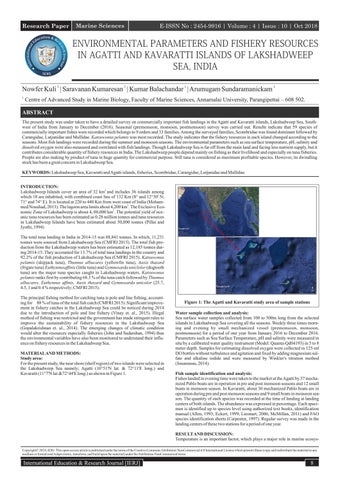
ABSTRACT The present study was under taken to have a detailed survey on commercially important fish landings in the Agatti and Kavaratti islands, Lakshadweep Sea, Southwest of India from January to December (2016). Seasonal (premonsoon, monsoon, postmonsoon) survey was carried out. Results indicate that 59 species of commercially important fishes were recorded which belongs to 9 orders and 33 families. Among the surveyed families, Scombridae was found dominant followed by Carangidae, Lutjanidae and Mullidae. Katsuwonus pelamis was most recorded. The study indicates that the fishery resources in each island changed according to the seasons. Most fish landings were recorded during the summer and monsoon seasons. The environmental parameters such as sea surface temperature, pH, salinity and dissolved oxygen were also measured and correlated with fish landings. Though Lakshadweep Sea is far off from the main land and facing less nutrient supply, but it contributes considerable quantity of fishery resources in India. The Lakshadweep people depend mainly on fishing as their livelihood and especially on tuna fisheries. People are also making by product of tuna in huge quantity for commercial purpose. Still tuna is considered as maximum profitable species. However, its dwindling stock has been a great concern in Lakshadweep Sea. KEYWORDS: Lakshadweep Sea, Kavaratti and Agatti islands, fisheries, Scombridae, Carangidae, Lutjanidae and Mullidae. INTRODUCTION: Lakshadweep Islands cover an area of 32 km2 and includes 36 islands among which 10 are inhabited, with combined coast line of 132 Km (8° and 12°30' N; 71° and 74° E). It is located at 220 to 440 Km from west coast of India (Mohammed Noushad, 2013). The lagoon area limits about 4,200 km2. The Exclusive Economic Zone of Lakshadweep is about 4, 00,000 km2. The potential yield of oceanic tuna resources has been estimated as 0.28 million tonnes and tuna resources in Lakshadweep Islands have been estimated about 50,000 tonnes (Pillai and Jyothi, 1994) The total tuna landing in India in 2014-15 was 88,841 tonnes. In which, 11,231 tonnes were sourced from Lakshadweep Sea (CMFRI 2015). The total fish production from the Lakshadweep waters has been estimated as 12,185 tonnes during 2014-15. They accounted for 13.7% of total tuna landings in the country and 92.2% of the fish production of Lakshadweep Sea (CMFRI 2015). Katsuwonus pelamis (skipjack tuna), Thunnus albacares (yellowfin tuna), Auxis thazard (frigate tuna) Euthynnusaffinis (little tuna) and Gymnosarda uniclolor (dogtooth tuna) are the major tuna species caught in Lakshadweep waters. Katsuwonus pelamis ranks first by contributing 68.3 % of the tuna catch followed by Thunnus albacares, Euthynnus affinis, Auxis thazard and Gymnosarda unicolor (25.7, 4.5, 1 and 0.4 % respectively; CMFRI 2015). The principal fishing method for catching tuna is pole and line fishing, accounting for 88 % of tuna of the total fish catch (CMFRI 2015). Significant improvement in fishery catches in the Lakshadweep Sea could be noticed during 2014 due to the introduction of pole and line fishery (Vinay et. al., 2015). Illegal method of fishing was restricted and the government has made stringent rules to improve the sustainability of fishery resources in the Lakshadweep Sea (Gopalakrishnan et. al., 2014). The emerging changes of climatic condition would alter the resources especially fisheries (John and Sudarshan, 1994) thus the environmental variables have also been monitored to understand their influence on fishery resources in the Lakshadweep Sea. MATERIAL AND METHODS: Study area: For the present study, the near shore (shelf region) of two islands were selected in the Lakshadweep Sea namely; Agatti (10°51'N lat. & 72°11'E long.) and Kavaratti (11°7'N lat.&72°44'E long.) as shown in Figure 1.
Figure 1: The Agatti and Kavaratti study area of sample stations Water sample collection and analysis: Sea surface water samples collected from 100 to 500m long from the selected islands in Lakshadweep Sea covering all the seasons. Weekly three times morning and evening by small mechanized vessel (premonsoon, monsoon, postmonsoon) for a period of one year from January 2016 to December 2016. Parameters such as Sea Surface Temperature, pH and salinity were measured in situ by a calibrated water quality instrument (Model: Quanta-Qd04193) in 5 to 8 meter depth. Samples for estimating dissolved oxygen were collected in 125-ml DO bottles without turbulence and agitation and fixed by adding magnesium sulfate and alkaline iodide and were measured by Winkler's titration method (Jouanneau, 2014). Fish sample identification and analysis: Fishes landed in evening time were taken to the market at the Agatti by 37 mechanized Pablo boats are in operation in pre and post monsoon seasons and 12 small boats in monsoon season. In Kavaratti, about 30 mechanized Pablo boats are in operation during pre and post monsoon seasons and 9 small boats in monsoon season. The quantity of each species was recorded at the time of landing at landing centers of both islands. The abundance was expressed in percentage. Each specimen is identified up to species level using authorized text books, identification manual (Allen, 1993; Eckert, 1999; Lieonart, 2006; McMillan, 2011) and FAO species identification sheets (Carpenter, 1997). Regular survey was made in the landing centers of these two stations for a period of one year. RESULT AND DISCUSSION: Temperature is an important factor, which plays a major role in marine ecosys-
Copyright© 2018, IERJ. This open-access article is published under the terms of the Creative Commons Attribution-NonCommercial 4.0 International License which permits Share (copy and redistribute the material in any medium or format) and Adapt (remix, transform, and build upon the material) under the Attribution-NonCommercial terms.
International Education & Research Journal [IERJ]
8
Research Paper
E-ISSN No : 2454-9916 | Volume : 4 | Issue : 10 | Oct 2018
tem. (Harly,C.D.G., 2006). The temperature has control over the other hydro biological parameters in the sea. Sea surface temperature (SST), salinity, pH and dissolved oxygen (DO) in Agatti Island were found to have ranged from 27.01 to 31.50 ºC, 30.07 to 35.91 psu, 8.10 to 8.30 and 3.89 to 6.00 ppm with average values of 29.07 ºC, 33.85 psu, 8.18, 4.95 ppm respectively. In Kavaratti Island, the same parameters were found in the range of 27.80 to 30.01ºC, 31.44 to 37.81 psu, 7.90 to 8.40, 3.02 to 4.88 ppm with average values of 28.60 ºC, 35.14 psu, 8.18 and 3.94 ppm respectively. AGATHI PREMONSOON MONSOON POSTMONSOON Mean Temperature (⁰C)
29.48
26.87
31.56
29.3
Salinity (psu)
35.15
33.34
34.05
34.18
Ph
8.17
8.13
8.25
8.18
Dissolved Oxygen (mg/l)
4.87
5.52
4.34
4.91
Fish Density
150755
32225
102858
KAVARATTI PREMONSOON MONSOON POSTMONSOON Mean Temperature (⁰C)
29.15
27.49
28.03
28.22
Salinity (psu)
35.1
34.78
35.86
35.24
pH
8.2
8.12
8.18
8.17
Dissolved Oxygen (mg/l)
3.54
4.08
4.06
3.89
Fish Density
104509
27362
87174
Table showing the different parameters observed at Agathi and Kavaratti Islands of Lakshadweep Sea, India. It was noticed that DO level in the Lakshadweep Sea did not fall below 3.5 mg/l throughout study period indicating that the Lakshadweep Sea is well aerated and mixed due to localised currents and found to have maintained in the optimum for marine organisms including fishes. The physico-chemical parameters favour for the sustainability of marine organisms in the coral reef region in both stations (table 1). The species density showed seasonal variations in both islands. The dominant groups were found belong to Scombridae, Belonidae and Hemiramphidae families. In pre and post monsoon seasons, the Scombridae landed in higher quantity followed by Belonidae and Hemiramphidae. The following order was noticed among different families based on the number of species Scombridae>Carangidae>mullidae>Istiophoridae>Belonidae>Lutjaninae>Sar ranidae>Suraenidae>Exocoetidae>Hemiramphidae>Clupeidae>Apogonidae> Mobulidae>Carcharhinidae>Chaetodontidae>Xipiidae>Sphyraenidae>Coryph aenidae>Scaridae>Pomacentridae>Platytroctidae>Octopodidae>Dasyatidae> Pristigasteridae>Synodontidae>Fistulariidae>Syphyraenidae>Serranidae>Bali stidae>Kyphosidae>Syngnathidae>Scorpaenidae. About 59 species from 32 families were recorded during the present study. Investigations were available mostly on specific species of fishes from coral reefs in Agatti (Idreesbabu, 2014). Coral reefs, as rainforests of the sea, (Davidson 1998), the breeding and spawning for most of the fishes are taking place in this ecosystem. Fishes and corals have been badly destroyed by illegal method of lagoon fishing and its resources along with habitat become lost over the past decade (Navjot et al., 2004). Some of fisherman use small sized mesh and other illegal activities for fishing from lagoon, thus immature fishes were caught (Christian Leveque 1995) predominantly. Total 33 families were found in this survey i.e. Scombridae, Istiophoridae, Xiphiidae, Carangidae, Exocoetidae, Belonidae, Coryphaenidae, Hemiramphidae, Lutjaninae, Sarranidae, Scaridae, Pomacentridae, Clupeidae, Apogonidae, Octopodidae, Mobulidae, Myliobatidae, dasyatidae, Carcharhinidae, Lethrinidae, holocentridae, Synodontidae, Fistulariidae, Syphyraenidae, Serranidae, Mullidae, Chaetodontidae, Balistidae, Kyphosidae, pempheridae, siganidae, acanthuridae. These families belong to 9 orders; they are Beloniformes, Clupeiforms, Octopoda, Myliobatiforms, Carcharhiniformes, Aulopiformes, Syngnathiformes, Tetraodontiformes. The abundant group is tuna, most commonly used for economical and edible purpose. Potential resources of tunas in the seas around Lakshadweep have been estimated to be 50,000 tones by George et al. (1977) and 90,000 tones by Chidambaram (1987). However, the total catch of tuna is gradually diminishing and poor especially during monsoon season (Pillai et al., 2001). Among the environmental parameters, temperature is considered to be important
9
as it directly influences the distribution and abundance of tuna (John and Sudarsan, 1994). Therefore, when considering, the tuna landings over the past decades, the present study also indicates that the SST has certain influence since the SST levels gradually increases over to past 5decades as per records followed. A study was made by Abhiya et al. (2015) on the distribution of SST in Lakshadweep Sea and Kerala coast from 1985 to 2010 by using satellite data, reporting that temperature has increased by 0.2oC per decade. The satellitederived annual mean value of SST reported by Shaji et al. (2017) for the Lakshadweep Sea (SST >28.7o C) was found within the range of SST values noticed during the present study. Hafiz and Anderson (1994) analyzed the taxonomical composition of the fish landed in both stations suggested that Scombridae is the most dominant family with 5 representatives. In this study for the two islands, 27652 kg and 18315 kg, 12145kg and 10230 kg of Kastuwonu pelamis, 10564 kg and 9214 kg, 10031 kg and 8633 kg of Auxis thazard, 11547 kg and 9546 kg, 10631kg and 9741kg of Ethynnus affinis, 5545kg and 4812 kg, 1640 kg and 233kg of Thunnus albacores were noticed during pre-monsoon and post monsoon seasons respectively (Fig.1&2). Outboard boats and non mechanised small size country boats are actively engaged with hook and line fishing. The Carangidae, Lutjaninae and Mullidae are the next dominant families comprising 4 species but dominant number of species was observed from Belonidae. A total of 4 species of Tuna (Katsuwonu spelamis, Auxis thazard, Ethynnus affinis, Thunnus albacores) belonging to family Scombridae was showing high percentage in Agatti and Kavaratti Islands during pre monsoon and post monsoon seasons. Second dominant family was Belonidae, it includes 3 species (Belone Belone, Strongylura strongylura, Ablenne shians). Third was Echidna zebra species which belongs to the family Muraenidae. Lowest was Parascorpaena picta species which belongs to the family Scorpanidae. REFERENCES: 1.
Abhiya, A. M., Minu, S., Ramachandrankizhur, 2015. Salient Long-Term Observations of SST along Kerala Coast and Its Comparative Variation with Lakshadweep Coast. Aquatic Procedia 4, 556 – 562.
2.
Allen, R., Seagle, J., Sheftall, W., Stevely, J. And Sweat, D., 1993. A Tackle Box Guide To: common Saltwater Fishes Of Southwest Florida.
3.
Carpenter, K.E., Krupp, F., Jones, D.A. And Zajonz, U., 1997. Fao Species Identification Field Guide For Fishery Purposes. The Living Marine Resources Of Kuwait, Eastern Saudi Arabia, Bahrain, Qatar, And The United Arab Emirates. Fao Species Identification Field Guide For Fishery Purposes. The Living Marine Resources Of Kuwait, Eastern Saudi Arabia, Bahrain, Qatar, And The United Arab Emirates.
4.
Chidambaram, K., 1987. Management Of Potential Fishery Resources. Cmfri Special Publication, 30, Pp.109-125..
5.
Cmfri, K., 2015. Cmfri Annual Report 2014-2015.
6.
Davidson, O.G., 1998. The Enchanted Braid: Coming To Terms With Nature On The Coral Reef. John Wiley & Sons Inc.
7.
Dye, A.H., 1998. Dynamics Of Rocky Intertidal Communities: Analyses Of Long Time Series From South African Shores. Estuarine, Coastal And Shelf Science, 46(2), Pp.287-305.
8.
Eckert, K.L., Bjorndal, K.A., Abreu-Grobois, F.A. And Donnelly, M., 1999. Taxonomy, External Morphology, And Species Identification. Research And Management Techniques For The Conservation Of Sea Turtles, 21, Pp.11-13.
9.
George, P.C., Antony Raja, B.T. And George, K.C., 1977. Fishery Resources Of The Indian Economic Zone. Souvenir Issued On The Occasion Of The Silver Jubilee Celebrations Of The Integrated Fisheries Project, Cochin, Pp.79-116. Ground Water Information Booklet Of Lakhadweep Islands,Union Territory Of Lakshadweep, Ministry Of Water Resources Central Ground Water Board 2009 March.
10. Gopalakrishnan, A., A Value Chain On Oceanic Tuna Fisheries In Lakshadweep Sea, Final Report National Agricultural Innovation Project, Icar,2014. 11. Hafiz, A., Anderson, R.C., 1994 The Maldivian Tuna Fishery - An Update. Pp.30-33. In: Ardill J.D. (Ed) Proceedings Of The Fifth Expert Consultation On Indian Ocean Tunas, Mahé, Seychelles, 4-8 October, 1993. 275PP. 12. Harly, C.D.G., Hughes, A.R., Hultgren, K.M., Miner, B.G., Store, C.J.B., Thornber, C.S., Rodriguez, L.F., Tomanek, L. And Williams, S.L. 2006.Theimpacts Of Climate Change In Coastal Marine Systems. Ecology Letters., 9:228-241. 13. Idreesbabu, K.K., Cernohorsky, N.H. And Sureshkumar, S., 2013. New Record Of Five Butterflyfishes (Family: Chaetodontidae) From The Lakshadweep Archipelago, Western Indian Ocean, With Notes On Occurrence Of Four Additional Species. 14. John, M.E. And Sudarsan, D., 1994. The Distribution Pattern Of Yellowfin Tuna In The Andaman And Nicobar Seas (India) As Observed In Longline Surveys With A Note On Influence Of Thermal Boundaries On The Stock Distribution. In Expert Consultation On Indian Ocean Tunas. Sess. 5. Mahe (Seychelles). 4-8 Oct 1993.. 15. Jouanneau, S., Recoules, L., Durand, M.J., Boukabache, A., Picot, V., Primault, Y., Lakel, A., Sengelin, M., Barillon, B. And Thouand, G., 2014. Methods For Assessing Biochemical Oxygen Demand (Bod): A Review. Water Research, 49, Pp.62-82. 16. Leveque, C., 1995. Role And Consequences Of Fish Diversity In The Functioning Of African Freshwater Ecosystems: A Review. Aquatic Living Resources, 8(1), Pp.59-78. 17. Lleonart, J., Taconet, M. And Lamboeuf, M., 2006. Integrating Information On Marine Species Identification For Fishery Purposes. Marine Ecology Progress Series, 316, Pp.231-238. 18. Mcmillan, P.J., Griggs, L.H., Francis, M.P., Marriott, P.J., Paul, L.J., Mackay, E., Wood, B.A., Sui, H. And Wei, F., 2011. New Zealand Fishes. Volume 3: A Field Guide To Common Species Caught By Surface Fishing. New Zealand Aquatic Environment And Biodiversity Report No, 69, P.145.
International Education & Research Journal [IERJ]
Research Paper
E-ISSN No : 2454-9916 | Volume : 4 | Issue : 10 | Oct 2018
19. Miyake, M., 1990. Field Manual For Statistics And Sampling Of Atlantic Tunas And Tuna-Like Fishes. 20. Mohammed Noushad, K., Sirajudheen, T. K., And Idrees Babu, K.K. 2013 Intertidal Ichthyofaunal Diversity Of Androth Island, Lakshadweep, India ,A Call For Developing Culture Based Fishery., Journal Of Aquatic Biology & Fisheries, Vol. 2(1) 2014:304-306 21. Murty, V.S., 2002. Marine Ornamental Fish Resources Of Lakshadweep. Cmfri Special Publication, 72, Pp.1-134. 22. Navajot, S. Sodhi, Lian Pin Koh, Barry W. Brook And Peter K.L Ng 2004., Southeast Asian Biodiversity An Impending Disaster.,Dec. Trends In Ecology And Evolution Vol:19. No-12 23. Pillai, N.K.G., Jyothi, V., 1994, Bibliography On Tuna, Cmfri Special Publication Number: 92 Issn. 0972-2351 24. Pillai, P.P., Nasser, A.K.V., Gopakumar, G., Yohannan, T.M., Koya, K.P., Sivadas, M. And Livingston, P., 2001. Problems And Prospects Of Marine Fisheries At Lakshadweep. Geological Survey Of India Special Publication, (56), Pp.95-101. 25. Plinski, M.A.R.C.I.N. And Jozwiak, T.O.M.A.S.Z., 1999. Temperature And N: P Ratio As Factors Causing Blooms Of Blue-Green Algae In The Gulf Of Gdańsk. Oceanologia, (41 (1)), Pp.73-80. 26. Saremi, A., Saremi, K., Sadeghi, M. And Sedghi, H., 2013. The Effect Of Aquaculture Effluents On Water Quality Parameters Of Haraz River. 27. Shaji, C., Sreejith, K.S., Reba Mary, R., Sundaresan, J., 2017. On the Seasonal Variability of Sea Surface Temperature and Air-Sea Fluxes in the Lakshadweep Sea. Proc. Natl. Acad. Sci., India, Sect. A Phys. Sci. 87(4):781–795. 28. Shelton, C., 2014. Climate Change Adaptation In Fisheries And Aquaculture. Fao Fisheries And Aquaculture Circular (Fao) Eng No. 1088. 29. Vinay, A., Ramasubramanian, V., Krishnan, M., Nalini Ranjan Kumar & Ayoob, A.E., 2015, Economic Analysis Of Tuna Pole And Line Fisheries In Lakshadweep 30. Wu, R.S.S., 2001. Environmental Impacts Of Marine Fish Farming And Their Mitigation. In Responsible Aquaculture Development In Southeast Asia. Proceedings Of The Seminar-Workshop On Aquaculture Development In Southeast Asia Organized By The Seafdec Aquaculture Department, 12-14 October 1999, Iloilo City, Philippines (Pp. 157-172). Seafdec Aquaculture Department. 31. Zacharia, S., 2007. Fisheries Of Lakshadweep With Special Reference To Livelihood Issues. Technical Digest, (10).
International Education & Research Journal [IERJ]
10