Chemistry
Research Paper
E-ISSN No : 2454-9916 | Volume : 5 | Issue : 3 | March 2019
PHOTOCATALYTIC DEGRADATION OF SYNTHETIC DYES BY CARBON NANO DOTS PREPARED FROM ORGANIC WASTES 1
2
Dr. C. M. Sharma | Dr. L. J. Barthakur | George Kumar Gogoi
3
1
Associate Professor, Nowgong College, Nagaon, India, PIN-782001. Assistant Professor, Nowgong College, Nagaon, India, PIN-782001. 3 PG Student, Nowgong College, Nagaon, India, PIN-782001.
2
ABSTRACT Use of eco friendly catalysts for degradation of toxic synthetic dyes with high efficiency has always been one of the primary targets for the present day researchers. The present paper aims at giving the green synthesis of high purity carbon nano dots(CNDs from sugarcane bagasse through a mild, one-step colloidal synthesis approach . The chemical composition and semantic feature of the obtained CNDs have been characterized using UV-VIS spectroscopy. These CNDs have been explored for their photocatalytic degradation activity against four dyes belonging to two major classes of potentially toxic yet commercially useful dyes. KEY WORDS: CNDs, sugarcane bagasse, green synthesis, photocatalytic degradation, Dyes. 1. INTRODUCTION: Carbon can exhibit astonishing physical as well as chemical properties when reduced to nano dimension [1, 2]. The vision to develop new carbon based nanomaterials has attracted researchers worldwide [3]. CNDs are at the center stage, having unique photo- physical and catalytic properties [4]. Very tiny CNDs (1 – 5 nm) owe this uniqueness to the surface defects and composition (36.8% C, 5.9% H, 9.6% N, 44.7% O). Inherently the non-toxic, abundant and renewable nature of carbon makes these nanodots most suitable in environmental remedies and biological applications [5].Another feature of CNDs is the wavelength dependent luminescence that makes these dots more superior and effective in comparison to the conventional quantum dots as they can be deployed as distinguishable intercellular probes with no toxicity issues. CNDs are already replacing the conventional quantum dots in the fields of fluorescent probes [6], photo-voltaic[7], catalysis [8]and sensing. CNDs can be used as assuring adherent in the degradation of synthetic dyes. The environment-friendly caliber along with high efficiency makes it one of the primary goals of “green chemistry”. A number of protocols have been established for the synthesize CNDs, including: laser ablation[9], electrochemical oxidation [10], hydrothermal[11] and microwave heating [12]. These synthetic routes demand expensive precursors and sophisticated equipment along with long and fatiguing post-synthetic workup to attain good control over the properties of synthesized CNDs. 2. MATERIALS AND METHOD: We have synthesized CNDs by setting up a facile, fast, low-cost and simple one step colloidal synthesis. The synthesized CNDs were used as a photo catalyst for degradation of some potentially hazardous dyes.
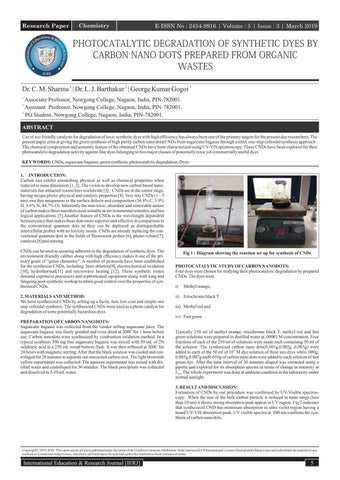
Fig 1 : Diagram showing the reaction set up for synthesis of CNDs PHOTOCATALYTIC STUDY OF CARBON NANODOTS: Four dyes were chosen for studying their photocatalytic degradation by prepared CNDs. The dyes were i)
Methyl orange,
ii) Eriochrome black T iii) Methyl red and iv) Fast green
PREPARATION OF CARBON NANO DOTS: Sugarcane bagasse was collected from the vendor selling sugarcane juice. The sugarcane bagasse was finely grinded and oven dried at 200C for 1 hour before use. Carbon nanodots were synthesized by combustion oxidation method. In a typical synthesis 500 mg fine sugarcane bagasse was mixed with 50 mL of 2N sulphuric acid in a 250 mL round bottom flask. It was then refluxed at 300C for 24 hours with magnetic stirring. After that the black solution was cooled and centrifuged for 20 minutes to separate out unreacted carbon soot. The light brownish yellow supernatant was collected. The aqueous supernatant was mixed with distilled water and centrifuged for 30 minutes. The black precipitate was collected and dissolved in 5-10 mL water.
Typically 250 ml of methyl orange, eriochrome black T, methyl red and fast green solutions were prepared in distilled water at .00001 M concentration. Four fractions of each of the 250 ml of solutions were made each containing 50 ml of the solution .The synthesized carbon nano dots(0.001g,0.002g ,0.005g) were added to each of the 50 ml of 10-4 M dye solution of three azo dyes while .000g, 0.005g,0.007g and0.010g of carbon nano dots were added to each solution of fast green dye. After the time interval of 30 minutes aliquot was extracted using a pipette and explored for its absorption spectra in terms of change in intensity at λmax.The whole experiment was done at ambient condition in the laboratory under normal sunlight. 3. RESULT AND DISCUSSION: Formation of CNDs by our procedure was confirmed by UV-Visible spectroscopy. When the size of the bulk carbon particle is reduced to nano range (less than 10 nm) it shows strong absorption peak appear in UV region. Fig 2 indicates that synthesized CND has minimum absorption in ultra violet region having a board UV-VIS absorption peak. UV visible spectra at 2̴80 nm confirms the synthesis of carbon nano dots.
Copyright© 2019, IERJ. This open-access article is published under the terms of the Creative Commons Attribution-NonCommercial 4.0 International License which permits Share (copy and redistribute the material in any medium or format) and Adapt (remix, transform, and build upon the material) under the Attribution-NonCommercial terms.
International Education & Research Journal [IERJ]
5
Research Paper
E-ISSN No : 2454-9916 | Volume : 5 | Issue : 3 | March 2019 From the fig 3© it has seen that the eriochrome black T solution without the CNDs have absorbance at 2.1. After the addition of 0.001g, 0.002g and 0.003g of synthesized CNDs it has seen that the absorbance appears at nearly 1.5, 1.3 and 1.1 respectively i.e CNDs causes the photocatalytic degradation of eriochrome black T. With the increase of the amount of the CNDs the degradation of the eriochrome black T also increases.
Fig 2 : Synthesized CNDs and UV visible spectra of CND indicating distinct absorption peak at 280 nm
TRIPHENYL METHANE TYPE DYES: Typical photolytic breakdown of fast green solutions are observed over CNDs and shown in the Fig 3(D). From the figure, it is seen that the fast green solution without the CNDs have absorbance at 3.2. After the addition of 0.005gm, 0.007gm and 0.010g of synthesized CNDs it has seen that the absorbance appears at nearly 1.6, 1.2 and .2 respectively i.e CNDs causes the photocatalytic degradation of fast green. With the increase of the amount of the CNDs the degradation of the fast green also increases.
PHOTOCATALYTIC ACTIVITY: Typical photocatalytic degradation of azo dyes viz. methyl orange, methyl red and eriochrome black T solutions are detected upon the introduction of CNDs and shown in the fig 3 (A), (B) and (c).
Fig 3 (A): Degradation of methyl orange by (a) 0.000 g (b) 0.001 g (c) 0.002 g (d) 0.005 g carbon nanodot (Time 30 minutes)
Fig 3 (C): Degradation of eriochrome black T by (a) 0.000 g (b) 0.001 g (c) 0.002 g and (d) 0.005 g of CND (Time 30 mins)
The electron hole pairs over the surface of CNDs are created upon the interaction of electromagnetic radiation with the CNDs. The holes are trapped in the Presence of the trap states and radiation decay electron is hindered. Holes combine with donor atoms like water to produce hydroxide free radicals and these free radicals are actually responsible for the photo catalytic decomposition of organic material. From the fig 3(A) it has been observed that the methyl orange solution before the addition of CNDs have absorbance at 1.6. After the addition of 0.001g, 0.002g and 0.003g of synthesized CNDs the absorbance peak degrades to nearly 0.7, 0.5 and 0.3 respectively i.e CNDs causes the photocatalytic degradation of methyl orange. With the increase of the amount of the CNDs the degradation of the methyl orange also increases. The fig 3(B) indicates that the methyl red solution without the CNDs have absorbance at 1.6. The addition of 0.001g, 0.002g and 0.005g of synthesized CNDs leads to the degradation of the absorption spectra and absorbance appears at nearly 0.8, 0.6 and 0.2 respectively. This degradation of the absorption peak is due to the photocatalytic behaviour of the CNDs. The degradation of the methyl red also increases along the increase of the amount of CNDs.
Fig 3 (D) : Degradation of fast green by (a) 0.000 g (b) 0.005 g (c) 0.007 g (d) 0.010 g CND (Time 30 minutes) Percentage degradation of the dyes in the presence of CNDs: Fig. 3(A), 3(B) and 3(C) depicts that the dye solutions of methyl orange , methy red and eriochrome black T have absorbances at 1.6 , 1.6 and 2.1 respectively without the addition of CNDs which decreases upon the addition of different amounts of carbon nano dots. The percentage decomposition of the dyes over the CNDs are given as: Amount of the CNDs Methyl orange Methyl red Eriochrome black T (g) (%) (%) (%)
Fig 3 (B): Degradation of methyl red by (a) 0.000 g (b) 0.001 g (c) 0.002 g (d) 0.005 g of CND (Time 30 mins)
6
.001
56
50
28.75
.002
68.75
62.5
38.09
.005
81.25
87.5
49.3
Analysis for triphenyl methane type dyes: Fig. 3(D) shows the initial absorbance spectra of fast green dye solution without the addition of CNDs and the gradual decrease of the absorbance peak upon the increased addition of the CNDs. The percentage decomposition of fast green over the carbon nano dots are given as:
International Education & Research Journal [IERJ]
Research Paper Amount of the CNDs (g)
E-ISSN No : 2454-9916 | Volume : 5 | Issue : 3 | March 2019 Fast green (%)
.005
50
.007
62.5
.010
90.25
CONCLUSION: Fluorescent carbon nanoparticle was obtained after sulphuric acid oxidation of sugarcane bagasse by combustion oxidation method. The light brownish yellow supernatant was collected .The synthesized CNDs have shown absorption in the ultraviolet region having a broad UV-VIS absorption peak at around 280-300 nm which confirms the synthesis of carbon nanodots. The aqueous supernatant was mixed with distilled water and centrifuged to collect the black precipitate and it was dissolved in 5-10 mL water. The solution was investigated for its photocatalytic activity against synthetic dyes. CNDs have been established to be an assuring catalyst in the photocatalytic decomposition of some varied classes of dyes viz. Azo dyes and triphenylmethane dyes which are commercially important yet potentially pollutant to the environment. REFERENCES: 1.
Li, H., et al., Carbon nanodots: synthesis, properties and ap- plications. Journal of Materials Chemistry, 2012.
2.
Anilkumar, P., et al., Crosslinked Carbon Dots as Ultra-Bright Fluorescence Probes. Small, 2013.
3.
Wang, Q.H., et al., Low Dimensional Carbon Materials for Applications in Mass and Energy Transport. Chemistry of Materials, 2014.
4.
Chakrabarti, M.H., et al., Application of carbon materials in redox flow batteries. Journal of Power Sources, 2014. 253: p. 150-166.20.
5.
Hu, S., et al., Laser synthesis and size tailor of carbon quantum dots. Journal of Nanoparticle Research, 2011. 13(12): p. 7247-7252.
6.
Zhou, J., et al., An Electrochemical Avenue to Blue Lumi-nescent Nanocrystals from Multiwalled Carbon Nanotubes (MWCNTs). Journal of the American Chemical Society, 2007.
7.
Mitra, S., et al., Rapid microwave synthesis of fluorescent hydrophobic carbon dots. RSC Advances, 2012. 2(32): p. 12129-12131.
8.
Bao, L., et al., Electrochemical Tuning of Luminescent Carbon Nanodots: From Preparation to Luminescence Mechanism. Advanced Materials, 2011. 23(48): p. 5801-5806.
9.
Xu, X.; Ray, R.; Ploehn, H.J.; Gearheart, L.; Raker, K.; and Scrivens, W.A.; J. Am. Chem. Soc., 2004, 126, 12736.
10. Sun, Y.P.; et al., , M. Chem. Soc., 2006, 128, 7756. 11. Baker, S.N.; . Baker, G.A.; Angew. Chem., Int. Ed., 2010, 49, 6726. 12. Li,H.; Kang, Z.; Liu,Y.; and Lee, S.T.; J. Mater. Chem., 2012, 22, 24230.
International Education & Research Journal [IERJ]
7