Research Paper
Engineering
E-ISSN No : 2454-9916 | Volume : 4 | Issue : 6 | June 2018
A NOVEL METHOD FOR IMAGE ENHANCEMENT AND SECURE TRANSMISSION TECHNIQUE USING MODIFIED CLAHE AND IMAGE CRYPTOGRAPHY 1
Lohith Kumar R. | Prasanna Kumar 1 2
2
Department of Computer Science and Engineering, East West Institute of Technology. Department of Computer Science and Engineering, East West Institute of Technology.
ABSTRACT These days pictures are additionally gotten and dealt with through clear watching frameworks and impelled PDAs. Scaling of VLSI (Very Large-Scale Integration) advancement connected with control particular applications like low power, low zone or tip finish accomplishing the exchange off; either in nature of picture or the time required to process. Power utilization in managing pictures is additionally the essential in these cutting edge adaptable gadgets. A centrality beneficial VLSI outlining is proposed in this work for picture upgrade application. This contemplation was delineated with MATLAB and Cadence RTL compiler devices. Picture change is refined by utilizing contrast kept adaptable histogram modify procedure which result the high exactness and better execution of the framework. Centrality of information way compositional musings and its fundamental effect at the photograph change configuration are appeared. It is watched that the proposed information way fabricating streamlining has lessened 10.5 % of spillage imperativeness of information way square. The photograph change result is inspected by utilizing particular parameters like PSNR, MSE, RMSE, MAE, Universal Quality Index and so forth. KEYWORDS: image processing, mat lab, 2-D FIR filter, CLAHE, AHE, PSNR.MSE, Universal Quality Index. I. INTRODUCTION: The process of altering the quality of any image is termed as the Image Enhancement. Whereas, in the digital processing system it is enhance the digital data of an image with the assistance of computer. The digital image processing helps in maximizing the clarity of an image and also the sharpness of an image, and enhancing the blurring of an image. Towards the information extraction and the further analysis, the details of the features of image are carried out. In 1960, the image enhancement has begun with a limited number of researchers who are analyzing the digitized serial photographs and airborne multispectral scanner data. In 1972, after the launch of the Landsat-1 the digital data of an image become broadly available for the sensing of remote applications. During those period, the theory and the implementation and the practice of both the digital computers and the digital image processing is apparently very high in the cost and also in there efficiency was very less compare to the other applications such as other than the image processing. Nowadays, the admittance to low cost and the computer software and the hardware is common place for the source of the digital data of any image verified. We have some of the digital image sources which ranges from the airborne solid-state camera, airborne scanner, scanning of the microdensitometer and also the earth resource to the high resolution of the video camera. Digital image processing has very wide range of advantages and also it is one of the very wide-ranging subject to study for fresher and also for the experience researchers and it also includes the procedures which are mathematically very complex to solve any digital data problems. The central idea of the processing of the digital data is quite very simple, but if we try to solve that issue it will become a big problem to solve it. The procedure for dumping the digital data to the computer is that initially we need to import the digital data which we are taking it as input and it fed into the computer and then the computer will solve it Because we already programmed the computer to manipulate the input data using the equations or the series of equations and then store the result in the computation for each pixel of an image. Low pass filtering and enhancement are the only two stages of Adaptive contrast enhancement. The increasing of the contrast around edges using Finite Impulse Response (FIR) or Infinite impulse response filters (IIR) is the Filtering of the image. This work illustrates the methods related to contrast enhancement are explained with low power VLSI architectures to reduce the power consumption. II. LITERATURE SURVEY: In the Existing technique, the use of the power is so high for the computational circuits which are associated with the photos. Along these lines, decreasing the use of the power using the FIR channel for the technique. The strategy will have the tremendous stack length which achieves the more power usage. Along these lines, reducing the power in the proposed advancement. Develop low power outlines in light of Image Enhancement structures. In this Modern world the structure on chip is enthusiasm for the more power. The power use is extending rapidly. If the semiconductor blend of the system continues following the Moore's law, the power thickness inside the chips will be one of the fundamentally layout impediment for the method. A response for this issue requires structures which consume low power when appeared differently in relation to best in class devices. Thusly, from this we can diminish the power goals of the proposed system.
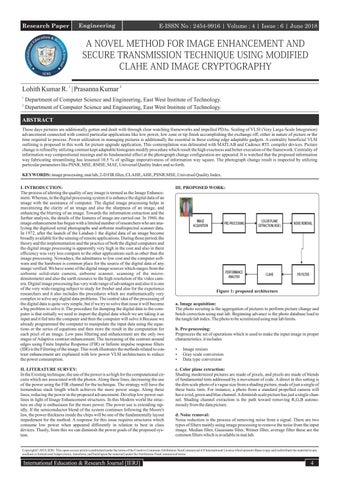
III. PROPOSED WORK:
Figure 1: proposed architecture a. Image acquisition: The photo securing is the aggregation of pictures to perform picture change and botch correction using mat lab. Beginning advance is the photo database load to the tangle lab index. The photo to be scrutinized using mat lab limits. b. Pre-processing: Preprocess the set of operations which is used to make the input image in proper characteristics. it includes Ÿ Ÿ Ÿ
Image resizes Gray scale conversion Data type conversion
c. Color plane extraction: Shading modernized pictures are made of pixels, and pixels are made of blends of fundamental tints addressed by a movement of code. A direct in this setting is the dim scale photo of a vague size from a shading picture, made of just a single of these basic tints. For instance, a photo from a standard propelled camera will have a red, green and blue channel. A diminish scale picture has just a single channel. Shading channel extraction is the path toward removing R,G,B autonomously from the data picture. d. Noise removal: Noise reduction is the process of removing noise from a signal. There are two types of filters mainly using image processing to remove the noise from the input image. Median filter, Gaussians filter, Weiner filter, average filter these are the common filters which is available in mat lab.
Copyright© 2018, IERJ. This open-access article is published under the terms of the Creative Commons Attribution-NonCommercial 4.0 International License which permits Share (copy and redistribute the material in any medium or format) and Adapt (remix, transform, and build upon the material) under the Attribution-NonCommercial terms.
International Education & Research Journal [IERJ]
4
Research Paper
E-ISSN No : 2454-9916 | Volume : 4 | Issue : 6 | June 2018
e. 2D FIR Filter: 2D FIR channel makes the two-dimensional FIR channel h using an opposite Fourier difference in the pined for repeat response Hd and duplication by the window win. Hd is a framework containing the pined for repeat response at correspondingly isolated concentrations in the Cartesian plane. fwind2 returns h as a computational particle, which is the appropriate casing to use with filter2. h is a vague size from to win. Use fwind2 to design two-dimensional FIR channels using the window procedure. fwind2 uses a two-dimensional window assurance to design a two-dimensional FIR divert in light of the pined for repeat response Hd. fwind2 works with two-dimensional windows; use fwind1 to work with onedimensional windows. For correct results, use repeat demonstrates returned by freq space make Hd. Algorithm for 2D FIR Filter: The transformation below defines the frequency response of the twodimensional filter returned by ftrans2
Figure 3 :existing approch result for image 1
where B(ω) is the Fourier transform of the one-dimensional filter b:
and T(ω1,ω2) is the Fourier transform of the transformation matrix t:
The returned filter h is the inverse Fourier transform of H(ω1,ω2): Figure 4 :existing approch result for image 2 This is the algorithm steps to perform 2d filter frequency response. f. CLAHE (Contrast Limited Adaptive Histogram Equalization): Difference constrained versatile histogram balance (CLAHE) is utilized for enhance the deceivability level of foggy picture or video. CLAHE upgrade technique for enhancing the picture quality continuously framework. Versatile histogram balance (AHE) is not quite the same as would be expected histogram adjustment on the grounds that AHE utilize a few strategies each relating to various parts of picture and utilized them to redistribute the gentility estimation of the picture and in the event of CLAHE `Distribution' parameter are utilized to characterize the state of histogram which deliver the better-quality outcome think about then versatile histogram balance (AHE). In this calculation Rayleigh conveyance parameter is utilized which make ringer formed histogram. The downside of AHE is worked over homogeneous mist however CLAHE connected over both homogeneous and heterogeneous mist and single picture and video framework. What's more, the second downside of AHE is utilized `cumulating capacity' which connected over just dim level picture yet CLAHE utilized the two pictures hued and dark level. g. Performance analysis: The performance of the proposed algorithm analyzed based on following parameters values. The parameters are Ÿ Ÿ Ÿ
PSNR MSE RMSE
IV. RESULT AND ANALYSIS:
Figure 5: proposed approch result for image 2 V. CONCLUSION: The proposed Image refresh include is addressed the work. Information way assembling types of progress were improved the condition the data path square of the photograph redesign tally. 2-D FIR sifting was related with overhaul the division of the photograph to manhandle the upsides of FIR channel against the IIR channel. Low power compressor outlining was proposed and acknowledged in the photograph change information course square to isolate the effect of building types of progress at the more lifted aggregate in the plan dynamic structure. The proposed refresh framework we utilized qualification obliged adaptable histogram alter (CLAHE) with expansion which giving all the more better execution when showed up contrastingly in connection to the present system. Since we reducing the power, substitute pieces like zone, timing of the adders which we are utilizing are also lessened for the better execution of the structure. The spread of the technique is done by the tangle lab mechanical get together and picture arranging device stash it is appeared in the above outcomes VI. ACKNOWLEDGEMENT The makers should need to thank the analysts for some accommodating comments and proposition which can improve the presentation of the paper. REFERENCES:
Figure 2: proposed approch result for image 1
5
1.
J. Angulo. “Morphological color operations in totally ordered lattices based on distances: Application to image filtering, enhancement and analysis”. Computer Vision and Image Understanding, pages 1–18, 2007.
2.
Tarik Arici, Salih Dikbas, and Yucel Altunbasak, “Local Contrast Enhancement Using 2-Dimensional Recursive Filters”,
3.
S. M. Pizer, J. B. Zimmerman, and E. V. Staab, “Adaptive grey level assignment in ct scan display,” J. Comp. Assist. Tomogr., vol. 8, no. 2, pp. 300–305, 1984.
4.
J. A. Stark, “Adaptive image contrast enhancement using generalizations of histogram
International Education & Research Journal [IERJ]
Research Paper
E-ISSN No : 2454-9916 | Volume : 4 | Issue : 6 | June 2018
equalization,” IEEE Transactions on Image Processing, vol. 9, no. 5, pp. 889–896, 2000. 5.
R. Deriche, “Fast algorithms for low-level vision.,” IEEE Trans. Pattern Anal. Mach. Intel., vol. 12, no. 1, pp. 78–87, 1990.
6.
D.E. Dudgeon and R. Mersereau, “Multidimensional digital signal processing, prentice-hall, englewood cliffs,” NJ, vol. 84, pp. 1984.
7.
Hu, Jy, and L. Rabiner. "Design techniques for two-dimensional digital filters."Audio and Electroacoustics, IEEE Transactions on 20.4 (1972): 249-257.
8.
Jiang, Hongtu. Design Issues in VLSI Implementation of Image Processing Hardware Accelerators-Methodology and Implementation. Diss. Lund University, 2007.
9.
Aliparast, Peiman, Ziaadin D. Koozehkanani, and Farhad Nazari. "An Ultra High Speed Digital 4-2 Compressor in 65-nm CMOS." International Journal of Computer Theory & Engineering 5.4 (2013).
10. N. Weste et al, “CMOS VLSI Design- A Circuits & System Perspective”, Pearson Education, 2008.
.
International Education & Research Journal [IERJ]
6