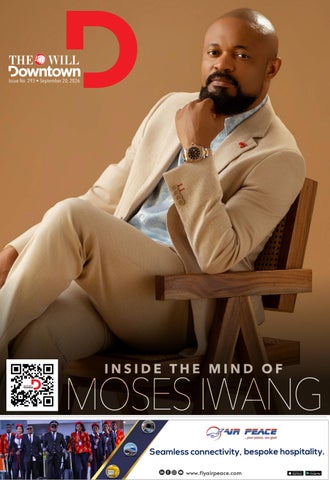
Issue No. 293 • September 20, 2026
INSIDE THE MIND OF
MOSES IWANG
Issue No. 293 • September 20, 2026
PAGE 2
THEWILL DOWNTOWN • www.thewilldowntown.com
THEWILL DOWNTOWN • www.thewilldowntown.com
Issue No. 293 • September 20, 2026
CONTENT
Photo: Kola Oshalusi @insignamedia Makeup: Zaron
EDITOR’S NOTE
I
have always admired filmmakers who are willing to entertain us while making us think. For more than two decades, Moses Inwang has done exactly that, building a career across directing, producing, writing and editing, while telling stories that explore human behaviour, difficult realities and the world around us. From Torn and Stalker to Alter Ego, Lockdown and Blood Vessel, Inwang has never shied away from complex subjects. What I find particularly compelling is his ability to weave themes of mental health into gripping stories that keep audiences engaged while encouraging deeper reflection. His latest project, Ordinary People, continues that tradition with an eight-part drama-thriller centred on residents of a gated estate whose seemingly perfect lives conceal secrets and unexpected connections. With a talented ensemble cast, including Ramsey Nouah, Chidi Mokeme and Adunni Ade, the series promises mystery, action and family drama. Read Moses Inwang’s story on pages 8 to 10; he shares the creative thinking behind his latest work and his enduring passion for meaningful storytelling. Flexibility and mobility may sound similar, but they serve different purposes. Understanding the difference can help you move with greater control, train more effectively and reduce stiffness. Whether you exercise regularly or simply want to move better, knowing what your body needs can make every movement count. Learn more on page 13. For many young men, health is reduced to fitness, muscles and appearance, while mental well-being, sexual health, fertility and routine check-ups receive less attention. This issue encourages a broader view of men’s health, reminding us that taking care of yourself means listening to your whole body. Read about conversations young men avoid on page 17. Until next week, enjoy your read.
to Wear 04-05 Outfits When You’re Going From Work to
FASHION
07
Dinner
#UNSHAKABLE TRUTHS
8-10 COVER
11 LUXURY
Untold Truths Have We Confused Independence With Never Needing Anyone? Inside The Mind of Moses Iwang
The Better Chair
SILK
12
BEAUTY
Everything You Need to Know About Mandelic Acid
13 FITNESS
Mobility vs Flexibility What Your Body Actually Needs
14 TRAVEL
Cities Every Food Lover Should Visit
15 CULTURE
Celebrity Life Is Becoming a FullTime Production
16
DÉCOR
17 HEALTH 18 TRIBUTE 19
DOWNTOWN CONFIDENTIAL
20
5 Ways to Add Colour to Your Home Without Painting the Walls Conversations Young Men Often Avoid
Olu Jacobs The Storyteller We Will Never Forget
The Meeting
Mutiny
REVIEW
WHAT YOU SAID Boluwatife Adesina @bolugramm
- Contributing Writer Boluwatife Adesina is a media writer and the helmer of the Downtown Review page. He’s probably in a cinema near you.
Onah
Issue No. 292 • September 13, 2026
THE
STORYTELLERS
Nigerians Changing How The World Sees Africa
@0001Jossy Greatest of all time
@onahluciaa +2348033239132
AUSTYN OGANNAH
Sally Chiwuzie @unshakable.is.a.state.of.mind - Contributing Writer Sally Chiwuzie is a non-practising barrister who owns the brand #Unshakable. She is the author of Silent Symphonies, a fictional love story, and the creator of the podcast Chronicles of #Unshakable Truths.
my idol.
@eveoclock
PUBLISHER/EDITOR-IN-CHIEF Executive Editor: Onah Nwachukwu @onahluciaa Writers:Dorcas Akintoye, Johnson Chukwueke & Evi-Ben Ezaga Design & Layout: Hogan Effiom Digital Media: Oladimeji Balogun, Victoria Dairo & Olamide Abolarin Consulting Art Director: Sunny Hughes ‘SunZA’ www.thewilldowntown.com thewilldowntown thewilldowntown 254 Remi Fani-Kayode Avenue, GRA, Ikeja. Lagos, Nigeria. +234 810 345 2286, +234 913 333 3888
Ada Obiajunwa @aaddaahh - Contributing Writer Ada Obiajunwa writes from Lagos about the big truths tucked inside ordinary moments — friendship, self-discovery, and the quiet revolutions of everyday life. She believes in the power of presence, good banter, and decoding the unsaid. Through her fragrance studio, WhiffWonders, she also crafts scents that weave memory and emotion into experiences that feel like home.
@mus_slimah_ Never let your Age limit you
PAGE 3
Issue No. ISSUE NO.293 261••September FEBRUARY20, 08,2026 2026
THEWILL DOWNTOWN • www.thewilldowntown.com
FASHION
OUTFITS TO WEAR G WHEN YOU’RE GOING FROM WORK TO DINNER
BY DORCAS AKINTOYE etting dressed for work and dinner on the same day can feel like a challenge. You want to look professional at the office, but also stylish and relaxed when the workday ends. The good news is that you do not need to carry a second outfit to work or rush home to change. With the right pieces, you can create an outfit that works for both. In this article, we will show you four outfit ideas that can easily take you from your desk to dinner.
PAGE 4
THEWILL DOWNTOWN • www.thewilldowntown.com
Issue No. 293 • September 20, 2026
FASHION
TAILORED TROUSERS, A SATIN TOP, AND A BLAZER Ta
ilored trousers are a gre at starting point for a workto-dinner outfit because they look polished witho ut feeling too formal. Pair them with a satin or silky top for a touch of elega nce, then add a blazer to ke ep the look office-appropri ate. During the workday, you can wear the outfit with simple flats or loafers an da structured work bag.Wh en it is time to leave, swap the work bag for a small er handbag and change int o heels or dressy sandals .
DARK-WASH JEANS, A STATEMENT BLOUSE AND A BLAZER In workplaces where jeans are allowed, dark-wash denim can be easily dressed up. Choose a well-fitting pair of straight-leg or wide-leg jeans and pair them with a blouse featuring an interesting detail, such as a bow, a bold print, an elegant neckline, or statement sleeves. Add a blazer to make the outfit look more polished for work. Once the workday is over, you can remove the blazer and let the blouse stand out.
A MIDI DRESS WITH A BLAZER AND HEELS
A midi dress is on e of the easiest outfits to take from work to dinn er. Choose a dress w ith a simple cut and a length that feels comforta ble for the office.You can wear it with a blaz er during the day for a more professional look. For dinner, you can ta ke off the blazer or wea r it still. You can also add a pair of eye-catching ea rrings or a simple neckla ce.
A MONOCHROME CO-ORD SET WITH STATEMENT ACCESSORIES A matching co-ord set ca n make getting dressed mu ch easier because the top and bottom are already desig ned to work together. A trous er set in a single colour can loo k smart and professional at work while still leaving room to create a stylish evening look. For the office, keep your accessories simple and pair the set with flats, loafers or low heels. Before heading to dinner, switch to statem ent shoes and a smaller ba g.
Going from work to dinner does not mean you need a completely new outfit. Start with clothes polished enough for the office, then use your shoes, bag, and accessories to give the look an evening upgrade.
PAGE 5
Issue No. 293 • September 20, 2026
PAGE 6
THEWILL DOWNTOWN • www.thewilldowntown.com
THEWILL DOWNTOWN • www.thewilldowntown.com
Issue No. 293 • September 20, 2026
#UNSHAKABLE TRUTHS
SALLY CHIWUZIE
UNTOLD TRUTHS @unshakable.is.a.state.of.mind
Have We Confused Independence With Never Needing Anyone?
D
uring a recent conversation about relationships, I admitted that my dating history since my divorce has been sparse.
acknowledges that survival was never meant to be the highest purpose of love. I do not believe God created partnership because women were incapable of surviving alone. Partnership should offer companionship, counsel, intimacy, and a safe place to set down some of what life asks us to carry.
The explanations came easily. I was raising my children, and that responsibility came first. I was working, rebuilding and doing what I like to call empire building. There were a few frogs along the way. Some announced themselves early. Others required a kiss before the evidence became conclusive.
This is where conversations about leadership and submission become unnecessarily loud. A man does not lead by overpowering a woman. Leadership is being secure enough to support her dreams, ambitions, peculiarities and individuality without turning love into a power struggle. It is creating the emotional safety in which fears, concerns and weaknesses will be cared for, not stored as ammunition for later.
All of that is true, but it is not the whole truth. I was not always ready. Beneath the schedules, responsibilities and ambition lived a fear I could conveniently rename busyness. My independence came from both temperament and necessity. I have always been resourceful, but life also taught me that if something needed carrying, I had better prepare my own back for the weight.
The independent woman also has work to do. She must learn that receiving support is not surrender and that asking for help does not cancel everything she has built. When my heart feels safe, I do not need to control everything. I can receive counsel without surrendering my judgement. I can allow someone to be strong for me without becoming less strong myself.
Eventually, capability stopped being something I practised and became part of my identity. I wonder how many women recognise that transition? How many of us became independent because we wanted to be, and how many because life left us no sensible alternative? At what point did self-reliance stop being something we could do and become something we believed we must always do? Independent women are admired. We are called accomplished, formidable and inspiring. Yet admiration can become complicated when our independence expresses an opinion, protects a boundary or refuses to shrink. It is easy to applaud a woman’s power in theory. Living alongside it may require something more.
or unwelcome because she has become accustomed to doing everything herself? When women say men are intimidated by us, is that always true? Or is “intimidated” sometimes a convenient word that saves us from asking whether we have left any room for someone to contribute? Some men undoubtedly want a woman to become smaller so they can feel bigger. Others may simply be trying to find a door into a life built without them, and that distinction matters.
But what does independence feel like from the other side? Being alone is often perfectly fine. Loneliness is different. Loneliness is facing a decision heavy Do men admire a self-sufficient woman and later enough to alter your life and wishing there struggle to understand where they fit in her life? Do were someone beside you who was equally they feel unnecessary because she asks for nothing, invested in its consequences. Wanting that person does not erase independence. It simply
So perhaps the questions belong to all of us. Women, when did capability become armour? Men, what has it felt like to love a woman who learned to live as though she needed no one? Did you feel welcomed, resisted, tested or diminished? Were you prepared to stand beside her without needing to stand above her? Perhaps the #Unshakable truth is this: independence and partnership are not opposites. The real work is recognising when self-reliance is freedom and when it is fear wearing a very respectable outfit. A woman can open her life without surrendering herself. A man can contribute without controlling it. Perhaps love begins when both stop treating partnership as a contest over who is needed more. ‘See’ you next week.
PAGE 7
Issue No. 293 • September 20, 2026
THEWILL DOWNTOWN • www.thewilldowntown.com
COVER
F
or more than two decades, Moses Inwang has been steadily carving out his place in Nollywood as a filmmaker unafraid to explore stories that sit at the intersection of entertainment and social commentary. A director, producer, screenwriter and editor, Inwang began his filmmaking journey in the late 1990s and has since built a diverse body of work spanning psychological thrillers, drama, comedy and socially conscious films. His filmography includes Torn, Damage, Stalker, Alter Ego, Crazy People, American Driver, Unroyal, Lockdown and Blood Vessel, among others. Across these projects, he has repeatedly explored subjects ranging from domestic violence and mental health to public health crises, migration and the complexities of human behaviour. His preference for thrillers, in particular, has allowed him to package weightier themes inside stories designed to keep audiences guessing. Moses Inwang's latest project, Ordinary People, takes that ambition to another level. The Netflix drama-thriller series centres on seemingly ordinary residents of a gated estate whose carefully constructed lives conceal secrets, criminal pasts and unexpected connections. Starring Ramsey Nouah, Chidi Mokeme, Adunni Ade and an ensemble cast, the eight-part series combines crime, mystery, family drama and action while examining the masks people wear and the truths they hide. In this exclusive interview with THEWILL DOWNTOWN’s Johnson Chukwueke and Evi-Ben Ezaga, Moses Inwang speaks on Ordinary People introducing a new chapter in his career. Moses Inwang’s journey offers an opportunity to look beyond the finished films, to understand the filmmaker's creative instincts, his evolution, the business of making Nigerian stories for global audiences, and the person he is when the cameras stop rolling.
Inside The Mind of
MOSES IWANG PAGE 8
THEWILL DOWNTOWN • www.thewilldowntown.com
Issue No. 293 • September 20, 2026
COVER You began your filmmaking journey in the late 1990s. What was it about filmmaking that made you believe this was the career you wanted to pursue, especially at a time when Nollywood was still very different from what it is today? I was very much into the arts; I was already in a rap group called Face2Face, and eventually I discovered I didn’t like fame. I discovered very early that I didn’t like fame. In the music group, we made a music video; I shot and funded it. After the edit, I realised I didn’t want to see myself on TV. The song was already out; it was everywhere, but I just realised I didn’t want the fame. I definitely wanted to be in the entertainment business and in the arts, so that pushed me towards being the guy behind the camera. I found myself piquing interest in filmmaking, and that’s how we are here. Looking back at your early projects and the filmmaker you are today, what do you think has changed the most about your approach to storytelling? A lot has changed. As I continue to grow in my career, I have come to realise that to be a successful commercial filmmaker, you have to make films that audiences want to see. Earlier in my career, I just made films I liked making. At a time when the industry was making lots of comedies, I was making action films, so I tried to take into account what people want to see and what the market wants by doing a bit of research into what was in demand. Also, the treatment— the way we treat our stories— we are also improving and making sure that the story, the plot, they are all properly layered and just making sure that we make our stories stronger and more intense. We have always had great stories, but it’s been the way we’ve told them that has been lacking previously.
What excites me is the knowledge that we still have many stories to tell as African filmmakers. I know we are an untapped region and an untapped industry, so I am excited about all the stories that are yet to be told. Personally, I have over 100 stories left to tell; my repertoire is very rich. I am excited about the future; I am excited about the stories we will tell. The thing I know we have to improve on is the way we go about making our films, the technical requirements towards making the films. I understand that we as a region are financially challenged; I know firsthand that it’s our biggest challenge. It also goes down to the professional requirements needed to make standard films globally. It’s easy to say filmmakers need to go and get training, but film school isn’t cheap; filmmakers need to go and learn the ropes. It’s easy for me to say filmmakers need to go to school; it’s easy for me to sit down here and say all of that. I know we need a lot of capacity building in the industry; we need many professional filmmakers to take on the filmmaking department, but what we lack is the financial firepower to get us where we want to go. But the good news is, it’s getting better and better every year. We have a lot more thoroughbred filmmakers coming up in every department everywhere, so yeah, the future is very bright for us.
"If you only make films for a selected audience, I mean, it’s a good start, but you have to find a way to grow and make You have described Ordinary People as a films that cut across story about “the masks we and the truths we regions and languages. wear hide.” What do you hope viewers understand about So all my films are themselves or society after watching it? targeted at a global It’s clear from the story that everything we see is audience, and Ordinary not quite as literal as it appears. People is no exception." There are people who are
Let's talk about Ordinary People.
"What excites me is What was the original idea that sparked the series, and how did that the knowledge that idea evolve into the eight-episode A lot of your story audiences are now seeing on films have we still have many Netflix? explored stories to tell as African It’s a story I conceived in the difficult pandemic, in 2020. The origin of that subjects, from filmmakers. I know story is as literal as the show you see domestic Netflix today. You know, in 2020 violence and we are an untapped on there was a pandemic, the whole mental health to public health region and an untapped COVID issue; everyone was locked in. So my neighbours and I in my estate, and migration. industry, so I am there was only one thing we could What usually After being locked in for so long, draws you to a excited about all the do. we came out to socialise with each particular story, and how do you stories that are yet to be other, which we hardly did before the pandemic. So we did that; we came decide that it out every other evening, got a ram or told." is one worth telling? The genre I fell in love with was thrillers, and I still love them. With Thrillers, if you go ahead and make a Thriller film, it would be hard to divorce that from characters that are mentally challenged. It would be hard to make a Thriller without establishing or involving a character who is mentally challenged; that is why, to bring it back home and tell our African stories, I found myself making films about mental health. That’s why I did lots of films focused on mental health in 2013, 2014, 2015, and even to date. I think it’s a topic we shouldn’t shy away from because there are lots of people suffering from mental health issues, and just because it’s not talked about enough, they tend to hide it, and the situation gets worse for them and everyone around them. That’s why I try to use my films to shed light on and advocate for that issue. You have been in Nollywood for more than two decades. What is one thing about the industry today that excites you, and one thing you think filmmakers still need to get right?
have limited time, maybe just six months, that wouldn’t give you enough time to develop the plot or even the characters properly, which is something I tried to avoid with Ordinary People. I started developing the characters from 2020 till 2024; that’s a whole 4 years. The film was in postproduction from 2024 to 2026; that’s all of the time it took me. For me, apart from the skill set required to make a film, you also need time to carry these things out.
a goat, did some grilling, had some chicken. You know, just socialise with each other, play some music, and it was really good. I remember a time hanging out; I just looked around and couldn’t believe the neighbourhood we had.
as literal as they appear, and there are also people who wear masks. Ordinary People will help you discover these characters in others and thoroughly entertain and enlighten you about certain areas of life.
The series was filmed across multiple locations, including Lagos and Bayelsa, with an international production scale. What was the most challenging part of taking Ordinary People through these different locations? The continuity was the challenging part. We shot over a period of two years; the first shooting period was in 2024, when we shot the bulk of the project in two months. After that, for a lot of the scenes, especially the ones with big elements, we had to move forward. Like the private jet hangar, the shots at the refinery, at the museum—just those big elements. Like when we had to explode stuff, we had to spread them out so we could properly prepare for those. The disadvantage of spreading your project out like that is that you might be unable to maintain continuity; actors may have grown out their hair or changed their looks, but somehow we were able to make it. Actors like Ramsey Noah and Adunni had different looks over the course of the shooting years, so whenever they came back on set, we had to do heavy makeup to restore their distinctive look from the last shot. It was quite challenging, but we were able to overcome it. Netflix gives Nigerian filmmakers access to audiences far beyond Nigeria. Did you approach Ordinary People differently because you knew a global audience would watch the story? Absolutely, I don’t make films for just the Nigerian audience alone; I make films for the global audience, films that can cut across language barriers, geographical barriers, and all that. If you only make films for a selected audience, I mean, it’s a good start, but you have to find a way to grow and make films that cut across regions and languages. So all my films are targeted at a global audience, and Ordinary People is no exception.
"The film was in post-production from 2024 to 2026; that’s all of the time it took me. For me, apart from the skill set required to make a film, you also need time to carry these things out."
The series is built around people who appear ordinary on the surface but are hiding extraordinary secrets. That’s quite the contrast; what sparked the desire to explore it? It’s one thing to have a story, and another to create it intensely and even craft characters that are exciting to watch. I had six years to create this story, which afforded me the time to develop the characters as in-depth as I wanted. I had the time, and I think that’s what lots of writers and creators need to do if they want to have that strong effect on the audience. When you just
When you're not working, what does Moses Inwang actually enjoy doing? What are the things that help you switch off from filmmaking? When I am not working, my best hobby is
PAGE 9
Issue No. 293 • September 20, 2026
THEWILL DOWNTOWN • www.thewilldowntown.com
COVER hanging out with my kids, going places with them, studying with them, teaching them; just generally being with my kids is one of the best things for me. Even when I am working, they try to stay around me. Another hobby is playing football; I love to play football. I play football three times a week when I am not injured. When I am injured, I treat myself; as soon as I am back, it’s straight back to football. You've also described yourself as a professional singer who eventually chose filmmaking. Do you still sing or perform privately, and do you ever imagine what your life might have looked like if music had remained your main career? Yes, I actually imagine that all the time because I am still a music lover; I still make music in my studio a lot. I make soundtracks; I have a couple of songs in Ordinary People that
I made, the soundtrack that has me performing. I definitely do make music, maybe not commercially, but I still try to make music from time to time. Filmmaking can consume almost every part of your life. After years of giving so much to the industry, what does a genuinely good day look like for you when there is no set, no script and no deadline? I try to relax. I bingewatch shows and movies. I just try to relax because most of the time, I am really busy, and when that’s not happening, I choose to relax.
PAGE 10
THEWILL DOWNTOWN • www.thewilldowntown.com
Issue No. 293 • September 20, 2026
LUXURY SILK
ADA OBIAJUNWA @aaddaahh
The Better Chair S
he couldn't remember when she had started noticing chairs.
Nobody else appeared to notice that anything had changed. Ada did. Her own chair was unremarkable. Four legs. Straight back. Firm seat. Ada shifted once. Everything was fine.
Ada had been offered the sofa. She chose the chair. Nobody noticed. There was no reason they should have. The sofa was beautiful. Low, cream, deep enough that the woman already sitting on it had folded one leg underneath herself. Beside it was an ordinary dining chair someone had pulled into the room. Ada looked at both. The sofa would have been fine. She exercised. She was perfectly capable of getting in and out of a sofa. Still. She chose the chair. The evening continued. Someone was telling a story. Glasses moved around the table. A phone was passed from one person to another. Somebody laughed from the kitchen. Across from Ada, the woman on the sofa changed position. One leg came out. A little later, the other followed. Both feet went to the floor. She stayed where she was. Ada watched briefly. She knew the sequence. She couldn't remember when she had started noticing chairs. There had been a time when a chair was simply somewhere to sit. Now there were chairs. And there were chairs. Some announced the problem immediately. Too low. Too deep. Too upright. Ada had opinions. She had not intended to acquire them. She knew which chair would require shifting after twenty minutes. Which restaurant would have everybody leaning across the table to hear one another. Which pair of shoes would become somebody else's problem halfway through the evening, except that somebody else would also be her. A few weeks earlier, someone had suggested a
Someone offered her another drink. Ada declined. It was getting late. She checked the time. It was not particularly late. Still. She had work in the morning. There had been a time when this information would not have become relevant until the following morning. Apparently that arrangement had been revised. The conversation moved on. Ada stayed a little longer.
restaurant. Ada knew the place. The food was good. The room was
beautiful. The music was loud enough to require everybody at the table to spend the evening leaning towards one another. Ada suggested somewhere else. "Why?" She thought about it. "The parking is easier." This was true. It was not the whole truth. The other restaurant had comfortable chairs. The music was lower. You could hear the person sitting across from you without moving closer. And the parking was easier. Ada had recommended it to three people. There had been a time when she would park wherever she found space and deal with the distance later. Now, apparently, later had acquired representation in the decision. Back in the room, the woman on the sofa had moved again. She was no longer sitting deep inside it. She had moved closer to the edge. Not much. A few inches. Both feet remained on the floor. She wasn't leaving. She continued talking.
Eventually, people began gathering their things. Phones disappeared into bags. Someone was looking for
a car key. Another person was finishing a drink they had apparently forgotten about. Across from Ada, the woman picked up her phone. She put it into her bag. Then she moved forward slightly. Both feet were already where they needed to be. Her hands found the sofa beside her. Ada saw it coming. There was a small lean forward. A pause. Then up. She stood. Perfectly fine. Nothing dramatic. She picked up her bag and continued talking. Ada stood too. Once.
At the door, her friend hugged her. "You were comfortable there?" "Very." "You should have taken the sofa." Ada looked back. Someone else had already taken the woman's place. She was sitting deep inside it, one leg folded underneath her. Ada looked at the sofa. Then at the ordinary chair beside it. "Goodnight." Outside, Ada walked towards her car. She had parked close.
PAGE 11
Issue No. 293 • September 20, 2026
THEWILL DOWNTOWN • www.thewilldowntown.com
BEAUTY
EVERYTHING YOU NEED TO KNOW ABOUT MANDELIC ACID BY DORCAS AKINTOYE
I
f your skin looks dull, uneven, or rough, you may have heard of mandelic acid. This gentle skincare ingredient is an alpha-hydroxy acid (AHA) derived from bitter almonds. It helps remove dead skin cells from the surface, allowing fresher, smoother skin to appear. Unlike some stronger acids, mandelic acid has a larger molecule size, so it penetrates the skin more slowly, making it useful for people who want exfoliation without too much irritation. Here’s everything you need to know about mandelic Acid.
GENTLY EXFOLIATES THE SKIN Mandelic acid helps loosen and remove dead skin cells that can build up on the skin’s surface. When these cells are not removed, the skin may look dull, dry, or rough. Regular use of mandelic acid can help reveal smoother and brighterlooking skin. Because it works more slowly than many other AHAs, it is often considered a gentler exfoliating option.
HELPS BRIGHTEN UNEVEN SKIN TONE Dark spots and uneven skin tone can develop after breakouts, sun exposure, or skin irritation. Mandelic acid can help by encouraging the removal of pigmented dead skin cells and supporting a more even-looking complexion. With steady use, the skin may look fresher and brighter. However, results take time, so it is important not to overuse the product.
MAY HELP REDUCE THE APPEARANCE OF ACNE Mandelic acid can be helpful for acne-prone skin because it exfoliates, clearing dead skin cells that may clog pores. It may also help improve the look of small bumps and blemishes. Since it is generally gentler than stronger exfoliating acids, it may suit people with easily irritated skin. Regardless, it should still be introduced slowly, especially if you are new to acids.
HELPS IMPROVE THE LOOK OF FINE LINES As we age, the skin naturally produces less collagen, and cell turnover can slow down. This can make fine lines and rough texture more noticeable. By removing dead surface cells and supporting regular skin renewal, mandelic acid can help the skin look smoother. It does not erase wrinkles, but consistent use may improve the skin’s overall appearance and texture.
CAN IMPROVE SKIN TEXTURE
Uneven texture can make the skin feel rough or look less smooth. Mandelic acid gently exfoliates the skin’s surface, helping to remove buildup that can make skin feel uneven. Over time, this may leave the skin feeling softer and looking more polished. This benefit makes mandelic acid useful for people who want smoother-looking skin without having to start with a very strong exfoliant.
When using mandelic acid safely, start with a low-strength product once or twice a week, then increase slowly if your skin responds well. Avoid using too many strong exfoliating products at the same time. Most importantly, wear sunscreen during the day because exfoliation can make skin more sensitive to sunlight.
PAGE 12
THEWILL DOWNTOWN • www.thewilldowntown.com
Issue IssueNo. No.293 293••September September20, 20,2026 2026
FITNESS
Mobility vs Flexibility WHAT YOUR BODY ACTUALLY NEEDS
BY JOHNSON CHUKWUEKE
M
obility and flexibility are often used interchangeably in fitness conversations, but they are not the same thing. You may be able to touch your toes and still struggle with a deep squat. You might also have flexible muscles but lack the control or joint strength needed to move freely through certain positions. Understanding the difference can help you train smarter, reduce unnecessary stiffness, and improve your body’s performance both inside and outside the gym.
YOUR WORKOUTS MAY BE REVEALING WHAT YOU LACK Certain movements can reveal whether mobility or flexibility is limiting you. Do your heels rise when you squat? Do your shoulders feel restricted when lifting your arms overhead? Do you struggle to maintain good form during lunges? These issues do not always have the same cause, but restricted movement can sometimes indicate that specific areas need more attention. It may be more helpful to identify whether you need improved flexibility, better joint control or stronger muscles within a particular range of motion.
FLEXIBILITY IS ABOUT HOW FAR YOUR MUSCLES CAN STRETCH Flexibility refers primarily to the ability of a muscle or group of muscles to lengthen. When you bend forward to touch your toes or stretch your hamstrings after a workout, you are working on flexibility. Static stretching, holding a position for a period of time, is one common way to improve it.
MOBILITY IS ABOUT MOVEMENT AND CONTROL Mobility takes flexibility a step further. It refers to your ability to actively move a joint through its available range of motion with strength and control. For example, having flexible hips may allow you to sit in a deep squat, but good hip mobility means you can move into and out of that position comfortably and with control. Mobility therefore involves a combination of flexibility, joint function, muscle strength, and coordination.
MOBILITY WORK CAN IMPROVE EVERYDAY MOVEMENT Mobility training isn't reserved for athletes. Getting out of a low chair, bending to pick something up, climbing stairs, and reaching for objects all require your joints and muscles to move efficiently. Simple movements such as hip rotations, ankle mobility drills, controlled shoulder circles, and deep squats can help you become more aware of how your body moves.
THE BEST ROUTINE USUALLY INCLUDES BOTH
You don't necessarily have to choose between mobility and flexibility. Both can play valuable roles in a well-rounded fitness routine. Dynamic movements can work well as part of a warm-up, helping prepare the body for activity, while longer static stretches may be useful after exercise or during a separate stretching session. The best approach depends on your body, your activities, and your individual limitations. The goal is to develop a comfortable range of movement that you can actively control.
Flexibility helps your muscles lengthen, while mobility helps your body move through its range of motion with strength and control. Understanding the difference can change the way you approach your workouts and help you identify what your body actually needs.
PAGE 13
Issue No.DOWNTOWN 293 • September 20, 2026 THEWILL • www.thewilldowntown.com
THEWILL DOWNTOWN • www.thewilldowntown.com Issue No. 293 • September 20, 2026
TRAVEL
CITIES EVERY FOOD LOVER SHOULD VISIT TBILISI, GEORGIA Tbilisi is a dream destination for travellers looking to discover something different. Georgian cuisine is rich, comforting, and deeply rooted in tradition. Visitors can enjoy khachapuri, the country's famous cheese-filled bread, alongside khinkali, juicy dumplings packed with flavour. Pair these with Georgia's world-renowned wines, produced using ancient methods that have stood the test of time. Every meal in Tbilisi reflects the city's warm hospitality and love for bringing people together.
OAXACA, MEXICO
Often called the culinary heart of Mexico, Oaxaca is famous for preserving authentic regional flavours. It's best known for its wide varieties of mole, handmade tortillas, tamales, and smoky mezcal. Local markets buzz with life as vendors prepare traditional dishes using recipes perfected over generations. Every meal tells a story of culture, heritage, and craftsmanship, making Oaxaca a must-visit for adventurous food lovers.
PAGE 14
BY NATO CHIMA
F
ood has become one of the biggest reasons people travel. Beyond famous landmarks and beautiful landscapes, every destination has a unique culinary identity waiting to be discovered. From recipes passed down through generations to bustling street markets filled with local favourites, food offers an authentic taste of a city's culture and history. For travellers who believe every trip should include unforgettable meals, choosing a destination based on its cuisine is never a bad idea. If you're ready to let your taste buds lead the way, these cities promise dining experiences that make every journey worthwhile.
PENANG, MALAYSIA Penang, especially George Town, is widely regarded as one of Asia's greatest street food capitals. Influences from Malay, Chinese, Indian, and Peranakan cultures come together to create an unforgettable dining experience. Signature dishes like Char Kway Teow, Assam Laksa, and Cendol showcase the city's incredible diversity. The lively hawker centres offer visitors delicious meals at affordable prices, proving that some of the world's best food doesn't come from luxury restaurants.
CUSCO, PERU While many travellers visit Cusco for its history and proximity to Machu Picchu, its food scene is equally rewarding. Traditional Andean ingredients are transformed into dishes such as lomo saltado, ají de gallina, and fresh trout prepared with local herbs and spices. The city's restaurants celebrate Peru's rich culinary heritage while embracing modern creativity, offering visitors an experience that is both authentic and memorable.
ISTANBUL, TÜRKIYE Few cities blend cultures as beautifully as Istanbul. Sitting between Europe and Asia, it offers a remarkable mix of flavours shaped by centuries of history. Visitors can enjoy grilled kebabs, flaky börek, colourful meze, freshly baked simit, and the city's famous baklava. Whether exploring local markets or dining along the Bosphorus, every meal reflects Istanbul's unique position as a meeting point of cultures and cuisines. Great food has a way of making every journey more memorable. Beyond satisfying your appetite, it introduces you to local traditions, history, and the people who keep those culinary traditions alive. Each destination offers far more than a good meal. Sometimes, the best way to experience a city isn't through its landmarks; it's through what's served on the plate.
THEWILL DOWNTOWN • www.thewilldowntown.com
Issue No. 293 • September 20, 2026
CULTURE
EVI-BEN EZAGA
CELEBRITY LIFE IS BECOMING A FULL-TIME PRODUCTION
B
eing a celebrity used to mean that people were interested in what you did. Your films, music, performances, interviews and public appearances were enough to keep people watching.
That creates a cycle. The more spectacular celebrity moments become, the more difficult it is for anything simple to attract the same attention. Celebrities are constantly competing not only with one another but with their own previous appearances.
Now, being seen seems to require a little more work. A celebrity can attend a friend's baby shower and arrive in carefully coordinated asoebi. They can turn up at someone else's wedding looking ready for a magazine shoot. Even ordinary appearances can come with professional photography, styling, a personal content creator trailing behind, and enough content to make the occasion feel like their own event. The preparation itself has become its own content, with getting ready now filmed and posted as a moment separate from the event it was meant for.
opportunity to be seen. Even a newborn can arrive with their own page, built for engagement and brand deals as much as memory. It may be income, or it may simply be that the spectacle itself has become part of the pleasure.
Increasingly, the cost of the look is part of the content too, worn and spoken about as proof of status as much as style. There is nothing particularly new about celebrities dressing well or wanting good pictures. What feels different is how often these moments now seem to be produced for an audience. Celebrity life has become increasingly visual. With social media, an appearance does not end when the event is over. There are photos to post, videos to share and moments to turn into content. An event becomes more than something you attend. It becomes another
And so, showing up is no longer always enough. There is an expectation to make an entrance, have a look, create a moment and give people something to talk about. There is an unspoken rule now: if an appearance produces no content, it barely counts as having happened at all. Social media has made this even more pronounced because celebrities are no longer only presenting their careers. They are constantly presenting themselves. Their clothes, homes, friendships, celebrations and even their presence at other people's milestones can become part of their public image. There is nothing dishonest in this, and nothing wrong with enjoying the spectacle. For many, dressing up, taking pictures and creating memorable moments is simply part of the fun. But its frequency says something about how celebrity culture has changed.
This has also changed what audiences expect. We have become accustomed to extravagant celebrity weddings, elaborate birthday celebrations, carefully styled appearances and professionally produced content. What once seemed excessive can quickly become ordinary when we see it often enough.
Fame now comes with an expectation of constant visibility. And visibility increasingly requires production. Somewhere in this is a quieter cost: never just being able to attend something without managing how it looks. That may be why celebrity culture can sometimes feel like it is always trying to outdo itself. There is always another look, another event, another celebration and another opportunity to turn an ordinary moment into something spectacular. Being a celebrity may once have been about being famous. Now, it increasingly seems to involve constantly creating moments that look worthy of being famous. PAGE 15
Issue No. 293 • September 20, 2026
THEWILL DOWNTOWN • www.thewilldowntown.com
DÉCOR
5 Ways to Add Colour to Your Home Without Painting the Walls USE A COLOURFUL RUG
A rug can add a lot of colour to a room without making any permanent changes. It can also help bring different colours in the room together. When choosing one, look at the colours already in your furniture and décor. Pick a rug that works with them instead of one that feels completely out of place.
BRING IN COLOUR THROUGH CURTAINS Your curtains take up a good amount of space, so they can make a big difference to how colourful a room feels. If your walls and furniture are mostly neutral, colourful curtains can add some personality to the room.
DECORATE WITH ARTWORK AND WALL DECOR
BY DORCAS AKINTOYE
A
dding colour to your home does not always mean reaching for a paintbrush. While painting the walls can completely change a room, it is not the only way to make your space look brighter, warmer, or more interesting. Sometimes, all you need are a few colourful pieces placed in the right areas. In this article, we will show you five ways to bring more colour into your home without touching the walls.
ADD COLOURFUL THROW PILLOWS Throw pillows are one of the easiest ways to introduce colour into a room. If your sofa is a neutral colour like white, grey, cream, or brown, colourful pillows can instantly make it look more lively.
You do not need to paint your walls to make them colourful. Artwork can do the job while giving your home a more personal feel. Hang colourful paintings, framed prints, photographs, or even decorative wall pieces. A large colourful artwork can become the main feature of a room, while smaller pieces can add little touches of colour around the space. The key is to choose pieces you like. Your decor should reflect your personality, not just follow a colour trend.
ADD COLOURFUL FLOWERS AND PLANTS Flowers and plants can bring life and colour into your home at the same time. Fresh flowers in a colourful vase can instantly brighten a dining table, coffee table, kitchen counter, or bedroom. You can also use artificial flowers if you do not want the work of caring for fresh ones. Green plants are another great choice, especially when paired with colourful pots. Even a few small plants placed around the room can make the space feel fresher and more welcoming.
Adding colour to your home does not have to involve a major makeover. Small changes can have a big effect when you know where to place them. The goal is not to fill every corner with bright colours. Instead, choose a few colours you love and use them in different parts of the room. This will help your home feel colourful, balanced, and, most importantly, like you.
PAGE 16
THEWILLDOWNTOWN DOWNTOWN••www.thewilldowntown.com www.thewilldowntown.com THEWILL
Issue No. No. 293 293 •• September September 20, 20, 2026 2026 Issue
HEALTH
CONVERSATIONS YOUNG MEN OFTEN AVOID F
BY NATO CHIMA
MENTAL HEALTH IS PART OF MEN'S HEALTH Many men grow up believing they should always appear strong and handle problems alone. As a result, stress, anxiety and emotional difficulties may go unspoken. Bottling everything up can make it harder to cope. Talking to someone you trust or seeking support from a qualified mental-health professional when needed is not a sign of weakness. Learning to recognise when stress is becoming overwhelming is an important part of maintaining overall wellbeing.
or many young men, conversations about health often begin and end with fitness. Going to the gym, building muscle and looking physically fit receive plenty of attention, while other important aspects of health are frequently ignored. Topics such as mental wellbeing, sexual health, fertility and regular medical check-ups can feel uncomfortable or embarrassing to discuss. However, avoiding these conversations does not make potential health concerns disappear. Taking responsibility for your health means paying attention to your entire body and being willing to seek reliable information and professional help when necessary.
YOUR REPRODUCTIVE HEALTH MATTERS TOO Male fertility is another subject many people avoid until they are actively trying to have children. However, reproductive health is influenced by various factors, including general health and certain medical conditions. If someone has concerns about fertility or notices changes affecting their reproductive health, speaking with a qualified healthcare professional can provide appropriate guidance.
YOUR LIFESTYLE CHOICES ADD UP
SEXUAL HEALTH SHOULD NOT BE AN EMBARRASSING SUBJECT Questions about sexual health can be difficult to raise, even with a doctor. Yet understanding sexually transmitted infections, practising safer sex and recognising unusual changes are important aspects of adult health. Misinformation from friends and social media can also create unnecessary fear. Reliable medical information is always preferable to guessing or relying on online rumours.
REGULAR CHECK-UPS ARE NOT ONLY FOR OLDER MEN
Feeling healthy does not necessarily mean every aspect of your health is perfect. Routine medical care can help people understand important aspects of their wellbeing and discuss personal risk factors with a healthcare professional. Blood pressure, family medical history and other individual factors may be worth discussing. Rather than waiting until something feels seriously wrong, developing the habit of paying attention to your health can be beneficial.
Sleep, diet, physical activity and substance use can all affect how your body functions. A demanding lifestyle may make it tempting to survive on little sleep, eat poorly and ignore exercise outside occasional gym sessions. Small, sustainable improvements can make a meaningful difference. Getting adequate rest, eating a balanced diet, staying active and reducing harmful habits are practical ways to support long-term health. Men's health is much bigger than muscles and physical appearance. Mental wellbeing, sexual and reproductive health, preventive care and everyday lifestyle choices all deserve attention. The conversations may sometimes feel uncomfortable, but becoming informed and seeking professional help when necessary are important parts of taking care of yourself.
PAGE 17
Issue No. 293 • September 20, 2026
THEWILL DOWNTOWN • www.thewilldowntown.com
TRIBUTE
OLU JACOBS The Storyteller We Will Never Forget Olu Jacobs.
BY N ATO C H IM A
F
ew names carry the weight, elegance and enduring influence of Olu Jacobs. For more than five decades, he gave Nigerian and international audiences performances that turned characters into memories and stories into lasting experiences. Trained at the Royal Academy of Dramatic Art in London, Jacobs built an impressive career in British theatre and television before returning home to become one of the defining figures of Nigerian cinema. Yet calling him simply an actor would never tell the whole story. He was a writer, stage director, producer, mentor and theatre practitioner whose passion for storytelling extended far beyond the camera. His creative journey included international productions, celebrated Nigerian films and theatrical works such as Holy Child, which reflected his work as a writer and performer. Alongside his wife, Joke Silva, he also helped build the Lufodo Group and the Lufodo
Academy of Performing Arts, creating opportunities for a new generation of creative professionals. Olu Jacobs leaves behind more than an extraordinary body of work. He leaves behind an example of what it means to dedicate a lifetime to the arts, to keep evolving, and to use one's craft to build something that outlives the individual. The curtain may have fallen, but his legacy lives on.
Olu
Olu Jacobs.
obs. Olu Jac
Olu Jacobs Through The Years
Olu Jacobs On Set for Dare Art Alade's Pray For Me Music Video
PAGE 18
Circa) e play ( g a stag in r u d e Silva and Jok Jacobs
Olu Jacobs and Joke Silva, Early Marriage Years and Older Marriage Years
Family obs and Olu Jac
Silva ife, Joke bs and W o c Ja lu O
Olu Jacobs at 80
THEWILL DOWNTOWN • www.thewilldowntown.com
Issue No. 293 • September 20, 2026
DOWNTOWN CONFIDENTIAL
s e l c i n o r h c ’s y s s ca THE MEETING
"Cassy?" he asked. "Yeah," I answered, stepping inside. The room smelled like fresh sheets and his cologne. We talked for maybe five minutes about how the traffic was bad, how long the drive took. We did a good job distracting ourselves like our bodies weren't on fire from the conversations we'd had. Then the talking stopped. He leaned in and kissed me. It started soft, then got deeper. His hands slid under my top, warm against my skin. I pulled his T-shirt off. His chest was smooth and firm. "You still want me to eat that pussy the way you described?" he asked quietly. My face went hot. I nodded. He pulled my top over my head, unhooked my bra, and pushed me onto the bed. My leggings and panties came off in one quick tug. He spread my legs and lowered his mouth between them exactly like I’d begged for in our texts. His tongue moved in slow, firm circles over my clit, then he sucked it the way I’d told him I liked. I grabbed his head and rocked against his face, the same way I’d written I would. "F@#k, you taste even better than you sounded," he murmured against me. When I was dripping and shaking, he stood up, rolled on a condom, and slid inside me in one smooth thrust. I gasped at the stretch. He started with the steady, deep strokes I’d asked for in our sexts.
I
had been talking to him for almost three months before I finally agreed to see him.
I kept checking my phone like it was going to disappear when I was on my way to meet him. He told me he would be staying in Lagos for a week, and we picked a hotel in Lekki to meet. His name was Daniel. I told my roommate I was going for a "catchup" with an old friend. She just smirked; that We met on Instagram, and I honestly didn't expect anything serious to come of it. At first, girl knows the message I am trying to pass he was just another guy in my DMs. Then we whenever I use that word. started talking every day. He knew how to When I got to the room, my palms were make me laugh, and somehow, he became sweating. I knocked twice. The door opened, the person I looked forward to hearing from and there he was, tall, dark, wearing a simple at night. black T-shirt and jeans. He smiled the same smile from his pictures.
He kept the rhythm until my legs started trembling, then he flipped me onto my stomach, pulled my hips up, and drove into me from behind—the position I’d told him made me come fastest. One hand reached under to rub my clit while the other held my waist. The wet sound of him f@#king me filled the room. "I’m gonna come," I warned, voice cracking. He didn’t change pace. I clenched around him, moaning into the pillow as the orgasm hit. A few thrusts later, he groaned, pushed deep, and came too. We stayed like that, breathing hard, until he pulled out and lay beside me. I rested my head on his chest. My phone buzzed on the nightstand, probably my roommate again, but I ignored it. For now, the only thing that mattered was how real everything finally felt.
PAGE 19
THEWILL THEWILL DOWNTOWN DOWNTOWN •• www.thewilldowntown.com
Issue No. 293 • Septembert 20, 2026 2026 September 20,
BY BOLUWATIFE ADESINA Scan this with your camera or click to access the playlist (Youtube Music)
MOVIE REVIEW:
Scan this with your camera or click to access the playlist (Spotify)
Mutiny trafficking ring under the company’s nose. And on a related note, see? Even evil-doers have side hustles these days. The economy really is that bad.
N
obody watches Jason Statham movies for their complexity. That’s not a bad thing. It’s just the beauty of Cinema Statham. His films are old-fashioned, satisfying, guileless uppercuts. Take one Jason Statham, toss in some bad guys, give him something to fight for and get out of the damn way. Statham’s movies aren’t always amazing, but they’re usually efficient little barnburners; you gotta give him that. Statham plays a bodyguard named (*spins the wheel of steely one-syllable names*) Cole Reed, who works for a shipping magnate, Tibu Campallo (Ramon Tikaram). Tibu treats Cole like a son; he respects him more than he does his own son. On the night Tibu’s scheduled to sell his company, he is assassinated in the middle of the street, and Cole immediately kills all the bad guys. Then he finds out one of the mercenary killers worked on a boat, so Cole gets on the boat because he assumes the captain of the boat must be the mastermind behind the murder.
Annabelle Wallis co-stars as Angie Ellis, a sailor randomly assigned to Madsen’s boat at the last minute who uncovers the conspiracy on her own. As soon as she teams up with Cole, she takes a bit of a backseat, which is disappointing because the story of Mutiny would probably have been more interesting and more efficient if Cole wasn’t in it. Once Statham gets to the boat, Mutiny picks up. From then on, it’s a simple, effective thriller with satisfactory action and an almost refreshingly mundane climax. Many action movies move heaven and earth to juice up the stakes and build to a comically oversized explosion at the last minute. Mutiny chugs along at a more natural pace, with Statham and Wallis whittling down the crew until there’s no one left and then going “ah, shit” when more bad guys show up when they thought they were done. No helicopter chase, no nuclear launch codes, just good guys and bad guys duking it out for our amusement.
Mutiny’s wonky structure is its biggest problem. The hero’s thin motivation for getting on a boat, which is important if you’re doing Die Hard on a Boat, is the second biggest. A subpar villain comes in third, but it’s a close third. Roland Møller’s character is too undeveloped to make any impression. He doesn’t get to have fun. He doesn’t get to reveal anything about his life It never occurs to Cole that or personality. He doesn’t even prove this guy probably doesn’t kill he’d be Statham’s equal in the action shipping magnates full-time, department. By the time the hero and and might simply have another villain are finally — finally — fighting to gig. Instead, Cole assumes that the death, it’s hard to get worked up this extremely circumstantial, about it. anecdotal evidence means he needs to immediately board I suppose it may be hard, or a shipping freighter and inconsequential, to tell the difference investigate. Which makes you between a Good Jason Statham movie wonder: If he was wrong, what and a Bad Jason Statham movie. Let’s was the plan? To hang around face it, if the filmmakers hit either the boat for a few months while extreme, they’ll also hit pay dirt. A the real conspirators got away? good movie makes an impression, Or was he going to leap over and a bad movie does too, but a the side and swim halfway mediocre movie is forgotten. Mutiny back across the Pacific if his gut is mediocre in an interesting way. instinct was wrong? If only that were the same as being interesting. Or exciting. Or even Who am I kidding? Jason ridiculous. Statham is never wrong. It turns out the captain of this freighter, Jason Statham’s “Die Hard on a Marko Madsen (Roland Møller), Boat” gets a sea minus. has been operating a human Rating:6/10
PAGE 20
KAYTRANADA - DO IT! (AGAIN!) (feat. TLC)
Cage The Elephant - Dying In Reverse
Robert Castaño - Damballa
Tentendo - I Want Your Love
Ashlynn Daniels - No One
Tamae - Wait on Us (Ricky Remedy Flip)
WATCH OF THE WEEK instalment could go, the proposal
TED LASSO
W
SEASON 4
hen Ted Lasso wrapped its original three-season arc in mid-2023, the world was in a different place.
The first two seasons of the Jason Sudeikis-led series became one of the defining cultural moments of the COVID-era, landing just as locked-down viewers uncertain about their futures found great comfort in the show’s commitment to kindness and decency. It’s not that the show was super gentle and coddled you; there was conflict, and some of it was serious explorations of mental health and repressed trauma. But its philosophy was encapsulated in that askew yellow-and-blue sign that hung above Ted’s office: BELIEVE. It was a calling card, and it spoke to an unyielding optimism that many people have lost touch with. Is that the value of Ted Lasso in 2026? To remind us to hold onto that core tenet of idealism, to believe and trust that people are generally good. The third, and at the time likely final, season ended with all the key characters’ story arcs largely wrapped up. They had grown and changed over Ted Lasso’s run, and were all ready for the next adventure. Ted had returned to Kansas to spend more time with his son, and everyone else was going to carry on, having been changed by Ted. The narrative hint of where a future
for a women’s football team at AFC Richmond, is exactly where the story picks up.
loves, which is those original characters interacting with each other, with something fresh.
Rebecca (Hannah Waddingham), Keeley (Juno Temple), and Higgins (Jeremy Swift) go to Kansas to make their pitch to Ted (Sudeikis) and discover the delights of baseball and barbecue before returning to London.
It’s in no way a radical departure from the earlier seasons, and that’s what the fans want: those recognisable pleasures they remember.
When he does, he discovers a fledgling team full of personalities (Faye Marsay, Aisling Sharkey chief among them), and an assistant coach, Alice (Tanya Reynolds), who has been passed over for the top job in favour of him. While the series started with no one taking Ted seriously, the challenge is now to establish and build a women’s team that so many are ready to dismiss – and it’s not just a cultural thing; it’s also financial. So, it is a familiar set-up, but with a new ensemble of secondary characters in the women’s players, the fourth season balances the demands of more of what everyone already
That also includes Brendan Hunt’s Coach Beard and Brett Goldstein’s Roy Kent, and there are pop-ins from Richmond citizens such as Mae (Annette Badland), the pub owner, and the trio of hardcore team fans (Adam Colborne, Bronson Webb and Kevin Garry), as well as Roy’s niece Phoebe (Elodie Blomfield). This new instalment of Ted Lasso is what it should be: that signature blend of warmth, humour and occasional goofiness. There’s a new story, but the vibe is still the same. And that’s exactly what we’re here for. Ted Lasso won’t save the world, but at least it’ll make us feel a little bit better about it, for 40 minutes at a time. Ted Lasso is streaming on Apple TV with new episodes weekly