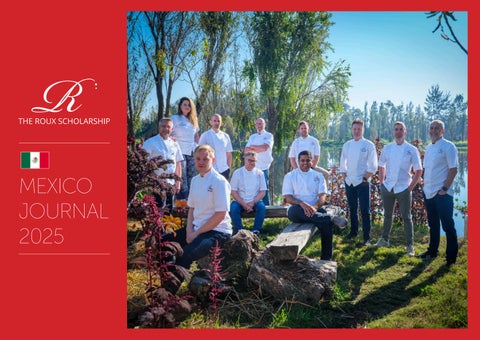
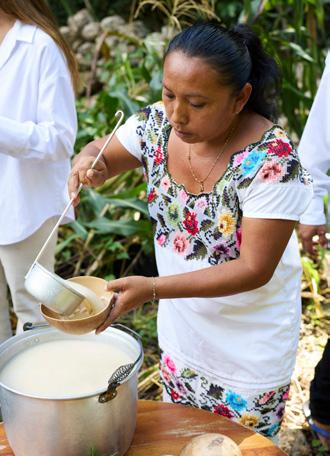
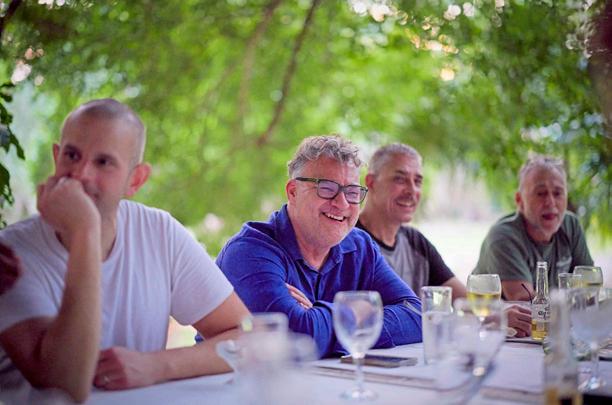
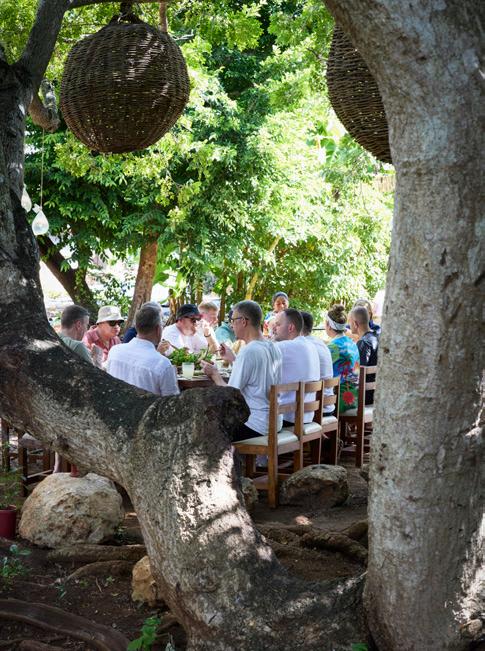
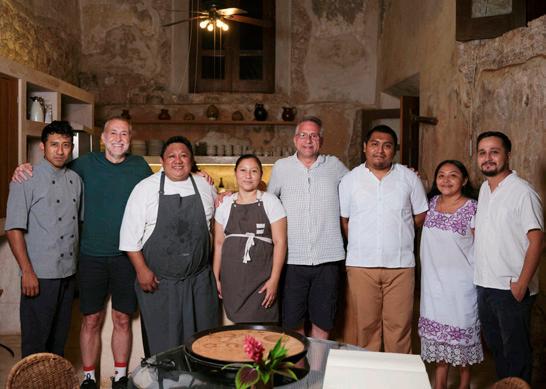
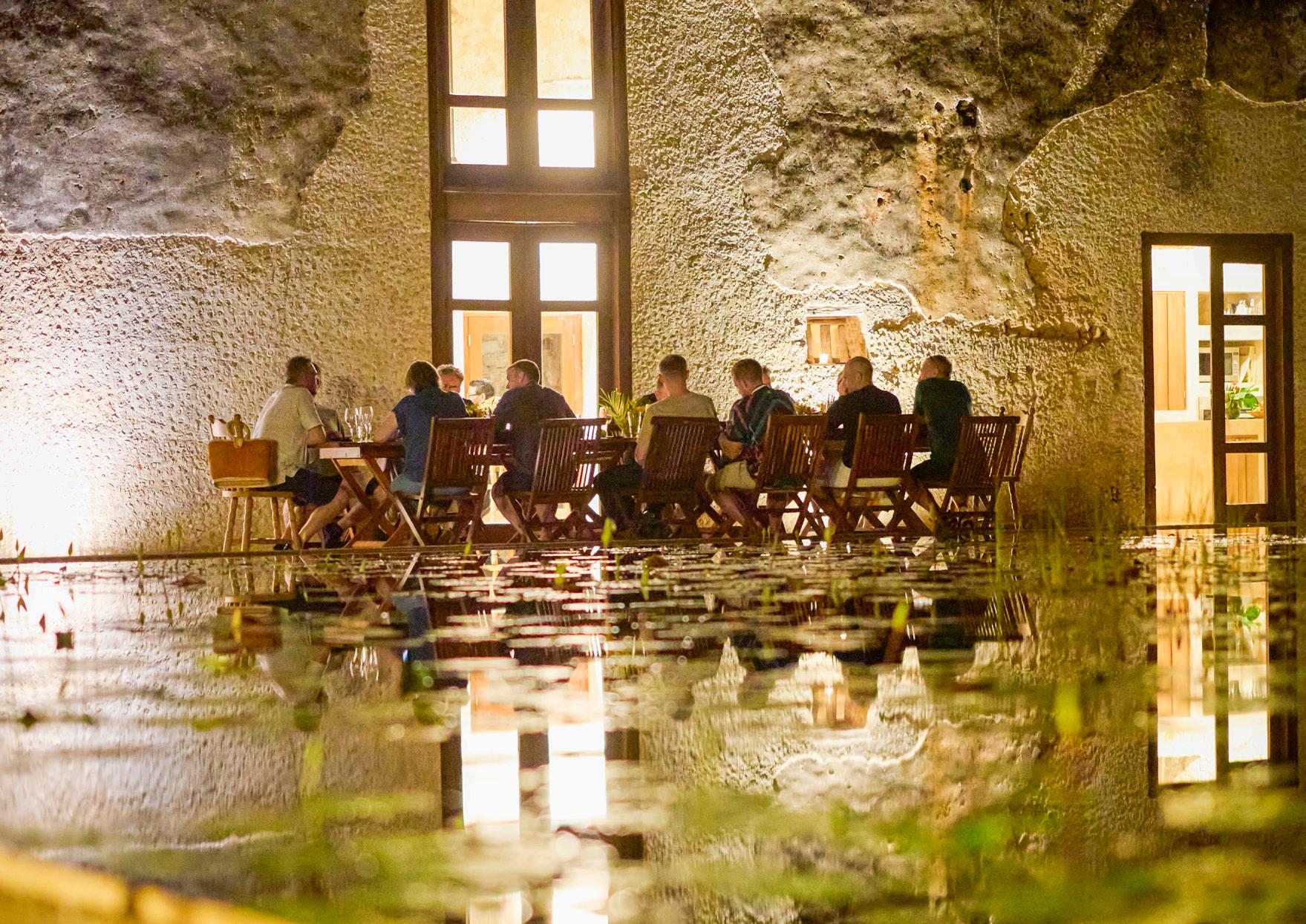
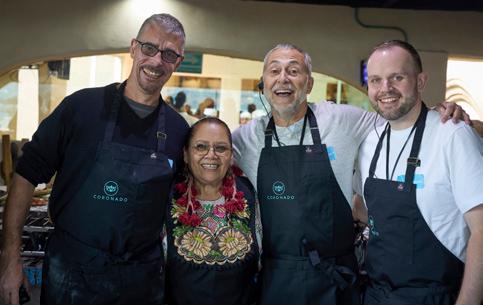
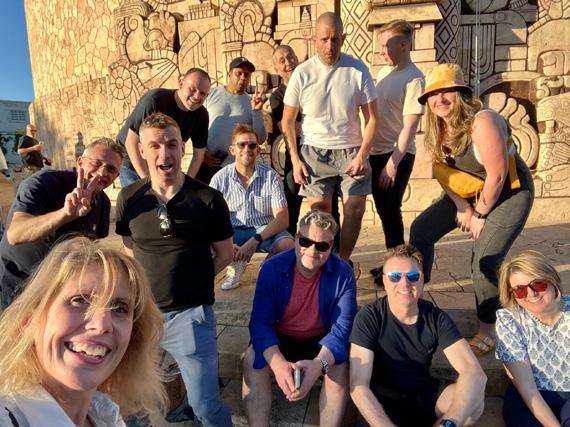
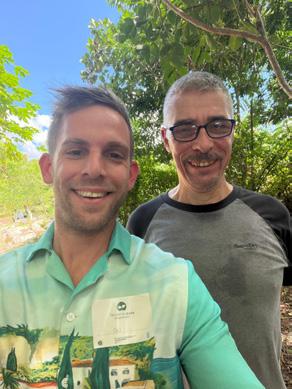
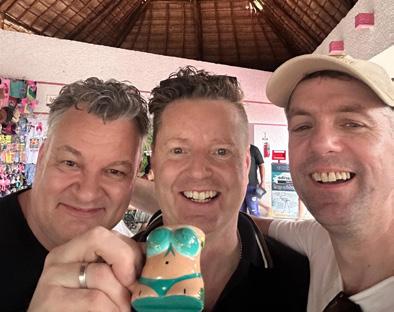
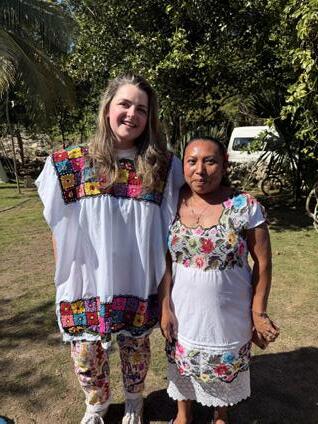
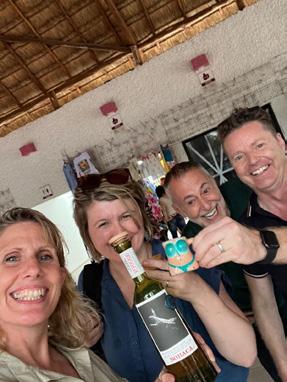
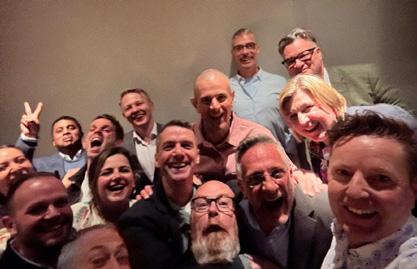
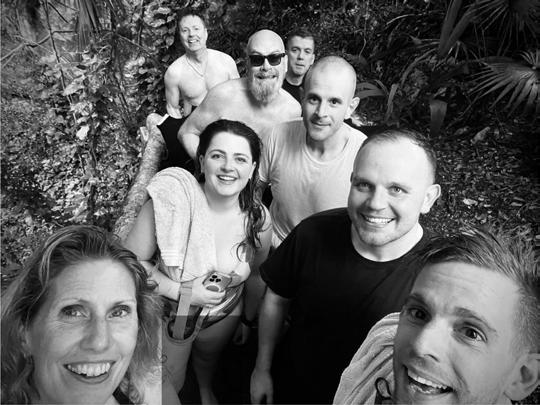
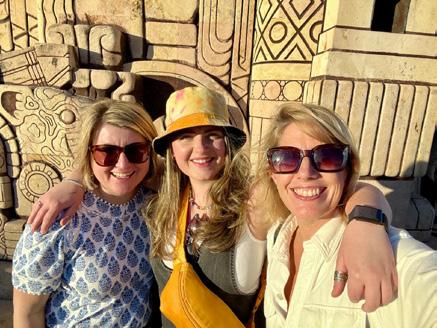
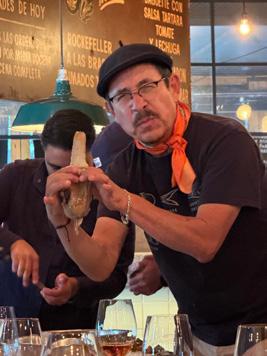
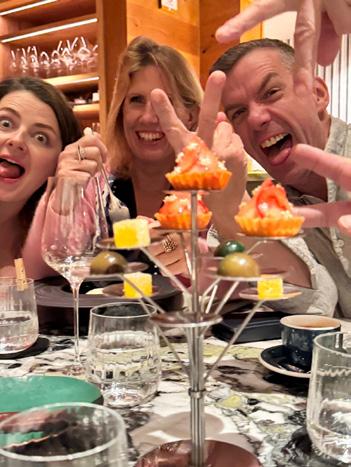
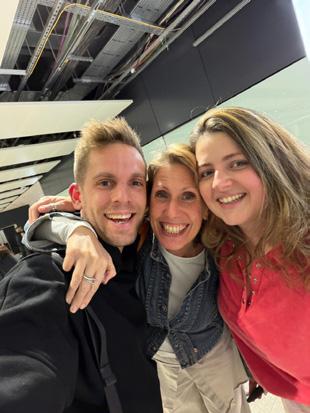
Every family adventure abroad has a moment, often when you least expect it, when everything suddenly clicks. A moment of unity, joy and clarity that quietly rearranges how you see the world afterwards. For us, that moment arrived in Yucatán, at the historic Hacienda Tamchén, the night before we travelled on to Mexico City.
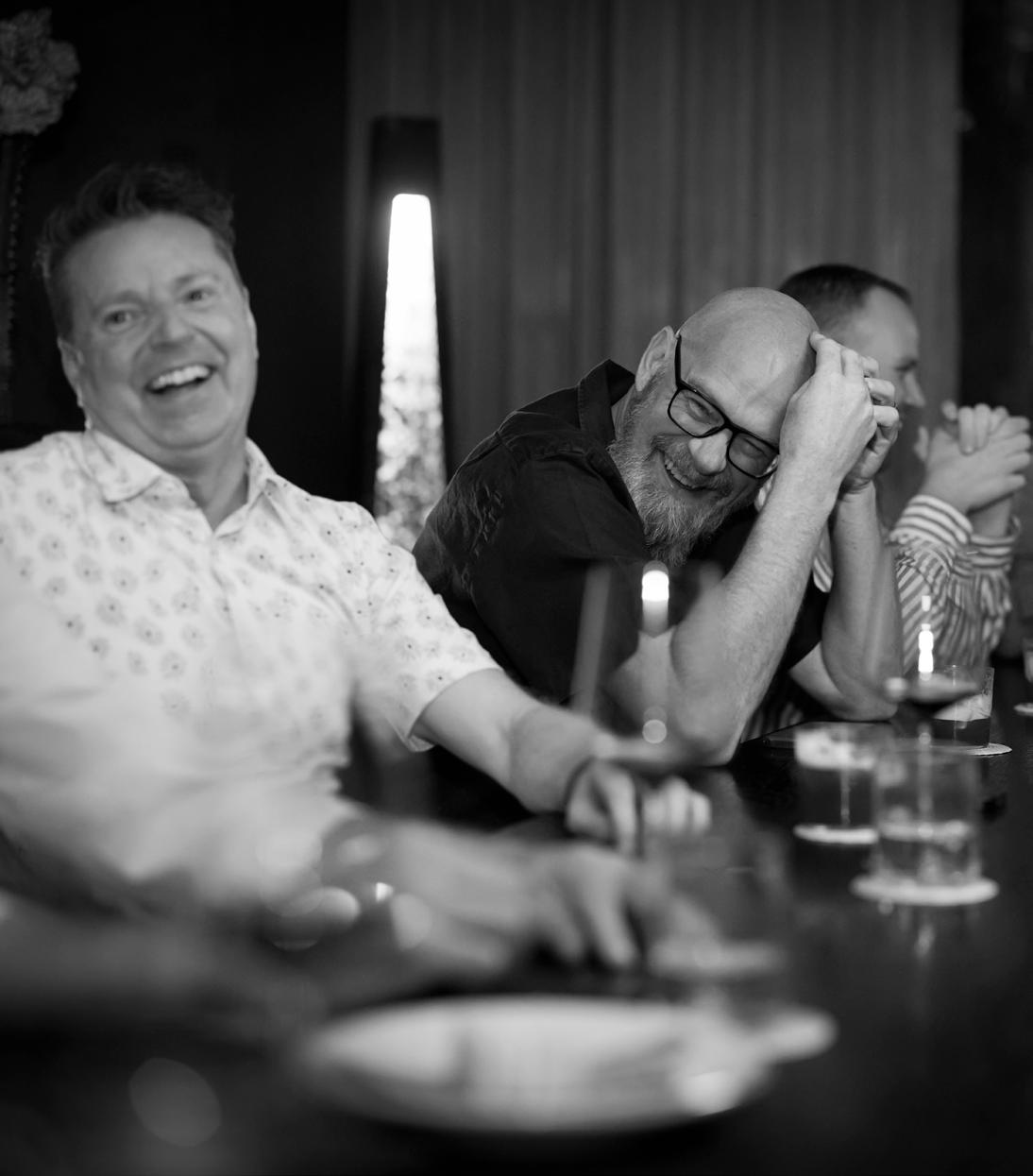
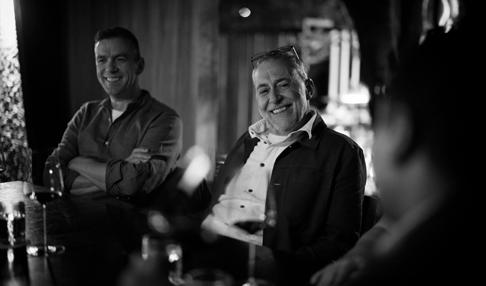
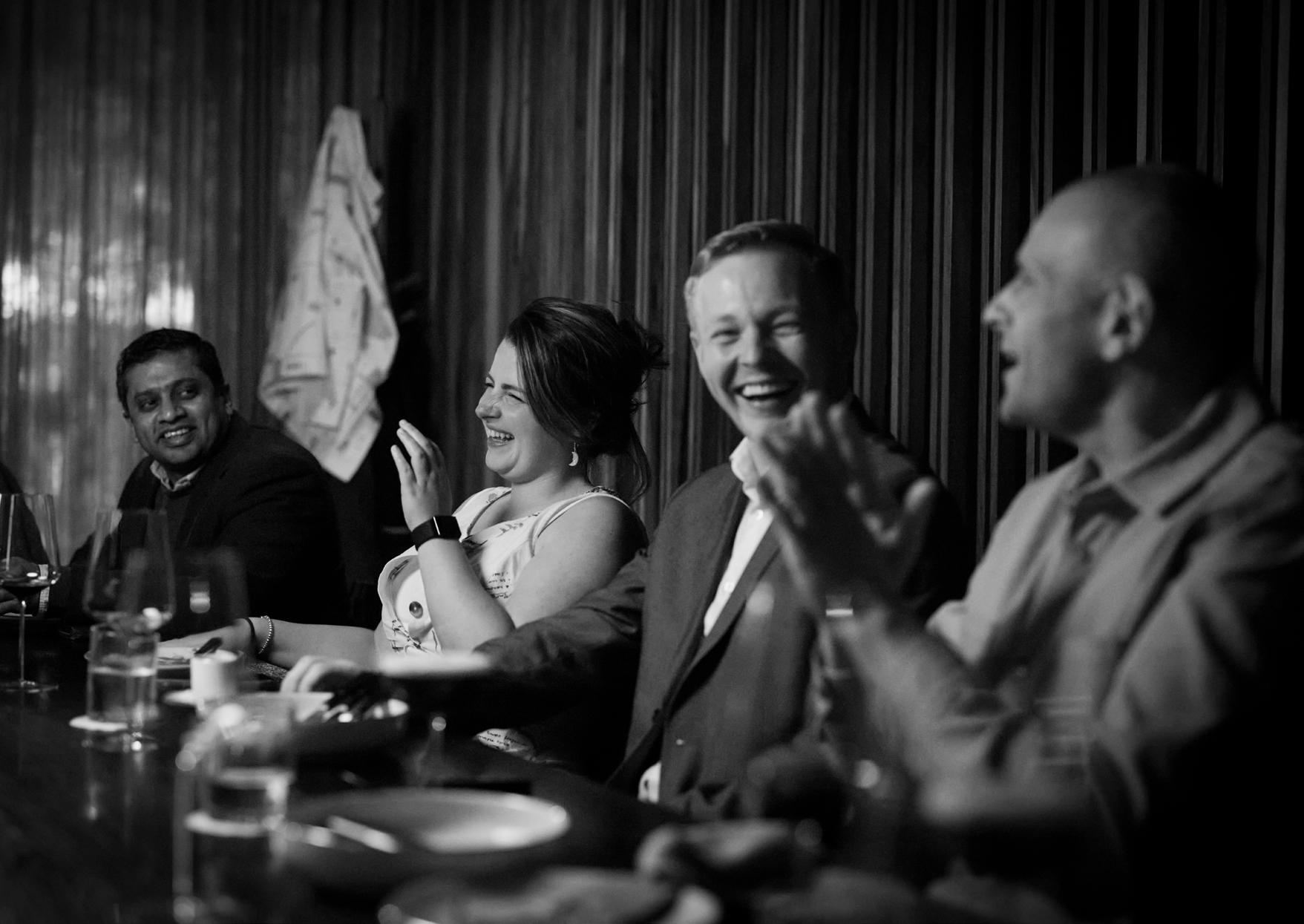
The day had already been full to the brim: time spent with Mayan families tasting melipona honey from stingless bees, citrus fruit picked straight from their orchards, followed by a wildlife safari through the mangroves of Celestún. That evening, after a moonlit dip in the pool and a meal cooked entirely from local ingredients, we finally stopped. Sitting under the stars, laughing, reflecting and trying to process everything we had experienced, it dawned on us …the importance, the emotion, and the sheer scale of the unique family that is The Roux Scholarship.
These biennial educational journeys take more than a year to plan and prepare because they are entirely bespoke. They are not a holiday. They are built with care, trust and a great deal of thought, designed to immerse our scholars in places, people and ideas that challenge how they think about food, hospitality and their own responsibilities as chefs. This trip was becoming everything we had hoped for, and more.
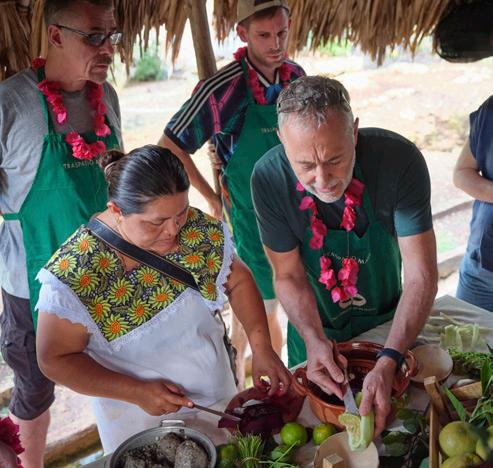
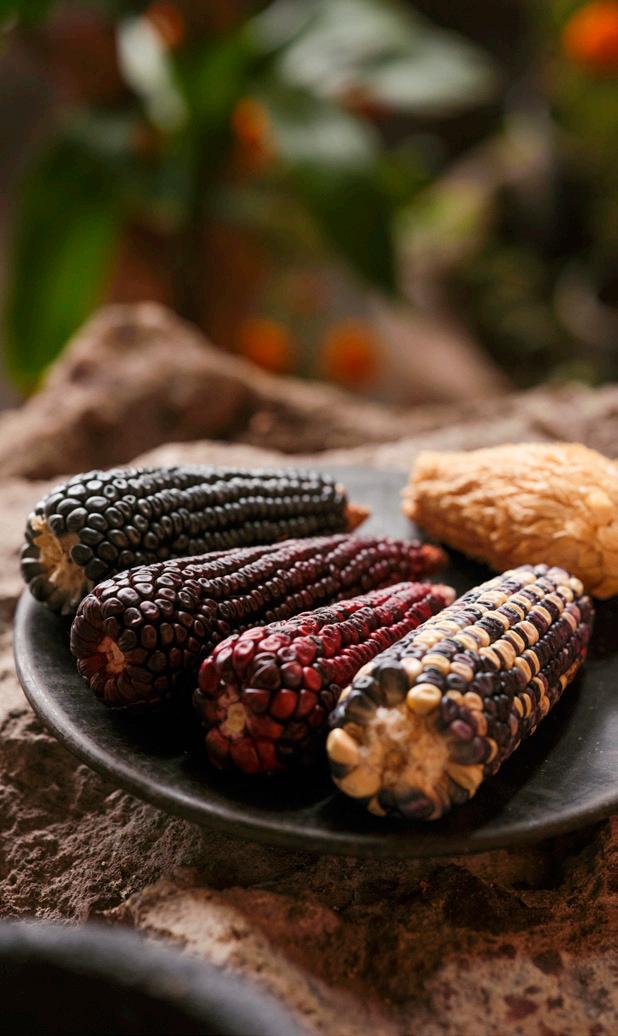
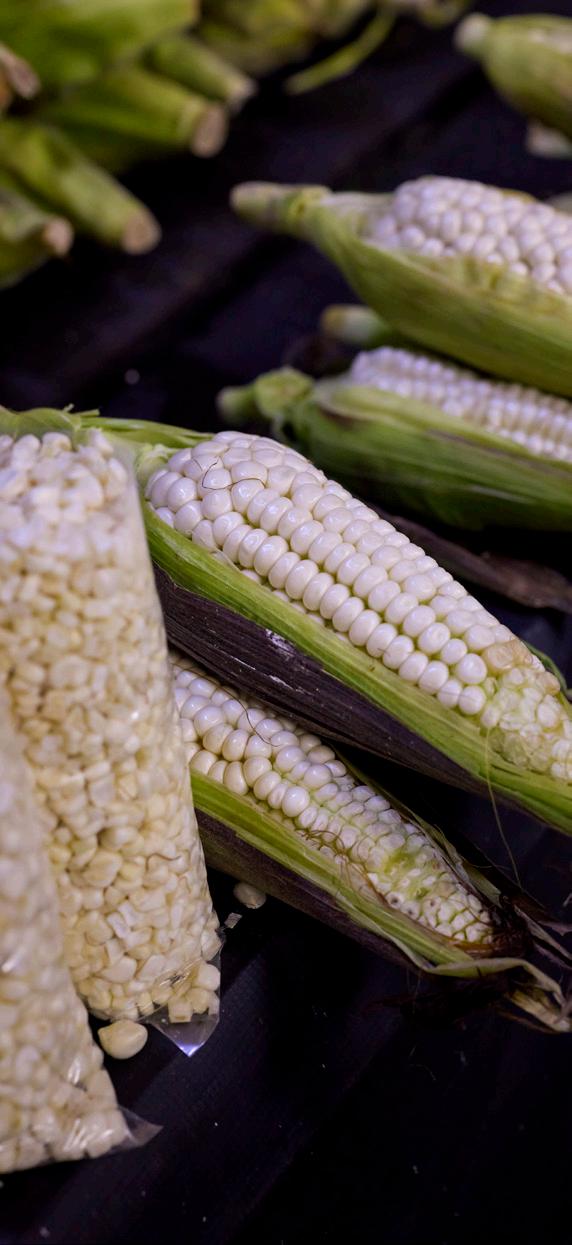
In Yucatán, we encountered hospitality in its purest form. We were welcomed into homes by people whose warmth, generosity and humility were as nourishing as the food they shared with us. We sowed, harvested, cooked and tasted alongside families whose knowledge stretches back generations. Corn is sacred. Nothing is wasted. Husks line baskets, wrap tamales and are used to start fires. Rainwater is reused, scraps composted or fed to animals, seeds carefully saved. Sustainability here is not a trend, it is simply how life works.
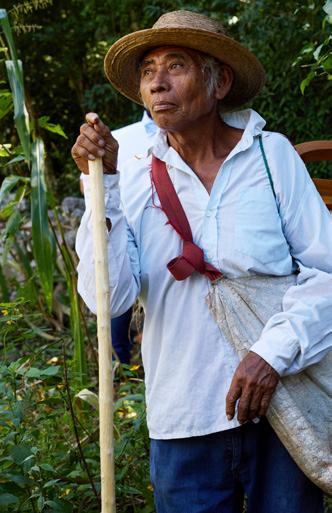
One moment, in particular, has stayed with us; an elderly man, tall and dignified, walking furrowed lines of soil, dropping a trio of tiny seeds, the Three Sisters – maize, beans and squash – into each tiny hole with astonishing speed and precision. His tool was a simple receptacle carved from a dried squash husk. When he handed it to us, we tried to copy him. The results were, frankly, laughable. Something so repetitive and apparently simple, yet completely deceptive. For chefs, it was the perfect lesson. Repetition is the foundation of mastery. Discipline, humility, respect for craft and consistency - all delivered without a word being spoken.
Then came Mexico City, a thrilling contrast. Dense, electric and endlessly exciting. With the brilliant Sofía Hernández helping to curate this part of the journey, we plunged into markets, bakeries, restaurants, bars and kitchens that pulsed with creativity. Mercado de Jamaica was a sensory overload, as markets should be. A day with Sofía’s father, Ezequiel Hernández of Jamat Seafoods, was nothing short of jaw-dropping, a masterclass in seafood, knowledge and generosity. Once again, we were not treated as visitors, but as family.
Across ten remarkable days, it was often the smallest moments that taught us the most. Watching the sun rise over the ethereal chinampas with Lucio and Pablo Usobiaga of Arca Tierra. A beautiful meal at Baldío that traced the full cycle from soil to fermentation. And the humour, warmth and wisdom of our Yucatán guide, Juan Manuel Trejo Lizama, who promptly christened the group the “Rock Scholars”, a name that will stay with us, and with them, forever.
The welcome at one of Mexico’s finest culinary schools, the family run Instituto Culinario Coronado was magnificent. Back to school for the scholars and for us too. We shared stories with students, cooks and
teachers, reminding them - and ourselves - that there are no shortcuts in this profession. You must learn to walk before you run. Follow your passion. Build experience. Savour the journey. Just as we did. Just as our fathers did.
This journal captures what makes The Roux Scholarship so special. Each trip is bespoke. We meet families, producers, artisans, chefs and communities who love what they do and want to share it. These journeys reignite passion, deepen humility and remind us, whatever our age or position, how much there still is to learn. We learn as much from the youngest scholars as they learn from us oldies.
Our heartfelt thanks go to our scholars, our hosts across Mexico, our friends, partners and supporters, and above all our sponsors. Without them, there would be no Scholarship, no journeys like this and our industry would be far poorer for it.
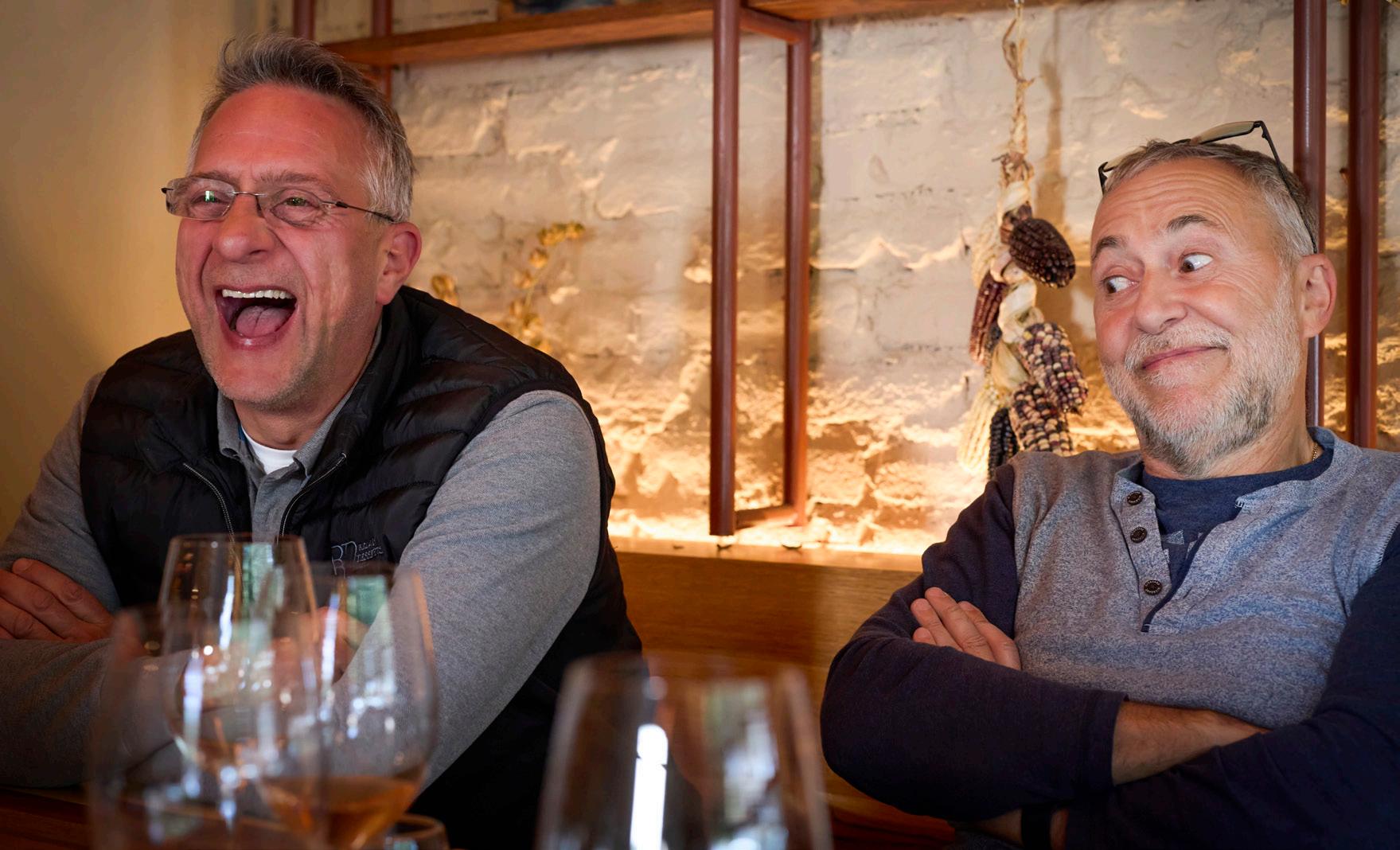
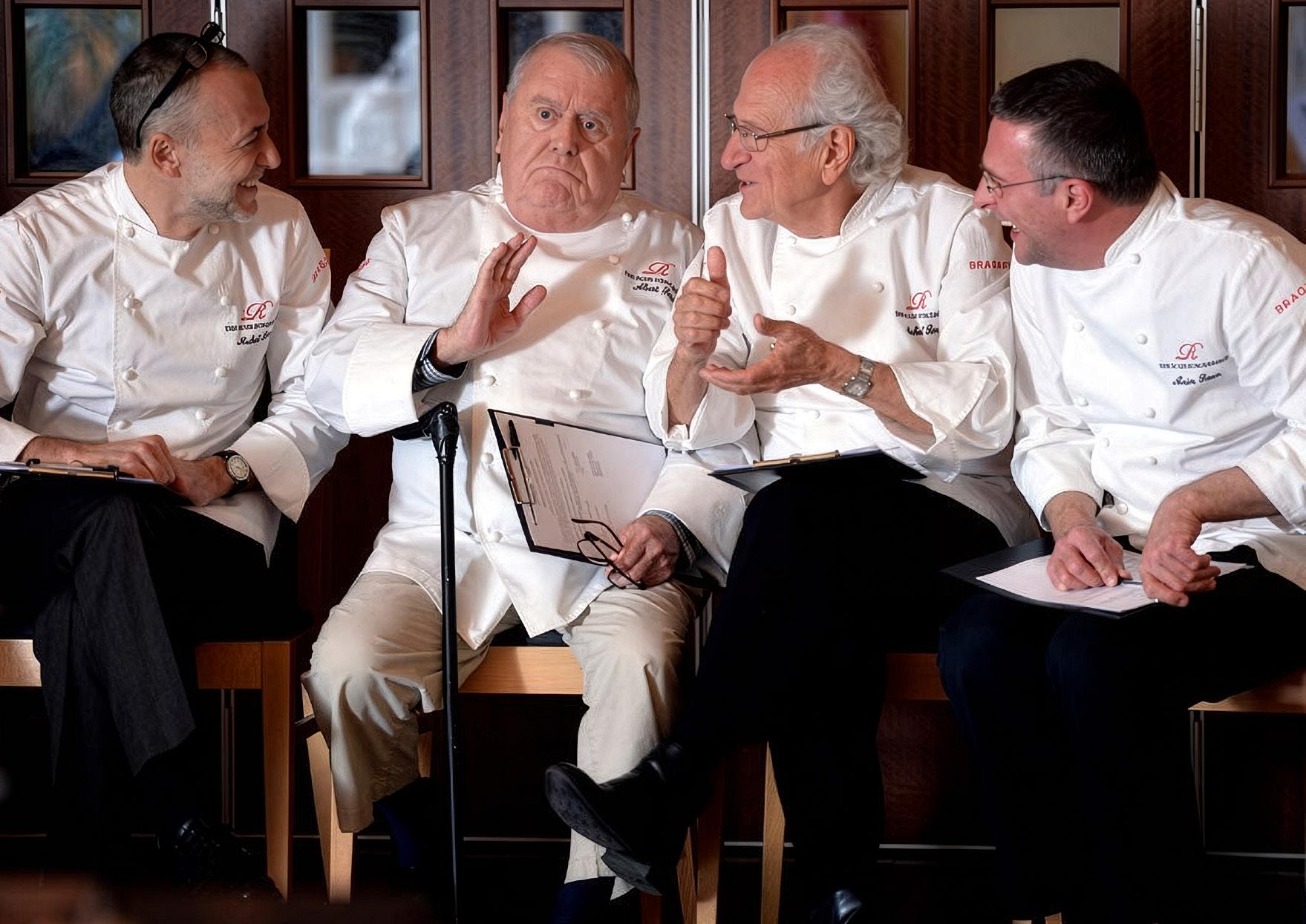
Alain Roux & Michel Roux Chairmen of The Roux Scholarship
THE PARTICIPANTS
ALAIN ROUX
Chef-Patron of the three-star Michelin
The Waterside Inn, Roux at Skindles
Together with his cousin Michel Roux, is chairman of The Roux Scholarship. He is dedicated to developing the UK’s next generation of talented young chefs, as he continues his family’s great contribution to the country’s culinary landscape.
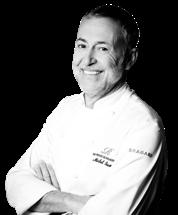
MICHEL ROUX JR
Chef Patron at Le Gavroche pop-ups and Chez Roux
As co-chairman of The Roux Scholarship since 2016, and a judge since 1999, Michel is dedicated to developing future generations of chefs. He has helped launch and supported the careers of hundreds of successful British chefs.
TREVOR BLYTH
Chef at Rangitoto, Tokyo, Japan
Trevor Blyth won the Roux Scholarship in 1996, having already worked at Les Près d’Eugenie, Cliveden House and Le Gavroche. Trevor has lived in Japan since 2000 and since 2021, Trevor has been Head Chef at a small restaurant in central Tokyo called Rangitoto, where his menus work in harmony with the restaurant’s focus on New Zealand wines and Japanese sake.
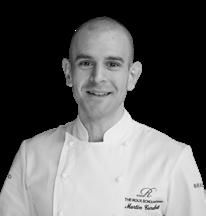
MARTIN CARABOTT
Executive Chef, Gravetye Manor, Sussex
Martin won The Roux Scholarship in 2018, and is now leading the brigade at Gravetye Manor. Originally from Malta, Martin’s career has seen him work in some of London’s top restaurants. He has many accolades to his name, including the Royal Academy of Culinary Arts Annual Award of Excellence in 2014.
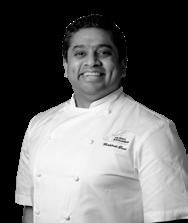
HRISHIKESH DESAI
Chef Patron, Farlam Hall, Cumbria
Hrishikesh won the Roux Scholarship in 2009, having developed a talent for classic French cuisine while training at Institut Paul Bocuse in Lyon. He has worked at Michelin-starred establishments throughout the UK and started his current role in April 2023, winning a Michelin star just 10 months later. The restaurant has received countless national and regional awards since Hrishi took the helm.
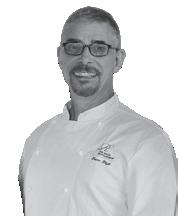
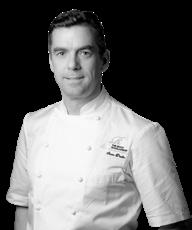
STEVE DRAKE
Owner, Sorrel, Surrey
Steve won the Roux Scholarship in 2001 and started his career as an apprentice at The Ritz. Since 2000, he has run his own restaurants, most recently the Michelinstarred Sorrel in Dorking, which was used in the filming of the A-list film We Live In Time with Florence Pugh and Andrew Garfield, for which he was consultant chef.
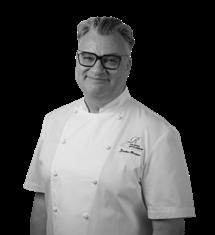
JONATHAN HARRISON
Chef Proprietor, The Sandpiper Inn, North Yorkshire
Jonathan won the Roux Scholarship in 1993 and his career took him to top restaurants throughout Europe and the UK, before opening The Sandpiper Inn in 1999. Other career highlights include cooking the banquet for the G8 heads of state in Birmingham’s Botanical Gardens during the 1998 summit.
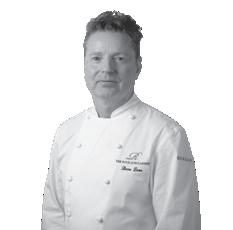
SIMON HULSTONE
Chef Patron of the onestar Michelin restaurant The Elephant in Torquay in Devon
Simon won The Roux Scholarship in 2003 and is one of five Roux Scholars appointed to the competition’s judging panel in 2016. His extensive experience with various chef competitions includes representing Great Britain in the Bocuse d’Or in both 2009 and 2011.
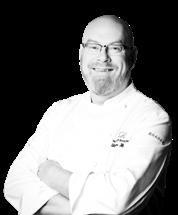
STEVE LOVE
Private chef, Loves’ Consultancy, worldwide
Steve won the Roux Scholarship in 1997. His career has seen him take roles as head chef of Relais & Chateaux properties and run his own restaurants. More recently, Steve has worked as a private chef on super yachts all over the Mediterranean, the Caribbean and the US.
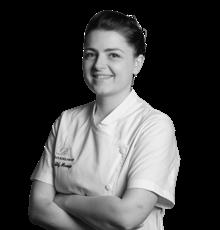
APRIL LILY PARTRIDGE
Development Chef, Opus Provisions, London
April won The Roux Scholarship in 2023 while working as sous chef at The Ledbury in London. She is now enjoying the creative freedom and learning opportunities at Opus Provisions. April was the first Roux Scholar to take advantage of the new bespoke programme of experiences, which included taking short educational stages, which has taken her to Australia and Mexico City.
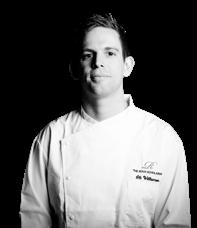
OLI WILLIAMSON
Executive Chef, Signature by Alexandre Mazzia, Cognac, France
Oli won the title of Roux Scholar 2020/2021 towards the end of the Covid-19 pandemic. His career has seen him work at Midsummer House, The Greenhouse and as Head Chef of The Fat Duck in Bray. Since 2024, Oli has worked in France and is currently leading the brigade at Martell’s Signature Restaurant in Cognac under Alexandre Mazzia.
THE
CAROLYN
BOYD Communications
Manager,
The Roux Scholarship
Carolyn accompanied the group to help with organisation, social media and the creation of this book. Her part-time role with the Scholarship includes organising the award ceremony and dinner, all stakeholder communications, managing the website and social media. For her other work, she is a writer and an expert in regional French food, her latest book Amuse Bouche: How to Eat Your Way Around France was published in 2024.
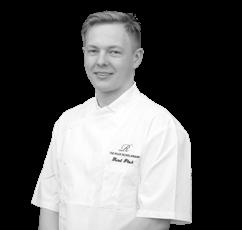
KAROL PLOCH
New role to be announced
The 2024 competition also saw the celebration of the 40th anniversary, and Karol Ploch was named our 40th Roux Scholar. At the time, he was sous chef at Kerridge’s Bar & Grill in London, and he went on to take the bespoke programme of experiences as his star prize including stages in Tokyo and Stockholm, as well as experiences with fermentation expert Dr Johnny Drain and baker Richard Bertinet.
JODI HINDS Photographer
Jodi is The Roux Scholarship’s official photographer and has shot the London regional finals, national finals, and award ceremonies since 2017. She is the go-to photographer for the much of the London hospitality scene, having photographed the food, chefs and restaurants including The Waterside Inn, Gravetye Manor and Ormer and many more. She is also the official photographer for both the Bocuse d’Or UK Team and the Pastry Team UK.
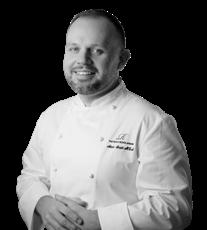
ADAM SMITH MCA
Executive Chef, Coworth Park, Berkshire
Adam won The Roux Scholarship in 2012, while he was working at The Ritz in London. In 2024, he joined the judging panel of The Roux Scholarship. He is an experienced competition chef, having won several other titles including his Master of Culinary Arts in 2017. In 2016, he took the reins at Coworth Park, our wonderful award ceremony and dinner venue, which has held a Michelin star since 2017.
SOFÍA HERNÁNDEZ
Sofía Hernández, whose family own Jamat Seafoods, has superb connections with Mexico’s culinary scene at all levels and so her advice and suggestions for our itinerary were hugely valuable. Sofia accompanied us on the Mexico City part of the tour, and her insights and good humour made her a joy to have in our company.
After eleven hours of flying, we landed in Mexico City; it was a brief stopover before we boarded another flight to Mérida, the capital of Yucatán. The Roux Cousins, Scholars, Carolyn and Jodi - who, from now on, we will call the ‘Roux Family’ - were in good spirits. Most had managed a decent sleep on the plane and were craving coffee. I, however, had other priorities. I wanted a beer and I wanted it immediately.
At a small café in the airport, we decided to quench this thirst for beer and some ordered breakfast. One dish on the menu stole the show: Huevos Divorciados ‘Divorced Eggs’, which comprised of two fried eggs kept firmly apart on a square plate, which were flanked by refried beans, avocado, and two sauces, one of them aggressively spicy, and with tortilla chips sprinkled on top added some crunch. It was chaotic, bold, and unforgettable, much like the journey ahead.
I was excited about Yucatán for one reason above all others: to understand real Mayan culture and meet the people who carry it forward. Mérida did not disappoint. The city stands on layers of history, literally! Before the Spanish arrived, it was a powerful Mayan city known as T’hó or Ichkanzihó, meaning City of Five Hills, named after its temple pyramids. In 1542, the Spanish founded Mérida directly on its ruins, reusing Mayan stones to build colonial churches, homes, and government buildings. What emerged is a city where cultures don’t clash but coexist.
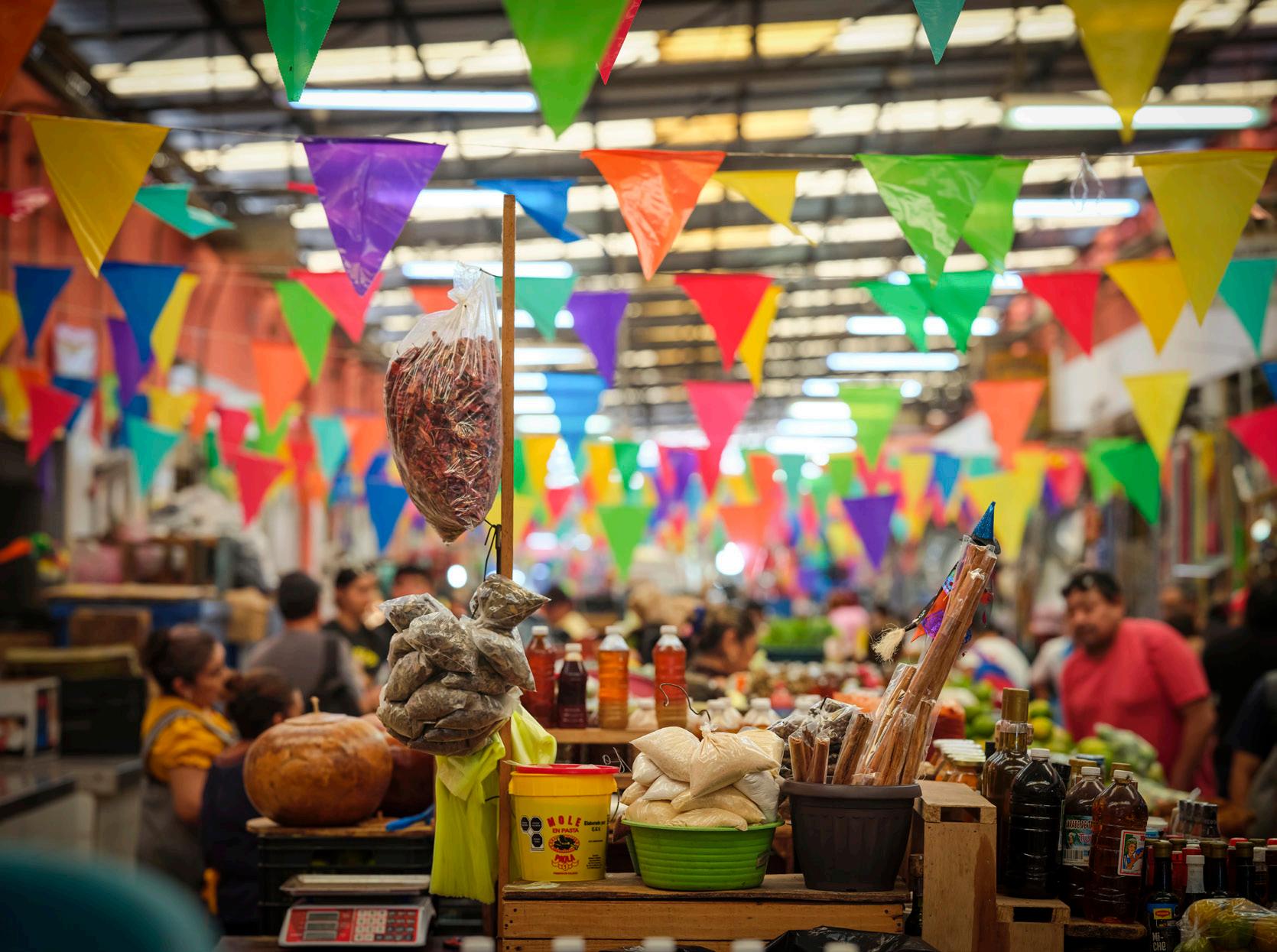
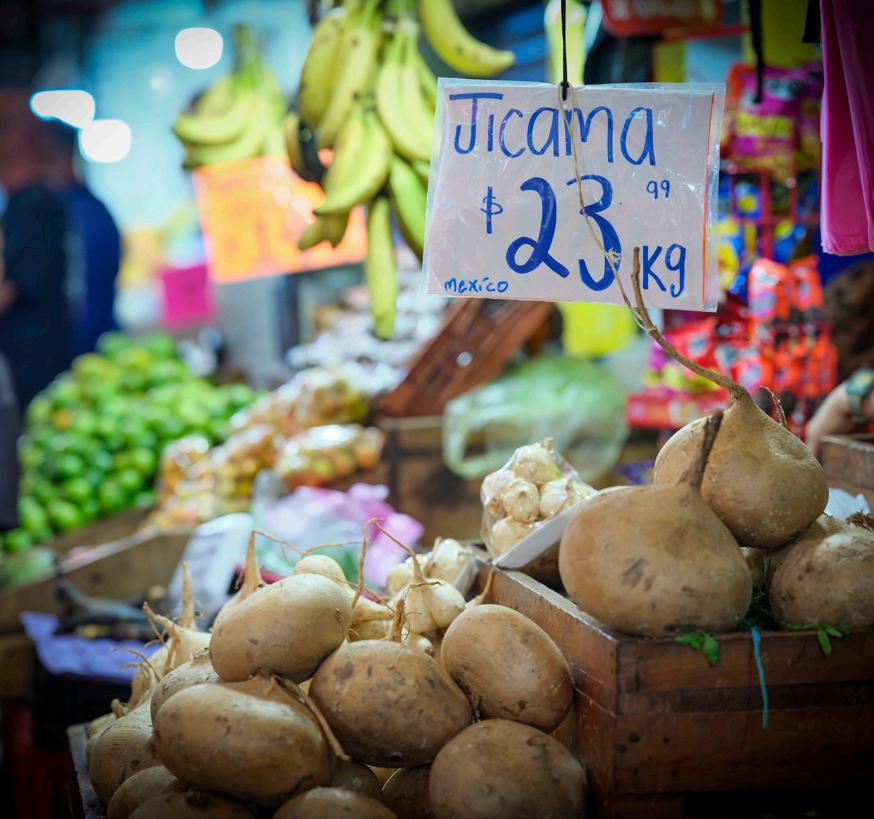
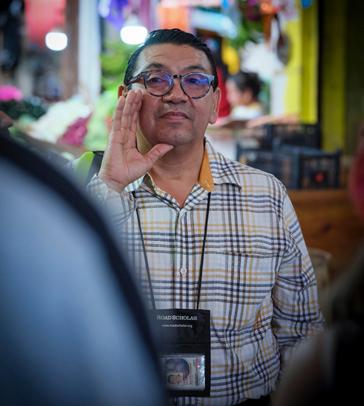
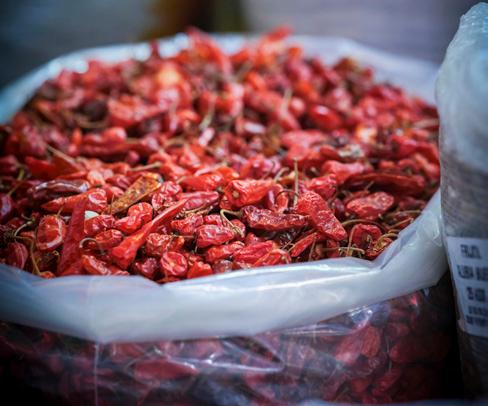
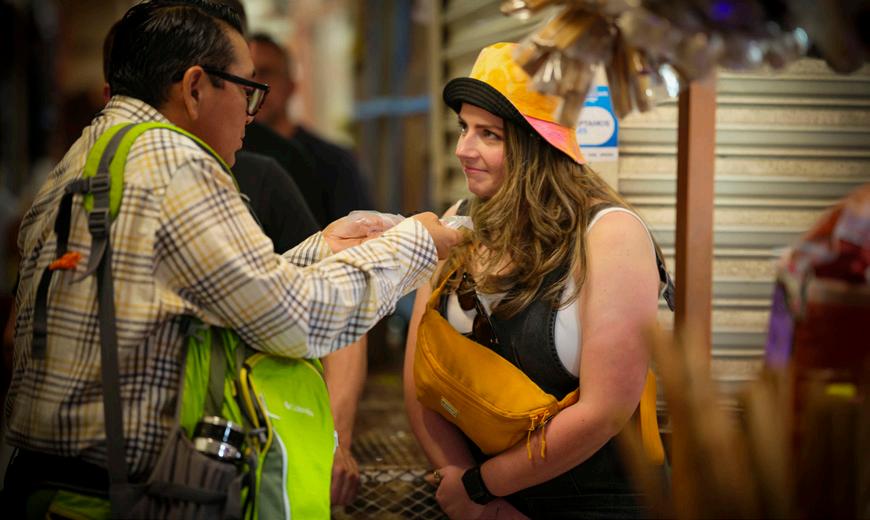
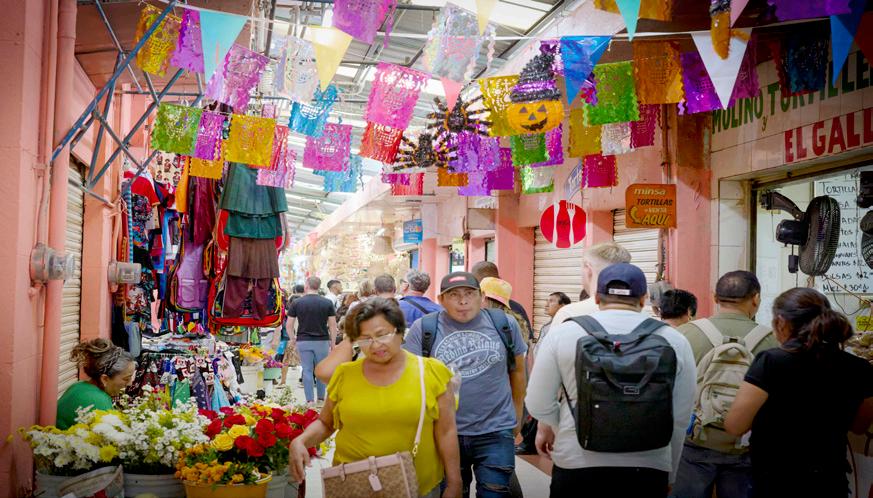
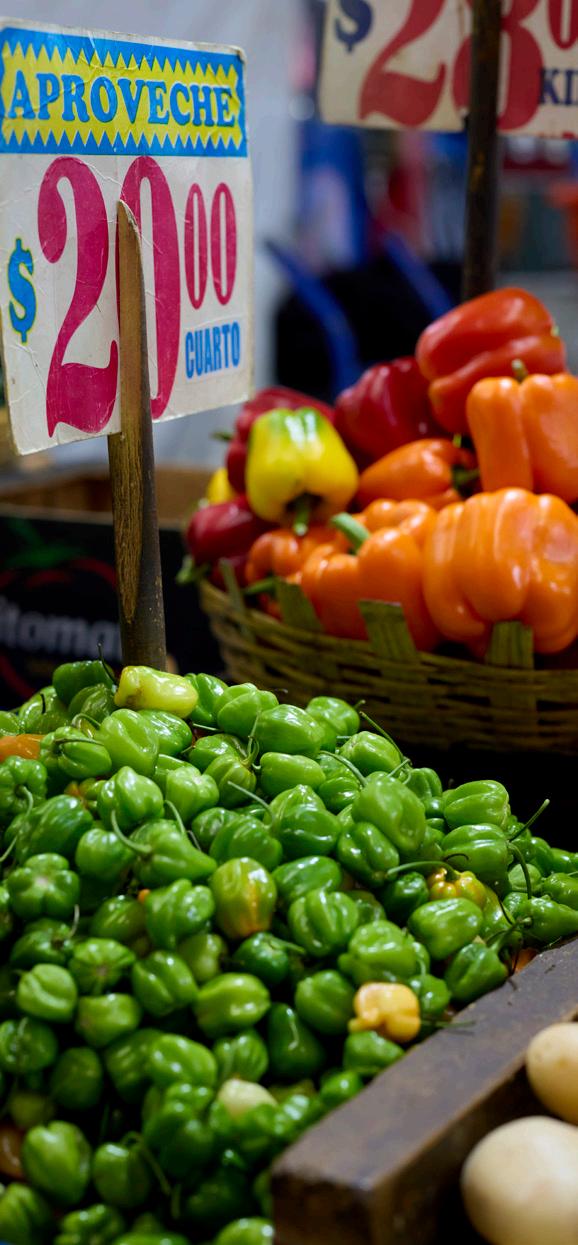
Pictured: (left page) Lucas de Galvéz market; (right page, from top) jicama root vegetables on sale at the market, our beloved guide Juan Manuel Trejo Lizama telling us all about the produce, chillis in the market.
We were taken straight to our hotel, the comfortable Fiesta Americana, where we refreshed, ate (again), and waited for our guide. His name was Juan Manuel Trejo Lizama, and from the moment he opened his mouth, it was clear he was going to be unforgettable. He was warm, passionate, endlessly curious, kind, full of love and empathy. Juan loved his city, his people, and his history with a sincerity that made everything he said worth listening to. Sometimes he spoke so much that no one was listening anymore, which somehow made it even better. He didn’t stop. And we were grateful he didn’t.
Our first proper stop was the Lucas de Gálvez Market, the beating heart of Mérida. Opened in the late 19th century and named after a Spanish colonial governor, the market remains one of the city’s most important social and economic centres. It reminded me instantly of ‘Mandai’ Market in Pune, my birthplace, which is sprawling, noisy, and alive.
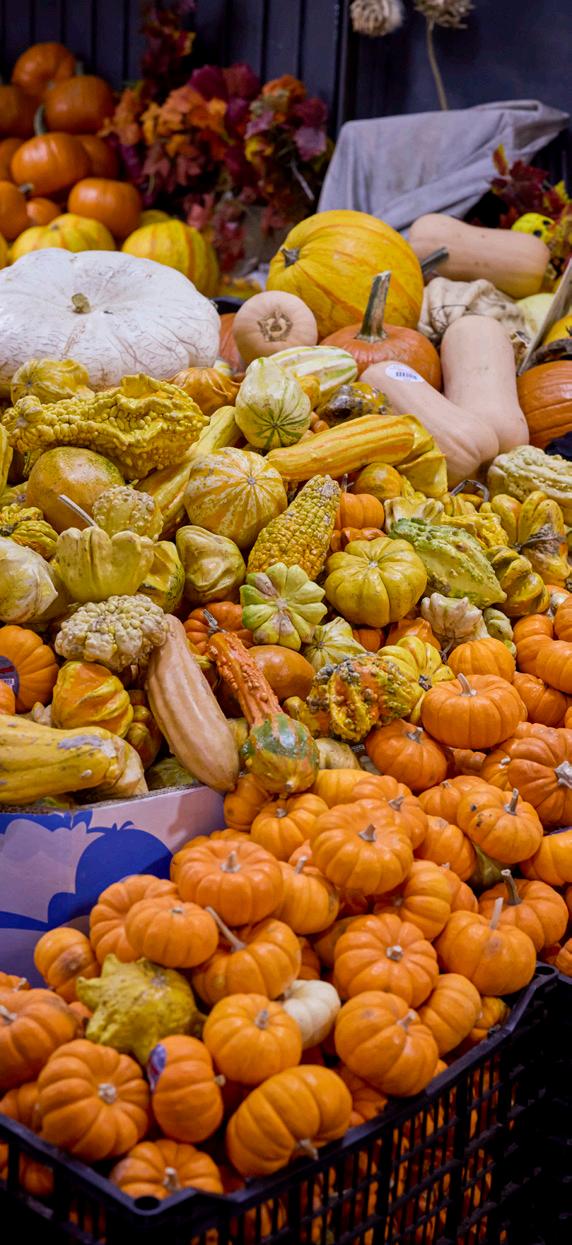
Lucas de Gálvez Market was not a market designed for tourists. This was a market built for life. Stalls stretched endlessly, selling everything imaginable: vegetables stacked high, fruit glowing with ripeness, butchers expertly breaking down meat, fishmongers calling out the day’s catch, leather goods, flowers, wild birds, pet animals, sweets, tacos, herbs, and medicines. Many stalls had been run by the same families for generations.
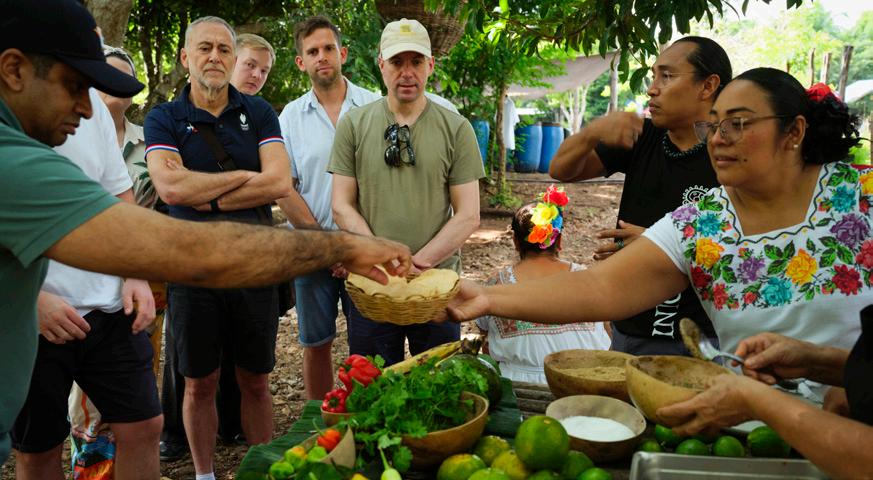
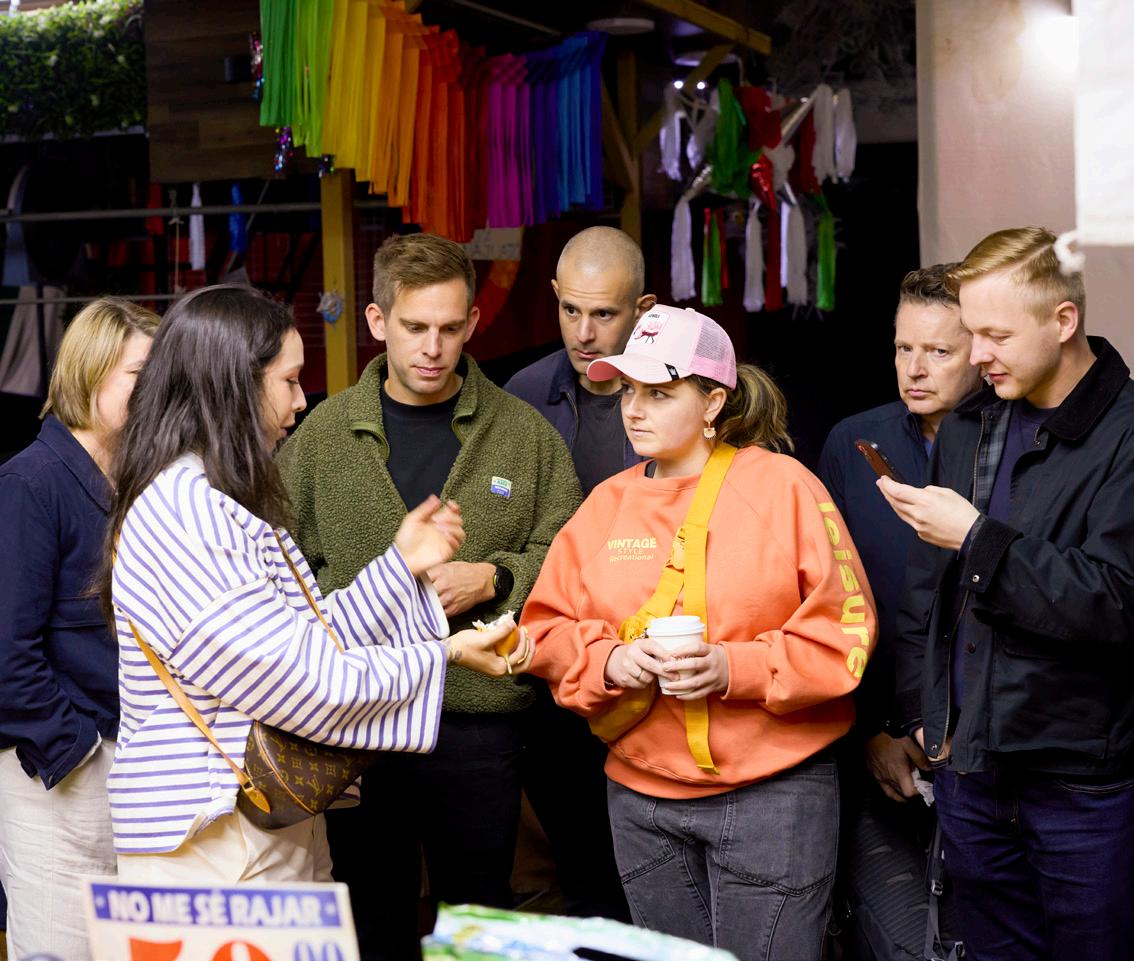
Juan guided us through with pride, explaining everything, until we stopped at a small stall selling traditional Yucatecan ingredients. Here, we touched, smelled, and tasted the building blocks of Mexican cuisine like chillies, cacao, spices, and most importantly, recados.
An impromptu masterclass followed. We tasted Recado Rojo, Recado Negro, Recado Verde. These thick, aromatic spice pastes are used as the foundation of dishes such as Cochinita Pibil, Papadzules, and Mole.
Pictured: Our guide Juan showing April Lily Partridge some of the recado produce; wandering the lanes of the market was a delight for its sights, smells and atmosphere. A truly local experience that immersed us in Yucatecan food culture.
Suddenly, memories from my time at the Institut Paul Bocuse came flooding back as I remembered the Mexican students cooking these very dishes, with flavours that now made complete sense. What shocked us most at the market was the prices. These flavour bombs cost next to nothing, literally pennies compared to what they’d sell for elsewhere.
As we walked deeper into the market, surrounded by abundance, a thought quietly settled in. There was so much food here enough to feed entire towns back home. People shopped, laughed, argued, shared snacks, and went about their lives with ease. Faces carried pride, not excess. Satisfaction, not greed.
It made me question how easily some politicians label places like Mexico as ‘poor’ or ‘less developed’. What we witnessed was incredible. It was balance. It was community. It was people knowing who they are and being perfectly fine with it. And that, to me, is incredibly cool.
Progress should never mean erasing culture. Development should never come at the cost of identity. Walking through Lucas de Gálvez Market didn’t just prepare me for Mexico, but it forced me to pause, reflect, and admire what the Mayan people stand for: resilience, pride, and a deep connection to land, food, and family. I was glad to be there to experience this. Bloody brilliant!
Before we headed back to the hotel, we visited the central square Plaza Grande opposite Mérida’s cathedral and then had a quick stop at a shop selling sorbets. I ordered a corn sorbet which did not disappoint. Flavours like sweet potato, pineapple, cucumber etc were refreshing too. A very good start to our trip and we were looking forward to meet the Mayans the next day.
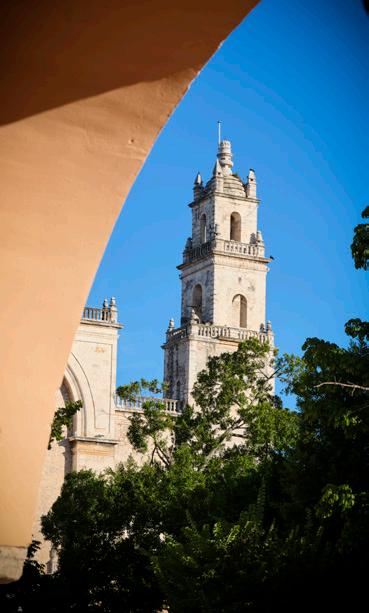
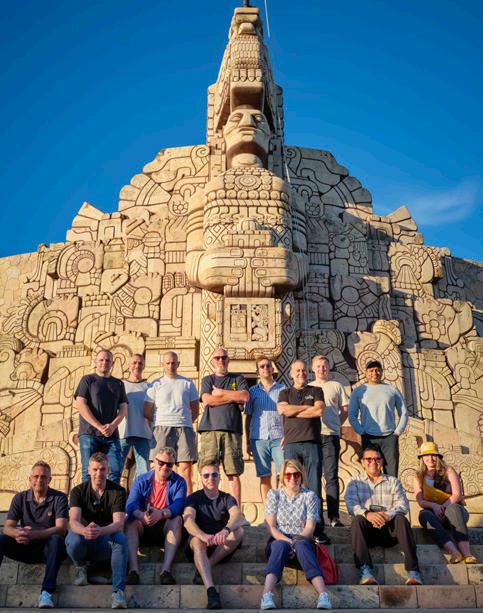
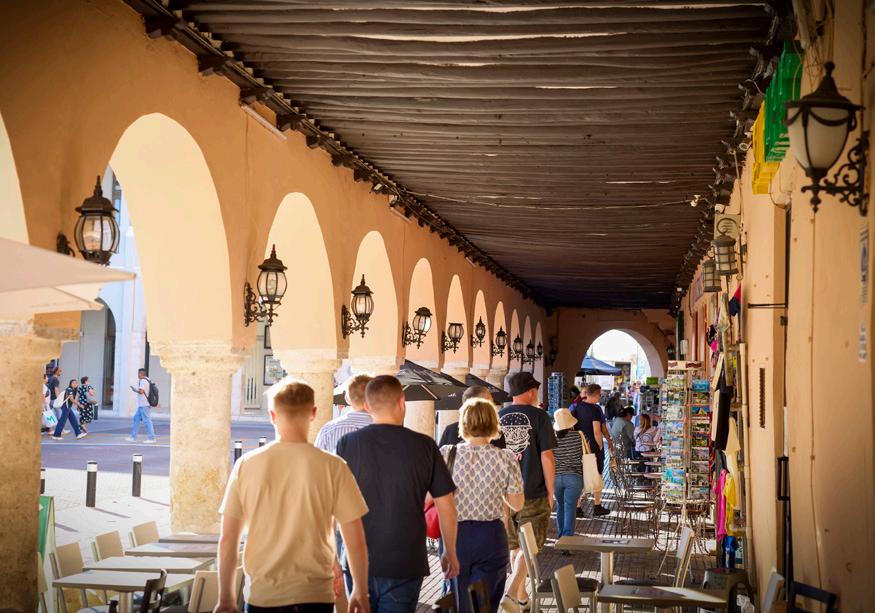
Pictured: The afternoon gave us a chance to see the sights of Mérida, including the Plaza Grande and its cathedral (top left), as well as the arcades around the square (bottom). We visited Monumento a La Patria (top right) on the Paseo de Montejo, an avenue where the city’s most impressive architecture is found.
TALLER MAYA GALLERY AND RESTAURANT TULIA
By Jonathan Harrison
We began our evening with a pre-dinner visit to the Taller Maya Santa Ana gallery, tucked away in the very heart of Santa Ana district, offering a vibrant tribute to the prosperous art and design scene in Mexico.
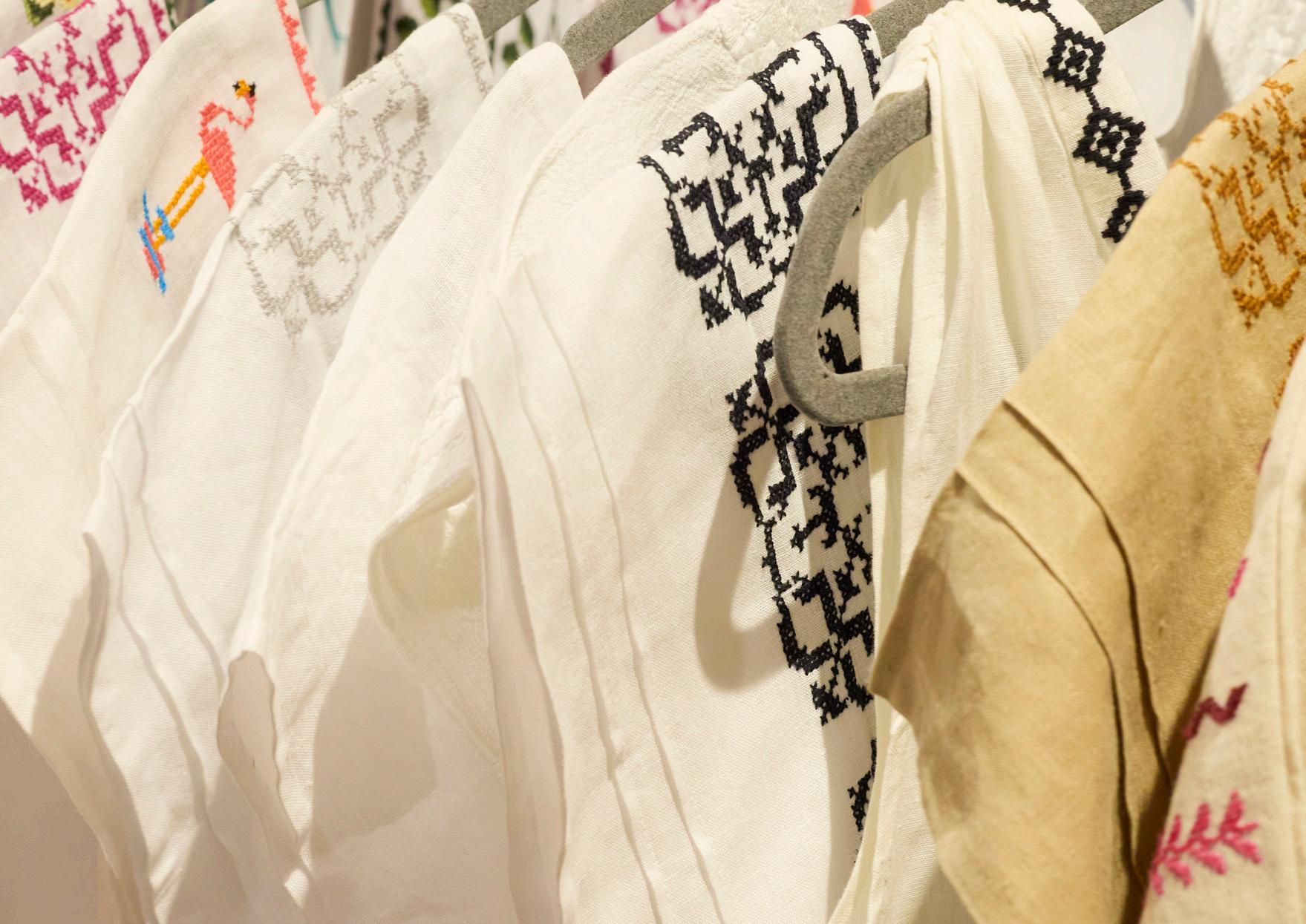
The aspect that stood out was the commitment to local, traditional craftsmanship and contemporary creativity, boasting entire collections of homeware, furniture, clothing, jewellery and accessories, all made by local artisans. It offered a truly immersive experience of Mayan heritage, bringing together artists, artisans, and fanatics of culture; all under one beautiful roof.
The second we stepped into Taller Mayan Santa Ana; we were greeted by a thoughtfully curated space that blended modern minimalism with rustic touches. There was a tree in the corner which represented the roots of culture that
this gallery portrays; every single item was skilfully made and presented with pride. It is completely communityled and focused on environmentally minimal impact production; renowned for showcasing work that celebrates the diversity of Mayan art. We saw a multitude of traditional methods, such as carpentry and rope weaving, all made in homes within the Mayan community.
The staff especially, were knowledgeable and passionate, eager to share incredible insights about the artists and techniques represented in the collections. Taller Mayan Santa Ana gallery was an incredible start to our trip; a destination for anyone interested in Mexican art, culture, and sustainable design. It is a place where heritage and innovation intertwine; creating an inspiring environment that preserves the past whilst protecting the future for many generations to come. We continued our dive into Mexican culture at
the restaurant Tulia, next to the gallery. Completely unpretentious, and instead warm and welcoming; we immediately felt at home. The ambience was lively, with rustic wooden tables inviting us to gather and connect over brilliant food. Hosted by Chef Roberto Solis, his menu celebrated Mérida’s rich culinary heritage, highlighting fresh, local ingredients prepared with a modern twist. Stand-out dishes included deep-sea shrimp, broccoli roasted with miso and New York steak.
The décor was abstract but carefully curated, utilising traditional arts and crafts from the area. An open kitchen was the true star of the show, emphasising the true dedication and talent of Chef Roberto and his team.
We left feeling well-fed and inspired, ready to see what else Mérida had in store for us.
NOHSUYTÚN VILLAGE WITH TRASPATIO MAYA // SWIMMING IN THE CENOTE XOCEMPICH
NOHSUYTÚN VILLAGE WITH TRASPATIO MAYA
By Adam Smith
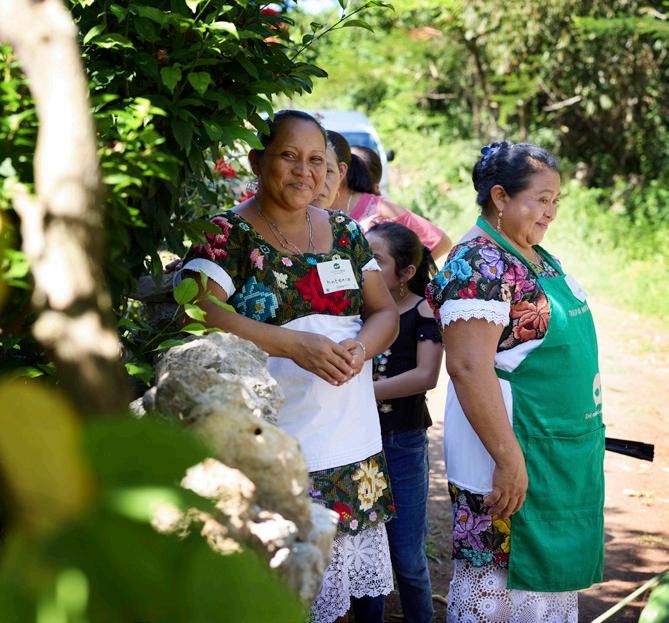
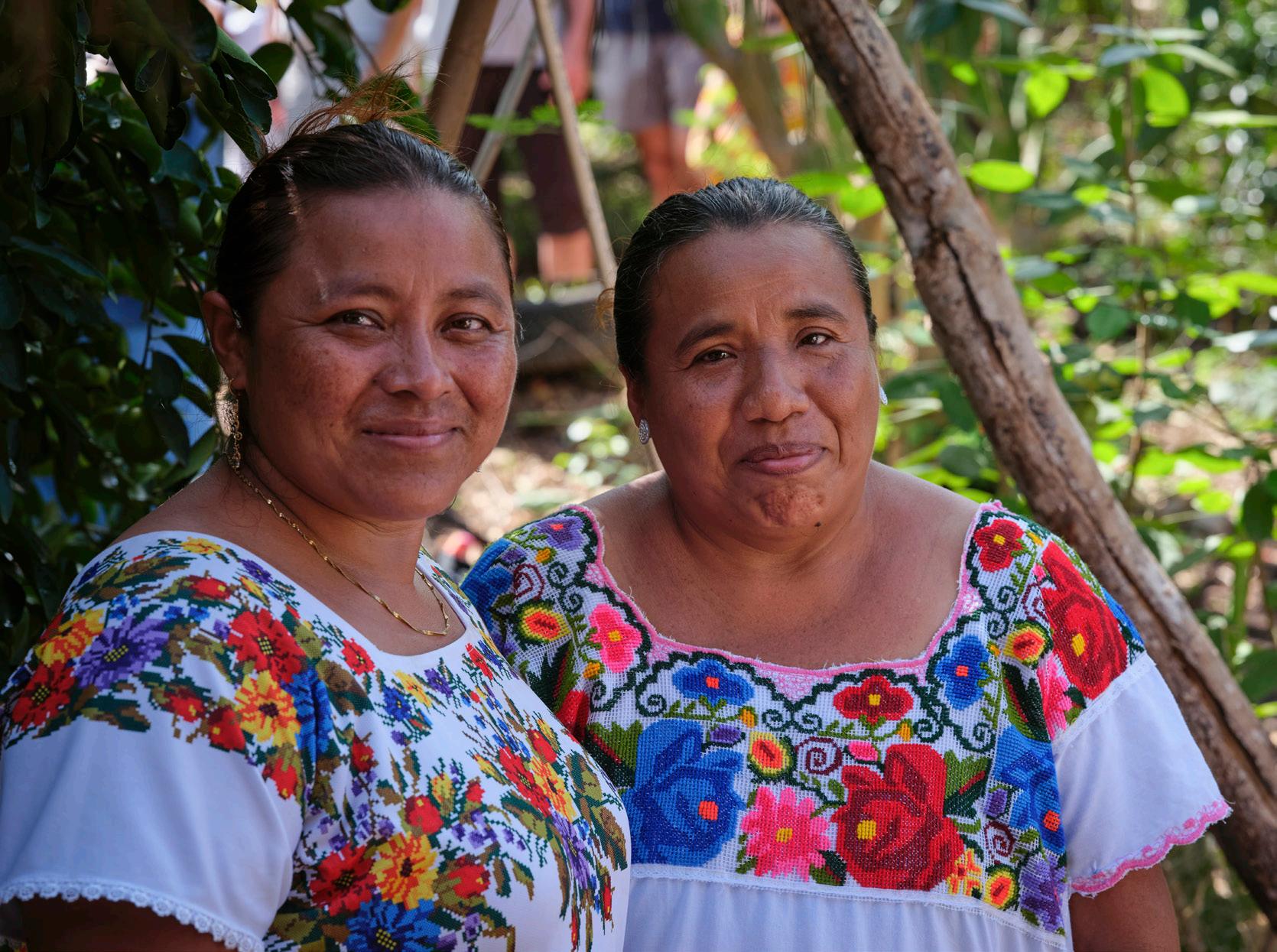
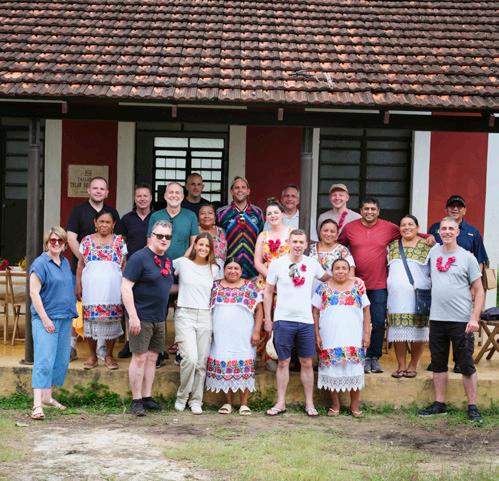
Day two had an early start; we headed out to Nohsuytún, a small village about 90 minutes’ drive from our hotel in Mérida, deep into the wilderness of the Yucatán peninsula, the roads were bumpy and lined with a mixture of stone walls and rough shrubs. As we arrived, we were greeted by a small welcoming party of local women. I initially felt awkward, feeling like the typical tourist, embarrassed by my naivety to the world and how others live. Thankfully this feeling was short-lived, purely down to the warmth and welcome that we received from a community of people who have a deep relationship with the land. They were openly excited and proud to have us visit them and to educate us on their strong traditions, skills and truly special way of life.
The second impression I had as we took a short walk through the village was the intensity of the sun and the heat, it was strong and I could feel it quickly starting to take effect on my ever-receding hair line.
We arrived at one of the local’s houses where we were greeted with a beautifully refreshing green juice made from a local ‘spinach’ called ‘Chaya’, mixed with local citrus juice and a little honey. Chaya is a leafy green shrub found all over the Yucatán and is rich in nutrients such as iron, calcium and vitamins.
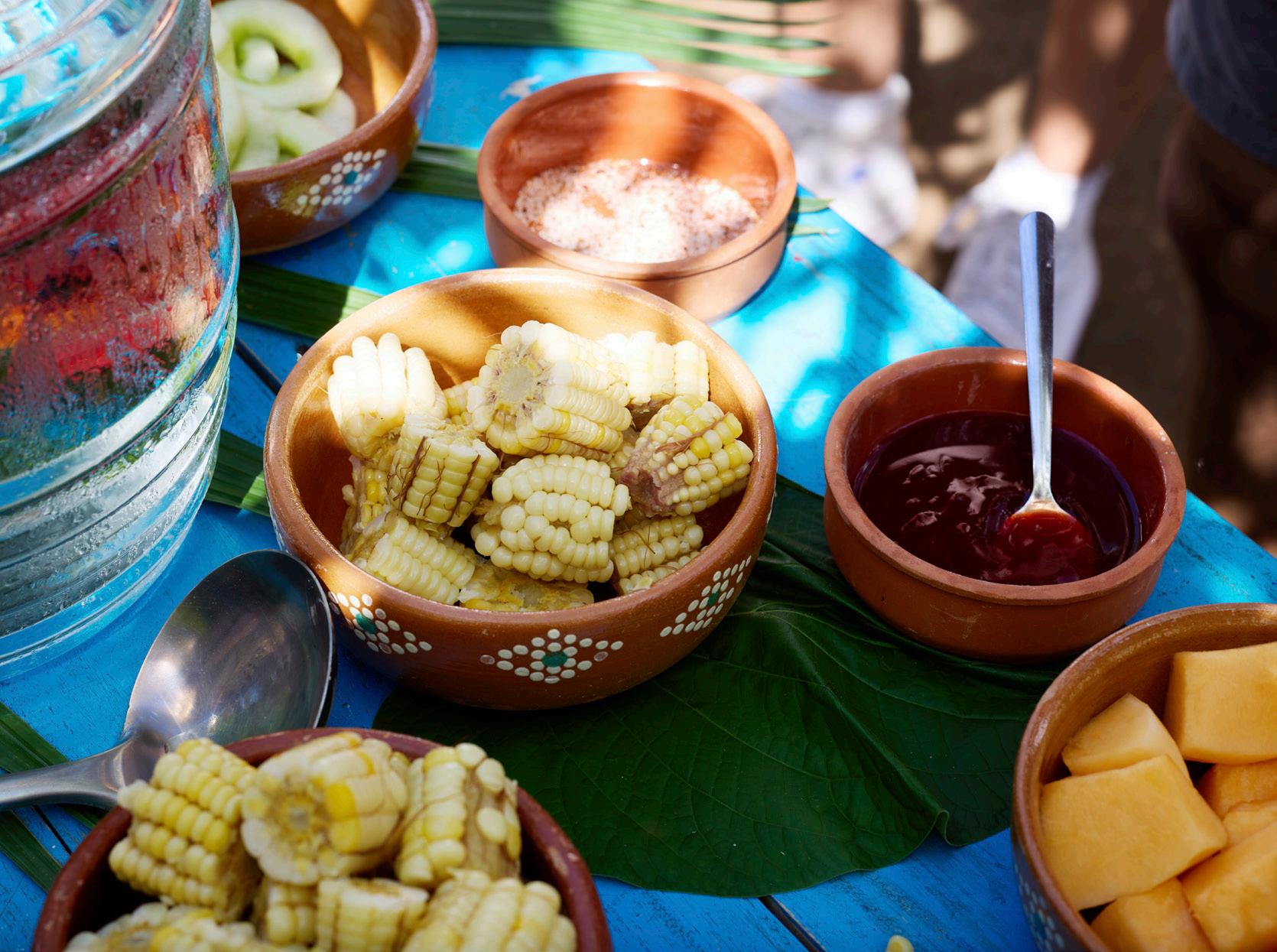
Alongside was a selection of sliced cucumber, melon and corn served with a chilli salt. It is at times like this that I’m reminded that food doesn’t need to be over-worked or complicated, but can be just great, fresh ingredients highlighted with the smallest of touches from the cook’s hand. After our short refreshment break, we walked through the gardens full of citrus trees down to the milpa. The milpa is what I would describe as a traditional farming system that the Mayan people have used for centuries. They grow corn, squash, chilli and beans all in the same shared space, each plant supporting the other and having its own role to play in the eco-system.
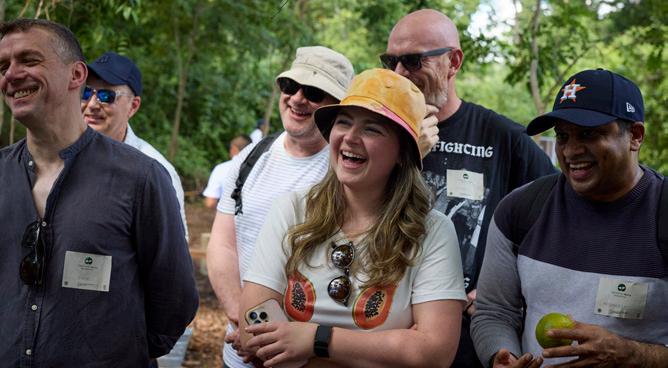
I tried my hand at planting the seeds in the traditional way guided by a local elder, Felix, who obviously made it look easy, which it clearly
Pictured: (left page) we were welcomed by a spread of delicious fruit, corn and drinks when we arrived in the community. (Right page, from top) As well as smiles and warm handshakes, we were served refreshing drinks; Felix showed the chefs how to sow the seeds of the ‘three sisters’, and the visit was absolutely enchanting.
wasn’t. What stood out to me was how deeply the milpa is ingrained into daily life; it isn’t just farming it is more the culture of the people. What I found fascinating and inspiring was that there isn’t a manual or rule book, knowledge of the milpa is learned and passed down through generations, watching, listening and repeating practices and processes handed down from parents and grandparents. All this going towards creating a strong sense of pride and responsibility for their traditions, culture and way of life.
We were then treated to a traditional drink that those working in the Milpa would have daily to help keep energy levels up. It was made from fresh and fermented corn boiled in water called ‘pozol’, served with salt and fresh chilli. If I’m totally honest it wasn’t to my taste at all but, trying to be respectful, I forced as much of it down as I could.
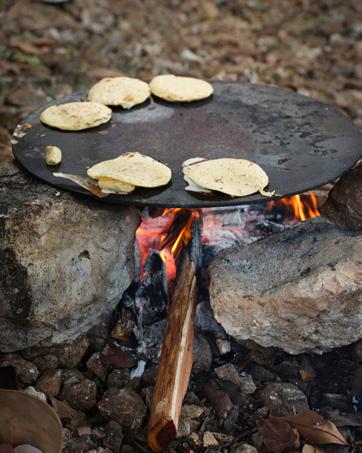
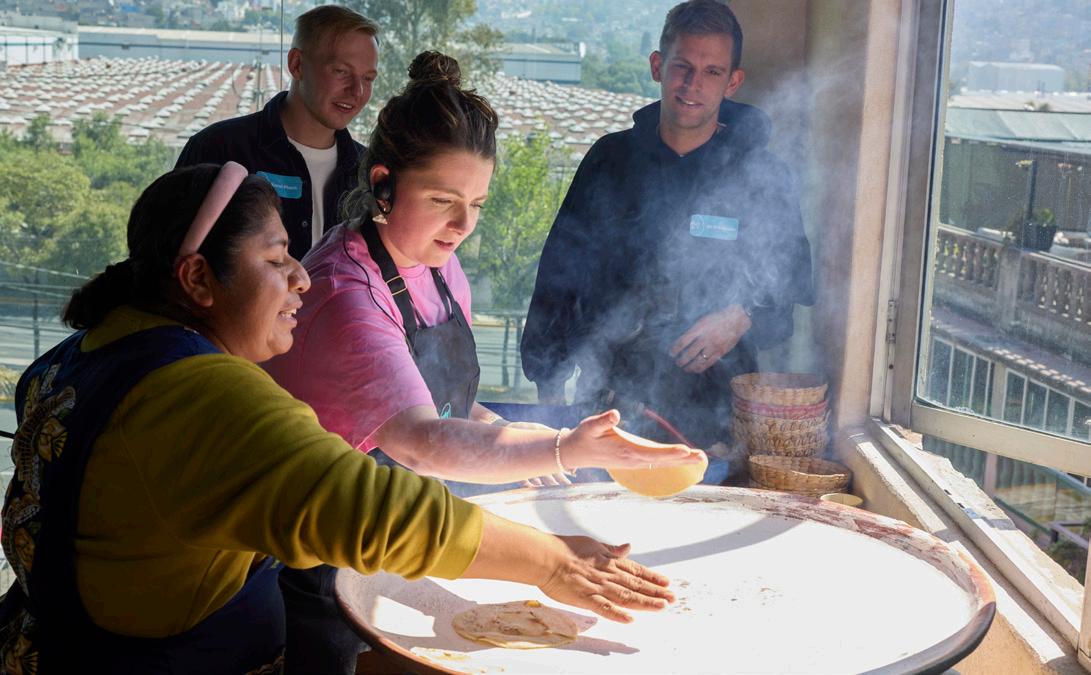
We then made our way back towards the house where in a clearing the locals had set us a selection of stations to demonstrate and explain the process corn goes through once it has been harvested from the milpa, from separating the corn kernels from the cob. They showed us the everyday process of nixtamalization, which is when they boil the corn with limestone before leaving it to ferment and then being ground to a paste to make masa dough for tortillas. We then tried our hands at making the tortillas, which were cooked on a hotplate over a fire.
This was another clear example of how corn is so much more than a crop from the field, it’s the way of life of the Mayan people and every day they work and process it in some way. Our visit was just after the Day of the Dead festival, which includes the tradition of cooking the season’s first corn for around two days in a large hole dug in the ground filled with hot rocks and lined with local plants: they call this a ‘pibil’ or ‘pib’, for short. After digging up lunch and making an offering to their ancestors, as is a local tradition of the Mayan people, we were treated to an array of local delicacies.
As we prepared to leave we were thanked for our visit and time spent with the Nohsuytún locals, I left feeling humbled and reminded of what a profound and special effect we can have on others with true and genuine hospitality, we don’t need to have all the fancy gadgets, polished silver or waiters in starched uniforms, all that’s needed is warmth, humility and a passion for what you do.
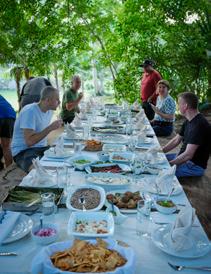
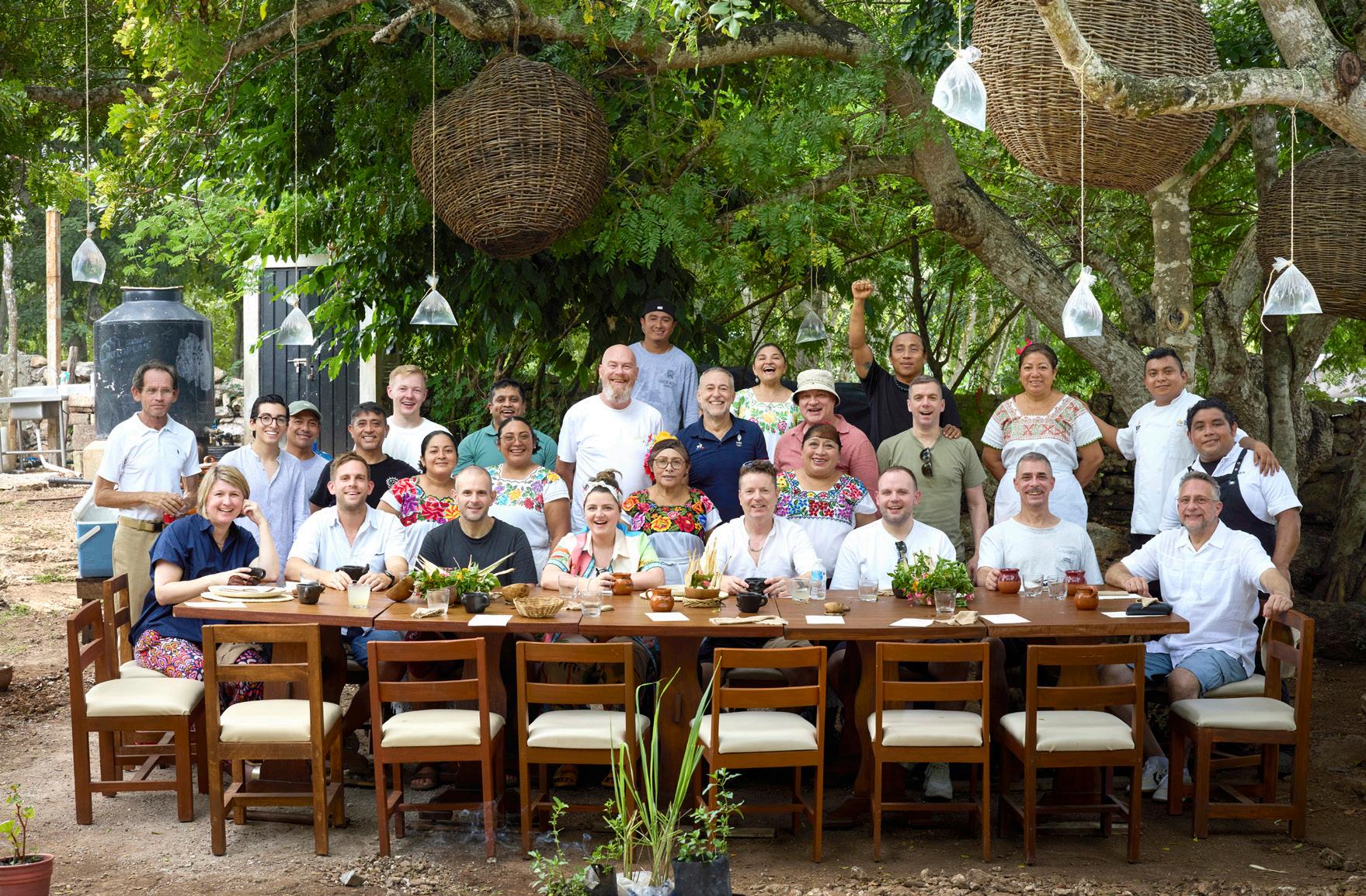
Pictured: We spent the afternoon at a local hacienda, where we were welcomed with tacos, fresh and bright salsas. After a swim in the cenote sink hole, we sat down at a long table for dinner under the trees, where much tequila was served.
SWIMMING IN THE CENOTE XOCEMPICH
By Martin Carabott
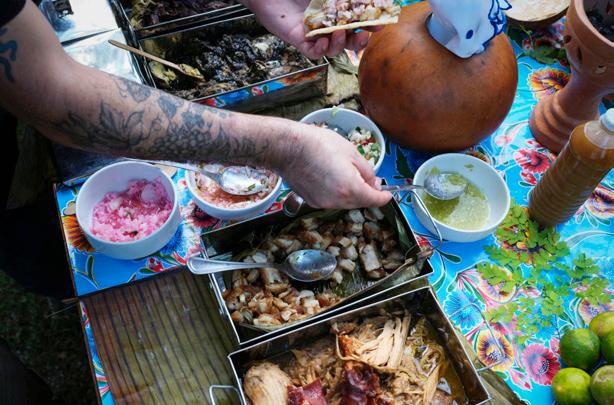
We arrived in the late afternoon to a warm welcome at a repurposed hacienda, originally built to process henequen (fibrous agave) into ropes. We were offered small cervezas beers and shots from a beautiful flashing bottle of tequila, along with the most amazing spread of tortillas and fillings. The most notable dishes were made with the pibil (underground pit) cooked pig, black chicken and pork liver.
One of our hosts then proceeded to show us to another pib which he said contained suckling pig, which was about done. After some digging and tortilla assembly and garnishing, we once again had pork juice dribbling from our chins as we ate the most amazing wraps.
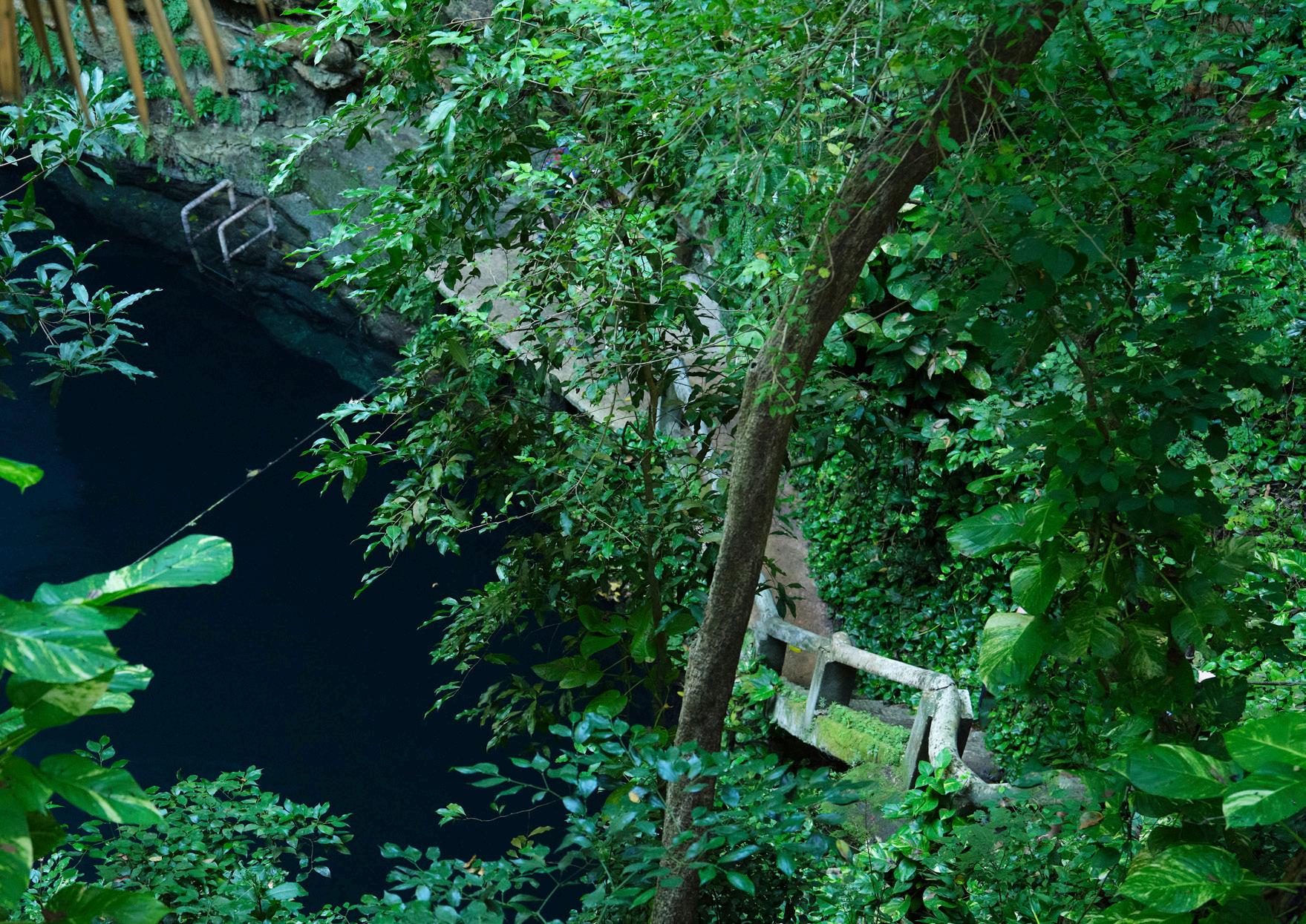
After our pre-dinner snacks, we were shown to the cenote at the back of the hacienda. The sight was breathtaking: it was very deep, like a small quarry in size, with a waterfilled pit at the bottom. A steep staircase led us down to the water, and the deeper we descended the more beautiful the scenery, all sorts of plants lined the walls of the cenote and the water was beautifully bluish green and very inviting. We jumped in and had an amazing time cooling off here, taking in the beauty of this natural pool. When we climbed out to go for dinner, everyone took note of Steve Love’s daring swimwear and had a giggle.
Dinner was fantastic; more tortillas, more pulled pork, more ice cubes of unfiltered water in drinks, more glasses of white wine for Chef Michel, more laughs and more tequila all around: the perfect day!
IZAMAL // KINICH RESTAURANT // CHICHÉN Í TZA
IZAMAL – MEXICO’S YELLOW CITY
By Hrishikesh Desai
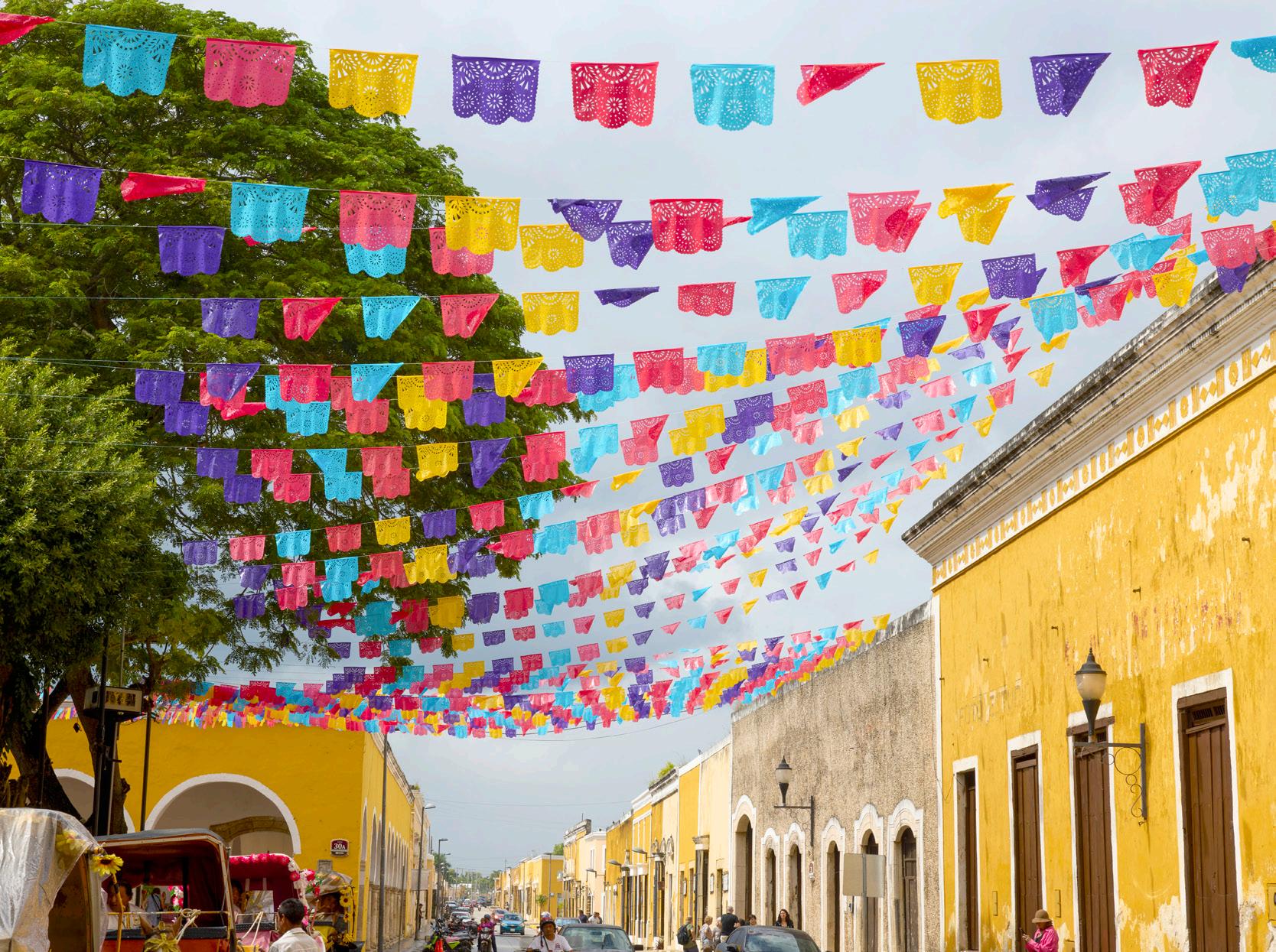
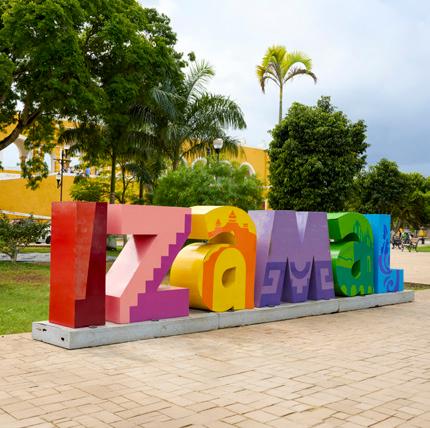
Leaving the hotel after a quick breakfast, I was half-asleep and quietly hoping to catch a few more minutes of rest in the bus. We were bound for Izamal, a city so uniquely unified in colour that every house, church and shop is painted bright yellow with a crisp white trim, earning it the nickname La Ciudad Amarilla, the Yellow City. It’s a place built on layers of historyMayan, colonial and modern - each one visible as you wander its streets.
Our first stop was Huerta Kinich, the kitchen garden attached to the famous Restaurante Kinich. We were welcomed with warmth by the team including the Azcorra family, whose matriarch, Miriam Azcorra Rejon, laid the foundations of Kinich with a mission to preserve Yucatecan culture and traditional Mayan cuisine. The restaurant started in the mid-1990s by Miriam and has become a culinary emblem of Izamal, celebrated for its authentic flavours and deep connection to regional heritage.
Guiding us through the garden was Imish Kuj, we affectionately nicknamed the ‘Witch Doctor’, a strong, deeply rooted Mayan man whose passion for his culture, traditions, and the land was palpable. His energy was magnetic; the kind that makes you lean in and absorb every word. Beside him, Miriam greeted us with the most beautiful, warm, honest smile, the sort that puts you instantly at ease. Together, with their team, they poured out a level of generosity and love that reminded me deeply of the joint Hindu family I grew up with, a sense of belonging and shared history in every gesture.
The garden itself was bursting with life: medicinal herbs, vegetables, fruits, corn and much more meticulously organised in aligned plots. The layout felt alive with intention, attuned to the earth and the cosmos, echoing an ancient belief that nature and sky are inseparable partners in growth. Stone carvings and deities were thoughtfully placed, anchoring each section with meaning. Elsewhere in the huerta (garden), the staff prepared tortillas, sikil p’ak (Yucatán pumpkin seed dip), salsas, coffees and tamales. While we walked around the garden, there were live demonstrations of the food culture that animates this region.
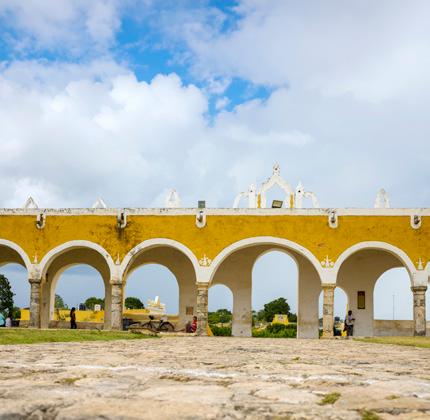
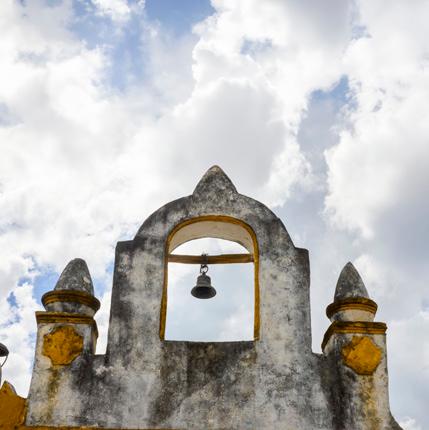
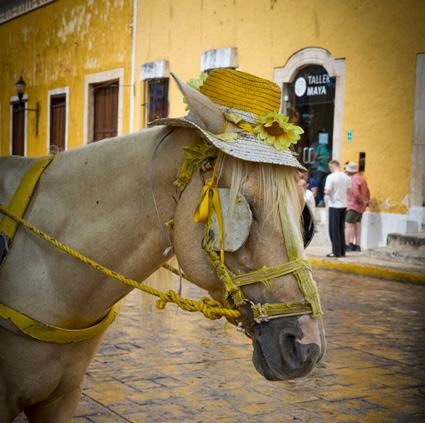
Pictured: (left page) Bunting flutters above many of the streets in Izamal. (Right page) The city’s central square and the Parque Itzamna; the bell tower and arches of the San Antonio de Padua monastery; even the horses offering cart rides in the square keep up the colour scheme.
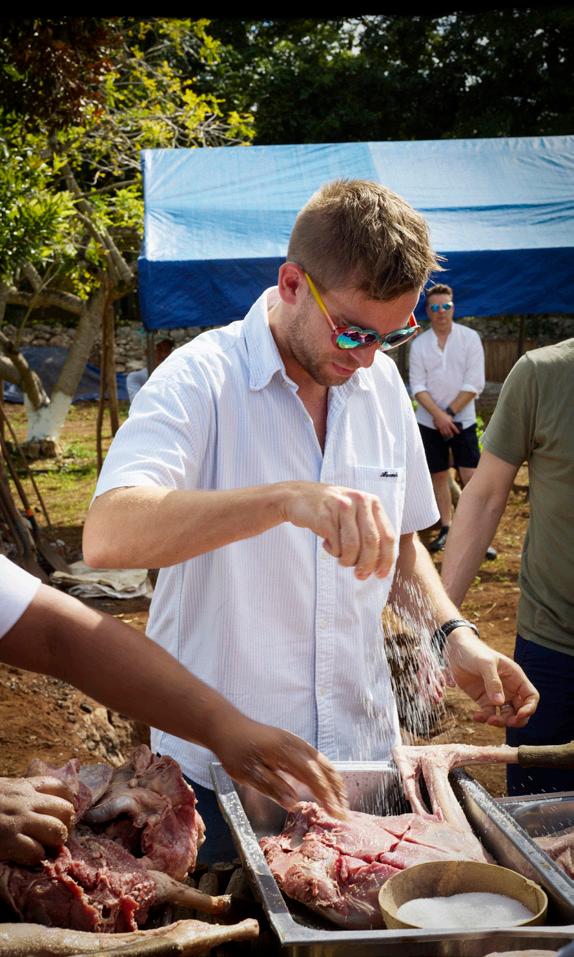
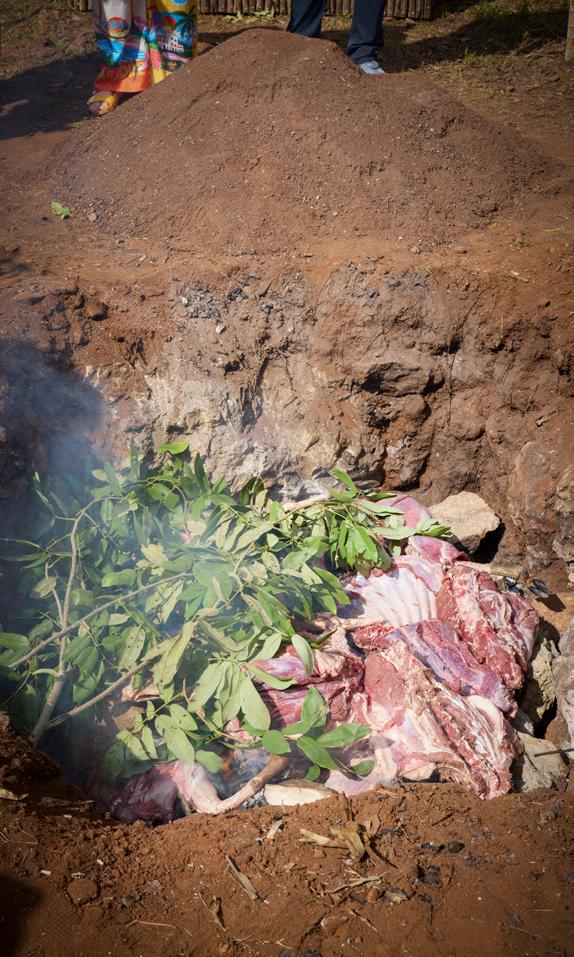
One of the most memorable moments was witnessing the preparation of venison in a traditional pit oven called a ‘pib’. Stones were heated over charcoal, and we each added a cut of the salted venison into the pit. This was layered in with fragrant rámon leaves from the garden, and everything was sealed beneath sheets of corrugated iron and a layer of fine soil to cook slowly for five to six hours, a ritual that felt as ancient as the land itself.
While that cooked, we explored more of Izamal. As we wandered further into town, led by our guide Gabriel Burgos, we admired the grand sweep of yellow buildings. They were first painted in 1993 to welcome the visit of Pope John Paul II, to represent both the colours (with white) of the Vatican as well as the yellow of corn, the sacred Mayan food staple. It was a project embraced by generations of residents and now part of the city’s pride. We visited Kinich Kakmó, an archaeological pyramid dedicated to the Mayan solar deity of the same name, whose name means ‘Fire Macaw with Sun-faced Eyes’. It’s a structure of remarkable scale that once made Izamal a central ceremonial hub long before the Spanish arrived.
Climbing Kinich Kakmó was a first for me; I’ve read and watched documentaries about pyramids around the world, but nothing compares to standing atop one built such a long time ago, feeling the Mayan sky press down on you and the centuries beneath your feet.
The next striking sight was the 16th-century Convent of San Antonio de Padua, its ochre-yellow walls trimmed in white creating a bold welcome under the bright sky. Originally constructed between 1549 and 1561 over a Mayan temple, this monastery’s vast atrium is one of the largest in the Americas and is a testament to both Spanish colonial ambition and the layering of cultures that define Izamal’s identity.
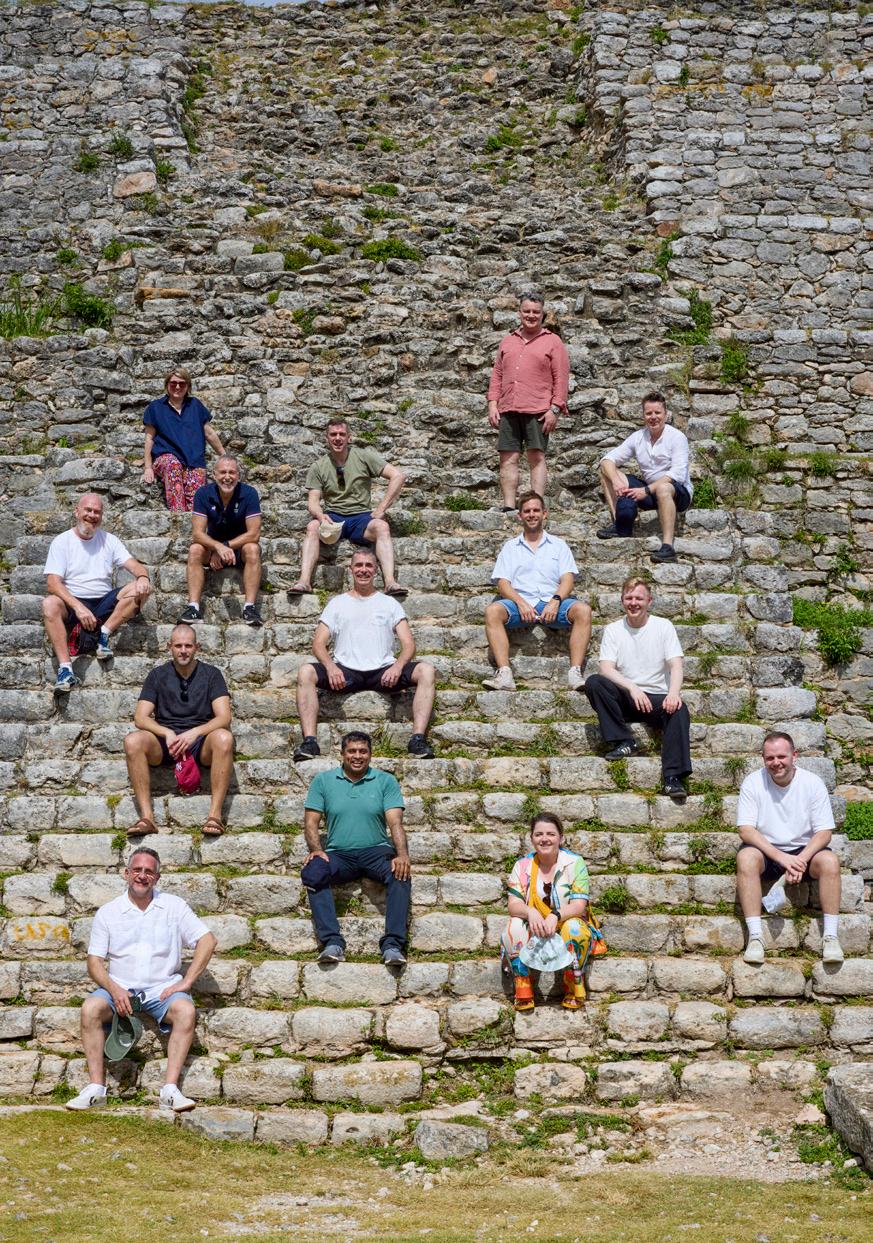
Pictured: (Left page) Oli helps salt the venison before everyone threw a cut into the ‘pib’. After it is cooked, the Kinich cooking team helped prepare it to take it to the restaurant. (Right page) Everyone on the steps of the Kinich Kakmó, a Mayan pyramid in Izamal, which dates from around 400-600AD.
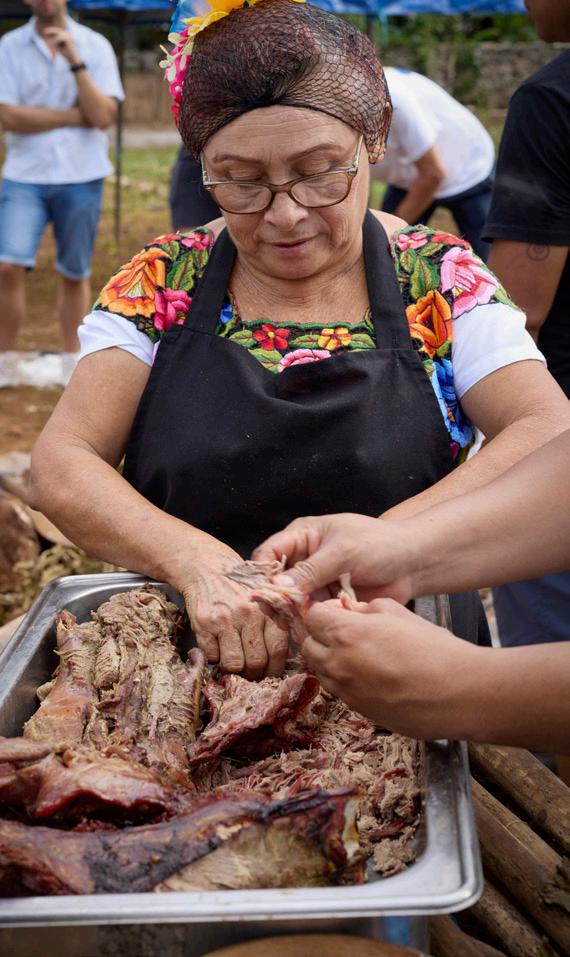
Back at the garden, the venison was unearthed; tender, smoky, and rich with the essence of earth and the leaves. It was both humble and profound: food that carried the mark of the land and the hands that tended it. We then walked through the city, dodging the raindrops, to Kinich Restaurant, a beautifully decorated farmhouse-like space where tradition and celebration collided.
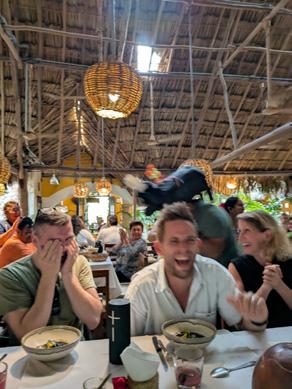
Here, the team surprised us with a playful performance: one of the staff was wearing a hat shaped like a cow and another one like a pig; the staff played celebratory music, clapping, and striding around in a joyous parade. It was a moment meant to make every guest feel special and it worked. The tasting menu that followed was exceptional: each dish thoughtfully prepared, each flavour a bridge between land and history.
But what lingered longest wasn’t the food, or the pyramids, or even the golden walls. It was the human warmth, the laughter shared under the sun, the generosity of the Azcorra family and their team, and the sense of deep belonging that places like Kinich foster so naturally.
Leaving Izamal and the Azcorra family was unexpectedly hard. There was something intangible in their hospitality, a pure kindness rooted in culture, tradition and shared joy that resonated long after we boarded the bus. It felt like saying goodbye to a home I knew as a child, full of treasured memories that will stay with me for a lifetime.
Pictured: (Left page) A welcome brunch, following a tour of the Kinich garden, where we tried tortillas freshly made over the fire, and had the chance to taste sikil p’ak (pumpkin seed dip), salsas, coffee and tamales. (Right page) brunch with everyone from Kinich before our city tour of Izamal.
CHICHÉN ITZÁ EVENING VISIT
By Simon Hulstone
The third day of our amazing trip took us to somewhere I had suggested purely out of my love for history and the fact we were so close. Chichén Itzá is a magnificent, partially restored Mayan city which, at one point, was the biggest city in the Mayan world.
Our visit was an evening visit and although we did not have time to walk the whole site or see it in daylight, we were treated to an amazing lightshow which was illuminated on the world-famous Mayan pyramid. This was visually striking and it followed the whole history of Chichén Itzá, from the foundations in 900AD, all the way through to the rise of the city and then the discovery and destruction by the Spanish invaders. The city is now being slowly restored and it is unbelievable to see.
One of the large courtyards was a sports court, which looked innocent enough until our guide Juan informed us that the games were violent and some interpretations teach that they ended in the death of the winners’ captain. Throughout the site, the story of Chichén Itzá is told by carvings on the walls, which makes the discovery of the city so much more intriguing. It was a dream come true to be able to visit this site and I will return one day to spend more time in its presence.
VILLAGE OF GRANADA WITH TRASPATIO MAYA
// CELESTÚN // HACIENDA TAMCHÉN
GRANADA VILLAGE WITH TRASPATIO MAYA
By April Lily Partridge
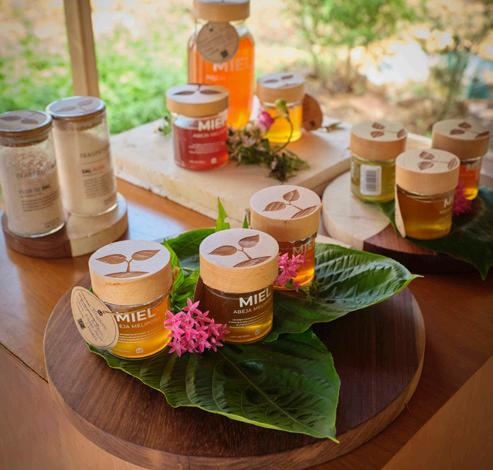
For me, one of the highlights of the trip was visiting the meliponary in Granada. I already have a huge fascination for bees in general but these little guys were just incredible. We walked around a citrus producer’s home and in the back of their garden were thousands of melipona bees, out and about pollinating then returning to their hives. The fascinating thing about these bees is that they don’t sting, which was quite a surreal thing as they buzzed all around us and we had no protective uniform on. We got to try the honey straight from the hives and, as the boxes were open, it was a beautiful sight to see the honeycombs being formed inside the trays and the way that the bees separate their honey depending on what they have pollinated. There were three completely different coloured honeys at the corners of the boxes, which really blew my mind. The flavours were just amazing; we tried them by pouring them into our mouths from citrus leaves (pretty special). It was a real privilege as these bees only produce one litre of honey per year in comparison to the normal yield of most bees, which is closer to 30 litres per year. It was slightly looser and paler than normal, but incredibly flavorful and citrussy. What really knocked my socks off though was trying the bee pollen straight from the hive, it tasted like passionfruit! Where they pollinate on the citrus fruits and the pollen ferments inside the box, it was just the most lip-smacking flavour. Nature really is phenomenal. This honey is the best in the world. Not for putting on porridge, it needs to be used wisely.
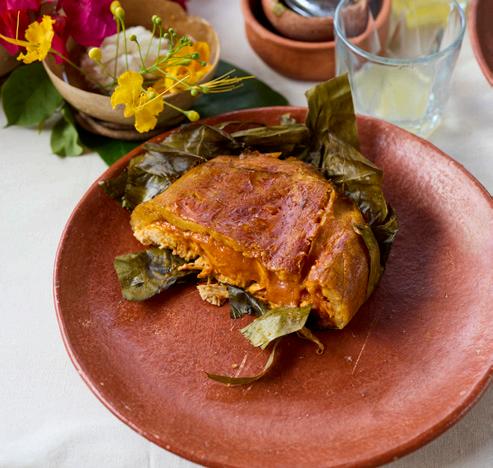
Pictured: It was a joy to meet the women who are cultivating melipona honey, citrus fruits and vegetables in their gardens in Granada. Our lunch was tamales, also cooked in the garden.
FLAMINGO AND BIRD BOAT SAFARI, CELESTÚN
By April Lily Partridge
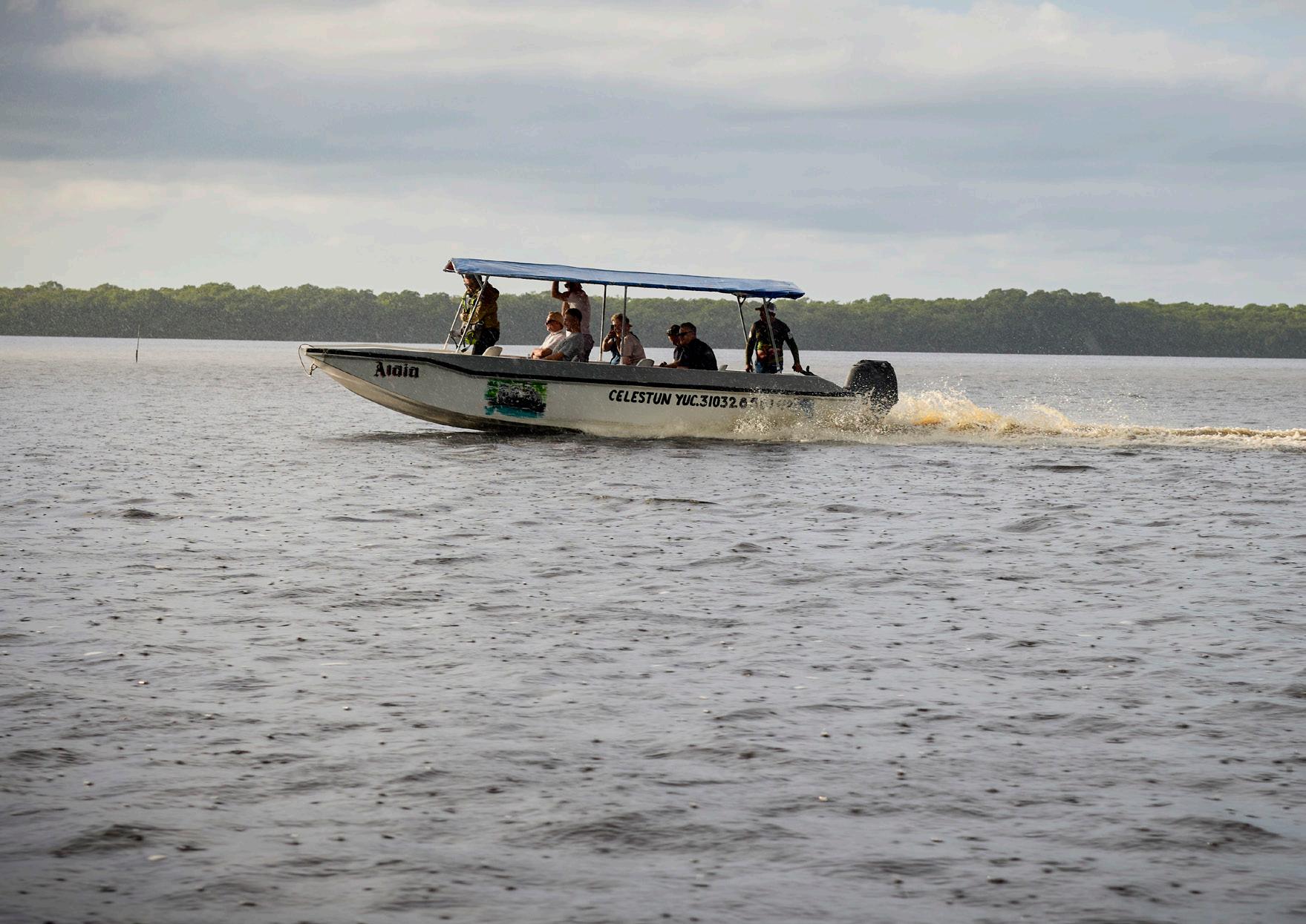
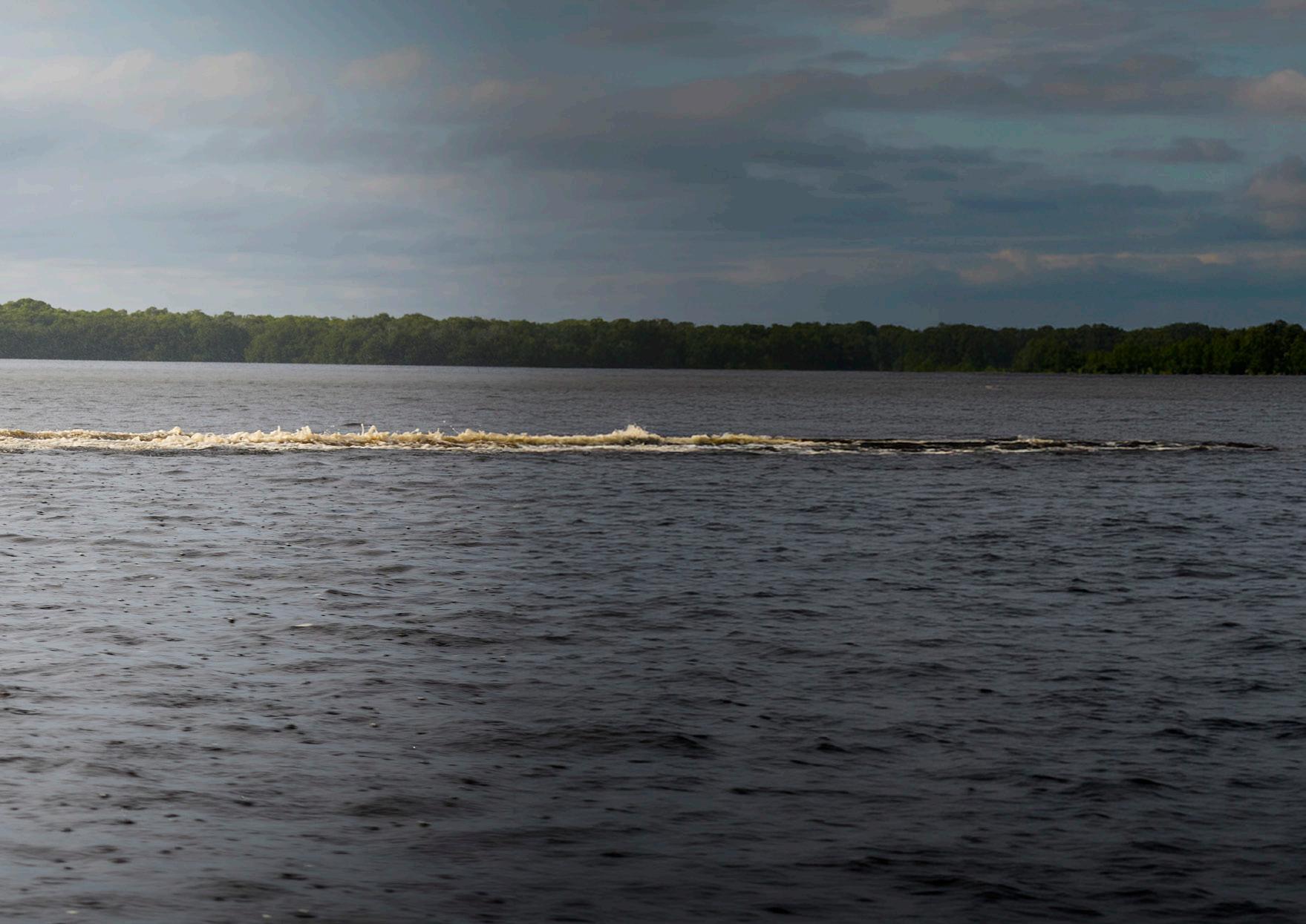
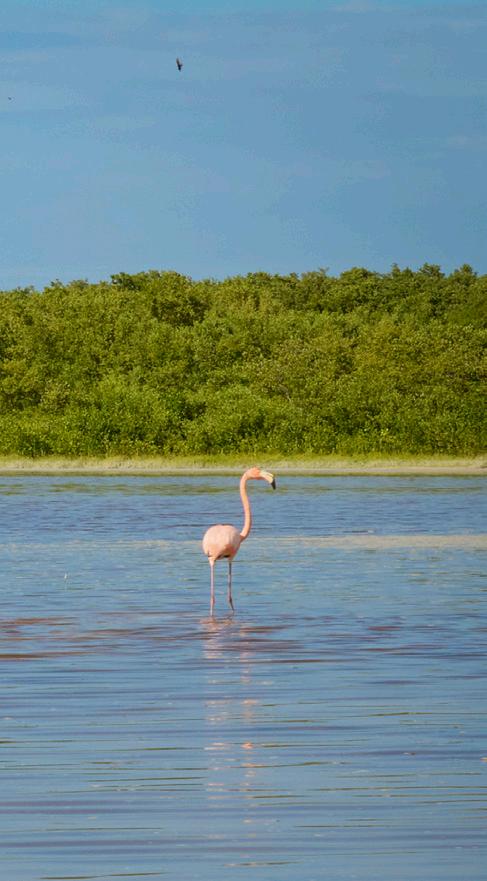
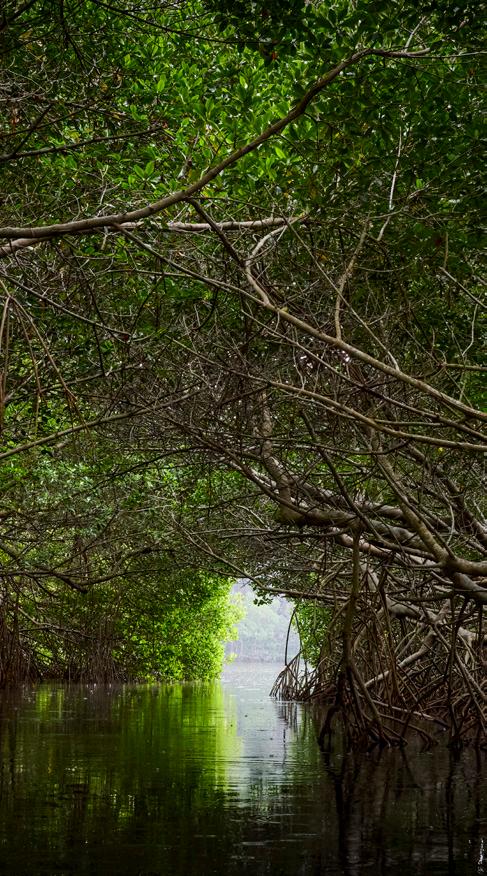
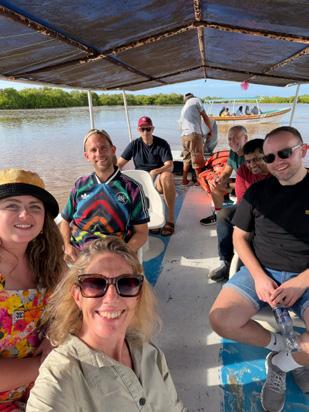
This was one of the highlights of the trip for a lot of us. We arrived at the quayside at of the Ría Celestún, an important biosphere reserve close to the Gulf of Mexico coast of the Yucatán peninsula, and were greeted by a group of mischievous raccoons who looked ready to steal our pesos at any moment, but we swiftly began our birdwatching experience hopping on to two boats and speeding out into the water to eagerly look for as many birds and crocodiles as possible. Soon we slowed into a narrow canal and cruised through the mangroves in what felt like a strange time warp into The Jungle Book, which can only be described as magical and whimsical. As we emerged from the mangroves into a wider lagoon, we were greeted by the most glorious flamingos. All jokes aside, I thought they were going to look a bit
creepy, but I was so wrong; they were elegant, bright and beautiful. Juan, our tour guide, gave us lots of fun facts like how the males have longer necks than females, how they get their bright colour from all the krill and shrimp they eat and how their number one predator is the jaguar. Fun fact: When flamingos are born, they’re bright white!
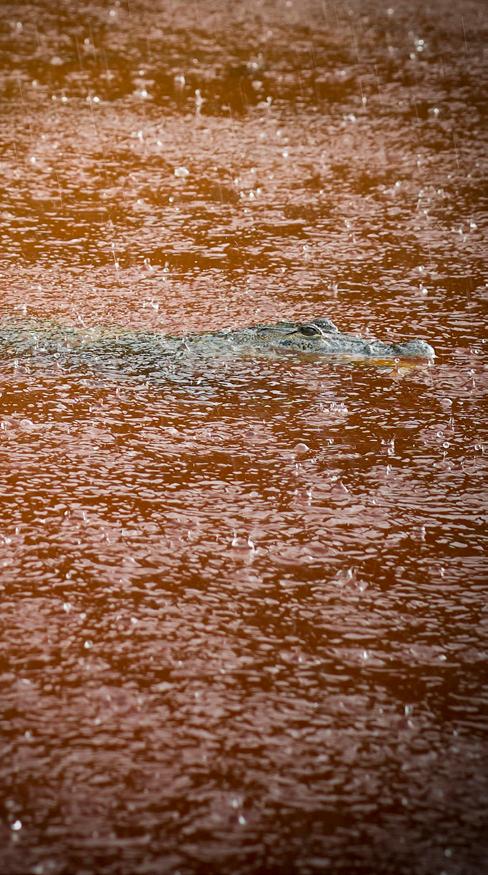
We continued on our tour as the heavens opened and a double rainbow appeared above the trees. There wasn’t gold at the end of the rainbow, though, we found crocs! They were lurking in the shallows, barely discernible in the pelting rain. Rich in memories but not in gold, we were soaked, happy and grateful for a very different day to what we all normally experience in England. It was a real pinch me moment.
Pictured: A trip in the biosphere gave us the chance to see flocks of flamingo and, as the heavens opened with torrential rain, we spotted crocodiles hiding in the shadows. The boat trip also took us through the mangroves which were peaceful and intriguing, before emerging into the lagoons full of birds.
DINNER AT THE HACIENDA TAMCHÉN
By April Lily Partridge
Our day finished visiting a hacienda, I eagerly spent the whole journey looking as high as I could see from the bus windows to try and spot a jaguar, but instead my mouth dropped to the floor when we saw the hacienda. This is the sort of place you want to rent out and get married at with a small group of your nearest and dearest. There were stunning rooms with open brickwork and decorated with simple but striking designs. Outside, there were ponds full of lily pads and frogs and a lady making fresh tortillas over a fire smothered in pork lard, lime juice and flaky salt. After a swim in the beautifully lit pool, we had a delicious dinner on the terrace, and the sounds of nature gently talked to us as we took in a very special day.
Pictured: a magical evening at the Hacienda Tamchén, with a swim in the pool and dinner on the terrace. A magical last night in Yucatán.
MEXICO CITY // DINNER AT QUINTONIL
ARRIVAL IN MEXICO CITY
By Karol Ploch
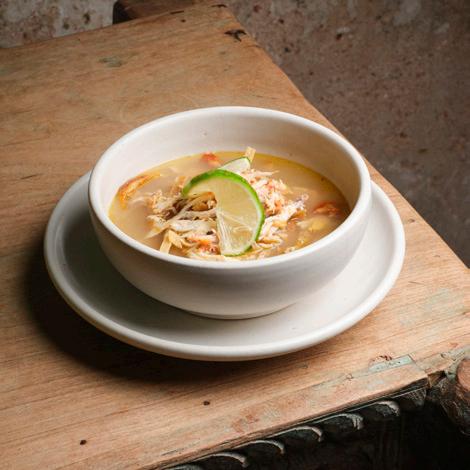
We arrived in Mexico City for the second part of our trip. The population of the city is 22 million people, which means massive traffic, chaos on busy streets and a lot of police officers with machine guns. We met our guides Sofía Hernández and Martin Bristow. After a quick check-in at the hotel, we went for a light lunch; tortilla soup really hit the spot after so many tamales in Yucatán. It was local restaurant called Otto, serving casual but very tasty dishes. Sofía’s family business, Jamat Seafoods, is one of the best fish suppliers in Mexico, working with the best restaurants in the country. Her recommendations and connections were very helpful throughout our whole stay.
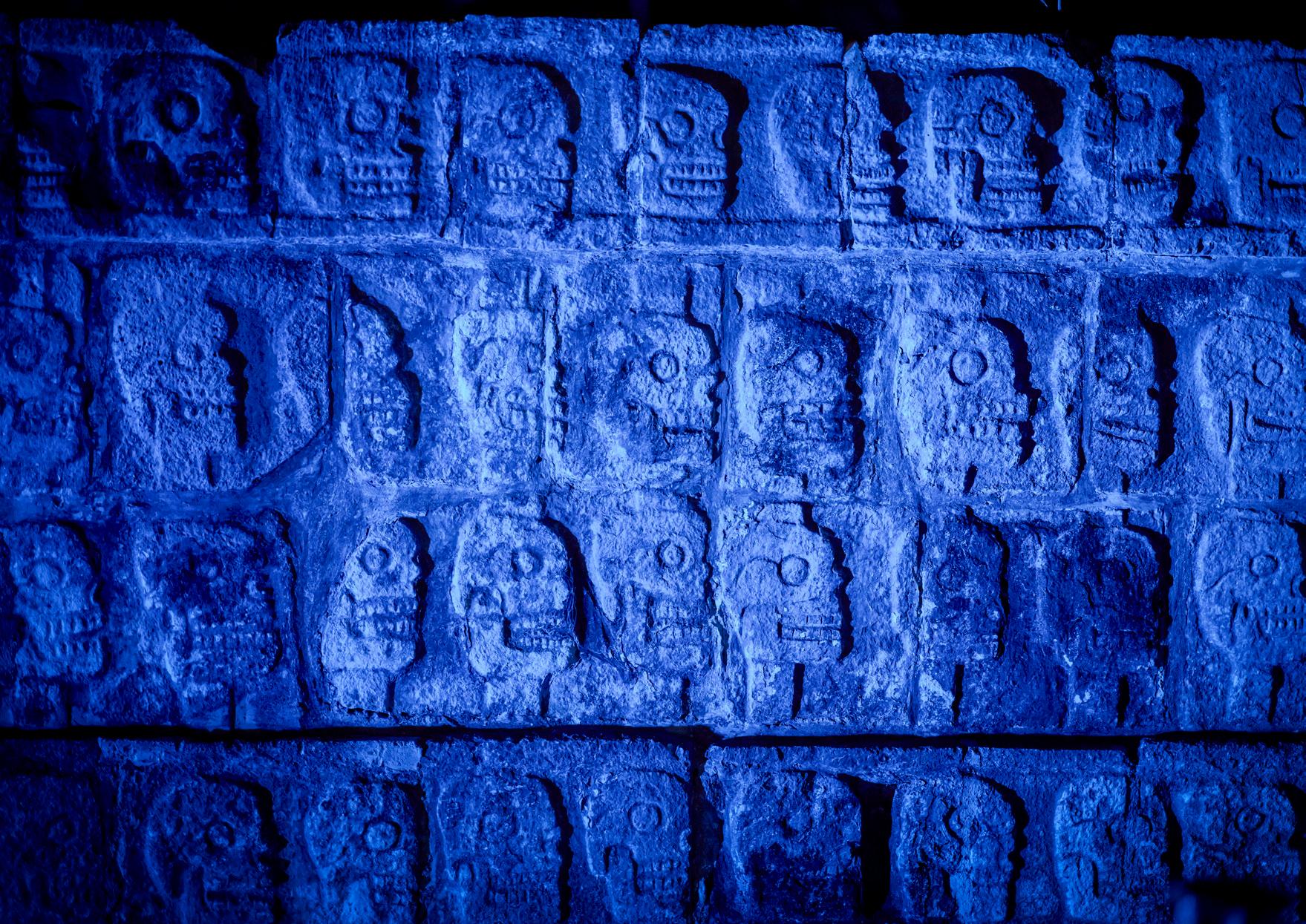
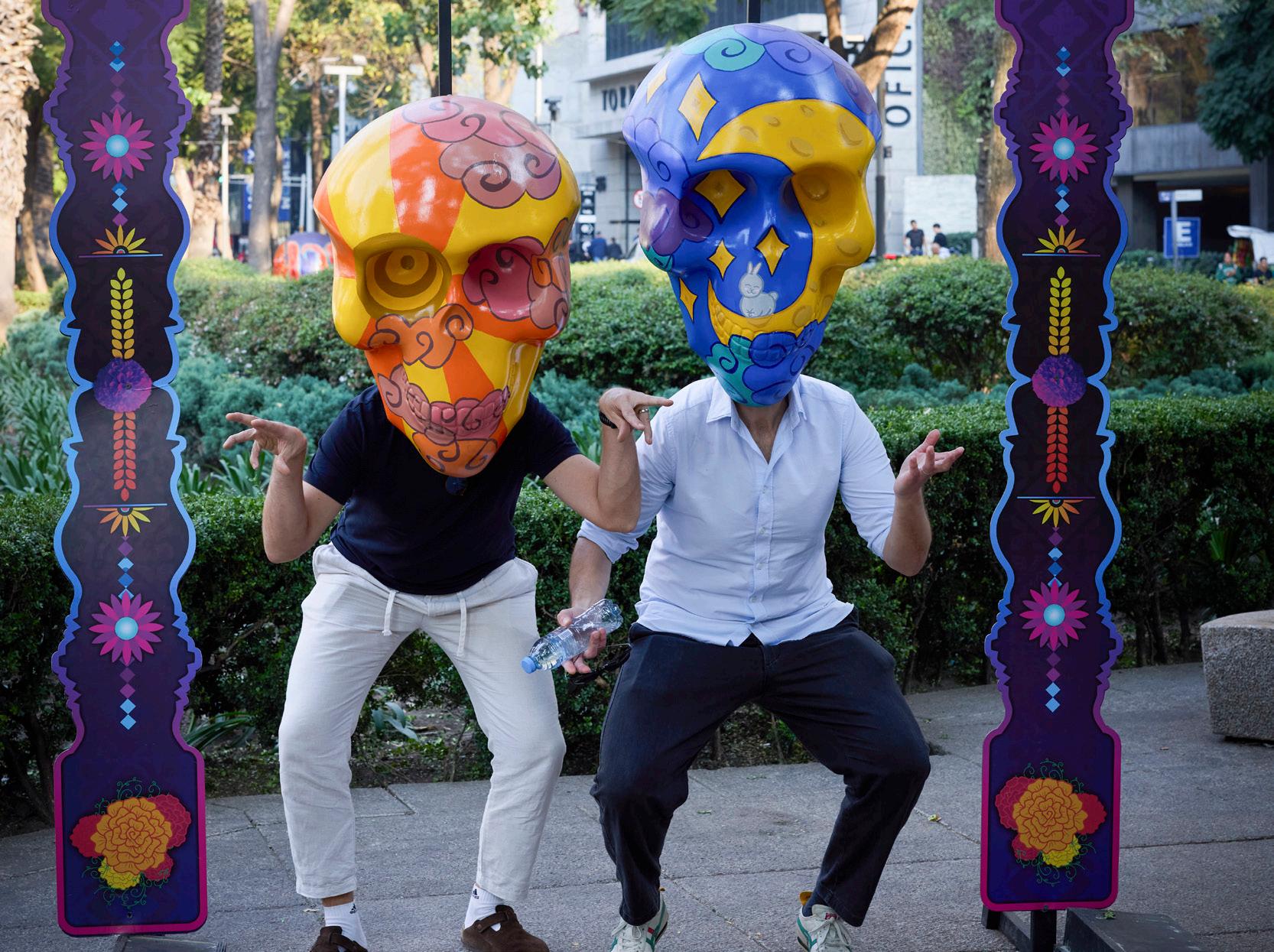
It was only a few days after Dia de Muertos celebration and the whole city was decorated with colourful skeletons, skulls and sculptures. it was a special and unique time to visit Mexico and experience it. There is no other culture that celebrates death in this way. We were wandering around the local neighbourhood exploring post-colonial Spanish architecture as well as modern skyscrapers. Then it was back to the hotel to quickly change; we enjoyed a welcome drink at the bar and then headed off to Quintonil.
DINNER AT QUINTONIL
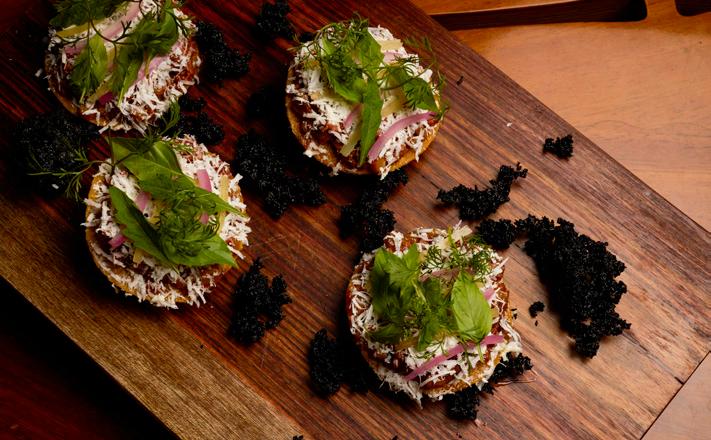
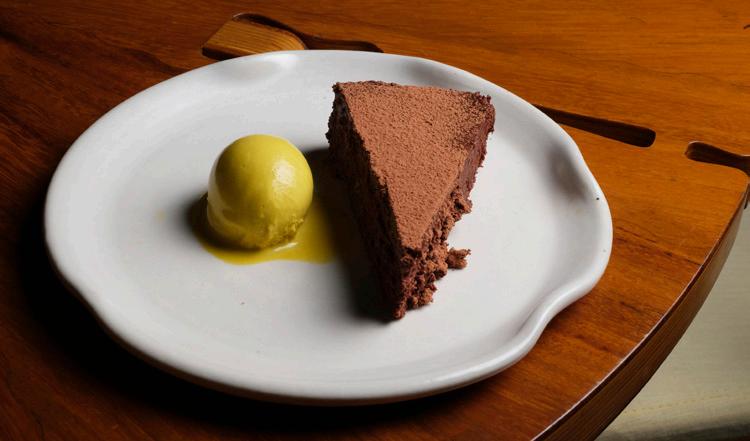
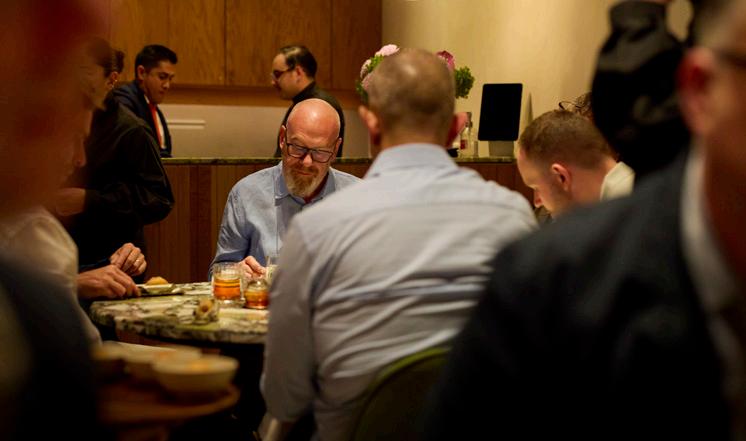
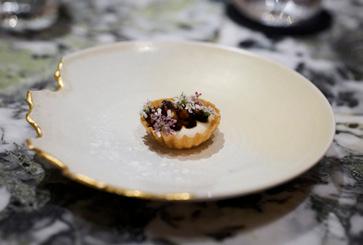
We were welcomed into the buzzing dining room at the two-star Michelin Quintonil, our first meal in Mexico City. At the helm of this acclaimed restaurant is Chef Jorge Vallejo and his wife Alejandra Flores. Our tasting menu included dishes using fascinating ingredients, some of which we had encountered on the Yucatán part of our trip, such as Melipona bee honey, jicama, blue corn tostadas, a duck cooked in a ‘pibil’. Flavours were rich and complex, some incorporating thai flavours. We were all fascinated by the course that included cocopache o xamui (beetles), escamoles (ant larvae), and chapulin (crickets). The dessert courses began with a cactus paddle sorbet, and included Mexican cornbread with rompope de nixtamal (a kind of egg nog) vanilla from Chichicaxtle and passion fruit.
Pictured: (Left page) Mexico City still had decorations up after the Day of the Dead celebrations, as demonstrated by Oli and Martin. (Right page) Dinner at Quintonil was an amazing experience where we had the chance to try amazing ingredients from all over Mexico.
EXPLORING THE BAKERIES AND CHOCOLATE OF MEXICO
CITY // TEQUILA EXPERIENCE AT MAIZAJO // VISIT TO KITCHEN OF MAIZAJO // AN EVENING AT SUD777
EXPLORING THE BAKERIES AND CHOCOLATE OF MEXICO CITY
By April Lily Partridge
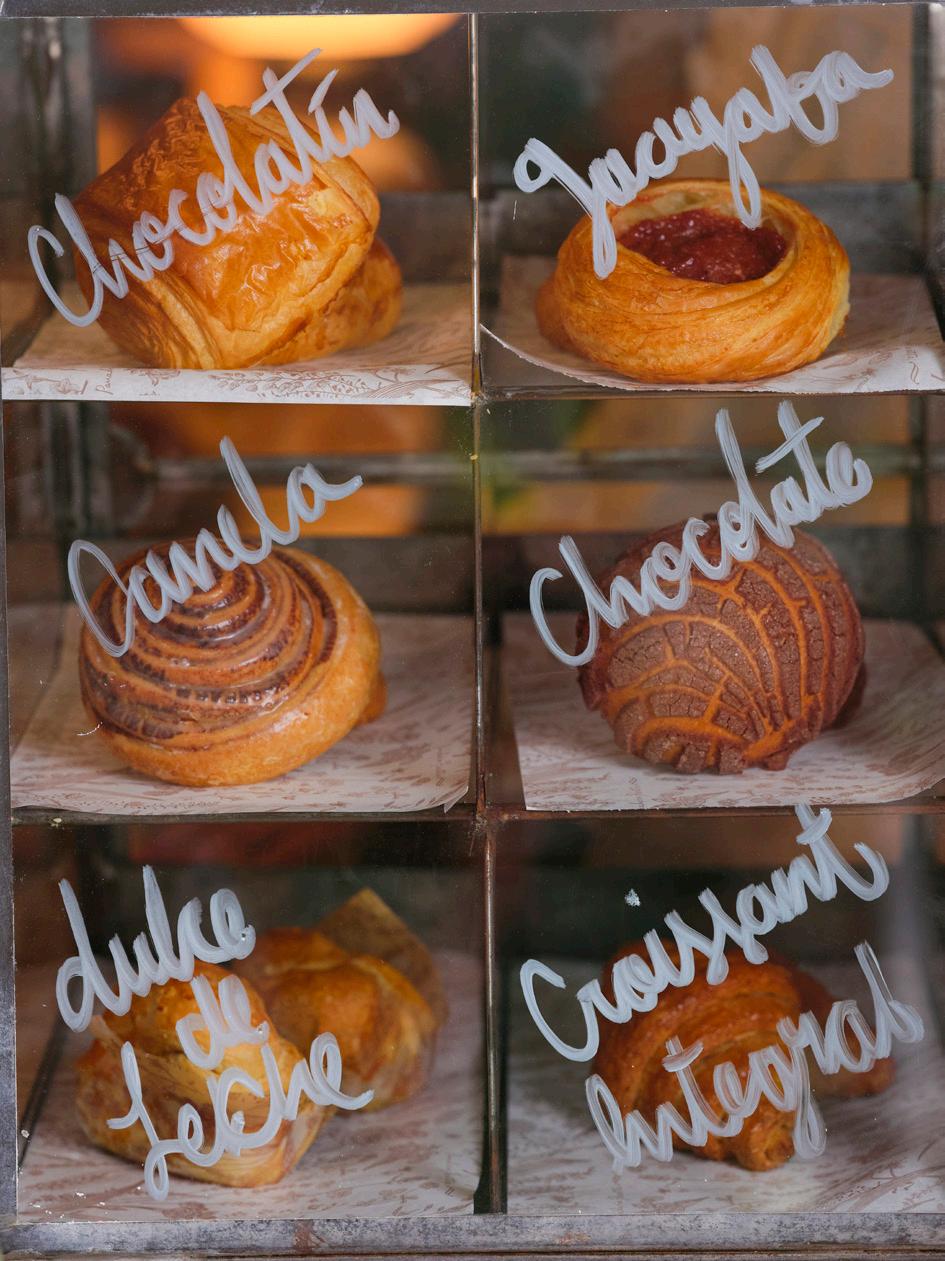
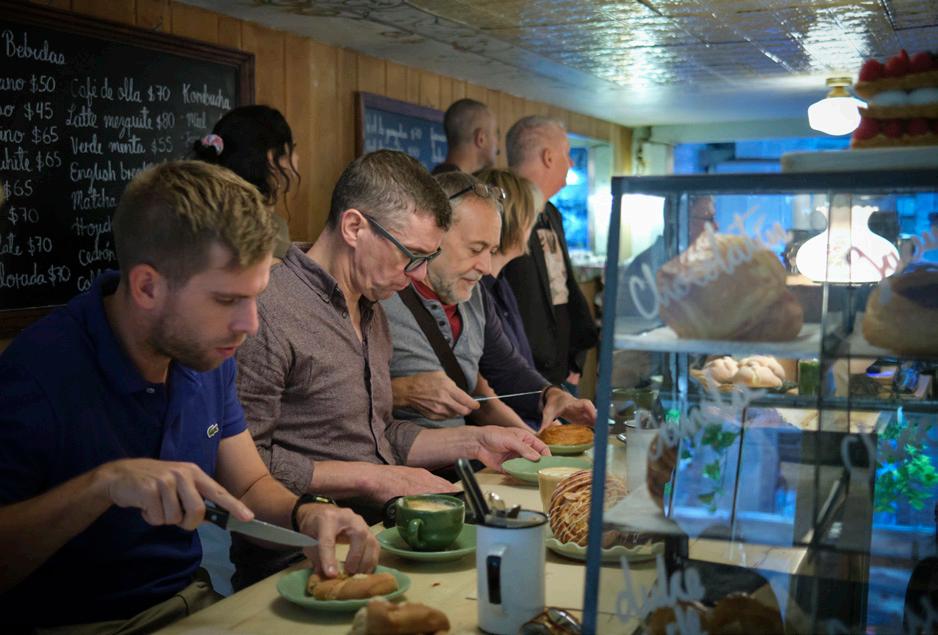
Walking back into Panaderia Rosetta was a lovely moment, seeing all the chefs in the place where I had worked for my Roux Scholarship stage in 2024. I hadn’t intended to stage there but my original stage fell through at the last minute. So, with less than a week’s notice, Chef Elena Reygadas welcomed me with open arms, knowing that I spoke no Spanish, and her team spoke no English. It was a challenging few weeks but it was incredibly humbling and soul-warming to work somewhere where the only way to communicate is through a shared love and passion for food. That was the language we shared, and we made it work. Panderia Rosetta is filled within a beautiful group of happy and passionate bakers, who perfect the Mexican breads such as Pan De Muerto (the Day of the Dead bread). There were also conchas, similar to brioche; and small gingerbread-flavoured piggy-shaped cookies, which are puffy and light and perfect dipped in their house coffee. The bar is filled with the sounds and smells of the bakery, there were bright flowers draped in decorations from the day of the dead celebrations, and the pastries were on show in antique glass cabinets. It’s the most beautiful bakery, and the queue of customers is down the road from the moment it opens until the moment it closes. It was a special moment for me to take the Scholars and Alain and Michel there and to show them what I am really passionate about right now. It may not be restaurants, but it is a different angle of cooking: the art of baking perfect breads and nailing lamination, balancing sweet and salty.
Shortly after, we walked on to Green Rhino bakery. This is where I was meant to stage originally, but it wasn’t ready in time, so I actually stayed on for an extra two weeks after our Scholar trip and I was able to fulfil my dream of baking with Richard Hart. It was one of the best experiences of my life. As we walked into Green Rhino, it was a different energy to Panderia Rosetta, but just as special. Edgy, unique and unapologetically quirky.
Pictured: (Left page) Our afternoon visit to the kitchen at Maizajo, with Chef Santiago Moctezuma; (Right page) Pastries at Panaderia Rosetta, including their much-loved guava jam pastry, and other French and Danish pastries.
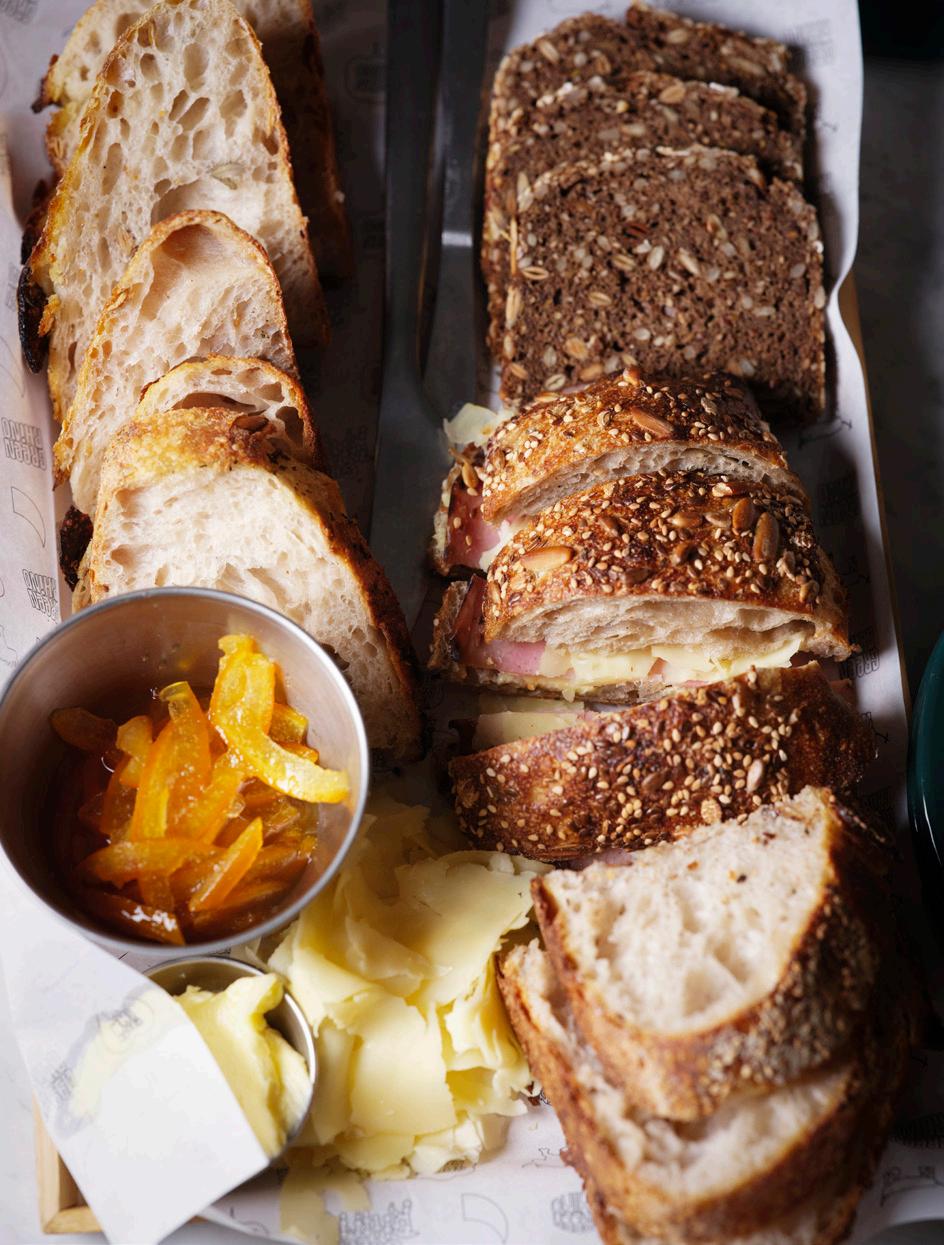
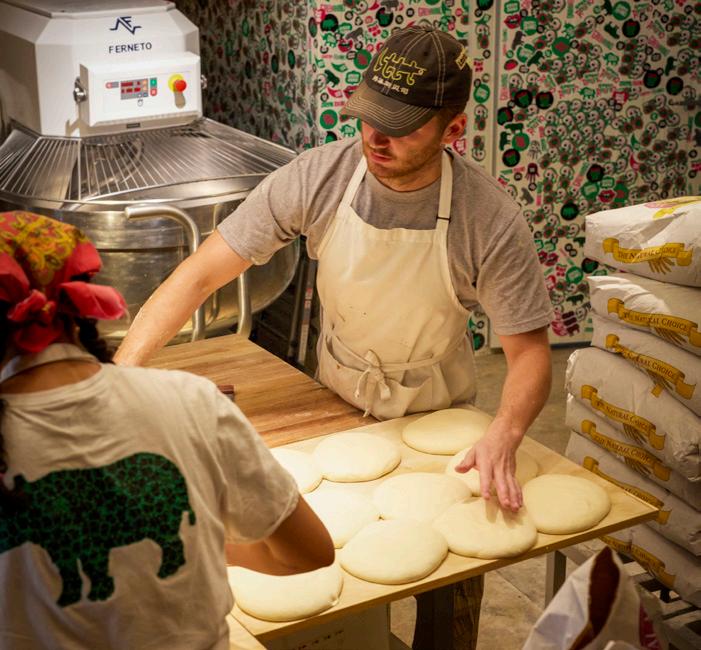
Random stickers covered the huge fridges, and unusual takes on pastries filled the displays, and their beautiful breads were glistening in the light, like something from a dream. This is what gets me excited. Richard was unfortunately not there, but his head baker Karishma and head pastry chef Ale gave us a great welcome, with tables full of all the pastries they sell generously filling the tables, along with pots of tea, from Richard’s wife Henrietta Lovell’s the Rare Tea Company. The bread was, well, world class: the best bread I have ever eaten, and lots of us agreed it was just superb.
A glistening shimmer on the dough, crust that shattered in your mouth, and a tender soft crumb with just enough chew that really showed finding good bread isn’t hard, but finding world class bread is rare, and that day we saw what the difference is. So special.
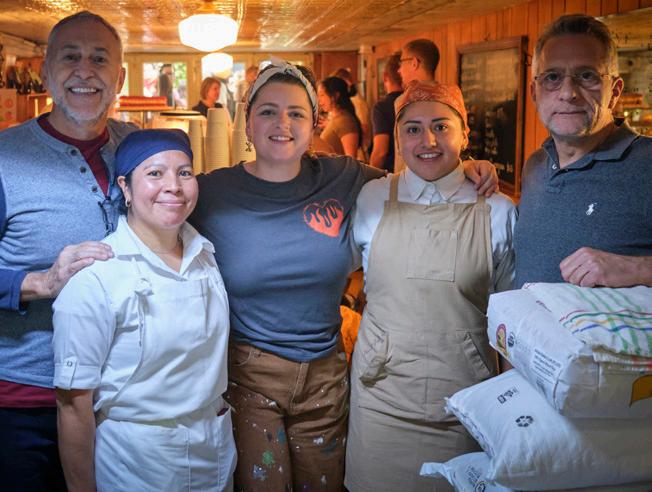
Pictured: The team at Panaderia Rosetta welcomed us for breakfast. We sat along the counter and watched the bakery to our left as we tucked into traditional pastries. Chef April introduced everyone to her fellow bakers, having done her stage there.
group tried a huge range of his bread and pastries before we had a chance to watch them creating their breads; despite it being November, the sun was warm that day.
Pictured: At Richard Hart’s bakery Green Rhino the
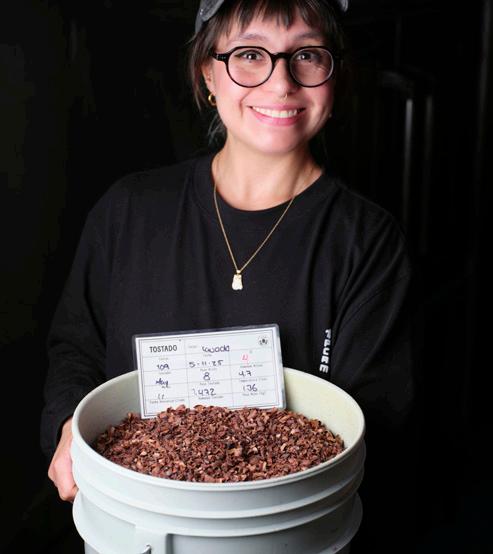
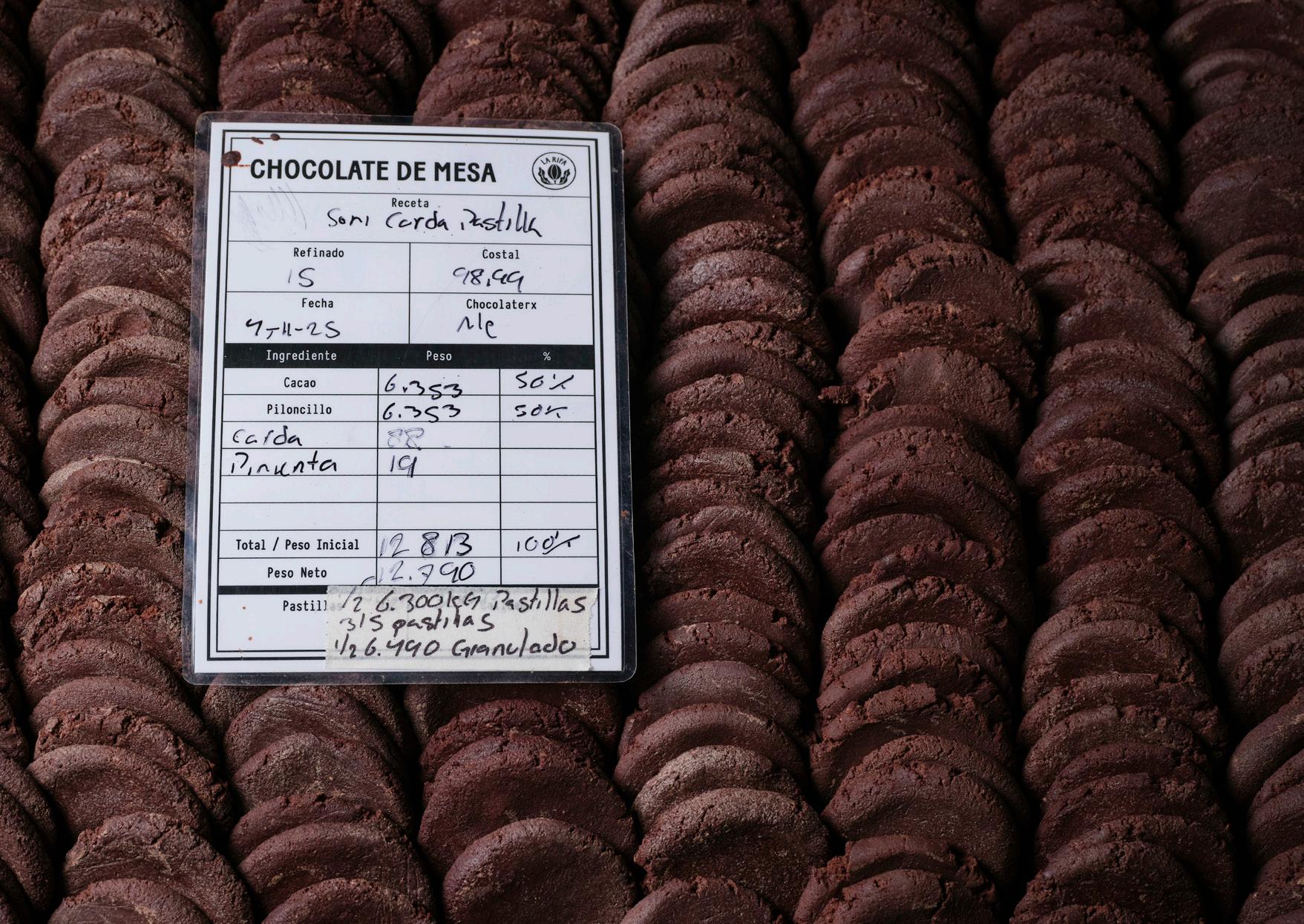
Our next visit was Chocolatería La Rifa, where the team were wonderful hosts. They took us into the workshop in two separate groups so we could get the most from the experience, one of the owners and chocolatier Monica Ortiz Lozano was so full of love and passion for the craft it spilled out of her. She taught us about where the cacao is harvested from, how she roasts the bean, the importance of fermentation and all the steps it takes to make a perfect bar of chocolate. We tried many different varieties of chocolate, and it was fascinating to see how the origin of the bean and the terroir affect the flavour, giving it fruity, smoky or caramel notes to name a few. We got to try an authentic cup of cacao: pureed cacao, water and piloncillo, a kind of Mexican sugar cone. It is a drink that has been drunk for thousands of years, full of natural cacao, and is a superfood. It was an amazing visit to learn about where an ingredient we all eat so often comes from and the skill it takes to produce something special. I also loved listening to the team so passionately championing the farmers, they are the real heroes of our industry.
TEQUILA EXPERIENCE WITH BROWNFORMAN AND HERRADURA TEQUILA
By Steve Love
Tasting Herradura Tequila at the upstairs bar of Maizajo in Mexico City transformed a tequila flight into a cultural experience. Maizajo is known for its dedication to heirloom Mexican corn and traditional nixtamalization, supplying many of the city’s top restaurants and serving beautifully crafted dishes that honour regional Mexican flavours. The upstairs barrestaurant was welcoming and offered an ideal environment for tequila tasting, where the aromas of fresh masa and wood-fired cooking drifted upstairs from the kitchen.
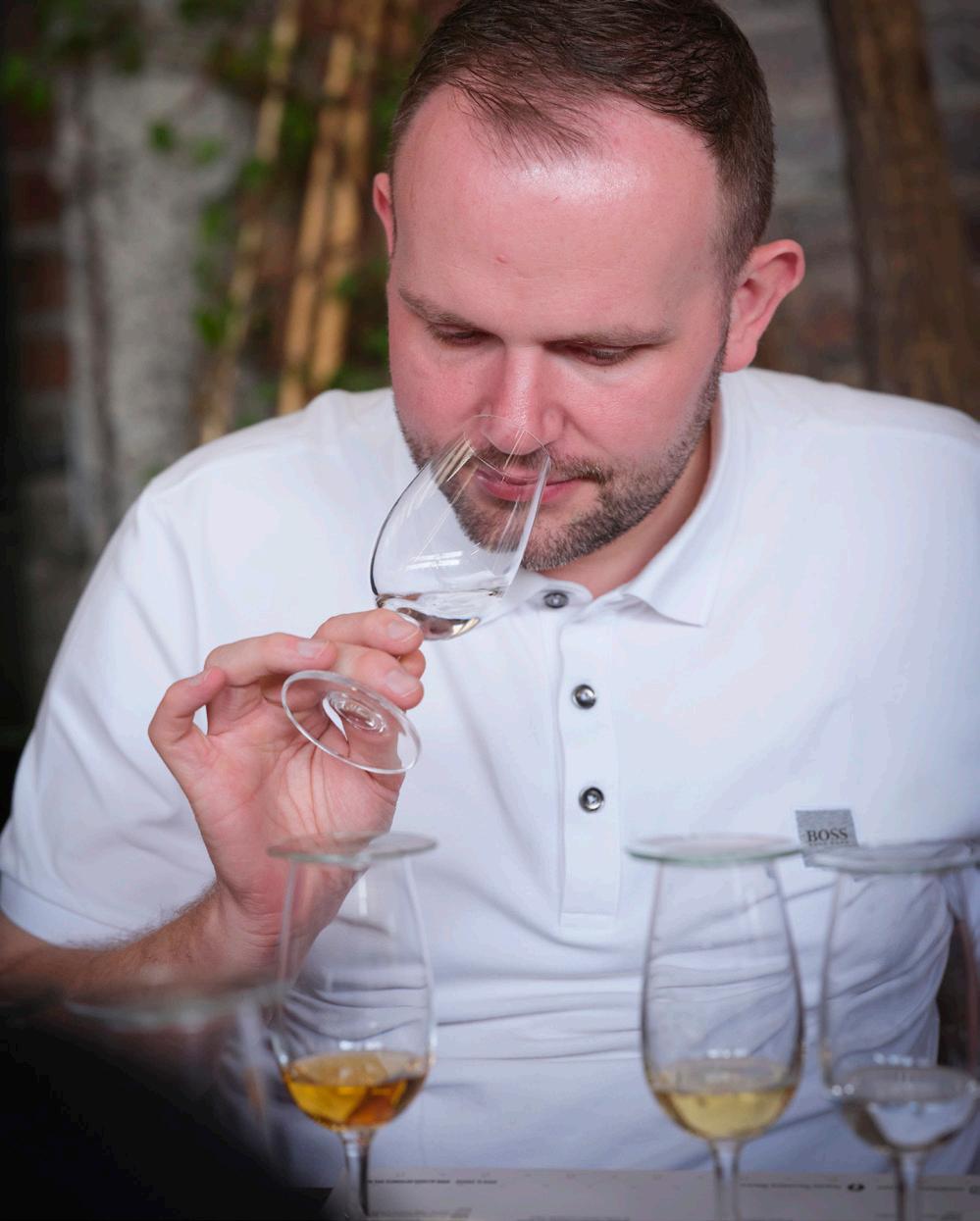
We tasted four different styles from Herradura Tequila; blanco is distilled from 100 per cent blue agave and is rested 45 days. Our hosts opened our experience with this version. It had crisp purity, bright citrus, pepper, and clean agave sweetness. Next was Reposado, the world’s first commercial reposado tequila which is aged 11 months. It brought a deeper warmth, with vanilla, baked agave, and mellow spice that reflected Herradura’s pioneering aging techniques.
The third tequila was Cristalino, an añejo – aged tequilaand had a silky texture with refined oak and subtle sweetness, merging aged complexity with a polished, modern profile. The final tequila was Selección Suprema, which is aged about 49 months, and unveiled layered notes of dried fruit, caramel, toasted oak, and chocolate. It is aged in old bourbon whisky casks, giving it a similar flavour profile.
Pictured: (Left page) Monica Ortiz Lozano gave us a masterclass in Mexican chocolate at Chocolatería Rifa. (Right page) Adam Smith familiarises himself with the different kinds of tequila during a tasting with Herruda Tequila.
VISIT TO KITCHEN OF MAIZAJO
By Oli Williamson
Recently decorated with a much deserved ‘discovery gem’ award from La Liste, Chef Santiago Moctezuma’s taco restaurant Maizajo was one of my personal highlights from the trip, and perhaps one of the group’s tastiest bites! This taqueria honours the heritage Mexican varieties of corn, so as to maintain their existence and celebrate the history of these flavourful, endemic varieties.
Upstairs, after the tequila tasting, we had a few bites, one of which included their variation of taco de camaron, a whole prawn, wrapped in a taco and fried, then drizzled with mayo and chives, it was an unexpected and mouthwatering variation of taco-making for me.
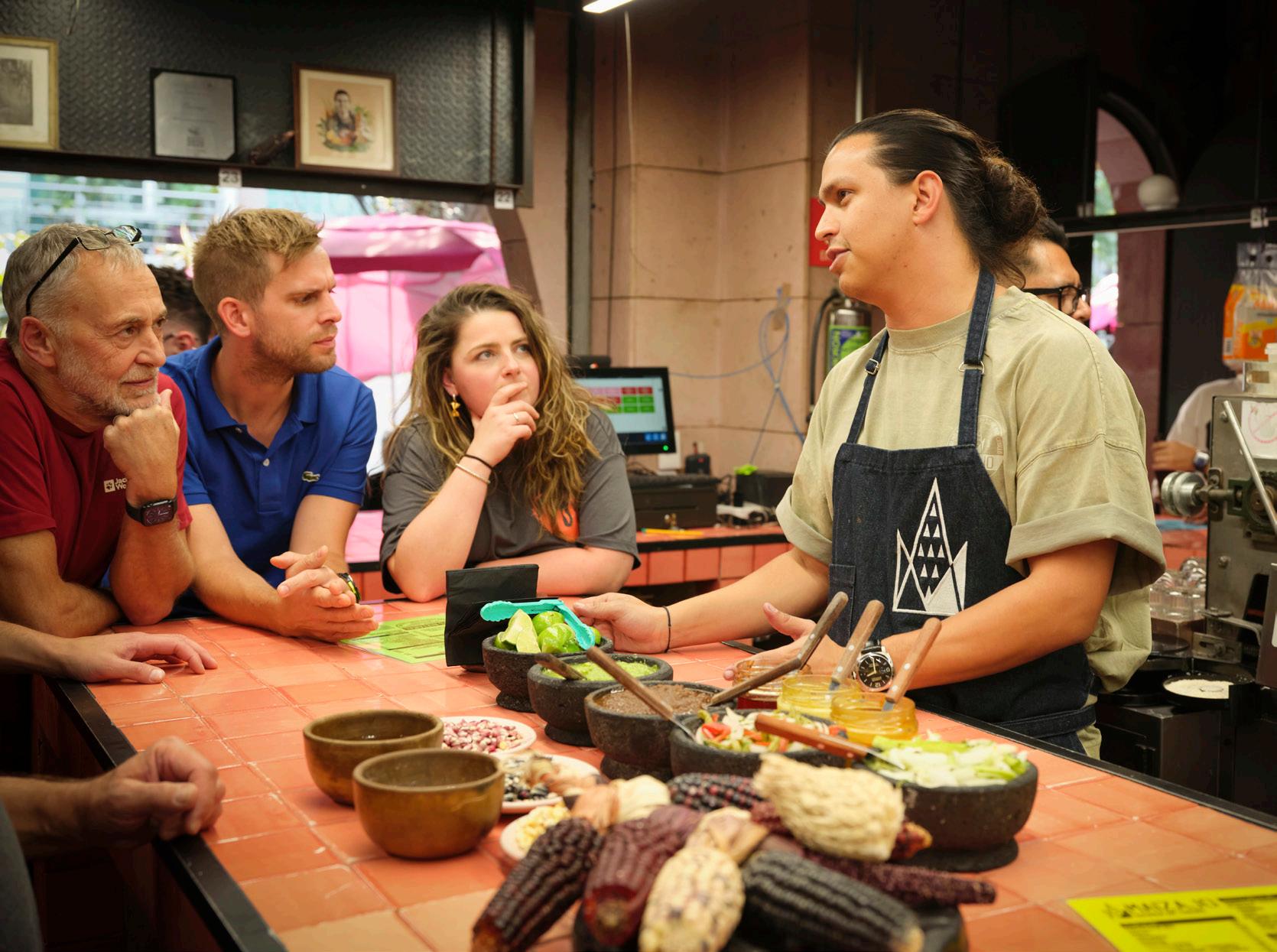
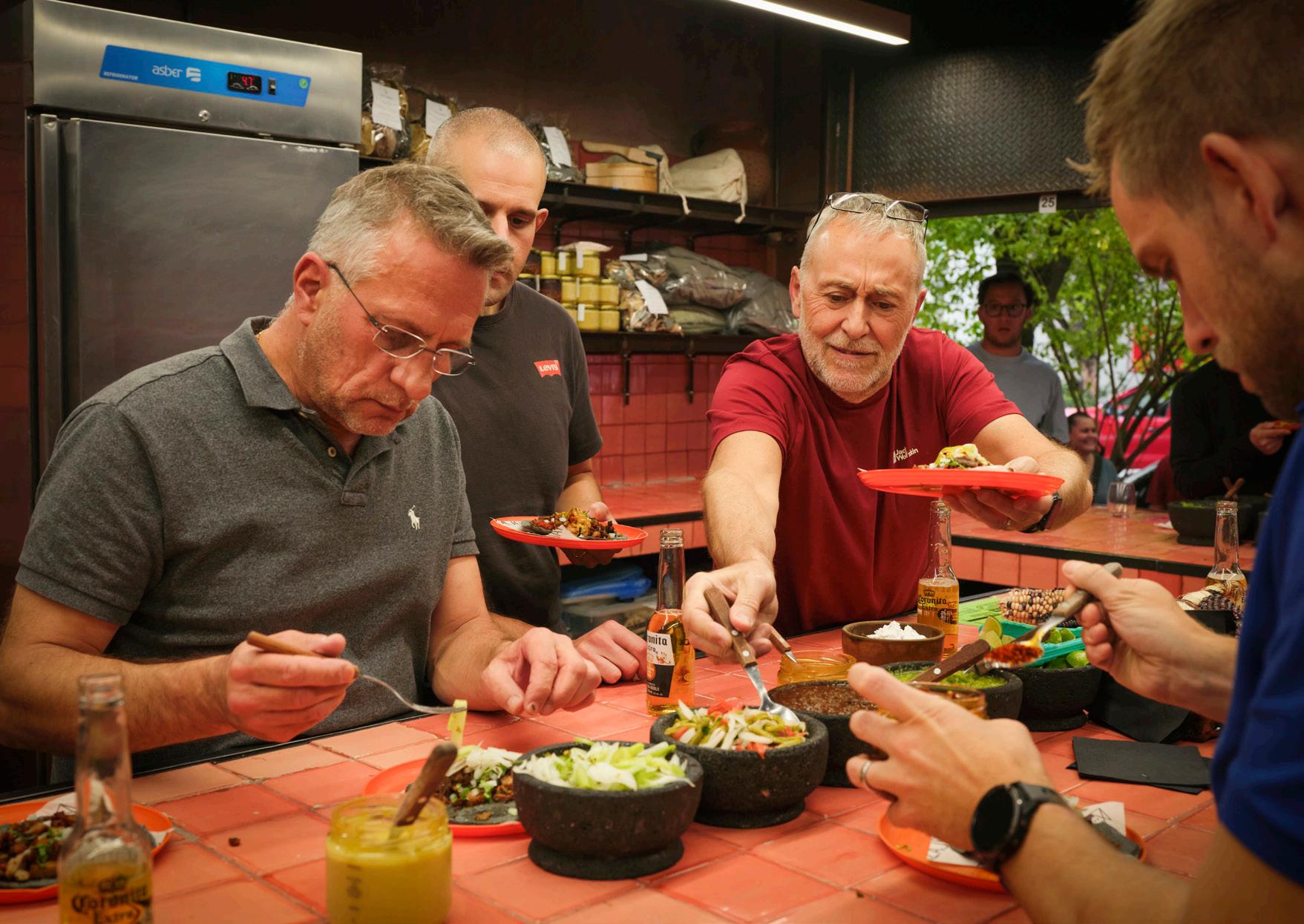
We then headed downstairs in groups through the busy kitchen. We passed many huge pots of cooked heritage corn, steeping in its high alkaline solution ahead of being ground into masa ‘dough’, to make the tacos. Standing at the kitchen counter at the centre of the action, we awaited many hot sauces, salsas, and a chilled corona to boot. Chef showed us the exo-thermic reaction when water is added to the slaked lime and it bubbled up in front of our eyes (and stomachs for some!).
Here we ate, for me, the most epic and delicious bite of the trip: blue corn taco, with Longaniza sausage (smoked slowly over the hearth, then crisped up) and griddled crispy trims of rib eye; this pairing of mixed meats is traditionally called ‘Campechano’. It had everything, the silence of the group said everything. Best. Tacos. Ever!
AN EVENING AT SUD777
We spent the evening dining at Sud777, Edgar Núñez’s restaurant in the upmarket Pedregal neighborhood in the south of Mexico City.
Pictured: (Left page) We visited the kitchen in smaller groups to learn about heritage corn from Chef Santiago Moctezuma, whose restaurant Maizajo is one of Mexico City’s best taquerias.
A DAY WITH ARCA TIERRA // BALDÍO LAB & RESTAURANT // TLECAN MEZCAL BAR
A DAY WITH ARCA TIERRA
By Hrishikesh Desai
Sunrise is a gift we often overlook. To witness one properly, you must rise early and find a wide, unobstructed horizon somewhere for those first rays, which have travelled roughly eight minutes across space, can meet you uninterrupted. It’s a spectacle as ancient as the sky, and yet we rarely pause for it.
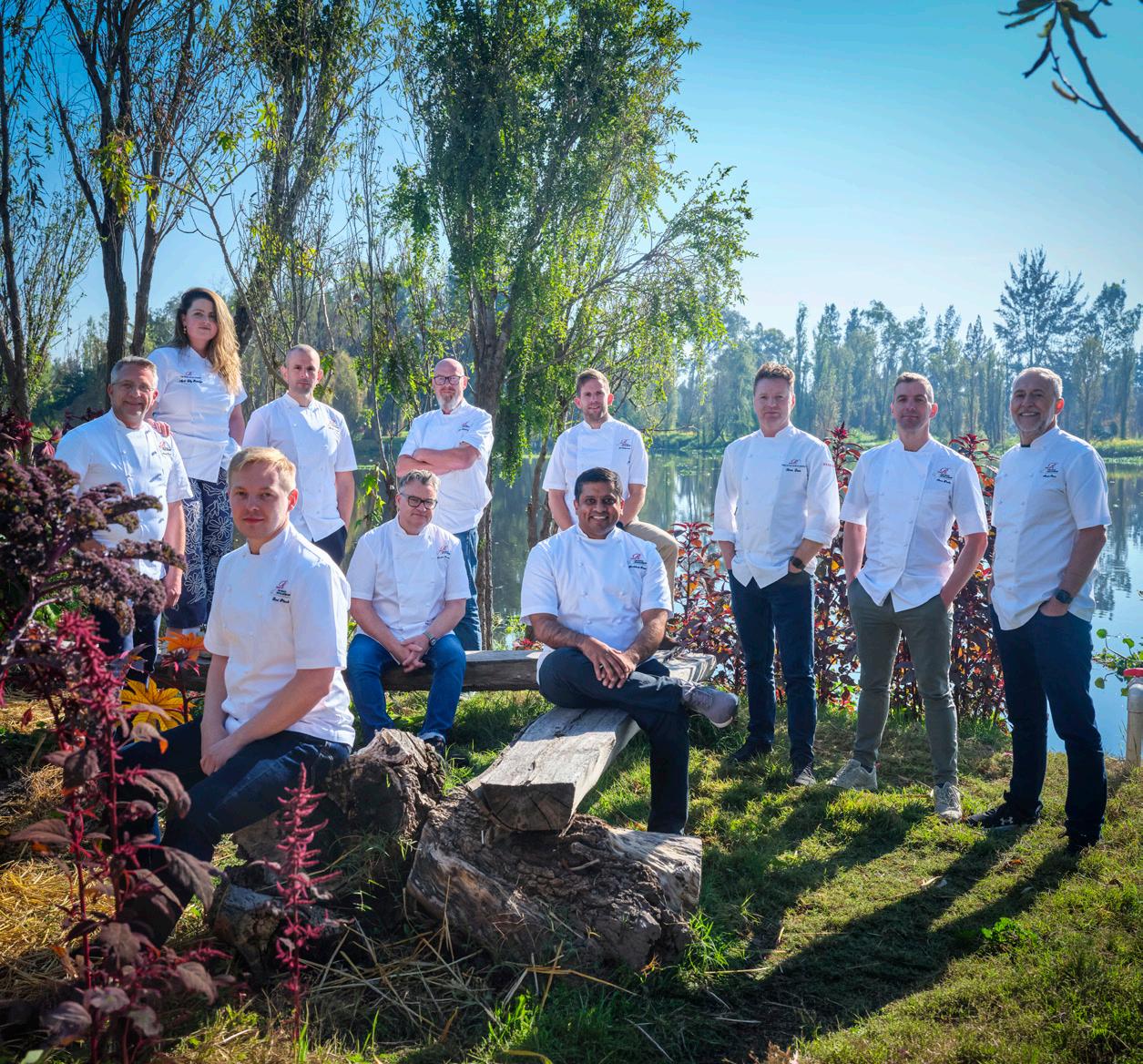
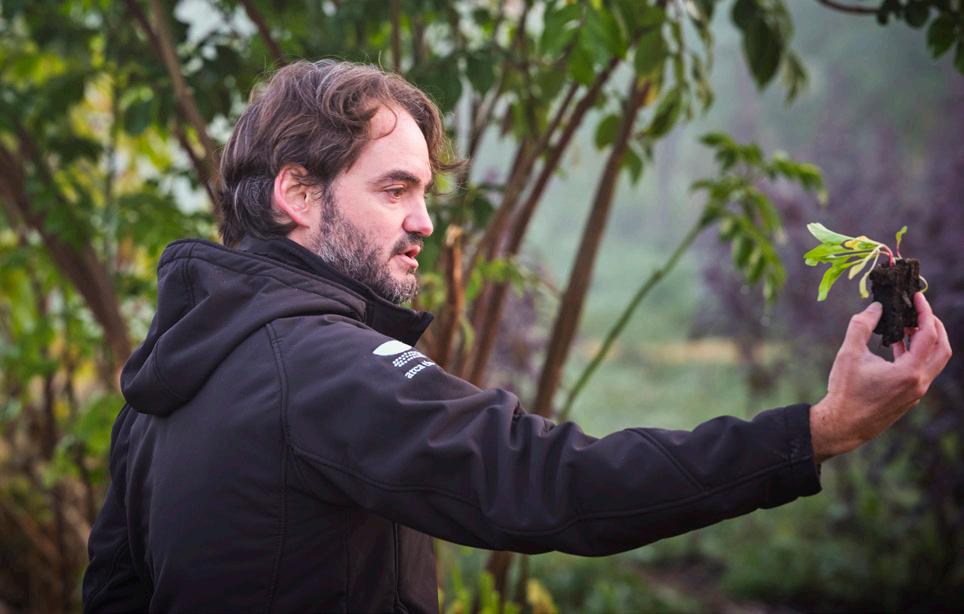
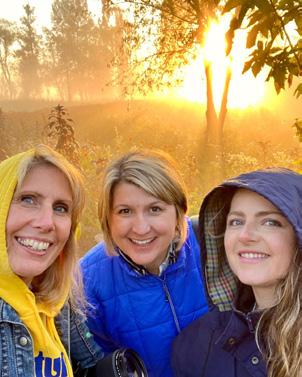
But, the sunrise I watched in the chinampas of Mexico City, alongside the Roux Cousins, Roux Scholars, Carolyn (our chief party whip), Jodi (our incredible official photographer) and the founders and owners of Arca Tierra and the restaurant Baldío, Lucio and Pablo Usobiaga, was a different experience altogether – a very rare experience!
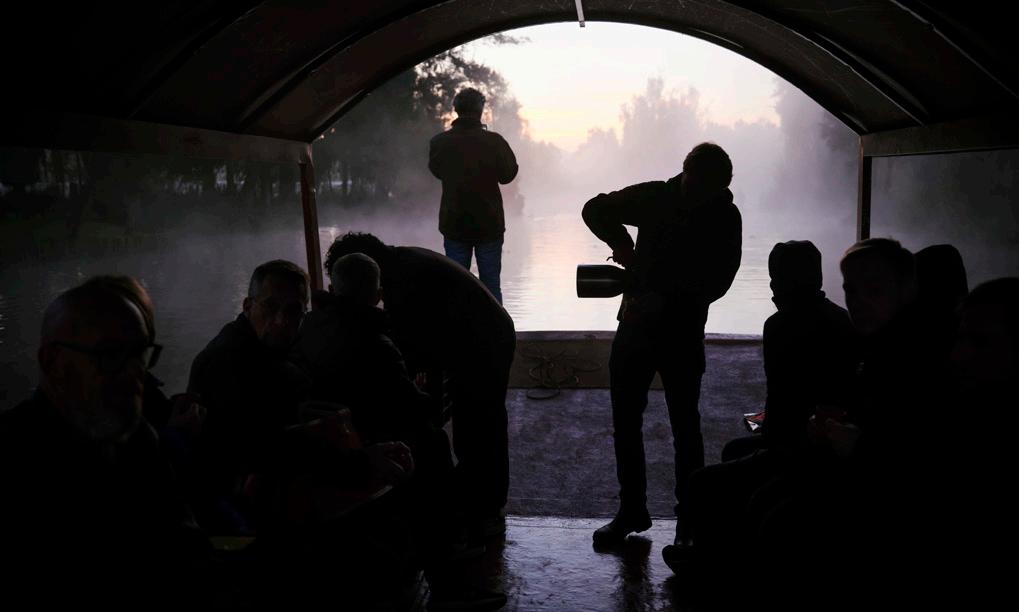
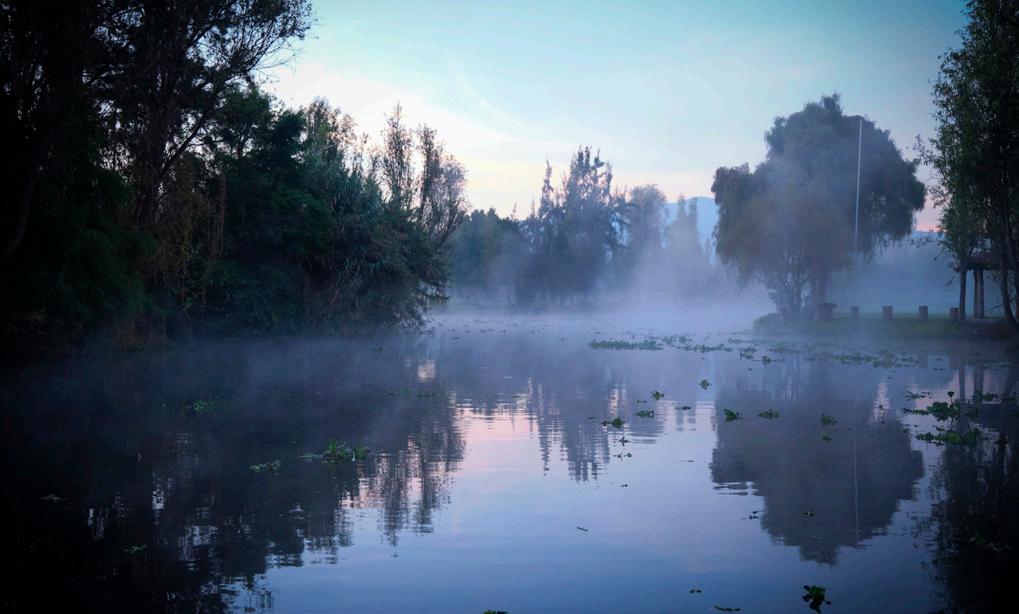
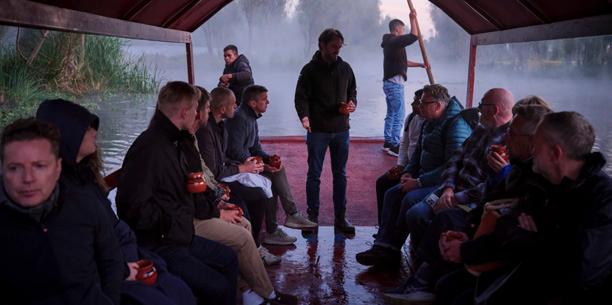
As we stepped off the bus and inhaled the scent of wet mud, cool air, and a thin veil of mist, I had no clue what to expect. The world felt eerie in the best way: moon still full, Venus glinting low behind trees, the mist giving everything the exaggerated hush of an old scary film.
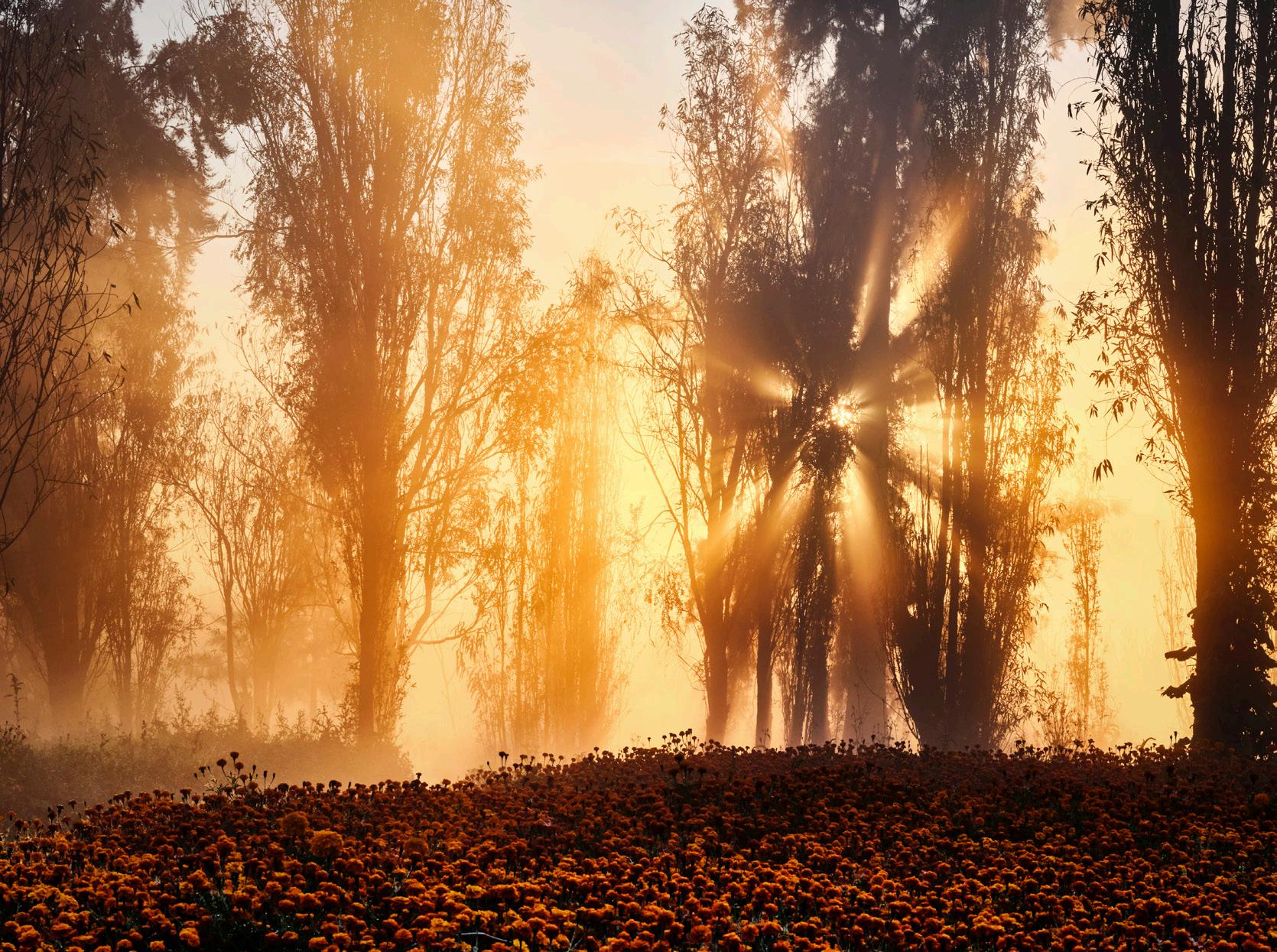
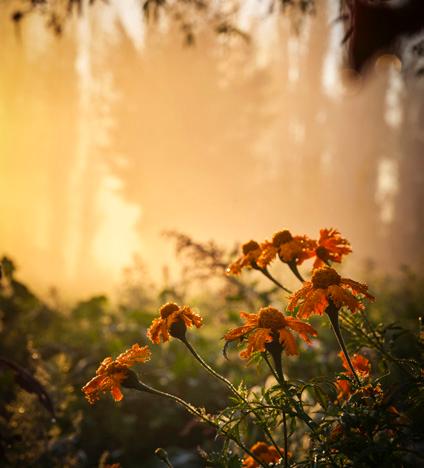
Our early start was rewarded with one of the most beautiful sunrises we had all experienced, with the yellow sun glancing through the willow trees and illuminating the fields of marigolds.
Pictured:
We climbed a wooden jetty and slid into a long, low boat pushed forward by two young men with steady bamboo poles. Chinampas are a living history: these artificial islands - narrow, rectangular beds built from lake sediment, reed, and organic matter - are raised slightly above the waterline and anchored with willow and other water-loving trees. Ancient, ingenious water-management and soil-building techniques made them enormously productive: a kind of wetland agriculture that fed dense pre-Hispanic urban populations and shaped the ecology of the Valley of Mexico for centuries. Where once these gardens spread across thousands of hectares of lakes and marshes, today only pockets remain — the waterways and fields around Xochimilco and a handful of canals totalling, by many accounts, only a fraction of their former extent. Urban expansion, drainage projects, pollution, and the slow sinking of the basin have shrunk and fragmented them, leaving a fragile patchwork of living farmland in the city’s shadow.
As Pablo told us the history, the story took shape in front of our eyes. Rows of raised beds with their edges ringed with willows that hold the soil in place. Small plots were tended meticulously: beds of greens, rows of maize, trellised beans. Up close, the soil was moist, dark, almost black with organic life.
As we cruised along the canals we saw how, along the banks, life spilled out in unexpected ways: there were tiny football pitches netted to stop runaway balls from plunging into the canals, family tables set under makeshift awnings, boats decorated for Festival de la Muerte with papier-mâché skulls and garlands. The chinampas are not just farms - they are neighbourhoods, markets, playgrounds, and stages for community life. That human pulse, the sense that people both live from and look after this place, is what Lucio and Pablo are trying to protect: not a museum, but a vibrant, working landscape.
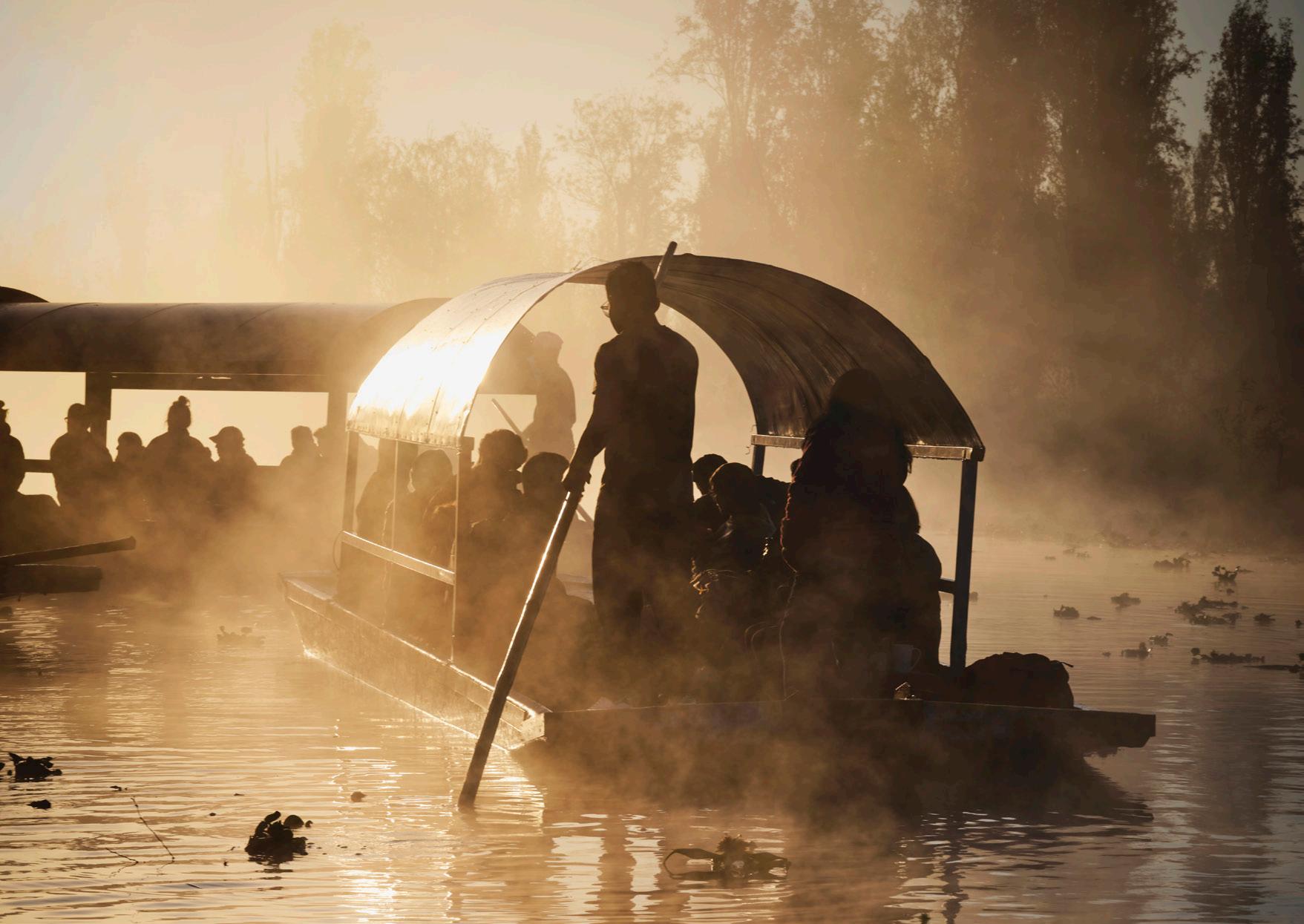
Pictured: The morning visiting the chinampas helped everyone learn about their unique ecosystem, the plants that thrive there, and how they contribute to the food culture of Mexico City.
The threats were obvious even from our little boat. Canals narrow where sediment and refuse accumulate. Some plots were abandoned, overtaken by invasive species or made inaccessible by development. The surrounding city’s thirst - for land, for water - presses hard against the chinampa network. Yet there are also the countervailing forces of stewardship: families who have tended plots for generations, grassroots efforts to restore canals, and small enterprises like Arca Tierra that turn local produce into dining experiences while funnelling resources back into preservation. Standing on that boat, having tasted infusions brewed from chinampa herbs and nibbled salads grown just meters away, it felt like preservation and hospitality had become entwined as a strategy for survival.
Then the sun rose. It was not a clean, cinematic horizon; instead, the sun broke through oak and willow silhouettes and sent its light through the mist in ribbons. Each ray caught a spray of droplets and made the whole lake look as if it were turning, briefly, into a pinwheel of gold. Photographers clicked away - the image was indisputably beautiful - but for me the moment was quieter: a reminder that the chinampas are both place and process, a meeting of water, soil, humans, and time.
Lucio and Pablo have forged a bond with this landscape that goes beyond conservation rhetoric. They work with farmers, they buy local, they bring visitors into the rhythm of the place so that preservation is not an abstract policy but a shared experience. That approach - of protection through use, of celebrating what the chinampas produce while funnelling some of that value back into the land - feels like a practical, hopeful path forward.
I don’t think words fully do justice to the chinampas. You have to be there to experience it. But if this piece accomplishes anything, I hope it is to give a sense of why those sunlit eight minutes matter so much here: because they illuminate not only a horizon but a way of living that persists in this crazy world. The chinampas are a reminder that cities can hold small, extraordinary ecosystems - if we choose to protect them.
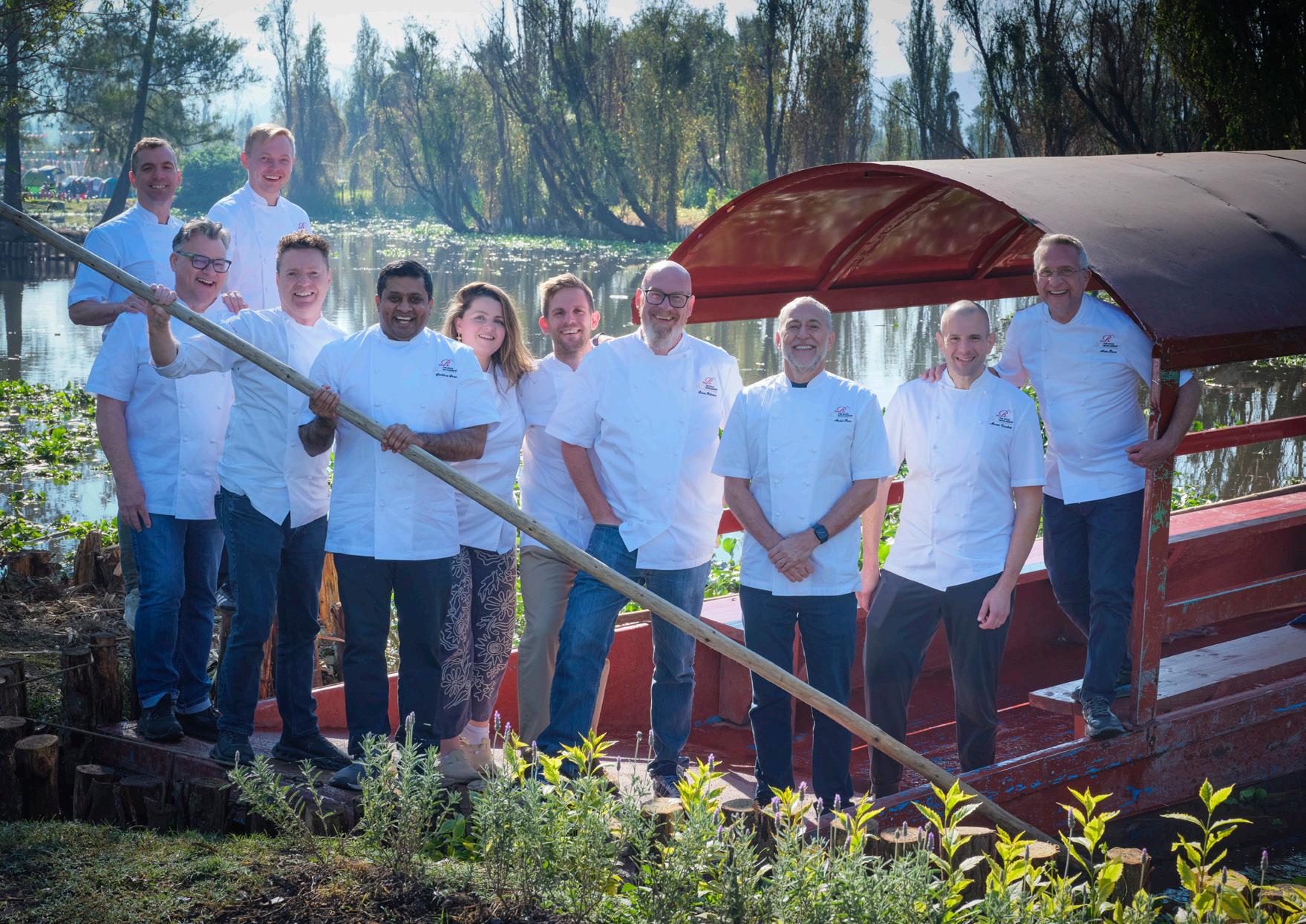
Pictured: (Left page) The chefs with a trajinera - these are traditional, flatbottomed boats used to navigate the canals and are punted along with a pole.
(Right page) Pablo Usobiaga, who set up Arca Tierra with his brother Lucio.
BALDÍO LAB & RESTAURANT
By Hrishikesh Desai
If the chinampas were the dawn of our day, misty, ancient, and quietly powerful, then Baldío Lab was the spark that lit the afternoon: bright, inventive, and utterly alive with ideas. Leaving the calm of the canals, we drove across the city where our bus stopped in front of two big metal gates. At first glance, it looked like any other food production unit. Cold rooms hummed gently, plastic crates overflowed with tomatoes, oranges, chillies and herbs, and stainless-steel tables stood in neat rows.
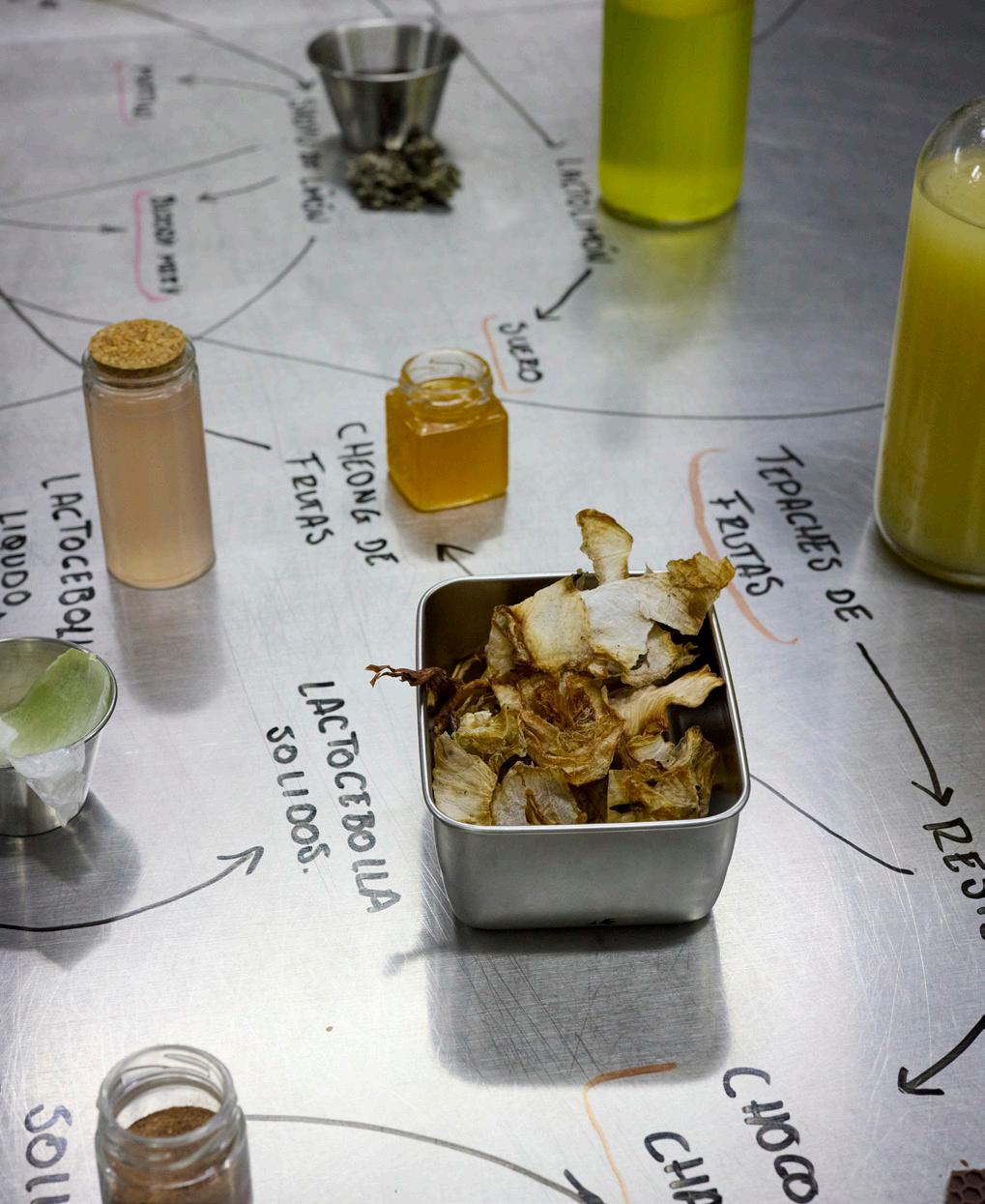
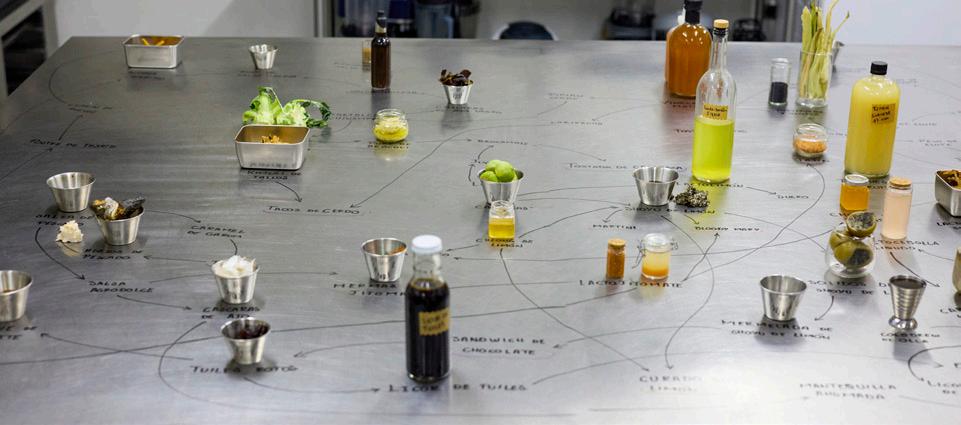
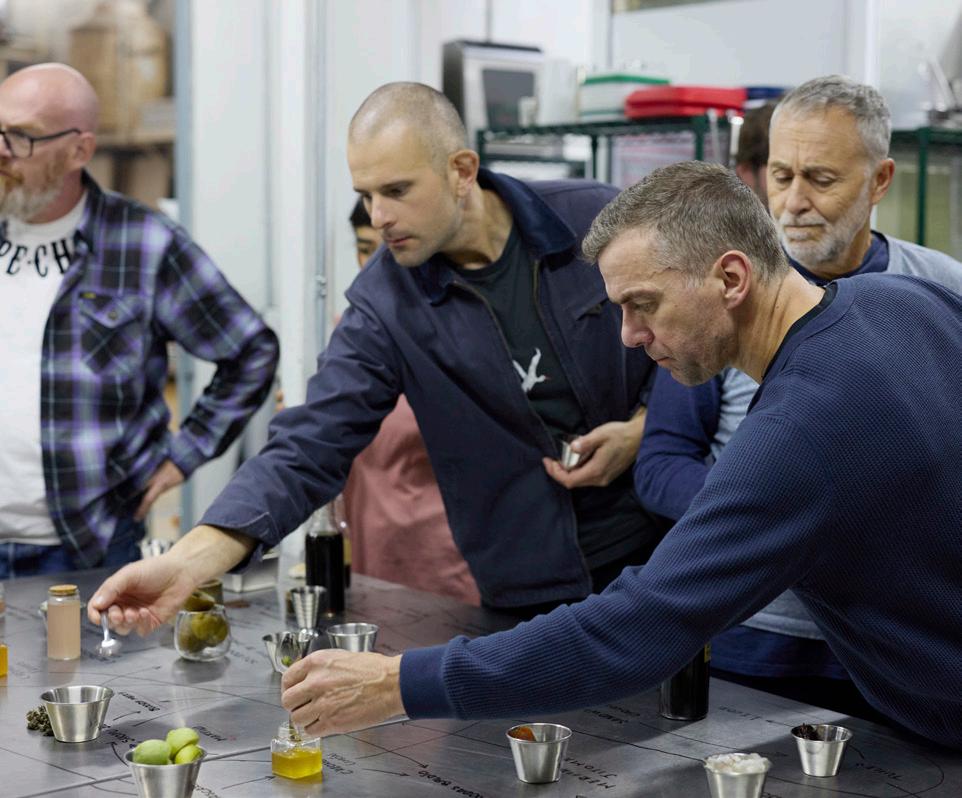
It felt industrial, functional - almost ordinary. But the moment we stepped into the main kitchen space; it became clear this was no ordinary operation. In the centre was a long island made from several metal tables pushed together, each covered with jars, powders, liquids, pastes and trays of half-finished experiments. Arrows drawn with thick black marker pointed from one ingredient to another like a map of possibilities. Nothing was random; everything was in conversation with something else.
Then came Chris Locke, Baldío’s head of fermentation, followed by Ariana Caleid, the chief mixologist. Together they form part of a team that has turned sustainability into a craft, and a craft into something artistic. Their philosophy is simple and radical: nothing goes to waste. Every ingredient is stretched, reimagined, transformed and reborn until it has no more to give.
A handful of dried chillies, for example, becomes chilli soy; the leftover solids are dehydrated, finely ground, and infused into oil to make marinades and pastes. Cocoa butter once discarded by one of the World’s 50 Best Bars after being used to infuse spirits? The Baldío team collects it, refines it, and turns it into a silky, complex chocolate used both in cocktails and desserts. Even citrus peels, tomato cores, herb stems, stale breads and fermentation residues find their second or third lives here.
The metal table island wasn’t a workstation, it was a living diagram of the zero-waste philosophy, each arrow showing where a flavour travels next,
how a by-product can become the star of another dish, how creativity can replace the bin.
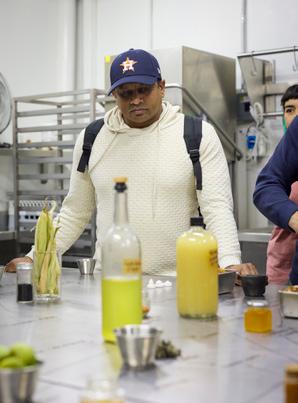
We were handed spoons and tiny cups and encouraged to taste freely. The room soon filled with the unmistakable noises of delight, banging on tables, sharp intakes of breath, laughter, disbelief. Every few seconds someone exclaimed, “That is unreal!” or “How does this taste so good?” The flavours were bold but thoughtful, rooted in the soil and the spirit of the chinampas we had just visited. The team wasn’t just avoiding waste, they were respecting ingredients to the point of revelation.
For me, it was an eye-opener. I’d read about zero-waste kitchens, but seeing it fully operational, scientific yet humble, changed everything. This wasn’t a gimmick. It was a way of thinking, a way of cooking, a way of living.
Pictured: After visiting the chinampas, we visited the laboratory that ensures no produce is wasted and the flavours contribute to a fascinating and delicious menu at the brothers’ restaurant Baldío.
After the tour, we headed to Baldío Restaurant, proudly awarded a Michelin Green Star - one of the only restaurants in Latin America with a genuinely holistic zero-waste philosophy. The ethos of Arca Tierra flowed seamlessly into its design. The restaurant felt like a neighbourhood space - warm, honest, lived-in. The walls were bare brick, adorned with corn husks, dried plants, small artefacts, and the Green Star trophy. The floor was a blend of tiles, wood, soil, and even crushed corn husk mixed in, so the very ground carried the story of the ingredients under our feet.
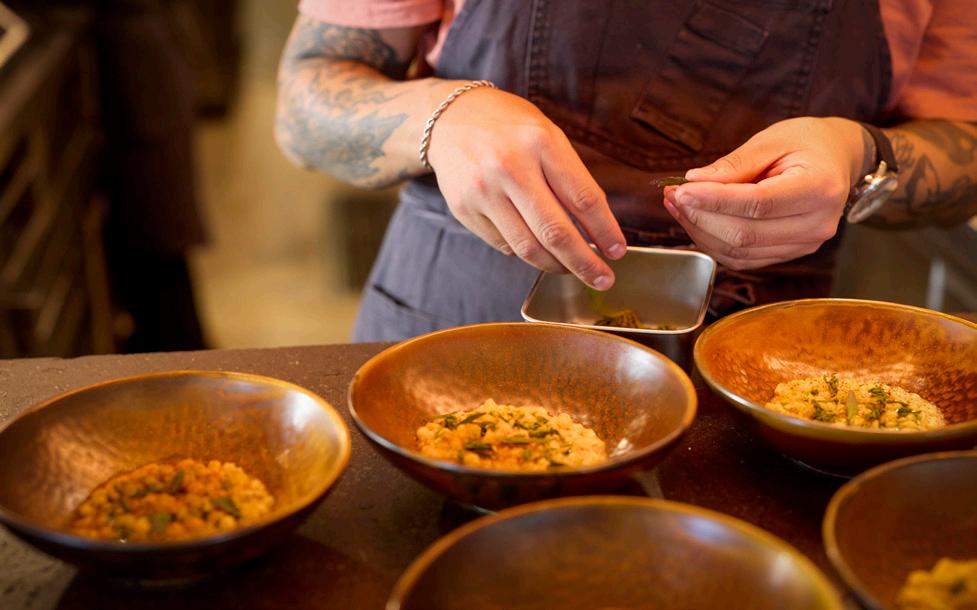
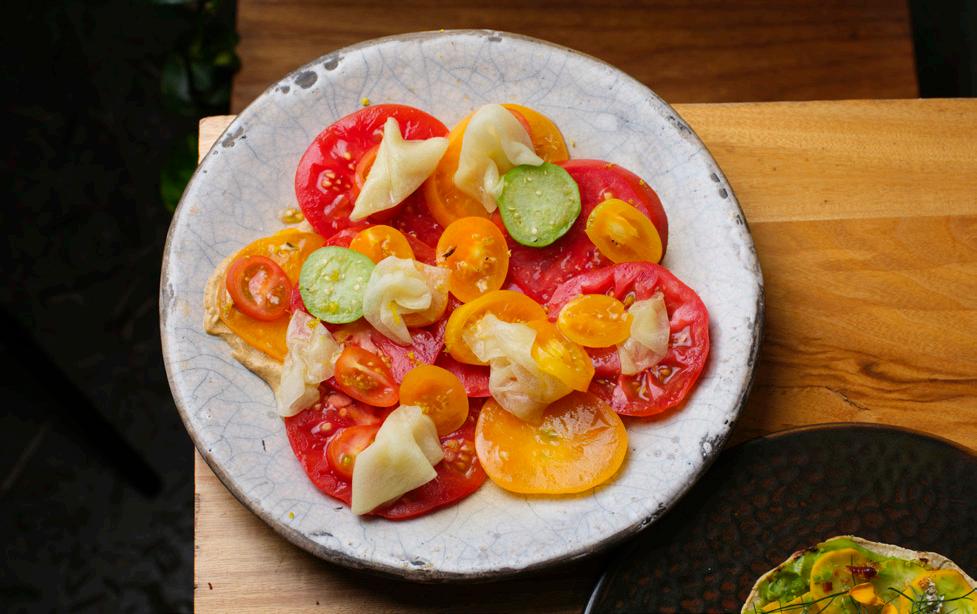
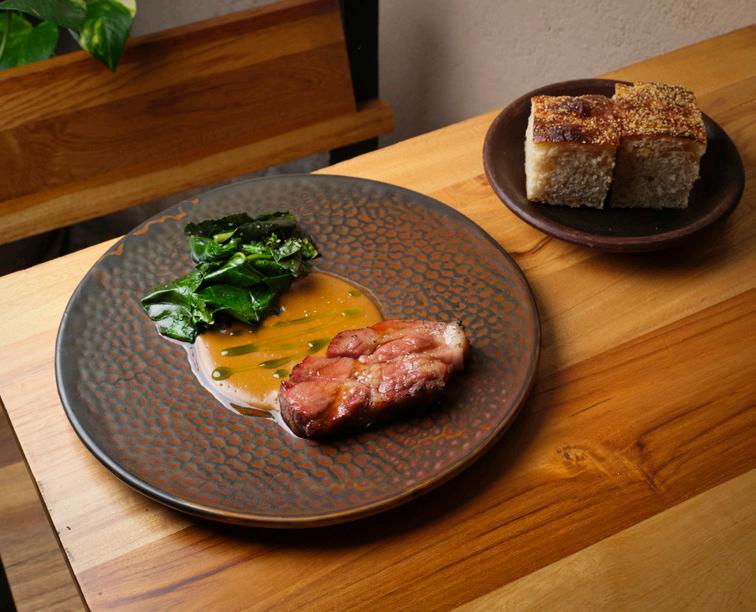
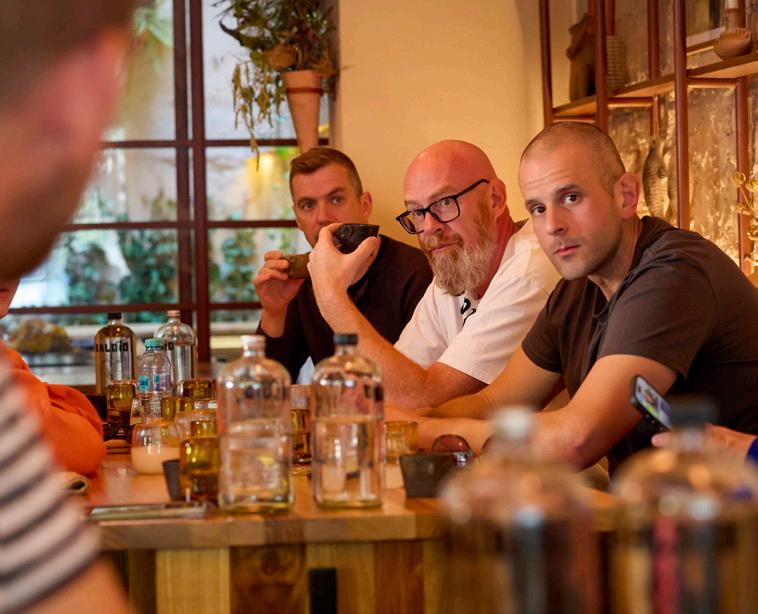
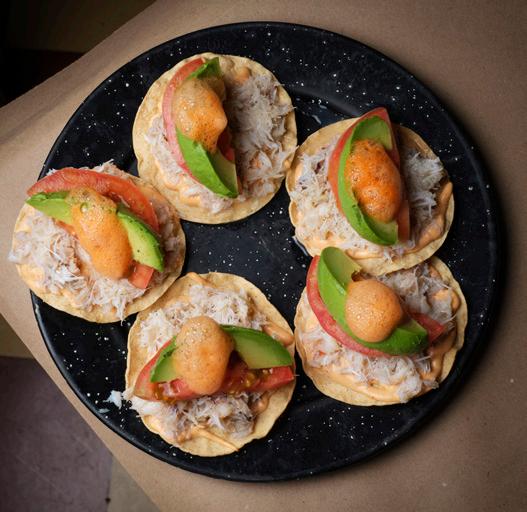
The team had kindly opened the restaurant on a Sunday just for us. We settled into long wooden tables, and soon cocktails, wine and food arrived in a steady rhythm. Every dish was an echo from the lab: a simple but exquisite crab with sauce; a Paloma with a Baldío twist; a vibrant tomato salad; tender pork fillet; a playful ice lolly; and a deep, comforting chocolate pudding made from the very cocoa butter we had tasted earlier. Experiencing the lab and then tasting its ideas made everything sharper, more meaningful. You could trace each flavour back to a technique, a decision, a piece of the zero-waste puzzle.
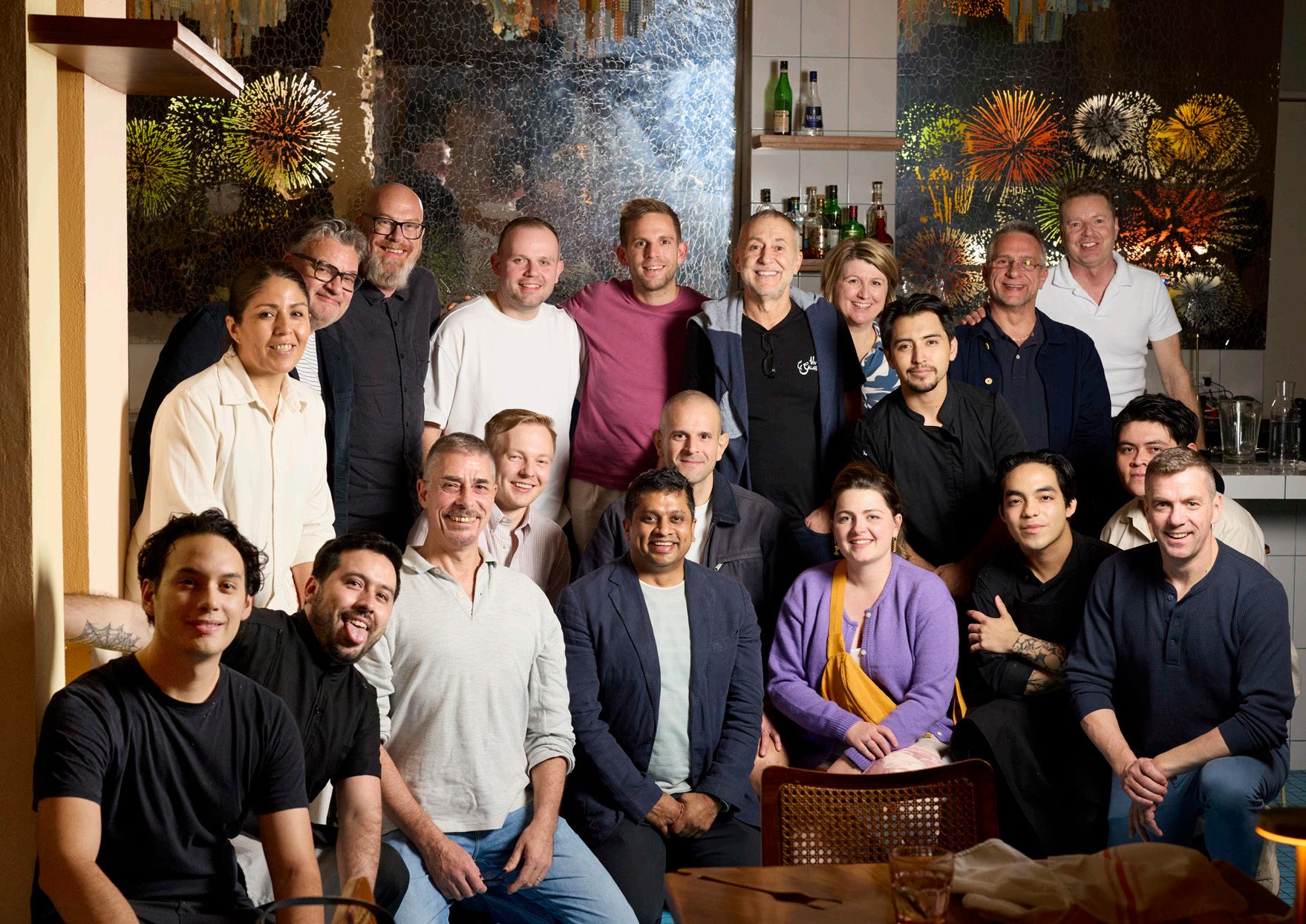
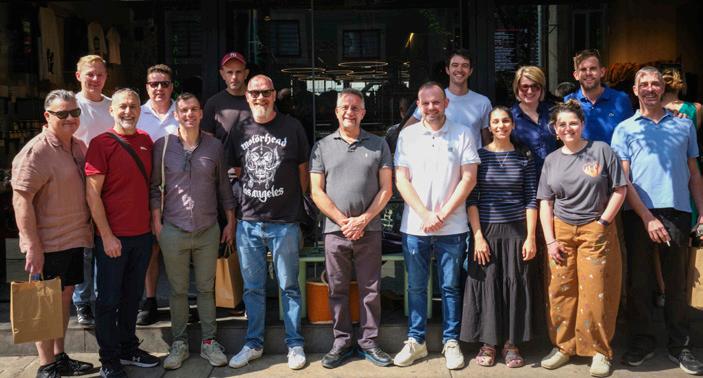
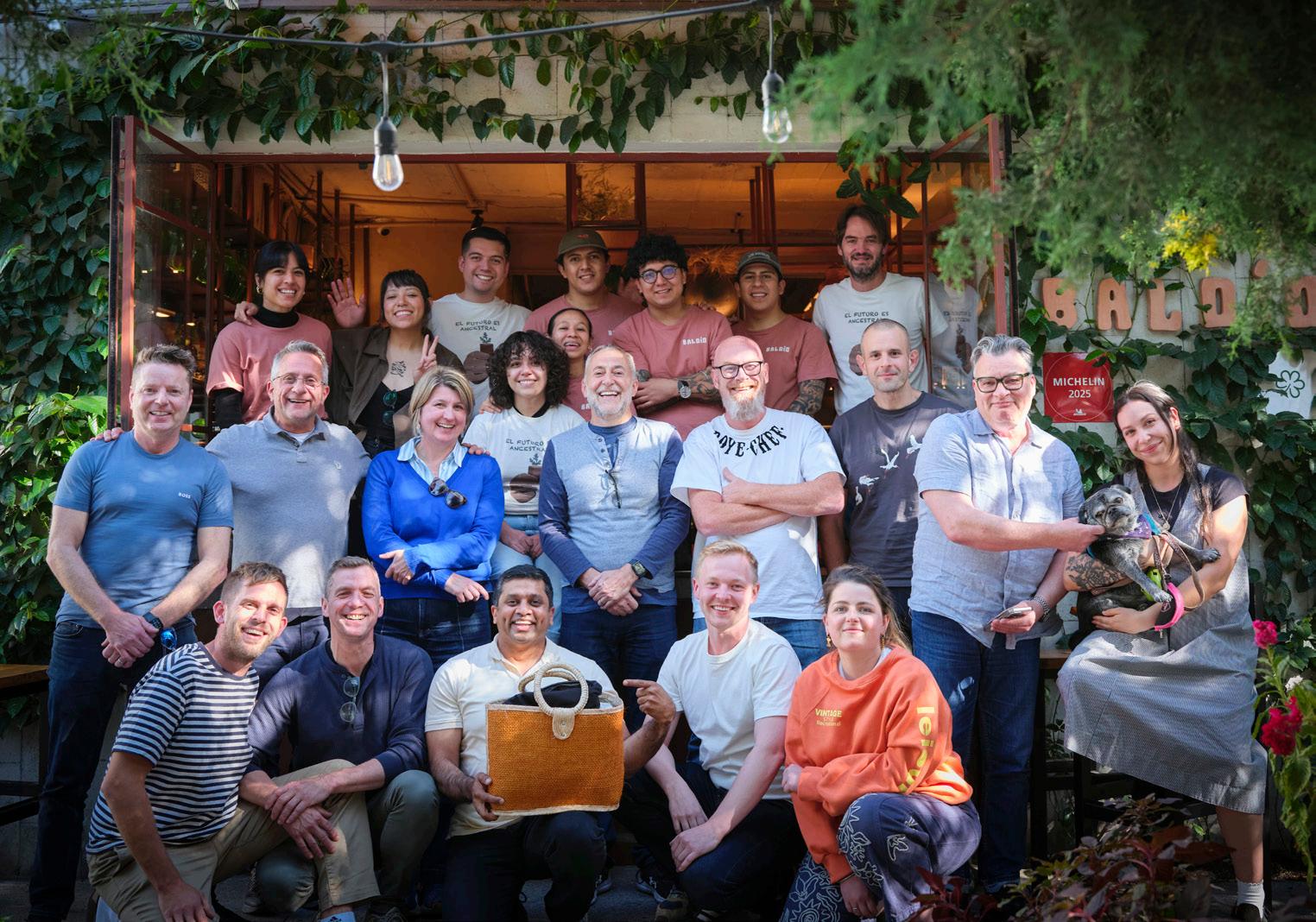
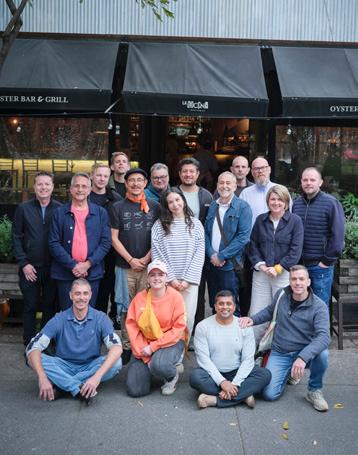
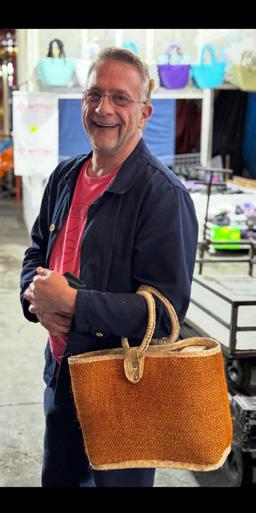
After the meal, we gathered for a group photograph which quickly became less about the photo and more about the laughter. I somehow ended up holding Chef Alain Roux’s iconic orange handbag, which, I am convinced, was photographed more times during this trip than anything else in Mexico. Even when the handle broke, it only added to its legend.
Baldío is not just a restaurant. It is the extension of the chinampas we saw at sunrise a modern expression of ancient respect for land and food. The chinampas teach us how to work with nature; Baldío teaches us how to honour every last part of what nature gives and waste nothing. And in one day, we experienced a great story: sunrise with friends followed by a lunch with friends, which does not happen all the time.
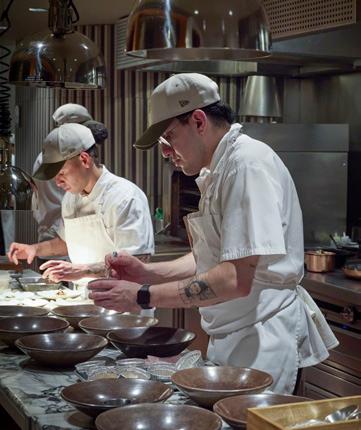
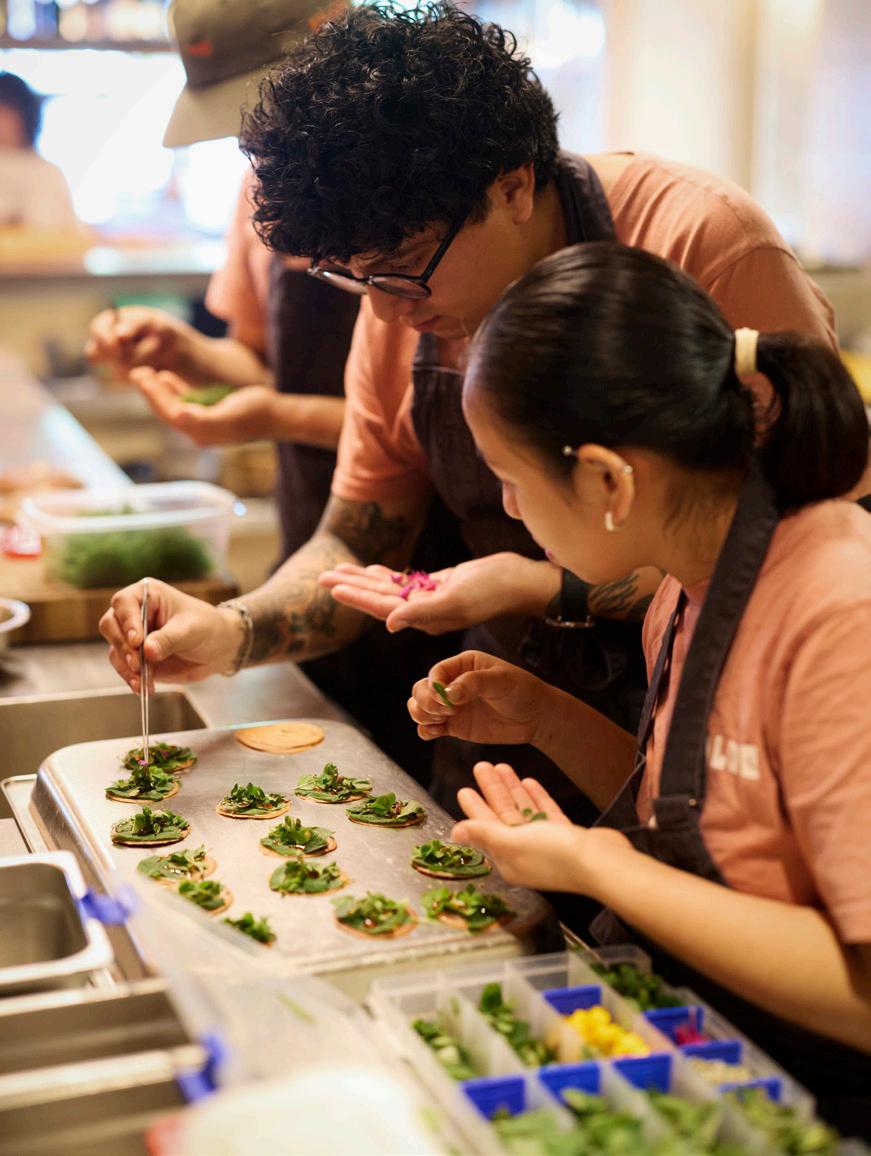
(Left page) Baldío’s Head Chef Daniel Vidal and his brigade creating our menu. This meal was one of the highlights of our stay in Mexico City, with fresh, zingy flavours and wonderful textures and creative twists on the traditional.
Pictured:
TLECĀN MEZCAL BAR
By Oli Williamson
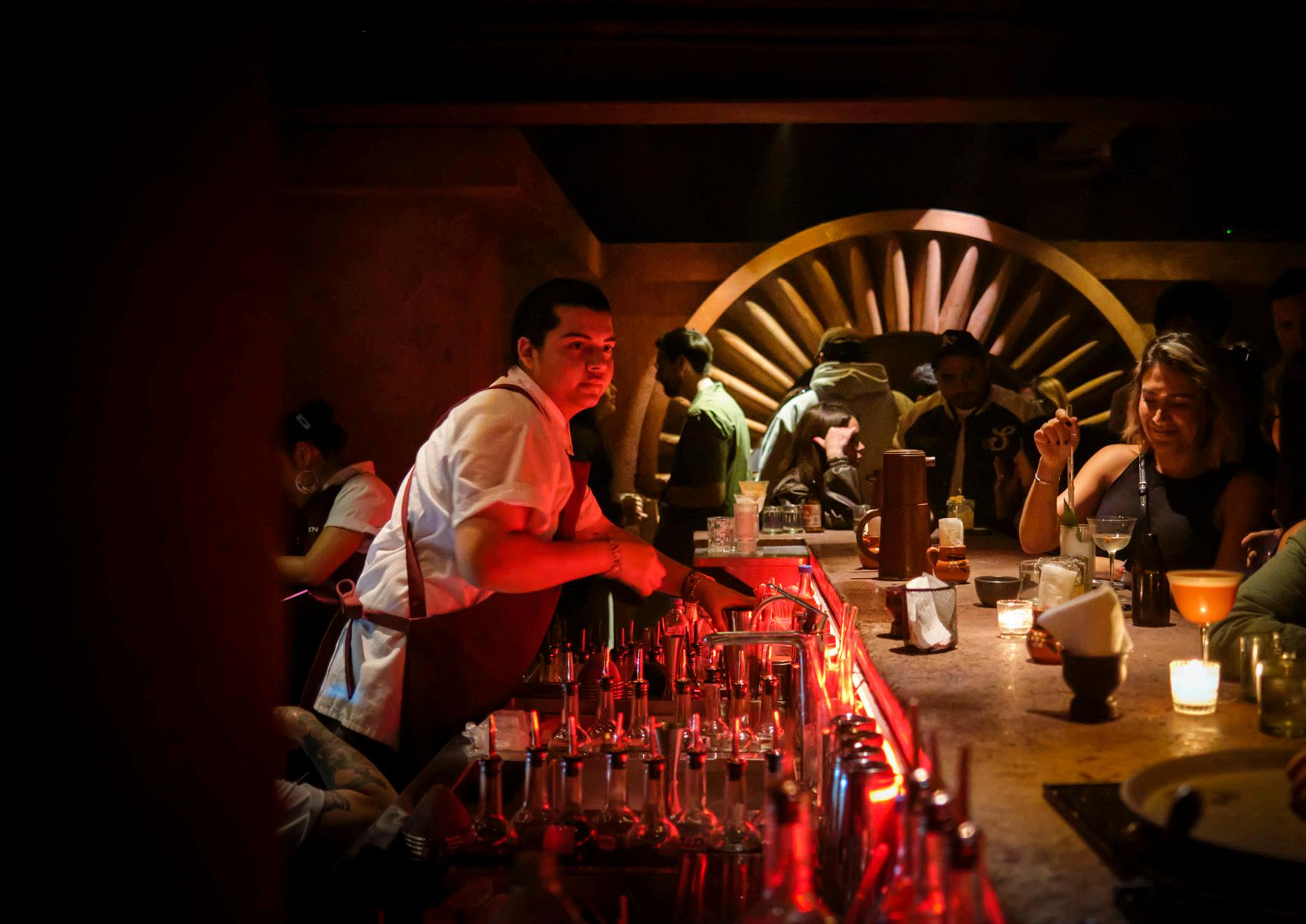
Tlecān bar, currently ranked 23rd in the world was an incredible little hustling, bustling Aztecthemed bar. Through Sofía, we had the chance to meet the owner Eli Martinez Bello, who’s vision of only using bespoke, individual mezcal and tequila producers got her closed down multiple times (until she hit the 50 best list) by the authorities for not complying with the norm and using the larger corporations’ spirits. We tasted three types of Mezcal from different Mexican terroirs and with ranging levels of agave. This, along with (many!) great tasting and original cocktails, was a great opportunity to see the extensive flavour profile of what can appear to be a quite linear spirit, we loved it!
MERCADO DE JAMAICA // SEAFOOD DAY WITH
SOF ĺ A HERN Á NDEZ // DINNER AT PUJOL
MERCADO DE JAMAICA, SEAFOOD DAY WITH SOFĺA HERNÁNDEZ & JAMAT SEAFOODS
By Trevor Blyth
At 8:30am we were met at our hotel by our wonderfully enthusiastic Mexico City guide, Sofía Hernández. Sofía and her family run a highly reputable seafood business in Mexico, Jamat Seafoods, and we were on our way to tour their main factory, but first we made a stop at the enormous Mercado de Jamaica.
The Jamaica Market is most famous for being the largest flower market in Mexico City. Needless to say, the market contains a great deal more than just the mountains of flowers but it is its association with the flower trade that gives it its name. In many Spanish-speaking countries, particularly Mexico and Central America, the word ‘jamaica’ is a common name for the hibiscus flower. Flor de Jamaica or Jamaican flower is widely used in Mexico to make a cranberry-flavoured drink called agua de Jamaica (hibiscus water) or te’ de Jamaica (Hibiscus tea).
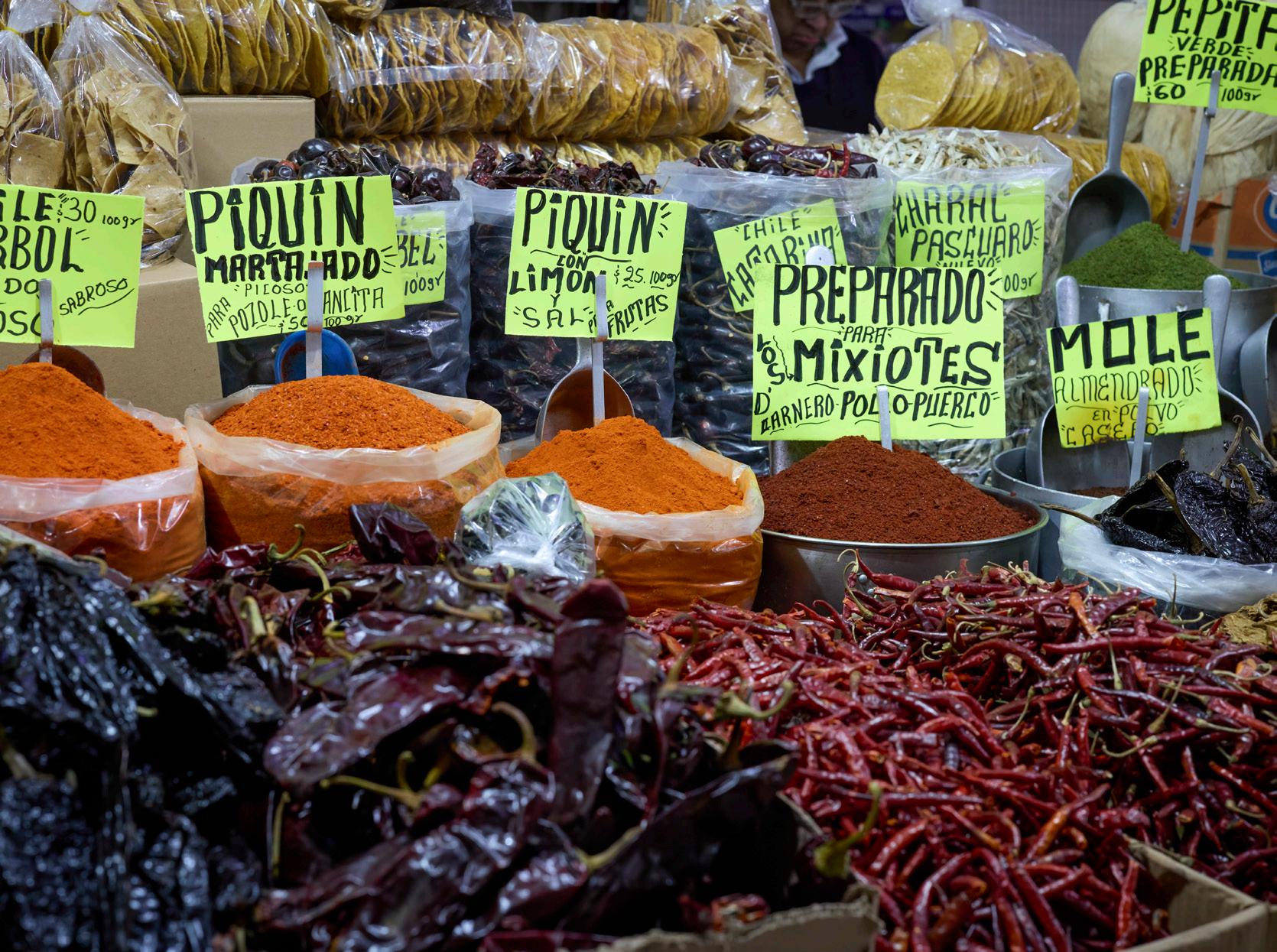
(Left page) chillis on sale at the Mercado de Jamaica. (Right page) Sofía shows us some of the incredible produce on sale at the market, which was a fascinating experience to explore.
Pictured:
The connection to the island of Jamaica is historical. The hibiscus plant, along with other herbs and spices, were first brought to Mexico from Jamaica in the 16th century and were sold in stalls along canals and waterways where the current market is now located.
Having first made our way through the rows of flower stalls we arrived at the food side of the market where we found fruit and vegetable stalls containing, in particular, multiple varieties of very tasty Mexican citrus fruits. Moving on we came across a stall specialising in dried chillies of every conceivable variety. They may have recorded a particularly good days sales as many of the Scholars bought a whole array of different chillies to experiment with back at their restaurants.
Turning the corner, we were all amazed to see what can only be described as a massive cauldron boiling and bubbling away, full of pig’s tripe. We walked along the lines of butchery stalls containing hanging pig heads, sides of pigs and goats, some great chunks of beef were being butchered and some beautifully yellow, very tasty looking corn-fed chickens.
As we made our way towards the exit, we passed several stalls containing multicoloured sugar confections, many shaped into the form of human skulls left over from the previous weeks, Day of the Dead celebrations.
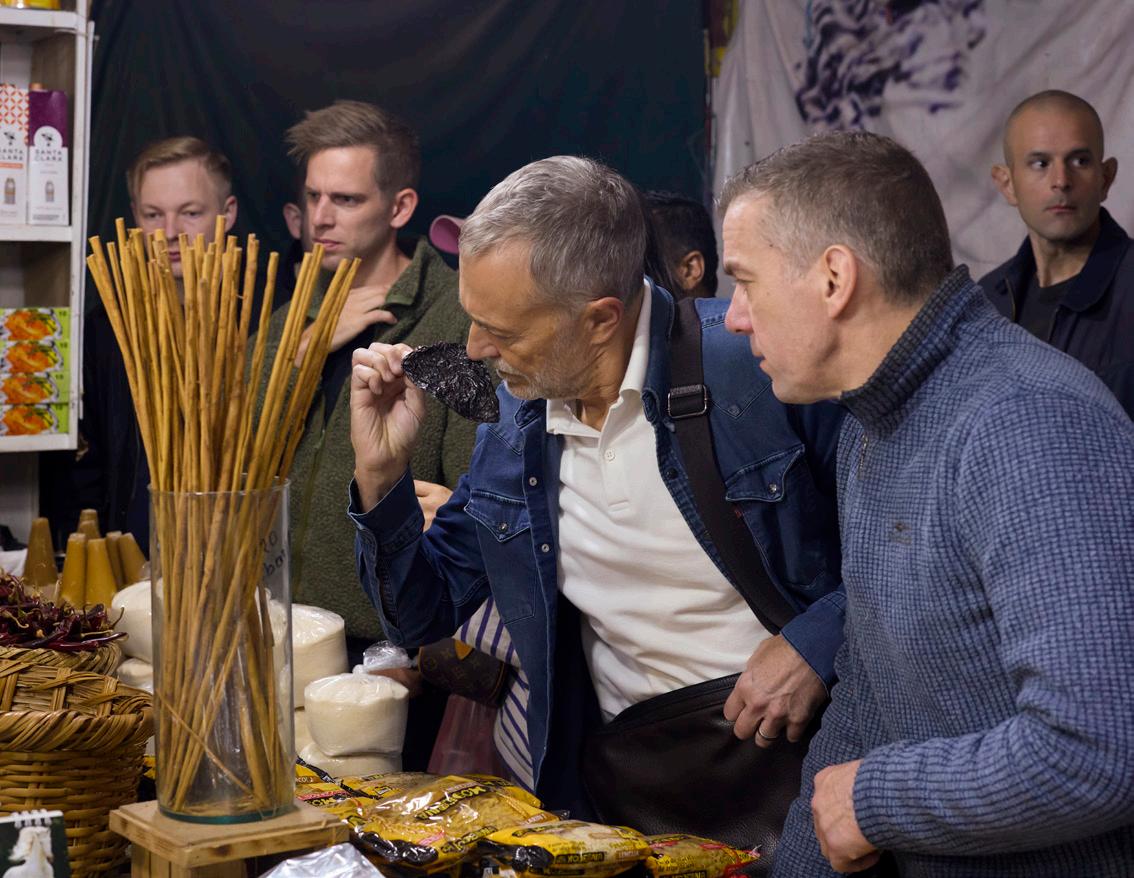
Pictured: Michel gets stuck into the aromas and flavours on sale at the Mercado de Jamaica. The range of spices, chillis, fruit, vegetables, fish, meat and offal was extraordinary. The flower displays, for which the market is famous, were also very impressive.
Next, we were back on the minibus and on our way to visit Jamat Seafood. Jamat was started in 1982 by Ezequiel Hernández, Sofia’s father. While it is still a family-run business, it has grown to become the leading name in high quality seafood in Mexico. Many of the top restaurants in Mexico get their fish and seafood from Jamat who also export to USA, Japan, Korea, Taiwan and China.
Arriving at Jamat we put on protective jackets, gloves, hairnets and shoe coverings and made our way to see some of the multitude of fresh fish and live shellfish that the company deals with.
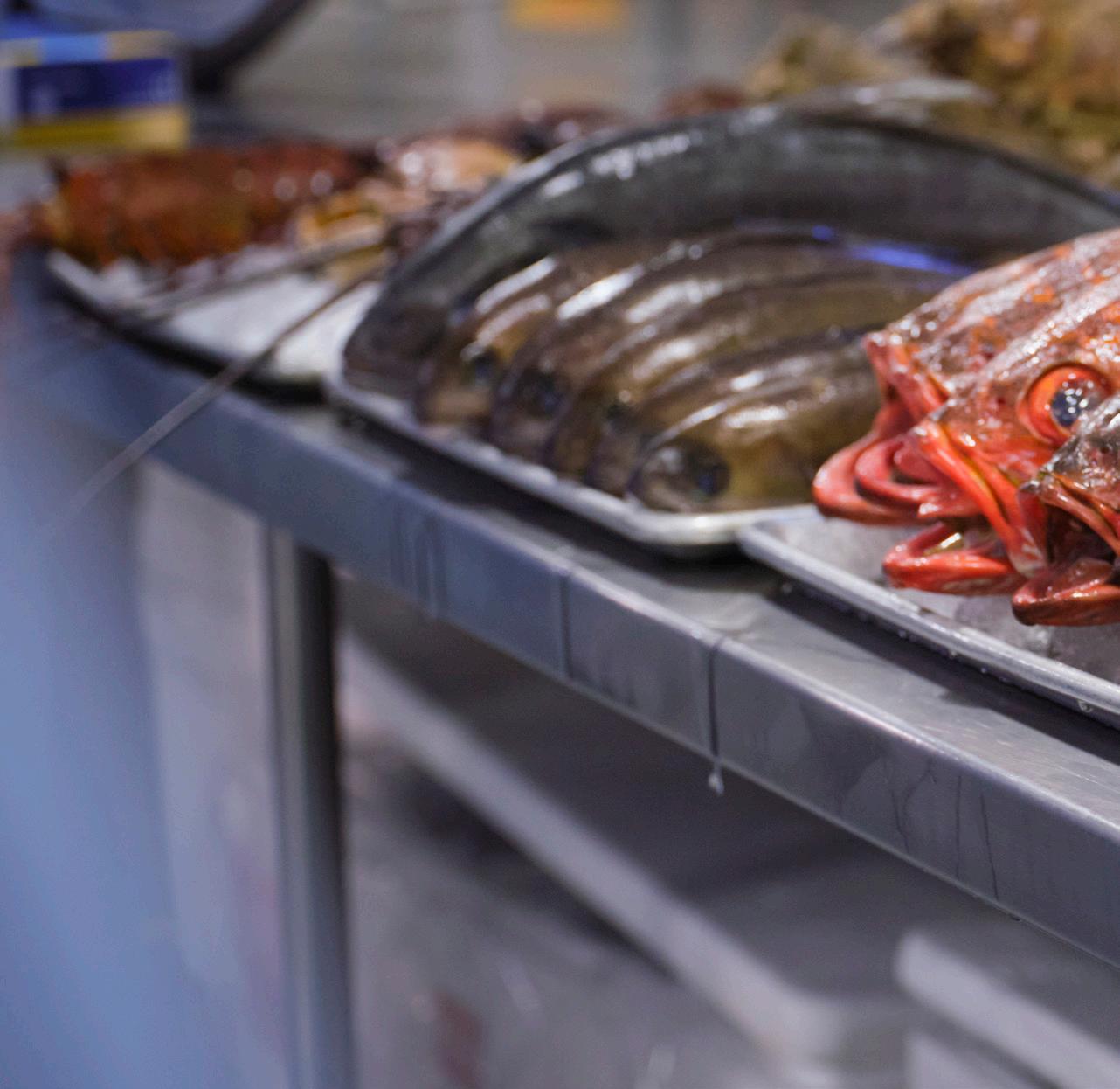
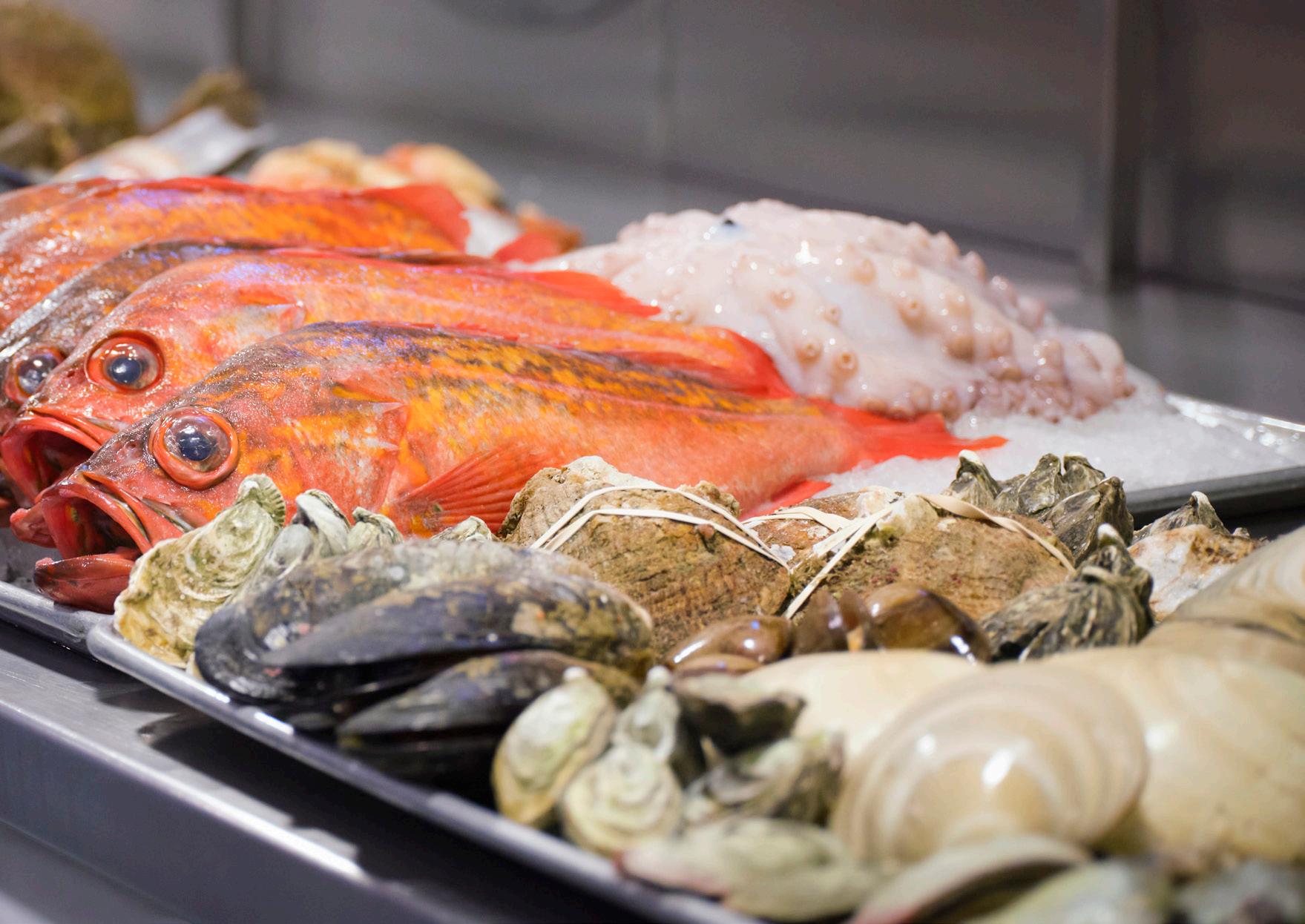
Red rocot, kampachi, yellowtail, groupers, snappers, seabass and mackerel were all on display along with pacific lobsters, crabs, octopus and a multitude of different clams and oysters. Sofia and her very knowledgeable staff talked us through their processes of ecologically and sustainability-conscious fishing, fair trade for fishing communities and best practice for methods of slaughter to achieve Alta pesca (highest quality seafood).
Moving to the next room we were given a demonstration of the cutting and packaging of another of Jamat’s main products, Bluefin tuna, and had a brief talk about the workshops and training programs that Jamat offers to Mexico’s gourmet and professional culinary circles.
Then we were back on the bus and heading for a seafood lunch at one of Ezequiel’s partner restaurants, La Docena.
Despite the busy road and wide bustling path outside, the interior of La Docena had a very cool look, my idea of a quintessential Mexican restaurant. A large rustic oblong room with a well-worn tiled floor, high celling, and a long wooden bar stretching almost the full length of the back wall. In one corner was a counter covered in ice and beautifully arranged with oysters and other shellfish.
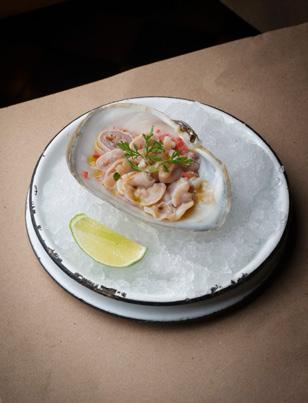
Our lunch began with a tasting of six different types of fresh Mexican oysters, all of which were delicious. Ezequiel named and described them all but I found it very difficult to pick a favourite. Different dishes of marinated fish and cooked clams and shrimp followed all introduced and described by La Docena’s talented and friendly chef Tomás Bermúdez.
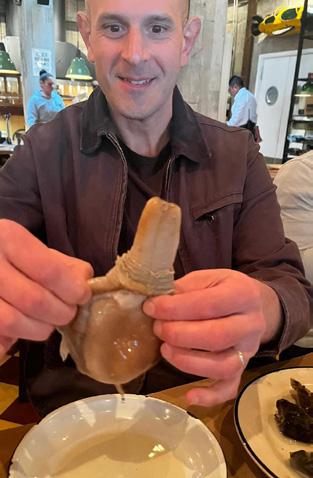
Towards the end of lunch Sofia treated us to a masterful demonstration of the preparation of Pacific geoduck. Geoduck is the world’s largest burrowing clam and has a large syphon much longer than the length of its shell. It is also one of the longest living animals of any type, with a typical lifespan of 140 years. Called Mirugai in Japan, where it is considered one of the most difficult clams to correctly prepare and cut for sashimi. Sofia’s knowledge and expertise is clearly a testament to the high quality, hands-on approach to Alta pesca at Jamat seafood. Following a quick family photo outside the restaurant we returned to the hotel to change for dinner. Many thanks to Sofia, Eziquiel and all the staff at Jamat and La Docena for a fantastic, interesting day and of course their very kind hospitality.
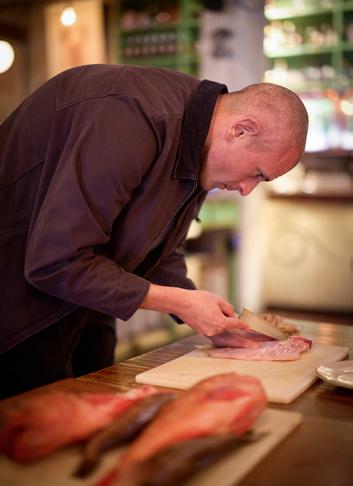
Pictured: After visiting Jamat Seafoods’ bodega, we went for lunch at La Docena, one of their partner restaurants. Sofía and her father Ezequiel gave us a masterclass in all the amazing fish and seafood from both of Mexico’s coasts, and some of the chefs had a go at filleting them.
DINNER AT PUJOL
By Carolyn Boyd
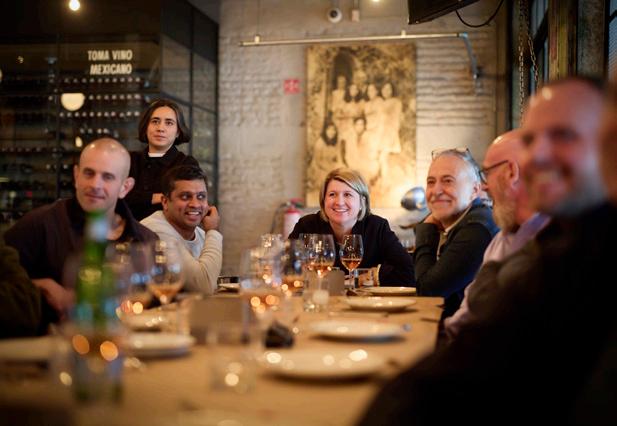
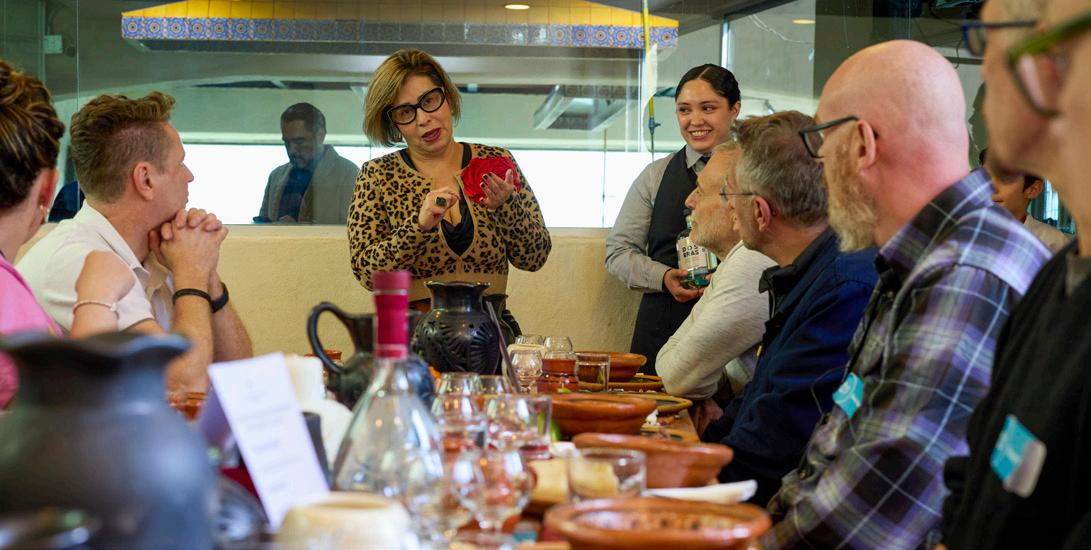
Our last evening meal was at the two-star Michelin Pujol, where Chef Enrique OIvera is a passionate advocate for the preservation of Mexican heritage corn (landrace maize). Each season Olvera and his brigade select a region in Mexico and represent it through the menu. “This time we turn our gaze to the southeast - from the mountains of Chiapas to the shores of the Caribbean: murky rivers and clear-water cenotes, solares and towering ceibas [a sacred tree], cerdo pelón [rare breed of indigenous pig] and cacao, humid and salty air. A present in which the myth of the people of corn still breathes,” he stated. As much as the meal was delicious, fascinating and beautifully presented, each dish delivered with exacting precision from serving staff, the highlight came at the end. Sitting together for a final time in a private dining room was our chance to go around the table to each of us to share our favourite moments of the trip, however small, however meaningful, however humorous. Those precious minutes of sharing the immense joy, gratitude and privilege that comes from our individual parts in The Roux Scholarship will remain with me forever.
INSTITUTO CULINARIO CORONADO
INSTITUTO CULINARIO CORONADO
By Steve Drake
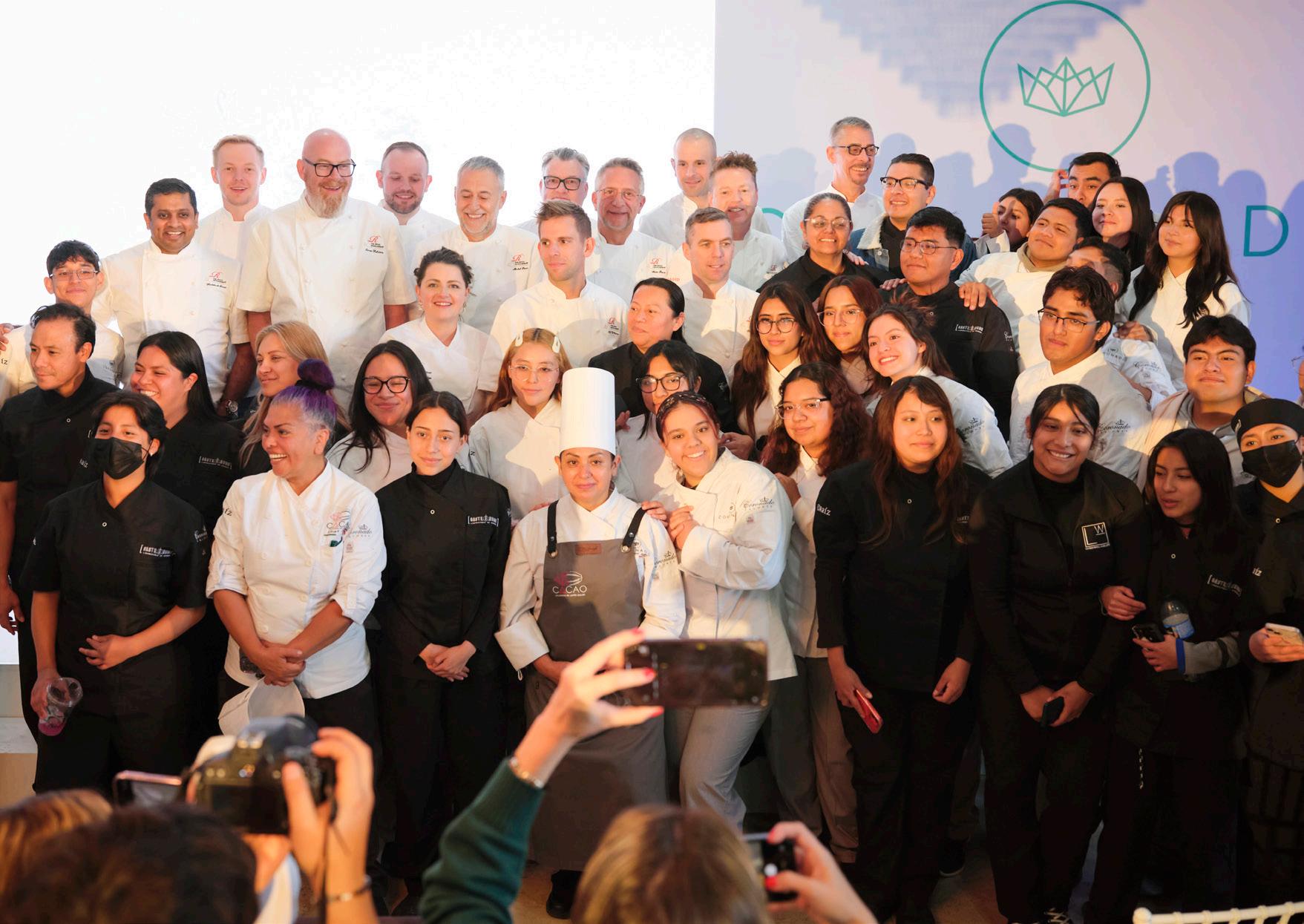
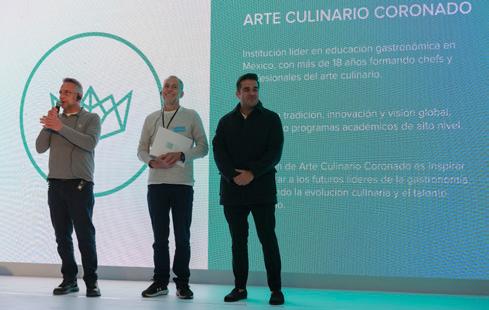
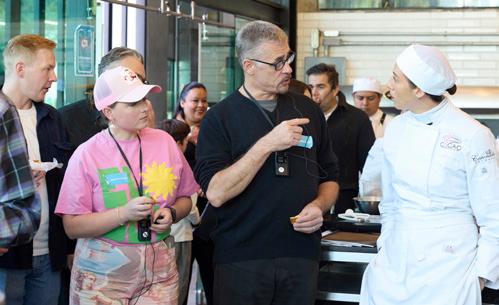
Our last day was spent at the magnificent Instituto Culinario Coronado, which is considered one of Mexico’s finest culinary schools, founded in 2007 by Carlos and Itzelle Coronado, who - together with their teamcertainly put on a show. With a full day planned ahead, it was clear from the start how excited they were to have us visit, when Chefs Alain and Michel made an entrance.
As the bus approached, we were met with the sight of chefs wielding hammers, chisels and even a chain saw: a lesson in ice-carving was in mid-flow, and it made for quite the scene for our arrival.
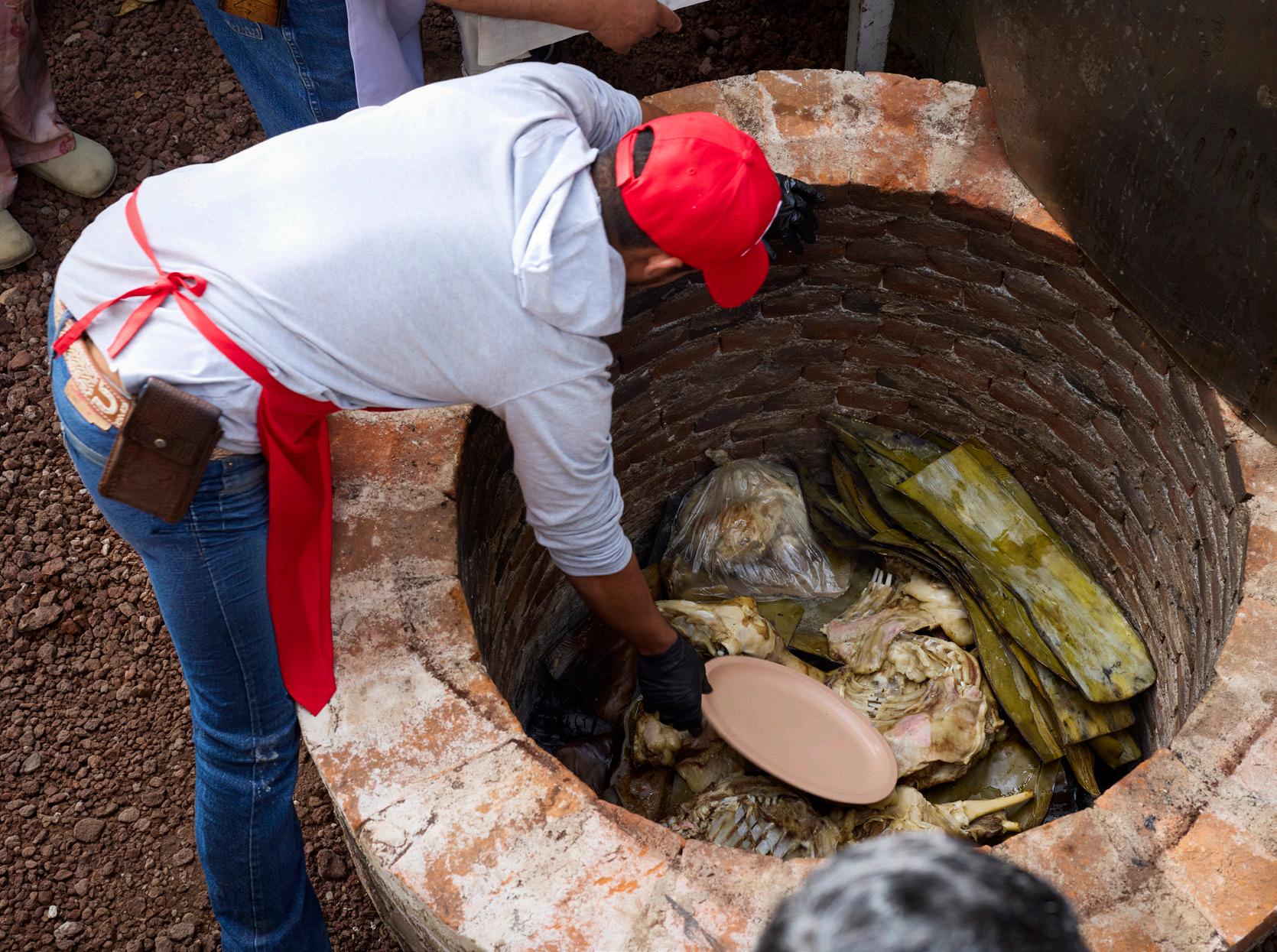
The day started with breakfast, and what is considered to be the ultimate delicacy: sheep intestine tacos. It was all washed down with a tequila tasting led by expert Lala Noguera. It was as strong start from the students and
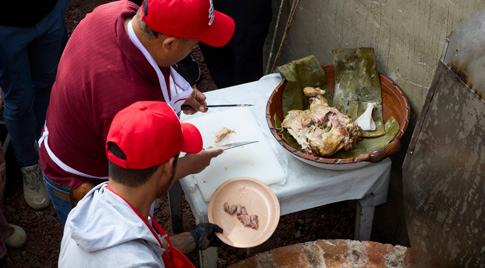
Pictured: (Left page) A welcome like no other to the college, with a chance to see the sheep cooking in the outdoor oven. (Right page) Tequila tasting and tortilla toasting with the experts.
culinary team who had cooked a beautiful whole lamb in the traditional fire pit overnight.
We had been lucky enough to have eaten a few dishes made with this style of cooking, but not with lamb. It had a totally stunning flavour and texture, and it was perfectly cooked. Drinking tequila at 9am is not usually my thing, but I was happy to make an exception.
Then followed a demonstration of traditional Oaxacan cooking, a region known for its food. The chef demonstrator Juana Amaya had trained chef Rene Redzepi in some of these methods when he was preparing for the Noma pop-up, in Tulum in 2017. She was a lovely lady, so proud and full of energy, and keen to share her knowledge.
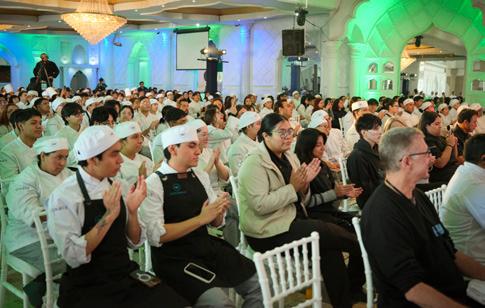
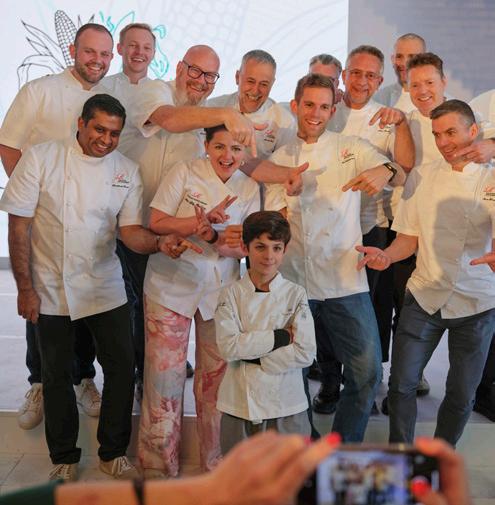
Next was an interview with Alain and Michel: I expected this to be an informal chat in a classroom instead it was in an auditorium with hundreds of students, who cheered as Alain and Michel took to the stage. To see the Roux Family and the Scholarship celebrated in this way was quite overwhelming, and the students all queued up to take a photo with us all at the end.
Next was lunch prepared by the students and local chefs in the newly opened Flama Restaurante, where no expense had been spared in creating a state-of-theart restaurant and kitchen facility for training the next generation of chefs.
The final part of the day was back in the auditorium for a Q&A with the students. Martin, Hrishikesh and I took seats on the stage with Juana Amayan and her fellow teachers, and answered questions about cooking, careers and Michelin-level dining. It was wonderful to see the pride and enthusiasm they had shown us. It was a perfect end to the trip and to see the effect of the Roux name and Scholarship across the world.
Pictured: The Scholars were made to feel like rock stars by the college students, who welcomed us with open arms to their stage for a Q&A with Alain and Michel and then photos with everyone, including young Sebas Coronado (above).
BEHIND THE SCENES
ABOUT THE ROUX SCHOLARSHIP
Michel Roux OBE founded The Roux Scholarship with his brother Albert to enable a new generation of chefs from Britain to train in the greatest restaurants in the world and the first ever competition took place in 1984. Not only has it become the industry’s most acclaimed chef competition in the UK with many scholars having gone on to win Michelin stars themselves, it ranks among the most prestigious competitions for chefs in the world.
In 2025, Roux Scholar 2011 Mark Birchall’s Restaurant Moor Hall, Aughton,
West Lancashire, received Three Michelin Stars, making him the first Scholar to achieve this accolade.
Since it was established, The Roux Scholarship has helped British chefs gain the international recognition they deserve. With many young chefs entering the competition each year, it is true to say thousands have been inspired and lives changed by the experience of competing.
WITH SPECIAL THANKS
We would like to share our deepest thanks with everyone who welcomed us to their establishments. We are especially grateful to those who helped with the planning of our itinerary: Chef Santiago Lastra, Martin Bristow from Not Just Travel, Chef Isaac McHale, Natalia Munoz Tapia from Catherwood Mexico, Stéphanie Blasco from GrupoAmigo Yucatan and our guide Juan Manuel Trejo lizama. Our thanks goes also to Mariana Poo from Traspatio Maya, who arranged our two enchanting days with Mayan communities in the Yucatán. For our Mexico City experiences, our deepest thanks goes to Sofía Hernández, for her help in planning and for her joyful company throughout our time there. In addition, her Jamat Seafoods colleague Ximena Galván Ampudia.
We must also thank April Lily Partridge, who arranged our visits to Green Rhino and Panaderia Rosetta.
A very special thank you goes to Lee Whitlock at The Waterside Inn, who spent more than a year planning this trip. Her diligence, ingenuity and ability to find the right contacts resulted in a truly outstanding itinerary and we cannot thank her enough. Our thanks, too, goes to Jodi Hinds for her superb photos and regular Spanish translation, as well as her joyful company.
We are grateful to Adam Vines from Lounge Design for designing this book and to Carolyn Boyd for compiling, editing and managing the project.
Sponsors
of The Roux Scholarship 2026
Special thanks to our sponsors, without whom The Roux Scholarship could not exist