WWW.VOICE-ONLINE.CO.UK
MAY 2026 • ISSUE NO. 1978
£2.50
50 years of carnival power !
Luton Carnival celebrates golden milestone
See supplement inside ›› p19-30
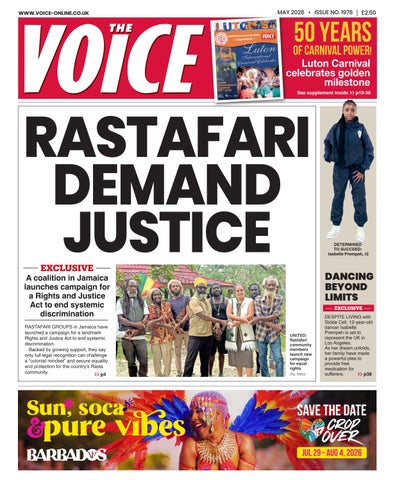
RASTAFARI DEMAND JUSTICE EXCLUSIVE
A coalition in Jamaica launches campaign for a Rights and Justice Act to end systemic discrimination RASTAFARI GROUPS in Jamaica have launched a campaign for a landmark Rights and Justice Act to end systemic discrimination. Backed by growing support, they say only full legal recognition can challenge a “colonial mindset” and secure equality and protection for the country’s Rasta community. ›› p4
DETERMINED TO SUCCEED: Isabelle Prempeh, 12
DANCING BEYOND LIMITS EXCLUSIVE
UNITED: Rastafari community members launch new campaign for equal rights (Pic: RMO)
DESPITE LIVING with Sickle Cell, 12-year-old dancer Isabelle Prempeh is set to represent the UK in Los Angeles. As her dream unfolds, her family have made a powerful plea to provide free medication for sufferers. ›› p38
Inside THIS MONTH
6
The Voice says
ROUNDUP
News, views, stories & videos
THE 10 MOST POPULAR STORIES ON VOICE-ONLINE.CO.UK
FAIRER ECONOMY Without transparency, pay inequality remains hidden
UN labels slavery ‘gravest crime’ — but campaigners demand more than words
13
Barbers, churches and volunteers unite to fight hypertension
17
Mental health or mainstream drama? The limits of televised therapy
18
From trauma to triumph: how Natalie Remee turned pain into purpose
41
Black music powers £24.5bn UK Industry, but who benefits?
47
Women’s football is rising fast — and the world Is taking notice
The government has backed ethnicity pay gap reporting. Now it must deliver real change
T
HE GOVERNMENT’S commitment to introduce mandatory ethnicity and disability pay gap reporting for large employers is long overdue. For years, campaigners, including MP Dawn Butler, have argued that without transparency, inequality remains hidden. The announcement that firms with more than 250 employees will be required to publish pay gap data marks a significant step forward. But delay in acting on that commitment risks undermining both trust and impact. The case for action is overwhelming. Closing the ethnicity pay gap is not just a matter of fairness, it is an economic necessity. Estimates suggest the UK could gain between £24 billion and £37 billion a year by addressing disparities that limit productivity and progression. At a time of economic strain, failing to act decisively is a cost the country cannot afford. The moral argument is even clearer. No one should be disadvantaged at work because of their ethnic origin. Yet structural barriers persist, often reflected not only in pay differences but in who gets hired, promoted and retained. With one in five working-age
This issue is 48 pages EDITOR Vic Motune E. vic.motune@thevoicemedia group.co.uk
CORPORATE AFFAIRS & COMMUNICATIONS Paula Dyke E. paula@thevoicemedia group.co.uk
EXECUTIVE DIRECTOR Paulette Simpson E. paulette.simpson@thevoice mediagroup.co.uk
ENTERTAINMENT EDITOR Joel Campbell E. joel.campbell@thevoice mediagroup.co.uk
people in the UK from ethnically diverse backgrounds, inequality in the workplace is not a marginal issue, it is systemic. Data is key to change. As Butler has said: “Shining a light on inequality is vital. I am convinced publishing data will encourage companies to act. It will show who is making progress — and who is not.” The experience of gender pay gap reporting supports this. Since mandatory reporting was introduced in 2017, the gender pay gap has fallen significantly. Transparency works. But transparency alone is not enough. Butler is right to warn that “voluntary reporting is insufficient… the minority of bad employers will not act unless required to.” Without enforcement and accountability, progress will stall. Reporting must be backed by clear action plans and, where necessary, penalties for those who fail to engage. The government has set out the direction of travel. Now it must accelerate the journey. This is about building a fairer economy, one where opportunity is not determined by background. The commitment has been made. Now there must be the urgency to take action on it.
BALLOT IS OUR POWER: Make sure your vote counts
1 2 3 4 5 6 7 8 9 10
Comment: Labour took the Black vote for granted. The Greens have a chance. Will they take it?
News: EXCL: Black British police officers tell all in new groundbreaking documentary series Sport: The Unity Cup is back as Nigeria look to defend their crown News: EXCL: “I was breastfeeding when they came. I feared they’d take my baby after calling the police”
News: St Kitts and Nevis become first Caribbean nation to recognise Rastafari faith in law News: Reform UK say they will block visas from countries demanding reparations for slavery Sport: Croydon Cougars prove themselves to be Euro stars
Sport: Africa destroys Jamaica’s World Cup dream News: Jamaica defends its record on Rastafari as St Kitts claims regional first Comment: Stephen Lawrence Day: honouring a life, inspiring a movement
Got a story? email us at yourviews@thevoicemediagroup.co.uk SPORTS EDITOR Rodney Hinds E. rodney.hinds@thevoice mediagroup.co.uk ADVERTISING AND SALES E. advertising@thevoicemedia group.co.uk
NEWS DESK E. newsdesk@thevoice mediagroup.co.uk
CIRCULATION & SUBSCRIPTIONS E. subscriptions@thevoicemedia group.co.uk
The Voice Newspaper Unit 1, Bricklayers Arms, Mandela Way, London, SE1 5SR T: 020 7510 0340 Web: www.voice-online.co.uk GV MEDIA GROUP LTD
MAY 2026 THE VOICE | 3
News
NEW MURAL HONOURS RASTAFARI LEADER The family of High Priest Ras Bandele say the artwork will keep his spirit alive in the heart of St Paul’s, Bristol, where he founded a cultural centre. By Sinai Fleary
A
STUNNING mural has been unveiled in memory of a popular Rastafari High Priest
in Bristol. Ras Bandele Selassie I was the Rastafari High Priest of the South West of England, who died in March 2024, following a short illness. He founded the Rastafari Cultural Centre in Grosvenor Road, St Paul’s in 1990s, which he ran for nearly three decades. It was first opened for the Rastafari community to have a place where they could worship and observe special celebrations. Now, a colourful mural of him has been unveiled as a lasting tribute to the respected spiritual mentor. Ras Bandele’s family have told The Voice in statements that the permanent mural is a fitting tribute to him. His son, Abijah Selassie, said: “The mural to me literally feels like a reminder to everyone that sees it that my dad was here, and during his time here he made such a major impact. For that I give thanks.” ‘Keeping his presence and power alive’ Ras Bandele’s wife, Morowa Selassie, says she “worked closely with youngest daughter Yeshawa in designing it”, which was then painted by a group of artists. “The idea was in thought from two years ago, it was just a matter of transferring these thoughts artistically in a mural” she explained. “I reflected on the other murals of community icons and wanted to capture something similar. I RESPECTED: Ras Bandele Selassie I was the Rastafari High Priest of the South West of England
wanted something big and bold, something that tells a story of Ras Bandele Selassie, and we are satisfied with the result. “The mural feels like we’re keeping his presence and power alive. A huge part of his legacy has been from working in this building, and now he’s become part of the building. I hope the representation of this mural will mean the same, not just to us, his family, but also all the people that knew and love him.” Ras Bandele’s daugher, Yeshawa Selassie, said: “The mural means more than art, it is a true representation of my Dad, placed on a building that reflects who he is he is and what he stood for. “Myself and my mother designed the mural together to honour him, bringing together the visions we both had; the images, wording and message. Through this mural, his teachings and legacy continues. “We spoke with three different artists and, in the end, asked them to collaborate. They each brought something unique, and as our organisation is rooted in unity. It truly is one of the most meaningful things I’ve helped create for him.” Artists worked together to create mural The dazzling mural of the Rasta-
fari elder was painted by artists Nick Halahan, Uri Green and Dante Bruno. Halahan said: “It was an honour to paint Ras Bandele’s portrait in this mural, celebrating both his life and the Rasta message he stood for in Bristol. “Having grown up listening to artists like Dennis Brown and The Mighty Diamonds, it felt natural to volunteer my time for a culture that has inspired and guided me for over 25 years. This mural was like a marriage of my two great loves – reggae and painting!” Green said: “I feel honoured having contributed to the making of this mural for the memory of such a great man and his legacy. “And having done it in the building that Bandele and his people fought hard to keep as a Rastafarian cultural centre in St Pauls, Bristol.” Bruno added: “Bandele gave me good advice in a time of need. It was my pleasure to contribute to his memory and support the local community.” A safe space for the community Ras Bandele’s iconic community centre became a safe place for Bristol’s African Caribbean community following the brutal racist attack on Black teenager Marlon Thomas in March 1994. The Justice for Marlon Thomas Campaign used the ground floor of the building, and the family allowed Ras Bandele to use the upstairs. Marlon was 18 when a gang of fairground workers attacked him in Durdham Downs, leaving him in a “waking coma”. Ras Bandele offered grassroots counselling sessions to the local community, who were left traumatised after the attack on Marlon.
HONOURED: A permanent mural tribute to Ras Bandele Selassie I – a respected Rastafari High Priest and community leader – has been unveiled by his family in Bristol (photo: supplied by family)
Lambeth founder recognised with Rising Star nomination THE FOUNDER of a Lambeth-based youth organisation supporting young people into the beauty industry has been nominated for the “Rising Star” award at the Glu Gala, which recognises women in business and enterprise. Michaela Anderson, pictured below, who leads Beauty Pathway, is being recognised for her work supporting young people aged 14 to 30 to access opportunities in the health and beauty sector. Her organisation focuses on career preparation, apprenticeships, enterprise training and leadership development. Beauty Pathway works with schools, salons and employers across Lambeth and London as a whole to help young people, particularly those from underrepresented backgrounds, move into employment or start their own businesses. Its programmes include workshops,
accredited training and industry insight sessions aimed at building skills and confidence. Born in the UK to Jamaican parents, Anderson has said her work is driven by a commitment to improving financial independence for young people, particularly girls and young women. Alongside running the organisation, she mentors participants and promotes a mindset focused on personal and professional development. “This nomination represents the young people we serve every day,” she said. “There is so much talent in our communities, especially here in Lambeth. Beauty Pathway exists to help young people recognise their potential, build confidence, and step into leadership within an industry that is full of opportunity.” Recent years have seen a growth in the number of initiatives seeking to address gaps between education, employment and entrepreneurship in the beauty and wellness sector.
4 | THE VOICE MAY 2026
News
JAMAICA ‘MUST RECOGNISE’ RASTAFARI RIGHTS IN LAW
TAKING A STAND: Honourable Priests from the Ethiopian African Black International Congress (BoboAshanti); below, some members of the Rastafari community in Jamaica say their sacramental rights are still aggressively and illegally being violated (photos: RMO)
A coalition of Rastafari organisations in Jamaica has launched a campaign calling for the introduction of a comprehensive Rastafari Rights and Justice Act. By Sinai Fleary
A
COALITION of Rastafari organisations in Jamaica is calling for the introduction of a comprehensive Rastafari Rights and Justice Act to protect the community from ongoing discrimination and human rights violations. The group, representing a broad alliance of Rastafari Mansions and Organizations (RMO), says a multi-layered legislative framework is urgently needed to safeguard Rastafari people from injustices that persist across multiple areas of life.
policing, prisons, education, emGroundation Day marked ployment, land access, healthcare, campaign launch housing, culture and economic life. The campaign was formally an“These are not isolated incidents nounced on April 21, marking the but reflect systemic and enduring 60th anniversary of Groundation Day, a sacred occasion commemo- oppression,” it said. “The call for a comprehensive Rastafari Rights and rating the historic 1966 visit of Call for comprehensive Emperor Haile Selassie I to Jamaica. Justice Act is therefore a logical reRastafari Act sponse to piecemeal provisions that That visit is widely regarded as The call for a standalone Act follows leave rights uncertain, discretionary a pivotal moment when Rastafari comments by Jamaica’s Minister received a form of official acknowl- and weakly enforced.” of Culture, Gender, Entertainment edgement through the presence of and Sport, Olivia Grange, who arHigh profile their spiritual leader. gued that the country’s constitution international support While acknowledging that the already provides protection for the The RMO has launched a global Rastafari faith as both a religion and Jamaican government has made petition which has already received some progress in addressing issues a way of life. backing from Prince Ermias affecting the Rastafari community, She made the remarks while Sahle-Selassie, grandson of Emthe RMO insists that far more needs disputing claims that St Kitts and peror Haile Selassie I. to be done to ensure full legal proNevis is the first Caribbean nation In a statement shared with The tection and to end what it describes to formally recognise Rastafari Voice last month, Prince Ermias as the continued criminalisation rights in law. said: “The Emperor challenged us to and marginalisation of Rastafari However, in a statement given overcome our petty prejudices and people in the country where the to The Voice, the RMO firmly realign ourselves with our brethren faith was founded. jected the government’s position, within the human community. I The group argues that existing arguing that existing protections support any laws and efforts to legal provisions are fragmented are insufficient and lack the legal make this dream a reality.” and fail to create a cohesive system force required to address systemic Founded in Jamaica in the 1930s, of protection. According to the discrimination. Rastafari is an Abrahamic faith that statement, Rastafari individuals The statement said: “RMO continue to face discrimination in reveres Emperor Haile Selassie I of refutes Minister Grange’s recent assertion that Rastafari recognition and rights have already been provided for within Jamaica’s constitutional and legislative framework. The claim of Jamaica’s regional leadership in legislative protection of Rastafari rights is false. “True recognition and protection requires specific definition and entrenchment within the Jamaican constitution, along with provisions that ensure a multi-dimensional legal status across all branches of government, with enforceable LEGACY SECURED: Young Rastafari still carrying the torch for accountability. This has not yet the faith and culture (photo: Kerida McDonald) happened.”
Ethiopia as the Second Coming of Christ. The movement was shaped by the teachings of Leonard Howell and inspired by the philosophies of Marcus Garvey, with a strong emphasis on self-determination and African liberation. The RMO points to a “colonial mindset” as a root cause of discriminatory attitudes and historic injustices against Rastafari people.
nation against natural hairstyles, the RMO argues that these measures lack legal strength.
standard in practice, wherein members are arrested, charged, and endure prolonged legal exposure before rights are discretionarily upheld,” the group said, calling for better police training and clear accountability measures. Among its recommendations is a directive requiring law enforcement officers to cease interference with lawful sacramental practices. The RMO criticised the placement of Rastafari sacramental rights within drug legislation, arguing that it mischaracterises a religious practice under criminal law rather than recognising it as a protected cultural and constitutional right. The organisation is calling for direct involvement in drafting the proposed Act to ensure it adequately addresses longstanding issues affecting the community.
Major concerns The group also highlighted wider issues, including lack of appropriate dietary options in schools, limited accommodation for Rastafari religious observances, and the absence of African and Rastafari history in the curriculum. St Kitts sets Economic exploitation is another regional precedent major concern. The RMO argues It also highlighted developments that Rastafari culture – including music, symbols, language in St Kitts and Nevis, which in 2023 introduced a Rastafari Rights and imagery – has been widely commercialised, particularly within Recognition Act that formally acknowledges Rastafari identity and Jamaica’s tourism industry, without sacramental practices. meaningful representation or finanWhile welcoming that step, the cial benefit for the community. “Rastafari identity has been RMO believes Jamaica should go aggressively commodified without further by implementing a more consent, protection or benefitcomprehensive framework that Milestone opportunity addresses identity, religious rights, sharing,” it said. The timing of the campaign, the Workplace discrimination also and reparatory justice for historical group said, is significant claimpersists, according to the group. harms. Central to the proposed ing that the 60th anniversary of legislation are protections in areas While dreadlocks are increasingly where Rastafari people continue to accepted, Rastafari individuals still Haile Selassie I’s visit represents an face discrimination, exclusion and report barriers to hiring, promotion opportunity for Jamaica to move beyond symbolic recognition and and full participation in profesexploitation. sional environments. take concrete steps toward justice Education remains a major Issues around policing and the and reconciliation. concern. The RMO says Rastafari enforcement of drug laws remain “The anniversary provides a children have long been marginalised within the school system, particularly contentious. Although milestone opportunity for practical particularly due to policies around the 2015 Dangerous Drugs (Amend- steps towards formal recognition grooming and cultural expression. ment) Act decriminalised the and repair of trust between the Rassacramental use of ganja, the RMO tafari community and the governThe statement noted that a ment,” the statement concluded. 2020 Supreme Court ruling initially says violations continue. Members of the community “The RMO calls on the Governfound that a school did not breach a child’s rights by barring them for reportedly face arrest and detention ment of Jamaica to legitimise its commitment to justice for Rastafari wearing dreadlocks, although this despite invoking their legal rights, leading to loss of income, confisca- by collaborating with the commudecision was later overturned following public outcry. tion of property and reputational nity to establish the first compreWhile the Ministry of Education damage. hensive Rastafari Act and secure introduced grooming guidelines in “The blatant violation of Rasbroad-based rights for the world’s original Rastafari community.” 2023 aimed at preventing discrimi- tafari sacramental rights remains
MAY 2026
THE VOICE | 5
ADVERTORIAL
Produced In Association with UK Government
The UK Government is Backing Businesses to Sell to the World By Vic Motune
F
rom pioneering fabric technologies to tackling one of the UK’s most persistent housing challenges, Micro-Fresh has built a reputation for innovation with real-world impact. Founded by Byron Dixon OBE, the Leicester-based company develops cutting-edge antimicrobial technology for fabrics and leathers, alongside Home-Fresh, a wall-applied solution designed to prevent mould and improve indoor environments. What began as an idea rooted in solving everyday problems has grown into a global export business, with Micro-Fresh products now used across international markets. In this interview with Vic Motune, Editor of The Voice, Byron reflects on the early days of the company, realities of entrepreneurship, and how support from the UK Government’s Department for Business and Trade (DBT) helped unlock global opportunities. From growing up on a council estate in Leicester to becoming a Black British entrepreneur, Byron’s journey reflects the ambition and resilience within the UK’s diverse business community. Through practical export support and accessible advice, DBT is committed to ensuring founders from every background have the tools and confidence to sell to the world. Building a Business from the Ground Up Vic Motune (VM): Tell us a little bit about your journey as an entrepreneur. What were you doing before you founded Micro-Fresh? Byron Dixon (BD): I grew up in Leicester, one of five children raised by my mum on a council estate. I was always good at chemistry, so after completing my A-levels I went into the footwear chemicals industry, working with shoe factories and tanneries. I was later headhunted by Ecco in Denmark, where I oversaw finishes across their global operations and worked closely with the CEO. I loved the role and the travel but eventually returned to the UK. With no job lined up, I started my own business, developing a treatment to stop shoes made in Asia from going mouldy
Advice for the Next Generation of Exporters
in transit, the product that became Micro-Fresh.
Taking Micro-Fresh Global VM: After successfully launching Micro-Fresh, how did you first hear about the work that the Department for Business and Trade (DBT) does with entrepreneurs like yourself and what made you reach out to them? BD: I first came across the Department for Business and Trade in a previous role, where the company had a trade adviser. When I started my own business, I got back in touch. Although my original contact had left, I was introduced to a new adviser who explained how DBT could support exports - and the service was free, which was a huge help as I had no money. I was eager to expand into China and, being impatient, flew out and opened an office myself. Later, a new adviser, Sharon McCarthy, helped me understand the right - and safer - way to expand internationally. Working with her was a dream. She told me that if I wanted to expand the business to overseas markets there was a way to do it and a way not to do it. The way I’d done it I’d been lucky. I could have met some sharks who wanted to rip off my product. There were lots of things I hadn’t thought about. VM: So as an entrepreneur entering new markets, you’re essentially navigating complex regulations, supply chains and compliance requirements, it’s a lot to manage, isn’t it? BD: There’s so much to consider when entering new markets, from regulations, duties and customs to supply chains and local compliance. But beyond that, cultural understanding and communication are just as important. DBT helped me navigate both the technical and the softer cultural aspects of international trade. VM: Has the DBT helped open other gateways for you as well? BD: DBT’s support has been invaluable. For example, we’ve explored hosting a reception in India and they’ve helped us carry out market research to assess product demand. They’ve also helped us understand that a country’s need for our products can differ
VM: But it seems awareness is key. Having the DBT’s guidance early on opens opportunities, but entrepreneurs who may be focused on the UK market only, can see exporting as too complex. BD: Yes, absolutely. And I’d just like to mention DBT’s Help to Grow Management program. About 12 years ago, I did a similar program with Goldman Sachs, and it was instrumental. The government has adopted a version of this program, run nationally through business schools. It’s accessible and covers internationalisation. It’s 90% government funded so businesses pay just £750 per person and the value is immense. Looking ahead
Byron Dixon significantly from our existing markets, which is crucial before expanding. When you talk to DBT and say, ‘I’m thinking of exporting to this market’, they can look into that, come back to you and say, ‘In South Africa, the requirement for your product or service would be this’, which we’d never thought of. So this saves you an awful lot of time and money.’ Also, one of the biggest lessons in business is that you will make mistakes but DBT has helped me make far fewer of them. A good example is trademarks. We now own the Micro-Fresh trademark in almost two-thirds of the world, but that came from experience. DBT encouraged me to plan properly, to understand why we’re entering a market, assess the economics and secure intellectual property before trading. Markets like the US can quickly catch you out if you go in unprepared. Working with DBT is like having a creative partner who helps you think ahead, challenge assumptions and avoid costly pitfalls. The Power of Exporting VM: What has exporting meant for your business and for your confidence as an entrepreneur? BD: Exporting has opened up limitless opportunities and made the business exciting. My team can be talking to
Bangladesh one day, overseeing shipments to Japan the next, or preparing marketing for the U.S. Beyond that, exporting future-proofs the business. When one market struggles, we can pivot to another, which helps make us resilient in the face of political or economic challenges. Around 85–90% of our products are now exported, and having multiple markets ensures sustainability, growth, and longevity. DBT’s guidance has been crucial in making this possible. Levelling the Playing Field for Diverse Founders VM: Do barriers to exporting disproportionately affect underrepresented founders? BD: Access to networks and trusted advice can be harder if you don’t come from traditional business circles. Having DBT’s support levels the playing field. It gives you credibility in international markets and access to expertise that might otherwise be out of reach. For Black-owned businesses especially, representation matters. Seeing that exporting is for businesses like yours makes a huge difference. In the USA for example, the Small Business Administration (SBA) has a dedicated support program for minority owned businesses. Without that support, growth would have been slower and riskier.
VM: You’ve been named one of the UK’s top 50 ambitious business leaders. What does the future of Micro-Fresh look like over the next five to ten years? BD: One of our big goals is to break into the automotive industry, so people get into cars treated with Micro-Fresh. Our US expansion is progressing well, and we also want Home-Fresh, our product for stopping mould in social housing, to succeed. Over the next five years, I see Micro-Fresh as a globally recognised brand, synonymous with freshness and sustainability. I want it to become a standard, where people can’t imagine products without it, and where our technology speaks for itself. Supporting Businesses to Sell to the World Micro-Fresh’s journey is a powerful example of what’s possible when innovation is matched with the right support. For business owners looking to start, scale or export, the Department for Business and Trade offers a wide range of free services designed to build confidence and capability at every stage. Through initiatives such as the Business Academy, entrepreneurs can access free events and on-demand training covering exports, digital skills and business growth. DBT also provides tools to identify the right international markets, alongside free, personalised guidance online and from specialist advisers who
understand the realities of running a business. More information, including access to tailored dashboards and support through the Business Growth Service, is available at business.gov.uk. You could take the first step towards turning ambition into global success. To explore tailored support, training and export advice, get started at business.gov.uk
ENGAGING WITH DBT: 6 DO’S AND DON’TS FOR BUSINESS OWNERS DO:
•
Be clear about your goals – whether it’s exporting, scaling up, or sharpening digital skills, clarity helps advisers guide you effectively.
•
Use the Business Academy – take advantage of free training, webinars and events designed for real business challenges.
•
Get the right support for your business – through business.gov.uk you can access the relevant support for your sector, location and business stage. DON’T: Assume support is only for big companies – DBT services are designed for businesses of all sizes, including start-ups and SMEs.
•
•
Ignore marketresearch tools – skipping this step can lead to costly mistakes when exploring overseas markets.
•
Wait until you’re struggling – early engagement with DBT can help prevent problems before they become barriers to growth.
business.gov.uk