WWW.VOICE-ONLINE.CO.UK
JUNE 2026 • ISSUE NO. 1979
£2.50
Stronger families, healthier lives Healthy futures start at home with family support
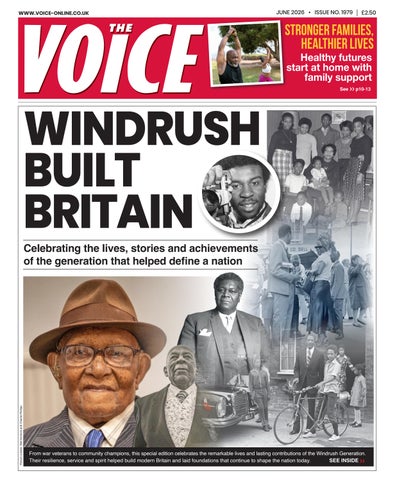
WINDRUSH BUILT BRITAIN
See ›› p10-13
Picture credits: Neil Kenlock and Charlie Phillips
Celebrating the lives, stories and achievements of the generation that helped define a nation
From war veterans to community champions, this special edition celebrates the remarkable lives and lasting contributions of the Windrush Generation. Their resilience, service and spirit helped build modern Britain and laid foundations that continue to shape the nation today. SEE INSIDE ››
Inside THIS MONTH
The Voice says
News, views, stories & videos
How one photographer captured the everyday lives of Windrush Britain
8
The Windrush story 16 we must fully tell
‘Education was our way forward’: Dr Delroy Beverley‘s journey from poverty to power
30
Do you know who this rare Windrush photo belongs to?
40
Ese Onojeruo helps reimagine Britain at the Biennale
43
From prison to Everest: Paul Hodge’s extraordinary journey to the top of the world
W
INDRUSH DAY, on June 22, is now a fixture in Britain’s calendar – but its meaning reaches far beyond commemoration. It began with Sam King’s vision in 1967: a day that would honour Caribbean migrants not as an afterthought in British history, but as builders of it. Today, that vision has grown into a national moment of reflection, pride and unfinished accountability. In this edition of The Voice we honour Windrush pioneers whose lives shaped communities across the country. People like Ilene Meriel Rowe, affectionately known as Aunt Ilene, who embodied care for those around her. Lessept Saunders, whose generosity touched many lives. And Gilbert Clarke, who once lied about his age to serve in the RAF, then went on to became a decorated veteran and whose story desire to serve speaks to sacrifice in the service of country. Their contributions are not just footnotes in history, they helped build the foundations of the modern, diverse Britain we know today. Young Black Britons continue to draw strength from their lives while also calling for fuller teaching of the Windrush story in schools.
This issue is 48 pages EDITOR Vic Motune E. vic.motune@thevoicemedia group.co.uk
CORPORATE AFFAIRS & COMMUNICATIONS Paula Dyke E. paula@thevoicemedia group.co.uk
EXECUTIVE DIRECTOR Paulette Simpson E. paulette.simpson@thevoice mediagroup.co.uk
ENTERTAINMENT EDITOR Joel Campbell E. joel.campbell@thevoice mediagroup.co.uk
THE 10 MOST POPULAR STORIES ON VOICE-ONLINE.CO.UK
BRITISH HISTORY: The Windrush Monument at Waterloo Station honours Windrush migrants
4-5
Hackney says farewell to beloved Windrush elder Lessept Saunders
ROUNDUP NEWSPAPER
Across Britain, Windrush Day celebrations honouring these and many other pioneers will bring communities together through food, music, storytelling and memory. These gatherings remind us that Windrush is lived culture, not just the remembrance of a historical event. But the Windrush story is also one of injustice that continues to reverberate. Rev Clive Foster reminds us that while progress has been made, too many people still face the trauma of proving their right to belong in the country they helped build. Some are asked to relive painful histories only to receive a nil award. That is not simply a bureaucratic failure; it is a moral one. Windrush Day stands as both celebration and reckoning. It honours the generation that rebuilt post-war Britain while providing us with an important reminder that the work of justice for those still affected by the Windrush scandal remains unfinished. The legacy of the pioneers who came to Britain after 1948 demands more than a day that celebrates it, important as this is. It requires a lasting commitment to ensure that because of this legacy, the rights of Windrush Generation members are never questioned again.
HISTORY REPEATING ITSELF: A vigil was held in Dublin after the death of Congolese national Yves Sakila
1
News: Campaigner Ngozi Fulani warns Black women to ‘stay on alert’ after bodies of three women found in Brighton
2 3 4 5 6 7 8 9 10
Comment: If Misan Harriman is being targeted, that should concern us all News: Man charged with murder of ‘wonderful mother of eight’ News: Father pays tribute to daughters recovered from the sea off Brighton beach
News: Zack Polanski’s pledge to Black voters: ‘The Greens will have your back’
News: Vigil held for Black man who died after being restrained by security guards in Ireland Lifestyle: #Merky Films land Ian Wright biopic
Comment: Black Britain is flirting with the Greens but not dumping Labour News: Local election candidate speaks out over racist abuse Sport: Usain Bolt centre of attention yet again
Got a story? email us at yourviews@thevoicemediagroup.co.uk SPORTS EDITOR Rodney Hinds E. rodney.hinds@thevoice mediagroup.co.uk ADVERTISING AND SALES E. advertising@thevoicemedia group.co.uk
NEWS DESK E. newsdesk@thevoice mediagroup.co.uk
CIRCULATION & SUBSCRIPTIONS E. subscriptions@thevoicemedia group.co.uk
The Voice Newspaper Unit 1, Bricklayers Arms, Mandela Way, London, SE1 5SR T: 020 7510 0340 Web: www.voice-online.co.uk GV MEDIA GROUP LTD
JUNE 2026 THE VOICE | 3
News
THE FATHERS WHO LOVED US QUIETLY
E
VERY YEAR when Father’s Day comes around, social media fills with tributes, old photographs and expressions of gratitude. But for many Black families, the day also creates quieter moments of reflection about fathers shaped by migration, sacrifice, emotional restraint and survival. For many Black and Brown households across Britain in the 1980s and 90s, music was rarely just background noise. Whether it was reggae, lovers rock, hip hop, bhangra or soul, those sounds travelled through front rooms during family gatherings and Saturday morning cleaning sessions. For many communities trying to build a life in Britain, music became one of the few places where men could process vulnerability and pressure without feeling they were somehow surrendering their masculinity. Beneath the basslines and bravado sat stories of heartbreak, responsibility and survival. Many Black African, Caribbean and South Asian fathers raising families in Britain during the 1970s, 80s and 90s were carrying enormous pressure, even when they rarely spoke about it openly. Some had arrived in Britain by themselves, while others inherited the pressures of migration, racism and economic struggle.
As Father’s Day approaches Lee Townsend reflects on how Black fathers, who carried the weight of racism and responsibility, still managed to love deeply — even if they rarely expressed it in words
What our fathers could not always express For many men from those generations, composure became survival. They spent years navigating workplaces where they constantly felt the need to prove themselves, before returning home, expected to remain emotionally strong for everyone else. In many households, love was rarely spoken loudly. Instead, it appeared through overtime, provision, discipline and protection. Yet many children still grew up struggling to fully understand their
fathers emotionally, not because those fathers lacked love, but because emotional openness was not something many of them had inherited themselves. James Baldwin once observed that “children have never been very good at listening to their elders, but they have never failed to imitate them.” Looking across generations of Black men, there is real truth in that observation. The lessons we inherited Many inherited emotional survival techniques from fathers navigating racism, financial pressure and the expectation to remain composed no matter what life placed in front of them. Looking back, artists like Beres Hammond, left, resonated deeply because they offered a version of masculinity that allowed room for tenderness and honesty without losing strength. Meanwhile, Garnett Silk quietly challenged the idea that hardness
OPENING UP: Lee Townsend with his daughters. He applauds how today’s fathers are learning to express affection more openly than previous generations were able to alone defined manhood. Beneath the melodies lay emotional depth many men recognised immediately. As a father myself, I have increasingly come to appreciate that fatherhood is not simply about being physically present, but emotionally available too. As a child of the 1970s, I know many men from our generation grew up believing that love was shown through sacrifice rather than conversation, and truthfully, I still find myself trying to unlearn parts of that.
Redefining strong fatherhood In cities like London, it is easy to believe being a good father simply means working harder and earning more. Yet the older I get, the more I understand that children also need time, conversation and emotional presence. Strong fathers matter. Discipline, guidance and protection matter. But emotional presence matters just as much. Sometimes the strongest men are not the loudest, but the
fathers who quietly decide the emotional silence passed down to them will not become the full inheritance left for their children. Perhaps one of the most meaningful things to recognise this Father’s Day is strength is not what a man can carry silently, but whether those closest to him feel loved, secure and able to turn to him when life is difficult. l Lee Townsend is a community engagement practitioner and writer whose work explores culture, wellbeing and the lived experiences of marginalised communities
LEEDS DADS CELEBRATES 15 YEARS SUPPORTING FATHERS A SIMPLE conversation between four exhausted fathers in a Leeds cafe 15 years ago has grown into a lifeline for thousands of dads navigating the pressures of parenthood. “Back then, we talked about feeling constantly tired, and the functional nature of our conversations with our partners,” recalls Errol Murray, one of the fathers. “And when we all shared our thoughts we realised that other people are in the same boat, which makes it easier to accept the challenges of fatherhood.” At the time, Murray admits he was struggling himself. He and his partner had recently moved to Leeds from Brixton after
the birth of their daughter Rayya in 2010. Family support was hundreds of miles away and he was commuting daily to Manchester while trying to adjust to life as a new father. “I was tired and balancing work and family, especially with the added responsibility of a new baby,” he says. What struck Murray most was the absence of support spaces for fathers. While mums had networks and groups to lean on, dads often felt isolated. So in 2011, he persuaded a handful of fathers to join him for a playdate at Leeds City Museum cafe, a gathering that would become the foundation of Leeds Dads. Now the organisation is prepar-
ing to celebrate its 15th anniversary on Father’s Day, June 21, with a Dadstastic Day event at Leeds City Museum and Millennium Square. Leeds Dads now supports more than 1,000 fathers a year through breakfast clubs, walks, soft play sessions, forest schools and wellbeing groups. Its work focuses on helping dads play an active and positive role within family life. “Research shows how dads are an important part of the family unit, but are often overlooked by services supporting parents and children,” Murray says. “So Leeds Dads aims to create a thriving community, offering parenting advice, friendship and wellbeing support.”
HAPPY FAMILY: Leeds Dads founder Errol Murray with wife Veena and children Rayya and Isaac The organisation’s work extends beyond playgroups. Leeds Dads runs support for separated fathers, offers birth trauma therapy, mental
health support, campaigns for improved paternity leave and works closely with maternity services. Murray says the group’s greatest strength is the peer support it creates. “Dads have told us the group has saved them, it’s given them a rock, some sanity,” he says, adding that he feels the organisation’s biggest achievement has been helping fathers feel seen and valued. “It’s not just the work we do, it’s about showing people someone cares,” he says. “Many dads said they’ve been in dark places and may not have emerged as they are now if not for Leeds Dads’ support.” l For more information please visit www.leedsdads.org
4 | THE VOICE JUNE 2026
Windrush78
THE MAN WHO CAPTURED BLACK BRITAIN ON CAMERA
IN FOCUS: Neil Kenlock , pictured in 1970s London, documented Black British life and helped transform media through photography, ROOT magazine and pioneering radio station Choice FM
From Brixton streets to Black Panther meetings, Neil Kenlock created an extraordinary visual record of Caribbean heritage communities. By Vic Motune
F
OR DECADES after the arrival of the Windrush in 1948, the lives of Black Britons were rarely reflected in Britain’s newspapers, museums or television screens. But in the late 1960s and 70s, photographer Neil Kenlock spent time in homes, churches, community halls and on the streets of Brixton quietly building an extraordinary visual chronicle of a generation whose contribution to Britain could not be ignored. More than half a century later, his daughter Emelia is ensuring those images and the stories they tell are not lost. “My dad is one of the few photographers that really captured the everyday lives of the people of the Windrush generation and their descendants,” she tells The Voice. “In the 1960s he would take photos at christenings, weddings, social events, funerals, concerts, award ceremonies and more. “He captured these amazing people through his lens at a time where their lives were not being documented by many photographers, either in their community or in the mainstream media.” For Emelia, preserving her father’s work is about far more than safeguarding old
photographs. It is about protecting a history that was too often overlooked and ensuring future generations understand how Britons of Caribbean heritage have helped shape the country we know today. The Neil Kenlock Photographic Archive, which she now helps manage as archive director, is bringing his work to new audiences through exhibitions, education projects and partnerships with museums and community organisations. Together, father and daughter are preserving an extraordinary collection that documents the Windrush generation’s resilience, creativity and fight for recognition. Born in Jamaica, Neil Kenlock arrived in Britain in 1963 and settled in Brixton, south London, during a period of immense social and political change. At a time when Black Britons were largely invisible in mainstream media unless portrayed negatively, Kenlock began photographing the everyday realities of Caribbean migrants and their families. His images became an invaluable visual testimony of a generation that helped rebuild post-war Britain while facing racism and exclusion. Kenlock later became the official photographer for the British Black Panther Movement, documenting meetings, demonstrations and
community programmes. Today, many of his photographs are among the few surviving visual records of the organisation’s work in Britain. At the same time, he worked as a staff photographer for West Indian World, the first national newspaper created for Black British audiences. His photographs chronicled the emergence of Black political consciousness in Britain and the development of communities determined to shape their own futures. Among his most famous images
(all photos: Neil Kenlock Archive)
is Keep Britain White, a haunting photograph of racist graffiti in 1970s London that has since become one of the defining images of the era and now appears in GCSE History textbooks studying post-war migration and race relations. But Kenlock’s work extended beyond photography. In 1979, he co-founded ROOT magazine, the first glossy lifestyle publication aimed at Black British readers. A decade later, in 1990, he helped pioneer Choice FM, the UK’s first 24-hour licensed Black
music radio station. Working alongside co-founder Patrick Berry and others, Kenlock campaigned for years to secure broadcasting licences for a station that would serve African and Caribbean audiences ignored by mainstream radio. Choice FM was instrumental in introducing British audiences to artists such as Mary J. Blige, Jodeci, Brandy and Omar long before they received widespread mainstream airplay. Emelia believes the photographs reveal a richer and more complete MEMORABLE MOMENT: Dr Arthur Wint, Olympic gold medallist, surgeon and Jamaica’s High Commissioner, pictured in Brixton in 1975 engaging with the community
picture of modern British history. “I don’t think we often get a chance to highlight the achievements and the bravery of the Windrush generation,” she says. “It is thanks to their hard work, perseverance and contributions that we have this society today.” Kenlock’s work has since been exhibited at major institutions including Tate Britain, the Victoria and Albert Museum, the Black Cultural Archives and the National Portrait Gallery. His photographs have also appeared in books, documentaries and academic publications exploring Black British history and the Windrush experience. Yet despite the growing recognition, Emelia believes the work of preserving and sharing these stories remains urgent. “It’s essential for future generations that these images, and the stories behind them, are captured, documented, shared and celebrated. That is something my father is very passionate about. “He feels very strongly about taking images of his community, showing their strength and determination. This is why he shares his photography with the public through events, exhibitions and online. He wants young people to know about these amazing people who contributed and shaped our society.”
JUNE 2026 THE VOICE | 5
Windrush78
CAPTURING A SIGNIFICANT MOMENT: Black youth gather in Brockwell Park, south London, circa late 1960s, early 70s The image offers a rare record of culture and visibility in public spaces at the time TAKING A STAND: British Black Panther members demonstrate in Brixton during the 1970s
PORTRAIT: A Caribbean family dress for a special occasion FAITHFUL: Church singers in 1970s London LEISURE TIME: Windrush generation members play dominoes. The game fostered connection, conversation and cultural continuity. London, 1970s
INSPIRATIONAL: Oswald Denniston became one of Britain's first Caribbean entrepreneurs
OLIVE MORRIS: The activist was a major campaigner for racial equality
VITAL ROLE: Courtney Laws, OD, OBE “Mr Brixton,” circa 1975. His campaigning on race inequality contributed to long-term changes in policy and public life JUST CAUSE: Two women at a stall distributing anti-racism literature
REVERED: Lord David Pitt was among Britain’s early Black parliamentary candidates