APRIL 2026 • ISSUE NO. 1977
WWW.VOICE-ONLINE.CO.UK
£2.50
Revealed: The latest edition of the Football Black List Showcasing excellence on and off the field ›› p46-47
Enfield Caribbean Association celebrates 40 years ›› See pages 21-28
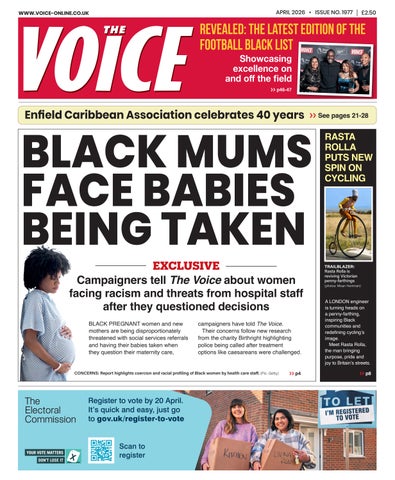
BLACK MUMS FACE BABIES BEING TAKEN EXCLUSIVE Campaigners tell The Voice about women facing racism and threats from hospital staff after they questioned decisions BLACK PREGNANT women and new mothers are being disproportionately threatened with social services referrals and having their babies taken when they question their maternity care,
campaigners have told The Voice. Their concerns follow new research from the charity Birthright highlighting police being called after treatment options like caesareans were challenged.
CONCERNS: Report highlights coercion and racial profiling of Black women by health care staff. (Pic: Getty)
Register to vote by 20 April. It’s quick and easy, just go to gov.uk/register-to-vote
Scan to register
›› p4
RASTA ROLLA PUTS NEW SPIN ON CYCLING
TRAILBLAZER: Rasta Rolla is reviving Victorian penny-farthings (photos: Misan Harriman)
A LONDON engineer is turning heads on a penny-farthing, inspiring Black communities and redefining cycling’s image. Meet Rasta Rolla, the man bringing purpose, pride and joy to Britain’s streets. ›› p8
Inside THIS MONTH
The Voice says
ROUNDUP
News, views, stories & videos
THE 10 MOST POPULAR STORIES ON VOICE-ONLINE.CO.UK
6
‘Our vote, our voice’: why Black Britain must show up at the ballot boxe
10
CALL: Prince Ermias Sahle-Selassie spoke to The Voice
Dawn Butler: “Powerless councils, vulnerable communities and the case for gambling reform”
1
16
‘A giant of justice’: world leaders join thousands in paying tribute to Rev Jesse Jackson
32
Beyond the beat: how hip hop helps us find happiness in everyday life
41
Pedalling for Purpose: Black Unity Bike Ride heads to Senegal
48
TrailBlazeHER Summit 2026: Empowering the next generation of female athletes
Body found in water believed to be missing Kenyan student Edna Mmbali Ombakho studying for Masters in London
If we don’t vote, others will decide our future
A
S THE deadline to register to vote approaches, there is a stark and urgent question facing Black Britain: if we do not show up, who will speak for us? For too long, voter turnout within our community has lagged behind, shaped by mistrust, frustration and a sense that politics does not deliver. Those concerns are real. Many look at the state of politics – locally and nationally – and feel disillusioned by the choices on offer and the systems that too often fail us. But disengagement comes at a cost we cannot afford. Local elections are not abstract exercises in democracy. They determine who makes decisions about the housing we live in, the schools our children attend, the safety of our streets and the quality of healthcare we receive. These are the very areas where Black communities continue to face deep inequalities, from maternal health outcomes to mental health provision, from substandard housing to youth violence. Others, however well-meaning, do not live these realities. They
This issue is 48 pages EDITOR Vic Motune E. vic.motune@thevoicemedia group.co.uk
CORPORATE AFFAIRS & COMMUNICATIONS Paula Dyke E. paula@thevoicemedia group.co.uk
EXECUTIVE DIRECTOR Paulette Simpson E. paulette.simpson@thevoice mediagroup.co.uk
ENTERTAINMENT EDITOR Joel Campbell E. joel.campbell@thevoice mediagroup.co.uk
cannot fully advocate for what they do not experience. That is why our participation is not optional, it is essential. We are living through a politically volatile moment. With the rise of far-right populism and shifting loyalties among traditional parties, the future direction of this country feels increasingly uncertain. But that also means it is malleable. If Black voters turn out in numbers, we become impossible to ignore. Politicians listen to those who vote. There is also a dangerous myth that Black voters think and act as one. We do not. We are diverse, with different priorities, concerns and visions for the future. Voting is how we ensure that complexity is recognised, not erased. Ultimately, the choice is simple. If we do not use our vote, we leave decisions about our lives in the hands of others—neighbours, officials and systems that may not prioritise us. Previous generations fought for this right. Now it is ours to use. Register. Show up. Be counted. Because if we don’t shape our future, someone else will.
2
Britain must return Ethiopia’s stolen treasures – in an exclusive interview with The Voice, Emperor Haile Selassie’s grandson calls for artefacts that are a key part of Ethiopia’s stolen heritage to be restored “My family has been torn apart”: vulnerable mum moved 90 miles away pleads to return home
3 4 5
“We can never forgive him,” say family of student killed in fatal collision caused by rapper Ghetts
Sickle Cell day unit which was closed to now reopen. The move comes after a petition to keep the unit open attracted more than 44,000 signatures
6 7 8 9 10
Baller League Season 3 kicks off March 16 Black scientists are ‘Smashing Stereotypes’
Femicide census: MP to read names of 108 women killed in the UK by men Celebrating British-Ghanaian Excellence: The Inaugural UK Black Stars List Man jailed after ‘cheerful and bright’ four-year-old girl died following collision in Birmingham
Got a story? email us at yourviews@thevoicemediagroup.co.uk SPORTS EDITOR Rodney Hinds E. rodney.hinds@thevoice mediagroup.co.uk ADVERTISING AND SALES E. advertising@thevoicemedia group.co.uk
NEWS DESK E. newsdesk@thevoice mediagroup.co.uk
CIRCULATION & SUBSCRIPTIONS E. subscriptions@thevoicemedia group.co.uk
The Voice Newspaper Unit 1, Bricklayers Arms, Mandela Way, London, SE1 5SR T: 020 7510 0340 Web: www.voice-online.co.uk GV MEDIA GROUP LTD
APRIL 2026 THE VOICE | 3
News
SWOT’S NOT TO LOVE? How an Oxbridge institution is returning to its east London roots in Hackney — 257 years on
H
OMERTON COLLEGE was born in Hackney. Now it’s investing £25,000 with a new programme to give local kids a shot at a world class university. The Cambridge college has made an extraordinary pledge to the east London community where it was founded more than two and a half centuries ago, promising to bring hundreds of local schoolchildren to the university city. Homerton College, which began life in the Homerton district of Hackney in 1768, before relocating to Cambridge 127 years later, returned to its birthplace last month with a landmark initiative designed to reconnect the institution with Hackney youth. Lord Simon Woolley, Homerton’s Principal, addressed Year 10 pupils at The Urswick School, just streets from where the college was first established, with a message that was equal parts history lesson and rallying cry. “I need you to know 270 years ago, Homerton College started here,” he told them. “You are part of history. We want a pathway for you.” The college is investing £25,000 to bring 250 Hackney schoolchildren to Cambridge on day visits, giving them a firsthand experience of university life. A further 3,000 pupils across Hackney schools will take part in an “Escape Adventure”, a puzzle challenge built around 150 questions drawn from real Cambridge admissions interviews. Perhaps most strikingly, Homerton students who were born or raised in Hackney will be paired with local charities supporting disadvantaged young people, volunteering over the Easter period. For an Oxbridge college, this breaks new ground. The initiative was conceived by Luke Billingham, a for-
mer Homerton student who now works as a youth worker for the charity Hackney Quest and who understands just how wide the gulf can feel between a Hackney postcode and a Cambridge college. That gulf is one Brandon AsensoBoateng knows well. A politics student at Homerton and a former Urswick pupil himself, he says he only applied to Cambridge after discovering the historical link between his neighbourhood and the college. “Before I knew about the Homerton-for-Homerton connection, I didn’t realise that applying to Cambridge was an option for me,” he said. “Learning that the college was founded in the same Hackney community I grew up in made Cambridge feel far more connected to my own story.” CONNECTION The launch was attended by borough mayor Caroline Woodley, who revealed a personal connection of her own: her mother had studied at Homerton and met her father there. She said: “That love story – that’s a real connection to what we’re doing here.” Homerton already holds a distinctive place in the Oxbridge landscape. By many measures of ethnicity and socio-economic background, it is the most diverse college at either Oxford or Cambridge, a fact that lends weight to its ambitions in Hackney, one of London’s most deprived yet culturally rich boroughs. Deputy Mayor Councillor Anntionette Bramble, herself a Homerton resident, told the pupils: “When you align with your purpose, when you activate your creativity, you walk in excellence. Dream the dream, aspire, and achieve.” For Lord Woolley, the message was simpler. “Curiosity and passion,” he said, “will unlock your future.”
NEW FRONTIERS: (left to right standing) Urswick Year 10 pupil Sinead Connolly, Councillor Anntionette Bramble (Hackney Deputy Mayor), Urswick Year 10 pupil Khyreese McKenzie Jennings, Caroline Woodley (Hackney Mayor), Urswick Year 10 pupil Sharon Usman; (seated:) Brandon AsensoBoateng (Homerton College student and former Urswick pupil)
HACK TRICK: (left) Lord Simon Woolley (Homerton College Principal), Councillor Anntionette Bramble (Hackney Deputy Mayor), and Caroline Woodley (Mayor); above, Deputy Mayor Bramble with Year 10 pupils at The Urswick School (photos: Homerton College /
Black Ink Photography
LEEDS EVENTS CELEBRATE AND EMPOWER BLACK WOMEN’S VOICES
MORE THAN 130 women gathered in Leeds last week to celebrate the contributions of Black women through a series of community events focused on storytelling, culture and shared experience. The gatherings, sponsored by Unity Homes and Enterprise and organised by Ebony Milestone founder Beverley Brown, took place at the Unity Media Centre in Leeds and Moortown Social Club. Delivered in collaboration with Dr Khadijah Ibrahiim, the events aimed to create space for women to connect and reflect on their lived ex-
periences. The Unity Media Centre event brought participants together for a lunchtime discussion on the theme “Women Wear Their Stories,” exploring links between clothing, identity and personal journeys. Contributors included Dr Ibrahiim, Women’s Whispers CEO Sunjeeda Hanif and Beverley McLaughlan of Petals & Stitches. Later in the week, more than 90 women attended an evening celebration at Moortown Social Club. It featured a discussion with Gloria Hanley, Tarsem Wyatt, Black Heath Initiative managing director
Tashi Brown and Rhiannon Oliver. Panellists spoke about identity, leadership and personal journeys, and highlighted the importance of creating spaces where community voices can be heard. The evening also included music, food from local caterers and stalls promoting small businesses, alongside fundraising efforts for women’s causes in Jamaica following Hurricane Melissa. The theme of both events focused on community empowerment and collective support. Brown said: “Women Wear Their
Stories was created to bring women together in a meaningful way, to listen, reflect and celebrate the journeys that shape us. “Seeing so many women gather across the two events showed just how powerful it is when communities create space for conversation and connection.” Cedric Boston, chief executive of Unity Homes and Enterprise, said: “We were proud to work with Beverley as sponsor of both events, reflecting our shared commitment SUPPORT: Panellists take part in an to community cohesion and event at the Unity Media Centre empowerment in Leeds.”
4 | THE VOICE APRIL 2026
News Feature
BLACK MOTHERS THREATENED WITH BABIES BEING TAKEN
Shocking details revealed in new report as campaigners tell The Voice Black women are disproportionately threatened with social services when challenging maternity care decisions. By Sinai Fleary
B
LACK mothers are being disproportionately targeted for referrals to social services and police surveillance during maternity and birth experiences, according to shocking new research. Campaigners spoke to The Voice after the publication of the report by the charity Birthrights called End Coercion in Maternity Care in UK. The damning report paints a picture of coercion, intimidation and racism in UK hospitals, with women denied vital information, told they were “not allowed” to choose their care, disproportionately threatened with referrals to children’s services and placed under surveillance when they questioned the maternity care they received or refused procedures such as caesareans. One mother told how social services and police were called after she challenged her treatment. “I was portrayed as the aggressive, angry Black woman,” she said. Some of the surveillance measures used on women include police involvement, midwives turning up unannounced and extra monitoring such as being forced to have additional scans. The research draws on the experiences of almost 300 women and professionals who witnessed coercive practices within the health system. One Black woman told the charity that false information was written in her records and, when she tried to complain, midwives later turned up at her home unannounced and threatened her with social services. She said: “The midwives responsible for my care constantly belittled me and covered for each other. Even when I made a complaint higher up nothing changed — they just covered up their actions. “I’ve had the worst experience with racism and threats of social services, to the extent that I’ve now put my house up for sale as I wouldn’t want to live around here if I was to fall pregnant again.” The research found that routine
and inappropriate threats of referral to children’s services, capacity assessments and even police involvement were sometimes triggered simply because women declined certain treatments. Another Black interviewee had the police called on her and was referred to social services after she requested a change of care provider following what she described as coded racist remarks. She said: “I felt like they weren’t listening to me. I was losing trust in them. My doula said I could request to be transferred. I sent a message on the Saturday asking to formally request to be transferred to a different team. “I thought that was the end of it. On the Monday night, they came banging on the door while I was breastfeeding my baby. I was a bit scared. My husband was home… I found out that they made out that he said it about me, as though I was the aggressive, angry Black woman. They said I wasn’t letting anyone see the baby, and called social services and police.” ‘Growing pattern’ Birthrights has expressed extreme concern over what it describes by what they describe as a growing pattern, warning that Black mothers have long feared their babies could be taken away due to unfair referrals. Speaking to The Voice, Birthrights CEO Hazel Williams said:
“I’ve had the worst experience with racism and threats of social services, to the extent that I’ve now put my house up for sale as I wouldn’t want to live around here if I was to fall pregnant again”
SHOCKING EVIDENCE: Black mothers are being disproportionately targeted for surveillance and referrals during maternity care, according to The End Coercion in Maternity Care in UK report “The UK maternity system is rooted in racist and patriarchal practice. Increasingly services are under immense pressure, with reduced staffing and a lack of training on human rights respecting care. This is set within a culture of fear and blame, which leads to more control being put upon women and birthing people’s bodies rather than listening to and respecting their choices. Coercion should have no place in maternity care.” She added: “We are calling on the government to end racialised, discriminatory practices in maternity, ring-fence funding to end chronic understaffing and ensure mandatory training on human rights respecting care. Coercion has no place in safe maternity care and must stop now.” The 67-page report documents widespread accounts of women feeling coerced or witnessing coercion. Common experiences included being pressured into induction, threatened with social services, or pushed towards caesarean sections. Although Birthrights did not record exact demographic breakdowns due to the qualitative nature of the research, the charity told The Voice that the findings point to the consistent use of coercive practices that disproportionately targeted Black women. These practices include both verbal and physical coercion, as well as the use of authoritative language such as telling women they are “not allowed” to make
certain choices. In some cases, in- ers reported experiencing coercive complete or misleading informa- practices. own informed decisions through tion was provided, undermining personalised dialogue about risks, informed decision-making. Racism and benefits and alternatives. If someThe report also highlights discrimination one is coerced, that legal standard racialised risk profiling, leading to Between January 2025 and Januis breached.” unnecessary interventions such as ary 2026, Birthrights’ Advice and She explained that coercion drug testing, and the use of stigInformation Service supported 17 matising language to label women cases involving specific incidents can include withholding information about treatment options or as “out of guidance”, which can of racism and discrimination misrepresenting evidence — for trigger further intervention and that resulted in unequal care and example, telling women they are restriction of birth choices. denial of rights. not allowed certain procedures Women described being subThe report states: “Racism and or exaggerating risks to pressure jected to fear-inducing comments, discrimination are embedded in including being told: “If you don’t coercive maternity care practices. them into compliance. There are clear professional do X, your baby will die.” The criminal justice system and guidelines from bodies including Others reported being mocked, safeguarding mechanisms are belittled or infantilised, and feel- structurally racist. Racialised risk the Nursing and Midwifery Council, the Royal College of Midwives ing pressured into procedures profiling leads to some groups and the General Medical Council, such as inductions, sweeps or being labelled ‘out of guidance’ outlining standards of care and vaginal examinations without by default, triggering coercive consent. meaningful consent. interventions.” One respondent said: “They This builds on Birthrights’ ear- Calls for action broke my waters without explanalier Systemic Racism, Not Broken Birthrights has set out four key tion of need, risk or benefit. They recommendations to tackle coerforced me into an epidural. They Bodies report, which found that many Black and minority ethnic cion in maternity care: gave me an episiotomy and the l End racialised and discrimionly information I was given was women felt unsafe, ignored and ‘I’m going to cut you’. I tried to run disbelieved, and were subjected to natory practices, including disproaway and screamed ‘no’ but they racism, coercion and dehumanis- portionate social services referrals ing treatment. Legal experts stress and unnecessary interventions did it anyway.” that coercion is never acceptable. l Introduce safeguards such as The report also found that monitoring consent practices and healthcare professionals who What does the law say? referral patterns challenge coercive practices or l Improve training on rightssupport women’s choices can face Birthrights Legal Lead Laura Mulbased care and informed consent larkey said: “Coercion occurs in bullying or isolation within the maternity care for many reasons. across all maternity staff system. l Ensure safe staffing levels and A lack of clear, accurate infor- However, legally, intention is working environments so staff irrelevant, and coercion is never mation was another recurring can provide personalised, rightsjustifiable. Coercion invalidates issue, with some mothers only centred care consent and is never acceptable. discovering what had happened The Voice contacted the Depart“The law requires clinicians to during their births after the fact. ment for Health and Social Care In 2025 alone, more than 20 per support pregnant women and for comment. cent (112) of Birthright service us- birthing people to make their
MARCH 2026
THE VOICE | 5