WEDNESDAY October 7, 2026 www.villanovan.com @thevillanovan VOLUME 121 | ISSUE 5
STUDENT-RUN SINCE 1916
How A Shuttle Drives Connection
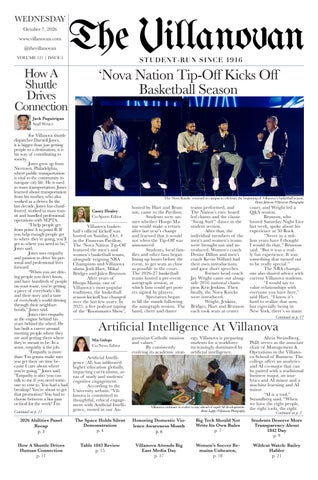
‘Nova Nation Tip-Off Kicks Off Basketball Season
Jack Paguirigan Staff Writer
For Villanova shuttle dispatcher Darnell Jones, it is bigger than just getting people to a destination, it is his way of contributing to society. Jones grew up from Nicetown, Philadelphia, where public transportation is vital to the community to navigate city life. He is used to mass transportation. Jones learned about transportation from his mother, who also worked as a driver. In the last decade, Jones has chauffeured, worked in mass transit and handled professional operations with SEPTA. “I help people get from point A to point B. If you help enough people get to where they’re going, you’ll get to where you need to be,” Jones said. Jones uses empathy and passion to drive his personal and professional lives forward. “When you are driving people you don’t know, and have hundreds of people on your route, you’re getting a piece of everybody’s life and their story and a taste of everybody’s world driving through their neighborhoods,” Jones said. Jones cites empathy as the engine behind his years behind the wheel. He has built a career around meeting people where they are and getting them where they’re meant to be. In a sense, empathy is the job. “Empathy is more than ‘I’m gonna make sure you get there on time because I care about where you’re going,’” Jones said. “Empathy is also ‘you can talk to me if you need someone to vent to. You had a bad breakup? You’re about to get that promotion? You had to choose between a bus pass or food for the week? I’m Continued on p. 11
The ‘Nova Knicks’ returned to campus to celebrate the beginning of Villanova’s basketball season. Dylan Johnson/Villanovan Photography
Casey Healey Co-Sports Editor
Villanova basketball’s official kickoff was hosted on Sunday, Oct. 4 in the Finneran Pavilion. The ‘Nova Nation Tip-Off featured the men’s and women’s basketball teams, alongside reigning NBA Champions and Villanova alums Josh Hart, Mikal Bridges and Jalen Brunson. After years of Hoops Mania, one of Villanova’s most popular traditions, the basketball season kickoff has changed over the last few years. In 2025, a live podcast taping of the ‘Roommates Show’,
hosted by Hart and Brunson, came to the Pavilion. Students were unsure whether Hoops Mania would make a return after last year’s change and learned that it would not when the Tip-Off was announced. Students, local families and other fans began lining up hours before the event, to get seats as close as possible to the court. The 2026-27 basketball teams hosted a pre-event autograph session, at which fans could get posters signed by players. Spectators began to fill the stands following the autograph session. The band, cheer and dance
teams performed, and The Nation’s exec board led chants and the classic “Swag Surf ” dance in the student section. After that, the individual members of the men’s and women’s teams were brought out and introduced. Women’s coach Denise Dillon and men’s coach Kevin Willard had their own introductions and gave short speeches. Former head coach Jay Wright came out alongside 2016 national champion Kris Jenkins. Then finally, the Nova Knicks were introduced. Wright, Jenkins, Bridges, Hart and Brunson each took seats at center
court, and Wright led a Q&A session. Brunson, who hosted Saturday Night Live last week, spoke about his experience at 30 Rock. “Never in a million years have I thought I would do that,” Brunson said. “But it was a really fun experience. It was something that turned out to be really special.” The NBA champions also shared advice with current Villanova students. “I would say to value relationships with everyone you have here,” said Hart. “I know it’s hard to realize that now, but especially being in New York, there’s so many Continued on p. 17
Artificial Intelligence At Villanova Mia Galego
Co-News Editor
Artificial Intelligence (AI) has infiltrated higher education globally, impacting curriculums, areas of study and students’ cognitive engagement. According to the University website.“Villanova is committed to thoughtful, ethical engagement with Artificial Intelligence, rooted in our Au-
gustinian Catholic mission and values.” By consistently evolving its academic strat-
egy, Villanova is preparing students for a workforce increasingly dominated by artificial intelligence.
Villanova continues to evolve to stay ahead of rapid AI developments. Brian Luppy/Villanovan Photography
Alicia Strandberg, PhD, serves as the associate chair of Management & Operations in the Villanova School of Business. The college offers an analytics and AI co-major that can be paired with a traditional business major, an analytics and AI minor and a machine learning and AI minor. “AI is a tool,” Strandberg said. “When we have the right people, the right tools, the right Continued on p. 2
2026 Abilities Panel Recap p. 3
The Space Holds Silent Demonstration p. 4
Honoring Domestic Violence Awareness Month p. 6
Big Tech Should Not Write Its Own Rules p. 7
Students Deserve More Transparency About 1842 Day p. 9
How A Shuttle Drives Human Connection p. 11
Table 1842 Review p. 15
Villanova Attends Big East Media Day p. 17
Women’s Soccer Remains Unbeaten, p. 18
Wildcat Watch: Bailey Habler p. 21
2 | The Villanovan
News 1 Opinion 7 Culture 11 Sports 17
VOL. 121 | ISS. 5 www.villanovan.com @thevillanovan
KAILEY FAHY DYLAN JOHNSON SOPHIE LATESSA EMMA COTE MIA GALEGO MARGARET MILLER EDEN ROSINI AVERY CHALK EMMA TAYLOR CALI CARSS MAGGIE FITZGERALD FINN COURTNEY CASEY HEALEY IRA NIDAMARTHY MASON CANTON ERICK QUEZADA CIARA DURSEE KORIN KOHEN ERIKA MASSIANI MICHAEL BRADLEY JJ Brown
Wednesday, October 7, 2026
NEWS
Editor-in-Chief Editor-in-Chief Managing Editor Abroad Correspondent News Editor News Editor News Editor Opinion Editor Opinion Editor Culture Editor Culture Editor Sports Editor Sports Editor Copy Desk Chief Photography Editor Photography Editor Digital Editor Digital Editor Digital Editor Advisor Advisor
PUBLIC SAFETY BLOTTER Harassment / Indecent Assault / Domestic Violence October 2, FRIAR HALL. An anonymous online crime report was received from an individual who reported being the victim of an Indecent Assault that occurred on campus between 03/19/2023 and 03/25/2023. Liquor Underage / Public Drunkenness October 3, DELUREY HALL. Two male resident students, under the age of 21, appeared in public and were evaluated by Public Safety for alcohol intoxication. Liquor Underage / Public Drunkenness October 3, DELUREY HALL. A male resident student, under the age of 21, appeared in public and was evaluated for alcohol intoxication. Liquor Underage / Public
Drunkenness October 3, MAIN CAMPUS GROUNDS. A female resident student, under the age of 21, appeared in public and was evaluated for intoxication. Criminal Mischief October 3, SULLIVAN HALL. Intentional damage was reported to university property inside a campus building. The value of the damaged property is unknown. Liquor Underage October 3, HEALTH SERVICES BUILDING. A male resident student, under the age of 21, was evaluated for alcohol intoxication. Liquor Underage October 4, KATHARINE HALL. A female resident student, under the age of 21, was evaluated for alcohol intoxication.
Retail Theft October 5, CONNELLY CENTER. A male resident student was observed taking items offered for retail sale without paying. The amount of the loss is $3.29. Theft by Unlawful Taking or Disposition October 5, DROSDICK HALL. A staff member reported a theft of University property from an academic building. The amount of the loss is unknown. Retail Theft October 5, CONNELLY CENTER. Four non affiliated males were observed taking items offered for retail sale without paying for them. The amount of the loss is unknown.
CORRECTIONS
Factual errors are corrected as soon as they are brought to The Villanovan’s attention. Please send an e-mail to villanovan.eic@gmail.com to report errors.
AI Usage At Villanova Mia Galego Co-News Editor Continued from p. 1
use of AI, the right strategies, we can do more, do better, do faster.” Strandberg discussed how changes to VSB’s required courses are implemented to help students stay ahead of rapid technological developments in the workforce. Introduction to Business Analytics is one example of a required course that is consistently revised every semester to include more AI and machine learning in its curriculum. “Our job in that class is to kind of demystify AI, to make sure that when they leave that class they know enough about it to talk knowledgeable in a conversation,” Strandberg said. While Strandberg highlighted the positive effects of using AI, she also commented on the harmful impacts AI can have on student learning. “You can use AI to be more curious, to see how things are working, to get answers to questions, to get access to information that you wouldn’t have had access to otherwise, to kind of have that curiosity,” Strandberg said. “Or you can use AI to say ‘do my homework.’” A VSB junior spoke to The Villanovan about how they use AI for everyday academic tasks. “I would say I definitely use AI on a daily basis, usually in a different capacity for each class,” they said. “I usually use it to guide my thinking, rather than like copy and pasting or like giving me the ideas, but I do use it a lot to make an outline or outline steps to complete an assignment.” While some students have already fully integrated AI into their academic routines, others try to limit their use of it whenever possible. “I try not to use AI when
doing my assignments when not necessary, but I have the machine learning and AI minor, so I am trying to learn how to use it in a way to better improve my career,” an anonymous VSB junior said. Villanova alumnus Pope Leo XIV released his first encyclical last May titled Magnifica Humanitas or “Magnificent Humanity,” writing on “safeguarding the human person in the time of artificial intelligence.” “We must learn, then, how to exercise restraint in the use of AI and to protect our young people from the promise of the perfect machine, from that subtle temptation which renders human thought seemingly superfluous precisely when it is most needed,” the Pope wrote in his encyclical. While AI will continue to impact students’ learning, it is important to understand when these tools have a positive impact on student work and when they can be detrimental to authentic cognitive processes. “With any tool you have people who are using it in good ways and bad ways,” Strandberg said. “I think that comes back to the person and the intent. I am hopeful that people are using it to learn more and do better things.” While VSB has worked to directly integrate AI into its curriculum, all Villanova students can adapt their education and better learn how to effectively use AI through the College of Professional Studies certificate programs. The Villanova College of Engineering also offers a minor in AI engineering that helps students build a strong foundation in artificial intelligence and machine learning. As artificial intelligence evolves, Villanova’s academic leadership will continue to adapt in ways that best support student success. This marks a new chapter for the University that everybody is learning to navigate together.
CLAS Majors Fair Recap Eliana Rodríguez Staff Writer On Friday, Oct. 2, the College of Liberal Arts and Sciences (CLAS) Majors and Minors Fair was held in the Villanova Room of the Connelly Center. The Ellis Center in the College of Liberal Arts and Sciences hosts this event annually to display the numerous majors, minors, study abroad and academic resources available to students in CLAS who are deciding on their courses of study or interested in exploring new opportunities. The fair was also a great opportunity for first-year students who are undecided to get more information about areas of study in CLAS. As a Professor Emeritus in one of the largest majors in CLAS and the most common pre-law track, Matthew Kerbel continues to come back to the Majors and Minors Fair because of the students. “I love having that opportunity to meet new students,” Kerbel said. “I always love meeting new students, and I love connecting a little with something that might be interesting to them.” This love for the students and their work is shared across all departments, as evidenced by
Professor Mark Doorely. Doorely has worked at Villanova for 30 years and helped found the Ethics Department in 1999. He loves both the Ethics Department and the Majors and Minors Fair for the same reason as Kerbel. “I love working with students, and we get to introduce them to these really fundamental questions about how to live a good life,” Doorley said. Students who have declared their majors also attended the fair to celebrate and share all that Villanova and CLAS have brought them. Students from each major worked alongside professors to share their experiences with the various majors and minors. As students, they could advise curious students about their experience with the program. Molly Duffy discussed her experience with her Writing and Rhetoric minor at her table. Additionally, she talked about her interest in working at the fair. “I like working at this fair because I like to meet new freshmen students and try to understand where their minds are at when it comes to choosing their path for the future,” Duffy said. Overall, the Fair accomplished its goal of offering students an opportunity for self-discovery. The event drew attention to doing what one feels passionate about and enjoys without stress.
The CLAS Majors and Minors Fair took place in the Villanova Room of the Connelly Center. Graydon Paul/Villanovan Photography
Wednesday, October 7, 2026
Margaret Miller Co-News Editor Jean Rodriguez-Perez Staff Writer On Monday, Oct. 5, in Driscoll 134, Special Olympics and LEVEL hosted a panel featuring faculty and students, speaking about diverse abilities and the mission of inclusion. The panelists included Erin Wiggins, MBA, MS, an assistant teaching instructor and director of American Sign Language at Villanova, Dr. Christa S. Bialka, Ed.D. an associate professor and director of the Disability and Deaf Studies Program at the University, Gabriel Donovan, the graduate assistant of the Office of Access and Disability Services, Amelia Tawadros, a board member of LEVEL, Sadie McCallum, a member of LEVEL and disability advocate and Natalie, a Special Olympics Pennsylvania athlete and athlete representative for Villanova Special Olympics’ Bocce committee. The moderators asked the panelists about what inclusive spaces look like for them. Dr. Bialka answered first and spoke about how she teaches students about the differences between accessibility and inclusion and the importance of both.
NEWS
The Villanovan | 3
2026 Abilities Panel Recap “ Even because you can access a space does not mean you feel like you are a part of this thing,” Dr. Bialka said. “It’s not like, oh, you’re here and isn’t that great. How do you ensure that people feel valued and validated?” Tawadros talked about the impact of the Office of Access and Disability Services in her college experience, along with LEVEL, the University’s organization for disability activism. Her experiences in the office and the club have transformed her time at Villanova. “It’s the kind of place where it doesn’t matter what disabilities students are dealing with, what walks of the world that we all come from,” Tawadros said. “It’s a place where we can all appreciate one another and
find value in one another, even if we have nothing alike on paper” Wiggins talked about the importance of providing individuals with accommodations, further emphasizing the point of inclusion. She specifically spoke to how individuals can use different forms of communication as a way to ensure inclusion for all. “For Deaf people, inclusion could mean communication access,” Wiggins said. “If you just learn a few signs, it’s amazing. People would really really appreciate it even if you knew just how to say hi, how are you.” McCallum spoke on the importance of designs that are accessible and how important accessibility is in inclusive spaces. She said that she can almost instantly tell whether an individual with a disability was consulted
LEVEL welcomed Max Gomez to campus to share his story of resilience following a motocross accident. Courtesy of @villanova_level
in the designing of a space. This passion has encouraged her to pursue a career in engineering, helping to design mobility devices and other products for individuals with disabilities. “As someone who’s used mobility devices since I was born, a very obvious majority of us do not incorporate actual disabled perspectives into that [process],” But inclusion, I think, is a little bit different. Because, to Gabe’s point, I find it a little bit frustrating when people say, well, I don’t see it.” A theme throughout the entirety of the panel was an emphasis on how inclusion and accessibility are not the same thing. Even if people have an intention to be inclusive, making sure spaces are accessible for all individuals is equally as important. The panelists discussed important steps and initiatives to take to make both a more inclusive and accessible world for all. The event was open to all students and was ACS approved, encouraging individuals who are not directly involved with Villanova Special Olympics and LEVEL to attend. Having this event now was especially important, as Villanova University is gearing up to host the 38th annual Fall Festival from Nov. 13-15. Making both inclusion and accessibility a year-round conversation between students is an aim for both organizations.
LEVEL Guest Speaker: Max Gomez Discussion Recap
gold medalist who helped create a specialized racing foot for Gomez. Gomez went on to compete in the Summer X Games in Los Angeles, where he finished fourth. On Thursday, Oct. 1, from Greg Hannah, a LEVEL 7 p.m. to 8 p.m., Villanova students gathered to hear Max Gomez share coordinator who helped create the video with a team, then led a queshis story of resilience following a tion-and-answer discussion with life-changing motocross accident. Gomez, a former motocross Gomez. When Hannah asked racer, amputee, personal trainer and gym owner, discussed his jour- Gomez about being invited to the X Games, Gomez described the ney of recovering from his injury experience as one of the biggest to returning to racing and helping moments of his life. others overcome their own chal“Growing up, I was so lenges. infatuated with sports and racing The event began with a that my password to everything was video showing Gomez’s childhood X-Games,” Gomez said. and his early passion for dirt bike After competing in the X racing. The video also detailed his Games, Gomez continued racing accident that occurred on June 7, for several years. He competed in 2012, at the AMA Amateur Nathe Extremity Games and raced tional Regional Motocross Championship at Loretta Lynn Ranch in against able-bodied competitors, supported by sponsors. Pennsylvania. In 2019, Gomez began a During the fourth race of new chapter by entering the fitness the day, Gomez was working his industry. His own physical recovery way toward the front of the pack played a major role in this decision. when he reached a wet section of After leaving the hospital, Gomez the track. After losing traction on lost significant weight and began a large jump, Gomez attempted working out consistently to rebuild to accelerate over it but landed his body. Fitness eventually helped approximately 30 feet below. The impact shattered his ankle and sev- him feel more comfortable in his own skin and led him to start trainered his arteries, eventually resulting others. ing in the amputation of his leg. During the COVID-19 Following the accident, pandemic, Gomez began training Gomez initially struggled with his new circumstances. His father sold clients in their backyards. This experience eventually led him to his dirt bike, but Gomez later conopen his own gym, AMP’D Fitness. nected with amputee racers who Gomez also discussed how showed him that he could continue his disability has influenced his pursuing motocross. work with others. He shared the Gomez eventually comstory of a woman who had to stop peted in the Extremity Games, attending his gym because she an event for athletes with disabilstruggled to pay for her prosthetic ities. He also met Mike Schultz, a Veronica King Staff Writer
leg. Gomez raised $20,000 to help her afford the prosthetic and continue her membership. Gomez emphasized the importance of having a strong support system, something he said his parents taught him from a young age. “Support is huge, and you need to have good people around you that will uplift you,” Gomez said. His connection to motocross has also remained an important part of his life. Gomez said riding allows him to escape from the challenges surrounding his disability
and return to something that has always been familiar to him. “Dirt bikes were in my blood from an early age,” Gomez said. “It was the only time I felt normal despite my injury.” Throughout the discussion, Gomez encouraged students to view obstacles as something they can adapt to rather than something that must stop them from moving forward. His experiences with motocross, fitness and the amputee community continue to shape the way he approaches challenges and supports others.
LEVEL welcomed Max Gomez to campus to share his story of resilience following a motocross accident. Courtesy of @villanova_level
Wednesday, October 7, 2026
NEWS
4 | The Villanovan
This Week In Politics: Military Moves Addy McDougall Political Columnist On Wednesday, Sept. 30, United States Secretary of War Pete Hegseth, formerly Secretary of Defense, delivered his second annual “State of the Force Address,” which outlined the administration’s strategic goals and initiatives for the United States military. Addressing hundreds of military officers and service members at Marine Corps Base Quantico in Virginia, Hegseth began by highlighting the department’s successes under his leadership. He described how he has upheld the three core priorities he pledged to champion as Secretary of Defense. “I’m proud to stand on this stage and report that the warrior ethos has been revived,” Hegseth said. “Our military is being rebuilt, and American deterrence is back.” He then introduced six new initiatives for the Department of War. The first is the creation of a new combatant command, Autonomous Warfare Command, designed to advance autonomous and robotic capabilities across U.S. military forces. He next introduced “Project Meridian,” an initiative partnering with the private sector to study the future of warfare. He also outlined a program to strengthen the infrastructure
and self-sufficiency of U.S. military bases, known as “Fortress America.” Hegseth also called for the installation of a new military base through “the Next Great American Base,” where leaders from each state would give a pitch as to why their state should host the new base. He then introduced the “America’s Corps of Cadets,” which would expand military training beyond the country’s existing military service academies through partnerships with additional higher education institutions, including Louisiana State University, Liberty University, Tuskegee University, Mississippi State University and Hillsdale College. Finally, Hegseth described plans for establishing an Office of Religious Affairs, pledging to provide “first-class religious support, wherever we send our warriors.” Hegseth also confirmed reductions in the military’s leadership,
announcing he has cut 10% of the force’s generals and admirals and slashed general officer slots by 10%. He also denounced previous military policies as “woke,” declaring “we are no longer the Woke Department,” and slammed diversity quotas, asserting “diversity is not our strength, unity is our strength.” Also on Sept. 30, the U.S. military forces officially withdrew from Iraq, ending two decades of American involvement in the country. This completed the agreement made by the Biden administration to remove all U.S. military personnel in Iraq by 2026. The 1,500 remaining personnel in Iraq have been withdrawn, with the anti-ISIS coalition relocating to Jordan to focus on counter-ISIS operations in Syria. American involvement in Iraq came with significant human and financial costs, with an estimated 210,000 Iraqi civilians and 4,599 U.S.
Pete Hegseth is evolving his military approach as Secretary of Defense. Courtesy of Reuters Images
service members killed between 2003 and 2023, as well as costing more than 2.8 trillion in taxpayer dollars, according to Brown University’s Costs of War Project. Iraqi leaders and American military commanders marked the official end of the U.S. mission at a ceremony in Baghdad, Iraq’s capital city. “The primary responsibility for addressing Iraq’s remaining security challenges, including ISIS remnants and Iran-aligned militias that undermine Iraqi sovereignty and regional stability, now rests with the Government of Iraq,” spokesman Sean Parnell said in a statement released by the Pentagon. Iran celebrated the U.S. withdrawal from Iraq, viewing the departure as an opportunity to gain greater influence in the region. Tehran has long pressured Iraq to expel U.S. forces and used Iraq’s destabilization to establish close ties with Iraqi government officials and arm militant groups. Iran’s Islamic Revolutionary Guard Corps has also advanced its paramilitary operations in Iraq, which could further threaten Iraq’s security in the absence of American forces. Hegseth’s State of the Force address and the withdrawal of American forces from Iraq demonstrate an evolving military approach, as the U.S. grapples with new priorities at home while shifting security strategies in the Middle East.
The Space Holds Silent Demonstration made the US a dangerous place for pregnant women. “We really wanted to bring attention to maternal mortality,” junior and Vice President of ComDuring the week of Sept. 28 munications Angeline Maestre said. to Oct. 2, The Space, an advocacy “It’s just an issue that doesn’t get club for reproductive health, rights a lot of attention, especially on a college campus.” and justice on Villanova’s campus, In a nation that is conheld a silent demonstration highstantly locked in intense debates lighting the reality of maternal over access to abortions and other mortality in the United States. forms of reproductive healthcare, Located across Austin the mother’s health has often been Hall next to the Riley Ellipse, the demonstration featured small white pushed down the list of important paper hearts, each of the 65 repre- considerations. The Space has posted senting 10 of the 649 women’s lives educational content on racial and lost to preventable causes during geographic disparities that worsen pregnancy in the United States in that reality. 2024. Southern and rural states “In the U.S., maternal morhave higher maternal mortality tality is a striking cause of death compared to all other high-income rates than northern states, with the Northeast region having the lowest countries,” senior and outgoing numbers. Co-President Sophia Lemmons Those statistics are a result said. “[649 deaths] is a staggering of limited access to healthcare, statistic. Some high-income counparticularly rural “maternal health tries have less than 10.” The Space also launched an deserts” that afflict countless comeducational social media campaign munities. Black women face disprospotlighting the issue. The posts defined maternal mortality as “the portionate risk during pregnandeath of a woman during or within cy. The Space acknowledges the collective Sister Song, a group of 42 days after pregnancy.” women of color who first coined The Space made it absothe term “reproductive justice” as lutely clear that this issue is one of they struggled against intersectionreproductive justice and injustice. al discriminatory practices. More than 80 percent of Black women in the US the deaths recorded in the US during the defined time period are face a maternal mortality rate three times higher than white women. preventable. They are systematically barred Yet, the difficulties and from proper care, not believed in injustices mothers face in healthcare, whether that is discrimination healthcare settings and otherwise disadvantaged. based on race, lack of access to “It’s quite frightening that certain forms of care or lack of nearly all of the deaths in those 65 resources based on location, have Annie Ou Staff Writer
hearts could have been prevented with proper medical care,” junior and incoming President Scarlett Quisenberry said. Beyond raising awareness for the crucial issue of maternal mortality, The Space also hopes that this demonstration will encourage viewers to rethink what reproductive justice means. The goal is to broaden the conversations had on campus about reproductive health and justice on campus beyond just a pro-life/ pro-choice debate about abortion access. “The [Respect Life Month] is coming up, so that was the timing [we chose],” Lemmons said. “We wanted to kind of offer another perspective and complicate the conversation. We thought that maternal deaths are something that is very hard to argue with.” The difficulties The Space has faced as a pro-reproductive health and justice organization on a Catholic campus are very unique. It has historically been limited in how it can express its demonstrations, making this educational week all the more important for people to pay attention to. “I think we have a very diverse student body, and I really think that The Space serves a really important role in exemplifying that,” Lemmons said. “Just because we are a Catholic campus doesn’t mean we can’t have these conversations and care about things that don’t necessarily align with some aspects of Catholicism. The Space has always been a really safe space for me.” For students who want to make a difference, the graph-
ics urged viewers to vote for pro-healthcare policies, donate to reproductive healthcare organizations and get involved with The Space. “I think that people just don’t really think about [reproductive justice] too much because it seems like they associate it with just abortion,” Quisenberry said. “And that’s not really what it’s all about. It includes, of course, maternal mortality. It includes access to contraceptive care. It’s holistic and comprehensive sexual education. It’s maternity leave. It’s universal health care [and] dismantling rape culture. It’s changing the adoption industry and foster care industry.” As they work to complicate conversations about reproductive health and care at Villanova, The Space wants students to know it’s open to everyone. “We are open to all views,” Lemmons said. “I know we come off as a pro-reproductive health club for women, but anyone can support these views, and also anyone can challenge us. We’re having a general body meeting the week after fall break, where we are curious to hear how the wider campus received the demonstration.” The Space’s education week on the reality of maternal mortality in the US provided students with valuable knowledge and resources to expand their own opinions on reproductive health and accessibility to healthcare. The full campaign can be found on @thespacevillanova on Instagram. Students are encouraged to stay up to date on the latest with The Space.
Wednesday, October 7, 2026
The Villanovan | 5
NEWS
Lunch With LePage Hosts Jamie McGhee Alee Ryon Staff Writer On Friday, Oct. 2, the Albert LePage Center for History in the Public Interest hosted LePage Center grantee Jamie McGhee for a talk about her interactive digital novel and hypertext game called Hunger on the Tracks. The project focuses on the Pullman strike of 1894, a nationwide railroad strike boycott, led by Eugene V. Debs. Even today, more than 130 years later, this strike’s impacts are still felt all across the United States. The project is set in Pullman, Illinois, “the most polished, perfect town in these great United States,” said McGhee. “The houses are grand and opulent, the streets are practically paved with gold,” McGhee said. Pullman was a company town, which means workers lived in Pullman and worked at the Pullman factory. “Pull back the curtain, and Pullman is definitely not what it seems,” McGhee said. “The reality of Pullman is far, far bleaker”. The Pullman Palace Car Company controls everything in this town, and while it paid its employees’ wages, it owned the homes, grocery stores and hospitals in town. Employees were monitored in every aspect of
their lives. The wealthy community members enjoyed the fruits of employees’ hard-earned labor. The project encapsulates real-life historical events, such as the deep economic depression of 1893. In the game, employees’ pay gets slashed, just as it did in history. The game begins in May 1894, when the Pullman workers begin striking at the Pullman Palace Car Company. The player helps lead the strike by working with people throughout Pullman town, such as woodworkers, blacksmiths and painters. Players are faced with deep moral dilemmas throughout the game, many of which reflect real-life situations that the workers actually experienced. By June 1984, labor organizer Debs joined the effort and helped turn the strike into a national boycott. The strike, which began with 3,000 workers walking off the job, exponentially grew to 250,000 railroad workers across the country who refused to touch any train involved with the Pullman Palace Car Company. By July 3, 1894, President Grover Cleveland sent U.S. troops to shut down the strike, which caused violence to escalate substantially. Within the next few weeks, alarming numbers of workers and civilians were killed, and upon Debs’
arrest, the entire strike fell apart, causing the Pullman Palace Car Company to win and reopen. Workers were forced by the company to sign pledges promising to never join labor unions or strike again. In “Hunger on the Tracks,” players visit real-life locations significant to the strike. Players visit the Pullman Factory, the manufacturing hub of George Pullman’s company. They also visit Turner Hall, where workers secretly met at night to plan the strike. Players may visit Hotel Florence, where Pullman hid out. “ The hotel also hosted the military officials who’d been sent to strike down the strike,” McGhee said. “See, high overlooking the company town, this hotel symbolized the gap between the rich and the poor.” The project also explores racism within the strike. The Pullman strikers denied thousands of Black workers the ability to participate in the strike. McGhee recalled how many historians believe this action contributed to their loss. Today, more than seven million people are unemployed, and many struggle with debt, showing the lingering effects of strike. “AI, the bubble that it is, is still threatening to replace entire industries,” McGhee said. “Across the whole country, people feel, I feel, exhausted and anxious and powerless.
The point of the game is that American workers have faced dark times before.” She recalled how the United States has a long history of workers rising up in the face of exploitation, and through strikes, sit-ins and armed protests, ordinary people can force change. “As an interactive narrative, Hunger on the Tracks reminds today’s workers, and the next generation who will become workers, that we have risen before, and we will rise again.” McGhee credited numerous archives for their contributions to her research during her talk. She specifically thanked the Newberry Library Pullman Collection, the National Pullman Porter Museum, the Chicago Public Library and the Chicago History Museum. The interactive novella is completely free to make it as accessible as possible for as many potential players as possible. Depending on the choices the player makes, it may take between 35 and 65 minutes, and although it does mirror the historical ending of the strike, the player has many different experiences to choose from. On Wednesday, Oct. 7, the LePage Center will host an in-person event in Villanova’s Topper Theater, featuring historians and historical theologians. All are encouraged to remain engaged with the LePage Center and
“Woman of No Consequence” Lecture And Q&A Veronica King Staff Writer On Tuesday, Sept. 29, Kalpana Karunakaran, an associate professor at the Indian Institute of Technology Madras, spoke to the Villanova community about her maternal grandmother’s life, writing and pursuit of intellectual growth during a lecture about her book A Woman of No Consequence: Memory, Letters, and Resistance in Madras. The event was sponsored by the Department of Asian Studies, the Center for Political Theology, the Department of Global Interdisciplinary Studies and the Department of Philosophy and Gender and Women’s Studies. Dr. Tsering Wangmo, a professor in the English Department, moderated the discussion. Karunakaran’s lecture examined the life of her grandmother, Pankajam, through an autobiography she wrote between 1949 and 1995, along with her short stories, poetry, diaries and letters. Karunakaran discovered the writings in an old wooden box while initially searching for material about her mother, Mythily Sivaraman. Karunakaran began the lecture by asking why a woman might choose to tell the story of a female ancestor and how a biography can capture the life of an extraordinary woman living in an otherwise “unexceptional social universe.” She first discussed her mother, Mythily Sivaraman, a
prominent trade unionist, women’s rights activist, writer and feminist from Tamil Nadu. Sivaraman spent decades working with agricultural laborers, factory workers and women from different social backgrounds while campaigning against class exploitation, caste oppression and patriarchy. Karunakaran then traced her family history to Subbalakshmi, Sivaraman’s grandmother. Subbalakshmi was married at 11 and became a mother at 14. Although she never attended school, she taught herself English by reading newspapers to her grandfather and developed a lifelong interest in politics. During the 1920s, she became involved in the anti-colonial movement in Madras before her family discovered her participation and confined her to the household. Pankajam, Subbalakshmi’s only surviving child, also faced restrictions on her education. She attended six years of school before being pulled out in ninth grade and married at 17. However, she continued to develop an intellectual life by writing essays, poetry and romantic and short stories in Tamil and English. Her writings described her childhood along the Coromandel coast, friendships across caste and religious boundaries, and her desire for education. Karunakaran explained that Pankajam’s fiction became another way for her to tell her own story. Several female characters represented aspects of Pankajam’s experiences, allowing her to address subjects that were difficult to write about directly.
Karunakaran described these works as “fictionalized autobiographies.” Pankajam’s letters and diaries also helped Karunakaran reconstruct her grandmother’s intellectual development. The letters allowed Karunakaran to “trace a housewife’s quest for intellectual growth and her efforts to keep alive a life of the mind despite the grind of household chores and caregiving duties.” One of the most significant pieces of writing Karunakaran shared was Pankajam’s description of herself as “A woman of no consequence at all.” Despite that self-description, the writings she left behind became the foundation for Karunakaran’s exploration of her grandmother’s life and the historical period in which she lived. During the Q&A, Karunakaran discussed how writing the book differed from her academic work. She said academic writing can be shaped by existing scholarship and disciplinary expectations,
while this project allowed her to approach her family members as people whose lives had left behind stories worth reconstructing. “I was leading with the story,” Karunakaran said. Karunakaran explained that the story connected the research and made the book accessible beyond an academic audience. An audience member later asked what Pankajam expected Karunakaran to do with the wooden box of writings. Karunakaran said she believed her grandmother hoped she would read them, recalling that Pankajam had introduced her to books and frequently encouraged her to engage with her writing. The Q&A ultimately returned to education, family and the ways women navigated expectations across generations. Through Pankajam’s writings, Karunakaran presented a personal family archive as a record of a changing India and the intellectual life of a woman who once described herself as having no
Karunakaran’s maternal grandmother’s learned English by reading newspapers. Dylan Johnson/Villanovan Photography
6 | The Villanovan
Wednesday, October 7, 2026
NEWS
Honoring Domestic Violence Awareness Month pens and pins while speaking with representatives. A board displaying domestic violence statistics was also used to encourage conversations Villanova began its Domestic around the issue. Violence Awareness Month program“All our services are free and ming Thursday, Oct. 1, by hosting confidential to all Villanova students Honoring Domestic Violence Aware- while they attend,” Abby Magee, outness Month from 10 a.m. to noon at reach and education specialist for the the Riley Ellipse. Domestic Abuse Project of Delaware The event brought together County, said. “We are here especially campus and community partners, to promote our hotline that is availand created a sea of purple across the able because a hotline can be a jarring Ellipse. word to students, so I’m here to have Students could stop by tables, conversations about how they can call take informational materials, ask ques- the hotline to talk to someone over the tions and learn more about resources phone about any issues they have.” available to those affected by domestic The Delaware County Victim violence, sexual assault and unhealthy Assistance Center also supported the relationships. event. The center offers resources for The Title IX Office hosted a individuals who have experienced table with educational resources and sexual assault. Its table included inforincentives, including pens, bracelets mational materials, highlighters, pens and purple domestic violence awareand stickers. ness ribbons and pins. Kathryn Poet, The Department of Public sexual assault resource coordinator Safety also participated by providing for the Villanova community, empha- information about campus safety sized that support for students extends resources. Students could pick up beyond a single event. materials, speak with representatives “This is not just a one-stop and meet Taffy, Public Safety’s dog. table,” Poet said. “We are here, and The Office of Health Prowe intertwine all these messages in all motion joined the campus partners of the work that we do.” in connecting students with resources The Domestic Abuse Project and information about prevention, of Delaware County also attended the safety and support. One Love, a event, providing information about its student organization focused on eduservices and hotline for students excating students about healthy and unperiencing domestic abuse. Students healthy relationships, also emphasized could take informational materials, the importance of continuing converVeronica King Staff Writer
sations about relationship violence on college campuses. “The reality is that relationship violence is prevalent on college campuses, and recent incidents at schools like Cornell are a reminder that no campus or community is completely removed from these issues,” Hudson Zivic, president of One Love, said. “That makes it even more important for students to know that there are resources available and people they can trust.” Zivic also said awareness requires students to engage with difficult subjects. “As someone involved with
One Love, I think awareness also means being willing to have conversations that can be uncomfortable,” Zivic said. “Domestic violence and unhealthy relationships can be difficult topics to discuss, but avoiding them doesn’t make them less prevalent.” Donuts were offered to encourage students to stop by and start conversations with representatives. As Domestic Violence Awareness Month continues, the event highlighted the resources available to Villanova students and the importance of knowing where to turn for support.
Villanova’s public safety dog, Taffy, and her owner were found around campus. Graydon Paul/Villanovan Photography
Wednesday, October 7, 2026
The Villanovan | 7
OPINION
OPINION
All Majors Should Consider The Undergrad Ethics Fellowship James Schmidt Staff Writer What does an ethics fellowship have to do with a quantitative finance major? When applying for the Undergraduate Ethics Fellowship last year, I asked myself this question countless times. Now that I’ve completed it, I believe Villanova students in every major have valuable perspectives to contribute to the program and should consider applying. Sponsored by a gift from John T. McLaughlin, M.D., a 1937 graduate of the College of Liberal Arts and Sciences, the Undergraduate Ethics Fellowship awards $3,000 stipends each year to students to design and carry out a project of their choosing centered on an ethical discussion at Villanova. Fellowships are awarded in the late spring semester and run for the entire following academic year. Dr. Peter Fay, Catherine of Siena Teaching Scholar in Villanova’s Ethics Program, reviews applications each year. “Fellows create ethics-focused programming, lead discussions about the ethical issues studied and demonstrate [their] academic, artistic and leadership abilities in service to the Villanova community,” Fay said. That combination of experiences, he said, is “especially attractive to employers and graduate school admissions committees.” In collaboration with a faculty mentor in the Ethics Pro-
Liam Foley Staff Writer
gram, students apply by developing a two-page project proposal that outlines the topic they plan to explore, how it connects to an ethical discussion and how they intend to contribute to that discussion on campus. “The strongest fellowship proposals have a sharp, specific topic in ethics that they plan to research and specific plans for the public-facing output that they will create through the fellowship,” Fay said. Regardless of major, there is so much to learn from an Undergraduate Ethics Fellowship. My fellowship last year focused on how Philadelphia’s mural artists use their work to tell stories about underserved communities in the city, which, on the surface, seemed unrelated to my studies. However, through interviews and guest speaker events with representatives from Philadelphia’s flagship mural arts program, I frequently ran into questions that connected to my finance coursework: How should community organizations secure sustainable funding? What role should public and private donors play in deciding which projects receive support? How can an organization balance financial constraints with its responsibility to the communities it serves? The fellowship also helped me develop skills that are useful in many careers, such as planning events, managing a budget and asking thoughtful questions during interviews. Addie Arvidson, a senior
comprehensive science major, is using her fellowship to examine the ethics of homelessness and substance use disorder through a project centered on low-barrier healthcare in Philadelphia. “One of my favorite experiences at Villanova has been volunteering with Back on My Feet, an organization that empowers people experiencing homelessness and addiction through running, community and support services,” Arvidson said. She also worked as a research assistant in Copenhagen, Denmark, studying the intersection of youth homelessness, substance use and mental health, an experience that inspired her goal of becoming a primary care physician assistant serving underserved communities. “The fellowship seemed like a great opportunity to build on these experiences while raising awareness about barriers to healthcare access and exploring how we, as students, can get involved,” Arvidson said. Arvidson plans to open her fellowship to the Villanova community through two interactive events in the spring semester. “My hope is that the first [event] will be a discussion centered around the ethics of low-barrier healthcare,” Arvidson said. “The event will also provide an opportunity to share stories from individuals with firsthand experience of housing instability and other barriers to healthcare access. These stories will come from interviews I will be conducting during
the second half of the fall semester.” Arvidson continued by expanding on her other event idea. “I am planning for the second event to give Villanova students the opportunity to learn about low-barrier healthcare and street medicine directly from healthcare and service providers in the Philadelphia area.” The ideas behind my fellowship last year and Arvidson’s this year both share a focus on Philadelphia’s underserved communities, but she is approaching it through low-barrier healthcare, while I approached it through public art. This shows how the Undergraduate Ethics Fellowship lets students tailor their projects to their unique interests and experiences. “I was initially hesitant to apply because I am not an ethics student and had only taken one ethics course at Villanova,” Arvidson said. “However, the fellowship has helped me realize that ethics is an important consideration in every field, major and career. It has shown me that we can all benefit from thinking critically about how we engage with the world and how we can approach our work and communities with greater ethical awareness.” Applications for next year’s fellowships will open next semester in the spring, and students interested in learning more can contact the program at EthicsFellows@ villanova.edu. Any student with an ethical question they’re passionate about should consider applying.
Big Tech Should Not Write Its Own Rules
On Tuesday, the most powerful people in American technology gathered at the White House for lunch with the president. Mark Zuckerberg, Alex Karp, Elon Musk, Jeff Bezos, Dario Amodei and Jensen Huang all made the trip. They left having signed a commitment to build strong internal AI controls, which Trump described as “morally binding.” The president told reporters he is seeing “tremendous self-policing” amongst major AI companies. Afterward, a reporter asked Palantir’s CEO a simple question: “Mr. Karp, is self-regulation dangerous?” His answer: “I’m trying to self-regulate myself. I have all these addictions. I’m trying to self-regulate.” Karp meant to be funny, but his response was tone-deaf. A man whose company builds AI-powered surveillance and targeting software for governments was asked whether his industry should be trusted to police itself, and he treated the question as a punchline. That was not wit. It was hubris, and a flippant mockery of a reporter asking the question millions of Americans are asking. This question deserves a
serious answer, so here is mine: yes, AI self-regulation is dangerous. Regulation is necessary, but the companies being regulated cannot be the ones leading it. Today’s wave of self-regulation may look virtuous, but it is a serious and predictable step in the wrong direction. The tech elite are not embracing oversight and “self-policing” out of conviction. They are accepting it out of necessity. The pressure to rein in AI is mounting fast, and regulation is coming one way or another. A new generation of lawmakers is heading to Capitol Hill, among them members of Gen Z, the generation that arguably understands AI’s promise and its pitfalls better than any other. We grew up surrounded by algorithms and were the first to experience AI’s arrival in higher education firsthand. Before they arrive, the AI industry has a window to self-regulate, institutionalizing rules that serve its own incentives. This is a highly strategic, yet incendiary, move on the part of the tech elite. It’s analogous to an oligarchy granting the masses democracy out of fear of revolt while ensuring that the new system still works in the elite’s favor. Consider Tsar Nicholas II’s October Manifesto of 1905, which prom-
Big Tech companies should not be able to write their own rules. Courtesy of Reuters Images
ised Russians an elected Duma under the pressure of revolution, only for the Tsar to curb its powers and later rig its elections toward the landed aristocracy. This type of dynamic is unfolding now within America’s tech elite. Donald Trump is not a neutral moral referee here. He is part of this group, invested in the AI boom and aligned with the executives who flanked him Tuesday, working to keep the money flowing for as long as possible. By moving first, they make sure the next generation of lawmakers cannot reshape the industry in ways that might cost
them immense profits for the sake of human dignity. There is no stopping what has already begun. Self-regulation is here. The pledge is signed, the framing is set and the playbook is in motion. And it will likely produce a system that makes further regulation of AI companies increasingly difficult. The incoming political class, and the think tanks and advocates who will equip them, must stop planning for a blank slate. They will inherit an entrenched structure designed to disadvantage them from day one. They need to arrive ready to meet this now skewed system where it’s at.
8 | The Villanovan
Wednesday, October 7, 2026
OPINION
EDITORIAL BOARD KAILEY FAHY Editor-in-Chief DYLAN JOHNSON Editor-in-Chief SOPHIE LATESSA Managing Editor AVERY CHALK Opinion Editor EMMA TAYLOR Opinion Editor
LETTERS TO THE EDITORS The Villanovan encourages all members of the Villanova community to voice their opinions. Letters to the editors may be submitted via e-mail to villanovan.eic@gmail.com. Letters must not exceed 500 words and must be signed. No anonymous letters will be published. All submissions become property of The Villanovan and are subject to editing for clarity and space.
POLICY
The unsigned editorial that appears is the opinion of The Villanovan as determined by the majority of the Editorial Board. Other columns, letters and artwork represent the opinions of their authors and do not necessarily reflect the position of The Villanovan.
Table 1842: An Innovative But Unnecessary Addition Maggie D’Amaro Staff Writer Table 1842, located on Villanova’s Cabrini Campus, is Villanova Dining’s newest concept. The restaurant-style dining experience offers family-style meals with a rotating menu. However, after dining at Table 1842 during the restaurant’s opening week, I do not think this style of dining was a necessary addition for Villanova. With an open kitchen, familiar and attentive dining staff and overall good food, Table 1842 brings a fresh, new dinner experience to Villanova. The problem is how few students it is actually built for. With the restaurant only being open on Tuesdays, Wednesdays and Thursdays between 5:00 p.m. and 8:30 p.m., there is only a limited amount of time for students to go and eat. With so many of Villanova’s students being involved in clubs and organizations that meet on Villanova’s Main campus during the weekdays, these hours do not offer many students the chance to go. And only being able to make reservations for the day you intend to eat the meal, does not give students much time to plan ahead. “Right now we wanted to start slow because we also have, like, Grubhub, that is a new piece of it, with the reservation system,” Andrew Camuso, executive director of Villanova dining services, said. “So, we wanted to do three days where we
pay out of pocket with either a credit or debit card. Senior Claire Priebke visited Table 1842 during opening week and shared the harvest table-inspired menu with her friends. “The idea behind sitting down for a nice meal with your friends is amazing; however, you cannot make it a ‘tradition’ when it takes so much planning,” Priebke said. “By the time you go back, the menu’s already changed. It feels like more of a one-time experience than a place to eat.” And maybe Table 1842 is meant to be just that, a special experience you have with friends for someone’s birthday or after taking a difficult exam. However, it seems to be taking up a lot of space and valuable resources at Villanova’s Cabrini Campus, which has already struggled with not being able to provide enough dining options for its students. So, in addition to opening and celebrating Table 1842 opened to students for the first time on Tuesday, Sept. 29. Table 1842, also focusing resources Dylan Johnson/Villanovan Photography on somewhere where students can eat thought we would capture the most plan when to go. The rotating menu every day of the week, and not have students. But anything is possible. does not offer the consistency students to plan when they want to go, should We could do Monday-Friday; we’ve need to make those choices. be another initiative. While there have talked about brunch.” While meal swipes, points and been major improvements to CabriAdditionally, while the roNovabucks are a great way for a mani’s dining options, there is still work tating menu offers a new experience jority of students to access the upscale to do. compared to other Villanova dining dining experience on a college budget, Table 1842 is an innovative options, it can make it hard for stuit isolates students not on a meal plan. and interesting concept developed by dents to plan when to go. Students are As a senior, I do not have a meal plan Villanova Dining. I think with a few able to pay with meal swipes, Novaand rely on my friends graciously tweaks and expanded hours, it has bucks, points, or a debit or credit card. offering their guest meals to allow me the ability to become a beloved staple While accepting the dining plan is a to eat with them. However, even if I on Villanova’s campus. Even despite great and accessible option, with only wanted to visit Table 1842 again for a the opening-week challenges, there is a set number of meals, Novabucks special occasion, they don’t currently clearly great potential for Villanova and points, students need to be able to accept guest meals. I would have to Dining’s newest addition.
The Importance Of Embracing Living Arrangments
me that I shouldn’t stress or obsess over things outside my control. Longitudinal studies on first-year university transitions show that freshmen who lean I counted down the days toward an external locus of conuntil the housing placements were trol experience significantly higher released, eager to know where I levels of anxiety, according to a would live my freshman year. To study by the National Library of my surprise and initial disappoint- Medicine. An external locus of ment, I was placed in a triple with control is believing that outside my chosen roommate and a ranfactors, rather than your own acdom roommate on Villanova Cam- tions, dictate your life. This is what pus. This was a curveball, to say I got caught up in, and so do many the least. Although I was initially other freshmen. This lesson applies disappointed with my housing to more than dorm assignments. situation, I have come to realize Being in a new place on your own that I not only love my living arnaturally results in having less rangement, but I have also learned control over your life. Living in this valuable lessons from it that could environment means relinquishing apply to other freshmen. some control, so adapting to what When I first got my housing gets thrown at you is better than assignment, my vision for freshstressing about it. Get comfortable man year shattered. I pictured with being uncomfortable. living with my chosen roommate Not only was I upset that on South Campus in my preferred my picture-perfect vision was dorm building. I wanted everything suddenly shattered, but I was also to be perfect. This mindset sets you scared of living with someone up for disappointment. It reminded whom I had never met. I had Jonnie Devine Staff Writer
already met and gotten to know my chosen roommate, so I wasn’t prepared for this. Fortunately, I am friends with my random roommate and am so grateful to have met her. Here I got lucky. Nobody can promise that your random roommate will be compatible with you, and nobody can promise that every person put into your life will be someone you naturally gravitate toward. Although it seems intimidating, this creates a productive opportunity. You can develop valuable problem-solving skills and learn how to communicate effectively with people whose personalities, perspectives and habits differ from your own. My rigid expectations for what my life should look like not only set me up for disappointment, but also for missing out on the unexpected. Planning for the future and setting goals can be productive, but getting caught up with every detail of how life should be is exhausting. People with a high present orientation, a type of psy-
chological mindset, tend to focus on the here and now, so they may find satisfaction in experiences that are available immediately, according to The Economic Times. College is a time for self-discovery and new experiences, and a high present orientation can help students make the most of what college has to offer. My living situation reflects this. Having a triple on the Villanova Campus was never a part of my plan. However, the people I have met and the experiences I have had here make me grateful that I ended up where I am. Embracing the uncertainty that comes with college is something I am still working on, but my living situation has taught me its importance. This mindset can help all freshmen, including me, who are being thrown into new environments, most of which they didn’t plan for. As I continue my freshman year, coming back to my dorm every day should remind me to adapt to my surroundings rather than resist.
Wednesday, October 7, 2026
The Villanovan | 9
OPINION
Society Has Normalized Financial Insecurity Veronica King Staff Writer For decades, Americans have been told that adulthood follows a relatively simple formula: get an education, find a job, buy a home, start a family and save for the future. These milestones were never guaranteed, and previous generations certainly faced their own financial struggles, but there was always the expectation that hard work could eventually build a reasonable level of stability. Today, that promise is no longer being kept. The problem is not that young people are suddenly expecting extravagant lifestyles. It’s that some of the most ordinary expenses of adulthood have become increasingly difficult to manage alongside stagnant or slower-growing incomes. A college education, a home, a tank of gas and even the ability to save for an emergency can take up a significant portion of a paycheck. Housing is one of the clearest examples. According to the Pew Research Center, the inflation-adjusted median home price for households headed by someone under 40 increased from about $170,700 in 1980 to $350,000 in 2024. During that same period, the inflation-adjusted median household income for those households rose from $67,300
to $100,900. The home price-to-income ratio rose from 2.5 to 3.5. College provides another example. In 1980-81, average published tuition and fees were about $1,805 at public four-year colleges and $1,977 at private colleges. Today, average published tuition and fees are $11,950 at public four-year institutions for in-state students and $45,000 at private nonprofit four-year institutions. Those figures cannot simply be compared dollar-for-dollar because inflation has changed the value of money, but even after adjusting for inflation, college costs have risen substantially over the long term. Then there is the cost of simply getting around. Gasoline is not a perfect example of a cost that has steadily risen from one generation to the next. Prices fluctuate dramatically with oil markets, wars, refinery conditions and other factors. In fact, U.S. regular gasoline averaged $3.10 per gallon in 2025, down from $3.30 in 2024 and $3.31 in 2023. But that does not mean the cost of driving has stopped mattering. As of Sept. 21, 2026, the national average for regular gasoline had climbed to $4.48 per gallon, according to the U.S. Energy Information Administration. That was about $1.31 higher than the same week a year earlier. For someone filling a 15-gal-
lon tank, that difference is nearly $20 more per fill-up than a year earlier. For someone who drives frequently for work or has a long commute, those increases can add up to hundreds of dollars over a year. These expenses aren’t driven by a desire for luxury or excess, but by necessities that allow people to build stable lives. People need somewhere to live, students need an education, workers need reliable transportation and families need food, utilities and other basic necessities, yet the rising cost of meeting these needs increasingly determines how much freedom people have with the money that remains after the bills are paid. The consequences follow people long after the initial purchase. According to Pew Research, in 2025, about 42.5 million borrowers held federal student loan debt, with an average balance of roughly $39,100. Total outstanding federal student loan debt stood at $1.66 trillion. Among 2023-24 bachelor’s degree recipients who borrowed, the average debt was $29,560. Student loans are not the only reason college has become difficult to afford, and they do not affect everyone equally. But for millions of Americans, the cost of getting an education can follow them into the same period of life when they are expected to begin saving, moving out,
buying homes and building families. None of this means previous generations had easy lives. They did not. People have always struggled with money, and no generation has been guaranteed a comfortable existence. The difference is that we should not use past hardship as an excuse to accept today’s problems without question. It seems as if we Americans began treating financial instability as an unavoidable feature of adulthood. We joke about never owning a home, assume student debt is inevitable and accept that a large portion of our paycheck will disappear before we even have the opportunity to decide what we actually want to do with it. That should not be the standard. An average life does not mean a wealthy life. It means being able to afford a home, pursue an education without decades of financial consequences, fill up your car without it becoming a major financial decision, handle an unexpected expense and save for the future without feeling like every decision could destabilize everything else. We should not have to redefine the standard simply because a stable life has become harder to afford. Financial insecurity has become common, but that shouldn’t make it the standard, and it certainly doesn’t make it acceptable.
Students Deserve More Transparency About 1842 Day departments have used funds from previous years. The University is clearly making an effort to communicate Every September, Villathe impact of giving. The problem nova asks its community to come is that students may not always see together for 1842 Day, a 24-hour that impact in their everyday lives. celebration of the University and For a student walking across camthe people, places and programs pus on 1842 Day, it can be easy to that make it what it is. But for stusee the day as a fundraising camdents, 1842 Day can sometimes feel paign aimed primarily at alumni, more like another email, Instagram parents and other members of the post or campus promotion than Villanova community. Students see something that directly affects us. the promotional posts, the incenIf Villanova wants students to see tives and the reminders to partici1842 Day as a meaningful part pate, but they may not immediateof the University community, it ly connect those messages to the should do more to show us exactly clubs they belong to, the programs where our support goes and what they attend or the experiences they it makes possible. value on campus. That connection The University’s message is where I think 1842 Day could about 1842 Day is simple: every become more meaningful. gift matters. For example, more than 150 “The University’s 1842 student organizations participated Day gifts are not placed into one in the Student Giving Power Hour general fund,” director of Annual this year, according to Jaworski. Giving Initiatives Kasia JaworLast year, more than 100 student ski said. “Instead, donors choose organizations participated. Those from hundreds of specific areas organizations fundraise directly of campus to support, including for their own missions and benefit student organizations, academic from the giving that takes place. departments and athletic teams. That is something students can Last year, more than 500 areas of understand. Instead of simply tellcampus received support through ing students that “every gift makes 1842 Day.” an impact,” show them what that That distinction matters, impact actually looks like. especially for students who may If a student organization assume their money simply disapwas able to purchase equipment, pears into the University’s larger host an event, bring in a speaker or budget. Jaworski explained that the expand a program because of 1842 University communicates where Day donations, students should gifts can go through emails, social hear about it. If a club raised media and student leaders. After thousands of dollars because its 1842 Day, student organizations members encouraged alumni and also receive donor and dollar totals, parents to give, students should see and the University collects stothat story. Even smaller examples ries about how organizations and matter because they make “collecKaitlin Lawrenson Staff Writer
tive impact” tangible. This is especially important because college is expensive. Students are already paying tuition, housing, meal plans, activity fees and countless other costs associated with being a college student. Asking them to donate on top of that can understandably feel strange. To its credit, the University recognizes this. “Students do not have to make a gift to participate in 1842 Day,” Jaworski said. “The campus activities are intended for everyone, regardless of whether they donate. For students who do choose to give, the University encourages them to contribute whatever amount they are comfortable with, emphasizing that even a five-dollar gift can add to the collective impact.” I think that distinction should be emphasized just as much as the fundraising itself. Students
should not feel that giving money is required to be part of the Villanova community. But they should be given a reason to care about the day beyond being asked to donate. 1842 Day can be more than a fundraising campaign. It can be a reminder that students are part of a much larger community and that the organizations, programs and traditions they participate in are supported by people who care about Villanova. But for students to feel connected to that idea, we need to see it. Tell us what last year’s donations actually did. Show us which student organizations benefited. Put the success stories in front of students, not just alumni and donors. Make the connection between a donation and the student experience impossible to miss. Villanova already has the stories. It is time to make sure students know them.
Students deserve more transparency surrounding 1842 Day. Courtesy of Villanova University
10 | The Villanovan
OPINION
Wednesday, October 7, 2026
Beyond English: Villanova Should Prioritize Other Languages Taylor Ulrich Staff Writer “Marhaba.” “Jambo.” “Nǐ hǎo.” “Dia dhuit.” At Villanova, Unitas, Caritas, Veritas, (unity, love and truth), are central to the University’s identity. But how can students build unity, practice love and seek truth across the world without learning how people communicate beyond their own language? Villanova emphasizes preparing students for an increasingly connected world through study abroad and international education programs. Language is part of that education, with courses offered in Arabic, Chinese, French, Japanese, Russian, Spanish and Swahili, among others. The University also requires students to study a language other than English through the Core Curriculum, stating that “students are required to study a language other than English at Villanova.” However, students who already demonstrate proficiency in another language can waive the requirement, which can make language feel more like a box to check than an opportunity to engage with another culture. The issue, then, is not whether Villanova offers language education, but whether it does enough to make language a meaningful and sustained part of its global education. That question is especially relevant in the Villanova School of Business. VSB emphasizes global education and says its International Business program prepares students to “manage and communicate across cultures.” Yet most VSB students are not required to
study a foreign language. Students interested in international business can study a language, but doing so remains optional. Dr. Nathan Badenoch, director of Asian Studies, believes Villanova should do more to encourage language learning. While the University has “a respectable selection of languages,” he said the University should “deepen its offerings and encourage students to go beyond the minimum.” That can be difficult when students have limited room in their schedules. “Some students delay graduation to gain language proficiency, while students in majors such as business and engineering often have little flexibility to study a language,” Badenoch said. If students are willing to stay an extra semester or year to gain proficiency, why isn’t there a better way to fit that education into their four years? Dr. Christine Kalleeny, an
guage should be viewed as an asset to students’ careers rather than a distraction. She wants faculty and advisers across disciplines to encourage students to see language as part of their education. “We shouldn’t view language study as just another general education requirement to check off a list,” Kalleeny said. Instead, she believes it should be “an essential component of who we are as human beings and a critical asset for future professionals entering a highly competitive global job market.” While the University already recognizes the connection between language and global citizenship through its language programs, Villanova should prioritize other languages. study abroad opportunities and Courtesy of Villanova University international education, the next associate professor in the Arabic step is making language study easier Language Studies program, believes to pursue, more clearly connectstudents themselves also need to see ed to students’ professional goals the value of continuing beyond the and more compelling for students graduation requirement. Studying a to pursue beyond the minimum. new language introduces new ways Expanding course offerings, creof thinking about the world and ating better opportunities beyond identity. introductory levels and developing “Our entire reality on this courses such as French for diploearth, our five senses, our culture, macy or Chinese for business could and life itself, is encoded in lanhelp students see language as a guage,” Kalleeny said. “Becoming professional skill rather than simply proficient actually expands who you another elective. are as a person.” Villanova does not need She pointed to Egyptian every student to become bilingual. Arabic as an example. But if the University wants to “In the Egyptian Arabic prepare students for an increasingly dialect, the word for bread is ‘eesh, interconnected world, it should give which literally translates to ‘life,’” them more opportunities to develop Kalleeny said. the skills needed to communicate She then explained that across cultures, while encouraging understanding this meaning can them to recognize the value of purchange how students view somesuing those opportunities. thing as ordinary as food, revealing Unitas, Caritas, Veritas cultural ideas they may miss when should not stop at learning about studying another country solely in the world. It should also mean English. learning how to communicate with Kalleeny also believes lanthe people who live in it.
Wednesday, October 7, 2026
The Villanovan | 11
CULTURE
CULTURE
How A Shuttle Drives Human Connection Jack Paguirigan Staff Writer Continued from p. 1 the driver, but if you need to get a little off your chest, I’m here for you.” Meet people where they are, be present for their humanity while on your route and allow them to part ways for the next step of their own journey. This is bigger than driving a bus. All of this empathy had to come from somewhere, and when asked about his own support system, Jones did not hesitate to sing praises for the influential women in his life.
“My grandmother laid the foundation for me,” Jones said. “The heart that I have, the spirit that I have, she poured her own life experience into me at a young age…uncommon for a kid in urban America. My mother laid down the paint job. She made me open up books, taught me to drive, made me do service. She cemented the foundation. My godmother added a few extra coats of polish. Do you want to be just a good person? Or an excellent human being? My fiancé reminds me who I am. She reinforces that I keep that foundation from those noble women and inspires me to show up and show out.” Everybody has their own passions and purposes. Find your
Darnell Jones, Villanova shuttle dispatcher, shared his philosophy on driving and human connection. Jack Paguirigan/Villanovan Photography
Villanova’s shuttles take students to a variety of spots, including to the Cabrini Campus. Dylan Johnson/Villanovan Photography
why and follow it. “That’s the whole point of life,” Jones said. “Everybody’s getting on the bus, but everybody has a different direction, a different stop. The purpose is built into your why.” From the words of Jones’s grandmother: “We all have to make choices. Some are harder than others, but the decisions that we make push us closer towards where we’re going.” Even in the face of loss, Jones is driven by passion.
“We have to have a passion to exist,” Jones said. “If something ends, you have to understand that that’s the way things are supposed to be. This is the stop I’m getting off at.” Jones is a walking testament to grounded human presence, built through years of following his passion and practicing the empathy taught to him by the indelible women in his life. His insight serves as a beacon of passion and empathy in a world that needs it most.
Paris And Other Detours: Crushing Anna Lonski Staff Writer This weekend, some of my friends from Villanova visited Paris and asked us to play tourist. And so this weekend, I let go of my highly curated French identity and went to the Louvre Museum. Even though I’ve walked by this monument upwards of 20 times, as it intersects my favorite running route, I’ve never been inside. Every time I go to a museum, I tend to get very narcissistic and only consider whether I could recreate the art I’m looking at. If I never got around to looking at the Mona Lisa, I could live with it. But at their request this weekend, we went. While I’ve run through the sizable crowd and structure many times, I didn’t consider this a factor on Friday. I was catching up with my friends because I signed up for a workout class that morning and forgot to cancel it. On the walk over, as the crowd thickened, and I realized it was a beautiful Friday afternoon in Paris, texts from my friends became less frequent, and my heart began to race. I’m obviously not deep
enough to appreciate art alone, and to put it into perspective, this is what my friend’s professor told her about the magnitude of the museum: it would take four days straight (no eating, sleeping or drinking) to look at every piece of art for at most 10 seconds. There was no shortage of people. There was, however, an internet shortage. Only one in five of my messages went through, and every call failed. I began walking in circles around the museum, looking for a second bar. I was in the Jardin des Tuileries when I found out they got in through the “triangle thing” using pictures of their visas. Even though these were super specific directions, as I got in line to enter the triangle, I was almost sure I
When I found Mona, I glanced at her, but my eyes wandered almost immediately to the crowd. I found them about two rooms over, where we hugged and then walked around, but without water or air conditioning, we soon found the exit. On Saturday, my roommate Megan and I had a slow morning. We didn’t leave the apartment till 3 p.m. And when we Anna is falling in love with Paris and all its beauty. finally did, it was only a brief stroll Anna Lonski/Villanovan Photography up and down our street. Later that night, however, wouldn’t see them for the next few we met up with our friends for hours. a picnic and to watch the Eiffel Things only grew more Tower sparkle. As we lay in the difficult from there. grass, laughing under the light of They’d mentioned they were in the Sully Wing, and while the tower and a half-full moon, I realized I had a crush. that helped, the Sully Wing holds A big crush so consuming about 1,000 years’ worth of art. I can’t think about anything else. My messages still weren’t going through, as I sat on the stone floor No, there’s no French man yet. Instead, my heart is overwhelmed with no idea where to go. by Paris. Finally, I got a text. They I’m in love with navigattold me to follow the signs pointing through people and historical ing to the Mona Lisa. Unfortunately, there was absolutely no sign artifacts at the Louvre, watching the tower sparkle at night and the of Mona. Only big marble stairsuper intense French woman who cases and ancient Roman sculpworks in the bakery across the tures. street from my school. Finally, a small picture of When my mom comes to the Mona Lisa was on a poster in visit me this weekend, I’ll have to the corner, with an arrow. I took soft-launch that I’m not leaving. off.
12 | The Villanovan
CULTURE
Wednesday, October 7, 2026
Escape the Midterm Blues: A Villanovan’s Fall Guide Sophia Thomas Staff Writer As the leaves begin to turn along Lancaster Avenue and Villanovans trade their iced vanilla lattes for warm caramel apple ciders, fall on the Main Line comes into full view. There is something especially inviting about autumn in Delaware County, and students can make the most of the rapidly changing season by venturing just beyond Villanova’s beautiful campus. Villanovans are surrounded by endless opportunities for the perfect fall escape. Whether in search of a new study spot, a quintessential autumn excursion, or simply a seasonal treat, students can experience fall all around our campus. Unfortunately, aside from the changing leaves and crisp air, fall coincides with the inevitable arrival of midterms. When on-campus study spots begin to feel all too mundane, venturing to a fall-inspired cafe can transform even the most daunting of study sessions to a productive, inviting experience. Just a few miles down Lancaster, adjacent to the Wayne train station, sits Mad Anthony Cafe. With indoor and outdoor seating, Mad Anthony offers an appealing change of scenery. Its seasonal menu is incredibly festive, featuring latte flavors
Cafes, attractions and more are available across the Main Line. Sophia Thomas/Villanovan Photography
such as ‘Pumpkin Pancake,’ ‘Apple Cider Donut’ and ‘Cardamom Cinnamon.’ Pairing one of these festive drinks with their delicious paninis or fresh baked goods, may transform the midterm grind into a rather enjoyable activity. For those interested in venturing further into the Pennsylvania country, Linvilla Orchards is well worth the 30-minute trip from campus. The orchard transforms into a fall destination year after year as it celebrates their annual ‘Pumpkinland’ festival. Open through November 8th, Pumpkinland gives students
plenty of opportunities to escape campus for a festive fall day trip. Pumpkinland admission is free, while many other attractions require separate tickets. Throughout October, Linvilla will offer a variety of activities, including evening ‘Autumn Moon Hayrides.’ The fall celebrations extend far beyond these attractions and into the world of cuisine, as the orchard’s farm market and bakery offer a plethora of seasonal treats. Linvilla’s freshly made apple cider and renowned apple cider doughnuts are fall necessities. The market offers an assortment
of baked goods, fresh produce, and even their own homemade candy apples. Whether interested in a hayride, exploring Pumpkinland or stopping by for cider and doughnuts, Linvilla offers Villanovans the perfect autumn escape just beyond the Main Line. Villanova’s ideal location places students within easy reach of various trails and parks, ideal for taking in the crisp fall weather. Chester Creek Trail is approximately 2.8-miles of paved pathway along Chester Creek, the ideal opportunity for a walk, run, or bike. Closer to campus, Radnor Trail, stretches approximately 2.4 miles through both wooded and residential areas. If a more traditional hiking experience is of interest, Ridley Creek State park offers a cluster of trails for students willing to travel a bit farther. Whether the goal is capturing the perfect fall photo, embarking on a hayride adventure, discovering a new cozy study spot, or indulging in seasonal treats, fall around campus offers the perfect escape from the midterm takeover. Just a few SEPTA stops down Lancaster Avenue, you are sure to find yourself embracing in the spirit of the season. So, grab your coziest of sweaters, convince your friends to break away from campus for a day and make the most of the season before the cold sets in and the semester slips away.
“The Moors” Comes To Villanova Theatre Grace Wehby Staff Writer From Thursday, Sept. 24 to Sunday, Oct. 4, Villanova’s Theatre Department showcased “The Moors,” a play by Jen Silverman, in the Mullen Center. Edward Sobel directed the production, and the cast consisted of Villanova graduate students. The play is set against the bleak landscape of the English moors: playwright Jen Silverman’s dark comedy follows two sisters, their maid and a newly arrived governess inside an isolated household filled with secrets, shifting relationships and increasingly bizarre circumstances. A talking mastiff and a moorhen even fall in love. Underneath the Gothic atmosphere and ridiculous humor, though, “The Moors” explores darker themes, such as isolation, loneliness, madness, familial strain and a desire for attention and love. Silverman drew inspiration from the three Brontë sisters, who were famous for revolutionizing Gothic literature. Gothic literature is characterized by tumultuous relationships, wretched places, death in the name of love and unbearable solitude. “The Moors” is deliberately intended to be a contemporary work rather than a recreation of the nineteenth century. The play’s themes of loneliness and human desire for love and attention have particular resonance on a college campus. While college students live in a continuous, ever-evolving social environment, that doesn’t mean constant human inter-
action eliminates loneliness. “I really thought it was a great showing of how different people react to being alone and secluded,” freshman Matthew Tusa said. Nearly every character in “The Moors” responds differently to that isolation. Some seek control while others look for affection or recognition. Their behavior is exaggerated for comedic and dramatic effect, but the emotions underneath are remarkably ordinary. Huldey, the younger sister, particularly embodies the need to be noticed. She dreams of becoming a famous author and spends much of the play seeking attention from the people around her. While her desperation reaches absurd levels, Tusa found the motivation behind it relatable. “I think we all can acknowledge that we maybe want more attention than we’re willing to admit to ourselves,” Tusa said. On a college campus, that statement hits differently. Students are constantly encouraged to distinguish themselves, whether through grades, clubs, internships, athletics or social life. Hudley takes that desire to an extreme, but her need for validation is not entirely foreign. College is often one of the first times students begin creating lives largely independent from their families. Friendships become more complicated and romantic relationships’ stakes become higher. People who were strangers weeks earlier can quickly become the people someone depends on most, especially for freshmen. “The Moors” takes those
“The Moors” ran for two weekends at the Mullen Center. Brian Luppy/Villanovan Photography
dependencies and pushes them into uncomfortable territory, raising questions about where connection ends and possession begins. Silverman’s use of the moors themselves strengthens this tension. The playwright has described the landscape as a place of “freedom and strength” where people can reinvent themselves. For Emilie, the governess who arrives at the house, leaving conventional society behind creates the possibility of discovering that she is capable of more than she previously believed. Arriving at Villanova gives students their own version of unfamiliar territory. For many, college offers the first real opportunity to decide who they want to be without the expectations of family immediately surrounding them. Even the Mastiff, despite being a dog, wrestles with loneliness, purpose and his place in the world.
“It’s just interesting to think that people today and back then kind of had the same thoughts about the world around them,” freshman Nikhil Misra said. That may be why “The Moors” works so well on a college stage. Its characters inhabit a bizarre, violent and deliberately exaggerated world, but their fears are not particularly strange. Even the aloof older sister Agatha, despite her cruel demeanor, desires the company of the governess Emilie. They want independence, but they do not want to be alone. They want to be themselves, but they also want other people to approve of who they become. Most of all, they want to matter to someone. For Villanova students navigating their own period of independence and uncertainty, the chaotic world of “The Moors” may not feel as distant as it first appears.
13 | The Villanovan
CULTURE
Wednesday, October 7, 2026
The ‘Nova Knicks Return As NBA Champions
Former Villanova basketball head coach Jay Wright was introduced to the crowd. Erick Quezada/Villanovan Photography
Josh Hart joked about playing against Kevin Willard during his time at Villanova. Erick Quezada/Villanovan Photography
Tyler Perkins is returning as a key veteran presence. Erick Quezada/Villanovan Photography
Mikal Bridges returned as a two-time NCAA champion and Finals championship. Erick Quezada/Villanovan Photography
James Jackson, aka Jimmy J, helped hype up the crowd throughout. Dylan Johnson/Villanovan Photography
Jasmine Bascoe is back on the Main Line for her third season. Dylan Johnson/Villanovan Photography
Villanova women’s head coach Denise Dillon hyped up the crowd on Sunday. Dylan Johnson/Villanovan Photography
Jalen Brunson recenlty hosted Saturday Night Live. Erick Quezada/Villanovan Photography
14 | The Villanovan
CULTURE
Wednesday, October 7, 2026
Love On Lancaster: The Usual, Please regular, this will only speed up the process. A go-to order makes you a customer with distinction. You are reliable, recognizable and predictable. What more could you ask for? Toasted egg everything bagel with scallion cream cheese. Small iced vanilla latte with almond milk, extra shot of espresso and half sweet on the syrup. Green Glow smoothie. Large, please. Blueberry spritz and a Caesar salad. Add the chicken cutlet, of course. Get it down to a science. Practice in the mirror.
Maggie Fitzgerald Co-Culture Editor Two months into my senior year at Villanova, I am obsessed with absolutely everything about my little life in Bryn Mawr. Whether it’s waking up and drinking coffee on the porch with my roommates, walking through the Haverford trail or simply grilling in the backyard, this year already feels like a storybook finish. My favorite thing thus far has been reaching regular status. Ever since going abroad to Paris, I have been obsessed with the premise of being known at the local establishments around me. After four months in the city, I touted a proud relationship with my butcher, boulangerie owner and our wine guy, Lenny. When I returned to Bryn Mawr, I hoped to do the same. There is something so special about being known. Certainly by your friends, definitely by your family and especially at your favorite sandwich or coffee shop. The pride I feel when the cashier greets me with a smile of recognition, my frequency finally paying off. Every coffee, bagel or pizza order has been made with the hopes of reaching one single question: The usual? Ah, yes, you see me. Say what you want about me, but I will be a local and respected customer if it’s the last thing I do. This may sound easy. It’s just eating, drinking and spending your
Get familiar with the owners of your favorite local shops. Maggie Fitzgerald/Villanovan Photography
money. Wrong. There is an art to becoming a regular, and luckily for you, this is an area where I excel. The Origin Story How and where you pick your “spot” is important. I recommend choosing someplace locally owned. Really lean into the whole thing. While it would be acceptable to frequent the La Colombe on the corner, it just doesn’t have the same charm as, say, Gryphon Cafe. If you haven’t reached regular status yet, I suggest you plan the perfect first visit. Choose
someplace that is easily accessible, not too expensive and offers a product that you could seek out time and time again. For example, if you crave a bagel once in a blue moon, stay away from Up-Ryes Bagel. Some of us are putting in the work there. Don’t compete where you can’t hang. The Order This is just as important as the location itself. No, I’m not saying you must order the exact same thing every time. However, if you’re truly yearning to be a
The Staff Like any good relationship, building a bond with busy, preoccupied staff will take work. It will likely take a smile or two. Prepare to get your game face on, folks. After a few consistent interactions, I suggest asking their name or offering yours. Walking in the doors and greeting them with a “Hello, ___” will do wonders for your cause. Frank (Fransciso) from Frank’s Pizza can attest to this. My roommates and I now have a sandwich named after us. Seriously. So, find your place, find your order and find your go-to guy. It’s well worth it. If you’re lucky, your hard work may even amount to a free coffee once in a while. As usual… With love, Maggie
Criminology Department Screens “Heightened Scrutiny” Eliana Rodriguez Staff Writer On Oct. 1, the Criminology Department took over Connelly Cinema to showcase the story of Chase Strangio. The audience watched as Strangio, a transgender attorney, fought against Tennessee and its ban on gender affirming care for transgender youth in the case United States v. Skrmetti. In this fight, he became the first openly transgender man to argue in the Supreme Court. The hour-and-a-half documentary amplified Strangio’s battle, as well as the testimonies of many transgender youth in America. Sam Feder, the director, began creating this project in 2023. The term “heightened scrutiny” is a middle-tier standard of judicial review courts use to evaluate the constitutionality of a law or government action. This definition makes it a fitting title for Feder’s documentary about Strangio and United States v. Skrmetti. At its core, Strangio’s case was viewed under heightened scrutiny. Additionally, the transgender community lives under heightened scrutiny in the US today. The film amplified the voices of the transgender community, and brought in more than a dozen transgender men and women to add their insights in the ever-changing political landscape.
Strangio begins the film by saying the transgender community “always resisted and has always taken care of each other.” This remark sets the tone for what follows. Strangio began his transition in his mid-20s. He took on this case to protect children who were denied their right to personal expression. He described it as “in some way my nightmare.” He, his partner and his child were subject to public scrutiny. He defended gender-affirming care for youth. In collaboration with the American Civil Liberties Union (ACLU), Strangio rallies in public schools to protest restrictions on students. Parents speak out about their fears of sending their transgender child to school every day, worried that, one day, they may not come home. The documentary confronted this fear head-on by interviewing many parents about their experiences with their child. One father detailed how to respond when a child tells them about their need to transition. “[The] first action should be ‘I love you, and I support you no matter what,’” the father said. The media consistently pushes for the transgender community to change themselves once again. Many right-wing conservatives, in Strangio’s experience, essentially ask, “Wouldn’t it be easier to not be yourself ?” Strangio’s response to this is one of courage. He continues to fight for
This documentary emulates acceptance and resistance in the trans community. Margaret Miller/Villanovan Photography
children whose shoes he was once in. He says to them, “We love you, we care about you, and we will keep fighting for you.” In his view, as media outlets such as the New York Times help push legislation harming transgender rights, Strangio believes that the transgender community and their allies must remain optimistic and rigorously hopeful. The documentary shows how hard it is to spur such institutional change, but also how, as Strangio states, “showing up is integral” to change. Despite his loss, Strangio
displays courage. The documentary shows the bravery necessary to fight for what you believe in. For Strangio, it would have been much easier to simply not act. He and his family would not face the mass scrutiny they experienced, nor would he have to spend hours writing an argument for the Supreme Court. His first proposition was 53 pages long. Despite this, he chose to voice his opinion and fight for what he believes in. His courage inspires the film’s audience and reminds all Villanovans of the beauty of taking a stand.
Wednesday, October 7, 2026
The Villanovan | 15
CULTURE
Table 1842 Review Gabriella Radford Staff Writer On Sept. 29, Villanova Dining welcomed students to its newest “upscale restaurant-style dining” experience on campus, Table 1842. With so much anticipation and a promising harvest-inspired menu for its opening week, I was eager to try Villanova Dining’s newest concept. As a Villanova Dining fan, I wanted to know whether these flavors were worth a reservation. The meal began with two types of bread and butter. With a choice between both standard and multigrain rolls, the meal was already off to a strong start. The showstopper was a cinnamon-and-sugar sweet butter that reminded me of Texas Roadhouse. For a drink, I opted for an apple cider mocktail. Crafted with apple cider, cinnamon and ginger ale, this brought fresh and sophisticated flavors, with the carbonation making it feel slightly more elevated. It felt like a more upscale version of regular apple cider, a theme I felt throughout the meal. Once we returned to our seats after grabbing our drinks, an autumn salad awaited us. With a spring mix base, this salad was topped with toasted pepitas, goat cheese crumbles, craisins, grilled pears, toasted oats and had a maple vinaigrette on the side. To preface, I am not keen on fruit in salads. To me, it simply doesn’t belong. How-
A delicious apple turnover was the perfect finale. Dylan Johnson/Villanovan Photography
ever, I think the sweet flavors of the toasted oats and maple vinaigrette made the grilled pears more subtle and well-rounded. This salad was unlike any salad I’d had before, mostly because of the maple vinaigrette. The grilled pear added depth to the sweetness, making this salad different from other standard dining hall salads. The main course included a piece of crispy roasted chicken breast topped with an apple gastrique, accompanied by roasted carrots and celery root purée. As this was served family-style, there
was enough chicken for everyone to have one breast, a few carrots and a large helping of celery root purée. The chicken was the same as in other dining halls. However, the restaurant prepared it very differently. The chicken breast was very moist on the inside and had a crispy outside. The gastrique enhanced the chicken’s savoriness without overpowering it with apple flavor. Next were the carrots, which were tender and soft to bite with a caramelized-tasting outside. They fit the autumn theme well
and paired excellently with the chicken breast. I tried the celery root purée last. I didn’t think this side fit the meal. The texture was similar to grits, and the flavor was lacking. I think celery is a very one-dimensional vegetable that is hard to enhance, so this purée was not my favorite. An apple turnover with caramel sauce and fresh whipped cream finished the meal. This apple turnover was delicious and fully encompassed the fall season with every bite. The whipped cream was light and tasted fresh, while the caramel sauce added some moisture to the baked dessert. Dessert lovers will also be pleased to know that the serving size is quite large. Compared to other dining options on campus, Table 1842 offers an upscale experience. While the food is similar to many of students’ favorites from around campus, the chefs elevate the meals with the seasonings, sides or even with just how it is presented. After trying Table 1842’s fall-inspired menu, I can say this restaurant is reservation-worthy. It brings to campus a combination of flavors and attention to detail in a coherent three-course meal that you cannot find anywhere else at Villanova for a meal swipe. If you and your friends want a restaurant-style outing where you can come together over the same meal and keep it cost-effective, Table 1842 is the place to go.
Freshman Finds: Fall Wardrobe Edition Eliana Rodríguez Staff Writer Finally, freshmen are getting to experience the season that every upperclassman has told us is the best of all: fall. Autumn officially started last week, on Sept. 21, marking the end of summer heat and the transition into the crisp air of fall. However, this leaves many freshmen scrambling and unequipped with the right attire to brave the walk from South to Tolentine at 8:30 a.m. While you can always buy something new at King of Prussia or rush over to Suburban Square, it comes at a cost. Even if you avoid the cost of an Uber by taking one of the shuttles, you still have to buy clothing at full price. Luckily, many accessible solutions are available for freshmen as they greet their first fall at Villanova. Go Thrifting As freshmen settle into their new home at Villanova, they can quickly find plenty of opportunities on campus and beyond the gates. On either side of Lancaster Ave., plenty of thrift stores sell donated or curated collections. Only 1.5 miles away from campus is the Bryn Mawr Hospital Thrift Shop, where all proceeds go to the hospital. In King of Prussia, 2nd Ave is known for its vast selection of women’s clothing. Additionally, 2nd Ave will pay customers for their used clothes, which gives
students a moneymaking opportunity, as well. Though it may cost an Uber ride, the New York staple Plato’s Closet is only five miles from campus. With a little digging, freshmen can find incredible staples from their favorite brands. Thrifting is the perfect way to stay budget-friendly as seasons change for the first time.
TJ Maxx No matter how far from home, a trusted TJ Maxx is always nearby. Only 1.5 miles away from campus, there is a large TJ Maxx full of hidden gems. Similar to thrifting, you may need to dig to find the perfect piece, but it will be well worth it. Speaking from personal experience, they have many popular brands, including Abercrombie & Fitch, Dolce Vita and Frame. All of their pieces are sold at a discount from retail, giving you incredible quality for a much more reasonable price. If you’re looking for good investment pieces to wear over and over, TJ Maxx is a great option for freshmen. Online Secondhand Buying However, between constant classes and the need to study during midterm season, walking 1.5 miles to dig through donated bins may not be appealing. We don’t blame you. However, the perfect study break might just be shopping. Plenty of apps and sites can help freshmen curate their fall wardrobe. Some of my personal favorites are Depop and Poshmark. In both apps, students can
Fall is upon us, and so too, is the need to refresh our wardrobes. Maggie Fitzgerald/Villanovan Photography
search for a hyper-specific piece or general idea to find items that suit their needs. Another perk is that you can place bids or negotiate the price, making the options more customizable. Customers can also message the seller and talk to them personally about the item if
they have any questions. Both apps also offer package protection and remind sellers to ship your items, so you receive them on time and get what you paid for. Fall is coming, and you can build your new wardrobe without breaking the bank.
16 | The Villanovan
CULTURE
Wednesday, October 7, 2026
The Room Where It Happens: Midterm Election Hudson Zivic Staff Writer The phrase “history repeats itself ” is widely known and often used for various reasons. It highlights recurring patterns in human behavior, societal trends and historical or political events. That’s where “Hamilton: An American Musical” comes in. The comparison for this analysis: Is history really repeating itself ? By examining a quote from the musical alongside a contemporary political story, we can explore whether the ideals, conflicts and ambitions that shaped the early republic are echoing in current events, or if what appears familiar is simply history’s rhyming, not its repetition. As midterm exams are right around the corner on campus, it felt only natural to host a midterm election check-in. And what better place to start than The Election of 1800? “Can we get back to politics?” With the 2026 midterm elections approaching, widespread public attention is turning to politics. Every seat in the House and 35 seats in the Senate are on the ballot, putting control of Congress at stake. Republicans currently hold 53 of the Senate’s 100 seats, and a relatively small number of competitive races will likely deter-
The State Election Board recently considered a Republican-backed proposal addressing a software vulnerability that could potentially allow someone to connect voters with their individual ballots. The flaw does not allow votes to be changed, but it has raised concerns about ballot secrecy. Two Republican board members questioned whether changing procedures so close to early voting could cause additional problems, and the board adjourned without immediately adopting the proposal. Don’t forget to practice your constituional right and get involved this midterm season. More than two centuries Avery Chalk/Villanovan Photography after the election of 1800, the details are completely different, mine control of the House. across at least 29 states, according It brings us to another to CNN. Democratic-leaning voters but the underlying questions sound familiar: Who participates? How fitting line from Hamilton: “It’s a began early voting at a stronger are elections conducted? And how tie!” pace in several states with competmuch difference can an individual The 2026 midterms are not itive races. However, early-voting vote make? literally tied, obviously. In Hamnumbers are not election results. In “The Election of 1800”, ilton, the line refers to the 1800 They show participation, not how Hamilton is told, “The people are presidential election, when Thomas people actually voted, and RepubJefferson and Aaron Burr received licans may make up ground later in asking to hear my voice.” Today, that voice belongs to the same number of electoral early voting or on Election Day. the voters themselves. votes, forcing the House of RepreThat makes turnout itself The parties have changed, sentatives to decide the election. one of the more important stories the methods of voting have But the parallel comes from to watch. changed and the issues motivating just how consequential a small In Georgia, some local voters have certainly changed. But number of votes can become. With Republican officials are already elections still depend on people control of Congress being contest- expressing concern about votchoosing to participate. ed, individual states and districts er participation. At an event on As we’ve seen, history defican have an outsized influence over October 1st in Columbus, party nitely rhymes, if not repeats itself. the direction of the federal govern- officials warned that Republicans So, as both academic midterms ment. And before anyone can win were staying home and pointed to those races, voters actually have to low turnout in previous elections as and political midterms approach, register to vote, stay informed and show up. evidence of the challenge. By Oct- 1st, nearly 700,000 Georgia is also facing ques- use your voice. The people mobiAmericans had already voted tions about the voting process itself. lize change.
Wednesday, October 7, 2026
SPORTS
The Villanovan | 17
SPORTS
Villanova Attends Big East Media Day including Villanova. Brosnan’s remarks were a segue into the rest of Media Day, which included breakaway interview NEW YORK – Big East opportunities with each program’s basketball is almost back again for representatives. Villanova men’s another season. basketball went first. Villanova men’s and womWillard was asked about en’s basketball attended the 2026 the program’s biggest addition of Big East Media Day on Thursday, the offseason, Italian forward Luigi Oct. 1, at the Marriott Marquis in Suigo. Times Square. It was the first time “The American game and since 2013 that the event had not the European game are so much difbeen held at Madison Square Garferent,” Willard said. “He’s only 19 den, which was due to a busy Octo- years old, but he has a great feel for ber, including a 30-show residency the basketball game. He fits really by Harry Styles. It was also the first well with these guys, which I think time the conference’s new commisis important. He was a big piece of sioner, Tim Brosnan, spoke publicly what we wanted to do. What I love about his future goals and where the about him is he’s very coachable. Big East is headed. He understands these guys and The men were represented adjusts to some things. He’s a really by head coach Kevin Willard and good player.” players Tyler Perkins, Devin Royal Suigo opted to withdraw and Kwame Evans Jr. Perkins was from the 2026 NBA Draft and voted on to the All-Big East Presea- attend Villanova for his freshman son First Team. Royal and Evans Jr. year. The 7-foot-3 international were selected to the Second Team. player will play his first official colVillanova women’s basketlegiate basketball game in his home ball was represented by head coach country of Italy. Denise Dillon and players Jasmine Willard also addressed the Bascoe, Kennedy Henry and Dani current landscape of the NCAA Ceseretti. and collegiate basketball. Brosnan, a former executive “I just think, in my honest at Major League Baseball (MLB), opinion, I think it’s time for colopened the day speaking about the lege basketball to just kind of do a future of the Big East, noting how restart, come up with good rules,” the conference is basketball-centric Willard said. “Eligibility, [revenue] and does not need to worry about share, so the money coming into football. the NCAA Tournament should be As collegiate athletics is in going back to the schools instead of courtroom battles across the country other places. It’s time for a really big regarding student-athlete eligibility, restart.” Brosnan does not plan on making Later, Willard took the any changes on behalf of the Big podium to field questions in a more East regarding who has eligibility. formal setting where he was again Brosnan noted multiple asked about the NCAA and the sitathletics directors have spoken with uation surrounding eligibility. This him about mandating a minimum time it was regarding the new ‘fivespending on revenue sharing and in-five’, which gives student-athletes Name, Image and Likeness (NIL) five years to play five seasons, effecfor the Big East. However, Brosnan tively eliminating redshirts. said he is not making a decision any“Well, we’re not recruiting time soon. a high school kid this year, so that’s His biggest goal for Big East probably a big change just because basketball is to have a minimum of of the fifth-year rule,” Willard said half the conference’s schools make to the media at the podium. “We the NCAA Tournament. The conhave six guys right now that can ference is made up of 11 programs, come back for a fifth year, so I’d Dylan Johnson Co-Editor-in-Chief
Villanova attended the 2026 Big East Media Day last Thursday. Dylan Johnson/Villanovan Photography
Both the men’s and women’s team fielded questions from media about their seasons to come. Dylan Johnson/Villanovan Photography
much rather have one of my players come back than bring a high school kid. I think moving forward, this kind of reminds me of what happened with COVID: a lot of high school kids and a lot of high school players got penalized, and it wasn’t their fault, so I think after a year or two, this system will flush out, and I think coaches will go back to recruiting high school players.” Evans Jr. and Royal spoke about why they came to Villanova and what excites them the most for the upcoming season. Willard emphasized that he focused on bringing in size and experience after last season’s run to the first round of the NCAA Tournament. “It’s two polar opposites,” Willard said. “Last year’s team was really fun to coach because you had to do so much coaching and teaching. So from that standpoint, it was really fun. This team’s a lot of fun because they know what they’re doing. These two guys played in the Big Ten for three years. I mean, they played high-level games every night, so they’ve been in every situation. “Tyler [Perkins’] the same way. All the guys we brought in have played high-level, so they understand pick-and-roll coverage. We might do it different than they did, but they understand it because they played high-level basketball. So from that standpoint, it’s a lot of fun because we kind of let them be who they are, and the team can kind of evolve around their personalities instead of mine. You’re a little more hands-off then?” The women’s basketball program is returning most of its roster outside of those who graduated in May. Bascoe, the program’s star guard, is back for her third season on the Main Line. Henry and Bascoe were both named to the Big East Preseason All-Team. “I feel like we’ve gotten over that hump,” Dillon said about last year’s season and the team’s growth. “The understanding of how the landscape of college athletics is working, just the understanding of what Villanova offers and having the
right people with us to keep them going. What you saw in [Jasmine’s] career so far has been tremendous. It’s still early. She’s just a junior. However, her experience certainly helps. What we’re trying to tell each and every one of them is that you’ve got to start bringing people along with you.” A big loss for the women’s team this offseason was veteran senior forward Brynn McCurry. Earlier this year, McCurry, who has suffered through injuries throughout her career, tore her ACL again. She will miss the 2026-27 season, and Villanova will need to address the loss of her size and passing abilities. “A big hit we took is losing Brynn McCurry in the offseason,” Dillon said. “I would tell you right now, I would feel that we would be ahead of where we might need to be at this point in the season if Brynn was playing. Now we’re relying on some newer players, some younger players, to fill that role. Some big shoes to fill.” With less than a month till the women face off against Notre Dame in Rome, Dillon and her staff will need to figure out who will step up in McCurry’s absence. Henry will be a key to Villanova’s upcoming season, who is coming off a successful freshman campaign where she got to play more minutes than initially expected. This offseason, Henry noted that she added muscle and weight to put her in a better position to compete against collegiate talent. “I think that team chemistry that we have, that bond that we have, is extremely helpful,” Henry said. “I think we’re very closely connected off the court, and I think it’s allowing us to see good progress in practice.” Both team’s kicked off their 2026-27 seasons with a tip-off event on Sunday, Oct. 4 (1 p.m.). The men have their first exhibition on Sunday, Oct. 11 against Rutgers on the road, while the women will host FDU at the Finneran Pavilion on Sunday, Oct. 18 (2 p.m.).
18 | The Villanovan
SPORTS
Wednesday, October 7, 2026
Men’s Soccer Drops Third Straight Big East Game To UConn Daniel Sweeney Staff Writer Villanova’s men’s soccer team fell, 1-0, to UConn on Friday afternoon at the Higgins Soccer Complex and are still without a Big East win. The Wildcats entered the match looking to secure a signature win, but a first-half goal proved to be the difference in a tightly contested Big East matchup. Even in defeat, Wildcats goalkeeper Alex Yagudayev once again delivered a stellar effort,
recording 10 saves and keeping Villanova within striking distance throughout both halfs of the match. UConn controlled possession for most of the match, outshooting the Wildcats, 24-14, and creating several opportunities around the box. Yagudayev made multiple stops to prevent the Huskies from adding to their lead and gave Villanova a chance to score late in the match. Following the game, head coach Mark Fetrow praised his goalkeeper’s effort. “Yagudayev had another
Villanova fell to 0-3 in conference games in the 2026 season with a 1-0 loss to UConn. Jacob Murtari/Villanovan Photography
great performance in goal and continues to make huge saves for us,” Fetrow said. While UConn held possession for most of the afternoon, the Sep. 30- Oct. 6 Wildcats showed resilience, even Wednesday, September 30 after playing with only 10 men on Women’s Soccer @ Creighton the pitch. 2-1 W The Wildcats continued to attack the Huskies’ defense in Friday, October 2 search of a goal and created a few Field Hockey vs Georgetown different opportunities in the final 3-1 W minutes of the match, but were Men’s Cross Country @ Paul Short unable to convert. Run Fetrow pointed to his No Team Scoring squad’s determination as one of Men’s Soccer vs. UConn the night’s biggest positives. 0-1 L “I loved our group’s continVolleyball vs. Providence ued fight after going a man down,” 3-0 W Fetrow said. “We are focused on Saturday, October 3 continuing to create more chances Football vs. Morgan State through the 90 minutes.” Although UConn finished 35-38 L with a distinct edge in shots on Men’s Tennis @ Saint Joseph’s goal, Fetrow did not believe the Invitational defensive scheme was the primary No Team Scoring issue. Women’s Soccer vs. Georgetown “Nothing broke down 1-0 W defensively,” Fetrow said. “We Women’s Tennis @ Villanova had too many turnovers that led Invite to big transition moments. We are No Team Scoring focused on continuing to improve Volleyball vs. UConn the quality of our build-out play to 3-0 W spend more time extending possesSunday, October 4 sion deep in our opponent’s third of the field.” Field Hockey @ Penn Villanova will return back 0-3 L to Big East play on Oct. 10 against Tuesday, October 6 Providence at 1 p.m. and look Men’s Soccer vs. New Haven to finally get in the win column 3-1 W against conference opponents in 2026.
WEEKLY SCOREBOARD
Women’s Soccer Remains Unbeaten, Defeats Creighton & Georgetown Sophia Cratty Staff Writer Last week, Villanova women’s soccer (8-0-3, 3-0 Big East) took down two Big East teams, holding off Creighton, 2-1, on the road, then, on Saturday, achieving a historic 1-0 win against Georgetown (3-4-3, 0-2-1 Big East) for the first time in 14 years. With Wednesday’s win, Villanova already matched its last season’s winning output, as Creighton (4-4-3, 0-1-2 Big East) marked the Wildcats’ seventh win of the season. It was also head coach Samar Azem’s 100th career win and her 29th win with Villanova. The last time Villanova was still unbeaten through its first 11 matches was in 2007. Wednesday was Villanova’s first road game since late August. Sophomore Kaydee Amorosa put Villanova up in the 14th minute off a corner from senior Gabby Koluch. Junior Isabella Chukwu secured the win with a 39th-minute goal. Creighton answered with a single goal in the last 10 minutes of play. “We went to Creighton, and that’s not an easy trip,” Azem said. “That was such a physical game, and we walked out with three points, and then came out and played a totally different team, a super sophisticated team. And to come out with a win. I was just so proud; I feel so happy for our players.”
The Wildcats remain unbeaten through their first 11 games. Ava Alabovitz/Villanovan Photography
On Saturday, the Wildcats earned their eighth shutout of the season and overcame a 12-match losing streak against the Hoyas, dating back to 2012. Saturday was the 34th matchup between Georgetown and Villanova in their series since 1983. In the 11th minute on Saturday, Villanova’s Dez Zapata sent a cross across the net for a tap-in from sophomore Avrie Nelsen. Nelsen’s goal brought her to a team-high six goals, building on an stellar freshman campaign with a great goalscoring start to season two. That goal was the first in nearly 10 years that the Wildcats scored against the Hoyas. The last
time was on Oct. 12, 2016, when Villanova fell 5-1 to Georgetown. “This is a huge win,” Azem said. “So much respect for this Georgetown team. I think we haven’t beaten them in 15 seasons. And haven’t scored on them in 11. So to get the shutout against them is a big deal. This is a team who was in the Sweet 16 last year.” Going into the Georgetown matchup, Azem and the team were prepared for a defensive-minded battle against the Hoyas. “Georgetown has a lot of talented attacking players,” Azem said. “We knew that we were going to have to defend hard and smart and together today. And then we were also going to create counterattacks, and adapt a little bit of
our style.” Azem emphasized junior Meredith Palmer for her defensive performance, along with the entire back line. She also highlighted sixthyear Bella Panaccione as holding midfielder and junior Dez Zapata for her assist. “Meredith Palmer was phenomenal today,” Azem said. “That last 20 minutes, I think she frustrated them so much. But honestly, our whole back line was just outstanding today. And Bella, our holding midfielder, did a really, really good job today. And then Dez Zapata. I mean, to create the goal, obviously Avrie finished it, but Dez was the one who created it, and it was incredible.” The women’s soccer team will play against Xavier (8-2-1, 2-0-1 Big East) at the Higgins Soccer Complex on Wednesday. Then, the team will head back on the road and travel to Providence (2-2-7, 0-1-1 Big East) on Saturday, Oct. 10. “We are recovering hard,” Azem said. “For us it’s just continuing to get better and better at what we do. It’s a gauntlet with these three games we have in a row. We’ve got Wednesday, Xavier, and then we go to Providence on Saturday. And so for us, it’s, ‘let’s recover right now, and then let’s go watch some video and see where we can get better and tune up some things.’” Villanova’s next match against the Musketeers is set to begin at 4 p.m. on Wednesday, Oct. 7.
Wednesday, October 7, 2026
SPORTS
The Villanovan | 19
Nova Nation Tip-Off Kicks Off Basketball Season
Casey Healey Co-Sports Editor Continued from p.1 people doing well in their respective careers, and the relationship we have with them just from being Villanovans puts us in a different category.” Wright also discussed competing against Willard’s former teams at Seton Hall, who memorably knocked off the Wildcats in the 2016 Big East Tournament Championship game. “Don’t you remember his teams,” said Wright. “When we
had big guys, and how tough and physical they were. I think this team this year has got very similar characteristics.” He also commented on the women’s teams, coming off a very successful 2025-26 season. “[The women] went to the NCAA Tournament last year, and now everyone’s coming at them this year,” said Wright. “They had a lot of success last year. They got everyone back.” Following the Q&A was the skills competition. Four teams, led by the three coaches and University President Father Peter M. Donohue, O.S.A, Ph.D., competed against
Kevin Willard addressed Nova Nation to kick off basketball season on campus. Erick Quezada/Villanovan Photography
Freshman Luigi Suigo made his first appearance in front of the Villanova faithful on Sunday. Erick Quezada/Villanovan Photography
one another in three pointers, layups and ballhandling. The teams were composed of both students and basketball players. The night ended with a student half-court shot for $10,000, which was ultimately missed, along with final messages from Denise Dillon, Kevin Willard and the event’s MC, Jimmy J. Villanova men’s and women’s basketball both open the 2026-27 season in Rome against the Notre Dame Fighting Irish men’s and women’s basketball
teams in the ‘Eternal City TipOff’. The games will be played on Sunday, Nov. 1 (9:30 a.m. ET, 12:30 p.m. ET) and will be aired live on FOX. The women will host one exhibition game against FDU on Sunday, Oct. 18. The men will play three exhibition games before heading to Vatican City. They scrimmage Rutgers on Sunday, Oct. 11 (1 p.m.) and then will host George Mason on Oct. 17 (1 p.m.) and Virginia on Oct. 22 (7 p.m.).
Volleyball Opens Big East Play, Beats Providence & UConn Lyla Cody Staff Writer This past weekend, Villanova women’s volleyball won matches against Providence and the University of Connecticut. On Friday, Oct. 2, the team opened its Big East season by defeating Providence. The Wildcats defeated the Friars 3-0, with set scores of 25-18, 25-22, 25-23. In the first set, the team took an early lead at 6-2. After scoring two more points, Providence called its first timeout. Still feeling the pressure, the Friars used their final timeout of the set while trailing 19-13. Villanova kept its lead and won the set. In the second set, Villanova saw its momentum reverse as the Friars secured an early 3-0 lead. However, the Wildcats got back on the scoreboard as the offense
stepped up and made more kills, while blocks from the defense increased. Villanova kept its lead in the third set, starting with a 4-0 lead from junior Campbell McKinnon and an impressive solo block by Taylor Lewis. This frame had some nail-biter moments as a few slip-ups from the ‘Cats allowed Providence to gain some points on the scoreboard, decreasing Villanova’s lead. The visitors’ error ended the set, sealing Villanova’s victory. On Saturday, Oct. 3, the team played its second game of the weekend against UConn and defeated them in straight sets, 25-20, 25-19, 25-19. In the opening set, VillanoCampbell McKinnon continued her strong junior campaign with two weekend wins. va grabbed an early 4-1 lead. In the Courtesy of Villanova Athletics second frame, the Huskies took an against UConn helped them complete “Anytime I see something that early lead, pushing Villanova to take the sweep. I don’t feel like is in character or nora timeout at 9-4. Head coach Josh With Abby Harrell sick, junior mal for us, we want to stop and see if Steinbach spoke on his decision to call we can reset,” Steinbach said. Cat Young played a lot and perthis timeout. After this, Villanova respond- formed well, finishing with seven kills against UConn. The team learned ed strongly and took the lead. Kills from the Providence game and adfrom Alyssa Nelson ended the score justed as needed to succeed against at 25-19, setting the table for another UConn. Villanova victory. “The differences are we Villanova kept the streak goserved a lot better,” Steinbach said. “I ing, taking a lead early in the third set thought we came out with a little bit and holding it until the end to win the of purpose from the service line, and match, making it Villanova’s second we got UConn in a lot of trouble as straight sweep and a victorious weekwe were serving. I thought we played end. Playing back-to-back games is two kinds of different matches last physically and mentally exhausting night, and I thought we were good for players, but they completed both offensively tonight. Not really good games with great success. defensively, so hopefully we can find “It is tough, and so I apprea way to get both in a match next ciate that those guys work on it really weekend.” hard,” Steinbach said. On Oct. 9, the Wildcats will This weekend, strong perforplay DePaul, and the next day, they’ll mances from McKinnon with 13 kills Villanova went 2-0 to open conference play. against Providence and another 13 play against Marquette. Courtesy of Villanova Athletics
20 | The Villanovan
SPORTS
Wednesday, October 7, 2026
Womens Tennis Competes Against Delaware and Temple Lexi Sinutko Staff Writer Villanova women’s tennis competed in the Villanova Invitational in singles and doubles on Friday and Saturday, before Sunday’s matches were canceled due to weather. The tournament wrapped up the Wildcats’ final invitational of the fall season. Villanova competed against Delaware on Friday, winning two singles and two doubles matches before facing Temple on Saturday. Sophomore Alina Korneyva earned the Wildcats’ only victory of the day, (6-2, 6-0) against Martyna Mackiewicz. “We were definitely pleased with [Alina’s] performance,” head coach Steve Reiniger said. “She is a formidable opponent for anybody, so we are working on her consistency from match to match and trying to get her to not be her biggest opponent.” Kornyeva’s victory came after a competitive (6-3, 7-6 (3)) loss to Delaware’s Annabel Hristova. The Wildcats also battled through illness during the invitational, as several players had to compete with colds. “Particularly when you’re not feeling well, it kind of speaks volumes to your character if you’re able to grind it out as best you can,” Reiniger said. Junior Oliva Corcoran was among the Wildcats suffering from a cold, but she still earned a three-set
Women’s tennis will compete in ITA Regionals beginning on Oct. 15. Courtesy of Villanova Athletics
victory against Fleur Sprengers from Delaware (6-3, 5-7, 10-7). “Corcoran won her match in three sets, but she was trying to make the points shorter because she was having trouble breathing,” Reiniger said. Senior Jenna Stevens joined Corcoran as Villanova’s other singles winner against Delaware. Stevens
defeated Lara Russiniello (6-4, 3-6, 10-2). Corcoran also competed in doubles with senior Miriam Gondorova. They beat Delaware, 6-4, but lost, 7-5, to Temple. “Miriam was moving a lot better at the net than in the past, so she’s improved in that area last year,” Reiniger said. “They played together
last year, so they are very comfortable with each other and the chemistry is there.” Junior Bella De Luise and sixth-year Anne Moody accounted for Villanova’s other doubles victory on Friday, defeating Delaware’s Russiniello and Isabella Kellenberger, 7-5. They nearly earned another victory Saturday but fell to Temple’s Irmak Ozturk and Lou Carla Baudouin, 7-5. Six of Villanova’s singles matches reached third-set tiebreakers, with the Wildcats winning two. With no ad-scoring in place, executing on game-deciding points became even more important. “Any time that you have a point that decides the game, you want to really make sure that you’re playing into your strengths,” Reiniger said. “And if there’s something about your opponent that you want to exploit, you definitely want to focus on that during those big points.” Turning those close losses into victories will be a focus for the Wildcats in the future. “They need to have a combination of trusting their shots, trusting their game, and to just keep going,” assistant coach John Jayakumar said. Beyond the individual results, this invitational gave Reiniger and his coaching staff another opportunity to evaluate the doubles combinations as they prepare for the spring season. Villanova will compete in the ITA Regionals to finish up its fall season in Princeton, New Jersey. Matches will begin Thursday, Oct. 15, and run through Tuesday, Oct. 20.
Field Hockey Beats Georgetown And Falls To Penn Sadie Walker Staff Writer Villanova field hockey went 1-1 this weekend after beating Georgetown, 3-1, on Friday, Oct. 2 and falling to Penn, 3-0, on Sunday. With its Georgetown (4-8) win, the Wildcats (7-4) increased their Big East season record to 2-1. At the start of the first quarter, both teams were evenly matched offensively, with neither side earning a shot in the first 12 minutes. Finally, senior back Gemma Lysaght attempted the first shot of the game, which was followed by a penalty corner for the ‘Cats. Sophomore forward Aimee Largoza capitalized on the corner and scored, giving Villanova the 1-0 lead at the 12:40 mark. Georgetown responded by increasing its offensive energy, with two quick shots before the end of the first period, the second of which was saved by goalkeeper Maddie Stears. However, the Wildcats maintained focus and increased their lead to 2-0 midway through the second period, after junior Colleen Finnan scored her fifth goal of the season. Villanova’s defense also had a near-flawless second period, holding the Hoyas to zero corners and zero shots in the entire period. “I loved our effort. Our girls showed a lot of discipline and calmness when we needed it,” Milhous told Villanova Athletics. “Georgetown had an absolutely fantastic game and was one of the strongest teams we’ve played against. They’re coached
really well and they made us work to the end because they did as well. I’m really proud of our girls.” Coming out of halftime, Villanova’s Lysaght scored off another penalty corner, making the Wildcat’s lead a 3-0 deficit in the 34th minute. Lysaght’s goal was her seventh of the season, the second most on the team and the most among backs. The remainder of the period was back and forth offensively, with Georgetown recording four shots and Villanova earning four. “If she’s not scoring, she is still a part of almost every play,” said Mihaus. “She does things at both ends for us, the attacking end and the defensive end. She’s got such poise with the ball, and she’s strong on the ball. Absolutely love her play.” In the final period, Villanova successfully closed out their tenth game of the season. Although Katherine Malloy scored for the Hoyas at the 54:04 mark, the ‘Cat’s three goals were too much to overcome. Overall, the game was very competitive, with the two teams tied 10-10 in shots, and resulted in an important second Big East win for Villanova. On Sunday, Villanova continued its season against Penn (2-7), where the Wildcats got off to a slow start. The Quakers earned two shots in the first five minutes, with the second resulting in a goal by Reese Czajkowski, putting Villanova behind 1-0. Villanova bounced back strong, generating two penalty corners and four shots following the goal. However, Penn’s offense
Goalkeeper Maddie Stears recorded seven saves against Penn. Courtesy of Villanova Athletics
remained in top form, matching the ‘Cats shot for shot, and registering another goal by Riley Thompson at the 9:27 mark. Villanova finished the first period down 2-0. The second period began with an attacking flurry for Penn, with four shots and three corners in the first six minutes. The ‘Cats held on and diffused the Quaker’s pressure, leading a momentum swing in their favor heading into halftime. In the third period, Villanova rode the momentum and raised its energy, outshooting Penn in the period 4-0 and earning two corners. The ‘Cats were
unable to capitalize on their opportunities, a trend that continued into the final period. In the 54th minute, coach Joanie Mihaus pulled off goalkeeper Maddie Stears, leaving an empty net. Less than a minute later, Penn’s Emma Nahon scored, increasing Villanova’s deficit to 3-0 and cementing Penn’s victory. Despite the loss, the ‘Cats were not without opportunities. They had 11 shots to Penn’s 12 and Stears had seven saves on the day. Villanova will head to Virginia this Friday to face Old Dominion at 1 p.m. as it looks to earn the sixth out-of-conference win of the season.
Wednesday, October 7, 2026
SPORTS
The Villanovan | 21
Men’s Tennis Competes At Saint Joseph’s Invitational Lilly-Kate Foley Staff Writer
Men’s tennis competed at the Saint Joseph’s Invitational on Oct. 2 and 3, putting together several strong performances in both singles and doubles competition. Villanova picked up eight singles wins on the first day of competition and swept all three doubles matches. Junior Evan Ancu, junior Jack Scherner and senior Ethan Carr all performed well in singles competition. Ancu found success for the Wildcats in the black singles draw. He opened the tournament with a dominant 6-1, 6-2 victory over Saint Joseph’s Omar Aboseada. Ancu carried that momentum into the quarterfinals, defeating Drexel’s Jose Argenal, 6-2, 6-2. After advancing to the semifinals, Ancu’s run came to an end against Swarthmore’s Haozhe Jiang, 7-5, 6-1. Quincy Jones also picked up a victory in the black draw. After dropping the opening set against St. Joseph’s Enzo Puppi, Jones battled back to win, 4-6, 6-3, 10-5. Jones advanced to the quarterfinals, where he fell to Saint Joseph’s Stefan Brajovic in another competitive three-set match, 6-7 (6), 6-3, 10-4. Several other Wildcats battled through close matches in the black draw. Cameron Kruep pushed Lafayette’s Derrin Lerner to a third-set tiebreak before falling, 6-4, 2-6, 10-7. Justin Fratterelli also went three sets
Men’s tennis compiled eight wins on its first day of competition. Courtesy of Villanova Athletics
against Jefferson’s Elouan Queguiner, but ultimately lost, 6-0, 1-6, 10-6. E.J. Roedl fell to Brajovic, 6-3, 6-1. Scherner found success in the white singles draw, beginning with a long three-set battle against Haverford’s Aarush Kumar. After dropping a close opening set, Scherner responded with a dominant second set and secured the match in a third set tiebreak, 6-7 (6), 6-0, 10-8. He followed the victory with another comeback against Lafayette’s Andreas Foong, winning, 4-6, 6-1, 10-5. Carr and senior Will Monahan added two more opening-round victories in the grey singles draw. Carr defeated St. Joseph’s Jakob Gaudreau Barnes, 7-6 (6), 6-2, before taking down Swarthmore’s Francis Alexan-
der Lendvay Thoresen, 6-2, 6-4, in the quarterfinals. His run ended in the semifinals with a 6-4, 6-3 loss to St. John’s Taichi Wakamatsu. Monahan started his singles run with a quick 6-0, 6-3 victory over NJIT’s Tom Sorin before falling to St. John’s Sergej Zivkovic in the quarterfinals, 6-1, 6-1. Senior Thomas Wakefield also competed in the draw, falling to Temple’s Matteo Crespi, 6-0, 6-2. In the crimson singles draw, Ryan Benoit fell to St. John’s Mats Pottbecker, 6-4, 6-0. Villanova also found early success in doubles. In the grey draw, Kruep and Ancu opened with a 6-2 victory over St. Joseph’s Gaudreau Barnes and Brajovic before losing in a close match to Drexel’s Josue Guz-
man and Tiago Lima in the quarterfinals, 7-5. Scherner and Jones also advanced with a 6-3 victory over Temple’s Crespi and Harshith Pennabadi before losing a close quarterfinal match to NJIT’s Arijan Kaliterna and Maxime Hankins, 6-4. In the crimson doubles draw, Carr and Monahan defeated Penn’s Adam Bain and Jonah Chernett, 6-3. Their run ended in the quarterfinals with a 6-1 loss to Temple’s Maj Najvirt Kolaric and Aayush Bhat. While the tournament was cut short for the Wildcats, Eduardo Ugalde viewed the weekend as an important opportunity for the team to put its work in practice into competition. “We had a great experience this weekend at the St. Josephs Invitational,” Ugalde said. “Our two main goals for the tournament were to compete hard and successfully implement the adjustments we’ve been working on during our practices.” For Ugalde, the weekend was not only about the final scores, but also about seeing the progress the Wildcats have made and identifying where they can continue to improve. “For the most part, we did a great job executing those goals,” Ugalde said, “And we learned a lot about our team and how to keep progressing in our player development efforts.” Men’s tennis will return on Oct. 15 for the ITA Regional Championships at the University of Pennsylvania. The tournament will run from Oct. 15 to Oct. 20.
Wildcat Watch: Bailey Habler ther convinced him it was an opportunity he couldn’t turn down without first seeing what it had to offer. “I was really actually very hesitant to get on the plane and An experienced runner may come,” Habler said. “I actually run a 5K in 23 minutes, but a Villawanted to turn down the scholarship nova runner can run an 8K in the that was offered and the opportunity same time. To think that particular because I was really happy with what distance runner almost didn’t board I had at home.” the plane to Pennsylvania in the first His father said, “You can’t say place. no to something you’ve never seen Senior Bailey Habler hails before.” from Sydney, Australia, and finished With Villanova’s welcoming fifth at the Princeton Meadows Challenge on Sept. 27. With a season team and a handful of international student-athletes on the roster, Habler best in the pouring rain, Habler led felt at home, nearly 10,000 miles Villanova with a 23:18.6 8K and was named Big East Cross Country’s away from where he grew up. However, when athletes from a foreign Male Athlete of the Week. Before joining the team under country move to the U.S., the learning curve can take their first year. head coach Marcus O’Sullivan, “It’s like a kind of a boat Habler competed at the U20 Chamfloating out into the ocean, and pionships in Bathurst, Australia. you’ve lost your mooring, you know, At the prestigious meet, he finished 31st and also became friend- you’re not tied to anything anymore,” ly with Villanova cross country alum O’Sullivan said. “All of a sudden, you’re inundated with this responMarco Langon. sibility now that I’m here, I’m not After keeping in touch for a few months, Langon told the Villano- locked down where I can be attached va coaches about this talented Austra- to anything like a family.” Once Habler found his Villalian runner. O’Sullivan had one word nova family amongst his teammates, for their meeting: “serendipitous.” especially the five other international Assistant coach Matt Valeathletes on the team, he knew he riani contacted Habler and, after made the right decision, despite his several phone calls, invited him to visit. Habler received a scholarship to initial hesitation. Since he lives across the globe, Habler and the few other run at Villanova, but he was concerned about being so far from home. international runners stay with a Habler is considered a “family man,” teammate’s family during breaks. The international athletes and the thought of being across the can only go home for Christmas and world for nine months a year was summer breaks. He spends a lot of unfathomable. time with his team. O’Sullivan offered to fly the O’Sullivan, who grew up in family to the area, and Habler’s faGenna Cottinham Sports Columnist
Habler will compete at the Prenational Invite at Indiana State on Oct. 16. Mason Canton/Villanovan Photography
Ireland, always sees himself in the teenagers who are far from home but still want to take a chance on their running careers. After learning more about Habler’s personality, O’Sullivan realized he was positive to a fault. “Maybe sometimes I even say he’s too positive,” O’Sullivan said. “There’s this overexpectation of himself in a very positive manner, and sometimes you have to encourage the athlete to be a bit more balanced.” Sometimes, setting high expectations can lead to disappointment when it doesn’t go as planned. In the spring of 2025, Habler, along with Liam Murphy, Langon and Devon Comber, placed second in the 4xMile at the Penn Relays. The following summer, going into his junior year, Habler suffered a stress fracture in his femur and was out for 12 weeks, while not being able to train at all. He came back in the fall not at peak condition but was
ready to put in the work. By the end of April, Habler was again selected for the 4xMile team, this time on the third leg. He improved his split time by a full 10 seconds and helped Villanova win the 4xMile wheel. Habler broke his split and the open record for a mile in 3:56.94. Habler described his gratitude for O’Sullivan along with the rest of the Villanova program, former and current teammates, alumni and all of the support staff. “Villanova has such a lustrous history and the fact that it would find the right person no matter what,” Habler said. “But, lucky for us and our time in the world, that’s mastered that person. It’s sort of very special to be able to share my life and my experiences growing up as a young man with a sort of person that can guide you through that, and that’s had that similar experience.”
22 | The Villanovan
SPORTS
Wednesday, October 7, 2026
Football Falls To Morgan State, 38-35 Casey Healey Co-Sports Editor On Saturday, Oct. 3, Villanova’s football team lost to Morgan State, 38-35, at home, a loss that dropped the Wildcats to 2-4 this season. After a back-and-forth second half, Villanova ultimately missed a 47yard game-tying field goal, giving the Bears the win. Despite the loss, Villanova scored five rushing touchdowns for the first time since 2024. Morgan State dominated with 444 passing yards to Villanova’s 266, but the ‘Cats totaled 191 rushing yards to Morgan State’s 77. “It’s just finishing plays,” head coach Mark Ferrante said. “We weren’t consistent today. We had some great highs, but we had a good amount of lows too. We got to stay steady, play with the same intensity.” Sixth-year quarterback Pat McQuaide went 22-for-28 for 266 yards. Sophomore Brandon Reed led with 57 receiving yards on six catches. Villanova’s defense fell short in total tackles, with 53 to Morgan State’s 61, and in solo tackles, totaling 39 to Morgan State’s 45. Morgan State opened the game with a five-yard rushing touchdown in the first quarter, putting the Bears up seven with 10:14 left. Six minutes later, Villanova answered back with a two-yard rushing touchdown from senior Isiah
Football is now 2-4 this season. Jacob Murtari/Villanovan Photography
Ragland to tie things up. With less than a minute on the clock, Morgan State completed a 45-yard pass from Keith Jenkins Jr. for a touchdown to take a 14-7 lead heading into the second quarter. The second period was no different, and the Bears opened up scoring with a 39-yard field goal at 9:09. Ragland tallied his second touchdown of the day two minutes later off a 13-yard rush to cut the lead to 14-17.
Morgan State closed out the half, scoring its third touchdown of the day off a 19-yard reception to take a 10-point lead heading into the locker room. In the second half, junior Ja’briel Mace scored to cut Villanova’s deficit to 21-24. Neither team scored for the rest of the third period. Ragland added another touchdown to reach a career-high less than a minute into the fourth quarter, giving the Wildcats their first lead of the day, 28-24.
Morgan State answered back just a minute later on an 84-yard reception to take a 31-28 lead. Villanova’s final points of the day came at 11:52 on a 52-yard rushing touchdown from Mace, putting the Wildcats up 35-31. Villanova couldn’t capitalize on a strong defensive effort late in the fourth quarter, and Morgan State got the ball back with about 1:51 left on the clock. The Bears completed a six-play, 56-yard drive that ended in a two-yard rushing touchdown by quarterback Cameron Edge, giving them a three-point advantage. “We’ve got to find a way to play complementary football for four quarters,” Ferrante said. “And there’s flashes of it, but it’s not consistent enough. So we got to keep tapping the rock and finding how we can become more consistent in everything we do.” Despite making it to the 47-yard line, Villanova couldn’t get into the end zone and opted for a field goal to tie the game. With two seconds on the clock, sophomore kicker Dom LeBlanc stepped up but ultimately missed, with the kick going wide right, and ending the game with a final score of 38-35. “We have an extra week to prepare for the next opponent,” Ferrante said. “So we’ll clean this up tomorrow like we do every Sunday, put it through every mirror, and move on.” Villanova will play on Saturday, Oct. 17, at Fordham (1-5) in The Bronx, N.Y. Kickoff is currently set for 3:30 p.m. (ESPN+)