Villanova Men’s Basketball Is In A Different Place
Dylan Johnson Co-Editor-in-Chief
March 15 marks exactly one year since Villanova men’s basketball dismissed head coach Kyle Neptune after three consecutive seasons of no NCAA Tournament appearances.
Ironically, March 15 is Selection Sunday, and Villanova is looking forward to learning its seed, opponent and first-round location in the NCAA Tournament. A lot has changed in the program over the past 365 days.
The firing of Neptune was the first big move athletic director Eric Roedl made in the role after coming over from Oregon in the fall of 2024. It was not an easy decision, but it was a necessary one in order to possibly return the championship-caliber program to where it was under Jay Wright.
Rodel wasted no time trying to land Villanova’s next head coach, using a national search and not staying within the program. That is where Roedl, University President Father Peter M. Donohue, O.S.A., Ph.D and the rest of the search committee zeroed in on Maryland head coach Kevin Willard.
Willard was no stranger to the Big East Conference, coaching Seton Hall for 12 seasons that included five (four consecutive) NCAA Tournament appearances and a Big East Tournament championship.
At the time of the search, Willard was in the midst of leading Maryland to a Sweet 16 appear-
ance. Maryland lost to the eventual national champion, Florida, in the Sweet 16. Days after, on Saturday, March 29. Willard sat on the porch of his house late at night and, at one point, joined a phone call with Wright.
“I just asked him, ‘Jay, would you be okay if I did take this job?’” Willard said to reporters in a Zoom press conference on April 2, 2025. “Jay was great. He’s like, ‘I’m 100% behind you.’ He said I think you’d be great there, whatever you decide to do, but he sold me on Villanova, and I would not have even thought about taking this job if I had not talked to Jay and had he not sold Villanova the way he did.”
Within the same response to the question, Willard said, “This is a place that I believe we can get back to winning championships.”
That is easier said than actually accomplished, but Willard’s work one year later is already backing up his statement.
At his official introductory press conference in the Finneran Pavilion on April 9, 2025, Willard took the stage alongside Fr. Peter and Roedl.
“We had the opportunity to speak with several outstanding coaches from around the country, yet when we had the opportunity to visit with Willard, it quickly became clear that he was everything we were looking for,” Roedl said at the introductory press conference.
Roedl knew the importance of what having a successful basketball program means to the
University. Its success spreads across the campus, including new dorms, increased enrollment and more applications. The list of benefits from winning a men’s basketball national championship is large for Villanova, which is without a powerhouse FBS football program. That means the University leans on its basketball program. Almost a year later, Villanova is not looking at how it will plan travel to Las Vegas for the College Basketball Crown or the National Invitation Tournament (NIT) and possibly host one more game on campus at the Finneran Pavilion.
Before the Big East Tournament at Madison Square Garden, Willard met with reporters before traveling to New York City. He was asked to reflect on his first season’s accomplishments so far, despite the season not being over.
“I think it’s the right first step that I needed to take,” Willard said. “I think knowing the tradition of this program and the history of this program, being talked about this time of year for the NCAA Tournament, is where we need to be. We still need to take a huge step next year, in my opinion, with our nonconference scheduling, getting more big nonconference opportunities. So I think that’s my next step is to make sure that we’re in that conversation, nationally, because this is, this is one of the best jobs in college basketball.”
Willard has won the most games for a Villanova men’s basketball head coach in their first season, with 24
and counting. The team also tied the program record for most Big East road wins with eight.
As of Selection Sunday, ESPN’s Joe Lunardi has Villanova as a No. 9 seed facing a No. 8 seed in Tampa, FL.
Lunardi has Villanova in the South region with Florida as the No. 1 seed. Other possible first-round opponents for Villanova include Ohio State, TCU, Georgia, Saint Louis, Utah State, Iowa, Miami, Saint Mary’s, Kentucky and UCLA.
However, out of 120 projection brackets, Villanova’s average seed is 8.26, according to Bracket Matrix at the time of this publication. A majority of the projection brackets have Villanova as low as a 9 seed, while The Athletic’s Joe Rexrode has the Wildcats projected as a 7 seed playing 10-seeded Missouri in St. Louis.
“Part of my message to these guys, a little bit, is just enjoying this a little bit,” Willard said, heading into the NCAA Tournament after the loss to Georgetown in the Big East Tournament. “We’ll let this one sting. We’ll go back and watch film on Sunday. They’re gonna get a couple days off, which I think is well deserved. We’ll come back Sunday and practice and watch film. After Selection Sunday, that’s a whole new season.”
Villanova will find out its seed and first-round opponent tonight during the Selection Show on CBS at 6 p.m. The team will be hosting a private watch party on campus.
Let The Dance Begin: Students React To March Madness
Caroline Etter Staff Writer
The most exciting time of year for basketball fans at Villanova has arrived: March Madness. After successful seasons for both the men’s and women’s teams, anticipation filled the air leading up to Selection Sunday, where the final brackets were released.
On March 15, the seedings for the NCAA Men’s and Women’s Basketball Tournaments were revealed, and both Villanova teams are set to compete for a national title.
The men finished their season with a record of 24-8, clinched a No. 8 seed and will head to San Diego, CA. They will play No. 9 Utah State in their first-round game on March 20.
The women had an equally impressive season, finishing with a record of 25-7. They received the No. 10 seed and will play No. 7 Texas Tech in their first round game. Their game will be in Baton Rouge on March 20 as well.
This is the first time since 2022 that both men’s and women’s basketball teams have made the NCAA tournament. So, students are feeling hopeful for the future of Villanova basketball.
“It’s exciting to see that both teams made it into the tournament,” sophomore Emily Yost said. “Both have faced change and adversity, so it is incredible to see
the progress they have made.”
The Villanova community cannot wait to see how the Wildcats perform in the tournament this year. Being able to watch both teams is the best way to close out
an academic year, especially if it is your last. And it is equally exciting as students round out their first years on campus.
“Villanova making the tournament this year is so exciting
to see, especially as a freshman,” Lucas Mandola said. “It gives us all something to rally around as Villanovans, for both the men’s and women’s teams.”
This last chance for seniors to watch their school compete is a special opportunity that comes with going to Villanova and being a basketball fan.
“As a senior, we’ve had a disappointing men’s basketball showing since I’ve been in school,” senior Kate Hamel said. “The women’s team did well my freshman year, but the past few years have been pretty quiet for our basketball programs. I’m so excited to cheer on our teams with my friends and classmates and strengthen the Villanova community that I’ve come to love.”
The success of the basketball programs is important to students at Villanova. Many grew up watching successful teams led by icons like Jalen Brunson and Josh Hart. This success even influenced some students’ choice to apply to Villanova.
“Villanova basketball is something I watched in middle and high school,” junior Maggie D’Amaro said. “I am so lucky to now be a student here and get to experience us going to the tournament.”
Whether the Wildcats win a national title or not, the fact that both teams are back on the biggest stage for college basketball players gives something for the entire community to rally around and be excited about.
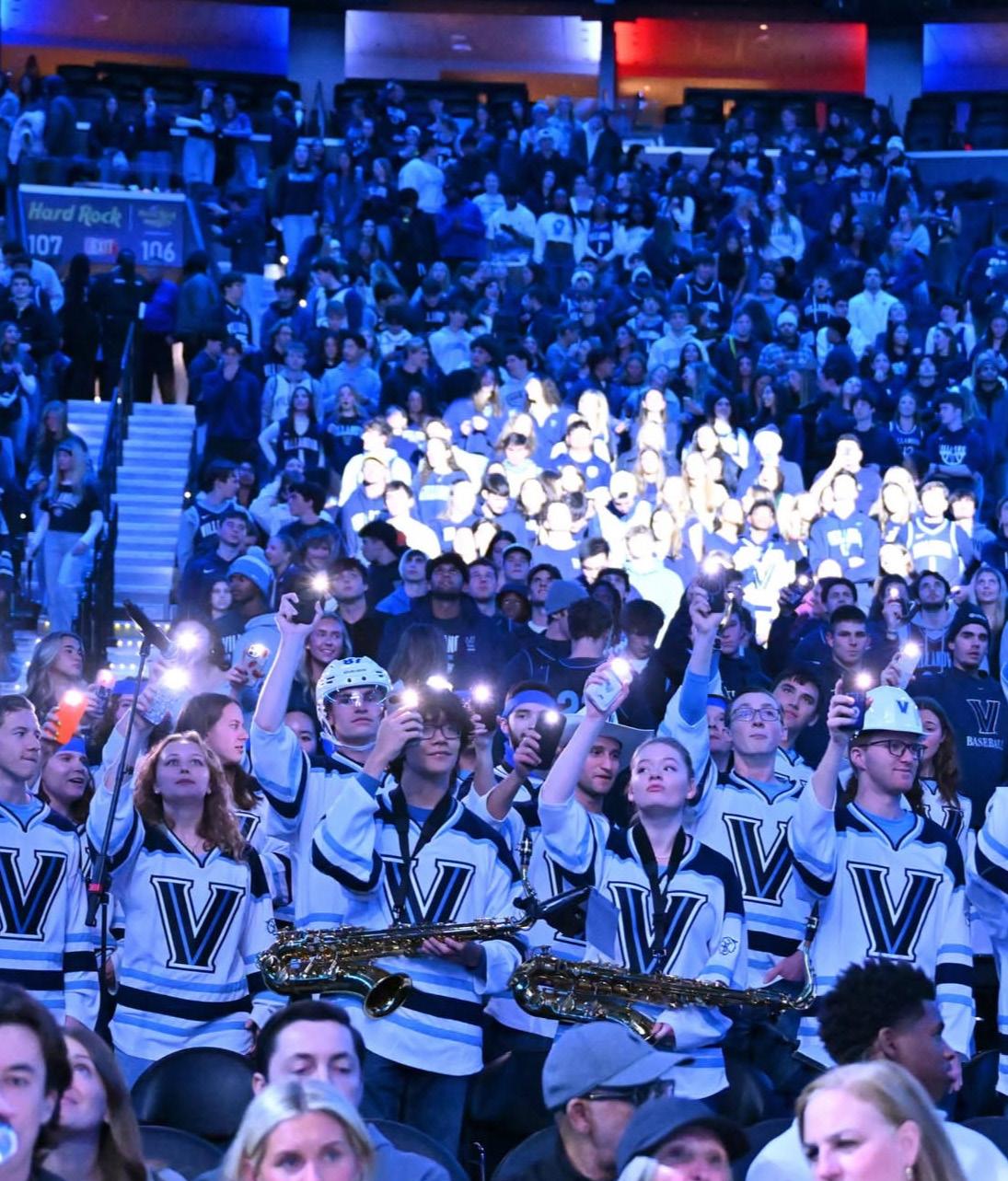
Villanova fans have shown up during the regular season to support the Wildcats. Courtesy of @novambb

2026 Indoor Track & Field Nationals Recap
Genna Cottingham Sports Columnist
All Marco Langon wants is a national title. After falling short at indoor nationals, he will have to wait a few more months to take another attempt at his goal in Eugene, Oregon.
This past weekend, the NCAA Indoor Track and Field Championships brought together the fastest collegiate athletes in the country. Competition began on Wednesday, March 11, and lasted till Saturday, March 14.
On Saturday, Langon crossed the finish line at 7:42.56 to come in third place in the 3000-meter. The original first-place finisher, New Mexico’s Habtom Samuel, was disqualified for pushing on the final lap, which caused him to step outside the lane.
The aggressiveness of the last 200 meters led Langon to nearly stumble alongside Northern Arizona’s Colin Sahlman, who was ultimately named the winner, finishing at 7:41.66. Following the race, Coach Marcus O’Sullivan protested Samuel’s finish after re-watching footage of the final lap. The New Mexico coach Darren Gauson counter-protested and Coach O’Sullivan re-protested the results again.
“I think he was even more determined than the three,” O’Sullivan said. There was some um altercating stuff going on, like pushing and shoving and stuffing. Solomon lost his composure. When the race was done, I didn’t even know who won.”
After reviewing the footage, Marco leaned into lane 1 but his feet never stepped out of lane 2. Although he crossed the finish line first, Samuel made several steps out of bounds so was unable to claim the national
Continued on p.10
Undergrad Career Outcomes Overview p. 6
March Madness Preview: Women To Face Texas Tech p. 17
Villanova University’s Center For Irish Studies Hosts Irish Prime Minister
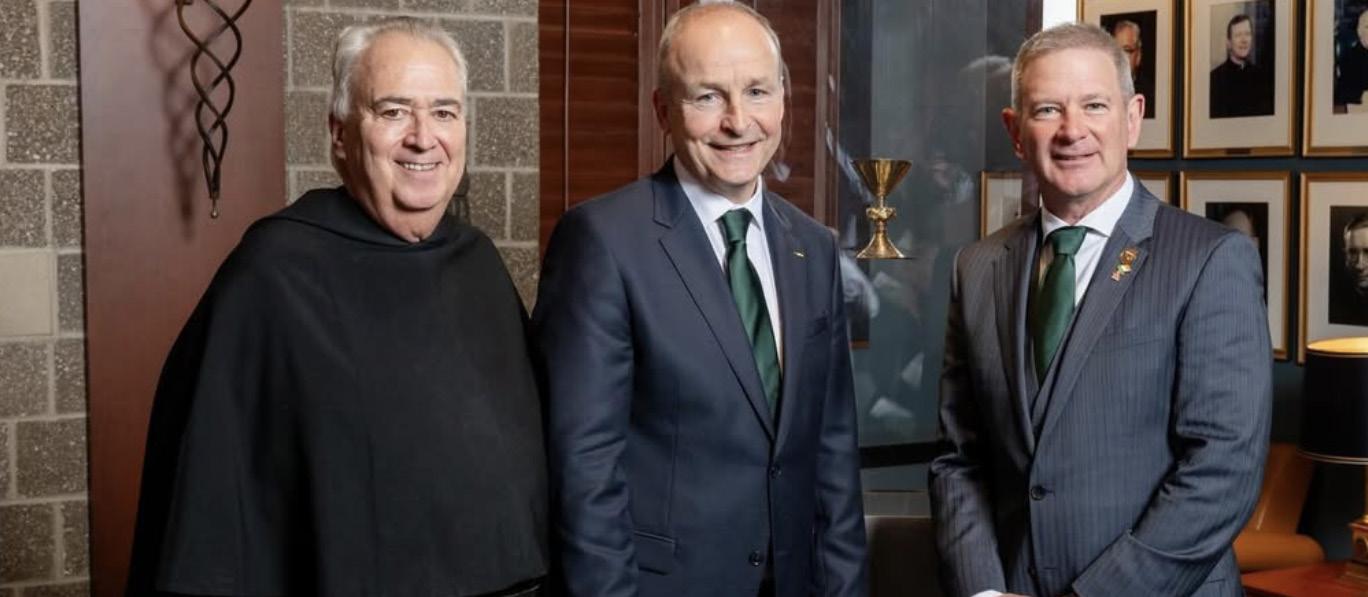

Commemorating 250 years of enduring connections between Ireland and the United States, Villanova University’s Center for Irish Studies hosted Irish Prime Minister Micheál Martin on Saturday, March 14, in an afternoon celebrating Irish American history. Prime Minister Martin was joined by Villanova faculty with deep connections to Ireland and a commitment to Irish Studies.
Villanova University Provost Patrick Maggitti
delivered opening remarks, highlighting the university’s Irish roots and calling attention to Villanova’s Irish Studies program as the longest-standing of its kind in the United States. He spoke about the “Irish Pipeline,” which has recruited Irish track and field athletes to attend Villanova since 1948. Maggitti also recognized that Villanova alumnus Edward Walsh, who attended Saturday’s event, was recently named the United States ambassador to Ireland. Walsh, his wife and three daughters all graduated from Villanova.
Martin then took the stage to express the vi -
tal role of universities like Villanova in supporting the Irish-American relationship. Martin outlined two key matters he wished to speak on: “the power of sport in building international connections and the 250th anniversary of the American Declaration of Independence.”
Martin emphasized the role of Irish Americans in the formation of the United States and called attention to Irish native Charles Thomson, who designed the Great Seal of the United States, which features the words “e pluribus unum,” meaning “out of many, one.” Martin asserted that the Irish people
would draw on these same unifying words for generations to come.
While noting complexities and challenges within Irish American history, Martin recognized the many accomplishments that Irish immigrants have achieved in America.
“America was, is and will remain a land of opportunity,” Martin said.
The Irish Prime Minister focused on the role of sports in fostering Irish American connections.
“Sport is a transformational and unifying force,” Martin said. “It brings people together. It drives connections between
Continued on p.4
Women’s History Month Events Preview

Mia Galego
Co-News
Editor
For Villanova, March is an action-packed month. Whether one is still reminiscing about Spring Break or looking forward to watching Villanova basketball, it is important to recognize that March is Women’s History Month. At Villanova, numerous student organizations and clubs are finding new ways to celebrate the achievements and
Why AI Doesn’t Love You and Never Will p. 6
Is 2026 The New 2016? p. 23
impact of women.
“This month, Villanova will celebrate the contributions of women within our community and
throughout history,” the University said across its various social media platforms. “Honoring Women’s History Month, Villanova

Villanova’s Second Annual Covenant House Sleep-Out p. 9
VillaVogue: Which Year Wore It Best p. 25
UNITY Event Takes Students Across the Earth p. 10
March Madness Impact On Admissions p. 26
University will host an array of educational events throughout the month of March.”
The Anne Welsh McNulty Institute for Women’s Leadership is hosting numerous events throughout the month. All Women’s History Month events are listed on its website, and the first event is a Women’s History Month Celebration from 11 a.m. to 2 p.m. on Wednesday at the Oreo. According to a post
Continued on p.5
March Madness Preview: Men To Take On Utah State p. 16
Horoscope: What Your Bracket Says About You p. 27
Addy McDougall Staff Writer
Villanova’s Center for Irish Studies hosted Irish Prime Minister Micheál Martin this past Saturday. Courtesy of Villanova University
Villanova’s
Villanova is hosting a variety of events to celebrate Women’s History Month. Dylan Johnson/Villanovan Photography

VOL. 120 | ISS. 6
www.villanovan.com @thevillanovan
KAILEY
PUBLIC SAFETY BLOTTER
Disorderly Conduct
March 11, MAIN CAMPUS GROUNDS.
A verbal dispute occurred between two motorists at the North Gate.
Disorderly Conduct
March 12, MCGUIRE HALL.
A male resident student reported an unknown person has been urinating on the window to his residence hall room.
Liquor Underage / Public Drunkenness
March 13, LANCASTER PROPERTY GROUNDS.
A female resident student, under the age of 21, was found intoxicated in public. The student was evaluated and transported by Radnor ambulance to Bryn Mawr Hospital.
Liquor Underage
March 13, HOVNANIAN HALL.
A non-affiliated male, under the
CORRECTIONS
age of 21, was evaluated for alcohol intoxication and released to a sober friend.
Liquor Underage / Public Drunkenness
March 14, STANFORD HALL.
A male resident student, under the age of 21, appeared in public intoxicated and was transported by VEMS to Bryn Mawr Hospital.
Liquor Underage
March 14, SULLIVAN HALL.
A male resident student, under the age of 21, was found in possession of alcoholic beverages and was evaluated for alochol intoxication.
Liquor Underage / Public Drunkenness
March 14, SULLIVAN HALL.
A male resident student, under 21 years of age, was evaluated for alcohol intoxication
Criminal Mischief
March 14, SULLIVAN HALL.
A female resident student reported a damaged exit sign in a residence hall.
Liquor Underage / Public Drunkenness
March 14, STANFORD HALL. One female resident student, under the age of 21, was evaluated by VEMS for alochol intoxication and transported to Bryn Mawr Hospital for further treatment.
Factual errors are corrected as soon as they are brought to The Villanovan’s attention. Please send an e-mail to villanovan.eic@gmail.com to report errors.
Villanova Hosts Irish PM

Addy McDougall Staff Writer
Continued from p.1
our people, generates economic activity, promotes tourism and develops political relationships.”
He highlighted the accomplishments of Villanova’s Irish athletes over the years and spoke about the Irish Pipeline.
“[It] allowed hundreds of Irish athletes to pursue academic and athletic excellence here at Villanova,” Martin said.
Martin concluded that the same spirit of unity that inspired America’s founders 250 years ago continues to inspire Villanova today.
“In a world which faces monumental challenges, it should direct us to work together on a shared and exciting future, for Ireland, for our relationship with the United States of America and for the world we share,” Martin said.
Joseph Lennon, the Emily C. Riley Director of the Center for Irish Studies, proceeded to moderate a discussion panel of Villanova faculty, featuring Political Science Professor Cera Murtagh, Chair of Irish Studies Cauvery Madhavan, and Irish Studies Professor Jonathan O’Neill.
After being prompted to share her Irish immigration experience, Cera Murtagh said that while living in Philadelphia the past eight years, she has maintained connections to Ireland through her work with the Irish Studies program and taking students to study there.
“It is a privilege to be part of ongoing ties that the Prime Minister referenced,” Murtagh said.
Cauvery Madhavan described her own connection to Ireland, explaining that upon moving there, she immersed herself in Irish culture through literature, television, and conversing with the Irish.
“[Ireland is]the best place in the world for the nurturing of the creative arts,” Madhavan said.
Lennon asked panelists about
Ireland’s political use of soft power, which involves a country achieving desired outcomes through appeal rather than coercion.
Jonathan O’Neill cited the Irish language as an example of soft power, exemplified today by the Irish government’s partnerships with American universities, such as Villanova, for Irish language programming.
“[It] acts as a thread that connects Ireland to the United States back a thousand years,” O’Neill said.
Murtagh highlighted Ireland’s role in the European Union.
“[Ireland is] well positioned to promote democracy and human rights in other parts of the world,” Murtagh said.
He further offered that Irish popular culture has sustained Irish American connections, as it “gives younger generations new perspectives of Irish history.”
“No country in the world has used soft power as smartly as Ireland,” Madhavan said.
Madhavan stated that Ireland uses the arts to drive its economy, exert global influence and maintain collaboration with American universities such as Villanova.
U.S. Congresswoman Mary Gay Scanlon, representative of Pennsylvania’s fifth congressional district, delivered closing remarks. She highlighted that Irish American ties preceded the formation of the United States and persist today through culture, shared values and bonds like Villanova’s Irish Pipeline of athletes.
“[America can] learn from Ireland’s values-based foreign policy and its commitment to diplomacy, peacekeeping and humanitarian efforts,” Scanlon said.
Scanlon left the audience with a call to continue collectively working towards a prosperous future for Ireland and America.
The Irish Prime Minister’s visit to Villanova demonstrated the university’s powerful connection to Ireland and the Center for Irish Studies’ commitment to promoting scholarship in this area.
This Week In Politics

Zoe Garrett Political Columnist
The United States has found itself at the center of a rapidly unfolding conflict with Iran, significantly raising global tensions and leaving thousands dead as the situation continues to evolve.
On Feb. 28, the U.S. and Israel launched coordinated missile strikes across Iran, targeting nuclear facilities, military bases and some of the nation’s top government officials, according to CNN.
President Donald Trump announced that the strikes had killed Iranian Supreme Leader Ali Khamenei, a controversial political figure on the international stage who has long been criticized for overseeing a harsh, repressive regime. Reports of his death sparked mixed reactions from Iranian and American citizens, many of whom expressed both celebration and apprehension.
The strikes also hit a girls’ elementary school in southern Iran, resulting in the deaths of more than 175 individuals, the majority of whom were children, reported CNN. Reports published in the following days indicated that the U.S. military force may have relied on outdated targeting data, which mistakenly directed the strike toward the school.
Growing confusion, fraying international relations and increasing military activity have ensued since the Feb. 28 attack. Iran has retaliated, launching attacks not only on the U.S. and Israel, but also on U.S. military bases located in Bahrain, Kuwait, Saudi Arabia, the United Arab Emirates and Qatar.
The human toll of the conflict continues to grow. On March 14, the U.S.-based group Human Rights Activists in Iran reported that 2,040 people had been killed in Iran, including 1,319 civilians while 206 of them are estimated to have been children.
The following day, Israeli officials reported that 12 of their citizens had died.
The U.S. has lost 13 citizens to the conflict, all of whom were service members.
Leaders in the U.S. and Israel have described the strikes as a preventative measure intended to mitigate the risk of Iran deploying nuclear weapons. Israeli Defense Minister Israel Katz described the move as a “pre-emptive strike” that was necessary to “remove threats against the state of Israel.”
But citizens in the U.S. are expressing a growing concern about the nation’s involvement in the Middle East. A Quinnipiac University poll on March 9 found that 53% of registered voters oppose the nation’s military action against Iran, with 55% of voters disbelieving that Iran did post an “imminent military threat” before the initial strikes.
Americans are beginning to feel the broader economic effects of the conflict.
Oil and gasoline prices have ballooned since the beginning of the month. In his State of the Union address just weeks earlier, the president mentioned that gas prices had fallen as low as $2.30 per gallon. Now, AAA reports that the national average price has since climbed to $3.60, which is an increase of more than 50%.
Instability in the Middle East has disrupted normal activity in the Strait of Hormuz, which is a critical waterway that typically facilitates the transport of approximately 20 million barrels of oil per day, according to AP News. This interruption has significantly hindered global trade.
Financial markets have also reacted to the conflict. The S&P 500, the Dow Jones Industrial Average and the Nasdaq, three major indicators of the U.S. economy, have reported downturns since the beginning of March.
With a new series of Israeli strikes launched this past Saturday, the future of the conflict remains uncertain.
While Trump told NBC News on Saturday that Iran was prepared “to make a deal,” Iranian Foreign Minister Abbas Araghchi denied the claim the following day.
Women’s History Events Preview

Mia Galego Co-News Editor
Continued from p.1
the McNulty Institute’s Instagram, the event will “celebrate and uplift women’s contributions to the Villanova community.”
The McNulty Institute will also host an “EmpowHER Hour” from 5-6 p.m. every Thursday in March.
Students can stop by Tolentine 203 on Thursday for a letter-writing event and on Thursday, March 26, for a bingo vision boards event.
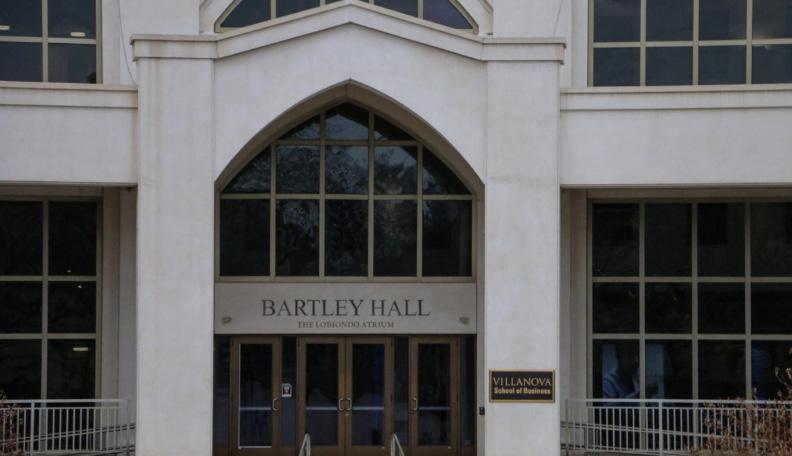
At 6 p.m. on Wednesday, in the PwC Auditorium in Bartley Hall, the Society of Women of Color in Villanova School of Business (VSB), in collaboration with the VSB Undergraduate Student Advisory Council (DUSAC), will be hosting a screening of the movie The Six Triple Eight in commemoration of Women’s History Month.
The event is a part of DUSAC’s Real Reel Series and is sponsored by VSB Unitas: Office of Community Engagement.A discussion exploring identity, equity and real-world issues will follow the screening of the film.
Sophomore Maya
Mathews, president of The Society of Women of Color in VSB, is looking forward to the event.
“As the Society of Women of Color in VSB, we’re excited to partner with the VSB DUSAC to create a space where students can come together to reflect on the powerful history highlighted in The Six Triple Eight,” Mathews said. “Events like this allow us to celebrate Women’s History Month while engaging in meaningful conversations about leadership, resilience and representation.”
At 7:30 p.m. on Thursday, The Space, Pre-Med Club and Villanova Medlife will host a discussion with OB/GYN Dr. Rebecca Cipriano in Bartley Hall 3010. The event will aim to educate attendees about the career and daily practice of an OB/GYN.
From 1 p.m. to 3 p.m. on Thursday, March 19, Falvey Library, in collaboration with the Research & Scholarly Engagement Department and Community Enrichment Committee of Falvey Library, will be hosting an event titled “Wikipedia Edit-a-thon Highlighting Historically Significant Villanova Women.”
The event aims to increase the representation of women online through editing Wikipedia entries.
Students will be provided with snacks and everything they
need to start editing. In celebration of Women’s History Month, the Multicultural Student Nurses Organization (MSNO) will be welcoming lifestyle influencer and travel nurse Eunice Jimenez to Villanova from 7 p.m. to 9 p.m. on Thursday, March 19, in Driscoll 134. The discussion will cover nursing advice and overall work-life balance.
MSNO president Laila Moore spoke about the importance of the event, highlighting the impact women of color have in “shaping the future of nursing.”
“While nursing is a female-dominant profession, the percentage of nurses of color remains relatively small, making representation especially important,” Moore said. “Hearing from Eunice Jiménez, a travel ICU nurse, content creator, and Philadelphia native, gives students the opportunity to learn from someone who is not only advancing the profession clinically, but amplifying the voices and experiences of nurses of color as well, reminding us of the true power in our presence within this field.”
From 10 a.m. to 4 p.m. on Friday, March 20, students can take part in the St. Rita of Cascia Day of Service.
Students will spend the day learning and discussing St. Rita of Cascia’s legacy and participate in a
service project to address violence in the Philadelphia area.
At 12:30 p.m. on Wednesday, March 25, The Center for Faculty Leadership and Success will host a discussion titled “Beyond the Job Description: The Invisible Labor Carried by Women in Academic Leadership.”
The panel will feature four female panelists, and the discussion will surround challenges women often face in academic institutions.
In collaboration with the Office of Belonging and Inclusion, the McNulty Institute will also host a screening of Period. End of Sentence. at 5:30 p.m. on Wednesday, March 25, in Corr Hall 115. The documentary follows a group of women working to create change and challenge stigma around menstruation.
Dinner will be provided, and students can expect a night of empowerment and entertainment. At the end of the day, every member of the Villanova community can celebrate Women’s History Month by supporting the student organizations working to improve representation and equality.
Through productive conversation and community engagement, students can not only reflect on past achievements but also continue to make progress towards the future.
Spotlight Speaker Series: Dr. OiYan Visits Campus

Lottie MacGregor Staff Writer
On Thursday, March 12, Dr. OiYan Poon, an author and scholar of race and higher education, visited Villanova University to discuss how women, particularly women of color, influence institutions by leading from positions often considered the margins.
Poon is an associate professor at the University of Illinois Urbana-Champaign, where her research examines college admissions, race and equity in higher education.
She has also served as a consultant to Illinois Gov. J.B. Pritzker’s office on education policy. Her book “Asian American Is Not a Color” has contributed to national conversations about race-conscious admissions and the role of higher education in a diverse democracy.
The event began with an introduction of Poon’s work, highlighting the impact of her previous speaking engagements.
The host noted hearing Poon speak at a women’s conference last April, describing her presentation as particularly memorable and encouraging audience members to reflect on how her ideas could inspire change within their own communities.
During the lecture, Poon focused on how women have historically faced barriers to leadership, particularly those who experience both racial and gender discrimination.
Despite these obstacles, she argued that women often bring valuable perspectives that can help reshape institutions and expand opportunities.
To frame this idea, Poon ref-
erenced the work of feminist scholar Bell Hooks, whose book “Feminist Theory: From Margin to Center” called for feminism to move beyond representation and challenge systems of oppression.
Hooks argued that perspectives from marginalized communities provide insight into how social systems function and how they might be transformed.
Poon also discussed the history of higher education in the United States to illustrate how access to opportunity has changed over time.
Many early colleges founded in the 1600s were created for wealthy white Protestant men.
Women were not admitted to college until 1833, when Oberlin College enrolled its first female students. Historically Black colleges and univer sities later expanded access for Black students, including Black women.
Some institutions continued to exclude women until relatively recently. Several Ivy League universities began admitting women only in 1969, and Columbia University did not admit women until 1983.
Although women now represent the majority of students in higher education, Poon explained that inequalities still exist, particularly in leadership roles.
Women and women of color remain underrepresented in positions such as university presidents, corporate executives and elected officials.
Poon suggested that part of this disparity comes from the way leadership is often defined within organizations.
Leadership styles that emphasize collaborating, listening and building relationships are sometimes dismissed as lacking vision or authori-
ty. However, these approaches can be essential for effective leadership.
“When women describe their leadership approach as listening and building relationships, it is sometimes interpreted as a lack of vision,” Poon said. “But those qualities are often what allow organizations to grow and innovate.”
Poon also shared examples of individuals whose work demonstrates how leadership from the margins can challenge existing systems.
One example is scholar Eve Tuck, who introduced the concept of “desire-centered research.”
Instead of focusing on deficits within communities, Tuck argues that institutions should recognize the strengths, aspirations and knowledge already present within those communities.
Another example is Chicago artist Tonika Lewis Johnson, whose Folded Map Project highlights segregation in Chicago by connecting residents on corresponding streets in the city.
Through conversations between these residents, the project encourages collaboration and greater awareness of structural inequalities.
Poon concluded by discussing the work of activist Grace Lee Boggs, a Chinese American philosopher and community organizer who spent decades advocating for civil rights and community development in Detroit. Boggs believed that imagination and collective action were necessary to create meaningful social change.
“People are aware that they cannot continue in the same old way,” Boggs wrote. “But they are immobilized because they cannot imagine an alternative.”
Poon encouraged audience members to rethink how leadership is defined and recognized.
By expanding definitions of leadership and valuing diverse perspectives, she suggested that institutions can create more inclusive systems and better address long-standing inequalities.
Villanova hosted Dr. OiYan on Thursday, March 12. Graydon Paul/Villanovan Photography
Undergrad Career Outcomes Overview

Lauren Armstrong Senior Columnist
Due to the topic of financial compensation, some individuals interviewed for this article have been granted anonymity.
On March 9, Villanova published the Class of 2025 outcomes data, showcasing the percentage of 2025 alumni who have jobs, are in graduate school programs, the average salaries by major and overall, as well as the majors and departments compared to each other.
According to the data, 94.1% of graduates from the Class of 2025 successfully secured opportunities, based on the responses of 1,390 of 1,587 Villanova’s Bachelor’s degree recipients.
“Villanova prepared me for the workforce significantly better than I could have ever predicted,” an anonymous 2025 graduate said. “I feel that compared to my friends who graduated from other schools, I am in a better place both academically and with the post-grad opportunities I was offered.”
Sixty-six-point-five percent of these graduates report being employed, 21.2% are continuing their education, 6.5% are engaged other endeavors and 5.9% are still

Natalie Manzo Staff Writer
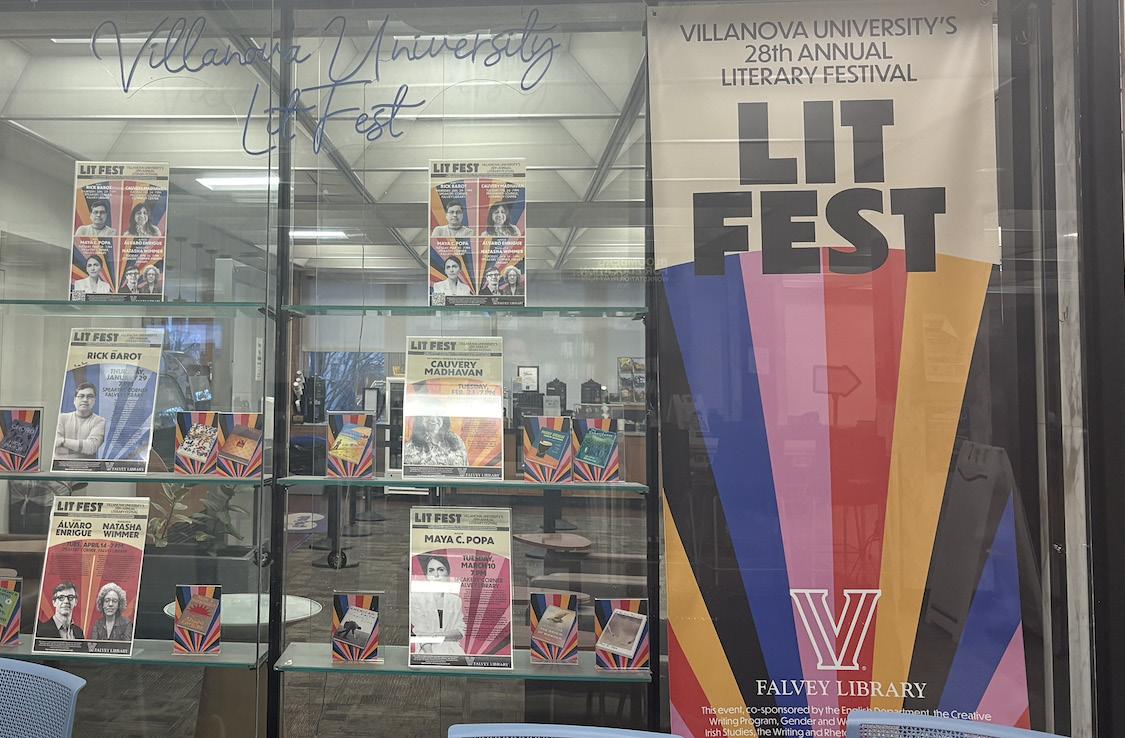
Villanova’s annual Literary Festival continued on Tuesday, March 10, with a visit from poet, editor and educator Maya C. Popa, who read from her work and spoke with students during her time on campus.
During the semester-long festival, Villanova hosts major poets and fiction writers for readings and conversations with students. Popa is the third author to visit campus as part of the 2026 Literary Festival.
“I was talking to faculty poets about somebody they’d be interested in having come,” Professor and Literary Festival director Alan Drew said. “We had a list of people, and Maya was on that list.”
As part of her visit, Popa
seeking opportunities.
The highest populated fields graduates entered were finance at 18.1%, healthcare at 11.6% and engineering at 10.4%.
For those continuing their education, 63.8% are pursuing a Master’s degree and 32.4% are pursuing their doctorate.
The average salary for Class of 2025 graduates is $79,854. The average salaries for each major and department differ significantly, ranging from $53,013 to $94,394. Five hundred forty-seven graduates reported their salaries.
“Seeing the results of the class of 2025 survey has reinforced my belief that Villanova provides its graduates with a high-quality degree and life skills to help them succeed in the outside world,” senior Jenna Parker said. “I would say that I am optimistic for postgrad, but still apprehensive as this will be the first time in my life that education is not my main commitment.”
The highest self-reported salary was $178,000 by a graduate working in web/software engineering, who is reported to have been an astronomy and astrophysics, computer engineering or computer science major.
The lowest reported salary was $19,200, which was reported by an individual who studied com -
munications, management, statistics, biology, chemistry, philosophy or nursing. This individual did not indicate what specific field they work in.
“When the school sent out this data, I felt relieved,” an anonymous senior said. “I am glad knowing that how much I will be making next year aligns with others who graduated in my major and now work in similar roles.”
Yet, not all current seniors and students felt relieved.
“This data was a bit disheartening,” another senior who requested anonymity said. “As a
Lit Fest: Maya C. Popa
attended the afternoon session of the Authors On & Off the Page course. The class is taught by Drew and Professor Adrienne Perry, and students read the work of visiting authors and have the opportunity to ask questions when the authors come to class.
“Maya really is an awesome person to talk with,” senior and class member Ava Petrosky said.
“I loved reading her collection of poems in class and then meeting her in person. She’s just so down to earth. She’s very real and very personable, and I just really enjoyed talking to her.”
Perry felt simlarly. “I really feel like when I’m in class with the author, I don’t feel like the teacher.
I feel like the student,” Perry said.
“I just love learning about writing and their process from them. I find it really humbling and inspiring, and that was especially true with
political science major who is not going directly into a graduate program, I knew I should not expect to be making a lot of money next year. However, seeing a lot of the averages in the $50,000 range, I realized I truly will be making less than I expected.”
Students should not be fully discouraged, as only 34.47% of 2025 graduates reported their incomes. The data presented does not represent the entire graduating class, but is a strong representation of what upcoming graduating classes can expect as they enter post-graduate life.
Maya.”
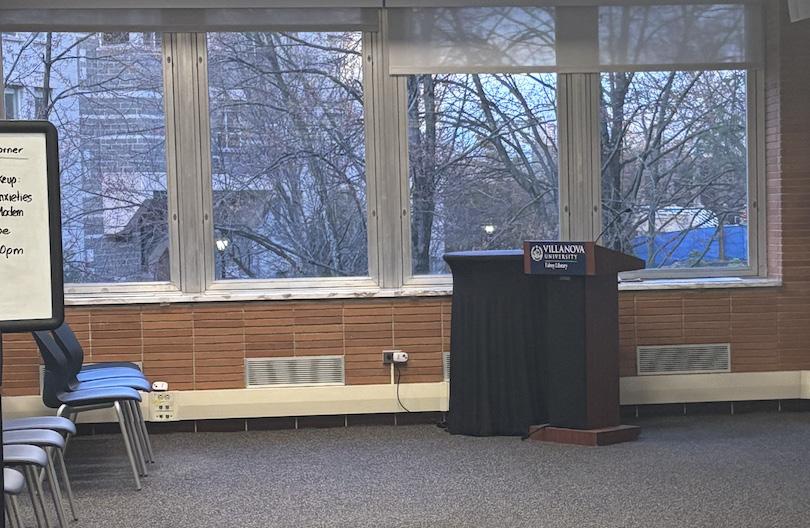
Following her class visit, Popa gave a reading at 7 p.m. in the Speakers’ Corner of Falvey Library. To begin the event, two students from the Authors On & Off the Page course, Zoe Magee and Natalie Zickel, introduced Popa and her work. Popa then began by reading from her published poetry.
“One of the things that struck me about her reading was the pace that she took,” Perry said.
“I wouldn’t say that she read her poems slowly, but she read them in a really measured way that helped me hear the music in her poems, and helped me slow down and appreciate the images that she was using and the way that she uses a kind of language play.”
Following her reading, Popa was joined by Stephen Sexton for a conversation. Sexton, a Northern Irish poet and professor at the
Seamus Heaney Centre at Queen’s University Belfast, was part of the group of visiting scholars on campus. This collaboration is part of an ongoing partnership between Villanova University and the Seamus Heaney Centre.
“It’s nice to sit and listen to two people who know their crafts,” Drew said.
Sexton posed questions about Popa’s work and writing process before opening the discussion to the audience. Professors and students then asked Popa questions before the event concluded.
The final event of the 2026 Literary Festival will feature novelist Álvaro Enrique and his literary translator, Natasha Wimmer, who will visit campus on Tuesday, April 14. The reading will take place at 7 p.m. in the Speakers’ Corner of Falvey Library.
Villanova hosts their annual Literary Festival series in Falvey’s Speakers Corner. Margaret Miller/Villanovan Photography
Villanova hosted Maya C. Popa on March 10. Margaret Miller/Villanovan Photography
Villanova published Class of 2025 outcomes data. Dylan Johnson/Villanovan Photography
Why AI Doesn’t Love You and Never Will
Emily Hauck Staff Writer
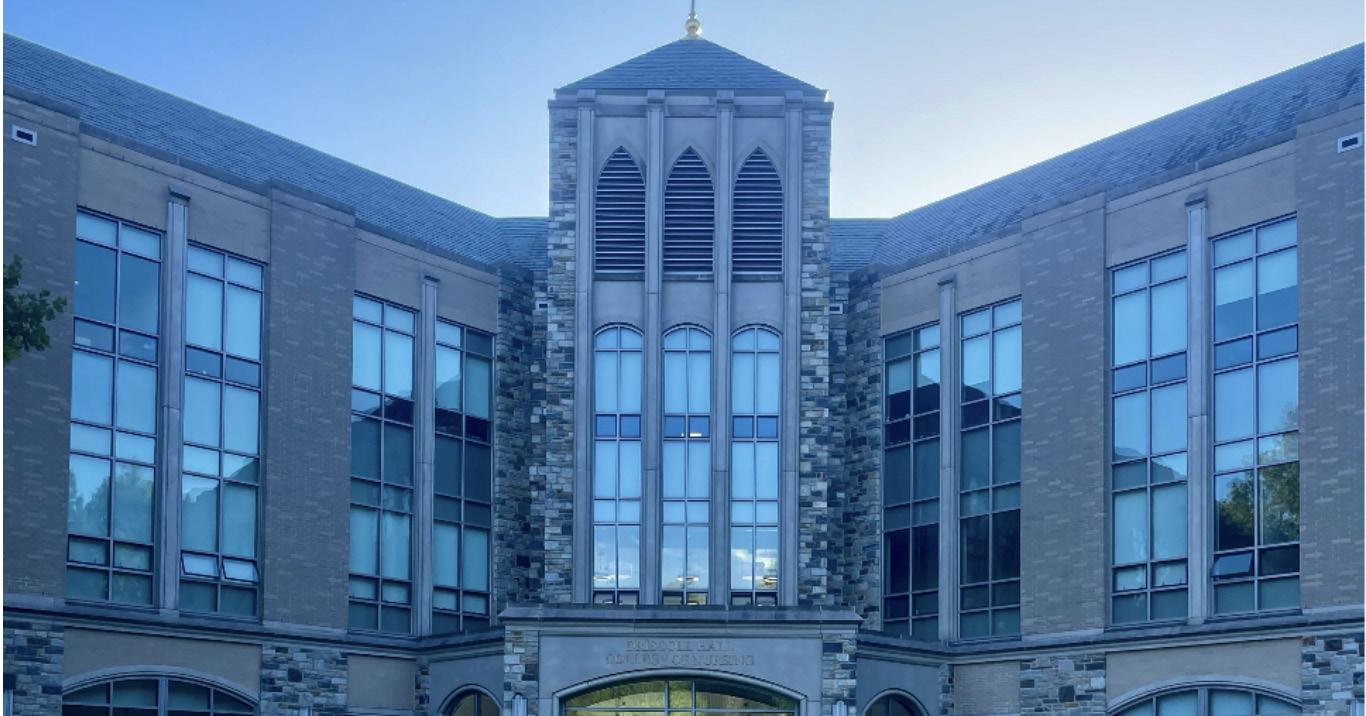
On Tuesday, March 10, Professor Eugene McCarraher delivered the 2026 Spring Humanities lecture titled “Why AI Doesn’t Love You and Never Will.” The event was held in Driscoll Hall auditorium and attracted a large crowd of students, faculty and Villanova alumni.
Professor McCarraher is a professor in Villanova’s Department of Humanities whose work is particularly concerned with the impact of different economic and religious practices and beliefs throughout history, as explored in his two books, “Christian Critics: Religion and the Impasse in Modern American Social Thought” and “The Enchantments of Mammon: How Capitalism Became the Religion of Modernity.”
McCarraher was introduced by host Michael Tomko, Ph.D, Chair of the Department of Humanities and Professor of Literature.
Professor McCarraher took his audience by surprise when he began his lecture.
“We should stop calling it artificial intelligence and start calling it what it is: automation,” McCarraher said.
By defining Artifical Intelligence (AI) in a way that many individuals oftentimes overlook, McCarraher laid the foundation for his following points.
Though many of us view AI as a technology that helps us more efficiently complete certain tasks and therefore a positive addition to human existence, Professor McCarraher explained how “automation has never been about making anyone’s life easier.”
He supported yet another shocking claim by encouraging his audience to consider the history of AI. Everything, including historical contexts, political beliefs and individual inventors, was explored in McCarraher’s lecture.
“We should all start focusing not on the marvelous machines, but on the people who design and bankroll them,” McCarraher said.
McCarraher emphasized the role of capitalism in the rise of technology.
“Automation has been about cutting costs and controlling people,” McCarraher said. “That way of looking at everything and everyone in purely instrumental and pecuniary terms” is what sparked technological advancement during the Industrial Revolution and what continues to spark progress today.
McCarraher’s discussion
about automation as a means of lowering costs and maximizing profits demonstrated how “capitalists have a built-in incentive to innovate technology.”
“We began thinking of ourselves as computers before we began humanizing our own creations,” McCarraher said.
The developments humanity has made are direct results of viewing our actions as reducible to computer-like automations. Only once humans accomplished automation did they begin to (attempt to) add in human traits.
Professor McCarraher’s lecture approached AI in a new and interesting way that invited his audience to consider not so much the technology itself, but the harsh and unpleasant influences that
drive its creation and progress.
Though listeners may have been taken aback by Professor McCarraher’s removal of AI’s sugar coat, he ended on a powerful reminder of our duty to uphold our humanity.
“AI will never love you,” McCarraher said. “You have to love you, and one another.”
McCarraher’s lecture was followed by a question and answer session and a reception in the lobby of Driscoll Hall.
Professor McCarraher’s book, tentatively titled Automated Vistas: Visions of Automation from Ancient Greece to Silicon Valley, which is set to be published by Yale University Press, will continue his discussion on automation and the role of AI in human life.
48th Annual Donald A. Giannella Memorial Lecture

Delaney Cromen Staff Writer
“It’s birth equality,” author Akhil Reed Amar said. “You shouldn’t be treated better or worse if you’re born black or white, male or female, gay or straight, in or out of wedlock, first born versus fifth born, with citizen parents or non-citizen parents, or born to Jew or Gentile.”
This quote captures the central theme of Amar’s lecture at the Eleanor H. McCullen Center for Law, Religion and Public Policy’s 48th Annual Donald A. Giannella Memorial Lecture on Wednesday, March 11.
Amar discussed his second book in what will soon be a trilogy: “Born Equal: Remaking America’s Constitution, 1840–1920”. It examines the four constitutional amendments that abolished slavery and established citizenship and voting rights for minorities in the United States.
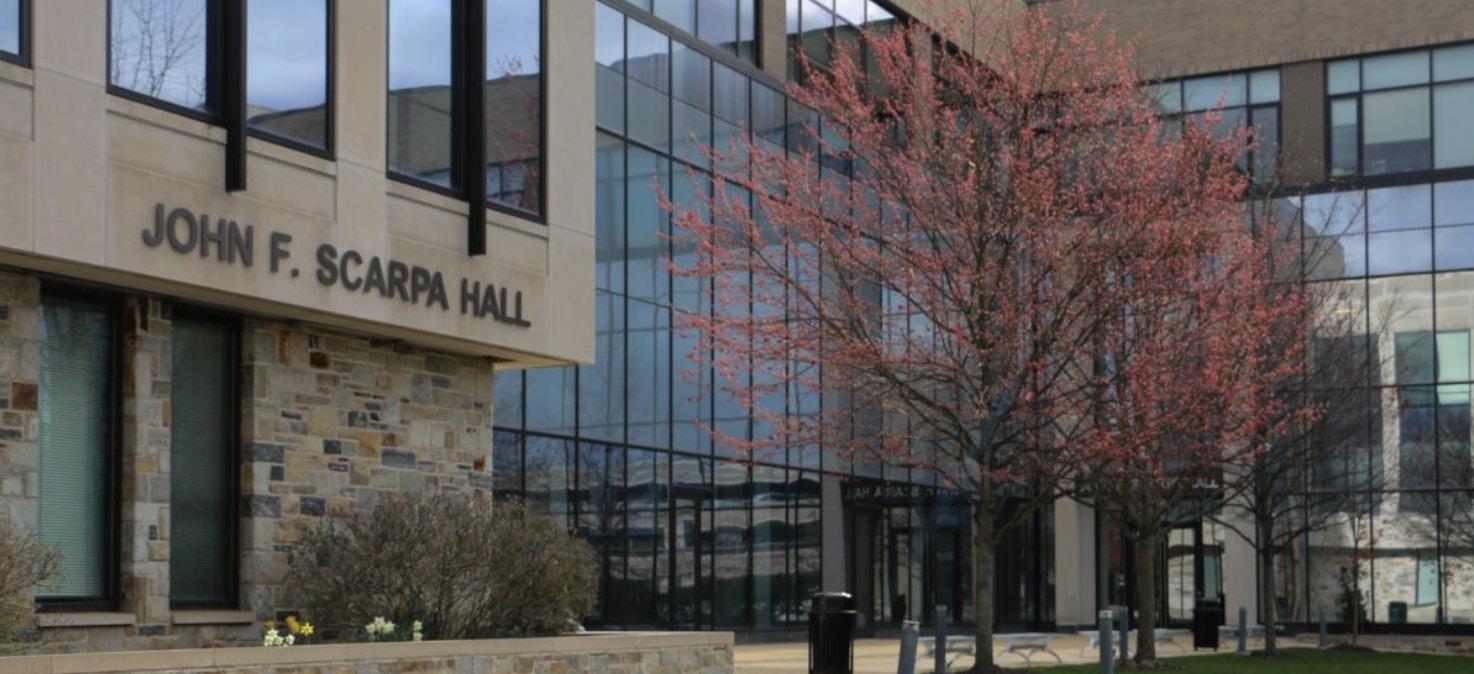
The event, hosted in John F. Scarpa Hall by Villanova’s Law School, attracted students, faculty and members of the surrounding community interested in constitutional history. Amar focused his talk on how constitutional amendments, legal reforms and historical figures following the Civil War reshaped the nation’s understanding of citizenship and rights. He asserted that the most fundamental connection among Americans is their natural history, while also emphasizing a problem: they remain largely unaware of it.
Amar graduated summa cum laude from Yale University in 1980 and later earned his law degree from Yale Law School in 1984. After clerking for Judge Stephen Breyer,
who later became a Supreme Court justice, he joined the Yale faculty in 1985. At Villanova, he addressed the themes of his book, highlighting the struggles and legal developments that have shaped modern interpretations of equality in the United States.
Amar emphasized the importance of understanding the history of the Constitution.
“You need to know that story, because otherwise, you can’t lead America,” Amar said. “You are the leaders and future lawyers of America, and you need to know the story, and my claim is you don’t.”
Amar also explained how diverse America is in terms of race, national origin, religion, politics and geography.
“And yet we have to govern ourselves,” Amar said. Despite our differences, America’s diversity finds unity in the Constitution, which provides a common framework for governing the nation, establishing laws and protecting individual freedoms.
During the lecture, Amar examined the historical context behind the 13th, 14th, 15th and 19th Amendments, emphasizing how these Reconstruction-era changes helped redefine the meaning of equality under the law. He argued that the Constitution Americans recognize today is the product not only of the original document but also of later movements and written pieces that expanded democratic participation and civil rights.
Amar continued to address how the period between 1840 and 1920 saw major constitutional developments, including the abolition of slavery, the expansion of birthright citizenship and the eventual ratifica-
tion of the 19th Amendment, which granted women the right to vote. He mentions the names of important reformers or abolitionists at the time.
Abe Lincoln, Elizabeth Cady Stanton, Benjamin Franklin, Frederick Douglass and Harriet Beecher Stowe.
Amar referenced the 14th Amendment’s guarantee of birthright citizenship.
“Everyone born in America is born an American citizen, even if you’re born of foreign travelers,” Amar said.
During a question and answer session following the lecture, attendees asked Amar about his take on Section 1 of the 14th Amendment, and what he believed to be intended by the words, “subject of the jurisdiction thereof.” Amar explained that the “subject of the jurisdiction” means “under the flag.”
Amar claimed that if one is born on American soil or under its flag, they are a citizen. In a “just” society, no one is born master nor slave, and no one has the right to remove someone else’s life, liberty or pursuit of happiness. That is and should be America’s aim and what “we are
compelled to follow,” as Amar said. Freshman Avery Pollackov gave her opinion on the lecture.
“I enjoyed how he brought both a historical lens as well as a current-day lens, as being born equal is now up for question with the Supreme Court,” Pollackov said. “So I thought overall it was really interesting and really important to hear about, especially at this time.”
The lecture was part of Villanova’s ongoing efforts to bring prominent thinkers and authors to campus to foster dialogue about law, politics and public life.
Amar’s book, “Born Equal: Remaking America’s Constitution, 1840–1920”, explores how Americans in the 19th and early 20th centuries reshaped the Constitution through activism, legislation and amendment, ultimately laying the foundation for many of the civil rights protections recognized today.
“We become ‘WE’ through constitutional conversation [and] by talking to each other,” Amar said.
The lecture left the audience wondering whether that conversation should start now.
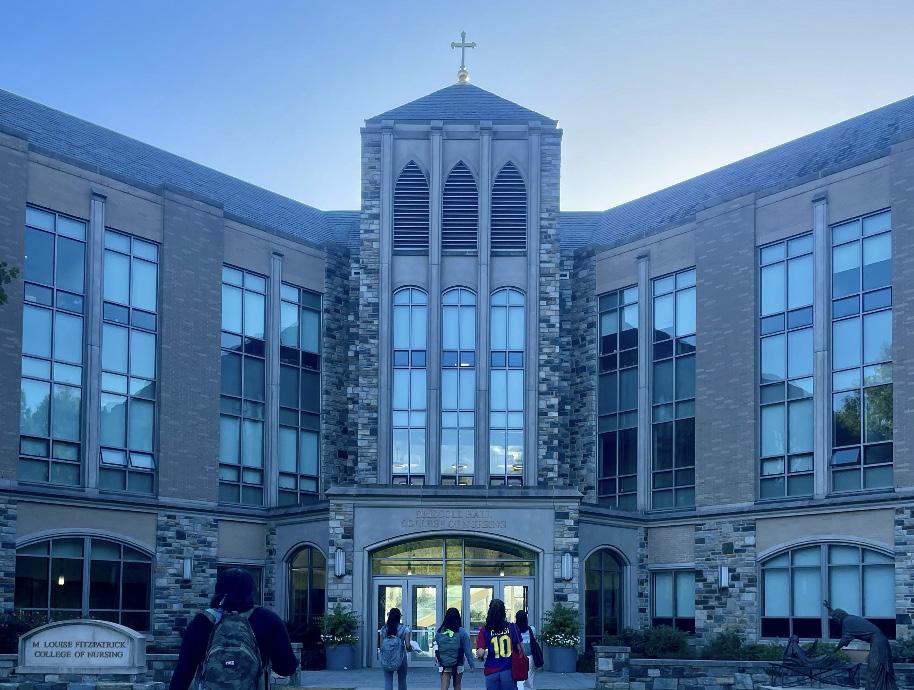
The 2026 Spring Humanities lecture was held in Driscoll Hall on Tuesday, March 10. Mia Galego/Villanovan Photography
The 2026 Donald A. Giannella Memorial Lecture was held in John F. Scarpa Hall on March 11. Graydon Paul/Villanovan Photography

Liam Foley Staff Writer
I take great pride in my American roots and being a part of the world’s first true democracy. We are built on the revolutionaries who fought the mighty British monarchy for a beautiful dream: that the common man might have a chance at political freedoms. That dream has spread around the world because of their bravery.
I fear, however, that our country is in the midst of real democratic backsliding. And it is not the result of a single political party, but rather the entire system as a whole. The way I see it, our nation far more resembles a plutocracy: a government by and for the wealthy, where ruling elites dominate both economic and political power. We are in a second Gilded Age, during which wealth is becoming increasingly concentrated at the top.
This ruling class is not ordinary wealth as we know it. It’s not your average “rich guy,” or even “mega rich guy.” I estimate the ruling class is roughly 300 individuals, which equates to the one percent of the one percent of the one percent in terms of net worth. Those with ordinary wealth benefit from the shots called by this class.
The concentration of wealth has given the ruling class immense economic and political power. Because our system of government relies so heavily on campaign financing, the concentration of wealth gives economic elites a critical advantage in the political realm: the power of the dollar. They can either run for office or finance their own campaign. Or they force politicians to rely on them for campaign financing, promising that their economic and political policy interests will be effectively implemented. Economic elites now
OPINION
Our Democracy Is Slipping
finance many lobbyists and think tanks to rally support for the policies that benefit them.
Additionally, they maintain a tight grip on mainstream media, propping up only the politicians who fit their agendas. I wonder whether average citizens truly have free political choice if the options presented to them have already been carefully selected. Do they genuinely hold independent policy views if many of those views are shaped by large media conglomerates such as MSNBC or Fox News? If so much of the information environment is curated, I believe we should ask whether autonomous political thought is becoming an illusion.
I do not see this wealth concentration and subsequent political power going anywhere. AI will only speed up this process, a point made by Dr. Eugene McCarraher, a humanities professor in his recent on-campus lecture, Why AI Doesn’t Love You and Never Will.
“The chief danger of AI is not an imperialism of sentient machines,” McCarraher said. “It’s rather unchecked financial speculation, and the centralization of data, money and power in the hands of the few corporations and the state, acting in cahoots to exploit and police an increasingly powerless and demoralized populace.”
AI will exacerbate the wealth disparity and numb the masses to that reality. The ruling class will soon begin cutting their number one cost of production, human labor and justify mass unemployment by implementing Universal Basic Income (UBI). UBI could effectively raise an individual’s income from $50,000 to $100,000 while eliminating the need to work. This may seem appealing. But this dynamic will give far more power to the elites. The masses will become docile while the ruling class’s net worth increases, reinforcing the

economic/political cycle as mentioned earlier.
I fear that many of our politicians say that they will act in the interests of the common man to secure votes, but then, once in office, act in favor of the ruling class who finance their campaigns. The constant talk of social issues conceals their true intentions. The modern-day Democrats secure votes by tugging on the heartstrings of citizens who consider themselves “good people.” They brand themselves as the party of morality. But then they enact arguably immoral policies, like, for example, supporting the massive offshoring of production in the early 2000s, decimating America’s industrial working class. That didn’t benefit the common man. But it benefited Wall Street. The modern-day Republicans, on the other hand, rely on inflammatory rhetoric to appeal to disenfranchised and angry Americans, or on emotional politics like immigration issues, branding themselves as America First. The recent tariffs have given many the illusion that Trump deeply cares about the working class. The working class might actually benefit from tariffs, but these benefits are not Trump’s core motivations. I believe he’s partnering with America’s industrial elites and strengthening the executive branch to consolidate power. He’s not a dictator. But could he be an authoritarian idealist?
The war on Iran is significant evidence that we live in a plutocracy. President Trump and Pete Hegseth are going to brand this war as being about human rights, the prevention of nuclear weapons and/or the war on terrorism. If this were the case, though, we’d be attacking North Korea, Eritrea, Turkmenistan, Syria, Myanmar, Belarus and the countless other oppressive regimes across the world. Could the prioritization of Iran, particularly in relation to U.S. support for Israel, be influenced mostly by the role that political funding and lobbying play in shaping American foreign policy decisions? Check out trackaipac.com. You will quickly see how there are only a handful of politicians who do not take money from Israel.
It’s worth mentioning that our plutocratic system may also be
intertwined with a broader elite blackmail network. In this scenario, figures like Trump could act in the interests of the plutocracy not only because it benefits them personally, but also because they are constrained by blackmail. It is a mutually reinforcing dynamic that discourages deviation from elite interests. I wouldn’t completely rule it out. The Epstein Files, both their content and intentional suppression, continue to horrify me.
It’s certainly not looking good. I may not be an optimist, but I do have hope, a sentiment also championed by Professor McCarraher. In the first Gilded Age, large social movements, such as the Labor Movement, produced the Sherman Anti-Trust Act. Fighting back is in the DNA of our nation, all the way back to 1776.
I am hopeful in two regards, the first being the rise of figures like James Fishback and Zohran Mamdani. Fishback is a Republican candidate for governor in Florida. He has faced an uphill battle thus far against the Trump-backed and financially loaded Byron Donalds. Yet, despite being underfunded, he’s going to win. Social media has created a rift in the campaign financing system that supports the plutocratic paradigm. This has allowed politicians like Fishback to reach youth free of charge, without binding themselves to the interests of the elites. Mamdani beat the establishment this way, too. As it currently stands, I am an Independent who evaluates purely based on genuine intent and honesty that benefits the average American. I am hopeful, given the increased popularity of freelance YouTube journalists like Andrew Callaghan and Tommy G. These men represent a real shift away from mainstream media, allowing real critical political thought to exist unrestrained.
We are entering a pivotal moment of American politics. The masses are certainly becoming more aware of how the system has begun to function. What we do with this information lies in the hearts and virtues of the upcoming generation. Will we submit to the interests of the ruling elite, or fight for the democracy that we deserve?
Students should attend lectures, like Dr. McCarraher’s, in Driscoll Hall. Mia Galego/Villanovan Photography
In the United States, Liam argues that democracy is in grave danger. Dylan Johnson/Villanovan Photography
CULTURE
Villanova’s Second Annual Covenant House Sleep-Out

Sophia Thomas Staff Writer
On Tuesday, March 10, Villanova hosted its second sleepout in honor of the Covenant House. The sleep-out is a global movement that seeks to raise awareness for youth homelessness.
According to the Covenant House, more than four million “young people experience homelessness each year.” The Covenant House is the largest funded agency in America that provides direct support and services to youth battling homelessness.
On Tuesday evening, Villanovans gathered together to raise money and awareness for this cause. A speaker event directly preceded the sleep-out during which students had the opportunity to hear from Covenant House board member Debbie McCabe, Covenant House resident William Brown and Covenant House Developmental Operations Director Lusana Masrur. Masrur works especially on youth overcoming homelessness and human trafficking, which is one of the leading dangers that homeless youth face.
As they rested their heads on the lawn of the Riley Ellipse, Villanova student volunteers were invited to reflect on how fortunate they are to live without constant concern for where they will sleep each night, a reality that so many young people tragically face.
“The sleep-out really gave me a new perspective,” freshman Sofia Davis said. “It made me real -

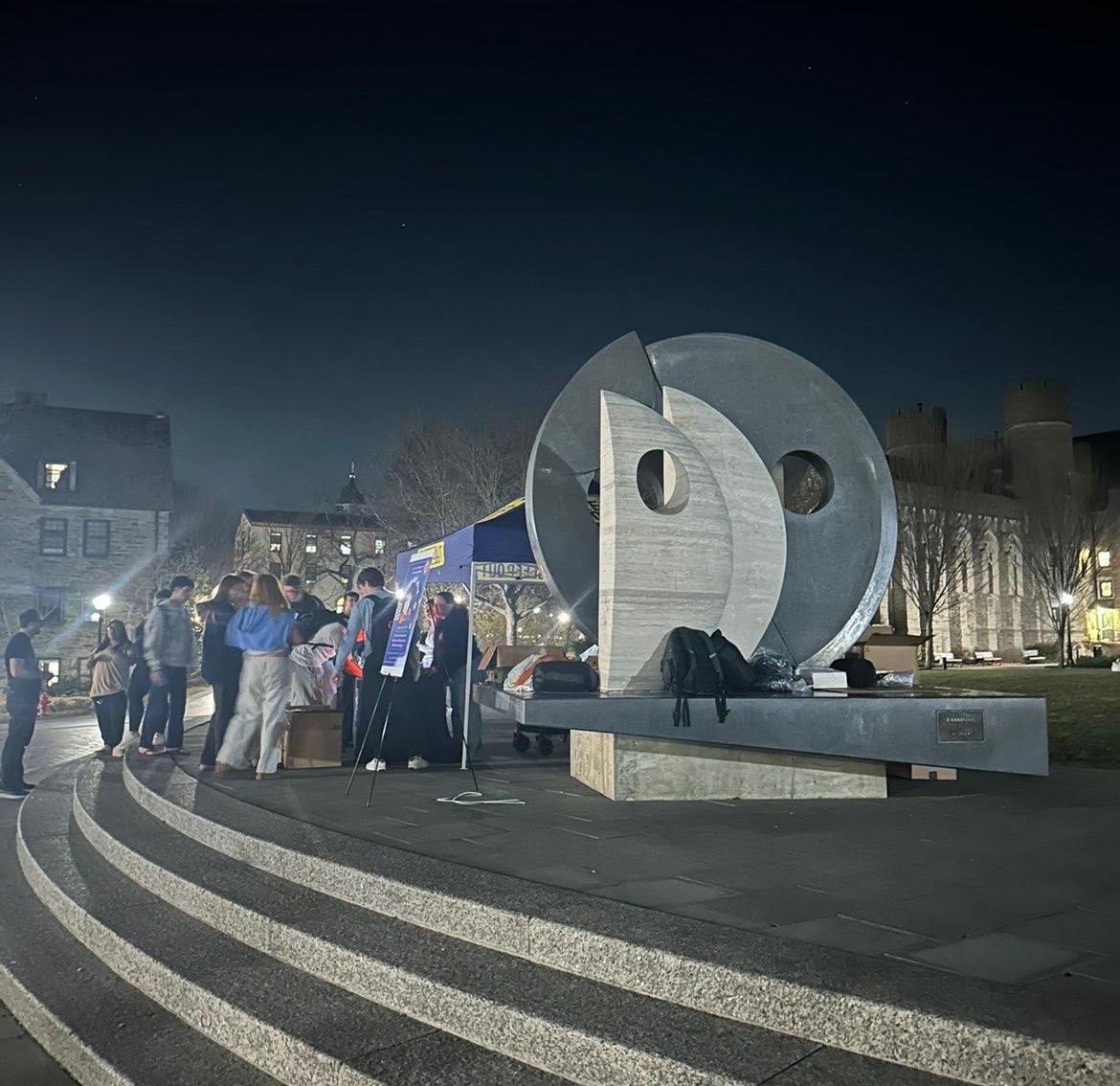
ize how much we take for granted every day, [like] basic necessities. I would encourage students to get involved next year because they will not find an opportunity like this elsewhere.”
Junior Michael Morrissey has been volunteering at sleep-out fundraising events since his sophomore year of high school. Morrissey is the director for the Covenant House Sleep-Out organized at Villanova. He spoke about how he draws inspiration from his fos -
ter sister, Jayla.
“That really put a face to the cause for me,” Morrissey said. Morrissey introduced the Covenant House Sleep-Out to the Villanova community last year, during which 50 sleepers raised $39,000 for the cause.
This year, the event beat both of those numbers with 100 people at the speaker event held before the sleep-out and 87 total sleepers. They have already hit $40,000.
“It’s really great to see how our school can have that big of an impact,” Morrissey said.
Behind Morrissey was a team of students who were advocates during Hunger Homelessness Awareness Week. They were integral in fundraising, advertising and promoting the event. Students had the opportunity to take part firsthand in the sleep-out and raise money through their individualized fundraising pages.
“You wake up after the sleep-out feeling so tired,” Morrissey said. “But then you go home, you shower, you eat a hot meal and you go to bed comfortably that night. You’re not guaranteed any of those things. When you realize that, it puts into perspective how important the sleepout event truly is.”
The Covenant House Sleep-Out will be held next year as well, and Morrissey encourages the Villanova community to get involved.
There were some great incentives for fundraising, including the opportunity for Big East tickets.
Next year, Morrissey hopes to implement a team system that may drive students to fundraise even more.
“I feel very blessed to be in the position we are in at Villanova,” Morrissey said. “It’s almost only fair if we help those who aren’t as fortunate as we are to get the same chance we do. It is important to hear the stories and understand the problem that we are working so hard to end.”
Play In A Day: A Completely Unique Studio Show
Cali Carss Co-Culture Editor
On Saturday, March 14, the Villanova Theatre’s Graduate Program presented its annual Student Studio Show in the Smith Performance Lab. Tucked in the back corner of the Mullen Center, the Performance Lab is a much more intimate and experimental space than the main stage of Topper Theatre. It was the perfect setting for the unique challenge these students set for themselves. Theatre graduate student and the show’s producer, Susan Betten, opened with a few remarks on how she had pitched this idea so that students in the program could spend time together and make art.
“I’ve done this sort of festival at my undergrad [three times],” Betten explained. “So I had a schedule that I felt I had improved over time. So, I took that schedule, and I modified it for what we can do at Villanova.”
This schedule was a rather intensive 24-hour period that began promptly at 8:30 p.m. the night before. On Friday, March 13, auditions were held. Each performer prepared a one or two-minute piece with creative freedom over its contents. The audition drew students from
within the graduate program, but some undergrads decided to take on this challenge as well. The goal of each audition was to showcase personality and creativity. After watching each entry, the three playwright-director duos, selected by Betten through a previous application process, cast four actors and drew a random setting and prop out of a hat. With the bare bones of a production set in motion, everyone left for the night. The work for the playwrights was not over, though, as they stayed up writing their plays all night. The entire group reconvened Saturday at 8 a.m. to begin working. There was an initial table read with the entire cast, after which the playwrights were sent to retire and get their well-earned rest. Then, it was up to the directors and the actors to memorize lines, stage the action and get in character. Saturday, 8:30 p.m. marked exactly 24 hours since the endeavor had begun, and the actors were ready to take to the stage. The first of the three 20-minute plays to be showcased during the festival was entitled “Super Smash Beaux.” The playwright, John Morrison, received the required setting of the Super Smash Bro’s Map and the prop Milky White the Cow. The play took place during a battle set in the world of this beloved video game. Luigi,
played by Miles Noecker, is trying to get over his breakup with Princess Daisy and sets his sights on Princess Rosalina, played by Julia Amendola, despite her disdain for the efforts of the men in the skit to protect her. This play was incredibly ridiculous and truly captured the spirit of this festival. While the actors still needed to reference their lines throughout the play, they made up for any awkward pauses with hilarious character choices.
The second play, “Pluck,” was written by Kristin Kijanka who was tasked with setting the play in a theatre and including a musical instrument as a prop. Each actor played just one character, “Pluck.”
Two ghosthunters stay overnight at an old theatre that is rumored to be haunted by a former owner as revenge on her unfaithful lover. As they set up and record hilarious clips for their video, the pair meet “Lydia,” played by Caroline Heins, who they assume is a local who heard about the sleepover and wanted to join. It is pretty obvious to the audience from the beginning that Lydia is actually Cordelia, the woman who haunts the theatre, and much of the humor comes from that knowledge gap. As night falls, the ghosthunters fall asleep, and Cordelia sheds her black mourning clothes for a colorful stage costume before exiting, the
harp the manager brought out to “encourage paranormal activity” in hand.
The final play was entitled “Space Jam (Not the Movie… Kinda)” by Justin Badoyen. Given the required setting of Space, and the required prop of a microphone, Badoyen created a witty, silly and perfectly timed script following a crew of humans attempting to make contact with the source of a “curious” sound. That source, of course, turned out to be basketball-playing aliens, and their unlikely misfit, played by standout actor David Walker, who played seven roles throughout the 20-minute show, must face off against these aliens in the final minutes of a game. The audience quite literally could not stop laughing through the final moments of this production.
“I feel really happy, and I feel really grateful, and I feel very tender-hearted,” Betten said at the end of the festival. “I hope everyone was able to take away how fleeting theater can be and how lovely it is to take a moment together to create something that is ridiculous and exciting and that we can all share.”
The festival ended with a standing ovation and many very happy actors. They danced onto the stage all together to take their final bow.
Students checked in for their night outside by the Oreo. Courtesy of Michael Morrissey
Villanova’s UNITY Event Takes Students Across the Earth

Christopher Brown Staff Writer
Villanova students and guests of all groups gathered in Cafe Nova last Thursday, March 12, for a special event organized by the Villanova International Students Organization (VISO). The event, UNITY: A Journey Across Cultures, is the biggest annual celebration of the different multicultural groups on Villanova’s campus. VISO worked with the Latin American Student Organization (LASO), Chinese Students Association (CSA), South Asian Multicultural Organized Student Association (SAMOSA) and the ABLAZE dance team to host an event that students would love.
VISO itself is a student-run group that aims to build relationships throughout the international student body. It helps international students transition to a new culture. Events are held throughout the school year to demonstrate the magnificence of these cultures to the whole campus, and all students are always invited to attend.
“UNITY is one of the biggest events thrown once a year by VISO,” senior and VISO president Maria Quintero said. “It’s a progress relation that we’re trying to celebrate different cultures that we have represented here at Villanova and just have a sense of community and connection between students.” Food is often the first insight into another culture that people

take, and the groups involved did not disappoint for UNITY. Options included several kinds of dumplings, samosas, Jamaican patties, roasted vegetables and a custom taco station with chips and guacamole. There were also tables where various groups and organizations displayed their respective cultures.
“I loved the different foods from different cultures that were involved through snacks and food,” freshman Mareli Perez said.
In addition, tables were set up with activities and snacks. The African and Caribbean table displayed unique examples of various skin and hair care products. For example, take the jars of shea butter. Shea butter is an ivory-colored and versatile fat useful for both cooking and making your skin glisten.
“I really liked seeing the diversity at this event and enjoying the yummy food and learning about different cultures,” freshman Melissa Castro said.
The Irish table featured free necklaces and tasty treats like donuts and Irish scones as a perfect way to get everyone in the St. Patrick’s Day mood. The CSA table hosted origami sessions and had various snacks, including Chinese brands of Lay’s chips and Oreos. They have a more aromatic, floral scent and flavor compared to their Western counterparts.
The Latin American table served Rita’s water ice and mangonada, which is a Mexican frozen drink made from mango, lime juice and ice. Attendees combined it with Tajín seasoning to make a unique
dessert.
“We just want to show that we’re present at Villanova, but we’re proud to be Hispanics,” junior and LASO Internal Affairs manager Edgar Alvarado said. “And coming together with other minorities is an amazing way to show that Villanova supports diversity within its campus.”
The night capped off with a dance performance from ABLAZE, Villanova’s multicultural hip-hop dance team. Their upbeat music and energetic, stylish dance moves amazed the whole room as attendees cheered them on.
“My favorite part of the event was seeing everyone come together to enjoy the performances, the food, the atmosphere and learning and celebrating different cultures around the world,” senior and LASO board member Luciana Wolcott said.
“I feel like students sometimes don’t realize the amount of cultures that we have here on campus and how the office is always open for international students and non-international students,” Quintero said.
Quintero described VISO as a safe space for all students to celebrate diversity and build community.
Students interested in events from VISO or joining the organization can find them on VUGroups or follow them on Instagram @villanovaviso. Let’s learn more about the world around us together.
Unpacked: A Love Letter Home From Galway
Emma Cote Abroad Correspondent
This past weekend, I spent Saint Patrick’s day in Galway, Ireland. In between late night bus rides from Dublin, complicated flights and several unexpected hail storms, I found myself feeling homesick for the first time since arriving in Rome. It’s incredibly easy to find yourself swept up in the excitement of novelty. I have had the privilege of visiting a variety of different countries throughout the past few months, and after just recently reaching the halfway mark, I am recognizing how temporary this experience truly is. It’s not every weekend you get to tackle seeing an entirely new place in a mere 48 hours.
As I touched down in Dublin Airport on Friday night, familiarity seeped its way into every activity that weekend.
My family’s name being scattered throughout Galway City, my mom’s favorite cider, the general comfort of hearing an Irish accent and even a fair share of “Boston” signs, all provided bittersweet memories of home.
We spent the first day just exploring Galway City. Long rainy walks along the ocean, shopping for Claddagh rings and getting caught in our fair share of rain made for a packed day.
I have now been in two countries that are participating in the Six Nation Rugby Tournament, which has made for some lively weekends. The Ireland vs. Scotland match
occurring during our stay was no exception.
Braving the most aggressive wind I have ever felt, we trekked to the Cliffs of Moher. Luckily enough for us, the clouds ended up parting, offering intensely gorgeous and clear views. After such a wet and cold weekend, the peak felt nearly tropical.
I have absolutely loved living in a city as unique and packed as Rome, but the time spent in nature this weekend was immensely necessary. While we were always on the move, the trip itself served as a reminder to slow down and remember home.
I come from a very typical Irish Catholic family, and a good portion of my family specifically comes from Galway. My Nana has always talked with such adoration for Galway since I was a kid, and when the opportunity presented itself to spend Saint Patrick’s Day there, I couldn’t pass it up.
While abroad, I have had weekly family phone calls just as I would at Villanova. Because of the rush of every week, it was easy to forget how much I can miss home. More so, how those feelings of homesickness aren’t limited to the first night abroad.
I’m lucky enough to have a family that always takes me to and from airports, texts me when the plane lands and supports my desire to travel. I also recognize how rare this opportunity truly is, and that it was not one afforded to my parents.
Both of my parents have been working tirelessly their entire lives to provide these opportunities for my

little sister and I, and they have never once expressed anything but pride in our ambitions.
This past fall when I gave them less than two month’s notice of my plans of traveling to Cyprus, they drove the six hours to campus just to bring me my suitcase and see me off.
Almost every day, the time in which I’m able to text my dad is at 3 a.m. given the time difference and the time in which he heads into work. My mom balances my many questions and calls in the midst of her already
intense schedule, and has done so for the entirety of my life. Galway was a necessary reminder of just how lucky I am to have a family like my own, and how fortunate I am to be having this experience. Next week, my parents are visiting me, and it will be my dad’s first time in Europe. I will be writing from Tuscany, Florence and around Rome before heading to France.
Until next time, Emma
The event was full of colorful celebrations and learning opportunities. Christopher Brown/Villanovan Photography
Calm waters in Galway before the madness of St. Patrick’s day. Emma Cote/Villanovan Photography
Letters From Lauren: One Last Dance

Lauren Armstrong Senior Columnist
Dear Seniors,
When most of us were seniors in high school, Villanova’s men’s basketball team made it to the Final Four of the NCAA Tournament.
Now, I am not known for being the biggest sports fan in the world, but that was a really amazing experience. Coming into Villanova, all I was ready for the team to go all the way again.
Spoiler: we did not. In fact, Villanova has not made the tournament since. So I stopped having hope. At least I was committed to Villanova when we made it last time, right?
When this season started, I was a bit pessimistic. I mean, do you blame me? Yet, Villanova proved me wrong, and the team has found its way back into the tournament.
Not only the men’s team, but the women’s team as well. The entire Villanova basketball community is back in the biggest tournament of the year.
Something I have noticed is how this is bringing school spirit back to campus, which has been decreasing since my first year. I love Villanova, but as a Connecticut native, I have avoided wearing my hats and sweatshirts in public in March when at home.
This year, I was proud to wear my merchandise, and I am proud to tell everyone that I go to Villanova. We are smart, we have fun and yes,
Eden Rosini Staff Writer
Have you ever held an accordion? Well, if you have, you would know that it is heavier on one side and much lighter on the other. Danny O’Mahony of the Irish Brokentalkers joked that this is a great build for an instrument and not so much for a human.
Villanova’s Centre for Irish Studies presented “Bellow” in the Topper Theater from March 10 to12, 2026. It is an experimental work that tells the story of one of Ireland’s more renowned accordionists, Danny O’Mahony, who has dedicated his life to preserving traditional Irish music and the mastery of the accordion.
There are three members of the cast: Danny O’Mahony himself, Gary Keegan and Emily Kilkenny Roddy. The story began with Danny and Gary on stage, sharing quips. As the show progressed, Danny expertly demonstrated his mastery of the accordion by playing songs to the audience that perfectly encapsulated his emotions. This piece of experimental theatre featured an original electronic composition by Valgier Suggurdson, Icelandic record producer, mixer, composer, audio engineer and musician. Although unexpected, the music added to the experimental nature of the show’s storytelling.
Coupled with the electronic soundtrack was contemporary dance. Choreographed by move-
we are good at basketball.
While this is an exciting time for all Villanovans, I cannot help but feel that it is special for us seniors.
Villanova basketball is a way so many people first heard about this university. It is one of the reasons many people chose Nova over other schools,
A Review Of “Bellow”
ment coordinator Eddie Kay, the dances were representative of Danny O’Mahony’s feelings when playing the accordion. The fascinating first dance number is called “Filling The Well.” As O’Mahony described the feeling of playing the accordion, Kilkenny Roddy depicted his emotion on a life-sized stick figure drawn onto a white sheet of paper. She used lines to express the vibrations throughout his body, squiggles to show the release he felt and arrows to display the push and pull in opposite directions that Danny experienced.
Keegan, co-artistic director of the Brokentalkers with Feidlin Cannon, described everything in the show as “intentional,” from the costume design to the movement and the coordinated mint green props. When asked about his creative process, he explained how the show was created by “feeling things out.”
“We really didn’t overthink anything,” Keegan explained. “Thinking is the enemy of creativity.”
This production featured metaphorical and dreamy aspects. Emily wore the mask of a young redheaded boy to represent Danny as a child, and danced to bring his feelings to life. The accordion playing was beautiful, contrasted with the rainbow LED lights that flashed on and off during a “rap” sequence. Everything was open to interpretation, but the main point was communicated: tradition is valuable and part of the future.
“The most important thing
and it is one of the parts of the school that brings students from every corner of campus together to cheer on one team and one university.
This past weekend, while in New York City, I was running wearing a Villanova hat. I kept getting V’s Ups, “Go Cats” and many people pointing to their own Villanova merchandise. It felt like that moment when they tell you on tours that the Villanova fans and alumni networks are some of the strongest out there.
Villanova making the tournament also has me thinking about the last time the women’s team made it during my freshman year. This campus hosted a game, and it was one of the most electric feelings I have had as a student.
Spirit and love for the University were my top requirements in a college. As I said earlier, I am not the biggest sports fan in the world, but I appreciate the people who love their universities. That is one of Villanova’s biggest strengths.
From walking around campus and seeing all the hats and sweatshirts, to looking through Instagram stories and seeing everyone reposting graphics from Villanova athletics, this is a school that takes pride in itself.
I cannot wait to be cheering on both teams throughout the tournament. Let’s remind the nation that we are three-time NCAA champions. It’s time to dance, Nova. Are you ready?
With love always, Lauren

I want people to leave with is a deeper appreciation for traditional Irish music,” Keegan said. “I want people to leave reflecting on what they are all about, because this show is the result of Danny doing that.”
With the message “tradition is the future” displayed onstage throughout the entire show, the message Keegan and the Brokentalkers wanted to communicate successfully resonated with the audience. So, next time you see an accordion, remember that tradition is what makes the future.
For the first time, current Villanova students can experience the excitment of March. Lauren Armstrong/Villanovan Photography
Scenes from the production last week. Courtesy of Villanova University
SPORTS
Langon Falls Short Of National Title

Genna Cottingham Sports Columnist
Continued from p.1
3K title. The podium ceremony was not until a half hour after the race due to confusion over results.
“I’m unapologetic for the way I am,” Langon said. “If people got a problem with me, they can meet me somewhere else and do something about it.”
The Villanova senior set the 3,000-meter school record at 7:34 last month in the David Hemery Valentine Invite in Boston.
“I was trying to explain to him if you look at where you were twenty four months ago, really two years ago,” coach O’Sullivan said. “I try to point out the important things that there’s so much growth and development.”
Langon was a much lower seed in past NCAA indoor championships. With his finish of third place in the 3K and second place in the 5K, it marked Langon’s highest finish on the national level. Despite not claiming an individual title for his own, Langon understands the complexities of long distance running.
“It’s a physical sport, so sh*t happens,” Langon told reporters on Saturday.
On Friday, Langon began his competition in the 5,000-me -
ter and was nearly half a second behind the first-place finisher, Habtom Samuel. Finishing at 13.36.98, Langon finished second in the tight race. Langon set the 5,000-meter school record on
Dec. 6 in Boston with a time of 13:05.21, 31 seconds faster than the time he ran at nationals.
Fifth-year Lizzie Martell also reached All-American status this weekend. Martell ran a
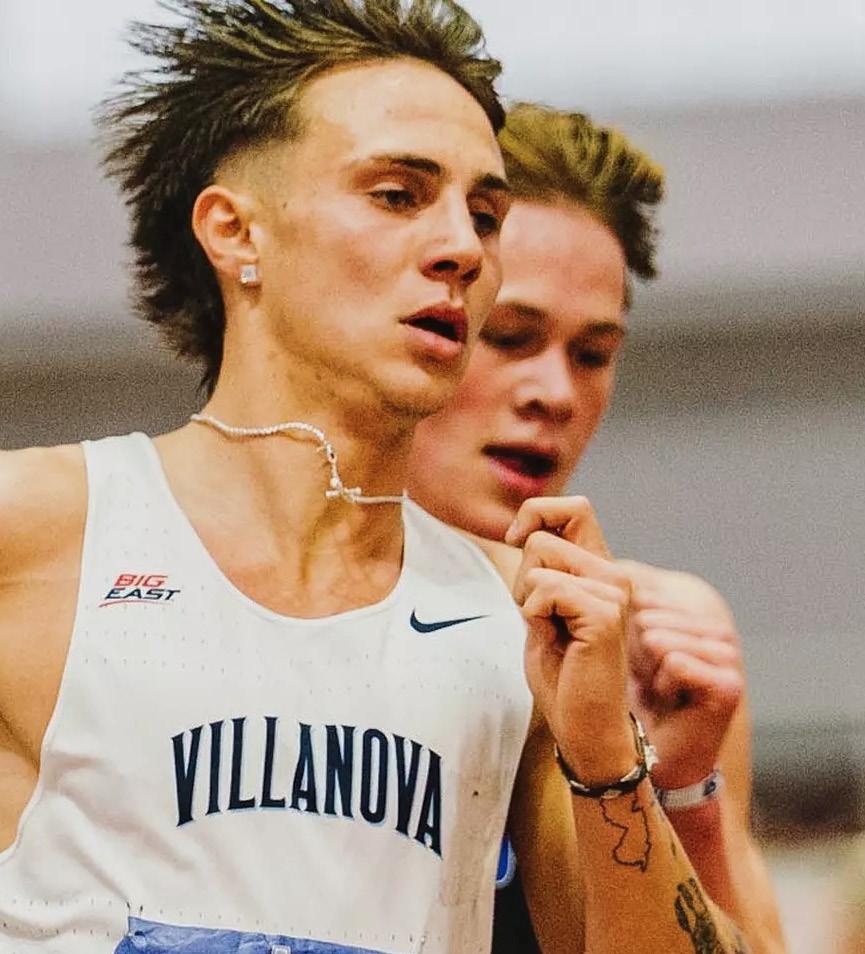
2:07.65 in the 800-meter preliminary race. Since Martell received 16th place, she did not qualify for the 800-meter finals.
The men’s DMR crossed the finish line at 9:40.36 to reach 11th place at the Championship.
Fifth-year Sean Donoghue was the lead off, running a 2:56.58 in the 1,200-meter.
“[Donoghue] was a good leadoff leg, his credential was a 2:50 to get us there, so it’s not like he couldn’t do it,” O’Sullivan said. “We knew we were going to be a little bit weaker on the back end. We didn’t know we would come apart on the front end, and that took us out of the race immediately.”
Junior Ethan Walls split 47.73 in the 400-meter portion. Junior Dan Watke ran his specialty of the 800-meter and passed the baton within 1:47.77. At the anchor, junior C.J. Sullivan ran the mile portion in 4:08.29. “It makes all the difference in terms of being engaged in the race because you just get discouraged,” O’Sullivan said. “It’s so hard to catch up, you’re on your own, you’re never making the impact you think you want to make to catch up.”
The National Championship concludes the indoor season for Villanova Track and Field. The team will commence the outdoor season on Saturday, March 21, at Franklin Field for the Penn Challenge.
Marco Langon’s Persona Is Good For The Sport Of Track
Dylan Johnson Co-Editor-in-Chief
Villanova’s Marco Langon kicked off the 2026 indoor track and field season with his signature 5K race in the Sharon Colyear-Danville Season Opener at Boston University. As Langon rounded the final turn into the straight, he turned over his legs into a dead sprint. He emptied his tank for a chance at victory. Langon was side-by-side with elite New Mexico distance runner Habtom Samuel.
Langon threw his body at the line and fell to his knees, diving for a shot at a first-place finish.
The two crossed the line at the same time in 13:05.21. After the replay, it was announced that Samuel finished just ahead of Langon by just thousandths.
Langon’s second-place finish was impressive nonetheless. However, Langon did not care. He did not win, and his main goal was the national championship at the end of the season.
“I am pretty disappointed in the result,” Langon said to LetsRun after placing second in a fast Boston 5K. “My main objective is to win, and I am not doing that. I got to get my get back. My get back in blood.”
To Langon, finishing second meant he was the first one to lose the race. Langon’s persona and quotable interviews have drawn controversy
across the sport of track and field.
Langon has generated interest in the sport that was not there before. His persona is crucial to growing the sport and its revenue. Win or lose, people are tuning in to watch Langon run. Langon continued in that same interview when talking about the runners he is facing, including the man who beat him, Samuel.
“Who cares? Who cares if [Samuel] wins the cross, if he wins worlds?” Langon said. “I don’t give a damn who it is. I am here to show up on the day. I don’t care what you did yesterday. I don’t care what you did last year. I don’t care if you’re a world champion, Olympic champion. At the end of the day, I am here to win. I am going to get up on the line and think I am the best, no matter what.”
That race kicked off Langon’s hunt to defeat Samuel in March and bring home his first indoor national championship title. Throughout the season, he continued his soundbites in interviews across the country.
In February, Langon returned to Boston to race a fast-paced 3K. Langon again put himself into the headlines and social media posts. Langon raced directly next to UNC’s Colton Sand, winning with a time of 7:33.00 to Sand’s 7:34.05 in a controversial finish.
Langon made the unplanned return to Boston because he was told that his 3K qualifying time of 7:34.56 at the New Balance Indoor Grand Prix on Jan. 24 was not good. It did
not count because the NCAA requires a minimum of two athletes from at least two different schools for a meet to count for a qualifying time.
Langon again delivered a signature soundbite after the race.
“Some random-a** dude Jeff [from the NCAA] was like, oh yeah, your time doesn’t count, blah blah blah, all that bulls**t,” Langon said to LetsRun after the 3K at Boston.
“At the end of the day, I don’t care. I don’t care who it is, what it is, I’m here for the smoke. All of it.”
His continuous trash talk and over-the-top personality continued to grow two separate groups of people: the ones who hated him and the ones who became infatuated with his character.
Langon anchored Villanova’s DMR team at the Philadelphia Metro meet on Feb. 20. The team ended up running the second-fastest collegiate time in the event. It set up Langon for another viral interview after the race.
“I’m the best runner God put in this country,” Langon said after the DMR win.
It prompted Coach T, a track and field voice on social media, to wish for the “demise of Marco Langon.”
“I am tired of this dude,” Coach T said on his Instagram account. “Marco “Lankin”, I want you to listen, and I want you to listen closely. You will fail on March 13 and 14. I can see it in your eyes. You’re about to get delt with. I will make sure
that you fail. I will not let you win that race. I will pull to the race, front row and center.”
Coach T was serious. He made the trip to Arkansas, the site of the NCAA Track and Field Indoor Championships, to trash-talk Langon from the side of the track.
Langon ended up falling short to Samuel again in the 5K indoor final, finishing in fourth place. Samuel was later disqualified, and Langon finished third officially.
Three of Coach T’s last nine Instagram Reels were about Langon, which did 85,300, 19,600 and 44,700 views. The other six Reels did an average of 8,300 views each.
It is clear that Langon creates engagement for a sport that is not a part of the major American sports such as basketball, football, hockey and baseball.
Despite Samuel being disqualified after the race, Langon was not fazed. His mind was already set on returning for the outdoor season and claiming an outdoor 5K title in June.
“This sport, as much as you do run it, people are here to watch it as well,” Langon said to The Stride Report after the loss in the 5K final. “And whether people resonate or don’t resonate with me. I’m apologetic in how I am, both on and off the camera. I live authentic through and through. I just am who I am. If people got a problem with that, they could meet me somewhere else and do something about it.”
Langon finished third in the 3,000 meters at the NCAA indoor championships. Courtesy of Villanova Atheltics
Softball Falls 3-0 In Home Opener

Eliza O’Neil Staff Writer
This past weekend, Villanova softball hosted Butler (10-9, 3-0 Big East) in its first home competition of the season. The Wildcats (5-22, 2-4 Big East) went 0-3 against the Bulldogs, bringing their attempt to stretch a one-game winning streak to a halt.
The games began on Friday, March 13, and the Bulldogs won the opener, 6-2. Senior pitcher Kat Gallant started on the mound for Villanova and struck out three over five innings.
In the first inning, Butler scored three runs, but Villanova narrowed the margin to 3-1 on an RBI double by junior pitcher Maranda Runco.
Runco hit her fifth home run of the season in the third inning, which moved her into a tie for seventh all-time in program history with 26.
“That’s just obviously credit to Maranda because of how good she is,” head coach Bridget Orchard said. “We need to make sure whoever’s hitting will drive her in, and then they’ll have to stop walking her if we hit behind her.”
In the fifth inning, the Bulldogs scored two more runs before scoring an additional run in the sixth. Although Villanova loaded the bases in the seventh inning with singles from senior second base Maddie Burrows, freshman outfielder Jacquelyn Cox and freshman infielder/outfielder Katie Reed, the Wildcats were unable
to score again.
The Wildcats fell to the Bulldogs again, 12-5, on Saturday, March 14. Sophomore pitcher Lexi Kobryn started and pitched for two innings with two strikeouts.
Butler scored first, with two runs in the first inning. After four innings, the Bulldogs had a 10-run advantage. Senior second base Lilly St. Jean had an RBI single, scoring Katie Reed to make the score 12-3.
Reed hit a two-run double, scoring Jaclyn Morra and Madison Ostrowski in the fifth. Runco was intentionally walked, the fifth time that that has happened, a program record.
“And then we get into those tight, close situations, that I think [we need to] mentally tighten up a little better, just work there,” Orchard said.
“I think they had good breakouts both of the days.”
The Bulldogs won the final game, 12-9, in 10 innings. Freshman pitcher Maggie King got the start on the mound and struck out two through five. She reentered in the eighth inning.
The Wildcats scored first with five runs in one inning. This began with two RBI singles by Cox and Burrows, followed by a fielder’s choice by Runco and a two-run double by Kobryn.
The Bulldogs responded, scoring three runs in the third, after St. Jean hit a double to bring in freshman Carly Zych.
Butler tied the game in the fifth, 6-6, before junior infielder Grace Reed managed an RBI walk and Ko-
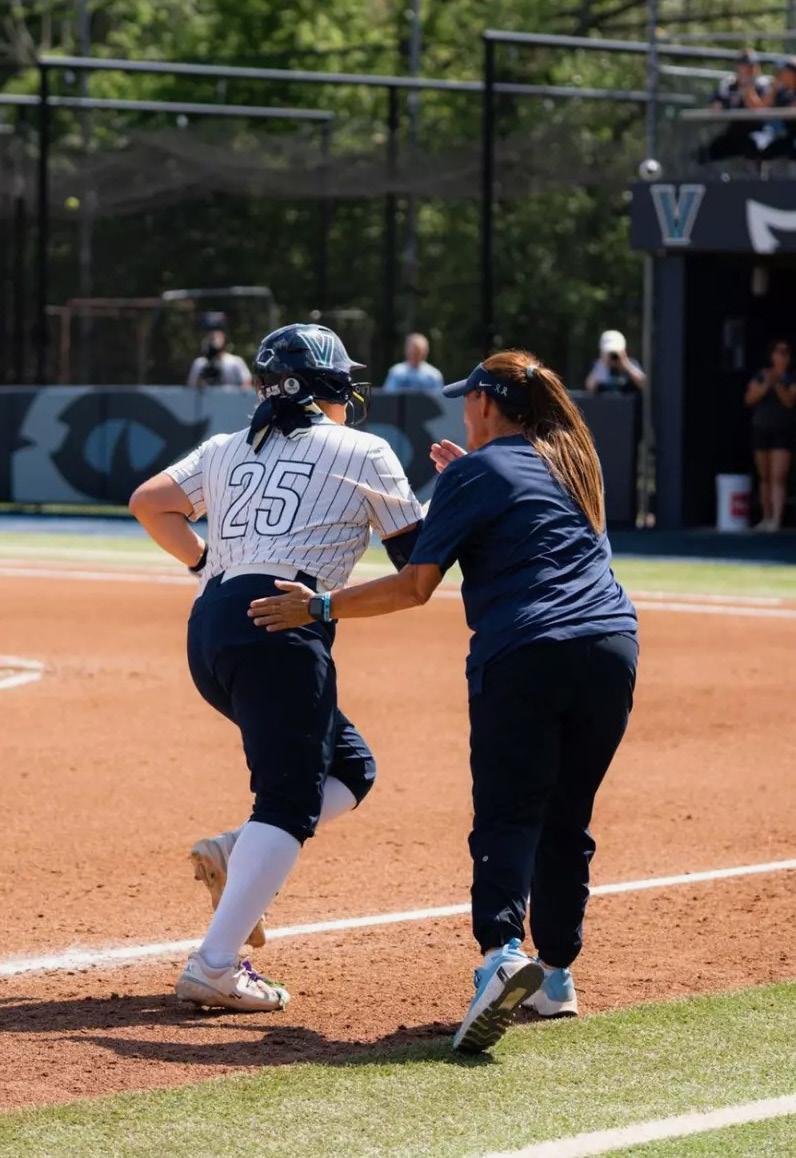
bryn hit a two-run single, which gave Villanova a 9-6 lead.
In the top of the seventh, the Bulldogs scored three to force extra innings. After two scoreless innings, Butler scored three against the ‘Cats at the top of the 10th, winning the game, 12-9, and the weekend, 3-0.
“They’re gonna be really hard games,” Orchard said. “I’m hoping that we can get a lot of good preparation and work this week, and then we get out there, hopefully, and that’s softball.”
Villanova will host Saint Joe’s at home on Wednesday, March 18. First pitch is scheduled for 3:30 p.m. The game will be streamed on ESPN+.
Women’s Basketball: Strength In Numbers
Casey Healey Co-Sports Editor
After a couple years of adjustments, Villanova women’s basketball has found its flow and proven itself as a March Madness-caliber team after earning its first bid since 2023. Led by star sophomore guard Jasmine Bascoe and fifth year center Denae Carter, the ‘Cats made their way through the regular season and finished second overall in the Big East.
However, as impactful as Bascoe and Carter have been, Villanova’s bench runs deep this season. Much of its success can be attributed to the efforts of Villanova’s depth, including senior guard Ryanne Allen, sophomore guard Dani Ceserreti and freshman forward Brooke Bender.
Allen came to Villanova her junior year, following a stint at Vanderbilt. Growing up near Villanova, she was familiar with the area already, having played at Archbishop Wood High School.
This season, she has averaged 7.9 points per game, 2.4 rebounds and 1.1 assists. Most notably, Allen finished the season with a 44.3% three-point field goal percentage, which got her an invite to the NCAA Women’s Three-Point Shot Competition, hosted in Indianapolis, IN, at the men’s Final Four. Allen was amongst the top shooters in the Big East this season, ranking 10th in the conference for three-point field goals per game.
Allen was also named Philadelphia Big Five Player of the Week back in December and appeared on
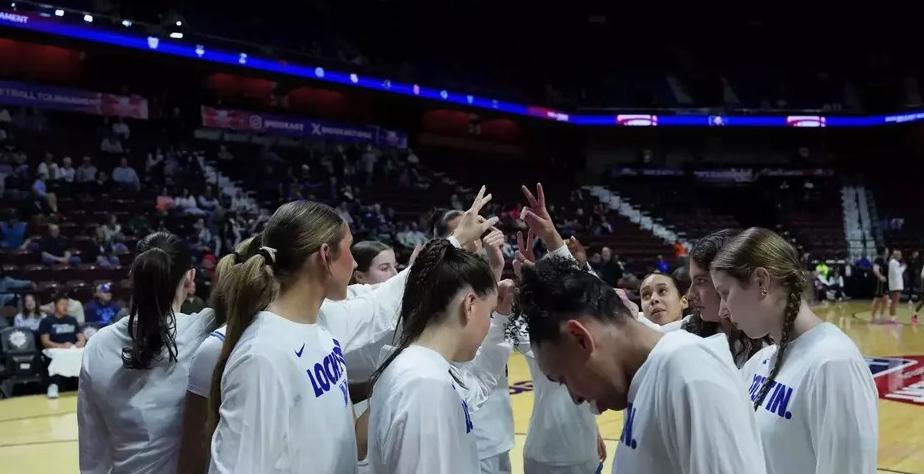
the Big East Weekly Honor Roll.
Ceseretti, a Rhode Island native, was recruited by Dillon and played her freshman season in 202425. As a freshman, she played in 30 games and had 25 points. The 6 foot guard recorded a career-high of four steals against Xavier as well as a career-best seven rebounds against St. John’s.
This season, Ceseretti has increased her contributions on the court. She recorded a career-high 12 points on Jan. 4 at Marquette.
“I think I have a bigger role defensively trying to help out,” Ceseretti said. “ I think mainly just trying to bring energy up. Being able to come in and add to what the starters have already done to start off the game has been fun.”
Bender joined the team this year, alongside her twin sister, Elise. The Ohio native currently averages 4.8 points per game and 2.6 rebounds. Known for her sharpshooting abilities from the three point line,
WEEKLY SCOREBOARD
March 11 - March 17
Wednesday, March 11
Softball vs. Monomouth 10-2 W
Waterpolo @ LaSalle 14-13 W
Thursday, March 12
Men’s Basketball vs. Georgetown 64-78 L
Men’s Tennis vs. Creighton 0-7 L
Friday, March 13
Baseball @ Charleston Southern 5-4 W
Softball vs. Butler 2-6 L
Saturday, March 14
Women’s Tennis @ Loyola Maryland 5-2 W
Men’s Tennis @ Loyola Maryland 6-1 W
Waterpolo vs. Wagner 15-14 W OT
Baseball @ Charleston Southern 5-0 W
Baseball @ Charleston Southern 4-22 L
Softball vs. Butler 5-12 L
Men’s Lacrosse vs. Towson 11-17 L
Men’s Track @ NCAA Indoor Championships 18th of 54
Golf @ People’s Championship 4th out of 20
Saturday, March 14
Softball vs. Butler 9-12 L Waterpolo vs. LIU 19-12 W
Tuesday, March 17
Women’s Lacrosse vs. Stony Brook 10-18 L
Men’s Lacrosse @ Lehigh 7-14 L
Bender achieved a career-high of 18 points against Providence, where she went 6-of-8 from beyond the arc.
“So far for me, it’s been shooting,” Bender said, when asked about her biggest contributions. “I just like to come off the bench, and shoot threes, and just bring some energy.”
Bender was named Philadelphia Big Five Rookie of the Week on Nov. 10, following a 16-point performance against Virginia Commonwealth University.
Allen, Ceseretti and Bender are anticipating their trip to Baton Rouge, LA, to play in the NCAA Tournament.
“I’m just really grateful for my 1st season, being able to have this opportunity and with a bunch of people that I love playing with,” Bender said. “So I’m just really excited and we’ll see what happens.”
It will be the first time all three players will wear the Villanova jersey in March Madness. Allen formerly competed in the tournament
with Vanderbilt back in 2023. “Being in a different position, and just being a senior now, I think I’ve become more appreciative of the opportunities that come my way,” Allen said. “Being able to do it with this group as a senior, to go out this way. It’s a cool experience to have, and I’m really looking forward to seeing what we can do in the tournament.”
Despite not being in the starting five lineup, these three players have helped to bring the Wildcats back to the tournament for the first time since 2023.
The three also named their choices for the loudest voice on the bench.
“Ours would probably be Annie,” Bender said. “She always has something to say. I sit next to her.” They concluded with a tie between senior Annie Welde and sophomore Rachel Wirts.
“I would also put Rachel in there,” Ceseretti said. “She has some really great cellies So, yeah, she brings some good energy.” Villanova was named a No.10 seed and will take on seven-seeded Texas Tech on Friday, March 20. Should it win, it will take on the winner of No. 15 Jacksonville vs. No. 2 Louisiana State University.
The ‘Cats will travel to Baton Rouge, LA, for the first round of March Madness on Friday, March 20. Courtesy of Villanova Athletics
The ‘Cats fell to Butler in the home opener. Courtesy of Villanova Athletics
Baseball Splits Series, 2-1, In Charleston
Noah Okenquist Staff Writer
This past weekend, Villanova baseball traveled to Charleston, SC, for a three game series against Charleston Southern University. Villanova (7-9) won its first two games of the series, 5-4 and 5-0, before taking a 4-22 loss to the Buccaneers (13-6) in its final face off.
The ‘Cats kicked off the series on Friday, March 13. Redshirt outfielder Austin Lemon and senior infielder Michael Whooley were quick to reach the bags in the first inning, setting up runners for graduate third baseman Carter Richey. Richey’s double to the left gave the Wildcats their first two runs of the game which remained unanswered until the third inning.
Junior pitcher Jake Francis started the game for Villanova. Following a leadoff walk, Francis held off the next three batters to end the inning.
During the bottom of the third inning, CSU tied the game at two, before it took a 3-2 lead off of a sacrifice fly.
In the fifth inning, freshman outfielder Jack Roventini and redshirt sophomore catcher Mark Gialluisi got on base for Lemon to drive them in with a double to left. Whooley followed, with a long triple to left, plating another run for the Wildcats. Sophomore JP Podgorski pitched four innings in relief and allowed one run on three hits. With
Mason Canton Staff Writer
Podgorski’s four strikeouts, he and the rest of the defense were able to hold down CSU going into the ninth.
“I was very pleased with JP’s progress and growth and he has a very high ceiling with good stuff,” head coach Kevin Mulvey said. “He’s not even close to where he will be.”
Senior pitcher Graham Moore closed out the game in four batters, helping Villanova take the victory over the Buccaneers on Friday afternoon.
Saturday morning saw a pitcher’s duel as graduate student Jack Kelley got through two innings without a runner on. Gialluisi rallied the Wildcat offense, hitting to the outfield in the third. A base hit combined with two hit-by-pitches loaded the bases for Lemon, who plated an RBI with a fielder’s choice. A double from sophomore infielder Brayden Leonard added a run. A sacrifice fly from senior utility Collin Quintano completed Villanova’s three runs in the third inning.
While graduate pitcher Jack Kelley dominated through six innings, Villanova scored another run in the fourth inning off of another fielder’s choice from Lemon.
“Coming off a win Friday and being able to give us that effort to win the series is incredible for Jack,” Mulvey said. “It helps the defense behind you stay locked in and ready to make a play for you. I couldn’t be happier with his outing and success”.
Whooley drove Lemon in during the seventh inning for their fifth and final run of the game.
Senior pitcher Bobby Finn came in for the last three frames, holding off CSU to secure the win.
Villanova fell early in Saturday’s game, after CSU opened play with six runs in the first inning. With only two hits, CSU took advantage of multiple hit-by-pitches and walks that caused them to give up unearned runs. Two more singles and a home run made it 9-0, and after a three-run home run in the fourth, CSU was up 12-0.
Quintano finally gave the Wildcats momentum with a solo shot in the fifth inning. Junior first baseman Tim Schuler followed, giving the ‘Cats another home run. Schuler’s home run marks his first of the season.
CSU responded to the ‘Cats in the bottom of the fifth, A single, double and passed ball gave the Buccaneers four more runs to continue their final rally over Villanova.
Villanova finished their scoring with a single from Quintano, followed by junior infielder Trent Toole’s production of another single to score Jake Bollin.
Villanova was unable to produce any more runs as it dropped the last game of the series, splitting Saturday’s double header with the 22-4 loss.
“There’s ups and downs in every game, the ability to overcome failure and adversity gives you the ability to succeed in the future,” Mulvey said. “Staying calm, cool and collected every game isn’t always easy.”
Prior to the weekend series, the Wildcats hosted LaSalle, earning
a 14-10 victory at home on Tuesday, March 10.
Lasalle took early command of the game, scoring four runs in the top of the first inning.
Whooley responded, scoring a home run in the bottom of the inning.
After Villanova further fell to a 6-1 deficit, Whooley rallied the ‘Cats again with a two-run double, scoring Leonard and Lemon.
“He does a great job preparing on his own,” Mulvey said about Whooley. “Our conversations are more about the mental aspect of the game and staying consistent.”
The Wildcats tied the game at six in the fourth inning, before trading runs in the fifth.
Gialluisi knocked in the equalizer on a sacrifice fly in the seventh inning.
Defensively, Moore closed out the game, striking out three of four batters he faced during the eighth inning. Villanova scored four runs to take a 14-10 lead, before the game ended in the eighth due to darkness.
“We try to help prepare them for those situations and keep them consistent in their approaches,” Mulvey said. “This group does a really good job and they love being together and playing together.”
The Wildcats will now continue their season at home, hosting the University of North Carolina at Asheville (11-10, 1-2 Big South) for a three-game series at the Villanova Ballpark at Plymouth. The first game of the series is set for a 3:05 p.m first pitch on Friday, March 20.
Men’s Tennis Splits Weekend, 1-1
Will Monahan at No. 2 singles.
The Villanova men’s tennis team split a pair of matches over the weekend, falling to Creighton, 7–0, on Thursday before bouncing back with a 6–1 victory over Loyola Maryland on Saturday.
Villanova opened the stretch on March 12 in a tough matchup against Creighton at St. John’s in Queens, NY. Despite a strong start in doubles, the Wildcats were unable to carry the momentum into singles play.
Sophomore Cooper Gordon and junior Ethan Carr earned Villanova’s lone doubles victory of the match, defeating McKenzie and McMahon, 6–4, at the No. 1 position. Creighton answered on the other two courts, as Daisima and Daniel defeated juniors Kush Anand and Thomas Wakefield, 6–0, at No. 2 doubles, while Kuo and Danler edged sophomores Jack Sherner and Quincy Jones, 7–5, at the No. 3 spot to secure the doubles point.
“I thought we played pretty good doubles,” Villanova head coach Brad Adams said. “We had a pretty good chance with Quincy and Jack to break and clinch the point. Overall, we were a little sluggish having to drive to St. John’s. We were relatively slow to get going.”
Creighton maintained control in singles play, winning all six matches to seal the 7–0 result. At the top position, Daisima defeated Gordon, 6–0, 6–2, while Patel followed with a 6–3, 6–3 victory over
The most competitive match came at No. 3 singles, where Carr battled through three sets before falling to Kuo, 6–3, 5–7, 10–6.
Danler added another point for Creighton with a 6–3, 6–1 win over Wakefield at No. 4 singles.
McKenzie defeated Justin Frattarelli 6–4, 6–2 at No. 5, and McMahon closed out the sweep with a 6–4, 6–7 (3), 10–6 win over Sherner at No. 6.
“Losing in three sets at three and six was tough,” Adams said. “They battled well. It was rough for a first conference match.”
Adams also pointed to the challenge of facing an opponent that primarily competes indoors.
“It’s tough to play a primarily indoor team like Creighton,” Adams said. “It might’ve been a different story outside. After coming back from San Diego and playing a lot of matches outside, it’s difficult for us to adjust to playing indoors sometimes.”
Villanova responded two days later with a strong performance on the road, defeating Loyola Maryland 6–1 on March 14.
The Wildcats once again set the tone in doubles, capturing the opening point with victories on Courts No. 1 and No. 2. Gordon and Carr battled to a 7–6 win over Lawliss and Gill at the top position, while Anand and Wakefield secured a 6–2 victory over Hagen and Moldenhaver at No. 2 doubles.
“The battle we had in doubles was very challenging,” Adams said. “At two, we had a pretty easy
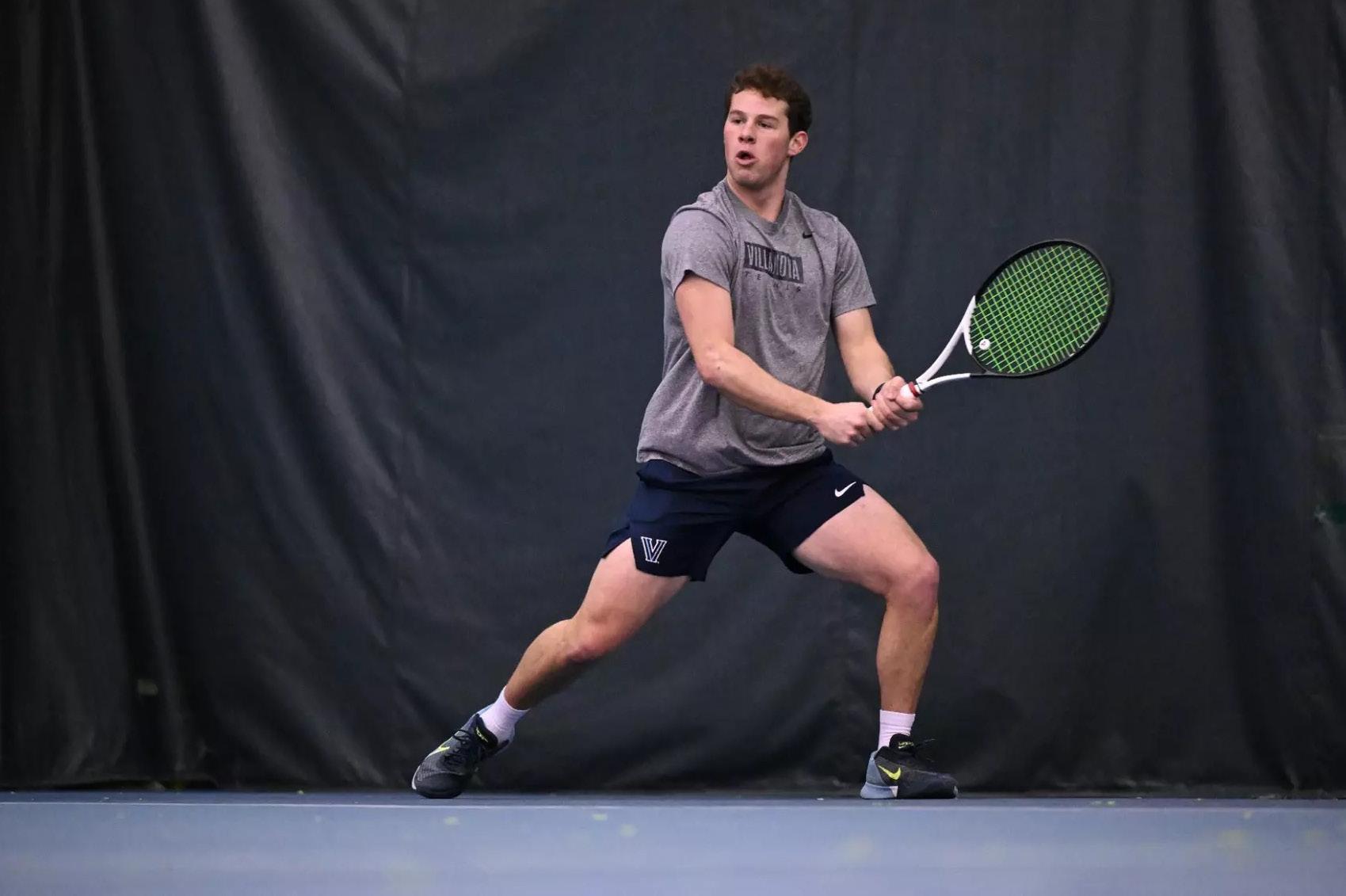
victory, but at one we had to win in a tiebreak.”
Loyola picked up its lone doubles win at No. 3, where Edwards and Zelders defeated Sherner and Jones, 7–6.
“I thought the guys should have been able to win more comfortably,” Adams said. “But the toughness helped us bring that intensity going into singles.”
Villanova carried that momentum into singles play, winning five of six matches to secure the team victory.
At No. 1 singles, Gordon delivered a dominant 6–0, 6–1 win over Moldenhaver. Carr followed with a 6–2, 6–3 victory over Gill at the No. 2 position. Monahan rebounded after dropping the first set to defeat Hagen, 1–6, 6–1, 6–1 at
No. 3 singles.
Wakefield added another point for the Wildcats with a 7–5, 6–1 win over Lawliss at No. 4. Loyola Maryland’s only singles victory came at No. 5, where Edwards defeated Jones 6–2, 6–0. Sophomore Evan Ancu closed out the match for Villanova with a decisive 6–1, 6–1 win over Rotundo at No. 6. Adams looks forward to the matchup against Marquette this weekend.
“We need to make sure that we set the tone from the first points and games in doubles,” Adams said. “We’ll have the energy and confidence from our matches against them over the past two years.”
Villanova will host Marquette on Saturday, March 21. First serve is scheduled for 2 p.m.
The team earned a 6-1 victory over Loyola Maryland on Saturday, March 14. Courtesy of Villanova Athletics

Genna Cottingham Sports Columnist
Growing up five minutes away from women’s lacrosse powerhouse Boston College, junior midfielder Emma Verhoest realized she could have a bright future in the sport, no matter what jersey she dawned.
Last week, Verhoest was named the Big East Midfielder of the Week for the second time in her Wildcat career after making significant contributions to spring break victories over Siena College and the University of Vermont. During the two games, Verhoest totaled 28 draw controls, setting the program record for the most draw controls earned by a Wildcat in a single game with 19 against UVM on March 6.
“I’ve grown a lot in terms of my lacrosse IQ and just like doing all the film sessions,” Verhoest said reflecting on her growth as a collegiate player. “I think there was a time that if things weren’t going well, myself and then the other girls in my year included would have a different reaction than we would now.”
As soon as she walked through Villanova’s campus with her father Patrick, the Massachusetts native realized her number one choice. Per NCAA rules, lacrosse athletes are not allowed to commit to a college until their junior year. Once September 2021 hit, Verhoest signed all the paperwork to be a part of Nova Nation. Thus, her Wildcat journey
Wildcat Watch: V For Verhoest
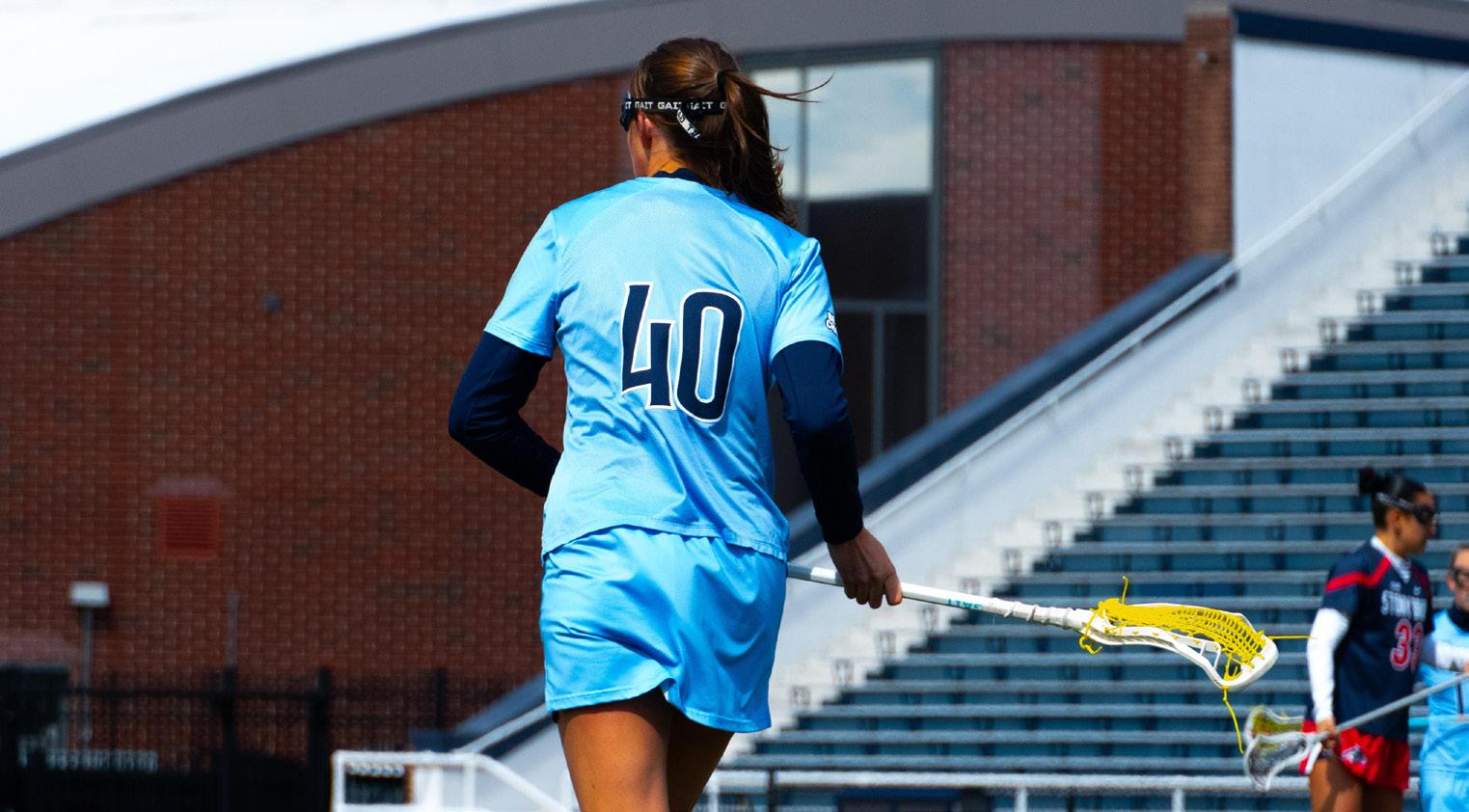
began.
Born and raised in Newton, MA, Verhoest started playing lacrosse in the second grade. Recognizing her skillset and adoration for the sport, Verhoest’s parents signed her up for Revolution Lacrosse, a distinguished all-girls club in Boston.
Verhoest attended Dexter Southfield High School and played on the varsity lacrosse team all four years. With the lacrosse season taking place during a portion of the winter and the entirety of the spring, Verhoest looked for a way to stay in shape during the fall.
Verhoest extended her athletic ability to the fall, picking up field hockey. What began as a slight interest transformed into her playing four seasons of high school field hockey during lacrosse’s offseason.
When Verhoest does any-
thing, she likes to give it her all. Her interest in field hockey didn’t stop as a mere off-season filler. Naturally, Verhoest signed up for a club field hockey team, making her part of two high school teams and two club teams during her four years of high school.
With middle school experience in ice hockey, Verhoest would have taken on a third sport, were it not for the limits in her schedule with her other two sports.
While at Revolution Lacrosse, which Verhoest affectionately nicknamed “Rev,” the Villanova junior learned how to carry independence and confidence in her daily life.
“I think that was a very transformational part of my childhood, not just as a lacrosse player, but as a person,” Verhoest said. We were emailing [the coaches] by ourselves in second grade if we couldn’t go to
practice, and they were very helpful throughout my growth process as a lacrosse player too.”
At Rev, Verhoest played under the mentorship of her longtime coach Meg Reddy. What Verhoest did not realize when she began playing for Reddy and “Rev” was that her coach’s close friendship with current Villanova head coach Jill Batcheller would become an integral part of her lacrosse career.
Verhoest’s club team got her recognized, even if it meant spending every weekend in a different state.
Most competitions were held on the East Coast. Verhoest spent the majority of her time in Maryland, New York, and even Philadelphia. The summer after her sophomore year at Dexter Southfield, Verhoest was encapsulated by the beauty of Villanova’s campus and personal connections to its lacrosse program.
“She is somebody that works incredibly hard on her craft, a lot of extra work and has constantly been getting better,” Batcheller said. “I think the biggest improvement that I’ve seen in her is her confidence and her ability to troubleshoot in games… to be able to make adjustments based on what the other team is doing while still remaining really true to herself and her draws.”
Now in the middle of her third season with the Wildcats, Verhoest reflected on Villanova’s impact on her development. She never pictured being anywhere else and owes a great deal of gratitude to Reddy and Batcheller.
Water Polo Completes Upset Over No. 20 Wagner
Noah Okenquist Staff Writer
This weekend, Villanova women’s water polo faced off against Wagner and Long Island at home, looking to carry the momentum it has built in the past couple of weeks. The ‘Cats have won eight of their last nine, and now sit at 15-7 following the weekend’s games.
Villanova won both games, dumping Wagner, 15-14, and overcoming LIU, 19-12.
“We have the ability to play really well against tough teams because of our experience, and because of our defensive stops and scoring,” head coach Michael Gordon said. “And even in the game itself, I see us get better quarter by quarter, which makes us better players down the stretch.”
On Saturday, the Wildcats (15-7, 2-0 MAAC) hosted No.20 Wagner (8-10, 1-1 MAAC) at home. Villanova hadn’t won against Wagner since March 28, 2015. However, multiple stars broke out during the game, which ultimately ended with a 15-14 overtime win.
“It’s good to play as many tough teams as possible to prepare for conference play, which is where we really get to shine,” Gordon said. “Although teams like Harvard and USC had given the team challenges before, facing these tough schools this late in the season shows where the team has progressed.”
Both Wagner and Villanova scored four goals in the first, and a 3-2 advantage in the second made it 7-6
before half.
Wagner drew a tie in the third, 9-9, before taking a lead later in the quarter, 12-11. With 30 seconds left in the game, senior Sara Withers knocked in a tying goal for Villanova to send it to overtime. Withers had also broken the career assists record on the day with a total of 166.
In overtime, goals from seniors Anna Painter and Ella Mattocks put Villanova up, 15-13. Senior Gracin Kerry was in the net all game for the Wildcats and saved 10-of-24 shots.
Though the Wildcats let up an overtime goal, they held on to secure the 15-14 victory over the ranked Wagner team.
“It’s the same message as the start of the game,” Gordon said. “We have the scouting on the other team, and we know what to do with maybe some minor tweaks. They know the system they’re playing, and we train all season for moments like these.”
Other scorers on the day included sophomore Riley Hull, with a team leading four goals. Junior Tippy Maguire, sophomore Layla Canales and senior Coco Jones all had one each.
Canales also reached her 100th goal milestone in the game.
On Sunday, Villanova celebrated its senior day game against Long Island. Coach Gordon spoke about the impact these seniors have had and the legacy they leave behind.
“They’ve really built up the team culture and have all been catalysts,” Gordon said. “There’s still a little way to go in the season, but they’re leaving it in a much better place than
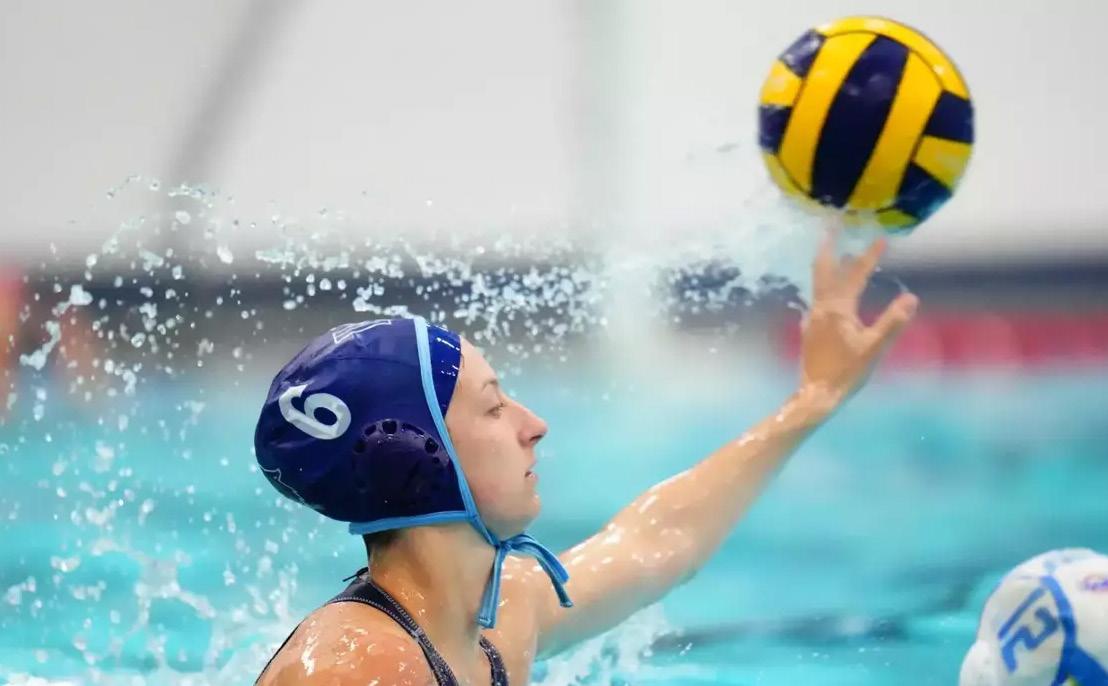
they came in. It’s a great senior group with a lot of experience.”
The first quarter ended with the Wildcats up 6-4, and they maintained their lead to go up 10-6 by halftime.
The third quarter followed similarly, with Villanova scoring seven against LIU’s three goals. After little deliberation, the fourth quarter quickly ended with the ‘Cats securing a decisive 19-12 victory for their third straight MAAC win.
With seven goals from Hull, five from Mattocks and two from Painter and Canales, the offense was dynamic in moving the ball down the pool and into the net.
“We’re still trying to home in on our passing to put the ball where it needs to be,” Gordon said. “But we’re a very dynamic team that can score in transition, score in the center, or drive
in on the outside and attack.” Withers and Jones both secured three assists while Painter, Hull, Withers and freshman Tessa Petit all accumulated a steal.
Gracin Kerry stayed in the net for Villanova, saving 13-of-15 attempts with an assist and a steal. Villanova has five games remaining in the season and hopes to reach the MAAC championship.
“We’re not putting any game behind us,” Gordon said. “We’re just headed right back to work Tuesday morning. When we keep the routine, it shows success, and we hope to have some successful results.”
Villanova will return on Saturday, March 21, to play against Marist in Poughkeepsie at 9 a.m. The following day, the Wildcats will take on Virginia Military Institute, also at 9 a.m.
Verhoust is currently the all-time leader in draw controls. Mason Canton/Villanovan Photography
Waterpolo now has three straight wins in the MAAC. Courtesy of Villanova Athletics
March Madness Preview: Men To Take On Utah State
Jack McFadden Staff Writer
On Friday, March 20, for the first time in four years the Villanova men’s basketball team will be making its return to the highly touted NCAA Tournament, starting with the round of 64 in Viejas Arena in San Diego, CA, where it is are set to take on the nine-seeded Utah State University Aggies (28-6, 15-5 Mountain West). The game will tip-off at 4:10 p.m. ET on TNT.
The two teams have only met one time prior to their matchup in the first round on Friday, that being in the 1960 NIT where the Aggies walked away with the first round win over Villanova, 73-72.
Following the regular season the Wildcats finished 24-8 overall and 15-5 in the Big East, helping them land the No. 8 seed in the west region. On Thursday, March 12, Villanova suffered a tough loss to Georgetown, 78-64, in the quarterfinals of the Big East Tournament. In that game, senior forward Duke Brennan led the way for the ‘Cats scoring 14 points and grabbing six boards, while junior guard Tyler Perkins narrowly trailed scoring 13 points and adding four rebounds.
The Wildcats are currently led by Perkins, who averages a team-high 13.7 points per game. Brennan leads the ‘Cats on the glass, averaging 10.5 rebounds
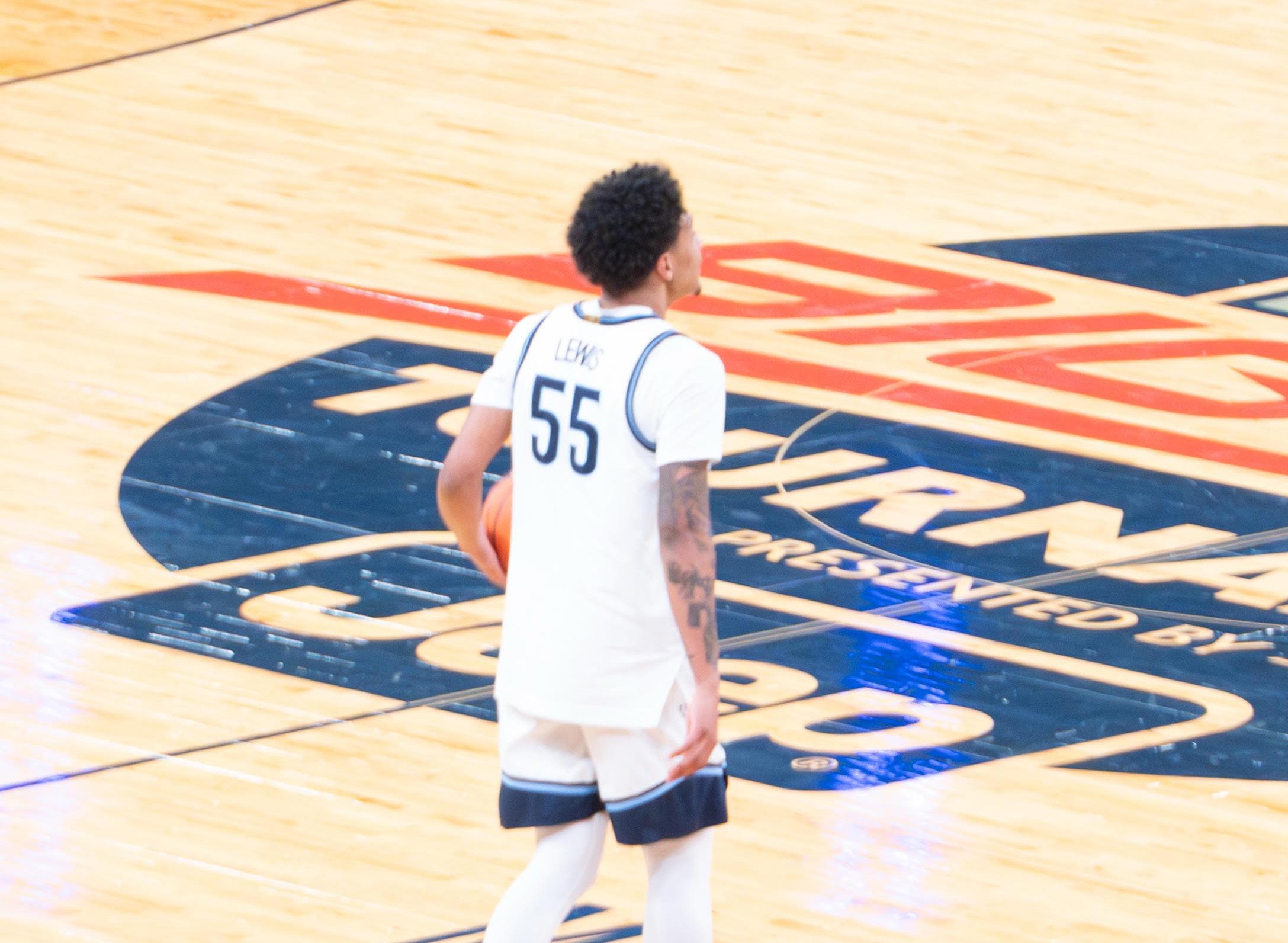
per game. As a team, Villanova is shooting 45.7% from the field, and 35.3% from beyond the arc on the season.
The ‘Cats average 77.2 points per game as a team, and hold their opponents to 70.8 points a game.
As for the Aggies, they are coached by Jerrod Calhoun who is entering his second season as the head coach of Utah State. In his first season at the helm, Calhoun had one of the more impressive debut seasons in Aggie history where he led Utah State to a 26-8
record and an NCAA Tournament appearance. Through his first two seasons in Logan, UT, Calhoun is 54-14 (30-10 Mountain West).
This season he led Utah State to one of their best seasons in program history, where they won their third ever Mountain West Conference championship defeating San Diego State, 73-62.
In the championship game, senior guard M.J. Collins Jr. led the way for the Aggies, scoring 20 points and picking up three steals. He also shot 4-for-10 from beyond the arc. Junior guard Mason
Falslev also contributed to the victory scoring 16 points and adding six assists.
Utah State’s leading scorer is Collins, who averages 17.6 points per game and shoots 49.1% from the field. Falslev just trails his backcourt sidekick, averaging 16.1 per game on 52% shooting. He also shoots 41.1% from threepoint range, and leads the team in rebounds averaging 5.8 a game, making him one of the players the Wildcats should watch out for.
The Aggies are typically a small ball type of team, but have two players who stand out, those being freshman wing Adlan Elamin, and senior forward Zach Keller who will likely match up against Brennan in the game.
As a team, Utah State is shooting 49.8% from the field, and 35.8% from three this season. They average 82.5 points per game and hold their opponents to 70.3 points, making it a balanced matchup against Villanova.
If Villanova wants a chance to make it to the round of 32, they are going to need to shut down the Aggies backcourt duo, and hope that Perkins and star freshman Acaden Lewis can win the matchup of the guards, while Brennan holds down the paint.
If Villanova is to win, they will play the winner of No. 1 Arizona and No. 16 LIU in the second round of the NCAA Tournament. The date for the second round game is Sunday, March 22.
Women’s Lacrosse Falls Short Against Stony Brook, 18-10
Casey Healey Co-Sports Editor
Mason Canton Staff Writer
On Tuesday, March 17, Villanova women’s lacrosse fell (53),18-10 to Stony Brook at Villanova Stadium. The Wildcats are now 0-4 against Stony Brook, in their last matchup on Feb. 25, Villanova lost, 5-12.
Stony Brook is currently ranked at No.12, according to the Intercollegiate Women’s Lacrosse Coaches Association (IWCLA) Coaches Poll.
The Seawolves opened the game with a 2-0 lead in the first several minutes. Junior midfielder Rose Christie answered back with a goal
off an assist from Sophia Corretjer. However, Stony Brook netted two more to go up 4-1 at the end of the first.
“I think one thing we could have done is start the game out a little faster,” head coach Jill Batcheller said. “We started out with a lot of turnovers in the first quarter.”
Villanova added one more in the second quarter, but Stony Brook went on a five-goal run to go up 9-2. Christie and redshirt junior midfielder Bella Piselli cut the deficit for Villanova, but the Seawolves were still up 10-4 heading into the locker room.
Coming out of the second quarter, we made some adjustments offensively,” Batcheller said. “That let us get some extra shots in the second quarter.”
Freshman midfielder Kath-
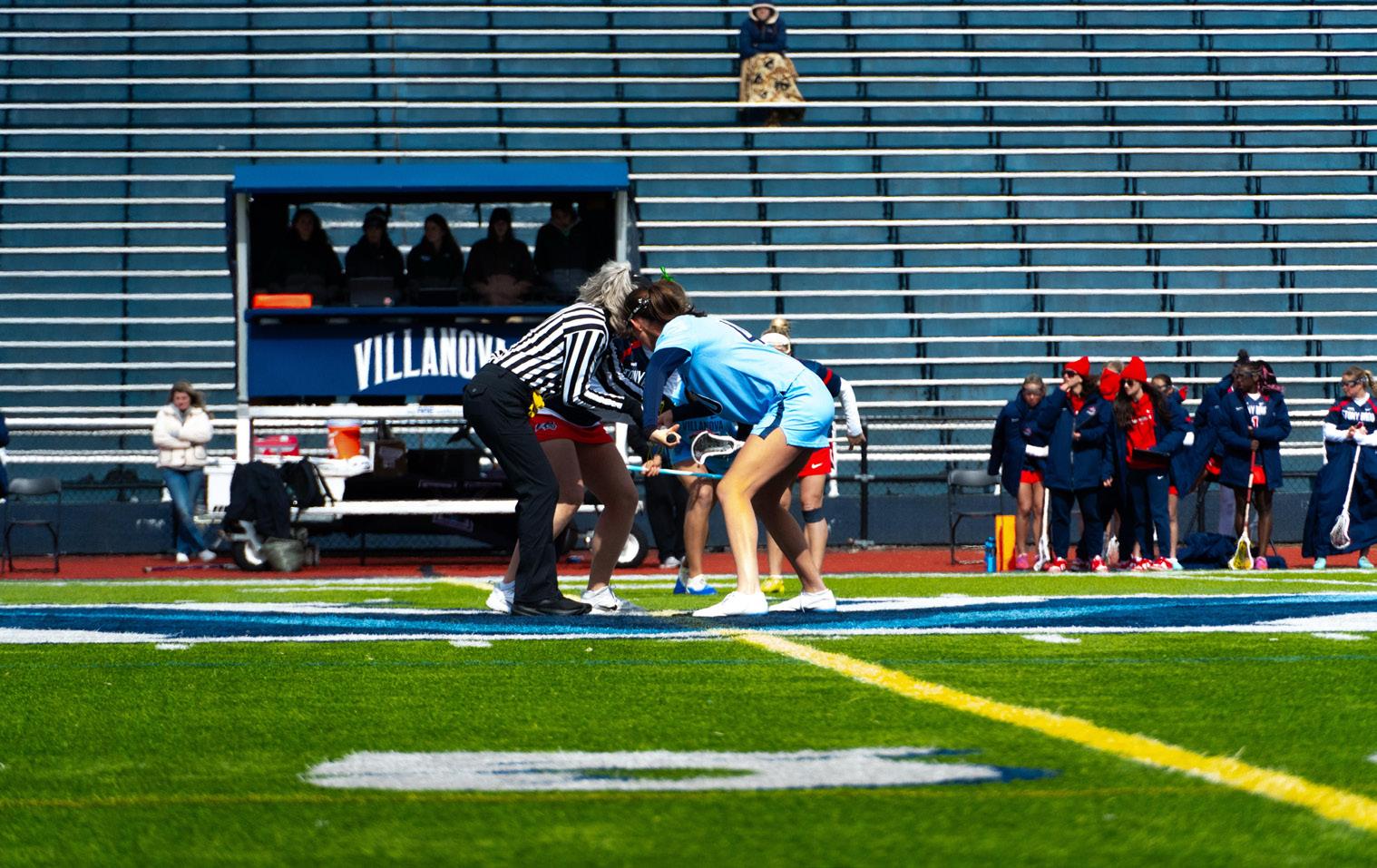
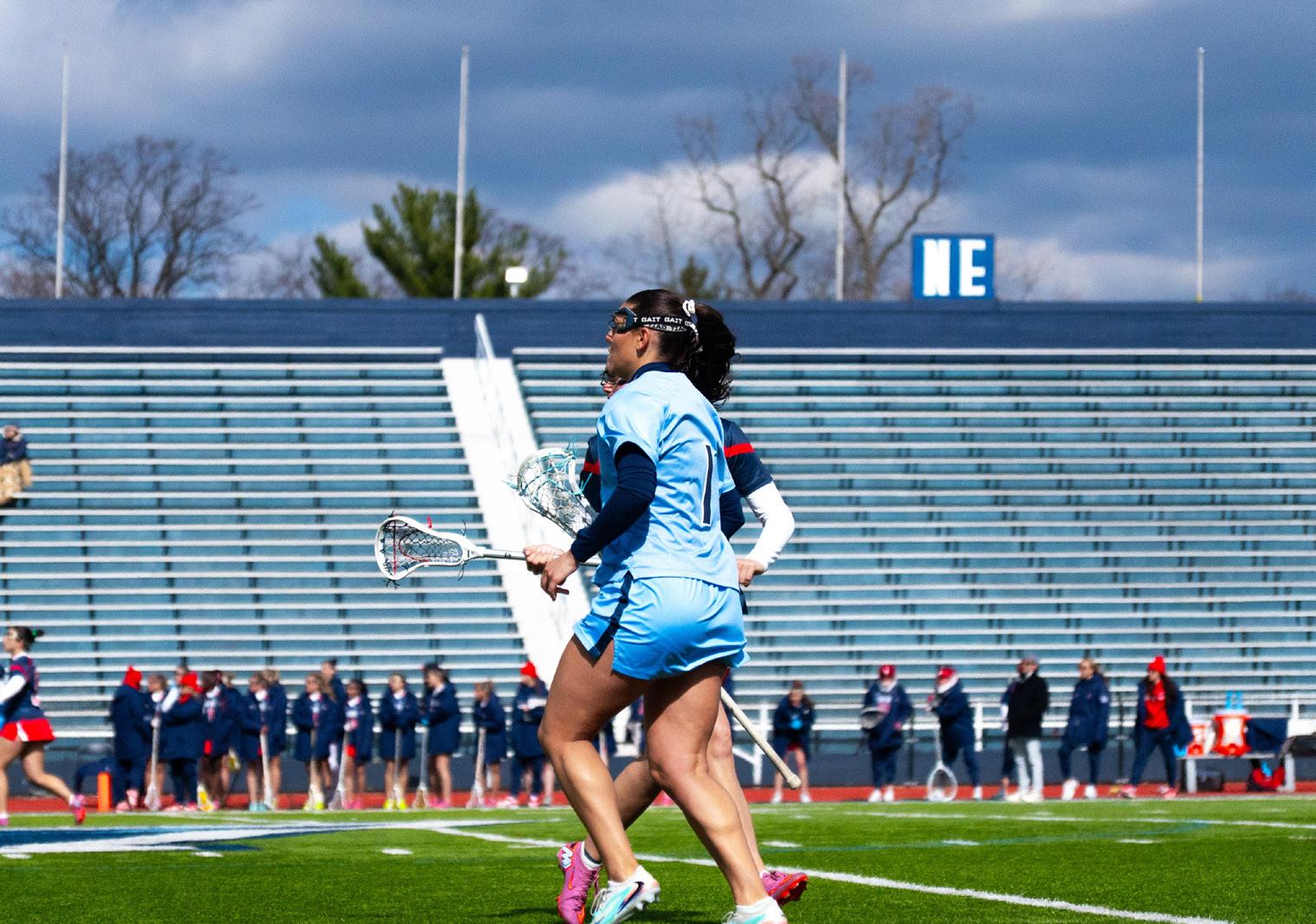
ryn Monaco made it 10-5 at the beginning of the third and then netted another later to make the game, 11-6.
The ‘Cats struggled to make up ground against the Seawolves, as they added three straight in the opening minutes of the fourth quarter to go up 16-7. Redshirt sophomore midfielder Mary Moore added two more to make it 17-9 and completed her hat trick.
Villanova finished the game with a final score of 18-10.
Junior midfielder Emma Verhoest led Villanova with 14 draw controls. Junior defender Katie Clark caused four turnovers and Freshman goalkeeper Allie Bell had a career-high seven saves against Stony Brook.
“I think one of the biggest
things we need to do is just take care of the ball,” Batcheller said. “We had a lot of turnovers today, so that’s gonna be a big focus for us moving forward.”
The Wildcats are now 5-3 overall this season. They sit at 2-2 at home and 3-1 away heading into Big East play. They recently completed a sucessful roadtrip, where the ‘Cats beat Binghamton, Siena and Vermont.
Villanova will return on Saturday, March 21, against Xavier (2-7) for its first conference game of the season as well as senior day. Start time is noon at Villanova Stadium.
Villanova’s all-time record against the Musketeers is 3-0, with its last win occurring in April 2025. The final score was 18-9.
Villanova men’s basketball will travel to San Diego to take on Utah State. Mason Canton/Villanovan Photography
Junior Emma Verhoest takes the draw against Stony Brook. Mason Canton/Villanovan Photography
Villanova is now 5-3 heading into conference play. Mason Canton/Villanovan Photography
March Madness Preview: Women To Face Texas Tech
Sammie McKee Co-Sports Editor
For the first time in three years, Villanova women’s basketball is set to return to the March Madness tournament.
The Wildcats are the No. 10 seed in the Sacramento 2 Region and are set to face No. 7 seed Texas Tech (25-7, 12-6 Big 12) on Friday, March 20. Tip-off is set for 8:30 p.m. EDT at the Pete Maravich Assembly Center in Baton Rouge, LA.
“March is different,” head coach Denise Dillon said. “This group knows that if you aren’t focused and locked in to what needs to happen, it’s short lived. You have to be ready and count on those veteran leaders who have experienced this. The young ones who have now put in the time now just need to be ready to put it out on the floor.”
The teams share identical season records. However, in comparison to Texas Tech, Villanova holds four more wins and two fewer defeats in conference play.
Half of Villanova’s losses in conference play come from battles against the undefeated No. 1 seed, the University of Connecticut (34-0, 20-0 Big East).
Villanova’s last dance in the tournament took place in 2023. During the tournament, the Wildcats advanced all the way to the sweet 16 in 2023. Led by
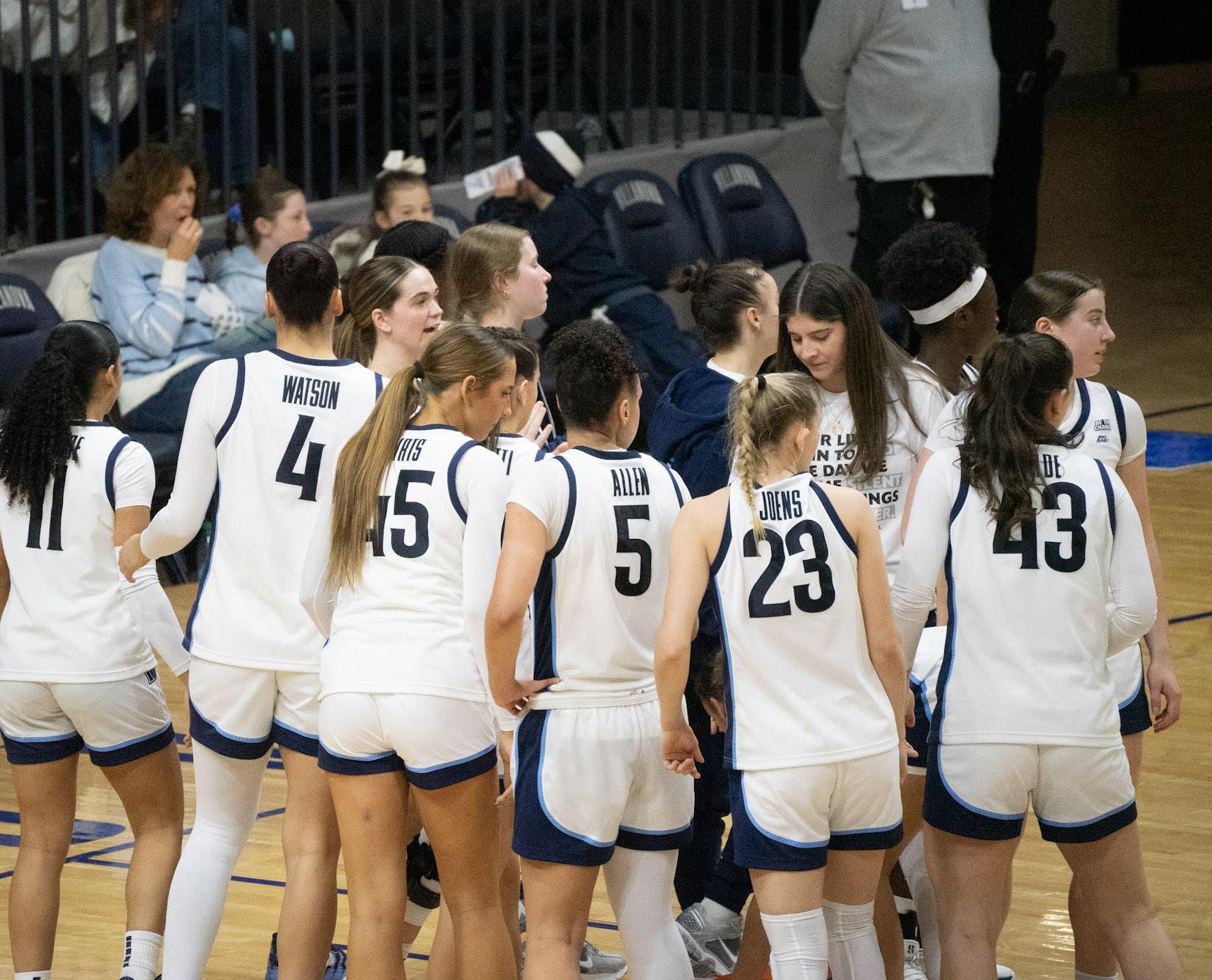
women’s basketball legend Maddy Siegrist, it was the program’s deepest run in the tournament since 2003.
“It feels different,” Denise Dillon said about comparing this year’s Selection Sunday to years prior. “I’m fortunate to be able to have experienced it in different aspects and different timeframes, but for them this is new, and we’re ready to get on the road.”
Villanova will rely on its combination of veteran leadership and young talent as it takes on the tournament.
“Being a senior, and then with our underclassmen, I think it’s so fun that we get to do this all together,” senior forward Denae Carter said about the excitement of the NCAA tournament. “We pour into each other so much that this is as important to them as it is to me.”
The 2026 tournament marks the first time in 13 years that Texas Tech will make an appearance in the March Madness tournament.
During the Lady Raiders’ last appearance in 2013, they fell
short to South Florida, 71-70, in the first round of the tournament.
The Lady Raiders are currently led by senior guard Bailey Maupin.
Maupin averages 15.1 points and 3.6 assists per game. Maupin was recently named to the All-Big 12 First Team.
Senior guard Snudda Collins follows Maupin offensively, averaging 14.8 points per game this season. She received the Big 12 Sixth Player of the Year and was named to the All-Big 12 Second Team.
Junior guard/forward Jaylnn Bristow Received an All-Big 12 Honorable Mention.
Head coach Krista Cerlich received the Coach of the Year award for the conference.
“With Texas Tech in the Big 12 you know they’re coming ready to battle,” Dillon said. “They’re a really intense defensive team who’s really good at holding their opponents to a low percentage and they really shoot the ball from the perimeter. Big keys are keeping them off the glass, getting them off the three and handling that pressure to take care of the ball.”
Villanova’s bracket also includes No. 2 Louisiana State University (27-5, 12-4 SEC) and No. 15 Jacksonville University (248, 13-5 Atlantic Sun).
Should Villanova beat Texas Tech, it will advance to the Round of 32 and take on the winner of the LSU/Jacksonville game.
Golf Competes At People’s Championship
Jack McFadden Staff Writer
On Thursday, March 12, Villanova’s golf team traveled to St. Simon’s Island, GA, for its second tournament of the spring season, the People’s Championship. The three-day tournament was hosted by Western Carolina University and consisted of 21 teams, including two teams from the Big East, aside from Villanova.
In last season’s People’s Championship, the Wildcats finished fourth out of 20 teams. Sophomore Vibhav Alokam had tied for sixth place, while seniors Ryan Pamer and Matt Zerfass followed, both finishing in the top 40. This year, the ‘Cats finished tied for fifth.
Following the first round of the tournament on Thursday, Villanova was in fourth place, after shooting 279 (- 5) as a team. The leader on the day was Pamer, who shot 67 (-4), good for a tie for fourth place overall. His fellow captain, Zerfass, shot 68 (-3) and finished tied for eighth.
Fifth-year Brockton English finished even on the day, while Alokam followed, shooting 73 (+2).
On day two of the tournament, Villanova dropped one spot to fifth place.
The Wildcats shot 279 (+6) on the round, and shot 569 (+1) through the first two days of the tournament. Zerfass led the way, shooting 70 (-1) on Friday, making his tournament total 138 (minus 4). He tied for sixth place. Palmer shot 72 (+1) on the day, making his total
139 (minus 3), which put him tied for 10th.
After the third and final day of the tournament, the ‘Cats finished tied for fifth place overall. Villanova had a strong bounce-back round from Friday. The team shot 852 (E) in the tournament and improved their score by seven strokes from round two to round three, after they shot 283 (minus 1) in the final round on Saturday.
“The third round is definitely set up for scoring,” head coach James Wilkes said. “We had a lot of birdies in that final round, which was great, and we were aware that there was going to be pressure down the stretch, and the fact that we just played some really difficult holes at the end and played those well, that allowed us to keep us where we were.”
Pamer led the way for the Wildcats through the three rounds of tournament play. He finished shooting 210 (-4), which allowed him to tie for 12th. Pamer shot 71 (E) on the final day, while Zerfass just trailed, tied for 16th, shooting 212 (minus 1) in the three days and 74 (+3) on the last one.
Alokam finished tied for 25th after he shot his best round of the weekend on Saturday, 69 (minus 2), a Villanova best.
“Vibhav, he is the next one,” Wilkes said. “He has everything that we will need going forward as an underclassman. He has played every event and has been right there soaking in everything that Pamer and Zerfass have been able to try and teach him. [Alokam] is just such
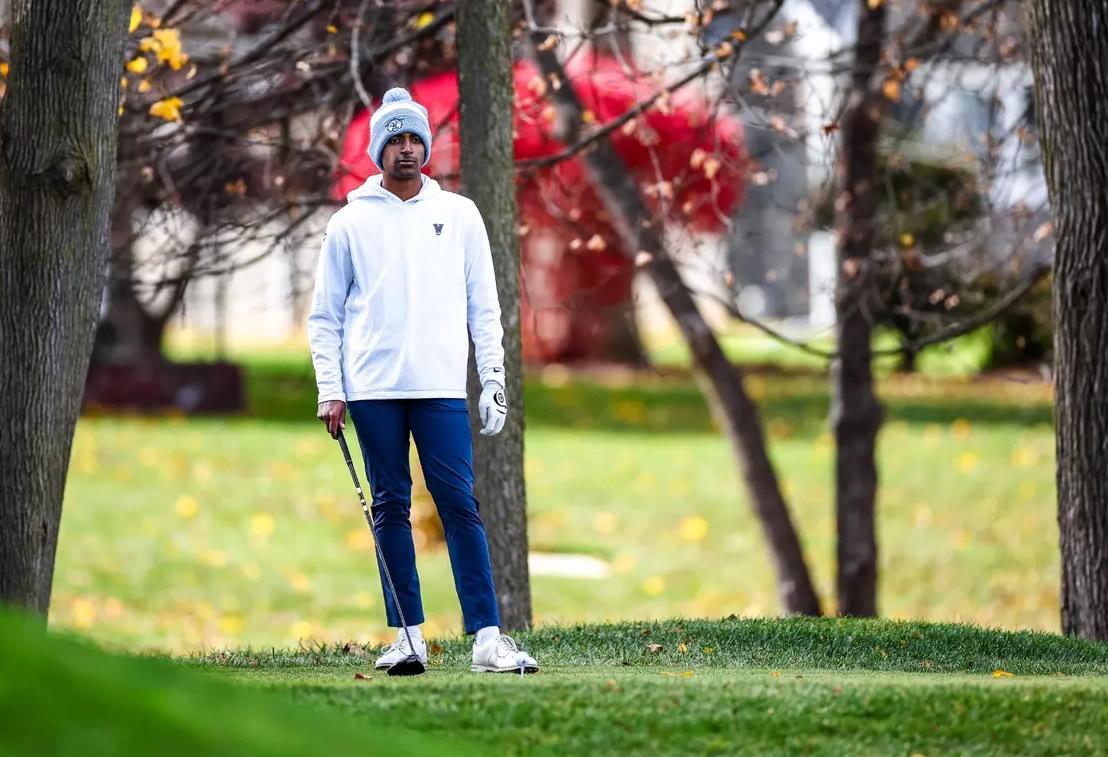
a steady, cool player. He’s very calm, he understands, he doesn’t get high, doesn’t get low and he just knows what it takes and he knows we’re going to need him going forward with so many guys graduating.”
Big East foe Xavier took home the 2026 People’s Championship. The Musketeers shot 838 (minus 14) as a team throughout the tournament. Freshman Cayse Morgan of Xavier finished at the top of the individual leaderboard, shooting 202 (minus 11) over the course of three days.
Host team Western Carolina finished second, shooting 840 (minus 12) as a team. Samford followed in third, shooting 842 (minus 10).
“We’re just gonna keep focusing on what we’ve been doing, what we preach and that’s attitude,”
Wilkes said. “This was a great week because to see that preparation, give us the results that we were hoping for and be able to hold our own position. Xavier is gonna be a contender for the Big East title. They’ve won multiple tournaments this year, and they’re just a really well-coached, really strong team. We understand and we respect how good the Big East conference is, and we just need to keep doing what we’re doing to be ready for May, for the Big East Championship.”
Villanova’s golf team will continue its campaign next Monday, March 23, when it will travel to Williamsburg, VA. The Wildcats will compete in the two-day Horseshoe Intercollegiate, hosted by William & Mary at the Golden Horseshoe Golf Club.
Villanova will compete as a 10 seed in the NCAA Tournament Mason Canton/Villanovan Photography
Villanova golf will return on March 23 in Willamsburg, VA. Courtesy of Villanova Athletics
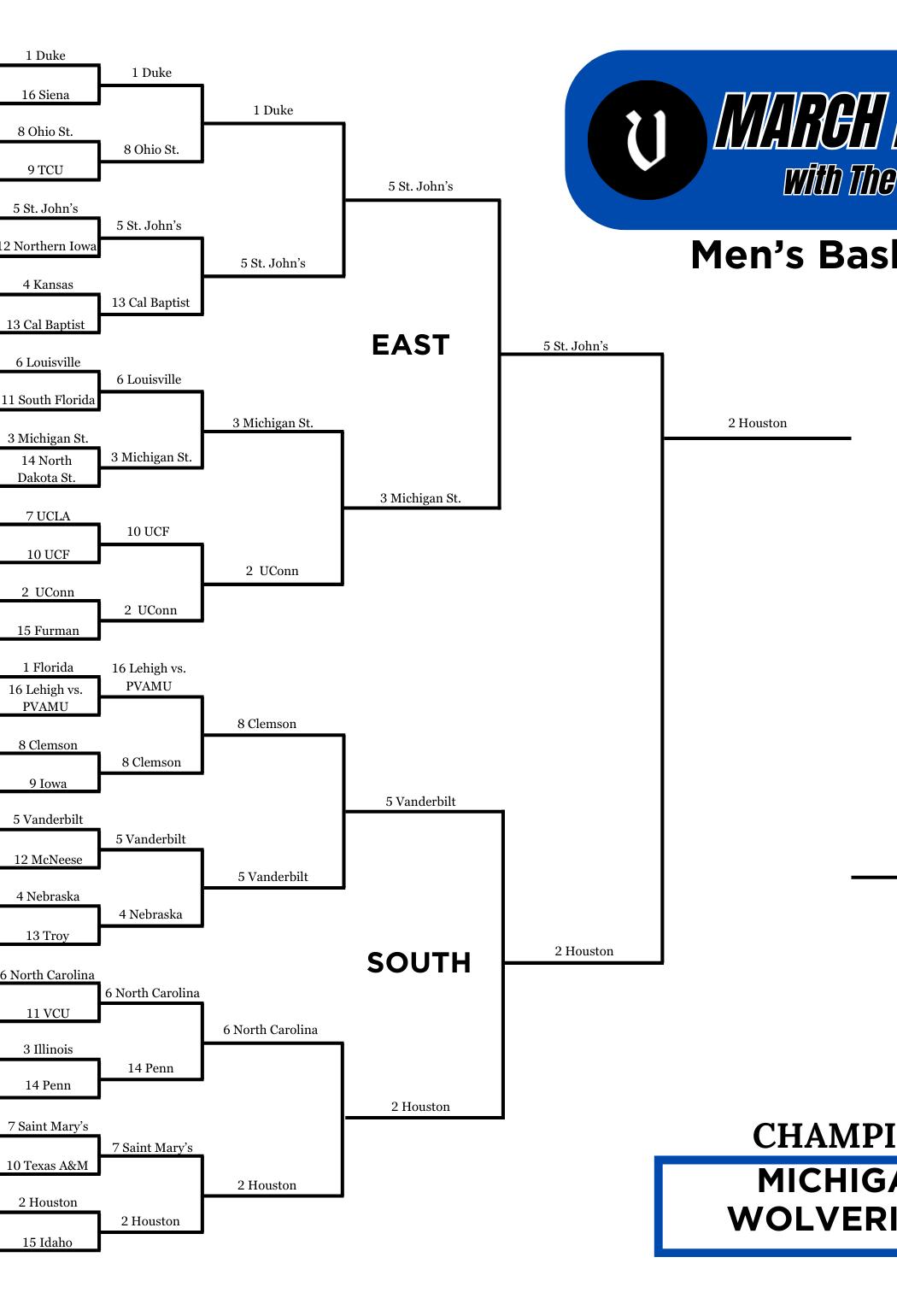
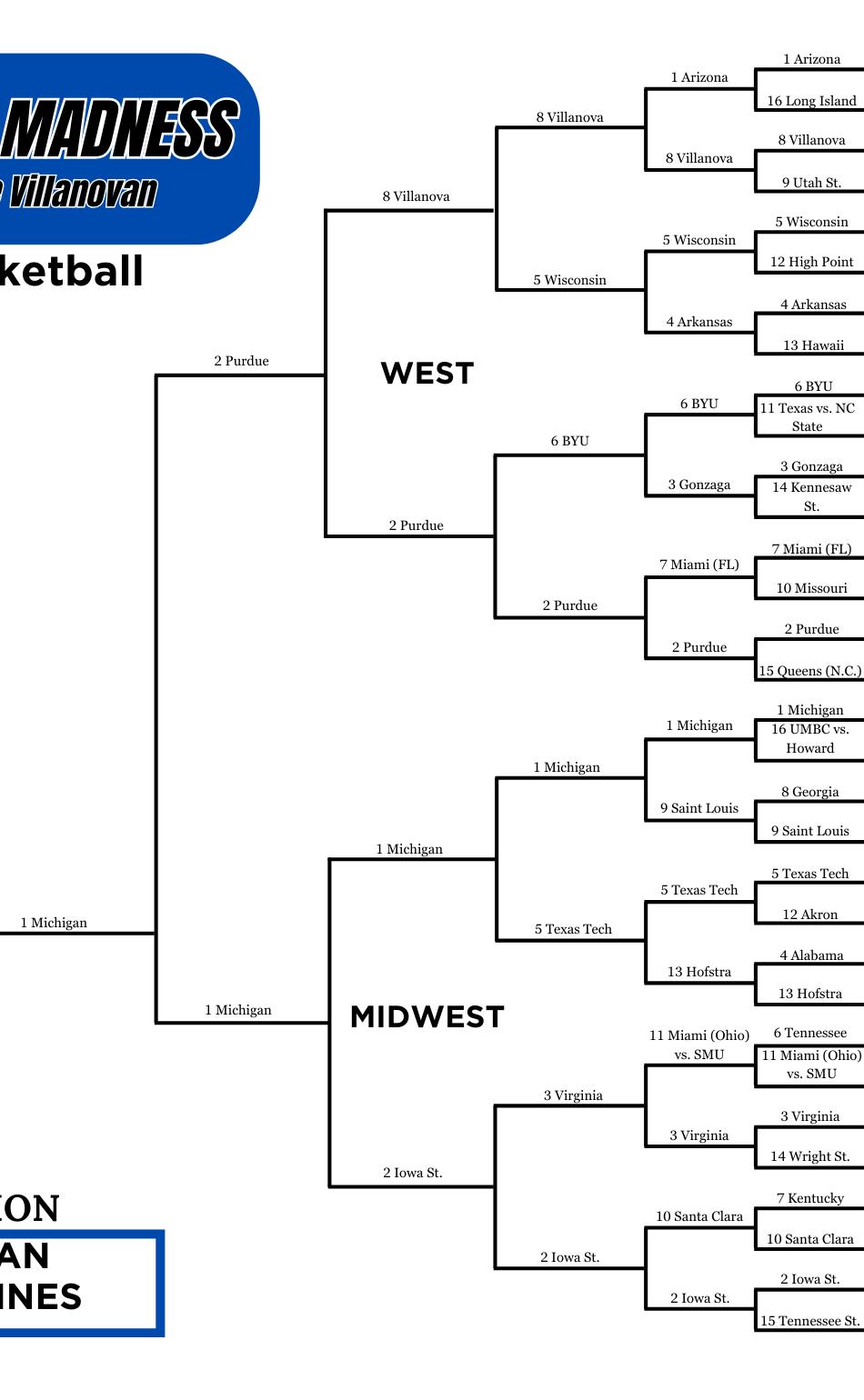
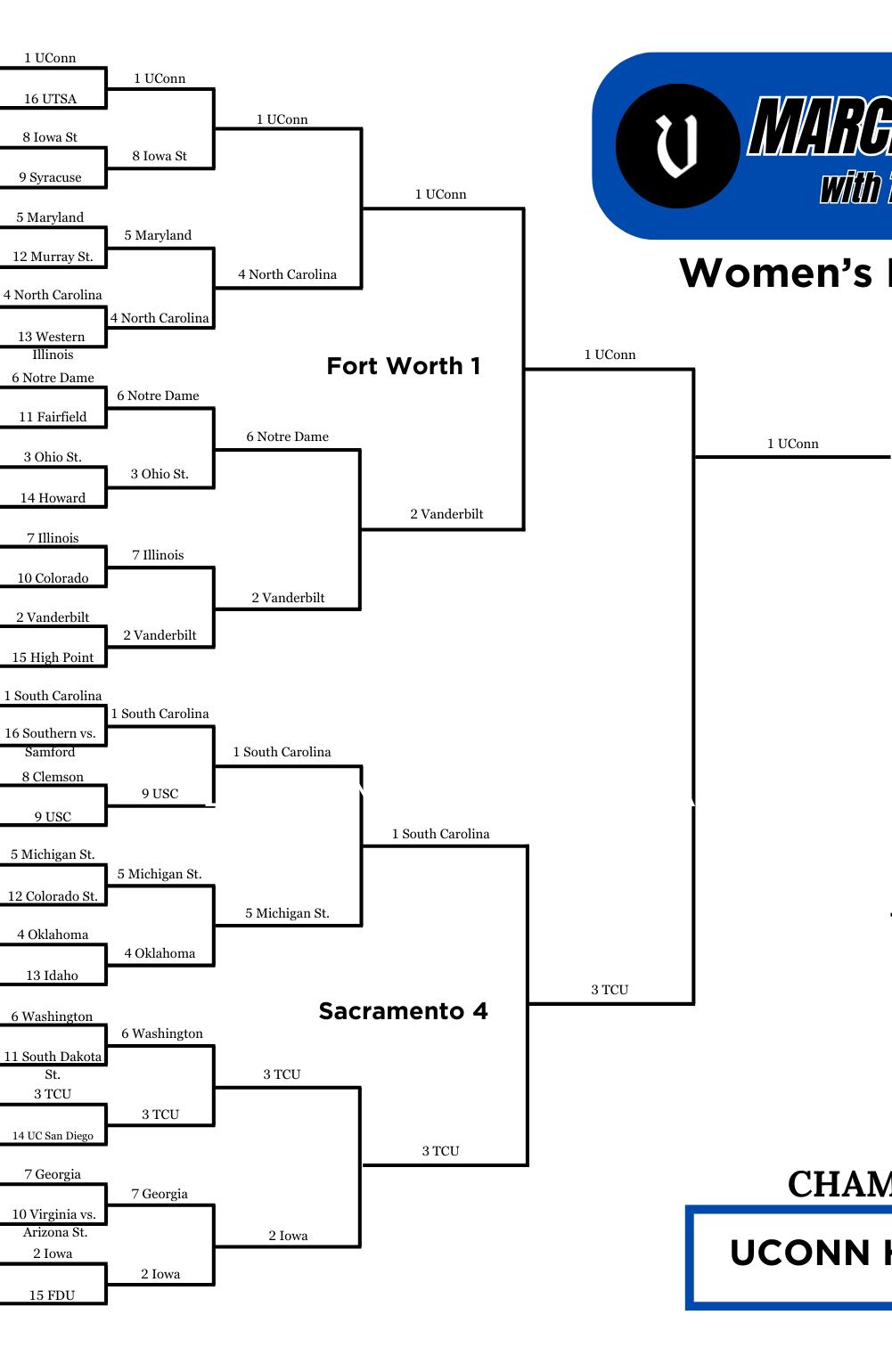
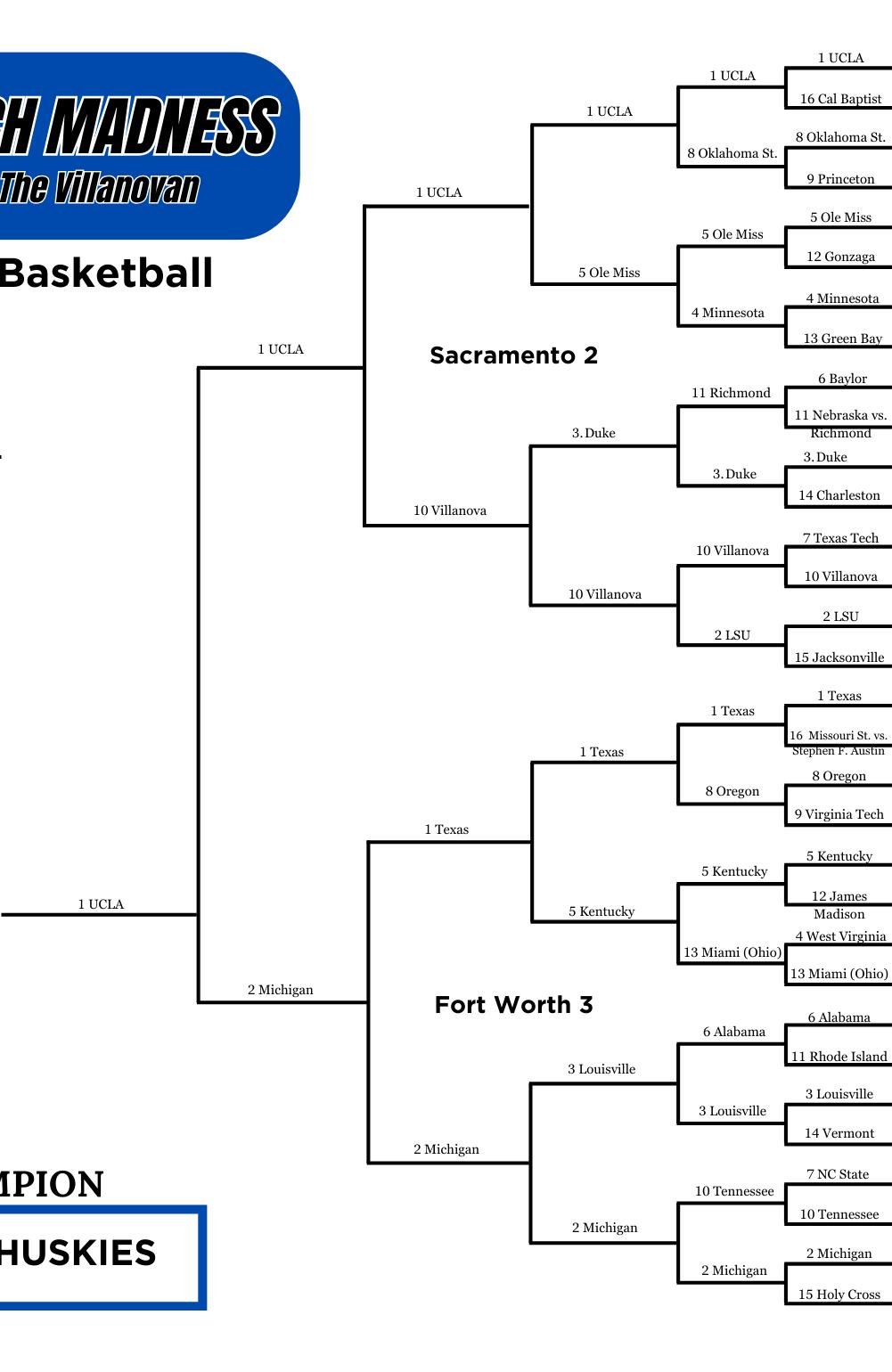
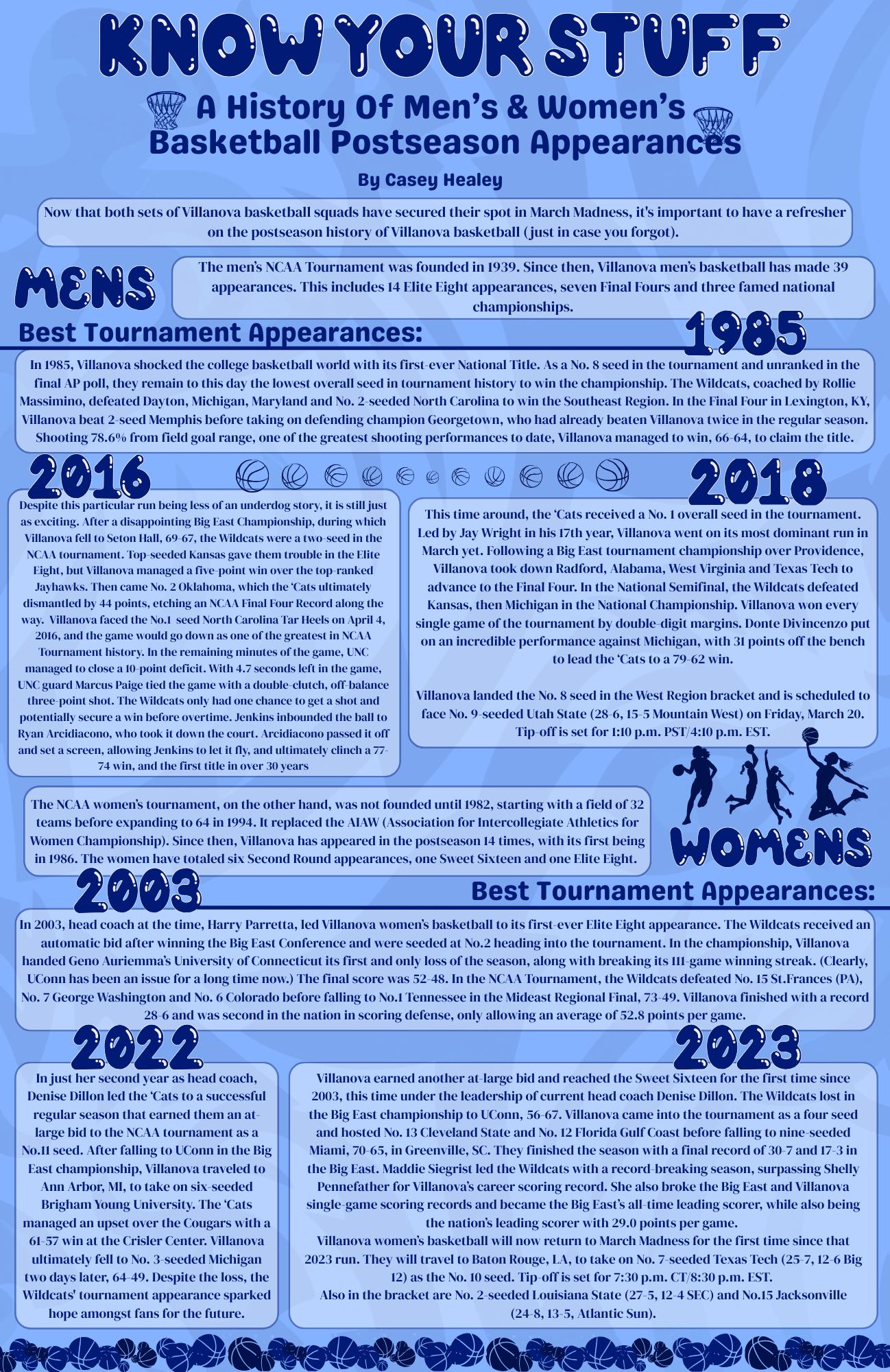
MARCH MADNESS
Where Students Should Watch the Action

Cali Carss Co-Culture Editor
It’s official. The most important month of basketball is upon us, and every student will soon be glued to whatever screen they can find to watch Villanova make its return to the NCAA Tournament for the first time in four years. With an entirely new set of students on campus since Villanova last accomplished this feat, there is no doubt that everyone will be tuning in, in some way or another. Now, nothing in March Madness is ever guaranteed, meaning each game could be the last time we watch the Cats play this season. To make matters worse, without our tried and true (most of the time) lotteries to get us primetime, in-person seats, it is entirely up to students to figure out where to catch the next game. But a little complication doesn’t have to be the end of your fun. There are plenty of other ways to watch the game to replace the experience of being there.
Stay In Your Dorm
That’s right, sometimes it can be just as simple as getting all your friends together and putting the game on in someone’s dorm. Bonus points if someone has an apartment with a TV or a projector that can cast the Wildcats on a wall. Wear your
Cali Carss Co-Culture Editor
For the first time in four years, the Wildcats are headed to the NCAA Tournament, also known as March Madness. This chance for the men’s and women’s basketball teams to go national is incredibly exciting, but it also comes with a significant sense of trepidation. None of the undergrads currently on campus has watched their team play in the coveted tournament. Each game comes with the risk of elimination.
But years ago, going to the tournament was the least of the Wildcats’ concerns. Ten years ago, the men’s team not only made the tournament but also won it. This team has become iconic in the canon of our basketball history. Consisting of many future “Nova Knicks,” coached by Jay Wright and redeeming two past failures to make the Sweet Sixteen, this win must have felt indescribable to the students on campus.
In the spirit of trending comparisons between 2016 and 2026, and to remind us all of what could be as we watch our own generation of Wildcats enter the March Madness fray, this is a quick look back at how The Villanovan covered the 2016 team and their (successful) bid for national glory.
The Beginning
Our sports section, obviously, reigns supreme in this account of March Madness coverage. Its members were watching the men’s team closely all

merch for good luck, assemble some gameday treats and get your cheer on.
Watch In Conn
Okay, it’s not ideal. But I can guarantee that if Villanova is playing, the Conn TVs will have the game on for students to enjoy. Get your gameday Wawa and settle in to experience every play from smack in the middle of the student center. Plus, there is no way you’ll be watching alone. With the team playing all
across the country, watching from Conn will be a much more common experience, unlike when you’ve been left behind on an Xfinity game day.
Rent a Classroom
If your dorm room just isn’t cutting it and there’s no free table in Conn, then there is always the option to book a study room where the game can be projected from a laptop. These spaces are for student use, and what better way to use
Is 2026 The New 2016?
season, but especially as Selection Sunday drew nearer. In an article published March 15, The Villanovan reported that Villanova would take the two-seed in the South Region, sending them to the Barclays Center in New York City to play UNC-Asheville in their first-round game. The article opens with an intense statement from coach Jay Wright: Villanova had “a lot more winning to do.”
The Sweet Sixteen?
For the first two rounds of play, Villanova held its breath. The ‘Cats had fallen short of the Sweet 16 for the past two years, and this hurdle would be a huge indicator of whether 2016 could be different. The 2026 ‘Cats should take this precarious hope to heart. It might seem impossible for us to go far, but it only takes one breakaway year, one definitive game to end a cycle. In 2016, the team did just that. They defeated UNC-Asheville and Iowa to finally reach the first March Madness round. The sports section covered each game carefully, weighing the odds and including extensive input from Wright, our own players and opposing players to paint the full picture for Villanova students.
Excitement Builds
The next stop? The Elite Eight. It is here that coverage picks up in emotion. An article titled “CATS HEADED TO THE ELITE EIGHT,” yes, in all capitals, was published on March 26, announcing this new milestone. The article recapping the Cats’ defeat of Miami included quotes from both team captains as
them during March than by getting a group together to watch the latest March Madness round on a bigger screen than your laptop can provide you alone.
Go Out On The Main Line
If you are over 21, the campus isn’t the only place one can watch the game. McSorley’s and the Grog both broadcast big games and are great places for students to enjoy basketball in a fun setting, especially if you’re missing the Xfinity Live environment from our own arena games.
Get Into Philly
The train line directly into Philly is not something one should take for granted, especially if you’re looking for some basketball excitement. Again, if you are over 21, there will undoubtedly be sports bars in the city showing the Villanova game. Get geared up in your merch and take over.
As round one approaches, Nova Nation must be prepared to get up, get excited and get watching. We may not have the force of our usual in-person student section supporting the team at each game, but tuning in from campus is just as important to let the country know that we are engaged and rooting for the ‘Cats for as long as they can fight it out.
well as Josh Hart and Wright, about the outcome of the game and their mindsets looking forward to future rounds. With the first three rounds behind them, making it all the way was looking more possible.
The Final Four
The Villanovan began to expand its coverage beyond strictly game recaps and projected matchups once the team advanced to the Final Four. With the championship game within reach, coverage included a feature on Kris Jenkins’ family and news from local police about security measures around celebrations. Both articles, published in the March 30 edition of the paper, demonstrate how March Madness grows to take over more of student culture and interest the further the team goes. Road closures and extra security in and around campus were planned by Radnor Township and Delaware County police forces to manage the increasing student excitement as Villanova headed into its second-to-last game of the championship.
In addition to this practical coverage, The Villanovan took a moment to recognize what a special year 2016 had been. In an article titled “HOLY MASSIMINO! Never forget these 2016 Villanova Wildcats,” every player and coach who was part of this national championship run was given a shout-out, emphasizing that this was one team that would forever be marked in the minds of Villanovans.
The Championship
Following a victory over Oklahoma in the Final Four bracket, and
with Villanovans practically flooding into Houston to witness the last moments of the tournament, the first few days of April gave The Villanovan its final chance to engage with this historic season. As anticipation built, a satire piece was published on April 1, claiming that Pope Francis had said he was rooting for the Wildcats to win it all. While we will never know if there was any (coincidental) truth in this piece, with one of our own now situated in Vatican City, perhaps in 2026 the Cats will have a real papal endorsement.
The final, and arguably most exciting, piece of the puzzle was covering the celebrations that erupted when Jenkins’ buzzer-beater shot soared through the net. The Finneran Pavilion exploded into cheers, according to an article called “A wild night for the Wildcats,” which was published on April 5. A two-mile stretch of main road was blocked off, residents came out to join students with speakers, helicopters circled and news cameras descended. It was an incredibly chaotic night on campus, but also a “once in a lifetime” experience that no student would soon forget. As March Madness commences, remember 2016 and the thrill of the team’s success each round. This year marks an even more significant return for Villanova as a contender on the national stage, so why not keep our expectations high? If 2026 truly is the new 2016, then perhaps this whole trend has been a sign that the Cats could surprise everyone and take it all the way.
Although it’s far, students should venture into Philly with friends. Dylan Johnson/Villanovan Photography

Anna Lonski Staff Writer
March has arrived, and soon enough, madness will follow. As we watch Cinderella stories, breakout players get their chance to shine, and brackets fall apart, these college teams will travel across the country in hopes of becoming national champions.
If you haven’t followed March Madness before, it’s the single-elimination NCAA Division I basketball tournament where 68 of the strongest teams in the country battle it ou and, after seven gritty rounds, one team remains standing as the national champion. This year, it will be even more fun to watch as our Villanova basketball team is among the schools in the tournament bracket.
Brackets for both the men’s and women’s teams were announced on March 15, or Selection Sunday, and until then, some of the lower-level teams competed to earn a spot. In other words, on March 15, the teams deemed the 64 greatest from across the leagues in college basketball were divided by the NCAA college basketball committee.
The March tradition of the “First Four” will begin only a few days after Selection Sunday, with the men playing on March 17 and March 18 and the women playing on March 18 and March 19. The First Four features the four lowest-seeded automatic qualifiers and four lowest-seeded atlarge teams. These teams will face off for two days. Those teams will play in

Sammie McKee Co-Sports Editor
Where Will The Wildcats Go?
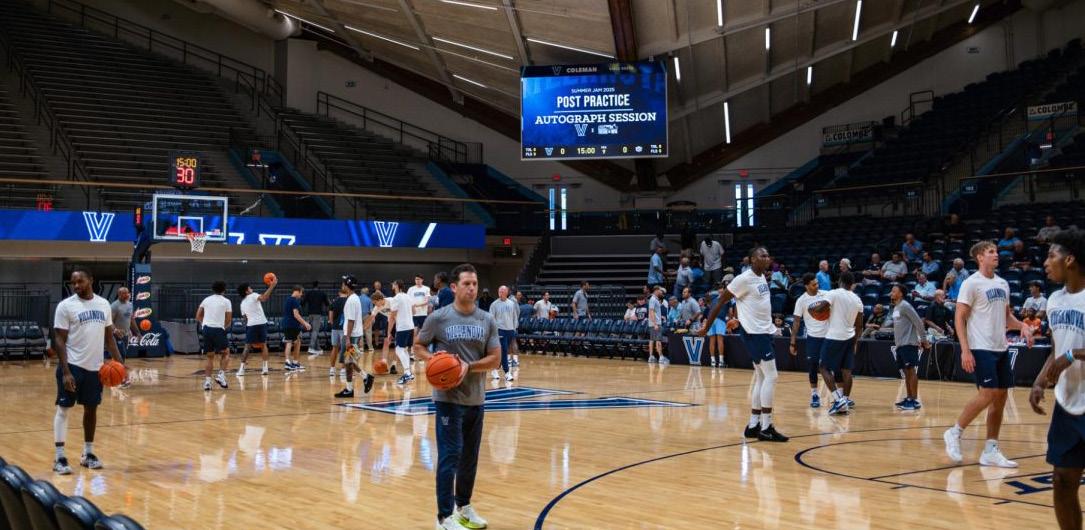
Dayton with the University of Dayton as host, while the women’s teams will play on the campus courts of the top 16 seeds. The exact location is usually announced after Selection Sunday.
Ultimately, the winners of these initial games move on to the first round of 64, and the real madness begins on March 17 once the first round is underway.
The men will play the first round on March 19 and March 20, with games happening across the country. The arena options are vast: The KeyBank Center in Buffalo, The Bon Secours Wellness Arena at Greenville, The Moda Center in Portland, The Benchmark International Area in Tampa, The Viejas Arena in San Diego or The Enterprise Arena in Saint Louis. Some games will even be underway at our own Xfinity Mobile arena in Philadelphia. These games will be hosted by local universities and athletic divisions. The
Wildcats will be heading to the Viejas Arena to face off against Utah State.
The second round begins with the remaining 32 teams on March 21 and 22. These teams will play in the same venues as those of the first round and continue to fight until there are 16 teams left.
The tournament really begins to heat up during the third round, also known as the Sweet Sixteen. Underground players and teams begin to take the spotlight, and most people’s brackets will prove to be once again, incorrect. These games will take place on March 26 and 27. If Villanova is one of the remaining sixteen teams, it could play at either the Toyota Center in Houston Texas, the SAP Center in San Jose California, the United Center in Chicago Illinois or the Capitol One Area in Washington D.C. Similarly to the last round, these games will be hosted by local universities.
Unlike the men’s, a lot of the
locations for the women’s tournament were not announced so far in advance. During the first and second round, the top 16 seeds host the games, and because these teams have not yet been selected, women’s fans are left waiting to see. At their Selection Sunday watch party, the Villanova women’s team found out that they will first be facing off against Texas Tech on March 20.
Afterwards, the Sweet Sixteen will be played on March 27 and 28 at either the Dickies Arena in Fort Worth Texas or the Golden 1 Center in Sacramento California. The remaining teams will battle it out during the Elite Eight on March 29 and 30. These games will also have the same location.
The highly competitive Final Four will be the next arena change for both tournaments. If either Villanova team fights their way to this semi-final round, the games would take place for the women at the Mortgage Matchup Center in Phoenix, and the men would play at the Lucas Oil Stadium in Indianapolis. The first four men’s teams will play on April 2 and the women on April 3.
Finally, the National Championship, bringing both March Madness and the college basketball season to a close, will be played on April 4 for the men’s championship and April 5 for the women’s.
Whether you love basketball, competition, Villanova or all of the above, March is the best time of the year (especially when your team is finally in the tournament).
Tyler Perkins: In It For The Long Run
meant to him.
Returning to the Main Line in the fall of 2025, junior guard Tyler Perkins was one of three players on the roster who had worn the Wildcat jersey in the spring before.
The Virginia native started his college career at the University of Pennsylvania in the 2023-24 season, before he transferred to Villanova in 2024.
During his first season with the ‘Cats, Perkins averaged 6.3 points per game, along with totalling 36 assists, 9 blocks and 38 steals.
Following Perkins’ announcement last May that he would be staying with the team, then incoming head coach Kevin Willard spoke about the significance of his presence.
“We are excited that Tyler will remain at Villanova,” said Willard. “Tyler has a unique ability to rebound from the guard position and is also an outstanding perimeter defender. He has made big-time shots at the college level, is an improved three-point shooter, and understands what it takes to play in the Big East. Tyler’s consistency at both ends of the court makes him a great fit for our program.”
In the fall, Perkins shared a statement with The Villanovan about his excitement to be remaining with the team and what being one of three returning Wildcats
“It feels like just yesterday I was the freshman walking into the college team not knowing really anything, so it’s kind of flown by. I’m the leader and the older guy now, and I’m ready for it.” Perkins said. “Just stepping into the role of being a leader, I feel like I’ve learned from past guys, Eric Dixon and Jordan Longino…now I feel like it’s my turn to be the leader on the team and show my experiences.”
This season, Perkins averaged 13.7 points per game and tallied 51 assists this season. His total blocks and steals remained identical in his second season with the ‘Cats.
His accomplishments during Big East Conference play earned Perkins the Big East honor of most improved player in the 2025-26 season.
As well as improving his own game, Perkins feels that this season has prepared the ‘Cats well for competition in the NCAA Tournament
“Just the types of teams we play in the Big East, the physicality, the attention to detail and playing the full 40 minutes [have prepared us for the tournament],” Perkins said. “We’re definitely going to use those habits in the tournament.”
After the ‘Cats failed to make March Madness in 2025, Selection Sunday felt especially rewarding for Perkins, considering that he knows what it’s like to not have the team success that the
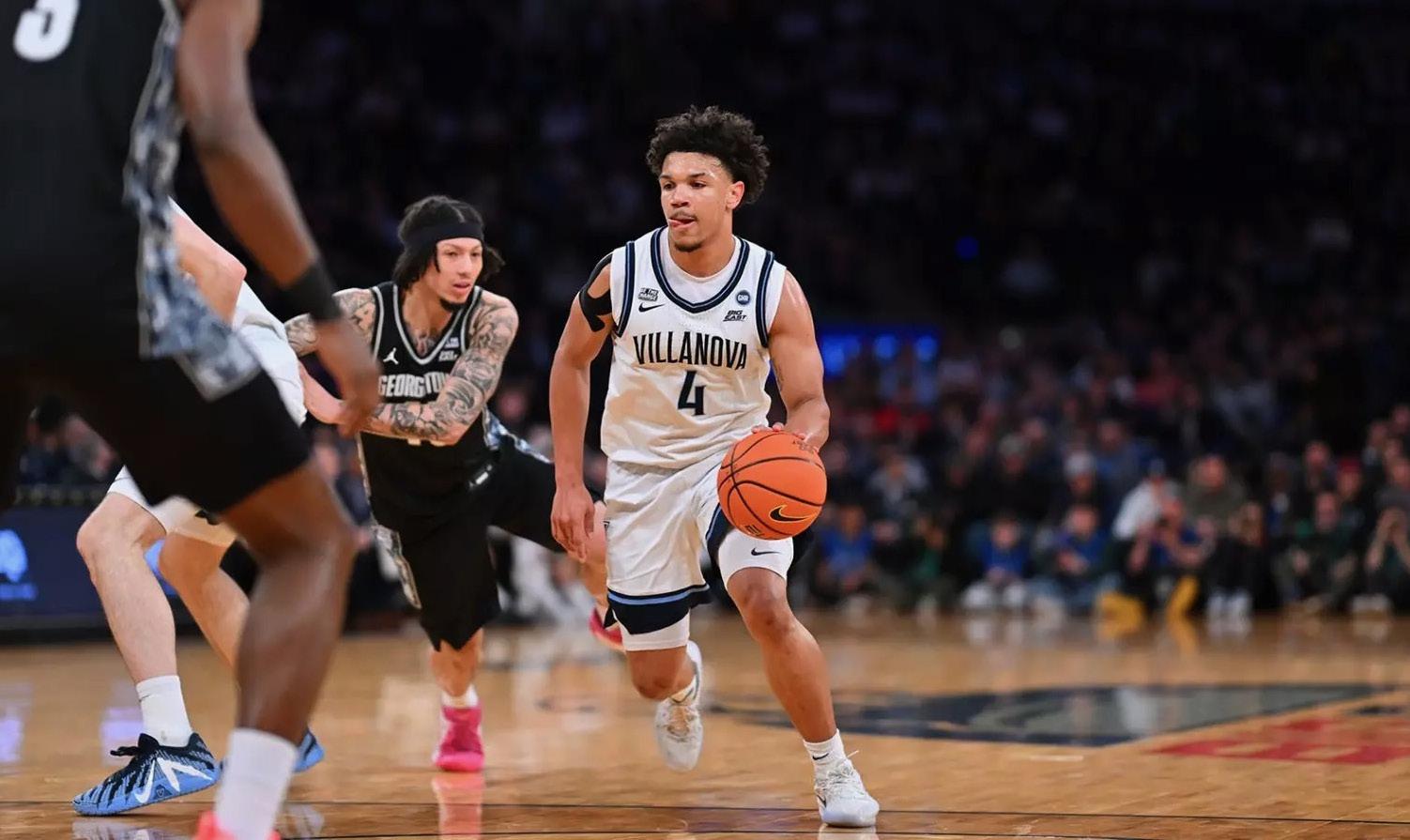
Wildcats do now.
“It’s a blessing. I’ve been waiting for this moment. We’ve all been waiting for this moment, and we all deserve this moment too,” Perkins said about making the tournament for the first time. “We’re glad to be part of it, and now we got work to do.”
Though the team is a newly meshed squad, Perkins feels that their natural chemistry has played a role in their success.
“It’s 13 new guys, but it feels like we’ve been playing together our whole lives,” Perkins said. “We get along and the coaches do a great job of holding us accountable and making sure that we’re doing what we’re supposed to do.”
Perkins’ former team,
Penn, stands alongside Villanova as the one of two Philadelphia teams making an NCAA Tournament appearance.
“I definitely called some of my friends on that team and congratulated them,” Perkins said. “Hopefully we see them whether it’s in the final four or wherever. I’m happy for them and to see two Philly teams in the NCAA Tournament..all the colleges around here are great colleges that have great programs.”
Perkins will take on the ultimate task of his college basketball career as the ‘Cats travel to San Diego, CA, taking on Utah State in the first round of March Madness. If it’s anything like his Villanova career, Perkins is in the tournament for the long run.
The Villanova men’s basketball team will play at Viejas Arena in San Diego on March 20. Dylan Johnson/Villanovan Photography
Perkins leads the Wildcats offensively, averaging 13.7 points per game. Courtesy of Villanova Athletics

Korin Kohen Co-Digital Editor
Every game day tends to unfold in a familiar rhythm. Friends gather around a TV, filling the room and each bringing their own level of enthusiasm. There are die-hard fans who analyze every play and offer long-winded explanations of each tactic on screen. Then, the casual viewers mostly keep an eye on the score to react just in time for the big moments. And of course, some fans hardly know the rules but arrive fully committed in team colors and face paint.
Just as every game day starts the same, it usually ends the same way, too. There are empty pizza boxes on the table, crumpled napkins everywhere, a pile of half-finished fries and someone asking who ate the last slice.
Though the game may be the main event, the food is often what holds the whole watch party together. Energy rises and falls with every possession, and sooner or later, fans turn their attention from the TV to the spread on the coffee table.
Between the tense final seconds and commercial breaks, food becomes just as important as the entertainment itself.
Luckily for Villanova students, the area surrounding campus offers plenty of reliable spots to keep a watch party well supplied, because every great game deserves an equally impressive food lineup.

Ciara Dursee Co-Digital Editor
Cat Appetite: Game Day Bites

Johnny’s Pizza
When it comes to game day cuisine, pizza is practically a tradition. It can be divided equally, requires no utensils or fancy plating and is arguably one of the least controversial foods. In a room where rival fans are spewing trash talk and people are disagreeing on referee calls, pizza is one of the few things that never sparks debate. And when your team is cracking under pressure during the semi-finals, sometimes a little grease is exactly what you need.
Johnny’s Pizza has become one of the most reliable spots for a quick go-to meal. Located just a short distance from campus, the place is hard to miss. The smell of fresh pizza seems to travel down the block and lures hungry students.
Whether it’s a pickup before the tipoff or a last-minute scramble during halftime, Johnny’s offers the same classic game day food that always seems to disappear, no matter how much you think you overestimated your hunger.
Kelly’s Taproom
For students looking to take the watch party off campus, Kelly’s Taproom has long been a star player. Located just blocks away from Johnny’s Pizza, the lively atmosphere and TV-lined walls make it an easy place to settle in and catch every moment of action. If you find yourself craving something a little heartier than pizza, Kelly’s is especially known for its wings. Served in a variety of flavors, they have become a signature
order for those looking to share a plate with their friends as the game intensifies. It’s messy, hands-on, chaotic and exactly the kind of food that fits the energy of a close match. As baskets of wings make their way around the tables and dirty napkins accumulate, the experience quickly turns into a game-day tradition.
Flip & Bailey’s
One can never go wrong with pizza or wings, but sometimes game day calls for something even more substantial. For students craving a classic burger or sandwich, Flip & Bailey’s is your spot. The kind of meal you order here isn’t something you casually push over to the side. It’s the type of plate that demands your full attention, and for a moment, might even steal the spotlight from the game on the screen.
With various stacked burgers, hearty sandwiches and sides that will satisfy any kind of sports fan, the menu delivers the kind of comfort food you may need when your team starts falling behind on the scoreboard.
In the end, every watch party has its own story. Some games have everyone, regardless of their understanding, on the edge of their seats. Other games may be landslides, where the score matters a little less and people are just there to enjoy each other’s company. Around Villanova, the excitement of game day may bring people together, but the food is what keeps everyone gathered long after the last shot.
VillaVogue: Which Year Wore It Best
From rule changes like shot clock and three-point lines, to style and culture, basketball has evolved dramatically over time. Just like trends featured on the cover of Vanity Fair or ideas brewing in the design studio at Nike, basketball uniforms reflect broader cultural shifts, not just fashion development.
Athletic jerseys are a clear representation of how clothing has evolved. Since the 1920s, apparel technology has advanced both the functionality and design of clothing. From basic, restrictive styles, to high-performance and quality material, uniforms are a crucial component to the game.
The early years of men’s and women’s basketball programs differed in style and play due to gender inequality, but modern athletics is intentional with the consistency across all teams. The programs aim to represent a unified athletic identity, now exhibited through uniform representation.
The history of Villanova’s basketball program tells a detailed story, not only in growth of the men’s program and the battle for the women’s team more than 40 years after, but of progress in gender equality. Uniforms reflect this transformation, evolving alongside the increasing parity between men’s and women’s programs.
Women’s
It may come to a surprise that
the first year women began competing in the Big East Conference was in 1969. “Nets and Nursing” as written in the archives of Villanova Women’s Basketball highlights, headlining Alice Finore Brogan, student in the College of Nursing, who organized what would become the university’s first team.
Since the 1970s, shifts in women’s rights and regulations have reshaped the sport. However, in the early years playing a tough sport, the uniforms prioritized appearance over performance.
1969-1970s: Uniforms were conservative and reflected traditional expectations for women, with long skirts and tunics. The players used adhesive tape to create numbers on their “jerseys” or blouses (what they truly were).
1970-80s: Following the passing of Title IX, changes in gender norms were reflected in athletic clothing. Shorts replaced skirts, sleeveless jerseys replaced loose blouses, signaling a greater move toward practical athletic design.
1980s-1990s: Jerseys finally started to resemble modern styles with matching sets, “Villanova” lettering across the chest, and Villanova’s classic color scheme of navy, white and light blue. Improved fabrics enhanced breathability and durability, reinforcing the legitimacy of women’s athletics.
2000s-2010s: High-performance materials finally became standard. There was a noticeable branding improvement and consistent logos used across all Villanova teams, reflecting a unified athletic identity.
2020s-today: Uniforms today
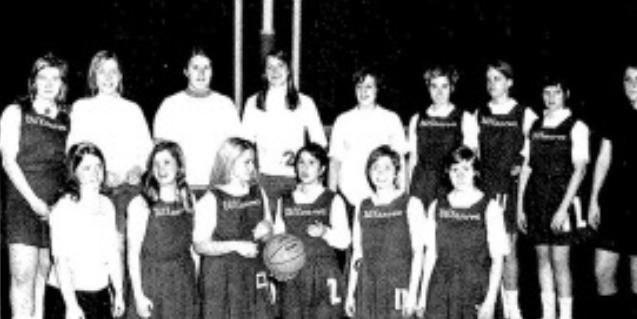
are clean and tailored fit for athletes. Jerseys are nearly identical to the men’s team, reflecting a broader change in women’s sports, emphasizing visibility and cohesive program branding. The transformation marks a major contrast to the restrictive skirts and blouses worn in the late 1960s.
Men’s From short-shorts to belowthe-knee baggy fits, men’s uniforms have taken a roller coaster of changes in length and design. The Villanova Men’s basketball league dates back to 1920, where it became part of the Philadelphia Big Five. Existing for over 100 years, both the program and its uniforms have continually evolved. The timeline runs long, just like their shorts in the 90s.
1920s-1940s: Heavy cotton uniforms offered limited breathability, making comfort a challenge itself. The designs were minimal, often just the “V” or player numbers. The bottoms short length were standard for the
year, but uncommon in today’s game. 1940s-1960s: The introduction to sleeveless jerseys seemed groundbreaking. There was a decent shift toward lighter material, more functional for basketball. “Villanova” lettering paired with the player’s number was a new addition, yet shorts remained short.
1960s-1980s: This era definitely experimented in design and color scheme. Uniforms were attempting to use yellow lining with the classic navy blue and white coloring, which was an interesting choice. The stylists were pushing the limits beyond their classic design. 1980s 2000s: The rise of modern uniforms brought lighter synthetic fabrics that helped with comfort and mobility. Arched “Villanova” lettering, bolder number and light blue details were more prominent. More in the 90s, uniforms expanded with logo features, including the wildcat mascot, interesting fonts and red detailing. Not their best work, but very reflective of the era.
Johnny’s Pizza is the perfect pick for a game day feast. Erika Massiani/Villanovan Photography
The Villanova women’s basketball team circa early 1970s. Courtesy of Villanova University
The Villanova Bracket: From Dorms To Dining Halls
Sophia Thomas Staff Writer
March marks peak basketball season, which also means brackets and timely predictions.
However, instead of bracketing college basketball teams, what if we were to apply a similar format to student campus favorites?
From favored outdoor lawn spots to the variety of freshman dorms, Villanova’s culture has its own contenders, each seeking out a top spot.
After conducting a highly competitive bracket challenge, the results are in. We can now unveil the champions of Villanova’s campus life.
In the dining hall division, Cafe Nova, or COVA, stands out as the top seed thanks to its variety of options. The acaí bowl station and the “Southwest Station” both stood out as fan favorites.
However, the Connelly Center was a close second. It had a strong run due to its central location and unique sushi bowl station and on-the-go Wawa snack options. After a close call, COVA ultimately won the bracket for the dining hall division with its variety and dependable classics.
The freshman dorm matchup sparked a bit of debate and plenty of controversy, as each first-year hall is unique and has loyal fans. McGuire was in the

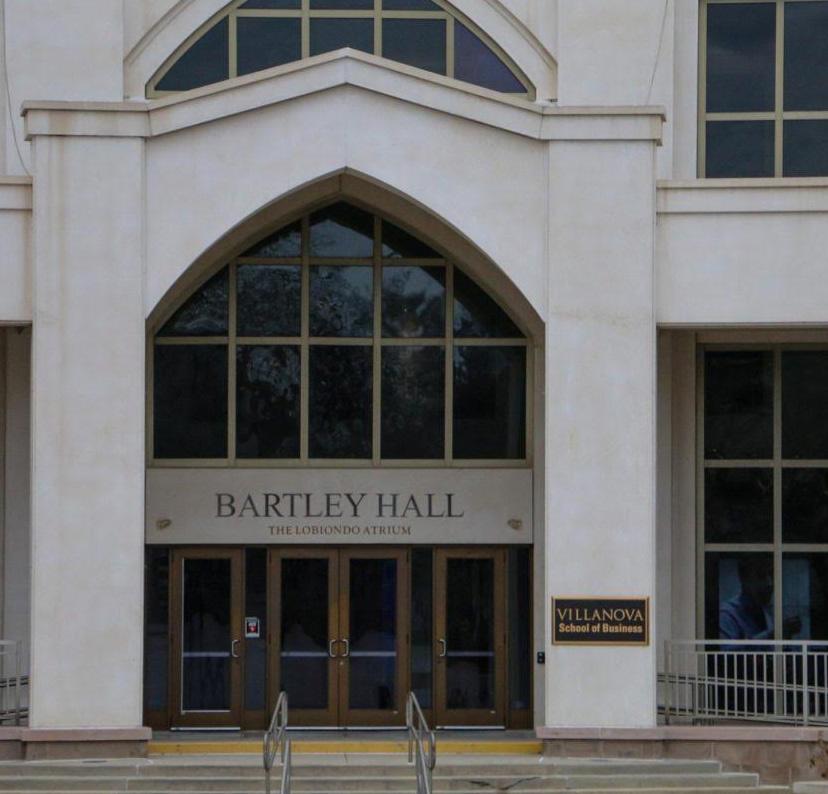
lead for a while.
However, in the end, Good Counsel emerged as the winner of the freshman dorm division. Notable for its strong sense of community, Good Counsel is a consistent fan favorite amongst first-years. Good Counsel lies next to “SPIT,” which is a necessity for any freshman.
For many first-years, fresh -
man year at Villanova is defined by hallway conversations and meeting fellow first-years in your dorm. Having friends to rely on is what makes Villanova have that true sense of a “new home.”
The favorite academic building division brought Villanova’s most notable study spaces into competition. Bartley was the clear champion. Bartley features
a variety of study spaces that are both comfortable and optimal for productivity. The Bartley Cafe is a feature of this popular study space, making it such an active academic building on campus.
Finally, there must be a winning coffee shop to close this bracket. If you voted for the Commons Holy Grounds, then congratulate yourself on a perfect call. This coffee spot stands alone and offers students a study space along with treats and coffee.
The ambience is phenomenal, with music that keeps spirits lifted amid the treachery of midterms and finals. The food selection is always reliable, and the company is more than you could wish for.
The only downside? You might have the watch like a hawk for one of the tables to open up, which makes sense at this fan favorite.
While these categories are not competing in the real NCAA tournament, they still represent defining and memorable parts of life here at Villanova.
From studying in Bartley to bonding with your first-year neighbors, these areas of campus life shape college life for Villanovans.
Like the March Madness bracket, everyone will have slightly different picks.
But the winner lies in the memories that students make each day as they roam the beautiful campus they call home.
March Madness Impact On Admissions
Lauren Armstrong Senior Columnist
Villanova is known for several things: academic rigor, community, involvement and Villanova basketball.
Since 1985, Villanova’s men’s basketball has won six Big East championships, has had five final four appearances and has won three national championships. These successes have elevated Villanova’s status, introducing the University to parts of the country that were unfamiliar with the school before the Wildcats earned these titles.
In the 2015-16 application cycle, Villanova University had a 47.89% acceptance rate. Two national titles later, in the 2018-19 cycle, the rate dropped to 29.22%. Most recently, the 2024-2025 rate was 27.4%.
Dropping over 20% in nine years opens the door for the question: how much has Villanova basketball impacted this decrease?
“When I applied to Villanova, I knew very little about the school,” senior Jenna Parker said. “I did not know how big or where the school was, I did not know it was considered such a prestigious university, and, most shockingly, I did not know it was a Catholic institution. What I did know was the basketball team. I have been a huge basketball fan since I was little and would religiously watch March Madness every year. I could distinctly remember the
name Villanova from my brackets, and when I was looking for colleges, I decided to apply. Four years later, and here I am, all because I remembered watching the team in elementary school.”
Villanova has continued to get an increase in applications year after year, and with both the men’s and women’s basketball teams making the NCAA Tournament this year, the question remains on how this will impact next year’s admissions cycle.
“I think Villanova has made a name for itself in many ways, academically, religiously, socially, but one of the biggest is through the reputation of the basketball team,” Parker said. “College sports are important to many people, and when a team has a record of success, people will flock there to be a part of it. I think that the community which has been built around Villanova basketball has had a significant impact on the school’s admissions.”
Basketball is not the only thing impacting admissions in the current and future cycles.
Many students and members of the Villanova community believe that the Pope will also make a large impact for years to come.
“I believe the Pope will have a bigger impact on admissions,” senior Maggie Parham said. “Over the summer, while sharing my Villanova email address with others, they recognized the school because of the Pope, not because of basketball.”
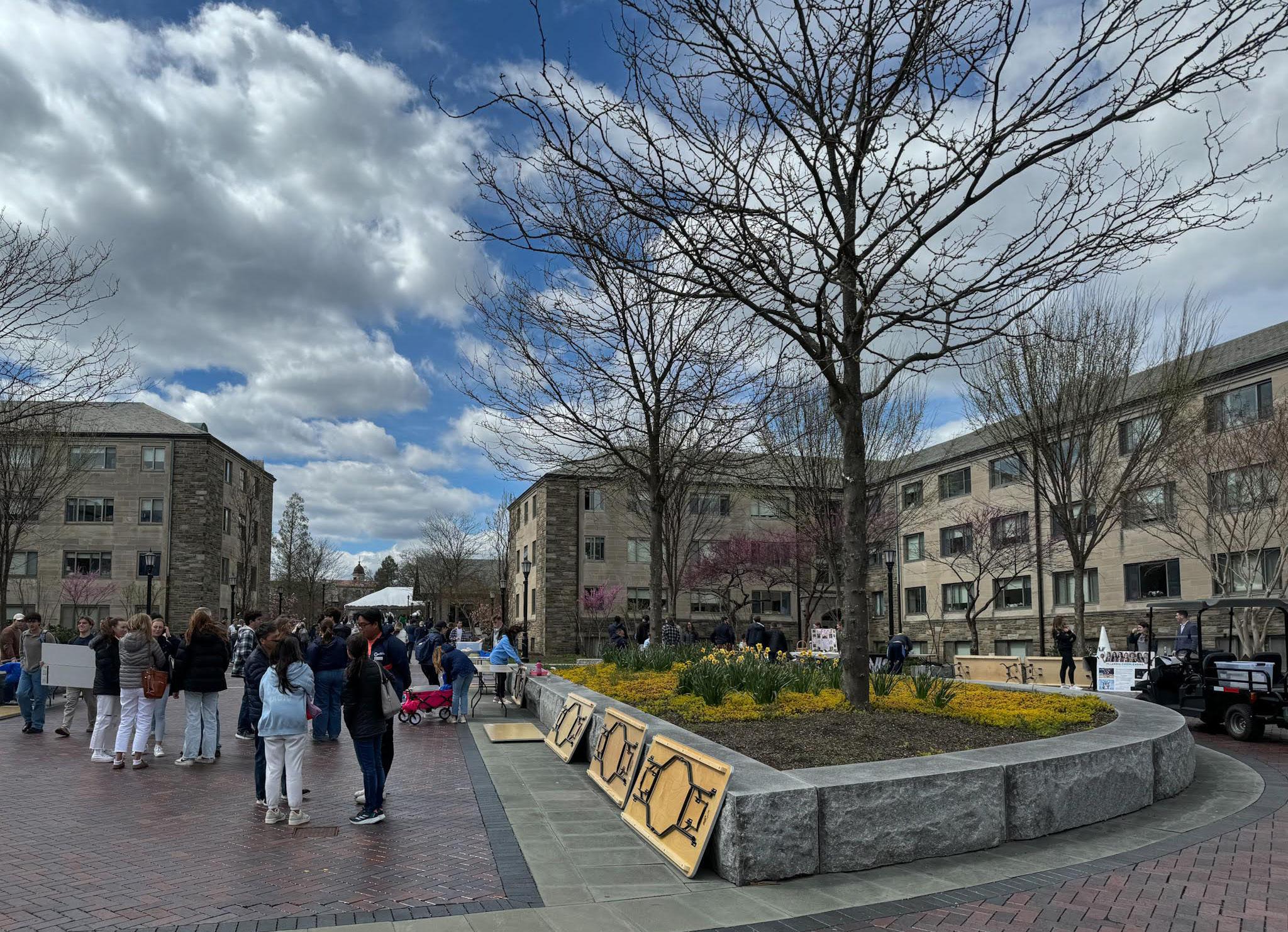
Some of the incoming students in the Class of 2030 credit their decision to apply for both reasons.
“I applied to Villanova because it is a great school,” an incoming freshman who requested anonymity, due to being younger than 18, said. “I found out about Villanova when I was in middle school, when they made the Final Four in 2022. My older brother was looking at schools, and that made him add Villanova to his list.
Once the Pope was announced last Spring, I remembered how much I enjoyed touring the school with him, and I decided to apply. If it were not for these two reasons, I would not be attending Nova next year.”
The numbers prove that the national attention that an NCAA championship brings affects admissions rates. The numbers also show an increase in applicants for the same target class sizes.
With the addition of the Cabrini and Rosemont campuses, the University plans on increasing its target class sizes.
While success in basketball and the Pope continue to drive admissions numbers, acceptance rates may begin to fluctuate.
As the Villanova community prepares to support the Villanova teams and welcome the Class of 2030, these trends will continue to be monitored as the University expands.
In a competitive campus bracket, Bartley came out on top out of best academic buildings. Graydon Paul/Villanovan Photography
The success of both basketball teams might entice future prospective students. Brian Luppy/Villanovan Photography
Back in the Dance: Denise Dillon’s Tournament Team
Katie Lewis Senior Writer
Three years ago, Denise Dillon celebrated with her team as Villanova was selected as a No. 4 seed in the NCAA Tournament on March 12, 2023.
Last Sunday, Dillon got to cheer again as Villanova’s name was called in the NCAA Selection Show for the first time since that day. This season marks Dillon’s third tournament appearance as Villanova’s head coach, a role she began in 2020-21.
“I’m not sure why, but it feels a little different,” Dillon said. “That year, we were top 16, so we knew we were hosting. But there’s the excitement of a new group heading off, and we’re going to hit the road. It feels different every time, which is unique and special. I’m fortunate to be able to experience it in different time frames.”
The program entered a period of uncertainty after the 2022-23 season concluded with a heartbreaking 70-65 loss to Miami in the Sweet 16 on March 24, 2023. Notably, the loss marked the end of Maddy Siegrist’s collegiate career. Siegrist, an All-American forward, finished her five years in the program as a Villanova legend and went on to join the Dallas Wings in the WNBA.
One of the main challenges for Dillon in the 2023-24 campaign was carrying on without Siegrist in the early years of the Name, Image,

and Likeness (NIL) and transfer portal era. The Wildcats, led by guard Lucy Olsen, finished that season with a 22-13 overall record.
Despite missing an NCAA Tournament bid, they battled to the championship game of the inaugural Women’s Basketball Invitation Tournament (WBIT). Villanova ultimately fell to the University of Illinois, 71-57, on April 3, 2024.
An exodus of players in the offseason due to the transfer portal and graduation made Villanova’s NCAA Tournament hopes slim once again. Olsen and forward Christina Dalce, who each departed the program through the portal, left sizable gaps in the roster as the 2024-25 season approached.
The addition of guard Jasmine Bascoe, who led the Wildcats in scoring as a freshman, generated high hopes for the program’s future. Villanova again found itself in the WBIT, finishing its 2024-25 campaign with a 21-15 overall record. The Wildcats lost to Belmont, 66-57, in the WBIT semifinals on March 31, 2025.
Yet members of the program were optimistic as the 2025-26 season began. Bascoe’s return, junior forward Brynn McCurry’s full recovery from an ACL tear, along with the additions of players like freshman guard Kennedy Henry and transfer junior guard Kelsey Joens, set the scene for a resurgence of Villanova women’s basketball.
When Dillon gathered her new team for summer preseason training, the coaching staff agreed
that there was “something special” about this year’s group of players.
However, this season did not come without its struggles, especially during the non-conference portion of the schedule. Villanova suffered a pair of concerning losses to Fairfield and Princeton in November. But the early season took a positive turn as Villanova soundly defeated thenranked No. 25 West Virginia, 81-59, on Dec. 1. West Virginia is now a No. 4 seed in the NCAA Tournament.
With a 25-7 overall record and 16-4 conference record, finishing second in the Big East behind No. 1 seed UConn, the Wildcats piled up the wins they needed to see March Madness again.
Sunday’s selection was a gratifying moment not just for Dillon, but also for the players who stayed through the team’s failure to make the Tournament the last two years, and remained resilient during early-season disappointments and a challenging schedule.
“You don’t get to play UConn three times in a season very often,” Bascoe said. “We’re fortunate that we played some great teams during the [Big East] postseason, and even our non-conference games, like West Virginia. Our coaches did a good job of setting us up [for the NCAA Tournament]. We played some tough teams.”
Senior guard Denae Carter, who transferred to Villanova from Mississippi State for the 2023-24 season, has also been part of the team’s evolution over the past three
years. “From the start of the season to now, we’ve competed our hardest, and we talk about it all the time that we still haven’t played our best basketball,” Carter said. “So all those games combined, and now entering March, where it’s win or go home, it’s really big for us. So I think we’re ready for the moment and excited.”
Only two players from the original Sweet 16 roster remain on the team now: senior forward Annie Welde and senior guard Maggie Grant.
In Dillon’s view, while the senior duo often do not get minutes in games, their presence has been crucial to bridge the gap between Villanova’s previous NCAA Tournament team and this year’s squad.
“Our veterans, Annie Welde and Maggie Grant, were a part of that Sweet 16 team, and they understand what the culture is and what it’s all about,” Dillon said.
While the team looks toward its upcoming matchup against No. 7 seed Texas Tech, Selection Sunday and the chemistry among the team were what Dillon envisioned at the beginning of the season.
“This team certainly put together the resumé they needed to get into March Madness, and we were confident that we were getting here,” Dillon said. “You put [the seeding] aside at this point. You just prepare for what’s ahead. You’re happy to be in there; you want to battle and prove yourself, so that’s our position right now.”
Horoscope: What Your Bracket Says About You
Korin Kohen Co-Digital Editor
Somewhere on campus, at this very moment, someone is staring at their March Madness bracket with complete confidence. Maybe they are sitting in Falvey in between classes, quickly filling in their picks before heading to their next lecture. Or maybe they are defending their predictions over lunch at The Exchange, convinced their upset pick will be the one that makes it through. Wherever they may be, for a few weeks every spring, the NCAA Tournament becomes a constant topic of conversation around campus.
At Villanova, this year’s tournament carries a little more meaning. For the first time since 2022, the Wildcats are back in March Madness under new head coach Kevin Willard. The return to the national spotlight has brought renewed excitement to campus and a spark of optimism for what the future could hold for Villanova basketball.
Of course, the idea of a “perfect” bracket is nearly impossible, but that does not stop people from believing they have finally cracked the code. So, before the first tip-off, consider this your March Madness horoscope. Because the real question of the tournament is not just who will win, but what kind of bracket maker are you?
The Loyalist
This bracket requires almost no thought. No matter the seed, no matter the competition, Villanova is
winning. Statistics and predictions are secondary to school pride, and if the Wildcats are in the bracket, they’re advancing. The Loyalist’s certainty has not wavered, even after a fouryear tournament drought. In fact, the sheer power of past tournament victories keeps their spirits alive. They are the first to bring up Kris Jenkins’ iconic three-point buzzer-beater that sealed the 2016 national championship and will continue to do so as if it happened last week. For the Loyalist, that shot is evidence and a completely valid reason to send Villanova deep into the competition.
The Analyst
The Analyst approaches their bracket with complete seriousness and no room for error. They have consulted multiple prediction models, watched each team with the focus of a professional scout and read more tournament previews than they have readings for their actual classes. Their brackets are all based on probabilities, ratings and a few bold picks that are still supported statistically. March Madness is less about actual madness and more about strategy. They will happily explain this equation to you, even if you did not ask. Of course, the tournament rarely agrees with such calculated brackets. By the end of the first day, their perfectly engineered masterpiece has usually been destroyed by a team that was nowhere in their projections.
The Mascot Judge
The Mascot Judge ignores data and expert insights. Their method is elaborate, but in a non-traditional way: which team has the
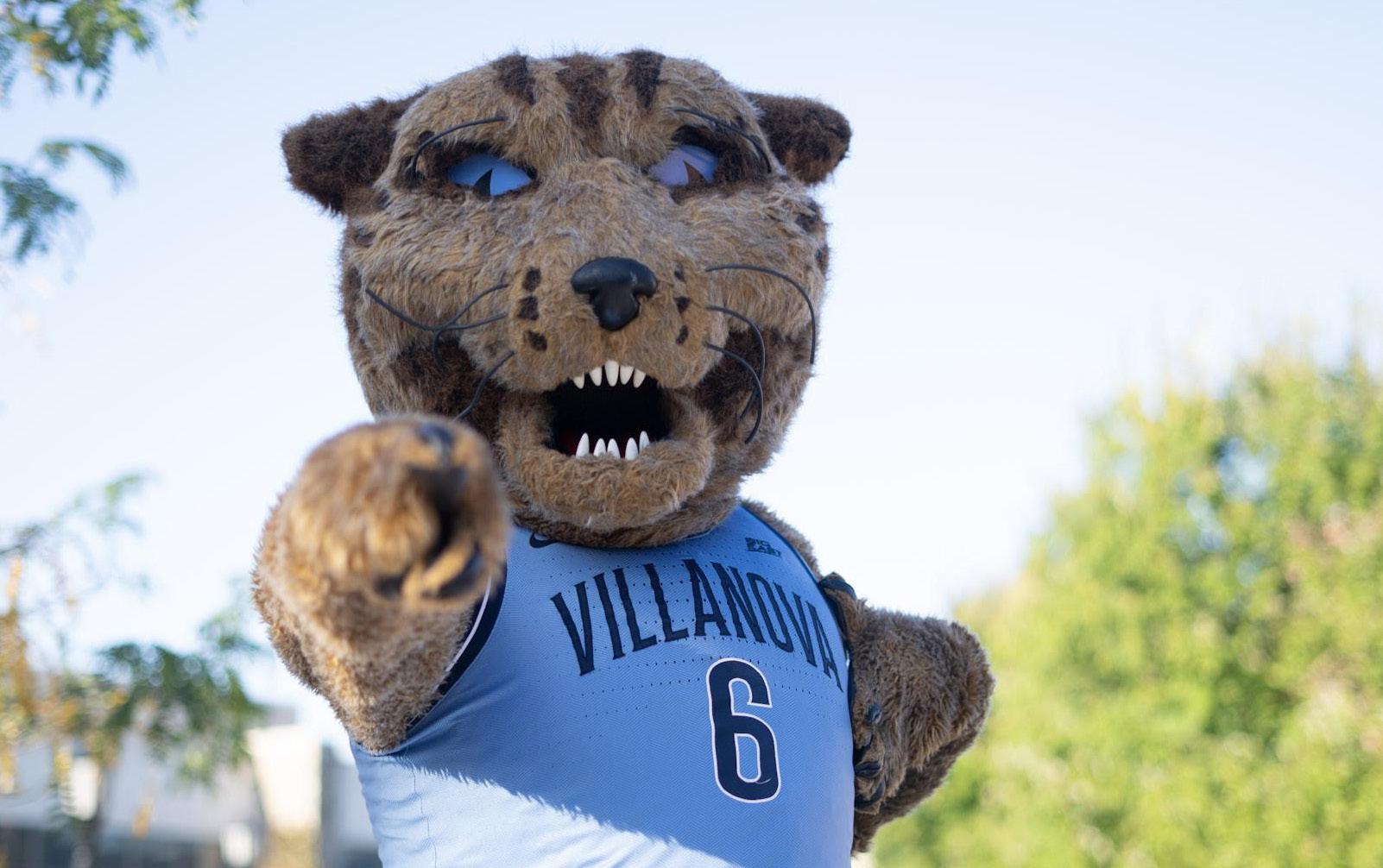
best mascot? They consider which one would win in a fight, which one sounds cooler and which one would make for a better jersey.
A Wildcat probably defeats a Bulldog, but the Thunders sound powerful enough to wipe them both out. While everyone else is arguing about seeding and defensive efficiency, the Mascot Judge is running an entire cinematic battle inside their head. They can practically hear the commentators announcing each team’s name in a dramatic fashion, envisioning which mascot would dominate the arena and bring the energy.
The Chaos Enthusiast
The Chaos Enthusiast lives for the thrill and unexpectedness of the entire process. Their bracket consists of wildcards that no one else seems to agree with. A No. 13 seed suddenly makes the Sweet 16, while a
powerhouse team is eliminated in the first round. They live for the mayhem and take great satisfaction in watching carefully crafted brackets collapse around them. The moment an underdog starts gaining momentum, they are the first to celebrate in the group chat. The real victory is not having a perfect forecast of the competition, but to say, “I called that,” in reference to their upset pick. No matter how much research you do, how loyal you stay or how chaotic your picks become, every bracket eventually meets the same fate.
A Cinderella team will derail your prognosis or maybe a sneaky buzzer-beater will change everything. Yet every March, everyone fills out another bracket with the same hope. The real appeal is in the slight chance that maybe this is the time you will finally get it all right.
If you’re a staunch Mascot Judge, Will D Cat is definitely a strong contender. Erick Quezada/Villanovan Photography
The Flutie Effect: Winning Teams Transform Universities
Michael Barravecchio Staff Writer
College sports are often viewed as entertainment, but their impact goes far beyond the scoreboard. A single university team’s athletic success can increase student sentiment, raise applications and lower acceptance rates. In honor of March Madness, we explored the ways strong athletics can transform universities overnight.
Origin of the Flutie Effect
On Nov. 23, 1984, the 10thranked Boston College Eagles played the 12th-ranked Miami Hurricanes. After Miami took a 45–41 lead late in the fourth quarter, Boston College’s eventual Heisman Trophy winner and NFL quarterback Doug Flutie delivered a 48-yard “Hail Mary” touchdown pass as the clock expired to give Boston College the walk-off win. The moment, labeled the “Miami Miracle,” cemented Boston College’s legacy and placed the university on national notice.
Two years later, according to Forbes, applications at Boston College had risen 30%. The “Flutie Effect” increased the school’s visibility, shifting it from a regional institution to a nationally recognized university. From that point on, universities had reason to believe successful athletic programs could influence admissions.
The Flutie Effect Elsewhere Gonzaga University struggled with enrollment in the late 1990s, dropping to just under 2,800 students in 1998. At one point, the school even considered moving down from Division I athletics as it searched for ways to attract students. During the 1998–99 season, Gonzaga suddenly broke out and made the Elite Eight in March Madness, boosting admissions
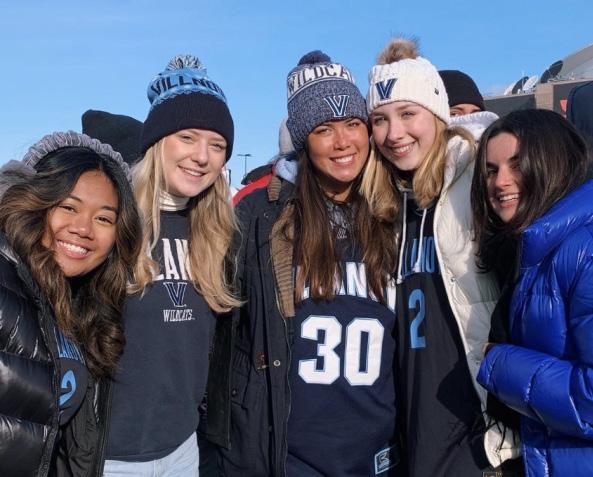
in the years that followed. Gonzaga used this momentum to raise the university’s academic standards. Over the next few decades, average GPAs and SAT scores rose, and donations helped improve the program (Gonzaga Bulletin). Today, Gonzaga is one of the premier basketball programs in America.
The Impact of Athletic Performance at Villanova While the Flutie Effect has impacted many universities, the Villanova Wildcats have also helped make the school more competitive. Villanova’s version of the Flutie Effect works slightly differently because the university already had strong athletics. Still, Jay Wright’s rise in Villanova basketball helped shape the university we know today.
In 2016, Villanova returned to glory. The Wildcats’ roster included six future NBA players, including
Jalen Brunson, now one of the NBA’s top players. Their NCAA championship buzzer-beater victory over North Carolina remains one of the most famous moments in college sports history. In 2018, Villanova won 36 games and featured seven future NBA players, winning the NCAA national championship again.
During this period, Villanova’s acceptance rate fell quickly as applications rose. In 2015–2016, the school posted an acceptance rate of about 48%. By 2018–2019, it had dropped to 29%. Applications rose from 16,206 to 22,741 during the same period, allowing the university to become more selective and strengthen its reputation (Applicants, Acceptance Rate, Yield Trends at Villanova).
Many students believe the Wildcats’ athletic success plays a major role in how they view the university. After Jay Wright retired, many students feared Villanova’s basketball
team would not remain as strong. Unfortunately, those fears proved correct. The Wildcats missed the tournament three straight seasons, the first time since the 2003–2004 season. Although Villanova’s admissions profile did not decline sharply, largely due to the University’s longstanding success, students were noticeably less excited to attend games. Fewer students followed the team, and one of Villanova’s biggest traditions, Wells Fargo Center games, felt less energetic.
This year, when Coach Kevin Willard was hired after leading Maryland to a Sweet Sixteen and building a strong career at Seton Hall, students quickly became excited about Villanova’s new beginning. The hiring of Willard brought in major recruits such as Acaden Lewis and transfers like Duke Brennan. The Wildcats finished the regular season 24–8, making Willard the winningest Villanova coach in his first season with the program. As the season progressed, games grew louder, and Villanova students swarmed Xfinity games.
Willard’s early success has Villanova dancing in March, as the Wildcats look well on their way back to title contention. His decisions and acquisitions have put Villanova back on the national basketball radar following the Jay Wright era, and the recruits he continues to bring in will strengthen the program’s impact on donations and admissions.
In April of 2016, Villanova was one of the most exciting places in the country. Thousands of students packed the Finneran Pavilion to watch the National Championship in Houston. When Kris Jenkins drained “the shot,” the Finn erupted into pandemonium. Simply put, it was a moment that changed Villanova forever.
Now, the current Villanova Wildcats have a chance to repeat
Why Villanova Should Continue To Invest In Basketball

Massimo DiLeo Staff Writer
At Villanova University, almost all students can agree that our men’s and women’s basketball teams have performed exceptionally well in the past several years. Most notably, the men’s team has seen a resurgence of strength that many in our community believed left with Jay Wright’s retirement following the 2021-2022 season. However, today the women’s basketball team is the runner-up in the Big East Tournament, and the men’s team is a lock for the NCAA tournament. This leaves many wondering about how much of Villanova’s identity is tied to basketball. Although some may argue that too much of Villanova’s brand identity is tied to the sport, it is important to consider the amount of recognition basketball has brought to our community and the ways it has shaped our presence nationwide.
When applying to colleges, students often want a good balance of academics, parties, and, of course, sports. When I applied to Villanova, I wanted the same things. Although I am not going to tell any stories about being a child-
hood fan of Villanova basketball and watching the 2016 national championship live because that is not true, I attest that when I entered the Finn in February of 2024 after getting my acceptance letter, I knew where I would call home for the next four years. Using this information, I often consider what Villanova would be like without basketball. There would be no trips to the Xfinity Mobile Arena or Hoops Mania, both huge parts of Villanova culture.
Moving beyond the individual student, on a global scale, Villanova’s investment in shaping basketball as a significant part of its identity has trademarked its name in many positive ways. When Kris Jenkins hit the shot to beat North Carolina in the 2016 NCAA championship, Josh Hart, Jalen Brunson, and Mikal Bridges were all present. Today, they play together for the New York Knicks and have earned themselves and Villanova widespread recognition for their resilience on the court. As a result, it is important to consider these factors when weighing the costs and benefits of a college’s further investment in its sports programs.
Looking at the women’s basketball team, a similarly identifiable legacy is evident in Maddy
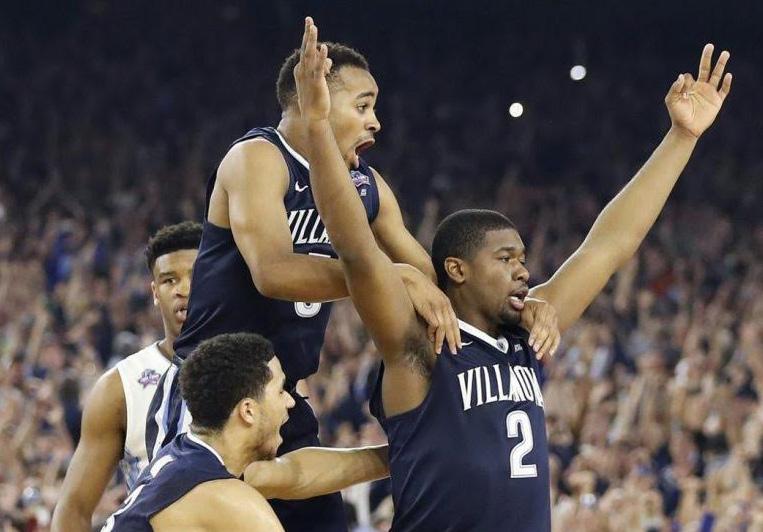
Siegrist. During her time at Villanova, Siegrist made the all-Big East first team three times, while also becoming the all-time leading scorer in program history. After graduating from Villanova in 2023, Siegrist played in the WNBA for the Dallas Wings. Looking at both the legacy of the women’s program and the men’s program through the success of their alumni, it becomes much easier to see why Villanova does and should
continue to invest in the future of both programs.
Basketball is part of Villanova’s culture, and without it, the unity of our community every winter would be lost.
As a result, the facts above should serve as a reminder of why many colleges invest large amounts of money in their sports programs and help one better understand why Villanova chooses to do so for its basketball teams.
Kris Jenkins’ iconic moment sparked a fire for Villanova athletics that is finally back. Courtesy of Villanova Athletics
Villanova students’ school spirit is closely intertwined with the basketball program. Courtesy of Jackie Thomas
Class Scheduling: Recipe for Success
Ingredients: Degree Works Schedule Plan Ahead
1. Identify courses in Degree Works
2. Search Schedule for Sections Offered
3. Enter Subject, Course Number, Campus
4. Review and Assess Details
5. Write down Section info for Phase 2
6. Repeat steps 1-5 for each course
1. Create a new Plan
2. Find your courses using the info saved in Phase 1
3. Add the course section to your Plan. The course will appear as “Pending” in the bottom right panel.
4. Repeat steps 2 and 3, assessing the practicality of the Plan as you work
5. Save by clicking “Save Plan”, naming it and selecting “Save”.
6. The status will change from “Pending” to “Planned” in the Plan panel. The courses will appear in color in the Schedule panel.
• You can create 10 plans per term.
• Since classes can fill before you register, review enrollment within your Plan and edit as needed.
• When it is time to register, select “Plans” tab, then either “Add All” or select individual courses.
What's Cooking? What's Cooking?
brac ket BITES
FOOD TRUCK FRIDAY It'sback!