The Villanovan | Volume 120, Issue 5: February 25, 2026
Villanova Needs More Call Light Boxes
Avery Chalk Co-Opinion Editor
Content warning: mentions of sexual assault
Several instances of sexual assault have shaken the Villanova community in recent years. Each incident reignites the same questions: Are students safe? Is the University doing enough to protect them?
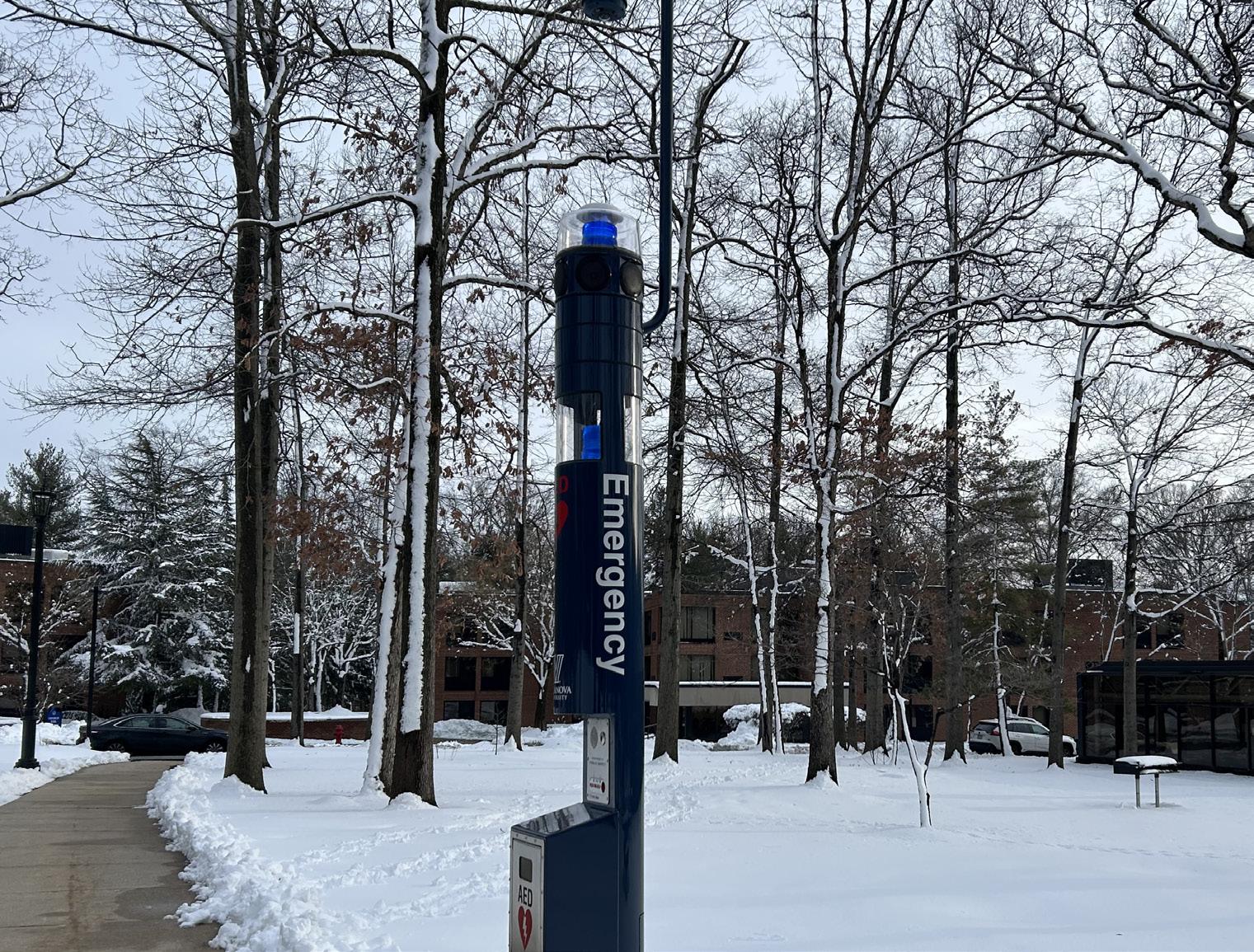
One visible safety measure on campus is the blue emergency call light box. These are pole-mounted, security devices designed to provide a direct line of communication to campus police or emergency services. While the University’s placement of these is well-intended, it must take additional steps to ensure these resources are not only present but also effective.
“Emergency call boxes are located throughout the campus and parking lot areas in order to provide emergency assistance to the Villanova community,” a University statement read. “Call boxes offer a direct link to Public Safety to report an emergency, such as a suspicious person or circumstance, a medical emergency, or to request a safety escort.”
This language suggests widespread coverage. However, the reality is far more limited.
There are only 16 emergency call boxes scattered across the University. Each campus, including sports complexes, walking paths and parking garages, has at least one box. However, the distribution of boxes is uneven and difficult to locate.
For example, West Campus has four call boxes: two in the parking lots, one inside John F. Scarpa Hall at the law school and one near St. Mary’s Hall. Yet, all other dormitories remain without immediate access to an emergency device. In moments
Continued on p.5
Know Your Rights: Law & ICE p. 2
Student Reactions To Winter Olympics p. 9
Women’s Swim And Dive Continues 13Year Dynasty At Big East Championship
Sammie McKee Co-Sports Editor
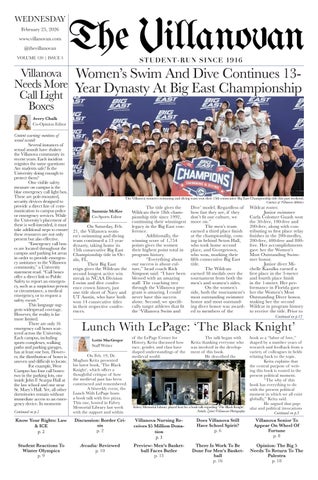
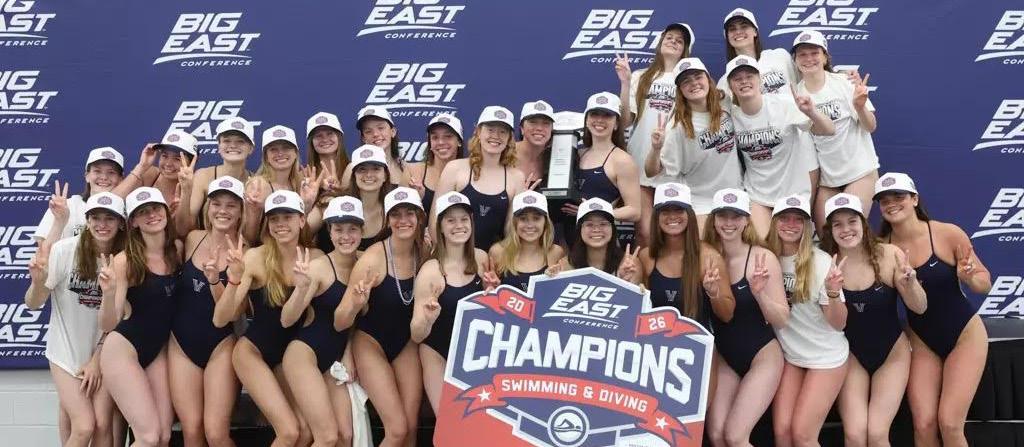
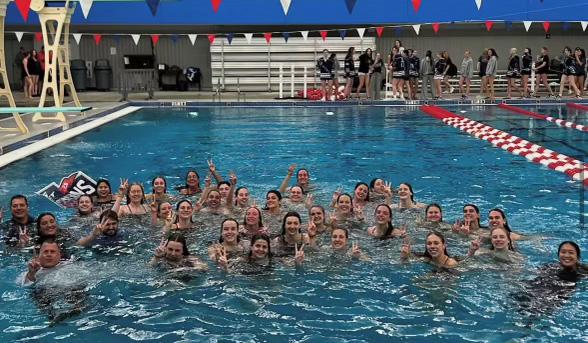
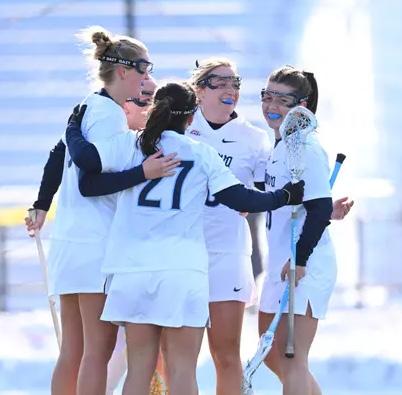
On Saturday, Feb. 21, the Villanova women’s swimming and diving team continued a 13 year dynasty, taking home its 13th consecutive Big East Championship title in Ocala, FL.
Their Big East reign gives the Wildcats the second longest active win streak in NCAA Division I swim and dive conference crown history, just one title short of Navy and UT Austin, who have both won 14 consecutive titles in their respective conferences.
The title gives the Wildcats their 18th championship title since 1992, continuing their winningest legacy in the Big East conference. Additionally, the winning score of 1,754 points gives the women their highest point total in program history.
“Everything about our success is about culture,” head coach Rick Simpson said. “I have been blessed with an amazing staff. The coaching tree through the Villanova program is amazing. I could never have this success alone. Second, we specifically target athletes that fit the ‘Villanova Swim and
Lunch With
Lottie MacGregor Staff Writer
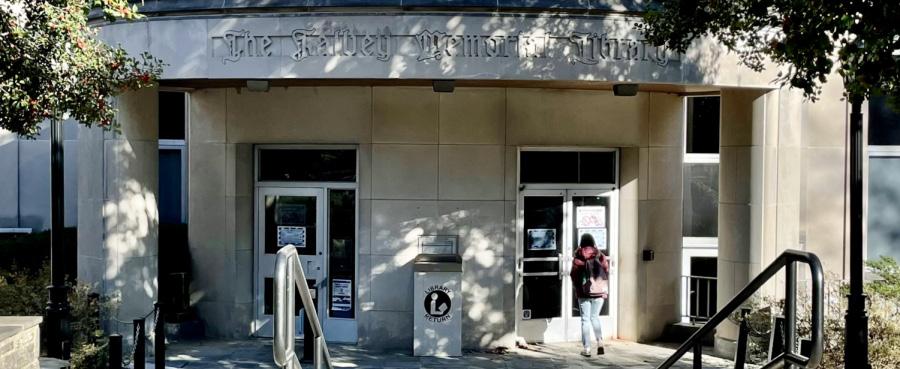
On Feb. 19, Dr. Maghan Keita presented his latest book, ‘The Black Knight’, which offers a thoughtful critique of how the medieval past has been constructed and remembered. A biweekly event, the Lunch With LePage hosts a book talk with free pizza. This one, hosted in Falvey Memorial Library last week with the support and within
Discussion: Border Crisis p. 2
Arcadia: Reviewed p. 10
LePage:
of the LePage Center for History, Keita discussed how race, gender, and class have shaped understandings of the medieval world.
Dive’ model. Regardless of how fast they are, if they don’t fit our culture, we move on.”
The men’s team earned a third place finish at the championship, coming in behind Seton Hall, who took home second place, and Georgetown, who won, marking their fifth consecutive Big East title.
The Wildcats earned 38 medals over the tournament from both the men’s and women’s sides.
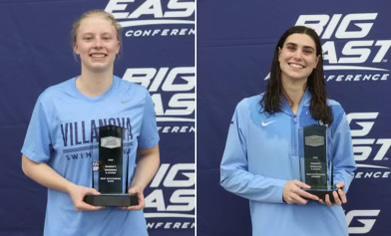
On the women’s side, both the tournament’s most outstanding swimmer honor and most outstanding diver honor was awarded to members of the
Wildcat roster.
Junior swimmer Carla Colomer Guash won the 50-free, 100-free and 200-free, along with contributing to first place relay finishes in the 200-medley, 200-free, 400-free and 800free. Her accomplishments gave her the Women’s Most Outstanding Swimmer honor.
Junior diver Michelle Kasulka earned a first place in the 3-meter and fourth place finish in the 1-meter. Her performance in Florida gave her the Women’s Most Outstanding Diver honor, making her the second Wildcat in program history to receive the title. Prior to
Continued on p.12
‘The Black Knight’
The talk began with Keita thanking everyone who was involved in the development of this book. He described the
Villanova Nursing Receives $5 Million Donation p. 3
Preview: Men’s Basketball Faces Butler p. 13
Does Villanova Still Have School Spirit? p. 6
There Is Work To Be Done For Men’s Basketball p. 16
book as a “labor of love,” shaped by a number years of research and feedback from a variety of colleagues in fields relating back to the topic.
Keita explains that the central purpose of writing this book is rooted in the present political moment.
“The why of this book has everything to do with the present political moment in which we all exist globally,” Keita said.
He argued that popular and political invocations
Continued on p.3
Opinion: The
The Villanova women’s swimming and diving team won their 13th consecutive Big East Championship title this past weekend. Courtesy of Villanova Athletics
Villanova Senior To Appear On Wheel Of Fortune p. 8
Big 5 Needs To Return To The Palestra p. 18
Falvey Memorial Library played host for a book talk regarding ‘The Black Knight’. Natalie Zickel/Villanovan Photography
PUBLIC SAFETY BLOTTER
Paraphernalia / PossessionMarijuana February 19, ALUMNI HALL. Marijuana and paraphernalia were observed in a room occupied by three male resident students.
CORRECTIONS
Factual errors are corrected as soon as they are brought to The Villanovan’s attention. Please send an e-mail to villanovan.eic@gmail.com to report errors.
Know Your Rights: Law & ICE
Darya Radzevich Staff Writer
On Thursday, Feb. 19, the Latin American Studies Program held a workshop in the Charles Widger School of Law on Immigration and Customs Enforcement (ICE) in communities. The recent increase in immigration enforcement in the United States has led to discourse regarding ICE’s presence in communities, making it more important than ever to stay informed about individual rights and advocacy opportunities.
With ICE presence becoming increasingly prevalent, Student Life sent an email to the student body listing protocols, resources and opportunities for education in law enforcement agencies come to campus.
Amid these developments, the workshop provided an opportunity for students to learn about their constitutional rights during ICE encounters and how to support immigrant groups through local advocacy.
The Director of the Latin American Studies Program, Raúl Diego Rivera Hernández, opened with a speech about the importance of this timely event and the state of the country.
“What is happening is not small, it is not isolated, and it is not temporary,” Hernandez said. “It represents a rapid expansion of federal enforcement of power happening in real time. It is whether confinement becomes an accepted tool of routine governance, and it is about the role of private corporations in incarceration and the expansion of federal authority in our neighborhoods, workplaces and schools.”
Additionally, the workshop highlighted local encounters with ICE agents. For instance, 25 workers were arrested in Bellefonte, PA, while working on a construction site.
“These are realities,” Hernandez said. “When families live in fear of routine activities, going to work and school, and seeking health care. With this, community life contracts and social bonds dwindle.”
Taking this into account,
the workshop focused on educating participants on their constitutional rights in case of an encounter with ICE officers. They laid out a list of rights that agents cannot violate, such as entering private property without a proper warrant, the right to remain silent, the right to record interaction and that agents must have probable cause and reasonable suspicion to make an arrest.
“Recording them is the best way to hold them accountable,” Tsehaitu Abye said. “Agents have been known to arrest now, think later.”
There is a power in numbers when pushing back against potential violations of personal and constitutional rights.
Showing support to communities impacted by ICE presence can be through conversations with others, supporting immigrant-owned businesses, donating to solidarity funds, outreach and divesting from organizations that fund ICE operations.
Another speaker, Tammy Murphy, spoke about an “ICE Out” legislation that they are working on getting passed in Philadelphia. This legislation would prohibit data sharing, asking about immigration status, ICE entering non-public city facilities and any organization from masking or concealing its identity.
Many efforts are underway to check the power of the federal government, but there is still a lot of rallying and support needed to help the communities that feel their lives have been disrupted by the recent developments in the country.
Ultimately, the workshop underscored the importance of education and community engagement during a time of heightened federal enforcement. By providing students with knowledge of their constitutional rights and opportunities for advocacy, the event reinforced the role universities can play in fostering informed and active citizens.
As conversations around immigration enforcement continue evolving, staying informed remains essential for supporting affected communities and upholding constitutional rights.
Discussion: Border Crisis
Addy McDougall Staff Writer
The question posed by the panel on Feb. 18 in the Driscoll Hall Auditorium was one at the forefront of today - is there a border crisis?
The panel was moderated by Villanova law professor Daniel Cortes, a Colombian lawyer whose personal experience with immigration led him to fight for an equitable system. Audience members in attendance ranged from various students to other community members, all eager to gain insight into this relevant topic.
Cortes introduced the panel of accomplished scholars: Penn State history professor Mary Mendoza, University of Pennsylvania history professor Hardeep Dhillon and Seton Hall law professor Lori Nessel.
The panelists traced the origins of immigration and border control in America, offering diverse perspectives on how the current system began and what led to its flaws.
Cortes opened, expressing that immigration has bent political discourse, making the topic timely.
Diving into her explanation of how the current immigration system emerged, Mendoza outlined border history and described the dehumanizing practices of chemical cleansing that Mexican migrants were put through, which caused many to pass through the border secretly to avoid such torture. This only “fueled animosity towards Mexicans.”
The 1940s saw an increased use of fences and patrol agents to control migrants along the border, and Mendoza highlighted that many agents were concerned about Mexican women having children in the United States and “staining the social fabric of America.”
Mendoza deduced that although border regulation traces to ticks, it has become more than that.
“Human migrants had become the parasite,” Mendoza said. “We have created a border crisis, but it is one of our own making.”
After Cortes posed the question, “Where does the border live,”
Dhillon jumped into her analysis of the crisis, explaining that the border is not a single physical structure.
“[The border] lives everywhere,” Dhillon said. “In the mind, in the body and at home.”
Dhillon detailed her view of how the US, particularly government employees, have “used legal status as a proxy to structure inequality.” She explained the development of birthright citizenship in the US and described barriers to citizenship that immigrant children face. Dhillon also drew attention to the Supreme Court ruling on birthright citizenship to come later this year.
“There is not a singular border, nor a singular crisis,” Dhillon said. “[There is] constructive legal architecture made by humans that follows an individual and their children, raises grave questions about their constitutional rights and protections.”
Nessel followed, describing the work she has done for more than 20 years fighting to achieve justice for immigrants. She points out that her rights clinic has now been forced to redefine what “winning” looks like. It used to entail clients gaining asylum and becoming U.S. citizens. It now looks like resisting an unjust system, fighting for due process.
“If people come together and push back, you can achieve small victories,” Nessel said.
Nessel voiced her concern regarding the lack of transparency in recent immigration operations, with masked agents intentionally sending immigrants away from their families and robbing them of full due process. She also clarified the importance of realizing that immigrant laws have long been weaponized to “dehumanize and send messages of control, but are not now exploding because of the lack of due process.”
“There is no other area of law that has been as isolated from constitutional norms and protections as immigration law,” Nessel said.
This discussion panel illustrated the importance of understanding the history and flaws of the US immigration system that produced today’s border crisis.
Lunch with Lepage: “The Black Knight”
Lottie MacGregor Staff Writer
of the medieval often rely on narrow, Eurocentric imagery. They influence how societies understand identity, heritage and power.
Keita said two things influenced his work most: illusion and the global medieval.
Illusion refers to the ways societies fail to see what is in plain sight. He claims that in texts, we often don’t see things because we are trained not to see them. This selective vision shapes the way we read novels.
His second idea, presented
in the novel, challenges the idea that the Middle Ages were exclusively European.
Keita touched on the 13th-century imagery from the court of Kublai Khan that depicted figures of African descent among elite retainers. He argued that these depicted figures disrupt the assumption of a racially homogenous medieval world.
Much of the book focuses on Arthurian literature, including Tristan and Parzival. Keita emphasizes that Africans appear in these sources more often than is acknowledged. Although over time, modern productions at least minimized this.
He highlighted the importance of the work of Sir Walter
Scott and Richard Wagner and how they reshaped medieval imagery. According to Keita, these works contributed to the push against racial conventions that gained attention in the 18th and 19th centuries.
This book Keita wrote extends beyond European texts. He also looked into the role of women known as qiyan, often translated as “singing girls,” in the medieval Islamic world.
He wanted to highlight how these women shaped the culture that influenced Iberia and many parts of Europe. He suggested that these women represent the interconnectedness of medieval societies.
Keita described himself as more committed to historiography than to narrative history. His goal, he said, is not to provide answers.
“That wasn’t my intention,” Keita said. “It’s to pose questions. Others will answer them.”
Keita’s book invites readers to reconsider the interconnectedness and racial diversity of the medieval world. By doing so, it challenges assumptions and represents more engagement with the past.
Falvey Library will continue to host more Lunch with Lepage events in the future.
Villanova Nursing Receives $5 Million Donation
Finn Courtney Co-News Editor
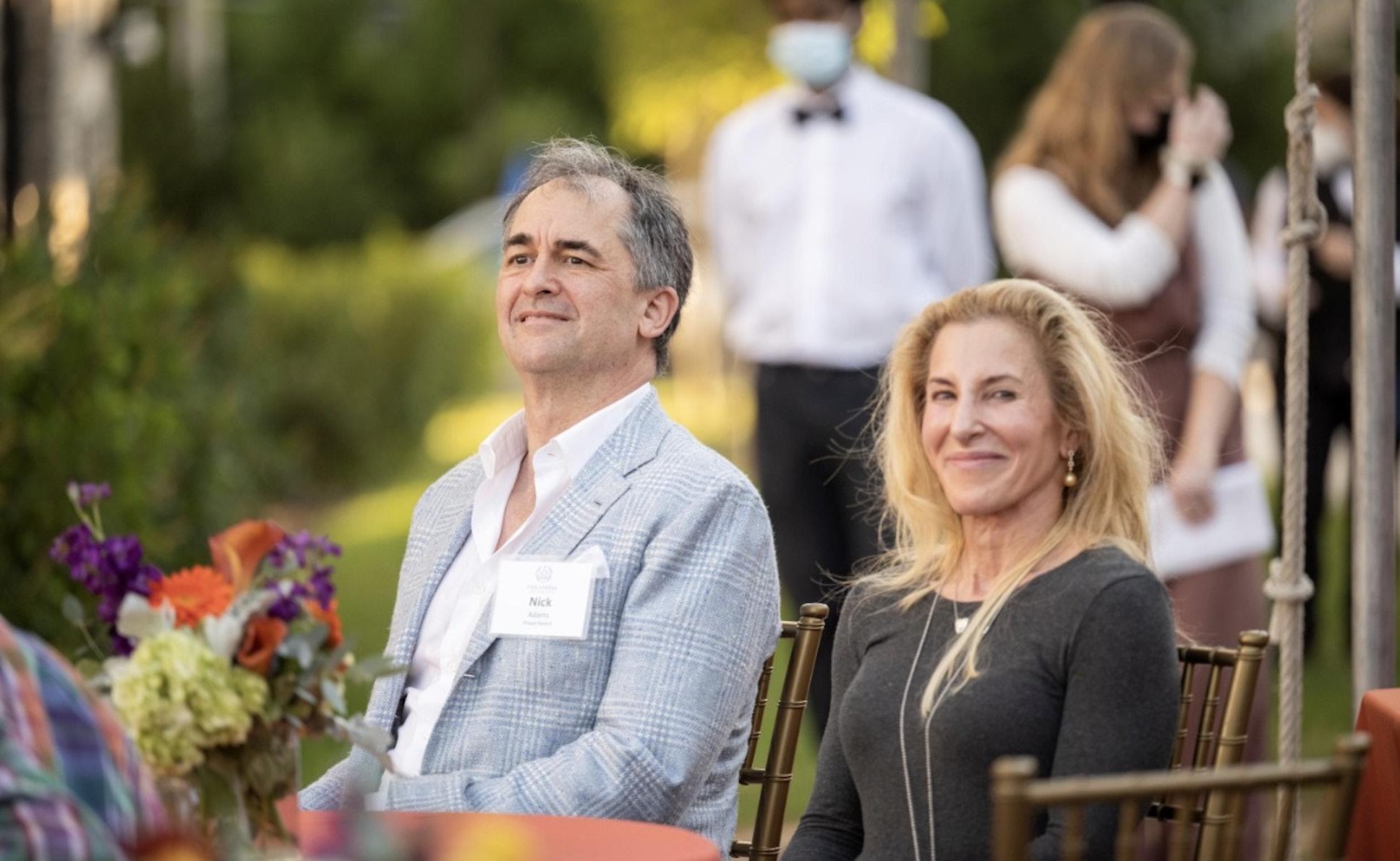
Villanova University’s M. Louise Fitzpatrick College of Nursing announced on Monday that a $5 million donation was made by Class of 1986 graduates Deborah ‘Dee’ Silvers and Nick Adams towards a reimagining of the simulation lab, a critical tool in the education and development of student nurses. This will allow for a 25% increase in undergraduate enrollment within the college.
“With demand for Villanova undergraduate and graduate Nursing degrees at an all-time high—and the country facing a growing nursing shortage—investing in Fitzpatrick College of Nursing facilities is a critical priority of Espiritus Nova: The Campaign for Villanova University,” a press release from the University read. “Built almost 20 years ago, the
simulation lab has enabled the College to become a national leader in simulation learning, and it now needs to keep pace with the rapid advances in technology in the ever-changing world of nursing education.”
As a result of the gift, the renovated and transformed simulation lab will be named the Dee Adams Center for Innovation and Simulation Excellence. This excellence will include overall enhancements in the way the College of Nursing prepares students to be professional nurses.
Nursing education requires facilities to be up to date to simulate real-world situations so that nurses can gain valuable insight into real-life operations, improve critical thinking and judgment skills and apply learning to a more nuanced practice.
This new center will include three distinct sections. There will be a Nursing Skills Wing, which will provide students with hands-on experiences in a safe and realistic environ-
ment, along with debriefing rooms to break down previous experiences. A Virtual Reality (VR) immersion suite will support the technology so that students can practice clinical scenarios with no risk. This will involve immersive scenes, sights, sounds, smells and touch feedback. And finally, a Smart Hospital Wing equipped with an operational emergency room will allow students to learn under pressure.
“This wing will also house the following: A labor and delivery suite to immerse Villanova Nursing students in realistic, high-fidelity birth scenarios; an ICU/medical-surgical suite that allows students to experience routine medical-surgical management to high-acuity critical care; a pediatric suite that can alternate between a general pediatric floor and a pediatric intensive care unit; and a series of exam rooms, which will replicate an outpatient setting for students to develop skills in comprehensive health assessment and documentation using digital platforms,” the University statement read.
This gift will not only go toward the new Adams Center, but also
“This gift will equip the 12,000-square-foot Center with the latest technology, transforming it into a dynamic new facility that will enable Villanova Nursing students to thrive in high-stakes care settings and deliver outstanding patient outcomes,” the statement read. “The Center, in addition to the simulation facility at the Iadarola Center on Villanova’s Cabrini Campus, will feature stateof-the-art skills labs, high-tech and high-touch spaces for immersive and virtual reality learning, and a simulated smart hospital.”
This gift is not the first from Silvers and Adams, as they have been longtime donors in both student and faculty projects on cancer-related research and towards the Mildred Boyd Adams Community Bridge over Lancaster Avenue, named after Adams’ grandmother.
More details of the plan will continue to be revealed in the weeks and months ahead. The Villanovan will continue its coverage both on the website and in print.
will work in concert with the Iadarola Center in the Cabrini Campus.
Deborah “Dee” Silvers ’86 and Nick Adams make a $5 million donation to Villanova Nursing. Courtesy of Villanova University
The gift will go towards the Adams Center and the Iadarola Center at the Cabrini Campus. Courtesy of Villanova University
Last Thursday, Dr. Maghan Keita presented his latest book, “The Black Knight”, at Falvey Library. Courtesy of Villanova University
The event was hosted by the The Albert Lepage Center for History in the Public Interest. Courtesy of Villanova University
This Week In Politics: Trump’s Tariffs Overturned
Zoe Garrett Political Columnist
The Supreme Court ruled in a 6-3 decision on Friday to overturn President Donald Trump’s comprehensive import tariff agenda, delivering a blow to the president’s signature economic strategy, according to AP News.
The case, which had originally been brought forth by a group of small businesses, prompted the highest court to consider whether a 1977 emergency powers statute granted the executive the authority to impose tariffs.
The president sharply criti-
cized the supporting justices, two of whom were Justice Amy Coney Barrett and Justice Neil Gorsuch, whom he had appointed.
“The Supreme Court’s ruling on tariffs is deeply disappointing,” Trump said in a press conference Friday afternoon. “I’m ashamed of certain members of the court, absolutely ashamed for not having the courage to do what’s right for our country.”
Although the International Emergency Economic Powers Act, or IEEPA, had been used by previous presidents to regulate importation under certain conditions, the Trump administration was the first to invoke the law to administer tariffs. The majority’s opinion, penned by Chief
Justice John G. Roberts Jr., reasoned that Trump’s unilateral tariff policies were unconstitutional because the power of taxation belongs solely to Congress.
“The Framers did not vest any part of the taxing power in the Executive Branch,” Chief Justice Roberts wrote in his opinion.
Justices Brett Kavanaugh, Clarence Thomas and Samuel Alito dissented, arguing on behalf of the tariff policy’s legality.
“The tariffs at issue here may or may not be wise policy,” Kavanaugh wrote. “But as a matter of text, history and precedent, they are clearly lawful.”
Neal Katyal, the attorney representing the small businesses that brought the case, identified Friday’s outcome as a “complete and total victory.”
“It’s a reaffirmation of our deepest constitutional values and the idea that Congress, not any one man, controls the power to tax the American people,” Katyal said in a statement.
The decision may force the administration to reimburse the thousands of U.S. businesses that had imported goods throughout Trump’s second presidential term.
Such refunds, reflecting the government’s accumulated tariff revenue, would amount to more than $100 billion in total, according to The New York Times. Many companies,
including Costco, have already approached lower courts seeking such refunds.
Justice Kavanaugh warned that any sort of reimbursement process would be “a mess.”
Despite the ruling, members of the Trump administration have voiced commitments to pursuing other legal routes to uphold the global tariffs.
“[The justices’] decision is incorrect,” the President said. “But it doesn’t matter because we have very powerful alternatives.”
Shortly following the decision, the administration announced plans to enact a new sweeping 10% tax on imports, reported NBC News. The president cited his powers as established in the Trade Act of 1974 as justification for the move. Less than a day later, he announced an increase in the global tariff to 15%.
The 1974 law stipulates that, once enacted, such tariffs can only last up to 150 days. After that deadline, members of Congress may have to pass legislation to extend them.
The newly enacted measure highlights Trump’s commitment to tariffs, a strategy that has defined his economic policy agenda since the campaign trail.
Many will likely maintain a renewed focus on the administration’s developing tariff policy in light of the Supreme Court’s most recent act of defiance against the president.
The Educational Crisis: Paul Vallas Visits Villanova
Mia Galego Co-News Editor
Last Thursday, the Matthew J. Ryan Center for the Study of Free Institutions and the Public Good hosted politician and policy expert Paul Vallas for a discussion titled “The American Educational Crisis: Is School Choice the Solution?”
Vallas is a lifelong Democrat and has served as superintendent to some of the largest school districts in the nation.
He is also the former CEO of both the Chicago and Philadelphia Public Schools and has run for office numerous times.
This includes the most recent mayoral election for the city of Chicago, when he lost to Brandon Johnson.
Vallas started off the event by discussing his goals for the night.
“What I’d like to do, really, tonight is kind of give you my sense of the state of education in the country, what’s evolved, what we are facing, the crisis we are facing,” Vallas said. “Then I want to get into some of the solutions or pathways out of that crisis.”
Vallas first discussed the current state of education in the United States, noting that the country’s education ranking and overall test scores continue to plummet.
The United States currently ranks 31st overall in public education, behind both Canada and China.
“The point of education in this country is dismal to say
the least,” Vallas said. “We are in trouble, and we have been in trouble.”
Previous executive actions by President Trump in his second term have reignited discourse surrounding the role of the Department of Education, a topic Vallas briefly touched on.
“Since that department has been in effect for 50 years, there has been really no identifiable academic improvement,” Vallas said. “Test scores are pretty much what they were 50 years ago, and there has been no closing of the achievement gap.”
Vallas continued by addressing how the department has repeatedly been used to advance the education agenda of whichever president is currently in office.
This has been a general concern regarding the department’s power and its ability to undermine state and local government.
“I would tell people who are critical of the Trump administration and his decision to close the Department of Education, which he has not yet, that if they were really afraid of Trump, they would want him to get rid of the Department of Education,” Vallas said.
Given his extensive experience as a superintendent, Vallas discussed recent trends in education across major cities in the U.S.
He noted a sense of frustration over the “inability to make real progress” in improving overall academic performance and closing the achievement gap.
“You are seeing systemically, across the educational horizon,
the abandonment of standards, the shifting, the restoration of social promotion, the demonization of testing, et cetera,” Vallas said.
Vallas also discussed the extreme racial and economic disparities across public education in major cities.
“So what you have in the United States today, particularly in urban cities, like Chicago, is you literally have an apartheid school system,” Vallas said. “If you live in Chicago, New York, if you live in cities like LA, the overwhelming mass majority of children who are in those cities are low income, and the overwhelming mass majority of those low income children are Black and Latino.”
Vallas then went on to explain the five types of “DNA” that can be found in top-performing schools.
High performing and rigorous academics alongside robust early childhood programs, data-driven instruction, intervention, strong leadership teams and instructional time on task.
Throughout the discussion, Vallas repeatedly blamed the unions for many of these problems.
For the most part, they have become increasingly politicized and ineffective.
“That’s a big struggle in large urban districts, where the union contracts work against supporting what I call the education improvement DNA,” Vallas said.
To help improve this “DNA” and the public education system overall, Vallas looks to the increasing efficiency of artificial intelligence (AI) and technology
in general. Vallas lists many ways technology can be used in and outside of the classroom.
“If you have the right technology infrastructure, you can guide the curriculum, you can provide the curriculum instructional materials and you can provide the teachers with the online support so they can deliver the quality of curriculum on the way,” Vallas said.
However, becoming more depedent on technology might not benefit everyone.
Vallas argued that the education establishment will resist the change. He closed by stating why school choice is important.
“School choice is important,” Vallas said. “Traditional public schools are going to resist any sort of real reform.”
Junior Fola Aiyebo thought the dicussion was an informational look at the harsh reality of the U.S. public education system.
“I thought the speaker was really nice,” Aiyebo said. “I like how he was personable, and he kinda, like, didn’t really sugarcoat anything. He got to the deep-rooted issues and gave solutions on how to actually fix them.”
Overall, Vallas gave an informational lecture on the state of education in the U.S., what has made it this way and how it can be improved.
By touching on his personal life and work experience, Vallas was able to provide students and staff in attendance a unique perspective on an increasingly relevant topic. Students and staff left with a greater understanding of the American education system.
The U.S. Supreme Court Overturned President Trump’s Sweeping Tarriffs Mia Galego/Villanovan Photography
OPINION Villanova Needs More Call Light Boxes
Avery Chalk Co-Opinion Editor
Continued from p.1
of panic, students should not have to wonder where the nearest call box is or have to travel up to 15 minutes to utilize one.
On prospective student tours, members of Blue Key are instructed to highlight that a member of Public Safety will respond to a call in 60-90 seconds. In doing so, they aim to assuage fears about safety, especially for students who will be walking at night. But what if a student can’t locate a box in the first place?
“I live in Jackson Hall, which is a bit removed from the academic and dining buildings on West [campus],” said junior Dianna Regan. “I honestly don’t know which call box I’d use in case of an emergency near my dorm.”
Regan’s uncertainty is alarming, particularly because research shows that many sexual
assaults occur in or near residential buildings. If students cannot easily access emergency resources in these areas, the effectiveness of the University’s safety measures is funda-
mentally reduced.
The majority of call boxes are concentrated on Main Campus, but even there, spacing can leave significant gaps between high-traffic
areas. Safety infrastructure should reflect student movement patterns, particularly at night, when students travel between dorms, libraries, dining halls and social spaces.
Furthermore, Villanova’s understanding of “campus” must evolve with student life.
The University should install call light boxes at the Villas of Bryn Mawr, colloquially known as “Props.” While these apartments are off-campus, hundreds of upperclassmen reside in them. The Wildcat Shuttle also services this location, providing a direct line of transit from campus. If the University recognizes this connection through transit services, it should extend meaningful safety infrastructure. Emergency call boxes alone will not prevent sexual assault. Meaningful prevention requires education, accountability and cultural change.
Still, 16 call boxes for a university of Villanova’s size is insufficient. Expanding the number would be a tangible, immediate step toward strengthening campus safety.
Why Cytokinetics (CYTK) Is A Buy
Michael Barravecchio Staff Writer
The stock market is often dismissed as risky or overly complex, but in reality, it rewards disciplined analysis more than luck. Cytokinetics shows how markets can misprice companies at key inflection points and why recognizing those moments can lead to outsized returns. Recently, Villanova hosted its fifth annual Villanova Finance Group Stock Pitch Competition, during which each group was tasked with pitching a stock to learn the value of informed investment decisions and develop essential skills. My team’s hard work and dedication earned us first place in the competition. Below is the Cytokinetics buy call I developed alongside my team.
Why Is Cytokinetics Mispriced?
Simply put, the market continues to treat Cytokinetics like a speculative biotech, despite clear evidence that it has moved beyond that phase. Cytokinetics (CYTK) is a clinical-stage biopharmaceutical company focused on serious cardiovascular and neuromuscular diseases. After years of research and development, the company reached a major inflection point in late 2025 with FDA approval of its first commercial drug, MyQorzo (aficamten). The drug treats patients with obstructive hypertrophic cardiomyopathy (oHCM), a rare disease in which the heart muscle becomes abnormally thick and stiff, reducing blood flow. Cytokinetics is also approaching approval to use MyQorzo to treat nHCM patients who have the non-obstructive form of the disease. CYTK is now primed to enter the nHCM market, supported by late-stage clinical progress, a physician-friendly treatment profile and platform expansion. With first-mover advantage, favorable adoption dynamics and a large underpenetrated total addressable market, CYTK
presents a compelling buy as the market forms.
What Does the Market Look Like?
The oHCM market currently has only two FDA-approved cardiac myosin inhibitors: Cytokinetics’ MyQorzo and Bristol Myers Squibb’s Camzyos. BMS commercialized Camzyos in 2022, while MyQorzo was introduced in Q4 2025. MyQorzo requires fewer echocardiograms, forms and checklists, suggesting that physicians may begin to prefer it over Camzyos. While both drugs operate under risk evaluation and mitigation strategies (REMS) to ensure safe use, Camzyos requires more intensive monitoring and has roughly double the half-life of MyQorzo. This longer maAintenance window may slow real-world adoption over time and lead physicians to favor the more streamlined MyQorzo. In a two-drug market, ease of use matters, and MyQorzo’s design gives it a structural advantage.
Catalyst 1: Highest Probability of First FDA Approval in nHCM
Although MyQorzo and Camzyos currently compete only in the oHCM market, nHCM remains largely unpenetrated. In recent years, diagnoses of nHCM have increased, with approximately 200,000 symptomatic, treatable patients across the combined oHCM and nHCM markets. MyQorzo has a unique opportunity to gain a first-mover advantage in nHCM if it receives FDA approval. Camzyos attempted to enter this market but failed its Phase 3 clinical trial, which will force BMS to rework the drug for an estimated three to five years before it can be reconsidered for approval. According to W.C. Wainwright, roughly 20% of CYTK’s valuation is tied to its potential expansion into the nHCM market, underscoring the importance of this opportunity. Additionally,
treatment with MyQorzo is priced at $108,400 per patient per year, ensuring significant revenue even at modest adoption levels. This pricing is supported by parity with Camzyos, as both drugs are sold at similar prices in the oHCM market. Approval in nHCM would fundamentally change how investors should value Cytokinetics.
Catalyst 2: Simplest, Most Physician-Friendly oHCM Profile
In the oHCM market, approximately 10,000 cardiologists account for care provided to 80% of diagnosed, treatable patients, suggesting that adoption among a concentrated prescriber base can lead to rapid market penetration. MyQorzo’s operational simplicity, including fewer REMS requirements and flexible titration, aligns with traits physicians value when prescribing new therapies and supports scalability. The drug also offers a predictable PK/ PD (pharmacokinetics/pharmacodynamics) profile, allowing physicians to feel confident when adjusting dosage or administration. As noted earlier, parity pricing indicated that Cytokinetics is not competing on price but on product usability. This usability advantage is why both patients and physicians are likely to continue favoring MyQorzo. At a W.C. Wainwright investor conference, early launch behavior showed strong healthcare provider and patient engagement, suggesting MyQorzo will continue gaining oHCM market share as adoption stabilizes.
Catalyst 3: Future Outlook; Opportunities for International Expansion and Growth
In addition to MyQorzo’s approval in China, CYTK recently received approval in the European Union for the treatment of oHCM. The company plans to expand across Europe, which would further increase market share and drive meaningful
revenue growth. Another Cytokinetics drug, SEQUOIA-HAM, has passed its pivotal Phase 3 clinical trial with positive results and is currently in the FDA approval process, making its eventual market introduction likely. Looking ahead, an estimated 880,000 diagnosed patients across the United States and European Union by 2035 represent an extraordinarily large addressable market, particularly at pricing above $100,000 per patient annually.
Valuation
To estimate CYTK’s potential stock price, we performed an enterprise value (EV) valuation using the median base multiple of comparable companies. The peer group included Bristol Myers Squibb (BMS), Sarepta (SRPT), Alnylam (ALNY), and Ionis (IONS). Averaging these companies’ EV to next-twelve-month revenue multiples produced a figure of approximately 7.75. Applying this multiple to CYTK’s expected 2026 revenue of $1.2 billion results in an enterprise value of $9.3 billion. After adding net cash of $0.5 billion and dividing the resulting equity value of $9.8 billion by 122 million shares outstanding, we arrived at a target price of $80.20 per share.
Conclusion
Since our stock pitch victory two weeks ago, CYTK has traded up 8.98%. Even after this increase, our $80.20 target price still represents an 18.04% upside from current levels. According to Zacks Investment Research, the average target price for CYTK is $90.06, with a high estimate of $136.00, suggesting that investors remain bullish on the company’s long-term outlook. Overall, Cytokinetics’ first-mover advantage, expanding addressable market, and clear path to commercialization make the current stock price difficult to justify, reinforcing why CYTK is a buy.
Pictured is a blue call light box on South Campus. Avery Chalk/Villanovan Photography
EDITORIAL BOARD LETTERS TO THE EDITORS
KAILEY FAHY
Editor-in-Chief
DYLAN JOHNSON
Editor-in-Chief
SOPHIE LATESSA
Managing Editor
AVERY CHALK
Opinion Editor
EMMA TAYLOR
Opinion Editor
The Villanovan encourages all members of the Villanova community to voice their opinions. Letters to the editors may be submitted via e-mail to villanovan.eic@gmail.com. Letters must not exceed 500 words and must be signed. No anonymous letters will be published. All submissions become property of The Villanovan and are subject to editing for clarity and space.
POLICY
The unsigned editorial that appears is the opinion of The Villanovan as determined by the majority of the Editorial Board. Other columns, letters and artwork represent the opinions of their authors and do not necessarily reflect the position of The Villanovan.
Does Villanova Still Have School Spirit?
Addy McDougall Staff Writer
While walking around campus, everyone seems to be sporting Villanova gear. However, recent years have called Villanova’s school spirit into question. Do people just wear the merch because everyone looks good in navy?
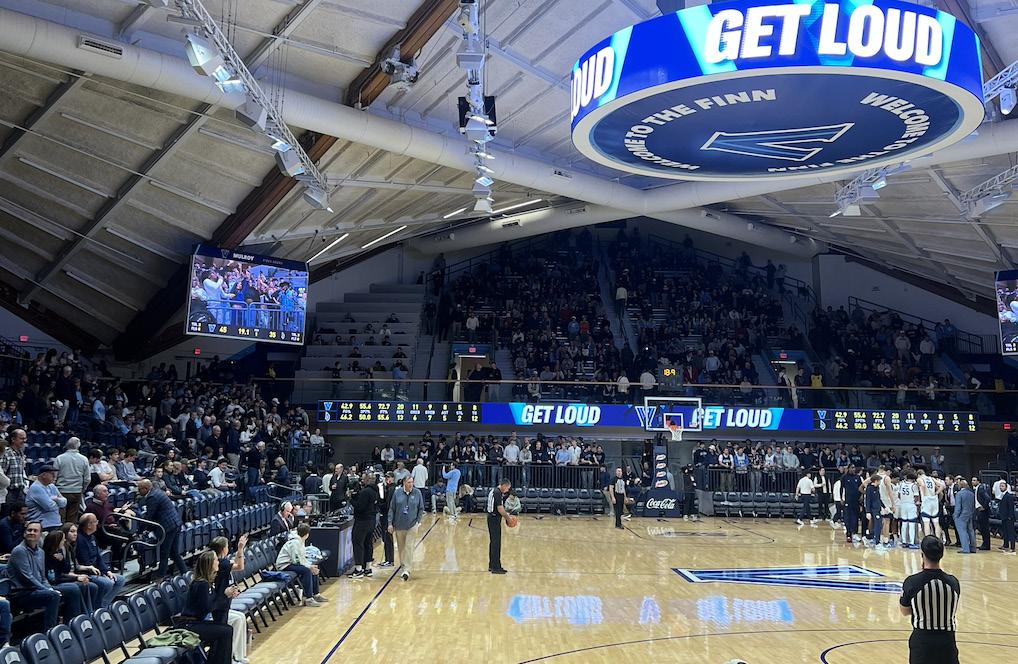
There have been recent complaints about declining enthusiasm and the number of students present in the student section, especially during basketball games. However, it is understandable that Villanova school spirit fluctuates with the success of the most popular sports teams, especially men’s basketball, as Villanova is often referred to as a “basketball school”.
Since men’s basketball has not experienced as much success in recent years, failing to make the NCAA Tournament since 2022, students have been less motivated to attend games and are unusually quiet when they do. If students are basing their level of school spirit on men’s basketball, there has surely been a noticeable decline in school spirit over the last few years.
Julia Stencel, President of The Nation, describes her experience leading the official student fan group of Villanova athletics throughout her time.
“I have served on the Nation’s Executive Board for all three years of my Villanova career so far, and being Giveaway Chair and
now President has let me see the behind-the-scenes of fan engagement,” Stencel said. “Throughout the years, we have noticed The Nation Member numbers go down when team performance goes down. At our peak, we had over 1000 Members, and at our lowest, we had as few as 400.”
But the 2025-2026 school year seems to have revived Villanova’s school spirit.
This renewal could be attributed to the addition of head coach Kevin Willard, with whom the men’s basketball team is seeing one of its best records in years. In addition, Villanova’s football team saw strong success this fall, achieving its best playoff run since 2010, and the women’s basketball team
has had a phenomenal season, boasting a 21-6 overall record.
This wild athletic success has fostered a level of school spirit that Villanova has not seen in years.
“I think this year we are truly seeing the revival of the Villanova student section,” Stencel said. “Although The Nation has our incredible fans that have stayed optimistic through ups and downs, the performance we have seen in men’s basketball, women’s basketball and football has definitely spiked fan attendance.”
Athletic performance has a direct connection with fan turnouts. The louder and more energetic the students are, the more likely a team is to win. Moreover, as teams continue to win, students have greater
motivation to cheer. Stencel says that Villanova athletics have recently been “seeing more students stay throughout the entire game, which has a direct impact on how well our team performs.”
Students need to support the school’s athletic teams despite losses. Although it may be frustrating at times, teams and fans depend on each other, and it is important to show unwavering support.
Stencel stresses the vital role fans play in the success of Villanova athletics.
“Every voice and individual’s energy matters to our athletes and our community,” Stencel said. “Keep showing up and cheering on our teams. We need you.”
Along with demonstrating school pride in the stands, Villanova’s school spirit is loudly manifested in other ways throughout campus. The enthusiasm students demonstrate for their campus involvements, such as collaborating to organize Fall Fest, fundraising for NOVAdance or giving enthusiastic Blue Key tours, exemplifies students’ Villanova pride.
Villanova’s school spirit may not be at an all-time high, but it is certainly increasing, and can continue heading in this positive direction with the help of the student body.
“We have, without a doubt, one of the best student sections in the country,” Stencel said.
Regardless of athletic ups and downs, most Villanovans would agree with Stencel.
The Importance Of A Good Playlist In College
Kaitlin Lawrenson Staff Writer
In college, your schedule changes by the hour, your sleep schedule barely exists and your sense of time dissolves somewhere between deadlines and late-night snack runs. In the middle of all that chaos, one small but mighty thing can make life feel more manageable: a good playlist.
A playlist isn’t just a collection of songs - it’s a coping mechanism, a productivity tool, a confidence booster and sometimes the only thing keeping you grounded while your todo list spirals. Whether you’re walking to class, studying in the library or cleaning your room, music becomes the soundtrack to college life. And the right playlist can make all the difference.
One of the biggest reasons playlists matter in college is their ability to regulate mood. College is stressful, full stop. Exams, internships, finances, social pressure and the constant feeling that you should be doing
more can weigh heavily. Music gives students an accessible way to manage those emotions without needing to pause their entire day.
“Music really shapes my mood,” Villanova sophomore Megan Lawn said. “When I’m studying or feeling overwhelmed, having music on helps calm me down and keeps things from feeling unmanageable.” That idea, music making life feel manageable, is exactly why playlists matter.
A good playlist can turn studying from something overwhelming into something doable. Instrumentals, lo-fi beats or familiar songs can help students focus by creating a steady rhythm that blocks out chatter in the library or your own anxious thoughts. Even upbeat playlists can help push through tasks like writing papers or reviewing notes, making productivity feel less like punishment and more like momentum.
Beyond academics, playlists also serve as emotional outlets. College is a time of transition, and with that comes homesickness, breakups, identity exploration and big feelings
that don’t always have neat explanations. Sometimes it’s easier to press play than to try to articulate what you’re feeling. Music can validate emotions—sad songs let you feel less alone, while upbeat tracks remind you that joy still exists even during tough weeks. A playlist becomes a safe space where feelings are allowed without judgment.
There’s also something deeply personal about curating a playlist. Choosing songs reflects who you are, who you’ve been and who you’re becoming. Many students can tie specific playlists to specific memories: the songs you listened to during your first week on campus, the tracks that got you through midterms or the music that played during late-night drives with friends. These playlists become time capsules, capturing moments that might otherwise blur together.
Music also plays a social role in college life. Sharing playlists is a form of connection—sending a friend a playlist or bonding over shared favorite artists can deepen relationships. Music taste often becomes shorthand
for personality, helping students find people who feel familiar in an otherwise overwhelming environment. Even communal listening, playing music while getting ready or during small gatherings, creates moments of togetherness that matter more than we sometimes realize.
Importantly, playlists give students control in an environment where control often feels limited. You may not be able to choose your workload, deadlines, or responsibilities, but you can choose the soundtrack to your day. That autonomy, however small, can be grounding. It’s a reminder that even during stressful times, you have tools to support yourself.
In a world that constantly demands attention and productivity, having a good playlist is an act of care. It’s choosing to soften the edges of a hard day, to motivate yourself when you’re tired, or to sit with your emotions instead of pushing them away. College isn’t just about getting through, it’s about learning how to manage life’s highs and lows. The best place to start is by pressing play.
In a March Madness drought, there is a noticeable decrease in school spirit on campus. Emma Taylor/Villanovan Photography
CULTURE
Mr. Heartthrob: Crowned For A Cause
Korin Kohen Staff Writer
Pitting men against each other. One winner. No mercy. This was a spectacle unlike any other, and it blurred the lines between competition and cold-blooded clash. This wasn’t Gladiator, but it was Alpha Phi’s annual Mr. Heartthrob event for Women’s Heart Health.
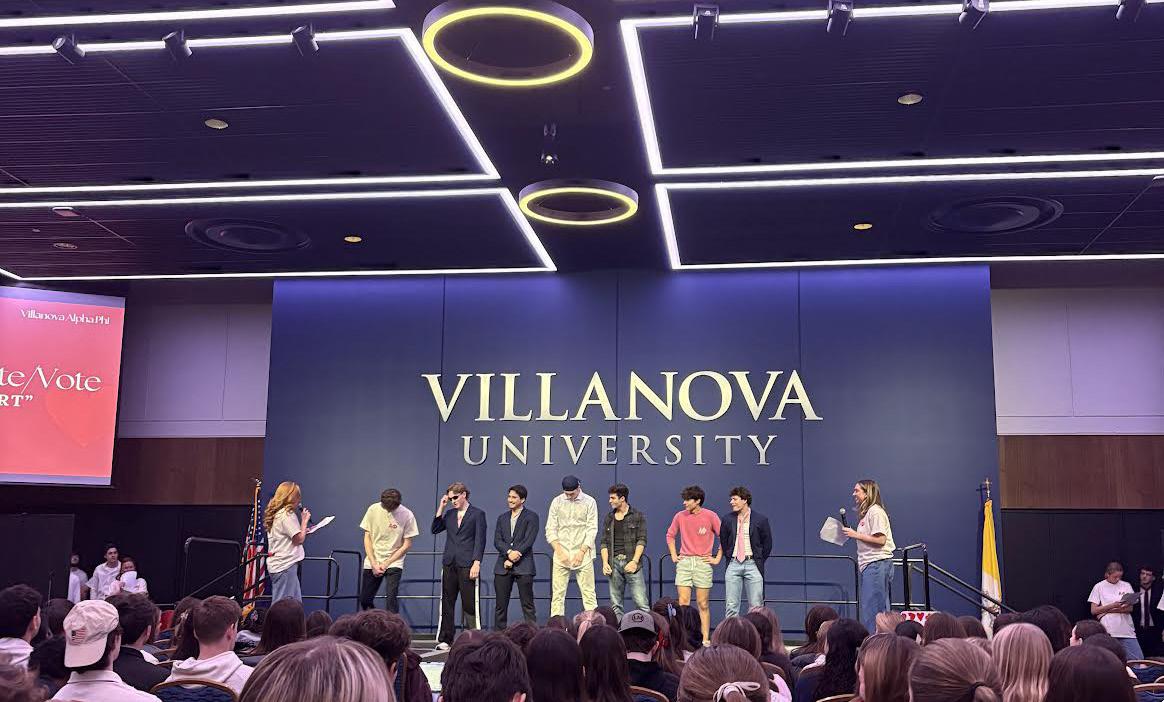
If one happened to walk past the Connelly Center Cinema this past Wednesday, they might have heard screams typically reserved for a Villanova buzzer-beater. Inside a lineup of brave (and very committed) male contestants was dancing, strutting and answering rapid-fire questions in the name of philanthropy.
Each year, Alpha Phi hosts one of the most anticipated events of the spring semester. Mr. Heartthrob is equal parts a talent show, comedy hour and dance battle. While the title may sound like a rom-com audition, the mission is serious. The occasion raises money and awareness for a cause that impacts women across the country. And it does so in a way that is interactive, hilarious and just the right amount of chaos. It takes weeks of planning and rehearsals to turn it into one high-energy night.
“It was a lot of fun once it came together,” social chair Summer Gammon said. “A lot of the guys were very into it, which was very exciting to see,” she added.
Although there were two official rehearsals, much of the magic happened elsewhere.
“They did a lot of work on their own,” social organizer Alexa
Kate Koslow Staff Writer
“You keep dancing with the devil…. One day, he’s gonna follow you home.”
It’s groundbreaking, it’s touching, it’s unlike anything I’ve seen before, and it’s about… vampires? Directed by Ryan Coogler, Sinners is a must-watch, with a screenplay so creative that all viewers will be spellbound. Not only has the film returned to theaters due to high demand, but Sinners has received a total of 16 Oscar nominations, more than any other movie in history. When watching this film, viewers know they are witnessing something special. Whether it is the characters, plot or music, every moment catches attention.
The plot follows two identical twins, “Smoke” and “Stack”, played by Michael B. Jordan. The notorious duo leaves its life of crime in Chicago to move back home and open a juke joint. Connecting with old (and wary) family and friends, such as their cousin Sammie Moore, played by Miles Caton and Mary, played by Hailee Seinfeld, Smoke and Stack navigate and weave together their dark history and present ambition. However, when evil demons creep into the town to consume its culture, this family is forced to confront a twisted and
Puzio explained.
Contestants practiced in their dorm rooms, classrooms and anywhere they could find an open stretch of floor. Hours went into fine-tuning choreography and timing long before stepping under stage lights.
For seniors Maddie O’Meara and Samantha Gordon, the night felt like a full-circle moment.
“Last year, I was the philanthropy chair, so I know what goes into coordinating the night,” Gordon said. Now in her second year emceeing the event, she’s practically Mr. Heartthrob royalty.
“I had a blast,” Gordon said. “It’s an opportunity to put myself out there and have fun for a good cause.”
O’Meara is in her third year emceeing and echoed the same enthusiasm. Their on-screen chemistry feels effortless, but that confidence comes from experience. The script itself is a tradition that passed down year after
year.
“It’s the same basis every year, but we like to include our own additions and questions each Heartthrob,” O’Meara said.
The foundation is consistent with playful prompts that the audience now anticipates, such as asking participants about their thoughts on red flags, first-date ideas and hypothetical romantic dilemmas.
The main segment included synchronized dance numbers and bold solo moments. The stage became a showcase of both commitment and creativity. Some routines were smooth, some were chaotic and all were unforgettable.
Freshman Joe Cavallaro, representing Delta Upsilon, was crowned this year’s Mr. Heartthrob. Cavallaro brought charm and self-assurance to the stage by delivering a number that felt both polished and thoughtful. His performance wasn’t just energetic. It
Reel Talk: Sinners
supernatural fate. The music is at the heart of this film. Blues were vital to the plot, weaving together a pained history with an expressive resistance. Certain songs like “I Lied to You” incorporate blues, folk, rock, hip-hop, rap and tribal influences, all exploring the value of music in African American culture throughout time. Notable artists on this soundtrack include blues legend Buddy Guy, Don Toliver, Ludwig Goransson (the composer of the Oppenheimer soundtrack), and Miles Caton. Caton’s musical talent took my breath away with his raw performance, a binding piece of this electric soundtrack.
The music, coupled with the memorable visuals, will entrance viewers. The cinematography by Autumn Durald Arkapaw is nothing short of phenomenal, possibly making Durald the first woman to win an Oscar for Best Cinematography. Shooting in both 65mm Ultra Panavision and 65mm IMAX, her bold technique places the audience into the perspective of each character. The wide and dramatic shots of the land, the fluidity of dance scenes in the juke joint and the attention to tone and color attract viewers. Through her composition and use of light, each scene surrounds viewers and creates a moody ambience, proving Sinners to be
was cohesive.
“I was really happy to do it with all my friends,” Cavallaro said post-win.
That camaraderie translated directly into his routine. Surrounded by close friends who matched his energy, his suave felt natural rather than rehearsed. His answers to the questions were quick yet sincere, wooing the crowd and making the decision easy.
Freshman Colin Pim brought undeniable character to the competition. He represented Beta Theta Pi and carried himself with a confidence that matched the event’s theatrics from the moment his name was announced. Despite a few minor technical hiccups during the act, he expressed his positive experience cultivating the performance.
“They left everything up to interpretation,” Pim said. “If I had an idea, they’d definitely hear it.”
And perhaps that’s what Mr. Heartthrob is all about. Beyond the choreography and the cheers and roses being thrown into the crowd, the night is about stepping forward for something bigger. For one night, the Connelly Center Cinema becomes a place where philanthropy meets performance.
While one contestant walks away with the title, the victory is collective. According to Alpha Phi social chairs, close to $4,200 were raised, awareness was sparked and all the students were willing to lean into something slightly ridiculous and equally important.
The heart of the night belonged to everyone who showed up and turned the spotlight into service.
a visually epic film.
Above all else, however, this movie is important. Yes, Sinners is about vampires, but it shouldn’t be brushed aside as fantasy. Instead, it should be recognized as a social commentary on love overpowering hate, love for music and the places we call home. Set in Mississippi during the Jim Crow Era, the film captures the strength of culture and community. The vampires, a symbol of white supremacy, act as the fighting force, and when the two communities clash, the audience witnesses an honorable refusal to surrender. Through passion, rage and violence, Sinners depicts the classic battle between good and evil with a thrilling twist, and reminds viewers of the outstanding fight for justice within Black history.
Sinners is the kind of movie that sticks with you, the kind that will have you listening to the soundtrack in the weeks to follow and gives you chills as the end credits roll. This movie was crafted with precision and intention, with a dedication to honoring this history. Coogler’s vision, while complex, came together so cohesively, incorporating themes of grief, faith, identity and the defense of one’s community. Sinners reminds us that in the wake of hatred, when darkness threatens to overshadow humanity and all hope seems lost, all we can do is stand firm and put up the good fight.
Delta Upsilon’s contestant Joe Cavallaro went home with the title of Mr. Heartthrob. Korin Kohen/Villanovan Photography
Sinners draws on blues culture in both its plot and its music score. Lucy Koslow/Villanovan Photography
Villanova Senior To Appear On Wheel Of Fortune
Kailey Fahy Co-Editor-in-Chief
Villanovans who regularly tune into Wheel of Fortune may recognize a familiar face next Friday, March 6.
Patrick Casale, a Villanova senior studying marketing and public administration, will appear as a contestant on the show after a monthslong audition process that began with an open call in Philadelphia.
In September 2025, Casale learned that an open call for the show was coming to Rivers Casino Philadelphia. Despite the timing coinciding with the busy week of Day of Service preparations, he invited his fellow Day of Service co-marketing director to join him at the audition.
“I picked her up, and we drove to Philly,” Casale said. “It was, like, a long line of people. So when we got to the actual audition aspect, they called five people up at a time. We had been with these five people the whole time, so we knew them already. And then we met with this one girl who was auditioning us, and we had 30 seconds to talk about ourselves.”
From there, Casale said he and the other hopefuls were told they could be contacted about appearing on the show anytime between two weeks and one year after the audition.
For Casale, the email came three weeks later, as he was sitting in the Falvey Library, telling him he had advanced to a second audition, this time over Zoom. Here, he introduced
Lauren Armstrong Senior Columnist
Dear Villanovans,
himself again and solved mock puzzles.
A few months later, on the second-to-last day of finals, Casale received the call confirming he would appear on the show. After spending winter break watching episodes to prepare, he and his family flew to Los Angeles for the taping just after second semester began.
Only Casale’s closest family and friends knew about the experience. It was not until last Friday, Feb. 20, when he posted about it on social media that his wider community found out, as he had kept it private to protect the integrity of the show. When he arrived at the studio
at 6 a.m., he described feeling nervous, as he had no idea what he was walking into. However, as preparations progressed and it came time to film his episode, he described how positive the experience was and noted how kind everyone was, which helped put him at ease.
“The first 10 minutes of us actually being at the studio, you’re like in this big garage and have to sign all these forms and stuff before the lawyer spoke to us,” Casale said. “Then they said they had a surprise guest and then Vanna White walked in. I mean meeting both Vanna and Ryan Seacrest was awesome. They’re actually so nice.”
Casale noted that he was the youngest contestant competing that day. Even so, he quickly formed meaningful connections with fellow contestants from across the country and all walks of life, bonding with competitors of every age, including the oldest contestant that day, who was 84 years old.
“There were 20 contestants total, with 18 ready to compete and two backups,” Casale said. “I made friends that day, like we really formed a community. We have a Facebook group. Everyone was just so outgoing and friendly.”
The taping was quick, with Casale noting it only took 30 minutes to film the episode.
“After walking off, I was like, ‘Wow, I can’t believe I just did that. I have no clue what I just said.’”
Overall, Casale expressed gratitude for the experience, noting that he met someone at the initial open call audition who had been trying out for 17 years straight without getting on the show. While he did some preparation, he had not been watching the show for years and was not going in with the goal of winning a specific amount of money. Rather, he was there for the experience.
In terms of what Villanovans should expect during Casale’s episode next Friday, he said “expect some laughs and a good time.”
Casale’s episode of Wheel of Fortune airs Friday, March 6 at 7:30 p.m. on ABC.
Letter From Lauren: Feeling Lucky
While it is not technically March yet, the feeling of luck has already begun. For those of you who do not know me, my freckles can speak for themself when I share that I have Irish heritage, making St. Patrick’s Day one of my favorite holidays for many reasons. This year, I want to focus on what has made Villanova so special and lucky over the past four years.
Friendship
While this may appear obvious, there are levels to the different friendships I have made over the past years. There are a few friends who I have been lucky enough to have in my life since freshman year. They have seen the good and the bad. I am also grateful for those I continue to meet. One of my favorite things about Villanova is that even though I know many seniors and classmates, there is still the opportunity to meet new people, gain new friendships and create lasting memories.
Academics
Yes, college is meant to be fun, but at the end of the day, we are here to get our degrees. One of the aspects of college I am the luckiest for has been my academic journey. And a journey it has
been. I came to college thinking I would be a doctor, but am now focusing on journalism, communication and public administration. The faculty at Villanova has helped shape these decisions and supported me every step of the way.
Involvement
I would not be who I am today without the organizations on campus that have shaped my college experience. Of course, The Villanovan comes in at number one. From writing and editing for the paper throughout college, I have gained experiences I would have never had otherwise. Getting to interview Paul Rudd and Elizabeth Warren in the same week was a pretty cool experience. I am lucky to have been involved with many organizations on campus that aim to make others’ lives better. Being involved in Orientation, NOVAdance, The Bandana Project, or The Villanovan has been rewarding, since this work can change someone else’s experience.
Housing
This may be less of a universal experience, but I have gotten really lucky with housing at Villanova. Not just the physical spaces, but how each year and chapter taught me something new about myself and those around me. From learning how to share a room and living space the first time as a freshman, to senior year knowing my roommates’ schedules like the back of my hand, knowing
who needs the sink area when and what days we will all be home to chat and debrief, living with my best friends has taught me to become a more thoughtful (and less messy) person.
Not Wanting To Leave
After having one of those weekends where everything was perfect, it truly hit me that I am lucky to have had such an amazing college experience that makes thinking about the end so horri -
bly sickening. Going into spring break, I am aware that the final stretch is coming soon, and while I want to hold on a little bit longer, there is bittersweetness in knowing that with the class of 2026 saying goodbye, the class of 2030 will get to experience the luck and love of Villanova for the first time. I just hope they are as lucky to have as amazing a four years as we did.
With love always, Lauren
Lauren reflects on all the ways Villanova makes her feel lucky. Lauren Armstrong/Villanovan Photography
Senior Patrick Casale at the open-call audition at Rivers Casino Philadelphia. Courtesy of Patrick Casale
Unpacked: Scotland, Unplanned
Emma Cote Abroad Correspondent
Rome reached 70 degrees Fahrenheit last week, so we naturally chose to board a plane and head to Edinburgh, Scotland. This was my group’s first time leaving the Schengen Area, and with three weeks of rapid travel, we were too tired to plan much.
As we touched down in the ever-so-inclement United Kingdom, we had three simple goals: meet new people, explore the city and see the Highland Cows.
This weekend differed drastically from the previous two, in which activities were given intervals to maximize our limited time. Nevertheless, a lesson I’ve learnt while studying abroad is that whether you account for each second in your preparation or just buy a plane ticket and leave the majority of your trip up to chance, you’re bound to run into unique challenges.
I have a friend in my program who has adopted a particularly interesting mantra in these circumstances, snarkily quipping, “Perfect, just what I wanted.”
Plane delayed? Perfect, just what I wanted.
Lengthy layover? Perfect, just what I wanted.
Hostelmates who choose to set 10 alarms beginning at 4:30 a.m. only to wake up at 9 a.m.? Perfect, just what I wanted.
The remark is reflexive at
this point, prompting many of us to laugh rather than dwell on any obstacles.
I’ve started to find myself saying it when difficulties arise. While intentionally blunt, wry and sarcastic, it prevents lingering complaints over typical blunders. There’s no point in complaining about it, so it might as well just be perfect and just what you wanted.
Scotland consisted of ridiculously early flights for some of us, inconsistent and torrential weather, as well as a painful conversation rate. Along with some natural struggles hostel living can pose, we were no strangers to inconvenience. Despite all of these hurdles,
Edinburgh made for an exceptionally incredible weekend. The capital was immensely authentic, altruistic and kind. While certainly a city that’s brimming with pride, companionship is an orientation in the city.
Hiking through the highlands was an unforgettable experience, and certainly a highlight of my semester. Being able to watch Highland cows graze the fields, sheep dogs sprint down the paths and still see miles of the city over the hills was incredible.
Within the city square, we were able to listen to bagpipe players, explore the myriad of castles and get caught up in the whirlwind
of rugby fanatics cheering on the country in the Six Nations tournament.
Honestly, I’ve never felt so welcomed in a new place. Everywhere we went, we were embraced and engaged in conversation. Locals and newcomers alike were eager to discuss life at the University, American politics and our travels.
I met several people who found themselves in Edinburgh without any plan at all. Many of them were recent graduates, similar in age to me.
The notion of arriving and settling down in another place is already daunting, and the easygoing component was jarring to hear.
On a dimly lit street outside of a rowdy pub, one recent graduate from the United States discussed her experience with me.
“I had travelled here, and I really liked it,” she shared. “I mean, it’s been really difficult, but I’m not going to limit myself because of little hardships.”
I found this statement to be especially poignant. Learning to navigate ambiguity has already posed a challenge for me, and is one I actively work on every day away from the comforting structure at home.
Edinburgh ultimately was perfect, and just what I wanted. Next week, I’ll be writing from Cadiz, Spain.
Until then, Emma.
What I Eat In A Day: Our Obsession With The Scroll
Korin Kohen Staff Writer
Be honest. You’ve watched one. Maybe it started with a yogurt bowl with frozen berries and organic granola, iced coffees in fancy glassware and ended with supplements and a “sweet treat.” Open TikTok or Instagram on any given afternoon, and it won’t take long before a “What I Eat in a Day” video appears.
This genre has become its own digital ritual. Scroll long enough, and you will find dozens of them. Gym girl editions, college apartment meals, “high protein,” “intuitive eating” and other buzzwords cycle through the algorithm. What looks like harmless inspiration quickly becomes a quiet blueprint for how we think we should be eating.
At Villanova’s recent “Facts vs. Fears: Social Media, Food and Body Image” event held this past Thursday in the Health and Services Building, students were asked to reconsider this online fad. An unsettling question arose: when did scrolling turn into self-evaluation?
Senior Samantha Grubb, who led part of the presentation, shared findings from a survey of 215 Villanova students that revealed the pervasiveness of these health trends.
“When I looked at the quality of responses, it became clear that social media isn’t just a distraction anymore, but more functioning as a guide to how we’re self-improving ourselves,” Grubb said. “Students described using social media as their source for learning how to structure
their workouts, what to eat and how to treat their bodies overall.”
In other words, digital platforms have quickly become a wellness syllabus. Sixty-five percent of respondents reported seeing health-related content often or very often. Even more striking was that 86% had interacted with it in the past month. Students were not simply scrolling past these videos. They were engaging with them, sharing them, saving them and returning for more.
The influence does not stop at the screen. Seventy-eight percent of surveyed students incorporated a health change due to something they saw online. While some changes seem small, the cumulative effect can be significant.
“It puts a lot of pressure seeing other people’s daily diet,” sophomore Samantha DiMento said. “It causes people to overthink their own eating habits and routines when other people are in their face all the time.”
Jessica Pellicciotta, coordinator of Nutrition and Fitness Programs, explained why these videos can be harmful to students’ health knowledge.
“They’re very curated,” Pellicciotti said. “They’re appealing, most of the time they are showcasing this perfect eating pattern, which is so unrealistic and unattainable, especially for college students.”
Pellicciotti emphasized that nutrition is highly individualized and depends on a range of personal factors, including schedule, medical history and goals. She warned that many influencers lack professional credentials and accountability. With-
out oversight, viral advice can promote restrictive eating patterns and false expectations that do not support long-term well-being. She also noted that much of the available health research has historically been conducted on men, making it even more complicated to generalize advice across different bodies.
The pressure is not always obvious. Sometimes it looks like fascination.
“I’m obsessed with watching ‘What I Eat in a Day’ videos,” sophomore Alessandra Fioretti said. “It’s so interesting, but it’s definitely bad sometimes because it’s all you think about.”
These videos seem motivating and inspiring, yet they can distort students’ perception of what being
healthy is.
The event stressed that the issue is not curiosity. It is comparison. When meticulously planned routines and arranged meals fill a feed, it becomes easy to measure one’s own day against someone else’s highlight reel. Behind every neatly edited clip is selectivity. What is shown is intentional. Viewers do not see what is left out, and as a result, may not realize that nutrition and fulfillment are not onesize-fits-all.
The takeaway from this event was not to delete social media, but to scroll with awareness. To ask who is providing the advice and why. To remember that health cannot be condensed into a 30-second montage. Health is personal and far more complex than what fits on a screen.
Some of the best experiences come from diving into trips without solid plans. Emma Cote/Villanovan Photography
Perfectly curated videos of meal ideas are all over social media, some less helpful than others. Emma Cote/Villanovan Photography
Male Suicide: The Risk All Around Us
Christopher Brown Staff Writer
Content warning: mentions of sexual assault and suicide.
Suicide is one of the leading causes of death among Americans, including college students. Conversations about mental health often center on those visibly struggling, but visibility and risk are not the same. Stigma and misconceptions around men’s mental health, in particular, prevent many from receiving help.
“Mental health [struggles are] normal,” senior and president of the Men’s Mental Health Club (MMHC) at Villanova, Zander DeLuca, said. “It’s something that everyone—male and female—goes through, and it is a shame that it’s so stigmatized, specifically in the male community, just based on how men were grown and raised.”
Men account for roughly 75 to 80% of suicide deaths per year.
CDC data reports 38,925 male lives lost in 2024 alone. SAMHSA data further indicate that adults aged 18 to 25 report the highest prevalence of suicidal thoughts, with similar rates among men and women.
In 2019, a study of children and young adults (ages 12 to 29) in the Journal of Adolescent Health focusing on LGBT youth also shed light on suicide among non-LGBT youth. It emphasized the need for inclusive prevention strategies.
Anna Lonski Staff Writer
DeLuca cautions against generalizing experiences, noting that people cope, behave and grow up differently.
Non-LGBT youth accounted for roughly 90% of the cases in the study, and four of every five of those were male. In addition, the data confirmed disquieting truths about suicide in young men.
First, most non-LGBT male suicide cases had no history of mental illness. Relationship issues were commonly reported. Seven out of ten (1,100) of the men and boys in the study had no mental illness before death. 62% of them faced intimate partner problems, ranging from bad breakups and cheating to ongoing conflicts. It even included experiences of physical or emotional abuse.
Recent national survey data from the CDC/NISVS corroborate these findings. They indicate that nearly one in three men experience intimate partner violence. Most of it occurs before turning 25. About 1-in-4 report experiencing sexual violence, and 1-in-14 report being made to penetrate. These experiences are often underreported, stigmatized or subject to differing legal classifications.
Villanova University survey data show that male students who experience relationship or sexual violence often describe similar experiences to female survivors. Given how frequently relationship issues appear, small shifts in how peers respond may be critical.
DeLuca suggested asking “Are you okay?” or “How can I help?” to start conversations that a casual “How are you?” cannot. Male survivors often report difficulty recognizing or disclosing abuse. Social expectations around masculinity can discourage vulnerability. Public narratives frequently emphasize men as perpetrators of violence while stories of male victims and female-perpetrated violence receive less attention in comparison, making it harder for male survivors and anyone harmed by a female perpetrator to seek help or recognize their abuse.
Perhaps the most unsettling truth from the study is that some men already sought help before taking suicidal action. One in six of the men and boys were in treatment for mental illness at the time of death, and about half had a history of suicide attempts or suicidal thoughts as well. Despite this tragedy, that does not mean men talking about their feelings never works, as sophomore and MMHC co-president Luke Brocius can attest.
“What I learned, especially from talking to some of these presenters and these mental health kinds of people, is that when men do speak out, when men actually do decide to identify and figure out their problems, there is a huge success rate,” Brocius said.
Brocius’ words suggest that outcomes improve significantly when men can identify and ad -
dress their tribulations early.
So, the question is: How can modern mental health resources improve success, especially in an academic institution? Anthony Ciliberto, assistant director for Fraternity and Sorority Life, shared his answer.
“What works is not telling men to be vulnerable, but creating conditions where vulnerability is normalized and rewarded,” Ciliberto said.
Effective strategies include peer mentorship mixed with smallgroup dialogue, storytelling from respected male role models and skill-building around emotional literacy. Help-seeking must be framed as a strength rather than a weakness. People must offer multiple entry points to support men, such as conversation, movement, service and creativity.
Men interested in the MMHC can find more information about them on Instagram @ mensmentalhealthvu. The University offers multiple resources for students suffering from mental illness, suicidal ideation, sexual misconduct and more, such as the University Counseling Center and Title IX. Off campus, there are hotlines dedicated to suicide prevention, domestic violence and sexual violence, such as the 988 Suicide and Crisis Lifeline.
Check in on the men you care about. A simple “Are you OK?” or “How can I help?” can potentially save a person’s life.
Student Reactions To Winter Olympics
Feb. 6 marked the start of the 25th Winter Olympic Games. The Olympics are always a spectacle, as people of all ages, with inhuman athletic abilities, gather and compete. Countries from all over the world put forth their best athletes as they compete for the coveted Olympic gold, and Villanovans have been following along.
Most students have been following along more intensely with the performance of the United States. However, it is actually Norway that is emerging triumphant with 37 total medals. In fact, one of Norway’s cross-country skiers, Johannes Hoesflot Klaebo, has set a record and become the most decorated Olympian in history with his ninth gold medal. That being said, the US follows closely behind with 27 medals.
Most recently, the US women’s figure skating team has put on a jaw-dropping performance.
“Alyssa Liu, now the Olympic gold medalist, performed so well and has such an inspiring story,” junior Audrey Dearlove said.
After retiring from skating at age 13 due to the stress the sport would put on her body both physically and mentally, Liu made a comeback with the focus on putting herself first in all areas. From training to music choice, her skating was going to be for her.
“Her comeback and her skating showed a real love of the
sport and the power of doing something because you truly love it,” Dearlove said. “Amber Glenn, the oldest of the three ‘blade angels,’ has been super open about her struggles with mental health, and she cracked under the Olympic pressure in her short program but was able to rise from 12th to 5th in her free skate.”
The US women’s hockey team has won the gold medal and set an Olympic record with the most consecutive Olympic wins.
“Their final hockey game became the most-watched women’s hockey game ever,” sophomore Stella Bartle said. “It’s cool to see the sport gain more appreciation, especially given how incredibly talented the athletes are.”
Aside from the jaw-dropping athletic abilities, the Olympics have brought on a lot of emotional intensity.
“It feels like there’s been a lot of drama,” sophomore Megan Ronan shared. “From injuries to political discourse, this year’s winter Olympics has been about more than just athletic talent.”
If you’ve been online, it’s been hard to avoid the stories and videos of a determined Lindsey Vonn going down the mountain with a torn ACL, only for that to result in further injury. Unfortunately, there have been athletes on all fronts suffering from torn ligaments and broken bones. That being said, the impact of injuries goes beyond the physical. The commitment of athletes who are willing to take these risks speaks
to their love of the game and their resilience, highlighting a level of mental toughness that extends far beyond physical stature.
“It’s amazing how committed all these athletes are,” Bartle said. “Especially when you put it into the perspective that so many of them are around our age.”
The Olympics are always
set to excite and inspire, and the Winter Games come around as a welcome break from the monotony of college life in February. Students can engage and cheer for their favorite athletes from the comfort of their dorms, and as the Games come to an end, the memories last far beyond the last few weeks.
Some Villanova students attended the festivities in person whilst studying abroad. Courtesy of Sophie Dengler
VillaVogue: What The Devil Wears Prada Taught Me
Ciara Dursee Co-Digital Editor
The most overlooked decision of our day happens before we even leave our rooms: getting dressed. Let’s not forget the first step of our morning routine, one of the few constants in our daily lives. The one low-maintenance, simple chore is often overlooked: choosing our wardrobe for the day.
Have you ever seen The Devil Wears Prada? A 2006 American classic starring Anne Hathaway and Meryl Streep has long been my comfort movie. It is the one I turn on to escape reality, with a bowl of popcorn in my hands, my mom on my right and my dog on my left. My dreams of writing for the real Vogue Runway one day, or how I adore the young and bold post-grad city lifestyle, are just a few reasons why I adore this movie.
The movie revealed a deeper purpose than just enlightening viewers to Meryl Streep’s brilliant wit and sarcasm in her performance as Miranda Priestly. Her speech to Anne Hathaway’s character, Andy Sachs, her new assistant at Runway, about the “lumpy blue sweater” all coming from a pile of “stuff” is illuminating if you listen closely.
“This stuff?” Priestly said. “Oh, I see you think this has nothing to do with you? You go to your closet and you select, I don’t know, that lumpy blue sweater, for instance, because you’re trying to tell the world that you take yourself too seriously
Eden Rosini Staff Writer
How would you feel if you could witness a conversation between two brilliant minds that existed long ago?
In Arcadia, presented at the Mullen Center Court Theatre from Feb. 12-15 and 19-22, time danced from 1809 to the present at the Coverly Estate, and the audience was immersed in the two distinct eras and the intellectual battles the characters face.
Valerie Joyce’s energetic crew of Villanova Theatre Department members brought this story to life through its impressive set, as well as thought-provoking visuals that enhanced the narrative. The play hooked the audience from the start, with 13-year-old Thomasina asking her tutor, Septimus, about the meaning of “carnal embrace.” The audience’s laughter is interrupted by the landscaper revealing that he witnessed Septimus and Mrs. Chater, the houseguest, in a “carnal embrace” in the gazebo.
This is the part where the audience was unsure of whether to laugh or gasp at the newest revelation of 1809.
Arcadia provides an experience rich with themes of love, knowledge and the pursuit of truth amidst scandal. The characters are ones that the audience learns to sympathize with, specifically the young Thomasina Coverly, played by the talented Susan Betten. Her mannerisms on stage tru-
to care about what you put on your back. But what you don’t know is that that sweater is not just blue.”
She goes on to indicate the significance of a seemingly mere selection of garments for a day at work.
“However, that blue represents millions of dollars and countless jobs,” Priestly continues. “And it’s sort of comical how you think you’ve made a choice that exempts you from the fashion industry when, in fact, you’re wearing a sweater that was selected for you by the people in this room. From a pile of ‘stuff.’”
Although I still don’t own a pair of Chanel heels, I understand the heart of the film. As a 13-year-old watching this movie for the first time, I, of course, missed the true lesson Miranda Priestly, the editor-in-chief of Runway, presented. I have found that what you decide to wear is a more powerful decision than I once thought. Now, I’m conscious of a few notes and mistakes I’ve made in the past when it comes to my wardrobe selection.
What We Wear Shapes How We Act
I learned about this psy-
chological phenomenon years ago: Enclothed Cognition. It theorizes how the clothes a person wears influence their own thoughts, feelings and behaviors due to the symbolic meaning of the garment and physical experience of wearing it. Hajo Adam and Adam Galinsky invented the term in 2012, suggesting that wearing specific items, like a doctor’s lab coat, can increase focused attention, while formal wear might improve confidence or authority.
Their theory conducts a follow-up consideration of your appearance’s ability to communicate who you are before you even speak. My friends wonder why I try to wear jeans and a nice top to class every day. Or why my mood improves when I wear an outfit that makes me feel confident enough to take a midterm exam. Just like Andy finally understanding how her style could influence how people treated her at Runway and how she felt more courageous, I’m conscious of this process daily.
Losing
Yourself in Others’ Styles
Like many of us, I’ve fallen down the algorithm’s rabbit hole and
Arcadia: Reviewed
ly encapsulated what a young woman yearning for knowledge and love looks like, as well as made the audience love her. When we learn of her tragic end and watch as she walks off the stage with the candlestick, one cannot leave the theater without feeling upset for poor Thomasina.
Thomasina exhibited her intelligence and inquisitiveness throughout the show by developing her math equation and constantly asking questions.
Thomasina got the audience thinking when she proposed the formula for the future by saying, “If you could stop every atom in its position and direction, and if your mind could comprehend all the actions thus suspended, then if you were really, really good at algebra, you could write the formula for all the future.”
The audience was then whisked away to the present day, where Hannah Jarvis and Bernard Nightingale worked to uncover the truth about romantic poet Lord Byron and whether or not he and Mr. Chater dueled at the Coverly Estate. Hannah learned that Bernard wrote a negative review about her most recent book.
Bernard quips, “Your photograph does you justice, I’m not sure the book does.”
Offended but eager to uncover the truth about Byron and Mr. Chater, she pushed her feelings aside and explored the evidence behind Bernard’s theory.
The Coverly siblings—Valentine, Chloë and Gus—were also introduced. Valentine was a scholar who was extremely gifted in the field of
have been letting Instagram trends dictate what feels desirable. This can cloud your judgement. In recent years, I’ve received a lot of my fashion advice from online trends through Instagram ads or influencer partnerships.
Don’t lose yourself in what social media tells you to wear or what people around you tend to purchase online. One of my biggest regrets about coming to college was losing myself in my choice of clothes. In high school, I wore eccentric color jeans, carefully chosen chunky jewelry and accessories that I preferred solely based on self-interest and enthusiasm. Coming to Villanova, witnessing what brands other girls wore or the shoes my friends had, I thought I had to buy them as well. I’m not sure if I regained my true sense fully, but I make an effort every day to return to my junior high school self. As silly as that sounds, she used to wear whatever she wanted to make herself feel put-together.
Dress How You Want and What You Aspire To Be
This one is crucial. Figure out what matters to you. It’s important to know what you care about, or you’ll get lost in your tracks. Are you an athlete? Wear your sweatsuit to campus. Are you a finance major destined to work on Wall Street one day? Wear your khakis to your 8 a.m. in Bartley. Do you daydream about working at Vogue? I’ll be wearing my denim pants and turtleneck to class tomorrow with a wool scarf. See you then.
mathematics and studied the grouse population. Chloë was curious and fun-loving, and stole the audience’s hearts the moment she skipped on stage in her dress and fabulous pink, patterned fishnet stockings. Gus, the most mysterious Coverly sibling, did not speak throughout the entire show. Rather, he was the chief observer.
As the audience was whisked between the past and present, discoveries were made and theories were consistently discussed. Valentine and Hannah realized that Thomasina, as evidenced by her math notebook, used a very modern mathematical methodology that was utilized in Valentine’s study of the grouse population. The parallels between discoveries of the past and studies of the present became clear as the play came to a close.
Topics that may be monotonous or uninteresting, such as mathematics, science and death are made into interesting theater in Arcadia Valerie Joyce’s clever directing style makes math appear life changing, and the projections provided onto the impressive set make the audience wonder how much mathematics can do.
The final scene showed the overlap between the past and present. Septimus realized Thomasina’s brilliant mind, as well as Hannah’s and Valentine’s in the same scene. Valentine swore that Thomasina’s algorithm would have made her famous. The show ended with Septimus and Thomasina dancing in the past alongside Hannah and Gus, the silent Coverly sibling, dancing in the present.
The stage directions laid out the parallels in a haunting but satisfying ending.
“I truly felt as if I was watching fascinating discussions between scholars,” freshman Julia Melby said. Watching the characters of the past set up mysteries later solved in the future gives the audience the unique experience of watching two plots unfold at once. The humor of the characters in both settings, as well as the twists and turns they all take, make this show one you cannot miss.
So, let me ask again, how would you really feel if you could witness these conversations unfold right in front of you?
Intentionality and confidence are key in fashion. Maggie Fitzgerald/Villanovan Photography
Arcadia was a smashing hit on campus. Courtesy of Villanova Theatre Department
Women’s Swim And Dive Continues 13-Year Dynasty
Sammie McKee Co-Sports Editor
Continued from p.1
Kasulka, Bridie Dunn received the honor in 2019.
“Both Carlota and Michelle have been seriously dialed all year,” Simpson said. “It’s all about consistency and focus. They both are very seasoned athletes so this is no surprise. They know how to do it!”
During the tournament’s finals, senior Katie White won the 1650-free coming in at a time of 16:28.88. Junior Peri Gagzuzi followed, coming in second place with a time of 16:36.28.
Freshman Kayla Bolster won the 200-back in 1:56.75, making her
the fourth fastest Wildcat in the event.
In the 200-fly, junior Anna Farley finished in 1:58.48, earning first place. Junior Meghan Tiernan, finished under a tenth of a second behind Farley, coming in at 1:58.55 for a second place finish in the event.
Farley, alongside Bolster, Gaush and freshman Jana Strand, helped the 400-free Relay team take home a gold medal, finishing in 3:20.87.
On the men’s side, the Wildcats broke four program records.
Villanova took home silver and bronze in the men’s 200 meter fly, with junior Justin Nowicki and freshman Micahel Anderson finishing in 1:45.03 and 1:48.12, respectively. Nowicki now holds the program record in the event.
Sophomore Zach Sutter finished the 100-free in 44.21, earning a new personal best, a third place finish and breaking a nearly 30-year-long program record, standing since 1989.
Freshman Hugh Borris also earned a personal best and broke a school record with a 1:59.25 finish in the 200 meter Breast preliminaries.
Sophomore Gavin Peck, senior Sam Randall and senior Gavin Jones posted a 2:58.58 finish in the 400-free event, setting the fastest school time since 1997.
Junior diver Nate Warson took home two silver medals and scored 314.85 on the 3 meter diving board.
In addition to the athlete’s medals, Villanova coaches took home hardware of their own and were
recognized for their leadership and success with the program.
Simpson and the rest of the women’s swim and dive coaching staff were awarded the Big East Coaching Staff Of The Year for the 13th year in a row, as well as being named men’s co-coaching staff with Georgetown.
“This will sound odd, but the award means nothing! This award is about the performance of the athletes,” Simpson said. “They do all the work. If they light it up, the staff gets an award. They deserve all the credit.”
The team awaits an invitation to the NCAA championships. If selected, the women’s team will travel to Atlanta, GA, from March 18-21. The men’s team would compete the following week, from March 26-28.
Wildcat Watch: New Era Of Villanova Track
Genna Cottingham Sports Columnist
“If you’re in a war and your arm’s shot off, what decision do you have? Do you just go to sleep and feel sorry for yourself, or do you shoot back and survive? It’s the same thing to me, it’s the same exact concept,” Villanova track and field senior Marco Langon said.
The word “no” is not a part of Langon’s vocabulary. He will not accept a second-place finish or a sub-par performance due to the flu. Diving at the finish line is a true “Marco-esque” move, even if it impedes another competitor.
The Villanova senior aspires to be the best, but not even the best collegiate distance runner. Langon aims to beat the pros while still wearing a Villanova singlet. Winning a national title is his main goal. Once he does that, he says he’ll be ready to leave Villanova.
Langon first redshirted his sophomore year outdoor season in 2023, then indoor in 2024, and most recently the 2025 cross country season. Villanova’s coaching staff plans out athletes’ schedules very carefully. Langon still has a full year of eligibility at Villanova after he graduates in May. However, if Langon wins a national title in either March or May, he will
not return for a fifth year.
“It doesn’t matter if you break a record because that’s going to be broken,” Langon said. “But if you win a national title, that can’t be taken away from you, and in your time in the sport, on that given day, you were the best athlete in the NCAA.”
Langon currently holds not one, but four school records, for two relays and two individual events. On April 27, 2024, Langon, alongside Sean Donoghue, Charlie O’Donovan, and Liam Murphy, broke the NCAA 4xMile record in 15:51.91 at the Penn Relays. Langon ran the third leg in 3:58.18. The relay time broke the Villanova school record and
came second to head coach Marcus O’Sullivan’s world record of 15:49.08 back in 1985 in Dublin, Ireland.
“I think it’s just been a very special few years,” O’Sullivan said.
Last December in Boston, Langon ran the 5K in 13:05.21 to break another school record, this time at the Sharon Colyear-Danville Season Opener. Two months later, Langon broke the 3K school record on Friday, Feb. 13, in Boston.
Last Friday, Villanova broke the DMR record at the Philadelphia Metro in 9:16.60, with Langon as the anchor. Sean Donahue, Ethan Walls and Dan Watke comprised the team that put up
the NCAA’s third-best time. Langon placed third in the 2025 NCAA Outdoor Nationals in the 5K and sixth place in the same event at the indoor nationals that same year.
“I’m the highest-ranked athlete in the school, and I’m making no money,” Langon said. “I just know how to run, and that’s all I care about.”
Langon has an NIL deal with Diadora and recently signed with Maurten. However, he does not receive any money from the school, no matter how much success and media attention he gives to Villanova. Langon has made headlines not only for his records but also for his “brashness” in interviews. He is unfazed by all competitors in his field, and losing only fuels his determination to win.
The Big East Championships are set for this weekend, starting on Friday, Feb. 27, in Chicago, IL. NCAA Indoor Nationals is set for mid-March in Fayetteville, AK, where Langon will be determined to win his long-awaited national title.
“I wanted to become worth something in my eyes and my family’s eyes,” Langon said. “I needed to get to college, and athletics was my way to do that. So, I really had no other choice, and I was 100% confident in everything I was doing.”
Following the results of the tournament, women’s swim and dive celebrated their victory. Courtesy of @novaswimdive
Though he’s broken many program records, Langon’s greatest goal is a national championship. Courtesy of Villanova Athletics
Kasulka won Most Outstanding Diver (left) and Gaush Colomer (right) won Most Outstanding Swimmer. Courtesy of @novaswimdive
Men’s Tennis Secures Home Victory Over Colgate, 4-2
Mason Canton Staff Writer
Villanova men’s tennis team secured a 4–2 victory over Colgate on Saturday evening, earning its third win of the season. The Wildcats used a strong doubles performance and a resilient effort in singles play to claim the home victory.
Villanova set the tone early by taking the doubles point with wins on Courts No. 1 and No. 3. Cooper Gordon and Ethan Carr cruised at the top spot with a dominant 6–1 victory. Quincy Jones and Jack Sherner followed with a 6–3 win on Court No. 3 to clinch the point. Kush Anand and Thomas Wakefield were also confident at No. 2 doubles, leading 6–4 at the time of Villanova securing the point.
“Doubles have been a bright spot. We really showed our full potential, especially with the amount of returns we were able to get back,” head coach Brad Adams said. “We played a higher percentage in doubles and didn’t give many errors away. Winning the doubles point is great, but you get into a bit of a lull after you win the first point.”
Colgate responded in singles play, earning victories at No. 1 and No. 2 to briefly take a 2–1 lead. Jones fell in straight sets at the top position, and Wakefield was edged in a competitive two-set
match at No. 2.
“Not having Cooper Gordon [in singles] was a big hit, but we’re trying to preserve him and make sure he can play every match. Quincy stepped up at Court 1 and came out with intensity, even if we didn’t get every win,” Adams added.
The Wildcats answered with three straight wins to secure the team victory. Ethan Carr evened the match at 2–2 with a convincing 6–3, 6–1 win at No. 4 singles. Anand followed with a 6–4, 6–3 victory at No. 6 to give Villanova a 3–2 advantage.
Will Monahan delivered the clinching point at No. 3 singles, rallying after dropping the opening set to earn a 6–7, 6–4, 6–3 comeback win. Cameron Kruep was fighting in a three-set
battle at No. 5 and led 7–5, 2–6, 3–3 when play concluded following Villanova’s fourth point.
Up next, the Wildcats will travel to California to compete in the Pacific Coast Doubles Championship beginning Feb. 26.
“We play UCSD this Thursday in the Pacific Coast Doubles Championship. One of our guys is on that team, so it will be an interesting dynamic,” Adams said. Ball State on Sunday will be a huge match; they’ve played a couple of Big East teams that we won’t get to play in the regular season, like Xavier. It will be an intense couple of days with lots of matches against quality opponents.”
There, the ‘Cats will face UC San Diego, Ball State and UC Irvine.
Preview: Men’s Basketball Faces Butler
Casey Healey Co-Sports Editor
On Wednesday, Feb. 25, Villanova (21-6, 12-4 Big East) men’s basketball will face Butler (15-13, 6-11 Big East), at the Finneran Pavilion in Villanova, PA. The two teams last met up on Jan. 3, where the ‘Cats had a decisive 85-67 victory.
The Wildcats will be looking to get back in the win column following their 73-63 loss to the University of Connecticut (25-3, 15-2 Big East) on Feb. 21. The result marked Villanova’s second loss to UConn and its sixth of the season.
Hopes were high heading into the UConn matchup, as students poured into a sold-out Xfinity Mobile Arena. After a promising first half, Villanova’s offense struggled coming out of intermission, allowing the Huskies to take a 21 point lead midway through the second half.
“Every once in a while you get your ass kicked,” head coach Willard said. “You have to bounce back. It’s not the end of the world.”
Villanova will be looking to do just that on Wednesday.
In Villanova’s previous meeting with Butler in early January, the Wildcats defeated the Bulldogs, 85-67.
Villanova went 32-for-58 (55.2%) on field goal attempts, 7-for21 (33.3%) on three-pointers and 14-for-20 (70.0%) at the free throw line. In comparison, Butler went 24for-63 (38.1%) on field goal attempts, 6-for-27 (22.2%) on three-pointers and 13-for-14 (92.9) at the free throw line.
The ‘Cats are currently led in points by junior guard Tyler Perkins, who is averaging 13.8 points per game this season. Graduate forward Duke Brennan leads against the glass with 10.4 rebounds per game, putting him at ninth place in the nation. The Grand Canyon University transfer has also tallied 11 double-doubles this season.
In Villanova’s last matchup against Butler, sophomore Bryce Lindsay scored a team-high, 18 points. Prior to that, Lindsay remained relatively quiet, with the
WEEKLY SCOREBOARD
Feb. 18 - Feb. 24
Wednesday, February 18
Women’s Basketball vs. UConn 69-83 L
Thursday, February 19
Waterpolo vs. Princeton 9-14 L
Friday, February 20
Softball vs. UMass 1-4 L
Softball vs. Kansas 1-8 L
Baseball @ Lipscomb 11-5 W
Women’s Track @ Philadelphia Metro No Team Scoring
Men’s Track @ Philadelphia Metro No Team Scoring
Saturday, February 21
Women’s Swim @ Big East Championships 1st of 7
Men’s Swim @ Big East Championship 3rd of 5
Women’s Lacrosse vs. Rutgers 12-15 L
Men’s Lacrosse @ Rutgers 7-8 L
Men’s Basketball vs. UConn 63-73 L
Women’s Tennis vs. Colgate 4-0 W
Men’s Tennis vs. Colgate 4-0 W
Softball vs. Florida Atlantic 1-9 L
Baseball @ Lipscomb 8-9 L
Sunday, February 22
Women’s Basketball vs. Marquette 64-39 W
Golf @ Savannah Intercollegiate 9th of 18
Softball vs. Southern Indiana 1-2 L
exception of a 15-point performance on Feb. 17 against Xavier.
Villanova will be looking for the 6-foot-3 guard to get back into his old scoring habits from the beginning of the season, especially as March approaches.
The Wildcats currently average 45.7% from the field, 35.8% from three-point range and 68.8% on free throws for the season.
The Bulldogs are led in points by junior guard Finley Bizjack, who averages 17.5 points per game. Senior forward Michael Ajayi leads in rebounds, with 11.1 per game, making him fourth in the country.
Butler will be looking to extend its win streak to three. Before that, it suffered a six-game stretch of losses.
The Bulldogs currently rank at seventh place in the Big East. Villanova sits at third.
Following Butler, Villanova will have three more regular season games remaining, including one of its most formidable Big East opponents, No. 15 St. John’s. The Red Storm (22-5, 15-1 Big East) currently ranks at the top of the Big East Conference.
Following conference play, the team will compete in the Big East tournament in March.
On Saturday, Feb. 22, Villanova fell, 73-63, to UConn at a sold-out Xfinity Mobile Arena. Erick Quezada/Villanovan Photography
The 4-2 win restarts the team’s win-streak and is their third victory of the season. Courtesy of Villanova Athletics
Women’s Tennis Defeats Colgate At Home, 4-0
Sophia Cratty Staff Writer
On Saturday, Feb. 21, Villanova women’s tennis returned home to the Villanova Tennis Complex after nine consecutive matches on the road, and claimed a 4-0 win against Colgate.
Although the Wildcats (5-5, 1-0 Big East) were scheduled for a home match against the Red Raiders (2-5, 0-1 Patriot League), city traffic made the commute that of an away game. The typically 55-minute trip to the complex took nearly two hours, limiting warm-up time for the Wildcats.
“It was the same [travel time] as an away game,” head coach Steve Reiniger said. “It was a little hectic, a little stressful and the team got a real short warmup. I was pleased with them. They handled it well.”
Villanova set the tone early, claiming the doubles point with wins on courts one and three.
Sophomore Olivia Corcoran and junior Maddie Hills won, 6-1, over the Colgate pairing on court three. On court No. 1, seniors Emi Callahan and Maddie Gehrig earned a 7-5 win, securing Villanova the first point of the match.
“We started slow in doubles,” Reiniger said. “But eventually, we won the doubles point, and we played pretty well in singles, not dropping a set.”
Following the doubles round, the Wildcats captured three-straight set wins to seal the shutout.
“We played to clinch,” Reiniger said. “Because of the court situation, we were sharing
with the men, so both programs played to clinch, trying to make it a shorter match.”
At court No. 1, Corcoran earned her first official win of the season, beating her opponent 6-3, 6-4.
“Olivia Corcoran got her first official win,” Reiniger said. “She had a lot of matches where she was up, and we were just playing to clinch, so she didn’t get credit, like at Army and Sacred Heart, so it was nice for her to get an actual win in the scorebook, at No. 1 singles.”
Then, at court No. 2, Gehrig claimed a 6-1, 6-4 win. Jenna Stevens, who typically plays at court No. 4, won at court No. 3, 7-6 and 6-0.
“We were missing our No. 3, Miriam Gondorova, who was injured, so everybody moved up,” Reigner said. “Jenna, who usually plays at 4, played at 3, and she beat a decent girl ranked higher than her. She played really well.”
Looking ahead, the women’s tennis team will next play North Carolina A&T State (1-0) and Saginaw Valley State (2-1) on March 3, before playing St. Bonaventure on March 5.
“Spring Break will be an opportunity for us to get everybody involved,” Reiniger said. “It’ll be nice to see everybody playing and make sure I’m not missing anything. It’s tough on the team when you’re not actually in the matches to stay sharp and to stand out, so it’ll be good to see everybody get a chance to play.”
After March break, the team will play Loyola University Chicago at the Villanova Tennis Complex on March 14.
Baseball Ties Series Against Lipscomb, 1-1
Noah Okenquist Staff Writer
This weekend, Villanova’s baseball team traveled to Nashville to face Lipscomb, hoping to improve on its 1-2 start. The Wildcats ultimately tied the series 1-1, as the third game was canceled due to weather concerns.
The first game started with senior Collin Quintano hitting a double for the game’s first run, giving Villanova a 1-0 lead. The Bison tied it, 1-1, in the bottom of the first. Over the next four innings, Villanova’s Jake Francis held Lipscomb to only a 3-1 lead as Villanova looked to rally heading into the fifth.
After Francis was taken out, Nova’s J.P. Podgorski was put in and continued to hold the Bison’s offense.
“Jake did a great job pitching ahead in the count, mixing his pitches and pitching to contact, giving us a great chance to win,” head coach Kevin Mulvey said. In the seventh, senior Michael Whooley hit a two-run home run to tie things up at 3-3. Sophomore Brayden Leonard knocked in a run with a single, and Quintano later singled to left, giving the Wildcats a 5-3 lead.
Lipscomb then launched a two-run home run to tie the game in the eighth, and later forced extra innings.
Redshirt sophomore Austin Lemon started the tenth for Villanova with a bases-loaded walk to
make it 6-5, followed by a two-run single from sophomore Brayden Leonard to extend the lead.
Quintano hit a three-run home run to cap off the six-run breakout inning.
“Collin has done a great job working hard to improve himself,” Mulvey said. “Coach Brown works with him and all of the hitters extensively. He’s also done a good job getting himself into leverage counts and not missing his pitches when it comes to him.”
Senior Bobby Finn struck out the side in the bottom of the inning to give the Wildcats a statement win, 11-5.
“That’s as sharp as I’ve ever seen Bobby,” Mulvey said.
“I’m happy for him and proud of him. That was fun to watch him dominate like he did.”
The following day, the Bison came back and opened the game with a two-run first inning, scoring on a sacrifice fly and a Villanova throwing error.
It took three innings for the Wildcats to find their rhythm and score, with redshirt sophomore Mark Gialluisi singling to score Villanova’s second run and tie the game.
Following a shut-down four innings from graduate pitcher Jack Kelley, Villanova began a six-run sixth inning. Gialluisi had an RBI, and Lemon hit a two-run double to get things started around the bases.
Shortly after, Leonard’s two-run double paired, and graduate Carter Richey’s RBI single
capped off the inning.
“It’s great to see our guys have success, and we will continue to lean on everyone to contribute,” Mulvey said.
However, the Wildcats’ 8-2 lead only lasted the break as Lipscomb responded in the bottom of the inning with five runs in the sixth. With Lipscomb now trailing 8-7, Villanova was unable to continue its campaign in the seventh and gave up another run to tie the game at 8-8.
“The offense has done a great job so far in these two series of staying within the approach and controlling the zone,” Mulvey said. “Good pitchers will certainly get us out at times, but when we stay within the approach, we will
extend at-bats. Get that starter’s pitch count up, and put the ball in play to put pressure on their defense”.
The game ended in the bottom of the eighth as Lipscomb knocked a sacrifice fly that would end up being the final run, as Villanova failed to respond in the ninth. The game ended with a score of 9-8.
Next, Villanova will face Florida Atlantic.
“We are not concerned with the other teams,” Mulvey said. “We’re more interested in our process and the things we can control.”
Villanova will face Florida Atlantic in Boca Raton, FL, on Feb. 27.
Women’s tennis defeated Colgate at home, 4-0, after nine straight matches on the road. Courtesy of Villanova Athletics
Baseball’s tiebreaking third game in the series was canceled due to inclement weather. Courtesy of Villanova Athletics
Water Polo Falls To No. 12 Princeton
Noah Okenquist Staff Writer
On Thursday, Feb. 19, Villanova’s water polo fell to No.12 Princeton at home, 14-9. Villanova attempted to ride the momentum from last week, but the undefeated Tigers were hot and extended their dominance away from home.
Villanova got up early, 2-1, at the end of the first. Goals from sophomores Sara Withers and Layla Canales helped the team.
“I was very happy with our first half defense,” head coach Michael Gordon said. “We game planned well for them. I thought we came out strong in the first quarter.”
It wasn’t until the end of the first quarter when sophomore Canales suffered an injury and was removed from the game that things started to slip.
“A few key players were out for us today,” Gordon said. “Layla went down in the first.”
In the second quarter, sophomore Riley Hull quickly scored another to extend the lead to 3-1. However, Princeton went on a 3-0 tear to take a quick 4-3 lead back.
“A couple of mistakes on our offense lead to opportunities for their offense,” Gordon said.
Villanova struggled to take advantage of opportunities until senior Ella Mattocks scored at the
end of the half to tie the game at four.
The third quarter was weak for Villanova, as it saw six
Princeton goals reach the net and struggled to develop a rhythm.
“We were pressing them deep into shot clocks,” Gordon
said. “We made a few of them [shots] on short clocks, but not enough.”
At the end of the third, Hull and senior Anna Painter scored to cut the lead to 10-6.
Coach Gordon had mentioned previously that passing was a necessity in the team game.
“The passes we missed in the third quarter hurt us,” Gordon said. “We tried to take a couple more risks on the counterattacks”.
The fourth quarter saw another goal from Painter, followed by two more from Hull. Despite a strong offensive effort, it was too late to match Princeton’s four-goal quarter as the game ended with the Wildcats falling, 14-9.
Senior goalkeeper Gracin Kerry played the whole game and saved 5-of-18 attempts and added an assist and a steal.
Although the team lost, it was a good challenge to play a top-15 team in the country.
“It showed us that we can hang with good teams,” Gordon said. “We can beat them, we just need to put together good fourth quarters and better defenses. We can compete when we’re playing Villanova water polo with our own style.”
Villanova will travel to Cambridge, MA next weekend to take on Harvard and the University of California, Merced on Saturday, Feb. 28. The ‘Cats will face Harvard at 10 a.m. and California, Merced at 1 p.m.
Men’s Hockey Defeats No. 21 West Chester In Overtime
Mason Canton Staff Writer
On Thursday, Feb. 19, Villanova men’s hockey defeated No. 21 West Chester, 4–3, in an overtime victory over one of the top teams in ACHA Division I. Sophomore Charles Davis, who scored a hat trick that night, had the final goal to claim the overtime win over the Rams.
West Chester (23-8-0-0) carried a 13-game winning streak into the contest, while the Wildcats (21-4-0-2) had won five straight. The Rams also boasted one of the nation’s most explosive offenses, averaging over five goals per game.
Defenseman James Reagan gave the Wildcats a 1–0 lead in the first period. West Chester quickly answered, beginning a pattern that would define the night. Each time Villanova gained momentum, the Rams responded.
Charles Davis put the Wildcats back in front with his first goal of the evening, but West Chester quickly evened the score. The back-and-forth continued into the third period, with Davis scoring his second to keep Villanova ahead, only for the Rams to tie the game yet again, forcing overtime in a 3–3 deadlock.
With the game on the line in the extra frame, Davis delivered the final goal. The forward buried his third goal of the night to seal the 4–3 victory and ignite the Wildcats’ bench.
“It’s always great to get
a big win against a great team,” assistant coach Sean Martin said. “WCU is a talented team and one of the top teams in our league. We are 2–0 against them this season and have proven we can hang with anyone.”
The win marks back-toback 20-win seasons for Villanova and strengthens its postseason résumé heading into tournament play.
“We are a talented group that works hard and loves to com-
pete,” Martin said. “That’s backto-back seasons with 20-plus wins. This is a special group of players, and we have a few more goals to check off this season.”
Statistically, the matchup featured two high-powered offenses. Villanova entered the game with 110 goals on the season and one of the league’s most efficient power plays (28.89%), while West Chester had totaled 163 goals and was riding a perfect 10–0 record in its last 10 games. The Wildcats’ disci-
plined play and ability to capitalize in key moments ultimately made the difference.
With the regular season winding down, Villanova now turns its attention to the ECHA playoffs. The quarterfinals (Feb. 28) and semifinals (March 1) will be held in Allentown, PA, with Lehigh serving as host. The championship game is set for March 7.
The ‘Cats may face West Chester again, with even higher stakes than before.
Villanova will face Harvard next weekend in Cambridge, MA. Courtesy of Villanova Athletics
Men’s hockey extends their win streak to six games. Mason Canton/Villanovan Photography
There Is Work To Be Done For Men’s Basketball
Dylan Johnson Co-Editor-in-Chief
Freshman redshirt forward Matt Hodge slammed down a putback dunk to put Villanova up, 30-27, over the University of Connecticut with 4 minutes and 29 seconds left in the first half on Saturday night.
The Xfinity Mobile Arena crowd of 20,261 – the most Villanova has had since 2020 – erupted after Hodge’s dunk forced UConn head coach Dan Hurley to call a timeout. A victory over the No. 5 team in the country seemed possible until it did not.
After that moment, UConn proceeded to go on a 40-16 run that stretched over the game’s next 20 minutes. Villanova’s grip on the game slipped away as UConn went on to win, 73-63, snapping the Wildcats’ six-game win streak. It was the worst performance Villanova had in conference play, and quite possibly this season.
At this point, if Villanova wants to even play in just the second round of the NCAA Tournament, Villanova head coach Kevin Willard understands that this loss to UConn needs to be a teaching moment.
“Every once in a while, you get your ass kicked,” Willard said. “I think the last one we had was Michigan, we bounced back really well [after that loss].”
Willard was quick to take
accountability for the team’s second-half mistakes in the postgame press conference.
“I’m a big believer in giving credit where credit is due, and you gotta give credit to UConn for playing really good and physical and hard,” Willard said. “We went on some stretches where we had some lineups that probably were self-inflicted by me, to be honest with you.”
After taking UConn into overtime and losing, 75-67, on the road, Villanova defeating the Huskies in South Philly was a strong possible outcome. However, Villanova had 24 points in the second half until the final 1 minute and 30 seconds when it had a 7-0 run.
Duke Brennan was limited to seven points and a season-low three rebounds. It was a vast difference from his 16-point, 14-rebound double-double against UConn in the earlier meeting this season.
“He doesn’t get a lot of credit for his defense, but Tarris Reed,” Willard said when asked about Brennan being shut down. “He’s a very smart basketball player as a center. He knew four or five of our play calls and actually jumped to plays where you don’t see centers do that very much. When he’s playing the way he played tonight, they’re gonna be tough to beat.”
Brennan has become a make-or-break piece to Villanova’s success. The Wildcats are 10-2
when Brennan registers a double-double and are 4-4 when he scores single digits.
Tyler Perkins, Villanova’s most consistent scorer through conference play, scored 15 points, 10 of which came in the first half. It was his 11th consecutive game with 15-plus points.
Graduate guard Devin Askew, Villanova’s sixth man, finished the game with zero points and three turnovers, shooting 0-for-5 from the field and 0-for-3 on three-pointers. It was his first scoreless game since the season opener against Brigham Young, when he was still recovering from a knee injury.
Hodge echoed what Willard had to say about bouncing back from tough losses.
“I mean, we’ve been through it before,” Hodge said. “We played Michigan. We got our ass kicked, and we bounced back. So we’ve been through it. We just gotta stick together. We still have a long season left.”
Villanova is now 2-5 in Quad 1 wins. Quad 1 wins are made up of opponents ranked in the top 30 in the NCAA NET Rankings. It’s two Quad 1 wins: a road win against Seton Hall, which is now 19-9 overall and 9-8 in conference play, and a victory against Wisconsin on the road. Wisconsin is 11-4 since its loss to the Wildcats on Dec. 19. The Wildcats will finish the season with no Quad 1 home wins,
with the only Quad 1 opportunity remaining being No. 17 St. John’s on the road on Feb. 28.
Villanova has been able to take care of the entire Big East conference outside of UConn and St. John’s. The Wildcats are 12-1 outside of games against the top two Big East teams.
Another struggle for Villanova this season has been free throws. Currently, Villanova is averaging 68.8% on free throws, which ranks 292nd in the country. It is second to last in the Big East, only in front of Marquette (68%). Against UConn, Villanova shot 9-for-15 (64.3%) from the free-throw line.
Outside of the Marquette game on Jan. 10, when Villanova went 7-for-7 from the charity stripe, it has not shot better than 77.8% in a game this season.
Teams that make it past the Sweet 16 and deep into the NCAA Tournament make free throws. For reference, all four Final Four teams last season averaged 72% or better from the free-throw line.
The loss to UConn shows that, despite Willard quickly turning around a quickly sinking program in less than 10 months, there is still a clear gap between them and the top of the Big East.
Villanova will take on Butler (15-13, 6-11 Big East) on Wednesday, Feb. 24 at the Finneran Pavilion in Villanova, PA. In their last meeting, the Wildcats won, 85-67.
Women’s Lax To Go On Three-Game Road Trip
Casey Healey Co-Sports Editor
Villanova women’s lacrosse is currently 2-2 on the season after suffering a 15-12 loss to Rutgers. Despite a strong run in the final minutes, the ‘Cats were unable to complete the comeback against the Scarlet Knights (3-1).
Redshirt sophomore midfielder Mary Moore led with five points, four on goals and one assist. Junior attacker Jillian Vaught recorded a hat trick. Freshman goalie Allie Bell made her first appearance in goal and made four saves.
Rutgers opened the game with three unanswered goals before Vaught found the back of the net. Following her goal, the Scarlet Knights added two more to make the score 5-1 to end the first period.
Villanova managed a 3-0 run with goals from redshirt junior attacker Elena Torres, Moore and sophomore midfielder Madison Freeman. However, they struggled to close the deficit and ended the half down, 10-4.
The ‘Cats came within two goals after a 3-0 run with just about two minutes remaining in the game, but it was not enough to complete the comeback. The final score was 15-12.
Villanova will now go on a three game road trip. On Saturday, Feb. 27 they will head to Binghamton to take on the Bearcats. Following that, they will face
Siena College and the University of Vermont.
Villanova faced Binghamton (2-2) last year at home and had a decisive 20-4 win over the Bearcats. Vaught added four goals, while junior midfielder Rose Christie and sophomore midfielder Leslie Iorio both added two.
The Wildcats will then take on Siena College in Loudonville, NY on Wednesday, Mar. 4. Villanova has not faced Siena since 2019, when they won 12-7 over the Saints. This will be the two teams third matchup of all time, their first one being in 2002. Villanova has the upper hand on the all-time record, 2-0.
Two days later, the ‘Cats will then travel to Burlington, VT to take on Vermont. They have only played once before, with Villanova winning, 11-9, in March 2024. Moore had the team-high goals that day with four. Its next game at home will be on March 17 against Stony Brook University (2-0).
Last season, the ‘Cats fell to Stony Brook, 5-12, at Villanova Stadium. Torres and Vaught contributed one goal each. The Seawolves are currently ranked No.18 in the nation according to the IWCLA weekly poll. They will be the second ranked opponent Villanova faces this season.
“That’s the good thing about being able to have played them [Stony Brook] last year,” head coach Jill Batcheller said. “We have an idea of what we need to do and what changes that we need to make. Ultimately, I think
it’s just playing a little bit faster and being able to convert on more of our offensive possessions.”
Redshirt sophomore Mary Moore earned Big East Midfielder of the Week after tallying five goals and two assists across two games. Moore is currently tied for third on the team in total points with eight. Torres was also named to the conference’s weekly honor roll. The Tustin, CA native scored six goals in two games, four of
which were against Rutgers. Torres currently leads the team in points. She has tallied a total of 13, with nine goals and four assists. Christie follows behind with 11 points, made up of three goals and eight assists.
The ‘Cats will be looking to get back in the win column coming off the home loss to Rutgers, and be well prepared for their return to Villanova in March against the Seawolves.
Villanova will face its second ranked opponent of the season after its roadtrip. Courtesy of Villanova Athletics
Men’s Track Sets Another School Record
Genna Cottingham Sports Columnist
On Friday, Feb. 20, Villanova men’s track broke another school record in the distance medley relay, crossing the finish line at 9:16:10 at the Philadelphia Metro Meet. The finish gave the Wildcats the fourth fastest NCAA time in the Distance Medley Relay this season. The team consisted of fifth-year Sean Donoghue, junior Ethan Walls, junior Dan Watcke and senior Marco Langon. Penn State was the runner-up, finishing at 9:18.58.
“Strategically, it worked out really well because Penn State had a very good front end,” head coach Marcus O’Sullivan said. “They had very good, level legs all the way, but they were speedier on the front end, which meant it dragged us out.”
On the leadoff leg last Friday, Donoghue ran the 1200-meter portion in 2:50.02 and recorded the fastest split of the event in program history. Donoghue passed the baton off to Walls for the 400 meters, who ran a 47.46 split. Next, Watke ran the 800 meters in 1:48, just two seconds short of his school record in the individual indoor 800 meters, 1:46.32.
Langon closed out the race and recorded Villanova’s fastest split time in the 1600-meter leg with a 3:50.75 finish. This was Langon’s fastest recorded mile (open or relay) in his collegiate career and was three seconds faster than the previ-
Sammie McKee Co-Sports Editor
ous record’s anchor leg.
“We didn’t actually take the lead until the last three laps with Marco,” O’Sullivan said. “He was
able to chase to make up the time and the difference.”
The record marked backto-back weeks in which Langon
has earned school and individual records. On Friday, Feb. 13, Langon broke the school record in the 3000 meters with a finish of 7:34.
“A lot of my look is towards the money,” Langon said. “I know that the only way to do that is to perform at the highest level you can.”
This 9:16:10 finish in the DMR shaved over four seconds off the program’s previous record set in 2023 at Notre Dame. The team consisted of Liam Murphy (’25), Jimmy Milgie (’26), Sean Dolan (’24) and Charlie O’Donovan (’24).
Typically, the Villanova distance crew would have competed at the Alex Wilson Invite at Notre Dame this weekend. With the proximity to conference championships, the coaching staff decided to have athletes run in Philadelphia for ample recovery.
“It was a good effort, but very little effort in terms of having to travel, fly somewhere,” O’Sullivan said.
The Wildcats will compete in the Big East Championships in Chicago, IL. Events will kick off on Friday, Feb. 27, at the Dr. Conrad Worrill Indoor Track and Field Center and will be streamed on ESPN+. This will be the fifth Big East Championship held at the Dr. Conrad Worrill Center. Last season, University of Connecticut secured its fourth consective victory on both the men’s and women’s side.
Men’s Lacrosse Falls To Rutgers, 8-7
On Saturday, Feb. 21, Villanova men’s lacrosse fell to Rutgers University, 8-7, after a hard fought battle while on the road in Piscataway, NJ.
The Wildcats (1-2) outshot the Scarlet Knights (3-1), 38-35. Sophomore goalkeeper Denis Fargione saved 19 of those 35 shots, tying a career-best performance in front of the goal. Fargione also tallied one assist to senior attackman Colin Michener early in the fourth quarter.
“It’s pretty rare,” head coach Micahel Corrado said about Fargione’s assist as a goalkeeper. “Denis had a great game. Our defense played well in front of him and gave him a bunch of saveable shots, and then he made three or four awesome, tight saves.”
Villanova had one of its best face-off performances of the season, winning ten of 18 total faceoffs. Junior faceoff George Clomb earned a 0.7 face off percentage, winning seven out of his 10 faceoffs for the ‘Cats.
“Face-offs are a game-to-g ame thing. One game Ryan Cunningham has a better matchup than George, and this time, George has the better matchup.” Corrado said. “The biggest difference was that our wing guys, specifically Jake Melchionni, did a really good job in those fifty-fifties.” Michener and graduate
attackman/midfielder Luke Raymond led the ‘Cats offensively, each scoring two goals. Freshman attackman/midfielder Kessy Cox, sophomore attackman/midfielder Brady Dumont and sophomore attackman/midfielder Gavin Michener closed out the Wildcats’ scoresheet, tallying one goal a piece.
Redshirt sophomore attackman Greyson Vorgang led Rutgers, scoring half of the Scarlet Knight’s eight goals.
“I thought we did a good job of defending No.50 and No. 8, their top two guys,” Corrado said.
“But that kid [Greyson Vorgang] stepped up and scored four goals.”
The first period of the game saw the most goals from both teams. Villanova took the lead, outscoring Rutgers, 5-4.
During the second period, Rutgers found its momentum, scoring two equalizers and then finding its first lead of the game, 7-6, just over two minutes before the end of the half.
Following intermission, both Villanova and Rutgers went scoreless in the third period. Fargione recorded six saves for the Wildcats during the third period, and redshirt junior goalkeeper Cardin Stoller recorded four saves for the Scarlet Knights.
During the game’s final, Villanova tied up the score with 13 minutes remaining, 7-7.
Both teams fought for the game-winner until Vorgang scored his fourth goal for the Scarlet Knights, putting the score at 8-7.
With just over 4 minutes
remaining, Villanova looked for an equalizer, but the Wildcats’ attempts on goal fell short, ending the game, 8-7.
“There were only six goals scored for the rest of the game [after the first period, so it was a very weird game from that standpoint,” Corrado said. “It looked like maybe it’d be a shootout in the first quarter, and then all of a sudden it became a defensive slug fest.”
The Wildcats will now take on their second match of a threeweek long away stretch. The ‘Cats will travel to Newark, DE, on Feb. 28. to face the University of Delaware (1-3). The game will be the two teams’ first meeting since 2023, when the Wildcats defeated the Blue Hens, 13-12, in Newark, DE. Face-off is set for 1:00 p.m. and the game will be broadcast on ESPN+.
Villanova will compete at the Big East Championships starting Feb. 27. Courtesy of Villanova Athletics
Villanova men’s lacrosse is now 1-2 this season. Courtesy of Villanova Athletics
Men’s Basketball Falls To UConn,73-63
Sammie McKee Co-Sports Editor
On Saturday, Feb. 21, shades of white filled the Xfinity Mobile Arena as thousands of fans poured into the sold-out stadium to ultimately watch Villanova fall to the No.5 University of Connecticut, 73-63, after a shortcoming second half.
The loss ends Villanova’s (216, 12-4 Big East) six game win-streak and restarts UConn’s (25-3, 15-2 Big East) winning streak after their most recent loss to unranked Creighton (14-14, 8-9 Big East) on Wednesday, Feb. 18.
“On the road we have such a different mentality. We’ve really struggled at home at times,” head coach Kevin Willard said. “This is really only our second time in this building. The crowd was unbelievable…We didn’t take advantage of [it] when the crowd was going early. But sometimes guys don’t have it going, or they [UConn] got into us pretty well, we missed a couple of layups, we missed a couple of free throws and it just snowballs.”
In their previous battle on Jan. 24, the Wildcats fell short in overtime, 75-67. Villanova has only beaten UConn twice since 2022, once at the Pavilion and the other at the Big East Tournament.
Junior guard Tyler Perkins led the Wildcats, scoring 15 points. Redshirt freshman forward Matt Hodge followed, with 13 points and fresh-
man guard Acaden Lewis totaled 11 points.
Three Huskies totalled double-digit points. Alex Karaban scored 12 points senior center Tarris Reed Jr. scored 11 and freshman guard Braylon Mullins added 10.
Villanova went 24-for-59 (41%) on field goal attempts, 6-for-24 on three-pointers (25%) and 9-for14 (64%) at the free throw line. In comparison, UConn went 28-for-51 (55%) on field goal attempts, 6-for-19 on three-pointers (32%) and 11-for13 (85%) at the free throw line.
Following tip-off, Perkins took control, scoring the Wildcats’ first eight points.
The teams traded points and neither managed to pull away from the other with a lead larger than four points in the game’s opening ten minutes.
Mid-way through the first half, UConn found its largest lead of
five points, 23-18.
Shortly after, Villanova called a timeout.
Lewis rediscovered momentum for the ‘Cats, immediately scoring five of his 11 first-half points.
With just over 6 minutes left in the half, important plays from the ‘Cats including a Perkins dunk and Hodge rebound generated energy from the crowd before Villanova took the lead, 30-27.
In response, the Huskies went on a six-point run, giving them the 34-32 advantage at halftime.
“I thought we had good opportunities [in the first half] to open up a lead, but we couldn’t take advantage of them,” Willard said. “We had a couple of shots…that you have to make against UConn.”
Following the intermission, UConn went on a 10-0 scoring run over 3:57, making the score 47-34.
“The same thing happened
against St. John’s, so it was very deflating,” Willard said about the change of pace following halftime. “But you have to give [UConn] credit. They’re an older team that will oppose your will at times.”
Villanova struggled with turnovers in the half’s early minutes, committing three over a period of 3:11.
“We didn’t come out with enough urgency,” Perkins said. “I feel like they set the tone at the half.”
Sophomore guard Malachi Palmer and redshirt freshman center Braden Pierce helped Villanova end its scoring drought. However, not long after, the Huskies responded with a 7-0 scoring run over 1:28, giving UConn a 15-point advantage with just over 10 minutes left in the game.
Reed, Karaban and junior forward Jaylin Steward rallied the Husky offense, extending their margin of victory to the largest of the game, 21 points.
In the game’s closing minutes, the Wildcats managed to cut down their deficit, ending the game, 73-63.
“Every once in a while you get your ass kicked,” Willard said. “You have to bounce back. It’s not the end of the world.”
The Wildcats are now scheduled to host Butler University (15-13, 10-6 Big East) at home on Wednesday, Feb. 25. The game is the second to last of the season at the Pavilion. Tip-off is set for 7:00 p.m. and will be broadcast on FS1.
Opinion: The Big 5 Needs To Return To The Palestra
Dylan Johnson Co-Editor-in-Chief
In the final 30 seconds of the PCL boys’ basketball semifinal game between Neumann-Goretti and Bonner-Predergast, Marquis Newson threw down a rim-hanging dunk that put the crowd into a frenzy.
The screams and cheers were deafening. That single moment was louder than any game a Big 5 school has hosted this year, and it was a random Wednesday in February. There were almost 9,000 fans in attendance, and walls of green and black were backdrops to both baskets.
It felt like the only thing that mattered in Philadelphia for the few hours it lasted.
The Palestra used to be the home to the Big 5 Classic for decades, a tournament that comprised six Philadelphia schools –Villanova, Drexel, La Salle, Temple, St. Joe’s, and Penn. However, it has been 40 years since the Big 5 hosted all of its games solely at the arena on the University of Pennsylvania’s campus. After the administrators moved the Big 5 Classic to the Xfinity Mobile Arena in 2023 to rejuvenate the league, attendance and hype have suffered. The arena is half-empty, and student sections are barely energized.
In order for the Big 5 to return to the product it once was, it needs to be moved back to the Palestra.
Fans packed it for the PCL semifinals and finals. Despite a snowstorm that was closing in on Philadelphia, Sunday’s PCL final between Neumann-Goretti and Father Judge was still played in front of a sold-out crowd.
The opposite can be said for the Big 5 Classic triple-header. Attendance has consistently fallen since the new format took over. From 2024 to 2025, attendance slipped drastically from 14,108 to 10,361. The Palestra seats 8,725 people. Returning the Big 5 back to Penn’s campus would almost guarantee a sell-out for each of the three games.
Next year is the 100th anniversary of the Palestra. It was announced that the Big 5 Women’s Classic would be changing venues next season after being held at the Finneran Pavilion on Villanova’s campus the last two seasons. It is fitting that the venue change falls during the same year as the Palestra’s 100th. There would be no greater way to celebrate the arena’s legacy than returning the Big 5 Men’s Classic to it and welcoming the women’s tournament, too.
Big 5 games hosted on respective school campuses have lost all of their intensity. The games no longer feel like they have meaning. To many, Big 5 games are just another nonconferecne games thrown on the schedule.
A large piece of Big 5 history is the student section rollouts. The rollouts, which student sections hold up to trash-talk opposing schools, used to prompt
large reactions. The rollouts all originated from inside the walls of the Palestra over 70 years ago. In the early 1960s, La Salle students hung a dummy of their coach in the early 1960s from a campus flagpole. St. Joe’s rolled out a banner a week later that said “We Fly Flags on our Flagpole,” Matt Breen wrote for The Inquirer.
“With the streamers, the rollouts, the mascots, and the bands, the Palestra is an entirely different atmosphere from a professional game,” Harvey Pollack, a nationally-known statistician who worked Big 5, said in Bob Lyon’s book the “Palestra Pandemonium: A History of the Big Five.” “The logistics are great, you can see anywhere, and you’re right on top of the action.”
During Villanova’s game against Temple on Dec. 1, Villanova’s student section rolled out a banner that read, “Rocky would’ve gone to Villanova.” Rocky, the character, was far from a potential Villanova student or even a college student altogether. Anyone with any knowledge of Philadelphia would know that.
Rollouts were a main way to talk trash. There was no social media to trade remarks back and forth. Games on school campuses have tarnished the rollout legacy.
The only thing holding the league’s administrators back from changing the location back to Palestra is logistics and profits.
When Villanova head coach Kevin Willard took over the program in April 2025, he thought
all Big 5 games were still played at the Palestra. He quickly learned that was not the case.
“I think in the future we’re gonna have to see how it can benefit everybody a little bit better,” Willard said on The Sideline with Andy Katz in September 2025. “Just because, from a financial standpoint, losing either two home games or an opportunity for a Quad 1 [game]. I think the Big 5 is important. I just think we have to find a way to probably make it either make it better and get back to playing all five and doing something more of a round-robin, where financially, it makes sense for everybody. Because I just don’t know how losing two opportunities for a home game is financially [good] in today’s world.”
Willard referred to when the Big 5 used to play all five opponents in one season, which changed in 2023 when it switched to a two-pod-style tournament format with the addition of Drexel. Bringing that format back sets up a possible return to the Palestra. Profits from the games can still be split evenly amongst schools, with Penn receiving the correct funds for hosting the games on its campus.
If the Big 5 does not find its way back to the Palestra soon, attendance will fall more than a few thousand each season. The Big 5 has been a staple in the Philadelphia basketball landscape and as a whole it might cease to exist by the time of its 80th anniversary in 2035.
Villanova has now lost to UConn both times this season. Courtesy of Villanova Athletics
Class Scheduling: Recipe for Success
Ingredients: Degree Works Schedule Plan Ahead
1. Identify courses in Degree Works
2. Search Schedule for Sections Offered
3. Enter Subject, Course Number, Campus
4. Review and Assess Details
5. Write down Section info for Phase 2
6. Repeat steps 1-5 for each course
1. Create a new Plan
2. Find your courses using the info saved in Phase 1
3. Add the course section to your Plan. The course will appear as “Pending” in the bottom right panel.
4. Repeat steps 2 and 3, assessing the practicality of the Plan as you work
5. Save by clicking “Save Plan”, naming it and selecting “Save”.
6. The status will change from “Pending” to “Planned” in the Plan panel. The courses will appear in color in the Schedule panel.
• You can create 10 plans per term.
• Since classes can fill before you register, review enrollment within your Plan and edit as needed.
• When it is time to register, select “Plans” tab, then either “Add All” or select individual courses.
Elementary Education Major
Prepare to teach Pre-K through 4th grade in Pennsylvania!
Program Highlights
123 credit program integrating core coursework and Elementary Education studies
Fieldwork begins sophomore year, including a 12-week student-teaching placement senior year
Small Cohort: 10-12 Students
Financial support available through the Erickson Fund