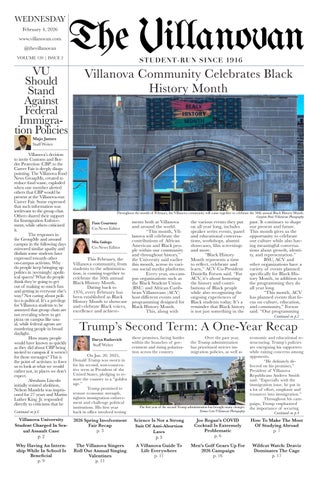

VU Should Stand Against Federal tionImmigra-Policies

Majo James Staff Writer
Villanova’s decision to invite Customs and Border Protection (CBP) to the Career Fair is deeply disappointing. The Villanova Food News GroupMe, created to reduce food waste, exploded when one member alerted others that CBP would be present at the Villanova-run Career Fair. Some expressed that such information was irrelevant to the group chat. Others shared their support for Immigration Enforcement, while others criticized it.
The responses in the GroupMe and around campus in the following days mirrored similar apathy and disdain some students have expressed towards other on-campus activism. Why do people keep bringing up politics in (seemingly) apolitical spaces? What do people think they’re going to get out of making so much fuss and getting in everyone else’s way? Not caring about politics is political. It’s a privilege for Villanova students to be annoyed that group chats are not revealing where to get pizza on campus like usual, while federal agents are murdering people in broad daylight.
How many people would have known as quickly as they did about CBP being invited to campus if it weren’t for those messages? This is the point of activism: to force us to look at what we would rather not, in places we don’t expect.
Abraham Lincoln initially resisted abolition, Nelson Mandela was imprisoned for 27 years and Martin Luther King Jr. responded directly to criticisms that he
Continued on p.6
Villanova University
Student Charged In Sexual Assault Case p. 2
Why Having An Internship While In School Is Beneficial p. 9
Villanova Community Celebrates Black History Month


Finn Courtney Co-News Editor
Mia Galego Co-News Editor
This February, the Villanova community, from students to the administration, is coming together to celebrate the 50th annual Black History Month.
Dating back to 1976, every February has been established as Black History Month to showcase and celebrate Black voices, excellence and achieve -
ments both at Villanova and around the world.
“This month, Villanova will celebrate the contributions of African American and Black people within our community and throughout history,” the University said earlier this month, across its various social media platforms.
Every year, on-campus organizations such as the Black Student Union (BSU) and African Caribbean Villanovans (ACV) host different events and programming designed for Black History Month.
This, along with
the various events they put on all year long, includes speaker series events, panel and educational conversations, workshops, alumni showcases, film screenings and more.
“Black History Month represents a time to reflect, celebrate and learn,” ACV Co-President Daniella Forson said. “For ACV, it’s about honoring the history and contributions of Black people while also recognizing the ongoing experiences of Black students today. It’s a reminder that Black history is not just something in the
past. It continues to shape our present and future. This month gives us the opportunity to celebrate our culture while also having meaningful conversations about growth, identity, and representation.”
BSU, ACV and other organizations have a variety of events planned specifically for Black History Month, in addition to the programming they do all year long.
“This month, ACV has planned events that focus on culture, education, and community,” Forson said. “Our programming
Continued on p.2
Trump’s Second Term: A One-Year Recap
Darya Radzevich Staff Writer
On Jan. 20, 2025, Donald Trump was sworn in for his second, non-consecutive term as President of the United States, pledging to restore the country to a “golden age.”
Trump promised to restore economic strength, tighten immigration enforcement and challenge political institutions. His first year back in office involved testing
2026 Spring Involvement Fair Recap p. 3
The Villanova Singers Roll Out Annual Singing Valentines p. 11
these promises, facing battles within the branches of government and rising polarization across the country.
Over the past year, the Trump administration has prioritized stricter immigration policies, as well as
Science Is Not a Strong Suit Of Anti-Abortion Laws p. 5
A Villanova Guide To Life Everywhere p. 11
Joe Rogan’s COVID
Is Extremely Problematic p. 6
Men’s Golf Gears Up For 2026 Campaign p. 16
economic and educational restructuring. Trump’s policies are energizing his supporters while raising concerns among opponents.
“He definitely delivered on his promises,” President of Villanova Republicans Andrew Smith said. “Especially with the immigration issue, he put in a lot of effort, emphasis and resources into immigration.”
Throughout his campaign, Trump emphasized the importance of securing
Continued on p.4
How To Make The Most Of Studying Abroad p.
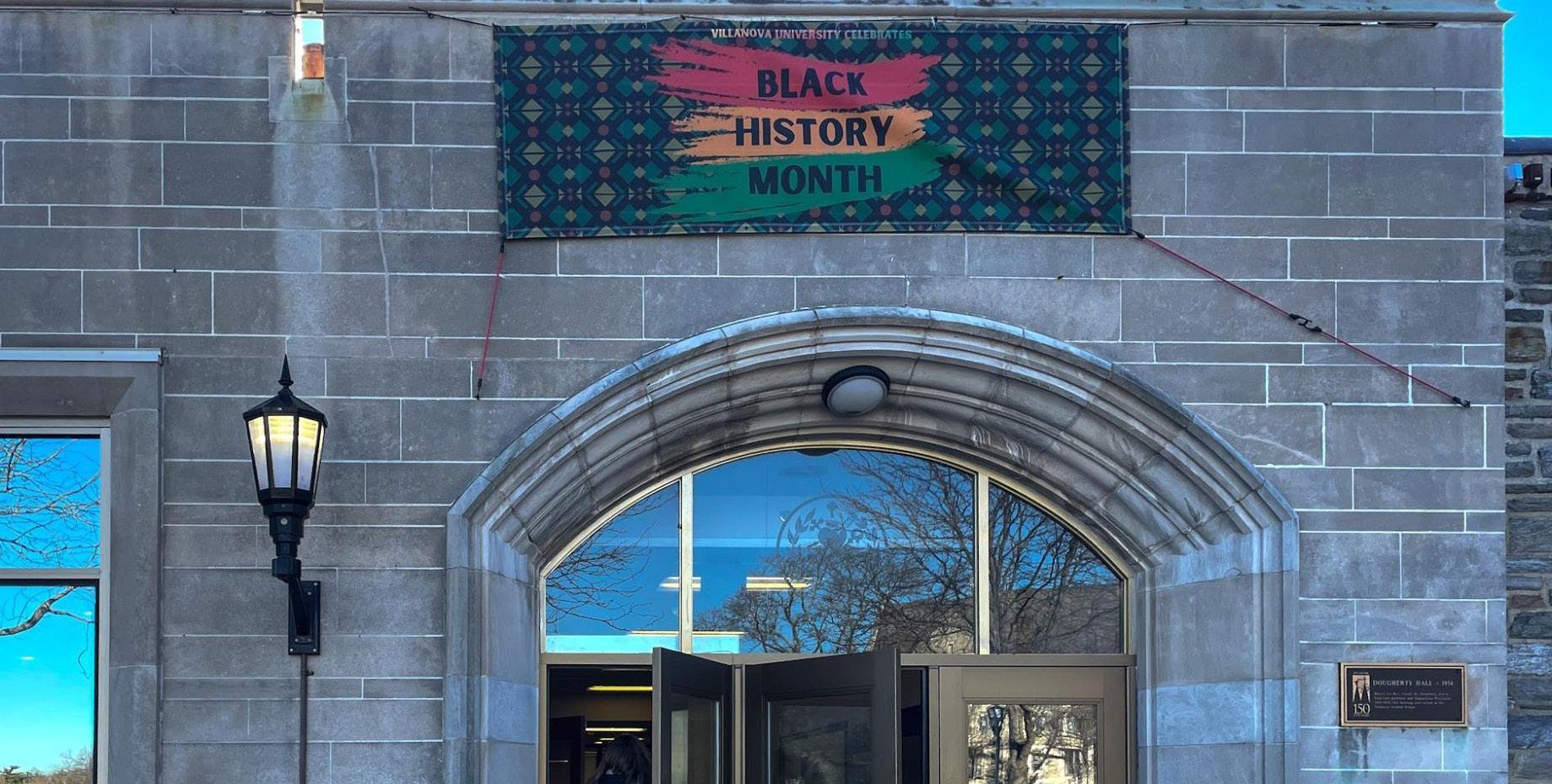
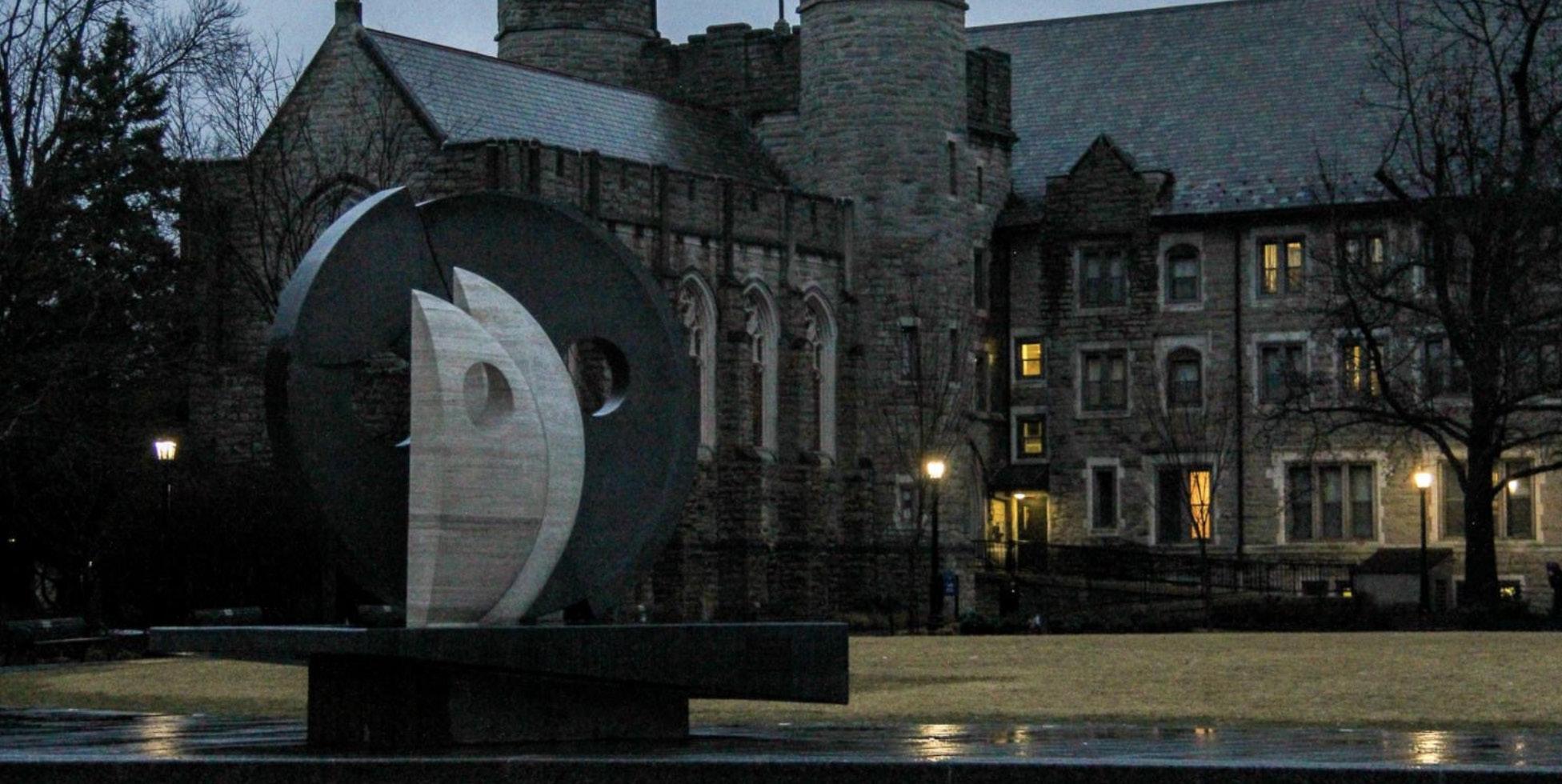
Throughout the month of February, the Villanova community will come together to celebrate the 50th annual Black History Month. Graydon Paul/Villanovan Photography
Cocktail
7
Wildcat Watch: Deaviz Dominates The Cage p. 17
The first year of the second Trump administration has brought many changes. Emma Cote/Villanovan Photography

www.villanovan.com
PUBLIC SAFETY BLOTTER
Theft by Unlawful Taking or Disposition
January 29, PAVILION.
A staff member reported possible misappropriation of event tickets from the Athletics Department by a third party contractor.
Liquor Underage / Public Drunkenness
January 31, STANFORD HALL. A non-affiliated female, under the age of 21, appeared in public intoxicated. The female was transported by VEMS to Bryn Mawr Hospital.
Liquor Underage / Public Drunkenness
January 31, SULLIVAN HALL. One male resident student, under the age of 21, was observed intoxicated in public. Student was evaluated by VEMS and transported to Bryn Mawr Hospital.
CORRECTIONS
Liquor Underage
January 31, STANFORD HALL.
A female resident student, under the age of 21, was evaluated for alcohol intoxication and transported to Bryn Mawr Hospital by Radnor ambulance.
Harassment / Terroristic Threats
January 31, FARLEY HALL. A female resident student wished to report harassing and threatening messages sent to her from an unaffiliated male.
Factual errors are corrected as soon as they are brought to The Villanovan’s attention. Please send an e-mail to villanovan.eic@gmail.com to report errors.
Villanova University Student Charged In Sexual Assault Case
Dylan Johnson Co-Editor-in-Chief
Content warning: mentions of sexual assault.
On Friday, Jan. 30, a Villanova University student was charged with sexual assault stemming from an incident that took place on campus last December.
Villanova Police arrested and charged freshman D’Hani Cobbs on Friday with sexual assault of another student back on Dec. 6, per Delaware County documents.
Cobbs is a Camden native, according to Villanova Athletics’ website.
Cobbs is charged with rape (by forcible compulsion), involuntary deviate sexual intercourse (by forcible compulsion), aggravated indecent assault (by forcible compulsion), aggravated indecent assault (without consent), sexual assault, indecent assault (by
forcible compulsion) and indecent assault (without consent of the other).
The Villanovan was provided with a statement from the University upon request.
“On Friday, Jan. 30, Villanova University Police arrested and charged Villanova student D’Hani Cobbs with the sexual assault of another University student stemming from a December 2025 incident,” the University statement read. “Once the University learned of the incident, campus police launched an investigation, notified the Delaware County District Attorney’s Office, and removed the alleged assailant from campus. Sexual violence of any kind is not tolerated on our campus, and we are committed to both supporting the victim and fostering a safe environment for all of our students. We are deeply troubled any time we receive reports of such misconduct, as our priority is, and always has been, to

ensure we have a safe community for our students, faculty, and staff.”
Cobbs was listed on Villanova Athletics’ website as a wide receiver on the football team for the fall 2025 season, but his bio page has since been taken down.
According to his stats page, Cobbs returned one punt for the team in this past season.
Villanova University’s Department of Public Safety received a report on Dec. 7 about the alleged sexual assault incident.
In a Public Safety campus-wide email on Dec. 7, it said that “the guest and the resident student were known to each other.”
In a Public Safety campus-wide email on Dec. 7, it said that “the guest and the resident student were known to each other.”
The email also stated that any form of assault will not be tolerated on the University’s campus.
“Sexual assault is a viola -
tion of University policy and the law,” the email read. “All forms of sexual misconduct, including sexual assault, sexual harassment, sexual exploitation, dating/domestic violence and stalking, are not tolerated at Villanova. Information on Villanova’s prevention and response efforts can be found on this dedicated website.”
It also defined the definition of consent.
Cobbs was arraigned Friday before District Judge Elizabeth S. Gallard, who set his bail at $250,000 unsecured.
Cobbs is set to appear before District Judge Sloan Walker on Thursday, Feb. 12, for a preliminary hearing.
Thomas G. Masciocchi, Esq., is representing Cobbs as his attorney, according to the court documents.
This is a developing story. The Villanovan will continue to provide updates as more information becomes available.
Professors in the College of Liberal Arts collaborate over DEI course ideas. Ryan Sarbello/Villanovan Photography
Professors in the College of Liberal Arts collaborate over DEI course ideas. Graydon Paul/Villanovan Photography
Villanova Community Celebrates Black History

Finn Courtney Co-News Editor

is meant to create spaces where students can engage with Black history and African and Caribbean culture in an intentional and welcoming way. Through collaborations, we hope to celebrate Black excellence while encouraging learning and dialogue across campus.”
This programming can spotlight organizations that some Villano-
vans may not have heard of before, like ACV.
“African Caribbean Villanovans (ACV) is a cultural organization that celebrates the identities and experiences of students of African and Caribbean descent,” Forson said. “ACV is a space where students can build community, learn from one another, and feel supported, while also sharing our culture with the wider Villanova community. Through social events, cultural programs and conversations, ACV works to create connections and understanding both within and beyond our organization.”
The Black Student Union (BSU) is hosting several events throughout the month. On Monday, BSU kicked off the celebration with an opening ceremony at the Oreo.
The goal of the event was to start the month as a community and honor the impact Black history has today. Tuesday saw BSU host an Unheard Histories panel in the Connelly Center Cinema. The panel was faculty-led, and the discussion highlighted underrepresented stories that shape Black legacy.
At 5:30 p.m. on Feb. 11 in the Connelly Center Cinema, BSU is hosting a Black Film Night. The film aims to educate, entertain and provide students with a space to engage with Black cinema. The Trap and Paint brunch will occur at 6 p.m. on Feb. 17 in the Corr Suite. The event will include music, painting, mocktails and brunch. To close out the month, BSU is hosting The Black Gatsby Gala at 7 p.m. on Feb. 22 in the Villanova Room.
While the University contin-

ues to promote the importance of Black History Month, there are still steps to be taken within the greater campus community.
“ACV appreciates the ways Villanova recognizes Black History Month and creates space for cultural events and conversations on campus,” Forson said. “These efforts are important and help bring the community together. At the same time, Black History Month is a chance to keep building and learning. Looking ahead, the University can continue to support diversity and inclusion by working closely with student organizations, listening to student experiences, and finding ways to celebrate and support different cultures throughout the year. Creating a welcoming campus is an ongoing process, and continued collaboration can help make that possible.”
2026 Spring Involvement Fair Recap
Finn Courtney Co-News Editor
After being delayed for two days due to a snowstorm, Villanova held its annual Spring Involvement Fair in the Connelly Center this past Wednesday, Jan. 28, to kick off the Spring Semester.
Housed inside the Villanova Room and an outdoor tent, the fair allowed students to get involved in various on-campus organizations, whether to make new friends, develop a skill or add more to their week.
Villanova offers rich ways to get involved at the Fall and Spring Fairs, including big campus-wide organizations like Orientation and NOVAdance, as well as campus activities, identity-based organizations, music groups and service and volunteer organizations.
With just about everything to choose to join at Villanova, all students got a chance to meet organizations’ leaders and seek new opportunities for enriching themselves.
“I think the Involvement Fair is extremely important as it exhibits the diversity of interests on campus,” sophomore Emma Tiren said. “It also gives students the opportunity to continue to find connections and lasting friendships while pursuing various hobbies and outlets.”
For some, it can serve as an eye-opener for clubs they may not be otherwise aware of over the course of a normal year.
“I really enjoyed going to the Involvement Fair with my
friends,” sophomore George Stattelman-Scanlan said. “Overall, I think it’s a great chance to learn about different clubs on campus. Like, I found out about clubs I didn’t even know existed.”
For the executive boards of clubs and organizations at Villanova, the Involvement Fair provided an opportunity to find students who may be interested in joining their organization, such as club sports.
“I tabled for Club Pickleball, and it went really well,” Club Pickleball President Justin Sebelin said. “We were able to meet a lot of new faces and talk with them about our amazing club, which was encouraging. It was also great seeing current members and friends stop by the table to say hi and show support.”
The Involvement Fair was also a time for a variety of Greek Life organizations that offer COB (continuous open-bidding) to show off everything about their organizations.
“I tabled for both Club Swim and Chi Omega,” sophomore Anna Rupp said. “I loved being able to meet potential new members and find people who share the same interests as me. I absolutely love the involvement [fair, everyone] is brimming with excitement, and it’s super cool to see the different organizations that we offer at Villanova.”
Even though student turnout may be lower for the Spring Involvement Fair when compared to the Fall Involvement Fair, there are still many students who show up to see what opportunities may be available for them.
“While it’s not quite the same scale as the fall club fair, it’s still really cool to see so many students and organizations come together,” Sebelin said. “At the end of the day, clubs like these are a huge part of what makes the Villanova experience.”
If any students missed the Involvement Fair because of class or other circumstances, there is still plenty of time to get involved.
The majority of on-campus clubs and organizations that were at the Involvement Fair are active on social media (such as The Villanovan , which also has different individual accounts for sections like news, opinion, culture and sports), with updates on how to
join, about general body meetings, different social or service events or how to get into the GroupMes and the mailing lists of that organization.
This semester’s Spring Involvement Fair was a success, with many clubs gaining new members or applicants and engaging in passionate conversations about the organizations they’ve called home, along with free food and goodies that everyone who tabled had to offer.
The Spring Involvement Fair gave everyone who came by a chance to find their home here on Villanova’s campus in whatever activity caught their attention.

The 2026 Spring Involvment Fair took place in the Connelly Center this past Wednesday. Brian Luppy/Villanovan Photography
Mia Galego Co-News Editor
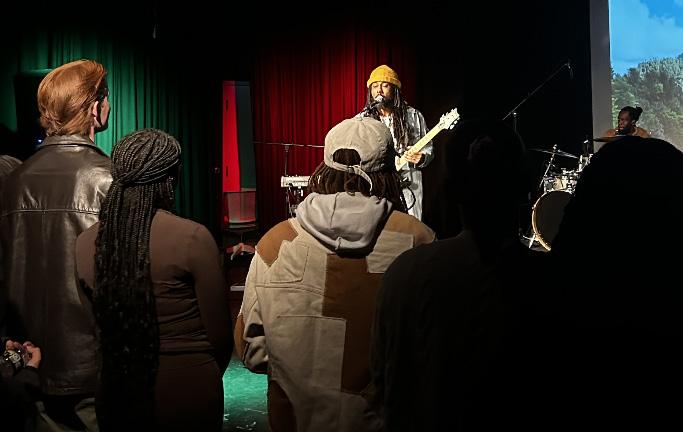
Soular rock band Amari Rebel and the Movement performing for a Black History Month Event last year. Cali Carss/Villanovan Photography
BSU to host Trap and Paint brunch on Feb. 17 in the Corr Suite. Peter Licopantis/Villanovan Photography
Continued from p.1
Trump’s Second Term: A One-Year Recap
Darya Radzevich Staff Writer
Continued from p.1
the Southern border through stricter immigration policy. Some of these policies include a $13.5 billion investment in state and local enforcement of federal immigration law, alongside a $1 billion effort to divert military resources toward border enforcement.
These investments increased criminal prosecution for immigrant-related offenses and allowed for higher enforcement of immigration laws. As a result, border crossings have plummeted, and individuals held in detention centers are reaching historic highs, according to ProPublica.
However, stronger immigration enforcement has faced escalating backlash, particularly following the killing of American citizens Renee Good and Alex Pretti by U.S. Immigration and Customs Enforcment (ICE) officers in Minnesota. The administration argued these measures were necessary for national security. Nevertheless, lawmakers in Congress began demanding investigations into the citizens’ deaths and defunding of ICE operations.
“You never thought that you would see that here,” President of Villanova Democrats Joey Scerbo said. “If there was an outside country that was doing the same thing, we would
say that would give us justification to go and intervene.”
U.S. foreign relations have defined news regarding President Trump and the acquisition of Greenland.
Trump made claims to seize Greenland for “security reasons,” which have been denied by Greenland’s leaders. In response, Trump threatened additional tariffs against numerous European allies for opposing his plans, according to the BBC. These claims have sparked debate surrounding the role of the United States as an expansionist or isolationist country.
Simultaneously, Trump’s tariff announcements increased the costs of essential goods and led to rising unemployment. This was followed by decreasing amounts of the budget going to health care, food assistance and clean energy. The administration’s actions led to 70% of Americans predicting 2026 will be a year of economic difficulties, according to Gallup.
Some Americans are trying to remain hopeful that Trump’s domestic investment will lead to further development of infrastructure and the creation of jobs.
“I think they hurt in the short term, but will benefit in the long term,” Smith said.
The Trump administration also aimed to reshape education. Early in his term, Trump signed an exec-
utive order calling for the dismantling of the Department of Education. However, the administration claimed the core functions of the department would be preserved.
Beyond K-12 education, the administration’s efforts to restructure federal oversight have extended into higher education. Many institutions have been forced to decide between defending their independence and giving in to the federal government’s demands due to financial pressure.
Harvard University faced a lawsuit with the administration because they refused to yield to demands such as a third-party audit of the viewpoints of students, faculty and staff.
Harvard also refused to diminish the power of instructors and administrators involved in activism.
As a result, the administration threatened the university by withholding $2 billion in federal funding, according to NPR.
“I think that Trump going after universities is supported by a lot of actual working-class Americans because they see a lot of money going to these institutions for studying things that don’t improve their life using their taxpayer dollars,” Smith said.
Trump started his term with frequent implementation of executive orders. As of Dec. 15, 2025, Trump has signed 221 executive orders, beating his first term total of 220 orders, according to the Pew Research
Center.
While the orders address a wide range of policy areas, critics argue that their sheer volume reflects a broader consolidation of executive power.
“There has been an unwillingness to place any checks on his power,” Scerbo said.
The administration’s policies have influenced Villanova’s political environment.
“I think that people that never liked Trump are the loudest, it just got louder,” Smith said.
While criticism continues, public demonstrations have become less frequent.
“There were protests here and there, but we are not seeing that now,” Scerbo said. “People are upset about the ICE raids and presence, but nobody seems to really care that much outwardly.”
Success in the 2026 midterm elections is critical for both parties. Currently, Republicans have control of the House of Representatives.
“Midterm elections are very important, especially this year, because if the Democrats win at least one chamber of Congress, it would place a check on the president,” Scerbo said.
As Trump enters the second year of his term, questions surrounding his executive power, congressional oversight, and the direction of the country are expected to intensify.
This Week in Politics: Partial Government Shutdown
Zoe Garrett Political Columnist
A partial government shutdown which left several federal operations temporarily unfunded, ended Tuesday after a narrow vote in the House and approval from President Donald Trump, reported NPR. The four-day shutdown came just 80 days after the end of the country’s previous and longest one, which lasted nearly one and a half months.
In the U.S. government, shutdowns occur when necessary funding legislation fails to be enacted ahead of set deadlines. Without such laws in place before the expiration date of the previous fiscal year’s funding, many federal agencies, operations and programs are interrupted until members of Congress and the President pass a new budget.
Approximately two weeks ago, the House approved a large spending package that totaled nearly $1.3 trillion. The spending bill, which was then sent to the Senate for approval, outlined budgets for federal defense, health, transportation, housing and homeland security operations, according to NPR.
However, recent developments arising from the increased presence of Immigration and Customs Enforcement (ICE) agents around the country have impacted the legislative timeline for the federal budget. On Jan. 24, an ICE agent fatally shot Alex Pretti, a Minneapolis-based ICU nurse for the U.S. Department of Veterans Affairs. The event prompted several Democratic Senators to reconsider their Yea vote for the spending bill, which had allocated funds to the federal agency in which ICE is
housed, the Department of Homeland Security (DHS). By expressing their disapproval of the legislation, Democrats hoped to pressure their GOP colleagues into conversations that addressed DHS’s operations and policies and that negotiated the agency’s funding.
Senator Chris Murphy (DCT) was among those officials who disapproved of the omnibus bill, according to NPR.
“What is happening in Minnesota right now is a dystopia,” Murphy told Fox News. “ICE is making this country less safe, not more safe today.”
President Trump expressed his commitment to secure a compromise with Senators in a post to Truth Social last week.
“I am working hard with Congress to ensure that we are able to fully fund the government without delay,” President Trump wrote.
After deliberation, Senate Democrats and President Trump reached a tentative agreement that would help push the majority of funding through the chamber. A two-week continuing resolution was suggested to give congressional lawmakers an extension to negotiate policy changes and department reforms.
The move by Senators to strip DHS funding epitomizes Democratic members of Congress’s continuous objection to what they perceive to be unfettered and unlawful conduct by federal immigration agents.
Following a 71-29 Senate vote on Friday to move forward with the amended spending plan, the budget was sent back to the House to be voted on again before President Trump could sign it into law. However, the House was out of session until Mon-
day, causing the government to enter a partial shutdown at midnight on Saturday before representatives could get back on the Floor to vote, reported The Guardian.
Statements made by House Democrats suggested that some representatives were resistant to the new funding plan. Congressman Ro Khanna (D-CA) expressed to NBC his resistance to the revised budget.
“I’m not a no– I’m a firm no,” Khanna said. “I just don’t see how in good conscience Democrats can vote for continuing ICE funding when they’re killing American citizens, when there’s no provision to repeal the tripling of the budget.”
Despite such opposition, a coalition of Republican and Democratic representatives secured a majority in the affirmative in a razor-thin 217214 vote Tuesday afternoon, according to CBS News. President Trump signed the budget into law shortly
after, putting the new budget into effect and ending the brief partial government shutdown.
With this new spending plan, lawmakers will now turn their attention to debates regarding DHS funding. Thanks to the continuing resolution previously agreed upon, members of Congress face a 10-day window to negotiate a budget for the federal agency. According to NBC, Democrats on the Hill will advocate for reforms within DHS and use their votes as leverage ahead of the Feb. 13 deadline.
Last weekend’s lapse in appropriations serves as a manifestation of the growing controversy surrounding ICE operations across the U.S. Though the partial shutdown has ended, many will continue to watch congressional lawmakers as they enter what are likely to be contentious negotiations pertaining to DHS in the coming days.

2026 Journalism Roundtable Preview

Mia Galego Co-News Editor
On Feb. 12, the Communication Department will host its fifth annual Journalism Roundtable. This year’s topic is “Artificial Intelligence and its Impact on Journalism’s Future,” a highly debated issue that has gained significant traction since last year’s discussion.
The roundtable will take place from 4:30-6:00 p.m. in Garey Hall Room 10A. It will be moderated by Communication Department professor Michael Bradley and will feature insights from five panelists, each with experience in a specific medium.
Bradley first chooses a topic for the roundtable, aiming to make the conversation both relevant and entertaining. Then he selects panelists who would offer diverse perspectives during the discussion.
“The reason I try to pick such a diverse group is that I want everybody to have someone that they are maybe identifying with,” Bradley said.
The panelists joining the discussion are Tom Davis, Vice President of News for 6abc, Luca Koppeser, the Brand Manager and Director of Digital for KYW Newsradio, Ross Maghielse, Deputy Managing Editor at The Philadelphia Inquirer, Johnny Archer, Reporter/Anchor for NBC10;,and Miranda Villei, Director
of Streaming at CBS Philadelphia.
“I want to make sure there are women and men,” Bradley said. “I want to make sure there are people of color. I want to make sure there is TV, print, radio, people who are on social media. That way, when I ask questions as the moderator during the discussion, we have a bunch of different perspectives that give the audience as good an idea of the topic as possible.”
This year’s topic dives into something increasingly relevant: the lasting impacts of artificial intelligence.
“It’s permeating just about every area of our lives,” Bradley said. “Within the media, there is an awful lot of use of it, whether it’s creating content all together, giving journalists ideas for things they should be pursuing, allowing them to do more research, or setting up the sets on television.”
WXVU broadcaster David Szczepanski is looking forward to engaging in an important conversation.
“While AI has its good side, I think it is also crucial for the future of the journalism industry to discuss the dangers of it,” Szczepanski said. “It must be used responsibly, while also acknowledging that writers and young journalists should have knowledge about it.”
With technology rapidly changing, the future of AI remains hard to predict.
“As much as we try as jour-
nalists to seem like everybody should be doing it purely, that’s going to be unavoidable in the future,” Bradley said. “We are going to be seeing a lot of jobs taken away in journalism by artificial intelligence.”
Students will be able to ask the panelists questions and build connections afterwards.
“These events are phenomenal opportunities to learn more about the changing world of journalism and to connect with some of the best people in our industry,” Szczepanski said.
Students can look forward to an informational discussion with a group of accomplished journalists.

The Marriage Pact: One Week Later
Caroline Etter Staff Writer
Jan. 23, Villanova students who filled out “The Marriage Pact” questionnaire received their matches. The anticipation of finding out your match’s name has passed, and it’s up to students to decide whether to make a move or not.
There were 2,231 submissions from Villanova students, who might have been looking for a relationship or simply the opportunity to meet new people.
Many of the questions asked on questionnaire revolved around relationship “dealbreakers” such as political affiliation, drug use and opinions about intimacy.
The questions were deep -
ly personal, which made it more likely to be matched with someone with the same values and interests.
The insights into students’ beliefs made “The Marriage Pact” full of opportunity to meet like-minded people on campus. Many students were successful in doing so, and many “talking stages” began this past week.
However, two days before matches were released, 561 more heterosexual women than heterosexual men filled out the survey.
In an attempt to give all individuals romantic matches, the questionnaire’s deadline was extended to Friday, Jan. 23. This effort did not do much to address the situation, with many girls receiving friend matches.
Not all students had desirable results.

Lauren Armstrong, a senior, reflected on her experience with “The Marriage Pact” over her four years at Villanova.
“The marriage pact can truly be a hit or a miss,” Armstrong said. “Sophomore year I got matched with one of my good friends, and we were in the same room when we got the email which was funny. While nothing has ever stemmed from the marriage pact for me, it is a fun Villanova tradition that my friends and I have looked forward to the past four years.”
Clearly, those looking for love via “The Marriage Pact” were left disappointed when it did not work out. Getting a “friend match,” for some, defeated the purpose of filling it out, not finding a romantic partner.
Not everyone had a negative ‘Marriage Pact’ experience, though. Some students have begun to connect in real life with their matches, testing the waters of a possible relationship.
Whether the matches were well-received or not, the ‘Marriage Pact’ revealed something about students at Villanova and possibly young people in general.
Students still hope to create meaningful, romantic relationships during their time at Villanova. They just go about it unconventionally.
Whether “The Marriage Pact” really has an algorithm that matches students perfectly, or it is just completely random, students still take the time to fill it out every year. For some, this is the first step in finding “the one.”
More than 2,000 Villanova students filled out the Marriage Pact this year. Eric Quezada/Villanovan Photography
Students recieved their Marriage Pact matches Jan. 23. Brian Luppy/Villanovan Photography
Students are anticipating the annual Journalism Roundtable. Courtesy of The Villanova Communication Department
OPINION
Villanova Should Stand Against Federal Immigration Policies
Majo James Staff Writer
Continued from p.1 wasn’t acting in the right time or place in his “Letter From Birmingham Jail.” To those with power, the right time for change is always tomorrow, and the right place is always elsewhere.
I was disappointed to see no concrete promises in the reflection University President Rev. Peter M. Donohue, O.S.A., Ph.D., shared with the University soon after news broke about CBP being invited to campus, but only a carefully worded assurance that he “will continue to use [his] voice against injustice.”
This is a sharp contrast to a quote he included in the very same email by Dr. Molefi Kete Asante, who spoke on campus at the Martin Luther King, Jr. Keynote Lecture on Jan. 20: “When you experience injustice in your community, you need to raise your voice.”
There is injustice in our community. Under President Trump, federal agents have (as of Jan. 29) killed eight people in 2026 alone, dismissed the necessity of judicial warrants and have engaged in increasingly violent behavior, such as employing explosives to force open doors and shattering windshields.
We can not reduce the leg -
acy of MLK to quotes and a day’s break from work and school. We must remember he was a radical in his time. We can not allow the voices of society’s conscience to rot under the ground for decades before we heed their call.
Villanova should have never invited CBP to campus. Doing so created an atmosphere of fear in our community and not only failed to criticize but also validated their actions. Villanova has yet to take a stand on this issue. CBP decided not to attend the Career Fair.
“Organizations participating in this event were contacted through standard outreach to employers that have previously taken part in Career Center programs,” a University statement said on the matter. “US CBP-Office of Trade was included in that general communication based on its participation in past career-related events. Following the announcement of their participation, the employer informed the Career Center that they do not plan to attend this event.” Villanova University must
openly and explicitly denounce tyrannical actions from the federal government. It must listen to student concerns. It must do its part to advance social justice as MLK Jr. did and as Catholic Social Teaching compels it to do. Our students, faculty and staff must remember progress is not guaranteed and that it may be unpopular. We must not allow ourselves to be like those in history who watched silently as acts of injustice became government policies and eventually dug graves.
Greenland: Villanovan Perspectives On Land Acquisition

Juliana Burke Staff Writer
The recent discourse surrounding the possibility of the United States acquiring Greenland has dominated headlines over the past few weeks. Discussions of American acquisition of the island date back to the nineteenth century and have reemerged consistently under President Trump’s rule.
What makes the current debate particularly striking is not simply its revival in our discourse, but the way it cuts across ideological and partisan lines.
Democrats and Republicans alike have voiced both support for and opposition to the notion, revealing a broader national divide about the limits of American power.
At Villanova, the Matthew J. Ryan Center for the Study of Free Institutions was a fitting venue to gauge the campus temperature. In the Center’s most recent discussion, students gathered to examine the repercussions of a potential acquisition, its implications for NATO and the legitimacy of President Donald Trump’s characterization of Greenland as a national security concern.
The conversation revealed not only diverging policy views but also deeper questions about American identity, justice in geopolitics and the moral boundaries of state power.
The event opened with a brief introduction from Ryan Center President Nicholas Shapkarov, who provided historical and political context for the issue. He traced the origins of renewed interest in Greenland to statements made by President Trump more than a year ago, framing them within a broader rhetoric of national security and strategic expansion.
Shapkarov outlined the possible mechanisms through which acquisition could occur, such as diplomatic negotiation, economic leverage or brute force. From there, he raised the central question that would ultimately define the discussion: If pursued, would the United States attempt to take Greenland by force?
When participants were asked to weigh in, the room was divided. Roughly one-third expressed support for full acquisition, while a clear majority argued that complete and forceful intervention was unnecessary and potentially harmful.
Interestingly, even the students opposed to acquisition tended to differentiate between the concept of increased American presence and the methods by which it might be achieved.
Sam Treat, a vocal proponent of acquisition, emphasized Greenland’s strategic value in countering Chinese influence in the Arctic. He argued that as global competition intensifies, control over critical regions is
increasingly tied to national security. Several students echoed this sentiment, suggesting that if acquisition strengthened NATO and enhanced the collective defense of Europe, it should fall within the United States’ jurisdiction. Andrew Smith pushed the argument further, likening the prospect of acquisition to “Manifest Destiny.” In his view, the United States should acknowledge and embrace its historical role as an imperial power rather than shy away from it.
Others pointed to Greenland’s vast natural resources as a compelling incentive. Jake Bricker noted that the island’s untapped reserves of rare earth minerals and other valuable resources are increasingly vital to modern technology and energy security. From this perspective, acquisition was framed less as conquest and more as strategic investment in longterm economic and geopolitical stability.
Opposition voices, however, focused less on outcomes and more on the process and moral conclusions to be drawn from such developments. Many stressed that they were “not entirely against” expanded American involvement in Greenland, but strongly opposed the manner in which the issue had been approached. One participant described the administration’s posture toward European allies as “bullying,” warning that aggressive
rhetoric risked undermining decades of diplomatic trust. While some expressed openness to expanded military bases or economic agreements, they were unwilling to jeopardize relationships with NATO allies over territorial ambition.
Joe Gionfriddo articulated this view succinctly, arguing that the current framework for increased American presence was sufficient without resorting to force. “This violates just war theory,” Gionfriddo stated. His comments sparked a broader philosophical debate: If force were permitted in such circumstances, do any meaningful limits remain on state behavior?
That question lingered as the conversation widened. “Is anything just in geopolitics anymore?” one student asked, prompting reflection on whether justice can meaningfully exist in a system driven by power and self-interest. Treat responded by defending justice as a principle rooted in outcomes rather than intentions, suggesting that actions leading to the greater good could still be morally defensible, even if imperfect.
By the discussion’s end, it was clear that the Greenland dilemma extends far beyond territorial acquisition. It forces a reckoning with how the United States understands power, alliance and justice in an increasingly uncertain world.
Villanova must listen to student concerns, especially on discriminatory matters. Dylan Johnson/Villanovan Photography
EDITORIAL BOARD LETTERS TO THE EDITORS
KAILEY FAHY
Editor-in-Chief
DYLAN JOHNSON
Editor-in-Chief
SOPHIE LATESSA
Managing
AVERY CHALK
EMMA TAYLOR
Opinion
Editor
Editor
Opinion Editor

The Villanovan encourages all members of the Villanova community to voice their opinions. Letters to the editors may be submitted via e-mail to villanovan.eic@gmail.com. Letters must not exceed 500 words and must be signed. No anonymous letters will be published. All submissions become property of The Villanovan and are subject to editing for clarity and space.
POLICY
The unsigned editorial that appears is the opinion of The Villanovan as determined by the majority of the Editorial Board. Other columns, letters and artwork represent the opinions of their authors and do not necessarily reflect the position of The Villanovan.
How To Make The Most Of Studying Abroad
Avery Chalk Co-Opinion Editor
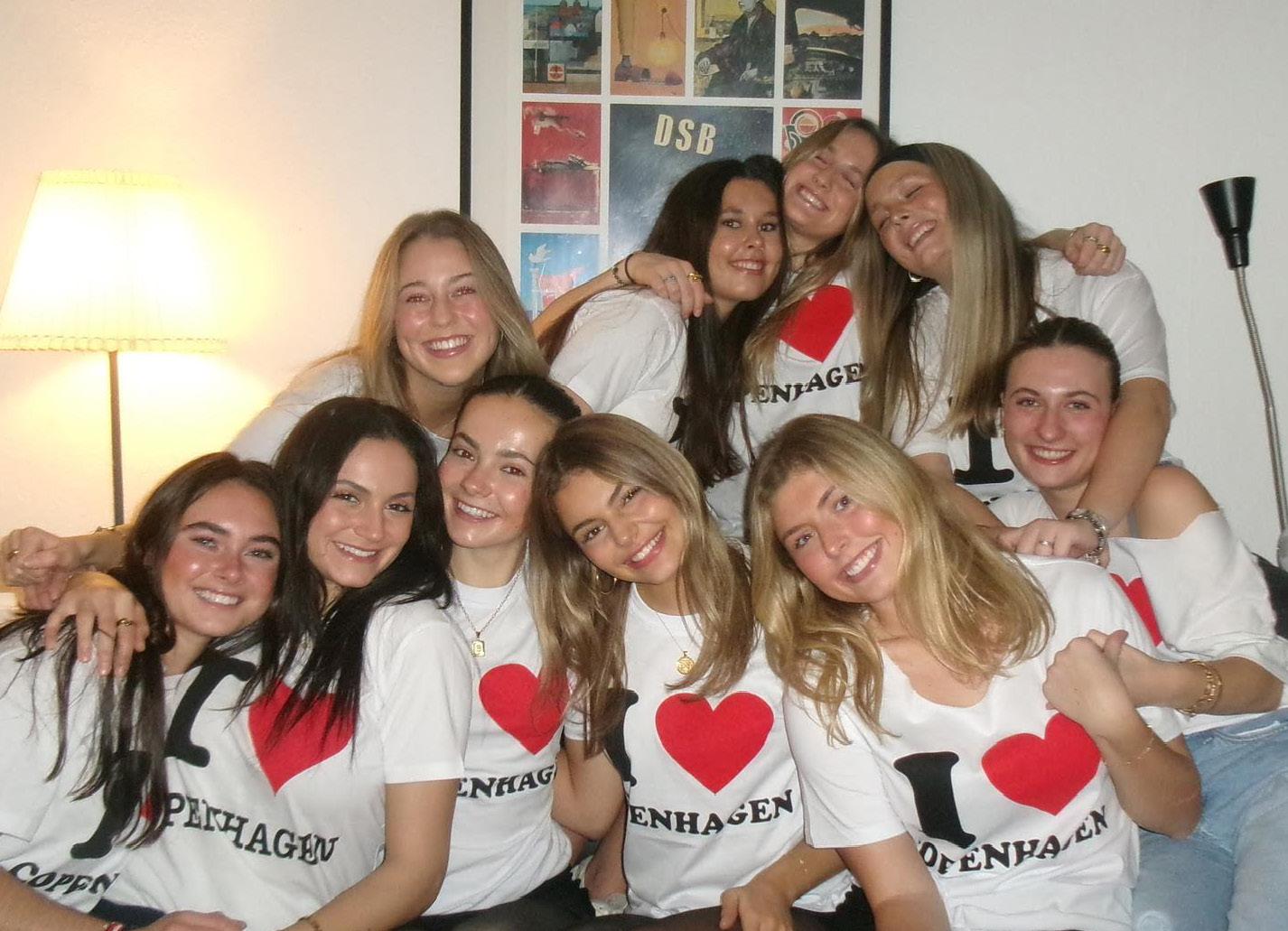
Like many of my third-year counterparts, I ventured outside the stone-cobbled, heated walkways of Villanova to study abroad last semester. From August through December, I considered Copenhagen, Denmark, my home. I biked, I ate smorrebrod and I certainly learned how to layer up.
Nostalgic as ever, I’m back on American soil. I believe enough time has passed that I can analyze my experience both objectively and empirically. Now that I’ve returned to Villanova, I feel reaffirmed in my belief that every student should study abroad (if they are able). Naturally, spending four months in a foreign country produced a few strong opinions. So, if you’re thinking about leaving campus as I did, please heed this advice:
1. Study abroad without your best friends
Controversial? Maybe. But I believe my experience would have been unequivocally less fulfilling had I not chosen to go alone. My friends are some of the most important people in my life, and the prospect of spending time away from them was daunting. Still, I, rather forcibly, put myself into a ‘sink or swim’ position. Without the comfort of familiar faces, I learned to assimilate. I made new friends, tried new hobbies and embraced a random roommate, all serving to push myself out of my comfort zone. Heck, I even went on
a solo trip. As my circle expanded, so did my perspective.
2. Love your host city before you leave it
Many students feel pressured to travel every weekend, especially in European-based programs where new countries are just a train ride away. While it’s certainly tempting to pack up an Amazon travel backpack at every opportunity, spending time in your host city is just as important.
For junior Samantha Zacharczyk, studying abroad is all about embracing your new sense of place: “Even though you’re there for most of the week, part of the experience is being a tourist in your own city,” Zacharczyk said. “I wish I
stayed a few more weekends to really take it all in.”
By the time I went home, I felt confident that I had adequately trounced over every square inch.
3. Stray from the rec docs
Each year, upperclassmen bestow their painstakingly crafted “rec-docs” upon a new generation of travelers. These guides often detail must-see destinations, shared across Pinterest, TikTok and just about every other form of social media. Ready-made, they’re undoubtedly attractive to those weary of planning their own itineraries. However, I’d urge you to travel off the beaten path. Go places that aren’t as popular, even if you’re flying solo.
4. The struggle is the best part It would be disingenuous of me to pretend that taking a wine tour in Tuscany or paragliding in the Swiss Alps was particularly identity-shaping. While incredible, those experiences weren’t where I grew the most. That’s not where I changed. Instead, it was recovering from almost missing my train leaving Florence. It was the three-hour, $2,000 taxi that my friends and I had to take after foolishly getting off at the wrong stop in Switzerland. While the vacation moments were fun, learning to navigate the unexpected obstacles was far more valuable.
5. Keep some perspective, baby!
Many students tout their “perfect” abroad experiences. On Instagram, countless feeds littered with brightly curated posts make it hard not to feel envious. But the opportunity to travel isn’t afforded to everyone, whether for logistical, financial, or personal reasons. It’s a privilege, and keeping that mantra in mind is essential. You’re in an exciting place. You’re doing cool stuff. Step back for a moment, and remember that comparing your experience to someone else’s only diminishes what you’re living through.
Studying abroad is what you make of it. Feel free to disregard my opinions entirely or cultivate new ones of your own volition. Just be sure to embrace every moment. And for one final take? No cafe in the world could ever come close to a medium iced Dunkalatte with caramel swirl.
Overinvolvement Culture Is Taking Over Villanova
Massimo DiLeo Staff Writer
Many students, including myself, struggle to find balance. Students might feel this way because Villanova’s student body prides itself on its commitment to the multitude of organizations present on campus. Whether it’s participating in Villanova’s Special Olympics’ Fall Fest, NOVAdance, Blue Key or even The Villanovan, the possibilities are endless. However, students are attempting to find a balance between their social lives, involvement, deadlines and a healthy diet. These responsibilities can accumulate, and the comparison culture we have curated can lead to some students feeling under-involved, despite having many things on their plate already. Has this overinvolvement culture been poisoning the campus?
An article published by the Waypoint Wellness Center titled “The Crisis of Comparison Culture”
attempts to crack down on this crisis. Over the past 20 years, social media and related technological advancements have begun to play increasingly large roles in comparison culture.
More specifically, the article orients us to how “this generation has grown up with social media at their fingertips” and “consequently, young people are not only keeping track of their own successes and failures, but also those of their peers.” Using LinkedIn as an example, students might overanalyze the highly flourished profiles of their fellow Villano-
vans and become influenced by the overinvolvement culture when, in reality, they’re doing just fine. Sophomores Peyton Benfield and Ava Taylor shared their thoughts on Villanova’s overinvolvement culture.
“People come to college thinking that the only way they can make long-lasting connections is through joining clubs, and my freshman year, I felt that the involvement fair was just one example of how many students end up taking on more than they can handle or need instead
of choosing a smaller amount of activities that they can spend more time in,” Benfield said.
Benfield and Taylor also expanded on how the Villanova Voices, a choral group, has been a meaningful part of their college experience.
“Although Voices can be rather time-consuming, I am grateful for the meaningful connections I have gained from the group that may not have been possible if I were involved in more organizations,” Taylor said.
Although it is helpful, and often encouraged, to get involved with a multitude of student organizations when students first arrive at college, it is best to identify the few organizations that you are passionate about and interested in, and make a concerted effort to cultivate meaningful relationships, or even leadership positions, within them. Overinvolvement culture is not only clouding our judgment about what we have already accomplished but also inhibiting students from committing to what they’re already involved in by making them believe they have to do more.
Chalk recounts her experience abroad in Copenhagen. Avery Chalk/Villanovan Photography
The Villanovan staff tabling at the Student Involvement Fair. Ciara Dursee/Villanovan Photography
Why Having An Internship While In School Is Beneficial
Kaitlin Lawrenson Staff Writer
Balancing coursework, extracurriculars and a social life is a familiar challenge for college students. But adding an internship to that mix introduces an entirely new level of responsibility. As a communication major at Villanova University, holding an internship while being a full-time student has been one of the most impactful parts of my academic experience. It has allowed me to move beyond theory and into practice and apply what I learn in the classroom to real-world situations while gaining clarity about the communication industry as a whole.
Villanova’s Communication Department emphasizes critical thinking, ethical storytelling and strategic messaging across platforms. In classes focused on public relations, media writing, advertising and rhetoric, students analyze case studies, craft campaigns and study how messages shape public perception. While these academic foundations are essential, seeing how they translate into a professional setting has made the lessons feel more tangible and urgent. Concepts that once lived only in textbooks suddenly carry real consequences when applied to clients, deadlines and stakeholders.
Through my internship experience, I have been practicing skills developed in class. Writing press materials, drafting social media content, assisting with campaign planning and
observing client communications have reinforced the importance of clarity, adaptability and professionalism. The work environment has also highlighted that the communication field is collaborative. Success rarely comes from individual effort alone. Instead, it depends on teamwork, feedback and an openness to learning from others with different perspectives and levels of experience.
One of the most valuable aspects of interning while in school is the opportunity to grow in real time. When I encounter challenges at work, whether it’s navigating constructive criticism or managing multiple deadlines, I can reflect on those experiences in class discussions and assignments. Similarly, when professors introduce new frameworks or strategies, I can immediately consider how they apply to my internship. This ongoing exchange between academic
learning and professional practice has deepened my understanding of both. This experience is shared by many Villanova students pursuing careers in communication.
Christina Galdi, a junior, who is also balancing coursework with a public relations internship, emphasizes how transformative this opportunity can be.
“Participating in a PR internship while studying communication, PR and Advertising has given me the opportunity to apply my classroom knowledge to projects and tasks within a workplace setting,” Galdi said. “That said, this experience has been invaluable thus far, and I am extremely grateful to Villanova for supporting me with this professional endeavor.”
Galdi’s experience reflects a broader culture at Villanova that encourages students to seek handson learning and professional growth
alongside academic rigor. Internships also offer exposure to the realities of the communication industry that cannot be fully captured in a classroom. The fast-paced nature of the field, the need to respond quickly to changing circumstances and the importance of maintaining strong professional relationships all become clear through firsthand experience. While the work can be demanding, it is also deeply rewarding to contribute meaningfully to projects and see how strategic communication can influence real outcomes.
Villanova plays a crucial role in making these opportunities accessible. Through faculty mentorship, career services and an emphasis on experiential learning, the University supports students as they navigate professional spaces for the first time. Professors often encourage students to pursue internships early and use them as a tool for exploration rather than expecting immediate certainty about career paths. This mindset helps reduce pressure and fosters curiosity.
Ultimately, having an internship while studying at Villanova has helped me grow not only as a communication major but also as a professional and individual. It has clarified my interests, strengthened my skills and reinforced the value of adaptability and lifelong learning. By bridging the gap between theory and practice, internships transform education into experience, preparing students to enter the communications industry with confidence, purpose and a deeper understanding of the world they will join.
Students Should Prioritize Limiting Screen Time
Michael Barravecchio Staff Writer
The average college student spends approximately four-and-ahalf hours daily on social media, according to a Concordia University article. In other words, we likely spend more time scrolling each day than sitting in class. In 2026, when “not a phone in sight” is a common satirical phrase used to make light of our constant screen use, it might be time for students to take greater accountability for how they spend their time. Though excess screen time isn’t obvious or intentional, it is the gateway to increased stress, decreased motivation and weaker academic results.
The Cause
When determining the cause of widespread social media use, it is important to assess our influence and surroundings. Overusing technology is a difficult conversation to have because of society’s reliance on screens. If you were to give a college student 100 years ago access to a phone, I would argue that, over time, their use would decline. At first, the student would be thrilled to have something exclusive and modern, but eventually they would realize they are the only one not present or engaged with their surroundings. Phone usage, then, is as much a societal issue as it is an individual one. At a college lunch table today, it might feel strange to look up and engage while everyone else is on their phone. One hundred years ago, however, it would
have been strange to look down and scroll while everyone else was talking.
The environment has promoted this behavior largely because of the productivity a phone provides. Screens are not just addictive to individuals but are also unintentionally encouraged by society. After all, phone use stemmed from the internet, which was widely promoted as a tool to access information more efficiently. Unfortunately, these technologies have evolved into platforms centered around shortform content that often waste as much time as they once saved. This raises an important question: how do we limit screen use when some forms help us, and others hurt us?
Part of the answer lies in dopamine. When someone pulls a slot machine handle at a casino, bright colors and sounds are followed by a quick reward. Similarly, when a student watches TikTok, they experience stimulating content and then scroll every few seconds to repeat the process. A University of Michigan article notes the “unnerving similarities” between infinite scrolling and slot machines, explaining how social media triggers dopamine responses similar to those produced by cocaine. Understanding this makes it clear why limiting screen time can feel so difficult. However, recognizing the problem is the first step toward meaningful change.
The Solution
If excessive screen time use is reinforced by our environments and is largely unintentional,

then we cannot reasonably seek to eliminate it. Instead, we should increase our awareness in an effort to improve time management. One helpful form of screen time prevention is apps and website blockers like BePresent or Cold Turkey. With BePresent, students can set blocking times where select apps they choose turn off for a specified period to encourage studying or productivity. In addition, students can create limits for specific apps to reduce the number of opens per day. With Cold Turkey, students can download software that fully blocks access to certain sites whenever they choose, preventing access to social media when greater responsibilities demand focus. I decided to try BePresent for two weeks. My screen time dropped by 27%, and I spent eight fewer hours on TikTok per week and six fewer hours on Instagram per week. Now, my combined time on Snapchat, TikTok and Insta-
gram is around 15 hours per week, or about two hours per day.
In addition to external aids, it is equally important to be internally disciplined, understanding that if we spent just 15 minutes of our daily screen time reading the news or reviewing for a test, we would become more well-versed and knowledgeable each day. There are many internal strategies that can simplify the difficult choice to put aside your phone. Whether it is the Pomodoro method, which breaks studying into 25-minute intervals with five-minute breaks, or simply placing your phone off and out of sight, students’ ability to regain their relationship with the outside world is within their own grasp. Screen time usage will always be a challenge, but college is the perfect place to learn how to manage freedom. If college students learn to cut back on social media, the world will become a more lively
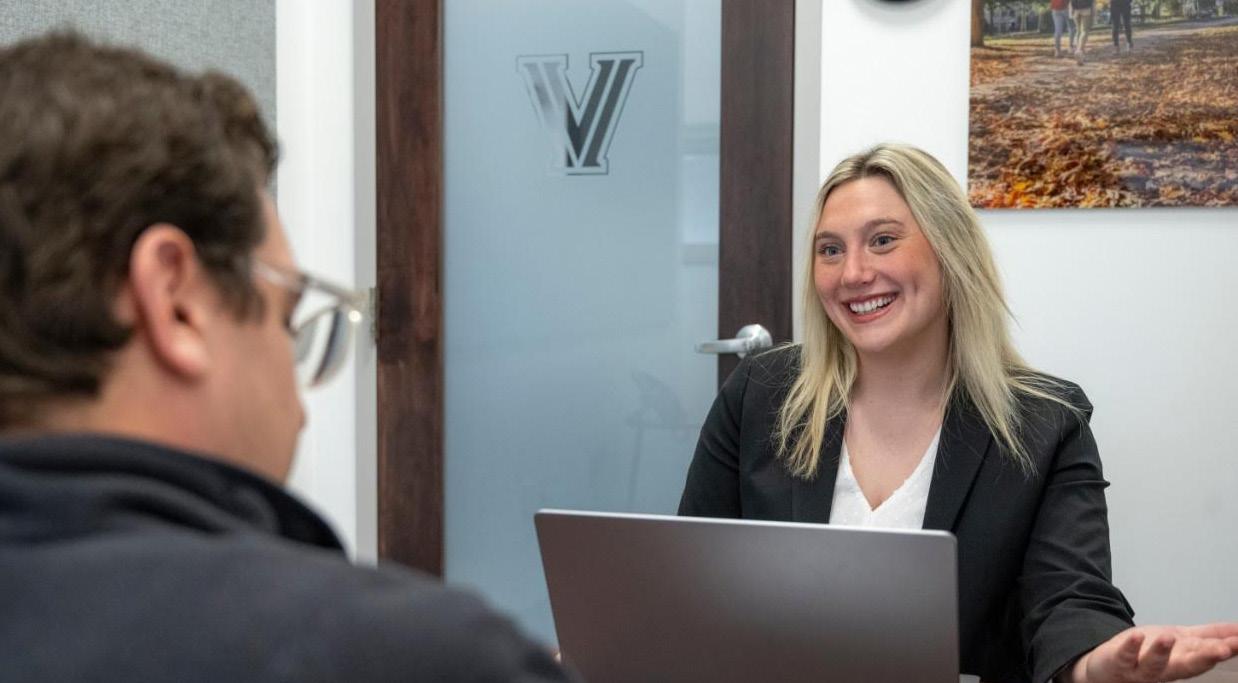
Internships offer many benefits in professional development and real-life application. Courtesy of Villanova University
Phone usage is as much a societal issue as it is an individual one. Erick Quezada/Villanovan Photography
It’s Time to Call Maduro What He Truly Is: A Dictator
Camila Caruso Staff Writer
The morning of Jan. 3 was one that I had been expecting my whole life. Yet, seeing it finally happen was shocking. I checked my phone that morning, and the first message I read was “Wake up NOW! Caracas is being bombed.”
By now, most people know about the intervention of the United States in Venezuela that took place on Jan. 3. Hundreds of articles in major media outlets, from ABC News to The New York Times, have been telling a partial truth: “Venezuela´s President Nicolas Maduro was captured.” But there is a keyword that takes away 26 years of oppression: president.
Here is when I say the truth: Nicolas Maduro is not a president. He is a dictator. This statement has somehow become controversial. Social media is flooded with comments, often from people on the left, arguing that Maduro remains a constitutional president. What makes this even more infuriating is that when Venezuelans explain what we have endured for years, these same voices that claim to defend equality and human rights dare to tell us it is not true and that Venezuela is fine. It seems that defending left-leaning ideologies is equal to defending any self-proclaimed socialist, including a dictator who has committed crimes against humanity. But the truth is that those supporting equality should also oppose Nicolas

Maduro. Calling him a dictator is not rhetorical. To understand why, it is important to trace the events that have brought Venezuela to its current situation.
Everything started 26 years ago when Hugo Chávez came to power, but the more important events are those around Venezuela’s last presidential elections on July 28, 2024. This story starts with the Nobel Peace Prize Winner María Corina Machado, who won the primary election to be the opposition candidate for the presidency. She was barred by the Supreme Court of Justice from participating in the elections and accused of treason against the country, among
other charges. Eventually, the opposition went to Edmundo González, a person who at the time was unknown not only to Venezuelans but also to the government. This allowed him to run in the elections, and he was ultimately elected president. From this point on, everything began to go wrong. Despite having evidence that Edmundo González is the president chosen by the Venezuelans and that the National Electoral Council never published the records of the elections, Maduro was sworn in as president in an illegitimate ceremony. More information can be found on the Carter Center report, the North Macedonia report on the results and the records
of votes on the opposition’s website, Resultados Con Venezeula, that were collected by both political parties and citizens who did not abandon the polling stations until every single record was collected.
Millions of Venezuelans have been impacted by Maduro´s oppression, including Villanova students, like sophomore Haile Tovar.
“I immigrated to the United States in 2019 because my father, an electrical engineer who worked for Corpoelec, began facing political persecution and genuinely feared for his life,” Tovar said. “During the nationwide blackouts of 2019, he was wrongfully accused of sabotage, when in reality, they were the result of corruption and chronic underfunding of public infrastructure. He came close to becoming one of the thousands of Venezuelans who have been imprisoned, kidnapped, or killed simply for opposing the regime, a characteristic of a dictatorship.”
Tovar’s father’s history, one of many cases of persecution caused by Maduro’s regime, takes me back to that morning of Jan. 3, when I learned that the dictator who caused so much harm to my country was finally going to face justice. Personally, having been born into this political system without knowing anything else, it fills me with hope for change and a better future for Venezuela. I believe it is essential to bring these conversations into our classrooms and, when we do, to name things for what they are. A dictator is a dictator. There is nothing wrong with saying it plainly.
Nicolas Maduro was arrested by a United States military operation on Jan. 3. Dylan Johnson/Villanovan Photography
CULTURE
Villanova Hosts Annual ASA Expo in Connelly Center
Christopher
Staff Writer
On Jan. 31, students, faculty and guests gathered in the Connelly Center to celebrate Villanova’s annual ASA Expo. Audiences bore witness to a spectacular celebration of multiple Asian cultures with pride shining through every inch of the Villanova Room.
ASA, or Asian Students Association, is the largest multicultural organization on Villanova’s campus. This year’s ASA Expo, the fifth since COVID-19, served to highlight the richness of different Asian customs, fashion, food and more. Elaborate dances, elegant clothing and Labubu dolls were the name of the game at this event.
“ASA Expo is an amazing showcase of different Asian organizations and even multicultural nonAsian organizations,” Co-Chair Joshua Wentz said. “It’s a great way to just learn some more about Asian culture and a phenomenal way to spend time with others and watch some amazing student groups perform.”
Attendees were treated to song and dance performances from a variety of Asian campus organizations, namely the Vietnamese Student Association (VSA), the Chinese Students Association (CSA), the Filipino American Students Association (FASA) and the Korean Students Association (KSA). Dance teams like NOVA NASSA and ABLAZE showed off their showstopping moves. Even organizations like Sigma Psi Zeta Sorority, Villanova Taekwondo and the Japanese Language & Cultur-


al Studies took part in the show.
Each year, the ASA Expo incorporates a new theme into its production. The theme this year was Blind Box, sets of sealed mystery packages with surprise collectibles like toys and keychains. Pop Mart, a Chinese-based retail store known for its Labubu dolls, was especially all the rage.
“So, Pop Mart is a pretty common store in popular culture, especially in Asian ethnic backgrounds, and so we just thought it’d be a great way to showcase some Asian-oriented experience,” Wentz responded when asked why the ASA Expo team decided to go with a Pop Mart theme this year.
When audience members were asked what their favorite part of the whole event was, they raved about the performances. The footwork and synchronization of all the groups was a sight to behold, whether it be the FASA students with their tinikling, the Taekwondo students turning martial arts into a brand-new dance form or KSA rocking it like the Saja Boys from KPop Demon Hunters
“I was super impressed with the Filipino dancers and NOVA NESSA. I just loved seeing how laidback and fun it was. It wasn’t serious, and everyone was just having a good time,” freshman James Bannon commented about the Expo.
Attendees also had positive
opinions on the fashion show that capped the event off. Students representing many of these cultures—Chinese, Bangladeshi, Indian, Vietnamese, Filipino, South Korean—dressed up in elaborate garments and took to the stage brimming with confidence while everyone cheered them on. It was yet another strong showing of how unique all the cultures are from each other.
“I find it really interesting seeing the different patterns and also the different style of clothing throughout the different cultures, and you can kind of see how they’re different, but also how they’re connected in a way,” senior Dayron Chavez-Gamboa said.
One cannot forget about the delectable foods being served at this event. Tiffin came through with its exquisite South Asian and Indian meals, as did Jin Ding Restaurant and Little Basil with appetizing East Asian and Chinese meals. Seeing everyone socialize over plates of fried rice, samosas, pepper chicken and more inside COVA was a magnificent way to end the night.
“ASA is just extremely welcoming and inclusive to everyone and everyone is treated [well], and I just say that you’ll just know that from ASA Expo, you will gain insight into the lives of individuals from Asian cultures, and you will have a great time and eat some great food,” Wentz said.
More information about every group in the event can be found on their individual Instagram and VUGroups pages.
They are all incredibly welcoming to new members, even those who do not identify with any Asian cultures personally.
The Room Where It Happens: ICE Crisis
Hudson Zivic Staff Writer
The phrase “history repeats itself” is widely known and often used for various reasons.
It highlights recurring patterns in human behavior, societal trends and historical or political events.
That’s where Hamilton: An American Musical comes in. The comparison for this analysis: Is history really repeating itself?
By examining a quote from the musical alongside a contemporary political story, we can explore whether the ideals, conflicts and ambitions that shaped the early republic are echoing in current events, or if what appears familiar is simply history’s rhyming, not its repetition.
One of Hamilton’s clearest reminders about power and governance appears in “Cabinet Battle #1”: “You’re gonna need congressional approval, and you don’t have the votes.” It reflects a system built to slow power down, to force debate and to prevent any single authority from acting without restraint.
That principle feels especially relevant amid the current conflicts involving U.S. Immigration and Customs Enforcement (ICE). In early 2026, these enforcement actions stemmed from President Don-
ald Trump’s renewed immigration strategy, which emphasized aggressive interior enforcement and expanded federal authority. As that plan was implemented, particularly in Minnesota’s Twin Cities, it quickly encountered legal challenges, public fear and judicial resistance.
What has made this moment especially alarming is not only the legal disagreement, but how dangerous and violent enforcement has become. Armed ICE operations in residential neighborhoods, detentions of U.S. citizens and confrontations that escalated into gunfire have shaken public trust.
In Hamilton, moments of crisis are often framed as fragile pauses before long-term consequences form. “This is the eye of the hurricane,” Hamilton warns, a calm before accountability.
The current ICE conflict mirrors that tension. Federal judges have repeatedly intervened, citing violations of habeas corpus, due process and direct court orders. In doing so, the courts have asserted a constitutional check on executive ambition, following the same limits emphasized throughout the musical.
The detention of a five-yearold child and his father became a defining moment in this conflict. A federal judge ordered their release, citing constitutional concerns. While
the ruling focused on legal standards, the broader public reaction reflected something deeper: fear that civil law enforcement, when accelerated beyond restraint, can cause real and lasting harm.
Violence has further intensified that fear. Fatal encounters connected to ICE operations have prompted federal investigations and widespread alarm. This escalation forces the question: how much risk to human life is acceptable in the execution of civil law? That question is not partisan. It is foundational.
Courts, communities and officials are grappling with what it means to stand for legality, restraint
and human safety when enforcement power expands faster than oversight.
Like the early United States dramatized in Hamilton, the nation is once again testing the limits of executive authority. The founders anticipated moments like this, building a system designed to restrain power before it turns destructive.
The current ICE conflict shows those safeguards under pressure, but still functioning.
History does not repeat itself exactly. However, it rhymes, especially when ambition moves faster than law and when fear and violence signal that the balance between power and restraint has been pushed too far.
Brown
The Connelly Center served as the site of the annual ASA Expo over the weekend. Christopher Brown/Villanovan Photography
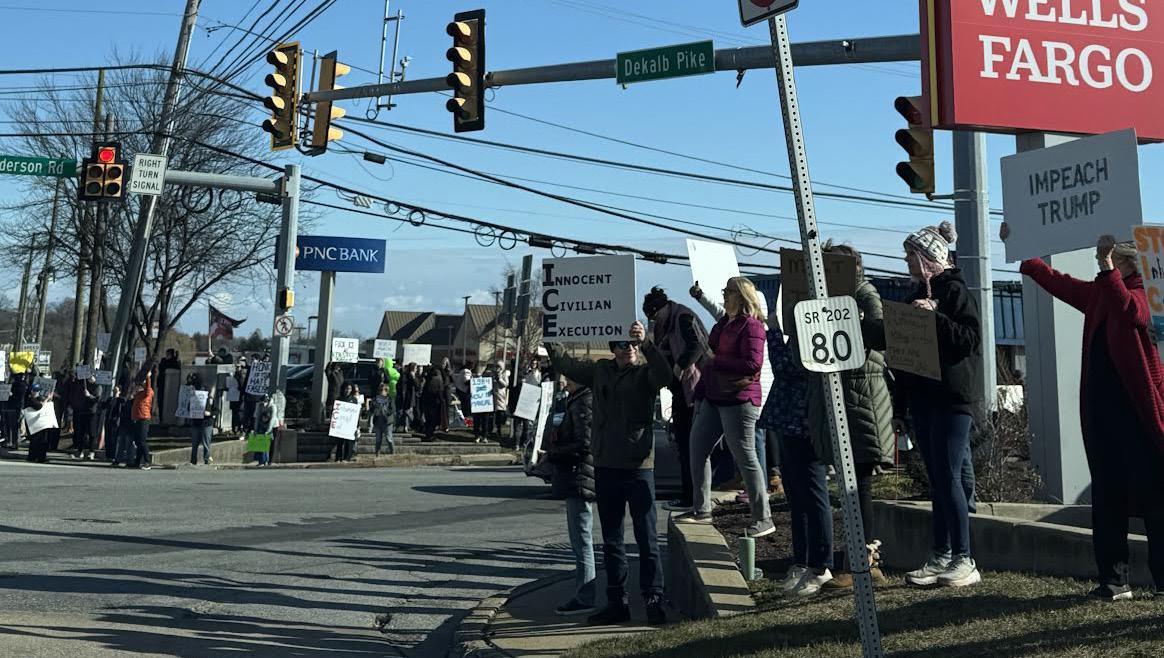
The presence of ICE in major cities, and their violence against civilians, has raised major concerns. Lauren Armstrong/Villanovan Photography
The Villanova Singers Roll Out Annual Singing Valentines

Cali Carss Co-Culture Editor
There are plenty of ways one can celebrate Valentine’s Day in college. Students can go on a date with a significant other, have a movie night in with roommates, decorate desserts at a “galentines” party or do just about anything else one’s imagination can dream up in a red-and-pink theme. One tradition that is specific to Villanova, though, and promises to feature in everyone’s plans one way or another, is the Villanova Singers Singing Valentines campaign.
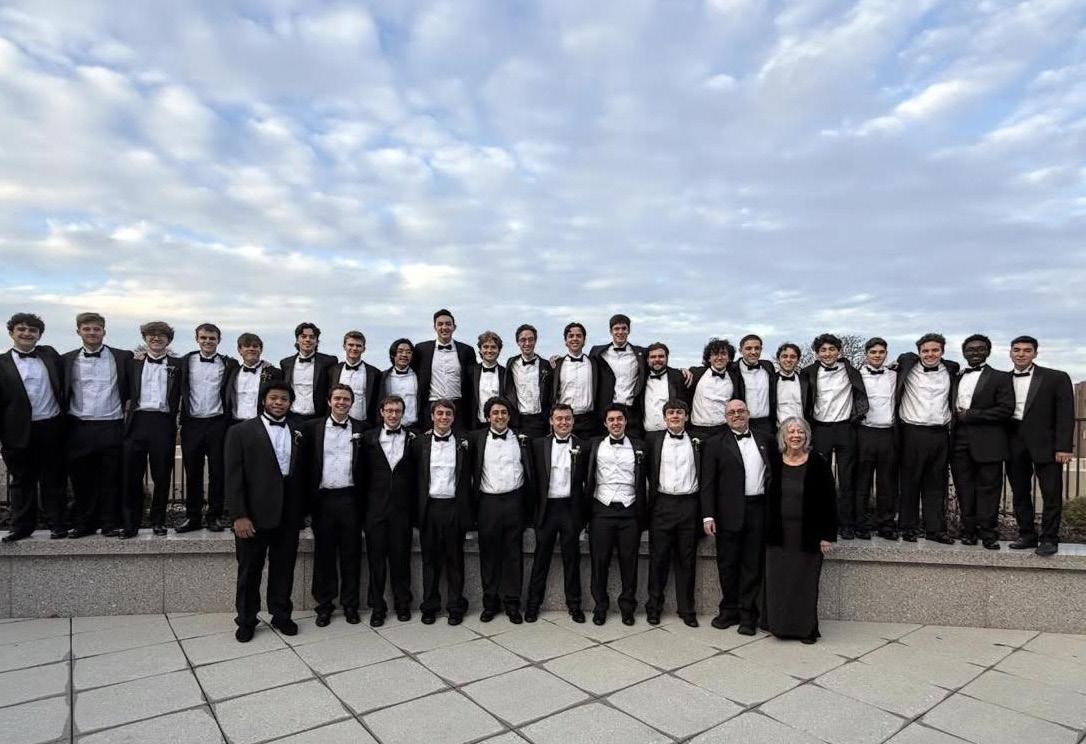
Every year on Valentine’s Day since 1979, the all-male singing group can be seen running around campus in quartets, fully dressed up in tuxedos, barging into classrooms or waking up unsuspecting students with their serenading skills. They perform “You Are My Valentine,” a short song modeled after the universally known “You Are My Sunshine,” to each shocked recipient.
“[Usually] people are a little shy or bashful about it,” Villanova Singer’s President Marco Klisch said. “But it’s honestly so much fun to be able to bring that fun realization to people about what is going on.”
But regardless of the slight embarrassment that comes with being serenaded in the middle of an otherwise mundane class day, these Valentine messages create fond memories for students to look

Sophie Latessa Managing Editor
Dear reader,
back on (once the blush eventually subsides).
“It is a great gift to give someone,” junior Julia Prendergast said. “It was super funny when they walked into my classroom, and it brightened my day. My Latin class all loved it.”
Student reactions and engagement outside of the group itself are obviously important. However, that doesn’t mean the Singers see this day as a tedious part of their club commitments. Performing in every part of campus possible creates scores of unique memories and experiences that the Singers share and remember long after Valentine’s Day is over.
“[One year] we were doing wake-up calls, and we had the golf cart down by Campus Corner, when I snapped the key off in the ignition,” Treasurer Aleko Zeppos shared.
“Then, the five of us had to run back to the Connelly Center in our tuxedos. I remember it was freezing, and there were kids trying to walk to their 8:30s, and it looked like the men in black were chasing them.”
This tradition has made quite the comeback in the years post-Covid and has now become an icon of the spring semester. As the club’s main fundraising effort for the entire year, members couldn’t be
more excited to see their schedule fill up each Feb. 14.
“Every single one of the Singers participates across campus,” Klisch said. “We need all hands on deck because between all the wakeups, all the class calls, it gets pretty busy. Especially to do all that in one day, we have [to have] all Singers doing it.”
The Singers have a unique and incredibly strong culture among the members, both on campus and with alumni supporters. They perform, travel, network and spend time together all year long.
The Singing Valentines are just one of the most forward-facing representations of that bond.
“Our alumni song that we sing at every concert, with the alumni that spans back to the ‘50s, is called ‘Brothers Sing On,’” Zeppos said. “It really is brotherhood. It’s just a great way to meet some really great people, that are current students and beyond, that are very accomplished in the world.”
This year, Singing Valentines will be delivered on Friday, Feb. 13, through wake-up calls to any student dorm on campus and to classrooms throughout the day (with certain professors being marked off-limits).
Other options include calls and emails that will be delivered on actual Valentine’s Day, due to Valentine’s Day not happening during classes. The Singing Valentines can be ordered online and are available for purchase through Feb. 10.
A Villanova Guide To Life Everywhere
have much to learn, but so do we all. You have 30 extra seconds. Always hold the door.
As I write this, I am becoming acutely aware of the fact that I am an American girl in Spain, unashamedly listening to the Mamma Mia soundtrack as she clumsily experiments with writing her first-ever newspaper column. “We don’t claim her,” the Spaniards all chant in unison. Though I am three weeks into my study abroad experience and loving it so far, the seamless integration into Spanish society is still a work in progress.
More often than I anticipated, though, I have found myself lingering on thoughts of Villanova and its homey charm whilst here. Our college days are formative for us all, so many of the lessons we have learned about life and about ourselves likely tie back to Lancaster Ave. As it turns out, I am finding that these lessons seem to apply to life everywhere, international or otherwise. Here, I hope to unpack the (at-times awkwardly executed) application of these teachings with you all and answer one important, terrifying question: how does what we have learned in college apply to our lives beyond Villanova’s campus? Each week, I will share tidbits of wisdom, brought to you by Nova Nation, and discuss how I am testing out their application internationally. I must preface by saying that I am by no means a philosopher. In fact, I have pushed on approximately 20 doors with “pull” printed on them since arriving on this continent. I still
When I first arrived on campus, I remember being shocked by just how long people were willing to wait to hold the door open for one another. It is often a bit of an awkward dance as the door-holder decides whether the approaching target is within range or slightly too far away. Yes, I originally received a sidelong glance from the Spanish woman with whom I had a classic door-holding standoff yesterday. In hindsight, she was probably a bit too far away, so my holding of the door may have actually made both of our afternoons more awkward. But in the end, her confusion turned to a smile.
At Villanova, when in doubt, we hold the door. We take one extra moment out of our day to show consideration for a stranger, a simple smile shared as a “thank you.” This works in any language, so you might as well keep doing it wherever you go. It’s awkward to make new friends: a universal experience.
Allow me to paint a picture some of you may be familiar with: it is freshman year and the second night of college. I am wandering around the famed Water Ice Social utterly alone. With no alternative option aside from social disgrace, I swallow my pride and tap two random girls on their shoulders, asking to join the conversation they are engaged in.
The friend-making skills I learned during freshman year suddenly came back into play when I arrived in Spain, surrounded by a sea of unfamiliar faces. I once again found

myself cheerily stating my name and major ten times a day and striking up a conversation on a whim because I liked a girl’s shoes. It was just as awkward as I remembered it. Sometimes this process works, though. I have made exceptionally kind new friends here who, after knowing me for merely two weeks, went all-out to celebrate my birthday with me. And remember those girls I approached on my second night at Villanova? Those are my roommates. When in doubt, fight the awkwardness and put yourself out there. You could be one shoulder-tap away from your future best friend. You’re never too old (or too cool) to stop and take a picture of the church.
By the end of my freshman
year, I felt like a tourist whenever I stopped to take a photo of our beloved church. Here, I’ve found a similar sensation when stopping in the middle of the sidewalk to take pictures of, well, everything. I’ve only been in Spain for three weeks, but judging by the number of orange tree pictures in my camera roll, you would think I had been living here for months and months.
What I eventually learned at Villanova is that there is always a new angle to be taken of the church or a new sunset to capture behind it.
In my personal opinion, it is never uncool to whip out your camera and seize a beautiful moment, even if you’ve seen it 100 times before. Some views just never get old.
The Villanova Singers are a fixture of campus life, especially on Valentine’s Day. Courtesy of @villanovasingers on Instagram
In place of our iconic church, Sophie has been taking in the scenery Seville has to offer. Sophie Latessa/Villanovan Photography
Albert Lepage Center: “Media, Pop Culture and History”

Sophie Cossio Staff Writer
George Santayana, a famous Spanish philosopher, famously stated that “[t]hose who cannot remember the past are condemned to repeat it.”
His words suggest that history holds an important place in today’s society and bears warnings for those who will listen.
However, the way history is viewed and digested has now dramatically changed. Students gain knowledge of the past from film, TV and video games as frequently as they do from books.
On Tuesday, Jan. 2, the Albert Lepage Center for History in the Public Interest held a webinar titled “Media, Pop Culture, and History” that aimed to answer the question, “How do film, television and now video games shape our understanding of the real stories behind the screen?”
The webinar featured Peter Raleigh, PhD (Long Library), Pamela Robertson Wojcik, PhD (University of Notre Dame), Makeba Lavan, PhD (Grinnell College) and Jeremiah McCall, PhD (Cincinnati Country Day School).
Dr. Wojcik opened the discussion by presenting her research into whether and how media, especially cinema, can be influenced by of the social and political climate in which it is produced.
She addressed the concept of reflectionism, the suggestion that movies can reflect national ideas or
Emma Cote Abroad Correspondent
I’ve always known Rome wasn’t built in a day, but I’ve come to find out you can’t really analyze the city in a week either.
It’s been seven days abroad, and while I have genuinely appreciated every minute of it, it’s easy to feel small in a place that is both massive and unfamiliar.
You can only bring so many books when you travel, and I chose to bring a familiar favorite of mine, The Anthropocene Reviewed, by John Green.
The essay collection embarks on the daunting task of analyzing all of humanity’s existence by boiling various events, discoveries and inventions down to five-star ratings. From cave paintings to Diet Dr. Pepper, Green goes on for hundreds of pages simply about things that humans have managed to accomplish, create or love.
I chose to employ that same technique to describe what Rome has meant to me so far, and have taken note of seemingly arbitrary aspects of my home base city that have already left an impression.
Nasoni Fountains
“Nasoni” or “big nose” fountains are scattered throughout the city, offering a constant source of cool water for anyone walking through the streets.
The spout is positioned at an incredibly awkward height, and they’re very plain. Embedded in a city rich with architectural grandeur,
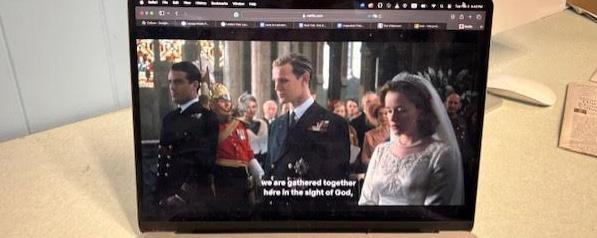
contemporary understandings of a time. Wojcik believes the problem with this idea is that often, viewers and scholars will project “overly simplistic understandings of a historical period back onto films.” She explained that we, as viewers, cannot view the ideas expressed in a piece of media as reflective of the entire national psyche, but as a part of a larger context.
Dr. Lavan spoke next and outlined the courses she teaches on media and history at Grinnell College.
She asks her students to reflect on the questions: “How do we decide which stories we tell? Who decides the stories that are important to publish and adapt into film and television?”
Her classes survey what is said and unsaid in media that centers black stories, how the myth and themes around vampirism often reflect issues of bigotry and society and why adaptations rarely depict black stories and the issues with those that do.
She also teaches courses on African American literature that address topics such as whiteness, blackness and propaganda in the media. Lavan’s classes feed directly into her research on the depiction of interracial relationships across differing forms of media, and how that works as propaganda to minimize the damage of the rise of fascism.
Dr. Raleigh, who teaches ancient and medieval history, spoke about the challenges he faces when dealing with his students’ preconceptions of history, as they often stem from popular culture. He explained that he grapples with how to respond to the fact that students derive so much of their sense of the past from media that reflects concerns and material conditions of the present.
Raleigh talked about the way that films present the past in ways that are shaped by modern concerns and ideas, bringing up the example of Zack Snyder’s 300 film being released during the Iraq War and portraying a heroic Westernized figure versus
Unpacked: First Impressions

they’re nothing fancy. Regardless, I’ve seen them constantly in use by the city to quench thirst, clean scrapes and wash hands. I’m just getting acquainted with the area, but within a week of being here, I already know the exact fountain along my route to school that I have used to fill up my bottle almost every day. At this very fountain, I have seen familiar faces doing the same. While we don’t know each other, we all share a stop on our way to class, work or elsewhere. The convenience and notability of the fountains connect the city, and have already become a part of my routine as I settle in.
I rate Nasoni Fountains 4.5/5 stars.
The Metro
Last summer, I spent three weeks in Washington, D.C., riding the Metro every day. While here, I’m reminded of just how much I took that public transportation system for granted. This week, the Metro in Rome was down simply because it
a Middle-Eastern enemy. His main concern is that students encountering these movies now no longer have the context necessary to understand the social attitude of when they were made, and may misinterpret their historical meaning.
His final point was that although films may be taken out of context, “no single argument about the past can ever be expected to be received by the audience in a sort of homogenous way,” and that he works continuously to meet students where they are in terms of their understanding of the past.
Dr. McCall then spoke about his field of research, historical game studies. He suggests that video games can be treated as secondary sources to study and critique, similar to films and later historical texts.
McCall believes games present the past as “problem spaces” in which players act as independent agents with goals, choices and restrictions in a simulated world, making history understandable through interactive gameplay. Although they vary in degrees of accuracy, games can still help develop historical understanding and critical thinking about the past.
The Q&A emphasized the panelists’ beliefs that the use of media in teaching can help students understand greater truths about history, as long as it is paired with critical discussion and primary sources. History should be actively engaged with and critiqued. Media, films and video games can and should stimulate deeper historical inquiry.
that I’ll find one I miraculously enjoy in the “right” place. I’ve come to find that my attitude towards the taste is not contingent on what cafe I actually go to, and that it’s just simply not for me.
rained. Oftentimes, there are hourlong delays with no explanation whatsoever. This happened when I had an academic advising meeting, which I ran into 10 minutes late and profusely apologizing.
“Why are you sorry,” my advisor asked. “You’re here.”
While this unreliability has already fostered a sense of anxiety in my everyday transportation, it has also forced me to slow down and adapt to inconveniences. In Rome, attitudes towards timing are generally a lot different than back in the United States. Being late isn’t an emergency, and there’s no need for specific ETAs or time constraints. Slowing down has been a challenge for me, but is something I’m growing to appreciate as the days go on.
Regardless of these lessons, I still rate the Metro 2/5 stars. Espresso Ultimately, I hate the taste of espresso. I’ve already trekked through the city to dozens of cafes, hopeful
This conclusion led me to a little family cafe just down the road from my apartment. What was supposed to be a 10-minute coffee stop before meeting my friends turned into an hour-long conversation with both of the owners. During this time, I drank an espresso. Coffee here isn’t a stop through a drive-through or chugged between classes. It’s a social event in itself. Even the way in which one is “supposed” to enjoy the drink is methodological: drink the water, stir the espresso and commonly consume in three sips. While I still don’t necessarily love the intensity or the bitterness, I find this part of my day to be a highlight. I have gone to that same cafe the past two days, and appreciate the friendship it’s already given me.
I rate espresso 5/5 stars. There are so many distinct characteristics of my home base, and I’ve already grown to love so much of what makes Rome unique. I’m constantly reminded of the corners of Villanova that make it feel like home, and can draw many parallels between the communities that form through seemingly mundane aspects of routine.
While I’m still finding my footing here in Rome, I’m headed on my first trip out of Italy. Next week, I’ll be writing from Zurich, Switzerland.
Until then, Emma
These days, students are turning to film, television and video games to grasp history. Maggie Fitzgerald/Villanovan Photography
Take in a quintessential sight from Rome. Emma Cote/Villanovan Photography
Love on Lancaster: Like Mother Like Daughter

Maggie Fitzgerald Co-Culture Editor
Are you buying things in bulk solely because they are on sale? Do you find yourself obsessively turning off the lights behind you? Saving random containers for later? Have you caught yourself assuming your roommate’s little cough was the black plague? Be honest. Are you reading important messages and replying hours, maybe even days, later? If the answer to any of these questions is yes, I hate to break it to you: you’re turning into your mother. And folks, I’m right there with you.
No need to panic, you won’t magically wake up one morning with an aggressive side part and a frustratingly low IQ for internet memes. This is a gradual process, one that comes in waves. From a young age, we are taught to fear this evolution. The concept of turning into our parents is one laced with dread because to give in to this phenomenon is to somehow throw in the towel and abandon our youth. However, contrary to the general sentiment of Progressive Insurance advertisements, this transition may not be so bad after all. Call it my frontal lobe developing, but if this conversion comes in stages, I have moved past denial and accepted my fate, embraced it even. With newfound enthusiasm, I can now joyfully recount how I have invariably become my own mother.
When you’re young, oftentimes, your mother can do no right.

Kate Koslow Staff Writer
“Freedom is a funny thing, isn’t it? When you have it, you don’t appreciate it, and when you miss it, it’s gone.”
Like a gut feeling you can’t quite shake, Paul Thomas Anderson’s One Battle After Another is a film impossible to forget. It’s a wild and winding ride, bound to keep your palms clammy and heart-racing for the entire two hours and forty-two minutes. A serious contender for Best Picture in the upcoming Academy Awards, this film isn’t just relevant, but a call to action.
The first half-hour is a masterpiece alone. In an action-packed sequence, a determined revolutionary group called the “French 75” carries out radical protests, ranging from storming an Immigration and Customs Enforcement (ICE) detentioncenter to blowing up offices against abortion rights. These attacks were intense and chaotic, all in the name of “the revolution.”
In the French 75 is the “Rocketman” or Bob Ferguson, the explosives expert played by Leonardo DiCaprio, and his girlfriend, the fierce Perfidia Beverly Hills, played by Teyana Taylor. Along the road, Perfidia makes enemies (or should I say obsessed harassers), including the terrifying Colonel Lockjaw, played by Sean Penn. After Bob and Perfidia have a child, a bank robbery goes south, causing Perfidia to be arrested and forcing Bob and his baby to flee

Whether it was the TV shows she wouldn’t let you watch, the crockpot meals she insisted you eat with gratitude or just her general sentiments of overwhelming love and affection, something was always an issue for your teenage self. I am getting painful flashbacks to junior high, sending snarky texts and sneaking out of the house in tops I was banished from wearing. Shame is washing over me as we speak. All the fussing and the particularities were unexplainably and unjustifiably maddening. We swore to be different, to never take away our future child’s phone after they spent ungodly amounts of time on social media at the ripe age of 10. Yeah,
that will turn out well. Incoming parent of the year.
The Awakening
But friends, you will come to the realization that you have made a grave mistake. You were wrong. It might be time to buck up and admit that your mom is actually cool. Gasp. Trust me. This great awakening, if you will, will cause you to lose sleep at night. It is a normal part of the transition. One day, when you are perusing her closet, it will dawn on you that she is fashionable. That you would actually wear that purse. One day, when you are listening to Hall and Oates, it will hit you that she also has good music taste. One day, when
Reel Talk: One Battle After Another
to a secure location: a small town called “Baktan Cross.” Perfidia flees from witness protection to Mexico after acting as an informant to the police, leaving Bob to raise their baby alone.
Sixteen years later, Bob and his daughter, Willa, played by Chase Infiniti, live a simple life. However, when Bob’s past, including Lockjaw, catches up to him, he is forced to save his daughter in this thrilling adventure, which can only be described as one battle after another.
The performances, labeled by Martin Scorsese as “extraordinary,” perfectly portray Anderson’s outrageous and uniquely individual characters. DiCaprio’s portrayal of Bob, a paranoid, washed-up father with a semi-serious drug problem, is hilarious at times and surprisingly touching at others. His devotion and love for his daughter are constantly present, going to unbounded lengths to protect her in even the most unfit state.
On the other hand, Penn’s disturbing performance as Lockjaw is unlike anything I’ve seen before. The character is every shade of creepy, as Lockjaw isn’t just obsessed, but a twisted and power-hungry supremacist. Another role I couldn’t possibly ignore is Benicio Del Toro as Sergio St. Carlos. Acting as a karate sensei by day and an undocumented-immigrant-harborer by night, this calm, cool and collected character became a fan favorite we’d all want to have in our corner.
However, these characters are just a piece of why this movie is so special: Anderson’s stylistic choices
you and your friends have taken up the farmers market as sport, you will remember the early Saturdays spent with your mom, and your new fate is inescapable: you want to be just like her.
The Shadowing
The next phase can only be described as your copycat era. Once you have confronted the fact that your entire life was a lie and you unknowingly drank the anti-mom Kool-Aid, doors will open. Without even realizing what life-altering shift has occurred, you will start buying napkins based on the holiday season, a habit you once abhorred. You will soon wake up and journal, your mom’s nonnegotiable throughout your childhood. If things get really bad, you will actually bring Rick Steves on your study abroad, referring to your mom’s old comrade with trust and affection. Soon, you will look in the mirror and see your mother; welcome to the club.
The Collaboration
The best is yet to come. While shadowing your mother like a young apprentice is good, and well, it only goes up from here. Once you swallow your pride, accept wrongdoing and apologize for your years of abuse, you can unlock your mother as your newest, coolest companion. Skip into that TJ Maxx with glee, maybe even hold hands while you shop for next year’s wrapping paper on Dec. 26, when it’s on sale, of course. Hand in hand, like any good pair of twins, go forth into the world joyously. After all, mother knows best.
Love you, mom.

bring visual storytelling to another level. Shot on a VistaVision camera with 35mm film, there are wide, horizontal shots that emphasize a detailed, vast image. The rough and chaotic movement of the camera imitates that of a 1970’s thriller, with low-angle shots close to the ground emphasizing the fast action. One of the most notable scenes in the movie is a long car chase, distinct from the VistaVision camera, a true pinnacle of tension and action. These scenes are only elevated by the soundtrack written by none other than Johnny Greenwood, the lead guitarist of Radiohead. The music perfectly captures the panic experienced by both the characters and the audience, in scenes that range from intense nail-biters to moments of ridiculous and unexpected comedy.
Still, One Battle After Another isn’t just well made, but daringly political, making it not just memorable, but important. While the story follows the classic fight-against-evil narrative, Anderson takes it further by complicating the means of these
“heroes,” showing how noble intentions can lead to extremes. Their passion turns to pugnacity, their righteousness to recklessness, and their methods begin to mirror those that they despise so much. Yes, they acted, they sacrificed and they chose to denounce compliance in a corrupt society. Yet Anderson forces the audience to question where the line lies and what it means when that line is crossed.
Nonetheless, through these uncertainties are moments of clarity and hope. The audience witnesses a conviction and a comeback from those willing to stand up and make a change. A surprising network and community are formed within the depths of this chaos, inspiring all in the audience to wake up and fight back against injustice.
One Battle After Another is more than just a movie. It is a reminder that freedom is never simple, but must be protected, not just for ourselves, but for those around us. So, as Anderson questions, when injustice is present, will you act or stand by?
Are you turning into your mother? Maggie Fitzgerald/ Villanovan Photography
Consider checking out One Battle After Another for your latest movie fix. Courtesy of Eesha Bhatia
Letters from Lauren: Advice to Underclassmen

Lauren Armstrong Senior Columnist
Dear Underclassmen,
The other day, I realized that the last class I will have at Villanova is in the same classroom I had my very first college course in. Freshman year, Philosophy 1000, and senior year, Physics of Sports. Both in a small, random room in the Chemical Engineering building that I could not for the life of me find on my first day of freshman year. Crazy, right?
This got me thinking a lot about what I know now that I did not know back then, and this got my friends and me talking about advice we wish we knew throughout the different years of college.
Lucky for you, we came up with a lot of different pieces on how to layer our clothes correctly for Wells Fargo – I mean Xfinity – tailgates, to recognizing that it is okay to not know what you want to do as a freshman, or even as a sophomore, junior or senior.
So, underclassmen, this one is for you. Consider this your “big sister” advice of the week, but remember that these pieces of advice are tips you can carry with you throughout the entirety of your college career and life beyond.
Freshman:
This is not supposed to be easy. If it were, everyone would be here.
Cliche, I know, but it is so true. Freshman year, I remember getting the grade back on my first General Psychology test and sob -
bing right there in the classroom. I was shocked that the upperclassmen around me were not floored that the class average was in the 70s, and I thought my future was falling apart right in front of me (spoiler alert: it was not). College is designed to be challenging because it forces us to dig deeper and fully understand concepts, not just to memorize them for a test. I might not have done the best in some of my classes, but I have gained undeniable knowledge about topics I would have never explored otherwise.
Please, do not sacrifice warmth for fashion.
The first-ever Wells Fargo game in my freshman year was in torrential downpouring rain. It was horrible. And, a shock to no one, I was not dressed correctly. Since then, I have learned to actually look at the weather app before leaving my room, to invest in boots for the winter, fleece-lined leggings and shirts for underneath my clothes at tailgates and to always have an umbrella available. Am I always the most fashionable? No, but at least I know I am doing what I can to prevent myself from getting hypothermia.
Sophomores:
Yes, you are supposed to be sleeping at night.
My friends and I joke a lot that in my sophomore year, I learned how to run on less than two hours of sleep a night. Yikes. Sophomore year, I have found, is the year when individuals here not only start to get involved, but to take on leadership roles, get even more invested and start to
take harder and harder classes, all while trying to still balance their social lives. What gets sacrificed? Their sleep. Listen, I am not perfect. There are still nights when I may have to stay up late to finish an essay, or when I have more club meetings than I can count, but what I no longer will do is wake up after accidentally falling asleep in the reading room, or not see my dorm room for over 36 hours. It is not normal to be sacrificing your health for the Villanova involvement culture. Getting sleep is good for you, and a night’s sleep should not be the same length as a nap.
Value the Quad.
Okay, do not lose me here. I know right now it may feel like you are living in a shoebox, and you may be one second away from yelling at your roommate if they leave one more piece of laundry on the limited floor space you share, but the Quad is a living experience unparalleled by any other on Villanova’s campus. With ideal people-watching views and the quickest commute to get your favorite sandwich from The Exchange, living in the Quad allows you to live within a three-minute radius of all your best friends. This is undoubtedly a unique experience that you may never get again.
Juniors:
It is okay to have F.O.M.O. from abroad…and from campus.
With a lot of my friends studying abroad during their junior year, I will admit, I had an intense case of feeling like I made a mistake deciding not to go abroad for an entire semester. I would see
videos of them skydiving in Switzerland, going to Oktoberfest in Germany and St. Patrick’s Day in Dublin and reconsider why I was stuck in Villanova, PA. Yet, when I would FaceTime with my friends who were abroad, they would tell me how much they missed the basketball games, the church picnics and the late-night runs. There is going to be F.O.M.O. all around, so just try to live in the moment and avoid comparison as much as you can. Spend time with your seniors.
I knew I would miss my friends in the Class of 2025. For three years, I looked up to them, saw them as some of my best friends on campus, and, quite literally, had an older sister in my big Jane. Then, in the blink of an eye, it was May, and they graduated. Now they live full adult lives and are not around to answer any questions at random times of the day. No matter how much time you spend with your seniors, it will not feel like enough. So, embrace it and remember that even though they may take a little bit longer to respond to your texts, they will still be there for you.
Underclassmen, time goes by fast. There have been rough times, fun times, moments that make me want to drop out and moments where I never want to leave.
So, do not be discouraged. Instead, take risks, be unapologetically yourself and remember that your experience is for you, no one else.
With love always, Lauren

Women’s Lacrosse Returns For 2026 Season
Casey Healey Co-Sports Editor
The Villanova women’s lacrosse team is preparing for its 2026 campaign with high hopes after playing in its first-ever Big East title game last seasona. Head coach Jill Batcheller will return for her fifth season at the helm after leading the ‘Cats to their best league regular season finish in team history.
“It was so awesome to go to the Big East Championship for the first time last season,” Batcheller said. “But we still have a lot of work to do this year as a team.”
The Wildcats were picked to finish second in the 2026 Big East Preseason Poll behind the University of Denver, who defeated them,14-9, in the 2025 Big East Championship.
Last season, Villanova finished with a record of 11-7 and 4-2 in the Big East. A league-high eight players were named to the All-Big East team.
Four players have been selected to the Preseason All-Big East team. Three were unanimous, including junior midfielder Rose Christie, redshirt junior Elena Torres and junior draw specialist Emma Verhoest. Sophomore midfielder Leslie Lorio rounds out the group.
“They’ve all been doing a really great job in being the leaders,” Batcheller said. “And being
the people that the attack can really look to.”
Last season, Christie was named First-Team All-Big-East and totaled 25 points on the season with 18 goals and seven assists. She earned All-Tournament Team recognition after registering six points in the tournament.
During her redshirt sophomore year, Torres started in all 17 games played. She scored 30 goals and 12 assists, along with
13 free-position goals, the second most in a single season in Villanova history. She earned an All-Big East Second Team accolade.
Verhoust is coming off an impressive sophomore season after totaling a program record 174 draw controls. She currently stands as the all-time leader in draw controls per game (8.18) and second for career draw controls (278).
Iorio made an immediate
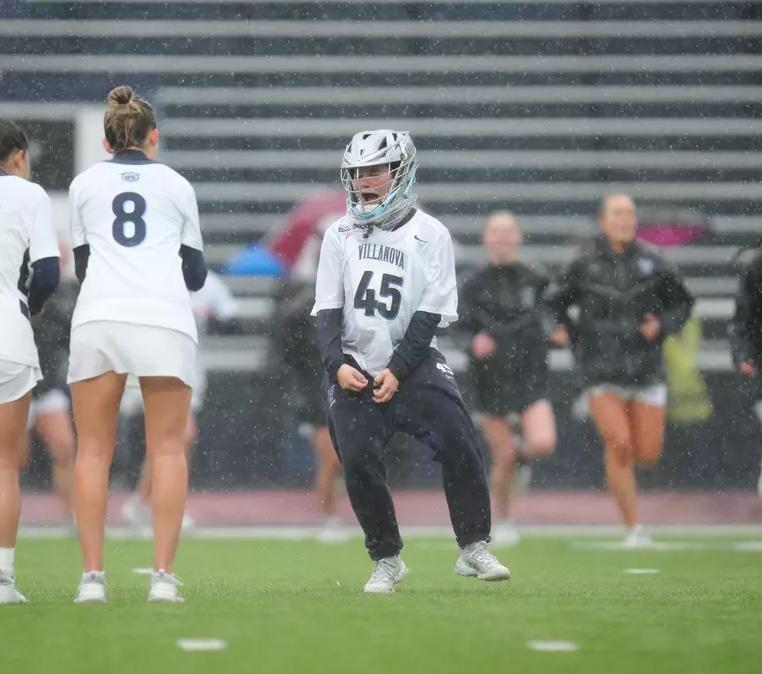
impact her freshman year. The midfielder played in all 18 games and totaled 30 goals in her opening season. She earned two Freshman of the Week accolades and ultimately achieved All-Big East Second Team.
Eight of the Wildcats’ 15 games will be played at home. Villanova will face five repeat non-conference opponents, along with six Big East teams. It will also play Towson for the first time since 2001 and Rutgers, a former Big East rival.
Last season, Villanova fell to No. 8 Stanford and No.17 Navy by just one goal. This year, it is looking to make adjustments after competing closely with the top teams.
“We have an idea of what we need to do and what changes that we need to make,” Batcheller said. “Ultimately, I think it’s just playing a little bit faster and being able to convert on more of our offensive possessions.”
Villanova will travel to Navy on Feb. 14 for its rematch and will face Stanford at home on March 28.
The Wildcats have added five recruits in the offseason as well, including midfielder Abby Beggans, attackers Lily Davenport and Anna Starr, as well as defenders Sophie Jurgens and Logan May.
Villanova will open its season at home on Sunday, Feb. 8, against Towson at noon.
Catching Up With The ‘Cats: John Celestand (‘99)
Dylan Johnson Co-Editor-In-Chief
During the 1999-2000 Los Angeles Lakers championship season, Kobe Bryant was always the first player in the practice gym, followed by rookie John Celestand.
The Lakers drafted Celestand (‘99) with the 30th pick in the second round of the 1999 NBA Draft out of Villanova. He packed his bags and moved out to Los Angeles to live on his own for the first time in his life.
Celestand, a Lakers fan growing up, was immediately surrounded by greatness in his first year as a professional basketball player.
“I’m watching Kobe Bryant get to practice hours before everybody else,” Celestand said. “I would always be the second person to practice. Watching him put that work in to see how great he was.”
The two knew each other before putting on the Laker purple and gold. Bryant, a Lower Merion graduate, would make trips to Villanova. Villanova players would play pickup with Bryant, and he would also come to watch games and join the team in the locker room.
Celestand received a bulk of playing time as a rookie to start the season after Bryant broke the fourth metacarpal bone in his right hand before the season. Celestand averaged around 10 minutes per game during Bryant’s 15-game absence.
The Lakers went on to win the 2000 NBA title, whose roster was already filled with championship rings.
“Ron Hopper had won three championships already with the Chicago Bulls,” Celestand said. “I’m playing with a guy like Robert Horry. He had already won two championships with the Houston Rockets. A.C. Green was on that team. He had won [three] championships with the Los Angeles Lakers. So there was a lot of greatness around me that already knew how to win.”
The Lakers decided not to resign Celestand during that offseason. He decided to take his professional playing career overseas in Europe. Celestand made stops in Braunschweig, Germany, Bologna, Italy, Villeurbanne, France, Berlin, Germany and Kyiv, Ukraine.
He played his last international season in 2005 at Basketball Löwen Braunschweig in Braunschweig, Germany. It was the same team he began his overseas career with, effectively bookending his international playing career.
It was the same year Hurricane Katrina hit New Orleans, where Celestand is originally from. That, combined with other life matters, pushed Celestand to decide to take a year off from playing professional basketball.
“A lot of my family was kind of scattered all over the place,” Celestand said. “At that time, I just didn’t feel comfortable going back to
play basketball. I had an injury, plus everything was happening with Hurricane Katrina. I was kind of like let me sit out a year, and then if I want to go back, I’ll go back.”
After his year off, he would never return to professional basketball.
“I think life hit me, and I saw how tough it was being in the real world,” Celestand said. “And I said, ‘You know what? Let me go ahead and get a start on the real world right now.’”
Celestand became a freelance sports announcer in radio and on television. He worked as an announcer for ESPN+ and ESPNU for nine years, covering college basketball games, including the Big East Conference. Every year, he would cover the men’s basketball Big East Tournament at Madison Square Garden. On top of that, he also had a stint as studio analyst on NBCSP “76ers Post Game Live” for Comcast Sportsnet Philadelphia.
“I think, as time went on, one of the things that got me to move away from [sports] was that it was so tough to move up the ladder, to get to ESPN, ESPN2, the big channels,” Celestand said. “Everybody wants to do this job. I had been doing it for 10 years, and I felt like I hit a glass ceiling. I just didn’t know how much longer I could do it, because I wasn’t making enough money where I could just do only that.”
After jobs at Rutgers Univer-
sity, Goodwill and the Corporation for Public Broadcasting (CPB).
Now, Celestand, who resides in Silver Spring, MD, has been a program director at Local Media Association. The company helps sustain over 26 local news organizations and provides support to foster long-term sustainability and independence of the organizations.
“It was kind of the opportunity to work with black-owned news organizations,” Celestand said. “I thought it was hard, too hard for me to pass up. So that’s how I started working with them. And currently, I work with 25 black-owned news organizations all across the country. The Philadelphia Tribune is one of them.”
Other outlets he works with include the Baltimore Afro-American, The Washington Informer and The New York Amsterdam News.
Most of his jobs have come from the Villanova network, Celestand noted.
Celestand landed his role at Local Media Association after connecting with its CEO, Nancy Lane, through the Villanova University Alumni Association (VUAA). Lane is a 1987 Villanova graduate with a Bachelor of Arts in Sociology.
“So for me, it’s been something that’s tangible evidence that connecting with people and connecting with the alumni association, alumni groups, the Villanova chapters, has worked for me,” Celestand said.
Villanova Prepares For a rainy game during the 2025 season. Courtesy of Villanova Athletics
Men’s Golf Gears Up For 2026 Campaign

Jack McFadden Staff Writer
On Saturday, Jan. 14, the Villanova men’s golf team released its schedule for the upcoming 2026 spring season.
Following an impressive fall season from the Wildcats, the team will head down to Savannah, GA, from Feb. 21-22 to start its spring slate at the Savannah Intercollegiate at The Club at Savannah Harbor.
The Savannah Intercollegiate is one of two tournaments this spring for the ‘Cats in which all 10 players on the roster will compete. It will be a good test for Villanova as it looks at true outdoor play for the first time since November.
On Nov. 6, Villanova successfully closed out its fall season, picking up a team win at the Big Five Championship. The Wildcats had not earned a team win since April 16, 2024, when they won their team-hosted Wildcat Spring Invitational at the Lulu Country Club in Glenside, PA.
“The Big Five win, especially, was just really gratifying for the whole team, the coaches, the guys that were playing and even the guys that didn’t even play that week,” head coach James Wilkes said. “It just showed that we were able to win a very close tournament, and all the things that we preach about, like focusing on the next shot and being able to deal with adversity when we were losing the lead constantly that day.”
The Wildcats took home the
team title, led by senior Matt Zerfass, who won the first individual title of his collegiate career.
The team’s captains, senior Ryan Pamer and Zerfass, both played very significant roles on the roster for the ‘Cats.
“They were our two lowest scoring averages for the season. And they’re great, lead by example guys,” Wilkes said. “Guys like Zerfass and Pamer are leading wherever they can. Whether it’s in the team meeting or it’s at workouts, they’re the guys that are trying to get the guys really pumped up in workouts. They’re the ones that are in there doing extra work, and the guys know it.”
Going into the spring, the Wildcats are looking to build upon the momentum they created in the fall. The senior captains will serve as the team’s foundation, having performed all season long.
However, if the ‘Cats want to have a successful spring season, there are several factors worth considering.
“Success for us is going to be, not only what we do in our day-today preparation, but just looking at when we’re done with each tournament, did we perform at our best?” Wilkes said. “Did we give 100% throughout? Did we leave everything out there? And if we do that, that’s going to be a success in the coach’s eyes. We can’t define our success on another team.”
Following their spring opener, Villanova will stay in Georgia for the People’s Championship, hosted by Western Carolina, from March 12-14 at St. Simon’s Island. The tournament is a 54-hole event. Last year, the Wildcats placed in fourth place out of 20 teams competing.
After this spring’s People’s Championship, Villanova will take part in three additional tournaments before playing in the Big East Championship at the Riverton Pointe Golf and Country Club in Hardeeville, SC., from May 2-4. Last year, the ‘Cats finished tied for fourth place.
Jan. 28 - Feb. 3
Friday, January 30
Men’s Basketball vs. Providence 87-73 W
Men’s Swim vs. Seton Hall 97.5-143.5 L
Men’s Tennis @ Delaware 0-7 L
Women’s Tennis @ Delaware 1-6 L
Women’s Track @ Penn Invitation No team scoring Saturday, January 31
Women’s Basketball vs DePaul 69-56 W
Men’s Track @ Boston University No team scoring Sunday, February 1
Women’s Water Polo vs Santa Clara 9-3 W
Men’s Lacrosse To Open Season Against No.7 Penn State WEEKLY SCOREBOARD

Sammie McKee Co-Sports Editor
This weekend, Villanova men’s lacrosse kicks off their 2026 season, facing Penn State University in University Park, PA.
Coming off of a second place selection in the 2026 Big East Preseason Poll, hopes are high for the ‘Cats, looking for their fourth Big East title appearance in the past five years. Much of their reputation stems from the depth of experience the team brings into 2026.
The team returns nine players, among them almost the entire Wildcat defense. While losing last year’s top-scorer, Matt Licata, the Wildcats boast a strong offense, including Senior attackman Colin Michener, who tallied the second-most goals during the 2025 season, just two short of Licata’s 28.
Head coach Mike Corrado is confident that the Wildcats’ experience will be foundational in fostering this season’s success.
“I think that experience is one of the reasons we got picked to finish second [in the Big East] compared to other teams,” Corrado said. “Those teams are looking at what they lost and what they’re trying to replace.”
Michener is one of four captains for the 2026 reason. The other captains include senior defenseman David Evanchick, senior defenseman Jack Shoemaker and junior middie Nick Lucchesi.
The trio of Michener,

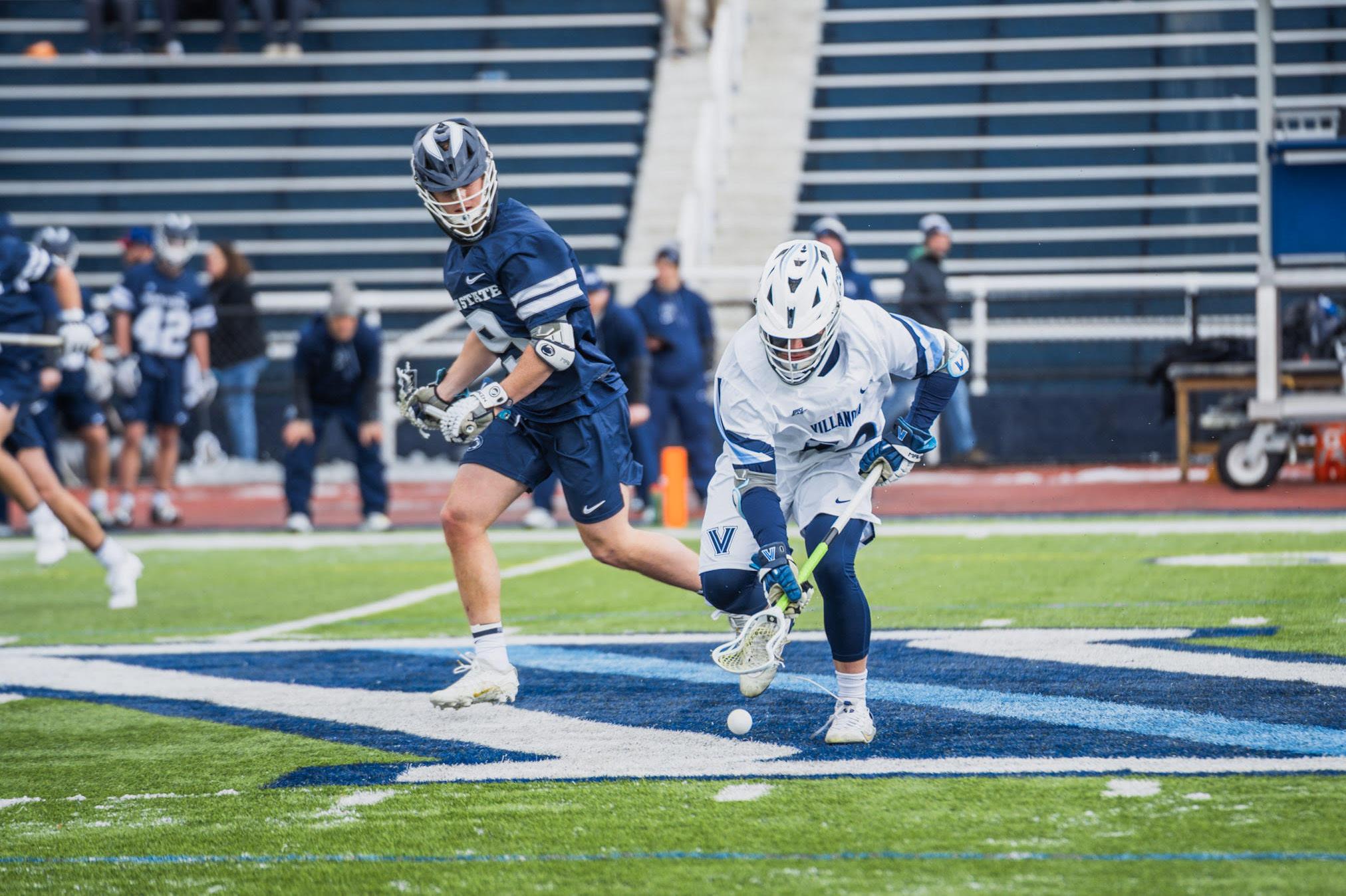
Evanchick, and Shoemaker is in their second year of captainship, making Lucchesi this season’s only additional captain.
“They said they set a really good example every day about coming into the weight room and coming to the practice field ready to go,” Corrado said about the captains. “They take things seriously, and they’re good kids who love lacrosse. I think they really do a great job of setting the expectations for the team.”
Michener and Shoemaker were both named to the 2026 Preseason All-Big East team in late January. Also named to the presea-
son team is long stick midfielder Jake Melchionni.
To prepare for the season, the team has undergone rigorous preparation. Although in recent weeks, the final preseason push has looked different due to the Northeast’s snowy forecast.
“It’s been a little bit of a disjointed preseason,” Corrado said. “Last week, we could only practice for an hour outside… but, we got our two scrimmages in against Fairfield and Princeton, which is always good to get out there, and those were good scrimmages.”
Graduate attackman
and midfielder Luke Raymond, Evanchick and Shoemaker have stepped up in the preseason and are players to keep an eye on this spring.
“Luke Raymond is kind of like, a quiet leader on the offense, and he’s really stepped up,” Corrado said. “Defensively, David Evanchick and Jack Shoemaker, two captains, have set the tone [in the preseason].”
This season, the Wildcats face a strong lineup of teams, starting with Penn State, who ranks No. 7, according to the Inside Lacrosse Division I Men’s Lacrosse Poll.
Following Penn State, the Wildcats will take on St. Joseph’s University, Rutgers University, the University of Delaware, Drexel University, the University of Pennsylvania, Towson University and Lehigh University. Then, Villanova will open Big East play on Saturday, March 28, against St. John’s University.
Coach Corrado is looking forward to what’s in store for this squad of Wildcats in the coming months.
“It’s always exciting to see how some of your new guys do, whether it’s freshmen or whether it’s kids who didn’t have much of a role last year that are going to get an expanded role this year,” Corrado said. “It’s always exciting to see kind of who’s going to be that guy that their role expands, and they embrace it, and they do well with it. So, I’m looking forward to that. We do have some very, very talented young players on the team, and so we’ll see how they do.”
Villanova Faces Off Against Penn State To Begin 2025 Season Graham Sukup/Villanovan Photography
Senior Ryan Palmer tees off. Courtesy of Villanova Athletics
Wildcat Watch: Deaviz Dominates The Cage

Genna Cottingham Sports Columnist
Fifth-year thrower Maria Deaviz has trained with the most prestigious track and field schools in the country. She decided to culminate her athletic career at Villanova University, where she has broken the school record three times in just one month.
Just 30 minutes from campus in Souderton, PA, Deaviz grew up playing soccer and basketball. While she attended Souderton HS, Deaviz realized that playing basketball and softball would not be in her best interest. Standing at 5-foot-7, Deaviz knew she did not have a great chance at making a Division I roster.
The first winter season without basketball, Deaviz was bored and was encouraged to try out for track. Since she played soccer, her parents and coaches thought she would have a career as a sprinter. Noticing her adept arm strength, her coach decided to put Deaviz in the shot-put cage. Finding her hidden talent in her junior year of high school, Deaviz started training at Garage Strength, an hour away from her house in Fleetwood, PA.
“I was training really hard,” Deaviz said. “I was surrounded by like-minded athletes at the time, and we just all trained so hard together. I was training up there, commuting, and that’s where my skills, my technique and my strength just really elevated.”
Deaviz went on to become a Pennsylvania Interscholastic Athletic Association (PIAA) champion for shot put, as well as the Souderton record holder for shot put and discus. The immense training and support she received at Garage Strength gave her recognition from Division I college track and fieldprograms.
A track recruit is allowed five official college visits. Deaviz was cutting it down with her fourth at the University of Virginia. After a brief meeting with the coaching staff, Deaviz was amazed by the sense of community at Virginia.
During her time as a Cavalier, Deaviz achieved the program record in shot put for both the indoor and outdoor seasons. Deaviz was also a four-time All-ACC academic honor student. In 2021, Deaviz placed fourth in the NCAA Championship for shot put at 17.97
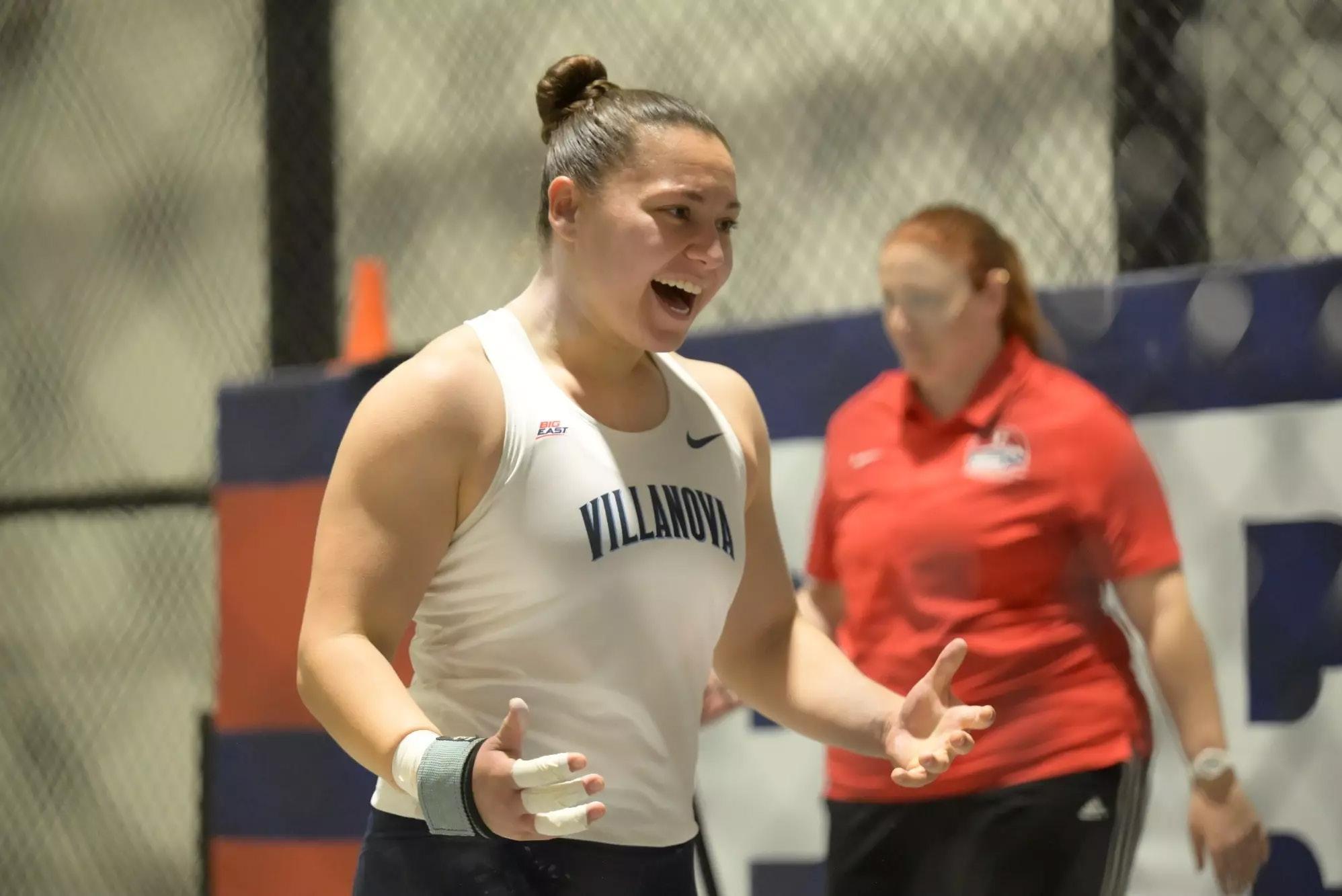
meters.
“She’s just a really, really, really good person,” Villanova women’s head coach Gina Procaccio said. “You just want nothing but great things to happen for her.”
Deaviz competed for Brazil, her parents home country, at the U23 South American Championships in 2021. There, she won gold in the shot put with a distance of 16.28 meters.
Not long after, Deaviz discovered back pain leading to a stress fracture in L4 and L5 of her lower spine. The Virginia track coach left the program, and Deaviz realized she needed strong leadership at an elite program. During her injury recovery, she transferred to the University of Michigan for her senior year. In the 2024 Big Ten Championships, Deaviz placed in fourth place in shot put outdoors and in eighth place for shot put indoors.
With one year of eligibility left after graduation, Deaviz did not want her athletic career to end once she received her undergraduate degree. Deaviz entered the transfer portal and committed to one of the best, track and field programs in the country: the University of Oregon.
After training in Eugene for a month this past summer, Deaviz learned the horrific news of her father’s terminal cancer. Not wanting to be on the West Coast, Deaviz entered the transfer portal yet again. This time was different. She wanted to be closer to home but had no schools on her radar.
Fortunately, Villanova offered her a spot on the team. The proximity to her house allowed Deaviz to spend time with her father before he passed away in the fall of 2025.
“[My father] loves Villanova,” Deaviz said. “I was just so glad before he passed to have that opportunity to let him know what my future looks like. He was just so ecstatic and so thrilled.”
Despite the many college uniforms Deaviz was grateful enough to don, she believes Villanova is second to none. The support system that immediately surrounded her in a time of great distress was something she never expected, but she will forever appreciate.
Cullen Aubin joined Villanova track and field the same month as Deaviz. Aubin was named as an assistant coach coming from the University of New Hampshire, and trains field athletes. Aubin and
Deaviz developed a special relationship after starting in the program at the same time.
“I’m just trying to continue what she was already able to accomplish,” Aubin said. “She’s somebody that has competed at the highest level collegiately. She already has a wealth of knowledge that she has shared with the team, in particular, our large number of incoming freshmen this year.”
On Saturday Jan. 10, Deaviz broke the women’s shot-put program record in her first throw in a Villanova uniform. Then she broke again two weeks later, and again on Friday Jan. 30, at the Ott Center in Philadelphia. The new distance of 16.76 meters landed her at No. 13 on the NCAA indoor performance list for the 2025 indoor season. Her whole team came to support her this past weekend, even though she was the only one competing.
“I don’t think there’s many individuals that have gone through those obstacles,” Deaviz said. “I think everyone has different challenges and different obstacles… when people share their stories, I think there’s more people that relate to it. You always find your way back home, I guess.”
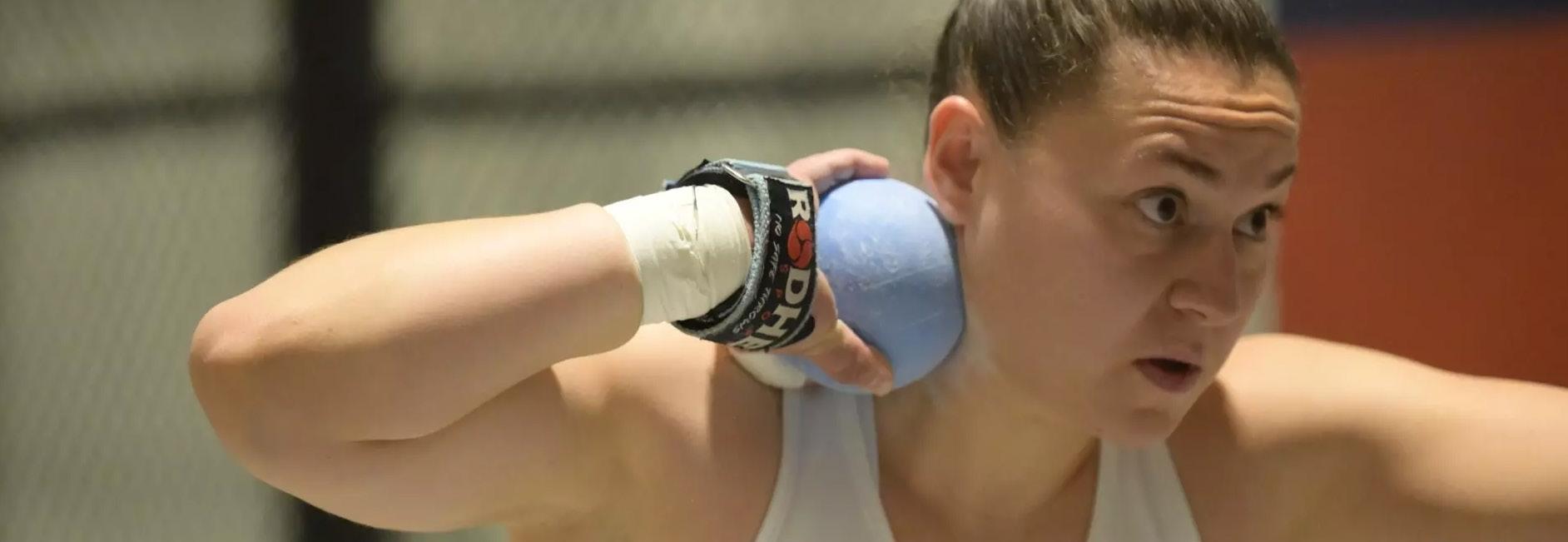
Maria Deaviz sets a Villanova record in women’s shot-put.
Courtesy of Villanova Athletics
Deaviz Sets a Villanova record during her first throw in a Villanova uniform. Courtesy of Villanova Athletics

Sophia Cratty Staff Writer
Women’s Tennis Falls To Delaware 6-1
On Friday, Jan. 30, Villanova women’s tennis (1-4) traveled to the Delcastle Tennis Center in Newark, DE, to face Delaware (2-1) for its home opener. The Wildcats fell, 6-1, at the hands of a strong Delaware team.
In doubles, on the first court, seniors Maggie Gehrig and Emi Callahan fought to a 7-6 loss. Junior Jenna Stevens and sophomore Olivia Corcoran fell, 3-2, and juniors Miriam Gondorova and Lauren Monti lost, 7-6.
“Two of the three doubles went into a tiebreaker,” head coach Steve Reiniger said. “Matter of fact, we had a 5-2 lead at No. 3 doubles, so they were a point or two away from getting that court, and one doubles was down 1-4, and came back and went up in the match 6-5. I thought we played very well.”
Going into the match, Reiniger acknowledged the strength of Delaware’s program. To prepare, the team played a lot of two-back in doubles, which, according to Reiniger, worked well for the Wildcats.
“We worked on two-back in doubles, and it kind of actually worked because the other team played two back a lot, which is not necessarily conventional,”

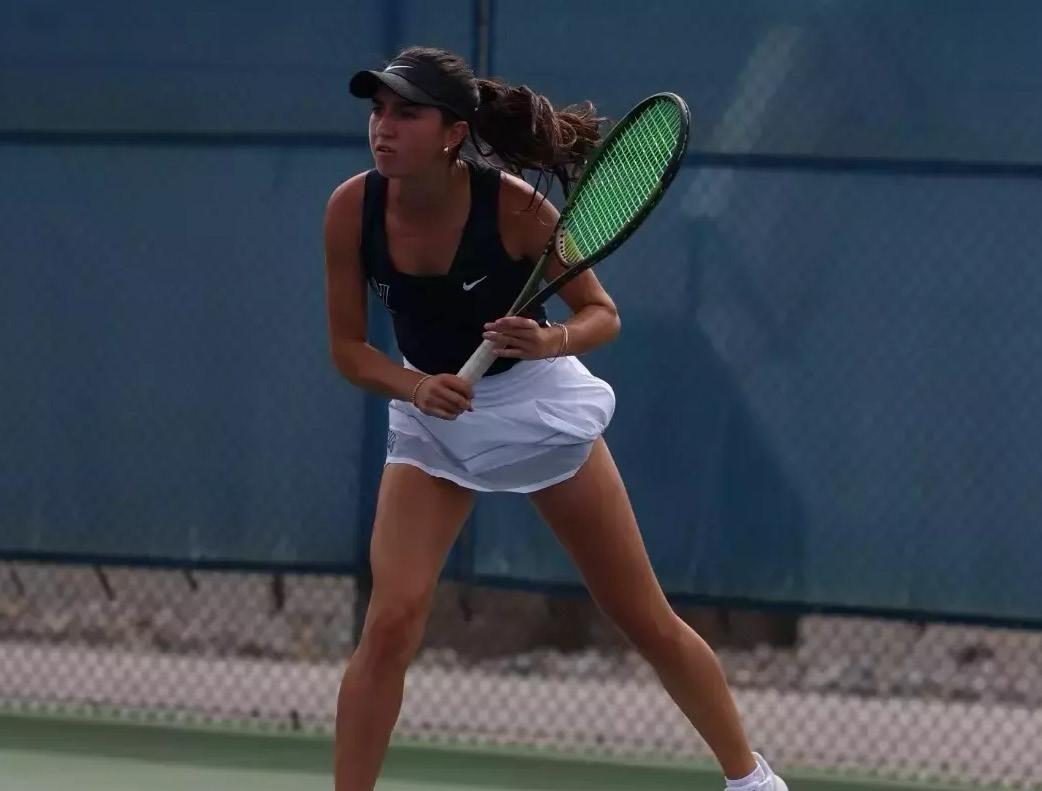
Reiniger said. “It’s usually one up and one back. So we worked on playing two-back, and we were prepared.”
In singles play, Gondorova won her match, 6-4, 6-4, on the third court, earning Villanova’s only point of the match.
“And then, [in] singles, unfortunately, we only got one court,” Reiniger said. “We won court three, with Miriam, and she
played very well.”
On court No. 1, Corcoran fell to Delaware senior Maryia Hrynashka in straight sets, and Gehrig was defeated by senior Amelia Gorman in a three-set battle on court No. 2.
On the remaining courts, the Blue Hens also earned straight-set wins, securing their 6-1 victory.
Looking ahead to Satur-
day’s match against Seton Hall and Sunday’s against Lehigh, Reiniger is optimistic and ready to tackle any challenges with playing back-to-back days.
“I think those are two winnable matches,” Reiniger said. “We’re dealing with some injuries, where when we play back-to-back matches, it can be a little tough. I’m glad we play Seton Hall first. If we played Seton Hall second, it might be a problem where I might have to sit more kids against Lehigh to make sure we’re healthy for Seton Hall, since it’s a Big East match. With Seton Hall being played first, I’m keeping my fingers crossed that we’ll have a strong enough lineup against Lehigh.”
Reiniger also noted that junior Maddie Hills has stepped in accordingly and is playing well.
“But the extra players that have been playing have done a really great job,” Reiniger said. “Maddie Hills has stepped in and played very well. So if we only have to replace one player, we should be fine.”
On Saturday, Feb. 7, women’s tennis will look to bounce back as they travel to Seton Hall for a Big East matchup. The following day, the Wildcats will take on Lehigh in Bethlehem, PA. In their last meeting against Seton Hall, the Wildcats won in straight sets on March 3, 2025. Against Lehigh, on Jan. 31, 2025, the Wildcats won, 5-2.
Women’s Basketball Defeats DePaul, 69-56
Genna Cottingham Sports Columnist
On Saturday, Jan 31, Villanova women’s basketball pulled away from DePaul University after a slow start, winning 69-56. The victory extends the Wildcats’ win streak to 10 games. Despite a slow start, Villanova (17-5, 10-3 Big East) pulled away from DePaul (5-19, 2-11) with the help of 20 bench points.
“The last couple days of practice getting back to the recognition of how important it is playing with the continuity of what we do,” Villanova head coach Denise Dillon said. “The movement, us doing a better job coaching, buying into it, believing that that will be what propels us forward until you get better.”
Despite taking nearly two minutes to score a shot, the Wildcats held their ground.
Sophomore guard Jasmine Bascoe led the game’s score sheet with 27 points, just three points shy of her season-high against Fairfield. The Canada native posted five assists and grabbed three rebounds as well.
Despite being the highest scorer of the game, Bascoe failed to make several easy shots early on in the game. Bascoe went 1-for-3 from behind the arc and making only half her free throws, Bascoe will need to pay attention to precision as the ‘Cats enter a critical period in the season.
Senior guard Ryanne Allen
led the ‘Cats against the glass, posting seven rebounds. Allen also scored 17 of the 29 total bench points, while going 3-for-4 from behind the arc.
“When I came in, I just wanted to make an impact and bring energy to those who were already out there,” Allen said. “We’ve already played everyone once, and so I just let me know that the teams are getting better the second time around, and in February, everyone is to play more than so even if it’s not pretty just being able to find a couple of times.”
The Wildcats forced 18 turnovers against the Blue Demons, with seven of those made during eight minutes in the second quarter. The highest scorer for DePaul was sophomore guard Devin Hagemann at 14 points. Villanova nearly matched DePaul’s turnover count at 17, due to lack of rebounding and traveling mistakes.
At the half, the ‘Cats were up, 33-20, after a 9-0 run before halftime. Villanova shot 75% behind the free throw line, in comparison to DePaul’s 60%. Villanova dominated the game’s three-point shooting. The Wildcats shot 42% from beyond the arc, while the Blue Demons shot 25%.
Freshman guard Kennedy Henry totaled four points and six assists. Junior forward Brynn McCurry and freshman forward Brooke Bender scored five points apiece. McCurry collected five rebounds and four assists as well.
Sophomore guard Dani Ce-
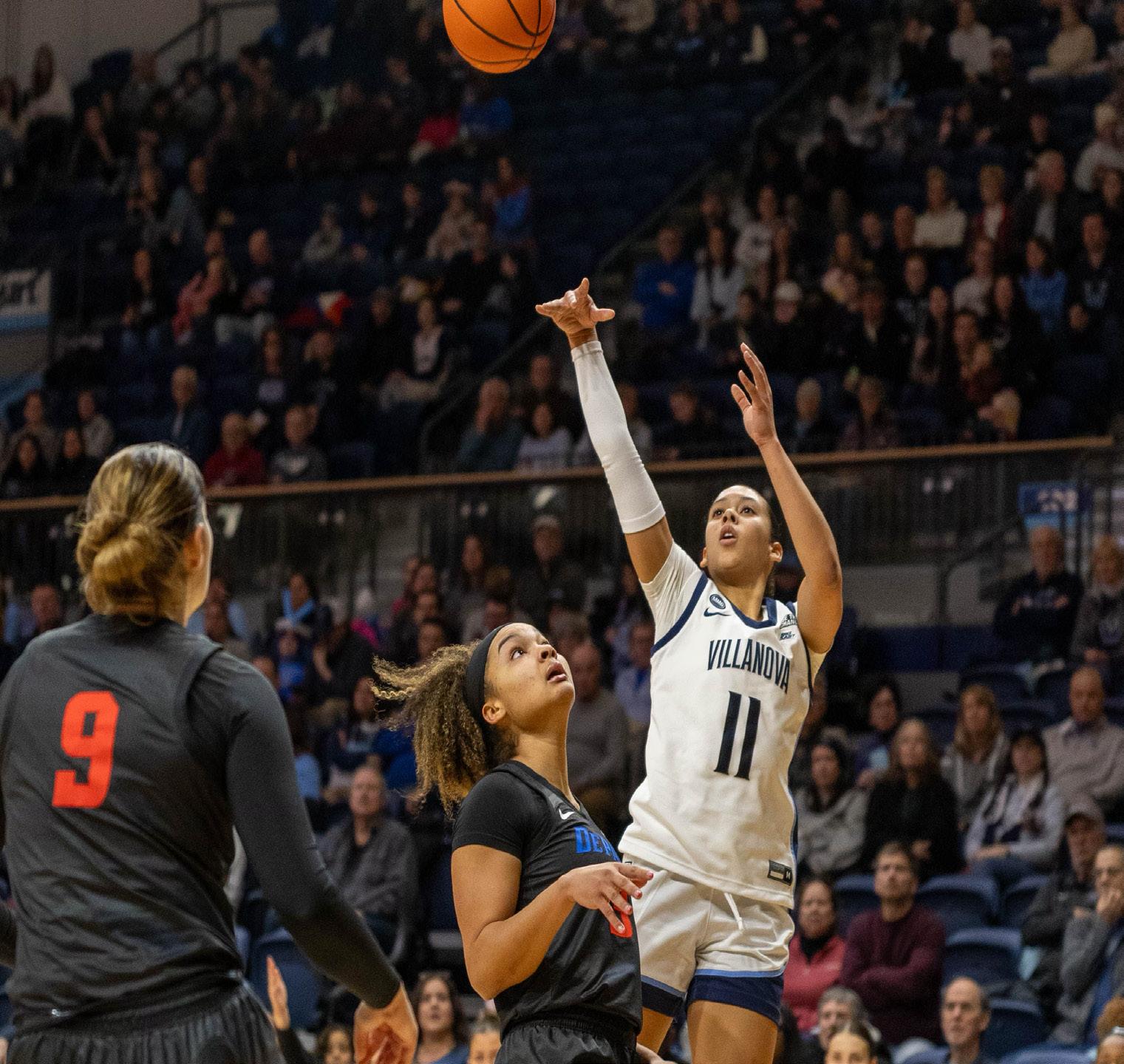
seretti achieved a career-high two steals. The Wildcats had five total steals.
“Dani’s one of our best defenders, so she gives you that spark,” Dillon said. “Then, the big challenge today was rebounding. I mean, it’s been a challenge for us as a team, but I was just trying to find different ways to motivate them to make it as competitive and as fun as possible.”
DePaul saw foul trouble after tallying 19 fouls across the team
in the game’s 40 minutes. Redshirt freshman guard Alayna West led the Blue Demons with five personal fouls, fouling out of the game with 3:50 left in the fourth quarter. “I’m pleased with us making adjustments to the physicality and coming out with the win,” Dillon said.
Villanova is now scheduled to take on Butler University (9-12, 3-8) on Wednesday, Feb 4. The ‘Cats will travel to Indianapolis, IN to take on the Bulldogs at 7 p.m.
Women’s tennis traveled to Newark, DE, where they fell 6-1. Courtesy of Villanova Athletics
Bascoe finished the game with 27 points, just 3 shy of her season best. Mia Sgro/Villanovan Photography
Villanova Softball Gears Up For 2026 Season

Jack Flannelly Staff Writer
A year removed from its trip to the NCAA Regional final for the first time in program history, Villanova softball finished 2025 at 27-26-1 (15-9 Big East), fell in the Big East Tournament and ultimately missed the NCAA Tournament.
“We’re ready for a bounceback year,” head coach Bridget Orchard said. “We’re hungry to get back to the Big East Tournament and reach our goal of an NCAA Tournament appearance.”
Orchard enters her eighth season leading Villanova, where she has guided the program to Big East titles in 2021, 2022 and 2024.
This season, the Big East Tournament will change its format to feature only four teams, tightening the path to postseason play. In the preseason poll, Villanova was projected to finish fourth in the conference.
“Being picked fourth, I am not opposed to that,” Orchard said. “It’s the lowest we have been picked since I’ve been here. We’re ready to prove people wrong.”
Villanova will open the 2026 campaign with a trip to Midtown Atlanta, GA, at the Buzz Classic from Feb. 3-7, facing No. 16 Alabama twice, along with Georgia Tech and East Carolina.
“We get the chance to play against some of the best in the
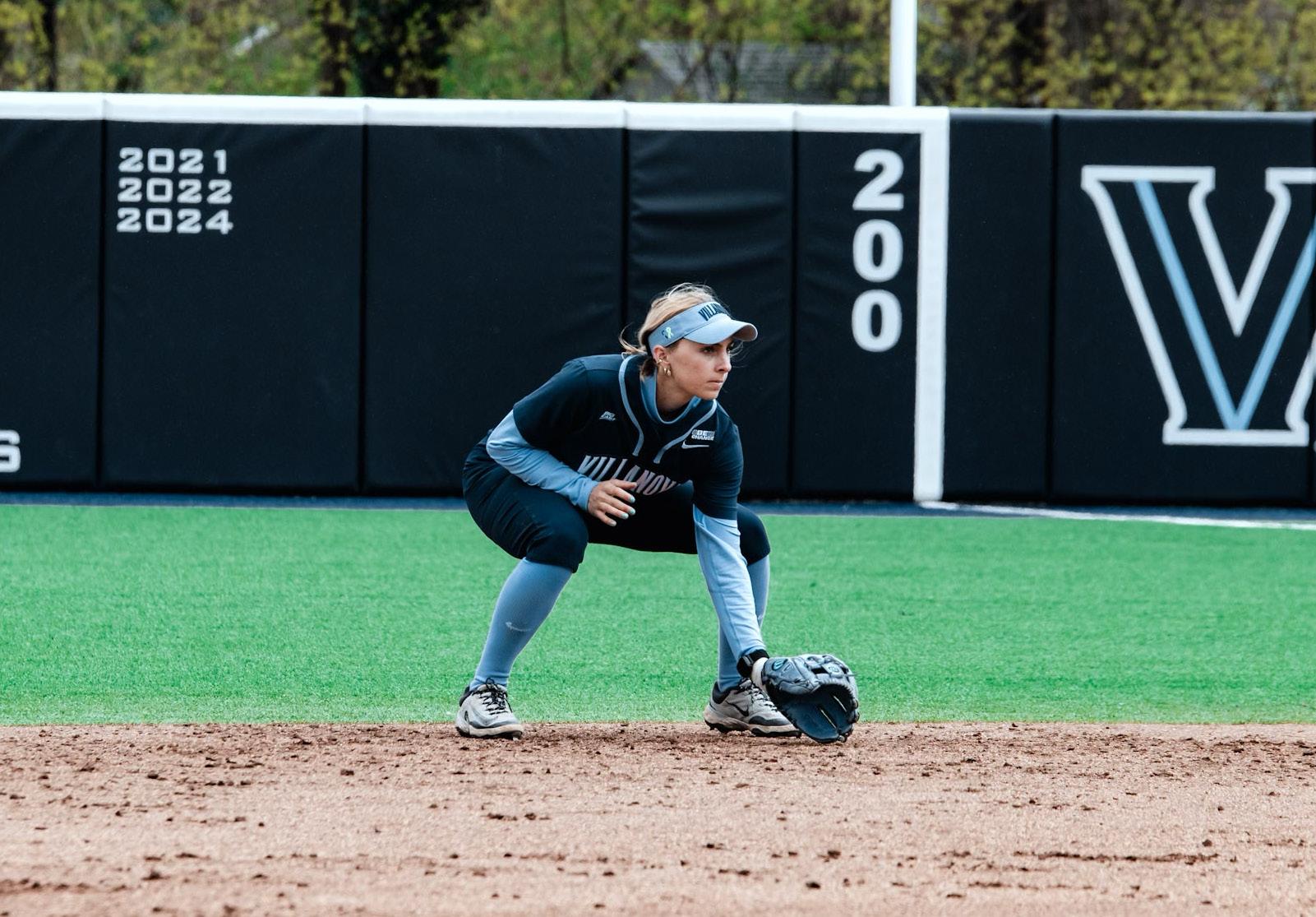
country,” Orchard said. “You’re trying to win the game, but more importantly, you’re trying to learn from those games.”
Villanova brings a balanced roster with six seniors, four juniors, five sophomores and five freshmen.
The Wildcats will not lose much in the pitching department, as they will bring back their top two pitchers from last year. Senior pitcher Kat Gallant, who led the team in innings pitched with 147, and sophomore pitcher Lexi Kobryn, who threw 101 innings in 2025.
“Kat will be the ace of the staff,” Orchard said. “We are
going to have her throw as many conference games and innings as she can handle.”
Offensively, Villanova will return its best offensive player, junior pitcher and first baseman Maranda Runco, who led the team last year with a .375 batting average and 20 home runs, along with senior outfielder Brooklyn Ostrowski, junior infielders Maddie Burrows and Grace Reed and sophomore catcher Ava Mahnken.
Unfortunately, the Wildcats will be without the only player to start all 54 games last year, shortstop Ava Franz, who graduated last spring.
A key name to watch this
year for the Wildcats is senior infielder Lilly St. Jean. In 2024, she was a unanimous All-Big East First Team selection with a .302 batting average. She took a huge step back in 2025 with a .102 batting average.
“She [St. Jean] has played multiple positions over the years, and we expect her to be a leader,” Orchard said. “In 2024, she really hit the ball well, and we hope she gets back into that.”
Orchard will bring back a total of six starters from last year’s team, leaving the door open for three new players to step into bigtime roles this upcoming season.
The five freshmen coming in are headlined by pitchers Maggie King and Carly Zych, utility player Katie Reed, outfielder Jacquelyn Cox and infielder Aubrey Police.
Villanova will spend the beginning of the season in warm climates playing a handful of nonconference tournaments. After Georgia, the Wildcats will travel to Charlotte, NC, for the Charlotte Invitational from Feb. 13-15. Next, they head to Boca Raton, FL, for the FAU Paradise Classic from Feb. 20-22.
The final tournament will be the UVA Party at the Palmer Invitational in Charlottesville, VA, from Feb. 27 to March 3.
For its home opener, Villanova will host Butler from March 13-15 in a three-game conference series.
What To Expect From Villanova Baseball’s 2026 Season
Noah Okenquist Staff Writer
As the clock winds down to 2026’s first pitch,Villanova Baseball looks to its first game against Florida International University on Friday, Feb. 13. The series will set the tone for the season as it looks to bounce back from a 22-28 losing season.
Senior infielder Michael Whooley will be a crucial returner in the comeback effort, having earned a spot on the All-Big East Conference Team in 2025.
“Mike’s been tremendous for us on and off the field,” head coach Kevin Mulvey said. “We’re lucky to have him.”
The team returns many to the roster, among them eleven sophomores, six juniors, six seniors and five graduates. Five freshmen will join the team. The fresh faces consist of two outfielders, two shortstops and a new pitcher. The roster totals to 33 this season.
“We have five or six guys who could start for us, which makes it hard when we only play three games in a weekend,” Mulvey said. “But that’ll just mean the guys who aren’t starting with get extended looks out of the bullpen.”
Last year, senior catcher Jake Bollin and Redshirt sophomore outfielder Austin Lemon led the Wildcats at bat, with a batting averages of 0.364 and 0.362, respectively.
Whooley led in runs, bring -
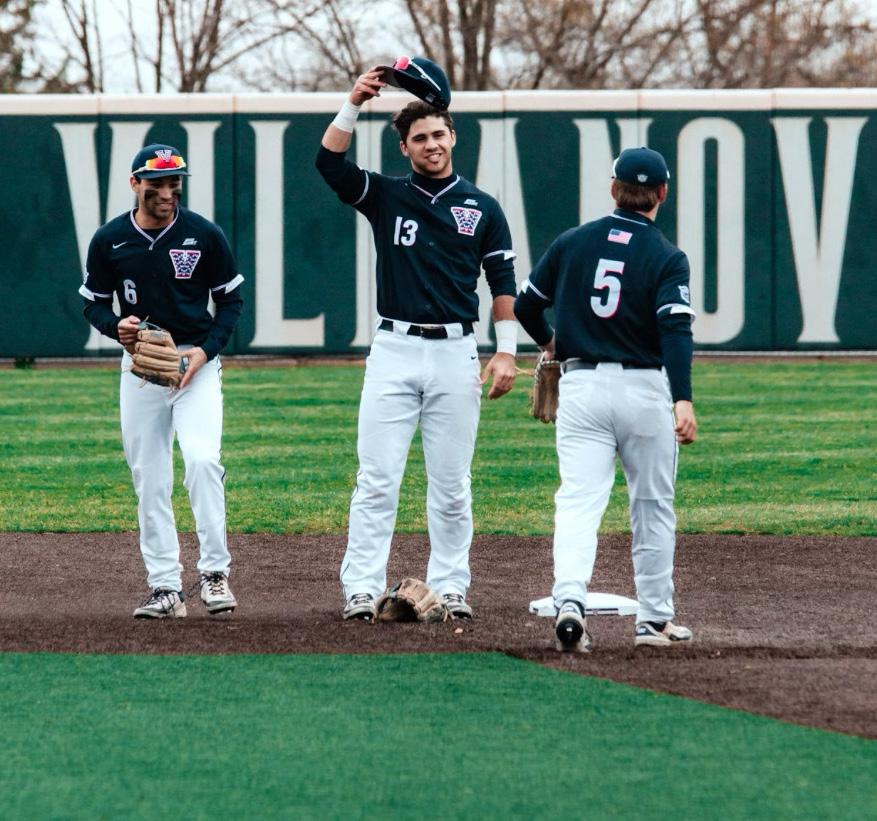
ing in 46 last season. Sophomore infielder Brayden Leonard took 32 runs home. Lemon trailed one run behind him, tallying 31 during the season.
In addition to his batting ability, Lemon boasts skill on the infield. Last year, Lemon made 88 catches and 87 putouts throughout the course of the season, earning a 1.000 fielding percentage.
Junior Jake Francis is one of four pitchers from the 2025 roster. He is the team’s only returning
pitcher. During the 2025 season Francis earned an average of 6.60 runs earned per game.
Villanova has also brought in new coaching staff to the program, hiring Michael Russo and Dusty Snyder.
Russo brings a depth of experience from his times at both Monmouth University and Princeton University. At Princeton, he led the Tigers to an NCAA tournament appearance.
“Russo works with the
pitchers on a positive mind and a positive attitude, and he has a great relationship with the other coaches,” Mulvey said.
Snyder joins Villanova after a successful coaching career at the University of South Florida and previously Pasco-Hernando State College. Coach Mulvey is pleased with the baserunning work Snyder has brought and says he is adaptable.
Creighton and the University of Conneticut will be two of the Wildcats toughest opponents in Big East play. UConn earns the honors at the top of the preseason coaches poll, with Creighton, Xavier and St. John’s also close in the mix. Villanova is currently predicted to finish sixth in the conference.
Beginning with their out-of-conference schedule, the ‘Cats hope to establish momentum that they can carry onto the Big East season.
In addition to FIU, the Wildcats will face Lipscomb, Towson, Florida Atlantic and other notable East Coast rivals before their Big East showdown.
While play can be competitive, the team tries to foster a work-hard, play hard environment.
“The guys play hard,” Mulvey explained. “It’s fun to coach, but it’s fun to play too.” Villanova will kick off Big East play at the Villanova Ballpark in Plymouth Meeting, PA on April 2, taking on Butler University, redeeming last year’s shortcomings.
Softball will kick of its season in Atlanta, GA, against the University of Alabama on Feb. 3. Erick Quezada/Villanovan Photography
The ‘Cats finished the 2025 season 22-28. Erick Quezada/Villanovan Photography
Track and Field’s Northeast Weekend Takeover
Genna Cottingham Sports Columnist
Villanova track and field started this past weekend at the Ott Center in Philadelphia, where fifth-year Maria Deaviz broke the program record in shot put, her third time breaking the record in a month. With a distance of 16.76 meters on Friday afternoon, the Michigan transfer threw the second best in the Big East and No. 13 in the NCAA this season.
“She’s just a really, really, really good person,” women’s head coach Gina Procaccio said. “She’s been through a lot in the last year, so you just really want nothing but great things to happen for her.”
Also on Friday, Jan. 30, two juniors ran the 800-meter race at the Penn State National Open in University Park, PA.
Dan Watcke finished at 1:46.62, which is only .3 seconds away from his school record set last indoor season. Watcke’s stellar time also landed him No. 2 in the conference and No. 5 in the country.
“The 800-meter is a very fast race that they try to put on out there,” men’s head coach Marcus O’Sullivan said. “I tried to express to him he’s had such a great build-up to this in the fall. When you’re training hard, your legs are still heavy, and it takes a while for it to kind of come to fruition.”

Ryan Beegle also ran the 800-meter, crossing the line at 1:54.09. The transfer from Boston College was four seconds off his personal best. Beegle was coming off an injury and had gotten caught in traffic on the way to BU, causing a late arrival to the meet.
“I think he was just a little bit despondent when he got done,” O’Sullivan said. “He’s still very young in the sport of what he’s doing and what he’s trying to
accomplish. So, I just try to give him some encouragement and kind of come back out again the next time.”
O’Sullivan was in New York City this weekend, commemorating the 40th anniversary of the 4xMile world record. While in Manhattan, O’Sullivan was able to watch the 118th Millrose Games at the Armory, although no current Villanova athletes competed.
On Jan. 31, four distance
runners traveled to Boston to compete in the John Thomas Terrier Classic at Boston University. Sophomore Charlie Moore, fifth-year Devon Comber, along with juniors C.J. Sullivan and Bailey Habler, all ran the 3000-meter race on Saturday.
Leading the way for the ‘Cats was Boston native Sullivan, who ran a 7:50.07, shaving five seconds off his personal best. Not far behind, Habler broke eight minutes in the 3000-meter, clocking in at 7:58.53. Moore achieved a new personal best, crossing the finish line at 8:02.05, over six seconds faster than his previous record. Fifth-year Devon Comber came in at 8:18.79 to round the group out.
“I think Charlie and CJ ran really well,” O’Sullivan said. “They’re gonna be happy enough with what they did, and I think Bailey and Devin are disappointed, hence the reason a mixed bag of sorts.”
Villanova women’s and men’s track and field will return to the Ott Center at the University of Pennsylvania for the Penn Classic on Friday, Feb. 7.
“It was not supposed to be heavy, but [competitions] get heavier as the season goes on,” O’Sullivan said. “Sometimes, we need to race more than we thought.”
Competition is set to begin with field events at 10 a.m.
Villanova Men’s Club Ice Hockey Wins 5-3, Over Lehigh
Mason Canton Staff Writer
On Sunday, Feb. 1, Villanova men’s hockey (16-4-0-2) defeated Lehigh University (16-111-0), 5–3, at Hatfield Ice Arena. The Wildcats bounced back from a one-goal loss the night before to NYU, earning their second win over the Mountain Hawks this season.
Villanova struck first midway through the opening period when sophomore forward Jonathan Nawrocki scored on the power play at the 5 minute mark. Nawrocki’s ninth goal of the season came off assists from Dylan Anderson and Jack Fidacaro, giving the Wildcats an early 1–0 lead. Lehigh responded early in the second period, as Maxim
Myagkov tied the game at 3:07. The score remained tied, 1-1, heading into the third period. The ‘Cats struggled to finish on their 25 shots in the first two periods.
Despite the slow start, Villanova found another gear in the final frame.
“We struggled in the first two periods but really turned it up in the third once we found our stride,” sophomore defenseman Davian Peretti said. “Our ice hockey team has had a tremendous season so far.”
The Wildcats regained momentum just over a minute into the third period when Brendan O’Brien found the back of the net at 1:05, assisted by Charles Davis and Jack Fidacaro. Lehigh quickly answered, as Myagkov scored his second goal of the game just 23

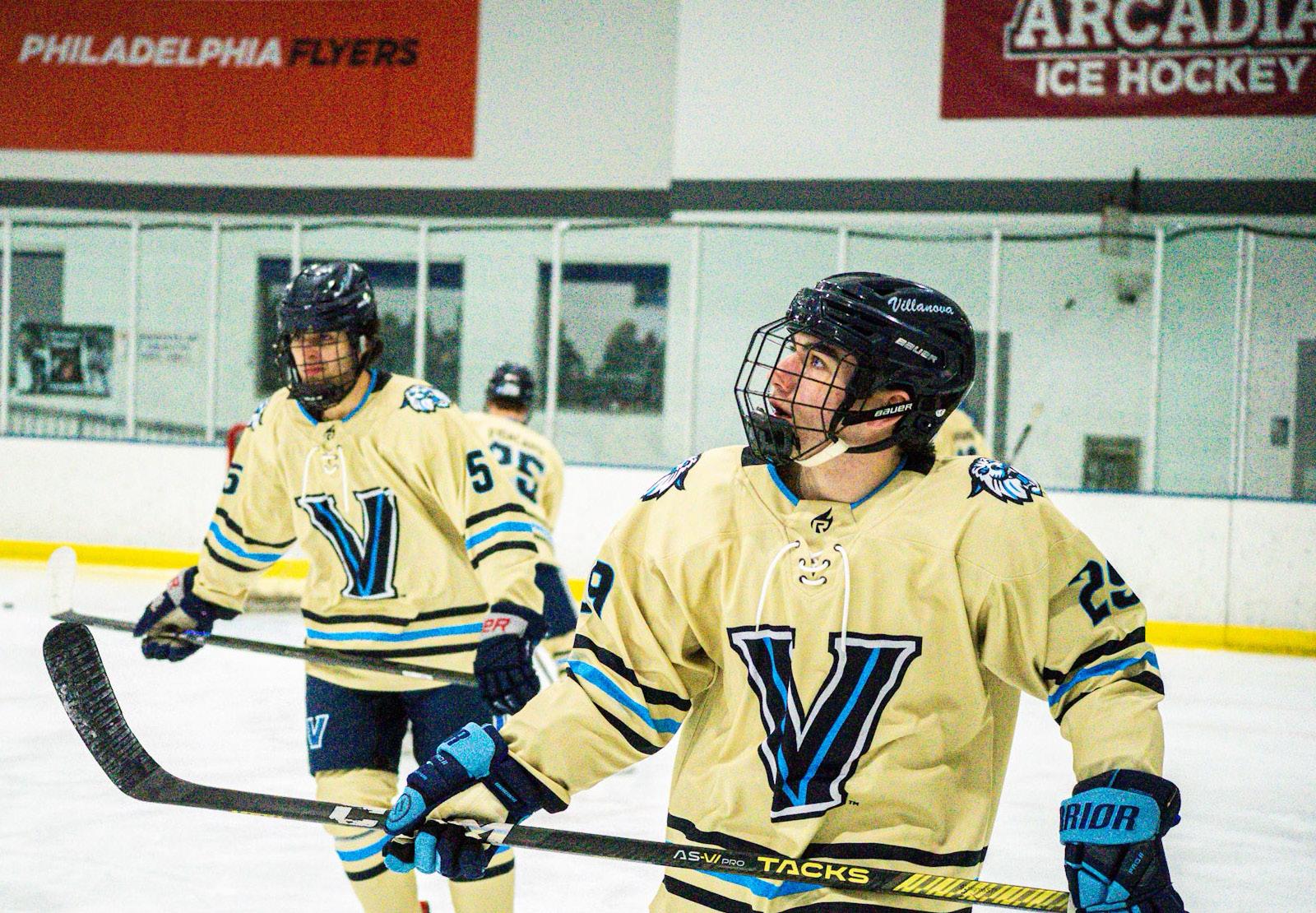
seconds later.
Villanova then seized control with three goals over the final 11 minutes. Davis gave the Wildcats the lead at 9:11 with an unassisted goal. Defenseman James Reagan extended the lead on the power play at 17:04, scoring what proved to be the game-winning goal.
After Lehigh cut the deficit to one with just over a minute remaining, O’Brien sealed the victory with a short-handed insurance goal at 19:25, his second of the game and 16th of the season.
Special teams played a key role in the win, as Villanova finished 2-for-2 on the power play while also adding a short-handed
goal. Peretti credited the unit as one of the team’s strengths.
“It’s one of the best power plays in all of ACHA Division I hockey,” Peretti said.
Goaltender Dmitrii Kapranov earned the win in net, stopping 29 of 32 shots. O’Brien led all Wildcats with two goals, while Davis recorded a goal and two assists.
With just a few weeks remaining in the regular season, Villanova is focused on finishing strong.
“We’re looking to make a strong playoff push,” Peretti said.
The ‘Cats return to Hatfield Ice Arena this Friday, Feb. 6, against George Mason University.
Sullivan recorded a personal record in the 3000 meters at BU.
Courtesy of Villanova Athletics
Villanova is now 16-4-0 this season. Mason Canton/Villanova Photography
On Sunday, the Wildcats earned their second win over Lehigh this weekend. Mason Canton/Villanova Photography