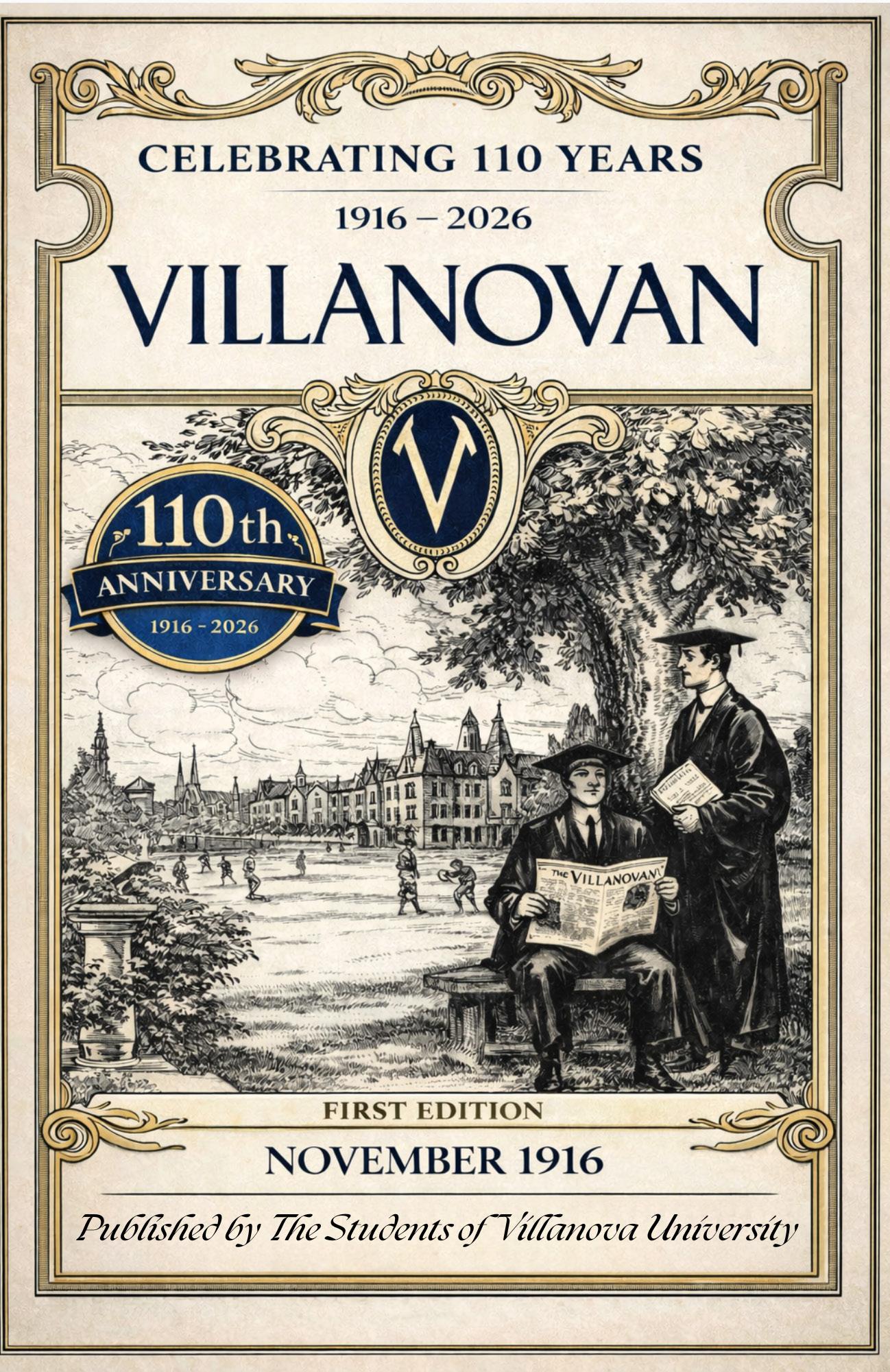
The Villanovan Celebrates 110 Years
Kailey Fahy Co-Editor-in-Chief
Dylan Johnson Co-Editor-in-Chief
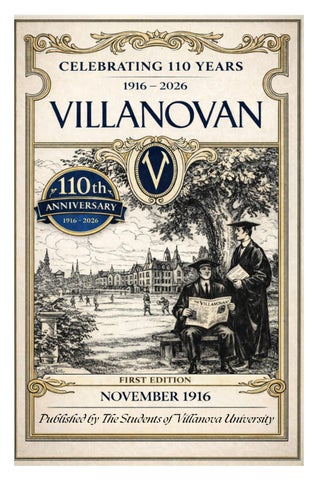
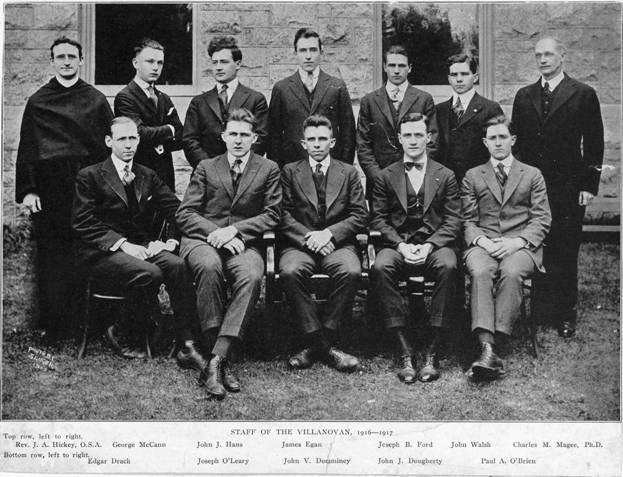
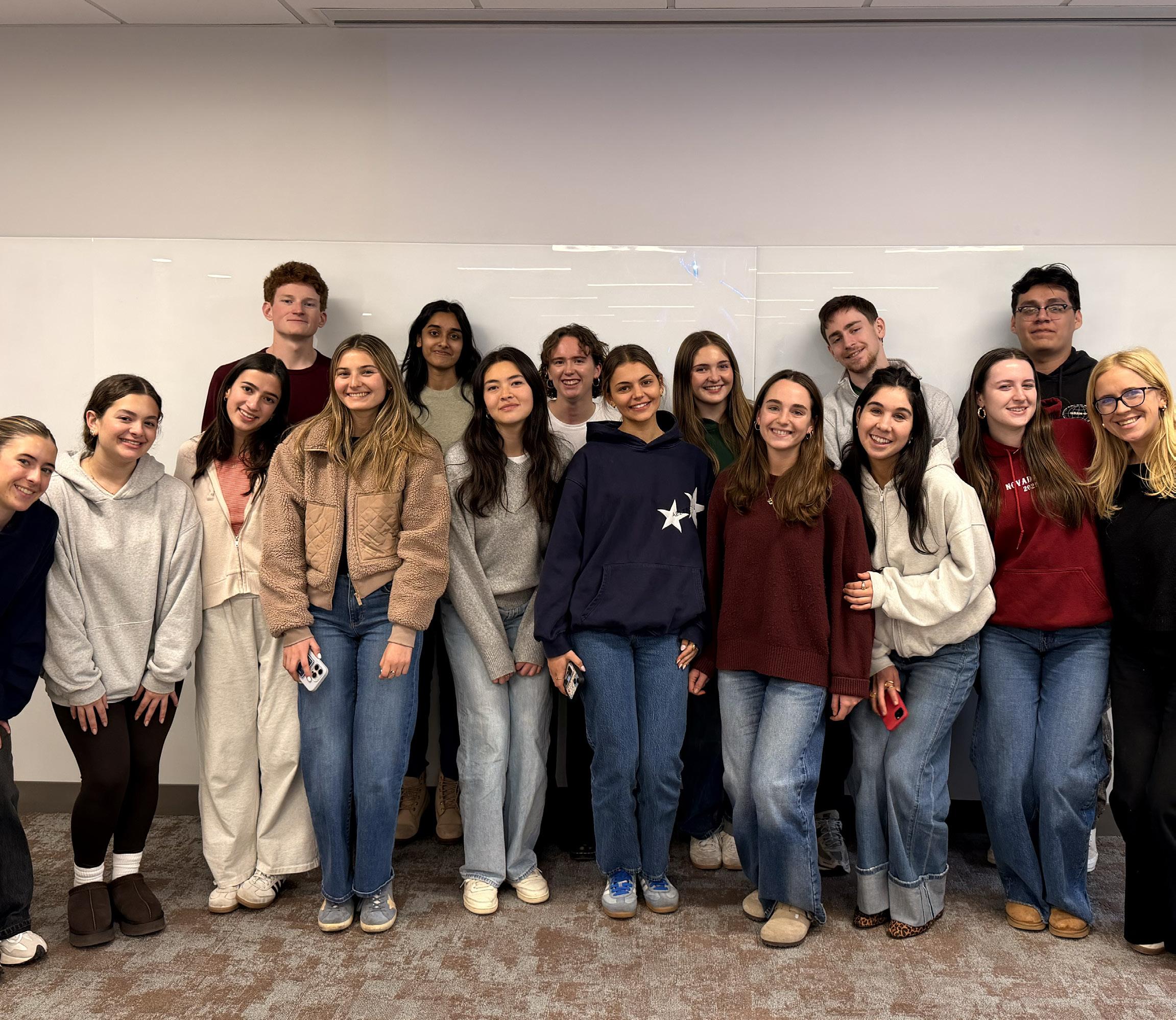
In November, 1916, a group of 10 students and two advisors came together on Villanova University’s campus to form a weekly student newspaper. They called it: The Villanovan.
Their first publication was released on Nov. 12, 1916, beginning its 110-year history of covering campus news and stories. Today, the paper produces weekly print editions distributed around campus, three magazines and consistent online content, all of which work to represent the many voices across Villanova’s community. While The Villanovan’s primary job is to quickly and effectively convey news to readers, its role on campus has expanded far beyond that over its 110-year tenure.
With seven sections, including News, Opinion, Culture, Sports, Photography, Digital and Copy Desk, its staff and editorial board work tirelessly to cover and represent all aspects of campus life.
The News section is the backbone of the paper. Its staff and editors work quickly to produce breaking news, investigate stories and conduct interviews to provide context for Villanova’s community.
The Opinion section provides interesting and engaging perspectives on the stories News produces. It serves as an outlet for writers to amplify the voices of students, faculty and alumni as they share their views on important
issues. While these perspectives can sometimes be difficult to share, the section presents them with confidence.
The Culture section captures the mood and atmosphere throughout campus. They focus on how issues and stories impact all corners of Villanova’s community. Working with all the other sections, the staff and editors highlight how Villanova’s community may be
impacted by stories in a range of ways.
The Sports section has the unique role of covering Villanova sports, a defining part of campus culture, highlighted by the success of the men’s basketball team. Over The Villanovan’s 110-year history, the section has covered three men’s basketball national championships, seven NCAA Final Four appearances and the tenures of eleven
basketball coaches. Its writers have the unique role of interviewing coaches and student-athletes to give readers an insight into the programs. Photography complements each of the sections by capturing the events and stories writers cover. Through images, the section helps guide readers through each story and highlights moments that words fail to describe. Over the paper’s 110-year history, Photography has been one of the sections to evolve most significantly alongside advancements in camera technology.
The Digital section is one of The Villanovan’s newer additions and conveys stories in creative and engaging formats that reach audiences beyond the print edition. By managing the paper’s social media platforms, the Digital staff uses graphics and videos to expand The Villanovan’s presence and visibility beyond the confines of campus.
The Copy Desk section is responsible for ensuring all articles are clear, accurate and free of grammatical errors. By carefully reviewing content for mistakes and formatting issues, this staff helps maintain credibility and consistency with readers and ensures all articles meet The Villanovan’s standards before heading to print.
Together, these seven sections work in synergy to convey and represent the many perspectives behind the important stories about campus. For 110 years, The Villanovan has served as a central source of news about Villanova, continuously expanding and evolving to meet the needs of its readers. As the paper looks to the next 110 years, it aims to remain a consistently trusted resource for Villanovans near and far and a lasting record of the University’s history. In doing so, The Villanovan will continue its commitment to informing and representing the Villanova community.
head
The first student staff of The Villanovan, 1916. Courtesy of The Villanovan
The current student staff of The Villanovan, 2026. Courtesy of The Villanovan
January
www.villanovan.com
The Case For Living on Cabrini
Emma Taylor Co-Opinion Editor
On Jan. 23 and 24, Villanova staged a host of tours catered to current freshmen to introduce them to Villanova University Cabrini campus, and here’s the takeaway: living there is not going to be that bad.
The round-trip bus tour included a walk-through of three residence halls, the Dixon fitness center, a preview of the new cafeteria and dining options, as well as free goodies, like iced coffee and Villanova-branded beanies.
Around 50% of incoming sophomores are expected to live at Cabrini this fall, an announcement that caused mixed reactions. The tours were a clear attempt to entice a section of the student body that isn’t entirely keen on being displaced three miles away from most of their classes, SEPTA stations, Wawa and an overall sense of familiarity.
Throughout the two and a half hour tour, a guide spoke on a microphone, outlining the logistics for next year’s shift and fielded questions on everything from the allergen-free dining program to Zipcars. Students eagerly snuck a peek at the brand new full-sized kitchens and living rooms, taking videos and chatting with friends about future design plans.
I understand the hesitancy about living far away, cut off from half of one’s class, and dependent on a shuttle system that has no merit yet. Still, there is plenty to be excited about. The entire campus is enveloped in a wooded area, tucked away between neighborhoods in a way that resembles the main Villanova campus, just without bustling Lancaster Ave.
The suites and apartments exceed the quality and size of their Commons and West counterparts, and even some of the traditional double rooms are situated
Continued on p. 10
Day of Service Recap: Honoring the Legacy of Dr. Martin Luther King p. 5
Unpacked: The Beginning p. 12

Students React To Another False Threat Hitting Villanova’s Campus

Cali Carss Co-Culture Editor
On Thursday, Jan. 22, many Villanova students woke up to a NOVA Alert sent at 7:20 a.m. telling them that campus was closed for the day “due to threat to academic building.” They were advised to stay sheltered in their dorm buildings and await further information. This was an incredibly disorienting experience. As the hours of the morning wore on, more and more students became aware of the situation our campus had found itself in, not for the first time,
and were left to process this information however they could. The next update, nearly two hours later, brought the instruction to remain in dorm buildings. The final major update came in at 11 a.m. and cleared the campus of any active threat of danger. Students were once again free to roam around campus as they pleased, although no classes or activities would commence for the rest of the day.
So, with the threat essentially declared another hoax, the next challenge for students was figuring out how to identify and move through the feelings this event brought about.
“I was originally panicked when I saw the NOVA Alert because it reminded me of what happened during Orientation,” sophomore Anna Rupp said. “But the fact that I was in the comfort of my room with my friend put my mind at ease. It’s sad that this is the third time something like this has happened in just one school year.”
The swatting events that cast a shadow over this past semester’s New Student Orientation Program were heavy on many minds when the NOVA Alerts came through on Thursday. While it is unclear to students whether this
threat insinuated the same kind of danger, the fact that it happened before was not unnoticed.
“At first, the lockdown didn’t feel real, especially since it was the third threat [this year],” junior Caitlyn Baker said. That sense of confusion followed many students around for the rest of the day, as the campus slowly came back to life after its eerily tense and quiet morning. Some students were left with the same fear and anger that the first threats had inspired.
“I think it’s disgusting that this is what our world has come to,” junior Liv Sallaberry shared. “It’s
Continued on p. 11
Zeppos Previews SGA Spring Semester

Finn Courtney Co-News Editor
Villanova’s Student Government Association (SGA) planned various initiatives and projects in the fall semester, including preparations for the launch of Villanova University Cabrini campus, opening the exterior doors to Cafe Nova from both sides and repainting the mural leading to the South campus. Student Body
NOVAdance Hosts Annual B+ Ball p. 7
Reel Talk: Heated Rivalry p. 13
President, Aleko Zeppos and Vice President, Sidney Mbah, are hoping to keep going strong until the culmination of their terms.
For them, the fall semester was the preview of how the next few months would unfold.
The Villanovan sat
The Case For Living On Villanova’s Cabrini Campus p. 10
p. 16
Sorority Recruitment Isn’t Meant To Be Stressful p. 10
p. 17
down with Zeppos this past week to discuss their further plans and also reflect on the work of this past semester.
“I’d say last semester was just to prepare for what’s ahead,” Zeppos said. “We spent a lot of time sitting down, meeting with as many administrators, as many higher-ups and [members of] leadership as possible. We have a big master plan that we’ve compiled through talking
Continued on p. 2
Students React To Another False Threat Hitting Campus p. 11 SPORTS p. 18
Villanova has seen three different occurrences of threats directed at campus over the course of this academic year. Dylan Johnson/Villanovan Photography
SGA is preparing for big plans in the spring semester. Quinn Burn/Villanovan Photography

VOL. 120 | ISS. 1
www.villanovan.com @thevillanovan
PUBLIC SAFETY BLOTTER
Criminal Mischief
January 20, SULLIVAN HALL.
A Resident Assistant reported damage to an exit sign. The estimated value of the damaged property is $40.00.
Liquor Underage / Public Drunkenness
January 21, ST. MONICA HALL.
A male resident student, under the age of 21, was found in public and evaluated for alcohol intoxication.
Theft by Unlawful Taking or Disposition
January 21, DRISCOLL HALL.
A female resident student reported a theft of AirPods. The value of the stolen property is unknown.
Harassment
January 21, GAREY HALL.
A male student reported being the victim of harassment by a previous female student.
CORRECTIONS
Hate Crimes / Intimidation
January 21, SOUTH CAMPUS LOT.
Two female resident students reported that unidentified males yelled racial slurs at them.
False Alarms to Agencies of Public Safety / Terroristic Threats
January 22, DROSDICK HALL. University officials received an email message threatening a crime of violence directed at a university building.
Factual errors are corrected as soon as they are brought to The Villanovan’s attention. Please send an e-mail to villanovan.eic@gmail.com to report errors.
Zeppos Previews SGA Spring Semester
Finn Courtney Co-News Editor
to our friends and classmates, and just things that we want to see differently on this campus. [...] But my whole strategy was to first find who the players were and how to get them to the table. So now we have very good relationships with all the different offices on campus.”
Zeppos laid out objectives and initiatives that he, Mbah and the rest of the SGA aim to accomplish, including adapting from the now defunct Nova Schedule Builder to the “Plan Ahead” feature to reforming dining plans and other advancements.
“I’d say just as far as headlines of big things we’re going to accomplish is to start building out our social media presence to be more visible,” Zeppos said. “We’re really pushing those menstrual products and continuing to be effective with dining and reforming our meal plan a little bit.”
Dining has been a principal focus of this administration, and was a central theme both during their campaign and after.
“I think we’re gonna continue to make improvements to Continued from
dining,” Mbah said back in April after the two won the election for Student Body President and Vice President. “I definitely have a lot of ideas, maybe extending hours in some cases on the weekends, but we understand eating is vital to the students’ lives. We wanna make sure that [Villanova dining] is at the highest prestige possible, so we can get the students living the best lives on Villanova’s campus as possible.”
Since then, SGA has supervised the introduction of Wawa to the Connelly Center, the relocation of dining options like V Sushi and the implementation of a sustainable takeout system with plastic boxes rather than the former disposable paper boxes. The current leaders’ aim this semester is not only to continue sustaining a strong relationship with dining but also enhance its promotion.
“I’d say one of our strongest partnerships, frequent partnerships, is usually with dining,” Zeppos said. “Dining has done a terrific job at publicizing what they’ve been doing and getting it out there to the student body. SGA will be doing even more of that this upcoming semester. [So] expect on a dining front to see more posts from SGA, more outreach to the student body, because that’s

what we’re here to do. We’re here to meet the needs and be the voice for our classmates here on this campus.”
SGA is also aiming to tackle some facilities and maintenance issues that they believe are affecting the lives of Villanova students.
“I know there’s some folks in SGA and a lot of the student body that has voiced concerns about the walkway underneath the SEPTA tracks with the puddle that forms down there, and maybe fixing that,” Zeppos said.
Zeppos also hopes to show students exactly what changes and policies they’re aiming to implement and have more conversations directly with them.
“My one big thing is I want to be more visible to the student body,” Zeppos said. “We’ve been very visible to everyone up [on] the administrative side of things, but I do want to be more upfront and personal with the student body. So once the weather turns, we’re going to be out at the Oreo, hopefully multiple times every week, just being there for the students [asking] ‘what do you want to see different about campus?’”
Campus security has become an important issue across Villanova in the wake of a hoax threat against the school this past
Thursday, marking the third of this year. Zeppos said that the SGA has been in conversations with everyone, from those in Student Life to Public Safety.
“There’s a lot to be uncovered, but I think the bottom line is there are sick people in this world that want to cause just panic among our college students here, and it’s despicable what’s going on,” Zeppos said. “We talked about the original threats to our campus at the beginning of the year, [and] I’m sure more [things] will be revealed. Nothing has been announced officially yet by the university. There’s a lot of moving parts behind the scenes right now, though.”
Zeppos has a lot of gratitude for getting a chance to lead SGA and accomplish a variety of policies and initiatives.
“It’s been truly incredible to see what we have been accomplishing and what’s on the horizon,” Zeppos said. “I’m so excited, and I know my turn’s coming to an end, but there’s still a lot more to be done, and I want to make sure I make the most of my time in this position.”
As Zeppos finishes both his term and time at Villanova, he hopes to finish strong in this semester.
This semester, SGA aims to be more visible to the student body, both in-person and on social media. Dylan Johnson/Villanovan Photography
SGA will also aim to keep a relationship with Dining Services strong as ever. Courtney of @villanovadining
“Discovering Cabrini Campus” Freshman Tours

Tessa Kleine Staff Writer
On Jan. 23 and 24, rising sophomore students were able to take tours to see the new Cabrini Campus. With many students uncertain about the new campus, these tours provided the opportunity to learn more about what living and learning at Cabrini will entail.
Freshman Victoria Covino’s response to the campus, was shared by many.
“At first, I was very hesitant about the adjustment,” Covino said. “But now seeing the campus and all it has to offer, I definitely feel a lot more reassured.”
Students were taken on a charter bus to Cabrini, where their first stop was Xavier Hall, a new residence hall that features “clustered rooms.” This means two or four double rooms around a shared bathroom. Students were able to see these arrangements, as well as a lounge and community kitchen in the hall.
After seeing Xavier, students were driven past traditional residencies such as Thomas Hall, Sophomore Living and Leadership’s St. Josephine Hall and Honors suite-style housing in Francesca Hall.
The tour then stopped at
Angelo Hall which features two double rooms or two double rooms and two singles connected by a shared bathroom. This was followed by a tour of Lecceto Hall, which has apartments for four, five or six students. These apartments have a full kitchen, living room and private bathroom.
Freshmen Preston Karrat, Michael Barravecchio and Jason Manzeloa are planning to room together in the fall and went into the tour wanting clarity on group housing at Cabrini.
“Seeing the different places and being able to determine what the bathroom and shower situation was like made it easier to picture where we are going to be living next year,” Karrat said.
Barravecchio echoed how insightful the tour was.
“Before the tour, I was majorly uninformed about what living here would look like,” Barravecchio said. “[The tour] definitely led me to understand the style of the rooms and how spacious they are. It was good to come here and actually see it. I feel more informed about making a decision on where to live next year.”
From the bus, students saw academic buildings, such as the Psychological and Brain Department’s Iadarola Center and the Communication Department’s Bellesini Hall. Students were also
able to see buildings such as the chapel, Tagaste Hall, the former library for Cabrini that will now be a study space, the student center, Cascia Hall and amenities such as tennis, pickleball and basketball courts.
Manzeloa went into tours with an open mind despite the skepticism he had heard from friends around campus.
“Actually coming and experiencing it firsthand, seeing these great places to live and deepen your friendships and your education is super exciting,” Manzeloa said.
He “couldn’t ask for more” after seeing the Dixon Center’s opportunities for fitness.
The tour ended with a visit to the Dixon Center, which features an indoor pool, a suspended running track, basketball courts and fitness rooms. While here, students were able to sample food that will be available on Cabrini and speak with members of different departments regarding specific concerns.
Freshman senator for Student Government, Wyatt Nicholson, was concerned about feeling separate from Villanova, but was reassured after touring.
“They’ve completely transformed it, but it still feels inclusive,” Nicholson said. “It’s just opening up so many new doors and being able to learn how to live by
myself.”
Concern surrounding the commute between campuses was shared by many students such as Janelle Daniels, but clarification provided by the tour made her feel more comfortable with the change.
Tour guides explained to students on the tour that buses used in the Cabrini shuttle system will be slightly larger than existing Wildcat Shuttle buses. These will be available later in the semester for students to see.
The shuttles will have two routes. Arrivals at stops will be every five to ten minutes from 6:30 a.m. to 10:30 p.m. on weekdays. The weekend schedule has an 8 a.m. to 10:30 p.m. run time with stops every ten to fifteen minutes.
Schedules and real-time tracking of the shuttles will be available on the Tripshot app, and there will be employees at each stop. These employees will make adjustments for transport efficiency, such as radioing for another bus when there is a large quantity of students at a stop and rerouting in response to troublesome traffic.
The Tripshot app can also be used for students in need during late night and early morning times to request Nova Vans. The Mobility shuttle will run around the clock and off-campus shuttles will make stops at King of Prussia, Bryn Mawr and Wayne.
Day of Service Recap: Honoring the Legacy of Dr. King

Mia Galego Co-News Editor
Villanova’s mission deeply aligns with the message of Dr. Martin Luther King Jr. “Everybody can be great, because everybody can serve.”
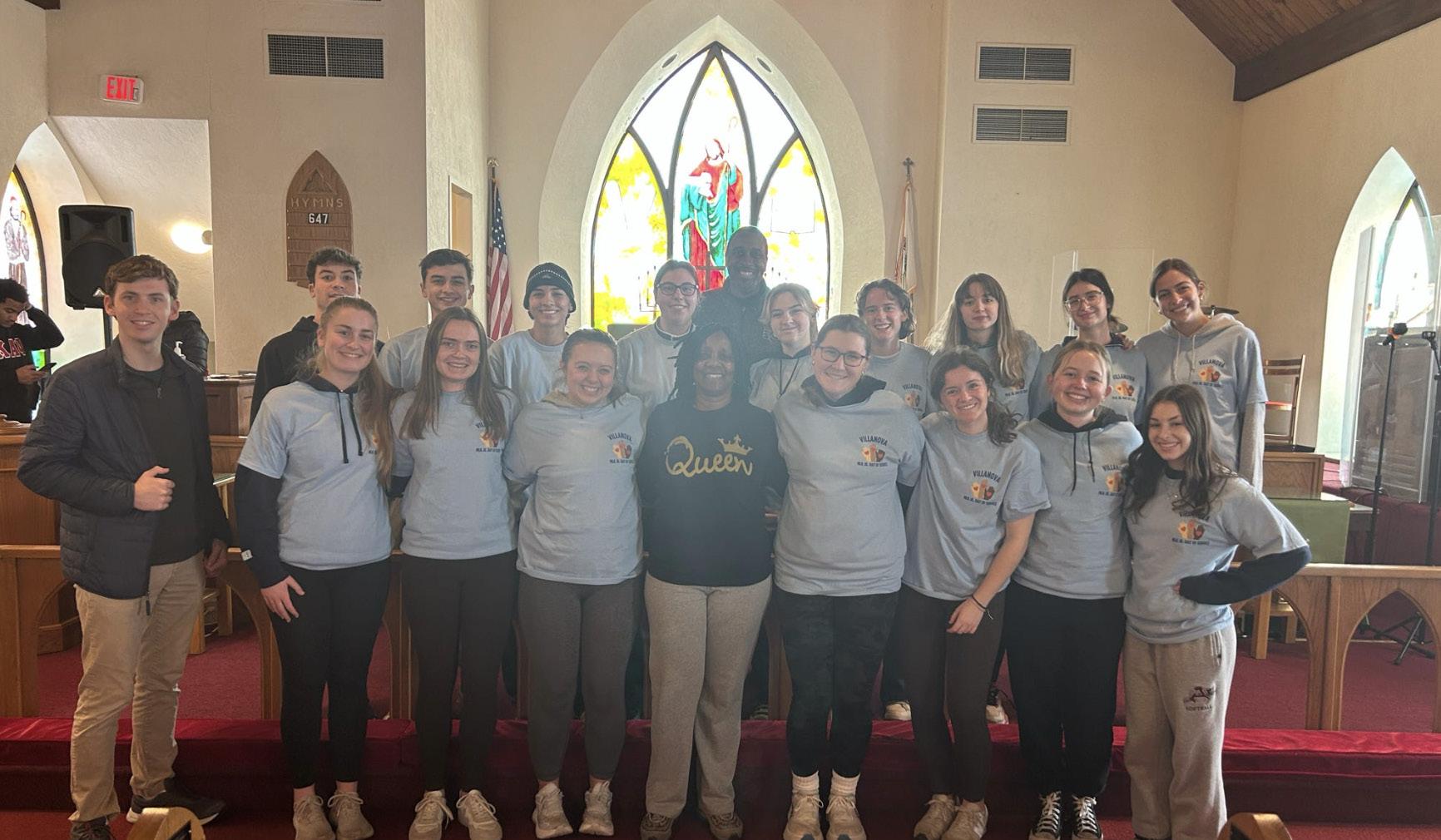
This year, that greatness was on full display as more than 300 members of the Villanova community dedicated their day off to participate in the 19th Annual Martin Luther King Jr. Day of Service.
Volunteers arrived at 7:30 a.m. on Monday morning at Jake Nevin Field House. They enjoyed a light breakfast and engaged in a gathering hosted by the Day of Service Committee and special guest, University President Rev. Peter M. Donohue, O.S.A., Ph.D. Seniors Sofia Arrascue and
Majo James served as co-presidents for this year’s MLK Day of Service and started off the event by delivering opening remarks.
“Today, we serve in honor and remembrance of Dr. Martin Luther King Jr., a man who reminded America of her promise,” James said. “We are called to do charitable works like you all will be doing today. We are called to serve. But, we are also called for social justice, to not only bandage the wound but heal it.”
Volunteers then departed for their sites around 8:30 a.m. and returned to campus around noon.
When asked about the success of the event, Arrascue credited the collaboration between the students on the MLK Day of Service Committee and the Office of Belonging and Inclusion.
“We wanted to focus on
making sure that we had enough studentws on our committee that were really passionate and excited about the event, who also took initiative,” Arrascue said. “We work with the Office of Belonging and Inclusion and those staff members do support us a lot, but we noticed that students could do more.”
The event aims not only to bring Villanovans closer to their surrounding community members, but also to each other.
“A lot of what our event is, it brings together groups from all over campus, from all different affinity groups, and brings them together to do this day of service,” James said.
When discussing why students should participate in this event in the future, Arrascue referenced the University’s Augustinian mission. Villanova follows Augustine’s push for Communitas and
being there for others.
“That is something that we at Villanova do through service,” Arrascue said. “If we want to contribute to both Augstinian values and the things MLK stood for, it is a good way to bridge both of those.”
James encourages people to think about the meaning of the holiday when deciding how to spend it.
“MLK day is more than just a day off from classes,” James said. “It’s important to spend that day in reflection and to carry out Dr. King’s legacy of progress.”
For Arrascue and James, this year’s MLK Day of Service was a success with volunteers serving at around 32 community locations in the Greater Philadelphia area. Both co-presidents hope to see student participation continue to grow in the coming years.
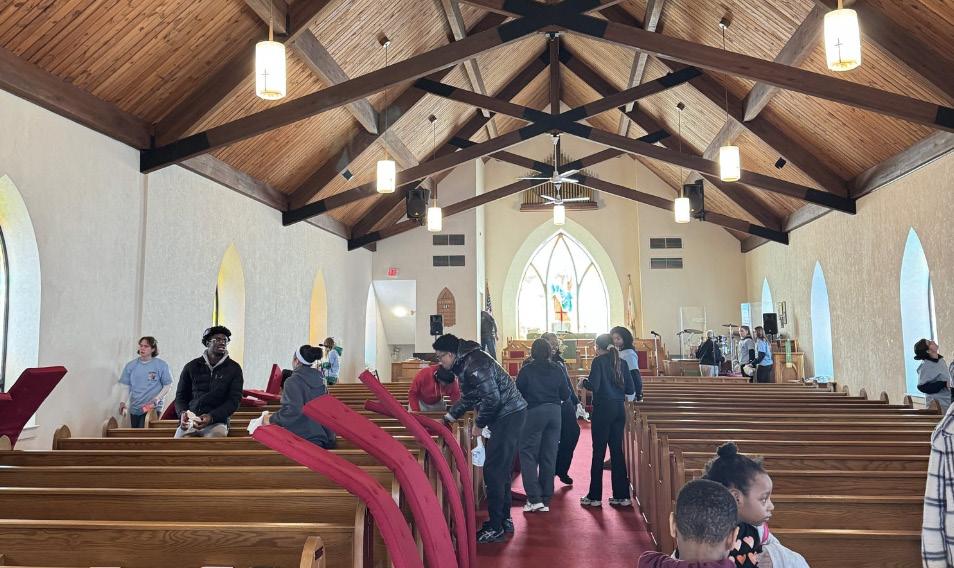
Students cleaning at Bethel AME Church in West Chester, PA.
Courtesy of Villanova Alpha Phi Omega
This Week in Politics: Red, White and…Green?
Zoe Garrett Political Columnist
The actions carried out by President Donald Trump and his administration throughout his second presidential term have resulted in a host of significant impacts on the nation’s economy, governmental structure, handling of immigration and more.
However, Trump’s foreign policy agenda has proved to be one of the most defining elements of his first year back in office. From withdrawing the U.S. from several international organizations, overseeing missile strikes on Iran and most recently to authorizing the capture of Venezuelan President Nicolás Maduro, the start of the president’s second term has been marked by numerous actions and developments that have notably affected the international stage.
Most recently, President Trump has ardently insisted on the U.S.’s acquisition of Greenland, a semi-autonomous territory under the jurisdiction of Denmark.
Trump’s campaign to take control of the Arctic island is grounded in reasons pertaining to the security of the U.S.
“It’s so strategic right now,” the president told reporters on Jan. 4, according to CBS News. “Greenland
is covered with Russian and Chinese ships all over the place…We need Greenland from the standpoint of national security, and Denmark is not going to be able to do it.”
Several administration officials backed the president’s ambitions. White House Press Secretary Karoline Leavitt echoed Trump’s security-related explanations.
“[The U.S. stands to gain] more control over the Arctic region and ensuring that China and Russia and our adversaries cannot continue their aggression in this very important and strategic region,” she said in a press conference early this month. “And, there would be many other benefits as well that, again, the president and his national security team are currently talking about.”
However, many world leaders, including Danish officials, have voiced confusion, concern and disagreement with the president’s musings.
In a Jan.18 text message to Trump, Norwegian Prime Minister Jonas Gahr Støre emphasized the need for a communal approach to maintaining the U.S.’s and the international community’s security, framing the endeavor as one that should be grounded in the strength of the NATO alliance.
Trump responded less than half an hour later, essentially rejecting Støre’s proposal. In his response, the president cited his failure to win the
Nobel Peace Prize– an honor awarded in Oslo, Norway’s capital– in his justification for acquiring Greenland, according to the BBC.
President Trump, in response to several European nations’ voiced opposition to his campaign for Greenland, threatened a 10% tariff on eight nations early last week, reported PBS.
This economic threat only built on the president’s previously stated commitment to achieve ownership of the territory despite pushback. Earlier this month, the president asserted that the U.S.’s acquisition of Greenland could be done “the easy way” or “the hard way,” reported CNN. Many have speculated that this ultimatum suggested the potential use of military force.
The president addressed these anxieties in a speech at the World Economic Forum in Davos, Switzerland, insisting on his commitment to not resort to force, reported NPR.
“We probably won’t get anything unless I decide to use excessive strength and force, where we would be, frankly, unstoppable,” he told the conference’s attendees. “But I won’t do that, OK? Now everyone’s saying, oh, good. That’s probably the biggest statement I made ‘cause people thought I would use force. I don’t have to use force. I don’t want to use force. I won’t use force.”
Following the international conference, world leaders participat-
ed in negotiations that could offer at least some victory for Trump.
Last Thursday, shortly after the president’s announcement of a “Greenland Deal,” NATO negotiators presented atentative plan to establish several sovereign U.S. bases throughout Greenland, a compromise which, while not fully meeting Trump’s desire for full ownership, would grant the president key mechanisms for control in the territory.
The proposed agreement would also vitalize new NATO efforts in the Arctic, update a 75-year-old pact between Denmark and the U.S. and restrict non-NATO states’ access to rare-earth minerals existing in Greenland, reported The New York Times.
Although not a signed deal, Greenland’s Prime Minister Jens-Frederik Nielsen expressed his hesitance to grant the U.S. any sort of ownership over parts of the island.
“We are ready to discuss a lot of things,” Nielsen stated. “Sovereignty is a red line.”
Relations between the U.S., Greenland, Denmark and other NATO allies will continue to shift as President Trump’s campaign for the territory continues to pan out. No matter the outcome of his pursuit, the tensions that have escalated as a result of the situation have already significantly impacted the relationships between many of the international community’s most significant actors.
“Sustaining the Dream” Villanova Hosts Dr. Asante
Margaret Miller Co-News Editor
On Tuesday, Jan. 20, The Center for Peace and Justice Education held its annual MLK Keynote Lecture in the Villanova Room of the Connelly Center. Titled “Sustaining the Dream: The Challenges for the Contemporary Generation,” the talk invited the public to a celebration of Rev. Dr. Martin Luther King Jr.’s life and legacy.
This year’s invited speaker was Dr. Molefi Kete Asante, a professor in the Department of Africology and African American Studies at Temple University.
Kathryn Getek Soltis STL Ph.D, the director of the Center, started by illustrating the goals of this event and other Martin Luther King Jr. commemorations.
“During this commemoration week, beginning yesterday with the Day of Service, we strive to contribute, reflect and expand on the legacy of MLK, pursuing the justice which is the urgent responsibility of each and every one of us,” Getek Soltis commented.
University President Rev. Peter M. Donohue, O.S.A., Ph.D then took the stage and explained the importance of recognizing Martin Luther King Jr.’s legacy as Villanovans.
“As an Augustinian Catholic University, we are called to uphold the legacy of justice and the beloved community,” Donohue noted.
Dr. Teresa A. Nance introduced the speaker and his contributions to academia, most prominently the idea of Afrocentricity.
“Afrocentricity is a paradigm
that says African people must view themselves and be viewed as subjects of their own history and culture,” Nance explained. “Now, more than simply giving African diasporic people agency, this theoretical view creates a renewed and expansive understanding that knowledge, facts and narratives stand, not on their own, but on the shoulders of a particular cultural perspective.”
Then, Dr. Molefi Kete Asante introduced himself and told the story of his ancestry.
“I’m a descendant of those who slept on the waves across the ocean, making that nearly forty-day journey from the continent of Africa to the Americas,” he said. “I am one of those who ended up in the United States of America, actually of the belly of a society where white supremacy was the rule of the day. I am one of those people who, from the very inception of bondage in the United States, defied that system of exploitation and never acquiesced to oppression.”
Afterward, Dr. Asante discussed the significance of celebrating MLK, as many people still have “lingering despair.” He brought up the recent killing of Renee Good in Minneapolis as a current event contributing to this despair.
“The killing of Renee Good in Minneapolis a few days ago is not a sign that King’s dream has been activated,” he said. “Actually, King, had he lived today, would have defended the vulnerable. In fact, he would have asked us as good people to speak up against all injustice.”
Dr. Asante then turned to discussing the history behind the challenges we face today pertaining to race. He touched on the Civil
War, the 13th and 14th Amendments to the Constitution, among other aspects of U.S. history.
Then, elaborating on the Civil Rights Movement, Dr. Asante introduced Martin Luther King Jr. and his ideology.
“His positive attitude toward morality and toward what he considered the moral art of the universe was that it was always bent toward justice” Dr. Asante said.
Dr. Asante also connected King’s beliefs to the ideas of the Zulu Declaration and African tradition, stating that the ideas King had, in addition to Christianity, can be traced to other traditions. He illustrated that King’s message is enduring and shared by many.
“It has withstood the test of time because no one can doubt that the greatest glory comes from defending the vulnerable,” he said. “And this has been known by all people who tried to do good. Mother
Theresa understood it. Mandela understood it. Bishop Tutu understood it. Pope Leo understands it.”
He then connected King’s ideas to current events, returning to the killing of Renee Good and debates over immigration.
“Renee Good’s killing in Minneapolis diminishes us all. As we have been diminished over and over again by the scapegoating of our neighbors, who, even as undocumented people, are also humans with inherent worth” Dr. Asante said.
Dr. Asante ended his speech by illustrating how we are to keep King’s dream alive in present-day circumstances.
“We too can dream of a better day for ourselves and our neighbors, because we are neighbors. And I say that we sustain King’s dream by not betraying it. And let us affirm the vision of one humanity working to elevate and support the vulnerable.”
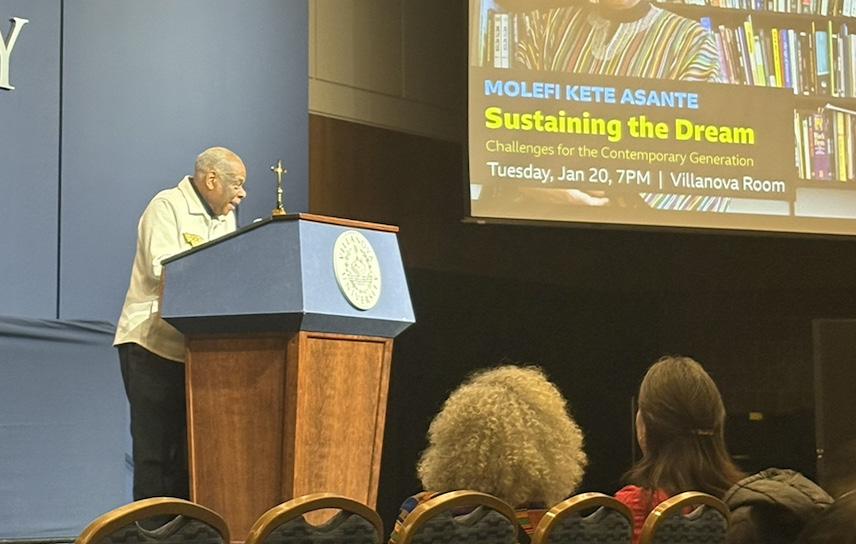
Molefi Kete Asante speaks at MLK Jr. commemoration talk. Villanovan Photography/Margaret Miller
NOVAdance Hosts Annual B+ Ball
Lauren Armstrong Senior Columnist
On Jan. 23, NOVAdance held its annual B+ Ball which took place in the Villanova Room.
The ball aimed to raise awareness for NOVAdance, raise money and provide a space where Heroes and their families could come to create memories, spend time together and meet students involved with the organization.
This year, the family relations co-chairs, Reese Trowbridge and Dylan Cahill, worked to make the ball more Hero-focused.
“The core mission of the B+ Foundation and NOVAdance is that everything we do is for our B+ Heroes,” Cahill said. “Making the B+ Ball more Hero-focused seemed like a no-brainer.”
The Ball is an annual event hosted and planned by the Special Events team within the NOVAdance committee, composed of Hailey Rebak, Matthew Deucher, Cait Jhin and Francesca Ward.
“The goal of NOVAdance this year is to reach a record $800,000 raised this school year, and we knew that for this to happen, we needed the Ball to be bigger than ever,”Deucher said. “We loved [the idea of involving more Heroes] and quickly began
Isabella Carlin Senior Writer
The return of Villanovans to campus officially marks the kickoff to the spring semester.
As classes and reunions are underway, students are looking forward to all of the upcoming events in the coming months. Between basketball games, the Winter Gala, and senior activities, Villanovans can expect a busy and exciting spring.
For many students, basketball season serves as a highlight for the spring semester. The Wildcats will face many Big East rivals in the coming weeks as they strive towards their first tournament appearance since 2022. Villanovans can anticipate packed student sections at both the Finn and Xfinity Mobile Arena in South Philadelphia.
“I think we did pretty well against UConn and other good
brainstorming how we can do this and decided on emphasizing the amount of work that our Hero Liaisons do with the Heroes.”
While appearing effortless to those in attendance, the Ball did not occur overnight.
“The planning process was about three months,” Deucher said. “[It] involved a lot of extra work to make sure details were ironed out.”
The organizations that are matched with Heroes on campus all have Hero Liaisons, who communicate with the Heroes and their families, and connect the Heroes with their organization.
Senior Alexandra Schuster has been one of the Hero Liaisons for Chi Omega for the past two years since it was matched with their Hero, Julia.
“Being a Hero Liaison to Julia and the Siegfried family has truly changed my college experience,” Schuster said. “It means so much to me that I am able to be a part of their lives and make a difference not only to them but to all families battling childhood cancer.”
Schuster was also in support of the change to make the Ball more Hero-focused.
“Having the B+ Ball become more Hero focused just shows what our mission is all about,” Schuster said. “Showing
people how much our Heroes mean to us, and how deep our connections are with every single one of them, proves that we NOVAdance for them and want to celebrate them every chance we get.”
This year, the Hero Liaisons for the Heroes who attended the Ball gave speeches dedicated to their Heroes.
“My favorite moment from the B+ Ball was watching five of our Chi Omega sisters perform a parody of ‘Golden,’ a K-Pop Demon Hunters song, for Julia,” Ella Johnson said, a Chi Omega Hero Liaison. “This showed me how even though my fellow Hero Liaisons and I have gotten to know Julia best, her light has spread throughout the chapter of Chi Omega, and our sisters are willing to go to great lengths to celebrate her.”
The connections between the organizations and their Heroes are unique and differ from Hero to Hero, yet what stays the same is the love they all have for each other.
“Showcasing the beautiful relationships [Heroes] have with their Liaisons and paired organizations truly captures the heart of NOVAdance,” Annie O’Brien said, Co-Executive Director of NOVAdance.
In addition to the surprise
Second Semester Preview
teams, so I think there will be a lot of great games ahead for the rest of the semester,” freshman Liam McKeown said.
The final Xfinity Mobile Arena game and tailgate will occur on Saturday, Feb 21. against the University of Connecticut.
The Spring Involvement Fair is set for Wednesday, Jan. 28, in the Villanovan Room. Students will get the chance to meet leaders and interact with active members of hundreds of different organizations. Like the Fall Involvement Fair, Villanovans have the opportunity to learn about student groups and recruit new members. These groups include but are not limited to Villanova’s athletic, media, service, arts, and advocacy clubs.
The countdown to graduation for seniors is fast approaching. On Feb. 5, Villanova will host the “100 Days Celebration” to mark the milestone for senior students.
speeches, the Ball featured a raffle, a merch sale and a section where Heroes and their families could play games.
This year’s NOVAdance raised the most money out of all the B+ Balls in years past, and it was put towards the $800,000 goal.
To Cahill, working closely with the Heroes and their families for the entire year has made his experience in this position rewarding.
“Being able to support the special relationships with Heroes and their organization is incredibly meaningful,” Cahill said. “Maybe a Hero is having a rough day with treatment or struggling at school. Having a place like Villanova to come to, where they can spend time with their organization, Hero Liaisons and friends, can mean everything. The smiles that come make all the hard work worth it.”
This year’s 12-hour dance marathon is set to occur on March 28, on Villanova University Cabrini campus.
The Villanova community is invited to see the work the NOVAdance committee, Hero Liaisons and other members of NOVAdance have put in over the year and to meet the Heroes who have made an impact within their Villanova organizations.
“I am excited because [100 Days] will be an exciting opportunity prior to Graduation,” senior Julia Harris said. “It will be a wake-up call for how close Graduation really is.”
In addition to this event, seniors have the opportunity to participate in the VU Senior Program. This program is a series of activities for students to engage with before Graduation on May 19.
Villanova’s annual “Winter Gala” hosted by the Office of the President will occur on Friday, Feb. 6, from 8 p.m. to 11 p.m. in the Connelly Center. Villaovans are supposed to dress in formal attire and get to experience an evening of dancing, casino games and socializing with one another. Students are required to RSVP, and those who are 21-plus are eligible for free drink tickets.
On Saturday, March 28, NOVADance will host its annual 12-hour dance marathon. NOVADance is a year-long fundraising effort
that raises money and awareness for pediatric cancer. This year, the organization is looking to reach its goal of $800,000, all benefiting the Andrew McDonough B+ Foundation.
This year’s NOVAdance will also mark the first year that the dance marathon is hosted at Cabrini in the Dixon Center. Students have opportunities to get involved in NOVAdance, including serving as Sidekicks, Engagement Coordinators, Hero Liaisons and Day-of Participants.
“I am so excited for the day of the marathon to see everything really come together,” junior Engagement Coordinator Maeve Cantwell said. “Seeing all of the smiles around the room, specifically on the heroes and families, makes all of the hard work worth it.”
In addition to large campus-wide events, Villanovans can anticipate a semester of new classes, friendships, snow days, and involvement opportunities.
Seniors look forward to commencement. Dylan Johnson/Villanovan Photography
Villanova students look forward to the Winter Gala. Dylan Johnson/Villanovan Photography
OPINION
Cliff Maloney: The Role of Political Speakers on Campus

Massimo DiLeo Staff Writer
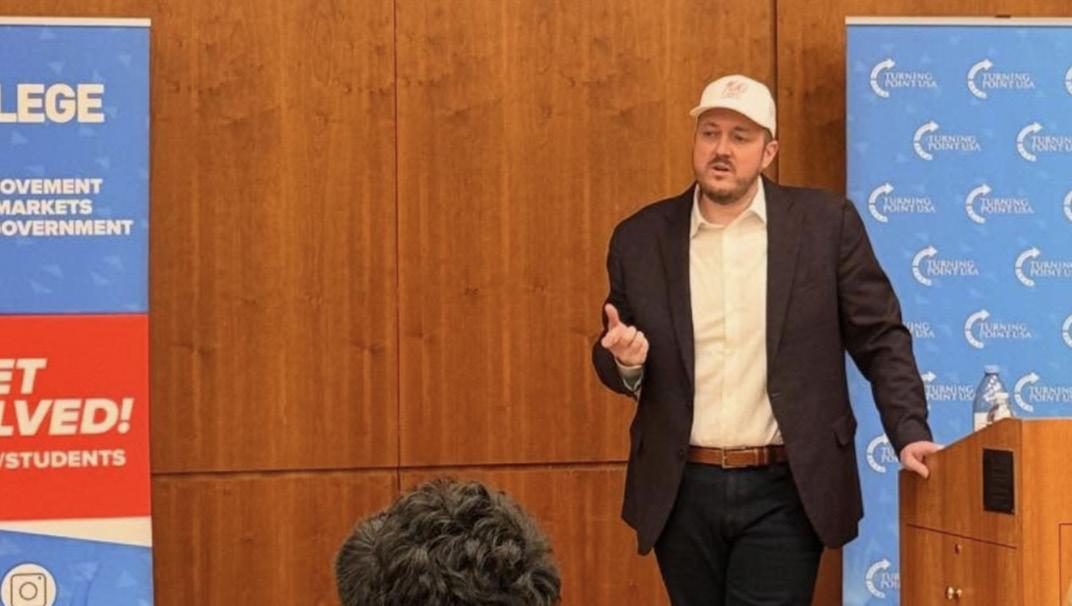
On Tuesday, Jan. 20, Villanova University’s branch of the wellknown conservative non-profit organization Turning Point USA (TPUSA) invited Cliff Maloney of Delaware County to speak to students about his campaign work and the late Charlie Kirk. Maloney began his campaign career around 2016 when he quit his job as a math teacher to campaign for Rand Paul of the Republican Party, who ran against Donald Trump in the presidential election, but ultimately dropped out. In addition, Maloney has appeared on various news platforms, including Fox, and is currently working on his book named “Run Right,” which will focus on how to run for office correctly and hopefully win.
On a broader scale, in 2012, Charlie Kirk and William Montgom-
ery founded TPUSA with the hopes of advocating for conservative politics on high school and college campuses. More than 10 years later, TPUSA is described as one of the most powerful conservative youth groups in the nation. I was able to attend the event hosted by Villanova’s TPUSA chapter, but I began to wonder whether or not these events empower or diminish student voices.
Although insightful, events similar to this one may make students who do not identify with the politics associated with it less likely to branch out and attend. In comparison, bipartisan events such as the debate held last semester between the presidents of both the major Republican and Democratic student organizations on campus allow for a more inclusive feel.
In reality, this event was not what many may have perceived it to be based on its advertisement and marketing. Maloney focused on shar-
ing his work and inspiring those in attendance to do the same; However, while some may have believed it to be an event aimed at reinforcing TPUSA’s political beliefs in students.
However, when events such as this one are present on campus, they may result in more negative change than positive, even if that is not their intended purpose. It is valid to argue that politics should be set aside from campus and exist independently outside Villanova’s gates, even if that is not completely feasible.
Analyzing Tuesday’s event specifically in relation to this argument, readers should note that when students branch out and attend these events, they may realize, as I did, how much more depth there is to these campaign organizations than what appears on the surface. More specifically, they see the amount of work
campaigners do to gain votes. The statistics show that it takes approximately 180 pieces of mail and 26 phone conversations to gain around two new votes for a candidate.
Events similar to this urge students to consider an important question about the role of politics on campus: should they create adversity or challenge us to think more critically? While political speakers and events may not appeal to all students, their presence can still offer insight into the realities of political organizing and civic engagement beyond headlines and stereotypes. College communities thrive when students feel comfortable engaging in critical discussions. If similar events plan to take place on campus, they should aim not only to promote ideas but to foster inclusivity, curiosity and genuine conversation from a diverse set of perspectives.
Students Should Learn About Compound Interest
Michael Barravecchio Staff Writer
At a 7% annual return, a college student who starts investing earlier can contribute significantly less money over time and still end up with more than someone who waits until their 30s. This paradox is not an illusion or a magic trick; it is simply the result of compound interest. How it Works
Compound interest is the financial principle in which interest is calculated on both the initial principal and previously accumulated interest, or simply, the interest an investor earns on interest, according to Investor.gov. For example, if a 26-year-old invests $5,000 into the S&P 500 per year for five years, which yields average annual returns near 7% when adjusted for inflation, reported SoFI, the person’s account value will rise to approximately $37,000 when they turn 31. However, if a 21-year-old college student invested $5,000 per year in the same index fund for 10 years, their account would be about $82,000 by their 31st birthday.
Why This Matters
The difference is in the time invested. By investing at 21 rather than 26, a student can generate
$32,000 from compound interest. If the student waits another five years and begins investing at 26, they will only earn $12,000 from interest alone.
The best component of compound interest is that the investor does not have to be smarter, richer or more sophisticated to earn more. They simply need to use time in their favor. Many college-aged students do not have significant income and are still learning the skills they need to succeed at high-level jobs. However, the one thing that college students have is time. Compound interest is accessible to anyone willing to start saving. By doing so, a young adult in an entry-level role can build more wealth than someone who starts later, even if that person earns far more.
Common Misconceptions
“I need a finance degree to properly realize the power of compound interest.”
The power of compound interest is available to anyone willing to save, and it does not require advanced financial knowledge. This misconception often stems from discomfort with investing and fear of making mistakes. If this is you, invest in the S&P 500, an index that tracks the performance of the world’s top 500 companies. The S&P 500 is a great way for inexperienced investors to mimic a highly diversified portfolio without needing the knowledge
to create one. The companies within the index span various sectors: energy, healthcare, real estate, tech and more. The S&P 500’s annual return rate of about seven percent adjusted for inflation suggests that it has historically delivered reliable long-term returns for patient investors.
“I think I will start saving at graduation, not now.”
Compound interest relies on time to grow, meaning that when you invest is more important than how much you invest. Whether the principal value is $100 or $10,000, the extra four years of college allow the money more time to compound. This is why the opportunity cost of waiting each additional year to save is extremely high and unrecoverable. Graduation may sound like a responsible starting point, but it often turns into an indefinite delay. In many situations, waiting until you are ready makes sense. With compound interest, however, starting early, even in small amounts, matters far more. Starting later usually means trying to compensate with larger contributions, creating a stressful environment where you may regret not saving earlier.
“Isn’t a Roth IRA or 401(k) enough on its own?”
While a Roth IRA and a 401(k) offer tax advantages that can significantly increase long-term
returns, they do not compound on their own. Instead, returns compound when money within these accounts is invested. However, these retirement accounts can work powerfully alongside investment strategies. Roth IRAs tax you when you contribute, meaning earnings are never taxed when withdrawn. A 401(k) retirement plan works similarly, but is tax-deferred, meaning you will not be taxed as the money grows; taxes are postponed until you withdraw the money. While these tools do not compound on their own, understanding how they work alongside investing is essential.
Call to Action
For college students, the next step is to begin saving. Compound interest rewards time, consistency and patience far more than complexity or a large principal. For students seeking guidance, firms like Fidelity are within walking distance of campus and offer free educational investing advice to help get started. With many firms, starting an account takes just minutes and minimal personal information. For additional knowledge, the link below is a valuable source from the U.S. Government that demonstrates the power of compound interest. Time is an advantage that college students cannot recover once it is gone.
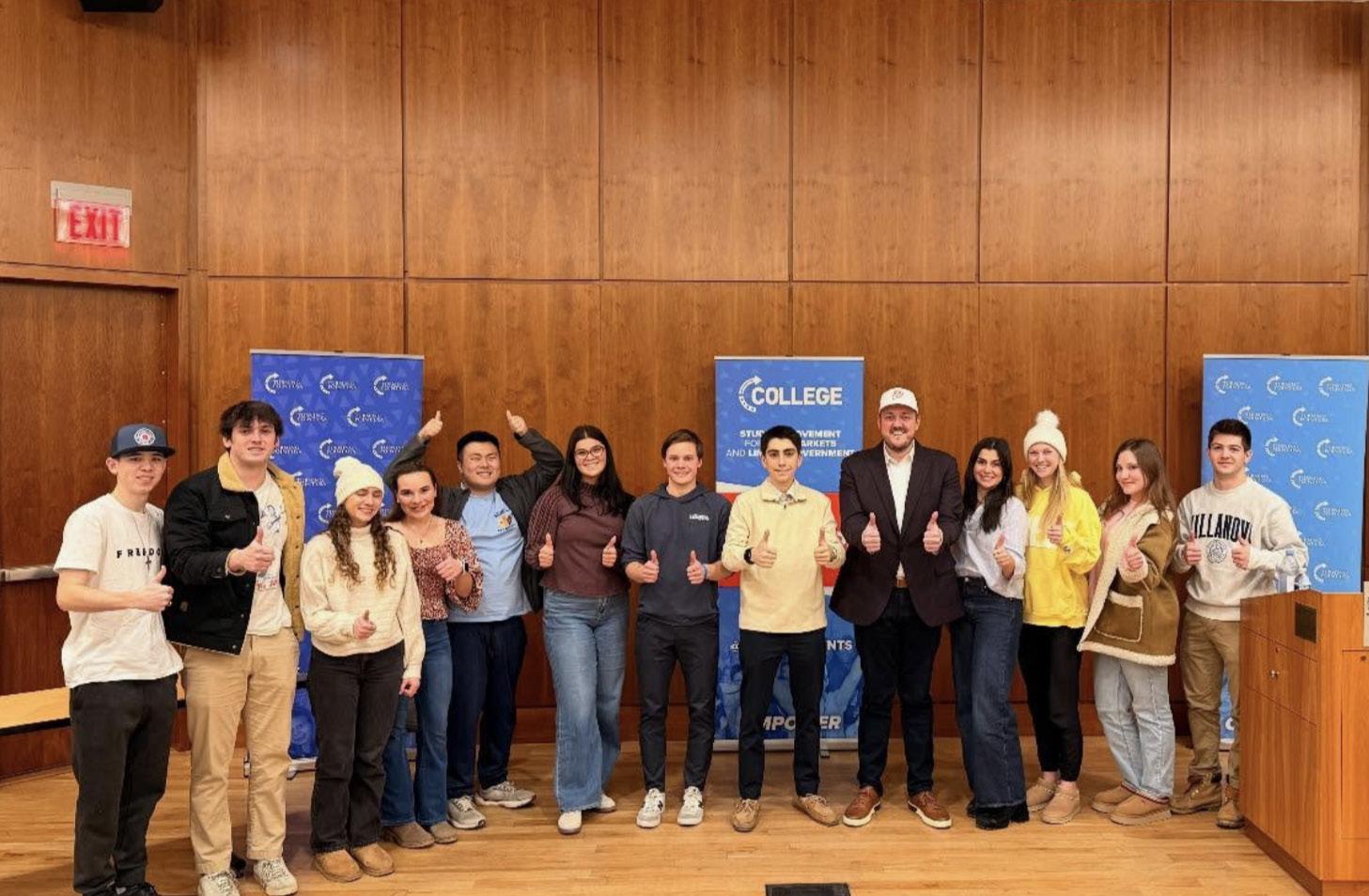
Several students across all grade levels attended the event. Courtesy of @tpusavu on Instagram.
Maloney spoke about several topics, including campaign logistics and free speech. Courtesy of @tpusavu on Instagram
EDITORIAL BOARD LETTERS TO THE EDITORS
KAILEY FAHY
DYLAN JOHNSON
SOPHIE LATESSA
AVERY CHALK
EMMA TAYLOR
Editor-in-Chief
Editor-in-Chief
Managing Editor
Opinion Editor
Opinion Editor
The Villanovan encourages all members of the Villanova community to voice their opinions. Letters to the editors may be submitted via e-mail to villanovan.eic@gmail.com. Letters must not exceed 500 words and must be signed. No anonymous letters will be published. All submissions become property of The Villanovan and are subject to editing for clarity and space.
POLICY
The unsigned editorial that appears is the opinion of The Villanovan as determined by the majority of the Editorial Board. Other columns, letters and artwork represent the opinions of their authors and do not necessarily reflect the position of The Villanovan.
Wokeism Died... And Gave Rise to the Alt Right
Liam Foley Staff Writer
“Woke” is dead. And its collapse has not led to moderation, but to something equally damaging: a growing alt-right style of political discourse, exemplified by figures like Nick Fuentes. This movement is rapidly moving from the fringe toward the mainstream. There is an explanation why ‘wokeism’ imploded and argue that its failure directly enabled the rise of a new form of radical right political influencers.
First, though, what exactly is “wokeism?” Most encountered the term for the first time in 2020. In reality, though, the term has existed for decades and originated out of the Black American experience. “Stay woke” meant staying alert to racial danger. It meant knowing when to leave a place, or when to keep quiet; when your skin alone made you vulnerable. To be “asleep” was to be naive about how power actually worked. “Wokeness” meant understanding that racism was not just about individual hatred, but a system that shaped how different races lived.
The term then catapulted into the spotlight following George Floyd’s tragic murder. The incident caused rightful outrage for the Black American community. The tension of not being seen had clearly reached a tipping point. In
the midst of the unjustified rioting, a noble cause would ultimately end up sprouting—a push to make white people also woke. The idea of wokeism then developed beyond its original context, becoming a phrase associated with a broad recognition of systemic racism and police brutality. It had explanatory power, and wider society largely accepted that these conversations needed to be had.
Racism is a moral wrong that commands near-universal agreement in American society, aside from a group of bigots. We have collectively arrived at this understanding through long-standing institutions like the American legal system. For that reason, a majority of Americans were willing to accept claims about systemic racism and to engage seriously with efforts to address it.
The leftists then attempted to capitalize on this momentum by broadening what wokeism could be applied to. They expanded the conversations from exclusively race to gender identity as well. When wokeism spread to gender identity, the common consensus was not there. Yet, leftists applied the same moral clarity used in racial politics to questions of gender identity, framing them in the same moral language as anti-racism and casting themselves as standing on the right side of history. Without a common strong consensus, the movement compensated by applying intense social pressure to those who disagreed. It became totalitarian.
Cancel culture literally functioned as its system of punishment, and the “correct” way to think and speak was enforced.
There is nothing wrong with believing that gender is completely a social construct and only loosely related to biology. Or that society should accept—and openly support—the use of they/them pronouns. The woke movement, however, treated disagreement with these principles as morally equivalent to racism and enforced conformity based on that flawed logic. In the cancel culture environment, many moderates feared speaking about their beliefs. They could be socially ostracized and shunned in the classroom or the workplace if they did. Given this reality, the average moderates silenced themselves and conformed.
When dissent is forced underground, it does not disappear. It mutates. And like a buried emotion, it eventually resurfaces in a more dramatic and destructive form. The woke experience drove many moderates to sharpen their views with resentment and gain a desire for retaliation. This process laid the groundwork for the movement’s collapse.
The alt-right was well aware of this dynamic and how it was building. It understood that once the political momentum swung back to the right, there would be a demand for vulgar and inflammatory claims—particularly racist and sexist ones—as a form of retaliation
against what many experienced as a totalitarian woke movement. Badfaith political elites, both politicians and influencers, have pounced on the opportunity under the momentum of the right-leaning Trump administration. Self-proclaimed involuntary celibate, racist and sexist Nick Fuentes is leading the charge and has become effectively mainstream. He’s recently been casually mentioned on the #1 and #4 most popular podcasts on Spotify, “The Joe Rogan Experience” and “This Past Weekend” with Theo Von. He has also debated Piers Morgan and has appeared on the podcasts and channels of many popular influencers.
The situation is unfortunately similar to many examples of politically extreme regimes and ideologies giving way not to moderation, but to their inverse. Following World War II, for example, many Eastern European nations emerged from fascist rule only to see it replaced by an equally repressive Communist system. In contemporary United States politics, the vacuum left by the totalitarian woke movement has been swiftly filled by a dangerous alt-right.
To avoid repeating this cycle of a negative political extreme, we must resist the emotional pull of retaliation and consciously rebuild a stable and moderate political society. Doing so may well be the defining political challenge of the next generation.
What Students Can Learn From the Concept of “Ego Death”

Juliana Burke Staff Writer
The concept of ego death has permeated our discourse over the past few years, but why? It is jokingly ascribed to the trivial aspects of our lives that we conjoin to the concept of ego death, such as a final grade in a class or a poor result in social pursuits.
This begs the question of whether or not true ego death is possible, or more importantly, if we are even operating under its intended definition.
Ego death is commonly described as the dissolution of one’s sense of self. This jars us on an emotional and physical level, as we tend to consider ourselves as an especially and intensely (due to our direct perception of such things) niche set of interests, fears, desires and general inclinations.
However, when we take a more practical approach and examine the concept of ego death philosophically, we can come to understand that ego death does
not need to be interpreted as the destruction of the self. Rather, it can be understood as a temporary suspension of egoic identity that offers valuable insight into the constructed nature of the self and the sources of human suffering.
To let go of the contemporary maximalized version of ego death is to let go of any ill conceptions surrounding the ego itself. In philosophical terms, the ego is not merely a Freudian structure but the organizing center of personal identity, where the aforementioned aspects we cling to are bundled into a unique package of being.
It is the narrative through which individuals understand themselves as continuous beings over time, distinguishing the self from the external world. The ego allows individuals to view themselves as fixed, autonomous entities, leading to an exaggerated sense of separation from others and from the world as a whole when it is challenged in any meaningful sense.
Ego death refers to the temporary breakdown of this
narrative identity, caused by the meaningful challenges we encounter throughout our lives (death of loved ones, financial hardships, isolation, etc).
Rather than erasing consciousness, such experiences often involve an intense awareness in which the usual boundaries between our internal and external senses are blurred.
This is often discussed in religious discourse among various sects: in Buddhism, the doctrine of anattā denies the existence of a permanent self, while Hindu philosophy describes liberation as the realization that the individual self is not separate from ultimate reality. From this, we can gauge that, as it is defined in the general discourse, one of the central lessons of ego death is the recognition that the self can be ephemeral.
Many philosophical and psychological accounts suggest that suffering arises from excessive identification with oneself to the point where you actually lose individuality trying to fit into a certain
aesthetic or niche. This leaves us vulnerable to anxiety, resentment and disappointment. However, the concept of ego death is not without its many limitations. The ego plays an essential role in moral responsibility and practical life, and losing sight of it, even for a brief period of time, can be incredibly destabilizing for the individual. Instead, we can aim for intentional reflection on our ephemerality without relying on dramatic manipulations of consciousness to achieve our personal goals.
This begins with refusing to romanticize a universal solution to existential problems. Ego death doesn’t mean the self disappears forever. It means that, during hard or meaningful moments in life, that story about ourselves can loosen or pause. When that happens, we might realize that the “self” isn’t fixed and permanent. When we begin to view the self through this lens, we can recognize the limitations of our egos and gain a deeper understanding of what it means to be a “self” at all.
The Case For Living On Villanova’s Cabrini Campus
Emma Taylor Co-Opinion Editor
Continued from p.1 in clusters with semi-private bathrooms, ensuring that friend groups can live together even if they don’t score one of the former options. The lounges are modern and well-furnished with pool tables, which are an otherwise rare sight to see if you don’t live on West campus. Moreover, our current Davis Fitness Center pales in comparison to Cabrini’s Dixon center with its state-of-the-art dance studio, suspended indoor running track and the brand new fitness equipment expected to arrive later this year. It may be hard to envision living there in its current state, I’ll
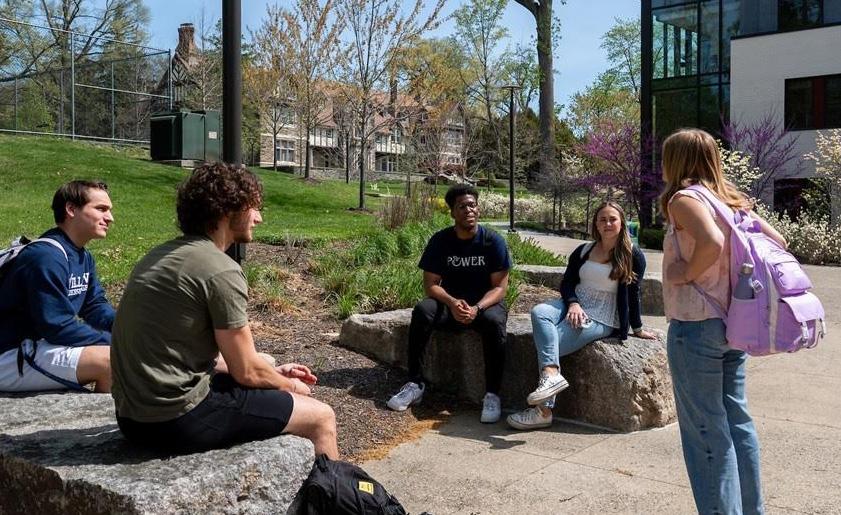
admit. Construction is still underway everywhere, and students have little to no exposure to the campus aside from perhaps the brief visit for Special Olympics last semester. No other class in the history of Villanova has experienced a transition like this before, and students with preset expectations of how their sophomore year was going to look may feel at a loss for what to do. Despite all this, I implore everyone to keep in mind that this is part of what college is about. It means being open to trying new things and discovering what you do and don’t like. It means developing independence and adaptation skills through unexpected situations, and relocating to Cabrini is an excellent opportunity to improve on these things with friends at your side. Ultimately, it has the potential to feel like the most quintessential college
experience yet.
In an email sent to the Villanova community on Oct. 23, University President Rev. Peter M. Donohue, O.S.A., Ph.D. shared that “community members are working tirelessly to ensure the Cabrini Campus reflects the same warmth and energy that define Villanova. Residence halls are being renovated, recreation facilities are being refreshed, dining spaces reimagined, and academic areas renewed—all with the goal of creating a vibrant student experience rooted in our Augustinian Catholic tradition.”
There are still many who are apprehensive about the adjustment, which is extremely fair. Sheehan and Sullivan Halls in the Quad are still
expecting the more than 800 sophomores they usually house, and with how desirable and spacious Cabrini living is set to be, I’m sure those who are searching for the more traditional Villanova sophomore housing won’t have an issue finding their space for a lovely year in the Quad.
However, it seems that the tours did their jobs well. The consensus is an anxious excitement to be the first Villanovans living at Cabrini, an attitude well-earned by the administration for all the efforts put into making it an attractive transition. As students move in this August and the campus comes alive, I’m sure the frustration once felt by so many will be long forgotten.
Sorority Recruitment Isn’t Meant To Be Stressful
Kaitlin Lawrenson Staff Writer
Last year, sorority recruitment felt like standing in the middle of a storm. Every outfit choice, every conversation, every smile felt heavy with meaning. I remember the nerves that settled in my stomach each morning and the constant internal questioning. Recruitment was exciting, but it was also exhausting, emotional and overwhelming. Now, as a sophomore on the other side of that experience, I see recruitment through an entirely different lens, one shaped by understanding, gratitude and a deep desire to support the women walking into that same storm. Going through recruitment as a first-year, it’s easy to feel like everything is happening to you. You’re evaluated, ranked and sorted in ways that can feel intensely personal, even when you’re told not to take it personally. What I didn’t realize then was how much heart exists on the other side of those doors. As a sophomore and an active member of my chapter, I now see the preparation, the intentional conversations and the genuine hope that each woman walking through recruitment finds a place where she feels seen and valued.
Watching recruitment from within my chapter has been grounding. It has reminded me that recruitment is not about perfection, it’s about connection.
The women in my chap -
ter show up day after day not to judge, but to listen. They share their stories honestly, hoping something resonates. They want potential new members to find a home, whether that home is with us or somewhere else. That shift in perspective has softened, allowing me to let go of the anxieties I once carried and replace them with empathy.
“When I went through recruitment as a freshman, I thought it was all about impressing people,” sophomore Faith Malki said.
“Now I realize it’s really about being present and open, on both sides. Seeing how much love and effort our chapter puts into recruitment makes me wish I could go back and tell my freshman self to breathe.”
Her reflection captures something I think many sophomores feel: a wish to comfort our past selves, and an even stronger wish to support those currently going through it.
Being part of my chapter has shaped me in ways I never expected. It has given me friendships that feel steady and safe, leadership opportunities that have challenged me and a sense of belonging that extends far beyond letters. Because of that, recruitment now feels less like a performance and more like an invitation. An invitation to be yourself, to trust the process and to remember that your worth is not determined by any single round or decision.
To the women who just went through recruitment: your
nerves are valid. Your excitement is valid. Your disappointment, if felt, is valid too. But please know this, there are women on the other side rooting for you, even if you never meet them. They remember exactly how it feels to walk into a room full of strangers, hoping to be accepted. They want you to find a place where you can grow, laugh and feel supported, just like we did.
Even as recruitment passes
by once again, the lessons taken from the four days stay. As a sophomore looking back, I can say with certainty that the most meaningful parts of this experience were never about the stress or the fear. They were about the people.
Standing on the other side now, I am endlessly grateful for my chapter, for my friends and for the chance to help make this experience a little less scary for someone else.
The Nerney Pavilion within the Dixon Fitness Center. Emma Taylor/Villanovan Photography
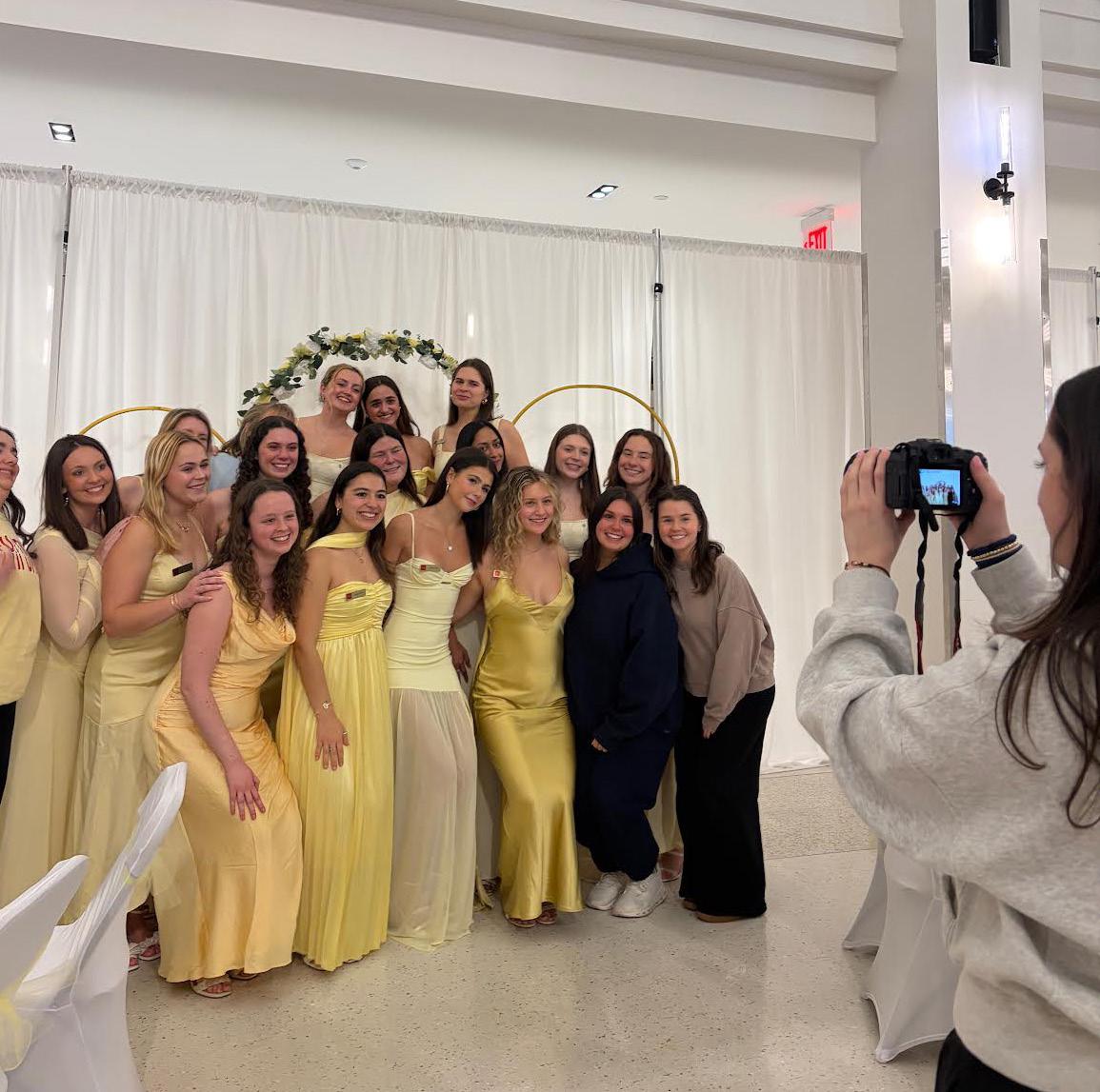
Recruitment is not about perfection, it’s about connection. Lauren Armstrong/Villanovan Photography
Students will begin moving into Cabrini Campus in August 2026. Courtesy of Villanova University
CULTURE
Students React To Another False Threat Hitting Campus

Cali Carss Co-Culture Editor
Continued from p. 1
motivated me to become more invested in working towards a solution to end gun violence, but it continues to impact my life and the lives of so many students in such a traumatic way.”
The Class of 2029 knows this better than anyone. With the beginning of their college years already clouded by memories of false threats, this event was another concerning turn for them to navigate.
“I was getting ready for my 8:30, and then I just heard a lot of commotion in the hallway,” freshman Addison Figel recalled. “Then my mom called, and I feel like when these instances happen, I feel just how much my parents get upset and worried, and that makes me feel sad. I just hate that this has become a normal occurrence.”
Many upperclassmen expressed frustration and exhaustion over the threats, especially when navigating these issues for the first time on a campus that had previously felt so safe.
Lauren Armstrong Senior Columnist
Dear Seniors,
With one semester left on the scoreboard, we have officially entered the halftime of senior year. Whoa. With just 111 days before we cross the stage in May, this is the time to do all the activities you and your friends have been bookmarking over the past four years.
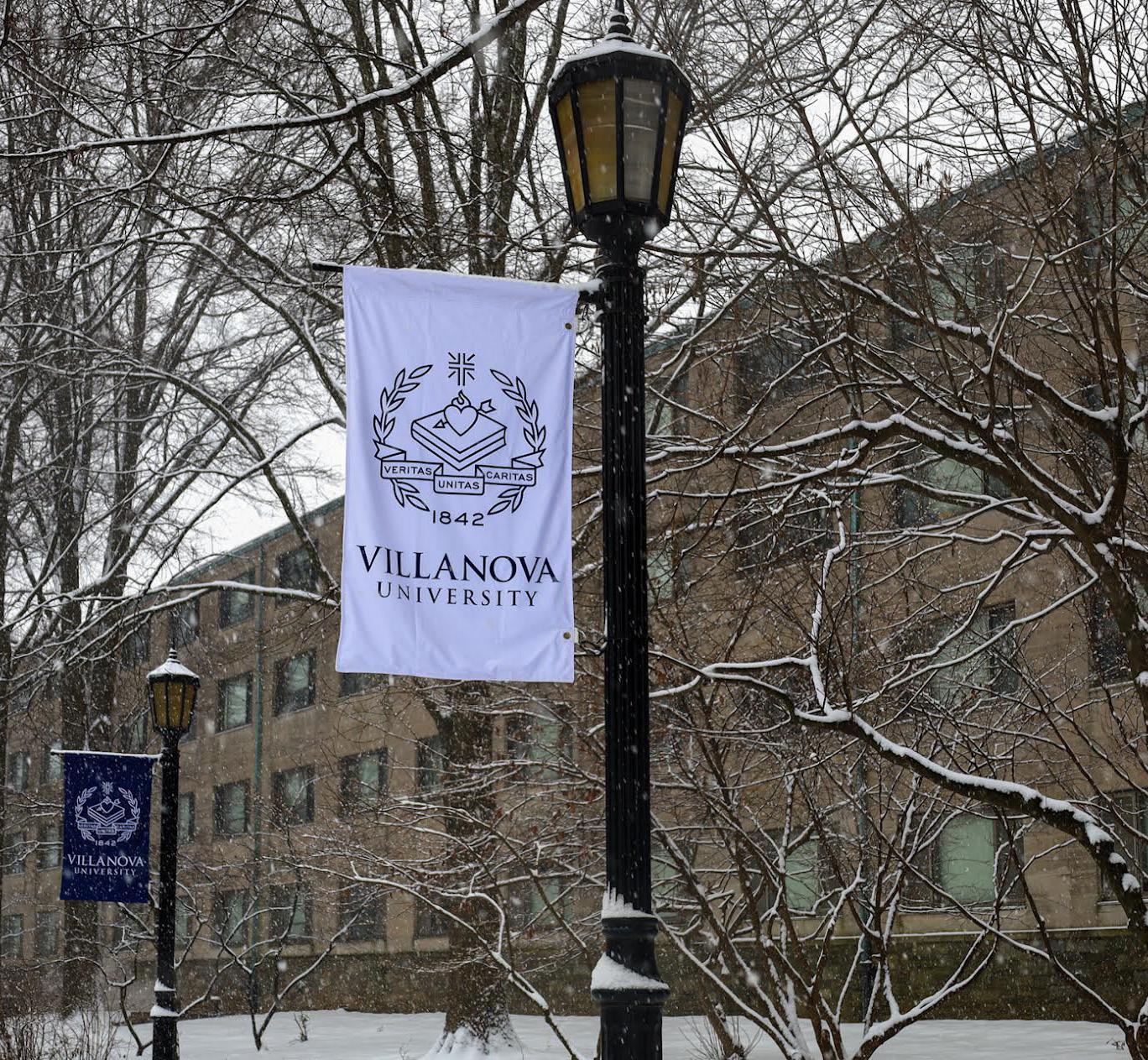
“I found it disheartening,” junior Abby Contessa said. “But I was grateful that the alert got out fast and the campus remained safe.” As important as these
NOVA Alerts are, they are also incredibly disorienting to receive in the early morning. Many students were unable to fully grasp the situation until later reports rolled in.
“My inclination is still that it’s nothing [at first],” senior Kaitlin Gibson said about her initial thoughts from Thursday morning. “I was confused, and I ultimately was like, ‘What do I do with the rest of my day? Do I just wait?’ I was feeling a lot of paralysis for the most part.”
Some students, like Gibson, felt a bit closed in even after the threat had subsided and chose to find other outlets for their energy.
“It was really important to me that I get off campus because I felt kind of trapped, and I didn’t want to be trapped anymore,” Gibson explained.
As the student body and the rest of the Villanova community recover from and reflect on the events of last Thursday, it is important to remember that we will carry these experiences with us for a long time.
“I just think it’s really sad how this has become the norm since it’s, like, the third time it has happened to us as freshmen,” Figel said.
Thankfully, the threats proved to be unfounded once again, but the impact of living through this lockdown and the uncertainty that followed it is incredibly real.
Letters From Lauren: Halftime
minal Market or exploring locally owned bookstores and vendors. The city is filled with endless opportunities.
Two: Villanova Senior Events
I do not know if this is just me, but my friends, roommates, littles and I are constantly sending TikToks, Instagram reels or other videos back and forth of cute coffee shops and pop-up activities around campus or in the Philly area. However, it is rare that we ever act on these plans. Instead, we bookmark them and, with an empty promise, say we have to try this out.
It is time to act, so here is a compiled list of places to visit, activities to do and things to try during our last semester in the greater Philadelphia area.
One: Philly Day Trip
Considering the fact that it only takes 25 minutes to get to and from the city, it is a place I have yet to fully explore outside basketball games at the Xfinity Mobile Arena. However, the city has so much to offer. From deciding to go to the Art Museum to exploring Chinatown or going to see the Liberty Bell near Independence Hall, the city is full of new places to explore. My recommendations? Catching a Phillies game on a Tuesday night, spending hours in Reading Ter-
The University hosts a variety of events for seniors throughout the spring semester. Included are the Senior Pub Series, the 100 Days celebration that is coming up and senior week right before graduation, to name a few, as well as events for all grades, such as the Winter Gala. The University has thought of it all. I will be the first to admit that there used to be a time when I might have thought that University events were overrated, yet now, with just a few months left, it is time to savor them and say yes when your roommates ask if you want to go.
Three: Freshman Year Redo
Okay, hear me out on this one. A lot of the friends I have now I did not know during my first months or even first year on campus. However, there are freshman year traditions that I would love to have memories of with these friends. So why not have a do-over?
From Sunday morning debriefs during SPIT breakfast, to church picnics and walking the neighborhoods behind South Campus, we can relive some of our favorite memories and places from our first moments as students during some of our last moments at Villanova.
Four: Graduation Photos
As a certified professional sentimental individual, I love having
pictures that I can always have to look back on. Graduation is no different. The past three springs, I have loved walking across campus, going to class or the library, and seeing groups of friends get their graduation pictures taken, and celebrating the end of their college careers. It is bittersweet knowing that in a few months it will be me and my friends, the classmates I sat next to in Ancients, the people who also lived in McGuire freshman year, standing on the other side of the camera in our white dresses and navy gowns.
Start getting your cords ready, photographers booked and hair appointments scheduled.
Five: A Dip in the Fountain
One of my favorite traditions is going into the fountain
by the library at least once before graduating. I do not know why this tradition started, but I do know that it is a rite of passage for each Villanovan. There is no need to go all the way in. A simple photo standing in the water will do. Maybe it happens during your grad pictures, maybe it happens on a random Wednesday night with friends, regardless, this is a moment all students deserve to enjoy.
There are a lot of ways to make the most of our senior spring semester, and these are just a few. The most important thing to remember is to cherish it.
Time flies, and May will be here before we know it. Make the most of the next 111 days.
With love always, Lauren
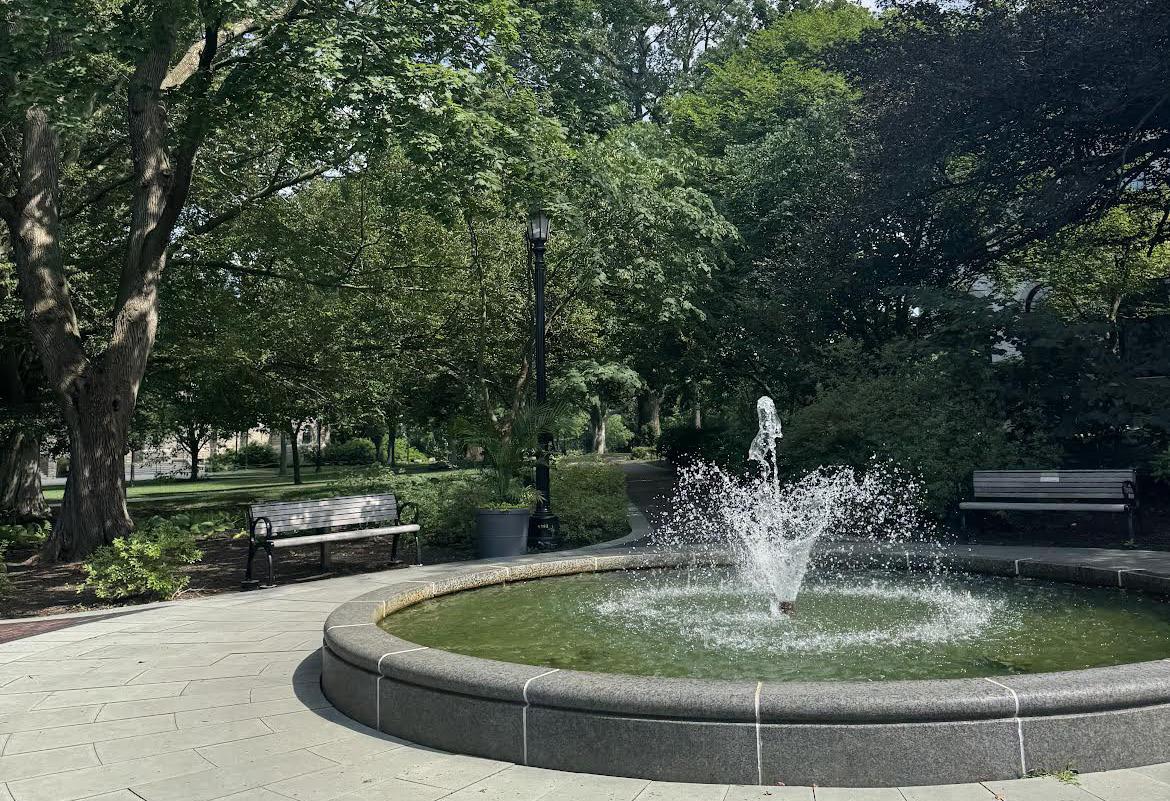
Villanova experienced it’s third false threat of the 2025-26 academic year. Natalie Zickel/Villanovan Photography
Making a bucket list is the best way to make the most of senior spring. Lauren Armstrong/Villanovan Photography
MLK Day Keynote Speaker: Dr. Molefi Kete Asante

Korin Kohen Co-Digital Editor
Nearly 60 years ago, Martin Luther King Jr. stood on Villanova’s campus and challenged students to confront injustice with moral clarity and courage. This past Tuesday, that history felt newly alive as students, faculty and community members gathered in the Villanova Room to revisit the meaning of King’s dream and consider how it may be sustained today. For the 2026 Annual Keynote Lecture, “Sustaining the Dream: The Challenges for the Contemporary Generation,” Villanova welcomed acclaimed scholar and cultural theorist Dr. Molefi Kete Asante as the evening’s speaker.
Asante, a professor in the Department of Africology at Temple University, is widely recognized for his pioneering work in African studies and his lifelong commitment to examining race, power and identity in the world. With more than 104 books and over 500 articles written, Asante brought both intellectual depth and personal reflection to the lecture.
Early in his address, he asserted that “King’s dream has not been activated,” grounding his argument in history but also connecting it to what he described as “painful reminders of how far we still must work towards.”
Asante briefly referenced the recent events in Minnesota regarding tensions between citizens and federal immigration enforcement, prompting a visible shift in the room. Heads nod-
Emma Cote Abroad Correspondent
By the time this article is published, I will have been in Italy for three days. As a former news editor of The Villanovan, I have spent much of the start to spring semester missing structure.
Every week, I had a routine. Familiarity paved the way for me finding my place at Villanova, and I never really appreciated it until I was watching my rountines go on from afar both seamlessly and without me.
I knew that Monday nights meant section meetings, and putting together a comprehensive list of just about anything happening on campus with my co-editors. I could always count on writing an article for that next edition, and the privilege of speaking with so many different people from each walk of life and every corner of campus.
Tuesdays consisted of long hours putting together the physical paper with some of my closest friends. While arduous, these nights included Dancing with the Stars viewing parties, CampCo family dinners and late night walks back to West Campus, all of which became a routine highlight of my week.
Wednesday nights, I’d watch as my roommates and best friends brought back physical copies to our apartment, culminating in a stack of editions that would reside under our TV until we moved out. This kind gesture is one I am especially missing. Rinse, recycle, repeat.
I’ve always loved to travel, and
ded across rows of students, signaling a shared recognition that the distance between the past and present had momentarily collapsed. This instance underscored how these injustices remain deeply prevalent in contemporary society, and the audience’s reaction illustrated how closely the lecture’s themes resonated with many of Villanova’s community.
Asante traced the contradictions embedded in America’s democracy and institutions, emphasizing the absurdity behind the nation’s founding ideals and its prejudiced realities. He repeatedly pointed out that African Americans have been enslaved longer than they have been free, a stark reflection on how the
promise that “all men are created equal” has often fallen short. Asante didn’t shy away from illuminating this discourse in ways that felt clearly relevant to students. The conversation shifted to education and how it might foster a generation capable of sustaining King’s dream.
“MLK Day matters to me because as someone who is half black and half white, I see both the pain of racism and also the hope for unity,” sophomore Lily Miklaszewski said. Her expression mirrored the mood in the room, in which audience members appeared attentive not only to Asante’s words, but also to their own positions within these discussions. The lecture made students realize that
Unpacked: The Beginning
studying abroad has been an ambition of mine stretching all the way back to the early days of the college search, long before I even chose Villanova. While that excitement is still at the forefront, the actual reality of leaving home for that long has become far too real.
My structure has been flipped entirely upside down. I am looking at a Google Calendar right now that is full of different countries each weekend, and suddenly all I want to do is be back on campus. Back in that office. Back with my friends.
Despite my absence, I know that those facets of the routine I appreciate so deeply are going to continue. Section meetings will keep happening, articles will continue to be written, production nights will go on and students will grab the paper each Wednesday. While I’d like to say that this provides me some comfort while abroad, I would probably be lying. I love playing a part in that routine, and I feel a bit lost without the organization.
However, The Villanovan itself hasn’t always been such a straightforward and comforting piece of my life. I can distinctly recall how terrified I was walking down the steps of Corr Hall for my first meeting freshman year, and just how much more frightened I was doing the same before my editor interview.
That first production night was certainly uncomfortable for me as well, as I stayed in the office making edits to my pages until 11 p.m. (a special thank you to Brooke and Nicole who had to suffer through that).
The first article I ever pub-
the ideals King fought for are reflected not only in national movements but also in everyday interactions and conversations on campus.
“MLK and Dr. Asante’s message remind me that my identity represents the kind of equality and shared humanity that they fought for,” Miklaszewski added.
Her response indicated an awareness that there is still significant work to be done to achieve the unity King envisioned, but that her generation is actively taking on responsibility and action.
“I think humility is a great trait to have,” sophomore Joseph Davenport said.
He noted that meaningful change begins with a willingness to listen, question assumptions and acknowledge gaps in understanding.
“We used to only study a very limited set of perspectives before we advanced to Black Studies, Women Studies and other disciplines,” Davenport highlighted.
Continuing the work towards equality relies on how students and teachers choose to lead within their own classrooms and spaces.
Asante affirmed these ideas and concluded with the sentiment that all humans originate from the same place and that the true measure of King’s dream lies in human beingness.
Asante issued his call to action that the responsibility to sustain that dream remains not only a historical legacy but an ongoing obligation for humanity.

lished was anything but original after all of the changes that had to be made. The first section meeting I held, only three people attended. The first edits I made barely scratched the surface of all the work that goes into finalizing an article.
Yet after all of those uncomfortable moments, I was able to carve a space out of Villanova where I feel a sense of belonging. It wasn’t naturally comforting. Far from it, really. But now, it’s a place I can’t wait to return to my senior year.
This abroad column is immensely different from anything I’ve ever put in the paper. News is formulaic and structured, and an area where I found myself excelling because of these characteristics. These pieces, though, will change depending on where I am, what I see and what I
find to be important. Whether it be a political phenomenon I get to witness up close, a particularly interesting activity, a meaningful conversation or just where my head’s at while abroad, I am embarking on this project of observation relatively blind.
In spite of all this uncertainty, in establishing this column I have brought this piece of home with me while travelling, and I’m so grateful for that.
So whether you’re also abroad, still on campus or elsewhere I’d like to formally invite you to my experimental section. Wherever you may be, I hope we all can navigate our new routines and find some comfort in that uncertainty.
Until next week, Emma.
MLK Day was celebrated on campus with an address by Temple’s Dr. Molefi Kete Asante. Korin Kohen/Villanovan Photography
As her journey abroad begins, Emma will report back to the Villanovan on her experiences. Emma Cote/Villanovan Photography
Love On Lancaster: The French Do It Best

Maggie Fitzgerald Co-Culture Editor
New year, new you, maybe even new me, but you can bet your weekly edition of Love on Lancaster is here to stay. Some things should never change. After a hiatus abroad in none other than the beautiful city of Paris, I have returned. Yes, I am now obnoxiously European and unable to let go of my previous life, but I am back. I figure for the first edition of 2026, we have no other choice than to go right to the source. The City of Love.
What could be more fitting for a love columnist than a semester spent in Paris? While I spent the majority of my time eating my body weight in cheese and bread, biking along the Seine and drastically changing my entire closet to black, I too spent some time learning the language of Paris. Love. The French, however, do things very differently. After four months spent traversing the city and doing my best to communicate in broken French, I learned a thing or two about my temporary neighbors. Alors, on commence?
Food is love
If I learned absolutely anything from my time in France, it is that food is the ultimate language of love. I didn’t need fantastic French language skills to clearly understand this principle. Quite literally, everything was about food. Every Saturday morning, my neighborhood was

Kate Koslow Staff Writer
“This is such a bad idea.”
It’s electric, it’s steamy and it’s all the rage. Based on Rachel Reid’s hit book, the series Heated Rivalry, created by Jacob Tierney, has millions enthralled by its story. With the global uproar occuring, it’s clear that something about this show has touched the hearts of many.
The story follows two hockey rivals, Ilya Rozanov and Shane Hollander, who begin as rookies competing for the first spot in the hockey draft. While the two completely loathe each other at first, their burning hatred turns into a heated and passionate affair. By offering a glimpse at what it looks like to be a closeted public figure, this show becomes an emotional journey into a tricky and very real dilemma: masking your heart to the world, or being true to yourself while risking glory.
The performances by Connor Storrie and Hudson Williams are what really have impressed viewers. While Hollander’s character demanded a timid performance by Williams, Storrie’s portrayal of Rozanov showed an incredible range that deserves great praise. As a Russian character, Rozanov required a thick Russian accent and convincing fluency in the language, which is especially notable since actor Storrie, a Texas native, learned Russian solely for this role.
Many viewers have been appreciating the execution of this series, emphasizing how it creates a
flooded with marketgoers, their bags overflowing with leeks, carrots and loaves of bread. The first thing I did when making French acquaintances was shamelessly ask them for their restaurant recommendations, aching to be a part of the magic. One of my largest notes on food pertained to the subject of lunch. After a summer spent on Capitol Hill, I grew accustomed to shoveling my hastily packed sandwich into my mouth at my corner desk. This was lunch. This was my break. Au contrare. The French take lunch seriously. From the hours of 11:30 a.m. - 3 p.m., stores shut down and restaurants open. Bistros are full of colleagues chatting, students gossiping and couples meeting to share a meal. Not only is food celebrated, sacred and something to take pride in, but it is also an experience
that is meant to be shared with those we love.
The myth of school buses
The French don’t believe school buses are real. On multiple occasions, I was asked if the bright yellow shuttles even existed outside of the movies. The source of this confusion: the idea that parents wouldn’t be taking their kids to and from school. I spent my semester in the 13th arrondissement of Paris. On the outskirts of the city, the 13th was full of working parents with small children, looking to still be in the city but further removed from the craziness. While I was initially saddened to not be placed in the quintessential areas of the city, I learned so much in my tiny pocket of Paris. Every morning on my walk to
Reel Talk: Heated Rivalry
well-rounded story from which viewers can’t look away.
“The show feels exceptionally well made, balancing action, dialogue, thoughtful camera work, and genuinely great performances,” sophomore Gabrielle Morales said.
These amazing portrayals, coupled with stylistic choices made by Tierney, have drawn millions into the relationship between these two young men. The music, by Canadian singer-songwriter Peter Peter, creates an edgy atmosphere, one that emphasizes a deep and riveting tension between the two. The subtle costume design highlights the contrasting personalities between Rozanov and Hollander, with their wardrobes exposing their social and personal divides. While Rozanov shows off more striking clothing, such as a bright Hawaiian shirt or leopard print, Hollander wears mowstly muted colors, later hiring a stylist, reflecting his uncertainty in the way he expresses himself.
While some may see this series as just another romance, it has shown the importance of queer representation in the media. Since the uproar from this show, Jake Williamson, a retired gay hockey player, has stated how Heated Rivalry has sparked a reflection of his time in the league, calling the series “raw, honest, and very, very human” in a recent Instagram post. Amazingly, Heated Rivalry has also inspired Jesse Kortuem, a retired hockey player, to come out on the Drew Barrymore Show, stating that he “didn’t realize that one story could spark a conversation, could encourage others to finally find the strength to be themselves.”
school, I was surrounded by Parisian parents, one hand holding their kid’s, the other wheeling a bicycle alongside them. The streets were filled with the sounds of childish laughter and French chatter. Walking your child to school is built into the DNA of French parenthood. It is an act of service for your child that the French can’t fathom that American parents don’t perform dutifully every morning. It is just something you do. It is just how you love.
Put your best foot(heel) forward Dressing well is not optional. Putting on a well-thought-out outfit and a pair of heels is the biggest form of French self-care. This column, as you know, deals with more than just romantic relationships. Love for yourself is essential to the French way. I learned that presentation is less about the outward gratification and more about the inward love for oneself. As my four months went on, the more I invested in the ordeal of presentation, the more confidence and poise I exhibited in the world around me. Learn from the French. Look good, feel good, play good.
I learned too much in my glorious time abroad to recount it in one measly article. For now, I hope my international wisdom will be translatable to our little lives here in Bryn Mawr. Love is universal, but love is cultural too. These are my notes on the French way.
With love, Maggie

“The open dialogue it’s created stems from the show doing such a good job of keeping the romance at the center, and really having it be a true, raw love story from start to finish, in an environment where it’s shut away,” sophomore Ava Nagengast said.
However, this isn’t the only positive effect from the show: the reaction from women demonstrates that queerness in men isn’t unattractive. For years, gay men have been stereotyped as being feminine, making those who present as “masculine,” such as professional athletes, feel embarrassed to come out. These problematic stereotypes, due to sociological factors and gender roles, have led to a long history of mental health issues among men, placing gay and bisexual men
at higher risk for suicide attempts, according to the National Institutes of Health (NIH). However, across social media platforms, audience reactions, and wide discussion within major outlets these harsh stereotypes are shown to be clear fallacies. Through these two characters, a truthful view of queer relationships is breaking into mainstream media. While Rozanov and Hollander often communicated through stolen glances, unspoken words and subtle grazes, their relationship has bloomed into a raw and vulnerable portrayal of love and sexuality in a callous environment.
Watching Heated Rivalry won’t just appeal to your romantic side, but it will also walk you through a love story - one that often goes untold.
There are countless ways to show love like the French; one of which is through food. Maggie Fitzgerald/Villanovan Photography
Heated Rivalry is a hockey romance that has captured the world’s attention. Courtesy of Ayla Uram
The Musica Nova Series Spotlights Michelle Cann

Cali Carss Co-Culture Editor
For the first installment of the Musica Nova concerts series of the semester, Dr. Elizabeth-Jane McGuire and Dr. Betsy Springuel invited pianist Michelle Cann to perform pieces composed by the women of Chicago’s Black Renaissance.
Cann is an award-winning pianist lauded by many organizations and publications for her work in performance and composing. She has played with a number of world-renowned orchestras and is on the piano faculty at the Curtis Institute of Music in Philadelphia as the inaugural Eleanor Sokoloff Chair in Piano Studies.
This program comprised music by several Black women composers, who were writing in the Chicago music scene around the 1930s and 1940s. Cann explained to the audience that this theme was inspired by one featured composer in particular: Florence Price. Since discovering Price’s music about 10 years ago, Cann has become a leading expert on her work and life. The two Price pieces that featured in the Musica Nova concert were “Fantasie Nègre no. 1” and “Fantasie Nègre no. 2.”
“[Price] actually wrote four fantasies. I did two of them,” Cann explained. “One is missing, sadly, so we only have three that we can play. … Those pieces that I played were some of her more powerful, impressive pieces for piano.”

Ciara Dursee Co-Digital Editor
Well, well, we meet again, VillaVogue readers. I’m sending my warm regards during the snow madness we’ve been experiencing at the beginning of the 2026 season. The usual mild temperatures in the Northeast have taken a sharp, bitter turn to weeks of temperatures wavering in the teens.
My mom called me the other day to laugh at herself about how ugly her shoes were when walking in the city, but she had no choice. The game is changing this winter. The snow, the ice, the salt. Everything makes it hard for you to walk from point A to B. You have to be able to walk on ice. Do you ever reach for your old pair of UGGs before stepping into the storm? Suede boots? Knee-high heels that’ll have you cracking all the salt on the sidewalks?
The question proposed is this: Can you look stylish and still be functional? If there is anything that will open your eyes to new clothing choices, it should be this weather shift.
I’m sure trudging through over a foot of snow and fighting against the strong winds while walking to class was not an easy adjustment to make on campus.
Rather than surrendering to a bulky layering of a random assortment of coats and sweaters, I’ve been attempting to gather essential wardrobe pieces that remain practical, but still allow my style to peak through. A winter wardrobe is never meant to be
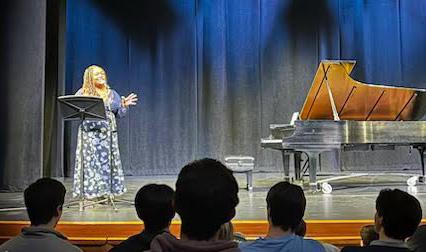
The entire concert consisted of six pieces and an encore, with Cann discussing the history and legacy of these composers in-between performances. She had in-depth explanations to share on each featured woman and on how they all interacted with or influenced one another during their lifetimes.
“I heard [Price’s] piano concerto, and then I looked for all these other pieces, and I wondered about whether there were other composers out there that were in Chicago, specifically that city,” Cann said. “Through my research, that’s how I came across all the names you saw on this program and all the music that I played.”
The audience was hooked from the moment Cann sat down at the piano to kick off her concert. Students listened intently to each piece,
and many joined in a standing ovation to conclude the event.
“What I got really excited about with this series was when I heard that it was for the student and faculty community,” Cann shared. “You don’t see that all the time. For instance, I’ll play with a lot of universities, and it’s a public concert [where] people in the community come and pay tickets. It’s very interesting, I’ll go to a university, and there are hardly any students. But, because the school thinks about students first, I feel like they go out of their way to make [the students] know to come and encourage you to come and hear this music.”
It was extremely encouraging to the professors present to see the level of engagement that Cann received from their students.
“Sometimes [classical music]
VillaVogue: A Snowy 2026
boring. Investing in the right elements to elevate the cozy look is the objective.
So light a candle, settle in with a soft blanket on your apartment couch or dorm room bed, take a sip of your warm tea and listen closely. Unfortunately, not much can prepare you for a “feels like minus 1 degree” day, but allow me to try.
Fuzzy Texture:
From head to toe, fur has taken over. Faux fur jackets taken over the closets of many college students. Last weekend, my friend wore an ALO fur jacket in a sharp black shade. I adored her.
Hero Knits:
I have been searching for a large sweater that’ll keep me warm with few layers to commit to. The heavy material of a hero knit sweater does the job exceptionally.
Bundling Scarf:
Scarves have been an essential part of keeping me warm on my walks to Bartley from my parking spot on West campus. I am currently obsessed with making a scarf the highlight of a basic go-to outfit. The pop of color, pattern and texture is fascinating.
Accessories matter, and as much as we forget how important these minor additions are, they are non-negotiable for me.
Puffer Vest:
Once a year, my twin brother will come forth with a fashion take. This year’s hyperfixation is his puffer vest. This is something I can actually support. Men, listen in. A puffer vest over a crewneck sweatshirt or sweater
is viewed as out of reach unless you studied music yourself,” Dr. McGuire said. “But I think music is for everybody. It’s accessible to everybody. I think that’s borne out by the fact that the entire audience stayed the entire time, which I see a lot of these events and they empty halfway through, but this was genuinely riveting.”
McGuire, as one of the organizers, has seen this event series grow and change over the last eight years. However, as a pianist herself, this performance was special.
“The ‘Fantasie Nègre no. 1’ actually took my breath away,” McGuire shared. “I was sitting forward on my seat, watching her perform it. It just seemed almost athletic.”
There is much to learn from the stories of these composers. They were brilliant women who carved out space for their music in a world that wasn’t all that interested in what they had to say. The rediscovery of their music by musicians like Cann is fascinating and essential to the creation of a fuller historical canon that celebrates all its contributors. This concert was one small, but important, step in bringing them to students’ attention and demonstrating their talent nearly 100 years after this music was written.
“Advocacy, I would definitely say that’s the word,” Cann explained what she hopes to be students’ main takeaway. “For me, it was, in my own little way, looking into these composers, doing some research, finding names nobody knew about and saying this music deserves to be heard. I’m going to play it.”

keeps you cozy while running errands. The bonus is that you’ll look good doing them.
Turtleneck and Mock neck: My hyper fixation of the season. There is something so chic about a turtleneck and high bun combination. The best part is the tradeoff. No scarf is needed. An undershirt is optional. What’s better than that?
Here’s your first 2026 VillaVogue report. Now, if you don’t mind, I’m going to sit down around the couch with my friends, wearing my grey mock neck sweatshirt and fuzzy Birkenstocks with a smile on my face. See you next time.
P.S. A little piece of advice. Just wear the eight-year old UGG boots. They still look good.
Michelle Cann dazzles at Topper Theatre. Cali Carss/Villanovan Photography
The more fur, the better. Maggie Fitzgerald/Villanovan photography
The Room Where It Happens: U.S. Strategy and Arctic

Hudson Zivic Staff Writer
The phrase “history repeats itself” is widely known and often used for various reasons.
It highlights recurring patterns in human behavior, societal trends and political events.
That’s where “Hamilton: An American Musical” comes in. The comparison for this analysis: Is history really repeating itself?
By examining a quote from the musical alongside a contemporary political story, we can explore whether the ideals, conflicts and ambitions that shaped the early republic are echoing in current events, or if what appears familiar is simply history’s rhyming, not its repetition.
President Donald Trump’s renewed focus on Greenland reflects a strategic effort to shape a geopolitical landscape in the Arctic. Rather than it being random, his Greenland initiative comes from what his administration views as critical to national interests. Some interests are securing Arctic Sea routes, countering Russian and Chinese influence, maintaining military leverage and accessing natural resources said to be vital for modern defense and technology sectors. His rhetoric and repeated assertions that the United States must have access to Greenland “whether they like it or not” show a willingness to push unprecedented and strong demands on a world stage.
But Greenland is not a simple


acquisition, as it is a semiautonomous territory of the Kingdom of Denmark. With a small but politically engaged population and its own government, Greenland insists that its sovereignty remains absolute and non-negotiable.
Denmark has repeatedly rejected any idea of giving control of Greenland to the United States, as such talk threatens the foundations of NATO and international law.
Danish Prime Minister Mette Frederiksen stated unequivocally that a U.S. takeover “would amount to the end of NATO,” reflecting deep alarm among allies.
This is the ideal quoted by George Washington in “Hamilton”: “Everyone shall sit under their own vine and fig tree, and no one shall make them afraid,” models a world in which people govern their own futures without coercion, which can be compared to Greenland and Denmark’s stance on the island’s autonomy.
While Trump has moved away from explicit threats of military
action or tariff imposition after stiff pushback from European allies, he continues to claim that the United States will gain “total access” and “all the military access we want” over strategic military bases and Arctic operations, even if it does not formally own the island. At the same time, NATO Secretary-General Mark Rutte and European leaders have wanted to channel these tensions into a broader Arctic security framework, one that emphasizes collective deterrence against Russia and China, while upholding sovereignty and alliance principles.
However, all this comes back to arguably the most central lyric to our core musical: “You have no control who lives, who dies, who tells your story.” This warning in “Hamilton” about narrative control resonates with how this crisis has unfolded. Not only is the United States’ relationship strained with its European allies, but it has also shown fractures within political coalitions.
Republicans have publicly criticized the Greenland gambit,
warning that Trump’s approach risks alienating key allies and damaging NATO, and the rhetoric being used also could trigger constitutional consequences. Europe also hasn’t been passive, as French, German, Italian, Polish, Spanish and other leaders have reaffirmed that Arctic security must respect territorial rights and international law, even when pursuing cooperative defense measures. These tensions have become a call to action in the European Union for strategic autonomy as European policymakers have openly pushed back against reliance on the United States for security, emphasizing that Western alliances need mutual respect and shared commitments rather than demands.
The Greenland crisis offers this reminder that history, while it isn’t repeating, is connected with past patterns of ambition, strategic competition, alliance tensions and the enduring importance of sovereignty. Trump’s assertive moves in the Arctic echo earlier power of competition, but in a modern context where alliances and international law are more central.
Just as the early republic struggled with how to balance competing interests and respect for voices in “Hamilton”, today’s leaders are navigating how to balance national security concerns with cohesion and respect for sovereign rights. Whether the Greenland situation is escalated or continues to operate under this diplomatic strain will be dependent on how parties can manage geopolitical goals and ambitions.
Shelfcare: New Year, New Reading Habits
Alexandra Pultz Staff Writer
Every new year comes with a fresh set of intentions, and one of the most common is the promise to read more. Whenever a friend tells me they want to get back into reading, I get a little too excited. I become an overly enthusiastic and slightly overbearing person, throwing recommendations at them. Not all of them completely land, but I am usually complimented for my well-equipped list of recommendation. I’ve learned to curate a list of fun books that almost everyone will enjoy. Still, recommendations can only take you so far. The habits you instill in your daily life make resolutions stick. Finding Time to Read:
We’re all guilty of saying we don’t have time to read. After a long day of classes, the first thing I want to do is collapse on the couch and scroll. Instead, try to swap out your scrolling by reading a chapter or two. Over time, choosing your book over your phone becomes a routine, helping you build stronger reading habits. People often feel pressured to be a “perfect” reader and finish books quickly.
However, it’s the consistency that matters most. Even reading a few pages a day adds up, and removing the pressure to read perfectly makes it easier to keep coming back to your book. A favorite trick of mine is to keep a book in my bag to read on the train or while waiting for an appointment. Those little moments
and pages really add up.
Read Books That Interest You:
While I love to give recommendations, I can understand that not all of the books I recommend might resonate with everyone. The most important and enjoyable thing about reading is finding books that interest you. Many college students avoid reading because they associate it with rigid rules and dated plotlines, but that’s not what reading is supposed to be at all. Reading for enjoyment should not feel like homework. It should be fun. So, research books on topics that interest you or find books by authors you’ve previously enjoyed.
One of my biggest tips for staying motivated is to read books that have been adapted into shows or movies you already love. If you spent your break binging “Heated Rivalry” or saw “The Housemaid” in theaters, try picking up the book version.
Make it
Social:
A favorite part of my reading experience is reading with my friends. There’s nothing better than finishing a good book and immediately talking about it with someone else. My friends and I love to exchange books to share opinions and different interpretations of the same story. Reading becomes a shared experience instead of a solo ritual. You can even take it a step further by making it a monthly ritual and starting a book club. Choosing a book to read together each month helps keep everyone accountable and makes it easier to stay on track with your reading goals.

At the end of the day, reading more isn’t about how many books you finish or how quickly you get through them. It’s about making reading a fun part of your daily routine. Whether that means swapping out your phone for a book before bed, choosing stories that genuinely interest you or reading alongside friends, the habits you build are far more important than the reading goal itself. By letting go of reading pressures and unrealistic expectations, your resolution becomes a daily
Consider
ritual that you actually look forward to.
5 Books to Read if You’re Not Sure Where to Begin:
“The Housemaid” by Freida McFadden
“Normal People” by Sally Rooney
“This Summer Will Be Different” by Carley Fortune
“Everything I Know About Love” by Dolly Alderton
“Funny Story” by Emily Henry.
Scenes from our nation’s Capitol. Maggie Fitzgerald/Villanovan photography
trying a kindle for comfort and ease. Maggie Fitzgerald/Villanovan photography
SPORTS
Marco Langon Runs 7:34 (3K), NCAA #4 All-Time

Genna Cottingham Sports Columnist
On Saturday, Jan. 25, senior Marco Langon recorded a 7:34.56 in the 3,000-meter, the fourth-fastest indoor time in NCAA history and a personal best.
Langon now holds the Villanova school record in the 3K and the 5K (13:05.21). Both times have been set this indoor season. He finished fifth at the New Balance Indoor Grand Prix in Boston, in a field that included many professional athletes.
“The pro meet is a really world-class race,” men’s head coach Marcus O’Sullivan said. “It’s very hard to extract that kind of a performance when the field isn’t built through. I think he wanted more. He’s in great shape, but he also hasn’t raced since December.”
While Langon ran for the first time in nearly two months, the majority of Villanova track and field competed at the Penn 10 Elite this past weekend for its sixth indoor meet of the season. The Ott Center for Track and Field, Penn’s brand-new facility in University City, has been a helpful asset to the indoor season.
“Winter’s a tough time,” women’s head coach Gina Procaccio said. “I think just having them be able to just hop on the train on campus and not having to do all the travel. We noticed last year that we had a lot less sicknesses on the team.”
Fifth-year thrower Maria Deaviz also accomplished a school
Dylan Johnson Co-Editor-in-Chief
record of 16.46 meters in shot put. The transfer from Michigan finished second at the Penn 10 Elite and posted a top-20 distance in the NCAA this season.
At Penn, sophomore Bella Walsh and junior Tilly O’Connor achieved first and second, respectively, crossing the finish line at 4:37.18 and 4:37.55. The pair also both posted new personal bests. While O’Connor kept a steady pace throughout the middle laps, Walsh sprinted the last few to win the race.
“I couldn’t have done it without [O’Connor], really,” Walsh said.
“Watching her excel in cross-country this year and how consistent she’s been throughout the whole year. I couldn’t be more happy for her. I think just being able to be on the line with her gave me more confidence in myself. It’s just another workout, it’s
just another practice.”
Junior Bailey Habler ran a 3:59.34 mile in his first collegiate appearance in the mile. Habler finished second behind former Villanova runner Charlie O’Donovan. Habler’s time now sits in the top 30 NCAA all-time list. Fifth-year Devon Comber finished in fifth place with a time of 4:00.59.
“I think we have a pretty funny, jovial bunch of boys, so it’s not hard,” Habler said. “Everyone’s pretty motivated, and the coaches and staff get pretty in line and check. We have it easy when you have like-minded people here.”
Fifth-year Lizzie Martell won the women’s 800 meter race, running a personal best of 2:06.58, which was #15 in NCAA indoor. Junior Olivia Allen finished in third place in the 400 meter race with a time of 54.75,

which landed her in fourth on Villanova’s all-time indoor performance list.
A trio of women’s distance runners ran the elite 3K on Saturday afternoon. Sophomore Rosie Shay came in at 9:13.45 to reach fourth place. Freshman Zoe Mosher and fifth-year Margaret Carroll crossed the line to reach sixth and seventh place at 9:14.66 and 9:18.12, respectively.
Sophomore Jack Fenlon achieved a second personal best, going sub-eight minutes in the men’s 3K. Crossing the finish line at 7:59.39 put him in the top 10 finishers.
“It was a good one for him personally, but also it was good in his journey,” O’Sullivan said. “He’s had some rough moments in the first year, like just things didn’t go the way he thought they would go, and it was a little bit more challenging than he thought, but he’s kept up his confidence.”
Fifth-year Tristan Bolisnky threw a 17.91 meters to place third in the weight throw. Freshman Yianni Papanikolas threw the shot put 16.11 meter, putting him at No. 8 in school history for the indoor event.
Junior Gina Smith jumped 11.67 meters in the triple jump, moving into the top 10 in Villanova history.
The women’s team will have the week off from competition. The men’s team, however, will travel to University Park, PA this weekend for the Penn State National Open on Friday, Jan. 30 and Saturday, Jan. 31.
Villanova Honors George Raveling
Whenever someone called George Ravelling, he picked up the phone the same way every time.
“How can I help you?” Raveling would respond.
That short question represented who Raveling was as a person. Raveling, a Hall of Fame basketball coach and Villanova basketball alumnus, always attempted to give back on and off the court. He sent large checks to support cancer research, and he also made sure his players got more out of his coaching than just how to play basketball.
Raveling’s story was laid out in the 90-minute documentary Unraveling George. Villanova and Nike came together to host a special screening of the documentary last Wednesday, Jan. 21, in the Connelly Center’s Villanova Room. It was screened directly before the Villanova men’s basketball game against Georgetown, which was also dedicated to Raveling.
The special screening was preceded by a panel discussion made up of former Villanova basketball head coach Jay Wright, the head of Jordan Brand, Larry Miller and the director of Unraveling George , Mike Tollin. The discussion was led by Nike’s head of global
communications, Ashley Hoffman. Raveling died at 88 on Sept. 1, 2025, after a battle with cancer. However, he was able to be interviewed for the documentary and saw its completion.
Tomlin, a Havertown native, grew up following Villanova basketball, and it was a reason that drew him to create the documentary on Raveling.
However, the main reason came after Tollin saw Ben Affleck’s Air in 2023. The film followed a fictionalized version of Michael Jordan joining Nike before his rookie season in 1984. Raveling has been credited as the main reason Jordan joined Nike. Jordan himself credited Raveling.
However, the film portrayed Sonny Vaccaro, played by Matt Damon, as the primary reason Jordan signed with the shoe brand.
Tollin decided that he needed to tell the true story along with the rest of Raveling’s life.
“[George and I] decide, we gotta tell the real story,” Tollin said.”We’re going through all these games, and I realize I’m gonna get to tell this story. So that’s a good four or five years. And I grew to know him as a man more than as a coach.”
The documentary follows Raveling’s life, beginning as a child in segregated Washington, D.C.
Raveling then attended Villanova, where he was only its seventh colored player, on the East Coast as West Coast college basketball was taking off. He returned to the team as an assistant coach after he graduated.
Various coaches, players and family members were featured in the documentary, including Jordan, the late Jerry West, Wright, Mark Raveling, Charles Barkley and John Calipari.
Tolin connected deeply with Raveling during their time creating the documentary. He recalled a moment between Raveling and himself during the panel discussion.
“‘What can George Raveling do today to make Mike Tollin’s life better?’” Tollin said when he was recalling what Raveling used to answer his calls with. “He was serious, and he meant it, and you better come up with something. And so I said, I have a sister-in-law fighting cancer, and I’m staging a benefit for her, and you haven’t even met her…”
Raveling cut off Tollin before he could finish and asked for his sister-in-law’s address. Days later, Tolin’s sister-in-law received a “generous check” from Raveling for cancer research.
“I’ve made a lot of films, but I never had this kind of relationship,” Tollin said about Rav -
eling.” Every time we talked, at the end of the call, we would say, I love you to each other.”
During Villanova’s 66-51 win over Georgetown, which was themed “Rav Night,” fans were asked to raise newspaper handouts that read, “THANK YOU, COACH.” It was in honor of Raveling’s love for newspapers. At one point in his life, Raveling subscribed to over 80 newspaper publications at once.
Raveling would send article clippings to anyone he thought of when reading them. He would drop off books and newspapers in his player lockers, and that was their reading for the season.
“I think the good thing is, these guys learned who [Raveling] was,” Villanova head coach Kevin Willard said when asked about honoring Raveling. “I asked the whole team before [the game] how many knew, and I think one or two really did. He was a great coach and is a great man, but he really stood for the civil rights movement, and that was his passion, and that’s what I thought he brought so much to what his legacy is all about. He was a trailblazer. He’s a big part of what Villanova is today, that’s for sure.” Tollin is currently working to make Unraveling George available through streaming to the general public.
Villanova Competes at Penn’s Ott Center. Erick Quezada/Villanovan Photography
Men’s Basketball vs. Providence: Game Preview
Casey Healey Co-Sports Editor
On Friday, Jan. 30, Villanova men’s basketball (15-5, 6-3 Big East) will face Providence (9-11, 2-7 Big East) at home.
Villanova is coming off two losses in three games. It lost to St. John’s, 86-79, then defeated Georgetown at home, 66-51, before falling to the University of Connecticut, 75-67, in overtime.
This season, junior guard Bryce Lindsay averages a teamhigh 14.1 points per game. The Baltimore native has averaged only 8.3 points in his last three games, a significant drop from the beginning of the season. Against UConn, Lindsay only scored three points.
Senior forward Duke Brennan leads the Wildcats in rebounds. The Arizona native currently averages 10.7 per game, putting him in seventh place nationally.
Freshman guard Acaden Lewis leads the team in assists. He currertly averages 5.2 assists per game.
The Friars are led in points by senior guard Jason Edwards, who averages 17.2 points per game and 2.9 rebounds per game.
Sophomore forward Oswin Erhunmwunse leads the team with 7.9 rebounds per game.
This will be Villanova’s second meeting with the Friars this season. On Jan. 13, the ‘Cats

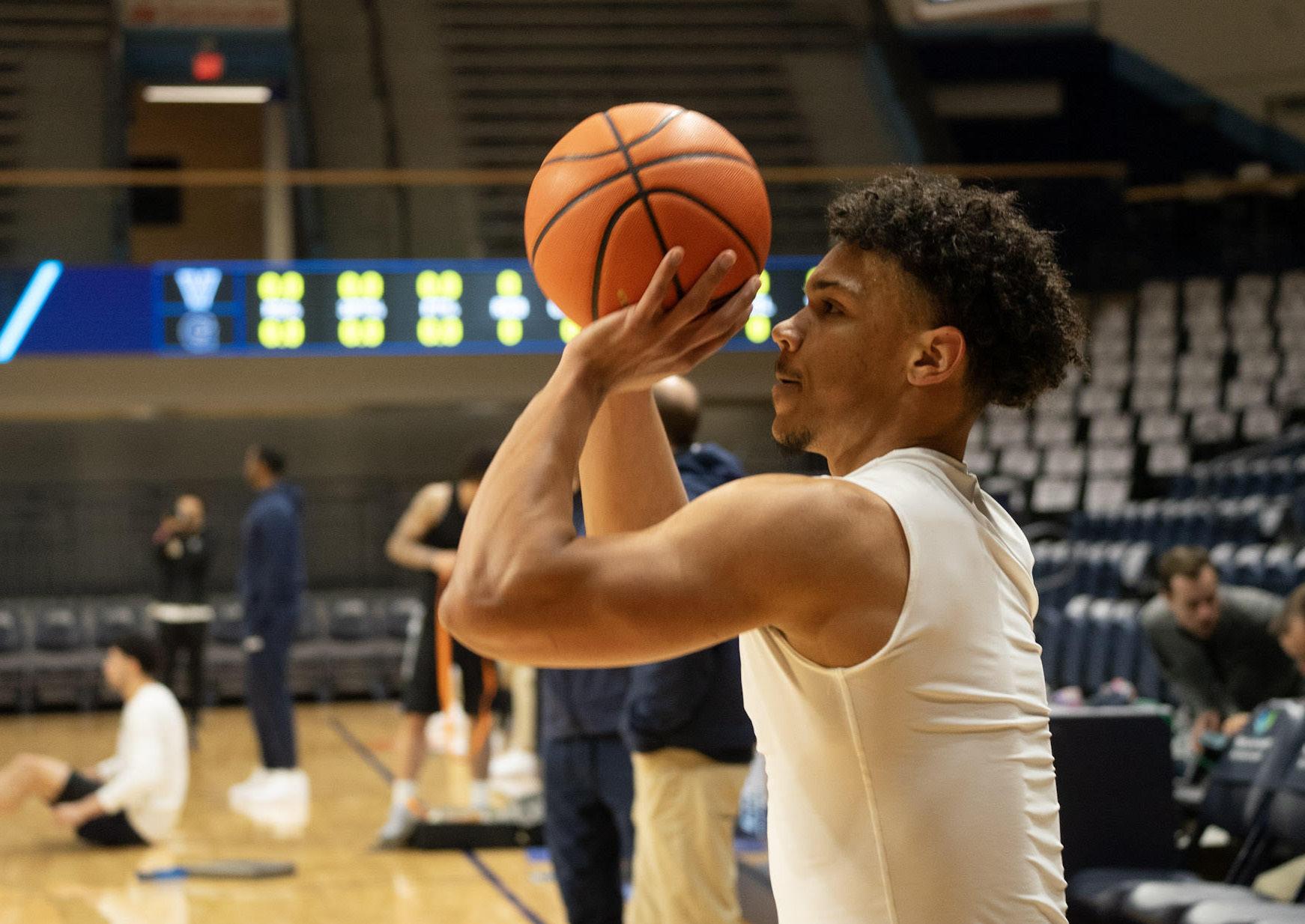
defeated them on the road, 88-82. In the game, Villanova shot 32-for64 (50.0%) from the field, 10-for-28 (35.7%) from three and 14-for-18 (77.8%) from the free-throw line.
Devin Askew added 20 points off the bench. Ty;er Perkins was next, with 15.
The Friars were 31-for-56 (55.4%) from the field, 8-for-25 (32.0%) from three and 12-for-17 (70.6%) from the free-throw line. They had three players score over 20 points.
Providence fell to Xavier, 97-84, in its most recent matchup.
Villanova holds the upper hand in the all-time series, 32-18.
Last season, the two teams split the series..
Villanova has dropped to fourth in the Big East rankings, behind UConn, St. John’s and Creighton. The Friars are ahead in 10th place, ahead of only Marquette.
The Wildcats will be looking to improve their chances of contending in the Big East Tournament come March. The Friars will hope to move up in the rankings and slowly chip away at their losing record.
Tip-off is set for 7 p.m. at the Finneran Pavilion. The game will be streamed on FOX.
WEEKLY SCOREBOARD
Jan. 21 - Jan. 25
Wednesday, January 21
Men’s Basketball vs. Georgetown 66-51 W
Friday, January 23
Women’s Tennis @ Sacred Heart 4-0 W
Women’s Water Polo @ Salem 22-10 W
Women’s Swim @ Pittsburgh 87-211 L
Men’s Swim @ Pittsburgh 70-228 L
Women’s Tennis @ Army 0-4 L
Saturday, January 24
Women’s Water Polo vs. Indiana 2-10 L
Women’s Water Polo @ Brown 5-14 L
Men’s Track @ Penn Elite No Team Scoring
Men’s Track @ New Balance No Team Scoring
Women’s Track @ Penn Elite No Team Scoring
Men’s Basketball @ #2 UConn 67-75 L
Women’s Basketball @ St. John’s 58-71 L
Tuesday, January 27
Women’s Basketball vs. Providence 83-68 W
Women’s Basketball Downs Providence, 83-68
Genna Cottingham Sports Columnist
On Tuesday, Jan. 27, the Villanova Wildcats defeated Providence (10-12, 3-8 Big East), 83-68, at the Finneran Pavilion. Villanova is now 16-5 for the season and extended its home win streak to eight games.
The Finneran Pavilion celebrated its Pink Out game in honor of Play4Kay, a fundraising initiative for the Kay Yow Cancer Fund.
In the Big East, Villanova is 9-3 compared to the Friars’ 4-7 conference record. The Friars dropped another away game, continuing their 1-6 losing record on the road.
The sophomore guard Jasmine Bascoe scored a game-high 22 points and managed six assists for her teammates. Despite not scoring until nearly two minutes into the game, the ‘Cats went on a 12-0 scoring run in the second quarter. Villanova was up by five points at halftime after Bascoe put up a last-minute layup. Villanova headed into the locker room with a 40-35 lead over Providence.
“I mean, the other day I think we only had nine assists in the game, that’s not building over basketball,” head coach Denise Dillon said. “When you’re moving the ball and getting on contested shots, it makes it a lot easier out on the court.”
The ‘Cats shot 44.1% from beyond the arc, with 6 of their 15 three-pointers coming in the first
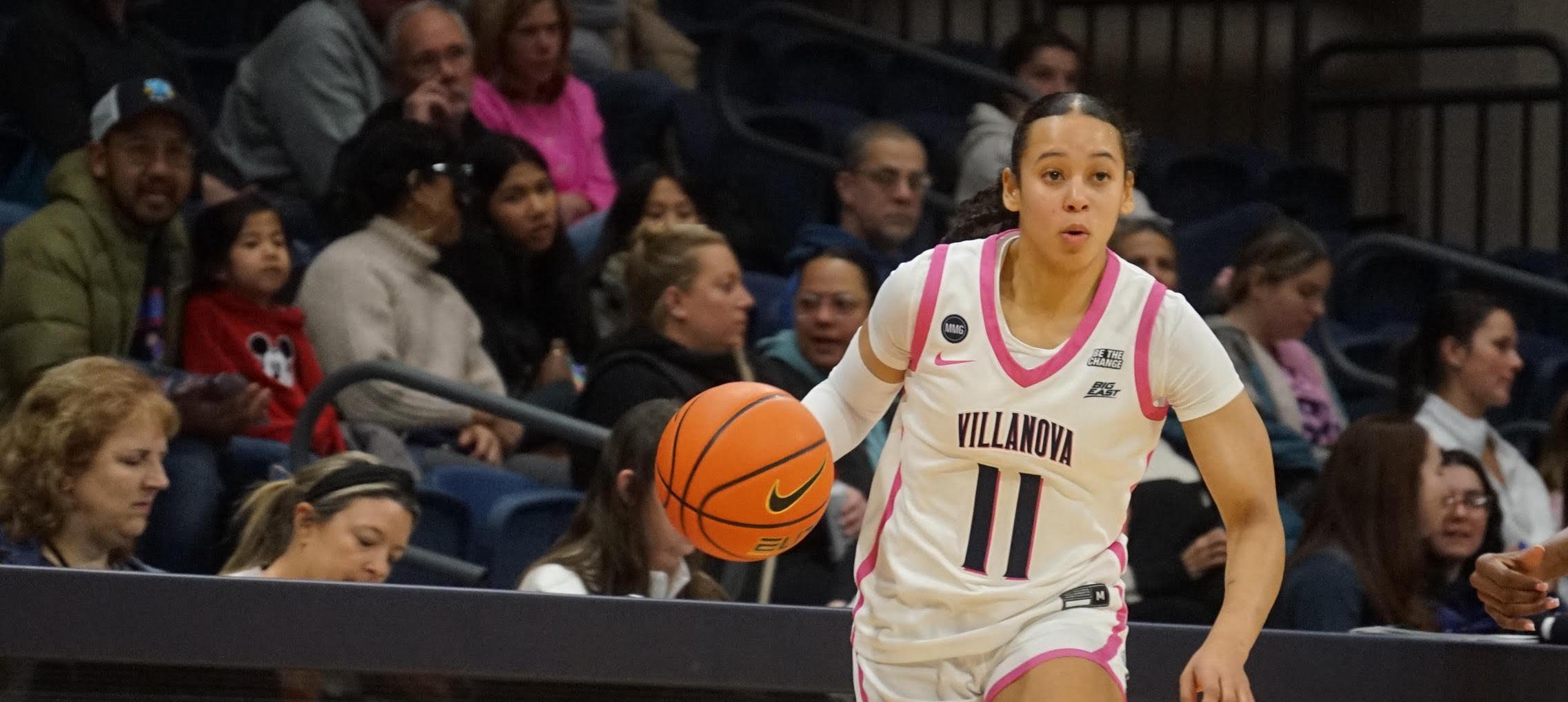
quarter alone. Freshman guard Kennedy Henry sank four-three pointers to reach 16 points. Freshman forward Brooke Bender shot 6-for-8 (75%) from beyond the arc to total a career-high 18 points.
“I just tried to do my best in the minutes I’m out there, and I’m really grateful for every minute that I do get,” Bender said. “They’re doing a really good job of finding our shooters, and that was really evident in this game.”
Senior forward Denae Carter led the team in rebounds, grabbing seven for the night. With seven minutes left in the third quarter, Carter received her third foul and was out until there was 6:07 left in the fourth. Redshirt sophomore forward Brynn McCurry also put up 11 points and
grabbed six rebounds.
“What we tried to explain to this group, like saying, yes, we played these teams once,” Dillon said. “It’s not going to be the same scale. You’ve got to get into your minds, it’s going to be a possession game. We’re too familiar now with each other.”
The ‘Cats managed 32 points off the bench, 18 of them being from Bender. Senior guard Ryanne Allen added seven and sophomore guard Dani Ceseretti had five. Villanova shot 100% behind the free throw line and went 33-for-65 (51%) on field goal attempts.
“[Ceseretti’s] strength is on the defensive end,” Dillon said. The effort and time she’s put in on offense, you just see her growth
and her ability. I know it’s there. She just had a feel of herself. We started her in the second half just to generate some of that energy we needed…she’s locked into what needs to be done.”
Villanova held the Friars’ best scorers, fifth-year guard Sabou Gueye and sophomore guard Orlagh Gormley, to only 31 points. Gueye reached 22 points, and Gormley had nine. The only other Providence player to accomplish double-digit points was fifth-year forward Teneisia Brown, who added 14 points.
Villanova is now scheduled to host DePaul (5-17, 2-9 Big East) on Saturday, Jan. 31 (2 p.m., ESPN+). This will be its second meeting of the season, Villanova beat DePaul in Chicago, 81-48.
Sophomore guard Jasmine Bascoe drives to the basket. Mason Canton/Villanovan Photography
Villanova faces Georgetown at the Finneran Pavilion. Erick Quezada/Villanovan Photography
Villanova Dance Places In Top-Ten At UDA Nationals
Sammie McKee Co-Sports Editor
The Villanova Dance team trailblazed a new era in the success of its program at the 2026 Universal Dance Association (UDA) Nationals held in Orlando, FL, from Jan. 16 to Jan. 18.
At Nationals, Villanova Dance earned a sixth-place finish in the Game Day Routine category and a ninth-place finish in the Jazz Routine category, marking the first time in program history that it has placed in the top 10 for both categories.
It is the third time in the Villanova Dance team’s history that it has advanced to the Jazz Routine finals, ending a four-year hiatus since its last Jazz Routine finals appearance in 2022. It is the first time that the team has reached the finals of the Game Day Routine category, which began in 2023.
Though categories like the Game Day Routine might suggest a copy and paste from courtside and sideline performances, competing at Nationals requires a new level of preparation. The team underwent intensive rehearsal to nail the routines. Returning from winter break almost two weeks earlier than other Villanova students, the team held two practices daily before heading south to Orlando. Moreover, its early return served as a complement to the additional Nationals practices beginning at the start of the school year, amid an intensive football and basketball
performance season.
For the Dance team, this preparation is important because the annual competition gives it a special opportunity to perform for those it doesn’t typically get the chance to, itself.
“Once we get to Nationals, we’re surrounded by incredible dancers from all over the country, and that puts us in a different competitive mindset that we’re not really in during the rest of the season,” senior captain Victoria Fusaro explained. “At basketball or football, we’re performing for the audience and trying to hype up the school. Nationals is more about our dance team in itself and representing Villanova as our own team.”
As a captain, Fusaro played an important part in uniting the team. With the two routines possessing very distinctive energies, Fusaro led her team as it tapped into different performing mindsets.
“Game Day is very high energy, and Jazz is very emotional,” Fusaro explained. “So, as a leader on the team, it was my job to keep the team grounded and united, while also being able to guide the energy switch between the dances and get the team riled up in two different ways.”
During dance routines, it is standard to have select members on the roster off the mat as alternates in case of injury. However, this year at Nationals, the team had the unique opportunity for all of its members to be represented in competition. During the Game Day Routine, the entirety of Villanova Dance
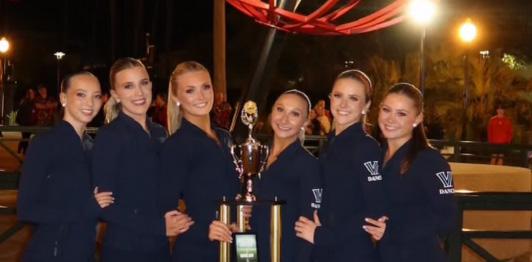
performed, making the experience particularly rewarding for Fusaro in her senior season.
“This team has been so influential to my Villanova experience,” Fusaro shared. “I remember as a freshman feeling like I had gained 24 sisters and best friends, so it’s even more special when you get to dance with every single member of your team, and I’m so proud of everyone.”
The sister-like bond among the dancers is one of the many strengths contributing to the team’s success. During the competition, the team had the opportunity to enjoy bonding activities, such as a day at Disney’s Hollywood Studios, rented by the UDA for all competing dancers. It’s these fun, lighthearted moments that contribute to the trust within the group while they perform.
Before each performance, the group holds hands and forms a circle. The captains and seniors take the
time to motivate the team and give it the last burst of energy that it needs before going on the stage.
“It’s a good reminder that we can lean on each other, dance for each other, and put our hearts and souls onto the floor,” Fusaro described. “That just goes to show what kind of family we’ve created here at Villanova, and it’s something that’s incredibly special to me.”
Coming off the high of their Nationals run, there’s a great deal of energy buzzing about the team, now that it can boast being a top-10 program in the country.
At Villanova, the team returns to an overwhelmingly comfortable space where it performs in front of the fans that make the campus feel like home. With the Big East tournament and the possibility of a basketball appearance in the NCAA tournament in March, the Dance team is more prepared than ever.
Swim Team Travels To Pitt & West Virginia
Casey Healy Co-Sports Editor
Villanova’s swim and dive teams competed this weekend on the road against Pittsburgh, Duquesne and West Virginia.
The Panthers won the women’s meet, 211-87, and the men’s, 288-70.
The women’s team defeated West Virginia 160-140 and Duquesne 180-120. The men fell short against West Virginia, 231-67.
“This road trip was probably the toughest we have ever faced in terms of logistics,” head coach Rick Simpson said. “But our athletes responded wonderfully. It’s a great sign for the upcoming Big East Championships which will require a week on the road and air travel to Ocala, FL”
Junior Megan Tiernan earned a first-place finish in the 200 Fly, coming in at 1:58.48. Tiernan also clocked a 4:20.09 finish in the 400 Individual Medley, earning second place.
Freshman Anna Kilponen placed third in the women’s 100 Fly with a time of 53.92. This time put her in third place on Villanova’s alltime performers list.
Senior Arabella Lee came in second in the women’s 100 Back in 56.08. Sophomore Alana Leen followed, finishing in third place with a time of 56.13. Leen was coming off being named Big East Female Athlete of the Week after her performance against Richmond and James Madison.
Winnie Jalet finished in sec-
ond place in the 100 Breast, clocking in at 1:02.88. She also secured fifth in the 200 Breast, finishing in 2:17.81.
Junior Anna Farley came in second place in the women’s 100 Fly (53.79) and third place in the 200 Free (1:48.38).
In the 50 Free, Junior Carlota Colomer Guasch placed third in 23.58. Katie White came in second place in the 500 Free at 4:57.84.
On the men’s side, Nathan Warson won the men’s 1-meter dive. He finished with a score of 338.40.
Sophomore Owen Nye placed third in the 1000 Free (9:32.99) and in the 500 Free (4:38.93). Junior Justin Nowicki also placed third in both his events, swimming 1:48.63 in the 200 Fly and 3:57.92 in the 400 Individual Medley.
On Saturday, the team traveled to Morgantown, WV, to face West Virginia and Duquesne University.
“After a late night travel from Pittsburgh to Morgantown, WV, we bounced back the next morning with another great showing at WVU,” Simpson said. “Again, some great personal performances. And the Women’s team managed to pull off two great wins against a strong Big 12 school (WVU) and a perennial Atlantic 10 power house (Duquesne).”
The meet began with a win from junior Peri Gaguzis in the 1650 Free. She clocked in at 16:58.97.
Senior Winnie Jalet earned first place in the 100 Breast, hitting the wall at 1:02.77. The women were also successful in the 200 Fly, with Farley taking first in 1:58.81.
Freshman Kayla Bolster set
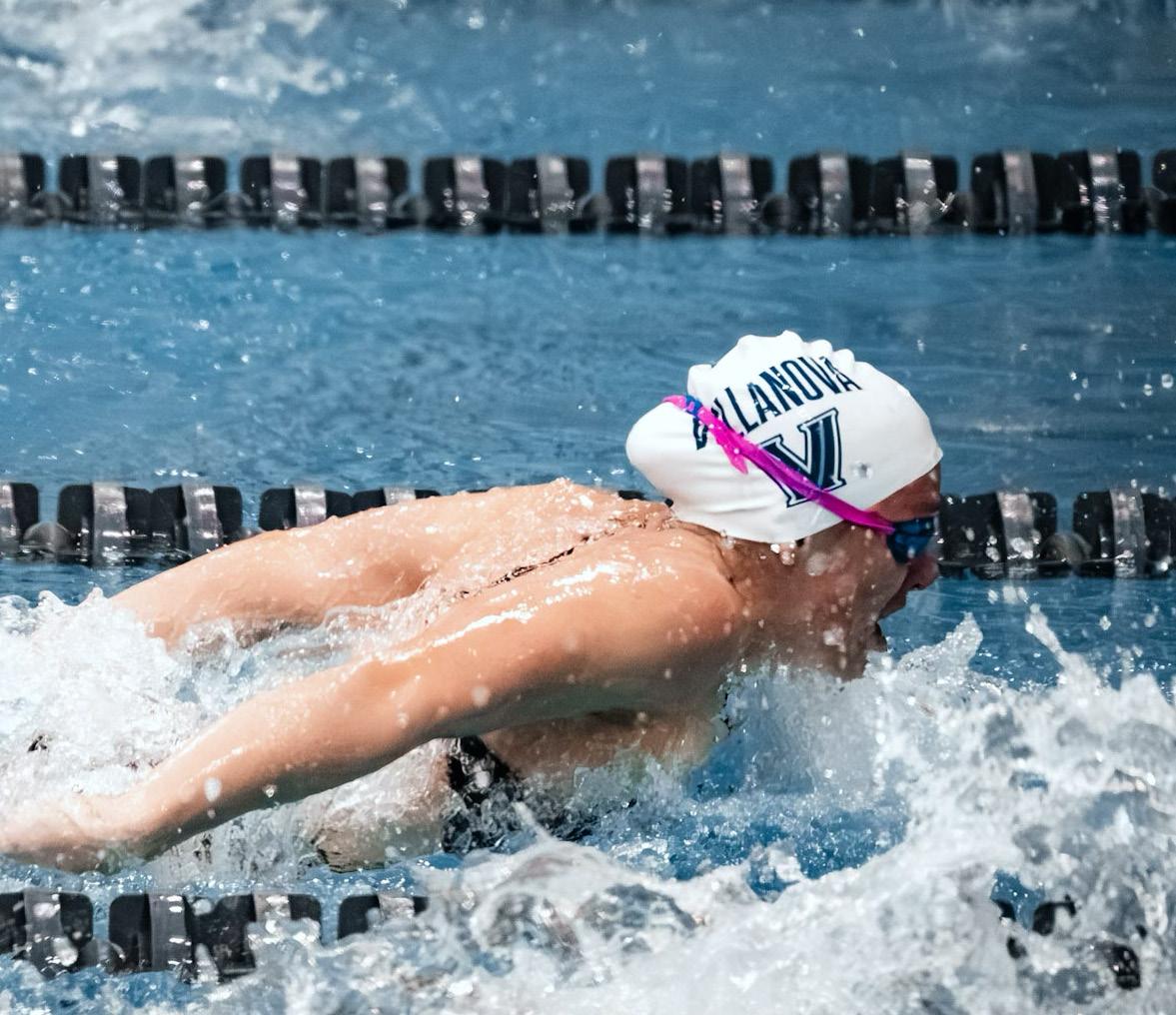
three personal-best swims in the meet. She came in second place in the 200 Free (1:49.26), 50 Free (23.59) and 200 Back (1:59.59).
Carlota Colomer Guasch earned first in the 50 Free, coming in at 23.32. She placed second in the 100 Free in 50.65.
For the men, Nowicki had a first-place finish in the 200 Fly, clocking in at 1:48.70. Sophomore Zach Sutter placed second in the 50 Free (20.75) and the 100 Free (45.95).
Senior Patrick Casey came third in the 1650 Free in 16:08.45,
and freshman Hugh Boris added a second-place finish in the 200 Breast (2:01.74).
“This weekend’s performances left the coaching staff feeling very confident in our current preparation for the upcoming Big East Championships,” Simpson said. ”It has been a consistent progressive season of improvement. This is exactly where you want your team to be four weeks from a major championship.”
The men will return home on Jan. 30 against Seton Hall. The women will host Sprintfest at home the next day, on Jan. 31.
Villanova Dance Team at the ESPN’s World Wide of Sports. Courtesy of @villanovadanceteam
Villanova Swim beat the Panthers at West Virginia. Erick Quezada/Villanovan Photography
Wildcat Watch: Grounded In Faith And Volleyball
Genna Cottingham Sports Columnist
On Sunday, Nov. 30, members of Villanova’s volleyball team sat in the Finneran Pavilion, anxiously waiting for the school’s name to be called for the NCAA Tournament. After the first 8-0 start to the season in 20 years, and a 20-win season, the ‘Cats were hopeful to finally reach post-season play.
Despite the team’s first appearance in the Big East semi-finals since 2015, the team lost, 3-0, to Xavier on Nov. 22. Eight days later, during a watch party with all staff and players in attendance, Villanova’s name was not called.
“We were all tearing up a little bit,” rising senior middle blocker Abby Harrell said. “Our goal was to sit in that room in anticipation of hearing our name called. With pain and suffering comes some sort of hope. I think that happens every year. There are so many programs out there that are in the same boat.”
During the season, Harrell reached her 1,000th career kill, while head coach Josh Steinbach achieved his 300th win. The monumental win at Providence on Oct. 17 was a milestone for the ‘Cats to signify how far the program has grown under Steinbach in his 19-year tenure.
“I just haven’t really pursued anything else,” Steinbach said. “It’s been a really good place for my family and me. My two sons grew up and came to Villanova’s events and did all
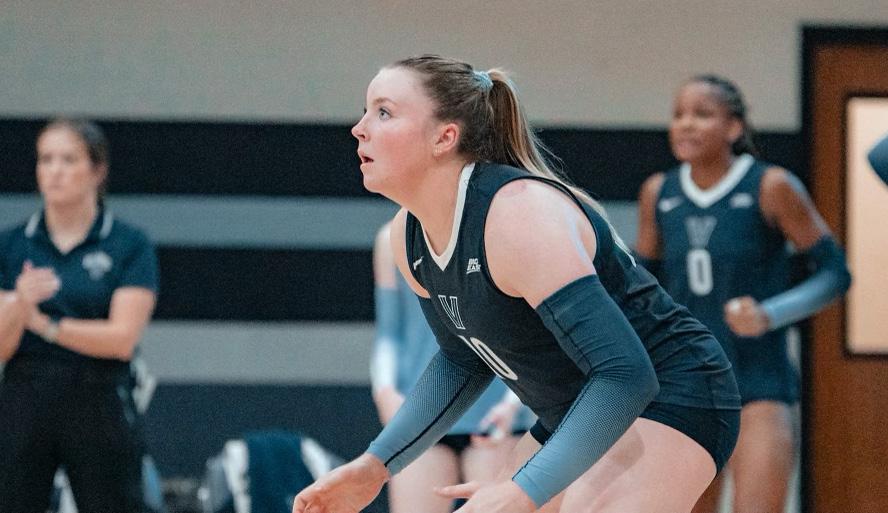
those things. My older son’s a Villanova employee now, [I] love the area and I’ve been really happy here.”
Harrell completed her junior season as Catholic Challenge MVP, Villanova Classic MVP, AVCA All-East Coast Region, All-Big East Team and BE Offensive Player of the Week all in 2025. The 5-foot-10 player from Ellensburg, WA, is a six-time Big East Weekly Honor Roll player, five-time Big East Freshman of the Week, and was the Big East Rookie of the Year in 2023.
Despite her list of accomplishments, Harrell feels she still has a responsibility to further the program. Her motivation and skill set are due to the undeniable leadership of Steinbach. His love for the sport is shown through his players’ camaraderie.
“Being able to remind my-
self that he also is here to learn and to grow, … continuing to evolve as a person, and we’re just part of each other’s stories for the time being,” Harrell described.
Harrell emphasizes her trust in God and connection to faith to keep her grounded on and off the court. Her composure makes her an unparalleled player with a constant determination to go the extra mile.
“I came in here with the intention not only to grow as a player, but I also wanted to be part of something like this, establishing a name for Villanova within the volleyball world,” Harrell said. “I didn’t think my resume would look like that. I didn’t even think I would set foot on the court. The way I live my life is trying to submit things at the feet of Christ, which comes with a lot of
uncertainty.”
As unpredictable as the sport is, Harrell’s mind is constantly at peace because of her strong connection to her faith. Harrell rarely listens to media critiques and trusts her teammates and coaching staff more than anyone else. She believes in God, and any negative comments that people can say are “temporary.”
Nearing her final season, Harrell has strong hopes for the program, with the end goal of making a tournament appearance. Achieving such a goal will require hard work and consistency.
“...To living in integrity, to walking the walk and not just talking the talk, you know,” Harrell said. “I remember Josh telling me this when I was a recruit. You come in, and you’re all part of the same team. There’s no hierarchy. I’m excited to learn from everyone.”
From now until Spring Break, the team is in a training period, focusing on lifting. As per NCAA rules, volleyball teams are only allowed eight hours of team practice a week. Villanova makes all lifts optional, as well as short, individual training practices.
Volleyball is allowed four game days in the spring season that will commence in March. Looking forward to her future in volleyball after graduation, Harrell is considering all her options. She is passionate about physical therapy and hopes to get her M.S. in PT at a school that would also allow her to play Sand Volleyball as a graduate student.
Men’s Basketball Falls To UConn In Overtime, 75-67
Casey Healy Co-Sports Editor
On Saturday, Jan. 24, Villanova men’s basketball traveled to Hartford, Ct, to face second-ranked University of Connecticut and fell, 75-67, in overtime.
“No,” head coach Kevin Willard said when asked if he was encouraged by the results of the game. “I don’t like losing.”
After going back and forth for the entirety of regulation, a three-pointer from redshirt freshman Matt Hodge helped send the game to overtime, where the ‘Cats (15-5, 6-3 Big East) went one-of-eight from the field. UConn (19-1, 9-0) pulled ahead to win its 15th consecutive game.
The Wildcats shot 20-for-59 (34%) from field goal range, 10-for-26 (38%) from beyond the arc and shot 17-for-22 (77%) from the free throw line.
Senior forward Duke Brennan posted his eighth double-double of the season with a team-high 16 points and 14 rebounds. Junior guard Tyler Perkins also had a double-double, tying Brennan’s 16 points, to go with 10 rebounds.
“Perks is playing hard,” Willard said. “He’s playing physical, using his shot-fake well, and doing a lot of good things.”
Villanova and UConn had nearly identical field goal percentages through the opening nine minutes. The ‘Cats shot 50% from the threepoint line compared to UConn’s 25%.
UConn entered a scoring drought midway through the first half, shooting just 2-for-10. Once the Huskies rallied back, Villanova had a dry spell of its own, going scoreless from field goal range for over five minutes.
A layup from Brennan got things going again with a minute left in the half. UConn cut the gap to one point, but sophomore guard Malachi Palmer sank a three-pointer with 27 seconds to go to close out the half with Villanova ahead, 31-27.
The Wildcats shot 37% from the field in the first half and 40% from beyond the arc.
Three minutes into the second half, UConn’s freshman forward Braylon Mullins exited the game due to a head injury after colliding with Lewis. Mullins had eight points at that point and did not return.
The game was tied with about six minutes to go, Brennan was benched with four fouls, resulting in a height deficit on the floor for the ‘Cats.
With Lewis struggling, Willard opted for experience and sent in senior guard Devin Askew for almost the rest of the game.
“I have to get better at that. I have to put the right lineups in at the right times,” Willard said. “I’m learning a lot about certain guys and what to do.”
UConn’s Alex Caraban put up nine points in five minutes to put the Huskies up by two. After a technical foul from UConn head coach Dan Hurley and another on the floor from the Huskies, Villanova took a couple of trips to the line to remain in the game.
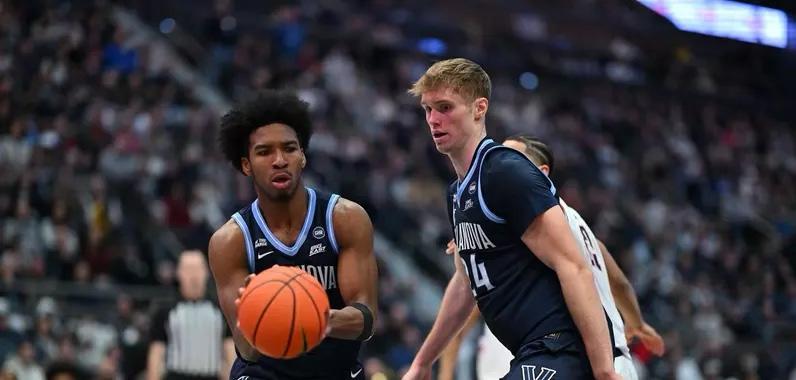
With just over a minute left to play, Hodge sank a three to put Villanova back in front, 61-59. UConn quickly answered back with a quick two to tie the game with 45 seconds to go.
The ‘Cats got possession but failed to capitalize on it. Redshirt sophomore Bryce Lindsay was blocked on a two-point attempt, and the Huskies managed to tie it up for a jump ball with 19 seconds remaining. In a strong defensive effort on the next possession, Lindsay stole the ball from Karaban, who was driving toward the basket.
“The big thing is, we’re going down playing high-level defense,” Willard said. “If we can continue building on that, then we’ll get out on transition, and get some easier buckets.”
Villanova and UConn ended regulation tied, 61-61.
Villanova struck first with its 10th three-pointer of the night. It would also be its final basket of the extra period.
The Wildcats managed to stay in the game on foul shots, but after tying the game at 67-67, things began to fall apart.
Askew fouled out with 13 points and four rebounds.
After sinking two foul shots and a layup shortly after, UConn went up four points with 47 seconds left to go.
With 31 seconds remaining, Lindsay missed a deep three-pointer, and Villanova was forced to foul on UConn’s next possession.
The Huskies made both shots to go up six points, sealing the game. The Wildcats currently sit in third place in the Big East Conference behind St. John’s and UConn. Villanova will return to action on Friday, Jan. 30, against Providence (9-11, 2-7 Big East) at home (FS1, 7 p.m.). It is the start of the second half of the Big East schedule. The two teams met earlier this season on Jan. 13, and the ‘Cats won 88-82. The Friars are currently ninth in the Big East.
Junior Outside Hitter Abby Herrell has made the All-Big East team three consecutive years. Erick Quezada/Villanovan Photography
Duke Brennan and Malachi Palmer face UConn.
Courtesy of Villanova Athletics
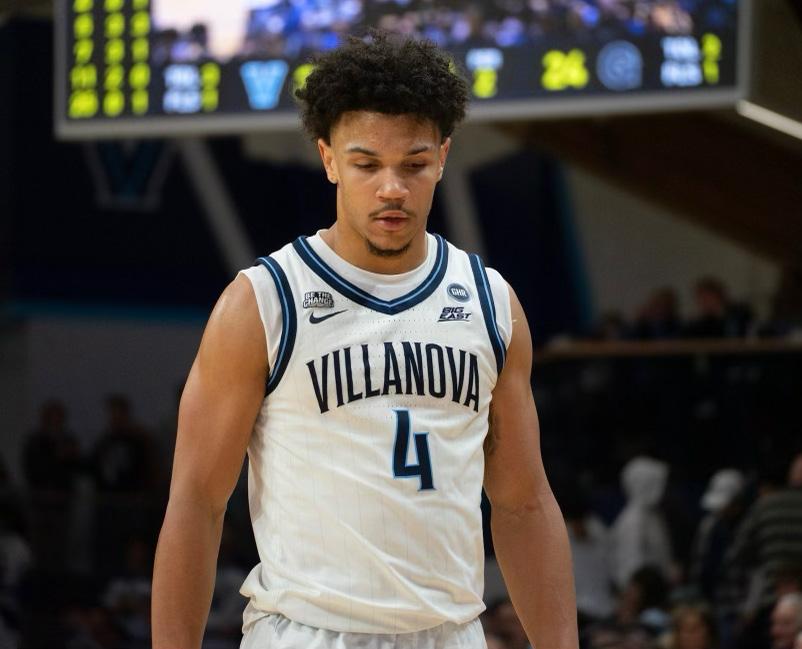
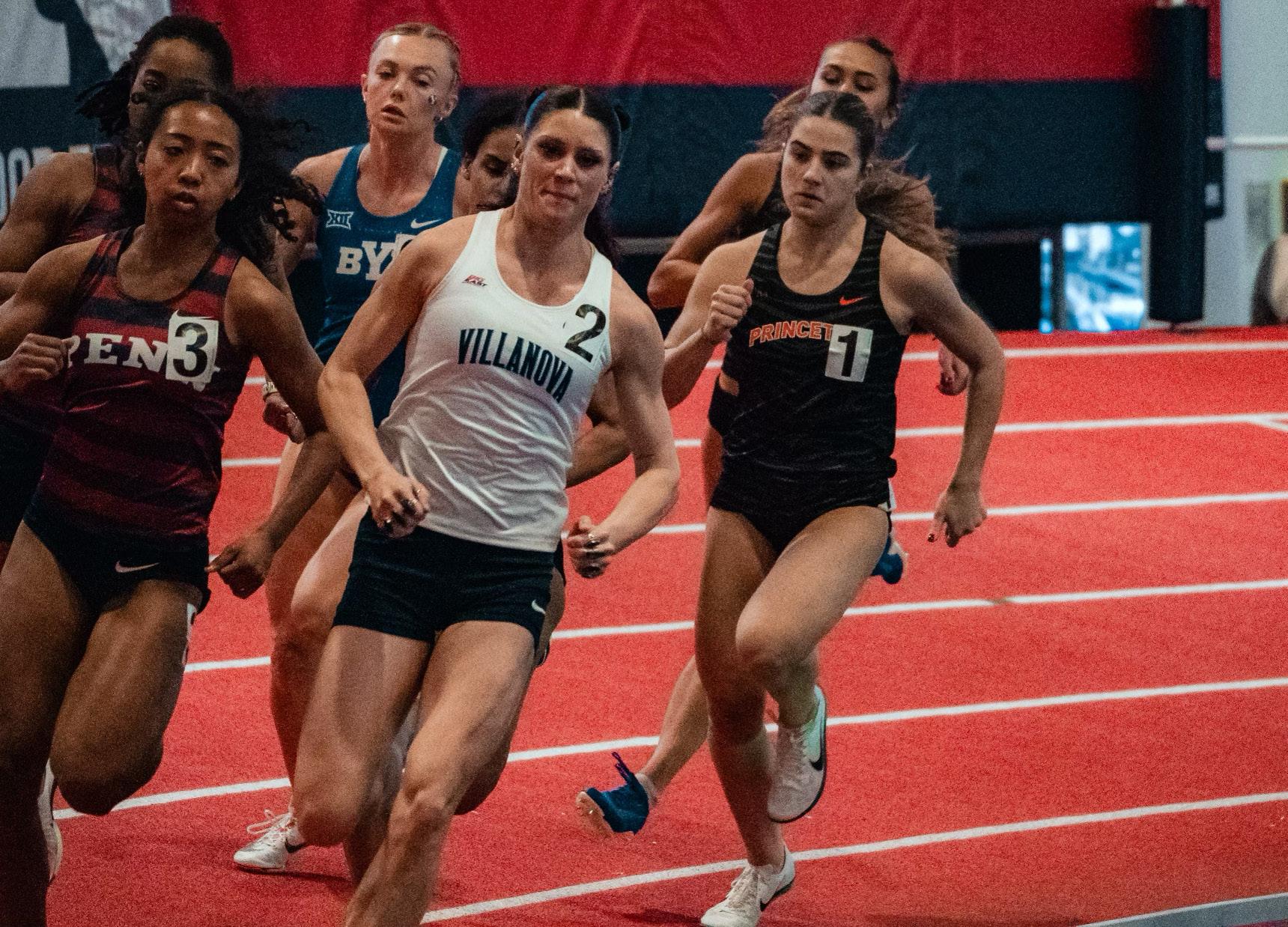
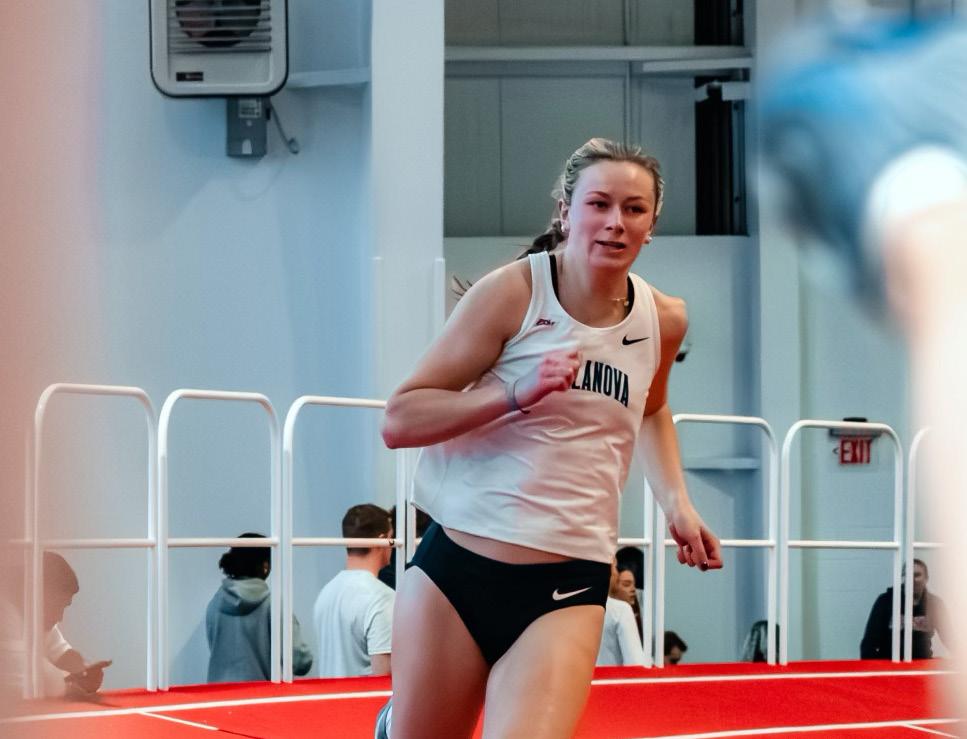
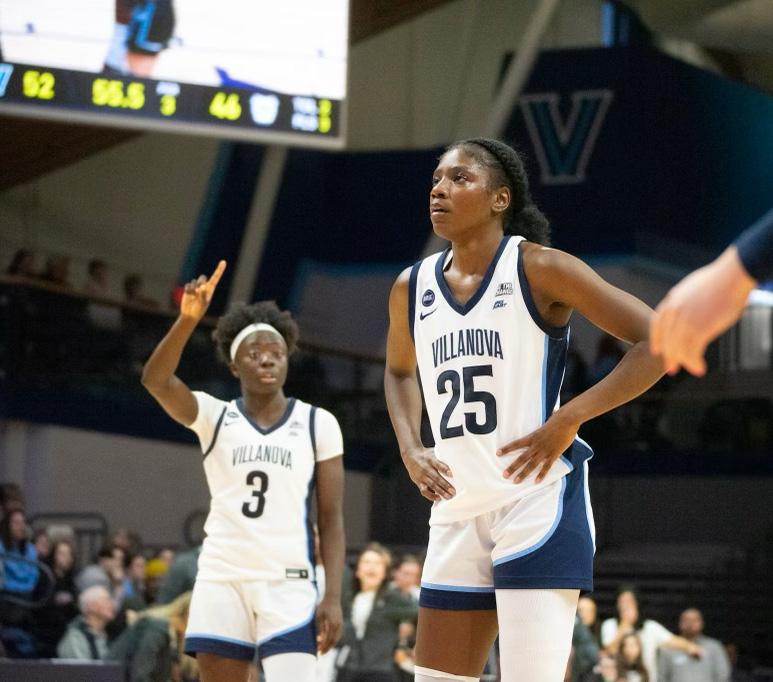
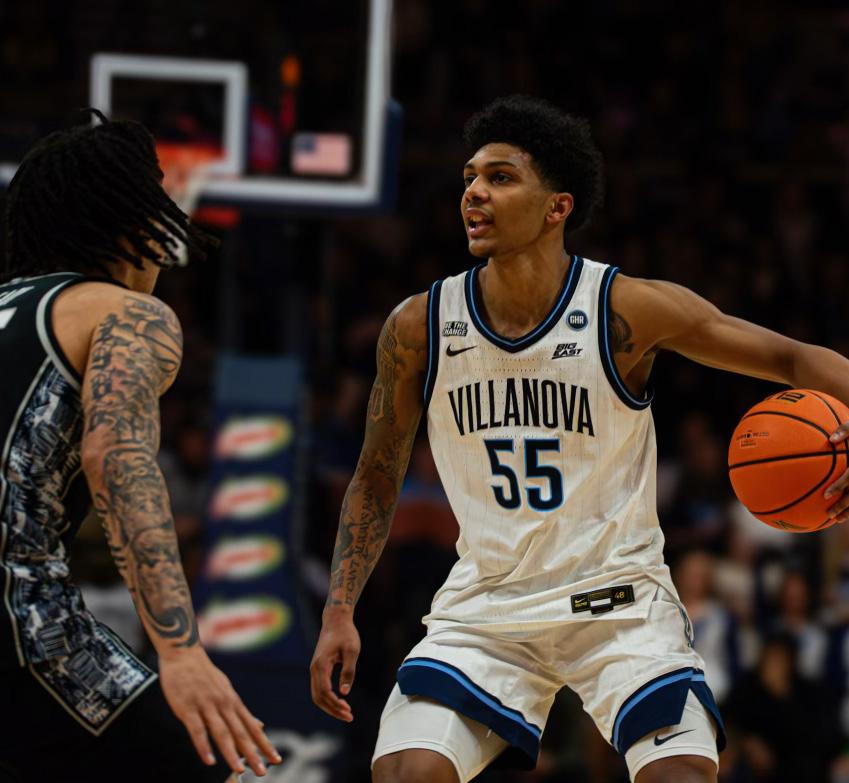
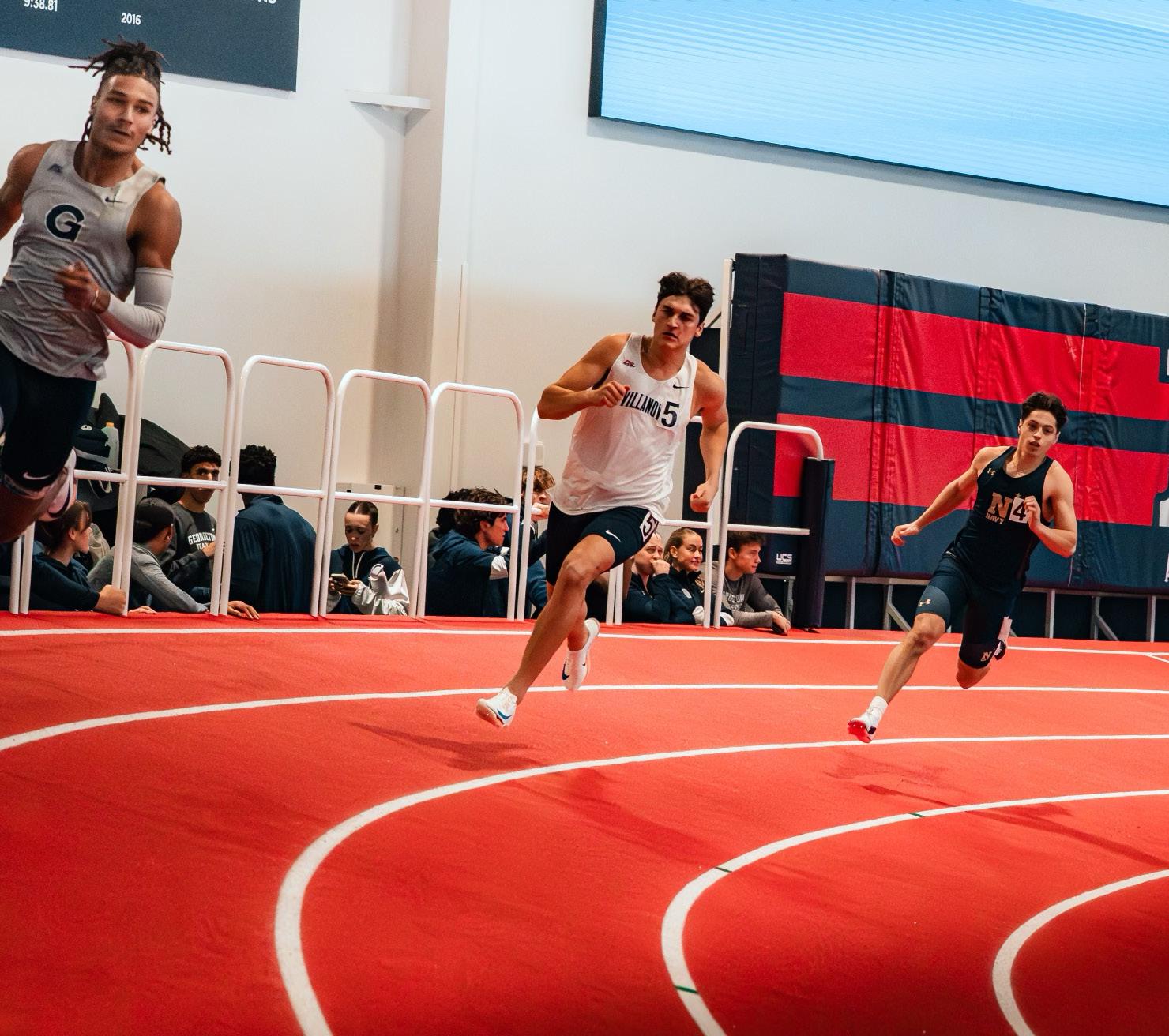
Freshman guard Acaden Lewis tallied 15 points and 7 rebounds against Georgetown.
Senior guard Danae Carter put up 15 points in the Wildcat’s 73-65 win over Butler.
Women’s Track & Field run at the Penn 10 Elite.
Junior guard Tyler Perkins scored 16 points in the 66-51 win over Georgetown.
Graduate Lizzie Martell tallies runs third fastest 500-meter in school history.
Men’s track run in Penn 10 Elite at the Ott Center. All photos Courtesy of Erick Quezada & Mason Canton/Villanovan Photography
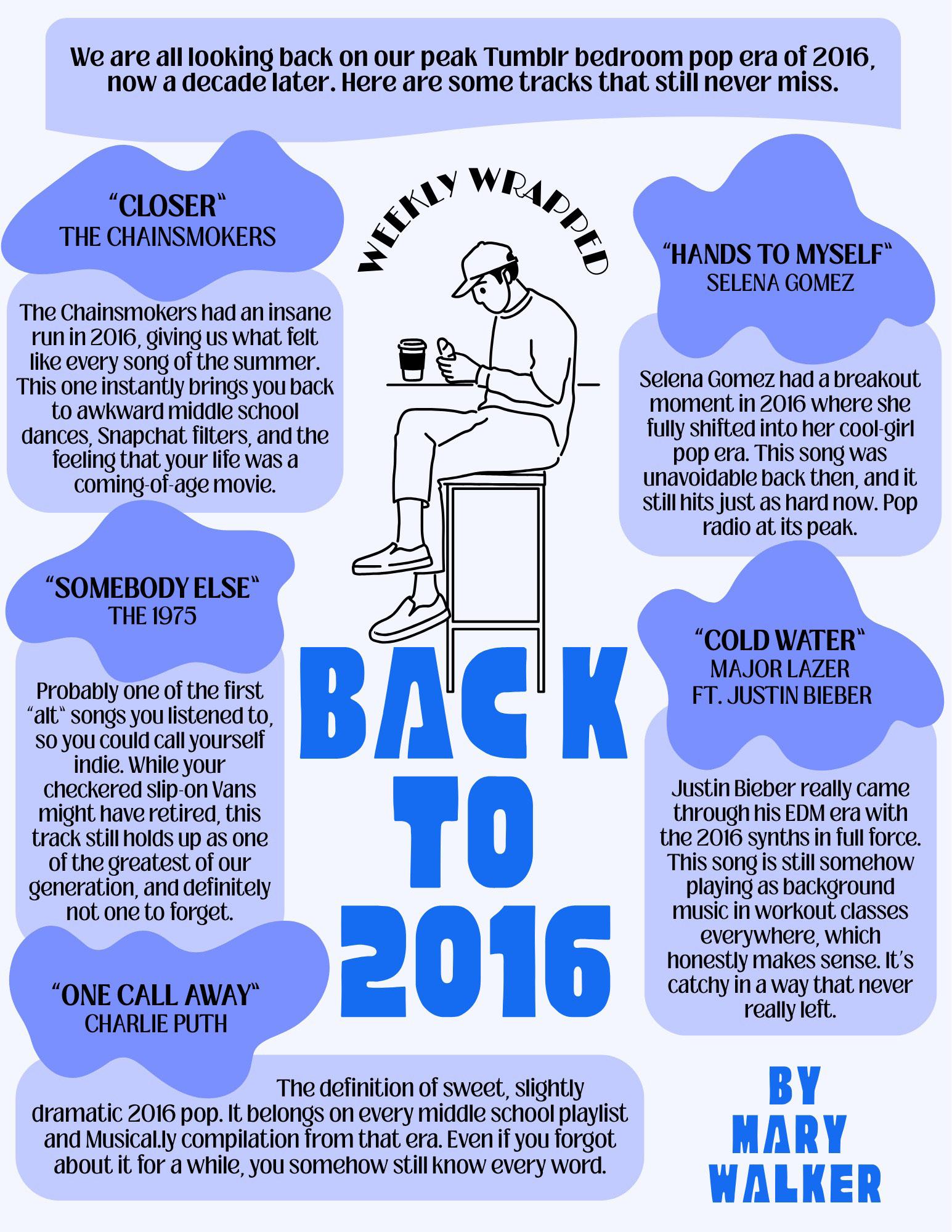

T W E E N C
S S E S ? N E E D A S T U D Y B R E A K ?