
Uncertainty

Nicole Liddicoat Co-Editor-In-Chief
In the early weeks of his presidency, President Donald Trump and his administration issued numerous executive orders (EO), many of which could affect Villanova University’s students and faculty.
The EOs have placed universities at the center of political debates surrounding diversity, equity and inclusion (DEI). These policies have had sweeping effects on academic research, funding and scholarship.
On Jan. 27, the United States Office of Management and Budget (OMB) issued a vague memorandum. It announced a pause on all federal funding to conduct an investigation until the administration “complete[d] a comprehensive analysis of all of their Federal financial assistance programs to identify programs, projects and activities,” that may be affected by the administration’s EOs.
The memo was rescinded, and a federal judge issued a temporary pause on the implementation just two days later.
However, confusion remains.
White House Press
Secretary Karoline Leavitt made a post to X on Jan. 29, stating that rescinding the document was “NOT a rescission of the federal funding freeze. It is simply a rescission of the OMB memo. Why? To end any confusion created by the court’s injunction. The President’s EO’s on federal funding remain in full force and effect, and will be rigorously implemented.”
The unabridged impacts of the OMB memo and compliance with the EOs are still largely unknown, creating a time of uncertainty for faculty.
A Villanova faculty
Continued on p. 2
Prepping for NOVAdance p. 2
Black History Month: Amari Rebel and the Movement p. 11

Reel Talk: Black History Month


“The United States is home to 5% of the world’s population, but 25% of the world’s prisoners. Think about that.”President Barack Obama Released in 2016, director Ava DuVernay’s documentary 13th investigates the effects of the 13th Amendment on Black Americans today. In 1865, the U.S. founding fathers passed a piece of legislation to abolish slavery in the United States, but with six short words, a loophole was created that caused decades of systemic racism,

still strongly prominent today. 13th is a powerful reminder of the deep-rooted inequalities within America’s institutions, arguing that mass incarceration is not just a flawed system but a deliberate continuation of slavery, all weaponized to oppress Black Americans today.
The 13th Amendment states, “Neither slavery nor involuntary servitude, except as a punishment for crime whereof the party shall have been duly convicted, shall exist within the United States, or any place subject to their jurisdiction.”
In short, slavery is illegal unless one is con -
victed of a crime. So, in an attempt for the South to save its economy after the Civil War, this loophole was exploited, beginning a long-lasting practice of arresting Black Americans with little-to-no cause, such as loitering or vagrancy. 13th explores how this ultimately ignited the targeting of Black Americans within the media. With movies such as Birth of a Nation , Black people were depicted as violent, animalistic creatures, dangers to society, all who must be arrested and controlled. Due to these aggressive portrayals, a time of terror reaped the United States, with lynchings,
beatings and violent attacks against Black Americans becoming normalized and even celebrated. As public lynchings and open violence became less socially acceptable, the country looked towards legal means to continue systemic racism, thus leading to the Jim Crow era. To rebel against these injustices, the Civil Rights Movement used peaceful protest. Still, these activists became labeled as criminals. However, Black protesters flipped the narrative, using “criminalization” to their advantage. Rather than feeling ashamed for being arrested, it became a noble act
Continued on p. 10
Behind the “Banana Operation”
Owen Hewitt
Former Sports Editor
Villanova senior Aidan Murphy is in the final hour of a plan that started in December. He is standing in section 113 at the Finneran Pavilion, surrounded by about 35 of his friends, who are all watching No. 9 St. John’s warm up before its Feb. 12 matchup with a flagging Villanova team.
The group of seniors, who are all sporting banana costumes, have 45 minutes to
History: Millard on Being First Black Student Body President p. 3
Staying Close From Afar p. 13
wait before the tip-off of the last Villanova men’s basketball home game in the Finneran Pavilion of their time on campus. As they stood in front
of the frosted glass panels of the Davis Courtside Club, a question arose: “What the hell are we going to do for the next 45 minutes?”

The bananas gained campus-wide attention as photos spread on social media. Erick Quezada/Villanovan Photography
Sof Says: Midsemester Catchup p. 7
VSMT Presents “Heather’s:
“We just started chirping the St. John’s guys,” Murphy said. It worked. Villanova claimed its first Quadrant 1 victory of the season, 7371, outlasting the nationally-ranked Red Storm and snapping their 10-game win streak. The bananas gained campus-wide notoriety as photos of them spread on social media and Fox Sports 1 continually featured them on the game’s broadcast.
Questions about the
Continued on p. 17
Kate Koslow Staff Writer
Ava DuVernay’s documentary 13th explores the effects of the 13th Amendment on African Americans. Graydon Paul/Villanovan Photography
The Musical” p. 15
Beat for Good p. 8
Wildcat Watch: Kobryn Throws Two Complete Shutouts p. 17
‘Nova Meets Nola: From One Culture to Another p. 10
Preview: T&F Prepares for Big East Championships p. 18

VOL. 118 | ISS. 3
PUBLIC SAFETY BLOTTER
THEFT
February 18, MAINTENANCE BUILDING
A staff member reported a set of keys were taken from a university building.
THEFT
February 19, CONNELLY CENTER
A female resident student reported that her jacket was stolen from the Connelly Center. The value of the loss is $80.00.
DISORDERLY CONDUCT
February 19, CONNELLY CENTER
A female staff member assaulted another female staff member causing the victim to suffer physical injuries. The actor also threatened
CORRECTIONS
Federal Funding Freeze

Nicole Liddicoat Co-Editor-in-Chief
Continued from p.1
member, who requested anonymity, spoke with The Villanovan about the challenges faculty members face in securing research grants and continuing identity related scholarship.
The faculty member described the most challenging aspect as the chaos and uncertainty surrounding the situation.
“That is unprecedented,” they said. “You know, that kind of chaos incited with no clear plan, I hope is not an indication of our future governance. But it’s a clear indication that this was not a thoughtful situation.”
Federal grants are essential for research, student funding and reducing teaching loads. Many scholars now face terminated grants or delayed approvals as agencies like the National Science Foundation (NSF) and the National Institutes of Health (NIH) scramble to comply with the EOs.
The uncertainty surrounding these grants has disrupted ongoing projects, forcing faculty to reconsider the viability of their research topics.
Minimal communication from federal agencies has made compliance difficult, especially given the vague language surrounding DEI and identity-based research.
“Even though many of the executive orders and messages from the Office of Management and Budget (OMB) are unlawful and will be challenged through the courts, in the meantime, a lot of research professors are being left in limbo,” the faculty member said. “If I do race work, equity work, gender work, sexuality work, other identity work - do I pause my work? Do I continue the work? Do I continue the work under another name?”
Additionally, they shared their experience with the abrupt halt of a long-standing federal grant program supporting women in STEM. The NSF’s ADVANCE initiative, which has funded gender equity efforts for two decades, now faces an uncertain future.
“I had an event set up for weeks as part of an NSF grant,” they
said. “I was invited to [a university] to give a talk in February, but because the grant involved advancing women—an identity-based group—their funding was paused. They told me, ‘Don’t come, it’s too much uncertainty,’ so we had to switch to a webinar.”
The sudden disruption has left many scrambling.
“They’re trying to find another funding source to pay me for the work that I’ve done,” the faculty member explained. “Shortly after, the whole program [that put on the event] they have instated at their institution was cut. This program that does wonderful work, in no way controversial, is now gone after 20 years.”
Looking ahead, some faculty have already adjusted their research proposals, while others debate whether to seek private funding or shift away from identity-based studies altogether.
The University has yet to issue definitive guidance on the executive actions, highlighting the disorganization these orders have brought to higher education.
On Wednesday, Sep. 19, University President Father Peter M. Donohue, O.S.A., Ph.D. sent a campus-wide email outlining the University’s next steps in complying with the federal guidelines.
“In the fullest sense of transparency, we will need to make some changes to comply with these orders, but I assure you that all community members will continue to have a place at Villanova,” Fr. Peter said.
The conversation was framed by the faculty member’s reflection on the University’s core values.
“Our institution at Villanova, we’re so deeply connected to unitas, it’s one of our core principles as a community,” they continued. “And so, what unitas means to us is that we do consider identity in every part of life, if we are not considering things like gender, race or sexuality or religion or any of these other really important pieces of ourselves, then we are ignoring who we are.”
These executive orders have wide-ranging implications for the higher education sector. For many, the question is not just how to navigate the present but how to safeguard the future of academic inquiry.
several other university staff members during the incident.
LIQUOR UNDERAGE
February 20, TRINITY HALL
A female resident student, under 21, was found intoxicated in public. The student was evaluated by Public Safety and released.
LIQUOR UNDERAGE
February 20, STANFORD HALL
A female resident student, under 21, appeared in public intoxicated. The student was evaluated by VEMS and released.
THEFT
February 20 & 21, STANFORD HALL
A female resident student reported that a pair of her sneakers were
stolen from the hallway outside of her residence hall room. The amount of the loss is $120.00.
CRIMINAL MISCHIEF
February 22 & 23, BARTLEY HALL
Graffiti was found inside of a restroom within a campus building.
Prepping For NOVADance

Ava Petrosky Staff Writer
Jake Nevin Field House will be filled with Villanovans, Heroes and positivity in just 31 days, with a goal of raising $700,000. The NOVAdance community has spent almost an entire calendar year preparing for the culminating 12-hour dance marathon, which will take place on Saturday, March 29.
Each year, NOVAdance fundraises in partnership with the Andrew McDonough B+ Foundation. In 2007, Andrew McDonough was diagnosed with Leukemia. He fought it for 167 days. His motto throughout his journey was “Be Positive,” inspired by his blood type: B+.
Andrew’s father, Joe McDonough, began the Foundation to raise awareness and provide fundraising for other families struggling with pediatric cancer. Just a few weeks ago, McDonough visited Villanova’s campus to share his son’s story and the foundation’s mission. He spoke to a crowd of around 600 students.
The various NOVAdance committees sponsor a multitude of events throughout the year to increase Villanovan involvement. On Saturday, Feb. 22, the Special Events Team of NOVAdance hosted its annual B+ Ball. Each year, the ball is a formal event for Villanovans, members of the public and B+ Heroes to learn more about the B+ message and foundation.
“We have, I believe, three or four Heroes coming, which is super cool,” junior and Special Events Chair Noah Kang said before the event. “We are excited for that.”
This year, B+ Hero Ellie Matz spoke. Ellie is a high school student, and she loves science and theatre. The Ball also featured food, drinks and raffles. Another upcoming event to continue fundraising efforts is the Sidekicks’ Jogathon.
Sidekicks is NOVAdance’s committee made up of first-year students. This upcoming Jogathon will be its second-annual run. It will take place on March 15 from 10 a.m. until 1 p.m. It is about a mile-long course, each lap beginning and ending at
the Oreo. Runners can partner with donors who pledge to donate a certain amount of money each lap run.
Leading up to the dance marathon, the Sidekicks will also be busy planning for the day-of events and activities. Sidekicks Chair senior Evan Eames shared his feelings of preparing for the dance marathon with the Sidekicks.
“I’m just soaking it all in,” Eames said. “I think it’s obviously tough it being my last NOVAdance dance marathon, but I’m really excited for all the work we’ve done and seeing that pay off with, kinda, the Sidekicks being able to see how awesome the day of is and also hopefully us breaking our previous record.”
In recent weeks, the Awareness Team has also been heavily planning out the dance marathon Reflection Room.
The Reflection Room is a designated space where NOVAdance participants can read thank you notes written from families to the B+ Foundation.
“It’s really such a big cornerstone of the day of,” Sheftel said. “I think it’s really effective in what it does in just grounding people to our message and understanding why we’re really here to do what we do.”
Organizations paired with B+ Heroes are also preparing to get their heroes excited for the dance marathon.
In the Fall of 2024, Chi Omega was paired with B+ Hero, Julia Siegfried. This past weekend, Chi Omega hosted a bonding event so Julia can begin to get excited for the upcoming dance marathon.
“We’re planning a little ‘Get to Know Julia’ x Chi Omega event,” junior and Hero Liaison Alexandra Schuster said. “It will just have some activities, some games, some food and give Chi O a chance to meet Julia and Julia a chance to meet our sisters.”
In 2024, NOVAdance raised $601,507.81.
Every year since 2021, the NOVAdance fundraising goal has been surpassed and increased. This year, the goal has been raised by nearly $100,000. The preparations and fundraising events led by the various NOVAdance committees will all contribute to that goal.
History: Millard on Being First Black Student Body President

Emma Cote Co-News Editor
Dean Millard, the first Black student body president at Villanova, knew that he wanted to attend the University since he was five years old, and his passion has remained unwavering.
Since his presidency began at the beginning of the school year, the University has already witnessed some noticeable shifts since his term began, ranging from SGA’s working with dining to increase sustainability to free menstrual products for the first time in school history. In all of these novel respects, Millard is no stranger to trailblazing.
“The people make this place so special,” Millard said. “So, having this platform to advocate for others means the world to me.”
During his time at the University, Millard has been incredibly involved in student government. Now, he leads along with his team, including Student Body Vice President Aleko Zeppos, Vice President of DEI Kenza Idrissi, Chief of Staff Timi Olyani and Student Government Advisors Eloise Berry and JJ Brown.
Millard finds himself serving in a time of intense pushback
against universities at the Federal level and has to navigate these current obstacles for the Villanova student body.
Within the past week, President Donald Trump has issued statements to universities, putting pressure on collegiate administration to cut their diversity, equity and inclusion programs and scholarships, while Millard has spent his time as student body president actively working to uphold DEI.
“I commend our administration for being very staunch in diversity, equity and inclusion,” Millard said. “When there’s continued pressure to scale DEI motives down, it says a lot when the administration moves forward anyway and spreads our values.”
To that end, Millard has also played a pivotal role in fostering DEI initiatives on campus, including being on the committee to select the new University Vice President for Diversity, Equity and Inclusion, Ariella Robbins.
“I am confident that we can all come to the table together and exchange and uphold mutual respect and discuss diversity, equity and inclusion,” Millard said. “It’s not political, you just have a place here. Were an education institution, it’s important that we share different perspectives”
Millard also emphasized the importance of understanding
that DEI is more than just words, it is action.
“It’s bigger than just words, its lived experience and its action,” he said. “Diversity of thought, gender, equity and so on. Inclusion is very key, we want to make this place our ‘new home,’ and this is home. It’s important you feel valued, heard and comfortable.”
As the first Black Student Body President, Millard states that it has been nothing short of gratifying, and he enjoys the busy schedule.
“It’s exciting because no two days are the same, and the days are busy,” Millard said. “This is fun for me, being very productive. People come up to me and say, ‘I’ve noticed this.’ I love being someone people can bounce ideas off of.”
As Millard makes his way through his final semester at the University, he has dedicated much thought to the legacy that he wishes to leave behind.
“If you want to talk about legacy, look at how things look after you leave,” Millard said. “I believe that there’s a lot of growth and construction going on.”
Despite it being the last semester for Millard, he believes that there is plenty more to do prior to leaving.
“Symbolically, a goal is making the path to this position
more attainable for students that look like me,” Millard said. “That’s the history part of this, representing all of the Villanova students.”
Additionally, he shared that he is incredibly proud of the Student Government Association but specifically commended the freshmen who have recently assumed their positions this academic year. While sad to part ways with the University, Millard believes student government is in good hands.
Outside of the scope of Student Government, Millard urges students to, “pursue [their] greatest aspirations.”
“Nothing is out of your reach as long as you put in the work and you put your all into it,” Millard said. “Sometimes people will challenge you, but remain rooted and restless and be very purposeful and intentional. I’m very focused on [perseverance], resilience and service, and I look forward to pursuing public services.”
Millard has already made history as a member of the Villanova community and attributes it to the Villanova student body for allowing him to do just that.
“I am the first Black Student Body President, but I hope that I am not the last,” Millard said. “I am confident that I will not be the last.”
This Week In Politics: Zelenskyy, McConnell & DEI

Zoe Garrett Political Columnist
This past week was one marked by political uncertainty.
Throughout the week, tensions between President Trump and Ukrainian President Volodymyr Zelenskyy have been escalating, while the former has acted to strengthen ties with Russian President Vladimr Putin.
On Tuesday, Feb. 18, Trump posited blame on Zelenskyy for initiating the ongoing Russia-Ukraine war.
“You’ve been there for three years,” Trump said to Zelenskyy. “You should have ended it…You should have never started it. You could have made a deal.”
Such accusations are false. The conflict first began when Putin led Russia in an unprompted invasion of its geographically smaller neighbor in February of 2022.
In a statement, Zelenskyy responded to Trump’s words, suggesting that the American president’s accusations stemmed from his submersion in falsehoods and rumors.
“We are seeing a lot of disinformation and that is coming from Russia,” Zelenskyy said on Wednesday, Feb. 19. “Unfortunately, President Trump, with all due respect…is living in this disinformation space.”
The President wasted little time before responding with an attack on the Ukrainian leader, labeling him a “dictator without elections” and criticizing him for “[doing] a terrible job.”
GOP officials offered mixed reactions to their party leader’s scathing remarks. Some, such as Senate majority leader John Thune of South Dakota, expressed the importance
of letting the President act without interruption.
“Right now, you have got to give him some space,” he said at a news conference on Wednesday.
Other Republican officials have outwardly disagreed with the President’s actions. Senator Lisa Murkowski of Alaska said that she would “never refer to President Zelenskyy as a dictator,” and Senator Susan Collins of Maine insisted that Zelenskyy is not to blame for Russia’s invasion “in any way.”
On Thursday, Feb. 20, Senator Mitch McConnell (R-KY) announced that he will not be seeking re-election in the 2026 midterm elections.
McConnell is the longest-serving Senate party leader in the history of the United States. He sat as either the majority or minority leader for the Republican party from 2007 through 2024. He was only recently replaced by South Dakota Senator John Thune in the current Congress. At 80 years old, the Senator from Kentucky intends to serve his current term out until 2026, claiming that he still has “important work” to carry out until then.
McConnell’s looming departure from the Senate reflects how the GOP is shifting in the Trump era. Once seen as an ally to the President, the Senator now fosters churlish relations with Trump. Their relationship was first sullied in the President’s previous term, when McConnell placed blame on Trump for the “disgraceful” events of Jan. 6, 2021, when his supporters attempted an insurrection on the Capitol.
Since Trump’s re-election, bitterness has persisted between the officials. Specifically, Trump levied
criticism on the Senator for his dissenting vote during the confirmation hearing for Robert F. Kennedy, the President’s pick for Health and Human Services Secretary.
Last week, Federal Judge Adam B. Abelson of Maryland directed a temporary block on the enforcement of EOs which aimed to weed out DEI efforts from the federal government.
The plaintiffs of the case were groups representing college professors and school diversity coordinators. In his opinion, Judge Abelson wrote that he believed the orders in question were “unconstitutionally vague on their face,” and that they “squarely, unconstitutionally” violated freedom of speech, thus framing the issue as pertaining to the First Amendment.
Judge Abelson also wrote in his opinion that the intimidation tactics being exercised by the Trump administration to ensure the enforcement of these orders blatantly breached the precedents the nation’s highest judiciary has previously set.
“The White House and Attorney General have made clear… [that] viewpoints and speech considered to be in favor of or supportive of D.E.I. [are those which] the government wishes to punish and, apparently, attempt to extinguish,” he wrote. “As the Supreme Court has made clear time and time again, the government cannot rely on the ‘threat of invoking legal sanctions and other means of coercion’ to suppress disfavored speech.”
While the block levied by Judge Abelson is only temporary and does not constitute a complete reversal of the provisions within the relevant executive orders, the decision does hold significance.
Through the spoiling of relations between Trump and Zelenskyy, McConnell’s impending departure from Congress, and the consequential decision of Judge Abelson, the nation is reminded of the deep political divisions which define our country and of the ever-changing dynamics that will shape the nation’s future.

Ukranian President Volodymyr Zelenskyy clashed with President Trump this past week. Courtesy of Shutterstock
Teach In on Palestine and the Question of Genocide

Cate Torrey Staff Writer
Villanova faculty led a significant and timely teach-in on Palestine, the question of genocide, the background of the current ceasefire and recent statements by President Donald Trump regarding Gaza. On Feb. 18, 2025, in Driscoll Hall, the event was led by various members of the Political Science and History Departments.
The event was also co-sponsored by various departments around Villanova, including the Center for Arab and Islamic Studies, the Lepage Center, the Center for Political Theology, Ethics and more.
Due to the ongoing developments in the Middle East, this teach-in was highly anticipated among students and faculty. The panelists noted that dozens of emails were sent to the Villanova office, raising questions and concerns regarding the topics discussed.
The faculty leading the event demonstrated a great care and desire to orchestrate conversations that may be difficult, in order to create greater understanding of the correlation between historical context and current events, and to bring different viewpoints together

Katherine Morris, a political science professor at Villanova, opened the event by discussing the definition of genocide and debate over its political versus legal usage. She explained that the legal definition, established by the United Nations, requires proof of intent to destroy a group, whereas the political usage is often broader, applied by governments, activists and media to adjust discourse and response.
She noted that in the context of Gaza, writers and journalists have grappled with the use of certain terminology in headlines and articles. Some media outlets avoid this language or debate the validity of the term entirely.
Another speaker, Elisabeth Kolsky, discussed terminology used to describe the situation in Gaza and how human rights experts and organizations justify their language choices. Terms such as “genocide,” “ethnic cleansing,” “settlements” and “occupation” were examined in the context of media coverage.
It was noted that The New York Times, for instance, has advised its journalists to avoid certain terminology when reporting on the conflict, largely due to fear of potential misuse.
Other speakers at the event, Paul Steege and Anna Duensing, faculty of the History Department, emphasized the importance of historical context when analyzing and
applying terminology to current events. Steege and Duensing referenced a historic tragedy such as the Holocaust and treatment of Black individuals during the Civil Rights Movement, discussing how terms such as “genocide” can sometimes oversimplify how complex historical realities can be.
“Problems of today are not new and have existed from the beginning,” Duensing said, highlighting how understanding history is crucial to making sense of contemporary conflicts, one of the main themes of the panel.
“There is a problem with summing up genocide with Auschwitz,” Steege said. “You miss the complexities that go along with genocide and the Holocaust.
He emphasized the importance of recognizing the tragedies involved in these historical events while also acknowledging the nuances of defining them.
“We’re going to see the power struggle and who is able and justified to claim that term,” Duensing said.
The discussion further addressed recent statements by President Trump, particularly regarding Gaza. Panelists examined how his comments about a U.S. role in Gaza have sparked debate over global power dynamics and terminology related to population transfers and governance.
Trump’s comments have created significant discussions on the historical role of the U.S. in foreign relations and what the impact may be in terms of geopolitical relations. Panelists explored how Trump’s statements contribute to ongoing debates about sovereignty, territorial control and the ethical implications of external governance. They also mentioned how language used to describe these actions, such as “occupation,” or “population transfer,” leads to many political implications that can influence certain international responses.
“For most human rights experts, the question of genocide in Gaza is not a question,” Kolsky said, emphasizing that many advocacy groups and scholars argue where and how the term applies.
However, legal bodies and international organizations continue to debate the classification within legal frameworks.
Overall, the teach-in provided attendees with a comprehensive discussion on the historical and political dimensions of terminology in conflict reporting, as well as the complexities of defining and analyzing such terms within academic and media contexts. The event reflected the University’s engagement with challenging global issues and the ongoing debates surrounding them.
Back-Half of Semester Dining Updates
Finn Courtney Co-News Editor
Villanovans are preparing to finish off their midterms and head home for Spring Break, but that does not mean work slows on campus with Dining Services as they push ahead to continue overhauling Villanova’s dining options.
The introduction of new Coca-Cola Freestyle Machines and the establishment of Smoothitias in the Connelly Center, along with the addition of Sushi in Café Nova, are just the beginning, per Executive Director of Dining Services, Andrew Camuso.
With a total renovation of Conn to come between the end of this academic year and the start of the new one, continuing popups of new food at different dining halls and the long-awaited introduction of reusable to-go boxes, Camuso has no intention of slowing down.
“I think [we’ve] hit the ground running, there’s no doubt,” Camuso said. “I think where the department of dining itself is evolving is we’re really looking at destination dining, so having this inclusivity of having kind of food for everybody.”
The to-go boxes, in particular, has been a project of great importance to Camuso and students involved with Sustainability and the Student Government Association (SGA), particularly SGA Vice President Aleko Zeppos.
“I originally brought [some samples] to one of our SGA meetings, showed them to our 60some members and got everyone’s
opinions, heard the good, heard the bad [and] we landed on a very good company,” Zeppos said in an October interview with The Villanovan. “Having Andrew on board, he’s been a very big advocate for sustainability in general for dining [and] we are very focused on making sure campus is sustainable overall.”
The boxes are expected to replace the current one-use paper boxes shortly after Spring Break and will be piloted at all-you-caneat dining halls (Donahue Hall [Spit], Dougherty Hall [Pit] and St. Mary’s Hall) with student feedback playing a very key role in the success of the program.
When it comes to other dining options, such as Cafe Nova, Second Storey or Connelly Center, changes will come later. With Connelly at least, that will likely be after Villanova finishes its interior renovations of the student hotspot.
“Come the day after Commencement, it’s all going under construction, so it’s all going to be different,” Camuso said. “That’ll be announced in the near future what that’s gonna look like, but it’s something exciting and will align with what we’re talking about for the Dining program. I think we need to keep things fresh and exciting and kind of break up what you see every day. Chicken fingers are great, so they’ll stay, but you know, the green beans and grilled chicken, it’s the same stuff every day and you’re eating three square meals here. It’s boring after a while, so you just keep it fun, keep it tasty.”
Serving as one of the main dining options for students living
on main campus, many believe that Conn and specifically Belle Air Terrace are due for an upgrade, in both the food options and layout.
“In my freshman year, I lived in Delurey Hall, part of what many call “Fresh-Main” and this meant that Belle-Air in Conn was consistently my go-to spot for getting meals,” junior Tommy Michels said. “With this in mind, I feel that a renovation would be great for this dining area and effectively address the key issues that it faces. The main issue I feel can be fixed is the efficiency of the space. Belle Air’s ordering stations are in a relatively small area. With long lines on the two main stations, the grill and the deli, many clutter problems occur, while other stations, such as the pizza area are repeatedly empty. If the layout of the area could be reworked, it would help fight the crowd problems and prioritize the food that students
choose to go to Conn for.”
There’s also the limited-time operations, such as Wednesday’s pop-up lunch options at Drosdick Hall or the offerings from local providers in dining halls sporadically. It all represents a firm shift from Camuso and Dining Services to embrace change and a multitude of different options at every available place to eat on campus.
“There’s so many things that I’m excited we got done really quick,” Camuso said. “[This dining team] have been here for a long time and change is hard, and a lot of the team has stepped up and pivoted to do these things that aren’t necessarily comfortable in some regards or could be extra work, but without them, this stuff wouldn’t happen. I’d have to say the team’s mindset as a whole has been incredible [because] change is not easy.”

Sports Journalism Roundtable Recap

Lauren Armstrong Associate EIC
“You report what you believe to be true. It’s really simple,” were Philadelphia Inquirer’s Marcus Hayes’ parting words to the students in attendance of the Communication Department’s fourth-annual Journalism Roundtable, which took place on Feb. 20 in Garey Hall.
This year’s panel focused on sports journalism, and Hayes sat alongside sports anchor for Fox 29 Breland Moore, editor of online blog Crossing Broad Kevin Kinkead, on-air host and reporter for NBC Sports Philly Taryn Hatcher and morning show cohost on 94WIP Joe DeCamara.
The panel was moderated by Communication professor Michael Bradley.
“As a young sports journalist at Villanova, I wanted to learn more about the field from professionals who are at the top of their field,” junior communication major David Szczepanski said.“I’m also a huge Philly sports fan, so hearing from those who cover Philly teams was also an awesome opportunity that I could not miss…I connected most with Joe DeCamara of WIP and his advice. I listen to him and the WIP Morn -

ing Show team every morning on my way to classes. I’m a sports talk show host at Villanova and Joe’s advice about loving what you do and finding your passion in sports really stuck out to me.”
Ranging from how to get into the world of sports journalism to the incorporation of social media into journalism, the panelists offered a wide variety of advice, and it is to no surprise that the field of journalism is ever evolving with the rise in social media over the past decade.
“Honestly, I feel like I should be doing more on social media,” Moore said. “I definitely think social media allows you to connect to people, and the nice thing is it allows you to connect to athletes and coaches…so I think it’s really nice because it’s another source. I think people feel a little intimidated by emailing or formally sending in a press release to the newsroom, but with social media they can just Tweet things at me or send me a DM.”
For Hatcher, social media is more than just a tool, it is another job in itself.
“I actually restructured my whole contract so that I could have more autonomy to take paid partnerships on social media,” Hatcher said. “If you’re, especially a woman, there is a lot of money to be made on social media.”
In addition to their commentary on social media, both Moore and Hatcher touched on the rewards and challenges of being a woman in the sports industry. For sophomore communication major Mia Zebrauskas, this stood out to her.
“I really liked Michael Bradley’s question on what the two panelists thought about being women in sports, being a women of color in sports and also talking about social media,” Zebrauskas said. “I think it is a really hot topic, so I think it was good that they covered that…I really resonated with what they were saying about being a woman in sports. They talked a lot about social media and that is something that really spoke to me.”
Zebrauskas additionally mentioned that the message of storytelling struck her throughout the panel.
“At the core of everything they do is writing and storytelling,” she said. “Everything has a story, at the core, and it’s something that we want to tell the fans.”
The panelists left a positive impression on those in attendance, including sophomore communication major Genna Cottingham.“I think it went very well. Obviously, Bradley asks very good questions, so I’m really glad he was the one facilitating that,” Cottingham said.
“It’s amazing that he has all these connections that could help us as students get to where they could be in a few years. It could be us sitting there, and that’s really cool to think about. I really appreciate how they all took their time out of their busy schedules to come meet with us like the future of the industry. I really think that’s important.”
“It provided a lot of information and resources for me already in the field, but I feel like it also gave a lot of information, specifically about finding your niche, to those who are just starting or maybe not fully interested in journalism yet,” Szczepanski said. “Some of these tips, specifically about the value of being able to talk and connect with people, are helpful in many different fields. I am thankful that the Communication Department and Mr. Bradley held this event, and I’m looking forward to hopefully another roundtable soon.”
This roundtable provided not only valuable insights and inspiration for aspiring sports journalists, but practical advice on how to personalize your work and your brand image.
As the future of journalism continues to evolve and change, the advice presented at the fourth-annual Journalism Roundtable will continue to be followed and valued.
Campus Welcomes Back ASL Club
Margaret Miller Staff Writer
On Tuesday, Feb. 18, Villanova’s American Sign Language Club met in Bartley Hall for an ASL workshop. This ACS-approved event drew in a large crowd and was open to all students, filling up all of the Bartley lecture hall.
This meeting’s guest speaker was Amy Vadakin, an ASL professor in the Disability and Deaf Studies program at Villanova. Focusing specifically on best practices when interacting with Deaf individuals, Vadakin started her lecture going through some ASL foundations: the ASL alphabet, numbers one through 10 and simple signs to use in conversation.
Vadakin also engaged audience members in a game related to ASL numbers, handing out Wawa gift cards to the winners.
Afterwards, Vadakin delved deeper into ASL etiquette. She emphasized the importance of looking at an individual’s face when they are signing, rather than their arms or chest area, as most ASL grammar is expressed in the face.
Similarly, it establishes connection in coversation, and helps those communicating understand each other more.
Vadakin also illustrated different respectful approaches to get a Deaf individual’s attention, such as tapping lightly on their shoulder, turning the lights on and off slowly or stomping the ground.
She also mentioned that it is considered disrespectful to watch signed conversations and to talk in
the presence of Deaf individuals.
Lastly, she described the best forms of communication between Deaf and hearing people. These include signing and writing back and forth. However, relying on spoken communication is difficult for both Deaf and hard of hearing individuals, as only about 30% of speech is visible on the lips.
This event was the ASL Club’s second meeting this year. Its president, Ana Colón Loza, describes that the mission of the club is to “provide students with a space to learn, immerse, and actively engage with the Deaf community.”
This club is open to all students, including but not limited to individuals in Villanova’s Deaf and Disability Program.
Discussing the former ASL club, Loza mentioned that it was tied very closely to the Deaf and Disability program at Villanova and was mainly supported by individuals within that field. This still remains true today, but this club is now more open.
“The former ASL Club worked closely with Villanova’s Disability and Deaf Studies program, and it is mainly supported by students involved in that field,” Loza said. “While it had a strong connection to the program, the club remains open to all students, welcoming anyone interested in learning ASL and gaining a deeper understanding of Deaf culture.”
“After taking ASL 1 and 2, I participated in a seminar with Dr. Bialka, where the absence of an ASL club was brought to my attention,” Loza said when asked about the inspiration for the reviv -
al of the ASL Club. Loza, with the support of Claire-Tilly Evans, has worked hard to re-establish this club.
“With the incredible support of Claire-Tilly, we’ve worked hard to re-establish the club and have been thrilled to see so many students show interest in ASL and Deaf culture,” Loza said.
“[The main goal of this club is to] raise awareness about Deaf culture and provide a welcoming space,” Loza said.
She said that part of the purpose of this club is to provide a place for past ASL students to continue learning and practicing ASL, even after they have finished ASL 1 and 2, and not let this skill go to waste.
Also, she hopes that this club can help “strengthen connections with the Deaf community through events, guest speakers, and other immersive opportunities.”
One of these events is a trip to Gallaudet University, a school in D.C. for Deaf and Hard of Hearing students.
“One of our most anticipated events is a planned trip to Gallaudet University, which will offer students an incredible opportunity to learn about the education offered to Deaf individuals,” Loza said.
Club members are also planning collaborations with other campus organizations to foster a more inclusive campus environment.
Students are incredibly excited to join the club, whether just beginning or contiuing to practice ASL.
Moreover, the guest speakeres and opportunity to establish an inclusive environment at the University have attracted several prospective students eager to contribute to the club’s mission.

OPINION
Blue Key Plays an Important Role in Families’ Decisions

Kaitlin Lawrenson Staff Writer
Why did you choose Villanova? At the end of every tour I give on campus, I tell the prospective students and their families my story of why I chose Villanova. Not only is my story important to the families that I am touring, but recounting why I decided to make Villanova my new home serves as an important reminder to myself.
Sometimes, I get caught up in the stresses of everyday life as a college student, and I lean into the complaints and negativity. However, when I walk around campus on a tour, I fall back in love with Villanova and remember why I wake up every day and choose to be a Villanovan. This is just one of the many things that the Blue Key organization has already given to me in such a short amount of time. Blue Key is more than just the tour guide organization on campus. It is a talented group of students who are all lucky enough to experience what it means to be a part of something bigger than ourselves.
Yes, it is our job to help students decide if they want to make Villanova their new home and our role as members is important to the University, but our job is also invaluable to members because of all that we gain from getting to be a part of this organization on campus. This role has made me a more versatile person, as I need to adjust to the quick changes that come my way like bad weather, difficult questions


or a crowded campus. Making these adjustments in the moment seems so scary, especially as a freshman who is new to the organization, but it has also made me more confident in myself and my abilities. I have carried this versatility into other aspects of my on-campus life, such as my academics and my day-today routine. I know that no matter what challenge comes my way, I am writing my own script, similar to the way in which I create my own tour experience, and that script can be flipped because I am in the driver’s seat.
Aside from all of the personal skills that I have gained from being a part of this organization, I have also found a new sense of
fulfillment. Getting to see the impact that we have had on families and their experience here at Villanova has been invaluable. It is so rewarding to know that by taking an hour or two out of my week, I may be helping someone make one of the biggest decisions of their lives thus far. This leaves me with a strong sense of responsibility as a member of Blue Key because the words we say and the experiences we share truly do make a difference for people.
“Since joining Blue Key as a first-year, I have made countless new connections and friendships that have been part of the foundation for my Villanova experience,” senior and outgoing President of Blue Key
Harrison Jenkins said. “It not only fosters such an incredible space to meet new people but there is a sense of shared love for Villanova that creates such a positive environment that fosters a wonderful community.”
Personally, I have only gotten to witness the end of Harrison’s presidency, but he has done a wonderful job of upholding the community of students in Blue Key, encouraging us all to support one another by leading by example himself.
“Being a part of Blue Key has granted me so many opportunities to expand my experience here at Villanova,” Jenkins said. “I have learned so much about the workings of our school that made me realize more than I ever had in the past how much care there is for our students from the members of faculty and staff here.”
This organization has given us the privilege to step behind the curtain here at Villanova. We have gotten a front row seat to how hard the entire faculty and staff work to foster the community here at Villanova and define the student experience here as unique from any other University. It has made me as well have a new appreciation for all of the work that people put back into our community, especially because Blue Key has truly taught me it is not what you get here at Villanova but what you give. Ultimately, Blue Key has shown me that Villanova isn’t just a place we go to, it’s a place we help build, a place that shapes us as much as we shape it and a place we are proud to call home.
Five Lessons Learned in Five Years of Running
Juliana Burke Staff Writer
In May of 2020, I, like many others experiencing their first pandemic, found myself having an abundance of free time. With spring weather and an open calendar, I decided to download the Couch to 5K app and enter the world of running. Little did I know, this app would take me from being unable to run down my street without exhaustion to qualifying twice for the Pennsylvania Cross Country State Championship(s), completing a half-marathon and logging thousands of miles. Running has significantly changed my life over the past five years and to diminish it to the status of mere cardiovascular exercise would be an understatement. Below are five lessons I have learned from nearly five years of running. And not all lessons are merely physical.
1. Starting slow and short are key to running success.
On day 1 of Couch to 5K, I glanced at the first workout and scoffed at the plan for the day, which included five one-minute intervals of running with two minutes of walking in between. A mix of ego and cynicism at the effectiveness of the app, I found
myself sprinting the minutes and being absolutely dead at the end of what I had previously deemed to be a “piece of cake workout.” Lesson heard, lesson learned. Pace yourself and adhere to a program if you are a beginner. Running is regarded as the ultimate “equalizer” and it cannot be faked, so being humble and fully committing yourself to a reliable program despite initial impressions is key to making meaningful progress.
2. Music is key to making it enjoyable.
Having experienced running with and without the aid of music, I can attest its power firsthand. In a study published by sports scientists at Brunel University, it is scientifically proven that music can diminish perceived pain in athletes by up to 12 percent, allowing for faster times and longer endurance. By pairing running with a favorite playlist, you transform mere exercise into a dance party full of endorphins.
3. Prioritize discipline over motivation, but never let running become a punishment so that you let it go.
It sounds counterintuitive to admit that most days I feel no desire to go for a run in an article centered on its benefits, but it leads to a meaningful conclusion that
is applicable to one’s professional, academic and personal life. Discipline beats fleeting motivation. As a college student with many responsibilities, it can be difficult to will oneself to commit to yet another task, especially one that is rather physically demanding. Excuses come so easily: it’s too cold, too hot, too early, too late. It is not only important to remain consistent and fight the urge to “mail it in,” but essential to making any meaningful progress in the sport of running.
That being said, it is equally important to know when to “mail it in,” such as in instances of illness, true burnout and injury. Too often, we become so wrapped up in our new goals that we go zero to 100 and burn out quickly. Be reasonable with your expectations and remember that running is not meant to be a flash-in-the-pan activity, but a lifestyle. Understanding that seasons of high and low fitness and mileage come and go. What is of the utmost importance is that you find time to “pencil” running into your schedule so that you may always have the option to utilize it as part of your regular wellness practices.
4. Pair running with regular strength training and rest. Many assume the only way to become a good runner is to simply keep running. Although logging
miles is one of the most important aspects of a new running routine, it is equally as important to ensure you are building and maintaining strength throughout, as well as recovering from these aforementioned activities. This can be as minimal as the recommended two-per-week 20-minute bodyweight strength training sessions, or as extensive as pairing it with a more consistent weightlifting routine. Ever since I began regularly lifting, I have noticed my runs have felt much less taxing and I have improved twofold as compared to when I was merely running with little-to-no days off.
5. Fuel your body well and frequently. Nutrition is important for each and every individual regardless of activity level, but running adds a bit of nuance to one’s diet. With running being a calorie-torching exercise, it is important you are not skipping meals. This goes back to the third tip, which emphasizes the importance of making running sustainable. You need to eat well to perform well, which tends to be a struggle for many athletes. Ensure you are getting your fill of protein, fruit, vegetables and carbohydrates - and save room for dessert. It may just give you that extra kick to set a new mile record.
Prospective Students are greeted by a “spirit line” of Villanova Blue Key Members. Courtesy of Villanova Blue Key
EDITORIAL BOARD LETTERS TO THE EDITORS
BROOKE ACKERMAN
Editor-in-Chief
NICOLE LIDDICOAT
Editor-in-Chief
LAUREN ARMSTRONG
Associate Editor-in-Chief
AVERY CHALK
Opinion Editor
KAILEY FAHY
Opinion Editor
The Villanovan encourages all members of the Villanova community to voice their opinions. Letters to the editors may be submitted via e-mail to villanovan.eic@gmail.com. Letters must not exceed 500 words and must be signed. No anonymous letters will be published. All submissions become property of The Villanovan and are subject to editing for clarity and space.
POLICY
The unsigned editorial that appears is the opinion of The Villanovan as determined by the majority of the Editorial Board. Other columns, letters and artwork represent the opinions of their authors and do not necessarily reflect the position of The Villanovan
Villanova Students Embrace the Spirit of Philadelphia

Patricia Cancio Staff Writer
Feb. 9 marked an important day for the Eagles, who defeated the Kansas City Chiefs, 40-22, securing their second Super Bowl title. On Feb. 14, more than one million people gathered in Philadelphia for the Super Bowl LIX Victory Parade.
Thousands of fans traveled from different states to see the parade while also resisting freezing temperatures. Although the parade began at 11 a.m., some fans arrived at early hours of the morning to secure perfect spots to watch.
I went with some of my friends from Villanova, and we took the train from Bryn Mawr station. We got to the train station around 6:55 a.m., and the line to get on the train was really long but organized. When we got to Philly around 7:50 a.m., there were many people all over the city. You could hear the “E-A-G-L-E-S” chant echo from anywhere. People were throwing a football across the street. Others were singing the chants out loud and screaming. It was a very motivated crowd.
“The wait in the freezing

Sof Quaglia Satire Columnist

cold that day in Philly was insane, but the moment the Eagles passed by Broad street near City Hall, right where I was with my friends, it was all worth it,” senior Valeria Ruiz said. “The energy was quite like no other.”
Another factor that made it challenging for some was the early
wake-up time. In order to get a good viewing spot, spectators had to get up early and stand in their spot for hours to secure it.
“Even with an early wake-up and hours of waiting to finally see the Eagles, the fans’ excitement was undeniable,” senior Nicole Brower
said. “Whether it was tossing a football across the street or hearing ‘E-AG-L-E-S! Eagles!’ every 10 minutes, the energy made it an unforgettable experience.”
The parade finished at the steps of the Philadelphia Museum of Art. Fans were really excited when the players arrived at the famous Rocky Steps for the speeches.
“We can’t do this without the fans,” Jalen Hurts, the Super Bowl LIX MVP, said. “We all appreciate you. We love you.”
He said he hadn’t been to the museum, where there’s a statue of Rocky Balboa.
“I told myself that when I got drafted I wouldn’t come to the Rocky Steps until I won the championship, and now here we are.” Hurts said.
Other players also gave speeches, Jordan Mailata started singing “We are the Champions.”
“What made this squad a championship team was all summed up in one word: love,” Saquon Barkley said.
As a senior at Villanova with just a few months left as an undergraduate student, it was really fun to have this experience. It was my first time attending a sports parade in Philadelphia. The energy, people and environment made it even better. I
Sof Says: Midsemester Catch Up
Coke or a Bartley Banana Bananza any day.
The following content is purely satirical. Don’t believe everything you read.
I love being a journalist. I love being a real-life, truth-telling, hard-hitting journalist. I have never given biased news, and I do not believe that anyone should. I do not make light of very serious current events, and I look down on people who do.
As a journalist, I care very much about the news getting to the masses. It is very important to me that the masses stay informed and educated.
So, without further ado, allow me to catch you up on any news you might have missed during the first half of the semester. Out with the Old, In with the Sushi
Let’s start off close to home and discuss the new changes that have come to Villanova this semester.
Starting in Conn, we have two new additions: the new soda machine in Belle Air and Smoothitas, the rebranded version of Freshens.
Both of these Conn updates have taken the world by storm. I, for one, am thrilled about both of them. I will happily drink a fountain Vanilla
The other new addition on campus is the sushi in Cova. I know, I know. This is super old news. But, I was just waiting to report on it until someone got food poisoning. A new, delicious sushi place doesn’t really make for great, hard-hitting journalism.
Alas, the food seems to be in tip-top shape. Congratulations, Cova. You bested this critic.
For those of you who are scared of change, don’t fret. There is still something that is staying the same for a considerable amount of time.
Of course, I am talking about the Falvey Library. Have no fear. The library won’t actually change locations until the turn of the century. I mean, the decade. I mean…it’ll probably be done soon. Maybe. Rain, Sleet or Super Bowl Win, Villanova Never Closes
Sticking close to home, let’s discuss the hottest topic of the semester: the lack of snow days at Villanova.
Now, this doesn’t have to be Villanova’s fault. We can blame climate change for the lack of big snow storms. I’m happy to blame global warming for pretty much anything, especially if we only blame climate change and now the human beings
who caused climate change.
However, there is really no defense to Villanova not closing for the Eagles Super Bowl Champions Parade. That was totally Villanova’s fault.
Hey, no big deal, I still went to the parade. I mean, I was sick that day. Couldn’t make it to class. Definitely.
In other news, Go Birds. World champs, baby.
Conclave: Based on a True Story?
With the Oscars coming up, I have been watching all the nominated movies. When I sat down to watch Conclave, the Mean Girls version of picking a new pope, I was not expecting it to hit so close to home.
From what I understand, Pope Francis isn’t terminally ill. However, he does seem really sick to me. I’m not a doctor or anything, but that guy really doesn’t look healthy, and phenomena in both lungs seems like a pretty big problem.
I definitely don’t think the Pope is dying, and I really think that he is very sick. But, wouldn’t it be so funny if this was just press for Conclave? I mean, how else was that movie supposed to compete with the Wicked press tour?
All I’m saying is that if Conclave wins Best Picture, don’t be surprised when Pope Francis is suddenly cured.
Yankee Doodle Vancey
There are a lot of things that I could cover from the new administration. There is a huge list of executive orders that I could explain and critique. However, I would like to focus on what I believe to be the most pressing matter to come out of this new presidency.
Historically, the vice president flies under the radar until they are absolutely needed, and I really figured JD Vance was going to follow that rule. You could imagine my surprise when I found out that less than a month into his vice presidency, Vance was behind the reversal of one of the longest-standing regulations in this nation.
Of course, I am talking about the Yankees grooming policy.
All baseball fans and players know about the grooming rule. It is everyone’s biggest fear when they get drafted. What if they get traded to the Yankees and they have to cut their beautiful locks or shave their beards? Brandon Marsh’s career would be over.
Thanks to the new VP and his commendable beard, players have to worry no longer.
Now the worst thing that happens when players get traded to the Yankees is that they have to play for the Yankees.
Villanova students ventured into Philadelphia to watch the Eagles parade. Kailey Fahy/Villanovan Photography
Beat for Good

Juliana Burke Staff Writer
With a new semester comes new opportunities for student involvement, and Beat for Good (BG) has demonstrated that. Beat for Good was founded by Villanova sophomore Anthony Garenani and his brother, Cornell junior Michael Garenani. These two brothers are uniting to provide heartfelt compassion and financial support for those affected by cardiovascular disease.
Beat for Good is a perfect fit for the Villanova campus climate, as it closely aligns with the University’s motto of “Veritas, Unitas, and Caritas.”
The organization embodies Veritas through meaningful advocacy efforts that use scientifically grounded truth to combat cardiovascular disease.
BG exemplifies Unitas through collaboration with the American Heart Association, a national non-profit organization dedicated to fighting heart disease for more than 100 years. By mobilizing students together in a passion-driven effort to drastically improve the quality of life for students, alumni and the greater community beyond campus.
Caritas is at the forefront of BG’s mission at Villanova. It hopes to orient students toward service and connection with communities outside of their own to broaden student perspectives on the larger global community and its struggle with cardiovascular disease. Furthermore, Beat for Good’s motto echoes a simple

sentiment: helping hearts beat for good and beating heart disease for good.
The importance of this organization is underscored by the alarming statistic from the World Health Organization, which cites cardiovascular disease as the leading cause of death worldwide.
This harrowing statistic has directly impacted the Garenani family, inspiring the brothers to establish Beat for Good at their respective universities in honor of their father, Dr. Christopher Garenani. “Dr. G,” as he was affectionately known by his patients, tragically passed away from a heart attack in 2008, leaving behind his beloved wife and seven young children.
He left a legacy of tremendous love for his neighbors and
genuine compassion to the patients he served. Following his sudden death, the children’s mother raised them to be health-conscious and active individuals.
Fueled by the same compassion that permeated all in which their father did throughout his 50 years of life, they hope to ignite change and foster healthier lifestyles in others. As the brothers pursue their own pre-medical aspirations, they both seek to raise funds for the American Heart Association and combat the world’s number one killer.
Anthony Garenani is especially excited to kickstart the semester.
“We’re geared up for an unforgettable first semester together and building something truly special on campus,” Gare -
nani said. “I’m extremely grateful for the significant progress we’ve already made and will continue to build on for years to come.”
The organization has made substantial early progress, as it has been featured on the first page of the American Heart Association’s “Raise Your Way” campaign, breaking the top 75 of all fundraisers.
Potential Beat for Good campus fundraiser campaigns could include, but are certainly not limited to, exercise classes, collaborations with other philanthropic and student interest organizations on campus and merchandise sales.
As always, there lies the potential for Beat for Good to form a prosperous and influential connection between Villanova and the American Heart Association, one which could help impact countless lives that struggle with cardiovascular disease.
To sign up and join the fight against heart disease as a member of Beat for Good, refer to the official Instagram page for the Villanova Chapter, @beatforgood_villanova. By clicking the link in the bio, one will be directed to a Google form where they can automatically subscribe to the email list for future updates and alerts about activities.
By joining Beat for Good, one will become part of something much larger than any one person. By committing oneself to “fighting the good fight” against the single largest cause of death in the world, we can all further represent the values of “Veritas, Unitas and Caritas” in the highest sense of the words.
Make America Healthy Again Commission Threatens Science

Charlie Insley Staff Writer
In the past month, President Donald Trump has signed 73 executive orders, 23 proclamations and 12 memorandums, making 108 total executive actions, according to 4NBCNewYork. Many of those have given many Villanovans cause for concern, especially those cutting diversity, equity and inclusion initiatives across government and education institutions.
University President Rev. Peter M. Donohue, O.S.A., Ph.D. recently gave a statement that the University would be complying with the executive orders. However, the vagueness of the order causes more concern than it soothes. We could be seeing very limited cuts to programs, or we could be seeing very broad cuts of funding for identity clubs or organizations. We won’t know until it happens, because of Father Peter’s vague and nonspecific statement.
One order, EO 14212 or “Establishing the President’s Make America Healthy Again Commission” should cause particular concern for the Villanova community. The EO starts by laying out “the less than preferable” health of Americans today. This exposition frames autism spectrum disorder, or ASD, as part of a health crisis, citing the prevalence
of ASD today compared to the 1980s. However, as a person with autism, this framing is very disingenuous and harmful. People with autism are not part of a crisis or problem to be solved. The rise in the number of people with autism can be attributed to the tremendous advances in psychiatry and our knowledge of autism. This has made diagnosing ASD more accurate and therefore more children have been diagnosed with ASD. This applies to other conditions like attention deficit hyperactivity disorder, or ADHD, which the order has framed in the same harmful manner as ASD, arguing that the rise in medicated children is cause for concern. The order creates a threat of “over-utilization of medication” to American health. The Make America Healthy Again Commission, created by this order, will “assess the prevalence of and threat posed by the prescription of selective serotonin reuptake inhibitors, antipsychotics, mood stabilizers, stimulants and weightloss drugs,” per whitehouse.gov. Many others and I are on selective serotonin reuptake inhibitors (SSRIs), while effectiveness depends on the person and drug, millions of Americans’ mental health and quality of life have been improved by SSRIs.
I am not a doctor nor a psychiatrist, but I am on medi -
cations for ADHD, anxiety and depression. I can confidently say that I would not be here today if it were not for those medications and I know many, many people who feel the same way.
Beyond the misinformation and harmful rhetoric, the executive order and Make America Healthy Again Commission claims it will approach these issues in a way that “restore[s] the integrity of science” and “ensure transparency of all current data and unpublished analyses,” according to whitehouse. gov. It is hard to believe those promises considering the chairman of the Make America Healthy Again Commission will be RFK Jr., Secretary of Health and Human Services.
RFK Jr., once renowned for his environmental and health legal advocacy, is now infamous for anti-vaccine rhetoric, conspiracy theories and out-of-pocket confessions. The person who will lead the commission to “restore the integrity of science” boosted claims that SSRIs are linked to school shootings despite lack of evidence. The AP reported that Kennedy also claimed “COVID-19 [was] targeted to attack Causcasians and Black people,” and Askenazi Jews and Chinese people are “immune,” despite estimates of hundreds of thousands Chinese citizens dying from COVID-19.
Kennedy also boosted claims that SSRIs are linked to school shootings despite lack of evidence, as reported by NBC News. This is cause for concern because Kennedy and his commission will be advising the President on decisions that may affect people’s ability to get prescriptions for life-saving medication.
As a university, Villanova has been committed to supporting individuals like me who have conditions both in and out of the classroom. Kennedy and his commission may impact on our ability to thrive even with the University’s support, which may be impacted by the administration’s policies targeting diversity programs.
In a recent statement, Father Peter explained that the University would be complying with the orders targeting diversity, equity and inclusion programs in education. The vagueness of the statement makes it hard to say how programs that support people with neurodivergent, mental or cognitive conditions may be affected, and their future remains uncertain.
University’s compliance with the targeting of diversity, equity and inclusion programs will likely affect many identity-based groups and organizations on campus. It is very important that the Villanova community comes together to support its most affected and vulnerable community members.
Founded by two students, Beat for Good aims to bring awareness to cardiovascular disease. Courtesy of @beatforgood_villanova on Instagram
Guantanamo Bay and the Ethics of Detention

Liam Foley Staff Writer
On Jan. 29, President Trump ordered the Defense and Homeland Security Departments to prepare Guantanamo Bay to receive up to 30,000 illegal migrants. Trump has outwardly expressed that migrants being held at Guantanamo Bay will be “high threat” individuals.
For those unaware, Guantanamo Bay is a U.S. naval base located in Southeastern Cuba, leased from Cuba under a 1903 agreement following the Spanish-American war. After 9/11, it became a detention facility to hold suspected terrorists outside the reach of U.S. courts. Over the years, it has become infamous for indefinite detentions, and reports of torture– sparking global human rights concerns.
I have no problem with the placement of terrorists and high threat level illegal immigrants in Guantanamo Bay. The facility is an unfortunate necessity in a world where we simply have no time to wait for fully democratic processes. If a terrorist is being held at Guantanamo Bay and they have information on a future planned terrorist attack, enhanced interrogation techniques are justified. The same applies to an illegal immigrant who has brutally massacred countless individuals to strengthen the cartel’s reign of

Massimo DiLeo Staff Writer
If you are reading this article, there is a high chance that you have entered one of Villanova’s ticket lotteries through the ‘Nova tickets app or purchased tickets externally. It is very easy to identify when ticket winners are announced because suddenly everyone is either selling a ticket or asking every club’s GroupMe if there are any leftover tickets.
The most desirable of all lottery games at Villanova are the men’s basketball games played at the Wells Fargo Center, in south Philadelphia. The Wells Fargo Center is a large arena most often the host for the Philadelphia Flyers and the 76ers, which play all of their home games there.
As a freshman, I have only experienced a select few of these games and the respective tailgates, but even so, these games can be rather overhyped. The men’s basketball team has performed better at the Finneran Pavilion on campus and travelling to the Wells Fargo Center is often not worth it. With no traffic, the drive from Villanova’s campus to the Wells Fargo Center ranges from 30 to 40 minutes. Thirty minutes without traffic can easily become one hour when accompanied by the almost constant Philadelphia traffic on all highways leading into the city throughout the weekend when the Wells Fargo Games occur.

terror. These people aren’t any normal criminals. They are the embodiment of human evil in its most horrific form, and they have intelligence that could save lives or disband horrific criminal organizations, factors together make them undeserving of our democratic processes.
With all this being said, I want to highlight that this treatment should exclusively apply to the “worst of the worst” criminals. Trump has promised to bring 30,000 illegal immigrants. That number concerns me. I am skep -
tical that there are truly 30,000 illegal immigrants who fit into the criteria I previously described. Maybe there are. We’ll find out with time. I would like to believe Trump and ICE Director Tom Homan have deeply vetted the illegal immigrants being sent to the “legal blackhole” of Guantanamo Bay, ensuring that each and every one of those 30,000 are truly pressing threats to society.
On Feb. 19, ABC News reported that it had spoken with the families of two migrants who claim their relatives are being de -
The Problem with Wells Games
In addition, paying for Ubers can become expensive, even when splitting the cost with friends. Any Uber heading in the Philadelphia direction will cost a minimum of $30 and will increase if there is traffic. This is often a conflict for students who want to make it to the tailgates in time before the game begins.
Many of you are probably reading this article thinking that anyone who pays upwards of $30 for an Uber to the Wells Fargo Center is insane for not taking the SEPTA from campus. I had the same thoughts, as well, until I took the SEPTA from South Campus straight to the Wells Fargo Center. It isn’t necessarily accurate to say “straight,” because we had to transfer trains a minimum of two times before arriving.
Unless you are from Philadelphia or know someone who is, it can be difficult to navigate the subway system and transfer to the correct trains that stop in South Philadelphia. When three friends and I attempted the SEPTA alternative instead of Uber, we had to keep our eyes on anyone with Villanova merch. If there had been no Villanova students on the train with us, it would have been much more difficult to know what we were doing. Although these may seem like trivial complaints, they are contributing factors to the overall Wells Fargo experience.
Although the Campus Activities Team does a great job supplying shuttles for students to and from main campus to the Wells
tained at Guantanamo Bay despite having no criminal record. This should be an extreme statistical outlier of the detainee population, a rare mistake rather than a systemic issue.
If errors have been made, they must be swiftly corrected with great urgency and transparency to ensure Guantánamo remains reserved for the most dangerous threats to society. With little democratic processes and it being a “legal blackhole” where due process is often suspended, there is a risk that the system could be abused.
With the current political and cultural climate, where immigrants have become largely scapegoated, there is a very real threat for undeserving human rights violations. Guantanamo Bay is being transformed from what is meant to be a strictly controlled detention facility into a tool for arbitrary detentions.
This is a situation to absolutely monitor and be conscious of. As this situation unfolds, it is imperative that policymakers, oversight bodies and the media vigilantly stay alert. However, we must not jump to any drastic conclusions.
This will only blur the line between fact and emotion for the general public who is relatively unaware of the political happenings of the world. We are only in the preliminary phase of this plan being implemented, and its future impact remains largely uncertain.

Fargo Center, advertising these rides and increasing the number of buses could possibly decrease the number of confused students attempting the SEPTA. If students are more aware of the various options on campus for transportation into the city, the issues above may lose relevance.
While the excitement surrounding Villanova men’s basketball games at the Wells Fargo Center may seem appealing on the
surface, the reality is that the experience is often overhyped and not as accessible as it can be. Although impressive, the Wells Fargo Center is far from convenient for many students, creating challenges that diminish the overall enjoyment of the games. Instead of focusing off-campus, we can bring things closer to campus in the Finneran Pavilion increasing attendance and the overall vibe surrounding the games.
The topic of Gautanamo Bay has proven to be a hotspot for debate. Courtesy of Shutterstock
Villanova should bring the same energy as Wells games on campus. Sophia Lutzker/Villanovan Photography
CULTURE
‘Nova Meets Nola: From One Culture to Another

Christopher Brown Staff Writer
Nothing jazzes up a place like a Mardi Gras party. Last Friday, Feb. 21, the Black Student Union (BSU) brought a taste of New Orleans’s cheery carnival to the Finneran Pavilion for its annual Black History Month showcase: “Laissez Les Bons Temps Rouler: ‘Nova Meets NOLA.”
Kentron “Tron” White, Villanova senior and BSU president, kicked things off with a quick speech about some background on Mardi Gras and New Orleans before introducing the guest speaker. Making its way to NOLA in the early 1700s, Mardi Gras, French for “Fat Tuesday,” dates back to the Middle Ages and marks the day before Ash Wednesday. It serves as one final opportunity for western Christians to engage in eating rich foods before they fast for Lent.
“Nola is a city known for its resilience, its strength and above all, its ability to celebrate,” White said. He proudly sang the city’s praises and its spirit of “joy, music and togetherness.”
West African culture has had a notable influence on the celebration in the modern day, as guest speaker Kenturah Kendrick can attest to. Kendrick is the author of award-winning memoir No Thanks: Black, Female, and Living in the Martyr-Free Zone, and is an independent African-American woman who embodies the ideals of freedom. She has lived in more than 30 countries (multiple in Africa) across three continents and uses her experiences to promote both liberation and cultural reverence.

Kate Koslow Staff Writer
Continued from p. 1
“But my greatest pride is being a woman who considers herself to be an absolutely ride or die black woman,” Kendrick said in her speech. “An auntie for any young adult who has been left to navigate the world my generation and above has kind of destroyed.”
She has gone on record citing NOLA as the most African city in America. After living on the soil of Kenya, Senegal and more, she recognizes the Zulu parade and the Mardi Gras Indians as two aspects of Mardi Gras that make it so unique.
The Zulu parade involves a celebration of coconut thrones and vibrant Hawaiian costumes, its fraternal organization possessing a history of promoting cultural pride and social justice for the Black community since its inception. The Mardi Gras Indians are a troupe of African-Americans decked out in fashion resembling Native American tribal clothes, paying homage to the Native Americans that protected Black slaves. These practices symbolize the pride, resistance and cultural continuity that have kept the Black community strong.
This display of tradition was also found in the lively decorations, such as lamp posts with gold beads wrapped around their ladder bars. There were signs reminiscent of what could be found on the real-life Bourbon Street, some of which promoted the live music that the DJ was blasting. Additionally, a gigantic jester balloon was stationed amid the flashy colored lights.
Renowned jazz and blues music from famous Black artists added to the carnival-like atmosphere. Students were bobbing to both classics

and modern hits like “Cupid Shuffle,” “Wobble,” “Work” and more. Nothing screams “get together” quite like a group of people grooving to DJ Casper’s “Cha-Cha Slide,” right? Attendees were graciously treated to a rich assortment of Mardi Gras-based delicacies: nutritious Caesar salad, creamy mac and cheese, fresh white rice, delectable gumbo, crispy blackened chicken and crunchy fried catfish. Sweet treats like loaf cakes and beignets filled out the dessert tables. Attendees got to choose from both alcoholic and non-alcoholic beverages to commemorate the celebration.
With so much to celebrate, why not book a trip to the Big Easy for Mardi Gras season? Whether it is a quick little Spring Break reprieve or a way to engage with the Black community, head down to Claiborne Avenue at Kendrick’s suggestion and treat yourself to the greatest celebration of African culture in the country.
Reel Talk: Black History Month
and a symbol for justice and the fight for freedom. Mass incarceration of black protesters, ranging in age and gender, took place in the U.S., therefore marking the first big boom in the number of U.S. prisoners. Eventually, President Lyndon B. Johnson signed the Civil Rights Act and Voting Rights Act, addressing the oppression within American democracy, bringing hope to the country of some equal justice.
However, as explained as a major theme in 13th, when one door closes for American injustice, another one opens. In a time of economic confusion and distress, Reagan’s War on Drugs continued the criminalization of Black Americans. While cocaine, a drug typically used by white people in suburban territories, and crack, a drug typically used by Black people in urban territories, were virtually the same drug.
“Congress established mandatory sentencing penalties for crack that were far harsher than those for powder cocaine.”

At the time, possession of one ounce of crack resulted in the same sentencing as did possession of 100 ounces of cocaine. Due to this, Black and Latino Americans were facing felony charges, with constant news coverage of them being depicted as dangerous predators to society, while white people were left out of the media and away from prison cells. Fi-
nally, President Obama reduced the disparity between crack and powder cocaine in an attempt to address the racial inequalities within the justice system. However, Black Americans still face significant injustices today. From private institutionalized prisons and failed “rehabilitation” centers to police brutality and normalized racism from public officials, 13th expos-
es the several parallels between today’s America and that from a hundred years ago.
13th is an eye-opening movie about the country we live in today and the problems that lie within it. Due to this mass incarceration, DuVernay explains that Black Americans have a lack of representation within our legislative system, emphasizing how systemic racism didn’t end with slavery, nor with the abolishment of the Jim Crow laws. These practices run deep within our nation, taking the form of redlining, police brutality and misrepresentation in the media.
Through historical footage and expert interviews, DuVernay is able to create a blend of evidence and storytelling that entices its viewers into an urgent narrative. This documentary is an example that the “American way” is not random but is, in fact, a result of decades of malpractice and prejudice. In times of division within our country, it is more important than ever to learn about every aspect of our past, both what is honorable and what is shameful. 13th admonishes us that education on matters of civil, social and human rights is indispensable to our country’s future.
Students enjoyed all the festivities at the event last Friday.
Christopher Brown/Villanovan Photography
Black History Month: Amari Rebel and the Movement

Cali Carss Staff Writer
On Monday, Feb. 24, Villanova welcomed soular rock band Amari Rebel and the Movement into the Black Box in Garey Hall for a performance as part of the Black History Month Event Series. People came to celebrate with Amari Rebel, enjoying its music and message along with food and community. The concert, while intimate, had a palpable energy brought by both the band and the audience.
This event was coordinated by Autumn Coard, president of the Association of Black Communications Students (ABCS). There to introduce Amari Rebel and the Movement was University of Pennsylvania Africana Studies professor Dr. Grace Sanders Johnson. Johnson, who is also married to lead singer Amari Rebel, explained to the audience that soular rock is both a music genre and a destination, encouraging students to let themselves feel the songs and the message without worrying about knowing the words or what they looked like while listening. She also let the audience in on the fact that the film b-roll being shown on a loop in the background of the band had been shot by the members themselves, some in collaboration with Villanova’s own Social Justice Documentary class.


After that incredible introduction, the show began. The first song made the at first self-conscious crowd begin to move, with Johnson leading the way at the very front cheering the band on.
After the first song concluded, Amari took to the mic to introduce the band members individually and explain a bit about its mission in his own words.
“Welcome to a Black history celebration,” Amari said to the
audience.
He emphasized that soular rock is about celebration and community, again prompting the audience to engage fully in their performance.
The next few songs were covers, altered into the band’s own soular rock style, but songs that the audience was a bit more familiar with allowed people to sing along and loosen up. The next break in music came with a
brief speech from Amari about the teachings of Malcolm X and the importance, especially now, of community support and recognition that fear should not control us or prevent group organization.
The final two songs were originals, the first one being a tribute to two of Amari’s biggest musical influences, Jimi Hendrix and Bob Marley, as well as his children. The last song of the show gave each band member a chance to show off their individual roles.
Once the concert had come to an end, Johnson took the stage once more to present what she called a “teaching moment.”
“Did you all see me over there?” she asked the crowd.
“That was me extending an invitation to be free.”
Johnson closed the event by reminding the audience not only to be grateful for events like this with bands like Amari Rebel and the Movement, but also to appreciate their time in college and to not be stiff in their youth.
Amari Rebel and the Movement is currently participating in a Tiny Desk competition, which Johnson encouraged the audience to look up and vote for.
The organizers of this event at Villanova ended by introducing a forum for communication students to discuss current federal regulations, ensuring that any discussions started at the event could continue on and build a community willing to discuss these pressing topics.
Love on Lancaster: The Art of The Dinner Date
Maggie Fitzgerald Co-Culture Editor
A table for one, a table for two and a table for five.
This past weekend, on our very own Lancaster Avenue, I was blissfully reminded of the most beautiful display of love there is: the Dinner Date.
Let me set the scene. It was a quaint Thursday night in Bryn Mawr. Picture an Italian bistro tastefully furnished with eclectic art, twinkling fairy lights and delicate floral arrangements. In the corner sat three tables. At the first was an older woman, her sparkly gray hair cut short to her neck and her thick, framed glasses perched on the tip of her nose. She sat alone, sipping something warm, perhaps a cappuccino, cradling the mug against her chest.Tucked beside her was a table for two, at which a lovely couple sat across from one another. They talked quietly over their shared arugula salad, emulating the kind of comfortability that only comes with time. And finally, across from them sat a particularly loud group of five girls. Talking excitedly in between bites of chicken Milanese, they laughed with the distinct ease of 20-somethings out to dinner with their friends.
Picture them all, each in their own little world, nestled in the corner of an Italian kitchen. While their stories may intertwine in more ways than imaginable, to the naked eye, they all had one thing in common. They were out on a date.
If you’re tuning in for the first time, welcome. If you’re a return-
ing romantic, I have a feeling you’ll like this one. This week’s “Love on Lancaster” is all about the infamous dinner date. I mean, it’s about time we talked about mastering this art in all of its many forms. The dinner date, whether it be solo, romantic or platonic, is a glorious endeavor. That being said, like most wonderful things, it has the potential to fall flat on its face.
Want to avoid the awkward, silent stare-down followed by a flustered credit card war for the bill? Are you desperate for a night out alone but can’t muster the courage to dine solo in a room full of people? Or, are you looking for tips on how to bring together a group of friends for a night of good fun and flowing conversation? Well, you’ve come to the right place.
How to solo:
We all know that girl. So effortlessly cool she must be part European. She frequently takes herself out on a date, contently reading a book with a Caesar salad and a side of fries. What are we if not in awe of her confidence, class and sense of fulfillment with her own company? Waiter, we’ll have whatever she’s having. For those of us newly embarking into the world of solo dating, we must begin with a good form of entertainment. Whether it be a journal, book or newspaper, allow yourself the luxury of a distraction, if only temporarily, as you build your way up to dining comfortable with just your thoughts.
Next on the agenda: a good outfit. You simply cannot sit alone at a table in a subpar ensemble. Sorry, I don’t make the rules. Just because

you aren’t dressing to impress doesn’t mean you shouldn’t look your best. Finally, order your absolute favorite entree. I’m talking about a staple you know never does you wrong. You are pushing yourself enough tonight, so embrace the comfort of your go-to meal. Go forth with confidence. Remember, do this well and fellow diners will think you are ten times cooler than you truly are.
How to woo:
Potentially the most complicated of the three, a romantic dinner date either cements a coveted second date or dooms you to the friendzone. Proceed with caution. First and foremost, choose the right restaurant. Are you going for a quiet and romantic establishment, envisioning private conversation over candlelight? Or, are you picturing upbeat chatter with a backdrop of funky jazz music? The ambiance, lighting, seating and menu are integral to the vibes of your date. Not all tables for two are created equally: choose wisely.
An absolutely necessary component, however, is embarking on a shared course. Let’s be real, this date won’t last long term if they don’t see the benefits of a half-and-half situation. A burger and a salad. Two plates. Happy couple. Consider an
with two spoons, or maybe even one, if you’re feeling particularly invested.
How to bond:
Bringing together a group of friends is not for the faint of heart. Lucky for you, however, I consider myself an expert. Going out to dinner is an event, an occasion if you will. There is a tendency among friends to become complacent with each other’s time and company. My first suggestion is pocket-sized and only costs five dollars: cards. It simply isn’t a night out if I don’t slyly whip my deck from the depths of my red mini purse. Cards are the perfect way to facilitate conversation and activity that deviates from the everyday chatter of college students.
Next on the docket: questions. While the usual gossip is entertaining, a dinner date is a time to engage with your friends on a more meaningful level. Come prepared with questions that stimulate new areas of conversation. Embrace this time with your friends and treat it as what it is: special.
Whatever dinner date is next on your schedule, consider heeding these words of advice to elevate your experience. Happy dating. With love.
Amari Rebel and the Movement dazzled in Garey Hall on Monday. Cali Carss/Villanovan Photography
ice cream sundae
A table for two?
Maggie Fitzgerald/Villanovan Photography
VillaVogue: All About Athleisure

Ciara Dursee Co-Digital Editor
The 1990s called. They’re wondering why we’re wearing biker shorts and fitted workout tops to class. News flash: it’s a trend that’s becoming a constant in everyone’s wardrobe rotation. Athleisure is here to stay, creating the perfect balance of tasteful style, practicality and performance for our daily lives.
I’ll never forget this past August, watching on move-in day as people were lugging their belongings up the stairs wearing everything athleisure. From jumpsuits and biker shorts to oversized tees and tennis skorts, I adored the simple yet excellent looks. I got into the athleisure game late, and I regret my lack of biker short implementation in my outfit collection last summer. But don’t worry – this trend is only just evolving in its range of influence on fashion.
“Athleisure” derives from the brilliant collaboration of athletic and leisure attire. The flattering and fitness ensemble is not only trending for its style appeal, but also for its functionality. Unlike the usual activewear everyone is used to, athleisure brings a new element that has people asking for more: the versatility component. The clothing trend has been designed to serve as workout clothing worn all day long, doubling as a fashion-forward look. It is the perfect blend of functional and put-together.
The future of athleisure looks incredibly promising, as the look is continuing to grow in not only the activewear market, but also on a


broad fashion scale in general. Luckily for us Villanova students, athletic apparel stores reside down the main line in Bryn Mawr in our beloved Suburban Square, as well as the recently opened Free People Movement store in downtown Wayne.
“Activewear is having such a moment,” Colleen Meehan, Retail and Operations Senior Manager of Addison Bay, said.
Meehan works for Addison Bay, a Philadelphia-based activewear store selling items for “girls on the go.” Looking around in society today, Meehan emphasized how individuals fill their days with work, running errands, getting a workout in, sustaining a social life and somehow also being a successful student. This elevated activewear is expanding because it’s convenient to wear from
dawn to dusk.
As a working student balancing extracurriculars and a heavy workload, time becomes a clear obstacle.
“On days when I go from the gym to class to a meeting to another meeting and so on, it’s important to me to find an easy outfit that fits the role of cute and comfort,” sophomore Frannie Murphy said.
Murphy emphasized her love for the workout sets from Alo and the sneaky Amazon finds that mirror the quality of Lululemon.
This high-quality and at times slightly expensive clothing trend is a useful investment I think everyone should take a chance on. With that, I would be honored to share and suggest my favorite athlei-
sure possessions.
Alo Yoga Ribbed En Pointe Tank:
Browse “Alo Lounge” to find excellent basics for your leisure collection. This high straight-neck top with ribs down the side can suit you for long walks to the farmer’s market on Saturday mornings while still looking chic.
Addison Bay Every Other Day Pullover:
The turtleneck design and slightly cropped feature makes this product perfect for layering. I have become obsessed with wearing the high neck for my morning runs on cold February mornings in Bryn Mawr.
Aerie’s Real Me High Waisted Crossover Flare Legging:
These are easily my favorite pair of pants to wear on walks around campus or Friday mornings when I want to dress comfortably. This specific pair of yoga pants are light on the skin with a buttery-soft feel. The crisscross detail modestly adds to the charm.
Aritzia Life Divinity Jumpsuit:
This full-length jumpsuit has a low scoop back and straight line neck to achieve a simple, sophisticated look. The fabric is cotton soft and fits snug to your body. In and out of the Pilates studio, this jumpsuit will cause some head-turns.
Free People Pippa Packable Puffer Jacket:
I have been infatuated by the design of this outerwear for months. This jacket is made with an oversized silhouette, perfect for layering and great for outdoor activities. This item is more than just a gym essential.
Villanova’s Interfaith Human Library Event
Evan Lombardo Staff Writer
Growing up in one tradition and culture, it is almost innate to wonder why other cultures practice the way they do. Why do Muslim women wear the hijab? Where do kosher laws come from? What is the Holy Trinity? For those harboring questions or really any desire to learn more about faith traditions, the Interfaith Human Library Event at Falvey Library’s Speaker’s Corner is a perfect opportunity to dive into the world of religion. Hosted once a semester, this event features multiple “human books” who each practice a specific religion and answer questions from groups of students. While one can definitely learn about religion on their own through books or the internet, conversing firsthand with members of that faith creates a more personal and effective method of learning.
Having a collection of so many diverse religions together also brought a real sense of community. While it may seem as though religious differences can be a source of tension among believers, here it all fed into a unified goal to find that something more.
The event demonstrated the surprising similarities amongst many religions. For example, as detailed at the event, the Baha’i faith


sees figures like Abraham, Moses, Jesus, Muhammed and more as divine educators to steer humanity back on track. They believe that this continual “infusion” of divine education wakes up humanity and will continue as we always need them. Learning that the Baha’i recognize many of the same figures my faith does, just in a different way, showed how alike many faith traditions are. Similarly, most, if not all religions propose a way to live our lives in a more caring and just way. Students of the Baha’i faith shared how their “human book” details their intent on collectively caring for the poor and mending our seemingly-divided world.
“The event is so important for the current state our country is in,” graduate student Nicole Infanzon said after the event. “I believe in the beauty of finding similarities and differences with each other.”
Here at Villanova, events like these are just some of the many opportunities to find others that share one’s faith and to learn more about ones that may seem unfamiliar.
For those intimidated by going to Mass or other services and don’t know where to begin, events like the Interfaith Human Library are a way to both learn about a variety of faith traditions and feel the interconnectedness of the religious culture at Villanova.
Stunt at your next workout with a stylish athleisure set. Courtesy of Maggie Pelligrini
Villanovan students engaged in informative and inclusive discussion in the interfaith event. Evan Lombardo/Villanovan Photography
Staying Close From Afar

Lauren Armstrong Associate EIC
Who says students need Spring Break getaways to get closer with their friends? Even if one is not going away with other Villanovans for the break, there are plenty of ways to stay connected with friends, even from afar.
Download Superfan:
The app Superfan connects to your Spotify account and tracks your most listened to songs, artists and albums every week. The data is used to curate your “Vibe of the Week” which can range anywhere from funny to a direct call-out. The key feature of the app is being able to join and create groups with friends and family. Every Friday afternoon, the data resets, and you can view who listened to the most music. It hands out awards as well, such as “most mainstream” and “oldest soul.” You also get the opportunity to see everyone else’s vibes, top artists, songs and albums. This is a great way to stay connected with friends and see what they have been listening to.
Connect on Goodreads:
Similar to Superfan, Goodreads is a great way to stay connected with friends through literature. If you are like me, Spring Break may be when you choose to catch up on reading for fun instead of for class. Are your friends into classics or romantic books? How many novels can they read in just one week? By following different people on the app, you can


share book recommendations and ratings to inspire your next trip to Barnes and Noble.
GamePigeon games:
There is nothing as classic as sending someone a game of 8 Ball or Darts with no other context. GamePigeon games are a fun and low energy way to stay in touch with people, no matter the physical distance between you. Just be careful, as sometimes these games bring out a competitive side in someone you may not have seen before.
Vlogging: Now, this may seem daunting
or like I am encouraging you to create a YouTube channel for the entire public. No. I mean just picking up your phone and taking a short video about your week to send to your group chats or to post on your private story. Vlogging your day is a fun and easy way to keep your friends updated on the little and big things that have happened over the week.
Photo dumps:
Similar to vlogging, one of my favorite ways to stay in touch with friends is by sending photos throughout my day or week. With or without context, it is exciting seeing what
brings your friends joy and to share what makes you smile throughout your day. Asking follow-up questions is a great way to gain insight into these experiences and help you to see the lives your friends live outside the Villanova bubble.
Schedule FaceTime calls:
While going home and seeing old friends and family is nice, it can feel out of habit not being able to walk down the hallway to knock on a friend’s door and talk about anything and everything. Therefore, I am a big fan of scheduling times throughout break to call and catch up. Even if just for 20 minutes, it is good to stay in the loop.
Good old fashioned snail-mail:
There is nothing I love more than the feeling of getting a piece of letter mail. Whether it be a witty card or just a folded piece of notebook paper, handwritten messages are both personal and thoughtful. Before leaving for break, take note of your closest friends’ addresses. A midweek pick-me-up in the form of a letter is guaranteed to make anyone’s break better.
While it may seem like everyone is planning big trips or going somewhere new with friends, finding ways to tie your Villanova friends into your at-home life is a way to deepen your relationships, no matter how you go about it. So pick up the phone, write a letter or stalk your friends on Superfan and Goodreads. Keeping the conversation going will make it feel like no time has passed once everyone is back on campus after break.
CatAppetite: The Food Girls of Villanova
Briar Braddock Staff Writer
The Banana Boys are a new addition to campus, but at this point, everyone knows them: Villanova basketball’s biggest superfans, decked out in bright yellow suits, hyping up the Finneran Pavilion and Wells Fargo Center. Their energy is unmatched, and their commitment is undeniable. But while they’re taking over the student section, another group dominates a different arena: the dining scene.
Enter the food girls of Villanova. If you’ve been on TikTok lately, you’ve seen the rise of the “girl” aesthetic—clean girl, vanilla girl, gym girl, oat milk latte girl. These personas shape not just routines and wardrobes but also what we eat. At Villanova, food is more than just fuel. It’s an identity. From JuicePod devotees to Connelly Center wrap connoisseurs, here’s a definitive guide to the food girls you’ll find around campus.
1. The JuicePod Girl
She swears by wellness shots and drinks green juice like it’s a personality trait. She starts her day with an early morning SolidCore class before grabbing an açai bowl and an iced matcha from JuicePod in Bryn Mawr (never Holy Grounds). She’s got a reusable straw, a matching workout set and a fridge stocked with kombucha and protein yogurt. If you ever need a recommendation for a “gut-healthy” breakfast, she’s got a list.
2. The Conn Center Wrap Girl
Loyal to the classics, she knows that nothing hits quite like a Conn wrap. Whether it’s buffalo chicken, turkey club or Caesar, she has her go-to and orders it religiously. She’s always on the move, speed-walking between classes, catching up with friends and convincing her roommates to join her for an impromptu dining hall run. She swears the wraps are the best meal swipe on campus, and, honestly, she’s not wrong.
3. The Study Abroad Girl
She studied abroad in Florence last semester, and you will never hear the end of it. She critiques Café Nova’s pasta (“It’s just not the same”) and orders a cappuccino before noon because that’s the real Italian way. She has at least one gold ring she bought at a street market in Florence and refuses to drink anything but still water now. If the Exchange ever adds an authentic carbonara to the menu, she’ll be first in line.
4. The Meal Prep Queen She’s got her life together. While the rest of campus is debating a late-night Wawa order, she’s meal-prepping quinoa bowls and grilled chicken. She keeps a fully stocked fridge of Trader Joe’s essentials and somehow finds time to pack a perfectly balanced lunch for every class day. She knows macros, loves a good protein bar and thrives on efficiency. If you ever need help organizing your schedule, she’s the one to ask.
5. The “I Just Eat What’s Free” Girl
Her superpower? Finding free food. She knows exactly when club meetings are handing out Insomnia Cookies, where to get leftover pizza

from career panels and the best times to raid the Nova Nook. She’s not about to waste a meal swipe when there’s a free buffet at a networking event. Her most-used phrase? “Wait, is that free?”
6. The Late Night Pizza Girl
She’s a warrior. She always ends her nights at Campus Corner or Johnny’s, or she’s single-handedly keeping Uber Eats in business. She’s a Campus Corner loyalist but will settle for Johnny’s if necessary. No matter where she gets it, pizza is always the final stop. Her nights out follow a familiar pattern, shuffling home with a greasy pizza box, recounting questionable decisions and insisting she’ll “definitely be up for her 9 a.m.” She never is.
7. The Diet Coke Girl
Her bloodstream is at least 40% aspartame. She has a Diet Coke with every meal, a 12-pack in her
mini-fridge and a borderline emotional attachment to McDonald’s large Diet Coke. She prefers it in a cup with ice but will drink it straight from the can in times of crisis (finals week). She jokes that it’s “basically water” and has probably texted her group chat “I need a Diet Coke immediately” at least once this week.
No matter your order, Villanova’s food scene has a place for everyone. Some will be starting out their day with a JuicePod matcha, while others will grab a Connelly wrap between classes, or even hunt down free snacks at club meetings. Food is more than just a meal for Villanovans. It’s a ritual, a personality trait and sometimes even a core memory. The Banana Boys might bring the energy on game days, but when it comes to campus eating, it’s the food girls who set the trends and keep Villanova
Consider vlogging as a mechanism to stay close to friends, near and far. Maggie Fitzgerald/Villanovan Photography
running (on Diet Coke, of course).
The diet coke girl–we all know her and love her. Maggie Fitzgerald/Villanovan Photography

Puccini and Bruckner: The Human and The Divine
Korin Kohen Staff Writer
This past Sunday, Feb. 23, the Mullen Center transformed into a sanctuary of musical brilliance as the Main Line Symphony Orchestra joined the Villanova University Chorale for an immersive performance of Puccini and Bruckner: The Human and The Divine.
A diverse crowd flooded the seats in anticipation of the show’s start, everyone drawn by the promise of an extraordinary evening and a shared love for the arts. Longtime classical music enthusiasts skimmed through the program, expressing excitement at hearing personal favorites, while younger members watched in awe at the mechanisms behind preparing the stage. It was incredible to see the range of ages within the audience, with some viewers even experiencing the magic of live orchestral music for the very first time. Children’s eyes gleamed as their gaze darted from instrument to instrument, their curiosity growing as their parents whispered the roles of the strings, keys and individual sections.
`When the lights dimmed, a hush quickly fell upon the crowd, and everyone directed their attention to the conductor, Maestro Don Liuzzi, as he prepared to bring the symphony to life. His baton carefully commanded the entire orchestra, and with a simple motion, music overcame the room. Under Liuzzi’s guidance, the violins and cellos gently

Leah Smith Staff Writer

wove a delicate melody. The soft, youthful voices of the Philadelphia Boys & Girls choir rose to meet the percussionists, their harmonies lifting the music to new heights. Following the opening act, the four main professional soloists made their grand entrance onto the stage: Joshua Blue, Kara Goodrich, Ashley Marie Robillard and Troy Cook. Each performer took their place, preparing to embark on a musical journey through their voices and expressions.
Unexpectedly, Blue captivated the audience with his powerful and rich range that echoed throughout the entire theatre. His tenor soared effortlessly and intertwined beautifully with Goodrich’s soprano in a blend of masculinity and grace during their rendition of Che gelida manina and Mi chiamano Mimi. Their harmony and passion evoked emotion within the crowd and as
the final note lingered in the air, the room erupted into applause, quickly followed by a standing ovation. Blue and Goodrich were beaming with appreciation and paid their respects to Liuzzi, who has been the Music Director of MLSO for the past eleven seasons. With his expertise over the years and the exceptional talents of his company, the music of the great Giacamo Puccini was revived with new energy and depth. Robillard and Cook then executed a hilariously witty piece, their playful storytelling offering a contrast to the drama of the earlier sections. Giggles and chuckles filled the hall, as each viewer was mesmerized by the duo’s theatrical abilities and infectious energy. Despite many not understanding the translation and meaning behind the libretto, the message was evident through their dynamic expressions and body language.
“I had no idea what to expect from this show,” freshman Shannon Dobies said. “I have never been to anything like this before.”
Even people who are complete strangers to the world of opera and classical music can enjoy its hypnotic powers. It was amazing to see an entire crowd of people from different walks of life be united by the universal language of music.
The show closed with a beautiful recital of Anton Bruckner’s most famous works, transporting the audience to a realm of splendor and transcendence. The bold brass and angelic string work took the crowd on a rollercoaster of emotions—from moments of intensity to sudden tranquility and calmness. The audience sat with stillness as they observed the intricate interplay of each orchestra member, overcome by the power of sound. As the final notes faded, Luizzi took his stance on the stage and expressed his gratitude to those in his close circle who made the evening possible.
“It is such an honor to be able to conduct in such an incredible and stunning room,” Luizzi said.
Luizzi directed the audience’s applause to the vocalists and percussionists across the stage, the atmosphere thick with mutual admiration and respect. Villanova’s Performing Arts Department continues to sponsor these events to provide an outlet for collaboration and creativity. For those who seek it, the opportunity to experience these captivating shows is just around the corner and across Lancaster Avenue.
The Anglerfish That Went to See the Sun
The ocean’s depths hold some of Earth’s most fascinating and misunderstood creatures. Among them is the anglerfish, a tiny yet terrifying-looking being that has long been depicted as a deep-sea monster. But beyond its eerie bioluminescent lure and sharp teeth lies a story that is as scientifically intriguing as it is powerful: the tale of the anglerfish who wanted to see the sun. Scientists off the coast of Tenerife in Spain’s Canary Islands recently made an extraordinary discovery. An anglerfish, known commonly as the “black sea monster,” was spotted near the ocean’s surface for the first time in recorded history. Typically, these creatures live in the crushing darkness of the deep sea, where human eyes and cameras rarely reach. This unprecedented sighting has sparked both scientific and philosophical discussion about the mysterious nature of these deep-sea dwellers.
A Scientific Wonder: Why this Sighting Matters
Deep-sea anglerfish inhabit one of the most extreme environments on Earth: the aphotic zone, where sunlight never reaches and pressures are immense. They rely on their bioluminescent lures to attract prey and their gelatinous bodies to withstand high pressure. But what happens when an anglerfish rises to the surface? Scientifically, it’s a journey of destruction.
Their bodies, perfectly adapted to the deep, cannot withstand the sudden pressure drop. This was evident in the Tenerife sighting, as the anglerfish, which marine biologists stumbled upon during a shark research expedition, was alive for only a few hours before succumbing. Regardless of the cause, witnessing such a creature in shallow waters was an event so rare that it left scientists in awe.
The Anglerfish: A Misunderstood Marvel
The anglerfish’s ill-fated journey to the sunlit surface mirrors a powerful metaphor—one of ambition, risk and the pursuit of the unattainable. The concept of leaving the depths for the light, even if it means certain doom, has long been explored in literature and mythology. From Icarus flying too close to the sun to explorers pushing past their limits in the name of discovery, adventure, and bravery – the story of striving beyond natural boundaries is a tale as old as time.
For years, anglerfish have been portrayed as monstrous beings lurking in the abyss. Their jagged teeth, glowing lures and deep-sea habitats have fueled their reputation as horror-movie nightmares. However, the truth is much different. Most anglerfish are incredibly small. Many species are only the size of a fist, with some even smaller. The infamous bioluminescent lure is not a menacing threat but a remarkable adaptation for survival in one of the most hostile environments on Earth. They

are not monsters but delicate, specialized animals that reveal the wonders of the ocean. It reminds us that the unknown still holds surprises, that ambition sometimes comes at great cost and that even the creatures we fear the most are often the ones we understand the least. Remember: it is not a terror of the deep. It is a fragile explorer of the abyss. Perhaps, in its own way, it has always been reaching for the light.
The Main Line Symphony Orchestra and VU Chorale joined together for a special show. Korin Kohen/Villanovan Photography
The anglerfish is a misunderstood sea creature that found the sunlight against all odds. Leah Smith/Villanovan Photography
VSMT Presents “Heathers: The Musical”

Cali Carss Staff Writer
Over the last two weekends, Villanova’s student-run musical theatre organization (VSMT) put on a production of “Heathers: The Musical,” directed and choreographed by senior Jacob Long. The musical ran in the Performance Lab in the Mullen Center from Feb. 13 to Feb. 16 and Feb. 20 to Feb. 23. A notoriously heavy and graphic musical, “Heathers: The Musical” was a massive undertaking, but was an undeniable success. The three Heathers were vicious and hilarious, JD was impressively unsettling, Martha was adorable and Veronica was absolutely unbelievable.
The musical opened with a few words from Long, before senior Jackie Bubnis took the stage as Veronica Sawyer to officially begin the production. The first few songs came with a technical difficulty concerning some of the mics, but the actors powered through as though nothing was happening and the matter was quickly resolved during a set change. A few highlights from the

Emma Cahill Former Editor-in-Chief
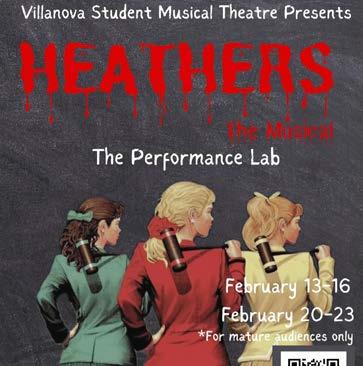
beginning of the musical had to be “Candy Store” and “Big Fun”
All the hard work the actors put
into this production was evident in both the vocals and choreography.
The actors also tackled the
tougher themes of this musical incredibly well. Songs like “Lifeboat” and “I Am Damaged” were handled with care by the actors, and it paid off with the emotional scenes they created. Similarly, the danger Veronica is in during “You’re Welcome” was not shied away from, and the actors played out the scene with intention and maturity. Ultimately, this was an impressive production of a difficult musical and it had the audience enraptured the entire runtime.
“Heathers was great,” sophomore Lexie Scibilia said. “[It was] super funny, amazing vocals and I can’t wait to see what VSMT does next.”
Based on the standing ovation and continuing cheers as the actors exited the Mullen Center stage, the rest of the audience agreed.
As a student-run organization, the members of VSMT clearly hold themselves to a high standard and level of commitment. That effort pays off in each of their productions, and especially in “Heathers: The Musical.”
If one missed out on seeing this musical, VSMT will be putting on a production of “Godspell” later this semester.
Senior Sentiments: Time Capsule
“Do you remember when…” has been a constant phrase invoked among my friends and me this past week. Gathered together in a crouched Grog booth, we reminisced on Spit dinners, Ancients class and our favorite campus characters.
Though it was a while ago, I can remember exactly what my freshman year dorm looked like. The cinder block walls, crowded with posters of Lorde and Taylor Swift. The distinct scent of the K-cups from my Keurig (before I became a devoted Holy Grounds convert). The letter from my parents that sat atop my desk, a reminder that home is just a call away. I remember how it felt getting lost on my way to Driscoll for my first class of the year, the time I slept through my 8:30 a.m. advising class and the first time I felt homesick. But with that, I also remember the first time I called Villanova “home,” and how that soon became a habit.
With Spring Break just around the corner, this past week has been full of sentimental remembrances among myself and others, begging the question: “What is your favorite memory from freshman year?”
The first few weeks of college are momentous. Students are exposed to a whole new world of people, and while finding their footing, make lifelong friends. Senior Brooke Bossé looked back to how she bonded with her hallmates at the beginning of her first semester.
“Early into the school year there was a CAT event where they had roller skating in the Tolentine parking lot and food trucks,” Bossé
said. “I went with my roommate, and we ran into two other girls on our floor who we didn’t really know, but we shared a lot of laughs as we tried to figure out how to roller skate together. Afterwards, we waited an hour in line for the crepe food truck and walked back to South Campus together. Doing those silly activities with girls I didn’t really know was a great bonding experience and made Villanova feel like home for the first time.”
Sometimes the greatest memories are made on a spontaneous whim. Such is the case for senior Brian Fitzsimmons, who remembers the first snowfall at Villanova, and the memories he made with Club Rugby, of which he is now a senior member.
“My favorite memory was the first snow storm at Villanova and playing rugby on Pike,” Fitzsimmons said. “It was a very spontaneous decision where 20 of us got up early and just enjoyed the day without class. At that moment I wasn’t worried about the homework I had or anything else, I was just focused on the moment.”
Similarly, senior Alice Korolev also reflects back on the shared moments brought about by the winter storm.
“The snowball fight on South Campus is definitely my favorite memory,” Korolev said. “We got to see everyone on South that we know, and it felt like it really brought the community together. Especially when you don’t know that many people, it’s the little things that bring people together that feel the most special.”
Back in the glory days of Jay Wright, current seniors experienced an unforgettable basketball season their first year at Villanova. Senior AnNa Hughes reminisced about

March Madness and the final moments leading up to her attendance at the Final Four in New Orleans.
“When Villanova went to the Elite Eight, we all watched it in the lounge together in Stanford Hall, and that was really exciting,” Hughes said. “After the win, we all ran to the Oreo and I got fried Oreos from the food trucks. We were on top of the world.”
Hughes’ friend, senior Meghan Buri, shared the same enthusiasm for that notorious basketball season. Hughes and Buri traveled together to New Orleans to watch the Final Four, which was one of Buri’s favorite freshman memories.
“Even though we didn’t
win the game, it was truly a once in a lifetime experience,” Buri said. “It was so special to visit with my extended family and to explore New Orleans with two of my best friends.”
Whether it be a spontaneous snowball fight or a trip to NOLA, these stories show that it’s the people who make the place. Seniors, grab your friends and re-hash every memory you’ve had. Look deep into the archives of your Snapchat memories, your group texts, your camera roll. Revive the moments that you’ve forgotten, and remember what it felt like to be a freshman: so new, so uncomfortable. You’ve made it so far, and now, it’s the perfect time for the bittersweet debrief.
VSMT put on “Heathers” from Feb. 13-16 and Feb. 20-23. Courtesy of @novavsmt
The nostalgia is kicking in for Villanova seniors in their final semester. Maggie Fitzgerald/Villanovan Photography
Shelf Care: Novels for a Winter Slump

Alex Pultz Staff Writer
This is the time of the year when everything gets hectic. It’s freezing on campus. Students are swamped with midterms and are just trying to make it to Spring Break. The perfect break from the business of this time is curling up with a good book. All these books take place either in the summer or a tropical location, so use these recommendations as escapism for a warmer time or pack them as a thrilling read for Spring Break.
Before We Were Innocent by Ella Berman
I read Before We Were Innocent on a trip this summer, and I could physically not put down this book. The story follows Bess as painful memories of her senior trip in Greece come back to haunt her 10 years later. Three friendsBess, Joni and Evangeline- take a summer trip to Greece after their high school graduation. While there, the girls get into a major fight, and Evangeline tragically dies. The book flips between their time in Greece and the present as Bess reflects on this haunting event. While this book is a thriller, it also deals with the girls’ friendship and how that affects their memories of this event.
Every Summer After by Carley Fortune

Natalie Hyde Staff Writer

Carley Fortune’s romance novels are my favorite books for a good escape. Every Summer After takes place at a summer house in Canada, flipping between past and present, as main character Percy develops and reflects on her love for her childhood best friend Sam. This novel explores themes of friendship, love and forgiveness through the characters’ complex relationship. I really enjoyed that there was a “secret” that drove the
plot that wasn’t revealed until the last couple of chapters of the novel. From early on in the book, this secret forces readers to question what made Sam and Percy disconnect for all those years.
The Counselors by Jessica Goodman
Nothing like a good summer mystery to keep you captivated as well as to give you a break from school work. Jessica Good -
man is always reliable for an entertaining mystery and The Counselors is no exception. The novel takes place at a summer camp while a mysterious death keeps the counselors in an elaborate chase to discover what happened. I did not expect the ending at all, which always makes for an enjoyable read. The Counselors is entertaining and spooky.
Eat Pray Love by Elizabeth Gilbert
This soulful book takes place across the world in Italy, India and Indonesia. Eat Pray Love is the perfect book for an escape to anywhere other than Bryn Mawr, PA. Travel the world with author Elizabeth Gilbert as she discovers herself and her purpose through this touching memoir.
Malibu Rising by Taylor Jenkins Reid
A Taylor Jenkins Reid book can truly suit any situation. Transport to Malibu in 1983 as the Riva siblings plan and throw their annual summer party. This book takes place in 24 hours, making it fun to see how all the characters choose to spend the day. Fans of The Seven Husbands of Evelyn Hugo will discover that the character Mick Riva appears in this novel as well. Malibu Rising will have you wishing you were part of this elaborate summer bash while uncovering the secrets of this fascinating family.
Heart of the Matter: Happiest Day
announcer to call my name for the American Civilian Award. I remember seeing tears stream down my mom’s face as she beamed at me.”
Seven-thousand-two-hundred-fifty-eight days. That is the number of days I have been alive. An existential crisis-inducing question, as I was recently asked to calculate the number of days I have been on Earth. From that number, I had to think of my happiest day. My mind blanked and oddly enough the only answer I could think of was a moment dating 10 years ago. With memories of a trampoline, my favorite cake and a white dress, for some reason my thoughts jumped to my First Holy Communion as the best day of my 7,258. I would hope I have had happier days since 2015, but my knee-jerk response was this sunny day full of childlike joy and a golden glow of nostalgia.
Shocked by my own response, I was curious to hear other Villanovans’ takes. Seemingly, I was not the only one to dive deep down memory lane.
“Easy answer – 5th-grade award ceremony,” a student said.
Per tradition, this student’s elementary school conducted yearly awards for the graduating class honoring those excelling in academics, sports and music, culminating with the coveted American Civilian Award for all-around character excellence.
“I remember being so confused seeing my mom in the front row,” the student continued. “I assumed she was there for my cousin. The last thing I expected was for the
Prideful and accomplished, this student remembered a floating feeling as they accepted their accolade and continued their day.
Many other students also chose days of high achievements and validation.
“When I ran a marathon and felt the love of all my family and friends supporting me,” another student said. “I was so proud of myself and to know the people I cared most about were just as excited for me was the best feeling in the world.”
Another describes a heated lacrosse game in a European league.
“Against all odds, we beat the Netherlands in double overtime,” this student said. “All my hard work had paid off when the final whistle blew.”
This student described a celebration full of champagne, a team dinner and the comforting relief of success and finality.
Another’s happiest day was a serendipitous excursion into a local Norwegian town.
“It felt like something out of a movie,” they said. “We just stumbled into a charming old church. It was Christmas time so there were decorations and a choir of little children singing. It felt like they were waiting for us to walk in.”
Nothing monumental occurred, but it was time surrounded by their family in a picturesque country, all from a lucky wrong turn.
“I remember it exactly – it is

how I would describe my perfect day if anyone asks,” another said. “Except it isn’t hypothetical, it actually happened.”
Every summer, this student’s family, including cousins on both sides, makes a trip up to Maine.
On this day, all the cousins decided to wake up at sunrise for an early swim, which flowed into cafe coffee and fresh fruit. At night, they all sat around a campfire, full of ice cream, singing songs as their dad strummed his guitar and laughing at old stories.
Many students’ happiest days were all those surrounded by loved ones. One student, in particular, recalls a blowout summer barbeque bash – balloon arcs, cornhole, more food than they could ever eat and their entire extended family in their backyard.
“We all knew this party would be the last real celebration with my aunt,” this student said. “And it was. But, I can still hear her laugh from that day and it will always be the best party I have attended.”
A bittersweet memory, one laced with love and longing.
“I think about that day all the time,” they continued. “I wish I could relive it.”
July 31, 2032 will be my 10,000th day alive. As much as I loved my Communion, which clearly I do, I strive for a new day to claim my happiest. That might very well mean a planned day full of all my favorite activities, or perhaps I will stumble into it. Either way, I hope not to count the days, but to make the days count.
Curling up with a book is a great way to to destress during this busy time. Maggie Fitzgerald/Villanovan Photography
My happiest day was my First Communion, but there are many more to come. Maggie Fitzgerald/Villanovan Photography
SPORTS
“The Banana Operation” Has Left the Group Chat

Owen Hewitt Former Sports Editor
Continued from p. 1
the impact of the Bananas on the outcome are valid, but for those in the bunch, they may as well be on the court. As St. John’s sophomore guard Simeon Wilcher stepped away from the foul line after making the first of two technical free throws with two-minutes, 41 seconds to play in the first half, he said something in the direction of the Bananas to the left of the St. John’s basket.
“He hit the first and then he turned to the Bananas and said something,” Murphy said. “I don’t quite know what, but he was engaging with us and it riled the group up, and [we] went crazy trying to distract him from the next free throw.”
Wilcher missed the following foul shot. It would be bananas to say the group didn’t have an impact.
“We won by two,” Murphy said. “One point matters in that type of a game.”
So, how did the Bananas arrive? According to Murphy, a smaller portion of the group that attended the St. John’s game intended to sport the yellow suits out on Halloween, but the plan fell through. Then, at a December Villanova home game, Murphy was inspired to break out the banana costumes to try and revive a student section on the same downward trajectory as the basketball team it supports.
“I can get a bunch of my
friends and maybe we dress up in the same costume, get a little attention and people would think it’s funny,” Murphy said of his initial plan. “Bring a new energy to the student section that hasn’t really been seen this year or last year.”
Murphy is hesitant to take credit for the whole enterprise. According to fellow banana senior Owen Holmgren, all the ‘Nova ‘Nanners act as “one big entity.” The planning for the St. John’s game took place in a Snapchat group chat simply named “February 12th Banana Operation.”
Logistics included bulk ordering banana costumes from Rasta Imposta, a New Jersey-based costume company of which one of the Bananas knew the owner.
“I think it was 17 [dollars] per banana,” Murphy said. “The original price was 30. I guess we saved 13 bucks, if that’s worth anything.”
Originally the Bananas targeted the Jan. 20 Villanova home game against Georgetown, but decided it would be hard to field a full Banana Bunch on the same night as the championship game of the College Football Playoff. Ironically, Villanova lost its game to Georgetown that night by one point, 64-63.
Once they settled on the St. John’s game as their target, the Bananas also needed to make sure they had enough tickets to the game to get the entire peel-clad parish in the door. Everyone got a ticket through the lottery, or got one from someone else who did. After those things were finished, all that was left was getting to
the game early and going bananas.
“The St. John’s game was our final Finn game,” Holmgren said. “We were, like, ‘We might as well try to make up for four years in one game.’”
The Villanova community’s reception of the bananas was “overwhelmingly positive,” according to Holmgren. Many of the Bananas are friends with senior guard Colin O’Toole, who joined the Villanova active roster in 2022 after spending the 2021-22 season as a practice player.
“[O’Toole] loved the idea,” Holmgren said. “He said a lot of the guys on the team love the idea. It’s been pretty cool to see the reactions.”
The Athletic Department’s marketing team loved the idea, too. Associate Athletic Director for Marketing and Digital Strategy Jake Whitten and the entire marketing team worked to feature the bananas at the next Villanova home game.
“Our team was meeting down in the Fitzgerald club, and we just looked up and saw two bananas walk by, three, four walk by, and we’re like, ‘Okay, wait. Something’s going on here,” Whitten said. “Then they all made their way down to the other end of the court and I’m like, ‘We’ve got to go talk to them right now.’”
As the marketing team worked to feature the bananas in the in-arena script for Villanova’s final game of the season, the basketball team suffered road losses to Providence and UConn that almost certainly popped the Wildcats’ bubbling hopes for an at-large bid to the
NCAA tournament. The Bananas questioned whether the effort to show up in force to the game against Marquette was worth it. Their verdict to make the effort was rooted in two ideas. First, fans should support their teams no matter what. Second, when will there be another chance to do this?
“Think about when the next time you’re going to be able to go to your college’s basketball game dressed up as a bunch of bananas with your friends,” Holmgren said. “It’s just not something that we’re going to get to experience again… I don’t think we would have done this as juniors or underclassmen. I doubt it. We’ve got two games left. We might as well do what we’re not going to be able to do after these two games and take advantage of this opportunity.”
Roughly 100 bananas occupied the front rows of the student section at the Wells Fargo Center for Villanova’s 81-66 thrashing of Marquette. It was the second-best win of Villanova’s season by NET ranking, only behind the victory over St. John’s three games prior.
There was a banana-centric hype video set to Kendrick Lamar’s “tv off.” Students donned t-shirts featuring a yellow cartoon banana spinning a Villanova basketball on its finger. The shirts spelled out “LET’S GO BANANAS.”
Graduate guard Jhamir Brickus summed up the environment for the team’s win postgame.
“It was bananas,” Brickus said.
Wildcat Watch: Kobryn Throws Two Complete Shutouts

Amanda McKean Sports Columnist
As Villanova softball continues to challenge itself against top-25 teams each weekend in preparation for Big East competition, players have started getting comfortable in the discomfort of adversity and seized the opportunity to shine.
One of the most surprising of these players is freshman pitcher Lexi Kobryn, who last week earned Big East Pitcher and Big East Freshman of the week.
Kobryn delivered two complete game shutouts at the Joan Joyce Classic in Florida. The right-hander led the Wildcats to a 1-0 victory over No. 25 Florida Atlantic, and a 3-0 win against Dartmouth in a two-hit game.
“[Kobryn] was getting ahead of batters, attacking them, controlling the zone,” head coach Bridget Orchard said. “She has a lot of movement on her pitches so she was able to throw out different types to different batters. To throw a whole seven innings is hard because the batters see you two, three, four times so you have to reinvent yourself when you’re out there.”
Kobryn brings the poise of an experienced player to her performances in the circle in her debut college season.
“I think having confidence in my pitches and my skills, knowing

that I’m better than whoever’s up at bat and that they’re not going to beat me really helps,” Kobryn said. “I also have confidence in the defense behind me, knowing that I don’t have to strike everyone out. I know my team is going to make amazing plays for me, just like they have been.”
The New Jersey native is an alumna of the Hun School in Princeton, yet has been on Villanova’s radar for a long time. She committed to Villanova in the fall of her senior year, in November of 2023.
“[Kobryn] was always a high-level, elite pitcher,” Orchard said. “We watched her pitch a lot, probably since her freshman, sophomore year of high school. She had size, talent and a ton of mobility. She can pitch, hit and play the field. So she stood out right away and she’s a highly academic kid as well.”
Kobryn has wasted no time in becoming part of Villanova’s pitching rotation each weekend, as
Orchard tries to fill the gaps left from the seniors of last year’s Big East Championship team.
“[Kobryn] knew we were graduating Caroline Pellicano and Alyssa Seidler, so she had big shoes to fill,” Orchard said. “I think that’s what excited her about it. She was going to come in and have the opportunity to compete and play right away, being asked to fill that role.”
Despite the team’s four losses at Clemson over the weekend, the final scores were not indicative of Kobryn’s success as she continued to deny runs up until the last day.
“It means a lot to me that [the coaches] have so much confidence in me,” Kobryn said. “It allows me to feel comfortable on the mound. It’s what I dreamed of my whole life, to be able to play softball at this level and to carry such a big role on a team full of so much talent.”
In the first loss to Clemson
on Friday, Kobryn was met with an unlucky break as the ‘Cats could not score, forcing an eighth inning in which the offense gets to put a man on second to start. All it took was a single for the Tigers to take the lead.
In the team’s next game, Kobryn came in and closed, finishing another game with no earned runs. By the last day, with a tired arm, Kobryn eventually wavered and gave up a grand slam to Elon.
“The biggest thing is the grind,” Orchard said. “Sometimes things go your way and sometimes they don’t. We lost 1-0, but [Kobryn] had no earned runs. She was really doing her job. We had bad numbers on Sunday, but she knows that we are going to have ups and downs. As a pitcher and a freshman, she’s really mature, as far as being able to understand that. It’ll get her back working hard, but it shows it doesn’t get any easier.”
Kobryn sees the weekend in Clemson as motivation to keep working.
“I think facing adversity like this is necessary to be the best,” Kobryn said. “You can’t just be high all of the time, you’re going to need to face your failures. That helps you know what you need to work on for next time so that it doesn’ happen again. I’m taking this weekend as my time to reflect on myself and see what I need to do so I can be 10 times better for this upcoming weekend.”
Professors in the College of Liberal Arts collaborate over DEI course ideas. Courtesy of Villanova University
Preview: T&F Prepares for Big East Championships

Genna Cottingham Staff Writer
This weekend, Villanova track and field will compete in the Big East Championships, hosted by DePaul. Concluding the indoor season, the Wildcats will travel to Chicago, IL at the Dr. Conrad Worrill Track and Field Center.
The meet will take place over the course of two days, starting on Friday, Feb. 28.
“Everyone kind of competes in all the events,” Villanova men’s head coach Marcus O’Sullivan said. “If there’s any one time during the year where the whole team is together, this is it.”
The reigning champion of the meet is University of Connecticut, both on the men’s and women’s sides. The Huskies’ highly skilled and massive team make them a tough competitor.
While Villanova has a strong lineup (the men’s team ranks No. 10 nationally), scoring for each event is based on the times, distances and number of entries. The Wildcats having a smaller team than the Huskies gives them fewer chances to redeem points for a higher ranking.
“It’s just a different compilation of how they can put a team together,” O’Sullivan said. “We can’t do [what UConn does].”
Last year, the women’s team ranked No. 2 in the Big East
after the championship on Feb. 24, 2024. Senior Sadie Sigfstead finished with a time of 15:59.18 in the 5K, earning first place. 2024 graduate Jane Livingston won the 60m dash (7.47) and the 60m hurdles (8.18). Junior Micah Trusty ran a 2:05.61 800m to reach second place.
The men’s team finished third in the 2024 Big East indoor championship. The DMR — made up of juniors Marco Langon and Ronan O’Neill, fifth-year Liam Murphy and 2024 graduate Xian Shively — won. Murphy also took first place in the 3k, with a time of 7:42.51.
“[Murphy is] definitely at such a very high level that he’ll most certainly be going in that direction [of professional track],” O’Sullivan said. “And at the same time, he’s in the middle of his MBA. So, he’s going to have a great future ahead of him.”
Langon was not far behind Murphy in the 3K, finishing second with a time of 7:43.83.
For the 2025 championship, O’Sullivan and women’s head coach Gina Procaccio make entries to ensure the athletes’ strengths are being tested, while also allowing for ample rest. Both coaches and staff try not to force the athletes to overextend themselves on race days.
Although O’Sullivan is unsure of which events some of his distance runners will focus on,
he did acknowledge the possibility of changes to distance and sprint relay teams.
One breakout star finishing up his inaugural indoor season is distance runner CJ Sullivan.
“CJ is very committed to his self-improvement,” O’Sullivan said. “He has made great progress this year and he’s only getting better.”
Sullivan redshirted his freshman year and ran in his first race in Spring 2024. After getting second place in the 3k at the Penn State Open back in January, Sullivan will be running both the 5K and 3K races this weekend in Chicago.
“I definitely want to score some good points for the team,” Sullivan said. “We have some good crews for both the 5K and the 3K. So, I think we can do pretty well.”
Despite this being the final meet of the indoor season for the majority of the team, three Wildcats received a qualifying time for the NCAA Championships. Two weeks after the Big East Championship, Murphy, Langon and sophomore Dan Watke will travel to Virginia Beach for nationals after each achiving qualifying times in their respective races on March 14 and
“We have to keep… making an honest effort that they’re making a contribution for the whole team, because I think it’s good for the whole team when that happens,” O’Sullivan said.
Feb. 19 -Feb. 25
Wednesday, February 19
Women’s Lacrosse vs No. 15 Stony Brook 5-12 L
Women’s Basketball vs Georgetown 70-65 W
Friday, February 21
Women’s Tennis @ St. John’s 2-5 L
Baseball @ Winthrop 10-4 W
Softball @ Clemson 0-1 L
Men’s Basketball vs No. 16 Marquette 81-66 W
Saturday, February 22
Women’s Tennis @ Army 1-4 L
Women’s Lacrosse @ Bucknell 16-11 W
Softball vs Elon 3-4 L
Softball vs Marshall 2-3 L
Men’s Lacrosse vs RV Colgate 5-16 L
Baseball @ Winthrop 10-3 W
Men’s Tennis vs Bucknell 1-6 L
Sunday, February 23
Softball vs Elon 2-6 L
Women’s Basketball @ Providence 56-63 L
Catching Up With the ‘Cats: Jerry Quinn (‘87) WEEKLY SCOREBOARD

Dylan Johnson Co-Sports Editor
The day after Gerald Quinn (‘87) graduated from high school in 1983, he was on his way to boot camp for the Coast Guard Reserves in Cape May, New Jersey. He still had not decided which university he would attend for the next four years.
Quinn is a former Villanova swimmer and graduate of the Villanova School of Business with a Bachelor of Science in Business Administration in finance and a minor in accounting. He currently leads a team that works for Customs and Border Protection.
Before Quinn departed for boot camp, he sent in a couple of applications for colleges. His mother wanted him to apply to a Catholic university, and Villanova checked that box.
Despite applying to Villanova, Quinn had plans set to attend the University of South Florida in Tampa, FL upon his return from his stint at boot camp. However, Quinn was going to end up somewhere else.
“When I got home [from boot camp] on July 15 of that summer in 1983, my waitlist [for Villanova] was turned into an acceptance,” Quinn said. “I made a decision [to go] and my mom, I think she was just overjoyed that I would be going to a Catholic university.”
Quinn was a captain of the Villanova men’s swim team in the
1986-87 season and was a Big East finalist in all four years.
Unlike most student-athletes, Quinn’s path to swimming was not through recruitment.
Throughout his childhood, Quinn swam on a club team in Fort Lauderdale, FL, and had a few teammates go on to swim at Villanova.
“I walked on the [swim] team,” Quinn said. “I spoke to the coach Ed Geisz. I talked to Ed once in high school and never thought that we’d be running into each other down the road.”
Quinn took up his first job at 20th and Chestnut in the Center City of Philadelphia working for a small market maker of bank stocks.
His career path quickly shifted and bounced around to different parts of the business world.
“I thought I was going to have something to do in the financial industry,” Quinn said. “And then I focused more on wherever my path took me and I eventually landed at a chemical company that was right there at 20th and Market [in Philadelphia] called Elf Atochem.”
Eventually, Quinn was named the company’s Chief Compliance Officer.
“It just was like a springboard to the next thing,” Quinn said. “That was working at one of the professional service firms at the time as Coopers & Lybrand doing SAP implementations...and learning how to implement the software for what their specific problem was.”
With decades of experience learning how to implement different systems to help businesses manage their operations, finances, and customer relationships, he now is working in the cargo industry.
“Now I’m the agile team lead for one of the teams at Customs and Border Protection on the cargo side to implement and maintain all the systems for how cargo comes in and out of the country,” Quinn said.
When companies need to move things in and out of the borders of the United States, it all needs to be tracked. That is where Quinn’s specialization in systems comes in. When companies move products, sometimes they are faced with duties which are a form of taxes on imports.
“We help to facilitate that and collect $72 billion worth of duty on an annual basis that supports the revenue of the United States,” Quinn said.
Quinn’s field of work has made recent news due to the new executive orders from President Donald Trump. His orders have included tariffs on Canada, Mexico and China, which have since been delayed. Every new order on imports and exports, people like Quinn have to adapt to.
“Every weekend since the inauguration, our team has worked,” Quinn said. “So, we’ve had to do some kind of change in the system or redesign how a calculation is done or implement new tariff rates based on the recent
Baseball @ Winthrop 3-17 L
Men’s Tennis vs Wagner 7-0 W
Monday, February 24
Men’s Swim @ Big East Championships
Team Scoring - 2nd
Women’s Swim @ Big East Championships
Team Scoring - 3rd
Tuesday, February 25
Men’s Swim @ Big East Championships
Team Scoring - 2nd
Women’s Swim @ Big East Championships
Team Scoring - 3rd
Baseball vs Coppin St. 12-2 W
executive orders.”
On top of his job, Quinn still is an actively involved alumni who is always helping current Wildcats. In 2024, he had calls with 51 students who all in some way benefited from his time with them.
In the District of Columbia near where he currently resides, he is a mentor for the Villanova Club of Greater Washington. He was formerly the president for more than 10 years. The club’s goal is to help current students connect with alumni to help further their future careers.
“It just makes me so happy when you see somebody else successful [that you’ve helped],” Quinn said. “I think when you see somebody else succeed, it’s irreplaceable.”
Baseball Captures Series Against Winthrop

Jack Flannelly Staff Writer
Over the weekend, Villanova baseball traveled to Rock Hill, South Carolina to take on Winthrop University in a three-game series.
The Wildcats (3-3) won the series, 2-1. They came out on top in games one and two, 10-4 and 10-3, respectively, and dropped the third game, 17-3.
“Biggest takeaway [from the first two games] was that we made the next play,” head coach Kevin Mulvey said. “We didn’t let it bleed us out. You make a mistake, you throw a strike, you make the next play. We responded well.”
On Friday afternoon, the Wildcats defeated the Eagles, 104, behind six innings of work from graduate transfer and starting pitcher Bobby Olsen. Tallying eight strikeouts and allowing only one earned run, Olsen got the win for Villanova.
It was a close game through six innings before the Wildcats broke out in a big way in the seventh inning, putting up four runs.
Overall, the team amassed 16 hits, including solo home runs from freshman Brayden Leonard and graduate captain Jason Neff. The Wildcats had six players tally multiple hits and seven extra-base hits as a team.
Graduate pitcher Alec Sachais received the save, throwing three innings and allowing two earned runs.
In game two, the Wildcats had another great outing on the

Jon Hunn Staff Writer

mound, this time from graduate Luke McCollough. He threw seven and one third innings, allowing three earned runs while striking out six, and picking up the win.
“They [Olsen and McCollough] pitched to contact,” Mulvey said. “They pitched for strikes, and they don’t get flustered. They were calm, cool, and collected.”
The offensive power carried into the first inning of game two, when junior Michael Whooley hit a two-run homer, scoring redshirt freshman Alex Lemon.
The Wildcats put up five runs
in the second, behind another Whooley RBI and a red-hot Neff driving in two. In the fifth, Neff brought in yet another run on a solo homer.
A third Neff home run of the series came in the ninth, a two-run shot.
The Eagles plated three runs in the contest, but it was not nearly enough for the high-powered offense of the Wildcats.
Villanova dropped the final game of the series. Winthrop got off to an early lead in the first behind a two-run home run.
The Wildcats struck back in
the second inning to tie the game, 2-2, on a two-run homer from graduate Jake McElroy. It was McElroy’s first home run as a Wildcat after transferring from Holy Cross for the 2025 season.
The game was not tied for long, as Winthrop put up two more in the second on a single and fielder’s choice.
The Eagles pulled away by putting up 11 runs in the fourth inning.
The Wildcats sent eight pitchers to the mound and saw less success than the previous games, as 16 of Winthrop’s 17 runs were earned.
“Sunday was a mirror of last week,” Mulvey said. “A little bit concerning. We need to have guys that can get up there and show mental toughness, show the team, ‘Give me the ball and I get some outs.’”
Junior Bobby Finn took the loss on the mound for the Wildcats.
McElroy and Whooley were an encouraging sign offensively, as they both picked up two hits and were responsible for all three runs.
“When you give up 17 runs, it’s tough to keep your confidence and grind out at-bats in that environment,” Mulvey said.. “I feel very confident in the offense and what they showed this weekend in the first two games.”
Looking ahead, Villanova will host Coppin State University on Wednesday, Feb. 25, for its first home game of the year. Next is a series in Nashville, TN, against Lipscomb University from Feb. 28 to March 2.
Softball Goes 0-4 in Clemson Classic
Villanova (5-8) went 0-4 at the Clemson Classic this weekend, suffering losses to Clemson, Elon (twice) and Marshall.
The Wildcats opened the series on Friday with a walk-off loss to Clemson, 1-0, in eight innings.
Offense was difficult for both teams to come by for most of the game. Villanova failed to capitalize with runs despite drawing four walks over the first two innings and recording its first two hits of the game, each a single, in the third.
Clemson had six hits before extra innings but also failed to score.
With the international tiebreaker rule in effect, the Wildcats were granted a runner on second base to begin the top of the eighth inning. Villanova failed to move the runner and remained scoreless.
After clearing the first seven innings without allowing a run, Villanova freshman pitcher Lexi Kobryn returned to the circle to begin the bottom of the eighth inning with the free runner placed on second base for the Tigers. Clemson sophomore Julia Knowler entered the box and grounded a single into right field, bringing home the winning run.
Kobryn took the tough-luck loss for the Wildcats, pitching seven-plus innings and allowing seven hits and one unearned run. She also walked two batters and struck out one.
“Lexi [Kobryn] did a great job of sticking to the game plan,”
head coach Bridget Orchard said. “[Kobryn] was working with [Villanova] pitching coach Grace [Fagan] and trying to figure out how they’re gonna attack these batters again and again.”
In the first game of a Saturday doubleheader, Elon defeated Villanova, 4-3.
Elon scored the first runs of the game in the top of the second on an RBI single.
The Wildcats answered in the bottom of the third with two runs to take a 2-1 lead. Senior pitcher Kelsey White plated the first run with a sacrifice fly and senior shortstop Ava Franz followed with an RBI single.
Elon tied the game in the top of the fifth with an RBI single. Then, in the top of the seventh, the Phoenix took a 4-2 lead with two runs scored off a Villanova error.
The Wildcats brought the winning run to the plate in the bottom of the seventh after the first two hitters reached. Freshman Jaclyn Morra’s pinch hit ground out made it a one-run game, but White struck out to end the game.
For Villanova, Kobryn took her seond tough-luck loss in as many games, giving up two runs over two innings of relief. She allowed just one hit and one walk while striking out three batters.
In Saturday’s second game, Villanova fell to Marshall, 3-2.
Villanova took a 1-0 lead in the top of the third on junior center fielder Madison Ostrowski’s RBI groundout.
Marshall answered to take a 2-1 lead in the bottom of the fourth inning, adding runs on an RBI triple

and a sacrifice fly.
The Wildcats evened the score in the top of the sixth inning when junior Maddie Burrows delivered a pinch-hit RBI double.
Marshall quickly regained the lead in the bottom of the sixth, as an RBI triple put them ahead, 3-2.
The Fighting Herd retired the Wildcats in order in the top of the seventh to seal the victory.
For Villanova, junior pitcher Kat Gallant pitched to a complete game loss, allowing seven hits and three runs (two earned) in six innings of work. She also walked one batter and recorded one strikeout.
“[Gallant] is mature and experienced,” Orchard said. “She’s a junior this year, and she’s composed and she competes and has a lot of really good stuff.”
In the tournament finale on Sunday, Elon defeated Villanova, 6-2.
The Phoenix opened the scoring in the bottom of the first, plating a run on an RBI single, before adding another run to go up, 2-0, in the bot-
tom of the third on a sacrifice fly. Villanova tied the game in the top of the fourth when sophomore DP Maranda Runco blasted a tworun home run.
In the bottom of the sixth, Wildcat pitcher Kobryn loaded the bases with walks before surrendering a grand slam to Elon redshirt junior left fielder Chloe Hatzopoulos to make the score 6-2.
In the top of the seventh inning, Villanova managed to bring the tying run to the on-deck circle with no outs when the first two runners of the inning reached. The comeback bid ended there, however, as the next three hitters were retired to end the game.
Kobryn recorded the loss for the Wildcats, surrendering four runs on two hits and three walks in 1.1 innings pitched. She also struck out one batter.
The Cats will return to action this Friday in Salem, VA, where they will compete in the Hokie Invite from Feb. 28 to March 2.
Junior outfielder Aidan Barry had three hits and an RBI in Friday’s win. Courtesy of Villanova Athletics
Villanova took Clemson (9-6) to extra innings, but fell 1-0 on Friday, Feb. 21. Courtesy of Villanova Athletics
Preview: Must-Win Games for MBB and WBB

Dylan Johnson Co-Sports Editor
Villanova’s men’s and women’s basketball teams each have only a few games remaining before the Big East Tournament. Both teams sit outside the NCAA Tournament bubble looking in.
The men are eight spots away from being in the tournament. They must win their final three games if they want any opportunity at grabbing an at-large bid to March Madness.
As for the women, the recent loss to Providence knocked them out of the ESPN Bracketologist Charlie Creme’s next four out. While winning the last two regular season games would not hurt, winning the Big East Tournament looks to be the only path for the women to dance in March Madness with an automatic bid.
Men’s Team
Villanova men’s basketball (16-12, 9-8 Big East) is coming off a dominant, 81-66 win over No. 16 Marquette on Feb. 21. It was the first time the Wildcats beat the Golden Eagles under the direction of head coach Kyle Neptune.
Over the final stretch of games, redshirt freshman Jordann Dumont is one Wildcat to watch out for.
In his breakout against Marquette, he scored a career-high 15
points, and shot 4-of-4 from threepoint range.
Despite being 4-1 against ranked opponents this season, Villanova’s tournament hopes remain questionable as March Madness approaches. ESPN bracketologist Joe Lunardi has the Wildcats as one of his next four teams out, meaning they are currently eight spots out of the NCAA Tournament.
The Wildcats have no choice but to win the rest of their regular-season games for an opportunity at an at-large bid into the tournament. The only other option is an automatic bid by winning the Big East Tournament.
Villanova will visit Seton Hall (7-19, 2-13 Big East) on Wednesday, Feb. 26 (8:30 p.m., FS1). The Wildcats opened conference play against the Pirates with a 79-67 win on Dec. 17. Villanova leads the all-time series, 85-44.
The Pirates are second-tolast in the Big East, but their biggest threat is sophomore guard Isaiah Coleman. He averages a team-high 15.2 points and 5.3 rebounds. The Pirates only average 62.4 points per game.
Villanova will return home on Saturday, March 1 to host Butler (13-14, 6-10 Big East) (Noon, FOX). It will be six senior players’ last game in the Finneran Pavilion, including graduate guard Eric Dixon and senior guard Jordan Longino.
On Jan. 1, Villanova had a late run to come from behind and beat Butler, 73-65. Despite Dixon
having a team-high 28 points, senior guard Wooga Poplar was the highlight of the lineup.
Poplar collected an 18-point, 15-rebound double-double in the win. He currently has five double-doubles this season.
The Bulldogs are a good three-point shooting team, averaging 37.4% from beyond the arc. That percentage ranks 32nd in the country. Senior guard leads the way, making 40.6% of his shots from three.
The final game of Villanova’s Big East slate will be against Georgetown (16-11, 7-9 Big East) on Tuesday, March 4 at Capital One Arena.
One player to watch for is Georgetown freshman forward Thomas Sorber. Sorber is averaging 14.5 points and 8.5 rebounds per game. Earlier in the season, when Sorber faced Villanova, he posted a 15-point, 11-rebound double-double in his return from an injury.
Women’s Team
Villanova’s women were battling for a possible March Madness appearance after winning eight of their last 10 games.
However, a recent 63-56 loss to Providence has hurt the team’s tournament chances.
The only thing the Wildcats can control now is the future, and that begins with closing out the regular season strong. Villanova has a tough Big East opponent in Creighton coming up in a must-win road game on Sunday, March 2.
Villanova returns home for its final home game of the regular season at the Finneran Pavilion on Wednesday, Feb. 26, against Butler (6 p.m., FloSports).
It marks the final home game for five senior Wildcats, including graduate forward Maddie Burke.
A huge second-half performance from sophomore guard Maddie Webber helped the Wildcats take down the Bulldogs, 63-59, earlier this season on the road. Webber scored 15 of her 19 points in the second half.
A big threat from Butler is senior guard Kylin McGuff. She averages 12.5 points and eight rebounds. Against Villanova, McGuff had a 19-point, 15-rebound double-double to mark one of her best performances of the season.
The Wildcats final Big East game of the season will be on the road in Omaha, NE to cap against Creighton (23-4, 15-1 Big East). The Bluejays are firmly the second-best team in the Big East behind UConn. Creighton has two solid scorers in senior guard duo Lauren Jensen and Morgan Maly. This season, Jensen has averaged 17.9 points, 4.2 rebounds and 3.9 assists. Maly has put up similar numbers, averaging 17.6 points and 5.6 rebounds. The duo is fourth and fifth respectively in Big East scoring.
Villanova freshman guard Jasmine Bascoe is playing like a veteran, averaging 15.8 points and 4.4 assists per game. Her assist total of 114 is only second to UConn senior Paige Bueckers (130).
Frames from Villanova vs. Colgate (Feb. 22)


All photos courtesy of Erick Quezada, Villanovan Photography
LAST WEEK’S ANSWERS

ASK THE VILLANOVAN
HELP! I’m a communication major and I am really struggling in my MSE. My entire class is so confused and my professor isn’t receptive of this.
I 100% understand where you are coming from. Because that’s me, as well. Science is no joke, and sometimes professors who teach these MSEs do not recognize that us arts majors are not premed for a reason.
My advice would be to take it one class at a time and to utilize office hours. By forming that connection with your professor, you will feel more comfortable expressing your concerns and asking questions. You got this!
I have no clue what classes I should register for next semester and my advisor is ghosting me. What should I do?
If there is one thing about academic advisors: you will either strike gold or never hear from them throughout your journey here at Villanova.
While it seems you have been granted (?) the latter of the two, it does not mean you have to suffer in silence. I advise (see what I did there)
that you go to a trusted professor in your major and ask their advice. They will be able to help you understand what classes you need to take for your major and give the advice the person you pay for the same advice did not give!
I keep getting rejected from all the clubs I apply for. It is making me doubt that Villanova is for me. Do you have any advice?
Villanova can be a competitive place for sure. But that just means you have not found the right environment for you yet.
It can be hard, really hard, to see your friends get into the clubs you applied for. Here at Villanova, there is such a desire to become involved, but what no one tells you is that it is okay to pave your own path.
If it had not been for rejection from other clubs, I would have never found some of my favorite organizations on campus.
Rejection is redirection, so I challenge you to keep your chin up and try something new. You never know what might end up sticking.
I have an old friend who really hurt me and is trying to come back into my life. How do I tell them I have moved on without hurting their feelings?
I’ll say it: friend breakups are just as, if not harder than, relationship breakups. But when the time comes, it is necessary to share your true feelings.
It is okay to have outgrown an old friend and it is okay to recognize that you need to protect your peace. But with that, it is important to be mindful of their feelings, as well.
I think that the best way to go about this is through conversation. I think that you should share why you feel the way you do, but make sure to listen to their side, as well.
It is easy to get caught up in your feelings and always feel as if you are correct, however, I find it important to put yourself in their shoes, as well.
It is okay to need space and to create these boundaries. I am a firm believer that people come and go into your life for a reason, it is just important to find what that reason may be.
THE CROSSWORD
By: Peter Reilly


