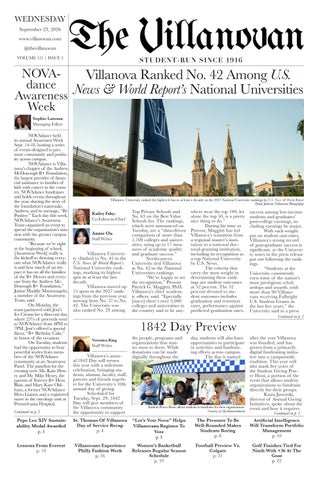
WEDNESDAY September 23, 2026 www.villanovan.com @thevillanovan VOLUME 121 | ISSUE 3
STUDENT-RUN SINCE 1916
NOVAVillanova Ranked No. 42 Among U.S. dance News & World Report’s National Universities Awareness Week Sophie Latessa Managing Editor
NOVAdance held its annual Awareness Week Sept. 14-18, hosting a series of events designed to promote community and positivity across campus. NOVAdance is Villanova’s chapter of the Andrew McDonough B+ Foundation, the largest provider of financial assistance to families of kids with cancer in the country. NOVAdance fundraises and holds events throughout the year, sharing the story of the foundation’s namesake, Andrew, and its message, “Be Positive.” Each day this week, NOVAdance’s Awareness Team organized an event to spread the organization’s mission with the greater campus community. “Because we’re right at the beginning of school, [Awareness Week] really is the kickoff to showing everyone what NOVAdance really is and how much of an impact it has on all the families of the B+ Heroes and everyone from the Andrew McDonough B+ Foundation,” Junior Maddie Mastranagelo, a member of the Awareness Team, said. On Monday, the team partnered with Jeni’s Ice Cream for a dine-out day, where 25% of proceeds went to NOVAdance from 4PM to 7PM. Jeni’s offered a special flavor, “B+ Birthday Cake,” in honor of the occasion. On Tuesday, students had the opportunity to hear powerful stories from members of the NOVAdance community at an Awareness Panel. The panelists for the evening were Ms. Kate Henry and Mr. Mike Henry, the parents of Forever B+ Hero Blair, and Mary Kate Oldham, a former NOVAdance Hero Liaison and a registered nurse in the oncology unit at Pennsylvania Hospital.
Villanova University ranked the highest it has in at least a decade on the 2027 National University rankings by U.S. News & World Report Dylan Johnson/Villanovan Photography
Kailey FahyCo-Editor-in-Chief
Annie Ou Staff Writer
Villanova University climbed to No. 42 in the U.S. News & World Report’s National University rankings, marking its highest spot in at least the last decade. Villanova moved up 15 spots in the 2027 rankings from the previous year, moving from No. 57 to No. 42. The University was also ranked No. 29 among
Top Private Schools and No. 63 on the Best Value Schools list. The rankings, which were announced on Tuesday, are a “data-driven comparison of more than 1,700 colleges and universities, using up to 17 measures of academic quality and graduate success.” Northeastern University tied Villanova at No. 42 in the National Universities rankings. “We’re happy to see the recognition,” Provost Patrick G. Maggitti, PhD, Villanova’s chief academic officer, said. “Epecially [since] there’s over 3,000 colleges and universities in the country and to be any-
where near the top 100, let alone the top 50, is a pretty nice thing to do.” During his time as Provost, Maggitti has led Villanova’s transition from a regional master’s institution to a national doctoral-granting institution, including its recognition as a top National University by U.S. News. The criteria that carry the most weight in determining these rankings are student outcomes at 52 percent. The 52 percent devoted to student outcomes includes graduation and retention rates, performance against predicted graduation rates,
1842 Day Preview Veronica King
Staff Writer
the people, programs and organizations that matter most to them. While donations can be made digitally throughout the
day, students will also have opportunities to participate in activities and fundraising efforts across campus. The day is named
success among low-income students and graduates’ post-college earnings, including earnings by major. With such weight put on student outcomes, Villanova’s strong record of post-graduate success is significant, as the University notes in the press release put out following the rankings. “Students at the University consistently earn some of the nation’s most prestigious scholarships and awards, with more than 90 Villanovans receiving Fulbright U.S. Student Grants in the last five years,” the University said in a press
Continued on p. 2
after the year Villanova was founded, and has grown from a primarily digital fundraising initiative into a campuswide tradition. This year will also mark five years of the Student Giving Power Hour, a portion of the event that allows student organizations to fundraise directly for their groups. Kasia Jaworski, director of Annual Giving Initiatives, spoke about the event and how it requires
Continued on p. 2
Villanova’s annual 1842 Day will return this year with a milestone celebration, bringing students, alumni, faculty, staff, parents and friends together for the University’s 10th annual day of giving. Scheduled for Tuesday, Sept. 29, 1842 Day will give members of the Villanova community the opportunity to support
Pope Leo XIV Sustainability Medal Awarded p. 3
St. Thomas Of Villanova Day of Service Recap p. 4
“Let’s Vote Nova” Helps Villanovans Register To Vote p. 5
The Pressure To Be Well-Rounded Makes Students Boring p. 8
Artificial Intelligence Will Transform Portfolio Management p. 10
Lessons From Everest p. 14
Villanovans Experience Philly Fashion Week p. 16
Women’s Basketball Releases Regular Season Schedule p. 19
Football Preview Vs. Colgate p. 21
Golf Finishes Tied For Ninth With +36 At The Goat p. 22
Student Power Hour allows students to fundraise for their organizations. Courtesy of @villanovaalumni
Continued on p. 2
2 | The Villanovan
News 1 Opinion 7 Culture 14 Sports 19
PUBLIC SAFETY BLOTTER
VOL. 121 | ISS. 3 www.villanovan.com @thevillanovan
KAILEY FAHY DYLAN JOHNSON SOPHIE LATESSA EMMA COTE MIA GALEGO MARGARET MILLER EDEN ROSINI AVERY CHALK EMMA TAYLOR CALI CARSS MAGGIE FITZGERALD FINN COURTNEY CASEY HEALEY IRA NIDAMARTHY MASON CANTON ERICK QUEZADA CIARA DURSEE KORIN KOHEN ERIKA MASSIANI MICHAEL BRADLEY JJ Brown
Wednesday, September 23, 2026
NEWS
Editor-in-Chief Editor-in-Chief Managing Editor Abroad Correspondent News Editor News Editor News Editor Opinion Editor Opinion Editor Culture Editor Culture Editor Sports Editor Sports Editor Copy Desk Chief Photography Editor Photography Editor Digital Editor Digital Editor Digital Editor Advisor Advisor
Public Drunkenness September 17, PEDESTRIAN BRIDGE. A female resident student, over 21 years of age, evaluated by VEMS for alcohol intoxication and transported to BMH. Criminal Mischief / Public Drunkenness September 18, FARLEY HALL. A male resident student, over 21 years of age, was evaluated for alcohol intoxication and released after he damaged property inside a residence hall. Liquor Underage / Public Drunkenness September 18, STANFORD HALL. A female resident student, under 21 years-old, was evaluated for alcohol intoxication at Stanford Hall and released.
Liquor Underage / Public Drunkenness September 18, GOOD COUNSEL HALL. A female resident student, under the age of 21, was evaluated for alcohol intoxication and released to sober friend. Theft by Unlawful Taking or Disposition September 19, STANFORD HALL. A female resident student reported a theft of a bag and it’s contents. The amount of the loss is $1200.00. Liquor Underage / Public Drunkenness September 19, ST. MONICA HALL. A female resident student, under the age of 21, was evaluated for alcohol intoxication and released. Liquor Underage September 19, RUDOLPH HALL.
A male resident student, under the age of 21, was evaluated for alcohol intoxication by VEMS and released. Liquor Underage September 20, STANFORD HALL. Two male resident students, under the age of 21, were in possession of alcoholic beverages. Criminal Mischief September 20, SULLIVAN HALL. An RA reported a damaged exit sign inside a residence hall. Aggravated Indecent Assault / Indecent Assault / Rape / Sexual Assault September 21, WHOLE CAMPUS. The Title IX Office reported a female resident student made a delayed report regarding a sexual assault(s) which occurred on 9/26/2025 by a male resident student.
CORRECTIONS
Factual errors are corrected as soon as they are brought to The Villanovan’s attention. Please send an e-mail to villanovan.eic@gmail.com to report errors.
1842 Day Preview Veronica King Staff Writer Continued from p.1
coordination across the University long before students arrive on campus. “We like to describe 1842 Day as a university-wide initiative, led by University Advancement, and quarterbacked by the Annual Giving team,” Jaworski said. “Every team in University Advancement has a role in 1842 Day and the actual day impacts the greater campus community.” Planning also involves departments throughout the University, including Dining Services, Facilities, the Office of the President, carpentry and Public Safety. Alumni volunteers, faculty and staff and student organization leaders also help promote the event and encourage others to support causes important to them. For students, the Student Giving Power Hour will be one of the main opportunities to get involved. More than 150 student organizations have registered to participate this year, according to Jaworski, setting a new record for the event. “The Student Giving Power Hour is personally my favorite part of the day because it highlights all the amazing causes our students care about, in a fun and
energizing atmosphere,” Jaworski said. The Power Hour also gives students a chance to participate, no matter how much they can donate. The competition is based on the number of donors supporting each organization rather than the amount of money raised, allowing students to contribute at any level. Beyond student organizations, Villanovans can choose from a wide range of areas to support through 1842 Day. University Advancement uses digital outreach, past giving data and peerto-peer messages from volunteers and campus partners to encourage members of the community to participate. As the University prepares for the 10th annual celebration, Jaworski said the event’s emphasis remains on participation and community rather than the size of an individual gift. “Together we are greater,” Jaworski said. “We want everyone in our community to feel motivated to participate on 1842 Day, and like they’re part of something bigger than themselves.” With hundreds of members of the Villanova community expected to participate, this year’s 1842 Day will continue a decade-long tradition of bringing Villanovans together to support the areas of campus and the University community that matter most to them.
This year, the University’s annual 1842 day will take place Tuesday, Sept. 29. Natalie Zickel/Villanovan Photography
NOVAdance Awareness Week Sophie Latessa Managing Editor Continued from p.1
“They shared a lot of insight,” Mastranagelo said. “It was really interesting to be able to hear from both Mary Kate’s perspective and also Kate and Mike’s perspective because they obviously have insights from dealing with the firsthand effects of childhood cancer on their family and also hearing from Mary Kate on the other side of that and seeing how the families deal with it everyday and the toll it takes on the families, which she sees from a medical perspective.” The panel was an ACS-approved event, and the speakers offered diverse experiences and perspectives on the fight against childhood cancer. “Mr. Henry works for the Pediatric Brain Tumor Foundation, so we talked to him a lot about his work and different bills that he’s trying to get passed,” Junior Maribel Haas, another member of the Awareness Team, said. “He also had great ideas for us and how we could get involved in legislation and writing letters, so that was really awesome to hear about.” Wednesday members of NOVAdance Committee held a
flower sale, Blooms of Gold. A hit with passerbys, flowers sold out before the end of the event. Thursday’s event was Share Your Why, held at the Oreo, an opportunity for students to write why they NOVAdance on a yellow ribbon and tie it to a large ribbon structure, creating a visual representation of the community’s reasons for fighting childhood cancer. On Friday, the week wrapped up with a celebration of NOVAdance’s 18 B+ Heroes. Each was featured on NOVAdance’s Instagram story through the Social Media Event, allowing students to get to know them further. “I feel like when the freshmen come to school they don’t know what NOVAdance is and a lot of people don’t know about it until Awareness Week because we’re tabling at the Oreo, we’re getting everyone on campus involved,” Mastranagelo said. Awareness Week also coincided with Childhood Cancer Awareness Month, which lasts throughout September. The week was fueled by positivity and love, bringing the Villanova community together to embody caritas and make an impact that extends far beyond campus. To learn more about NOVAdance, visit https://www. novadance.org/ for more information.
NOVAdance held events at the Oreo throughout Awareness Week. Courtesy of Allie DiFalco
The Villanovan | 3
NEWS
Wednesday, September 23, 2026
U.S. News Ranks Villanova No. 42 Kailey Fahy Co-Editor-in-Chief
Annie Ou Staff Writer
tors that are weighted from year to year. “For example, the one U.S. News, for the longest time, they used to give points for they used to give value to schools that have smaller class sizes, which I think is
great,” Maggitti said. “It is a positive. And then a couple years ago they dropped that measure, and so when they put some other things in there, I don’t remember exactly what they were at the time, but that’s something that we believe in
at Villanova whether U.S. News is measuring it or not.” Despite constant changes to the methodology used to determine college rankings, Villanova has remained focused on priorities it believes matter most to its students.
Continued from p. 1 release put out following the rankings. “Students at the University consistently earn some of the nation’s most prestigious scholarships and awards, with more than 90 Villanovans receiving Fulbright U.S. Student Grants in the last five years,” the University said in a press release. “Upon graduation, Villanovans are highly sought-after by top graduate schools, companies and organizations across the country and the world.” Villanova also placed in several program-specific rankings. The School of Business ranked No. 14 in real estate and No. 29 in international business. The M. Louise Fitzpatrick College of Nursing ranked at No. 27 among nursing schools. However, while Maggitti acknowledges the rankings are a “nice validation” from the outside world, he cautioned against reading too much into them because of changes in methodology and fac-
Villanova’s rankings have fluctuated over the past decade.
Pope Leo XIV Sustainability Medal Awarded Annie Ou Staff Writer On Sept. 14, Villanova announced Cardinal Michael Czerny, SJ, as the inaugural laureate of the Pope Leo XIV Sustainability Medal. The award, established in 2026 by Villanova University, seeks to honor individuals and organizations who have demonstrated significant impact in advancing a more sustainable and equitable world. The medal is awarded to people who perform acts of sustainability that connect caring for the environment with caring for the marginalized. According to the University’s nomination criteria, to be considered for this award, one must have shown remarkable achievements in advancing sustainability and climate justice through aid to the vulnerable, academic and practical excellence and/or faithbased collaboration. Nominations are welcomed for academics, social leaders, non-government organizations, scientific consortia, corporations and governments. The medal ultimately celebrates extraordinary contributions to “environmental stewardship, social equity and protection of our common home,” as well as “inspire leadership, encourage innovation and promote collaboration in building a more just and sustainable world.” “This honor belongs to a shared effort across the Church and beyond to respond to the one
cry of the poor and of the earth,” the laureate, Cardinal Czerny, said in the University’s Sept. 14 press release. “The recent Popes have forcefully taught that environmental responsibility and social justice are radically intertwined. The Pope Leo XIV Sustainability Medal is a loud call to continue accompanying the vulnerable and caring for our common home.” Cardinal Czerny has a long record of work in social justice, human rights, migration and refugees. After being ordained as a priest in 1973, he went on to establish the Centre of Jesuits for Faith and Social Justice in Toronto in 1979. He later directed the Institute for Human Rights of the Central American University in El Salvador during the country’s civil war, when he contributed to the United Nations’ efforts to help end the conflict. From 2002–2010, Czerny worked in Africa, establishing and directing the African Jesuit AIDS Network (AJAN). He later returned to Rome and became involved in the Church’s work with migrants and refugees. In 2019, he was named Cardinal by Pope Francis and from 2022 until Sept. 1, 2026, Czerny led the Church’s work on justice, migration and care for creation as Prefect of the Dicastery for Promoting Integral Human Development. “Cardinal Czerny’s work has shown us that care for creation cannot be separated from care for people,” University President, Reverend Peter M. Donohue, O.S.A., Ph.D., said in the Sept. 14
press release. “This is precisely the kind of leadership the Pope Leo XIV Sustainability Medal seeks to recognize.” The University further elaborated on Czerny’s selection as the first laureate, saying it “reflects the Church’s unique global understanding of sustainability: one in which care for the planet cannot be separated from care for people, particularly the poor and
marginalized.” The medal will be presented on Oct. 13, by Pope Leo XIV, at Borgo Laudato Si’ in Castel Gandolfo. The presentation will take place during Villanova’s 2026 International Sustainability Conference titled, “Responding to the Cries of the Earth and the Poor,” which will be held in Rome from Oct. 12 to Oct. 15.
Cardinal Michael Czerny, SJ was awarded the Pope Leo XIV Sustainability Medal. Courtesy of Villanova University
The Villanovan | 4
NEWS
Wednesday, September 23, 2026
St. Thomas Of Villanova Day of Service Recap Veronica King Staff Writer
Villanova students gathered Saturday, Sept. 19, for the annual St. Thomas of Villanova Day of Service, joining together with student organizations, clubs, faculty, staff and community members to volunteer at service sites throughout the greater Philadelphia area. The annual event gives Villanovans an opportunity to step away from campus and engage directly with local communities through a variety of service projects. The morning began with students gathering at Villanova Stadium, where participants checked in with their respective groups before receiving information about their service sites. Members of the Day of Service Committee then welcomed students before they departed for their assigned locations. For many students, the event provided an opportunity to connect with the University’s Augustinian tradition of service while working alongside friends and classmates. Among the volunteers were Orientation Counselors, many of whom returned to Day of Service with experience from previous
years.
“The Day of Service really has become a constant during my years here at Villanova,” said junior and two-time Orientation Counselor Luke Prebola. “Each year, not only do I take in and admire my surroundings, but it also reminds me of how fortunate I am and makes me appreciate the opportunities and experiences I have at Villanova even more.” While returning students brought previous Day of Service experiences, the event also introduced many freshmen to the tradition for the first time. For first-year students, the day offered an early opportunity to become involved in Villanova’s service-oriented community and interact with organizations and communities beyond campus. “It made me feel good knowing I was helping the community, even if I didn’t exactly enjoy the dirt being thrown all over me,” freshman Keila Goodall said. “I’m already looking forward to next year.” Throughout the day, students worked on a variety of projects depending on their assigned service site. While the activities varied, the central goal was to provide meaningful assistance to organizations and communities in the surrounding area. The event also allowed students to serve
alongside members of different campus organizations, creating opportunities to meet other Villanovans outside their usual circles. After completing their service projects, students returned to campus for a welcome-back celebration. The event gave volunteers a chance to eat and reflect on the day’s experiences. Students also signed the annual St. Thomas of Villanova Day of Service poster to commemorate their participation.
For many participants, Day of Service encouraged students to consider how they can continue contributing to their surrounding communities throughout the rest of the academic year. As students returned to campus after their service projects, the day reinforced the central theme of the St. Thomas of Villanova Day of Service: one act of service can become an ongoing part of the Villanovan experience.
Last Saturday, students participated in St. Thomas of Villanova Day of Service Courtesy of Villanova University
Wednesday, September 23, 2026
The Villanovan | 5
NEWS
“Let’s Vote Nova” Helps Villanovans Register To Vote Dominic Piscopo Staff Writer Tuesday, Sept. 15, was National Voter Registration Day, and with it came a huge push from the Let’s Vote Nova initiative to get as many students registered to vote in the upcoming November midterm elections as possible. The Let’s Vote Nova program was founded in 2019 by current Villanova faculty member Caroline Levine. Let’s Vote Nova is a collaborative effort between Villanova’s Student Government Association (SGA), the Office of Government & Community Relations, and the Office of Student Involvement (OSI). There are plentiful resources for how to register to vote on their website which can be found through the OSI webpage. As Midterm elections get even closer, students can find Let’s Vote Nova tabling throughout campus, helping get students registered. Prior to the formation of Let’s Vote Nova, registering to vote on Villanova campus was convoluted given the campus was divided into four wards. Students were assigned different polling places determined by where they lived on campus. “We started to advocate at
the local level to Radnor Township to consolidate the campus… so that it looked more like the rest of the township,” Assistant Director for Government & Community Relations Hally Ammons said. “No other place in the township had that kind of gerrymandering.” Now all students who register with their Villanova Campus address can vote at the Joan Mullen Center for the Performing Arts on election day. For the 2024 election, Villanova students showed up in numbers, waiting in long lines that wrapped around the building to cast their vote. “We had a really, really big turnout in 2024 for the presidential election,” Ammons said. “It was really the culmination of all
the work that Caroline and her peers had started all those years ago in 2019.” The program has successfully galvanized Villanova students to vote in both local and national elections by providing resources on candidates and assisting students with registering to vote. With this year’s midterm cycle drawing national attention, it is important students exercise their right to vote. It is important to note that there will be two different polling places for Villanova residents this year, due to the addition of the Cabrini Campus. Villanova campus students will still vote in the Mullen Center; However, Cabrini residents will vote at the Wayne
Students voting for an election on-campus at the John and Joan Mullen Center. Graydon Paul/Villanovan Photography
Senior Center, which is a short drive away from the campus. Students who aren’t originally from Pennsylvania can decide whether they want to vote as a Pennsylvania resident or as a resident of their home state. It is advised that they conduct research into the races both here and back home, and decide from there where their vote is best served. If students are interested in receiving a mail-in ballot, the deadline to request one is Oct. 27. If students are interested in registering to vote in Pa. or switching their registration, the deadline to do so is Oct. 19. Voting in local and national elections is the right of all American citizens. It is incredibly important that the Let’s Vote Nova initiative exists on campus to help students participate in the democratic process. “It’s really an opportunity to make sure your voice is heard, and that you are affirming the representation you want owr you are changing the representation you want,” Ammons said. To find more information about voter registration, polling places and frequently asked questions, check out the Let’s Vote Nova website. Polls are open from 7 a.m. - 8 p.m. on election day, Tuesday, Nov. 3.
ASPA Speaker Series: Administering a New Nation
infrastructure focuses on places where people gather, learn and form relationships with one another, across all 50 states. It includes schools, libraries, historical sites, On Monday, Sept. 21, the parks and places of worship. American Society for Public AdCivic institutions do not ministration (ASPA) Speaker Seoperate themselves. Numerous ries hosted Administering a New civic leaders have contributed Nation: Public Service and Govthroughout American history. ernance in Early America. Key One particularly relevant examspeaker Vince Stango (‘01 MPA, ple, both to the nation’s founding ‘07 MS), interim president and and to Philadelphia, is Benjamin CEO of the National Constitution Franklin. He helped establish the Center, focused on the America’s institution that would become founding from the perspective of the University of Pennsylvania, public service and administration. Pennsylvania Hospital and PhilThis year, America celeadelphia’s first fire company. He, brated the 250th anniversary of among other leaders, identified the Declaration of Independence. needs within communities and Much of the focus of this anniorganized people around them. versary centered on the language Membership structures were used and the ideals of the nation. created, money was raised and However, examining this milestone rules were drafted. Officers were from a public service perspective appointed and procedures were esreveals that declaring a nation tablished. At this time, Americans and creating a nation are two very were learning to govern organizadifferent things. tions and govern the Republic. “As someone who has spent While many institutions much of his career leading civic were initially exclusive, they institutions and when I look at the eventually became advocates for American Republic, one of the change. things that strikes me most is how “Many civic associations much of the founding story is real- themselves excluded people on ly a story of institution building,” the basis of race, religion, class or Stango said. gender,” Stango said. “And that While the Declaration detension matters. Institutions can scribed the principles the country preserve injustice. They can also would be founded upon and the become instruments for addressing Constitution created a framework it. They can close doors, but they for the government that would can also give people the capacity eventually run the nation, neito organize, support one anothther document itself created the er, advocate, educate, and build civic infrastructure often taken something new.” for granted today. InfrastrucStango noted that disture within society goes beyond agreement is an important part of bridges, roads and airports. Civic communication in our democracy, Alee Ryon Staff Writer
and is a critical habit of self-governance. People come together in civic organizations to unite themselves as one, putting all previous differences aside. Stango also connected students’ involvement in campus organizations to their future participation in civic institutions. Additionally, he described students as future stewards of institutions, responsible for their preservation, analysis and reformation. Civic education is ongoing. Stango connected this idea of continual improvement to the Constitution’s goal of creating a ‘more perfect Union.’ Stango shared future plans for the National Constitution Center, titled ‘The Civic Decade.’ While the 250th anniversary of the Declaration of Independence has passed, Stango described it as the beginning of a longer period of civic work. Within the next 15 years, the nation will celebrate the 250th anniversary of the Con-
stitution in 2037, and the Bill of Rights in 2041. The event concluded with a question-and-answer session. Stango notes that many Americans view voting as the primary way to engage civically. However, he encouraged attendees to become involved with groups in their local communities, through joining youth athletic leagues, PTAs or volunteering at public libraries. Stango said these groups influence the daily lives of Americans and help strengthen all civic muscles. Additionally, he emphasized the importance of staying informed about political candidates beyond the presidency during elections. ASPA brings together academics, practitioners, students and all interested in public service to connect, learn from each other and strengthen the public administration community across Pennsylvania. The next ASPA event will be Oct. 15 and will feature the graduate student symposium.
The lecturers discussed the founding of America and students’ duty to preserve the foundation. Olivia Pasquale/Villanovan Photography
Wednesday, September 23, 2026
The Villanovan | 15
NEWS
This Week in Politics: Rollbacks And Restrictions Addy McDougall Political Columnist The Trump administration made several consequential announcements this past week, from rescinding environmental protections to supposedly banning several news agencies from the White House. The United States Environmental Protection Agency (EPA), which sets national regulations to protect the environment and public health, announced on Monday, Sept. 14, that it will remove regulations on greenhouse gas emissions from power plants. These polluting gases, emitted when power plants burn coal and gas, contribute heavily to global warming, intensify extreme weather events and harm public health. At Monday’s meeting with the G-20 energy ministers, EPA administrator Lee Zeldin announced plans to repeal most of the Biden administration’s greenhouse gas requirements for U.S. power plants. Zeldin also proposed to repeal all other greenhouse gas regulations for the power sector. According to the EPA, repealing the remaining standards would save $370 million in direct compliance costs, while saving families and businesses billions of dollars by lowering transportation, heating, utility and manufacturing costs. However, experts warn the rollback could potentially result in an additional 5.8 billion metric tons of carbon dioxide emissions by 2050, leading to billions of dollars in health
President Trump speaks to media prior to the media ‘s response to his media ban Courtesy of Reuter’s Images
damages from pollution-driven disease, according to the Los Angeles Times. Zeldin justified the EPA’s decisions. “For over 15 years, the Obama and Biden administrations implemented a war on coal to destroy reliable and affordable energy,” Zeldin said. “The Trump Administration has come in to protect American energy and to make sure you can afford to keep the lights on.” Earlier this year, the EPA also eliminated greenhouse gas standards for car tailpipes and loosened restrictions on planet-warming chemicals used in appliances. Most significantly, the EPA repealed the scientific determination that grants the agency legal authority to determine climate regulations. If courts accept the EPA’s argument that greenhouse gases from power plants do not endanger human health or the environment, the agency
may be blocked from restoring environmental protections under future administrations. “GHG emissions from power plants have no material impact on global climate change,” The EPA said in its recent statement on the repeal of the 2024 power plant regulations. “In fact, if all carbon dioxides were eliminated tomorrow, there would be no meaningful climate impact.” Additionally, on Friday, Sept. 18, Trump announced that he has banned the news agencies CNN, Politico and MS NOW from the White House, claiming there has been continuous “fake news” reporting from the outlets. “Media outlets shouldn’t be able to constantly write or report FICTION and LIES when they’re covering the President of the United States, the Trump Administration or the United States of America,” Trump said in his Truth Social post announcing the ban.
Trump also wrote that there would be “other Fake News Media Outlets to follow.” It is not entirely clear how such a ban would be applied, as legal experts, journalist groups, and citizens alike insist it would be unconstitutional under the First Amendment, and journalists from the cited news outlets were still seen on Friday doing their usual work on the White House grounds. Both Politico and CNN have vowed to defend their First Amendment rights, with CNN stating they would challenge the ban in court. Trump’s recent efforts to restrict news coverage follow his extensive history of clashing with the press. There have been many reports of the Trump administration attempting to intimidate and control news outlets, including filing defamation lawsuits and decreasing reporting access to government sites. He has also called for the firing of late-night talk show hosts, including Jimmy Fallon and Jimmy Kimmel, who have mocked or spoken out against him. Trump has most notably clashed with CNN reporters, frequently launching verbal attacks at CNN’s chief White House correspondent, Kaitlan Collins, chiding her for “not smiling” and, most recently, calling her a “very dumb and unhappy Fake News CNN reporter” on social media last Tuesday. Recent developments from the White House have drawn attention to the current administration’s policies and direction as the country approaches the halfway point of Trump’s second presidency.
Published Writers Discuss Bad Bunny With Students Eliana Rodríguez Staff Writer On Wednesday, Sept. 16, Villanova welcomed Dr. Petra R. Rivera-Rideau and Vanessa Díaz to discuss beloved Puerto Rican musician Bad Bunny. The two co-authored P FKN R: How Bad Bunny Became the Global Voice of Puerto Rican Resistance, a book that traces the artist’s music career alongside his humanitarian work. The event was held in Driscoll Hall, 132 Larson Auditorium. Dr. Rivera-Rideau spoke about a class she taught at Wellesley College called “Bad Bunny: Race, Gender and Empire in Reggaeton.” She said the class sent shockwaves through Wellesley’s academic community and began gaining online traction as well. She said many criticized it as “unpolished and unacademic.” However, that “unpolished and unacademic” course struck Díaz, compelling her to reach out and create a similar course at Loyola Marymount University. They bonded over their shared Puerto Rican identity, culture and love for Bad Bunny. Now, the two mentor other professors in creating similar courses at their own schools through their Bad Bunny syllabus website and their “textbook,” P FKN R: How Bad Bunny Became the Global Voice of Puerto Rican Resistance. They opened by explaining the purpose behind their book and highlighting the injustices in Puerto Rico. They discussed the failures of the United States government after
This flyer was found all over the University advertising the lecture. Courtesy of Villanova University
it gained the colony. They argued that Puerto Rico has been treated as a piece of land since the acquisition in 1898 and that the United States continuously failed to provide Puerto Ricans with the necessary supplies to properly recover from devastating hurricanes, properly address the debt, employment and infrastructure crises. Díaz passionately spoke about the United States’ failures. “I am mad,” Díaz said. “I am angry.” These two women cared deeply about their home, and someone had finally given them a platform to express it. They then guided attendees through their book, highlighting specific chapters, such as Bad Bunny’s first music video, his first Jimmy Fallon appearance and his nail salon music video. This path showed how he became more emboldened as time passed to advocate specifically
for Puerto Rico. In his first music video, Bad Bunny sang about an abusive relationship, which some deem to be a metaphor about the relationship between the United States and Puerto Rico. However, Bad Bunny never directly mentioned the government or the current president. At his Jimmy Fallon appearance, as only the second Hispanic star ever to appear on the show, Bad Bunny, still unable to speak English fluently, said only a few words in English. “After one year of the hurricane, there are still people without electricity in their homes,” he said. “More than 3,000 people died, and Trump’s still in denial.” This marked Bad Bunny’s direct advocacy for Puerto Rican aid, as he then sang “Estamos Bien?” and addressed how Puerto Rican citizens are almost unable to survive.
This set a precedent and guided Bad Bunny throughout the rest of his career, as he showed in his next music video. The two mention a story they read on Twitter about Bad Bunny, known for loving to paint his nails, being refused service in Spain by a nail salon. This led Bad Bunny to open his next music video with an image of him getting his nails painted, bending gender norms and traditional stereotypes of masculinity. The examples Díaz and Rivera-Rideau shared offered insight into Puerto Rico’s struggles while also emboldening the Villanova community. “Attending their talk showed me the intersection of pop culture and advocacy, making the talk more enjoyable and interesting,” senior Lydia Castelblanco said. Díaz’s and Rivera-Rideau’s passion left an imprint on attendees
Wednesday, September 23, 2026
The Villanovan | 7
OPINION
OPINION
Villanova Has A Fire Alarm Problem Samantha Sullivan Staff Writer Imagine, just for a second, you get back from a night out with friends. You’re tired, ready for bed, and just as you slip under the covers you hear the worst sound on the planet: the fire alarm. You evacuate with the rest of your building and stand outside in the cold in your pajamas. You think, “Thank God that’s over,” and get back in bed. Then you hear your roommate trying to shout over the noise and wake you up. The horrible shrieking of the alarm struck again at 3:30 a.m. You exit the building for a second time, then stumble back up three flights of stairs to your dorm again and fall asleep, because you need to be somewhat well-rested for your plans in a rapidly decreasing number of hours. When you hear the third alarm, you look around. Your roommates are asleep. You roll back over. This was my experience, and the experience of many Alumni Hall residents, on the night of Sept. 12. Ignoring a fire alarm is obviously a bad call, but that moment raises a more serious question: what happens when students hear so many alarms that they stop believing the next one could be real? Well, it’s obvious: it stops being an alarm and becomes an annoyance. A noise that once impelled action becomes something to wait out. In technical terms, this is bad for fire safety.
Many buildings, like Alumni Hall, have reported increased false alarms. Courtesy of Villanova University
The risk of “alarm fatigue” is an acknowledged risk by the administration at the University. “The vast majority of fire alarm activations at Villanova are not the result of an actual fire,” Matthew Pollart, Director of Environmental Health and Safety at Villanova, said. Despite this, students must act and not do what I did. A couple of minutes of annoyance does not outweigh the risk to your life that ignoring fire safety protocol does. “If an actual fire were to occur, any delay in evacuation could place occupants at greater risk,” Pollart said. The onus for your safety is on you, but that doesn’t mean it only extends to evacuations.
“We have seen an increase in fire alarm activations compared to previous years,” Pollart said. Even with the understanding that the new addition of the Cabrini Campus can increase the likelihood, this information indicates a need for greater student awareness and caution.” Most false alarms are preventable. Some of the most common causes include cooking, very hot showers, aerosol sprays and hair care products. Others include candles, which are banned in residence halls, and other flammable materials. I would be remiss not to mention that some false alarms in some places are also caused by students pulling them unnecessarily. If someone is even considering it, they should first
think of the potential safety risks, then the enmity of their peers and finally the express prohibition under Villanova policy against tampering with fire alarms and all safety equipment. Regardless of the cause, Pollart emphasizes that Villanova staff treat every emergency alarm as such. “False alarms divert emergency response resources and disrupt campus operations,” Pollart said. “Public Safety, facilities personnel and, when necessary, local emergency responders treat every alarm as a legitimate emergency until the cause is determined.” I’m not too worried about this as an ongoing issue. The Public Safety department is truly efficient and dedicated. They have all the policies and technologies in place to keep us safe. What is on us now is to work with them, not against them. Follow procedure, be cautious with fire safety and thank the Public Safety officers if you see them around. This is by no means a lecture, and I will call attention once again to the fact that I ignored the third alarm. I am genuinely disappointed in myself about my behavior. But that just shows how dangerous it can be when the alarms no longer carry the same effect the second or third time as they do the first. The fact that I, of all people, am on a pulpit for this issue should indicate that it matters. I am willing to be called a hypocrite. I deserve it. However, I am making a promise that I hope that you will make with me. I will get out of bed for the third alarm next time because I know there might not be another time.
Villanova Should Support Students Without Cars Kaitlin Lawrenson Staff Writer There are so many benefits to being a junior on campus, from finally having a sense of seniority to getting the opportunity to live in an apartment and cook your own meals. After spending two years living in traditional residence halls, having more independence can feel like one of the biggest perks of junior year. But for students who do not have cars on campus, how accessible is that independence? For myself, my sister and I share a car. While I am a junior in college, she is a senior in high school, which means she gets priority when it comes to having a car. My parents are not going to buy me a car simply so I can drive around the area and get back and forth from school. Realistically, it does not make financial or practical sense. I know I am not the only student in this position. Living on West Campus is often presented as a step toward independence. Students have kitchens, more space and the ability to make more decisions about their day-to-day lives. However, that independence also comes with new responsibilities. Many juniors living in apartments have lower meal plans, meaning grocery shopping becomes
a regular part of life. Villanova does offer several transportation options for students without cars. The Wildcat Shuttle stops at Acme, the King of Prussia shuttle provides access to Wegmans, and the West Campus SEPTA station connects students to Suburban Square, which has multiple food and shopping options. These resources give students without cars ways to get off campus and complete everyday errands. However, having an option does not always mean having a convenient option. For students with cars, grocery shopping can be relatively simple. They can get in their car, drive to a store, buy everything they need and return to campus on their own schedule. For students without cars, the same trip requires planning around shuttle schedules, SEPTA times or someone else’s availability. That difference becomes especially noticeable when buying groceries. Carrying multiple bags onto a shuttle or train and then walking them back to an apartment is a very different experience from putting them in the trunk of a car. A student may technically have access to a grocery store without a car, but that does not necessarily mean the experience is equally convenient. “Having a car definitely
makes living on West Campus easier,” Emma Walsh, a junior, said. “I don’t really have to think twice about going grocery shopping or running an errand because I can just get in my car and go. I think sometimes we forget how much of a difference that makes for students who don’t have that option.” The issue also extends beyond grocery shopping. Students without cars may need to plan around transportation when getting to pharmacies, restaurants, clothing stores, appointments and other places off campus. Villanova’s location gives students access to the Main Line and Philadelphia, but that access can require additional time and planning for students who cannot drive themselves. This does not mean Villanova’s transportation options are ineffective. In fact, they provide an important resource for students who do not have cars. The question is whether there is an opportunity to make those resources even more accessible for students living on West Campus. A scheduled grocery shuttle on weekends, for example, could give students another predictable option for completing a major weekly errand. More frequent transportation during popular grocery-shopping times could also reduce the need for
students to coordinate their schedules around existing routes. Another possibility could be expanding partnerships with nearby grocery stores or creating more opportunities for students to coordinate rides. The goal does not need to be providing constant transportation. Even a few predictable options each week could make living off campus feel more manageable. Junior year is supposed to come with more independence. Students are trusted to live in apartments, manage their own schedules and, for many, prepare their own meals. Villanova has created transportation options to help students navigate that independence, but there is still room to consider whether those options meet the everyday realities of students without cars. For students who have vehicles, West Campus living may feel like exactly the kind of freedom Villanova intends to provide. For those who do not, that same experience can come with an added layer of planning and logistical challenges. Villanova does not need to eliminate the challenges of living without a car. But as more juniors live independently on West Campus, making everyday necessities like grocery shopping as accessible as possible should remain part of the conversation.
8 | The Villanovan
Wednesday, September 23, 2026
OPINION
EDITORIAL BOARD KAILEY FAHY Editor-in-Chief DYLAN JOHNSON Editor-in-Chief SOPHIE LATESSA Managing Editor AVERY CHALK Opinion Editor EMMA TAYLOR Opinion Editor
LETTERS TO THE EDITORS
The Villanovan encourages all members of the Villanova community to voice their opinions. Letters to the editors may be submitted via e-mail to villanovan.eic@gmail.com. Letters must not exceed 500 words and must be signed. No anonymous letters will be published. All submissions become property of The Villanovan and are subject to editing for clarity and space.
POLICY
The unsigned editorial that appears is the opinion of The Villanovan as determined by the majority of the Editorial Board. Other columns, letters and artwork represent the opinions of their authors and do not necessarily reflect the position of The Villanovan.
The Pressure To Be Well-Rounded Makes Students Boring Veronica King Staff Writer For most of my experience as a student, being “well-rounded” has been considered the gold standard of learning and development. It was imperative that I got good grades, joined a few clubs, acquired leadership positions, got a job and found time to serve and volunteer in my community. All these responsibilities were on top of maintaining my social life and having my own hobbies. It seems as if the ideal student is not supposed to be passionate about one thing but must be decent at everything. While a student being good at everything is not inherently an issue, expecting every student to fit that mold is. “Well-rounded” is commonly defined as having a variety of experiences and abilities and a fully developed personality. The concept itself is not problematic. Students should be encouraged to explore different interests and develop skills outside of the classroom. But somewhere along the way, modern schooling expectations shifted: being well-rounded stopped meaning being curious about different things and started meaning collecting accomplishments. And I think that makes students less interesting. This pressure begins long before college. High school students are encouraged to build impressive activity lists, often with the understanding that colleges want applicants who can demonstrate excellence in multiple areas. By the time students arrive on a college campus, many have learned to look at every opportunity through
Veronica urges students to prioritize quality over quantity! Avery Chalk/Villanovan Photography
the same question: “How will this help me reach my goals?” instead of finding activities they truly enjoy. Research supports the idea that students can benefit from both depth and breadth. A five-year study by Jeffrey Scott Coker of 2,058 Elon University graduates found that both the depth and breadth of experiential learning were associated with positive student outcomes. The study suggests that meaningful engagement can come from spending significant time developing an interest rather than simply accumulating experiences. At Villanova, that distinction matters. “I think there is an expectation that you should be involved in a lot of things in college,” freshman Nina Constandino said. “Sometimes it feels like if you aren’t joining
organizations or taking on leadership positions, you’re falling behind.” When a student chooses to join several clubs, pursue multiple leadership positions and gain work experience, these opportunities can be extremely valuable. The problem is when this standard is imposed on all students as the only path to success. Not everyone is inclined to be involved in countless activities, and the unspoken expectation to overexert themselves for success can take the enjoyment out of activities students once pursued simply because they cared about them. A student who joins six organizations because they genuinely care about all six is impressive. A student who joins six because they are afraid that having only two will make them seem less accomplished is not neces-
The Value Of Nostalgia
James Schmidt Staff Writer I have a turntable set up near my laptop, competing for valuable desk space in a room that has very little. I grew up when CDs began to lose popularity, and vinyl records had little appeal. And yet there it is. It is the least practical thing on my desk and plays records I had to specifically go find and pay for, when the same songs are right there on my phone for free. Vinyl sales in the U.S. increased by 9.3% last year, according to the Recording Industry Association of America, and about 60% of Gen Z now reports buying vinyl, according to a study by Futuresource Consulting. I used to assume this was just a small, specific aesthetic some people were into, the same way that some people are into film
cameras or vintage clothes. However, that explanation doesn’t do justice to the scale of the trend or why so many people are beginning to feel nostalgic for things they likely never experienced. Streaming makes music easier to access but also makes it easier to forget. We can find any new album in 10 seconds with a quick search, are constantly being recommended new music by an algorithm and can skip through songs in almost a comical number of ways depending on the situation: swiping our lock screen, tapping an AirPod or even pressing a button on the steering wheel. A record, by contrast, asks a listener to sit through an album, rather than skip to a single track, and to go through the slight inconvenience of flipping it over to listen to the second half. These small inconveniences are becoming less common in daily
life, which is why going through them occasionally gives a renewed sense of ownership over an activity as common as listening to music. Experiencing nostalgia this way is a healthy habit to develop throughout college life because it helps us recognize personal growth and enjoy something that stays constant while almost everything else around us changes. Vinyl records are a particularly niche example, but the same idea applies to many types of media and entertainment. Junior James Hardy shared what nostalgia meant to him in college. “Nostalgia is a bittersweet feeling that comes from looking fondly at the past but often with rose-tinted glasses that worsen the present,” Hardy said. “A game that gives me nostalgia is Zelda: Breath of the Wild, which takes me back to life pre-college.”
sarily getting more out of college. When students try to become good at everything, they can lose the opportunity to become genuinely passionate about something. A student who spends years deeply involved in one organization can develop knowledge, relationships and meaningful responsibilities that cannot be reduced to a bullet point on a resume. “I would rather be really passionate about one thing than be involved in five things where I don’t feel like I’m actually contributing,” freshman Reyna Gabriela Luna said. Being passionate about something gives you something to talk about beyond what you have accomplished. It allows you to develop opinions and experiences that cannot be reduced to a resume. A hobby does not need to become a side hustle, a club does not need to become a leadership position and a class does not need to connect directly to a future career. The goal of college, or any education, should not be to become good at everything, but to give yourself the freedom to become genuinely invested in the things that matter to you. College should be a place where students can explore different interests without feeling like every experience needs to become another LinkedIn post or resume line. The most interesting person in the room may not be the one with the longest resume or the most leadership positions, but the person who has found something they genuinely care about and has taken the time to understand it deeply. Students do not need to check every box. They need the freedom to discover which boxes are actually worth checking.
Time in college moves so fast between classes, the wealth of extracurriculars Villanova offers and recruiting seasons for jobs and internships that seem to get more competitive every year. If it ever feels like you need to take a step back, consider carving out time to rewatch a favorite movie or revisit a book you haven’t returned to in a while. Or, if you are inspired by my awkwardly placed turntable in my dorm, take a trip on the King of Prussia shuttle to a record store like The Rock Shop and enjoy exploring its timeless collection of vinyl music. Nostalgia can sometimes carry a negative connotation of dwelling too much on the past, but I would argue the opposite is truer. By revisiting old favorite films, music, books or any other form of media from before college, we are able to find new meaning in them and recognize how far we’ve come since experiencing them for the first time.
10 | The Villanovan
Wednesday, September 23, 2026
OPINION
Artificial Intelligence Will Transform Portfolio Management Michael Baravecchio Staff Writer Artificial Intelligence (AI) will transform the portfolio management space, and an article from Ernst & Young supports this claim. Portfolio management and research are two fields set to benefit from AI and RPA investments. RPA, or robotic process automation, is the deployment of automation software within investment operations to automate certain processes. Data has fueled AI’s ability to search databases and find specific company information in seconds, allowing portfolio strategy to become increasingly efficient. AI-assisted investment decision-making can reduce the manual workload and allow portfolio managers to spend more time on more demanding tasks. AI systems can also go beyond simply finding data. Through natural language processing, AI can read and synthesize earnings calls, 10-Ks, research reports, economic data and news at a speed and scale that portfolio managers would struggle to achieve without these systems. Traditionally, analysts rely heavily on financial statements, company guidance and economic data. AI can also process unstructured data, such as satellite imagery, credit card spending data, web traffic, job postings and shipping information, at a scale
humans cannot. AI therefore expands not only the speed of research, but also the amount and types of information that can be incorporated into investment analysis. As a result, portfolio monitoring can become more continuous. AI can also assist with decisions across an entire portfolio, rather than simply researching individual investments. A portfolio manager must consider how different investments interact with one another. AI can analyze correlations, factor exposures, concentration, volatility and other risks across many holdings simultaneously. In this way, it can help answer questions at the portfolio level, not just questions about an individual stock. These changes do not necessarily take away the portfolio manager’s job but instead change where the value comes from. Previously, a portfolio manager was required to analyze equities and credit while also building strong client relationships. As information gathering and investment research become increasingly assisted by AI, portfolio managers can spend more time on client relationships, portfolio strategy and interpreting the information these systems produce. However, increased reliance on AI also has limitations. AI can hallucinate or produce inaccurate information, meaning portfolio managers will still need to fact-check these systems and determine the validity of generated information. While
investment research can be produced custody platform, in a deal valued at more frequently and at a greater scale, roughly $4 billion. Major investments portfolio managers will have a greater in wealth management technology responsibility to verify that informasuch as this demonstrate how imtion and make the final investment de- portant technological capabilities cisions themselves. Clients may value are becoming within the industry. the information that AI helps portfolio Investors may therefore become more managers gather, but more important- interested in working with advisors ly, they will value the portfolio manor portfolio managers at firms with ager’s own insights and interpretation access to advanced technology. of that information. As information However, an AI paradox could becomes easier to access, investment emerge. Nearly every investment research and information itself could management firm and portfolio become less valuable. In its place, manager may soon have access to interpretation becomes increasingly similar AI capabilities. One way this important. could appear is through alpha decay. This could drastically change Alpha is investment performance junior investment roles. Rather than beyond what can be explained by norfocusing primarily on traditional mal market exposure. If AI discovers research and information gathering, an investment signal and everyone younger analysts may need to adapt eventually gains access to that same to AI tools and demonstrate analytical signal, the signal itself becomes less of skills earlier in their careers. They will a competitive advantage. need to show that they can interpret At that point, the technology AI-generated information at a high itself will no longer be the primary level rather than simply gather it. differentiator. Instead, the advantage Differences in access to AI will once again come from the hutechnology could also widen the gap man: the portfolio manager’s ability between wealth management firms. to interpret the data, question it and Firms with the best proprietary data, ultimately make better investment AI infrastructure and research tools decisions. AI will therefore not simcould give their portfolio managers a ply enter the portfolio management significant advantage over firms that space. It will change how the space are slower to adopt these technologies. operates and where portfolio managCompanies that fall behind in AI ers create value. might become less competitive. Regardless of the future, one For example, Vanguard thing is certain: AI is here to stay, and recently agreed to acquire Altruist, it is changing the portfolio managean AI-forward wealth technology and ment space every day.
A Year At A Glance in The Matthew J. Ryan Center
environment where students can confront them directly and engage with people who may see them differently. This year’s programming On a Wednesday night in reflects that broader goal. Its Old Falvey, students gather around schedule includes speakers and Room 304 to debate the political discussions spanning politics, issues dominating the headlines. foreign affairs, business, journalThe topics change with the news ism and higher education. Steve cycle, but the premise remains the Forbes, businessman and entrepresame: disagreement does not have neur, is scheduled to visit Villato mean disengagement. nova on Oct. 20 at 6:30 p.m. at That is the idea behind Driscoll Hall, Room 132 to discuss “Debate America,” which is a his career and its relevance to weekly discussion hosted by the the 21st century. The Center also Matthew J. Ryan Center for the Study of Free Institutions and the plans a student lunch with Forbes, followed by an evening lecture Public Good. Held at 7:30 p.m., in partnership with the business the discussions invite students to engage with current political issues school, giving students an opporand events in an open setting. The tunity to interact with Forbes in a more informal setting. Ryan Center describes its student Foreign affairs expert John programming as an opportunity Allen Gay, executive director of for free debate of controversial pothe John Quincy Adams Society, litical issues, encouraging underwill visit campus for “The Iran graduates from across the political Conflict Beyond the Headlines” spectrum to participate. on Nov. 19. Journalist Peter DoFor the Ryan Center’s ocy is scheduled to speak on Feb. student leadership, this year’s goal 9 about his experience as a Villagoes beyond getting students to nova alum and his perspective on attend a weekly discussion. the inner workings of the White “We must have spaces to House. The Center is also discusshave important conversations about these controversial issues in ing a spring event with a former European head of state. a respectful and academic manBut the Ryan Center’s proner,” Co-President Joseph Giongramming isn’t limited to speakers friddo said. “Our main mission is behind a podium. to promote inquiry into the princiThe Center has worked ples and processes of free governwith the Young Americans for ment.” Freedom chapter at Villanova to That emphasis on converorganize a memorial flag display sation is particularly relevant at a commemorating Sept. 11. Ryan time when political disagreement Center members met at 8:30 a.m. can quickly become personal. and spent the morning planting Rather than asking students to more than 2,900 flags throughout avoid controversial topics, the the Oreo, in memory of each life Ryan Center seeks to create an Juliana Burke Staff Writer
lost. The Center is also working with the recently established Main Line Center on a Red Friday event on Sept. 25. It will be a steak lunch in honor of all those currently deployed. For Co-President Samuel Treat, expanding the Ryan Center’s reach is a key priority for the year ahead. “We want to make sure the Ryan Center is well known and well respected,” Treat said. Treat emphasized the importance of moving beyond its traditional sphere and building connections with students in the Villanova School of Business and other parts of the university.
That nonpartisan approach is central to what Gionfriddo and Treat describe as the Center’s role on campus. For students interested in politics, that can mean another place to pursue an existing passion. For students who do not normally attend political events, the Center’s broader programming invites them to enter the conversation. For a university community navigating an increasingly contentious political environment, the Center is betting that the best way to engage disagreement is not to avoid it, but to create a place where students can practice existing within it.
These talks provide the opportunity for students to engage in open conversations. Juliana Burke/Villanovan Photography
Wednesday, September 23, 2026
The Villanovan | 11
OPINION
Israel-Palestine: No Innocent Side
Liam Foley Staff Writer The Israel-Palestine conflict has generated fierce debate in American political discourse. The violence is appalling, and that horror often pushes people toward unwarranted, one-sided conclusions. The loss of innocent life understandably clouds rationality, but for this piece, that emotion is set aside in favor of a rational analysis of the conflict’s true catalyst and who bears responsibility for its continuation. Ultimately, radical, terrorist elements within both camps are responsible for perpetuating a cycle of terrorism, and ‘picking a side’ in this issue is an error. The Israel-Palestine cycle of terrorism was set into motion long when the political ideology of Zionism was born. As an ethnicity scattered across Europe, Jewish people suffered frequent political persecution. These conditions motivated Theodor Herzl, in 1896, to publish “The Jewish State,” arguing that Jewish assimilation into Europe would never fully succeed and that only a sovereign Jewish state could secure Jewish safety. “The Jewish State” deeply influenced the spread of Zionist ideology. At the first Zionist Congress in 1897, the movement had outlined its explicit goal: a Jewish homeland in Palestine. Over the following decades,
waves of Jewish settlers arrived and legally bought Palestinian land without ever bringing the Palestinian population into that conversation. Zionism simply failed to reckon with the long-entrenched Arab Palestinian population already living there, which had its own culture, institutions and political structures. This was a colonial oversight on the part of Zionism, a moral mistake similarly made by geopolitical actors throughout history. Under our modern conceptions of international law, that oversight is now recognized as such. However, at the time the prevailing Western worldview viewed colonization of Arab lands as redeemable, even justified, given the seemingly “uncivilized” way of life of those being colonized. This bigotry may not have been stated outright, but it was a prevailing sociological current in the West nonetheless. Following the genocide of Jewish people in the Holocaust, the West adopted the Zionist cause, driven by genuine sympathy but also by a colder calculus: European stability depended on finally resolving where Europe’s Jewish population belonged. This legitimized the cause for the formal colonization of Palestine into the state of Israel, and the UN moved to grant Israel statehood. For Arab Palestinians, this meant colonization now backed by international law. Land cultivated for generations and political structures in place changed hands,
while communities were evicted and “legally” displaced. Palestinians radicalized by displacement formed guerrilla groups, including the fedayeen, whose cross-border raids killed hundreds of innocent Israelis, and so the cycle began. Israel responded with its own aggressive reprisal operations in the face of the terrorism they endured, and would go on to commit acts of terrorism themselves. In 1952, the Qibya massacre, inflicted on Palestinians by Israel, killed roughly 69 innocent civilians. Each side’s atrocities deepened the other’s sense of victimhood, and each round of retaliation manufactured the next generation of radicals. Both were shaped by the same psychological engine: people terrorized into becoming terrorists. When Hamas slaughtered roughly 1,200 Israelis on Oct. 7, 2023, it was not an isolated event, but the latest iteration of this century-long cycle. Israel’s response under Prime Minister Benjamin Netanyahu, which has included bombing residential areas and weaponizing starvation, has since killed tens of thousands of Palestinian civilians, and are acts of terror by the same definition used to condemn Oct. 7, and part of the same broader cycle. What we see in Gaza today is retributional terrorism, driven by a psychology of perpetual victimhood every bit as dangerous as the one that radicalized Hamas. It’s worth resisting a common
misreading of this conflict, one similarly made in analyses of the Northern Ireland Troubles. There, it’s often assumed that the core motivation of individual Catholics and Protestants was sectarian. In reality, the Catholics were the colonized population, and the Protestants were the colonizers. The same error recurs in analyses of Israel-Palestine. That the colonizers happen to be Jewish and the colonized happen to be Arab invites the assumption that this is, at its core, an ethnic or religious conflict. But it is not. It is a colonial one, in which ethnicity is a correlation, and at most a minor factor, but never the primary cause. If there is a path forward out of this cycle of terrorism, it rests on an uncomfortable but necessary framework: a formal recognition that both sides have committed terror, that the colonization of Palestine was wrong, that the Israelis living today did not commit that original wrong and that the Palestinians alive today are nonetheless right to be angry about what was taken from their ancestors, even if today’s Israelis shouldn’t be forced to return it. This rests on the fundamental principle that descendants should not be made to pay for their ancestors’ injustices. This is the only real way to break a cycle that would otherwise perpetuate itself indefinitely. Ultimately, this demands that moderates fight the terrorists on their own side.
Villanova Should Support Careers Beyond The Courtroom Taylor Ulrich Staff Writer When I tell people that I am a political science major, one of the first questions I am asked is, “So, are you going to law school?” as if political science comes with a predetermined career path: study government, graduate from college, take the LSAT and become a lawyer. While law is certainly a valuable and popular path for Villanova’s political science students, it is far from the only one and should not be the path students feel they must pursue. Political science encompasses far more than the legal system. It can lead students toward public policy, international relations, diplomacy, government, political communications, public administration, advocacy and countless other fields. Yet at Villanova, opportunities around the major often seem disproportionately concentrated in legal studies and law school preparation. The University’s law school provides a convenient pathway into the legal profession, while students pursuing other careers often have to navigate a less defined path. For students who want to work directly in government and policymaking, that difference is noticeable. If a political science student wants to become a lawyer, there is a clear path and plenty of resources to help one get there. But what if one wants to work on Capitol Hill, research policy for a congressional office, work for a federal agency, join a think tank, enter the Foreign Service or pur-
sue a career in international relations? Students interested in these careers can often find themselves piecing together their own path through internships, fellowships and networking. The Career Center’s Villanova on the Hill and Washington Minimester are important steps in the right direction, but two programs cannot represent every career possibility within such a broad field. Students interested in government and public policy need opportunities to gain experience, build connections and explore these careers. The difference is not necessarily that the University is telling political science students to go to law school, but that it has created a much more visible and established path for aspiring lawyers than for those pursuing careers in policymaking, government, diplomacy or congressional work. When one path has more obvious resources and connections while others require students to search on their own, it is easy to see why law can feel like the default. Qing Hu, a current thirdyear student at the University’s Charles Widger School of Law, experienced pressure choosing a career path. Although she ultimately chose law school because of her own interests, she said the strong presence of pre-law on campus shaped how she viewed her options. “I felt pressure to attend law school mostly from the large presence of pre-law on campus and the fact that I felt this assumption from a lot of professors in criminology that most of us were
going to be attending law school,” Hu said. When she told peers and faculty that she was double majoring in computer science and criminology, she said the question that often followed was, “Oh, are you considering law school?” Hu said she noticed the same assumption among political science students, including friends whose interests were more focused on international relations and public policy. She believes the University could make those alternatives more visible by highlighting alumni who pursued careers outside of law and creating more opportunities to hear from professionals in fields like government and policy. Some political science students do not want to argue cases in a courtroom and that should not be the default. They want to write and shape legislation, work on Capitol Hill, research policy, advocate for issues they care about
or work for a federal agency. Others may want to pursue international relations, work in diplomacy or serve in government abroad, as I do. These cannot be relegated to secondary career paths for students who “don’t know what to do with” a political science degree. They are central to the field itself. If Villanova wants its political science students to see the major as more than a stepping stone to law school, it should make those possibilities just as visible and prominent through events, conversations and the general classroom environment. Students should have the resources, connections and opportunities to pursue these careers while they are still in college. The question should not simply be, “Are you going to law school?” For political science students, there are dozens of answers, and the University should make sure there is room for all of them.
Political science encompasses far more than the legal system. Emma Taylor/Villanovan Photography
12 | The Villanovan
Wednesday, September 23, 2026
OPINION
Sip Or Skip? Ranking A New Year Of Smoothie Options Qing Hu Staff Writer As someone who has attended Villanova for both undergrad and law school, I have seen the shift in the smoothie scene firsthand. I spent four years of undergrad with Freshens smoothies, both in the Connelly Center and Donohue Market. Then, during my first year of law school, I came back from Thanksgiving break bewildered to find that the beloved Freshens had been replaced with Smoothitas, Villanova’s own smoothie brand, with smoothie names unique to Villanova. Fan favorites included Nova Nectar, Campus Green and Wildcat Citrus Blast. While these are dearly missed and, in my opinion, should be brought back, we have entered a new era of smoothies. The old smoothies are a core memory for those who were here during the 2024-25 school year, and they should be reintroduced alongside the offerings at Cabrini Campus. Currently, Rooted on Cabrini Campus offers only four smoothie options. Let’s dive into my honest review of which smoothies are worth the shuttle ride for. Father Peter Power I was intrigued by the name, and wondered whether Father Peter
himself endorsed this smoothie or played a role in naming it or planning the ingredients. It is very pink, with dragon fruit sorbet, pineapple, bananas, coconut milk and protein powder. The protein powder taste is distinctly absent, which, in my opinion, is a win. Here’s to a smoothie that doesn’t taste chalky. I did taste more of the pineapple and banana, two ingredients that dominate a smoothie’s flavor. I would recommend this as a post-workout snack after hitting the Dixon Center or even a study snack for those long study sessions in Cascia. I rate this one a nine out of 10. I would absolutely get this again, though I wish I could taste the dragon fruit. The Dillon If you saw anyone carrying a bright blue smoothie on the Cabrini Campus, that is The Dillon. This one has coconut sorbet, bananas, pineapple, coconut milk and a little blue spirulina for the bright blue color. Blue spirulina is a potent natural food coloring, and just a tiny bit produces a strong pigment. The taste is very tropical, almost like a pina colada smoothie. The blue spirulina tasted nonexistent. I rate this one an eight out of 10. It tastes good, but I still cannot get over how blue it is.
when I ordered it, I tasted turmeric and SunButter. I honestly could have sworn there was SunButter in the smoothie. Unfortunately, I didn’t taste any fruit, and I expected a tropical profile, especially with passionfruit sorbet, banana and pineapple. I hate to be negative, but I rate this a two out of 10. I was disappointed not to taste any fruit, and I didn’t like it. As I drank this smoothie, I was thinking about how much I wanted the Nova Nectar from Smoothitas.
though. Overall, I’d give this one a six out of 10. I do like SunButter, but I was hoping to taste more fruit in this smoothie.
Conclusion, and what’s next To sum it up, the smoothies offered are quite unique. I’d order some again (shoutout to Father Peter Power). Others, I would never touch again. However, the options feel a bit limited. Rooted recently introduced a build-your-own smoothie option, which I am eager to try. Even so, The Brunson nothing compares to the glorious The smoothie I tried most days of Smoothitas and its offerrecently. This one has acai sorbet, ings. Bringing those back would give blueberries, banana, coconut milk and students who may be overwhelmed SunButter. The first thing I tasted was by the combinations for creating their SunButter. However, as I progressed own smoothie a few other options through the smoothie, I started to choose from. Plus, there are some getting hints of acai and blueberries. people here, like me, who will never The fruit flavor was still very subtle, get tired of a good old Nova Nectar.
The Wright Way The Wright Way has passionfruit sorbet, banana, pineapple, turmeric and coconut milk. However,
We have entered a new era of smoothies at Villanova. Courtesy of Villanova University
An Overbearing Orientation
ing anxiety in their first year of college, according to the National Library of Medicine. With that in mind, having a day to do things like walk to your classes or get groThe first few days as a ceries could help calm that univercollege freshman involve a whirlsal freshman anxiety. wind of new experiences, emo“Orientation definitely ran tions and people. This is a lot to a strict schedule and filled all four take in, and at Villanova, they are days to the brim with things to also accompanied by four days of do,” freshman Talia DiCristofaro Orientation. Although informasaid. tive and a good social opportunity, One might assume that many aspects of the University’s eliminating a day of Orientation new student Orientation feel over- would deprive new students of inwhelming and unnecessary. formation. However, as a freshman The Orientation schedwho just went through the process, ule felt overwhelming because it I found many redundant presenwas so long. All four days began tations and activities that could around 8 a.m. and ended around be condensed, making room for 8 p.m., making it an approximate- a free day. Several presentations ly 12-hour day. As a freshman, informed students about campus this schedule felt overwhelming resources, but after a certain point, because it didn’t allow time to they became less effective. acclimate to my new living situaBesides giving new students tion. Students only had one day information on how to navigate to move in before we were thrown the University, another goal of into Orientation. I wasn’t fully un- Orientation is to create opportupacked or adjusted, and it felt like nities for students to socialize and I had no time for either because meet other first-years. Although I spent the whole day at Orientathe program is effective in this tion. By the time I returned to my regard, it could improve. dorm, I was exhausted. The program organizes Along with the length of Orientation groups by putting stuthe days, the sheer number of dents with other first-years in their them also leaves no room for fresh- residence building and on their men to navigate their new living floor. This approach seems somesituations. The program leaves what inefficient because it groups only four days between move-in students with peers they are most day and the first day of class. It likely to meet naturally. Since would be more productive for students live on the same floor and freshmen if the last day of Orien- have the same shared spaces, proxtation were replaced with a free imity already provides an opportuday to plan for their first day of nity to build connections. class and finish settling into their The University should use dorm. Up to 60% of first-year the Orientation program to constudents report feeling overwhelm- nect students from different buildJonnie Devine Staff Writer
ings through Orientation groups. This could be even more successful if the groups aimed to connect students from both South and Villanova Main Campus residence halls. As a freshman placed on Villanova Main Campus, it would have been nice to connect with people from South campus, since I already met other Villanova Main Campus freshmen naturally due to proximity. It is important to recognize that there is so much time and effort put into organizing the University’s Orientation program by Orientation counselors, professional staff and the student leadership team. Their efforts do not go unnoticed and create an amazing
opportunity. The program could make a few adjustments to create an even smoother transition into college for first-year students. The University’s Orientation program serves an important purpose: to inform new students, connect them with each other and help them feel comfortable at their new home. This purpose can be executed even better if the program were thoughtfully condensed, Orientation groups were organized differently and there was overall more time given for first-years to settle in. Orientation should help students transition smoothly into college, not make them feel like they already need to catch up.
Many aspects of New Student Orientation feel overwhelming and unnecessary. Courtesy of @novaorientation
14 | The Villanovan
Wednesday, September 23, 2026
CULTURE
CULTURE
Senior Sentiments: Family Weekend Sophie Latessa Managing Editor To even be writing under a headline that says “Senior Sentiments” is still surreal. My firsts at Villanova still feel like yesterday, but there is no denying it: the lasts are starting to roll in. One imminent last that really hits home? Our last Family Weekend. I was one of those terrified, bound-to-be homesick freshmen you could spot from a mile away. One of the scariest moments of my young life was the moment my parents and two younger brothers left me at the door of White Hall to officially hand custody over to my Orientation Counselor. Later that night, at the Water Ice Social, I met one of my future best friends at Villanova, a fellow member of Group 83 who had witnessed the unfortunate scene. The first words he ever spoke to me were these: “Are you okay? You cried a lot when your parents left earlier.” Though it had its moments, my freshman fall was more of the same; I was lonely and overwhelmed in a new place, living a completely unfamiliar life. I was counting the days until Family Weekend. When the weekend arrived, it was objectively disastrous. It was cold and rainy, all five of us dressed to the nines in ponchos.
Family Weekend celebrates the people who supported us throughout every next step. Sophie Latessa/Villanovan Photography
We arrived late to the football game, and the only parking left was a mile away. My dad’s efforts to start a movement on the shuttle by continuously yelling “Go ‘Cats!” met dead silence.
To me, it was perfect. I grew into my life at Villanova more each year, but the excitement of Family Weekend never faded. Last year, Villanova’s Fam-
ily Weekend happened to overlap with the Family Weekends at both of my then-freshman brothers’ colleges. Knowing I would be missing my family, my roommate’s parents adopted me for the weekend without batting an eye. They made sure I was never lonely for a second, making it clear from the moment they arrived that I was family and would be treated as such. I felt so loved. The weekend was full of laughs and singing and fun—a celebration of found family and the incredible friends Villanova had given me. I felt the best visual to accompany this article was a picture of my family from freshman move-in, one of the most special in my camera roll. As they left my dorm that day, they all glanced back up towards my Good Counsel window. When they noticed I was there watching, they all broke into smiles and gestured their support. My brothers were carrying all my leftover bags, doing anything to lift me up just like they always have. My mom, my rock, blew a teary kiss. And my dad, my biggest fan in everything I have ever done, threw up an enthusiastic “V.” My heart fills every time I look at it. Family Weekend is a gift, no matter who we spend it with. Whether it be a family you were given or one you chose, the people who support us through this crazy college journey are always worth celebrating.
Lessons From Everest Jack Paguirigan Staff Writer Cali Carss Co-Culture Editor When climbing Mount Everest, the lack of oxygen from high altitude often induces a short-term memory loss on climbers, especially with tasks they had completed that day. Because of this, many sherpas journal their day-to-day activity to keep track of their voyage. Putting pen to paper affords the traveler the opportunity to zoom out and view their progress from a birds-eye perspective. Villanova alumna Nicole Lobiondo took this practice to heart after her own ascent of the mountain, writing her book Where Air Grows Thin about her experiences. In fact, the book details her journey across the Seven Summits, the seven highest peaks in the world, not just Mount Everest. Lobiondo’s book is full of fascinating stories and tips for any aspiring mountaineer. First and foremost? Journal. Put pen to paper. We are all climbing our own metaphorical
Mount Everest towards the person we wish to become. As we make progress in achieving our long-term goals, the altitude of ambition can choke out the oxygen of motivation that we thrived off in the beginning of our trek. “When you have the ability to write it’s a form of escapism from your internal thoughts,” Lobiondo said. “It’s really satisfying and gratifying at the same time. It’s a really good form of therapy, everyone should journal and meet their inner perspective.” Without the introspective zoom out, it’s easy for our ambition to cloud the view of how far we’ve come, and we forget just how proud a past version of ourselves would be to see us now. The next tip from Lobiondo is to keep some things just for you. There is a special intimacy tied to an intrapersonal relationship. Lobiondo learned this lesson from David Hahn, her mentor and a renowned mountain climber. In his prime, the sherpa summited Everest more than any mountaineer. Hahn did all of this in an era before social media, before mass recognition, with no cell phone. “[He would] disappear to
Antarctica for months at a time and do expeditions for no recognition, nobody would even know he was there…just him and the mountain,” Lobiondo said. Hahn took Lobiondo under his wing and reminded her of the importance of doing difficult things for oneself, not just for public recognition. “I still keep my life private…I don’t publish all of my climbing, some things are just for myself,” Lobiondo said. “You are your biggest advocate, nobody will fight for you as hard as you fight for yourself.” The final piece of advice Lobiondo has for aspiring climbers is to prioritize health, happiness, and laughter. Lobiondo saw health from an entirely new perspective after her mother’s diagnosis with ALS. “With ALS you watch people watching you suffer, and I now understand how powerful that is,” Lobiondo said. “I wanted to use the abilities that we take for granted to do the mission of climbing the peaks of the highest mountains for the people that can’t.” Happiness can come to us in all shapes and forms. Even in the most difficult of situations, finding something to be happy about can make all the difference.
“Laughter is number one… it’s the best form of medicine,” Lobiondo said. “If you don’t have that and take life too seriously, you’re gonna create a lot of stress and stress causes diseases. You have to take advantage of the fact that you have your health and that you can laugh. If you get sick you understand the true meaning of health and happiness.” Where Air Grows Thin is an account of Lobiondo’s incredible journeys, but also of her incredible resilience and humanity. Lobiondo emphasizes grounding oneself in authenticity and love. “If you have laughter and peace and love in your life everyday that’s all that matters,” Lobiondo said. “It’s not about the money or the success or the accomplishments… it’s about your family, children, laughter, happiness and health. That’s all that matters. When I go to bed at night and I have my health, and family and we laugh and we’re happy, happiness is all that matters.” This story is especially inspiring because of Lobiondo’s Villanova roots. It serves as a reminder that human relationships and feelings are always at the core of any larger-than-life accomplishment.
Wednesday, September 23, 2026
The Villanovan | 15
CULTURE
Paris And Other Detours: Insomnia
also going for a swim, we turned our attention to his next move. When he Anna Lonski waddled back up onto the boat, we Staff Writer noticed a giant, shimmering blade in his hand. In retrospect, this should’ve When I first moved in with spiked some level of concern. Stuck at my roommate during freshman year sea with a strange man and his knife, and realized the power of my best we couldn’t help but cry-laugh at the friends living two doors down the hall, cartoonish way he jumped in and out I had a problem. I wasn’t sleeping. of the water with his machete-sized Every night we’d agree: we blade. After all, he was probably just should go to bed soon. But every cutting a rope or something beneath night the clock crawled into the the boat. early hours of the morning, and I still Good friends are always worth staying up for. Since we survived the giant hadn’t slept. I hadn’t even attempted Anna Lonski/Villanovan Photography knife, I was almost sure I would surto shut my eyes. and I met up with our other half: We stayed up almost every arguing over card games and jumping vive a few cold and restless nights. But Kathleen, Erika and Stella. They’re night until 4 a.m., before our 8:30 in and out of the salty water. At night, three nights in, my temperature rose, a.m. classes, uncovering secrets about studying in Madrid, so we hadn’t seen we ate pasta at a restaurant on the wa- and it mattered. them in months. “Turns out, people aren’t lyone another. I was frequently exter, and befriended an English couple The continuous traveling also sitting next to us. They liked that we ing when they say you need sleep and hausted and fighting a cold, but never allows the opportunity to experience learned my lesson. I was excited. made a phone pile at the dinner table water,” my wise friend, Erika, said. I was both lucky and unlucky Here, in a foreign place again, every suspicious airline Europe has to and made weirdly specific jokes about offer. Unless you are willing to pay an stealing them. to wake up with a fever Sunday. I’m I can’t sleep. And this time, it’s not absurd additional fee, these airlines eternally grateful the illness didn’t because I’m getting to know the four Saturday, we rented a boat. ask you to bring one small bag, and so Megan said it’d be better than her stop me from experiencing Sorrento, most interesting people in the world. I’ve been packing light. Unfortunately, wedding. I said looking at the boat but I had five forms of transportation I keep nodding off on the Metro and going to Sorrento, I decided to bring feel my eyes closing in class, but just would be better than looking into the waiting for me, no pharmacy or bottle extra beach cover-ups instead of any like freshman year, I haven’t done eyes of my future children. Somehow, of water, and an overpriced tourist anything about it. This Sunday, at the pants or a sweater. we both still underestimated it. There sweatshirt I bought because I was so When we arrived, our suspicold. end of a beautiful weekend with my is no word in the English language Tucked into the corner of the best friends, I started to feel the effects ciously cheap Airbnb was surprisingly that can encapsulate the overwhelmnice. It was in a good location, and Naples airport, I found some Italian of my bad habit. ing joy of a boat day with your best Advil. While my fever slowly broke, Weekend trips abroad are part we even had a balcony. Unfortunatefriends off the coast of Italy. I curled up on a cold chair in the of the experience. Being in Europe for ly, the beds had virtually no blankets We had an adorable Italian four months allows a unique opportu- and the air conditioner was stuck at captain who took us around Sorrento crowded airport, put in my AirPods 18 degrees Celsius. I don’t know the and slept for two hours before our nity to see the continent. Flights and and Capri. He played the “Mamma flight. trains are easily accessible, and though conversion, but it was cold. Mia” soundtrack, and we joked he In the freezing cold apartDespite the momentary, not particularly financially responsiknew his audience. ble, jetting off to a new country every ment, with my girls and much to At our first stop, we jumped in all-consuming illness and the stress discuss, I didn’t sleep again. that ensued the next day when I had weekend is not uncommon. the water and floated away from the On Friday, we spent the day to put together a presentation, I don’t This weekend, we flew to boat when we realized he’d jumped at the beach, soaking in the sun, regret staying up. southern Italy, and my friend Megan in too. Confused about why he was
The Buzz Around Town: Philadelphia’s Honey Festival Gabby Mazzini Staff Writer Sarah Butler Staff Writer a.) What do you call a bee that works for the government? b.) What does a bee use to style her hair? c.) Who’s the beekeeper’s favorite singer? With the fall semester back in full swing, it’s time to celebrate the beauty of the environment we’re surrounded by every day. You know the drill: another week, another chat on all things sustainability. This week, we had the “un-bee-livable” opportunity of attending Philadelphia’s 2026 Honey Festival. Let’s talk about what this buzz is all about. Every year, Philadelphia puts on this sweet celebration, marking the end of summer and the change of seasons. This year, thirteen local honey vendors from the greater Philadelphia region all gathered at the Wyck Historic House to educate, celebrate and share the love for the honeybee. And let us be the first to say: it did not disappoint. To share the love for the honeybee, many vendors put out samples of their personal honey batches. “I love hot honey, so that one was definitely my favorite to
try,” senior Kylah Rice said. Not only did we sample our way through the festival, but we also watched beekeepers extract honey right in front of us, in real time. The beekeepers remove the wax cap from the honeycomb and spin it fast enough that the honey pulls off the sides of the comb and drains out. It’s a beautiful, delicate process that opened our eyes to the magnificent and valuable role honeybees play in making life just a little bit sweeter. Plus, for the real busy-bee citizens, there is also an opportunity to volunteer at the festival. Options to donate your time range from selling honey to children’s exhibits to the Bee Beard. Yes, you heard that right. One brave soul wore a live beard made of bees at the festival. This challenge causes thousands of worker bees to swarm across their face and body, creating a living “beard” of stinging insects. Whether you are a beekeeper, a daredevil or just a honey-loving person, there really is something for everybody here. Now, why does all this matter? As summer turns to fall and the leaves start to drop, the temperature drops and they release pollen and other particles into the air. One of the best remedies for this is honey, especially local honey. By exposing yourself to tiny amounts of regional pollen over time, your body builds tolerance and learns not to overreact to
The Philly Honey Festival was a fascinating day full of learning and fun. Courtesy of Philadelphia Honey Festival
the allergen. While most store-bought honey is overprocessed, natural honey from these local vendors remains raw and unfiltered, preserving the original pollen traces. In our ever-changing environment, there truly is something out there for everyone, and for every student. Whether on campus or off, we encourage you to try new
things, attend a new event, and embrace the beauty of our world. And we want to leave you with a friendly reminder: always “bee kind” to the environment around us because it helps us in more ways than we realize. Answers: a.) A pollentician b.) A honeycomb c.) Bee-yonce
16 | The Villanovan
CULTURE
Wednesday, September 23, 2026
Villanovans Experience Philly Fashion Week Philly Fashion Week Designer of the Year. Known for her sculptural work, Limas’ red gown, a red mini dress with a dramatic sleeve and a white gown served as the centerpiece of the Right as New York Fashion runway. Week ends, Philadelphia Fashion Villanovans played many Week begins. Under the Maison label, roles, as some interviewed local Philly Philly Fashion Week ran from Tuesinfluencers, designers and the gala day, Sept. 15, to Saturday, Sept. 19, attendees. Additionally, students and aimed to showcase small, emergsteamed garments, photographed aring designers through a series of rivals and captured looks throughout events, including two runway shows at the night to create content for Philly the end of the week. Fashion Week and Maison’s TikTok With the help of career and Instagram pages. resources and the Business of FashThe Friday and Saturday ion Society, Villanovans began their shows were filled with Villanovans involvement two weeks ago. Students and were the final events of Philly were given opportunities to intern Fashion Week. under the main label, assisting deAs models arrived and began signers, filming content and getting a hair and makeup, interns captured full behind-the-scenes look at a high Villanova interns played important roles in this year’s Philly Fashion Week. the moment and produced more fashion production. Eliana Rodriguez/Villanovan Photography content to post before the show, phoAt the heart of the Fashion big week ahead. They captured shots tographing the work that goes into an District, head of Philly Fashion Week, tions, took aerial shots from parking event of this size. and engaged with the designers to lots and crouched on the street to get Kevin Parker, gathered college stuThroughout the run-through, learn more about their stories and the dents from Villanova University, Tem- the perfect angle. Villanovans had the opportunity to sit inspiration behind their work. Some Models were then dismissed, ple University and Drexel University, in the front row as models walked the and interns took their place. Like New defining aspects of their work and along with many of the school’s runway with K-Pop band Big Ocean, designers’ goals were craftsmanship, alumni to start working on promotion York Fashion Week, Philly Fashion whose fans ran through the mall with confidence and beauty. Designers Week is only possible because of the for Philly Fashion Week. signs of adoration. passionately shared how they aimed people working behind the scenes. Only two years old, Philly Both shows featured dozens to validate a woman’s beauty and Parker wanted to reflect this in the Fashion Week aims to reach a larger help her understand their undeniable of designers, giving them the opporpromotion shots for his social media audience and create a larger media tunity to showcase their designs in a worth. campaign. platform. This year, Philly Fashion way they never had the opportunity Interns flowed in and out Styled by Parker himself, a Week’s theme was “From Runway before. of Philadelphia to work throughout few Villanova students were called to Street.” This served as the main Over the course of Fashion the week, mainly arriving at the end. to model, walking the streets with inspiration for the shoot. Week, students from across classes clipboards, handbags, dress racks and On Thursday, Sept. 17, Villanovans Models walked throughout came together to work, learn and supshowed up in large numbers to help Starbucks coffees. the streets of the Fashion District, port local designers, utilizing Villanoput on the Avantgarde Ball. The following Sunday, inRedding Market and City Hall to va’s resources to further their careers The Avantgarde Ball featerns came back to gather content gather shots. Interns followed the and engage with their interests. tured the work of Jeanette Limas, for the final model fitting before the models through the different locaEliana Rodriguez Staff Writer
Love On Lancaster: Make The Trip Maggie Fitzgerald Co-Culture Editor This Sunday, instead of sitting down to casually watch football, I am recovering from a trip across the great state of Pennsylvania to Happy Valley. I am exhausted, tired and did I mention I am deprived of copious amounts of sleep? And yet, I am exceptionally happy. It’s fitting. Entering my senior year of college has meant the beginning of many lasts. One is the last chance to visit my home friends, now scattered across the country in their various college towns. When we put our heads together to find a prime meeting spot, the obvious choice was the ever-so-grand Penn State. What better destination for a weekend girls’ trip? Two flew from Chicago. One made the voyage from Knoxville. Another rented a car and road-tripped down from upstate New York. From South Carolina, there was a flight on Contour Airlines (we had never heard of it either) into a quaint town called Altoona, PA. And finally, there was a loaded car driving down from Bryn Mawr. After months of anticipation, the girls were getting back together. Bus, train, car or plane, we were determined to make it happen. After four years of long-distance friendship, broken up by summers or holiday week-
ends together, I believe I have learned quite a bit about being a friend. Friendship is work. But it is easy work. Calling your friend on a hard day, texting them when something makes you think of them, even just checking in to say hello, that’s the kind of work you can get used to. Like all good things, it requires intentional effort. It means giving what you can, when you can. If you’re 21 and in college, it often means squeezing seven girls into one room at Penn State. Sorry, comfort comes later in life. Or so I’ve heard. My point isn’t that you need to make grand friendship gestures every day of the week. Rather, you get out what you put in. As we grow older, conquer new cities and jobs and unfortunately, lose the simplicity of our friendships. You can no longer come home to your college house full of your best friends, everyone eager for a couch hang out. You can no longer return from school and text your girls to meet at your neighborhood coffee shop. But don’t panic. You are changing. Your friendships will too. What I want to impress is the idea that you should make the trip. Book the ticket. Jump on the Greyhound, for all I care. Keep up with it, even when the work looks a little different
Making the effort for your closest friends is always the right move. Maggie Fitzgerald/Villanovan Photography
than it did before. They are worth it. So, happy road-tripping to all my friends. See you at Villanova in the
Spring. May our last visit to each other be the best one yet. With love, Maggie
Wednesday, September 23, 2026
The Villanovan | 17
CULTURE
Villanova Vegetarians: A Guide To Meatless Nutrition Andalucia Ranney Staff Writer Maintaining a vegetarian diet in college can be challenging, and doing so in a healthy way is even harder. Even without the interruption of their typical “athome” eating habits, many vegetarians fail to meet their daily nutrient needs. Though Villanova rotates meatless options relatively often at the dining halls, along with meatless staples at other on-campus locations, it can be difficult to maintain a balanced diet when the vegetarian option lacks those often-neglected nutrients. “Other places will try to have vegetarian meals, and they won’t be exactly what I am looking for,” freshman Faith Zantua said. “There are not as many options as ones with protein. It’s harder to find something specifically for me.” This experience isn’t unique to Zantua, but it’s often part of vegetarianism. Fortunately, there are some tips and tricks for navigating Villanova’s nutrition to tailor the food to one’s dietary goals. First, take advantage of the salad bar. Before I lose the attention of all the herbivores sick of being offered a salad, I am not suggesting you resort to a bowl of leaves for all your meals. Instead, I recommend meeting your nutrient goals by adding salad bar ingredients to the dining hall’s
college students assemble “elevated dishes,” such as dining hall tiramisu or buffalo chicken dip, maintaining a healthy meatless diet requires some “culinary” creativity. In addition to keeping a balanced diet, this method is simply a fun way to experiment with your food palate. Finally, finding small ways to sneak in nutrients throughout the day helps ensure you don’t focus too much on fitting these essentials into your meals, especially when sharing food with company. For example, try substituting the creamer in your morning coffee for a protein shake. This way, you can make protein a habit at the start of the day, and if other opportunities to reach your protein goals aren’t available, you have already met part of that goal. “[I talk] with other people about how I can find out which ones are vegetarian options in the Don’t be afraid to get creative with the vegetarian dining options. rotation menus,” Zantua said. “I Annalucia Ranney/Villanovan Photography have personally found that I can prepared meatless options. My offered while still meeting nutrition find ways to still follow my vegetarifavorite nights at Donahue Hall are goals.” an diet even when in university, like when the beloved Indian barbeThe next piece of advice attending Villanova.” cue chain, Choolaah, is open. The is to eat snacks that help you meet The Villanova dining expeTikka Masala with veggie samosas your health goals if your main rience offers a variety of meatless is a perfect comforting dish. For an meals are lacking. For a snack at options, but it is important for extra boost, I head to the salad bar Dougherty Hall, I grab a bowl and vegetarians to be conscious of the to add tofu and chickpeas on top. start with a scoop of hummus for nutritional value of those options “Generally, how I go about the iron, cottage cheese for protein to be the strongest, and most sticking to a vegetarian diet, esand vitamin B12 and top with veg- importantly, the happiest version pecially in college, is by trying to gies. Then for an added crunch, I of yourself. I have found that the prioritize having separate ingreget some baked pita chips to dip in Villanova dining hall staff memdients and being able to mix and the assembled bowl. bers are happy to answer questions match them,” Zantua said. “This Similar to popular “dinabout the food offered, so when in tactic allows one to enjoy the dishes ing hall creations” TikToks where doubt, just ask.
VillaVogue: Let’s Talk Activewear Ciara Dursee Co-Digital Editor Am I the only one fascinated by vintage activewear? The cycle of trends that have rotated since the 50s, for predominantly feminine workout clothing, has shifted around, rearranged and come back again as each decade passes. Recently, however, I think we’ve blurred the lines between sport and fashion. Since I was old enough to choose what I wore to school, I always chose what I called “sporty clothes.” Neon T-shirts with the giant Under Armour logo spanning across the chest, coupled with a matching Nike headband, were a consistent choice four out of five days. As I got older, I made sure I had at least 13 pairs of elite socks in my drawer at all times, and avoided wearing jeans during the week at all costs. It could have been from the mountains of hand-me-downs from my older brothers that tainted my judgment, but this used to be the only “sense of style” I had. As I recently leaned into the more recent athleisure trends, which was me buying my very first pair of biker shorts this summer, I was curious about the change in activewear popularity through the years. Here’s a quick walk-through of the evolution of activewear, specifically feminine. The 50s: Sportswear didn’t hit its stride until the 1950s, becoming a fashion trend for women following
the war. There was growing interest in physical activities, which led to making clothes that were both functional, stylish and appropriate for the “lady-like” female standard back then. Leisurely activity was more popular, so the style reflected something of a classy, conservative nature that was fitting for tennis, golf or swimming. The 60s-80s: The 60s was the age of revolution, and this showed all over the clothing, including exercise wear. Workout clothes turned vibrant, patterned and bold. Leotards were the most popular type of activewear, typically worn with tights. This continued into the 70s and 80s, when aerobics and tight-fitting, flashy exercise wear became acceptable.
Consider, are you dressing for comfort or aesthetic in your workouts? Maggie Fitzgerald/Villanovan Photography
that Aritzia, Alo and even Skims have been some of the top brands The 90s: that thrive on consumers’ love for the Most people can envision the “butter” biker shorts, or the matchquintessential biker-short and pulling sports bra-legging duo from Set over look that Princess Diana uninActive. These brands became poputentionally perfected, encapsulating lar for their skin-tight silhouette and 90s athletic wear. There was a huge flattering fit. emphasis on practicality and comfort While I am biased toward while exercising. Oversized T-shirts my seven-year-old self ’s wardrobe, I were part of active fashion and loose can’t help but miss what activewear pullovers. This was the golden year used to be. The loose T-shirt found of wearing clothes to sweat in, not in the back of your closet and a pair clothes to style. of gym shorts you got at Sports Authority. This is a reminder that while The 2000s: expectations point to having at least Technology changed the five variations of leggings or tanks game for activewear. Moisture-wick- in your dresser, sometimes it’s that ing fabric altered the entire direction simple T-shirt. of the market. The rise of compresLuckily, after reading Vogue, sion-wear, stretchy, breathable clothes Cosmopolitan and WWD media this remains today. past week, my hopes are high. This There’s no hiding the fact fall, we’re heading back to the over-
sized, loose-fitting activewear I’ve been waiting for. The notable transition this season is workout pieces for working out, not just for looking like you work out. This means they’re made for function and success, not just a clean, cute look. For those who are lost on where to look first: Free People Movement is my holy grail, and there’s one 15 minutes down the road in Wayne. FP Movement is my favorite brand right now because of its quality and variety. There’s a great mix of loose and tight, casual and vibrant athleisure that fits the mold of activewear from the 70s-90s. I’m itching to indulge in a vintage pair of track shorts and maybe even dip my toes into the capri section. The change of seasons always calls for a style change. Take a risk. The 90s are back.
18 | The Villanovan
CULTURE
Wednesday, September 23, 2026
The Room Where It Happens: The American Voice Hudson Zivic Staff Writer The phrase “history repeats itself ” is widely known and used for a variety of reasons. It highlights recurring patterns in human behavior, social trends and historical or political events. That’s where “Hamilton: An American Musical” comes in. The comparison for this analysis: Is history really repeating itself ? By examining a quote from the musical alongside a contemporary political story, we can explore whether the ideals, conflicts and ambitions that shaped the early republic echo in current events, or whether what appears familiar is simply historical rhyming, not repetition. This week’s parallel is particularly special for the Villanova community. Leslie Odom Jr., who originated the role of Aaron Burr in the Broadway production of “Hamilton,” is visiting Villanova’s campus for a fundraiser supporting student scholarships. In recognition of his visit, this week’s analysis turns to one of Burr’s most memorable lyrics, and the title of this column: “I wanna be in the room where it happens.” In the musical, Burr watched as Hamilton moved closer and closer to the center of political power in America. But in his young ambition, he doesn’t just want to watch decisions being made. He wants a seat at the table. His frustration raises a question that extends far beyond the world of the musical: Who gets to be in the room where political decisions
Leslie Odom Jr., who played Aaron Burr, will perform this week in the Pavilion. Courtesy of Villanova University
happen? On Monday, Sept.14, the Supreme Court declined to allow the U.S. Postal Service to enforce new requirements for mail-in ballots ahead of the 2026 midterm elections. The proposed system would have required states to follow new federal requirements involving ballot envelopes, barcodes and voter information. At first, a dispute over Postal Service regulations may seem far removed from Burr standing on a Broadway stage wanting to enter “the room where it happens.” But both bring us back to questions of political access and power. For Burr, access means being physically present amongst the people making decisions. For the average American today, access to political power looks different. Most voters will never enter the rooms where Supreme Court justices deliberate or government officials debate policy. Instead, one of the most direct ways
citizens participate in those decisions is by voting. In that sense, a ballot can be an ordinary citizen’s seat in “the room where it happens.” The modern dispute also revives another argument familiar to the world of “Hamilton”: Who has the power to make the rules? The legal challenges have questioned the Postal Service’s authority to impose the new requirements on state-run election systems. The tension between federal and state authority sounds remarkably familiar when placed beside the political battles portrayed in “Hamilton.” Hamilton pushed for a stronger federal government, while Jefferson became a leading advocate for limiting centralized power and preserving greater authority for the states. The subject has changed dramatically, but the underlying argument over where governmental power begins and ends has not disappeared. Then, there is Hamilton’s line
from “The Election of 1800”: “The people are asking to hear my voice.” Unlike Burr, who wants access to political influence, Hamilton already has it. Though he is not a candidate in the election between Jefferson and Burr, his voice carries enough weight that others believe his opinion could influence the outcome. Burr wants to get into the room; Hamilton has reached a point where the room wants to hear from him. The mail-in voting controversy brings those questions of access and influence into a modern setting. The circumstances are entirely different, but decisions made by courts, federal officials and state governments can shape the rules under which citizens participate in the democratic process. Of course, an important difference exists between Burr’s America and ours. Political participation in the early republic was restricted to a fraction of the population, while constitutional amendments, legislation and social movements have since dramatically expanded the electorate. Burr’s personal desire for political influence is also not the same as a citizen exercising the right to vote. And maybe that difference gives us our answer to the question: Is history repeating itself ? Not exactly. The room has changed. The people allowed inside have changed. Even the way Americans enter that room has changed. But the questions Burr and Hamilton wrestled with about who holds power, who gets access to it and whose voice carries influence continue to echo through American politics.
Life & Legacy: ‘The Strength of Others’ Book Launch Massimo DiLeo Staff Writer Many members of the Villanova community have heard of the Reverend William “Bill” Atkinson. Whether in a classroom, at St. Thomas of Villanova Church, or in the University’s surrounding areas, Father Bill’s name and legacy will live on in our community for generations. He was the first paraplegic man to be ordained as a priest in the Catholic Church after becoming paralyzed from the neck downwards at the age of 19. Despite his hardships, Father Bill worked hard and continually advocated for himself until he was given the privilege of ordination. In 1974, Father Bill earned his undergraduate degree from Villanova University and began his teaching career at his alma mater, Monsignor Bonner High School for Boys, in 1975. Sara McDermott Jain wrote “The Strength of Others,” inspired by and largely based on the work of Father Bill’s sister, Joan Mullen. A book launch will be held at the Mullen Center for the Performing Arts on campus on Wednesday, Sept. 30, at 7 p.m., with a book signing at 8:15 p.m. The book features a series of letters Joan Mullen wrote. After Father Bill’s passing in 2006,
Mullen began contacting people who knew him at different stages of his life to learn more about his life and the positive impact he had on so many people. Many people did not speak about Father Bill’s accident. This made people more eager to understand it and how it shaped Father Bill’s life and legacy. Jain included first-hand accounts from someone who witnessed the accident in “The Strength of Others,” adding to the book’s impact. The Father Bill Atkinson Service Corps empowers people with intellectual disabilities. It shows how Father Bill’s story can inspire people and create opportunities. “Father Bill was an inspiration to all he knew in this life,” the Service Corps’ website states. “We chose him as our patron because, like us, Father Bill was disabled. Father’s disability did not stop him from living an exemplary life of service to others.” “The Strength of Others” transforms a series of meaningful recounts into a cohesive book. Readers can see how many people and organizations, like the Service Corps, Father Bill positively impacted, and how his impact on the broader Villanova community continues today. To learn about the event on Sept. 30, visit https://augustinian.org/event/fr-bill-booklaunch/.
The book launch will be held at the Mullen Center this week. Courtesy of Villanova Theater
Wednesday, September 23, 2026
SPORTS
The Villanovan | 19
SPORTS
Women’s Soccer Ends Nonconference Play Undefeated for each team, neither could capiHead coach Samar Azem said talize again by the end of full time. the team’s identity changed after Sunday was Villanova’s Senior Princeton’s goal on Sunday. “Even today, we started the Day, and at the end of the game there was a ceremony to honor the game off with one identity, and On Thursday, Sept. 17, then we morphed it a little bit, and senior and graduate class. Villanova’s women’s soccer team On Saturday, Villanova will earned a 2-1 win against Delaware Dez got the goal from it, which is take on St. John’s in its first conferexciting,” Azem said. “It’s really and on Sunday, Sept. 20, closed ence game at the Higgins Soccer non-conference play with a 1-1 tie just forming the overall identity Complex. Azem reflected on evbut knowing how we can adapt against Princeton. erything that went into Villanova’s Villanova (5-0-3) allowed its and be movable within that.” performance, the transition period After a total of 11 chances first goal on Thursday but remains undefeated after both matches this week, and is ranked No. 25 by TopDrawerSoccer. Sophomore Kaydee Amrosa scored the first goal on Thursday in the 72nd minute, shooting from more than 20 yards out on a pass from Dez Zapata. Amrosa’s goal on Thursday was her third of the season, and it was Zapata’s fourth assist. Delaware (4-2-3) was the first team to score on the Wildcats this season, tying the game in the 74th minute. Villanova’s Amalia Cardo finished the game with an 80th-minute goal. After Delaware, the Wildcats took on Princeton (4-3-1) at the Higgins Soccer Complex on Sunday. Princeton scored within the first 10 minutes of play, marking the first time Villanova has trailed this season. Villanova answered in the 42nd minute when Isabelle Chukwu stole the ball at midfield. She sent the ball forward to Zapata, Women’s soccer will head into the regular season undefeated. who leveled the match at 1-1. Courtesy of Villanova University Sophia Cratty Staff Writer
in July and preseason. “You’re still going to learn a lot through conference, but it’s really time to get the job done,” Azem said. “So nonconference for us was the time to take the first two phases, put them into play, after every game figure out what we needed to tweak, what we needed to see. We have a whole week before we see St. John’s, but really excited to go undefeated in nonconference.” Going into Saturday’s match, Azem thought back on nonconference play and how it will prepare the team for Big East games. “One of the things I’ve really enjoyed about nonconference is we have played a lot of different types of opponents, different levels of opponents,” Azem said. “One style of play didn’t quite fit every opponent. So we adjusted here, we adapted here. Our players really bought into that.” In nonconference play, Villanova only gave up two goals and scored 26. Azem hopes this is telling of what’s to come. “There are a lot of stats that are very telling to what this team is about,” Azem said. “But we have a lot of work to do still. By the time Saturday comes around, it’s time for the dance. And we want to create our postseason.” Villanova will take on St. John’s at the Higgins Soccer Complex at 4 p.m.
Women’s Basketball Releases Regular Season Schedule Finn Courtney Co-Sports Editor Villanova women’s basketball released its entire schedule for the 2026-27 season, highlighted by a strong non-conference schedule and a Big East Conference gauntlet in February. The Wildcats, coming off a 25-8 campaign and their first NCAA Tournament appearance in three years, come into 2026-27 with eight returners from last season and expectations that they’ll look to turn into a second straight trip to March Madness. Villanova will play in the first college basketball game of the season in Rome on Nov. 1, against Notre Dame in the Eternal City Tip-Off event. Tip-off is set for 12:30 a.m. EST, with coverage on FOX. Villanova then comes back stateside for its first away game on Nov. 10 against Princeton after a tight loss to the Tigers last season. The Wildcats will then come home to the Finneran Pavilion on Nov. 12 against Merrimack. From there, other marquee non-conference matchups include heading to Fairfield to take on the three-time defending Metro (formerly MAAC) conference champion Stags, LSU in the Women’s Fort Myers Tip-Off event on Nov. 27.
Women’s basketball will kickoff its season in Rome against Notre Dame. Courtesy of Villanova University
Also on the nonconference schedule is the 2026 Big 5 Classic where Villanova enters as defending champions from 2025. In Pod 2 along with the Wildcats this year are La Salle on Nov. 24 and travelling to Temple on Dec. 1 before the day of the Classic on Dec. 6 at
The Palestra. Villanova enters Big East play against DePaul on Dec. 3, before playing in the Classic. The Wildcats will then return to conference play at Marquette on Dec. 10 before a final nonconference game at home against West Vir-
ginia on Dec. 12. From there, it’s all Big East, starting with a road matchup against Providence on Dec. 20. Time and television for this matchup, along with most of Villanova’s nonconference schedule and the entirety of its Big East schedule has not yet been announced. Villanova will come home to take on the 12-time national champions UConn (Dec. 23) and Georgetown (Dec. 30) in its last games of 2026 before flipping the calendar to 2027. There, between the span of January and February, the Wildcats will play 15 games including their second game against the Huskies away on Feb. 10 before closing out their conference play against Seton Hall on Feb. 27. After a 16-4 record in conference games last season, the Wildcats will look to repeat that success in 2026-27. From there, the Big East Tournament kicking off on March 5 to March 8 at Mohegan Sun Arena before the NCAA Tournament begins, a tournament the Wildcats hope to be called in come Selection Sunday. The entire Villanova men’s basketball schedule can be found on Villanova Athletics’ website, with the season kicking off in October with an exhibition game against FDU on Oct. 18.
SPORTS
20 | The Villanovan
Wednesday, September 23, 2026
Men’s Soccer Drops Big East Opener Lexie Sinutko Staff Writer Villanova men’s soccer dropped its Big East season opener to St. John’s, 2-1 on Friday, Sept. 18, as the Red Storm scored two second half goals to overcome an early Villanova lead. Villanova fell to 3-3-1 while St. John’s improved to 4-3-0. The Wildcats took an early 1-0 lead in the 11th minute when junior Karson Vazquez scored his first goal of the season, assisted by Sam Nyenka. “I know that felt really good for Vazquez because he has been knocking on the door a lot this year,” Fetrow said. “I felt both of our center backs did a great job winning first balls and battling for second balls. So collectively I was really happy with everybody on the team and with how they performed and battled.” Villanova entered the match looking to bounce back from a twogame losing streak and got off to a strong start by recording the first three shots of the match. St. John’s began to generate more offensive pressure as the first half continued. The Red Storm outshot the Wildcats, 8-3, in the opening 45 minutes, but junior goalkeeper Alex Yagudayev held St. John’s scoreless with five saves. The Red Storm quickly erased the advantage in the 52nd minute when Luca Fargnoli scored following a corner kick. Set pieces
proved to be a challenge for Villanova throughout the match as the Red Storm earned 13 corner kicks compared to the Wildcats’ six. “I don’t think a whole ton changed at the start of the second half,” coach Mark Fetrow said. “We were effective with clearing those chances, but they took advantage of the corner kick opportunities.” The Red Storm’s second goal came from another corner-kick opportunity in the 71st minute by Kaief Tomlinson with assists from Ivar Na Aga and Camron Boumsong. Villanova created opportunities to score in the second half but failed to convert. In the 69th minute, junior Luke Martelli delivered a cross to Nyenka, who sent the attempt over the net. Nine minutes later, senior Josh Oladele and Matertelli had a chance to tie the game. Martelli, from the right side took a firm shot that Bezama deflected which led Oladele to fire another shot that hit the crossbar.
Villanova finished with 11 shots with four on goal compared to St. John’s 26 shots with nine attempts on goal. Yagudayev recorded seven saves, while Bezama made three. Although the Wildcats were unable to hold on to their early advantage, the match marked an improvement offensively. They struggled to find the net consistently in the first few games of the season, but now they have scored in three consecutive matches and will look to build more momentum in their next outing. “We just need to stick with the process, to stick together and make decisions as a whole,” Fetrow said. “We just came up a bit short today, but everything was right there in front of us. Overall, it was a good performance, we just have to be a little bit better in our defensive corners and that game looks different.” Villanova will return home for a non-conference match-up on Tuesday, Sept. 22 versus Drexel (5-2-1) at 4 p.m. at Higgins Soccer Complex.
Men’s soccer currently stands at 3-3-1 this season. Mason Canton/Villanovan Photography
WEEKLY SCOREBOARD
Sept. 16 - Sept. 22 Thursday, September 17 Women’s Soccer vs. Delaware 2-1 W Friday, September 18 Women’s Tennis @ Delaware No team scoring Field Hockey @ No.10 UConn 1-3 L Women’s XC @ Main Line Invite 1st of 13 Men’s XC @ Main Line Invite No team scoring Volleyball vs. UMBC 3-2 W Men’s Soccer @ St. John’s 1-2 L Saturday, September 19 Women’s Tennis @ Delaware No team scoring Football @ LIU 20-16 W Volleyball vs. Princeton 3-0 W Sunday, September 20 Golf @ The Goat 9th of 15 Field Hockey vs. Drexel 0-2 L Women’s Soccer vs. Princeton 1-1 T Tuesday, September 22 Men’s Soccer vs. Drexel 4-2 W
Cross Country Competes At Main Line Invitational Mason Canton Staff Writer On Friday, Sept. 18, Villanova’s women’s cross country team won the Haverford Main Line Invitational with a total team score of 44 points. The men’s team raced four runners and chose not to compete for a team score. Freshman Hannah Jicha finished third in the women’s 5K in 17:49.3. Sophomore Cecilia Montagnese followed in fifth at 17:57.0, while senior Therese Trainer finished eighth at 18:02.5. Freshman Ivy Slavinski and sophomore Sophia McInnes rounded out Villanova’s scoring five. Slavinski placed 13th in 18:12.9, and McInnes finished 15th in 18:16.5, giving the Wildcats five runners inside the top 15 and a team score of 44 points. Head coach Gina Procaccio commented on Jicha’s strong result in her first collegiate cross country race, explaining how it sets her up to make a big impact on Villanova’s lineup this season. “She’s tough and never complains, so I’m not surprised by how she finished, “ Procaccio said. “Same for the rest of the girls. They all get along and never complain.” The Wildcats will take a larger lineup to Princeton on Saturday, Sept. 26. Villanova plans to race 10 women, with the five runners who did not compete at Haverford joining the five who made up the scoring lineup on
Friday.
Cross Country will return at the Meadows Challenge on Sept. 26. Mason Canton/Villanovan Photography
“Princeton will be a good test to see how they stack up against some good competition, “ Procaccio said. “Some strong teams from our region will be there, and some teams from different regions will enter.” The men competed without a team score, as Villanova entered four runners in the four-mile race. Senior Dan Watcke led the Wildcats, finishing 18th in 20:05.9. Watcke primarily competes in the 800 meters and has not raced cross country since his freshman year. Watcke’s return to cross country only recently became a serious possibility for the 2026 season, according to assistant coach Donny Speas. The coaching staff
ultimately decided to enter Watcke at Haverford to test the aerobic gains he made over the summer and work a longer race into his training. “We weren’t really sure going into it, and didn’t really know what to expect,” Speas said. “He could have run 24 minutes or 18 minutes, and no one would have been too surprised.” Senior Brian Theobald followed Watcke in 34th with a time of 20:43.0, while freshman Porter Spiceland placed 38th in 20:49.3. Senior Ryan Beegle rounded out Villanova’s field, finishing 61st in 21:37.5. Like Watcke, Spiceland’s appearance gave the coaching staff an opportunity to evaluate how his track-based strengths translate to the longer distances of cross coun-
try. Spiceland was a strong cross country runner in high school, but his primary strengths are expected to come on the track, particularly in the steeplechase and other longer distance events. “Getting to see how he would react to the longer stuff is kind of what we were looking forward to, to get some more information out of this,” Speas said. Speas said the meet also gave the men’s team information to take into the next stage of the season, as they look ahead to the upcoming meet at Princeton. “It was a good learning moment. Definitely a lot of good stuff to gather out of [the race],” Speas said. He noted that the meet will provide a different test for the men’s team, with a larger field and a course that Speas believes suits the Wildcats. “It’s a really good course that plays to our strengths, especially for some of those all-important fourth and fifth scorers,” Speas said. “I think it’s a really good opportunity for us to show the type of team we have this year.” The Villanovan’s Co-Editor-in-Chief Dylan Johnson also competed in the race, finishing 127th in 26:17.3. Johnson, a longtime runner, has run every day for nearly three and a half years. Johnson finished secondto-last. Both Villanova teams will return to competition Saturday, Sept. 26, at Princeton for the Meadows Challenge.
Wednesday, September 23, 2026
SPORTS
The Villanovan | 21
Field Hockey Drops To 5-3 After Back-To-Back Losses Anna Petrosino Staff Writer
Villanova field hockey was 0-2 this weekend after falling to No. 10 UConn, 3-1, on Friday, Sept. 18, and Drexel, 0-2 on Sunday, dropping the Wildcats to 5-3 on the season. The Huskies controlled much of the possession, finishing with a 17-3 advantage in shots and had 11 shots on goal. Despite the offensive pressure, Villanova senior goalkeeper Maddi Sears kept the Wildcats in the game, making several key saves, including a blocked penalty stroke. The Huskies continued to apply pressure in the second quarter, recording six shots and two penalty corners. Sears and the Villanova defense held UConn scoreless for much of the frame before UConn’s Lucy Zich broke through at the 27:24 mark. Just over a minute later, Goldstein added another goal to give UConn a 2-0 advantage heading into halftime. “I think our defense really held strong,” head coach Joanie Milhous said. “UConn has very good corners and I think our guys did a really good job of holding them.” The Wildcats came out with more offensive pressure after halftime. Freshman Adie Minnella opened the third quarter with a shot that went wide before UConn earned three consecutive penalty corners. The Huskies continued to threaten, but Sears made a diving save on Abby Davidson’s penalty
stroke to keep Villanova within two. With only 36 seconds remaining in the third quarter, Villanova finally broke through. Sophomore Aimee Largoza drove into the circle before finding graduate forward Ava Borkowski, putting the ‘Cats on the board. The goal gave Villanova momentum heading into the final quarter. According to Milhous, the team began stepping forward more and increasing pressure on UConn. “We started just getting the ball in more,” Milhous said. “We were definitely in more of an attacking mindset.” Villanova continued to search for the equalizer in the fourth quarter, but UConn held the Wildcats off. With a little over three minutes remaining, Milhous pulled Sears from the cage to add an additional attacker and create another scoring threat. Instead, UConn intercepted a pass and Zich scored her second goal on an open cage, giving the Huskies a 3-1 lead and securing the victory. “It was a great game because UConn presses a certain way and we were going to see the same thing in Drexel,” Milhous said. “So it was great prep to bring us into the Drexel game.” The Wildcats returned to action Sunday, against Drexel. Villanova struggled to find its offensive rhythm throughout the afternoon, with six shots on goal. Additionally, Drexel held a 4-2 advantage in penalty corners and finished
with eight shots on goal. Drexel created the first opportunities of the afternoon, earning a penalty corner just three minutes into the game. The Dragons continued to pressure the Villanova defense, but Sears made an early save on a shot from Fleur Hamers to keep the game scoreless. The defensive battle continued into the second quarter, when Drexel generated four shots and two penalty corners within the first five minutes. The Wildcats’ defense blocked two shots during their defensive corner and Sears blocked the other. Sears continued to keep the game close making multiple saves throughout the quarter. Drexel finished the first half with 10 shots, five of which were on goal, but Villanova’s defense held strong to send both teams into halftime tied at 0-0. Despite the scoreless first half, Milhous believed they played very off. “We look like a totally different team,” Milhous said. “We have principles that we stick by, and we really weren’t using any of those principles.” With 48 seconds into the third quarter, Cato Nackarts fired a shot that deflected off Sears giving Drexel a 1-0 lead. After Drexel received a green card, Borkowski drove into Drexel’s defensive circle and recorded Villanova’s first shot of the game, but it went high. The Wildcats struggled
to create additional opportunities throughout the third quarter, with Sears making another save to keep the deficit at one entering the final frame. Villanova came out with increased intensity in the fourth quarter, generating four shots and two penalty corners while searching for the equalizer. The Wildcats also began attacking more aggressively and creating more opportunities around the cage. “In the fourth quarter, we started generating more offensive opportunities,” Milhous said. “Our intensity increased. We started playing more like ourselves.” The Wildcats had several chances, but were unable to capitalize. Villanova even had a goal called back. “We definitely had opportunities to score,” Milhous said. “We just need to finish them.” With Villanova still trailing 1-0, Milhous once again pulled Sears to add an extra attacker in an attempt to tie the game. The Wildcats generated pressure with the additional player, but a misplaced pass allowed Drexel to transition quickly into the attacking end. Drexel player Pili Lemoine capitalized on the opportunity, scoring into the open cage to give Drexel a 2-0 lead late in the fourth quarter. The loss marked Villanova’s second consecutive defeat after falling to No. 10 UConn on Friday. Villanova will face Temple at 12 p.m. on Friday as the Wildcats host their Big East opener.
Football Preview Vs. Colgate
Noah Okenquist Staff Writer As Villanova heads into Family Weekend, it has plenty planned, including the highly anticipated annual tailgate and football game. Villanova’s football team has been making its mark as it pushes through the Patriot League with growing confidence. It currently has a 2-2 record with wins against both Bucknell and Long Island, and a close loss to William and Mary. With momentum and attention to detail, Villanova turns its attention to its next opponent on Saturday, Sept. 26, against Colgate (3-1). In all-time matchups, Vil-
lanova leads the Red Raiders, 6-1. The Wildcats most recently defeated Colgate, 28-3, last September, and had a 24-17 victory back in 2025. However, Colgate has a slew of competitive players this year who will challenge the Wildcats. Junior running back Danny Shaban leads the team in rushing yards along with four touchdowns and averages 5.5 yards per carry. Sophomore wide receiver Matt Fogler has 21 receptions and four touchdowns, making him another offensive threat. In addition to the offense, last week’s matchup against Cornell showed the strength of Colgate’s defense as well. Colgate had three interceptions and four sacks and limited Cornell to just 238 total yards. Senior linebacker Trooper
Villanova will look to keep positive offensive momentum rolling against Colgate. Magdalena Martini/Villanovan Photography
Price also leads the team with 29 tackles and collected 13 in a single game against FBS competitor Central Michigan. However, Villanova poses a serious threat to Colgate as the team is riding a high after last week’s victory against Long Island. Junior running back Ja’briel Mace scored the game-winning touchdown and now has 244 rushing yards along with two touchdowns this season. Sophomore Brandon Binkowski leads the team with 18 receptions and he has 259 passing yards. Graduate quarterback Pat McQuaide has thrown for 877 passing yards and five touchdowns through the team’s four games. McQuaide will now have to outmaneuBrandon Binkowski is off to a good start to his sophomore season, with 259 passing yards. Courtesy of Kellen O’Neill ver a Colgate team that has forced
numerous interceptions in its last few games. For years, the Red Raiders and Wildcats played nonconference football. This year, they will play for positioning within the Patriot League for the first time. Colgate will look to reverse its recent struggles against Villanova, which has taken the last eight meetings and looks to continue its good fortune. The fourth quarter has proved essential for Villanova, especially in its most recent win, when it scored a touchdown with 1:08 left. On the other hand, Colgate shut down Cornell’s offense in its last game, holding it scoreless for three quarters and showing its composure under pressure.
22 | The Villanovan
SPORTS
Wednesday, September 23, 2026
I Ran An NCAA Cross Country Meet Dylan Johnson Co-Editor-in-Chief It was a muggy Friday, Sept. 18, and 132 athletes toed the line to run the 4-mile Main Line Invitational cross country meet. It was a mix of NCAA Division I, II and III runners from a dozen different colleges. And then there was me, standing in all black in the middle of a field awaiting the starter’s gun for an NCAA cross country meet. The thing is that I am not a collegiate athlete. I am the Co-Editorin-Chief of a student newspaper. So there I was running the first-ever official race of my entire life with no cross country experience. More importantly, I started running four years ago during my senior year in high school. The official raised the gun, and bang, I was off. When I started my time at The Villanovan, my first-ever assignment was to cover Villanova cross country. I remember calling head coach Marcus O’Sullivan for the first time, and he had to break down the sport in simple terms for me to understand. Since then, I have covered countless cross country, indoor and outdoor track meets. I even went to Oregon to watch Marco Langon try to win it all at the NCAA championships. The only thing I had yet to do was actually run along with the athletes I cover. So I did exactly
that with the simple goal of not finishing last. Anything else would be a success. Entering my senior year of high school, I weighed 305 pounds, and I could not even run a mile in under 12 minutes without stopping at least once. It was rough. I started running as just a way of losing weight and getting in shape. I could not stand being held back from doing things athletically. I wanted a better version of myself. I hated running, but then I eventually found joy in it all. Running became addictive to the point that I started running every day and have been since April 3, 2023. I never enter races because I have always just run for the love of it all. Why pay to do something when I can do it for free? I found peace in running every morning. There was a calmness in not having anything to worry about. It was the only quiet time I got every day. That brought me all the way up until last Friday. Now, I was about to come through the first mile of the race. I felt great until Villanova assistant coach Donny Speas yelled out my split. I ran a 6-minute mile with three miles still in front of me. I came out too quick, so all I could do now was hold on for three miles. It was painful. It was like the world around me was in slow motion, and a quarter mile felt like a marathon. I wanted to quit
coming into Mile 3. I watched people drop off in front of me and hit the ground, wincing in pain. That was not going to be me. I came too far. I put in too much work. People came out to see me run this race and cheer me on. I care more about letting other people down than letting myself down. I came through mile marker three and wished it was a 5K race. My heart felt like it was beating out of my chest, my calves were burning, and I developed two runner’s stitches under my left and right rib cages. Then, with half a mile to go, two people passed me. I took a quick look over my shoulder and could not see anyone right away. My goal of not finishing last was in jeopardy until I came up and over a hill and heard a coach yell at someone behind me to “finish strong.” That is all I needed to hear. I used up every ounce of energy I had left in my legs and turned the last quarter mile into a sprint. As I sprinted towards the finish line, it felt like the finish line was moving forward with me. It was like running on a treadmill, and I was never going to cross the line. However, I did. I walked over to the side and put my hands on my knees. My sister, Katie, walked over to me, and the first thing I said was, “Did I do it?” “Yes. You weren’t last,” my
sister said. I did it. I finished 127th out of 128 runners who finished. I was not last. It meant so much more to me than just a race. Four years ago, I could not even run a mile without stopping. I just ran a competitive race against NCAA athletes. The guy that I lined up next to probably has a photo somewhere of him running races as a toddler. I learned a lot about what it takes to be a collegiate runner, but I learned something even larger. It is never too late to become who you want to be. I did the race to experience the sport I cover as a journalist. However, it made me realize that the race was an even bigger moment in my life than that. It was a physical representation of all the work I have put in over the last four years of my life. For me, running is a metaphor for life. Running has taught me that nothing is guaranteed in life except the work that you put in. The promotions, the awards, the money are all not guaranteed. Only the work you put into those things is. I’ve brought the lessons into my career and the rest of my life. Everything we do isn’t going to be perfect. Running changed my life, and even though it’s not a living thing, I can’t thank it enough. Go do things you can’t. Always do what you can’t.
Golf Finishes Tied For Ninth With +36 At The Goat Ben Zahn Staff Writer Villanova golf continued its season this weekend at The Goat, hosted by the Naval Academy in Annapolis, MD. Coming off a seventh-place finish two weekends ago, the Wildcats looked to improve on their last result, which was highlighted by a standout debut from freshman Evan Rohde and another strong performance from junior Vibhav Alokam. The team came up just short of last tournament’s result, finishing tied for 9th, with a total score of +36 (888). George Washington won at The Goat, finishing at +4 (856) as a team. The team’s lineup saw one significant change this week, with AJ Colonna making his debut and adding another freshman to start. Assistant coach Patrick Aylward had some thoughts on the fresh-
man adding to the team’s dynamic. “Captains Peter Barrows and Vibhav Alokam have done a really nice job of helping them adjust and kind of know the expectations of college golf,” Aylward said. “It’s a quick adjustment period for them, but [the freshman] have done a very nice job.” Rohde was the other freshman starting for the Wildcats this weekend, and was coming off an impressive four-under score that earned him third place individually at his first tournament. “We knew coming in that Evan was going to be a contributor playing for us, but he’s really been great,” Aylward said. The Wildcats struggled in the opening round of the tournament, shooting a combined 22 over. They eventually settled in and shot one over in the second round, with three of the five starters recording rounds under par. “[The team] does not get down on themselves,” Aylward said.
Junior Vibhav Alokam continued a strong start to his junior season. Courtesy of Villanova Athletics
“They continue grinding, and it allows them to turn things around like they’ve done two weeks in a row now.” The ‘Cats wrapped up the third round on Sunday shooting a combined 13 over, enough to tie for ninth place overall. Alokam continued to shine for the Cats, ending the tournament with a four-over 217. The junior was the team’s top finisher individually, placing 18th overall. Rohde turned in another solid performance, finishing six-over 219 after shooting five-over in the first round and recording his first collegiate eagle in the second. Cameron Besaw’s 10 over (223) brought him into the scoring for the first time this season after competing as an individual during the last Peter Barrows is one of two captains for golf this year. tournament and earning a spot in the Courtesy of Villanova Athletics starting lineup this weekend.
His second-round score of one under tied a career 18-hole low. Luke Leonard and AJ Colonna rounded out the standings for the Cats, both finishing T69 and shooting 20 over (233). Ian Love shot a 231 playing as an individual, and placed 62nd. Looking ahead to next weekend’s tournament, Aylward stated that their preparation would remain the same. “We know the course well, and we’re going to put in the work, a lot like we’ve done the first two weeks, so not a lot changes,” Aylward said. Villanova will continue play this Sunday, Sept. 27 to Sept. 29. This is the team’s first three-day tournament of the season at the UConn Invitational in Hampden, MA. It will be the team’s third consecutive year of competing at the Invitational.
Wednesday, September 23, 2026
SPORTS
The Villanovan | 23
Villanova Defeats LIU, Gets Back To .500 Mark
Casey Healey Co-Sports Editor On Saturday, Sept. 19, No. 22 Villanova (2-2) defeated Long Island University (0-4) with a final score of 20-16. Sixth-year quarterback Pat McQuaide completed an 85-yard drive that ended with a touchdown to give the Wildcats the lead late in the fourth quarter. McQuaide was 6-of-7 for 78 yards on the drive, and moved into top 10 in Villanova history in career passing yards with 4,000 yards. Ja’briel Mace caught the 13yard winning touchdown pass with
1:08 left on the clock. Mace finished the game with 170 all-purpose yards, including 97 rushing yards on 14 carries, three receptions for 35 yards and two kickoff returns for 38 yards. Brandon Binkowski had two catches for 38 yards on the drive, and totaled 100 yards on the day. Heading into the fourth quarter, the ‘Cats were leading 13-6. The Sharks tied the game with a touchdown after returning a 50-yard interception. A few minutes later, LIU knocked down a 29-yard field goal to take a lead with 2:44 remaining. The game was off to a slow start, as both teams only scored field goals in the opening half. Villanova
Pat McQuaide moved into top 10 in Villanova history in career passing yards last Saturday. Courtesy of Kellen O’Neill
headed into the locker room with a 10-3 lead. In the second half, the Wildcats went 61 yards on nine plays to take their first lead. Mace rushed a total of 50 yards on the drive, including a 20 yard run for a touchdown. After LIU took the lead with 2:44 left, Villanova had to start from the 15-yard line after a flag on the first kickoff. From there, McQuaide engineered the winning drive, with his only incompletion coming on the first play. Ja’briel Mace finished Saturday’s win over LIU with 170 all-purpose yards. Junior linebacker Christian Courtesy of Kellen O’Neill
Caballero had a career-high 10 tackles to lead the defense. Sophomore defensive lineman Ugo Nwotite recorded a fumble. The win marked Villanova’s 21st consecutive regular season non-conference game against an FCS school. It also moves to 28-12 in FCS road games since the start of the 2019 season. The Wildcats will return home to take on Colgate next Saturday at Villanova Stadium. Kickoff is set for 2:30 p.m.
Wildcat Watch: Freshman Chloe Kelly Making An Impact Genna Cottingham Sports Columnist Freshman outside hitter Chloe Kelly has already started to make an impact on Villanova volleyball, after totaling 20 kills against South Dakota State University to break the freshman single-game record. The Austin, TX native stands at 6 feet tall and played for some of the best club teams in the state, including U16 Adidas and Austin Juniors Volleyball. Volleyball has been Kelly’s entire life, her parents played, as well as her little sister, Clayton. In middle school at Trinity Episcopal School of Austin, Kelly received three MVP awards. During her senior year of high school, Kelly was searching for a challenge, and realized all club teams in Austin only had one U18 team each. After doing her research, she realized the most competitive program in Austin is Skyline Volleyball. She attended several volleyball camps across the country, but never attended Villanova’s. “I really didn’t know what I wanted besides the fact that I wanted to be able to go to have the opportunity to study abroad,” Kelly said. “I kind of honed in on like I wanted a smaller school so that I could have classes that were more one-on-one based, and somewhere that’s not in Texas.” Before she had her sights set on being a Wildcat, her list of potential schools ranged from coastto-coast. Kelly was searching for an elite balance of athletics and aca-
demics, and looked at Washington State, Southern Methodist University, Pepperdine, University of California: Santa Barbara, Utah State and Ohio. Once she made her official visit to Villanova, she realized Coach Josh Steinbach saw her potential and knew she could be a true asset to the Wildcats. Kelly attended the Princeton Classic two years ago to watch Villanova, and soon after became very interested. “Once I started seeing like Villanova, it kind of checked all the boxes and for sure built itself together.” Kelly said. The community of Villanova has since aided in her transition to the NCAA. Especially traveling 1,660 miles from her home. Luckily, the guidance of her teammates has helped her through the process. Senior outside hitter Abby Harrell also knows a thing or two about being far from home hailing all the way from Ellensburg, WA. Harrell has become a role model for Kelly, introducing her to new skills of the game while also balancing school work and social life at Villanova. “[Kelly’s] in-game decision-making is much further along than mine was at her age, and, honestly, I’ve been able to take things from her game and apply them to my own,” Harrell said. “I think that’s been one of the most rewarding parts of being her teammate, and watching her growth.” When Villanova defeated South Dakota State on Aug. 30, Kelly set a personal best of 20 kills, breaking teammate Harrell’s rookie year record of 18 in a single game.
Outside hitter Chloe Kelly is off to a fast start to her freshman season. Courtesy of Villanova Athletics
She seemingly absorbs all advice and direction like a sponge. Kelly is able to see the opposing team make a play and react quickly. According to her teammates, Kelly has an infectious personality on and off the court and is eager to learn at all times. Despite getting overwhelmed by coaches and teammates talking to her, she quietly listens and takes in the knowledge to become a better player on the spot. “She’s got the ability to hit the ball pretty hard, and we always value that,” Steinbach said. “She’s a great student here, she’s a physical athlete who can play above the net and can score, she’s well rounded.” Interestingly, Coach Steinbach has been coaching at Villanova for longer than Kelly has been alive. Being the youngest member on the team
has its struggles, but it also means she has 17 other girls to exemplify. All of her teammates went through the same scary transition of their comfortable high school to going to a prominent Division I university. Kelly plays beyond her years and displays the potential to help lead Villanova through the Big East Tournament and beyond. She is only a month into her Villanova career, and has already made a lasting impact on the team. Despite being 18 years old, her distinguished presence on the court makes it seem like she’s a seasoned veteran. Kelly and the rest of Villanova volleyball will be on the road this weekend, taking on Butler on Friday, Sept. 25 and Xavier on Saturday, Sept. 26.