REC RD of ffthe Viking magazine


As party culture and weekend drinking threaten to impact athletic performance, athletes and experts are weighing up the consequences of a night out PAGE 20
![]()


As party culture and weekend drinking threaten to impact athletic performance, athletes and experts are weighing up the consequences of a night out PAGE 20
would like to thank our sponsors...
Alex Comsa
Amy McCarter
Anthony Custodi
Carol Burnett
Cheung Family
Filiz Dogan
Tamlin Connel Kinnan
Kaiyu Li
Stephanie and Ryan Frick
Hsu Family
Olsen Family
Kapohilin Family
Joachim Family
Liu Family
McCarter Family
Carol Mueller
Porat Family
Schoebel Family
Segev Family
Tung Family
Julie Wissink
Our mission is to create and maintain a magazine that can be a preeminent voice for Paly athletics, celebrating our community through powerful storytelling. We strive to foster a positive culture by giving a platform to diverse voices and challenging readers to think critically.
Editors-in-Chief
Arjun Bharat, Tyler Cheung, Scarlett Frick, Sarah Thieman
Creative Director
Amanda Goody
Photo Editor
Lucas Tung
Business Manager
Dylan Robinson
Online Editors
Luke Joachim, Max Merkel
Copy Editor
Juliet Frick
Head Columnist
Greg Goody, Mabel McCarter
Social Media Manager
Elena Salvatierra
Staff Writers
Carter Burnett, Ian Cierniak, Andy Comsa, Elif Dogan, Dylan Fujita, Natalya Kaposhilin, Andrew Knapp, Jake Liu, Carys Olsen, Shira Porat, Zoe Pashalidis, Isaac Telyaz, Daniel Segev, Finnegan Schoebel, Silas Steele, Lucas Wu, Michael Wu
Adviser
Brian Wilson

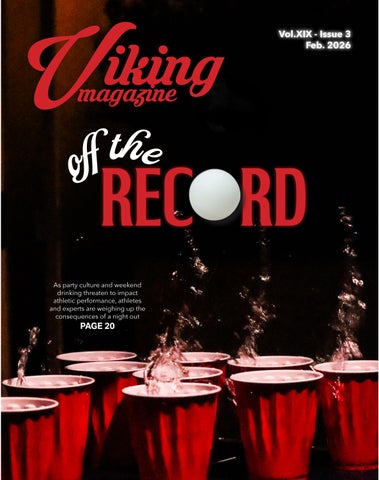
This cover, with photo by Arjun Bharat, features drinks splashing in a game of beer pong. Read all about the impacts of alcohol and party culture on athletes and team dynamics in “Off The Record” on Page 20.
Viking Magazine
Palo Alto High School 50 Embarcadero Road
Palo Alto, CA 94301 650-329-3837
Email contact: vikingeds@gmail.com
Follow us @vikingsportsmag or go to vikingsportsmag.com for current game updates/scores.
Viking, a sports magazine published by the students in Palo Alto High School’s Advanced Magazine Journalism class, is an open forum for student expression
and the discussion of issues of concern to its readership. Viking is distributed to its readers and the student body at no cost. The staff welcomes letters to the editor, but reserves the right to edit all submissions for length, grammar, potential libel, invasion of privacy and obscenity.
Printing Services
2,500 copies of The Viking are printed, five times a year by Folger Graphics in Hayward, Calif.
Advertising in Viking
The staff publishes advertisements with signed contracts providing they are not deemed by the staff inappropriate for the magazine’s audience. For more information about advertising with Viking, please contact Viking by email at vikingeds@gmail.com
Logo Font Courtesy of Måns Grebäck
Hey Vikes! 2026 is off to a bang with the Super Bowl, the Winter Olympics and the World Cup still to come. Winter Sports at Paly are in full swing and as always, we are posting scores and updates on our website, Instagram and X. We hope you enjoy our third issue of Viking for the 25-26 school year!
“Mat Matters” (page 18) follows the Paly wrestling program’s year-round grind, highlighting how an intensely individual sport builds resilience and an unexpectedly tight-knit team culture through relentless dedication on and off the mat.

Our cover story “Off the Record” (page 20) explores the tension between
high school party culture and athletic commitment, examining how underage drinking affects performance, recovery and team accountability.
In “Breaking Boundaries” (page 24), learn about the rise and rapid improvement of the Flag Football program, and how it sets an example for the creation of new sports at Paly.
“Pridelined” (page 30) highlights the lasting impact homophobic language can have on athletes who have witnessed and experienced it.
“No Tryouts Required” (page 34) sheds light on the rapid rise of ‘pickup’ and recreational sports centers which have become a core part of Palo Alto
youth culture.
“Turning the Spotlight” (page 36) presents Greene Middle’s ‘Special Olympics’, an event that brings together athletes with disabilities to participate in a variety of sports.
“Built on Silence” (page 38) showcases the unseen work, mental battles and quiet perseverance it takes to be a successful young athlete.
Our final word “Ceasing Celebrations” (page 46), written by our Head Columnists Greg Goody and Mabel McCarter, discusses the NFL’s crackdown on celebrations and whether it is justified.
That’s all for this issue, we can’t wait for you to read it!

In Paly girls’ lacrosse, safety protocols vary between teams, leading to a com petitive disadvantage and a larger risk of injury. While many girls’ lacrosse teams within the league wear helmets to minimize the risk of head injuries, Paly girls’ lacrosse continues to play without helmets, even when competing against other teams that wear them. As the occurrence of concussions increases within the team, as well as an increase in research on the long term impact of head injury, safety protocols within girls’ lacrosse need to follow suit. Paly girls’ lacrosse players should wear helmets to minimize injuries and to increase healthy competition among athletes.

mets have an added layer of protection, which results in a more confident and aggressive play style, while the girls who do not have this added safety measure are left to face the same level of play. Safety should not be based on school policy and tradition.

Girls’ lacrosse was originally a “non-contact” sport, meaning that additional safety gear wasn’t as important. However, the sport has evolved significantly since then, and even without contact, accidental stick checks, deflected shots, and collisions are all very much part of the sport. As a result, concussions continue to grow. The recent concussions experienced by Paly girls’ lacrosse players are evidence that the consequences are no longer hypothetical.
The biggest issue at hand is the uneven playing field when one team wears helmets and the other does not. When we face teams that wear helmets, Paly’s lack of helmets puts our athletes at a major disadvantage. The girls who wear hel-
Some may argue that having helmets changes the sport and causes players to be more aggressive in their playing style. But safety improvements in any sport have rarely weakened competition. Basketball added breakaway rims to prevent injuries, baseball added batting helmets, and soccer added concussion protocol. All sports have adapted to safety gear without losing their identity. If anything, safety allows players to be more confident while playing.
At Paly, sports are used to improve the well being and development of students, and playing sports without access to necessary safety equipment is not suitable. Students should not be forced to choose between their sport and their physical health. Concussions can have lasting impacts, both cognitively and physically, especially for teenagers. Stopping injury should be the priority, not continuing with tradition and appearances.
Paly has always been a school that prides itself on leadership and putting students first. When it comes to the issue of introducing helmets in girls lacrosse, it is a leadership decision that aligns
with the school’s policy of prioritizing each individual student. Sports should be played in school to test players, motivate them, and to bring them together as teams, and safety is the best way to preserve that. In the interest of the future of girls lacrosse, it’s time to make helmets a standard part of the sport.


Brian Miller (‘27) locks on and pulls down his opponent in a senior night match-up vs Gunn on Jan. 22.


Matthew Wei (‘26) pushes through a freestyle set at the first practice of swim season.
Photo by Dylan Fujita


Kacey Washington (‘26) shoots from deep in a 81-42 win vs. Overfelt on Dec. 5.


“I thought Moneyball was so good because it really captured the underdog story of the A’s and showed that it was more than just baseball, it was innovation and risk.”
— Henry Germain (‘27)
“I like Happy Gilmore because anything with Adam Sandler is a good movie to me and nostalgic to my childhood. It’s the furthest thing from an actual sports movie that still falls under a sports movie.”
— Delilah Kaplinsky (‘26)
“Momentum Generation changed my perspective on how difficult surfing is and how much it can impact someones life and mental health for the better. It inspired me to learn how to surf.”
— Kostas Pashalidis (‘29)
From team dinners to bus rides, important moments outside of required practices bring teams together.

By ZOE PASHALIDIS and LUCAS TUNG


“We have games on Tuesdays and Thursdays, so in between games we do pasta feeds to bond and load up on carbs.”
— Paulina Dubey (‘29), JV Soccer

“We would always play music and talk during bus rides to games, and sometimes we would get food before our games.”
Lara Hadade (‘29), JV Tennis


“We did a Gott’s dinner with JV and varsity as well as with all of the coaches. That was very fun and I think we bond a lot in the van when we drive to away games.”
—Tess Li (‘27), Varsity Tennis


By SHIRA PORAT and ELENA SALVATIERRA
Often overshadowed by more mainstream high school sports, Paly’s ice hockey team remains one of the school’s least visible programs. With minimal funding and limited representation, players rely on commitment and community to sustain the team in a region where Ice Hockey is rarely recognized.
The clean scrape of skates cuts through the cold air as players following.


The bay area poses an interesting opportunity and experience for those interested in joining an ice hockey program. As ice hockey is relatively unheard of in the golden state, those who play ice hockey are involved in a tight knit program that at times can be inaccessible and underfunded. Still, for those involved, that closeness is exactly what makes it special. For Paly junior Oliver Reid, the small size of the program is part of its appeal.
“It is just big enough that you’re always meeting new people, but small enough that you feel like you know almost everybody,” Reid said.
The hockey program at Paly is newly established, as it was started in the 2018-2019 school year by Paly alum Sam Janik and his dad, coach Craig Janik. Before that, students who played ice hockey resorted to club teams with seasonal breaks for time on the ice.
“It
Although the ice hockey program continues to grow in success and popularity, it is important to highlight the bumps along the way as the team found hardship with funding, accessibility and
connection.
Breaking into hockey in the bay area comes with a challenge: before can think about scoring or strat egy, they have to become com fortable simply moving on the ice. Unlike many other sports, the fundamentals begin with balance and glide — skills that require time, patience and access to a rink.
Reid recalls how demand ing that introduction felt.
“[Hockey] has a steep learning curve, since you have to learn how to get into Reid said.

has a steep learning curve since you have to learn how to skate before you even get into shooting and passing.”
—Oliver Reid (‘27)
The recruitment process is only the beginning. Once the season starts, commitment and time man agement become vital concerns. Balancing academics and ex of players, they’re also on club teams where they have several days a week taken out for practic es,” Reid said. “You have to drive 20 to 30 minutes to get to the rink, and


with traffic it can take over an hour.”
In order to combat these difficulties, coaches look to aid their players, especially those who compete at both the high school and regional level. This could range from things like changing schedules to simple acts of understanding, something Reid has noticed within

“Regional coaches understand that Mondays are game days for us, and they respect that commitment to high school hockey,” Reid said.
This helps lighten the load for many, and makes putting time and effort into ice hockey an easier balance.
Even more than this, the understanding hockey play-
culture of the sport locally. Unlike more established school-based sports such as soccer or basketball, hockey operates within a tighter circle. Players often know not only their teammates but also their competitors from other teams. The familiarity adds another layer of connection for teens.
“Having players from multiple schools is really cool because it makes you kind of appreciate the time that you spend with your teammates at the rink more because you can’t see your teammates at school,” Reid said. “I only get to see most of these guys once a week or once every couple weeks, outside the season.”
Though balancing different schools and schedules can be chal lenging, that distance often strength ens the bonds
mosphere. Additionally, Paly is not able to provide funding for the ice hockey team, which means that each player has to pay a fee to afford the jerseys, equipment, ice rinks, travel costs and other outside expenses.
However, the team is student-managed, which means they don’t necessarily have to pay for coaching staff, but coach Janik has volunteered to lead the team since its creation.
“The team being student managed is sometimes difficult because it’s hard to get ice time to practice, as our coach has to do that, but otherwise it’s great because there is more of a community feel,” Joing said.

However, the players agree that it creates a sense of responsibility and authenticity that they wouldn’t feel if they had the regular structure of a coaching staff.
“Being able to represent my school while playing the sport I love is something I really appreciate.”
—Miles Joing (‘27)

By FINNEGAN SCHOEBEL and LUCAS WU

Paly wrestlers put in long hours for a sport that trains year-round, but they also work as a team for individual competitions and revel in the struggle wrestling offers.
Junior Brian Miller spins on the soft mat, grappling with his opponent as the two vie for control. Coach Jonathan Kessler and teammates watch on, shouting instructions and words of support from the sideline. After a tense scuffle, Miller is awarded a point, pulling himself back up with a celebratory fist pump.
For Miller and other Paly wrestlers, victories on the mat are earned through long training grinds and years of technical and skill development. Most sports only have a single season lasting three-tofour months, or practice just a few times a week. In their off time, athletes must find their own time to train, or risk falling behind in the off-season. Wrestling, however, is available practically year-round. Miller explains that Paly’s wrestling gym is available for practices and workouts almost every day of the year.
“We have coaches that show up nearly every single day, during the summer, winter, spring, fall,” Miller said. “We’re just constantly training every day and everyone’s there. There’s no, ‘well, do we know if we have practice today?’ ‘Uh, we’re not sure.’ There’s almost a guarantee.”
Even though league wrestling meets only occur in the winter, there is no complete off-season for Paly’s most dedicated wrestlers, who can be seen practicing their moves, fitness and techniques
throughout the year and even into the summer. From this long time spent competing and improving together, Paly wrestlers work through disagreements and form tight bonds, creating a unique culture.
“We have a core of guys that are training year round,” Miller said. “We’re so competitive with each other and we butt heads so much. A lot of people avoid conflict, but wrestling forces you to confront friction and confront the uncomfortable and to confront the things that you need to get through.”
Such a frequency of workouts demands a high time investment and can often make it hard for wrestlers to simultaneously pursue other commitments.
For many athletes, such a barrier to entry would make it difficult to continue competing at high levels. In fact, many Paly wrestlers find both the physical and time commitments to be overwhelming, causing some to stop wrestling after freshman or sophomore year.
through, the ones that end up making it through. A lot of these kids, unfortunately, they don’t make it through. It’s a tough sport.”
Seeing others leave the sport and fulfilling heavy demands can make retirement an appealing opportunity for many Paly wrestlers. Despite this, many remain committed to the team and themselves, pushing through, managing school, wrestling and other commitments as they continue to chase physical and competitive success.
“A lot of people avoid conflict, but wrestling forces you to confront friction and confront the uncomfortable, and to confront the things that you need to get through.”
—Brian Miller (‘27)
“And sometimes I might hear like ‘oh man, you guys always, you guys are always practicing. You guys want to have a break?’” Miller said. “But it shouldn’t be taken as a punishment. It’s a privilege to have a beautiful wrestling room with equipment, with great coaches and for the room to consistently just be there.”
“You get new kids every single year,” Kessler said. “You’re recycling kids
On the wrestling mat, each competitor fights for themselves. Where many other sports calculate overall team points to see which team wins the meet, wrestling’s winners are determined not by
school, but by an individual. Despite not literally being a team sport, Paly wrestlers, like senior James Otuhiva, work together to bridge that gap.
“Wrestling is an individual sport,” Otuhiva said. “But despite it being an individual sport, the sense of camaraderie with the team is something you would never expect from an individual sport such as wrestling.”
Unlike many other individual sports, training for wrestling necessities others to practice grappling, holds and takedowns.
Because wrestlers need teammates to improve, wrestlers learn to work together through hours on the mat and cheer each other on during competition days.
greatness for yourself.”
Another great positive about Paly’s wrestling program is that it is easily accessible for every student. While many other Paly sports have challenging competition for spots and playing time, wrestling prides itself on being a no-cut sport that every student, no matter their experience or strength, can access. Everyone who joins wrestling, whether they fixate on success or just prioritize fun, contributes to and learns from wrestling’s culture, prioritizing hard work and chasing challenging goals.
“[Wrestling is] very tough. But if you get through it, what you’re going to be able to accomplish after high school is anything, anything’s possible.”
—Coach Jonathan Kessler
“Being stuck in a hot room drilling hard and getting after it with other people makes you gravitate towards those people,” Otuhiva said. “You start to enjoy the company of those people [after spending so much time with them].”
But while wrestlers form close bonds with one another, wrestling is still an individual sport, one that depends on how much the work put in and the grind to reach goals. Whether casual or hyper-competitive, wrestling success is mainly determined by personal effort and investment.
“I’ve played many sports before I started wrestling,” Miller said. “Wrestling’s the only sport where it made me feel like greatness can be achieved and it made me feel like it was all up to me. In team sports, sometimes it can be a little discouraging, like, oh, maybe my team isn’t that great, or oh, maybe I’m the worst on the team. That doesn’t happen in wrestling.”
Sometimes, that feeling of not having teammates to directly compare with or blame for poor results can make a sport feel lonely. But for Paly wrestlers, the sport is not lonely, but an incredible opportunity to learn and work alone, building strength and confidence through individual focus and quiet dedication.
“You show up to every practice; you are going to wrestle,” Miller said. “ There’s no there’s no if ands or buts about it. You’re focused, you’re diligent, you’re going to compete. And that really encourages people here to consistently get better. It encourages you to want and to desire
“I think you build that culture, build that mentality for the kids that make it through,”
Kessler said. “You watch them, the culture’s a little bit different from one end of the room to the other, because you want these kids to come in first year and they’re brand new, to run the way up to the kids that are trying to win state titles every single year.”
Of course, wrestling is not always positive. Wrestling can be brutal: intense training and specific eating patterns can leave participants exhausted. Like other sports, wrestling is not immune to the injuries and burnout that can derail matches and seasons.
“My experience with wrestling has been a bit of a love-hate relationship,” Othuiva said. “I think that the sport is incredibly tough and some close losses, hard practices or time sacrificed for the sport makes me feel as if I don’t like the sport.”
For Ella Cohen, a Paly sophomore who won the California State Wrestling Championship as a freshman, this has manifested in a recent ACL tear. After undergoing surgery, Cohen has a challenging journey of physical recovery ahead, which will include almost an entire year unable to competitively wrestle.
“It’s been pretty hard both physically and mentally,” Cohen said. “I think the hardest part probably was the first couple of weeks, just because I was taking a lot of painkillers and I really couldn’t do much.”
But in the struggles, success and joy can be found. Wrestling’s challenges reward dedicated athletes with incredible agility, dexterity and self control. Even when the sport could momentarily feel overwhelming and exhausting,
Otuhiva looks back happily on his wrestling career.
“The sport has given me an amazing community, close friends that I have been through some incredibly tough times with and something to chase after,” Otuhiva said. “[Wrestling has given me] something to enjoy and think about all day, [whether it’s] ways I can hit a move more effectively or perfecting a certain technique.”
Wrestling means long hours spent in the gym, working over the mats to grow as an athlete and a competitor. While the path may be challenging and littered with setbacks, becoming a competitive wrestler gives Paly students an opportunity to form a close-knit community and develop mental grit that can serve them beyond the mat.
“[Wrestling is] super rewarding,” Kessler said. “It’s tough. It’s very tough. But if you get through it, what you’re going to be able to accomplish after high school is anything, anything’s possible. You know, the hard work and dedication that you put in for this sport, you’re gonna reap your rewards for sure.”
While wrestling is a challenging sport, it remains an incredible opportunity for athletes to push themselves, chasing victory through incredible physical control on the mats and improving techniques and strengths alongside teammates.


by IAN CIERNAK, AMANDA GOODY and MICHAEL WU
As party culture andthreatendrinkingweekend to impact athlete
..
lthough illegal for underage students, high school drinking culture has remained a popular phenomenon for decades—often considered a high school ‘rite of passage.’ But for young, committed athletes, what’s the impact of a casual night of drinking with friends on athletic performance?
According to the National Library of Medicine, about 78% of student athletes have consumed alcohol, compared to the 60% national average of high school students. So does this discrepancy actually impact a player’s game-time performance, or is it just athletes blowing off steam from stressful games and practices?
Weekend party culture continues to drive a wedge between Paly’s student-athletes. On the one hand, students agree that athletes should be allowed to do what they want and make their own decisions; on the other hand, some students feel strongly that drinking shouldn’t be tolerated under any circumstances during the season.
Some Paly athletes, like Matt*, who has requested anonymity, believe that drinking can have both positives and negatives.
“Our team’s stance is that it [drinking] is fun and they [the team] have normalized it,” Matt said. “Drinking has been a way our team has connected and bonded.”
Different teams have different pol icies. Typically, teams will bar the use of alcohol, as having even a few athletes participate could impact the whole team.
Despite drinking being somewhat common in high school sports cul ture, many athletes argue that alco hol has serious negative effects that affect play during the season.

“Drinking is something that should not be a form of having fun but un fortunately it is,” Matt said. “I believe that it 100% nega tively affects the play ers ability to perform in the long run.”
According to the National In stitute of Health (NIH), while alcohol may appear harmless in the moment, its impact on athletic performance can quiet ly build over time, often showing up when it matters most. One of the most immediate ways alcohol affects is through hydration and recovery.

For Paly athletes such as James*, a name used for anonymity, who op poses drinking, the issue goes be yond personal choice and extends


“ An individual’s choice [to drink] affects the team as a whole.
—estelle dufour ‘26


system specializing in mental health and substance use disorder treatments, approximately 90 percent of teens have experienced peer pressure.
“It’s really easy to get pressured into drinking because you don’t want to feel left out and that’s a feeling nobody wants to have,” Harry said.
Teams often drink to celebrate after a big win, which some may see as a reward for their performance.
“After a successful victory against our rivalry team, a player suggested that we go to his house to celebrate with food and snacks, while playing games at the same time,” Harry said. “There were a couple of people who were drinking and would offer others to participate. If the person politely rejects the offer, the person offering would try to make the person seem ‘lame’, which I feel is completely unnecessary.”
FOMO, or the fear of missing out, is a struggle that many athletes face when attempting to avoid drinking when their peers are involved in social activities revolving around alcohol.
“No one should be forced to do something they don’t want to do, just to look ‘cool’ and to fit in,” Harry said.
While Harry speaks to the social weight of fitting in, student captains have turned that philosophy into action. Senior and varsity girls’ water polo captain Estelle Dufour assumed this responsibility during the 2025 season.
“When it comes to being pressured into drinking, no matter who it is, if it’s a teammate pressuring someone

else, or just any person-on-person in teraction, no matter if they’re an ath lete, pressuring someone into drinking is unacceptable,” Dufour said. “That would be something I would step in and try to help. To me, this would look like just butting in and saying, ‘No, you don’t have to.’”
Regardless of one’s captaincy, look ing out for a teammate or peer should always be a top pri ority for the Paly ath letic community as a whole.
The pressures to drink as a student-athlete are ever-pres ent, even for captains, so how do they deal with these pressures in addition to the responsibility of keeping an entire team on track?

and set a good example especially for younger and more easily influenced players. This responsibility is one that captains don’t necessarily realize belongs to them at first, but as the season progresses, this priority becomes
“
Even if you think you’re fine, it [drinking] shows up at practice and during games when you’re tired or not playing your best. —james
“Drinking in-season has always been very much frowned upon,” Dufour said. “As captain, I defi nitely expressed to the team that an individual’s choice affects the team as a whole. We also acknowledge that we don’t have any real power in affecting their decision, but we wanted to make it clear the rules of the team and what it means to be a part of the team.”
This mindset is incredibly important not just for all team members to uphold, but for captains to reiterate


“We definitely tried to prevent drinking or at least make sure that they [players] are aware of the consequences,” Dufour said. “Especially before big games, we reminded the team that it was important to prioritize your teammates instead of prioritizing a night out.”
Ultimately, the choice to drink during the season forces a compromise between immediate social acceptance and long-term athletic goals. While peer pressure and team bonding often normalize the culture, the biological reality of hindered recovery and disrupted sleep remains a constant obstacle to performance. For the dedicated athlete, navigating this “rite of passage” is less about fitting in and more about the personal and mutual accountability required to stay locked in for the team.


Flag Football, an up-and-coming Olympic sport, has picked up steam at Paly and become one of the most popular and successful sports this school year.
The final whistle sounded, as the Paly girls flag football team hung their heads after a winless debut 20242025 season. The scoreboard reflected the many struggles that came with a brand-new program. But beneath the disappointment and frustration something rose within the girls: a determination to learn, grow and come back stronger. That motivation would soon lead to one of the most remarkable turnarounds a team has had in Paly athletic history.
Flag football is one of the fastest growing sports in America, especially for girls. Its appeal is driven by its inclusivity, accessibility and safety—which is reflected by a 63 percent increase in female players from 2019 to 2023 according to the National Federation of State High School Associations. Paly has also jumped on this trend, introducing their own all-female varsity flag football team with their debut season in 2024.
didn’t have that luxury; with a program that is new and a sport that is less widely known and practiced—there was no guar antee that the team would have enough interested students to thrive. But accord ing to sophomore quarterback and allleague MVP Eleanor Wells, despite flag football being a new sport, there was high levels of interest.
“There was a big amount of interest
“Considering we didn’t win a single game last year, I think that the program has really grown a lot since last year.”

The team finished its first season 0-10, a discouraging start which could have ended the program before it truly even began. Instead, their losing season lit a spark in players, who bounced back for the 2025 season and ended with a record of 14-4—an almost unimaginable level of improvement in just one year.
Paly’s flag football team has proven just how much time, effort and practice can completely change the outcome and future of a program.
Many sports at Paly have been established for decades, with consistently dominant or popular teams like football, basketball, baseball, volleyball, swim and water polo who don’t have to worry about funding or interest levels for student athletes. However, flag football

to cut some of the players,” Wells said.
But interest leves aren’t all it takes to build a successful program from scratch. For athletic director Scott Davis, building a program that is able to thrive is not only about the number of players, it’s about the momentum of the team.
“Success would be the sport growing in numbers and popularity, which it is,” Davis said.
“And hopefully [we’re] building enough momentum to field a JV team next year as well.”
The new program had to worry about resources as well and the lack of available field space at Paly proved to be a challenge for the program early on, however, in building the new softball field, Paly has taken steps to ensure that the team has what it needs moving forward.
“Field space is challenging,” Davis said, “But with the new

ia Leming has been with the team since their first season, citing that it hasn’t always been easy to build team chemistry.
“The first season was interesting,” Leming said. “We had some really athletic girls on our team but we just didn’t connect well and there was a gap in our game knowledge. Things like how to run a route, how to cover defense efficiently, etc.”
Despite their discouraging first season, many players returned for a shot at redemption on the field. Those who came back found exactly what they seeked—a season with a winning record and multiple CCS all-league players.


sive coach Nancy Nguyen who plays on the national flag football team.
“Some key moments from this season were probably when we started the season strong going into over half the season undefeated,” Leming said. “Going into CCS for the first time and having this season with our new coach—coach Nancy.”
Davis also accredits the team’s success to their athleticism and their improve-

ment reflects the athletic potential at
“The team put together a good group of athletes who have played other sports and their athleticism really showed,”
Many athletes found that they not only fell in love with the sport of flag football, but fell in love with the community that was built alongside the program. Flag football brings many different athletes together—from multi sport athletes, to club flag players, to people who had never played a Paly sport before— and creates a home for these
“Over time, I think our team chemistry has substantially helped the team become more and more successful,” Wells said. “From going to dinner together to just waving to each other in the halls, our bond has grown along with the success of the team.”
the league recognized her improvement through awarding her as league MVP.
“Getting the league MVP award felt like all of my hard work finally paid off,” Wells said. “Last year when I was a freshman, I only had a couple chances to play quarterback. Coming into this year, I had to mentally prepare myself to face hardships like losses, interceptions and bad passes.”
Instead of dwelling on mistakes, Wells set her sights on improvement.
“The team put together a good group of athletes who have played other sports and their athleticism really showed.”

Beyond improvement on the field, many flag players found something even more meaningful—strong community bonds and friendships.
“My favorite part of being on this team is that it has brought me into a big community of very nice and enthusiastic people,” Wells said. “When I was a freshman, I didn’t know a lot of people at Paly, but after the first flag football practice I knew that I had made a bunch of friends.”
The team culture quickly grew to be one of the most important assets they could have and Wells gained leadership experiences that were unlike any previous sport she had played.
“This team is so special to me because I feel like I am one of the girls that the freshmen look up to,” Wells said. “Being a leader is hard, but the reward is having a team you care for and a team that cares for you.”
The relationships built between players strongly translated onto the field and for many of these athletes, their hard work had its rewards. For Wells personally,
“I taught myself to move on and look towards the next play,” Wells said. “That mentality really helped me.”
Additionally, the team provides an important area of representation for girls in football.
For years, football has been a “boys only” sport, where girls never got the chance to participate as athletes if they wanted to. Flag football is providing an opportunity for those female athletes who never got the chance to play tackle football growing up or in high school. On top of that, there was a lot of enthusiasm around flag at Paly.
“It’s great to continue to grow opportunities for girls sports, and flag was the perfect one to add based on the excitement,” Davis said.
As a varsity sport, flag football also acts as a sport that is accessible to players who may not be able to afford to play club flag football. Club sports often require hefty payment for coaches, tournament travel fees and expensive equipment that may not be feasible for students to pay. However, varsity sports provide transportation, uniforms, coaches and fields without student payment.
This levels the playing field for many students and grants accessibility to the entirety of the female student body to play a sport that they may never have gotten to experience otherwise.
“It gives female athletes another opportunity to find a sport and hopefully one they love playing,” Davis said. Looking forward, the next challenge for the team isn’t necessarily winning— it’s maintaining momentum. As a new team, girls flag football must find a way
to cement themselves as a staple sport at Paly and permanently establish the importance of the team to the school’s athletic program. One way they could do that is by implementing a JV team as early as next season.
“[We’re] hoping to add a JV team next year,” Davis said. “[To do that we have to] continue to grow in numbers and success.”
As the team potentially expands, so will the necessary resources such as coaches, equipment and field time—showing the increasing demand of the program.
But for now, the varsity team is focused on themselves and their goals for the upcoming 2026 fall season.
“My goals for the next two seasons at Paly are to win league again and maybe even try for CCS,” Wells said. “But the most important goal of mine is to become a role model and leader for the younger players.”
As a whole, flag football has proven to be an impressive addition to Paly’s athletic program and it looks as though this sport is here to stay. The development and popularity of this sport is reinforced by its rapid growth on a national and international level.
In 2028, flag football will make its Olympic debut in Los Angeles. The announcement, made in 2023, followed a survey by the Sports and Fitness Industry Association which showed that over 20 million people played flag football in more than 100 countries.

“The sport overall was an amazing experience and opened my eyes to the sport that it is and is becoming,” Leming said. “It’s awesome especially for my underclassmen teammates because it’s becoming a collegiate sport.”
“It’s awesome especially for my underclassmen teammates because it’s becoming a collegiate sport.”

The expansion is especially prominent in the United States. In January 2026 women’s flag football was added to the NCAA’s Emerging Sports for Women program effective immediately. The program is designed to support developing sports on their way to collegiate-level competitions. It also opens the doors for future flag football scholarships and opportunities for girls across the country.
The sport’s rapid growth has already changed the possibilities for high school athletes.
Within high schools, participation has also surged. Flag football has fewer specialized jobs, less protective gear and a smaller roster than typical tackle football. This makes it significantly cheaper and easier to introduce to high schools across the country. Unlike tackle football, flag is non-contact, which offers a great alternative for students and parents who worry about the safety measures that come with football.
“It is a great opportunity for them [female athletes] to try a sport they may have tried in middle school without it being a full tackle sport,” Davis said.
Between the 2023-24 season and 2024-25 season the National Federation of High School Sports reported an increase of 25,000 participants. The number of high schools offering flag football nearly doubled as well, from 1,777 to 2,736. California plays a large role in this increase and accounts for 29% of all girls flag football players in the country.
The Bay Area has also played a particularly influential role. The growth partially contributed to the San Francisco 49ers Foundation, which launched the initia-
tive “Football is Made for Girls” alongside NFL Hall of Famer Steve Young. The initiative aims to help grow girls flag football in the Bay Area and beyond and helps to provide equitable opportunities for girls to learn and compete.
This growth has reflected back at Paly, where what started as a brand-new 0-14 team struggling to get its footing has become a successful and impressive program that is built on perseverance, opportunity and community.
In just two seasons, the team has completely transformed into one of the most successful sports currently at Paly. Beyond their record, the team has provided a new community that is a safe space for many girls to try a new sport and many of these athletes end up excelling at flag football.
As interest for the program continues to grow, the Paly administration is hoping to add a JV team next year to provide flag exposure to even more student-athletes at Paly. The addition of a JV team would surely cement the future of the program and could even improve their success in the near future. Paly’s addition of the sport follows the rapid growth of flag all around the country on many different levels, including the development of collegiate and international teams.
What began as a dream for Paly athletics became a successful reality in which flag football provides representation, new opportunities and an impactful community—showing that with great dedication, even the newest programs can quickly thrive.

By DYLAN FUJITA and ISAAC TELYAZ

With its low barrier to entry and social atmosphere, spikeball has become a popular way for Paly students to spend free time and connect with others.
By lunchtime at Paly, the sound of a small rubber ball hitting a net is often enough to draw a crowd. A net appears on the quad, a few students begin playing and within minutes, backpacks are set aside as a loose circle of spectators and players forms. There’s no planning involved, just a fast-paced game that anyone can join.
Over the past few years, Spikeball has grown from a small backyard activity into a popular game played across campuses, parks and beaches. The game’s simple setup and fast paced style have helped it spread rapidly among students looking for an easy way to stay active and socialize with friends.
time. Junior and avid spikeball player, Om Rajan believes that spikeball games can quickly create community.
“Spikeball is fun when it starts as a quick game at lunch and suddenly a bunch of people are playing,” Rajan said.
a few minutes or stay for an entire game. For these reasons, spikeball often brings together people who might not normally connect every day, which creates a shared space that’s built more around fun rather than competition.
“Spikeball brings together different groups,” Rajan said.

At Paly, the game has become a regular part of lunch activities and free
Jayden Dhaliwal (‘27) serving the spikeball.
by Owen Reiss
The points aren’t always perfect and the calls aren’t always serious. But the mood and energy stay light—a large factor that contributes to the popularity of Spikeball on Paly campus. It’s a game that’s easy to pick up and easy to enjoy with friends. Spikeball can be played anywhere, whether it’s during lunch, after school, or out in the community.
“Spikeball is really easy to play. Anyone can pick it up within the first game or two.”
— Aiden Miao (‘27)
What makes Spikeball unique is how open and flexible it is compared to other sports. There are no official teams, required skill levels, or specific positions you have to play. Anyone can hop in for
“Older people, younger people and different genders. [It’s] a great way to make friends.”
While spikeball can be played with anyone, playing with friends tends to make the experience more enjoyable. It gives people an easy reason to get outside, spend time together and burn some free time with peers. Some teens feel that spikeball helps them avoid habits such as video games and doom scrolling.
Paly junior, Aiden Miao cites that Spikeball keeps him outside.
“I have spent more time with friends going out to parks during free time rather than staying home,” Miao said.
Rather than needing a whole field or
gym, Spikeball fits naturally into places students already spend time. Lunchtime hangouts, backyards and local parks often become great game spaces. Because of this, Spikeball blends easily into people’s daily routines and allows for ordinary places to be used for fun activities and connecting with friends.
“We play in our backyard, at parks and most often at the quad,” Rajan said. “[It is] easiest to play when we’re together.”
For Paly senior Malcolm Ginwalla, Spikeball began as a way to fill unstructured time during the school day. Its accessibility makes it an easy option for students looking for something to do during lunch, even if they have never played before.
“I first got into spikeball when I was bored during lunch and wanted something to do,” Ginwalla said.
That low barrier to entry is part of what allows spikeball to fit different moods and expectations. Some games stay relaxed, while others naturally become more competitive depending on who is playing and how seriously they want to take it.
“Spikeball can be super competitive or just friendly,” Ginwalla said. “It really just depends on how you’re feeling and the mood your friends are in.”
Like other informal sports on campus, Spikeball often connects people who might not otherwise interact. The rotating nature of the game makes it easy for new players to join in.
“Spikeball is the same as a lot of sports in that it brings together people who typically wouldn’t talk to each other,”

Photo by Owen Reiss
Ginwalla said.
For Ginwalla, the most memorable parts of Spikeball are not tied to competition or score. Instead, they come from the shared atmosphere and freedom to experiment during games.
“I like to have fun while I’m playing and I enjoy trying new stuff,” Ginwalla said.
Paly junior Samarth Karnam’s experience in Spikeball started the same way it did for Ginwalla, where boredom during lunch turns into a daily routine. What stood out to him, though, was how the game felt once competition crept in.
“Spikeball is definitely meant to be a casual hangout,” Karnam said. “Games with my friends sometimes get heated and that’s honestly when Spikeball becomes less fun. I don’t think the makers intended it to be a competitive sport.”

by Owen Reiss
Those interactions left a lasting impression, even if his own interest in the game has started to fade. While some students believe spikeball will continue expanding on campus, Karnam is more uncertain about its future.
“Honestly, I’m not sure if Spikeball will continue to grow because a lot of my friends and I are starting to lose interest in it,” Karnam said. “I am not sure if more people will start to join.”
Despite that uncertainty, Karnam said his favorite moments playing Spikeball were never tied to scores or wins, but to shared breaks in the action.
“Spikeball brings together people who wouldn’t normally hang out.”
Karnam emphasized that the appeal of Spikeball is strongest when it stays relaxed. Unlike others who enjoy the competitive side, he feels the game works best as a way to unwind rather than to win. That casual environment also shaped some of his earliest connections at Paly.
— Om Rajan (‘27)
“As freshmen, my friends and I would play Spikeball with lots of people we’d never met, including the seniors who sat on the quad with us,” Karnam said. “This way, I was introduced to new people, even older students whom I likely wouldn’t have socialized with otherwise.”
“My favorite moment in Spikeball is the fun of a good rally,” Karnam said. “Either that or sitting around the net with friends after we’re all tired.”
At Paly, Spikeball has grown into more than a passing lunchtime activity. Its simplicity allows students to shape the game around their own energy, whether that means a relaxed rally with friends or a more intense match that lasts the whole break. For many, the appeal lies in how easily it creates moments of connection, even if interest rises and falls over time. As nets continue to pop up around campus, spikeball remains a reflection of student life itself, spontaneous, social and driven by the people who show up to play.

By Carter Burnett and Mabel McCarter
Sports can promise teamwork, respect and belonging, but for many LGBTQ+ athletes, the field can be one of the most isolating places to stand. Behind the cheers and score-

Paly athlete, referred to as Rachel for privacy, who experienced gender-based harassment firsthand, illustrates the emotional impact of homophobia. Even brief comments can leave lasting emotional effects beyond
“There were people from the other team of emotions about what hap-
“I believe it is completely unnecessary and unfair to the athletes who are just there to play their sport.” — Emma ‘27
Despite this, Rachel expressed gratitude for a supportive environment, stating that they feel safe because of their many friends and great coaches. It is important to have a strong, supportive community around you, especially when dealing with something
“My teammates and coaches always defend me,” Rachel said.
Their experience highlights how strong support systems can help counteract harm. This, however, doesn’t underscore the importance of preventing such behavior in the first place.
Homophobia is even present in sports viewed as more masculine, like football. One anonymous football player, referred to as James for privacy, explains how normalized this behavior has become
“It is pretty common to hear people say the f-slur in games because there is nothing anyone can do unless the ref hears them say it,” James said.
Because these remarks often go unpunished, the effects on athletes are often overlooked. James points out that this may be due to football’s hyper-masculine reputation.
“I think the use of homophobic remarks has been normalized in football because it is a masculine sport, so people automatically think all football players are straight,” James said.
According to a 2021 study by Erik Denison, Nick Faulkner, Ruth Jeanes, and Daniel Toole published in the Journal of Science Medicine in Sport, more than half of male team sport athletes reported using homophobic language, and the behavior was linked more to team social norms than to individual hatred. The harm caused by these commentsdoesn’t just affect the opposing team, but can also affect their own teammates.
“When people say those things, they don’t know who they are affecting because gay football players usually try to hide it, so for all they know, they could be bringing down one of their own teammates,” James said.
Homophobia on the field can directly harm teammates who feel forced to hide their identities out of fear or exclusion. This can eliminate trust and unity on the field and replaces it with fear and silence.
However, opinions are rarely unanimous, and with big subjects like identity, many can have polarizing opinions. Another Paly athlete, referred to as Mason for privacy, shared how, for him, this tension played out in team environments.
“I’m not trying to be a bad person, but sports are already intense, and the locker room is supposed to feel normal. When someone’s gay, it feels awkward, and people don’t know how to act.” Masonn said.
In many sports, it has become normalized for teammates to use homophobic remarks at each other as a joke. In certain circumstances, this casual acceptance may cause the sports community to ignore homophobia rather than taking action against it. One anonymous athlete, referred to as Pete for privacy, shared how this type of dialogue has become more common.
“Sports are supposed to be about being tough and competitive, and that’s just how I’ve always seen it,” Pete said. “I
grew up hearing jokes and stuff, so it’s kind of ingrained. It’s not something I really stop to think about — it’s just how it’s always been.”
Beyond the athletes directly targeted, homophobia in sports also affects teammates and bystanders who witness it. An anonymous witness, referred to as Emma for privacy, describes how hearing homophobic remarks during a game influenced the team’s performance.
“I think in a way it motivated other people who heard to play harder and me because you want to do whatever you can to stand up for your teammate in that moment and sort of prove the person saying offensive things wrong,” Emma said.
According to an educational intervention study on homophobic language use among youth rugby players, nearly half of the participants reported hearing slurs from teammates, highlighting how common such language can be and how easy it is to tune it out during play.
“I wish people would stop believing that I’m gay just because I play volleyball.”
— Leo ‘28
Speaking up in times like these to support your teammate is not easy, especially when you are focused on your performance as an athlete.
“I think for me what makes it difficult to speak up in those moments is that I’m too focused on the game to fully comprehend what is happening on the sidelines,” Emma said.
In competitive environments, athletes are trained to tune out distractions, including comments from parents, spectators, and their opponents.
“The full impact of what is said doesn’t fully hit right in the moment,” Emma said. This allows homophobic language to go unchallenged until later, after the emotional harm has already been done.
Emma also describes the jarring reality of encountering homophobia in youth sports, an experience that caught her off guard in a space meant to be safe and

supportive.
“I was definitely surprised to be hearing homophobic comments during a club soccer game,” Emma said.
She emphasized how, at younger levels, sports are meant to prioritize enjoyment, teamwork, and personal growth.
“I think what is so amazing about sports is that they are games that can be played no matter what someone looks like, their sexuality, etc,” Emma said.
When spectators and players bring homophobia into these spaces, it shifts the focus away from athletic ability and turns what should be a supportive environment into a hostile one, which does not belong in sports.
“I believe it is completely unnecessary and unfair to the athletes who are just there to play their sport,” Emma said
In many cases, when homophobic remarks are said, intervention does not happen immediately, due to the intensity of the game.
“No one has intervened at the moment, but there have been actions taken after the fact to have the team take responsibility,” Emma said.
Emma explained that while incidents are rarely addressed at the moment, school officials often respond afterward by placing responsibility on the team as a whole.
“There is no way to tell if these actions are effective when they are going through other people and not directly to the person,” Emma said.
This lack of immediate accountability allows harmful behavior to continue without clear consequences.
Homophobia and gender stereotypes continue to shape how athletes are perceived in high school sports, especially when they participate in activities that challenge traditional expectations. One anonymous boys’ volleyball player, referred to as Leo, shares his experiences confronting these assumptions firsthand.
“I have faced stereotypes before, immediately after I tell people that I play volleyball only because it has a history of being a mostly feminine sport,” Leo said. These assumptions often lead people to judge his identity rather than his athletic ability. Often, these remarks come from people who don’t fully understand athletics.
“Even though these comments are pretty mean, I don’t really take them to heart because I know that a lot of the people that make these kinds of comments ar-
en’t really athletic because most of the real athletes I’ve met all know that volley ball is actually pretty intense and hard er than a lot of the average sports,” Leo said.
His perspective emphasizes the impor tance of respecting athletes regardless of the sport they play, recognizing the dedication, effort, and skill required to compete at a high level. In fact, boys’ volleyball is one of the fastest-growing high school sports in the country, and that growth is starting to shift percep tions.
“When I tell people that I play volleyball, everyone is mostly surprised, and a lot of them do make stereotypes, but some do think it’s really cool,” Leo said. “Boys’ vol leyball is actually one of the fastest-grow ing high school sports in America, and it’s really starting to show as a ton of my friends are starting to play, and it’s gaining tons of popularity.”
This reflects the gradual change in how boys’ volleyball is being viewed. Still, one misconception is especially frustrating for him.
“We never know who or what someone’s going through, one comment might trigger them to quit or have problems with other people.” — Carmine Unga ‘29

helped create a welcoming environment for Unga.
don’t always understand how damaging one comment can be.
“We never know who or what someone’s going through,” Unga said. “One comment might trigger them to quit or have problems with other people.”
“I wish people would stop believing that I’m gay just because I play volleyball, and that I don’t play the sport because I’m uncoordinated, I play because I love it, and it’s a really unique and enjoyable team sport,” Leo said.
Harmful stereotypes can overshadow passion, dedication, and love for the game. For Paly cheerleader Carmine Unga, the hardest part of the sport isn’t the performance, but the reactions that come with it. As Paly’s only male cheerleader, Unga is the constant recipient of both wanted and unwanted attention.
“Sometimes I hear people call my name out while cheerleading, in a way that makes it feel like they are making fun of me,” Unga said.
Even when the comments aren’t directly threatening, they can still create an environment where athletes feel judged for simply participating. Instead of en-
“I feel pretty safe being me,” Unga said. “My whole team defends me, and I feel like that plays a big role in support.”
He admits that, among this support, there are also times when he feels uncertainty and doubt.
In a sport structured around presentation, it can be difficult to gauge an audience’s reaction.
“I never know who supports it, who doesn’t support it,” Unga said.
80% of all athletes have witnessed some form of homophobia.
This support was put to the test when Unga faced online harassment.
Sports are meant to be a place of unity, escape, and self-expression, yet the experience of Paly athletes demonstrates how homophobia continues to disrupt that ideal. From slurs yelled during games to online harassment, harmful language and assumptions have become so normalized that they often go unchallenged. While strong teammates and supportive coaches can help lessen the damage, support alone is not enough. True progress requires accountability and a willingness to challenge longstanding norms that excuse discrimination as part of the game.
Pickup and recreational centers have become a core part of Palo Alto youth culture, bringing students together through community, competition and a way to relieve academic pressure.

he ball bounces, the sound of the hardwood floor creaks and the voices of students echo through the gymnasium. Senior Aryav Singh comes to YMCA every weekend, an activity he looks forward to all week. At places like the YMCA, the JCC, local parks and local community centers, pickup and recreational sports are ex-
Many people play sports at a younger age, but eventually stop for varying reasons. However, that urge to be involved in spirited and fun competition stuck around. This is one of the main reasons a lot of people get into pickup sports.
Most students learn about pickup sports through their friends, family or simply just watching on the side. People can be intrigued by the idea of playing pickup because of the inclusive community and environment—and especially what that can also bring to stu-

“I first got involved by going to the YMCA and watching people play basketball,” Singh said. “But what keeps me coming back is the competitive but welcoming environment.”
There is something special about the power of pickup. It is the ability to bring people together who are passionate about the same activity all to the same place. —Iverson Lee (‘26) “ ”
Senior Iverson Lee discovered recreational sports early and this activity has become a part of his life and gives him an opportunity to keep playing during his free time.
“I was first introduced to recreational sports here in Palo Alto by my dad,” Lee said. “He taught me basketball from a young age and since then I have loved

By ELIF DOGAN and JAKE LIU
playing the game.”
For other students like senior Vinay Shah, his experience with recreational sports began very casually.
“I first got involved in pickup sports when I started playing basketball with my friends at Peers park,” Shah said.
Senior Woody Chehadeh started playing pickup basketball with a recommendation from a friend.
“I first started playing pickup basketball at the YMCA after a friend told me to come by one afternoon for pickup,” Chehadeh said. “I found that it was really easy to jump into games.”
While pickup sports are and can be extremely competitive, the greatest appeal of pickup sports is how it can make students feel.
A common reason for playing pickup sports is because of the way that it can relieve the stress and pressure of school.
“For me, pickup basketball has been a great outlet from the academic focus at Paly,” Shah said.
This gives students a chance to get exercise everyday, which can improve their mental health and improve their performance and overall mood in school.
The National Library of Medicine recommends that an increase in physical activity could help improve a student’s academic performance and time used for physical education class and physical activity in the classroom could also

I would encourage athletes and students to go to community centers because it gives you a community that is welcoming and pushes you to improve. ”
—Zoe Quinlan (‘27)
contribute to improved academic performance.
“Pickup sports are a great way to take a break from school stress and reset your mind after a long academic day,” Singh said.
Stepping onto the court requires focus and energy, which can provide immediate relief from a long day at school.
“When playing pickup, you tend to forget about all things outside of the game as you are just focused on winning and the team,” Lee said. “Pickup sports can help balance the academic pressure of students by taking their mind off of school.”
By allowing students to fully immerse themselves in the game, pickup sports provide a rare balance of competition, freedom and enjoyment.
“Pickup sports are super fun because you can play competitive games without the pressure or time of performing for a school team,” Shah said.
The physical intensity of pickup games also plays a huge role in the appeal of pickup sports.
“These games are usually pretty competitive and fast paced,” Shah said. “It feels great to have the ability to play basketball games with your buddies.”
Beyond just Shah, the competitiveness of pickup sports is also a draw to many students that often play.
“Pickup games are usually intense and competitive because everyone wants to win,” Lee said.
Although pickup sports are competitive, the feel is the same as playing any other normal school sport.
“It is still fun at the same time and it feels like playing any sport: exciting, loud
and full of energy,” Lee said.
Even though games can become competitive and intense, the heart of what makes pickup sports so enticing is the people. Pickup sports can bring people from many different backgrounds together all on the same court.
“These games bring together people of all different backgrounds,” Shah said. “Even with the difference in skill level, the games remain fun and create a collaborative environment.”
The pickup sports community doesn’t care about your skill level or how many years you have played the sport, an aspect of the game many players admire.
“Pickup games bring people together because no one really cares where you’re from, what school you go to or how good you are,” Singh said.” Everyone is there to play, compete and have fun, which just creates a shared sense of community.”
These environments of pickup sports can create meaningful relationships with many new people.
“I have made many friends from sports and pickup in general that I would not have made otherwise,” Lee said.
Another great way to build community is by using the community centers for workouts. Junior Zoe Quinlan enjoys the way that the YMCA can help her train for her sports season.
“Community centers help me stay active during the off-season because it gives me a place to train,” Quinlan said.
In addition to helping students stay active and improve during the off-season, community centers can help build physical strength.
“I would go there more often to maintain my fitness and lift weights to help with my strength which would then help me when I’m in season with soccer.” Quinlan said.
A significant aspect of com munity centers is what they can offer to students.
“It gives you a sense of belonging because people can uplift each other and push each other to their limits,” Quinlan said. “I would encourage athletes and students to go to community centers because it gives you a com munity that is welcoming and pushes you to improve.
The appeal of pick-up sports and community centers is not the competition, but the con nection that it brings to stu dents. For many students, picking up sports can really offer stress relief, friend ship and a place where you can share the same passion.
“There is something special about the power of pickup,” Lee said. “It is the ability to bring people together who are pas sionate about the same activity all to the same place.”


Every year, the Greene Middle School’s Special Olympics turns shy students into celebrated athletes for a day, filling the field with cheers and connections to last a lifetime.
Rows of students, parents and teachers line both sides of the entrance to the Greene Middle School field, carving it into a living tunnel of volunteers. Hands clap and cheers fill the atmosphere as waves of athletes from schools across the Bay Area pour onto the grass, wide-eyed and smiles shining. As they run through the pathway of applause, a day of fun compe tition and athletic prowess await those who would not be able to compete in sporting events.
The tunnel-like en trance marks the start of Greene Middle School’s annual Special Olympics, a day-long event that brings ath letes with disabilities onto the school’s field to partic ipate in a variety of sports.
munities where friends of participants become fans for the day and the athletes are recognized not for the amount of medals they have, but instead for their effort and bravery.
Students, parent volunteers, and coaches morph into coaches and fans cheering for the athletes, creating a large sense of inclusivity and support throughout the community.
“It’s something like Christmas morning, or a wedding. It’s something you would just want to catch in a bottle.”
On this day, students’ typ ical class schedules are re placed by sporting events and games designed so that all ath letes can shine and show off their skills.

Although these athletes are not competing on a world stage, the spirit of Greene’s Special Olympics echoes the same idea as the Paralympic Games. Athletic greatness is measured not by limitations, but by what they are able to accomplish. This same idea is embodied at Greene, where additionally each spectators pride and enthusiasm is evident and the athletes are incredibly joyful to be able to participate in such a unique experience.
Though the Paralympics are televised on global platforms, it is clear that the spirit of sports is not found in huge stadiums. Rather, it’s found in smaller com-
Behind the scenes of this day is Special Olympics Northern California (SONC), a nonprofit organization dedicated to promoting unity and empowering children and adults with intellectual disabilities, both on and off the field. SONC partners with PAUSD to make these district-wide events come to life. They provide the resources needed to turn Greene’s Field into multiple competition spaces. Their prowess ensures every event maintains professionalism while balancing joy with inclusion in respect to its physical
Before the first race starts or the first goal has been scored, hours of preparation happen behind the scenes. The fields are set up carefully and volunteers gather to go over the schedule for the day, making sure everything runs smoothly and more importantly, to make sure each kid has the best experience possible.
Program supporter and Medical Consultant Dr. Randall Vagelos watches the event unfold from the sidelines, seeing the athletes light up on the field in ways they rarely can in classrooms.
“The special Olympians were super
By DYLAN ROBINSON and SILAS STEELE
excited,” Dr. Vagelos said. “The effort is always to make these kids feel as normal and as accepted as they can be.”
Many of these kids rarely get to see themselves as the center of attention or involved in organized sports, making this event an opportunity for students to express themselves and their athletic abilities.
“When they came off the bus and ran through that line of balloons cheering, it’s like they’re at the end of the Olympic Marathon, you know, they’re the winners,” Dr. Vagelos said.
Part of what makes this day so special for the athletes is that nobody loses and everyone gets to be a winner. But this doesn’t at all deter the athletes. They all still play very competitively and seriously, whether it’s soccer or track. That competitive fire lights up the field regardless of not having a scoreboard.
Greene leadership teacher Joleen Roach, who helps coordinate the event, said the energy rises the moments the games begin.
“There’s so much excitement and joy in the students and the adults,” Roach said.
“It means just as much for the Olympian kids as it does for the non-Olympian kids,” Dr. Vagelos said. “How often are you doing something at school for some one else’s benefit, not your own?”
Additionally, for many students watching from the sidelines, the event helped change how they view their class mates.
Greene Middle School


8th grader Elle McComas attended as a fan and interacted with many athletes.
“Everyone seemed more friendly,” McComas said. “After the Olympics, people were more patient and more willing to include each other in activities.”
Additionally, Greene Middle School Eighth grader Gabriela Her bert-Paz has also witnessed the difference that this day makes for the school and its commu nity.
“The students feel more connected to each other and I’ve no ticed some new friend ships that may not have happened without this,” Herbert-Paz said.
Even Greene students who did not participate or volunteer at the event see the difference it makes throughout the entire school community. For athletes who normally hear negative chatter as opposed to cheers, this feels amaz ing for them as they are able to be their full selves without the threat of judgment lingering over them.

by Joleen Roach
it’s a one-day event, these athletes look forward to this day months in advance and tend to carry forward their experiences for life.

“Most of them are very aware when people are snickering at them,” Dr. Vagelos said. “And here, this is a situation where people are really celebrating what they are doing.”
Physical education teacher and event volunteer Aimee Becker recalled that the Olympics create a sense of comfort and belonging for these
“They get to be with kids that are much more like them mentally and or physically,” Becker said. “So that becomes their own little enclave.”
This event truly has a lasting impact on the lives of these athletes. Although
“The patients I see look forward to these events like it’s the best thing that happens to them over the course of the year, and they love it,” Dr. Vagelos
Not only do these memories stick with athletes for years to come, but they also make a huge difference in how students and special education students interact with one another.
“The students feel more connected to each other and I’ve noticed a lot of new friendships that have been formed that may not have happened without this event,” Herbert-Paz said.
For one day, athletes who keep their arms tucked by their side turned a new leaf, raising their arms high. Kids who heard laughter got their names chanted. Special education students became the stars under the arches.
The Greene Special Olympics is more than just a game, it’s a field where every movement is celebrated. Kids who are usually quite shy are the stars and center of attention.
While the balloons are removed and the fields return to normal, the impact of the Greene Special Olympics continues. A deep sense of empathy is left, as well as a better understanding of inclusion. This special day serves as a reminder that when communities choose to be empathic towards everyone, the effects can last well beyond one afternoon.
“It’s something like Christmas morning, or a wedding,” Roach said. “It’s something you would just want to catch in a bottle.”


by


The stories behind different Paly athletes highlighting the unseen work, mental battles and quiet perseverence it takes to be a succesful athlete
By ANDY COMSA, NATALYA KAPOSHILIN and DANIEL SEGEV


Sports achievements in high school may be defined by goals scored, games won or minutes played. While it’s great to celebrate those stats, stats aren’t all there is to it. It doesn’t speak to games spent sitting on the bench or at the end of the lineup while a player silently works hard hoping to one day see the results they expect manifest. It doesn’t speak to those quiet nights when an athlete questions their place or ability in their sport. The quiet battle to earn a place at the top is often overlooked.
For athletes at Palo Alto high school, this is the hidden face of sports. Not everyone arrives as a star. Some athletes begin the season at the fringes, waiting their turn while others shine. These experiences can allow many athletes at Paly to develop character and reveal an individual’s ability to cope with challenging situations.
Sophomore Maya Rajgopal was a lower doubles player for the girls varsity tennis team the previous year as a freshman. Being on the varsity team was an accomplishment, but Rajgopal knew she was still at the bottom of the ladder. Being the lower doubles player meant she would be playing tough opponents with no room for errors, despite hard work with no visible gains.
between where they are and where they want to be.
“You still feel it,” Rajgopal said. “You’re playing the lowest position on the team.”
What made Rajgopal’s struggle so hard to endure was the fact that it was so quiet. There was no defining moment where she was sitting out entirely or where she was told she was not good enough. Instead, it was the quiet accumulation of small defeats. When she saw her teammates scoring higher in the lineup, the announcer’s voice calling out the scores and the knowledge that she is not moving up in the lineup, it created an inner tension for her.
It was not until Rajgopal recognized that if she was going to tie her selfworth to her performance and her performance to external factors outside her control, she would never feel like she was making progress.
“You still feel it. You’re playing the lowest position on the team.” Rajgopal
Early in the season, the team played opponents that were significantly stronger. Losses were common, specifically be cause of miscommunication with her doubles partner.

“You put in a lot of effort, but they [opposing team] still beat you,” Rajgopal said. “That can hurt your confidence.”
Being at the bottom of a lineup creates a specific kind of mental pressure. Every mistake feels a lot bigger than it actually is. An athlete is part of the team, but always aware of the distance

“I had to stop making my spot on the team personal and just focus on how I can get better,” Rajgopal said. The only part of her game she could control was her attitude, her reaction to her frustrations and her ability to move forward to the next point no matter what had happened in the last.
This was the beginning of her shift from progress being about proving herself to others to progress being about regaining control.
On the soccer field, senior Cole Baker was navigating a different version of that same mental struggle.
Last season, Baker played on the boys varsity soccer team, a team that consisted of a lot of key seniors. Baker had a lot of experienced defenders ahead of him on the team, resulting in not getting the playing time he wanted. The lack of
game action began to affect Baker’s play and his attitude toward the sport.
“We had a lot of depth and I wasn’t playing as well as I could,” Baker said. “I didn’t really want to be there a lot of the time because of my performance. And the lack of playing time made practices start to feel like a hassle and made my mistakes linger longer. ”
Other athletes across campus faced similar internal battles.
For Senior Kacey Washington, this struggle manifested itself on the foot ball field. Last season, Washington frequently found himself sitting on the bench, trying to pick up as much knowledge as he could, waiting for his opportunity to prove himself. Being a benchwarmer caused Washington to doubt himself, both as a football player and as a person.

Instead of letting this doubt consume him, Washington decided to look at this year’s season as a learning experience.
“When you don’t play as much, it’s kind of hard on you,” Washington said. “It makes you question, do I love this sport? Am I good enough to be playing?”
On the field hockey team, Roni Horovitz was challenged to a quieter—but still demanding task. She was a late starter to the sport and her first few years were about learning the ropes and getting accustomed to a very competitive atmosphere. Once she made it to varsity, everything was different. The practices were harder and she was expected to do better. The focus was no longer on enjoying the game but rather successfully making it through each and every practice.
“The hardest part was finding the energy to come to practice after a really long day of school, when that’s the last thing you want to do,” Horovitz said.
Even though all of these athletes are playing different sports and have their own unique circumstances, they wondered if their rough patch was where their athletic journey would end.
For many athletes, this is the hardest point. Being in a place where they don’t know if effort will ever be rewarded. Many step away. Others stay, but mentally drift. And a few decide to lean into the discomfort.
Rajgopal’s shift began internally. Tennis, especially singles, leaves no room

ketball and softball, keeping herself in shape year round. On weekends, she practiced consistently with her doubles partner and private coach. Improvement felt quiet and uncertain, but she continued anyway.
Baker’s reset came through distance. Over the summer, he stepped away from soccer entirely. The break was not about quitting, but about reflection. Without the constant pressure of the season, he was forced to confront why he played in the first place.
“I realized it was my senior season and I wanted to play because I realized I would never get this opportunity in my life ever again,” Baker said.
That realization changed how he returned to the sport. When he came back, the team looked different. Graduations had reshaped the roster and suddenly, Baker was needed in ways he hadn’t been before.
“Going into this season, the team is relying more on me,” Baker said. “It changes your mindset.”
Responsibility has a way of sharpening focus. When a team depends on you, there is no room to hide. Leadership becomes unavoidable.
Similar shifts were happening across other teams at Paly.
For Washington, the offseason became his turning point. He joined a seven-on-seven team and spent months getting reps, working on in-game skills and building confidence. Of all the things that Washington has worked on, there


For Horowitz, progress was a slow process. Each season, she learned more about the game and was more comfortable out there. Being assisted by upperclassmen was a big factor in helping her transition into varsity.
“I feel like I’ve just been improving each season,” Horovitz said. “Having upperclassmen there to help made a really big difference.”
For Rajgopal, the moment when progress became undeniable arrived quietly. During an early-season practice, the varsity team was split into two groups, something she had experienced many times before. Last year, she always knew where she would be placed. This year was different.
She found herself competing alongside players she once viewed as far ahead of her. The drills felt different. The gap she once felt had narrowed.
“That day kind of showed me that all the work I have been putting in was finally paying off, ” Rajgopal said.
Baker’s moment came in competition, specifically a match against Gunn High School in which he felt a shift.
“I was surprised by how well I played,” Baker said. “I felt like I was able to play the game in a way I have never played it before.”
With that confidence came leadership. Baker became more vocal and more accountable— eventually earning a captain role. What once felt like pressure became purpose. Around campus, other athletes reached similar moments.

work from this past summer to complete an over the shoulder catch deep in the end zone, resulting in the whole crowd chanting his name. Making a key catch in a tight game, specifically an over-theshoulder catch that he has been working on all offseason, confirmed that the work he put in was finally paying off.
“The feeling of that catch is an unforgettable feeling that I will never forget,” Washington said. “It felt like all of my hard work had finally payed off.”
For Horovitz, the major change was not in terms of a single play but in terms of performance. Later on, her performance improved and she felt as if she belonged in the field.
“I just kept going because it was my final season,” Horovitz said. “My teammates were always there telling me it was okay and that I should

When the tennis lineup was released and Rajgopal saw her name listed under singles, the recognition felt surreal. As a sophomore, placed ahead of older teammates, it confirmed that quiet effort had finally become visible.
“As long as you can show growth, coaches will see it.”
— Kacey Washington (26’)
For Washington, that moment came this year during the home opening game against Mountain View. After spending his previous season watching from the sideline, Washington translated all his
For Baker, the transformation felt just as striking. Reflecting on the previous season, he knows how unexpected his current role would have seemed.
“If you told me last season I’d be captain, I would’ve thought that was crazy,” Baker said.
The same was true for Horovitz, Washington and others who are still writing their stories. It was just as important for these players to get to a place where the time they were spending on the field correlated


with how they felt about themselves on the field.
These stories are not really stories of natural talent or success, but stories of staying through the hard, uncertain periods, of learning how to stay with the uncomfortable and of staying when the easy thing to do would be to leave.
These athletes at Paly high school prove that being overlooked can be only temporary if you put your mind to it. Growth is quiet, but when it happens, everything is different. Often, the biggest victories begin before anyone is paying any attention.
What gives these moments significance is not the end result, but the journey that leads up to it. Not one of these players describe that the defining moment in their athletic careers was easy. Instead, it was the repetition of showing up to practice even when motivation levels were low, competing even when it felt like

nothing was being accomplished and learning to separate yourself from competitors. It was a journey where improvement was slow, slow enough that it was almost impossible to notice. It was only in moments of reflection that it became clear how far an athlete had come. The confidence they eventually achieved was not from winning but from learning.
In a way, these stories can be seen as the majority for what it is like to be a high school athlete. Most will never have their name announced over a loudspeaker or have their achievements tracked in statistics that will last long after the season is over. What will remain is the work ethic that was developed during the difficult times. For Rajgopal, Baker, Washington and Horovitz, success was not achieved overnight, but by staying persistent and moving to the front of the lineup. Their stories illustrate that growth is not always easy to spot. In fact, it is often quiet and

unheard long before it ever becomes obvious to anyone else.
“Looking back, I’m glad I didn’t stop when it got hard.” — Roni Horowitz (26’)


Parents are increasingly involved in youth sports; sometimes this can lead to improved performance, but other times it can create stress for student athletes.
In an intense volleyball match coming down to the wire, junior Maura Ham bly’s team was trailing by one point in the final set. With the pressure at an all time high, Hambly’s thoughts were scattered all over the place. However, she managed to think back to a conver sation she had with her dad prior to the match, where her dad reminded her to remember to stay calm and anticipate her next move. Hambly ended up having the game sealing spike for her team and credited her dad with the assist.
A report conducted in 2025 by First Tee Education highlighted that parents still believe that investing in youth sports

ance from mom. Parental influence is ac tually an integral part of a young athlete’s

America. The film’s purpose is to portray perseverance and to show that, if you work hard enough, you can do anything you want. The story centered on a young Serena and Venus Williams who since they could walk, were trained by their dad—Richard Williams—to become elite tennis players. The story covered dedication and an undeniable hunger to win in tennis and in life. This story was celebrated because of the way the Williams family was portrayed.
Sophomore basketball player Zachary Vakili similarly attributes his success to his parents. When Vakili was five years old, his dad had encouraged him to try as many sports as possible. This approach had a positive impact on Vakili’s outlook, mainly because it kept his options open.

“[Playing many sports] helped me build a strong foundation and figure out which sports I wanted to focus on,” Vakilli said.
Early in his life, Vakili was pushed by his parents to be an athlete to the best of his ability. This approach left some doors open for down the road, which Vakili eventually took later in his life.
“Later on, I got into track after my trainer, who works with the Stanford athletic program, recommended that I try the 400-meter event,” Vakilli said.
This allowed him to expand his abilities to the next level while revealing his best
Contrasting with Vakilli, junior Rocco Smith has been focused on basketball from a young age. Smith is the son of cur rent Stanford Basketball Coach Kyle Smith, which has created a unique experience growing up
“I’ve been playing basketball since I can remember,” Smith said. “It’s always been a huge part of my family and my life. I focus a majority of my time out of school playing basket ball and my parents want me to work more on school, but they have kind of stopped trying to push me in school and have accepted my okay

league play this season, proving to make impressive marks for his first season on varsity.
“My dad being a coach has really pushed me to always work at it [basketball] and he has influenced me to be the best player I can be,” Smith said. Smith stated that an underrated part of
“Playing multiple sports helped me figure out what I truly wanted to pursue.”
—Zachary Vakili (‘28)
An anonymous former water polo player quit the team because of pressure from his parents. The pressure from his parents had to do with his lack of playing time, leading to his falling out of love with the game.

Smith moved to the Bay Area in 2024, when his dad was named head coach of Stanford. Although being the son of a Division I collegiate team across the street puts a lot of eyes on him, Smith hasn’t let the pressure get to him. After spending his sophomore year on JV, Smith earned the starting nod on the varsity team this winter and has excelled thus far. Smith is averaging 11 points and 4 assists in
have and Smith is doing a great job of living up to his expectations and taking advantage of his circumstances. However, this isn’t always the case. Many athletes struggle under the pressure to live up to their parents’ high standards, which can cause them to lose passion for a sport they once loved or to hate a sport their parents forced them to play.
“My parents made it clear to me that I wasn’t going to be an athlete, so they made me focus more on academics rather than sports,” the anonymous source said. “My parents encouraged the discipline that came with water polo and insisted I kept playing, but honestly, it was me who really disliked the sport and it was more of the coaches and teammates that made me dislike the sport.”
This is extremely common in youth sports, as well as among parents who force their kids to play sports in the first place. Many parents want their kids to be athletic and can pressure or even force them to participate in sports, even if they aren’t interested. This can lead to disagreements between children and parents or to general frustration.
A study from the Baylor College of Medicine found that this was certainly the case and that “if children feel they cannot meet unrealistic expectations, they might start to doubt their own abilities and whether their parent is proud of them, regardless of meeting those expectations.”
Parental influence can go both ways: it can be the fuel that drives a “King Richard” level of greatness, or the weight that leads to burnout. As the 2025 First Tee report suggests, parents see sports as a vehicle for character. However, that character is only built when the child is in the driver’s seat. In order to be great, student athletes must love the sport they play and parents must realize that.


by GREG GOODY and MABEL McCARTER
The NFL has began to crack down on celebrations by penalizing players in game, with penalties sometimes costing teams big times, is it justified, or unnecessary?
During the 2026 NFC Championship Game, Seattle Seahawks Cornerback Riq Woolen was flagged for taunting after getting a stop on a critical 3rd down, which then extended the drive for the Los Angeles Rams. The very next play, the Rams ended up scoring a touchdown, leading many to question whether the outcome would have been different had the flag not been thrown.
The beauty of sports lies within the emotion that each game is played with. Players are constantly giving it their all, through all the highs and lows of the game. Games often can get pretty intense, leading to trash talk and iconic moments. However, none of these rise above the iconic dance moves and celebratory gestures players display during their games, iconic celebrations like Cristiano Ronaldo’s knee slide, or Rob Gronkowski’s spike of the football make sports, sports.
Celebrations are more than just a flashy moment, however, they allow players to express themselves and give fans a look into who they are as a person. For athletes who have spent their whole lives working their way up to the top of their sport, celebrating almost acts as a relieving mechanism from the pressure they experienced to get where they are today. It’s a chance for them to shake out all their built up emotions and stress.
During the 2025 NFL Season, players began getting penalized in game for celebrations that were historically acceptable. Examples include flexing in front of the other team, or even spinning the ball after catching a first down. Celebrations are often harmless and fun to watch as
fans, the NFL fining and penalizing players for little gestures is absurd.
Some of the best moments in NFL history involve iconic celebrations. My personal favorite example was the Beast Quake, where Marshawn Lynch dove into the end zone, infamously grabbing his genitalia. These iconic moments are now discouraged in the NFL, as players are flagged constantly.
Moments like these make specific plays more memorable. Although this was a super long run in a playoff game with the crowd breaking sound records, the gesture at the end brought the whole play together, and is a huge reason why it is one of the most iconic moments in the history of the sport.
neither team has scored yet won’t have as big of an influence on the outcome as a penalty during a game winning drive. However, if a penalty is a penalty, you have to call it so. Which is why they shouldn’t be called ever. A game shouldn’t be decided in the fourth quarter off of a celebratory gesture, and these penalties make that a possibility.
“Unless you’re doing it atflag...adefender,itshouldn’tbea Don’tmakeitapartofthegamewhereit affects theteam”
—Travis Kelce
A specific example of this instance was Rams Superstar WR Puka Nacua, who caught a first down pass on Eagles All Pro Cornerback Cooper Dejean, and got up to flex afterwards. Nacua was penalized for 15 yards after, even though it was a routine celebration and didn’t seem to have any malicious intent.
Football is an extremely situational game, a penalty in the first quarter when
Another example of this was Seattle Seahawks Superstar wide reciever Jaxon Smith-Nijgba dunking on the goalpost after a touchdown. Although it is true that this celebration has historically been disapproved of by the NFL, it does not change the fact that he shouldn’t have been penalized in the game.
The celebration ended up resulting in a 15 yard penalty against the Seahawks, enforced on the PAT. This penalized Smith-Nijgba’s teammates more than it did him. Although in this instance the penalty did not make much of a difference, since the Seahawks kicker Jason Myers ended up making the kick, historically it has not been the same.
Although these two examples are different, as one was directed at an opposing player, and one was an act of pure celebration, both didn’t end up making much difference on the outcome of their
respective games. However, this isn’t always the case.
In 2022 the Panthers scored a long touchdown to tie the game with 15 seconds left. PJ Walker threw the ball 70 yards in the air to WR DJ Moore, and Moore proceeded to take his helmet off in celebration of the game changing play, and received a flag for it. The kicker was backed up an additional 15 yards, and proceeded to miss what would have been the game winning kick. The Panthers ended up losing in overtime.
A report from Mike Pereira, an NFL rules expert, published prior to the 2025 season, provided an outlook of the new rule changes in the NFL regarding celebrations.
“Obviously, a lot of how this is enforced will come down to how the officials interpret players’ celebrations. It might look like the players are pointing two fingers on each hand down the field, but it will only take one official to think they were simulating a gun for a flag to be thrown and a 15-yard penalty to be enforced,” Pereira said.
Switching to a different league, 76ers Center and Former MVP Joel Embiid is known for his iconic “thrust celebration.”
Although this is a somewhat lewd gesture, the NBA handles it well. Embiid is only fined, not penalized with a techni
aggression. The league often argues that excessive celebrations promote disrespect and could escalate into fights, yet there is little evidence that harmless celebrations actually lead to on-field violence.
Most altercations in the NFL stem from late hits, trash talk, or dangerous plays, not from a player flexing after a first down or celebrating a touchdown. While some argue that cracking down on celebrations helps keep emotions in check, suppressing emotion does not eliminate conflict; it only removes the personality from the game. Allowing controlled celebrations while penalizing genuinely aggressive behavior would better project sportsmanship without sacrificing the excitement fans expect.
it’s affecting the game in the wrong way,” Kelce said.
“Obviously,alotofhowthis is enforced will come down tohowtheofficialsinterpret players’celebrations.”
—Mike Pereira, NFL Rules Expert
Even current NFL stars have spoken out about how overly restrictive celebrations rules have become. During the New Heights podcast commentary on
Kelce believes that subtle gestures like finger-gun celebrations shouldn’t carry a game-altering penalty. “Unless you’re doing it at a defender, it shouldn’t be a flag… Don’t make it a part of the game where it affects the team,” Kelce said. His opinions illustrate that many players believe the celebration enforcement has crossed the line from preserving sportsmanship to diminishing the fun and excitement of the game.
Statistics show that penalties related to unsportsmanlike conduct, which often include celebration flags, have increased in recent NFL seasons. According to NFL penalty tracking data, unsportsmanlike conduct penalties rose from 25 calls in the 2023-24 season to over 40 in the 2024 season, showing a dramatic increase in enforcement. Analysts have noted that these penalties are being called at a much higher rate than in previous years, despite no clear rise in dangerous or aggressive behavior. This increase supports the argument that officials are penalizing emotional celebrations more frequently, allowing subjective judgment to affect games rather than focusing strictly on player safety

Although the NFL has good intentions in preventing on field violence and keeping the league appropriate for all ages, they have taken it too far. Teams should not be penalized for the acts of the players within the heat of the game, unless the player deliberately taunts or threatens another player. Football is an extremely physical game that requires intense emotions that are hard to control, and penalizing teams with flags is unneces-


