
The true cost of food delivery apps
The labour issues involved in delivering meals to your door
Benedetta Martelli Varsity ContributorOver the past 15 years, digital labour platforms have allowed the share of Canadians who do gig work to nearly double: between 2005 and 2020, their share of the Canadian workforce jumped from 5.5 to 10 per cent. Food delivery services like DoorDash and Uber Eats have been a major part of this surge. Their business model is founded on connecting customers with workers who pick up food from restaurants and then deliver it to the customer’s location.
Currently, workers on these digital labour platforms are classified as independent contractors under Ontario’s Digital Platform Workers’ Rights Act 2022. This is the same classification used for people who do freelance work, such as graphic designers, electricians, or caterers.

But several factors distinguish delivery couriers from freelancers. The latter tend to be self-employed, have multiple business relations, and design contracts on their terms.

On the other hand, the gig workforce is also distinct from traditional employees of a company. By definition, gig workers occupy temporary and part-time positions without guaranteed
hours or pay. The temporary and casual nature of delivery couriers’ work means they are disconnected from both one another and the company they work for.
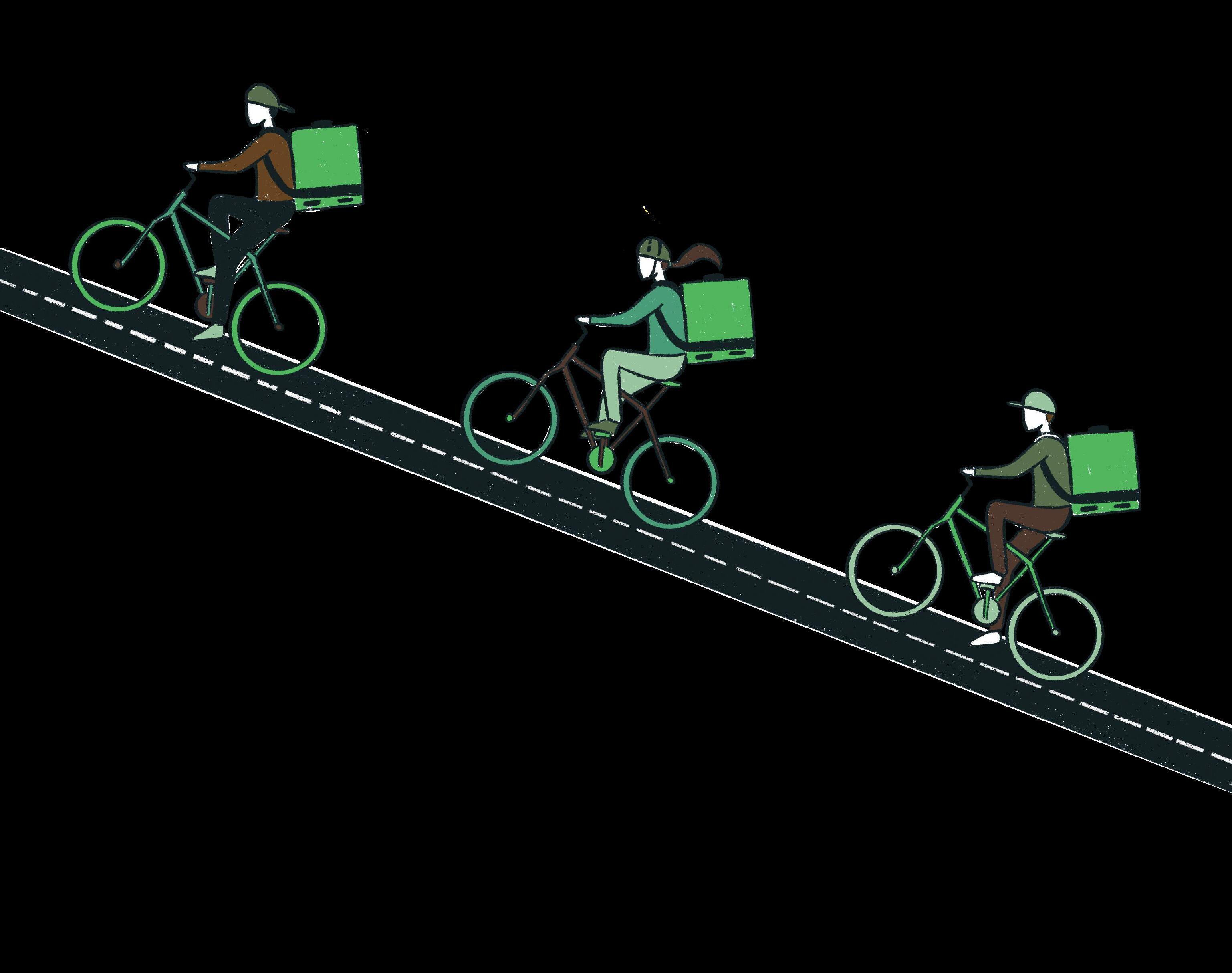
These working conditions allow employers to avoid complying with labour regulations that apply to traditional employee relations. What's more, workers have less opportunity to do collective organizing because they lack connection to each other.
The challenges of gig work
Gig Workers United (GWU) is a union of delivery app workers in the GTA, whose goal is to obtain rights like fair, livable wages and safe working conditions. In an email to The Varsity, Brice Sopher, vice president of GWU CUPW, described the challenges that gig workers face.
Gig workers, unlike other workers, don’t have access to benefits such as unemployment insurance, health insurance, or a retirement pension. They can often be, essentially, fired from the platform they work on without any notice and can be accused of violating their contract without being told how or why — practices that labour laws for traditional employees prevent.
Although gig workers gain flexibility and independence in comparison to traditional workers, they do not have job
Arts: Bringing accessibility to the big screen pg 12

security. This flexibility might seem beneficial, as it allows the workers to choose their working days. But it also may lead them to work until exhaustion when orders are coming in, as they have no guarantee of a satisfactory demand the following day.
Ginevra Sweetko, a third-year criminology student working in a restaurant, confirmed: “I directly interact with drivers… their income and working hours are largely based on the restaurant’s demand. During a slow day, only three or four drivers will stop [by] to collect orders. When fewer orders are placed, multiple drivers issue a request for pick up.” Sweetko notes that this suggests couriers struggle to find enough orders to complete.
Sopher also noted that for workers who do courier work by car, workplace challenges include “gas, wear and tear on cars, insurance, long waits with no pay… risk of repetitive use injuries as well as dangerous working conditions in inclement weather.”
Sopher added that bike couriers also face hardships, such as “bike theft, being injured in collisions, [the] cost of renting bikes or commuting, [and] expensive data plans.”
Continued on page 6
Science: Why aren't lightsabers possible? pg 15
The University of Toronto’s Student Newspaper Since 1880 Vol. CXLIV, No. 2 September 11, 2023
T HE V
T HE VA RSI T Y
Vol. CXLIV, No. 2
21 Sussex Avenue, Suite 306 Toronto, ON M5S 1J6 (416) 946-7600
thevarsity.ca thevarsitynewspaper @TheVarsity

MASTHEAD
The Varsity would like to acknowledge that our office is built on the traditional territory of several First Nations, including the Huron-Wendat, the Petun First Nations, the Seneca, and most recently, the Mississaugas of the Credit. Journalists have historically harmed Indigenous communities by overlooking their stories, contributing to stereotypes, and telling their stories without their input. Therefore, we make this acknowledgement as a starting point for our responsibility to tell those stories more accurately, critically, and in accordance with the wishes of Indigenous Peoples.


the.varsity the.varsity The Varsity
Sarah Artemia Kronenfeld editor@thevarsity.ca
Editor-in-Chief
Caroline Bellamy creative@thevarsity.ca
Creative Director
Andrea Zhao managingexternal@thevarsity.ca
Managing Editor, External
Shernise Mohammed-Ali managinginternal@thevarsity.ca
Managing Editor, Internal
Mekhi Quarshie online@thevarsity.ca

Managing Online Editor
Ajeetha Vithiyananthan copy@thevarsity.ca
Senior Copy Editor
Kyla Cassandra Cortez deputysce@thevarsity.ca
Deputy Senior Copy Editor
Jessie Schwalb news@thevarsity.ca
News Editor Selia Sanchez deputynews@thevarsity.ca
Deputy News Editor
Maeve Ellis assistantnews@thevarsity.ca

Assistant News Editor
Eleanor Yuneun Park comment@thevarsity.ca
Comment Editor
Georgia Kelly biz@thevarsity.ca
Business & Labour Editor
Alice Boyle features@thevarsity.ca
Features Editor
Milena Pappalardo arts@thevarsity.ca
Arts & Culture Editor

Salma Ragheb science@thevarsity.ca
Science Editor
Kunal Dadlani sports@thevarsity.ca
Sports Editor
Olivia Belovich design@thevarsity.ca
Design Editor
Arthur Dennyson Hamdani design@thevarsity.ca
Design Editor
Zeynep Poyanli photos@thevarsity.ca
Photo Editor
Jessica Lam illustration@thevarsity.ca
Illustration Editor
Olya Fedossenko video@thevarsity.ca
Video Editor
Aaron Hong aaronh@thevarsity.ca
Front End Web Developer
Andrew Hong andrewh@thevarsity.ca
Back End Web Developer
Vacant utm@thevarsity.ca
UTM Bureau Chief
James Bullanoff utsc@thevarsity.ca
UTSC Bureau Chief


Emma Livingstone grad@thevarsity.ca
Graduate Bureau Chief
Vacant publiceditor@thevarsity.ca
Public Editor
Vacant Associate Senior Copy Editor
Vacant
Associate News Editor
Divine Angubua, Isabella Liu
Associate Comment Editors
Vacant
Photos of the Week
Khan
Uzunović
Ukani
Salina Khan
Media Manager
Designers: Kevin Li, Cheryl Nong
Cover Jessica Lam, Zeynep Poyanli :
Ishir Wadhwa business@thevarsity.ca
Business Manager
Rania Sadik raniasadik@thevarsity.ca
Business Associate Eva Tsai evat@thevarsity.ca
Advertising Executive
Executive
@thevarsity.ca
editor@thevarsity.ca 2 THE VARSITY PAGE TWO CORRECTIONS: A features article from issue 1 entitled “ ‘If not me, then who?’” mistakenly referred to Dionne Aleman as a professor on track for tenure, instead of as a tenured professor. A science article from issue 1 entitled “Unique science courses to check out” mistakenly stated that CSB202, VIC245, ESS223, and GGR201 are not offered in the 2023–2024 school year. All four courses are being offered this year, but VIC245 and CSB202 are currently full and only open to waitlisted enrolment. A sports article from issue 1 entitled “‘Harvard of the North’ comes out on top” mistakenly forgot to add in the final score of the game, which the Blues won 68–65.
Associate
Alyssa
Associate
Vacant Associate
Ahmad
Associate
Nina
Associate
Vacant Associate
Vacant Associate
Vacant Associate
Vacant Associate
Features Editor
A&C Editor
Science Editor
Sports Editor
B&L Editor
Design Editor
Illo Editor
Photo Editor
Video Editor
Social
BUSINESS OFFICE
Vacant
Advertising
Vacant Associate
Developer Copy Editors: Kamilla Bekbossynova, Nichelle Budhrani, Olivia Cerello, Ozair Chaudhry, Ikjot Grewal, Cindy Liang, Jen Oh, Biew Biew Sakulwannadee, Nandini Shrotriya, Kiri Stockwood, Lina Tupak-Karim, Kyleeanne Wood, George Yonemori The Varsity is the University of Toronto s largest student newspaper, publishing since 1880. It is printed by Master Web Inc. on recycled newsprint stock. Content © 2023 by The Varsity A l rights reser ved Any ed tor a inquir es and/or let ters should be directed to the sect ons associated w th them; emai s listed above The Varsity reser ves the right to ed t al submissions Inquiries regarding ad sales can be made to ads@thevarsit y ca ISSN: 0042-2789
Web
MEKHI QUARSHIE/THEVARSITY
MEKHI QUARSHIE/THEVARSITY
MEKHI QUARSHIE/THEVARSITY
MEKHI QUARSHIE/THEVARSITY
MEKHI QUARSHIE/THEVARSITY MEKHI QUARSHIE/THEVARSITY
ARTHUR DENNYSON HAMDANI/THEVARSITY
ARTHUR DENNYSON HAMDANI/THEVARSITY
The Weekly Crossword by
thevarsity.ca SEPTEMBER 11, 2022 3 51 Whispered 10 Furry one, in words internet slang 54 Weapons cache 11 Fall birthstone 56 Most noted 12 ___ mortals 59 Kind of lamp 13 Culminates 60 Lecher's look 19 ___ a high note 61 Use the on-ramp 21 Flowerpot spot 62 Name anagram 25 Futile 63 Cost to cross 26 Raring to go 64 Gardener's tool 28 Furthermore 65 It may be out on 30 Kennedy or a limb King, e.g. 31 Monopoly token DOWN 32 Youngster 1 Sitcom starring 33 Observed Valerie Harper 34 BLT spread 2 Drew a bead on 35 Fencing action ACROSS 1 "Fiddlesticks!" 5 Engine sounds 10 Rotunda feature 14 Bring on board 15 Showy display 16 Start the bidding 17 Warning sign 18 Toni Morrison's "The Source of ______" 20 Jordan River's outlet 22 Square's foursome 23 Append 24 Subtle slur 27 Mickey's creator 29 Type of palm tree 30 Tailor's concern 33 Like some talk 35 Renowned 37 Food, slangily 38 King or queen 39 Run ___ (go 3 Stay afloat, in a 36 Willy Wonka's 50 Bias, in reporting wild) way creator 51 Advance, 40 Startling 4 E-mail button 38 As it happens slangily revelation 5 Bristle at 41 Short intro 52 For that reason 42 Stand out 6 Billy who sang 42 Puts in stitches 53 Con's quarters 43 Scand. land "Loverboy" 45 Make a trade 55 Pizazz 44 Tattered duds 7 ___-in-one 46 Angler's basket 57 Beatty of 45 Boxer's cue 8 UK fliers 47 "Tootsie" Oscar "Deliverance" 46 Picnic side 9 Netflix series, winner 58 Energy unit 48 Triumphant cry "____ Things" 49 Roof overhangs
Copyright 2023 by The Puzzle Syndicate Answers to Previous Crossword: 1 2 3 4 5 6 7 8 9 10 11 12 13 14 15 16 17 18 19 20 21 22 23 24 25 26 27 28 29 30 31 32 33 34 35 36 37 38 39 40 41 42 43 44 45 46 47 48 49 50 51 52 53 54 55 56 57 58 59 60 61 62 63 64 65 N O V A S E A T S A G I N A M I D A S C O T W A K E T A R O R E A R R A N G E S C H A L E T D E E P W A S H A L F N O T E S E E R C R I M E S L I L T K A P P A R E S O N A T O R E U R A S I A P R O T E G E P R O V E N D E R V E R S E T A P E S E N I L E E D I T S T A N D O F F A L L V I A L B A R R E L G O L D E N G A T E A S I A E P E E C A V I L M O N K D E R N T R E S S A N T E
Margie E. Burke
Meric Gertler on international crisis responses, U of T’s sexual violence policies, ChatGPT

In the past year, students and faculty have criticized the university for its responses to global crises, its public communications about donor influence, and its responses to sexual violence on campus. Meanwhile, artificial intelligence (AI) and a lack of funding opportunities from the province have altered the university landscape.
On September 7, The Varsity sat down with Meric Gertler — who is entering his 11th year as U of T’s president — to discuss these issues and more.

The Varsity: In your view, what role should U of T play in responding to global events, like military conflicts and environmental disasters, that personally affect international students and faculty?
Meric Gertler: We are implicated in global events because of the globalized nature of the U of T community and the connections that we have to universities around the world.
First, we help the public understand the roots and consequences of these conflicts through the expertise that we have. Our communications departments actively make our experts available to both social and traditional media.
Second, we know that our students, in particular, are often personally connected to people who are impacted by events abroad. So we do everything possible to support these students, including directing them to resources on our three campuses.
Third, we are often asked to accommodate people who are displaced by serious negative events abroad. For instance, our Scholars at Risk program has accommodated 92 scholars from 19 countries in the past year alone. This is a longstanding commitment and we are quite proud of our effort.
TV: That’s a good segue into my next question. In the past year, students have criticized the university for unequal responses to different international crises. For instance, U of T’s response to the war in Ukraine included an exchange program and an emergency grant program, which is far more extensive than its response to the war in Sudan.
What is U of T’s process in determining how it responds to crises in international students’ home countries, and what it provides in terms of financial, academic, or mental health support?
MG: Our goal is not to treat crises unevenly, but to treat crises in ways that are most appropriate for the particular conditions or characteristics of the events themselves. Every crisis is different and unique, but we treat them all seriously.
With that, we have extended the Scholars at Risk program to scholars from all countries that have experienced hardship, whether it be Sudan or Ukraine or Türkiye or elsewhere.
We also support and publicize efforts that our students and faculty organize on their own. I am sure that we can always do more and we are happy to do so.
TV: Every year, we ask you questions about the high costs of international tuition. Simultaneously, U of T raises international tuition every year. U of T has continuously acknowledged that its current funding structure, which is reliant on international tuition, is not ideal, but is happening partially because the province has been decreasing funding for universities.
It seems clear that something structural needs to change — something beyond providing scholarships for international students — so that U of T’s funding structure doesn’t place unnecessary burdens on international students. How does U of T plan to get us there?
MG: We are acutely aware of the cost of education and its impact on families. With that, we’ve moderated the increases in international fees over the last few years to around two per cent a year.
We are also committed to putting more funding into scholarships for international students. This past year, we earmarked $65 million, in addition to high-profile programs like the Lester B. Pearson International Student Scholarships that U of T awards every year, which are full-ride scholarships for international students.
Recently, the provincial government has commissioned a Blue Ribbon Panel to look at the future of the higher education system in Ontario — particularly, the financial stability of the system. We know that they’re looking at provincial operating grants, tuition fee frameworks, and how to support smaller universities in more remote locations that are often more vulnerable to financial fluctuations.
That panel is supposed to report by the end of this summer. Operating grants from the provincial government have been inadequate for a long time, so that report could be a game changer. It’s a chance for this government to demonstrate how much they value a strong, publicly funded higher education system.
TV: Can you describe how the university is advocating for a stronger publicly-funded higher education system, specifically?
: We are working directly with the Minister of Colleges and Universities and advocating directly with the Premier’s office. We have also submitted a detailed brief to the chair and vice-chair of the Blue Ribbon Panel, which is publicly available.
We have heard a very positive response to our brief from the chair and vice-chair. I think that they found our arguments to be well-structured and well-supported by evidence.
We emphasized a couple of things in our brief. For one, we suggested that U of T’s financial aid system should be a model for the rest of the province. U of T targets students who come from the most disadvantaged families. Our Policy on Student Financial Support, which has been in place since 1998, provides the rationale for our financial aid system. We’ll see if they take our advice.
TV: In light of the Azarova scandal, and most recently, an instance where the Faculty of Law accepted undisclosed donations from Amazon, critics have argued that donors and business interests have had an unfair influence on the university’s research through U of T’s advancement office, which connects donors directly with academic leads. How does the university plan to distribute funding in a way that would reduce the impact of donors on academic freedom?
MG: First of all, it was not an undisclosed gift. All donations of $250,000 or more are reported to U of T governance. So, the donation was reported to the governors of the Academic Board and the Business Board through the quarterly report on donations and Amazon was identified as the source of that gift. With that said, it is true that those reports come to governance in-camera, which means that they are not publicly available.
So, one of the changes that we have already committed to making is to move the quarterly report on donations to open session, so that this will be publicly available.
Another is to ensure that going forward, all donations from corporate sources must be identified by the source, so sources cannot have their identities concealed.
On the matter of the gift from Amazon, Faculty of Law Dean Jutta Brunnée has said that she made the decision not to disclose the identity of the donor publicly. But ultimately, we decided to return the gift because of the perception that there was less than full transparency here. Brunnée has also said that in hindsight, this may not have been the best approach, and that’s why we’ve decided to change our approach.
We do have very strong provostial guidelines on donations, and they have been recognized by a number of organizations both inside and outside this institution as very strong.
TV: In November 2022, an open letter, which now has 1,971 signatures, called on U of T to terminate Professor Robert Reisz, after an external investigation found that he had violated U of T’s sexual harassment policy and failed to respect supervisory boundaries.
Reisz is the only professor teaching BIO354 and BIO356 this semester, both of which are mandatory for the paleontology major at UTM. What steps has U of T taken to inform students of Reisz’s past harassment, and why has it continued to let Reisz teach these courses?
MG: I can’t comment on the specifics of individual cases above and beyond what we’ve already said in public.
What I can say, though, is that we remain firmly committed to creating an environment in which all members of our community feel safe and believe that they can conduct their business, free of harassment of any sort.
We have recently introduced an asynchronous online module on promoting a culture of consent, which we encourage all of our students to view. It provides a lot of information about where to go if you feel you’ve been a victim of sexual violence or sexual harassment.
Furthermore, we have recently revised our Policy on Sexual Violence and Sexual Harassment after months of extensive consultation. It’s never going to be perfect or please everybody, but we feel that it has evolved in a really good direction, provides stronger protection and support for victims, and provides more effective channels for reporting on incidents.
TV: Speaking of the revisions, many students have called on the university to commission an independent review of the policy by an expert in gender-based violence. Why hasn’t U of T commissioned this type of review, and does it plan to do so in the future?
MG: We have publicly said that we accept and embrace the idea of external expertise coming in to look at what we’re doing and telling us how we can do it better. We are committed to evolving our practices within the existing policy framework.
TV: Currently, course instructors are making their own rules in terms of students using ChatGPT and other generative AI tools. Does U of T plan to standardize rules around the use of AI in assessments?
MG: Many universities are beginning to generate policies on this, and we’re all comparing notes. At U of T, Vice-Provost, Innovations in Undergraduate Education Susan McCahan and her office have generated FAQs to help instructors, which I think are useful.
I am quite excited by the opportunity that generative AI presents. It’s forcing instructors to ask themselves, “How do we evaluate students in ways that are more effective? How can we help students integrate these tools into the work that they do from my course?” Because we know that students will be using these tools in the working world.
I personally do not think we should ban these tools outright. But I do think that we need to apply them thoughtfully, and that’s where we are going to be helping instructors. We are also encouraging instructors to engage in conversations with their students about these tools, rather than pretend they don’t exist, and make sure that the boundaries are clear for everyone.
TV: Have you used ChatGPT to write any of your statements?
MG: I have not! Everyone says that I should try it, and I am curious, but I have not used it.
TV: When is the data for U of T’s student equity census coming out?
MG: I am not sure, but over 95 per cent of current students responded to the survey and have answered all or most of the questions, so we are going to have fantastic data.
We are working to generate a public-facing dashboard and a summary of the data. We will also share data at the divisional level for individual faculties, so that they can use this data to better support the student body.
A U of T spokesperson later wrote to The Varsity that initial data from the student equity census will be shared publicly later this fall.
This interview has been edited for length and clarity.
4 THE VARSITY NEWS
U of T's president weighs in on the biggest news stories of the past yearAlyanna Denise Chua Varsity Contributor U of T President Meric Gertler. ZEYNEP POYANLI/THEVARSITY
TTC permanently closes Line 3 Scarborough RT following July derailment
Shutdown, originally planned for November, was accelerated after review
Lucas Sousa Varsity ContributorAfter 38 years of serving Scarborough commuters, on August 24, the TTC made the decision to permanently shut down the six-stop Scarborough Rapid Transit (SRT) system, also known as Line 3, following a train derailment the previous month. This announcement comes months ahead of the November date when the TTC had originally announced the line would cease operations.
On September 3, the TTC began running a bus replacement service to the affected stations in place of the SRT.
Line 3’s shutdown comes amid other service cuts for Scarborough commuters. Community members at UTSC have repeatedly protested over the last few years, arguing that these transit cuts pose issues for community members who rely on public transit.
History of Line 3
In 1977, the TTC approved the SRT to accommodate Scarborough’s growing population. Initially, the SRT planned to use light rail cars along its route, but the TTC switched to a plan involving an Intermediate Capacity Transit System partially through construction. This new system was the first computer-controlled automatic train operation in North America. The SRT was designed to run for 25 years, meaning the line has been kept in operation for 13 years past its intended lifespan.
In a 2006 report, city staff warned Toronto’s council that they would need to replace the SRT vehicles due to expected “progressivelydeteriorating service reliability over the coming years.” However, a year after the report’s release, the city council cancelled its plan to replace Line 3’s aging vehicles. Instead, it approved Toronto’s ‘Transit City’ initiative, a large infrastructure program that planned to convert the SRT into a seven-stop light rail transit (LRT) system.
In 2010, former Toronto mayor Rob Ford scrapped the Transit City initiative and proposed a plan to replace the SRT with a three-station extension of the Bloor-Danforth line. The city approved this plan, which was estimated to cost $3.65 billion.
In 2014, city councillors continued to advocate for the LRT, claiming that it could be built faster and at a cheaper rate than a subway extension. While the original plan for the subway extension was to add an additional three stops, the City scaled the construction plan back to include one stop, and construction costs continued to grow.
In 2019, Ontario Premier Doug Ford’s provincial budget committed over $11 billion in funding to Toronto transit projects, including the Scarborough subway. Doug Ford later switched the subway construction plan back to include three stops and pushed its opening from 2026 to 2030.
In 2021, the TTC board voted to replace the SRT with express buses due to difficulty maintaining the trains and other parts of the system. The Toronto Transit Commission confirmed in June that it would decommission the line on November 19.
Earlier this summer, on July 24, Line 3 experienced a train derailment that sent five people to the hospital. On August 24, the TTC announced that it would not reopen Line 3. The TTC has commissioned a comprehensive review of the derailment, although as of September 10, the review has not yet come out.
Prior to the announcement of Line 3’s shutdown, on August 22, the City and TTC contractors began installing temporary signage to create bus-only lanes within the Line 3 area. The TTC has installed bus lane signage on Kennedy Road and Midland Avenue, and plans to create dedicated bus lanes this fall. It will also adjust curbs and pavement markings.
Public reaction
The news of the SRT shutdown has sparked public debate regarding the treatment of residents who rely on public transit.
In February 2022, students held a protest at Scarborough Centre Station to protest the City’s original decision to shut down the SRT by 2023. Student speakers noted how the city has neglected to fund Scarborough transit development projects and highlighted overcrowding on buses during a pandemic, making it impossible to practice social distancing.
In a February interview with The Varsity, Shelagh Pizey-Allen — a spokesperson for the grassroots advocacy group TTCRiders — said that the City’s decommission of Line 3 was expected, but the lack of alternative transit options in place before shutting it down was not.
“[Scarborough] residents have some of the longest commutes in Toronto, and this shutdown is coming at a time when there’s been service reductions all across the TTC network,” she noted. Within its 2023 Operating Budget, which raised transit fares, the TTC introduced service cuts across the city and particularly in low income areas. The reduction in service includes Line 2, which runs from Etobicoke to Scarborough.
“The fact that people are going to be taking shuttle buses for at least seven years, I think the blame [for it] lies with multiple levels of government,” said Pizey-Allen. “What’s important now, looking ahead, is that we get busway funded as soon as possible.”
In a statement provided to The Varsity, Khadidja Roble — vice president, external of the Scarborough Campus Student Union — wrote that the SRT shutting down early indicates bigger issues about transit in the UTSC campus area.
“The Line 3 closure is not the problem Scarborough commuters are facing. The issue relies on the non-existent infrastructures that were meant to replace the LRT upon its closure,” she wrote.
“What we would like to see from the city of Toronto, Metrolinx, and the TTC is the prioritization of Scarborough transit projects,” she continued. According to the statement, prioritizing Scarborough transit would include creating a replacement bus line by 2025, speeding up the Line 2 subway extension, and implementing a Universal Transit Pass to provide UTSC students with unlimited fare-free rides on Scarborough’s transit system.
Heat wave strikes U of T, first week of semester
Students describe “rough” impacts of heat amid discussion about adapting cities
Carly Campbell Varsity ContributorOn September 3, at the beginning of the first week of the fall semester, Environment Canada alerted Torontonians of a heat wave lasting from three to five days. This surge included the hottest stretch of heat all summer — impacting students’ commutes, orientation events, and overall transition into the school year.
During the week, temperatures reached heights of 40 degrees Celsius, which the alert noted was “very atypical of early September.” As the effects of the climate crisis worsen, climate researchers have warned that extreme weather events will become more prevalent, and institutions will need to work to mitigate them.
According to the Centre for Disease Control and Prevention, spending prolonged periods in extreme temperatures can cause negative health impacts such as fainting, dizziness, and vomiting.
Too much sun for students
Some commuters found that the weather made commuting more difficult and less appealing.
Lana Yu, a third-year student studying neuroscience and immunology, told The Varsity that her commute felt “overwhelming” and “much more taxing” because of the heat. She also said the high temperatures have led her to drive more to avoid large crowds of people.
A 2021 study based in Austin, Texas found that extreme heat events reduced public bus ridership; however, placing tree canopies close to bus shelters mitigated this effect.
The heat has also impacted students’ preparation for the new school year. “I wanted to visit campus in advance, but the heat kept me home,” said Mariel Rivera, a third-year studying political science and diaspora and transnational studies.
Additionally, the heat wave conflicted with orientation events, such as the University of Toronto Students’ Union club fair on September 6.
“Running a booth in this weather was less than ideal,” said Amareena Saleh, a third-year student studying political science and public policy who was staffing a booth at the fair. “I had to take shifts with some of the other representatives to ensure people were getting adequate hydration and rest time,” they said.
They added that attendees they talked to
changes in heat between this back-to-school session and those in the past.”

Researchers suggest that these heat spells are likely to be more common in the future. According to one study from Nature Climate Change, “In high-emission scenarios, week-long heat extremes that break records by three or more standard deviations are two to seven times more probable in 2021–2050.”
Blair Feltmate, head of the Intact Centre on Climate Adaptation at the University of Waterloo,
the “heat island effect” — an exacerbation of heat that occurs in cities with dark and tarred buildings and roads such as Toronto. This problem can be mitigated by building white roofs and incorporating more trees and vegetation into infrastructure.
The school itself has committed to measures to adapt to the effects of climate change and future weather events. UTSC hosts a Climate Change Impacts and Adaptation program, where students can learn about “science-based,

thevarsity.ca/category/news SEPTEMBER 11, 2023 5
BRIANNA CVITAK/THEVARSITY ALYSSA
VILLAR/THEVARSITY
Business & Labour
Continued from cover
The gig workers’ demands
Indeed, according to GWU, if workers spend more time taking precautions to work safely, they can be penalized by app employers for not meeting unrealistic delivery deadlines. Additionally, since gig workers’ days off are unpaid, many choose to work while injured or sick.
One of GWU’s aims is to correct the misclassification of workers as independent contractors. This is essential for workers to gain access to labour protections such as paid breaks, recourse for wrongful dismissal, and protection against wage theft. Since earlier this year, the GWU has been demonstrating against the Ontario Labour Board

GWU notes on its website that employers often impose new contracts on workers without any notice, forbidding them from going online unless they accept it. Sometimes, that means agreeing to lower pay. That is why GWU demands transparency and accountability in how employers determine working conditions and payments.
Sopher proposes that legislative protections apply the “ABC test” to employers’ treatment of gig workers.
The ABC test defines workers as employees unless a company can prove three criteria: A) they must show that workers are free from the company’s control; B) they must show that the workers perform work outside the usual course of the company’s business; C) they must show that the workers do similar work in a separate and
independent capacity, outside of their work for the company.
The test “puts the onus on the employer instead of the worker as it is now,” according to Sopher. Raising prices for customers could seem like a potential solution to increase couriers’ wages. But there is no reason to believe that companies would use that money to improve workers’ conditions.
As Sopher noted: “When apps have raised prices for consumers and increased fees for restaurants, they [have] paired that with wage cuts for workers.”
Gig workers who spoke to The Washington Post pointed to this as well. As prices peaked for consumers due to inflation, they claimed that workers still struggled to pull through.
In 2022, the total compensation for Dara Khosrowshahi — the Uber Technologies Inc.’s chief executive — rose 22 per cent, reaching 24.3 million USD. Additionally, as the number of monthly active drivers and couriers rose by 23 per cent, the median pay decreased from the previous year. This divided the CEO-to-employee pay ratio from 316 to one.
U of T students weigh in Food delivery services charging higher prices could trigger varying reactions among students that talked to The Varsity about the issue.
“I would not be willing to pay more for delivery services… increasing their prices will only encourage me to use them even less,” said Chiara Nuvoloni, a third-year economics student.
“As consumers, it’s not our duty to compensate for corporate greed,” said Riad Sankari, a thirdyear neuroscience student.
Some other students, like Sweetko, would instead “happily pay a tax… that aims to protect the safety rights of the drivers.” Dalia Bechara, a third-year european affairs student, added that she would be “willing to pay a higher price,” but not a significantly higher one.
Amélie Mazzarotto, a second-year criminology student, said “If I wasn’t an unemployed university student… I would 100 per cent be willing to pay more for [food delivery] services, if this was absolutely necessary in order to improve workers’ salaries and conditions. However, I believe it’s the companies hiring them that should change their policies.”
Sankari added that he wasn’t familiar with the topic of couriers’ working conditions, but he noted that the unfair treatment they face is a “striking reflection of broader issues within our workforce.”
Part of that, Sankari wrote, is that a tough job market forces people to rely on gig work for their full income, rather than doing it for supplementary income.
Bill 88 offers new protections, but not enough
In 2022, the Ontario government passed Bill 88, the Digital Platform Workers’ Rights Act, into law. The legislation is flawed, but it does introduce some benefits for gig workers.
One of those benefits is pay transparency — employers must now disclose how they calculate the amount they pay gig workers. Employers
must also provide more notice and information when they penalize, suspend, or terminate gig workers’ employment. This act also makes sure that tips go to workers, although this is already technically required by Ontario labour laws.
Finally, Bill 88 plans to bring in portable healthcare benefits. These benefits would be attached to an individual employee, rather than to their employer — which is essential for gig workers who frequently change jobs.
However, Bill 88 still allows employers to pay gig workers below minimum wage.
Under the legislation, employers are only mandated to pay their employees minimum wage exclusively for “assignment time.” For food couriers, this would mean they only get paid for the time spent picking up and delivering orders. They would not get paid for the time they spend waiting for new assignments to come, which is an inevitable part of their working day.
On its website, GWU says this is equivalent to a scenario where a construction worker gets paid “only while the hammer is on the nail.”
The act also does not address the misclassification of gig workers as independent contractors, nor the necessity for them to be classified as traditional employees in order to gain access to labour protection and employment rights.
What is certain is that gig workers face unethical working conditions that we can no longer ignore. They should stop being misclassified as independent contractors and receive the same rights that other traditional workers have. After all, they are ultimately the ones running their industry.
Post summer optimism

2023
September 11,
thevarsity.ca/category/business biz@thevarsity.ca
Gig Workers United demonstrators at the Ontario Labour Board this August. COURTESY OF GIG WORKERS UNITED
Vincent G T Quach Varsity Contributor
Middle housing is the way to achieve housing equity
Emily Carlucci Varsity ContributorAffordable and suitable housing is an ongoing concern for U of T students, and proximity to campus often dictates housing choices. For U of T students post-first year, limited dormitory availability is a major issue.
As the demand for on-campus housing continues to surpass available spaces, many students find themselves seeking alternative housing options in the inflated Toronto rental market. With Toronto rent averaging $2,822 as of April 2023, while minimum wage will still be at $16.55 per hour in Ontario as of October 2023, it’s no wonder students struggle to secure affordable and appropriate housing near U of T campuses.
With high-rise apartments dominating the urban landscape, limited housing options can often force students into suboptimal living situations or lengthy commutes. This not only adds stress to the already challenging postsecondary life but also raises suspicions regarding the university’s ability to provide a stable living environment for its students throughout their academic journey.
In my view, the concept of missing middle housing offers a potential remedy, as it presents a range of housing options that bridge the gap between single-family homes and towering apartment complexes. While the city’s past zoning laws have hindered the addition of middle housing, it is important to understand the advantages of reintroducing duplexes, triplexes, and townhouses in Toronto because it unveils a plethora of positive outcomes for U of T students.
What is missing middle housing?
“Missing middle housing” is a range of housing types that bridge the gap between detached single-family homes and large apartment buildings. These include duplexes, triplexes, townhouses, and other similar buildings. The idea behind this concept is to provide diverse, moderately denser housing options that not only fit into existing neighbourhoods but also offer
affordability and community integration. Missing middle housing can involve building along the lines of the historic row houses in neighbourhoods like Cabbagetown or modern townhouse developments in areas like Liberty Village.
Reintroducing missing middle housing options can have several direct and indirect benefits for U of T students. To start, affordability is a pressing concern for students. Single-family homes are often unattainable, and high-rise apartments can be costly as well. Missing middle housing options tend to be more affordable due to their smaller size and shared infrastructure. A study by the Urban Land Institute also highlighted that diversifying housing options can lead to increased affordability for various demographic groups, including students.
Further, missing middle housing could be strategically placed near U of T campuses to reduce commute times and enhance the overall student experience. Duplexes, triplexes, and townhouses can be designed to fit into existing amenities and established communities, bringing students closer to their academic activities. According to Evergreen, a GTA housing action lab, opening areas to “gentle” density building options — such as middle housing — could increase housing supply, diversify Toronto’s housing stock, and create opportunities to reimagine walkable neighbourhoods.
Although high-rise apartments are great at utilizing vertical space, they often lack the close-knit community feeling that missing middle housing can provide. These smaller housing options encourage social interaction, creating a sense of belonging and support among U of T students.
Lastly, and most obviously, middle housing options can enhance the aesthetic appeal of neighborhoods. With careful planning and design, these structures can blend modern architecture with the existing urban environment, contributing positively to Toronto’s cityscape. I mean, just think of the beautiful Toronto-ubiquitous Bay and Gable townhomes.
Zoning laws: the barrier to missing middle housing

While the benefits of reintroducing missing middle housing are evident, Toronto’s past zoning laws — although many of them have now been rectified — still present a formidable obstacle.
On May 10, 2023, the Official Plan Amendment and Zoning By-Law Amendment were voted in by City Council to permit the development of middle housing. While this decision is better late than never, the damage has already been done. Toronto’s housing culture is filled with Not In My Backyard (NIMBY) sentiment, a term which refers to strong feelings against affordable housing projects being proposed in already established neighbourhoods. This sentiment is difficult to dismantle, and the city’s zoning laws have traditionally favoured single-family homes and high-rise apartment buildings.
These laws have often restricted the construction of smaller-scale housing options like duplexes, triplexes, and townhouses in many neighbourhoods. The intent behind the zoning laws was to protect Toronto’s most vulnerable populations and reinvigorate flagging neighbourhoods, but their unintended consequence felt to this day, has been a limited range of housing options.
Calls for zoning reform in Toronto have gained momentum in recent years as policymakers, urban planners, and housing advocates recognize the need for change. The Missing Middle Housing project by the Canadian Urban Institute underscores the urgency of reforming zoning laws to accommodate
the diverse needs of residents, including U of T students. Efforts to enable missing middle housing are seen as an avenue to enhance housing options, promote community engagement, and address affordability concerns.
City officials and policymakers must collaborate with urban planners, architects, and communities to identify suitable areas for missing middle housing development. Furthermore, the process should involve input from U of T students to ensure it meets unique student housing needs.
U of T students’ housing future
U of T students deserve housing options that align with their budget and needs. The promise of missing middle housing offers a bit of hope, but its success hinges on community involvement against NIMBYs who want to guard zones for single, detached family homes in Toronto. As conversations around housing reform continue to gain momentum, U of T students have an opportunity to shape a more equitable housing landscape — one that prioritizes accessibility, affordability, and the diverse needs of Toronto’s residents.
At the intersection between the promise of missing middle housing and the push for zoning reform lies the potential for a brighter, more affordable, and more inclusive housing future for U of T students. As we advocate for change, we as students are reshaping not only our own housing experience but also the trajectory of Toronto’s urban development.
Emily Carlucci is a third-year student at Trinity College studying political science and English.
As every international relations major will recall — with a shudder or a smile, I can’t tell — TRN250—Empire, Nationalism, and the History of International Relations certainly leaves its mark on the soul.
TRN250 is not for the faint of heart. Students have eight months to learn just under 400 years worth of modern world history — stories that stretch from the corners of a revolutionized Haiti all the way to the very last harbour in Meiji Japan. There are books to read and papers to write, and the underlying course theme of nationalism and nation-building is a complex weave that takes all eight months to navigate. Whether they’re spent reading about the Wilsonian Moment or debating whether the Cold War era was fought as nation-states or empires, not a second is spared within the four walls of this classroom each week.
Props have to be given to Professor Katie Davis for taking on the challenge. Coming in as a first-year professor the year I took the course to teach such a high-stakes course could not have been easy on her end, either. Yet here we are, two semesters later. Monarchies have seemed to domino into democracies, and empires have turned into nation-states in front of me. At last, my paper on nationalism in the Chinese Civil War has been submitted. What needed to be done was done; what needed to be known was taught.
Professor Davis kept us on a tight, wellorganized timeline, was thorough with her lecture content, and ultimately ensured that all 400 years of wars and European barbarism — I mean, colonialism — were crammed into our skulls. To answer the million-dollar question for every U of T student: grading was — tragically — on the harsher side, but it came with reason and valid criticism. If anything, I’d like to think it helped me improve my analytical abilities. In
the grand scheme of things, despite TRN250 probably being my most difficult and timeconsuming course both semesters, it was far from a horrible experience.
However, success is never without shortcomings. U of T students know that no class in this institution is ever perfect and, unfortunately, this class was not an exception.
Throughout the year, the most prominent complaint I had was about the course delivery — not what Professor Davis taught, but how she taught it. Professor Davis employed a seminar-style method of teaching, lecturing with very minimal visual assistance, such as lecture slides or powerpoints. Lectures resembled a two-hour long speech: one where nearly every sentence was testable information, that is.
Thus, it became the burden of the student to transcribe words as they were being said. This posed an issue not only for the sake of convenience, but on a deeper level of accessibility as well. With recording disallowed, students who could not type or write fast enough struggled immensely and scrambled every class in a kind of stress that could have been entirely avoidable.
If a student was sick and unable to attend one week, there was absolutely no way to remediate that absence; no lecture slides, no recording, no written information beyond what their friend might have taken down. And even then, the student’s friends probably couldn’t
record everything either — this one comes from personal experience.
Other items that put a damper on the overall experience included what I felt was a lack of clarity on the formatting and grading of upcoming assignments, and a grading scale that felt heavily uneven, where a large majority of our final grade was made up of just two major tests.
Yet, I don’t want to discount the class as a whole. The content was interesting, albeit rather eurocentric. And credit must be given where credit is due: Professor Davis put in the effort for us. That is more than can be said for some.
For better or for worse, my year with TRN250 has finished. This review exists not to praise it nor to bash it but to reflect on it. To hopefully guide whoever comes next — the next professor who rambles on about the Potsdam Declaration, or the next student who has to carry a dozen books on the Haitian Revolution home in time to write their gargantuan final paper. My best wishes to you.
One last thing, by request of my fellow classmates who watched me type this up: shoutout to Sam, the best TA anybody could ask for. You are a gem, and the academic world would be lifeless without you.
Isabella Liu is a third-year student at Victoria College studying public policy and international relations. She is an Associate Comment Editor at The Varsity.
Comment September 11, 2023 thevarsity.ca/category/comment comment@thevarsity.ca
Toronto’s housing is where dreams come true for millionaires
TRN250 was more fun than I expected, but demands accessibility
Isabella Liu Associate Comment Editor
U of T students deserve housing options that align with their budget and needs. MEKHI QUARSHIE/THEVARSITY
Meditations on TRN250—Empire, Nationalism, and the History of International Relations
Gen Z is redirecting the path to intellectualism, not derailing it
Charmaine Yu VarsityEight-hour daily screen time, doom-scrolling on Twitter, and toddler-like attention spans are just some stereotypes about Gen Z. These emerging mannerisms of our generation all seem to retrogress from what historically approved intellectuals possessed, leading us down a potentially worrisome path.

However, I argue that Gen Z is the generation of anti-intellectual intellectuals: the generation that retains key values of what was historically considered to be intellectualism, yet also rejects beliefs that are archaic and problematic, or have yet to be adapted to the digital, globalized, and late-stage capitalist world.
There is a common perception that Gen Z is derailing the route to intellectualism in ways such as neglecting the Socratic method in the age of misinformation, staying within echo chambers, and entertaining algorithmicallycoded content. Though this could be true to a certain degree, it is also a narrow imagination of how the Socratic method can be digitally translated.
Gen Z reads — just not the way we’re used to Gen Z is often spurned for not reading. But this is simply a narrow way to frame what is considered ‘reading’ or what is considered ‘valuable’ knowledge. Gen Z is always reading — more than ever.
News has transcended the medium of print and has entered digital realms consisting of online articles, Instagram posts, Twitter threads, and more. Even presidential debates are livestreamed on YouTube. Whether you choose to believe that Gen Z is developing shorter attention spans — something that there is little empirical data to prove — I see this as an adaptation to accommodate the mass intake of knowledge from varying disciplines that we are now exposed to in our daily lives, allowing Gen Z to have ‘sample tastes’ of innumerable topics.
Importantly, people are no longer confined to traditional mediums of knowledge such as studying directly from the Lyceum, speaking Latin, or only reading Marx or Engels — which were once considered the only ways to gain legitimate knowledge and establish oneself as an intellectual.
The American Press Institute reports that 79 per cent of Gen Z and Millennials consume news daily, and 96 per cent report doing so at least weekly. Gen Z and Millennials, moreover, get their news from a wide range of sources, including national and local news outlets, TV news stations, news stations’ websites, and apps. Gen Z is especially likely to get news daily on social media platforms compared to older Millennials — 74 per cent versus 68 per cent.
Most importantly, however, is that the younger generation is developing a sense of skepticism, including toward the portrayal of racialized groups in traditional media outlets.
According to the American Press Institute, 49 per cent of surveyed Gen Z and Millennials believe media coverage of immigrants is slightly or totally inaccurate, for example, with 48 per cent being skeptical against news reported about Black Americans and 45 per cent
The paradigm shift in argumentative dialogue
At times, argumentative dialogue on the internet, especially on infamous sites such as Reddit, causes it to seem like we are regressing in knowledge. Yet simultaneously, disagreement, probing, and interrogation are key parts of intellectualism — or at least the Socratic method.
In fact, we can draw similarities between the back-and-forth questioning between multiple online users to the structure of the Socratic dialogue that was used in canon works such as Plato’s Republic.
Furthermore, online discussion forums have created a sense of a meritocracy about who gets to be an intellectual, rather than in the past when knowledge and the tools to derive knowledge were — even more intensely than now — reserved for the rich. After all, Greek philosophers were often only able to sustain themselves because they had rich families or patrons.

I am not denying that the commodification of knowledge continues to prevail. The irony of the back-to-school season, where students must shell out thousands of dollars for tuition and textbooks, has not gone unnoticed. However, the internet has undeniably unlocked the gates to a wealth of information that would have remained inaccessible to the average non-post-secondary student a decade or two ago.
Although Gen Z continues to personify this rhetoric, many pieces of rhetoric are historically associated with intellectualism that we have begun to reject. Thinkers such as Hume, Kant, and Locke, whose works are used to fuel theories of race and intelligence, have led newer generations to become disillusioned by intellectual figures; ideas of intellectualism have always been monopolized into a quest for power by pedestalled writers of the Western canon. Similarly, Aristotle justified enslavement by proposing that some individuals were “slave[s] by nature,” because he believed they had lower intellectual reasoning capabilities. His philosophy was used to build Antebellum America.
These archaic ideologies cannot and should not exist as we move through the twenty-first century. We now live in a globalized world where marginalized voices once relegated to a lower caste of intellectualism are being included in intellectual discourse.
Intellectualism, removed from any attachment to canon ideology, can simply be defined as the drive for knowledge, which younger generations clearly display.
So, the habit of reading still exists among Gen Z — it just takes another form. The search for knowledge still exists among Gen Z, but the idea of ‘legitimate’ knowledge takes another form. The desire to live with reason and critical thinking still exists among Gen Z, but the face of who is allowed to embody these traits takes another form. Gen Z simultaneously incorporates and rejects what historically approved figures of intellectualism promoted, creating a generation of anti-intellectual intellectuals.
Charmaine Yu is a third-year student studying political science and English. She is a member of Trinity College’s BIPOC Writing Circle and an editor of The Trinity Review.
comment@thevarsity.ca 8 THE VARSITY COMMENT
We’ve created a generation of anti-intellectual intellectuals
YIXUAN GUO/THEVARSITY
Contributor
A review on problematic summer weight loss trends in Toronto
Huda El-Zein Varsity ContributorContent warning: This article mentions weight loss and diet culture.
The 2023 summer months in Toronto have come with their usual sweltering heat, lively festivals, doe-eyed tourists, and cheerful laughter from crowds in the parks. But this year, we had an unexpected and uninvited guest permeate the city: aggressive ads for Ozempic.
Ozempic, a rising star in the weight-loss world, is a novel second-line treatment in type 2 diabetes mellitus that — through mechanisms not entirely known — has been shown to also assist in weight loss, leading to its current off-label usage and popularity in facilitating weight loss. While I think we should destigmatize medical interventions, including medication, overselling these products can be dangerous. Likewise, we can’t normalize flippant disregard about the risks these medications carry.
The normalization has in part come from a new-age type of direct-to-consumer-advertising that appears on typical billboard ads like those on the TTC, which showcases influencers rather than celebrities. In a different way from celebrity endorsements, which bring notoriety and recognition to a product, influencers have a unique role in the marketing space as they can leverage their parasocial relationship with a curated audience to promote a product they are being paid for while maintaining their relatability.
This parasocial relationship between influencers and their audience is an insidious phenomenon, particularly in the marketing space. Consumers come across what many perceive as a hopeful and relatively easy fix promoted by someone they feel some sort of connection to based on the content they curate, but the nature of the relationship leaves them blinded to the issues that lay in the shadows.
The effect of a virtual parasocial relationship
mixed with heavy advertising and a sprinkle of hope has put us in an era of ‘fad-ceuticals’ — an era fraught with misleading and dangerous ads, little accountability, hidden side effects, and the looming threat of a supply shortage to a medication which is lifesaving to many.

Popularity and the emergence of common discourse of a medicine or medical intervention is the first step towards destigmatizing it — including when it comes to the often taboo topic of weight loss. For many people, lifestyle changes alone do not always allow them to lose weight, and medications can act as a necessary tool to allow lifestyle changes and holistic intervention to actually be successful.
Before the introduction of a medication like Ozempic, many people’s repeated trial and error of weight loss tactics felt like pressing the gas pedal on a car that isn’t even on. The introduction of medication is the key-in-the-ignition many need. While there is much discourse about weight loss and its place in body positivity, there is unequivocal evidence that weight loss is the difference between a better quality of life and serious health risks for some.
Obesity and related metabolic disorders are growing concerns in the public health landscape. According to the 2020-2021 community health survey from Statistics Canada, over 30 per cent of adults self-reported as overweight, with a body mass index (BMI) recording over 25. Similarly, around 30 per cent reported themselves as obese, with a BMI over 30.
Not an instant game-changer but a kickstarter Ozempic, Wegovy, and similar trending counterparts belong to a class of medications called ‘incretin mimetics’ that are traditionally used to manage Type 2 diabetes as a second-line therapeutic treatment. Semaglutide, the drug that makes up Ozempic, promotes the secretion of insulin — a hormone needed for most cells to take glucose in the body to convert into usable energy. Type 2 diabetes typically has a drug
called metformin as its first line of defense in managing the condition. When this alone fails, the second-line therapeutic is often prescribed.
Not only are incretin mimetics an effective second-line therapy, but they also carry significantly less risks and more protective effects compared to older, traditional second line therapeutics like sulfonylureas.
This type of treatment is a unique approach to the management of diabetes and obesity, in that lifestyle change is an integral part of dealing with these unique conditions, and unlike its treatment counterparts, the medication can give a ‘kickstart’ to allow the user to better implement those changes and see results. Increasingly, we are seeing an increase in off-label prescriptions for Ozempic and its bedfellows to cause weight loss.
However, in my view, the issue with the obsession with Ozempic is that we miss the mark on health. For one, many doctors are basing their decision to prescribe Ozempic on patient-reported BMI alone. As a population statistic, BMI can be helpful to give an insight into the health and trends of a given population to inform policy and programming changes. Yet, at an individual level, it gives nothing more than a framework to make clinical decisions — and certainly not the entire picture.
BMI is taken by calculating a person’s body mass in kilograms and dividing it by their height squared in centimeters. A BMI of 30 is considered obese, but individuals who, for example, are athletic can easily reach a BMI of 30 without being medically considered overweight, let alone obese. Concerningly, Ozempic and similar drugs are being prescribed through telehealth providers who do not have pre-established relationships with patients and are not able to fully evaluate their physical status as one would be able to in person or with a pre-existing relationship.
Aside from the medical and health concerns,
riche’ — as pretentious and conspicuous because they openly display their wealth through flashy labels, and ‘lack class’ by bragging endlessly about the obscene amounts of money they spend to maintain their lifestyle.
the rise in Ozempic ads and availability begs the question of how ‘far’ we should go with weight loss treatments. Body trends are culture-specific and fluctuate through time. In Western culture in particular, unlike the archaic supermodel’s cigarette-a-day narrative, the trends we see today are not found through voluntarily watching the year’s fashion week or flipping through Vogue magazine, but by involuntarily being bombarded at every turn by the “body shape” of the time.
In that sense, I believe we must separate our socially created desire to fit a certain mold that can entirely change tomorrow from our medical perceptions of something that is a necessity or beneficial. The solution is not to do away with medications, it is not to do away with the choice to change one’s body, nor is it to do away with consumer advertising using influencers — which is unlikely to go away anytime soon.
Meaningful change is going to come from stricter regulation and oversight. We should be creating better clinical oversight about the guidelines of prescribing these medications, particularly given they are done as off-label prescriptions. We need better oversight by federal regulators pertaining to advertising and the use of influencers in campaigns; we need increased transparency around risk/benefit analysis; and we need to have more conversations on the intertwining of social desires and medical practice.
Huda El-Zein is a graduating University College student specializing in global health and minoring in German and physiology. She is the U of T student representative for the Consortium of Universities for Global Health and a youth consultant with the Canadian delegation to the World Health Assembly and Pan American Health Organization.
cialized people. True to form, the royals were exempt from following legislation that prohibited hiring discrimination practices and did not hire minorities in clerical positions until at least the 1960s.
Nothing makes me cringe more than seeing an old money aesthetic Get Ready With Me video on my TikTok timeline. With 9.2 billion views, #oldmoney is on TikTok’s top list of trending topics. This trend points to our society’s obsession with the rich, and Gen Z’s specific version of being enamoured with their lifestyle.
Although I like the preppy style of what is deemed ‘old money’ on TikTok, the trend perpetuates dangerous racial and socioeconomic bias by ridiculing any other form of wealth that accumulated later than ‘old money,’ and glamourizing stereotypes that only white people can be associated with ‘class.’ As a black woman, this fascination with emulating a group connected to racism and inequality does not appeal to me.
#Oldmoney versus #newmoney
#Oldmoney, #quietluxury, and #stealthwealth are all trendy terms affiliated with people who were born into wealth. Old money is specifically defined as those who have inherited wealth from their families who have been wealthy for generations. One might think of the British Royal Family, the Rockefeller family or individuals like Beatrice Borromeo, a journalist who is the daughter of an Italian aristocrat. The stealth wealth trend isn’t only about wearing
high-quality brands, as content creators also show how to emulate the aesthetic on a budget, making this style supposedly attainable.
In my view, TikTok’s romanticization of the old money aesthetic could be because the status of #oldmoney isn’t attainable today like #newmoney. New money is considered extreme wealth created in the current day and age. Individuals with new money have had wealth created in their lifetime and usually are selfmade entrepreneurs, celebrities, and athletes.
“New money shouts, old money whispers” is a quote from Emily Post’s highlights the stark differences between the two. On TikTok, the old money life is the refined and classy private school and trust fund life with a nothing-to-prove mentality. In contrast, TikTok denotes new money — or the ‘nouveau
Style determines much of the essence of the old money and new money trends. Minimalism is one of the ways to attain TikTok’s quiet luxury style, and shows such as Gossip Girl and Succession are major inspirations for it. According to TikTok, the old money aesthetic requires wearing everyday clothes from brands known among wealthy circles. Some examples include wearing brands known for the quality of their clothing, such as Brunello Cucinelli or Loro Piana, whose t-shirts and sweaters sell upwards of $2,000. This also contrasts with the ostentatious style of new money because it rejects logomania.
The old money rhetoric
tions. In a 2021 interview with Oprah, Prince Harry and Meghan Markle said that members of the ‘old money’ royal family were concerned about the skin colour of their unborn first child. Meghan is the first Black woman in nearly three centuries to join the British royal family, and ment of her is symbolic of the relationship with ‘old money’
In my view, the old money aesthetic in itself has various racist undertones that enforce noninclusive aesthetics, and its comparison with new money makes the undertone more apparent. Countless TikTok videos use examples of new money to show what they deem to be ‘unclassy,’ but these examples are often Black people dressed in designer clothing. Black people have also been ridiculed for engaging in the old money aesthetic with comments alluding to the aesthetic not being “for” them. In contrast, white people proudly don styles that resemble a J.Crew catalogue.
TikToks that glamourize old money reinforce stereotypes that only white people can be affiliated with elitism and class, especially since Black people are more likely to achieve their wealth through new money, due to systemic inequality, a lack of employment opportunities, and housing loans due to discrimination. A study on accumulated wealth for Black and white families found the median accumulated wealth for Black households with a college degree families was 70 per cent of that of white families who didn’t have a college degree.
I believe that perpetuating the ‘new money versus old money’ paradigm endorses dangerous racial and socioeconomic bias. It suggests that white people have a unique right to inhabit wealth and prestige and incorrectly minimizes the work it takes to attain wealth for those who weren’t born into wealthy families.
Ruth Baker is a fourth-year student at UTM, studying Communications, Culture, Information and Technology and Professional Writing. Baker is the Event Director for the UTM Book Discovery Club and Blog lead and Peer Support Mentor for the UTM Health and Counseling Centre.

thevarsity.ca/category/comment SEPTEMBER 11, 2023 9
The old money aesthetic pushes dangerous racial and socioeconomic bias
Why I’m not interested in TikTok’s old money aesthetic
Ruth Baker Varsity Contributor
Ozempic advertisements show critical gaps in health, advertising, regulation
CHERYL NONG/THEVARSITY
The rise in Ozempic ads and availability begs the question of how far we should go. ZEYNEP POYANLI/THEVARSITY
Like most cities, my hometown, Vancouver, was on complete lockdown during the spring of 2020. We all yearned for similar things: to see friends, for a normal school life, to secure a steady source of income, and for life to go back to the way it was before. Not only that, but I felt the irrepressible urge to coldwater scuba dive again for the first time in nearly two years.
This would not have happened if the works of the French novelist and proclaimed “fa ther of science fiction” Jules Verne had not piqued my interest. In a fit of boredom, I had rummaged through the shelves of my parents’ home office to find the familiar aroma of old glue bind ing together the same classic stories they loved when they were my age.
I was looking for something time less, removed from the confines of pandemic regulations. This moved me to reach for 20,000 Leagues Under the Sea, Jules Verne’s

Novel Discoveries


Why scientists should read fiction too


Thinking uncon ventionally drives innova tion. So why not source inspiration for scientific dis coveries from unconventional plac 20,000 Leagues Under the Sea is just one example of dozens of fic tion books that have inspired me to pursue different aspects of science. Well-written fiction encourages scientific professionals to under stand the social implications of the work that we do. It explains wonder fully the unknowns that we cannot quantify, and — almost like a literary research conference — broadens our understanding of the sciences by sparking curiosity for subjects we never knew were worth investigating, let alone existed. As somebody who studies life sciences, reading fic tion makes me a more empathetic, creative, and inquisitive scientist.
The science of stories
Beyond inspiring curiosity for the sciences, I con sider the novels I read to be a unique form of quali tative research. I enjoy reading novels because they use metaphors instead of mathematics to explain concepts we cannot quantify, which is an asset to science. While research articles give us insight through data, novels combine data with analysis on how characters’ relationships with their communities evolve as they face adversity. If you are a science student, you are likely waiting for a statistical argument for this. I recently stumbled upon a new sub-disci pline of cognitive science — interchange ably called ‘story science’ or ‘literary neu roscience’ — which studies how reading fiction rewires our brain. Since all humans have the gift

10 THE VARSITY FEATURES
Caitlin Adams Varsity Contributor
whether we are resolving or mediating conflict, trying to find meaningful questions to ask in a conversation, or making new friends.
One neural pathway, called the default mode network (DMN), is responsible for helping us consider how our decisions might make others feel and why. People who can easily do this are said to have a higher theory of mind — the ability to correctly attribute mental states to ourselves and
others, which plays an important role in social interactions — than those who cannot.
In 2016, Diana Tamir et al. used fMRI to show that readers’ DMN is also activated when they read fictional scenes containing vivid imagery or social interactions. They also demonstrated that frequent fiction readers score significantly higher on moral judgement tasks than both non-readers and readers of primarily non-fiction. When participants were given hypothetical scenarios where there was a risk of harm, fiction readers chose to minimize harm to help others more than the latter two groups.
What if we could translate the lessons we learn from our favourite stories to our work endeavours? Recently, neuroscientists have investigated why successful authors continue to use certain literary devices: they leave lasting impressions on readers by giving them a higher emotional experience. Although we may not remember the details of the best stories, as we watch their characters cope with hardship, we empathize with them, and that — empathy — is what we take away.
Take one of the most famous and common literary devices, as described in Poetics: the plot twist. The Greek word, peripeteia, literally translates to “to fall around” or “to change suddenly,” indicating an abrupt reversal of good fortune — giving us a tragic story.


Fiction makes research more equitable
While reading statistics about different demographics has taught me who science should be helping more, fiction also contextualizes human experiences that we might miss when we only collect quantitative data. The Island of Sea Women by Lisa See, another novel that I read recently, clearly sets out an example of this.
Based heavily on post-World War II- and Cold War-era South Korea, the novel recounts the story of the haenyeo — women in the province of Jeju who make a living by diving for food. Partway through the book, after a beloved member of the haenyeo sustains permanent brain damage while diving, the story explores how her relationships with others change. The mixture of grief, shame, and enduring love that her family members express helps frame her disability as a series of experiences, and not as an isolated event. On the other side, contemporary science mostly treats disability as the latter.
Works of fiction deconstruct this perspective in metaphors. Now, scientists are starting to reframe disabilities as a group of differences that can be accommodated. They’re starting to understand that other aspects of a person’s lifestyle, including poverty or country of residence, can aggravate
tem, as a result of fear, cultural and accessibility barriers, and other unique individualized challenges. These circumstances can affect the ways individuals with disabilities can access and benefit from the services available to them. Even as a volunteer, my advocacy work for neurodiversity has taught me how family and social life determine whether children can even benefit from well-developed disability accommodation services.
Empathy makes for higher-quality research Plot twists and resulting changes in characterization not only make for a more intriguing read but have helped me learn how to anticipate and cope with one of the most confusing variables in science: whether the demographic we target in studies actually benefits from our work.
I read George Orwell’s 1984 for the first time this year, which explained to me why people under authoritarian regimes must carefully guard their secrets and relationships to survive. Winston, the protagonist, made a brief, clandestine effort to rebel against the government for continuously rewriting history according to their will — until his trusted friends reported him. I held small bouts of hope for his future when he ventured inside an antique store containing relics of creative expression from pre-authoritarian times, and when he found a lover at work, but Orwell took my hope away as quickly as he instilled it. The visceral reaction I got from reading 1984 upon the fact that people who are be ing oppressed, or in socially disad vantaged situations, may be extra cautious with working with out siders, such as researchers and scientists.
In clinical studies, which collect data from human participants, a sample’s size and representativeness are particularly important variables, as they determine how accurately the study can represent real-world demographics. Most biomedical research has been historically conducted on white men, even when scientists have aimed to create medications and treatments targeted toward other demographics. Now, scientists are trying to broaden their participant criteria to include underrepresented minorities.
During my work at BC Children’s Hospital Research Institute this summer, I met biomedical researchers in every imaginable sub-discipline of medicine, including maternal health in the Global South, sudden onset neurodegenerative disorders in adolescents, and cancer cell cultures. I had the privilege of attending weekly seminars run by the Global and Women’s Health Research Institutes, where some of Canada’s best clinician-scientists based in the city lectured about their outreach in rural areas in BC and around the world.
All these groups of scientists identified a common barrier to improving data quality: a small sample size. Although lecturers’ study teams mailed prototypes of simple, portable screening tools directly to their patients so they could perform tests in the comfort of their homes, patients were still nervous to submit their results. Knowing that lab volunteers were available to answer questions about product usage, our presenters inferred that patient nervousness did not necessarily stem from test design but from a lack of trust for mainstream healthcare research. Acknowledging this barrier
From a logistical standpoint, it is also timeconsuming to mail hundreds of screening tests to patients, and without a high return of data, research teams risk facing rejection for future grant applications, inhibiting them from continuing their research. The Canadian Institute of Health Research, the federal government’s grant funding agency, accepts under 20 per cent of grant applications — and unfortunately, sparks of scientific curiosity are not enough to set one’s application apart from competitors. Therefore, it is also in scientists’ best interests to investigate why sample sizes quickly dwindle when working with historically marginalized groups — possibly through fiction.
Finding the middle ground
So, what do sample sizes, trust, and barriers to cultural understanding have to do with my love of fiction?
Pure logicians and creative brains may constantly argue with each other whether standard deviation calculations or emotional prose provide us with a more holistic understanding of our world’s problems, but I believe in a middle ground.

While approaching community members and asking them about their experiences is the most direct way to accommodate their needs, good or non-fiction narrative authors use appropriate characterization to show why communities might continue to distrust

The Island of Sea Women also illustrates this tension well. The novel also tells the story of an American team of scientists travelling to Jeju to measure the haenyeo’s tolerance for cold water, and comparing it with the average American’s tolerance. The youngest haenyeo were the most eager to interact with the scientists, asking questions about their equipment and methods, while those who were older reluctantly participated.
Jeju residents worried that American interference in Korean politics would jeopardize the haenyeo tradition; United States, at the time, was fighting in the Cold War and attempting to reform the Korean government. Unlike much of Western society during and before the Cold War, Jeju had a matriarchal society where women were expected to earn income. Partway through the experiment, more haenyeo began to quit because they grew suspicious that the American scientists were attempting to coax their younger members into more intimate relationships. Reading this made the importance of building trust with patients from different cultures become very apparent to me.
Scientists are trained to draw inspiration from unexpected places — including everyday conversation and meeting new people — often connecting variables together in unexpected ways. Reading fiction trains the same pathways. For me, fiction weaves together what makes a worthwhile scientific inquiry and sparks a sense of awe and questioning about the natural world. At the same time, however, it challenges me to reconsider how people interact with the world depending on their circumstances and, through prose, it teaches me how to use science to serve — and not intimidate — society.
When scientists understand how the populations they are serving interact with their investigations, they not only produce more reliable data and become increasingly satisfied with their own work, but they also can distribute the positive impact of their work more effectively among those who are traditionally marginalized.
I do not believe that reading fiction is the only way to better understand others. In fact, I believe conducting honest conversations with the com
features@thevarsity.ca
JESSICA LAM & ZEYNEP POYANLI/THEVARSITY
Arts & Culture
The case for movie captions in theatres
After a summer dominated by blockbuster movies Barbie and Oppenheimer, it’s finally time for one of the biggest seasons in the film world: the Toronto International Film Festival (TIFF). This year, the festival is set to showcase films such as Les Indésirables, Hate to Love: Nickelback, Wicked Little Letters, and so much more — including a larger emphasis on Canadian and international films in wake of the ongoing Writer’s Guild of America and Screen Actors Guild and American Federation of Television and Radio Artists strikes in the US industry.

But as we eagerly discuss hopping from theatre to theatre for movie premieres, I have a burning question: is it time we put captions in films?
You might be confused by that question — after all, don’t we already have the opportunity to add closed captions or subtitles to our movies and shows when streaming? Of course: as a person with hearing loss, I use closed captions for everything I watch online.
But on that special occasion when we go out to enjoy a movie in theatres, captions are absent. This has been the case for most of my life. As I watched Black Panther: Wakanda Forever, The Batman, and Top Gun: Maverick last year, I did so without captions. I enjoyed the movies, of course, but due to my hearing impairment, I missed a lot of dialogue and context to fully understand the plot of some of these films.
In North America, while captioned films in threatres exist, they are usually foreign-language films. Furthermore, for the billions of people outside the English-speaking world, captions are often essential in enjoying Hollywood blockbusters and in making these blockbusters successful on a global scale. When we watch movies in a foreign language, we don’t bemoan subtitles: they are an accessibility tool for those who don’t speak the film’s original language. Yet the same mentality isn’t applied for those who can’t hear the film’s dialogue.
Some say captions ruin the experience of
cinema, some say they are too distracting, and others say they are too prone to technical problems. Yet the Silent Era of films had words on the screen — why have people’s attitudes changed now?
The downsides of captions
In an interview with Innis College Principal Charlie Keil, who as a professor had researched the Silent Era, he brought up three reasons why people may be against the idea of captioning in theatres. Firstly, unlike on a small laptop screen, when movies are projected in theatres, captions are literally larger and more noticeable — this perhaps contributes to the ‘distracting’ argument. Secondly, there may be pushback from the creatives and directors themselves. According to Keil, “Directors especially tend to see film as a more visual medium. [They] don’t want [their] lovely image obscured by writing.” Finally, caption technology is not perfect; if words are not in sync, it can ruin the pacing of the film.
“One of the things [the creatives] don’t like is what I would call anticipatory in nature of titling,” said Keil. “You don’t really want that joke until exactly the moment it’s spoken — but the way titling typically works is you get a block of text all at once. So if you’re a faster reader, you’ll get the joke before the joke has been said.” Therefore, in films with comedy and suspense, the timing of the captions is everything.
The silent film era
Unlike what the name suggests, the silent films of the early twentieth century were not completely silent. Keil explained that most films would have a musical accompaniment that would be played live following the plot of the movie. That being said, during that era, the main means of communication was purely visual. As a result, it was quite accessible for audience members who had hearing loss.
By the 1930s, however, the use of synchronous sound technology quickly became the norm, isolating the hearing loss community. One solution to address this problem was sign language interpreters; later, theatre hearing aids provided by theatre
staff helped to amplify the movie’s existing sound. However, not everyone knows sign language or can have their hearing ‘fixed’ with amplification.
These logistical hurdles are why captions have become the preferred solution. They have a universal appeal, and can be used for both deaf and hearing audiences.
Cineplex’s solutions
Captions, admittedly, aren’t perfect. They must align with the script for each specific film, requiring a meticulous and time-consuming process. They also must be synchronized with the film’s dialogue; if they go too fast or too slow, it will ruin the experience. Furthermore, captions on the screen cannot be hidden for the benefit of viewers who do not need subtitles.
There are some theatres out there that provide captions directly on the screen, and some American theatres even provide ‘futuristic’ caption glasses. But the main form of captions for movie theatres in Canada is through the use of machines.
Cineplex Entertainment — the largest cinema chain in Canada — uses a caption machine system called CaptiView. The portable machines, which have small rectangular screens the size of an iPhone, provide digital closed captions that glow in the dark. They have ‘shutters’ that ensure other people around you are not disturbed. You place its base in your cup holder and adjust it to your height. Before you enter the theater, a staff member will link it up with the movie you are about to watch.
Outdated alternatives
This past summer, I decided to try these CaptiView machines for myself while watching Across the Spiderverse and Mission Impossible: Dead Reckoning. Getting the captions was easy; all I had to do was ask an employee and scan my ticket.
The captions on my CaptiView machine followed the film well, yet I couldn’t help but notice some major problems.
Firstly, it is clunky: for it to work, I had to place the base in the cup holder, which took up space. And where else was I supposed to place my drink
in a crowded theater? It also didn’t stay in the cup holder after a while so I had to hold it, which is difficult to do when eating popcorn.
Secondly, you have to multitask: shall I watch the movie or read the captions? The machine has an arm that extends upward to eye level, but it has to be at exactly the right angle to view the captions and film simultaneously. It was difficult to do so.
Thirdly, CaptiView is not for beginners. The previous issues were mostly resolved once I figured out how to use the machine my second time around, but the design isn’t as easy to understand if you never used them before.
Fourthly, the captions are inconsistent and not always in sync. Though the previous problems may be annoying to deal with, it was CaptiView’s inconsistency that made me reconsider future use. While the first time around it captured both dialogue and special effects really well, the second time I used it, it would leave large gaps of words, sentences, and even small scenes blank. If it was playing captions, they would be delayed or appear in advance to the dialogue.
Finally, CaptiView machines are not available at every theatre. What eventually killed my enthusiasm for using these machines was realizing that, out of the three theatres I go to in my town, only one had CaptiView. As much as I am grateful for the technology’ existence, I prefer having the freedom to go to different theatres — especially if they are closer, or have better seating, sound quality, or even popcorn.
While I am leaving a rather negative review of caption machines, I only bother reviewing them because I desperately want them to work. I would love to see the day when we actually have words on screen by default. Given the preferences of the hearing masses, however, on-screen captions may not ever become the standard.
For the time being, I only hope that developers like those behind CaptiView improve the current archaic tech to something more modern. After all, every year Apple drops a new phone, and we have touch screen technology. Why are we still using a hunk of hard plastic straight from the early 2000s as an accessibility device?
2023
arts@thevarsity.ca
September 11,
thevarsity.ca/category/arts-culture
As TIFF season commences, let’s reflect on movie accessibilityCatherine Dumé Varsity Contributor In North America, while captioned films in threatres exist, they are usually only for foreign-language films. COURTESY OF RAYSONHO/CC WIKIMEDIA COMMONS
On palm reading and carpet cleaning
How I bartered my way into a fortune teller’s office
“I will give you a funny prediction that, from this June until next June, you may gain 20 pounds.”
This was not what I expected to hear at the palm reader’s office. Krishna Chawla, an astrologer in Toronto, kept on speaking while scribbling notes on his yellow legal pad. “Your palm shows that you are spiritual, not materialistic,” he said. “You are more loveoriented rather than money-oriented.”
In a way, this was true. I didn’t spend a penny to have my future read off my outstretched hand.
That morning, I had struck a deal with Chawla over the phone when we agreed to a neat exchange of services. No money changed palms! The bartering economy is reemerging in practices like house sitting, communitysupported agriculture, and in online sharing groups. Strategies like these keep us conscious of our consumption while helping build connections throughout a community. Chawla and I were participants in an alternative economy, one that runs on creativity and trust.
But trading a mystical session in exchange for me cleaning a few carpets. Who knew such a thing was possible?
Magic carpets
Last summer, I moved out of my apartment and let a friend sublet the place. While doing a final sweep of my room, I decided to clean the dingy floral carpet I’d bought second-hand years earlier. A neighbour had been selling it for $20 on Kijiji, an online hub for used goods, and I’d carried it home on my shoulder.
I found a capable carpet cleaning tool on Facebook Marketplace that could be rented for just $15 a day. Better yet, the owner lived nearby.
Then I thought to myself, while I had the tool rented, why not start a mini carpet cleaning business and offer to clean the carpets of others? Who knows what kinds of carpets I’d clean — Author Margret Atwood lives nearby in the Annex, and there are many well-to-do carpet owners living in Yorkville!
So the next day, I posted my carpet cleaning ad to some community Facebook groups and waited. Before long I had a dozen offers, but one stood out in particular.
From professor to palm reader Krishna Chawla grew up in Mumbai, India, where he studied economics. All was well for a long time, but then a slipped disk injury to his back threatened everything. “Doctors were telling me that I’d walk on crutches forever,” he said. “But my mother went to a psychic to make my horoscope.”
As Chawla recalls, the psychic contradicted all of the doctors, telling his mother that her son would become “fully ‘perfect’ after January 1.” Miraculously, Chawla woke in the new year and rose from bed with his spine injury healed. The psychic had been right, and the mystical power of astrology made a strong impact on Chawla.
“It started as my hobby, and while living in India, I studied the art of astrology from 1966–1970,” he said. Today, Chawla estimates that he’s read the palms of 40,000 people over 40 years. Agreeing to trade his wisdom for my carpet cleaning service had made me customer number 40,001.
Lending Chawla a hand
When our palm reading session began, Chawla told me right off the bat that my lucky colour was orange. “If you have a job interview, dress in an orange tie. And maybe get yourself a new orange checkbook,” he recommended. I have to admit — ever since I can remember, orange has been my favourite color.
Chawla traced a line from my ring finger to my pinky, then studied the shape of my thumb. He confidently explained to me that its shape indicated I had a “gentle” nature and was not fit to be a salesman.

He offered up his own thumb for comparison. “Have you ever been a salesman?” I asked. “Look at me,” he said. “Bullshitter is my job!” I could tell that the magic meeting was going quite well.
After nearly an hour during which Chawla predicted everything up to the back problems I’d have in my 60s, he finally stood up and gave me a tour of the carpets around his house.
They were thick, dark red carpets that showed their age. There were shoe marks everywhere by the front door from years of hurrying tenants who had rented Chawla’s upstairs rooms. It was a tough job, but after everything I’d learned from the psychic, I knew I had to do it well.
Trading items from your past to discover your future
This wasn’t the first time I’d bartered and traded around Toronto to ‘buy’ without opening my wallet. I offered up an old pair of soccer cleats in exchange for two used ultimate frisbees using an app called Bunz. By trading a tube of sunscreen, I found myself two metal mixing bowls to make a batch of cookies. Later, I
Anemoia & Gen Z’s ‘80s dream
gave up an old Pentax camera for a hammock stand, which I still use to this day.
Still, it was Chawla who had reminded me of the value in trading. The morning after he read my ad, he proposed we trade palm reading in exchange for carpet cleaning. I had made a new friend in the process.
While I didn’t believe his curious predictions through and through, they did give me food for thought. Maybe I should sign up for a running race if I wanted to ward off that excess weight. And why not find myself an orange tie to boost my luck this year?
Best of all, Chawla gave me a new experience and a great story. I wouldn’t trade that for anything.
Reflecting on the human propensity to yearn for times passed
The word ‘anemoia’ cannot be found in the Oxford English Dictionary but is defined by digital sources such as The Dictionary of Obscure Sorrows as a nostalgia for a time one has never known.
Anemoia often occurs in relation to historical periods passed. For instance, one may experience anemoia after reading Little Women, or watching a Joe Wright film: suddenly becoming full of longing for a time when people sent letters written with feathered pens that left their hands ink-stained.
The experience is much older than the word which describes it. Anemoia troubled nineteenthcentury romantics who reintroduced medieval literature, gothic art, and spirituality to European culture. The Romantic movement was greatly influenced by a nostalgia for pre-industrial Europe, when natural landscapes abounded and people led ‘simpler’ lives.
Today, the internet makes longing for what we don’t have very easy. Developing an identity is difficult enough, and for a generation whose everyday life is overwhelmed with media and whose maturation was interrupted by a pandemic, Gen Z is in an awkward position with itself. This struggle is best reflected by the generation’s obsession with identity: from astrology to online aesthetics, Gen Z is desperate to define itself.
It is no wonder, then, that anemoia can be found underlying some of the trends Gen Z partakes in, many of which take the form of online aesthetics. For example, the fashion represented by the ‘cottagecore’ aesthetic is reminiscent of an eighteenth-century milkmaid, and ‘dark academia’ favours classical and romantic concepts.
However, both aesthetics are subtly anemoic because, although viewers can draw obvious
conclusions between them and historical periods, the focus of each aesthetic is not the history itself but the imagery and ideas it inspires.
Yet among Gen Z’s beloved trends, some specifically focus on times in history that the most recent generations have not experienced. One period I have noticed the generation being fascinated by is the 1980s. Since season one of Stranger Things was released in 2016, other series and movies set in the ’80s have been made and become very popular, such as Sex Education (2019) and It (2017). The End of the Fucking World (2017) and I Am Not Okay With This (2020) are set in the modern era but heavily use ’80s aesthetics.
The recreation of the ’80s aesthetic in the entertainment business has been accompanied by ’80s memorabilia: from leg warmers, oversized blazers, and denim-on-denim to vinyl records, film cameras, and fanny packs, it

appears as though by wearing the clothes and owning the technology, Gen Z is chasing their own ’80s dream.
Of course, other decades have their popular influence on modern culture. It is notable, however, that ’90s fashion and music have merely maintained a consistent place in this culture, whereas Gen Z’s recent interest in the ’80s has caused a sort of resurgence in lifestyle of the time. So, why the ’80s?
The most obvious answer is that the ’80s represent the last decade that escaped technological integration. Despite having had certain everyday technologies like television or cameras, media did not pervade the lives of young people like it started to in the ’90s with the growing influence of the Internet. Additionally, there was an optimism to the ’80s that cooled down during the ’90s, when brooding became trendy.
As such, for Gen Z, the ’80s might seem like the ideal time to be young. Socialization did not happen digitally, and the optimism of the decade was reflected in the groovy music and colourful fashion. All of this forms an imagined memory in the minds of Gen Z of a time where the world was alive.
In modern culture, where minimalism assumes great popularity, digitality dominates reality, and we're overexposed to human tragedy, optimism is difficult. In an attempt to escape modern despair, perhaps Gen Z holds onto the ’80s as a hopeful memory of what being human can be like, since being connected and present are states of being we might have to work harder to acquire in today’s isolating conditions. Moreover, the ’80s are a decade that many of us hear our parents reminisce upon, fueling an impression that this ‘simpler’ life was just out of our reach.
Every period in human history has its challenges. It is easy to summarize the past in terms of a perceived simplicity. For instance, the medieval Europe that romantics idealized was maintained by the labour of ever-suffering peasants. However, it is understandable that the past ends up appealing to the given ‘modern age’ because we only know what our modernity has robbed us of: for Gen Z, it might feel like the opportunity to be human in a more connected and present way.
Unfortunately, indulging in ’80s memorabilia and eighteenth-century fashion will not save us from the issues we face in modern society. These fixations become incredibly superficial when we lack the introspection to identify and confront the roots of our dissatisfaction.
It is therefore important not to get lost in anemoia and become attached to the impossible. That we live in the now should be our immediate concern. We must recognize anemoia as a symptom of discontent, trace the roots of that deficiency, and find our way toward fulfillment. In doing so, I believe Gen Z will be able to realize and actualize its right to meaning, connection, and individuality.
thevarsity.ca/category/arts-culture SEPTEMBER 11, 2023 13
Jesse McDougall Varsity Contributor
Sophie Esther Ramsey Varsity Contributor
Some of Gen Z’s most beloved trends emulate times in history they’ve never experienced. DENIS OSIPOV/THEVARSITY
ARTHUR DENNYSON HAMDANI/THEVARSITY
Gujarati Students Association kicks off academic year with Rangeelo Raas event

Holiday celebration was held in honour of Hindu festival Navaratri
Shonita Srinivasan Varsity ContributorOn Friday, September 8, the sound of drums boomed and students in the finest Indian clothing mingled under the lights of the Athletic Centre gym. The smell of samosas wafted in the air; for a moment, it felt like home.
This was the U of T Gujarati Student Association (GSA)’s Rangeelo Raas event, which the association hosts every year. Raas is a Gujarati folk dance to honour the Hindu goddess Durga and is typically performed during the Hindu festival of Navratri. The well-attended event was full of students celebrating the festival with their peers.
Navaratri, which translates to ‘nine nights’, is a festival that celebrates the goddess Durga, the feminine divine form, along with her nine manifestations. Raas is danced in circles to represent time, which Hindus believe to be a cycle from birth to death to rebirth. In the middle of the dance circle lies a clay lantern, which symbolizes Durga as a constant symbol in the cyclical process of life.
Raas is also danced barefoot to reinforce the Hindu belief of respect for the earth and its natural gifts bestowed upon us.
In an interview with The Varsity, Co-President Stuti Kantawala spoke about how events like these are a good space for people to make friends and an opportunity for first-years and commuters to find community through culture.
The GSA’s event also included an Arti. An Arti is an essential religious ceremony to honour the presence of a deity. During this ceremony, a candle is lit with a wick soaked in ghee — clarified butter — alongside a plate of offerings. Attendees take turns circling the plate and candle as well as reciting prayers before pictures or statues of deities.
As more Hindu people from South Asia have immigrated to North America, Raas events have become more widespread. More than 20 universities in the US have largescale Raas competitions, including expensive costumes and professional choreography. In cities with high Gujarati populations, artists from India come to the US to perform live music during the Navratri season. Fun fact: Toronto hosts North America’s largest Raas festival! Traditions like Raas can be lost if there aren’t teams putting in the work to organize events around them.
Thanks to the efforts of Co-Presidents Parth Patel and Stuti Kantawala, Vice President Nandini Shah, and the entire GSA, U of T Hindu students were able to celebrate their traditions and find comfort in community, all while being far away from home.
TUSARNITUT! Music Born of the Cold
music
Canada is home to vastly diverse Indigenous communities, some living farther north than much of Canada’s population. However, this distance shouldn’t prevent people living further south from engaging with stories and histories from northern communities.
TUSARNITUT! Music Born of the Cold is a story of Inuit culture and tradition, as told by Inuit communities located in arctic regions of Canada through art and music. The exhibit, now at the Royal Ontario Museum (ROM),
amplifies the sounds of traditions such as throat singing and drum dancing, and showcases the breadth of Inuit musical expression across multiple generations.
The context: Bringing throat singing into the spotlight
Throughout the exhibit, the tradition of Inuit throat singing is brought to life by audiovisual performances and soapstone carvings of vocal cords. Throat singing is a friendly competition between two Inuit women who mimic sounds of the natural environment through complex movements of their mouth and diaphragm. In
the early 1900s, Christian missionaries tried to eradicate this longstanding Inuit tradition.
Recently, some Inuit have brought discussions of this history to a wide audience. In an interview with Breakfast Television, throat singer Pauline — who only discovered the craft in her teenage years commented on the suppression of the genre. “It was quite rare for us to learn [throat singing] at home because our parents went to residential school,” she said. “So it was really important for me when I had a chance, because this was actually forced to be stopped in Inuit culture.”
Pauline is not the only star currently bringing throat singing back into the spotlight; TikTok sensation Shina Novalinga took to social media for her throat singing during the pandemic. When throat singing was forbidden in Puvirnituq, Novalinga’s mother was one of the few women who was able to preserve the art. She later passed the tradition down to her daughter, and it continues to bring them closer together today.
A history of Inuit musical expression
In addition to the intimate practice of throat singing, TUSARNITUT! Music Born of the Cold sheds light on the central role of drum dancing in facilitating relationships within Inuit communities and with ancestors.
According to angakkuuniq an Inuit belief system all living entities can reincarnate into other forms, and the human and non-human worlds are inextricably linked. The exhibition showcases carvings of walruses and bears playing the drum, performing drum dances in the same role as angakkuit — a community’s spiritual leaders. Drum dances and drum songs are communal events, and several of
the artworks throughout the exhibition show a man carrying an angakkuq using a drum, or the dance itself occurring within an iglu.
In a conversation with The Varsity , Justin Jennings, the ROM’s Senior Curator of Archaeology of the Americas and co-curator of TUSARNITUT! , highlighted his hopes for the exhibit’s impact. “I think the most important message to me is to showcase the vibrancy, the excitement, [and] the joy that you see in Inuit music and dance,” he said. “[To] look at where Inuit music has been, but also where it’s going.”
As a lifelong learner and art lover, I was deeply moved by the exhibit, which seemed to me to embody the idea of “sounds that please the ear” — which is how the exhibit translated its title, ‘tusarnitut.’ With over 100 installations, TUSARNITUT! Music Born of the Cold celebrates the collective joy of Inuit musical expression across multiple generations, styles, and mediums.
Photocredit:
Napachie Pootoogook (1938-2002), Untitled (Kattajjaq Performers and Women Sitting), 2000, felt-tip pen, coloured pencil on paper mounted on cardboard, 38.8 x 60.4 cm. Collection of Jean-Jacques Nattiez. © Reproduced with the permission of Dorset Fine Arts.
Napachie Pootoogook (1938-2002), Sans titre (Joueuses de kattajjaq et femmes assises), 2000, crayon feutre, crayon de couleur sur papier marouflé sur carton, 38,8 x 60,4 cm. Collection Jean-Jacques Nattiez. © Reproduced with the permission of Dorset Fine Arts.
MBAM, Christine Guest

arts@thevarsity.ca 14 THE VARSITY ARTS & CULTURE
Photo MMFA, Christine Guest
Photo
The ROM’s new art exhibit highlights past and future of Inuit
Carolina Suaid Varsity Contributor
TUSARNITUT! Music Born of the Cold is currently on display at the Royal Ontario Museum until September 24.
The GSA team. NISHKA SRIVASTAVA/THEVARSITY
Are lightsabers possible?
A scientific look into the physical feasibility of lightsabers
Adham M. Bakr Varsity ContributorSince its first appearance in the 1977 film Star Wars: Episode IV - A New Hope , the lightsaber has been a pop culture icon.
For the uninitiated, a lightsaber is a fictional sword-like energy weapon mainly used by members of the Jedi Order and the Sith — two warring factions of the “Force-sensitives” in the Star Wars universe. Force-sensitives are beings connected to the fictional energy field known as the “Force,” which grants extraordinary abilities to those capable of wielding it. The most pertinent of those abilities to us is building a lightsaber.
The Star Wars lightsaber Star Wars lore outlines several key components a lightsaber needs to function. Sources differ on the subtleties of this, but, in general, a power cell — like a battery — is used in conjunction with a “kyber crystal” to power the lightsaber. This crystal is also the source of each lightsaber’s iconic colours. The lightsaber’s blade is made of plasma, which is a form of superheated matter that contains a lot of energy.
The blade is emitted when the power cell releases its plasma bolt, which is sent through a series of focusing lenses to the kyber crystal, which amplifies the energy being coursed through it via the Force. The energy emitted from the kyber crystal then passes through a blade emitter, which converts the raw energy into a plasma blade. Finally, this blade is surrounded by a magnetic stabilizing ring, which acts as the energy’s containment field — think of it as a glass case. These components of the lightsaber are contained within the hilt.
In Star Wars, a correctly constructed lightsaber can cut through virtually everything and deflect blaster bolts — projectiles that are the primary form of small-arms fire in the Star Wars universe. But this raises the question: is any of this possible in real life?
Sadly, if lightsabers are possible, we are far from achieving anything remotely similar. This is due to several physical constraints — outlined by researchers François Fillion-Gourdeau and Jean-Sébastien Gagnon in a 2019
Think of photons in terms of sunlight. Every ray of sunlight that reaches Earth is made up of photons, all of which travel through space until they impact a surface. Getting a hypothetical lightsaber to only emit photons that travel within the specific length and width of the blade — and not beyond that — would be difficult, if not outright impossible.
In combat, two similar hypothetical light blades can have virtually infinite possible positions relative to each other, all of which would cause a unique physical interaction between the photons.

When two identical hypothetical light blades are crossed at each other’s exact centres, a likely position in combat, they would emit the same amount of photons, exerting an equal physical force on one another in opposite directions. As such, the force from the photons emitted from each blade would cancel out, resulting in no net force.
The closest light blades get to acting solid
Besides the respective center positions, in the vast majority of the positions between two light blades, one light blade will emit more photons that do not get canceled out. These undeterred photons will keep moving in a straight line until something stops their
motion. In this case, these photons’ remaining resultant energy will cause the other light blade to experience a torque moment.
A torque moment is a rotational or twisting force. The photons which are emitted from one light blade are not actually rotating. Instead, they exert a linear force that translates into a rotational force on the hilt of the other light blade. This happens in the same way a car crashing into the rear of a perpendicular car will cause the other car to spin. This torque moment happens because the photons of the light blade which emits the most non-nullified photons are pushing the hilt of the other light blade.
The illustration above demonstrates this motion in three of the many different scenarios of interaction between lightsaber 1 and lightsaber 2 where they are not crossing each other at their respective centers. In this figure, lightsaber 2 is perpendicular to you, the viewer.


The torque moment — which will be felt in the wrist of the wielder — is the closest the blades will get to having a solid interaction. This torque moment will not result from an exact-centre interaction between the light blades, as described above, because the photons in this position are nullified before they result in a torque moment.
It is the torque moment that eventually translates to a force on the hilt, not the force between the photons from each lightblade. This force on the hilt is what would result in a solid interaction felt by the wielder of the lightblade.
Still, even in these non-centre interaction scenarios where a solid interaction will be felt by the wielder, the two light blades would go through each other, which is inherently nonsolid behaviour.
No other solid blade behaves this way. Solid blades recoil off of one another, break, or damage each other — as solid objects tend to do. The only physical sensation the wielders would be able to feel due to the light blades is torque.
The energy required to power lightsabers
Besides the problem of solidity, lasers that are powerful enough to act as lightsabers would need an immense energy source for just one minute of use. According to François FillionGourdeau and Jean-Sébastien Gagnon, this energy would have to be equivalent to one order of magnitude less than the sun’s total output in one second, or approximately seven billion Terawatt hours.
To put this number into perspective, according to the International Energy Agency (IEA), all the energy humans used on Earth in 2019 amounted to approximately 23,000 Terrawatt hours. This means that powering a theoretical lightsaber like the one in Star Wars for just one minute would require an energy source approximately 300,000 times larger than the Earth’s total energy use in 2019.
So three reasons lightsabers are improbable are light’s continuous properties, light’s inability to exhibit classic solidity, and the considerable energy a lightsaber would require — should we ever achieve building one. It is highly impractical and unlikely that we could produce enough energy to power a lightsaber, even for a minute.
Maybe in the future, technology will develop to a point where such a device is possible, but that would be far, far away. For now, we will have to be content with the humbly powered TV that allows us to even learn and wonder about lightsabers at all.
Science September 11, 2023 thevarsity.ca/category/science science@thevarsity.ca
JESSICA LAM/THEVARSITY
Science clubs to enrich your experience at U of T
Bringing science into your day!
Beyond the lecture rooms, laboratories, and study halls, a community of science enthusiasts is waiting for you. U of T is home to over 1,000 student groups across all three campuses, with a grand portion of them dedicated to highlighting different areas in science!
Science clubs on campus range from program- or course-specific to non-specific organizations dedicated to showcasing fields or topics within Science, Technology, Engineering, Math, and Medicine (STEMM). These clubs are often looking for new executive members, casual members, and volunteers at their events.
Here is a list of some science clubs and organizations at our school!
Program-specific unions
For starters, chances are a program you are interested in or are already enrolled in has a student union. Almost every program has a student union available, which makes it impossible to list all of these amazing clubs. Student unions are student-run organizations that plan activities, provide networking opportunities, and eventually create a community of students in similar fields. Student unions are especially useful for students who are seeking mentorship from upper-year students for topics ranging from study habits to research or job opportunities.
You will generally find that student unions focus on community building among their students. For example, the Human Biology Students’ Union in St. George is dedicated to creating a community for students in a Human Biology program. The union hosts student events for those interested in research and working toward medical school. It also hosts other academic and social events to support its students. Take advantage of its mentorship program — either as a mentee or mentor — to socialize more with upper-year and incoming students and to learn from each other!
Other examples of student unions include
the Ecology and Evolutionary Biology Undergraduate Union; the Physics Students’ Union; the Astronomy Union; the Economics Students Association; Chemistry Students’ Union; and the Psychology Students’ Association.
Science advocacy and outreach
On the other hand, some science clubs aim to create an impact on their local communities and educate their audience.
The U of T Trash Team, associated with the Department of Ecology and Evolutionary Biology, leads cleanups across the GTA to alleviate plastic pollution while increasing waste literacy. During certain times of the year, undergraduate and graduate students plan their own cleanups while creating outreach opportunities to educate people about nature conservancy and the joy of cleaning our environment. Similar organizations include the Green Up Initiative, Climate Justice UofT, EnviroCare Organization Eco (UTSC) and more.
Organizations such as A Moment of Science, Please! and Project START! Science focus on science outreach. A Moment of Science, Please! is a UTSG organization where members discuss recent research directly from researchers at U of T in a podcast. Meanwhile, at UTSC, Project START! Science seeks to spark interest in elementary school students through hands-on learning modules and fun experiments.
Other organizations from the likes of the Science Communication Club and Science Rendezvous want to educate non-experts on scientific breakthroughs or publications and to create large outreach events that promote Science, Technology, Engineering, Art, and Mathematics (STEAM) awareness.
Innovation and engineering
Engineering and technology clubs at U of T are also spaces for students who want to make an impact on their community. The Aerospace Team allows stu-
dents to embark on several innovative design projects as they traverse the field of aerospace engineering. The team fosters a welcoming environment for members with an interest in technology, policy advocacy, and community outreach.
The U of T Hyperloop Team (UTHT) and ThinkL’Out are also both clubs that bring technological advances to our community. The UTHT is a group of dedicated students, professors, and researchers with a common goal of designing and engineering hyperloopenabling technology that wants to design the future of sustainable and fast transportation. Meanwhile, ThinkL’Out brings students together to explore the world of virtual reality and the metaverse, to ask open-ended questions, and to foster a sense of community.
Medical field and mental health
It is not news that the medical profession is the end goal for many students majoring in a science field. Thankfully, there are several clubs supporting students entering the field of health. Aspiring Physicians of Tomorrow at UTM brings together students from minoritized
The Hitchhiker’s Guide to the Galaxy is a mustread for

The Hitchhiker’s Guide to the Galaxy is a veritable masterpiece of science fiction. It’s ostensibly random but somehow still coherent, and the events are hilari-
The novel begins on Earth, where the story’s main character, Arthur Dent, is fighting to keep his house from being bulldozed to make room for a highway. The demolition crew slated to carry out this task is led by a shabby man who, from 9:00 am to 5:00 pm, seems to dutifully restrict his attention solely to matters of bulldozing.
While Arthur may understand this, he is not sufficiently empathetic with this man’s devotion to sanctioned destruction to step aside and watch his home be flattened. Hence, they arrive at an im-
If you’re thinking that the aforementioned dilemma seems overly mundane for a novel about the galaxy, you would be right. The much bigger problem is that the Earth itself is set to be bulldozed on the same day for a galactically analogous reason: to make
After Arthur escapes Earth right before it’s destroyed, the problems he faces become increasingly inventive in a crescendo that culminates in his near death at the hands of
mice — more on this later.
Arthur has just seen his planet incinerated and is now aboard a spaceship called the “Heart of Gold” with a group of whimsically-named aliens and their hopelessly depressed robot, Marvin. They are travelling to a planet called Magrathea.
Travelling the lightyears separating Magrathea from Earth would be an unsolvable problem for most spaceships, but luckily, the Heart of Gold is no ordinary spacecraft. Its engine operates based on the laws of “improbability physics.”
Explaining this complicated, mostly fabricated branch of physics in a few lines would be infeasible, so we’ll just concern ourselves with its application to the spaceship. The Heart of Gold is simultaneously everywhere at once, much like an electron. This seems to be a play on quantum superposition, a principle in quantum physics in which a subatomic object — like an electron — is assumed to be in multiple positions simultaneously until measured.
The Heart of Gold contains an engine that allows the crew to artificially shift the probabilities of a ship being in certain positions. Through the Improbability Drive, it becomes perfectly likely for the ship to be, say, across the galaxy at Magrathea.
When Arthur et al. finally reach Magrathea, they find it not only inhabited but also quite busy. It turns out that Magrathea’s economy is based around the luxury planet-building business, and
communities who want to enter the medical field. Its network supports undergraduate students by connecting them to medical students, doctors, professors, and more through workshops and opportunities.

If you’re looking to get involved in supporting the healthcare field more directly, check out the University of Toronto chapter of Hemoglobal, which aims to improve the medical care provided to children with fatal blood diseases through campaigns and fundraisers. Students will get to act as a helping hand to the mission of Hemoglobal in bettering the lives of vulnerable children.
With so many science student groups available at the university, a description of each one could fill this newspaper! Feel free to search for more information on all available student groups on the Student Organization Portal, found at sop.utoronto.ca.
Despite the vast range of clubs at U of T, you might be in a position where you can’t find the club you were looking for. Take this as the opportunity to be a founding member and leader of your own club and to create a home for students seeking the same thing!
they were recently assigned a new planet to build: Earth Mark 2.
Who, you might ask, would be willing to spend the money to create another version of a planet that was only recently determined to be less valuable than a highway? Well, the mice, of course.
It’s common knowledge in most regions of the galaxy, the book explains, that mice are the most intelligent species on Earth by a considerable margin. Arthur learns that they’ve been deceiving humans for thousands of years with the whole inane squeaking charade, so that they could monitor their experiment, Earth. Our planet’s premature destruction had forced the mice to restart their 10 million-year computation by building another one.
When the mice hear of Arthur’s arrival on Magrathea, they invite him to a private meeting where they explain all this. Arthur is given the opportunity to sell his brain, which the mice believe may hold the answer to their experiment. Rudely enough, he is not offered a replacement brain.
In the interest of keeping his head firmly attached to his neck, Arthur and the rest of the crew, the aliens, make a rush for the Heart of Gold. All members, including the galactically miserable robot Marvin, make it off Magrathea safely.
And then they go for lunch.
I don’t think it’s at all an overstatement to say that The Hitchhiker’s Guide to the Galaxy sparks the imagination. It targets that voice in your head that occasionally encourages you to put popcorn kernels in pancakes, so that they might be able to flip themselves. And if you’ve never considered flipping pancakes this way, perhaps a lesson in improbability physics would do you good.
science@thevarsity.ca 16 THE VARSITY SCIENCE
Juan Diego Areiza Varsity Contributor
This article contains spoilers.
A review of Douglas Adams’ seminal novel
Alec Dewulf Varsity Contributor
all sci-fi fansSci-fi novel The Hitchhiker’s Guide to the Galaxy explores a world in which Earth is a failed experiment. EMILY LIN/THEVARSITY FIONA TUNG/THEVARSITY
Breaking the central oaths of medicine
A look into the moral failings of the Tuskegee syphilis study
 Alyssa Ukani Varsity Contributor
“Do no harm.”
Upon entering the medical profession, nearly every physician takes some form of a medical oath. While the infamous phrase ‘do no harm’ does not hail from the original Hippocratic Oath, it heavily aligns with today’s core tenets of medical ethics: autonomy, justice, non-maleficence, and beneficence. Every day, we trust medical professionals to uphold these principles and treat patients to the best of their ability. After all, they took an oath.
But oaths can be broken. The integrity of the medical profession endures a continuous struggle between an empathetic responsibility to benefit the collective and the intellectual desire for answers and heroism, no matter the cost. As we unearth medical stories from the past, we also unearth some of the misdeeds committed in the name of science throughout history due to physicians’ and researchers’ failure to balance compassion with scientific inquiry. Among these misdeeds is the Tuskegee syphilis study.
The Tuskegee syphilis study
During 1932, the United States Public Health Service (USPHS) came to study the effects of latestage syphilis in 400 African-American men in Tuskegee, Alabama.
The Tuskegee study was conducted when Social Darwinism — the idea that certain people gain power and influence in society because they are innately better than others — was extremely prevalent, particularly in scientific circles. As a result, efforts to corroborate the belief that there were fundamental differences between people of different races, and thereby to provide justification for discrimination towards people of colour, were enthusiastically welcomed by the scientific community. Researchers of the Tuskegee study used prevalent ideas like Social Darwinism to justify racial discrimination in their research.
Meanwhile, many Black Tuskegee residents welcomed the researchers with open arms because they had been misinformed about the purpose of the study. And so the USPHS doctors, spinning tales about life-saving research, felt further justified by the community’s misled support. What followed over the next several decades managed to violate the sworn Hippocratic principles of non-maleficence and beneficence beyond reproach.
Syphilis — despite being transmitted primarily through sexual activity — can have more far-reaching effects throughout the body, including cardiac and neurological complications. The antibiotic penicillin is currently used to treat many different types of bacterial infections, including syphilis.
Because the study aimed to examine the longterm effects of the disease, the doctors refused to treat the men even after the advent of penicillin in the 1940s, which became widely available in the 1950s. Some doctors even attempted to suppress the publication of papers about penicillin. Instead, USPHS doctors left the bacteria to fester for decades and watched, unmoved, as the men succumbed to the disease and died.
Even worse, the USPHS doctors didn’t inform the men that they had been diagnosed with syphilis. Doctors lured those who already knew of their ailment into the study with promises of a free cure. They were promised treatment, but time and time
again, the doctors would only run tests on them and monitor them under the guise of curing them.
The men in the infected group of the study, believing that they were cured, or altogether unaware of their diagnosis, spread the disease to others.
But the study continued all the way until 1972, after which an investigation by an advisory panel appointed by the Assistant Secretary for Health and Scientific Affairs concluded that the study was “unethically justified” and subsequently terminated it. Informed consent in human participatory research became defined and required by the US federal government in 1981. This public outcry against the Tuskegee study helped influence this regulatory legislation.
The ripple effects of the Tuskegee study on research legislation
In our current society, in which researchers are ethically required to inform patients about the study they are participating in and any associated risks, this type of deception seems unthinkable. Moreover, when some deception is required to carry out a study, researchers today are also mandated to debrief the participants afterward so that they understand what has been done.
The flaws of the Tuskegee study run deeper than the researchers’ dishonesty with participants — the study’s experimental design itself is dubious.
Longitudinal studies — like the Tuskegee study — often have variables that can be difficult to control, as the circumstances of study participants can change vastly over the years in which the study takes place. The experiment, poorly designed and not adequately planned, swapped participants back and forth between the control group and the infected group due to some participants becoming infected and others being treated by outside doctors. Not only was this morally questionable, but it also rendered the study scientifically invalid.
Decisions between the desire for knowledge and the ethical implications of obtaining that knowledge are not always simple. By studying the disease and its progression, the USPHS doctors might have believed that their research would eventually save many lives — despite the harm caused to the 400 men in the infected group, which was unnecessary given the penicillin that was already available to treat them. The USPHS doctors evidently decided that, for them, this was a tradeoff worth committing to, even if it was made without disclosing to the participants that they were being sacrificed for the doctors’ own curiosity.
However, medical professionals today would likely disagree. Perhaps this difference in perspective results from far more robust ethical standards in scientific research. Regulations that take into account the participants’ willingness, such as informed consent and better transparency, are often required. Our standards for ethical research are progressing with the advent of an improved ideological revolution in how we approach topics such as privacy, personal autonomy, and racial and gender inequalities.
Among all of these competing considerations, unfortunately, the core purpose of the medical profession is sometimes obscured. At its core, medicine should not aim to push political agendas or satisfy intellectual curiosity. First and foremost, medical professionals should aim to heal people. After all, they took an oath.
Can artificial intelligence make decisions like humans?
human decision-making
With ChatGPT permeating our computers, artificial intelligence’s (AI) astonishingly rapid advancement has reached the forefront of the world’s attention. One question in particular is looming over everyone’s minds: how can we best deploy technologies such as AI so that they are safe and beneficial for everyone?

The Schwartz Reisman Institute for Technology and Society aims to answer just this. By focusing on the ethical and societal consequences of technology, the institute “seeks to rethink technology’s role in society, the needs of human communities, and the systems that govern them.” In nine sessions with 23 speakers, in fields spanning computer science, psychology, law, economics, education, philosophy, media studies, and literature, the third annual Absolutely Interdisciplinary Conference, on June 22, 2023, put a wide variety of perspectives into the conversation to better understand how AI can promote human well-being.
In a session titled “The Reward Hypothesis” at the conference, Richard Sutton joined Julia Haas — a senior research scientist in the Ethics Research Team at an AI company called DeepMind — and moderator Gillian Hadfield — the director of the Schwartz Reisman Institute for Technology and Society — to discuss the reward hypothesis and how it can advance our understanding of human decision-making.
The reward hypothesis
Almost 20 years ago, AI research pioneer Richard Sutton presented his reward hypothesis: “What we mean by goals and purposes can be well thought of as maximization of… a received scalar signal [or reward].” This means that the desire to maximize some kind of reward, whether social or material, drives all our goals and purposes.
The discussion opened with this question: is the reward hypothesis a good model for understanding human behaviour?
Sutton believes it is. “The powerful part of [both human and artificial] intelligence is not the ability to mimic people but the ability to achieve goals,” he claimed. More specifically, intelligence is the computation that allows us to achieve goals.
From this definition, Sutton hypothesizes that “intelligence, and its associated abilities, can be understood as subserving the maximization of reward.”
Sutton has considered possible opposing claims that reward is not enough to capture the full extent of human intelligence. Yet, he does not see a better alternative to the reward hypothesis for discussing human motive. The formulation of goals as rewards not only forms the basis of classic AI theories such as artificial cognition, but also helps us model decision-making in the fields of neuroscience, psychology, and economics.
Haas agrees that the reward hypothesis has changed our understanding of the mind. But while Sutton’s reward hypothesis only
applies the concept of reward to our goals and purposes, Haas presents a stronger thesis — that the mind computes and continually evaluates features of our environment in terms of reward. Essentially, she claims that “we perceive the world conditional on our goals,” meaning that we tend to remember things to which we attribute higher rewards, whether social or material.
How the reward hypothesis might guide decision-making
Extended to questions in morality, Haas’s theory claims that experiences of right or wrong are merely attributions of reward and value. This interpretation allows morality to be quantified in terms of reward, allowing a greater understanding of the application of morality to artificial intelligence.
The conversation then turned to the ability of the reward hypothesis to inform our understanding of morality and ethics.
For Sutton, the reward hypoth esis is essential to the development of morality. “Good and evil,” Sutton claimed, “are about the sum of upcom ing reward… so basi cally, [moral decisions are] all hedonism, but value functions make
it hedonism with foresight.” Sutton defines value functions as “predictions of [a] reward,” upon which all efficient methods for decision-making rely.
Haas posits that moral cognition is full of errors. She claims that we should not use the reward hypothesis to completely guide a theory of ethics. But Haas does not think we should discard the reward hypothesis entirely when it comes to morality. We can use the reward hypothesis to understand the mechanisms behind our perception of something as right or wrong.
Overall, the session’s participants were left with an enlightened understanding of how AI can be trained to make intelligent decisions, and perhaps even a few insights into how we make ethical and value-guided decisions as humans.
thevarsity.ca/category/science SEPTEMBER 11, 2023 17
Richard Sutton’s reward hypothesis may help us understand
Maggie Wang
Varsity Contributor
ZAINAB AFAQ/THEVARSITY
In 1932, United States Public Health Service doctors in Tuskegee left syphilis untreated in Black research participants. COURTESY OF ADA MCVEAN/CC WIKIMEDIA
Rounding up the Women’s World Cup
Canada crashed out during the group stages — what happened?
 Rayan Rahman Varsity Contributor
With the 2023 Women’s World Cup wrapped up, here’s our chance to reflect on what happened. This year, there were plenty of teams that exceeded expectations and others that disappointed.
Recapping the tournament
however, was her composure on the big gest stage of the soccer world at such a young age. On the other end of winners, England finished second in the Women’s World Cup as a solid team with strength, unity, and belief. After winning the 2022 European Women’s Football Championship, England’s Lion esses showed their dominance to reach another final of a major tournament. Without unnecessary pressure from their fans, they seem to win the finals of major tourna ments. Yet, with this second-place victory, England’s runner-up saga continues to develop: the men’s team also fin ished second at the 2020 European Football Champi onship. It seems that when their fans start singing “It’s coming home,” the trophy the English team is chas ing tends to go to another country.


hope for the future with a host of young, talented stars — like Trinity Rodman, Sophia Smith, and Naomi Girma — com-
In contrast, Jamaica’s women’s team made it past the group stages for the first time in their second-ever Women’s World Cup appearance. In the group stages, the Reggae Girlz blazed past Panama and drew with France and Brazil, knocking Brazil out of the tournament. Unfortunately, Jamaica failed to get a needed win against Columbia to progress to the quarterfinals. Definitely keep an eye out for them as they look to make their first appearance in the Olympic
Meanwhile, the Morocco women’s team, who also made it past the group stages, fielded the first football player to wear a hijab in Women’s World Cup history, Nouhaila Benzina. Though France had a strong team with stars such as Sakina Karchaoui, Eugénie Le Sommer, and Kadidiatou Diani, the Australian team — led by Sam Kerr — cruised through them to the semifinals, finishing fourth. Sweden had a great tournament, finishing third, while Japan had a quiet World Cup, ending their run in the quarterfinals.
been striking and negotiating for the past two years. Canada Soccer told both teams they did not have adequate funds to meet the requests players outlined during the strikes. Consequently, the Canada National Women’s Team had to choose between getting paid to play at the World Cup or if they wanted Canada Soccer to only pay for the flights to all their games.
The women’s team settled for an interim collective bargaining agreement before the World Cup that provides per-game pay incentives and resultsbased compensation to every player. Unfortunately, due to this ongoing dispute, the team still had to prepare for the World Cup without the appropriate staffing needed to run practices. With Canada being one of the best rising nations in soccer, had the World Cup been their only focus, the Canadian women’s team would have most likely gotten past the group stages with ease.
retirement of Megan Rapinoe, who famously spearheaded the US Soccer Equal Pay lawsuit. Rapinoe’s farewell game ended with her missing an unlucky penalty, followed by a quirky laugh. But the USWNT has plenty of
But what happened to the Canadian Women’s National Soccer Team that just recently won Olympic
Due to pay equity disputes and inadequate funding for both the men’s and women’s teams since 2021, the players and staff have
Varsity Blues fall to Queen’s Golden Gaels after a hopeful first half
Blues football team begins the season
After what started as a fairly even game, with the Varsity Blues and Queen’s Golden Gaels football teams neck and neck throughout the first half, the Blues lost 9–42 to the Gaels in their September 9 matchup at Varsity Stadium.

The Blues had already suffered losses in the first two games of the season against the Guelph Gryphons and Ottawa Gee-Gees. Meanwhile, the Gaels’ record improves to 1–1 following their win, with their previous game being a 10–11 loss to the Laurier Golden Hawks. The Blues have lost 18 straight games against The Gaels since October 9, 2004, with their previous matchup in October 2022 ending in a 13–41 loss.
What happened
The Gaels saw early success in the first quarter, as Niklas Henning drew first blood by scoring the first touchdown at minute 3:49. However, the Blues responded and tied the game 7–7 after defensive back Ryan Collins impressively intercepted a pass and scored a touchdown. With Queen’s conceding a safety with ten seconds remaining in the first quarter, the Blues maintained a 9–7 lead going into the second quarter.
with
three consecutive losses
interview with The Varsity. “We [have] a few guys who are banged up, so hopefully they can get healthy.”
Nevertheless, the Blues held steady and had some promising drives in the final quarter, including a successful and impressive 46-yard pass by quarterback Scott Barnett to receiver Nathan Bullock. Yet, the Blues failed to capitalize on the opportunity, and with the Gaels scoring a 13-yard safety with half-the-quarter remaining, the game ended with a final score of 9-42.
“Obviously, we’re not happy with the result,” said Marshall. “We hung in there the first half, but came out and played lousy in the third quarter [so] the game got away from us.”
What’s next
The second quarter remained scoreless for over ten minutes, with both teams demonstrating solid defence. However, the Gaels scored a field goal with less than five minutes remaining and earned another ten points after the Blues also conceded a safety, resulting in a 9–12 score at halftime.
The Gaels carried their momentum into
the third quarter, dominating to score three consecutive touchdowns and bring the score to 9–40. The Blues’ struggles continued as the team encountered multiple injuries — three players had to be assisted off the field.
“We have a bye week coming up, so that will be good,” Greg Marshall, the Varsity Blues head coach, later commented in a postgame
The Blues are set to face Carleton University Ravens away on September 23. Despite the loss and the team’s rough start to the season, Marshall maintains optimism for the rest of the Blues’ season. “We’ve got to go up to Carleton and win a ball game,” Marshall explained. “That’s going to be our focus, and that’s all we’re going to focus on.”
This game against the Gaels took place on Saturday, September 9. For what happened earlier this week, read about the Varsity Blues’ September 3 game against the Gaels on page 19.
Sports September 11, 2023
thevarsity.ca/category/sports sports@thevarsity.ca
Caroline Ho Varsity Contributor
EVELYN BOLTON/THEVARSITY
The first half was a tough battle between the two teams. NEIL PATEL/THEVARSITY
Varsity Blues fall 15–10 against Ottawa Gee-Gees in home opener
Despite their loss, U of T begins the season with a strong defensive start
Alessia Baptista Varsity ContributorOn September 3, the Varsity Blues football team faced the University of Ottawa Gee-Gees at Varsity Stadium for the season’s home opener. With a packed stadium of more than 4,100 fans anticipating a win on home turf, the Blues fell short, suffering a 15–10 loss.
What happened
The game started off strong for both teams, with Ottawa applying pressure early, establishing a strong defensive strategy that carried throughout the game. At the end of the first quarter, the GeeGees were successful with their first field goal attempt, taking a 3–0 lead.
Nevertheless, a change in possession early in the second quarter worked to the Blues’ advantage, providing the team with an opportunity to drive up the field. Blues kicker Sam Henke put the Blues on the scoreboard with a successful 29-yard field goal, tying the game at 3–3. The Gee-Gees scored their second field goal from the 40-yard line to regain the lead, but the Blues took back possession and had a promising opportunity for another field goal. Yet, the Blues could not capitalize on it, and a ten-yard punt return by the Gee-Gees set their team up for another field goal opportunity and a score of 9–3 to end the first half of the game.
The Blues fought back in the second half, applying pressure on Ottawa’s offense and playing aggressively, with key defensive players
Ryan Stewart and Owen Cassie making several tackles. Another successful field goal for the GeeGees extended their lead to 12–3 to end the third quarter.
Early in the final quarter, Blues wide receiver Nigel LeGood made an impressive 60-yard pass to receiver Christopher Joseph that put the team in an optimal position for a comeback. On the next play, Blues quarterback Kinsale Phillips rushed the ball into the endzone, scoring the team’s first touchdown — the only one of the game. A successful kick from Henke completed the play, leaving the Blues trailing just behind Ottawa’s
Opinion: Beating the climate crisis
Unfortunately for the Blues, the Gee-Gees consolidated their lead with another successful field goal and won the game 15–10.
What happened next
After a tough loss for the Blues, the team lost 9–42 to the Queen’s University Golden Gaels on September 9 at Varsity Stadium. The Gaels were ranked second in the Ontario University Athletics standings last season, and brought some excellent competition to Saturday’s game.

This game against the Gee-Gees took place on Sunday, September 3. For what happened next, read about the Varsity Blues’ September 9 game
is our most important race
Winter athletes release open letter urging International Ski Federation to take climate action
Ola Kim Varsity ContributorThe ongoing global fight against the climate crisis is over 30 years in the running, and with no sign of slowing down, the world is beginning to morph and shift beneath our feet. For the most part, we all appear to be playing our role. Cloth shopping bags, reusable cups, public transport, upcycling — each choice works towards offsetting the carbon emissions created by heavy manufacturing and production processes that are the bane of our current climate crisis.
But what are corporations and organizations that control these processes doing to reduce their environmental impact? The answer: not much. At least, not in the eyes of the 484 athletes signed under the International Ski Federation (FIS), who released an open letter earlier this year demanding that the FIS take real, organizational action in the global fight against climate change.
In their letter titled ‘Our sport is endangered’, the FIS-registered athletes headed by Protect Our
due to the shrinking of glaciers. Heatwaves reduce the availability of conditions needed to ski and snowboard. Rising temperatures prevent even the production of artificial snow. The icy slopes that once gave these skiers purpose are now deteriorating under the industry’s own lacklustre caretaking.


The athletes further note that — in light of these environmental changes and the impact that winter sports will further bring to them — public opinion will and is shifting towards the in dustry becoming an unjustifiable environmental price to pay. And their words have merit.
For years, winter sports have been the topic of speculation on whether they can ever be truly worth the environmental payoff or whether they will become a product of the past as the climate crisis becomes — and has already become — too great to ignore. From the heavy carbon footprint of ski resorts to the immense emissions released during every winter Olympics, or the blatant hypocrisy of the FIS taking on a sponsor ship from Audi — whose products eat away at the very snow the FIS needs to exist — the time
evident every day. In their letter, they demand that the FIS commit to reaching net zero by 2035 and implement a sustainability strategy by 2030 — publicized by 2024 for the organization’s own accountability. They also demand that the organization install a sustainability department
slopes is only a precursor of what is to come, and they know it. “This is our most important race,’ the letter finishes resolutely, determinedly. “Let’s win it together.”
So, to the FIS President Johan Eliasch, the ball is in your court. To all the corporations that turn
thevarsity.ca/category/sports SEPTEMBER 11, 2023 19
ELVIA IP/THEVARSITY
The Blues’ defense stopped the Gee-Gees from scoring a touchdown. KATE WANG/THEVARSITY
The Varsityinvites you to our annual Fall House!Open

In workshops led by ’s masthead, learn about student journalism and meet fellow

Where?
Second floor, 21 Sussex Avenue
When?
2:00–5:00 pm, September 18–21, 2023
SEPTEMBER 11, 2023