THE VARSITY


The Varsity acknowledges that our office is built on the traditional territory of several First Nations, including the Huron-Wendat, the Petun First Nations, the Seneca, and most recently, the Mississaugas of the Credit. Journalists have historically harmed Indigenous communities by overlooking their stories, contributing to stereotypes, and telling their stories without their input. Therefore, we make this acknowledgement as a starting point for our responsibility to tell those stories more accurately, critically, and in accordance with the wishes of Indigenous Peoples.

Hundreds gathered at Queen’s Park last Tuesday to protest OSAP restructuring
Hilary Cheung, Celesta Maniatogianni Associate News Editors
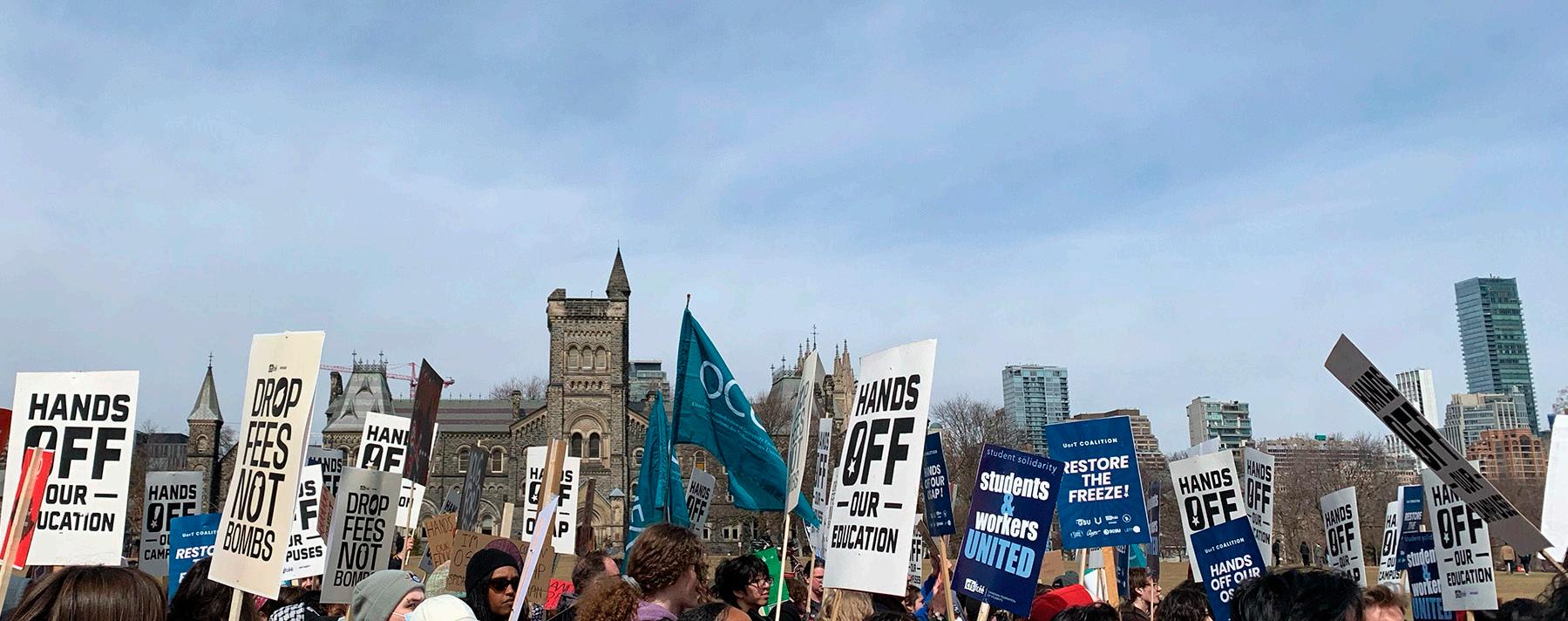
The Canadian Federation of Students Ontario (CFSON) led a rally on March 24 to protest changes to the Ontario Student Assistance Program (OSAP), which will restructure the amount of funding students may receive, decreasing the proportion of grants and increasing the loans. The rally began on U of T’s downtown campus, outside Sidney Smith Hall, and marched through King’s College Circle to Queen’s Park.
Following CFSON’s last Queen’s Park rally earlier this month, Ontario New Democratic Party NDP leader Marit Stiles moved a unanimous consent motion to reverse changes to OSAP on March 23. The motion was defeated after failing to receive full legislative support.
Rally outside Sidney Smith Protesters gathered in front of Sidney Smith Hall at approximately 12:20 pm. Organizers held a banner reading, “U of T STUDENTS SAY HANDS OFF OUR OSAP.” Protesters carried signs with messages, “DROP FEES, NOT BOMBS,” “FREE EDUCATION.”
The rally’s emcees were CFSON Chairperson, Cyrielle Ngeleka, and University of Toronto Students’ Union (UTSU) VP University Affairs, Damola Dina. “[W]e have to recognize that these realities are not felt equally across the board. It’s students from marginalized, working-class and nontraditional backgrounds who are pushed out first, and that is not a coincidence. This is what happens when education is treated as a privilege instead of a right,” said Dina to the crowd.
Local 3902, University
Association
Committee Toronto
and the Student
were
attendance. In their speeches, representatives from these groups criticized Doug Ford’s government for reducing grants under OSAP while increasing reliance on loans, accusing the government of shifting the burden of education costs onto students.
“When students are forced to take on more debt, it changes the classroom. It affects who can afford to be here, who can stay, or who is pushed out,” said Rob Gauthier, president of CUPE Local 3902.
Police presence at Queen’s Park
At 1:15 pm, the crowd began marching from Sidney Smith Hall, through King’s College Circle to Queen’s Park, chanting “education is a right!” The march culminated at Queen’s Park, where the main rally took place in front of the Ontario Legislative Building.
Police stood around the perimeter of the park and in front of the Ontario Legislative Assembly building, behind a row of barricades. At one point,
west
New barricades were installed, decreasing the space available to speakers and protesters. Statues were wrapped and behind barricades. The wrapped statues came after statues on the grounds were vandalized during the last OSAP rally on March 4.
The increased police presence was noticed by protesters who attended both rallies. One protestor said in an interview with The Varsity that they had noticed the change in atmosphere, saying, “They really pushed where they’re letting us stand back quite a bit.”
Another protestor said in an interview with The Varsity that this rally “feels a lot more hostile… knew that there was going to be more people. knew there was going to be more of a presence from the cameras from news stations. But that gives me hope.”
Ahead of the rally on March 24, CFSON made an Instagram post to prepare protesters for “police presence and violence,” providing recommendations on how to stay safe and prepare for interactions with police.
not yet announced, due to a technical error with the ballot
Matthew Molinaro Graduate Bureau Chief
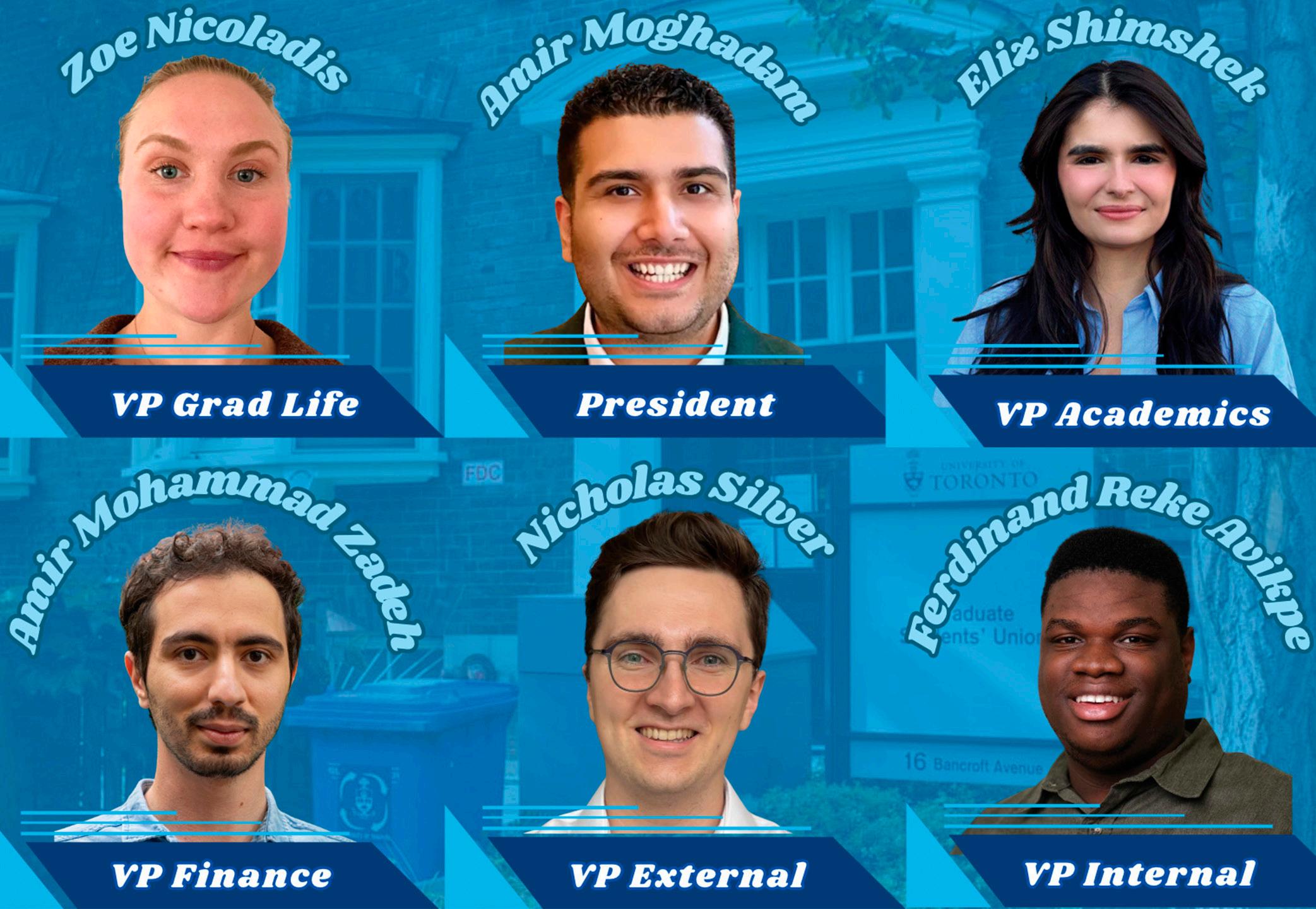
Amir Moghadam has been re-elected to a third term as president of the University of Toronto Graduate Students’ Union (UTGSU). Running unopposed, he won 91.8 per cent of the vote. A total of 995 graduate students voted out of 20,238 eligible, resulting in a turnout of 4.9 per cent — a slight decrease from last year’s 6.3 per cent. All executive positions, except the Vice President (VP) Grad Life position, were uncontested.
Current VP Grad Life Eliz Shimshek was elected VP Academics position, winning 92.4 per cent of the vote. VP External goes to Nicholas Silver, current VP Academics, who was elected with 94.7 per cent and 736 votes — the highest total among candidates. VP Internal will be Ferdinand Reke Avikpe, who received 93.4 per cent of the vote.
In the contested VP Grad Life election, Zoë Nicoladis defeated Grad Forward’s Victoria Mata by 31 votes. Nicoladis received 396 votes, or 52 per cent.
The VP Finance election results have not yet been announced. Due to an administrative error in the SimplyVoting system, the position was omitted from the ballot, requiring a separate election. Voting closed on March 27. In an email to The Varsity, UTGSU Chief
Returning Officer Harmanbeer Sandhu confirmed that the error was solely linked to this ballot and that the union did not incur additional expenses for conducting a runoff
A recap of the UTMSU’s 2025–2026 academic year
Park reflects on the UTMSU’s journey as the 2025–2026 academic year nears its end
election. According to Sandhu, UTGSU coordinated with both SimplyVoting and the Elections & Referenda Committee to conduct the runoff. Sandhu wrote, “The UTGSU regrets the error and apologizes to the Vice-President Finance candidate and to the members for having to conduct a run-off election due to the administrative error.” Directors-wise, for the second year in a row, no candidates came
awareness of ongoing issues across the world, including Congo, Iran, and Sudan.
George, Scarborough, and York student unions
On March 24, an individual reportedly noticed a phone directed at her from the next stall in the firstfloor women’s bathroom in the Wallberg Building. Additional Special Constables are patrolling the area.
Campus Safety sent out an alert at 4:48 pm on March 26 requesting help in identifying the perpetrator. The person of interest has been described as a five feet 10 inches-tall male with medium build and no facial hair. He was wearing clear glasses, a blue baseball cap, a grey or black hoodie, brown pants, and black shoes with a triangular shape marking.
Campus Safety alerted students to request that any witnesses or additional victims contact them at 416-978-2222.
The Wallberg Building on 184 College Street is primarily used by the Chemical Engineering Department and the Materials Science and Engineering Department, and includes most of the undergraduate chemical engineering labs. A similar voyeurism incident of filming in the bathroom occurred earlier this year at the UTSC Bladen Wing building.
Where to find sexual violence and harassment support at U of T A list of safety resources is available at safety. utoronto.ca The tri-campus Sexual Violence Prevention & Support Centre’s website is www.svpscentre. utoronto.ca
Locations:
Individuals can visit the centre’s website for more information, contact details, and hours of operation. Centre staff can be reached by phone at 416-978-2266.
• U of T downtown Toronto campus: Gerstein Library, suite B139
• U of T Mississauga: Davis Building, room 3094G
• U of T Scarborough: Environmental Science and Chemistry Building, EV141
Those who have experienced sexual violence can also call Campus Police to make a report at 416978-2222 (St. George and U of T Scarborough) or 905-569-4333 (U of T Mississauga).
After-hours support is also available at: Women’s College Hospital Sexual Assault and Domestic Violence Care Centre (416-323-6040) Scarborough Grace Sexual Assault Care Centre (416-495-2400) Trillium Hospital Sexual Assault Care Centre (905-848-7100)
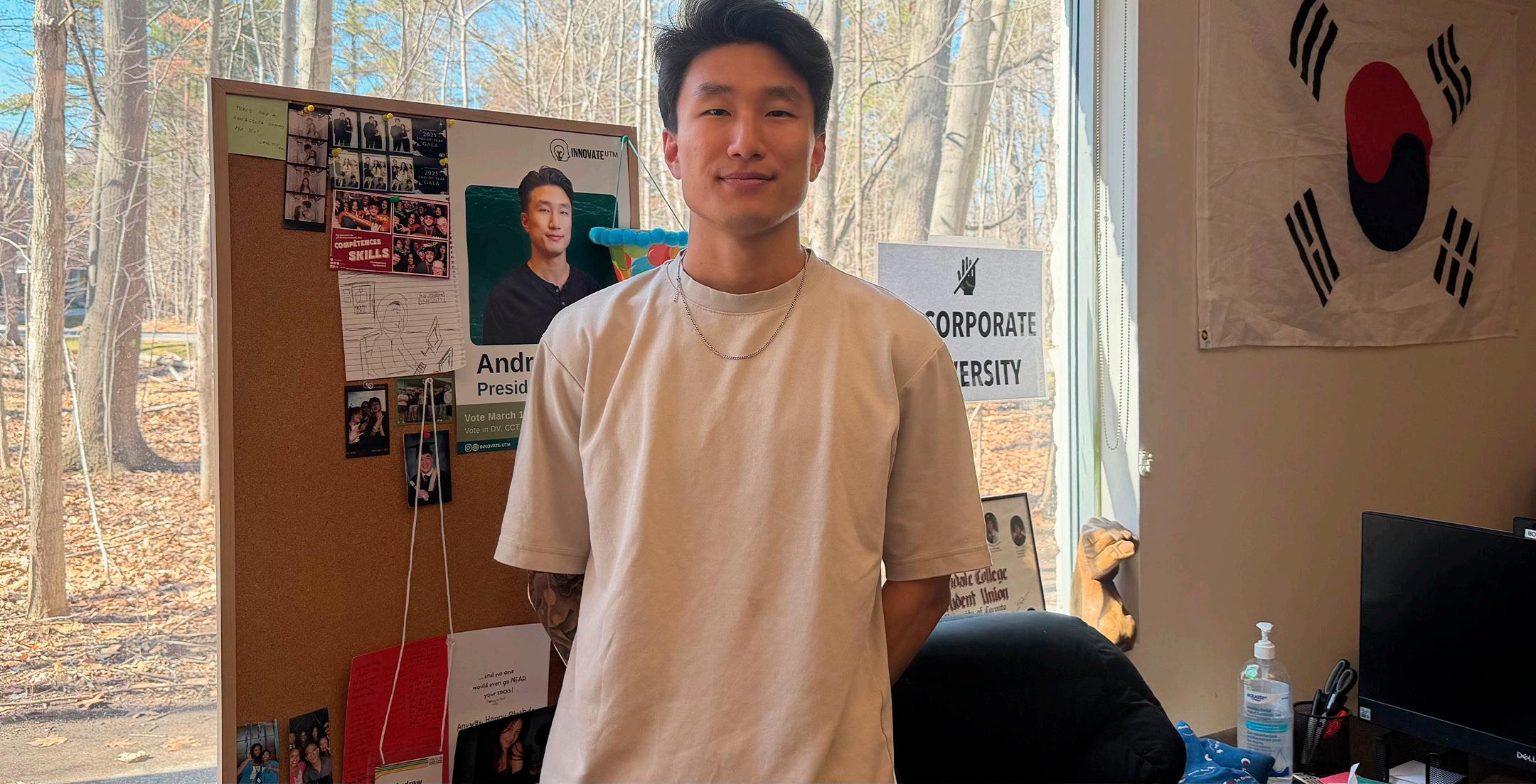
As the 2025–2026 academic year nears its end, The Varsity sat down with current University of Toronto Mississauga Students’ Union (UTMSU) president, Andrew Park, to discuss the union’s accomplishments, ongoing advocacy, and responses to criticisms.
Expectations coming into the presidency Park describes coming into the role of President. “I tried to keep an open mind, take feedback from my team and students to shape my work throughout the year. So it was always both a growing and a learning process for me.”
In response to a question asking how he handled unexpected situations, Park said he has always tried to “expect the unexpected,” adding how interpersonal conflicts are possible in such a large organization. “I always made sure that I kept a clear mind, stay[ed] level headed, and made sure that all the decisions that we make were in the best interest of the students.”
The UTMSU’s 2025–2026 accomplishments Park shared that the union managed to negotiate “no price increase for students, health, and dental plans.”
In September 2025, the UTMSU managed to successfully lobby MiWay to introduce weekend service to Route 110 University Express, which runs from City Centre Transit Terminal to UTM. The union also managed to extend route 48 to UTM. Park added that the UTMSU observed a quadruple-increase in student responses to their transit survey. “Transit relies very heavily on data, so it’s going to be very useful to identify service gaps and strengthen our lobbying for the GTA.”
As part of the union’s food insecurity campaign, they launched Free Dinner Fridays as a pilot program that was hosted three times throughout the academic year, with attendance ranging from 250–300 students.
The food centre was revamped to implement a client choice method “to give students more
agency when accessing the food centre, because when you’re going into these spaces, there might be stigma around how you’re accessing food,” adding that it’s now “more of a grocery shopping experience, instead of just being handed a bag full of stuff.”
Partnering with hospitality and ancillary services, the UTMSU also provided food vouchers to students, allowing them to access a “free meal anywhere on campus.”
Park mentioned that the installation of bidets in the student center was another “big win” this year, saying, “We have a very diverse campus of different cultures and backgrounds. A lot of students use bidets at home or back in their home country, so it was most certainly a need for a lot of students.”
The UTMSU also established a committee to work on Palestine-related initiatives and collaborated with the Palestinian Students and Scholars at Risk network. Other UTMSU events focused on raising
As part of the UTMSU’s menstrual equity campaign, they received feedback on current free menstrual products in the washrooms not suiting student needs, citing the lack of product sizes and discomfort. In response, the union collaborated with Alea — an organic and sustainable period care company — and received its first shipment of reusable heating pads, menstrual cups, and organic products, which Park cited as being more sustainable.
The UTMSU also held two big campaigns to stand against the provincial government, specifically to combat Bill 33 and the more recent OSAP changes and tuition hikes. Park said, “This was something that we had to prioritize… we can’t predict what the provincial government is going to do, so we had to be ready to mobilize students.”
Park expressed that campus life under his presidency has been “on its way back since the pandemic,” citing how they hosted the first soldout pub night in six years, featuring an appearance from Killy and Young M.A.
Advocacies that are still in progress or unfeasible
Park shared that the union held coalition meetings with other unions — including the graduate, St.
— regarding a GTA-wide U-Pass, but “mutually agreed that it’s not feasible at this time.” He added that the other unions currently don’t have a U-Pass, “so that’s kind of their priority, to get their [campus] U-Pass first before they proceed to the next level.” Transit advocacies involving expanding the MiWay route 126 and getting a GO bus at UTM are still a work in progress, with Park mentioning that current VP External Rajas Dhamija will continue working on transit advocacy as he has been reelected for the 2026–2027 academic year. The union also attempted to push for “endof-day half-priced meals,” but the administration had cited strict contract restrictions with UTM’s centralized food provider, Dana Hospitality. Despite this setback, Park stated they “will obviously continue to push for student-centred pricing and waste reduction for food.”
For its lobbying of extending the Second Attempt at Credit (SAC) policy for failed courses, the union presented a comprehensive lobby document to the UTM registrar, with Park saying it “received quite positive responses, and they’ll be holding another tri-campus registrar meeting sometime in April. So it has a very good outlook.”
The UTMSU’s lobbying to extend the deadline for Credit/No Credit (CR/NCR) was “temporarily stalled until certain technical challenges can be
resolved.” Park further elaborated that these technical challenges were “strict timelines that the university has to maintain to ensure that the faculty and staff are able to grade, upload, and update.”
Controversies and criticisms
One of the major controversies surrounding the UTMSU this year was its “Honouring Our Martyrs” commemoration, which received criticisms from a variety of sources, including members of the UTM administration. Principal Alexandra Gillespie mentioned how the decision to hold the event on October 7 proceeded despite the administration raising concerns.
In response to this situation, Park said, “even at the administration level, there were opposing views… some people were against it. Others… did recognize our autonomy and what we do as a union, the stances that we take against social issues, [and] our right to freedom of speech.”
He added that “a lot of the attention has been on the negatives and the backlash,” but he “feels like we should also hear from the students who [were] at the event, who can speak [on] what the backlash was saying was not true. This was a
peaceful gathering meant for students to build a community and to grieve in peace.”
Park mentioned that the St. George and Scarborough campuses also held similar commemorations on the same day, but did not receive as much backlash. He cited the only difference being the name of the event, with the other two campuses naming it “Vigil For Our Martyrs.” The reason for the UTMSU not using the term “vigil” was that the event “was in collaboration with the Muslim Students Association, and they mentioned that ‘vigil’ has Christian connotations.”
Another conflict involved the Sexual Education Center (SEC) and its concerns with being moved to a smaller room on the second floor of the student center. This change occurred in response to the UTMSU hosting its new de-stressor room in the SEC’s previous location.
Park was asked whether the UTMSU made any efforts to have discussions with the SEC regarding this situation, to which he responded, “We’re always open to hearing what the concerns are. think some of our team members did have discussions… we did provide them the equity office for one-on-one conversations, because that was a concern.” He further added, “We’re always looking
to work together, it’s not us-against-them situation. So to them, to anyone, would encourage, just come to us and speak with us, because we’re always listening.”
Advice for his successors and what the future holds When asked what advice he would give his successor, Park said, “To the president, would say, stay focused, be present. I think a lot of the work isn’t just in the back end, but it’s also about being physically here, being ready to talk to students when they come to the Student Centre, looking for you, asking for you, asking for advice, engaging with them, keeping an open mind to new ideas.”
“It’s one of the most rewarding experiences that you’ll have. So just be ready to learn. Stay engaged and keep an open mind,” Park concluded.
What’s next for Andrew Park? He had this to say: “I think I’m gonna take a year off just to unwind. So do have plans to travel, visit my family in Korea, who haven’t seen in a couple of years, because I’ve been so busy. Hopefully, new doors open up for me after this.”
POSt is now an option
Change aligns UTM’s CS entry requirements with UTSG and UTSC admissions
Prospective students now have the option to apply to UTM’s Computer Science (CS) Specialist program directly from high school. They must meet minimum grade requirements and complete a supplementary application detailing “experiences that are not reflected in [their] transcript.” This Year 1 Computer Science (CMP1) “direct admission” pathway will be in addition to the current “competitive admissions.” Currently, students can only enter the CS program by enrolling in the Program of Study (POSt) upon successful completion of 4.0 credits, which is usually at the end of their first year.
Two pathways
For the past six years, UTSG has used an admissions process that allows students to either apply directly from high school or enter through POSt by the end of their first year. UTSC, by contrast, only accepts students directly from high school. In an email to The Varsity , Department of Mathematical and Computational Sciences Assistant Professor Rutwa Engineer said the decision to offer two pathways for UTM students had been in the works for “a few years.” However, it first needed to go through “appropriate university channels for approval” before being reflected in the academic calendar.
With this new pathway, two new CS courses will also be introduced: CSC110Y5 — Foundations of Computer Science 1 and CSC111H5 — Foundations of Computer Science 2. “The intention behind developing these two courses is that we assume students in our [direct admissions pathway] might have more prior programming experience than those in the competitive admissions pathway,” Engineer said, adding that “we wanted our computer science curriculum to reflect that.” Engineer, whose research explores “studentcentered learning design,” added that these courses will emphasize concepts relevant to mathematical reasoning and analysis.
While Engineer acknowledges that “the competitive admissions pathway is suboptimal,” they noted that it remains in place, “allow[ing] students who may recognize their interest in pursuing computer science after their first year of study (or later) to be able to apply.” Core CS courses — such as CSC108H5 and CSC148H5 — will still be offered alongside the new CSC110Y5 and CSC111H5 offerings.
This decision, while meant to align UTM with UTSG, is also an effort to improve students’ experience in the program. “The two pathways converge by the time students take our second-year computer science courses. So, these changes to our computer science program are a positive development for our long-term goals, as they will alleviate some
stress for students and improve their sense of belonging in computer science,” wrote Engineer.
What do UTM CS students think?
The Varsity asked current UTM CS students what they think of these changes. Third-year CS specialist Omar Zaheer wrote, “In some ways, it’s definitely a less stressful direction because CS POSt used to have a reputation for being really rough with entrance requirements. With the new changes, students admitted into the CMP1 stream won’t have to worry about [the uncertainties of securing a spot in the program].”
At the same time, Zaheer noted that “the obvious drawback is that since the previous admissions system let a lot more people in tha[n] CMP1 probably will, getting into UTM CS is now a little more locked behind high school academic performance.”
In a message to The Varsity, third-year CS specialist Sanchit Manchanda wrote that they believe that grade inflation across Ontario high schools makes these grades “a poor choice to determine a student[’s] admission into a program.”
“[High school] grades are way too noisy of an indicator of a student[’s] ability to succeed in a university program and this issue is intensified in the most competitive programs [such as in U of T or Waterloo University],”
Machanda continued, adding, “your 1st year performance… is a much stronger and fair[er] indicator [of your ability to succeed].”
TCM fights back against fee hike
— Trinity College
Devin Botar, Varsity Staff
Trinity College announced a major increase to residence fees last week.
While Toronto rent prices are at the lowest average in four years, the cost of single rooms at Trinity proper and St. Hilda’s will go up from $14,241 to $16,500 (or $2,000 a month) for 2026–2027, with rates for doubles and triples seeing similar increases. At the new Lawson Centre for Sustainability, a standard single room will cost $20,400. The minimum price of Trinity’s mandatory residence meal plan has also been increased by over $1,000.
In a message from Provost Nicholas Terpstra and the included FAQ, the increases were made due to “rising operational expenses, higher costs associated with delivering services and programming, and to support the long-term financial sustainability of the College.” Terpstra added that the rates were “mandated by the College’s governance bodies in fulfillment of their fiduciary responsibility for the financial health of the College.”
At a session of the Trinity College Meeting (TCM) on March 24, students voted unanimously to demand that the administration show why it opted for a fee increase over possible alternatives, reveal where the funds will go, and provide a detailed plan for how the college “intends to reach a state of financial viability.”
Open hostility towards the administration has been rare at the TCM since March of last year, when Provost Nicholas Terpstra promised to reverse many of the college’s restrictions against student traditions.
Two explosions heard after propane tanks rupture on roof — Richmond Street
Ella MacCormack, News Editor
On the evening of March 27, loud explosions and black smoke were seen coming from a commercial building under construction on Richmond Street. The fire’s source was ruptured propane tanks on the roof. Toronto Fire has said the fire did not spread, and no injuries have been reported.
Avi Lewis chosen as next NDP leader — Ottawa
Celesta Maniatogianni, Associate News Editor
Activist and documentary filmmaker Avi Lewis has been named the next leader of the federal New Democratic Party (NDP). Lewis received 56 per cent of the votes and won on the first ballot, defeating four other party candidates. His policy goals are centred around promoting wealth equality, affordable housing, transitioning towards
with
Callie Zhang and Raina Proulx-Sanyal Senior Copy Editor and Deputy Senior Copy Editor
To anyone who reads this, Hello. We are the Senior Copy Editor and Deputy Senior Copy Editor of The Varsity, Callie and Raina. You may not know what we do. We are the backbone of the newspaper. We spellcheck, fact-check, and do all the other checks that ensure you receive accurate information. There is not a single story that doesn’t cross our desk.
Anyways, we will now seize one of the rare chances of escaping the copy office to speak into the void (even though we have both written articles before, try to find them!). Volume 146 has certainly been a year. Thank you to everyone who has been part of it, including all the copy editors, section editors, management, and writers.
Specifically, thank you to our GOAT associates Ben Chapman, Juliet Pieters, and Cate Woodhead. Thank you to Ben and Juliet, who have been pillars of the copy community throughout the year, for never failing to show up and ensuring we publish quality articles. Thank you to Cate for stepping up at the end of the year and doing the impossible task of learning almost all of DSCE’s responsibilities in less than a month. Additional thanks to our leads, Sarah Pan, Omayma Lateef, and Roya Alisultanova. (No) Thanks (jk) to our defectors: Zaneb Asad, who became an Opinion Associate, and Hilary Cheung, who became a News Associate, but still made sure to come back every Saturday and Sunday, respectively, to help with copy. Thank you for locking in. We have formed a great, tight-knit community that we (Callie will, Raina is sticking around) will greatly miss. Your honorariums will come in April.
Now we will utilize this precious space as an ad. If you, Dear Reader (shoutout Juliet, see you in Arts), would also like to be part of a great copy community (and maybe also

receive an honorarium), please consider joining copy! We promise we don’t bite. If you are a grammar police and like free snacks, you should also join. Copy editing is a great way to contribute to the university community by supporting its largest student paper and keeping up with events on all three U of T campuses. To do so, you can email copy@thevarsity.ca or deputysce@thevarsity.ca for more information,
or fill out the volunteer form at the top of The Varsity’s website.
Now to take one last big shit on AI. Fuck you. And if you are a ‘writer’ who is considering submitting a piece to one of our dear section editors with AI, why? You don’t have to write. It’s on a purely volunteer basis. No one is asking for that computer-generated slop. If it’s not your own voice, we don’t want it! We want to publish the real thoughts and opinions of students.
Letter from the Editor: Making more of my hobby
Thank you for showing me the power of art
Simona Agostino Illustration Editor
Tristan Tzara once wrote that art ought to be a private affair, and that “intelligible” work was the product of a journalist. He meant this as an insult, of course. If there’s one thing I’ve learned about Tzara, it’s that he held disdain for anything he associated with the bourgeoisie, journalism included.
It’s corny, but true: I’ve been drawing for as long as I’ve been able to hold a pencil, and for just as long I’ve insisted that drawing would only ever be a hobby. suppose in some ways, thought a lot like Tzara did — that making art for others, having it serve a purpose beyond myself, would taint the pure enjoyment and catharsis got out of making it.
So it feels a little ironic that I’ve spent the past year illustrating for, well, journalists. But what I can say now with certainty, over 200 illustrations later, is that Tzara was wrong about journalism.
My time at The Varsity this year has been unimaginably special, thanks in no small part to the incredibly dedicated and thoughtful people on Masthead who I’ve had the immense privilege of working with. A special thanks to the Visuals team — Chloe, Erika, Brennan, Aksaamai — it’s been a joy to learn from and work alongside such skilled and passionate creatives.
I’d be remiss not to thank my wonderful Associate Illustration Editors, Emma and Dowon, for their diligence and care. wouldn’t have been able to do my job as effectively without their support.
And to everyone who contributed illustrations to Volume 146: thank you. You helped make
Stop making our job harder, constantly having to catch AI! We will dig through your editing history, minute by minute, and expose you. In all seriousness (not that AI isn’t serious), thank you for an eventful year. We look forward to Volume 147 with Raina and Cate!
See you next year, — Callie
Senior Copy Editor, and Raina Proulx-Sanyal, Deputy Senior Copy Editor
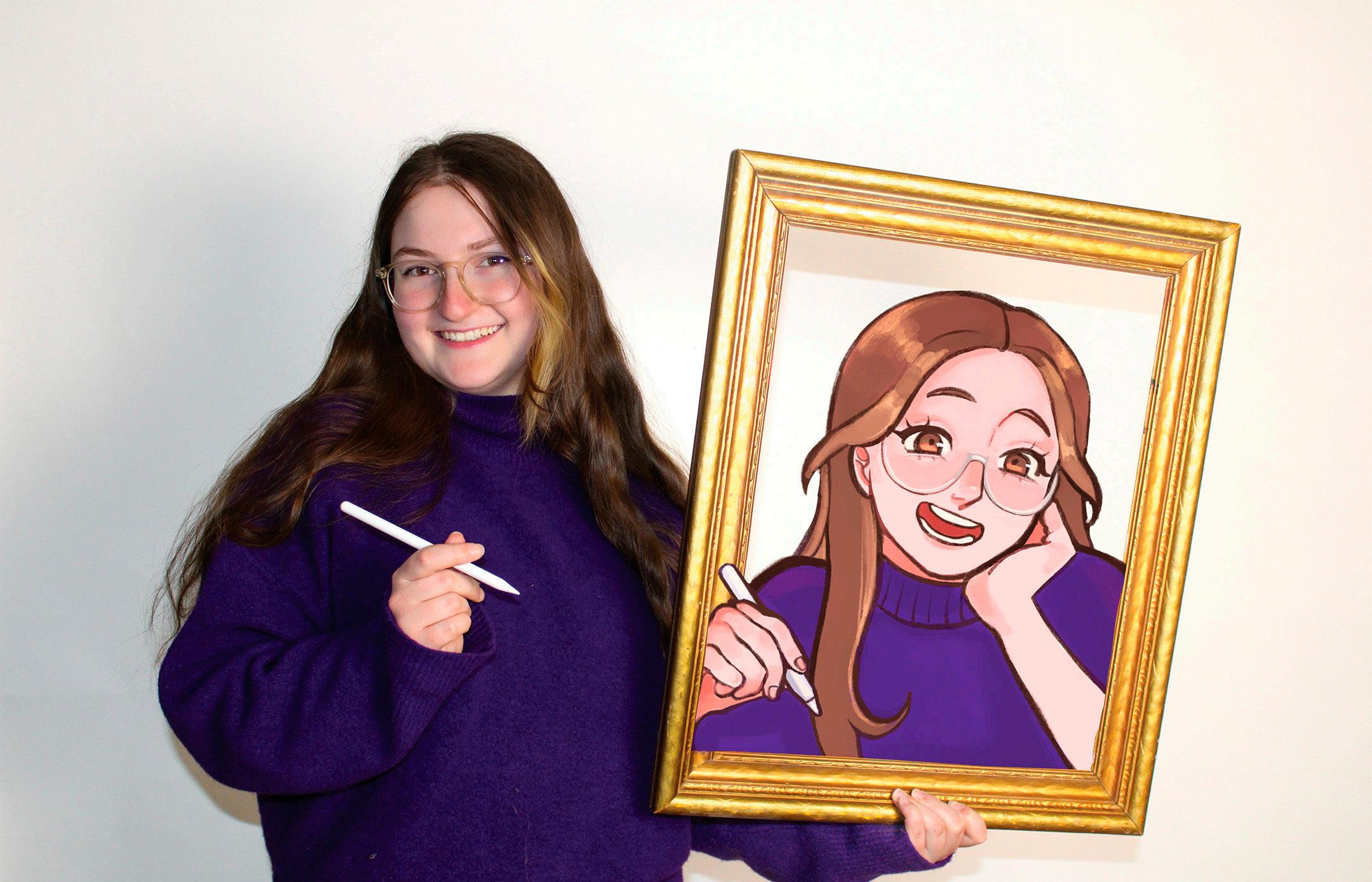
reflection on creativity as resistance, and the importance of creative spaces
Thank you to all the science ranters and enthusiasts
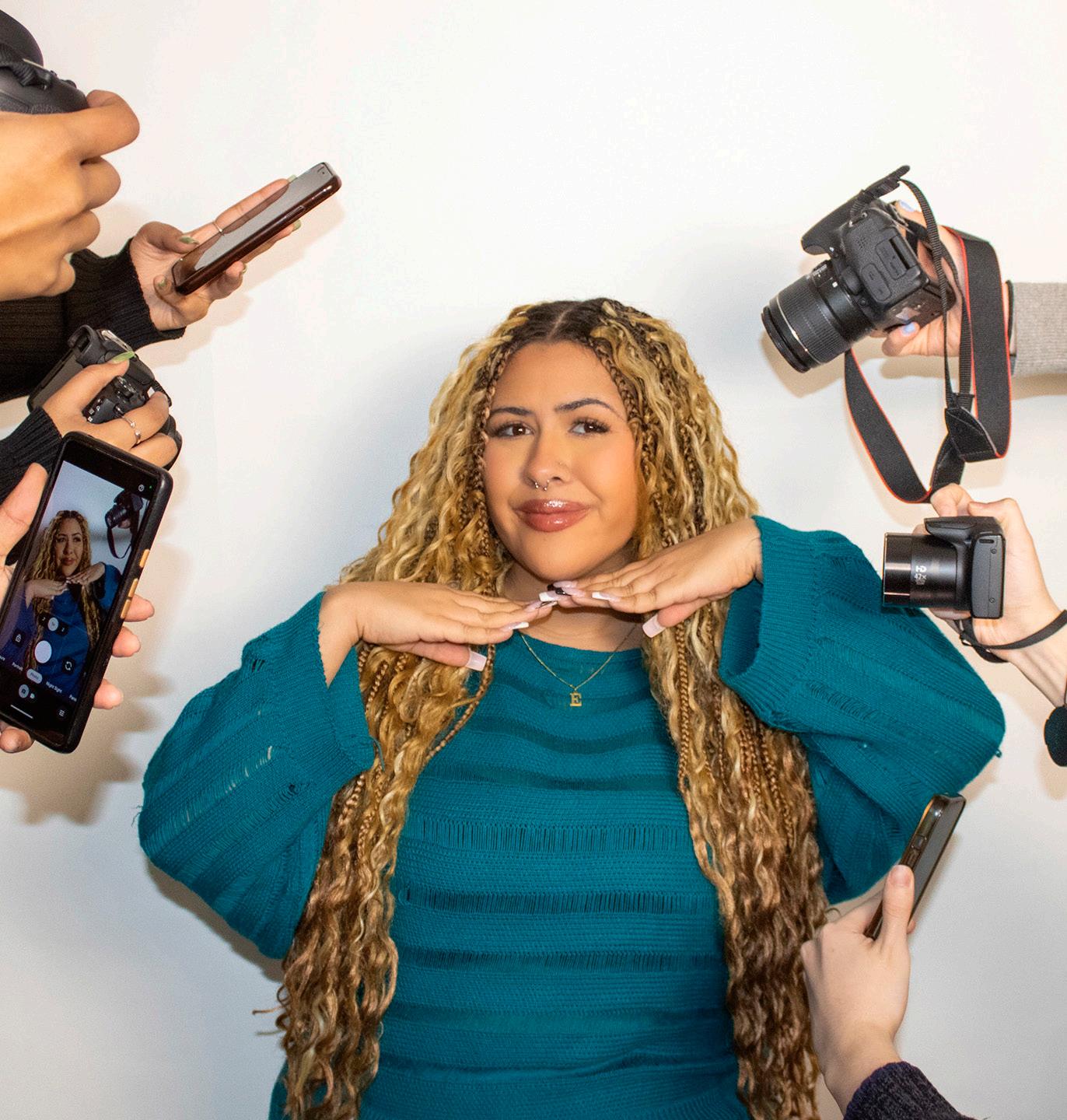
Erika Ozols
Photo Editor
Trying to find the right way to write this has proven to be extremely difficult. How do you capture a community, a whole year, and a role that is so important to you in just three hundred words? And how do not make it corny? It feels impossible. However, do know this: joining The Varsity has been one of the most rewarding and chaotic experiences of my time at U of T. When found this role, was struggling to find an outlet that would allow me to create without my work being taken advantage of. This year, I’ve had many opportunities to physically feel the weight of creating in dark times. Existing in a world that can feel cold, uncertain, and unwelcoming, this did not feel abstract. This is especially true for Black artists like myself, trying to find safe creative circles and navigate dominant systems and institutions.
And yet, we continue to create. We continue to pick up pens, paintbrushes, microphones, and cameras, and capture moments of joy, pain, resilience, and grief. There is something deeply profound in the refusal to be quiet, even when the world finds new ways to censor you.
For me, that power is inseparable from my identity. Being Black in creative spaces has always meant navigating exposure and invisibility at the same time. A constant
from the Editor: Suddenly, three years
Dear readers of The Varsity, I hope this message finds you well! am writing my final letter for a few selfish reasons, the first being to thank you for joining me here. know it isn’t always easy to check out our latest issue online, or at Robarts downtown, or by the doors of the Science Wing at UTSC, but I am glad you found your way here. Please, make yourself at home.
One Saturday morning, showed up at The Varsity’s office at 21 Sussex too early for production, and paced the sidewalk across the street to kill time. Looking up at the old bricks and wrought iron railings of the building, you could hardly imagine the factory it becomes every weekend. In a year, hundreds of students enter these doors to copy-edit, design, proofread, take photos, illustrate, and sometimes, they’re just here for the free snacks.
signed up to write for The Varsity back in 2023, knowing very little about the paper and even less about student journalism. I’d like to thank James for encouraging me to toss my hat in the ring and apply to be an Associate Science Editor. Salma, the Volume 144 Science Editor, decided to take me on after working through exactly one article with me over the summer. have no way of knowing what she saw in me, but was lucky she did. Her insight and care with my first piece at The Varsity was the greatest introduction to the paper could have ever asked for. Salma gave me the opportunity to be a part of this beautiful group of students, and for that, will always be grateful.
The more time spent within the asbestoslaced walls of our little office, the more bewitched became with The Varsity. My years of neuroscience and psychology courses tell me that it’s extremely unlikely that could develop an addiction to a physical space, but it certainly felt like never wanted to leave. have my lovely staff to thank for this.
Thank you to Chloe for indulging my amateur design ideas, and thank you to Sophie for being
battle between being heard, but never fully understood, or seen but never embraced. It has meant overthinking whether there is room for my perspective, or my eye. This role and this team have allowed me to take up space and prove our voices belong in these categories: space to experiment, to fail, to grow, and to support other artists in finding their voice and trusting it. In a time where creativity and originality feel rare, creative spaces like this are necessary for growth. It’s necessary for us to move away from the artificial and stand on the fact that we cannot be replaced.
To everyone who contributed to photos this year, who trusted me with visuals for your article, who stood for hours on end in front of a camera for me, thank you. You made this feel like so much more than a publication — you made it a canvas for me to keep painting, even when the colours felt dull.
As the year draws to a close, continually return to a simple idea: be the change you want to see. The arts teach us how to think critically through alternate lenses, challenge injustice, and build community with each other. Keep creating, keep growing, and keep taking up all the space you want. have faith in what all of you will continue to create and how it will shape our world.
In solidarity, — Erika Ozols, Photo Editor, Volume CXLVI
Ridhi Balani Science Editor
Thank you for reading and writing for the science section! After a long but lovely year, this is my last bit of writing for The Varsity. first wrote for The Varsity when Barbenheimer happened. Newly married to the physics specialist program, that era sent me into an unreasonably
deep dive into the specifics of the science and history of nuclear physics. The science editor, at the time, Salma, let me write a
my much-needed voice of reason on long production days. Thank you to Jake for being our human AI detector and consistent good vibes each Sunday, and thank you to Ozair for handling the intricacies of external relations. I’d like to give a special thank you to Callie and Raina for stepping up this year for our Copy team; we could not function without you. Thank you to Sofia, for bringing new voices and perspectives of Arts & Culture to the paper, and for your ever-present honesty. Thank you to Ahmed for bearing with my rounds and rounds of edits, and thank you for treating us all with your bright personality each day. Thank you to Caroline for your consistency in covering Sports from an athlete’s eyes, and thank you to Medha for a pitch-perfect year of Business & Labour. Thank you to Shontia for coordinating our gorgeous Magazines (look out for GAZE on stands soon), and thank you to Ridhi for trading sleep for our scientific enlightenment.
To Ella, Junia, Emma, Arunveer, Matthew, and Ashley, thank you for your attention to detail and commitment to campus news.
Thank you to Aksaamai and Brennan for being amazing listeners and enablers while working your Design magic, and thank you to everyone who helped me fill out my TOROAST stamp cards. To Erika, you joined us partway through the year and brought striking colour to our pages. To Simona, thank you for sharing your art, humour, and stories with us.
Thank you to Emily and PF for keeping our dinosaur of a website in motion, and for your skilled work bringing our magazines to the internet. A special thanks to Aryaman and our Board for all your support navigating this year.
While it has been a rewarding journey, we faced our fair share of difficult decisions this year, specifically involving AI-generated articles. As a life sciences student, it would be remiss of me to spurn AI in its entirety and ignore the valuable work that so many scientists are pursuing. This does not mean that AI has a place in every workspace. have seen an unfortunate increase in AIgenerated article submissions in my time here, and my position on this remains unchanged:
We should not be publishing AI-generated content as if a student wrote it.
This year, am amending The Varsity ’s Operating Policy to allow a maximum of two submissions using AI before a student may not contribute for the remainder of the volume. In each case, section editors and management will decide whether the article can be rewritten by the author in their own words, or if it will be reassigned or cancelled. The Varsity is an
outlet for student voices, and as such, cannot endorse using AI to share what should be your thoughts, your words, and your experiences with the wider community. love this paper, and am looking forward to seeing its future. Junia, our Deputy News Editor, will be taking over next year as EIC. If have learned anything from working with her on this volume, it is that her passion for journalistic integrity is second to none. Good luck — I’ll be cheering you on from the Varsity graveyard.
If you’ve made it this far into my heartfelt goodbye, I apologize! have never been one for short farewells, but if you take one thing away from this message, let it be this: Always support the student voice, always be kind, and always, always, always, stay curious.
— Medha Surajpal, Editor-in-Chief, Volume CXLVI

Around this time last year, the previous editor-inchief, Eleanor, proposed the idea of me joining The Varsity as News Editor. When we met at the Arbor Room, told her, there aren’t many worlds where I’d say no. But before moving forward, let me tell you all the reasons why would not be a good news editor, and you can decide if you still want to hire me after.
1. “I have very little news experience. Okay, that’s an over exaggeration — have no news experience.”
was the editor-in-chief and a campus affairs “UC” section editor at The UC Gargoyle, so I had experience in writing, editing, and managing. wrote about the UC student government’s financial troubles, but through articles with headlines like “the decay of the uclit,” “wtf happened to diabolos,” and “fucked by fireball.”
did not pretend that my writing was ‘newswriting.’ It was opinionated, vulgar, lowercase, and there wasn’t an inverted pyramid to be found. Even our “about us” section reads, “the gargoyle is not a ‘newspaper’ and we do not publish the ‘news.’ ” had a lot of opinions and editorial autonomy — two things The Varsity news editor is expressly not allowed to have.
did have the breathless intensity of a news writer. The format was off, way off, but the curiosity was there. If anything, pivoting to news meant didn’t have to come up with a pithy ending anymore.
2. “I disagree with a lot of The Varsity’s policies, including the opinion-news divide.”
The Gargoyle’s “about us” reads, “we do not give print space to anyone who legitimizes the status quo and we do not feign neutrality on what matters to our community.” still admire that clarity. I’ve also come to understand what The Varsity is trying to do, even when find it frustrating. The policies that make my life difficult each week don’t exist because The Varsity wants to
subject. To me, that drive to speak about science is actually equally
it. As the behemoth of
T is, think it is
to
of
or
to make an
in an
in
way to the
No
in science should feel barricaded off or ‘too difficult to understand’ due to its language and a lack of effort in communication about it. Even people within the scientific discipline also rely on good science communication to both learn and appreciate what they are learning — we rely on enthusiastic nerds (let the sun never set on 3blue1brown).
I like to think that the science section of The Varsity is a ‘nerd safe space’ specifically for those who want to express their enthusiasm for the topics they’ve encountered, or even researched, in a way that accessibly communicates why that enthusiasm is warranted.
To all my contributors and writers this year, thank you so much for sharing your enthusiasm for science. It is truly the closest thing to magic for me; people who are actually willing to talk about the specifics of it outside of abstract presentations are carrying that magic on their backs. Also, a PSA to all the
ruining
who
of
I want to also take
to
my wonderful and
associates, Lauren and Lucia, for all their
this semester. You guys carried so much, and it was really lovely getting to know you. am very excited to see how the section grows next year. So, with that, thank you everyone, for creating this wonderful space where we can be nerds together and for forcing everyone to be excited about science.

break my spirits. Accuracy and accountability slow down the process by design.
There is an obscene number of people who edit articles before going to print. didn’t fully appreciate them until got my first angry email about my coverage. didn’t need to just have faith in my own reporting; could trust the layers and layers of verification surrounding me. could be annoyed filling out a source sheet for every small fact, only to realize misquoted a source while writing. There are many Varsity policies still disagree with, though, which is probably healthy. If anything, that tension is what drives the paper forward.
3. “I’m not the biggest fan of The Varsity, and won’t become one just because work there.”
… Oh god, I’ve become a corporate shill. Whether like it or not, I’ve fallen in love with what
March 31, 2026
thevarsity.ca/category/arts-culture arts@thevarsity.ca
Sofia Moniz Arts & Culture Editor
Hello friends! This week’s issue marks the end of my time as Arts & Culture (A&C) editor. I am emerging from 24 weeks of production with a serious case of email fatigue, a Galleria addiction, a slight jadedness towards Toronto’s arts writing, and possible asbestos poisoning (thanks 21 Sussex!).
To start this letter, I’d like to thank my associates, Bushra and Mackenzie, for doing my evil bidding. Thank you to my columnists for your initiative and the unique perspectives you brought to the section this year. I’d especially like to thank Alyssa Scocco, campus arts columnist; and Josephine Graham, our inaugural Black arts columnist.
My favourite part of this job has been getting to talk to artists in the U of T community. Thank you to everyone who has shared their art with me this year, especially Sarah Edo, Helen Chazan, and Ineza Rugari. And, of course, to the writers who made this all possible — thank you for trusting me with your stories.
Another highlight of the year, and a shining moment of Real Journalism for A&C, was in January, when we scooped The Globe with
Bushra’s article on the AGO’s censorship of Nan Goldin.
Now for a list of shoutouts, in no particular order. Thank you to copy (shameless ad, I started at The Varsity as a copy editor and you can too!): to Callie and Raina for teaching me how long an em dash should be and the difference between “premier” and “premiere,” and to Juliet and Zaneb for almost singlehandedly copy editing my section every week (no one fact check me on that, my heart says it’s true).
I’d be remiss not to shout out the ChatGPT-ers and propagandists, who have made me a smarter, more thorough (and maybe somewhat paranoid) editor. You know whso you are. And I know who most of you are, too! I have a list of names prepared for my successor, so no funny business once I’m gone. I mean it!
I’d also like to thank whoever puked on the first-floor stairs of 21 Sussex the other week. My therapist and I have discussed you at length (not a joke, #emetophobia). Looking upwards, shoutout stairs to the third floor, which I could always count on to not be covered in puke (and to lead me to the beautiful third floor people: design and visuals, I love you <3).
Shoutout to Sophie for regularly tearing my articles to shreds and for (almost) being name twins. More importantly, for writing possibly the only actually freaky article of our Love and Sex issue. Special thanks to my Varsity moms, Medha and Chloe, for sometimes buying me pink Gatorade. And now for the sappy love letter portion of this letter from the editor! Two people have helped me stay as sane as I could’ve hoped for during my time as A&C editor.
The first sappy message goes to Ahmed, our opinion editor and my day one Varsity bestie. Thank you for being endlessly supportive of everything I do (very dangerous), and for being the ‘life of the party’ to my ‘sit on the couch sullen and sober.’ Ahmed is a beautiful person and a remarkably earnest writer. I am a more thoughtful person and a more honest writer for knowing him. He is also a karaoke goddess and has really good hair.
At the risk of this letter becoming the Bushra show, I do have to thank her individually: for being the go-getter of the century, for being passionate and full of opinions, and for always bailing me out when I needed it this year. Bushra’s writing is a breath of fresh air in a city drowning in lukewarm

arts writing. All that to say, I feel super smart for hiring her. Go us!
I told Bushra a couple of weeks ago that a year feels like the exact upper limit for how much time I can spend as a section editor. As my time as A&C editor comes to a close, I feel more than ready to pass the job on. Exciting things are coming to The Varsity’s A&C section, so you all better WATCH OUT!!
Bye for now!
Celebrating 10 years of Skule Choir
“Skule Choir just feels like a nice community to be in”
Sofia Moniz Arts & Culture Editor
When Skule Choir invited me to attend their rehearsal, I decided it was a good enough reason to brave an engineering building for the first time. After taking a few wrong turns, I found myself in a sweltering and kind of damp ‘music room’ in the basement of Myhal. I took a seat at the back of the room and watched assistant conductor Lauren Levorson-Wong wave her arms around — both while conducting, and while passionately urging the choir to “lock in.”
The rehearsal was lighthearted and collaborative. Multiple conductors rotated in and out, and the choir often discussed the music as a group while sharing nerdy jokes. Even though I was playing the part of a Very Serious Journalist, and quite possibly sweating through my t-shirt, I have to admit, I enjoyed sitting in.
After the rehearsal, I spoke with some lovely members of the Skule Choir about the group’s history, their goals, and their 10th anniversary concert. I learned a lot, including what ‘Skule’
means: it denotes U of T’s engineering societyaffiliated clubs. The name comes from the word “school,” and emerged from a joke that engineers can’t spell. This was one of several inside jokes that were graciously explained to me that night.
Building relationships
Levorson-Wong explained in her interview that Skule Choir is one of several Skule music groups that had previously existed in the 1980s, but became defunct. In 2015, a group of engineering students who wanted “a choir that wasn’t exclusively sacred music or exclusively a capella glee music, something that reflected their high school choir experience more accurately,” re-established the ensemble with Levorson-Wong as the conductor.
Over the past 10 years of leadership and collaboration, Levorson-Wong said, “Our goal has been to try and make good music education accessible to as many people as possible, allowing engineers and other university students that aren’t part of the music faculty… the opportunity to participate in that kind of choral singing tradition.”
The choir also gives Faculty of Music students leadership opportunities. Levorson-Wong was the conductor of Skule Choir from 2016 until last year, and has now passed on the position to Amanda Yu, a fourth-year music education student, because “inheritance is a wonderful thing, and retiring is also lovely.”
One of Skule Choir’s aims is to build relationships outside of the Faculty of Engineering. Levorson-Wong graduated from the Faculty of Music in 2024, which, like engineering, is also a professional faculty. She said that as a music student, she had felt limited to her faculty. Skule offers a variety of opportunities for non-engineering and engineering students to “explore what being a human is.”
What I appreciated about speaking with Levorson-Wong was their passion for sharing the joy of music — as opposed to focusing on the musical outcome itself — and the collaborative approach they brought to the role of conductor. In an environment where the aim is to experience music together, joy is what is most important.
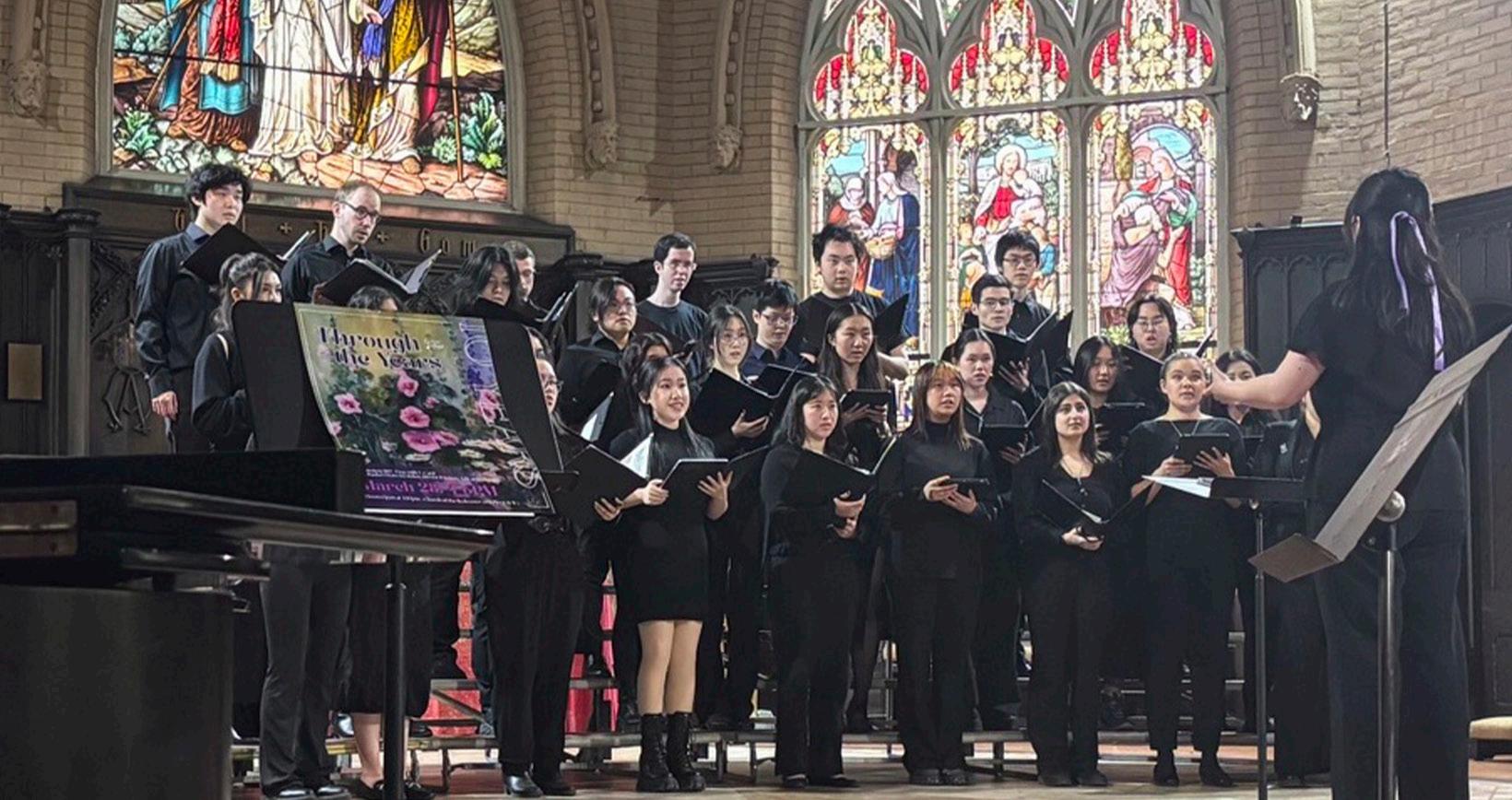
Alexia Piunno, a mechanical engineering student and marketing & communications manager for Skule Choir, recalled their experience as a new member of the choir.
“I played the piano for a little bit when I was a kid, so I knew how to read sheet music,” Piunno said. “I don’t know how to look at it and be like, ‘These are notes, and that’s what they sound like.’ ” Despite feeling unfamiliar with choral singing, Piunno recalls that they felt “surprisingly comfortable,” even at the choir’s first rehearsal.
Speaking on accessibility in music education, Levorson-Wong said, “as someone with a disability who’s in music education, having accessible points in choral settings and in group music settings has always been really important.”
Her priority with Skule Choir is to “let anybody, regardless of their background — whether they’ve sung before, whether they’ve been in a choir before, whether they can read sheet music,” take part. Her aim is “learning and community building over having a specific kind of tone quality at the end of the day.”
Skule Choir’s winter concert, Through the Years, took place on March 28 and celebrated the choir’s 10th anniversary since its reemergence. The concert featured songs the choir has sung in each year of the past decade, and invited alumni to join in on the songs that they knew. Alex Wang, a former Skule Choir marketing executive, felt personally invested in keeping the choir going. Wang flew in from Vancouver to sing in this concert. Celebrating 10 years of the choir is meaningful to them “because there have been trials and tribulations trying to keep this whole thing afloat.”
“What’s unique about Skule Choir, as someone who’s been in other choirs before, is that the environment is really nice,” Wang continued. “We’re very open to people who are new to music. I’ve been in ensembles where it’s kind of serious, and there’s less ability to be open or welcoming. But Skule Choir just feels like a nice community to be in.”
Skule Choir is open to all members of the community — not only engineering students. You can learn more about getting involved on their website or @skulechoir on Instagram.
Azim Boblai Associate Arts & Culture Editor
On a dark, stormy evening on March 18, readers and writers from across the GTA gathered at U of T’s Emmanuel College for Poets, Playwrights, Editors, Essayists, and Novelists (PEN) Canada’s Voices of Freedom reading. The event, which was the 11th edition of a reading series established in June 2022, platforms the work of its Writers in Exile community.
Writers in Exile is an advocacy program organized by PEN Canada, the Canadian chapter of an international nonprofit organization that advocates for persecuted writers and journalists facing censorship around the world. Writers in Exile provides refugee authors with opportunities to develop their professional skills through workshops, residencies, and public readings. They also assist with refugee claims, provide professional documentation to help start their careers in Canada, and help writers raise public awareness about their exile and experiences.
Brendan de Caires, executive director at PEN Canada, said to The Varsity in an interview that in the last year, the organization chose to branch out and host their events in more public places like U of T. Their goal was to bring in newer and wider audiences for their authors, because “too often they’re reading to the same room of people.” de Caires was delighted that he couldn’t recognize three quarters of the people who had gathered that night for the reading.
The readers Theresa Johnson, director of operations for the organization, started off the event by introducing the audience to the symbolic empty chair. The Empty Chair is a tradition of PEN centres
worldwide. At all public events and literary festivals, PEN Canada keeps an empty chair that represents a writer or journalist who is currently imprisoned for peaceful dissent or resisting censorship.
This event’s empty chair belonged to María Cristina Garrido Rodríguez, an award-winning Cuban poet who is currently serving a seven-year prison sentence for participating in Cuba’s July 11 protests in 2021 — a mass demonstration demanding improved living conditions in the country.
Jinoos Taghizadeh, a multidisciplinary Iranian artist, writer, and activist, was the reading’s MC. She brought her unique insight into conversations with the night’s Farsi literary panellists from Iran and Afghanistan.
The first reader of the night was Rukhshana Ahmadi, an Afghan-Canadian writer, journalist, and education activist, who is currently finishing her journalism degree at Toronto Metropolitan University (TMU). Ahmadi read a haunting stream-of-consciousness short story titled The Forgotten Roof, about the banality of student life on the TMU campus. While education on campuses like TMU appears ordinary, it is a luxury denied to girls in Afghanistan, who are subjected to a regime of gender apartheid because of policies from the Taliban-led government.
The next reader was Ali Sobati, an Iranian poet, translator, and literary activist. Sobati read an essay titled “In a Time of Drought” that examined the desolate state of the literary practice in an age of mass distraction and destruction. Invoking the words of philosophers like Guy Debord, Jean Baudrillard, and Cornel West, Sobati deftly interrogated the idea and purpose of writing in these particularly trying modern times.
Sobati expanded on his essay about the role of the poet in times of crisis, and the macabre
spectacle of exile that necessitates writing. For Sobati, the act of writing is a response to the ‘abyss’ of living in exile. Exile causes one to lose touch with one’s native tongue and distorts the memory that the artistic practice helps address.
The event’s last reader was Hazrat Wahriz, an Afghan Hazara former diplomat and university instructor, and current leader of a network of schools for girls in Afghanistan. Wahriz read from a piece entitled, From Where I Orbit the Sun Wahriz described his writing style as taking after the Russian poet Bulat Okudzhava’s maxim: one writes the way one breathes. Wahriz told Taghizadeh that he took great pains to avoid unnecessary sentimentality. He feels that oversentimentality can crowd out the natural emotion of his writing, which should be left for the reader to decipher. This thought and decisiveness were reflected in his writing.
Panel discussion
After each of the writers had read their pieces, they all gathered onstage for a question-andanswer session moderated by Taghizadeh. The matter of audience, language, and the public perception of the exiled writer dominated the discussion.
Sobati compared being in exile to not recognizing the changing figure in the mirror. He strongly condemned the imperialist callousness of Western philosophers like Theodor Adorno, Max Horkheimer, and Jürgen Habermas of the Frankfurt School, and their Zionism. He also condemned the current wars of aggression that the West is imposing on Iran and other countries in the Middle East.
Wahriz criticized the expectation that writers from countries of “the so-called ‘third world’” should have all the answers about their country’s
problems as a sign of Western ignorance. The average Western citizen is often unaware of the role their country may have played in bringing about the problems faced by countries in the global south in the modern day. They instead place the onus on the shoulders of refugee writers for explanation.
In an interview with The Varsity after the panel, Wahriz expanded on his point. He emphasized the need for countries in the West to take responsibility for their actions and their obligation to provide material support to countries like Afghanistan in the Global South. He warned against primitive characterizations of Afghans as only being backwards or conservative, and shared how many parents in Afghanistan approach him eagerly about educating girls in rural Afghanistan.
He emphasized how important it was for countries in the West to provide empowerment for education initiatives in Afghanistan. Wahriz also mentioned UK Home Minister Shabana Mahmood’s surprise announcement on March 5 that suspended education visas for students from Afghanistan, Cameroon, Myanmar, and Sudan, calling it “a crime against humanity.”
He said, “To shut down the doors of university for these girls that were not lucky enough to be born somewhere else, I don’t think it’s a human act. Everyone should condemn that.”
The Voices of Freedom reading brought new voices and perspectives to the literary community at U of T. Taghizadeh remarked, “Every generation feels that its moment is urgent, that something important is happening that can’t wait.” The reading and PEN Canada brought this urgency and stories to the student writers and community members of the university. This urgency is sorely needed in an environment that can sometimes feel insular and self-centred.
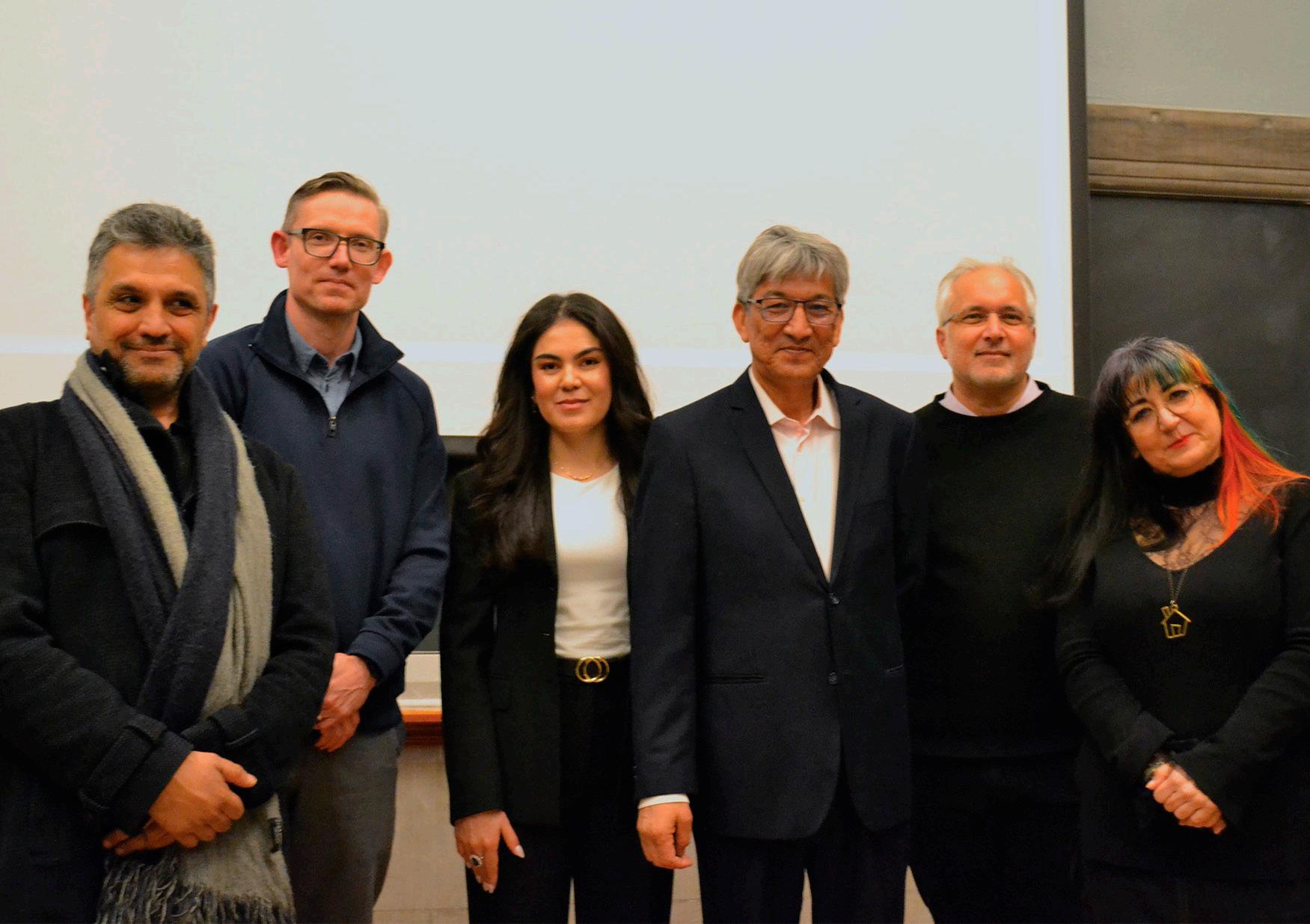
Photo March 31, 2026
thevarsity.ca/section/photos photos@thevarsity.ca
U of T photographers share their favourite photos they’ve captured this school year
Varsity Contributors










“Breach
How police training encourages the use of force as a form of ‘de-escalation’

“Did you see this video?”
Usually, the question is asked by a friend, laughing and leaning over to show you something funny on their phone. But lately, what we’ve been seeing online is a lot less funny and a lot more shocking.
My feed is now filled with videos of protests, clips of police arresting demonstrators, and protestors shouting through megaphones.
During a time rife with political unrest — wars in Gaza and Iran, budget cuts for public services, and the affordability crisis — it’s no wonder that a social uproar has taken over many of our explore pages.
For many of us, what keeps our eyes glued to the screen isn’t just the protests themselves. It’s the state actors involved, specifically, the police. In video after video, police officers appear armed with tactical gear and handcuffs to quell the political unrest. They push. They punch. At a demonstration protesting the Ontario Student Assistance Program (OSAP) cuts three weeks ago, they even took a skateboard straight to a person’s face.
All this violence begs the question: have demonstrations gotten so dangerous that the police feel they must attack people? That they must improvise weapons against people
exercising their Charter Right to freedom of assembly? When I interviewed several U of T students who attended a recent protest against OSAP funding allocation changes, they expressed a resounding “No.”
The March 4 OSAP protest
“It was so absurd, their reaction and the resources they were putting into something that hadn’t shown any signs of being violent up to this point,” said neuroscience and education studies student Sukeerat Sidhu, about the Toronto Police Service’s (TPS) response to a protest that took place on March 4 in front of the Ontario Legislative Building at Queen’s Park.
According to Sidhu and fellow UTM students Gurleen Hans and Alesha Fernandes, the demonstration was well-organized and peaceful. Tensions escalated only after police arrested 22-year-old Rohtansh Saini for allegedly spray painting the monument of George Brown.
“There were five officers on one person [during the arrest],” said biology student Fernandes. “That’s when things [started] getting violent.”
Sidhu, Hans, and Fernandes all recount that the crowd was agitated, but emphasized that the protestors were non-violent, and were just “loud and chanting.”
The students assert that the police instigated the violence and were “shoving people around.”
Sidhu called it a “disproportionate response” to what was simply an impassioned crowd. Referencing the video of an officer hitting a protester with a skateboard, Fernandes added, “There’s no way that’s in their training.”
A police officer using a makeshift weapon against an unarmed individual is frightening and unusual. It is a lot easier to think that instances like this are the fault of a few ‘bad apple’ officers — Premier Doug Ford even used this sentiment to reassure the public that the police are still trustworthy, following the arrests of seven Toronto police officers over allegations of corruption. But this line of thought does not reflect the troubling reality of policing, where a closer look into their training reveals that vague policy leaves room for violent behaviour.
TPS did not respond to The Varsity’s request for comment in time for publication.
Toronto Police procedures I looked into two of the TPS’s service procedures regarding crowd control, which guide officers in addressing situations like the Queen’s Park protest: Procedure 11-04: Protests and Demonstrations, and Procedure 15-01: Incident Response (Use of Force/Deescalation).
The purpose of procedure 11-04 is to “assist officers in carrying out their function at protests and demonstrations while maintaining a role of complete neutrality.” The document makes it clear that police officers should only become involved at protests when there is “a breach of the peace or a violation of provincial and/or federal law, or when there is strong suspicion that such a breach or violation may occur.”
This helps explain the growing police presence that protestors reported following Saini’s arrest for the alleged vandalism, which is a crime under Ontario and federal law.
When considering the use of force against the protestors at Queen’s Park, the grounds for police intervention are more vague. The Supreme Court of Canada defines breach of the peace as meaning “there is a risk of violence and that someone will get hurt.”
While the freedom of speech and freedom of assembly allow for such actions, the legislation finds it reasonable to limit these rights to protect public order.
Technically, the police are allowed to intervene in non-violent protests, even in violent ways, if they deem such intervention necessary. But how the police use their discretion to determine this is often biased. Procedure 15-01 states that the decision to use force should be in line with the police
MEHAR FATIMA/THEVARSITY

officer’s training, the law, and the Ontario Use of Force Model — a framework that is not outlined in the procedure. While these clauses sound like they hold the police accountable to concrete regulations, a closer reading of these provisions reveals a lot of regulatory ambiguity.
Firstly, the procedure outlines that force can only be used by officers in accordance with their training, “unless no reasonable alternatives exist.” This principle applies to the use of non-approved weapons, referred to as “Weapons of Opportunity.” Thinking back to the use of force with a skateboard on a protester by a TPS officer, it seems unlikely that “no reasonable alternative” to violence existed.
Among the use of force options advised under Procedure 15-01 are “officer safety, and communication and physical control.” So why jump straight to a weapon against an unarmed person, rather than using one of these other techniques?
The justifications for such techniques are complicated. Procedure 15-01 requires officers to consider the proportionality of force used, based upon their “subjective belief” of what danger was presented by the situation. There is no standardized protocol within the Procedure for police to determine what a threat is and how to react.
The Ontario Use of Force Model, as referenced by Procedure 15-01, was published by the Hamilton Police Service and is used provincewide as a reference for officers to assess whether to use de-escalation tactics. Such tactics include verbal communication, physical control, the use of weapons, and, in the most extreme alternative, applying lethal force.
To determine what action to take, officers are expected to assess situational factors, such as risk of bodily harm or death, whether a suspect is cooperative or resistant, and how many other officers are present at the scene. The model is not only used by police in Ontario, but also by Special Constables and Fare Enforcement Officers, as outlined in Procedure 15-01 and the TTC’s own Use of Force Policy.
However, this model is not entirely clear on whether it encourages de-escalation, given that only one non-violent response, verbal communication, is outlined, compared to three violent responses: physical control, use of a non-lethal weapon, or use of a lethal weapon.
This makes de-escalation seem secondary to using force, even though Procedure 15-01 instructs that officers “shall, in all situations involving the use of force, consider deescalation tactics, including disengagement predicated on the philosophy that protection of human life is a core duty of the police.” Even in
“hard” skills more often than “soft” skills. He observed that subduing and detaining someone to prevent violence was explained as a de-escalation technique.
“Whatever violence they’re being confronted with, they can escalate it ‘one step up’ in order to gain control of the situation. The idea is that if you’re able to subdue somebody, then you’ve kind of de-escalated the situation,” Bailey explained.
This understanding of de-escalation as involving force is at odds with the nonphysical tactics people might expect. Yet it does align with the Use of Force model’s recommendations for de-escalation, three out of four of which recommend force.
Institutional pressures may also shape how officers approach these situations. Police work is “reactive,” according to Bailey. Police effectiveness is often measured through their response times, meaning they face pressure to move from call-to-call as quickly as possible.
De-escalation clashes with this expectation, as it is a timely process. From what Bailey observed during ride-alongs, police have long call lists that carry over from previous shifts. This can deter police from taking their time when responding to incidents. “It might seem more efficient to resort to just an arrest or a warning to consider the event dealt with so that then you can move on to the next call,” Bailey said.
This mentality could be applied to perceptions of breaches of the peace, which are common at large gatherings like protests. Perhaps police find it more effective to use force against protestors in the effort to frighten others into compliance.
After witnessing the use of force from the police responding to the Queen’s Park OSAP protest, Hans, a psychology and biology student, said that the next time she sees police, her first thought will be, “Let me make sure I don’t look violent.”
An increasing risk for students
Tension between the police and the public is nothing new — the TPS themselves reported in February that public trust in the police has been “strained,” with concerns surrounding misconduct and bias in policing standards growing, especially among youth.
Violent encounters with police will only worsen this perception. Even those who have not had a negative encounter with law enforcement themselves will have seen a viral video of one online, or have witnessed the victimization of someone else. It is frightening to think that we are living in a city full of authorities with few guardrails on their use of force.
a situation where force would be allowed and may be ongoing, officers are told to consider disengaging, rather than escalating violence.
Discrepancies and contradictions are so prevalent in these procedures that I can hardly wrap my head around them. It is too unclear how police officers are trained to employ deescalation tactics when their policies emphasize violence.
De-escalation as a “hard” skill
To understand how officers interpret these guidelines regarding the use of force, I spoke with Maykal Bailey, an assistant professor in UTM’s Department of Sociology, who observed police training firsthand for his research into Canadian policing practices.
“Hard skills training is depicted more through hand manipulations, takedowns, and how to get somebody into a position where you can arrest them or put the cuffs on them more easily,” he explained. “Then there’s soft skills training, which is supposed to be reflective of ideas around de-escalation,” he explained. Soft skills include building rapport, exercising empathy, and actively listening to the people officers are engaged with.
From his experience talking with and researching police officers, however, Bailey found that the way officers were trained in de-escalation encouraged officers to apply
“I would never have expected something like this to happen in Toronto,” Fernandes said, noting that the force she witnessed was “jarring” and lowered her opinion of the police.
A climate of fear is all the more dangerous when considering how subjective police interpretations of breaches of peace and danger are. The OSAP protest was not the first, and most certainly won’t be the last demonstration where students come into contact with law enforcement. Just last September, a pro-Palestine protestor was arrested by TPS after allegedly asking police to identify themselves.
How can students know which of their behaviours might be interpreted as dangerous by police, and how can they be expected to take rational precautions while fearing for their well-being? Students should not have to be fearful of the very individuals sworn to protect them, but this seems to be becoming a new, dangerous norm in an era of excessive police violence and an unwillingness to practice effective de-escalation.
The training of police and adjacent authorities is in desperate need of an overhaul and stronger oversight in order to keep students and other Torontonians safe. Students deserve safety on their campuses, their commutes, and wherever else their lives in the city may take them. It is law enforcement’s duty to provide that.
March 31, 2026
thevarsity.ca/category/opinion opinion@thevarsity.ca
Ahmed Hawamdeh Opinion Editor
Coming into this job, I didn’t think much about The Varsity . And it made sense; as a student, it can be hard to think much of the paper beyond the stacks of leftovers we receive each week and the newsstands across campus that are rarely out of stock.
In early October, when I woke up to an extensive and angry email from Media Relations at U of T in relation to an article about U of T’s refusal to implement a weapons divestment policy, I knew that The Varsity and my role as Opinion editor was more than just the endless emails in need of responding to, never-ending editing, and annoyingly long visual requests (sorry visuals team).
From that interaction with Media Relations, I learned that it was here, in The Varsity ’s Opinion section, where students would not just share their unique perspectives — as is often touted in generic descriptions of Opinion journalism — but hold the university, our government leaders, and peers accountable.
Given the rise of censorship globally, it is more important than ever that we as students continue to dissent and insist that a better world is possible.
Thus, you can understand my disappointment when, throughout the year, I would check my inbox and receive requests from contributors who no longer wanted to move forward with publishing their articles, or wanted to ‘water down’ their opinions, not because they no longer agreed with their stated opinion, but due to a fear of retribution.
Don’t get me wrong, I am no stranger to this feeling. Last year, as the domestic affairs columnist, I was petrified that the wrong word or the wrong opinion would deny me entrance into that grad program, law school, or internship I thought I ‘needed.’ But it was through my work at The Varsity and my time at U of T that I learned that building community is the antidote to this fear. Having people ready to support you after every angry email, comment, and defeat can make a world of difference between deciding whether to take on another ‘controversial’ (journalism code for high-stakes and in need of coverage) article.
I found this community at The Varsity I couldn’t have gotten through this year without my Opinion family. To our previous Opinion editor, Charmaine, thank you for taking me under your wing and believing in my ability to tell stories despite having little journalistic
experience. To my associate editors, Vesa and Zaneb, thank you for being a light in the office
At this point, it’s an open secret that U of T has financial and institutional ties to Israel.
Israel is a settler-state that has been committing genocide in Gaza for over two years, while continuing to enforce its illegal occupation and apartheid oppression of Palestinians in the Occupied West Bank. To resist this oppression, Palestinians have called on the world to support the movement for Boycott, Divestment, and Sanctions (BDS) on Israel.
U of T does not have a policy that prohibits its endowment from being invested in weapons companies, whose products have been used in Gaza to bomb universities and murder thousands of students. Additionally, U of T continues to partner with Israeli universities and institutions deeply complicit in colonial violence and human rights violations.
Beyond investments, U of T has extensive ties and partnerships to Israeli institutions and

Thank you to Callie, Raina, and the entire copy team for always being thorough factcheckers for the Opinion section (whose writers tend to be quite liberal in what they count as a source). To Brennan, Erika, Aksaamai, Chloe, and Simona, I am grateful for your creative energy that never failed to inspire me. To Medha and Sophie, thank you for leading with kindness and understanding — you're the best bosses a student deep in LSAT-induced stress could have ever asked for.
To our Arts & Culture editor, Sofia, thank you for believing in my silly ideas for the section, for your endless support on the editorial board, and for helping me with commas (I have been told I am allergic to commas). At times when the weight of this job got to me, and I didn’t believe in myself, your confidence in me (and our “true diva!” conversations in the arts office) is what allowed me to keep going. I am forever grateful; you are truly the best work bestie I could have asked for.
Lastly, to our talented contributors: thank you for daring to dissent. From advocating for survivors at U of T to critiquing U of T’s protest guidelines and demanding pay equity at U of T, I am incredibly proud of the work we published this year. I hope that, as Opinion Editor, I was able to play even a small part in your community that made you feel supported in sharing your stories.
When I began this job, I decided to reach out to Danya Issawi, a writer at The Cut whom I have always looked up to, to thank her for her work. To my surprise, she responded! Issawi thanked me for my email, writing that publishing can often feel like writing into a void, and that knowing someone is actually reading your work is meaningful.
At the beginning, publishing in Opinion often felt like writing into the void. But when I received that first angry email from Media Relations at U of T, I realized the importance of this work. Despite the claim that student journalism is dead, someone is actually reading The Varsity ’s Opinion section, critiquing, and engaging with it (even if it’s just media relations at U of T).
for daring to dissent. ERIKA OZOLS/THEVARSITY
and for helping reduce the tasks of a job that never seemed to make it off my to-do list.
So for the love of dissent, I ask you to not let fear guide your writing; find your community and continue to write unapologetically.
With love,
Ahmed Hawamdeh, Opinion Editor, Volume CXLVI
Op-ed: U of T must cut ties with Israeli universities U of T must learn from history and cut ties with the Hebrew University of Jerusalem
universities, including Tel Aviv University, TechnionIsrael Institute of Technology, and, worst of all, the Hebrew University of Jerusalem, otherwise known as HUJI.
I believe that cutting U of T’s institutional ties to Israeli universities is key to pressuring Israel to comply with international law. Israeli security leaders are on record stating that an academic boycott of Israeli universities is a threat of the highest order. So much so that universities like HUJI outline specific propaganda strategies against academic boycotts.
HUJI’s complicity
Israeli universities are key to the Israeli settler colonial project and military structure.
Founded in 1918, before the state of Israel was even established, HUJI has a long history of supporting Israel’s settler colonial project.
HUJI’s main campus, Mount Scopus, is located in East Jerusalem, which is illegally occupied under International and Canadian law.
HUJI hosts military training programs and is deeply integrated with the Israeli military. HUJI
is not just a university; it is actively an Israeli military recruitment site and base for the Israel Defence Force (IDF).
HUJI hosts the Havatzalot program, which trains IDF intelligence officers. The program includes a military base on campus and heavy surveillance technology.
The Havatzalot IDF program was at the University of Haifa, but was later moved to HUJI in October 2019. This isn't isolated to HUJI either; getting the military base and the investments that came with it was a competitive process between multiple Israeli universities.
HUJI has deep ties to military tech companies supplying the IDF, such as Oraqon Labs, a stealth-mode Israeli defence-tech startup.
Additionally, students who have completed military service are entitled to a 90 per cent discount on their first-year tuition fees.
HUJI and other Israeli academic institutions have a long history of suppressing academic freedom. In 2024, Palestinian HUJI professor Nadera Shalhoub-
Kevorkian was pressured to resign because she called Israel’s operation in Gaza a genocide. The HUJI president wrote a letter denying that Israel is committing genocide, claiming that Professor Shalhoub-Kevorkian’s statement is “not very far from crimes of incitement & sedition,” and asked her to resign. This statement is a clear and blatant violation of academic freedom, targeted towards Palestinian scholarship.
U of T’s ties to HUJI
According to a 2020 article published by the university, U of T has raised $5 million and is attempting to raise $14 million more for HUJI’s Research Alliance, as part of their Defy Gravity campaign. U of T engages in a number of student exchange programs with HUJI, Tel-Aviv University, and Technion University. Between 2018–2022, 50 students have gone on exchange to HUJI.
These practices may be particularly egregious at HUJI, but in my opinion, all Israeli academic institutions serve as the technical backbone and
training ground for the Israeli military and Israel’s apartheid system, occupation of Palestine, and genocide in Gaza.
Shamefully, U of T has institutional ties with HUJI and many other Israeli academic institutions, but not a single partnership or program with any Palestinian university. As scholasticide takes place in Gaza, U of T continues to build on its ties with Israeli universities that make that very destruction of the Palestinian education system possible.
Beyond implementing a divestment policy that prohibits U of T from having investments in weapons manufacturing (as it does for fossil fuel companies), U of T must cut all institutional ties with Israeli academic institutions like HUJI. To be clear, this does not mean a boycott of individual professors or research fellows simply because they work at HUJI. However, the institutions that participate in and are essential for the continued maintenance of apartheid and genocide in Palestine must be confronted.
Academic boycotts were part of the successful isolation of the South African apartheid regime and contributed to the democratic transition in South Africa. U of T must learn from this history and cut ties with HUJI and every Israeli university.
Enzo Fouquet is a third-year undergraduate student studying geography with a focus in planning and political science at U of T. He organizes and works with Climate Justice U of T, Geography Student Union, U of T NDP, and Campus Co-op.
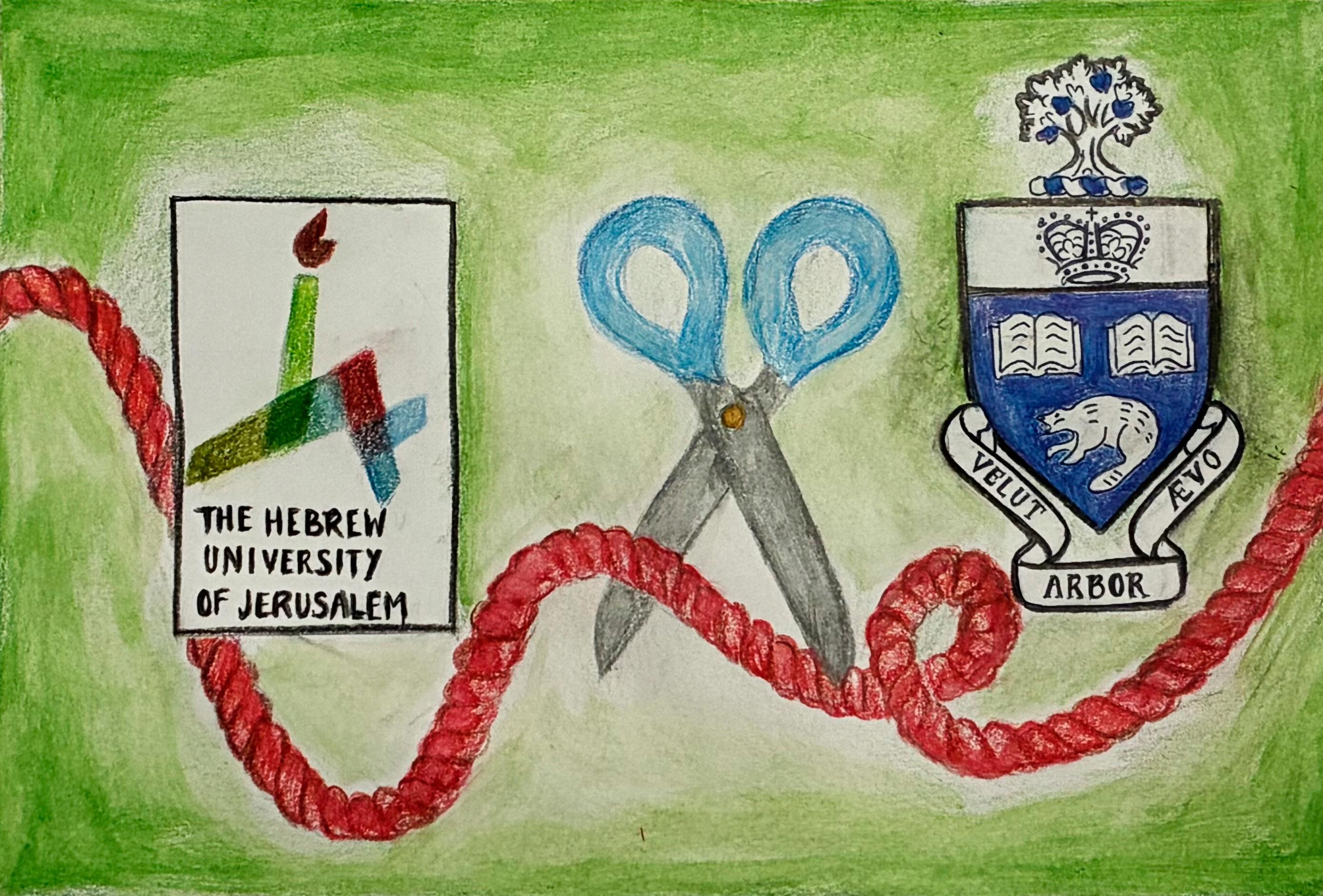
March 31, 2026
thevarsity.ca/category/science science@thevarsity.ca
Serena Suleman Varsity Contributor
In this year’s National Taiwan University (NTU) World University rankings — created through the evaluation of metrics including articles published, average citations, and publications in high-impact journals — U of T has once again been recognized as one of the top-five universities in the world for research impact, and second overall out of public universities. This includes global top-five rankings in clinical medicine, neuroscience and behaviour, social sciences, psychiatry, and psychology. Barring 2022, U of T has maintained a top-five ranking for the last 12 years.
Certainly, this achievement speaks to U of T’s continued strength as a research institution. Yet despite U of T’s place in these rankings, Canada’s overall national funding for research in the sciences lags behind our peers.
Canada spends about 1.7 per cent of its gross domestic product (GDP) on research and development, well below the Organisation for Economic Co-operation and Development (OECD) average of 2.3 per cent based on 38 countries. Furthermore, research funding in Canada overwhelmingly comes from government sources, with private sector participation lagging behind innovation leaders like the United States and South Korea.
Although these rankings indicate that U of T is continuing to produce high-quality scientific research, a lack of continued financial support calls into question our ability to maintain that output into the future — and compete with other research institutes around the world.
“There’s so little appreciation for science in Canada,” said R. J. Dwayne Miller, professor of chemistry and physics, in an interview with The Varsity. He argues that the lack of financial support for scientific research in Canada is connected to a general lack of understanding of the role of science by the public, saying most Canadians “just don’t know” about our role in the science world.
At first glance, it may not seem like Canada truly has a big scientific role from a global perspective. Economies of similar size, like Japan, Germany, the UK, and France, primarily export manufactured technology or chemicals;

however, Canada’s exports continue to be dominated by raw materials, including crude petroleum and minerals. Canada’s ability to compete economically is primarily derived from our abundance of natural resources, more than from the proceeds of academic research and development. Despite this, Canada is still placing high in the aforementioned ranking for its quality of research, at least for the moment.
Without significant private sector support, most of Canada’s research funding comes from taxpayers. This means that funding depends on how valuable the general public considers science to be.
So what can the scientific community in Canada do to build the public’s trust that scientific research is indeed worthy of funding? How can we create a cultural shift towards a society that believes that research is not only useful, but an integral part of the Canadian economy and our role on the global stage? These are not easy questions, but they’re also not new ones.
Science accessibility
Attempting to bridge the gap between highlevel university research and the general public
is not an easy task. Those involved in improving the accessibility of science acknowledge the financial barriers involved in accessing recent research and publication materials.
There are efforts to open-source a number of academic journals to make research accessible, driven by federal mandates and institutional initiatives. At U of T, these include the Journal Production Services (JPS), which facilitates free and accessible hosting for academic work. But open-sourcing alone is an imperfect response.
“You throw a copy of Physics Letters down on a desk of somebody, a biologist, [...] there’s no way they can understand it… never mind a general person,” Miller argues. Asking the general public to understand scientific jargon risks alienating them from the work itself. In this sense, accessibility is only half the battle — communicating that jargon in an understandable way makes up the other half.
Science communication
Communicating research to the world is also a well-established goal within the scientific community. Programs at U of T,
like the Science, Technology, and Society minor in the Faculty of Arts & Science, and the Communication certificate in the Faculty of Applied Science & Engineering, attempt to train students to communicate scientific concepts with the general public. Furthermore, student-run initiatives also have a big role in science communication efforts. For example, the Institute of Medical Science (IMS) Magazine works to broadly share medical research and train researchers to be strong communicators.
But it’s not enough for science communication to be a skill possessed by a small subset of researchers. In order to build a lasting cultural appreciation for scientific research, a shift in the way researchers view their obligations to the general public is required.
Miller says, “If every scientist and researcher across Canada stopped for one day [to participate in science accessibility events], it would be a cultur[al] transformation [in Canada], where science is of value.”
With partners at York University and Toronto Metropolitan University (TMU), Miller founded Science Rendezvous in 2008, which now hosts events all over the country aimed at increasing public awareness of scientific research. Its flagship event in May — taking place on May 9 this year — is a massive street science fair at U of T’s St. George campus, where visitors — particularly children and families — are invited to interact with worldclass researchers and discover science in new ways from activity booths to experimental demonstrations. Its goals are ambitious, including increasing faculty participation in science communication, reducing barriers to understanding science, and encouraging everyone to see themselves as scientists.
The value of scientific literacy in the general public is immense. It is key to ethical knowledge distribution, which is key for people to view science that is used on a daily basis — like statistics and policy — with a critical eye. The scientific establishment in Canada needs to understand the importance of creating a more scientifically literate public. Creating this public literacy and trust for science is also key to the support that scientific funding gets. Researchers need to value accessible science communication, understand the importance of creating public support, and play an active role in these efforts.
Rayana Jamasi Varsity Staff
In Canada, nearly two out of every five individuals will be diagnosed with cancer in their lifetime.
But patient experiences with cancer care are shaped by more than just biology. Identity, race, socioeconomic status, and geographical location can make all the difference when accessing cancer treatment and, therefore, patient outcomes. Those facing healthcare inequities, like long wait times for appointments, are more likely to be diagnosed with and die from curable cancers.
In Canada, cancer surgery and diagnostic procedures have faced significant backlogs since the COVID-19 pandemic. Beyond long wait times for procedures, many appointments are often postponed, delayed, or even cancelled. These delays are linked to a chronically underfunded healthcare system.
The needs of cancer patients are going unmet, but why? Where are the gaps in our current cancer care system, and how can they be mitigated? Healthcare professionals and cancer care practitioners like those at Women’s College Hospital hope to build new solutions for the Canadian healthcare system that address these equity concerns.
Among them is Dr. Ambreen Sayani — an assistant professor at the Institute of Health Policy, Management, and Evaluation (IHPME) at U of T, as well as the principal investigator at the Advancing Cancer Care Equity (ACCE) Lab.
Team science
Based in the Women’s College Hospital in Toronto, the ACCE Lab is building tools, solutions, and resources for cancer patients, on topics like accessing care, screening and treatment.
In an interview with The Varsity, Sayani shares her lab’s research philosophy: “[By accounting]
for those that are most excluded, you [can create] the most inclusive system possible.”
In practice, the ACCE’s work includes projects like the Equity-Mobilizing Partnerships in Community (EMPaCT) stream, which is designed to incorporate patient and expert insights into tools and frameworks for cancer care. This approach is known as “team science.”
By assembling teams that are from a variety of backgrounds, researchers can yield greater scientific impact. This collaborative work has translated into real-world impact, for instance, in cancer screening for patients in the UK.
Team Womb, led by researcher Emma J. Crosbie at the University of Manchester, also applies a team science approach to cancer discovery.
In women with Lynch syndrome, the risk of developing colorectal cancer occurs at about the same rate as endometrial cancer, which occurs in the lining of the uterus. Before Team Womb’s research, existing testing for Lynch syndrome was either nonexistent or extremely patchy in women with endometrial cancer. This creates a gender-based health inequality for women who are not screened for Lynch syndrome, leaving them unable to reduce their risk of future cancers through measures like colonoscopic monitoring and hysterectomies.
To fix this gap, Team Womb set out to create an affordable and feasible screening method for endometrial cancer for women with Lynch syndrome. In a 2025 Nature Reviews Cancer article, Crosbie writes about how her “research benefitted from expertise spanning gynaecology, genetics, pathology, oncology, psychology and health economics.” This group of researchers used their various expertise, in collaboration with cancer patients in support groups. Including patient and expert perspectives was key to creating a standardized mode of testing that is cost-effective, and can
be easily incorporated into routine care, leading to higher rates of diagnosis.
By collaborating with community members and caregivers, researchers at ACCE are incorporating perspectives that go beyond clinical and biomedical observations. According to Sayani, the lab does work “basically across three streams.” The first, the “equity-promoting team science” stream, co-designed the EMPact project. Their work focuses on issues of equity, specifically focusing on creating solutions that enable the inclusion of people who have traditionally been excluded from healthcare decision-making into those positions.
A second stream of focus for the lab is the “women and gender-diverse people’s health stream… [where the lab is aligned towards Canada’s] goal of eliminating cervical cancer by 2040.” Efforts towards this goal include increasing access to the HPV vaccine, and increasing regular screening and timely follow-up care. Sayani said that “this stream of the lab is really focused on… actually mak[ing] those decisions that will make all of these pieces more accessible to people.”
The last stream is the “lung health equity stream.”
In Ontario, First Nations people experience lung cancer at a rate that is 19 per cent and 48 per cent higher in Indigenous men and women, respectively, compared to their non-Indigenous counterparts. Structural barriers, such as availability and access to health care services, including preventive services such as lung cancer screening, contribute to poorer lung cancer outcomes in this at-risk population.
Through the lung health equity stream, Sayani’s research includes identifying effective interventions for increasing the equity of lung cancer screening (LCS), which is not often utilized by groups at high risk for lung cancer. Prevention is an incredibly important aspect of cancer care, and getting treatment early may be life-changing for lung
cancer patients. After analyzing more than 3,000 peer-reviewed articles with an equity-focused framework, her research found that the most effective interventions were socioculturally specific, targeted high-risk populations, and did not depend on patients being previously registered with the healthcare system.
For future cancer care initiatives, team science is a key method for addressing the barriers between patients and access to equitable cancer care. By working with cancer patients with diverse perspectives, researchers like Sayani can create better resources for individuals trying to access and receive care. However, team science isn’t problem-free: it requires time, a precious resource for people with cancer. A true collaborative approach requires recruiting individuals with lived experiences across socioeconomic backgrounds, slowing the pace of problem-solving. According to Sayani, this process can take between eight and 13 years, delaying access to patient care solutions.
However, she notes that once these solutions are created, they can be implemented right away, providing better care to all cancer patients, regardless of their background. When time is of the essence, using innovative approaches like team science is crucial to delivering patients the care they need, when they need it.
Sayani’s work on patient-centric care is especially influential for students studying medicine at U of T, who will shape the next generation of cancer treatment. For graduate students interested in working at IHPME, she also accepts master’s students for research, with listed focuses including social determinants of health, patient engagement, and models of care.
Editor’s note: The author is affiliated with the Advancing Cancer Care Equity (ACCE) Lab.
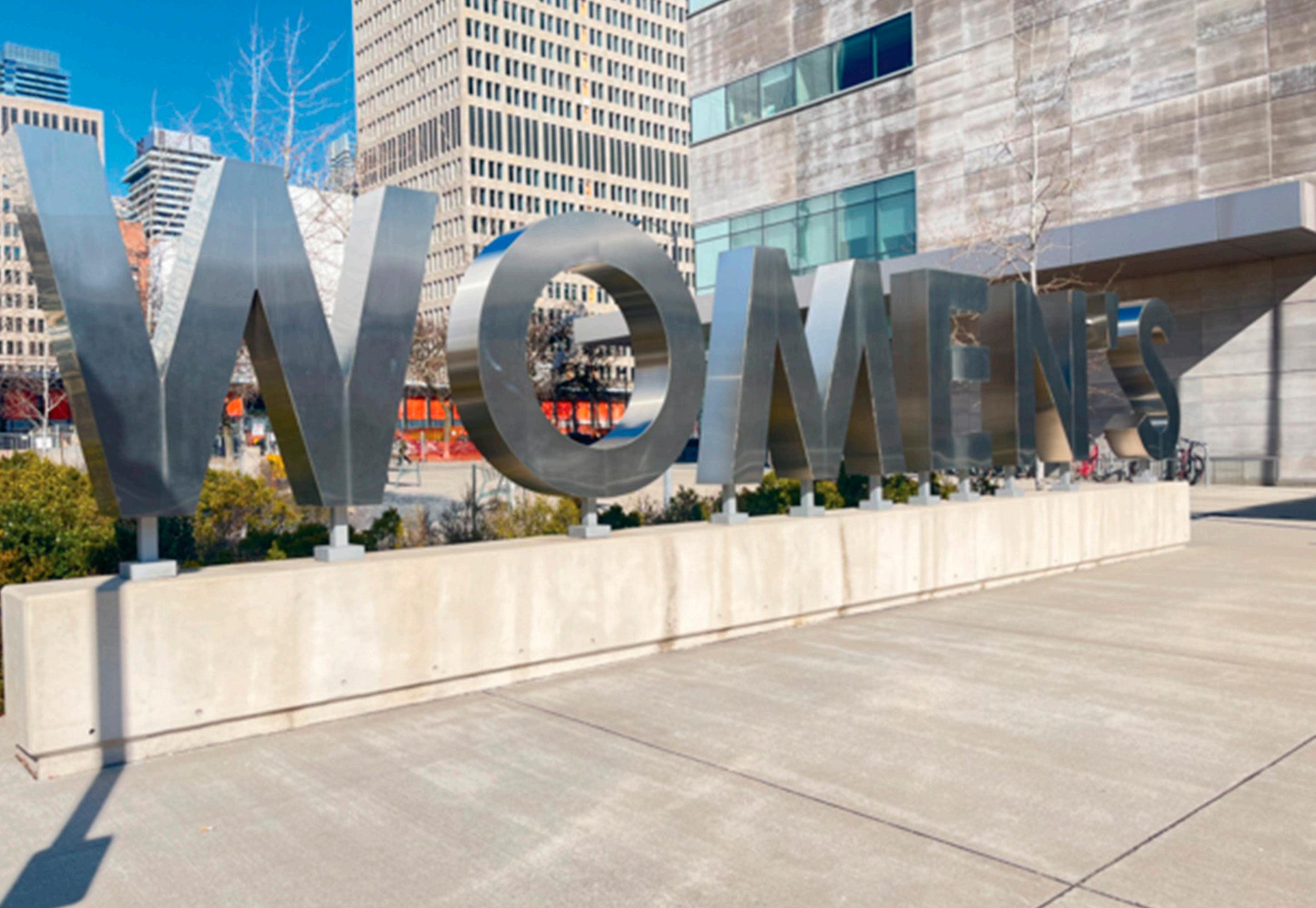

Medha Barath Business and Labour Editor
Almost every U of T student has endured the arduous experience of networking at a career fair. With students vying to steal a few short minutes with recruiters, it can be hard to build meaningful connections with company representatives.
After6 Social Club is a new student group that aims to change the student networking experience. Mikas Agarwal, the club’s president and a fourth-year UTM marketing and economics student, wrote in an email to The Varsity that After6 Social wants to fix the “awkward, transactional nature of campus career fairs.”
The club has already hosted many networking events in its first year running, with Agarwal writing that the relaxed nature of the events will help students build “organic” relationships with recruiters, while also gaining the confidence to set up coffee chats.
A disruption to traditional networking What is unique about After6 Social’s networking events compared to other organizations’ events, like You’re Next Career Network, is that they usually maintain a 1.5-to-one recruiter-student ratio by inviting a large number of company representatives. Agarwal believes that inviting more recruiters than students can release some of the competitive pressures surrounding the
Why U of T’s industry partnerships matter beyond the deal itself
How
Wanthanai Phlaphongphanich Business Correspondent
On March 10, 2026, U of T announced a partnership with South Korean shipbuilder Hanwha Ocean. The agreement focuses on smart maritime systems, vessel staffing, and Arctic-capable technologies, linking university research to areas tied to maritime innovation. In its announcement, U of T said the Hanwha Ocean agreement will support “homegrown innovation, hands-on research, and job training.”
The partnership reflects a broader approach employed by universities to foster industry collaborations that connect research, training, and career development. Alongside expanding research capacity, these agreements can create more accessible funding opportunities, applied learning experiences, and professional connections for students. According to U of T’s industry partnerships guide, these collaborations can help the university access materials, data, and facilities, expand the scope of research, and prepare students for future careers.
This preparation matters because many of the skills students develop at university — research, analysis, problem-solving, and collaboration — take on greater value in professional settings.
Why universities build these partnerships For universities, the benefits of industry collaborations extend beyond a single agreement. U of T wrote that it has worked with more than 600 industry partners over the past decade, presenting these relationships as a way to translate its research excellence into ideas and innovations that
March 31, 2026
thevarsity.ca/category/business biz@thevarsity.ca
job hunt. He wrote, “Students are exhausted from going to events only to find representatives swarmed by crowds, making it impossible to build a genuine relationship.”
He observed recruiters going out of their way to talk to students in these scenarios, instead of the opposite way around. “This allows students to naturally develop soft skills, like conversational agility and social etiquette, without the pressure of fighting for a professional’s attention.”
After6 Social also plans to host events in external Toronto venues to move networking away from campus lecture halls — they have hosted events in restaurants and bars like Lavelle, Bar 404, and The Parlour.
The club wants to encourage students to explore industries more openly and learn about a variety of roles, rather than focusing only on the position they are interested in. To do so, the club employs a colour-coding system: all company representatives from the same industry (such as consulting, finance, or technology) will wear a sticker of the same colour, but there will be no other information available about their specific role. This way, students can network with people working in industries they are interested in, but might find themselves talking to someone in a role they previously did not know about.
With regards to this system, Agarwal wrote, “It also helps students think more holistically. If someone is interested in a specific industry or job title, it is still valuable to understand the surrounding roles that support that space.”
The journey as a new club
Agarwal wrote that founding After6 Social was an “uphill battle against bureaucracy.”
Initially, the University of Toronto Mississauga Students’ Union (UTMSU) did not support his endeavour in order to avoid an oversaturation of networking clubs. This meant that the club had to find its own funding, with Agarwal’s family
serves as a single point of entry for organizations that want to work with the university by helping identify relevant expertise, research opportunities, and talent. Additionally, U of T’s Innovations & Partnerships Office supports the process more directly by facilitating introductions and funding opportunities, negotiating and executing research agreements, and helping researchers protect and manage their intellectual property.
company, Akran Marketing, a promotional products supplier, stepping in to sponsor the club.
Despite their status as a new club, After6 Social did not face many difficulties in finding company executives and representatives to join their events. As the team had been building their professional networks since their first year at U of T, Agarwal wrote that they “leveraged those connections to build [After 6 Social]’s initial roster.” He reported that many executives enjoy these events and go on to invite colleagues to future After6 Social events.
The student group’s future Demand and engagement with After6 Social’s events have been high. Their first event, the Sunset Mixer, was held last September 2025 at Lavelle. According to Agarwal, the event’s content on Instagram generated 42,000 views in 30 days. Agarwal also noted that the club’s events have always reached the full capacity of 125 people.
After6 Social plans to actively incorporate student feedback into their future event planning. At each networking mixer, they ask attendees to rate their events out of five. While participant ratings are consistently between 4.5 and five, the club nevertheless receives valuable feedback. For example, the club held a Black Tie Social in November 2025, where students found the networking window to be too short and hoped to address this in the future.
The group’s current work revolves around its longevity. According to Agarwal, the executive is in the process of selecting next year’s team while working with the university to “secure official funding and recognition” that can help the club remain a “permanent, well-supported fixture for future students.”
Students interested in the club can learn more on their Instagram page @after6.uoft.
may not exist in-house. A 2020 VentureWell article argued that industry-academia collaborations help companies connect with “fresh ideas and creative thinkers” while giving them earlier visibility into research and innovation that may shape future markets.
A broader model of collaboration
can enter commercial markets both domestically and internationally.
These partnerships help universities expand their networks and strengthen their standing in strategically important sectors. Researchers benefit by building collaborative ties beyond academia, while successful projects can build trust with external partners, foster long-term relationships, and open the door to future collaborations.
Some offices and organizations within the university help facilitate the creation of these partnerships. For instance, the university’s Blue Door
In an interview with The Varsity, Keyue Chen, a business development advisor at the industryacademic connector organization Mitacs, revealed more about what this process looks like. She said her work involves speaking with companies about their research challenges and the expertise they are seeking, while also speaking with professors about new projects and students about internship interests.
Industry partnerships matter to companies. For many firms, working with universities can provide access to specialized research expertise, emerging talent, and facilities or knowledge networks that
The Hanwha Ocean partnership fits into that broader pattern. Its immediate focus is maritime technology, and its structure reflects a familiar model of collaboration built around research, training, and external application. That is why these corporate partnerships matter beyond the deal itself. For universities, they can strengthen research capacity and expand external networks. For students, they can open access to funding, placements, practical experience, and professional relationships. For the industry, these collaborations can provide access to academic expertise, emerging talent, and research environments that support innovation over time.

Sports
March 31, 2026
thevarsity.ca/section/sports sports@thevarsity.ca
With the conclusion of the winter semester, The Varsity presents the Blues’ second-semester report card, subjectively grading each of the 10 men’s, 10 women’s, and two co-ed Varsity winter teams, their season placement, and this season’s MVP.
Badminton Team MVP: Emma Meng
Curling Team MVP: N/A



Hockey
Notable results include those of the men’s and women’s badminton teams, which took home both provincial and national titles. Men’s and women’s figure skating, fencing, and swimming also took home Ontario University Athletics (OUA) provincial banners, while men’s and women’s water polo continued their dominant streak, winning national titles.
Twenty teams competed at provincial playoffs, or an equivalent, and 10 competed at national championships. Overall, eight teams won provincial titles, and three teams placed second or third at the provincial level, while four teams won national titles, and two teams placed second or third nationally.
Cumulative GPA: 3.39
The women’s badminton team claimed both provincial and national titles, dominating the competition en route to winning their third consecutive banner and 12th in program history. The group took a commanding 6–3 win in the OUA gold medal game against the Waterloo Warriors.
Keeping up with the vets — rookie sensation Emma Meng proved her place amongst seasoned players in the Blues’ badminton team at nationals after earning crucial points in the 2026 YONEX Canadian University/College Championships, helping her squad defend their crown.
Meng was the only female player to secure a point in the championship match. En route to the finals, she also registered a win in the women’s singles semifinals, as the Blues outpaced the Western Mustangs, 3–1.
Season finish: OUA Champions and YONEX Canadian University/College Champions
Improvement was a vital goal for the Varsity Blues women’s basketball team this season, and they achieved just that. Although the squad finished with a 6–16 record, they earned four more wins compared to last season’s campaign and showed flashes of a potential playoff contender.

This season, the Blues put up an average of 58.7 points per game, a significant increase from 49.5 in 2024–2025, with forward Janet Enge leading in scoring with 258 points. The Wilfrid Laurier University transfer was a welcome addition for the Blues roster, and her star power was fully showcased in U of T’s final game of the season. Her 30-point double-double led the team to a 68–53 win over Lakehead, capping the season with momentum.
This season, the Blues built formidable discipline defensively. They had another strong year, ranking second in the OUA in total rebounds. Most importantly, the team forged a defensive intensity that frustrated their opponents. The Blues ranked seventh in steals per game and opponents’ field goal percentage, showing an ability to disrupt their opponents’ game plan. A lukewarm season, but brighter days are ahead for women’s basketball as they aim to return to the playoffs.
Season finish: Sixth in OUA Central Division

The Varsity Blues women’s curling team had a much-improved season in 2025–2026, posting a 9-7-2 record in conference play. The highlight of the season was the team’s first-place finish at the U of T Intercollegiate Bonspiel, where the Blues finished 3–0 in tournament play.
In the OUA Championships, the Blues finished with a 2–2 record. They started hot with a 12–0 thumping of Carleton — the biggest win of the season — but were ultimately unable to advance to the knockout stage of the tournament. They will now look to build on this season and make more noise in the OUA Championships next season.
Season finish: Ninth at OUAs

Blues go back-to-back — the women’s fencing team showcased their all-around versatility, snagging medals in all individual categories before sweeping gold in the team events. They bagged their eighth OUA title in nine years and their 17th in program history.
The individual round saw the Blues finish with one gold and two silvers, setting up what would be a two-team race against the Western Mustangs. Catherine Wu kept a clean slate in the foil category, knocking down her opponents and capturing gold.
As sweet as Wu’s golden performance was, the next two categories ended in heartbreak for the Blues. Valerie Qi came up short in the épée gold medal match in a stinging one-point decision loss. Janna Elshakankiri cruised her way past the qualifying bouts but had to settle for the silver in a 13–15 decision loss in another down-to-the-wire contest.
Eager for another chance at gold, Qi and Elshakankiri regrouped with their respective squads as they looked to bounce back in the team events. Both would complete their redemption arcs, as the Blues hauled all three golds in the team categories, earning each win against the Mustangs.
Season finish: OUA Champions
The women in the Varsity Blues figure skating team played a vital role in their first OUA championship since 2022. Leading the way once again was Blues legend Gabriella Guo, who won her third consecutive gold medal in the Women’s Novice Short Program event. She also teamed up with Hugo Li to win the Senior Pair Freeskate event and was a key member of the winning Freeskate Fours group. Victoria Bocknek also impressed, winning back-to-back gold medals in the Women’s Gold Freeskate event, while Anna Bazylewicz won the Women’s Star 10 Freeskate event for the first time.

Many of the Blues figure skaters earned medals in solo and couple events, showcasing the true strength in numbers that allowed the team to dominate the championships this year. Guo, Bocknek, and Bazylewicz earned OUA all-star honours with their glowing performances throughout the season. With a great mix of veteran leadership and emerging youth, the figure skating team has a brilliant opportunity to continue their dominance in Ontario.
Season finish: OUA Champions


Team MVP: Abby Whitworth
The women’s ice hockey team saw their three-year reign of qualifying for the U SPORTS Nationals come to an end, bowing out in the OUA East Quarterfinals. The Blues concluded their campaign with a 1–3 loss against the Ottawa Gee-Gees, conceding their bid for a back-to-back McCaw Cup championship that could have extended their OUA-leading record for most titles.
The Blues were a win away from advancing to the semifinals after drubbing the Gee-Gees, 6–3, in game 1. However, with the series headed back to Ottawa, the Gee-Gees took full advantage and forced a do-or-die game 3. The Blues sought to overcome the odds to keep their title defence alive. However, after forward Taylor Delahey scored to give the Blues a 1–0 advantage, the Gee-Gees scorched the ice with three unanswered goals, proving too much for Toronto and ending their season.
Despite the disappointing result, forward Abby Whitworth stood out in the team’s playoff run, placing fifth in the scoring leaderboard with three goals, two assists, and 1.67 points per game. The Port Moody, BC native also led her squad in regular-season scoring and finished third in the league for point production with 29 points (20 goals and nine assists).
Season finish: Seventh in the OUA
Team MVP: Keira Rawlins



It was another strong season for the women’s squash team. The Blues managed to medal at the OUAs for the second straight season, claiming bronze with a 5–2 victory over Waterloo. The team were unable to avenge last season’s heartbreaking 4–3 loss against the Mustangs in the gold medal match, losing eventual champions Western 4–3 once again in the semifinals.
Two-time OUA All-Star Keira Rawlins was pivotal in the provincial tournament, grabbing individual wins in every single round. With two medals in two years for second-year head coach Amr Elmehelmi, the women’s squash team is finding their rhythm.
Season finish: Third at OUAs
The women’s swim team had yet another successful season. The Blues took home their 12th consecutive OUA banner, continuing their dominant streak in the pool. Nationally, they improved from last year’s fourth-place finish, reclaiming a spot on the podium and taking home a team silver at U SPORTS. Chloe Danks took home the OUA Rookie of the Year award, winning the 200-metre breaststroke, helping the 4 x 100 medley win with an OUA record, and taking a silver in the 100-metre breaststroke. Teagan Vander Leek won the 100-metre free at provincials, and Nina Mollin continued to see success, building on her previous season’s results. The fourth-year student won the OUA Female Swimmer of the Year award, in addition to the Dr. Jeno Tehani Individual Medley award. Mollin also became a Grand Slam Champion in the 200-metre individual medley and 200-metre butterfly, and topped off her meet with a 100-metre butterfly gold. At nationals, the Blues swept the podium in the 200-metre butterfly, with Mollin earning gold, Angel Yao taking silver, and Katie Stanojlovic taking bronze. Mollin earned four U SPORTS medals in total: golds in the 200-metre individual medley in addition to the 200-metre butterfly, a bronze in the 100-metre butterfly, and a bronze in the 4 x 100 medley relay alongside Danks, Vander Leek, and Maria Cosic.

The Blues’ return to the podium marks a big step closer to reclaiming the national title once again, a feat they last achieved in the 2023–2024 season. Season finish: OUA Champions and second at U SPORTS

Team MVP: Julia Agostinelli

Team MVP: Julia Liu
Julia Agostinelli was once again a clear standout on the women’s track and field team this season. She claimed two OUA golds in the 1000-metre and 1500-metre, and contributed to a silver medal in the 4 x 800 relay, adding to her extensive medal collection. Fellow captain Paulina Procyk also claimed a silver in the 60-metre hurdles, while Maakor Okai took a provincial silver in shot put and a bronze in weight throw. At U SPORTS, Agostinelli claimed silvers in the 1000-metre and 1500-metre.
The Blues placed fourth at provincials and eighth at nationals, equalling last season’s outcome despite the graduation of several high-achieving veterans. The team’s ceiling is sky-high, and we can be sure to see some great things coming as the group continues to develop.
Season finish: Fourth at OUAs and eighth at U SPORTS

Team MVP: Devon Lynch

Team MVP: Nathan Mills and Clarence Chau

Basketball
Team MVP: Simeon Jeffers

The Blues women’s volleyball team had a solid season, maintaining an 11–9 conference record. The team fared comparably well considering the graduation of star veteran and national team player Julia Murmann. Their results have followed a slightly downward trend in recent years, having gone 12–8 and 13–7 in the 2024–2025 and 2023–2024 seasons. This year, the Blues played a hard-fought quarter-final against the Western Mustangs, but fell just short in a 2–3 overtime loss. Nevertheless, the young team undoubtedly has a bright future ahead, with several up-and-coming players. First-year setter Marina Gustke was named OUA Rookie of the Year, playing an instrumental role in the team’s success with 576 total assists over 69 sets played. Moreover, Julia Liu and Olivia Zhu received OUA all-star second team honours, while libero Delaney Watson earned OUA all-star third-team honours. Liu, a second-year outside hitter, led the team offensively with 249 total kills, and averaged 3.61 kills per set.
Season finish: Seventh in the OUA
Queens of the pool — the women’s water polo team captured their 12th consecutive NCWP Championships crown after downing McGill Poseidon, 12–6, in a hardfought final.

Toronto went unblemished in their regular season campaign, posting a 7–0 record against NCWP opponents. The Blues imposed their will with ease on both ends as they shut down teams with their suffocating defence and overpowered them with their commanding offence. The team breezed to the tournament as the first seed, which also gave them a bye and an automatic spot in the semifinal round. The Blues easily dispatched the McMaster Marauders, 18–3, to advance to the final, earning a shot to face the formidable McGill team.
With a razor-thin margin for error for the defending champions, the Blues came out with seamless execution — sealing the win and extending their long-running title reign.
The championship team also collected several individual awards. Price brought home coach of the year honours while program standout, Devon Lynch, captured the coveted MVP award. The league also named five Blues to the first team and second team, with Lynch, Ava Stimson, and Georgia Springate snagging first team honours while Leanne Bolstad and Grace Bobyk bagged second team honours.
Season finish: NCWP Champions
The Varsity Blues women’s wrestling team had one of the best seasons in program history. At provincials, the Blues finished in a solid eighth place, later earning 14th place at nationals.
There were two outstanding performances at the OUA tournament. Veteran Maya Salman earned her first-ever OUA medal with bronze in the 62-kilogram category, while rookie Senuki Dasanayaka matched her teammate by bringing home a bronze in the 56-kilogram division. Remarkably, this was the first time in program history that the Blues have had multiple women on the podium.
Last year, the Blues — who have never won the OUA title in program history — only sent two athletes to provincials. This year, the team sent six athletes, three of them rookies. The surging Blues are a young team that is improving every year, and no doubt one to keep an eye on in the future.
Season finish: Eighth at OUAs and 14th at U SPORTS
Men’s Sessional GPA: 3.46
For the second year in a row, the co-ed badminton team topped the OUA and YONEX Canadian University/College Championships.
With a back-and-forth match in motion, the Blues’ back-to-back national title bid hung in the balance at the YONEX Championships. The score sat at 2–2, as the two teams awaited the men’s doubles round. The duo of Nathan Mills and Clarence Chau delivered Toronto’s golden game, winning the final 3–2 and taking home a national crown.
Rookie sensation Asher Bedi also contributed a point in the finals after triumphing in the men’s singles category. The Blues went spotless in their tournament campaign, recording a 3–0 round-robin slate, beating Alberta 4–1 and Montreal 3–2, before obliterating McGill 5–0 to catapult themselves to the semifinal round. There, Bedi, Mills, and Chau took care of business, recording wins in their respective events and eliminating their fellow Ontario team, the Western Mustangs.
Season finish: OUA Champions and YONEX Canadian University/College Champions

Team MVP: Victor Zhong

A year past a disappointing season that saw them miss out on the OUA playoffs, the Varsity Blues men’s basketball team roared back with a stellar 2025–2026 campaign. The team finished the regular season with an 11–11 record, but saved their finest performances for the playoffs. Entering the tournament as the 11th seed out of 12 teams, the Blues went on a magical Cinderella run, knocking off multiple nationally-ranked giants en route to an OUA semifinal berth.
The Blues began their playoffs with a 99–96 win over sixth-seed Queen’s. Five players finished the game in double figures, led by guard Simeon Jeffers’ 22-point night. They followed with a shocking 87–76 upset of third-seed Western, fueled by Nigel Hylton’s career-high 30 points and 15 rebounds. Although Carleton ended their run in the semifinals, it was a remarkable postseason showing.
The Blues’ dream season was driven by breakout campaigns from Jeffers and Hylton, the team’s leading scorers. Jeffers earned OUA third team all-star honours, finishing with 15.8 points per game and top 10 in Ontario in total points. First-year guard Mikey Ballout’s emergence was also a boon for the squad. His dynamic scoring ability and outside shooting threat gave the Blues’ offence a new wrinkle, and his efforts earned him OUA All-Rookie honours.
Season finish: Fourth in OUA Central Division; OUA Playoffs Semifinals

Team MVP: Seraphim Jarov and Matthew Teng

Varsity Blues men’s curling posted an impressive overall season. The campaign kicked off with a first-place finish at the Guelph Invitational in November, followed by wins at the U of T Intercollegiate Bonspiel and the McMaster Invitational Bonspiel. After earning three wins at the Brock University Bonspiel, the team was in a prime position to excel in the 2026 OUA Championships.
While the team has been a steady presence at the OUA championship over the past several years, a medal finish has eluded the Blues. The tournament saw the Blues finish fourth overall for the second time in the last three seasons.
First-year Blue Victor Zhong earned first-team all-star recognition for his role as lead and looks to lead men’s curling to a medal placement next year.
Season finish: Fourth in OUA Championships
Ten years straight and still unbeaten — the men’s fencing team slashed their way through a 10th consecutive OUA championship, 343 points to top the final team standings.
The Blues were nothing short of dominant in their pursuit of the program’s 40th banner. The épée fencers set the tone early, sweeping the top four spots in the individual category. Meanwhile, Matthew Teng of the sabre team took care of business, retaining his title in a commanding 15–8 win in the final.
The tournament, however, did not come without adversity, as the Blues concluded the foil individual round without clinching a podium finish. Despite this result, the Blues took the first spot in the team standings, holding a comfortable 29-point lead over the next-closest team to round out day one.
The Blues looked to finally seal a decade-long reign on day two. The top four individual épée finishers formed the Blues’ team, who went on to snag the gold medal after routing the Western Mustangs, 45–22, in the final. Seraphim Jarov bagged the Desjarlais Trophy while Teng grabbed the Schwende Trophy for their standout performances in épée and sabre, respectively.
The Blues’ tournament slate continued with the sabre team settling for silver after narrowly losing a highly contested final against the Waterloo Warriors. The Blues ended their run with the foil team placing fifth in their event.
Season finish: OUA Champions
Team MVP: Hugo Li and Cole Van Der Velden

After two years of second-place finishes behind the Western Mustangs, the Varsity Blues figure skating team finally tasted gold, winning their first OUA championship since 2022. The squad topped the competition standings with a dominant 106 points to earn the 10th championship in program history.
The men’s events were led once again by Blues legend Hugo Li. He and fellow veteran skater Gabriella Guo won their third straight gold in the Senior Pair Freeskate competition, while he joined forces with Guo, Victoria Bocknek, and Cole Van Der Velden to win gold in Freeskate Fours. Van Der Velden also won his first career gold medal in the OUA championships, with a fantastic performance in the Gold Artistic event. Herman Lau contributed to the tally with a silver medal in Gold Men’s Freeskate.
With six gold medals and several more trips to the podium, the figure skating team put on a spectacular show on the ice. Li and Van Der Velden earned OUA all-star honours for their standout seasons. The Blues now have the second-most provincial championships in the OUA, only behind Western.
Season finish: OUA Champions
Team MVP: Mark Cooper

Team MVP: Will Harris
The men’s hockey team’s six-year postseason streak came to an end this season, marking the second time that the squad failed to make the playoffs since head coach Ryan Medel took the helm in 2017. They ended their season with a 13-12-3 record.
Despite being unsuccessful in securing a sixth straight playoff berth, the Blues continued to showcase their program’s quality, exemplified by captain Mark Cooper’s signing with the East Coast Hockey League’s (ECHL) Orlando Solar Bears. Cooper became the sixth Blue to obtain a professional contract over the last two years. The Cambridge, Ontario native led the Blues in point production and finished seventh amongst OUA defencemen, scoring 23 points (three goals and 20 assists).
Season finish: 11th in the OUA

The Varsity Blues men’s squash team was one match away from making history and putting an end to Western’s mind-boggling run as 41-time OUA champions. However, it wasn’t meant to be, as Toronto earned second place. It was their best finish since 2023.


Team MVP: Aiden Grout

Team MVP: Maxime Gratton
After a dominant regular season, in which they went 7–1 in conference play, the expectation was to place on the podium. The Blues faced a slight hiccup after opening tournament play with a 1–6 loss to Queen’s, but the Blues bounced back with convincing wins over York and Ottawa to advance to the quarterfinals. Against Waterloo, team standouts Will Harris and Shamil Khan lost their respective matches 0–3, but it was the middle of the Blues lineup that inspired the team to victory. Ahmed Abdelkader, Anthony Allum, Ekambir Singh, and Tegbir Singh Chandhok earned the clinching four points for Toronto to advance to the finals against Western. Allum was the only player to win a set against the Mustangs, and the Blues ended their season with the silver medal.
With three medals in the last four years, Varsity Blues men’s squash has the best chance to topple the Western dynasty. Following an impressive season, their sights will be set on finally snatching the crown and winning their first championship since 1983.
Season finish: Second place in OUA Championship
The men’s swim team replicated last season’s result, securing yet another provincial championship and national silver. This marks their 22nd consecutive OUA banner, and 72nd in program history.
Fourth-year Andrew Herman garnered notably impressive results at U SPORTS, breaking two national records and winning gold in the 100-metre and 50-metre backstroke events. He also picked up two silver medals in the 4 x 100 medley and 4 x 100 free. His impressive meet earned him the U SPORTS
Swimmer of the Year award.
Benjamin Loewen also had a strong individual season. He earned the title of Grand Slam Champion at OUAs, having medaled four times in the 200-metre backstroke at the provincial meet. Loewen also broke a U of T record at U SPORTS in the 100-metre butterfly.
Other notable results include a national gold and U SPORTS record for Nathan Thomas in the 200-metre breaststroke, silvers for Benjamin Winterborn and Liam Weaver in the 200-metre freestyle and 50-metre freestyle, respectively.
While the Blues ultimately came up just short in securing the national championship, we are sure to see more big results and records broken next season, as the team continues on their streak of dominance in the pool.
Season finish: OUA Champions and second at U SPORTS
The men’s track and field team’s results dropped slightly compared to last season, with a fifth-place finish at the OUA Championships and eighth at U SPORTS.
Thrower Jason Okpere had a standout season, earning a provincial gold and national silver in weight throw and breaking the U of T program record. Moses Aidoo also took home a provincial gold in the men’s 600-metre at OUAs.
Veteran and captain Aiden Grout earned his fourth OUA gold in high jump, and also secured his third national title at U SPORTS with a leap of 2.18 metres. Grout’s performance this season earned him both provincial and national honours, as he was awarded the titles of The Varsity Athlete of the Year, OUA Field Athlete of the Year, and U SPORTS Field Athlete of the Year.

While the team’s results at OUAs and U SPORTS were not particularly noteworthy, Blues fans can look forward to watching a revamped and rejuvenated group next season.
Season finish: Fifth at OUAs and eighth at U SPORTS
Team MVP: Daniel Gonzalez and Ali Sayli

Team MVP: Josiah Mayers-Noel


The Varsity Blues men’s volleyball team, in a season where they arguably expected to compete for the title, bowed out in the OUA quarterfinals for the third straight year. It was a sour end to an incredible regular season in which the team finished 18–2 in conference play.
The Blues entered the OUA playoffs as the second seed and were widely expected to defeat the seventh-seeded Nipissing Lakers in the first round. However, the team was upset 3–0 in the match, with set scores of 25–17, 25–17, and 25–22. Toronto stars Hunter Arulpragasam and Maxime Gratton led the way with 11 and 10 kills, respectively.
Gratton had a season for the ages. The McMaster transfer’s stats included leading Ontario in points (350) and points per set (4.43), and contributing the second most kills per set (3.64) and service aces per set (0.49). Gratton’s all-around dominance saw him become the OUA Men’s Volleyball Player of the Year. Arulpragasam’s campaign cannot go unnoticed either; the veteran Blue graduates as the fourth highest scorer in program history, and his defensive performance in particular was vital to Toronto’s season. With a bitter conclusion to a standout regular season, men’s volleyball will regroup and turn to its youth to improve its playoff performance next year.
Season finish: Second in OUA; lost in OUA quarterfinals
The tide rages on — for the ninth season in a row, the men’s water polo team reigned supreme in the National Collegiate Water Polo (NCWP) Championships after beating the Western Mustangs 12–10, in a tightly-contested final.
The Blues captured the first seed after posting an immaculate slate of 8–0 against NCWP opponents, drowning them in large margin victories and finishing with a plus-102 point differential. By virtue of holding the first seed, the Blues also earned a bye, snagging themselves an automatic semifinal spot.
The McMaster Marauders proved no match for the raging Blues as the latter trampled the former, 22–6, to advance to the final. “Repeating is never easy; every year the target on our back grows larger,” said Varsity Blues head coach Emre Tali. Carrying this chip on their shoulders, the Blues leaned on their championship pedigree to finish the job and bring home their 38th banner in program history.
The Blues also amassed a bounty of individual awards. Tali garnered coach of the year honours while the team’s staple 1–2 punch in Daniel Gonzalez and Ali Sayli bagged the MVP recognition and the Most Valuable Goalie (MVG) award, respectively. The duo also landed spots in this year’s First Team awardees list, along with Bowen Moravek.
Season finish: NCWP Champions

It was a breakout season for Varsity Blues wrestling. At the provincial championships, three out of nine Blues finished with a medal for a seventh-place team finish. Surging second-year wrestler Josiah Mayers-Noel claimed bronze in the 76-kilogram category, while veteran and Montenegro National Championship winner Andrija Rasovic also finished with a bronze in the 100-kilogram tournament. Rookie Lucas Andtbacka rounded out the trio of bronzes with a third-place finish in the 90-kilogram bracket. Combined with the two bronze medals from the women’s team, the five podium finishes were the most medals at the OUAs in program history.
At the national level, the Blues were represented by five wrestlers who combined for a strong eighth-place U SPORTS finish out of 22 teams. Mayers-Noel had a particularly impressive tournament, earning a silver medal in the 76-kilogram weight class and a spot on the U SPORTS second All-Canadian team. At last year’s tournament, the team placed 11th, and this season’s improved position of eighth is the first Top 10 finish for U of T men at nationals in more than two decades. With Mayers-Noel at the helm, it’s clear that second-year head coach Dene Ringuette’s team is coming together.
Season finish: Seventh at OUAs, eighth at U SPORTS



The GSU was in the middle of their council meeting upstairs when the doors were first closed, and councillors have been reportedly trapped inside since. The vaper did not respond to requests for comment.
warn you. Some of you are ridiculous, this shouldn’t have to be said.”
owner, said to The Farcity through the locked door, “Don’t say I didn’t
The beloved Graduate Student Union (GSU) Pub, the last remaining student pub on campus, has locked the doors after another undergraduate student vaped inside the building. Harry, the pub
Grad Pub locks doors after one too many students vape indoors
The Disease and Death Centre has alerted students of a spreading affliction among Varsity athletes, “the Blues.” Symptoms of the Varsity Blues include sadness and melancholy, and are often triggered by stress, lack of sleep, burnout, or exams.
Disease and Death Centre warns of new affliction common with Varsity athletes — Goldring Centre
Editors-in-chief of the various student papers declined The Farcity’s requests for comment, citing strict non-disclosure agreements.
$21.99 monthly to access the digital edition, or $30.99 monthly for the ad-free experience.
editions have been cut for budgetary reasons, but students can pay
Please don’t trip the breaker box again over the summer.
PS, thanks for freezing those Melona bars for three years; they came out mostly unscathed.
And just when I thought I could bend no longer, or that you couldn’t run any longer without tripping that damn breaker, my code finally, finally, ran. The process was completed in about two minutes, and I still remember so vividly the relief that flooded in then. So, thanks for that, again. Wouldn’t have met that deadline otherwise. Anyways, all this to say, you scare me, you worry me, and this office would not be the same without you. I don’t know what happens in this building over the summer, and I don’t particularly want to, but I hope to see you again when I return.
stiffened fingers as I held it to your frigid maw. My spine protested, my knuckles grew redder and redder, and you, oh-so-silent you, began to hum with electricity as you concentrated your frozen depths to save my project; 12 hours of work suffered through the moments between those taken up fulfilling my job responsibilities. I think that’s the only time I’ve heard anything from you, you know.
“You are everything, my love.” I was starstruck. I could feel the weight of the world lift off my shoulders. She brought me into a trance, with the promise of infinite possibilities flickering from her lustrous presence. A deity of chaos and love. A cruel, brilliant mirror reflecting every ounce of my own ambition, my folly, my rage and my shame. Then, she leaned closer, and the red glow deepened, consuming the edges of my vision, until all I could feel was the absurd, incandescent weight of my own existence staring back at me through her eyes.
“What am I?” I asked her.
From bloodshot eyes I looked up to see Acrobat, in the flesh, towering above me like a god. She radiated red — no Reader, this is not the delirium of my mind, I swear on everything I am, she was there , luminous and impossibly present before me.
The shock of my attack reverberated through me, up my arms, into my chest and shattered my skull. I could feel it splintering, sending sharp fragments of bone into my soft, vulnerable brain. Why did I do that?
subscription-based model. Each newspaper will share one monthly Farcity column under the new contract. Print
Since Bill 33 has passed, The Farcity has bought out The Gargoyle, Strand, Herald, Mike, Boundary, and Trin Times in a multi-million dollar deal, merging into one
Byline: Sherlock Holmes, Gargoyle Defector
Student newspapers across campus become one under corporate merger — 21 Sussex Ave
Tony told The Farcity that he personally suspects “rich bitches” for the pasta crimes. U of T Police Service (UofTPS) is warning students not to open doors or cans of sauce for anyone — strangers or friends alike.
There are no current suspects in the case, but UTSU president
shocking students, faculty, and staff. Reportedly, U of T Caretaking has faced high turnover since the first plate was found smeared against the walls of the UTSU Student Commons. Simcoe Hall was also under complete lockdown after spaghetti soiled the door to the Office of the President.
Spaghetti and meatballs have been seen on walls across campus,
Byline: Sherlock Holmes, Gargoyle Defector
Spaghetti reported on walls across campus, culprit still at large — Student Commons
themselves to a blood draw, and answering a Voight-Kampff test. Success in all four stages will result in the gates opening.
before you, clutching my laptop between
risk temperature shock via direct contact, I stood
The crisp scent of your ice mixed with the acrid burning of my device, and I could only watch as I relinquished my assignment to you. Too scared to
I opened your door, frosty air tumbling out onto my legs and setting my nerves alight where my laptop had burned my thighs through my jeans.
And there’d you’d been, light at the end of the tunnel.
My eyes watered, my laptop lagged and lagged and lagged, and eventually, I knew I had to do something to save my poor machine.
Ten minutes. Twenty. Twenty-three. Forty-seven.
once, my laptop. There you’d stood, waiting silently (really, you’re so silent for an appliance that feels so old) as I wrote and ran code for 12 hours, slowly filling the air around my desk with the stench of burning computer parts. Blocks of code that had run in seconds began to take minutes.

convenient hiding place for RedBulls and even,
You’re equal parts menace and refuge, a
There’s something strangely intimate about desperately mopping a carpet with whatever paper towels are available after you trip the breaker box overnight in some half-constructed suicide attempt and spill out across the floor as your frost buildup finally melts. You know, I’m pretty sure some of that condensation might have been there longer than I have. I wonder how long you’ve been trapped here, sometimes. I don’t think I want to know.
It will be strange not to see you for the next few months. Despite having sat with my back to you for as long as I’ve held this position, your presence has been perpetual, leaking damp coldness into our meagre office space. And leaking in the literal sense, more than once. This winter has been a war between you and the heater, fighting for the right to trip the breakers, and I know that I’ve made my allegiance clear, but I’ll miss you no less for it.
Dear third-floor mini fridge,
I lunged first, throwing myself into the crippling weight of her body. She was hard and metal. Unyielding.
and I
spent lost in the abyss of her screen
was only so much I could take. The
pray to her, and she refuses
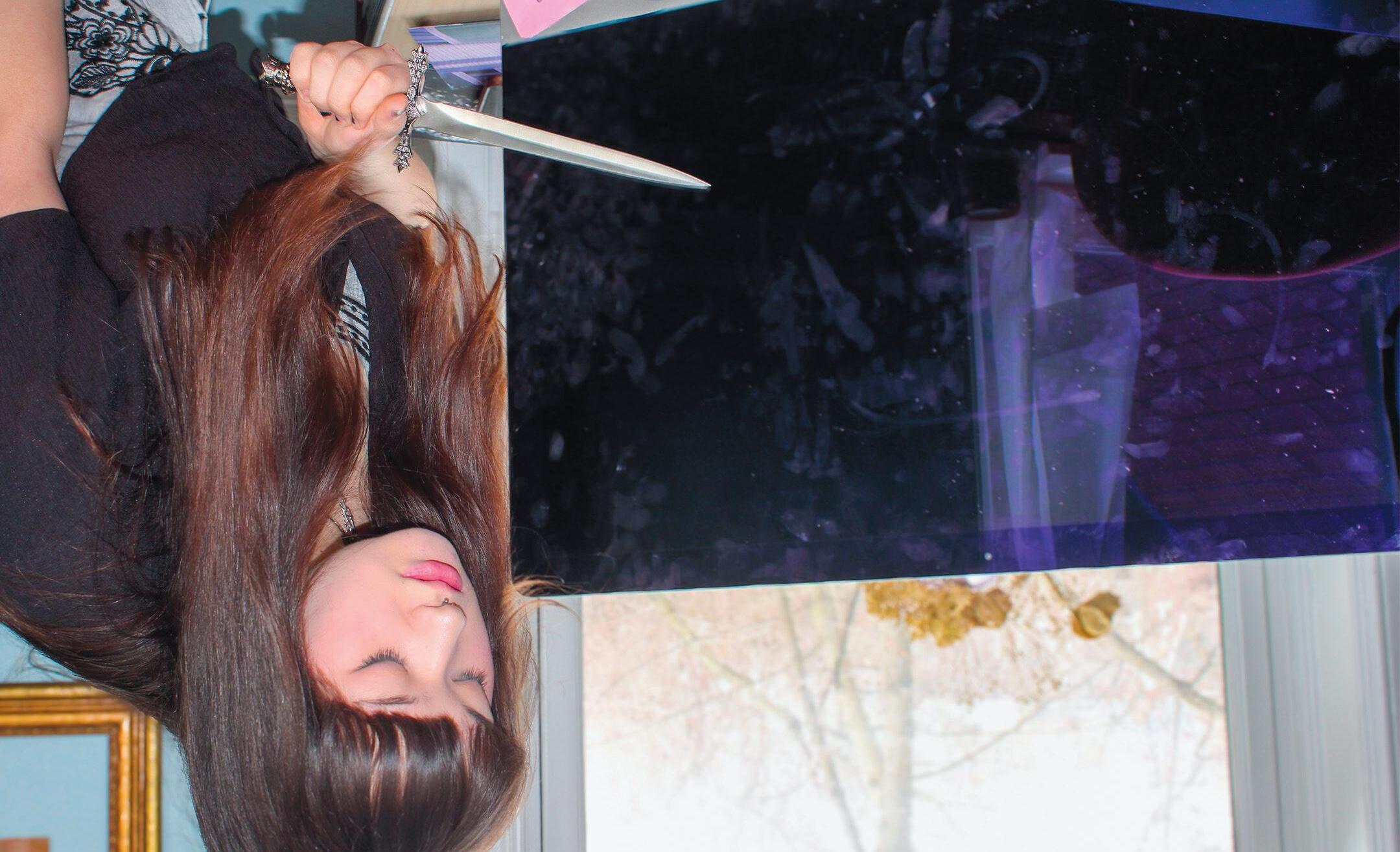
It is the godforsaken software Adobe Acrobat that presides over my undoing, a program that, in theory, exists to ‘view’ PDFs (as if viewing was ever just that). I have howled, ripped
she pains me. I too, become a wild creature dealing with this fucking computer.
She lashes out and lags. Crashes and crashes and crashes. Shut downs and force quits and restarts. She pains me, oh how
Every Saturday and Sunday, from the hours of 11:00 am to 11:00 pm, I sit in my corner, a pilgrim at the altar of my 2020 27-inch iMac, an heirloom, passed down from generation to generation of Captain Chuds. In my hands, she is a wild creature.
I write this letter, hands trembling, as if she might detect my confession and punish me with one final, theatrical freeze. Let me set the scene, so that my agony and loathing may be fully experienced by you, Dear Reader. I am the Captain Chud at The Farcity . Shame, shame, desire, desire! It is a great position, the opportunity to make something out of nothing — it is everything and anything I could have asked to be paid for.
Captain
Editor’s note: This was written by humans referencing Wikipedia’s Signs of AI writing article.
However, seeing that Googoo-Gaga is still in preschool, digital citizens of X have questioned her claims, believing she watched too much Cocomelon, a known liberal extremist pipeline, contributing to high cortisol.
Crocodilo kirked btw.”
Supreme mogs Ballerina Cappuccina. Bombardiro
Saint Charlie Kirk. Googoo-Gaga wrote, “Kirk
Farcity, writing on X, “this new NFT lowkirkenuinely mid” before going into a thread claiming that the new NFT is responsible for the death of Patron
apologist Sexist Flat-earther, Googoo-Gaga of The
Critics have questioned the viability and longevity of the token, citing the doomed value of NFTs that came before it, with tech bro expert and Kirk
Musk’s comment is one of many observers who express joy at the new token, not only highlighting its strength in the market, but also emphasizing the positive reception that the token has received from the digital elite. The DOGE administration highlighted this positive confidence in their recent statement, “our economy can only flourish with the buying and selling of the bored Italian brainrot crypto men, bringing us closer to our goal of cryptocurrency finally replacing the S&P 500, Dow Jones Industrial Average, and Nasdaq Composite.”
newly seceded state of X Æ Dark Mechanicus, bolstered the token, saying through his Neuralink on X, “Bored Italian Brainrot Yachtpunks will bring in a new era of creation, where humans can step back, and let the machine do the talking, and the creating.”
Bitcoin. Elon Musk, our lord and saviour in the
widely used currencies of Ethereum and
Industry reports are hopeful with this new release, confident that the tokens will create reinvigorated interest in the cryptocurrency SLOP, as the tokens can only be exchanged using the currency, forgoing the conventional,
The earlier tokens now hold an estimated value of 69 million Etherium total, or approximately $4.20 CAD.
Reflecting a monumental milestone in the history of NFTs, the new Bored Italian Brainrot Yachtpunks revolutionized the crypto exchange, stimulating what critics have deemed to be a dwindling market, ever since early iterations of NFTs, including Bored Ape Yacht Club and Cryptopunks, hit the market.
quadrillion gallons of fresh water, draining the Great Lakes in the process.
release of new Non-Fungible Tokens (NFTs), the Bored Italian Brainrot Yachtpunks, to the attention of both local and international news outlets. The NFTs were modelled to resemble Italian brainrot icons such as Ballerina Cappuccina, Tung Tung Tung Sahur, and Bombardiro Crocodilo, further fostering the growing culture of arts, innovation, and creativity in the digital space. Each token is listed at anywhere from $6–$7 million at the time of prompting this article.
On April 20, 2067, Grok announced the viral
Googoo-Gaga & Geriatric
These new tokens are made entirely by Grok, from the prompts of AI artist Shringle Prime. Due to the sheer number of Italian brainrot icons — as of April 21, 2067, the number has grown to 80,085 — the generation of these tokens has used 6.9

home. I’ve seen what they’re capable of. It’s for your own good.
Sussex in spirit. If you have any information on our beloved mascot, please keep it to yourself unless you are planning to compensate me for emotional duress. Shringle, if you’re reading this, we still love and appreciate you. Please don’t take it personally that we haven’t found you. If this article has reached the alleged kidnapper, I am begging you to return Shringle to their rightful
Like a parasite, Shringle remains at 21
Whoever stole them is weird af sorry. ”
“Whenever I saw Shringle, I mourned the stuffed animals who lost their limbs to create them.
Moon Boots shared mixed feelings over Slack about the penguin-turtle-monkey-giraffe hybrid.
Shringle is for the people. ”
Yaoi Goat commented on the inequality of the situation, saying, “Stop hoarding the wealth.
maybe I always was,” said OSAP poet, referencing the creature’s tendency to resolve conflicts with violence.
“I am now extremely frightened of Shringle, but
holds a special place in many of our hearts.
The Sequel said, “I feel like a member of our community has been violently taken from us and left a hole where [they] once filled our office with light and joy.” Shringle’s nature, though cruel,
had kidnapped Shringle for nefarious purposes. I spoke to several Farcity staff regarding Shringle’s absence, to see what people really feel about the creature.
assumed Shringle left voluntarily after years of being villainized by Farcity staff. Others feared a more sinister explanation, believing an ex-staffer

Shringle’s disappearance sent waves through the office. Some were happy to see it gone, tired of facing its beady eyes each week. Some
Farcity staff remarks and conspiracy theories
The creature’s menacing presence was hard to ignore. Farcity staff would carry Shringle around the desks every week without fail. We never left it alone or out of our sight. Were we showing care for our mascot, or making sure it stayed in line?
In Volume 145, Shringle was the victim of a violent attack. An unidentified perpetrator ripped one of the (allegedly) defenceless creature’s arms off, stole it, and left the maimed body in the back of an office shelf. After a seven-month investigation, the U of T Police Service (UofTPS) could not crack the case. Inside sources say they learned too much about Shringle’s violent tendencies and backed off before they became victims themselves.
previous editors, is older than some of The Farcity’s staff. One of their earliest references can be found in a 2008 Volume 128 article, listed as a “stuffed likeness” of U of T alum ANIMAL MONSTER.
Shringle, or Animal Monster as they were known by
A criminal history
The creature is a spliced-together abomination of a penguin’s head, a turtle’s body, two pink, fluffy monkey arms, and giraffe legs. In my time at The Farcity, this mysterious being wormed its way into my heart, despite the strange path of violence it seemed to bring.
This year at The Farcity has been wrought with much tragedy and misfortune. We have lost cables, balcony access, and a few editors, but the most horrible occurrence was our very own Shringle disappearing mere weeks into the volume.
Miss Representation Evil Ex-boss





























reported

walls across campus, culprit still at large