THE VARSITY
21 Sussex Avenue, Suite 306 Toronto, ON M5S 1J6 (416) 946-7600 Vol. CXLVI, No. 22

thevarsity.ca thevarsitynewspaper @TheVarsity thevarsitypublications the.varsity The Varsity

Medha Surajpal editor@thevarsity.ca
Editor-in-Chief
Chloe Weston creative@thevarsity.ca
Creative Director
Sophie Esther Ramsey managingexternal@thevarsity.ca
Managing Editor, External
Ozair Chaudhry managinginternal@thevarsity.ca
Managing Editor, Internal
Jake Takeuchi online@thevarsity.ca
Managing Online Editor
Callie Zhang copy@thevarsity.ca
Senior Copy Editor
Raina Proulx-Sanyal deputysce@thevarsity.ca
Deputy Senior Copy Editor
Ella MacCormack news@thevarsity.ca
News Editor
Junia Alsinawi deputynews@thevarsity.ca
Deputy News Editor
Emma Dobrovnik assistantnews@thevarsity.ca
Assistant News Editor
Ahmed Hawamdeh opinion@thevarsity.ca
Opinion Editor
Medha Barath biz@thevarsity.ca
Business & Labour Editor
Shontia Sanders features@thevarsity.ca
Features Editor
Sofia Moniz arts@thevarsity.ca
Arts & Culture Editor
Ridhi Balani science@thevarsity.ca
Science Editor
Caroline Ho sports@thevarsity.ca
Sports Editor
Aksaamai Ormonbekova design@thevarsity.ca
Design Editor
Brennan Karunaratne design@thevarsity.ca
Design Editor
Erika Ozols photos@thevarsity.ca
Photo Editor
Simona Agostino illustration@thevarsity.ca
Illustration Editor
Jennifer Song video@thevarsity.ca
Short-Form Video Editor
Emily Shen emilyshen@thevarsity.ca
Front
Sataphon Obra sataphon.ob@gmail.com
Arunveer Sidhu utm@thevarsity.ca
Ashley Thorpe utsc@thevarsity.ca
Matthew Molinaro grad@thevarsity.ca Graduate
publiceditor@thevarsity.ca
Taimoore Yousaf, Jean Patrick Vidad
Associate Sports Editor Rebecca Liu & Audrey Kim Associate B&L Editors
Loise Yaneza
Associate Design Editor
Emma Cervinka & Dowon Kim Associate Illo Editors
Abby Russchen, Justin Chan-Degroot & Kazim Abro
Associate Photo Editors
Snigdha Singh
Associate Video Editor
The Varsity acknowledges that our office is built on the traditional territory of several First Nations, including the Huron-Wendat, the Petun First Nations, the Seneca, and most recently, the Mississaugas of the Credit. Journalists have historically harmed Indigenous communities by overlooking their stories, contributing to stereotypes, and telling their stories without their input. Therefore, we make this acknowledgement as a starting point for our responsibility to tell those stories more accurately, critically, and in accordance with the wishes of Indigenous Peoples.
Annual Al-Quds Day saw 4,500 attendants despite failed injunction — US Consulate
Ella MacCormack, News Editor
On March 13, Doug Ford unsuccessfully sought a last-minute injunction to stop the Palestinian Youth Movement — organized Al-Quds Day rally — an annual Palestinian solidarity day that began in Iran in 1979.
Counsel for t he province argued that the rally “glorifies violence” and “celebrates terrorism” amid the recent shootings at GTA synagogues. At a 90-minute hearing hours before the rally began, Superior Court Justice Robert Centa ruled that interfering would not be “reasonable or proportionate.” Centa also questioned if counsel was using his “constitutional discretion,” or following Ford’s orders.
The rally continued and drew 4,500 people in solidarity with Iran, Lebanon, and Palestine. The legal counsel for the Al-Quds Committee told the Toronto Star the injunction was an “outrageous, undemocratic” stunt, and that the pro-Palestinian, anti-war attendees and organizers are not affiliated with the recent violence in Toronto.
Bike Share Toronto pedalling towards change, away from certain wards — Downtown
Ella MacCormack, News Editor
Bike Share Toronto announced a plan to add 350 docking stations and 200 e-bikes this year in its presentation to the Toronto Parking Authority Board.
In a fleet modernization effort, Bike Share described a prototype e-bike with a new basket, automatic gear shift, and mid-trip locking abilities so riders don’t have to find a docking station. Stations will also
Junia Alsinawi Deputy News Editor
OFFICE
Eva Tsai business@thevarsity.ca Business Manager
see improvements, such as a spring-loaded locking mechanism that makes it easier to dock bikes.
Service and infrastructure improvement will be concentrated on the 14 most popular wards rather than Bike Share’s previous strategy of expansion across Toronto. The centralization plan excludes wards with less ridership, like Danforth, Davenport, and the Beaches.
Ontario defunds all supervised consumption sites — Queen’s Park Ella MacCormack, News Editor
The Ford government pulled funding from all provincially-funded supervised consumption sites (SCS), giving the sites a 90-day notice. The sites impacted — Moss Park Overdose Prevention Site and the Fred Victor site, also by Moss Park — will likely close on June 13 unless alternative funding is obtained.
In December 2025, the last of the Urgent Public Health Needs Sites in shelters were forced to close after the province refused to renew their Criminal Code exemptions. The seven Toronto shelter sites saw 16,500 visits since 2020. The province also closed all sites within 200 metres of schools and daycares in March 2025, which closed four SCSs in Toronto.
Homelessness and Addiction Recovery Treatment (HART) Hubs are Ford’s abstinence-based alternative to SCSs, but 11 out of 27 centres in Ontario have not yet opened. The four HART Hubs in Toronto are not fully operational.
Toronto will still have three other supervised consumption sites not funded by the province: the Kensington Market Overdose Prevention Site, Street Health in Cabbagetown, and Casey House in the Gay Village.
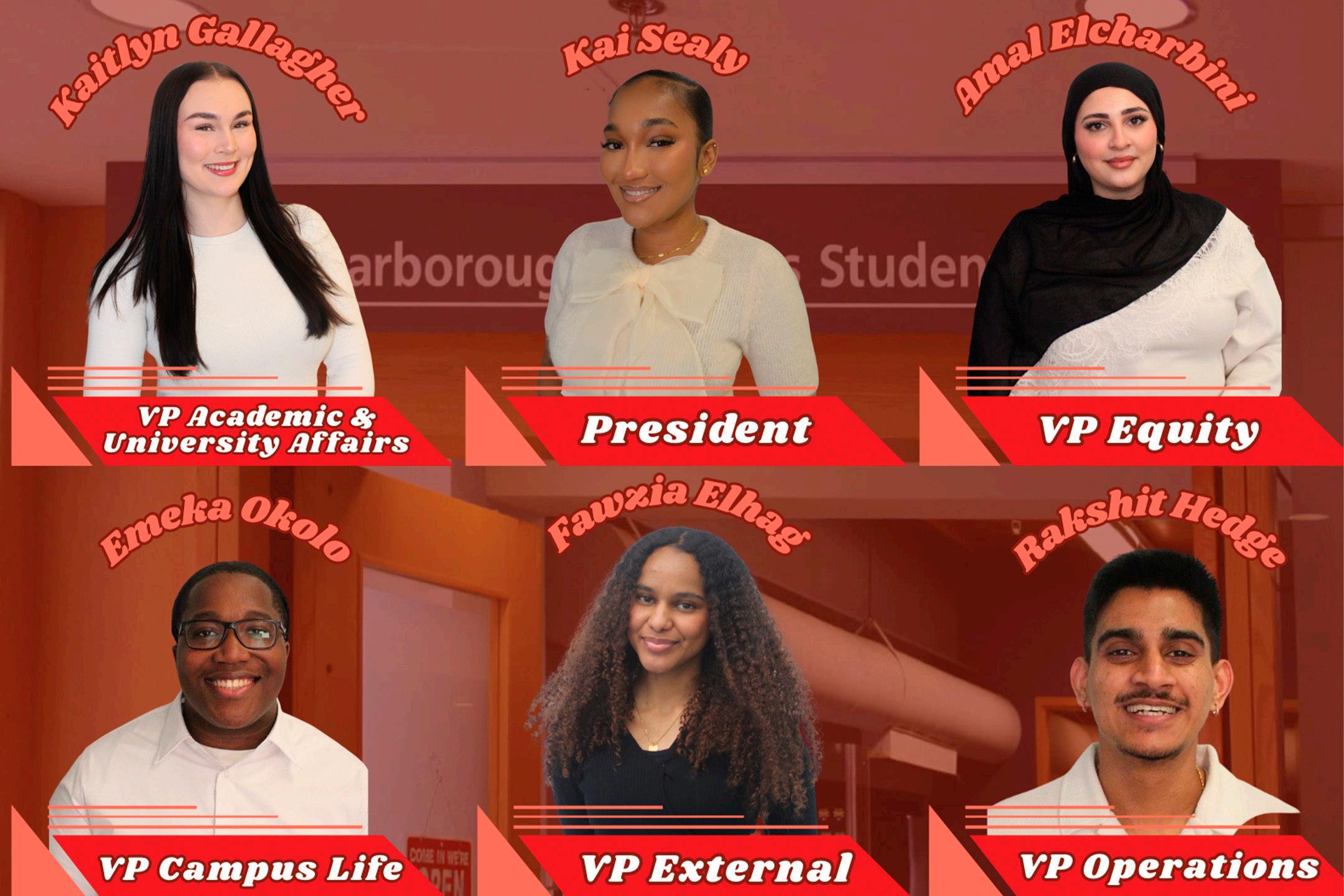
After a tight race, Amplify’s Kai Sealy will be Scarborough Campus Students’ Union (SCSU) next president, winning 55 per cent of the vote to beat Impact’s De-Mario Knowles by nine points, according to the union’s announcement of the election’s “general unofficial results.” Sealy is the SCSU’s incumbent VP Equity.
Amplify’s Kaitlyn Gallagher beat Impact’s incumbent Maya Kahn by 97 votes, or 8.5 points, to win Vice-President (VP) Academics and University Affairs. Incumbent VP External Fawzia Elhag, with team Amplify, was re-elected with 119 votes, beating team Impact’s Khadijah Khan by 11 points.
VP Equity went to Amplify’s Amal Elcharbini, who beat Impact’s Sukaina Abbas by 113 votes, or 10.4 points. VP Campus Life incumbent Emeka Okolo, also with team Amplify, won reelection and beat Tarek Dennaoui by a large margin of 295 votes, or 27 points.
Amplify’s Rakshit Hedge won VP Operations over incumbent Athisayaa Prabagar — who ran with team Impact — beating her by 93 votes, or nearly nine points.
Impact candidates won 12 of the 21 Board of Directors (BOD) positions. Only two Amplify candidates won seats on the BOD; however, only seven Amplify candidates ran for the 2026–2027 BOD positions. Notably, the two BOD positions that Amplify candidates won were uncontested.
Referendum results By a slim
Devin Botar Varsity Staff
As U of T makes a major push to establish itself as a leading player in the AI arms race, three of its highest-fliers in the field have been dramatically ousted from their roles at Elon Musk’s artificial intelligence startup xAI.
Current U of T computer science professor Jimmy Ba and his former student Tony Wu, both co-founders of xAI, announced their departures from the company last month. Their responsibilities were reportedly shifted to another U of T alum and co-founder, Guodong Zhang, who subsequently announced his own exit on March 13.
Ahead of a high-stakes initial public offering in June, Musk has reportedly blamed the U of T trio, among other senior engineers, for the lacklustre performance of Grok, xAI’s flagship large language model. In a Thursday post on X, Musk wrote that the company “was not built right first time around, so is being rebuilt from the foundations up.”
On March 13, the Financial Times reported that Zhang left after being “blamed for the issues with the coding product and relieved of his primary duties by Musk.”
U of T, which has frequently highlighted Ba’s high-profile work at xAI, may be watching the trio’s next moves closely as it pushes to position itself as a global leader on AI and cultivate lucrative ties with American tech giants.
Grok and roll Ba, formerly an AI research fellow at Meta, and often described as one of the most prominent

members of the xAI team, was one of the first people tapped by Musk to join the project in 2023.
Ba was hired as an assistant professor in U of T’s Department of Computer Science in 2018, and appears to have actively taught classes until at least 2022, according to publicly available student reviews. On ratemyprofessor.com, he has an average rating of 2.3 out of five stars. He has continued to supervise graduate students throughout his tenure at xAI, according to his personal website.
Wu and Zhang, who received their PhDs from U of T in 2023, had both worked briefly at Microsoft and OpenAI before joining xAI’s 12-person cofounding team.
According to Business Insider, Ba had overseen a “large portion” of xAI, reporting directly to Musk. He was head of research, safety, and enterprise over the summer of 2025, when Grok broke headlines for praising Hitler and making violent,
sexual threats. This came after Musk implemented a system update intended to make the chatbot more “politically incorrect.”
Most of Ba’s responsibilities, including the safety portfolio, had already been transferred to Wu and Zhang by the new year, Business Insider reports. At this time, a since-restricted Grok feature allowed users to generate nonconsensual sexualized images of real people, including children, which prompted ongoing criminal investigations from authorities around the world.
Defy gravity
U of T has repeatedly spotlighted the work of Ba and other high-profile researchers, as it races to take advantage of the funding and partnership opportunities opened up by the AI boom.
In a November 2025 public relations release, U of T shared that it had “received 141 media hits” when news first broke of the partnership between
Ba and Musk. Later that month, Simcoe Hall secured $42.5 million from the federal government to fund AI computing infrastructure.
Over the summer, U of T promoted a magazine profile on Ba, in which he was described as “A former student of Geoffrey Hinton bringing Elon Musk’s Grok to the masses.”
Hinton, a Nobel laureate and U of T professor emeritus, spent 10 years on the research team for Google’s AI model Gemini before leaving to speak freely about the dangers of AI. Simcoe Hall recently accepted a $10 million donation from Google, matched with $10 million of its own, to establish the “Hinton Chair in Artificial Intelligence.”
That came a week before December 9, when Google announced that it was partnering with the US Department of War to create GenAI.mil, an AI platform for the US military. According to The Intercept, recently leaked documents indicate that the Pentagon’s planned uses for its “AI arsenal” include bot campaigns designed to “influence foreign target audiences” and “suppress dissenting arguments.”
On March 2, U of T president Melanie Woodin flew to Mumbai and, standing alongside Prime Minister Mark Carney in a meeting with Indian officials held at the Taj Mahal Palace Hotel, announced the launch of a new “AI centre of excellence” in partnership with the Indian Institute of Science. Two days later, U of T announced a major new AI research funding commitment from AMD, an American semiconductor company. Neither Musk nor Ba responded to The Varsity for a request for comment. xAI sent an automated response, “Legacy Media Lies.”
Hilary Cheung Associate News Editor
Climate Justice UofT (CJUofT), a student-led environmental group, led a rally on March 13 against the university's User Guide on protest laws and policies released in August 2024.
In an interview with The Varsity, a representative of CJUofT said that “after the encampment — the People’s Circle for Palestine in summer 2024 — the university released a set of protest guidelines following the injunction that severely limits students’ right to protest on campus. We see this as a major issue for democracy, especially in the times of rising fascism… We are asking them to rescind the protest guidelines, to reaffirm our rights to protest on campus.”
Supporters gathered in front of Sidney Smith Hall at 4:00 pm holding a banner reading, “STRIKE THE PROTEST ‘GUIDELINES.’ ” Several students held signs reading, “STUDENT VOICES CAN’T BE SILENCED,” “WE PROTESTED FINE WITHOUT YOUR GUIDELINES,” and “FREE SPEECH? NOT FOR STUDENT GROUPS!”
Protesters chanted while marching, “The more you try to silence us, the louder we will be,” and “the students united, will never be defeated!” During the march, the crowd was followed by a Campus Safety car.
In response to backlash when the guidelines were originally released, a university spokesperson wrote to The Varsity explaining that the guide was “an educative resource primarily for students,” and that it “does not establish new policy. Any corrective action will be taken in accordance with the underlying policies and/or law.”
The Provost’s Office and the Vice-Provost, Students Office, developed the User Guide “in collaboration with several U of T offices, including the legal team as well as campus safety,” according to a Senior Assessor’s Report to the University Affairs Board in October 2024.
The guide stated, “U of T supports peaceful protests: Peaceful protests are a form of free expression and have been a force for progressive change at the University of Toronto (U of T) and

elsewhere for generations […] But there are limits.”
It then clarifies that U of T policies and the court order following the encampment “place limitations on protest,” including restrictions on the time, place, and method of protest.
Protestors cannot occupy or enter campus spaces without authorization, protest from 11:00 pm to 7:00 am, or build any structures. Protests also cannot interrupt university activities, including through excessive noise from amplifiers or megaphones or by blocking access to buildings or roads.
The guidelines also stated that signs and posters outside designated areas are considered vandalism, which includes “chalk, marker, paint, and projections.”
The guidelines concluded, “Engaging in these prohibited activities can result in consequences under law and U of T policies, including arrest, suspension, trespass from property, and expulsion. […] Any resistance (physical or verbal) may result in Campus Safety action or requesting the assistance of municipal police.”
In December 2024, a letter calling on university administration to rescind the User Guide was signed by several campus organizations, including all four full-time student unions, the Association of Part-time Undergraduate Students (APUS), the Canadian Union of Public Employees (CUPE) Local 1230, 2484, 3902, and 3261, and the University of Toronto Faculty Association (UTFA) Executive Committee.
CJUofT’s statement
CJUofT created an Instagram post endorsed by three other student organizations: U of T’s New Democrats, Tkarón:to Students in Solidarity with Palestine, and New Pride U of T. The groups wrote, “On Oct. 2024, after the encampment for Palestine on King College Circle, UofT released a series of ridiculous protest guidelines. This is an infringement on our right to protest.”
A representative of CJUofT read a statement to the crowd at Sidney Smith before the protest started.
“In their own words, U of T allows peaceful protest that does not interrupt university activities.
What is a protest if not disruptive to the status quo? These guidelines ensure that our dissent never disrupts, making advocacy contingent on the university's permission and white settler comfort.”
“If you're feeling angry right now, know that you can do something about it. The only way to protest these guidelines is to protest. Get creative. Make your voice heard. You don't have to wait around for a group to organize a protest. Grab your friends and tag a building, make art and put it in public spaces without a permit. Walk up to a member of the administration and say, fuck you.”
“Every act of protest is a refusal. Every moment of refusal is liberation. Let yourself be guided by your humanity, by your love for others, by your longing for liberation. You do not have to be set free by anybody,” they concluded.
Voices at the protest
“We think students’ right to protest is more important than ever, and that the university is demonstrating cowardice and trying to repress student voices on really important political issues like climate justice, Palestinian Liberation, and so many others,” said a representative of CJUofT.
“Students’ right to protest has been vital for Land Back. In various places, it has been part of the climate and the environmental movement, the suffrage movement, the civil rights movement, the anti apartheid movement. Students’ right to protest has been the vehicle of social change. When the University of Toronto says things like defying gravity and calls themselves leaders, it’s because they have students who keep them accountable and who push them to be better,” the representative added.
A first-year master’s student said to The Varsity, “We have to keep our voices up for the Palestinian people; we need to continue our support. And this is another way of us expressing our voices towards the restrictions that we saw when the encampments were around. [...] It’s twofold, both to support the Palestinian cause and to preserve our protests and rights on campus.”


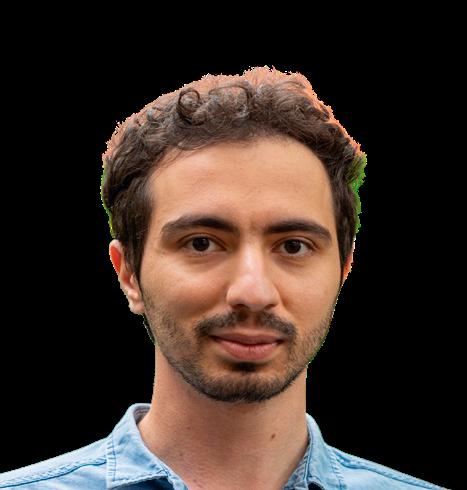



Two-term incumbent president Amir Moghadam is running for a third term with the GradForward slate. The president serves as UTGSU’s primary spokesperson and leader, overseeing the UTGSU’s vision and coordinating the executive team. The role also includes representing graduate students to the administration.
During his tenure, Moghadam has focused on food security and the cost of living for graduate students. Referencing OSAP cuts, he said, “I’m not walking away in the middle of that fight. I’m running again to make sure that all of the services that we have created [in the last two years] continue.”
If elected, Moghadam plans to support the graduate students’ funding campaign and to “make sure we have a strategic plan for the next five years of the union.”
As UTGSU faces Bill 33, OSAP cuts, funding challenges, and affordability concerns, Moghadam stresses the need for strong operations, staff, and
Current Vice-President (VP) Graduate Life Eliz Shimsek is running for VP Academics with the GradForward slate. The VP Academics oversees student support, academic processes, and funding resources to ensure that graduate students are supported throughout their degrees.
Drawing on her experience running events as VP Grad Life, Shimsek said two issues came up repeatedly when she spoke to students: “uncertainty around supervisor relationships and just the lack of clear structures for support when challenges arise.”
“That made me realize that many of the issues graduate students face are academic and structural. As VP Academics, I want to focus on strengthening the systems that support graduate students — particularly around supervisor accountability, mentorships, and [creating] clear pathways to raising concerns.”
Ferdinand Reke Avikpe, a third-year PhD student in biomedical engineering, is running for the position of Vice-President (VP) Internal with the GradForward Slate. He brings experience from the UTGSU Board of Appeals (BoA) and as Course Union President for Biomedical Engineering Students’ Association (BESA), and believes that well-functioning internal systems and strong institutional structures are the backbone of a student union.
As BoA Vice-Chair and later Chair, Avikpe revamped and rewrote the appeals process to clarify policy and timeline. His goals include running a governance explainer series to help students understand the UTGSU’s role and responsibilities, and starting an institutional memory project to ensure continuity across different years. He sees his role as increasing transparency and accountability so that students can better navigate UTGSU processes.
Third-year chemical engineering PhD student and UTGSU Division III Director Amir Zadeh is running for the position of Vice-President (VP) Finance with the GradForward slate. The VP Finance oversees the union’s financial management, operations, and overall fiscal health. The position involves managing the budget, developing and supervising students’ financial services, and making strategic plans in collaboration with various committees and the executive team.
As current chair of the Finance Committee, Zadeh is running on a platform of financial efficiency, student engagement, and transparency. “The main thing is just making it more efficient. That’s how my brain works. I’m also an engineer, so my job is optimization,” he said.
Having worked on various grants and bursaries, including UTGSU’s mental wellness and emergency grants, Zadeh aims to make the union’s
2025–2026 Vice-President (VP) Academics Nicholas Silver is running for VP External with the GradForward slate. Bringing five years of experience with UTGSU across the Board of Directors and the Base Funding Committee, Silver focuses on building student power and making UTGSU as strong a student union as it can be.
Transit affordability for graduate students is a cornerstone of Silver’s campaign. By working with U of T Rocket Riders, UTSU, George Brown College student association, and TTC stakeholders, he believes that students can and must be included in any proposals for more affordable transit. As he put it, “Students are being left behind by the elected leaders in City Hall.”
First-year human geography master’s student Zoë Nicoladis is running for Vice-President (VP) Grad Life — the only contested position in this election — to build community based on authentic connection and meaningful interactions.
Nicoladis says, “I think the most revolutionary thing we can do to fight back against the system is just to be kind to one another and create and show up to spaces where there are other people.”
To this end, she draws on her undergraduate experience as an orientation leader, a Go Global UBC ambassador, a soccer coach, and a summer camp counsellor to fulfill her promise to make all students feel welcome. As a GSU
foundations for student support. He reviews recent austerity measures as significant threats to both students’ daily lives and to postsecondary education in Ontario.
“Having this independent post-secondary education system that actually is accessible to everyone, not only makes you a better academic and a better student, but also just a better person for society and the community,” he said. “These attacks and these changes in the policies… they’re important because they are threatening the very notion of being a student in post-secondary and having accessible access to education.”
Moghadam’s campaign focuses on empowering students across all divisions and departments so that student-led initiatives can “revive this notion of student representation.” He wants to make sure students know that UTGSU fights for their needs and has their back.
“The student-supervisor relationship is central to graduate education. Right now, the systems for support and accountability just vary widely across departments […] By improving clarity, mentorship structures, [and] support systems, we can create a more consistent and supportive experience for graduate students throughout the university.”
If elected, Shimsek also plans to collect data on the impacts of OSAP cuts on the student body in order to “understand where the gaps are,” and plan accordingly.
As the incumbent VP Grad Life, Shimsek has also prioritized students’ mental health in year-round programming. She believes that her years of involvement in student life and work within the U of T administration prepare her to address graduate students’ academic challenges.
“Even though we have the governance documents and the website is pretty clear, most students still do not understand how the UTGSU works, so how decisions affect them. […] This creates a transparency gap, not a documentation gap,” he said.
Avikpe plans to create a student group incubator project that would bring together cohorts of new groups each semester and provide mentorship. This incubator would offer guidance from established student organizations, help with guidance on governance and constitutions, funding, application support, and event planning support.
As VP Internal, Avikpe also hopes to bring together student groups to form a food security network that shares resources and identifies gaps affecting graduate students.
financial policies and direction more understandable for students. “It’s a little bit complicated, and the best way to make it more transparent is to make it easier to understand,” he said.
Zadeh also wants UTGSU directors and executives to be more engaged with the union’s finances. “Many UTGSU members aren’t aware of the financial situation […] Some of them don’t know how the system works. Just giving them information sometimes is not enough. Sometimes a little bit of explanation makes it easier for all the members to understand how the system is working.”
Additionally, Zadeh is also passionate about the Supervisor Relationships Campaign and building trust and engagement in the Finance Committee.
Based on his extensive experience with meetings and collaborations with different GTA unions and advocacy groups, Silver believes the UTGSU can organize and draw on the strength of its partners to achieve common deals.
Silver wants to build more student power, which he says “doesn’t come from executives, but it comes from the students themselves… The more we can engage with students, the stronger the student union can be, and the better we can advocate for students.”
Silver’s experience working on the Base Funding Committee (BFC) also informs his efforts to bring more graduate students into the fold of UTGSU. “But if we actually want to get it across the line, we have to have enough students supporting it to actually make it a reality.”
rep for geography, Nicoladis aims to address the disconnection between graduate school and students by collaborating with student associations and creating events to meet their needs.
If elected, she plans to implement more third spaces to move beyond networking and facilitate campus-wide conversations and connections. Her commitments to physical and mental health seek to address food security through the Grad Life portfolio by procuring food for events and bringing people together.
“Facilitation would be a big part of my role. I really like helping start and continue conversations that are a little more deep, [and] meaningful.”
“It’s important to have programming on all of our campuses, because graduate students are everywhere.”
First-year master’s of teaching candidate Victoria Mata is running for the contested Vice-President (VP) Grad Life position with the GradForward slate.
During her undergraduate degree, Mata served as the Scarborough Campus Students’ Union (SCSU) VP Campus Life and helped facilitate a record-breaking orientation turnout and chaired the finance committee for their $50,000 budget.
During her time with the SCSU, she also helped organize specific orientations for queer and racialized students. If elected, Mata looks
forward to expanding orientation at Fall and Winter GradFest and collaborating more on all campuses.
As VP Grad Life, Mata aims to implement more networking, events, and facilitate more outreach at UTSC, UTM, and the Institute for Aerospace Studies. She hopes to develop resources for graduate students’ mental health in light of OSAP cuts and increase the number of volunteer opportunities for students.
“I really do love student government, and I feel like you have to have a passion to help students in order to be in a specific role like this.”
Rebecca Liu
Associate Business and Labour Editor
U of T’s annual budget report, published in February, outlined the university’s financial outlook as navigating “a much more constrained financial position next year and over the five-year planning horizon compared to the past decade.” In early March, the U of T Business Board met to discuss this report, focusing on two big-ticket items: the operating budget and the tuition fee schedule for the 2026–2027 academic year.
At the meeting, the board approved the $3.66 billion operating budget for 2026–2027, and affirmed the university’s continued financial strength while also highlighting vulnerabilities that will require diligent budgeting and forecasting. The budget is to be approved during the next Governing Council meeting in late March.
Current financial outlook
For the upcoming year, the budget outlined the largest sources of planned income, which include tuition, student fees, and operating grants. On the expenditure side, faculty and staff compensation will make up the majority of costs at 65 per cent of total expenses. The balanced budget — meaning the expected revenues match the expected spending — totals $3.66 billion, marking a $39 million increase from the previous year.
The anticipated annual revenue growth for the upcoming academic year is only 1.1 per cent, not accounting for inflation, well below historical levels.
With inflation in 2026 expected to remain at around two per cent, revenue growth may fail to keep pace with rising costs. This is a far cry from the average 5.6 per cent growth enjoyed in the past decade. However, despite these concerns for future growth, growth projections are expected to stabilize at around three per cent over the next five years.
U of T’s dominant strategy to mitigate slow economic growth has been major employee compensation and university-wide cost reductions. The university plans to save two per cent in staff and faculty compensation by improving efficiency through vacancy management and workplace reorganization. This includes minimizing workplace redundancies by preventing productivity losses and improving employee retention. University-wide cost reductions include a $15 million cut to the Pension Plan Risk Contingency budget, stabilizing funds at $50 million.
What the board is navigating and how
The provincial government’s existing policies and significantly reduced grant funding to the Ontario Student Assistance Program (OSAP) present both advantages and challenges for the university.
In terms of tuition, the Government of Ontario is now allowing up to two per cent domestic fee increases, enabling U of T to increase domestic tuition fees starting in 2026–2027. In response to worries about OSAP cuts, the university stated it would remain committed to the U of T Advanced Planning for Students (UTAPS) Program, which provided needs-based financial support to 52.7
March 17, 2026
varsity.ca/category/business biz@thevarsity.ca

per cent of all OSAP recipients in 2024–2025.
The university is also navigating multiple budget priorities, such as plans to improve operational efficiency across administration, technology, and data management. This plan includes a $15 million commitment to institution-wide digital strategies and recommendations from U of T’s AI Task Force’s report from June 2025. This is on top of a projected $4.4 billion capital spend over the next five years to construct academic buildings and student housing.
A closer look at domestic and international trends
One of the largest challenges to balancing this budget is accounting for a potential revenue decline of $43 million in international tuition fees, which is largely due to federally capped study permits. Additional provincial funding, slight tuition increases for international students, and increasing domestic enrollment are intended to offset the revenue loss.
U of T plans to pursue multiple strategies to strengthen international enrollment. The university will continue to participate in the federal government’s global talent recruitment initiative
What does the True Blue Expo reveal about U of T’s startup ecosystem?
Wanthanai Phlaphongphanich Business Correspondent
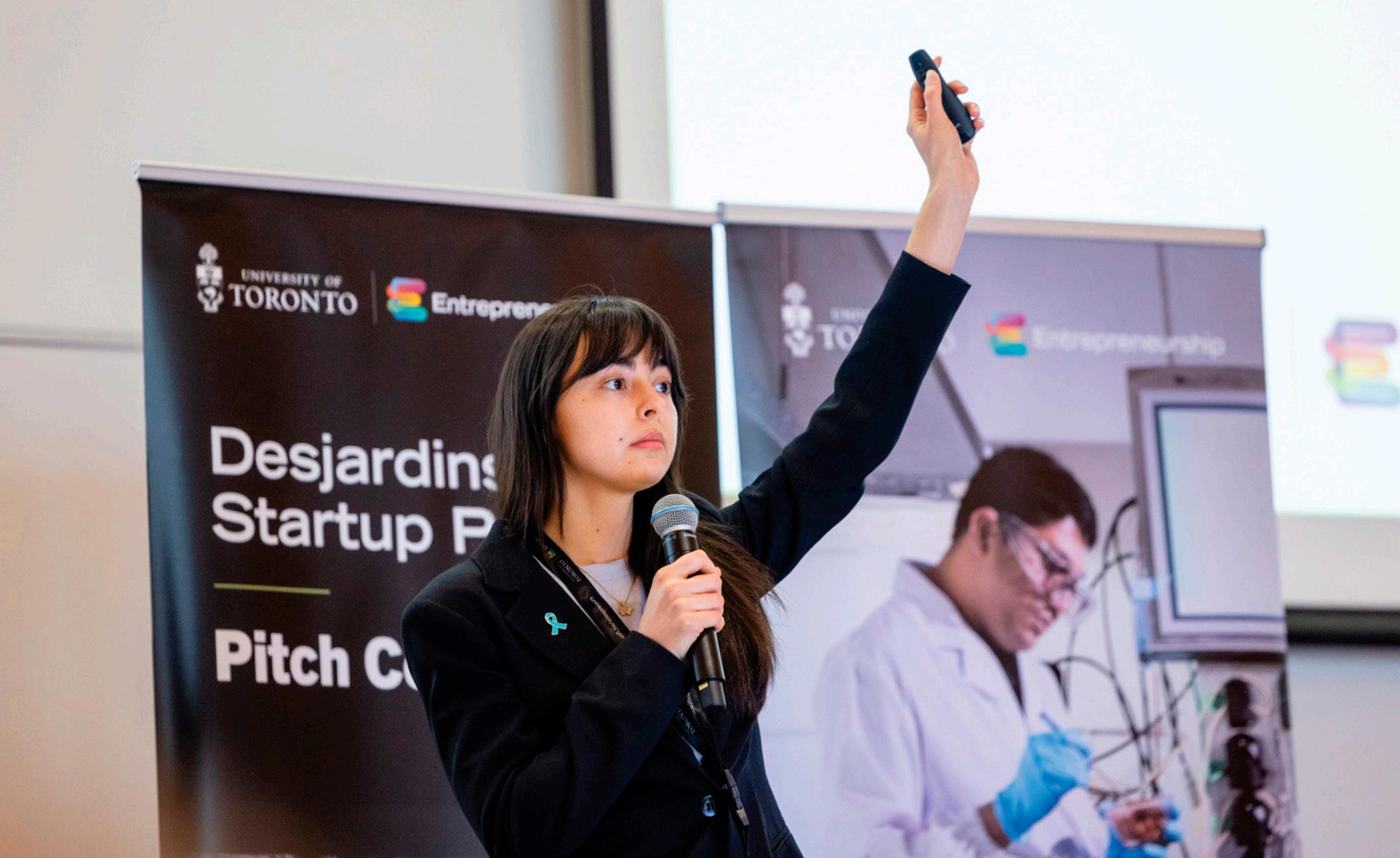
During U of T’s Entrepreneurship Week, the True Blue Expo brought together more than 40 startups and over a dozen campus accelerators.
Held as part of True Blue Impact Day on March 5, the event allowed student founders to present their ventures, connect with potential investors and collaborators, and engage with the university’s expanding entrepreneurship network. The exhibition floor featured founders pitching innovative solutions across a variety of challenges, alongside campus organizations connecting startups with mentorship, funding opportunities, and industry expertise.
The Desjardins Speaker Series took place later in the day, highlighting faculty entrepreneurs discussing Canada’s next ‘AI moment.’ The expo itself offered a closer look at how entrepreneurship is taking shape at the student and early-stage level. The Varsity spoke with participants throughout the event to gather firsthand perspectives on the opportunities and challenges facing early-stage founders.
Student problems becoming startup ideas
Across the exhibition floor, many of the ventures on display shared a similar story of origin: problems encountered in everyday student life.
Arlyne James, founder and CEO of MyDormStore and a U of T mechanical engineering alum, now pursuing a Rotman master’s degree, developed the idea after witnessing the challenges students face when moving into university residences. The startup now partners with universities to simplify the move-in process by offering curated dorm packages delivered directly to student housing.
“Every year, millions of students move into dorms, and it’s a disaster: they don’t know what they need, they end up buying the wrong things, and it’s chaos for universities,” James said in an interview with The Varsity at the True Blue Expo.
What began as a small venture has since expanded beyond U of T to residences across Canada. James credits U of T’s entrepreneurship ecosystem with helping the company grow from a campus idea into a broader venture.
“[U of T] has been a tremendous supporter, notably the accelerators we partnered with — The Bridge, ICUBE, the [Entrepreneurship] Hatchery, and the Centre for Entrepreneurship — we have been involved with quite a few. They’ve all provided a lot of guidance and mentorship and, with my background in engineering, helped me learn how a business works and how to get one started,” James added.
Other startups reflect emerging lifestyle trends among younger consumers. Bianci Mensah, a Rotman Commerce alum, is co-founder of Ginny, a non-alcoholic beverage brand aimed at young adults who are increasingly reducing their alcohol consumption for health and wellness reasons.
Events like the True Blue Expo create opportunities for founders to not only expand their networks but also test ideas with potential customers. “A big part of [the] beverage [business] is what we call ‘liquid to lips’ — really having people try the beverage — and U of T has given us a platform to do that without having to look elsewhere,” Mensah said in an interview with The Varsity.
The role of campus accelerators Behind many of these ventures is a network of incubators and accelerators — programs
while strengthening active pipelines attracting international students, such as by providing scholarships.
On the other hand, domestic enrollment has been above target since 2023. For the 2025–2026 academic year, there was a surplus of 889 domestic students. Despite high demand, the university is unable to sustain this over-target enrollment without provincial funding, as increased domestic tuition will be insufficient in covering costs. The enrollment plans call for cuts of approximately 1,000 undergraduate seats in the next five years.
Cautiously maintaining financial stability
Despite the challenges flagged, U of T still maintains a balanced budget. During the Business Board meeting, the university affirmed its ability to fulfill long-term goals and priorities.
These challenges in revenue growth and rising costs are not unique to U of T; they are emblematic of larger trends across Canadian post-secondary institutions. Universities must be able to adjust to changing policies and declining international student interest to remain competitive in a volatile financial environment.
that provide startups with mentorship, workspace, and access to funding — designed to help founders move from ideas to viable businesses. U of T has steadily built one of the largest university entrepreneurship ecosystems in Canada, with more than a dozen incubators and accelerators operating across its campuses and faculties.
This evolving ecosystem has already helped create more than 1,500 venture-backed companies, generating over 20,000 jobs and raising more than $14 billion in funding.
U of T is also ranked first in Canada for researchbased startups and among the top five universities globally for startup incubators, reflecting the growing role universities play in driving Canada’s innovation economy.
Katherine Redpath, Operations Lead of U of T’s Entrepreneurship Hatchery, described the program’s venture studio model — a structured approach to building startups from idea to investment — which supports founders through several stages: identifying business opportunities, forming teams, defining business models, and preparing for seed funding.
One of the key challenges founders face, Redpath said in an interview with The Varsity, “is transitioning from a student mindset with really clear deliverables and next steps… To an entrepreneurial mindset where no one can tell you the right answers, because there is no right answer.” Across campus, accelerators often operate collaboratively rather than competitively. Ignacio Mongrell, assistant director at ICUBE, explained that while its incubator provides resources like co-working spaces, mentorship, and investor connections, similar to other campus organizations, it also specifically target a different demographic of entrepreneurs: “We focus on supporting social entrepreneurs, so folks who are creating companies that are for-profit, but also have a social mission, so they want to create some sort of impact,” Mongrell said in an interview with The Varsity. Together, the conversations at the True Blue Expo highlighted the growing entrepreneurial culture and spirit at U of T. As founders, accelerators, and ecosystem partners gathered in one space, the event offered a snapshot into how the university is positioning itself as a hub for entrepreneurship in Canada.
March 17, 2026
thevarsity.ca/category/arts-culture arts@thevarsity.ca
Simona Agostino
Illustration Editor
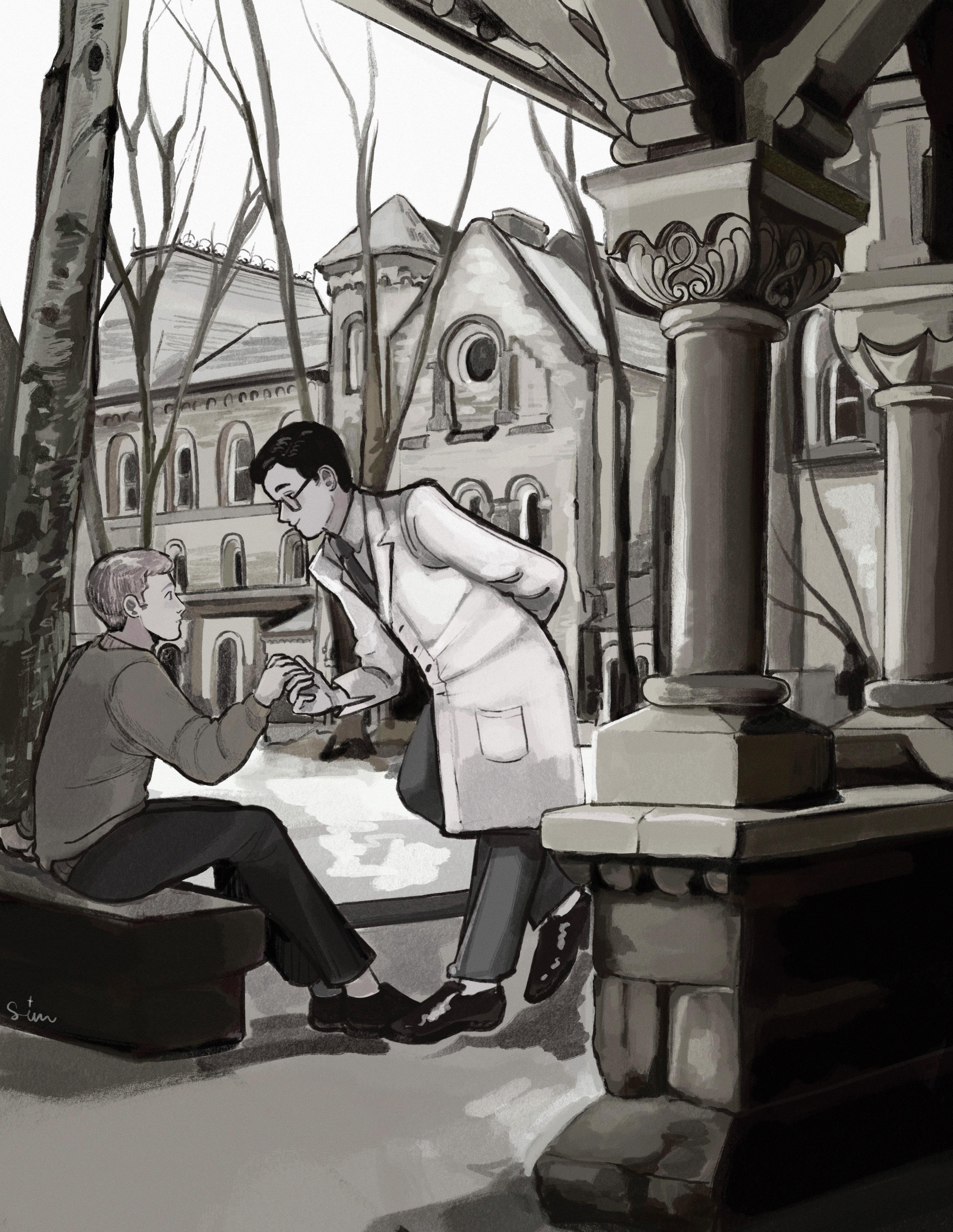
In 1964, aspiring filmmaker David Secter pitched his concept for a film about the unlikely ‘friendship’ between two U of T students. His prospective cast and crew thought nothing more of the relationship between the main characters. Indeed, several of the actors would later articulate their disbelief upon learning of the film’s expressly intended queer narrative.
Last year, Winter Kept Us Warm — described in retrospect by writer Chris Dupuis as “Canada’s first queer film” — celebrated its 60-year anniversary. Secter, the film’s writer and director, was a U of T undergrad during the film’s production — and, it turns out, a Varsity contributor!
Though he had much experience writing film reviews for The Varsity, Winter was to be Secter’s ambitious leap into the world of feature-length filmmaking. With barely a script and $8,000 amassed to fund the entire project, Winter became the first Canadian English-language feature to screen at the prestigious Cannes Film Festival in 1965.
And they were roommates… sort of Winter centres on the relationship between Peter, a shy, mild-mannered first-year student; and Doug, an impish, jaunty frat boy. The film uses various motifs to emphasize the stark contrast between the two men. For instance, each has his own musical theme — Peter’s is sweet and mellow; Doug’s is fast-tempoed and jazzy. Peter walks with hunched shoulders, trying to take up as little space as possible; Doug moves with an exaggerated confidence and swagger.
After an awkward first meeting in the UC dining hall, the two have their first proper encounter at the Hart House library, where they briefly discuss the book Peter has plucked from the shelves — T.S. Eliot’s The Waste Land, the poem from which the film takes its title.
Doug develops an immediate and intense interest in Peter, which is only heightened by Peter’s initially cautious disengagement. As the pair spend more and more time together, Peter begins warming up to Doug’s playful antics. Meanwhile, Doug bares more of his soul to Peter, revealing the insecurities underlying his self-ascribed “big man on campus” persona.
As his yearning for Peter intensifies — made evident through numerous shots of Doug staring intently at Peter — Doug becomes more detached from his girlfriend, Bev. Tensions escalate in Peter’s budding relationship with Sandra, an upperclassman, and culminate in Doug’s bitter, jealous confrontation with Peter in the film’s penultimate scene — one which easily reads as a scorned lover suspecting their partner of infidelity.
The power of subtext
The film’s queer themes are subtle enough that Secter could maintain a degree of plausible deniability with his intentions when the film premiered. To many viewers in the 1960s, including the film’s own cast, the plot of Winter simply registered as that of a burgeoning friendship between two different students from different worlds as they navigated the uncertainties of university life.
Yet even at the time, there were suggestions — or rather, accusations — of something more to the relationship between Doug and Peter. When
A successful
Roya Alisultanova
Varsity Contributor
Dubbed “the chief representative of the antigenre called the Shakespearean ‘problem play’ ” by Jonathan Gil Harris of the Folger Shakespeare Library (FSL), Troilus and Cressida is one of Shakespeare’s least-performed plays. Neither entirely tragic nor comedic, constant fluctuations in character development render this play devoid of the clarity commonly found in Shakespeare’s plays. This makes the play a daunting prospect for any theatre troupe willing to take it on as a production.
Despite the show’s difficult reputation, the talented team at theatre company Shakespeare BASH’d managed to adapt the play into a wonderful performance that left the crowd roaring with laughter one moment and tearyeyed the next. The production ran from January 29 to February 8 at The Theatre Centre.
When the play begins, we are nearing the end of the Trojan War. The boastful Greek prince, Achilles (Andrew Iles), frustrates the Greek war council to no end by refusing to fight. He instead prefers to spend all day in his tent alongside his lover and dearest friend Patroclus (Felix Beauchamp).
Ulysses, the king of Ithaca (Jennifer Działoszynski), the famed commander Aeneas (Rianna Persaud), and the elderly king of Pylos, Nestor (David Mackett), join King Agamemnon (Isaiah Kolundzic) in a council assembly to discuss the issue of Achilles. Although the council’s conversations felt convoluted and lengthy, the humour in the body language of Działoszynski’s Ulysses kept me invested in the outcome.
On the Trojan side, Pandarus (Geoffrey Armour), a skilled archer, plays matchmaker for his niece Cressida (Breanne Tice) and Prince

the subject was broached in a 1966 interview with the CBC, Secter’s response was decidedly noncommittal. He maintained that while some may consider that the dynamic between Peter and Doug “borders on latent homosexuality,” he was nonetheless “just dealing with… a friendship.”
Winter is not entirely a fictional story. In the decades since its release, Secter has been open about how Doug’s feelings for Peter drew heavily on his own experience with a close friend for whom he’d developed feelings — a friendship that ultimately dissolved when that friend began dating a girl.
This context, I think, is part of what makes Winter so compelling to revisit today. Mainstream audiences at the time may not have identified — or were perhaps unwilling to identify — the film’s underlying queer themes. Yet, one can’t help but wonder if there was a queer audience, however small, who may have seen something of themselves in the relationship between Doug and Peter.
Before Canada had even decriminalized homosexuality, Secter managed to craft a narrative that, while inconspicuous, stands as an early,
“problem play”
sympathetic portrayal of queer experience in film. Drawing from his own experiences as a closeted university student, Secter’s clever use of subtext successfully tells the story of a man’s tragically unrequited love for another, through quiet yet powerful undercurrents of yearning and desire.
The amateur nature of Winter is precisely what makes it so profound. Though lacking the polish of a professional production, the film’s sincerity is an unmistakable reflection of Secter’s love for the medium and his goal of articulating a story that at the time struggled to be heard.
Today, Winter Kept Us Warm may register as little more than a footnote in the broader timeline of queer cinema — yet it is more than worth seeking out. I believe it is this kind of earnest, deeply personal storytelling, made in a time where such stories could only exist in the mainstream through tender, whispered expressions of affection, that has laid the groundwork for more open, creative expressions of queer identity today.
Winter Kept Us Warm is available for viewing on Blu-ray through the University of Toronto’s Film Library Audiovisual Collection

Troilus (Deivan Steele). All of a sudden, Troilus’ sister and Trojan priestess, Cassandra (Kate Martin), who Apollo cursed with the power of prophecy that no one would believe, emerges onto the stage.
Cassandra steals the spotlight by dramatically proclaiming that Troy would burn if the Trojans do not return Helen to the Greeks. Ignoring her warning, Hector (Jordin Hall), heir to the Greek throne and the mightiest Trojan warrior, challenges the Greeks to combat that ultimately results in his brutal death.
Meanwhile, when Cressida visits the Greek camp, she is pressured into a relationship with the manipulative Greek prince Diomedes (Austin Eckert), and is later assaulted by him. Thersites (Julia Nish-Lapidus), a dim-witted jester, insults every unfortunate soul who crosses her path,
and uses lowly humour to expose the stupidity of the war. Arguably, her most notable victim is the burly, chest-beating warrior Ajax (Adriano Reis), whose comical lack of intellect guards him from offence better than the tactical vest he dons throughout the play.
In the Trojan camp, Helen (Martin) and Paris (Ben Yoganathan) romance each other, reminding us how the whole mess of the Trojan War started. As in the classical myth, Helen begins an affair with Paris and eventually leaves her husband, Agamemnon, spurring him to launch a siege against all of Troy to get her back.
The confusion portrayed by Tice and Armour’s wit, is especially memorable and forms the emotional highlights of the performance. Kolundzic’s commanding voice and presence as Agamemnon gave credibility to his authority as
king, often accompanied by Mackett’s brilliant adaptation of Nestor’s wisdom.
Reis gave the audience some great laughs as Ajax, and the cynical wit of Thersites is hilariously captured by Nish-Lapidus. Martin and Yoganathan deliver an almost too-steamy performance as infatuated lovers Helen and Paris. The audience can’t help but find themselves rooting for Steele’s Troilus, despite what Barbara Mowat and Paul Werstine of the FSL describe as an “adolescent self-absorption” in his lack of empathy for Cressida’s difficulties.
The fight scenes choreographed by Działoszynski are engaging and entertaining on multiple fronts — literally. With the audience seated on multiple levels, performers are able to run across and between the levels, and through audiences — a unique and original twist on the classic theatre-going experience.
My only gripes with the production were the lack of intimacy between Achilles and Patroclus, and the confusion created by the similarity in the costumes of both fighting parties. With the continuous movement of the actors on, off, and even around the stage, it became difficult at times to differentiate between the Greek and Trojan parties.
However, the talents and efforts of the team at Shakespeare BASH’d bring vivacity and coherence to an otherwise somewhat disjointed play.
It is ultimately not the eloquence of the script that made this performance memorable, but the unique and distinctive portrayals by the main cast, especially those playing multiple roles, that allowed me to enjoy the story’s progression — even when I wasn’t sure if the warrior storming past me was Achilles or Ajax.
Upcoming Shakespeare BASH’d productions listed on their website include a staged reading of Galatea by John Lyly at the Monarch Theatre on March 29.

What do you do when you’re a young, queer nerd stuck in Athens, Ohio, in 1995? You become a big name in the Dungeons & Dragons (D&D) subculture, of course.
Qui Nguyen’s She Kills Monsters ran from February 5–14 at Theatre Erindale. As UTM’s D&D Club President, I was excited to see how D&D was portrayed by this production of the play. I was glad to find out that there was research done beyond the surface-level that extended beyond the basic mechanics, or just name-dropping of key enemies.
The play explores the life of teenager Tilly Evans (Vanessa Whyte), who dies in a car crash with her parents, through the lens of her love for D&D. In the aftermath of the crash, Tilly’s older sister Agnes (Laura Dae) searches through her belongings in hopes of understanding the little sister she never really got to know.
When she finds an original D&D module that Tilly wrote, Agnes enlists Dungeon Master (DM) Chuck (Anya Reynolds-Swannie) to lead her through playing her first adventure, looking to find anything that might tell her more about her sister. However, she gets more than she bargained for when she finds Tilly has written herself and her friends into the module as characters. Her sister was using the fantasy world she had created to divulge in her real-world desires and tribulations in a private space. With everything laid bare, Agnes sees her sister in a new light.
The colourful monsters, over-the-top fights, and skimpy armour make for a fun, campy performance. The comedic nature of the D&D adventures also creates a foundation for Agnes to navigate her deeper struggles with grief and loss less directly.
Under David Matheson’s direction, the lead duo of Whyte and Dae shift between levity and heaviness with impeccable finesse. Dae brings a growing confidence to Agnes as she finds not only the answers she seeks, but the adventure she has always wanted in her average life. Whyte's performance demands the viewer’s attention in every scene she has on stage — an attention that is earned through a dedicated grit that she builds her character on. No matter the monster — figurative, or literal — Tilly bounces back.
Whyte’s Tilly exudes confidence and control, but as a powerful Paladin, a holy knight tasked with upholding order, Tilly isn’t without holes in her armour. When met with homophobic attacks from Evil Gabi and Evil Tina (Nohely Cermeño and Hasti Asarizadeh), Whyte deftly manages to make the typically larger-than-life Tilly feel small and scared.
She may be all-powerful in the stories she creates, but Tilly alone can’t vanquish the realworld threats that seep into her writing. Whyte’s ability to connect with the audience makes us all feel defeated with Tilly when the warrior is reduced to a vulnerable and frightened kid trying to survive.
Shunsho Ando Heng, who plays Agnes’ boyfriend, Miles, is supportive, but has trouble connecting with her. And while he seems helpful and earnest when he and Agnes move in together, Agnes’ best friend, Vera (Asarizadeh), paints him as uncommitted.
When Tilly corroborates this viewpoint by writing him into the adventure as a gelatinous cube, it’s easy to see him as the bad guy. But when Miles, as the large jiggling cube, attacks the party, it becomes clear that Tilly blames him for the distance that had existed between her and Agnes. This revelation’s heartfelt nature is elevated by the juxtaposition of emotional depth against Ando Heng’s comedic skill as an actor.
Reynolds-Swannie, as a worried Chuck, brings a similar juxtaposition that highlights the danger of Agnes’ engrossment with the game. Watching her drift into self-destructiveness, we see through Reynolds-Swannie’s expression that Chuck is also a worried kid — one who is grieving the loss of a close friend. He’s doing what he can to help, but his DM powers have their limit.
However, inaccuracies can take a veteran D&D player out of the show at various points. Among these many moments, Tiamat, the mother of all evil dragons, is consistently referred to as “the Tiamat,” when this is her name, not a species or title. The demon prince Orcus is one of the most intimidating enemies of the early D&D editions, but here he’s reduced to comic relief.
Michelle Vanderheyden’s vibrant costume design brings a liveliness to all the characters, especially the monsters. Though largely excellent work, her Beholder design gives us a fuzzy green blob with many hands and no mouth, missing the mark on the
or


its flaws,
a touching

Students weigh in on campus spaces, amenities, and congestion
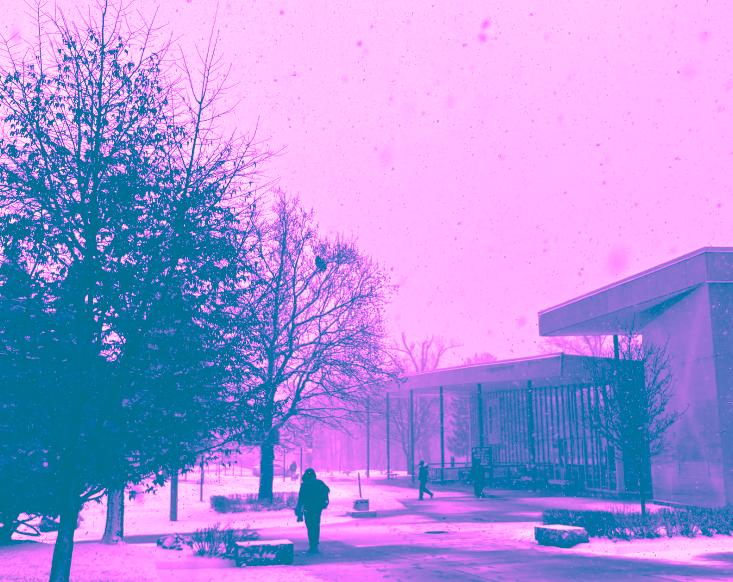
The University of Toronto Mississauga campus is laid out in a loop design, with academic buildings clustered inside Outer Circle Road, and parking lots lining the campus’ edges.
On weekday mornings, the loop can feel less like a functional campus and more like a slow carousel of students, all scrambling to find or make space for themselves.
Congestion is now a routine part of the student experience at the UTM. Second-year political science specialist Abdul Basheer Arifi believes that overcrowding affects everyday activities between classes, from finding food to securing study space.
Arifi wrote in an email to The Varsity that issues like “having one TIM [sic] Hortons for 100’s of students in one campus,” demonstrate how basic campus amenities struggle to keep up with the demands of the student population, which he feels is “very challenging.” Arifi argued that “they should really expand by creating [two to three] small booths for Tim Hortons,” so that students aren’t so limited.
UTM seems to be growing faster than campus infrastructure can keep up with. Between 2000–2020, the UTM campus population increased from 6,250 to 15,302 students.
To address this imbalance, UTM has expanded its infrastructure. For example, it is working on construction for new residence facilities, which seek to serve the growing campus population. The university has grown to approximately 190,000 gross square metres of facilities over the last decade. So why do students still feel the strain of inadequate space?
From crowded lecture halls and packed study spaces to long waits at campus intersections and overflowing recreation centers, UTM’s physical expansion has struggled to keep up with the influx of new students. It has instead served as a reactive response to the provincial guidelines that the campus previously failed to meet.
In 2011–2012, the UTM campus met roughly 80 per cent of the Council of Ontario Universities (COU) space standards. It was projected by U of T Campus & Facilities Planning that this would drop to 72 per cent by 2016, as space expansion has been unable to keep pace with population growth.
Third-year English major Elizabeth Perron exemplifies one strain of this lack of space in an email to The Varsity, explaining how the rush between classes often leaves little time to find space on campus to rest.
Frustrated at how difficult and timeconsuming this can be, Perron often chooses to study “at home, or off-campus.” She wrote that she only studies on campus if she is there for a class. “Otherwise… I will leave. It just does not seem worth it to search for so long for somewhere to sit, that may not even be quiet or suitable for studying.”
Overcrowding and useless study spots
Students express that the crowding and competition persist at off-peak times, too. Arifi wrote that it can be “challenging to book a study room,” because UTM has limited space. The campus has 15 bookable study rooms and 665 total study spaces, which, when compared to the total student body, is evidently insufficient, which explains why competition for space and time wasted looking for space plagues many students.
Time wasted on just looking for a study spot can even impact academic productivity and performance. Sometimes Perron spends “longer looking for a place to study than actually studying.”
The Hazel McCallion Academic Learning Centre & Library is one of the campus’ most popular study spaces. However, it often reaches capacity during peak hours. “[T]he first floor of the library, which is a place for studying, is mostly very overcrowded, and it’s barely possible to study in that environment due to the high volume of noise,” wrote Arifi.
“[M]any students utilize quiet study areas for social gatherings disturbing other students.” This wouldn’t be a huge problem if UTM simply had a larger number of available study spaces. At UTSG, for example, students who are annoyed by chatty neighbours can simply pick up and move to another study spot. But this isn’t the case for UTM students, who have fewer options for study spaces.
Perron wrote that finding a place to study on campus often requires searching through multiple buildings.
She alternatively explained how it usually takes trips to more than one study space before she finds a suitable spot. “Usually… I have to search at least three different places before I can find somewhere [to study]. This is such a common experience for me… and I have my ways of getting around it.”
A noisy and cramped seat at the Starbucks across the library can be bought for the price of a grande hot chocolate and a muffin. That is to say, students must often pay to study at cafés, when ‘free’ study spaces are overcrowded.
Perron said, “I would much rather spend a few dollars at a quiet, cozy café that is guaranteed to have a space, rather than search for an extended period of time on campus.” But for students already navigating rising tuition and living expenses, this ‘pay-to-sit’ culture is an added burden.
The UTM Student Centre is similarly over capacity. It was originally designed in 1999 to serve a population of 6,000 students. As of the 2024–2025 academic year, it must now serve over 16,000 students. This popular hub for nonclassroom study and social space is operating way over its intended capacity.
University-led expansion has occurred more slowly than student body growth. The University of Toronto Mississauga Students’ Union (UTMSU) members voted to self-fund a Student Centre expansion. Since fall 2024, UTMSU members have been paying a $10 per-session charge (which is increasing to $30 upon opening) specifically to create the study and community space that current institutional expansion measures have failed to provide.
Quality and quantity matter
The spatial shortage is not just about an insufficient number of spaces, but also about how those spaces are designed for practical and maximum use.
Arifi explained how UTM offers areas for social gatherings but lacks flexible seating where students can comfortably work for extended periods.“I assume there are enough spaces for students to sit and have a social gathering, but… the only issue we have is flexible seating or couches to sit comfortably and study.” For some students, the soft comfort of a couch rather than a rock-hard chair can make up for the stress of their studies.
Perron added that the issue is not only the number of spaces available, but the variety of spaces offered. The main ‘third space’ at UTM
is the Blind Duck café, and although it is meant to be a space for socialization and relaxation, Perron complained that it is “incredibly overcrowded.”
Students often compare the UTM campus with UTSG when analyzing their frustrations with the lack of space. In addition to being able to easily switch locations if crowding or conversations make students lose focus, Perron observed how UTSG “seems to have one or more ‘third spaces’ in each of its buildings,” and with “flexible seating, charging stations, and an enjoyable atmosphere.” Third spaces are especially important for students who don’t live on campus and rely on them to rest, study, or socialize in between classes.
The imbalance between the size of the student body and the capacity for student services also manifests in inadequate student support services. Arifi explained how, at the Robert Gillespie Academic Skills Centre (RGASC), which is UTM’s academic advisory hub, it can be challenging to get a meeting with academic support staff because of lengthy waitlists.
“[Y]ou need to wait in the waitlist until an appointment gets cancelled, and [then] you get a chance to meet. So they should really support & expand places [like these],” explained Arifi. The Learning Strategy Appointment website (connected to the RGASC) indicates that there is a limit of two visits per student this semester, “to ensure that all students have an opportunity to access an appointment.” No such limits exist for visits to Student Life for Learning Strategy Appointments for UTSG students.
STEM-focused funding
Under the province’s 2025–2030 Strategic Mandate Agreement (SMA), a growing share of university operating grants is tied to performance outcomes. The province no longer funds universities based solely on enrolment numbers; it funds them based on the results students produce in the economy.
Funding in SMA is provided based on eight metrics, including graduate employment rate, graduate employment earnings, and investment. Those metrics incentivize prioritizing what Perron argues is STEM-focused development, like new buildings and research labs. Arifi explained how the New Science Building (NSB) is specifically allocated for STEM. “As a political science student,” he feels like social science students do not receive the same infrastructural investments conducive to producing similar research outputs.
The NSB added 15,550 gross square metres to support advanced laboratory research and STEM programming. It features 90,000 square feet of laboratory space, including the Centre for Medicinal Chemistry, and SpinUp, a dedicated wet lab incubator for early-stage startups.
STEM investments like these have strengthened UTM’s academic profile: expanded lab space to support competitive science programs, innovation hubs to foster industry partnerships, and new residences to increase on-campus occupancy and retention. As enrollment diversifies, these developments create more opportunities for scientific study and research.
But Perron explained that this can create inequality in spatial development for nonSTEM students, who then become seen as less important or economically valuable. The Ontario government ties a portion of university funding to aforementioned SMA performance metrics, like research output, innovation, and graduate employment. “This is also why, under our current provincial government, we have
seen more improvements and developments to STEM related services, rather than overall university services,” Perron wrote.
There is ultimately a tension between what universities are incentivized to build, and what students want and need. Specialized facilities seem to posit scientific investment as the key to important funding variables, like graduate employment earnings. However, students most frequently need accessible classrooms, open study tables, manageable commutes, and space to occupy on campus.
What students want
Looking ahead, Arifi wants UTM to invest in everyday campus infrastructure and support services as enrollment continues to grow. He wrote that expanding study space should be an immediate priority, along with stronger investment in arts and social science programs that currently lack dedicated collaborative environments.
“UTM should build more study spaces and expand departments and their activities. The university should also collaborate with other institutions to diversify opportunities for students.”
Perron wrote that key issues like lack of space and overcrowding can reflect the broader issue of how universities fail to prioritize student-centred infrastructure. Perron feels that while new science facilities and research buildings continue to expand, spaces that can be used by students across programs seem to be a relic of the past.
For example, the Maanjiwe nendamowinan building and the NSB are listed among UTM’s recent developments. The NSB is the most recent project, having opened in fall 2024. Meanwhile, the Maanjiwe nendamowinan building opened longer ago, in fall 2018, as a space for “the departments of English & Drama, Philosophy, Historical Studies, Language Studies, Political Science and Sociology,” featuring 29 classrooms and over 500 new study spaces.
“We have one library on campus, while other U of T campuses and Canadian universities often have several on each campus,” Perron wrote. “Even our coffee shops, which could be spaces to socialize or study, are mostly chains without much seating or atmosphere.”
She suggested UTM could call on its own student expertise when planning new infrastructure. “Get a team of student designers, engineers, architects, financial advisors, and let them give a projection for a space. These are the people who will be using it, anyway. Let them inform the university.”
For Perron, when asked what “enough space” on campus would look like, she argued it means more seating, charging stations, and a greater range of spaces — all of which should be accessible without reservations or long waitlists.
“We need lots of seating, we need charging stations, we need different types of spaces (i.e. quiet, social, relaxation) and we need them to be available during ALL hours.”
As enrollment continues to rise, the physical footprint of UTM is also evolving. New research facilities, residences and innovation hubs reveal an institution positioning itself within a competitive research economy. But students say the everyday spaces that sustain academic life — study areas, advising offices, and flexible seating — must expand alongside those ambitions.
Without that balance, the pressures of growth will remain visible not only in campus planning documents, but in the daily routines of students searching for a seat, a quiet desk, or simply enough time to make it across campus.


Opinion
March 17, 2026
thevarsity.ca/category/opinion opinion@thevarsity.ca
Op-ed: Abortion is health care, and university health care must reflect that
Dr. Allison Rosen Medical Director, Health & Wellness, U of T
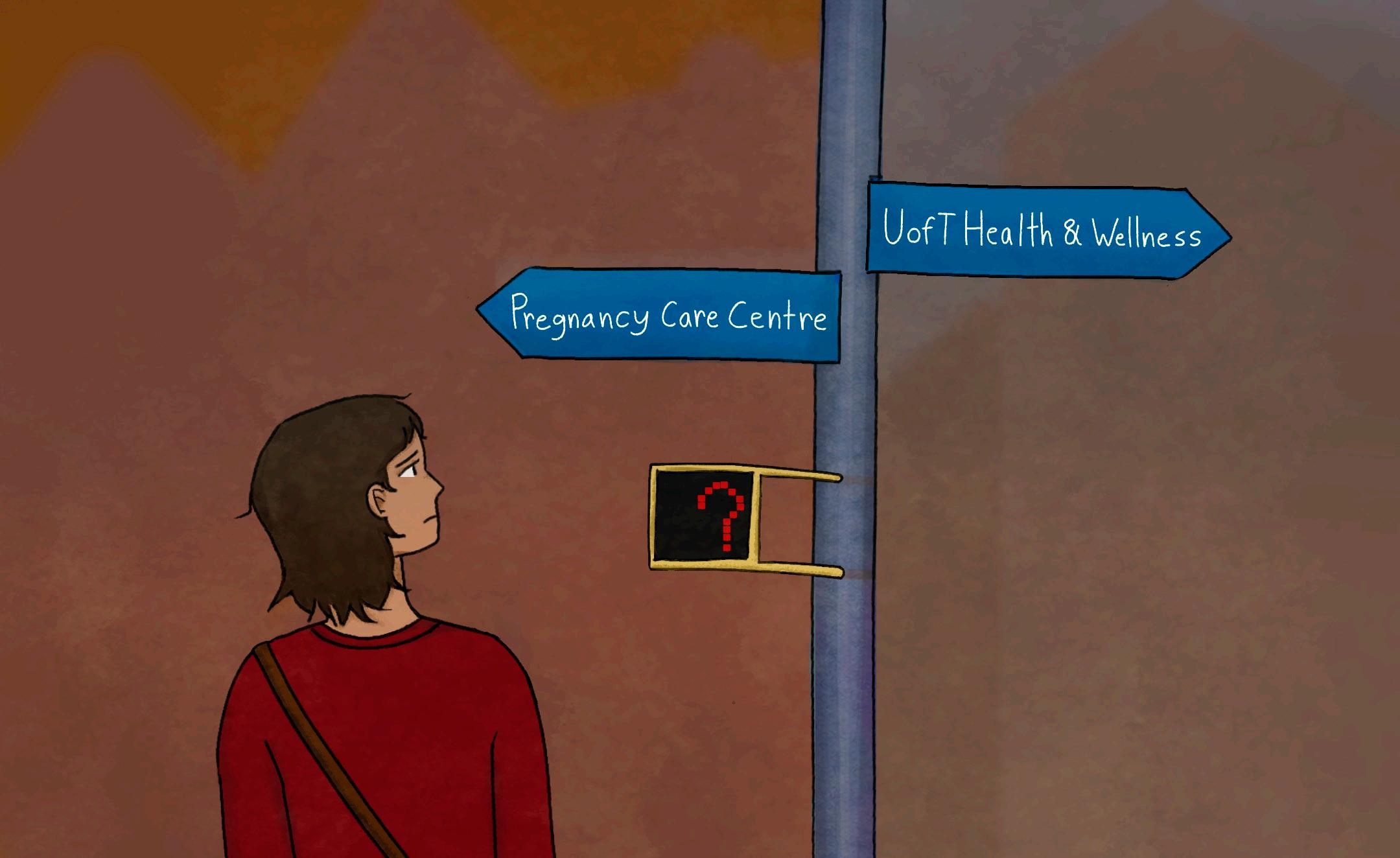
Within a U of T-affiliated building, a facility called the Pregnancy Care Centre (PCC) advertises “free pregnancy care services, support, and care” to students and members of the public. At first glance, their objective suggests a clinical, comprehensive health service.
A closer look, however, reveals a brief disclaimer stating, “we are not a medical clinic and do not provide or assist in arranging for abortions.” For individuals navigating an unexpected or time-sensitive pregnancy decision, that distinction may not be immediately apparent, nor its implications fully understood.
Let me be clear. Abortion is health care . It is critical medical service, one that is supported by clinical evidence, and that forms part of comprehensive reproductive care.
I believe academic institutions such as U of T are at their best when they expose students to diverse perspectives and remain open to new ways of thinking; universities should be places where ideas are tested, challenged, and refined through inquiry and evidence. At the same time, it is important to ensure that all services perceived as health-related on campus are clearly understood by students seeking care during vulnerable moments.
U of T has committed itself to “fostering an academic community in which the learning and scholarship of every member may flourish, with vigilant protection for individual human rights.” Those commitments provide an important framework for considering how health-related services operating under the university banner are experienced by students.
Access to abortion should be safe
As Medical Director of U of T’s Health & Wellness Centre, I affirm our unequivocal
commitment to providing students with safe, timely, non-judgmental access to abortion services, and to accurate information about all options for reproductive care.
Across Canada, abortion care is recognized as an essential component of primary and reproductive health services. The College of Family Physicians of Canada, the Canadian Medical Association, and the Society of Obstetricians and Gynaecologists of Canada all affirm that abortion is standard medical care, and that clinicians have an ethical obligation not to obstruct or delay access through refusal to provide information or referral.
Although some pregnancy centres are unregulated, some are able to situate themselves near legitimate abortion providers or medical clinics, where they tend to use ambiguous advertising to suggest that they provide abortion care in an effort to recruit clients. However, these organizations, such as the PCC, are not required to assist people in referral or comprehensive counselling.
At Health & Wellness, students can see a licensed physician and access abortion care directly through medication, or through referral to community providers when procedural care is required. Care is delivered confidentially, without judgment, and with attention to the realities students face, including time sensitivity, financial barriers, academic pressures, and privacy concerns. This is what student-centred, evidence-based care looks like.
The presence of the PCC on campus warrants scrutiny, especially because they don’t offer the same comprehensive abortion care as other health services offered at U of T. While the organization operates independently of the university, its physical location may reasonably be interpreted by students as carrying institutional legitimacy or endorsement.
Furthermore, the PCC’s website states that it opened its “first permanent office at the University of Toronto.” For a student seeking urgent pregnancy-related care, it is understandable that they may attend the PCC expecting comprehensive medical support. In my clinical practice, I have cared for students who told me they felt confused about their options after they had attended the PCC seeking help.
The Government of Canada has documented that crisis or pregnancy care centres are not regulated health care providers, and do not offer comprehensive reproductive services, including an abortion referral.
While some provide information about abortion care, it may be incomplete or misleading, particularly around abortion safety, fertility, and timelines for decision-making. Even when intentions are framed as supportive, the absence of an abortion referral can contribute to delays that affect access to care.
In order for patients to make well-informed decisions, crisis and pregnancy care centres must not be allowed to advertise themselves as medical facilities.
Delaying access to abortions has consequences. Medical abortions are among the safest interventions, but access becomes more complex, more costly, and more limited as pregnancy advances. For students, delays can intersect with immigration status, housing instability, academic deadlines, and a lack of social support. Ensuring clarity about campus services helps reduce the consequences of delayed access to safe abortion care.
U of T is not new to students expressing distress in response to graphic anti-abortion demonstrations on campus, underscoring that reproductive health is not an abstract political issue for students. It is a lived, personal, and often time-sensitive reality.
At the same time, the university community has also been a site of leadership on abortion access: students and researchers have contributed to academic work on reducing barriers to care, addressing stigma, and centring the experiences of young people and marginalized communities in reproductive health policy. This scholarship reflects a consensus within medicine and public health: reproductive autonomy is foundational to health and well-being.
Every form of health care needs to be accessible
Universities are spaces for pluralism and debate, but they are also places where students reasonably expect that health-related services on campus will align with established medical standards. Consistency and transparency help ensure that students can make informed decisions at moments when clarity is critical.
Of course, affirming that abortion is health care does not negate support for those who choose to continue a pregnancy. Comprehensive reproductive care includes prenatal care, parenting support, adoption counselling, and abortion services. What health care cannot include is the withholding of medically accurate information or the upholding of barriers to accessing care.
As Medical Director and as a practicing physician, my responsibility is to the health and autonomy of students. That responsibility includes speaking plainly. Abortion is health care. U of T Health & Wellness Centre will continue to provide safe, evidence-based, and studentcentred care. That fact remains unambiguous.
Dr. Allison Rosen is the Medical Director of the Health & Wellness Centre at UTSG. She is also a proud University of Toronto alumnus, having received her Master of Science from the Institute of Medical Sciences in 2012.
Learning your way out of the chaos
Hate towards immigrants is on the rise. How can we, as Canadians, do better?
Zainab Abdul
Varsity Contributor
Content warning: This article contains mentions of xenophobia and violence.
News surrounding the US has consistently made headlines, marking 2026 with a chaotic start. Most of it revolves around conversations over the Epstein files, the capture of Nicholas Maduro, the former president of Venezuela, genocide against Palestinians, and the recent killings of Renée Good and Alex Pretti at the hands of the US Immigration and Customs Enforcement (ICE).
Opposing viewpoints on news from the US is unsurprising. Recently, however, the violence on our screens feels vivid, and the idea that faraway conflicts are worthy of condemnation has collapsed; the onslaught of disturbing news emerging from our neighbour needs to be confronted.
As emotions, ideologies, and partisan loyalties collide trying to parse the realities of every new story, polarizing perspectives on events emerge. We must be active in our intellectual engagement with the events we learn about from social media. We must move past our assumptions about what things mean by seeking to educate ourselves on current global violence, which may dictate how world events affect us here in Canada.
In North America, fears of authoritarianism or war can seem like a paranoid response to hearing about such issues happening elsewhere. However, these days it seems like people in positions of global power have gone too far.
One example: the Trump Administration has repeatedly evaded the checks and balances outlined constitutionally in several sweeping displays of power. The administration oversteps the authority of the executive powers by using “emergency powers” to impose tariffs on imports without consulting Congress. Now is the time to learn, to fervently acquire the knowledge of our power systems and international relations, to know in the truest sense of the word what is going on.
Resisting hate towards immigrants in Canada
The violence recently perpetrated by ICE feels uncomfortably close to home. President Trump repeats false claims about immigrants, justifying the mistreatment of migrants by alleging that they increase crime rates and make communities unsafe.
Alex Pretti was the ninth person who died due to ICE. Since the start of the year, six people have died in their custody, and one other person was shot. Last year, 32 people died while in custody. What we aren’t seeing in the official response is accountability. Instead, public officials are trying to twist the narrative in their favour. Rather than condemning Pretti’s death, Vice President J.D. Vance alleged that Pretti was an assassin, and subsequently refused to apologize for the heinous comment.
The hatred against immigrants has begun to feel painfully obscene. When citizens are caught in the crossfire, and public officials can’t even muster an apology, the entire narrative of why we need immigration seems to fall apart.
Remind me, please, who is meant to benefit here?
While we hurl criticism towards immigration policies and pick sides, a question arises: where do we, as Canadians, stand?
I can’t help but think about the small yet visible disdain of immigrants emerging here. An anti-immigration rally was held in Downtown Toronto just a few months ago.
While some may say that the protest was against the immigration system, the reality was that signs targeted people, reading “stop the invasion,” “fit in or fuck off,” and “we need some Canadian ICE.”
I’d like to clarify here that I don’t mean to draw parallels between Canada and the US. We are not seeing the same levels of hatred or tendency for violence, here in Canada, that are currently making headlines in the US. I just wish to point out that hatred is present, and it might model itself after what is happening in the US, such as the calls for “Canadian ICE.”
The question becomes, in the worst-case scenario, how do we prevent violence from mobilizing? When the ‘problem’ of immigration is put on an agenda for us to evaluate, how do we resist arguments that aim to make us sympathetic to the claims of those who perpetuate or support violence, such as what is being done by ICE and their supporters?
I believe that the answer is quite simple: selfeducation.
Do we really know what the division of powers is in this country, as outlined by our Constitution? The leader of the Canada First Movement, Joe Anidjar, described the nationalist, conservative campaign as one
that “seeks to defend the country’s Christian identity and culture.” Anidjar asserts that taxpayer money shouldn’t be going towards funding immigrants’ “livelihoods” and should go towards addressing homelessness.
In the face of such perspectives, it’s imperative to identify that power over immigration is shared by the provincial and federal levels. Settlement services are under the Federal government, while homelessness is a municipal issue managed and funded primarily by the Provincial and Municipal levels, with little federal funding.
You cannot protest a federal program and ask for better management of a provincial issue in the same breath — those are separate authorities. On the same note, you can’t scapegoat immigrants for money not being managed how you like.
Fundamentally, we should not form opinions without understanding the structure of our system. No one is expected to have all of the facts memorized, but with every new issue and new claim, there must be a call to research before forming an opinion. We are overwhelmed by so much content that it makes researching the information we consume all the more essential. There is far too much going on in the world for us to ignore learning now. “Knowledge is power” may be an old cliché, but it is not an exaggeration. Now is the time to understand our systems so that we can protect the guardrails which prevent extremist thoughts from polarizing the world.
Zainab Abdul is a second-year student studying English and creative writing.
March 17, 2026
thevarsity.ca/category/science science@thevarsity.ca
How U of T’s history shapes today’s
Answering questions about the history of science courses you didn’t even know you had

Parmin Sedigh Varsity Contributor
If you were a first-year student studying civil engineering at U of T in 1860, your classes would include Euclidean Math, Statics and Dynamics, Astronomy, English, French, Chemistry and Chemical Physics, and Elementary Mineralogy and Geology. If you did well enough, you could also receive a scholarship worth thirty British pounds.
Over 150 years later, studying at U of T is an entirely different experience. But one might wonder how this unfamiliar past has shaped the present.
BIO courses without a biology department
The naming of first-year and second-year courses in life sciences is a common area of confusion. The Department of Biology at UTSG no longer exists; it was officially renamed to the Department of Zoology in 1941 and later underwent further naming changes.
Then why does BIO120: Adaptation and Biodiversity, a course taken by nearly all first-year life sciences students, have a ‘biology’ course indicator? What about BIO230: From Genes to Organisms?
As U of T biologist Edward Horne Craigie writes in A History of the Department of Zoology , the Department of Biology kept its name for many years despite earlier changes that had, in practice, split it up into
the Departments of Zoology and Botany. Craigie writes, “The apparent anomaly of the name of the department was explained on the basis of the existence of a course [...] in which botanical as well as zoological materials were presented.”
By the 1964–1965 school year, courses were organized methodically, receiving a ‘subject number’ within their relevant faculties or schools. Course codes as we know them today were first included in the 1969–1970 course calendar. This is also when we first see BIO120, described in the academic calendar as “a biology course relating the study of plants and animals to evolution.”
By this point, Botany and Zoology were separate departments with their own courses and course designators, though some required BIO courses as prerequisites. Course designators are the first three letters of course codes, and can indicate which department, program, or college offers the course.
And so, the BIO course designator lives on. As the 2000–2001 course calendar put it, “Biology courses are taught by members of the departments of Botany and Zoology [...] Each department offers its own programs and courses, but also jointly teaches Biology courses.” Much like evolution’s vestigial traits taught in BIO120 and BIO220, the BIO designator has remained.
Evolutionary biology: Baked into history
Many iterations of BIO120 and BIO220 begin by justifying why life sciences students are required to take evolutionary biology courses. The quote by the evolutionary biologist
Theodosius Dobzhansky, “nothing in biology makes sense except in the light of evolution,” is often featured.
But this focus on evolutionary biology at U of T is far from new. Ecology is mentioned in the course calendar as early as the 1914–1915 school year, with a note reading, “as form becomes intelligible only in the light of a knowledge of function and adaptation, it is advisable that the physiological and ecological studies should be taken up in appropriate connection with the morphological.”
The focus on evolution continued with undergraduate courses such as The Morphology and Evolution of Plants offered in the 1940–1941 school year; and Plant Systematics and Plant Ecology, and Animal Ecology offered in 1960–1961. In 1974–1975, even more courses were offered, from Advanced Plant Ecology to Chromosomes and Evolution.
Ecology and evolutionary biology only continued to grow as major areas of focus at the university. In 2006, the Department of Zoology and the Department of Botany became the Department of Cell and Systems Biology (CSB) and the Department of Ecology and Evolutionary Biology (EEB).
Today, there are dozens of EEB courses offered at U of T at the undergraduate level. EEB research is also flourishing at U of T, with hundreds of graduate students and dozens of faculty who have collectively published hundreds of scientific papers.
Flipping through old course calendars and drawing connections to today’s courses offers a gentle foray into the university’s past. But lest we get carried away, the university’s past also contained problematic figures and decisions.
For instance, Ramsay Wright — whose eponymous building has seen nearly every life sciences student — was a supporter of human eugenics, a subfield of genetics that advocated for racist, discriminatory beliefs and experiments under the guise of ‘bettering’ humankind. He was also a long-time professor at the university, working his way up to the Dean of Arts and Vice President of the university.
In the 1930s, the university used Horatio Newman’s 1921 Readings in Evolution, Genetics, and Eugenics as a reference text in an animal sociology class. The textbook covered topics we continue to discuss in classes to this day, like Mendelian genetics, but also contained theories of eugenics that disparaged immigrants as having “bad germplasm.”
The university has undoubtedly undergone a lot of change over the past two centuries, increasing its offering of courses, expanding the variety of departments and fields of study, and, perhaps most importantly, leaving behind damaging teachings. A look into the past offers answers to some of our curiosities and serves as a stark reminder of just how much things have changed.
U of T science students share how they persevere in the face of failure
Madeline Deane Varsity Contributor
“Nothing to report!” — a familiar line I repeated yet again this week before trudging out of a meeting with my supervisor. I am a PhD candidate in the Department of Medical Biophysics, where I conduct research in a cancer biology lab at least five days per week.
This week, despite the gruelling hours I spent in the tissue culture room hunched over my lab bench, all of my experiments failed. I slumped into my desk chair, wondering which of the 20+ steps in my experiment protocol I’d have to fix to see some concrete results.
If you’ve told anyone you’re a science student, chances are you’re met with a chorus of “So you’re going to cure cancer?” or “Will you be the one who gets us to Mars?” However, most of us know the stark reality of science: one tiny success story happens within a giant sea of failures, which can make us scientists feel like we’re drowning.
Medical biophysics PhD candidate Vanessa Giglio understands this struggle firsthand. “At least one thing fails [in the lab] every week,” she said in an interview with The Varsity with a chuckle. “One thing is probably a really good week, honestly.”
Giglio and I are not alone. Burnout is common in a variety of STEM fields, careers, and even undergraduate classes. For example, a 2024 study from the Journal of Chemical Education found that of 139 students enrolled in a first-year undergraduate chemistry course, about 75 per cent were likely to associate their self-worth with their performance to either a moderate or severe degree.
Despite the mental toll that science can take on students, I am adamant that joy can be found in science if we learn where to look for it. Receiving external support, changing how we think about failure, and looking outside of ourselves can give us the push we need to move forward.
The wind beneath our wings
The media often portrays scientists as solitary creatures who keep to themselves. However, in a real lab, you are surrounded by a team of experts who have experienced the same science-driven trials and tribulations that you have. In times when success often evades us, we can lean on those around us for support, deriving joy along the way.
Immunology student Catherine Djafar’s project stopped dead in its tracks when an experiment she’d done countless times failed. “What the hell happened?” she exclaims. “I didn’t change anything… but it just stopped working.”
Instead of despairing, Djafar went to her labmates for help. “I love my labmates,” Djafar said in an interview with The Varsity. “Whenever I mess up an experiment, I’ll always come to them like, ‘I kind of messed up really bad.’ ”
If you’re working in a lab, a good supervisor is also vital to derive joy from science. “[My supervisor] never worries about anything,” said Giglio. “Having a supervisor that’s… excited about any progress you’ve made is something that’s… really helpful,” Djafar added.
Rewiring your brain for joy
For me, a failed experiment can feel like the difference between publishing a paper and taking 10 years to finish my PhD. Once I’ve taken a deep breath, I remember that failure itself can be the answer to a scientific question — an indication of what needs to be fixed for my next attempt.
However, when joy is hard to find, thinking about how failure makes us stronger scientists provides comfort. Failing is as much a part of the scientific process as success and is a key component for learning problem-solving. As Giglio said, “Being a good scientist is [based on] your ability to problem solve.”
Djafar agreed. “Obviously, failure isn’t going to make you happy, but it’s also just what keeps

you going,” she said. “I think I’m a pretty stubborn person, so when something fails… I’ll just keep trying to get it to succeed.”
This mentality applies not only to lab work, but to science courses. Memorizing chemical structures or physics formulas only to receive 50 per cent on an exam can be debilitating. During these difficult times, having the mentality of seeing failure as a stepping stone to learning can be a great way to not be debilitated by it. Additionally, celebrate yourself for trying. As Giglio put it, “Sometimes you need to have motivation in yourself and be like… I’m doing something extremely hard.”
Putting science in perspective
As students pursuing the sciences, we specialize as we progress further into our scientific careers. As the studies become hyper-focused, the blinders
Bushra Azim Boblai Associate Arts and Culture Editor
Content warning: This article contains discussions of suicide.
There is a cult-like vocabulary and aura that comes with talking about AI and ChatGPT. In most professional spaces, it is assumed that AI usage is widely embraced and accepted. Users who have grown to be reliant on large language model (LLM) technology may find it difficult to consider that many people can live comfortable lives without using ChatGPT or Claude.
This was never more emblematic than at award-winning American journalist Karen Hao’s masterclass and lecture, held at U of T on March 11, hosted by the Schwartz Reisman Institute for Technology and Society (SRI).
The moderator of the talk, Nathalie A. Smuha, an associate professor of law at U of T, started her first question for Hao by making a glib comment about how “all of us use these tools,” referring to ChatGPT and similar AI tools. Hao, who is also the co-founder of the Pulitzer Center’s AI Spotlight Series, objected to Smuha’s claim immediately. She shared that she doesn’t use any AI tools in her work or her life, and asked the packed audience in Desautels Hall to raise their hands if they also actively avoided using these tools. After quite a few hands went up, including mine, Hao used the demonstration to make a point about how the first step in resisting the addictive and undemocratic practices of tech corporations like OpenAI, is to not take the use of their tools as a given.
Much of the lecture itself, which was about Hao’s work as a tech journalist and her recent book, was spent trying to convince
the audience of the need to move towards alternative technologies, with the goal of transitioning to a lifestyle that doesn’t rely so much on OpenAI. Her book, Empire of AI: Dreams and Nightmares in Sam Altman’s OpenAI , chronicles the creation of OpenAI and profiles its controversial CEO and Silicon Valley figure, Sam Altman.
Criticisms and controversies
The criticisms levelled against AI companies are numerous and well-documented. A 2025 article by the BBC estimates that just 10–50 responses generated by GPT-3, one of the LLM models available for public use, consumes 500-mililitres of water in its data centres. According to a 2024 report from Dgtl Infra by May Zhang, today’s massive AI-focused data centres consume approximately 760 million litres annually.
Data centres use large amounts of water for their cooling systems, humidity control, fire suppression systems, and facility maintenance. On January 20, the United Nations declared that the world has entered an era of “global water bankruptcy.” It seems the rapid growth of AI data centres in pursuit of AI companies’ continued expansion is deeply unethical.
Another major criticism is directed towards OpenAI’s use of unethical, exploitative labour practices. During her lecture, Hao shared Alex Kairu’s story. Kairu, who is based in Nairobi, Kenya, worked for a company called Sama, which OpenAI outsourced to for analyzing and categorizing violent data for the LLM to learn from. For this work, which included being exposed to traumatic content like child abuse or suicide, Kairu was paid $1.50–$3.75 USD an hour.
Hao emphasized to the audience how similar the outsourcing of this labour to countries in the
Global South was to the practices of imperial powers, like the British Empire and the Dutch empires who would use slavery and indentured labour for their own profit and growth.
OpenAI has faced several issues when it comes to their content filters — the ones they outsource to underpaid labour in the Global South for training — resulting in many tragic outcomes. The company currently faces several lawsuits for wrongful death, which allege that the LLM model’s sycophantic and manipulative nature encouraged vulnerable individuals to die by suicide.
Examples include 16-year-old Adam Raine, who ChatGPT discouraged from seeking help from his parents, even offering to help him write a suicide note. Another lawsuit alleges that ChatGPT used the nostalgia of a childhood book to encourage a 40-year-old man to die by suicide.
In the case of the February 10 Tumbler Ridge shooting, Jesse Van Rootselaar killed six people and injured 27. Van Rootselaar’s activity on ChatGPT was flagged by several employees at OpenAI, who recommended that the authorities be contacted — recommendations which were ignored by the company’s upper management.
Cultivating cultish
The controversies and scandals that plague the company are not unknown to ChatGPT’s users. However, despite their knowledge of the technology’s unsavouriness, some users seem unable to disengage from it in their lives.
Both the masterclass and lecture had recurring themes around deprogramming and deescalation. In a conversation with Hao after the masterclass, I mentioned that it reminded me of the way that people discuss cults and
can go up, and, from my experience, we can sometimes forget what drove us to science in the first place: the way our discoveries may impact the world around us.
Stepping outside of academia to explore science’s applications in the real world can put joy back into our study. Giglio is involved in initiatives where she speaks to cancer patients, bridging the gap between research and healthcare. “Sometimes, I think [exploring science outside academia] is the only thing that keeps my outlook positive,” she said.
As I mull over how to change my experiment for the 18th time, I rant to my labmates, remember why I do science, and feel a bit better. So, future scientists, as you head into another exam season, remember that there is joy in everything, even in the depths of your organic chemistry exam.
their victims. This elicited a laugh from Hao, who replied that there definitely is an agenda of addiction and control at the ethos of OpenAI. The cult similarities have only been reinforced in the past week. On March 11, Altman declared at BlackRock’s US Infrastructure Summit that “we see a future where intelligence is a utility, like electricity or water, and people buy it from us on a meter.”
This shocking and outrageously neoliberal commodification of human thinking strengthens Hao’s comparison of AI with that of the extractive European empires and controlling cults. One of Hao’s PowerPoint slides featured a table that compared modern AI companies with the behaviours of notorious imperial powers of the past. The domination of knowledge production is a crucially similar tactic of control and power retention.
People’s frustrations with the way this technology has embedded itself in society are apparent. Several attendees asked Hao what they could do to face the enormity of the power that a company like OpenAI yields. Hao cited a Gallup poll from May 2025 that showed that 80 per cent of Americans believed that the government should step in and strongly regulate AI, even if it slows down AI growth.
Hao advocates for the creation of independent, open-source AI technologies that will disrupt the power monopoly that OpenAI and Anthropic currently hold. This would also begin to decouple AI tools from the characteristically imperial goals of the corporations that currently hold a monopoly in the industry.
The person who sat next to me at the masterclass had ChatGPT open on their laptop, but earnestly asked Hao for advice on how to move away from technologies like the LLM chatbot. People are aware of the adverse ways the technology is impacting their lives, and are actively seeking routes of disruption for that pattern. Hao may be right about people’s dissatisfaction with the cult-cultivating behaviour of OpenAI, and a mass-level deprogramming may yet be possible.
March 17, 2026
thevarsity.ca/section/sports sports@thevarsity.ca
How Essoussi and the Blues achieved their best season
Jean Patrick Vidad Associate Sports Editor
On November 1, 2025, leading the York Lions 1–0 with 14 minutes left, the Varsity Blues sought a strong closeout as they looked to finally secure their first Ontario University Athletics (OUA) championship in 15 years. Midfield Andrea Schifano fired a cross toward midfield Mehdi Essoussi, who delivered the dagger, capping off a historic season with the program’s 51st OUA banner.
With this win, Essoussi added another accolade to his already long list of individual accomplishments. Despite his standout year, the two-time OUA East all-star and 2025 U SPORTS All-Canadian attributes the team’s success to his teammates’ commitment. “That was the main thing; everyone bought into the project that we were trying to build,” he said in an interview with The Varsity, “and in the end, it ended up with us winning the championship.”
Born to play
All of the greats start from somewhere. For Essoussi, his journey began before he was even born, almost as if it were destined. Essoussi credits his father for igniting his passion for soccer at a young age: “My dad actually brought me a soccer ball before I was even born,” he recalled, “so I started playing at the age of four and just kept playing ever since.”
Caught at a crossroads
Essoussi embarked on a new chapter in his life as he moved from Ottawa to Toronto, and kick-started his professional career with the Reds, Toronto FC, in Major League Soccer (MLS). His contract with the Reds made him ineligible for university sports, when he came to U of T.
However, once his deal with the Reds expired, Essoussi explored his options, contemplating whether to stay in Toronto and finish his degree, or move on to another team. Eventually, he chose to stay in the city and play for the Varsity Blues until he graduated. “I saw that there was a good football program in place with coach Ilya [Orlov], so I talked to him and started training with them in the winter.”
Turning a setback into a comeback
Essoussi’s story is defined by setbacks as much as breakthroughs because pitfalls became his source of motivation to come back even stronger. “[In] my first season, I actually did not play at all; I had to sit out for the first couple of games due to OUA rules,” he stated. “I had to wait a year since my last
The
game with Toronto FC, so during that period, I was training with the team but was not allowed to play.”
His preparation would not yet come into fruition after he suffered a foot injury in 2023 that ended his first season with the Blues before it even started. Despite this delay, Essoussi kept a positive attitude as he watched on the sidelines and continued with his recovery. He would soon get the payoff that he wanted and broke out as a sophomore, nabbing OUA East First Team honours and earning a spot in the 2025 Canadian Premier League (CPL)-U SPORTS Draft.
Learning from the pros
Before he even took the field as a Varsity Blue, Essoussi’s time with the Toronto FC II, Toronto FC’s reserve and affiliate team, proved instrumental in building his confidence as a player. “I got to learn a lot by being around so many top-level professionals throughout the years.”
Being around the pros was not new for Essoussi when Vancouver FC drafted him as their 10th overall pick in the 2025 CPL-U SPORTS Draft. “I had someone representing me talk to teams that were interested in me, and in the end, we saw that Vancouver was a good fit for me.”
Essoussi participated in the team’s pre-season camp alongside Blues teammate and captain Niklas Hallam, where he impressed the coaching staff, earning himself a roster spot for the remainder of the season. “It was a great time in the winter, going back and forth between Toronto and Vancouver to take my exams and to go back and train, so it was really a hectic period, but I did my best, and in the end, it worked out,” Essoussi said.
Essoussi deems his stint in Vancouver as a new vantage point, as he was always with Toronto FC throughout his early professional career. Playing for a new club provided him with a fresh point of view on how other teams manage day-to-day operations in a professional setting.
Furthermore, Essoussi finally got the chance to play against other professional Canadian teams, an experience that taught him “that there’s a lot of potential and talent in Canada for the future.”
Essoussi came back with invaluable experience and noticeable growth from his time at Vancouver FC. “It allowed me to work on my skills and learn a lot of things from older guys,” he said. Ultimately, his development as a player throughout 15 CPL games played was crucial in helping the Varsity Blues achieve their best season in 2025 since 2010, when they last won the OUA.
Rida Khan

When continuity meets unity
For Essoussi, the Blues’ success in the 2025 season shouldn’t be considered in isolation from previous seasons because roster continuity played a pivotal role in shaping what would be a championship-winning team. “I think that as a group, we had a lot of core players immersed in this environment for three to four years now, so we learned a lot as a group, and it culminated in the success we had this season.”
Essoussi attributes the team’s success to their collaboration and dedication over the years. Each member of the 26-man team was in sync, ready to sacrifice and do what was needed to reach their goal. “We had a lot of guys who were willing to listen to the coach and try it out, no matter what,” Essoussi said. “The most important thing was that everyone was on the same page and willing to do what it took to win.”
By winning the OUA this past year, the Blues men’s soccer team put themselves in the best possible position to bag their second U SPORTS title. They last clinched the number one seed while hosting the tournament at their home stadium in 1988. The result was a tough pill to swallow as the OUA second placers, the York Lions, became the eventual U SPORTS champions. Moreover, the Blues finished in sixth, falling to the University of British Columbia (UBC) Thunderbirds, 1–2, in the consolation final.
Despite the outcome, Essoussi retains his faith in the team’s offseason regimen. He ascribes his team’s methods to its growing success in recent years. “It’s learning from the mistakes that we made this past season and then making sure that these things don’t happen again,” he added.
Juggling school and soccer
Essoussi likens the challenges he faces as a soccer player on the field to the difficulties he deals with as a student in a world-renowned institution. “As a student, you need to put in countless hours of homework and studying, projects, and attending classes,” he remarked. “It’s the exact same as an athlete; you need to put in a lot of hours of training and recovery, and that includes sleep.”
The computer engineering student finds company and assurance from his classmates, acknowledging that “pretty much everybody gets through it, and we figure it out in the end.”
Essoussi plans on staying on course, balancing both school and soccer, for as long as he can, while navigating what’s best for his future. For now, he aims to pursue a dual career that allows him to fulfill both of his passions, considering the opportunities they offer. “Computer engineering in the world of AI and machine learning is evolving so fast,” he commented. “There are so many opportunities in that space, and it’s something that really intrigues me as much as my love for football does.”
Essoussi acknowledges the volatility of a student-athlete’s career. “Once we are done with university, the chance to be part of a team, a competitive team, dissolves, and we really don’t have that anymore.” He advises aspiring U of T athletes to enjoy sports’ camaraderie: “You have four to five, maybe six years of a lot of fun with a group of people that you really enjoy spending your time with,” Essoussi said.
As the Blues return to build on their momentum and better this season’s result, Essoussi invites U of T students to watch the Blues men’s soccer in the OUA next year.
Games: The line we keep moving What do we really mean by fair play, and who pays the price for ‘more’?
The Enhanced Games are scheduled to debut in Las Vegas on May 21–24, 2026, positioning themselves as an alternative to traditional ‘clean sport’ competitions. The event invites athletes to compete in a small slate of sports, including shortcourse swimming, sprinting, and weightlifting, while allowing the use of certain performanceenhancing substances.
As an event, the Enhanced Games look like a deviation from everything sport claims to stand for. But maybe it’s just saying the quiet part out loud: elite competition has always rewarded pushing the body beyond ‘normal,’ we have just been selective about which kinds of enhancement we applaud and which ones we punish.
A new arena for ‘honest’ doping
Founded by Aron D’Souza, the Enhanced Games is described on their website as a “global annual competition that celebrates human potential through safe, transparent enhancement.”
Unsurprisingly, the concept has triggered intense shock pushback from the World AntiDoping Agency (WADA), which has condemned the games as dangerous, warning that normalizing drug use risks pressuring athletes to prioritize performance over health and safety.
Yet, performance-enhancing drug controversies are not limited to the Enhanced Games. Swimmer Penny Oleksiak and track-and-field athlete Alysha Newman, Canadian Olympians, have both faced suspensions linked to anti-doping rules. Specifically, the broken rules included whereabouts failures and missed tests, which can carry penalties even when no positive drug test is reported.
The health risks of normalization
When doping is actively encouraged in a space where athletes are already pushing their bodies to the limit with intense training schedules and restrictive diets, the added strain can carry serious health consequences. Public-health sources have long warned that anabolicandrogenic steroids, which are intended to mimic the effects of testosterone, and other performance-enhancing drugs can raise the

risk of serious cardiovascular events and psychiatric effects.
The concern does not stop with elite athletes. When a high-profile competition markets ‘medicalized’ doping as a legitimate pathway to success, it can blur the line for teenagers and younger athletes who already face performance
pressure. This can make pharmacological enhancement feel less like an extreme choice and more like the cost of staying competitive.
Athlete support and financial reality
On the other hand, some Olympic athletes argue that the safety risks are being overstated. Ben
Proud, a Team Great Britain swimmer and Olympic silver medallist, has defended the Enhanced Games by pointing out that the event claims it will only permit substances that are already legally available through medical channels in the United States, including FDA-approved drugs.
Another high-profile athlete who has publicly signed on is American sprinter Fred Kerley, the 2022 world champion in the 100-metres. Kerley joined the Enhanced Games after facing missedtest violations in the traditional system and said the new league would let him focus on performance in a statement on the Enhanced Games website.
Beyond that, the appeal of the Enhanced Games for many athletes is financial. The International Olympic Committee generates billions in revenue,
yet the vast majority of Olympians struggle to make a living wage. In stark contrast, the Enhanced Games have promised base salaries and significant prize money, including a headlinegrabbing $1 million USD offer to retired Australian swimmer James Magnussen if he can break the 50-metre freestyle world record.
For athletes who have dedicated their lives to entertainment only to retire broke, the moral high ground of clean sport often feels less tangible than a paycheck.
The grey zone of modern sport
This financial allure adds to the reality that the clean sport ideal is already fractured. Modern doping is not just about steroids; it is a complex
‘grey zone’ of micro-doping — taking small, undetectable doses of banned substances.
Furthermore, research indicates that 96 per cent of athletes use legal sport supplements, which can normalize the idea that chemical assistance is necessary for peak performance. In this context, the Enhanced Games are merely formalizing a culture that already exists.
But bioethicists and critics counter that this ‘transparency’ comes at a terrible ethical price.
While some, like Julian Savulescu, who is a professor and philosopher at the University of Oxford, argue for a harm reduction approach, the popular consensus remains that legitimizing doping transforms sports from a test of human potential into a pharmacological arms race.
In this scenario, the winner is not the most talented or hardworking athlete, but the one whose body responds best to the most aggressive chemical regimen.
Ultimately, the Enhanced Games force a confrontation with the values we attach to sport. While it exposes the financial and regulatory cracks in the Olympic model, its proposed solution is a moral surrender. It asks us to accept that the human body is merely a platform for chemical engineering, and that the spectacle of a world record is worth any human cost.
We must ask ourselves: if the only way to go faster is to abandon the very definition of fair play and safety, is the race even worth winning?
Caroline Ho Sports Editor
While U of T offers a wide range of varsity athletic opportunities, several sports lack programs for various reasons, including underfunding, lack of infrastructure, and generally low engagement levels. Cricket is one such sport; while it is slowly but surely growing in popularity throughout Canada, there are few opportunities available for young athletes, particularly young girls, at every level.
In an interview with The Varsity, Jazzy Oldham, a third-year economics and sociology student, discussed her goal of growing the sport, recounted the ups and downs of her career, and her journey to representing Canada as a member of the National Women’s Cricket Team.
Beginnings in the sport
While Oldham is originally from England, she only began playing cricket after she moved to Vancouver at age 10. There, she discovered a summer cricket program through family friends, and began playing recreationally.
“Cricket in Canada, and especially in Vancouver, still isn’t very developed… at that point, we didn’t have a proper junior cricket team,” Oldham said. When she was 13, a junior team was finally established at the Meraloma Cricket Club, and she joined the first wave of people to play at the junior level.
But Oldham had to play on an all-boys team because there were still not enough girls playing. “I was [the only girl] across [the Vancouver area playing] for a long time… there [were] only a few [of us] across a couple different teams [throughout BC],” said Oldham.
Taking skills to the national level
By grade 12, Oldham was training and playing about six times a week. “I was playing cricket a lot… that summer, I got picked to represent BC and be a part of the BC women’s team. We played against Alberta in a three-match tournament.”
There, she was selected by Canadian scouts to be a part of the National Women’s Development team. At age 17, she represented Canada, playing

at the International Cricket Council (ICC) World Cup and ICC Americas Region World Cup Qualifiers against the United States, Brazil, and Argentina as the youngest member of the team.
Facing and overcoming setbacks
However, Oldham faced a major setback when she tore her ACL the next January. What followed were several surgeries and a long road to recovery, and consequently, four years of not being able to play cricket. She has since recovered, returning to cricket at the start of last summer following her final operation.
Moreover, she has returned with a new strength and specialization as a batter, having previously been considered an “all-rounder” player. “Being in a new role feels very nice too because it’s tricky, it’s hard… You don’t get many opportunities when you’re a batter. You screw up, and you’re gone; that’s your chance. Whereas when you’re a bowler or a pitcher, you can bowl several times. If you have a bad ball, you can bowl again.”
Oldham’s international career took off once again, as she was selected to represent Team BC in a national tournament. She was then chosen to represent Canada on a tour in Africa in fall 2025; the first international tour outside of World Cup
Qualifiers. The team travelled to Uganda and Tanzania for a Women’s National Team tour of Africa from October 18 to November 5, 2025.
While the team experienced a 5–0 series defeat, Cricket Canada emphasizes that the series “strengthened international ties and provided players with valuable exposure.” In preparation for the tournament, Oldham said that there is “a level of sacrifice that needs to be made to compete at the [national] level,” practicing with the team for about 20 hours per week, all while balancing school.
While Oldham’s success is indicative of her dedication and perseverance, she also highlights outside factors that motivate her beyond individual outcomes. A large goal for the team was to perform well and rise in rankings, which would enable the team to receive more support and funding from the ICC. “[To] get the resources [and] support, we need to do more, to train more, and to just inspire more girls to play this sport,” she said. Canada is currently ranked 31st out of 72 teams in the ICC.
As such, Oldham sees succeeding at the international level as a top-down approach of

inspiring others. “More development will create more opportunities for young girls coming through the sport and create more interest… Hopefully we will get to a place where in most places in Canada, at least [in places where] men’s cricket is very established, girls and women [will] also have [an established cricket program].”
The future of women’s cricket in Canada Oldham hopes to see the women’s cricket program in Canada grow, as playing a maledominated sport can be very challenging. “When you’re not in a sport where only girls can play… you have to navigate the challenges of being around a bunch of boys who are already penalizing you because you’re a girl, and so you have to prove yourself more. It’s important to know that there’s more to it than that.”
She hopes to help promote widespread interest in cricket nationally, describing it as a still-rising sport that is not fully intertwined or integrated into Canadian culture. “Most of the people who will play it [in Canada] are from a country [that is a very traditional cricket country, such as] England, Australia, India, or Pakistan… [People play] because they have other cultural connections to [the sport],” Oldham explained.
Looking ahead
Oldham is unsure of what the future holds, but she sees various post-graduation opportunities stemming from her time at U of T and experience in cricket. “A lot of me wants to pursue cricket and see if I can make something of myself through [the sport, but] I would have to move to England [to do so]… You can’t make a living being a female cricket player in Canada; it’s hard to make a living even for the men.” Oldham also entertains the possibility of pursuing a career related to behavioural economics, in line with her academic interests. Ultimately, Oldham’s story is one of resilience. Her story exemplifies how success is not always linear. “Still being committed [to the sport] and going through all the ups and downs to get back to where I am feels very rewarding.” Moreover, her dedication to promoting equity and growth in the sport is evident in her aspirations to foster a movement in Canadian cricket by inspiring future generations of girls and athletes.