
International students at U of T pay nearly
Nina Uzunović Business & Labour Correspondentdisparities between domestic and interna tional tuition rates.
In its last budget report, U of T stated that the high fees it requires from international students “[take] into consideration the full cost of providing a program and [were determined] with reference to fees at peer Canadian and US universities.” This is a prevalent pricing strategy, with McGill University having said the same about its 35 per cent international tuition fee hike in 2020.
However, U of T’s tuition far exceeds tuition at rival Canadian institutions. U of T may be a more desirable destination for international students — a factor that appears to be priced into its higher tuition fees.
U of T’s history with tuition
Before 2019, undergraduate domestic tu-
financial accessibility concerns following CO VID-19.
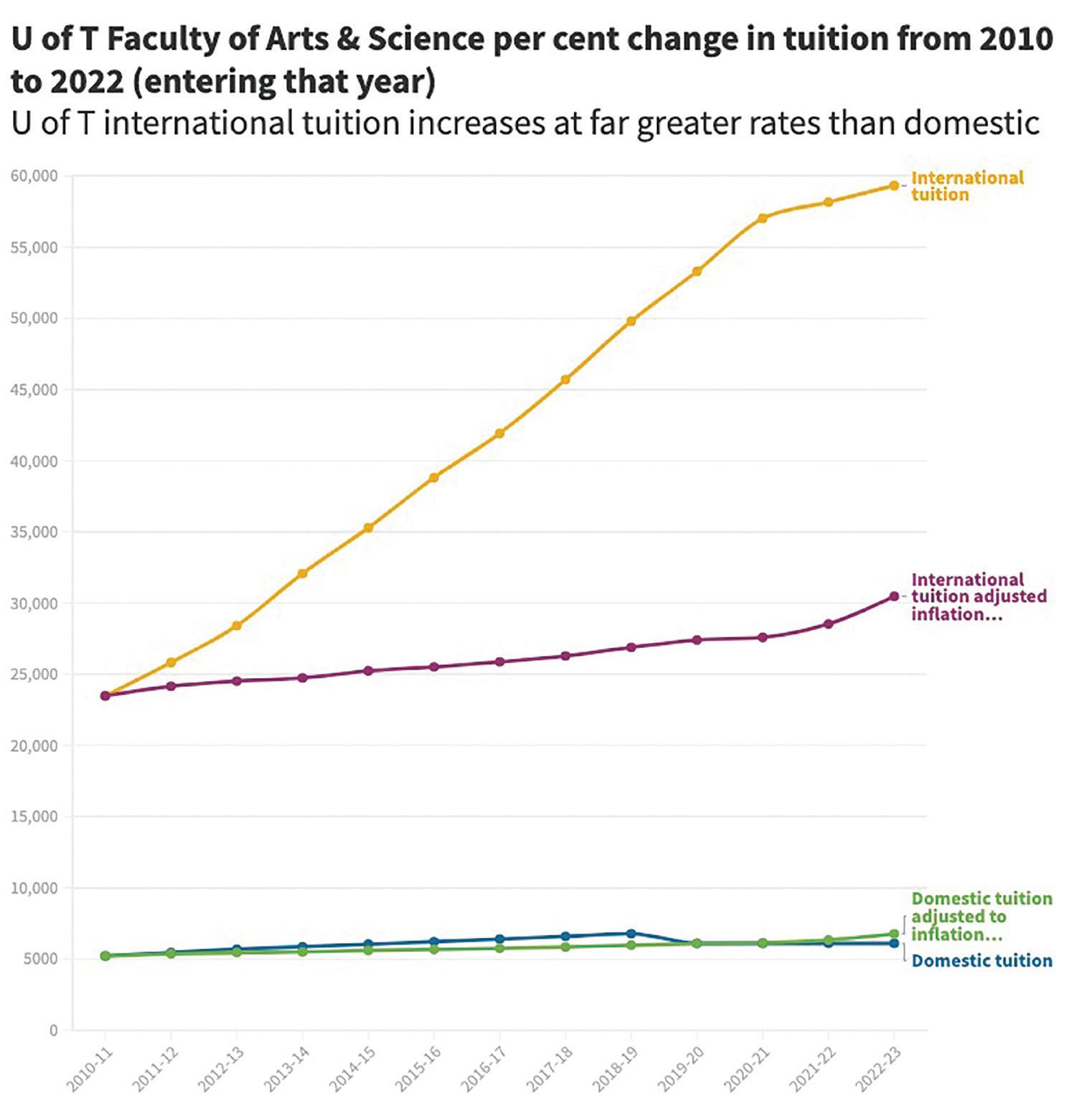
This freeze did not apply to international students, however. Since the Government of Ontario doesn’t regulate international tuition, universities are free to engage in price discrimination. At U of T, this lack of regulation has resulted in extreme disparities between undergraduate international and domestic tuition rates — with increases in international tuition outpacing domestic tuition each year.
U of T increased tuition for students from outside Ontario this academic year, while the fee for Ontario residents remained the same as the previous year.
Differentiation between in- and out-of-province students
International students aren’t the only ones
differentiating tuition by province as well.
Several American universities also differentiate tuition for in-state and out-of-state students. Even with this new change, however, out-of-province students still pay much less than international students. At U of T, the tuition for out-of-province students in the Faculty of Arts and Science for the 2022–2023 school year was $6,280, while international students paid $59,320.
A Canadian context

Undergraduate international students at several top Canadian universities pay tuition fees far greater than domestic students, but there’s still notable variation between institutions. Among Times Higher Education’s (THE) top 10 Canadian universities in 2023, the mean tuition for undergraduate international
viations greater than the mean.
The top four universities on the THE list are U of T, McGill University, the University of British Columbia (UBC), and McMaster University — each of which is one of the top 100 universities in the world according to the THE 2023 World University Rankings. U of T ranks 18th in the world, McGill 40th, UBC 46th, and McMaster 85th. The average undergraduate international tuition of McGill, UBC, and McMaster is $43,121.06, with a meager standard deviation of $262.19. When U of T is added to the pool, the mean tuition becomes $47,170.80, and the standard deviation is $7,018.02.
Continued on page 6
The University of Toronto’s Student Newspaper Since 1880 March 6, 2023 Vol. CXLIII, No. 20
$60,000 in tuition every year. Why?
T HE VAR SI T Y
T HE VAR SI T Y
Vol. CXLIII, No. 20
21 Sussex Avenue, Suite 306 Toronto, ON M5S 1J6 (416) 946-7600
thevarsity.ca thevarsitynewspaper @TheVarsity
MASTHEAD

the.varsity the.varsity The Varsity
Jadine Ngan editor@thevarsity.ca
Editor-in-Chief
Makena Mwenda creative@thevarsity.ca
Creative Director
Nawa Tahir managingexternal@thevarsity.ca
Managing Editor, External
Sarah Artemia Kronenfeld managinginternal@thevarsity.ca
Managing Editor, Internal
Angad Deol online@thevarsity.ca
Managing Online Editor
Talha Anwar Chaudhry copy@thevarsity.ca
Senior Copy Editor
Khadija Alam news@thevarsity.ca
News Editor
Shernise Mohammed-Ali comment@thevarsity.ca
Comment Editor
Janhavi Agarwal biz@thevarsity.ca
Business & Labour Editor
Alexa DiFrancesco features@thevarsity.ca
Features Editor
Marta Anielska arts@thevarsity.ca
Arts & Culture Editor
Sahir Dhalla science@thevarsity.ca
Science Editor
Mekhi Quarshie sports@thevarsity.ca
Sports Editor
Caroline Bellamy design@thevarsity.ca
Design Editor
Andrea Zhao design@thevarsity.ca
Design Editor
Vurjeet Madan photos@thevarsity.ca
Photo Editor
Jessica Lam illustration@thevarsity.ca
Illustration Editor
Maya Morriswala video@thevarsity.ca
Video Editor
Aaron Hong aaronh@thevarsity.ca
Front End Web Developer
Andrew Hong andrewh@thevarsity.ca
Back End Web Developer
Safiya Patel deputysce@thevarsity.ca
Deputy Senior Copy Editor
Lexey Burns deputynews@thevarsity.ca
Deputy News Editor
Jessie Schwalb assistantnews@thevarsity.ca
Assistant News Editor
Al Aref Helal utm@thevarsity.ca
UTM Bureau Chief
Alyanna Denise Chua utsc@thevarsity.ca
UTSC Bureau Chief
Emma Livingstone grad@thevarsity.ca
Graduate Bureau Chief
Ajeetha Vithiyananthan, Kyla Cassandra Cortez, Lina Tupak-Karim
Associate Senior Copy Editors
Alana Boisvert, Selia
Sanchez, Tony Xun
Associate News Editors
Isabella Liu, Eleanor Park
Associate Comment Editors
Alice Boyle, Maeve Ellis
Associate Features Editors
Madeline Szabo, Milena Pappalardo
Associate A&C Editors
Seavey van Walsum, Salma Ragheb
Associate Science Editors
Alya Fancy Social Media Manager
The Varsity would like to acknowledge that our office is built on the traditional territory of several First Nations, including the Huron-Wendat, the Petun First Nations, the Seneca, and most recently, the Mississaugas of the Credit. Journalists have historically harmed Indigenous communities by overlooking their stories, contributing to stereotypes, and telling their stories without their input. Therefore, we make this acknowledgement as a starting point for our responsibility to tell those stories more accurately, critically, and in accordance with the wishes of Indigenous Peoples.
Student sit-in forces closure of RBC branch

inside the UTSU student commons
Climate Justice U of T demands UTSU sever ties with RBC as part of nationwide day of action
Jessie Schwalb Assistant News EditorOn March 2, Climate Justice UofT held a sit-in outside of the University of Toronto Students’ Union (UTSU) Student Commons’ Royal Bank of Canada (RBC) On Campus branch. The student activist group protested UTSU’s connection with the bank.
The protest occurred as part of a nationwide day of action, during which students at 12 Canadian universities held events calling on RBC to stop funding fossil fuels and, in particular, the Coastal GasLink Pipeline. In light of the protest, the RBC branch closed for the day.
The protest
Around 11:00 am, a group of students from Climate Justice UofT entered the UTSU Student Commons. Approximately 15 students displayed large banners and sat in front of the RBC On Campus location.
As RBC is one of the largest investors in the Coastal GasLink pipeline, which crosses Wet’suwet’en land, the protesters projected videos featuring speeches by First Nations people condemning the pipeline. Although some elected First Nations governments signed agreements with the company constructing the pipeline, many hereditary chiefs — who are the nation’s authorities, according to both Wet’suwet’en law and a 1997 ruling by the Supreme Court of Canada — oppose the project, expressing concerns about the pipeline’s environmental effects.
In response to a November 2022 protest in Nova Scotia against RBC’s funding of the pipeline, the bank told Global News that they support energy projects developed in a socially and environmentally responsible manner and “strive to be the leading financial institution in Canada to work with Indigenous people towards reconciliation.”
bank divests. Nine of these protests took place at RBC On Campus branches.
Demands
In an interview with The Varsity, Kate Martens, Climate Justice UofT’s spokesperson for the protest, noted that RBC is the largest funder of fossil fuel companies in Canada and the fifth-largest funder worldwide. A November 2022 report by Stand. earth — a group of researchers and policy experts investigating climate and environmental issues — found that, within the first nine months of 2022, RBC provided more than nine billion USD in loans and underwriting to fossil fuel companies currently expanding coal, oil, and gas infrastructure.
In September 2022, the Competition Bureau, which is an independent law enforcement agency, opened an inquiry into RBC’s environmental marketing after a group of individuals submitted a complaint accusing the bank of making misleading claims about their environmental commitments. In a statement to the Financial Post, RBC rejected these claims, writing that the complaint was “unfounded and not in line with Canada’s climate plan.”
Martens highlighted RBC initiatives, including green grants and environmental events at U of T, that she described as greenwashing — companies advertising themselves as environmentally conscious despite a lack of action. “Banks are smart — they know that when a student joins a bank, they’re with them for life,” said Martens. “They’re trying to target students, get students to join them, and I think most students at U of T would agree that they don't want their money to be invested in fossil fuels.” Martens suggested that students bank with credit unions to avoid placing their money in banks that use customers’ savings to fund fossil fuel companies.
Referring to the bank’s funding of the Coastal GasLink pipeline, Martens said that hosting an
RBC branch within the Student Commons serves as “a reminder to students, and especially Indigenous students, [of] the atrocities that the RBC is currently committing.”
Climate Justice UofT presented several demands directed at the UTSU. They called on the union to release a statement condemning RBC’s contributions to climate change, open up a pilot account with a credit union, and release a report on the feasibility of fully transitioning from banking with RBC. They also demanded that the union publish a policy prohibiting RBC from funding UTSU activities and events and publicly disclose the details of their contract with RBC on the campus branch.
Responses from the UTSU and RBC
In an email to The Varsity, UTSU President Omar Gharbiyeh thanked the students who participated in the protest, highlighting their thoughtfulness in crafting their demands. “Moments like these are really important opportunities for us to connect with our membership, and we look forward to continuing to work with Climate Justice U of T to explore our options and represent students as best as we can.”
According to Gharbiyeh, the UTSU will discuss Climate Justice UofT’s demands over the next few days and provide a full response in the near future.
In an email to The Varsity, a spokesperson for RBC highlighted the bank’s environmental goals, including their commitment to achieving net-zero lending by 2050. They wrote, “We are focusing our attention where we will have the biggest impact – helping our clients reduce their emissions and supporting initiatives that bring green solutions to market.” They also affirmed their commitment to supporting responsible energy development “including meaningful consultations with Indigenous peoples.”
Kunal Dadlani, Alaysha Merali, Hargun Rekhi
Associate Sports Editors
Georgia Kelly, Andrew Ki
Associate B&L Editors
Arthur Hamdani, Johanna Zhang, Spencer Lu
Associate Design Editors
Cheryl Nong, Biew Biew Sakulwannadee Associate Illo Editors
Zeynep Poyanli, Nicholas Tam, Augustine Wong
Associate Photo Editors
Olivia Belovich, Ashley Choi Associate Video Editors
Lead Copy Editors: Andrea Avila, Kamilla Bekbossynova, Ozair Chaudhry, Linda Chen, Jevan Konyar, Momena Sheikh, Nandini Shrotriya, Camille Simkin, Kiri Stockwood, Grace Xu, Valerie Yao
Copy Editors: Naomi Altwasser, Medha Barath, Nichelle
Budhrani, Anushka Dhir, Denisse Rocher Isaias
Designer: Kai Seal, Daby Echefu
Cover: Jessica Lam
BUSINESS OFFICE
Parmis Mehdiyar business@thevarsity.ca
Business Manager
Ishir Wadhwa ishirw@thevarsity.ca
Business Associate
Rania Sadik raniasadik@thevarsity.ca
Advertising Executive
Abdulmunem Aboud Tartir atartir@thevarsity.ca
Advertising Executive
made to ads@thevarsity. ca. ISSN: 0042-2789
Around 12:00 pm, Special Constables arrived at the Student Commons and asked protesters to move a few feet away from the branch. RBC employees closed the space, while students continued to sit outside. Throughout the day, a few people trickled into the Commons. Protesters offered pizza and asked them to sign a petition demanding that the UTSU “phase out” their connections to RBC.
The organizers of the protest also spoke with the UTSU General Manager, who offered to provide the protesters with food or chairs. The protestors declined. They remained in the building until 5:00 pm, when the Commons closed for the day. Climate Justice UofT organized the event as part of a campaign by Banking on a Better Future, a group of youth across Canada advocating for banks to divest from fossil fuels. Students at 12 universities in British Columbia, Alberta, and Ontario staged protests calling on RBC to stop providing funds to fossil fuel companies and demanding that their respective universities sever ties with RBC until the
CORRECTIONS:
Climate Justice UofT camped out in front of the RBC branch in the UTSU student centre. JESSIE SCHWALB/THEVARSITY
A science article from issue 6 entitled “What does a world without colours, shapes, or faces look like?” referenced a case study from Melvyn Goodale and David Milner. It mistakenly referred to the study’s patient DF as a man, when, in fact, patient DF was a woman.
In a news article from issue 17 entitled “Will increased police presence reduce TTC violence?” The Varsity incorrectly interpreted a comment from Julius Haag as suggesting that data on an increase in violent TTC incidents did not exist. He meant instead that he had not personally seen such data, so the comment has been removed for clarity reasons.
A business article from issue 17 entitled “High inflation, skyrocketing interest rates leave university finances tight” incorrectly stated that, between 2021 and 2022, U of T saw an increase in building replacement value from $5.3 million to $5.9 billion. In fact, the starting figure was $5.3 billion.
Due to editorial error, an arts & culture article from issue 17 entitled “The newfound success of the independent music critic” contained an incorrectly ordered and incomplete table of reviewer rankings. We’ve reproduced the corrected table below.
A news article from issue 18 originally titled “UTMSU hosts annual Commission meetings” incorrectly stated that the UTMSU hosts its Commission meeting annually. In fact, the UTMSU hosts Commission meetings approximately twice a semester.
CREDIT:
Special illo thanks to Jeremy Mytkowski.
news@thevarsity.ca 2 THE VARSITY NEWS
The Varsity is the University of Toronto’s largest student newspaper, publishing since 1880. It is printed by Master Web Inc. on recycled newsprint stock. Content © 2022 by The Varsity All rights reserved. Any editorial inquiries and/or letters should be directed to the sections associated with them; emails listed above. The Varsity reserves the right to edit all submissions. Inquiries regarding ad sales can be
President
SCSU CANDIDATE PROFILES Vice-President Academic and University Affairs Vice-President Equity
Alyanna Denise Chua
UTSC Bureau Chief
Amrith David is running uncontested for president on the TRANSFORM UTSC slate in the Scarborough Campus Students’ Union (SCSU) spring elections. He is a fifth-year global development studies specialist with a minor in human geography and is the SCSU’s current vice-president academics and university affairs (VP AUA). Since January, he has been acting as the SCSU’s interim president.
In an email to The Varsity, David said that, if elected, he will work to implement the Universal Transit Pass at UTSC, which, would grant students unlimited fare-free rides on local transit systems. He also aims to establish a “student-led wellness centre,” a space that would address mental health, physical health, harm reduction, and sexual vio-
lence on campus.
David hopes to make the SCSU more transparent and accountable to students, in part by providing opportunities for students to understand how the SCSU allocates its funds.
As the SCSU’s VP AUA this year, David successfully lobbied for a revised course retake policy and Ramadan accommodations during the winter exam period, among other policies. He believes that his experiences with the union allowed him to “[gain] insight into what changes must be made within our campus for the betterment of students and the SCSU.”
Previously, he served as president of the International Development Studies Students’ Association, vice-president external at Water.org UTSC, and director of events of the Tamil Students’ Association.
Afsana Miah is a fifth-year psychology and global development studies student running for the Scarborough Campus Students’ Union (SCSU) vicepresident, academic and university affairs (VP AUA) position, as part of the TRANSFORM UTSC slate.

In an email to The Varsity, Miah wrote that, if elected, they aim to invest more in SCSU services like the Free Book Network, which was an initiative that allowed students to trade in an old textbook and get a different textbook. They would also like to introduce a course relief policy, allowing students who’ve switched programs remove previous program requirements’ grades from their cumulative GPA.
Currently, Miah is the coordinator of the SCSU’s Racial-
ized Students’ Collective and a director of UTSC’s International Development Conference. Over the past few years, they’ve worked as the director of academics and peer support at the International Development Studies Students’ Association and as an equity ambassador at UTSC’s Equity, Diversity, and Inclusion office. They believe that these experiences have prepared them to work with both students and administration to address student needs.
Miah hopes to see a high voter turnout in this election, despite the many uncontested positions. As VP AUA, they aim to make the SCSU better at engaging students. “I want the SCSU’s executive members to be recognizable faces across campus so that our members don’t hesitate to reach out to us or rely on us with anything they may need,” wrote Miah.
Denise Nmashie is a fourth-year student majoring in economics with minors in political science and global development studies. She is running uncontested for the position of the Scarborough Campus Students’ Union’s vice-president equity.
Nmashie told The Varsity that, as vice-president equity, she hopes to establish an equity fund, increase cultural accommodations on campus, and increase programming amongst underrepresented student groups on campus.
Nmashie has worked as an ambassador for international students, a peer facilitator for the English Language Department, the director of events for Black Students in Business, and is currently in the African Studies working group and president of the UTSC African Students’ As-
sociation (ASA).
“I will describe myself as a change maker,” Nmashie said. She highlighted her previous successes in promoting student engagement with the ASA, increasing the number of events in a year from two to about 10.

Nmashie highlighted that her experience with the ASA has shown that clubs are not given enough funding upfront and that the reimbursement system requires clubs to rely on executive members to use their own money. Nmashie argues that this constrains newer and underrepresented clubs from running as many events, and she proposes they be given more funding upfront as a solution. Nmashie also advocates for more halal and kosher food options and the establishment of multi-faith prayer rooms in campus buildings.
Vice-President Campus Life Vice-President External Vice-President Operations
Abdulrahman Diab, a fifthyear statistics and physics double major at UTSC, is running uncontested for the position of vice-president campus life of the Scarborough Campus Students’ Union (SCSU). He has been involved in leadership roles in numerous clubs, where he has occupied marketing, outreach, and finance positions. Diab also served as the Orientation Coordinator for the SCSU’s Frosh in 2022.
Diab explained that his campaign focuses on clubs.
In an interview with The Var-
sity , he explained that vicepresident campus life “tends to be a very club-oriented position.”
Diab added that clubs “are one of the best parts about being on campus.” He hopes to streamline club processes such as club funding and registration that “people seem to have difficulty with.” Diab also plans to centralize club information so that it is more accessible to SCSU members.
Above all, Diab said that he wants to be someone that students can talk to about anything related to the SCSU.
Khadidja Roble is the only candidate running for the Scarborough Campus Students’ Union (SCSU) position of vicepresident external. She is a fourth-year student majoring in the health studies population stream, with a double minor in women and gender studies and environmental management.
In an interview with The Varsity, Roble said that her “strong devotion to social justice” is what inspired her to run for the position. Her main goals include a new co-operative housing project for Scarborough students and advocating to lower the student TTC fare.

“Students are very much affected by the rising costs of
living, and food and transportation expenditures, which [raise] stress levels and could impact academic performance,” she said.
Roble was previously vice president of events and the marketing director of the African Students Association (ASA). She said that, during her time with the ASA, the group hosted eight events with almost 100 student participants, and grew its platform by 250 per cent over a year and a half.
Roble also spoke about the unique perspective she would bring to the position of vicepresident external. She said, “As a Black woman that is also part of other marginalized groups and identities, I think I have a unique standpoint that will allow for inclusive policy recommendation.”
Akaash Palaparthy, a fourthyear economics and international development studies major with a minor in applied statistics, is running uncontested for vice-president operations on the TRANSFORM UTSC slate in the Scarborough Campus Students’ Union (SCSU) general elections, with three main campaign focuses.


First, he aims to increase the transparency of how the SCSU allocates student funds, in part by making the union’s monthly income statements more visually appealing to students.
Second, he aims to make the food options at the Student Centre “more budget friendly” and add food items that would better cater to students’ diverse dietary needs.
Lastly, he wants to provide dis-
counts to UTSC students on entertainment options such as concerts, sports games, and movie theatres. “I think UTSC is a very isolated campus… so we [want to] encourage students to go out and engage with the city life,” he said in an interview with The Varsity
Palaparthy is currently an interhouse sports convener for UTSC’s Department of Athletics and Recreation and a teaching assistant in the Department of Management. Previously, he worked as a senior leader for the SCSU’s Frosh Orientation, the logistics co-director of the International Development Conference at UTSC, and external director of the Sustainable Innovation Group.
Palaparthy also said that his academic background and use of data analysis tools will allow him to “modernize and streamline” the SCSU’s operations.
thevarsity.ca/section/news MARCH 6, 2023 3
Sarah Artemia Kronenfeld Managing Editor — Internal
Georgia Kelly Associate B&L Editor
Al Aref Helal UTM Bureau Chief
Maeve Ellis Associate Features Editor
Alyanna Denise Chua UTSC Bureau Chief
PHOTOS COURTESY OF THE SCSU
The SCSU elections will be held from March 7–9 from 10:00 am to 6:00 pm at IC Atrium, Student Centre, and BV Hallway.Abdulrahman Diab TRANSFORM UTSC Khadidja Roble TRANSFORM UTSC Akaash Palaparthy TRANSFORM UTSC Denise Nmashie TRANSFORM UTSC Afsana Miah TRANSFORM UTSC Amrith David TRANSFORM UTSC
U of T graduate student petitions federal government to increase Tri-Council scholarships
MP supports petition to increase scholarships that have remained stagnant for past 20 years
 Emma Livingstone Graduate Bureau Chief
Almost 300 graduate students and an MP from British Columbia have expressed support for a petition requesting that the federal government expand graduate students’ scholarships. Nick Fast, a PhD candidate in U of T’s Department of History, introduced the petition to the Canadian government, citing the rising costs of living in Canada and the static government funding for student scholarships.
Rationale
for the petition
The petition requests an “increase [in] the number and monetary amounts of Tri-Council scholarships” for graduate students and researchers.
The Tri-Council funding agencies — the Canadian Institutes of Health Research (CIHR), Natural Sciences and Engineering Council (NSERC), and Social Sciences and Humanities Research Council (SSHRC) — promote research in a variety of fields, partially by providing grants to graduate students.
The monetary amount and number of graduate student funding packages provided by CIHR, NSERC, and SSHRC have not increased since 2003. These organizations currently provide $17,500 per year for master’s students and $21,000 per year for PhD students. For 2022, the agencies allocated a total of 6000 master’s stu
dent awards, including 806 awards for University of Toronto master’s students.
This scholarship money is provided with the intention of covering graduate students’ costs, allowing them to concentrate on their research.
According to Fast in an interview with The Varsity these amounts are no longer enough and graduate student researchers are taking on additional jobs to cover the rising costs of living. Fast explained that, by increasing the number and monetary amount of scholarships, the Tri-Council could help students focus on their research and avoid “potentially putting their research in jeopardy because they are having to take on other responsibilities to live.”
Fast, who also serves as the graduate student committee chair for the Canadian Historical Association (CHA), explained that the petition grew out of an open letter drafted by CHA President
Steven High to the Federation for the Humanities and Social Sciences. In the letter, High noted that funding levels currently fall below the poverty line and highlighted the “abysmal” success rate for students who receive SSHRC postdoctoral and doctoral fellowships.
According to a CHA report, SSHRC only provides first-year or prospective PhD students up to four years of funding. However, only 10 per cent of doctoral students completed their PhD by the end of 4.25 years. High called on the Federation to join the CHA in demanding that the SSHRC increase scholarships “by at least 50 [per cent].” High also advocated for the government to increase the number of postdoctoral fellowships made available.
Although High’s open letter only addressed SSHRC funding, Fast explained that his petition applies to all of the Tri-Council agencies. He hopes to connect with other graduate student groups, including students covered by NSERC and CIHR,
while collecting signatures for the petition.
Current support for the petition
Fast explained that the petition process first involves collecting enough signatures to create a petition through the government’s online petition portal. Then, the petitioner must receive support from an MP, who sponsors the petition during the signature-gathering process. If the petition receives enough signatures — in this case, at least 500 signatures — the MP will bring forward the petition and discuss the issue in the House of Commons.
Fast explained that he decided to ask MP Bonita Zarrillo of Port Moody—Coquitlam in British Columbia to support the petition. In a written statement to The Varsity, Zarrillo highlighted the many students that live “at or below the poverty line,” noting that the cost of living in Canada is at “historic highs.” She explained that she decided to support the petition “as a way to lift up the
voices of students and researchers who want the government to understand and to act.”
Next steps
Providing more financial support to graduate students conducting research across the nation will benefit Canada for years to come, according to Fast. Fast explained that graduate students often continue working in academia and building on ideas from their master’s or doctorate programs even after completing their degrees.
“Canada prides itself on producing some of the greatest research and innovation in the world. But if we’re not funding the graduate student levels to conduct that research, then we are essentially undercutting our own ability… [and] our own research capabilities,” said Fast.
Since it opened for signature on February 15, 291 graduate students from nine different provinces and territories have signed the petition, as of March 5. The petition closes on April 16.
University Affairs Board approves increase in student fees
New budgets for Student Life, Sports and Rec, Hart House include higher ancillary fees
Tony Xun Associate News EditorOn March 1, the University Affairs Board (UAB) approved new budgets for Student Life at UTSG, the U of T Sport and Rec Program, Services and Facilities at the Faculty of Kinesiology and Physical Education, and Hart House. These services’ operating plans for 2023–2024 included increased ancillary fees for full-time and part-time students across all three campuses.
Between the three services, a full-time UTSG student will pay an additional $26.28 in 2023–2024 compared to 2022–2023, while a part-time student will pay an additional $5.27. A full-time student at UTM or UTSC will pay $1.52 more and a part-time student will pay 30 cents more.
Rebuilding post-pandemic budgets
Beth Ali, U of T’s executive director of co-curricular athletics and physical activity programs, said inflation was among the “primary contributors” to increased operating costs. She added that revenue losses in the pandemic, especially from sponsorships, are another major factor necessitating fee increases.
Ali is hopeful that external revenue sources will eventually come back and help Sport and Rec reduce its reliance on student fees. She said that Under Armour, Pepsi, and the Duke of York have
returned as sponsors and that “this past year was much better than the year before.”
Sherry Kulman, Interim Warden of Hart House, reported that Hart House operations are also recovering from pandemic disruptions. According to Kulman, event bookings at Hart House have

tripled since last year, while Gallery Grill — a restaurant on the second floor of Hart House — reopened on March 22, 2022.
2023–2024
operating plans
While the UAB meeting focused primarily on fis-
cal planning, each of the services briefly highlighted some of the most crucial aspects of their operating plans. David Newman, executive director of student experience, said that Student Life, St. George Campus committed to TCard improvements and hosting an Indigenous Career Fair.
Ali added that Sport and Rec Programs, Services and Facilities is one of the largest employers of students on campus. Kulman described how Hart House is opening up new revenue sources including off-site catering while improving sustainability goals associated with the building.
Newman said the fee changes represent a “moderate increase.” Full-time UTSG students will pay $91.14 for Health and Counselling, $109.16 for Student Services, $212.03 for Sport and Rec, and $119.53 for Hart House. Parttime UTSG students will pay $18.23 for Health and Counselling, $21.83 for Student Services, $42.41 for Sport and Rec, and $23.91 for Hart House.
Full-time UTM and UTSC students will pay $24.60 for Sport and Rec and $3.67 for Hart House. Part-time UTM and UTSC students will pay $4.92 for Sport and Rec and $0.74 for Hart House.
All of the presented operating plans were approved unanimously by the UAB.
news@thevarsity.ca 4 THE VARSITY NEWS
-
1. JACKY K LAI/THEVARSITY
The UAB held their meeting on March
JESSICA LAM/THEVARSITY
SCSU lobbies for Ramadan accommodations during exam period
Audit finds that SCSU made around $530,000 in net income in 2021–2022
Alyanna Denise Chua UTSC Bureau ChiefAt its recent Board of Directors (BOD) meeting on February 27, the Scarborough Campus Students’ Union (SCSU) informed the BOD that UTSC will hold all winter semester exams in the morning and afternoon to accommodate students during Ramadan and presented
the union’s 2021–2022 audited financial statements.
Additionally, the union told the BOD that its Food Centre will now increase its weekly grocery pickups to two times a week.
Executive updates
After lobbying efforts by the SCSU, the Office of the Registrar informed the SCSU that all exams during the winter exam period will be held in the
UTSU discusses housing, therapy, finances at February
board meeting
Union has spent 74.31 per cent of this year’s $3,325,292.46 budget
Maeve Ellis Associate Features EditorThe University of Toronto Students’ Union (UTSU) held its most recent Board of Directors (BOD) meeting on February 26. Topics of discussion included a new housing initiative, committee membership, psychotherapy funding, and the union’s finances.
Out of the 20 board members and executives who currently hold positions, 11 were in attendance.
CHESS
Victoria Liu, vice president public and university affairs, announced the implementation of the Community Housing and Employment Service Support (CHESS) after 58 per cent of the student body voted to ratify it in the spring 2023 election.
Starting next year, all U of T students will pay a mandatory $4.00 fee for the program. The UTSU Executive Committee Report reads that the UTSU team will “build a pilot that will be ready to launch as
soon as possible.”
Psychotherapy
Director Rayan Alim, who represents St. Michael’s College, spoke on UTSU-provided mental health coverage, with a focus on changing the 15-session limit for psychotherapy.
Currently, students are eligible for $1,500 of psychotherapy coverage that can be spent over a maximum of 15 sessions, which Alim said was “a good start.” She added that “there’s a bit of limitation there, which we are positioned to address.”
Alim noted that students who visit practitioners that cost less than $100 spend less money than this plan makes available to them, yet they have to pay out of pocket for additional visits.
Dermot O’Halloran, vice-president operations, explained that “the 15 sessions at $100 a session is something that was criticized when that decision was made,” during the 2018–2019 academic year.
The UTSU plan previously covered 20 sessions at
mornings and afternoons, said Vice-President Academics and University Affairs and Interim President Amrith David. These time changes will allow students observing Ramadan to avoid taking exams during the time to break their fast.
David also mentioned that the SCSU’s course retake policy will now be up for approval at the March meeting of the UTSC Academic Affairs Committee. Previously, the policy was up for approval in February, but according to David, the administrators needed to discuss many agenda items in the February meeting, hence the delay. Ultimately, the delay does not matter, as the policy is set to apply in the fall 2023 semester.
Meanwhile, the SCSU’s Food Centre increased its weekly grocery pickups to two times a week — on Mondays and Fridays — “due to the increasing demand that we had for the Food Centre,” according to SCSU Vice-President Operations Mathooshan Manoharan.
Manoharan said that around 200 students use the Food Centre weekly and that many students are unable to get groceries due to long wait times. Previously, students could only get groceries at the centre on Fridays.
Lastly, the SCSU donated $500 to Ahbap, a Turkish-based nongovernmental organization that collects and provides both in-kind and cash
donations to people affected by the 7.8-magnitude earthquake that hit southern Türkiye and northern Syria on February 6.
2021–2022 audited financial statements
Manoharan went over the SCSU’s audited financial statements from the 2021–2022 fiscal year at the meeting. According to the statements completed by Yale PGC, the SCSU garnered around $530,000 in net income in 2021–2022, which is almost 46 per cent less than its near one million dollar net income in 2020–2021.
The SCSU’s revenues increased by around 5 per cent from 2020–2021 to 2021–2022, from around $6.6 million to $6.9 million. Meanwhile, the SCSU’s expenses increased by around 13 per cent in the same period, from around $5.8 million to $6.5 million.
The union’s wages and benefits expenses increased by around 86 per cent, from around $300,000 in 2020–2021 to around $570,000 in 2021–2022. The union’s general and administrative expenses also increased by around 54 per cent, from around $320,000 in 2020–2021 to almost $500,000 in 2021–2022. The union’s health and dental plan disbursement, professional fee, and repairs and maintenance fee expenses increased as well.
The union ended the 2022 fiscal year with around $9.8 million in total assets, which is almost $1.9 million more than its total assets at the end of the 2021 fiscal year. According to the audit, the SCSU’s cash, cash reserved for students’ health and dental plans, and investment in 1265 Bistro significantly increased.
$125 a session, but, according to O’Halloran, “it quickly created a situation where the UTSU was liable to be bankrupted by the plan.” In an email to The Varsity, O’Halloran wrote, “Private claims for psychotherapy are indeed one of our most used services on the health and dental plan.”
Review of the past year
O’Halloran reported on the inefficacy of UTSU committees despite new governance bylaws, saying they “have basically been dead this year in our organization.” O’Halloran also presented the UTSU’s Quarter Three Profit and Loss Statement, which accounted for finances from May 2022 to January
UTMSU board approves two referendum
on a “wall of transparency” located in the Student Center and on the UTMSU website.
virtual and in-person campaigning.
Amendments to the Referendum Charter
Content warning: This article includes brief mentions of death.
On February 17, the University of Toronto Mississauga Students’ Union (UTMSU) held its monthly board meeting. Board members passed amendments to the Referendum Charter and approved questions for two referenda that UTM students will vote on in the upcoming UTMSU elections. The union also approved emergency donations toward relief organizations in Türkiye and Syria.
In advance of the spring 2023 elections, the union has also clarified the language of the Electoral Procedure code, delineating specific rules for
During the meeting, the board approved a new version of the Referendum Charter, which governs how the UTMSU presents questions to the membership. The last time the board amended the Referendum Charter was in 2007.
The amendments to the Referendum Charter include eliminating monetary penalties for petitioners that violate the Referendum Charter. “We do not want to attach financial penalties to people who break the rules,” said Felipe Nagata, executive director of the UTMSU. Instead, the UTMSU will only use the current demerit point system; if the petitioner accumulates a certain number of demerit points, the union will disqualify the referendum. The union displays the demerit points attributed to each party
In addition, the UTMSU will no longer require petitioners to provide their date of birth or report all individuals associated with their campaign.
Emergency donations
The board decided to provide $1,000 in emergency donations to the Turkish Students Association and the UTM Syrian Students’ Association, which will donate the funds to charities providing physical and financial aid to areas in Türkiye and Syria affected by the February 6 earthquake and its aftershocks. The earthquake left 5.3 million Syrians and 1.5 million Turkish people homeless and caused the deaths of 41,000 in Türkiye and 5,800 in Syria as of February 20.
Upcoming referendum
At the meeting, the board discussed a referendum question submitted by Housing Our University
2023, saying, “the costs for the most part were in the normal range for where we would be.”
From May 2022 to January 2023, the UTSU spent 74.31 per cent of the $3,325,292.46 that it planned to spend for the school year. This includes 72.15 per cent of the $1,898,154.54 budgeted for staff remunerations and 85.69 per cent of the $30,000 budgeted for meetings, which “[increased] as result of COVID re-opening,” according to the budget.
Thus far, the UTSU has earned more than it expected on interest from reserve funds, such as that from its guaranteed investment certificates. The UTSU earned 149.81 per cent of its predicted $160,000 earnings.
Students Equitably (HOUSE) Canada, a national organization working to create affordable housing for students. The referendum proposes a $5 levy for full-time students and a $2.50 levy for part-time students, which would increase or decrease annually based on inflation as measured by the Toronto consumer price index (CPI). The CPI is a general approximation of how much a Canadian household spends on consumer goods and services in terms of an average market basket.
According to its website, HOUSE will devote this money towards working with the UTMSU and UTM students to design and begin developing “affordable, sustainable, and community-led” housing for students.
UTM Regenesis — a UTMSU recognized student group promoting sustainability initiatives — also proposed a referendum asking students to approve a $5 levy for full-time students and a $2.50 levy for part-time students, indexed to the Toronto CPI.
The board approved both referendum questions, which will appear in the upcoming spring elections.

thevarsity.ca/section/news MARCH 6, 2023 5
Board amends Referendum Charter and election procedure,
UTM
questions to be included in spring elections
approves emergency donations Al Aref Helal
Bureau Chief
MICHEAL PHOON & JESSICA LAM/THEVARSITY
The UTSU held their BOD meeting on February 26. CAROLINE BELLAMY/THEVARSITY
Business & Labour
Continued from cover.
Observing institution composition of international students
You may think that U of T’s above-average international tuition is because international students make up a greater proportion of enrolment than at other institutions. This would make price differentiation an effective way of raising revenue, especially in light of decreasing government grants.
Other top Canadian universities have slightly smaller ratios of international students to domestic students than U of T. Undergraduate

FAS international students entering U of T in the 2021–2022 academic year represented 36 per cent of the FAS’ total entering enrolment. McGill and the UBC Vancouver campus — where UBC’s numbers do not include applied science students — reported 29 and 28 per cent international student enrolment, respectively, for similar undergraduate divisions.
Although U of T has only moderately larger proportions of international student enrolment compared to UBC and McGill, undergraduate FAS international students entering U of T in the fall of 2022 paid considerably higher tuition than their counterparts at other top Canadian universities. Undergraduate international students paid 39 per cent more at U of T than at UBC and 37 per cent more than at McGill.
U of T tuition competes on the global stage
This begs the question as to why fees are so high at U of T if other Canadian universities with a similar composition of international students boast much lower costs. In an email to The Varsity, a spokesperson for U of T defended its comparatively higher tuition: “As a Top 20 world university, U of T competes more directly with similar-ranked North American universities, where undergraduate tuition is equivalent to more than $80,000 in Canadian funds.”
This suggests that while other Canadian universities may be basing their international tuition on comparative Canadian institutions, U of T places greater emphasis on competing with the pricing of American universities that are similar in world rankings and therefore, prestige.
For instance, the University of Chicago, which ranks 13th in the THE 2023 World University Rankings, set tuition for both domestic and international students in 2022–2023 at about 79,612.23 CAD, using an exchange rate of CAD 1.30 for USD 1. That figure is roughly $20,292.23 greater than that of U of T international tuition, making U of T much more affordable. Although UChicago is a private institution, U of T international tuition is unregulated, meaning that we still can compare the two rates since both institutions charge at their discretion.
Echoing these observations, James Wang, a second-year international U of T student from Singapore double majoring in political science and philosophy, wrote in an email to The Varsity , “In terms of tuition… [international student tuition at U of T] is extraordinarily more expensive [compared] to domestic but in a studying abroad perspective it’s actually not the most expensive option, compared to the UK international fee and those of the private schools in the [United] States.”
The University of California (UC) Berkeley, a public university that ranks eighth, set tuition for out-of-state students in 2022–2023 at about $59,568.60 CAD, using the same exchange rate. That figure is about $248.60 higher than that of U of T international tuition.

Reputation is king
While comparative affordability is a strong selling point for some international students selecting Canadian universities over other schools in other countries, there are still factors beyond tuition, such as ranking, reputation, and location, that inspire them to select U of T over more affordable Canadian universities.
Ana María Guevara is a second-year international student from Mexico studying econom-
ics, international relations, and business German. In an email to The Varsity , she cites U of T’s premier reputation and urban location, including its proximity to Pearson Airport — providing her with direct flights to Mexico — as reasons why she chose U of T despite the higher tuition.
Similarly, Wang wrote that he applied to 14 different schools in four countries before selecting U of T. Like Guevara, he references U of T’s reputation as what prompted him to choose it over UBC or McGill. The 2022 THE World Reputation Rankings, which rank universities on their research and teaching qualities according to the opinions of senior and published academics, supports Wang’s and Guevara’s comments — U of T ranks 21st in the world, with UBC and McGill at 40th and 50th place, respectively.
From the Varchives: Which comes first, money or principle?
This article was originally published in The Varsity on Wednesday, February 23, 1977.
Dr. Evans, we hear, is in Washington.
Pity, because we wanted him to comment on the Planning and Resources recommendation that the university accept and implement the 250 percent increase in foreign students fees.
Dr. Evans, you see, went to see Dr. Harry Parrott (Minister of Colleges and Universities) on Dec. 20 to register U of T's unhappiness with this government plan. At that time Dr. Evans did not favor the plan on principle, and he said so.
It seemed possible that Governing Council could make a decision on principle about the fee hike when in November Academic Affairs voted to reject it, for now at least, as a matter of principle.
But now?
First we hear that the new budget assumes that the increased fees would be collected. (Oh yes, that "income" had an asterisk beside and was footnoted "subject to Governing Council's decision" but why weren't two budget models drawn up, to accommodate any eventuality?)
Next, we see Planning and Resources voting to implement the fee hike - "reluctantly" and subject to a review after one year.
The implication in Planning and Resources' decision is that, well, we should forget about the principle of the matter, for a year anywaymoney is more important right now.
Finances and principles often, regrettably, get tangled up. But they shouldn't, and in this case they don't have to be.
Why has the university failed to see that this decision should be made on principle and principle alone? Why is one committee able to recognize that fact when two others - Planning and Resources and the Budget Committeeare unable to?
Foreign students contribute a great dealto the life of this university and we are pleased to see that many faculty members recognize this and condemn the fee hike for what it is — an absurd piece of parochialism.
Will we have to sit back and watch while this university kowtows to the Ontario government's xenophobic move — a move which saves the government only .6 percent of the Ministry of Colleges and Universities budget?
What, we wonder, does the university stand for? If Governing Council votes to implement the fee hike, well have one more clue — not Scholarship, not quality of education, but merely efficient management of "income" and "expenses".
6, 2023
March
thevarsity.ca/section/business biz@thevarsity.ca
NINA UZUNOVIĆ, SARAH ARTEMIA KRONENFELD, ANDREA ZHAO/THEVARSITY
Op-ed: “If you’re not moving out, we are moving in”
T
Kate Martens Varsity ContributorOn March 2, over a dozen students chanted, “If you’re not moving out, we are moving in!” while protesting against the RBC on-campus branch located at the UTSU student commons. This protest was part of a national day of action where over a dozen student groups across Canada protested RBC’s presence at their academic institutions. This protest was organized with support from Banking on a Better Future, a not-for-profit group.
Members of Climate Justice UofT, the school’s largest climate advocacy student organization, and many others occupied the RBC branch — and succeeded in closing down the branch an hour into the protest, blocking them from profiting off students for the rest of the day. Although the branch closed early, protestors continued to occupy the space until the building closed at 5:00 pm. We, Climate Justice UofT, believe there is no room for corporations like RBC — which violate Indigenous and environmental rights — at U of T, a school that is portrayed as one of the most sustainable in the world.
RBC and fossil fuels
RBC is the fifth largest global and biggest Canadian financier of fossil fuel expansion, with investments of over $263 billion since 2016. RBC finances various fossil fuel projects that directly violate Indigenous rights such as TC Energy’s Coastal Gaslink pipeline that is drilling under the Wedzin Kwa, the sacred headwaters of the Wet’suwet’en peoples as we speak. TC energy received $341 million USD in funding from RBC in 2022 alone, which is advancing this project without the consent of the Wet’suwet’en hereditary chiefs. The Wet’suwet’en people have been fighting to defend their land since February 6, 2020 when the RCMP

first moved into their territory. Land defenders have been subjected to RCMP violence and arrests ever since.
As a funder of the Coastal Gaslink pipeline, RBC is sponsoring this very violence against Indigenous communities, who are calling on us to stand in solidarity and support them in pressuring RBC to divest from Coastal Gaslink.
Don’t be fooled by what they may say otherwise; RBC’s deceitful strategy of seeking student support and money by setting up campus branches across the country includes using a popular tactic known as ‘greenwashing,’ the practice of making a company appear more environmentally friendly than it truly is. RBC actively green washes on the U of T campus to give students the impression that they align with progressive values to try and take
our business, but the reality proves that their values actually lie with Big Oil.
For example, earlier this year RBC invited students to partake in the ‘Innovation Challenge’ with the theme of ‘Tech for a Greener Future,’ with prizes totalling $100,000. The cost of greenwashing initiatives like this are nickels and dimes for this big bank,which invested $1.36 billion into the coal industry in 2022 alone. Students are being tricked into banking with RBC, resulting in their money being used to finance the fossil fuel industry and Indigenous oppression.
RBC and U of T
While the university and the UTSU have long partnered with RBC, the bank’s influence is now more entrenched into campus life than ever, with its strik-
ing presence at the UTSU’s Student Commons. Located at 230 College St, the Student Commons is advertised as “A place to relax, socialize or study” — yet, it is not as safe a space for students as the UTSU claims.
RBC has contracts with the UTSU that allow the bank to operate a commercial space within the Student Commons building, targeting students as they are trying to receive services and support. How can the Student Commons be a safe space when there is a constant reminder of RBC — a funder of Indigenous oppression and the climate crisis? Take note, UTSU: corporate aggressors like RBC should not be let anywhere near campus, let alone invade our sanctity.
Most importantly, however, this partnership goes against every value of the so-called environmentalism U of T has long claimed to encourage. The university cannot call itself an environmentally and socially conscious institution while keeping close ties with one of, if not the largest, financial polluter and Indigenous rights violators in Canada.
Beyond this protest, Climate Justice UofT will continue the fight with other environmental and Indigenous groups across Canada to get RBC to divest from fossil fuels. However, we hope to make a difference on our own campus as a concrete next step. Please join us by signing our petition asking the UTSU to break ties with RBC once and for all so students can learn and access services without the influence of the fossil fuel industry.
Access the petition link the Linktree in our Instagram bio @climatejusticeuoft.
Kate Martens is a second-year undergraduate student at U of T studying political science. Kate is Climate Justice UofT’s media liaison for the RBC Off Campus campaign and was one of many organizers of the March 2 protest.
Op-ed: Democracy lives on campus
Thai Dillon Higashihara Varsity ContributorWith winter semester here and spring fast approaching, one upcoming event that will shape the outcome of student life on campus is the SCSU election.

Despite the importance of these elections, the steady decrease in student election turnout over the last few years indicates that students at U of T may not be interested in student politics or elections. We must evaluate this disconnect between students and campus politics exists so we can address the underlying issues and increase student engagement.
Why is voting in student elections important?
Participation in student elections is important because as students, we need an organization that both has our best interests in mind and operates independently from the university. Channelling independent voices collectively through the student union is important to hold the university accountable and protect each and every student.
Students — or youth in general — make up one of the largest cohorts in Canada; yet we are often overlooked and our needs are pushed aside by public officials. For example, over the past several decades, public higher education has been underfunded by the government. Consequently, student tuition and donations are primarily used to maintain universities in Ontario.
With that being said, student politics and student union elections are more important than one might think. The specific actions taken by
student unions, also known as campaigns, play an important role in improving the quality of student life at U of T by lowering fees, increasing access to mental health services, and building a more sustainable campus.
Despite the integral role campaigns play in improving student life, campaigns are often forgotten and undervalued. Unions work to uphold these campaigns to fruition, and advocate for student interests.
The work of student unions is not simply about improving the quality of campaigns, but also about representing the voices of students beyond the campus. Student unions represent us not only to university governing bodies, but also on provincial and federal levels. As such, the more students that vote in elections, the more students that will have their voices heard on multiple levels of decision making.
Diversity, however, is not the only benefit of participation. The more students that vote in elections, the more potential students have to change the people in office. Many students often choose not to vote in student union elections because of the common misperception that the proceedings are ‘undemocratic’ and act like a social clique. However, the decision not to engage in elections is counterproductive because students cannot change the people in office without voting.
Every student pays incidental fees toward their student union regardless of if they participate or not. Not voting in student elections, despite paying student union fees, is similar to paying taxes without voting. While low voter turnout rates are not a problem unique to student unions — federal, provincial and municipal elections are all seeing declining rates of voter
turnout — it is still important to understand that low voter turnout is a critical issue. We all pay to have a student union and we all have the right to participate, and we will not have a robust and dynamic student union without voting in student elections.
Why run as a candidate in student union elections?
While engagement in student union elections as voters is integral, I see the need for increased engagement in candidacy for elections as well.
Student unions have a bad reputation that stems from past contentious elections. However, student union elections represent an integral democratic process. Elections are where students can voice their concerns and discontent with the candidates or the operations of the student union. While it is fine to express your discontent with student unions, not acting to improve the state of student unions is a problem.
As students, we all have aspirations of what U of T should look like and how student unions should run; yet, few students take the ambitious leap to run in student elections. Without running, even the most passionate students will only leave space for other students to take leadership roles and the vicious cycle of discontent with the state of student politics may continue.
I believe that students must understand how one vote could change the outcome of an election. One vote could determine the student experience of the entire school year, if not many years to come. The future of the student body, the future of your own time here at U of T, is in your hands, your ballot. We as a collective need to participate because if not us, who? If not now, when?
Comment March 6, 2023 thevarsity.ca/section/comment comment@thevarsity.ca
RBC and its involvement in the climate crisis has no place at U ofThai Dillon Higashihara is the vice president external at the SCSU.
Student elections and politics matter to every student at U of T
JESSICA LAM/THEVARSITY
On March 2, student protestors occupied the RBC On-Campus Branch at UTSG. COURTESY OF KATE MARTENS
U of T must do more amid growing security concerns on the TTC
Remote course delivery options can help minority students feel safer
Not all equally vulnerable
In 2021, 55 per cent of U of T’s total student population of 97,066 identified as women. International students amounted to 22,203 individuals, an overwhelming majority of them visibly racialized. Today, over 2,000 students with disabilities are registered with the university, the number of students occupying homeless shelters has risen, and trans and nonbinary students have a significant presence in the community.
What ties the aforementioned demographics together is their disproportionate susceptibility to random acts of violence. Last June, two viral TikTok videos prompted many Toronto women to share their distressing experiences of assault in TTC-owned spaces.

Coupled with Canada’s rates of police-reported sexual assault reaching their highest since 1996, it is irrefutable that the stakes for women, alongside other visible minorities, are high when they exist in public spaces. More often than not, these ongoing security incidents are bound to have basis in either gender, race, or class.
U of T may not be able to keep its vulnerable students from harm, but it can certainly equip them with the ability to prioritize their safety should they personally feel they must do so. Remote delivery of courses had once been enforced when lives were at risk during the pandemic. There should be no reason as to why it cannot, at the very least, be offered as an option for those who have been spending their recent commutes racked with tension.
Content warning: This article contains mentions of sexual assault and discusses violence
The running joke these days seems to be that Toronto has turned into Gotham City. The sense of unease interwoven in the Batman reference is palpable, permeating the environment like a thick, invisible fog.
The city has recently seen a slew of excessively violent incidents transpire on the Toronto Transit Commission (TTC) vehicles and stations. In the past two months alone, news of a woman’s face being slashed, the stabbing of a 16 year old and an attack against a firstyear U of T student have all triggered strong emotional responses from the public. In late January, Nanos Research for CTV conducted a survey in response to the violence and found that 71 per cent of Ontario public transit users feel less safe than they did last year.
The ongoing public safety crisis has revealed the inevitable human cost of a deeply fragmented system. The violence we are observing represents more than just a lack of adequate security mechanisms on public transportation.
Lurking under it are the interminably skyrocketing costs of living, the pathetically meager mental health and social support resources, the shortage of shelter spaces and the surface-level application of a policing approach to multifaceted social problems. That the role of the police has always been to respond to crime, not necessarily to deter it, offers me little hope that a bloated TPS budget of $1.16 billion will be the gateway to peace and public order.
Naturally, this is not a problem U of T can solve alone. Outside of campus territory, the institution can only do so much to protect its students from such situations where their safety might be compromised.
Nonetheless, its response to recent events has left much to be desired, particularly for its community members who are especially vul-
nerable in dangerous situations. In the wake of one female and racialized U of T student already having been victimized, the university must evaluate how rigid in-person course delivery policies can increase the number of lives that are endangered.
Words of support, yet deafening silence
In late January, an email penned by the provost and addressed to U of T students, faculty, and staff addressed the recent series of violent incidents occurring on Toronto’s public transportation. The statement linked to various campus and external resources available to community members impacted by emergency situations.

The university’s acknowledgement of the gravity of the situation was an important and welcomed development amid heightening fears. And yet, the message was consolatory and informative at best, and passively complicit at worst.
claimed that U of T was “always working to enhance supports for faculty, librarians, staff, and student safety and well-being,” how exactly it would go about doing so was not explicitly outlined.
Going forward, it seemed ambiguous how the institution — whose main campus resides in the heart of downtown Toronto where several of these incidents have taken place — would be tightening safety measures for its community. The chapter on the assaulted first-year architecture student had closed, and classes would go on as usual without further discussion. All who faced similar situations in the future were to themselves reach out to the university’s ample resources.
The question of what would become of students who cannot afford to wait for the next TTC attack to turn to the university for help remained woefully unanswered.
One might argue that remote options are not a sustainable long-term solution to random TTC attacks. But neither is dispatching an additional 80 police officers across the city as the infrastructure around us and life as we know it continue to indefinitely collapse.
Offering remote access must necessarily be paired with greater — and more transparent — investment in the university’s social support services, as well as an expansion of its supply of student and faculty housing. For now, however, it is essential that U of T sends a stronger and more humane message to those who have the most to lose from inflexible course formats — namely, that one shouldn’t have to choose between their life and their education five days a week.
comment@thevarsity.ca 8 THE VARSITY COMMENT
Noshin Talukdar is a fourth-year student at Victoria College. She is the equity columnist for The Varsity ’s comment section.
Noshin Talukdar Comment Columnist
JULIA DEDDA/THEVARSITY
A dangerous spike in recent violence now threatens the safety of TTC passengers.
VURJEET MADAN/THEVARSITY
Chloe MacVicar Comment Columnist

We live in the age of the Anthropocene. We have successfully pushed the Earth into a new geological epoch, where humans affect the planet more than all its natural systems combined. Such a sweeping statement is quite compelling. I’ll be the first to admit that I’ve often referred to the term “Anthropocene” without much questioning — it seems like the perfect term to encapsulate the impact of humans on the planet, and it rightfully puts responsibility in the hands of humanity.
In a time where finding solutions to the climate crisis is a top priority, using the term Anthropocene is valuable because it emphasizes humanity’s role in the ever increasing issue of the climate crisis. However, problems in how we use this term still exist.
Holocene, began 11,700 years ago, following the last glacial ice age.
Proponents of the Anthropocene suggest a distinction is needed between the Holocene and the current time period in which human activity has become a significant shaping force for the environment, altering many of the planet’s systems and ecosystems at an unprecedented rate. Natural warming cycles have accelerated, stores of resources have dwindled, and rates of extinction have skyrocketed. In just 200,000 years, humans have guided the planet toward a new trajectory because of agriculture, pollution, deforestation, and urbanization.
It’s hard to disagree with the significance of human activity. However, epochs are officially classified based on changes in the Earth’s rock layers — so the question for stratigraphers, and the International Union of Geological Sciences (IUGS), one of the world’s largest geoscience organizations, is whether humans have altered the
footprint, claiming that these are comparable to the actions of the world’s major companies is flawed.
100 companies have been found responsible for more than 70 per cent of global greenhouse gas emissions. Since 1988, half of the total global emissions comes from the actions of 25 companies. Among those are major fossil fuel companies such as Chevron, Exxon, BP, and Shell — and when combined, these four companies are to blame for more than 10 per cent of global emissions since 1965.
The climate crisis directly threatens the survival of Tuvalu due to rising sea levels, yet among the world’s nations, Tuvalu has contributed least to the ecocatastrophe — it has a carbon footprint of zero.
Michael Mann, a leading international climate scientist, puts it best: “The great tragedy of the climate crisis is that seven and a half billion people must pay the price — in the form of a degraded
without addressing disparate levels of responsibility is to allow corporations to avert responsibility yet again, shifting the blame to the human species rather than focusing on the major actors whose actions brought us to this point in the climate crisis.
Moving forward
Using “Anthropocene” as a catch-all term is risky. Without context, it’s easy to slip into the habit of assimilating all of humanity into one responsible party. But while the term is problematic, it can be a useful way to classify the current time period. At no other point in history has a single species had such devastating effects on the environment, and it’s important to recognize this fact.
Nevertheless, continuing to rely on the rhetoric of the Anthropocene doesn’t put us in the best position to address the climate crisis. The most common recommendations are to implement legislation, reduce emissions, and mitigate consequences. It may seem repetitive, but at this point in the crisis, we’re running out of time. Focusing on the environmental impacts of individuals’ activity won’t get us where we need to be. It’s the major actors — the companies — that need to change, and fast.
Perhaps the solution isn’t to erase “Anthropocene” from our vernacular. Instead, we must endeavor to recognize its shortcomings and address areas of improvement for those shortcomings. Whether it’s formally adopted by the IUGS or not, it can be a useful way to refer to this period of human influence — but we must change the way it’s framed to ensure that it recognizes divergent scales of responsibility in the climate crisis.
Chloe MacVicar is a third-year student at University College, studying environmental studies, political science, and writing. She is a climate columnist for The Varsity’s comment section.
JISHNA SUNKARA/THEVARSITYOp-ed: Robarts needs to fix its beverage problem
Robarts Library favours offering over-priced, unhealthy drinks over ensuring water accessibility
Current drink options are unhealthy and overpriced
John P. Robarts Library, the arguably-turkey-resembling building where I have spent the majority of my on-campus time at the University of Toronto, has a major problem. No, I’m not referring to the accessibility issues, nor the MAT137 students who frequent it, nor student-led responses, but the accessibility of beverages that are both healthy and reasonably priced.
Taking a close look at the fridges within the cafeteria and the vending machines lining the dining area, students might notice one thing missing — water! Now, we can all applaud the fact that for over a decade now, the university has stopped selling plastic-bottled water across all three campuses.
However, students who don’t have, or forget, their bottles — like myself! — are often forced to wait 20 minutes in the Starbucks line for a — plastic! — cup of water or are relegated to drinking the cheapest option in the vending machine so they can reuse the bottle for water — often an unhealthy Coca-Cola that makes their teeth dry up.
The seemingly environmentally-conscientious decision to rid the campus of plastic water bottles has not affected the ever refilling supply of plastic bottles of soda and cans of energy drinks available in Robarts. If the university was serious about providing environmentally friendly beverage options, they could consider installing drink-dispenser machines found at your local movie theater rather than offering dozens of different types of plastic-bottled drinks.
The existing beverage options are not only environmentally unconscientious, but they allow student health to take the back seat in favour of trendy, sugar-filled, caffeinated drinks.

Perusing the vending machines, I find it appalling that the university charges upwards of $4 for a small Gatorade, when two large Gatorades with the fun spouts cost $3 at the 7/11 on Bloor and Spadina. A special mention should go out to one of the most recent additions, Logan Paul and KSI’s energy drink, PRIME, which my friends and I first noticed was available at Robarts on November 21st for $15 a bottle. The same drink costs $3.50 at the Circle K near the Royal Ontario Museum.
Instead of using the vending machines as a way to provide students with a mix of cheap, healthy beverage options, the university more than doubles the price of drinks, and students are again forced to swallow complaints and wash them down with one of the twenty options of energy drinks available to us for the mere price of our second kidneys.
I know what you’re probably thinking. I mentioned 7/11, so why don’t I just walk there? Why not stretch my legs and head over to the nearest store that sells normally priced drinks? Why not bring my own reusable water bottle that I’ve bought from somewhere else?

While these are all valid questions that make me feel only slightly judged, it is important to acknowledge that students are not perfect. Those like myself who study best when they can remain focused within the same environment for a long period of time cannot afford to make these trips and should not be expected to. My point is that the university has a responsibility to provide students with healthy, affordable drink options.
What now?
These problems don’t require a team of our finest engineering students to solve them. The university can easily rectify the lack of affordable and healthy drinks by lowering prices and stocking the vending machines and fridges with healthier options.
I’m not here to decree that no student should be
able to have a Monster Energy drink if they would like one, but when there are more flavours of Monster available than natural juices in comparison, I think we have a problem.
In terms of water availability, when the Robarts Commons opened up this September, I was happy to see that there were water fountains present on every floor, solving the issue of water fountains only being found on a select few floors of Robarts.
However, this soon became a thing of the past, as they were marked out of order shortly after and have not been fixed since. When asked about them, the Library Communications Team stated that they are investigating the problem with Facility, Engineers and Project Management to find a solution as soon as possible — yet, it has been months without water.
Those who study at Robarts Commons overnight — or during the days when it is a microwave — thus must succumb to their thirst or leave the building for the frigid night in pursuit of sustenance. However, Robarts did mention that the second floor cafeteria is temporarily left open for water fountain access. This is a recent change, and when I asked around, no one was made aware of this.
Again, I’m not asking Robarts to ruin the environment by selling plastic water bottles, but I don’t think it is unreasonable to request that it be easier to obtain water in the building than an expensive energy drink. I know that I wouldn’t say no to lining U of T’s pockets if it got me a sick Robarts reusable water bottle.
thevarsity.ca/section/comment MARCH 6, 2023 9
“Anthropocene” is an imperfect term We must recognize the role major companies play in climate crisisElad Dekel is a fourth-year student at Innis College double majoring in criminology and cinema studies, with a minor in history. He is also the vice president of the Cinema Studies Students’ Union. Elad Dekel Varsity Contributor Robarts Library lacks affordable, healthy drink options AMEREENA SALEAH/THEVARSITY
Opinion: To serve and protect — except those in mental health crises
Content warning: This article describes mental illness, death, and police brutality.

On Saturday June 20, 2020, Ejaz Choudry, a 62-year-old father of four, was killed by a Peel Police officer while the police carried out what they call a “wellness check.” Choudry, who had schizophrenia and did not take his medication, appeared confused; his daughter called a non-emergency helpline for medical assistance. Paramedics and police soon arrived at Choudry’s Mississauga residence.

After three hours of tense interactions, and despite the protests of Choudry’s family, the Peel Police forcibly entered Choudry’s apartment. They ordered him to drop a 20-centimetre long knife that he was holding — speaking English, a language that his family said afterward that he did not properly understand. Three hours after Choudry’s daughter made the call, Peel Police Officers fired both a taser and plastic bullets at Choudry, before finally shooting Choudry in the chest with two live bullets.
A year later, Ontario’s Special Investigations Unit Director Joseph Martino determined that the police officer who shot Choudry would not be charged; in his decision, Martino wrote that he believed that “[the officer’s] resort to his firearm was objectively reasonable, necessary, and proportional to the threat posed by Mr. Choudry, notwithstanding the tragic loss of life it caused.”
Choudry’s death did not occur in isolation. A 2017 systematic review of the Toronto’s Po-
meaning, and could develop false beliefs and extreme changes in emotion. First aid respond ers recommend not to argue, confront, or chal lenge someone in a mental health crisis; there fore, instead of escalating from a stun gun to bullets, police should enter stressful situations with the goal of de-escalation and calming down the person in crisis.
The police state: a dark history
Like many institutions, police forces come from less than noble begin nings. Thirteenth century England in vented the concept of a “constable” as another watchman to protect the peace of the kingdom and throughout the eigh teenth century, different jurisdictions in the Americas created armed forces to capture enslaved people who tried to run away from their enslavers.
In Canada, the first police force was formed in Toronto in 1834, when the then-mayor ap pointed a full-time constable and granted them the authority to hire and appoint special constables. A similar pattern was followed by other cities as the need became appar ent. In 1867, after Canada became a nation, then-Prime Minister Sir John A. MacDonald founded the Royal Northwest Mounted Po lice (RNMP), which was created by Federal statute in 1873 to police the Northwest Territories. In 1920, the Federal Govern ment extended the jurisdiction of the RNMP to the whole of Canada — this group later became the Royal Cana dian Mounted Police (RCMP) — and by 1950, all provinces but Ontario and Québec contracted with the RCMP to form provincial police.
However, Canadian history is also rooted in white supremacy and co lonial practices; as such, the RCMP implemented state-recommended discriminatory policies toward vis ible minorities, such as rewarding Black people who turned back af ter escaping American Jim Crow laws and recommending that Japanese-Canadians be forcibly placed in internment camps to be monitored during World War II.
lice Service examined 32 victims who experienced mental health crises that were killed by the police between 1996 and 2016. Out of the 32, nine cases were catalogued as “accidental death,” while 21 were considered homicide cases; the most frequent cause of death was a gunshot to extremities.
According to the World Health Organization, around 450 million people currently struggle with mental illness. According to The Centre for Addiction and Mental Health, mental health crises affect three per cent of the world’s population. During mental health crises, people may be unable to distinguish between what is and is not real. They may lose understanding of words’
This loose retelling of global his tory demonstrates that, to keep the peace in their patrolled areas, the police also have a history of punishing actions and people that they interpreted as disorder. But, in language, “disorder” means more than the opposite of order. It is also a medical condition, one de fined by the National Cancer Institute as a “disturbance of normal functioning of the mind or body” and by tionary as a “derangement or abnormality of function: a morbid physical or mental state.”
Notice the dichotomy between the idea of normativity and disorder, and how the same word is used within crimi nal and medical contexts when dealing with those with someone suffering from poor mental health. If order and norma tivity are the upheld status quo, people with mental health is sues “disrupt” that status quo.
Section four of the 1985
10 THE VARSITY FEATURES
When we help the most vulnerable in our communities, we help ourselvesCatherine Dumé Features Accessibility Correspondent
“Instead of escalating from a stun gun to bullets, police should enter stressful situations with the goal of deescalation and calming down the person in crisis.”
mental illness or substance abuse issues. A 2005 study from the Canadian Association of Mental Health further found that police encounters afflicted roughly a third of people with serious mental illnesses who were declined care at emergency departments.
But what emotional trauma do victims expe-

“I think it all comes down to their ignorance toward mental health issues and how abrasive and cold they treated her when she was in her most fragile state,” Candance said. “They would talk to our parents as if she were a criminal: ‘You need to behave. You need to be nicer to your parents.’ ”
In an email to The Varsity, the DRPS’ Director of Corporate Communications, Christopher Bovie, wrote that “out of respect for health privacy and this young person” the police department “won’t comment on anything specific to [their] wellness check.” However, Bovie mentioned that, in general terms, “there are times that officers will
ment and care.”
Defund the police?
Amid national outrage over the police killing of George Floyd in Minnesota on May 25, 2020, and other police shootings of Black people, the slogan “defund the police” grew into a movement that sparked protests across North America. As of 2022, the City of Toronto spends almost 25 per cent of its taxpayer dollars, or $1.1 billion, funding its Police Services, the Police Board, and the Police Parking Authority; in part, supporters of the movement argued that by defunding the police, resources like these
could be reallocated to create emergency services that better support those suffering from mental health crises.

In March 2021, the City announced the creation of the Toronto Community Crisis Service (TCCS), which would offer a non-police response to mental health crises. The TCCS provides those in crisis with multidisciplinary teams of trained crisis workers who will respond to non-emergency requests for well-being checks and calls from people experiencing a mental health crisis.
During the announcement of the service, then-Toronto mayor John Tory explained that “residents and community organizations have made it clear that they want a non-police response in appropriate situations in those in crisis.” According to the City of Toronto’s website, the TCCS “focuses on health and wellbeing, trauma informed response to non-emergency
However, in our interview, Candance pointed out that the DRPS already has a Mobile Crisis Intervention Team, a unit that consists of two DRPS officers working with a Durham Mental Health Services (DMHS) community men-
tal health registered nurse and a DMHS case manager. This team assesses and supports “emotionally disturbed persons,” with the aim of de-escalating mental health crisis response and providing support to community services.
U of T has also made structural changes to how Campus Safety Special Constable Services treat mental health crisis cases. When Natalia Espinosa, a UTM student, informed a mental health advisor of thoughts of self harm in October 2019, the advisor contacted campus police, and instead of giving the student resources, they handcuffed her because of “risk.”
After this incident, Cheryl Regehr, U of T vicepresident and provost, established the Presidential & Provostial Task Force on Student Mental Health, which assesses and recommends equity and mental health training, expanded 24-hour access to multilingual counselling, is coordinated with health insurance plans, and plans to establish a student advisory board on mental health and wellness. While solutions like these are far from perfect, they are a step in the
Though police may have a dark history and a concerning present, that does not mean that the institution is incapable of changing for a better future — one in which they enact justice for people with disabilities, and ensure that Canadians can get the proper treatment for their mental health instead of feeling stigmatized. One of the most important values that disability justice teaches us is that when we help the most vulnerable in our communities, we help ourselves; by offering those in mental health crises extra care, police can better protect and serve us
*Names have been changed due to privacy concerns. With files from Maeve Ellis.
features@thevarsity.ca
“One of the most important values that disability communities, we
DALAINEY GERVAIS/THEVARSITY
As of 2022, the City of Toronto spends almost 25 per cent of its taxpayer dollars, or $1.1 billion, funding its Police Services, the Police Board, and the Police Parking Authority.”
Arts & Culture
March 6, 2023
thevarsity.ca/section/arts-and-culture arts@thevarsity.ca
Reggae relations: Defending the power and purpose of music On neoliberalism and music relationships under duress
A Reggae bassline is a rapturous experience. The sound waves are thorough. For many Jamaicans, there is no other way to start the day other than listening to Reggae. As the sound of our mornings, Reggae transports our minds and bodies from restful inertia to an active state. Unapologetic lyrics and melodies interlock to drive a powerful groove that strengthens the spine for the day’s work.
Reggae is an interrogative soundscape popularized by Jamaican musicians in the latter half of the twentieth century. This music, sometimes tender and often piercing, has cut a sharp profile for its resistance to many Western ideals and opposition to inequitable practices and oppressive structures.
If there ever was one, the fundamental promise of Reggae is perhaps a movement toward a common better; to remain true to the abundant and natural beauties of our world and to protest any threat to it; and to protect, console, redeem, and encourage. Thus, indignation, perseverance, peace, and love are common themes. This can be seen in Beres Hammond’s “Putting Up Resistance,” Sizzla Kolanji’s “Holding Firm,” Jah9’s “Tension,” and Damian Marley’s “The Struggle Discontinues.” Reggae’s onward march is a pulse, stirring generation after generation.
Music as relationship
Music connects us with people, places, and times. In an early morning conversation between us, we began reflecting on the best way to start the day, quickly deciding to collaborate on a morning-time Spotify playlist.
It was exciting to hope that wherever we were in the world, rhythms could connect us: the land, our people, ambitions, purpose, and histories we dare not forget.
I added Bob Marley’s mesmeric “Redemption Song,” which asks us to remember where we are coming from; the histories that brought us to this place; and, more pressingly, the ongoing struggle to forge liberating futures. We grew up listening to these songs on the radio, as cassettes in our parents’ cars, and later, as CDs in our households.
At that moment, we had to rethink how we could meaningfully sustain this collaboration. More broadly, we began to reflect on the importance of collectively cultivating relationships with each other — our past, present, and future — and with Marley’s music, with words, imagery, and messages centering our experiences and guiding our shared history.
– Justin RhodenBob Marley
Born Robert Nesta Marley in 1945, Marley is most famously known as a Jamaican singer, songwriter, musician, and early pioneer of Reggae. His name is synonymous with global hits such as “One Love,” which captures the central messages of his catalogue: peace, love, and collective work toward liberating futures.
Like many other Jamaicans who curated stories of the past and visions of the future to sustain our souls, Marley left this world, but he never died. His music is an extension of himself. In form and perception, it is a dialectic; it is a conversation between the instruments, the vibrations they produce, the melodies, the lyrics, the lands of Jamaica, its history, Marley’s soul, and our embodied beings.
Indeed, in experiencing his music, we are all present at that moment; we are all listening, talking, reflecting, thinking, singing, dreaming, and being. In engaging with his music, we all exist simultaneously at a point where time and place converge, and the perceptual labour untether us from seemingly tethered realities. With this relationship, the musical experience is complete. Without this relationship, we would let Marley die.
In the opening of “Redemption Song,” the strung chords immediately take me to my childhood home in Spanish Town, Jamaica. Engulfed in a feeling of serenity, the calmness of strong winds ruffling the leaves of tall mango trees in the yard, fruit hitting the zinc roofs, dogs barking in the distance, and the presence of mind to be in that moment.
While in that place of sincere bliss, he begins: “Old Pirates, yes, they rob I / sold I to the merchant ships / minutes after they took I / from the bottom-
the history of struggle and liberation and guide it to purpose.
Because of our intimate and persistent relationship, he always knows what to say to us. As one of our elders, he has the profound wisdom to say the right thing at the right time. So, it is not coincidental that “Redemption Song” was the final song on his last album with The Wailers, Uprising, released in 1980, a year before he moved on in 1981.
It is not coincidental that this song serves as the generative theme for this article. It was “Redemption Song” in its promise of the morning that reminded us once again of the oppressive structures that permeate the intimate spaces of our lives. When this structure materialized, Marley asked us again, “How long shall they kill our prophets / while we stand aside and look? Some say it’s just a part of it / we got to fulfill the book?”
How long will we normalize these assaults on our connection to self, history, people, and land?
– Justin RhodenMusic and neoliberalism
Our relationship with Marley has shifted alongside broader patterns of neoliberal production and consumption of music over the years.

We remember growing up in Jamaica, where music announces itself loudly and beckons to all at once — from passing cars, distant parties, neighbouring homes, and handheld speakers. In our younger years, burned CDs laid on tarpaulins in town squares would quickly find their way to stereo systems and car radios, route taxis, and coaster buses dancing through the day. At school, a small gathering of friends with their ears to a phone, bopping, was a common sight. Excited leaps and screams would follow, responding to witty lyrics and flows before everyone lined up to receive the song by Bluetooth.
The recent shift to digital music streaming services is a significant recoordination of how people access and relate to music globally. Streaming is produced and policed through the contemporary legal models of ownership: private and intellectual property, music rights, and agreements with music labels like the Universal Music Group, the DutchAmerican multinational music corporation with the
production shifts. Most cited are songs created to capture listeners’ attention for at least 30 seconds to satisfy Spotify’s compensation scheme. Within all this, the discourse of what music is and what listening to it entails is redefined and promoted with no consideration for the relationships that some music sets out to build and the place, the history, and the context that grounds it.
The messages in many Reggae songs explicitly resist or are intended to disrupt the dominant neoliberal landscape in which they were produced. This tension, while productive, is too quickly resolved by neoliberal common-sense narratives of individualism that erase the range of relationships that constitute music, limit the music to the artist, and restrict their influence over the music, a problem which intensifies beyond an artist’s lifetime.
Our early morning experience forced us to confront these structural barriers constructed within the music thoughtfully. We have no choice but to earnestly contend with the ideological, material, and spiritual barriers these systems activate and the manufacturing of a pool of haves and have nots, a subversion of principles espoused by Marley himself.
An open invitation
In the neoliberal narrative of individualism, the importance of music as a relationship is subverted and erased and so is the importance of protecting and sustaining these relationships. We must understand what Reggae embodies and its significance for individual and collective selves, lands, peoples, and their histories. This understanding requires meaningfully engaging with the structural conditions that disrupt our ambitions to collaborate and build relationships. We are never beyond redemption.
In the spirit of Reggae, we invite you to collaborate on our early morning Spotify playlist and build relationships that complete the music by listening, reflecting, feeling, talking, learning, asking questions, being, and then collaborating, organizing and resisting. By joining, you are responsible for conversing with each element of the music; let it speak to and move you.
What if some songs are unavailable, or you can-
Justin Rhoden, Alphy Gardener Varsity ContributorsIMPACT MIKE 856 CC FLICKER
Bob Marley’s music resonates across Jamaica.
“Best seen after midnight”: New Toronto publisher restores rare Canadian films
U of T instructor Stephen Broomer brings Canadian experimental cinema to Blu-Ray
Liam Donovan Varsity ContributorA babyfaced David Cronenberg lies naked in bed with a woman and another man. Dim crimson light caresses the grandiose metal bedframe and intermingles with the smoky air. The image, which covers the right half of the screen, is an otherworldly crystallization of the fading 1960s. On the left, similar footage is put through a kaleidoscope to psychedelic effect. Colours spin, refract, and jangle dizzyingly around the frame.

You probably haven’t seen this film. Palace of Pleasure , directed by John Hofsess while he was studying at McMaster University in the 1960s, is rarely screened. Its experimental polyphony of acid trip visuals, heart-thumping electric rock, post-Freudian theory, and nudity has largely been lost to time.
Until now.
This February saw the birth of new Torontobased multimedia publisher Black Zero. Palace of Pleasure , from which the publisher’s name is derived, is one of three films they released Blu-Ray restorations of at the launch. The other two films, Keith Lock’s 1975 Everything Everywhere Alive Again and Arthur Lipsett’s Strange Codes from the same year, are similarly rare entries in Black Zero’s genre of focus: underground Canadian experimental cinema.
In an interview with The Varsity , Black Zero founder and U of T instructor Stephen Broomer explained why he started the publisher. “Over the years, a need emerged for some kind of a home video label that was specialized in this way, because otherwise the only people who
are seeing these films are people who live in cities and whose schedules happen to align with the one occasion in a 20- or 30-year period [that the film screens],” said Broomer. “And I’m not really that kind of urbanist. I’m not biased toward cities. I’m biased toward anyone who is curious about the world.”
ences of a Canadian cinema that has been, but also a Canadian cinema that might yet be,” said Broomer. “Each of these films represents threads and strands that have never become truly dominant… I really think that [each of] these films… represents a unique challenge to our perception.”
UTM
For Black Zero’s launch releases, Broomer picked films that he has a deep personal attachment to. “These three films informed me a lot in my own artistic practice and my own critical practice. I’ve lived with them for a very long time,” said Broomer. “I’m sure that future releases… will be just as meaningful to me. But these three are like the rhythms of my soul or something, man.”
They also have serious critical weight.
“These are sorely overlooked, valuable experi-
Black Zero is partially a local endeavor. The discs are sold at the UTSG campus-adjacent video store Bay Street Video, and the publisher soft launched this December when it sold its Everything Everywhere Alive Again disc at a free screening of the film on U of T campus put on by AD HOC, an experimental cinema screening collective that Broomer is part of. But because the discs are also sold online, they have international reach. “I’ve sold some copies to Madrid, to Australia, to Japan,” said
Broomer. “I’ve just been delighted by the response from people who are not necessarily experienced with Canadian cinema or experimental cinema, but who are interested in seeing things that haven’t been available to them before.”
In the past, these films have only been available to watch in public, at prescribed times. Now, people can take them into their homes, consume the detailed contextual material that accompanies them, and develop personal connections to them over multiple viewings. In the case of Palace of Pleasure , this portability allows the film to fulfill Hofsess’s vision of it as a therapeutic experience that draws out neurotic energies.
But it’s not just Palace . All three films work well as private, late-night experiences. “If you look at their motives, all three of them are about taking the viewer into a kind of alien headspace,” said Broomer. “[For example, Everything Everywhere Alive Again is a documentary film of a commune that, when it was first [screened] in Toronto, came with a note saying ‘best seen after midnight.’ These are films that have rhythms and aesthetics that aim at a kind of hypnotic commitment.”
As for the future? “I just want us to be able to continue… to connect with audiences,” Broomer said. “I would love to see Black Zero put out at least a couple of dozen rare, underappreciated Canadian films with this level of contextualization.”
To Broomer, for a critical discussion to take place about movies, their availability to a wider audience is imperative. “Otherwise, you end up with a very small number of voices… And I don’t believe in that,” he said.
lecturer Andrea Thompson releases new spoken word album The Good Word Thompson discusses poetry, history, and spirituality
Using words
I am often reminded that U of T attracts extremely creative people, despite the fact that it may not always be the environment most conducive of creative expression. This was made abundant all throughout Black History Month, as students collaborated to showcase many incredible artists.
And of course, one would expect that we also have some very creative professors, as I learned was the case with Andrea Thomp son, a sessional lecturer on spoken word po etry at UTM. Thompson recently released a spoken word album exploring the in tersection of faith and Black history, and in an interview with The Varsity discussed the power of art, spirituality, and deconstruct ing narrative.
Literature has always played a large role in Thompson’s life, with her grandparents introducing her to poetry at an early age. She recounted how her grandmother would randomly recite poetry in the midst of conversation, teaching Thompson that poetry had to be spoken aloud in order to really come alive.

Though she always wanted to be a poet, she went to university for journalism, thinking of it as a more practical way to make money off her writing. However, she eventually switched into a creative writing major with a psychology minor, deciding it was important that journalists have the same passion for their work as she
After graduating, Thompson moved to Vancouver and started working for a radio show on slam poetry. “I needed to make friends,” Thompson said. “I was never really comfortable as a child or adolescent… and I think that really fed into my love for writing because it was a way that I could communicate clearly.”
Though she didn’t immediately host the show, she would collect information on local artists and pass it over to the show runner. After spending enough time in the community, Thompson eventually tried performing her own work, and though
she thinks it went poorly, she loved the feeling of receiving immediate feedback.
“This idea of a live audience and the idea that people felt the way I felt or thought the way I thought was just profound for me,” Thompson said.
Art, faith, and history
Thompson noted that while younger artists tend to be inspired by emotions — which is why much of their work focuses on social justice — as she’s gotten older, her work has more so reflected intellectual pursuits.
For example, on her most recent album, The Good Word, she explores the intersection between history and faith. For example, the first track, “Ode to Harriet Tubman,” traces the connection between Tubman and Moses, whose name was used as her code name.
“I used the spiritual ‘Go Down Moses’ because Harriet Tubman was referred to as Moses… in this way, people who were in bondage and wanted to escape slavery could use these songs as a literal method of covert communication,” Thompson explained.
The words and music on the track are spacey, echoey, and repetitive, mimicking the sound of spirituals and religious chants. She felt it was important to include background music to the tracks, given how important religion has been to the development of Black music.
She also noted that the album is a historical reconstruction, since Christianity has often been characterized as the white man’s religion. “[I heard] things in culture about Christianity… and it being related to white supremacism, and I was like, ‘That is not my experience at all, and it’s not what I see, and
it’s not what I understand from history.’ So it became something I really wanted to investigate.”
Thompson said that through her research, she found out that faith, whether it be Christian or not, was not just important for civil rights leaders like Martin Luther King Jr, but that Christianity also had deep ties to Africa in antiquity. It made her realize that the connection between white supremacy and theology of Christianity is propaganda.
“[The] coupling of white supremacy and Christianity is mythological,” Thompson said. “I have a lot of assumptions about what Christianity is… [but] it has been a cornerstone of the Black community… [and that deconstruction] is hopefully what I’m trying to do.”

thevarsity.ca/section/arts-and-culture MARCH 6, 2023 13
Black Zero Disc specializes in underground films.
LIAM DONOVAN/COURTESY OF BLACK ZERO
Marta Anielska Arts & Culture Editor
COURTESY OF BIA PHOTOGRAPHY
Poet Andrea Thompson teaches a spoken word course at UTM.
Andrea Thompson’s most recent album, The Good Word. COURTESY OF ANDREA THOMPSON
Hart House Drama Festival back in person for the first time in years

The festival showcased student talent in writing, directing, acting
Milena Pappalardo Associate Arts & Culture EditorFrom February 16–18, the Hart House Theatre hosted 10 student-written and student-directed plays for the annual Hart House Drama Festival. The festival was adjudicated by Kwaku Okyere, a multidisciplinary theatre artist with experience at some of the most prominent theatre companies in Toronto, such as the Canadian Stage and the Tarragon Theatre.
This U of T tradition started over 80 years ago in 1936. Since 2002, the festival has accepted only student-written plays. This year is its first year back in person since 2020, and budding theatre artists were once again able to perform in front of a live audience on the Hart House stage.
This year’s festival saw a diversity of productions, from one-woman shows to elaborate musicals, featuring everyone from first-time directors to veteran drama students. At the end of the festival, adjudicator Okyere presented awards and offered his critiques to the eager casts and crews.
One play that won numerous awards at the festival was God Save The Queen, written and directed by Maggie Tavares and produced by the UTM English and Drama Student Society. It received much recognition, including the Robert Gill Award for Best Direction and the President’s Award for Best Production.
The play was inspired by the song “The Ballad of Sara Berry” from the musical 35mm, in which a sociopathic high school girl goes on a murder-
ous rampage after her chances at winning prom queen get dashed. That fits with the synopsis of God Save the Queen, in which a charismatic and perfectly shrill Sara (Jasmine Jenkinson) spiralled into meticulously slaughtering her classmates while wearing a sparkly dress. The show’s dynamic set, dramatic lighting, and creative flourishes were all very well executed with the help of stage manager Mikaël Bennett, who took home the Janet Bessey Award for Excellence in Stage Management.
It wasn’t the first time Tavares, a theatre and
drama student in her second year, participated in the festival. Last year, Tavares wrote and directed another production, but it had to be performed online. “Theatre should be experienced with other humans,” said Tavares in an interview with The Varsity, adding that they were glad to be back in person where they can gauge the audience’s reaction.
The Robertson Davies Playwriting Award was awarded to Luis Sanchez of the Trinity College Dramatic Society for his play The Pomodoro Technique. Sanchez’s play — the first full play
he’s ever written — portrayed a friend group of relatably flawed characters that slowly unravelled over the course of an hour-long economics study session. Sanchez describes writing his play as “therapy” — a sort of introspective exercise. Each character in The Pomodoro Technique reflected anxieties he knew that he and his peers were feeling — around competitive social lives and academic pressures — but heightened these to a theatrical level where the audience could laugh at themselves and embrace these human emotions.
Throughout high school, Sanchez would write his own TV pilots, theatre scenes, and short stories for fun. It is this writing practice, in addition to reading books and Reddit how-tos about screenwriting, that he says is crucial to any aspiring writer. “If you’ve actually written a story, it could be the crappiest story of all time. It could be put on stage and it could be laughable. But the fact that you wrote something automatically puts you ahead of 99 per cent of other people. So just write, write, write, [and] learn, learn, learn,” he said in an interview with The Varsity
These were just two of many outstanding student productions selected to perform at the 2023 festival. The Hart House Drama Festival exemplified the power of putting your creative ambitions into action, whether you are a firsttime playwright or a seasoned actor. By receiving feedback from both audiences and industry professionals while performing on a historic stage, U of T’s future theatrical talents are sharpening their skills and bringing their ideas into reality.
Will AI ever be able to create real art?
Over the last few months, artificial intelligence (AI) art has exploded in popularity on social media, and with this have come many questions about the nature of art.

thia Nan, a criminology and psychology student, and Kenny Wang Dai, an international affairs specialist, both agreed that they see art as a fundamentally human endeavour, with Nan saying that the “act of creating art [is an] essential human desire and instinct,” and Wang Dai calling art “the expression of the human mind.”
bility AI Ltd., Midjourney Inc., and DeviantArt Inc. for using this stolen artwork. This is a move in the right direction to Quach, who believes that without “legal repercussions,” AI art could continue to evolve, and artists still wouldn’t get any compensation for the use of their art in improving the AI generators.
to ceremoniously meld and blend together, then I would be more than ok with AI art,” Nan proposed jokingly.
Another issue that Quach, Wang Dai, and Lewin brought up was that AI generators could take away clients from human artists, who already struggle to gain respect from consumers and are often not well compensated for their labour. “Saturating the market with these quick fixes will only worsen the problem,” Lewin ar-
For Lewin and Nan, the underlying problem is capitalism. Lewin believes that, despite AI art’s possible pros, ultimately, “it will always be used as a tool to generate more profit while eliminating expenses.” For Nan, it’s an extreme example of capitalism that has no place in the art world: “Capitalism has reduced baseline human behaviour into skills and products that need to be streamlined and perfected.”
AI art seems pretty cool. It can generate images in an instant, and it can be a powerful tool for artists to create and get inspired. Unfortunately, there are also a lot of downsides: it relies on stolen artwork, takes jobs from artists, and eliminates the human element we consider integral to artistic endeavours. Overall, AI art poses too great a risk to the art community, and we should all make a conscious effort to support real artists by not using these generators.
arts@thevarsity.ca 14 THE VARSITY ARTS & CULTURE
U of T artists on the rise of AI art
Artemis Riedmueller Varsity Contributor
JESSICA LAM/THEVARSITY
COURTESY OF HART HOUSE
Sahir Dhalla & ChatGPT Science Editor & AI
As artificial intelligence (AI) continues to develop, it has begun entering the creative space — one we had assumed would be the last one to be addressed by AI. But instead, we now have AI that can write, paint, create music, and so much more. In fact, most of what you see on this page was made by an AI model. The visual for this article was created using MidJourney AI, while ChatGPT wrote parts of this article.
In the past couple of months, ChatGPT has become the fastest-growing web app ever, already surpassing 100 million users. Its incredible writing ability combined with its ease of use has made it exceedingly popular in almost every industry where written content is needed. From writing tedious emails to full-blown newspaper articles, ChatGPT has excelled nearly everywhere, and this is still a research model that is growing and learning for future iterations.
To see how convincingly human these models can be, let’s play a game. In this article, two sections have been written using a ChatGPT model trained to mimic my writing style. See if you can figure out which paragraphs were written by me, and which were written by a bot.
Who knows, maybe you’ve already read one that wasn’t written by a human.
How it works
AI has been making rapid advancements in recent years, leading to increased abilities in content creation, and with increasing computational power, AI models are becoming better at producing written, visual, and audio content that resembles human content.
But AI models develop creativity in a very distinct manner from humans.
While humans consider creativity an innate process that inspires us, creativity in AI works by training models on large datasets and then generating content based on the patterns learned from that data. For example, DALL-E, which is capable of generating highly detailed images, is trained
on thousands of images, while ChatGPT, which can generate human-like text based on a given prompt, is trained on text.
This process enables the models to learn how different elements of an image or text relate to each other and how they combine to form a coherent picture.
Once the models are trained, they can generate new images or text by combining the learned relationships and patterns in new and creative ways. For example, when generating an image, the model might start with a basic shape and then add elements like colour, texture, and details based on what it has learned from its training data. Similarly, when generating text, the model might start with a prompt and then generate text based on what it has learned about the relationships between words and phrases.
It’s important to note that AI models like DALLE and ChatGPT don’t truly understand the images or text they generate. They don’t have a concept of the meaning of the objects or words they generate. Rather, they are simply combining patterns and relationships in the data they have seen in a new way. This means that while the results can be impressive, they don’t mean anything to the model itself.
But despite the lack of understanding, AI models still have an impact on audiences. Regardless of its origin, content that engages, informs, or inspires its audience is what truly matters. In the end, the goal is to use AI and human creativity in a complementary fashion, allowing for the creation and dissemination of even more powerful and impactful content.
A creative prodigy
The uses and applications of AI-generated content will be vast. From generating articles for a newspaper or personal blog to developing orchestral works, there is no limit to the possibilities of AI. Its only limit will be human creativity.
One of the fastest-growing uses of creative AI is in the entertainment industry. AI can generate music, write screenplays, and create visuals that rival the works of human artists. AI-based plat-
forms like Amper Music and Artificial Intelligence
Virtual Artist are even allowing musicians to create new samples and tracks based on a few simple parameters like mood, length of track, and genre they want.
Along with AI that can generate screenplays, the development of ‘deepfake’ technology and voice mimicry is making it so that actors would not even need to be present physically while acting out a scene. This notion has also caused controversy, particularly around the idea of using deepfakes of actors who have passed away, almost reviving them digitally.
Continued development of creative AI is also reducing the need for human-human interaction, particularly in the service and education industry. AI-powered tutors are becoming a notion now, with chatbots like Cognii creating assessments and grading systems while others like Replika develop interactive educational games to teach classes.
Alongside the generation of content, AI can also be used to make existing content more accessible to humans. It can be used to automatically generate captions and transcripts, as well as translate videos in real time for individuals to watch or listen to.
A trial for humanity
Creative AI can have many benefits, but it also poses potential risks and challenges that need to be addressed, particularly its potential for misuse.
One such case is where AI can be used to generate fake or misleading information, such as deepfake videos that can manipulate people’s opinions or spread false narratives.
Deepfake technology has been a growing concern in recent years as it becomes easier to manipulate audio and video content. With AI’s ability to generate realistic images and sounds, deepfakes can be used beyond the film industry, to manipulate public opinion or spread false information. In some cases, deepfakes can even be used to harass or defame individuals, particularly in the case of political figures. This malicious use of AI in deepfakes highlights the need for caution
in the development of creative AI systems.
Another concern is the potential for AI to replace human creativity and jobs. With AI capable of generating high-quality content, there is a fear that creative jobs, such as graphic designers, writers, or artists, may become obsolete. This is especially true in industries where cost-cutting is a priority, and AI solutions can reduce labour costs.
The ownership and legal implications of AI-generated content also need to be considered. While DALL-E makes it clear that you own any work you generate, it’s unclear as with many other models as to who owns the rights to AI-generated works, and the question remains regarding whether they can be copyrighted or patented. This creates uncertainty for organizations and individuals who use AI to generate creative works and can lead to disputes over ownership and control.
Creative AI has the potential to revolutionize almost every industry and enhance human creativity. But its use also raises serious ethical and legal concerns. The development of creative AI must be guided by principles that promote transparency, accountability, and fairness across all areas to ensure its benefits are enjoyed by all and its risks are minimized.
When we talk about the applications of these tools being limited only by our imagination, that isn’t an exaggeration. When writing this article, for example, I could have just told ChatGPT to “write an article on the benefits and dangers of generative AI,” and it would have written a decent piece. But to make its writing better and closer to my style and voice, I gave it a few samples first, telling it to read and understand the voice behind them before asking it to write its sections of the article in a similar voice.
As you read the piece, you were probably trying to figure out which parts were AI-generated and which ones were written by me. I could reveal it to you, but where’s the fun in that? The truth of the matter is, if you weren’t 100 per cent convinced that one section was either AI or humangenerated, that is enough cause to be excited but wary about the future of AI in the creative world.

Science March 6, 2023 thevarsity.ca/section/science science@thevarsity.ca
This article was not written by a human
In the creative space, it is getting harder to distinguish between AI and human contentMIDJOURNEY AI VIA SAHIR DHALLA
Henrietta Lacks’ Immortal Legacy
How the most popular cell line in human
Salma Ragheb Associate Science EditorContent warning: This article describes violations of a Black woman patient's bodily autonomy.

In Rebecca Skloot’s The Immortal Life of Henrietta Lacks, Deborah Lacks was quoted as saying:
“My mother name was Henrietta Lacks, she died in 1951, John Hopkins took her cells and [those] cells are still livin today, still multiplyin… Sci ence calls her HeLa and she’s all over the world in medical facilities… I always say my mother was HeLa... her cells helped make my blood pressure medicines and antidepression pills.”
“If our mother cells done so much for medicine, how come her family can’t afford to see no doc tors? People got rich off my mother without us even knowin about them takin her cells.”

When Johns Hopkins Hospital stole Henrietta’s cells
On January 29, 1951, a 31-year-old African American woman called Henrietta Lacks went to the gynecology clinic at Johns Hopkins Hospital — whose public wards admitted Black patients — complaining of a “knot in her womb” and vaginal bleeding. Upon examination, Dr. Howard Jones — the gynecologist on duty — found a lump the size of a nickel. A few days later, Jones received Henrietta’s biopsy results from pathol ogy, which had diagnosed the lump as stage 1 cervical carcinoma, a type of cancer that begins in the surface, epithelial tissues that line the cervix.
When Henrietta showed up at Hopkins, Jones and his boss, Dr. Richard Wesley TeLinde — one of the top cervical cancer experts in the US at the time — had been publicly debating how to diagnose and treat cervical cancers.
Cervical carcinomas are categorized into invasive carcinomas — which have penetrated the surface of the cervix — and noninvasive carcinomas — which remain superficial. In 1951, most doctors believed that invasive carcinomas were fatal and required aggressive treatment, while noninvasive carcinomas couldn’t spread so they wouldn’t require aggressive treatment. TeLinde and Jones believed that noninvasive carcinomas were just an earlier stage of invasive carcinomas, and found in a study that 62 per cent of women with invasive carcinomas had previously had noninvasive carcinomas.
TeLinde believed that if he could culture tissue from both types of carcinomas and prove they looked and behaved similarly in the lab, he could disprove the argument that noninvasive carcinoma is not deadly and that it is the precursor to invasive carcinoma. TeLinde collected or oversaw the collection of samples from any woman who went to Hopkins’ public wards with cervical cancer and sent them to Dr. George Gey, head of tissue culture at John Hopkins, and Margaret Gey, a registered nurse and his wife, who had been trying to grow cells in culture for the past 30 years — a development that would allow them to grow the first immortal cell line.
On February 6, 1951, as Henrietta was unconscious on the operating table, the surgeon on duty, Dr. Lawrence Wharton Jr., extracted two
La’s susceptibility to poliovirus, they contacted Scherer to oversee the development of a HeLa Distribution Center. Eventually, 20,000 tubes of HeLa, containing about six trillion cells, were produced every week, all of which came from a single vial Gey had shipped to Scherer.
In the beginning, researchers reserved HeLa cells for polio testing purposes, but the rate at which the HeLa cells were proliferating didn’t indicate any risk of shortage, so the cells were sent to any researcher who bought them to see how human cells behaved in certain environments, how they reacted to specific drugs, etc. Despite their malignancy, HeLa cells still had the same cellular mechanisms as normal human cells: they expressed genes and regulated them, they were susceptible to infections, and they synthesized proteins.
With HeLa cells, researchers had human cells on demand without having to jump through the logistical hoops of waiting for donor cells, providing compensation, running experiments on rodents, or getting the rigorous ethics review and approval that would have otherwise been required for human clinical trials. Researchers had access to inexpensive, live, immortal human cells that allowed for mistakes and risky experiments. This development revolutionized almost every area of human research.
HeLa cells today
As the human cell staple in most labs, the HeLa cell line was used to study human genetics. The HeLa cell line is the reason we know that human cells have 46 chromosomes — the DNA threads inside our cells that contain all our genetic information. Scientists believed that hu-
cells, inducing an immune reaction that is similar but milder than that of the real viral infection; this primes the immune system for the real virus.
Recognizing the impact of Henrietta’s cells
Today, due to the HeLa cells, we know so much about cancerous genes, herpes, leukemia, influenza, hemophilia, Parkinson’s disease, sexually transmitted diseases, and human longevity. The HeLa cell line has helped with some of the major advances in medicine: the polio vaccine, chemotherapy, cloning, gene mapping, genetic mutations, in vitro fertilization, and more. Henrietta’s cells were even taken on the first space missions to help us gauge the effect of zero gravity on human cells.
While HeLa cells indeed have a phenomenal impact on medicine, they have not had the most ethical history, from the cells’ use in research to the media coverage surrounding them. In 1985, reporter Michael Gold wrote about HeLa cells and quoted from Henrietta’s medical records. When Skloot interviewed Gold years later to ask how he had gotten the records, he said he didn’t remember, and when she asked if he had tried speaking to Henrietta’s family before he published the records, he said, “To be honest, the family wasn’t really my focus.”
In the early 2000s, when Skloot had been interviewing Henrietta’s family, Deborah said that she took multiple pills a day, some of which weren’t covered by her or her husband’s health insurance. So not only were Henrietta’s cells stolen, the medical revolution that her cells launched did not even financially benefit her family in a way that even attempts to compen-
to stop unnecessary hysterectomies and allow women with cervical carcinomas the option to get one. But the means by which Wharton, TeLinde, and the Geys acquired Henrietta’s samples are questionable, to say the least. Should results that progress medicine to such an extent as the HeLa cell line has done continue to be used even though they violated Henrietta’s consent?
Some people would argue it would be unethical to use anything found using HeLa cells. Others would say that it would be inappropriate to turn our heads to the research potential of the cell line, especially considering the international scale at which it has helped people and transformed medicine. There is also the argument that using her cells is a way of honouring Henrietta and retelling her story. It’s an ethically sticky situation, but we benefit nonetheless. If you know that you have 46 chromosomes, if you are diagnosed with a genetic disorder, if you’ve had a COVID-19 vaccine, if you’ve ever had a flu vaccine, if you have ever taken any medicine for lactose intolerance, or if you’ve never had polio, you have directly benefited from Henrietta’s cells. We are cushioned with the privilege of benefitting from this dark history, and we have benefitted from the knowledge, the convenience, and the relative ease of research that resulted from racial discrimination in healthcare, from the intrusive means of manipulating Henrietta’s tumor. We will continue to benefit in ways beyond our realization from unethical and racist practices of the past. It’s a burden tagged with a perverse, awkward appreciation.
16 THE VARSITY
JESSICA LAM/THEVARSITY
The case of misleading pharmacogenetics
A look into disparity in available data, lack of resources, and the links in between
Coined in 1959, the term ‘pharmacogenetics’ describes how an individual’s genes can be used to predict the efficacy and consequences of particular drugs on the body. Pharmacogenetics is an advanced way to enhance drug efficacy, and introducing genetics to the field of pharmacology and healthcare has proved to be an incredible asset in terms of understanding patient response to certain drugs.
But pharmacogenetics has a major issue: who it represents. Data from marginalized communities, particularly Indigenous communities, were omitted from the groundbreaking findings in the field of pharmacogenomic studies. The absence of such data means that physical reactions to drugs remain understudied for Indig-
One important aspect of progress in pharmacogenetics lies in understanding and collecting data from people of different ancestries and cultures. How pharmaceutical products affect any given person will be influenced by both environmental and genetic factors. A large portion of human DNA is similar in everyone, but there is a small portion of genetic variation in everyone which varies across communities and populations. These differences may look small, but they play a fundamental role in the effect of drugs on the system and thus need to be taken into account.
A 2018 paper regarding P450 genes, which are responsible for metabolizing antidepressants, in Indigenous populations in North America provides a pertinent example of the lack of diversity in data and how that harms marginalized communities. The paper noted that, due to limited data on Indigenous populations with respect to P450 genetic variations, drugs developed based on the data could lead to increased side effects and even toxicity for Indigenous peoples. Antidepressants thus have lower effectiveness in Indigenous communities than in other communities.
The explanation for the utter disparity in datasets is the lack of available information about Indigenous communities — but there is rarely much elaboration within research literature as to why that inadequacy exists. The reason for many of these database deficiencies is past researchers’ wrongdoings, including a failure to maintain ethical, inclusive, and transparent communication with Indigenous communities and a disregard for Indigenous histories and traditions.
One high-profile example of this failure comes from the 1980s, in a conflict between Arizona State University genetics researchers and the Havasupai Tribe in Arizona, USA. What was supposed to be a study on diabetes in tribal communities turned into an unauthorized collection of data for detecting schizophrenia, migration, and inbreeding, topics and practices
What really are emotions?
that are taboo for the Havasupai people. The Havasupai people never consented to the collection and analysis of such data. According to the 2019 Annual Review of Genomics and Human Genetics, “[while] the researchers initially took steps to build trust and engage the community, these steps did not neutralize the unethical steps that led to an egregious breach of community trust and a subsequent lawsuit.”
This was not the only time such a breach of researcher-participant trust occurred. On multiple occasions, researchers have either collected data without consent, or reused and analysed old data in studies that participants did not consent to. Indigenous peoples have also been regularly misled and deceived in research processes, with their data being used for entirely different purposes than agreed upon.
The 2019 Annual Review of Genomics and Human Genetics notes that Indigenous communities “have been the subject of western science and research for centuries,” often without consent from the communities in question. According to the review, non-Indigenous Western scientists’ unethical behaviour and disrespect of cultural and spiritual beliefs signify “a failure to address the interests and priorities of particular Indigenous communities and their membership,” which has created “an environment of mistrust between researchers and Indigenous communities.”
To reverse the years of the scientific community’s wrongdoings, researchers will need to work to rebuild trust and cooperation with Indigenous communities. This starts with simply acknowledging Indigenous peoples’ rights and the obligation to respect them and their beliefs. Improving communication and attaining clear consent during research processes also works to protect these rights, allowing researchers to continue studying and creating pharmaceuticals for diverse populations without exploiting or deceiving them.
In an attempt to earn back the trust of Indigenous communities, there are new systems and projects in place — such as the National Center for Indigenous Genomics in Australia — which work to facilitate consensual and ethical participation in genetic research. These can give a vision of a brighter future bridging the gap between Indigenous communities and healthcare systems, along with significant advancement in diversity in pharmacogenetic research and development. Additionally, the All of Us research program in the United States seeks to advance health data integration by collecting genetic information and medical and lifestyle histories from a million individuals from diverse backgrounds.
By making substantial efforts, non-Indigenous researchers can hope to improve relationships with Indigenous communities, and ultimately give way to a more inclusive and supportive medical ecosystem for everybody.

Explainer: Quantum computers
Catherine Jean Pelicano Varsity ContributorAdvancements in computers and the rise of the internet have revolutionized our world, making our lives unrecognizable to those who had lived less than a century ago. Every day, computers allow us to perform tasks that would be impossible to complete on our own. Despite all this progress, there are still tasks regular computers cannot do. So, where do we turn when we have a task too complex for even the world’s most powerful supercomputers?
How quantum computers differ from classical computers
Unlike classical computers that store information using ‘bits’ that can only be in one of two states, either 0 or 1, quantum computers have quantum bits, often referred to as ‘qubits.’ Qubits are particles with physical properties that cause them to behave differently than regular bits. One of these properties is superposition, allowing them to be a mix of 0 and 1 — instead of being just 0 or 1, they can be both at the same time.
Qubits can also become entangled, meaning that the states of individual qubits can become connected and, as one changes, so does the other. So, by measuring the state of one qubit in an entangled pair, you could infer the state of
Sahir Dhalla Science EditorThe role of emotions in humans is one of the oldest debates in philosophical history. From groups claiming that emotions are useless and need to be conquered, to those that claim that emotions are better than reason, and everything in between, a diverse range of opinions has been debated.
One part of this debate aims to answer what emotions even are. Are emotions the feelings you get when you receive a good grade, or when you look at someone you love? Or are emotions what motivate you to respond in anger when you’re annoyed?
To answer these questions, philosophers have developed theories of emotion with the goal of accounting for the intuitions we’ve developed regarding emotions and the role they play in our lives.
The feelings theory of emotion
One popular theory, the feelings theory of emotions, claims that emotions are the feelings themselves. This is the theory most commonly accepted by psychologists, and is also known as the James-Lange theory, since it is a synthesis of the works of psychologists William James and Carl Lange.
The theory includes both mental and physical feelings, including physiological changes that occur and can cause changes to our mental states. These emotions are distinctive conscious experiences and are things we feel.
Intuitively, this theory seems to make sense. It would be fair to assume that emotions are constitutive of physiological changes and feelings that go along with certain mental states. The theory also seems to pick up on the component of emotions that we think to be most central, in that they involve feelings.
But is there any reason beyond intuition to believe this theory?
According to James, an important benefit of the theory is that it is able to accurately predict outcomes. We can predict reasonably well how certain biological and physiological changes will impact our emotions. This theory has even given us the ability to develop tools for dealing with emotions, like breathing in for four seconds, holding your breath for four seconds, and then breathing out for four seconds.
But an important objection to the feelings theory is that it arguably fails to separate emotions from other kinds of mental states, such as general thoughts and intuitions. A way to respond to

this objection would be to claim that we consider bodily feelings emotions insofar as they only lead to specific mental states, but this has the danger of excluding unconscious perceptions and emotions that still impact the way we feel.
So if emotions are not feelings, what are they?
AI and the evaluative theory of emotions
A theory that some are more partial to — and one that may be important when considering the development of artificial intelligence (AI) — is an evaluative theory of emotions. According to this theory, emotions are processed information and sensations and can be used to justify our beliefs about the world.
Consider the disgust you might feel eating your least favourite food or the fear you feel coming across a snake in the woods. Your emotions here would be incredibly helpful with providing you evaluative information that can affect your decisions, which could serve as a good evolutionary shortcut for the brain as well.
When it comes to the development of AI, the next step is going to be to provide AI with tools to figure out what to do with the large amount of data they already have.
Evolutionarily, this is a similar concern humans would have faced upon the development of stronger sensory intake mechanisms. Evaluation via emotion was a shortcut that prevented our brains from having to process all this sensory information and come to immediate conclusions, and the same might be true for AI.
And this is something that’s already being done.
AlphaZero, Google’s chess AI, uses evaluative emotion in its play strategy. Instead of calculating every possible move and outcome, which every past chess bot did — an incredibly computationally intensive process — AlphaZero creates a value system to figure out which paths of processing are worth exploring, and which should be left behind. An evaluative theory, as opposed to the feeling theory, leaves space for machines to develop emotions.
Evaluative theories of emotion can also account for the slight pause there tends to be in between a reaction and deliberate action to emotional stimuli in both humans and animals. Because these evaluations are largely unconscious, they can occur incredibly quickly and allow us to make decisions. In cases of fear, for example, animals tend to freeze before running away or fighting; that pause is where an emotional evaluation could take place.
Through looking at AI and human evolution, evaluatory theories of emotion become more appealing and useful in application.
How quantum computers blow classical computers to the dust
the other. These unique properties are what reduce the processing time and increase the capabilities of quantum computers, making them superior at performing certain computations.
What can they be used for?
The current and potential applications of quantum computers are truly endless and exciting. In chemical and biological research, some processes are too complicated for classical computers to simulate but quantum computers can easily model them, such as simulating entire regions of the human brain.
Quantum computers are also part of a new frontier in cryptography. Most modern encryp-
tion methods are based on mathematical algorithms that are only secure because they would take classical computers lifetimes to crack. One day, quantum computers will break these encryptions within a matter of seconds, and, fortunately, create new encryptions that will withstand the power of quantum computers.
Overall, quantum computers are incredibly complex and expensive devices that will likely be one of the most important technological advancements of our lifetime. Just as the invention of classical computers forever altered our world, quantum computers will no doubt broaden the horizons of science, maths, and other fields.
thevarsity.ca/section/science MARCH 6, 2022 17
According to one theory, AI can have emotions too
FLORENCE TANG/THEVARSITY
The turning of the new year can mean many things, and for a lot of people, it marks the beginning of a journey at the gym. This can be a daunting path, and the University of Toronto presents new gym-goers with an added challenge: which of the three gyms available at UTSG should they use? Is one gym better than the others? Does one provide better cardio equipment? Which gym is the quietest?
These questions can usually only be answered by going to the gyms and figuring them out. Luckily, I’ve done that part already and will now do my best to answer all potential questions about the three U of T gyms on the St. George campus, as well as give each gym a ranking out of ten on five important aspects: cardio equipment, strength training equipment, convenience of the facility set up, busyness — with a higher rating corresponding to a less busy gym — and change room and facility condition.
The Athletic Center
The Athletic Center (AC) feels like the ‘base’ gym at U of T. If you tell someone you’re going to one of the other two gyms, the first question you get is usually: why not AC? The latter part of this article may answer that question, but for now, I’m focused on a different question: why AC? The AC provides a large strength training area with numerous squat racks, benches, pullup bars, cardio machines, dumbbells, and a few weight machines in the Strength and Conditioning Center (SCC). The SCC is on the first floor, which is one floor above the locker rooms and one floor below the field house. The field house contains the track, which you can use for running or walking, and some cable machines you’d expect to find in your average gym. If you’re looking to build your workout plan around weightlifting, especially compound lifts such as bench presses, squats, and deadlifts, the AC provides more than enough equipment for you, as well as machines to work periphery muscles.
The AC’s biggest draw in the cardio department is the track, which gives treadmill despisers like me an indoor running option that doesn’t involve pure boredom. This makes up for its lower number of cardio machines compared to the other two gyms. The drawback of the track is its location — it sits two floors above the change room, meaning that most of the weight machines at the AC involve a one to two-minute walk up to the second floor from the SCC, which can be a bother. The condition of both the locker rooms and the gym at
The ultimate UTSG gym ranking
Breaking down U of T’s three gym facilities

the AC are clean. The locker rooms are large, so they never feel too busy.
The same is often not true for the SCC. The bulk of my experience at the AC is from the 2021–2022 academic year when I often found the SCC quite busy, which can be uncomfortable for those who are new to the gym and frustrating for people trying to get through specific programs on time. Despite some drawbacks, there’s a reason the AC is the most popular gym on campus. It provides enough of everything one might need, allowing for a range of workouts. On top of that, it provides classes for those looking to do cardio, have some fun, or both!

Cardio Equipment: 9
Strength Equipment: 9
Convenience: 7
Busyness: 6
Change Rooms/Gym Condition: 8
Hart House
I’ll admit up front that Hart House is my favourite of the U of T gyms. However, this doesn’t necessarily mean it’s the best for everyone. To get to the exercise facilities at Hart House, you must head to the basement that houses the locker rooms and a room with cardio machines, as well as rooms for some of Hart House’s fitness programs. After changing, one would head up to the main floor, where there is an empty room useful for stretching and some types of workouts, a basketball court, and a weight room. One floor above that is Hart House’s track and an abundance of cardio and strength machines.
The weight room at Hart House is noticeably smaller than the one at the AC, but its size matches its traffic. Hart House is significantly less busy than the AC, making it ideal for those who want a quieter gym experience. I also find its smaller size creates a more comfortable area to work out in. The downfall is that, at busy times, it can be hard to use all the equipment you want to because the small room can sometimes get packed, but there are quieter times of the day at Hart House when you may only find one or two other people in the weight room. The last point about the Hart House weight room is that all the weights and equipment are older and are more worn and torn compared to that of the AC or Goldring. None of the equipment is broken or otherwise negatively affected by this condition, but if you prefer newer equipment, Hart House may not be for you.
For those looking to do cardio, Hart House and
more cardio machines than the AC and, in my opinion, a better area for cardio on the second floor. AC’s advantage is its larger track allowing for non-treadmill running compared to Hart House’s track, which is so small it would be difficult to do a full cardio workout without it feeling extremely repetitive.
Hart House’s setup sounds like the AC, but it’s actually more convenient. The distance between the weight room and the room upstairs with the machines is at most a 20-second walk, significantly less than the minute or two walk in AC. In my experience, Hart House feels like one large gym, whereas the AC setup almost feels like walking from one gym to another to use machines. The locker rooms are in roughly the same condition as the ones in the AC and considering the older equipment I would say that the condition of the gym itself is slightly lower, though it’s an inconsequential difference.
Cardio Equipment: 9
Strength Equipment: 8
Convenience: 8
Busyness: 9
Change Rooms/Gym Condition: 8
Goldring Centre
The Goldring Centre can seem intimidating at first. The building is large and looks very modern, quite unlike U of T’s other gyms. It’s right next to Varsity Stadium, so most of the Varsity athletes train there. All this can make it tough to consider it as the gym for you, but there’s a lot of advantages to the gym as well. After heading up the stairs and changing, you’ll walk out into a beautiful strength and cardio room. Everything you need is in this one room, which is another difference between Goldring and the other two U of T gyms. The room is well-lit and has a better view than the other two gyms. It’s also the best-looking gym on the interior. You’ll see what I mean when you pay it a visit.
The strength training equipment at Goldring is roughly comparable to the AC. Goldring has an abundance of squat racks and benches, allowing for compound lifts. The gym lacks the strength machines of the other locations, which is a downfall; however, it makes up for this through the several adjustable cable machines that allow for exercises for peripheral muscles even without other machines. If you’re looking to do leg extensions, hamstring curls, or ab exercises on machines, this might not be the place for you, but, if your pro-
gram is built around compound movements along with accessory exercises for other muscles, you may find Goldring provides the perfect strength training equipment.
On the cardio side of things, Goldring has an upside and a downside. The upside is that all the cardio machines face the windows, so you have a great view, and the room is open, which creates a great environment for doing cardio. The downside is that there aren’t that many machines, and it doesn’t have a large track to make up for that like the AC. In my experience, Goldring never gets busy enough that all the machines are taken up, but considering how few there are initially, that’s a possibility to keep in mind.
The upsides of Goldring are its convenience and the compound strength training equipment. One thing to consider if you’re new to the gym is the environment there. I don’t find it to be a negative energy at all; in fact, for experienced gym users, it has a great environment that will likely get them motivated. However, for some who are new to the gym, it’s understandable that the presence of Varsity athletes and others who are quite experienced in the gym could create a slightly intimidating environment. If this sounds like something that you may agree with, maybe consider Hart House or the AC, at least for starting out.
Cardio Equipment: 6
Strength Equipment: 8
Convenience: 10
Busyness: 9
Change Rooms/Gym Condition: 10
The purpose of this article isn’t to crown a U of T gym champion, so if you were hoping for that, I apologize. In truth, there’s no such thing as the “best” gym. Everybody has different wants and needs when it comes to their exercise experience. I think it’s great that U of T has three gyms with their own differences. Each one may provide something that an individual desires. Depending on your workouts, you could make use of one, two or even all three gyms weekly.
Furthermore, if you’re trying to fit workouts in between classes, one gym may simply have the most convenient location. One final tip is to remember that January is likely the busiest month in gyms. Around March, things slow down. Hopefully reading this has made your decision on what gym to use at least the tiniest bit easier and less stressful!
Sports March 6, 2023 thevarsity.ca/section/sports sports@thevarsity.ca
Mac Bell Varsity Staff
Students get their sweat on in the Hart House weight room. MAC BELL/THEVARSITY
The Athletic Centre weight room. MAC BELL/THEVARSITY
Economics of sports — the Chelsea FC transfer splurge Insights into the implications of Chelsea FC’s $800-million spending spree
David Zhang Varsity ContributorWith Chelsea FC spending over $950 million on transfers in the 2022–2023 season, the team’s fans have been celebrating the arrival of new players nonstop. From FIFA World Cup Young Player Award winner Enzo Fernández to four-time Premier League winner Raheem Sterling, Chelsea’s squad seems to be one of the most formidable clubs in all of Europe. Shattering all previous transfer records, the new American owners of Chelsea FC have set a new precedent for the world — but how sustainable will this spending spree be?
$1,002,223,006.75… A breakdown

To put it into perspective, here are a few mindblowing facts: Chelsea FC spent more money in the current season than in the last four seasons combined; the second-highest transfer spend in the 2022–2023 season is way less than half of what Chelsea FC spent this season, with Manchester United spending $350 million on players across two transfer windows; only receiving about $96 million in income from selling players, Chelsea FC is also operating in the most significant net negative transfer spend at over one billion dollars.
Financial Fair Play
In 2011, the Union of European Football Associations (UEFA) enforced Financial Fair Play (FFP) rules as a means of ensuring that clubs operate within their means, which involves not spending more money than they generate. The Premier League, which Chelsea FC is in, has its own set of rules that are slightly more lenient but similar in nature.
In 2019, Chelsea FC rivals and recent Premier League winner Manchester City were also investigated for breaching FFP rules. They were almost permanently banned from participating in European competitions until an appeal reversed the
decision and reduced their fine from $43.4 million to $14.5 million.
With such an impressive yet seemingly impossible recent transfer history, the club has been under strict scrutiny for breaching FFP rules but has managed to avoid consequences for the time being.
Abnormalities and evading FFP rules
Chelsea FC has a history of having an unnecessarily large squad, which has led to registration
issues. The squad currently has 33 first-team players, of which only 25 can be registered. Previously, they would sign an abundance of young players, loan them out for development, and eventually profit from trading them. Throughout the years, this strategy has been controversial due to the concerning low number of breakthrough players returning from loans.
However, the current situation is unprecedented and somewhat unrelated to their previous problem. The club is making first-team level
signings, each costing more than the other, with Enzo Fernández breaking the league’s transfer record. Chelsea FC was able to make all these signings and avoid punishments because of their ridiculously long contracts, keeping the annual spend under the maximum amount under regulation. While most players sign contracts for less than five years, Chelsea FC has dished out several seven- and eight-year contracts in the past transfer window to operate without punishment. For instance, Ukrainian wonderkid Mykhailo Mudryk is signed by Chelsea, allowing him an 8.5-year contract to escape FFP consequences.
Implications for the future
Currently, Chelsea FC are sitting mid-table in the Premier League and have only won two games so far this calendar year. They are far from being eligible for participation in European competitions, let alone the UEFA Champions League. In 2021, they made over $163 million from playing in the Champions League. Losing out on that sum of money could prove detrimental to their finances. The FFP rules of the Premier League state that clubs are not allowed to have a loss of $172 million across three years. Thus, not making the Champions League will cause serious problems for Chelsea FC, as they would lose a large amount of revenue.
Unlike North American sports leagues like the NBA and the NHL, there is no such thing as a draft system that allows a balance between the top and bottom teams in the Premier League. Therefore, the unfairness that money brings to sports is further exaggerated in the case of Chelsea FC. There may be a series of serious consequences in store for the football club and for the future of the sport, but as spectators, we can only speculate.
Varsity Blues fail to overcome Lancers’ energetic defense
Blues eliminated from playoffs, but will play in bronze-medal match
Kunal Dadlani Associate Sports EditorOn March 4, the Varsity Blues men’s volleyball team lost to the Windsor Lancers 3–1 in the Ontario University Athletics (OUA) semifinals in Windsor.

In the regular season, the two games between the Blues and Lancers were tight affairs, with each team narrowly winning one game apiece. This game was no different, with both sides battling back and forth. Yet, it was a strong defensive showing from the Lancers, who had 12 total blocks compared to the Blues’ two, which ultimately gave Windsor the advantage.
What happened
The Blues led throughout the first set, starting strong with four unanswered points. The Lancers clawed back, reducing the deficit to one point. Subsequent kills from hitters Evan Falardeau and Mitchell Neuert and a service ace from setter Davis Young restored the Blues’ four point lead.
The Blues would maintain that lead throughout the set, but the Lancers would tie the game 21–21 after an attacking error from Falardeau. To close the set, the Blues and Lancers traded points and a kill from Falardeau helped the Blues reach set point. While the Lancers recovered to take the lead 25–24, Falardeau ensured the Blues took the first set with three straight kills. Falardeau finished the set with a team high of nine kills.
The second set began in a similar fashion, with the Blues taking a 5–0 lead and forcing an early Lancers timeout. Yet, the script flipped completely, as the Lancers dominated the rest of the set. An attacking error from Neuert gave
Windsor their first lead, 11–10, and soon forced a Blues timeout. The Lancers continued to dominate, expanding their lead and taking the second set 25–16. The game was now tied 1–1.
Relative to the previous sets, the third set began as a tight affair, with the Blues and Lancers trading points. Nevertheless, momentum clearly remained with Windsor, who pulled away, taking a 9–5 lead and forcing a Blues timeout. The Blues fought back and tied the game 12–12, and a Lancers attacking error from Luca Nastase gave the Blues the lead. Yet, the Lancers tied the game immediately, and ultimately took the third set at 25–20.
The Blues later grabbed the first point for the fourth set in a row, but the Lancers dominated early, taking a 7–3 lead and forcing a Blues timeout. The Lancers’ dominance continued throughout the set. As Windsor led 11–5, Varsity Blues Head Coach John Barrett made the bold decision to call their second — and final — timeout of the set soon after. The Blues tried to fight back, but the Lancers never lost their nerve. As a hit from outside hitter Hunter Arulpragasam was blocked by hitters Luca Nastase and Anthony Ivanovski, the Lancers won the set 25–14 and eliminated the Blues. Ivanovski and Nastase both finished the game with five blocks each.
What’s next
While the Blues will not play in the Forsyth Cup final, they will play in the bronze-medal match against the York Lions. The date, time, and location of the game have not yet been confirmed. Victory against the Lions will secure qualification for the men’s volleyball U SPORTS Championship, set to take place in Hamilton between March 17–19.
thevarsity.ca/section/sports MARCH 6, 2023 19
a hand signal at the net before a serve. COURTESY OF CONNOR SYKES/VARSITY BLUES MEDIA
COURTESY OF ERIC VAN DEN BRULLE/CC WIKIMEDIA; JESSICA LAM/THEVARSITY
Benedikt Licht holds up
The Weekly Crossword


MARCH 6, 2022 20 THE VARSITY DIVERSIONS ACROSS 1 Embellish 6 Workout woe 10 Web crawlers 14 Sri Lanka money 15 Backyard structure 16 Russian range 17 Insect stage 18 Here or there 20 Whittling hazard 22 Laid-back 23 Baby blues 24 Oblivious 26 Give a fright 28 Kind of pad 32 Fairly new 34 Red Muppet 36 Meadow sound 37 For the most part 39 Ointment base 41 Reading room 42 Word before year or frog 44 Baltimore team 45 Admittance 6 Thumbs-up 43 Examine by 53 Mardi Gras 47 Scotland sights 7 Singing group touching sights 49 Ms. Getty 8 ___ and haw 46 Rhyme 54 Plays a part
of 2/6/23 - 2/12/23
Week
by Margie E. Burke Copyright 2023 by The Puzzle Syndicate 1 2 3 4 5 6 7 8 9 10 11 12 13 14 15 16 17 18 19 20 21 22 23 24 25 26 27 28 29 30 31 32 33 34 35 36 37 38 39 40 41 42 43 44 45 46 47 48 49 50 51 52 53 54 55 56 57 58 59 60 61 62 63 64 65 66 67 emissions 13 Boatload 62 Dorothy's dog 19 Part of PIN 63 Mobile leader? 21 Ninja in a shell 64 Meat cut 25 In good health 65 Caught in the act 27 Critical study 66 Consider 29 Seasoned salt 67 Puts in the mail 30 Water pipe 31 Kitchenware 32 James Stewart DOWN western, "Two 1 Come about ___ Together" 2 Shabby 33 Divisible by two 3 Milky, in a way 35 Weasel's cousin 4 Sink in 38 Curtain material 5 Sign-making 40 Disallow, as an substance objection ACROSS 1 Embellish 6 Workout woe 10 Web crawlers 14 Sri Lanka money 15 Backyard structure 16 Russian range 17 Insect stage 18 Here or there 20 Whittling hazard 22 Laid-back 23 Baby blues 24 Oblivious 26 Give a fright 28 Kind of pad 32 Fairly new 34 Red Muppet 36 Meadow sound 37 For the most part 39 Ointment base 41 Reading room 42 Word before year or frog 44 Baltimore team 45 Admittance 6 Thumbs-up 43 Examine by 53 Mardi 47 Scotland sights 7 Singing group touching sights 49 Ms. Getty 8 ___ and haw 46 Rhyme 54 Plays 51 Paper quantity 9 Fluid build-up alternative 55 Arctic 54 Fling 10 Bite the ____ 48 Ski run 56 It 57 Grand view 11 Like some 50 Group of three twist 59 Mozart's music vaccines 52 Change, as a bill 58 Slays, 61 Noxious 12 Fiesta fare 60 Stage Week of 2/6/23 - 2/12/23
Weekly Crossword by Margie Copyright 2023 by The Answers to Previous Crossword: 1 2 3 4 5 6 7 8 9 10 14 15 16 17 18 19 20 21 22 23 24 25 26 27 28 32 33 34 35 37 38 39 40 41 42 43 44 45 46 47 48 49 50 51 54 55 56 57 58 59 60 61 62 63 64 65 66 67 R S V P T R O U T O P A L R O U S E T U N A A T T E N C R I T I C A L D S O M E T I M E B A H P R E V E N O N I C E E T C A N N U L A R S Y R A G E P O P S E P A R A T N A S P E N E T R A C A C I A S T O A U T O C R A T I C C R I B E P O C H P A N S D E N S E emissions 13 Boatload 62 Dorothy's dog 19 Part of PIN 63 Mobile leader? 21 Ninja in a shell 64 Meat cut 25 In good health 65 Caught in the act 27 Critical study 66 Consider 29 Seasoned salt 67 Puts in the mail 30 Water pipe 31 Kitchenware 32 James Stewart DOWN western, "Two 1 Come about ___ Together"
Shabby 33 Divisible by two 3 Milky, in a way 35 Weasel's cousin 4 Sink in 38 Curtain material 5 Sign-making 40 Disallow, as an substance objection ACROSS 1 Embellish 6 Workout woe 10 Web crawlers 14 Sri Lanka money 15 Backyard structure 16 Russian range 17 Insect stage 18 Here or there 20 Whittling hazard 22 Laid-back 23 Baby blues 24 Oblivious 26 Give a fright 28 Kind of pad 32 Fairly new 34 Red Muppet 36 Meadow sound 37 For the most part 39 Ointment base 41 Reading room 42 Word before year or frog 44 Baltimore team 45 Admittance 6 Thumbs-up 43 Examine by 53 Mardi 47 Scotland sights 7 Singing group touching sights 49 Ms. Getty 8 ___ and haw 46 Rhyme 54 Plays 51 Paper quantity 9 Fluid build-up alternative 55 Arctic 54 Fling 10 Bite the ____ 48 Ski run 56 It 57 Grand view 11 Like some 50 Group of three twist 59 Mozart's music vaccines 52 Change, as a bill 58 Slays, 61 Noxious 12 Fiesta fare 60 Stage Week of 2/6/23 - 2/12/23
Weekly Crossword by Margie Copyright 2023 by The Answers to Previous Crossword: 1 2 3 4 5 6 7 8 9 10 14 15 16 17 18 19 20 21 22 23 24 25 26 27 28 32 33 34 35 37 38 39 40 41 42 43 44 45 46 47 48 49 50 51 54 55 56 57 58 59 60 61 62 63 64 65 66 67 R S V P T R O U T O P A L R O U S E T U N A A T T E N C R I T I C A L D S O M E T I M E B A H P R E V E N O N I C E E T C A N N U L A R S Y R A G E P O P S E P A R A T N A S P E N E T R A C A C I A S T O A U T O C R A T I C C R I B E P O C H P A N S D E N S E emissions 13 Boatload 62 Dorothy's dog 19 Part of PIN 63 Mobile leader? 21 Ninja in a shell 64 Meat cut 25 In good health 65 Caught in the act 27 Critical study 66 Consider 29 Seasoned salt 67 Puts in the mail 30 Water pipe
Kitchenware
James Stewart DOWN western, "Two
Come about ___ Together"
Shabby 33 Divisible by two 3 Milky, in a way 35 Weasel's cousin 4 Sink in 38 Curtain material 5 Sign-making 40 Disallow, as an substance objection ACROSS 1 Embellish 6 Workout woe 10 Web crawlers 14 Sri Lanka money 15 Backyard structure 16 Russian range 17 Insect stage 18 Here or there 20 Whittling hazard 22 Laid-back 23 Baby blues 24 Oblivious 26 Give a fright 28 Kind of pad 32 Fairly new 34 Red Muppet 36 Meadow sound 37 For the most part 39 Ointment base 41 Reading room 42 Word before year or frog 44 Baltimore team 45 Admittance 6 Thumbs-up 43 Examine by 53 Mardi 47 Scotland sights 7 Singing group touching sights 49 Ms. Getty 8 ___ and haw 46 Rhyme 54 Plays 51 Paper quantity 9 Fluid build-up alternative 55 Arctic 54 Fling 10 Bite the ____ 48 Ski run 56 It may 57 Grand view 11 Like some 50 Group of three twist 59 Mozart's music vaccines 52 Change, as a bill 58 Slays, 61 Noxious 12 Fiesta fare 60 Stage Week of 2/6/23 - 2/12/23 The Weekly Crossword by Margie Copyright 2023 by The Puzzle Answers to Previous Crossword: 1 2 3 4 5 6 7 8 9 10 14 15 16 17 18 19 20 21 22 23 24 25 26 27 28 32 33 34 35 37 38 39 40 41 42 43 44 45 46 47 48 49 50 51 54 55 56 57 58 59 60 61 62 63 64 65 66 67 R S V P T R O U T O P A L R O U S E T U N A A T T E N C R I T I C A L D S O M E T I M E B A H P R E V E N O N I C E E T C A N N U L A R S Y R A G E P O P S E P A R A T N A S P E N E T R A C A C I A S T O A U T O C R A T I C C R I B E P O C H P A N S D E N S E emissions 13 Boatload 62 Dorothy's dog 19 Part of PIN 63 Mobile leader? 21 Ninja in a shell 64 Meat cut 25 In good health 65 Caught in the act 27 Critical study 66 Consider 29 Seasoned salt 67 Puts in the mail 30 Water pipe 31 Kitchenware 32 James Stewart DOWN western, "Two 1 Come about ___ Together" 2 Shabby 33 Divisible by two 3 Milky, in a way 35 Weasel's cousin 4 Sink in 38 Curtain material 5 Sign-making 40 Disallow, as an substance objection ACROSS 1 Embellish 6 Workout woe 10 Web crawlers 14 Sri Lanka money 15 Backyard structure 16 Russian range 17 Insect stage 18 Here or there 20 Whittling hazard 22 Laid-back 23 Baby blues 24 Oblivious 26 Give a fright 28 Kind of pad 32 Fairly new 34 Red Muppet 36 Meadow sound 37 For the most part 39 Ointment base 41 Reading room 42 Word before year or frog 44 Baltimore team 45 Admittance 6 Thumbs-up 43 Examine by 53 Mardi 47 Scotland sights 7 Singing group touching sights 49 Ms. Getty 8 ___ and haw 46 Rhyme 54 Plays 51 Paper quantity 9 Fluid build-up alternative 55 Arctic 54 Fling 10 Bite the ____ 48 Ski run 56 It may 57 Grand view 11 Like some 50 Group of three twist 59 Mozart's music vaccines 52 Change, as a bill 58 Slays, 61 Noxious 12 Fiesta fare 60 Stage Week of 2/6/23 - 2/12/23 The Weekly Crossword by Margie Copyright 2023 by The Puzzle Answers to Previous Crossword: 1 2 3 4 5 6 7 8 9 10 11 14 15 16 17 18 19 20 21 22 23 24 25 26 27 28 29 32 33 34 35 36 37 38 39 40 41 42 43 44 45 46 47 48 49 50 51 54 55 56 57 58 59 60 61 62 63 64 65 66 67 R S V P T R O U T O P A L R O U S E T U N A A T T E N D C R I T I C A L D U S O M E T I M E S B A H P R E V E N T O N I C E E T C A N N U L A R S Y S R A G E P O P T S E P A R A T E N A S P E N E T R A A C A C I A S T O M A U T O C R A T I C C R I B E P O C H P A N S D E N S E emissions 13 Boatload 62 Dorothy's dog 19 Part of PIN 63 Mobile leader? 21 Ninja in a shell 64 Meat cut 25 In good health 65 Caught in the act 27 Critical study 66 Consider 29 Seasoned salt 67 Puts in the mail 30 Water pipe 31 Kitchenware 32 James Stewart DOWN western, "Two 1 Come about ___ Together" 2 Shabby 33 Divisible by two 3 Milky, in a way 35 Weasel's cousin ACROSS 1 Embellish 6 Workout woe 10 Web crawlers 14 Sri Lanka money 15 Backyard structure 16 Russian range 17 Insect stage 18 Here or there 20 Whittling hazard 22 Laid-back 23 Baby blues 24 Oblivious 26 Give a fright 28 Kind of pad 32 Fairly new 34 Red Muppet 36 Meadow sound 37 For the most part 39 Ointment base 41 Reading room 42 Word before year or frog 44 Baltimore team 45 Admittance 6 Thumbs-up 43 Examine by 53 Mardi Gras 47 Scotland sights 7 Singing group touching sights 49 Ms. Getty 8 ___ and haw 46 Rhyme 54 Plays a part 51 Paper quantity 9 Fluid build-up alternative 55 Arctic ice mass 54 Fling 10 Bite the ____ 48 Ski run 56 It may have a 57 Grand view 11 Like some 50 Group of three twist 59 Mozart's music vaccines 52 Change, as a bill 58 Slays, in slang 61 Noxious 12 Fiesta fare 60 Stage signal Week of 2/6/23 - 2/12/23 The Weekly Crossword by
E. Burke Copyright 2023 by The Puzzle Syndicate Answers to Previous Crossword: 1 2 3 4 5 6 7 8 9 10 11 12 13 14 15 16 17 18 19 20 21 22 23 24 25 26 27 28 29 30 31 32 33 34 35 36 37 38 39 40 41 42 43 44 45 46 47 48 49 50 51 52 53 54 55 56 57 58 59 60 61 62 63 64 65 66 67 R S V P T R O U T S P O T O P A L R O U S E E A C H T U N A A T T E N D A N C E C R I T I C A L D U M D U M S O M E T I M E S A R E B A H P R E V E N T S O N I C E E T C A M E N A N N U L A R S Y S T O L E R A G E P O P T E R M S S E P A R A T E S O T N A S P E N E T R A T E A C A C I A S T O M A C H S
The
2
The
31
32
1
2
Margie