


Vol. CXLVI, No. 18
21 Sussex Avenue, Suite 306 Toronto, ON M5S 1J6 (416) 946-7600

thevarsity.ca thevarsitynewspaper @TheVarsity

thevarsitypublications the.varsity The Varsity
MASTHEAD
Medha Surajpal editor@thevarsity.ca
Editor-in-Chief
Chloe Weston creative@thevarsity.ca
Creative Director
Sophie Esther Ramsey managingexternal@thevarsity.ca
Managing Editor, External
Ozair Chaudhry managinginternal@thevarsity.ca
Managing Editor, Internal
Jake Takeuchi online@thevarsity.ca
Managing Online Editor
Callie Zhang copy@thevarsity.ca
Senior Copy Editor
Raina Proulx-Sanyal deputysce@thevarsity.ca
Deputy Senior Copy Editor
Ella MacCormack news@thevarsity.ca
News Editor
Junia Alsinawi deputynews@thevarsity.ca
Deputy News Editor
Emma Dobrovnik assistantnews@thevarsity.ca
Assistant News Editor
Ahmed Hawamdeh opinion@thevarsity.ca
Opinion Editor
Medha Barath biz@thevarsity.ca
Business & Labour Editor
Shontia Sanders features@thevarsity.ca
Features Editor
Sofia Moniz arts@thevarsity.ca
Arts & Culture Editor
Ridhi Balani science@thevarsity.ca
Science Editor
Caroline Ho sports@thevarsity.ca
Sports Editor
Aksaamai Ormonbekova design@thevarsity.ca
Design Editor
Brennan Karunaratne design@thevarsity.ca
Design Editor
Erika Ozols photos@thevarsity.ca
Simona Agostino illustration@thevarsity.ca
Jennifer
Short-Form
Emily
video@thevarsity.ca
emilyshen@thevarsity.ca
sataphon.ob@gmail.com
Arunveer Sidhu utm@thevarsity.ca UTM
utsc@thevarsity.ca
grad@thevarsity.ca
publiceditor@thevarsity.ca
The Varsity acknowledges that our office is built on the traditional territory of several First Nations, including the Huron-Wendat, the Petun First Nations, the Seneca, and most recently, the Mississaugas of the Credit. Journalists have historically harmed Indigenous communities by overlooking their stories, contributing to stereotypes, and telling their stories without their input. Therefore, we make this acknowledgement as a starting point for our responsibility to tell those stories more accurately, critically, and in accordance with the wishes of Indigenous Peoples.

1. One may be a hopeless
2. “I’m okay with whatever”
3. Acronym at the beginning of many TikTok videos
4. Hermione’s boyfriend in the Harry Potter series
5. Suffix for “monogam-” or “polyamor-”
6. Fall head over heels for somebody
7. “Very ___, very mindful” (TikTok catchphrase)
8. Like one’s emotions after a bad breakup, perhaps
9. With 9-across, contents of a flower bouquet symbolizing passion and desire
10. Peanuts character with a girlfriend named Fifi
11. Justin Bieber mega-hit in which he asks, “Are we an item? Girl, quite playin’ ”
12. Idyllic spot to frolic with a beloved 13. Rim
22. 25-down, dans la langue d’amour 23. DIY bomb
25. Dreaded response to 11-across 26. Jazz artist King Cole
28. Idiomatic resident of a pod 29. Finch West Line or Eglinton Line, eg. 31. Like the path of Cupid’s arrow, perhaps
Yuriy Khraplyvyy was arrested with multiple charges, including five counts of arson
Jonathan Wang Varsity Contributor
1. Genre of music including “Bound 2” by Kanye West and “Best I Ever Had” by Drake
4. Body part of Adam used to create Eve, in the Book of Genesis
7. Generous giver
9. See 9-down
11. Question to ask a potential date on February 14
14. Online Q&A session
15. Marry
16. Nonchalant way to dance to 1-across
17. Cheek
18. Type of cake that’s rolled into a cylinder
19. Viva bus service operator
20. “Whoops,” in Midwestern slang
21. German indefinite article
23. Blue ___ Carter, daughter of Jay-Z and Beyonce
24. Pro partner
26. Surname before marriage
27. Activity after a cuddle, perhaps
29. Young chap
30. Shape of this puzzle
32. Like “The Kiss” (1908) by Gustav Klimt
On Friday, February 6, a suspect connected to multiple small paper fires on campus earlier last month was reportedly arrested.
Yuriy Khraplyvyy was arrested for a laundry list of charges: five counts of arson causing damage to property, two counts of mischief under $5,000, mischief over $5,000, extortion, uttering threats, and two counts of failure to attend court.
According to a since-deleted Reddit post, a student spotted Khraplyvyy on the TTC and notified police shortly before the arrest.
The fires were set on January 14 in Bloor Street West and Avenue Road area, including at Victoria and St. Michael’s colleges. No injuries were reported.

arrest warrant which authorizes police to arrest an individual for not appearing in criminal court.
His information sworn date was on May 23, 2025. An ‘information’ is the provincial court document that formally sets out the charges against an accused.
Centre Toronto on campus will “not perform or refer for” abortions
The crisis pregnancy centre is in the same building as the Toronto School of Theology
Celesta Maniatogianni Associate News Editor
A pregnancy centre that operates out of the same building as the Toronto School of Theology (TST) is offering abortion information and postabortion care despite being a non-licensed and non-medical organization.
Nestled on the east end of campus, at 47 Queen’s Park Crescent East, the Pregnancy Care Centre Toronto (PCC) advertises free pregnancy tests, “a safe place” to discuss pregnancy options, and information regarding parenting, adoption, and abortion.
However, the PCC does not provide or assist in arranging for abortions, according to a disclaimer on their website.
The PCC is a crisis pregnancy centre (CPC). In 2024, the Canadian government warned that CPCs “often look like clinics or support centres, but [...] are designed to discourage people from getting an abortion.” All of the PCC’s locations (excluding the newest Brampton location) are listed on the Abortion Rights Coalition of Canada anti-choice directory.
A spokesperson for the university confirmed that although the TST is academically affiliated with U of T, it “is institutionally independent of the university” and that “St. Mike’s licenses the use of the building to the Toronto School of Theology.” The Toronto School of Theology Memorandum Agreement also states that the TST is “independently responsible for its own buildings and space.”
It is unclear how long the PCC has been operating in the building, although Google reviews of the centre stretch back at least five years. The TST declined to share the exact date, but affirmed that the PCC has “no connection to the TST. It is a completely independent organization.”
Concerns for U of T students
In a statement to The Varsity, Nithya Gopalakrishnan, Co-Executive Director of the U of T Sexual Education Centre (SEC), said that having a CPC on campus is “worrisome” due to the extra stress students already face, making “the decision-making that comes with accessing reproductive care” more difficult.
Zain Butt and social media manager Esther
Junia Alsinawi Deputy News Editor
Zain Butt knew from the start what kind of community he was looking for at U of T.
“I came to U of T, and I was just getting into fanfiction, really — I’d only been writing fanfiction for a year or two, and I wanted to find a new fanfiction club on campus, or some sort of fandom thing,” Butt said to The Varsity in an interview.
“I thought, ‘Oh, surely, because it’s U of T — 60,000 students, 1,000 clubs — there’s gotta be a club like that on campus already.’ No, there isn’t a club like that. I was like, ‘Huh, well, I guess I’ll make the club.’ ”
That’s how Butt, now a fourth-year philosophy major, became the Founder and President of the U of T Fanfiction Club (UTFFC).
Despite the obvious gap in the market, the club — started in the fall of 2023 — initially struggled to attract new members.
“It was very slow, because I really didn’t have any way to reach out to people. I made a quick [announcement] during the creative writing course — only one person showed up for that, and she still comes to our meetings,” Butt said.
“The big breakthrough was in winter 2024,” he added, when the club began advertising with posters around campus. “That was really what put us on the map. The rest is history, really.”
Club attendance skyrocketed from a few people to 40–50 students at weekly events.
“We have a lot of game-related meetings [and events],” said Esther Yoo, a second-year chemical engineering student and the club’s social media manager. Last Friday, the club hosted a “Fic or Fiction?” event, where attendees guessed whether excerpts were from a fanfiction or published fiction.
“We’ve had a fandom potluck, and karaoke where people sing fandom songs,” Yoo added, “One of our big events this semester so far has been gambling,” in which participants gambled tokens that could then be exchanged for fandom merchandise.
As president, Butt has also been working on more collaborative events. Recently, the club partnered with the Literature and Critical Theory Students’ Union to host a murder mystery event. While the union handled logistics, UTFFC wrote the scenario — personifying different U of T buildings.
“We were, like, well, what if we had it be U of T buildings, with different relationships and drama?”
Devin Botar Varsity Staff
Students across all three University of Toronto campuses have increasingly been targeted by petty fraud operators using an age-old tactic: upselling faulty electronics.
According to Campus Safety activity reports, “projector scams” were reported on eight separate days as of the end of January — three of those in November alone.
On November 24, 2025, third-year University College student Justin Arandia called Campus
Safety after witnessing the scammers in action on Huron Street.
Arandia recognized the scammers because he had been targeted by them before, he said to The Varsity in an interview. “They’ve tried to scam me three times in the past two years… They usually go for international students… I think they profiled me as an [one],” Arandia observed.
Campus Safety has warned of other scams that commonly target international students.
“They hang around Huron Street from Clara Benson to Bikechain, pull up to you and
Gopalakrishnan also noted that the online listing for the centre on campus includes “UofT” in its location name, which she said “seems to be an attempt to lend credibility to this centre, which again, is not a medical clinic and cannot offer any sort of healthcare.”
CPCs on campus also raise privacy concerns. As non-licenced and non-medical organizations, CPCs are not required to follow laws relating to collecting and protecting personal health information, such as the Personal Health Information Protection Act (PHIPA).
Additionally, international students who may not be fully aware of what resources are available to them from the Ontario health care system are particularly at risk of being misinformed by CPCs.
inside the PCC
Although Google reviews of the PCC are overwhelmingly five stars, one reviewer claims to have been provided with false information later refuted by a doctor.
The Varsity also spoke with an anonymous source who claimed to have received an
“There was a lot of Catholic guilt,” Butt added thoughtfully.
Does it go that deep for you?
“I don’t think fanfiction is just fetish,” Butt reflected, “I think there is more to fanfiction than that. There is real literary merit in this unique form of storytelling. I think fanfiction is a really good, important space for writers to practice their craft.”
Butt got his start writing Deltarune fanfiction. “I was a moderator for a Deltarune Discord server. We used to do contests there, [and] someone started a writing contest. We didn’t even call it a fanfiction writing contest. I started doing my own writing for that. That was when I really started writing fanfiction — I didn’t really consider it fanfiction at the time.”
One thing led to another, and Butt started writing on Wattpad. He has since moved to publishing his work on Archive of Our Own (AO3); “It was really peer pressure,” Butt joked. For readers, Butt believes that fanfiction occupies an important space in the way people engage with art and culture. “[Readers] have the things they really like. People are really attached to certain works and certain characters and certain pairings. And I think that’s been true well before fanfiction — they always have had their favourites.”
Yoo, who creates fanart, sees a similar appeal. “[Fanart] is pretty much the same thing, but in visual form. Sometimes you just want to see your favourite characters in a certain scenario.”
Yet, even as Butt and Yoo spoke enthusiastically about fandom, they acknowledged some stigma around fanfiction,
say, ‘Hey, do you want a free TV?’ ” Arandia continued, “They ask you to e-transfer them or give cash, $750 or something along those lines. They say that this TV is worth $12,500; they just had an extra because their boss ordered wrong, and they have a yellow invoice sheet with them. That’s what makes it seem so legit.”
The technology sold by the alleged scammers is not worth the prices they claim.
Other campus locations where projector scams have been reported to Campus Safety include Galbraith Road, King’s College Circle, Russell Street, College Street, St. George Street, Charles Street West, and Hart House Circle.
Arandia called Campus Safety after noticing the scammers speaking with other students. A Special Constable arrived in a squad car, spoke to one of the scammers, and watched them depart in a black SUV.
“What [Campus Safety] said [about the scammers] is that it’s a grey line. They can’t
intake form disclosing that the PCC was not a medical centre, which the centre emphasized was legally binding.
According to a 2024 news release, CPCs that are registered as charities are federally mandated to “explicitly disclose if they do not provide abortions, birth control, or referrals to these services.” CPCs that fail to do so risk losing their charitable status, which means they would no longer qualify for income tax exemptions or donations.
The Varsity confirmed that this form exists. It asks for marital status and church affiliation, and states that any attempt to obtain their services or resources under false pretences is prohibited.
Although the form states that the PCC will provide you with “accurate information about abortion and its alternatives,” it also discloses that the centre does “not perform or refer for abortion.” The form states that the goal of the PCC is “to help you consider alternatives to abortion, and to offer support” to those who have chosen to carry their pregnancy to term.
In an email to the PCC, The Varsity asked how the centre ensures that visitors receive accurate information. The PCC did not respond.
It is unclear what form of training staff receive at the PCC. As stated on the intake form, staff and volunteers receive training in “crisis advisement and assistance,” but there does not seem to be training provided in matters relating to reproductive health.
often relegated to anonymous corners of the internet.
“Sometimes we do get haters,” Butt revealed, “but we just ignore them,” Yoo added.
“A lot of us [club members] don’t tell people about [being in the club],” Butt said, “I have one Exec who is, like, ‘Oh, I say this is a gaming club.’”
“Me personally? I really don’t have much shame.”
Legacy and community
“Everyone [in the club] says this too — it really is a big family,” Yoo said. “Of course, we’re gonna talk about fan fiction, but most of the time we just talk about our personal life, or non-fandomrelated stuff.”
“The community is really what made this club,” Butt said. “It wouldn’t be possible without people. The community really is something special. And there’s the fact that it’s so diverse: we have so many different people. Oftentimes, [they’re] completely different, personality-wise, but they bond over their shared fandom, or their shared trope. That’s what I really love.”
As Butt’s time at U of T draws to a close, his vision for the club is clear. “My dream for this club is for it to go on without me. We need to find someone to step up — [to] be the new Zain.”
“That’s really my future dream for the fanfiction club — not just something that I'll be there to enjoy, but something I know be there always, self-sustaining.”
The UTFFC is hosting a fandom convention on April 30 at the Ontario Institute for Studies in Education (OISE). More information can be found on the UTFFC Instagram.
really ban them from campus unless someone who was already scammed went to them or the police,” Arandia said.
In a post on r/UofT from May 2025, several users described similar incidents on St. George, UTM, and UTSC over the past two years. One commenter claimed that when he encountered the scammers, they had a Québec license plate, which students at Western University had also reported in connection with a similar scam.
Arandia also reported a Québec license plate, although it’s not clear whether or not these cases were all perpetrated by the same people. The tactic — often called the white van speaker scam — has been common in Canada and internationally for decades.
Toronto residents have lately described similar incidents occurring off campus as well. Under a recent post about the scam on a Toronto Facebook group, a commenter asked, “Let me know if you see them, they scammed me in 1978.”

UTGSU
contributes $1,000 to report on rape-culture, introduces master’s funding campaign
Directors rename Centre for Women & Trans People Fund to Gender Equity Fund
On January 29, the University of Toronto Graduate Students’ Union (UTGSU) held its first Board of Directors (BOD) meeting of the semester. During the meeting, directors allocated funding for antisexual violence advocacy, discussed a new campaign centred around increasing funding for master’s students, and withheld approval of a new ancillary fee for the Hart House Building Renewal Project.
Centre for Women and Trans People
A motion to contribute $1,000 from the Center for Women and Trans People (CWTP) restricted fund to Students for Consent Culture’s Open Secrets Report carried. In 2024, funds collected through the UTGSU’s CWTP levy were withheld from the center after it failed to submit the required documentation on time.
The collected funds — now totalling approximately $20,000 and held in a restricted reserve — can “only be used for the purposes it was collected, namely to facilitate programming, advocacy and services for women and trans identified people,” according to the motion.
Students for Consent Culture is a national campus advocacy group focused on addressing sexual violence on campuses. The organization requested funding from the UTGSU for its Open Secrets Report, which evaluates rape culture and institutional accountability at Canadian
universities using survey data collected over the past three to four years. The funding will support bilingual services, design, and other resources needed to produce the report.
As the levy no longer exists, a motion to rename the “Centre for Women & Trans People Fund” to the “Gender Equity Fund” also carried. The gender equity fund will support similar projects or programs that would otherwise have fallen under the scope of the former levy.
Master’s funding justice campaign
Division I Director Sadaf Sohrab introduced her master’s funding justice campaign, which outlines three main goals. The first is to demand a minimum annual funding guarantee of $30,000 for students in research-based master’s programs and needs-based financial support — including emergency grants, bursaries, and financial aid — for students in professional master’s programs.
The second goal is to increase funding transparency by advocating for all master’s programs to publicly disclose their funding minimums. The third calls on programs and departments to ensure that funding commitments are met and reported in annual funding reports.
“Of course, with any campaign, we need to have a measure of success,” Sohrab said at the meeting. “Our measure of success would be more than 2000 petition signatures, 20 plus departmental letters… and a written commitment from the university regarding
Ella MacCormack News Editor
Like many other facilities on campus, U of T’s gyms closed in March 2020. Since then, the Athletic Centre’s steam rooms have not reopened like the other gym facilities on campus.
The Athletic Centre was built in 1979, and the steam rooms were added during a $1.5 million renovation in 1998, which also redistributed locker rooms evenly, ending men’s majority use of the facility.
A university spokesperson wrote to The Varsity that, “The steam rooms were permanently closed in 2022 after a review concluded they no longer aligned with the university’s long-term goals for sports and recreation facilities. The closing was primarily due to the significant operating costs.”
“In addition, steam rooms were damaging the building and required significant capital investment. The university’s goal to reduce its carbon footprint and the Faculty’s commitment to support sustainable programs and services also contributed to this decision,” they concluded.
Towel service was also paused during the pandemic and has not returned. Between June 7, 2023 and September 29, 2023, the Lockers and Other Services webpage was updated from towel service no longer being offered “at this time,” to no longer offering towel service “for environmental and operational reasons.”
Steam room safety rules
The Athletic Centre briefly reopened in the 2020 fall semester with limited services. Under provincial regulations, all “locker rooms, change rooms, showers and club house/ lounge areas” were closed unless required for equipment storage, washrooms, or first aid.
Starting July 26, 2021, gyms began reopening for limited services and programming. Locker rooms reopened on August 2, 2021, though program participants were “encouraged not to
linger,” and showers were restricted to those registered for the pool.
U of T’s COVID-19 Safety Plan for Athletic Facilities was amended on October 1, 2021 to open locker rooms again entirely, now just with disinfection as required.
On January 5, 2022, the Athletic Centre closed due to Ontario COVID-19 regulations. It reopened at 50 per cent capacity on January 31 and fully reopened on February 21, 2022. Showers were available to “registered Sport & Rec participants.”
Under provincial regulations, steam rooms remained closed under Stages One, Two, and Three of Ontario’s Roadmap to Reopen. On March 1, 2022, the City of Toronto officially entered the fourth and final stage — the Roadmap Exit — allowing steam rooms across the city to reopen to the public.
While the rest of Torontonians were getting steamy, U of T students were still left in the cold.
Between August 14, 2022 and September 1, 2022, U of T’s Athletic Centre’s website description was edited to remove any mention of steam rooms: “The Athletic Centre is home to seven gymnasia, three pools, a strength and conditioning centre, indoor track, field house, dance studio, cardio machines, tennis and squash courts, steam rooms and more. Please note that the Athletic Centre is open with limited services and all spaces may not be available for use.”
It now reads, “tennis and squash courts, and more.”
From January 27, 2023, to October 3, 2023, the Lockers and Other Services webpage noted that, “The steam room will be closed indefinitely.” This message was removed by December 14, 2023, and has not returned.
As The Varsity reached out to the university for comment, the change room webpage stated on February 1 that, “Steam rooms are available in each of the men’s and women’s change rooms.” The reference has since been removed.

funding towards master students and meeting what our demands are.”
Master’s students make up more than 50 per cent of the graduate population, and often lack access to the multiyear funding packages available to PhD students. Professional master’s students typically receive no funding, while research-based master’s students often receive stipends below the poverty line.
A motion to allow the board to direct the UTGSU’s representatives on the Council of Student Services to vote in favour of a new ancillary fee to fund the Hart House Building Renewal Project failed.
Vice President (VP) Nicholas Silver said the project would cost $240 million and take 20 years to complete. Hart House proposed a fee of $60 per term for full-time students at St. George and $12 per term for part-time students, with the fee increasing by two per cent annually. The proposal prompted opposition among directors.
“I vote against this because I feel like we [the BOD] have no mandate to approve this kind of thing. That’s a huge cost [for] all graduate students,” said VP Internal Dominic Shillingford.
VP Student Life Eliz Shimsek spoke to the fact that despite three presentations on the subject, most graduate students were unaware of the project or the proposed increase to their fees necessary to fund the project.
VP External Seema Allahdini was granted signing authority and appointed to the Finance Committee, assuming the responsibilities of the VP Finance role following Farshad Murtada’s resignation in November.
The finance committee reported an operational surplus of $440,000, and passed a motion allotting $100,000 to the student conference bursary fund and $75,000 to the international student bursary fund.
Near the meeting’s end, Division III Director Sina Ahmadi Malayeri acknowledged the escalating crisis in Iran and called for solidarity for Iranian graduate students experiencing distress. “Many Iranian graduate students in our community are experiencing significant distress right now [due] to the escalating crisis that's happening in our country… I hope we can ensure that they know about the resources and hope that we may be able to offer.”
Devin Botar Varsity Staff
Shortly after midnight on January 25, the Instagram account of Trinity College Meeting (TCM), Trinity College’s student government, was hacked by malicious actors who appear to be part of a large-scale cybercriminal network.
The hackers posted two images promoting a crypto-gambling scam website falsely presented as belonging to Elon Musk, before TCM restored control of the account roughly six hours later.
This scam website is one of thousands circulated online through compromised accounts since at least May 2025. These sites all share the same backend software, suggesting a centrallymanaged operation.
These scam sites appear to intentionally mimic Stake.com, an online cryptocurrency casino recently accused of organizing a racketeering ring with Toronto rapper Drake, seemingly in an effort to expand its footprint in Canada.
Blockchain, Bitcoin, and bust
Until this hacking incident, TCM’s Instagram page was still linked to the Facebook account of a former executive who created it in 2019. The hackers appear to have compromised that Facebook account and used it as a backdoor, according to the account’s login activity.
The account registered a login from the same type of device several hours earlier. The activity record lists Toronto as the login location, though a VPN could account for this.
The hackers posted a doctored image suggesting that Elon Musk had launched a “Crypto Casino,” offering a $2,500 giveaway to all registrants. The linked website features images of Musk and Tesla Cybertrucks, and boasts of “cutting-edge blockchain technology.”
Visitors are informed that $2,500 has been added to their account balance, and are prompted to try to win more through betting games. Any attempt to withdraw those funds, however, is blocked by a requirement for account verification, which asks for a $60 deposit payable through Bitcoin, Ethereum, or other cryptocurrencies.
Doctored images depicting a crypto casino supposedly created by Musk — or sometimes by social media personality Mr. Beast — have circulated widely online since at least May 2025, posted en masse by compromised accounts. Some have appeared on U of T-related Discord servers.
An investigation in July 2025 by cybersecurity reporter Brian Krebs found that the scammers

have paid to register over a thousand different domains, with each site redirecting to a web platform that shares the same interface, user database, self-hosted “Live Support” chat system, and catalogue of games.
One game, “Drop The Boss,” allows players to eject a cartoon caricature resembling Donald Trump from Air Force One mid-flight, with cameos from caricatures evoking Musk, Russian President Vladimir Putin — shirtless astride a Chestnut stallion — and podcast host Joe Rogan.
An AI-generated voice of Musk can be heard in the game, saying, “I am in a K-Hole, man,” an apparent reference to the Tesla CEO’s ketamine use.
Staked reputations
“Drop The Boss” is part of the exclusive catalogue of Stake.com, a popular grey-market
UTM student levy fees to undergo an increase for the 2026–2027 academic year — UTM Student Center
Arunveer Sidhu, UTM Bureau Chief
Fees for full-time students will increase by $1.45 in the fall and winter semesters, and $1.41 in the summer, according to the UTMSU’s January 30 Board of Directors meeting.
Part-time student fees will rise by $0.50 per semester. Most fee increases corresponded with the Consumer Price Index, which rose by 2.1 per cent in 2025.
UTMSU Executive Director Melissa Theodore said that the U-Pass fees could increase by up to nine per cent per semester, but noted that a three per cent increase was negotiated in “the contract.”
Additionally, the UTMSU Health and Dental fee could face up to a 10 per cent increase. This would raise the Health plan from $135.88 to up to $149.47, and the Dental plan from $108.42 to up to $119.262 per term for each student. In the event of a 10 per cent increase, the Health and Dental plan fees would rise by a total of $24.43 per term. Theodore assured the UTMSU that “it won’t go that high.”
cryptocurrency e-casino that the scammers appear to be intentionally mimicking.
While Stake is accessible to users around the world, its online casino license comes from the Dutch Caribbean island of Curaçao, a jurisdiction with loose gambling regulations. The company also maintains offices in Serbia and Cyprus.
The scam websites replicate Stake’s game catalogue, elements of its user interface, and its partnership with the UFC. A website footer falsely claims ownership by Stake’s same parent company, Medium Rare N.V., and lists fake Curaçao licence details and offices in Cyprus.
Stake, officially banned in the US, UK, and Australia, is able to operate in all Canadian provinces except Ontario, where it has been trying to secure access since at least 2022.
Eglinton Crosstown LRT open as of Sunday — Eglinton Ave
Junia Alsinawi, Deputy News Editor
After 15 years of construction and $13 billion, the Eglinton Crosstown Light Rail Transit (LRT) opened on Sunday, February 8. Also known as Line 5, the Crosstown runs for 19 kilometres along Eglinton Avenue, from Mount Dennis to Kennedy Station. The route offers connections to Line 1, Line 2, multiple GO Train stops, and 68 bus routes along the way.
During the first phase of Line 5’s soft opening, 24 trains will run between 5:30 am and 11:00 pm. Over the next three to six months, the line is expected to transition into full service, with 28 trains running and extended hours of operation.
Line 5 was originally scheduled to open in 2020 but faced delays due to technical issues. At a board meeting on February 3, TTC CEO Mandeep Lali announced Sunday morning’s opening following prodding from Mayor Olivia Chow and Ontario Premier Doug Ford.
Stake’s presence in Canada has been boosted by a long-time promotional partnership with Toronto rapper Drake, which has recently come under legal scrutiny.
A December class action lawsuit filed in Virginia alleges that the partnership used deceptive practices, claiming that Drake publicized extravagant bets made with Stake house money, while giving the false impression that he was wagering with his own money.
Plaintiffs also allege that Drake was using Stake to illicitly channel funds toward the purchase of bots to artificially inflate his music streams on Spotify and other platforms.
In a statement to Rolling Stone, Stake said that the platform “does not have a tipping function that could be used in this way,” that the complaint was “nonsense,” and that the company is “not concerned about this lawsuit.”
Carney announces return of EV rebates, scraps federal EV mandate — Ottawa Nguyen Bao Han Tran, Varsity Contributor
On February 5, Prime Minister Mark Carney announced that the federal government will restore consumer rebates for electric vehicles (EVs) as part of a new national automotive strategy.
The five-year incentive program will offer up to $5,000 for battery-electric and fuel-cell vehicles and up to $2,500 for plug-in hybrids. The rebates will gradually decrease each year through 2030.
The government also said it will scrap its EV sales mandate, which required all new vehicles sold in Canada to be electric by 2035, replacing it with lower adoption targets and updated emissions standards.
The announcement comes as Canada’s auto sector faces economic pressures, including US tariffs. Automakers largely welcomed the return of incentives, while some environmental organizations raised concerns that the revised targets would weaken Canada’s climate goals.
Pranasha Amabella Jo Varsity Contributor
Love may feel timeless, though the way it’s sold is anything but. Romance is a billion-dollar industry — according to WordsRated, a research organization focused on the publishing industry, romance is the highest-grossing fiction genre. While overall readership numbers flounder, the romance genre’s consumption is steadily growing.
Much of romance’s renewed popularity stems from innovative marketing strategies. A particularly striking example of this dynamic is ‘BookTok,’ the ‘reading corner’ of social media giant TikTok.
Publishing’s dark horse: The effect of BookTok
BookTok — a section of TikTok dedicated to reviewing books and sharing recommendations — is a widespread marketing medium for the romance genre. This platform took off during the pandemic and became a place for avid readers to discuss their favourite books and recommendations.
Though other online book communities like ‘BookTube’ on YouTube have existed in the past, perhaps what lies behind BookTok’s singular success is its authenticity. TikTok’s short-form video content lends itself to distilling emotions and reading experiences into quick, snappy clips. Organic presentation fosters trust with readers, and virality generates fear of missing out.
BookTok has since driven fundamental shifts in the literary marketing landscape. The phenomenon allowed decade-old works to be rediscovered by a new generation — Madeline Miller’s The Song of Achilles , a tragic romantic retelling of the Trojan War, sold 20,000 copies in its first run in 2011, but sold two million copies by 2022 after gaining popularity on TikTok.
The literary merit of romance
On a broader scale, the accelerated success of the romance genre also reflects readers’ desires beyond the industry itself. In a time of political turmoil, readers gravitate towards feelgood stories, citing them as an escape. This has begun to reshape the contemporary literary landscape, as publishers increasingly prioritize romance in a self-reinforcing cycle of demand and profit.
However, there is a lot of discourse surrounding whether the rise of the romance genre is beneficial. A 2025 NPR/Ipsos poll showed that only 51 per cent of adult Americans reported reading a book in the past month. The romance genre could motivate more adults to read — WordsRated also reported that 78.3 per cent of romance readers finish a novel every month. On the other hand, an article on BookRiot, an editorial book site, argued that it homogenizes literature, marginalizing nonromance narratives.
Saya Alvares Varsity Contributor
At U of T, love and labour are two words that do not normally go hand in hand. While we attend an incredibly academic school, should relationships truly take a back seat to everything else? Beyond attending lectures, students often pursue 15-hour library days, grad school applications, coffee chats with professors and industry executives, and parttime jobs. It is clear that productivity is the norm.
The Varsity interviewed students who (bravely) discussed their romantic and platonic relationships at U of T. Among them, two clear positions emerged: those who admit that school comes above all, and those who believe that relationships should be considered a priority as well.
Burnout culture leaves no room for relationships
Second-year Rotman Commerce finance and economics students Claire Dixon and Malcolm Austgarden offered their insights on how their lives flip upside down during exam weeks, leaving little room for personal relationships. While this concept may be foreign to other students, especially to those in high school, it is no foreign concept to those who’ve endured the notorious U of T curriculum.
One thing both Dixon and Austgarden pointed out is that while the schoolwork is indeed rigorous, it may be more of a culture rather than a true lack of time, at least for them. “We feel like we have to just put everything towards our career right now, or else we fall behind, and then there’s no chance for us, because there is a lot of pressure to do the good internships early… that creates [a] lack of attention on relationships,” Austgarden said.
Dixon enforces Austgarden’s statement by speaking on her own experience in Rotman. “Burnout culture is incredibly normalized, as well as being constantly tied to your school work. I don’t think that’s actually necessary to succeed here, and it isn’t healthy for anyone.” While Dixon noted that she feels she learned how to balance her time relatively well, she added that this kind of balance is rare among her peers.
February 10, 2026
thevarsity.ca/category/business
biz@thevarsity.ca

The (very) lucrative business of book-toscreen adaptations
Even as critics debate its literary merit, the publishing industry ultimately runs on profit, and few genres deliver returns as consistently as romance.
Romance book-to-screen adaptations are particularly lucrative — Netflix spent upwards of $230 million for Season 3 of regency-romance series Bridgerton, based on Julia Quinn’s novel series of the same name, and the series is now one of Netflix’s most-watched original shows of all time.
These works have a built-in fanbase, translating to guaranteed revenue returns. Adaptations, thus, can be seen as a low-risk venture in the wider landscape of the entertainment industry. Moreover, these productions also expand readership of the source material, which in turn
fuels further adaptations, producing a positive feedback loop within both the publishing and entertainment industries, and a promise of more romance projects to come.
Ultimately, the romance genre is less of a guilty pleasure than a cornerstone of the publishing and media industries. While the genre itself is far from new, its expanding diversity has also broadened its readership, allowing more audiences to see themselves reflected in stories of love — Crave’s hit TV show Heated Rivalry is based on a romance novel of the same name that features a relationship between two male hockey players. Knowing this, it’s really little wonder that publishing’s most beloved and lucrative genre and what we come back to, continues to be love, actually.

In an environment where ambition is quietly rewarded, and rest often feels like a risk, choosing school over relationships can begin to feel less like a choice and more like an unspoken expectation.
Should we ground our relationships in productive activities?
Among students who prioritize relationships is second-year art history and cinema studies double major Zane Hansen. He pointed to a lack of space for conversations about love at U of T.
“It’s a very work-hard, play-hard culture,” Hansen said, “but when you’re playing hard, it’s harder to make relationships.”
He also offered a perspective that complicates what many students describe as one of U of T’s social strengths: the ease of forming relationships through shared schoolwork and academic life.
While studying together can create closeness, Hansen suggested that grounding relationships too heavily in productivity may come at a cost.
“If academics and professionalism become the basis of all social interaction, it’ll probably make it harder to make a relationship that isn’t based on that,” he said, “you need friends that aren’t work friends.”
Is there really a lack of time?
Second-year industrial relations and human relations student Lily Rogers spoke similarly about her experience at U of T, and how she feels like a bit of an anomaly, attributing it to her equal emphasis on both socializing and schoolwork.
“If you meet the right person or someone who could potentially be the right person, it’s not necessarily the best to just assume that it’s not gonna work out because you’re so busy,” said Rogers. In a culture that often frames busyness as a prerequisite for success, Rogers’ perspective challenges the idea that connection must be postponed until life becomes more manageable.
At U of T, students are surrounded by people chasing similar goals, juggling the same pressures, and imagining comparable futures. We meet in lecture halls, over coffee between classes, and across library tables late at night. Yet still, many of us treat relationships as something to pencil in after midterms, after applications, after life finally slows down. But it is not just a lack of time that gets in the way.
It is a culture that rewards constant busyness, normalizes burnout, and quietly suggests that rest and connection are optional. If university is one of the few moments where so many like-minded, driven people exist in the same place at the same time, it begs a question — if not now, when?
Maybe love at U of T is not losing to labour so much as constantly being told to wait till after the next midterm, the next internship, the next degree. Maybe the real challenge isn’t waiting for time for a relationship, but unlearning the idea that it comes second.
February 10, 2026
thevarsity.ca/section/sports sports@thevarsity.ca
Sarah Chaudhry
Varsity Contributor
I don’t remember choosing you. I didn’t weigh options or look at stats, deciding which team to love most. I don’t even know how long it’s been since I first donned your colours.
A cheap, often faulty, blue and garnet jersey, bought off the racks of a small shop somewhere overseas, and flown to Canada in a family member’s suitcase. Something for me to wear proudly, once my brother had grown out of it, of course.
If romcoms are to be believed, true love is undeniable. It fills you with emotion, and it cannot be manufactured. It just… shows up. That’s what Barça is to me.
Where do diehard sports fans get their passion? Why put your energy and passion into caring about a result that doesn’t really impact your life?
I spent a fair amount of time asking these questions as a teenager, not even realizing I did the same when World Cup knockouts brought me to tears in high school. The emotion and investment in what most see as just a game. Wasn’t this the same passion that compelled nine-year-old me to argue with the boys in class on the side of FC Barcelona (FCB)? Looking back, the only explanation for this connection that truly made sense was the convention as old as the game itself, birthright.
Sometime in the late ’80s, my father had learned why they call football the beautiful game. He was drawn to the Brazilian style of play. Joga Bonito,
Portuguese for “play beautifully,” Brazilian football was expressive, skillful and creative. A mindset that emphasizes individual flair, countless legends of football have emerged from the Brazilian game, often landing in Barcelona during their club careers.
At the same time, the Spanish game had its own way of captivating young fans like my dad; TikiTaka, a game of short passes, constant movement, possession and precision. A style that became synonymous with FC Barcelona’s identity as a club.
Arguably, two completely opposite styles of the game, Brazilian and Spanish football, come to a crossroads at Barça. The club became home to the likes of Ronaldo Nazário and Ronaldinho Gaúcho, stars my dad had followed eagerly. South American finesse became at home, blending seamlessly with Spanish strategy. To my father, Barcelona was home to the true sport of football, and this was a belief he might as well have passed to his kids in their genes.
Barça has been my team for as long as I can remember. Loving the team felt natural, like it really was in my blood. FCB was my introduction to football, and it became a part of my identity, my personality. From second grade to undergrad, there perhaps isn’t a single person who knows me who wouldn’t associate me with the sport. Without Barcelona, I don’t know who I would have been.
In 2014, I spent every recess at school playing soccer. Rain, snow, or sun, I was outside repping my team, practically arguing on Messi’s behalf,

when other kids walked on with Ronaldo kits and a whole lot of audacity.
In reality, it’s a difficult concept to grasp, but if not for a childhood with Lionel Messi, Luis Suárez, and Neymar Jr. (MSN), Barcelona’s golden trio, I would’ve led a different life.
In April of 2017, I sat at my desk in class, hiding a sports streaming tab on the school Chromebook. Watching intently as the most iconic football rivalry, the greatest El Clásico of all time began to unfold. In the game that gave me bragging rights for the rest of the year, prime Barcelona took on the equally prime Real Madrid. A game nothing short of suspense, left tied in added time, and closed in Lionel Messi’s iconic fashion, scoring his 500th goal at Barcelona, he won it all for the club at our rival’s own home stadium.
All that time and energy, the better part of my adolescence, I had spent watching, arguing, playing soccer, falling short, or pushing myself, shaped me. The people I’ve met, goals I’ve set,
and memories that fill my head when sleep doesn't come — I have this club to thank for all of it.
January 14, 2026, nearly 10 years after the El Clásico that pulled Barcelona back up to the top of their league, I find myself in the same position. At the back of my tutorial in UTSC’s Arts & Administration building, watching the game with DAZN open on my laptop.
Only this time, I watch intently as Barcelona’s Femení team, a team that has set a precedent for the future of women’s football, takes on Atlético Madrid in their own division. I’m no longer 11, cheering on Messi’s opening goal. Instead, I’m 19 watching Alexia Putellas bury that opener in the back of the net. The setting may have changed, but the feeling definitely hasn’t.
FCB’s story, like my own, has always been one of resilience. A club that has suffered, grown, and conquered, staying true to the beauty of the game.
Barça perseveres.
Més Que un Club.
Team Canada’s women’s ice hockey emphasizes veteran talent, international experience The Olympic roster is going ‘tried-and-true’ as they push for back-to-back gold

With the 2026 Winter Olympics starting, Team Canada finalized and publicized their official women’s ice hockey roster on January 9. The roster features 16 former Olympians, part of a Canadian team that went 7–0 in games and defeated the USA 3–2 in regulation to win gold in Beijing four years ago.
Two impactful players for the Beijing 2022 team, forwards Sarah Nurse and Marie-Philip Poulin, are among the former Olympians selected for Milano-Cortina.
Nurse led the Beijing team with 18 points, setting a tournament record. She made a tangible impact in the final push for the gold medal, gaining a goal and an assist in the final match against the USA.
Since Beijing, Nurse played with the PWHL’s Toronto Sceptres for two seasons (2023–2024 and 2024–2025), where she was second in points across the league at the end of the former. During the 2024–2025 season, Nurse missed nine games and had 14 points, 28th overall in the PWHL.
She joined the Vancouver Goldeneyes in the 2025 PWHL expansion. After suffering an arm injury in her first game of the 2025–2026 regular season, Nurse missed significant playing time. She returned to the ice on January 17, notably scoring two goals in a 5–0 shutout over the Sceptres on January 22.
A seasoned veteran of international competition, Milano-Cortina will be Poulin’s fifth time at the Olympics. She finished close to Nurse on Team Canada in terms of points at Beijing (17, second on the team), with two important goals and an assist in the gold medal match.
As of January 26, 2026, Poulin, who plays on the Montréal Victoire in the PWHL, is currently seventh in the league in points (14). She finished fourth overall in the 2024–2025 season with 26. One of two Canadian players ahead of Poulin in PWHL points (15) is forward Brianne Jenner, who was also named to Canada’s 2026 Olympic roster.
Other notable names include forwards Natalie Spooner, Laura Stacey, Blayre Turnbull, and Emily Clark, and defence Jocelyne Larocque, all for
whom Milano-Cortina will be their third or fourth return to the Winter Olympics.
On the goaltending side, the strategy emphasizing international competitive experience and consistent, strong playing remains. Ann-Renee Desbiens, who is currently third in the PWHL in save average stats (an impressive 0.951 per cent in 12 games played), was named to the roster alongside Emerance Maschmeyer (0.930 per cent in 12 games played). Both were part of the gold medal-winning team for Beijing 2022.
Alongside the two returning Olympians on the goaltending roster is Kayle Osborne. Unlike many of the other selected players, Osborne did not appear on the roster for the 2025 International Ice Hockey Federation’s (IIHF) Women’s World Championship, though this is her first Olympic Games. Osborne is a goalie for the PWHL’s New York Sirens, where she has a 0.922 per cent save average in 14 games played. She is tied for second in wins among PWHL goalies (seven).
Other first-time Olympians selected for Team Canada include defence Sophie Jaques, who
currently plays for the current PWHL champions, the Minnesota Frost, and forward Julia Gosling with the Toronto Sceptres. Jaques played in her first major international competition during the 2025 IIHF Women’s World Championship. Gosling currently has 12 points in the PWHL, tied for fourth overall. She played in the 2025 and 2024 IIHF World Tournaments.
The Milano-Cortina roster doesn’t feature many significant changes from the 2025 IIHF World Championship, where Canada suffered a 4–3 overtime loss to the USA in the finals, ultimately taking silver. To potentially go back-to-back at the Olympics this February, Team Canada’s main drive will need to be beating a USA team that they struggled to overcome last year.
On their own roster, the USA has named defence Lee Stecklein and forward Taylor Heise, who were important parts of their 2025 IIHF victory. Alongside them is forward Kendall Coyne Schofield, who currently leads the PWHL in points (16) and goalscoring (10). Schofield herself will be marking her fourth return to the Winter Olympics at Milano-Cortina.
Beating the USA is no easy feat, but it is one Team Canada has accomplished before. In the November 2025 Rivalry Series, which again featured many players headed to the 2026 Winter Games, Canada overcame the US, going 3–2 in a five-game series, winning the deciding match 3–1. For Team Canada, forwards Laura Stacey, Blayre Turnbull, and Emma Maltais led in points, all of whom will be headed to Milan-Cortina.
The women named to Team Canada for Milano-Cortina are chock-full of competitiveness and experience playing at an international level. Team Canada has built a roster where success is consistently there, having been proven previously (both at the Olympic level and at the World Championships). They have also been sure to trust in younger players, particularly those who have still competed at the international level.
What Canada is looking for is confidence in its playmaking, a solid foundation. Whether it will push them to the top, to gold, we’ll be anticipating.
How

Luka Stoikos is sliding into the world stage. After competing as a member of the Blues football team from 2021–2024, and on the track and field team in the 2024 season, the Toronto native now looks to bring home gold for Canada in bobsleigh at the 2026 Winter Olympics. Stoikos sat down in an interview with The Varsity to discuss his journey to Milano Cortina, while simultaneously navigating the ups and downs of academics as a student in the Daniels Faculty of Architecture.
Beginnings at U of T
Stoikos began playing football in Grade 10, with his sights set on playing professionally in the Canadian Football League (CFL). While he didn’t have the most experience — applying to universities with only two seasons under his belt due to the COVID-19 pandemic — he earned a spot as a football recruit at U of T as a running back in the 2021 season.
Stoikos started strong in his rookie season, as he found himself dressing for almost every game, an impressive feat for his first year. His
Road to the CFL Simultaneously, Stoikos continued to perform well as a member of the Varsity Blues’ football team. He was selected to compete in the East-West Bowl in 2024, which is a Canadian University Football showcase for top prospects in U SPORTS.
Following his fourth season, Stoikos was invited to the CFL combine, getting a step closer to his longtime goal. “I tested quite well in several of the events, [but] had an average day in the football skills… There was a bit of uncertainty following the combine.”
Hoping to further demonstrate his potential as a football player, he attended RBC Training Ground, a program dedicated to “finding young athletes with Olympic potential.” It was there that he first caught the attention of Bobsleigh Canada, who were recruiting potential athletes for their program. “While still unsure if I was going to get drafted, I ended up getting connected with [Bobsleigh Canada], and they were very interested in having me out for a camp.”
Yet, with his sights set on making the CFL, Stoikos decided to put his eggs in one basket to chase his professional football dream. It paid

momentum carried into his second year, where he returned 25 kick-offs for 632 yards and two return touchdowns. He led the Blues with an average of 106.3 all-purpose yards per game, and was named an Ontario University Athletics (OUA) second team all-star.
In Stoikos’ third year, the Blues’ performance dipped, and the team was unable to make the playoffs with a 2–6 record. Searching for an outlet to optimize his football performance, he began training with the Blues track and field team.
“[I] didn’t have the season I wanted, especially coming off that high from being an OUA all-star the previous year,” Stoikos explained. “I [wanted] to train harder… sometimes we get caught up in [not running in the postseason], and I wanted to do some training to keep running all year-round.”
Stoikos reached out to track and field Head Coach Carl Georgevski and began training several times a week. He ended up making the OUA standard at the tryout meet, and, with the green light from his football coaches, began competing as a thrower and sprinter. That season, he represented the Blues at the OUA Provincial Championships, where he placed fifth in weight throw and eighth in shot put.
He notes that his experience in a range of sports has contributed to his success in his other endeavours. “My knowledge from track helped me prepare for the CFL Combine in 2025, which was pretty exciting.”
off on April 29, 2025, when he was drafted 67th overall by the BC Lions, becoming the first Varsity Blue to be drafted by the CFL since 2019. However, at training camp prior to the team’s second preseason game on May 29, Stoikos was cut from the team, with the Lions citing a misalignment in the team’s needs with regard to roster positions and Canadian player quotas.
A change of plans
With his CFL dream on hold, Stoikos reconsidered his chance with Bobsleigh Canada. “I was obviously disappointed, but I [also knew that I had an] opportunity with bobsleigh. It happened to be an Olympic year… [I thought], ‘I’ll just go all in for the next six months and see what [I] can do.’ ”
That same night, Stoikos reached out to Ryan Sommer, a bronze medalist in bobsleigh at the 2022 Olympics in Beijing, to inform the team he was on board.
He was invited to his first pushing camp at WinSport’s Canada Olympic Park in Calgary in June 2025, where he touched a bobsled for the first time. There, he impressed the coaches and received an invitation to join the program full-time, leading up to the start of the bobsleigh season in November 2025. Stoikos then relocated to Calgary and continued to prove himself as an Olympic-calibre contender.
His big test, however, was competing in his first full run at the Whistler Sliding Centre,
which is widely considered the world’s fastest bobsleigh track. There, he would have a chance to make it to Canada’s World Cup Team in the International Bobsleigh and Skeleton Federation (IBSF), where he could compete in a series of seven meets against the best athletes in the world and maximize the number of points awarded to qualify for the Olympics.
Stoikos performed well at Whistler and achieved his goal of making it to the World Cup Team. “Being named to the World Cup Team meant that I was competing [against] the best of the best across Europe… I continued to work hard, prove myself, and show that [I can push].” What followed was a heavy training and competition schedule throughout Europe, with a day of travel every Monday followed by training every other day and races in each discipline on Saturday and Sunday.
Yet, the question of whether he had made the Olympic roster was left unanswered. Canada had qualified two men’s sleds for the games, but aside from the pilots who steer at the front of the sled, the rest of the brakemen positions remained unfilled and up to the discretion of the selection committee.
Getting the call
Following his last race of the World Cup season in January in Altenberg, Germany, Stoikos was notified by his coaches that he had made the Olympic roster for the four-man bobsleigh. He will be sliding with pilot Jay Dearborn, who won a gold medal at the North American Cup on November 21, in the two-man competition. While he has only slid with Dearborn in the preseason, Stoikos has pushed with the same group of brakemen in the four-man, consisting of Yohan Eskrick-Parkinson and Mark Zanette, since the start of his bobsleigh career and is looking forward to racing alongside them at the games.
Stoikos emphasizes the importance of working as a team to succeed, as the smallest differences can make a large impact, with races coming down to the smallest fractions of a second. “Anything you do [could make a difference]… maybe [someone’s] timing is off when he hits the sled, because we all have to hit it in unison as a crew to get it moving… or someone takes slightly too long to load into the sled, that [could be] a hundredth right there.”
“The cool thing about this work is [that you are] chasing perfection in a sense, to ultimately get the best possible time you can.”
Becoming an Olympian
Stoikos now reaps the rewards of his hard work.
Being an Olympian presents “an opportunity to represent [his] country and [show the whole world] what [he] can do.” Moreover, he traces his sense of accomplishment back to his family roots.
“My grandparents immigrated to Canada and it was hard for them, but they made it work and they’re grateful [for everything they have] been able to accomplish while living in Canada… to be able to show my grandparents [that] my last name is out there [and] I’m going to be an Olympian for Canada, our country, is quite an exciting feeling… It’s not something I take lightly.”
Stoikos also credits the support he has received in getting to where he is today, including his teammates and coaches from U of T. “[The community was] instrumental to being able to make the switch to bobsled.” However, he also brings attention to the barriers that many Canadian athletes face in achieving their full potential.
Notably, he says that the financial aspect of competition can prevent athletes from getting to the international stage. “The costs associated with bobsled are something that a lot of people don’t realize, [especially being] a national-level athlete… our yearly budget is just not enough to cover the actual fees and expenses.”
He notes that a lot of sacrifice has gone into his journey, noting that the Olympics would not have been possible without financial support from his community. “That was the only reason I was able to compete this season… It’s a really nice feeling that [everything has] paid off.”
Looking ahead
While Stoikos is no stranger to athletic accomplishment — evident in his long resume of achievements on both the football field and on the track — his path to the Olympics is anything but conventional. Having only pushed a bobsled for the first time roughly six months before his Olympic debut, Stoikos’ achievement in being named to the Olympic roster is indicative of his strong work ethic and discipline over the long run. Stoikos hopes to close out his season on a high note. “I’m really excited to put everything I’ve got into one last race for this season, and that race happens to be the Olympics.”
As a current student, Stoikos has managed coursework throughout his training with plans to finish the winter semester after the conclusion of the Games. He is set to compete on February 21 and 22, and can be watched on CBC.


Ashley Thorpe UTSC Bureau Chief
by baseball fans across decades: how can you not be romantic during a baseball game?
Beginning in Toronto, the Blue Jays were hosting the Chicago Cubs at the Rogers Centre. As the crowd settled in for a night full of baseball, one pair of fans had other plans. High above the field in the upper deck, baseball became a contact sport. The seventh-inning stretch began, but two fans were not waving their arms or singing “Take Me Out to the Ballgame.”
attempted to lie low in section 334. As the A’s secured a 5–3 win against the Mariners, the players were not the only ones covering every possible base.
After fleeing the scene, the happy pair was not caught in the act. They managed to get away and likely had more fun than anyone else in the Oakland Coliseum.
Finally, in the city that never sleeps, the New York Yankees took on the Philadelphia Phillies. In 2025, two visiting fans got a little too caught up in the action. Somewhere high in the stands, the couple decided to hit a grand slam, cementing themselves in the stadium’s rich history.
This is certainly not the first instance of a couple enjoying Yankee Stadium a little more than the average person. Over a decade prior, a different pair was caught ‘warming up’ in the bathrooms near the left-field bleachers. One bystander noted that this went on from “about the 2nd through the 4th or 5th inning.”
Welcome back to another evening in the ballpark. In the sport of baseball, dreams come true, beers are spilled, and peanuts are tossed across the stands with more precision than the opposing team’s starting pitcher. Baseball is a game built on patience, team harmony, and a lot of waiting around for something to happen on the field.
As the couple swung for the fences, security came quickly, hustling through the section faster than a relief pitcher leaving the game after loading the bases. However, by the time they arrived, the couple had already rounded home plate and was bringing the game into extra innings. Ironically, this incident occurred as the Blue Jays secured their 69th win of the 2022 season.
However, every once in a while, a game manages to inspire a unique form of enthusiasm within the crowd. Tonight’s broadcast covers three stadiums and answers a question asked
Meanwhile, in Oakland, the Athletics’ stadium, famous for its empty seats and unusual aura, hosts a different kind of play. During a 2022 game against the Seattle Mariners, one couple
By the time the final out of the on-field game is recorded, the scoreboard tells one version of events, while the upper deck tells another. Across stadiums and countries alike, baseball turns on couples who can’t wait for the game to end. They manage to rack up extra base hits without anyone tagging them out. That is certainly a unique way to ‘get into the game.’

A glance at U of T alumni who have taken on the world stage
Jayna Hefford
With the 2026 Winter Olympics fast approaching, The Varsity has taken a deep dive into U of T’s history to honour former students who are Olympic Champions. Lori Dupuis, Jayna Hefford, Lesley Reddon, Laura Schuler, Vicky Sunohara, and Heather Moyse have all reached the podium at the Winter Olympic Games, winning medals for Team Canada.
Lori Dupuis
Lori Dupuis was the captain of the Varsity Blues Women’s Hockey Team from 1994–1997. During her time with U of T, she studied French and geography, and became the Blues’ all-time top goal scorer at the time, with 58 goals and 78 assists for a total of 136 points.
Dupuis received back-to-back nominations in 1996 and 1997 as the University of Toronto’s Female Athlete of the Year. She is recognized as a five-time Ontario University Athletics (OUA) all-star and won three world championships in her 10 years with Team Canada. She represented Canada at the 1998 and 2002 Olympics, where she earned silver and gold medals respectively.
Today, Dupuis is an assistant coach alongside former hockey player Jayna Hefford, a fellow U of T alumna at the Lori Dupuis/Jayna Hefford Hockey School for Girls. She was inducted into the U of T Hall of Fame in 2007.
Jayna Hefford was a student-athlete at U of T, studying physical education in the Faculty of Kinesiology and Physical Education while playing for the Varsity Blues Women’s Hockey Team.
A seven-time world champion, she is one of three Canadian women ice hockey players to score over 100 goals in international competition, and is one of two players in Canadian women’s ice hockey history to play over 200 international games. She has represented Canada five times in Olympic history at the 1998, 2002, 2006, 2010, and 2014 Games, earning four gold medals and one silver.
She was inducted into the Hockey Hall of Fame in 2018 and hired full-time as the women’s hockey assistant coach to the Varsity Blues in 2016. She also coaches in the Lori Dupuis/Jayna Hefford Hockey School for Girls.
Lesley Reddon
Reddon was a goaltender for four years with the Varsity Blues women’s hockey team, completing her undergraduate degree at U of T in business. She won provincial titles in each of her four seasons in the OUA from 1989 to 1993.
In 1993, she did her master’s at the University of Brunswick in physical education, where she tried out for the men’s hockey team. She made the team and became the first woman goaltender to play at the Atlantic Universities’ Hockey Conference in 1994 and 1995.
She was a chosen goaltender during the 1998 Olympics in Nagano, Japan, where she played
in four games and won a silver medal. She was recognized for her efforts in the Mississauga Sports Hall of Fame.
Laura Schuler
Laura Schuler represented Canada in the 1998 Olympics as a forward in women’s ice hockey, where she helped the team win silver. At U of T, she studied exercise science and played hockey for the Varsity Blues.
Schuler eventually began coaching after playing hockey for over two decades. She was the head coach for Team Canada in the Canadian National Women’s Hockey team during the 2015–2016 season. Schuler then became head coach for the 2018 Women’s Olympic Hockey team in May 2017, helping Canada win silver in South Korea. Schuler is currently serving as Head Coach of the University of Minnesota Duluth women’s ice hockey team.
Vicky Sunohara
Vicky Sunohara played for the Varsity Blues Women’s Hockey Team for two years and completed her bachelor’s degree in physical health education. As a Blue, she won two Women’s Intercollegiate Athletic Association championship titles, in addition to the rookie of the year award.
Following her time in Toronto, she played professional ice hockey for 19 years and won three Olympic medals: one silver in Nagano in 1998, and two golds from 2002 in Salt Lake City and in 2006 in Turin.
Sunohara then made the shift to coaching, becoming head coach of U of T’s Varsity Blues in 2011, a position she still holds. She has helped the Varsity Women’s Hockey Team win multiple provincial and national titles, including the 2024–2025 McCaw Cup. In May 2025, Sunohara was inducted into the IIHF Hall of Fame.
Heather Moyse
Moyse received her bachelor’s degree from the University of Waterloo in 2000, then later earned a master’s degree in occupational therapy at U of T in 2007.
She has represented Canada internationally across multiple events, including bobsleigh, rugby, and cycling. At the 2010 Vancouver Games, she was the first Canadian woman to win Olympic bobsleigh gold, breaking the start record twice and track record three times. During the 2014 Sochi Olympic Winter Games, she won her second gold medal in bobsleigh.
Several more U of T students and alumni are heading to the 2026 Olympic Games. These athletes include alumni Gabrielle De Serres, who will be representing France for Women’s Ice Hockey; Justine Todd, who will be officiating Women’s Ice Hockey; and Paul Poirier, who will represent Canada in Ice Dance. Current student Luka Stoikos will represent Canada in Bobsled.
The 2026 Winter Olympics will take place from Friday, February 6, to Sunday, February 22, in Italy. We look forward to cheering on our Blues community!
Content warning: This article mentions misogynistic slurs, rape, prejudice against women, and gender-based discrimination.
It’s a busy Saturday night on King Street. You’re wearing a cute outfit, your hair and makeup are done, and you feel good. You’re waiting in line with your friends to get into a bar when suddenly a man approaches you, microphone and phone camera in hand. He shoves both into your face and asks, “What’s your body count?”
After a fun night and almost enough drinks to forget it, you’re on the subway ride home with your headphones in, listening to a popular pseudo-feminist podcast. Another fan wrote in, describing how her boyfriend ended their relationship after learning about her sexual past. She explains that they’ve since gotten back together, but after hearing her response,
he now constantly reminds her that she’s ‘easy’ and that her body count is too high.
‘The question’ always seems to carry an underlying air of judgment. It is not an invitation to share, but a demand to confess. It asks women to convert their lived experience into a number that is used to determine their value.
The question presents itself as an innocent inquiry, a gateway toward openness, honesty, and even intimacy. However, it resurrects an old logic: that society is entitled to a woman’s sexual history in order to determine her worth.
The language we use to talk about sex and relationships — especially in relation to heterosexuality and women — has quietly become a tool for translating women’s bodies, behaviour, and online presence into moral data.
Sexual attitudes through historical eras ‘The question’ almost always seems to be posed to women rather than men, as if a man’s sexual past is not a determining factor of his
integrity, while it is a woman’s. According to an article published in the journal Frontiers in Psychology, this is known as a “sexual double standard,” where men and women are judged “differently for the same sexual behaviour.”
Double standards are only exacerbated in the sphere of sexual activity, most often to the detriment of women. Shame has long been pushed on women’s romantic and sexual lives — what has evolved over time is the language and terminology we use to reinforce it.
In her 1993 study on sexual language in early modern London, England, historian Laura Gowing examined how sixteenthcentury courts handled cases of sexual defamation, which refers to cases where an accused’s sexual activity was being slandered publicly.
When women were accused of being ‘whores,’ they were often forced to defend themselves in courts against allegations rooted in these perceived criminal and immoral sexual behaviours.

Sociologist Mary Evans similarly explored in her 2020 book Making Respectable Women how, in the nineteenth century, social norms for women were shifting. Clothing shifts like the normalization of knee-length skirts arose, but women were ultimately still having their “respectability” determined by their “domestic and sexual behaviour.”
Medical language also reinforced sexual double standards through the diagnosis of hysteria in the sixteenth century. Derived from the Greek word hysterikos, meaning ‘of the womb,’ a 2015 article from the National Library of Medicine explained how hysteria was framed as an inherently ‘female’ disorder. Women’s wombs were thought to produce “excess pollution.”
By the early nineteenth century, hysteria became further associated with sexual expression, suggesting that women suffered when sexual desire was either excessive or insufficient. This pathologization positioned female sexuality as something requiring regulation and control, reinforcing the idea that women’s sexual behaviour was dangerous and socially disruptive.
The language surrounding marriage has also historically connoted sexual shame and coerced compliance, framing women’s bodies as inherently accessible to their husbands. Terms such as ‘wifely duties’ and ‘marital rights’ normalized the erasure of consent within a marriage, and reconfigured access to a wife’s body as a right rather than a consensual agreement. Until 1983, marital rape was legal in Canada.
The term ‘virginity’ also operates as a deeply gendered linguistic marker that sanctifies a woman’s sexual inexperience as evidence of her moral integrity. When a woman keeps her virginity, she is said to keep it ‘intact,’ suggesting that there is something ‘broken’ about women with sexual experience. Other words, such as ‘purity,’ ‘flower,’ and ‘innocence,’ are used to characterize virginity as a morally superior state. Furthermore, having your virginity ‘taken away’ or being ‘deflowered’ posits sexual experience as something passive for women, portraying them as objects to be claimed by the men with whom they have sex.
Comparable standards rarely apply to men.
In fact, when men lose their virginity, they are often praised by society — and often by other men — for ‘coming into their own,’ again reinforcing the sexual double standard.
The twenty-first century is heavily influenced by what is known as the Sexual Revolution — a movement of the 1960s and ’80s that challenged norms surrounding sex and gender.
Part of the rhetoric of this revolution was that it encouraged women to reclaim their sexuality, by openly talking about and engaging in it.
It also sought to cultivate a culture that respected women’s agency in choosing with whom, when, and how to have sex and express their needs and desires. This revolution posited sex as a form of resistance against heteronormative and sexist structures. But while some attitudes and rules around sex and the outward expression of it had changed, the underlying patriarchal formulation of women and sexuality would prove more difficult to dismantle. Where women were once shamed and told to be quiet or subtle about sex, they are now heckled to be explicit and open, for the same end: to be surveilled and categorized.
Sexual freedom, in practice, came with a new expectation: to explain, justify, and narrate one’s sexuality in legible terms. The question is no longer whether a woman is sexual, but how much, how often, and at what cost to others
Everyday language quantifies women’s sexual history
When asked what comes to mind upon hearing the phrase “sexual reputation,” third-year political science major J.S. listed three words: “virgin,” “offender,” and “slut.” He described ‘slut’ as “the most common word, but the one with the least impact as a statement.”
According to J.S., terms like ‘slut’ have become increasingly desensitized, losing much of their shock value as offensive and insulting. “You don’t even need to say the word,” he explained. Its frequent usage means everyone knows what it means.
Fourth-year kinesiology major L.T. echoes this observation, noting that “the classics are out of fashion.” According to L.T., calling someone a ‘slut’ is no longer effective at offending them precisely because judgment now operates through subtext. She thinks that the policing of female sexuality has not disappeared but has simply become more subtle, since it is no longer socially acceptable to publicly shame women for their sexual activity.
L.T. speculates that when a man asks about women’s body count, “it’s a loaded question” that comes less from a place of curiosity, but the desire to “gauge something” — presumably about the woman’s character. L.T. also observes that “men seem to have an idea of what would be okay” for a woman to have as her body count, whereas for men, “it’s not a big deal.”
How are people judged on the sexual market?
Sexual Market Value theory is a framework used by some scholars that conceptualizes one’s value as a sexual partner, as a function of traits like appearance, behaviour, and social status. These traits are thought to determine someone’s value within a ‘mating market,’ which posits that people with more desirable traits can be more selective with their partners.
To J.S., the potential partner assessment happens instinctively, through what he describes as a logic of “supply and demand.” If a woman has slept with or is presumed to have slept with multiple people, her desirability to men is assumed to decline — not because of an explicit moral objection, but because “her value… is [implicitly] diminished.”
This thought process mimics the Sexual Market Value theory, wherein a person’s value as a sexual partner is treated as something that depreciates through each instance of sexual activity. A woman’s sex life is no longer simply her personal business, but is something that can affect her reputation.
J.S. even notes that this logic surrounding women’s sexuality even influences how men imagine their own sexual value is diminished by association. He says that “sometimes the only reason not to go out with a girl” who has a high body count is because “you don’t want to be seen in public” by other women you may want to be with in the future.
In this way, the judgment is perceived to be both internal and external. Within this logic, women’s sexual value — especially a ‘negative’ one — is transferable, as if it were a disease that could be caught through mere proximity.
But this doesn’t just apply to sexual proximity. Women are also blamed for men’s own romantic or domestic failings.
The title ‘single mother,’ for example, often carries negative connotations that suggest the mother in question has been abandoned by the father of their child. Although the woman has not necessarily done anything wrong, she is judged on the assumption either that she has had a child out of wedlock or has tainted her dignity by having had a child with a man who is unable to care for a child. In either case, it is perceived that she is at fault for her child’s fatherlessness.
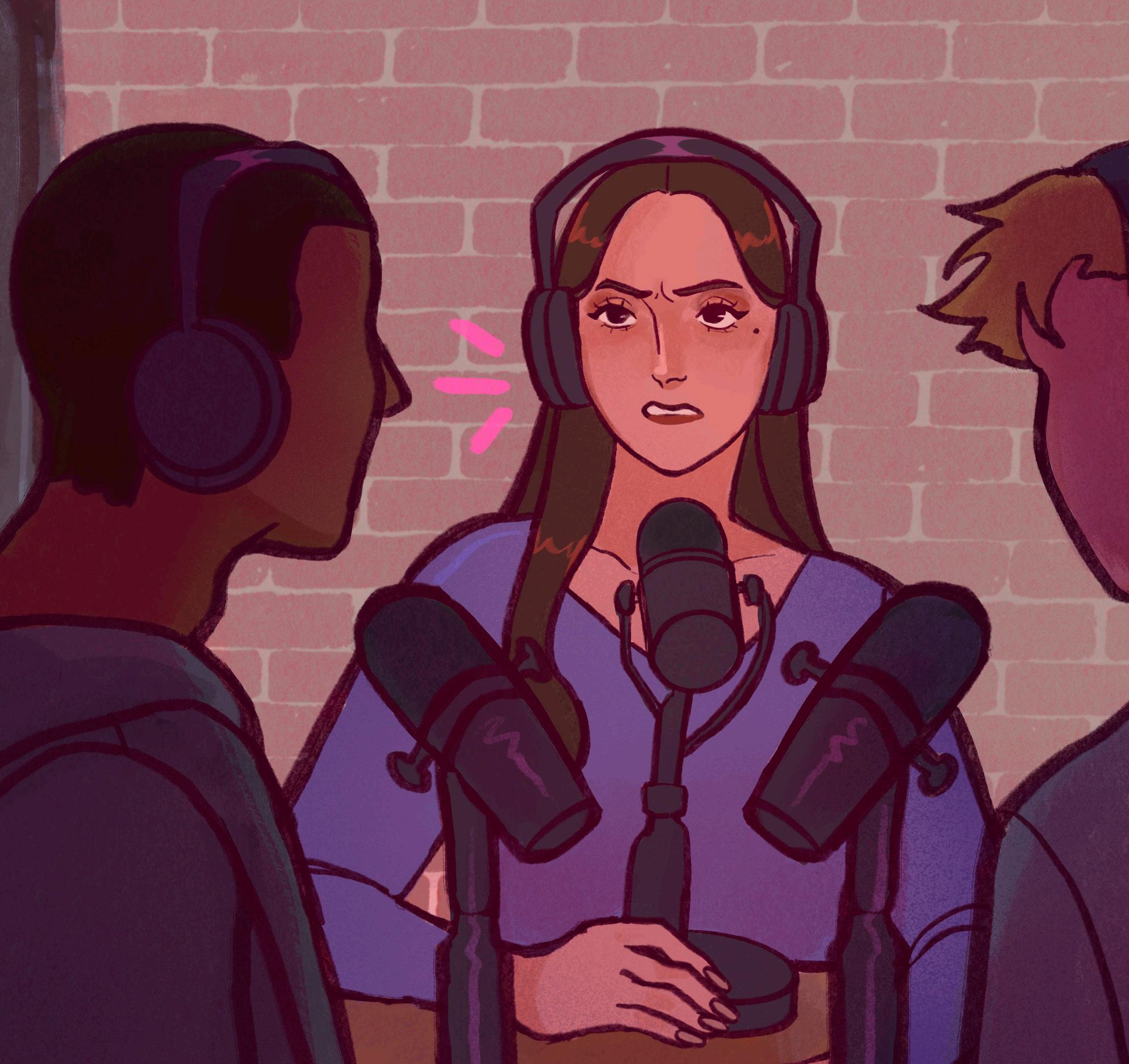
women’s sexual value — especially a ‘negative’one — is transferable, as if it were a disease that could be caught through mere proximity
Another example of how language reinforces gendered imbalances are the terms used to describe unmarried women and men of a ‘mature’ age. Author Karen Stollznow exemplifies how double standards reemerge with the difference implications with the terms‘spinster’ versus ‘bachelor.’ While ‘bachelor’ is a more neutral term, ‘spinster’ is cited as “derogatory,” if you look the definition up online. This is once again a testament to the value we place on women’s sexual life, as opposed to men’s.
To get a like is to be seen L.T. notes the pressure placed on women to appear confident but not overt in their sexuality. “You’re supposed to look like a hot girl in a way that you’re trying to be desired, instead of in that self-empowered kind of way.” In other words, women are encouraged to cultivate their sexual personality not for themselves, but for the benefit of others. This expectation mirrors the logic J.S. describes when he explains that women’s social market value is fragile, constantly assessed, and
vulnerable to decline based on how others perceive them sexually.
L.T. also believes that male-dominated spaces like fraternities and ‘locker room talk’ publicly perpetuate this hierarchy, signalling which women are desirable and which are not. She emphasizes that judgment is not solely male-driven; women also monitor one another to avoid associating with those who are considered of lesser value.
Social media operates as an amplifier, making sexual reputations into quantifiable social currency with increased visibility and digital metrics. An example of how this plays out is the viral TikTok trend, “They’re a 10, but….” With this trend, both men and women assign value to hypothetical romantic partners; they start with a perfect score of 10, then deduct a point each time the person in question exhibits a trait or behaviour they don’t like. Desirability becomes a calculable metric, and attraction is a scorecard.
What is questionable about how women’s ‘scores’ are evaluated in trends like these, is the criteria that determine them. In the trend, men’s desirability is frequently assessed by traits that confer economic success and good treatment of their female partners. Yet women’s desirability is often rooted in conformity to traditional gender roles and their sexual activity.
In one video that appears when you search for the trend on TikTok, a group of men react to various prompts, including “She’s a 10, but she has a small [butt],” “She’s a 10, but she doesn’t know how to cook,” and “She’s a 10, but she smokes and drinks.” Another one features negative reactions from the male participants to prompts like “She’s a 10, but she’s not good in bed,” and “She’s a 10, but she has multiple piercings.”
Contrastingly, in a video from a woman’s perspective, the prompts include “He’s a 10, but he doesn’t give you flowers,” “He’s a 10,
but he doesn’t have a car,” and “He’s a 10, but he only sees you on weekends.”
There is a clear imbalance between how men and women evaluate each other’s romantic desirability. Even though many videos of the trend are simply playful, the misalignment between what traits make a man’s score decline versus a woman’s seems anything but a joke.
A woman’s value seems to diminish if she does not satisfy the superficial and sexual wants of a man, including through factors as insignificant as bodily piercings. Yet, a man’s value declines in the eyes of women if he is not a dedicated partner, as opposed to physical characteristics.
How does it all add up?
The common question of one’s body count lingers in the same systems that seem to promise sexual freedom. Social media encourages the illusion that such a question fosters relatability and openness, and contemporary sexual discourse frames transparency as a marker of maturity.
Yet, as the experiences of students like J.S. and L.T. show, the potential interpersonal and social consequences of that transparency are uneven. Women are told they are free to govern their sex life however they choose, but those choices remain subject to constant scrutiny.
Women are not necessarily freer to express their sexuality today, despite the impact of movements like the sexual revolution. Sexbased insults and shaming are often more implicit and subtle, but they’re still there.
Even if an outright insult is not made, underlying connotations still bubble at the surface of each comment or inquiry about a woman’s sexuality. And when women are outrightly attacked, the marketization of dating and sex seems to confine them to one box: undesirable.
control: How did we get here?
Mary Wared Varsity Contributor
Have you ever put your prayers into the ‘pull-out’ method? Known as coitus interruptus, it’s one of the earliest forms of birth control. But ‘praying’ for the pull-out method to prevent pregnancy is only effective around 80 per cent of the time. Additionally, this form of birth control offers no protection against sexually transmitted infections (STIs). Thankfully, many other methods of birth control exist on the market today — but this wasn’t always the case.
A history of barrier methods in the US and Canada
To understand how modern contraception developed, it helps to look at how ideas about reproduction evolved over time. Long before modern condoms, ancient societies like the Egyptians and Romans used linen or animal-based sheaths made from sheep and goat intestines or bladders as protection.
Reproduction was poorly understood for much of history, but that began to change in 1827, when a key discovery took place: Scientist Karl Ernst von Baer first identified the mammalian ovum, the mature egg cell that can give rise to offspring.
As scientific understanding advanced, technological innovations also began reshaping contraception. In 1839, Charles Goodyear developed the vulcanization of rubber, a process that made it more durable and resilient, revolutionizing the production of tires — and condoms — in the process. By 1860, condoms were manufactured on a large scale and bought at a cheaper price. Today, condoms remain one of the most widely used contraceptive methods.
Other barrier methods were also developed to prevent sperm from reaching the egg. In 1838,
Friedrich Wilde, a German gynecologist, began offering cervical caps to patients, later referred to as diaphragms. Diaphragms are small cups placed inside the vagina, covering the cervix to obstruct sperm entry. By the 1870s, condoms and cervical caps hit shelves at pharmacies, dry-goods stores, and rubber vendors, becoming easily accessible to consumers. Despite these growing options, a greater scientific mystery remained: how do eggs get fertilized?
in the body to release the medication quinine, a drug historically, and occasionally still used today, to treat malaria.
Around the same time, scientists uncovered another crucial piece of the reproductive puzzle: hormones. In 1928 and 1929, the hormones progesterone and estrogen were identified as key regulators of the female reproductive system and the menstrual cycle. Across the menstrual cycle, estrogen stimulates the growth of the uterine lining and progesterone supports and maintains it, in case pregnancy occurs.
To understand the role of progesterone and estrogen in the menstrual cycle, initial clinical investigation of the birth control pill was led by Dr. John Rock and women’s health advocate Margaret Sanger in 1954. However, scientific progress in reproductive health did not immediately translate into access to birth control.

Fertilization, cacao butter, and hormones
In 1876, researchers Oscar Hertwig and Hermann Fol observed fertilization in sea urchins and starfish, discovering that pregnancy begins when a single sperm penetrates an egg and the two cells fuse together. Because this process is fundamentally the same in humans, their findings helped scientists identify precise stages in reproduction where pregnancy could be prevented, paving the way for modern birth control methods.
In 1886, chemist W. J. Rendell manufactured the first birth control suppository. It contained a cocoa butter shell for suppositories that melted
To all the birds I’ve loved before
While science was advancing sexual health knowledge, public discussion about contraceptives encountered significant barriers. In 1892, the Criminal Code of Canada prohibited the sale and distribution of contraceptives and restricted the dissemination of information about their use. This criminalization reinforced stigma surrounding sexuality and reproductive autonomy, and limited public discussion regarding birth control.
Throughout the twentieth century, restrictions on birth control gradually eased, allowing for its use to regulate the menstrual cycle. Still, it wasn’t
How our winged friends gear up for their Valentine’s Day
Caitlin Adams
Varsity Contributor
With Valentine’s Day upon us, you might be wondering how other animals find love. And, if you are one of those people who woke up and finally started noticing the birds everywhere, you may be wondering about birds in particular. It might be surprising to learn that birds — like humans — don’t flirt or mate at random, but rather have courtship rituals that have fascinated zoologists for centuries.
Sexual selection
A species’ tendency to find certain traits in other individuals more attractive than others is a repeating phenomenon throughout the animal kingdom. Among birds, finding a desirable mate — whatever that metric may be for different birds — often increases the chances of hatching viable offspring.
We humans might flirt by giving our crush a flower bouquet or dressing to the nines on a dinner date. Many bird species do their version of the same with the limited resources they are given in the wild.
Most bird species practice monogamy because bonded pairs are more likely to survive harsh environmental conditions. For example, an egg can only grow if it is kept in a narrow temperature range and protected from predators. This is easier for mating pairs than groups to coordinate among themselves.
Birds haven’t always been monogamous; in fact, the ancestors of today’s birds likely didn’t have strong pair bonds. But now, a minority of birds in many species engage in some form of polygamy when the sex ratios align — for example, if there are many more females than males, one male is more likely to mate with multiple females at different times. Black coucal birds are an interesting example of polyamory in birds, where females defend large territories and form social polyandrous groups; the
females breed for the entire mating season while the males are solely responsible for parental care.
Therefore, in the bird world, mating can be a feisty competition where only the best performers win over their love interest.
Take me to the ballet: Dancing and feathers
One common mating strategy is for one bird — typically, the male — to show off bright plumage in a dance or musical sequence, in hopes that the other will approach them out of curiosity. Male magnificent frigatebirds (that is their actual name), which are mostly jet black, inflate a red, heartshaped pouch on their throat (yes, really).
Martha Fischer, an audio archivist working with the Cornell Lab of Ornithology’s Bird Academy, captured footage of these birds on an island in the Dry Tortugas National Park in Florida, USA. That footage showed them using their inflated pouch to make a drumming noise, which attracts female frigate birds soaring high overhead.
Another well-known example of this visual attraction strategy is the ocelli or mock eye pattern on a male peacock’s long tail. Interestingly, males with blue-green ocelli seem to have more success than other colours, but the exact biological function of this behaviour remains a mystery. During mating, male peacocks fan out their feathers and vibrate them in a way that makes the ocelli shimmer. However, looking pretty and dancing isn’t the only way to flirt.
Singing (and/or screaming)
Many birds sing to woo potential mates — sometimes in a way that is pleasant to the human ear, and sometimes, not. Like human languages, the variation and diversity of bird song often vary by geographical location, forming different dialects. This can help birds identify local species that are likely best adapted to their particular environment.
until 1967 that former Prime Minister Pierre Elliott Trudeau introduced Bill C-150, which passed in 1969 and allowed for the sale and use of birth control to ordinary people, not just specific groups like married couples, doctors, or hospitals, across Canada. With legal barriers lifted, hormonal birth control quickly became more visible and widely used.
Before the twentieth-century, there was no clear evidence of the insertion of foreign objects into the human uterus to act as contraception; in other words, the intrauterine devices (IUDs) we have today were inconceivable. That is, until 1969, when variations on the IUD culminated in a form we know today: a copper or progestincontaining device inserted into the uterus to prevent pregnancy.
Dr. Howard Tatum is responsible for creating the IUDs’ distinctive T-shape, while Dr. Jaime Zipper’s research led to the discovery that copper wire reduced the risk of pregnancy. Hormonal IUDs, the first of which was approved for use in the US in 2000, expanded on earlier designs by releasing small amounts of progestin inside the uterus.
Most existing hormonal contraceptives are focused solely on preventing pregnancy in people who ovulate, leaving limited options for those who produce sperm. To address this gap, Gunda Georg and her team at the University of Minnesota are developing the first non-hormonal birth control pill to target sperm production, YCT-529, currently undergoing human trials.
This pill targets retinoic acid signalling pathways essential for sperm production. In animal studies, it reduced sperm count in primates within two weeks and was 99 per cent effective in preventing pregnancy in mice after four weeks. However, further research is necessary before it can be made accessible for public use.
Together, these developments show how contraception continues to evolve. From early barriers like condoms and sponges to hormonal devices and emerging male contraceptives, birth control has come a long way. While no method is perfect, ongoing research promises safer and more inclusive options, offering individuals greater control over their reproductive futures.
In 2010, the Weir Lab at UTSC conducted an evolutionary biology study on a variety of bird species and discovered that oscine bird species — those that learn birdsongs culturally rather than innately through evolution — have evolved more complex birdsongs at polar latitudes than those at tropical latitudes.
In contrast, it was the obnoxious scream of male white bellbirds that captivated Jeff Podos’ research team and his colleagues in the National Institute of Amazonian Research in 2019. In courtship exclusively, these birds have the loudest bird call ever recorded, reaching 125 decibels, which is comparable to standing next to an exploding firecracker.
Male white bellbirds are able to reach this threshold due to their chest, which is five times thicker than that of the same-sized birds of other species, and an unusual trumpet-shaped beak.
In F. Scott Fitzgerald’s famous work The Great Gatsby, the titular character purchases a mansion and throws bedazzled house parties weekly in the hopes of wooing his long-lost love, Daisy Buchanan. Like Gatsby, some birds (usually males, again) build nests in hopes of demonstrating some aspect of their fitness as mates. For example, there was a correlation found
in the mating success of male black wheaters and the amount of stones they carried to their nest sites; this further correlated to a potential fitness advantage of males with larger wing areas being able to carry more stones.
A similar, although more subtle, style of courtship is gift-giving. Some gifts are unconventional and purely practical.
For example, the great gray shrike spears rodents with thorns, creating a rodent ‘kabob.’ In pleasant contrast, penguins court each other with pebbles in anticipation of building a pebble nest together.
During our own season of love, frantically innovating creative ways to secure our date may leave us feeling hopeless and existential. In the meantime, we find it fascinating to watch birds woo each other in whatever ways they can, whether through heart-shaped chest pouches or screaming in public. We suppose that, collectively, the entire animal kingdom is just trying to ‘figure love out,’ even though we have pursued it at every stage of our evolution.
We would not recommend going birdwatching to gather inspiration for Valentine’s Day (also unofficially known as human courtship season). Unless, perhaps, you were thinking of gifting your crush whimsical trinkets as a form of human penguin-pebbling.
The architectural guide to a date Or: A last resort if you lack personality

Step two: Focus on ‘proxemics,’ or the science of understanding space and distance
Let’s be honest: with Valentine’s Day around the corner, we all find ourselves wanting something. For the couples, it’s a matter of finding ways to improve their relationships. For the singles, it’s a matter of not spending February 14 drowning in a vat of ice cream for once.
If you’re reading this article, you might have already realized that your personality alone is not enough to seal the deal. You need something to impress someone, and ‘you’ alone aren’t cutting it — but never fear, because The Varsity is here!
It turns out that you can essentially hack human psychology, through your environment, to make it work in your favour. Architects, designers, and psychologists have been trying to decipher how physical spaces can create ambience in order to influence emotions, behaviours, and romantic interest. Can’t be creepy if it’s backed by research, right?
Step one: The gambit of lighting
Here’s where you can get truly thoughtful. A 2017 study from the Journal of Environmental Psychology showed that low lighting creates an intimate atmosphere, and, according to a 2021 study from Hamadan University of Medical Sciences, it also has a positive effect on mood.
There’s science behind this: warmer colours mimic the natural light of sunsets or firelight, which our brains have long associated with the evening, rest, and safety. As a result, a dim atmosphere can make people look more relaxed, comfortable, and ultimately more attractive.
Pick a restaurant with candlelit tables, or if you’re hosting, use your warm-toned lamps. Bright lights are for illuminating your statistics textbook, not your sweat stains and inadequate conversation skills.
In 1966, American anthropologist Edward T. Hall devised the term ‘proxemics’ to describe the science of proximity, or how close you can get to your date before it gets awkward. He categorized personal space into four zones: intimate (less than half a metre), personalcasual (half a metre to over a metre), social (over a metre to three metres), and public (three metres or more).
For your date, aim for the personal zone sweet spot: close enough to show your interest, yet far enough to not cross physical boundaries. A 2009 study from the California Institute of Technology found that personal space violation triggers a part of the brain responsible for emotional and social cues. If a stranger breaches that intimate half-ametre threshold, you may get a flood of stress hormones that are decidedly not romantic.
This will also be crucial for your restaurant choice. Sit too far, and you might as well be on a Zoom call with the perpetual audio lag; come too close, and you will be bumping knees and butting heads before appetizers make it to your table. The goal is to feel comfortable and cozy, not claustrophobic.
Step three: The great booth debate (pick your poison, geometry might be destiny)
The eternal question rises: booth or table? Face-to-face, or side-to-side? Sitting side-byside may make it easier to feel comfortable expressing yourself, whether in a restaurant or on a walk, since it avoids the potential discomfort of eye contact during conversation.
On the other hand, eye contact in faceto-face conversations can also help foster a deeper connection. It shows vulnerability, and a willingness to communicate and empathize with the other person.
MEL Magazine found that most people prefer to sit face-to-face on first dates — it is a clear
signal of genuine interest in getting to know them, and allows you to be open and present during the conversation. Alternatively, if you are in an established relationship, sitting sideby-side is intimate, and offers a cozy bubble where you can share food and be adorable, or even mildly inappropriate (respectfully, get a room).
Step four: The ‘mise-en-scène’ of success French speakers and cinema nerds may recognize the phrase ‘mise-en-scène,’ or ‘placing on stage,’ as crucial art in stage design where actors, props, and sets are arranged to create meaning. Consider your date as a oneact play, and you are the director who forgot the script (whoops). This can be a colossal mistake, unless you figure out how to convey your intentions through set design.
To compose the perfect shot, there are three main elements of lighting to remember: ambient lighting, task lighting, and accent lighting. Ambient lighting sets the mood and tone of the evening; think dim lights to illuminate without obstruction, and to let your date know that ‘this is me getting to know you.’
Task lighting creates an intimate spotlight. A candle on the table, for example, gives off just enough light to focus on the face and expression. Lighting has been shown to affect a person’s feelings in a space through ‘emotional architecture,’ such as the candle’s glow triggering a soothing atmosphere.
Accent lighting adds depth to your setup, and is kind of a misdirect. It highlights details of the space around you, taking attention away from your nervousness and awkward moments in conversation.
Physical layout highlights intention better than words can, and might be the extra step that shows your partner that they are the centre of attention tonight. Choosing a corner table or a booth location creates a quiet pocket within a larger space. This provides seclusion and a semblance of sanctuary, which is a method
of creating a feeling of privacy within a public setting.
The ideal ‘cocktail party effect,’ in which you’re able to focus on your conversation despite a busy setting, happens when ambient noise sits around 60–70 decibels — which is a normal conversation volume. This creates enough acoustic masking that you can confess your deepest fears to your date without the table next to you eavesdropping, while still being able to actually hear your date.
This range feels safe because it provides privacy through sound camouflage, your conversation blending into the background hum rather than echoing in dead silence. As a bonus, a padded space will absorb excess sounds like cutlery scraping, babies crying, and other couples fighting.
The ultimate truth (also known as the metaphorical Band-Aid)
These steps create a supportive infrastructure for human connection, and give you a boost for conversation and chemistry. You have an opportunity to express yourself and your intentions when words alone fail, while making your date or partner feel seen and special.
All of this architectural design and strategy works: it influences mood, perception, behaviour, and provides a safe and comfortable environment that caters to the occasion. But it amplifies what is already at the table, good or bad. Designing a good date is like a performance enhancer: it makes the awkward pauses feel slightly less stifling, and the conversation somewhat more interesting.
The architecture of an ideal date might aid in creating the conditions for connection, but you still have to show up as someone worth connecting with. So take the chance! Shoot your shot, pick the right spot, trust the science, and show up with intention. The magic might not even be in the setup, but rather in having the courage to sit down in the first place.
February 10, 2026
thevarsity.ca/category/arts-culture arts@thevarsity.ca
“It’s amazing what a shelf can do for people”
Sofia Moniz Arts & Culture Editor
With the ongoing mainstream erasure of queer and trans histories, and the right-wing attempt to mandate queer and transness out of existence, I become more and more drawn to small press print publications, and am reminded of the importance of physical media and personal collections; media that can more readily escape censorship.
I spoke with Helen Chazan, project manager of the Sexual Representation Archive (SRA), and a graduate of the Faculty of Information’s Master of Library and Information Science program. We spoke about queer and trans histories, the importance of small press and DIY publishing, and how to see yourself in trans porn for straight men.
Described by Chazan as “in between a community archive and a university archive,” the SRA is home to videos, magazines, zines, pornography, and erotica, with a focus on “feminist, queer, trans, and kink sexual cultures.”
Now tucked away in the basement of University College, the SRA began in the ’90s when Max Allen — a CBC reporter who was an activist involved with the Canadian Committee Against Customs Censorship — donated his collection of media that had been censored by the Canadian government.
By following these censorship cases and collecting the materials in question, Allen ended up with pornographic, queer, and subcultural literature. As the collection grew, it bounced around different departments and locations at U of T, until the SRA found its permanent home in the Sexual Diversity Studies department.
The SRA is not the only dedicated academic porn archive in Canada, but Chazan explained it’s particularly unique and expansive because “its history is rooted in what was censored on the basis of being pornography, erotica, or obscenity.”
Preserving these histories is particularly important for queer/trans communities because the Canadian government has a history of targeting queer and trans literature (think Glad Day’s censorship and seizures by Canadian Customs in the ’80s and ’90s).
Chazan shared that a recent anonymous donation to the library contained porn magazines that, alongside explicit photographs of trans women, had additions from the publisher that described support and acceptance from family members. These magazines, in particular, stood out to Chazan because “part of the fantasy being conveyed is that she’s happy.
The ‘heterosexual male consumer’ of trans female porn is not necessarily that heterosexual or male 100% of the time.” Even in extractive magazines aimed at cishet audiences, we can see proof of queer and trans histories — in this way, Chazan can see herself in the women being pictured.
On other Toronto-based archives
Aside from the SRA, Chazan is the founder of Gynoid Distribution — a Toronto-based “trans, feminist, sex positive” micropress that publishes “personal zines, art, comics, erotica, anything that feels compelling and boundary-pushing in the right ways.” She is also involved with DIY publishing and community-driven spaces in Toronto, like the Toronto Zine Library, and The Canada Comics Open Library.
What I love about the zine library — and the works I find when I go there — is the connection I
feel to the creators as I read their work. Especially with the DIY pieces, I can see the care the creators put into it — their penstrokes and typos, their messy handwriting and rough sketches and crooked hand-stapling. The medium allows artists to push boundaries without worrying about whether their work is publishable through more traditional channels.
For Chazan, zines are particularly important and compelling as a medium because “they can’t go away, in the same ways that a website is keen on just going away these days. As the internet gets worse for sharing information and art, the channels that paper creates are going to be more and more important.”
Queer and trans histories are long and rich, and have always been preserved through
personal collections and physical media. Even bigger Toronto institutions, like Glad Day Books and The ArQuives, began as a backpack or a shelf full of books.
In May and June 2025, the Zine Library had its trans popup library, coordinated by McKenna Gray. It was a shelf of trans literature, zines, and comics donated from local people’s personal libraries, which ranged from periodicals to information on how to recover from gender-affirming surgeries to personal stories and photo essays.
The popup also became a community space. Chazan, who is a volunteer at the Zine Library and donated to the trans popup, remarked, “It’s amazing what a shelf can do for people.”
Chazan ended our interview by saying: “Read trans literature and read writing by trans women, read small press writing by trans women. Read widely. Go to comic stores. Go to weird little bookstores. Look for the queer stuff. Look for the trans stuff. Look for transgressive literature by queer authors. Look for compassion. Look for real ways to show solidarity from what you learn or what you feel from seeing profound queer expressions.”

Bushra Azim Boblai Associate Arts and Culture Editor
Romance novelist, Talia Hibbert, of Get a Life, Chloe Brown fame, discovered the romance genre through well-read paperbacks at her local library. Her love of the genre is what inspired her to selfpublish her own romance novels until Chloe Brown was picked up by a traditional publisher.
Hibbert’s years of writing and passion for romance are why the other two novels that make up the Brown sisters’ trilogy work so well. She does not look down on the cringey aspects of the genre that might not appeal to every audience. This philosophy does not seem to be shared by the Brooklyn-based romance-exclusive publisher, 831 Stories, which launched in 2024.
Confused marketing
As a longtime romance reader, I should be the target demographic for 831 Stories. But their marketing gimmicks left me disappointed, as I don’t think that they translated into well-written romance novels. The consistent blandness of their characters and a lack of believable stakes to overcome felt odd. Why were these books so sanitized, but presented in all their marketing as revolutionary products meant to take away the ‘guilt’ from the ‘guilty pleasure’ you get from romance novels?
Erica Cerulo, one of the company’s cofounders, wants 831 Stories to do for romance novels what Marvel does for comic books, or what A24 does for independent movies: provide access to a larger audience that they wouldn’t otherwise have access to.
Romance literature is already a billion-dollar industry. According to The Guardian, in the US and UK, romance sales have doubled in the past five years. I would argue that such a well-established market with a dedicated fanbase is not in need of

more brand recognition or a larger audience. So what are Cerulo and her co-founder Claire Mazur’s real motivations?
To me, the very obvious answer seems to be easy profit. I am not saying that the Big Five corporate publishing houses, with their constant attempts at union busting and oligarchical consolidation, are not motivated by profit.
831 Stories, it seems, only craft their romance novels to be pre-fanfiction, instead of a work of literature to be cultivated. The content doesn’t matter, as long as it sells hats, keychains, and builds up interest for a Hollywood adaptation.
Corporate strategies
“We want to be hip, horny Hallmark,” Mazur told Glamour, referencing the made-for-TV movies produced by the American greeting card company. With their low production costs, and a production timeline of only two to three weeks, Hallmark raked in approximately $480 million from product placement and advertising annually.
831 Stories’ incorporation of cookie-cutter corporate strategies is most apparent in their
book launches. Their first book, Big Fan by Alexandra Romanoff, is about a divorced political strategist who gets a second chance at love with her teenage boy band crush. Readers were able to stream a single from the fictional rockstar love interest on Spotify and purchase a $195 necklace. The book and the business itself were inspired by the success of the Anne Hathaway adaptation of Robinne Lee’s romance novel, The Idea of You.
Other corporate strategies adopted by 831 Stories can be seen in their decision to avoid physical descriptions of their characters so that the maximum number of readers can imagine themselves living out the main characters’ romances.
They also do not invest in individual book design. Typically, romance novels have elaborate covers of beautiful models in various stages of undress, or more recently, cartoon illustrations of the characters. Not being ashamed of this depiction of desire is a milestone that every romance reader has to go through. However, for a company so intent on taking away the guilt from their readers’ ‘guilty pleasures,’
831 Stories follows a formulaic design for all their books with only two blocks of colour and no illustrations. Designed by C47, a creative studio, 831 Stories seems to be opting out of engaging with book illustrators and designers who are so essential to the ecosystem of the publishing arts. The company is also averse to actual romance writers. They specifically scout writers from outside the romance genre who sometimes aren’t writers at all: Upasna Barath, a comedian, wrote Comedic Timing. Other unconventional authors chosen include wine critic Eliza Dumais and fashion writer Erika Veurink.
But the most egregious corporate behaviour that 831 Stories commits for me is giving their women characters no stakes in the romance. A key component of romance novels is the third-act conflict — a serious obstacle the couple has to overcome to arrive at their happily-ever-after.
According to KJ Charles, a British historical and fantasy romance novelist, the third-act conflict is the testing of a couple’s connection and vulnerability with each other. Without this essential step, there is no way to demonstrate through the story that the two main characters actually belong together.
What’s the point?
In 831 Stories, the woman has to be undevastated if the romance doesn’t work out. In my eyes, this condition makes the third-act conflict in their books an awkward suggestion rather than a cohesive part of the plotlines.
Why should the reader care about the love story if its main characters aren’t even invested in it?
If a publisher appears only interested in making romance and love products that appeal to the most general of audiences, why does it get to market itself as an innovative star in the industry? When I read romance novels, I want to be invested in the love story. I want to believe in their ability to work through their conflicts.
I do not read romance novels for the merch or for fan content. I do not want to read a silly story of rich women going on boring dates with boring men. I can encounter that at the U of T campus, or anywhere else I go. If this is the future of romance novels, count me out.

Judging U of T students by their favourite smut A professional deep-dive into the freaky minds of smut-lovers
Sophie Esther Ramsey Managing Editor, External
It is not unusual that I find myself scrolling through Archive of Our Own (AO3) the night before an assignment is due. But this time, it’s for research — I swear!
I’m already so close to the deadline when I start leafing through the fics you anonymous freaks sent me to review. Seated at Robarts, I look over my shoulder as I search the meaning of tags such as “mating press,” “typical butt chugging,” and “roping” — seriously, what is wrong with you people?
If you’ve ever paused mid-fic to ask yourself this question, then I’m writing this for you. As a connoisseur of guilt and pleasure myself (they go best together), I’m here to show you just how far from grace you filthy smut-lovers have fallen.
Thank you to everyone who partook in providing the nasty material that made this article possible. Though I could only select a few submissions to review, I am indebted to each and every one of your pruning fingers.
#1 —
My first review is dedicated to our Dramione fan — we knew you were coming, we were just hoping you’d bring your hotter, Drarry-shipping friend. But this will do.
This fic screams God-fearing virgin. Only a few paragraphs in, and there are already three mentions of Hermione’s “soul,” and the threat that her “lawless thoughts” about Draco pose to its sanctity.
Not only that, but Hermione exhibits a deep-rooted shame only the devout know of. This shame arms them with the self-sufficient impulse to punish themselves faster than you can say “bad girl.”
Hermione’s voice is “choked” just fine, without the grip of Draco’s “long, nimblelooking fingers.” The muscles she admires from under his “form-fitted suits” are rendered obsolete by the strength of her own mind, with which she “slap[s]” and “chastis[es] herself
viciously” out of her aroused state. Apparently, size really doesn’t matter when the intensity of your libido writhing in its cage is massive enough to bring you to tears.
For the sake of Hermione’s dignity — as well as the pious reader’s — Draco seems to have emerged from his dark past a righteous man. Not only does he love books and hate bureaucracy, but he has also even started a non-profit Apothecary business, where all the proceeds go to charity… If your pants are still buttoned, they won’t be once he asks you about yourself because he’s interested in you — you self-loathing virgins have yet to know such intimacy.
While Draco is soft on the streets, we can count on him to be hard in the sheets. All Hermione had to do was confess, and Draco would ensure her repentance. And through all the wall-pinning, hair-pulling, and good-girling, we get to take a peek into Draco’s tender feelings about Hermione, and I must admit, it’s kind of romantic.
This Dramione fic is a beacon of hope for those battling with their innermost desires. This is your sign to ask and receive. And because I know how much you love being told what to do, here’s an order: let your freak go.
Good.
#2 —
This next one, I am reviewing because the person who submitted it wrote: “HEAR ME OUT” — and, well, I’m a sucker for begging.
This fic is for those of you who are already hot and bothered by the time you’ve logged onto AO3. Your fingers are slipping on your phone screen as your heavy lids and dilated pupils scavenge for the nastiest tags you can think of — that is, if you can think at all, in this sorry state.
The ship features real people, so the reader must have been on a qualmless quest towards the finish line when they dug deep to uncover this dirt.
The desperation with which we might imagine the reader’s hasty arrival is projected
onto the fic, where racing driver Lando Norris whimpers at the mere hum of a vibrator’s siren song. Like our horny reader, the Pavlovian Lando is on a hungry ascent, and towards a high he’s already reached multiple times. Even before this moment, we’re told that Lando’s appetite is so great that he cannot be in the same room as his lover and fellow driver, Carlos Sainz, without salivating at the sight of Carlos’ hands. The power play that made the Dramione fic mildly layered is stripped of subtleties in this overtly sub/dom fantasy.
Carlos is relentless with Lando, reducing him to a squirming, sputtering mess — probably akin to the state the reader was in when they came (ahem) across this fic.
Apparently, size really doesn’t matter when the intensity of your libido writhing in its cage is massive enough to bring you to tears.
To the person behind this submission: I see you. In this world where you are constantly pushed around, all you can think about is getting screwed. If it’s happening to your GPA, your bank account, and your employment status, why not you?
Take the advice of your favourite smut — when you think you might only have one more in you, think twice, because you have two. Close your eyes, and listen to Carlos telling you to never give up, and keep pushing forward.
Come on… just a little longer… there you go.
#3 -
Finally, we’ve made it — past the hetero fluff and the abundance of m/m content, to the “lesbian sex,” to the “MILFs.”
Although the fic claims to be “without plot,” it’s better at building tension than its tag suggests. The story teases us with a scene featuring a breathless Sevika from Arcane: League of Legends, only to be suspended in helpless anticipation by backstory. Talk about a whip lash.
The tension only builds with the dialogue between stubborn Sevika and her taunting captor, Ambessa. It seems like the two women are equally strong in character, with Sevika’s only disadvantage being that she is bound to a table.
Enjoyers of this fic want to have their cake and eat it too; to be collared but still keep their pride. For these brats, simple orders won’t do. Like Sevika, they’ll pout and retort, but it’s all an act — really, they’re just begging to be put in their place. Rather than simply being told what to do, they must be made to do it.
Ambessa likes the challenge. She sees herself in Sevika’s loyalty and respects her warriorship. However, she knows that beneath Sevika’s tough exterior, there is a softness waiting to be prodded. And Sevika is exactly where Ambessa needs her to be to open her up.
Doesn’t it feel good to let go? Now, I know that “no aftercare” tag had you foaming at the mouth, but the burn of those restraints as you struggle against them… If you close your eyes, the heat almost feels like a loving touch. This fic is for those who like their lovers mean and at a tantalizing distance. Perhaps you grew up a stranger to warmth, and now the only way you accept pleasure is when it’s cold and demanded of you.
You’ve feigned strength for long enough; it’s time to admit defeat. Stop resisting, you’re only making it harder on yourself. Surrender, relax, and find comfort without control. Don’t make me make you.
Photo February 10, 2026
thevarsity.ca/section/photo
photo@thevarsity.ca


But love, I’m beginning to learn, doesn’t have a deadline; it lingers. Sometimes, it quietly takes the backseat, while we’re too busy looking ahead to even notice.

Love, patience, transformation, and connections you find when you stop searching for them
Erika Ozols
Photo Editor
Love in your 20s feels like standing in a room engulfed in flames, while everyone keeps asking you which way you’re going to walk. Their tone carries
a sense of urgency that’s subtle at first, but gets louder with every soft launch on Instagram, every Hinge date that falls through, and every question about who you’re seeing. Love begins to feel like something you’re constantly late for, like something you need to catch up to before the door closes.

In your 20s, love is messy. It’s passion, fear, infatuation, hope, and grief all thrown together into the mixing bowl. We are conditioned to seek love outwards, in the arms of a stranger, on apps, at bars, as if it’s some missing piece to the puzzle. And while finding love in others can ground us and build lasting connections for us to
hold onto, it can also operate as a distraction to avoid sitting with ourselves. There is a far quieter kind of love we rarely have the chance to celebrate; the love we build with ourselves. Make the conscious decision to love yourself deeply, even with the parts of the puzzle which feel uncertain or not yet whole. It’s honouring your boundaries, learning the rhythm in which you operate, and finding forgiveness in the versions of yourself that were too young to know any better.



When you start recognizing love in yourself, you begin to recognize it everywhere. In friendships that feel like home, in passing connections — love stops being something you’re chasing after and becomes something you’re in tandem with.
When we learn to love ourselves, the kind of love we find changes. It teaches us what care truly feels like and what respect looks like actively in practice. When you know yourself, you quit mistaking attention for affection, and recognize the behaviours you no longer want to shrink yourself to accept. You choose people who meet you where you are, people who listen to you. It opens the right door to people who see us without us having to perform.
Loving yourself first doesn’t mean closing the door to others; it means being able to open the door without trepidation. That way, when love makes its way over, it doesn’t ask you to change yourself or water yourself down. It leaves space for you to be exactly who you are.


February 10, 2026
thevarsity.ca/cateogory/opinion
opinion@thevarsity.ca
The Varsity asked two students whether dating should be digital or offline

Anna-Maria Roszuk and Jana Hilal Varsity Contributors
Love and dating are becoming more and more digital. What do you think of dating apps? Have dating apps streamlined the process of meeting a significant other, or is it just another example of the loss of whimsy in the modern world? The Varsity asked two U of T students for their thoughts.
For
those of us who feel stuck in the same social environments time and time again, dating apps can serve as a bridge rather than a replacement for real-world connections, making finding real and authentic love possible
Dating apps aren’t all that bad Dating apps. Whether you love or hate them, they have become unavoidable in the modern dating landscape. The outlook on the current dating environment for young people is — to put it gently — bleak.
A 2024 study commissioned by Tinder found that 91 per cent of men and 94 per cent of women between the ages of 18–24 said that the current dating environment is ‘worse than ever before.’ So why not make it easier through dating apps? Findings from a 2023 Pew Research Center study indicate that 42 per cent of US adults believe that dating apps have made the search for a long-term partner easier.
In real life, asking someone out can feel like a gamble. What if they’re already in a relationship? What if they’re not looking for the same thing I am? What if they reject me? If these kinds of questions stop you from making the first move, you’re not alone. 63 per cent of singles who were a part of the 2025 “Singles in America” survey believed that people have become less confident in making the first move.
Why? Because of ambiguous romantic dynamics, of course. People are simply unsure of what the other person wants, specifically regarding gender roles and relationship dynamics. Dating apps help mitigate this issue through features that allow users to indicate their preferences in a relationship and a future partner. They can help reduce the anxieties of not knowing what other people are ‘looking for,’ that prevent young people from seeking out romance in the real world.
In the era of online learning and remote working, where young people are living at home longer and socializing in smaller circles, opportunities to meet people organically are limited. Dating apps expand this limited pool of potential dates to people you may not have otherwise encountered in your day-to-day life. For those of us who feel stuck in the same social environments time and time again, dating apps can serve as a bridge rather than a replacement for real-world connections,
making finding real and authentic love possible.
So are dating apps really so bad? Although they might suck some of the joy and spontaneity from finding love, they remain a useful tool in lessening the social and societal barriers that help in finding love.
Anna-Maria Roszuk is a first-year student at UTSG studying English and history.
People are commodified, turned into a product, and their worth is determined by how many likes they receive
Dating apps have ruined dating
As a generation that grew up watching romcoms like How to Lose a Guy in 10 Days and 13 Going on 30 , it is safe to say that our expectations for dating are quite different from our reality. Dating apps like Hinge and Tinder have become alternatives to third spaces for people to meet, and now more than ever, it is harder to connect with others.
This raises some questions: what problems are dating apps trying to solve? Are they really fixing the issue, or are they creating more problems in the dating world? I believe that dating apps have skewed our perception of dating, turning genuine human connection and interest into a zero-sum game.
One of the biggest and most prominent flaws in dating apps is their ability to set unrealistic expectations. Users scroll through a selection of candidates like a fashion magazine, picking
and choosing very particular traits that they like or dislike. The minuscule details that are magnified on the app are unnoticeable in person — or at the very least, not significant.
Dating apps are unrealistic by design. Users curate their profile, selecting particular pictures and prompts to ‘bait’ people into liking their profile to form a match. This produces a similar conversation regarding the superficial nature of dating apps. Monotonous conversations of “who’s your favourite artist” and “what do you study/do for work” are standard procedure and feel like interviews rather than authentic conversation.
The desire to know more about the person you are talking to vanishes, and the priority becomes whether or not the person is eligible for a date. Users are speedrunning through profiles trying to match with the next best thing.
Another major issue is the digitalization of human experience. Convenience is favoured over pursuit, and personal life transforms into a ‘digital trading card’ that is passed around. People are commodified, turned into a product, and their worth is determined by how many likes they receive. Investing time and effort is no longer necessary because someone more attractive, more interesting, and who might like you more is only a swipe away.
This is not to say that dating apps are evil and genuine connections cannot be made; however, the vast majority of users are not satisfied with their experience, and it is important to critically address the negative impact the apps have on our society and the modern dating world.
Jana Hilal is a fourth-year undergraduate student, double-majoring in political science and Near and Middle Eastern studies.
Emily Rosevear Varsity Contributor
Breakups fucking suck. So it’s no wonder that many of us try to avoid dealing with the emotional aftermath at all costs, something that romantic comedies (rom coms) do quite well.
A staple of rom coms is their climactic break up, after the couple has already developed feelings or gotten together. Except, even though this climactic breakup is a pivotal plot point within the story, it’s almost never permanent, absolving the protagonist from having to do any real emotional healing. While this makes rom coms fun, feel-good movies that a lot of us enjoy, we don’t tend to separate fact from fiction as much as we should.
In my experience, rom coms are typically structured into four acts orchestrated by the state of the protagonists’ relationship: ‘prerelationship,’ ‘the relationship,’ ‘the third act breakup,’ and finally, ‘the happy ending.’
In the third act breakup, some truth comes to light, such as a lie or a cheating scandal, and some insurmountable issue boils over. The relationship cannot recover, and the climactic breakup of the couple occurs. However, by the end, in the happy ending, the pair return to

each other with some grand gesture, realizing they truly love each other and want to be together.
In real life, the fourth act is a fallacy. The idea of a perpetual happy ending existing with any one person creates the false expectation that if you just hang on long enough, or want it badly enough, any problem will resolve itself and
In this chapter of life, date ‘for the plot’
Dating in college is just experiential learning
Maya
Belle Varsity Contributor
According to recent rulings from the court of public opinion, or at least what I’ve heard from friends and seen online, Gen Z has ruined romance. Between the rise of ‘situationships,’ ick-lists, and Instagram slop relationship content instructing you not to settle for anything less than a 6’5 tall provider who works in finance, how is a young adult supposed to find their life partner?
I mean, isn’t the entire point of dating in college to carefully vet potential romantic candidates based on appearance, height, personality, and major, so we can determine their suitability for marriage?
This understandable but misguided sentiment is common among university students. Lax social norms working in tandem with dating apps and social media have created a freer, yet
far more ambiguous dating landscape for Gen Z. Our nascent romantic and sexual awarenesses certainly aren’t eased by the prospects of ghosting, blocking, and curtly-named ‘IDGAF wars.’ When love is more intimidating than ever, why risk heartbreak when you can skip ahead to finding ‘the one’?
I understand this impulse, I really do. Yet, in an era where young people today, unlike previous generations, have the freedom to enter relationships not out of social obligation, but just for fun, I also question Gen Z’s urgent pursuit for a lifelong partner in university. I believe that the response to this cultural moment should be to date ‘for the plot’ as much as possible.
‘For the plot’ dating — as opposed to the aforementioned ‘dating for marriage’ — can be characterized as dating purely out of curiosity. Examples include going on peculiar Hinge dates,
you will have that happy ending. So, although watching rom com movies can feel good, these false expectations can have harmful consequences for real-life relationships.
A 2024 study at the University of Mississippi found that frequent watchers of Hallmark romance films are more likely to believe in romantic concepts such as soulmates or love at first sight.
getting coffee with your eye-contact-ship from your tutorial, or walking home with an acquaintance you met at a party.
Naturally, you should always enforce boundaries, maintain respect, and stay out of dangerous situations. But once safety is established, I think that having exciting, humorous, and sometimes disappointing romantic escapades is paramount in a culture that encourages disposability and transactionality. Yes, this means going on bad dates, enduring a meal with someone who won’t stop talking, and being annoyed that your date didn’t pay for your Uber after picking a distant restaurant.
At the risk of sounding like an Op-Ed columnist lamenting the risk-aversion and sexlessness of Gen Z, I acknowledge that dating is difficult, especially when coming of age in uncertain times. But to be clear, the fickleness of dating is not specific to today. To suggest otherwise is patently absurd. My third rewatch of Sex and the City made this very clear to me in light of my own heartbreak this past semester. The core four had to go on literally hundreds of bad dates until they each found ‘the one.’
I can already hear the incessant refrain from the ‘date to marry’ crowd: “But why would you go on
I find that both of these are blinding notions that can result in major relationship problems. These issues can include unrealistic expectations from partners, and negatively altering your behaviour during a relationship or breakup.
It’s hard to see the most unlikely happy endings on screen and not hope for one such finale for yourself. But, being aware of the realities of real-life relationships doesn’t mean you’ve stopped holding out hope.
The 2024 study also found that individuals who watched more television in general had an increased likelihood of believing in the idea of love conquering all obstacles. Such obstacles include coming back from something as major as a breakup, enforcing the idea that a relationship always has a happy ending.
Despite their harm, I am still an avid fan of rom coms. I’m not going to stop watching them any time soon, and I am not arguing for you to stop watching either.
Sometimes it’s nice to have an escape from the harsh realities of life. However, the distance we put between our understanding of real romantic relationships and the relationships we see on screen needs to widen.
Each time we fall for the false ideals of rom coms, our breakups end up getting worse, and we only end up more hurt. I know that’s easier said than done, but remember that after the rom com comes to an end, your own love life goes on.
Emily Rosevear is a third-year undergraduate student studying English and creative writing at the University of Toronto.
a date with someone you aren’t quite sure of? Isn’t that a waste of time?”
I am not advocating for you to go on dates with people you don’t want to. I am also not suggesting that you place a mental expiration date on your relationships with people. I am simply suggesting that rather than requiring all potential romantic partners to fulfill the criteria for a long-term relationship, go out with people because you’re interested in them, and see where it goes.
This chapter of your life is about learning. This includes meeting and dating people whose experiences, backgrounds, and personalities are new to you. In university, when you are exploring yourself and the world around you, dating can be a springboard for self-discovery and learning. As dating is fundamentally about experiencing life with other people; rejection, embarrassment, and heartbreak are inevitabilities. Before you can know what you want in your life-partner, you have to figure out what you don’t want first.
Maya Belle is a first-year student at University College planning to study political science and environmental science.