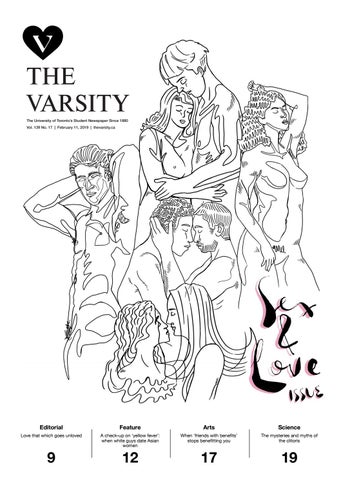
THE VARSITY The University of Toronto’s Student Newspaper Since 1880 Vol. 139 No. 17 | February 11, 2019 | thevarsity.ca
Sex & Love ISSUE
Editorial
Feature
Arts
Science
Love that which goes unloved
A check-up on ‘yellow fever’: when white guys date Asian women
When ‘friends with benefits’ stops benefitting you
The mysteries and myths of the clitoris
9
12
17
19
THE VARSITY
2 | THE VARSITY | NEWS
THE VARSITY Vol. CXXXIX, No. 17 21 Sussex Avenue, Suite 306 Toronto, ON M5S 1J6 (416) 946-7600 thevarsity.ca
the.varsity
thevarsitynewspaper
the.varsity
@TheVarsity
The Varsity
news@thevarsity.ca
Events January 11
editor@thevarsity.ca
Pearl Cao Creative Director
creative@thevarsity.ca
Reut Cohen Managing Editor
managing@thevarsity.ca
Kaitlyn Simpson Managing Online Editor
copy@thevarsity.ca
Josie Kao News Editor
news@thevarsity.ca
Ibnul Chowdhury Comment Editor Kate Reeve Features Editor Kashi Syal Arts & Culture Editor Srivindhya Kolluru Science Editor
Espresso Your Love
deputysce@thevarsity.ca deputynews@thevarsity.ca
Keith Cheng Design Editor
keith@thevarsity.ca
Angela Fu Design Editor
angelafu@thevarsity.ca
Jess Stewart-Lee Video Editor
Time: 10:00 am to 6:00 pm Location: Sidney Smith Hall, Room 1068
Time: 9:00 am to 9:00 pm Location: Instructional Centre Atrium and The BRIDGE
Indigenous UTSC
Time: 11:00 am to 1:00 pm Location: Student Centre, Presentation Room
St. George
Calls To Action Time: 11:30 am to 1:00 pm Location: Academic Resource Centre, Room 321
XAO: Living Past Transgenerational Trauma
BHM: Interactive Lego Workshop
Time: 1:00–3:00 pm Location: Ontario Institute for Studies in Education, Room 8220
Time: 3:00–5:00 pm Location: Student Centre, Presentation Room
Black History
photos@thevarsity.ca
Month Poetry Slam
illustration@thevarsity.ca video@thevarsity.ca
Nikhi Bhambra Front End Web Developer
nikhi@thevarsity.ca
Stephanie Zhang Back End Web Developer
stephanie@thevarsity.ca
Zeahaa Rehman UTM Bureau Chief
utm@thevarsity.ca
Jayra Almanzor UTSC Bureau Chief
utsc@thevarsity.ca
Joseph Naim Blog Editor
blog@thevarsity.ca
Blythe Hunter Podcast Editor
podcast@thevarsity.ca
Mandy Wang Chinese Translations Editor
chinese@thevarsity.ca
Morag McGreevey Public Editor
BHM: Brunch
science@thevarsity.ca
biz@thevarsity.ca
Troy Lawrence Illustration Editor
Scarborough
arts@thevarsity.ca
Michael Teoh Business Editor
Shanna Hunter Photo Editor
Mississauga
features@thevarsity.ca
sports@thevarsity.ca
Ilya Bañares Deputy News Editor
January 15
comment@thevarsity.ca
Daniel Samuel Sports Editor
Julie Shi Deputy Senior Copy Editor
January 14
Hackathon
online@thevarsity.ca
Kevin Lu Senior Copy Editor
January 13
#TheBRIDGEHack:
MASTHEAD Jack O. Denton Editor-in-Chief
January 12
Barrier Free Access to Mental Health
Time: 5:15–8:00 pm Location: Humanities Wing, Room 305
Services (XAO)
Why Ontario
Time: 6:00–8:00 pm Location: Earth Sciences Centre, Room B149
Needs a Student Strike
BHM: Mental Health & Love
XAO: Anti-black Racism and
Time: 6:00–8:00 pm Location: Student Centre, Presentation Room
Time: 7:00–9:00 pm Location: Sidney Smith Hall, Room 1084
Mental Health Time: 6:00–8:00 pm Location: Ontario Institute for Studies in Education, Room 5250
publiceditor@thevarsity.ca
Vanda Mayer Ori Gilboa, Associate Sports Editor Jovana Pajovic Associate Senior Copy Editors Matias Gutierrez Associate Business Editor Ann Marie Elpa, Adam A. Lam, Gheyana Purbodiningrat, Silas Le Blanc, Yolanda Zhang, Andy Takagi William Xiao Associate News Editors Associate Design Editors Angela Feng, Theo Arbez, Zach Rosen Dina Dong Associate Comment Editors Associate Photo Editors Vacant Iris Deng, Associate Features Editor Fiona Tung Associate Illustration Editors George MoshenskiDubov Vacant Associate A&C Editor Associate Video Editor Ashima Kaura, Huiyi Chen Spencer Y. Ki Associate Translations Editor Associate Science Editors Lead Copy Editors Amena Ahmed, John Bao, Megan Brearley, Ryan Delorme, Jacob Harron, Sabrina Wu Copy Editors Emily Hurmizi, Emily MacCallum, Isabella McKay, Khyrsten Mieras, Gabriella S. Zhao
BUSINESS OFFICE Emma Findlay-White Business Manager business@thevarsity.ca
Al Janusis Advertising Executive al@thevarsity.ca
Daniel Dong Advertising Executive danield@thevarsity.ca
Petros Kwan Advertising Executive petros@thevarsity.ca
The Varsity is the University of Toronto’s largest student newspaper, publishing since 1880. It is printed by Master Web Inc. on recycled newsprint stock. Content © 2019 by The Varsity. All rights reserved. Any editorial inquiries and/or letters should be directed to the sections associated with them; emails listed above. The Varsity reserves the right to edit all submissions. Inquiries regarding ad sales can be made to ads@thevarsity.ca. ISSN: 0042-2789
Date Spots
Diablo’s Coffee Bar
University College Junior Common Room Price: $
Art Gallery of Ontario
Scarborough Bluffs 1 Brimley Road South Price: Free
317 Dundas Street West Price: $11 for full-time students with valid ID, free on Wednesdays 6:00–9:00 pm for special exhibitions
Edwards Gardens
TIFF
U of T Planetarium
Art Gallery of Mississauga
Astronomy & Astrophysics Building, Basement Price: $10, must be purchased online
300 City Centre Drive Price: Free
Skating in Nathan Phillips Square
Sorelle
Playdium
Royal Ontario Museum
Aga Khan Museum
Escape from the 6
Cacao 70 Eatery & Dip Shop
Yuk Yuk‘s Comedy Club
TIFF Bell Lightbox, 350 King Street West Price: $11.50
Nathan Phillips Square Price: Free $10 per two-hour skate rental
100 Queen’s Park Price: $16.50 Free on Tuesdays with valid student ID
Museum of Contemporary Art
158 Sterling Road Price: Pay what you can until February 13
161 Yorkville Avenue Price: $$
77 Wynford Drive Price: $12 for students
300 Borough Drive Price: $$
161 Yorkville Avenue Price: $$
99 Rathburn Road West Price: Indoor: $$ Outdoor: $
3600A Laird Road, Unit 3 Price: $25–30
5165 Dixie Road Price: Varies
FEBRUARY 11, 2019 | 3
var.st/news
U of T President Meric Gertler on international student fees
Gertler: U of T looks “at what our peer institutions are doing” to set tuition levels Ilya Bañares Deputy News Editor
In an interview with The Varsity, U of T President Meric Gertler explained comments he recently made in a BBC News interview, in which he said that increasing international tuition led to an increase in demand from international students, saying that the university also takes other factors such as funding and peer institutions into account. In the BBC interview, Gertler said that because of a higher education market driven by status, people seemed to have a “hard time reconciling” U of T as an inexpensive postsecondary institution and yet a top-30 university. “When we increased price, we found demand went up — as did the quality of the applications,” Gertler said to BBC. Speaking to The Varsity shortly after the BBC interview, Gertler said that the university took other factors into consideration when setting tuition fees for international students, especially given the fact that neither the federal nor provincial government provide postsecondary institutions with funding for non-domestic students. The university thus has to cover the “full costs associated with educating those students.” When asked if U of T increased its fees in part as a way to attract more students from abroad, Gertler said that this was not the case. “While many of our international students do not require financial assistance, a significant number of them do,” he said. “We have been able to — through the international tuition revenues that we have brought in — fund some international student scholarships.” The president also mentioned that U of T looks “at what our peer institutions are doing,” in terms of setting fee levels, including in public university systems in places like California, Washington, and Michigan. “We obviously want to be in the similar bands to them,” he said. “We don’t want to be higher and we also don’t want to be lower.” Gertler said that another factor is the cost of “various services that ensure that [international students] are prepared for a successful experi-
ence while they are students here. So there’s special counselling, Centre for International Experience, and things like that that are relevant.” Tuition fee increases are set differently for domestic and international students. Under provincial regulations, domestic fees cannot be increased past a certain ceiling every year. International fees are unregulated, meaning the university can increase them at a higher rate than for domestic students. Fee increases are proposed by senior administration officials and approved by Governing Council, U of T’s highest decisionmaking body. As for the rising number of international students at U of T, Gertler explained that this was due to the university’s active drive to recruit overseas. “We compared our international enrolment to other peer institutions and found that we were actually lower than a lot of our peers,” he said. “While it’s true that Toronto is a very global city, we found that the university wasn’t quite as globalized as the city itself,” Gertler added, noting that students benefit from having more international students in the classroom. Around 16.2 per cent of the University of Washington’s Seattle campus students and roughly 14 per cent of the University of Michigan’s students were international. According to U of T’s 2017–2018 numbers, around 21.3 per cent of students were international.
International fees background
If it seems like international student fees are ever-increasing, you’re not wrong. An undergraduate student entering the University of Toronto in 2019 will pay as much as $59,230 in tuition fees, or roughly four per cent more than someone just the previous year. A student entering U of T in 2015 paid as much as $43,540, or 36 per cent less than in 2019. According to Statistics Canada, it’s part of a general trend across the country. Data collected by the federal agency shows that the average tuition for an international student rose 6.3 per cent for the 2018–2019 academic year, not including incidental fees and other day-to-day expenses.
U of T President Gertler said there are various services that factor in the cost of tuition. BRIAN RANKIN/THE VARSITY
UTM principal suggests over-enrolling international students to make up for tuition revenue losses
City of Mississauga to vote down funding for Innovation Complex, UTM to increase non-tuition fees Zeahaa Rehman UTM Bureau Chief
In a wide-ranging UTM Campus Council meeting on January 30, UTM Principal and U of T Vice-President Ulrich Krull suggested over-enrolling international students to act as a “buffer” against the loss of revenue following provincial tuition cuts that are a part of recently announced changes to postsecondary education funding. Further ideas to offset the changes included getting involved in the real estate market, reducing the rate of hiring faculty, delaying building openings, and cutting other investments such as faculty and staff housing. Krull also made the announcement that the City of Mississauga is likely to vote down the upcoming year’s funding for UTM’s Innovation Complex in an unexpected move, leaving the university on the hook for $5 million. Furthermore, Krull announced that the university will be going ahead with professional graduate program proposals, even though it does not have “express permission” from the provincial government yet, though it is very much expected that they will be approved. The council also voted in favour of increasing parking, meal plan, and retail fees for the upcoming academic year.
Changes to postsecondary education funding
University of Toronto Mississauga Students’ Union Vice-President External Atif Abdullah spoke on how the union might be put in jeopardy based on the provincial government’s plans to mandate an opt-out option on “non-essential” fees, known as the Student Choice Iniative. “As a student union, our autonomy and our operations are at stake with voluntary ancillary fees,” said Abdullah. “We don’t know what next year is going to look like for us as a student union.” Krull agreed with Abdullah, saying that there is a “lot in the balance” and that U of T would be “in front of the politicians” to “make a case for universities overall.” “We’re in the same boat,” said Krull to Abdullah, adding that he intends to work together with all affected parties to ameliorate these changes. “We looked at the financial plans of the U of T in total across all three campuses and other areas,” said Krull. “The kind of impact that that 10 per cent domestic tuition reduction has [is] something on the order of $200 million over two years.” According to recent estimates from U of T Vice-President & Provost Cheryl Regehr, the university expects to lose $88 million in the first year, and $113 million the following year, based on these cuts. Krull maintained that the university does not intend to “take this out” on international students, and instead proposed that UTM “over-enrol” international students, like it did this academic year, to compensate for the loss in revenue. However, he acknowledged that the over-enrolment “was not something that was planned.” “It put us under a great deal of strain this [past] year, and part of that strain is because we didn’t have time to react to
it… If we can take on some more international students, then we have a way of starting to create some revenue generation to buffer some of the cut.” Krull also said that U of T has plans to participate in the real estate market to generate revenue to buffer it against the incoming changes in funding. Explaining that U of T has many property holdings that are not being used for academic purposes, Krull said that one possible plan is to partner with realtors and construction companies to build, for example, faculty and staff housing in a “shared risk situation.” “We know more changes are coming,” remarked Krull. “All you need to do is look at the record of the government funding over the last 15–20 years, and you recognize operations funding has been going down almost linearly.” Krull further noted other ways that the university could buffer against the imminent revenue cuts. “We can reduce the rate at which we hire faculty, we can reduce… the amount of money we put into capital. Maybe the ACT [Arts, Culture, and Technology] building will open one or two years later,” he said. “Whether it’s faculty, staff housing, or other types of investments we’re looking at.” Krull assured the council that the university “can afford to slow down a little” because it is doing quite well in terms of faculty hiring. He noted that the university has almost met its student-faculty ratio goal. “It’s not to stop, it’s simply to give us the breathing space so that we can pay it down over a period, and we can move to a new state of operations.” “The end result will be if we’re going to take this particular cut, we’re going to try to spread it, and we’re trying to keep it from hitting the academic budget as much as we can,” said Krull.
Increases to non-tuition fees
Following Krull’s report, the council discussed and voted on increases to UTM’s non-tuition fees. These included a 10 per cent gradual increase to the parking permit for the Communication, Culture, Information, and Technology Building parking garage, four per cent increases to most student residence fees with the exception of a seven per cent increase for the MaGrath Valley residence, and a 15 per cent increase for the newly renovated Putnam Place. The Campus Council also voted to approve a two per cent increase to meal plans pricing, as well as an increase in
retail prices between two and three per cent. The increases will be presented to the University Affairs Board on March 4, before confirmation by the Executive Committee on March 26.
Funding cut from City of Mississauga
Krull informed the room that the City of Mississauga, which supports UTM’s Innovation Complex with $1 million in annual funding, will likely vote down the funding for this year. According to Krull, the city’s budget committee voted against the funding, and although it still needs to be put to City Council for final approval, it does not seem likely to be overturned. “We now have to find another $5 million to cover off of what we’ve already built, what we’ve already hired,” announced Krull. When asked why UTM would not just halt the project, Krull responded that “UTM is a city builder in this community. We have been for decades. We will, in a sense, take a leadership role in spite of the city.” When construction of the building first began in 2013, much attention was also paid to how the university would continue to fund the project moving forward.
Professional graduate programs going forward without “express permission”
Krull also announced that UTM would be running its professional graduate programs, such as the Master of Urban Innovation program, without the “express permission” of the provincial government. The program’s proposal is pending approval from the government, which, Krull suggested, has been running behind. “If we’re going to start it in September and we don’t recruit and advertise now, then we cannot start in September. Yet we’ve made commitments to people,” pointed out Krull. “I am loathe to pull [the program] after all of the three to four years of work that people have done to get us to this point of launch.” Krull acknowledged that the decision came with a financial risk, in case the government rejects the plan and leaves UTM to fund the entire program. However, he said that it was a “worthwhile risk,” given that it was a “strong program.” The next UTM Campus Council meeting takes place on March 5.
UTM Principal Ulrich Krull said U of T has plans to participate in the real estate market. SHANNA HUNTER/THE VARSITY
4 | THE VARSITY | NEWS
news@thevarsity.ca
Scarborough student union election results in split executive
Shine Bright UTSC’s Chemi Lhamo wins presidency Lham
cu
rre
President Campus Life over independent Shehtabbanu Shaikh. Rival slate SCSYou did not put up a candidate for the position. The count was 950–407, with 111 spoiled ballots. For Vice-President Operations and Vice-President Equity, there was a difference of less than five per cent between each candidate. According to the SCSU Elections Procedure Code, this means an automatic recount will take place. The Vice-President Operations race was between SCSYou candidate Rayyan Alibux and Shine Bright UTSC candidate Kevin Turingan. The Vice-President Equity race was between SCSYou candidate Tebat Kadhem and Shine Bright UTSC candidate Leon Tsai. The Academics & University Affairs race had the highest voter turnout at 1,513 votes. According to SCSU’s website, its membership numbers at around 14,000 students, meaning that, at most, the voter turnout was a little more than 10 per cent. Out of the 16 seats available on the Board of Directors, Shine Bright UTSC won seven, SCSYou won four, an independent candidate won one, and the remaining four had less than a five per cent difference and will be sent for recounts. SC
SU
eVic
ent Equity. S P re sid HA
NN
AH
UN
TE
R/
TH
A RS EV
I TY
After two weeks of campaigning, the Scarborough Campus Students’ Union (SCSU) election results have been released, and next year’s executive will be split between the two slates. Current SCSU Vice-President Equity Chemi Lhamo of Shine Bright UTSC will be the next president, winning 837 votes to defeat independent John John. SCSYou’s presidential candidate Anup Atwal was disqualified from the race at midnight before the voting period began on February 5. There were 124 spoiled ballots in the presidential race. SCSYou’s Carly Sahagian was elected Vice-President Academics & University Affairs over Shine Bright UTSC candidate Raymond Dang, who currently sits on the union’s board as Director of Political Science. The count was 837–594, with 82 spoiled ballots. SCSYou candidate Chaman Bukhari, co-president of the Pakistani Students’ Association, will be the next Vice-President External. He won against Shine Bright UTSC’s Kalkidan Alemayehu. The count was 790–602, with 61 spoiled ballots. Sarah Mohamed of Shine Bright UTSC won the election for Vice-
t he
nt
Ilya Bañares Deputy News Editor
o is
A roundup of Black History Month at U of T Where you can celebrate Black history on campus Ann Marie Elpa Associate News Editor
In honour of Black History Month, equity groups and student unions across U of T’s three campuses are organizing a series of events from panels to workshops throughout February. Here’s where you can participate and celebrate Black excellence on campus.
UTSG
Student unions, college governments, and equity collectives at UTSG have a plethora of events in celebration of Black History Month. As part of the eXpression Against Oppression series, the University of Toronto Students’ Union (UTSU) will be hosting an event on February 15 titled “Anti-black Racism and Mental Health.” This event will take a look at mental health from an intersectional perspective while addressing the role of anti-Black racism and discrimination. The event will be moderated by Sudanese-Canadian writer Rania El Mugammar. In collaboration with Hart House, the UTSU will also be hosting a career drop-in event, titled “Black Futures,” featuring résumé checkups and professional
LinkedIn photography. College student unions such as the Victoria University Students’ Administrative Council (VUSAC), the Innis College Student Society (ICSS), and the Woodsworth College Students’ Association (WCSA) are hosting respective Black History Month events run by their equity commissions. Along with the ICSS and the WCSA, the Woodsworth Racialized Students’ Collective will be hosting a panel discussion featuring three U of T graduates drawing on their experiences going through academia while Black. VUSAC’s equity commission hosted an event on February 7, titled “A Taste of Black History,” highlighting the importance of food in Afro-Caribbean diasporas. It is also running a social media campaign highlighting the contributions of Black-Canadians to Canadian society. The Varsity spoke with Vibhuti Kacholia, a member of VUSAC and organizer of its Black History Month programming, on the significance of commemorating Black histories in an academic environment. “It is important for the U of T community to celebrate Black History Month because it is important
Ford government yet to release results of Ontario-wide sexual violence survey conducted a year ago
for us to recognize and celebrate our Black students, faculty, and staff and provide spaces for that prioritizes them,” she said.
UTSC
In collaboration with the U of T Black Students’ Association, the Scarborough Campus Students’ Union (SCSU) and the Olive Branch of Hope, a foundation aimed at breast cancer research, will be hosting Hoops for Hope, a tricampus basketball tournament, on February 22. Tickets start at $8, with the proceeds going toward cancer research. The SCSU is also hosting the Black Joy Banquet on February 15, celebrating Afro-Caribbean culture over a three-course meal. The UTSC Department of Student Life and International Student Centre will be hosting a Black History Month poetry slam competition on February 13 in collaboration with Hart House.
UTM
UTM will be hosting a Black History Month Luncheon on February 28, featuring Masai Ujiri, president of the Toronto Raptors and co-founder of Giants of Africa. The event is free but space is limited.
FIONA TUNG/THE VARSITY
Ministry cites privacy concerns for delay Stephanie Bai Varsity Contributor
In February 2018, over 20,000 U of T students completed Student Voices on Sexual Violence, an Ontario-wide survey about sexual violence sent by the provincial government to all postsecondary institutions. However, one year later the results have still not been released and the current Progressive Conservative (PC) government was unable to give a timeline on when the results can be expected. With more than 160,000 students participating, the survey was created to help the province and universities benchmark and understand sexual violence. It was developed in fall 2017 by the previous Liberal government’s Ministry of Advanced Education and Skills Development, currently known under the PC government as the Ministry of Training, Colleges and Universities (TCU). In an interview with The Globe and Mail in March 2018, Mitzie Hunter, the previous Liberal minister and current MPP for Scarborough—Guildwood, said that the results would be released to postsecondary institutions in summer 2018, and that certain portions of the report would be released to the public that fall.
After the Liberals lost the June 2018 provincial election to the PCs, MPP Merrilee Fullerton succeeded Hunter as the new Minister of TCU, taking over responsibility for the release of the data.
Government blames privacy concerns for delay
Fullerton’s office told The Varsity that the results of the survey have not been compiled due to concerns about the confidentiality of students. When asked for the reasons behind the delay and for a release date, Fullerton’s media relations representative Tanya Blazina wrote that the survey vendor, identified as CCI Research on the survey’s website, is “continuing the process of compiling the data in a way that protects participant privacy.” “Initial projections underestimated the time this work would take.” When pressed again for a release date, Blazina repeated that the project had underestimated the timeline. According to the FAQ on the survey’s website, “CCI Research will conduct this survey in a manner that protects your identity… Results will only ever be reported in a format that preserves confidentiality.”
When CCI Research was asked by The Varsity to independently verify the government’s assessment about the survey’s progress, the company redirected all questions to Blazina. When The Varsity asked Hunter about the delayed results, she noted that confidentiality was the utmost concern when developing the survey. “I think [Fullerton] should explain what the risks are… There was thought given to confidentiality and the privacy of those [completing] the survey so that it would not be attributable to any individual,” she said. “The survey has been completed by students for quite some time,” said Hunter. “It’s Minister Fullerton’s responsibility to make those results known to students and to the public.”
Increasing demands to release the data
Pressure has been mounting on the Ford government to release the survey results to universities and the public. According to U of T Vice-Provost Students Sandy Welsh, the results of the survey currently remain unknown to schools and students alike. “We have not received the data nor
have any other universities,” she wrote to The Varsity. Likewise, the Queen’s Journal, Queen’s University’s student paper, recently reported that Queen’s also has not received the results. U of T group Silence is Violence, which recently released a 60-page report on sexual violence on campus, released a statement condemning the delay. “The delay in releasing the data represents the PC government’s deprioritization of issues impacting women and other marginalized groups most affected by sexual trauma,” wrote Jessica Wright
and Simran Dhunna, representatives of Silence is Violence. Wright, a PhD candidate at U of T and researcher for Silence is Violence, believes that the survey’s results are necessary to create a safer campus. “In order for [U of T] to act in accordance with Bill 132, which stipulates that they have [to] review their policies at least once every three years and then amend them as appropriate, and also [to] include student input in that process, we need to see the data from universities and colleges,” Wright told The Varsity. “We need to see what students said.”
FEBRUARY 11, 2019 | 5
var.st/news
Many student groups like the Association of Part-time Undergraduate Students are rallying against the Student Choice Initiative. SHANNA HUNTER/THE VARSITY
A look into the student groups protesting postsecondary changes
Weeks after the Ford government’s announcements, student groups continue to organize Andy Takagi Associate News Editor
From organizing province-wide protests to talks of a student strike, student groups and unions are mobilizing in response to the changes to postsecondary education funding announced by the Ford government last month. The Varsity took a look into what student groups are doing to protest the changes and what they hope to accomplish. A majority of groups are rallying
against the Ford government’s Student Choice Initiative (SCI), which would give students the option to opt-out of “non-essential” incidental fees and levies. The changes also include sweeping alterations to the Ontario Student Assistance Program (OSAP) and a 10 per cent cut to domestic tuition. The University of Toronto Students’ Union (UTSU), the University of Toronto Mississauga Students’ Union (UTMSU), and the University of Toronto Graduate Students’ Union (UTGSU) all signed an open letter to
the Ford government, along with 75 other student unions from across the country, condemning the changes to postsecondary education and specifically asking for the reversal of the SCI. The UTSU launched its #UTSUwithU campaign last week in an effort to lobby government officials and university administrators, and the union has also confirmed that it has met with the university to discuss how U of T plans to respond to these changes. In a statement released last week, the UTGSU committed to working
with “coalition and campus partners to advocate for accessible post-secondary education for all students.” The UTGSU executive, in an email to The Varsity, confirmed that it is also in talks with other student groups to organize meetings with U of T administrators. The Association of Part-time Undergraduate Students (APUS) executive wrote to The Varsity, “We are working with our members, student unions, clubs, societies and associations across all three campuses to fight back against these cuts.” APUS executives particularly expressed concerns regarding the cuts to OSAP and the SCI and their impact on marginalized students and student groups that provide “support, services and community.” The Ontario Public Interest Research Group (OPIRG) confirmed that it is in discussions with other student groups on how to move forward and affirmed that OPIRG stands in solidarity with other levy groups. “OPIRG is quite disturbed and condemns the [government’s] move to unilaterally invalidate and overrule the choices students have already made through democratic votes and processes to implement the levies currently in existence and the ways in which this provincial legislation now strips students [of ] power to make their voices heard,” representatives wrote. The Canadian Union of Public Employees Local 3902 (CUPE 3902), the labour union that represents sessional lecturers and teaching assistants at U of T, has also established a presence at multiple rallies and protests since the
Ford government’s announcement. Inviting members to sign a petition to reverse the cuts, CUPE 3902 is also encouraging members to write to their MPPs about these changes. “We are looking into organizing townhalls and meetings with other leaders on campus and in Toronto so that we can continue to present a united front and to create a plan for loud, disruptive organizing that shows that Ontario residents do not accept these cuts and changes that will only saddle students and workers with more debt and worse working conditions.” Students for Ontario, a group formed in response to the provincial government’s policy, organized a province-wide march on February 4 and has also provided resources to students on how to to contact their local MPP. The group also confirmed with The Varsity that it will continue to organize protests and marches, coordinating with other groups in the coming weeks and months. On the topic of a student strike, Canadian Federation of Students– Ontario (CFS–O) Chairperson Nour Alideeb said that “anything is possible,” but she wants to see any kind of movement come directly from the federation’s member student unions. Alideeb is currently examining the 2012 Québec student strike to identify potential unforeseen consequences of a similar strike in Ontario. Alideeb also believes that the SCI will not be the end of the CFS–O, further saying that changes to the organization will depend on member unions and how those members wish to allocate funds.
Students march to Queen’s Park in protest of OSAP cuts Attendees split over support for Liberal MPPs present, cheered NDP speakers Silas Le Blanc & Kathryn Mannie Varsity Staff
Students from schools across the GTA marched from City Hall to Queen’s Park on February 4 in protest of the provincial cuts to the Ontario Student Assistance Program (OSAP). Similar protests also took place in Guelph, Ottawa, and the Kitchener-Waterloo area. The march, hosted by Students for Ontario, March for our Education, and the Ontario Student Action Network, went north on University Avenue toward Queen’s Park, where organizers, student activists, and MPPs gathered to make speeches and rally the protesters. One of the first speakers was Canadian Federation of Students–Ontario chairperson Nour Alideeb. She began by commending the many protesters for their efforts in pressuring the government on this issue. Addressing the crowd, Alideeb said, “We are going to show them that OSAP cuts will not be tolerated, and we’re going to show them that our students, as individuals and as a collective, will not be silenced.” She invited everyone in attendance to return to Queen’s Park on February 19 to welcome back the government when it is back in session. “When I see you next, look around you. This group is going to double and
it’s going to triple in size, because this government needs to remember that we are the students.” First-year student activists for Students for Ontario, Le Nguyen and Tyler Riches, then got on stage to speak to the crowd. “I am standing in front of you today as a proud female immigrant and the first person in my family to attend postsecondary education in Canada,” said Nguyen. “I, along with many, many low-income students in Ontario, receive free tuition thanks to the expansion of OSAP last year.” “Don’t get me wrong. I’m not telling my stories to get some pity looks. I’m telling my stories to show that students from disadvantaged backgrounds — like me — regardless of the barriers and struggles, we still have the strength and the determinism to study hard and contribute to the community, get accepted to one of the best institutions in the world, and ensure a better future for our children.” Afterward, in an interview with The Varsity, Nguyen went into greater detail as to her motivations for attending and speaking at the march. “Seeing the change from the Doug Ford government, seeing that students will no longer have free tuition, as well as student unions, student groups, and student newspapers being optional fees, I feel outraged because I feel that
The march was hosted by Students for Ontario, March for our Education, and the Ontario Student Action Network. SHANNA HUNTER/THE VARSITY
this is like a direct attack on students from minorities and students from low-income families,” she explained. Riches dubbed the reaction to Ford’s cuts ‘the student movement.’ “We march for low-income students. We march for international students. We march for all students, and we march because education should not be gatekept by financial means. And we will not stop marching,” said Riches. “Make yourselves heard, and together, let’s show this Ontario government what ‘For the Students’ really means,” he proclaimed, to a chorus of cheers. A number of MPPs from the New Democratic Party took to the stage to voice their support for Ontario students. Marit Stiles, MPP for Davenport, spoke on the effects that the changes to OSAP might have on the student population. “People are graduating with mountains of debt, and that means putting
off important life milestones for years… Ontario’s economy suffers, while you put off buying a home or starting a family because all your income is going back to the government or the banks.” While the remarks made by Stiles were met with cheers and applause, the crowd was split when members of the Liberal caucus went up to speak. Marie-France Lalonde, MPP for Orleans, the first speaker from the Liberal Party, struggled to make herself heard over chants of “What’s disgusting? Union busting!” Former Liberal MPP Yvan Baker tried to turn the attention back onto Ford, saying, “If we don't stop Doug Ford, he will cut access to postsecondary education… So I congratulate you for being here. Let’s get out there. Let’s stop Doug Ford and let’s save OSAP.” While his comments were met with cheers from parts of the crowd, booing and chanting persisted from others. These chants were primarily led
by members of Socialist Fightback, a Marxist organization with chapters in numerous Ontario universities. Marco La Grotta, an organizer and editor of the Fightback magazine, voiced his discontent with the Liberal Party on the issue of education. “Well, the fact of the matter is that the increase in tuition, that happened under the Liberals. I mean, it’s skyrocketed over the last few years, the last few decades. And the Liberals were just as much responsible for that as the Tories are. So I honestly don’t believe that the Liberals are friends to students.” La Grotta and Socialist Fightback were at the protest to stand in solidarity with working-class students and to encourage protesters to join a student strike. “What we really need is for a student strike, similar to what you saw in Québec in 2012. Really we need to use the leverage and power we have in order to force this government to back off.”
6 | THE VARSITY | NEWS
news@thevarsity.ca
A recap of the Scarborough Campus Students’ Union elections
Table throwing allegations, “disgusting, transphobic” comments Jayra Almanzor & Silas Le Blanc Varsity Staff
The attention on this year’s Scarborough Campus Students’ Union (SCSU) elections has been largely focused on non-policy related matters, namely the allegation of an SCSYou candidate being hit by a table, harassment of now-president-elect Chemi Lhamo of Shine Bright UTSC for her personal activism, and an antiLGBTQ+ comment from disqualified SCSYou presidential candidate Anup Atwal. As the election comes to a close, The Varsity looks back at the major events of the campaign period.
The table incident
Atwal was disqualified on February 5 after receiving too many demerit points. A large number of these were in response to an “unapproved” social media post, which was ruled by the SCSU’s Elections and Referenda Committee on January 25 to have contained “an unreported incident which contained broad accusations.” In this post, Atwal wrote that candidates were “shoving, yelling, hitting each other with tables (literally), throwing things at each others posters so they can fall and you can put up yours.” In the following days, Atwal claimed that Lhamo hit SCSYou’s Vice-President Academic & University Affairs candidate Carly Sahagian with a table, a claim that Lhamo said is categorically false. Video clips later posted show Lhamo asking Sahagian and bystanders about the incident if she had hit her, to which all answered no. Chief Returning Officer Philip Scibor handed Atwal 20 demerit points for a “Gross Misrepresentation of Facts,” and posting unapproved campaign material on social media on January 25 for these claims. “Days after that, I keep hearing from first years when I’m going and campaigning, ‘Oh, I heard you’re the one that hit someone,’” Lhamo explained.
“It sucks to have to win someone’s vote by trying to bust myths first… That is creating such a big disadvantage for any candidate because you’re having to defend yourself before you can say, ‘Hi, my name is Chemi.’”
Online harassment of Lhamo for Tibetan activism
In the run-up to the release of the election results, Lhamo’s social media was attacked with comments that mostly concerned her outspoken stance on the Tibetan independence movement. On her Lunar New Year post on Instagram, Lhamo received about 10,000 comments in the span of a day. Other recent posts have also been affected. Many of the comments included Chinese flag emojis, personal attacks, racist slurs, and vulgar words in English and Chinese. “It’s been blowing up since the day after the elections,” Lhamo wrote to The Varsity. “It is concerning, not so much about my safety but rather the safety of our Canadian rights.” “This is just an example of China’s long arms, how they still think and inherently believe that they can intimidate me into not running for Presidency,” said Lhamo. According to Lhamo, the heads of security at UTSC and the U of T President’s office are both aware of the situation. Lhamo said, “To all the students, I’m standing tall and strong, so stand with me. I’m not afraid because I know I stand on side of the truth and justice.”
“Disgusting, transphobic” comments
Following Atwal’s disqualification from receiving too many demerit points, a screenshot of a group chat in which Atwal made a transphobic comment about Shine Bright UTSC’s Vice President Equity candidate Leon Tsai was leaked to UTSC’s student newspaper The Underground. Tsai is a transgender woman who ran on an LGBTQ+-friendly platform. The vote count for Vice-President Equity was within a five per cent margin
The SCSU election resulted in a split executive between slates Shine Bright UTSC and SCSYou. JOSIE KAO AND ANDY TAKAGI/THE VARSITY
and has been sent to an automatic recount as of press time. Armaan Sahgal, who ran for Director of Critical Development Studies with SCSYou, was revealed to be the one who leaked the chat. “Someone close to me sent [The Underground] the first screenshot to see if they would publish it, then put me in contact with them and I DMed them the rest on Messenger,” Sahgal wrote to The Varsity. “[Atwal’s] comments about Leon Tsai were disgusting, transphobic, and hateful,” wrote Sahgal. “Voters have a right to know about his views especially considering Anup’s expressed intent to appeal his disqualification and call for a re-vote.” According to Sahgal, after The Underground’s article went live, Anup messaged the group chat, “threatening” to sue both Sahgal and The Underground. Sahgal provided a screenshot of Atwal writing to the group chat that it’s “going to now become a legal suit against Underground AND @Armaan.” However, Sahgal wrote to The Var-
sity, “I stand by my platform, I stand by the platforms of our great exec candidates such as Tebat Kadhem and others, and I stand by the electoral reform agenda we at SCSYou have put forth to the public… I stand by the electorate’s right to be informed.” Kadhem is SCSYou’s Vice-President Equity candidate. When The Varsity asked Atwal about the leak, he said that he did not want to make any particular comments, but that “context is super important.” In screenshots he sent to The Varsity to provide such context, Atwal is shown further criticizing Tsai for posting about what she saw as SCSYou candidates’ mishandling of LGBTQ+ issues. A day after Atwal’s messages were leaked, The Underground received an anonymous screenshot showing a Facebook chat with SCSYou’s VicePresident External candidate Chaman Bukhari. In the screenshot, an anonymous person is shown asking Bukhari, “How was it,” to which Bukhari replied in Urdu, “Fuzool” and “Wohi LGBTQ [bakwas].”
The Varsity translated Bukhari’s text to “useless” and “the same LGBTQ bullshit.” However, Bukhari defended his comment as being “grossly misinterpreted” and “utterly lacking context,” and added that it was almost two years old. Although Bukhari knows the identity of the woman who leaked the screenshot, Bukhari told The Varsity in an email, “I refuse to stoop to tactics beneath me and I do not find it appropriate to reveal her name.” “It is amusing how offense from two years ago can be realized when someone begins to run for office. Ultimately, it’s an inevitable part of politics and I welcome a healthy environment of criticism.” Bukhari said that he does not hold anything against The Underground. “If I truly stand for freedom of expression, I stand for it whether the news favours me or not,” said Bukhari. “I personally loved the article… The popcorn at home has run out.” Tsai has not responded to The Varsity’s requests for comment. — With files from Josie Kao
You’ve never lived like this. · Fully furnished units · All-day dining program operated by UofT*
Ready to move up to the CampusOne Lifestyle? Secure your housing for Fall 2019!
· Fitness Centre · Games Room · Video Game Lounge · Individual liability leases
and roommate matching available
· All inclusive rent
Live-CampusOne.ca | CampusOne@studenthousing.ca | 647.288.0827 *CampusOne is an independently owned and operated residence affiliated with the University and the University assumes no responsibility in regard to any agreements entered into by students/residents with the Owner and the Operator. The University makes no representations or warranties and assumes no responsibility for the conditions of services provided at the Academic Residence.
Business
February 11, 2019 var.st/business biz@thevarsity.ca
Valentine’s Day is a capitalist construct
Read the story at var.st/vdcap
Tahani Baakdhah: crochet entrepreneur
U of T PhD student on combining self-made crocheting business, retinal stem cell research Matias Gutierrez Associate Business Editor
Tahani Baakdhah is a published author, U of T PhD student, and avid crocheter with an eye for business. Since 2012, Baakdhah — or the Purple Lilac, as she is known on her social media — has been using Etsy, an e-commerce website focused on handmade or vintage items, to sell her crochet creations. Crocheting is a process of creating fabric or 3D objects by interlocking loops of yarn or thread using a crochet hook, similar to knitting. Baakdhah self-financed her first crochet models, which were custom toys for her children. She has since combined her interests in medicine, education, and crocheting in a business that provides educational crocheted models of human organs and cells. Her recently published book, Crocheting Neuroscience: The Retina, takes this one step further by demonstrating how to crochet stem cells and the entire retina for use in science illustration, communication, education, and outreach events. Baakdhah sees her interests as highly complementary: “Every time I look under the microscope, I see different kinds of cells, which motivates me to create my own patterns to crochet.” Baakdhah began her PhD research in U of T’s Institute of Medical Science in 2012. The aim of her research is to use biotechnology to make large numbers of retinal stem cells to replace cells lost to retinal degenerative diseases. This is useful in treating diseases and providing cures for people affected by retinal issues.
An unorthodox business
In 2010, Baakdhah taught herself how to crochet by watching YouTube tutorials. Two years later, she was asked by SciCommTO — a network of science communications professionals that organizes events — to introduce crocheting to a Knit-a-Neuron Workshop. She has also taken part in Etsy pop-up shops in Toronto. This past October, she participated at the Breaking Down Barriers STEM conference at the Bahen Centre for Information Technology. The event was run by hEr VOLUTION, a nonprofit organization inspiring girls and young women to pursue STEM careers. In many ways, her entrepreneurship is admirable for its unorthodoxy. Crocheting is not usually what comes to mind when we think of starting a viable business, but Baakdhah insists on the value of creativity. Its relative low cost and almost universal application are helpful factors as well. “You can turn any idea in your mind into [life] simply just by using hook and yarn. Whether you are crocheting a toy or a scientific model the possibilities are infinite.”
Navigating entrepreneurship
Speaking on her busy schedule as an entrepreneur, researcher, and mother, Baakdhah admits that it is impossible to balance all her responsibilities fully, but “organization really helps.” As with all things, a certain degree of enjoyment is also vital for success, and Baakdhah embodies this with her quirky creations and wholesome social media persona.
Baakdhah selling crocheted organs and cells at Bahen in October. Courtesy of TAHANI BAAKDHAH
She frequently posts and advertises her latest creations on Instagram. She counts about 2,780 followers and over 1,400 posts, the majority of which are highly detailed displays of her crochet creations and the various organs or cells they are meant to represent. She also uses Instagram’s stories feature to link to her Etsy shop as a means of facilitating sales. Instagram has undoubtedly been a useful tool in promoting her business. Baakdhah plans to expand her online busi-
ness by creating new models and patterns, launching her own online store, and starting science crochet teaching classes as a way of facilitating science communication, education, and outreach. She is also in the process of putting together her second book, Crocheting Neuroscience: The Brain. Baakdhah is an example of the possibilities of student entrepreneurship and the oftentimes unlikely crossovers between disciplines that occurs as a result.
U of T yet to receive provincial funding for facility maintenance, implementing international student tuition deposit Business Board reports on deferred maintenance, international intake strategy
University College is among the 78 U of T facilities with a ‘Poor’ Facility Condition Index. SHANNA HUNTER/THE VARSITY
Michael Teoh Business Editor
Last Monday, the Business Board of U of T’s Governing Council reported that millions of dollars in provincial funding for facility maintenance expected in January had not yet been announced, possibly due to the provincial government’s budgetary changes. The board also presented the university’s new initiative to implement a tuition deposit for prospective international students. The meeting, the third of the 2018–2019 year, was held on February 4. The Business Board monitors and approves the university’s business
policies and major transactions. Aside from voting to approve the report of the previous meeting, all open session items were for information, meaning that no action needed to be taken.
Deferred maintenance funding
Ron Saporta, the Chief Operating Officer of Property Services & Sustainability, presented the annual report on deferred maintenance for 2018. U of T’s Facility Condition Index (FCI) is 15.2 per cent, up from 13.4 per cent last year. The FCI is a standard index used to assess the conditions of a building against norms. At U of T,
facilities with an FCI higher than 10 per cent are ‘Poor.’ U of T’s FCI is “significantly higher than the [Council of Ontario University] average of 11%,” according to the report. The increase is partially due to a new FCImeasuring method used on 24 buildings. Saporta said that these were “heavily weighted in laboratories, which tend to have a higher cost” and which thus do not form a representative sample of U of T buildings. Using the FCI framework, there are 78 ‘Poor’ buildings at U of T — 71 at UTSG, three at UTM, and four at UTSC. In order for the university to maintain its 15.2 per cent FCI next year, an investment of $28.7 million is required; last year, the university invested $24 million. Of last year’s funding, $7 million came from the provincial government’s Facility Renewal Program. Scott Mabury, Vice-President Operations, said that the university usually receives notice of this funding in January but, as of the meeting, had not yet received anything. The report notes a “growing concern that this funding may be impacted by the anticipated provincial budget changes.” Saporta added that to bring the university’s FCI down to a ‘Fair’ rating of maximum 10 per cent, the university would need to invest $66 million per year over 10 years. According to Mabury, $28.7 million is enough to make renewals to Priority 1 buildings, which are described in the report as “assets that are well beyond useful life or are currently failing.”
initiatives at the university. Among the new policies is the implementation of a tuition deposit for prospective international students. “Until recently, essentially students could accept our offer, but they didn’t have to put any appreciable money down,” Sargent said. The list of prospective students who pay the deposit will be used to create “a waitlist to take in the right number of students and pursue [the university’s] diversity goals.” International intake from Africa and the US is falling short of the university’s targets, while intake from India and a number of East Asian countries are exceeding projections. “The US is the world’s most competitive higher education market, and the University of Toronto really should be on the list of the best students coming out of the US, thinking about where to go,” Sargent said. The university has also increased its targets for outbound exchange students from 20 per cent to 30 per cent. Sargent’s office is working with the provost’s office to establish a fund to support students for whom the cost of studying abroad may be too expensive. In response to a question about potentially targeting international students to make up for revenue losses from the provincial government’s 10 per cent tuition cut, Mabury said that increases to international intake is done for academic reasons. “It is not [a] financial imperative. That’s not how we view international students. It’s primarily academic.”
International intake, tuition deposit
Read the rest of the story at var.st/bb18three
Vice-President International Ted Sargent presented his annual report on international student
Editorial
February 11, 2019 var.st/comment editorial@thevarsity.ca
Love beyond romance
Make Valentine’s Day about family, friends, U of T, The Varsity, and yourself all, this is the school that engages in contentious policies, be it the university-mandated leave of absence policy or investments in fossil fuels. But, by the time you leave U of T, you’ll probably feel kind of cool for having gone here. I mean, what’s not to love about those emails you get about the school being ranked number one in Canada, yet again? In all seriousness though, going to U of T, despite all its challenges, puts you right at the heart of a buzzing metropolitan city. There’s always so much to do and somewhere to be, and you can easily hop on transit to get there. Be an explorer, and learn to love the adventures and little pockets that you didn’t know existed. And there’s a world unto itself on campus, with plenty of activities and events to experience. So take the day to love what U of T has to offer.
Love The Varsity
YIYUE JIANG/THE VARSITY
The Varsity Editorial Board
Every February 14, the capitalist cisheteropatriarchy (we’re not social justice warriors; we’re being satirical, somewhat — we promise!) calls on us to perform, or yearn for, ‘romance.’ That is, lavish expenditures and material offerings for ‘the one.’ But love is much more than romantic gestures directed toward a single target. Spreading affection to the broader community and to oneself ought to be the goal of Valentine’s Day. So we challenge you, U of T’s student body, to give your love to something different this year.
Love your family
The rigour of studying at U of T often results in a disconnect from what really matters: family. If you live on or near campus, you likely don’t see your family for weeks at a time. For international students, this might even be months or, god forbid, years. If you’re a commuter who still lives with family, it’s likely you’re too busy at school, doing extracurriculars, or on transit to spend as much time with your folks as you should. In some ways, this is what we all dreamt of. University was sold to us not just as a pathway to better employment, but as an escape from home, to experience independence and responsibility. And this is an important step for young adults. But homesickness is a real phenomenon for many — it doesn’t take long to
miss home-cooked meals, for example. Remember, the number one supporters of what we’re trying to achieve at U of T are those whom you consider family, whomever comes to mind with that word. On Valentine’s Day, give them a call and tell them you love them.
Love your friends
Yes, friends do exist at U of T — and no, the library doesn’t count. During your time here, you are bound to have made some acquaintances, whether through your college, classes, events, extracurriculars, or the gym. In any case, you probably have multiple social networks that fuel your enjoyment at this university. Whether helping you with homework, listening to you vent, or discussing how problematic that one professor’s views are, you were never in it alone. Take a moment to appreciate the community around you by letting your friends know how central they are to your university experience.
Love U of T
Okay, this one is controversial. How can you possibly love U of T, or even like it? After all, this is the school whose grandeur radiates alienation until you feel like a nobody, and makes you tired from walking so much. This is the school that refuses to close its downtown campus as early as its satellite campuses, leaving commuters to suffer. And, above
Obviously, at some point, we’re going to ask you to love us, your student newspaper. To be honest, we get more hate than we deserve, especially when we’re accused of being biased and having a political agenda. We’d like to tell you that what we do is actually invaluable on campus. First of all, we keep the student body informed about what’s happening on campus. When the university or a student union does something questionable, we communicate that information to you. On the bright side, when a theatre show, sports game, or scientific discovery is really worth tuning into, we let you know. And we provide you, the students, a platform to express yourselves. We’re always looking for writers, designers, photographers, illustrators, copy editors, and more, so join us if you’d like to make a difference in how this paper is run. And if you’re a reader who wants to know what U of T is up to, pick up a print issue on a stand near you, or hit up our website. Our doors are always open, so drop by on February 14 to say hi.
Love yourself
No matter how much you might be struggling with school right now, or stressing over getting into graduate, medical, or law school in the future, remember that everything working out depends on you taking care of yourself. So get enough sleep, eat well, exercise, and do things that make you healthy and happy. Life is short, but university life is even shorter. So take it day by day, and make sure that moving forward doesn’t mean leaving you and your needs behind. On Valentine’s Day, remember that love starts with loving yourself. The Varsity’s editorial board is elected by the masthead at the beginning of each semester. For more information about the editorial policy, email editorial@thevarsity.ca.
No, The Varsity doesn’t silence conservative (or other unpopular) opinions A letter from the Comment Editor
Recently, two contributors, in separate cases, wanted to write responses to recent Varsity News articles. The catch was that their viewpoints were conservative — or contrary to popular opinion — and they wanted to be granted anonymous bylines. One justified this request based on a fear that publicly expressing their views would cause retribution in terms of employment prospects. I rejected both requests, because it is protocol at The Varsity to attach an author’s name to their article. This is especially the case for the Comment section, as it is an arena for public discussion, dialogue, and debate in the U of T community. It is essential to contextualize who you are, and where you are coming from, when you provide a perspective. This is why every Comment contributor receives a short biography at the end of their article. The hope is that productive discourse, in good faith, can lead to better understandings of the opposition’s views, even if the issue or policy in question is a contentious one to start. Anonymity, however, means that the original author cannot be held to account for their words. If you hold a conservative or unpopular opinion, and you want to share it with the community, you ought to be able to publicly stand by and defend it. This means building a strong and robust case for why you believe what you believe, even if it is unpopular, and why other students should listen to you. But some students may feel that publicly sharing conservative views leads to backlash, especially given our leftleaning readership and contributor base. They therefore refrain from contributing, which leads to their underrepresentation in The Varsity’s opinion pages. Others accuse The Varsity of an outright biased, ‘social justice’ agenda that caters to its ‘social justice’ contributors and audience. Given that most of The Varsity’s opinion pieces are left-leaning, where politics is concerned, it is important to take these accusations seriously — especially since some students are pleased by the prospect of opting out of our levy with Doug Ford’s recently announced Student Choice Initiative. First, it is true that our readership tends to respond unfavourably to conservative articles. But that is not something we can control, be assigned responsibility for, or answer to. What we do control are the publication standards that guide what kind of opinion pieces are published. Simply put, if you have a well-reasoned, substantiated argument on a topic that affects students, and that might nudge students to think differently, we aren’t concerned about ideology. We will publish you. What we won’t publish is anything that is hateful — for instance, views that sympathize with white supremacy — because that won’t productively engage with readers, to say the least, and it will irredeemably compromise our reputation. We also control for conspiratorial, speculative, and contrarian viewpoints — that is, opinions that alarm audiences based on conjecture rather than
evidence, or that stokes controversy for the sake of controversy. We also don’t like strawmanning. Both sides of the spectrum are subject to this sort of opinion writing, and we try our best to reject these kinds of articles. When it comes to accusations about our ‘agenda,’ it is important to clarify that editorials written by The Varsity’s editorial board represent the opinion of the newspaper and typically lean left. The board, like the rest of the Comment section, is also strictly separate from and does not influence the News section, which is obligated to factual reporting. Furthermore, independent opinion pieces that oppose the editorial board and our left-leaning readership are regularly commissioned. For instance, even though the editorial board has consistently opposed Ford’s policies, The Varsity has also published numerous pro-Ford pieces, whether defending Ford’s campus free speech policy, minimum wage freeze, Toronto city council size cut, or Ford’s postsecondary education announcements. Aside from Ford, we have also published letters that defended anti-abortion protests and an article that defended Steve Bannon’s right to speak at the Munk Debate. When it comes to student politics, contributors have written about the value of conservative students getting involved in their unions or holding them to account from the outside, or how voluntary student unionism might improve political participation. I encourage readers to especially read through the past work of Sam Routley, the UTSG Campus Politics Columnist, to get a sense of what well-written and reasoned conservative pieces might look like. When it comes to unpopular opinions in general, consider the controversial university-mandated leave of absence policy (UMLAP). While the editorial board was critical of the UMLAP, and numerous other anti-UMLAP pieces were published, we did not hesitate to feature a pro-UMLAP op-ed. Ultimately, we value opinion pieces that go against the views of the editorial board and most readers because, within reasonable limits, they provide balance and prompt folks to consider and learn from the opposition’s views. Indeed, our Governance Policy obligates us to a diversity of opinion. And if you review our letters to the editor this past year, both online and in print, we’ve also been very open to criticism of our coverage. If you’re a conservative, or you hold an opinion that might be unpopular among fellow U of T readers, that shouldn’t be the reason that you hold yourself back from writing for us. What is important is the quality of your argument, the relevance of what you have to say to the U of T community, and the prospect of engaging in good faith with the other side. And remember, The Varsity is studentrun and is the product of the hundreds of students who choose to participate in it each year. If you don’t see your views reflected well in the opinion pages, go beyond just criticizing — pitch your ideas and ask to write for us. The Varsity is what you, the students, make of it. — Ibnul Chowdhury, Comment Editor
Comment
February 11, 2019 var.st/comment comment@thevarsity.ca
The curious case of Anup Atwal
The drama-ridden 2019 SCSU elections can be understood backward and its lessons must be lived forward Michael Phoon UTSC Affairs Columnist
Student union elections provide student politicians and voters the opportunity to discuss the possibilities of change and improvement to livelihood on campus. The Scarborough Campus Students’ Union (SCSU) spring election was supposed to be no different.
Debate
In an exciting start, UTSC student newspaper The Underground hosted a debate on February 1. Shine Bright UTSC, SCSYou, and independent executive candidates took to the stage to present their platforms, answer questions, and display their smack-talk ability. Of note was the rivalry between Shine Bright UTSC’s presidential candidate, Chemi Lhamo, and SCSYou’s presidential candidate, Anup Atwal. Atwal’s answers to debate questions reflected his solemnity and passion as a presidential candidate. Students responded positively when he addressed student issues like financial security and academics. Atwal also took the opportunity to criticize current Director of Political Science and Vice-President Academics & University Affairs candidate Raymond Dang for proposing a motion to limit media at SCSU meetings in December. Dang later expressed some regret, claiming that he “absolutely never intended to make that policy about controlling media.” Atwal’s criticism was well-founded. Dang’s motion was a self-caused controversy. Hopefully, his participation in the Underground-hosted debate has pushed him to better recognize the value of the campus press. Indeed, for student media to host student politicians not only better informs student voters, but also creates a positive image of student engagement and campus democracy.
Drama
However, the debate was soon followed by the issuance of demerit points. By February 5, Lhamo had received 25, while Atwal was handed enough points to be officially disqualified from elections for multiple violations, including criticisms of Dang, described in the notice as a “direct and misleading comment towards another candidate.” But Atwal’s disqualification was not justified given the accuracy of his comments. He was right to subsequently criticize the SCSU for undermining free speech. Furthermore, given his resonance with students, especially as the Scarborough Campus Union Reform Club president, the demerit point system detracted from what could have been an exciting contest. It more or less guaranteed the presidency to Lhamo, an establishment politician. Although independent candidate John John received 519 votes, only Atwal had presented a serious challenge to Lhamo. This likely lessened student motivation to vote and therefore the chances of other SCSYou candidates
to be voted in. But the drama did not stop there. Atwal was shrouded with even more controversy when fellow slate member Armaan Sahgal leaked a chat to The Underground. It exposed Atwal for transphobic remarks directed toward Leon Tsai, Shine Bright UTSC’s Vice-President Equity candidate. There is no doubt that this was a turning point in the election in terms of Atwal’s reputation. Even as a candidate advocating for change in the SCSU, Atwal failed to perceive his own actions as requiring remorse and reform — for example, he has been called out for his transphobic remarks but has yet to apologize. He ultimately drew much attention to the election for the wrong reasons, and his initial association with action and policy has been replaced by drama. Public opinion has justifiably turned against him. Running for an important position of power means being responsible and accountable for one’s actions, both in public and private spheres — the ability of a student politician to conduct themselves with dignity and command the respect of voters is as important as matters of policy debate. Atwal has disregarded these responsibilities as SCSYou’s leader, and thus he has seriously compromised the quality of the election at UTSC.
Democracy
But students have voted in a new SCSU executive. Although a split ticket, I hope that the executive learn to work together and overcome the election’s negativity to effectively develop policy and address student needs. Interestingly, Dang was outvoted by SCSYou candidate Carly Sahagian, whom he had called “utterly unqualified” during the debate, another comment unappreciated by students. In this sense, the election was a success: students cast informed votes based on candidates’ questionable behaviour. But beyond policy, the SCSU must find a way to improve its own quality and legitimacy as an institution. From Atwal’s rise as a reformist candidate, to his controversial disqualification, and finally to his disgraced fall, it is clear that there is much work to be done when it comes to electoral processes and decorum. One positive spillover is that the election was subject to intense media coverage by The Underground and The Varsity. The importance of the press for ensuring student awareness and engagement in campus politics should not be taken lightly. This sort of precedent should inspire students to better exercise their rights to vote or run for office and effect change in the future. Student participation is essential to democracy on campus. This year’s SCSU elections have unfortunately been more dramatic than democratic. But the dissatisfying experience gives students all the more reason to care about what their politicians are doing. Hopefully, students come to understand the power of their voice, and that the SCSU is ultimately what they, the students, make of it. Michael Phoon is a second-year Journalism student at UTSC. He is The Varsity’s UTSC Affairs Columnist.
SCSYou presidential candidate Anup Atwal was at the centre of an election that was more dramatic than democratic. ANDY TAKAGI/THE VARSITY
Op-ed: A student union must always be political
The UTMSU VP External discusses Ford reforms, importance of advocacy
UTMSU VP External Atif Abdullah at the UTSU AGM 2018. ANDY TAKAGI/THE VARSITY
Atif Abdullah Varsity Contributor
If you’re a student at a postsecondary institution in Ontario, you are bound to know what happened with the recent announcements by Doug Ford’s Progressive Conservative (PC) government, especially as it pertains to the Ontario Student Assistance Program (OSAP). Last year, it was estimated that over 400,000 students in Ontario use OSAP to attend school. Students at U of T know how expensive it is firsthand and how much government assistance is essential to accessing education. As a disclaimer, I must note that I abhor all political parties, and I choose to voice my concerns based only on policies that affect me and the students that I represent. And I can’t say that I was a full believer in the Liberal changes to OSAP in 2016. I am a student who heavily depends on loans, and my family does not make enough to support me and my two other siblings who also attend postsecondary institutions. We didn’t qualify for the “free tuition” grant because my dad makes $65,000 a year, but nonetheless, some of the grants helped us through. But with the Ford government announcing major changes to student assistance, including cuts to funding for students, I am one of the students who will only walk out with more debt, like thousands of others at U of T. When I joined the University of Toronto Mississauga Students’ Union (UTMSU) a few weeks after my orientation week, I found a place where I could be a part of something bigger. I began volunteering and pretty soon applied for a part-time position in the union, where I began to engage students and help with event planning. Now, as an executive, I can see a lot of the behind-the-scenes work that goes into representing over 14,000 students and providing them with campaigns, services, and events that work for them. There is so much at stake as students now see the low level of support given to them by a government whose platform is supposed to be “for the people.” I ask the question: is it really? I read a recent Varsity Comment piece on how the UTM Campus Conservatives are somehow the “official opposition to the UTMSU.” The writer went after issues between UTM’s student newspaper, The Medium, and the UTMSU, seemingly failing — or choosing not to — understand that both parties have addressed their recent behaviour, instead loosely clinging to misguided attacks in a desperate cry for attention. After scratching my head from reading the piece and coming to the conclusion that some people enjoy altering reality under the guise of pretending to care, I began reading old articles about student organizations and how student unions lobbied the government in the past.
I came across an article in The Charlatan, Carleton University’s student newspaper, from March 2009. It exposed how the Ontario Progressive Conservative Campus Association allegedly led meetings and trainings for Campus Conservatives to take over their student unions. Leaked documents from a workshop at the University of Waterloo on WikiLeaks showed that Conservative students were told to create front clubs like “Campus Coalition for Liberty” to defend free speech agendas and lobby for funds. Reading this, I felt immediately that history was simply repeating itself. It’s not unheard of for Conservative chapters on campuses to wish to remove political activism from student union organizing. What we see is that Ford and the PC government’s agenda with the ‘Student Choice Initiative’ is precisely meant to attack student organizing and autonomy. Why? Because the government fears student unions and organizations when we become political. We create platforms for students to assemble, to organize, and to challenge. Whether university administrations or governments, student unions have been there to fight those that stand in the way of student interests. Students should always demand to see better from their student unions. I was lucky enough to join my union and feel inspired by the work and leadership of the executive when I was in first year. Victories are important, and I saw them in abundance over the 2016–2017 academic year. Student unions must always work to build on strong advocacy efforts to achieve a better and more inclusive campus environment. For instance, the UTMSU got rid of the $35 exam remark fee, introduced free menstrual products on campus — becoming the first U of T campus to do so — extended the credit/no credit policy to the last day of classes, successfully lobbied for a direct transit line from Brampton to UTM, and brought in gender-neutral washrooms on campus. This was a student union at work. Last month, the UTMSU saw a huge victory with its course retake policy amendment being approved by Governing Council, one that was seven years in the making. This was achieved by the student union remaining true to its objectives for fairness in academic policies. Thinking and believing that students deserve more and better is the essence of being political, and it must be how we reach those goals. Some of our goals are lofty, but that doesn’t mean they can’t be achieved. We must yearn for better. Our lives are inherently political because there are decisions being made for us. If being political is how we win, then student unions must stay political. If they aren’t, then students must organize and make them that way. Atif Abdullah is a third-year Computer Science student at UTM. He is the Vice-President External of the UTMSU.
10 | THE VARSITY | COMMENT
comment@thevarsity.ca
Will you show some love to ASSU this week?
ASSU executives are asking for a $1.50 increase to their levy to continue to serve students.
ASSU has yet to address long-standing issues, such as the lack of student engagement and accountability.
Courtesy of YOKO MINODA/ASSU STAFF
PATRICK CRUZ/THE VARSITY
Op-ed: Vote ‘yes’ to the ASSU levy increase referendum
How we support students — beyond just buttons and free coffee Victoria Chen, Ikran Jama & Martha Taylor Varsity Contributors
During the 1960s, students were faced with large class sizes and a sense of alienation on campus. In response, course unions were founded across the arts and science disciplines to advocate on behalf of student issues within their respective departments. Ultimately, this led to the formation of the Arts and Science Students’ Union (ASSU) in 1972 to ensure stronger representation for all students in the Faculty of Arts & Science. Today, ASSU represents over 23,000 full-time undergraduates, and we’re asking you to vote in favour of the upcoming referendum to increase our levy by $1.50 per semester. We support course unions We at ASSU are comprised of seven executives, three staff, and over 60 recognized course unions. The structure of our council, which meets once a month, allows course unions to best represent the voices of their students. We fund over $180,000 to our course unions, which work tirelessly to meet student needs through interesting and innovative events. The Indigenous Studies Students’ Union’s Honouring Our Students Pow Wow and the Philosophy Course Union’s Symposium on Love are just a few examples of the ways by which course unions are able to connect with their peers. Course unions also provide a multitude of platforms for students to showcase their academic work, including journals such as the Classics Students’ Union’s Plebeian and the Health Studies Students’ Union’s Health Perspectives. Our course unions will directly benefit from our proposed levy increase as the funds will be used to further support their projects and events. We support campus life For student support, Executive Martha Taylor started the Moving on From… campaign to showcase the obstacles that students face during their undergrad. The campaign now features multiple students covering a range of themes, including international student life and mental health. Executive Victoria Chen started the ASSU Mentorship Project (AMP) to establish a student support system, especially for first years, international students, and students with accessibility needs. The AMP received hundreds of applications, proving the necessity of such an initiative. More broadly, providing our students with strength and guidance during stressful times is an area that ASSU aims to continue to focus and grow on, such as through our bi-annual Exam Jams — the ones with the cute puppies — and access to our past test library for over 500 courses. We support student research Last year, we recognized the lack of opportunities
available for students to present their own research. In response, our Undergraduate Research Conference was created, inviting students from across disciplines to present original research to fellow students, professors, and the general public. In addition to the conference, ASSU provides travel grants and undergraduate research funds to help students afford the costs of creating and presenting novel research. Our Arbor Journal of Undergraduate Research furthers our commitment to celebrating student work. With an increased levy, ASSU hopes to create and contribute to projects and grants that prioritize undergraduate research. We support accessible education Treasurer Ikran Jama created ASSU’s Student Success Day High School Conference in an effort to help marginalized youth explore the prospect of university education. Invited students attended workshops run by our course unions, listened to professors, and spoke to campus leaders. Our Project: Universal Minds matches U of T students as tutors for high school students. Our scholarships and bursaries give our students greater assistance with continuing their education. Our levy will always contribute to projects and increases in scholarships and bursaries in order to ensure that the academic needs of all students are fulfilled. We continue to build on our past accomplishments, including the implementation of our annual Fall Reading Week, the credit/no credit option, and the 24-hour study space in Robarts. Currently, ASSU is working to extend the credit/no credit deadline, revise our course retake policy, and create an American Sign Language course. We need your support Our levy, unlike that of most other student societies on campus, is not attached to the Consumer Price Index, meaning that it does not reflect the changes of dollar inflation over time. As a result, we have had to make strategic cuts to line items in our budget, which we hope to reverse and provide additional funding to, such as award bursaries and course union funding. We encourage you to read our official referendum statement, and to contact us with any questions or concerns. We need your support to continue supporting you: please vote ‘yes’ to our levy increase. The ASSU levy increase referendum will take place from February 13–14 at voting.utoronto.ca and in Sidney Smith Hall. Victoria Chen is a second-year Psychology and Cell & Molecular Biology student at Trinity College. Ikran Jama is a second-year International Relations and Criminology and Sociolegal Studies student at Victoria College. Martha Taylor is a second-year Life Sciences student at Trinity College. They are members of the ASSU executive.
Op-ed: Vote ‘no’ to the ASSU levy increase referendum
Before asking for a raise, the group should improve its governance and finances Daman Singh Varsity Contributor
With the recent postsecondary fee changes announced by the Ontario government, student groups across the province are under attack. It is more important than ever to fight for the existence of strong, well-funded, and democratic student societies. It would feel almost irresponsible to urge students to vote against a student organization’s fee increase at this time. However, these changes have placed a new emphasis on accountability, and it remains important to speak out against student societies that, whether through apathy or malice, act in undemocratic ways. As such, I cannot support the Arts and Science Students’ Union’s (ASSU) upcoming referendum to increase its levy from $9.50 to $11 per semester. ASSU’s primary function is to organize, aid, and fund arts and science course unions. The union proposes to distribute about $180,000 in course union funding each year. It also offers essential academic services and advocacy. While there’s no evidence that ASSU is acting maliciously, it is clear that little progress has been made to address the union’s long lasting problems. A read of ASSU’s constitution shows that there is no avenue for a member to engage in the union’s governance process. ASSU holds no general meeting at which all fee-paying members have voting rights, does not advertise the dates of its regular meetings, and holds no public forums to hear student concerns. Furthermore, although it holds its presidential and executive elections at open council meetings, ordinary members are not eligible to vote. It seems that the only time that ASSU offers its membership basic democratic control is when it needs a fee increase. Instead of being governed by its 23,000 fulltime undergraduate student members, ASSU is governed by the course unions to which it provides funding. ASSU defends this structure because it views itself as a federation of course unions rather than a student union made of individual members. However, the union cannot expect its members to pay fees if it is not ready to give those members the right to participate in its governance process. If ASSU wants to be more than a middleman for distributing funding, it needs to acknowledge that it is accountable to all full-time Arts & Science students at UTSG. With little oversight, it’s easy for an organization to slide further away from its mandate and democratic norms, and a look at the ASSU budget tells us that this is exactly what has happened. ASSU has three full-time staff members in addition to its elected executives. The
most senior of the three staff members receives a salary of at least $100,000 before benefits. The remaining two employees receive salaries of about $55,000 each. Student society staff are essential and deserve to be compensated fairly. However, ASSU spends about $280,000 on salaries and benefits each year, and these salaries are increasing at an annual rate of three per cent above inflation. With every year that goes by, a larger and larger share of ASSU’s budget will be taken up by its staff ’s salaries — leaving less and less money for bursaries, scholarships, and course union funding. The ASSU executive has not, and likely will not, admit that these salary increases are an issue. ASSU’s financial statements paint a picture of an organization that’s running out of money as staff costs increase. While the union claims that it needs a fee increase to fund bursaries, scholarships, and the growth of course unions, it hasn’t made any assurances that this is how the new funds will be used. The proposed increase is a band-aid solution for ASSU’s problems, and those in charge have demonstrated no intention of finding a longterm fix. Even if this referendum passes and allows for inflationary increases, between each referendum, staff costs will increase at a rate greater than these levy increases due to inflation. Eventually, the union will run out of money, be forced to cut services, and will come asking for another increase. If ASSU wants a fee increase, its leadership needs to show that it understands who the union is accountable to. It can begin by giving all members the ability to elect their own representatives. It should also follow the lead of similar unincorporated student societies and voluntarily hold annual meetings for members of the executive to hear and address the concerns of students. It also needs to prove that it has a long-term plan to fix the union’s financial woes. ASSU should work with the labour union that represents its staff to limit salary increases and ensure its long-term welfare. Until ASSU starts to take the students’ concerns seriously, and addresses them with long-term solutions, they shouldn’t be given a fee increase. The ASSU levy increase referendum will take place from February 13–14 at voting.utoronto.ca and in Sidney Smith Hall. Daman Singh is a fourth-year Political Science and Philosophy student at University College. He was the 2017–2018 Vice-President Operations of the University of Toronto Students’ Union.
FEBRUARY 11, 2019 | 11
var.st/comment
Who speaks for Palestine?
U of T must condemn Efraim Karsh’s recent lecture and address its double standard on free speech Lina Lashin Varsity Contributor
This year, Israel and Palestine have entered their seventh decade at war. As one of the world’s most conspicuous international conflicts, opinions on the subject vary widely among both scholars and observers, and everyone is entitled to speak freely, engage in dialogue, and offer roadmaps to peace. With this in mind, every debate, if it is to effect meaningful change, must provide a fair voice for all sides, and, more importantly, outline reasonable limits to drown out the extremes. But that wasn’t the case on January 17, when U of T welcomed Israeli-British historian Efraim Karsh to deliver a lecture entitled “Back to Basic: Rethinking the Arab-Israeli Conflict” at Seeley Hall. Even though the event was co-sponsored by U of T’s prestigious International Relations (IR) program, my expectations of respectful and constructive academic discourse that would subject neither Palestinians nor Israelis to offence did not come to fruition. The views that Karsh expressed reflected antiPalestinian racism, and the U of T organizers of the lecture remained, and continue to remain, silent and therefore complicit with the issue.
A beneficial presence?
In the lecture, Karsh indicated that the Israeli–Palestinian conflict was self-inflicted by Palestine. This was not surprising. After all, the event’s description foreshadowed Karsh’s problematic view that the Palestinian Arab leadership is to blame for the current lack of Palestinian statehood. He indicated that Israel saved Palestine from its neighbouring Arab countries, whose agendas were supposedly to take over the territory for themselves. He also claimed that “most Palestinian Arabs benefitted greatly from a growing Jewish presence [in the 1920s and 1930s]. Their situation improved tremendously.” Karsh did not opt to provide a middle ground argument either, failing to hold Israel accountable for its actions. Beyond this one-sided view, Karsh went to the extreme of ascribing saviourism and patronage to a state that has subjected Palestinians to decades of illegal occupation, settlements, expulsions, mass murders, and bombings. This is not a controversial description — the international community has consistently criticized Israel’s occupation. In sum, Karsh excused the violence in and justified the colonization of Palestine. When The Varsity contacted Karsh for clarification on his “benefit” comment, he pointed to the socioeconomic development in the region during the interwar period and prior to Israel’s creation. But Karsh’s previous comments, such as in a 2017 interview with YouTube channel J-TV, point to his belief that Palestinian Arabs also benefitted, at least regarding life expectancy increases, under the existence of Israel in the decades following World War II. The creation of Israel resulted in the expulsion and flight of 700,000 Palestinians from their homeland in the first year of the conflict alone. Karsh failed to explain how this supposedly beneficial interwar period was relevant in light of the history of the occupation that has devastated the Palestinian people.
“An invented people”
Karsh also denied the legitimacy of a Palestinian identity, declaring that “they are not a nation,” but rather an “invented people.” He elaborated that “they are just some Arab tribes, a collective of people from other Arab countries.” When asked by The Varsity to elaborate on these claims, he responded that “no independent political entity called Palestine had existed prior to the revival of the name by the British in WWI,” and that it “hardly developed from the 1920s throughout the late 1940s.” While the origin of Palestinian identity is subject to considerable historiographical debate, Karsh’s description of Palestinians as an “invented people” is a racist trope designed to reduce the gravity of, and even justify, Israel’s treatment of Palestine. Denying the identity of the Palestinian people is to deny the
legitimacy of their grievances as an occupied people. If there is no legitimate ‘ethnicity’ to begin with, then the ethnic cleansing that Palestinians have experienced did not happen. Today, Palestinians embrace their national identity as a mode of claiming their homeland and resisting Israel’s occupation. While all nations are indeed constructed, they become real to the people who identify with them. If Palestine is to be called invented, then so should Israel, Canada, and every other nationstate. To selectively focus on Palestinian identity is to justify political imperatives, namely colonization and ethnic cleansing. However, Karsh arguably gave his worst responses when discussing the prospect of peace in the Q&A period. The Gaza Strip and West Bank are the only territories left under Palestinian self-government. His view was that even these two territories should not be joined into one state, although a unified Palestine under a two-state solution is the best solution by the consensus of the international community. He later said that, were the two territories to join, “some Palestinian will pop up from the ground and blow [Israelis] up.” Although Karsh did not recognize this claim at all in his comments to The Varsity, multiple sources present at the lecture independently corroborated the statement. In my view, what Karsh implied with this claim is that a unified Palestine is an inherent terrorist threat to Israel. Ultimately, Karsh’s reading of history overlooks and correspondingly justifies Israel’s past and present actions against Palestine. In light of U of T welcoming such views, it is worth considering whether Karsh’s lecture is an isolated and unusual incident on our campus or not.
A broader pattern: U of T and Canada
This is certainly not the first time that a speaker with such extreme views on the conflict has been welcomed on campus. In 2005, controversial US scholar of the Middle East Daniel Pipes was invited, despite backlash and protest from students. Academics and students refused to give Pipes a platform for what they called “hate, prejudice and fear-mongering” on campus, but ultimately, his ‘free speech’ argument won and he was able to speak. Meanwhile, U of T itself has a history of limiting free speech when it comes to pro-Palestinian advocacy. This is especially the case for Boycott, Divestment, and Sanctions (BDS) groups on campus, as argued in a 2009 article by activist Liisa Schofield. Schofield argues that the administration enagages in active opposition to pro-Palestinian activism. Although BDS is a peaceful human rights movement that seeks to use economic means to pressure the Israeli state to comply with international law, similar to past calls for the boycott of apartheid South Africa, it is frequently misconstrued and conflated with antisemitism. When the University of Toronto Students' Union (UTSU) motion supporting the creation of an ad hoc BDS committee was first turned down in 2015, executive director of Hillel of Greater Toronto Marc Newburgh stated, “This decision is an important step toward building a campus community where all students, regardless of their background and identity, feel safe, welcome, and secure.” In 2016, U of T President Meric Gertler similarly rejected the idea of a BDS ad hoc advisory committee because it did not make sense to “[boycott] interaction with an entire nation.” Just last month, at a town hall at Brock University, Prime Minister Justin Trudeau defended his November parliamentary condemnation of the BDS movement, in which he associated it with the kind of antisemitism that saw Canada turn away Jewish refugees from Nazi Germany. This is unsurprising — Trudeau has been criticized before for his government’s silence on Israel’s atrocities in Palestine. In other words, BDS is misinterpreted as targeting Israeli and Jewish identities. But BDS has actual political objectives, such as ending the occupation of Palestine. BDS supporters have not even been allowed to make their case through these committees, however, and the university continues to invest in
Although demeaning to Palestinians, Efraim Karsh’s recent lecture is being defended under the guise of free speech. TROY LAWRENCE/THE VARSITY
companies that are complicit in illegal Israeli activities in Palestine. In a HuffPost article, U of T student Alex Verman notes the ways in which pro-Palestinian activism is being intimidated and silenced by our governments. They also point to well-financed and organized proIsraeli groups, like StandWithUs, that have harassed pro-Palestinian students and staff. The point is that, if our universities and governments are so invested in the Israeli state, it should be of no surprise that free speech on campus regarding the conflict doesn’t apply fairly across the board. While pro-Palestinian BDS advocacy is dismissed as racist, pro-Israeli speakers who distort history and justify Israel’s widely condemned actions against Palestine are welcomed, whether in 2005 or 2019.
Whose free speech?
Prior to the current conflict, Jewish and Muslim citizens lived in Palestine for centuries in peace. But Karsh, and those who echo his anti-Palestinian sentiments, serve to widen the divide between these peoples. Following Karsh’s lecture, I contacted organizers of the event expressing my shock and anger toward his views, and demanded recognition for the offensive content of the lecture and a publication of a letter of apology. Professor John Kirton, the interim director of the IR program and organizer of the event, wrote in response that “the mission of [U of T] is to enrich the critical thinking of our students, professorial colleagues and others in our scholarly community on issues of importance.” He continued, “We also are committed… to exposing our students to a diverse range of views.” It is clear that hate speech is being confused for freedom of speech and diversity of thought. The purported objective of Karsh’s lecture was to bring light
to an issue of importance. Instead, the Palestinian identity was degraded. The event organizers could have demonstrated real ‘diversity’ if they had hosted panelists with other views or invited a moderator to question and challenge Karsh. Instead, Karsh was given an unrestricted platform at the expense of the well-being and security of students for whom Palestine carries deep meaning. I have not heard any substantive follow-up feedback from Kirton in our correspondence, and given the history of U of T’s responses to similar concerns, I am sadly not anticipating any either. Nonetheless, I have mobilized the support of over 100 Ontario students who now await U of T’s response to this issue. The university should consider implementing an outline of clear limitations on advocacy around the Israeli–Palestinian conflict. Just as justifying violence against Palestinians should not be allowed, Israeli and Jewish students should be protected from racial and religious discrimination too. But this cannot be conflated with political criticism of Israel’s illegal occupation and treatment of Palestine. Freedom comes with responsibility. U of T must carefully assess the content of speeches that take place with its endorsement and apply a vetting policy for guest speakers accordingly. If we support a kind of free speech that enables attacks on already marginalized identities, then whose freedoms are we even fighting for? Lina Lashin is a first-year Social Sciences student at New College. Editor’s Note: Because Karsh contested almost every claim in Lashin’s account of his lecture, Karsh’s responses have been included in this article. Multiple sources who attended the lecture independently corroborated Lashin's account to Varsity editors.
12 | THE VARSITY | FEATURES
A check-up on yellow fever What it’s like for Asian women to date white guys Writer: Stephanie Bai Collage Artist: Kate Reeve
C
heryl Quan’s eyebrows furrow as she pauses, searching for the right words. “It’s a lot,” she finally says. “And I hope I got it across. I want to be mindful of the language I use, and sometimes it’s hard for me to think of the right words to say.” It is a lot, I want to tell her. I had just spent 40 minutes asking the fourth-year U of T student, vocal activist, and Administrative Director of LGBTOUT about her experience as an Asian woman in the dating scene, covering topics from colonialism and white privilege to Tinder. This interview was about the intersections of love and race, of dating and division, and these are matters that have given everybody who I talked to pause. I had to pause myself, writing this. I didn’t realized the sheer enormity of this topic until I began researching the social history, the generalizations, the stereotypes, the conflicting opinions. To begin unravelling the complexity, I spoke extensively with three people about their perspectives and histories with interracial relationships. Qualifying experiences that deal with race meant examining implicit views of each race’s treatment, views, and experiences — things that need to be felt to be truly understood. As an Asian woman myself, this topic is uniquely important to me. My identity also inspired different questions to pursue, including: how do individual experiences differ in relationships between Asian women and white men, how do these experiences change over time, and how do you reconcile racialized experiences with love and dating?
And, most importantly, at the end of the day, how much does this truly matter?
Popular opinion
Relationships between Asian women and white men are often looked at through the lens of ‘yellow fever,’ a label attributed to men who prefer Asian women. But this preference comes with a whole host of issues, including stereotypes, typically about Asian women. “It’s the weird paradox of being hyper-sexual or not sexual at all,” says Rebecca Gao, a third-year student at U of T who has been in a relationship with her white boyfriend for a year and a half. Either Asian women are like the kinky, openly sexual caricatures often portrayed in pornography, or they’re docile and adoring girlfriends. Think Knives Chau from Scott Pilgrim vs. The World, before the blue hair dye and eponymous knife skills kicked in. Quan notes that the stereotypes around and about her are that “I’m quiet, probably; good at math; or delicate and kind of submissive. And I’ve seen that reflected in the way people treat me.” There is a subtle power dynamic at play here. The combination of white male privilege with stereotypes about Asian women’s docility indicates that white men would likely exert more power in the relationship, which could be considered a conception of imperialism. According to one academic paper, sexual relations between white men and Asian women are extensions of a primal, war-driven desire to imperialize the Asian woman’s body and conquer her submissive nature. The study points to the history of white male dominance in Asia, of colonization and conquests, and of blatant racism. These desires and power dynamics are maintained in the racial stereotypes of today, which eventually translate into relationships between white men and Asian women. Reading this paper was chilling. It is disturbing to think that we can strip relationships down to such stark and violating generalizations. It seems paradoxical, doesn’t it? That some of our most intimate experiences — from that casual date to the depths of our love lives — should collide so violently with the cold realities of racial power plays.
A white guy’s dating experience
Mitchell Newman* is from Richmond, British Columbia. He has a history of dating mostly Asian girls, but he doesn’t consider it a fetish. He’s open about his dating history and he understands that people look at him funny sometimes when they hear about it. When I ask him about the ethnicities of his past girlfriends, he says, “I’d say it was half Asian, half other races.” While he attended a well-ranked, diverse high school, being in the International Baccalaureate program put him in a small pool of students that was very much separated from the rest of the school. And the majority of students in this program were East Asian. “In my program, I was one of the three white people,” he says. Proximity and exposure were two of the biggest factors at play in the genesis of his dating life. “It was more like you were friends with people who were in the same program as you, so I was in an environment with a lot of Asian people, and I learned a lot about their culture,” he says. “I think people have a misconception that there’s a certain characteristic that makes me into Asians, but I think it was the environment mostly.” David Frederick, Chapman University assistant professor of psychology, told Vice that “if a man has a particularly positive relationship with an Asian woman, this may increase his preference for Asian women.” He explained that “the physical features typical of Asian women can become paired with feelings of reward and pleasure, leading men to preferentially seek out relationships with Asian women in the future.” This may be another explanation for white men’s preferences. This might apply to Newman too. “I guess my most long-term relationship was with someone who was Asian, so I guess maybe subconsciously, I associate that with stability,” he concedes.
Behind the attraction
Newman’s attraction to Asian women isn’t easily defined, though. He explains that he likes less aggressive women, a characteristic that apparently overlaps with Asian values. “I kind of like people who talk about issues that are important but [don’t] just try to shove their opinions down people’s throats,” he says. “I wouldn’t even say that I associate that with Asian people, but that’s just a quality I like and I’ve noticed that quality more in Asian girls I’ve dated, but that’s only because I’ve dated more of them… I can’t say for certain.” Part of his attraction also comes from his expectations of beauty, which are notably outside of the white mainstream perception and likely due to his
high school experience. “I grew up in that environment, and [Asian girls] are the girls I find pretty,” he says. “Like, one of my friends, he’s of Indian descent. He grew up in Europe, and he grew up around lots of white people… now he only finds white girls attractive because [of ] the environment he grew up in.” Newman’s first experience with the idea of ‘yellow fever’ actually came from a difference in opinion about attractiveness. He was 16 and staying with a host family during his Québec exchange trip. While he and the host family’s son were scrolling through girls’ profiles on Instagram one day, “I was like, ‘That girl’s cute,’” Mitchell says. “He’s like, ‘No she’s not, she’s not cute at all.’ And I was like, ‘Yeah, look, she has a nice smile, and she looks nice and stuff.’ And he’s like, ‘She’s not hot though.’ And I guess it was that moment I realized, ‘Am I — is there something wrong with me?’ And he’s like, ‘Do you only like Asian girls or something?’” It was the first time that he had been told that the way he thought of or saw people was wrong or different. It was an uncomfortable, revelatory moment that stuck with him, like gum on the bottom of his shoe. “I guess I was just questioning myself. I was questioning what I think is attractive,” he says. “And then I think that may have spurred the fact that, in that time — then and [shortly] after — I dated two white girls. So I think that might have had something to do with it. I don’t think it was direct, maybe subconsciously or indirectly.” Above all though, Newman believes that the term ‘yellow fever’ impacts Asian women the most. “If you’re dating a white guy and your friends are like, ‘Oh, he’s only dating Asians because he has yellow fever’… I bet it makes the girl feel objectified,” he says. “Like, ‘Oh, he’s only dating me because I’m Asian, because he has some sort of weird Asian fetish.’” Indeed, for Asian women especially, there is an underlying reductive quality to the term. Yellow fever traditionally refers to a viral, infectious disease, which implies that a white man must be experiencing a feverish delirium, or that Asian women are only desirable because they are like germs infecting men, like viruses that replicate and latch on to more and more hosts. In either case, the language is degrading and may invoke a level of unease for Asian women in these relationships — that they may feel more wary, be more aware of the way they’re being perceived.
An East Asian woman’s dating experience
Viewed in terms of stereotypes and yellow fever, Asian women are forced
to be more conscious of how their relationship’s racial dynamics are portrayed. “A lot of it’s just my own internal anxieties,” Gao says. “I don’t think my boyfriend has ever been like, ‘Huh, weird that I’m not dating someone who’s white.’ I don’t think he’s ever thought that, but I feel as if I think about it a lot and I feel as if other people think about it a lot.” Even though Rebecca’s in a loving, committed, and equal relationship, these thoughts still infect her mind some days. This anxiety is compounded by the fact that racialized experiences are difficult to qualify, and words like ‘microaggressions’ have been offered to try and give people the language to express their inner feelings. Ultimately, though, it’s a matter of perception that is rooted in deeper systemic issues. Just the idea of a submissive stereotype can come with the idea that Asian women somehow loathe themselves or each other for dating outside of their race. “I think that’s where a lot of my issues stem [from] whenever people are like, ‘You’re not a ‘woke,’ progressive, strong, independent Asian woman because you’re dating a white person,’” Gao says. “I feel as if it’s a thing of people thinking in that framework of ‘once you’re indoctrinated in this white society, especially if you’re an Asian woman dating someone who’s white, then you’ve become colonized, or absorbed.’” Therein lies my issue with the theory of imperialization in relationships between Asian women and white men. That choosing to date a white guy is somehow forfeiture of agency and power for Asian women. After all, if white men are so obviously going to colonize Asian women, then clearly they must be weaker and more submissive, right? “I don’t know even know if I can put words to it, but it makes me really, deeply uncomfortable when people are like, ‘You’ve been colonized because you’re dating a white person,’” Gao admits. “But it’s this thing I’ve read where it’s like, ‘Why are women — specifically women of colour — why’s the onus on them?’” Disconcertingly, the burden is on Asian women to explain themselves, to validate their so-called ‘Asianness.’ Sometimes, people from their own community see their relationship as a betrayal to their race. It’s a frank conversation I’ve had with my Asian friends throughout high school, something that we still return to every now and then. If we dated an Asian, there’s this odd pull of the gut, a question instantly sparked about homogeneity or conformity to our parents’ limited permissions for our love lives. So, if we were to date
features@thevarsity.ca
a white person, we sometimes wonder if it’s just an act of rebellion. Would we just be trying to prove that we’re different from the rest, that we’re ‘not that kind of Asian?’ It’s an uncomfortable subject to dwell on and an uncomfortable topic to discuss. Both questions make me step back and want to say that no, it’s not all about race. It can’t be. There are so many more mitigating factors to a relationship. But that can only change so much. At the end of the day, the questions and tension still linger.
How important is race?
There are mountains of generalizations that I can sift through when it comes to race — stereotypes, history, oppression, power dynamics. Deconstructing the idea of race and racial interactions, unpacking it until it’s completely accessible and understandable, is a layered, layered process far beyond the scope of this article. According to Quan, these are issues that she’s discussed within her queer community. They often talk about intersectionality and examine relationships with different lenses, whether that be through gender or race. She believes that race influences our daily interactions and overall lives. She found that Tinder and its use in the LGBTQ+ dating community revealed some of the internalized racism. “It’s not uncommon for people literally on dating profiles to be like, ‘No Asians, no Black people,’” she says. “I have these biases too that I’m working on. But a lot of us, when we look at someone with apps like Tinder, we decide whether we want to talk to them or not, and we would all be lying if we said it wasn’t racially motivated.” To her, the discussion of race is necessary for open communication in relationships. “I think things like race and sexuality — I can’t not talk about them because they’re my life, right? And so, I don’t see it as a difficult conversation. It’s like any other, like, ‘What’s your favourite food?’” “Because as much as you might love your partner in a completely healthy, valid way, there are still structures in society, in things like systemic oppression, that treat both of you differently [and] influences how you interact with each other. For example, a man acknowledging that he has male privilege is an act of standing in solidarity with his wife, who is a woman. He acknowledges her experience by acknowledging his privilege and how his experience has differed from hers.” According to a study that interviewed nine couples of Asian women and white men separately, each set of partners found that being in an interracial relationship and communicating their differences in perspectives actually strengthened their sense of cul-
tural heritage. For the white men, they noticed the differences in the treatment of their partners and the unique characteristics of their own European heritage. For the Asian women, they addressed their family’s culture more, and some even developed a newfound appreciation for it. Paradoxically, the distance created by racial divisions may build a bridge in and of itself. For if Asian women reckon with the burden of validating their Asianness, then that also allows a reclamation of the self and of their heritage. That being said, there are always different power dynamics in different relationships. Some may find that race factors more into unequal power dynamics and unhealthy stereotypes than others. When it comes down to it, the topic of race and relationships is multifaceted. It can be seen from within and without, and it can also be contextualized within discussions of colonial and racist oppression that still hangs low around our society. This is a valid interpretation, and to ignore the history of race would be to erase the power of it. And yet how do you qualify the dynamics of every relationship between Asian women and white men? Love, attraction. Though these may be nuanced by and bound up in race, they can also be so simple. As I wrap up my interview with Rebecca, I say, “I find that the bottom line is that every relationship is so unique and so—” “And so personal,” she says. “Exactly.” “You never know what’s going [on] inside a relationship.” “Exactly, which is why I feel like I can explore the history, I can explore the power dynamics. But there’s always something more to be said about two people that are in love, and that’s just what it is,” I say. “Yes,” she says, “and that’s what it should be.” *Name has been changed for confidentiality
Arts & Culture
February 11, 2019 var.st/arts arts@thevarsity.ca
University of Toronto’s Drama Festival 2019 The beginning
Hannah Lank Varsity Theatre Critic
Ranking from best to worst: The 2nd Annual 2018 McGill Drama Festival took centre stage with An Other Tries To Speak: A Theatrical Mixtape and Jews in Baseball: The Musical falling closely behind.
stage. In terms of production, there are no notable elements; the set is sparse save for a few chairs, a table, and a carpet during the interview. A brief shining moment is Gianni Sallese’s appearance as the charismatic mayor in the musical Jews in Baseball that opens Jews in Baseball: The Musical. I know — it’s confusing.
An Other Tries To Speak: A Theatrical Mixtape — Ember The U of T Drama Festival is a wonderful Island Players showcase of student talent, with one-act shows entirely written, produced, and performed by students, who give up whatever free time they have outside of classes to create dramatic art. But, as often as such restrictions produce incredible creativity, the three shows that kicked off this year’s festival did not rise to the occasion.
Jews in Baseball: The Musical — independent submission by Angelo O. O’Leary and Lenny Rosenbloom
The first show of the night and the festival, Jews in Baseball: The Musical is an independent submission from audience favourites Tristan Bannerman and Leo Morgenstern under the pseudonyms of Angelo O. O’Leary and Lenny Rosenbloom. The show functions in the realm of metatheatre, beginning with the musical’s ending, and morphing into a pseudoQ&A with the playwrights, led by New York Times theatre critic Noah Goldman (Funké Joseph), who does a good job of keeping his cool while Morgenstern and Bannerman play comedians. If it sounds a little messy, that’s because it is. There are funny moments, certainly, but Morgenstern and Bannerman’s comedic efforts are overall hit-and-miss, and it is unclear what the show is ultimately about, if anything at all. Is there a comment on Judaism and Judaic identity buried somewhere within? If so, it is truly buried. A misplaced Holocaust joke that could have functioned as commentary on the lack of knowledge that millennials polled about the genocide display served merely as yet another attempt at generating rather inappropriate laughter. Perhaps the show is meant to be ‘theatre for theatre’s sake,’ in which case it has its funny moments, but even those feel forced. Morgenstern and Bannerman are clearly talented writers and actors who work well together, but this show fails to exhibit the full extent of their abilities. While Jews in Baseball can be funny and creative, it can also feel like a vanity project. Overall, it feels like the show needs more time in the workshop stage before hitting the stage
Following the attempt at metatheatrical comedy was the Ember Island Players’ drama, An Other Tries To Speak: A Theatrical Mixtape. This performance was composed of a series of vignettes, each of which seemed to question the grander theme of identity — particularly, Asian identity. Unfortunately, the Ember Island Players chose a very difficult form to portray on stage. Vignettes function well if there is a clear overarching theme that comes through, such as in TV series The Romanoffs, or if they are given a framework within which to make no sense. Of these vignettes, Nam Nguyen’s “F*ck the Ch*nks” and Sam Zhu’s “PTA” most clearly asked questions of how past experiences and other people’s actions influence our own identities, while Wilfred Moeschter’s “Clean Whites” provided an amusing commentary on the often racist content available on networks like Fox News. While their attempts to portray intangible aspects of identity are appreciated, Priyam Balsara’s “Farramoor” and Shi Yi’s “Cafe au Lait” were the most confusing by far. While An Other Tries to Speak is commendable for its attempts to embody the grand themes of identity and belonging, it falls short of this goal to leave the audience confused. The production does not clearly ask questions of yearning or discovery, thus failing to induce such selfreflection in the audience. Perhaps with some refinement, these questions could come through more clearly. Staging is overall strong, with a good use of sparse props. An enjoyable musical performance concludes the show and perhaps most clearly articulates what it means to be Asian-Canadian: a phenomenon of both knowing and not knowing your own culture — the song is sung in an Asian language that the onstage narrator admits he cannot understand. A strong performance by Moeschter stands out, but is lost in the overall confusion of the drama.
The 2nd Annual 2018 McGill Drama Festival — U of T Improv
Concluding the evening was a production by U of T Improv titled The 2nd Annual 2018 McGill Drama Festival. It must be noted that it is challenging to compare improvisational theatre performances with other productions that have been written and repeatedly rehearsed for the purpose of this festival. Improv is, well, improv. Nonetheless, this show managed to rise to the top of the evening. Another metatheatrical commentary, this time on the drama festival itself, the show was structured as an evening at the McGill University Drama Festival, where three dramas would be performed. The show began with a welcome from the McGill Drama Festival coordinators, mimicking the very opening of this year’s U of T Drama Festival. As is typical of improv, the audience was enlisted to determine what the three performances would be. “Lesbian Speed Date from Hell,” “The Bottomless Pit in the Back Corner of Nick’s Speak Easy,” and “Arcadia” were selected from the six possibilities listed in the program, although none of these titles were in any way suggestive of their content. Regardless, each skit was quite funny, and the performers played off each impressively. Backgrounds were projected onto the screen at the back of the stage for a rough idea of location, although these settings were prone to change, as is the style of improv. Apart from these projections, the show did not make use of any props — again, in the style of improv. The performers mimed any necessary props, a tactic that functioned perfectly well and left nobody yearning for more. Due to the nature of the show, nonsense was to be expected, and it overall worked quite well. The skits were followed by pseudo-adjudications, cementing their metatheatricality in a coherent and amusing manner. Nonetheless, it is hard to imagine this production qualifying for any of the awards that will be presented to festival performances. Best direction? It’s there, but merely as a guiding framework for the performers. Playwriting? Again, pretty minimal. The reproducibility of this show is highly questionable. Best performance, maybe? No one is on stage long enough! It is perhaps ironic then that The 2nd Annual 2018 McGill Drama Festival still managed to rise to the top in terms of quality for the evening. The drama festival began with a few bumps along the way, but what truly matters is that it exists as a platform for students to showcase their creative energies. There are strong elements in all of these shows that could find a better outlet in a different production.
The actors from Statistics preparing to go on stage on Friday night. THEO ARBEZ/THE VARSITY
(Left to right) Flora Mei Fushii-McIntosh, Gabby Lio-Mcpherson, and Nicole Eun-Ju Bell portray the three versions of Bailey in Honey Lemon Green Tea. TIA DAYMAN/Courtesy of the VICTORIA COLLEGE DRAMA SOCIETY
Nicole Eun-Ju Bell (far right) also directed the UC Follies’ Cordelia and won the 2018 IATSE Award for Technical Achievement.
(Left to right) Kael Buren and Mo Zeighami in UTM Drama Club’s After Icarus.
TIA DAYMAN/Courtesy of the VICTORIA COLLEGE DRAMA SOCIETY
CALLUM GIBSON/Courtesy of UTM DRAMA CLUB
FEBRUARY 11, 2019 | 15
var.st/arts
Three new productions took to the stage Friday night for the annual festival
The middle
Khyrsten Mieras Varsity Theatre Critic
Ranking from best to worst: After Icarus, Statistics, Outstretched The second night of U of T’s annual drama festival was held at Hart House Theatre on Friday, with three new oneact plays performed. For one weekend every February, the drama festival provides a showcase for young talent to present original work by writing, directing, producing, and performing their own plays. It is an important and accessible way for students to see their ideas come to life and showcase them to an audience on a large stage. In this way, inspired young artists are able to create and share in a remarkable few evenings of art. This year, the festival was adjudicated by Autumn Smith, an artist, innovator, director, curator, educator, and former adjudicator of the National Theatre School. As a professional in the industry, Smith was on hand every night to offer valuable feedback for each performance. Smith would also conduct the awards ceremony after the final performances on Saturday night. The shows are competing for a number of awards, including the IATSE Local 58 Award for Technical Achievement, the Donald Sutherland Award for Best Performance, the Robert Gill Award for Best Direction, the Robertson Davies Playwriting Award, the President’s Award for Best Production, and the Awards of Merit. There is also a Viewer’s Choice Award, which allows the audience to vote for their favourite production from each night. The three hour-long plays featured on Friday were Statistics, Outstretched, and After Icarus, which covered a range of topics and themes, from scientific discovery and perseverance in Statistics, to loss and relationships in Outstretched, and resilience and the fight for freedom in After Icarus. Identity and memory played large roles in all of these plays.
show is a parable on captivity and how it can be both a blessing and a curse. In After Icarus, the two main characters, Abe (Kael Buren) and Moe (Mo Zeighami), leave the dystopian regime that they’re living in to pursue a life of freedom in the outside world, while recalling the good and bad memories of their old home. The show feels more like a movie than a play and is reminiscent of post-apocalyptic films like The Hunger Games. It portrays the struggle for power between people and governments through war and death, and effectively demonstrates how, in some situations, we must leave the comfort of our homes to be safe. The actors were confident and comedic in their roles, while a moody set design and sound effects added interactive elements that made the audience feel like a part of the story. Of the performances on the second night of the festival, After Icarus stood out as the most noteworthy show overall. The production was cinematic and captivating from beginning to end, with incredible performances by Buren and Zeighami. I believe it deserves to win the Donald Sutherland Award for Best Performance for its high quality in delivery, character development, interaction, and overall performance.
After Icarus’ set helped convey the haunting storyline, for which playwright Max Ackerman was given an Award of Merit for argumentation. CALLUM GIBSON/Courtesy of the UTM DRAMA CLUB
(Left) Victoria Watson-Sepejak portayed Lauren in TCDS’ Outstretched and was given an Award of Merit for outstanding monologue. THEO ARBEZ/THE VARSITY
The five scientists of Statistics: (left to right) Ryan Falconer, Oliver Daniel, Violet Allmark, Wilfred Moeschter, and Brent Nuevo. SENA CHEUNG/Courtesy of the SMC TROUBADOURS
Statistics — SMC Troubadours
After Icarus — the UTM Drama Club
Written by Max Ackerman and directed by Mackenzie Burton, this
(Left to right) Chloe Getaz and Elena Matas rehearsing for Statistics. SENA CHEUNG/Courtesy of the SMC TROUBADOURS
Marissa Monk (right) received an Award of Merit for being a monstrous Ringmaster in After Icarus on stage. CALLUM GIBSON/Courtesy of the UTM DRAMA CLUB
Where Shreya Jha’s script and gorgeous score were accompanied by Anastasia Liu’s direction, Statistics tells two interconnecting stories. At King’s College London in the 1950s, scientists work to discover the structure of DNA; the scientists are mostly male, apart from bright female scientist Rosalind Franklin (Violet Allmark). In 2017, U of T students Rose (Chloe Getaz) and Angie (Elena Matas) are dealing with medical school applications and other university responsibilities. Rose looks to Rosalind as inspiration, as both are faced with the pressures of learning, growing, and pursuing science. The show was performed as a musical, complete with a full orchestra at the back of the stage and characters singing for much of the dialogue. The storyline was a familiar one for university students, especially for those studying life sciences. Accurately reflecting the misogyny of the previous era, the script was also smart and empowering, paying close attention to the details of its scientific subject matter while also proving that science students can do art too. With its relatable story plot and
musical components, Statistics was the second-best show of the night. I predict that this play will receive the Robert Gill Award for Best Direction for its achievement in artistic and technical quality of direction and transitions, as well as its clearly articulated storyline.
Outstretched — Trinity College Drama Society
Structured in five memory monologues, Outstretched was directed by Jennifer Dufton and written by Emily Powers. It follows Hyatt (Ezera Beyene), who delves into the past of his late sister Diana (Tuhi Sen) to learn more about her and find closure after her death. This leads him to Kate (Hannah Fleisch), Diana’s first love, and both characters are forced to come to terms with the death of their loved one. Centring on loss and how we grapple with loss as human beings, the play was well-written and poetic in its use of language, although it could have integrated some more upbeat and lighthearted tones. While Outstretched was enjoyable and well done, it came in last out of the three plays for its repetitive scenes and overall lack of entertainment.
16 | THE VARSITY | ARTS & CULTURE
arts@thevarsity.ca
And just like that, it’s all over
The end
Elaine YJ Zheng Varsity Theatre Critic
Ranking best to worst: Lone Island Lovers stood out from the magical Cordelia and the heart-wrenching Honey Lemon Green Tea Alongside its clear skies, Saturday night marked the end of the trilogy of evenings dedicated to the showcasing of ambitious young talent eager to make their debut upon the Hart House Theatre stage. Rather than the throat-cutting clash one might expect from the offspring
of our university, the modest gathering of actors and audience assembled as a community in a commendable effort to support artistry. Abby Palmer, one of the two festival coordinators, began with a land acknowledgment for the ground upon which Hart House Theatre stands. She spoke about the importance of the drama festival to encouraging students to find their voices and giving them professional tools to make their ideas accessible and understandable to a wider audience. When asked by The Varsity about the importance of the event, Palmer wrote, “Each show has so much heart bursting out of it, and that feeling alone is worth dozens of tickets. Additionally, shows Mick Robertson’s script for Lone Island Lovers is haunting, harrowing, hopeful, and all-around perfect. ISAAC ROBERTS AND NIKKI WATSON/Courtesy of the SMC TROUBADOURS
The three Bailey’s in Honey Lemon Green Tea. TIA DAYMAN/Courtesy of the VICTORIA COLLEGE DRAMA SOCIETY
that have been in the festival have gone on to have long and flourishing lives outside of U of T, so it’s actually pretty great theatre, too.”
Cordelia — UC Follies
Director Nicole Bell and playwright Lauren Lacey invite the audience on a journey of dynamic interpersonal relations where we encounter our first protagonist, Cordelia. A young woman with questions that come to burden every being endowed with reason, Cordelia is concerned with the burden of choice in the face of the inevitable tensions created by a culture of responsibility and agency constantly confronted by uncertainty and endless possibility. Likewise, the minimalism of the setting as well as the easygoing humour both support the essence of the production to reflect the culture of a time when the fleeting nature of every moment propels one along, with eyes to the stars, all the while trapped on the ground in constrained motion. Perhaps it is from this that the necessity to appeal to perspective and constellations arises; it is an attempt to locate substance and depth upon the plane of reality. Each scene is acted with enough presence to capture the audience’s attention for an instant, but none are endowed with the power to make them stay — intermission almost seems like a further installment of the play.
Lone Island Lovers — SMC Troubadours
Following the short break, we come face to face with five figures seated before a stage demarcated by white canvas tents, each a segregated island with a resident desperate to forge an identity by establishing relations with the world outside their own.
The team behind Lone Island Lovers took the President’s Award for Best Production. Their show, Rhythm Method, won the same award in 2018. BRAD GIRA/Courtesy of SMC TROUBADOURS
And yet, in spite of the relations we cultivate through time and space, ultimately, we remain but islands of our own, loose clusters of sand drifting along the waves, yet never entirely in control of what is to come our way. Lone Island Lovers reflects this reality through the exploration of desire in the form of repressed sexuality. Mick Robertson’s intricately woven writing illustrates our innate desire to extend our possibilities and surpass the limits of the individual. Through the collective, one hopes to inherit the abundance of the other as well. One after the other, through their rapport with one another and in passionate confession, Lady and her loved ones unveil their longings and attempt to negotiate a space for themselves once unrooted from their dormant states.
Honey Lemon Green Tea — Victoria College Drama Society
The festival concludes with similar sentiments in Honey Lemon Green Tea, an exploration of mental illness and identity written by Bailey Irene Midori Hoy. Despite these sombre themes, the audience remains cheerful as warm applause fills the auditorium; the merit of the undertaking supplants that of the content itself. Yet, beyond mere entertainment, if we are to notice the concerns addressed by each production and take into consideration their intentional selection, we may gain a clearer perspective into the concerns of the youth of today. Viewing these youth beyond the millennial imagery, a neat justification for symptoms that have only come to take shape from an environment over which they have little control and did not create comes to
The cast of Lone Island Lovers: (left to right) Enzo Campa, Margaret Rose, Prithvi Kahlon, Frosina Pejcinovska, and Leslie Durward. ISAAC ROBERTS AND NIKKI WATSON/Courtesy of the SMC TROUBADOURS
form. Through theatre, we may amend the perceptions acquired from representation through representation itself, for art alone expresses the inexpressible and offers a voice to those who seek to convey that which goes beyond speech. Amid this shared language, perhaps we can at last begin to forge a path toward understanding, of both ourselves and that which lies outside us, to eventually establish new possibilities surrounding a reality in which we find ourselves in a constant struggle to find place.
And the winners are…
The highlight of the night, Lone Island Lovers, directed by William Dao and Ahlam Hassan, brought home three awards, including best direction, best production, and best performance for the electrifying Frosina Pejcinovska.
SMC Troubadours’ triumph leaves little surprise, for the application of every aspect of the production suggests that they very much deserved their prize, instilling the audience with hope that one day we may recover some of the texture sacrificed in our everyday haste. Past politics and theory, lamentation and ideology, the drama festival hosted by the university is the coming together of a community, an assembly of individuals from across the nation to pursue a shared passion for theatrical expression — a conglomeration of actors, directors, writers, and artists to whom a chance to speak is at last granted. In the end, the festival reflects the very necessity of establishing relations in a world that has come to prize individuality and offering spaces within which one may pursue one’s exploration of boundaries.
AND THE AWARDS GO TO… IATSE Local 58 Award for Technical Achievement: UC Follies’ Cordelia Donald Sutherland Award for Best Performance: Frosina Pejcinovska — Lone Island Lovers Robert Gill Award for Best Direction: Will Dao and Ahlam Hassan — Lone Island Lovers Robertson Davies Award Playwriting Award: Emily Powers — Outstretched President’s Award for Best Production: Lone Island Lovers
FEBRUARY 11, 2019 | 17
var.st/arts
What movies get wrong about casual sex
You don’t have to be damaged to sleep around
TROY LAWRENCE/THE VARSITY
Amelia Eaton Student Life Columnist
Two of my favourite romantic comedies are No Strings Attached and Friends With Benef its, both
centred around an ostensibly modern dynamic: friends having sex. Once taboo, casual sex is becoming increasingly normalized — mainstream enough to be the centre of a romantic comedy.
But underlying their apparently modern stories is a reliance on outdated tropes. No Strings Attached opens with young versions of the main characters at summer camp, with Emma (Natalie Portman) comforting Adam (Ashton Kutcher) over his parents’ divorce. “People aren’t meant to be together forever,” young Emma says, making evident her resistance toward commitment, a detail that will drive the plot in the rest of the film. The opening scene of Friends with Benef its is similarly meant to set up character motivations for having casual sex: both leads are dumped by their long-term partners, leading them to be cynical about love. The concept that people only have casual sex because they are damaged is not a new one and is often levelled specifically against women. Even more recent films, like Amy Schumer’s Trainwreck, reinforce this message that women sleep around because they fear intimacy and crave attention. Amy (Amy Schumer) is told by her father in the opening scene that “monogamy isn't realistic,” which then jump-cuts to her current lifestyle of excessive drinking and one-night stands. The audience is meant to see her life as a calamity — see the movie’s title. She ultimately changes her ways when Aaron (Bill Hader) persuades her to pursue a monogamous relationship with him — after some conflict, of course. The plot conveniently plays on the classic fairytale ending of a woman being saved by her Prince Charming, while embedding this antiquated storyline in a modern context. As casual sex is increasingly
Things that go bump in the night A playlist for wandering bodies Kate Reeve Features Editor
JIE ZHOU/THE VARSITY
MARCH 3 Metro Toronto Convention Centre
SSION MI
SE
S
SUNDAY
AD
Canada’s Largest International University and Student Travel Expo
MINA
R
Expo: 1 pm - 5 pm Seminars: 12 noon - 5 pm
www.studyandgoabroad.com
While sex is often dramatized as something similar to the glorious union of two silkily muscular dolphins, reality isn’t usually as kind. I, for one, am not a grey tube with flippers. Though I am extremely intelligent for my kind — blonde woman — so go figure. Our bodies make sounds and produce fluids. Smushing them together often gets a little messy and there’s nothing wrong with that. But, especially if you have roommates with particularly sonic voyeuristic tendencies, a bit of ambient sound can be useful. As I’m sure you know, this is where music comes in handy. But in the heat of the moment, making a musical selection can be stressful. Music can make or break a mood! So here I am with this generic and universally applicable playlist for you, embedded in an article that will pop up whenever anyone googles my name. Please, enjoy. Embrace pleasure with an open fist and a tight glove.
portrayed on the big screen, I can’t help but notice that female characters like Amy are often portrayed as emotionally stunted to explain their sexual choices. In contrast, male promiscuity is seldom psychoanalyzed or represented as a character flaw. When I started sleeping with a friend in first year, it didn’t look anything like these films. We didn’t spend time developing a list of rules. Both of us still believed in love and commitment, just not with each other. We were 18, friends, attracted to each other, and living in the same residence. It was a dynamic made out of convenience — but that doesn’t mean it was without complications. There were times when I thought I was developing feelings for him. However, it was hard to differentiate whether I truly wanted a relationship or whether I just wanted to be absolved from the guilt of having sex outside of one. I was often unhappy and conflicted about the dynamic. I’d tell him it would never happen again, but then it would. I questioned whether choosing to sleep with a friend meant I was damaged in some way. Ironically, it took someone else saying what I had been telling myself to realize how ridiculous it sounded. A male friend recently imparted this advice to me: if I wanted guys to find me attractive, I needed to stop sleeping with them. Men don’t like women who sleep around, he said. I realized that for all the judgment I inflicted on myself, I never judged the guy I was sleeping with for having casual sex. Moreover, anyone who determined others’ worth by judging their sexual history was
1
“Pink Beetle” by Rejjie Snow, 2016 As a recovering Catholic, I can assure you that all good things follow a resounding chorus of “Our Father.”
2
“Couch” by Triathalon, 2018 Okay, so we started out with some heavy religious motifs. Am I the only one who finds that hot? Surely not on this campus — cough, cough, St. Mike’s. Now let’s move into some lo-fi innuendos.
3
“Got Friends feat. Miguel” by Goldlink, 2018 Is this song about an orgy? I don’t know, I’m not Ilan Zechory. But it could be. In conclusion, mystery is hot and so is this song.
probably not someone I wanted in my life, friend or boyfriend. Casual sex had its benefits. I was sleeping with someone who respected me and viewed my pleasure as important. I learned that sex could be something I actually enjoyed. The experience also forced me to confront the double standards that I had internalized and ultimately changed my relationship with sex for the better. For young women, taking ownership of our sexuality doesn’t have a uniform manifestation. While some can’t have good sex outside of a monogamous relationship, others find one-night stands to be empowering. We don’t all want the same thing — but we should all have the autonomy to make those decisions for ourselves. Society needs to see that women are competent adults, not sexual objects. Navigating the complex Venn diagram of sex, love, and intimacy is a captivating topic for films, but I would love to see more that challenge misconceptions rather than reinforce them. Pop culture needs a new narrative, one that doesn’t equate promiscuity with damage and cynicism — and we all need to stop pathologizing women for their sexual choices. You’ll still catch me watching Friends With Benef its and crying when Justin Timberlake surprises Mila Kunis with a flash mob at Grand Central Station or when, in No Strings Attached, Ashton Kutcher brings Natalie Portman a bouquet of carrots because she hates flowers. But I know that real women don’t need a backstory to explain their sexual choices, or a relationship to prove that they’re worthy of love.
7
“Redbone” by Childish Gambino, 2016 It has the word bone in the title! Hahahah. Also, all the scenes in Atlanta of Donald Glover in tightie-whities has ensured that I will never not be attracted to him. So yeah, it’s a hot song. Aren’t you glad I dodged the obvious stay woke joke here? Comedy gold!
8
“Carmen” by Jay Squared, 2017 Honestly, this popped up on my explore feed last year and I got super into it. Could this be because I was alone at the time, and the singer — whoops — crooned “you ain’t alone no more!” in the first line? Who knows, psychology is a nerd’s game.
4
9
5
10
“Move Slow feat. Olukara” by Maxwell Young, 2016 Whew, okay, things started to heat up with that orgy-no-orgy debate, so let’s smooth things out a little bit. Here’s another skinny European. “Yeah, I Said It” by Rihanna, 2016 Do I need to explain this? Nope.
6
“Why” by Roy Woods, 2016 Let’s get some Canadian nationalism in this strange line-up, shall we? Roy Woods is a trifecta of sexual energy: his name is gorgeous, he says “thighssss” with about a million s’, and he mumbles enough for me to project whatever I need to hear onto his vocal sounds.
“Call Me Up” by Homeshake, 2017 Alright, we’re winding down. Soft trumpets. Yes. Lovely. Ooh, a soft voice talking about the future. Lovely. Don’t tense up, don’t tense up. The future. Pass the rash cream, please. “Glory Box” by Portishead, 1994 Conclusion! Bing, bang, boom. “Just want to be a woman.” Or whatever you wanna be. It’s a postorgasm world, “A thousand flowers could bloom. Move over, and give us some room.”
18 | THE VARSITY | ARTS & CULTURE
arts@thevarsity.ca
(not) Overlooked: Romantic comedies The best genre of film, fight us xoxo The Varsity’s A&C section Tamilore Oshodi Varsity Contributor
Palpable and undeniable chemistry, long witty banter, brazen declarations of love, and unlikely pairings followed by actions laced with infinite empathy are just a few of the key pieces that embody the essence of a romantic comedy to me. Characters who seem emotionally incomplete without the affections of their person of interest — a habitually regressive trope that can seem rather fluffy in our recent era of heralding self-love, which is by the way also important and its about damn time — gets me every time. As I tell all my friends while planning my weddings with every guy who has ever returned a pen that I unknowingly dropped or held a door for me for an extended time, I can’t help it — I love LOVE. My love of the genre can be traced back to my tween years in Nigeria as a fairly socially awkward schoolgirl. Being African, but specifically Nigerian, it was, and still is, rather bizarre to not be as abrasive and unabashedly confident as every other person you come across on a daily basis. So you can imagine how I stuck out like a sore thumb with my reserved nature and tendency to only speak when I needed to — a rare phenomenon back home. Instead, I used coming-of-age romance novels and the occasional Mills & Boon-esque books lent to me by my aunt — as inappropriate as that may sound — to escape into a world of stories that only I could imagine myself in. They ranged from summer love pieces and stories of best friends who unknowingly had feelings for each other, to fantasy stories about a princess recently hiring a stable boy who somehow constantly misplaced his shirt and needed her to keep him warm. I know, I know. But I went to an all-girls high school, so what we lacked in everyday interactions, we sought elsewhere. The whole romance thing fascinated me and I craved to understand and interrogate the nuances and intricacies of love.
The romantic comedy is as important a genre as any other, including science fiction, drama, and action. But, over the years, it has been afforded less cultural legitimacy than its counterparts. Romantic comedies are regularly degraded in favour of stories that highlight more heavy-handed topics. Though these lighthearted stories are equally as important, this stigma deprives the genre’s most ardent followers of the opportunity to be as openly self-indulgent about depictions of everyday romance as, for instance, Star Wars stans. Why should we diminish our declarations of love for one genre over another when, rather, we should be able to embrace them all without shame? Romantic comedies allow their audiences to delve into stories that touch on everyday human connections and the complexities of our interactions. Though it may be considered predictable or cheesy, there is a comfort in knowing what to expect, something that real life regularly fails to give us. Nevertheless, the current sociopolitical climate has forced us to look at our most relished romantic comedies and re-evaluate what should be considered problematic. The recent box office successes of Netflix’s To All the Boys I’ve Loved Before and Warner Bros. Pictures’ Crazy Rich Asians sent messages to Hollywood about the lack of diversity in our most adored romantic comedies and that inclusive movies can be just as successful. The audience, including myself, craves representation onscreen. I grew up watching romantic comedies that mostly featured people who didn’t look like me, and that is a problem. Love and Basketball, The Best Man, and Think Like a Man stand out as some of the few features that encapsulated Black love on screen for me. Having matured and experienced adult romantic connections, romantic comedies mean all the more to me now. Now, they are a reflection of lived realities, more meaningful than they were in past times of preferred realities. But I am now able to embrace myself, along
TROY LAWRENCE/THE VARSITY
with my awkwardness and its complexities, and forge my own stories outside of what I see in film. Romantic comedies served as an escape for a younger me to imagine a reality outside of my immediate world, and they are still just as significant to me now. So yet again, it’s important to recognize that romantic movies are as important as the umpteenth period drama in the cinemas every year. Love is essential and even more special because it can be redefined in so many funny ways. Dismissing the quintessential plot of two unlikely individuals falling in love with each other in spite of themselves robs you of the comforts of revelling in the most basic of human connections. And that should be considered a crime in itself.
Need a hand getting started? Here is a list of my most loved romantic comedies, in no particular order — don’t make me do what I cannot do! Also, the ’90s had the best romantic comedies, don’t deny it! • • • • • • •
When Harry Met Sally… Notting Hill My Best Friend’s Wedding The Proposal Silver Linings Playbook Jerry Maguire Crazy, Stupid, Love
When ‘friends with benefits’no longer benefits you Let’s talk about sex, second tries, and no strings attached Rachel DeGasperis Varsity Contributor
A couple of months ago, I decided to get involved in a friends-with-benefits relationship. Do I regret it? No. Does it suck? Yes. Am I surprised that it sucks? No. After all, these situations rarely work out, but I also knew that I didn’t want to shelter myself anymore or cower away from new experiences, even if that entailed making myself vulnerable to getting hurt. This was the second time I chose to get involved with this guy because I thought the feelings I once had for him were gone. Logically, I understood that we wouldn’t
work out together, not only because he had expressed to me before that he didn’t see me ‘that way’ — ouch — but also because I genuinely could not see us in any type of relationship beyond this weird hookup or friends-with-benefits thing. We don’t share many similar interests, we don’t really have the same sense of humour, and we just aren’t compatible. I figured that my judgment could override my emotions; naturally, this did not work out. At the time, I didn’t even want a relationship, but tasting intimacy was simultaneously comforting and unsettling. I enjoyed it in the moment, but retrospectively, I felt fake because he didn’t actually want me and he just wanted to have sex with me. I began to crave something genuine. I realized that my feelings had not disappeared and that I subconsciously thought that if he spent more time with me, he would like me. I eventually had to accept that I was the rule, not the exception, and that if a guy is acting like he doesn’t care, it’s because he doesn’t care. He was doing
everything he should be doing for the type of relationship I agreed to: nothing more and nothing less. Could I really blame him? I rarely dabbled in the dating scene, so I was disturbed when I began to doubt myself because a boy denied me affection. I began to question my emotional and mental depth. I overthought whether I was interesting enough to deserve romantic attention. I have always been strong-willed and self-assured, so I disregarded myself when I began to crumble over a guy who wasn’t worth crumbling over. I hate to turn this oh-so-sexy article into a Chicken Soup for the Soul narration, but after I ended things with him, I realized how much love was in my life that I had been oblivious to while I was sleeping with him. Was part of this romantic longing a sick need to prove to myself my own worth by trying to win his validation? That’s when I knew it was time to end it. After it was over, I continued to wonder if casual sex was ever sustainable, or if getting hurt and developing feelings for
your partner is inevitable. A friend of mine said that her experience with casual sex worked out well. However, she only recommends it if you don’t see them often because otherwise “you’ll probably get attached, catch feelings, and start freaking out.” I don’t regret my decision. I still care about him, and he still cares about me. I broke it off because hoping for anything stronger than platonic care is a waste of my time and energy. In a weird way, friends with benefits did work out. I learned from it. I sustained the friendship. I walked away. If anyone relates to my experience or is in a similar situation, my main advice is to end it when it’s not fun anymore. If you want more from the relationship but can’t get it, or if you find yourself feeling generally dissatisfied or frustrated, you should probably move on. Stop beating your dead horse. The horse is already dead and the punching and kicking will only make you winded. We all have too much to do to be winded.
Science
February 11, 2019 var.st/science science@thevarsity.ca
The man, the myth, the clitoris How anatomical misconceptions impact women’s health and sexuality Kate Reeve Features Editor
Freud, who I’d absolutely be down for in another place and time, famously said that clitoral orgasms were infantile and their recipients frigid. Well, pass the mittens, Sigmund. Like the majority of histories about female health, the story of the clitoris isn’t heartening. Understandings of the clitoris have largely been shaped by societal norms around femininity, rather than scientific rigour or reality. Premodern, modern, and even contemporary discourses surrounding the clit are guided mainly by patriarchal priorities. Past depictions of it involved associations with witchcraft, names such as “shameful member,” and claims that the clitoris was effectively a “female penis.” Disgusted as I may be by the rise of white women calling themselves ‘witches’ for owning a succulent and the like, I do appreciate the associative power of drawing a connection between the clitoris and the supernatural. In the twentieth century, the clitoris was erased from medical textbooks, including the famous 1948 edition of Gray’s Anatomy, or mentioned with little information and accuracy. For authors and researchers, the clitoris seemed to be a low priority — especially compared to male genitalia, which usually received extensive, accurate coverage. Today, however, this is not necessarily the case. U of T Associate Professor of Obstetrics and Gynecology Christine Derzko explained that there are a significant number of studies and academic papers dedicated to sexual dysfunction. But, in her opinion, a “lack of information or misinformation about women’s sexual health has left many women to simply accept sexual difficulties.” This means that women are often suffering in silence “rather than seeking medical help for their problems.” These could include painful intercourse and hypoactive sexual desire disorder, which could be due to psychological issues like emotional or physical abuse. Only relatively recently, in 1981, was an anatomically correct image of the clitoris developed by the Federation of Feminist Women’s Health Clinics. In 2009, the first 3D sonogram of the clitoris was created in France — a famously sexy country — by two researchers in the urology department
How to maintain Valentine’s Day flowers
Scientific ways to care for your bouquets
These tips will keep your flowers fresh and help them last. SOFIA LUDWIG/THE VARSITY
of Saint-Germain-en-Laye Hospital. In 2017, French engineer, sociologist, and independent researcher Odile Fillod developed and shared a 3D, life-size model of the clitoris. Contrary to popular belief, the clitoris is not the size of a fingernail! As Fillod’s model shows, it’s usually over 10 centimetres in size and shaped like a wishbone that would fit nicely in a short person’s palm. Her model is free to download online, and inquiring minds can even print it out for themselves using a 3D printer. Fillod told The Atlantic that she created the model to help educate young people, who are often taught “that boys are more focused on genital sexuality, whereas girls care more about love and the quality of relationships, in part because of their ‘specific anatomical-physiological characteristics.’” Although teaching scientifically accurate anatomy doesn’t seem that revolutionary, in this case, it is. Undoing heteronormative, sexist, and essentializing beliefs about traditionally female genitalia is a radical act. Asserting a right to pleasure is political. The clitoris itself is a bundle of super sensitive nerves above the vagina that extends into the body. It has twice the number of nerve endings as a penis, but, like the penis, has erectile tissue that can swell when stimulated. The clit has great blood supply, which means it can fluctuate in size repeatedly, allowing for multiple orgasms in close succession. Freud’s argument, first made over 100 years ago, was that as girls matured, they transitioned from clitoral arousal to vaginal. He posited that women who orgasmed from vaginal stimulation were more psychologically mature, competent, and healthy. Although debunked, this theory still resonates today and stigmatizes those who rarely or never orgasm from purely vaginal intercourse. But, according to a National Institutes of Health (NIH) report, only around 25 per cent of women “always have orgasm from intercourse, while a narrow majority of women have orgasm with intercourse more than half the time” and “roughly one third of women rarely or never have orgasm from intercourse.” Not only does this Freudian make-believe obscure interest in or care for the clitoris during intercourse, it also unnecessarily segments sexual pleasure between the vagina and the clitoris. Pushing back on this narrative and others that have cropped up to support it is key. People with different genitalia often experience sexual pleasure differently. While people with penises reliably climax during intercourse, those
Flora Hewitt-Harris Varsity Staff
If you are lucky enough to receive a floral Valentine’s gift, then you’ll want to keep it fresh and fragrant for as long as possible. This collection of science-backed tips may help. Stem trimming This is a common trick, but we must be particular about it. Stems should be cut at a 45-degree angle in order to maximize water absorption by increasing surface area. They should be trimmed underwater to prevent air bubbles from forming and blocking the passage of water through the stem ends. Furthermore, trim according to the vase: adjust the length cut off based on the depth and shape of the vase, and re-trim every time the water is changed.
without usually require different kinds of stimulation. That stimulation varies widely between individuals, making ‘good sex’ much harder to quantify or enumerate. As explained by the NIH, some “reach orgasm from direct clitoral stimulation, indirect clitoral stimulation, vaginal stimulation or stimulation of internal areas surrounding the vagina,” whereas others orgasm solely from penetrative intercourse, simultaneous stimulation, or not at all. Derzko explained that while male orgasm is achieved with “a delicate balance between the sympathetic and parasympathetic nervous system,” for females “the experience of orgasm is more complicated.” She highlighted that while “the autonomic nervous system plays an important role, including modulating brainstem function… the stress may lie more heavily on the physical anatomy itself.” But understanding the clitoris isn’t just important for sexual education — it’s vital for doctors, too. In a 2005 study in the Journal of Urology, researchers reported that “because surgery is guided by accurate anatomy, the quality and validity of available anatomical description are relevant to urologists, gynecologists and other pelvic surgeons.” This impacts clitoral preservation in invasive surgeries, as well as for broader basic complaints that women might bring to their doctors regarding clitoral pain or infection. On a broader scale, women’s health issues are often misdiagnosed or ignored entirely. Take endometriosis, or the condition where uterine tissue grows on other pelvic organs, which is estimated to affect one in 10 Canadian women but takes, on average, eight to nine years to diagnose and receives relatively little research funding. As a woman with both a clitoris and endometriosis, this was a sad article to write. I know how frustrating it is to have a doctor dismiss you, or a sexual partner not really grasp your anatomic reality. This is why better education is necessary for everyone. Fillod’s model is a step in the right direction, but much more needs to be done. We have centuries of misconception to dismiss and so much more to discover. FIONA TUNG/THE VARSITY
Keep away from heat and dampness Recent studies from Horticultural Science and Technology and Proceedings of the National Academy of Sciences suggest that flowers have a longer vase life when in dehumidified greenhouses and cool storage. So keep flowers away from radiators, heaters, and other damp conditions, such as near glass that is prone to condensation or in bathrooms with showers and baths. However, ensure that they don’t become dehydrated! Always keep cut flowers in water and store them in a fridge or dark cupboard whenever they do not need to be seen. Try to avoid harsh sunlight in general; a table beside the window is preferable to the window sill itself. Change water daily It may seem to be a basic aspect of flower care, but it’s important nonetheless. As flowers begin to use up their water, the
stems take up less, causing them to become dehydrated and their petals to wilt. Discard used water as it can contain bacteria, which can kill or damage plants, and refill the vase with fresh water, ensuring that none of the flowers themselves are below the water line. Remove all leaves below the water line to inhibit bacterial growth. Don’t put them by the fruit bowl Ripening fruits release small amounts of ethylene gas, which can reduce the longevity of flowers as it acts as a growth hormone. Place them elsewhere to avoid buds blooming too early or leaves shedding. Prune regularly Remove dead flowers and leaves quickly to avoid bacterial growth and reduce the risk of attracting flies or other bugs, which could eat parts of the plant or otherwise cause damage.
20 | THE VARSITY | SCIENCE
science@thevarsity.ca
Who knew cannibalism could be sexy? The male redback spider has evolved to offer himself to females as a post-sex meal Jodie Lunger Varsity Contributor
During sperm transfer and climax, the male redback spider does a somersault of sorts, placing his abdomen in the perfect position for the female to eat, and more often than not, she goes for it. Whether you think it romantic or horrific, there is something captivating about this ultimate sacrifice during the moment of climax. But because of this, the female redback may remain a lonely single after sex, albeit a little less hungry. Black widows are also members of the Latrodectus genus to which redbacks belong. This act of sexual sacrifice, called ‘terminal investment,’ has been extensively studied by the lab of Dr. Maydianne Andrade at UTSC, where thousands of black widows — notorious for their highly potent and neurotoxic venom — share refuge. However, if you think it romantic, perhaps the male spider’s reasoning for sacrifice may make you think again. It appears that the male redback’s terminal investment serves an evolutionary, or depending on how you look at it, selfish purpose. Though it may seem counterproductive for a male spider to sacrifice his entire existence for just a single shot at producing progeny, there
are several adaptive advantages that he gains by taking this risk. Self-sacrifice serves to enhance male paternity both by increasing the number of eggs the male spider fertilizes and by decreasing the chance that their female partner will mate with another competitor. Andrade’s team found that six out of nine females that cannibalized their partners refused to mate with a second male, while only one in 23 females that didn’t have the pleasure of consuming their mates did the same. Also, the chance that the male could mate again if he escapes the fangs of his lover is meagre. Therefore, his self-sacrifice offers a way to give it all he’s got by partaking in the ultimate act of evolutionary fitness. Though female redbacks can be violent in their courtship, they do offer some mercy to the fittest of their male counterparts. ‘Premature cannibalism’ — which occurs before copulation is complete — is much less common if the male offers courtship for over 100 minutes, a marathon of sorts for the reward of paternity. However, males that are ready for this marathon must be wary of cheating competitors that can sneak in at the finish line, disguise themselves as the winner, and avoid being prematurely eaten. And when it comes to being eaten by their
The mating ritual of redback spiders gives a whole new meaning to oral sex. RYAN WICK/CC FLICKR
mate, size does matter. Females are less likely to prematurely cannibalize a large marathon runner than a small sprinter. However, more importantly, a male is less likely to be eaten by his female counterpart if she is well-fed — he only offers a meal sized at one or two per cent of her body mass. Unfortunately for him, food is typically a rare commodity for a plump female redback in
her native Australian habitat, so she may well take the meal that he offers in addition to her potential future offspring. While this extreme sacrificial gesture and its violent ending could be seen as a spider’s ultimate Valentine’s Day gift, in the end, it is neither the life of the female nor the male redback that is rewarded, but their offspring that ultimately earn the gift of life — and go on to do the same.
U of T undergraduate co-wins prestigious research award at AIES Conference Inioluwa Deborah Raji awarded best paper for detecting facial recognition bias in Amazon technology Adam A. Lam Associate News Editor
Amazon’s facial recognition technology may be misidentifying dark-skinned women, according to U of T Engineering Science undergraduate Inioluwa Deborah Raji and Massachusetts Institute of Technology Media Lab research assistant Joy Buolamwini. This finding helped Raji and Buolamwini win “best student paper” at the Artificial Intelligence, Ethics, and Society (AIES) Conference in Honolulu, Hawaii. Held in January, the prestigious conference was sponsored by Google, Facebook, Amazon, and the like. Their paper, which caught the Toronto Star’s attention, was a followup on an earlier audit by Buolamwini on technology from Microsoft, IBM, and Face++, a facial recognition startup based in China.
Origins of the research
Buolamwini’s earlier study, “Gender Shades: Intersectional Accuracy Disparities in Commercial Gender Classification,” investigated the accuracy of artificial intelligence (AI) systems used by the three technology firms for facial recognition. ThenMicrosoft Research computer scientist Timnit Gebru co-authored the paper. Raji wrote that after reading about Buolamwini’s experiences “as a black woman being regularly misgendered by these models,” she wondered if
her personal experience would hold true for a larger dataset containing samples of other dark-skinned women. This proved to be the case in the final analysis. According to Raji, “Gender Shades” uncovered “serious performance disparities” in software systems used by the three firms. The results showed that the software misidentified darker-skinned women far more frequently than lighterskinned men. In an email to The Varsity, Raji wrote that since the release of Buolamwini and Gebru’s study, all three audited firms have updated their software to address these concerns. For the paper submitted to the AIES Conference, Raji and Buolamwini tested the updated software to examine the extent of the change. They also audited Amazon and Karios, a small technology startup, to see how the companies’ adjusted performance “compared to the performance of companies not initially targeted by the initial study.” At the time of Raji and Buolamwini’s follow-up study in July, Raji wrote that “the ACLU [American Civil Liberties Union] had recently reported that Amazon’s technology was being used by police departments in sensitive contexts.” Amazon denied that bias was an issue, saying that it should not be a concern for their “partners, clients, or the public.” Raji and Buolamwini’s study
showed evidence to the contrary. “We found that they actually had quite a large performance disparity between darker females and lighter males, not working equally for all the different intersectional subgroups,” wrote Raji. Amazon’s response to the study In a statement sent by Amazon’s Press Center to The Varsity, a representative wrote that the results of Raji and Boulamwini’s study would not be applicable to technologies used by law enforcement. Amazon wrote that the study’s results “are based on facial analysis and not facial recognition,” and clarified that “analysis can spot faces in videos or images and assign generic attributes such as wearing glasses,” while “recognition is a different technique by which an individual face is matched to faces in videos and images.” “It’s not possible to draw a conclusion on the accuracy of facial recognition for any use case – including law enforcement – based on results obtained using facial analysis,” continued Amazon. “The results in the paper also do not use the latest version of Rekognition and do not represent how a customer would use the service today.” In a self-study using an “up-todate version of Amazon Rekognition with similar data downloaded from parliamentary websites and the Megaface dataset of 1M images,”
JIE ZHOU/THE VARSITY
explained Amazon, “we found exactly zero false positive matches with the recommended 99% confidence threshold.” However, Amazon noted that it continues “to seek input and feedback to constantly improve this technology, and support the creation of third party evaluations, datasets, and benchmarks.” Furthermore, Amazon is “grateful to customers and academics who contribute to improving these technologies.”
The pair’s research could inform policy
Raji wrote that while it’s tempting for the media to focus on the flaw in Amazon’s software, she thinks that the major contribution of her paper is in helping to uncover how researchers
can effectively conduct and present an audit of an algorithmic software system to prompt corporate action. “Gender Shades introduced the idea of a model-level audit target, a user-presentative test set, a method for releasing results to companies called Coordinated Bias Disclosure,” wrote Raji. In other words, Raji and Buolamwini’s research showed an effective way for companies and policymakers to investigate and communicate a problem in software systems and take action. Most importantly, wrote Raji, the studies highlight the need for researchers to evaluate similar software models “with an intersectional breakdown of the population being served.”
FEBRUARY 11, 2019 | 21
var.st/science
How data gaps affect Canadians and researchers alike
Addressing the data deficits that hold back health care systems Javiera Gutierrez Duran Varsity Contributor
A Globe and Mail article published late January revealed the difficulties of obtaining data in fields such as public health and energy economics. ‘Data gaps’ are the “areas at the national level in which data [is] not collected or readily accessible.” This includes inconsistent data collection, which makes it difficult to compare data, and data that is not updated on a regular basis. For example, the article reports that data gaps have impeded research in a study on whether the American rise in “deaths of despair” — deaths of the white, middle-aged working class — can be observed in Canada as well. One reason for data deficits lies in the appropriate collection of data. And even if data has been collected appropriately, barriers to accessing the data may remain. Associate Professor Arjumand Siddiqi from the Dalla Lana School of Public Health explained in an email to The Varsity that, in her experience, data gaps occur in “groups for which we do not make a concerted effort to sample or identify.” A summary on the evaluation of the Health Statistics Program between 2011 and 2015 high-
Emily Deibert Varsity Staff
A lack of data could spell disaster for research efforts. SHANNA HUNTER/THE VARSITY
lighted that one of the recommendations made in the evaluation was regarding management. The summary explained that for health statistics, which includes births, deaths, stillbirths, divorces, and marriages, the information would now be published 10–11 months after the reference period ended. A recent blog post by Statistics Canada said that more, specific information on the population was needed to resolve the issue of data gaps. Siddiqi suggested that statistics may be difficult to obtain as the “infrastructure or the mechanisms” regarding availability and accessibility of the information have not been facilitated by statistical agencies like Statistics Canada. For example, Statistics Canada’s Research Data Centres inhibit collaboration between researchers who are not near the
centres in which the data they require is stored. Data in the field of Siddiqi’s research, which is centred on the relationship between social and economic factors and health, are difficult to obtain. Other areas in which researchers experience difficulty in studying health are racial inequalities. “Existing surveys don’t have sufficient sample sizes of nonwhites, nor are these samples representative of those populations,” said Siddiqi. While one tool, like the census, would provide information on Canadians, there lacks a relationship between other sources for the collected data to be useful. It is important for Canadians to know our statistics as “we need to know what’s happening in our society, who is benefitting, and whom we are failing,” said Siddiqi.
Science Around Town
Digital Design of Pharmaceutical Manufacturing Processes As part of the Fields-CQAM Interdisciplinary Thematic Program, Salvador Garcia will deliver a lecture on the mathematical methods behind pharmaceutical product design. Date: Tuesday, February 12 Time: 5:30–6:30 pm Location: Fields Institute, 222 College Street, Room 230 Admission: Free with registration AI/Machine Learning — Practical Use Cases in Media and Entertainment This event is run by the Society of Motion Picture and Television Engineers and will feature a panel of media executives discussing applications of machine learning and artificial intelligence in their industry. Food is provided. Date: Tuesday, February 12 Time: 6:00–9:00 pm Location: Rogers Communications Centre, 80 Gould Street, Room RCC204 Admission: Free with registration Career Centre Networking Series: Earth Sciences Meet industry professionals with
careers in the earth sciences at this Networking Series event hosted by the UTM Career Centre. Date: Wednesday, February 13 Time: 5:30–8:00 pm Location: William G. Davis Building, 1867 Inner Circle, Room 3140 Admission: Free with registration Boom to Bust: The Story of the Universe The 16th annual Astronomy and Space Exploration Society symposium will feature three talks from leading experts in the fields of physics, astronomy, and cosmology. Date: Friday, February 15 Time: 6:30–10:00 pm Location: Medical Sciences Building, 1 King’s College Circle, JJR Macleod Auditorium Admission: Free for students with registration Black History Meets Tech This Black History Month, the Black Professionals in Technology Network is teaming up with MaRS Discovery District to showcase the impact of the Black tech community in Toronto. Date: Thursday, February 21 Time: 6:00–8:00 pm Location: MaRS Discovery District, 101 College Street, Lower Level Auditorium Admission: Free with registration
WANT A CAREER IN
THE ARTS? WE SHOW YOU HOW ONTARIO GRADUATE CERTIFICATES
“Instructors aren’t just teaching you the theory of something. They're teaching you how to do what needs to be done. That was a really great aspect of the program: people who are already doing it are teaching you what to do.” Tamara Tatiossian Music Business Graduate
creativearts.humber.ca/gradstudies
Sports
February 11, 2019 var.st/sports sports@thevarsity.ca
The Olympic podium can be a lonely place How loneliness affects professional athletes
Vanda Mayer Associate Sports Editor
When Australian swimmer Ian Thorpe spoke out about his depression, he became part of a growing group of elite athletes who openly suffer from mental illness. After missing the cut for the Australian Olympic team in 2016, he faced a long and arduous journey back to the top. Regarding the process, he said, “I was about to put myself back out there as a competitor. I was surrounded by people but I still had this intense loneliness. Sport can sometimes isolate you and I’ve come to realise through all the travelling and all the hotel rooms that there is this recurring Lost In Translation moment.” Loneliness and isolation for elite athletes is most prominent in individual sports. The preparation may often be a team effort, but ultimately it is the individual athlete who is judged. Matt Grevers, an American swimmer and six-time Olympic medalist, explained the pressures of swimming when he said, “Swimmers have to be in a good relationship with themselves, I think, to perform well. You don’t really get to talk things through or distract yourself by talking to others. Even in the ready room usually it’s silence so even right before the race you’re not talking to someone.” This physical loneliness places intense pressure on the athlete to per-
form and prove themselves. Many sports like swimming also leave little room for error; often 0.001 seconds make the difference between success and failure. Grevers explained that “it’s not like a basketball game where you have time to warm up, or [if ] you miss a shot you have the next one.” In swimming, he said, “You miss your start, you have a bad breakout, even a couple of bad breaths or a bad turn, whatever it is, one mistake and you’re out of luck. You have to be so perfect and that can get to you.” This aim for perfection is suffocating, especially in combination with constant competition. A friend stops being a friend and instead becomes another competitor, another person to beat. At the end of the day, the goal is to win, and while different athletes are willing to go to different lengths for this, the impossibility of perfection and constant victory is hard to digest. Yet team sports can foster just as much loneliness despite the presence of teammates and the less solitary nature of the sport. England cricketer Marcus Trescothick explained that he felt uncomfortable discussing his depression with his teammates, while sports psychologist Carol Seheult explained that athletes often insist on masking their depression because “they worry that they’d be seen as wimps.” Athletes often hesitate to open up to their teammates with whom they spend most of
their time; instead, they remain silent and alone for much of the day. The sense of failure, inescapable in any sport, is also isolating in team sports. Former professional cricketer Richard Doughty explained that because the sport is not individual, failures are shared by everyone on the team. “If you’ve under-performed, a dressing room is a very small place to be.” The media add to this feeling. Sports psychologist Dr. Steve Peters explained that “some athletes get the feeling that the whole world is against them, especially when the media might be involved too.” The public assessment and 24-hour news cycle constrains freedoms and distances athletes from society. Another source of loneliness for athletes is the rapid shift from frequent and extreme highs to lows. This is felt strongly by athletes who play sports that only allow them a few chances to prove themselves. Contrary to sports like soccer and football that fans follow throughout the year, sports such as swimming, diving, and figure skating rarely gain worldwide attention outside of the Olympics. Michael Phelps becomes the best-known man in the world for two weeks and then returns to relative obscurity for the next four years. These transitions can be extreme: during the Arena Pro Swim Series, Grevers swam in front of a few dozen
Why we love sports
Three writers on why sports resonates with them in the ways that they do
Sports provide people from various backgrounds with a common cause to root for. KEITH ALLISON/CC FLIKR
Varsity Contributors
Those who compete in sports at the highest level do so because they have an innate desire to compete and win. For the fans on the outside, myself included, our love for sports is born out of the camaraderie that it creates and the sense of community that it fosters. Look at the most recent Super Bowl champions, the New England Patriots, and how their fans reacted on parade day following their victory. People from all walks of life, from South Boston to Harvard University and the Massachusetts Institute of
Technology, joined together to celebrate their team’s success. We love sports because no matter how bad our day has been, the moment that the game begins, it becomes our sole focus for the next few hours. We feel as though we are a part of something much bigger than all of us, and that our fandom is driving the players toward success. International competitions bring out everyone’s patriotic side too, as even the most casual sports fan has a vested interest in the competition, if not for the love of the sport then at least for the love of their country.
For me, sports have always meant family time. I would sit down with my dad, mom, and sisters, and we would cheer on our favourite teams. We were together in both victory and defeat. Sports draws so many people in, as it gives everybody something to root for and believe in. — Henry McGowan The series of small, split-second decisions that comprise a sports game are also forms of communication. One can learn more about another by playing on a team with them for a single game than they could ever get out of a single conversation. The
fans, while the University of Texas football team plays before a stadium, just across campus, that seats over 100,000. The loneliest time for an elite athlete, however, likely comes after retiring from the sport to which they dedicated much of their life. When their career ends, athletes lose something that is integral to their identity. This end is always inevitable in elite sports. As distance runner and two-time Olympic champion Kelly Holmes described, “The biggest thing I felt was loss of identity and purpose.” Holmes explained, “Suddenly the structure, the people you call on, it all goes. But with no idea of what you want to do and who you want to be and that’s a really lonely place and I got quite depressed around that time.” Many former athletes reported a need for transition programs to help avoid depression, addiction, and self-harm. Athletes are almost always surrounded by fans, teammates, and coaching staff who rally around them. In the end, however, the swimmer is alone on the diving block and the soccer player is alone when they miss that shot. The pressure isolates, but still the athlete plays on.
fast-paced nature of most team sports leaves only time for reactions so, on the field, one has no choice but to be oneself. There is an unwritten code of sportsmanship that applies universally. It is unwritten because it has no language, nor does it need one. When players face each other with animosity all game but then shake hands at the end and walk off together, it speaks louder than words. Team sports require constant communication, but rarely is any of it expressed aloud. When a play is executed at full speed, players know where the others will be in advance, and this is only possible by sharing the same line of thinking. This is how teammates overcome language barriers. People speak in order to be understood, but if you know where to go before the pass is made, it’s clear that understanding already exists. Competitiveness is often put in a bad light, but its negative effects come from a rise in intensity, which strengthens all emotions equally. The better side of competition can be more easily understood with a Newtonian approach: all feelings of rivalry toward the opposition have an equal and opposite force that unites one’s own team. This explains why sports create the strongest friendships. — Matthew Barrett Sports is an immutable constant for many people all across the globe. This incorporates all denominations, including the classical physical sports, as well as unconventional activities, such as e-sports. There is comprehensive research regarding what motivates us to play and watch sports, and
From swimming to soccer, in the end, the athlete is alone in the moment. RORALS/CC FLICKR
a our evolutionary history has been revealed to be a key driver. Evolutionary theory can be applied to all facets of our lives, and sports are no exception. This is not to say that evolution is the only factor at play. There are many reasons why we watch and play sports, but evolution is a vital force in the development of our species, and its effects in the realm of physical activity are fascinating. Sports, at their core, are displays of physical strength. All animals exhibit their strengths to attract mates and intimidate rivals. In response to such presentations, members of the species gather to search for a suitable mate or possibly learn more about the competition and decisions they must face. As a result, there is a theory surrounding the viability of sports: for any sport to be viable, it must meet minimum levels of informativeness, accuracy, and transparency. That is to say, it must provide accurate and accessible information about its participants to the viewer. However, the matter is not all black and white. Humans are very complex beings, and our interest in sports also involves a certain level of subjectivity, otherwise an audience is not entertained. Oftentimes, cultural norms also play a role in sports and their reception; despite lacking explicit displays of strength, some activities elevate participants’ standings in society. Additionally, team sports exhibit and teach team building and leadership skills that are imperative to all members of a community. Clearly, there is a lot driving our love for sports, but one thing is without doubt: they are here to stay. — Junaid Tariq
FEBRUARY 11, 2019 | 23
var.st/sports
Queering the scoreboard
WEEKLY BOX SCORES
An athlete reflects on the history, experiences, and challenges faced by LGBTQ+ athletes
IRIS DENG/THE VARSITY
Jaime McLaughlin Varsity Staff
Every young queer needs a hero. At least, that’s what I always tell myself. Having grown up playing sports — and only coming to terms with my sexuality in adulthood — that person for me is one Brittney Griner. But before I go further, I must clarify that I use the term ‘queer’ in this article as an umbrella term to refer to gay, lesbian, bisexual, transgender, intersex, non-binary, gender non-conforming, and other non-normative sexualities and gender identities. Griner has always been one of my favourite athletes. I can still vividly recall one of my earliest memories of watching her play some 10 years ago; it was an 80-second YouTube clip featuring the Texan and thenNimitz High centre perform dunk after dunk during what appeared to be a break during practice. At six-foot-eight, Griner went on to dominate the college basketball scene at Baylor University, leading the team to a national championship in her junior year and obliterating records in blocked shots and buckets in the process. To no one’s surprise, she’s since gone on to have a stellar career in the pro leagues, scoring a WNBA championship with the Phoenix Mercury and several additional titles with her Russian team, UMMC Ekaterinburg. Griner changed the game and left a legacy. Watching her dominate the court has been delightful, but it has been her courage off of it that transformed me into super-fan. When Griner came out as lesbian in high school, she was kicked out of the
house at her father’s request, and lived on her assistant coach’s couch for six weeks. At Baylor, due to the school’s stance on ‘traditional’ relationships, she was warned not to discuss her sexuality, especially because of her national profile as a star athlete. Sport has never really been an apolitical domain, or simply about the numbers. In simply existing — let alone thriving — in her chosen field, Griner, a Black queer woman navigating a world dominated by white men, has never had the luxury of separating herself from her layered identities. While definitely not the first known queer athlete in sports history, she is certainly one of its most decorated. But how does Griner fit into the larger picture? Attempting to map out a definitive, comprehensive history of queer athletes is difficult at best and problematic at worst. We simply aren’t monoliths. However, reflecting on major events in the sporting world over the past several decades can perhaps encourage us to evaluate both progress made and progress needed. After iconic swimmer Diana Nyad came out as lesbian at 21 in 1970, legends Billie Jean King and Martina Navratilova followed suit in 1981. Where King and Navratilova were trailblazers for women in tennis and sports in general, this was a significant moment in sports history by anyone’s account. Meanwhile, in an announcement preceding the opening ceremony of the 1994 Gay Games, prolific American diver Greg Louganis publicly declared that he was gay, though, to those in his close circle, this was not much of a shock. More recently, former NBA player
Jason Collins as well as former NFL and CFL player Michael Sam disclosed that they were gay, in 2013 and 2014 respectively. Just last year, Collin Martin of the MLS’ Minnesota United acknowledged that he was gay on Twitter before the squad’s Pride Night, making him the only active male athlete in major professional sports leagues to publicly identify as queer. Despite the courage displayed by these athletes who openly acknowledge their sexuality, other moments are sober reminders of how far we have to go to make athletics a safe place for queer folks. Recall the International Association of Athletics Federations’ humiliating and disturbing demand that South African intersex runner Caster Semenya undergo “gender testing” in 2009; the results of the test were leaked and she was “hounded mercilessly by the press and on social media.” Meanwhile, in 2017, Texas high school wrestler Mack Beggs, despite asking to wrestle in the boys’ league, was forced to compete against girls. Under Texas law, athletes are required to compete under their assigned sex on birth certificates. Although he took home the state championship with a 32–0 record in 2017,when he took the state championship again last year, he was targeted on social media and in person at meets due to his gender identity. There are countless other stories, moments, and figures that could give valuable context to the queering of sport. But how can we determine what constitutes progress? For every league like the WNBA, where so many of its biggest stars are openly queer that their ‘coming out’ stories don’t even make headlines anymore, there are countless others, like the men’s Big Five sports leagues, which have only one active and openly queer athlete collectively. And this doesn’t account for coaches like former Pennsylvania State University women’s basketball boss Rene Portland, who once said that she refused to “have [lesbians] in [her] program.” But, for every Caitlyn Jenner — who, with the protection that comes from a life steeped in wealth, class, and racial privilege, rightfully earned the Arthur Ashe Courage Award following a very publicized transition — there are dozens more Brittney Griners and Andraya Yearwoods, young women simply trying to compete in the sports that they love. So, ultimately, while it’s good to celebrate the progress made, it is so much more important to be mindful of how much work there is left to be done.
BASKETBALL MEN’S 114–66
February 8 Laurentian Voyageurs
February 9
Varsity Blues
82–80 Varsity Blues
Nipissing Lakers
February 15
Queen’s Gaels
vs
Varsity Blues
February 16
York Lions
vs
Varsity Blues
WOMEN’S February 8 Varsity Blues
February 9
83–80 (2OT) Laurentian Voyageurs
64–56 Varsity Blues
Nipissing Lakers
February 15
Queen’s Gaels
vs
Varsity Blues
February 16
York Lions
vs
Varsity Blues
VOLLEYBALL MEN’S February 10
3–0 (25–13, 25–15, 25–19) Varsity Blues
Trent Excalibur
February 22
York Lions
vs
Varsity Blues
February 23
Nipissing Lakers
vs
Varsity Blues
WOMEN’S February 10
February 16
3–0 (25–15, 25–12, 25–18) Varsity Blues Varsity Blues
Trent Excalibur
@
Lakehead Thunderwolves
HOCKEY MEN’S February 7
3-0 Guelph Gryphons
February 8
Varsity Blues
5–2 Varsity Blues
Laurier Golden Hawks
WOMEN’S February 9
6–2 Varsity Blues
York Lions
February 15
Varsity Blues
@
Waterloo Warriors
February 16
Varsity Blues
@
Guelph Gryphons
24 | THE VARSITY | DIVERSIONS
FEBRUARY 11, 2019
ISSUE 15 Crossword Solutions
ISSUE 16 Crossword Solutions
ACROSS 1. Waited for a baby, maybe 6. Far from friends 10. Dugout supply 14. Airborne 15. Bronte’s fictional governess 16. Choice in fencing 17. Discontinue, as relations 18. Clearing house? 19. Cost of a ticket, perhaps 20. Makes free of bacteria 22. Farrier’s aid 23. Fred, to Pebbles 24. Role rote 25. Cured, in a way 29. Knife handle? 32. Angry, and then some 33. Capitulate 37. Grave responsibility 38. Lip-smacking 39. Woodworker’s groove 40. Malachite and lapis lazuli 42. Made over 43. Pen pal chatter? 44. Anaesthetize 45. Food Network stars 48. Hook, as a crook
49. Campus building 50. Weatherman 57. Opposed 58. OPEC V.I.P. 59. Lake on the Nevada border 60. Gable’s place 61. Cultivate, as a garden 62. Dale on Buttermilk 63. Spearer, of sorts 64. Make-meet link 65. Franklin or Jefferson, religiously DOWN 1. Football call 2. Act as a lookout, say 3. Sheltered spot 4. Glade or green starter 5. Put down 6. Like a dump’s aroma 7. Bailiff’s bellow 8. Coastal raptor 9. Film studio’s many 10. Got close to 11. Like some colonies 12. Grammar subject 13. Slowly trickles 21. Dog in literature
24. Be a make-up artist? 25. No walk in the park 26. Cry from a selfish child 27. Eggs, in biology 28. Resuscitation routine 29. They move pupils 30. Food scraps 31. Like some wit 33. Lost seaworthiness 34. Absurdist art movement 35. Change your story? 36. Used a saddle 38. Amount of bricks 41. “Angela’s Ashes” sequel 42. Returned some cash 44. Black Hawk’s people 45. Boardroom illustration 46. Capital since 1976 47. First name in pop music 48. Pocket protector wearers 50. Honor with a party 51. Black cat, possibly 52. Peeling 53. One way to gain interest? 54. Cambodian’s neighbor 55. Ages upon ages 56. Doctors often prescribe it