Meet the oldest free-swimming Medusa: Burgessomedusa phasmiformis
U of T researchers identify oldest free-swimming jellyfish fossil

 Mehakpreet Kaur Saggu Varsity Contributor
A groundbreaking finding published this August in Proceedings of the Royal Society B is revolutionizing how we think of ancient life. Researchers from U of T have identified the oldest fossils of a free-swimming jellyfish, which dates all the way back to about 505 million years ago.
These exceptional fossils, now nestled within the hallowed halls of the Royal Ontario Museum’s (ROM) Willner Madge Gallery, Dawn of Life, shed light on an enigmatic period when life on Earth was starting down its path toward complexity, offering invaluable insights into the evolution of not only jellyfish but also the broader marine ecosystem.
In U of T’s Department of Ecology and Evolutionary Biology, Joe Moysiuk, a PhD candidate, and Jean-Bernard Caron, an associate professor in the Department of Earth Sciences, looked into the fossils, which come from the Burgess Shale of British Columbia’s Rocky Mountains. This area is
renowned for preserving a remarkable time in the history of life known as the Cambrian period. The Cambrian period is a timeline in geological history when an explosion of diverse and complex life forms happened over 500 million years ago.
The collaborative efforts of the researchers brought to the spotlight a total of 182 fossils that have sent shockwaves through the scientific community and garnered global attention from media outlets, including CNN, The Guardian, CBC News, and New Scientist
Behind the Burgessomedusa

These fossils were actually discovered in the 1980s and 1990s during expeditions led by Des Collins, then-curator of the invertebrate palaeontology collections at the ROM, but it wasn’t until a colleague of Caron and Moysiuk, Justin Moon, led a study on the early evolution of jellyfish-like animals as part of his graduate work at U of T that these fossils got the attention they deserved.
In emails to The Varsity, Moysiuk explained, “[Moon]’s project focused on the
early evolution of cnidarians, the group of animals with stinging cells including jellyfish, anemones, and corals. Describing the oldest jellyfish was therefore a very important step for him.”

“Although these fossils were discovered 30-odd years ago, they had never been formally described or studied. There’s always a tension between the urge to wait to see if more fossils can be discovered and just getting the work out there. After all this time, it’s exciting to finally give these fossils the attention they deserve.”

These fossils have unveiled an entirely new species of jellyfish named Burgessomedusa phasmiformis. In general, jellyfish are Medusozoans, a major part of Cnidaria. The new jellyfish genus was newly named Burgessomedusa because the fossils were found in the Burgess Shale — hence the Burgesso — and this genus, like other Medusozoans, has stinging tentacles like the mythical snakehaired figure Medusa — hence the medusa


As it gracefully moved through the prehistoric oceans, this giant ghostly


form resembled the iconic ghost from the game Pac-Man. The etymology of the phasmiformis species name is from the Greek word “phasma” and the Latin word “forma,” referring to the phantasmal form of the jellyfish’s umbrella.
These jellyfish, characterized by bellshaped bodies reaching up to 20 centimetres in height — just about the same length as a No.2 pencil — and with around 90 tentacles, were not mere drifters but likely active and efficient predators.
Moysiuk wrote to The Varsity, “Burgessomedusa is large for a Cambrian animal. Our own ancestors, the earliest fish, were no bigger than a little finger at this time. We also think Burgessomedusa was a predator since modern jellyfish and their relatives use their stinging cells to capture prey. We don’t know for certain what these jellies were feeding on, but we do have one specimen that shows some ancient crab relatives inside its bell, which could be evidence of predation.”
Continued on page 15.
The University of Toronto’s Student Newspaper Since 1880 September 25, 2023
THE VARSITY
Arts: U of T’s fall fits pg 13 News: Victoria University decides to sell its oil well pg 2 News: Unpacking Canada’s housing crisis pg 3
T HE V
T HE VA RSI T Y
Vol. CXLIV, No. 4

21 Sussex Avenue, Suite 306 Toronto, ON M5S 1J6 (416) 946-7600
thevarsity.ca thevarsitynewspaper @TheVarsity
MASTHEAD

The Varsity would like to acknowledge that our office is built on the traditional territory of several First Nations, including the Huron-Wendat, the Petun First Nations, the Seneca, and most recently, the Mississaugas of the Credit. Journalists have historically harmed Indigenous communities by overlooking their stories, contributing to stereotypes, and telling their stories without their input. Therefore, we make this acknowledgement as a starting point for our responsibility to tell those stories more accurately, critically, and in accordance with the wishes of Indigenous Peoples.
the.varsity the.varsity The Varsity
Sarah Artemia Kronenfeld editor@thevarsity.ca
Editor-in-Chief
Caroline Bellamy creative@thevarsity.ca
Creative Director
Andrea Zhao managingexternal@thevarsity.ca
Managing Editor, External
Shernise Mohammed-Ali managinginternal@thevarsity.ca
Managing Editor, Internal
Mekhi Quarshie online@thevarsity.ca
Managing Online Editor
Ajeetha Vithiyananthan copy@thevarsity.ca
Senior Copy Editor
Kyla Cassandra Cortez deputysce@thevarsity.ca
Deputy Senior Copy Editor
Jessie Schwalb news@thevarsity.ca
News Editor
Selia Sanchez deputynews@thevarsity.ca
Deputy News Editor
Maeve Ellis assistantnews@thevarsity.ca
Assistant News Editor
Eleanor Yuneun Park comment@thevarsity.ca
Comment Editor
Georgia Kelly biz@thevarsity.ca
Business & Labour Editor
Alice Boyle features@thevarsity.ca
Features Editor
Milena Pappalardo arts@thevarsity.ca
Arts & Culture Editor
Salma Ragheb science@thevarsity.ca
Science Editor
Kunal Dadlani sports@thevarsity.ca
Sports Editor
Olivia Belovich design@thevarsity.ca
Design Editor
Arthur Dennyson Hamdani design@thevarsity.ca
Design Editor
Zeynep Poyanli photos@thevarsity.ca
Photo Editor
Jessica Lam illustration@thevarsity.ca
Illustration Editor
Olya Fedossenko video@thevarsity.ca
Video Editor
Aaron Hong aaronh@thevarsity.ca
Front End Web Developer
Andrew Hong andrewh@thevarsity.ca
Back End Web Developer
Kamilla Bekbossynova utm@thevarsity.ca
UTM Bureau Chief
James Bullanoff utsc@thevarsity.ca
UTSC Bureau Chief
Emma Livingstone grad@thevarsity.ca
Graduate Bureau Chief
Vacant publiceditor@thevarsity.ca
Public Editor
Ozair Anwar Chaudhry, Lina Tupak-Karim
Associate Senior Copy Editors
Vacant
Associate News Editor
Divine Angubua, Isabella Liu
Associate Comment Editors
Vacant
Associate Features Editor
Alyssa Ukani
Associate A&C Editor
Medha Surajpal
Associate Science Editor
Salina Khan
Social Media Manager
Victoria University approves sale of property with active oil well
Student advocates call for deconstruction of the oil well, further transparency
Selia Sanchez Deputy News Editor
On September 13, Victoria University Students’ Administrative Council (VUSAC) announced that Victoria University’s Board of Regents (BoR) approved the sale of a property in Weyburn, Saskatchewan that houses an active oil well.

Mary Mounfield — a U of T alumna — donated the property, which had also been her family farm, to Victoria University in 2001. The oil well produced approximately $200,000 in yearly revenue, and the bulk of the profit has been used to fund the Vic One program, an academic program for firstyears that Mounfield helped found.
This decision comes nearly a year after Victoria University President Rhonda McEwen committed to divesting from the oil well and roughly six months after student activists occupied Victoria College’s “Old Vic” building to demand divestment, after which Victoria University decided to divest its endowments from fossil fuel companies.
On September 12, Trinity College was the last of the three federated colleges to commit to divesting from fossil fuel companies by 2030.
Student activism against Victoria College’s ownership of the well has focused on climate change concerns. Emissions from Canada’s oil and gas extraction industry made up 22.4 per cent of emissions in 2020.
Board of Regents’ decision
On April 13, Victoria University’s BoR passed a motion to divest its endowment portfolio from fossil fuel companies by 2030. The federated college invests part of its $250 million endowment in pooled funds, which external managers use to invest in other companies. In a statement, McEwen noted that between six million to nine million dollars of these pooled funds are allocated to fossil fuel companies.
initiatives, as outlined in its five-year Strategic Framework, as well as its goal to divest from fossil fuels by 2030.
McEwen wrote, “Planning is currently underway to determine how the proceeds for the sale, which will remain as part of the endowment, may contribute to further sustainability efforts on campus.”
In an email to The Varsity, a spokesperson for Victoria University explained that the proceeds for the sale will be determined by the BoR, which includes student representatives as well as senior leaders.
According to the spokesperson, Victoria University has integrated sustainability into its future plans for the federated college. As part of its commitment to increasing transparency, it has updated its website to include its progress on a number of sustainability initiatives.
“The coming years will see many more exciting sustainability initiatives on campus,” said the spokesperson. “For example, assessing the use of geothermal energy and making our century-old buildings more sustainable.”
Student reaction
On September 15, VUSAC’s Victoria College Sustainability Commission, issued a press release, saying the property sale was a “triumph” for students and faculty, but by selling the oil well, Victoria University continues to profit off of it.
Student leaders have also criticized the lack of transparency regarding how the proceeds of the sale will be allocated. The press release states that many students on campus are demanding “more transparency and more concrete promises that can lead to genuine redress.”
McKinney wrote that the sale does not prevent the production of oil and allows Victoria University to create “an appearance of sustainability while generating a profit from the sale.”
“Given the recent increase in oil prices since July, it appears the board of regents chose an opportune time to offload this ‘asset,’ ” she continued. “While it is a step in the right direction to dissociate the university from fossil fuel extraction, it is critical that we are wary of what is genuine progress and what is greenwashing.”
In an email to The Varsity, Climate Justice UofT organizer Mathis Cleuziou wrote that the group has been advocating against the oil well since the Victoria College divestment campaign in April.
Cleziou acknowledged that selling the oil well is a step in the right direction, but wrote that owning the well made Victoria College “an active beneficiary of the climate crisis” and demonstrated “[an] attitude of indifference all federated colleges have had throughout the push for divestment.”
In a joint interview with The Varsity, VUSAC President Shane Joy and Vice-President External Cameron Miranda-Radbord commended Victoria University for the progress it has made on divestment and the oil well sale, but said that more work needs to be done.
According to Joy, VUSAC and student members of the BoR will be working closely to ensure that Victoria College makes progress on sustainability initiatives and prioritizes transparency for students.
Ahmad Khan Associate Sports Editor Nina Uzunović Associate B&L Editor Vacant Associate Design Editor Biew Biew Sakulwannadee Associate Illo Editor
Vacant Associate Photo Editor Maya Elrick, Julie Han
Associate Video Editor
Vacant Associate Web Developer
Copy Editors: Regan Boyles, Nichelle Budhrani,
Designers: Daby Echefu, Vy Le, Cheryl Nong
Cover Jessica Lam :
BUSINESS OFFICE
Ishir Wadhwa business@thevarsity.ca
Business Manager
Rania Sadik raniasadik@thevarsity.ca
Business Associate
Eva Tsai evat@thevarsity.ca
Advertising Executive Vacant @thevarsity.ca
Advertising Executive
A recent statement from McEwen said the sale of the oil well property aligns with Victoria University’s commitment to sustainability
In an email to The Varsity, Leah McKinney — VUSAC Sustainability Commission Co-chair — wrote that since learning of the oil well last year, student advocates have been calling for the administration to dismantle it, not sell it.
“It’s imperative that we are ensuring that administrators are held accountable to these initiatives, because oftentimes, a commitment can be made [and then there’s] no progress” Joy said. “So ensuring that there’s things such as annual reporting, letters to the community — those things must happen and will happen this year.”
news@thevarsity.ca 2 THE VARSITY NEWS
Dumé,
Kumar Nair,
The Varsity is the University of Toronto s largest student newspaper, publishing since 1880. It is printed by Master Web Inc. on recycled newsprint stock. Content © 2023 by The Varsity A l rights reser ved Any editoria inquiries and/or et ters shou d be d rected to the sections associated w th them; emails isted above The Varsity reser ves the right to edit a l subm ssions Inquiries regarding ad sales can be made to ads@thevarsit y ca ISSN: 0042-2789
Catherine
Ikjot Grewal, Elizabeth Simpson Hillis, Hunayh Irfan, Darya Kartalaei, Julie Lam, Matt Lee, Elizabeth Li, Anuraag
Leofwin (Leo) Xinrui Pu, Sophie Esther Ramsey, Vanessa Salvati, Nandini Shrotriya, Michael Tripodi, Kyleeanne Wood
CORRECTIONS: An arts review from issue 3 for the movie A Normal Family stated that the character Jae-wan killed a man and crashed into his daughter with a car, when, in fact, this was done by a different character. An arts review from issue 3 for the series Bria Mack Gets a Life incorrectly indicated that it is a movie, instead of a television series. A featured photo on a business & labour article from issue 3 entitled “Financing your short film” was incorrectly credited to Mokshali Raman instead of Angelina Zahajko.
JISHNA SUNKARA/THEVARSITY
Experts, advocates warn against blaming international students for the housing crisis
Concerns about scapegoating rise as Ottawa considers cap on number of study permits
The average monthly rent for studio apartments in Toronto rose from $873 in 2013 to $1,306 in 2022, and the average price of a Canadian home reached $716,828 in April. As rental and housing prices in Canada skyrocket, some groups, including spokespeople from the federal government, have blamed this housing unaffordability crisis on international students. In August, Federal Housing Minister Sean Fraser announced that the government is considering a cap on the number of international students who it will allow to enter the country.

However, in interviews with The Varsity, experts and advocates warned that attributing the housing unaffordability crisis to international students reflects xenophobia more than the reality. They highlighted the many factors affecting the housing crisis, arguing that international students are predominantly victims of the housing crisis rather than its main drivers.
Considering slowing down student visas
Federal government officials have warned that Canada may limit the number of international students entering the country, claiming that these students’ demand for housing reduces housing availability and drives up prices. At the end of 2022, 807,260 international students lived in Canada — roughly one in every 48 people.
Fraser said in an August press conference that Ottawa had discussed a cap on the number of study permits that the federal government issues to international students as an option to combat the issue of housing unaffordability. “We’ve got temporary immigration programs that were never designed to see such explosive growth in such a short period of time,” Fraser said. He said that the federal government needs to consider all of its options to encourage housing affordability, including pushing colleges and universities to provide more housing options for their students.
Some Canadians seem to associate the influx of international students with rising housing costs. Polling conducted by Nanos in September found that 55 per cent of Canadians are in favour of lowering the number of international students coming to Canada. Two in three Canadians believe that rising immigration levels negatively, or somewhat negatively, impact housing affordability.
Why are international students taking the blame?
According to William C. Strange, a professor of economic analysis and policy at the Rotman School of Management, any increase in population — not only increases relating to international students — would put upward pressure on housing prices.
“Students cause housing prices to be more expensive — just like tourists do, just like professors do, just like investment bankers do. Just like everybody who lives in Toronto does. We all contribute to Toronto being a more expensive place to live,” Strange told The Varsity
In interviews, academics and activists told The Varsity that politicians and the Canadian public may blame international students as opposed to other groups due to xenophobia and the student’s lack of political power in Canada.
Sarom Rho, an organizer with Migrant Students United, says that international students only have temporary visas instead of permanent residency status, which means that they have less power to advocate for themselves.
Meanwhile, landlords and real estate investors, who set the prices for their properties, do not take the same blame for rising housing prices, says Rho. “There is a pragmatic solution here, which is to hold these people responsible for making a profit off of precarity [to account] instead of blaming international students, and trying to divert where the responsibility lies,” Rho told The Varsity Rho advocated for “permanent residency for all,” which would entail automatically granting the option of permanent residency status for everyone who arrives in Canada, instead of the current
system of temporary student and worker visas. She says this would bring less precarity for those struggling to find affordable and safe housing.
“We need a single tier immigration system, which grants permanent residence status on landing… we, as a class of students, and workers, and people [would] have more collective power against a class of people who profit off of [the] housing crisis,” she said.
Mike P. Moffatt, senior director of policy and innovation at the Smart Prosperity Institute, said that there may be some truth to the view that an increase in the number of international students in Canada creates upward pressure on rental prices. Both domestic and international students tend to rent instead of buy, and many international students do not have family in Canada to stay with, so they are forced to search for additional housing units, said Moffatt.
However, this is the same for other students not from the area, including out-of-province students and students from outside of the GTA. “I absolutely worry that the international students or other newcomers to Canada, temporary foreign workers, are scapegoated as a reason for Canada’s housing crisis,” Moffatt said.
Saarthak Singh, a fourth-year international student at UTSG specializing in financial economics and minoring in political science, told The Varsity that, when people are increasingly anxious about increases in housing prices, they might turn to scapegoating people they consider outsiders.
“When people don’t really understand how the market works and what forces are leading to these sorts of prices, the first thing to blame is people you don’t know, people you don’t understand,” he said.
Other factors in the housing crisis
Moffatt told The Varsity that the number of international students in Canada is not to blame for the housing crisis, but that government policies have prevented Canada’s supply of housing from keeping up with the higher demand.
“Our crisis is due to a lack of planning and a lack of coordination between [immigration] policies and housing policies,” he said. In particular, Moffatt said a lack of student residences and restrictive municipal zoning laws have meant the amount of new housing has been unable to keep up with population increases in general, across Ontario and across Canada.
The 2022 Housing Affordability Task Force report, a set of recommendations that the Ontario government commissioned from a task force composed of academics, businesspeople, and public servants, determined that restrictions on new housing developments played an important role in creating the current shortage.
The report called for the provincial government to facilitate the building of 1.5 million homes in Ontario, mostly by the private sector, over the next 10 years to keep up with the province’s rising population. To do so, it recommended that the government reduce bureaucratic obstacles that prevent housing developments that more people can live in, including permitting zoning for taller buildings which contain more units without needing special approval from city councils.
Housing affordability was an important topic in the recent Toronto mayoral election. Some candidates, like Mayor Olivia Chow, advocated for more student co-ops while others, like Ana Bailão and Brad Bradford, called for looser zoning by-laws.
According to Strange, NIMBYism, which uses an acronym that stands for “not in my backyard,” has played a role in increasing housing prices. The acronym ‘NIMBY’ is used to refer to people who push back against housing development, such as student residences, being built in their areas.
“That sort of NIMBY attitude, I understand where it comes from. But there are a lot of costs, especially for people who have to pay high rents to go to U of T because we don’t have enough rental housing,” he said.
University takes a stand
Post-secondary institutions like U of T have advocated against imposing limitations on the
number of international students. U of T’s VicePresident, International Joseph Wong released a statement in August, titled “Message to the Community on International Students and Housing,” where he argued that the government should allow schools like U of T to continue admitting international students at a growing rate.
“We are deeply concerned that recent conversations around housing affordability and availability have unfairly focused on international students. The housing challenges Canada faces are a complex and long-standing societal problem with no single driver,” Wong wrote.
In the past, international student advocates have criticized U of T for exploiting international students to increase their revenue, by enrolling students without providing proper information or resources to support them. U of T has accepted increasing numbers of international students and relied increasingly on international tuition as government funding has stagnated and the provincial government has capped tuition charged to Ontario residents.
International students made up 30.9 per cent of undergraduates in the 2022–2023 school year, with U of T charging international undergraduate students enrolled in the Faculty of Arts and Science $60,510 while domestic Ontario residents in the same faculty paid $6,100. The university’s Enrolment Growth Plan aims to welcome 2,550 more undergraduate international students by the 2027–2028 school year, increasing the proportion of international students to 31.5 per cent.
International students are victims of the housing crisis
“[International students] are not the cause of Canada’s housing crisis, and in many ways, they are the victims of Canada’s housing crisis,” said Moffatt.
Rho echoed similar sentiments to The Varsity “It’s actually current and former international students, migrants, and working-class people who are right at the centre of this massive housing crisis and affordability crisis,” she said. Rho added that international students face specific challenges when apartment hunting such as a lack of a credit
history in Canada or a Canadian guarantor. This can lead to international students only being able to receive approval from landlords with illegal listings. Rho spoke of listings with no protections against illegal clauses like curfews, or poor conditions like a lack of privacy.
Laeticia Halbedel, a second-year international student specializing in biological physics, majoring in neuroscience, and minoring in physics, has considered leaving U of T due to high housing costs in Toronto.
Halbedel currently pays $1,850 for a bedroom in a two-bedroom apartment and had to pay five months of rent in advance to secure the deal. This is illegal, as Ontario’s Residential Tenancies Act requires that landlords cannot collect more than one month of rent for an initial deposit, or the rent for one rental period, whichever is less. She said a main challenge for international students was that many only arrive in Toronto right before the start of the school year, when rent is much more expensive, compared with domestic students located in Toronto who can start looking months earlier.
Singh said a lot of the apartments he could find were in poor condition: he described them as “ratholes in a basement somewhere.”
“With the way the Toronto housing market is going, it’s only going to get worse over time,” he said.
Raghav Arora, a third-year international student studying math and computer science at UTSG, told The Varsity he has faced landlords demanding months of rent up front and a gap between Canadian incomes and rents that “seems a bit insane.”
“I don’t have any long-term plans on staying in the country,” Arora said. “Simply because the cost of living seems too high and also given these political stances, and these things that are done to blame foreigners.”
Strange said that the rhetoric against international students can harm Canada’s future. “One of the things Canada has been very successful at as a country is attracting educated immigrants who contribute in various ways to Canada’s culture and productivity. Many of them started by coming here as students.”
thevarsity.ca/category/news SEPTEMBER 25, 2023 3
Ellis
News Editor
Maeve
Assistant
ELLIS/THEVARSITY
Experts note that anyone who rents or buys housing puts pressure on the housing market. MAEVE
U of T and USW Local 1998’s staff-appointed unit reach agreement, raising 2023 wages
Unit negotiated improved salaries, benefits for 5,800 employees
Lucas Sousa Varsity Contributor
On September 15, United Steelworkers (USW) Local 1998’s staff-appointed unit — which represents 5,800 permanent administrative and technical staff at UTSG, UTSC, and UTM — voted to ratify a new collective agreement with U of T. The new agreement, which operates until June 2026, includes an overall 13 per cent across the board increase in wages over the next three years. The increase comes a month after a court struck down a 2019 bill from the Ontario government that had capped wage increases for public-sector employees at one per cent per year.

USW Local 1998 collectively bargains for around 10,000 administrative and technical workers across U of T, Victoria College, University of St. Michael’s College, and University of Toronto Schools; the staff-appointed unit is the largest of the union’s three units. Before the ratification, the unit voted 95.4 per cent in favour of going on strike if necessary.
Bargaining process
In 2019, the Ford government passed Ontario Bill 124, Protecting a Sustainable Public Sector for Future Generations Act, which capped
wage raises for public-sector workers at one per cent per year for three years. The bill remained in effect in 2021 when the staff-appointed unit last negotiated their agreement, which provided one per cent across the board wage increases in 2021 and 2022. Meanwhile, in 2022 alone, the Canadian consumer price index — a measure of how much goods tend to cost — rose 6.8 per cent.
In November 2022, a judge struck down Bill 124, declaring it unconstitutional. However, USW Local 1998’s President John Ankenman told The Varsity that the union’s prior bargaining agreement did not include a renegotiation clause, which meant that the unit couldn’t call on the university to renegotiate wages until its agreement ended in 2023. After Bill 124 was struck down, the union submitted a letter to U of T President Meric Gertler asking to voluntarily reopen negotiations, but the university declined.
Ankenman said that this left the union “trying to do the best [it] could in this most recent round of bargaining to make up as much lost wages as [it] could.”
The staff-appointed unit’s 2023 bargaining committee — a group elected by the unit that represents its members at negotiation meetings with administration — included 14 members, with the majority working at UTSG. The unit’s previous agreement with the university expired at the end of June.
From August 29 to September 1, the unit’s membership voted on whether they would strike if the union deemed it necessary during the bargaining process,
with the vast majority indicating they would. Generally, strike votes demonstrate union members’ willingness to call a strike, and votes that incur significant majorities generally result in collective agreements without the need to strike.
The bargaining committee secured a ten tative agreement on September 9 and held meetings on Zoom and in person to answer members’ questions about the agreement. The union held voting online, and on Septem ber 15, members ratified the agreement.
In a memo to the U of T community, Kel ly Hannah-Moffat — vice-president, people strategy, equity and culture — wrote, “I would like to thank both bargaining teams for their hard work, commitment, and professionalism throughout the process.”
The agreement

The negotiations secured a nine per cent raise across the board in 2023, a two per cent raise in 2024, and a 1.8 per cent raise in 2025.
The new collective agreement also protects members from disciplinary action if they raise concerns about their workload. Ankenman told The Varsity that he is not aware of the univer sity taking any disciplinary measures against members for talking about issues with their workload, but said that it was “not uncom mon” for union members to worry about their managers perceiving them negatively if they raised concerns.
The USW Local 1998 also negotiated a new process where members can request alternative work arrangements —
hours — on a person-to-person basis. It also requires the university to include its rationale for approving a request with adjustments or denying a request in a written response to the employee. Ankenman said that, before
UTSU abolishes its student Senate, discusses late penalties and emergency call stations
On September 17, the University of Toronto Students’ Union (UTSU) Board of Directors (BOD) held its first meeting of the fall semester.


Topics of discussion included the launch of a student advocacy roundtable to replace the union’s student Senate, a cap on penalties for late assignments, the number of emergency call stations on campus, and federal budget submissions.
Abolishing the Senate
Samir Mechel, vice president, finance and operations, discussed preliminary plans to replace the UTSU Senate with a newly-formed monthly student advisory roundtable.
He said he would like to eliminate Article Nine of the UTSU Bylaws, which states that the current Senate is “the sole governance organ of the UTSU responsible for advising the Board of Directors about issues of student life.” Established in 2022, the Senate is an advisory body of 51 to 75 individual student representatives, while the new roundtable will primarily be made up of student advocacy organizations.
The UTSU formed the Senate in October of last year after downsizing the number of seats on the BOD and was met with student criticism over the senate system’s alleged lack of representation.
By contrast, this roundtable — which does not yet have a specific name — would consist of a chair and representatives from campus advocacy groups, who would have voting rights and would communicate concerns to the UTSU.
Mechel explained that the union’s main reasons for replacing the Senate are to encourage more engagement from members and direct in-
put from advocacy groups instead of unaffiliated students.
“We expect that a lot of the people who come to the first Senate meeting… will be elected [and] will be first-years who are just interested in all the opportunities that there are, but won’t necessarily have a sustained interest,” said Mechel.
The chair of the meetings said that at the UTSU’s coming annual general meeting, the only part of this process members will rule on will be the elimination of Article Nine — an action that would abolish the Senate — and the decision of whether to adopt the roundtable proposal will happen at a later date.
Late penalty caps
Elizabeth Shechtman, the president of the
UTSU, said she is working on research and a report about implementing a new cap on the penalties that instructors can place on assignments students hand in late.
Her objective is to implement a maximum penalty of three or four per cent grade deduction for the first 48 hours after a deadline in order to relieve academic stress. Currently, U of T’s Academic Handbook for Instructors does not list a cap on penalties for late assignments but says “late penalties normally range from 2 per cent to 10 per cent per day” and that instructors must list their policies on their syllabi.
Campus safety stations
Shechtman also said the UTSU is looking to expand the number of emergency call stations on
campus and will produce a report comparing the number of stations at U of T to other universities.
Currently, U of T’s St. George campus has 22 emergency call stations, which means there is roughly one call station for every 24,000 square metres of university property.
In comparison, McGill has 24 emergency call stations and roughly one station per 13,300 square metres on their downtown campus, and the two Queen’s University campuses have at least 149 emergency call stations, which is roughly one station per 4,300 square metres.
International students off-campus work
In August, the UTSU submitted its feedback on the federal budget to the Canadian government through two lobbying organizations: Undergraduates of Canadian Research-Intensive Universities (UCRU) and the Canadian Association of Research Administrators.
Last year, the Canadian government released a temporary policy that allowed international students to be able to work more than 20 hours a week off-campus until the end of 2023. In its submission through the UCRU, the UTSU included a recommendation to permanently eliminate the 20-hour work limit for international students.
The UTSU also made submissions asking the federal government to maintain the increased $4,200 per year maximum scholarship amount for full-time undergraduate students that qualify for the Canada Student Grants Program; to establish a four-year Post-Secondary Mental Health Infrastructure Fund; and to create an $800 million fund for student housing.
news@thevarsity.ca 4 THE VARSITY NEWS
Disclosure: Elizabeth Shechtman was an associate news editor at The Varsity in the 2021–2022 academic year.
At September board meeting, UTSU proposes replacing Senate with a monthly advocacy roundtable
Lina Obeidat
Varsity Contributor
KYANNA VELASQUEZ/THEVARSITY
BELLAMY/THEVARSITY
JESSICA LAM & CAROLINE
Content warning: This article discusses homophobia, transphobia, and harmful harmful homophobic stereotypes, and mentions anti2SLGBTQ+ violence.
On September 20, a demonstration organized by anti-2SLGBTQ+ organizations, rallying under the title “1 Million March 4 Children,” took place in Queen’s Park. In response, U of T and Toronto-based organizations ran counterprotests and organized other supports for community members.

Groups that took part in the counterprotests included The 519 — an agency providing education and community-building programs to 2SLGBTQ+ Torontonians — and labour organizations such as the Toronto and York Region (TYR) Labour Council and the Ontario Federation of Labour. The city-wide group Students for Queer Liberation Toronto and the U of Tbased Prevention, Empowerment, Advocacy, Response, for Survivors (PEARS) Project organized a safe walk program for students worried about harassment from protestors.
The protest on the north side of Queen’s Park
Anti-2SLGBTQ+ demonstrators began gathering at the north side of Queen’s Park at around 9:00 am. One of the main groups of counterprotesters, primarily organized by The 519, headed out from The 519 building at 8:30 am.
In an email to The Varsity , Curran Stikuts, the Director of Advocacy and Strategic Communications at The 519, wrote that the group held the counterprotest to show that most Ontarians “support creating safe and affirming schools for all students, including trans and 2SLGBTQ+ students, and to demonstrate that moves to peel away the hard-fought rights of 2SLGBTQ+ people will not go unchallenged.” He also wrote that more than 2,500 people attended the counterprotest, according to police estimates.
Some counterprotesters who identified themselves to The Varsity as U of T students had joined the counterprotest in small groups. Two of them said they were skipping classes to attend.
When asked about the counterprotester turnout, Erin Ralph — a third-year U of T student studying English and history — said “It’s really nice to see, so beautiful.”
As the day continued, members of the anti2SLGBTQ+ demonstration stood atop the King Edward VII statue in the middle of the park with a microphone, leading anti-LGBTQ+ chants. The counterprotestors responded, chanting, “Protect trans kids.”
Around 12:00 pm, as more demonstrators
U of T students, faculty join counter protests against
anti2SLGBTQ+ demonstration
Gathering brought about large police presence, remained non-violent with one arrest
joined the crowd, the line between the protest and counter-protests began to blur. At around 1:00 pm, both protests at Queen’s Park began to dissipate, with the demonstrators later heading east down Bloor Street while a few counter-protesters remained at Queen’s Park.
Police presence
The Toronto Police Service (TPS) retained a presence at Queen’s Park, with four large police buses parked on Wellesley Street west, and had blocked off a large section of the street by 11:00 am. At Queen’s Park Circle, police blocked anti-LGBTQ+ demonstrators from counterprotesters by aligning their bikes in a perimeter circle. Demonstrators originally dominated the middle of the circle while counterprotesters surrounded them, and police officers stationed around the circle of bikes limited interaction between the two groups.
Stikuts told The Varsity that The 519 contacted the TPS about the counterprotest so the TPS could assist with street closures and other logistics.
The TPS confirmed to The Varsity that it made one arrest during the protests, charging the person with possession of a weapon and carrying a weapon while attending a public meeting.
Counterprotests on the south side of Queen’s Park
On the south side of Queen’s Park, in front of the Ontario Legislative Building, the TYR Labour Council, which represents 220,000 workers and their families across various sectors, and Community Solidarity Toronto, a progressive coalition focused on labour issues and racial and climate justice, co-hosted a counterprotest starting at 8:30 am.
Members of the United Steel Workers Local 1998, a union representing more than 10,000 administrative and technical staff across U of T’s three campuses, attended the counterprotest. “We have a growing number of USW members and USW family members who are 2SLGBTQIA+-identified, so we want to underscore that this is a workers’ issue. We cannot allow hate groups to divide us,” the group wrote on its Instagram page.
Background on the anti-2SLGBTQ+ demonstration
According to the 1 Million March 4 Children website, the demonstrations held across Canada on Wednesday advocated for the elimination of 2SLGBTQ+-inclusive curricula and support measures for 2SLGBTQ+ students in schools.
Although the groups organizing the protests claim their movement is “inclusive and diverse,” the Canadian Anti-Hate Network characterizes their goals as “unequivocally exclusionary.”
At other protests around the country, news outlets documented explicit anti-LGBTQ+ hate speech, with Ottawa police arresting three people for incitement of hatred.
Multiple organizations supporting the march have a history of engaging in anti-2SLGBTQ+ hate speech, and have specifically perpetuated a conspiracy conflating 2SLGBTQ+ identities with pedophilia. A 2023 report from the US-based LGBTQ+ advocacy group Gay and Lesbian Alliance Against Defamation and the Anti-Defemation League tracking harassment, vandalism, and assault motivated by anti-LGBTQ+ hate from June 2022 to April 2023 found that the majority of hate incidents it documented made explicit references to the pedophilia conspiracy theory.
Attendees of the September 20 Toronto anti-2SLGBTQ+ demonstration included both families and individuals. Some children held signs that read, “I belong to my parents.”
The Canadian context
In an interview with The Varsity , Anglican Reverend Maggie Helwig, an alumna of the Toronto School of Theology, said that, although the anti-2SLGBTQ+ demonstrators currently represent a minority opinion, she worries about their views entering the mainstream. In an email to The Varsity , she noted the provincial government’s role in stoking transphobia and the view that schools push “some kind of coercive ‘gender ideology.’ ”
In early September, Doug Ford spoke at an event, telling attendees that schools should have to inform parents if their children used a different name or pronouns while at school, and perpetuated a view that school boards “indoctrinate” children by implementing 2SLGBTQ+-inclusive curricula. The provincial governments of Saskatchewan and New Brunswick also recently implemented policies requiring parental consent for teachers to use names and pronouns for students other than those assigned at birth.
In response to Ford’s comments, the Ontario Secondary School Teachers Federation released a statement arguing that limiting students’ ability to choose how they express their gender and self-identify can harm their sense of self-worth and lead to negative mental health outcomes.
Human rights groups have also criticized these policies, arguing that they will lead teachers to out transgender kids into transphobic parents. Stikuts wrote that he hopes people will recognize that these policies “cause real harms to 2SLGBTQ+ students and youth.”
The Rev’d Canon Andrea Budgey — who serves as the Humphrys Chaplain to Trinity College — also attended the counterprotest. In an email to The Varsity , Budgey wrote that she believes many people who oppose 2SLGBTQ+
rights don’t understand what they’re protesting against in schools. “I’m sure there were people in yesterday’s demonstration who actually believed the horrible misrepresentations the organisers put out, who could be brought to better understanding if the issues were unpacked in a more nuanced way,” she added. Helwig said that she hopes that trans children with people in their lives who do not accept them “will see that there are a whole lot of us out here who are with them.”
Supports for students
In light of the demonstration happening close to the St. George campus, the PEARS Project — a grassroots U of T group supporting survivors of gender-based violence — and Students for Queer Liberation Toronto hosted a studentrun safe walk program from 9:00 am onwards. Students who had class and wanted someone to walk with them could contact PEARS to access volunteers, who were predominantly 2SLGBTQ+ or otherwise marginalized, according to a PEARS spokesperson.
In a statement to The Varsity , the PEARS spokesperson wrote that around 15 to 20 students used the program, and “many” students told PEARS that they didn’t want to leave their homes without someone else.
“Queer and trans students, particularly racialized and disabled queer and trans students were the ones primarily on the front lines of the counter-protest, showing yet again how WE keep us safe,” wrote the spokesperson.
On September 19, Kelly Hannah-Moffat — U of T’s vice-president, people strategy, equity, and culture — released a statement noting that U of T had consulted with community partners about the planned demonstration. “In the wake of the recent violent incident targeting women and gender studies at a peer university, we understand that certain members of our own community may feel particularly impacted,” reads the statement, referring to a stabbing that occurred at a University of Waterloo gender studies class in June.
Moffat also reaffirmed the university’s support for 2SLGBTQ+ people at the university and worldwide and highlighted support through the Sexual and Gender Diversity Office and the university’s other equity offices, which exist on all three campuses.
The University of Toronto Students’ Union also released a statement that condemned the protests and directed students to various safety resources.
The Varsity reached out to the provincial government, which did not provide comment in time for publication.
With files from Caroline Bellamy and Sarah Artemia Kronenfeld.
thevarsity.ca/category/news SEPTEMBER 25, 2023 5
Jessie Schwalb & Mekhi Quarshie
News Editor & Managing Online Editor
Counter-protesters sported 2SLGBTQ+ flags. MATTHEW MACQUARRIE COTTLE/THEVARSITY
“Invisible wounds”: Survivors of homicide victims present experiences in film screening
U of T centre hosts project focused on Black survivors who’ve lost loved ones to homicide
Muzna Erum Varsity Contributor
Content warning: This article discusses death and mentions substance use disorder.
On September 13, The Centre for Research & Innovation for Black Survivors of Homicide Victims (The CRIB) — a multidisciplinary research initiative based out of the Factor-Inwentash Faculty of Social Work — held a screening of their film titled Invisible Wounds: Stories of Survivorship

The CRIB created the Invisible Wounds project to provide an opportunity for African, Caribbean, and Black (ACB) Canadians who have lost loved ones to homicide to share the impact that these deaths have had on their mental and physical well-being. The organization led focus groups with ACB survivors of homicide victims and
led the project in collaboration with StoryCentre — a group that works with organizations and communities to share stories through various platforms — and other community organizations.
The CRIB previously held a screening of the film at Innis Town Hall on September 13, 2022.
Stories of the survivors
After the film screening, Tanya L. Sharpe, founding director of The CRIB and an endowed chair at the Factor-Inwentash Faculty of Social Work, led a panel discussion where participants shared their experiences working on the movie project and why they chose to take part.
“In so many ways, this project and coordinating this project was healing for me as well,” explained Jheanelle Anderson, a social worker and senior research assistant at The CRIB whose research focuses on disability justice and Blackness.
works as a community youth supervisor with the City of Toronto Parks and Recreation; Deshawn Hibbert, an aspiring social worker who served as a neighbourhood ambassador for the project; and Rani Sanderson, the Canadian projects director at StoryCentre Canada, who facilitated the digital storytelling aspect of the program and edited the film.
Tito-tae Sharpe told the audience that he decided to participate in the project to actualize the values of the person close to him who passed away. “The person who passed away… he would come to people’s houses and paint for free. He would take all of the people’s garbage, come to my house, ask for a fruit, just little things like that. You remember a lot of little things that happened around that time period. And so, you are just trying to pass it on,” he said.
According to Tito-tae Sharpe and Hibbert, the 13-week-long project started during COVID, with participants meeting on Zoom.
“At times, it was all black screens — so we’re opening up, being super vulnerable to a black screen that we don’t know,” said Hibbert.
He described wondering about other participants’ views of him. “What is this guy’s facial expression behind the screen? What does he think?
Am I soft?” Hibbert said. “That part was challeng-
Tanya Sharpe added that they found it difficult to have participants turn on their cameras and to help them feel comfortable. Panellists shared that sitting through interviews and reliving that pain also felt difficult. Sometimes, they had to stop during interviews because things became too hard.
“I used to grieve with substance abuse, or just being depressed or down,” said Hibbert in an inThe Varsity. As part of the program, he learned to channel his grieving energy differently and found joy in sharing that
Orientation events across U of T welcome students to campus
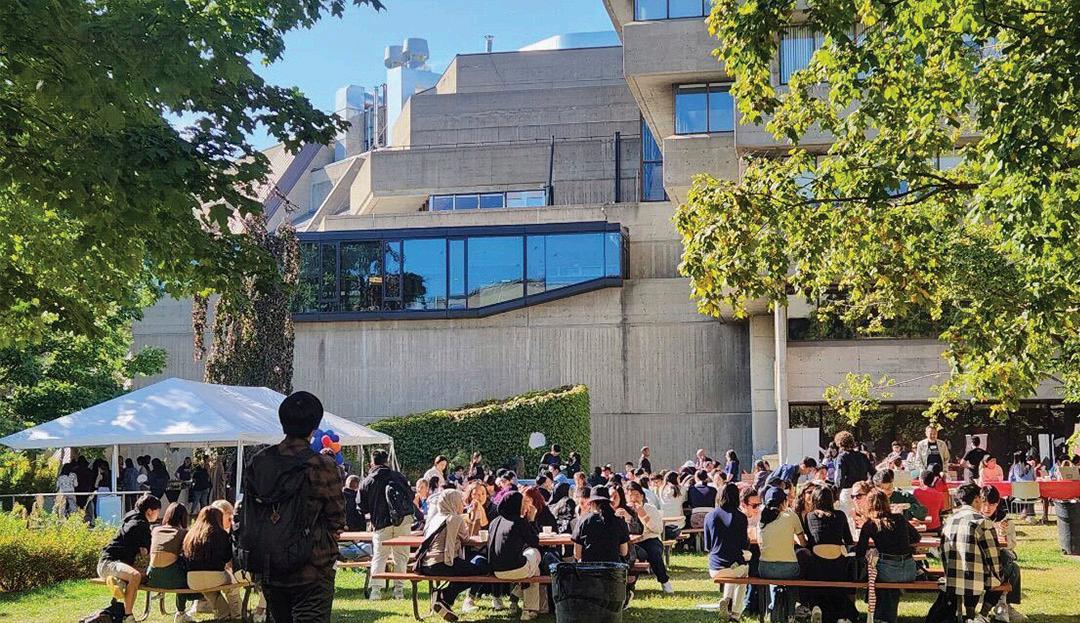
A spotlight on First Nations House orientation, UTSC BBQ for international students
sources to encourage Indigenous students’ success in and outside of the classroom.
Throughout September, after orientation week events like the tri-campus parade, various groups at U of T held orientation events — including a welcome bonfire held by Student Life and the Indigenous Initiatives team, Black Excellence Orientation at UTM, Queer Orientation held by the Sexual and Gender Diversity Office, and a mature students’ community event — welcoming students to the university. Many of these events focused on orienting students from marginalized communities to campus.
The Varsity attended two orientation events at U of T to hear from students about their experiences.
First Nations House orientation
On September 13, First Nations House (FNH) — an organization that provides services for Indigenous students at the university — hosted an orientation event to introduce undergraduate and graduate students to the space and programs that FNH offers.
The event began with opening remarks and introductions from staff at FNH, including FNH Director Michael White and Carol Ducharme, the organization’s Indigenous learning strategist. In a speech, Bonnie Jane Maracle — a Traditional Teacher in residence at FNH and a member of the Mohawk Nation at Tyendinaga Territory — described FNH as a “Rez away from rez,” a second home equipped with re-
The event included a tour of the building, which includes a free kitchen equipped with fruit, vegetables, and other food that students can take from; an array of quiet study spaces; rooms for traditional healing; and a library with Indigenous texts and books available for loan.
FNH offers personalized financial and academic advising for Indigenous students on all three campuses, opportunities to meet oneon-one with Traditional Teachers, and appointments for Indigenous students with disabilities to meet with Indigenous accessibility advisors. They also run events throughout the year, such as beading circles and Indigenous Education week.
Ashlyn Beck, a third-year political science student, told The Varsity that she found it harder to become involved at FNH last year because there was no FNH orientation. She was glad that one was being held this year so that she could learn of the various offerings and connect with her community.
Grace David, a second-year who studies global health and physiology and is a member of Chapleau Cree First Nation, also found the orientation event to be a positive experience. She told The Varsity , “I wanted to find a smaller community in such a big school. Orientation was a great way to start the year and meet new people from similar backgrounds.”
International Student BBQ
On September 15, UTSC held an international
student barbeque event on the Humanities Wing patio. The event included free food, music, and tabling from various clubs across UTSC. Students were also encouraged to eat together at picnic tables and share their personal experiences with others.
According to program coordinator and administrator Betty Liu, the annual BBQ started in 2010 and aims to foster lifelong relationships among international students and help them navigate moving into a new place.
Liu, who runs the orientation event and transitional programs for international students, discussed the purpose of the BBQ in an interview with The Varsity . “We want to create a platform for [students] to mix and mingle. This is why we’re here,” she said. “We also want to create a new vibe for students to get engaged… we don’t want them to feel lonely.”
Liu discussed the types of support systems available for international students as well. She explained that bringing students together creates another form of support. “Sometimes, support from us is more serious.” She continued, “But the peer support is more creative because they can meet a student and they can talk about anything.”
with his community.
Hibbert felt happy that people came out to the film screenings so that the program’s message could continue to spread. “I’m looking forward to pushing that narrative that… in the right setting, hurt people can help people for a better day, for a better tomorrow, for a better future,” he said.
The CRIB
Tanya Sharpe launched The CRIB in 2019 with funding from the university’s division of the VicePresident and Provost as well as the division of University Advancement. According to its website, The CRIB focuses on advancing research and policy for Black survivors of homicide victims through community-engaged methods. The centre focuses on understanding how the traumatic impact of murders can affect surviving family members in Black communities.
In 2022, The CRIB released a report and interactive map based on homicide data from 2004 to 2020. The data demonstrates that majorityBlack neighbourhoods in the GTA are not only disproportionately affected by homicides but also include fewer grief supports for survivors.
The report estimates that on average, each death by homicide strongly impacts at least seven to 10 family members and close friends, with an estimated 3,850 Toronto residents affected by the deaths of loved ones by homicide. It also discusses how social determinants that drive homicide rates — including lack of employment opportunities and education, mass incarceration, and continual retraumatization that breaks down social support networks — are often fueled by anti-Black racism.
At the screening, Tanya Sharpe told the audience that, in the next few months, The CRIB plans to launch a similar program with younger participants between the ages of 12 and 16 in the GTA.
The event was cancelled for two years during the pandemic but returned last year. In 2022, the event saw a significant turnout, and its focus shifted to orientation for first-year students, in order to give them opportunities for involvement on campus.
In an interview with The Varsity , Alexander Platzer, a first-year business management coop student from Washington, DC, spoke about his thoughts on the welcome BBQ. “I think it’s very useful for the new international students to host events like this and bring people together and make new friendships.”
When asked about the difficulties of moving to a new place, Platzer said, “The hardest part is probably being away from home, from family. And a new environment, not knowing where everything is and making connections. But again, these events help with that.”
Mayank Singal, a first-year business management co-op student from India, spoke to The Varsity about his experience sitting with new friends. For Singal, one of the hardest parts about moving has been adjusting to the new environment. He said, “[Welcome events are] nice because if I didn’t attend, I wouldn’t meet [new] people.”
news@thevarsity.ca 6 THE VARSITY NEWS
Avishka Gautham & James Bullanoff Varsity Contributor & UTSC Bureau Chief
Tanya L. Sharpe, Tito-tae Sharpe, Deshawn Hibbert, Rani Sanderson, and Jheanelle Anderson all spoke as part of a panel after the screening. MUZNA ERUM/THEVARSITY
Students at First Nation House’s Indigenous Orientation enjoy a meal together. JAMES BULLONOFF/THEVARSITY
Forum: What does the promotion of French language mean to you?
Anthonie Fan and Sulaiman Hashim-Khan Varsity Contributor & Comment Columnist
On June 1, 2022, the National Assembly of Québec passed Bill 96 to enhance the use of French in public services and businesses. The Bill involved six-month restrictions on providing immigrants with language services other than French, and mandated small companies to declare the proportion of their workforce that cannot communicate in French.




On June 20, 2023, Bill C-13 received royal assent and officially enshrined citizens’ right to work and be served in French in Québec and in other regions with a strong Francophone presence. This included the requirement that all Supreme Court judges be bilingual.
We asked two students about their take on the federal and provincial efforts to promote and preserve the French language.
Francophonie is more diverse than ever and deserves protection
I am in favour of federal Bill C-13 and Québec’s Bill 96 while maintaining reservations about how the bill will affect Indigenous rights.
Section 16.1 of the Charter states that Parliament has the right to promote the French language without limitations. Parliament is responsible for expanding linguistic requirements and creating a French-friendly environment to ensure equality between French and English in Canada.
Further, in recent years, while the overall bilingualism rate in Canada has remained stable, it has steadily declined outside of Québec. This supports why the federal government recognized in Bill C-18 that French is in a “minority situation” due to the “predominant use of English.” Given Parliament’s duty to advance the equality between Canada’s official languages, legislation like Bill C-13 must exist.
Furthermore, multiple opinion pieces criticizing the bill cite the French requirement as the reason behind the lack of racialized individuals in higher positions in the Canadian government. A letter sent to former Justice Minister David Lametti in 2020 by 36 bar associations, advocacy groups, and legal clinics also cited the bilingualism requirement as a barrier for Black, Indigenous, and people of colour candidates in federal positions.
I believe these arguments all make the incorrect assumption that Francophones are primarily of European descent. Today’s Francophonie is a diverse community with people of different genders, races, national origins, and faiths. In 2022, most Francophone immigrants in Canada came from Camer oon, Morocco, and Algeria, with only 13 per cent
zenship. Canada’s first racialized Supreme Court justice, Mahmud Jamal from Kenya, is also fluent in French. Promoting French-friendly workplaces can provide valuable advantages for racialized and immigrant individuals, given the increased numbers of immigrant children in French immersion programs and recent government efforts to increase the proportion of Francophones among new Canadians. Interestingly, few argue that educational requirements or English proficiency create barriers for racialized or immigrant Canadians in federal public service or judicial positions.
There are few justifications for treating French and English differently as working languages without endorsing the historical exclusion of Francophones. If we embrace that employment affirmative action is equitable rather than exclusionary, we should welcome the inclusion of French in the workplace instead of opposing it.
I do not aim to justify all aspects of the federal and Québec enactments. Both Bill C-13 and Bill 96 fail to acknowledge the use of Indigenous languages in official and educational settings. Furthermore, the narrow definition of historic Anglophones in Bill 96 has rightfully frustrated First Nations organizations. However, promoting Indigenous languages does not mean boycotting the preservation and promotion of French. In my view, without protection for French as an official language, we will reinforce a perception of Canada as an English-only country — further marginalizing Indigenous languages. This contributes to our obligation to preserve the linguistic heritage of French-speaking communities in Canada.
I believe that one can support the preservation of French while critiquing the lack of protection for Indigenous peoples and the differential treatment of foreigners and Canadians moving to Québec. However, English Canadians must acknowledge the elephant in the room: Francophone Canadians exist, Francophones deserve representation in the workforce, and the Francophonie is more diverse than ever.
Anthonie Fan is a fourth-year student at Trinity Col lege studying ethics, society, and law, public policy, and Portuguese.
Regulation from above is not like culture spreading from below
It is chiselled into the minds of all good Canadian children that the modern colonial state of Canada was conceived by two founding nations — al though recent curri
promotion of French
Canada’s founding — and therefore that our country has two official languages. However, in reality, most Canadians go about their public lives by only speaking English.
As such, there is little opportunity for the average Canadian citizen to acquire the French language yet government regulation makes it artificially necessary for Canadians to speak if they wish to make it to the top of their society. This regulation is put in place despite the reality that in 2021, only around 11 per cent of their population speak French and not English, and only 18 per cent speak both official languages — with most Francophones being Québécois.
As romantic as this dogmatic idea of two equally valued official languages is, its application to real-world policy on the federal and provincial levels can be harmful and limiting to Canadians. The most egregious policies on the artificial promotion of the French language in the country come out of the province of Québec — the only province in which most of the population conducts their life in French.
The latest example of the province’s notorious language bills is the recently passed Bill 96, which builds on top of the infamous Bill 101, or, as it’s officially known, “la Charte de la langue française.” The “Charter of the French Language,” as it were, created official arms of the government that were given the mandate to ensure the proliferation of the French language in the quotidian affairs of business, work, and education, as well as official matters of legislation and in the judicial sphere. By significantly
from accessing their government in a way that English-speaking parts of the country do not.
I see this as an artificial promulgation of French culture, which is, in my opinion, the most detestable offence of Bill 96 and other bills designed to synthetically promote French language use. Culture belongs to the people and should move up towards recognition — not be commanded from the top-down. Languages and cultures are never stagnant and continuously evolve over time and through contact with other languages and cultures. Any government which tries to artificially divert the flow of culture is overstepping the ethical boundaries of liberalism.
It is a uniquely Canadian insecurity to feel the need to protect a language that is not endangered in our country, nor unique to the continent. Regardless of the Bloc Québécois actions, French would not be a dying language in the country, and the policing of language use is imperious and disadvantageous to millions of Canadians.
Most pertinent to us, as students seeking higher education to further our learning and careers, is that this out-of-place and archaic linguistic imperative stands in the way of work opportunities. The farther up the corporate or political ladder, the fewer opportunities there are for those who only speak one of the two official languages. It is the song of the century to ensure diversity and equity in our spaces, yet we ignore this great unequalizer. It is shameful that Canada is to be a marionette whose strings can be pulled by a small linguistic elite.
Comment September 25, 2023 thevarsity.ca/category/comment comment@thevarsity.ca
We asked two students on their take on Canada and Québec’s
Substance doesn’t matter for winning in campus elections
Flashy social media posts and messages usually seem to win the game
 Devin Botar Varsity Contributor
One central point of democracy is to make sure that the views and goals of people in power reflect the views and goals of the people affected by that power. So, when you cast your vote in an election for the University of Toronto Students' Union (UTSU), the Governing Council, or your faculty union, you’re meant to choose someone who shares your stances on important issues.
As I see it, campus politics aren’t currently issue-based. And while most student politicians are smart, substantive, highly qualified people, I don’t think these qualities are what wins them elections.
For example, look at the UTSU candidates’ debates. Candidates repeat lines like “engage with students,” “make voices heard,” and “stay committed to accessibility/equity/awareness” ev ery year. Students may wholeheartedly agree with these messages, but close attention reveals that the lines themselves don’t actually mean any thing. These phrases usually appear without any elaboration. They don’t describe a specific action or a goal that can be measured in any meaning ful way.
Lack of crucial candidate information
Student candidates also post other shallow ma terials on social media. If you type ‘vote’ in your Instagram search bar, you’ll probably find that a few candidates’ campaign accounts already fol low you. These accounts rarely present anything policy-related.
Disappointingly for lovers of flare, they don’t tend to have catchy slogans either. No sizzle, and no steak. The campaign pages are mostly instructions on how to vote, surrounded by tem plate graphics. Sometimes, there’s a photo of the candidate standing in a quad, smiling. Physical signs and posters I see are just as vapid.
Often, candidates will exhibit their relevant past experiences, but these aren’t always so helpful. To use fictional examples; it’s very impressive to learn that someone is the first-year representative for the vape-tricks society or five-time recipient of the Richard Nixon award for public policy, but this
doesn’t say much about how prepared that candidate is for organizing frosh week or managing a multi-million dollar budget.
It is important to note that many candidates present very thoughtful, detailed, and creative materials. However, it is also important to note that these types of candidates don’t seem to win any more often than the others.
One private message, one vote
One student politician, Soban Atique, a fourthyear student majoring in criminology and political science, wrote to The Varsity that during his run for a seat on the Governing Council, “the goal is to reach out to the greatest number of people
can work with strangers — but it also helps to actually know hundreds of people. Knowing more people seems to be the most practical advantage to having experience at lower levels of student government, like executive positions of small clubs or secondary positions in smaller unions; these positions introduce you to a lot of people.
It wouldn’t be right to simply call student elections a popularity contest because no one necessarily has to like you to vote for you. They just have to feel bound by politeness enough to say yes.
If you’re not daunted by the idea of asking for a little favour from a hundred
is the election system like this? Student government matters. The UTSU handles tens of millions of dollars every year. The Arts & Science Students’ Union is responsible for bringing fall reading week to students under the Faculty of Arts and Science. The students we elect to the Governing Council have a role in setting our tuition fees.
Shallow elections may be a sign of function Students are busy. They have bills to pay and lectures to attend. There are real-world politics to be upset about. I understand how difficult it is to expect students to pay attention to the little league variant — campus politics — on top of everything.
For anyone not paying close attention, it may be difficult to understand the inner machinations of all the unions and councils, to determine what policies are best, or know what experiences make someone the most qualified. So when a candidate belts out their whole resume and 15-point plan, many students can’t help but hear it simply as noise.
But this isn’t the worst thing in the world. In a way, the shallowness of campus elections is a sign of function because engagement usually only tends to surge whenever there’s a scandal.
The highest voter turnout in any UTSU election over the past decade was in 2018, after the UTSU had sued its former president for the theft of nearly $278,000, and then made the controversial decision to settle the case out of court. In recent elections, major UTSU positions have been contested by just one candidate or none at all. However, in 2016, two full slates of candidates with highly developed platforms and inspiring messages of change fiercely competed for every position as, earlier that year, a UTSU vice-president had been impeached after being publicly accused of sexual assault.

Still, it would be too gloomy to think that a higher standard of politics is impossible without this kind of extreme prompting. All we really need is for students to pay a little more attention.
Devin Botar is a second-year student at St. Michael’s College studying history and classics.
comment@thevarsity.ca 8 THE VARSITY COMMENT & ILLUSTRATION
PIPER LEPINE/THEVARSITY
Stress
Illustration
Jessica Lam Illustration Editor
U of T fraternities
are
a ticking time bomb
Greek life is fun, but it’s not worth the risks
James Jiang Comment Columnist
There are bombs planted across U of T’s St. George campus. Big, towering bombs are hidden in plain sight. But these bombs aren’t Oppenheimer’s fireballs nor are they past war relics: they are U of T’s fraternities. U of T Greek life, in my view, is one horrible incident away from a tragic explosion.
The history of U of T’s Greek life is a touchy subject. In the 1960s, U of T severed its relationships with fraternities and sororities and has since barred them from any official university recognition — a decision based on the wildly discriminatory and exclusionary nature of these social organizations.
On campus, however, Greek life still thrives. Students at U of T have an impressive choice between 11 fraternities and seven sororities. The fraternities are living, ticking time bombs at U of T.

Presided over by a family of “brothers and sisters,” fraternities are social organizations working toward common philanthropic, preprofessional, and social goals. There are many common stereotypes about Greek-letter organizations: fraternities are colloquially known as sites of poor academic performance, beer drinking, toxic masculinity, and out-of-control hormonal urges. At U of T, fraternities are famous for their parties.
At the baseline, Greek life is fun; fraternity parties are bona fide fun. This is an easy concession. They help fill the gaping social hole in U of T students’ hearts and allow them to have some much-needed fun on a weekend night. For many students, especially first and second years, fraternity parties are their only real chance to party and experience the fun parts of
their undergraduate life in an icy-cold, cutthroat university like U of T.
Fun parties aren’t the only positives about Greek life. Fraternity houses serve other healthy and valuable purposes: they act as community hubs for the hundreds of students involved in Greek life, engage in philanthropic activities and community service, and are living text-
spiked drinks, nasty hazings, and overcharging students unfamiliar with frat policy. It might sound like these aren’t huge problems. It might feel easy to say, “Case closed; it’s just a bunch of guys being guys!” This thinking, however, is grossly simplistic and dangerous.
Though none of the aforementioned stories are official, there are obvious capital-T truths
Greek life scene. To me, they are defenceless against what I see as fraternities’ toxic power relations.
This is why fraternities are ticking bombs: I think it’s only a matter of time before a newspaper headline about a sexual assault, a hazing gone too far, or an out-of-control argument rocks the U of T community.
But the solution isn’t to take up pitchforks and torches and go on a fraternity witch hunt. When you have one rotten part of an apple, you don’t throw the whole fruit away: you just cut off the spoiled parts.
At U of T, fraternities serve real, valuable purposes, and they’re a beautiful thing. What needs to change is an end to the current questionable Greek life morals and practices. We need to recognize and accept the current crises, and fraternities need to put in place real systems of accountability and fail-safes to stomp out any problems before they crop up.
In essence, fraternities need to stop, do a 180, and march back to their legitimate role as community-oriented organizations for simple and clean fun, away from the current path of destruction.
books with a rich history and a long line of U of T alumni. Chiefly, fraternities offer the chance to meet new friends and instill a sense of belonging, and there’s something intrinsically beautiful and worth treasuring about this simple fact.
But fraternities are still bombs. One incident — one small spark — and U of T becomes a nuclear wasteland.
It is not uncommon to hear friends casually discussing incidents at fraternities that cannot easily be verified but echo similar stories of
HIS255 taught me how to be sensitive to suffering
Meditations on HIS255 — Introduction to the Histories of Extraction and the Environment
Divine Angubua Associate Comment Editor
In the winter semester of 2023, I took Assistant Professor Kristen Bos’ class, HIS255H5 — Introduction to the Histories of Extraction and the Environment. I was halfway through my second year at UTM and already questioning everything. Was a history and political science specialist the right choice? Why do I feel no great love for what I study? How am I supposed to make a difference in the world if I cannot even help myself?
I took HIS255 because my sadness and rage developed into a sorrow for the Earth, and I needed to understand it. I had read Amitav Ghosh’s The Great Derangement and enrolled in an environmental studies course that year, where I learned the full extent of the human causes of climate change and its relationship to colonialism. Still overwhelmed with what to do with the information, I found in Bos’ class a place to learn, feel seen, hope, and express emotion as a catalyst for critical thought. HIS255 taught me to be sensitive to the suffering caused by the colonial pursuit of dominion over land and its inhabitants. We read about the fur trade and the Hudson Bay Company. We learned how the Doctrine of Discovery was employed to strip Indigenous people of their humanity whilst their methodologies, people, and resources were stolen from them. We observed how resource extraction for the purpose of consolidating wealth and power has destroyed land, systems of ecology, faith, and subsistence, as well as caused nature to retaliate in violent ways that often further impacted the victims of this abuse of power.
We also observed environmental racism in depth through case studies of Flint, Michigan’s water health crisis and Shelburne, Nova Scotia’s man-made cancer epidemic. These Black and Indigenous communities were persecuted by provincial governments, which licensed capitalist enterprises to prey on their land’s resources while polluting their communities with toxic waste at no cost; in their examples, I learned of how pollution can be exercised as a form of colonization.
HIS255 taught me the importance of good historiography and research. In one of the required readings, Decolonizing Methodologies, writer Linda Tuhiwai Smith discusses how research has been historically practiced as a tool of colonization and epistemological killing to silence, omit, and construct truths that heroize their storytellers at the expense of the Indigenous people destroyed to make space for their empire.
Using research, colonists constructed — or named — Indigenous peoples as a problem before granting themselves the permission to erase them. I learned that history is often incomplete this way, as a one-sided testimony of the victors. Such accounts of history are false because their goal was never objectivity and truth — rather, it was the construction of a physical and epistemological empire.
I learned that good research can have a standpoint, a perspective informed by your identity and history in the greater recollection of our past. My standpoint as a Black, queer African drives me to investigate my history and reflect on the parts of myself that have been suppressed and erased.
As a Métis woman based in Toronto, Bos used her standpoint to enhance her teaching

and takeaways about Greek life. Fraternities’ reputations for being unsafe are substantiated through past accounts of sexual assaults and substance use issues from U of T fraternities in the Annex area in 2017, and more recently, through reports of gender-based violence in fraternities elsewhere in Canada, like Western University.
Students who just want to build a community and have some fun are forced to go face-toface with an increasingly morally questionable
and advocacy. She engaged us with statistical and historical material, and presented us with in-class documentaries, podcasts, and testimonies from inhabitants of communities such as Flint, Michigan and Shelburne, Nova Scotia, residential school survivors, and even the lonesome remnants of families wiped out by pollutant-related cancers.
By studying Canada’s history of extraction, I was reminded that the Earth is a body that keeps score; if you poison her waters, she will deny you food, poison the water that you drink, and send you to an early grave. What’s sad, however, is that it is often not the people who committed acts against her that suffer punishment.
At times, HIS255 was too painful to face.
I recall shaking and weeping silently several times during a lecture or tutorial. I was horrified by the extent of Indigenous erasure and dehumanization in the historical record, and even more saddened by how this racial difference had created a landscape that white capitalists
Before the bomb explodes, U of T students must bring out the wire cutters and form its bomb disposal squad. Even if only a single student is at risk, we should be ready to say no to fraternities that refuse to acknowledge it. I’m ready to risk everything to save a single student — and you should too. It’s time to defuse U of T’s ticking time bombs.
James Jiang is a fourth-year political science specialist student at Trinity College. He is a Life Between Lectures Columnist for The Varsity’s Comment section.
and their racist allies had exploited for power and profit through the fur trade, the Klondike gold rush, the diamond trade, and Canada’s oil greed.
This class helped me grieve for the people who came before me, whose suffering paved the way for me into this world, into that classroom, where I attempted to salvage their losses from the canonical grip of history. Altogether, this class reinforced my dedication to research as a tool for emancipation — because in order for nature to heal, we must all be truly free. Since HIS255, I have had a better grasp of my purpose in research; to deconstruct the empires that bind us and release my people to freedom.
Divine Angubua is a third-year student at UTM studying history, political science, and creative writing. He is the editor-in-chief of With Caffeine and Careful Thought and a staff writer at The Medium. He is an associate comment editor at The Varsity.
thevarsity.ca/category/comment SEPTEMBER 25, 2023 9
Despite its benefits, U of T’s Greek life is concerning. OLIVIA DANS/THEVARSITY
HIS255 reinforced my dedication to research as a tool for emancipation. KAMILLA BEKBOSSYNOVA/THEVARSITY
A shark in the water for Canadian journalism

How Canada’s new Bill C-18 will affect the democratic process
 Kate Forrest Varsity Contributor
Uncertainty is universal in life: we cannot know what the future holds. But for some people and some fields, this is more true than others. Specifically, for journalists like Peterborough Examiner reporter Joelle Kovach, who has been in the field for 26 years, journalism’s existence is paradoxical; the only thing reliable about the media sector is that it will always be evolving. In Kovach’s career, for example, the field has changed from focusing on print media and classifieds to moving into the digital sphere. From Kovach’s perspective, this change came so fast that journalists were unable to keep up with the changing times, and incapable of predicting what would come next.

Kovach is left to ponder questions like how long print media will last. “I don’t think print editions are long for this world. But then [again], I’ve been saying that for 15 years,” Kovach said in an interview with The Varsity. If print truly takes its final breath once and for all, how will the news be delivered? This kind of uncertainty is part of her job, for better or worse.
The newest instability and unpredictability that journalists like Kovach will face comes from the likes of Bill C-18. Called the Online News Act, Bill C-18 received royal assent on June 22, 2023. The bill’s goal claimed specifically a desire to increase the fairness of compensation for creators of news in the online sphere. It also hoped to bring more stability to the volatile online news industry. Further, this bill hoped to
the bill will most impact. Google and Meta both announced that, following the implementation of the bill, they will be removing all links to Canadian news sites to avoid financial liability. In practicality, this means that while consumers can visit Canadian news sites by typing in their URLs directly, they will stop seeing websites from Canadian news outlets appear in their search results when using Google. They will also be blocked from seeing posts from news outlets’ Facebook and Instagram accounts.
Google claims that as a result of the government’s currently vague description of the financial liability Bill C-18 will require major corporations to take on, it is unable to participate in the bill’s required revenue sharing, citing concerns about “forced payment for links and uncapped financial liability.” In a rare interview with The Peterborough Examiner while Prime Minister Justin Trudeau was in Peterborough in July, Kovach asked him for comment about Bill C-18. Trudeau described the major companies’ actions as “bullying tactics” and said the Canadian government needed to “stand strong” on this issue.
10 THE VARSITY FEATURES
This bill poses a threat to more than just the journalists whose jobs and wellbeing rely on the income that major online platforms generate.
government: “The fact that Google and Facebook, these big media companies, have essentially decided to strongarm Canadian media into not existing where most Canadians consume content, I think is going to have an incredibly negative effect on democracy as a
If engaging in the democratic process hinges on people’s ability to access news, Bill C-18 is a huge blow to the current process and functioning of Canadian democracy in a

Within Canada, one specific demographic will be particularly impacted by the inability to gain


“Young people are a lot more reliant on their news from Instagram, Facebook, and Twitter,” said Moorman. And he is correct: last year, the BBC reported that Instagram was the most popular news source for teens, followed by Younger demographics also make up a larger majority of the population using social media platforms. Instagram’s age demographic is made up of just over 30 per cent of users between 18 and 24. Facebook sits just a bit older, at just under 30 per cent being between the ages of 25 and 34. And Twitter, now known as X, sits between the two, with just over 40 per cent of users being between the ages of 18 and 29. This means that younger demographics will likely be most impacted by the erasure of Canadian news
The accurate reporting of news to Canadians, by Canadians, is of vital importance, especially to those whose jobs depend on it in a shrinking industry. “We’re still managing [to] somehow put out newspapers and put out TV broadcasts, and against the odds really. There’s fewer and fewer of us doing this work. And [the] fact that we’re managing it is a small daily miracle in my mind,”
Free access to the media allows people to engage with the democratic process in an informed way. Notably, journalists appreciated
features@thevarsity.ca
BIEW BIEW SAKULWANNADEE/THEVARSITY
We’re still managing [to] somehow put out newspapers and put out TV broadcasts, and against the odds really. There’s fewer and fewer of us doing this work. And [the] fact that we’re managing it is a small daily miracle in my mind.
Business & Labour
U of T’s trade unions made summer gains — now they’re preparing for fall bargaining
Zen Nguyen Varsity Contributor
Last November, an Ontario court declared Bill 124 — which had limited public sector workers’ salary increases to one per cent per year — unconstitutional. The rate of inflation in Canada, meanwhile, hit its peak at 8.1 per cent last year. That rate has been decreasing ever since, but it is still above the Bank of Canada’s ideal rate of 2 percent. This has meant increased costs of living and an erosion of consumer purchasing power.
Many of the contracts for U of T’s largest employee groups contracts — which typically last for around one to four years — were set to expire in June, and the resulting summer bargaining wave saw many unions taking advantage of Bill 124’s repeal. This summer, unions were able to negotiate significant improvements in pay in an attempt to make up for lost wages.
A bargaining refresher
Unions are organizations by and for workers to advance and protect their interests. A core part of this is the collective bargaining process, in which a team from a union negotiates with the university’s representatives to decide on a contract. The contract, also known as a collective agreement, determines everything from the working conditions of union members to things like pay, benefits, and workers’ protection.
U of T sports a total of 10 unions and 25 bargaining units. Bargaining units are a subset of a union, representing groups of workers in similar positions who share a collective agreement. They may represent a combination of full-time employees, part-time employees, and casual employees —
those hired on a contract basis for at most a few months, whom employers usually hire in response to unforeseen and urgent situations.
Four of the units that saw new collective agreements this year are from the Canadian Union of Public Employees (CUPE), CUPE 1230, CUPE 2484, and CUPE 3261; and from the Ontario Public Service Employees Union (OPSEU), OPSEU 578. CUPE 2484 represents daycare workers at the university. CUPE 1230 represents student casual library workers. CUPE 3261 represents service workers on campus, such as caretakers and food service workers. OPSEU 578 represents research associates at the Ontario Institute for Studies in Education.
Summer gains
Multiple unions representing university staff achieved 2.6 per cent pay annual increases, that apply retroactively to the pay periods in which Bill 124 restrictions had been in place.

CUPE1230, CUPE2484, and OPSEU 578 all won an increase retroactive to the 2021–2022 period. However, that increase only applies to noncasual members of CUPE2484. Unifor 2003, which represents operating engineers at the universities’ campuses, meanwhile, achieved an increase retroactive to the 2022–2023 period.
Except for casual workers, all workers in these units also received a $400 one-time-only payment as part of the compensation for Bill 124 restrictions. They also achieved increases and more inclusions to their health benefits — notably, the addition of gender-affirming healthcare services. Units with fulltime employees also negotiated a new plan for the change from the current long-term disability plan to the new University Pension Plan.
The United Steelworkers, Local 1998 Residence Dons unit negotiated a contract that clearly lays out dons’ compensation, a $500 one-time payment for most dons in response to Bill 124’s repeal, and wage increases for residence advisors. The casual units in CUPE1230 and CUPE3261 also achieved two additional paid sick days, with the latter also negotiating bereavement leave of five days, a base minimum rate for wages, and a mechanism through which workers can be recognized as part-time.
Units also made gains in working conditions and workers’ protection, in general, through clarifications of the language included in their contracts. CUPE2484’s new collective agreement includes language that reaffirms the equitable treatment of trans employees, clarification on the grievance process for violations of the collective agreement, and better protection against workplace harassment.
Both casual units for CUPE1230 and CUPE3261 attained recognition for domestic violence and a domestic violence leave for workers of up to 10 days, and CUPE3261’s contract now contains new language recognizing the right to free gender identification and additional commitment to equity employment metrics.
A look ahead at fall bargaining
These different bargaining units’ summer gains were similar, which is no coincidence.
U of T, bargaining units will use offers that U of T has made to other unions as precedents for their own negotiations. This means that as unions at the university are gearing up for a fresh round of collective bargaining this fall, with the expressed intention of coordinating bargaining together, within and across unions, to achieve their demands.
U of T saw solidarity and coordination between the major unions of CUPE and USW 1998 last fall, when CUPE3261 geared up for a strike.

On September 8, USW, Local 1998, one of the major unions representing technical staff at U of T, ratified a tentative agreement with the university for its staff-appointed unit, a category that excludes casual workers and represents appointed staff. The agreement covers three years, ending in June 2026, and includes a significant nine per cent raise for members in the first year of the agreement, with much lower increases of two per cent and 1.8 per cent for the following years.
The University of Toronto Faculty Association, a representative body that negotiates on behalf of faculties, also achieved an additional seven per cent increase in pay, retroactive to the year 2022–2023, There is no doubt that these significant wage raises were thanks to the repeal of Bill 124, and other unions likely will demand a similar catch-up in wage increases as the
In her economic update speech to the House of Commons last November, Deputy Prime Minister and Finance Minister Chrystia Freeland warned of an approaching recession in 2023. She emphasized the need for Canadians to be prepared. Indeed, economists are increasingly confident that the recession they have been predicting for months is on the horizon.
But economic indicators always change, and experts have varying opinions on this upcoming recession. Its severity, duration, and specific impacts on different groups of people remain uncertain.
Why do people say there is going to be a recession?
Current recession concerns generally trace back to the generous pandemic stimulus that boosted economies worldwide out of the 2020 recession brought on by COVID-19 lockdowns. Three years later, the consequence of the stimulus is now manifesting as unprecedented levels of inflation, which refers to the increase in the average price
of goods and services over a certain time period. Economists argue that injecting more money into an economy — in the form of stimulus packages, in this instance — bolsters inflation.
Other factors, however, are increasing the average cost of goods and services too. The war in Ukraine, along with the US and China’s trade war, is causing supply shortages that are increasing the price of certain products, especially food products.
At the same time, average wage rates are not keeping pace with inflation. The result is that people also have less money in their savings accounts. In the US, the average person is only saving 3.5 per cent of their income as of this past August, which is significantly lower than the pre-COVID average of nine per cent.
Central banks in various countries, including the US Federal Reserve and the Bank of Canada, have been significantly increasing interest rates over the past year. This makes it more expensive for people and businesses to borrow money, and is a way for countries to stop inflation from getting out of control. High interest means that consumers have less money to spend, bringing the overall demand for products and services down, which in turn decreases the average price of things — in theory, at least.
The US Federal Reserve’s deflationary monetary policies began in 2022 and strengthened the US dollar over other currencies. This means that countries that depend on the US for imported goods have to pay more for them, making the average cost of things more expensive in these countries, too.
How do we know when a recession is starting?
The definition of a recession may vary depending on who you ask. Formally,
investors generally say a recession is happening in a given country when its GDP — the total value of all the goods and services it produces during a certain period — gets smaller for two consecutive three-month periods.
The US National Bureau of Economic Research (NBER), which is responsible for officially declaring recessions in the country, defines a recession as a decline across various factors in a country’s economy for “more than a few months.” Those factors include the country’s GDP, along with the percentage of people experiencing unemployment, consumers’ confidence in the economy’s health, the rate of inflation, the value of retail sales, and others.
The NBER can delay making a decision on whether or not to declare a recession for months. If the factors it considers do not align, a recession may not even be officially announced. This all contributes to the uncertainty and ambiguity of what a recession means and whether or not we will enter one soon.
How bad will the next recession be?
With experts warning of a recession, some people may have concerns that the economy will deteriorate like it did during the 2008 financial crisis, which was triggered by the US housing market and caused severe economic problems worldwide. That recession wiped out $19 trillion USD in American households’ net worth. 10 per cent of Americans became unemployed, leaving 2008 as one of the worst years for students to graduate from university and start looking for a job.
Fortunately, economists generally agree that the recession will not be so severe this time around. The circumstances of the global economy are different from what they were in 2008. Some economists even argue that the overall economy
remains healthy, citing strong retail sales and a robust job market.
Nevertheless, the impending recession will not impact everyone equally. Individuals with tighter finances, such as students, may encounter greater challenges. Recent graduates entering the job market during a recession may also find it harder to secure positions after completing their university education, due to reduced demand in various industries. Many companies may already be making new hires a low priority in response to economic pressures.
Students should prepare for the effects of inflation, which may manifest as rising living expenses and perhaps even tuition costs. This inflationary pressure can be particularly burdensome for students who rely on loans that charge interest, as those loans’ interest rates are liable to increase. Students in tight financial situations may need to trim non-essential expenses and may also need to postpone expensive purchases to alleviate financial strain during the recession.
For recent graduates, it may be wise to seize opportunities to enhance skill development and experiences to enhance their prospects in a job market with diminished demand.
When will the recession end?
The question of how and when Canada will recover from the recession is complex. Different factors influence our economy’s health, making it impossible to precisely predict when it will fully recover. The trajectory of Canada’s recovery also depends on how severe the recession gets and what policies Canada and other countries implement in response.
But we will know we are recovering from the recession when inflation rates become stable, the average cost of living becomes more sustainable, our economy’s GDP increases, and the unemployment rate decreases. As the experts debate how best to recover from the impending recession and mitigate its effects, we can keep an eye out for these visible signs of a healthy economy.
September 25, 2023 thevarsity.ca/category/business biz@thevarsity.ca
As unions gear up for a fresh round of bargaining, let’s review the summer
YIXUAN GUO/THEVARSITY
How hard should we brace ourselves for an impending recession?
As prices and interest rates go up, students may have a harder time saving
Elizabeth Xu Varsity Contributor
ZEYNEP POYANLI/THEVARSITY
On average, Americans are saving less than half of what they were saving pre-COVID.
Arts & Culture
September 25, 2023
thevarsity.ca/category/arts-culture arts@thevarsity.ca
Form triumphs over function in first-week fashion


Why dressing up for class isn’t as trivial as you think
 Mayumi Ramos Varsity Contributor
Do you remember back when you were younger, you were so excited for the first day of school that you picked out an outfit — all brand new clothes, of course — laid it all out on your bed, and perhaps even slept beside it the entire night?
Last August, during the last few weeks of summer, that shiny childhood feeling came back to me. I was inspired to try out new clothing combinations, curating my outfits, snapping pictures of them in the mirror, and adding them to an album on my phone. I spent hours doing this — that is not an exaggeration.
I justified the time I spent by telling myself there was a practical reason for this ostensibly frivolous practice: it would be super easy to pick out something to wear on mornings when I’m running late! And if I’m feeling indecisive, I can just scroll through my outfits, à la Cher Horowitz.
I even rationalized buying a pair of fourinch heeled boots on SSENSE to my mom: “Okay, it’ll make me taller and therefore more confident, and if I feel more confident, I’ll start acting more confident, and that means I’ll put myself out there more, and so I’ll get better opportunities and grades!” Yes, I got the boots. The opportunities and grades part is still in the works.
I was onto something, though. Deep down, I knew I was putting all this effort into my outfits because I aspired to be the kind of person who puts effort into everything I do, even something as seemingly mundane as choosing the clothes I’m wearing for the day.
In his 1964 book Understanding Media: The Extensions of Man wrote that clothing is an extension of our skin and a means of defining ourselves socially. Some people dress extra special during the first week of class because it’s a way to establish and express their identity — not just to others but also to themselves. Who are you, and who do you want to be?

As I strolled through campus during the first week of school looking for other people’s outfits to photograph, I found that the ones I gravitated toward weren’t just unique and unconventional — although, admittedly, that was part of my criteria — they were the outfits whose models radiated selfassurance. I could tell they genuinely felt like themselves in what they were wearing. It was always so nice to see them break out into a smile once I explained why I approached them, as they realized that their efforts at selfexpression weren’t going unnoticed.
There’s a certain vulnerability that comes with being noticeable, however. I’ve seen many commenters on the U of T subreddit say that no one really cares what you wear — a hoodie and sweatpants are the unofficial U of T uniform, after all.
But I don’t think people are truly indifferent. Bold leopard print and a blingy belt; an eclectic combination of wraparound sunglasses, maximalist jewelry, a corset, fishnet tights, and leg warmers; layering a denim midi skirt over baggy jeans: these are all distinctive fashion choices that draw others’ attention. Second glances, slightly-too-long stares, and maybe even turned heads — to be authentically expressive, at its core, is to be vulnerable.


But is garnering this attention the whole point of dressing uniquely? You’ve probably heard sayings such as “School is for learning, not a fashion show,” and “You shouldn’t sacrifice comfort for style.” I think they’re reductive.





In many of the outfits that caught my eye, aesthetics took precedence: funky, sky-high platform boots and spiky collars are not exactly the most comfortable clothes to study or attend class in. On the surface, this seems superficial. But prioritizing self-expression is powerful — especially through fashion, which is often the first thing others notice — and it changes how you view yourself, thus improving how you present yourself. It really is a positive feedback loop.
Personally, dressing to impress does wonders for me. Putting on a cute outfit in the morning sets the tone for my day and makes me more inclined to go out, but I’d also be lying if I said the compliments don’t go straight to my head. And although my four-inch heeled boots make me sacrifice some — okay, fine, a lot of — physical comfort and add at least five minutes to my travel time, the confident feeling I get and the way I carry myself when I wear them makes it a worthwhile trade-off.
These U of T students around campus agreed to let The Varsity photograph their back-to-school fits..
AMAREENA SALEH SINGH, BRIANNA CVITAK, MAYUMI RAMOS & MILENA PAPPALARDO/THEVARSITY
The fantastical geographies of Kōtuku Titihuia Nuttall
A review of Tauhou: A Novel
Malaika Mitra Varsity Contributor
When we consider geography, we often forget that it’s an act of imagination. The national and international borders that we draw rely on geopolitical machinations out of our reach. The province that we live in connects people across immense swathes of land, most of which we will never see. Even the city is an imagined community — when was the last time that you visited a neighbourhood outside of your normal routine?
Kōtuku Titihuia Nuttall’s debut novel Tauhou stretches the geographic imaginary beyond land and into generations — not just through time or history but by envisioning land through past, present, and future lineages. She begins with a creation poem that places the two islands of her Coast Salish and Maōri heritage — Vancouver Island, Canada and Aotearoa, the Maōri name for New Zealand — side by side. She explores stories from these lands individually, as well as stories that connect them, without regard for chronology.
Although Tauhou could technically be described as a collection of short stories, I prefer to think of it as one narrative, constantly iterating over the same islands in different ways. One of the most powerful ways that Nuttall articulates this is through the book’s full title — Tauhou: A Novel In the description of the book published on the website of Canadian publisher House of Anansi Press, it says: “Dear grandmother, I am writing this song, over and over again, for you. I am a stranger in this place, he tauhou ahau, reintroducing myself to your land.”
Each chapter is a reintroduction, and before you have time to feel jilted by the departure of a story, Nuttall introduces another one — another perspective, another language, another way to mould similar experiences into something new. While reading it, I got the distinct feeling that the emotions shown in each story could be woven into a tapestry of one person’s life.
In Tauhou, Nuttall imagines what historical
Reena Sarju Varsity Contributor
dynamics between them could have looked like and what future relationships could be. By leaving parts of the islands’ history ambiguous — particularly the extent to which settler colonialism had existed in the world — she was able to explore Indigenous futures in a unique way, imagining alternate settings in urban areas, on a reservation, and in villages.
One setting that stood out in my mind is one of the first ones described in the book; a woman named Hīnau describes her commute to work, travelling from her home in an above-water condo community on stilts to her job at the tribal propaganda office. Nuttall’s frank yet imaginative prose immediately allows a reader to see the beauty and brutality of such a landscape. This intriguing setting was not just a backdrop, as Nuttall was able to deftly weave Hīnau’s personal relationship to the land as well as her interpersonal relationships into descriptions of the landscape itself.
And here lies Nuttall’s greatest strength: her ability to write about the ways that people care for each other and themselves. At a point in the novel, Nuttall contrasts the varied ways in which two different characters practice tattooing. For Miro, getting tattooed is an escape — distinctly metropolitan, somewhat impersonal but not unkind, an exercise in tolerating pain through silence and stillness. She explicitly describes the process as violent, yet simultaneously craves that violence “until it happens, and then she’s waiting for it to stop.”
Immediately after, we are shown Hīnau, who chooses to get tattooed with “old world style” designs after seeing the style on many of her
colleagues. She’s tattooed in the artist Camas’ home. Camas offers her food, and gently contests her use of the word ‘traditional’ to describe what she wants, using a skin-stitching method instead of a tattoo gun.

The juxtaposition of these vignettes itself contains acceptance. Even with two vastly different outlooks on tattoos, they’re an emotional release for both Miro and Hīnau, regardless of whether their tattoos have an explicit connection to their cultures. The care that Camas shows Hīnau in the novel shows that even the briefest of connections can offer safety and comfort. Nuttall explores the complexities of cultural alienation, connection, and familial trauma, gently turning over each rock and examining the mud and bugs and moss on them.
As much as this novel is about culture and land, it is also about love and family. The overwhelming majority of the romantic relationships portrayed in Tauhou are between women who have varying
never rejection or disgust. The tension and love within their relationships were explored in conjunction with a fundamental acceptance of them. As someone who is bisexual, it was nice to be able to delve into the intricacies of the relationships in this way — in a story that allowed lesbian relationships to exist as they are and didn’t try to make them seem like straight ones in the process.
Through recreating geographic boundaries, Nuttall has found a way to understand the complexities of a person’s relationship to their culture spatially. Worldbuilding that focused on cultivating this theme, rather than geographic or historical realism, allowed her to expand into different stories without creating a disjointed work, constructing an emotional depth that has left a profound impression on me since I read it.
I recommend Tauhou because it masterfully weaves together stories, traversing a wide cast of characters and a range of time periods without leaving you in the lurch.

You’re not alone in your celebrity obsession
The psychology of a parasocial crush

“Be careful who you love.” — Michael Jackson
When I was seventeen, I stumbled on the Motown 25 special. I watched it out of curiosity as a distraction for the night, only to become hypnotized by “Billie Jean.” His fedora and sequined glove weren’t new to the world anymore, but they were to me. All I could do was look up at my television screen with wide eyes at his glittering silhouette, and the song that seemed to captivate everyone from investment bankers to stray cats with its urgency.
That was when I fell into the rabbit hole of Michael Jackson’s music.
It felt like returning to a lost place as I listened through every album and short film he ever made. But I had further to fall as I went on to soak up any biography about his life that I could find.
Around this time, most of the world was in lockdown due to the COVID-19 pandemic. This meant that time was a resource I had an abundance of, and connection was not. Something about watching audiences get swept away by Michael Jackson, from a time when I wasn’t even alive, made me feel like I belonged in a way no other fandom has ever inspired in me. Until Michael Jackson, I had never fangirled over anyone.
To understand my descent into the Michael Jackson fandom, one must understand the phenomenon of parasocial relationships as a whole.
Tilo Hartmann’s research in The Routledge Handbook of Media and Well-being reveals that parasocial relationships provide feelings of connectedness to someone even when the interaction is one-sided — and that in some cases, this could be a good thing. Hartmann also poi-
son’s ever growing fanbase to date. I was far from being alone in feeling like he was a more integral part of my life than many of the tangible relationships in my life combined — this was affirmed by the years I spent immersed in the fandom.
made me feel like I could heal myself, and “You Can’t Win” made me understand that I didn’t have to.
As it turns out, the above experience that I describe encompasses one of the main facets of parasocial relationships that Riva Tukachinsky Forster describes in her book Parasocial Relationships: Falling in Love with Media Figures Forrester notes that parasocial relationships are, by nature, imaginary. Her research revealed that the person experiencing the parasocial relationship becomes infatuated with a celebrity’s image and not the person themself. Yet the accompanying emotions involved are nearly identical to those in relationships founded in reality.
While reality inevitably eclipses the imaginary, I’ll never judge anyone for wanting to look up to another — whether based on fantasy or not. Especially since I can say firsthand that my parasocial relationship changed my life in ways no one else has.
gnantly equates the human need to belong as primordial of a feeling as pain itself. This made sense on a personal level, as growing attached to someone who made me feel like I belonged was enough to override feelings of isolation.
It also lends an explanation of Michael Jack-
Something about Michael Jackson was ambrosia to me during the end of my teenage years. His music was like a final jolt of childlike wonderment while simultaneously making me feel like I could even transition into adulthood.
He had a song for everything. “Heal the World”
For most people, a celebrity obsession is a phase, and mine was admittedly no different. And as the world started to open up again, so did I. About three years after almost morphing into a fangirl, I found myself in an indie record store selling a vinyl of Michael Jackson’s “Off The Wall.” Maybe the newer, tangible relationships I had took precedence over my parasocial one and made my fervency as a fan dwindle from what it used to be. But when I looked at his warm eyes on the album cover — him in a tuxedo, smiling as freely as the sweeping saxophone of the title track — I remembered him as the one who made me fall in love with life, when life wasn’t easy to love.
arts@thevarsity.ca 14 THE VARSITY ARTS & CULTURE
The author drew from her Coast Salish and Maōri ancestry to craft her novel. COURTESY OF EBONY LAMB & COURTESY OF HOUSE OF ANANSI PRESS
ZAINAB AFAQ/THEVARSITY
Honestly, at one point, I wasn’t even aware of what sourdough is, let alone the science behind it. After conducting a fair amount of research, I now feel well-versed in the history, science, and practical applications of sourdough starters — even in their roles as pets. Yes, you heard me right: pets!
The roots of sourdough starters can be traced back to 3500 BCE, but they experienced a spike in fame fairly recently. In 2020, when the COVID-19 pandemic turned our lives upside down, it also brought life and prominence to sourdough starters.
As grocery stores faced the infamous toilet paper shortage, they also faced another shortage, albeit less notable: commercial yeast. Yeast, a fungus, exists all around us; it resides within us, in the food we eat, and even in the air we breathe. It’s what’s in both commercial yeast packages and sourdough starters. For centuries, commercial yeast has been a bread-making staple. But in light of commercial yeast shortages, sourdough starters entered the lives of millions of bakers as an alternative rising agent.
Sourdough starters and their chemistry
Sourdough starters are natural cultures composed of wild yeast and bacteria that leaven bread. There are various methods for creating a sourdough starter, but they generally involve combining water and flour and allowing the mixture to ferment. Fermentation is a metabolic process that triggers chemical changes in a substance due to the presence of enzymes — proteins that speed up these metabolic and chemical changes.

Continued from cover
Reconstructing history
The fossils presented an interpretive challenge. Moysiuk explained in an email to
can make them a challenge to interpret and reconstruct in 3D. Fortunately, we had a large collection of about 200 specimens, some of which were buried at different angles relative to the shale bedding plane.”
‘bottom-up’ view.
The significance of this discovery goes far beyond its extraordinary age. Soft-bodied creatures like jellyfish are often elusive in the fossil record. Notably, jellyfish are composed of 95 per cent water. Because of this high water content, fossilization is extremely rare.

Thankfully, the Burgess Shale is a remarkable store of well-preserved, detailed fossils of delicate structures such as jellyfish, which usually disintegrate before leaving an imprint. This allows scientists a rare glimpse into the ancient marine life that thrived during the Cambrian period.
Caron emphasized the significance of these findings. In a release from the ROM, he said, “Finding such incredibly delicate animals preserved in rock layers on top of these [Burgess Shale] mountains is such a wondrous discovery. Burgessomedusa adds to the complexity of Cambrian food webs, and… these jellyfish were efficient swimming predators. This adds yet another remarkable lineage of animals that the Burgess Shale has preserved, chronicling the evolution of life on Earth.”
As the oldest definitive free-swimming jellyfish ever found, Burgessomedusa paves the way for further exploration into the evolution of marine life. Not only does the discovery enrich our understanding of the Cambrian period, but also enables us to reflect on the intricate history of life.
Moysiuk and Caron’s study was funded by doctoral fellowships from the University of Toronto, an Ontario Graduate Scholarship, and a grant from the Natural Sciences and Engineering Research Council.
As I mentioned, the starter is a mixture of water and flour, which undergoes spontaneous fermentation the moment the two come in contact. Microorganisms like wild yeast and lactic acid bacteria that naturally exist in the environment start to feed on the sugars in the flour. All of these elements come together to create a thriving ecosystem within the sourdough starter.
Initially, certain microorganisms, including lactic acid bacteria, contribute to the acidification of the starter. The environment eventually becomes unfavourable for many of these colonies of microorganisms, leaving the starter to be dominated by lactic acid bacteria and acid-tolerant yeasts.
Yeasts metabolize flour sugars, such as glucose and sucrose, to produce alcohol and carbon dioxide gas through alcohol fermentation. The production of gas leads to bubble formation and ultimately to the rising of the dough. Meanwhile, lactic acid bacteria acidify the starter through a process known as lactic acid fermentation, which converts sixcarbon sugars into three-carbon lactic acid molecules. The acid preserves the starter and inhibits the growth of undesirable microorganisms.
Within a week or two, the yeast and lactic acid bacteria populations grow rapidly, producing enough carbon dioxide to leaven a loaf of bread. Notably, temperature plays a pivotal role, with warmer temperatures resulting in a sour flavour and colder ones yielding fruity flavours.
Longevity and emotional connections
To maintain the starter, you must discard a portion of it and add fresh flour and water. According to internet wisdom, you should feed
the starter every 24 hours if you keep it at room temperature; every 12 hours if warmer; and one or every two weeks if re frigerated. Rou tinely feeding the starter en sures you provide sufficient nutrients for the yeast and lactic acid bacteria to survive and mul tiply.
Regular feedings maintain the starter’s integrity by sustaining an acidic environment through continuous fermentation. This pre vents the growth of harmful moulds and bacteria and allows for the desired microorganisms to continue adapting and thriving.
The Boudin Bakery, located in San Francisco, California, is home to a sourdough starter that dates back to 1849 and is still in use! If that doesn’t display the longevity of starters, I don’t know what does.
Sourdough starters are much more than mere baking tools or refrigerator residents. Amid the isolation and uncertainty brought about by the pandemic, people found solace in these starters. Some individuals went as far as naming and featuring them on their social media platforms, treating them like family pets.
This phenomenon likely arises from the regular nurturing of starters, which fosters an emotional bond. From a practical perspective, it’s akin to nurturing countless pets, as the starter is home to millions of thriving microbes that rely on routine care and nourishment.
Whether you’re a beginner like me or a seasoned sourdough connoisseur, I hope this was an insightful glimpse into the world of sourdough starters: their underlying science, their never-say-die attitude, and their ability to fill an emotional void in you that you may not have known existed.
Science September 25, 2023
thevarsity.ca/category/science science@thevarsity.ca
Ashmal Shoukat Varsity Contributor
Joe Moysiuk and Jean-Bernard Caron recently identified jellyfish fossils discovered in Burgess Shale years ago. ASHLEY JEONG/THEVARSITY
The science and history behind sourdough starters
COURTESY
Sourdough starters could be the pet you never knew you needed
Sourdough starters need to be taken care of to survive.
OF JEUWRE/CC WIKIMEDIA COMMONS
Canadarm3: Canada’s robot on the moon!
The latest Canadian Space Agency robot arm system will enter lunar orbit
Former U of T PhD student Jamil Shariff is one of the brains behind the Canadian Space Agency (CSA)’s new contribution to international space exploration: Canadarm3.
Canadarm3 is an autonomous system consisting of two robotic arms that will be attached to NASA’s Gateway space station, a lunar outpost that will also host a human presence.
This mission marks a global stepping stone towards our understanding of lunar science, through an extended view of the moon’s surface that we wouldn’t be able to get from Earth. NASA also hopes that the Gateway space station can act as a stopping point during future Mars voyages.
A history of Canadian robots in space
Canadarm3 is not the CSA’s first endeavour in furthering autonomous space exploration. In fact, it is the latest version of their previously established cosmic robot arm.
The CSA’s journey in this field began in the 1970s when NASA commissioned it to build an autonomous system to unload payload bays — areas in NASA’s space shuttles where cargo is stored. The challenge of creating such a dexterous apparatus resulted in the birth of the original Canadarm.
As the country’s very first robot arm, Canadarm started missions in 1981 and went on to accomplish many more tasks than its initial purpose. It helped send various satellites into orbit, captured drifting satellites for repair, and assisted
astronaut spacewalks — when an astronaut gets out of a vehicle in space to conduct experiments, test equipment, and conduct repairs. It even helped assemble the International Space Station (ISS), a large satellite inhabited by astronauts that is in orbit around Earth to facilitate astronomical research.
The system was an engineering marvel; it could lift over 30,000 kilograms using less electricity than a kettle.
While Canadarm eventually took its last flight in 2011 due to NASA’s space shuttle program shutting down, the CSA built a new version of the system: Canadarm2. This 17-metre-long contraption is one of Canada’s contributions to the ISS.
Canadarm2 performs maintenance tasks around the ISS and helps move supplies and astronauts. One of Canadarm2’s most fascinating uses is achieving ‘cosmic catches.’ These maneuvers involve harnessing incoming uncrewed ships from Earth and docking them to the ISS to help distribute supplies. Canadarm2 is also relatively self-sufficient; it can replace its parts while in space. It is never supposed to return to Earth.
Canadarm3 and its uses
Canadarm3 will be part of a milestone in space exploration due to its contribution to the Gateway space station.
The Gateway space station is set to launch in 2025, with Canadarm3 joining the station in 2028. The Gateway will be the first space station in lunar orbit — a repeating path circling the moon. It can stay in orbit around the moon as long as the station’s momentum and the moon’s gravitational force are balanced.

By Newton’s first law, an object will continue its motion forward unless another object exerts a force on it. Provided that the Gateway’s forward motion isn’t too strong, it will also experience gravity from the moon pulling it to the lunar surface. The tug between the station’s momentum and the moon’s gravity is what enables the Gateway to continue circling the moon.
Putting the Gateway into a lunar orbit is quite a challenging task, especially because it is hard for the station to gain enough forward momentum from its velocity to prevent itself from succumbing to the gravitational pull of the moon. The cost of the resources needed to accomplish this warrants a question: why do we even want to put the Gateway into lunar orbit?
Primarily, the Gateway will facilitate the observation of the lunar surface, which can foster further breakthroughs in space science.
Moreover, as we consider the possibility of more humans travelling beyond our planet, it is crucial for us to understand the health effects of being outside the Earth’s magnetic field. The field — produced in the Earth’s interior due to many factors like its fast rotation — is what shields us from harmful substances, such as the sun’s charged particles that can erode atmospheres. The Gateway space station will act as a testbed for new technologies outside the Earth’s magnetic field, will help facilitate exploration of the surface of the Moon, and will act as a stepping stone for future missions to Mars.
Canadarm3 will help facilitate many vital tasks aboard the Gateway. Similar
to previous iterations of Canadarm, Canadarm3 will also aid with maintenance and vehicle management, while continuing to ‘catch’ vehicles arriving at the station. Its highly autonomous nature means it will also reduce the requirement for astronaut spacewalks, but it will still assist with these activities if they are to occur.
The CSA writes on its website that advancements in AI might mean that Canadarm3 can also perform non-manual tasks, such as optimizing resource use or helping with mission planning.
Canadarm3’s future beyond outer space In exchange for contributing to NASA’s Gateway mission, the CSA will be able to conduct certain commercial space activities and scientific demonstrations from the station. Canada will also be able to send two astronauts to the moon.
In fact, Canada will have an important role on the Artemis II mission, the first piloted mission to the moon since 1972. Jeremy Hansen will be a part of the crew of Artemis II and will be the first Canadian astronaut to fly to the moon.
The Canadarm robots not only contribute to increasing Canadian presence beyond Earth and signify progress in our efforts to deepen our knowledge of the universe, but they also mark advancements in robotics that can significantly benefit our life on Earth. The technology used in these systems has helped advance healthcare and robotics amongst other fields. For example, Canadarm led to the development of neuroArm, which is the first robot that can perform neurosurgery inside an MRI machine.
science@thevarsity.ca 16 THE VARSITY SCIENCE
Medha Barath Varsity Contributor
An artist’s depiction of Canadarm3 on the Gateway space station planned for lunar orbit. COURTESY OF CSA & NASA
Leaders at U of T ask AI developers to hit the brakes

direction, it urges, means implementing strong industry watchdogs and comprehensive regulatory frameworks. And that requires cooperation across AI labs, businesses, and governments.
“I don’t think the pause letter is trying to stifle innovation or technological advancement, as some have accused,” Crichlow wrote to The Varsity Instead, she suggested, the letter urges us to think critically about what direction humankind is headed: “I think that’s a good thing.”
How to save the human race
One potential set of AI regulations, under Bill C-27, is currently making its way through Canada’s House of Commons. It is Ottawa’s first attempt to “comprehensively regulate” AI, writes SRI policy researcher Maggie Arai in an article on the institute’s website.
The field of artificial intelligence (AI) is at a critical inflection. Over the past few years, computer programs like Chat-GPT, DALL-E, and others have stunned the public with their capacity to develop artistic creations and work with abstract concepts.
They have also prompted deep unease. Worries about AI are not just from Twitter users and conspiracy theorists predicting a robot takeover this time around. Industry leaders, including those at U of T, are almost unanimously sounding the alarm on AI becoming an existential threat.
“Perhaps there is a lot more happening here than we are currently able to understand, and maybe we’re going at a pace that’s just too fast for us to be able to grasp the implications of the current era of technological development,” wrote Monique Crichlow, executive director at U of T’s Schwartz Reissman Institute (SRI), in a statement to The Varsity
“We don’t know for certain that AI poses an existential threat,” Crichlow noted. But she wrote it is a possibility, and the SRI urges world leaders to take that possibility seriously.
U of T’s complicated history with AI
The SRI’s director, U of T Law Professor Gillian Hadfield, has signed two open letters calling for
developers to slow down and policymakers to act before it is too late.
As a U of T-based institute, the SRI’s message is especially notable. U of T is the university where, 11 years ago, Geoffrey Hinton and two graduate students pioneered artificial neural networks — the technology that opened up the possibility of ChatGPT and other generative AI technologies in the first place.
Shortly after the breakthrough, Hinton took a position at Google, which acquired the neural network technology for 44 million USD. The AI industry has come to call Hinton its “godfather.”
He went on to found the Vector Institute, a nonprofit AI research company, in 2017. Its office sits at the corner of College Street and University Avenue, across the street from the SRI building.
Then this past May, Hinton announced that he had left his position at Google so that he could openly criticize the company’s actions. In light of the existential threats that AI currently poses, Hinton says he regrets how his research contributed to its development.
“I console myself with the normal excuse: if I hadn’t done it, somebody else would have,” he told The New York Times
Experts call for legislation and cooperation
Along with Hadfield, Hinton is a signatory on the US-based Centre for AI Safety’s 22-word long
statement released on May 30, earlier this year.
The statement reads, “Mitigating the risk of extinction from A.I. should be a global priority alongside other societal-scale risks, such as pandemics and nuclear war.”
The statement has 350 signatures from highlevel players in the AI industry, including the CEOs of the research organization Google DeepMind — whose AI-based projects address challenges in areas ranging from medicine to ancient languages — and OpenAI, the AI research laboratory that created Chat-GPT.
Hadfield has also signed a letter calling on AI labs everywhere to immediately halt training all AI systems more powerful than GPT-4, the latest version of what is commonly known as ChatGPT. The letter was released on March 22 by the Future of Life Institute, a global non-profit that seeks to prevent existential risks that technological development could produce. As of September 23, the letter has 33,711 signatures.
The letter paints a striking picture of the industry. “AI labs [are] locked in an out-of-control race to develop and deploy ever more powerful digital minds that no one — not even their creators — can understand, predict, or reliably control,” it reads.
These AI developments could make life vastly better for current and future generations, the letter acknowledges. But it warns they could also do the opposite. Steering the technology in the right
Among other provisions, the bill proposes to put the onus on developers, distributors, and managers of AI technologies to mitigate and monitor the risks that their technology poses. This includes ensuring that whatever personal data the technology collects remains totally anonymous, and providing consumers with easy-to-understand explanations of any potential risks or impacts the technology poses.
The proposed regulations are not without flaws, Arai writes. But the whole business of regulating AI generally suffers from more fundamental issues. Essentially, developments in AI are prone to happen at an exponential rate. Policymakers, meanwhile, are already infamous for their snail-like pace; AI regulations can scarcely hope to keep up. The technology is inherently difficult to understand, and those in government lack the expertise to create legislation to properly curb potential threats.
But a reconfiguration of how governments create AI regulations could address this chasm. Hadfield and Jack Clark, the policy director for OpenAI and sitting member on the US president’s advisory committee on AI, propose in a preprint that regulators use a market-based approach, where developers and distributors of AI technologies would be responsible for purchasing regulatory services for their own products from a third-party regulatory body. Essentially, under such a model, the onus for keeping up with AI developers’ unmanageable speed is shifted onto the developers themselves.
But until a model like this addresses problems with AI regulation, the Canadian government and others will struggle to keep up as AI developers race toward a potential global existential crisis.
considered similar to clubs: optional activities run by organizations that have no significant imperative to bring in as many people as possible.
Philip Harker Varsity Contributor
U of T prides itself on being a research-intensive unU of T prides itself on being a research-intensive university. Having been through a number of different research experiences myself, I feel that I’m in a position to look back and reflect on my past opportunities to express my gratitude for the advantages I’ve had. But I also see flaws in the system, and these flaws matter — both for students and for the scientific community as a whole.
The undergraduate research opportunities in the Faculty of Arts and Science can be broken down into a few broad categories: some are done for course credit, some are done for pay, and some are volunteer positions. Volunteerships are generally entry-level and can translate to future work opportunities.
Research volunteers are students who assist with lab research on their own time, generally on top of their coursework or other employment.
Being an assistant can be an interesting learning experience, but it is hardly the same as an actual science course — it’s often lower-skilled work such as data entry or cleaning glassware. Working in a lab is not a tailored curriculum like in the lab component of a course, where learning is the major objective.

Herein lies the problem with these positions:
educational value notwithstanding, volunteering is work. You, a volunteer, are in some way useful or valuable to the lab you are working in, whether you’re conducting an entire study yourself or just entering values into a spreadsheet.
We’re in a moment in labour history where people are no longer content to work for free. It’s great that volunteerships are available to those who want them, but the idea that working for free is a prerequisite to a paid position leaves a bad taste in my mouth. This trend is not exclusive to science — lengthy unpaid internships are remarkably common in law, journalism, communications, and tech, for example, generally tied to the promise of future paid work.
I’m not saying that you should never work for free. But I do think it pays to interrogate the true impact that the prevalence of research volunteerism has on the scientific community. Who is more likely to agree to volunteer in a lab: a student benefiting from a domestic university tuition and scholarships, or an international student who has to work at Harvey’s on top of a full course load to support their family and pay for their expenses? The reality is that not everyone can afford to volunteer their time.
None of this is to say that U of T researchers themselves haven’t observed balancing volunteerships with work and course load as a problem. Megan Frederickson is a professor in the Department of Ecology and Evolutionary Biology.
Her lab, the Frederickson Lab, has an explicit policy about unpaid lab volunteers: she, for the most part, doesn’t take them. To quote her lab’s undergrad job page: “In the past, the Frederickson Lab has accepted undergraduate student volunteers. However, not all students can afford to work for free, and it is not fair to offer opportunities to gain research experience only to students with enough financial resources to pursue unpaid positions.”
Does it matter that not everyone at U of T will be able to take part in research? Some would argue that it doesn’t. Research opportunities can be
But, the comparison of research experiences with extracurricular clubs is imperfect. Many science students at U of T are interested in medical or grad school — programs that encourage, if not require, some research experience. As an undergrad without experience, it’s easy to believe that if you don’t get a job in university, you’ll never get one afterward.
I don’t propose a solution to this issue. The number of paid research positions is a direct function of scientific funding, which, in an era of inflation and reduced research dollars, isn’t going to change overnight. But to students like me who have had these opportunities: be mindful. Don’t quit your job and demand it be handed to someone less privileged than you, but remember that being aware of inequity in research opportunities is the first step to progress.
thevarsity.ca/category/science SEPTEMBER 25, 2023 17
Georgia Kelly Business & Labour Editor
Experts say AI developers are in a race that policymakers cannot keep up with
ALYSSA VILLAR/THEVARSITY
Opinion: U of T’s research opportunities are not accessible to everyone
Entry-level research volunteerships are catered toward the financially privileged
Some undergraduate students struggle to balance between school work, a job, and research volunteerships. ASHLEY JEONG/THEVARSITY
Blues men’s hockey team win 4–2 in final home exhibition game
Blues’ rookies shine in dominant win over Hawks
Shonita Srinivasan Varsity Contributor
On September 22, the Varsity Blues men’s hockey team beat the Laurier University Golden Hawks 4–2 in their final home exhibition match. It was a rough game for the Blues, but first-year goaltender Jordan Fairlie was a standout performer, earning the team their second win.
What happened
The Blues were on track for a rough match from the start. The Hawks had defeated the Ontario Tech Ridgebacks 5–1 two days prior and clearly wanted to secure another dominant win. The Blues withstood a few major falls and cross-checks, but they were still able to maintain a good defence — Fairlie finished the game with 33 saves. Around 13 minutes into the game, Blues cap-
tain Cole Purboo scored a power-play goal assisted by defensemen Nick Grima and Ryan Barbosa to put the Blues ahead. Soon, second-year Blues forward Graham Dickerson scored another goal, with another assist from Barbosa and forward Julian Recine. As the first period ended, the Varsity Blues held a two-goal lead.
As the second period began, both teams came out strong and accumulated four penalties in the whole period for slashing, hooking, and tripping.
The Hawks scored a power-play goal to cut the deficit early in the second; however, the Blues soon scored their third goal in the game as rookie defenseman Aiden Reeves buried the puck in the net — his first goal as a Varsity Blue — after receiving an assist from forward Mason Reeves. Yet, the Hawks scored their second goal midway through the period, meaning that the Blues entered the third period with a 3–2 lead.
The third period began with Laurier only trailing the Blues by one goal and both teams fighting tooth and nail for the win. Through this period, the referees had to break multiple fights, resulting in four penalties — two for each team. Yet, halfway through the period, with an assist from Blues forward Nicholas Wong, defenseman Benjamin Dirven scored the game’s final goal to secure the team’s 4–2 win.

What’s next
On September 23, the Blues travelled to Oshawa and defeated the Ontario Tech Ridgebacks 3–1 in their final exhibition game. According to Fairlie, the team will now focus on recovery and ensure all lines and systems are in check before the regular season begins on October 6 against the Western University Mustangs.
Blues
fall as Warriors stage a late comeback victory
A tough fight by the Varsity Blues women’s basketball team as the pre-season begins
Alaysha Merali Varsity Contributor
On September 22, in their first exhibition game of the season, the Varsity Blues women’s basketball team fell to the University of Waterloo Warriors 59–48 at the Goldring Centre.

What happened
The Blues dominated the first quarter, beginning the game with a strong 19–8 lead. Blues guard Ellen Ougrinov was essential in helping the team increase their lead with her exceptional ball-handling skills and by drilling the first of many three-pointers in the match.
With the Blues leading by 11 points going into the second quarter, the Warriors’ defense signifi-
Canada
Exactly 100 years ago, Canadian men’s basketball began its journey in international competitions, hoping to earn the distinguished title of the greatest basketball country in the world.
Today, the Summer Olympics remains one of the
cantly improved as they began to work their way back up on the scoreboard in an effort to tie the game. Nevertheless, the Blues’ offense stayed strong, and they were able to hold onto a 10-point advantage, maintaining the score at 28–18 by the end of the second quarter.
Back from halftime, Warriors guard Ghiselle Poblete led the team in points with multiple successful breakaways, including driving down the line, reverse layups, and quick jump shots. The Warriors clearly held their momentum, even though the Blues still had a 45–35 lead at the end of the third quarter.
In the fourth quarter, with strong encouragement and cheers from the bench, the Warriors applied pressure on the Blues defensively and stepped up their attacking plays.
As the pressure overcame them, the Blues tried to remain supportive of one another as they made more strategic plays on the court. However, they could not secure a basket after the seventh minute of the fourth quarter. The Blues were outscored 24–3 during the final quarter.
The Warriors’ expand ing advantage continued to intimidate the Blues as the game continued. Ultimately, the Warriors earned a valiant, dominant comeback win against the Blues, leaving the final score at 59–48.
What’s next
After this tough loss, the Blues will travel to Montreal on October 6 to play against the Concordia University Stingers in the Con-
competitions in the world for athletes in most sports, and it’s the same for men’s basketball: the gold medal is the quintessential symbol of triumph and hard work. The Canadian men’s basketball team has only medalled once at the Olympics, with a silver medal at the 1936 Berlin Olympics. While Canadian legends such as Steve Nash or Rick Fox attained noteworthy success for their teams in the success failed to translate into their international duties.
Yet the recent ascendancy of the team in the International Basketball Federation (FIBA) World Cup, where Canada won the bronze medal — their first time finishing on the podium at the tournament — has suddenly accelerated the belief that a gold medal is a genuine possibility at the 2024 Paris Olympics.

The 2023 FIBA World Cup Announced in 2020, the 2023 FIBA World Cup has been one of the central ways to qualify for the Paris Olympics, where nations compete against each other to ultimately win the tournament but also to earn Olympic qualification. The highest-ranking two teams from the Americas during the FIBA World Cup automatically qualify for the Olympics, meaning that Canada would need to outplay countries like Mexico, Argentina, and of course, the United States — all squads with rich and successful basketball history. Yet, currently, there are 22 Canadians on NBA rosters, which is the largest number of any country besides the US, so it’s undeniable that the level of pure basketball talent within the Canadian team rivals any of the favourites for the Olympics.
The Canadian team’s endless pursuit to dethrone the US men’s basketball team — who have won four straight Olympic gold medals — was invigorated when Canada beat the US to take the bronze medal at the FIBA World Cup. Although somewhat insignificant compared to the Olympics, this win proved to many Canadian players and fans that they belonged on the same stage as their southern neighbours.
Led by superstar point guard Shai Gilgeous-Alexander, who finished the game with 31 points and 12 assists, Canada cemented their ticket to Paris by finishing as the best performing team from the Americas. With guards like RJ Barrett, Luguentz Dort, and Dillon Brooks accompanying GilgeousAlexander to France, it’s evident that Canada finally bears a complete and unified team filled with star players.
The 2024 Paris Olympics
The 2024 Paris Olympics is the first real shot the Canadian team has had in over 20 years to bring prosperity to their country. The team last played in the 2000 Sydney Olympics. Superstars like Nash have battled hard to qualify for previous games but to little avail.
It’s not as if the team has lacked the talent to compete with other dominating teams. So why is the team succeeding now?
Team Canada’s recent success is grounded in a collective three-year commitment that players signed in May 2022 with each other and the country’s basketball federation. The commitment erased any possibility of the players unexpectedly backing out while allowing the team to primarily focus on developing their chemistry for future tournaments. Additionally, this created a more serious outlook on the program, introducing a newfound sense of urgency that had been severely lacking in previous years. This announcement conveyed a win-now mentality that stimulated the team’s recent success at the FIBA World Cup.
Other Canadian stars like Andrew Wiggins and Jamal Murray chose not to play at the FIBA World Cup, but if they pledge to join the squad in Paris next summer, their announcements will bring unparalleled excitement to the nation. Only time will tell if this newfound commitment will result in actual success. However, for Canadian basketball fans, it’s difficult to hide the excitement of a possible gold medal, especially as the 2024 Paris Olympics draw nearer.
Sports September 25, 2023
sports@thevarsity.ca
thevarsity.ca/category/sports
rising: The men’s basketball team is making history
After winning bronze at the FIBA World Cup, Team Canada now prepares for Paris
Mason Chang
Varsity
Contributor
The Varsity Blues were unstoppable in front of the Hawks’ net. COURTESY OF SEYRAN MAMMADOV VIA VARSITY BLUES MEDIA
SIMONA AGOSTINO/THEVARSITY
Veteran guard Ellen Ougrinov was a standout performer for the Blues. KATE WANG/THEVARSITY
NBA introduces the new In-Season Tournament
Is this new announcement fire, or a misfire by the league?
Ashmal Shoukat Varsity Contributor
If you haven’t heard, the NBA has introduced a new trophy for its world-class players to chase: the NBA Cup. The means to attain it is the new NBA In-Season Tournament.
The concept of a soccer-style league cup has been circulating in the NBA since the early days of NBA Commissioner Adam Silver’s tenure. The NBA believes the in-season tournament will boost fan engagement early in the regular season, as the tournament — which includes group play matches and knockout rounds — will take place from November 3 through December 9. It also incentivizes players to give their best effort since all championship team members will receive 500,000 USD each, while the runner-up team players receive 200,000 USD.
Currently, the NBA is in high demand among major media companies like Apple, Netflix, and Fox, which are all competing for its streaming rights. This tournament will likely attract even more media giants to the table, making it a winwin for the league and its players.

So, how does this tournament work? In group play, each conference is divided into three groups of five teams based on their standings in the previous season. Every team will play four games
against the other teams in their respective groups — two home games and two on the road. The six teams ranked first in their groups will advance to the knockout rounds, along with two wildcard
battle. All these games will be part of the new 80-game regular season, but the teams in the inseason tournament’s finals will technically have to play an 82-game season.
or bench roles. For instance, a superstar like Stephen Curry has little reason to compete for the prize pool, which is less than one per cent of his estimated 2023–2024 season earnings of around $52 million.
Furthermore, the most coveted trophy for players to pursue has always been the championship trophy, awarded to the NBA Finals winner. Teams receive financial incentives for participating in the playoffs, which makes playoff-related titles like the Larry O’Brien Championship Trophy more desirable, and so the absence of playoff incentives in the in-season tournament makes it slightly less meaningful for teams.
On the opposite side, another recent addition to the NBA’s roster — the play-in tournament — has recently become a fan favourite, owing to the Miami Heat’s remarkable playoff run this past season. The Heat overcame insurmountable odds, securing the eighth seed in the Eastern Conference and defeating the Milwaukee Bucks, New York Knicks, and the Boston Celtics en route to the 2022 NBA Finals. They became only the second team to achieve this feat since 1999.
teams from each conference. The wildcard teams will be the best performers among all secondplace teams in their respective conferences.
The knockout round will commence with the quarterfinals and culminate in the championship
I believe that the in-season tournament is a wise business decision for the NBA as it will attract more attention during a time when fan interest is low. However, I feel the incentives it offers primarily appeal to players with smaller contracts
The Heat’s successful run to the finals was made possible only by the recently introduced play-in tournament. In the same vein, only time will tell the fate of the NBA’s latest invention, the in-season tournament.
Bad decisions in MMA are here to stay
Why MMA fans say “Never leave it in the hands of the judges”
The phrase, “Never leave it in the hands of the judges,” has become increasingly common among combat sports fans. Occasionally, time runs out for a Mixed Martial Arts (MMA) fight with both fighters still standing. When their time is up, three scorecards from three judges will determine a fighter’s fate.
Unfortunately, fans and fighters alike have witnessed this countless times, and bad decisions have become more commonplace in the process. But why do they occur in the first place?

The judges and referees
The immediate answer to that question points to the judges themselves. Certain judges have become infamous for their decisions.
One notable example is Douglas Crosby. On December 9, 2022, Crosby scored an Interim Bantamweight title fight at Bellator 289 between Raufeon Stots and Danny Sabatello. Stots won the fight via a split decision, with the two other judges ruling in favour of Stots and the only scorecard for Sabatello coming from Crosby. Crosby consistently ruled in favour of Sabatello and scored the fight 50–45, marking the first time in Bellator’s history that a losing fighter swept their opponent on one judge’s scorecard.
The next day, Crosby scored a bout between Paddy Pimblett and Jared Gordon at Ultimate
Fighting Championship (UFC) 282. He scored the contest 29–28 in favour of Pimblett, as did the other two judges, Chris Lee and Ron McCarthy. Yet, MMAFighting’s deputy editor, Shaheen AlShatti, dubbed the decision — which they said robbed Gordon of the win — the “heist of the year.”
Referees can also add to the issue of scoring. Different referees have their own styles. Some provide multiple warnings and shy away from calling fouls, while others may be quicker to deduct points. Certain referees may also force the fight back from wrestling on the ground to fighting from a standing position if they believe insufficient action is occurring on the ground. This can harm a fighter’s proficiency in wrestling by taking them out of an advantageous position.
The criteria
When one looks beyond the surface, other factors start coming into play. MMA has adopted the tenpoint scoring system used in boxing yet obviously needs to change its criteria for scoring bouts.
In MMA, three primary criteria determine these scores: effective striking/grappling, effective aggressiveness, and cage control. In contrast, boxing is scored based on hard and clean punches, effective aggression, defence, and ring generalship — who has overall control of the fight. Furthermore, in boxing, the amount of points judges give to each fighter is easier to determine. According to boxing’s criteria, judges score a
round 10–9 when one fighter has been more effective. They score a round 10–8 mostly when one fighter scores a knockdown, but also if a fighter dominates by a large margin. If a fighter scores two knockdowns, judges score a round 10–7.
Yet MMA does not specifically award or deduct points based on knockdowns. The unified rules of MMA state that if a fighter wins by a close margin, judges will score the round 10–9. They score a round 10–8 if a fighter won it by a large margin and 10–7 if one fighter completely dominates the other. This already makes judging more convoluted compared to boxing, which has set clearer indicators.
Another issue lies in the frequency of these different sets of points. The most often score judges award is a 10–9 round, and a 10–8 round is much rarer. But a 10–10 round is even rarer than that, and judges are discouraged from giving that score. Thus rounds in which both fighters are largely equal would be scored a 10–9, which can unfairly skew a fight.
Strikes
The unified rules of MMA determine the efficacy of striking based on the impact or effect of legal strikes. However, determining the impact or effect of strikes can become confusing in certain scenarios.
The bigger issue is when judges use visible evidence to determine the effect of strikes.
Factors such as the amount of scar tissue on a fighter have played a large role. Old cuts can open back up, amplifying the visible damage from strikes — evident in the career of MMA veteran Nate Diaz. Additionally, fighters’ cuts can open if they accidentally clash heads, which could be misinterpreted as damage from a strike. One big issue with the unified rules of MMA is that they have a section on impact, stating that visible evidence, such as swelling and lacerations, can influence a judge’s decision.
Furthermore, effective striking is also grouped together with effective grappling in the unified rules of MMA. This can create issues because one fighter may dominate the ground game while the other dominates when standing up.
It doesn’t seem that the MMA will solve issues surrounding its scoring soon — that would require reworking the scoring system. However, a little hope emerged on September 18, when MMA journalist Ariel Helwani tweeted that the Nevada State Athletic Commission would hold a training session for judges on September 20 to improve the results of their calls. The news comes after another divisive scorecard ended the UFC flyweight title bout on September 16 in a draw, allowing Alexa Grasso to retain her championship over Valentina Shevchenko.
This announcement might be a sign of improvement, but it seems frustrated fight fans are doomed to face more evenings screaming at their screens.
thevarsity.ca/category/sports SEPTEMBER 25, 2023 19
Ahmad Khan
Associate Sports Editor
CHRIS BENNY PAUL/THEVARSITY
The NBA Cup is a new trophy for players to chase COURTESY OF ERIC DROST VIA FLICKR
Elise Corbin Varsity Contributor









SEPTEMBER 25, 2023 20 THE VARSITY DIVERSIONS Check out our email newsletters to stay up to date with all news at U of T!
