On newsstands weekly
Volume 64 Issue 6
Thursday, October 22, 2026
THE USD VISTA VISTA
The Official Student Newspaper of the University of San Diego since 1968
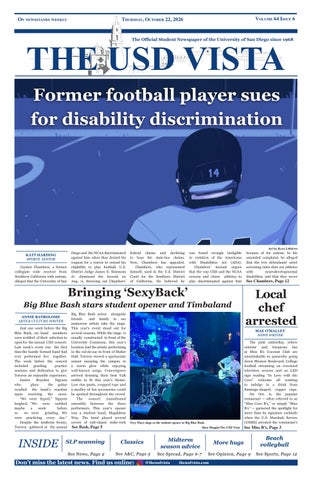
KATT HARDING SPORTS EDITOR Cayden Chambers, a former collegiate wide receiver from Southern California with autism, alleged that the University of San
Diego and the NCAA discriminated against him when they denied his request for a waiver to extend his eligibility to play football. U.S. District Judge James E. Simmons Jr. dismissed the lawsuit on Aug. 11, throwing out Chambers’
federal claims and declining to hear his state-law claims. Now, Chambers has appealed. Chambers, who represented himself, sued in the U.S. District Court for the Southern District of California. He believed he
Bringing ‘SexyBack’
was found wrongly ineligible in violation of the Americans with Disabilities Act (ADA). Chambers’ lawsuit argues that the way USD and the NCAA screens and clears athletes to play discriminated against him
Big Blue Bash stars student opener and Timbaland ANNIE BATROLOME ARTS & CULTURE WRITER Just one week before the Big Blue Bash, six band members were notified of their selection to open for the annual USD concert. Last week’s event was the first time the hastily formed band had ever performed live together. The week before the concert included grueling practice sessions and dedication to give Toreros an enjoyable experience. Junior Brayden Ngyuen who plays the guitar recalled the band’s reaction upon receiving the news. “We were hyped,” Nguyen laughed. “We were notified maybe a week before so we were grinding. We were practicing every day.” Despite the midterm frenzy, Toreros gathered at the annual
INSIDE
Big Blue Bash soiree alongside friends and family to see numerous artists take the stage. This year’s event stood out for several reasons. While the stage is usually constructed in front of the University Commons, this year’s location had the artists performing in the cul-de-sac in front of Maher Hall. Toreros viewed a spectacular sunset encasing the campus in a warm glow while enjoying well-known songs. Concertgoers arrived donning their best Y2K outfits to fit this year’s theme. Low rise pants, cropped tops and a medley of fun accessories could be spotted throughout the crowd. The concert transitioned smoothly between the three performers. This year’s opener was a student band, Magdalene Way. The band played several covers of cult-classic indie-rock
See Bash, Page 5
Art by Kyra Lefebvre
because of his autism. In his amended complaint, he alleged that the two defendants’ strict screening rules shut out athletes with neurodevelopmental disabilities and that they never
See Chambers, Page 12
Local chef arrested MAE O’MALLEY NEWS WRITER
Trey Mays sings as the student opener at Big Blue Bash. Shea Moggio/The USD Vista
The pink umbrellas, yellow exterior and turquoise bar at Miss B’s Coconut Club are unmistakable to passersby going down Mission Boulevard. College football streaming on oversized television screens and an LED sign reading “In Love with the Coco” welcome all wanting to indulge in a drink from flamingo-shaped, copper cups. On Oct. 6, the popular restaurant — often referred to as “Miss Coco B’s,” or simply “Miss B’s” — garnered the spotlight for more than its signature cocktails when the U.S. Marshals Service (USMS) arrested the restaurant’s
See Miss B’s, Page 3
SLP scanning
Classics
Midterm season advice
More hugs
Beach volleyball
See News, Page 2
See A&C, Page 5
See Spread, Page 6-7
See Opinion, Page 9
See Sports, Page 12
Don’t miss the latest news. Find us online:
@theusdvista
theusdvista.com
2
The USD Vista
•
October 22, 2026
NEWS
Toreros now scan upon entry in SLP Students react to changes in the dining hall
NORA FENDLEY NEWS WRITER In the recent weeks at USD, students headed to the Student Life Pavilion (SLP) looking for a bite to eat have been surprised by what they’ve found instead – lines out the door. Since new changes to the dining hall system were implemented, lines has become a regular occurrence, along with modifications to the cash value of meal swipes. Adjusting to this new style of dining has amassed mixed reactions from the student body. As of Oct. 7, the SLP’s procedure for purchasing food shifted. Previously, students used their meal swipes for dinner Monday through Sunday, as well as weekend brunch, by swiping at the exit. Those without a meal plan paid the equivalent value of what they were purchasing. Now, students swipe their student IDs upon entry as opposed to exiting. The expectation of swiping before entry changed the cash price for those without a meal plan, landing at a flat rate of $22.50. Students who frequent the SLP have expressed their reactions to this change, sharing both positive and negative feedback. Charlie Burster, a firstyear at USD, expressed her
Students line up in the seating area to scan for entry into the SLP.
dislike for the new procedure. “I feel like even though the line, when it was inside, was long, it was still shorter because it was spread out into multiple lines and it was more staggered,” Burster said. Burster stated that lines extending into the dining area has made getting her food, as well as Ozzi boxes (reusable boxes offered to take food to-go), a challenge. Burster also said that she and her friends have been deterred from
Tommy Doyle/The USD Vista
reentering for seconds due to the length of the lines. USD first-year Alyssa Wagner disagrees, saying it is more practical to scan before entering. “I think it probably makes the lines inside of the actual [serving stations] a bit shorter,” Wagner said. “When you’re holding all your plates and they’re all full and you have to put them down and get your card out —
now you don’t have to do that.” USD junior Liam Sullivan is also pleased with the new scanning system. “It seems efficient so far,” Sullivan said. “I guess once people get used to it, it’ll probably move pretty smoothly.” According to Charles Ramos, director of dining, these changes were implemented to make student dining
more efficient, accessible and streamlined for a larger number of students than previous conditions accommodated for. “The new setup improves flow and convenience for guests, especially when entering the foodservice area,” Ramos wrote. “This moves any lines before guests enter the food stations, alleviating bottlenecks in the serving area and ensuring that once you get your food, you will be able to exit quickly.” With this new system, Ramos stated data collection has become more effective, allowing greater prediction of busy dining hours. “Scanning every customer provides far more accurate, realtime data on guest traffic, meal plan utilization and purchasing forecasting,” Ramos wrote. “This improved tracking data allows our culinary and operational teams to better forecast day-to-day demand, ensuring food availability while also minimizing waste.” Amid the recent change, Toreros are getting to know the new dining hall structure. However, the SLP remains highly frequented on campus, and as students adjust to the new system, the university continues to monitor reactions and engage with student feedback.
Inside USD’s immigration enforcement How and when protocols are implemented
MATTHEW SEDANO NEWS WRITER On Sept. 8, at about 9:30 a.m., Renatho Casseus, a Haitian immigrant and San Diego City College (SDCC) student, was driving another Haitian immigrant and SDCC student. The students were near the intersection of 16th and C streets in downtown San Diego, directly next to the college, when U.S. Immigration and Customs Enforcement (ICE) agents took Casseus into custody. According to SDCC district officials, one of the passengers fled onto the City College campus while ICE agents detained Casseus, according to NBC 7 San Diego. SDCC district officials said agents quickly stopped pursuing the passenger. “They stopped as they recognized they were entering a college campus,” SDCC district officials said. “The agents went
back to their vehicles and left.” The arrest lands amid San Diego’s larger immigration enforcement initiatives. On Oct. 7, Kern Sol News reported that federal officials began a 45-day enforcement campaign called Operation Safe California in San Diego. The publication stated that agents were instructed to target immigrants, regardless of their criminal history, and they will continue to arrest all illegal immigrants that they encounter. USD has protocols in place should ICE agents request access to campus or student information. The policies can be found on the USD “National Dialogue on Immigration” website under “Campus Protocols.” On that page, scroll down to “Be Prepared” for a resource guide outlining employee response protocols for immigration enforcement. The resource guide identifies “Public Areas” and “Nonpublic
The USD Vista Riley Rains - Editor-in-Chief Calla Jordan - Managing Editor Amelie Sedlack - Copy Editor Sophie Hummel - News Editor Julianna Flores - Feature Editor Cristina Trice - Arts & Culture Editor Katt Harding - Sports Editor
Kyra Lefebvre - Art Director Emma O’Connell - Photo Editor Lucas Meza Ehlert - Distribution Manager Ella Fitzpatrick - Social Media Manager Sasha Sepatjian - Director of Finance Nina Dameri - Advertising Manager Dr. Byron Howlett - Operations Advisor Blake Nelson - Student Media Advisor
Areas” on campus, including dorm rooms, classrooms, faculty offices, locker rooms and private events, as “the shield” — where ICE requires a judicial warrant or consent to enter. If ICE agents attempt to enter a private area on campus, university staff must deny access and report to the Department of Public Safety (DPS) for further review, according to the Immigration Enforcement Response resource guide for employees. Parking lots, lobbies and outdoor quads are public areas. Officers may be present in these places, but staff should still notify DPS immediately, according to the resource guide. USD modified its immigration enforcement protocols to reflect changes in federal immigration policy and legislation, according to a university spokesperson. “When appropriate, DPS may issue an informational alert to keep the USD community informed of activity in the surrounding
area,” the spokesperson wrote. In January, California Senate Bill 98 issued a requirement for universities to use DPS to alert their community when immigration enforcement occurs on campus. USD conducts ongoing procedure evaluations with campus departments and legal counsel, according to a USD spokesperson. Jocelyne Olguin, associate director of Student Leadership & Learning at USD’s Mulvaney Center, explained that qualifying community members can receive free immigration legal services through the university’s clinic. USD students, faculty and alumi qualify for free immigration legal services. Individuals not affiliated with USD may still qualify based on demonstrated financial need and low-income status. “We’re just doing our best to be proactive and hoping that we have systems in place where students can feel safe and know
Editorial – 619.260.4584 Business – 619.260.4714 www.theusdvista.com / @TheUSDVista
that the campus and administration have their back,” Olguin said. USD junior Janine Fell, a child of an immigrant, was unaware of the university’s immigration enforcement protocols. “[USD] can do a seminar or something in depth where it’s not too formal but also not too informal,” Fell said. “It would be helpful if they addressed it through the wellness center and what support they can provide to students.” Shannon Ross, a first-year at USD, shared her thoughts on the possibility of ICE activity being near campus. “It’s scary, I see them at my job and they’re not doing anything … I’m not an immigrant, but I can still feel that fear,” Ross said. The legal clinic and campus support systems remain open to students and their families. The Department of Public Safety can be reached at 619260-2222.
The USD Vista publication is written and edited by USD students and funded by revenues generated by advertising and a student fee. Advertising material published is for information purposes only and is not to be construed as an expressed or implied endorsement or verification of such commercial venues by the staff or University. The USD Vista office is locwated on the fourth floor of the Student Life Pavilion in room 403B. All inquiries should be sent to: The USD Vista 5998 Alcala Park San Diego, CA 92110 Opinions expressed in this publication are not necessarily those of The USD Vista staff, the University of San Diego or of its student body. Letters to the Editor can be submitted to The USD Vista office. Letters should be limited to 300 words and must be signed. For identification purposes, USD identification numbers and writer’s year must be included in the letter. The USD Vista reserves the right to edit published letters. Any content sent to the editor will be considered for publication unless otherwise stated.
Volume 64 Issue 6 •
NEWS
•
3
The USD Vista
NEWS
Chaos at Coconut Club
From Miss B’s, Page 1
head chef. The chef, 50-year-old Brian Anthony Williams, was working under the alias Troy Williams for the last 10 years. Mission Beach — where the restaurant is located — is a popular area for USD students to live, work and eat. The scandal shocked the USD community, including senior Jess Bush who previously lived across from the restaurant. “He was the least of our problems,” Bush said. “When I lived across the street from Miss B’s, our lawn chairs were stolen from our front yard. One time, someone came into our house and took my roommate’s keys and stole her car. When I heard about this I was like, ‘that’s crazy,’ but there is always something going on in Mission Beach.” Brian Anthony Williams of Davenport, Iowa reportedly fled his hometown 14 years ago to evade arrest following the alleged abduction of his then-girlfriend, Brittany Hamilton. The kidnapping, which took place on Oct. 26, 2012, resulted in Hamilton being left in a field with a gunshot wound to her leg, according to the Iowa District Court affidavit. Originally, local news outlets, such as WQAD that serves the Quad Cities, reported both Anthony Williams and Hamilton as victims of
the home invasion and kidnapping. Hamilton escaped and found help at a nearby business, thinking that the kidnappers had taken Anthony Williams with them. Weeks later, police officials learned through investigation that Anthony Williams had been involved with three others, including his brother Troy Williams – whose name Anthony Williams would later use as an alias in San Diego. Employees and regulars of Miss B’s are reeling with the loss of the person they thought they knew. Eddie Jurado, general manager of the restaurant, told ABC News he has conflicting feelings about Anthony Williams. “I want to say I feel a certain way, but then I feel a different way,” Jurado said. “Because the Troy we knew is not the same guy that did that.” Miss B’s Coconut Club declined The USD Vista’s request for comment. In the background facts docket of an appeal to the Court of Appeals of Iowa, the men allegedly conspired on the crime so that Anthony Williams could end the estranged relationship with Hamilton. He allegedly hoped to take her money in addition to breaking off the relationship. Police found Hamilton’s safe open in her backyard, which only Anthony Williams and Hamilton knew the code to, according to the court documents. Following the kidnapping and shooting, the men set fire to Hamilton’s new boyfriend’s
home. There were five occupants residing in the home at the time, including an infant. The residents escaped unharmed. The arrest warrant ordered by a judge of the Iowa District Court charged Anthony Williams with four counts including kidnapping in the first degree, assault causing serious injury, conspiracy to commit a felony and arson in the first degree. He was also charged with unlawful flight to avoid prosecution in 2013. Under Iowa Code section 902.1, a “class A” felony is the most severe level of a crime and results in a mandatory life sentence without the possibility of parole. According to section 710.2 of the same state code, first-degree kidnapping is a class A felony. In a press release following the arrest, the U.S. Marshals wrote that they had received a tip in September that Anthony Williams had been living under an alias and working at the Mission Beach restaurant. According to the Automated Regional Justice Information System utilized by San Diego County, Mission Beach’s total crimes reported in Aug. 2026 was four, including three car thefts. Nearby Pacific Beach, also frequented by USD students, reported 103 total crimes in the same time frame, including 16 violent crimes, 68 thefts and 87 property crimes. USD sophomore Madison Merlino commented on the safety in Mission Beach and the chef’s double life. “It’s crazy that it was so close to us, but I don’t feel more unsafe
The U.S. Marshals Service arrested the head chef of Miss B’s Coconut Club. Photo courtesy of @missbcoconutclub/Instagram
or anything,” Merlino said. “Maybe that’s a hot take. I’m most shocked he got away with it for that long and created an entire new life.” Some students were unaware of the arrest in the area they frequent. USD sophomore Lauren Mohan often spends time in Mission Beach. “I don’t know if this is crazy to say but you could walk by a serial killer and never know it,” Mohan said. “What he did was crazy but the fact that it was so close to us … it’s a smaller world than you think. Why did he pick San Diego?”
The San Diego County Superior Court held an extradition hearing on Oct. 12, where Anthony Williams waived his right to a trial. He will be held in a California prison until transported back to Iowa within 30 days and there is not a set date for extradition at this time. USD senior Jess McKechnie has eaten at Miss B’s often during her time as a student. “The food was fire,” McKechnie said. Miss B’s Coconut Club remains open for business.
Advertisements 2026 Gubernatorial General Election Every active registered voter in San Diego County will receive a ballot in the mail the week of Oct. 5.
VOTE TODAY THROUGH NOV. 3 YOUR VOTING OPTIONS: Sign and date your return envelope, seal your completed ballot inside, and return it in the mail – no stamp needed!
MAIL IT.
DROP IT.
Return your ballot to any of the Registrar’s official ballot drop boxes around the county starting Tuesday, Oct. 6, through Election Day, Tuesday, Nov. 3. Avoid long lines by taking advantage of early voting! Vote early starting Saturday, Oct. 24. Vote centers around the county will be open daily from 8 a.m. to 5 p.m. through Monday, Nov. 2. On Election Day, Tuesday, Nov. 3, voting hours change to 7 a.m. to 8 p.m.
VISIT.
Find a ballot drop box or vote center near you at sdvote.com.
POR CORREO.
Main (858) 565-5800 | Toll Free (800) 696-0136
sdvote.com |
@sdvote #SDVOTE
DEPOSÍTELA.
VISITE.
蟈ੀ
ಭ螏
ꗖ蛪ڹஃ
GỞI ĐI.
NỘP LẠI. ĐẾN NƠI.
IPAKOREO ITO. IHULOG ITO.
BUMISITA.
4
The USD Vista
•
October 22, 2026
Art by Kyra Lefebvre
Is iced coffee really the problem?
Internet debate strikes conversation about workplace professionalism CRISTINA TRICE ARTS & CULTURE EDITOR MACKENZIE SMITH ARTS & CULTURE WRITER 6:00 a.m., a prospective employee rises out of bed with one goal in mind for the day — to ace their job interview. After tossing and turning all night, stress and anxiety eating away at their attempt to rest before their big day, they awake more tired than they were the night before. They ready themself — business casual outfit on, hair done and firm handshake at the ready. Their favorite coffee shop greets them the same way it does every morning, a natural routine. With an iced coffee in hand, attempting to caffeinate their tired, stressed body, they walk into their interview, prepared to answer any question about their professional competencies. Only, when they leave, it is clear that their skill levels were not the matter being evaluated. Despite their performance in the interview and their qualification for the job, talks of professionalism begin to circle the candidate. Ultimately, they are met with rejection. From this, a new discussion emerges of whether or not someone should bring an iced coffee to an interview. The dilemma, posed on TikTok by managing recruiter and On Cue Hire President Caitlin Wehniainen, has received divisive responses. Wehniainen, when first sharing the story on her social media, argued that the choice to
bring an iced coffee into an interview presents poor time management, whether you were on time to the interview or not. “It is perceived, from my opinion, my hiring standpoint, that this interview is just a stop on your list of errands for the day,” Wehniainen argued. Many online critics argued the same — bringing an iced coffee to an interview instead of finishing it beforehand, or waiting to get one until after, reads as unprofessional and out of touch. An interview may be just another stop on a to-do list for someone, but it shouldn’t be treated as such. USD sophomore Amber Garcia gave her take on the discourse. “I feel like you should show up to an interview with your whole self presentable and I feel like sometimes an iced coffee gives that you are kind of coming in disheveled or that you are caring about something else [and] not giving your attention to the matter at hand,” Garcia shared. Supporters of the iced coffee debacle argue that critics are making a mountain out of a molehill. For some, it may very well be just another stop on their busy schedule, and an iced coffee sitting on the table does not reflect their competencies regarding the job itself. USD sophomore Kaitlin Trauscht shared her opinions on the matter. “I personally don’t think that bringing an iced coffee to an interview is unprofessional,” Trauscht said. “I actually had an internship this summer and into
the school year and I brought an iced coffee every single day and my boss drinks at least two every day. I don’t believe that there is a problem with that.”
The debate, as silly as it seems to many on the surface, raises bigger cultural questions surrounding workplace standards and generational gaps. Many millennials and Gen X users on the internet have referred to Gen Z as lazy and unserious, comments stemming from the generation’s prioritization of personal well being. As many Gen Z individuals enter the workforce for the first time, they are beginning to look for jobs that benefit them, either through their interests, personal expression or flexibility. This mindset, especially in a post-pandemic era, has caused many of the standards that were previously in place, like dress codes or mannerisms, to take a backseat. To many Gen Z individuals, who were raised in a generation that pushed back on many of the rigid standards of American culture, the debate over professionalism has entered as another obstacle in the already difficult job market. On the other hand, some Gen Z and millennials argue that bringing an iced coffee to an interview is unprofessional. For some, first impressions matter heavily, and bringing in an iced coffee to an interview is not a
good look to many employers. Many argue that you should not bring any drink to an interview. USD sophomore Emilio Reyes is currently a resident assistant on campus, a position that had a casual yet competitive interview process. Reyes gave his thoughts on workplace professionalism. “There are some environments where you have to follow through with it, and some others where you can be more flexible,” Reyes argued. “I was an intern for two different corporations back at home, one being a little older and they were very much like ‘follow this and wear this.’ I have also worked in an atmosphere where we had flex Fridays, or ways to change it up – it wasn’t as strict to the rules.” USD career center counselor Emily Baxt works with many students to prepare them for a professional field after college. From interviews to resumes, Baxt interacts with all types of students and gave her professional thoughts on the matter.
“I was not surprised [to see the debate] because I think there is often a mismatch between what certain employers expect and what interviews are anticipating,” Baxt stated. “Some of that I think has to do with understanding the industry. Certain industries are much more formal, and other industries can be a little more casual.”
USD senior Gerald Deleon Guerrero works as a coordinator at USD’s Writing Center and sits in on many student interviews for potential consultants. Deleon Guerrero shared his perspective on the debate with his experience at the Writing Center in mind. “We have all of these professional policies implemented and we enforce that with staff, and in that way professionalism manifests itself at the writing center,” Deleon Guerrero stated. “We want to build a community based upon people’s individuality. I think that holding them to that professional standard really erases the idea of community and individuality.” Bigger debates over cultural norms have risen out of this controversy. Many western cultural standards in the workplace follow eurocentric ideals, from dress codes to hair regulation to speech. The standards set in place by western professionalism often exist in binaries, and generally allow little room for error or difference. While the iced coffee debate does not directly engage in discourse about dress or speech, its implications on longstanding values and traditions revolve around the idea of social control and conformity. Western professionalism has always existed around the idea of control, especially in the context of capitalism and consumer gain. The iced coffee debate is just one of the few ways deeper issues of workplace standards and stereotypes are exemplified.
Volume 64 Issue 6 •
ARTS & CULTURE
•
The USD Vista
ARTS & CULTURE
5
Classics turned contemporary Film adaptations of classics aren’t a new trend
MACKENZIE SMITH ARTS & CULTURE WRITER Classic literature has been read and interpreted in every English class across the country and chances are it’s been the cause of many debates. Was John Proctor the villain? Why didn’t Romeo and Juliet communicate more? Even for those that didn’t read classics, many were still able to contribute to discussions about the story because they had opted to watch the movie instead. The movie industry has been adapting and readapting classic literature since the beginning of motion picture, and despite the abundance of these adaptations, modern takes continue to appear. In the past few weeks, many of these films have entered mainstream discussion. On Oct. 7, Amazon Prime Video released a fourth major screen adaptation of Stephen King’s “Carrie,” offering a new interpretation on the classic horror story. The same week, a third adaption of John Steinback’s “East of Eden” premiered on Netflix and on Oct. 16, “Sense and Sensibility” hit theaters, adding to the five other adaptations and four modern retellings of Jane Austen’s first novel. While discussions surrounding these adaptations seem recent, this is not a new thing. Just two years ago Denis Villeneuve’s second installment of “Dune” debuted, and last year Guillermo del Toro’s “Frankenstein” added to the 494 feature films based on Mary Shelley’s book. The interpretations have led to many debates. While many enjoy the adaptations of their favorite books or find films an easier way to consume classics, others believe they should be fully book accurate.
Big Blue Bash
From Bash, Page 1 hits, such as The Backseat Lovers’ “Kilby Girl.” Members of the crowd reacted enthusiastically to watching their peers on stage. USD junior Kinsey Runquist gave a glowing review of Magdalene Way. “I always love a student opener, and I remember the student band [Slowtide] that opened my freshman year,” Runquist recalled. “This set is really good. The keyboardist harmonizes well with the lead singer.” The musical chemistry between bandmembers was undeniable to those in the crowd. Unbeknownst to them, the band only formed one week prior when they were notified of the opportunity to open for Big Blue Bash. Magdalene
USD English Professor Dennis Clausen commented on what makes a good adaptation. “I think so many of the bad adaptations start to tell their own stories and they change everything,” Clausen said. “For example, there are a couple versions of ‘The Scarlet Letter,’ the PBS version stays true to the storyline, and [then] you have the one that was created not too long ago… they completely redid the story and maybe that works sometimes, but not very often.” USD sophomore Sam Muzzi added on discussing her dislike of the frequent adaptations. “As a classics fan, I think it’s increasingly difficult to do these classics justice because [the audience] is always chasing something new,” Muzzi said.
“It’s really disappointing because human beings are capable of so much creativity …. I think that in late stage capitalism there’s this desire to make money as easily as possible and because these things were largely successful the first time, there’s a desire to repeat that.” Despite criticism from classics fans, adaptations frequently perform well in theaters because they have a preexisting audience. However, because directors frequently incorporate their own interpretation of the text or characters into the adaptation, book purists are often left disappointed. The recent adaptation of “East of Eden” offers a backstory to the main female character which many viewers thought garnered
Classic novels make their way to the big screen.
Way, named for the street where the members rehearse, received a warm reception from their first crowd and were excited to share they would play again soon at Greek life fundraising event, Phikappalooza. Nguyen explained the logic behind formulating their set list. “We wanted to choose songs that everyone knew,” Nguyen expressed. “‘I’m All Yours’ by Tyler Childress is always a good one.” Magdalene Way exited the stage leaving concert attendees with a great impression, especially first-time attendees. First-year Milo Tillman shared his first impression of the student opener and how it contributed to his overall perception of the concert. “I think they’re killing it,” Tillman enthused. “The band is great, there are good vibes overall and [the vocalist] sounds good. I think a school should always promote their own artists.”
After Magdalene Way closed out their set, students danced along to a professional DJ as they eagerly awaited this year’s headliner, Justin Timbaland. The Virginia Beach native wears many hats in the entertainment industry, working as a singer, songwriter, rapper and record producer. He rose to prominence in the mid-1990s by collaborating with popular artists of the decade such as Aliyah, Missy Elliott and Ginuwine. He has won several Grammy awards and produced breakout songs for prominent artists Nelly Furtado, Jay-Z and Justin Timberlake. His songs are widely regarded as synonymous with mid-’90s to early 2000s culture. Torero Program Board (TPB) is the student-run organization responsible for organizing and hosting concerts for the USD community each year. TPB executive member and Vice Chair of the Big Blue Bash committee
sympathy and took away from the evil nature of her character. Similarly, in the 2024 version of “‘Wuthering Heights’” director Emerald Fennell eliminated a portion of the original plot, taking out the entire second half of the book. USD sophomore Alma Bayat watched “‘Wuthering Heights’” when it was released and found it interesting despite the changes. “I personally really liked the ‘Wuthering Heights’ movie,” Bayat said. “I know the book offers more specific details that were changed, but personally, not reading the book, I didn’t really care.” USD first-year Molly Leuning is more particular about the movie adaptations she enjoys. “I like when they do movie adaptations but when
Art by Kyra Lefebvre
it’s really parallel to the book,” Leuning said. “Most movie adaptations of ‘Hamlet’ I think are really good because in my opinion most of them are really spot on, but I don’t like when they take the plot away or do something abstract that diverges away from the whole plot.” Some movies like Christopher Nolan’s “The Odyssey” and Georgia Oakley’s “Sense and Sensibility” seek to adapt a story’s plot and characters directly from the text to the screen. Other adaptations merely use the book as a basis for the plot allowing the director more creative freedom. One such example is the romantic comedy, “10 Things I Hate About You.” This film is a retelling of Shakespeare’s “The Taming of the Shrew” and offers a comedic, 1990s high school version of the classic play. The humorous approach to the adaptation takes away the pressure that comes with trying to be truthful to the book while still following the plot of the original text. These types of adaptations are also generally more well received because they seldom use the direct title of the book to market. “I love that movie and I haven’t really in depth read the book it’s based on,” Bayat said. “I know the ending of that [play] is about a woman submitting to her husband and the ‘10 Things I Hate About You’ movie is completely the opposite of that, which I think is better.” As we look ahead to next year more classics will be turned into films including C.S Lewis’s “The Magician’s Nephew” directed by Greta Gerwig, and Robert Louis Stevenson’s “Treasure Island” directed by Ridley Scott. Opinions of these upcoming releases are divided, continuing to pose the question of what makes for a good adaptation.
Bella Marquez elaborated on the choice behind the theme. “Our goal was to create a fun, nostalgic atmosphere to give students a memorable opportunity to come together and enjoy great music,” Marquez explained. “We want students to leave with great memories, feel connected to the USD community and feel that Big Blue Bash was a worthwhile and exciting campus experience.” Many students expressed excitement with the Instagram announcement of a themed Big Blue Bash. USD junior Kathy Cao shared her thoughts on the Y2K inspired concert. “I loved the early 2000s theme,” Cao declared. “It matched really well with the artist and the DJ set before Timbaland, which also complemented each other very well.” Timbaland’s entrance was accompanied by excited concert goers’ enthusiastic cheers and
a sea of phones raised to take videos of the artist. He was interactive with the crowd and catered to the audience by playing two of his most popular songs, Beyonce’s “Drunk In Love” and Justin Timberlake’s “SexyBack.” USD senior Dani Piscitelli voiced her opinion regarding his set. “Timbaland’s performance was a lot of fun,” Piscitelli enthused. “I knew he was a super popular producer, but have never really heard of him actually performing himself. His interactions with the crowd made it feel relaxed and intimate but still energetic.” The 2026 Big Blue Bash introduced a new location and theme, debuted student performers Magdalene Way and showcased headliner Timbaland. Concert attendees enjoyed seeing peers perform live and listening to familiar throwbacks, leading students to already look forward to next year’s event.
6
The USD Vista
•
October 22, 2026
Toreros spill their survival gu
Photo courtesy of Nick Abadilla/The USD Media Gallary
“Your mental health comes first. If it’s too late and you have an early class, go to sleep. The work will be there in the morning.” Dani Kankunda, sophomore
“Especially as a person who does use the Disabled and Learning Difference Resource Center (DLDRC), USD does a good job at having those accommodations and providing the writing center and math tutoring. If a class has a [teaching assistant], I'll ask them for help.” Lila Neubauer, sophomore
As classes progress, survi intimidating and an impossi students highlight the man successful midterm season. Rea learning experiences by estab
“I sleep with my notebook under my pillow and just hope that the information seeps into my brain. There’s nothing actually behind that, but it works for me.” Priya Hecox, senior
Volume 64 Issue 6
•
FEATURE
•
The USD Vista
uide for midterm management “I’ll have the app Notability take quiz questions for me from all the notes I have taken in that class. That way I keep on quizzing myself and testing myself and going over the same questions over and over again.” Ali Suss-Pardo, junior
“I try to listen to one song as I am studying which helps me study quicker, and when I'm taking the test it brings me back to the song and I can remember the information.” Inci Varon, first-year Photo courtesy of Nick Abadilla /The USD Media Gallary
iving midterms may seem ible task to complete. These ny tips and tricks behind a ad how students diversify their blishing efficient study habits.
Art by Kyra Lefebvre/The USD Vista: Content by Adela Tabak
7
Volume 64 Issue 6
8
• OPINION •
The USD Vista
OPINION
LinkedIn or Linkedout?
An unexplored toxic social media platform
500+ connections! New inte
n! romotio
P
rnship!
Recruited!
It is important to not lose yourself in meaningless competition Art by Alicia Higuchi
KATARINA MARIC OPINION EDITOR “This is perfect for my LinkedIn!” I say as I add another meaningless position to my experience section — one that doesn’t advance my future career whatsoever, which I really do nothing in, and which I exaggerate and overembellish, hoping to convince my 500+ connections and LinkedIn recruiters that I am doing something successful, notable and life-changing. I’ll connect with people I don’t know for the sake of looking important and economically relevant. I’ll probably use artificial intelligence (AI) to generate a reflection of my summer internship or turn an irrelevant story into an inspirational post about productivity and perseverance. LinkedIn was launched in 2003 by Reid Hoffman as an online directory and social network for business professionals, turning static resumes into digital opportunities. What was
intended to be a productive platform, promoting careers and interconnecting the job market, has warped into figments of the imagination, fake authenticity, AI-to-AI conversations and a toxic point of comparison. Instagram, with its artificially aesthetic profiles and falsehoods about beauty and lifestyle, is deemed the tyrant of the internet. Maybe what’s even worse is a platform that promotes upward social comparison in the less shallow aspects of life: careers, achievements and goals. On Instagram, you feel awful because someone is partying on a yacht or has unbeknownst to you, shrunken their waist through editing. On LinkedIn, you feel awful about your achievements and future, and especially in college, your timeline and success compared to others. USD sophomore Jonas Epstein described his experience. “When I used LinkedIn, I was appalled by the soulless profiles I’d been connected to,” Epstein
explained. “Upon viewing these personas, I wished to ‘link out.’ It’s a career-hungry popularity contest and it capitalizes on our desire for meaning. It kills the creative spirit and replaces it with robot generated nonsense. It’s all fake.” The true reality of careers is fabricated, with LinkedIn users only posting awards and promotions, while hiding their rejections and failures. No one can see the amount of failed job applications, unread resumes, the downsides of certain commitments or even the actual quality and tasks of career opportunities. What a user presents as an intense law firm internship may have actually been morning coffee runs and staring at a screen all day. On social media platforms like TikTok, there are even accounts advising how to exaggerate job titles and experiences, marketing small opportunities as inflated endeavors. By manipulating language, it is easy to describe a dog-walking gig as a professional entrepreneurship, in a ridiculous spiel of “managing daily schedules and care, maintaining a 100% incident-free record and cultivating long-term client relationships.” When was the last time someone just walked a dog? When it seems that everyone is a codirector of a club or one step ahead
It is that deep
Rethink your sexist joke SAVANNAH HARLAN ARTS & CULTURE WRITER “I didn’t know women dress like w------ now?” That is what comedian and actor Shane Gillis asked the crowd on comedy’s biggest stage on Oct 10. Gillis opened “Saturday Night Live,” telling a personal story about how he was distracted by women’s tight-fitting neon gym clothing but “no he wasn’t allowed to look.” The crowd burst into laughter as Gillis further described with vivid imagery, how those clothes fit perfectly around the butt, vulgar hand gestures and all. The internet spiraled. Hundreds of women online reacted with outrage, but it wasn’t the anger that made this situation unique. It was the exhaustion. The collective “how long do we have to keep doing this?” the “I don’t know if they’ll ever take us seriously.” In a post-#MeToo world,
social media allows women to post their outrage, but does freedom of expression equal respect? Scroll through the TikTok comments of any female creator reacting to Gillis’ monologue and you’ll find at least one with this sentiment: “It’s not that deep.” Four simple words that say you’re too dramatic. Four simple words that say you’re taking things too seriously. Four simple words that say “hey, we don’t believe you and we never will, so don’t bother speaking up.” Gillis’ monologue may have just been “comedy,” but what happens when so-called satire reflects society’s deeplyrooted misogyny and inability to take women seriously? Comedy reveals truth, but it’s also an easy way to hide. Today’s culture doesn’t allow men to sl-t-shame, but calling them w----- if it’s satire is fine. Don’t be offended, because otherwise you’re the loser who can’t take a joke. I’m
tired, and so are countless other women. Is our objectification funny? It’s hard to think so when we don’t feel safe to walk alone at night. What a privilege to laugh about circumstances you don’t have to live in. Humor can exist without contributing to patriarchal structures, and comedy should include instead of isolate. It should be an escape from harsh realities, not a reminder of how much work still needs to be done. With women’s rights facing growing threats worldwide, getting on a stage and calling us w----- is tonedeaf. Expecting us to laugh and shut up is repulsive. So yes, it is that deep. Words matter, and desensitization to misogyny helps patriarchy grow. Rethink your sexist joke. Can’t think of anything else? I’m here to break it to you: you’re just not that funny.
in their industry, it is easy to go into a downward spiral. These blatant insincerities on LinkedIn lead to feelings of self-doubt, inadequacy and lowered self-esteem. The study described the platform as increasing negative “professional selffocused attention.” Corporate culture has embedded itself into the worst patterns of social connectivity, and created another capitalistic myth that every aspect of life must be treated as an opportunity for the job market. Instead of professional content, it is more and more common to see personal and emotional stories shaped into some economic motivational message. An illness is suddenly an opportunity for growth and a private parenting lesson is somehow parallel to business mechanisms. Connections are performative, and users are obsessed with these numbers. Hitting the milestone of 500+ connections is almost a mark of digital and economic credibility, even if the user doesn’t know the majority of their connections, doesn’t reap any actual benefits and the ordeal
has
zero professional value. Every semester recap, every summer internship summary, is authored by AI. In feeds and on posts, AI is essentially talking to itself. Not only is the environment degrading, but personhood and authenticity are lost even more. How truly socially connected is a platform driven by robots? Presenting such a distorted mirror reflection of reality, LinkedIn harbors a toxic environment that users, including USD students, should distance their identity, worth and attention from. A career is not a competition, and growth and success can’t be truly captured on a profile. Instead of obsessing over connections, how to turn an opportunity into a resume-worthy accomplishment or how to make your life sound impressive to others, users should focus on the value these experiences bring to their life. Your twenties are a time of exploration, mistakes, discovering passions and growing at your own pace, and users should not be discouraged by the illusions online. Be authentic! Follow your goals in your own timeline and harness your creativity and individuality.
ADVERTISEMENT
Debug your gameplan. Verify you’re a student; unlock $579 value.
The views expressed in the editorial and op-ed sections are not necessarily those of The USD Vista staff, the University of San Diego or its student body.
Volume 64 Issue 6 • OPINION •
9
The USD Vista
OPINION
Where my hug at?
Being touch starved in a touch screen world PRATINYA BODANAPU OPINION EDITOR At Disney parks, there’s a tradition known as the “Disney hug rule,” where characters aren’t allowed to let go of a hug until the person lets go first. Whether the hug lasts three seconds or 30, the patron gets to decide when it’s over. It’s a small detail, but one that makes a lot of sense. We rarely know how much someone needs a hug, and we’re often too quick to end one. There’s no reason kindness and consideration should only be reserved for children meeting Mickey Mouse. We should all be practicing the Disney hug rule. The person checks their phone hundreds of times a day However, we can go weeks without touching another human being. According a study by the Survey Centre on American Life, nearly one in five Americans reported going more than a month without receiving physical affection in 2025. That’s thirty days of going to classes, meeting friends, eating dinner and going about everyday life without feeling the warmth of someone’s arms. Physical affection is one of the most basic forms of communication, yet somewhere between childhood and adulthood, we begin treating it as something reserved for special occasions. We hug people when we haven’t seen them in months, when they’re crying, when they’re leaving or when something
significant has happened. Otherwise, a wave, a smile or a quick side hug seems sufficient. Why should affection require an occasion? Children don’t operate this way. They reach for their parents when they’re tired, run into their friends’ arms when they’re excited and ask to be held when they’re upset. Physical touch is a natural part of how kids seek comfort and express emotion. As we grow older, we become increasingly conscious of how affection might be perceived. We worry about making someone uncomfortable, appearing overly emotional or lingering in an embrace for too long. Of course, respecting physical boundaries is essential. Not everyone enjoys hugs; affection should always be mutual. There is a difference between respecting someone’s comfort and becoming so hesitant about expressing affection that we stop offering it altogether. I would argue that a hug is the most straightforward way of communicating care. It doesn’t require the right words, a carefully constructed response or an explanation of what someone is going through. When someone tells us they’ve had a difficult day, we feel obligated to offer advice or reassurance. We try to find something useful to say, even when there may be nothing that can meaningfully change their circumstances. A hug offers something different. It doesn’t attempt to solve the problem. It simply
communicates that someone doesn’t have to experience it alone. Knowing that you are not navigating life alone, and that there are people willing to support you along the way is the most important part of being human. The comfort of a hug is more than emotional. A study published in the National Library of Medicine has linked hugging with lowering cortisol levels, stimulating the parasympathetic nervous system and improved mood. These findings don’t suggest that hugging is a substitute for professional support or meaningful relationships. They reinforce something we already recognize through experience: physical affection makes difficult moments manageable. Hug your roommate when they come home after a stressful day. Hug your friends when you meet them for dinner. Hug your siblings even if you’ve spent the last hour arguing about something insignificant. If you’re someone who enjoys physical affection, communicate it. If you’re unsure whether someone else does, ask. Making affection more common doesn’t mean making it obligatory — it means creating more opportunities for people to express and receive it comfortably. The Disney hug rule offers a useful reminder that affection doesn’t always need to be hurried. Sometimes, giving someone the freedom to hold on a little longer is itself an expression of love.
A hug can make a day easier.
Art by Alicia Higuchi
The views expressed in the editorial and op-ed sections are not necessarily those of The USD Vista staff, the University of San Diego or its student body.
Crossword theme: Space SHY BROWN GAMES EDITOR
Across 4. A summer sign between the twins and a lion 5. The “poor boy” mentioned in Bohemian Rhapsody 7. A pirate might collapse this 8. Team, in Italy 9. What transforms dough into strands? 11. Agency of the U.S. federal givernment originally created in 1958 for oceanic exploration 12. Ring-bearing titan of myth Down
Scan For Answers
Combine the circled letters to discover a secret themed word!
1. Curve with four cusps? 2. Partner of Perseus 3. Hit David Bowie track from 1972 6. “Dirty Mouth?” was the slogan of this brand 10. The serious nature of a situation
The USD Vista
10
◆
October 22, 2026
Cato University on Campus in San Diego Saturday, November 14, 2026 • 8:30 a.m.–5:00 p.m. University of San Diego, Nexus Theater
Applications close October 30 —Apply now! This day-long seminar will explore “The Enemy Is Power: Markets, Institutions, and Liberalism,” examining the classical liberal case for dispersing power wherever it concentrates. We’ll explore big questions: How do competitive markets create economic freedom? How do constitutional institutions constrain the state? How are AI and emerging technologies creating new centers of power in the public and private sectors? Session highlights: Matt Zwolinski—The Enemy Is Power, Wherever You Find It Marcos Falcone—When Power Concentrates: Lessons from Latin America Juan Londoño—Can Competition Check the Power of AI? Luke A. Nichter—Closing Keynote: The Imperial Presidency, Then and Now Career panel, debrief activities, and networking Each attendee will receive: • $100 travel stipend • A full day of academic programming and discussion • Networking opportunities with scholars and peers • And more!
Cato University ON CAMPUS
Cato U Campus-San Diego_Newspaper Ad_10 x 15.25_BW.indd 1
10/16/26 12:31 PM
Volume 64 Issue 6
•
ADVERTISEMENT
•
The USD Vista
In partnership with Linda Vista Farmers Market & Social Artistry a Lighting the Way to 2030 initiative
USD MULTICULTURAL FARMERS MARKET
Enjoy food & drinks from local farmers, small businesses & engage with our amazing multicultural student orgs & performers!
TUESDAY, OCTOBER 27 12 PM - 5 PM
PASEO DE COLACHIS PLAZA
11
The USD Vista
12
•
October 22, 2026
SPORTS First on the sand
Women’s beach volleyball prepares for its debut season ROCCO PASQUINI SPORTS WRITER Before the USD women’s beach volleyball team’s season starts, they already have a medal. The USD women’s beach volleyball team represented the United States in the 2026 International University Sports Federation (FISU) games where first-year Lauren Watson and junior Niki Egan won the silver medal. The games took place in Lima, Peru where 15 sports were played and 18 countries participated from across the Americas. Led by head coach Derek Olson the Toreros won as a team against Colombia, Chile, Argentina and Brazil while first-year Sam Herman and graduate student Maddy White reached the semifinals as a duo. This was the first competitive appearance of the women’s beach volleyball team — the program was recently announced in 2025 as a new Division I team at USD. The team’s inaugural season starts in the spring of 2027 where they will compete in the West Coast Conference (WCC). Olson was named head coach of the beach volleyball team in 2025 where he was previously head coach of the University of Washington Huskies from 2021 to 2025. He led the Huskies to their first NCAA national championship appearance in
Chambers’ Lawsuit
From Chambers, Page 1
worked with him to find a solution. The NCAA grants waivers in a handful of situations. A medical hardship waiver can restore a season lost to injury. Extensions of the five-year clock have only been available for pregnancy, active-duty military service and religious missions, according to the NCAA. During the pandemic, athletes were also given an extra year of eligibility. In the past, NCAA rules typically gave football players five years to play up to four seasons, according to the court’s order. Chambers’ five-year calendar window began in 2019, playing his first of four seasons. A new change came about in June 2026
USD’s beach volleyball team competes in Lima, Peru. 2024 and three consecutive top 20 finishes from 2023 to 2025. Olson lived in San Diego and played beach volleyball professionally around 11 years ago. “This was a long time coming,” Olson said. “Honestly, it was an easy decision. This is a program that will be competitive right out of the gate. I mean, this is the beach volleyball community, beach volleyball city and I think we can have a lot of success here.” The team introduced 16 new recruits including three previous Washington graduate students Kierstyn Barton, Teila Allen and Ella Wimmer. The recruiting process was different
Photo courtesy of @uniusateam/Instagram from other programs, as the equipped with three playing Toreros are starting from scratch. courts and one practice court. Olson described his process The layout will also include to pick the best layers he could. 250 spectator seats for fans “San Diego sells itself,” to watch the Toreros play, Olson said. “As soon as you according to USD athletics. get recruits to visit, they fall in USD sophomore Matthew love with the city … The only Elliott lives in The Alcalá Vista thing that is missing is a proven Apartments that sit right next track record. So we’re trying to to the beach volleyball courts. convince recruits that they get “A couple Summer to be a part of making history Olympics ago, I really enjoyed and building this program, watching women’s doubles which for some is exciting.” for beach volleyball,” Elliott Not only did USD announce said. “I think it could be really a new beach volleyball team, interesting to start going to that but they’re also introducing in person, especially with it new beach volleyball courts in being right next to The Vistas.” support of the program. The The project was announced courts are replacing the Sports on May 21, 2026 and will soon Center East Tennis Courts, be finished in the coming
which granted athletes five years to play five seasons, an additional season compared to the old rule. Chambers filed his lawsuit before the new rule was in place. His case is based on the old standing due to the fact that the NCAA made it clear the new policy will only apply to future classes starting after the 2026-27 season. According to school rosters, Chambers played at Mt. Jacinto College from 2019 to 2021 and then Concord University from 2022 to 2023 before transferring to USD in 2024. The NCAA had previously granted him two waivers for earlier seasons. He was one of the many athletes nationwide who received a waiver for COVID-19 that applied to his 2020 season as well as a medical hardship waiver for 2023 season after a hip injury. Neither of these waivers counted against
his four-season limit, and they did not pause the five-year clock. Even with those prior waivers, his five years expired despite only playing two seasons. In July 2025, Chambers learned the NCAA had not approved his request to extend his eligibility, which jeopardized his 2025-26 season. USD asked the NCAA to reconsider, but the NCAA denied the request. Officials from USD’s Athlete Compliance Office later told Chambers it would take no further action and directed him to the Office of General Counsel, according to the court’s order. Chambers initially sued both USD and the NCAA on April 10, 2026, alleging that they never worked with him to find a solution. He insisted the defendants relied on clearance dates that weren’t properly documented
and that strict screening rules shut out athletes with neurodevelopmental disabilities. The court dismissed that initial complaint on its own because the parties were not from different states and it did not state a federal claim. Chambers told the judge he could state a federal claim, so the court then allowed him to amend. A USD spokesperson responded to the lawsuit in a statement to The USD Vista. “We have received the complaint and are reviewing it carefully,” a USD spokesperson wrote. “Out of respect for the legal process, we do not comment on pending litigation.” Both the NCAA and USD asked the court to dismiss the
weeks. Olson has expressed interest in a clubhouse where players can watch beach volleyball film and rest between practices and matches. The team has already started practicing at South Mission Beach courts and are building team culture. Gala Trubint is a new recruit on the beach volleyball team and a recent transfer to USD. She played indoor volleyball at the University of Southern California from 2022 to 2025 and is a San Diego native. “It’s such a cool opportunity for us, but I think it’s been really productive,” Trubint said. “We’ve worked really hard to set new goals, new standards, new traditions that are going to stick around for years to come.” The team continues to train and will begin practicing at the new facilities. To prepare for the season, they are competing in preseason tournaments like the Manhattan Beach Tournament which concluded Oct. 12. They’re set to play in the Huntington Beach Tournament beginning on Oct 24. and then they will open the season against Florida International University on Feb. 26. Students will be able to watch the beach volleyball team play with the Student Access Pass in the new beach volleyball complex starting next spring. case, arguing Chambers failed to show he was denied reasonable accommodation. A motion to dismiss asks the judge to decide whether the claims, if taken as true, add up to a legal case or not. Chambers did not respond to requests for comment at this time. Chambers filed a notice of appeal to the 9th U.S. Circuit Court of Appeals the same day as the ruling, according to the docket. Following his brief stint with USD football, Chambers then transferred to Mercyhurst University in hopes of continuing his football career there. However, as of fall 2026, he does not appear on any collegiate football roster.
To read the Chambers v. National Collegiate Athletic Association lawsuit in full, please visit https://dockets.justia.com/ docket/california/casdce/3:2026cvo2275/851745.
EDITOR’S NOTE: The Vista is continuing to follow this story, and we want to hear from you. If you or someone you know has experienced similar challenges with athletic eligibility, disability accommodations or NCAA waiver decisions at USD or elsewhere, we invite you to share your story. To get in touch, email vistasports@sandiego.edu. Nothing will be shared prior to informed consent.
COMING UP THIS WEEK
WVB at U of Pacific Thursday, Oct. 22 6 p.m. Stockton, CA
FB at U of Dayton Saturday, Oct. 24 9 a.m. Dayton, OH
WVB at Saint Mary’s Saturday, Oct. 24 2 p.m. Moraga, CA
WSOC vs Portland Saturday, Oct. 24 7 p.m. San Diego, CA
MBB vs Colorado State U Sunday, Oct. 25 1 p.m. Fort Collins, CO
MSOC at UCLA Sunday, Oct. 25 7 p.m. Los Angeles, CA
To see updates from this past week in athletics, please visit theusdvista.com