THE USD VISTA
Roger Pace
Retiring after 39 years
LUCY JACKMAN CONTRIBUTOR
After nearly four decades at the University of San Diego, Communication Professor Roger Pace, PhD, is preparing to step away from the classroom and into retirement.
The decision comes at the end of his 39th year at USD, a career that helped build the university’s communication department and shaped generations of students. As retirement approaches, Pace said his motivation for teaching remained the same throughout his career.
“It’s why we do this job,” Pace said. “To see students succeed.”
Pace started at USD in the mid-1980s during the construction of the Department of Communication.
“We taught every class,” Pace recalled. “Just the three of us,
even classes I wasn’t familiar with.”
Prior to his move to San Diego, Pace’s upbringing in Provo, Utah, played a formative role in his career path.
At age 12, Pace joined the Boy Scouts and earned a merit badge in public speaking, sparking his interest in the feld. That interest carried into high school and college, where he joined the debate team and found particular success in forensic debate competitions.
Pace enjoyed college, leading him to pursue a career in academia.
“Partway through [college], I began to think, ‘how can I stay around,’” Pace asked himself. “And the logical answer was: be a professor.”
While studying at BYU, Pace also met his future wife, Diane.
The two worked together in food service at the university, catering for administrative events.
See Pace, Page 9
Engineering graduation rescheduled
SOPHIE
HUMMEL ASST. NEWS EDITOR
On April 2, USD announced the separation of Knauss School of Business (KSB) and the Shiley-Marcos School of Engineering (SMSE) undergraduate ceremonies. The combined ceremony was originally scheduled for May 24 at 9 a.m. However, engineering students will now be graduating on May 23 at 1 p.m.
In an Instagram post announcing the change, USD explained the record number of graduates choosing to participate in the KSB and SMSE commencement ceremonies would exceed the capacity of the Jenny Craig Pavilion.
“To ensure the safety of our guests and remain in compliance with fire code regulations, we are splitting the ceremonies to
provide a better experience for everyone,” USD wrote.
Commencement is one of the University’s largest annual events, bringing together thousands of relatives, friends and guests.
The announcement came less than two months before graduation and the change has created challenges for families who had already made travel arrangements based on the original commencement date.
USD senior Brynn Gerty explained how she feels about the change.
“With all of the senior festivities, not graduating on the same day as any of my roommates or the majority of my friends feels kind of isolating,” Gerty said.
The rescheduling changed the number of guests graduates may bring. Engineering
The ‘Chance’ of a lifetime

O’CONNELL ASST. ARTS & CULTURE
Last week, Toreros stepped away from the fnals grind to see this year’s TPB Olé Fest headliner, Chance the Rapper. Known for his independence and genre-blurring style, the Chicagoborn rapper energized Torero Way. A crowd of around 2,500 students gathered to hear fan favorite tracks like “No Problem” and “Cocoa Butter Kisses.”
The Grammy Awardwinning artist made his mixtape debut in 2012 with “10 Day,” a track inspired by his ten-day suspension from high school for marijuana use. The release quickly attracted attention from major labels — all ofers that he ultimately declined to maintain his artistic autonomy and creative control. Since then, Chance the Rapper has collaborated with major names, including
graduates can now invite unlimited guests, while students graduating the following day remain limited to six tickets.
USD senior Tony Whalen is graduating with a B.S. in computer science and remarked on the way this disparity affected his peers.
“A lot of people who are outside of the engineering school, are not necessarily happy with [the date change] because … engineering students get unlimited tickets now,” Whalen said.
Speculation continues among students about how long the University was aware of the issue before its announcement.
USD senior Evan Walls is majoring in integrated engineering and is frustrated by the timing of the announcement.
“I think with something as big as graduation, USD should and probably did know about there being an overcapacity issue months ago so it’s kind of frustrating,

Justin Bieber, Madonna, DJ Khalid and Lil Wayne.
Last semester, Malcolm Todd, a rising R&B artist, performed at Big Blue Bash. The concert proved a success, leaving the student body buzzing with anticipation for the release of this year’s Olé Fest headliner.
When Chance the Rapper was announced as the headliner, students immediately recognized the scale of the moment.
According to TPB representative Arden Anderson, Olé Fest drew an estimated 2,500-3,000 attendees, a sharp increase from roughly 500 at Big Blue Bash. The event was ticketed and fenced in, and some students felt that the added structure heightened the excitement and overall experience. USD frst-year Connor Cougevan appreciated the atmosphere.
“It’s really cool to have such a big name like Chance in such a
Opinion, Page 9
hate on title tracks Padres to be sold
small space,” Cougevan said. “TPB literally transformed the street.”
DJ DAUCHÉ kicked of Olé Fest with a crowd-pleasing pop and hip-hop set spanning the ‘90s, 2000s and 2010s. From Zedd’s 2012 hit “We Found Love” to “Soak City” by 310babii, her mix ofered something for everybody. USD sophomore Marie Espinosa shared how how DJ DAUCHÉ set the mood.
“[She was] the best DJ at USD so far,” Espinosa said. “We should bring her back. Everyone knew everything [that she played].” AKIA took the mic after DJ DAUCHÉ, stepping onstage in a black catsuit and furry stiletto boots with full R&B-princess
SD arts funding cut proposed
RAINS
Musicians orchestrated symphonies to echo the concerns of the people, artists painted murals of dissent. Actors, musicians, poets and photographers stood defant against a backdrop of handmade signs in a civil protest against the budget cuts. Hundreds of San Diego creatives gathered outside Civic Center Plaza to protest San Diego Mayor Todd Gloria’s proposed budget for the 2027 fscal year. The plan — released on April 15 — reduces funding for arts and culture from $13.8 million to $2 million: an 85% decrease. This plan will most directly impact city employees, hours for public spaces like libraries and recreation centers and grants for A&C festivals. Nonprofts that rely on
annual grants from the city will also struggle to keep doors open.
San Diego Mesa College Art Professor Alessandra Moctezuma is the chair of San Diego’s Commission for Arts and Culture; Moctezuma stood in the center of the protest and gave a speech.
“It felt like a kick in the gut,” Moctezuma expressed on April 20 to reporters at KPBS. “The arts are not just expression, they are how communities fnd agency, connection and power. The arts are not a luxury. They foster economic growth, but just as importantly, they provide connection, healing and hope.”
USD students across campus are frustrated by the budget cuts. USD senior and co-president of the Humanities Center Annela Rice aired her grievances. “We see time and time again organizations disregarding
EMMA
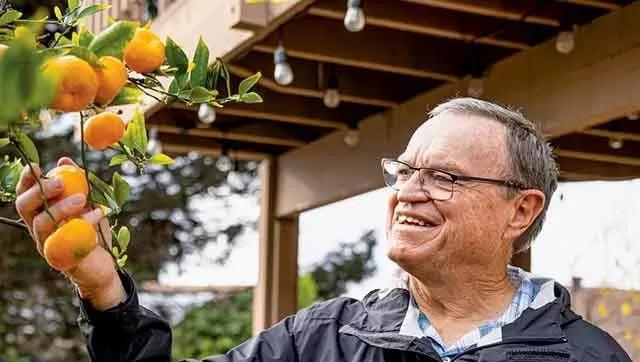
Pace taught in the Department of Communication at USD. Photo courtesy of sandiego.edu
Chance the Rapper headlines Olé Fest in front of the USD University Center. Emma O’Connell/The USD Vista
RILEY
ARTS & CULTURE EDITOR
From Graduation, Page 1
hearing about it a month before graduation,” Walls said.
The University’s Commencement Committee explained why the ceremony split occurred and how the ceremony might look.
“Capacity issues that existed in a combined ceremony are no longer an issue for the Shiley-Marcos School of Engineering undergraduate ceremony, so we removed guest limits for that ceremony,” the Commencement Committee wrote in a written statement.
“The need to uncouple the ceremonies came from the fact that there were more Business graduates eligible. So, we anticipate that we’ll still have a full house in the JCP with the number of Business graduates and their set number of guests.”
USD senior Sam Jorgenson has family members who now won’t be able to attend the ceremony due to the changes.
“I did have a couple family members that originally were going to come down on Saturday and so now they actually can’t come anymore because they won’t make it in time which is a bit of a bummer,” Jorgenson said.
As graduation approaches, some families are now adjusting travel plans while others are finding the change works in their favor.
Gloria plans to cut A&C funding
USD alum receives backlash for budget proposal
From Arts, Page 1
the arts as if they aren’t the backbone of society,” Rice continued. “Places like Balboa Park and the Art District aren’t just buildings and places, they’re where community is built through artistic expression. To know that a USD alumni is degrading something I am so passionate about is very disheartening.”
The budget addresses San Diego’s massive fscal defcit: over $115 million. As infation combines with cut federal aid, the city faces more debt than ever seen before — and San Diego is not alone. Los Angeles is facing a $200 million defcit, San Francisco is dealing with a $643 million gap and Sacramento is coping with a $66 million shortfall.
The FY2027 “all-cuts” budget is prioritizing closing San Diego’s defcit. The $6.4 billion plan reduces funding for recreation centers, museums, libraries and arts in San Diego.
As the 37th mayor of San Diego, it is part of Gloria’s job to propose an annual budget addressing community concerns. Gloria addressed San Diego residents on April 15 at the City Hall.
“This is a balanced, responsible
budget that confronts a $118 million defcit directly,” Gloria said. “It makes the tough decisions now — including targeting reduction to stafng and support functions — to protect the services San Diegans rely on and keep the city on solid footing.”
Gloria argued that the spending plan will allocate funds toward public safety, road repair and homelessness; however, with this redistribution, other services will be slashed.
USD Associate Professor in Accounting Erica Berry responded to the A&C budget cuts in regards to her expertise.
“Arts are usually the frst thing to go when people are trying to cut budget, so that hurts,” Berry explained. “But in the end if we don’t have the funds to pay for it, then we don’t have the funds to pay for it. It is always a matter of money coming in, and money coming out. It’s got to equal zero one way or another.”
Some students are particularly upset about the proposal because the mayor is a USD alum. He is a magna cum laude graduate with a dualdegree in history and political science — both majors are within the College of Arts and Sciences.
USD senior Blanca Gonzalez
works at the Creative Zone.
Gonzalez reacted to the San Diego mayor’s college years.
“It’s crazy he’s an alumni,” Gonzalez admitted. “I can’t believe that. I feel like the majority of our students are CAS, liberal arts, so I think that this goes against what our University believes.”
The nonproft arts and culture sector generates more revenue for a city than one might expect. A 2022 study conducted by The City of San Diego’s Arts and Economic Prosperity found that the arts and culture industry supported 16,900 jobs and produced over $275 million in tax revenue.
Attending concerts or museums results in money spent at parking meters, childcare centers, restaurants and neighboring businesses. Local attendees of entertainment events spend an average of $34.94 per event beyond admission — a fgure signifcantly less compared to tourists who are drawn to San Diego for its art. In 2022 alone, the San Diego arts and culture sector created $1.2 billion in economic activity. This pattern holds true across the country. Around 4% of the national economy consisted of
arts and cultural production: equivalent to $1.17 trillion.
“The most expensive mistake a city can make,” The CEO of San Diego Magazine Claire Johnson called it. “Disinvesting in arts and culture is not painless or prudent. If San Diego wants to be a city people want to live in, invest in, and believe in, arts and culture cannot be treated as expendable.
USD frst-year Larissa Montano heard about the budget cuts while watching the news last week. Montano commented on how FY 2027 will afect USD students.
“Personally I was annoyed, mad and angry,” Montano exclaimed. “[This] is not a very good idea for the city of San Diego. Humanities events that happen on campus and in San Diego as a whole, help with mental health and encourage being creative before a stressful period like midterms or fnals. This will afect how people see school and the overall health of everyone.”
Budget review hearings are scheduled between May 4 and May 8, with a council vote in early June. The public hearing will take place in the City Council Chambers in Downtown San Diego.
Sacred Kumeyaay monument destroyed Kuuchamaa Mountain altered in controlled explosions
CONNOR DUFFEY ASST. NEWS EDITOR
Controlled demolitions, heavy machinery and noise pollution greeted residents of Tecate, a border town 40 miles from San Diego that extends into both the United States and Mexico, on the morning of April 19. Tecate is home to Kuuchamaa Mountain, a site that is considered to be revered and sacred among the Kumeyaay people.
USD junior Lincoln Neal shared his thoughts on the treatment of ancestral Kumeyaay lands.
“If I’m going in their shoes, ‘these people already took my land in building USD,’” Neal said. “‘So they are stepping all over my land, and then blowing it up?’ It makes me feel horrible.”
On April 19, the Trump administration began building a 30-foot wall along the San Diego County border with Mexico, an area which includes both the town of Tecate and the Kuuchamaa Mountain. The construction process includes controlled demolitions on Kuuchamaa Mountain, and the use of heavy machinery.
USD junior Roman Di Napoli shared his thoughts
on the construction process.
“The mountain already acts as a natural barrier,”
Di Napoli said. “There is no need to blow it up in the first place, and you shouldn’t be destroying nature itself.”
The construction of the fence is funded as a part of the One Big Beautiful Bill Act.
The Department of Homeland Security waived several environmental laws in order to expedite the completion of the wall, including the National Historic Preservation Act and the National Environmental Policy Act.
Leadership of both Mexico and the Kumeyaay nations have expressed their disapproval of the project.
Emily Burgueno, the chair of the El Cajon-based nonprofit organization known as the Kumeyaay Land Conservancy, shared her thoughts on the border project with Microsoft Network (MSN).
“We as a Kumeyaay Nation know this project is going to go through, whether we agree with it or not,” Burgueno stated. “Our focus is the protection and conservation of our sacred and holy mountain.”
Kuuchamaa Mountain was the first mountain to be added to the National Register of Historic Places in 1982,
and is known among the Kumeyaay people for being a site of spiritual healing, as well as a place for tribal leaders to gain knowledge. The mountain is also a sacred place for rites and rituals.
“It’s like a church to us,” Norma Alicia Meza, a Kumeyaay leader and Tecate local said in an interview with MSN. “That’s where we hold our ceremonies.”
USD professor and chair of the ethnic studies department Jesse Mills, PhD, spoke on the construction of the border wall.
“It’s not and never has been about the fence,” Mills said. “It’s really a form of political grandstanding, and it’s really unfortunate, and shows a complete disregard for sacred sites.”
The area was designated as a restricted military zone late last year, with a sign at the foot of the mountain warning visitors to stay away. In December 2025, the Department of the Interior announced the transfer of approximately 740 acres of public land in San Diego and Imperial counties to the Department of the Navy, allowing military personnel to enforce federal law and detain individuals considered to be unlawfully present in the area.
Kuuchamaa Mountain is also included in the restricted zone.
The mountain is included in a binational conservation effort dating back to the 2000s, aiming to protect the biological diversity and cultural diversity of the area.
Mexican president Claudia Sheinbaum addressed the desecration of the sacred site during a press conference last week, ordering the Mexican Ministry of Foreign Affairs and the Secretariat of Culture to investigate and review the matter.
Mills also spoke on the importance of advocacy and awareness
surrounding this issue.
“Every undergraduate, everyone working at this campus, loses out if we’re cut off from how we’re connected to Native land,” Mills said. “We have to make sure native students and faculty are not required to do all the advocating for themselves.”
The Kuuchamaa Mountain, a sacred location known for its healing effects, is being demolished in order to construct an enlarged border wall, with important environmental laws and the sentiments of local and national leaders being bypassed.
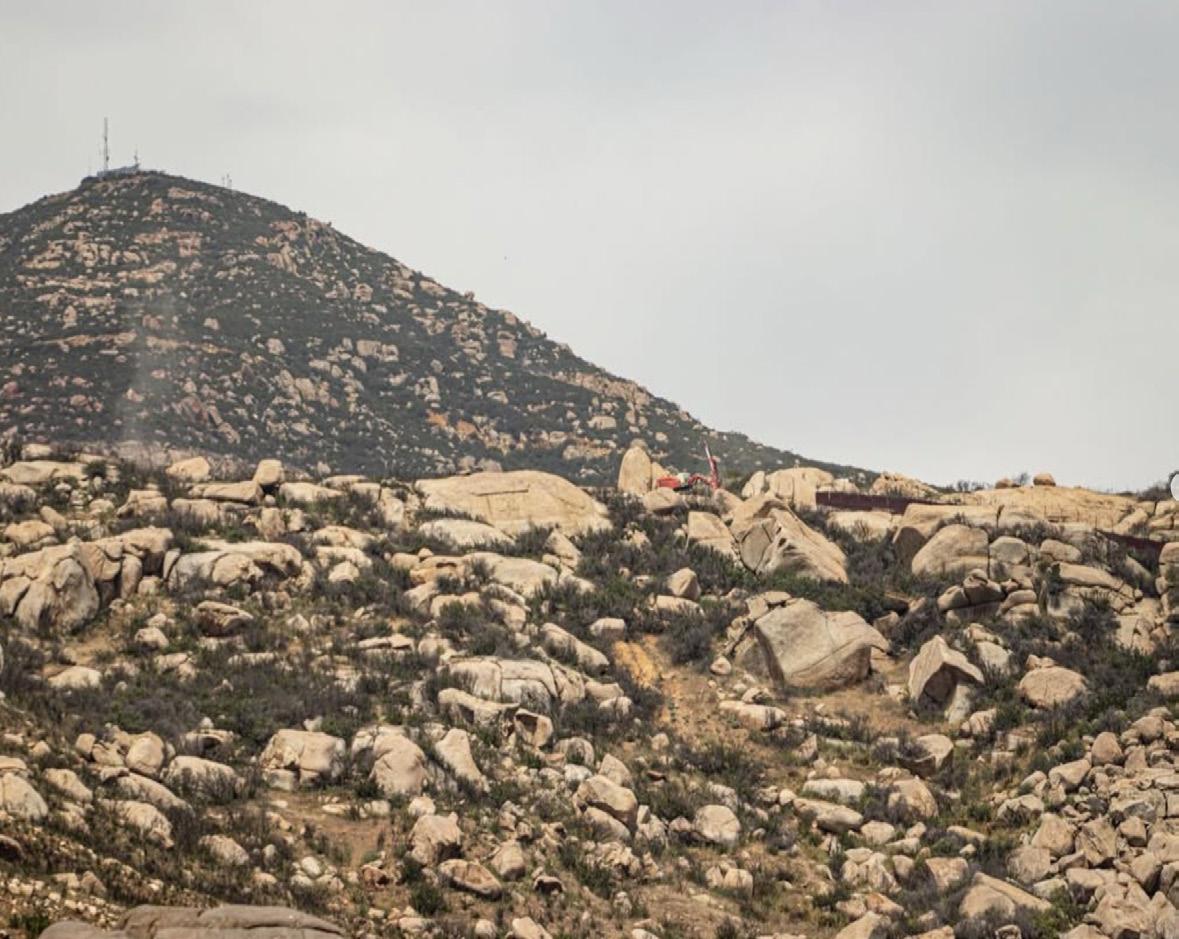
Kuuchamaa mountain is being reshaped by controlled demolitions. Photo courtesy
Toreros donate to super typhoon victims
Student-led donation drive aids afected US territories
CADEN HAYNOR NEWS EDITOR
In 2018, Gerald Deleon Guerrero, now a junior at USD, looked up and through his house to see that his roof was ripped away by the 180 mph winds that terrorized the Northern Mariana Islands in Category 5 Super Typhoon Yutu.
Now, he and junior Jill Mallari, are urging students to aid in the recent Super Typhoon Sinlaku — which, from April 13-17, touched down in the islands.
Deleon Guerrero explained what it’s like to live through Typhoon Yutu.
“Recently, we had another super typhoon in similar conditions: heavy wind, heavy rain and my roof few, like I didn’t have a roof on a portion of my house,” Deleon Guerrero said. “Witnessing that experience really traumatized me, and traumatized my family. My dad actually works for the Emergency Management Ofce and during that time, since we didn’t have my dad there, it was just me and my mom and my siblings.”
Deleon Guerrero and Mallari are both from Saipan, located in the
CADEN HAYNOR NEWS EDITOR
USD sophomore Gabriel Ambrose and USD senior Grant Sobek, in conjunction with the Changemaker HUB and the Humanities Center, are organizers holding a TEDstyle event on Thursday, April 30 in the Dillabough Ministry Center. This event, named “Building Bridges,” will feature student and faculty perspectives on “Borders, Boundaries, Bridges” through speeches that connect various disciplines.
TEDx events are local and community-driven, organized independently, but follow TED’s guidelines. They cover a wide range of subjects and feature multiple speakers.
Ambrose described how this preliminary event looks ahead to possible future TEDx talks.
“TEDx wants a program to be put together to see if a school like this can put on an event, especially with the way we are doing it,” Ambrose said. “Other TEDx organizations usually bring speakers from of campus or out
U.S. territory the Northern Mariana Islands. Mallari described her experience living through Category 5 Super Typhoon Yutu, which occurred in 2018 — the most powerful storm on U.S. soil since 1935, with sustained winds reaching up to 180 mph.
“We didn’t have electricity for two months straight,” Mallari said. “Our school was completely blown away. Currently, we only have one community college on the island and, because they were still building it at the time, classes were being held in tents… I vividly remember having to line up for clean gallons of water at 5 a.m.every week. We had food stamps, which we also had to line up for fve hours for days on end.”
Deleon Guerrero and Mallari are running a disaster relief drive to aid those afected by the Category 5 Super Typhoon Sinlaku that struck the Northern Mariana Islands and Guam from April 13-17.
This typhoon is the strongest storm this year, with winds reaching up to 175-185 mph. The typhoon hit Saipan, Tinian and other surrounding
islands particularly hard.
As a result, many residents currently lack clean, running water, electricity, food and other essentials. Recovery and aid from the U.S. military and the Federal Emergency Management Agency (FEMA) are underway, but working slowly. Local and diaspora-led eforts, such as student drives, are flling urgent gaps as recovery continues from the storm.
Deleon Guerrero and Mallari are running a two-week donation drive to send supplies to the afected islands via the foundation, “Sons and Daughters of Guam.” The USD students are also accepting monetary donations through GoFundMe, which can go directly to families and local organizers in the area.
Since water and electricity is severely afected in many areas, those looking to donate should contribute basic necessities including canned goods, power banks, batteries, fashlights, shampoo, conditioner soaps, cleaning wipes, diapers and cleaning supplies.
Deleon Guerrero explained the importance of spreading awareness about this natural disaster and the afected areas.
“The intention of the drive is to not only have people give physical items or give monetarily, but also to spread the word,” Deleon Guerrero said. “So even if you can’t give anything, the fact that you’re aware and you can share it with others is so good. At the end of the day, the intention is to spread awareness, because we’re a U.S. territory so we know we’re not really covered in the media. It is nice to know that people are aware that this is happening because oftentimes we are forgotten.”
Typhoon season normally occurs from August to November. However, some experts attribute the disaster’s early arrival, fueled by warm waters from the Pacifc Ocean, to the widespread efects of climate change.
Mallari refected on the consequences of this disaster and appreciates the support from the USD community.
Testing TEDx talks
Preliminary TEDx talks start at USD
of their organization. What we’re trying to do is elevate the unique voices that we already have on our campus and be able to put USD on the map. They want to see us be able to put this into an actual event and after we show that we can do it, we get the licensing.”
In order to receive the licensing, TEDx organizers must be from the city holding the event and manage the entire event, from start to fnish, while adhering strictly to the TED guidelines.
Organizers must volunteer their time, without pay, select local speakers, make non-commercial talks and handle venue logistics.
USD is not the frst university to try and get TEDx licensing. USC and CSULB are two universities with established TEDx programs.
The USD community members that will do a talk are USD physics and biophysics professor Shruti Singh, PhD, USD junior Eva Fouret, USD senior Rachel Schmidt and Associate University Minister Alec Hartman.
Singh will speak on the mixed disciplines under science and the humanities, using her knowledge in physics and complex systems
science to see how jazz music intertwines with society and resilience. Singh explained why she is researching qualitative resilience in people along with her quantitative physics study.
“If you look at a society, there are things that are easily quantifable, like economics, for example,” Singh said. “We just measure money at diferent places and make a model out of it. But then there’s interactions between people, like resistance of a society if there’s oppression. Those are dynamics that are really hard to quantify… I really like thinking about, when we’re studying societies and models of these places, how do we make sure that we do not lose this very valuable qualitative data?”
Fouret, a political science major with a minor in theology and religious studies, pursuing an Arabic certifcate, was selected due to the intersectionality aspect of her coursework. Fouret explained how she wants her talk to resonate with the audience.
“I want people to walk away with a realization that our society has been very anthropocentrist
and that in order to fght climate change, we can use science, but we also need spirituality,” Fouret said. “And the spiritual part of ecology is that we’re all connected to the world around us… What I am most excited about is I’m going to talk about my frst time skydiving and how I consider that to be a religious experience.”
Schmidt’s talk is about how travel can change the way someone views the world. Schmidt described the most difcult part of preparing for her talk on an Instagram post run by TEDx USD.
“Narrowing down my topic,”
“This afects all of us eventually,” Mallari said. “Earth Day was just the other day and people are very big on celebrating our Earth, but they don’t really think about the consequences of what we are contributing to, especially when we’re not getting hit by a typhoon over here… I think education goes a long way, so the fact that we’re able to talk about it and know that this afects all of us is so important. Just knowing that groups are supporting us and sharing our story means a lot.”
The donation drive is set to end on May 4, when the organizers plan to package each item and donate them to the Sons and Daughters of Guam Club in tandem with Inafa’maolek Mutual Aid Organization, which are collecting for the broader San Diego area. These organizations plan to drive the items up to a large container in Long Beach that will be flled with donations to send directly to the afected islands. On-campus donation bins are at SLP 418, SLP 119 and Mata’yuum Crossroads.
Schmidt wrote. “I started too big, but with the help of Dr. Leeva Chung, I was able to curate a topic that I am passionate about and will hopefully resonate with others.”
Each presenter has a speaking advisor that is there to assist them in logistical areas of their talk, such as narrowing down the topic, learning how to speak to a larger audience or simply giving an outside perspective to their entire speech.
USD community members can attend this event in the Dillabough Ministry Center on April 30 from 12:15-1:30 p.m.
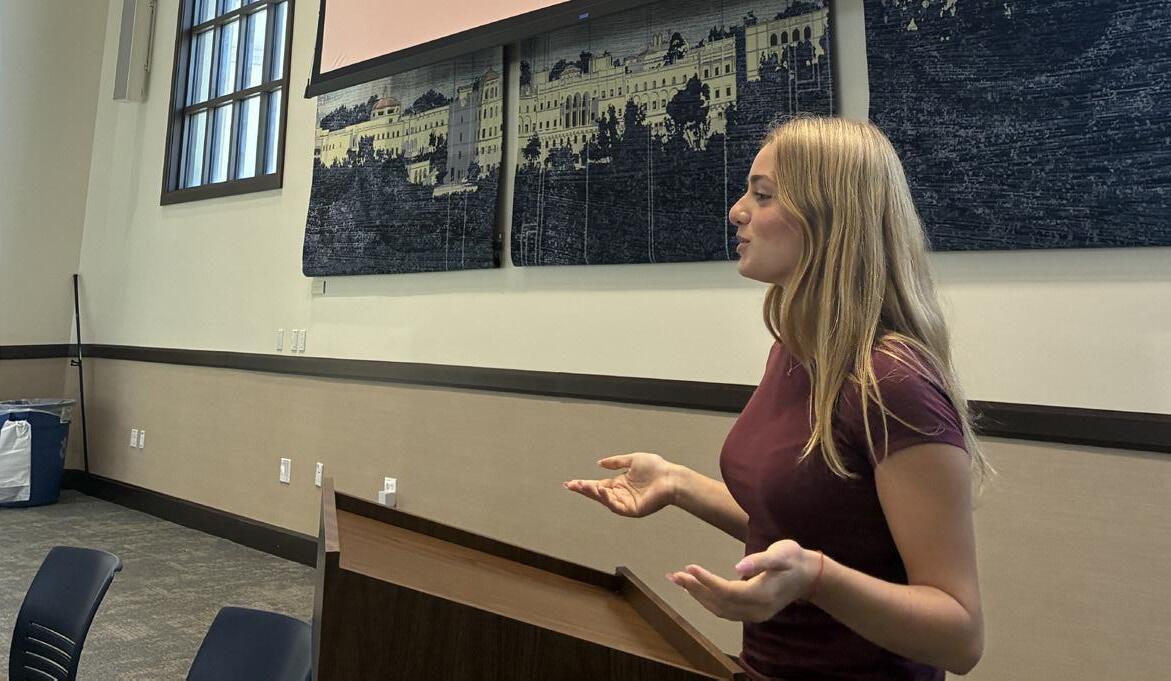
Fouret practiced her TEDx talk in the Dillabough Ministry Center. Photo courtesy of Gabriel Ambrose
Springing into style ARTS & CULTURE
MIA VORKOPER CONTRIBUTOR
In a city where perfect weather is perpetual, San Diego spring fashion is less about changing layers and more about the turn of trends. Across the country, this season results in various spring collections hitting the runways and eventually cycling on to the hallways of USD. As a campus known for its beauty, the “look good, feel good” mentality doesn’t just apply to lifestyle habits, but to everyday clothing.
Although many students are searching for their own unique sense of style, part of that journey is noting the various trends taking over. USD junior Jansen Grubbs refected on the trends dominating the campus.
“I would say summer colors are coming back in, but really bright and bold colors, less pastel,” Jansen said. “I also think ballet fats are really big right now. And I feel like fowy tops have been in, like ponchos and layering tops.”
Jansen’s statement directly refects the “trickle-down” aspect of fashion. Trends that debut on runways don’t stay there for long, they flter down into boutiques and department stores before making it into your closet. The recent spring collections in high-end brands focused on the primary colors: red, yellow and blue. Jil Sander focused on scarlet and violet and Chanel turned to tangerine, bright greens and raving reds. Brands like Bottega Veneta, Balenciaga, Khaite all used texture as the center of their looks, adding an aspect of “feeling” to their fashion.
The kaftan pieces from Dries Van Noten parallel the beachy ponchos and draping tops seen across campus. Tiered maxi skirts overtook the runways, highlighting the greater embrace of emphasizing
Toreros explore spring fashion
structured proportions. USD frst-year Mary Koch noted brands playing with proportions.
“[I really like] baby doll tops where it shows out at the bottom, but it’s tighter up near your chest,” Koch said. “Lot’s of capris and midi skirts too — anything below the knee. I think those are really cute and I defnitely see them around campus a lot.”
The capri comeback is a trend few saw coming. A style emphasized in the early 2000s, this is a throwback to Carrie Bradshaw’s “The Sex and the City” iconic strappy kitten heel and cropped trousers. Capris aren’t where the longline proportions stop. Low-rise midi skirts have been taking over: able to range from beachy casual to springtime preppy, midi skirts are a fresh change from the long time full length maxi skirts and jeans. With the jean shorts getting longer and longer, and trousers shorter and shorter the happy middle of “just below the knee” is where all hems currently stand.
But spring fashion doesn’t stop there — no outft is completed without accessories. Scarf styling with big prints and accents took over with Celine, Kallmeyer and Veronica Beard recent collections. This emphasis continues to other styles as well. USD frst-year Avery Jones commented on trending accessories.
“Everyone here is kind of accessorizing with a little belt number usually seen in outfts that have baggy jeans with a little belt, and then like a shirt or layered with a jacket,” Jones said.
Belts are no longer just an accessory, but rather the main event. No longer is it just black and brown leather, but rather dangling chainlinked and studded western pieces. An emphasis on structured belts and buckles took over this spring; Masha Popova emphasized criss-
cross belts while Chanel showed a variety of colorful statement belts.
The takeover of trends on our campus is directly attributed to greater fashion brands, infuencing and curating what we see and value. Meryl Streep said it best in the Devil Wears Prada.
“And then cerulean quickly showed up in the collections of eight diferent designers,” Streep said. “And then it fltered down through the department stores and then trickled down into some tragic ‘casual corner’ where you, no doubt, fshed it out of some clearance bin.”
Although popular trends are infuenced by various high-end designers, it’s only to an extent — San Diego remains a center of a specifc taste and unique style.
Toreros partake in the embrace of individuality in fashion. As a recent No. 5 most beautiful campuses, USD students try to make sure their outfts match the aesthetic campus. USD sophomore Annie Dorelien refected on the standard of fashion.
“I’m infuenced by seeing people get up at 7 a.m. and actually get dressed for class,” Dorelien noted. “I think seeing everybody’s diferent uniqueness and their diferent ways of expressing themselves inspires me to do the same.”
With an increase in pursuit of sustainability and creativity, thrifting has become as much an activity as a “look.”
USD sophomore Christina Pellegrini refected on the style that brands, such as Free People, try to imitate.
“The Bohemian style is meant to be so thrifty and mimic a culture that San Diego is trying to adopt,” Pellegrini said. “It’s just kind of an interesting observation that Free People does mimic a diferent culture than the people that are actually wearing it.”

The Bohemian style draws roots from an emphasis on natural woven cloth, an unconventional lifestyle and rejection of materialism. Fast fashion imitates this style for a cheaper quality — sacrifcing the integrity and foundation on which this style was conceived. Since the price point of brands like Free People is far greater than the point of the style it refects, it provides an opportunity to refect on the impact of wealth within fashion.
From the 1920s fapper girl to the 1960s counterculture movement, fashion has played a key role in expressing creativity and societal attitudes. Tracking trends can be another tool in exploring the way art shows up in everyday life. Regardless of the cyclical nature of fashion, its role reminds us to challenge previously held beliefs on not just what is “cool” or “in” but more pervasive structures like masculinity and conformity.
Jones works to apply his attitudes of creativity toward clothing as a way to be intentional about expression.
“The way I want to present myself to the world and what I want to express through what I’m wearing is honestly the biggest factor of fashion in my life,” Jones refected. “I really try to be intentional about wearing things with a purpose.”
The simplest act of choosing clothing can be grounding. USD senior Willie Allen uses his clothing as means to express himself.
“I think it allows you to have agency in a world where we often feel like we don’t have agency,” Allen said.
Although Allen noted it on the individual level, his understanding refects why fashion maintains relevance.
The “trickle-down” efect connects each item of clothing to a high-end brand, designer or collection, all infuencing one another. That unusual top in the back of your closet may be part of something bigger than you think. It is clear that regardless of whether midi skirts and belts make it into your closet, style ultimately remains a fundamental part of expression.
Last issue’s crossword answers:

Spring clothing has taken over the USD campus.
Art by Kyra Lefebvre
TPB hosts Chance the Rapper
Students food to campus to watch Olé Fest
From Chance, Page 1
presence. She performed tracks from her latest release, “DUMBCRAZYSTUPID,” and kept the crowd engaged with lighthearted storytelling and quick crowd prompts. Before “DND,” she joked that her boyfriend just put her on do not disturb ahead of her big show — something the audience could hardly believe. Toreros leaned into AKIA’s anecdotes and playful call-and-response, matching the energy of the set.
The crowd’s energy ahead of Chance’s set was tangible — and attendance was at its peak. DJ DAUCHÉ and AKIA had set the stage for a highimpact, high-energy entrance.
Chance burst onto stage jumping and dancing, and students jumped and danced along with him. He opened the set with fast-paced lyrics over driving bass. When technical issues caused his backdrop visuals to cut out, Chance took the moment to talk right to the crowd. He delivered a strippeddown rendition of “Tree,” saying that he “preferred the moment without distractions” and focused solely on the audience.
Students sang songs like “Cocoa Butter Kisses,” “Ultralight Beam” and “Same Drugs” word for word. These

tracks were crowd favorites, especially due to their familiarity among college-aged listeners. USD sophomore Annie Dorelien described the set as especially nostalgic.
“‘Cocoa Butter Kisses’ was my favorite… I listened to it in middle school,” Dorelien said.
“It was definitely memorable… I think a lot of people feel
like ‘this is my childhood.’” Together, the three performers delivered an energized and impactful show. A record-breaking number of students came together on Torero Way to jam with DJ DAUCHÉ, AKIA and Chance the Rapper — a celebration to propel the student body through the final weeks of the semester.

USD produces ‘Dog Sees God’ Department of Theatre presents spring play
JORDAN CONTRIBUTOR
USD Department of Theatre presented the production of “Dog Sees God,” this past weekend. This homage to the “Peanuts,” written by Bert V. Royal, reimagines Charlie Brown and the rest of the gang as teenagers, navigating high school and working through complex identities. While much of the “Dog Sees God” cast was renamed in this adaptation, certain attributes of characters resemble that of the original “Peanuts” characters.
The production begins with the death of the beloved character, Snoopy. CB, Charlie Brown, played by USD senior Joshua Kelly, opened the play with a monologue sharing his grief and, in reference to the comic strip, how the rain cloud has come back. On stage he was met with his sister played by USD senior Ava Ribando. The two characters squabble over Snoopy’s memorial, setting the tone for continuous confict between characters and a reminder of their adolescent immaturity.
Assistant Director and USD senior Hasan Iqbal touched on relevant stories and themes throughout the production.
“Envisioning them as teenagers, and what issues they face,” Iqbal shared. “[There is] crude imagery of drugs, alcohol and sex, but there’s also serious conversations

[surrounding] mental illness, substance abuse and suicide.”
Struck by his grief, CB seeks out a new friendship with the misunderstood, and bullied character Beethoven, played by USD junior Cat Nickoli. Their newfound relationship is met with outrage from the rest of the now grown-up gang, particularly CB’s best friend Matt played by USD senior Tanner Blackington.
The growing animosity between characters Matt and
Beethoven ultimately leads to a tragic ending, highlighting both the consequences of hate and the hidden battles teenagers may face.
Kelly hopes audiences walk away from the show with an understanding of the importance of expressing one’s feelings.
“As cliche as it may sound, we all walk around with the weight of what has hurt us,” Kelly stated. “By looking our pain in the eye, we gain such insight into
ourselves that allows us to better embrace the world around us.”
Kelly shared that taking on the role of CB provoked mixed feelings within him as well.
He noted that CB’s story is incredibly impactful for viewers because of his raw display of sadness and uncertainty.
“I knew that taking on CB was going to be a challenge, simply due to how many of his fears align with my own,” Kelly expressed. “I had to
overcome my own fears, and allow myself to be vulnerable in front of audiences.”
The production’s exploration of grief is complemented by humorous bits, particularly from USD senior Liv Meloy’s portrayal of Van. The once blanket-attached child has since mellowed out, and now presents as the stereotypical stoner giving unsolicited philosophical advice. As CB searched for an understanding of life and death, Van provided a helpful contrast of teenage angst.
USD students and faculty worked together throughout the semester to bring this show to life. Characters were cast from the USD course “Acting the Play” led by director and senior teaching professor Lisa Berger. The sets and costumes were designed by USD students enrolled in the course “Creating the Play.”
“The trial and error of the collaboration of it all,” Iqbal shared. “That’s been my favorite part.”
“Dog Sees God” takes the audience back in time to a heightened and dramatized high school experience. The exploration of modern adolescence is contrasted by the play’s continuous nods to the world of the “Peanuts.”
Cherished cartoon characters are turned into complex archetypes, and are further brought to life by passionate USD students.
CALLA
Chance the Rapper rapped his heart out last Friday.
Emma O’Connell/The USD Vista
Students gathered to watch DAUCHÉ open for Chance the Rapper. Emma O’Connell/The USD Vista
Joshua Kelly pictured on the left and Cat Nickoli pictured on the right playing piano during ‘Dog Sees God.’ Photo courtesy of @usddeptoftheatre/Instagram


arth day everyday
Art by Kyra Lefebvre/The USD Vista: Content by Julianna Flores
ARTS & FEATURE
In loving memory of Corinne
USD senior leaves a lasting impact on students
AMELIE SEDLACK FEATURE EDITOR
Many of the students who knew Corinne Stackpole spoke about her kindness, support and humor above anything else. While they all met in college, it was living close by, traveling, working together and fnding common hobbies that made their individual relationships with Corinne grow quickly over the years.
Last spring, after being diagnosed with cancer, Corinne took time of from school in the spring of her junior year to focus on her treatment. From campus, her friends supported her through her journey. Corinne won her battle with leukemia, but faced complications while in remission and passed away on March 27 at the age of 22.
Corinne was deeply involved in the community at USD. Between working in the Writing Center and shifts at Aromas, she still made time for her friends. Corinne wanted to become an occupational therapist after college.
USD senior Maribel Acevedo is a close friend to Corinne.
“I call her Corn,” Acevedo explained. “We lived two doors down from each other in Maher … They start out as friendships of convenience, but I was very lucky that that’s not what that friendship ended as.”
Acevedo shared about her friendship with Corinne.
“We both really liked Adrianne Lenker.” Acevedo said. “One of our favorite songs is ‘not a lot, just forever,’ and that’s something I think about a lot. I’m going to miss her, not a lot but I’m going to miss her forever. And I say not a lot because I don’t feel like she’s gone.”
USD senior Veronica Gomez described how her friendship with Corinne began.
“My frst impression of her was that she was so, so kind and warm,” Gomez shared. “She was always smiley and friendly and
had such welcoming energy to her. She always made me feel included, and we especially instantly bonded over our mutual Taylor Swift obsession.”
USD senior Jacob Bocanegra met Corinne at Neon Night their frst year and later realized they lived near each other. The two also worked together at the Writing Center. When the stress of college started to get to them, they started a weekly tradition together.
“Circa December 2023, the two of us were going through the toughest semester ever with our course loads and work schedules,” Bocanegra explained. “By Friday, we both had a hard week and were feeling defeated. That was until we got into the water at Scripps during golden hour and surfed all the way through what must have been the prettiest sunset I’ve seen. We went through the same cycle of admiring the beauty and laughing hysterically at each other when we fell of our boards. I remember thinking in the moment that it was the frst time I had experienced 100% joy without stressing out in a long time.”
USD senior Emma Parker spoke about her favorite memory with Corinne. They ofcially met sophomore year when they moved into the Alcalá Vista Apartments. After that they realized they had many classes together, both worked at the Writing Center and even shared many of their friends.
“My favorite memory of Corinne was our decision to study abroad in Spain together,” Parker shared. “I remember our decision to room together and live with a host family in a diferent country created a new level of trust … I never doubted for a minute that Corinne always had my best interests and I felt so happy having a best friend I trusted with me as we were far away from home.”
Acevedo shared a story of driving down to San Diego from Corinne’s hometown of Manteca, Calif. together, so Corinne could get her car on campus.
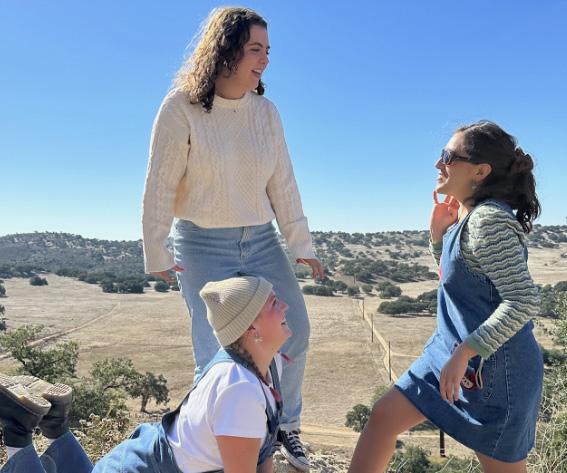
“I few up to her hometown,” Acevedo described. “She needed to drive her car back down so I was like, ‘Oh I’ll fy up there and we can drive down together.’ So then we did two days of driving down California together. It was just us two … I could be with Corn for three days and I would be like, ‘I’m not even tired of you yet, don’t leave me.’”
USD senior Cici Jobe shared how Corinne’s love of family impacted her.
“One thing I would like people to know about Corinne is that she came from such a loving family,” Jobe said. “Her father wrote a children’s book about her growing up and she has two brothers who also adore her and love her so much … Her family was such an anchor in her own life and I think that allowed her to extend a lot of authentic love to other people. It’s important that we acknowledge the people that shaped the Corinne we know because they are left to be mourning her like we are.”
Corinne’s parents, Mark and Charlotte Stackpole shared a favorite memory of their daughter and something they want others to know about her.
“The thing that I want people to know about Corinne is something that they likely already know, because she could not hide it: the size of her heart, which she always wore on her sleeve,” Mark Stackpole said. “She was a good listener because she cared about you. She wanted to help because it was the right thing to do.”
Corinne’s mom Charlotte Stackpole shared memories of her daughter from greeting everyone as a toddler to showing her maturity while abroad.
“As [her] mom, there are so many favorite memories of Corinne,” Charlotte Stackpole recalled. “Her enthusiastic toddler greetings of strangers when she


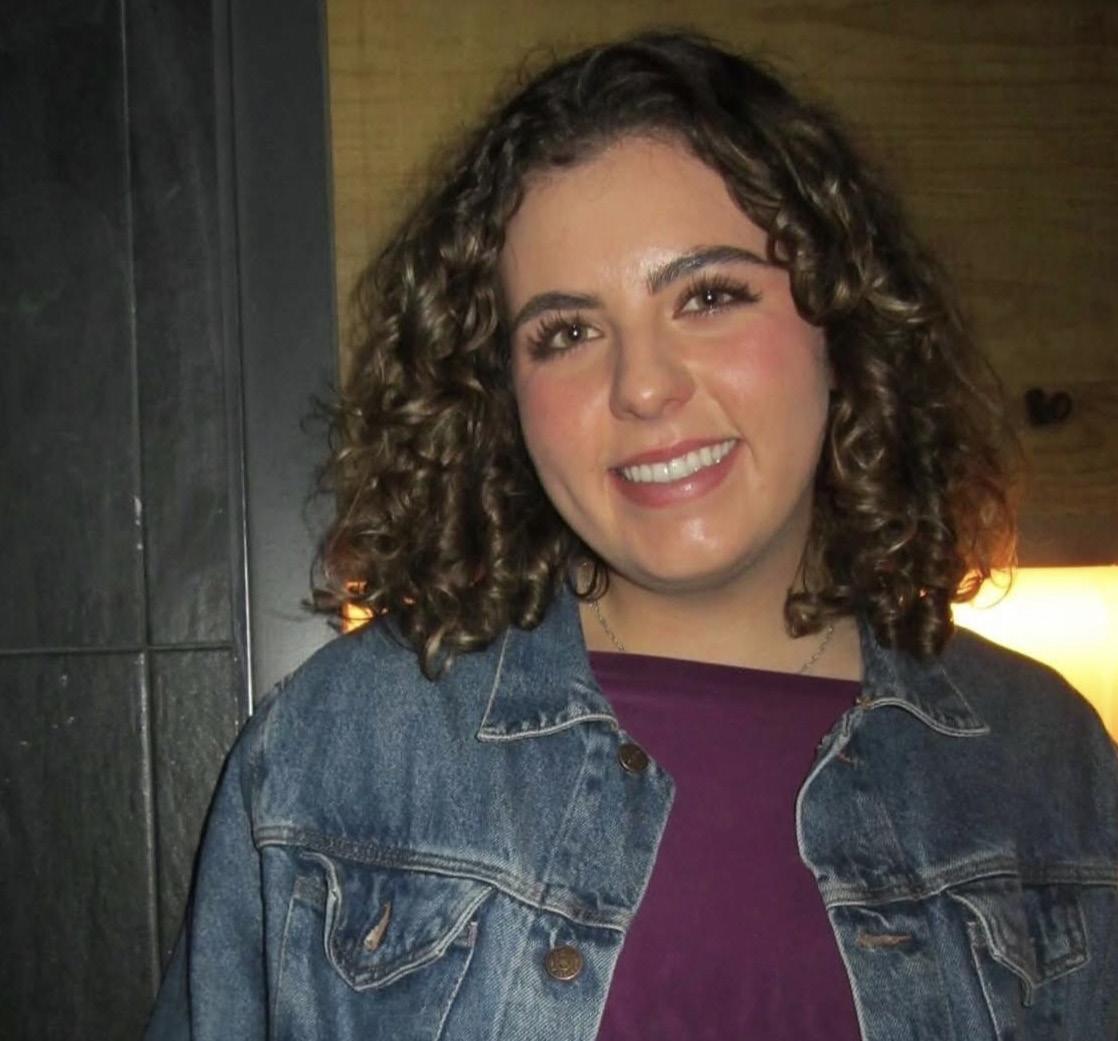
was barely walking to being the best plant-shopping cofee date anyone could ever ask for. Corinne was pure magic wrapped in curls wrapped in stars and moons … She loved USD and was so very excited to marry her love of travel, learning and friends [when she was studying abroad in Madrid]. Corinne moved efortlessly through both the landscape and the language, introducing me to her friends, taking me to her favorite spots and exploring new places together. Stepping into the world Corinne created in Madrid and watching her fourish gave me memories I will never forget.”
Acevedo shared what she would want others to know about Corinne.
“I guess I would just want people to know that who she is as a person is so much more than anything her time on Earth could have ever described,” Acevedo explained. “Who she is and who she was, is genuinely one of the miracles I’ve gotten to witness.”
Acevedo continued, trying to put the love she has for her friend into words.
“It’s hard to say what I wish people knew, but I just wish you could have met her,” Acevedo said. “I wish people could have gotten to meet her and those who did, understand why I say that.”
Gomez described something that others who had not met her might not know about Corinne.
“I want others to know how much Corinne truly loved love,” Gomez explained. “She valued close connections and deep conversations. She really saw you as a person, for all parts of you.”
USD senior Emma Vertiz met Corinne through a class and again through the Writing Center where their bond grew.
“Even as she was undergoing treatment, she was just so positive about her situation and her outlook on life,” Vertiz recalled. “After she has passed, people who know her can continue that attitude and personality within their own lives. That’s something we should take away of her being on Earth and us having the privilege to know her.”
Acevedo described the light Corinne’s presence brought to every room.
“It’s hard to put into words how much love and care and acceptance she emulated,” Acevedo described. “How much grace she had. For just the light that she is, I don’t think there’s a word that can fully describe that.”
During her time at USD, Corinne bonded with many students who will carry her memory and positive attitude with them forever. On May 15 at 12:15 p.m., Founder’s Chapel will be holding a mass in Corinne’s honor and memory followed by a celebration of life at 1:15 p.m.
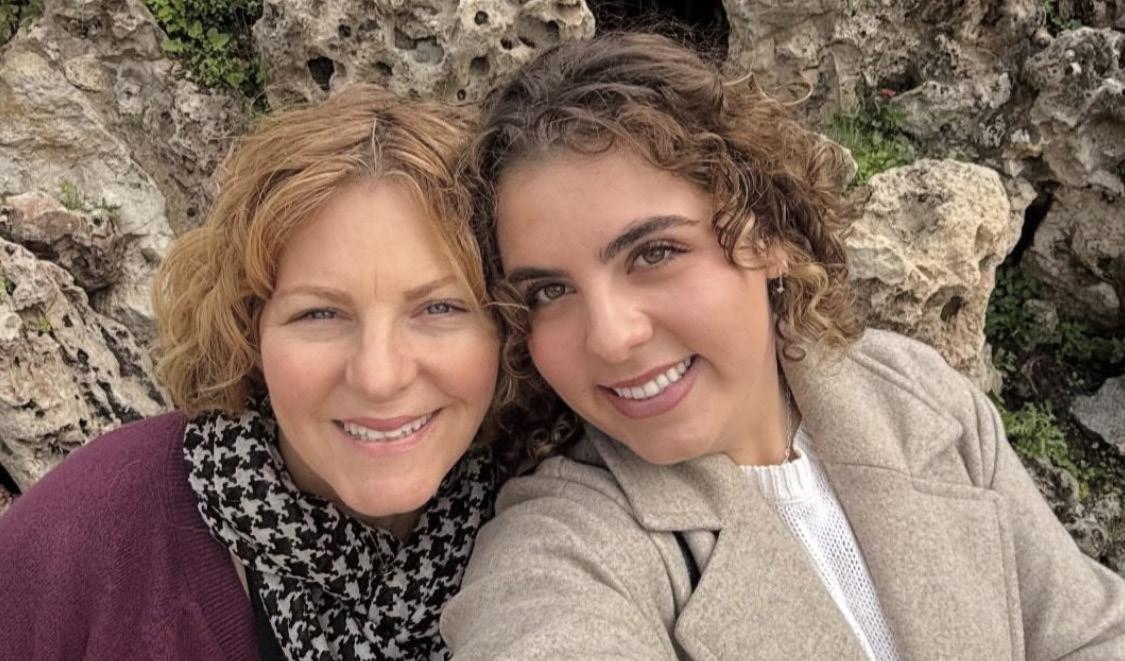
Corinne’s family and friends remember her bright smile. Photo courtesy of Emma Parker
Corinne’s family was an important part of her life.
Photo courtesy of Emma Parker
Corinne and her friends enjoyed exploring other areas off campus. Photo courtesy of Cici Jobe Corinne spent time with friends. Photo courtesy of Veronica Gomez
Corinne had a tattoo of a poppy. Art by Kyra Lefebvre
A change of Pace Dr. Roger Pace retires after 39 years of teaching at USD
From Pace, Page 1
The couple married while they were still students, a decision that shaped Pace’s early career choices. After the two tied the knot, Pace temporarily dropped out of school and worked in construction so Diane could finish her degree, before returning to complete his own studies as she began her career.
Once he graduated, Pace began teaching high school debate, a temporary stop on his path toward higher education.
“I knew I didn’t want to teach high school forever,” Pace said. I enjoyed it, but I always knew I wanted to get back to the university.”
That desire prompted him to pursue a doctorate at Pennsylvania State University. Even after missing the application deadline, a faculty connection helped him secure a spot in the program.
After completing his PhD, Pace accepted his first university position at Texas A&M.
“Texas A&M was a good place to be,” Pace said. “The students were eager… But I was missing a more intimate undergraduate
teaching experience.”
Large lecture halls sometimes contained more than 200 students.
“I didn’t even know their names,” Pace said.
After about three years at A&M, one of Pace’s friends from graduate school who was working at USD encouraged Pace to apply.
“I was walking up the sidewalk to the UCs, the SLP wasn’t there yet,” Pace said. “It was a glorious day with sun and palm trees, and I’m thinking, ‘oh, this could be good.’”
Only one obstacle stood in his way: when he and Diane got married, she told him she would live anywhere but California. Luckily, she trusted his judgment and Pace accepted the job, moving his family across the country to sunny San Diego.
“Now my wife is more Californian than any of us,” Pace said.
Throughout his time at USD, Pace has taken on a wide range of roles beyond the classroom. He has served as a department chair, associate dean of the College of Arts and
Sciences, director of the honors program, and vice provost. Many of those opportunities came to him unexpectedly.
“None of them I applied for,” Pace said. “So all of those have been blessings I didn’t even know I wanted.”
After his term was over as chair of communication, Pace moved into a small office hidden under a staircase in Camino in an attempt to keep a low profile.
“I thought I was going to hide out,” Pace said. “I even tried to disguise where my office was. I didn’t tell people except the students where I was.”
Still, colleagues kept finding him.
“By the end of the year, I was interim assistant dean of the college, interim head of the film studies program and then ultimately, the vice provost,” Pace recounted. “People just kept knocking on my door. I don’t know how they found me.”
Teaching has always remained central to Pace’s career. In the classroom, Pace emphasizes respect for students and an understanding of the personal struggles that
can interfere with academics.
That perspective partly developed during his undergraduate years, when he missed a deadline for a major paper due to personal difficulties. When Pace finally turned in the assignment late, his professor’s response left a lasting impression.
“He took the stack of papers he was about to grade and put mine right in the middle,” Pace said. “He said he’d read it as if I’d turned it in on time.”
The moment shaped Pace’s perspective on the kind of educator he wanted to be.
“Students have difficulties in their lives,” Pace said. “So I’ve always tried to give students a second chance. I’ve always wanted my students to succeed.”
While compassion is one important aspect of his teaching principles, the other is humor.
“My underlying philosophy of teaching is to try and be funny,” Pace said with a laugh. “I know they’re laughing because they think it’ll make better grades, but I’m shallow enough to believe I’m funny.”
Outside the classroom,
OPINION
Pace is interested in travel, writing and film festivals. He has attended festivals globally, including Sundance, inspiring a project he hopes to pursue in retirement.
“I’d like to start writing about film festivals,” Pace said. “Not [reviewing] films, but a discussion about the festivals themselves and their importance to local communities.”
Now, as Pace looks ahead to retirement, he notes the decision isn’t based on burnout.
“It’s not that I’m dissatisfied with my job,” Pace said. “I’m still energized by what I’m doing.” Instead, he simply feels it is the right time for a new chapter.
Looking back on decades at USD, Pace highlighted that students have always been the most meaningful part of his career.
“I’ve just had great experiences with them, and I enjoy watching what my students do with their careers,” Pace said. Although Pace will soon leave the classroom, the impact he has made at USD will carry on.
Too many criticize artist’s singles Artists too often receive backlash on their newly released songs
CALLA JORDAN CONTRIBUTOR
Each time an artist reemerges, ready to release a new pop album of the year, their appraisal is halted by an overwhelming disapproval of their handpicked single. Artists choose to release a single in hopes of building up momentum and potential hype for their upcoming album release. But, almost inevitably, an artist’s single will fall flat, worrying listeners about the integrity of the following album. However, the concern lies with the consumers’ unwillingness to adapt and accept new music rather than the artists’ choice to release the single. Recently, pop singers Harry Styles and Olivia Rodrigo released singles months before their album drop, and were met with particularly harsh criticism. Listeners were shocked by Harry Styles’ 2026 single “Aperture” because of its deviation from his typical,
upbeat pop music. The song had a greater techno-influence, aligning with the resurgence of EDM. While his shift conforms with current music trends, fans were displeased with the lack of familiarity in the single. This brings up a common phenomenon: the exposure effect. Listeners subconsciously prefer music that feels familiar because it stimulates a feeling of safeness.
Prior to his album, “Kiss All the Time. Disco, Occasionally,” Styles had not dropped new music for nearly four years. The built up hype for this album release set the album up for an inevitably unsatisfactory reception. Expectations became impossibly high and all that could please his dedicated fan base would in fact be an upcycle of his previous material.
It’s unrealistic to assume that any music artist’s style won’t evolve throughout their careers. But unfortunately, listeners are not dialing back on their strong opinions. 23-yearold pop star Olivia Rodrigo

is heading toward her third album release in six years, yet fans were taken aback by her single release “drop dead.” Critics on TikTok and Reddit argued that the song felt immature compared to her previous albums “Guts” and “Sour.” Her lyrics dive into her experiences with young love, and to write the song off as childish merely highlights
the common dismissal of young female artists’ expression.
However, reviews of Rodrigo’s seem to conflict, as several listeners complained that the song felt too unoriginal compared to her previous sounds. Artist Noah Kahan received similar backlash for his title track “The Great Divide.” While the overall album was largely successful, many listeners believe his sound is becoming too predictable. Kahan’s newest album remains under the folk-pop influence, prompting particular listeners to write the album off as a rendition of his previous album “Stick Seasons.” The critiques surrounding both Rodrigo and Kahan’s newest singles highlights the even greater issue artists’ face when dropping new music. Listeners, no matter the sound or genre, are hard to please.
Artists are oftentimes put in a no-win situation when it comes to releasing music, as they are expected to both release out of the ordinary sounds while staying in tune with their
image and predicted style. Criticism will likely follow both Rodrigo and Kahan throughout their evolving careers, but listeners should acknowledge music as a reflection of the artist, and not as something curated for perfection. Some listeners might argue that a musician should stick with their particular style in order to maintain an image, but experimenting with new or multiple genres is how groundbreaking music is created. Artists like Olivia Rodrigo and Harry Styles are dominant forces in pop music, and by exploring other genres, they inevitably introduce their wide range of listeners to new sounds. The ever expanding music scene makes it easy for listeners to jump to hasty conclusions about the music and artists cycling through pop culture. While listeners are entitled to both their preferences and criticism, having an open and adaptive mind can lead consumers to new influences, grooves and communities.
The views expressed in the editorial and op-ed sections are not necessarily those of The USD Vista staf, the University of San Diego or its student body.
OPINION
Standard college advice is now outdated
Students should be more eager to fgure out their career dreams
DAVID COOK OPINION EDITOR
When students are getting ready to go to college, people love to ofer the same comforting advice: “Don’t worry if you don’t know what you want to do yet. That’s what college is for.”
I get why people say it. No one wants to put even more pressure on an 18-yearold who is already trying to pick a school, move away from home and adjust to a completely new life. The advice is well-intentioned, but I think it is now outdated.
The problem isn’t that every freshman needs to show up on campus with a perfect career plan. I graduate in less than a month, and can’t even tell you what I’ll be doing then. Most people barely know who they are at 18, let alone what they want to do for the next 40 years. I certainly didn’t.
College should still be a place where students can change their minds, take diferent classes and fgure out what actually interests them. But there is a diference between exploring
options and idly waiting.
Students are often told they have plenty of time to fgure things out, but the job market doesn’t work that way anymore. A degree by itself does not carry the same weight it once did. Employers want experience and proof that you are already prepared for the feld you want to enter.
That creates a strange situation for students. They are told not to worry too much about their future when you get to college, but by the time they start applying for jobs, even entry-level positions often expect internships or direct experience. It is hard to call something entrylevel when one already needs to have entered the feld to be considered.
This is where the timeline gets tricky. In many industries, junior year is not when you should start thinking about experience, but now, it’s when you are supposed to already have some. A freshman-year club can lead to a sophomoreyear internship, which can lead to a better junioryear internship, which can eventually lead to a job ofer
after graduation. That does not mean every student needs to know their exact path right away. It just means waiting until later has consequences.
The cost of being undecided is also higher than people admit. Changing your mind is normal and often necessary, but switching majors late can mean extra classes, more stress and more money. Students should not be scared into choosing a major before they are ready, but they should be given a clearer picture of what diferent majors actually lead to.
Too often, students are encouraged to follow their interests without being told what that decision might look like after graduation. That does not mean everyone should choose the most practical major possible or ignore what they care about. But students deserve to know what skills they need, what internships matter and what career paths are realistic with the degree they are pursuing.
That is why colleges need to be more honest with students from the beginning. The message should not be that you need to have your entire
life planned before your frst semester. That’s unrealistic and honestly, unfair. But students should be pushed harder to ask better questions earlier.
What careers connect to this major? What skills do employers actually want? What internships should I be looking for? What does a strong resume look like by sophomore year? What happens if I wait too long? These questions should not be saved for senior year, when students are already panicking about graduation. They should be part of the freshman-year experience.
Some could argue that this advice mostly applies to students pursuing traditional white-collar careers. For students interested in bluecollar work, the timeline may look diferent. Many trade careers do not require four years of college, and in some cases, apprenticeships, certifcations or direct work experience may be more valuable than a degree. The larger issue is not just whether students are choosing a major early enough, but whether they are being shown all their options early enough. College is certainly
not the only path to a stable career, and students should not be pushed into a four-year degree if a trade, technical program or apprenticeship would better ft their goals. The better advice is not “fgure out your whole life now.” It is “start testing things early.” If you have even an inkling of an idea about your career, put your all into it as soon as you can. Take the class, join the club or talk to the professor. Email someone who works in the feld. Apply for the internship, even if you feel underqualifed. Try things while there is still time to adjust. The clarity students seek usually does not come from sitting around and waiting for your future to suddenly make sense. It comes from realizing what you like, what you hate and what you’re actually good at. College can still be a time to explore, and it should be. But the idea that students can wait for direction to appear is no longer realistic. Students do not need to have everything fgured out at 18, but they do need to understand that the clock starts earlier than they think.
The hidden beauty of fraternity pledges
Fraternity pledges show USD students how to be carefree
MAE O’MALLEY CONTRIBUTOR
Every spring, the fraternities and sororities welcome new member classes, or pledge classes, to campus. Before these typically doe-eyed frst-years are ofcially initiated into Greek life, there is a probationary period. During this time, students can choose to drop out if they fnd these organizations are not for them. Fraternities, specifcally, take this time to have a little more fun. In an efort to weed out any guy who may not have an undying loyalty to the brotherhood, fraternities subject new “pledge classes” to tests of faith in the only way they know how: Are you willing to humiliate yourself in front of the entire campus? Yes, completing these tasks and risking minor embarrassment will undeniably prove capability to be a brother. What if we all did whatever we want, whenever we want? Would people really care, or would something that happens in fve minutes make them forget all about it? Is it really
that deep? I think pledges answer this question for us. No, it isn’t that deep. Wear what you want, do what you want; we are only here for four years.
Pledge hijinks have historically included wearing wild outfts or causing spectacles throughout USD. I recently saw someone in a suit with a pink rolling backpack running across campus and screaming “My fight! I’m going to miss my fight!” I remember seeing one pledge drop an entire box of pennies on the ground and briskly walk out the doors. Sometimes they opt to stand on tables and just scream. For those of us lucky enough, a group of three or four pledges might serenade you with a song and dance — possibly even a rose.
The result of these displays? Nothing. People may turn heads for a brief moment, but for the most part pledges’ actions go unnoticed. I, and other displeased girls on campus, are not aforded the same leeway of “Oh, he’s just a pledge.”
I once walked to class behind a guy blasting “SICKO MODE” by Travis Scott from a speaker connected to his
backpack at 10 a.m. on a Monday. I attempted to tell my friends about what I witnessed, as it was uncharacteristic for a student to be doing such a thing so early in the morning, and they quickly dismissed him as being a pledge. Basically saying, “It’s not weird. They’re just forced to do it.”
I do acknowledge the argument that pledges are joking around and their outfts or actions are not necessarily their choice, though a fraternity member may disagree with that statement. And honestly, if someone wants to play music from their speaker and walk through campus, that’s fne by me. My issue is that there is an immense double standard in terms of the fact that guys can get away with anything under the guise that they are being forced to do it, and nobody would ever assume that for a girl. After giving it a second thought, maybe I do want to wear a full American fag onesie to campus.
My frustration reached a boiling point when I dropped a can of Sprite in the SLP. As expected with a shaken can of carbonation, the soda exploded
and may have simultaneously spiraled and sprayed some innocent bystanders. A complete accident turned into a moment of extreme embarrassment. I have never seen my friends run so fast out the double doors of the dining hall, leaving me stranded and red in the face. Thanks, guys.
I didn’t ask anyone what they were thinking, but I do know that nobody thought, “There goes another pledge.”
I wasn’t playing a practical joke, I just dropped my soda by accident. Why do I have to feel so ashamed?
Though this campus may be small, we still have about 6,000 undergraduates. We don’t know every pledge on campus, but we do know pledges are guys. So, boys can really do whatever they want with the assumption that they are pledges. They can get away with anything.
There is no doubt that the tasks pledges are subjected to can be super funny and — compared to universities in the Southeastern Conference (SEC) or Big — minimally harmless. Pledges might walk home with a slight tinge of embarrassment,
but at the end of the day it’s all a joke, right? And it will be worth it in the end to say they are an ofcial member of the fraternity they have chosen or, rather, has chosen them. They’ve proven themselves. I’d like to think that maybe, along the way, pledges discover their own self-worth and strengths. We could learn something from pledges: nobody really cares what you are doing. People might look for a second, but everyone moves on with their day and their lives and fnds something else to look at. Worst case scenario: someone posts about it on Fizz. Regardless, we will survive. So really, this is a letter of gratitude to pledges. In fact, I’m going to call you new members from now on. You deserve that much. Thank you for teaching me not to be afraid, thank you for entertaining us. And don’t give up – one day you too will be an initiated member and get to wear the clothes you want to wear and sing the songs you want to sing, one day you will eat meals in the SLP peacefully and walk through campus undetected. I believe in you.
The views expressed in the editorial and op-ed sections are not necessarily those of The USD Vista staf, the University of San Diego or its student body.



ALEPENDING!
Padres to be sold for $3.9 billion Potential for highest sale in MLB history
The San Diego Padres are in the process of being sold for the largest amount in MLB history. The team is going through negotiations to be sold for about $3.9 billion to the co-owner of Chelsea Football club, José E. Feliciano and his wife, Kwanza Jones.
Feliciano is the managing partner of a private equity frm in Santa Monica, Calif. called Clearlake Capital. Kwanza Jones is a singer and the CEO of Supercharged, a media development company. She met Feliciano while they were students at Princeton University. Together, they also lead the Kwanza Jones & José E. Feliciano Initiative, which focuses on philanthropy and social impact.
Feliciano and Jones emerged as the winning bidders in the race to purchase the Padres, surpassing three other highprofle ownership groups. Their competition included Tom Gores, owner of the Detroit Pistons; Joe Lacob, majority owner of the Golden State Warriors; and Dan Friedkin, whose portfolio includes
Stromer joins Toreros
PRIYA COOPER SPORTS EDITOR
The USD men’s basketball team has undergone a recent change in leadership, and taken on an entire new coaching staf. Leading the charge is the new head coach J.R Blount, former assistant coach from Iowa State University. The arrival of Blount has come with a large number of new recruits and players from the transfer portal.
The University of San Diego has landed a major addition for the 2026–27 campaign, securing a commitment from former Gonzaga and Grand Canyon guard Dusty Stromer. A 6-foot6 inch wing and former top-50 recruit, Stromer will arrive in San Diego with valuable experience from two competitive programs and is expected to make an immediate impact for the Toreros.
Stromer spent his junior season at Grand Canyon, where he averaged 6.4 points per game after beginning his collegiate career with two seasons at Gonzaga. His transfer, announced in April 2026, gives USD a versatile backcourt presence with familiarity in high-level competition. With his size, skill set and experience in both the West Coast Conference and beyond, Stromer hopes to add proven depth to the Toreros’ roster as the program looks to strengthen its standing ahead of the 2026–27 season.

Everton F.C. in England’s Premier League. The competitive feld underscored the national and international interest in acquiring the franchise, marking Feliciano and Jones’s successful bid a signifcant victory.
The highest an MLB team has ever been sold for previously is $2.4 billion when Steven Cohen purchased the New York Mets in 2020.
75 % of Major League Baseball owners must approve the sale before it is ofcially fnalized. The next owners meeting will take
place in June and determine the fate of the Padres ownership.
USD sophomore Charley Kakos shared his thoughts on the sale.
“I am really excited for money coming to San Diego and for money coming to the team,” Kakos said. “I mean Petco Park is already really nice but I think the brand is being pushed, which is great for the future being one of the only major sports teams in San Diego.”
The previous owner of the Padres was Pete Sidler, who
passed away in November 2023 at the age of 63. Sidler’s death triggered confict and the eventual motion to sell.
Alongside his uncle Peter O’Malley and businessman Ron Fowler, Seidler helped form the O’Malley Group, which acquired the San Diego Padres from John Moores for $800 million in 2012. Under their leadership, the franchise adopted a more aggressive approach to building a championship-caliber roster. Seidler in particular pushed for increased investment
in player talent, raising the Padres’ payroll to $214 million for the 2022 season. The team then became the sixth-highest in the MLB, signaling the organization’s commitment to competing at the highest level.
USD sophomore Thomas Fuller commented on the potential outcomes that may come with the sale.
“I think that it’s a good move,” Fuller said. “I know a change of ownership is always really difcult in terms of who is going to take over the team [and] in what direction they’re going to take it with. But I think with Feliciano already owning a part of Chelsea and having that kind of experience already owning a team, I think he’s gonna already know what to do with the team. Obviously, one of the things that we were really worried about was relocation. And I think now that he’s moved a lot of his stuf here to San Diego, that we don’t really have that fear anymore.”
The Padres have never won a world series in franchise history. However, they have made the playofs three times in the past four years. This season the Padres record is 17-8, and they are leading in the National West League. Their next game is May 1 at Petco Park, versus the Chicago Cubs.
USD earns 15 all-conference honors
Men’s tennis will host two NCAA tournament games

After the regular season for University of San Diego tennis, both men’s and women’s programs collected a combined 15 all-conference honors from the West Coast Conference (WCC), showcasing the depth and dominance that had made Torero tennis one of the most exciting programs on campus.
On the men’s side, the Toreros claimed nine total all-conference awards, capping of what has been a third straight season winning the WCC tournament championship, earning the number 15 seed heading into the NCAA tournament. Leading the charge was senior Oliver Tarvet, who claimed his third consecutive WCC Player of the Year award — only the third player in WCC
men’s tennis history to accomplish the feat. Tarvet went 17-2 in singles on the season, including an 11-match winning streak to close out the regular season.
Joining Tarvet in the spotlight was Dutch USD frst-year Manvydas Balciunas, who earned WCC Freshman of the Year, and fnished with the most wins in singles play on the team at 13-4. This marks the second straight season — and fourth in the last fve seasons — that a Torero has taken home the WCC freshman honor.
With so much talent on the court and the high rankings, many USD students such as USD sophomore Ryan Zook, enjoyed coming to watch the talented programs during their class breaks and weekends.
“There was never a dull moment seeing the USD Tennis team compete this year,” Zook said.
“Being able to watch such a high level of tennis right on campus is something more people should take advantage of. The team always gets hyped with cheers before and during the match which contributes to the atmosphere.”
That atmosphere was highlighted especially during doubles, with the San Diego men’s duos roaring and celebrating with the crowds on the way to earning two separate frst-team duos as well as an honorable mention for their doubles tandems.
The women’s program added six more conference honors to the department’s total, led by USD junior Charlotte Keitel earning All-WCC Singles First Team in her frst season as a Torero.
USD sophomore Hannah Read, coming of a Co-Freshman of the Year award last season, went 14-6 overall and 4-0 in conference,
reaching a ranking as high as 51st nationally. USD frst-years Vilma Krebs Hyllested and Maria Shmakova also earned individual recognition, with the frst-year duo going 8-1 together in doubles and a perfect 4-0 in conference to earn All-WCC Doubles Honorable Mention. Read and doubles partner sophomore Anni Moll were named All-WCC Doubles Second Team.
USD frst-year and tennis fan Connor Hughes remarked on how tennis is just as much a team sport as it is individual.
“Tennis honestly deserves more hype because people forget it’s not just an individual sport but a team experience too,” Hughes said. “Being part of a tennis team makes the sport way more fun, with everyone pushing each other and sharing the highs and lows together. It’s competitive but also really connected. And seeing USD tennis doing so well right now just shows how exciting and strong the program is. It’s the kind of energy that makes the sport really cool to follow.”
After the men’s tennis team beat conference rivals Pepperdine in the WCC tournament fnal 4-3 after a comeback from redshirt senior Stian Klaassen, USD will host the frst round of the NCAA tournament for the second year in a row. The Toreros look forward to hosting UCLA, Arizona State and UC Santa Barbara over the weekend, starting of playof play against the Gauchos on Friday, May 1 at 1 p.m. in the San Diego Regional.
WTRACK at Steve Scott Invite
Saturday, May 2 Irvine, CA
Petco Park is home to the San Diego Padres and has over 40,000 seats.
Photo courtesy of @padres/Instagram
GABE ROMERO CONTRIBUTOR
The USD men’s tennis team will compete in the NCAA tournament after winning in the WCC.
Photo courtesy of @usdtennis/Instagram
PRIYA COOPER SPORTS EDITOR