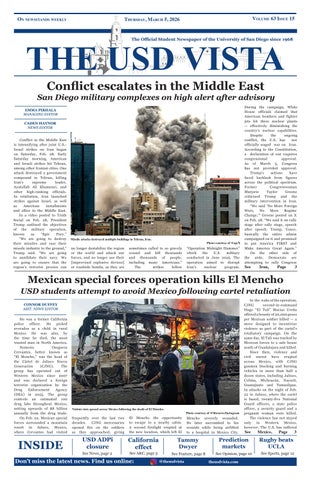

THE USD VISTA
Conflict escalates in the Middle East San Diego military complexes on high alert after advisory
EMMA PIRHALA MANAGING EDITOR
CADEN HAYNOR NEWS EDITOR
Conflict in the Middle East is intensifying after joint U.S.Israel strikes on Iran began on Saturday, Feb. 28. Early Saturday morning, American and Israeli strikes hit Tehran, among other Iranian cities. One attack destroyed a government compound in Tehran, killing Iran’s supreme leader, Ayatollah Ali Khamenei, and other high-ranking officials. In retaliation, Iran launched strikes against Israel, as well as American installments and allies in the Middle East.
In a video posted to Truth Social on Feb. 28, President Trump outlined the objectives of the military operation, known as “Epic Fury.”
“We are going to destroy their missiles and raze their missile industry to the ground,” Trump said. “We are going to annihilate their navy. We are going to ensure that the region’s terrorist proxies can

no longer destabilize the region or the world and attack our forces, and no longer use their [improvised explosive devices] or roadside bombs, as they are
sometimes called to so gravely wound and kill thousands and thousands of people, including many Americans.”
The strikes follow
“Operation Midnight Hammer” which the U.S. military conducted in June 2025. The operation aimed to disrupt Iran’s nuclear program.
During the campaign, White House officials claimed that American bombers and fighter jets hit three nuclear plants — effectively diminishing the country’s nuclear capabilities. Despite the ongoing conflict, the U.S. has not officially waged war on Iran. According to the Constitution, a declaration of war requires congressional approval. As of March 3, Congress has not provided approval.
Trump’s actions have faced backlash from figures across the political spectrum.
Former Congresswoman Marjorie Taylor Greene criticized Trump and the military intervention in Iran.
“We said ‘No More Foreign Wars, No More Regime Change,’” Greene posted on X on Feb. 28. “We said it on rally stage after rally stage, speech after speech. Trump, Vance, basically the entire admin campaigned on it and promised to put America FIRST and Make America Great Again.”
On the other side of the aisle, Democrats are attempting to rally Congress See Iran, Page 3
Mexican special forces operation kills El Mencho
USD students attempt to avoid Mexico following cartel retaliation
CONNOR DUFFEY
ASST. NEWS EDITOR
He was a former California police officer. He picked avocados as a child in rural Mexico. He was also, by the time he died, the most wanted man in North America.
Nemesio Oseguera Cervantes, better known as “El Mencho,” was the head of the Cártel de Jalisco Nueva Generación (CJNG). The group has operated out of Western Mexico since 2007 and was declared a foreign terrorist organization by the Drug Enforcement Agency (DEA) in 2025. The group controls an estimated 100 drug labs throughout Mexico, netting upwards of $8 billion annually from the drug trade.
On Feb. 22, Mexican special forces surrounded a mountain resort in Jalisco, Mexico, where Cervantes had visited

Violent riots spread across Mexico following the death of El Mencho.
frequently over the last two decades. CJNG mercenaries opened fire on the soldiers as they approached, giving
See News, page 2
El Mencho the opportunity to escape to a nearby cabin. A second firefight erupted at the new location, which left El
Mencho severely wounded. He later succumbed to his wounds while being airlifted to a hospital in Mexico City.

In the wake of the operation, CJNG second-in-command Hugo “El Tuli” Macias Ureña offered a bounty of 20,000 pesos per Mexican soldier killed — a move designed to incentivize violence as part of the cartel’s retaliatory campaign. On the same day, El Tuli was tracked by Mexican forces to a safe house south of Guadalajara and killed. Since then, violence and civil unrest have erupted across Mexico, with CJNG gunmen blocking and burning vehicles in more than half a dozen states, including Jalisco, Colima, Michoacán, Nayarit, Guanajuato and Tamaulipas. In attacks on the night of Feb. 22 in Jalisco, where the cartel is based, twenty-five National Guard officers, a state police officer, a security guard and a pregnant woman were killed. The violence has not stayed only in Western Mexico, however. The U.S. has suffered
page 12
Photo courtesy of @bbcnews/Instagram
Missile attacks destroyed multiple buildings in Tehran, Iran.
Photo courtesy of @ap/X
USD Alpha Delta Pi closes after almost 50 years
CADEN HAYNOR NEWS EDITOR
Alpha Delta Pi, one of USD’s panhellenic sororities, announced that the national chapter decided to withdraw the USD Zeta Pi chapter on Feb. 21.
The sorority’s statement, released on Instagram with over 1,200 likes, confirmed the Zeta Pi chapter’s closure.
“With care for our sisterhood, Alpha Delta Pi has made the decision to withdraw the Zeta Pi chapter at the University of San Diego at the end of this semester,” the statement read. “This follows a period of thoughtful evaluation despite many heartfelt efforts to strengthen the chapter. Our focus now is ensuring every Alpha Delta Pi member feels supported, valued, and surrounded by Panhellenic love during this transition.”
USD Assistant Director of Fraternity and Sorority Life Kristen Reynolds explained why the Zeta Pi chapter shut down.
size force ADPi closure

“The Grand Council of Alpha Delta Pi voted to close the Zeta Pi chapter due to ongoing challenges with membership size, recruitment outcomes, retention and leadership capacity, which together make long-term sustainability difficult,” Reynolds stated. “The International Organization determined that closure is the most responsible option given current conditions.”
The Zeta Pi chapter of Alpha
Delta Pi was the first Greekletter organization brought to USD in 1977, after the men’s and women’s colleges merged.
Nationally, Alpha Delta Pi is the oldest sorority in the United States, beginning as Adelphean Society in 1851 at Wesleyan College in Georgia. Wesleyan was the first college in the world chartered to grant degrees to women. Reynolds reacted to the
closing of the Zeta Pi chapter.
“As both their on-campus chapter advisor and a Panhellenic sorority woman, I am deeply saddened to see the Alpha Delta Pi chapter at the University of San Diego close,” Reynolds said. “This is a significant loss for Panhellenic, Fraternity and Sorority Life, and the broader USD community.”
Alpha Delta Pi is a social sorority and a member of
the National Panhellenic Conference. It has an international scope, with 149 active chapters and more than 260,000 lifetime members.
USD Director of Fraternity and Sorority Life DJ Mahoney showed his support and sadness at the closing of the Zeta Pi chapter.
“The university did not make the decision but our office supports the decision made by Alpha Delta Pi,” Mahoney stated.
“I am saddened by the news of this decision as Alpha Delta Pi has provided meaningful and transformative college experiences to countless USD students and alumnae since 1977. I am so grateful to the members of Alpha Delta Pi, past and present, for showing the USD community how to showcase the positive impact sororities can have on their campuses.”
USD’s Alpha Delta Pi chapter received support from the students and members of the panhellenic community on their post.
Winter storm ravages the East Coast USD students face travel trouble
CADEN HAYNOR NEWS EDITOR
SOPHIE HUMMEL CONTRIBUTOR
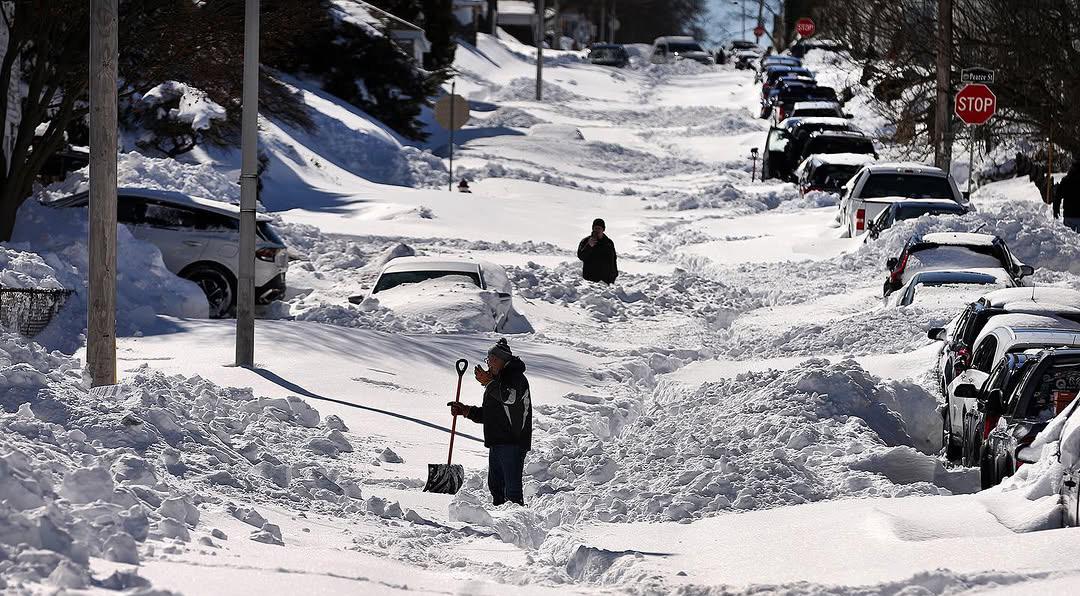
A major East Coast blizzard formed on Feb. 20, with severe conditions causing multiple states to declare emergencies. Millions of people were put under blizzard warnings and some areas saw historic snowfall.
The storm, known as Winter Storm Hernando, intensified into a bomb cyclone on Feb. 22 as it moved off the East Coast and into Atlantic waters. A bomb cyclone has a massive pressure drop, which is characterized by strong winds.
Currently, more than 40 million people are under winter alerts, with blizzard warnings stretching 600–700 miles from Virginia to Maine. New England experienced widespread 18–24 inches of snow, with pockets of up to 30 inches possible.
Winter Storm Hernando is a Category 3 major blizzard
with a Regional Snowfall Index of 9.69, placing it among the most powerful winter storms of the decade.
Rhode Island recorded 37.9 inches of snow, the highest ever measured in the area and peak gusts reached 98 miles per hour in Massachusetts.
USD junior Skyler Headrick flew to the East Coast to visit her mom the week of Feb. 16. Headrick explained how the forecast unexpectedly intensified as she departed.
“It’s definitely been a lot more severe this year,” Headrick said. “This is the first blizzard they’ve had in a while. A day or so before the flight my mom said it would snow. When I got on the flight, it was only predicted to be a few inches but with time the forecast said 12 inches.”
Headrick explained that one of her classes was affected by the storm.
“I emailed all my professors and one of my professors in the city actually had to move class virtually this week
because she couldn’t make it back either,” Headrick stated.
USD junior Evan Zub, who calls Wilmington, North Carolina home, explained how the storm has affected his hometown and how this storm is different from previous years.
“A lot of places close down, like, 24 to 48 hours
beforehand,” Zub explained.
“So if it’s supposed to snow that night, restaurants, coffee shops and other places will close down the day before because we don’t have any salt to put on the ground. We don’t have any snow plows…
This winter has definitely been colder, and more different than
previous years. Previous years, it usually only snows about two inches, or it doesn’t snow at all.”
Despite the storm moving offshore and completing its land exit on Feb. 24, there remains lasting impacts on the East Coast, including power outages, flight cancellations and road closures.
Alpha Delta Pi has been on USD’s campus since 1977.
Photo courtesy of @usdadpi/Instagram
New England experienced heavy snowfall throughout the storm on Feb. 24.
Photo courtesy of @johntlumacki/Instagram
San Diego-based aircraft carrier involved in Iran
Trump projects operation to last ‘four to five weeks’
members to oppose the war.
Senator Chuck Schumer spoke out on March 2 against the war.
“As soon as our resolution comes to the floor, senators need to pick a side,” Schumer said. “Stand with Americans who don’t want war, or stand with Donald Trump as he singlehandedly starts another war.”
A strike on a girls’ school in Southern Iran killed at least 153 people, according to Iranian state media. It is currently unclear who is responsible for the strike. The United Nations Educational, Scientific and Cultural Organization (UNESCO) classified the action as a violation of humanitarian law.
The U.S. State Department issued urgent “Depart Now” notices to U.S. citizens in 14 Middle Eastern countries due to severe safety risks.
On campus, students and faculty have discussed the eruption of violence.
USD senior Elle Kaveh, whose grandparents live in Iran, described her thoughts on the conflict.
“I think that, for the people of Iran, this was really helpful for them because their human rights were all at stake and they were getting killed and tortured and imprisoned and executed just for doing things that we do every day,” Kaveh explained. “I don’t think war
is good, but coming from that perspective, I think that taking out the leader could end up really well for the people of Iran, depending on what happens in the next few weeks. And for other countries too in terms of terrorism threats and all that going away. But it also could turn the wrong way.”
USD first-year Sofia Rubio explained her perspective on the missile attacks.
“I don’t understand why we are going to war,” Rubio said. “Why are we starting war to bring peace? It won’t get us anywhere.”
Domestically, the ongoing conflict is impacting daily life for San Diegans and Toreros.
The San Diego Union Tribune reported that the Department of Defense’s Northern Command informed the San Diego Navy and Marine bases to remain vigilant for potential attacks on U.S. military locations.
The U.S.S. Abraham Lincoln, an aircraft carrier based out of San Diego, is involved in the operation against Iran. The vessel holds thousands of sailors and is acting as an airfield for Navy and Marine Corps aircraft.
U.S. Central Command (CENTCOM) denied claims from the Iranian military that missiles struck the ship.
“The Lincoln was not hit,” CENTCOM posted on X. “The missiles launched didn’t
even come close. The Lincoln continues to launch aircraft in support of CENTCOM’s relentless campaign to defend the American people by eliminating threats from the Iranian regime.”
On March 1, Naval Base Coronado released a statement on X notifying civilians to expect traffic delays around all entrance gates due to increased base security. Coronado is home to one of the largest military complexes in the country, with three aircraft carriers, four Sea, Air and Land (SEAL) teams and multiple squadrons, which consist of warships, submarines or aircrafts under one commander.
Department of Public Safety Captain Quinton Kawahara explained how USD is responding to the violence in the Middle East.
“The safety and well-being of our students, faculty, and staff remain the university’s top priority,” Kawahara stated. “Our Public Safety Personnel work closely with local and state officials in situations like this, and although San Diego and our campus are home to a large military community, at this time, we are not aware of any specific threats that would impact our campus.
As a standard practice, Public Safety continuously evaluates security protocols
and adjusts staffing and patrol patterns as appropriate.”
On campus, the hostilities are impacting the operations of Reserve Officer Training Corps (ROTC) programs. March 4 was the 100th anniversary of Navy ROTC (NROTC), which was supposed to be celebrated by the six NROTC units in San Diego. Midshipmen were ordered to wear uniforms on the anniversary. However, The USD Vista reviewed a message from an NROTC captain that announced to the USD battalion that no uniforms will be worn on March 4. Their physical training will be done in civilian clothes as well.
Members of the NROTC program who did not wish to speak on the record because they were not given permission to speak to media explained that the change in uniform procedure could be related to reducing conflict between midshipmen and any potential agitators.
The Army ROTC battalion has not received a notice to not wear uniforms during the week as of The USD Vista’s production date of March 3.
It is unclear how long the conflict will last. At a White House Medal of Honor ceremony honoring killed service members, President Trump explained the timeline for “Epic Fury.”
“Whatever it takes,” Trump said at the ceremony on March 2. “Right from the beginning, we projected four to five weeks, but we have capability to go far longer than that.”
In the Truth Social video released on Feb. 28, Trump acknowledged that death is a possibility for armed forces members.
“The lives of courageous American heroes may be lost, and we may have casualties,” Trump explained. “That often happens in war… We pray for every service member as they selflessly risk their lives.”
As of The USD Vista’s production date of March 3, American death tolls have risen to six casualties, while Iran’s total is estimated to be over 780 deaths. The world watches as war ensues and death tolls rise.
Multiple American universities have increased their presence in the Middle East in recent years. Georgetown, New York University (NYU), Northwestern, Texas A&M and other universities currently maintain a presence in the region. Students in NYU’s Abu Dhabi and Tel Aviv campuses are currently sheltering in their dorms after Iranian missiles struck miles away from their campuses. As a result, classes were canceled and placed online indefinitely. No American students have been pronounced injured or dead as a result of the attacks.
Cartels incite violence throughout Mexico
Cartel leader killed, but criminal organization remains rampant
more than 320,000 fentanylrelated deaths since 2020, and a large quantity of the lethal opiate is smuggled across the southern border by the CJNG. In 2025, U.S. Border Patrol seized 11,500 pounds of fentanyl at the San Diego border crossing alone — enough to kill every American nearly eight times over.
The burning of cars and blockage of important roadways caused the U.S. Consulate to issue a shelter-inplace order on Feb. 22 for all American citizens in Tijuana. The order was lifted days after. USD sophomore Ryan Canton was visiting Tijuana the week of Feb. 23 and viewed the chaos firsthand.
“There was a massive plume of smoke moving over the ocean from all the cars burning in Tijuana,” Canton said. “It was like watching a war zone.”
The killing of El Mencho has sent shockwaves throughout Mexico, leading to instability and violence right on San Diego’s doorstep.
The riots in Tijuana and a potential threat to local military installations places San Diego and Toreros in a unique situation. USD senior

Brynn Gerty explained how the lack of security is impacting some Toreros regarding their spring break travel plans.
“I was planning on traveling to Tulum for spring break with some of my friends,” Gerty explained. “A few of them have decided they don’t feel safe traveling anymore.”
The decision to take direct
action against the cartel and its leadership marks a new chapter in Mexico, one that may be difficult to navigate. Since 2012, Mexico has taken a less direct approach to combating cartel operations due to the failure of its previous “kingpin method.” This method, headed by former President Calderón, focused on the
elimination of individual cartel leaders rather than addressing systemic issues. This approach led to the fragmentation of cartels into various splinter groups and a sharp rise in homicide rates.
Criminologist Nikos Passas offered a cautionary note during an interview with Northeastern University.
“The problem is not one
leader,” Passas said. “The problem is that you have a whole illicit economy that is made up of all these structural components. Killing a leader makes headlines, but it doesn’t make for a durable reduction of illicit flow.”
The influence El Mencho had over the CJNG was uniquely centralized and powerful. Competing cartels, such as the Sinaloa Cartel, deliberately avoid this centralized model of power precisely because of the discord a single leader’s death can cause. The cartel is now desperate for new leadership in the wake of the deaths of their two most influential leaders, creating a drug-fueled power vacuum.
On June 18, Mexico is slated to host FIFA World Cup matches in Guadalajara, with a qualifying tournament scheduled for late March, leaving the Mexican government with an imposing deadline for peace.
The man is dead, but the cartel is not. With the scent of burning cars still fresh in the air and official government safety warnings, many Toreros doubt travel plans out of concern for their safety.
From Iran, Page 1
From Mexico, Page 1
Fires and explosions spread across Mexico following the death of El Mencho.
Photo courtesy of @bbcnews/Instagram
RILEY RAINS ARTS & CULTURE EDITOR
LARA DOMINIQUE SOLANTE COPY EDITOR
1. Infamous war between Athens and Sparta that began in 431 BC
2. The most common translation of The Bible
4. The United States’ 26th president, who famously consumed a gallon of coffee daily
5. The champion of the 2026 Winter Olympics women’s figure skating
8. One of the most popular search engines 13. A gelatin dessert 14. Shortest wavelength on the Visible Light Spectrum

Across
3. A type of cake baked in a donut-shaped pan
6. This wide, ‘50s style skirt shares a name with a fluffy dog.
7. The Australian word for flipflops
9. In which state can you find the Gateway Arch?
10. The most reactive element that you can find ionized in your toothpaste
11. What mammal is “Punch the Monkey’s” beloved stuffed animal?
12. In Greek mythology, this deity is the god of the seas.
15. The capital of New Zealand
16. Which poet’s initials revealed Walter White’s identity?
Dream of ‘Californiacation’ Out-of-state students discuss cultural immersion
for surfers of all levels.
CALLA JORDAN CONTRIBUTOR
While attending the University of San Diego, students are able to immerse themselves not only in their higher education, but also into a city defined by its diverse blend of nature and a distinct appreciation for individual style. California’s relaxed and nature-centered atmosphere is unique to that of other states. For many out-of-state students, this can come as quite a culture shock. However, many students take riding the wave to heart, adopting this laidback and expressive mentality.
USD’s beloved sunny weather catches the attention of potential students nationwide. Its picturesque landscapes and ocean views earn the school a consistent top-tier annual ranking in the Princeton Review for one of the most beautiful college campuses across the country. When students first attend USD, they experience the typical, gradual lifestyle changes that take place in any new social environment, but a California phenomenon inevitably strikes.
California’s beachy culture adds a unique twist to students’ college experiences. The tropical climate creates mini staycations rather than weekends for Toreros, prompting beach days, matcha dates and lively thrift store browsing in Pacific Beach. The coastal state makes it easy for
students to find outdoorsy outlets, helping students relax and find peace in a relatively stressful period of their lives.
USD junior from Washington state, Ben Johnston, has not taken the California coastline for granted. Johnston picked up surfing as a way to connect with the environment.
“I love how peaceful surfing is,” Johnston shared. “I just love being out in the water.”
California not only provides students with the perfect environment to try out new and exciting activities, the state also often pioneers progressive cultural and political shifts, attracting creative and open-minded individuals. This ultimately leads students to feel comfortable to express themselves through their personal style.
USD sophomore and Houston native, Leila Nuri, loves showcasing her personality through her fashion. However, back home in Texas, she noticed that many of her peers were more likely to stick to southern fashion trends, rather than experimenting with other styles.
“I would always kind of dress the way I dress now in Houston, but it was different there, because I would stand out,” Nuri expressed. “Here you might still stand out, but everybody’s kind of doing their own thing.”
Nuri knew prior to coming to USD that she wanted to attend a university outside of Texas.
She liked the idea of California because of its celebrated diversity, as well as its emphasis on the environment. Since moving to California, Nuri has noticed a definite contrast between California and Texas. Nuri appreciates the chill energy of San Diego and the opportunities that come along with living in such a distinctive and paradisal place.
“I think the nature, surf culture and music culture all contribute to this stereotype,” Nuri expressed. “How can you not be laid back when you live right next to the beach?”
The ‘California effect’ not only influences USD student’s personal style, but also often slips into other aspects of how students are perceived. USD junior from Uruguay, Tizi Habsburg, highlighted how he has gradually been influenced by the California culture.
“It’s funny, because I don’t think I would personally say that I fit the California stereotype,” Habsburg noted. “But, I’ve been told by everyone around me, people that used to know me, people that have just met me, that I’m completely California-fied. The way I speak, and the way I act are definitely examples of that.”
USD Associate English Professor Joseph McGowan specializes in historical linguistics. While some Torero’s might deny that Californians have any accent, McGowan argued that the dialectal assimilation
when moving to USD is more than apparent.
“There is an anxiety of influence when you move anywhere,” McGowan commented. “People modify their accents in their firstyear at USD. They want to fit in… [For] others it is unconscious: they go to the beach and pick up a certain way of speaking. There is always a connotation with accents.”
Accents are symbols of an individual’s cultural and social background. Habsburg incorporates California lingo into his speech subconsciously, highlighting the intuitive nature of individuals to adapt to their new social surroundings. Habsburg experienced a shift in social norms and complexities since moving to San Diego. However, he was primarily taken aback by the relaxed mindset obtained by many California residents.
“I definitely used to have a much more structured lifestyle,” Habsburg expressed. “My life has a go-with-theflow feel to it now. I have more liberty to try new things and just do the things I love.”
Habsburg surfed prior to living in San Diego, but it wasn’t until his move that he was able to consistently enjoy the waves.
“San Diego has really consistent swell, so I have had more opportunities to get out there and meet others who also surf,” Habsburg shared.
A swell is often used to describe desirable waves
The low-stress California mantra doesn’t just stem from unwritten cultural expectations, but also from how embedded nature is in California culture.
USD junior Sasha Paquini recently moved to North Park after growing up in Denver, Colorado. Pasquini noted how she has taken advantage of the nearby parks and nearly perfect weather to stay grounded and refreshed.
“I love California because of how elevated my day to day life is,” Pasquini shared. “Everyday I step outside and I am a bit more appreciative because of how nice the environment is around me.”
Pasquini acknowledged a distinct culture shock since coming from a landlocked state to the golden coast, a change she does not take for granted.
“It comes with a price,” Pasquini shared. “California is more expensive than other states. It’s definitely a privilege to be here.”
This ‘California Effect’ is provoked by an unmatched appreciation for natural diversity and the emphasis on relaxation and enjoyment. Living in San Diego enables students to step outside of their comfort zones and find activities that foster expression and personal growth. Many of USD’s outof-state students dreamt of ‘Californiacation,’ and since their move, have embraced the state fullheartedly.

Coconut water, ‘Rainbow’ flip-flops and lighthearted beach reads are all San Diego staples.
Calla Jordan/The USD Vista
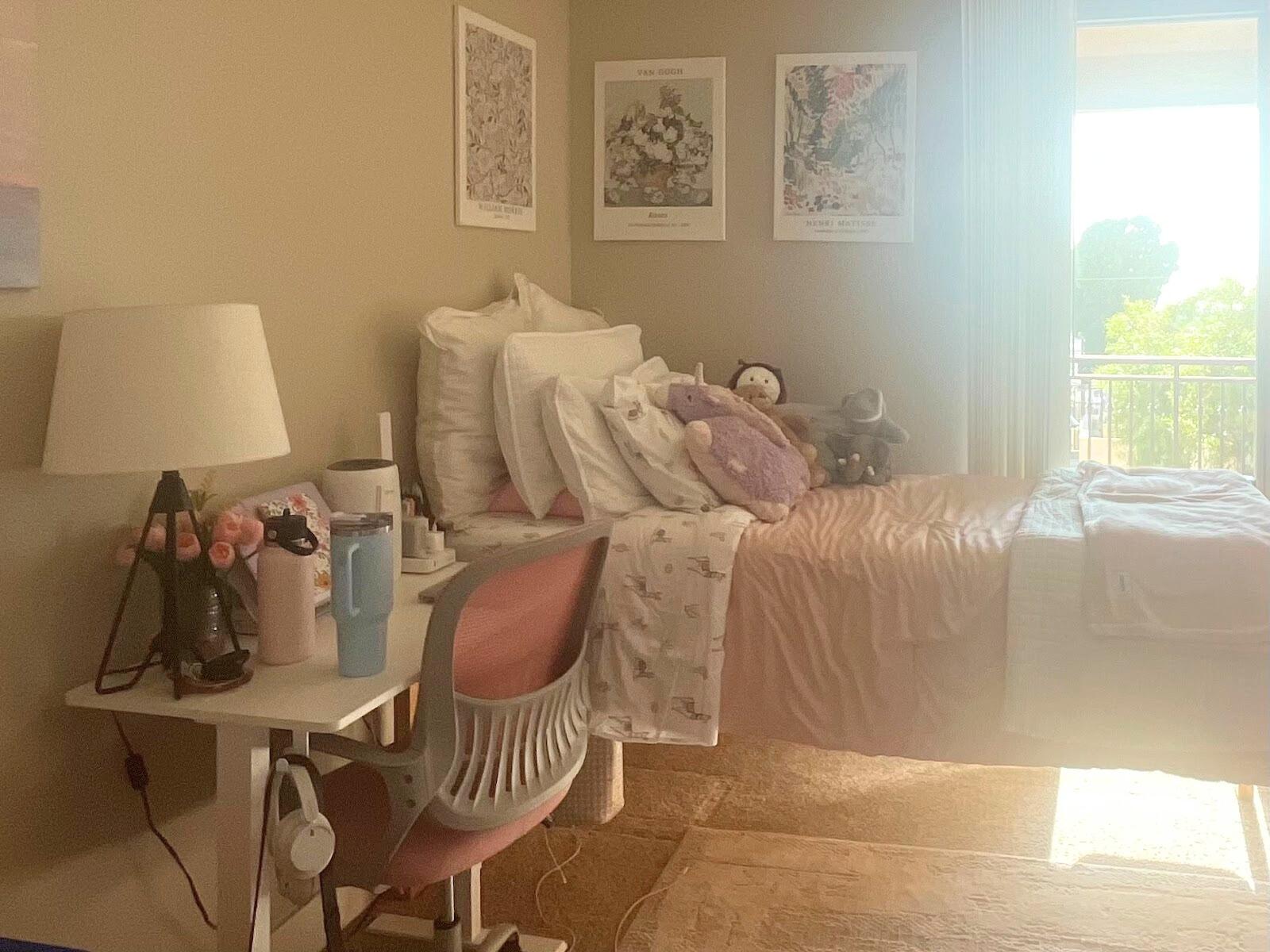
“I use my desk for studying and eating I have a personalized standing desk with flowers, my lamp and my water bottles ”
Kaylina Stroud, USD junior
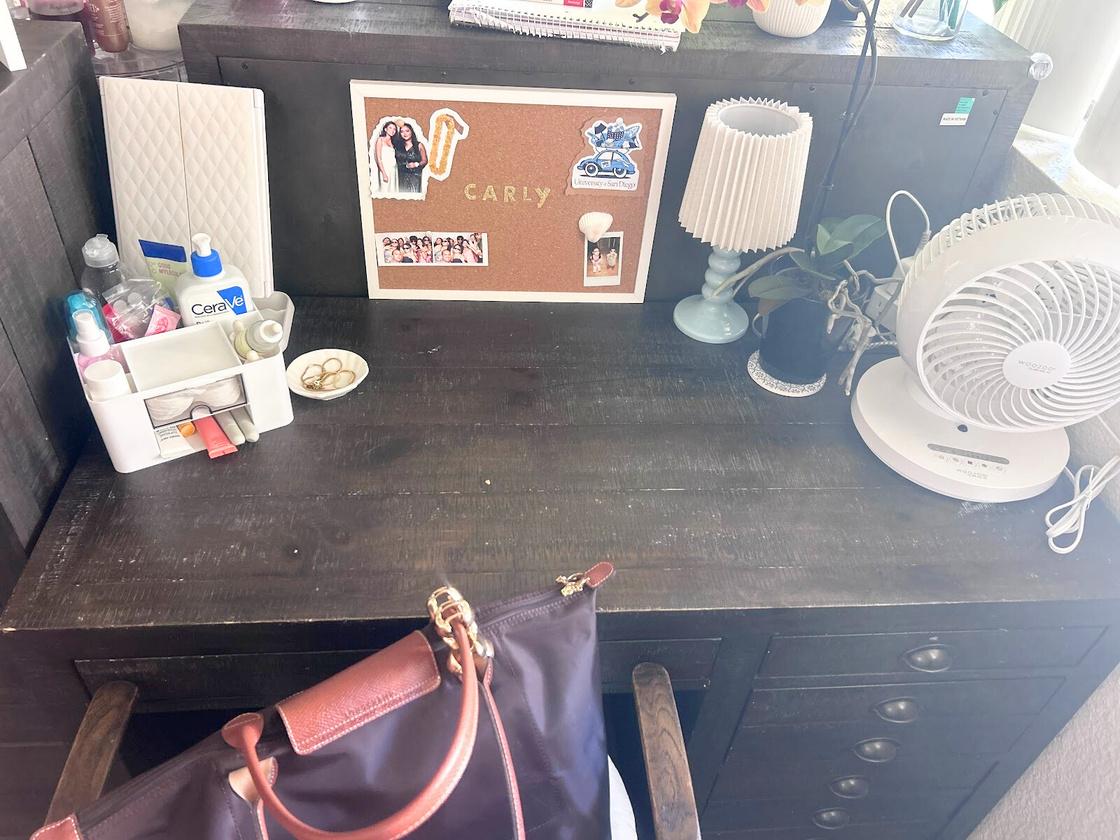
“I mostly use my desk for getting ready or doing homework I like to have my desk decorated with pictures of my family and friends, my orchid plant and other small things that remind me of home ”
Carly Genovia, USD first-year
Torero desk
Whether in dorms or off-ca have a desk tucked bes studying, desks can be u eating, getting ready or s tend to reflect a person sparseness, what individual they live. USD community m of place their desks have i personalizations they m
“I use my desk for studying a need on a daily basis. I have a but tha Ivan Tripp, US

Art by Kyra Lefebvre/ The USD Vista: Content by Katarina Maric/ The USD Vista
Photo courtesy of Carly Genovia
Photo courtesy of Kaylina Stroud
ks on display
ampus, most USD students side their bed. Besides used for so many things: simply for storage. Desks n themselves, showing s value and the kind of life members share what kind n their lives and the little make in everyday life.
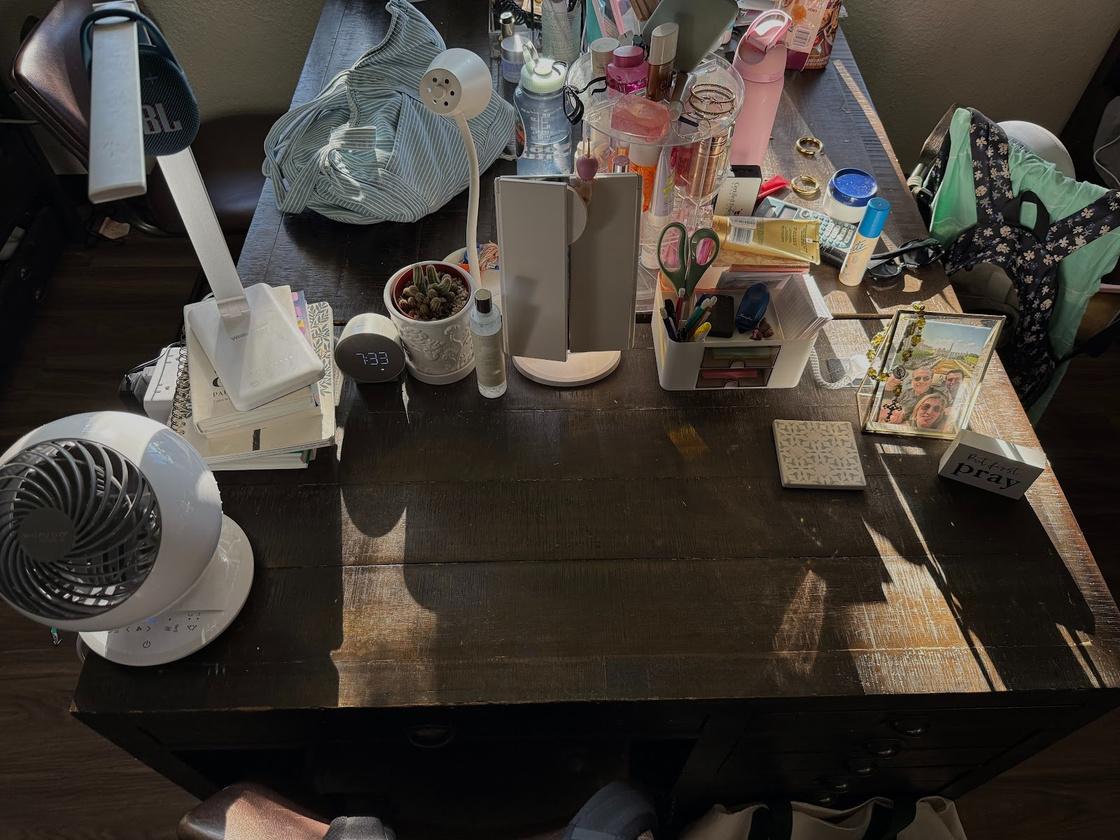
“I use my desk to get ready and to do homework or study at night I have a picture frame, a rosary, a little wooden block with a quote, a mirror, a lamp, books and school supplies on my desk ”
Ella Gamas, USD first-year
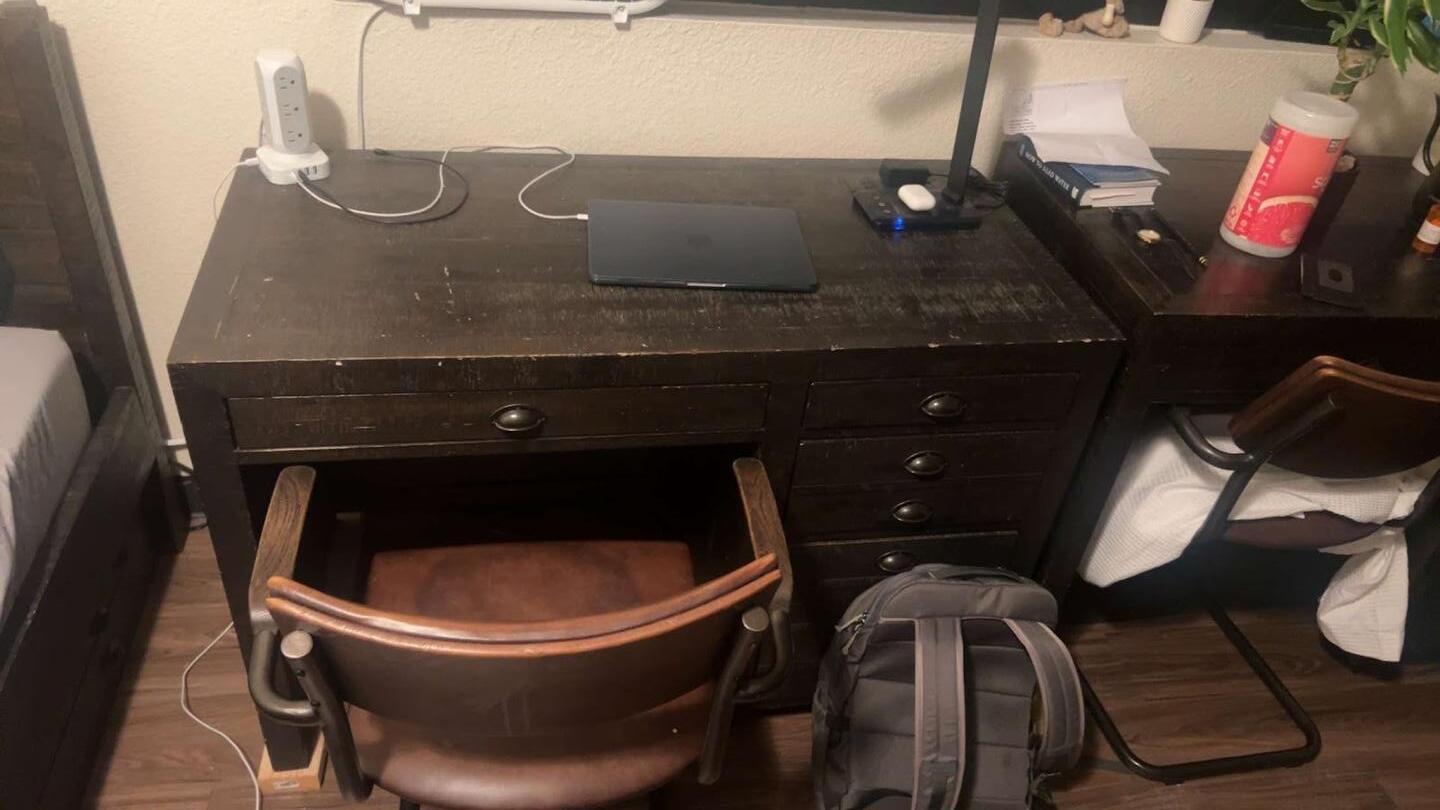
“I don't really use my desk I haven’t decorated it at all ” Austin Baber, USD first-year and keeping anything that I a few pictures of my family, t’s it.”
D sophomore
Photo courtesy of Austin Baber
Photo courtesy of Ella Gamas
FEATURE
A career of education comes to a close
Tammy Dwyer retiring after a long career of research and education
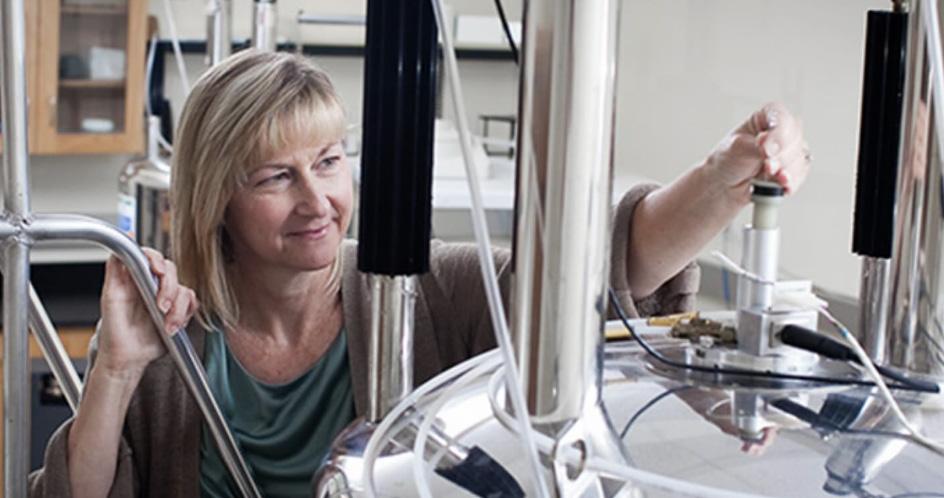
Tammy Dwyer, PhD., has taught chemistry at USD since 1994. She has been a friendly face to students within the department. Dwyer recently announced that she plans to retire after this semester. Her journey to teaching is a story of determination, perseverance and love. From not knowing a female professor to leading her own lab and chairing two departments, Dwyer has shown that knowing what you want and working hard for it are the most important things.
Dwyer’s support started from a young age as her father noticed her interest in math.
“I’ve always been good at math and my parents, even though they didn’t go to college, especially my dad, really instilled a love of math for me,” Dwyer recalled.
Dwyer shared some advice that she had heard early on in her career.
“Find a mentor,” Dwyer said. “I have had so many mentors over the years that have helped me in so many different ways learn to be the best I can be and to support me through that. I mean from the beginning of my career I consider my faculty at [California Polytechnic State University, San Luis Obispo] to be my first mentors.”
Dwyer continued, explaining how she felt without seeing any female representation within her field.
“There was nothing called or labeled an ‘imposter syndrome’ when I was in school, but that sense of ‘do I belong here’ hit me early but I got through,” Dwyer continued. “I just felt like I was excelling in chemistry, my confidence grew and I had great people like him. I never had a female chemistry professor in my whole life, in my whole life, ever.”
After receiving her bachelor’s from California Polytechnic State University, Dwyer went on to receive her master’s and PhD from University of California,
San Diego. Then, Dwyer and her husband completed their postdoctoral research together at University of California, Berkeley. She applied to be a faculty member at the then new school California State, San Marcos. At first she was excited to be part of the beginnings of a new school until she got there and saw the realities of starting out.
“I took a job at California State, San Marcos and I was so excited, until I got there,” Dwyer described. “It was at a time when there weren’t too many resources financially to do everything that a new university could do. So it was just this mad dash, grab for resources … my second year I was so unhappy.”
Dwyer remembered looking for jobs in the trade magazine Chemistry and Engineering News (CNE).
“I’m reading CNE news one night and it says ‘Tammy Dwyer, USD needs you,’” Dwyer joked.
“No, It didn’t say that. It said USD was looking for an NMR spectroscopy person which was my field … I’d never been on the campus, but I knew I had to get out of the situation I was in.”
Dwyer started teaching at USD in the Fall of 1994. At
the time, the whole chemistry department fit in the basement of Camino Hall. When the Donald P. Shiley Center for Science and Technology was built, Dwyer remembered being asked to design the building, along with other science and chemistry faculty.
“[Shiley] was the first building on campus to be designed by the users,” Dwyer explained. “So we had two faculty from each of the four science departments at the time … We all worked with the architects and the planners and everything … to design that building.”
After over 32 years of working in higher education, Dwyer has seen many noticeable changes, especially with technology. Dwyer explained how she has seen teaching, and the classroom, change over the years.
“To compete for your students’ attention with cellphones and tablets and texting,” Dwyer commented.
“I have a no laptops policy because I see that as a barrier between me and my student … I need your attention three times, 55 minutes a week.”
Dwyer discussed the
difference she feels in a large classroom now.
“I love learning and I get excited about it,” Dwyer said. “I love chemistry and I get excited about it. Sometimes it’s felt, with a larger number of students, that it’s harder to get them excited about it than I used to be able to because there’s so many competing distractions these days.”
Dwyer even commented about how her examples in lecture have had to change because of new technologies.
“Even examples I can use in the chemistry room,” Dwyer explained. “Most ovens are selfcleaning these days but Easy Off was a great product. The spray on oven cleaner that you used to be able to talk about because it’s great chemistry.”
Dwyer spoke about the many commitments she has as a professor and the need for time management.
“We have to balance teaching, research and service,” Dwyer explained. “And a lot of us do a lot in the community, especially in our younger years … So it’s a big balancing act. And then we have families. I have my spouse and my two kids. I was constantly taking off one hat and putting on another.”
Because of her many commitments, whether personal or professional, Dwyer highlighted the importance of students helping out in the lab and aiding with research.
“I got some of my best papers out when I was chair,” Dwyer said. “My students were excellent. Students can do all the work. Our undergraduates here, we don’t need masters programs because our undergraduates are awesome.”
While it’s easy to say how to manage time, it’s much harder in practice, as Dwyer explained.
“It isn’t easy by any stretch,
I don’t want you to think it’s easy, but passion goes a long way,” Dwyer said. “I love working with students. Doesn’t matter if it’s a classroom, teaching laboratory, research laboratory. It’s just wonderful to work with students.”
Now that Dwyer is retiring at the end of this year, USD will be honoring her with a research fellowship. They are still trying to reach their donation goal but many alumni have reached out to Dwyer, thanking her for teaching them and telling her where they are now.
“I’ve just been so blessed by the number of alums who have given to this,” Dwyer explained. “And so they’ve reconnected when asks went out in the fall. I started getting emails … To think that that name will be associated with research at USD for a few years after I’m gone will be wonderful.”
Dwyer’s husband has been teaching at USD also for the last couple years but once Dwyer retires, they will both be retiring permanently. They have two kids and four grandchildren. Dwyer shared her plans after retirement.
“We are committed to being the best grandparents we can be and we love that,” Dwyer said. “We love them all, doing puzzles with them and reading books. My husband and I love to travel, we have friends all over the world … The number one on our bucket list is we’re going to go to the Grand Canyon.”
Dwyer shared an important message for all students to hear.
“My genesis is that I’ve had a lot of luck,” Dwyer said. “I’ve worked hard and I was very well educated which has been my mantra here with students. ‘Give them the best darn chemistry education I can give them’ because that is a springboard for everything to come.”
Dwyer has helped many students hone their skills as researchers during her time at USD.
Photo courtesy of @usdchembiochem/Instagram
AMELIE SEDLACK FEATURE EDITOR
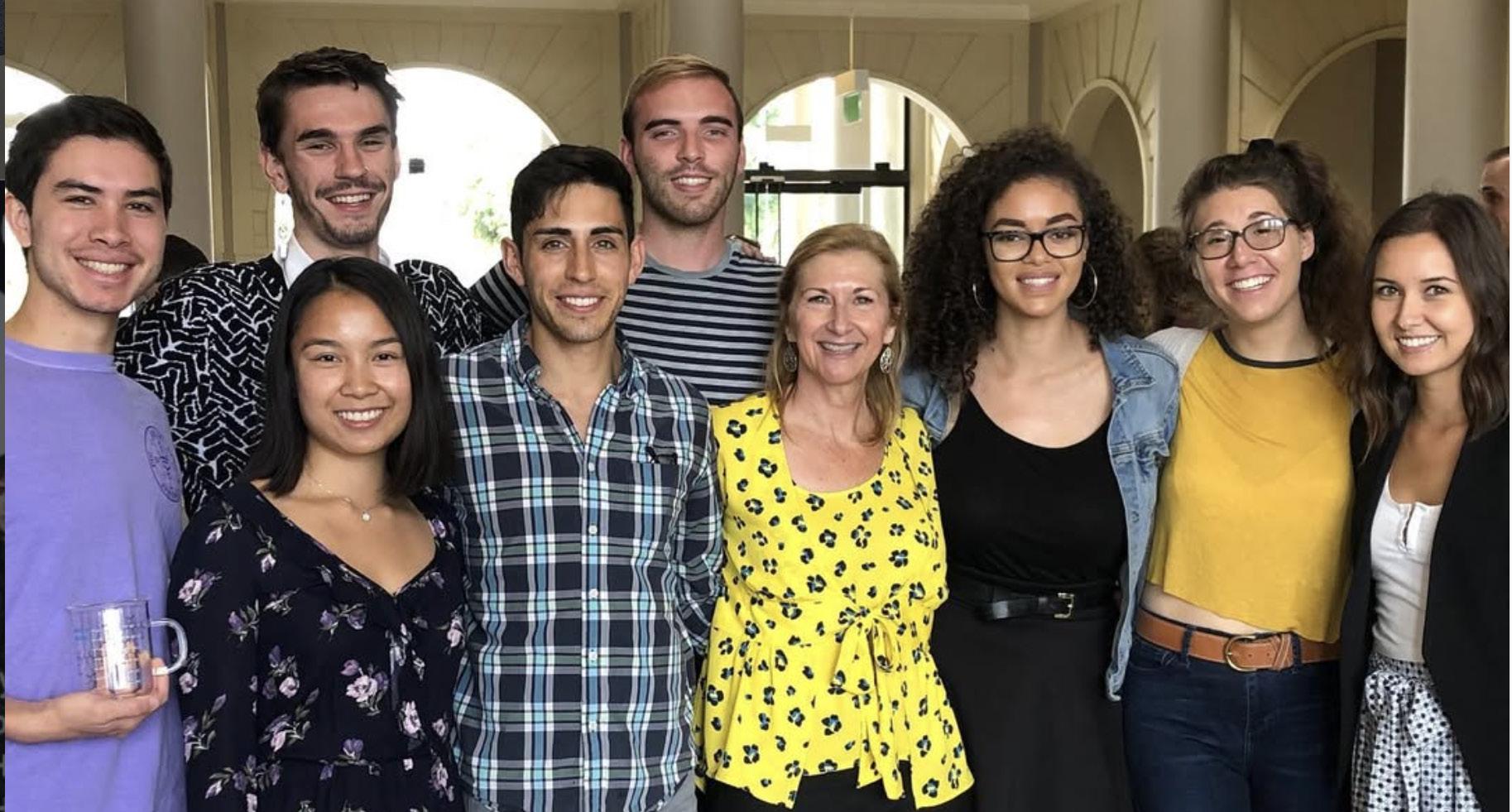
In her lab, Dwyer worked with many students that aided with research.
Photo courtesy of
DAVID COOK OPINION EDITOR
For many years, the sports world has entered a new era, which I call the analytics era. It started with “Moneyball.”
Oakland A’s baseball club turned its program around in 2002 using analytics to get the most bang for its buck. Then, in the mid-2010’s, the Golden State Warriors showed everyone that shooting more three-pointers is the best strategy, leading the NBA to become dominated by the three-pointer. In football, we watch coaches make “analytical” decisions almost every Sunday, by regularly keeping their offense on the field on fourth down, or going for a two-point conversion when trailing by seven. The numbers usually win. Front offices think in probabilities, and coaches manage games in expected value.
Now in the NBA, there has been a dramatic shift into either competing for a championship or competing for the top pick in the draft. For those unfamiliar, the NBA, like the NHL and MLB, uses a lottery system to assign draft picks. This means every team that misses the playoffs is put in a lottery, where the worse their regular-season record is, the better their chance of landing a top draft pick is.
In the NBA, the draft lottery began in 1985 to combat tanking, which is when a team strategically loses to improve its odds of a higher draft pick the following season. However, this introduction did not solve the problem, as it is in the NBA where the clearest signs of tanking have been seen.
Recently, the NBA fined the Utah Jazz $500,000 and the Indiana Pacers $100,000 for “conduct detrimental to the league.” These teams benched, or intentionally left their star players out of a game, during a matchup that had a greater impact on their draft position.
Worse records mean better lottery odds, and front offices aren’t in the business of ignoring that. If finishing with one of the worst records gives you the best shot at a franchise-changing player, some teams are going to aim for that outcome. It’s very rational.
Now the NBA is reportedly considering a list of draft lottery changes to address tanking. The problem is that most of the proposals feel extreme. They treat tanking like it’s breaking the league, when it’s really just
OPINION
NBA’s incentive for losing Solutions to basketball’s tanking issue

the predictable result of how the rules are set up.
One idea would be to completely flatten lottery odds, so every team in the lottery would have the same chance at every pick. That would pretty much eliminate the incentive to tank. Losing more games wouldn’t improve your odds at all.
But the draft exists for a reason. It’s supposed to help bad teams get better. If the lottery becomes a 14-team coin flip, the worst teams could easily end up picking 10th or 12th year after year, while mid-tier teams jump into the top three by luck. Small-market teams already struggle to land elite talent in free agency. Taking away their structural edge in the draft undermines fairness and makes rebuilding harder.
Another proposal would extend the lottery to include play-in teams, further flattening the odds. A play-in team
is either the seventh, eighth, ninth or tenth seed in each Conference, who play each other before the playoffs to fight for the seventh and eighth seeds in the playoff bracket. Currently, the bottom-three teams in the NBA have a 14% chance each to land the first overall pick. The NBA already flattened odds in 2019, though, and tanking didn’t disappear. Adjusting the percentages again doesn’t change the underlying incentive. It just chips away at the advantage for the teams that actually need it.
There are also proposals to ban consecutive top-four picks or restrict teams that finish in the bottom three multiple years in a row. But the current system already gives the three worst teams about a 50% chance at a top-four pick. If a team finishes near the bottom, misses out and then isn’t allowed to draft high again the following year, that’s heavy-handed. Bad teams
already deal with variance. Adding more restrictions doesn’t really fix the core issue.
A lot of these ideas feel like they’re trying to eliminate tanking completely. That’s not realistic. As long as the draft position is tied to record, there will always be some incentive to lose. The better question is when that incentive exists.
Freezing lottery odds at the trade deadline, or even at the All-Star break, both of which are about two-thirds of the way through the season, makes more sense than changing the entire system. Through most of the season, the worst teams would still earn the best odds. This keeps the draft aligned with its purpose. But once the odds are locked, losing no longer improves draft position.
Right now, struggling teams have a reason to lose every game. Under a deadline freeze, that incentive disappears in the final stretch — when tanking
becomes most obvious and frustrating. The standings are largely set. The lottery race is clear. And suddenly, there’s no benefit to sitting healthy players just to slide down a spot. Teams would still evaluate what they have early in the year. Some would still pivot toward rebuilding. That part isn’t going away. But for the final third of the season, everyone would have the same reason to compete: to win games, and not to throw them for a better chance at landing a top draft pick. There will always be bad teams in the NBA. The draft is supposed to give them a path forward. Most of the current proposals risk making that path harder in the name of solving a problem that’s really about incentives. The NBA doesn’t need to redesign the lottery every few years, they just need to structure it so that trying to win makes sense for more of the season.
Over the all-star break, NBA Commissioner Adam Silver announced that the league is considering multiple potential rule changes to help combat tanking in the NBA. Photo courtesy of Markus Spiske/Unsplash
OPINION
Prediction markets and news outlets team up
CNN’s partnership with Kalshi calls for concern
DAVID COOK OPINION EDITOR
Lately, something strange has started to slip into mainstream news coverage. Betting odds are now appearing next to serious headlines. CNN’s partnership with Kalshi, a regulated prediction market where users can buy and sell contracts tied to future events, has sparked debate. CNN is not alone as CNBC now incorporates prediction market data into its reporting. Even The Wall Street Journal and Yahoo Finance have partnerships with Polymarket, another prediction market.
On these websites, people bet on the outcome of future events, ranging from betting
on the weather to who will win political elections. Newsrooms and betting markets are increasingly intertwined, and that shift deserves more attention than it’s getting.
At first, it can look like a harmless innovation. Markets are often described as efficient collectors of information, and a probability percentage can feel reassuring in uncertain times.
A clean “62% chance” graphic looks objective and precise, but journalism and financial speculation serve fundamentally different purposes.
Journalism is meant to investigate facts, provide context and hold institutions accountable. Prediction markets are designed to turn uncertainty into financial opportunity. When media organizations
elevate market wagers as part of their reporting, the distinction between informing the public and capitalizing on unpredictability begins to fade.
The problem becomes clearer when you look at what people are actually betting on. These markets do not stop at broad election outcomes. Users have bet on whether the Federal Reserve will raise or cut interest rates at its next meeting. There have even been bets on which specific words a president will use during a State of the Union address. That example should make anyone pause. If money can be made on whether a president says “border,” “inflation” or “transgender,” the incentive to influence messaging, leak selective details or manipulate timing becomes
obvious. The more granular the bet, the easier it is to distort.
Election betting presents its own dangers. When odds heavily favor one candidate months before ballots are cast, those numbers do not exist in a vacuum. They shape narratives and influence enthusiasm, donations and even turnout. In tight races, perception alone can alter behavior. The issue is not simply that individuals are placing wagers, but that major news outlets are amplifying those wagers as part of the broader political conversation, reinforcing signals that may end up influencing the very outcomes being forecast.
Monetary policy offers another example. Contracts tied to Federal Reserve decisions may seem like harmless speculation,


but central banking relies heavily on credibility and carefully managed expectations. When speculation becomes a visible, tradable event — and then gets highlighted in mainstream coverage — it adds another layer of pressure to institutions that depend on stability. It can also distort how the public interprets policy moves that require nuance rather than instant reaction.
At the center of all this is an incentive problem. Markets react to new information, but they also react to rumors, framing and strategically timed releases. If money can be made based on how a headline lands, the surrounding ecosystem changes. Many malinfluenced people may see openings to push narratives that move markets, regardless of whether those narratives are responsibly sourced. In a media environment already dealing with misinformation and polarization, attaching financial stakes to headlines increases the risk of manipulation. All of this is unfolding at a moment when trust in both media and government institutions is already strained. Public confidence in journalism has declined over the past decade, with skepticism about bias, corporate influence and motive becoming standard. Visible financial ties between news outlets and prediction platforms add another layer of doubt. Even if editorial independence remains intact, perception matters. Credibility, once weakened, is difficult to rebuild.
Journalism should operate as a stabilizing force, especially during periods of political tension or economic uncertainty. It should prioritize verification, context and accountability over spectacle. Betting platforms, by design, thrive on volatility and shifting expectations. When those systems overlap in mainstream coverage, the consequences extend beyond graphics and percentages, influencing how citizens interpret public events.
Innovation in media is inevitable, and experimentation is not inherently wrong. But directly attaching financial speculation to news headlines is not a minor formatting change. It alters incentives, introduces new vulnerabilities and further complicates an already fragile trust landscape. In a democracy that depends on informed citizens, the long-term costs of that shift outweigh the shortterm appeal of interactive odds.
CNN displays Kalshi’s live odds on Tennessee’s seventh congressional district special election.
Photo courtesy of @dewforpolitics/Instagram
In early December, CNN and Kalshi announced their partnership, coining the introduction, “The future of news.”
Photo courtesy of @Kalshi/Instagram
Team USA wins gold over Canada
Men’s hockey team appears at the State of the Union and on SNL
PRIYA COOPER SPORTS EDITOR
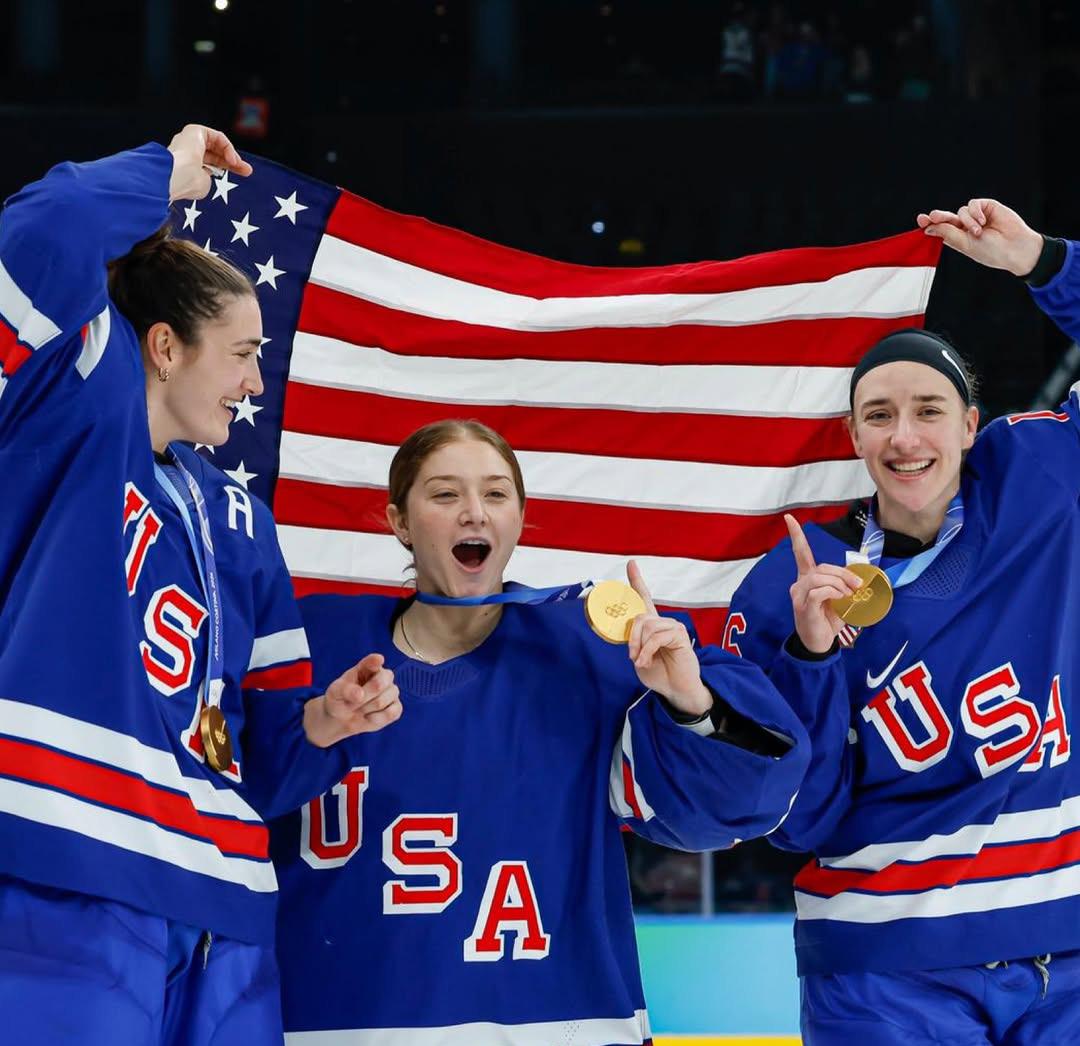
The Winter Olympics recently came to a close and both the women’s and men’s U.S. hockey teams won gold over Canada. The final score of both games was 2-1. Both wins were huge as the men’s team has not won an Olympic gold medal in 46 years, ending the drought since the famous “Miracle on Ice” in 1980. The women’s team last won in 2018 and has three gold medals total from the Winter Olympics. They won in 1998, 2018 and 2026.
After the victories, both teams were invited to the White House to meet with President Trump. The invite came from a phone call from Trump, where he offered to send a military plane to bring them to Washington, D.C.
“We’re giving the State of the Union speech on Tuesday night,” Trump said. “I could send a military plane or something, if you would like to. It’s the coolest night. It’s the biggest speech.”
Trump then included a comment about extending an invitation to the women’s team.
“I must tell you, we’re gonna have to bring the women’s team — you do know that,” Trump said. “If they weren’t invited, I do believe I probably would be impeached.”
The women’s team declined the invitation claiming it was due to scheduling conflicts with professional and academic
commitments. They released a statement expressing their gratitude for their invitation and their inclusion.
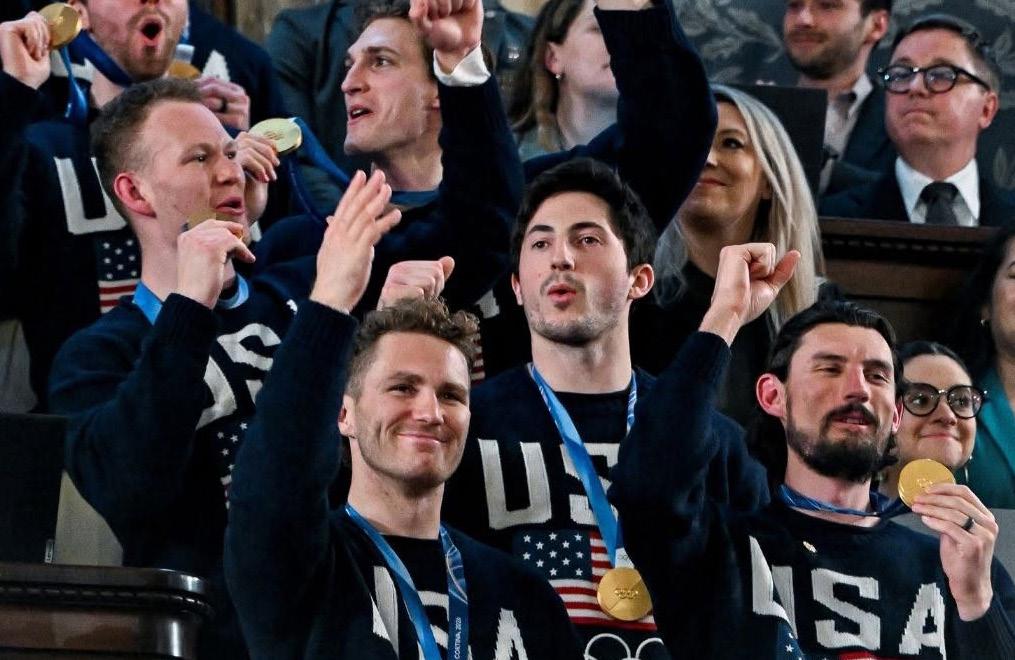
At the State of the Union address there was a standing ovation for the members of the men’s hockey team who were the present and wore their gold medals to the ceremony. Out of the 25 players on the team, 17 were present at the State of the Union. President Trump then awarded the Presidential
Medal of Freedom to the goalie of the hockey team, Connor Hellebuyck. The Presidential Medal of Freedom is widely regarded as the highest civilian award bestowed by the U.S. government. Presented by the president, the medal honors individuals who have made exceptional and lasting contributions in areas such as the arts, public service, science and other fields.
USD sophomore Alan
Hickerson shared his views on the goalie, Connor Hellebuyck, winning the Presidential Medal of Freedom.
“I did not watch the State of the Union Address, but I’ve heard a lot in the news about the hockey team lately,” Hickerson said. “I was very surprised and it didn’t make sense because I learned that it was top of the top reward and I was just kind of like ‘Wow, like good for him’ but at the same time it feels weird.”
After their appearance at the State of the Union, the Hughes brothers appeared on Saturday Night Live this past weekend for the opening monologue done by “Heated Rivalry” actor Connor Storrie. At the end of his monologue, the Hughes brothers joined him on stage and pretended they had no idea what “Heated Rivalry” was about. Storrie was joined by the Hughes brothers, Jack and Quinn and USA women’s hockey captain Hilary Knight and her teammate Megan Keller.
The Hughes brothers competed in their first Olympics, with Jack netting the overtime “golden goal” that secured Team USA’s win over Canada. Meanwhile, Knight is a five-time Winter Olympian, earning two gold medals and three silvers throughout her career.
USD senior Sofia Gatti watched the cold open on SNL and shared her thoughts.
“Pop culture is really having its moment right now in regards to Heated Rivalry and the phone call with Trump and the men’s hockey team and I think SNL did a great
job throwing it back at the men’s hockey team’s face while making it funny,” Gatti said.
“I think Connor Storie smiling at Hilary Knight after that joke too was also very telling to the men’s team that while they may feel as though they are on top of the world, they are a laughing stock on SNL.”
On Monday night, March 2, three of four Olympians who appeared on SNL made their debut on “The Tonight Show” starring Jimmy Fallon. The Hughes brothers and Hilary Knight reappeared on live TV just four days after their performance on SNL.
The three athletes reflected on their hockey journey with Falon and shared when they knew they wanted to play professionally.
USD senior Vi Pham commented on the performance from “The Tonight Show.”
“I have not been following all of the hockey lore in that much detail but I know the men’s team has been receiving a lot of hate because of their political views,” Pham said.
“But I watched ‘The Tonight Show’ and I think Fallon kind of made all of them more likable with his show because they all just shared sort of anecdotes about their past and what inspired them to play hockey. And I think those stories are just cool because they aren’t your typical nepo baby stories that typically circulate popular media outlets.”
The gold medal victories marked a milestone for U.S. hockey as both are major sports accomplishments that led to a lot of media attention over the past few weeks.
Women’s USA Team players hold up gold medals in celebration after their victory.
Photo courtesy of @usahockey/Instagram
The USA men’s hockey team appeared at the State of the Union address on Feb. 24, 2026.
Photo courtesy of
USD club rugby achieves big win
Toreros win in 40-19 victory against UCLA at home
For USD club rugby, a move from Division 1AA (D1AA) to Division 1A (D1A) last summer meant playing against the best college rugby has to offer. Last week the University of San Diego rugby team hosted the UCLA Bruins, a nationally recognized program competing at the highest level.
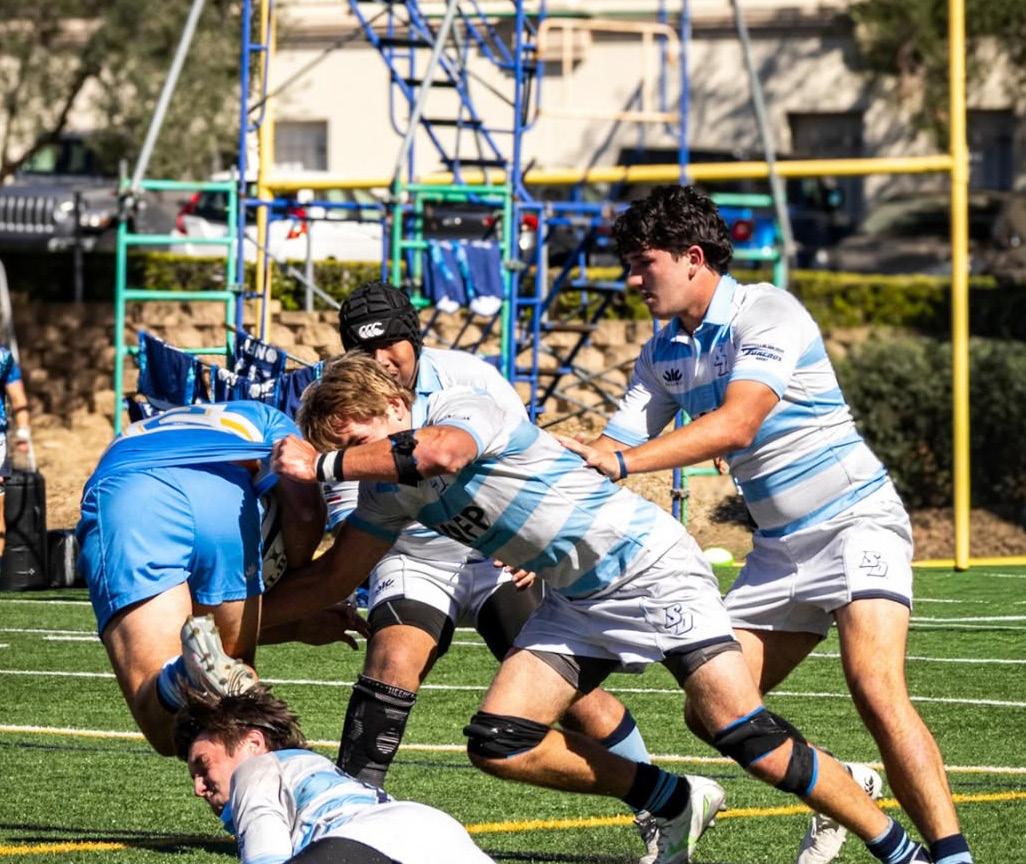
Division 1A represents the highest level of college club rugby in the country, featuring ranked opponents from around the country and established programs. This past week at Manchester Field, USD club rugby delivered its most significant result since the transition, defeating the UCLA Bruins 40-19 in front of a home crowd.
In their first season competing in the California Collegiate Conference, San Diego has quickly positioned itself near the top of the standings, currently sitting in second place. Before their matchup with UCLA, the Toreros opened league play with a tie against UC Santa Barbara. They built momentum, going on a winning streak beating GCU and UC Davis at Long Beach State.
USD first-year and inside center Will Briggs commented on the big win as the team led early and held on to beat UCLA at home.
“First time we’ve beaten UCLA in 15s, and this is

especially important because this is the first season we’ve gotten pulled up to D1A as we’ve been in D1AA,” Briggs said. “I am so happy for the seniors who got to win, obviously in the rankings it’s huge, according to Goff from the Goff Rugby report, our rankings have moved from 17th to 12th after that win, so we are now
ranked 12th in the country.”
Briggs attributed the team’s early season success to what he described as a “blue collar mentality.”
“A big thing about our team is that ‘blue collar mentality’ where we want to just work hard for each other,” Briggs said.
The performance was
bolstered by individual efforts, including USD junior Torres Kapust, who was named D1A Athlete of the Week, and USD graduate student Paul Habeeb, who added two tries in the second half.
USD first-year Cole Dennis said preparation in the training leading up to the match played a critical role in the victory.
“Our coach prepared us by getting us in the right mentality and making practices harder than ever,” Dennis said. “Every player on the team was hungry for the win and that was shown during practice and the game. We were conditioned and disciplined the best we could be.”
Although a regular season game, Dennis said the team entered the game with a deeper purpose.
“We were playing for the legacy of the club and most importantly our brothers,” Dennis said. “This was the game that would prove to the rest of the D1 league that we weren’t there to lose.”
With the victory, San Diego’s club rugby strengthened its position near the top of the California Collegiate Conference standings while continuing to establish itself in its first season at the D1A level.
The result marked a statement win in conference play for USD club rugby as the season is more than halfway over with matches left at Sacramento State, Princeton and Air Force. Club rugby’s B team plays their next game this coming Sunday, March. 10, at home on Manchester Field against Cal Lutheran.
MROW at Redwood Shores Invitational Saturday, March. 7 Redwood City, CA
WROW v.s UC San Diego
7 San Diego, CA WTEN at UC Santa Barbara
MGOLF vs R.E.L Invitational
MTEN vs Memphis
BSB at USC
USD senior Sam Carlson receives the ball on a line-out, which is an inbounding play. Photo courtesy of @usdrugby/Instagram
Toreros stopped UCLA from advancing during the game.
Photo courtesy of @usdrugby/Instagram
GABRIEL ROMERO CONTRIBUTOR
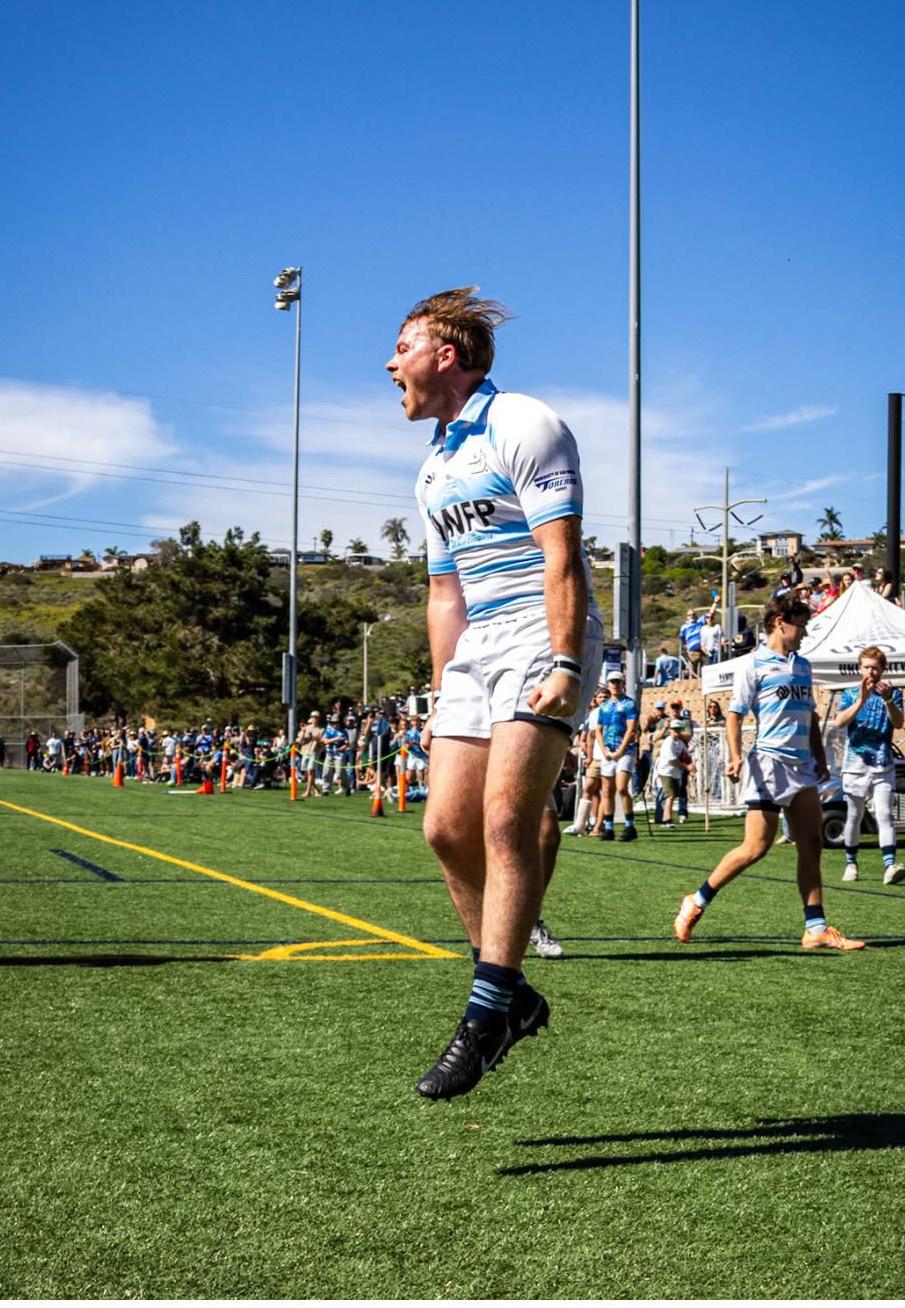
USD player Vaughn Fouts celebrates on the pitch.
Photo courtesy of @usdrugby/Instagram