TheUSDVISTA
Volume 57 Issue 4
Thursday, October 3, 2019
On Newsstands Weekly
◆ The Official Student Newspaper of the University of San Diego since 1968 ◆
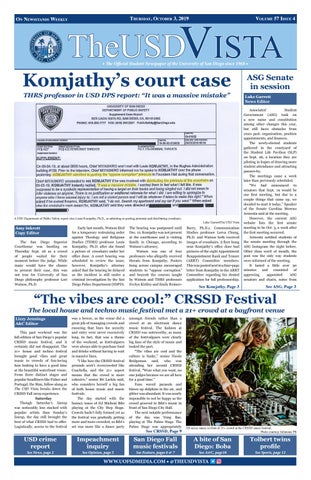
Komjathy’s court case THRS professor in USD DPS report: “It was a massive mistake”
A USD Department of Public Safety report cites Louis Komjathy, Ph.D., as admitting to posting printouts and distributing crosshairs.
Amy Inkrott Copy Editor The San Diego Superior Courthouse was bustling on Thursday Sept. 26 as a crowd of people waited for their moment before the judge. While many would have the chance to present their case, this was not true for University of San Diego philosophy professor Lori Watson, Ph.D.
Early last month, Watson filed for a temporary restraining order against Theology and Religious Studies (THRS) professor Louis Komjathy, Ph.D. after she found a picture of crosshairs under her office door. A court hearing was scheduled to review the issue; however, Komjathy’s attorney asked that the hearing be delayed as the incident is still under a criminal investigation by the San Diego Police Department (SDPD).
The hearing was postponed until Dec. 10. Komjathy was not present at the courthouse and is visiting family in Chicago, according to Watson’s attorney. Watson was one of four professors who allegedly received threats from Komjathy. Posters hung across campus encouraged students to “oppose corruption” and boycott the courses taught by Watson and THRS professors Evelyn Kirkley and Emily Reimer-
ASG Senate in session
Luke Garrett News Editor
Barry, Ph.D.s. Communication Studies professor Leeva Chung, Ph.D. and Watson both received images of crosshairs. A flyer hung near Komjathy’s office door had pictures of the eight Appointment Reappointment Rank and Tenure (ARRT) Committee members. This was posted next to a four-page letter from Komjathy to the ARRT Committee regarding his denied application for full professorship.
Associated Student Government (ASG) took on a new name and constitution among other changes this year, but still faces obstacles from years past: organization, position appointments, and finances. The newly-elected students gathered in the courtyard of the Student Life Pavilion (SLP) on Sept. 26, a location they are piloting in hopes of drawing more student attendance and attracting passers-by. The meetings came a week later than previously scheduled. “We had announced to senators that Sept. 19 would be our first meeting, but due to a couple things that came up, we decided to start it today,” Speaker of the Senate Carolina Moreno Armenta said at the meeting. However, the current ASG website lists the first senate meeting to be Oct. 3, a week after the first meeting occurred. Armenta notified students of the senate meeting through the ASG Instagram the night before. Other than word of mouth, the post was the only way students were informed of the meeting. It lasted a little over 30 minutes and consisted of approving appointed ASG senators and chairs, notes from
See Komjathy, Page 3
See ASG, Page 3
Luke Garrett/The USD Vista
“The vibes are cool:” CRSSD Festival
The local house and techno music festival met a 21+ crowd at a bayfront venue This past weekend was the fall edition of San Diego’s popular CRSSD music festival, and it certainly did not disappoint. The 21+ house and techno festival brought good vibes and great music to crowds of fun-loving fans looking to have a good time at the beautiful waterfront venue. From three distinct stages and popular headliners like Fisher and Portugal. the Man, follow along as The USD Vista breaks down the CRSSD Fall 2019 experience. Saturday Though Saturday’s lineup was noticeably less stacked with popular artists than Sunday’s lineup, the day still brought the best of what CRSSD had to offer. Logistically, access to the festival
was a breeze, as the venue did a great job of managing crowds and ensuring that lines for security and entry were never excessively long. In fact, that was a theme of the weekend, as festivalgoers were always able to purchase food and drinks without having to wait in massive lines. “I like how the CRSSD festival grounds aren’t overcrowded like Coachella, and the 21+ aspect means that the crowd is more cohesive,” senior Bri Larkin said, who considers herself a big fan of both house music and music festivals. The day started with the bouncy tones of DJ Micheal Bibi playing at the City Step Stage. Crowds hadn’t fully formed yet as the festival was gradually getting more and more crowded, so Bibi’s set was more like a dance party
amongst friends rather than a crowd at an electronic dance music festival. The fashion at CRSSD was noteworthy, as many of the festivalgoers were clearly big fans of the style of music and looked the part. “The vibes are cool and the culture is funky,” senior Nicole Bridgeman said, who was attending her second CRSSD festival. “Wear what you want, no one judges because we are all here for a good time.” Fans waved parasols and blown up dolphins in the air, and glitter was abundant. It was nearly impossible to not be happy as the crowd grooved to Bibi’s music in front of San Diego City Hall. The next notable performance of the day was Yung Bae, playing at The Palms Stage. The Palms Stage was appropriately
USD crime report
Impeachment inquiry
San Diego Fall music festivals
Lizzy Jennings A&C Editor
See News, page 2
See Opinion, page 5
See CRSSD, Page 9
See Feature, pages 6 & 7
DJ mixes music in front of 21+ crowd at the CRSSD music festival. Photo courtesy Infamous PR
A bite of San Diego: Boba See A&C, page10
WWW.UOFSDMEDIA.COM ◆ @THEUSDVISTA
Tolbert twins profile See Sports, page 12
2
The USD Vista
October 3, 2019
◆
NEWS
Campus Update
Drop in car theft, rise in stalking
$200,000 UCSD tuition scam
Reports of rape and car theft saw a sharp decrease while stalking and dating violence showed a steep increase in the 2018 calendar year, according to the 2019 USD Annual Fire and Safety Report. Each year, the University of San Diego Department of Public Safety (DPS) is required to share all crime statistics under the Clery Act. USD DPS sent the report to students on Sept. 25 and the report includes the statistics from 2016, 2017, and 2018. In 2018, domestic violence, dating violence, and stalking all increased from zero reports the year before. Stalking rose to seven reports, dating violence jumped to five, and three domestic violence reports were made in 2018. Assistant Vice President of Public Safety James Miyashiro said that these stark increases could be attributed to cyberstalking and abuse through social media. University of California San Diego (UCSD) also saw an increase in stalking and domestic violence, a fact that Miyashiro noted. The number of car thefts decreased by 10 reports, leaving only one car report in 2018, and rapes on campus saw a decrease of five, from seven in 2017 to two in 2018. Another notable decrease was in burglary reports that went from 12 reports to eight. USD has received zero reports of manslaughter in the past three calendar years. Crimes on campus can be reported to USD DPS at (619) 260-7777.
Scammers extorted nearly a quarter million dollars from UCSD international students this summer, according to Miyashiro. The extortions began three months ago and involved scammers who either acted as the state officials on the phone or a third-party tuition service, said Miyashiro. The over-the-phone extortion involves scammers who claim to be either the Internal Revenue Service (IRS) or state police from the international student’s home country. Scammers threaten arrest or a suspension of education visas, prompting students to pay a fine to the con artists. Scammers also offer reduced tuition to students, but only through a faux-thirdparty website that promptly takes the money from students. UCSD officials contacted USD, prompting a precautionary email sent to all students about the scam and how to guard against it. Scams on campus should be reported to USD DPS at (619) 260-7777.
DPS completes investigation on Fiji hazing allegations
ASG appoints new senators and committee chairs
DPS completed their investigation into hazing allegation against the fraternity Phi Gamma Delta, also known as Fiji, during the week of Sept. 16, according to Sgt. Hansen. Fiji was received a cease and desist order last semester following the allegations. The DPS investigation into the hazing allegations began on May 3 and consisted of interviewing students about the allegations, Hansen said. The report created by the DPS investigations will now be sent to Student Conduct where a Greek counsel will decide if the hazing allegations are incriminating or not. Fiji President JP Vargenes did not agree to comment on the investigation.
Appointed senators: College of Arts and Sciences: Eliza Giroux, Eniya Pendleton School of Business: Drew Duhovic, Antonio Cardenas School of Engineering: Justin Daus Vistas: Chidiebele Okaru Commuter: Michayla Mabourakh
UN on climate
The assembly discusses future climate plans Mikaela Foehr Asst. News Editor In the wake of worldwideclimate protests, such as the one held on USD’s campus, the United Nations (UN) met in New York City to discuss its plans to face the problem of global climate change. While some countries pledged themselves to extremely progressive plans, others stuck to the status quo. China and India, two of the world’s largest emitters of carbon, reaffirmed their commitment to the Paris Climate Agreement, but expressed displeasure at the fact that the United States of America, another large carbon contributor, has effectively backed out. This was highlighted by the fact that President Trump only briefly stopped by the day-long summit, according to CBS News. Despite the lack of leadership by traditional global leaders, there were still many progressive pledges made by other countries. According to The New York
Times, over 60 countries pledged to become carbon neutral by 2050, an achievement that matches the tone set by protesters on Sept. 20. A great deal of media coverage focussed on a speech delivered by Greta Thunberg, a 16-year-old climate activist from Sweden. Thunberg illustrated to the assembled ambassadors just how serious this issue was to her. “You have stolen my dreams and my childhood with your empty words,” Thunberg said. “The eyes of all future generations are upon you. And if you choose to fail us, I say, we will never forgive you.” Thunberg has also been very open about the fact that she has been diagnosed with Asperger’s syndrome, a fact that was used to mock her in the aftermath of the speech by some critics. Most notably, guest speaker on Fox News, Michael Knowles, referred to her as “a mentally ill Swedish child” and President Trump retweeted a video of her speech with the caption, “She seems like
a very happy young girl looking forward to a bright and wonderful future. So nice to see!” Thunberg’s words, as well as the disparity of reactions to them, highlight the gap that exists between leaders and citizen activists at various levels across the globe. A gap that is beginning to close on our own campus through awareness efforts by students and policy changes by the school’s administrators.
Thunberg outside Swedish parliment. Photo courtesy of Wikimedia Commons
Appointed chairs: Speaker Pro-Tempore: Maya De La Torre Parliamentarian: Eniya Pendleton Clerk of Senate: Michayla Mabourakh Academics: Daniella Walter Student Life: Maya Ramirez Sustainability: Rhonda Papp Student Organizations: Fanisee Bias Athletics: Drew Duhovic
Luke Garrett/News Editor/The USD Vista
USD action
Future climate plans from Harris Mikaela Foehr Asst. News Editor USD has long touted its commitment to sustainability, but it can be hard to see how exactly the school is keeping these promises. The goal of the Climate Walkout on Sept. 20 was to encourage more action and transparency from USD’s administrative leaders, and that may already be happening. On Sept. 18, two days before the walkout, USD President James T. Harris III, D.Ed. sent an email to the USD student body outlining the university’s old and new commitments to aiding in the fight against climate change. Harris provided some concrete achievements based on the 2016 Climate Action Plan, but promised to push the school to do better by committing to more comprehensive climate goals. In the email, Harris pledged to co-sign, along with students, the President’s Climate Leadership Commitment. It sets out timelines
and deadlines for schools across the country to create plans to achieve the goals outlined in the contract. The headlining goal is to achieve carbon neutrality, which Harris pledged to do by 2035 in his email. Junior Sneha Thomas wanted to be convinced of this plan. “You can say a lot of things, but I actually want to know how he is going to do it,” Thomas said. Another part of Harris’ plan going forward is to develop classes across all majors that address the problem of climate change. Thomas is excited for the new opportunities and discussions that this change could bring to campus. “I just don’t know enough about climate change or the environment to be able to assess policies through that lens,” Thomas said. President Harris will officially sign the President’s Climate Leadership Commitment during Global Climate Change Week, Oct. 14-20.
Volume 57 Issue 4
◆
NEWS
◆
The USD Vista
Professors go to court
3
Watson and Reimer-Barry represented by the same lawyer in restraining order cases
Komjathy from Page 1
In the letter, Komjathy appealed the committee’s unanimous decision, citing support from other faculty members and his perceived commitment to the university’s mission. “I hope that the Appeals Committee and the higher administration will, in turn, recognize the illegitimate and apparently unprecedented nature of the CAS ARRT Committee’s ‘evaluation,’” Komjathy wrote. “I hope that you will recognize the merit of my work based on the actual criteria for promotion.” Other flyers told five individuals to contact his attorney and another included printouts of a black “X.” According to the documents an english professor identified the “X” as the Condor Legion symbol used by Hitler in the Spanish Civil War. According to court documents, USD’s Department of Public Safety (DPS) met with Komjathy the morning after the incident. During this conversation, the DPS officer quoted Komjathy admitting to posting the flyers and the crosshairs. “It was a massive mistake,” Komjathy said in the Public Safety report. “I wanted them to feel what I felt like. It was supposed to be a symbolic representation of having a target on their backs and being
singled out … I am not a violent person and I will do whatever it takes to make this right.” In the report, Komjathy admitted to the threats and attributed his actions to being in a “dysfunctional department”
and “hostile work environment.” The document reported that Komjathy had held office hours in La Paloma and Aromas to avoid using his office. On Sept. 16, the SDPD petitioned for a Gun Violence
Restraining Order against Komjathy. This order prohibits the professor from possessing or buying any guns or ammunition. According to court documents, Komjathy does not have any firearms legally registered to him.
The “X” on Komjathy’s door is the Condor Legion symbol used by Hilter in Spanish Civil War according to an english professor. Luke Garrett/The USD Vista
At the courthouse, Watson and Reimer-Barry were visibly distressed by the situation. During an interview, Reimer-Barry’s hands were shaking as she spoke with reporters. Both professors emphasized the fear that they continue to face as a result of the alleged threats. “There had been a history of his escalating behavior of aggression,” Watson said in an interview with NBC 7 and The USD Vista. “I believe that if he were found responsible for this, that might further escalate his aggression. I believe that if he were held responsible for his actions, either through the university or through the police ... that he would seek me out and get revenge. I am concerned that he is not reliable or stable — when he feels cornered or threatened, he acts out.” Reimer-Barry explained that Public Safety has given her multiple points of reassurance during this ongoing investigation. She was told that the issue is being taken seriously and that safety continues to be its numberone priority. Despite the alleged threats, Watson, Reimer-Barry, and Leeva Chung are continuing to teach throughout the Fall 2019 semester and Evelyn Kirkley remains on sabbatical.
ASG holds first meeting
Fifteen ASG members were appointed by the senate to fill position vacancies ASG from Page 1
the ASG executive staff, and a number of updates on ASG’s $1.5 million budget. Seven senators were appointed, continuing a pattern from last year in which the executive staff selects students to fill senate vacancies. Last year, then-president Natasha Salgado appointed 14 senators. This process was a topic of much debate last year, as some argued that it fails to engage the student body. No debate was had this year, however. The seven appointments were made by one mass vote
upon the suggestion of Armenta, without individual discussion of the appointees. Eight chairs of ASG were also appointed in the same fashion. Despite his appointment, the Finance Chair George Sanderson was not in attendance. ASG had been unable to fill this position over the past few weeks. This has halted much of the financial activity of ASG, prompting concerns from those who rely on ASG funding early in the fall semester. ASG President Marion Chavarria Rivera spoke to the delay in student organization
funding. “Because the initial Finance Chair that we had selected had to step down over the summer due to unforeseen circumstances, we had to take a minute to get our new Finance Chair up to date,” Rivera said. “We are trying our hardest in the next few weeks to get all the funding done.” ASG commands a budget of over $1.5 million made up of a $121 fee paid for by each undergraduate student. The entire Fall 2019 budget was confirmed last May, with one exception — the College Readership Program (CRP).
The CRP program provided physical newspapers in years past and was reduced to digital subscription this past year. The current ASG executive staff decided not to pay for both The New York Times and The Wall Street Journal and are attempting to have Deans pay for one of the two digital subscriptions. The ASG President spoke about the CRP, but did not name the Deans with which she is speaking or the newspapers the ASG executive staff is hoping to fund. “We are trying our hardest to get subscriptions to stay on
campus,” Rivera said. “There is a leaning toward one over the other, but based on my meeting with the dean that I am meeting with I can’t really rule out anything as of yet.” Students still have digital access to both The New York Times and The Wall Street Journal, but both subscriptions are pending contract renewals this fall. ASG has not provided any specific information about the program so far. The next senate meeting is on Oct. 3 at 12:15 p.m. in Solomon Hall. It will be live streamed on the student government’s Instagram.
Screenshot of the ASG website that lists the date, time, and location of senate meetings to students. This information does not match that of the ASG Instragram or when the meeting first occurred. Luke Garrett/The USD Vista
The USD Vista Kaia Hubbard - Editor in Chief Anderson Haigler - Associate Editor Celina Tebor - Managing Editor Amy Inkrott - Copy Editor Alee Pingol - Art Director Luke Garrett - News Editor Eric Boose - Opinion Editor
Catherine Silvey - Feature Editor Lizzy Jennings - Arts & Culture Editor Chris Spiering - Sports Editor Zoé Morales Martinez - Photo Editor Connor Buckley - Distribution Manager Molly Feeney - Social Media Manager Jake Schmid - Finance Manager
Editorial – 619.260.4584 Business – 619.260.4714 www.uofsdmedia.com @TheUSDVista Razann Rizk - Advertising Manager Gina Lew - Student Media Advisor Marie Minnick - Operations Advisor
The USD Vista publication is written and edited by USD students and funded by revenues generated by advertising and a student fee. Advertising material published is for information purposes only and is not to be construed as an expressed or implied endorsement or verification of such commercial venues by the staff or University. The USD Vista office is located on the fourth floor of the Student Life Pavilion in room 403B. All inquiries should be sent to: The USD Vista 5998 Alcala Park San Diego, CA 92110 Opinions expressed in this publication are not necessarily those of The USD Vista staff, the University of San Diego or of its student body. Letters to the Editor can be submitted to The USD Vista office. Letters should be limited to 300 words and must be signed. For identification purposes, USD identification numbers and writer’s year must be included in the letter. The USD Vista reserves the right to edit published letters. Any content sent to the editor will be considered for publication unless otherwise stated.
4
The USD Vista
◆
October 3, 2019
OP I N ION
Op-Ed: Varsity Blues
Parents under-punished for abuse of privilege in admissions scandal Emilie Schumacher Op-Ed Contributor Spoiled kids have a few guarantees in their life. Well, certainly more than just a few, but these are the main ones: they can do what they want, they can spend what they want, and their punishment will be minimal, if it even exists. It sounds like the life, but for other kids who receive fair or even sometimes too much punishment for their actions, it breeds an understandable resentment. They start to ask themselves, why does that kid get away with anything that they do, and I don’t? Spoiler alert, it doesn’t get better with age. The Varsity Blues college admissions scandal has made the news yet again, this time for the sentencings of Felicity Huffman and Devin Sloane. If these sentencings say anything about how the rest of the parents will be punished, then we’re in for a lot of minimal, spoiled-kid punishments. Just like how the lives of spoiled kids are seen as unfairly privileged to the other kids, the lives of these spoiled parents are, and should be, seen as unfairly privileged to other parents. Many have taken this opportunity to compare these two sentencings with the sentence of an African-American woman from Ohio, Kelley Williams-Bolar. According to ABC News, In January 2011, she was convicted of two felony charges for using her father’s
address to enroll her kids in a better school district. She was sentenced to 10 days in jail, three years probation, and a $70,000 fine. Huffman admitted to paying $15,000 to raise her daughter’s SAT scores for a better chance at getting into an elite university. On Friday, Sept. 13, CNN reported that she was sentenced to 14 days in prison, one year of probation, 250 hours of community service, and a $30,000 fine. Sloane admitted to paying $250,000 for his son to go to the University of Southern California as a fake recruit to the water polo team. According to National Public Radio (NPR), on Tuesday, Sept. 24, he was sentenced to four months in prison, 500 hours of community service, and a $95,000 fine. At the time of WilliamsBolar’s sentencing, Judge Patricia Cosgrove told ABC that she “felt that some punishment or deterrent was needed for other individuals who might think to defraud the various school districts.” What Williams-Bolar did was still wrong, regardless of the reasoning, and using the sentencing as an opportunity to deter other parents who might go down the same route was smart. At Sloane’s sentencing, U.S. District Judge Indira Talwani made the point that the crimes committed by many of these parents did not concern basic necessities, but rather “getting your child into a college that might be called exclusive.” She then questioned whether they
were doing so for their children or for their own status. That question of reasoning is at the center of the obvious comparison between Varsity Blues and Williams-Bolar’s case. Williams-Bolar knew that her kids would face immense difficulties based on the color of their skin, difficulties that parents like Felicity Huffman, Devin Sloane and their children never had to face and never will. It’s no secret that better public school districts reside in more affluent neighborhoods, and this contributes to keeping districts largely racially concentrated. In other words, American schools are still segregated, not by law, but by opportunity. WilliamsBolar was trying to give her kids better opportunities. Huffman and Sloane’s children already had those opportunities. Williams-Bolar’s actions were arguably much closer to concerning basic necessities than any of the parents indicted in the Varsity Blues operation. What Judge Cosgrove said at Williams-Bolar’s sentencing also would have been wise to consider in Huffman and Sloane’s cases, as the punishment they both received will not deter others. Fines of $30,000 and $95,000 are chump change for them, and reporting to a probation officer and doing community service don’t affect their lives nearly as much as others. A fine of $70,000 for WilliamsBolar most definitely was not chump change, and three years
probation and 10 days in jail affected her ability to get a job, be considered for a loan, or anything else where a judge of her character is necessary. Williams-Bolar’s punishments could have been significantly lighter and still have deterred other parents from doing the same as she did. Huffman and Sloane’s punishments will not deter others. With such a lenient public punishment, the rich and famous of the world know that they can still cling on to and inflate their opportunities, with little to no penalty. If the rest of the sentencings continue in this pattern, then make no mistake — there will be more scandals like Varsity Blues. Whether or not they see the light of day is to be determined, but they certainly won’t go away. Parents will still bribe their kids’ way into selective universities, universities such as our own. Our very own campus was marred by this scandal on March 12, as the news broke that the University of San Diego was involved in the Varsity Blues operation. For the majority of students who got in on merit alone, to find out that someone allegedly got in on an abuse of privilege is incredibly disappointing, especially considering what USD preaches about fostering an inclusive and diverse environment. Our school is also the perfect example of why every university should be worried about future
scandals like this. In a long list of highly-selective and soughtafter schools, USD stood out as a less-selective, small, private university. We don’t fit the mold of a school that’s expected to be involved in something like this, which sends the message that no university is safe from abuses of privilege. College admissions offices can tighten the screws and implement as many preventative measures as they want, but there will always be different loopholes and opportunities for exploitation. Most admissions offices also don’t have the finances or power to close every single one of those possible loopholes. Ideally, they wouldn’t have to. With the sentencings of Felicity Huffman and Devin Sloane, there was a missed opportunity to send a message that if you choose to go through the side door, you will be fairly punished for it. The Varsity Blues scandal promised to put an end to the advantage given to the elite in the college admissions process, and they still can. If these parents start getting tougher sentences that actually fit the crime, then maybe this can foster change. Fairly punishing the parents of the Varsity Blues situation won’t magically give students from all financial, racial, and educational backgrounds a fair shot at a higher education, but it would be a start.
Op-Ed: Back-to-school season A chilling video with an important message
Kayley Norman Op-Ed Contributor Back-to-school season, for a number of us, can bring to mind memories of new backpacks, shoes, books, pencils, and the basic essentials we craved as young kids or teens venturing back into the new school year. We probably never thought we would need these supplies in life or death situations, but the Sandy Hook Promise did. Founded after the devastating shooting at Sandy Hook Elementary School in Newtown, Connecticut back in 2012, this foundation works to educate and train adults and students to know the signs of gun violence in honor of the lives lost during this tragic event. Their recent video published on the Sandy Hook Promise website and YouTube on Sept. 17, was titled “BackTo-School Essentials.” At first
glance, the cheerful music and smiles on the children’s faces as they show their new supplies to the audience watching, makes this seem like it’s just another ordinary advertisement for the new school year. But within seconds, this jolly advertisement takes a sharp turn into reality, and exposes the harsh truth of what children and teens going back to school have to think about. It’s a truly heartbreaking video, but the message you are left with in the end is vital in spreading awareness of gun violence in the school environment, and hopefully, it will become a catalyst for taking steps toward preventing mass shootings. Seconds into the video, we see a boy studying in the library, exclaiming that his mom got him the perfect headphones for studying. Viewers may be distracted by the smile on the
boy’s face, but a keen eye can see that just behind the boy, other children begin to rush out of the room. Cut to a hallway where another boy is running and says, “These sneakers are just what I needed for the new year,” and we begin to hear that once cheerful music fade out, and it is replaced by gunshots and screaming. Scenes later, a young girl is seen hiding in a bathroom stall. With tears in her eyes and some streaming down her face, we see the young girl send a text, “I love you mom.” The video closes with the sound of footsteps along the bathroom floor and the screen turns black as you hear the young girl gasp for air. A final message appears on the black screen in silence; “It’s back to school time and you know what that means. School shootings are preventable when you know the signs,” and viewers are further urged to visit their website at
www.sandyhookpromise.org. This video makes it quite clear that tragedies of gun violence are not unknown to today’s generation of children and young adults. Dreadfully, it’s not an uncommon event in today’s world, as CNN reported back in July that there have already been 22 school shootings in the U.S.
so far this year, and honestly, it would be naïve to assume that there will not be more. This year marks the 20th anniversary of the Columbine school shooting, and coming this December, it will have been seven years since the fatal shooting at Sandy Hook
Continued on Page 5
Watch the video here:
The views expressed in the editorial and op-ed sections are not necessarily those of The USD Vista staff, the University of San Diego, or its student body.
Volume 57 Issue 4 Back-to-school from Page 4 Elementary School. Whether you have been directly or indirectly affected by school shootings, it is something that shakes us all, and beyond political action, we can often feel helpless. However, it is tremendously important to remember that there are in fact steps we can take to knowing the signs and preventing these gruesome attacks. With further research into the Sandy Hook Promise and a trip to their website, viewers can note their mission and story with a scroll down their homepage. A full mission statement indicated on the website says, “Based in Newtown, Connecticut, our intent is to honor all victims of gun violence by turning our tragedy into a moment of transformation by providing programs and practices that protect children and prevent the senseless, tragic loss of life.” A few clicks in and you can see that they offer ways to get involved in their promise, take a pledge yourself, and most importantly, get the facts. The Sandy Hook Promise offers “16 Facts About Gun Violence and School Shootings,” some of which include but are not
limited to, “Each day eight children die from gun violence in America. Another 32 are shot and injured,” along with, “18 percent of school shootings have taken place since the tragedy at Sandy Hook Elementary School in December 2012.” In addition to these facts, the website offers “Know the Signs” programs, designed to be brief, 30 to 40 minute, student trainings that can be delivered in a classroom, with all the resources provided at no additional cost. For such a program that can help to save lives, a mere sacrifice of time to host just one of these programs is well worth it. An example of these programs includes one entitled “Start with Hello,” a program created to teach today’s youth to, “minimize social isolation, empathize with others, and create a more inclusive and connected culture” the website says. One survey taken by Alfred University recorded the opinions of students and whether they disagreed or agreed with 16 statements regarding the reason for school shootings. The top two responses, with over 87 percent of students strongly agreeing, indicated that school shooters want to “get back at those who
◆
OPINION
◆
have hurt them” or that “other kids bully them.” So, if we are to credit a shooter’s motivations to the school environment and being bullied, I would say that it’s imperative that we work toward creating an inclusive culture in our schools where students do not feel isolated but connected with their fellow classmates. With dedication to prevention programs such as “Start with Hello,” I believe that we can turn these idealistic goals into a reality and rid the modern classroom of hatred, forming it into safe spaces for growth. These programs are important to begin implementing in school communities today, and opportunities to register elementary and secondary schools for such programs is just one click away. The Sandy Hook Promise isn’t alone in this idea of training students and adults in creating a better school environment. The National Institute of Justice (NIJ) reported in a survey that, “approximately 95 percent of school districts have a comprehensive plan to address crisis preparedness, response, and recovery.” This data seems like a step in the right direction,
5
The USD Vista which it is, but the flaw in these programs for preparedness, response, and recovery lies in the practice and execution of these plans. In the same study, the NIJ stated, “In a national survey of more than 750 school-based police officers, about half of the officers said the emergency plans for their schools were not adequate. More than 66 percent indicated that their emergency plans were not practiced on a regular or ongoing basis.” So if these programs and plans provided by school districts for prevention and emergency readiness are inadequate and not practiced regularly, it is crucial that we take the necessary steps to provide and support additional programs like “Start with Hello,” and others like “PRAISE,” offered by the Children’s Hospital of Philadelphia to, “reduce day-today aggression within schools and communities.” These programs are a step in the right direction and definitely worth the time and dedication, as they will work toward creating a more inclusive culture in schools and in turn, save lives. Without political or legislative action, it can be
frustrating to think of how we can prevent gun violence in our schools. However, by knowing the signs and educating others on them, especially our youth, we can start the conversation and begin on the right path. To ignore the facts and the truth that these tragedies occur daily would be a neglect of our position as role models for children today. It would thus be an injustice to not educate those who wish to ignore reality or hide it from their children, especially when support programs and services like the Sandy Hook Promise are so readily available. I implore you to not only watch the PSA posted by the Sandy Hook Promise, but to take it a step further and share the message. Start the conversation. Today’s youth looks up to us to take action, and by providing these programs and educating not only ourselves but others on the signs, we can help to prevent gun violence in schools and change the culture of the classroom for the better. The classroom can once again become a place of learning and growth, rather than one of fear.
Inquiry will set precedent
Congress must put facts above partisanship during inquiry, potential impeachment Eric Boose Opinion Editor We have reached a critical point in American political discourse. The country is arguably more polarized now than it was during the Civil War, and the current administration may be the most controversial the country has ever seen. As if that was not enough, we are now set to embark on one of the most potentially divisive political processes — the impeachment of a sitting president. It should be clear, Congress has not introduced articles of impeachment, which would formally begin the process. However, the Speaker of the House Nancy Pelosi announced a formal impeachment inquiry on Sept. 24, meaning the House of Representatives will officially investigate “what, if any, ‘high crimes and misdemeanors’ Trump may have committed,” in allegedly asking the president of Ukraine to investigate former Vice President Joe Biden, according to The Washington Post. If the House, where Democrats hold a majority, finds evidence they deem sufficient to impeach, they will then draft articles of impeachment. Naturally, President Donald Trump reacted to Pelosi’s announcement of the inquiry with a typical Twitter tantrum, concluding with a tweet which read “PRESIDENTIAL HARASSMENT!” On Saturday, Trump called multiple prominent House Democrats, including Intelligence Committee Chair Adam Schiff and Judiciary
Committee Chair Jerry Nadler, “savages” on Twitter. Generally, the Trump administration and many of its strong supporters in Congress have called the impeachment inquiry nothing more than a partisan attack. Obviously, the inquiry is not entirely nonpartisan. So many Congressional Republicans have shown such loyalty to Trump that they would have surely chosen a different course of action, had they been in control of the House. However, there is also a compelling argument that a serious inquiry into Trump’s dealings with Ukraine is in the best interest of both parties. Hypothetically, if an authoritarian leader in some foreign country asked the leader of another country to investigate a political rival, we would surely call that an abuse of power, and certainly we would be glad that such a thing would never happen in the land of the free. Now, that hypothetical may just be unfolding in our own backyard. It is time to decide if there are things we would criticize in other countries that we would turn a blind eye to at home. Beyond that decision, there is a greater purpose of this inquiry, and any impeachment process which follows, can serve: defining (or re-defining) the limits of what a president can and cannot do. Already, this impeachment inquiry is drawing comparisons to the three previous incidents of impeachment inquiries and impeachment. Admittedly, those comparisons are less so with Andrew Johnson and more
to do with Richard Nixon and Bill Clinton. The bottom line is that this proceeding, however it ends, will not get tucked away in a shadowy corner of American history. Lawmakers on both sides of the aisle should treat this like it will set a precedent for future proceedings. With the eyes of the country watching them, Congress cannot afford to let this impeachment inquiry become a partisan issue. On Saturday, Mark Amodei of Nevada became the first Republican in the House to publicly support the impeachment inquiry, saying, “I’m a big fan of oversight, so let’s let the committees get to work and see where it goes.” Other Congressional Republicans have shown interest in getting more facts about Trump’s dealing with Ukraine, including John Curtis of Utah, who said he had the “utmost confidence in the investigative tools Congress has at its disposal.” Last Tuesday, the Senate voted unanimously, 100-0, in favor of calling on the Trump administration to release a whistleblower complaint which allegedly pertains to Trump’s involvement with Ukraine. With lawmakers on both sides of the aisle in both chambers of Congress interested in getting more facts about the Ukraine issue, that is what this impeachment inquiry must focus on — purely the facts. Democrats must resist the urge to take partisan pot-shots at Trump and at Republicans. At the same time, Republicans must be open to examining any information the inquiry turns up, no matter
how damaging it may be to their party. Ultimately, we can hope that our country will not find itself in a similar situation any time in the future. However, if we do find ourselves at the doorstep of another impeachment proceeding, we will look back on this one, just like we look back on Clinton, Nixon, and even Andrew Johnson. This inquiry, like the others before it, will establish
(or re-establish) boundaries for what a sitting president can and cannot do. This inquiry, and any proceedings which may follow it, will be a test of lawmakers’ ability to put partisanship aside. However it acts, Congress will be setting an example. They should do everything in their power to set a good one, to live up to the political cliché and truly put country above party.
Im-“peach”-ment
Audrey Garrett/The USD Vista
The views expressed in the editorial and op-ed sections are not necessarily those of The USD Vista staff, the University of San Diego, or its student body.
6
The USD Vista
◆
October 3, 2019
While many Toreros cite easy access to beautiful beaches and amazing food as benefits of resi Southern California’s biggest music festivals. Though some of this fall’s biggest events have a
CRSSD - SATURDAY, SEPT. 28 - SUNDAY, SEPT. 29 The CRSSD festival is a house and techno festival located in Downtown San Diego, at Waterfront Park. Occurring twice a year in both the fall and spring, the festival has become known for its welcoming atmosphere and its commitment to enhancing the customer experience. The whole purpose of CRSSD is to bring the house and EDM community in Southern California together for a weekend of good music and great vibes, and with artists like Kaskade and Fisher headlining this fall, CRSSD did not disappoint. Check out the front page and Arts & Culture section (page 9) for our review of this year’s experience.
KAABOO - FRIDAY, SEPT. 13 - SUNDAY, SEPT. 15 KAABOO continued its reign as one of the most popular annual festivals in the San Diego area, celebrating its fifth anniversary this fall. KAABOO took place at the Del Mar Racetrack for the last time, as the festival is scheduled to move to Petco Park next year. Known for predominantly featuring rock artists, the three-day festival hosted Kings of Leon, Dave Matthews Band, and Mumford and Sons as its headliners. The festival is also well-known for its inclusion of a comedy lineup, and featured sets from comedians such as Bob Saget, Tom Green, and Tig Notero during this year’s festival.
Sabrina Alterman/The USD Vista
Sabrina Alterman/The USD Vista
LIFE IS BEAUTIFUL - FRIDAY, SEPT. 20 - SUNDAY, SEPT. 22 Unique in its blend of music and art, the Life is Beautiful Festival returned to Las Vegas for its seventh event since its inception in 2013. Featuring a blend of hip hop, alternative rock, and EDM artists, the festival’s variety was sure to please music enthusiasts of all genres. Additionally, the event displayed art installations and murals for festivalgoers to enjoy, adding another dimension to the eclectic energy of the festival. A notable appearance was headliner Billie Eilish, whose recent success in achieving the top slot on the Billboard Hot 100 built excitement for her much-anticipated set.
Volume 57 Issue 4
◆
FEATURE
◆
7
The USD Vista
iding in San Diego, University of San Diego students also enjoy close proximity to some of already passed, there are still exciting festivals to come for music-loving Toreros to attend.
Photo courtesy of Infamous PR
WONDERFRONT
Photo courtesy of Infamous PR
-- FRIDAY, NOV. 22 - SUNDAY, NOV. 24
The Wonderfront Music & Arts Festival is new to the San Diego scene, and is gearing up for its inaugural year. Also occurring at the downtown waterfront venue, this three-day festival is quickly generating a great deal of excitement in the San Diego music scene and beyond. The festival aims to bring together the expansive San Diego area and its many cultural scenes in one place. Combining Baja and Southern California influences, this new music and art experience is going to be groundbreaking. Toreros should be especially excited for the festival, as they are offering a special discount code for students. The code is “TayaUSD,” which can be used at checkout when purchasing tickets. Ticket prices begin at $229.
CAMP FLOG GNAW
- SATURDAY, NOV. 9 - SUNDAY, NOV. 10
Celebrating its eight-year anniversary this fall, Camp Flog Gnaw has been a massive hit every year since its inaugural festival in 2012. The event itself is a fusion between a music festival and carnival, featuring both performances from big-name artists like YG, Daniel Caesar, and BROCKHAMPTON and carnival activities, such as games, rides, and food vendors. Produced by Tyler the Creator, Camp Flog Gnaw features a star-studded lineup. The festival will take place at Dodger Stadium in Los Angeles, but the long drive will be worthwhile for music-loving Toreros. Ticket prices begin at $235.
Discount Code for Wonderfront Tickets:
TayaUSD
Spread by Alee Pingol/ The USD Vista; Content by Catherine Silvey and Lizzy Jennings/ The USD Vista
8
The USD Vista
◆
October 3, 2019
F E AT U R E
Rosh Hashanah at USD
Jewish students share their personal traditions and what the holiday means to them Catherine Silvey Feature Editor Some Toreros are months away from their new year’s festivities. However, other University of San Diego students have been preparing for a new year celebration that occurred this week — the Jewish celebration of Rosh Hashanah. Rosh Hashanah is celebrated at the beginning of Tishrei, the seventh month of the Jewish year. This year, it was held from Sept. 29 to Oct. 1. First year Abby Foygelman emphasized the significance of Rosh Hashanah in her life, especially within her family. “Rosh Hashanah is a holiday that holds a special place in my heart,” Foygelman said. “It is a time that we celebrate the sweetness of the new year.” The holiday is often celebrated with family and friends, connecting the Jewish community in a celebration of life. Foygelman shared that she celebrates Rosh Hashanah every year with her grandparents. “My family and I are very traditional when it comes to
gathering together on Rosh Hashanah,” Foygelman said. “Every year we go to my grandparents’ house in Orange County. There we are able to have a traditional dinner and go through the prayers together.” Alongside widely-practiced Rosh Hashanah traditions, Foygelman’s family participates in special traditions of their own. “One tradition I love most is apple picking,” Foygelman said. “At my grandparents’ house, they have an apple tree. On Rosh Hashanah, it is custom to eat apples dipped in honey. My family is able to go and pick the apples that we are going to eat, celebrating our new year, new life, and ability to come into it together.” The custom of dipping apples in honey is one of the most popular Rosh Hashanah traditions worldwide, symbolizing hope for a sweet new year. This tradition was celebrated on campus last Thursday by the San Diego chapter of Jewish collegiate organization, Hillel. Senior Simon Mizrahi explained the history behind Rosh Hashanah and why the holiday
is so important to the worldwide Jewish community. Simon is both a member of Hillel and of the oncampus organization, Toreros for Israel. “Rosh Hashanah is the Jewish holiday that celebrates the Jewish New Year,” Mizrahi said. “During the Diaspora, Jews throughout the world often had to hide the celebration of high holidays due to persecution. Today, millions of Jews in the Diaspora still celebrate Rosh Hashanah, but many more celebrate it in Israel, the one and only Jewish state.” Mizrahi expressed that the holiday is not only a community celebration, but also a time of personal meditation and quality time with family. “Rosh Hashanah means to me a tradition that unites Jewish people together to begin a new year filled with love, life, and potential for self-growth,” Mizrahi said. For many, Rosh Hashanah is a reflection on the past year and an expression of gratitude for the blessings in one’s life. Foygelman views the holiday as a time of light in the midst of life’s darkest moments.
Eating apples and honey is one of the most popular Rosh Hashanah traditions. Alee Pingol/The USD Vista
“Rosh Hashanah is a time that even when all the darkness in our lives seems to overcome us, we focus on the good,” Foygelman said. “The goodness in our lives can be represented in many different ways. For me, it is this time that I get to spend with the ones I love the most.” Adam Haberman, Ph.D., a biology professor at USD, expressed the importance of the
holiday for his family. “For me, Rosh Hashanah is a time to focus on family and think about the year ahead,” Haberman said. “We’ll make resolutions for the new year and talk about seeking forgiveness.” Rosh Hashanah is a celebration deeply rooted in Jewish tradition, and is cherished by Jewish individuals both in the USD community and worldwide.
Volume 57 Issue 4
◆
ARTS & CULTURE
◆
The USD Vista
A RT S & C U LT U R E
9
CRSSD’s waterfront weekend
Recounting all the highlights from another edition of the jam-packed CRSSD Festival CRSSD from Page 1
decorated with flowing cloth covered in images of palm leaves in various shades of green, and the lighting of the stage alternated between white and green lights, making the atmosphere appear as though the crowds had entered a tropical realm. Yung Bae’s vibe is especially groovy, and he, like Bibi, had the crowd dancing through his entire set. As a performer he was noticeably engaging, constantly getting his crowds involved by having them shout out riffs or bounce their hands to the beat. The day carried on with performances from Green Velvet, SG Lewis and Polo & Pan as crowds thickened. Green Velvet dominated the City Steps Stage while Polo & Pan gave an awe-inspiring set at the Ocean View stage. This stage was the largest, and lived up to its name with impressive views of the water that make this festival so distinctive. Polo & Pan was captivating, drawing crowds in with their mystical sound and French accents. The duo has been described as enchanting and this description holds true; the vibing sounds had the whole crowd swaying along to the magical beats as the sun set on Saturday. Hot Chip and yaeji brought the energy back up with their bouncing sets that held true to the house and techno vibes. The New York artist yaeji brought breathy tones and a beating bassline while Hot Chip emphasized their eclectic songwriting and quirky taste in their set. The two acts concluded the night,
and as festivalgoers poured out onto the streets of Little Italy, the excitement and anticipation for the next day was already pulsing through the crowd.
Photo courtesy of Infamous PR
SUNDAY Even though it was a Sunday afternoon, you wouldn’t have been able to tell from the lively CRSSD crowds who were streaming back into the venue for their second day of music. Even from the outside of the venue fans could hear the pounding bass of sets already going on, keeping everyone excited even as they waited in line for festival entry. The day truly kicked off with Masego on the Ocean View stage, whose distinctive, jazzy sound, was different from some of the other more strictly house sets. Crowds hadn’t fully formed in the venue yet, so his set was characterized by the laid-back feel of the crowd, who vibed along to his music while laying on the crowd or bouncing around with their friends. One of the most impressive aspects
of Masego’s sets was his live saxophone playing, which blew away crowds more used to strictly DJ-style performances. Then the day carried on, with The Palm Stage’s stacked lineup. Anna Luneo went on, giving the crowds an ethereal performance. It was exciting to see a female DJ, especially because her performance held up well against her male peers. Her set gave way to Kyle Watson’s, who was a must see for many of the USD festivalgoers. Walker and Royce followed with another impressive set, though they ended up not playing many of their hit songs like “Take Me To Your Leader” and “My Own Thang,” which disappointed fans. Instead, the duo they played their new music from their recently dropped “Rave Grave” EP, which was just released this September. The Palm Stage rounded out their impressive day with DJ MK, who is known for his European-influenced dance music. His set made the stage feel like a European dance club, and kept the crowds engaged even after long days of dancing. At the same time as MK was making the SoCal festival feel like Europe, Kaskade was playing their redux set on the Ocean View Stage. Because Kaskade has been DJing since 2000, his music catalogue is filled with hits that he can’t play at every set; this is the purpose of a redux set. He is aiming to return to his roots by focusing on the sounds that made him popular all those years ago. “I have been looking forward to Kaskade’s set for
Masego’s skills on the saxaphone blew away the crowds bouncing along to his set. Photo courtesy of Infamous PR
a while because he is one of my favorite artists, and I knew he wouldn’t disappoint,” senior Vanessa Grasso said of her thoughts on Kaskade reminding fans of his old sound. “He was absolutely my favorite artist who played this weekend.” The festival concluded with the two biggest headliners of the weekend playing thirty minutes apart. Fisher took over The Palm Stage and the crowd was
The Palm Stage had one of the coolest atmospheres out of all the CRSSD stages, featuring an abundance of tropical decorations like palm leaves and suspended parasols.
packed. Everyone was dying to see his hit songs like “Losing It” and “Stop It,” but the rest of his set wowed the crowd as well. Portugal. the Man took over the Ocean View Stage with some of the most impressive theatrics of the entire weekend. Lights strobed in the sky and smoke poured out of the stage as the band gave festival goers an impressive conclusion to another successful CRSSD weekend.
Photo courtesy of Infamous PR
10
The USD Vista
◆
October 3, 2019
A bite of San Diego: boba
Discover the best boba San Diego has to offer in this week’s food column Ashley Ingraham Contributor Boba tea first emerged in the Tawainese culinary scene in the 1980s. Since then, it has grown to become a consistently popular item throughout the U.S., with an especially noticeable presence in Southern California. Convoy Street in Kearny Mesa hosts many of these tea shops due to its large Asian community, making boba easy to find for San Diego residents. To give a brief overview of what “boba tea” actually is, the concoction is usually a sweet drink combined with milk, flavored tea, and tapioca balls. The tapioca balls, or what is referred to as the “boba,” are typically dark spheres at the bottom of the drink with a chewy texture. Other popular items that are commonly added to milk tea include red bean, jelly, pudding, and popping boba. If you’re a fan of boba, or want to give it a try, this list will surely give you an idea of some of the best boba shops in San Diego.
throughout the location that are perfect to take pictures in front of. I personally enjoy any of their drinks that include the rose flavor, the black rose milk tea specifically. Since the shop is called “The Korean Rose,” this is definitely a place you want to go to if you yourself are also a rose tea fan. It’s common for other boba spots to have too strong of a rose taste in their tea making it a little overbearing, but I find here that the balance is perfect. Another plus is that it’s open until midnight on weekdays and 1 a.m. on weekends, which means all your late-night boba cravings can be accommodated. Parking is easy to find and prices range from $2 to $5.
Celina Tebor/The USD Vista
Celina Tebor/The USD Vista
The Korean Rose 7655 Clairemont Mesa Blvd. Ste. 502 San Diego, CA 92111 First up on the list is The Korean Rose, a fairly new boba shop in San Diego. Its soft opening happened recently, on Feb. 1 of this year. Nevertheless, it has quickly become quite a popular spot. Not only does it have excellent boba tea, it also offers other items that make its menu unique. Such items include its Instagrammable specialty drinks, cheesecake and yogurt smoothies. Besides tasting great, its drinks look great too, featuring a wide range of vibrant colors. This is what makes its speciality drinks so perfect for posting. A popular drink for posting all of September was their monthly speciality tea lemonade named “Euphoria.” The drink has cascading ombre colors of purple, pink, and red finished with a shimmer to make the drink appear glittery. I find that its year-round matcha drink options more than satisfy posting needs. The shop also has cute LED light roses put up
Boba Bar and Desserts 4619 Convoy St, San Diego, CA 92111 and 7655 Clairemont Mesa Blvd San Diego, CA 92111 Boba Bar and Desserts has two locations in the San Diego area, one being on the ever-sopopular Convoy Street. At this tea shop, many go for the boba but stay for dessert. Customers love the boba tea and smoothies at this restaurant, but they rave about Boba Bar’s “puffles.” Puffles are a waffle dessert with frozen treats, toppings, and drizzles of your choosing. You can pick from their specialty puffles or build your own. Customers also love the tapioca balls at Boba Bar and claim they have the perfect consistency, making the experience at this restaurant that much better. Boba Bar is a great place to go to for typical black milk tea and Thai tea drinks since their flavoring and drink quality is always consistent. I know for me personally, I love having a go-to place that I can be confident in receiving good product. Parking at peak times can be a little hard since the shop shares its lot with surrounding restaurants, but the great pricing makes up for it with item prices not exceeding $10. Ding Tea 5945 Balboa Ave San Diego, CA 92111 Another popular chain tea shop that has locations all across Asia and America is Ding Tea. Instead of having traditional boba, Ding Tea offers golden boba. The only difference between traditional boba and golden boba, however,
Ding Tea is decorated in an aesthetically-pleasing manner, with neon signs catching the eyes of customers. Photo courtesy of Mark Bautista
is the color. Ding Tea also offers crystal boba, which has a chewy, yet not as jelly-like texture as usual boba and has a subtle grapefruit, citrus flavor. A customer favorite at this tea shop is their Signature Milk Tea. Ding Tea’s menu has a multitude of other flavored milk teas to choose from including Jasmine Green Milk Tea, Honey Milk Tea, Lychee Milk Tea, and many more. Moreover, they also offer iced teas and coffee which all range from $3 to $5. Along with its boba tea, Ding Tea also offers Yakult yogurt drinks. Yakult is a fermented milk drink that helps with digestion and building immunity by increasing the number of beneficial bacteria in your digestive system so harmful ones cannot take over. Ding Tea offers different flavors of this popular Asian drink like green tea, passion fruit, and mango to name a few. Customers also love that at
Celina Tebor/The USD Vista
this location there’s activities to do while hanging out and drinking their tea. Ding Tea has board games available and a wooden foosball table set up as well. An extra plus to this tea shop is that if you can’t find parking out front, there’s an ample amount of spots behind the restaurant as well. It’s Boba Time 4344 Convoy St Unit A San Diego, CA 92111 Want a boba place that has endless options to choose from? It’s Boba Time is the perfect shop to pick with its service of over 100 drinks. Their “Top 10” menu includes milk tea, smoothies, frappes, and shakes of all flavors. You can even search for certain beverages on their website. Plus, all their drink prices range from $3 to $6. With a menu as extensive as It’s Boba Time’s, there is of course also unique options for those willing to venture off and try different kinds of drinks. One of the most interesting items on their menu is Cheese Foam Top. True to its name, Cheese Foam Top drinks are green or black tea topped with foam made from salty or sweet cream cheese, milk, and whipping cream. With Halloween right around the corner, make sure to keep a heads up for a 10 percent holiday discount since they have been known to offer this for holidays in the past. It’s Boba Time also has street parking and a private lot, making getting in and out with your boba a breeze.
Vivi Bubble Tea 3904 Convoy St #116 San Diego, CA 92111 Last on the list is another popular chain restaurant in San Diego, Vivi Bubble Tea. This franchise branched out from Taiwan and opened locations in the U.S. in 2007, and have been quite successful. Tea aside, Vivi Bubble Tea feeds millennials’ Instagram addictions through their signboards and cute decorations, making each moment pictureworthy. The shop’s interior and exterior design has fun cartoon skull characters and bubble font signs. To top it off, its walls are also painted baby pink to match the artwork and add to the overall vibe of the place. The shop’s cups also have adorable designs mirroring the aesthetic of the tea shop. These images range from the skull-like cartoon characters mounted and painted around the restaurant to pixelated and highly stylized world maps. What many customers appreciate about this particular tea shop is their non-traditional flavors for their drinks. On their signature menu, customers rave about the Blue Galaxy tea. The blue, purple, pink, and yellow ombre set colors make the drink eye catching and a fun choice. While Vivi Bubble Tea does have typical black milk tea, their menu also ventures out to hold flavors like honeydew, ginger, and flaming brown sugar to name a few. To top it off, they also have the standard boba pricing from $3 to $5.
Volume 57 Issue 4
◆
SPORTS
◆
11
The USD Vista
SP ORT S
Meet the men’s rugby team University of San Diego rugby is a club sport with Varsity expectations
Maria Watters Asst. Sports Editor Though rugby isn’t one of the University of San Diego’s NCAAsanctioned sports, players on the USD rugby team have high expectations for themselves. Playing at the highest level of college club rugby, the team has labeled their organization as a “club sport with varsity expectations” and perhaps rightfully so. Fielding a team since 1980, the USD club rugby team has established a tradition of hard work in a sport that is growing in popularity everyday. From the outside, a casual sports fan might consider rugby a cross between a high-contact version of soccer and football, minus the pads. And, in some ways, it is. Though rugby is not as wildely popular in the U.S. as it is in other countries, the sport has a rich history spanning over 2000 years, with its origins tracing back to the ancient Romans who played a primitive version of the game. Modern rugby, however, can thank William Webb Ellis, the “creator” of the game when he, disregarding the rules of the time, ran with the ball in his arms in 1823. Since then, rugby has become a cultural phenomenon with hundreds of millions of fans worldwide and counting. While the sport is most popular in countries like New Zealand, England, Ireland, and Scotland, interest in rugby in the U.S. and other countries has increased since rugby “sevens” was included in the 2016 Rio De Janeiro Olympics. Rugby sevens is when teams are seven versus seven instead of 15 versus 15.
Defining rugby may be tough to the average individual. Though wildely entertaining to watch, the specifics of the game can be quite difficult to understand without some help. Rugby is a highly-complicated game, but, like many other sports, the main goal is to outscore your opponent in the 80 minutes allotted for each match. Two opposing teams face each other on a field or pitch, and try to score in one of four ways. A try is worth five points and is awarded when a player touches the ball to the ground behind the goal, similar to scoring a touchdown in football. A conversion, worth two points, is scored by kicking the ball between two posts above a goal (think field goal or extra point). A penalty kick is given after a team commits an infringement or foul and is worth three points. Finally, a drop goal is worth three points and can be earned at any time so long as the ball bounces before it is kicked. Aside from scoring, what is unique about rugby is the rule that the ball can never be dropped or passed forward by a player. All passes are thrown behind the player with the ball; however, if the ball does move forward, on a pass or is dropped, the referee will award a scrum. Probably the most complicated and violent aspect of the game, a scrum is contest of brute strength and strategy as both teams push each other in hopes of getting the ball to their free player and resume play. When the ball goes out of bounds, the referee will signal a lineout in which both teams will face one player throwing the ball back in play toward his team. At that
The USD rugby team warms up before each practice by tossing the ball back and forth.
precise moment, each team will launch one of their players into the air to catch the ball. As if high flying, kicking, tackling, and wrestling weren’t enough to draw attention to this unique sport, rugby presents a truly unique community for its players and fans that is unlike any other sport. Sophomore Henri Vatinel appreciates the sportsmanship that is a part of the game. “Usually when you think about sports you think about competition,” Vatinel said. “The reason I like rugby is that afterwards you get to shake hands with the other guys and we eat together and we have a couple laughs.” For senior Darren Steward,
the sense of unity is his favorite aspect of the game. “(It’s) the community, the brotherhood,” Steward said. And it really is just that: a brotherhood. The USD men’s club rugby team spends hours and hours together each week training and practicing. “It’s definitely a big commitment,” Steward said. “But we play at a Division I (club level), so it’s a lot of work for a lot of payoff.” Junior Cam Wilmer, the team’s president, has been playing rugby since he first picked it up in middle school after moving from Hong Kong to Canada when he was 14. To Wilmer, the best thing about rugby is the philosophy behind
Maria Watters/The USD Vista
the game: “work hard, play hard.” With three weight training sessions a week, two hour practices, and conditioning on the beach, it would seem like only serious athletes could participate. “It doesn’t matter your skill or experience,” Wilmer says. “If you like sports you’ll have a fun time, if you like a team you’ll have a fun time.” Whether it’s trying out for the team, cheering on the Toreros, or watching the Rugby World Cup being played worldwide, rugby is a game that is played for everyone. It’s the action-packed competition that draws millions to the stands, and the community that brings the players.
12
The USD Vista
◆
October 3, 2019
Tolberts take on senior year Identical twins David and Daniel Tolbert share their University of San Diego football
Chris Spiering Sports Editor Football started at an early age for the Tolbert twins. From playing Pop Warner in grade school, to high school and college football, the identical twins have been playing most of their lives. “I have been going to practice every August for the last 16 years,” David Tolbert said. “This has really been most of my life, and most of my best memories are on the football field.” Football training camp starts in August for almost every level. “The August part is crazy,” Daniel Tolbert said. “Every time August comes around you just know that you have to get ready for football.” Before David and Daniel Tolbert arrived at the University of San Diego as first years, they didn’t know much about the history of the school’s football program. But the team, made up of mostly upperclassmen, brought them in and treated them like family from the start. David and Daniel knew that this was going to be the place for them. A typical day for a USD football player consists of being with their teammates either at school or at practice, meetings, and watching film. On certain days, the players wake up and go to weightlifting early in the morning.
Senior David Tolbert tackles the Stetson ball carrier in the Toreros’ 49-10 victory over the Hatters last season.
“We start with lifting weights at 7:15 in the morning,” Daniel said. “Next we shower and eat a quick breakfast. Then we have class up until practice, after that we have meetings, and on some days we have class after practice.” Ever since they were young, it was tough for people to tell the twins apart. Even coaches and teammates had trouble, but over
time, it got easier. “The good thing about sports is, we have numbers,” David said. “So people usually just remember you by your numbers.” But that isn’t always the case. The twins had their fair share of coaches not being able to tell them apart. “When we were young it happened all the time,” David
Daniel (left) and David (right) share a special bond as both twins and members of the USD football team. Photo courtesy of Thomas Christensen
said. “Coach used to just say ‘David-Daniel’ when he would want to call one of us, knowing one of us would look.” Aside from telling them apart, it’s easy to see them make plays on the football field. The Tolbert twins have a prominent role in the Torero defense. Their individual roles on the team are a huge boost for the defense. “I feel like I know the defense better than anyone else,” Daniel said. “I have to communicate more and I’m the last line of defense. I try to lead by example.” Daniel Tolbert plays safety for the Torero defense and David plays cornerback. They are both considered defensive backs. “My role here has grown over the years,” David said. “As a freshman, I was fortunate to play a little bit. I feel like a leader, I’m telling guys where to line up and calming guys down when I need to. I’m never going to get too riled up to where I get out of my own game. So that is what I try to pride myself on.” Both the Tolberts strive to be leaders on the field and as seniors, they know that their roles on the team will benefit the other players. USD football is not a scholarship sport, so the players use that as a little extra motivation when playing schools that do offer scholarships to their football players “Every time we play UC Davis, Cal Poly, even Harvard, you want to win that game because you know that they have something that you don’t have,” David said. Scholarship or no scholarship, the twins are here to play football. “It’s tough some days, especially since we do everything a scholarship school does,” Daniel said. “We just have to go out there and compete as if we were at those schools.” Last Saturday, USD defeated Harvard to give the Toreros
Photo courtesy of Thomas Christensen
their first win of the season. Daniel Tolbert sealed the win on defense with an interception late in the game. “It actually goes back to the sideline before we go on the field for the last time,” Daniel said. “Miles Wilson, number 99, told me to make a play. I was just reading the quarterback the whole way and saw that he was actually going to throw it. I actually cut in front of David and he still tells me that he should’ve had that interception, but it was just a cool play to help us win.” As David and Daniel start their senior year, they praise their time under head coach Dale Lindsey. “Coach Lindsey is definitely a guy that knows so much about football,” David said. “When he talks, you have to listen. But at the same time he is going to be tough on you, he might say some things that you don’t necessarily agree with, but at the end of the day it’s coming from a good heart. He is always looking out for us.” Lindsey strives for his team to be disciplined. “I like the discipline that goes along with the program,” Daniel said. “I have never played for an undisciplined team, so it’s nothing that I am not used to. Lindsey knows that discipline is the first step to being a good team.” David and Daniel know what USD has meant to them in their four years here. “This has been some of the best four years of my life,” David said. “Just the people I have met, some of my best friends who will probably be at my wedding. The bond we have in the locker room is what I love the most about being here. I’m definitely going to miss that next year.” You can catch the Tolbert twins in action this Saturday, Oct. 5 at 2 p.m. against PFL opponent Marist College at Torero Stadium during Homecoming Weekend.