TheUSDVISTA
Volume 57 Issue I
Thursday, September 12, 2019
On Newsstands Weekly
◆ The Official Student Newspaper of the University of San Diego since 1968 ◆
DOJ case development
Flaxman’s son no longer at USD, no other university member involved
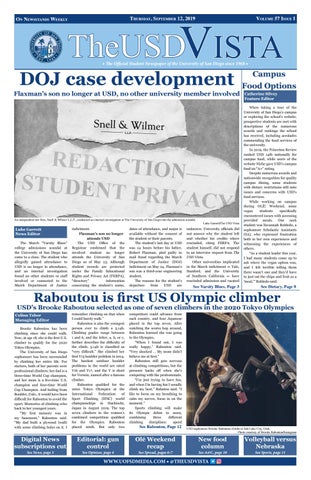
An independent law firm, Snell & Wilmer L.L.P., conducted an internal investigation at The University of San Diego into the admission scandal.
Luke Garrett News Editor The March “Varsity Blues” college admissions scandal at the University of San Diego has come to a close. The student who allegedly gained attendance to USD is no longer in attendance, and an internal investigation found no other students or staff involved or connected to the March Department of Justice
indictment. Flaxman’s son no longer attends USD The USD Office of the Registrar confirmed that the involved student no longer attends the University of San Diego as of May 23. Although student records are protected under the Family Educational Rights and Privacy Act (FERPA), “directory” information concerning the student’s name,
dates of attendance, and major is available without the consent of the student or their parents. The student’s last day at USD was 24 hours before his father, Robert Flaxman, pled guilty to mail fraud regarding the March Department of Justice (DOJ) indictment on May 24. Flaxman’s son was a third-year engineering student. The reasons for the student’s departure from USD are
Luke Garrett/The USD Vista
unknown. University officials did not answer why the student left and whether his credits where rescinded, citing FERPA. The student himself, did not respond to an interview request from The USD Vista. Other universities implicated in the March indictment — Yale, Stanford, and the University of Southern California — have rescinded admission and vacated
See Varsity Blues, Page 3
Campus
Food Options Catherine Silvey Feature Editor When taking a tour of the University of San Diego’s campus or exploring the school’s website, prospective students are met with descriptions of the numerous awards and rankings the school has received, including accolades commending the food services of the university. In 2019, the Princeton Review ranked USD 14th nationally for campus food, while users of the website Niche gave USD’s campus food an “A+” rating. Despite numerous awards and nationwide recognition for quality campus dining, some students with dietary restrictions still note issues and concerns with USD’s food services. While working on campus during OLÉ! Weekend, some vegan students specifically encountered issues with accessing provided meals. One such student was Savannah Robledo, a sophomore Scholastic Assistants (SA), who expressed frustration both in her own experiences and witnessing the experiences of others. “As a student leader this year, I had many students come up to ask where the vegan option was, and I felt terrible telling them there wasn’t one and they’d have to just eat the chips and fruit as a ‘meal,’” Robledo said.
See Dietary, Page 8
Raboutou is first US Olympic climber
USD’s Brooke Raboutou selected as one of seven climbers in the 2020 Tokyo Olympics Brooke Raboutou has been climbing since she could walk. Now, at age 18, she is the first U.S. climber to qualify for the 2020 Tokyo Olympics. The University of San Diego sophomore has been surrounded by climbing her entire life. For starters, both of her parents were professional climbers: her dad is a three-time World Cup champion, and her mom is a five-time U.S. champion and four-time World Cup Champion. And hailing from Boulder, Colo., it would have been difficult for Raboutou to avoid the sport. Memories of climbing echo back to her youngest years. “My first memory was in my basement,” Raboutou said. “My dad built a plywood (wall) with some climbing holes on it. I
remember climbing on that when I could barely walk.” Raboutou is also the youngest person ever to climb a 5.14b. Climbing grades range between 1 and 6, and the letter, a, b, or c, further describes the difficulty of the climb. 5.14b is classified as “very difficult.” She climbed her first V13 boulder problem in 2014. The hardest outdoor boulder problems in the world are rated V16 and V17, and the V is short for Vermin, named after a famous climber. Raboutou qualified for the 2020 Tokyo Olympics at the International Federation of Sport Climbing (IFSC) world championships in Hachiochi, Japan in August 2019. The top seven climbers in the women’s combined competition qualified for the Olympics. Raboutou placed ninth. But only two
competitors could advance from each country, and four Japanese placed in the top seven. After watching the scores hop around, Raboutou learned she was going to the Olympics. “When I found out, I was really happy,” Raboutou said. “Very shocked … My mom didn’t believe me at first.” Raboutou still gets nervous at climbing competitions, but the pressure backs off when she’s competing with the professionals. “I’m just trying to have fun, and when I’m having fun I usually climb my best,” Rabatou said. “I like to focus on my breathing to calm my nerves, focus in on the moment.” Sports climbing will make its Olympic debut in 2020, combining three different climbing disciplines: speed
Digital News subscriptions cut
Editorial: gun control
Olé Weekend recap
Celina Tebor Managing Editor
See News, page 3
See Opinion, page 4
See Raboutou, Page 12
See Spread, pages 6-7
USD sophomore Brooke Raboutou climbs in Salt Lake City, Utah. Photo courtesy of Brooke Raboutou/Instagram
New food column See A&C, page 10
WWW.UOFSDMEDIA.COM ◆ @THEUSDVISTA
Volleyball versus Nebraska See Sports, page 11
2
The USD Vista
◆
September 12, 2019
NEWS
Campus Update
USD bans dockless scooters
Birds, Limes, and other electric scooters are no longer allowed on USD’s campus, said Public Safety Chief James Miyashiro in an email sent to the entire campus community on Aug. 29. The scooters can be used to travel to campus, but must be left in designated drop-off areas. Miyashiro cited “instances of accidents involving electric or motorized scooters across the country” as the reason for the scooter ban. Warning cards will be given to first-time violators. If students are found violating another time, a report will be sent to the Office of Ethical Development and Restorative Practices.
Main entrance designated drop-off area
Photo courtesy of USD Department of Public Safety
East entrance designated drop-off area
Photo courtesy of USD Department of Public Safety
West entrance designated drop-off area
Photo courtesy of USD Department of Public Safety
Printing on Campus
A new printing service arrived on campus this year. Wēpa printing consoles are across campus. The third-party printing service is meant to kick out the middleman, allowing students to print directly from their cloud, phone, USB, and email.
New ticket booth
The USD ticket booth has moved from the glass window outside of the University Center to the desk complex adjacent to Tu Mercardo. A popcorn machine greets students who visit this new location. The desk complex was seldom used by the Torero Program Board in prior years and will now be the permanent home of the ticket booth. The UC’s window will be converted into an office space.
Hong Kong removed from intercession tour The University of San Diego’s International Center canceled its visit to Hong Kong during their Asia Tour 2020 program. The political unrest in the once-British colony and now-Chinese territory caused Hong Kong to be removed from the tour. The program’s trip to Seol, Taipei, and Siem Reap will each be extended by one to two more days. The International Center notified students through an email sent on Tuesday, Sept. 10.
We’re Renovating Copley Library! While some traditional study areas are temporarily closed, here are a few areas that are open: Copley’s Mother Hill Reading Room Mon-Thurs: 7 a.m. - 2 a.m. Fri: 7 a.m. - 9 p.m. Sat: 9 a.m. - 9 p.m. Sun: Noon - 2 a.m. UC/SLP General Area Mon-Sun: 7 a.m. - 1 a.m.
Tu Mercado Sun-Thurs: 7 a.m. – 11 p.m. Fri-Sat: 7 a.m. - 10 p.m. Saints Tekakwitha and Serra Hall Foyer open 24/7
To find a location near you, go to sandiego.edu/study-spaces.
Volume 57 Issue I
◆
NEWS
The USD Vista
◆
“Varsity Blues” concludes
3
Questions still remain regarding the reasons for the student’s departure from USD Varsity Blues from Page 1
the credits of some students involved, while other students, like Lori Loughlin’s daughters, have left their universities on their own accord with credits intact. According to the father’s plea agreement with the U.S. Attorney for the District of Massachusetts, the admission scheme involving Flaxman’s daughter will be the only one resulting in criminal charges for Flaxman. No other staff or students involved in the scandal Over the past few weeks, USD President James T. Harris III, D.Ed. emailed students and staff the findings of an internal independent investigation called for in March following the DOJ indictment. The law firm, Snell & Wilmer L.L.P., found that no other current or former USD employees
were involved in the alleged wrongdoing other than those cited in the DOJ indictment. The investigation did find that four USD employees had contact with Singer, the scheme’s orchestrator, but found no wrongdoing done on their behalf. In an interview, Harris spoke of the steps university officials are taking to guard against future admissions bribery attempts. “We are going to have another coach and another administrator in athletics look at the list (of students) that a coach submits — no matter what the sport is — to the admission office,” Harris said. “And we are going to have not one set of eyes, but two sets of eyes in the admission office on any of these discussions.” Snell & Wilmer investigators did find information concerning the involved student but all
was redacted from the report due to the Family Educational Rights and Privacy Act (FERPA). Harris also declined to make any comment on the involved student, citing FERPA restrictions. This act guards college students’ information from being released without the eligible student or parent’s consent. However, FERPA does allow universities to publish “directory” information, including the student’s dates of attendance and major, according to the U.S. Department of Education. Because of this, the USD Office of the Registrar confirmed with The USD Vista that the student who was allegedly bribed into USD no longer attends the university. Original March Indictment The initial DOJ indictment concerned Robert Flaxman, his
son and daughter, Martin Fox, and William “Rick” Singer. According to the DOJ, Fox facilitated bribes paid for by Flaxman and allegedly received by former USD men’s basketball head coach Lamont Smith. In return for the payments, Smith allegedly designated the son of Flaxman as a basketball recruit, even though the son did not play the sport. As for the daughter, Smith was paid $10,000 in helping secure her admission although she did not attend USD like her brother, according to DOJ documents. The Snell & Wilmer investigation did find further university documents that paint a full picture of how Smith used his powers as head coach to ensure the admission of Flaxman’s daughter. In brief, the indictment and executive summary detail how
Smith told the USD Admissions Office that Flaxman’s daughter was the sister of one of his players and he wanted her to fill one of his student manager positions. University records show that there was no funding for the manager position. On May 24, Robert Flaxman admitted to paying $75,000 to alter his daughter’s ACT score, according to a Los Angeles Times article. According to the published plea agreement, between Flaxman and the DOJ, no other criminal charges will be made against Flaxman in connection to the initial indictment, meaning his son will not be included in the federal prosecution of his father. Robert Flaxman will be sentenced on Oct. 18 in Mass. at the John Joseph Moakley United States Courthouse.
College Readership Program
Journalistic service is reduced to one digital subscription in current ASG fall budget Luke Garrett News Editor Beginning this fall, University of San Diego students will no longer have free access to two digital subscriptions, instead they will only have one — meaning either The Wall Street Journal or The New York Times will be available to students this year. In their final budgetary vote last May, USD’s Associated Student Government (ASG) continued a year-long trend of defunding the College Readership Program (CRP). This program, now a shell of its former self, is a free journalistic service available to USD students. This service was originally designed to inform students of local, national, and world affairs. “Reading a daily newspaper will enable a greater understanding of events occurring beyond the campus as well as provide realworld examples of course theory in practice,” the USD Residential Life website reads. As recently as the 2017-2018 academic year, students were provided with three physical and digital newspapers from The New York Times, The Wall Street Journal, and The San Diego Union-Tribune. The USD student government action to defund all physical newspapers was one of the first
decisions made by last year’s ASG executive team. This initial decision led to much senate reaction: a unanimous vote for a referendum, a presidential veto to the senate’s vote, a senate
override, and finally a senatorial warning to the then-president, Natasha Salgado. The May vote to further limit the news service was voted for by the senate majority, led by
College readership program newstands used to be filled with three national newspapers, but now holds none. Zoé Morales/The USD Vista
The USD Vista Kaia Hubbard - Editor in Chief Anderson Haigler - Associate Editor Celina Tebor - Managing Editor Amy Inkrott - Copy Editor Alee Pingol - Art Director Luke Garrett - News Editor Eric Boose - Opinion Editor
Salgado. The minority argued against the vote and made note that no action had ever been made on Resolution 2018-2, which voted to give students a say in the CRP through a referendum.
Catherine Silvey - Feature Editor Lizzy Jennings - Arts & Culture Editor Chris Spiering - Sports Editor Zoé Morales Martinez - Photo Editor Connor Buckley - Distribution Manager Molly Feeney - Social Media Manager Jake Schmid - Finance Manager
Editorial – 619.260.4584 Business – 619.260.4714 www.uofsdmedia.com @TheUSDVista Razann Rizk - Advertising Manager Gina Lew - Student Media Advisor Marie Minnick - Operations Advisor
According to the ASG meeting minutes, the executive team initially defunded The Wall Street Journal, “because not as many students know about it,” Setpahnie Silvar said. Student senators opposed made note that this defunding saves the fall budget $12,000 — less than one percent of the Fall 2019 budget, according to Reijer den Dulk, the then-Director of Changemaking Initiatives. A motion was made to continue funding the digital subscription to The Wall Street Journal along with The New York Times. The motion failed, as it needed to be unanimous, and three senators opposed. The current ASG executive team was set to decide which subscription will be kept, and which will be discontinued this past summer. The current ASG President, Marion Chavarria Rivera, did not initially respond to questions regarding the CRP. Although when with ASG staff advisor, Jennifer Lee, Rivera and Lee both said no decision has been made on which newspaper digital subscription will be funded, and that ASG is working with the USD School of Business to fund both The New York Times and The Wall Street Journal. The first ASG senate meeting of the semester is Thursday, Sept. 19 in Solomon Hall.
The USD Vista publication is written and edited by USD students and funded by revenues generated by advertising and a student fee. Advertising material published is for information purposes only and is not to be construed as an expressed or implied endorsement or verification of such commercial venues by the staff or University. The USD Vista office is located on the fourth floor of the Student Life Pavilion in room 403B. All inquiries should be sent to: The USD Vista 5998 Alcala Park San Diego, CA 92110 Opinions expressed in this publication are not necessarily those of The USD Vista staff, the University of San Diego or of its student body. Letters to the Editor can be submitted to The USD Vista office. Letters should be limited to 300 words and must be signed. For identification purposes, USD identification numbers and writer’s year must be included in the letter. The USD Vista reserves the right to edit published letters. Any content sent to the editor will be considered for publication unless otherwise stated.
4
The USD Vista
◆
September 12, 2019
OP I N ION
Solving the unsolvable Gun-control debate produces multiple imperfect solutions
Eric Boose Opinion Editor There have been more mass shootings than days in 2019. As of Sept. 10, the nonprofit Gun Violence Archive identified 293 mass shootings — shootings in which at least four people, not including the shooter, were shot — in the United States this year. Today, Sept. 12, is the 255th day in 2019. Horrifyingly, this has happened before. In 2016, the United States experienced 382 mass shootings. In 2017, there were 346. In 2018, 340. In August, the global human rights group Amnesty International issued a travel warning urging extreme caution when visiting the United States due to “rampant gun violence, which has become so prevalent in the United States that it amounts to a human rights crisis.” At this point, denying the existence of a gun violence problem in the United States is blatant deception, both toward oneself and others. Gun violence is so pervasive that the debate surrounding how to end mass shootings alone can seem everpresent. As with most debates over creating effective policies to solve a problem, there is little doubt that everyone shares the same goal when addressing gun violence — to keep people alive and safe. Where we differ is not in the underlying goal, but in our beliefs about how best to achieve that goal. The most common of these approaches fall into three general groups, two of which aim to emulate other countries’ models of gun control, one side proponing Switzerland’s balance of high gun ownership and few mass shootings while the other advocates for strong restrictions like those in Australia and New Zealand. The third group insists that guns are not the cause of mass shootings. The group hoping to emulate Switzerland suggests that the country’s high rate of gun ownership is the reason for its overwhelming lack of mass shootings. The National Rifle Association (NRA), the most powerful pro-gun lobby in the U.S., points to Switzerland as an indication that large numbers of privately-owned firearms effectively deter mass shootings. Texas Governor Greg Abbott is undoubtedly a member of this group. After a mass shooting in the Texas cities of Odessa and Midland left seven dead and 22 injured, Abbott signed multiple bills into law which reduced restrictions on gun owners. The new laws increase the number of places Texans can openly carry
registered firearms, provide for more armed marshals in schools, and allow gun owners to leave their weapon in their car in school parking lots. The basic thinking of solutions like these has long been an NRA rallying cry — the only way to stop a bad guy with a gun is a good guy with a gun. While it is easy to look at Switzerland and conclude that ending mass shootings in the United States is as easy as increasing gun ownership, it is also not completely accurate. While Switzerland has a high rate of private gun ownership, that rate is far below that of the
with some of the loosest gun laws in the United States, has experienced four of this year’s 20 deadliest mass shootings — the most of any state. In one of the states most likely to see a good guy with a gun stop a mass shooting, it has yet to happen. As it turns out, the Switzerland that the NRA wants to emulate is far from the Switzerland of reality, which has gone 18 years without a mass shooting. Furthermore, Texas’ attempts to ensure a good guy with a gun will defend its citizens have so far failed. While the NRA and other pro-gun advocates point to Switzerland as a model, gun
US mass shootings by year: 2016
382 mass shootings 451 killed, 1538 injured
2017
346 mass shootings 437 killed, 1803 injured
2018
337 mass shootings 371 killed, 1336 injured 2019 293 mass shootings 320 killed, 1217 injured Statistics courtesy of Gun Violence Archive
United States, and is declining. Business Insider estimates that in 2007, 46 percent of Swiss citizens owned a firearm, compared to 89 percent of Americans. Now, only around 33 percent of Swiss citizens are gun owners. Clearly, Switzerland’s lack of gun violence is not because they own staggeringly more guns than Americans. Furthermore, it is not easy to buy a gun in Switzerland. Nearly every type of firearm requires a permit to own, and the permitting process is incredibly strict. People convicted of a crime or with a drug or alcohol addiction are not allowed to own a gun in Switzerland, nor can people who express a “violent or dangerous attitude.” Those who wish to own a gun for “defense purposes” must prove that they can safely load, unload, and fire a weapon, and it is illegal to carry a gun in public, save for transporting an unloaded weapon between home and a firing range. All of this is without mentioning that Texas, a state
control advocates point at Australia and, more recently, New Zealand as the countries to emulate. Both countries responded to mass shootings with sweeping and restrictive gun control legislation. In 1996, less than two weeks after a mass shooting killed 35 people, Australia banned private ownership of semiautomatic rifles and shotguns. Following a mass shooting in Christchurch earlier this year, New Zealand took 10 days to ban the private ownership of assault-style weapons, as well as attachments which can make it easier to fire multiple rounds in quick succession. Australia also requires a 28-day waiting period, a thorough background check, and a “justifiable reason” for anyone purchasing a firearm. Crucially, Australia does not consider self protection a justifiable reason for gun ownership. Abbott’s fellow Texan, presidential candidate Beto O’Rourke, supports strong gun control like that in Australia. Last week, O’Rourke made his
ambition for an assault weapons ban clear. “I want to be really clear that that’s exactly what we are going to do,” O’Rourke said. “Americans who own AR-15s, AK-47s, will have to sell them to the government. We’re not going to allow them to stay on our streets, to show up in our communities, to be used against us in our synagogues, our churches, our mosques, our Walmarts, our public places.” The basic position of O’Rourke and those who agree with him is that no citizen has a justifiable reason to privately own an assault weapon. While the Australian model has proved largely successful, it is not perfect. In June, the nation was rocked by a shooting which killed four people, the first in nearly 23 years. The shooter used a shotgun, a weapon authorities believe was stolen back in 1997 as the new gun laws began to take hold. Stolen weapons, and especially weapons not turned over to authorities would certainly be a weakness in any ban instituted in the United States. Furthermore, gun violence takes more forms than just mass shootings. From 2013 to 2017, a large majority of gun homicides were committed in the United States using handguns, not the types of weapons Australia banned in 1996. Perhaps the best example of gun violence other than mass shootings is the overwhelming gun violence in Chicago. In the past year, The Chicago Tribune reports at least 282 people have been shot and killed in the city. One final, cultural complication standing in the way of a ban resembling those in Australia and New Zealand is that neither of those nations has the right to bear arms. There is no Australian or Kiwi equivalent of the Second Amendment. While the relevance of the Second Amendment is debatable — it was, after all, written when the commonly available firearms were muskets — its impact on American culture is not. While the deadly capabilities of firearms have evolved, Americans’ literal interpretation of the Second Amendment has not, making gun ownership so intertwined with American culture that it could be mistaken as a requirement for citizenship. For what it is worth, Americans’ firm hold on their right to bear arms has loosened in recent years, with increasingly more Americans supporting some increase in gun control, from universal background checks to full-scale bans. However, there is still a
group of Americans so attached to their firearms that they blame anything but guns for the existence of mass shootings in the U.S.. Following seemingly every mass shooting, some scapegoat is offered to take the blame away from the availability of assault weapons, whether it be the shooter’s mental health or the glorification of violence in movies and video games. While mental health and the glorification of violence are both issues in this country, they are also issues in Switzerland, Australia, and New Zealand – countries which have effectively eliminated mass shootings. The success of those nations would suggest that limiting access to firearms reduces the prevalence of mass shootings. This makes sense, considering that there is no more effective way for a civilian to kill large numbers of people in a short period of time than an assault rifle. The Route 91 Harvest Festival shooting in Las Vegas, Nevada — the deadliest mass shooting in modern U.S. history — was committed using an assault rifle. The shooting which killed 49 people at Pulse nightclub in Orlando, Florida was committed using an assault rifle. The shootings in El Paso, Texas, Parkland, Florida, and at Sandy Hook Elementary School in Newtown, Connecticut were committed using assault rifles. There should be no doubt that assault rifles, and easy access to them, are the leading cause of mass shootings in this country. Ultimately, the debate on how to end mass shootings and gun violence as a whole could rage for years to come. Hopefully it will not. Hopefully we can find a solution that works. However, creating such a solution looks to be a frustratingly complex problem. As much as we can look to Switzerland, Australia, New Zealand, and other nations for examples, the United States is unique. There is no perfect model for the United States. That is to say, there is no country with a similarly romantic cultural relationship with guns that has also solved the problem of mass shootings. What matters is that we stop waiting around for the perfect solution. Such a solution likely does not exist, and continuing inaction will only lead to more deaths. The common thread between Switzerland, Australia, and New Zealand is the rigidity in their laws. Universal background checks, longer waiting periods, and an assault weapons ban have worked for other nations, and they ought to be tried in the U.S. as well.
The University of San Diego does not share the views presented within the editorial and op-ed sections. The opinions expressed in this section reflect solely the opinion of the respective writer.
Volume 57 Issue 1
◆
OPINION
◆
5
The USD Vista
Copley gets necessary update USD library renovations finally adjust to the needs of modern students
Eric Boose Opinion Editor When it was first constructed in the 1980s, Copley Library was an ideal college library. Filled by thousands upon thousands of books and journals while still boasting swaths of spaces for students to immerse themselves in the volumes, Copley matched with the traditional, “ivory tower” approach to academia. Based on the old design of the library, the approach emphasized individual study. Clearly, “ivory tower” academia was born in an era long before current technologies even existed, let alone were widely adopted by students. Three decades after its initial construction, Copley’s design has become ineffective in meeting the needs of 21st century students. It should be made clear, the resources the university fitted Copley with in the 1980s have not dropped in quality. Instead, the need for those resources has decreased significantly. As we drive further into the 21st century
and the technological revolution continues, Copley Library, and others like it, must adapt to the changing needs of students. If the renovation goes according to plan, it will. The first and foremost of these changes occurred thanks to the increasing availability of laptop computers; more and more students are abandoning the use of pen and paper in their studies, with some even managing to take notes, read textbooks, and write papers using solely their computer. However, computer batteries cannot last forever, making access to power a necessity for modern study spaces. While Copley’s old design certainly had outlets available, some were hard to access, and some no longer actually provided electricity. In redesigning the library, the university has actively considered access to power. Grids of outlets will be built into the floor, enabling students to plug in no matter where they are sitting. As students have updated their study habits, so too have
professors updated some of their teaching methods. Online practice software is replacing or supplementing paper homework, especially in business, science, and language classes. Blackboard has become ubiquitous at the University of San Diego and countless other institutions. For students with computers, adapting to digital assignments is relatively easy. For students without their own computers, doing homework includes the additional step of finding a computer with which to do it. While computer labs in Olin Hall and Saints Tekakwitha and Serra Hall already make technology available to students who need it, Copley is further increasing availability with rentable laptops. With the increasingly digital nature of college, libraries, especially those on college campuses, must do more than simply be book-filled study spaces. Students are in need of digital resources more than books, whether those resources be more accessible power outlets or digital access to more
databases and journals. As learning has become increasingly more digital, it has also become increasingly more collaborative. Certainly, the days of quiet, individual study are far from gone. In the planning of Copley’s redesign, one of the most common requests from students was increased group study spaces. Where before Copley was completely meant for silent study, the redesign not only includes reservable group study rooms, but aims to create open spaces for students to study together. This new open space is not meant to be inherently loud, but the hope is that students will not feel confined to silence. In modernizing, Copley Library will sacrifice traditional appearance for improved utility. Where the library used to be centered around its vast collection of books, the space once dominated by shelves will soon be left open, save for new furniture. The new focus of the library will be on providing students the resources and space that they desire for their studies, both independent
and collaborative. While the redesigned library comes with a shift in purpose, it does not leave its long-held thousands of books behind. The main floor will still feature a few low bookshelves, reminding students that Copley is still a library. The stacks of books underneath the Mother Hill Reading Room — better known as the Harry Potter Room — will remain, and will be updated in order to hold a higher volume of books than before. Ultimately, some books will remain off site, but not out of reach of students. We live in an increasingly digital age. The renovations Copley undergoes this year may be outdated in another thirty or forty years, possibly fewer. However, these renovations are necessary and even exemplary for other libraries. A library has long been, and should continue to be, a concentrated source of knowledge, a repository of information, and a reliable study spot. As the ways people process and develop knowledge, access information, and study continue to change, so too must libraries.
Op-Ed: Why is he golfing? Trumpian sociology in America
Brandt Jager Op-Ed Contributor We are all ruining America. Let us be real for a second, our country is in a bit of a pickle. One night, I was having a great, relaxing dinner, when my dad started popping off about how Trump is ruining America. I rolled my eyes and to be honest, those kinds of comments make me angry, but not because I support Trump. Divisiveness, political polarization, intolerance, and hostility tend to be common themes in our society nowadays. Everyone is mad at someone, and everyone has picked a side. Still, people are not having the conversations they need to be having, and our president is definitely playing a role in that. Nationalized debates televised for millions to see, rallies that sometimes end in violence, protests, and more; from Charlottesville to Parkland to CNN, these are all examples of occurrences to which we’ve grown accustomed to seeing in our media feeds today. Our current environment encourages that whether you are a Democrat or Republican, you pick a side and fight for that side. American politics can be perfectly described as an “us versus them” battle, where basically any major event, like the Parkland school shooting, becomes politicized, in that specific case being turned into a debate on gun control. It does not take long for mourning
and anger to be directed at a specific political opponent or their ideologies. In more liberal circles, that target is often Trump, while in conservative ones, that target can range massively, from immigrants, Islamists, the social elite, or the democratic party as a whole. A perfect example of this is the policy of Medicare being turned into a fight against “Obamacare.” The Huffington Post cites “remarkable parallels between Obamacare and George W. Bush’s Medicare Part D” in a recent article. Republicans had little issue overall with this policy until adopted and politicized into a Democratic policy, Obamacare. This intense divisiveness is a big problem because it can bleed into everyday life. It catalyzes xenophobia and bigotry, and further solidifies the polarization we see in politics today. And while this divisiveness results in the U.S. earning a happiness ranking of 108th out of 140 nations (not very good), according to the happy planet index, what is our great president doing? Golfing. Trump’s avoidance subconsciously sends a message to the American people: just ignore it. And that’s exactly what we’re doing. The current state of our nation has inspired me to invent my own term: Trumpian sociology. I would define Trumpian sociology as being a characteristic of a society that not only faces extreme division and political polarization, but one where its own citizens either
don’t care enough or are too afraid of offending someone to voice their political beliefs. As a result, a bystander culture develops, leading youth to be much more passive and uninvolved in that society’s politics. In addition, solutions tend to be lackluster, like shutting down the government for the longest period in history, resulting in a bill that neither party was fully satisfied with (a $400 billion deal) to tackle immigration issues. Compromise today takes being pushed and forced to a point where both sides can hazily agree. It’s like a sick man pouring hydrogen peroxide and placing Band-Aids on a five foot, festering, cancerous wound. Government shutdowns don’t fix anything. Politicians can pretend it’s effective, but we all know it’s not. We all know it’s only a matter of time before things go septic. San Diego is in an interesting position as being very liberal in the dense, urban areas, while being in a very conservative county. According to recent polling data from Voice of San Diego, the Alpine neighborhood (precinct) is 62 percent Republican. Coronado is 42 percent Republican, and Encanto is 61 percent Democrat, showing quite a lot of voter diversity. San Diego as a whole has 509,359 voters with “no party preference” as of August. This diversity in political beliefs is even more of a reason to have difficult conversations about our
opinions, but it isn’t happening. I have not personally had a very serious, in-depth conversation about politics with a single person since arriving at USD. In America, strong associations with Christianity tend to be associated with Republicanism. As a Catholic school in a liberal city in California, with so many different beliefs being present, I get the feeling that people are afraid to offend. Students do not want to voice their true opinions because they are concerned about what others will think of them, and rightfully so. America’s environment of intense hostility toward the opposing political party, on both sides, encourages people to just stay silent. This political avoidance is effectively excused by our president when he chooses to go
golfing at his resort instead of starting any type of intelligent dialogue. Recently, Trump has called off peace talks with the Afghani Taliban and delayed negotiations with North Korea. When people who disagree don’t talk, nobody learns, nobody grows, and everybody just gets walled off more and more into their little bubble of beliefs. Hostility leads to ignorance and hatred, which leads to more hostility, and it is tearing our country apart. You do not have to like someone else’s beliefs, but that’s not an excuse to avoid and ignore them. Participate in challenging dialogue as hatred rises, voice your opinions so that we can all grow from each other. By listening and really hearing someone else’s beliefs, we can make USD and our country a more inclusive place.
“Here Jim, we have a category five. Soft day here at the Dorian cup, let’s see where this goes.” Audrey Garrett/The USD Vista
The University of San Diego does not share the views presented within the editorial and op-ed sections. The opinions expressed in this section reflect solely the opinion of the respective writer.
6
The USD Vista
◆
September 12, 2018
was very well organized.
“
Volume 57 Issue 1
◆
FEATURE
◆
The USD Vista
7
Spread by Alee Pingol/ The USD Vista; Content by Ashley Ingraham, Jenny DeSantis/ The USD Vista; Photos courtesy of Nicole Greiwe, Andrew Tolentino, James Burns
8
The USD Vista
◆
September 12, 2019
F E AT U R E
Dietary options questioned Students share frustrations with campus dining options and hope for the future
Dietary from Page 1
Such frustrations are not new. Despite the campus organization Student Vegans United fighting for dietary option accessibility, especially in its role in the creation of the Clean Earth Kitchen at Pavilion Dining, some vegan students believe that there is still room to grow within campus dining. “Some of the items at the SLP are mislabeled as vegan or vegetarian,” Robledo said. “During my first week of school I got a ‘vegan’ burger from Sea Salt Grill a couple times before finding out the burger bun was not vegan the entire time ... brunch at the SLP is extremely disappointing, as the only options really are oatmeal, spring rolls, and waffles.” Cross-contamination is another concern cited by student vegans. While she acknowledged that all on-campus dining spots provided at least one option for vegan students, senior Hannah Sonberg noted that meals with animal products and vegan meals are often prepared in the same space using the same equipment. “Unfortunately, I’ve noticed a lot of instances of cross-
contamination on campus, whether it be preparing vegan food in general areas or not changing gloves,” Sonberg said. “When someone orders a vegan meal, it would be nice to see the worker immediately change gloves.” Vegans are not alone in their concerns about crosscontamination. Toreros with food allergies also fear communal food preparation, as sometimes even slight cross-exposure between foods is enough to spark a serious, potentially life-threatening reaction. Sophomore Amanda Mueller understands this realization fully, as she was diagnosed with celiac disease this summer. While impressed by the amount of gluten-free options USD kitchens prepare, Mueller still has reservations about eating on campus. “Since I was recently diagnosed and I’m still learning and adjusting, I was, and still am, nervous about eating on campus, especially with the threat of crosscontamination,” Mueller said. “Overall, I think the school does a good job with all of the gluten-free
options they provide, but I’m still unsure about food preparation.” Additionally, Mueller cited that her perspective of student dining had changed since her diagnosis, admitting that last year, she did not experience uncertainty about on-campus eateries. “Last year I didn’t stress at all about food because I had no dietary restrictions,” Mueller said. “It’s a big change having to be extra mindful this year.” However, changes to student dining have been made. Over the summer, the Culinary Institute of America partnered with USD Dining Services to train Pavilion Dining staff regarding dietary restrictions and vegan cooking. Loryn B. Johnson, the Marketing Director of Auxiliary Services, explained the improvements made during the summer, particularly in plant-based cooking. “The Culinary Institute of America was just here in August and they did training for all of our full-time Pavilion Dining staff,” Johnson said. “It was a five-day training and one day was totally dedicated to plant-based cooking … we came up with some amazing
A CH G! N I H C
Students order from the Clean Earth Kitchen, Pavilion Dining’s vegan eatery. Zoe Morales Martinez/The USD Vista
dishes.” Some more changes include vegan cheese and vegan meat toppings, in addition to a totally vegan pizza crust at Heirloom Cucina, as well as the nutritional yeast seasoning offered at the Clean Earth Kitchen personally provided by Mishka Romanski, the manager of Pavilion Dining. Romanski expressed her dedication to helping students access delicious and suitable
options for their dietary needs, and urged students encountering issues to reach out to Dining Services. “If students have any suggestions of what else we can do to help make it easier for them, we want to know,” Romanski said. Students can contact Dining Services to express concerns or learn about dietary options for their personal needs by emailing dining@sandiego.edu.
$ $ E R O M E SAV TRANSIT. H T I W
Ride for as little as $1.25/day with a Semester Pass! On sale now at the University Center Ticket Office. $148/semester USD Undergraduate $162/semester USD Law
sdmts.com/college
Volume 57 Issue 1
◆
ARTS & CULTURE
◆
The USD Vista
A ART RT S & CULTURE C U LT U R E
9
San Diego concert scene Setting the stage for September’s upcoming concert schedule
9/18 - Chance the Rapper
Grammy award-winning artist Chance the Rapper will be performing in San Diego this September as a part of his current world tour, named for and celebrating his debut album “The Big Day.” Chicago born and raised, the artist still resides in his original hometown. His debut mixtape, “10 Day,” was released in 2012 and immediately stirred interest in the music community. Chance has been active and releasing new music ever since. The rapper is most well-known for his mixtape trio, comprising of “10 Day,” as well as “Acid Rap” and “Coloring Book.” Chance the Rapper has been nominated for and received a variety of awards for his innovative music style, including Grammys in the categories of Best New Artist and Best Rap Album, and his voice has become instantly recognizable to any rap fan. His other major accomplishments include his work on Kanye West’s “Life of Pablo” album as a co-writer and featured artist. Though he has released mixtapes in the past, this year, Chance released his first full-length studio album, “The Big Day,” which features artists like John Legend, Death Cab for Cutie, and Gucci Mane. Outside of his music career, Chance is also well-known for his activism and support of Chicago’s underprivileged youth. 7 p.m. Wednesday, Sept. 18. Pechanga Arena, 3500 Sports Arena Blvd. $50-$200, all ages.
9/28 & 9/29 - CRSSD
9/19 - Zac Brown Band Another Grammy awardwinning country favorite will be making a tour stop performance this September in San Diego. Zac Brown Band, led by Zac Brown himself, is an Atlanta-based country music group made up of eight members. The band has released six studio albums and will be embarking on their seventh national tour, titled The Owl Tour. This tour is named after their newest album, which will be released on Sept. 20. The album includes collaborations with artists like Skrillex and Max Martin, and will carry on the band’s tradition of sampling various music styles in their songs. In the past they have experimented with reggae, rock and other music styles especially on their “Jekyll+Hyde” album. Zac Brown Band has experienced great commercial success, with hit singles like “Chicken Fried” and “Toes” topping charts and have developed an extensive and loving fan base. Another one of their most popular songs, “Knee Deep,” features the legendary Jimmy Buffet. The band has been nominated for and won Grammys and awards from the Country Music Association. Over time, they have become a household name. Zac Brown Band’s music can be streamed on services like and Apple Music, including their most recent album. 7 p.m. Thursday, Sept. 19. North Island Credit Union Amphitheatre, 2050 Entertainment Circle. $40-$130, all ages.
Popular San Diego Electronic Dance Music festival, CRSSD, will be held again this September at Waterfront Park downtown. The festival, featuring artists like Fisher and Portugal. the Man, draws crowds from the San Diego area and beyond in both the fall and spring. The festival focuses on the music of an electronic variety, hosting more than 36 artists on three stages set up across the festival grounds. The venue for the CRSSD festival is particularly unique in that it looks over beautiful bay and downtown area. Though the festival has a strict 21+ age requirement, many of CRSSD’s biggest fans enjoy this limit, as it makes the festival feel more intimate. Festival-goers return to CRSSD year after year for both the welcoming environment and atmosphere of music and camaraderie between other EDM and house music fans. In fact, the CRSSD festival is known for attracting crowds of house fans who consider themselves experts on the genre. With that being said, CRSSD is open to all lovers of music, regardless of the genre you enjoy most. The festival has something for everyone, from the food to the natural beauty of the waterfront venue. Tickets for the CRSSD festival are available on their website, www.crssdfest. com, and range in price from $120 for single day passes to $215 for weekend passes, all of which have since sold out. All day Saturday and Sunday Sept. 28 and 29. Waterfront Park, 1600 Pacific Highway. $120-$215, 21+.
9/29 - Of Mice and Men
Popular metalcore rock band Of Mice and Men, named after the John Steinbeck novel of the same title, will be back performing in San Diego again after a yearlong absence. Originally from Costa Mesa, Calif, the band comprises of four to five members, though the core members of the band have changed over the years. The current lineup is Aaron Pauley on lead vocals and bass, Alan Ashby and Phil Manansala on guitar, and Valentino Arteaga on drums. The group has released six studio albums and is known for hits like “Would You Still Be There” and “SECOND & SEBRING.” Their music is characterized by the intensity of their rock sound, and fans rave about the energy of their live performances. Despite the changes in members over the years, the band stays loyal to their original sound and still plays older songs live, though some of the originals have come and gone. Though their new album “Earth & Sky” won’t be released until Sept. 27, the San Diego concert is a part of the Earth Tour, and there is a good chance the band will be playing songs from their newest album, including the recently released “Earth & Sky” single. Of Mice and Men’s music can be found on streaming services like Spotify and Apple Music, and their newest album is available for preorder on their website. Tickets are $20 for general admission for all ages. 7 p.m. Tuesday Sept, 24. Soma San Diego 3350 Sports Arena Blvd. $20, all ages.
9/20 - Florida Georgia Line
Country music duo Florida Georgia Line will be performing in Chula Vista as a part of their Can’t Say I Ain’t Country Tour. Artists like Dan + Shay, Morgan Wallen, Canaan Smith, and Dylan Schneider will also be rotating as openers for the pair on their tour. The duo, made up of Tyler Hubbard and Brian Kelley, was formed in Nashville, Tenn. back in 2010 and started originally as a country music cover band. Florida Georgia Line’s music is considered “brocountry,” a term that describes a particular style of country music that adds elements of rock and hip hop to the classic country style. The pair released their debut single, “Cruise,” in 2012, which became an instant hit and has remained their most popular song. They have released four studio albums in their career, their newest being released this past February, titled “Can’t Say I Ain’t Country,” which their current tour is named after. The band is known for their previously mentioned hit “Cruise,” as well as songs like “Simple” and “H.O.L.Y.” They were also featured on Bebe Rexha’s hit “Meant to Be” and have supported artists like Luke Bryan and Taylor Swift on their respective tours. All of Florida Georgia Line’s music, including their newest album, can be streamed on services like Spotify and Apple Music. 7 p.m. Friday Sept. 20. North Island Credit Union Amphitheatre 2050 Entertainment Circle. $50-$125, all ages. - Lizzy Jennings, A&C Editor
A variety of musical artists are performing in the San Diego area this month. With genres ranging from country to rock, there are concerts for nearly every music fan. Photos courtesy of Morgan Williams, Larry Darling, Daniel Gregory/Flickr, Achim Raschka/Wikimedia Commons
10
The USD Vista
◆
September 12, 2019
The new weekly food column Introducing our newly-created food column, guided by student opinion
Lizzy Jennings A&C Editor As students in San Diego, we are particularly lucky to have access to the vibrant, everchanging culinary scene that is alive in our city. The size of the city alone lends to a plethora of choices, especially with rapid expansion in neighborhoods across the San Diego area. Little Italy is one of these rapidly expanding and developing neighborhoods. Little Italy is not only home to multiple new restaurants on India Street and beyond, but there is now a Little Italy Food Hall that boasts stations representing five different cuisines. Even with all of these examples of new and unique culinary options, Little Italy is still just one example of the greater variety San Diego offers. The city is also home to a wide variety of people of diverse cultural backgrounds, making San Diego famous for more than just its Mexican and American cuisine. Asian influences have come across the Pacific and shown up in restaurants across town. Most of this Asian influence has been particularly focused in the Convoy Street area, which has become a hub for Asian dining. Popular restaurants like
the Jasmine Seafood Restaurant and Pokirrito line the street. Din Tai Fung, a restaurant known for its impossibly scarce dining availability, also shows up constantly on social media, posted by USD students happy to show off the delicious dumplings the restaurant has become famous for. Thai food is also a student favorite, whether it is J&Ts just down the hill or Oriental Thai in Pacific Beach. No matter what food you enjoy, it can easily be found in San Diego. However, with new restaurants popping up overnight all across town it is at times overwhelming to navigate the ever-changing options. To resolve this problem, The USD Vista staff has decided to launch a new weekly column that guides students to the best of the best in San Diego. We will be covering a range of cuisines, with restaurants fit for a range of budgets, and hope this column will serve as a guide to anyone looking for new spots to try when they’re deciding to eat out. Now we need your help, so we are urging you, our readers, to write in with your favorite spots in San Diego. There are no wrong answers, so tell us where you love to eat and why, and you may even see your recommendations featured in the column.
A bite of San Diego Kaitlyn Pereira A&C Contributor Café Gratitude: 1980 Kettner Blvd. The look and feel of Café Gratitude — the marble tables, patterned blue floor, and presence of potted plants all around — gives off a zen, peaceful ambiance for customers coming in. And the food takes it one step further. From keto bowls to fresh-fruit smoothies, everything is animal-product free, and the charming hotspot in Little Italy is perfect for those looking to experience something new. The menu has a unique twist to it, as all the items are named after positive qualities found in a person. The café does this so that when ordering food, customers are encouraged to open with the phrase “I AM…” followed by the dish name, ranging from Next Level/Watermelon Poke to the Devoted/Indonesian Grain Bowl. Café Gratitude also cultivates fresh produce to use in its new and unconventional dishes. This eatery distinguishes itself from others by incorporating elements of mindfulness with going out to eat. Our recommended dish to try is the Buffalo Cauliflower appetizer, a vegetarian dish that mimics the traditional buffalo chicken-style starter by breading and smothering cauliflower in adobe buffalo sauce. RANKED AMONG
That e m a G e Play Th ge Your Life... Will Chan
IN USA
E N O Z A R T at UL “COLLEGE COLLEGE NIGHT”” Thursday — 3rd Game FREE
USD Greeks / Student Orgs:
LATE NIGHT at the ZONE
GROUP EVENTS
Fri & Sat • 10:30pm to Midnight Huge Party Area $6.50 per Game to 200 Guests
20% OFF Your Event! Contact a Group Events Coordinator at lasertag@ultrazonesandiego.com
www.ultrazonesandiego.com • 619.221.0100 3146 Sports Arena Blvd. • San Diego, CA 92110
#ultrazonesd
Morning Glory: 550 W Date Street For all the Toreros who love breakfast, this one’s for you. When imagining the inside of Morning Glory, picture a restaurant with an atmosphere and aesthetic comparable to Elton John’s eccentric rocket man style. The flashy chandeliers, posh pink velvet booths, and checkerboard flooring of the restaurant transport customers to the 70s. Most well known for its dreamy and light soufflé, Morning Glory also offers a take on avocado toast called “Millennial Tears.” At times the restaurant can have long waiting periods over an hour, and doesn’t offer reservations. The overall aesthetic, along with the high tea option and opportunity to watch as chefs prepare meals seems to have drawn many to this popular breakfast spot in Little Italy. The extensive menu can be overwhelming, so a dish we encourage our readers to try is the extremely popular housemade Morning Glory Fried Rice, featuring peas, pork belly, and a delicious amount of cheese.
Tocaya Organica: 4545 La Jolla Village Drive It wouldn’t be San Diego without an excessive amount of tacos. One trendy taco spot, with locations all around San Diego, is Tocaya Organica. From opening in One Paseo in Del Mar, to the location at the University Town Center Mall in La Jolla, Tocaya Organica has established itself in San Diego this summer. One of the more affordable options for college students here is the taco combo, which includes two tacos, one of Tocaya’s side dishes, and a drink for $11. Vegans, vegetarians, pescatarians, and meat eaters alike can all enjoy the food and variety of options at Tocaya. The overall environment of the restaurant incorporates natural elements of the outdoors while staying true to its modern flair that is prevalent throughout the menu. If the taco combo isn’t what you’re looking for, we also recommend the seasonal watermelon and heirloom tomato salad, which is a delicious seasonal salad topped with a light and lemony vinaigrette.
Volume 57 Issue 1
◆
SPORTS
◆
11
The USD Vista
SP ORT S
Toreros nearly upset Huskers No. 25 USD volleyball comes within three points of upsetting No. 2 Nebraska
Anderson Haigler Associate Editor In taking on the No. 2 team in the nation, many women’s volleyball programs would be satisfied with a close match. Perhaps content to simply hang with a top-ranked opponent, make the contest competitive, and have a good showing in front of a packed crowd. The 25thranked Toreros did all of that last Saturday night in the Jenny Craig Pavilion against No. 2 University of Nebraska, but they likely weren’t satisfied. Though they battled valiantly through five sets with the Huskers (4-0), No. 25 USD (2-3) probably wasn’t happy to settle for what ultimately resulted in a hard-fought 3-2 defeat. That’s not to say they didn’t play well
Newsome began the match with a service error on the first serve of the contest, San Diego immediately bounced back by taking advantage of an attack error by Nebraska’s Jazz Sweet. They would go back to trailing for the next few points until a kill by redshirt first year middle blocker Lauren Turner again evened the score, this time at five points apiece. This tie would lead to a 6-5 Torero advantage, their first of the evening. Kills from Fayad, first-year opposite hitter Grace Frohling and sophomore outside hitter Katie Lukes allowed USD to push their lead to as large as three points (11 to 8) before the Huskers surged back with an 8-1 run to take a 16-12 lead. A trio of attack errors by Nebraska, kills from Turner and Fayad, and a service ace from junior outside
edge of their block pretty well, we just played pretty smart volleyball.” The second set did not fare nearly as well for San Diego. After the Huskers jumped out to an 8-3 lead, USD was unable to recover, trailing for the entirety of the set before losing by a score of 25-19 despite besting Nebraska in kills by a 12-11 margin. Their success in the kills column may have been offset by points they gave back — they recorded seven total errors in the frame to the Huskers’ five. In the third set, however, the Toreros appeared to return to form. In a frame that featured 18 ties and eight lead changes, USD battled in a fierce backand-forth effort with Nebraska, utilizing seven kills from Lukes, four from senior middle blocker
and a service ace across the two sets that her team won on the evening, weighed in on her team’s performance in those frames. “Our coaches said that we followed the game plan really well,” Fayad said. “Which was to take advantage of a weaker left side block on the pins, and to make sure we were picking up all of the little scrappy plays — which we did really well in those two sets, but we could’ve done a better job of that in the fourth and fifth set.” Like Fayad mentioned, the successes the Toreros had in the first and third sets may not have carried over into the fourth and fifth. Another back-and-forth battle saw the score tied deep into the frame, with both teams deadlocked at 21 points each as
set at six after falling behind by two points early on, but was unable to get much closer. After continuing to trail by two in the late stages of the frame, they eventually suffered a 15-11 set defeat that clinched a 3-2 match win for the Huskers. After the match, Fayad mentioned that her team’s defeat may have been self-inflicted. “I think our own errors (allowed Nebraska to pull away),” Fayad said. “They did everything by the book, and we could have stayed more true to our gameplan. If we would’ve done that, I think we would’ve come out with a win today. It was a tough one, but we’ll definitely learn from this experience.” Petrie stated that despite the loss, there were positive aspects of the match for her team.
Senior outside hitter Thana Fayad said that despite the loss, she and her teammates drew confidence from their performance against second-ranked Nebraska, which saw them come within three points of an upset. Photo courtesy of USD Athletics.
at times — they did. Throughout the two sets they won, the first of which being just the second set the Huskers had ceded all year, they showed why they are, and will continue to be a dangerous team throughout the regular season and postseason. And in a decisive fourth set they had Nebraska on the ropes, leading by a score of 22-21 at one point — just three points away from an upset victory. It’s just that with the talent and experience within San Diego’s roster, wins in matches like those are well within their reach. “I think that we had the same amount of a chance to win that match that Nebraska did, and I think that was unexpected from everybody (except for us),” senior outside hitter Thana Fayad said after the game. “But we came out and expected to win, and had the full confidence that we could’ve done it.” Though the first set did not begin on a promising note for USD, it proved to be an impressive one for the Toreros. After senior setter Anna
hitter Roxie Wiblin helped San Diego to even the score at 18, however, and they wouldn’t trail again. The Toreros were able to finish the set strong despite letting the Huskers tie the score for the fourth and final time of the set at 19, going on to win the frame by a score of 25-22 after a kill by Lukes sealed the victory.
Megan Jacobsen, and three from Wiblin to trade nearly every point with the Huskers up until the score was knotted at 19-19. On the ensuing point, an attack error from Nebraska’s Madi Kubik gifted the Toreros a 2019 edge, prompting a timeout by the visiting squad. Kills from Lukes and Wiblin paired
“I think our own errors (allowed Nebraska to pull away) ... we could have stayed more true to our gameplan. If we would’ve done that, I think we would’ve come out with a win today.” -Thana Fayad The set win, which gave USD a 1-0 lead in the match, marked just the second time the Huskers had been defeated so far this season. After the match, USD volleyball head coach Jennifer Petrie described her team’s early success. “I think we were passing well,” Petrie said. “Our servers got the ball and got them out of system a little bit. We used the
with another attack error from Nebraska stretched the Torero lead to 24-20 after the break, but the Huskers weren’t done yet. Lexi Sun notched back-to-back kills in an attempt to stave off a USD win, but first-year Frohling was able to seal the deal for San Diego with a kill to end the set, marking a 25-22 victory for the Toreros that moved the score to 2-1 in favor of the home team. Fayad, who recorded five kills
the set entered its final stages. Boosted by seven more kills from Frohling, USD was within three points of an upset of the No. 2 team in the country as they took a 22-21 lead deep into the fourth set. Like elite teams often do, though, the Huskers came back with a vengeance. Nebraska was able to score four unanswered points coming out of a timeout to steal a 25-22 victory of their own in the match, moving the overall score to 2-2. Fayad assessed where things went awry for her and her teammates in their narrow fourth set defeat against the Huskers. “We just missed out on a few opportunities in the moment that would’ve put us ahead and helped us win in that fourth set, but unfortunately when you let those opportunities go, teams like Nebraska or teams that are in the top two in the country, they take advantage of that,” Fayad said. In their fifth, and final chance to take down the Huskers, the Toreros fell short once again. USD was able to rally to tie the
“We’re really excited to be playing at the level that we are this early in the season,” Petrie said. “Having matches like that, it just helps to boost your confidence. Win or lose, you’re playing stiff competition, and you are learning a lot about yourself and your team and what you need to work on.” Fayad shared her coach’s sentiment regarding confidence. “It’s giving us confidence — the fact that we could have won given our own mistakes,” Fayad said. Next up for the Toreros is a road matchup with the University of California, Santa Barbara on Friday, Sept. 13 at 6 p.m. According to Petrie, her team will be both well prepared and motivated for the match. “I think that we’re finally settling into a pretty good lineup, and I think that everyone is hungry to get some wins,” Petrie said. “We’re gonna carry that up there.” Live statistics for the match will be available on the USD volleyball website.
12
The USD Vista
◆
September 12, 2019
Torero climbs to Olympics Sports Climbing will make its Olympic debut in the 2020 Tokyo Olympics
Olympics From Page 1
climbing, bouldering, and lead climbing. Speed climbing is true to its name, as climbers attempt to reach the top of the climbing wall as fast as possible. Bouldering involves shorter walls, up to four meters. Climbers must attempt a route without any climbing equipment within a four-minute time limit, and the routes involve difficult holds and require careful technique. Lead climbing includes climbing ropes and quickdraws, which allow climbers to control their rope while climbing, and competitors attempt to climb as high as possible in six minutes. The combined climbing disciplines in one Olympic
event has spurred conversation and controversy among the climbing community. Typically, climbers specialize in one type of climbing. Shauna Coxsey, who won IFSC Bouldering World Cup in 2016 and 2017, said in an interview with Olympics News, “It’s a bit like asking Usain Bolt to run a marathon and then do the hurdles. No one has really transitioned before. No boulderer has transitioned to speed and lead, and no speed climber has done it to bouldering and lead.” However, Raboutou thinks it’s a good introduction for the sport to the Olympics. “I hope to see that in the
future, there’ll be medals for individual (disciplines),” Rabatou said. “I think that as a sport, all three are quite different and people should be rewarded for being specialists. As a start, I think it’s cool that it’s combined. It definitely brings a different strategy to it that athletes have to use.” Raboutou has been training in bouldering and lead climbing for longer, but has been practicing speed as well, because the youth world championships she has participated in involve combined disciplines — like the Olympics. Despite joining the speed game late, she enjoys all three disciplines equally. “A lot of people don’t like
speed as much because it’s different than the other two,” Raboutou said. “I really enjoy it and enjoy competing in it, because I seem to improve my time every time. I like them all, honestly.” The 2020 Olympics won’t be happening for another year, and Raboutou has plenty of time to train in the meantime. She plans on focusing on a different discipline each day in the gym, and doing mock simulations to get used to the format. She’ll continue to attend USD this fall, but will take off the Spring 2020 semester to prepare for the Olympics and plans to return after. As for her hopes after
finishing her career at USD, Raboutou is not planning on leaving climbing behind in her college years. “I think I’ll always want to be a climber,” Raboutou said. “Maybe combine the two, business and climbing. My mom is a coach and owns a climbing gym, so following along her footsteps would be awesome.” Raboutou has achieved a lot during her 18 years of life. During the 2020 Olympics, she may add one more accomplishment to her lengthy list. The 2020 Tokyo Olympics will occur between July 24 and Aug. 9, 2020. Currently, Raboutou stands alone as the only American who has qualified for Olympic sport climbing.
Toreros lose to No. 5 Aggies USD football falls to UC Davis 38-35 on final play of game
Chris Spiering Sports Editor It all came down to the final play as the Toreros came up short Saturday against No. 5 UC Davis. Facing a three-point deficit with seconds remaining in the game, University of San Diego football was on the verge of an upset. Inside the Davis five-yard line, redshirt senior quarterback Reid Sinnett threw to an open Emilio Martinez at the goal-line where he reached for the endzone. Suddenly, a UC Davis defender tackled Martinez just before he was able to reach the goal-line and the ball came loose and rolled in the back of the endzone for a touchback, giving Davis possession of the ball. “He fumbled the ball,” USD football head coach Dale Lindsey said. “My first thought was that the official made a bad call but after just seeing it, (Martinez) stuck out his hands. It was a good call by the officials.” The Aggies then proceeded to seal the 38-35 victory by taking a knee. The Toreros are now 1-5 all-time against UC Davis with their only victory occuring in 2008. Every year since 2011, USD has hosted Western New Mexico University as their home opener. The Toreros defeated them each season. Prior to Saturday’s
back a kickoff return 93 yards for a touchdown, which seemed to switch the momentum back to the Toreros. Armstead was awarded the Pioneer Football League (PFL)
grab it tying the score at 28. After a field goal by the Aggies, USD drove down the field once again as Sinnett found Kincaid for another touchdown. The Toreros had their first lead
Junior Emilio Martinez loses the football on final play of game against No. 5 UC Davis.
Special Teams Player of the Week honor last week when he finished with 221 return yards in the loss to Cal Poly San Luis Obispo. He once again had another solid performance with 152 yards and a touchdown in
“I can’t fault any of our players for a lack of effort.” -Coach Dale Lindsey loss, the Toreros had a streak of winning eight straight home openers while winning 21 straight home games in that span. USD had a rough start to the game, allowing two quick touchdowns by the Aggies. After being down 14-0 early in the first quarter, senior wide receiver Michael Armstead took
at 14 with a one-yard touchdown run by Sinnett. After interceptions were thrown by both teams, the Aggies responded with a trick play that led to a 37-yard touchdown pass
the loss to the Aggies, earning himself the PFL Special Teams player of the week for the second week in a row. “If you are going to kick the ball, (Armstead) is a weapon every play,” Lindsey said. “Every time he gets tackled around the 40-45 yard line, that is great field position for us.” The Toreros then tied it up
by receiver Carson Crawford to tight end Mathew Hyman. The score at halftime was UC Davis 21, USD 14. The Toreros started the second half with the ball. USD used an eight-play, 79-yard drive which was capped off by an 11yard touchdown run by Martinez to tie the score at 21. The Aggies responded with a four-yard touchdown run by running back Ulonzo Gilliam, taking the lead once again. From this point on, it was a battle to the finish. Sophomore tight end Dalton Kincaid snagged one of his two touchdowns with an acrobatic catch on the edge of the endzone, with one foot barely staying in bounds. Sinnett threw a ball to the back shoulder of Kincaid, who was the only one who could
Jacob Bergstrom had himself a day with an interception and a fumble recovery. The interception came when the Aggies were on the verge of scoring a touchdown, but
Photo courtesy of USD Athletics
of the game by a score of 35-31. That lead didn’t last long as UC Davis scored their final touchdown on what was their longest possession of the game. The touchdown moved the score to 38-35 Aggies, with only 3:35 remaining in the game. However, the Toreros knew they still had a shot. After marching down the field once again, they set themselves up for either a chance at a game-tying field goal or a shot at the lead in the final seconds to win the game. They did neither and the final score was 38-35. “I can’t fault any of our players for a lack of effort.” Lindsey said. The Torero defense stepped up huge, with three turnovers that kept them in the game. Redshirt junior defensive end
Bergstrom swiped the ball from air and ran it back about 15 yards, giving the USD offense better field position. Like Saturday’s game demonstrated, forcing turnovers is crucial when it comes to winning a football game. “Creating turnovers really alters the game and getting the ball back to the offense, especially the way they were working today, is great.” Bergstrom said. “When we are on beat with each other and we are in sync, I think that we can play with anybody in the nation. I think we proved that here today.” USD will spend the next two weeks preparing for their home game against Harvard on Sept. 21 at 2 p.m. Tickets are free for all USD students.