TheUSDVISTA
Volume 56 Issue 5
Thursday, October 11, 2018
On Newsstands Weekly
◆ The Official Student Newspaper of the University of San Diego since 1968 ◆
And live from New York... Chase Fryfogle Contributor Happy birthday to the longest running variety television show in United States history. With a daunting run of 44 seasons, it’s an understatement to say that “Saturday Night Live” (SNL) has withstood the withering tests of time. Too often do shows lose their magic by continually trying to replicate what they’ve already done successfully, only to feel stale by the second or third season. “SNL” forgoes the need for status quo shake-ups by regularly cycling in new writers and actors to the roster each season. It also helps that they have a non-stop flow of popular celebrity guests and musicians. Yet, one attitude that seems to echo from peer to peer of long time viewers is that “the show has been going downhill for a while now.” This is a phenomenon that the show’s creator and executive producer, Lorne Michaels, chalks up to viewers simply outgrowing the show. Recently, on “SNL” alumni Norm Macdonald’s talk show, “Norm Macdonald Has a Show,” Michaels stated that people’s favorite period of the show is typically when they’re in high school. So naturally, as people estrange themselves from the show, the new stuff won’t ever hold a candle to what they remember as the good ol’ days. With this season already in full motion, will it be able to live up to the legendary eras of Tina Fey, Will Ferrell, or The Lonely Island? The cast is just as stacked with all-stars as previous generations. A
See SNL, Page 9
Judgment day for JUUL
Food and Drug Administration gives JUUL an ultimatum in order to protect minors
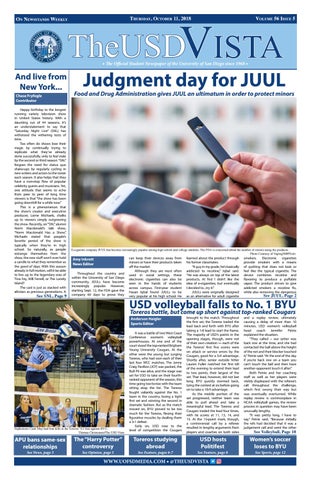
E-cigarette company JUUL has become increasingly popular among high school and college students. The FDA is concerned about the number of minors using the products. Photo Courtesy of Vaping360/Flickr
Amy Inkrott News Editor Throughout the country and within the University of San Diego community, JUULs have become increasingly popular. However, starting Sept. 12, the FDA gave the company 60 days to prove they
can keep their devices away from minors or have their products taken off the market. Although they are most often used in social settings, these electronic cigarettes can also be seen in the hands of students across campus. First-year student Hasan Iqbal found JUULs to be very popular at his high school. He
learned about the product through his former classmates. “A guy in my grade, he’s basically addicted to nicotine,” Iqbal said. ”He was always on top of the latest products. At first I didn’t like the idea of e-cigarettes, but eventually I decided to...try it.” JUULs were originally designed as an alternative for adult cigarette
smokers. Electronic cigarettes provide smokers with a means of quitting that does not look or feel like the typical cigarette. The device combines nicotine and flavoring to produce a puffable vapor. The product strives to give addicted smokers a nicotine fix, while also removing the dangerous
See JUUL, Page 2
USD volleyball falls to No. 1 BYU Toreros battle, but come up short against top-ranked Cougars
It was a battle of two West Coast Conference women’s volleyball powerhouses. At one end of the court stood the top-ranked Brigham Young University Cougars. At the other were the young but surging Toreros, who had won each of their last four WCC matches. The Jenny Craig Pavilion (JCP) was packed, the Bull Pit was alive, and the stage was set for USD to take on their fourthranked opponent of the season, this time going toe-to-toe with the team sitting atop the list. The Toreros fought valiantly against the No. 1 team in the country, losing a tight first set and winning the second in dramatic fashion. But as the match moved on, BYU proved to be too much for the Toreros, flexing their figurative muscles by dealing them a 3-1 defeat. Early on, USD rose to the level of competition the Cougars
brought to the match. Throughout the first set, the Toreros traded the lead back and forth with BYU after taking a 1-0 lead to start the frame. The majority of USD’s points in the opening stages, though, were not of their own creation — each of the the Toreros’ first five scores were on attack or service errors by the Cougars, good for a 5-4 advantage. Shortly after, senior outside hitter Lauren Fuller notched her first kill of the evening to extend their lead to two points, their largest of the set. That lead, however, did not last long. BYU quickly stormed back, tying the contest at six before going on to take a 10-9 advantage. As the middle portion of the set progressed, neither team was able to pull ahead and take a meaningful lead. The Toreros and Cougars traded the lead four times, with tie scores at 11, 13, 14, and 15. At the 15-point mark, though, a controversial call by a referee resulted in lengthy arguments from players and coaches on both sides
and a replay review, ultimately causing a delay of more than 10 minutes. USD women’s volleyball head coach Jennifer Petrie explained the situation. “They called – our setter was back row at the time, and she had contacted the ball above the height of the net and their blocker touched it,” Petrie said. “At the end of the day if you’re back row on a team you can’t touch the ball and then have another opponent touch it after.” Both Petrie and her coaching staff as well as her players were visibly displeased with the referee’s call throughout the challenge, which first swung their way but was eventually overturned. While replay review is commonplace in NCAA volleyball games, the review process in question may have been unusually lengthy. “It was pretty long, I have to say,” Petrie said. “Because initially the refs had decided that it was a judgement call and went the other
The “Harry Potter” controversy
Toreros studying abroad
USD hosts Politifest
Women’s soccer loses to BYU
See Opinion, page 5
See Feature, pages 6-7
See Feature, page 8
See Sports, page 12
Anderson Haigler Sports Editor
Sophomore Cami May had four kills in the Toreros’ 3-1 loss against BYU. Thomas Christensen/The USD Vista
APU bans same-sex relationships See News, page 3
WWW.UOFSDMEDIA.COM ◆ @THEUSDVISTA
See Volleyball, Page 10
2
The USD Vista
◆
October 11, 2018
NEWS
JUUL in trouble with FDA
JUUL at risk of being shut down as more minors and students start using the addictive products
JUUL from Page 1
removing the dangerous tobacco and tar within traditional cigarettes. Because they can be found at almost every gas station, JUULs are relatively easy for students to obtain. In the state of Nevada, where Iqbal is from, the legal age for purchasing a JUUL is 18.
with vaping. The stigma around vaping isn’t as harsh as it is around smoking. Vaping is often seen as the healthy alternative.” Although often associated with vaping, the nicotine content in JUULs is much higher than other vaping options. The higher levels of nicotine within the product makes the use of JUULs extremely
“The disturbing and accelerating trajectory of use we’re seeing in youth, and the resulting path to addiction, must end. It’s simply not tolerable.”
-Scott Gottieb
“I got my first JUUL when I was 18 during my first semester of senior year,” Iqbal said. “I got it at the gas station, Speedee Mart. It was super easy.” This accessibility has become increasingly concerning to members of the United States Food and Drug Administration (FDA) as more minors have started using these devices. The different flavor pods attached to JUULs mask the taste of nicotine within the vapor. The nicotine in these pods makes the e-cigarettes addictive. However, these products are not viewed in the same way as traditional cigarettes. “The image of it is different,” Iqbal said. “When you hear ‘e-cig,’ you don’t think of it as a cigarette, it’s electronic. People associate it
addictive. In September of 2018, the FDA stated that the number of teenagers using e-cigarettes, like JUUL products, had reached an epidemic level. In 2017, the FDA reported nearly two million middle and high school students were frequent users of e-cigarette products. “It was definitely a high school thing,” Iqbal said. “Everyone I knew had one.” Over the summer, the FDA issued over 1,300 warning letters and monetary penalties to retailers found selling e-cigarettes to minors. Many of the penalized retailers were 7-Elevens, Circle Ks, and other gas stations, like the one mentioned by Iqbal. FDA Commissioner Scott Gottlieb commented on the rising
number of young people using nicotine products. “E-cigs have become an almost ubiquitous – and dangerous – trend among teens,” Gottlieb said. “The disturbing and accelerating trajectory of use we’re seeing in youth, and the resulting path to addiction, must end. It’s simply not tolerable.” Recently, the FDA has also targeted the makers of the products. Starting Sept. 12, the agency has given the four largest producers of e-cigarettes 60 days to prove that they can keep their devices away from minors, under the threat of having their products removed from the market. While the FDA also gave notice to e-cigarette companies MarkTen, Vuse, Blu, and Logic, it primarily focused on JUUL. Currently, JUUL controls over 70 percent of the e-cigarette market. Each of the companies has expressed a willingness to work with the FDA in keeping their devices out of the hands of minors. JUUL’s website is reflective of this. Upon accessing their site, browsers are asked if they are over 21 years old. If the person selects no, they are redirected to a website highlighting the dangers of tobacco use, especially in teens. However, the effects of e-cigarettes are still largely unknown. “It’s still too early for us to know the effects of e-cigarettes and
vaping,” Iqbal said. “We know the effects of regular cigarettes because those have been around for forever. Seeing through time what it does to the body, we know exactly what happens. E-cigarettes have only been around for a decade. There could be nothing wrong with it, or it could be the same as cigarettes, or it could be worse. We really don’t know.” Iqbal opted to quit after his high school graduation. However, he started using his JUUL again when he was preparing to come to USD. “I got back into it because I was about to go to college,” Iqbal said. “It really was a social thing,
“When you hear ‘e-cig,’ you don’t think of it as a cigarette, it’s electronic. People associate it with vaping. The stigma around vaping isn’t as harsh as it is around smoking.”
-Hasan Iqbal
but I actually enjoyed the feeling I got when I was smoking. One of my friends went and dropped a hundred dollars at a smoke shop before he left for college.” However, he ultimately chose to quit again after considering the health problems associated with smoking and e-cigarettes. “Here I am with this little thing in my hand,” Iqbal said. “I don’t know if it’s healthy or not, but I feel like
JUUL products were originally created as a tobacco-free alternative for people trying to quit smoking. The vapor contains a high concentration of nicotine, making it more addictive.
The USD Vista
Luke Garrett - Editor in Chief Kaia Hubbard - Associate Editor Hannah Sonberg - Managing Editor Kathryn Querner - Copy Editor Monica Millan- Art Director Lexi Crea - Assistant Art Director Amy Inkrott - News Editor
Editorial – 619.260.4584 Business – 619.260.4714 www.uofsdmedia.com @TheUSDVista
Paulina Sierra - Opinion Editor Jennifer Mossuto - Feature Editor Dorothy Dark - Arts & Culture Editor Anderson Haigler - Sports Editor Thomas Christensen - Photography Editor Zo é Morales - Photo Assistant Richard Benson - Distribution Editor
it isn’t. So why am I continuing to smoke it?” JUULs are very popular among some USD students. These small devices can often be seen in the hands of students in class, walking to their dorms, and even waiting for the trams. However, because USD is a smoke and tobacco free campus, students are more subtle about using their JUULs. “Coming into college, I don’t think it is unrealistic to think that a lot of people have them, but I feel like students here are more secretive about it,” Iqbal said. If the FDA finds that these companies cannot keep their
Elizabeth Brunelli - Finance Manager Rachel Steinheimer - Advertising Manager Gina Lew - Student Media Advisor Marie Minnick - Operations Advisor
devices out of the hands of minors, then they will be removed from the market. The agency also plans to track the online purchases of these products. They predict that young adults will buy a large number of e-cigarettes that they can later resell to minors. The FDA believes that the tightening of e-cigarette regulations will help to prevent minors from becoming addicted to nicotine in the future.
Photo Courtesy of Vaping360/Flickr
The USD Vista publication is written and edited by USD students and funded by revenues generated by advertising and a student fee. Advertising material published is for information purposes only and is not to be construed as an expressed or implied endorsement or verification of such commercial venues by the staff or University. The USD Vista office is located on the fourth floor of the Student Life Pavilion in room 403B. All inquiries should be sent to: The USD Vista 5998 Alcala Park San Diego, CA 92110 The first copies of the newspaper are complimentary, all copies thereafter are a 25 cents charge. Opinions expressed in this publication are not necessarily those of The USD Vista staff, the University of San Diego or of its student body. Letters to the Editor can be submitted to The USD Vista office. Letters should be limited to 300 words and must be signed. For identification purposes, USD identification numbers and writer’s year must be included in the letter. The USD Vista reserves the right to edit published letters. Any content sent to the editor will be considered for publication unless otherwise stated.
Volume 56 Issue 5
◆
NEWS
◆
3
The USD Vista
Same-sex relationships banned Azusa Pacific University reinstates ban on same-sex relationships, USD weighs in
Azusa Pacific University in Glendora, Calif. is an evangelical Christian school that strictly adheres to biblical standards for human sexuality.
Amy Inkrott News Editor
Recently, the University of San Diego has become more supportive of its LGBTQ+ students. Eighteen years ago the Board of Trustees approved the addition of “sexual orientation” to the school’s nondiscrimination policy. Today, PRIDE holds a space in the SLP Commons and hosts numerous events around campus. However, this supportive environment is not found at some other universities across the country. Azusa Pacific University (APU), an evangelical Christian university, recently reinstated a ban on samesex relationships on their campus. For junior Annabel Gong, USD has always been a welcoming and supportive place for members of the LGBTQ+ community. “I have found a place, both organized and with friends, where I feel comfortable being myself,” Gong said. “As I have spent more time at USD, I feel like I have
students share about an experience they have had in order to foster a sense of empathy and a respect for diversity throughout the community. But despite having a generally supportive campus community that was receptive to their story, Gong has not seen many openly gay couples at USD. “I have seen zero gay couples on campus,” Gong said. “When I have a significant other on campus, I don’t feel unsafe; however, after doing my My Story talk, I do feel a little more vulnerable. Everyone knows I’m gay and can’t pass as a more heterosexual couple if I were to hold hands with a girl.” However, USD differs from other religious schools as there are not restrictions on how students choose to display their romantic relationships, regardless of sexual preference. This is not the case for students at APU. In late September, APU students stood in solidarity with their school’s LGBTQ+ students. A sea of rainbow pride flags flooded the campus
“As a Changemaker campus we should strive to make the world a more welcoming place, especially if that starts on our own campus.”
-Annabel Gong
expanded that space for myself and have welcomed other LGBTQ+ members into my space.” Although not an active member within PRIDE, Gong has found this group to be essential to the LGBTQ+ community on campus. “I made sure to check that an organization like PRIDE existed before confirming that I would attend USD, mainly because I knew religious schools may hold more conservative values,” Gong said. “The presence of an LGBTQ+ organization made me feel more welcome on campus.” Recently, Gong has shared their personal story with the USD community through My Story, a program hosted by the Changemaker Hub. At the event,
courtyard as students protested the recent change to the student handbook. At the beginning of the school year, the university had lifted its ban on same-sex relationships. However, this ban was reinstated last month, prompting numerous protests and debates about the value of same-sex relationships on Christian college campuses. Before this fall, same-sex relationships had always been prohibited at APU. The school founded this ban on a series of biblical passages. Referencing the book of Genesis, the university maintained that sexual relations are only to occur between a man and a woman within the bonds of marriage. Because of this, the school has prohibited any form of physical
intimacy outside of marriage, regardless of sexual preferences. However, the expression of romanticized heterosexual relationships was permitted on campus. In the past, APU’s Christian foundations have led it to exclude any expression of the LGBTQ+ identifications. Haven, a club representing members of the LGBTQ+ community, served as an underground support group for many years. The group had been denied official status as it went against the values expressed by the university. The club was not permitted to advertise its meetings or gather on campus. The times and locations of Haven’s events were only spread by the students themselves. At the start of the fall semester, however, this standard was reversed. In addition to lifting the relationship ban, APU’s Student Government advocated for the formation of a designated safe space for the school’s LGBTQ+ students. The new program promised to establi a formal partnership with the Haven organization, and provide educational outreach opportunities across their campus community. However, on Sept. 28, the APU Board of Trustees released a statement to the campus community, opting to reinstate the ban on same-sex relationships. “Last week, reports circulated about a change in the undergraduate student standards of conduct,” the statement said. “That action concerning romanticized relationships was never approved by the board and the original wording has been reinstated.” While the decision to lift the relationship ban was supported by members of APU’s student government and administrative board, the Board of Trustees had not been notified. Members of the board intend that APU remain “biblical and orthodox” in its Christian identity. Gong was shocked by the board’s decision. “It is hard for me to imagine a school in California that has these
Photo Courtesy of Jon Coyne/Flickr
ideals,” Gong said. “It is a harsh reality check, that we have an awfully long way to go.” This commitment to religious identity is not dissimilar to that of USD’s donors. For the past few years, USD’s Supreme Drag Superstar has angered some of the school’s alumni and donors who believe that the event contradicts the school’s Catholic values. However, at the moment, it is unlikely that the school will implement policies similar to that of APU. Gong believes that the Torero
community will support them and other members of the LGBTQ+ community. “I think our student body is supportive of gay rights and would respond with protest,” Gong said. “As a Changemaker campus we should strive to make the world a more welcoming place, especially if that starts on our own campus.” Given APU’s controversial ban on same-sex relationships, students are called to reflect on the ways USD has supported its LGBTQ+ community.
TELL US WHAT YOU THINK. SCAN THE CODE WITH YOUR SMARTPHONE CAMERA.
4
The USD Vista
◆
October 11, 2018
The trouble with trams
Tram Services is making changes to appease students and fulfill the demands of their schedules Tyler Arden Contributor The logistics of keeping over 9,000 students moving and on-time are far from simple. Yet changes made this semester meant to improve tram operation and the riding experience still fail to address the complaints of many students. Tram Services recently changed service routes and moved the location of several stops with hopes to better serve the campus population. What remains unchanged is the frequency of these trams and the number of vehicles that comprise the fleet. Most notable is an additional route introduced this semester. The new West Campus Loop makes stops at the West Parking Structure, Colachis Plaza, and the Law Circle before circling back down the hill to West. Tram Services and Fleet Safety Manager Jonathan Oberg said that the new service was designed around feedback directly obtained from last year’s transportation survey. “The changes made of combining the Camino Loop and the Barcelona Express is due to the increased demand for service connecting the West Parking Structure to the Law School Circle and or Legal Research Center,” Oberg said. “This combined with the increased utilization of the West Parking Structure and reduced parking resources due to construction projects, our department’s VP and AVP wanted to implement the route adjustments.” Oberg noted that although the new route takes longer to travel the upper mesa, Tram Services did add an additional driver to prevent impact on passenger wait times. The department overseeing the service made other small changes
as well. For example, the Old Town tram now begins its route from the Law Circle before stopping at Colachis Plaza then proceeding to Old Town in an effort to help riders catch service on the Coaster commuter train operated by the North County Transit District. These changes aren’t necessarily sufficient for students during peak operating times, though. Senior Madeline Dougherty has been late to class numerous times because of impacted tram service at the West Structure. Dougherty isn’t alone in facing these problems. “I’ve run into problems waiting for the tram at the West Lot countless times,” Dougherty said. “I’ve still been late to class even after taking time in to account because of how many people there are.” Getting a ride from the West Structure is widely regarded as a contact sport by students and staff alike. It’s an issue on the mind of the department. Oberg said that peak hours are taken into account when planning. “We have a daily schedule that outlines the class beginning and end times and schedule all breaks outside of these rush hours,” Oberg said. “While we have four drivers on the West and three drivers on the East side of campus, the 9 a.m., 10 a.m., and 11 a.m. hours have always been the heaviest demand.” Oberg recommended that students arrive early and plan ahead. Even then, students are eager to see new solutions that would better accommodate the growing population on campus. “I’d like to see them get new trams just because they are so small right now,” junior Annabelle Steiner said. “They can get packed coming up from the West Lot at times with people cramming in.” Tram Services has demoed three new vehicles that might better serve campus. Because of tight turns on
USD students riding the Mission Loop tram on their way to campus.
campus and steep hills, though, most vehicles are unsuitable. A previous pilot program of electric buses that featured two doors and capacity for more riders did not proceed because of cost. “The second pilot was the two door electric shuttle that everyone loved, and it even could accommodate our stops’ limited turning radius,” Oberg said. “However, that vehicle was approximately $375,000, while the vehicles we currently use are approximately $93,000.” Faced with an impacted tram service that doesn’t meet the demands of their schedules, students are turning to alternative transportation methods. Most notably, Bird scooters have filled the gap for students seeking a ride
to class. These scooters and dockless bikes like Lime are already prohibited on parts of campus during certain time periods by the Student Code of Conduct. That policy is likely to change to directly address the scooters that became popular over the summer. Dean of Students Donald Godwin and Assistant Vice President of Public Safety James Miyashiro are co-authoring a campus-wide email regarding the devices. Additionally, the Bird app now lists USD’s campus as a red zone. While feedback from the transportation survey conducted during the previous academic year to gain insight into stakeholder needs across campus and help inform plans regarding trams and
Zoé Morales/The USD Vista
alternative solutions is already being utilized, the patience of those that rely on the system to get across campus is growing thin. “It would be nice to see changes happen sooner rather than later,” Steiner said. Until then, students are pointed to the GPS tracking accessible through the university’s app that provides an overview of where the trams are and when the next one is likely to arrive. What students shouldn’t expect is a schedule and timetable that would allow them to anticipate a tram in any set and reliable manner. Tram Services notes on their webpage that they aren’t a bus service, even as much as the campus community expects it to be and relies on it as such.
Volume 56 Issue 5
◆
OPINION
◆
5
The USD Vista
OP I N ION
“Harry Potter” & the rogue author USD students discuss their discontent with Rowling’s additions to the story they love
Paulina Sierra Opinion Section Editor J.K. Rowling has found herself in the middle of a scandal surrounding Nagini, Voldemort’s pet snake from the original “Harry Potter” franchise. According to new information from the team behind “Fantastic Beasts and Where to Find Them,” Nagini is now said to be a Korean woman who lived in the era portrayed in the film. According to the new film, Nagini was a circus performer and was eventually left to permanently be a snake. The specific circumstances surrounding this are still unknown. For fans, this is another example of Rowling adding representations of minorities into existing content (as the snake does appear in the original franchise), something that Rowling has been doing for years. For USD sophomore Alex Schwartz, this announcement was particularly distasteful due to its racist implications. “I started reading about it and got mad, so, I took a step back,” Schwartz said. “I think it’s more than just the retroactive continuity thing. It’s stupid to go back and add things that weren’t there, and I agree that it makes you see things in the past differently, when something suddenly new is thrown at you. But also, the idea that this whole time, in eternal imprisonment, this snake was basically a slave, and then this slave was a woman, and then this slave was an Asian woman. I just think that’s so distasteful. Of all the things you could have done, if you
never perfect in the first place. On Oct. 19, 2007, during a question-and-answer session at Carnegie Hall in New York City, J.K. Rowling answered a fan question about Dumbledore’s potential past marital status by announcing that Dumbledore, in her eyes, was gay. This became a pivotal point in fan’s understanding of “Harry Potter.” Rowling was adding to the published books in real time, something that had never ocurred before. As time passed, Rowling continued to surprise fans with new additions. Soon, her Twitter became full of announcements about a new “canon,” which is a phrase used online to describe legitimate content surrounding the story. For B Carucci, this began in 2007, with Rowling’s announcement about Dumbledore. “That was my first idea that ‘Harry Potter’ wasn’t perfectly formed and complete already,” Carucci said. “She’s still making edits, even though she’s published the material. There are things she feels she should correct. That was the first time I thought ‘oh, this isn’t perfect.’ That was a good realization, probably.” The realization that the book, according to the author, is not finite or perfect, is a new one in literary culture. In the eyes of fans, however, the original published novels are not the end of the story. For those who feel short changed by the series, dislike a major aspect, or simply want to engage
“The book doesn’t belong to her anymore, it belongs to us. And we are the ones who get things out of it, and we’re the people that need it. -Alex Schwartz have any sort of awareness about anything in the world, you would know that that leaves a bad taste in people’s mouths, and you know that that was done completely thoughtlessly and tastelessly.” “Harry Potter” has become one of the most beloved franchises in history, and Rowling could have been even more of a cultural mogul than she is had she kept her positive status. However, her scandals may have opened up fans to viewing Rowling, who could have been their hero, in a different light. For senior B Carucci, this was a positive realization. “A big part of my growth as a ‘Harry Potter’ fan was realizing that I could have problems with it; I can have certain things that I don’t agree with, and I can still like it, as either a whole or just like part of it,” Carucci said. “I’ve started seeing things about Nagini being an Asian woman, and that’s ridiculous. No, just no. End of story. I think this whole conversation can be summed up with this: Eventually I realized that J.K. Rowling is a biased, fickle human being who sometimes tries to go past her limits, and that’s admirable, but there are certain times where it just causes more problems.” A lot of fans see their dissatisfaction with the novel as something that has opened up a new idea: perhaps the content was
with new content, fanfiction becomes an option. Fanfiction began in the age of the internet, and can be attributed largely in part to the fans of “Harry Potter”. The universe that Rowling created is vast and highly detailed, and for some fans, the details she focused on are not the ones they care about or find interesting. Often, the fans take it upon themselves to fill in the gaps. According to many, Rowling’s retroactive additions to the content of the novels has taken away their sacredness, and has opened them up to the fans. Because of this, USD junior Grace Strumpfer feels apathetic to Rowling’s announcements. “I think (Rowling) can do whatever she wants, but so can we,” Strumpfer said. “She can say whatever she wants to say; I just don’t accept it. People are out there sort of spewing stuff, and you know, things like a movie sequel will come out and people will kind of pretend it never happened.” As a result of the discontent with both the original content and Rowling’s constant additions to it, the original novels have become, in Strumpfer’s eyes, almost obsolete. “It’s the idea that means a lot to me, it’s not every single word in the text,” Strumpfer said. “It’s what people can create with it, and I love
the art, and I love the fanfiction. And people have these really cool ideas, and they take the world, and they run with it. It’s sort of like how people interpret the Bible. Some people are literalists... and some people are like ‘let’s take this, and loosely follow the teachings.’” This is one of the first instances of an author attempting to have a heavy hand in public perception of the novels post-publication. With lack of social media and personal reader engagement in the past, this separation was not necessary, but has been fanmade in the case of Rowling. This dissociation of content from the author allows fans of the series to continue interacting with content created by someone toward whom they are so highly critical. For Strumpfer, what matters isn’t the author or even the story. “I think it’s the world,” Strumpfer said. “Sometimes it’s the books, or sometimes it’s the movies if they did something I like better. And sometimes it’s fanlore. I feel like I have all this knowledge about ancient and noble families work, and how Gringotts works, and all these behind the scenes things, and they’re not legit, technically. They’re not endorsed by trash queen (J.K. Rowling) herself. They’re just really interesting things that people have taken and played with, and they’re really fun.” Due to such recent controversies surrounding “Fantastic Beasts and Where to Find Them,” in which Johnny Depp had been cast despite controversy due to his history of relationship abuse, and young Dumbledore not being openly gay, this disconnect can be important to fans. Alex Schwartz thinks the possibility of redemption for the author is bleak, “I don’t think she’ll ever redeem herself,” Schwartz said. “I don’t give her money anymore, I won’t pay to go see her movies if she lets Johnny Depp star in them. I won’t pay to go see characters that won’t be explicitly gay that she said were gay in canon. I don’t think she’ll ever redeem herself when she continues to be rewarded for bad behavior and paid by jaded fans that don’t want to realize that their hero and the creator of this thing is a bad person. You can like things made by bad people in certain circumstances, but I don’t think she’ll ever change. More of the fanbase is disowning her, and I think in the future, the train will be off the rails and flying away in the sky with all the people who have stolen her franchise from under her, and made it to be their own while she flounders in her bigotry.” First-year Leah Ring believes Rowling’s additions are best ignored. “Right now, I kind of try to ignore everything that (Rowling) says about the books, truthfully,” Ring said. “I like to look at what they were, and what the author says on Twitter, I can’t really trust that. That’s just word of mouth. And she could change her mind, she could just strip away everything she said on Twitter.” Other fans, however, think the content that Rowling is putting out is not something to be ignored, but directly criticized. For Schwartz, the experience
J.K. Rowling at a question-and-answer session in 2010. Photo Courtesy of Daniel Ogren
of reading and interacting with “Harry Potter” has always been one that involved criticism, especially toward Rowling herself. “From (watching) the movies, she meant nothing to me, but after growing up in the age of the internet and seeing things about her online, when I went into the books, I had different ideas of what it was versus what she wrote,” Schwartz said. “Because of things like Tumblr and Twitter where people were dissatisfied and came up with their own ideas for, like, what characters would look like, character dynamics, and things like that. I was already dissatisfied with the book before I read it, so I went in with a different state of mind than what she intended.” Schwartz believes the added content is a direct slap in the face to people who seek cultural representation in literature. “She didn’t earn it,” Schwartz said. “I think that if you’re gonna go out there and make a book full of positive representation of different ethnicities, gender identities, and sexual orientations, you gotta earn it like the rest of us earn it. The people who you’re supposedly writing about are real people, and we work very hard to be put into these categories that we then apply to your characters. To take it without having worked in the narrative to make it real, I think is unfair.” For these fans, the consensus is clear: Rowling’s additions are to be ignored. The power of the Harry Potter franchise was already pivotal in literary culture, where fans became deeply involved in the content on a personal level, more than ever due to the rising use of the internet and the interconnected community that it created. This newness, however,
is only strengthened by the new phenomenon of disowning the author, and giving the content over to the fans. For Schwartz, the magic of “Harry Potter” is in the community, not the author. “I think when you put anything out into the world, it doesn’t belong to you anymore,” Schwartz said. “And I think that with how much the fans have taken the books and changed them into something incredible, something about inclusion, and adding our own representation in there. The book doesn’t belong to her anymore, it belongs to us. And we are the ones who get things out of it, and we’re the people that need it. It was ours for the taking, and we took it. These books are the foundation that has built upon it an enormous culture of inclusivity and friendship amongst people, ones with similar interests and things like that. When you have fan ideas about how your childhood heroes were gay, or your childhood heroes looked like you, or sounded like you, that’s what I’m a fan of. Maybe that’s not the way she wrote the books, but it’s what the books did on their own.” To fans of “Harry Potter”, the power of the franchise lies with them, not the author. With Rowling constantly adding new controversial content, it seems like only a matter of time before fans of the franchise close their ears to her musings entirely, and take full ownership of the franchise, be it through eventual disinterest in her new canon content, or an eventual apathy towards anything she says and her celebrity presence. Given the fact that this has never happened before, only time will tell if Rowling’s authoral magic will fade any time soon.
6
THE USD VISTA
◆
Volume 56 Issue 5
OCTOBER 11, 2018
,A r o
7
THE USD VISTA
e
Madrid, Spain , r io
“Coming into study abroad, I was going to a country that I did not know the language so I think one of my favorite parts is starting to learn a third language and actually getting to practice and use that language in this country. Another one of my favorite parts has been the ability to go to so many countries (I am currently writing this as I’m sitting in the airport at 5 a.m. for a flight to Germany) and to get to see a lot of Europe that I have never seen before.”
nio r,
Photos courtesy of Marie George
Photos courtesy of Tyler Yard
Matt Tauer, Ju
Ya rd ,
◆
e George M a ri , Ju ni
ABROAD
Tyle r
FEATURE
“Experiencing new cultures while abroad has been one of the most humbling and eye-opening experiences of my time in college. I would recommend it to everybody if they have the opportunity.”
TO R E R O S
n Ju
rovence, Fran P ix c
◆
ue, g a Pr
Czech Repub lic
“Being abroad has made me appreciate living in the moment. I’m 20 years old in a beautiful city with my best friends.”
Photos courtesy of Matt Tauer
Photos courtesy of Lauren Rivers
en Rivers, J Laur un ior ,
M
rid,
or, ni
ad
Spain
nce, Ital y
“ My favorite part has been the fact that I get to fully immerse myself in the Italian culture, while still being so centrally located that I can travel to all kinds of different places!”
Flore
“Study abroad has easily been one of the most enriching opportunities of my life. It has allowed me to experience so many different ways of living and fully immerse myself into a new culture. I have loved getting to travel to other countries and try out new things that I would never be able to in the United States. I can’t fully put into words how invaluable this experience has been and I highly encourage anyone to take advantage of this opportunity if they can.”
kenzie De M ac an ,J u
Photos courtesy of Mackenzie Dean
Spread by Monica Millan/ The USD Vista; Content by Jennifer Mossuto/ The USD Vista
8
The USD Vista
◆
October 11, 2018
F E AT U R E
Politifest comes to USD
Professors and educators inform attendees on need-to-know information about the midterm election Joshua Strange Asst. News Editor The University of San Diego hosted Politifest this past Saturday. The public affairs summit focused on the issues and candidates that will appear on the upcoming ballot in November. From a full schedule of debates, panels, and one-on-one interviews with experts to providing a platform for residents and students to raise their voices, Politifest was created to attempt to answer the hard-hitting questions. Around 800 people registered for the event and over 25 percent were students who took advantage of the free tickets that were provided by sponsors and interest groups. Important guests and speakers included the mayors of Tijuana, Sacramento, and San Diego as well as California representatives from Congress, the state assembly, and the local San Diego council. More than a few topics were discussed over the six-and-a-half-hour event: the case for California independence from the United States, ways to get involved in the community, the loss of the Chargers, crash courses in ballot measures, Prop 10, Cannabis Tax, and undocumented life in the Trump era. Politifest honed in on the makeup of San Diego. It covered everything from infrastructure to journalism, diversity, community life, and even the role of students who become the next generation of workers, politicians, and taxpayers. Every part of the city breathes life into its future and part of the process is becoming educated about that makeup and figuring out how or what to change. Maria Coleman works several
jobs, is a mother of two boys, and is majoring in political science at USD. She has dreams of becoming a diplomat. “Seeing high ranking members of political life here in San Diego and the state of California just coming together to have a platform and share conversations with the community, students, media ,and people of all walks of life was important for me,” Coleman said. “This was a place to have an open discussion about issues and generate ideas and I’m happy Politifest was here at our school given what’s going on in our nation. I’m an immigrant and when Trump ran for office he said some really bad things and it angered me in a way that drove me to vote and it mobilized me as a citizen and a mother, especially knowing that a lot of people in my community can’t or don’t vote. People from both sides of the aisle came together to discuss things, regardless of party, and it was great to see that rather than the dissent and argument we might be used to seeing.” Sienna Todd, a USD sophomore and a visual arts and international relations double major, attended the panels about civility in politics and undocumented life in the Trump era. She networked with government employees, fellowship recipients, and a real estate magnate who had worked abroad for several years in Russia. “Something I really liked was the sense of community and the emphasis on undocumented immigrants being people and that we need to have empathy because the legislation we create affects families and human beings, they’re not just data,” Todd said. “Civility is a means to make sure people are
comfortable with a conversation but that should not inhibit you from delving deeper into a topic, you need to approach different dialogues and discourses with the understanding that everyone deserves respect. Part of our voices are expressed in individual interactions and our ability to engage in dialogue about the things that we are passionate about but it’s also important to know we have a voice through our vote. Getting involved in our campus is definitely important but even taking the two minutes to register to vote is imperative for our political system.” San Diego boasts the largest economy in California. Despite that, San Diego has the highest poverty rate in the nation.
Issues like affordable housing, homelessness, and immigration policy were consistent themes at the event. Anna Scharrer, a USD sophomore majoring in finance and French, aspires to go into the financial development of emerging economies. “Local politics, especially in San Diego, really matter,” Scarrer said. “We are in an interesting strategic location for a lot of debates that tend to be very divisive and a lot of people’s lives can be affected by what we choose in the upcoming election. USD is the castle on the hill. New radical ideas are born here, and we have an open and diverse environment. Misconceptions around immigrants is a super important issue for people at USD
and southern California and it was good to hear from people who are actually affected by it. We were all placed on this earth and we have to find a way to live together and have civil conversations.” In less than a month, on Nov. 6, the midterm elections will be taking place in the middle of President Trump’s first term. The next governor of California will be decided along with all 435 seats in the House of Representatives and 35 of the 100 seats in the Senate. Politifest enabled students and community members to receive more information about the upcoming midterm election and become better informed citizens in the future.
Experts and educators debate with each other in panels and one-on-one interviews at Politifest.
Zoé Morales/The USD Vista
Misconceptions of poverty in SD USD interdisciplinary panel encourages community members to throw away their prejudice
Emma Goodman-Fish Asst. Feature Editor In 2017, there were nearly 40 million Americans living in poverty, while about 400 people control 35 percent of the value of equity and assets in America. While there is a significant number of Americans living in poverty, the impacts, issues, and causes of poverty are often misunderstood and misconstrued. Last week, a USD interdisciplinary panel titled “The Myths and Misconceptions of Poverty” addressed this problem. Professors and doctors from the sociology, science, and theatre departments all shared their insight on what living life in poverty is truly like, through the lens of their respective studies. Poverty isn’t an individual or isolated issue; it impacts everyone and every aspect of life and humanity. Julia Cantzler, Ph.D. in sociology, shared that poverty is an American display of social stratification, meaning society’s categorization of its people into rankings of socioeconomic tiers based on factors like wealth, income, race, education, and power. This proves to be a clear marker of inequality in
the U.S. Net worth was used by Cantzler repeatedly, and while this term is vague to many, it has a huge impact on the impoverished. Net worth is defined as “assets minus liabilities.” This means the worth of an entity on its own. “Our net worth is the predictor of our ability to be resilient,” Cantzler said. “How we are able to pay for our kids’ college, education is tied to social mobility. Without net worth, it reinforces cycle of inequality and poverty that exists.” Americans’ perceptions about inequality and mobility differ from those around the world. Cantzler presented studies that show that more Americans believe people get rewarded for their effort, intelligence, and skills, and that coming from a wealthy family isn’t essential to succeeding. While the pursuit of the American dream is imbedded in what it means to be American, certain resources and advantages are needed to actually attain this “dream” to which Americans are so committed. This is “Misconception No. 1” as Cantzler puts it. Cantzler emphasizes that Americans need to destroy the misconception that social mobility
doesn’t have anything to do with social class, and that people can do better than their parents if hard work is involved. Statistically, the U.S. is very class based and continues to remain that way. “We’re always talking about whether we should raise the federal minimum wage, because it does not provide a livable income for families and leaves it impossible to actually increase net worth,” Cantzler said. “Despite putting hard work in on multiple jobs, families still cannot rise in class, or create enough to found net worth. Chastising those in poverty or living on the streets for not ‘putting in enough work’ is an ignorant statement. America has established a society in which social mobility is virtually impossible if the right advantages are not provided.” Suzanne Walther, Ph.D. in ocean and environmental sciences, contributes her ideas on the misconceptions of poverty. Environmental hazards and issues tend to have the biggest impact on those in poverty, again hindering those in poverty from leading their most successful lives. “How a natural disaster impacts depends on our vulnerability system, how vulnerable our society is based on exposure, sensitivity,
and ability,” Walther said. “Without insurance, or the right resources, people are more vulnerable to being negatively impacted by natural disasters.” Natural hazards displaced more persons than war in 2013, putting persons on the streets and those living in hazardous areas in danger. In cheaper areas, where there are no building codes, and often more pollution and oil pipelines, there is a higher risk of natural disasters occuring and impacting the residents. The impact natural disasters have on those in poverty is usually not under their control, but is defined by their living situations. “Natural disasters are something that need to be addressed along with poverty,” Walther said. “When considering climate change and preparation for earthquakes, the issue of poverty in America and in San Diego needs to be recognized in order to mitigate damage from these disasters.” The final presenter, Ryan Scrimger, M.F.A. in theatre, explained the humanity of those who are currently in poverty, and how theatre can start to address misconceptions and bring to light the real stories of people who experience poverty. Scrimger described ‘Theatre of
the Oppressed’ where those who are subjugated by society and its stigmas can share their truth. “Theatre is a way to explore, an active vehicle, and way to heal,” Scrimger said. “Theatre allows for anyone anywhere to tell their story and send a message.” Theatre education can have a positive impact on poverty. Although when times are hard in the economy, many people believe that cutting funding to ‘unimportant’ programs like art, theatre, and music is the first solution. However, as Scrimger shares, when students are involved in art education, a risk for dropping out decreases, and students become better communicators and are highly motivated. It is not the fault of the student, for being born into poverty, but rather the resources they are often not given to succeed. With theatre programs, students are given an outlet to express their thoughts and further themselves. The USD interdisciplinary panel encouraged attendees to dismantle the myths and misconceptions of poverty. It concludes Americans’ perceptions of what it means to be in poverty needs to be rethought so community members can address the root of the problem.
Volume 56 Issue 5
◆
ARTS & CULTURE
◆
The USD Vista
A RT S & C U LT U R E
9
“SNL” kicks off Season 44
“Saturday Night Live” makes their return to live television with as much honesty and wit as ever Chase Fryfogle Contributor seriously hilarious chimera comprised of comedic actors, stand-up comedians, internet sketch groups, and improv artists. Even at the pro level of sketch comedy, a handful of players manage to cement themselves as hall-of-famers, like Keenan Thompson. The grizzled, yet eternally jolly, veteran has been on the show since 1993, making this his 25th season. Then there’s Kate McKinnon, who’s charisma and unmatchable talent for character work have earned her the status of Queen Midas, turning every scene she’s in to gold. Her mere appearance can make the audience break out in rapturous applause. Next, the unforgettable Pete Davidson, the golden boy - a self-deprecating stand-up comic who has stepped further into the spotlight since his recent engagement to pop star, Ariana Grande.
“‘SNL’ remains consistent in its ability to deliver goofy, albeit in no way subtle, satire of the political climate, highlighting the absurdities of real life with steadfast punchlines.”
Davidson brings a boyish energy to the show that makes it appear he’s there just having a fun time, which can be seen in his consistent breaking. Breaking is laughing in the middle of a sketch, which destroys the element of immersion. Also a key member is Kyle Mooney, one of the cast members picked up from the internet sketch group, Good Neighbor. Much like the content from his internet days, he specializes in a uniquely awkward style of humor. Mooney writes sketches which breakdown popular television archetypes like sitcoms, in-the-street interviews, and reality television to their bare essentials, parodying them in a surreal way that only he can do. With a cast this strong, the 44th season is in safe hands and everything falls to the quality of writing. The season premier episode started out incredibly strong with a cold open parodying Kavanaugh’s Supreme Court Nomination hearing. Matt Damon made a surprise appearance and portrays Kavanaugh as a beer-loving, oh-so-mildtempered judge. Damon satirizes Kavanaugh’s behavior in a charged sketch which borrows from the language used in Kavanaugh’s actual hearing. The context of late night television works beautifully as a vehicle to communicate the subtleties of the trial which are sometimes lost in the language of politic. “Saturday Night Live” remains consistent in its ability to deliver goofy, albeit in no way subtle, satire of the political cli-
mate, highlighting the absurdities of real life with steadfast punchlines. From this point onward, the season premiere continued to knock it out of the park with a series of strong sketches. The show’s featured celebrity guest, Adam Driver, steals the show right from the get-go during his opening monologue. Some of Driver’s more standout roles include an Oil Tycoon on an elementary school’s career day and a disgruntled coffee consumer. Ultimately, “SNL” has a little something for everyone, like a charcuterie of comedy, commentary, and celebrity guests. After so many seasons the show still manages to remain fresh, but comes across as a cold pool to viewers. More often than not, people only dip a toe in, only to shy away from thought of getting in. As it turns out, the best way to approach the situation is to throw caution to the wind and jump in. To watch episodes of “SNL” both old and new, scan the QR code below:
The building at 30 Rockefeller Plaza, where “SNL” is filmed. Photo Courtesy of Sharat Ganapati
Now taking art and comic submissions
For more information email:
vistaartsculture@sandiego.edu
10
The USD Vista
◆
October 11, 2018
SP ORT S
Cougars too much for Toreros Despite an impressive 26-24 victory in the match’s second set, No.1 BYU deals USD a 3-1 loss
Junior setter Anna Newsome (left) and first-year libero Anna Benbow attempt to fend off an attack from the Cougars last Friday. Benbow had five digs in the match.
Volleyball From Page 1
way, and that took a long time in itself, before we even got to the challenge part.” According to Petrie, the break in the game’s action had an impact on the course of the set beyond the scorecard. “Absolutely,” Petrie said. “I think any time you have that long of a break it can take an athlete out of their game.” The interruption appeared to do just that to the Toreros. When the dust settled, what was
Jacobsen, making the score 3-1 in favor of the Toreros. Their early lead would be one they would cling to for nearly the set’s entirety. They maintained it early on behind a team effort on offense, with Jacobsen doing much of the heavy lifting. Sophomore Roxie Wiblin also chipped in with three kills, one of which was a service ace. As the set grew longer, the Toreros’ lead over BYU grew greater. They began to pull away from the Cougars near the midpoint of the frame, extending
“I think that we battled pretty hard, and we came out really strong...I was proud of what we accomplished in the first couple games, and it kind of gives us an idea of where we need to be.” -Jennifer Petrie once a one-point lead for the Toreros turned into a one-point disadvantage, giving BYU a 1615 edge. Any momentum USD may have had was gone, and the Cougars took their newfound lead and ran with it. They rattled off four consecutive points following the challenge, making the score 19-16 in favor of the visitors. The Toreros labored to climb their way back into the set, coming within two points of the Cougars’ lead twice, but the back-and-forth nature of the frame had all but dissipated. The first set belonged to BYU, winning by a score of 2521. The second set was by far the most competitive of the match’s four. Though BYU struck first, jumping out to a 1-0 lead to start it, USD quickly scored three points on three consecutive kills from junior middle blocker Megan
their lead to be as large as eight points at times. They led by the same margin as the set wound to a close. Up 20-12, it appeared that the Toreros were nearing a relatively easy set victory. BYU, however, was far from finished. The remainder of the set consisted of USD desperately fending off the Cougars’ fervent comeback. After the 20 point mark, USD slowly inched closer to victory, with kills from first-year outside hitter Katie Lukes and Jacobsen pushing them to within one point of a win. But at the same time that the Toreros were attempting to close out the set, BYU was scoring points of their own, and doing so quickly. What was once a comfortable eight point lead for USD evaporated into the JCP’s rafters, culminating into a 24-24 tie. Tensions both within the Toreros and within the crowd were
high. As USD attempted to put the finishing touches on their near win, a crowd of 1,382 was living and dying with each pass and attack, and a high-stakes atmosphere was certainly present. Adding to the raucous environment was the strikingly large contingent of BYU fans in the arena. Nearly the entire visitors’ half of the pavilion’s seats was occupied by Cougar fans, who traveled extraordinarily well for a school that is located over 700 miles from Alcala Park. Armed with handmade signs, flags, and a willingness to get loud on enemy turf, the Cougar faithful made the JCP feel like an away venue for the Toreros at times. Late in the second set they were joined by the BYU women’s soccer team, who also traveled to USD for a game against the Toreros — and showed little hesitation in leading chants in support of their fellow student athletes. Not to be outdone, the USD Bull Pit was in full force. Clad in Hawaiian shirts as prescribed by their theme for the night, the USD student section was as loud and as large as they have been in the last couple years. With blue USD spirit towels waved high, they matched the visiting fans each time they got loud, even engaging in goodnatured back-and-forth chants with them, leading to a truly festive environment. As each rally and attempt at victory bounced back and forth, the section began chants of “U-S-D” in sync with their team’s play as they utilized their three passes before sending an attack over the net. Of course, these chants were quickly met with the Cougar fans’ chant of their own, modifying the Toreros’ popular refrain to “B-Y-U.” Jacobsen discussed the
environment on Friday night. “The crowd was great,” Jacobsen said. “Excitement on either side gets us going, so it’s awesome.” Petrie weighed in on the atmosphere. “It was electric, it was fun, there were a lot of good volleyball fans in there,” Petrie said. With their eight-point lead now whittled away to a tie, the Toreros found themselves in a precarious position: score two more points to win or risk squandering an otherwise well-played set against the best in the nation. USD chose the first option. After allowing the Cougars to tie it on a pair of attack
Thomas Christensen/The USD Vista
call on the court was upheld, and USD’s set victory was made official. Petrie described her team’s performance in the second set. “I think we handled the ball really well, we served really tough tonight,” Petrie said. “Which was one of the things we focused on, because in order to keep them on their heels a little bit, their first contact had to be off the net, and we did a good job of that. The first couple games we really took them out of their offense a little bit.” Petrie said she was impressed with her team’s defense as well. “We did a nice job defensively,” Petrie said. “It allowed us to release our blocks when we needed to,
“I thought it was pretty hard fought, but, I mean props to BYU, they played great and they’re an awesome team, tough to beat.” - Megan Jacobsen errors, the Toreros took advantage of BYU’s own mistakes. A bad serve by BYU senior Lyndie HaddockEppich gave USD their lead back by a score of 25-24. Following the score, junior libero Megan Priest subbed into the game for the Toreros. Seconds later, she watched an attack from BYU outside hitter Madelyn Robinson land wide, earning the Toreros a dramatic 26-24 set victory over the Cougars. Or so they thought. Halfway into the locker room for the game’s intermission and in the midst of a jubilant celebration, the Toreros were called back to the court after BYU head women’s volleyball coach Heather Olmstead opted to challenge the final point. Minutes later, after another delay and lengthy deliberation, the celebration resumed after the
get a nice double block up, and touches on balls.” Jacobsen, who had a teamhigh six kills in the second set, assessed her team’s mid-game success. “I think our passers were doing an awesome job,” Jacobsen said. “It made it so all the hitters were available, our setters were getting balls located well.” The celebration for the Toreros was short lived. They battled with BYU in the third set following the break, but lost ground on the Cougars halfway through. After trailing by just four with a score of 19-15, the USD offense stalled out, managing just one more point in the rest of the set as BYU went on to win a 25-16 decision. Though they matched the Cougars with 12 kills, their play in the third set was
Volume 56 Issue 5
◆
SPORTS
◆
11
The USD Vista
JCP packed for WCC battle Toreros are just the third team to win a set against the Cougars this season
The USD Bull Pit showed up en masse for the conference showdown. A raucous atmosphere througout the match was present as the home crowd attempted to drown out a healthy contingent of visiting BYU fans. Thomas Christensen/The USD Vista
Volleyball From Page 10 plagued by errors, committing 11 errors to BYU’s two. Accuracy on hitting may have also been a factor: the Toreros hit .033, while the Cougars hit a robust .476 in the set. They didn’t fare much better in the final frame. Up 2-1 in the match, BYU showed why they are top ranked more than they previously had in the game. The Cougar offense exploded for four service aces amidst 12 total kills as the USD offense struggled to get going, mustering just four total kills and hitting just -.214 in the set. BYU would go on to win the set by a score of 25-10, and the match by a 3-1 decision. Though the Toreros didn’t finish as strongly as they would’ve liked, there were positive elements
of their defeat to the first-place Cougars. They are one of just three teams to win a set against BYU (16-0, 6-0 WCC) this year, joining Duke University, No.19 Marquette University, and Stanford University as the only teams to not lose in straight sets to the Cougars. Petrie described her team’s performance. “I think that we battled pretty hard, and we came out really strong,” Petrie said. “You have to hand it to BYU, they just play with a lot of grit and a lot of heart, and they’ve got some really, really talented volleyball players — and it was hard to match that playerfor-player. I was proud of what we accomplished in the first couple games, and it kind of gives us an idea of where we need to be.” One aspect of her team’s play that she would like to see improve is consistency.
“The thing that I was really hoping for and looking for is that we have to not just have streaks,” Petrie said. “You have to put together a full match. And that’s what we’re still trying to gain from some of our athletes, they can play from point one to the last point of the match. We’re just a little streaky right now, and we need someone to carry us a little more.” Petrie mentioned that her team may have been a bit tired in the set’s final portions. “(The Toreros) started to wear down a little bit, you could tell that physically we started to wear down a little bit towards the end. I wish that they had held up a little bit better, especially at home.” Jacobsen discussed how her team stacked up against the Cougars. “I thought it was pretty hard
fought, but, I mean props to BYU, they played great and they’re an awesome team, tough to beat,” Jacobsen said. She stated that her team was excited to take on an opponent as formidable as BYU. “To be honest it’s kind of a nothing to lose situation, so we went out fighting, going for every ball, but it’s tough, it’s definitely tough.” Petrie shared her player’s sentiment regarding playing topranked competition. “Playing the number one team in the country is the best thing in the world,” Petrie said. “It gives you an opportunity that not a lot of teams get throughout their season to play a number one ranked team. So I continue to tell (her players) to relish this chance to see what you’re made of, and how you can
compete with that.” The loss moves USD to 7-9 overall, and 4-2 in conference play. Next week they will go on the road to take on Santa Clara University in another conference matchup. Petrie said that she and her team are looking forward to the trip. “I’m excited to get on the road again,” Petrie said. “We’ve been at home a lot, which has been great, but there’s something about also being on the road where there’s less distractions than you have at home, your friends, your school. Once you get on the road you can really focus into the task at hand, and we really need into that mode right now where we just think about volleyball for a little bit.” USD returns home on Oct. 18 for another conference match against Pepperdine University at 8 p.m. in the JCP.
RECAP: No.1 BYU: 3
USD: 1 1
BYU USD
2
3
25 24 25 25 21 26 16 10
USD: R. WIBLIN: 10 KILLS M. JACOBSEN: 10 KILLS A. PICHA: 3 BLOCKS P. DOUGLASS: 9 DIGS Sophomore Roxie Wiblin (left) had ten total kills Friday, tied with sophomore Megan Jacobsen for a team high. Thomas Christensen/The USD Vista
4
12
The USD Vista
◆
October 11, 2018
USD’s overtime effort falls short Torero women’s soccer loses hard-fought 2-1 decision to WCC foe Brigham Young University
Senior defender Summer Mason attempts to dribble past BYU’s Mikayla Colohan. Mason had two shots on goal in the game, one of which was good for the Toreros’ lone score.
Alyssa Sanchez Contributor The University of San Diego women’s soccer team lost to the Brigham Young University Cougars by a score of 1-2 last Saturday night. The players of both teams were aggressive right from the kickoff as they were determined to win this conference game. USD forward Summer Mason took two shots at the Cougars’ goal early into the game but both were blocked by the quick hands of their goalkeeper. The Toreros kept possession of the ball for the majority of the first half. Although BYU ran a manto-man defense, the USD players easily slipped through the gaps and hurried toward the goal.
The Toreros appeared to be fearless as they played against the Cougars, who currently lead the conference in total goals scored. USD head coach Louise Lieberman explained that the team is not easily intimidated by schools like BYU. “I don’t tell them they’re big schools. I think we’re just as good as anybody,” Lieberman said. “Our approach is to just stick to the game plan and give it our all.” USD midfielder Milan Moses set the pace for the Toreros as she raced the BYU defensive players to the ball, almost always beating them to it. Moses and Mason assisted each other multiple times throughout the game as they passed the ball back and forth until one of them was able to take a shot. “We’ve been working on
Redshirt junior Milan Moses vaults in front of a defender last Saturday night. Thomas Christensen/The USD Vista
moving as a unit and defending and attacking together,” Mason said. “I have been working on getting crosses in and finding opportunities to score for the team.” The Cougars came close to scoring after they brought in a corner kick but an off-sides whistle foiled their attempt, much to the relief of the Toreros. With the ball turned over to USD, the Cougars retreated to their side of the field to reorganize their defense. The ball was passed to Mason who then charged through several BYU defensive players and scored the first goal 30 minutes into the game. BYU was able to shake off Mason’s goal and took multiple shots in response. None of their attempts were successful as USD goalkeeper Amber Michel stopped each shot with ease. The half ended shortly after with the Toreros leading 1-0. The USD players re-entered the field with even more energy than they’d had in the opening half. Mason was quick to take two more shots at the Cougars’ goal early in the second half. BYU seized an opportunity to take the ball up the field as its forward player Madie Gates danced around multiple USD defensive players. Gates took a shot that was able to sneak past Michel, evening the score at 1-1. The Cougars, motivated by their goal, began to dominate the field for the rest of the second half. The ball hardly left the Toreros’ side of the field as BYU forward players were able to keep the ball in their possession. Michel, along with the USD defense, was able to stop the many shots taken by the Cougars
near the end of regulation play. As the end of the regulation time neared, both teams scrambled for the ball in order to take the lead. In an attempt to head the ball to a teammate, USD midfielder Halle Walls collided with a BYU player. A hard bump of their heads sent the two of them tumbling onto the ground in pain. Walls was able to walk it off but BYU brought in a substitution for their player who needed to sit out the rest of the game. The regulation time ended shortly after the collision and pushed the teams into overtime. Mason’s tenacity in overtime brought USD close to winning the game as she nearly scored more than once. The Cougars’ defense
Thomas Christensen/The USD Vista
after the loss, but stressed the importance of winning the next conference games. “I think we’re going to be working on some fine tuning and fixing any lapses that we had because conference is extremely important to us, it’s everything,” Mason said. She explained that the rivalries they have within the conference help to motivate the team. Coach Lieberman was pleased with the team’s performance, despite the fact that the game did not end in their favor. “We played such a great game but in overtime sometimes there’s a defensive lapse, and unfortunately that happened with us,” Lieberman said.
“I think we’re going to be working on some fine tuning and fixing any lapses that we had because conference is extremely important to us, it’s everything.” -Summer Mason was able to aid their goalkeeper in blocking the shots taken by Mason. It seemed as though a second overtime period was going to take place as both USD and BYU battled back and forth across the field, attempting to take as many shots as they could. The Cougars were finally able to put a stop to the fervent playing as their forward Elise Flake scored in the 97th minute by targeting the goal when the Toreros left a gap in the defense and Michel was not prepared to make a save. The game ended with a final score of 1-2 and BYU left Torero Stadium victorious. Mason was not disappointed
She plans to keep the team working on the same things they’ve already been working on, since she believes the repetition has had a positive impact on the girls’ playing. “I’m proud of the team,” Lieberman said. “I tell them ‘give it your all and reach a new level of who you are, so you walk off of the field feeling like you did your job.’” The loss moves the Toreros to 4-7-1 (0-3 WCC) on the season. USD will continue conference play on their next homestand. They return home on Oct. 25 to take on the Santa Clara University Broncos at 7:00 p.m. at Torero Stadium.