TheUSDVISTA
Volume 56 Issue 23
Thursday, May 9, 2019
On Newsstands Weekly
◆ The Official Student Newspaper of the University of San Diego since 1968 ◆
AS Election Amy Inkrott News Editor At the May 2 AS Senate meeting, the student government was faced with appeals to the body’s election results. Speaker of the Senate candidate Charlie Young filed an appeal with the AS Elections Committee claiming that his opponent, Carolina Moreno Armenta, had violated the AS Election Bylaws. In his appeal, Young referenced a Facebook post made by USD Act Now to Stop War and End Racism (ANSWER) supporting a number of candidates, including Armenta. AS Presidential candidate Shanti Stender also filed an appeal with the Elections Committee for the same reasons as Young. During the meeting, however, Stender noted that some students were unable to vote through the portal in the first few hours of the election. While the elections committee approved these appeals, they chose not to disqualify the candidates included in the Facebook post. At the senate meeting, the elections committee issued a statement. They recommended that the involved candidates work closely with the elections committee throughout the fall and spring election cycles. Additionally, they will table
See AS, Page 2
USD school spirit slowly rising Bull Pit working to create excitement on campus
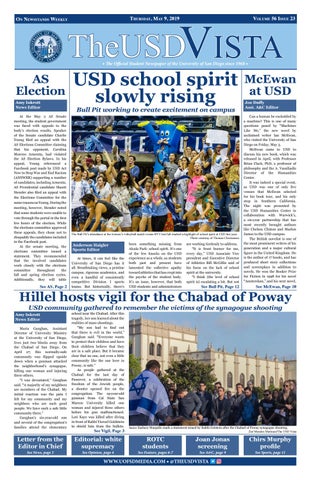
The Bull Pit’s attendance at the women’s volleyball match versus BYU last fall marked a highlight of school spirit at USD this year. Photo courtesy of Thomas Christensen
Anderson Haigler Sports Editor At times, it can feel like the University of San Diego has it all. Breathtaking views, a pristine campus, rigorous academics, and even a handful of consistently competitive Division I sports teams. But historically, there’s
been something missing from Alcala Park: school spirit. It’s one of the few knocks on the USD experience as a whole, as students both past and present have lamented the collective apathy toward athletics that has crept into the psyche of the student body. It’s an issue, however, that both USD students and administrators
are working tirelessly to address. “It is front burner for me, every day,” USD Associate Vice president and Executive Director of Athletics Bill McGillis said of his focus on the lack of school spirit at the university. “I think (the level of school spirit is) escalating a bit. But not
See Bull Pit, Page 12
McEwan at USD Joe Duffy Asst. A&C Editor
Can a human be cuckolded by a machine? This is one of many questions posed by “Machines Like Me,” the new novel by acclaimed writer Ian McEwan, who visited the University of San Diego on Friday, May 3. McEwan came to USD to discuss his new book, which was released in April, with Professor Brian Clack, PhD, a professor of philosophy and the A. Vassiliadis Director of the Humanities Center. It was indeed a special event, as USD was one of only five venues that McEwan selected for his book tour, and his only stop in Southern California. The night was presented by the USD Humanities Center in collaboration with Warwick’s, a six-year partnership that has most recently brought authors like Chelsea Clinton and Marlon James to the USD campus. The British novelist is one of the most prominent writers of his generation and a major cultural figure in the United Kingdom. He is the author of 17 books, and has produced short story collections and screenplays in addition to novels. He won the Booker Prize for Fiction in 1998 for his novel “Amsterdam,” and his next novel,
See McEwan, Page 10
Hillel hosts vigil for the Chabad of Poway USD community gathered to remember the victims of the synagogue shooting
Maria Gaughan, Assistant Director of University Ministry at the University of San Diego, lives just two blocks away from the Chabad of San Diego. On April 27, this normally-safe community was flipped upside down when a gunman attacked the neighborhood’s synagogue, killing one woman and injuring three others. “I was devastated,” Gaughan said. “A majority of my neighbors are members of the Chabad. My initial reaction was the pain I felt for my community and my neighbors who are such good people. We have such a safe little community there.” Gaughan’s six-year-old son and several of the congregation’s families attend the elementary
school near the Chabad. After this tragedy, her son learned about the realities of mass shootings. “My son had to find out that there is evil in the world,” Gaughan said. “Everyone wants to protect their children and have their children believe that they are in a safe place. But it became clear that no one, not even a little community like the one here in Poway, is safe.” As people gathered at the Chabad for the last day of Passover, a celebration of the freedom of the Jewish people, a shooter opened fire on the congregation. The 19-year-old gunman from Cal State San Marcos University killed one woman and injured three others before his gun malfunctioned. Lori Kaye was killed after diving in front of Rabbi Yisroel Goldstein to shield him from the bullets.
Letter from the Editor in Chief
Editorial: white supremacy
Amy Inkrott News Editor
See News, page 3
See Vigil, Page 3
See Opinion, page 4
Junior Zachary Margulis reads a statement issued by Rabbi Golstein after the Chabad of Poway synagogue shooting. Zoé Morales Martinez/The USD Vista
ROTC students
See Feature, pages 6-7
Joan Jonas screening See A&C, page 9
WWW.UOFSDMEDIA.COM ◆ @THEUSDVISTA
Chirs Murphy profile See Sports, page 11
2
The USD Vista
◆
May 9, 2019
NEWS
Campus Update
Associated Students
AS from Page 1
Student Org panels during elections as representatives of AS, and help with informing students and campus organizations about the elections process. This decision was made on the basis that Armenta told USD ANSWER to not endorse any candidates as it would jeopardize their campaign. Young sought to issue a statement to the body appealing the election committee’s decision. He promised new information regarding the appeal and to address a concern in the election committee’s procedures. Before the meeting, AS Speaker of the Senate Alexander Plummer issued a statement decrying Young’s claim. On numerous occasions, AS advisor Jennifer Lee referred to Plummer’s statement and the Election Bylaws, invalidating Young’s appeal for a statement. Senator Rowan Parmenter repeatedly countered these claims through referencing other aspects of the constitution and bylaws. Multiple senators became frustrated by the cyclical conversations. After a slim vote, Young was allowed to speak during the final business and hearing of the public. The senate later determined that Young did not have any new information, and his statement was disregarded. Later, Inclusion and Diversity Chair Jesse Magaña presented a resolution requiring that trigger warnings be included in all sensitive emails at USD. In a survey of 355 students, Magaña found that 70.4 percent of students believe the USD community would benefit from the presence of trigger warnings. This resolution was approved by the senate.
The Renaissance Plan
On Tuesday, Vice President of University Operations Ky Snyder, gave a presentation on the proposed Renaissance Plan. The presentation provides the campus community with a blueprint for the university’s upcoming construction and renovation projects. The Renaissance Plan is a part of USD’s Envision 2024 project. Over the next five years, the University of San Diego plans to construct two new buildings. Construction on the Learning Commons is scheduled to begin this summer and last until Fall 2020. When completed, this building will offer students a 24-hour study space, nine collaborative study rooms, and 13 new classrooms. Additionally, students will have access to a grab-and-go dining location, and an outdoor study area. USD also plans to build the Knauss Center for Business Education. This new building is set to replace the Olin Parking Lot. While little information is available surrounding this building, it promises new classrooms, offices, and interactive spaces for the School of Business. This building is expected to be complete in August 2022. The Renaissance Plan also includes guidelines for proposed renovations. Currently, USD has $312 million in deferred maintenance costs due to building deterioration and their resulting refurbishments. Copley Library will be the first to undergo renovations, set to begin in mid-2019. All areas of the library except for the Mother Rosalie Hill Reading Room, also known as the “Harry Potter Room” will be closed until Fall 2020. When complete, it will offer 38 collaborative study spaces and 1,000 available seats. However, the most drastic of these renovations will come in June 2020 when Camino, Founders, and Sacred Heart Halls will be shut down for 14 months. 300 first-year students will be placed in other residence halls and professors will be moved into temporary office spaces. Founders Chapel will not be accessible during these renovations. This project will be completed in August 2021. Finally, Olin Hall is set to be renovated following the completion of the Knauss Center for Business Education. Olin Hall will be taken offline and all classes will take place in the Knauss Center.
2019 AS Election Results President: Marion Chavarria Rivera Vice-President: Greyson Taylor Speaker of the Senate: Carolina Moreno Armenta Torero Program Board Chair: Elisse Etcheverry Finance Chair: Stephanie Silvar Chief of Staff: Leslie Martinez SAPS/San Buenaventura Senator: Fanisee Bias Vistas Senator: Ashley Butler Manchester Senator: Analleli Villegas Barrera Commuter Senators: Nadia Al-Faraje, Krystal Alvarez & Simon Mizrahi School of Business Senator: Rhonda Papp College of Arts and Sciences Senators: Maya de la Torre, Valerie Jaimes, Yashve Kalati, Maya Ramirez, Bryanna Rivas, Vida Vossoughian, Justice Zoto & Eliza Giroux
PREPARE
CONFIDENTLY PREPARE FOR THE CPA EXAM at a top ranked school. GMAT waivers available. Earn your MS in Accounting in as few as 10 months in Orange County. CHAPMAN.EDU/MSA
Volume 56 Issue 23
◆
NEWS
◆
The USD Vista
A message of hope and love
3
Toreros were encouraged to be a light in the world despite these mass shootings Vigil from Page 1
impacted by the shooting. Students from USD’s Hillel shared messages of hope with the campus community in remembrance of those injured and killed during the attack. The death of Lori Kaye was
“Our sages teach us that ‘anyone who destroys a life is considered by Scripture to have destroyed an entire world; and anyone who saves a life is as if he saved an entire world,’” Glasser said. “In other words, the loss of
one person’s life is equivalent to the loss of hundreds of people.” Glasser viewed the attack on the Chabad as the continued spirit anti-semitism in the world. “Our people continue to say ‘never again’ when talking about the Holocaust, but it has happened again,” Glasser said. “People who hate us do not hate us because of our religion or our political ideals, they hate us because we are Jews. Whether we are religious or secular, rich or poor, right wing or left wing, none of us are immune to anti-semitism.” As the sun began to set, other individuals stood at the podium to share messages of peace, love, and hope with the gathered community. With the Israeli flag draped across his shoulders, junior Zachary Margulis read aloud the statement issued by Rabbi Goldstein following the attack. The statement highlighted the resiliency of the Jewish community and called all people toward greater love and tolerance. “Rabbi Goldstein talked about the inevitability of darkness,” Margulis said. “But it’s up to us in order to bring light upon the darkness. You can’t fight darkness with more darkness... (Goldstein’s) message was so
Dearest The USD Vista staff and USD community:
honor to see it all. I have seen late nights turn into early mornings as we put the finishing touches on an Associated Students (AS) article written the day of so as to provide the campus with up-to-date ews. I have watched the newsroom lead itself and step up to the task when the college admission scandal hit our campus forcing many on our news team to pick up jobs not listed in their position description. I have heard fear in student reporters’ voices as they struggled with the fact that despite the accuracy of their work, heavy criticism and potential
attacks seemed inevitable on the horizon. I experienced our USD campus come to life as the accomplishments of our sports teams, the beauty of a student art exhibit, and rich stories of student activism ran through our 12-page paper. Better yet, your work has proved the importance of solid and consistent student journalism. AS senators and members of the public have referenced our coverage during AS senate meetings. Professors have cited our work in their classes in order to bring the issues of our campus into the
Goldstein was shot in the hand, causing him to lose his index finger. Eight-year-old Noya Dahan received shrapnel wounds in her leg and face. Her uncle, Almog Peretz, was also shot in the leg. United States Army veteran Oscar Stewart tried to tackle the shooter, but the gunman quickly fled. Off-duty Border Patrol agent Jonathan Morales fired at the shooter as he ran from the building. This shooting at the Chabad of Poway left members of the University of San Diego campus community stunned and heartbroken. On Thursday, May 2, a group of 90 people gathered in front of the University Centers to stand in solidarity with those
remembered at USD’s vigil by Jewish Student Union President Joshua Glasser. Glasser reflected on the relationship he formed with Kaye through his volunteer work. “Lori Kaye was someone I knew personally,” Glasser said. “Throughout high school I was involved with an organization called Friendship Circle which specialized in helping people with special needs...Lori’s commitment to the Friendship Circle truly shows the type of person she was. She had nothing to gain from being a part of it but she volunteered at every event due to the goodness of her heart.” Throughout his testimony, Glasser continued to emphasize the value of Kaye’s heroic sacrifice.
“Whether we are religious or secular, rich or poor, right wing or left wing, none of us are immune to anti-semitism.” -Joshua Glasser
pure. He was shot at by someone who wanted to murder him, and all he had to say was go shine some light on the world, do a good deed, make somebody’s day, go to synagogue, and don’t be scared of being a Jew.” Afterward, Margulis
in San Diego. “It’s where I feel most comfortable,” Margulis said. “I grew up in synagogue. It’s safe, it’s warm. But then again, now, I do look over my shoulder and out the door. I do understand that there is a threat. The sad thing now is that
continued to reflect on the Poway attack. Margulis explained that he learned about the attack within minutes through a notification on his phone. “It was heartbreaking,” Margulis said. “Of course it’s heartbreaking, but I’m not surprised unfortunately. My human instinct was just sheer terror, not to the degree of what those people felt, but personally, especially being Jewish with an attack on a synagogue. That man may have only shot a few people, but he was going for the Jewish community as a whole.” Since that day, Margulis has sensed the gravity of this shooting as it impacts his own community
you never really know. This is not the first time this has happened, and it’s not going to end.” The vigil concluded with a number of traditional Hebrew songs and prayers for hope. Together, the community sang “Hineh Mah Tov” with lyrics conveying “how good and how pleasant it is for brothers and sisters to dwell together in unity.” In the first few months of 2019, the United States has seen 109 different shootings, killing 131 and injuring nearly 400 more. However, members of the USD community were encouraged to be a beacon of light despite these continued acts of hatred and intolerance in the world.
classroom. And our e-newsletter, the University Dispatch, has had great viewership success. Well done The USD Vista staff, your work has not been done in vain. To our campus community, I would be remiss if I did not mention the controversy between some members of Associated Students and The USD Vista. For better or worse this USD contention mirrored well the divisiveness between our country’s current administration and media. In many respects a tension ought to exist between government and journalism, as the former holds the greatest
power and the latter has the responsibility to check that very power. My greatest hope is that the USD community has seen that we take this responsibility seriously and have done our very best to up hold it. In closing, thank you to all our readers. You all are the reason why our paper exists. We produce this weekly record for you. To next year’s The USD Vista staff, best of luck and stay true– this job is not easy, but well worth it.
“All (Goldstein) had to say was go shine some light on the world, do a good deed, make somebody’s day, go to synagogue, and don’t be scared of being a Jew.” -Zachary Margulis
A letter from the Editor in Chief
To The USD Vista staff, few know of the work you all do. Few see the 20 hours a week you all spend interviewing, writing, editing, and designing in order to produce a weekly paper worth reading. And fewer still have seen the unique challenges of college journalism which span anywhere from awkward Aromas bump-ins with students you just covered to explicit threats from those who disliked your story. Rest assured, as Editor in Chief of The USD Vista I have had the privilege and
Cheers, Luke Garrett Editor in Chief, 2018-2019
4
The USD Vista
◆
May 9, 2019
E DI TOR IA L
Trump’s white supremacy
Trump’s words, actions, and associates encourage white supremacist groups Eric Boose Opinion Editor The day after the Chabad of Poway was attacked, a White House spokesperson said that President Donald Trump and his entire administration “have and will continue to condemn racism, bigotry, and violence of any form.” The history of Trump’s administration, stretching back to his very first speech as a candidate, says otherwise. History indicates that the White House’s statement is a lie. In his speech announcing his candidacy for president, Trump called Mexican immigrants rapists who were “bringing crime” and drugs into the United States. The duration of his candidacy, his time as president-elect, and his time in the Oval Office have all followed the precedent he set in that first speech. In May of 2016, Trump claimed that a federal judge would be unable to fairly do his job due to being Mexican. “He’s a Mexican,” Trump said of Judge Gonzalo Curiel, who was born in Indiana. “We’re building a wall between here and Mexico. The answer is, he is giving us very unfair rulings – rulings that people can’t even believe.” Despite being a Trump supporter, then-Speaker of the House Paul Ryan denounced Trump’s remarks, calling them “sort of like the textbook definition of a racist comment.” Latinx people are not the only group about which Trump has made racist remarks. In January of 2018, Trump asked, “Why are we having all these people from shithole countries come here?” referencing immigrants from El Salvador and Haiti as well as various African nations. Trump also called NFL players who knelt during the national anthem in protest of police brutality “sons of bitches.”
Almost all of the players who knelt were African American. There are many words for what these remarks are – disgusting, unacceptable, appalling – but the one word that must be used for Trump’s remarks is racist. For every racist comment he has made, the worst thing Trump has said is in fact something he has never said. Throughout his entire time as a candidate, as president-elect, and as president, Donald Trump has never forcefully denounced white supremacy. The Southern Poverty Law Center (SPLC) found nearly 900 “hate incidents” in the United States following Trump’s election. Among them was an incident in which white school children told their African-American classmates to sit at the back of the school bus. In 40 percent of the 900 incidents, the SPLC found that the perpetrators invoked either Trump’s name or his campaign slogans. In response, Trump minimized the events, claiming that there had only been “a very small amount” of racist incidents. In August of 2017, white supremacists marched through the streets of Charlottesville, Virginia. A woman was killed when a white supremacist drove a car into a crowd of counterprotestors. The marchers chanted “Blood and soil,” a phrase with its origins in Nazi propaganda. They chanted, “Jews will not replace us,” and, “Sieg Heil.” Trump said there were “very fine people on both sides.” The Nazi salute echoed through the streets of an American city, and the president called those who shouted it “very fine people.” Less than 24 hours before the shooting at the Chabad of Poway, Trump stood by those remarks. If our actions speak louder than our words, Trump’s actions only amplify his nativist rhetoric. Trump’s rise to prominence as a
candidate can in large part be attributed to his subscription to and advancement of the “birther” movement, which perpetuates the false belief that President Barack Obama was born in Kenya. The “birther” movement has never questioned the birthplace of a white politician, but has instead focused solely on undermining the first African-American President of the United States. Even more prominent in Trump’s campaign than his false claims about President Obama’s birthplace was his promise to build a wall along the entire length of the border between Mexico and the United States. In the years since his election, Trump’s promises to not only build a wall, but to make Mexico pay for it have changed. No longer is “the wall” necessarily a wall, but simply a physical barrier. Mexico is not going to pay for it. Trump’s wall was never about border security. Reports from the Trump administration itself suggest that a wall would not be effective in securing the border; a majority of drug smuggling takes place at established border crossings. Trump’s wall has always been a monument to nativism, a way to paint Latinx immigrants as a threat so grave that sending soldiers to defend the border was necessary. A week into his presidency, Trump signed Executive Order 13769, titled Protecting the Nation from Foreign Terrorist Entry into the United States – the first of two so-called Muslim bans. All of the countries affected by Executive Order 13769 have a majority-Muslim population. The second Muslim ban, Executive Order 13780, was signed less than two months later, replacing Executive Order 13769. Both of these orders heavily restrict travel to the United States from Iran, Libya, Syria, Yemen, and Somalia. The travel ban established by the
second order has been revised, but is still in place today after being upheld by the Supreme Court last April. Both Executive Orders share the same name: Protecting the Nation from Foreign Terrorist Entry into the United States. In this name, Trump’s intention is clear: to label all Muslims a dangerous threat to the United States. Trump is not the only member of his administration spewing hate by word and action. Some of Trump’s closest advisors have deep and well-documented ties to white supremacy in the United States. Steve Bannon, former White House Chief Strategist and Special Counselor to the President, is the former head of Breitbart News Network, a website Bannon himself described as a “platform for the alt-right.” Breitbart has long published blatantly racist, sexist, and xenophobic articles, including some which promote the “birther” movement. Stephen Miller, current Senior Advisor to the President, has a long history of antiimmigrant sentiment. One of Miller’s high school classmates describes him as having “an intense hatred toward people of color, especially toward Latinos.” In college, Miller was close friends with noted white supremacist Richard Spencer. Now, Miller is the chief architect of the president’s immigration policy, including the Muslim ban. Spencer, the president of the National Policy Institute, has advocated for ethnic cleansing and the creation of a “white ethno-state” in the United States. Spencer is one of many white supremacists who endorsed Trump for president, as well as David Duke, the leader of the Ku Klux Klan. Regardless of whether Donald Trump is truly a white supremacist, the white supremacists clearly think he
is. As Creighton University’s Dr. George McHendry, Jr. puts it, “Trump is conversant with the language of white supremacy at the same time that white supremacist agitators are increasing their visibility in American politics.” Trump has surrounded himself with white supremacist advisors, and he has adopted and advocated for the policies they promote. White supremacy is on the rise in the United States, and the president is giving it a platform to thrive. Even still, Donald Trump is more dangerous than simply giving white supremacy a platform. Trump’s words and actions line up with the goals and ideals of white supremacy groups. White supremacist groups are excited by the fact that the White House seems to agree with their point of view. Trump’s words and actions do not overtly send the message of white supremacy. Trump’s white supremacy is not explicit, but implicit. What he has said and done mobilizes existing white supremacists and inspires new one. In Pittsburg, Christchurch, and Poway, the shooters mentioned nativist ideologies like Trump’s. Donald Trump is not explicitly advocating for ethnic cleansing. His words and actions are in no way as extreme as those of the KKK. This does not mean that Donald Trump is not a white supremacist. Trump has promoted white supremacists to positions of great influence within the White House. Trump refers to minority groups as monoliths, and aims to demonize those minority groups. At best, Trump is soft on white supremacy to the point of being apathetic and his failure to take a hard stance against intolerance can be considered an endorsement of hate crimes and oppression. At worst, the President of the United States is a white supremacist.
When a joke goes too far
Internet humor has taken an ugly turn, and it’s time for some accountability Catherine Silvey Feature Editor For years we have wondered what makes a mass shooter. One long-standing theme has been a pattern of loneliness and isolation in the shooter. Additionally, many shootings have been motivated by revenge, involving attacks launched on the shooter’s school or place of work to avenge perceived wrongdoings committed against them.
Recently, however, another unnerving factor has been added to the pattern. The flash of an upside down “OK” hand signal when photographed in a postshooting court appearance. The declaration of “Subscribe to Pewdiepie” moments before murdering dozens of innocents in their place of worship. A longwinded manifesto released on 8chan littered with references to online humor and memes. These actions indicate an attempt at communication, a cry for
attention, and approval from the home base of these incessant references – the internet. The most disturbing aspect of the recent shootings is that they have not been motivated by a personal connection, by experiences directly felt with the victims. Instead of acts committed due to a personal history of experienced disapproval, these shootings take place as a result of a desire for approval, a desire to be accepted and veer more into the
realm of hate crimes as they tend to target historically oppressed groups. The online communities who explicitly align themselves with hate groups such as white supremacists or Neo-Nazis are undeniably problematic and dangerous. The lines are blurred, though when it comes to the types of humor referenced by both the Christchurch and Poway shooters – widely-shared edgy memes and jokes. Pewdiepie himself, who has
been referred to in two major mass shootings at this point, has been a leader in the realm of edgy humor and trolling on the internet for some time now. With a massive social media following and nearly 100 million subscribers on Youtube, Pewdiepie has historically come under fire for including subliminal messages of white supremacy and Neo-Nazism in his videos. Many of his jokes rely on sought shock value, including
See Internet, Page 5
The University of San Diego does not share the views presented within the editorial and op-ed sections. The opinions expressed in this section reflect solely the opinion of the respective writer.
Volume 56 Issue 23
◆
OPINION
◆
E DI TOR IA L
Internet from Page 4 a video in which he pays two strangers online to hold a sign reading, “Death to all Jews.” Despite how troubling his content can be, Pewdiepie has always been insistent that these startling recurrences in his videos are only jokes and are not meant to cause harm. In the wake of the recent tragedies in which his name has been repeatedly invoked, Pewdiepie has released statements denouncing the acts, and even published a video encouraging the end of the “Subscribe to Pewdiepie” movement referenced in the attacks. Such is the crux of the conflict – if someone who makes jokes such as endorsing “Death
to all Jews” to an audience of nearly 100 million subscribers is referenced in a terrorist attack on a synagogue, how responsible is that individual for the attack? How responsible are the internet communities that claim that their “edgy” humor is all in
his name. He can, however, be held responsible for his position as a leader in a community that considers finding the most devastating facets of our humanity hilarious an esteemed character trait – the more offlimits and shock-inducing, the
“Edgy humor is not a sign of high intelligence... Edgy humor is a gateway drug.” jest when someone takes it too far and opens fire on innocent civilians? Pewdiepie made the right decision in condemning these vile acts. Pewdiepie cannot be held responsible for the murder of innocent people committed in
better. The more we find the agony of other humans, especially those who have been and still are systematically oppressed, something to be laughed at, the more susceptible we are to desensitization to human
5
The USD Vista
suffering altogether. Edgy humor is not a sign of high intelligence. It is not a sophisticated vein of humor that if you find uncomfortable or wrong, you just don’t understand. Edgy humor is a gateway drug. There are more than enough openly hateful individuals and groups in the world that require the focus of this conversation. But it should be worrisome that a man with a platform of nearly 100 million people worldwide has been referenced in two separate terrorist attacks, especially given that his audience is notoriously young, extremely devoted to him, and willing to do anything to capture their idol’s attention.
The internet is an incredible facilitator for connection, where people who may be struggling with their home, work, or school environments come to find solidarity, support, belonging. The internet thrives because it is free and largely unregulated, but its defining qualities have created a downward spiral, one that could start with watching the most popular influencer on Youtube and end in online forums espousing white supremacist values. A joke is a joke until it is not. We need to rethink if it is worth a cheap laugh to keep engaging in behaviors that numb our pain receptors and have the potential to cause such enormous suffering.
In the process we trust The electoral college ought to be the key issue in 2020 election
Ali Ulin Asst. Opinion Editor Over 20 candidates and countless topics, all in less than two years: that is what is to come for the 2020 election. The Republican ticket is essentially decided as there is next to no question that incumbent President Donald Trump will have a second-term candidacy in a landslide victory against his single opponent, former Massachusetts Governor Bill Weld. However, that leaves the Democrats with 22 choices and potentially counting. For Democrats this means picking a candidate that will knock out other blue candidates followed by winning the title fight against Trump in the general election. As has played an increasing role in the 2008 election, 2016 election, and 2018 midterms, identity politics are no longer an option for the race in 2020. Voters need to make informed policy and platform decisions about who they believe will be able to preserve the wellbeing of this country and potentially make progress while in office. With a variety of platforms and opinions, it seems there are a few leading favorites for the nomination. Of course, Trump is the leading voice of the opposition to the Democratic party, but the Democrats themselves lie within an elite top six: former Vice President Joe Biden, Vermont Senator Bernie Sanders, South Bend, Indiana Mayor Pete Buttigieg, Massachusetts Senator Elizabeth Warren, former Texas House Representative Beto O’Rourke, and California Senator Kamala Harris. Each of these candidates have voiced their own thoughts on what should be the top issue and potentially the deciding factor in why any voter should vote for them, but really for anyone in general. Warren
made a cry for education funding, O’Rourke for climate change, Sanders for a “political revolution,” and so on. However, there is topic that is most telling about candidates and should have the most weight in your vote, and it is that candidate’s plans for the electoral college. As has become increasingly worrisome, the electoral college has been a large concern for voters especially following the 2000 and 2016 elections, both elections in which the candidate who received the most electoral college votes did not win the popular vote. Though Trump is the fifth president to have not won the popular vote, voters are growing sick of an election process some view as being outdated. However, changing the system is not as simple as just abolishing the electoral college all together. The electoral college was put in place to prevent tyranny of the majority, a phenomenon that has posed a threat to democracy since Alexis de Tocqueville first wrote about it in “Democracy in America” in 1835. Eleven candidates have publicly supported the abolition of the electoral college including Buttigieg, Sanders, and Warren. Additionally, Harris said she was “open” to the conversation during an interview on “Jimmy Kimmel Live!.” As a system established in the Constitution, the electoral college is not a method that can simply be done away with through an executive order or even the passage of a law. A constitutional amendment – something which has always been difficult and time-consuming to accomplish – would be necessary to abolish, replace, or even alter any aspect of the electoral college. The electoral college is made up of a total of 535 electors, and each elector is expected to act on behalf of the voters in their state and cast
their votes for the winner of the popular vote in that state. Often the argument to abolish the electoral college is in the name of a true democracy, where the candidate with the most votes wins. However, the United States is not a pure democracy nor does it try to be. The United States is a democratic republic, meaning that while democracy is at the core of the political design of the country, the federalist design of the Constitution, “the highest law of the land,” does not incorporate a pure form of democracy. The idea that the majority vote is a better system than using any type of buffer system, whether that be the electoral college or an altered version, would open the door to an irrationally powerful majority. The Constitution serves as the main outline for the electoral college with revisions coming from the United States Code. Article II of the Constitution sets the rules for number of electors: “Each State shall appoint, in such Manner as the Legislature thereof may direct, a Number of Electors, equal to the whole Number of Senators and Representatives to which the State may be entitled in the Congress;” but, many of the details come from the Twelfth Amendment, which designates the President “the person having the greatest Number of votes for President...if such number be a majority of the whole number of Electors appointed.” The Constitution designates the amount of electors to ensure that states are given electors relative to their proportional amount of the national population. These laws are made to protect the minority-minded voters from a tyrannical majority electing officials and extreme political interest groups. While the electoral college on a base level provides a great and
underappreciated service to the American people, the methods in which it works need altering. Abolishment is both irrational and impossible, but alteration is beneficial to politicians and voters alike. Majority rule cannot be the sole factor of election, yet the biased weight of larger states, and therefore electorate values, leaves the election to select swing states: Colorado, Florida, Ohio, Pennsylvania, and a few others. This heavy reliance on battleground states is unhealthy for the democratic, and specifically American, election system by providing dangerous avenues for election tampering such as foreign interference, as was seen in the 2016 election, voter fraud, and other potential threats to the American political system. However, the current system is extremely flawed and obsolete. When the electoral college was written into the Constitution over 200 years ago, the eligible voter pool was exponentially smaller. The eligible voters at the time were white, Christian, land-owning men which would leave out the vast majority of the population of the United States. In 1776, the total population of the United States was 2.5 million people according to the U.S. Census data; that would be less than the size of Chicago alone. A system designed for such a relatively small population can not be expected to be fit for a population as large as the more than 370 million people who live in the United States today. It is no wonder that the electoral college seems so outdated in the context of modern elections. As Trump stated in a nowinfamous tweet, following President Barack Obama’s re-election in 2012, “the electoral college is a disaster for democracy.” Trump’s tirade about the election results continued, “He lost the popular
vote by a lot and won the election. We should have a revolution in this country!” shortly followed by, “the phoney electoral college made a laughing stock out of our nation. The loser won!” These were following multiple news networks calling Barack Obama’s victory after he won Ohio which weighted in his favor while opponent Mitt Romney still owned the popular vote at midnight of the election. After all votes were counted, Trump deleted his tweets in response to the backlash he received for his quick judgement and short temper. Though Trump’s tweets were unfounded in this instance, his ideas were not far off. Though the electoral college, and not the popular vote, was responsible for his victory in 2016, his idea that the electoral college had undemocratic aspects and lacked authentic representation of the U.S. population align impressively well with the complaints of voters following the 2016 election. Much of what the public sees, similar to what Trump saw the night of Nov. 6, 2012, is a small, biased portal through a faulty, politically interested media. By this, news anchors, specialists, and celebrities take up the role of creating awareness around issues that are generally very socially charged – climate change, women’s rights, healthcare, and so on, yet this continually ignores major issues such as the two explained above that could fundamentally alter the future of this country and realistically the entire world. Both of these issues listed above seem trivial in the eyes of voters who are perplexed by the high profile issues, but electoral college plans are of the utmost importance and should be at the forefront of voters’ minds throughout this campaign season and more importantly come election day.
The University of San Diego does not share the views presented within the editorial and op-ed sections. The opinions expressed in this section reflect solely the opinion of the respective writer.
6
The USD ViSTa
◆
May 9, 2019
Michael Twiss Sophomore political science major Michael Twiss comes from a strong military background, as both his father and grandfather have served for the United States. Twiss credited being in the ROTC program with helping to keep him focused on a goal and with giving him something to hope for after he graduates. Photo courtesy of Michael Twiss
“It feels natural. It feels like something I am supposed to be in. It also
puts me in a different mentality. It makes me think more about my actions and how I carry myself because I represent the Army when I wear the uniform... I joined because I fight for liberty. I believe liberty is something that is good for its consequences, and is why this country has advanced as far as it has. Liberty is something that must be fought for every generation. My grandfather fought for it, my father fought for it, and I will fight for it... I was bad enough at time management before I joined the program. But adding 20 hours a week of ROTC to a full-time college schedule was, and is, a struggle.”
ROT TORER UNIF
Reserve Officer Train students make up a USD’s community. simultaneous commi personal studies and from easy, but these balance with grace. T come to USD from n an excellent educat an officer standing, leadership and te
Sara Arata Originally from Virginia, junior accounting major Sara Arata grew up in a military family, and applied for the Navy ROTC scholarship after receiving encouragement from her father. Arata expressed that being in ROTC has allowed her to challenge herself, overcome obstacles, and to truly develop herself into the person she is today. Photo courtesy of Sara Arata
“I truly love America with my whole heart and to have the opportunity to serve and be part of an organization I have admired for my whole life was just something I couldn’t turn down... I think of my dad and all of the other brave men and women who have come before me and worn the same uniform. When I put on my uniform it is an active reminder that freedom is not always free and many have paid the ultimate sacrifice wearing this uniform... Balancing college, a social life, and ROTC has at times been challenging; it definitely is not the traditional route, one very different than what my friends have chosen. With that it sometimes means I can’t do everything my friends do...It’s definitely been a balancing act but it’s been one through the support of many of my friends and a whole lot of discipline and coffee.”
Photo courtesy of Suraya Marzuki
Volume 56 Issue 23
◆
FEATURE
7
The USD ViSTa
Suraya Marzuki
TC: ROS IN FORM
ning Corps (ROTC) an integral part of . Balancing their itment to both their d their country is far students handle the These students have near and far to gain tion, graduate with and develop their eam-building skills.
◆
Sophomore mechanical engineering major Suraya Marzuki came to USD from Aurora, Illinois in hopes of experiencing warm weather and a strong ROTC program. Her motivation stems from her loving parents, older brother, who is also in the ROTC program, and her ambition to be a pilot. When she needs an escape from school, Suraya sings and plays both ukulele and guitar. Photo courtesy of Suraya Marzuki
“I’ve been wanting to be in the military since the sixth grade. I knew that I wanted to be an officer because I wanted to be a leader. I still wanted the college experience and so I followed my older brother to USD. I wanted the possibility of something new... The uniform is a lot about respect. It is about professionalism and conduct. I am proud of what I represent. I haven’t served yet, but I am hoping to inspire others... I want to fly jets or anything that they’ll let me fly. I just think planes are really cool. I like the action. You see the people who are older than you and you see how much they love their jobs. It is a community of people I want to join.”
Tanner Claudio San
Diego
native
Tanner
Claudio felt inspired by his father to also pursue a career in the Navy. He aims to graduate with a mathematics degree and serve on a submarine. Tanner is eager for more leadership opportunities, thrives off of the physical challenges during training, and wants to make his country and family proud. Photo courtesy of Tanner Claudio
“The first time you put the uniform on, you feel really good. You are wearing our country’s cloth. It is serving as a reminder to me of where I’m going... I remember seeing my name sewn into the fabric for the first time. It just felt like I was a part of something bigger than myself when I saw my name next to the Navy logo... When you take your uniform off, you’re never really taking it off. You are always representing the Navy. You are always representing our country.”
Spread by Mónica Millán/ The USD Vista; Content by Sabrina Alterman and Emma Goodman-Fish/ The USD Vista
8
The USD Vista
◆
May 9, 2019
F E AT U R E
Students march for Earth
USD students march to combat climate change and to spread campus-wide awareness Rosalinda Puentes Contributor On April 30, students at the University of San Diego took part in the USD March for Climate in an effort to spread awareness for the environmental issue of climate change. Climate change is a fluctuation in the earth’s weather patterns, caused by human activity that affects various weather patterns. The USD community gathered outside of the Torero Store with signs and chants in an effort to push the voices of the Youth Climate Movement into action. Environmental studies major and sophomore Gianna Petersen, a member of the student organization Be Blue Go Green as well as an employee at the Office of Sustainability, saw the March for Climate as an opportunity to educate and empower the community. “We marched to educate and bring awareness within our community,” Petersen said. “We marched to acknowledge those who are victims of climate injustice. We marched because we want our institution to be more accountable for climate action.” Petersen marched through the SLP and down to Paseo de
Colachis alongside professors and students from the Environmental Science and Ocean Science (EOSC) departments and both on and off-campus organizations. One such off-campus organization was SanDiego350, a volunteer organization that strives to prevent climate change and injustice through education and advocacy. Participants were given the opportunity to visit booths from campus organizations such as Climate Education Partners and the Office of Sustainability. One face that stood out among the crowd was Marlene BritoMillan, Ph.D., from the EOSC department. Before marchers dispersed to visit the various booths, Brito-Millan gave a speech discussing the importance of climate action and highlighting that marginalized groups are affected by and bear the burden of climate change much differently than more privileged individuals. Her background in ecological research and environmental justice made Brito-Millan’s presence a crucial component of the March for Climate, indicating that the involvement of staff is just as important as that of students. Petersen reiterated the importance of both student and staff involvement. Her belief is
that the message must be spread in order for action to occur and before it is too late. “Students at USD are one, two, three, four years away from entering into the professional world in which they will have the choice and power to make decisions to prevent climate change and its implications from continuing on its current path,” Petersen said. “Professors and staff are in the positions where they currently have the ability to make a difference as well.” The March for Climate was one way for students to become involved in creating an impact for the environment, but there are still plenty of other ways students can take part yearround to support sustainability. Petersen noted that starting small leads to a more environmentallyconscious mindset, both within the individual’s actions and on the actions of those around them. “From my experience, when you begin carrying around a straw or your own utensils or coffee mug, people see you using it and might even ask you about it and that’s how we begin changing our culture and begin the conversations we need to have more of,” Petersen said. While encouraging her fellow
Prepare for the business of
Marlene Brito-Millan, Ph.D., gives an impassioned speech on climate change. Photo courtesy of Jackie Crane
students to start small, Petersen also emphasized the urgency and time sensitivity of the issue at hand. “USD is part of a community where we, with the right efforts, can collectively make a difference,” Petersen said. “There is no time to wait and it is important that we educate our community and empower our peers, cohort, coworkers to take action before it’s too late.”
MAKING A DIFFERENCE
EARN YOUR 12-MONTH MBA AT POINT LOMA NAZARENE UNIVERSITY • Values-driven curriculum • Professional mentorship network • Hands-on classroom experience
Become the leader that others will follow. Learn more at pointloma.edu/12monthMBA
As a Changemaker campus, the March for Climate displayed passion and determination from many Toreros in support of a cause they deeply believed in. In taking action and standing together against climate change, the students involved used their platform and voices to promote the salvation of this planet and the promise tomorrow may bring if the right steps are taken here and now.
Volume 56 Issue 23
◆
ARTS & CULTURE
◆
The USD Vista
A ART RT S & CULTURE C U LT U R E
9
Screenings 3: Joan Jonas
Artist Joan Jonas’ 24-minute long video, “Double Lunar Dogs,” has been on display Angelina Dinsmore Asst. A&C Editor In collaboration with the Museum of Contemporary Art San Diego (MCASD), USD’s Humanities Center presented the final screening of artist Joan Jonas’ video artwork. Jonas has visited USD in the past, and is currently a professor of visual arts at the Massachusetts Institute of Technology. Her 24-minute long video, “Double Lunar Dogs,” has been on display since March. On Thursday, May 2, Anthony Graham, an assistant
their whole lives there. The only stories they know of Earth are ones that have been passed down through tall tales. The spaceship resembles a mad scientist’s lab and the passengers have futuristic outfits and makeup. The story is told through special effects, fragmentary scenes, and an electric soundtrack. Graham drew the audience’s attention to the continuous themes of memory and the passage of time. The main character constantly questions herself and the objects around her. When shown everyday
“I have always been intrigued by performance artists and the ways in which they utilize and exert their bodies to convey their artistic intent.” -Sarah Kushner curator at MCASD and a USD alum, gave a talk about Jonas’ contemporary film, analyzing the original choreography, striking images, and abstract dialogue. An intimate group of people gathered in the Humanities Center gallery to hear from Graham while Jonas’ video played on repeat behind him. Graham told listeners that the 1960s and 1970s began a crucial development in performance art. Though she was originally trained as a sculptor, Jonas has expanded her talents to many different art forms, and was among the first artists in the 1970s to combine performance and video. “Double Lunar Dogs” stems from Robert Heinlein’s science fiction story, “Universe,” which conveys a similar concept of the spaceship as the entire world. Jonas’ video originally debuted as a stage performance in 1980, then later came out as a video in 1984. While there is no obvious plot, it tells a story about a small team of astronauts who have been aboard a spaceship for so long that they forget their mission. They were born on the spaceship and will live
objects, it is evident that she has forgotten what they are. This is demonstrated when she uses a bowl and a piece of plastic as a makeshift helmet. Graham also compares doubling and mirroring in film. Jonas used multiple screens to portray the various dimensions and perspectives. After Graham’s synopsis of the film, the event turned from a presentation into a discussion. A few members of the audience asked questions to further understand what she was trying to say. “Do you think Jonas uses the characters’ body movements to compliment each scene and message?” one asked. “We move around just as much as the characters do,” Graham responded. “Jonas demonstrates this by trying to make the screen itself appear mobile.” “Double Lunar Dogs” attempts to show access to different layers and realities. Jonas does not want anything to be so cut and dry. She uses pixilation to show a shift in perspective and visibility. Some characters shift in and out of view to show the various perspectives of the
Jonas is a Professor Emerita in the MIT Program in Art, Culture, and Technology and a seminal figure in performance art. Photo courtesy of Flickr
characters. Jonas incorporates various body movements and symbolic props such as masks, mirrors, and hearts to show the ongoing exploration of identity. One audience member asked how the work was initially received, and although Graham was not entirely sure, he explained that the art market is constantly changing and that Jonas’ work eventually grew out of fashion in the 1980s. Sophomore Sarah Kushner came to the exhibit for a class, and found that she is a fan of Joan Jonas’ work. “I have always been intrigued by performance artists and the ways in which they utilize and exert their bodies to convey their artistic intent,” Kushner said. “It is clear that Jonas is heavily influenced by animals and enjoys featuring the relationships shared between humans and animals. I found this really interesting and she inspired me to incorporate my loved ones into my art.” Sophomore Maura Knopke also attended the event simply out of love for Jonas. Knopke appreciates Jonas’ sense of self in her work. “I like how she incorporates herself into her videos,” Knopke
Joan Jonas at Reanimation: A Performance by Joan Jonas with Jason Moran. Photo Courtesy of Flickr
said. “She is not only the creator but also the subject.” Jonas remains an influence for all contemporary artists. Jonas is still making art, as she claims she is never truly satisfied with her work, so she constantly tries to improve it. She also spends time at colleges nationwide to present
her art. For those who have not yet gotten the chance to visit the Humanities Center gallery, Jonas’ film will be on display until May 17. USD is fortunate to have collaborated with MCASD so that Jonas’s incredible work could be showcased to the broad San Diego community.
One of artist Joan Jonas’ pieces of artwork, a crystal sculpture from Reanimation, was displayed in the Museum of Modern Art in New York City. Photo Courtesy of Flickr
10
The USD Vista
◆
May 9, 2019
All about McEwan’s new book
McEwan discusses his latest book, “Machines Like Me,” with Professor Brian Clack
McEwan from Page 1
“Atonement,” was made into an Oscar-winning film starring Keira Knightley and James McAvoy. A large audience of students, faculty, and other visitors turned out for the event, filling up at least the first dozen rows of seats in Shiley Theatre. Once the house lights dimmed, the crowd became quiet and a representative from Warwick’s came to the podium, followed by Noelle Norton, Ph.D., Dean of the College of Arts and Sciences, who introduced McEwan. “The subversive and entertaining novel poses fundamental questions that all of us probably need to start asking, such as, ‘What makes us human? Our outward deeds or our inner lives? Can a machine understand the human heart?’” Norton said. “It’s a provocative and thrilling tale that warns of the power to invent things beyond our control.” Set in an alternative 1980s London—a warped history wherein the mathematician and artificial intelligence pioneer Alan Turing never took his own life, John F. Kennedy was never assassinated, and Jimmy Carter won a second term over Ronald Reagan—“Machines Like Me” explores the moral dilemma that
like androids in existence. He then meets Miranda, a young graduate student who lives upstairs from him, and together they attempt to co-author Adam’s personality. Feelings are laid bare, a love triangle forms, and Charlie is forced to grapple with the question of whether Adam is more “human” than he initially thought. In their discussion, Clack and McEwan touched on the subjects of science, politics, humanity, and, of course, “Machines Like Me.” Clack began the discussion by talking about the origins of the book, asking McEwan what led him to this book at this time. The author discussed his relationship with artificial intelligence, describing how over the years he has kept up with some advancements, but mostly disappointments, in AI technology. “Finally, I feel as if (AI) has arrived on our laps,” McEwan said. “It really has been a 40-year excursion of mine.” In the course of the discussion, McEwan read two passages from his book, both of which were followed by applause from the audience. One of the passages honed in on the main character Charlie’s ongoing dilemma in determining whether his android more closely
“And you have to be wary of utopianists because, if they’re rational enough...it would be perfectly reasonable to kill quite a few people.” - Ian McEwan arises when the line between man and machine becomes blurred. The story follows Charlie, a 32-year-old electronics enthusiast, after he uses the profits from the sale of his dead mother’s house to purchase Adam, one of the first truly life-
resembles a human or robot. “The important thing for me in keeping curiosity alive was to get the reader to share, along the way, Charlie’s certainty that (Adam) is merely a machine and he’s just playing a computer game, and then doubting himself
Professor Brian Clack and Ian McEwan onstage, discussing “Machines Like Me.”
Ian McEwan and Brian Clack in the green room together before the event.
and feeling that he actually is with a fully sentient being who has a consciousness as rich as his own,” McEwan said. Clack also brought up McEwan’s stylistic departure and the sci-fi elements present in his new novel. It was a question that felt particularly relevant, as the author had recently come under fire from sci-fi fans who accused him of genre snobbery following an interview with The Guardian, where he seemed to slight conventional sci-fi by saying that novelists could explore the future of artificial intelligence
“…not in terms of travelling at 10 times the speed of light in antigravity boots, but in actually looking at the human dilemmas of being close up to something that you know to be artificial but which thinks like you.” McEwan has since commented that the quote was an innocent remark and that he is, in fact, a fan of scifi writers like Philip K. Dick and Ursula K. Le Guin, and of movies like “Blade Runner.” He redoubled this opinion in the discussion on Friday night. “I both honor and
Photo courtesy of Sabrina Kaiser
Photo courtesy of Julie Slavinsky
like science fiction, but on this planet,” he said. The discussion between Clack and McEwan lasted for around 45 minutes before it was opened up for an audience Q&A. The first audience member asked McEwan what his vision of an ideal social system would be. “Most utopias are masks for nightmares,” he responded. “And you have to be wary of utopianists because, if they’re rational enough, they’ll make this simple equation that if you have a set of ideas that will make humanity happy for everyone, it would be perfectly reasonable to kill quite a few people to get to that point.” Other questions dealt with McEwan’s literary influences— among them John Updike, Gabriel García Márquez, and Jorge Luis Borges—his most shameful Christopher Hitchens story, our manners when dealing with Siri and Alexa, and the ethics of murdering a machine. USD senior Nina Montejano, who attended the event, found the discussion to be stimulating, and was fascinated by McEwan’s humanistic outlook on literature. “I liked his comments about how he takes a specifically human-based approach on science fiction,” Montejano said. After taking about seven questions, the organizers called it a night and an overwhelming applause rose from the audience once again as Clack and McEwan exited the Shiley Theater stage. The crowd then filed out of the theater and into the night, chatting away with copies of “Machines Like Me” tucked under their arms.
Volume 56 Issue 23
◆
SPORTS
◆
11
The USD Vista
SP ORT S
Murphy reflects, eyes future A look at USD baseball staff ace Chris Murphy’s big season and his road ahead
Anderson Haigler Sports Editor Nearly every time Chris Murphy takes the mound, something interesting happens. Not necessarily in the sense of what’s taking place on the field, but in what’s happening around it. Almost each time the University of San Diego baseball team’s left-handed ace kicked his right leg skyward to begin his pitching motion this past season, 10-15 men wearing baseball caps and polo shirts sitting behind home plate raised radar guns and scribbled notes in their notepads. The pitcher: one of the Toreros’ and the West Coast Conference (WCC)’s best. The men: scouts from a handful of Major League Baseball’s 30 teams, evaluating Murphy’s potential to continue his career professionally. Their presence hasn’t been a coincidence. Through a team-high 60.1 innings pitched so far this season, Murphy has posted a 3.43 ERA, and a 1.31 WHIP, and has held opposing batters to an average of just .192 — a body of work that points to potential for a career in professional baseball. There’s more to the story than the statistics, however. As a hard-throwing lefty who has been able to rise to the occasion for his team when the lights are brightest and the pressure is highest, Murphy has set forth a season that has been integral to USD’s success and indicative of bigger things to come for the junior. As for the scouts? Part of the reason he’s been able to be successful this season is his ability to tune out distractions, stay focused, and perhaps feed off of the high-pressure, Fridaynight environment in which the majority of his starts have taken place. “I just try to stay locked in,” Murphy said. “I know (the scouts) are there, I’m not gonna ignore it. But there’s a time where it can give me an adrenaline boost.” But a year ago, Murphy wouldn’t have found himself in the same situation on the mound, leading his team in the first game of a WCC series. As a sophomore, the lefty registered solid, if unimpressive numbers: a 4.20 ERA and a .239 batting average against. Good numbers? Yes. But good enough to establish himself as a bona-fide MLB draft prospect? Probably not. Perhaps with this in mind, Murphy shipped off to play summer ball on the East Coast last offseason, an experience he said was invaluable to his development as a pitcher, as well
as his confidence on the mound. “I think it all started in summer ball,” Murphy said. “I really wanted to mature, and facing better hitters like that definitely gave me a confidence boost heading into season. That (summer ball) experience really led me into the fall, helped me gain confidence on the mound, really just not being afraid of anybody who steps up there.” And when the next season began several months later, USD baseball head coach Rich Hill identified him as being one of the leaders of the Toreros’ pitching staff. “I think Chris Murphy has earned that distinction right away early in the season,” Hill said in mid-February. Murphy has certainly lived up to that aforementioned distinction, and has handled the pressure of being USD’s go-to starter well. “Definitely something I’ve been working on since I was a kid was just — it’s a game, you get to have fun,” Murphy said. “I don’t need to stress about a runner on third base with nobody out. It happens, if a guy scores, a guy scores, but of course I’m trying not to let him score. I don’t sweat that situation, I’m not afraid of anybody up there in the box. I think I have good enough defense behind me that will get guys out and minimize every inning.” But if you ask first-year pitching coach Matthew Florer what has impressed him the most about the 20-year-old pitcher this past season, it wouldn’t be any specific performance or mechanical adjustment. “I think I’ve seen a lot of maturity, which is natural,” Florer said. “You’re talking about a stud individual who has progressed over a threeyear career. But I think a lot of his success has come down to what he’s done even away from the diamond — what he’s done with his body, what he’s done more importantly with his mind. As crazy as it might be, it’s not necessarily a mechanical adjustment or fine-tuning. But more of just a mental edge of knowing who you are.” As the pitching coach at another WCC school in Loyola Marymount University prior to arriving at USD, Florer had the chance to see Murphy pitch from the other side of things, as an opponent, rather than one of his own players. Florer was impressed with what he saw in Murphy’s early outings. “It’s not like I had never seen Chris Murphy before,” Florer said. “I had gone against him the two previous seasons. I even brought this up to Chris — even
Junior left-handed pitcher Chris Murphy has led the USD pitching staff this season, and will likely be selected in June’s MLB draft. Photo courtesy of Thomas Christensen
his freshman year when there were very talented individuals around him on that weekend staff — I remember walking away from that series and thinking that this guy might be the best arm of those three starters when it’s all said and done.” Now two years removed from his first encounter with Murphy, Florer preached the value that his staff ace’s consistency has brought to his current team. “Anytime you are rewarded with the opportunity of being called that ‘Friday-night guy,’ — that’s something that he’s been working for over the last couple of seasons — you gain confidence in that, you gain comfortability in knowing that Friday in and Friday out, you’re going to be the individual that gets the baseball. Whether it’s through the success, or through the ebbs and flows of the season, at least you know that you have a rock and a foundation like somebody like Chris Murphy once a week.” The same way Florer saw a bright future for Murphy as a college pitcher years ago, MLB scouts have seen a path for him as a professional as they have observed him this season. But as a junior with one more year of college eligibility remaining, Murphy has the option to return to USD for his senior season. Whether he elects to accept a near-certain MLB deal in the draft this June like recent Torero pitching draftees Paul Richan and Nick Sprengel before him, or bet on himself and finish things out at USD before the following year’s draft remains to be seen, and Murphy was vague about his
plans for baseball beyond this season. “(The MLB Draft is) in the back of my head, I know it’s there, it has been for a little while,” Murphy said. “It’s not something that I’m focusing on. I know that what I do out here is gonna help me in the next month. It’s on the back burner, I’m not totally sure what I’m gonna do yet. It’s definitely a decision I’m gonna have to make come June.” Referencing previous conversations he had with Murphy, Florer provided a bit more detail regarding his pitcher’s upcoming decision, emphasizing that Murphy will be hoping to land with an organization that is the best fit for him. “It’s just more of a matter of when his name is called,” Florer said of the potential of Murphy getting drafted. “I was actually talking to him recently about that, and it just comes down to the organizational need. And what I mean by that is that there’s certain organizations that are gonna value him higher than others. He’s definitely gonna be a name that’s called early, it’s just gonna come down to which organization fights for him the most.” One thing that Murphy is specific about, however, is his ultimate goal in baseball, stating that his aspiration is “100 percent” to pitch in the big leagues. “I’m pretty confident in myself, I know what drives me on the mound, I know my work ethic is pretty hard to beat,” Murphy
said. “I know that I’ve played a lot of hard baseball here at USD that’s really helped prepare me and a lot of guys that have come through here, so there’s no doubt in my mind (that I can compete professionally).” Regardless of when or in which manner Murphy finishes his time at USD, he will take away countless memorable moments from his now three-year career as a Torero. Amidst talk of him moving on from college to the professional level, Murphy mentioned his first collegiate start in a game against UCLA as being the most unforgettable of his career so far. “There’s a lot of games along the line that I’m never gonna forget here,” Murphy said. “I still remember my first start at UCLA, that was one of the big ones. My first start, my hometown, (UCLA) was the school I always wanted to go to. It was just kinda cool to say, ‘Hey, this is what you passed up on.’ I kinda gave it what I had for six innings, one run. I probably won’t forget a single pitch from that game.” If he is to leave after this season, Murphy stated that he would miss his teammates the most. “Being in the dugout is definitely a fun time,” Murphy said. “The clubhouse, hanging out, telling stories, just being with all these guys, all the crazy antics.” Murphy and the Toreros take on the University of the Pacific starting this Friday at 6 p.m. at Fowler Park in the first contest of a three-game series. Admission
12
The USD Vista
◆
May 9, 2019
Bull Pit boosting school spirit In face of low student attendance at games, USD is making school spirit a priority
Bull Pit From Page 1
nearly as rapidly as I’d like.” The task of fixing that shortcoming has not been easy. In a city like San Diego where the beaches, nightlife, and countless other attractions beckon to college students, it’s hard to make a college sports game a destination on a weekend night. Progress has been slow, but steady, and the Bull Pit, USD’s student section, has undergone a transformation over the last couple years as part of these efforts. Leading that progress is Robbie Hill, a 2014 USD graduate and the current Assistant Director for Marketing in USD Athletics, and he spoke about the challenges that he and the students of the Bull Pit have faced in trying to build energy around USD’s 17 Division I sports. “Obviously it’s tough,” Hill said. “We never wanna blame the Pacific Ocean, but that, of course, is always a factor with the beach and so many things going on in San Diego.” Hill and McGillis both view their mission to get more students to games as a work in progress. The Bull Pit in its current form has only been around since 2014, and compared to Gonzaga University’s “The Kennel Club,” which is in its 34th season of existence, or San Diego State’s “The Show,” which dates back to 2001, the USD student section as it stands today is in its infancy. This relative newness in comparison to other school’s rowdy crowds may have contributed to the lack of identity and turnout studentwise. “School spirit as a whole, I think is still being defined,” Hill said. “I don’t think there’s a big emotional attachment to our brand, and that’s something that we’ve really tried to address this year.” The Bull Pit’s most recent efforts have centered around student experiences in conjunction with the games — incentives for Toreros to show up. These have ranged from giving away Coachella tickets at a men’s basketball game to a “Kombucha Kickback” or free tacos at another. They’ve also placed a heavy emphasis on partnering with fraternities and sororities on campus, and have enjoyed a handful of greek lifethemed nights at baseball and basketball games — the winning chapter of a greek life-oriented spirit competition will earn the chance to take batting practice at Fowler Park. Partnerships with other on-campus groups like the Movimiento Estudiantil Chicanx de Aztlán (MEChA) have also proved to be fruitful. To Hill, incentives like these are a way to engage students in a way that they hadn’t been previously. “The mission of the Bull
At times, the Bull Pit has seen large attendance numbers for events like the men’s basketball game versus Gonzaga. Consistently drawing a crowd, however, has been a challenge. Photo courtesy of Thomas Christensen
Pit is to create a multisensory experience at games, to make things fun,” Hill said. “We’ve been working with a lot more sponsors, Urbane Cafe, we have a great partnership with them, we’ve been giving out sandwich cards. The Coachella tickets, we had one of our athletes win it, she went and had a great time.” Sometimes, giveaways like these have worked, and worked well. Highlights of student attendance in this past year included more than 300 students showing up to cheer on the women’s volleyball team as they took on then-national No. 1 Brigham Young University in an electric match. And the men’s basketball team’s matchup with Gonzaga continued to be a success in terms of student attendance, as the Bull Pit boasted its largest, and most cohesive crowd in recent memory in the Jenny Craig Pavilion. But the challenge, however, lies in creating a buzz that goes beyond when top-ranked teams come to town. “It can’t just be about the Gonzaga basketball game,” McGillis said. “Because the fun and the impact that our students experience at that game — we can do the same thing against Saint Mary’s and BYU and LMU and Pepperdine — if we choose to as a campus community. But we’ve gotta change the mindset that’s all about the Gonzaga game.” McGillis elaborated on how he hopes to change the way the Torero community views big games like those. “It can’t be about Gonzaga,” McGillis said. “It has to be about USD, it’s gotta be about the Toreros. We’ve gotta work to change that. And we are.”
Exactly how the USD Athletic Department will work to shift that perception remains to be seen. This past season, however, both the scope and organization of the Bull Pit has become greater. “(In the past), we didn’t have an exec board, we didn’t have anything at all,” Hill said. “And now we’re getting an Associated Students Athletics Committee moving into this next year, with athletes, with exec, with Torero Program Board. So it’s a little more cohesive.” Hill mentioned that the executive board will be more representative of the student body as a whole in the upcoming year. “Something we’re really, really gonna focus on is — our Bull Pit executive board was mostly athletes — and while that’s obviously a strength, it’s also a weakness because your umbrella and your reach is limited. So this next year, we are trying to recruit a couple greeks to be on that panel. Really, giving insight in a way so that it’s not just all athletes, and you’re getting a big reach.” They also have their sights set on something more tangible. “A huge opportunity looking forward is a tailgating thing,” Hill said. “Getting a space, that’s really our next launch, getting a space before games.” In terms of space during games, the Bull Pit found a new place to watch Torero basketball in the last year: court-side, on the baseline, under the basket, a significant upgrade from their upper-level seating of previous years and a change that displaced an amount of season-ticket holders. But McGillis stated that the move was worth it, and
demonstrated a commitment to the student section at USD. “What I envision is that whole side eventually opposite the team benches being full of students at all games,” McGillis said. “We knew that would take some time to get traction, but we went ahead and made the decision to relocate everyone on that side of the arena…so that our students could have what most people would view as the best seats in the arena.” For as much thought as Hill and the university have put into finding ways to create engagement between the average USD student and the school’s athletic programs, the burden of finding a way to get Toreros to attend games may not fall solely on the Bull Pit. “I think (school spirit) starts with winning, and we have to do that at a higher level,” McGillis said. It’s a two-way street. For as much as students like showing up to watch winning teams, athletes feed off of their home crowd’s energy. And nearly every athlete and coach who was asked about school spirit in this past year expressed appreciation for the students that did show up, and the raucous atmosphere that was sometimes created in the JCP. It’s just that there could be more, and it could happen more consistently. Perhaps similarly to McGillis’ assessment that winning needs to happen more consistently. Though Hill and McGillis both acknowledge that a wealth of work remains to be done before USD steps into the same metaphorical ballpark school spirit-wise as universities like Gonzaga and SDSU, they both noted that progress has been
made. “I think there’s more and more students that want to contribute to increasing school spirit,” McGillis said. “There’s more people talking about it, there’s more people meeting about it. And I do think there’s been some improvement in our student attendance. We’re gonna continue to work at it every day. Literally every day. And I think it might be the single greatest challenge we have as an athletic department — changing the environment at our home games in order to inspire the team that’s playing, and to make the environment more conducive to recruiting great studentathletes.” Hill offered his perspective on the progress that has been made. “We got an email from the guy who started the Bull Pit, it said, ‘I’m really seeing a lot of changes in terms of uniformity,’” Hill said. “Yes, we are not seeing insane numbers, we’re not seeing this huge spike. But if we don’t have a base, we can’t kind of launch off of that.” McGillis, Hill, and the Bull Pit’s overall approach to boosting engagement points to something larger: they’re trying to build a culture that goes beyond simply attending games, and more toward having USD students be proud to be a Torero. “School spirit is not just going to athletics games in my opinion,” Hill said. “It’s ‘bleeding blue,’ being a Torero. We’re not saying the Bull Pit is more important, we’re saying you’re more important. Come join. We have a seat for you.” The Bull Pit’s efforts to raise school spirit at USD will continue in the fall.