TheUSDVISTA
Volume 56 Issue 22
Thursday, May 2, 2019
On Newsstands Weekly
◆ The Official Student Newspaper of the University of San Diego since 1968 ◆
Tennis on to NCAA’s
USD men and women’s tennis teams to play in NCAA tournament
AS Election appealed Luke Garrett Editor in Chief
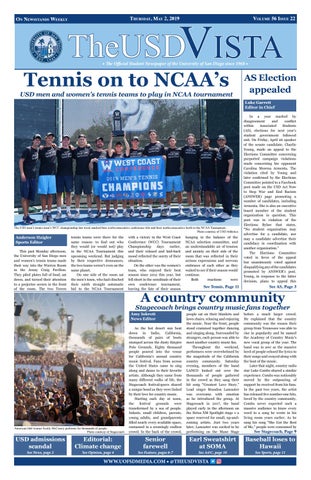
The USD men’s tennis team’s WCC championship last week marked their sixth-consecutive conference title and their ninth-consecutive berth to the NCAA Tournament. Photo courtesy of USD Athletics
Anderson Haigler Sports Editor This past Monday afternoon, the University of San Diego men and women’s tennis teams made their way into the Warren Room in the Jenny Craig Pavilion. They piled plates full of food, sat down, and turned their attention to a projector screen in the front of the room. The two Torero
tennis teams were there for the same reason: to find out who they would (or would not) play in the NCAA Tournament this upcoming weekend. But judging by their respective demeanors, the two teams weren’t even on the same planet. On one side of the room sat the men’s team, who had clinched their ninth straight automatic bid to the NCAA Tournament
with a victory in the West Coast Conference (WCC) Tournament Championship days earlier, and their relaxed and laid-back mood reflected the surety of their situation. On the other was the women’s team, who enjoyed their best season since 2012 this year, but fell short in the semifinals of their own conference tournament, leaving the fate of their season
hanging in the balance of the NCAA selection committee, and an understandable air of tension and anxiety on their side of the room that was reflected in their serious expressions and nervous embraces of each other as they waited to see if their season would continue. Both reactions were
See Tennis, Page 11
In a year marked by disagreement and conflict within Associated Students (AS), elections for next year’s student government followed suit. On Friday, April 26 speaker of the senate candidate, Charlie Young, made an appeal to the Elections Committee concerning purported campaign violations made concerning his opponent Carolina Morena Armenta. The violation cited by Young and later confirmed by the Elections Committee pointed to a Facebook post made on the USD Act Now to Stop War and End Racism (ANSWER) page promoting a number of candidates, including Armenta. She is also an executive board member of the student organization in question. This post was in violation of the Elections Bylaw that states, “No student organization may advertise for a candidate, nor may a candidate advertise their candidacy in coordination with another organization.” The Elections Committee voted in favor of the appeal but unanimously voted against disqualifying any of the candidates promoted by ANSWER’s post. Young, in response to the latter decision, plans to appeal this
See AS, Page 3
A country community
Stagecoach brings country music fans together
Amy Inkrott News Editor
American Idol winner Scotty McCreery preforms for thousands of people. Photo courtesy of Stagecoach
USD admissions scandal See News, page 2
Editorial: Climate change See Opinion, page 4
As the hot desert sun beat down in Indio, California, thousands of pairs of boots stomped across the dusty Empire Polo Grounds. Eighty thousand people poured into the venue for California’s annual country music festival. Fans from across the United States came to sing along and dance to their favorite artists. Although they came from many different walks of life, the Stagecoach festival-goers shared a unique bond as they were linked by their love for country music. Starting each day at noon, the festival grounds were transformed by a sea of people. Infants, small children, parents, young adults, and grandparents filled nearly every available space, enmassed in a seemingly endless crowd. In the back of the crowd,
people sat on their blankets and lawn chairs, relaxing and enjoying the music. Near the front, people stood crammed together dancing and singing along. Surrounded by strangers, each person was able to meet another country music fan. Throughout the weekend, performers were overwhelmed by the magnitude of the California country community. Saturday evening, members of the band LANCO looked out over the thousands of people gathered in the crowd as they sang their hit song “Greatest Love Story.” Lead singer Brandon Lancaster was overcome with emotion as he introduced the group. At Stagecoach in 2017, the band played early in the afternoon on the Sirius XM Spotlight stage – a space reserved for small, up-andcoming artists. Just two years later, Lancaster was excited to be performing on the Mane Stage
before a much larger crowd. He explained that the country community was the reason their group from Tennessee was able to rise in popularity and be named the Academy of Country Music’s new vocal group of the year. The band was in awe as the massive herd of people echoed the lyrics to their songs and swayed along with the beat of the music. Later that night, country radio star Luke Combs shared a similar experience. Combs was noticeably moved by the outpouring of support he received from his fans. In the past two years, the artist has released five number-one hits, loved by the country community. Combs never expected such a massive audience to know every word to a song he wrote in his living room years earlier. As he sang his song “She Got the Best of Me,” people were consumed by
Senior farewell
Earl Sweatshirt at SOMA
Baseball loses to Hawaii
See Feature, pages 6-7
See A&C, page 10
WWW.UOFSDMEDIA.COM ◆ @THEUSDVISTA
See Stagecoach, Page 9
See Sports, page 11
2
The USD Vista
◆
May 2, 2019
NEWS
Campus Update
Associated Students
At the April 25 AS Senate meeting, members of the senate continued to debate changes to the body’s constitution. This debate has spanned the past three meetings without senators being able to reach an agreement on the document. At this latest meeting, senators discussed the placement of two senators within the Alcalá Vistas residence hall. Currently, the hall’s senators are not limited to a specific building within the area. However, senators considered the possibility of the area’s senators being divided between the east and west buildings. Ultimately, the senators decided that future Alcalá Vistas senators will not be restricted to specific buildings, but will not reside within the same building. The revised AS Constitution was published on the organization’s website under the Current AS Initiatives tab. Students are encouraged to read the document before voting on May 13 through the my.sandiego.edu portal. Before the meeting adjourned, the senate granted $10,000 to the USD Men’s Club Lacrosse team. After their regular season, the team expressed their plan to attend a national tournament in Salt Lake City, Utah. Drawing from the AS Senate reserves, the body helped to fund the team’s trip. Senators hoped that a strong performance from the lacrosse team would spark a greater sense of school spirit among students. Elections for the 2019-2020 Associated Students Government body ended last Thursday night. The election’s results have not been publicized as of Tuesday afternoon. AS Chief of Recruitment Blanca Hernandez explained that they are currently processing appeals but expect a final announcement no later than May 2. Despite this, students have discussed the unofficial results.
Car theft on campus
LLC Integration Showcase
On April 30, all of the first-year students gathered at the Jenny Craig Pavilion (JCP) to present their integration projects at the Integration Showcase. This showcase is a part of the Living Learning Community (LLC) program and is an integral part of the liberal arts education offered at USD. Students were divided by LLC and grouped by their second-semester LLC class. Prior to this event the first years were all assigned to integrate their first- and second-semester courses in a presentable work. Some projects featured intricate origami and 3D models while others were simply essays presented collectively by the class. When not presenting, students visited others’ stations where they learned about different classes and how to approach topics through an interdisciplinary lens.
March for Climate
On Tuesday afternoon, a group of roughly 50 students paraded across campus with banners and bullhorns as part of what was promoted as the “USD March for Climate.” The group gathered in Plaza Menor in front of the Torero Store and shouted slogans decrying the fossil fuel industry as they made their way down to Colachis Plaza. The march was the first of its kind and was coordinated by Gianna Petersen, a first-year Environmental and Ocean Sciences major and self-identified climate activist. Following their march, the students listened to remarks from a local climate-action organizer, who tied environmental concerns to greater systemic issues regarding racial equity and what she deemed to be capitalism’s “culture of extraction.” The event brought together a coalition of allied student organizations, including USD Vegan Club, USD Votes, Be Blue Go Green, and the Office of Sustainability, all of whom tabled in Colachis Plaza during Torero Hours.
On April 29, the USD campus community was alerted to a car theft on campus. The car was stolen from Manchester Village Garage #2 and occurred between April 17 and April 28. Currently, Public Safety does not have a suspect in custody.
Colleges expel students linked to bribery Students await administration decision weeks after USD implicated in scandal
Glenn McDonell Asst. News Editor At the end of March, Yale and Stanford University announced plans to rescind the admission and vacate the credits of students named in the March 12 Department of Justice investigation into college admissions bribery, which also implicates a USD family. Now that USC and other universities are publicly planning to follow Yale and Stanford’s lead, USD students are left wondering whether their university will take similar action. Sophomore Justin Daus has been following reports ever since the scandal was revealed and is concerned about the possible consequences if USD does not take disciplinary action. “This is a very public situation,” Daus said. “By not doing anything, we will be sending a message to those who might want to try this in the future. If there aren’t any repercussions, what’s to say it won’t happen again? I think it could definitely set a dangerous precedent.” The federal indictment implicates the Flaxman family of the University of San Diego, who paid the same racketeer from the Stanford and Yale cases to bribe former men’s basketball coach, Lamont Smith, into securing an athletics admissions referral for their son. In a statement released on March 20 by President Harris, the issue of disciplinary action was briefly addressed. The letter refers to language
from the USD Student Code of Rights and Responsibilities stating that falsifying or making misrepresentations on an application for admissions can be grounds for disciplinary action, and that students found in violation of the code can be subject to sanctions, up to and including expulsion, depending on the nature of the misconduct. The USD Vista reached out to President Harris inquiring into whether the conduct in the
falsified your way in. Not that we have to do exactly what Stanford has done, but we should practice what we preach.” Federal documents reveal that both Flaxmans – the current USD student and his father – communicated directly with the fraudulent college counseling agency at the center of the investigation. The reports show email correspondence regarding the falsification of the son’s application to solidify his status
“We can keep these individuals accountable but it’s our whole system which needs to be changed if they want to make it equitable.” -Stella Kilfoy Flaxman case warrants expulsion or the vacating of credits. As of now, the administration has not made a determination on this question, maintaining only that the investigation is ongoing and is currently being conducted by an outside law firm. While Daus is receptive to the fact that the university has chosen to extend the federal investigation with a private one, he also expects the administration to enforce its own code in dealing with the scandal. “Since this has all gone public, I think it’s up to USD to uphold its own standards,” Daus said. “It can be case by case and I realize this is still under investigation but at the end of the day if you are a student with admitted status at this school you should be here legitimately, not because you
as a student-athlete. While Flaxman’s son’s intentions and knowledge of the bribery are unknown, some of the students implicated in cases from other universities have claimed total ignorance of their parents’ wrongdoing. These nuances have opened up a national dialogue over what the fair course of action should be for the students, and whether their prior knowledge should be the key factor in disciplinary decision-making. Junior sociology major Stella Kilfoy, who has discussed this topic in some of her classes, says these situations are difficult and she is still unsure on the question of whether USD should take actions similar to other universities. “I think it’s really hard to just
take away the years they (the students) put in if they didn’t know their parent did this and if they were really trying hard to take their college career seriously,” Kilfoy said. “But if you knew what your parents were doing and you knew that you were taking a spot away from someone else I think it’s a different story.” Kilfoy believes that student knowledge and involvement should be taken into consideration, but that it doesn’t necessarily have to be the deciding factor. “For me it really depends,” Kilfoy said. “Each case is specific and unique and I think you have to take into consideration the tactics which were used, in what way the student was aware, and also how they are contributing to the school. If you had to make a complete generalization then prior knowledge seems like a fair reason to take action but I still think it’s really hard.” Yale University President Peter Salovey has said in public statements that the longstanding policy of the university is to rescind the admissions of students who are found to have falsified their application, citing the fact that the applicants sign a document attesting that the content is “true and complete.” This statement seems to suggest that prior knowledge was not a part of the Yale administration’s decision-making process in taking disciplinary action. Regardless of whether USD chooses to follow the lead of other universities in taking disciplinary
action against those admitted through fraud and bribery, the larger issue of equity with regards to college admissions still remains. Wealthy families continue to incentivize admissions panels to favor their sons and daughters by making substantial donations and using their influence to secure funding for development projects. While the subjective nature of admissions decisions renders these practices legally ambiguous, Kilfoy takes issue with the ethical problems inherent in a college admissions system which is susceptible to this kind of influence. “I’m willing to bet that the majority of them (families in indictment) could have just donated to a building to get their kids in, but instead they took these extra measures,” Kilfoy said. “My takeaway is that it’s bigger than just bribery or fraud. We can keep these individuals accountable but it’s our whole system which needs to be changed if they want to make it equitable because I can see it continuing to happen in legal ways.” With the admission scandal came into the national spotlight, a specially appointed oversight committee of USD administrators has convened regularly to discuss appropriate action in response to the findings of the federal investigation. Until the administration releases the results of its own probes and publicly explains its disciplinary decision, student questions and public scrutiny will continue.
Volume 56 Issue 22
◆
NEWS
◆
The USD Vista
AS elections show conflicts
3
Throughout the year, contentious debates plagued Associated Students government AS from Page 1
decision against disqualifying involved candidates during the senate meeting on Thursday, May 2. Those on the Elections Committee stated that the final election decisions will be announced at Thursday’s meeting along with a statement from the Elections Committee. The USD Vista requested an interview from Armenta and received no response. This appeal process within AS elections follows disagreements within the Elections Committee itself, concerning the extension of candidate applications. According to fifth-year Chair of Communication, Jordan Rodriguez, who assumed the responsibilities of the then-vacant Director of Recruitment position, President Natasha Salgado extended the original deadline through the weekend without Rodriguez’s confirmation. Salgado made this decision via an email sent to students across campus. “Technically it wasn’t (Salgado’s) call in the sense that the Director of Recruitment at the end of the day has the call, not necessarily the president,” Rodriguez said. “But in sending that email she did make that call.” Earlier in the week, the AS Executive Team had spoken of extending the deadlines, stating that only a few people had applied by that time. Although, according to Rodriguez, on the day of the deadline, 20 students had applied–a number Rodriguez felt comfortable with. “When it was 20 I did not feel the need for it to be extended given that it would only be one extra day,” Rodriguez said. “How many more people would attend an information session on one extra day when they hadn’t for two weeks?” According to Rodriguez, before the extension was made Young was the sole applicant for the speaker of the senate position. In an email response, Salgado clarified why she chose to extend the deadline. This is the first time Salgado has responded to an interview question since midOctober. “The extension was made due to the low number of senate candidates and an attempt to have more interested students apply,” Salgado said. “This extension was given to all members of the campus community with the hope of getting more candidates that were interested additional time to turn in their application (petition
& Google Form). Moving the deadline to April 5 was discussed at my Exec Board’s weekly meeting, and in conversation with our Communications Chair, my advisor, and myself. This can be verified in our minutes for that meeting.” Plummer, the current speaker of the senate, also clarified to The USD Vista that this extension decision was made because of the lack of turnout for senator positions. “I had been aware of the candidacy of both candidates for the positions of speaker of the senate well before the application deadline,” Plummer said in
to a staggering 12 of its original members. Some of those who have left point to this consistent political infighting as the main cause of their exodus. One of whom is Vayunamu Bawa, a current senior, then-senator of the College of Arts and Sciences and then-Chair of Inclusion and Diversity. “I left at the end of last semester (fall 2018) because I felt like the body wasn’t being as productive as it should have been which was largely due to how tense and hostile the environment had become,” Bawa said. “I would say that the relationship between the president and the speaker
Members of the AS Senate sat through contentious debates throughout the semester.
contradiction to Rodriguez. These and many other conflicts within the student government have become common occurrences over this past year in AS, as long-time divides between the president’s cabinet and senate have led to confusion over AS rules, infighting, and a priority of conversation over policy making. Salgado has sat at the center of this all, with well-defined supporters and dissenters within senate. These two sides faced off throughout the rest of the year causing some to vacate their positions as a result of this stark divide. What began in the fall as a senate of 29 senators dwindled
is very critical in the way the body operates and having those tensions this year had a negative effect. Having distinct camps and voting blocs within AS created a sort of deadlock that made it hard for things to move forward.” Senators were not the only members of AS to leave their posts. Three positions within the executive structure of AS also opened up: the Athletics Chair, Finance Chair, and speaker of the senate. The then-speaker of the senate Robert T. Warren gave his own reason for of leaving the student body this past February. “This past year, honestly, the environment that senate
The USD Vista Luke Garrett - Editor in Chief Kaia Hubbard - Associate Editor Hannah Sonberg - Managing Editor Kathryn Querner - Copy Editor Jennifer Mossuto - Assistant Copy Editor Monica Millan- Art Director Audrey Garrett - Assistant Art Director
Amy Inkrott - News Editor Eric Boose - Opinion Editor Catherine Silvey - Feature Editor Danielle Agnello - Arts & Culture Editor Anderson Haigler - Sports Editor Zoé Morales Martinez - Photo Editor Richard Benson - Distribution Manager
became was something I didn’t feel comfortable with anymore,” Warren said. “Especially so, and I hate to be that person to throw someone under the bus, but Natasha definitely induced it... There has been nothing of the sort of kind of environment or unwillingness to compromise that Natasha has brought that all the other presidents before have not exhibited... It essentially comes down to, if you agree with Natasha you are fine, if you don’t you are not.” With 16 senators leaving their seats, one ousted, and three executive members vacating their seats, a vacuum of empty seats
Zoé Morales Martinez/The USD Vista
was created within Solomon Hall throughout this year. The majority of these were appointed by Salgado and confirmed by a two-thirds senate vote throughout the year, as is the procedure stated in the AS bylaws. Jesse Magaña– the current senator of the UTA’s, Chair of Inclusion and Diversity, candidate for Vice President, and recent USD transfer – is one of the 14 appointed senators. He too spoke of the divides within AS. “I came to AS at a heated time,” Magaña said. “There were already shifts that were happening that some members in senate weren’t the happiest about. The tensions were already present.”
Editorial – 619.260.4584 Business – 619.260.4714 www.uofsdmedia.com @TheUSDVista Diana Percy - Social Media Manager Elizabeth Brunelli - Finance Manager Rachel Steinheimer - Advertising Manager Gina Lew - Student Media Advisor Marie Minnick - Operations Advisor
As for Salgado’s role within this divide, Magaña differed greatly from Warren’s account. “Natasha is a really incredible person and often her leadership gets overlooked, in the sense there is a lot she does behind the scene to make sure students are having the best experience they can at USD,” Magaña said. “I know it is a misconception that she only focuses on one group of students. In just the way I have watched Natasha interact with people, even if she doesn’t agree with them she always is mindful of there might be two different perspectives that we are not catching here that could lead to common ground.” As has been reported by The USD Vista, a shift in perspective arose within senate as more newly-appointed senators recited their oaths to serve students. Many questions still linger as to how Salgado made her 14 appointments to senate. The president herself denied an interview with The USD Vista concerning the issue. Both Warren and Plummer, the past and current speakers of the senate, were unaware as to how senators made it to the senate floor for confirmation. Warren, commented on the absence of advertisements made for the open positions within senate. “There were none whatsoever, I never received an email,” Warren said. “Even when I was in there, when there were resignations and people were getting appointed. There were no interviews, no applications, no email. They were just there and it was clear they were her friends.” Warren also spoke of last year’s process of appointmentship with then-president Will Tate. “Whenever there was an opening (last year) we would collect resumes and we did interviews together. He would take my input on which people should be appointed because they were going to be in my department. We had a process. That process was not followed.” Looking to the future, candidates for next year’s student government stood behind their podiums at AS debates on April 23. The most frequently asked questions from the audience regarded transparency from their student government. With the trends of debate and division being prevalent throughout the year, some students might wonder whether the new student government will follow suit, or learn from the past missteps.
The USD Vista publication is written and edited by USD students and funded by revenues generated by advertising and a student fee. Advertising material published is for information purposes only and is not to be construed as an expressed or implied endorsement or verification of such commercial venues by the staff or University. The USD Vista office is located on the fourth floor of the Student Life Pavilion in room 403B. All inquiries should be sent to: The USD Vista 5998 Alcala Park San Diego, CA 92110 Opinions expressed in this publication are not necessarily those of The USD Vista staff, the University of San Diego or of its student body. Letters to the Editor can be submitted to The USD Vista office. Letters should be limited to 300 words and must be signed. For identification purposes, USD identification numbers and writer’s year must be included in the letter. The USD Vista reserves the right to edit published letters. Any content sent to the editor will be considered for publication unless otherwise stated.
4
The USD Vista
◆
May 2, 2019
E DI TOR IA L
To save a dying planet Candidates’ calls to address climate change must be heeded
Eric Boose Opinion Editor Of the 22 candidates already in the 2020 presidential race, only two have devoted serious effort to addressing climate change, and only one has made it their number one priority. One of those two candidates, former Texas Congressman Beto O’Rourke, announced a comprehensive, $5 trillion plan to combat climate change on Monday. On his website O’Rourke says, “Climate change is the greatest threat we face – one which will test our country, our democracy, and every single one of us.” O’Rourke’s plan to combat climate change is his most defined policy proposal by far and an important step in provoking serious debate about how to lead in the fight against climate change. However, no presidential candidate has prioritized climate change like Washington Governor Jay Inslee. Inslee’s candidacy is built on his pledge to make solving climate change his first priority if elected. In fact, Inslee asserts that climate change should be the number one priority for the next president. Even considering the vast range of issues a president will face during their term, Inslee is right. Climate change must be the number one priority of any president. As Inslee puts it, “We are the first generation to feel the sting of climate change and the last who can do something about it.” Climate change is already impacting our planet, and has
been for years. It has caused global temperatures to rise over the last half-century, including a two-degree-Fahrenheit increase in the average temperature in the western United States. Heat waves are more common now than they were 50 years ago, bringing more days where it is literally too hot to go outside in certain parts of the world. In India, deadly heat waves have forced the government into action to bring the annual death toll down from over 2,000 in 2015. With the heat come more frequent and more intense droughts in California and other parts of the American southwest. Not only do those droughts damage local agriculture, they transform our forests into tinderboxes. The Union of Concerned Scientists links the increased heat experienced in the western United States to the increasing number and size of wildfires that torch this state
have been rising exponentially ever since 1880, and are eight inches higher than they were at the end of the 19th century. While this does not mean that downtown will be underwater tomorrow, it does increase the likelihood of seawater making its way onto the streets in a storm. The dangers that we face here in San Diego and throughout California are only some of those unfolding on a global scale. Flooding and tornadoes which level towns across the south and the midwest are only becoming more common and more destructive. The hurricanes that rock the East Coast, the Caribbean, and the South Pacific are becoming continuously more lethal. Polar ice caps continue to melt, threatening to reshape the entire arctic ecosystem. The habitats of hundreds of plant and animal species are dying, and we are doing precious little to stop it. The environmental threats,
“We are the first generation to feel the sting of climate change and the last who can do something about it.” -Jay Inslee every fall. In fact, the number of large wildfires per year in California and other western states has quintupled since the 1970s. In San Diego, we are stuck between devastating fires and a rising ocean. Perhaps one of the most commonly-reiterated dangers of climate change is the rise of sea levels and the impending danger to coastal communities. Global sea levels
despite being omnipresent in discussions of climate change, are not the only threats we face. A report published last fall notes that climate change also poses a threat to people’s “economic well-being.” A report from the Environmental Protection Agency predicts that if nothing changes, climate change will cost the United States upward of $100 billion per year by the end of this century. Much of that cost
will come in the form of losses for farmers. In 2010, the dairy industry lost $1.2 billion due to “heat stress” reducing milk production, and the EPA report estimates that the midwest will see corn and soybean production both fall at least 25 percent. This is the sting of climate change that Inslee talks about.
take as individuals to seriously combat climate change, the first and foremost of which is to vote. The only way to guarantee the implementation of laws designed to protect the environment and combat climate change is to vote for politicians who will pass those laws, not only at the federal level, but in state and
“Climate change is the greatest threat we face – one which will test our country, our democracy, and every single one of us.” -Beto O’Rourke It is not just shorter winters and hotter summers, it is the ongoing collapse of our ecosystems, a serious threat to our health, and the potential crippling of our economy. When Inslee calls us the last generation who can do something about climate change, he is not asking us all to stop using plastic straws or to recycle more. Doing “something” about climate change is no longer about individuals making small changes in their lifestyles – however worthwhile those changes may be. Even if we make every change possible to reduce our carbon footprint, corporate pollution will still deal significant environmental damage. At this point in time, the effort to save the planet will have to take place on a grand scale, beyond the capacities of any one individual. With that in mind, it can be easy to feel discouraged. However, simply because we cannot save the world on our own does not mean that we do not have a role to play. There is a variety of actions we can
local governments as well. Like most history-defining problems, climate change does not have a simple, defined, or clear solution. What we know is that we must drastically reduce harmful emissions and work to protect and restore dying ecosystems. In deciding how we accomplish those goals, we have room to be creative. Like all college students, we are in the process of deciding what we want to do in life. In making that decision, we ought to ask ourselves how we can help save the planet while still achieving our personal goals. Answering this question will be easier for some people than for others, but we all must still answer it. Businesses built on principles of sustainability are as important as biologists to monitor the effects we have on our planet and both are as important as engineers to design even better ways to harness renewable energy. We can do something about climate change. In fact, we must do something about climate change.
Straws are only the start
Efforts to eliminate plastic straws are counterproductive and potentially harmful Catherine Silvey Feature Editor The heartbreaking video of a crew of marine biologists removing a plastic straw from a sea turtle’s bloody nose exploded across the internet last year, leading California to ban plastic straws in January 2019, making them available only upon request. Even at USD, eateries including Tu Mercado and La Paloma have implemented straw-restriction policies, citing environmental concern and activism on cute little placards with cartoon turtles placed beside the cream and sugar. We love to think of cute, happy little cartoon turtles, swimming in a sparkling blue ocean, carefree and void of suffering now that the straws are banned. And this is where
the problem emerges—I know because I have experienced that rush too. I know that burst of satisfaction felt upon refusing an offered straw or enjoying a beverage without one. It’s a feeling of “mission accomplished.” It makes us believe that because we are doing something, we are doing the best we can, all we can. But this is untrue, and dangerously so. While their shape and size makes them an extreme hazard to marine animals, straws do not actually make up that much of the plastic waste in our seas. A report by science writer Seth Borenstein states what while, if counted by piece, straws do make up about four percent of plastic pollution, their light weight and size means that they account for just 2000 tons of the almost
nine million tons of plastic waste polluting the ocean on a yearly basis. Even if all straws were immediately eliminated, plastic pollution would remain devastatingly prevalent in the ecosystems of beloved marine animals. The focus on eliminating straws as a cultural mission comes from the best of intentions. Nobody wants to see the ocean filled with plastic, and nobody wants to participate in the death of sea creatures. Identifying straws as a common enemy, especially with mammoth companies such as Starbucks participating, is the perfect social movement, but it is perfect because it is entirely effortless. This is the primary reason behind the success of the antistraw movement; if we are not
given a straw and are capable of drinking our beverage without a straw, especially with the image of a bloodied sea turtle floating around in our consciousness, we are more likely to accept what we have been given and move on rather than go out of our way to obtain a straw. It is a perfect movement given the small, effortless sacrifice, but a problematic one in that it makes us feel we have accomplished something incredible when we have not actively accomplished anything at all. Passivism and reliance on better habits becoming cultural norms will not heal the world; active revision of our lifestyles, support of companies with ecofriendly practices, and relentless pressure on world leaders to prioritize mending our broken planet just might.
The straw revolution has absolutely done some good. It is a wonderful start, connecting the emotional distress of seeing a beloved animal in pain with a simple adjustment in our dayto-day lives. But that’s how we must see it – as a start. When we settle and accept the nice feeling of refusing a plastic straw as our full potential in saving the environment, we do more harm than good; we quell our anxiety about the dire physical state of our world and move on to worrying about something else. While being content with a strawless iced coffee from Starbucks may feel good, being content is what is putting the world we live in and the lifestyles we take for granted at stake. To live without straws is good, but we can and must do better.
The University of San Diego does not share the views presented within the editorial and op-ed sections. The opinions expressed in this section reflect solely the opinion of the respective writer.
Volume 56 Issue 22
◆
FEATURE
◆
5
The USD Vista
F E AT U R E
Building a better future
Studio room for architecture majors helps prepare them for their future careers Mayella Vasquez Contributor Catherine Silvey Feature Editor Behind Camino Hall exists a room hidden from campus and unknown to most students at the University of San Diego. It is known as the Pavilion and is a hub for architecture majors who spend countless nights crafting ideas, models, and floor plans, as well as collaborating with one another in a space that is meant to foster creativity and prepare them for their careers. Junior Nicola Estona expressed that besides being a classroom, the Pavilion is also a community. “The Pavilion is a space where architecture majors can interact and collaborate with one another and gives us a sense of community,” Estona said. “It’s very helpful to get advice from more experienced students and work together.” Some of the work that goes on in the Pavilion includes building models, creating floor plans, using software to make 3D designs, technical drawings, analytical diagrams, and coming up with conceptual ideas for projects.
“We hope this will give us the skills we need post-graduation because we will be using similar software and doing similar tasks in our careers,” Estona said. Although much time is spent working, the community built in the Pavilion makes the time enjoyable. Estona shared his positive views of the Pavilion. “Having our own room gives us a sense of security with our work and serves as a home base,” Estona said. “We usually have a certain computer and workspace that we go to do our work. I think it’s a positive thing to have our Pavilion. A lot goes on in there and the collaboration aspect is crucial.” Sophomore Jackie Crane explained the purpose of the room, highlighting how important it is for architecture majors to have access to such as space. “We mostly just call it the studio since most studio courses are held in there,” Crane said. “It has a lot of tools we use for making models, and the computers in there have all of the software we need to do our work. This allows us to work with the proper software but not have to pay for it out of pocket.” These tasks often include different artistic mediums, so
having their own space is vital for architecture majors. Crane expressed this sentiment about the studio. “I think it is important for us to have our own room since our major is so special,” Crane said. “We have to use computers to design, we use laser printers, large printers, the wood shop, the metal shop, the sculpture/ art shack, etc. Having all of these resources readily available and all within close proximity makes our work possible. We also have final reviews instead of finals for studio classes, which is where the entire faculty gathers in the Pavilion to review and critique student work. A lot goes on in there.” When finishing assignments and preparing for final reviews, architecture majors spend a lot of time in the Pavilion with each other. Crane emphasized the community that such an interactive space often builds among architecture majors. “We have to spend long hours in there getting our work done, and there are usually a decent amount of people there even late on weeknights,” Crane said. “I think having a community area is more of a constructive thing. You’re surrounded by people who have a similar passion to
The Pavilion is located behind Camino Hall, and acts as a home for architecture majors. Photo courtesy of Mayella Vasquez
you, and getting to collaborate and chat about your work or architecture in general makes it such a productive space. Some of my favorite memories of college have been in that studio.” Architecture is a field that not only focuses on creative ideas, but also on forming logical thought and constructing a community. A lot of work goes into being an architect, but Crane expressed confidence in her decision to pursue a career in this field. “I chose to be an architecture major because I’m very analytical but also very artistic and creative.” Crane said. “I love getting to build things but also learning about
history and theory. I feel like it challenges my brain in such a different way than anything else, and I can’t see myself doing anything but architecture.” The Pavilion breeds a community of people who are driven by passion and desire to constantly innovate the spaces around them. Such a community not only allows for personal growth through collaboration with others and getting a glimpse of what the career of an architect has in store, but it also creates a friendly dynamic and closely bonds the individuals within the architecture department at this university.
6
S
The USD ViSTa
◆
May 2, 2019
E
N
As spring semester draws to an end, seniors at the University of San Dieg spent on this campus, seniors share their favorite memories, greatest lesso
Photo courtesy of Chelsea Johnson
Photo courtesy of Grace O’Brien
CHELSEA JOHNSON
GRACE O’BRIEN
Political Science
International Business with minor in Enviromental Studies and Policy
My favorite USD memory is taking walks in Tecolote Canyon in the spring! The most important thing I have learned during my time here is that the world is infinitely more complex than I’d ever imagined. I will miss my wonderful friends and professors here. But I’m also really excited to take that next step in life!
One Saturday my friends and I decided to drive all the way to a natural hot spring three hours away and back in one day! It was such a wild adventure, and still one of my favorite memories. The
most
important
thing
I
have
learned during my time at USD is how to incorporate sustainability and climate action into business. This has become my mission in my career, and I plan to go to graduate school so I can learn even more about how business can save the environment. I will miss my best friends being just a short bike ride or walk away, and being able to go put my feet in the ocean whenever I want.
F A R E
Volume 56 Issue 22
I
◆
FEATURE
◆
7
The USD ViSTa
O
R
go prepare to leave their soon-to-be alma mater. Reflecting on their years ons learned, and what they will miss the most about being a USD student.
Photo courtesy of Rebecca Shea
Photo courtesy of Kaylynn Wilkes
REBECCA SHEA
K AY LY N N W I L K E S
Finance & Business Economics
Behavioral Neuroscience
It’s difficult to choose. One of my favorite memories at USD would be being a part of a business fraternity. Pledging, meeting amazing people, and being a leader of a fantastic community allowed me to grow in ways I never could have imagined.
My favorite USD memory was a chem club event where the various labs on campus competed in a bowling competition.
I’ve learned that the best and most meaningful experiences come from saying yes and putting yourself out there. I’m truly going to miss the community of amazing people. Four years ago I didn’t know a single soul on campus and now the people I have grown with over these last few years are my home.
The most important thing that I have learned during my time at USD is that time goes quickly, and it’s best to spend it with people who are important to you. I will miss being able to call friends in the middle of the night to go on an adventure and have it be a normal thing to do so.
W E L L Spread by Mónica Millán/ The USD Vista; Content by Catherine Silvey/ The USD Vista
8
The USD Vista
◆
May 2, 2019
A RT S & C U LT U R E
Stagecoach wows audience
Country stars dazzle attendees, delivering renditions of their hits all weekend long Jennifer Mossuto Asst. Copy Editor The 2019 Stagecoach Music Festival included heart-wrenching moments, over 100-degree weather, and most importantly, gathering together another country-loving community for the 13th year in a row. The festival stages became home to new country artists making their debut and also remained a sanctuary to veteran artists such as Jason Aldean, Old Dominion, and Luke Bryan. Each day began with smaller names in the country music world but Friday officially kicked off when Scotty McCreery took the Mane Stage. The American Idol star performed at the hottest time of the day, but that didn’t stop him from enjoying his highly anticipated 6 p.m. set. He performed his newest song “In Between” and ended with the fan favorite and ultimate tearjerker, “Five More Minutes” released back in 2017. Following McCreery on the Mane Stage was Kane Brown, known for his No.1 hit “What Ifs” featuring fellow Stagecoach performer, Lauren Alaina. Soon after, Cole Swindell took over the second-to-last set time and did not let the audience’s energy go to waste. As the sun had set, the people joined the crowds and sang along to every song including his popular radio hits “Break Up In The End,” “Middle of A Memory,” and “You Should Be Here.” Finally, at 10:15 p.m., headliner Luke Bryan arrived and the general admission audience was packed like sardines. He performed some oldies but goodies including “Country Girl (Shake It For Me)” and “Huntin,’ Fishin,’ And Lovin’ Every Day.”
During his transitions he was constantly making jokes to the audience while taking numerous shots of tequila and exciting the crowd even more as each shot quickly came and went. At one point he asked everyone in the audience to raise their hands if they “have to piss right now,” leaving the entire crowd with their hands in the air. He then went on to tell them to let it go down their leg because it’s so hot that it would evaporate, then immediately took back his suggestion while laughing hysterically. Bryan also played relatively newer favorites such as “Most People Are Good,” “Sunrise, Sunburn, Sunset, Repeat,” and his newest single “Knockin’ Boots,” released just this past March, but not before taking even more shots of tequila and leaving the crowd surging with energy and excitement for the following days to come. On Saturday LANCO, a fivemember country band, took over the 6 p.m. set time, constantly encouraging the audience to sing the tunes to their soft country songs including “Born to Love You” and “Greatest Love Story.” Soon after, Luke Combs took the stage, performing with a beer in his hand. Combs took breaks from singing and allowed the audience to sing the lyrics back to him as he performed “Hurricane” and arguably his most popular love song that even non-country listeners have heard, “Beautiful Crazy.” The wind picked up during his set but that didn’t stop him from showing how excited he was to be on the Mane Stage Saturday night. Saturday’s headliner, Sam Hunt, ended the night with a bang. With bass and drums seemingly louder than everyone else’s, he
Festival-goers stands through blistering desert heat all day to see their favorite artists. Photo courtesy of Stagecoach
Sam Hunt serenades Stagecoach attendees as the Saturday night headliner.
began with fan favorite “Take Your Time.” As the temperature finally dropped to a tolerable 81 degrees, the people continued to crowd the stage and get as close as possible to the 34-year-old country singer. He ended the night performing Keith Urban’s “Cop Car,” “House Party,” and “Downtown’s Dead.” Sunday’s 6 p.m. set began with another American Idol star but first-time Stagecoach performer, Lauren Alaina. She began by bringing a stranger on to the stage, who later introduced himself as Zach. He excitedly jumped onto the stage alongside the beautiful Lauren Alaina and even took up her challenge of doing popular dances on the stage such as the Nay Nay, the Stanky Leg, and even twerking (impressively) toward the end. She noticed he knew all the words to her song “Next Boyfriend” and allowed him to sing a few lines on the stage, shocking everyone with a surprisingly good singing voice. Starting her set off with this enjoyable and original performance not only entertained the audience but showed her charming personality on stage. Alaina performed a “Pitch Perfect” inspired set including a mash-up of cover songs from Aerosmith, Zedd, Backstreet Boys, Sam Hunt, Shawn Mendes, and Shania Twain. She ended
her captivating set with some more popular songs, “What Ifs” and “Road Less Traveled.” She continued to tell her story of how she managed two No.1 hits and hundreds of thousands of streams on Spotify when people told her she couldn’t, but she never gave up and preached the message of pursuing your dreams. Between her sparkling outfit, bringing Zach onto stage, and telling her personal stories, Lauren Alaina stunned everyone with the most entertaining performance of the night and completely stole the show. She ended her performance extremely grateful saying, “All I’ve ever wanted since I was three years old was to write songs and have people sing them back to me. This is a dream come true.” Next to perform on the Mane Stage was Old Dominion, another veteran five-member country band, who expressed their happiness for being able to perform, saying, “We can’t see your faces but we can feel it,” which completely encompassed the entire Stagecoach feel. They performed hits such as “Written in The Sand,” “Hotel Key,” and “Break Up With Him” while the audience screamed every word right back to them. Ending the festival on Sunday evening was Jason Aldean, who gave the audience chills as he
Lil Nas X and Billy Ray Cyrus delight the crowd with hit single “Old Town Road.”
Photo courtesy of Stagecoach
acknowledged the Route 91 Festival shooting. “Last time I saw some of you guys, we got a little cut off,” Aldean said, and then proceeded to sing “When She Says Baby” which was playing when the shooting began at the festival in 2017. He created an incredibly powerful moment as he sang and the entire crowd went silent as they thought of the lives lost, yet rejoiced that everyone had come together once again for the love of music. Last but not least was the one performance everyone was hoping to see, the surprise debut from Billy Ray Cyrus and Lil Nas X, who sang new single, “Old Town Road.” They were featured by Diplo during his late-night set at the Palomino Tent alongside other surprise guests, Cam and Sam Hunt. Stagecoach offered a three-day long festival full of line-dancing, drinking, and good ol’ country music, but the most consistent element was the attendees. While attendees ranged in age from teenager to grandparent, commonality was seen, as everyone was there to have a good time, enjoy some music together, and create memories in the pounding desert heat. As Luke Bryan’s song would say, the weekend had a clear theme: Sunrise, Sunburn, Sunset, Repeat.
Photo courtesy of Stagecoach
Volume 56 Issue 22
◆
ARTS & CULTURE
◆
9
The USD Vista
Stagecoach remembers victims Eighty thousand festival-goers stomp their boots across the Empire Polo Grounds
Stagecoach from Page 1 their love for the artist. Both men and women were lifted up on the shoulders of others and thousands of phones filled the air. Countless couples danced and spun each other in circles as they sang along with the country love song. Like LANCO, Combs expressed his gratitude for the unwavering support he has received from fans of country music. But the connections within the California country community extended well beyond their love for the performers. The wide variety in attire sparked conversations between festival-goers. Many girls wore crop tops and cut-off shorts, or cute flowy sundresses. Most men chose to wear t-shirts and jorts, but some opted for no shirts at all. Bandanas, boots, and cowboy hats seemed to be everywhere. Other people looked to embrace the spirit of patriotism surrounding the country music genre. Across the venue, people were dressed in red, white, and blue in pride for their country. Many festival-goers were quick to compliment one another on their outfits. Still other people chose to take their attire to the extremes. One group of men paraded across the grounds dressed only in American flag-inspired tutus. Festival-goers were encouraged to take pictures with the people in these extreme outfits and made new friends in the process. But the greatest sign of community among the festivalgoers was evident in the love and support given to those affected by recent mass shootings. In 2017, 58 people were killed and hundreds more were injured during Jason Aldean’s performance at the Route 91 Harvest Festival in Las Vegas, Nevada. According to The Press-Enterprise, nearly 2,000 of the shooting survivors were present at this year’s Stagecoach festival. In 2018, 11 country music fans were killed at the Borderline Bar in Thousand Oaks, California. Many of the people present were college students out with their friends. Throughout the first two days of the festival, people were introduced to Honey County’s
Luke Bryan takes on Stagecoach, making the crowd of country music lovers go wild.
“Country Strong,” a song dedicated to the victims of these tragedies. In the Honky Tonk line-dance hall, people were taught the various steps to this dance before the tribute dance on Saturday afternoon. Hundreds of people lined the walls of the
dance hall and watched as the dancers spun in remembrance of those lives lost. Each dancer wore a black t-shirt with large white wings and an orange ribbon centered on the back. One woman wore a Route 91 survivor pin on her hat and
Photo Courtesy of Stagecoach
a remembrance band on her left wrist. She explained that the wings on the dancer’s shirts were symbolic of the 58 angels she believes are always with her. Later that afternoon, many of the survivors came together to take a picture, an
Cole Swindell’s Friday performance drew a large crowd to the Mane Stage as they swayed to his country tunes.
image of the love and support in the country community. On Sunday, Jason Aldean took the stage as the night’s headliner. After singing a few of his hit songs like “Tattoos on This Town” and “Fly Over States,” Aldean introduced the song he sang when bullets were fired from a window of the Mandalay Bay hotel. Aldean said he intended to finish the song “When She Says Baby” for the survivors of the Route 91 Harvest festival. When the song ended, festival-goers cheered louder than they had for any of the previous songs. The festival itself also looked to support the survivors of these attacks. Each day, the festival’s medical tents held therapists for those suffering continued emotional trauma from the tragedies. Festival-goers were also warned about any fireworks or pyrotechnics within a performance as the noise could be triggering to the survivors. But despite the grief faced by individuals throughout the community, those in attendance were still able to enjoy the concert experience. Stagecoach 2019 was surrounded by an atmosphere of love, perseverance, and support as it brought together individuals from all walks of life. Regardless of age, people were able to enjoy the festival and embrace their love for country music.
Photo Courtesy of Stagecoach
10
The USD Vista
◆
May 2, 2019
Earl Sweatshirt at SOMA
Fans lined up outside the concert venue, ready to see artist Earl Sweatshirt perform Joe Duffy Asst. A&C Editor Over an hour before the show started on Saturday, April 27, people were lined up outside SOMA, a small concert venue right next to Pechanga Arena. At 7 p.m., the doors opened, security started conducting patdowns and taking tickets, and
in interviews, and in his music The strained relationship the rapper had with his father, the South African poet and political activist Keorapetse Kgositsile, is a subject he often returns to in his work, especially following his father’s death in January 2018. On the track “Playing Possum” off his latest album, Earl samples a speech by his
The rapper took the stage for one of the last tour dates of his “Fire It Up!” tour.
the line inched closer to the low, steady hum of subwoofers coming from inside the venue. The large group of concert-goers, mostly in their 20s, were waiting to see the rapper Earl Sweatshirt perform on one of the last dates of his “Fire It Up!” tour. The Los Angeles native, whose given name is Thebe Neruda Kgositsile, first gained popularity at the age of 16 following the release of his debut mixtape, “Earl.” This mixtape brought him praise from critics and fans, as well as scorn from those who found the lyrical content—which referenced drug use, violence, and sexual assault—to be vile and obscene in nature. The success of the mixtape, in addition to the rising profile of Odd Future—an alternative hip-hop collective that included Earl, Tyler, the Creator, Frank Ocean, and others—made it seem inevitable that “Earl” would hit mainstream popularity. But then, in March of 2010, shortly after the release of “Earl,” he was sent by his mother to a boarding school in Samoa for atrisk teens, igniting a “Free Earl” movement amongst his fans that called for the rapper’s return. Since returning to the United States in 2012, Earl has been a highly scrutinized figure. He has retained the young cult following from his Odd Future days, while also branching out and gaining new fans from the releases of projects like “Doris” (2013), “I Don’t Like Sh*t, I Don’t Go Outside” (2015), and, most recently, “Some Rap Songs” (2018). Music hasn’t been the only thing that’s brought him attention. His relationship with his mother and his struggles with anxiety and depression have been the subjects of much discussion online, and are topics that he has addressed on social media,
took the microphone from her and asked the audience repeatedly to give it up for the two openers and his DJ. Then he jumped right into his set, and the audience, which had been laid-back and calm up to that point, rushed toward the stage. The front of the show was tightly packed, and many people hung near the back, or stood on a bench
Joe Duffy/The USD Vista
lining one of SOMA’s walls. Despite the somber tone of much of Earl’s music, the crowd became lively and energized at curious times; one of the biggest and most aggressive mosh pits of the night, for example, occurred during the song “Grief,” in which Earl raps, “Lately I’ve been panicking a lot / Feeling like I’m stranded in a mob, scrambling for Xanax out the canister to pop / Never getting out of hand / Steady handling my job,” over a dark, jarringly ominous instrumental. In his set, Earl performed most of “Some Rap Songs,” as well as a few tracks from his other albums. He also performed a few songs that he had done in collaboration with other artists and producers, such as the track “E. Coli,” which was part of The Alchemist’s 2018 “Bread” EP. He didn’t, however, perform any of the older songs he had made with “Odd Future” or any tracks off “Earl.” USD senior Scott Hering was in attendance Saturday night,
The crowd of concert-goers who were mostly in their 20s gave the artist a whole lot of love.
mother and a poetry reading by his father and splices them together; he had planned on presenting the finished song to his father as a reconciliatory gesture, he said in an interview with Vulture, but his father died before he had the chance to do so. Contrary to the sullen, downcast manner that has generally been a defining part of his public persona, Earl was all smiles on Saturday night. His DJ, Black Noi$e, came to the stage first, accompanied by the New York-based rapper MIKE, who performed a brief but energetic set. He was promptly followed by Liv.E, a Dallas-born musician who had an upbeat but lo-fi style informed by a unique blend of jazz and hip-hop. During her set, Earl came onto the stage, quietly and discreetly, and joined the DJ, smiling, dancing, and bobbing his head back and forth to the music. After Liv.E finished, Earl
Joe Duffy/The USD Vista
and said that the show was even better than he had expected. “I thought the show was great,” Hering said. “It was above my expectations because I thought it would be a short show featuring mainly his new album, but he ended up putting on a good, long performance. The crowd was energized and he played every song I wanted to hear.” While Earl initially came out to the stage wearing a grey hoodie with the hood pulled up, 10 minutes into his set, he took the hoodie off. Underneath, he wore an oversized graphic tee shirt that reminded one of the younger, Odd Future-affiliated Earl Sweatshirt, whose wardrobe consisted of Supreme box logo tees, five-panel caps, and crew socks bearing the letters “OF” in the form of a sprinkled donut. Back then, his style was a blend of LA skate rat fashion and the bright, cartoonish aesthetic of Tyler the Creator and the Odd Future collective as a whole. Yet, the Earl on stage on Saturday night looked vastly different from the one dubbed a teenage-rap phenom nearly a decade ago. In place of a goofy, baby-faced teenager was an artist who seemed more mature and composed than ever. His dreadlocks bounced over his shoulders as he strutted from one end of the stage to the other. After performing for around an hour and a half, Earl ended the show with “Riot!,” the instrumental track that closes out his most recent album. He stood near the DJ and bounced to the beat of the song until it finished, then set his microphone down and left the stage. Some people headed for the exits, while others stared at the SOMA stage, hoping for an encore. After a few minutes, though, it was apparent that the show really was over, and the remainder of the crowd made for the exits while staff trickled out onto the stage and began packing up the equipment.
Earl was more composed than ever as he belted his song lyrics and strutted from one end of the stage to the other. Joe Duffy/The USD Vista
Volume 56 Issue 22
◆
SPORTS
◆
The USD Vista
SP ORT S
11
Success continues for tennis
Men make tourney for ninth straight year, women are back for first time since 2012 Tennis From Page 1
completely understandable, but the two teams were simply in different situations. However, the fact that the two teams were in a position to both qualify for the NCAA Tournament together was itself a testament to the success of USD tennis as a whole. But a suspenseful hour-long selection show stood between the Toreros and celebration. First up to clarify their postseason plans was the 30thseeded men’s team, who found out that they will be playing No. 38 seed University of Minnesota in the first round in a match that will take place in Los Angeles, California. The team reacted with perhaps muted excitement, indicative of both the Toreros’ previous experience in the tournament and the lofty goals they have for the road ahead. “Excitement, just pure joy,” USD men’s tennis head coach Ryan Keckley said of his team’s clinching of an NCAA Tournament appearance. As successful as San Diego has been thus far this season, their road to the national tournament was not necessarily an easy one. They went 20-4 overall, and 8-1 in the WCC this season, and came into the conference tournament after winning the WCC’s regular season title. They enjoyed a first-round bye as the tournament’s No. 1 seed, and took on Loyola Marymount University in the second round. The Toreros were able to get off to a hot start early on in their matchup with the Lions, with senior Pratt Keerasuntonpong and junior Garrett Kurtz putting the Toreros up early in doubles with a 6-3 victory at the No. 3 position. Shortly after, sophomore David Norfeldt and junior Joel Gamerov secured the doubles point with a 6-4 win at the No. 2 position, moving the score to 1-0 in favor of USD. Sophomore August Holmgren extended the San Diego lead to 2-0 with a dominant win at the No. 2 position, but LMU wasn’t done yet. The Lions battled back to tie the contest at two before redshirt sophomore Nico Borter and junior Gui Osorio took control and earned USD a 4-2 win of the match for the Toreros with two consecutive points at the No. 3 and No. 1 positions, respectively. Keckley described the Toreros’ first match of the WCC tournament. “We knew the tournament was gonna be tough, all in all,” Keckley said. “We started out with LMU, who’s a very good team, and they had us on the ropes. We talked about toughness nonstop throughout the course of this year, and I felt like we really turned a corner, I
USD women’s tennis’ Solymar Colling (second from left) earned WCC Freshman of the Year, and head coach Sherri Stephens (right) was named WCC Coach of the Year. Photos and graphic courtesy of USD Athletics
felt like it really showed during that match. We were fortunate to get past a good LMU team.” Up next for USD in the tournament final was No. 6 seed Santa Clara University, who had upset the No. 2 seed Gonzaga University in the other semifinal matchup. The Toreros proved to be much more dominant against the Broncos, defeating them by a score of 4-1 behind doubles wins from Holmgren and Gamerov at the No. 1 position and Osorio and Borter at the No. 2 position. Santa Clara was able to strike first in singles play with a win at the No. 6 position, but they would not score again in the match. WCC Player of the Year Osorio battled for a 7-6 win at
energy, they fight hard. We were expecting it to be a hard match.” The Toreros’ victory is the latest accolade in an extensive and lengthy tradition of success in the USD men’s tennis program that is among the most accomplished in all of USD Athletics. Their regular-season WCC title earlier this month was their second straight, and their fifth in the last six years, their WCC Tournament Championship was their sixth straight, and the NCAA Tournament berth they earned with the WCC Tournament Championship will mark their ninth consecutive NCAA Tournament appearance. Keckley, who won WCC Coach of the Year for the second
“...the fact that we dedicated so much time to working hard and competing in our matches and fighting and wanting to win helped us get in (to the NCAA Tournament).” -Solymar Colling the No. 1 position, then Norfeldt clinched the WCC Tournament Championship for USD for the second straight season as he earned a 6-2, 6-4, victory at the No. 5 position that propelled his team to a 4-1 victory and an automatic berth to the NCAA Tournament. After the selection show on Monday, Osorio spoke about his team’s big win. “The final, we already knew it was gonna be really tough,” Osorio said. “We played (Santa Clara) at home earlier in the year and it was a straightforward match, but they always bring the
consecutive season this year, weighed in on what his team’s consistent success has meant to him. “To set the tone and the standard as an NCAA bid means everything,” Keckley said. “That’s what we work for. Everyone’s trying to get to this tournament, and let me tell you, it is really challenging, it is really tough to get here. I think less than 14 percent of the Division I schools are invited to this tournament, and to do it nine years in a row is a testament to this university, a testament to
the tradition and the history of the program.” As sweet as San Diego’s most recent victory may be, they will have to quickly turn their focus to an opponent that is relatively unknown to them in the Gophers. Minutes after the selection show concluded, Keckley offered his assessment of USD’s upcoming opponent. “We know they’re a very wellcoached team,” Keckley said. “I know they are a threat in the Big 10 every single year, and they’re always very good at doubles.” One aspect of the matchup that may swing the Toreros’ way is the fact that Minnesota plays their home games indoors as opposed to USD’s outdoor home venue, as well as the outdoor venue in Los Angeles where the tournament match will be played. “We look forward to getting them outside,” Keckley said. Though both Keckley and Osorio said they were confident in their team’s ability to make a deep run into the tournament that could rival their performance of last season that saw them reach the tournament’s second round, they both stressed that their focus remains the match ahead of them. “I think we’ll focus on one match at a time,” Keckley said with a chuckle. Once the men’s bracket was set, all eyes turned to the women’s side of things. But without a guaranteed spot in the tournament like the men, tensions drew higher for the lady Toreros with each spot on the
bracket that filled without their name being called. “We were all very, very nervous,” USD women’s tennis head coach Sherri Stephens said. “We had a pretty strong feeling we were gonna get in, but you don’t know it until you see it.” Stephens and her team’s strong feeling proved to be an accurate one, as the words “San Diego” appeared onscreen late in the selection show in a bracket slot above their opponent: No. 28 seed Louisiana State University. When the Toreros were finally called, the entire room erupted in joyous cheers and celebration that was the culmination of an afternoon of success for both USD tennis programs. San Diego was in the tournament, and would be the bracket’s No. 36 seed in a match that was also in Los Angeles alongside their fellow Toreros on the men’s team. First year Solymar Colling, who won WCC Freshman of the Year honors earlier this week, described her team’s reaction to their suspenseful bid to the tournament. “This year everyone was willing to work super hard,” Colling said. “And the fact that we dedicated so much time to working hard and competing in our matches and fighting and wanting to win helped us get in (to the NCAA Tournament).” USD women’s tennis’ berth to the NCAA Tournament is the latest step forward in a season full of improvement for San Diego. Their 17-4 (8-1 WCC) record and second-place WCC
See Tennis, Page 12
12
The USD Vista
◆
May 2, 2019
Torero tennis in tournament First-round NCAA matches for both teams will take place in Los Angeles, California
Tennis From Page 11
finish this year marks their best season since 2012, which was also the last time they appeared in the NCAA Tournament. Stephens, who also won her fourth career WCC Coach of the Year award alongside her colleague Keckley this season, discussed the improvement she has seen from the Toreros this year. “(The improvement) means everything,” Stephens said. “We had been struggling for a couple of years. A lot of it had to do with
injuries and different things that had happened to us, but from the very beginning when these girls came in in September, they said, ‘We’re doing this.’” Stephens mentioned that the Toreros may have inadvertently exceeded their own goal they set in the beginning of the year by qualifying for the tournament. “Actually, our goal was to win conference, so we didn’t even talk about making it into NCAA’s. And then things just started rolling our way, they worked really really hard and we
started winning and winning and winning. All of a sudden it was like ‘Oh my God, we can make NCAA’s.’ And here we are.” Like the men’s team, the lady Toreros will have little time to prepare for their first-round matchup against the Tigers. Despite the quick turnaround, Stephens stated that her team will be well-prepared for the match. “We know nothing (about LSU), we are about ready to go do our work,” Stephens said immediately after her
team’s postseason berth was announced. “We know a lot of coaches and a lot of places, so we’ll be able to get a good scouting report on them.” When it was all said and done, Monday afternoon marked a momentous occasion for USD tennis as a whole, both the men and women’s programs. With the men’s team continuing their tradition of dominance and the women’s team taking a significant and impressive step forward, fans of Torero tennis have a lot to look forward to in
the next week as the two teams make their way through the tournament. At press time, dates and times of both team’s matches in the first round of the NCAA Tournament have yet to be announced, but will be made available on USDToreros.com as soon as they are announced, along with information on how to watch and follow the matches through live statistics. Both matches will likely be streamed online, either through the USD or NCAA websites.
USD baseball loses to Hawaii
A quiet night at the plate deals Toreros their third-straight loss in mid-week matchup Anderson Haigler Sports Editor Coming off of a tough loss the previous night, the University of San Diego baseball team was looking to bounce back with a mid-week victory against the University of Hawaii last Wednesday. A quiet night on offense, however, doomed the Toreros to their third straight defeat by a score of 5-2 as a lategame rally fell short. The Rainbow Warriors wasted no time in getting the scoring started, jumping out to a 1-0 lead in the top of the first inning behind a pair of singles. An inning later, the Toreros were able to even the score. After redshirt junior utility player Paul Kunst walked to lead off the inning, redshirt senior Chris McCready reached base with a single on the first pitch he saw. A double play ball from sophomore catcher Adam Kerner nearly extinguished the rally, but firstyear infielder Cody Jefferis broke through with a single to right field, which plated Kunst and moved the score to 1-1. The score would remain knotted at one for the next couple of innings, with the Torero pitching staff doing their part to keep USD in the game. Playing in their second consecutive midweek non-conference game with an important West Coast Conference (WCC) series at Saint Mary’s looming on the horizon in the upcoming weekend, the Toreros employed a pitchingby-committee approach on the mound, something that USD baseball head coach Rich Hill attributed to ensuring that the remainder of his staff would be well-rested for the series. “The main focus is staying fresh, and keeping the pitchers that we need to beat Saint Mary’s ready to go,” Hill said of his usage of six different pitchers in the game. The hurlers that Hill did call on were not necessarily USD’s strongest, as the average ERA between the six was 8.57 heading into the game. But their collective performance
belied any struggles they may have had earlier this season, as they turned in eight innings of three-run ball, before being touched up for another two runs in the top of the ninth. Firstyear right-hander Cade Brown opened the game for the Toreros, surrendering two runs on three hits before turning things over to fellow first year Jake Reed, who threw two and a third scoreless innings. Reed’s successful mid-game outing was achieved with a little help from redshirt junior Nigel Ward, who took over after the righty gave up back-to-back singles with one out in the fifth. Ward successfully quelled the Rainbow Warriors’ rally, retiring third baseman Ethan Lopez on a popup in foul territory before he struck out first baseman Alex Baeza on five pitches. Ward would eventually run into trouble of his own, however, allowing a run on a hit batter, a wild pitch, and a single before Hill went to the bullpen yet again, this time opting for redshirt junior right-hander Nicola Mislinski. He turned in one and two thirds scoreless before giving way to yet another righty in first year Jack Dolack. Dolack threw a scoreless eighth, working around a walk to set down Hawaii without incident. In the ninth, though, Dolack was unable to keep the Rainbow Warriors in check, and was lifted from the game after allowing a single and a walk. The Toreros’ final pitcher of the evening, junior righty Nathan Walker, did what he could to keep things close, but surrendered Hawaii’s final run of the game on a wild pitch. Though he mentioned that his bullpen was already taxed from the Toreros’ 4-2 loss to crosstown rival San Diego State University the night before, Hill stated that he was impressed with the efforts that his pitching staff set forth on Wednesday. “I’m very proud of the pitching staff tonight,” Hill said. “That last inning got away from us a little bit, but we just kinda hung in there and made
Sophomore catcher Adam Kerner (left) said that his team is experiencing a “sense of urgency” as their season progresses. Photo courtesy of Thomas Christensen
big pitches. Nicola Mislinski, I thought really stood out. And Jake Reed, I think, was the big story of the night. Those two guys stood out from the rest.” As successful as Hill’s pitchers may have been that night, Hawaii’s were better. Using a similar strategy to that of the Toreros, the Rainbow Warriors sent nine different pitchers to the mound on Wednesday, and did not allow USD to score over the middle seven innings of the game, holding them to one run over the game’s first eight frames. Hill described his team’s offensive performance after the game. “They rolled out a different pitcher every inning, and it was tough for us to get the leadoff guy on all night,” Hill said. That’s not to say the Toreros’ didn’t have their chances, however. USD outhit Hawaii 11 to nine, and left nine runners on base. They just couldn’t get the
right hit at the right time. “It was singles, singles, singles,” Hill said. “It’s just hard to do that. They made pitches with guys on base. We just gotta do a better job.” Heading into the ninth inning, the Toreros trailed by a score of 5-1. Bucking the aforementioned night-long trend of a lack of extra-base hits for USD in the game, Kerner spun on the first pitch of the bottom of the ninth, sending a fastball over the left field wall for a solo home run that marked the first Torero run since the second inning. Despite Kerner’s infusion of power into the Torero ninth that made the score 5-2 in favor of the Rainbow Warriors, his teammates were unable to capitalize on the momentum. Though senior outfielder Connor Doyle notched a single with two outs, they ended the game without any further scoring, dropping a 5-2 decision
to Hawaii. After the game, Kerner weighed in on his team’s lack of offense. “I mean, we put up 11 hits, so it obviously wasn’t bad, we’re just not stringing them together right now — which is something that just comes with certain games,” Kerner said. “Sometimes you just can’t put them together.” After dropping two of three on the road to Saint Mary’s in the ensuing WCC series over the weekend, the Toreros’ overall record stands at 26-19, and 10-11 in conference. Kerner described his and his teammates’ mindset as their season winds its way a close. “(There’s) a sense of urgency,” Kerner said. “(But) it’s not close to being over yet.” The Toreros return home on Tuesday, May 7 at 6 p.m. to take on UC Irvine. Admission is free for all USD students.