TheUSDVISTA
Volume 56 Issue 20
Thursday, April 11, 2019
On Newsstands Weekly
◆ The Official Student Newspaper of the University of San Diego since 1968 ◆
“Light as of Thought” Joe Duffy Asst. A&C Editor They’re inside our homes. They’re all over our cars. We walk past them every day. Chances are, you’re sitting near one right now. What are they? Windows, of course. On Thursday, April 4, students and members of the visual arts faculty gathered in the Camino art gallery to hear USD senior Nina Montejano defend her thesis project, an exhibition entitled “Light as of Thought.” In a neat, single-file row spanning the walls of the gallery hung 36 graphite drawings of windows. Each drawing was different from the next—darker, more somber depictions often contrasted with their brighter neighbors. Some of the drawings could easily be recognized as windows, while others were disorienting at first glance, appearing as geometric abstractions of black and white shapes.
See Light, Page 10
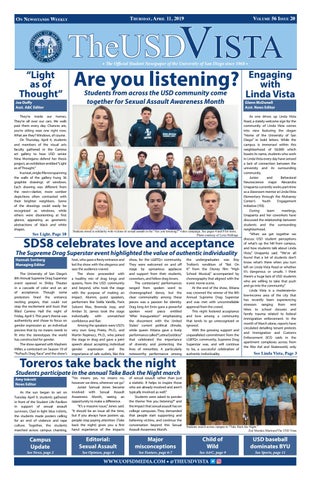
Are you listening? Students from across the USD community come together for Sexual Assault Awareness Month
Students stood in solidarity with victims of sexual assault in the “Are you listening?” video campaign. See pages 4 and 8 for more. Photo courtesy of Lexie Rollings
SDS8 celebrates love and acceptance
The Supreme Drag Superstar event highlighted the value of authentic individuality Hannah Sonberg Managing Editor The University of San Diego’s 8th Annual Supreme Drag Superstar event opened in Shiley Theater in a cascade of color and an air of acceptance. Though some protestors lined the entrance reciting prayers, that could not stop the excitement and buzz that filled Camino Hall the night of Friday, April 5. This year’s theme was authenticity and chose to focus on gender expression as an individual process that by no means needs to fit into the stereotypes the world has constructed for gender. The show opened with Mayhem Miller, a contestant on Season 10 of “RuPaul’s Drag Race” and the show’s
host, who gave a fiesty entrance and led the show with the elegance and sass the audience craved. The show proceeded with a healthy mix of drag kings and queens, from the USD community and beyond, who took the stage with the purpose of making an impact. Alumni, guest speakers, performers like Stella Vanilla, Paris Sukomi Max, Brennda Joyy, and Amber St. James took the stage individually with unmatched confidence and flair. Among the speakers were USD’s very own Greg Prieto, Ph.D., and Martin Repinecz, Ph.D., who joined the stage in drag and gave a joint speech about accepting individual gender expression and the importance of safe outlets, like this
show, for the LGBTQ+ community. They were welcomed on and off stage by uproarious applause and support from their students, coworkers, and fellow drag lovers. The contestants’ performances ranged from spoken word to choreographed dance, but the clear commonality among these pieces was a passion for identity. Drag king Art Emix gave a powerful spoken word piece entitled “After Inauguration” emphasizing the discontent with the United States’ current political climate, while queen Xitiana gave a lively performance called “Latina Goddess” that celebrated the importance of diversity and protecting the lives of minorities. A particularly noteworthy performance among
Toreros take back the night
the undergraduates was Boy Trolton’s rendition of “Bet On It” from the Disney film “High School Musical,” accompanied by choreography that aligned with the iconic movie scene. At the end of the show, Xitiana was crowned the winner of the 8th Annual Supreme Drag Superstar and was met with uncontrollable approval from the crowd. This night fostered acceptance and love among a community that tends to go unrecognized or ignored. With the growing support and unparalleled commitment from the LGBTQ+ community, Supreme Drag Superstar was, and will continue to be, a successful celebration of authentic individuality.
Engaging with Linda Vista
Glenn McDonell Asst. News Editor As one drives up Linda Vista Road, a stately welcome sign for the community of Linda Vista comes into view featuring the slogan “Home of the University of San Diego” in bold letters. While the campus is immersed within this neighborhood of 50,000 which boasts its name, students who work in Linda Vista every day have sensed a lack of connection between the university and its surrounding community. Junior and Behavioral Neuroscience major Alexandra Unapanta currently works part-time as a classroom mentor at Linda Vista Elementary through the Mulvaney Center’s Youth Engagement Initiative (YEI). During team meetings, Unapanta and her coworkers have discussed the relationship between students and the surrounding neighborhood. “When we get together we discuss USD student perceptions of what’s up the hill from campus, and how students talk about Linda Vista,” Unapanta said. “We’ve all found that a lot of students don’t know what’s there when you turn left on Linda Vista Road or whether it’s dangerous or unsafe. I think there’s a huge lack of USD students who are willing to take that push and go into the community.” Linda Vista is a moderate-tolow-income area of the city that has recently been experiencing stressors ranging from rent hikes to school closures and family trauma related to federal immigration enforcement. In the month of March alone, reports have circulated detailing tenant protests and Immigration and Customs Enforcement (ICE) raids in the apartment complexes across from the Rite Aid and Skateworld, only
See Linda Vista, Page 3
Students participate in the annual Take Back the Night march As the sun began to set on Tuesday April 9, students gathered in front of the Student Life Pavilion in support of sexual assault survivors. Clad in light blue t-shirts, the students made posters calling for an end of violence and rape culture. Together, the students marched across campus chanting,
“Yes means yes, no means no, however we dress, wherever we go.” Junior Samual Jones became involved with Sexual Assault Awareness Month, seeing an opportunity to make a difference. “It’s a massive issue,” Jones said. “It should be an issue all the time, but if you always have posters up, people stop paying attention. (Take back the night) gives you a first hand experience of the impacts
of sexual assault rather than just a statistic. It helps to inspire those who are already involved and aren’t typically involved as well.” Students were asked to ponder the theme “Are you listening?” and the impact that sexual assault has on college campuses. They demanded that people start supporting and believing victims, and continue the conversation beyond this Sexual Assault Awareness Month.
Campus Update
Editorial: Sexual Assault
Major misconceptions
Child of Wild
USD baseball dominates BYU
See Opinion, page 4
See Feature, page 6-7
See A&C, page 9
See Sports, page 11
Amy Inkrott News Editor
See News, page 2
Students march across campus to “Take Back the Night.” Zoé Morales Martinez/The USD Vista
WWW.UOFSDMEDIA.COM ◆ @THEUSDVISTA
2
The USD Vista
◆
April 11, 2019
NEWS
Campus Update
Associated Students
Constitutional changes
In preparation for the upcoming Associated Students (AS) Elections, members of the senate looked to approve changes to the body’s constitution, which will be voted on by students. However, as some senators failed to attend their scheduled constitutional meetings, the student government did not reach an agreement on the document. Over the past few weeks, Speaker of the Senate Alexander Plummer called three separate meetings to allow senators to discuss any changes to the AS Constitution; though, not all senators were present. Plummer declared the initial meeting to be mandatory for all senators. While some representatives were able to provide a reasonable excuse for their absence, others did not. Only 18 of the senate’s members were present for this meeting. Attendance did not improve much in the following two meetings. At the second meeting, 19 senators were present. The last one — only 14. At the April 4 AS Senate meeting, Plummer and AS President Natasha Salgado stood at the podium seeking senatorial approval for the proposed changes. However, many senators and members of the public wished for more discussion time. After half an hour of discussion, the time allowed for that item expired, ending further discussion. Multiple senators motioned to extend the discussion time; however, Senator Carolina Moreno Armenta disagreed. “This discussion would be done in a shorter amount of time if senators did show up to the constitutional review meetings,” Moreno Armenta said. “Personally, I don’t think we should be allotting as much time as we are to this.” Plummer and Salgado echoed this sentiment and encouraged the senators to continue to discuss the constitution outside of the weekly senate meetings. “I would ask all of you to engage with this document to the best of your ability and try to get your questions answered before you come to the senate,” Plummer said. Next week, the senate will again look to approve changes to the constitution. These changes will include: • A reapportionment of senators • The formation of a judicial branch • A change in the election of the speaker of the senate • Renaming Associated Students to the Associated Student Government Changes regarding reapportionment and the election process will likely occur during the Spring 2020 AS elections.
ANSWER and the Jewish Student Union
The contentious relationship between the recently-approved organization USD Act Now to Stop War and End Racism (ANSWER) and Jewish Student Union (JSU) again manifested itself in the April 4 AS Senate meeting. In February, USD ANSWER sought to be approved by the AS Student Orgs Committee. Then-Student Orgs Chair Charles Young raised concerns about the organization and their attachment to the larger national organization. Referencing articles from the AntiDefamation League (ADL), Young highlighted the national ANSWER Coalition’s connection to anti-Semitic terrorist organizations such as Hamas and Hezbollah. The group however, denied these claims and was permitted to seek the senate’s approval. At the March 28 meeting, USD ANSWER was approved by the senate after sophomore Alanah Winston, a member of the organization, detailed their relationship with the JSU. Winston explained that USD ANSWER had reached out to the JSU and found that their goals on campus did not conflict. JSU President Joshua Glasser, however, claimed this statement to be entirely inaccurate. Prior to the April 4 senate meeting, Glasser prepared a statement on behalf of his organization. When the speaker of the senate called for all final business and hearing from the public, Glasser stood to defend the JSU against ANSWER’s claims. “We are extremely disappointed in how AS has handled all these situations the past
few weeks,” Glasser said. “We were misrepresented at last week’s meeting; people who were a part of AS told everyone that we were approving of ANSWER. I want to make it very clear that that was wrong; that was extremely inappropriate and we are very upset about it. There was no compromise made between ANSWER and JSU.” Glasser proceeded to link the national ANSWER Coalition to the terrorist organization of Hamas. This was done in an effort to debunk the claims made by senators saying that ANSWER has no anti-Semitic affiliations. Glasser presented the body with an article from the ANSWER Coalition’s website titled “The U.S. media’s six lies about Hamas.” He also claimed that AS has no right to define what anti-Semitism truly is. Quoting the U.S. Department of State, Glasser provided the body with an official definition of antiSemitism. He then quoted from the 1988 Hamas covenant in an effort to connect it to this definition. In the middle of the statement, a member of the senate motioned to end the meeting. However, many members of the senate believed Glasser should be allowed to finish. Alcalá Vistas senator Rowan Parmenter advocated for Glasser. “This body continues to try and silence the opinions of the Jewish Student Union,” Parmenter said. “We did it last week and were doing it again this week. It’s just despicable.” Glasser continued to read from the Hamas covenant, expressing the hurt felt by the Jewish Student Union, furthered by the actions of AS. “As part of being a student on campus here...we have lost trust in Associated Students.” Glasser said. “We have done everything that we could to try to be respectful and maintain our dignity, and we were as a whole, disrespected.” Assistant Vice President of Student Life Cynthia Avery explained to the senate that members of the administration extended an invitation to both USD ANSWER and the JSU, encouraging them to engage in a mediated conversation with other members of the administration. Carmen Vasquez, Michael Lovette-Colyer, and Mike Williams are all involved with this dialogue. Avery explained that ANSWER had twice rejected this opportunity; however, they were interested in meeting the following day. The USD Vista reached out to Avery and Lovette-Colyer, who decided to wait until after the conversations ended to have an interview. Before the meeting adjourned, AS President Natasha Salgado addressed the situation and encouraged dialogue between the two groups. “It is very clear that we have members from JSU talking about how they’re feeling, what their emotions are. At this point in time, I would say this is out of the AS hands in terms of intervention. In terms of right now, what we are working on is having conversations between ANSWER and the JSU…ANSWER is a student organization. When the vote took place, many students say their vote was not based on the national organization but on the students and what they want to do.” The meeting adjourned acutely aware of the hurt felt by various groups across the USD campus furthered by the continuation of this conflict.
College admissions scandal
USD parent Robert Flaxman pled guilty to his involvement in the college admissions scandal on Monday. In a campus-wide email on Tuesday, President James T. Harris III issued a statement explaining that the university is continuing to cooperate with the Department of Education’s investigation. Harris reinforced that no other former or current USD affiliates, other than those previously named, were involved with the scheme.
Renaming buildings
Last week, President James T. Harris III announced the university’s plan to rename Serra Hall and Missions Crossroads in an effort to promote greater inclusion and diversity across campus. The names of Plaza Mayor and Plaza Menor will also be changed to honor St. Teresa of Calcutta and Vietnamese Cardinal Francis Xavier Nguyễn Văn Thuận, respectively.
CORRECTION: Page 9, 4/4 Issue The “Women in Hollywood: doing it all” article about Cady McClain and her documentary “Seeing is Believing: Women Direct” incorrectly stated her first name in the subhead as “Tracy” when it should have read “Cady.”
PREPARE
CONFIDENTLY PREPARE FOR THE CPA EXAM at a top ranked school. GMAT waivers available. Earn your MS in Accounting in as few as 10 months in Orange County. CHAPMAN.EDU/MSA
NEWLY DIAGNOSED WITH MS? YOU’RE NOT ALONE. ATTEND A FREE PROGRAM FOCUSED ON YOU. In your 20s or 30s and interested in managing life with MS? Join other young MS patients at this free, live small-group program.
REGISTER AT 877-926-9904
Thursday April 18, 2019 6:30 PM ET Please plan to arrive 30 minutes before the presentation time.
Sheraton La Jolla Hotel 3299 Holiday Court La Jolla, CA 92037 Jody Corey-Bloom, MD, PhD
Dept. of Neurosciences, UC San Diego
Jamie S.
Person living with relapsing MS
Hurry—space is limited and advance registration is required.
©2019 Genentech USA, Inc. | All rights reserved. | OCR/022119/0049 03/19
Volume 56 Issue 20
◆
NEWS
◆
The USD Vista
USD students in Linda Vista
3
Toreros look beyond campus to engage with and serve the larger Linda Vista community
Linda Vista from Page 1
about a mile up Linda Vista Road from the USD campus. According to information provided by the Mulvaney Center on the YEI program, 80 percent of the classroom mentors in Unapanta’s role are first generation college students, students of color, and/or low-income students. For Unapanta, the desire to engage with students at Linda Vista Elementary stemmed from her own experiences growing up. “I could have done my FWS (Federal Work Study) job in an office where I would be able to do homework, but I decided I wanted to do this instead,” Unapanta said. “I think if I hadn’t had some of the same experiences as these kids growing up and coming from a similar background maybe I wouldn’t have pushed myself out of
campus. “Because of my background as a BN (Behavioral Neuroscience) major, I’ve become kind of like a therapist or a psychologist in my role as a mentor,” Unapanta said. “I work with the teachers to figure out the best options for our kids. The school counselor has been overloaded this year and so the teachers really rely on me. It’s been very eye opening.” Unapanta spends 10-15 hours of her week mentoring students in grades K-4. She believes that the experience of leaving campus and going up the road to participate in the neighborhood has been personally enriching. “With the stresses and business of school it’s easy to get stuck in this beautiful bubble of campus,” Unapanta said. “We at USD are surrounded by so many privileges whether or not we recognize them.
“Going into Linda Vista is very life bringing. People up the road have completely different life stories and go through completely different things.” -Alexandra Unapanta this bubble.” Much of the work Unapanta does at Linda Vista Elementary involves helping teachers to manage the challenges of dealing with students who are behaviorally or socially challenged. For Unapanta, the opportunity to assist in this capacity has complimented her studies back on
Going into Linda Vista is very life bringing. People up the road have completely different life stories and go through completely different things.” Senior Christina Kimsey is aiming for a dual credentialed Masters in Curriculum and Instruction in SOLES. She has been a co-worker of Unapanta’s at Linda
Vista Elementary since her first year at USD. In order to further her inclassroom experience, Kimsey has been given the opportunity to conduct lessons and collaborate with teachers to provide specialized support for students who are experiencing trauma in their home lives. “I’ve been with students and followed them on their journey from being innocent second graders up until now, and I’ve noticed how many of them have to face adult situations really early on,” Kimsey said. “They bring a lot of the issues from their home into school. It really goes to show how you lose a lot of your innocence when dealing with poverty.” Linda Vista Elementary staff are in many cases the main source of support for students whose families are struggling with anything from food insecurity to family separation. Kimsey says she has often tried to step in and provide for their basic needs, whether in the form of donations, free meals, or simply companionship for the children. “I had a homeless student who was often absent, and we’ve had plenty of students with holes in their shoes, or who haven’t had breakfast, or who just want to sleep because they weren’t able to at home for whatever reason,’” Kimsey said. “I remember two years ago I had a student whose dad had recently been deported, and it was really hard for him to talk about it. I try
THANK YOU! We want to thank all employees who are making gifts as part of this year’s Employee Giving Campaign.
Visit: SANDIEGO.EDU / STUDENTS FIRST to make your gift today!
to be as supportive as I can in those situations but it’s really tough.” Austin Galy, who graduated in 2016 with a sociology degree and is currently pursuing a masters in Peace and Justice from the Joan B. Kroc Institute, now serves as Assistant Director for Student Leadership & Learning at the Mulvaney Center. In this position, Galy supervises both Unapanta and Kimsey in their work as student mentors. Galy believes that students in
facilitated the student-worker focus groups which Unapanta has participated in. The feedback he has received from the students he oversees has led him to believe that there is room for more direct engagement between USD and the Linda Vista community. “I would like to see the USD community as a whole work more diligently and be more present to the challenges that exist in Linda Vista, because there are a lot of
“I would like to see the USD community as a whole work more diligently and be more present to the challenges that exist in Linda Vista.” -Austin Galy the YEI program have the ability to directly improve outcomes for children in the Linda Vista community. “I look at our work-study students and volunteers as silent heroes because they recognize the social privileges they enjoy going to a school like USD and yet they choose to take time out of their day to connect with people who are going through some of the same challenges they have gone through,” Galy said. “They want to get to know the students because at one time they saw themselves as that student. The relationships they build can really inspire youth and transform their lives.” As part of his role, Galy has
them,” Galy said. “We need to push ourselves to embody our values and increase our connectivity to our partners in the neighborhood. I will say we can all do better.” According to Christopher Nayve, who serves as the Associate Vice President of Community Engagement and Anchor Initiatives, USD students and faculty contribute more than 300,000 hours of public service hours in the surrounding community every year. If the university is truly going to work toward its goal of becoming an “anchor institution” for the surrounding community, students will likely engage in many more partnerships like the YEI in the coming years.
April 3–May 3
STUDENTS FIRST! EM PLOY EE GIVING CA M PA IGN 2019
The USD Vista
4
◆
April 11, 2019
E DI TOR IA L
Boys will not simply “be boys” In addressing issues of sexual assault and harassment, men must step up
Eric Boose Opinion Editor Brett Kavanaugh is a Supreme Court Justice. Brett Kavanaugh is also a beneficiary of a longstanding culture which excuses some of the most deplorable behavior imaginable. In fact, Brett Kavanaugh is a Supreme Court Justice almost entirely thanks to that culture. Whether we like it or not, we have to admit that something made a group of senators decide that someone could be accused of sexual assault and still be fit to sit on the bench of the highest court in the land. Twenty-seven years earlier, that same something helped another group of senators reach the same conclusion. Worse, in 2016, the same disgusting ignorance helped American voters say that someone accused of sexual assault, someone who encouraged sexually assaulting women, and someone who sexualized his own daughter was still fit to serve as the President of the United States. There is a culture pervading modern society that allows people, especially those in power, to get away with sexual assault and sexual harassment. Call it what you will, but it is a disgraceful reality that we must change. There is no better time to address this culture, the role we play in creating it, and the role we must play in dismantling it than Sexual Assault Awareness Month. Sexual assault and sexual harassment are serious issues in the United States and around the world, and especially so for people our age. In the United States, one in three women will experience “some form of contact sexual violence” in their lifetime, as will one in six men, according to the National Sexual Violence Resource Center. Fifty-four percent of all sexual assault victims are between the ages of 18 and 34, and twothirds of all college students experience some form of sexual harassment or sexual assault. In fact, women in college are three times as likely to be victims of sexual assault than women in general. Male college students are five times as likely to be sexually assaulted than men of the same age who are not in college. This is our reality, and it should concern you. You should also know that this does not happen in, nor does it originate from, a vacuum. There is a culture in the United States that is used every day to justify actions that are simply not justifiable. It is the same culture that moved senators to ignore the allegations of sexual assault brought against Kavanaugh by Christine Blasey Ford and the allegations brought against Justice
Clarence Thomas by Anita Hill. It is the same culture that Trump supporters used to clean their conscience despite his “grab them by the p*****” comments. It is a culture that stems from concepts like “locker-room talk,” and the idea that “boys will be boys.” It is a culture that men are responsible for creating, and it is a culture that men ought to be fighting every day to dismantle. If the phrase “locker-room talk” seems familiar to you, that may be because it was the phrase Donald Trump used to defend his comments about forcibly kissing and groping women. Trump’s logic seems to be that something about the archetypal setting of a locker room, male athletes talking casually amongst themselves, excuses any vile remarks made in that setting. Soon after Trump’s comments were made public in 2016, The New York Times sportswriter Bill Pennington wrote in an editorial that “while I have heard distasteful boasting and crude talk about the attributes of a recent date or a new girlfriend – wives never seem to come up – I’ve never heard anything that could be described as an assault, or any crime. Not even close.” In his editorial, Pennington also noted former NFL tight end Jacob Tamme’s reaction on Twitter. “I showered after our game but I feel like I need another one after the debate,” Tamme wrote. “The attempt to normalize it as any kind of ‘talk’ is wrong. I refuse to let my son think that this is ‘just how men speak.’” Tamme highlights the power of locker-room talk as an excuse for the inexcusable. While some of the things said in a locker room may be crude and may be distasteful, the setting in no way makes them any less crude and distasteful. Attempts to normalize “locker-room talk” are spearheaded by men, much as the discussions that inspired the term “locker-room talk” take place overwhelmingly in male locker rooms. In the same vein, attempts to undo the cultural effects of “locker-room talk” and the idea that it is somehow acceptable language must be spearheaded by men. Furthermore, while it may be tempting to think that locker-room talk is the only time that our language excuses sexual assault and sexual harassment, it would also be recklessly naïve. Like Tamme, we should all refuse to let our sons think that men are allowed to speak in any way that makes light of sexual assault or sexual harassment, let along in ways that the president has. Confronting the excuse of “locker-room talk” and challenging old standards of what is acceptable
language is only a first step in changing a culture that fails to confront sexual harassment and sexual assault. A bigger step is changing the way we act. The notion that “boys will be boys” has become so boundless that it is now used to excuse behavior that does not fall under the category of acceptable behavior for anyone. The expression is used to excuse boys and young men for behaving recklessly, irresponsibly, and even blatantly inappropriately. The same logic behind “boys will be boys” reared its ugly head during Kavanaugh’s confirmation hearings. Repeatedly, Kavanaugh and those supporting him mentioned that the people at the party were drinking, as if that made it okay for him to make the wrong decision. They characterized Kavanaugh as a reckless high school kid, somehow absolved of all responsibility for his own actions. Neither of those things are anywhere near enough evidence to discredit Christine Blasey Ford, and neither of those things make what Kavanaugh is accused of remotely close to acceptable. Yet, enough senators bought into the logic that Kavanaugh was just acting as any high school boy would in that situation, that he was just a boy
being a boy. No high school boy should act how Kavanaugh did, no matter what the circumstances; no man of any age has any right to act in that way. This is the culture we live in, where the notions of “locker-room talk” and that “boys will be boys” justify language and actions that would otherwise be impossible to justify. It is a culture that men have created, and a culture that shields men against accountability for their actions. No matter how hard women fight to change this culture, men have an obligation to make that change. For all of the concrete examples – locker-room talk, “boys will be boys,” Trump, Kavanaugh, and countless others – the culture that excuses sexual assault is an abstract issue. It does not have leaders who can be stomped out. It is not a practice that can be declared illegal. It is pervasive, and it reaches multiple parts of our society. There is no easy way to confront this culture that excuses sexual assault and sexual harassment. We will change this culture only by believing that we can and acting accordingly. Our actions speak louder than our words, and they speak loudest when we believe in what we are doing. As
with any cultural shift, this will take leadership from all of us. If we are going to make a change, men will have to step up and take deliberate action. As men, we are in a unique position of privilege, whether we recognize it or not. This culture that we should be working so hard to dismantle has benefitted men for as long as it has existed. It has sheltered us from the consequences of words and actions, some of which we may not have even realized were causing harm. If we are going to change our culture, we will have to work hard. We cannot tolerate “locker-room talk,” in the locker room or not. We have to teach not only our sons, but our brothers and our fathers that boys will not just “be boys.” There is a standard that must be set. It is up to us to set and enforce that standard. We will have to call out language that makes light of or, God forbid, encourages sexual assault and sexual harassment. We must believe and unequivocally support survivors of sexual assault and harassment. If we confront the current culture, which allows the atrocity of sexual assault to continue in this country, we can change it and we may just solve one of the greatest problems of our time.
Editorial Cartoon
The University of San Diego does not share the views presented within the editorial and op-ed sections. The opinions expressed in this section reflect solely the opinion of the respective writer.
◆
Volume 56 Issue 20
OPINION
◆
The USD Vista
5
OP- E D
Are you listening?
Sexual Assault Awareness Month provides opportunity to spark allies and activists on campus Lexie Rollings Op-Ed Contributor I remember when my middle school sex education teacher tactfully tried to scare us away from having sex when he projected high-definition pictures of sexually transmitted infections on the board. Yet, the conversion of consent was breezed over in the same silent classroom. Sophomore year of high school, my health class cringed at the mention of lube, dental dams, and any time our teacher dropped the term “hookup culture.” By the time she brought up consent in the last few minutes of class, we had already zoned out. During the first 18 years of my life, I never stopped to question the importance of consent – I assumed consent was always present in sexual encounters, how could it not be? After all, my parents had instilled the concept of consent
into my mind since I was a child. In all situations yes means yes and no means no. I didn’t understand the need for formal consent education until I experienced the tragic effects of sexual assault second hand. Sexual assault isn’t something you think about until it happens to you or someone you love. I remember that night last year, the phone call, and the helplessness we both felt – the silence on both ends of the call, only to be fractured by the broken breaths intertwined with our tears. I remember feeling scared, confused, angry, upset – how could this have happened? In the weeks that followed my friend’s assault, I spent much of my time looking inward and questioning myself: Were my own hookups consensual? Had I been coerced into sex before? Had other friends experienced sexual assault? Why didn’t we talk about
sexual assault in high school or at home? Did I know any perpetrators? Was I listening? I returned to campus last spring feeling the weight of a broken heart. The frustration I felt inspired a burning desire to get involved in sexual assault awareness – I had to become part of the solution. After meeting with individuals in the Center for Health and Wellness Promotion, I became a relationship and sexual violence peer educator in the fall of 2018. This past school year has shocked me and at times left me in tears. I have heard the stories of men and women who have been sexually assaulted at USD. The list of my friends who are victims and survivors continues to grow. I learned the definition of coercion and was finally able to understand I had experienced it once in high school and again in college. However, when I shared these
realizations with someone I loved, they asked me: “Why didn’t you just leave the room?” I listened as people I admired told rape jokes in hallways while others brushed off the Kavanaugh allegations as “not that bad.” I answered late-night phone calls to assist friends who believed their sorority sister had been slipped roofies at a party. I have seen rapists walk the same sidewalks as me. This past year has also brought me new allies and countless moments of hope. I gave multiple presentations to students and sports teams concerning the topic of healthy relationships and consent. With my fellow peer educators, we lead engaging conversations and opened the minds of many. I have held hands with survivors and celebrated every win along their journey. I have been filled with genuine love when over 50 students signed
up to participate in the SAAM 2019 solidarity video campaign. My heart nearly stopped when over 10 fraternity members signed up to serve on the Sexual Assault Awareness Month planning committee. I am honored that two Phi Kapp members Sam Jones and Chris Brown dedicated over 20 hours to helping me produce the SAAM 2019 solidarity video. I have learned that USD’s campus is full of activists and allies just waiting to have their spark activated, giving them a reason to become part of the movement. Through the ups and downs, the pitfalls and the triumphs, I have learned that this work is both difficult and necessary, daunting yet hopeful. I will never stop fighting to prevent sexual assault and I will always dedicate my soul to supporting survivors – I hope that one day you find your voice to do the same.
The University of San Diego does not share the views presented within the editorial and op-ed sections. The opinions expressed in this section reflect solely the opinion of the respective writer.
The USD Vista Luke Garrett - Editor in Chief Kaia Hubbard - Associate Editor Hannah Sonberg - Managing Editor Kathryn Querner - Copy Editor Jennifer Mossuto - Assistant Copy Editor Monica Millan- Art Director Audrey Garrett - Assistant Art Director
Amy Inkrott - News Editor Eric Boose - Opinion Editor Catherine Silvey - Feature Editor Danielle Agnello - Arts & Culture Editor Anderson Haigler - Sports Editor Zoé Morales Martinez - Photo Editor Richard Benson - Distribution Manager
Editorial – 619.260.4584 Business – 619.260.4714 www.uofsdmedia.com @TheUSDVista Diana Percy - Social Media Manager Elizabeth Brunelli - Finance Manager Rachel Steinheimer - Advertising Manager Gina Lew - Student Media Advisor Marie Minnick - Operations Advisor
The USD Vista publication is written and edited by USD students and funded by revenues generated by advertising and a student fee. Advertising material published is for information purposes only and is not to be construed as an expressed or implied endorsement or verification of such commercial venues by the staff or University. The USD Vista office is located on the fourth floor of the Student Life Pavilion in room 403B. All inquiries should be sent to: The USD Vista 5998 Alcala Park San Diego, CA 92110 Opinions expressed in this publication are not necessarily those of The USD Vista staff, the University of San Diego or of its student body. Letters to the Editor can be submitted to The USD Vista office. Letters should be limited to 300 words and must be signed. For identification purposes, USD identification numbers and writer’s year must be included in the letter. The USD Vista reserves the right to edit published letters. Any content sent to the editor will be considered for publication unless otherwise stated.
& Julia Herold
6
THE USD VISTA
◆
APRIL 11, 2019
Major Misc G r a c e Tu r n e y Major: English
Photo courte
“A lot of people assume that if you major in English, then the only thing you can do is teach or that there isn’t really anything you can do with that major.”
Charlotte Major: Bioc
Photo courtesy of Grace Turney
Though all University of San Diego students begin th and studies, eventually every student branches off to more fo have little idea what it is like to experience majors other th based entirely on assumptions. Certain majors are often difficult or even impossible. In response to such assumptions about the majors of about not only their majors, but the stereotypes attributed
Va y u n a m u B a w a Major: International Relations
Photo courtesy of Vayunamu Bawa
“People think the only thing that can come out of the major is working in government and don’t realize politics affects a lot of our lives and so much can be done with a knowledge of it. In my studies I have gained a better understanding of the political systems we live and operate in, how we relate to ourselves in terms of what we do or do not believe, the ways power works both on personal and societal levels, just to name a few. I think it’s a misconception that you need to be a political junkie and know everything already to be in the major because more people actually need to engage with politics and especially with IR, learn about other parts of the world and what’s going on outside the U.S. bubble instead of maintaining the position we’ve all heard about not being ‘into politics.’”
Siena S
Major: Biology a Neurosc
Photo courtesy of Siena Spilotro
Kyle Davis
Major: Mechanical Engineering
Photo courtesy of Kyle Davis
“I think the biggest misconception about my area of study is that ‘we’re only math people’ or that we aren’t very creative. And while it’s true that we aren’t painting on canvases or playing an instrument, every part of engineering involves some sort of creativity. From coming up with a solution to a tough problem, to creating 3D models of an idea that you had, there’s always something that requires more than just knowing some physics or math. Engineering presents many opportunities to be creative and think outside the box.”
“The misconcepti
and Behavioral majors, as well as a STEAM field, enta no room for a a lonely career women aren’t eq men to be stellar a the people involv are nerds and only which is entirely paths in STEAM especially for wom to pursue it.”
Volume 56 Issue 20
◆
FEATURE
◆
7
THE USD VISTA
onceptions “I think a common misconception of architecture majors, and especially of art majors is that we’re taking the easy way out in college, that all we do is sit down and look at art and that’s it.”
esy of Charlotte Infante
Infante chemistry
“A common misconception (about my major) would be that it’s heavily based in science and chemistry–that’s true but we also do a lot more. For example, for my analytical chemistry class we are coding and we have to learn to tie the two concepts into one. Through this (and being a film minor) I realized that biochemistry, chemistry, and other sciences like computer science is another form of art. Our eyes are naturally drawn to patterns; these patterns are what can make a very conceptual artwork and topic like chemistry or computer science into a nexus of abstract ‘paintings.’”
heir liberal arts curriculum exploring a wide range of courses focused, major-specific classes. Because of this, most students han their own, and their perceptions of such experiences are labeled as “easy,” while others are thought of as incredibly
f USD, the students below address common misconceptions d to individuals within their respective fields of study.
Major: Architecture
Photo courtesy of Ana Fernanda Aguilar
Va n e s s a Te m b l a d o r
“People always think I’m tr ying to analyze t h e m .”
Major: Psychology
“When I tell people that I’m majoring in accountancy, they assume that accounting is simply about numbers and calculations. The math itself is simple arithmetic. I enjoy how accounting has a social aspect where you have to be able to communicate and interact with others. When working with a firm, you need to speak with your clients and work with your team to complete a job. Accounting also requires a lot of data analytics: you need to be able to explain why your results are the way they are.”
pilotro
and Behavioral cience
ion of all Biology Neuroscience all women in the ail the following: creative outlet, field or path, quipped such as at STEAM. Also, ved in my major y live for science, untrue. Career are admirable, men who chose
Ana Fernanda Aguilar
Photo courtesy of Eileen Rhatigan
Photo courtesy of Vanessa Temblador
Eileen Rhatigan Major: Accounting
Spread by Monica Millan/ The USD Vista; Content by Catherine Silvey & Mayella Vasquez / The USD Vista
8
The USD Vista
◆
April 11, 2019
F E AT U R E
Sexual Assault Awareness Month Students take part in Sexual Assault Awareness Month to address and combat campus sexual violence
Catherine Silvey Feature Editor In 2015, over one-fifth of women and one in 20 men reported experiencing rape or sexual assault by means of physical force, violence, or incapacitation throughout their time as an undergraduate student according to the Association of American Universities. In response to such alarming statistics, the University of San Diego and the Center for Health and Wellness Promotion (CHWP) recognize the importance of intentional dialogue through Sexual Assault Awareness Month (SAAM), a nationwide campaign rooted not only in informing campuses about the prevalence of the issue but also in promoting methods of prevention. Amanda Luckett, the Prevention and Education Coordinator at the CHWP, reiterated this sentiment, further explaining the importance of SAAM’s presence on campus. “Sexual Assault Awareness Month is recognized every April across the country,” Luckett said. “It is a time to raise awareness of the issue of sexual violence, being in solidarity with those who have been affected by sexual violence, and educate our community on how we can prevent this from happening.”
Because of the sensitivity of the topic, some people don’t feel comfortable addressing or speaking on the issue of sexual assault on their own. Planned and facilitated by Co-Chairs Lexie Rollings and Lindsay Aiello, SAAM initiates the conversation and encourages everyone to take part in it. While discussing this month’s goals, Rollings explained the importance of encouraging and inviting dialogue. “Many folks have a difficult time conversing about sexual assault either because they lack proper language and knowledge, or feel uncomfortable with the topic,” Rollings said. “SAAM seeks to break down these barriers that separate people from addressing sexual assault, and bring the community together to confront the issue head on. Through public displays of solidarity, and activism embedded in each event or program, SAAM allows for intimate moments or public advocacy promoting education about the issue, self-care, and awareness.” The theme of this year’s SAAM, “Are You Listening?,” speaks to the more private and reflective side of the month. Conceived by USD sophomore and SAAM volunteer Lexi Crea, the theme suggests that simply lending an ear and
listening to the experiences of others can break down the walls of misunderstanding surrounding this topic. “The theme of the month is ‘Are You Listening?’ and that applies to everyone,” Crea said. “A lot of people worked really hard on this month in order to share some knowledge and better educate the students and staff here about the issue, so all people have to do is show up and listen. Once people have the knowledge I think they can help change the culture of our campus, college campuses in general, and our country. Listen to your friends. Listen to yourself. Listen to the way people are talking about the issue. Everyone needs to listen more.” Another way for students to participate in SAAM is to complete the anonymous Campus Climate Survey, which is open until April 12. Luckett highlighted the importance of the survey, and encouraged all students to take part in it. “This survey is designed to assess perceptions and behaviors related to a wide range of issues regarding sexual harassment and violence that impact USD students,” Luckett said. “With data about our students’ experiences, as well as our community’s perceptions and knowledge around these issues, we can better inform our efforts to end
The CHWP is an on-campus resource accessible to students year-round. Photo courtesy of Catherine Silvey
sexual harassment and violence at the University of San Diego.” Though SAAM only spans a month, its message and intention remain important and vital to campus culture year-round. Crea reasserted this and urged students to stay involved and engaged throughout the entire year. “Some ways students can be involved year-round is to start small,” Crea said. “Attend any of the events we are putting on that you feel called to. Again you just have to listen to others. Be an ally. Listen to your
friends and learn how to support them. Be an active bystander and learn what to do if you happen to see something. Support survivors. Work on changing the culture by not letting you or your friends take part in any type of assault. By educating yourself on the issue, you are better prepared to show support and help others. Pay attention and listen to it all year round, not just this month.” Resources and support are available at the CHWP the entire year for students to access as needed and desired.
Volume 56 Issue 20
◆
ARTS & CULTURE
◆
The USD Vista
A ART RT S & CULTURE C U LT U R E
9
Child of Wild’s deeply rooted ethos USD alum, Eileen Lofgren discusses the successes and hardships of creating her company
Danielle Agnello A&C Editor A college course load is extremely distinct from the bythe-books high school classes in countless ways. For students at the
standpoint rather than a scientific one, seeing as she thrived in her English and art courses. “I really am interested in all these different facets that high school never gave me,” Lofgren said. “I took art, art history, philosophy,
“I wanted to take classes that absolutely ripped me apart and broke down barriers.” - Eileen Lofgren University of San Diego, the diverse opportunities to take courses which introduce entirely new subject matter, absorbing infinite knowledge from professionals is manifold. Former USD student, Eileen Lofgren, owner and creative force at Child of Wild, went to college for this exact reason. “I went to school to get my mind f---ed,” Lofgren said. “I wanted to take classes that absolutely ripped me apart and broke down barriers. I took every modern lit class, every modern philosophy class, and I didn’t take intro to Christianity; I took Hinduism and a Holocaust class because when else are you going to be able to sit with a professional in that field and just be fed this unreal information.” On Thursday, April 4, Lofgren returned to USD, enlightening students about her eclectic and cultural jewelry and lifestyle brand, and compelling experiences as a woman entrepreneur. Lofgren took the students on a journey through her successes, hardships, and everything she faced since the launch of Child of Wild six years ago on her 24th birthday. As a woman who majored in humanities with a discipline in philosophy, the heart of Lofgren’s brand name had to encapsulate her enchanting ethos, extending knowledge, and ongoing cultural awareness. “I am an extreme believer in humility and I always view myself as a student,” Lofgren said. “And Child Of Wild means I am a student of everything else, the wild, physical nature, so in essence, the world. I am the servant. I am beneath and still working. It could mean anything you want to relate ‘wild’ to. But, I liked the playfulness of it too.” Lofgren’s admiration for art surfaced at a very young age. Considering her grandmother was a painter, she was exposed to the limitless abstractions and eccentric fantasies concealed in the subconscious. Lofgren delved into the art of creating, persistently exploring the power of her hands, and their ability to make and draw, both the absurd and the beautiful. “I just love how the human mind works and the reasons for why we do what we do,” Lofgren said. Before she entered the immense, elaborate world of college, she considered studying psychology because of her fascination with the human mind. However, she soon found herself intrigued with the human psyche from a more philosophical
Englishes, languages, pretty much anything surrounding culture, and then I minored in studio art.” Lofgren spent the majority of her college career taking a collection of courses which would
the conception of my business.” While working full-time at her mother’s shoe store, Lofgren was also bartending. She hustled and saved up $35,000, enabling her to move to LA where she launched her business out of a raging frustration toward what she claims are the heinous malpractices of consumerism fueling the fashion industry. Lofgren soon moved into her parents basement to save money on rent and started her business by decorating cow skulls as a representation of time and death. “The inspiration was from a Hindu class where I learned about the goddess of time and death,
the first group of people to have one,” Lofgren said. “And with my company launching the same time Instagram picked up, I got to scale immediately.” Lofgren’s Instagram account packed with Native American jewelry and decorated cow skulls went viral and now has over 500K Instagram followers. “There is nothing more isolating than entrepreneurship,” Lofgren said. “Especially in the beginning when you don’t have sales to rally troops around you; you’re kind of like an unmarked territory” Luckily, Lofgren’s stars aligned with her timeline. Celebrity Vanessa Hudgens found Child
Lofgren’s jeweled cow skull wrapped in a snake is a represenatation of her eclectic cultural, jewelry, and lifestyle brand. Photo Courtesy of https://www.childofwild.com
progress her thinking about the importance of art within our culture, granting her the key to unlocking all the unknown she had been searching for. She left USD fired up and equipped to continue her exploration of human nature and the world itself. Lofgren took a full time position managing purchase orders for her mother’s shoe store which was opening. While she got a front row seat to learning the mechanisms of buying, this was also her first entrance into understanding what she says is the awfully dark and twisted consumerism side of the fashion industry. “I spent four years going through all of these really cool philosophical theology courses and seeing how beautiful the world is,” Lofgren said. “I’m from an art background, so everything I do has a meaning or purpose and some love and I would go up to Los Angeles and see three or four stories of absolute crap, then see the same products in stores like LF and Nordstrom. Seeing how the business side of fashion is solely pushing out what a trend is, copying it in China, and having these soulless products mass produced in sweatshops is what inspired
Mother Kali,” Lofgren said. “And when I was explaining it to my dad he was like ‘you’re psycho’ but you just keep doing it, and you take a lot of confidence and you follow what lights you up.” Lofgren’s foundation is built off of her travels, exploring new places and sourcing one of a kind oddities. She started going to Rose Bowl Flea Market to find rare antiques and other goods and would then upload them online. “I’m a firm believer in having really cool things in the home including pillows, Navajo weavings, anything with a very beautiful history,” Lofgren said. “Everything we purchase is authentic and has a meaning of why it exists, whether it be religion or history; and I exchange money with the people and community of people who actually invented it.” Though Lofgren’s mission statement is very important to her and the brand she has curated, her overhead when she first started was nothing. She had two employees and a “cool little weird” office downtown where they would Instagram post and sell out. “I luckily spent money on a Shopify website and was within
of Wild on Instagram and was within Lofgren’s 10 first orders. “Social Media is such a beast,” Lofgren said. Though the brand got a lot of recognition through social media and celebrities flaunting the jewelry at Coachella, Lofgren faced many challenges when it came to the business side of managing her company because she had to teach herself everything. “But I pretty much have a Masters in business now,” Lofgren said. “I have eight employees, and
this is our second year hitting over a million in sales, so you just make it work, you figure it out. And what I find the most important is that I created a baseline of interesting information that I found about the world which I now tie into my business philosophy.” Lofgren’s humanities degree empowers her to hit business at a different angle. Though mass producing and entertaining wholesale orders would make Lofgren a lot more money, she refuses to serve them. “Mass producing is not my lifestyle,” Lofgren said. “It’s not what I want to be. I do think for anyone interested in entrepreneurship, the best thing to do is to build out an ethos and give yourself strict guidelines because you’re going to be hit with so many challenges. If you don’t have a strong foundation you’re going to turn into every other company, and then why are you here?” Lofgren dedicated her heart and soul to this brand and it shows. “I lived off of water and broccoli for a year and I didn’t go out,” Lofgren said. “I couldn’t afford it; but don’t be scared to be broke. A little bit of hunger is really good for you.” She’s proving the fashion industry wrong and working each day to continue showcasing her art to the world. Whether she’s traveling to Istanbul, Bali, or Morocco to source authentic jewelry and to be inspired, or managing her employees, Lofgren is hard at work. “You can’t turn it off, it’s constant,” Lofgren said. “But it’s also super fun, and now that I’m making money that also helps. It’s the age old saying, do what you love and it’s not work. Honestly though, the majority of it is a fun puzzle that I get to solve every day and I love it.” Lofgren created something out of nothing, and balancing the legalities of a business while also hunting for new art isn’t simple, but she says her strong ethos keeps her grounded. Overall, Lofgren’s degree in humanities is the foundation of her lifestyle brand, Child of Wild. Her company prides itself on giving back to the world, and changing the face of consumerism within the fashion industry, selling history and authenticity, rather than just pushing out another “trend.”
A few of Child of Wild’s necklaces which can be found on https://www.childofwild. com. Photo courtesy of Child of Wild
10
The USD Vista
◆
April 11, 2019
Montejano’s “Light as of Thought” USD’s very own Nina Montejano presents her thesis project, an exhibition on the art of windows
Light from Page 1 Montejano, a visual arts and architecture double major, is no stranger to public showcases of her artwork. This past fall, she displayed a project called “Made You Look” in the same gallery as her current exhibition. Those drawings—three large scale graphite compositions that played with space and perspective, flipping ordinary scenes upside down—were completed over the summer and funded by the Summer Undergraduate Research Experience (SURE) Grant, which provided her with $5,000 to focus on her artwork in lieu of a summer job or internship. “The window was something that grew out of my past work, where I was focusing on domestic interiors with figures, and then manipulating those scenes in order to work with the ideas that I was working on for this project,” Montejano said. “But after doing that project, I was kind of overwhelmed with how many things I was working on…so I started focusing on one aspect of the architecture of the domestic space, which was the window.” Montejano said that the drawings included in her current exhibition fall into three categories. The first type consists of light coming through windows and falling over objects or the shared edge of a wall or floor. The second type flips negative and positive space in the composition and turns the window into a dark shape emerging out of a white background. The third and final type of drawing purposely emphasizes geometric patterns and traditional artistic elements like line, shape, and texture, nearly abandoning the literal representation
of
a window altogether. The result is a project that differs greatly from the drawings in “Made You Look”—in terms of sheer size and content—but retains many of the same familiar qualities, and finds the beauty contained in quiet, domestic spaces.
Latvian-American visual artist known for her photo-realistic representations of natural wonders and environments, such as the ocean, night sky, and spider webs. Barth, on the other hand, is a German photographer whose out-of-focus photos and
philosophical, and literary motivations for her project. She cites “Art & Theological Imagination,” a course taken at USD and taught by Susie Paulik Babka, Ph.D., as being a major influence on both this exhibition and her previous one in the
Artist Montejano explains her senior thesis project and her thought process behind her creations displayed in the gallery. Joe Duffy/The USD Vista
USD junior Xavier Brenza, who works in the Writing Center with Montejano, attended the artist’s talk on Thursday and was impressed by the drawings. “The quality and the quantity of the works speaks for itself,” Brenza said. Discussing the artists that influenced her project, Montejano cited the work of Vija Celmins and Uta Barth as being two of the primary inspirations for her drawings. Celmins is a
abstract depictions of sunlight seek to deconstruct conventions of visual representation and draw connections between photographic and human perception. “I feel like their work focuses on the exchange between the perceiver and the perceived, and it doesn’t just focus on what they’re showing, but it’s how they’re showing it,” Montejano said. In her talk, Montejano also made clear the theological,
Part of Montejano’s collection of window drawings displayed in her exhibition entitled “Light as of Thought.”
fall. That class, said Montejano, was one of the first times in her life where she was encouraged to embrace her uncertainty about God. She found a strange comfort in accepting that she simply couldn’t know the answers to certain spiritual questions. Other influences she discussed included the philosopher Immanuel Kant and his ideas concerning the existence of two realities—an objective and a subjective—as well as the
work of William Carlos Williams, whose poem “These” inspired the title of her latest exhibit. On Friday, April 5, the day after her thesis defense, a reception was held in the Camino art gallery for the final day of her exhibition. Many students, staff, and members of Montejano’s own family attended the reception. More than one visual arts student remarked that the event had an unusually large turn-out. USD junior Nick Cohn was one of the students in attendance that evening, and had much to say about the artwork hanging on the walls. “I’m incredibly impressed by the way in which the artist blends abstract forms with very rigid geometry through a binary of light and shadow,” Cohn said. “When I look at (the drawings) I can see the artist’s intention playing with my own imagination.” Montejano described this project as a step toward abstraction, a representational space that she’s beginning to feel more comfortable with. “I think I’ll stick with (abstraction) because what I like about what I did is that it was still somewhat familiar and I’ve been doing that since I got to school here,” Montejano said. “I enjoyed moving toward the abstract because that was the way I disrupted the familiar that I was portraying for this project.” The experimentation and hard work on her part seems like it’s paying off, as more and more people take notice of her artwork. “Light as of Thought” was an exciting exhibition in and of itself, but its subject matter runs parallel to Montejano’s own artistic journey—one that’s bright, promising, and out in the open, for all to see.
Photo courtesy of Nina Montejano
Volume 56 Issue 20
◆
SPORTS
◆
11
The USD Vista
SP ORT S
USD baseball crushes Cougars
Toreros take two of three from first-place BYU with a Thursday-night blowout and a Friday-night walkoff
Redshirt senior outfielder Chris McCready powered the Toreros to a 15-5 victory over BYU in the first game of the series with a grand slam and seven total RBI. McCready leads USD with a .415 batting average in 53 at-bats. Photo courtesy of USD Athletics
Anderson Haigler Sports Editor When University of San Diego baseball welcomed the West Coast Conference (WCC)’s first-place team to Fowler Park last Thursday night, they treated it like any other game. “I don’t think we even look at that,” USD baseball head coach Rich Hill said of visiting Brigham Young University (BYU)’s 21-6 overall record. “We’re playing the game, not the opponent. We know that BYU is a very quality
victory over nationally-ranked BYU. A convincing performance for a team that was simply trying to survive. The game did not begin in dominant fashion for the Toreros, though. As he has done multiple times previously this season, Murphy ran into a bit of trouble in the first inning after surrendering a lead-off single to infielder Carson Mathews. After a four-pitch walk to the following batter, the junior lefty was able to record the first out of the game on a popup to
“It was a great offensive night. We just put it on them. Two-out hits, quality AB’s, and that’s on a Thursday night against Jordan Wood, who was an all-conference pitcher last year.” -Coach Rich Hill opponent, they’ve got a good record.” After the game, however, Hill offered a small peek into his team’s mindset going up against the firstplace Cougars. “We’re just trying to survive,” Hill said. But the Toreros did more than simply survive the first game of the series. They dominated it. With a solid performance on the mound from staff ace Chris Murphy and a monster night at the plate from veteran outfielder Chris McCready, San Diego powered their way to an emphatic 15-5
sophomore catcher Adam Kerner before issuing another walk on a full count. Staring down a basesloaded situation early on, Murphy would need a little help from his battery-mate to work his way out of trouble. With a snap throw from his knees behind the plate, Kerner back-picked Matthews off of third base, earning the Toreros a crucial second out of the inning. The next batter, Abraham Valdez, worked a 2-2 count but swung and missed on the fifth pitch he saw, allowing Murphy to escape the opening frame unscathed. Hill discussed Murphy’s precarious,
but ultimately inconsequential start to the game. “I thought he really showed some resiliency there in that first inning,” Hill said. “The first inning can be a little weird, I’ve made more mound trips in the first inning than in all the other ones combined. It’s a little bit tricky. But he found his stride, and it was awesome.” The Toreros enjoyed a rally of their own in the bottom half of the inning. Sophomore outfielder Tora Otsuka, who hails from nearby Rancho Bernardo, California, got things started for USD by slapping a line drive single down the third base line that fell just out of the reach of the Cougars’ third baseman’s dive. Senior infielder Ripken Reyes followed up with a single of his own to center field, putting a Torero in scoring position just three pitches into the game. Next up was sophomore first baseman Shane McGuire, who made a productive out, advancing the runners to second and third with a swinging bunt to the catcher. Senior shortstop Jeff Houghtby walked on four pitches immediately after, and the stage was set for San Diego to do some damage, and to the plate strode Chris McCready. McCready, who is batting a team-high .415 so far this season, came up big. With a 1-2 count, the redshirt senior outfielder turned on an off-speed pitch and sent a grand slam over the right field wall
in front of the Manchester Village Apartments, giving his team a 4-0 lead early on. “I was just trying to get something to hit, trying to drive the run in somehow,” McCready said. “I fought off a couple pitches, then got a pitch out front. I knew it was enough to drive in the run, then it went out, so it was a good
game. “I’m pretty happy about the start,” Murphy said. “It’s always good to get a win against BYU on a Thursday night, we’re not used to that. (Keeping the Toreros in the game) is all that really matters. I didn’t really have my best stuff necessarily, but my goal was just to compete with what I had today.”
“It just proves to ourselves that we are that good...even though we’ve had a couple rough weekends. It proves that we can just bounce back and do this again.” -Chris Murphy feeling.” The Toreros’ success continued past the first inning. After his eventful opening frame, Murphy settled in for the next couple innings, holding BYU scoreless until the top of the fifth, where he was touched up for four runs, three of which were earned. BYU did their damage by way of a single, a home run, a walk, and a throwing error on a swinging bunt by Kerner that would’ve made for a spectacular sliding play should his throw have hit its mark. Murphy departed the game after the errant play, with Hill opting for hard-throwing righty Travis Kuhn to quell the Cougars’ rally. Murphy’s final line: 5.2 IP, 7 H, 3 ER, 5 BB, 6 K, and the win, moving his record to 4-1 so far this season. He spoke about his outing after the
With the way the USD offense performed on Thursday evening, it wouldn’t have mattered if Murphy surrendered 10 runs. After McCready’s four-RBI blast in the first, redshirt junior Paul Kunst chipped in with a home run of his own in the second inning, lining a 1-1 pitch well over the left field wall to expand the USD lead. In the bottom of the fifth, USD was able to answer BYU’s flurry of scoring with two runs on a line-drive triple from Houghtby that kicked around in the right field corner as the speedy infielder raced his way to third. Then McCready got aboard with a walk in the ensuing plate appearance, before Kerner notched two RBI on a double down the left field line to move the score to 7-4 USD.
See Baseball, Page 12
12
The USD Vista
◆
April 11, 2019
Baseball wins series versus BYU USD beats Cougars by scores of 15-5 and 6-5 in weekend West Coast Conference matchup
Senior infielder Ripken Reyes tags BYU’s Carson Matthews out at third base in the first inning of Thursday evening’s game. The Toreros would go on to take the series from the Cougars with a walk-off win on Saturday. Photo courtesy of USD Athletics
Baseball From Page 11
The Toreros’ metaphorical foot remained firmly on the gas pedal as the game progressed. In the sixth, they further extended their advantage with two singles, two hit by pitches, two walks, a balk, and a stolen base. By the end of the frame, San Diego led by a sevenrun, 11-4 margin. They wouldn’t stop there. USD began the bottom of the seventh with three straight hits — a single from first-year utility player Caleb Ricketts, a double from Kunst, and a single from McGuire — made it a 12-5 ballgame. Shane McGuire piled
on with a two-RBI double, then McCready delivered the final blow with a single up the middle, good for his seventh RBI of the night and a 15-5 Torero lead. McCready described his and his teammates’ big night at the plate. “We were taking a lot of good at-bats, really good with two strikes,” McCready said. “We also had a lot of good at-bats with two outs as well. When we’re getting that big two-out hit, bouncing back and scoring after they score, that’s big for us.” Hill described the game as his favorite offensive performance
of the season thus far, even more so than the Toreros’ absurd 31run effort on the road versus UC Riverside in March. “It was a great offensive night,” Hill said. “We just put it on them. Just two-out hits, quality AB’s, and that’s on a Thursday night against Jordan Wood, who was an allconference pitcher last year. So, it was an awesome performance by the offense.” After their big win, San Diego continued their success with a thrilling, extra-innings, walk-off win on a ground ball from redshirt senior Chris Colarossi before they
lost the series finale in a blowout on Saturday afternoon. The two wins move USD’s record to 21-11 (6-6 WCC), good for seventh in the conference. Murphy spoke about what the series victory versus the WCC’s first-place team meant to him and his teammates. “It just proves to ourselves that we are that good...even though we’ve had a couple rough weekends,” Murphy said. “It proves that we can just bounce back and do this again.” He mentioned that though the Toreros are proud of what they have accomplished thus far, work
remains to be done should they finish the season the way they want to. “I’m extremely happy with what we’ve accomplished so far,” Murphy said. “Although, there are games where you can see that one pitch decided the game. Hopefully we start winning those one-pitch games, and hopefully we look back at the end of this and we’ll be pretty happy.” The Toreros return home on Thursday, April 18 at 6 p.m. to continue conference play versus the University of Portland. Tickets are free for all USD students.
This week in USD Athletics:
Silveyra powers USD softball to sweep of University of Pacific:
Junior shortstop Sara Silveyra went 7-for-10 with a grand slam, three doubles, six RBIs, six runs scored, and a walk this past weekend against the Tigers. She had a walkoff hit in each of the last two games of the series, and received West Coast Conference Player of the Week honors for her performance. Photo courtesy of David Bernal/USD Athletics
Pineiro and Carter III reach 3X3U National Championship’s final round:
USD men’s basketball’s Olin Carter III and Isaiah Pineiro competed in the Dos Equis 3X3U National Championship in Minneapolis, Minn. this past weekend, and won six straight games before falling in the championship. The tournament was played for a $150,000 prize pool. Photo courtesy of USD Athletics/Twitter