TheUSDVISTA
Volume 56 Issue 19
Thursday, April 4, 2019
On Newsstands Weekly
◆ The Official Student Newspaper of the University of San Diego since 1968 ◆
Saints Tekakwitha and Serra Hall
After a change of heart and much student-faculty dialogue, Pres. Harris approves renaming of Serra Hall Celina Tebor Contributor The University of San Diego announced on April 4, 2019 that it will change the name of Serra Hall to Saints Tekakwitha and Serra Hall during the Fall 2019 semester. This name change follows on-campus opposition and pressures to change the name of the building over the past two years, most notably from students in the American Indian Student Organization (AISO). The building will now have two names: adding the name of St. Kateri Tekakwitha, the first Native American Catholic Saint, and keeping St. Serra’s name, according to USD President James T. Harris III, D.Ed. Many of those who advocated for changing the name of Serra Hall argued that St. Junípero Serra’s participation in the California Mission Systems destroyed and negatively impacted indigenous people’s community and culture, and still impacts indigenous students today. With USD’s campus being on native Kumeyaay land, this discussion is especially relevant. Senior Patrick Murphy, President of AISO, explained in an interview with The USD Vista in September 2018 why the club took the official
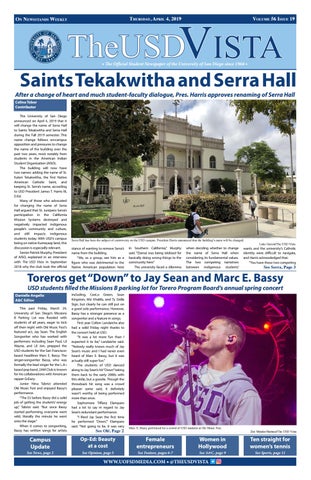
Serra Hall has been the subject of controversy on the USD campus. President Harris announced that the building’s name will be changed.
stance of wanting to remove Serra’s name from the building. “We, as a group, see him as a figure who was detrimental to the Native American population here
in Southern California,” Murphy said. “(Serra) was being idolized for basically doing wrong things to the community here.” The university faced a dilemma
when deciding whether to change the name of Serra Hall when considering its fundamental values. The two competing narratives between indigenous students’
Luke Garrett/The USD Vista
wants and the university’s Catholic identity were difficult to navigate, and Harris acknowledged that. “You have these two competing
See Serra, Page 3
Toreros get “Down” to Jay Sean and Marc E. Bassy USD students filled the Missions B parking lot for Torero Program Board’s annual spring concert
Danielle Angello A&C Editor This past Friday, March 29, University of San Diego’s Missions B Parking Lot was flooded with students of all years, eager to kick off their night with Olé Music Fest’s featured act, Jay Sean. The English Songwriter who has worked with performers including Sean Paul, Lil Wayne, and Lil Jon, prepped the USD students for the San Franciscobased headliner Marc E. Bassy. The singer-songwriter Bassy, who was formally the lead singer for the L.A.based pop band, 2AM Club is known for his collaborations with American rapper G-Eazy. Junior Nina Tabrizi attended Olé Music Fest and enjoyed Bassy’s performance. “The DJ before Bassy did a solid job of getting the students’ energy up,” Tabrizi said. “But once Bassy started performing, everyone went wild, literally the minute he went onto the stage.” When it comes to songwriting, Bassy has written songs for artists
Campus Update
See News, page 2
including, CeeLo Green, Sean Kingston, Wiz Khalifa, and Ty Dolla Sign, but clearly he can still put on a good solo performance. However, Bassy has a stronger presence as a songwriter and a feature in songs. First year Colton Landaiche also had a solid Friday night thanks to the concert held at USD. “It was a lot more fun than I expected it to be,” Landaiche said. “Nobody really knows much of Jay Sean’s music and I had never even heard of Marc E. Bassy, but it was actually still super fun.” The students of USD danced along to Jay Sean’s hit “Down” taking them back to the early 2000s with this oldie, but a goodie. Though the throwback hit song was a crowd pleaser some said, it definitely wasn’t worthy of being performed more than once. Sophomore Tiffany Elamparo had a lot to say in regard to Jay Sean’s redundant performance. “I liked Jay Sean the first time he performed ‘Down,’” Elamparo said. “Not going to lie, it was very
See Olé, Page 2
Marc E. Bassy performed for a crowd of USD students at Olé Music Fest.
Zoé Morales Martinez/The USD Vista
Op-Ed: Beauty at a cost
Female entrepreneurs
Women in Hollywood
Ten straight for women’s tennis
See Opinion, page 5
See Feature, pages 6-7
See A&C, page 9
See Sports, page 11
WWW.UOFSDMEDIA.COM ◆ @THEUSDVISTA
2
The USD Vista
◆
April 4, 2019
NEWS
Campus Update
Associated Students
With three swift strikes of the gavel, the March 28 Associated Students Senate meeting was called to order. Throughout the semester, the senate has witnessed a shift in power as elected senators resign or were removed. AS President Natasha Salgado filled these vacancies, causing a shift in the AS power dynamic. After a month of contentious debate, the AS Senate voted to register USD Act Now to Stop War and End Racism (ANSWER). ANSWER’s mission statement expressed the group’s commitment to socialism, solidarity, and direct action. Previously, the group defended themselves against allegations of anti-Semitism and terrorist affiliations connected to ANSWER’s national organization. Again, senators raised concerns about the group’s ties to the national organization and the concerns of students within the Jewish Student Union (JSU). Sitting as a proxy, sophomore Alanah Winston defended ANSWER, explaining how they met with students from the JSU, finding that their respective goals on campus did not conflict. In a later statement, students from the JSU denied this claim. Senator Rowan Parmenter expressed his interest in constructing a resolution denouncing anti-Semitism. Inclusion and Diversity Chair Jesse Magaña requested that any resolution made, also be extended to racism, sexism, anti-Islam, and homophobia. The body voted to approve ANSWER, officially registering them as a student organization. Next, Speaker of the Senate Alexander Plummer highlighted the proposed changes to the AS Constitution. These changes would include a reapportionment of senators and a proposed judicial branch of the AS government. Under the proposed plan, eight senators would represent the various residence halls, six senators would represent commuter students, four senators would represent the College of Arts and Sciences, and one would be given to each the School of Business and another to the School of Engineering. The remaining 10 senators would be classified as “at large,” enabling them to represent any dimension of the campus community. This means that a senator does not need to be linked to a specific school or residence hall. Further, they can represent any area of the campus community with which they are involved.
Another proposed change would form a judicial branch within the student government. This decision comes after a month of intense constitutional debate between members of the AS Senate and Executive Board. The proposed judicial branch would be composed of one chief justice and four associate justices and tasked with resolving constitutional disputes. Plummer proposed that parliamentarian become the assistant to the Chief Justice. Currently, it is unclear how individuals will be chosen for these positions in order to represent student voices and avoid conflicts of interest. The senate plans to vote on any constitutional changes at their April 4 meeting. As the meeting ended, Director of Student Activities and Involvement and AS Advisor Jennifer Lee addressed the senators. Lee urged the senators to remember their commitments outside of the weekly senate meetings, including attendance at constitutional and committee meetings.
Burglary on campus At 3:10 p.m. on April 1, the USD community was alerted to an on-campus crime. A robbery was reported at 10:12 a.m. on March 30 in the University Terrace Apartments. The Department of Public Safety explained that the burglary occurred between 6 p.m. and midnight the previous night. The individual’s cash and debit card were reported stolen. Public Safety is conducting an investigation into the situation. A suspect has not yet been apprehended.
Marc E. Bassy and Jay Sean perform at Olé Music Fest Olé from Page 1
The two artists bring excitement and mixed reviews to the Missions B parking lot
repetitive of him to perform it two to three times, and I could totally tell he was lip syncing too.” Other students including Landaiche shared a similar opinion. “When Jay Sean sang ‘Down,’ I could tell he was lip syncing,” Landaiche admitted. “At one point, Jay Sean went to grab some water, but the music kept going and I was like, ‘woah, hold on.’” Despite the lip syncing and repetitive nature of Jay Sean’s performance, the students still managed to make the most out of the night and have a good time. Many students agreed that a more relevant and timely artist may have been a better fit for the Friday night entertainment. “Overall I think this was a good event, but getting a more well-known artist would be nice,” Landaiche said. “Jay Sean was awesome, but a lot of people thought, ‘this guy’s still alive?’ I had no idea he was still around.”
Some concert-goers were slightly frustrated with the artists’ lip syncing and suggested that TPB shouldn’t spend as much money on live performers if they’re not really going to be performing live. In response to the alleged lack of live music, first year Katie Bush had a lot to say. “I wish the artists weren’t lip syncing because that made it feel like less of a concert,” Bush said. “If they were planning on not actually singing, we could’ve just played some music on speakers. I don’t know, it all just seemed a little pointless.” Generally, the USD student body danced the night away in the residential hall’s parking lot. Even though being surrounded by familiar faces in a concert setting was a refreshing change of scenery as opposed to the traditional indoor music venue some believe the performers should’ve at least played a live set for the fellow Torero crowd.
Jay Sean performed his song “Down” three times during his appearance at Olé Music Fest.
Zoé Morales Martinez/The USD Vista
CORRECTION: Page 8, 3/28 Issue The “Professor leaves mark on USD” article about Dr. Laurence Savett incorrectly stated that this professor was retiring and ending his career at USD. The article also incorrectly stated that Savett had a Ph.D. Savett is unsure if he will return next year, and has an M.D.
The USD Vista Luke Garrett - Editor in Chief Kaia Hubbard - Associate Editor Hannah Sonberg - Managing Editor Kathryn Querner - Copy Editor Jennifer Mossuto - Assistant Copy Editor Monica Millan- Art Director Audrey Garrett - Assistant Art Director
Amy Inkrott - News Editor Eric Boose - Opinion Editor Catherine Silvey - Feature Editor Danielle Agnello - Arts & Culture Editor Anderson Haigler - Sports Editor Zoé Morales Martinez - Photo Editor Richard Benson - Distribution Editor
Editorial – 619.260.4584 Business – 619.260.4714 www.uofsdmedia.com @TheUSDVista Diana Percy - Social Media Manager Casey Donnelly- Social Media Assistant Elizabeth Brunelli - Finance Manager Rachel Steinheimer - Advertising Manager Gina Lew - Student Media Advisor Marie Minnick - Operations Advisor
The USD Vista publication is written and edited by USD students and funded by revenues generated by advertising and a student fee. Advertising material published is for information purposes only and is not to be construed as an expressed or implied endorsement or verification of such commercial venues by the staff or University. The USD Vista office is located on the fourth floor of the Student Life Pavilion in room 403B. All inquiries should be sent to: The USD Vista 5998 Alcala Park San Diego, CA 92110 Opinions expressed in this publication are not necessarily those of The USD Vista staff, the University of San Diego or of its student body. Letters to the Editor can be submitted to The USD Vista office. Letters should be limited to 300 words and must be signed. For identification purposes, USD identification numbers and writer’s year must be included in the letter. The USD Vista reserves the right to edit published letters. Any content sent to the editor will be considered for publication unless otherwise stated.
Volume 56 Issue 19 ◆
NEWS
◆
The USD Vista
Serra Hall to be renamed
3
USD’s set to change the name of Serra Hall and other buildings across campus in the Fall 2019 semester
Serra from Page 1
narratives, in some ways, that are taking place on our campus,” Harris said. “I was a proponent for keeping Serra’s name on the building: he is a Catholic saint, this is a Catholic university. But through our conversations, we talked about the possibility of adding something to that building, and so what we came up with is that we would add the only Native American saint in the Catholic Church, and that is a woman by the name of Kateri. It’s a symbol that we were honoring those who were here first, and also those who came later, so that they would be on equal footing.” In an interview with The USD Vista from December 2017, Jeffrey Burns, Ph.D., professor and faculty member in the Center for Catholic Thought and Culture, expressed why USD was hesitant to strip Serra from the building’s name. “I know that the university will probably want to keep it as Serra because he was just named a saint (in 2015),” Burns said. “Taking away that title would be a slap to the Catholic Church.” In an interview with The USD Vista in December 2017, Former Vice President of University Relations Tim O’Malley noted that he believed the building would not change names due to AISO’s criticism. “I just think it’s unlikely that the name would be changed,” O’Malley said. “We would not easily or similarly take a saint’s name off a building because a group of students object. It would have to be a broader reason than one particular cohort, one particular affinity group, one particular group objecting.” Harris noted that he originally concurred with the opinion that the university should not change the name of the building, but had a change of heart after discussing the issues with many members of the USD community. “I had made a statement early in my time here that we were not going to take Serra’s name off the building,” Harris said. “So the solution that many people thought that taking Serra’s name off would solve problems — simply name it something else, and it goes away. Partly, I think it was partly my discernment process. I thought about it, I thought of the students
and the faculty and various conversations I had on campus. We need to make this campus as inclusive and as welcoming as possible. Many good ideas came into the conversation, and I think it demonstrates that the campus is listening and having good conversations, and we will continue to listen.” Harris’ conversations on campus took part mainly through a working group, in which he invited members of the USD community involved or related to the issue to discuss it. Members included Associated Students President Natasha Salgado, AISO President PJ Murphy, USD Tribal Liasion Persephone Lewis, faculty from Mission and Ministry, Student Affairs, University Design, and other areas. Associated Students President Natasha Salgado and AISO President PJ Murphy declined the request to be interviewed by The USD Vista at this time. Additionally, Harris offered that having two names on the building would produce a thoughtful dialogue within the USD community that aligns with the institution’s purpose as an academic university. “A university is where difficult dialogues should take place, and if we take off the name, it goes away,” Harris said. “We’re an academic institution, so difficult dialogues take place here. We don’t shy away from them, and I think it’ll make us a better campus in the long run.”
of art created by Johnny “Bear” Contreras, a Native American artist. AISO’s initial public criticism and proposal of a name change of Serra Hall was in Fall 2017, when the club held an event outside of Serra Hall in November to educate USD students about their reasoning behind the criticism. Club members spray painted 300 rocks bright red and placed them on the lawn of the building: each rock symbolized 1,000 native deaths. Members also passed out informational flyers about St. Serra and hung tribal nation flags to represent the different tribes in California. AISO also sponsored a discussion panel in February 2018 titled, “Should we Re-name Serra Hall?” and featured six speakers including students and professors from USD and neighboring California universities. Additionally, AISO led a “Speak on It!” installment, a UFMC event aimed to foster conversation, in November 2018 about the impact of having a building named after Serra and the possibility of having the building renamed. In September 2018, Stanford University made the decision to remove Serra’s name from one of their academic buildings and a dormitory, as well as asked the U.S. Postal Service and Santa Clara County to wipe Serra’s name from its mailing address. Although USD’s decision to change the name of the building comes after Stanford removed
“I thought of the students and the faculty and various conversations I had on campus. We need to make this campus as inclusive and as welcoming as possible.” -President James T. Harris III In 2015, Pope Francis issued a statement apologizing for the grave sins of colonialism against the Native peoples of America: this was at the same time that Harris became President of USD. The initial dialogue concerning indigenous students and USD’s placement on indigenous land began when the Tecolote Memorial Garden’s name was changed to Kumeyaay Garden in September 2017, after pressure from Associated Students and indigenous students on campus. The garden now contains native plants and a piece
Serra’s name, Harris said that USD’s decision was in no way related to Stanford’s, but acknowledged that recent national dialogues about inclusion and diversity had inspired the university’s decision. “It did bring more attention to the issue from some people on campus, but Stanford’s decision was completely separate,” Harris said. “They had other reasons for doing that: they’re not a Catholic university. Stanford’s decision came into the conversation, but it certainly was not a part of our decision making. I think ours is
A statue of St. Junípero Serra sits in front of the hall bearing his name. Luke Garrett/The USD Vista
particular to our region, who we are as a university and where we’re located, and I think we’re trying to be sensitive to our local realities. There’s a national dialogue that’s been taking place that has been heightened over the past two or three years.” In late October to early November 2018, Harris established his working group to create dialogue about Serra Hall from different areas on campus. He came to a Board of Trustees meeting in late January to early February 2019 with suggestions of renaming from the working group, and in late February 2019, the Board unanimously voted to approve the decision to add St. Tekakwitha’s name to Serra Hall. Harris noted that there was doubt, yet support for the decision. “There were some people who were skeptical, some people who were fearful that we were going to walk away from our Catholic values or legacy,” Harris said. “Basically, they were positive about moving forward so long as the conversation remained within our mission and within our set of values identified as a Catholic university. They were very supportive and thought it was a great solution. They were deeply appreciative of the fact that we had conversations with people on campus.”
Harris acknowledged that he will most likely receive backlash from his decision. “Any decision that I make that I go public with, I get backlash,” Harris said. “Whenever, as a president, I take a stance and talk about issues in society, there is backlash. My guess is that there will be somebody who is angry, upset by this on both sides of the question. There are people that will say you should have taken Serra’s name off. There are people who will say you should have never changed the building. And those in between. Often, in these days and times, with the political turmoil of the country, someone’s going to be upset.” Until the official announcement that USD would be changing the name of Serra Hall, the university had not made any official statements on the consideration or changing of the name of the building. After two years of silence, USD has taken its stance on the renaming of Serra Hall. The university will also be renaming Missions Crossroads to “Mata’yuum,” a Kumeyaay word for meeting place, and later, removing the word “Missions” from any structure that bears its name, in acknowledgment of the possible negative connotation of the word concerning Native Americans and colonization.
The USD Vista
4
◆
April 4, 2019
E DI TOR IA L
Mueller report: locked behind Barr Attorney General’s withholding denies Americans answers, prevents government accountability
Ali Ulin Asst. Opinion Editor For three years, the legitimacy of Donald Trump’s election has been questioned by the media, American voters, and the FBI. For almost two of those years, Special Counsel Robert Mueller led a team of FBI investigators looking into the possibility of election collusion between all those involved in Trump’s presidential campaign and Russian intelligence and espionage. On March 22, Mueller completed and delivered the nearly 400-page report of his investigation to Attorney General William Barr. Barr’s meager fourpage summary claimed that there was no evidence that the Trump campaign “conspired or coordinated with the Russian government in its election interference activities.” In a statement to the press, Barr claimed “the evidence developed is not sufficient to establish that the president committed an obstruction-of-justice offense.” Furthermore, Barr has committed to releasing a redacted copy of the report to the public in midApril, but has so far refused to ever release an un-redacted version. When Mueller’s report first reached Barr, Trump seemed willing to grant the public full access to the report, saying, “Let it come out. Let people see it.” As Democratic cries for the report’s release grew louder, the president’s confidence faded into defensiveness. On Tuesday, Trump called releasing the full report a “waste of time” and a “disgrace.” Whether the president likes it or not, Mueller’s investigation is complete and the report is here. What matters now are the findings published in the report and the consequences they may hold. When former Trump lawyer Michael Cohen testified in front of Congress in February of this year, suspicions of Trump’s collusion with Russia regarding the election spiked after Cohen’s suggestion that Trump at least coordinated with Russian forces. This was similarly controversial to the release of the Mueller report as Cohen claimed he did not know of any incriminating or direct evidence pointing to campaign collusion with Russia though he felt that there was a high chance that Trump if not actively sought out help, at least knew of the Russian conspiracy. He also declared that multiple accusations against Trump and the Trump campaign were blatantly false, namely that Trump had visited Prague to meet Russian officials to pay off Russian hackers and that Trump directly told Cohen to lie to Congress about a proposed
Trump Tower in Moscow. Amidst all this controversy, Mueller’s report offers the best chance to clearly establish what did and did not occur surrounding the 2016 election. While some argue that the romance between Trump and Russia is a fantasy constructed by spiteful Democrats and a delusional media, the possibility of collusion and conspiracy is anything but fiction. The narrative from the executive branch has long been tales of building a campaign, election, and presidency on the backs of the American public’s honest desire, sometimes referred to as a need, to “drain the swamp.” However, the relationship between Russian espionage and the U.S.
guilty to lying to the FBI during the course of the investigation. In total, Mueller and his team brought charges of over 200 individual criminal acts against a total of 34 people over the course of their investigation. While parts of Mueller’s report that have been made public seem to undermine the narrative of a close relationship existing between the Trump campaign and Russian officials, there is a wealth of information that is yet to be released. The story of the investigation is far from over. Alongside the personal implications of guilt regarding Russian involvement throughout the election, the Democratic National Committee (DNC) has
find the 30,000 emails that are missing,” said Trump. While Trump publicists insist that this was only meant to be a joke, a line needs to be drawn on when a coincidence turns into a conspiracy. Beyond revealing sensitive information, Russians used all sorts of tactics to confuse American voters and brainwash voters to support Trump over Clinton. For example, Russians fabricated news stories, slamming the Clinton campaign and spreading false information about Clinton. To say that leaked emails and fake news stories did not affect the outcome of the election would simply be naïve and ignorant of undeniable facts. The Mueller report stands as an extensive record of whether
election results have been proven to be real. Six of Trump’s cabinet members, campaign advisors, or personal confidantes have been indicted during the investigation due to their unethical and illegal conduct throughout Trump’s campaign. Jeff Sessions, the former U.S. Attorney General, chose to recuse himself from the federal investigation into Russian interference. Michael Cohen, Trump’s personal lawyer, testified against the president, exposing his unethical conduct and further weakening the president’s already debilitated credibility. Former Trump advisors Michael Flynn and George Papadopulos both pled
strong evidence of Russian hackers compromising their computers and service to attain classified and private information, especially regarding Hillary Clinton. A month before the 2016 election, Elaine Duke, who would go on to serve as Secretary of Homeland Security under Trump, asserted that not only were cyber-attacks made against the DNC by Russian agents, but that those attacks were meant to influence the presidential election. To put this into context, at a July 2016 press conference, Trump begged Russians to attack and expose Hillary Clinton’s private emails, “Russia, if you’re listening, I hope you’re able to
Trump was personally involved in an attempt to cover up the Russian involvement in his election, his assistance of Russian officials or backed forces to intervene in American politics, and/or his involvement in any type of scheme with Russian forces to ensure his presidency. Much, if not all, of the journalism that covered this scandal has royally failed the American public. Inaccuracy polluted the broadcast networks and online sources daily with incomplete, unfounded, and untrue implications made of the president, the Democratic response, and the investigation. News stories desperately lacked
evidence, contained false accusations, and were undeniably skewed or even outright biased. Americans have been misled and given a false narrative to the unfolding of this saga, but certain events are assured. To act as a fact-check and guideline to the ongoing speculation into Trump’s relationship with Russia, the Mueller report needs to be released in full to the American public and legislators to give America much-needed closure and bring necessary consequences for the despicable actions that betrayed Americans’ trust and confidence in our elected officials. Beyond the basic ideals of transparency, honesty, and integrity that are being violated and undermined by the withholding of the documents, the disrespect to the democratic system, especially popular opinion, entering a new campaign cycle will prevent voters from being aware of information integral to their decision-making process. Not only does physical evidence suggest a correlation between Russian actions and Trump’s election, but for the amount of interpersonal, professional, familial, and social ties that the Trump family and the Trump Organization have to Russia and Russian officials to be a coincidence is simply unbelievable. Campaign advisors, presidential advisors, business partners, children: the list goes on for how many connections Donald Trump has to the Russian elite. To expect Mueller’s report to fully determine the extent of the affair between Russia and the Trump campaign is to put a great deal of faith in Russia, a country known to falsify information and cover up their international misdeeds. No matter what, only the full report can even come close to fully explaining the closeness of all campaign members to Russian actions, including the president himself. Regardless, the American people deserve the chance to judge the report’s contents for themselves, a chance they can only have with the release of the full, unedited, un-redacted report. A president’s conduct, regardless of whether it is against the law, should be known to the public. After all, it is a founding principle of democracy that the power of the government comes from the consent of the governed. Currently, no one outside of the Attorney General’s office and the special counsel grand jury know what is held in Mueller’s report. For the sake of transparency, for the sake of citizens, and most importantly the sake of our country, release the report.
The University of San Diego does not share the views presented within the editorial and op-ed sections. The opinions expressed in this section reflect solely the opinion of the respective writer.
Volume 56 Issue 19
◆
OPINION
◆
The USD Vista
5
OP- E D
Ornamental campus, at a cost
How many hazardous chemicals are required to maintain one of the most beautiful campuses in USA? Michelle Gilmore-Grier, Ph.D. Department of Philosophy The University of San Diego has enjoyed its status as a most beautiful campus; indeed, if one looks at reviews and comparisons, it is declared to be one of the most beautiful campuses in America. And why not? With its Spanish Renaissance architecture and its location on a mesa overlooking Mission Bay, with the crisp San Diego climate and the canyon views, its sprawling exotic commercial grade ornamental turfs, plants, flowers and trees (all impeccably maintained), the campus is indeed lovely; why, it’s enough to take your breath away! Literally. How can a campus in the drought-ridden region of Southern California sport such lush and ornamental environs? I went to Environmental Health and Safety on campus for a list of chemicals used on our grounds. This list, unfortunately, is far too long to include here. The majority of these chemicals are pesticides, insecticides, and fungicides, virtually all of them (as with most industrial chemicals) carrying warnings of toxicity. Anyone who has worked here for any length of time has become acquainted with the routine spraying, and the use of chemicals and pesticides. With the more recent upgrades to the mesa, and the addition and expansion of lawns on what used to be Marion Way, the need to maintain the ornamental commercial grade turfs has expanded. All of this adds to the wonderful experience of being at USD, and it is, moreover, an important marketing tool. There are, however, costs and obligations attending to such landscaping choices. These costs are perhaps worth noting, for we – unlike visiting parents or trustees or conference participants, etc. – spend years on campus; our faculty and staff and other essential employees will have been exposed to these chemicals
over the course of a career for potentially, if not already actually, decades. Round-up Pro, (Monsanto Corp.) is one product deployed by USD grounds-keeping. The active ingredient in Round-Up (Glyphosate) has been repeatedly affiliated with non-Hodgkins lymphoma among those who undergo long exposure over time. In a lawsuit in 2018, Monsanto was instructed to pay Dewayne Johnson 289 million. The jury found that Monsanto acted maliciously by failing to warn consumers of cancer risks posed by the herbicide. Other suits have followed, and continue still. Currently, it appears that there are many thousands of cancer patients suing Monsanto in numerous state courts for failure to warn the public about the risk of cancer associated with glyphosatebased weed-killers. It must be noted that Monsanto vehemently rejects the causal connection between Glyphosate and cancer. Bayer, which rather recently purchased Monsanto, also rejects the legitimacy of the charges, and is thus now confronted with thousands of similar lawsuits of its own. My aim is not to enter into the details of the arguments. One thing is certain: The toxicity of Round-Up increases when mixed with other chemicals. USD does indeed use a variety of chemicals. We also use Criterion 0.5g Insecticide (Bayer Corp.), with the active ingredient being Imidacloprid 0.5%; it is used for ornamental landscaping and turf-grass. Reported adverse affects gathered by the EPA documents over 22,000 minor poisoning incidents, mostly identified among those working directly with the product in grounds-keeping. (nrdc.org). Reported reactions include skin irritation, numbing on fingers, facial numbness and swelling, among others. Apart from toxicity to humans, Imidacloprid is very toxic to honey bees and other beneficial insects. USD also
uses Spray Fast, a product of the Simplot Corporation for use along with various insecticides, miticides, fungicides, herbicides, fertilizers, defoliants, and dessicants in order to maintain healthy turf. In addition to all of the above, USD uses (among numerous others) Simplot’s Right on Blue and Dimension 270G. Although warnings are not always on the packaging, a simple search of the active ingredients (e.g. Dithiopyr, Thiamethoxam) suggests that these chemicals are hazards to humans and domestic animals. Simplot, one of the largest, private companies in America, located in Idaho, itself has a long history of suits and complaints on various Obviously, many of these issues flow from the university’s choice to landscape with ornamental and non-native turf, and so on. Quite apart from any factors stemming from climate change, Southern California is, and always has been, a drought sensitive region. Aside from whether our use of natural resources, such as water, is responsible, a real problem is that this decision carries with it the seeming necessity of a full panoply of chemicals needed to maintain the grounds. Here we may simply note that the chemicals are toxic in general. They are toxic even if they remain legal, and enjoy popular commercial use at golf courses, public parks, etc.. It is naturally difficult to measure and quantify exactly how toxic each individual chemical is, or what practices might exacerbate toxicity. The difficulty of measuring toxicity is evidenced by glancing at the case of Simplot’s Right on Blue. On the list of products used by USD, this is a colorant for use in spray application of pesticides (e.g. Round-Up). An examination of the toxicological information is distressing: acute toxicity, germ cell mutagenicity, reproductive toxicity, specific organ toxicity, and more. So far as I know, none of this toxicological information has resulted in a process of classification
as of yet, meaning that its hazardous “status” is undetermined. Even Simplot does not appear to be able to classify the product in this regard! Perhaps it wishes not to. And of course, individuals vary widely in their chemical sensitivities. Nevertheless, it is worth noting that Simplot is willing to state: “AVOID ALL UNNECESSARY EXPOSURE.” Of course, the hazards are not limited to humans. USD has become increasingly welcoming to animals on campus, and we thus might want to consider whether the voluptuous use of chemicals on the lawns and plant beds is consistent with our welcoming these animals. Then, too, the insecticides used (especially Meridian 0.33G and Fusilade ll as well as Criterion) are extremely toxic to native and helpful insects. This is particularly unfortunate for the threatened California honey-bee. Ditto the ladybug, the mantid, and so on, insects beneficial for controlling other pests and, obviously, in the case of the honey-bee, essential for pollination. Considering that a number of the chemicals used at USD appear to be used to treat the soil directly in order to kill pre-emergent insects that might mar the appearance of the pristine lawns, one thing seems clear: there are far-reaching implications attending to the use of industrial chemicals. I do not enjoy, indeed I decry, alarmist activism. No doubt there are studies and arguments producible by those on the other side of the issue. But this is in a sense irrelevant to the question. The debate is not about whether our use of pesticides, etc., is in itself acceptable/unacceptable or even desirable/undesirable. The question is whether there are better, or less risky, methods for maintaining the landscape in a way that uses natural resources more responsibly, and sustains itself with a decrease in the use of chemicals. The question is whether implementing a long-term and measured plan to reduce the
use of industrial chemicals is worth it. It is possible. Noting with concern the amount of chemicals used on university campuses, some students are stepping up to the plate. Finding that the chemicals used at the University of California, Berkeley were hazardous, especially to young women of reproductive age, for example, two female student athletes pursued the issue. The result is that UC Berkeley is now a “pesticide-free” campus. A number of fore-thinking colleges and universities are following suit, if they hadn’t already done this themselves. There thus now appears to be a network of campuses together working on minimizing the use of industrial chemicals. The reasons for pursuing pesticide-free environments vary across campuses. Aside from the universal desire to avoid the obvious health risks appended to exposure, some campuses additionally see pesticide free environments as a means of putting into practice what they “preach.” Some see cost benefits, citing the high cost of synthetic pesticides. Then, too, there is the commitment to helping to reduce the toxicity of their community, to practice good stewardship over the environment, knowing that the birds and the bees and the seeds, and so on, that are on campus inevitably influence the environments surrounding campus, etc. In short, these colleges and universities take their commitments on this score to be demanded by the Missions of their institutions. Given the success enjoyed by so many campuses thus far, it appears to be the case that one needn’t sacrifice the beauty of a campus in order to promote alternative methods of maintaining its grounds. It may be that the most beautiful campuses in America are also the most healthy and responsible. What does it mean to be a “Change-Maker?” See online article for sources.
The University of San Diego does not share the views presented within the editorial and op-ed sections. The opinions expressed in this section reflect solely the opinion of the respective writer.
& Julia Herold
6
THE USD VISTA
◆
APRIL 4, 2019
Female Entrepeneurs at USD
Roller Bowls
Hope McLaughlin, Camille Morales, Julia Herold
Women at USD are students, athletes, activists, leaders, and entrepreneurs. While balancing rigorous academic and extracurricular commitments, some women have decided to create and develop their own businesses. They come from a variety of majors and backgrounds, yet all share a common goal of bettering themselves and their communities through business. Meet the incredible women behind student-run businesses including Roller Bowls, Ethereal Alchemy, Beach Butter SD, Faded Virtue, and Lucky Charms.
Inspired by their passion for nutrition, three roommates and cross country runners came up with the idea of a smoothie bowl delivery service powered by roller blades. Thus, Roller Bowls was born. Being both athletes and entrepreneurs, these three women promote nutrition in a new and creative way. Senior Camile Morales explains.
“
When we have free time, it’s all we want to do,” Morales said. “Between biochemistry, comparative anatomy, and genetics, it forces us to be good with time management. We make time for what we love.”
Photo courtesy of Roller Bowls
In addition to feeling empowered by owning a business, the creators of Roller Bowls are proud to have catered Changemaker Hub meetings on campus.
Roller Bowls upholds their environmental promise by composting all fruit scraps, using wooden spoons, and donating 30 percent of profits to the Ric O’Barry Dolphin Project in an effort to end dolphin captivity. Photo courtesy of Roller Bowls
Victoria Roberts
“
Victoria Roberts, a sophomore from Mexicali, has found a way of self-expression through the creation of personalized denim jackets for friends, students, and those in the USD community. Though running a business while being a full-time student might seem difficult, Roberts handles the task with grace.
Photo courtesy of Victoria Roberts
Faded Virtue
It’s about teamwork and knowing we can count on each other when we get busy,” Roberts said. “We have found that scheduling and giving ourselves deadlines help us stay organized.”
Roberts caters to the individual taste of each client to make her product unique.
“
They are a part of the process from beginning to the end to ensure that they really love their jacket,” Roberts said. It is this connection with the customer that makes the job so worthwhile for Roberts. Photo courtesy of Victoria Roberts
Finally, when asked what advice she would give to others who looks to start their own businesses, Roberts noted that determination largely contributed to her success.
“
Be prepared to work and be organized,” Roberts said. “At first, it is going to seem like a lot to handle but if you are driven and work hard consistently, it will pay off.”
Volume 56 Issue 19
◆
FEATURE
◆
7
THE USD VISTA
Photo courtesy of Kenzie Murphy
After a few visits to a local bead store with her mom in her hometown of Scottsdale, Ariz., Kenzie Murphy began to create jewelry that soon grew in popularity amongst friends and family, and turned it into the business she named Lucky Charms Jewelry. While Murphy has all the passion and drive it takes to start her own business, she has faced struggles as a female entrepreneur along the way. Although Murphy is aware that men have traditionally been more dominant in the business world, she is determined to be a part of gender revolution in the business world.
Lucky Charms
“
Kenzie Murphy
I am hoping to change this as I believe women are brilliant, creative and have several advantages,” Murphy said. “Both men and women can be entrepreneurs! Gender does not determine your entrepreneurial spirit.”
Photo courtesy of Kenzie Murphy
Pre-med sophomore Dominique Keane-Cawrse has built a successful business making essential oil sprays based on the different chakras. Her product line, Ethereal Alchemy, arose from her childhood pastime of playing with her mother’s various essential oils, as well as her passion for hot yoga.
Keane-Cawrse balances her busy school and work schedule by focusing on her business while she is on break from school, during which she is home in Orange County. She utilizes these breaks to grow inventory and fulfill product orders, using organization and strategic planning to work
“
Photo courtesy of Dominique Keane-Cawrse
Beach Butter
Anna Ford & Laura Franceschi
Having my own business gives me more confidence,” KeaneCawrse said. “It helps me learn more about finance, brings to light how business really works, and shows me how much fun I can have by putting my creativity into making something I love.”
First-year students and making flavored almond receiving a Magic Bullet their friends and quickly
Photo courtesy of Dominique Keane-Cawrse
After making her first spray as a Christmas present for her friend, Keane-Cawrse pitched selling her single spray in a crystal shop she worked at last summer. Her boss agreed to give her a chance.
While Dominique continues to set academic and personal goals for herself, her next business move is to put her sprays in San Diego retail shops.
Ethereal Alchemy
Dominique Keane-Cawrse
roommates Anna Ford and Laura Franceschi started butter in their Founders Hall dorm as a hobby after blender for Christmas. They initially gave samples to realized people were willing to pay for their product.
When discussing the benefits of running a business, Ford highlighted that the satisfaction of pleasing customers and creating a loyal client base was a large motivator for Beach Butter’s hard work.
“ Photo courtesy of Beach Butter
We keep integrity in our business because we want to do well for our clients and have them come back,” Ford said. “Instead of going on social media before bed, we make jars of almond butter. We love to grind.”
Photo courtesy of Beach Butter
The Beach Butter Instagram page has inspired USD students to become loyal customers and purchase unique flavors such as “Ocean Blueberry” and “Sea Salt Original” in reusable mason jars.
Spread by Monica Millan/ The USD Vista; Content by Sabrina Alterman and Emma Goodman-Fish/ The USD Vista
8
The USD Vista
◆
April 4, 2019
F E AT U R E
Fashion club sparks creativity
The student-run USD Fashion Collective gives students opportunity to express their individual style Mackenzie McDonald Contributor Fashion is constantly evolving, and so is the University of San Diego Fashion Collective, a student-run club looking to majorly revamp its style this spring with an exciting new project – a student-produced magazine. The USD Fashion Collective was co-founded last year by juniors Ella Wathne and Sophia Talese with the simple intention of uniting creative minds. Rooted in a shared love for fashion, Wathne and Talese have worked to create a community for students to express their individual style and connect with similarminded individuals. Club president Wathne said that she first got the idea to start a fashion club after she transferred to USD her sophomore year and recognized an unmet need in the community. After attending an art club meeting during her first week, Wathne said she was struck by the meeting’s low attendance. It prompted her to think about establishing a club of her own–one that was still rooted in a passion for the arts, but approached that passion from a slightly different angle. “I wanted to create a community of artistic people,” Wathne said. “A
space where creative people could come together and inspire one another. I love fashion, and I felt like there wasn’t really a group on campus with that specific focus.” Following this realization, Wathne said she contacted her architecture professor and asked if she knew anyone who might be interested in starting a fashion club. That’s how she met Talese. “After that, I met with Sophia, and USD Fashion Collective got started,” Wathne said. Unfortunately, the club did not gain the immediate traction that Wathne had hoped it might. USD Fashion Collective remains relatively unknown to some USD students, despite holding a number of events since its formation last year. One such event USD Fashion Collective participated in was a clothing exchange co-hosted with the Fair Trade Club. The event promoted sustainable fashion by providing students with the the opportunity to “swap” old items of clothing rather than going out and buying more. The club also organizes three professional photo shoots per semester that are used as content for the USD Fashion Collective Instagram and blog, which have been a big success according to Wathne. Still, she wants the club to
have greater scope, which is why her and Talese decided it was time to make some changes. “As a group, we all needed a goal,” Wathne said. “Something to work toward other than events and photoshoots. Something serious and tangible.” That’s where the idea to create a magazine came in. Not only would publishing a magazine give club members a concrete objective, but it would also ideally increase group membership by giving USD Fashion Collective greater exposure. Wathne also believes that putting together a magazine will give the club a chance to broaden its self-concept. “We’re getting more serious about this,” Wathne said. “We want to get into campus culture and art and featuring artists on campus. That’s the big reason we decided to do a magazine.” The magazine, which does not yet have an official name, is set to launch in early May. It will be mainly digital with limited print editions of each new issue. Wathne said that the magazine will be comprised of several different sections, including a section featuring student artists and musicians and another specifically dedicated to submissions of creative work. It will also include a section called “Cool Girls on Campus” that
Prepare for the business of
Silvia Ramirez shows off her personal style on the club’s social media. Photo courtesy of the USD Fashion Collective
highlights the accomplishments of female go-getters. The first one focused on the girls behind Roller Bowls, a student-run company that makes custom smoothie bowls and delivers them to their customers on roller blades. Although the “Cool Girls on Campus” spot is female-specific, Wathne expressed the desire to make USD Fashion Collective increasingly gender inclusive. “We need to get the word out,” Wathne said. “There’s definitely
MAKING A DIFFERENCE
EARN YOUR 12-MONTH MBA AT POINT LOMA NAZARENE UNIVERSITY • Values-driven curriculum • Professional mentorship network • Hands-on classroom experience
Become the leader that others will follow. Learn more at pointloma.edu/12monthMBA
this assumption that USD Fashion Collective is only for girls, and we want to change that.” To that end, Wathne said she hopes to incorporate content into the magazine specifically targeted at males as well, expanding the creative potential of the publication. Looking ahead to the magazine’s release in early May, the USD Fashion Collective hopes to put forth a strong and innovative publication, staying true to their core values of passion and originality.
Volume 56 Issue 19
◆
ARTS & CULTURE
◆
The USD Vista
A ART RT S & CULTURE C U LT U R E
9
Women in Hollywood: doing it all
USD’s Warren Auditorium screens actress, producer, writer, and director, Tracy McClain’s documentary
McClain found Chilean artist and animator, Xaviera López, on Giffy. McClain admired López’s “subconscious feminine” linework and reached out to her, displaying her artwork throughout the documentary. Danielle Agnello/The USD Vista
Danielle Agnello A&C Editor In Hollywood a woman’s voice can be a powerful tool, as it’s initially her key to unlock and transform the social and political landscapes of the entertainment business. In an industry dominated by men, Emmy Award winning actress, director, producer, and writer of “Seeing Is Believing: Women Direct,” Cady McClain strives to empower women. In pursuit of achieving full equality, McClain wholeheartedly encourages women to use their voices through media. On Wednesday, March 27, McClain’s documentary, “Seeing Is Believing: Women Direct,” was screened in Mother Rosalie Hill Hall’s Warren Auditorium. After viewing the film, students, faculty, and other audience members asked McClain questions regarding the making of her film and her perspective of breaking into the world of Hollywood as a woman. As a female director, McClain experienced first-hand, time and time again, people’s underestimation of her and her work, along with the genderbased assumptions people make. “At one of the film festivals I went to there was a young person handing out the name tags which had little stickers on them stating each individual’s role,” McClain said. “I was handed a name tag with the stickers titled, ‘producer and writer,’ but not ‘director.’ When I told this person my name tag should have a sticker on it for ‘director’ too, this individual gave me a puzzled, belittling gaze. She literally could not see me as the director of a film, even after I clearly expressed my title.” McClain was asked if there was any one defining moment in her life when everything
just clicked and she knew she wanted to pursue directing. “I took a directing workshop with Curt Dempster when I was 22,” McClain said. “I saw how the director was the one who was creating that whole world and all those toys, all that ability to affect the audience and their choices. At this point I thought, ‘That’s it, drop the mic, that’s where it’s at for me.’” Similarly, McClain was inspired after reading John Patrick Shanley’s collection of plays, “Welcome to the Moon.” “The way he saw the world was so unusual,” McClain said. “He’s very much a surrealist in a way and it’s not really fantasy, it’s like mixing life and dreams. I thought it was wonderful, and I didn’t realize that you could tell stories in this way.” McClain commanded the audience through her enchanting and animated presence. The audience most definitely saw McClain’s inner actress glisten as she spoke about her experiences. She was so passionate, so knowledgeable, so timely, and so aware as she told her story, cultivating brilliance and creativity in USD’s own Warren Auditorium. Sophomore Serena Stockton attended McClain’s screening out of curiosity and to gain a new perspective on an industry she is not necessarily familiar with. “I felt very empowered, inspired, and reassured,” Stockton said. “With a group of strong women coming together we have the power to create change no matter the industry we aspire to go into.” Throughout the night, McClain highlighted how mentorship and leadership by female directors is influential. While creating “Seeing Is Believing: Women Direct,” she wanted the foundation of her film to revolve around a diverse collection
of female directors, capturing their unique stories. Throughout the film, McClain presented a range of women in terms of age and race, encapsulating how women have this uniqueness, but solidarity about them. During McClain’s presentation following the screening, there was a focus point on storytelling through the eyes of a woman and how a woman’s story both compares and contrasts from a man’s outlook. “For both men and women, there are issues of the soul,” McClain said. “Who you come into this body as, where you land, what your experiences are; they all have a beautiful multiplicity, a lens you come in with, trumping on uniqueness.” McClain then went on to speak about the distinct angle women embody and the actions they take considering the body they’ve been given. “Women have to deal with birth, and what being a mother or not being a mother means,” McClain said. “Men have to deal with a different energy.” McClain talks about how men can benefit from hearing a woman’s story because it offers an important, new kind of experience. I think there’s a lot of hammering for guys on how they should be and not enough encouragement that they could also learn from the feminine and the creative sacred feminine,” McClain said. “As a culture, it’s something that I think we can all learn from. I want people to see women as visionaries, and intellectuals that are worth investing in. Women are the boss.” McClain is tough, constantly training herself to be the best female leader and motivating other women across the world to do the same. Though, many
people are still adjusting to female leaders and making space for this presence and voice, McClain is gradually changing the face of the entertainment industry. “Part of the reason I made ‘Seeing Is Believing: Women Direct’ was because there’s only so much voice you have when acting,” McClain said.“I wanted to get behind the camera and incentivize people to take personal responsibility for the stories we digest.” McClain discusses the many potential structures a film could be composed of, including Aristotle’s three-act structure, the hero’s journey, and the heroine’s journey. But, McClain didn’t want a boring structure. “I wanted women to sit in a circle, talk, and share stories,” McClain said. “There’s a cyclical tendency and that is where a sacred healing happens. They then expand from that point. But when it’s time to deal, they sit in a circle. They expand
again and again, but they all come back together and sit in this circle.” McClain believes that four women sitting in a circle and sharing stories is a powerful approach, inspiring the community. “Cultural impact is my definition of success,” McClain said. “I want to make people think, ‘What is possible?’ because that excites me. If you discipline, and you train, and you want, male and female filmmakers can work together, and they can change, and they can heal.” McClain continues to refine the industry and is currently on the road to directing a creative film. As a female in Hollywood, and a model leader for young adults, McClain manifests that with passion and a virtuous execution, what once seemed like the impossible can be made possible. As McClain infuses others with her story and bridges the gap between aspirations and reality, individuals are reminded that all of their goals are in reach.
McClain enthusiastically responded to the many questions the engaged audience asked. Danielle Agnello/The USD Vista
10
The USD Vista
◆
April 4, 2019
A weekend filled with music
Greater San Diego Chamber Orchestra celebrates 30 years of community engagement Noah Staninger Contributor Music, at its core, is a means of expression. It is the universal language that all can understand, regardless of where they are from and who they are. For 30 years, the Mulvaney Center for Community, Awareness, and Social Action has been connecting USD with the neighborhoods in San Diego, and what better way to celebrate this milestone than through the music of the community. Two concerts were held in Shiley Theatre on Friday, March 29 and Sunday, March 31. They were performed by the Greater San Diego Chamber Orchestra and featured a number of guest soloists as well as conductors. It’s safe to say that this orchestra is San Diego’s best kept secret in classical music. The lights dimmed and all the musicians began to tune to one another, steadying the pitch so that they could maintain a unified sound. The light shined off the freshly polished instruments as Professor Angela Yeung, Ph.D. stepped onto the podium and raised her baton. The performance began with Camille Saint-Saens “Bacchanale from Samson and Delilah.” Within seconds the audience found itself mesmerized by the music, which successfully commanded their attention throughout the course of the entire performance. The exotic melodies of the oboe were complemented
by the string section, with a thundering timpani driving the piece forward. This piece served to not only introduce the orchestra, but also as the perfect lead in to the highlight of the festivities. After “Bacchanale and Romanze” were over, Yeung turned to face the audience and told them about the significance of the 30 years of service the Mulvaney Center has provided to the community. She explained that USD is more than just a school for rich kids, but an institution dedicated to justice for all people around the world. Yeung explained that empathy and humanity are more than just words here. They play a part in the curriculum everyday, and upon graduation students are leaving with more than just a diploma. Yeung then presents an award to Mrs. Reggie Smith, a Linda Vista community Leader, for embodying the principles that USD so greatly represents. The Mulvaney Center, and all it has done in the past 30 years, are in large part a product of Pfister’s work at USD and surrounding communities. Pfister takes the stage and discusses the importance of community and university relations, and humbly accepted the award. Reggie Smith was also honored at the performance for her community involvement on Friday but was unable to attend Sunday afternoon. Pfister inspired the audience with her decades of
dedication, accepted the award, and wished the orchestra the best of luck as they began to play again. Max Bruch, played “Romanze” with a Viola solo performed by department faculty member Ramon Negron. The soloist played with abundant personality and style. His performance is for the eyes as much as it is for the ears. The solo was gentle but demanded that it be heard. The transitions were seamless, from both the Orchestra and Negron. The whole point of an accompanying Orchestra is to complement, not undermine the soloist and their performance perfectly executed this duty. “Romanze” finishes and Negron traded his violin in for a baton and begins to conduct “Csárdás” by Vittorio Monti. Performing the complex violin solo on this piece is USD’s own Elizabeth Tin-Maung, a junior studying both voice and violin as a music major. Completely unphased by the challenging transitions and speed, Tin-Maung moved her fingers over the neck of the violin without hesitation. “When you practice you focus on technique and you focus on all these other things that are important to what you’re playing, but when you’re performing what I think about is trying to streamline my emotion that I feel for the piece so that the audience can feel it.” After 14 years of playing her instrument, Tin-Maung has powerful understanding of what
it takes to be a superior musician. With both the motivation to succeed and the talent to back it up, Tin-Maung shows the audience why she is one of USD’s most valuable students. The concert continued with two guest pianists, Youchae Bae, 11, performing Haydn’s “Vivache,” and Alexis Wu, 16, performing the third movement of Mozart’s “Piano Concerto No, 27.” Both Bae and Wu received first place in their respective divisions at the Music Teachers Association of California Concerto competition. They each performed with an intimidating confidence as their hands glided across the piano. They had an attention to detail that most musicians, no matter what age, never seem to achieve. For Bae, it was her first time playing with an orchestra accompaniment, but as an audience member, it was impossible to tell. Also featured in Vivache was guest conductor Jeffrey Malecki, whose unparalleled talent and charisma speaks for itself. The orchestra accompanied the two pianists perfectly without taking away from their solos. After the young proteges left the stage there was a brief intermission. The orchestra had already been playing for an hour, but they were far from over. The final piece, Rimsky-Korsakov’s “Scheherazade,” was dedicated to the aforementioned Reggie Smith, as it is her favorite piece
of classical music. The entirety of the composition is 50 minutes. Anyone who’s ever performed the piece before knows how physically and mentally taxing it can be, but the chamber orchestra played for a whole two hours without a drop in quality. The level at which they played remained consistent despite the duration and complexity of the piece. The emotional content that each musician had translated clearly into the music and showed no signs of stopping. Throughout the harmonies of “Scheherazade,” the contrast of the dynamic ranges and the energy of the highs and lows were clear in each movement. The main melody would repeat itself throughout the piece in different contexts, drawing the audience in more and more. After the final note of the final movement, Yeung and all the performers took a bow. After two hours they must have been extremely exhausted, but they certainly didn’t show it. The hardwork, dedication and talent of the orchestra as a whole, in addition to the individual soloists cannot be summed up in one article. Music, especially at this level, can only be truly experienced live. The San Diego Chamber Orchestra’s next performance will be Gershwin’s Rhapsody in Blue and the Chinese Yellow River Piano Concerto on May 11 at 4 p.m. in Qualcomm Hall. Student tickets will be sold for only $15 at the event
Volume 56 Issue 19
◆
SPORTS
◆
11
The USD Vista
SP ORT S
Ten straight for women’s tennis USD women’s tennis continues success with 4-0 West Coast Conference victory over BYU
The women’s tennis team’s victory over Brigham Young University last Saturday afternoon marked their 10th straight, third straight in conference, and 12th out of their last 13 matches. They are now 12-2 overall (3-0 WCC). Anderson Haigler/The USD Vista
Anderson Haigler Sports Editor Any way you slice it, the University of San Diego women’s tennis team is playing well right now. They’ve won 10 consecutive matches, and 12 of their last 13. And in a matchup against WCC opponent Brigham Young University (BYU) on a sunny Saturday afternoon last weekend, the Toreros continued their success with a 4-0 victory over the Cougars. “I saw a lot of girls working really hard to finish their matches,” USD women’s tennis head coach
and better, so that helps to go into the singles with a point,” Stephens said. When the match moved on to singles play, senior Maria-Paula Torres took charge, defeating BYU’s Katie Fitt at the No. 5 position by scores of 6-0 and 6-1, to give the Toreros at 2-0 lead. Torres described her and her teammates’ performance after the match. “I think that we were playing really good,” Torres said. “(BYU) was really competitive too, and it was good that (the match was at home) because we are used to playing and practicing here. So I think we did a really good job in
“I think we’re more focused. We’re practicing harder, we’re a really, really close-knit team, so that helps a lot during our matches.” -Maria-Paula Torres Sherri Stephens said after the match. The Toreros found early success in doubles play, earning 6-1 victories at the No. 2 and No. 3 positions, with juniors Kati Kukaras and Gemma Garcia first earning the win at the No. 3 position. Minutes later, junior Daniela Morales and redshirt first year Maria Tyrina secured the doubles point for the Toreros with a win of their own, making the score 1-0 in favor of USD. Stephens spoke about her team’s early advantage. “Our doubles is getting better
every part of the match.” Like Torres said, the Toreros excelled in every facet of the match, both singles and doubles. After her victory, first year Solymar Colling, the reigning WCC Singles Player of the Week, kept things rolling with a 6-4, 6-1, victory at the No. 1 position against the Cougars’ Kate Cusick. Late in the match, USD was able to close things out behind a win at the No. 6 position from Tyrina, clinching a 4-0 WCC victory over BYU for the Toreros, their third straight in the conference.
Once USD’s sweep of the Cougars concluded, Stephens stated that she was impressed with her team’s ability to finish strong. “It wasn’t easy, it never is, especially when you get into conference play,” Stephens said. “They all grinded it out, and I’m really proud of them.” The victory marked the latest in a string of successful matches for USD that has seen them win 10 straight. According to Stephens, her team’s consistent success as of late has stemmed from their determination, perseverance, and ability to play as a team. “The battle, just the battle,” Stephens said. “They just never give up. One thing our team does really well is when someone isn’t playing well, someone else steps up; it’s all evened out all year long.” The win moves the Toreros’ record to 12-2 overall, and 3-0 in the WCC. Their three wins so far in the conference already tops the win total of the disappointing 2-6 WCC record they posted last season that saw them fail to qualify for the conference tournament. With momentum on their side, they appear poised to continue their success and make last season a distant memory. Stephens mentioned that the Toreros’ falling short of their goals last season may have served as extra motivation in their current campaign, and that her team may be playing with a chip on their collective shoulder. “Everything just kind of came
together,” Stephens said. “The girls gelled, they wanted it. They were pretty embarrassed that we didn’t get into (the conference tournament) last year, they came back in September ready to fight and play and work hard, and they’ve done just that.” To Torres, the Toreros’ improvement this season has been a matter of being more locked in. “I think we’re more focused,“ Torres said. “We’re practicing harder, we’re a really, really closeknit team, so that helps a lot during our matches.” As Stephens looked ahead to the remainder of the season, she made her team’s ultimate goal
clear. “Our conference in the women’s side, everybody’s good,” Stephens said. “It can be anybody’s match at any time, in the tournament anything can happen. Kinda like basketball, you can have a Cinderella story — hopefully that’s us when we win it. We have to take it one match at a time first, but we’re looking forward to (the conference tournament) and seeing if we can get an automatic bid (to the NCAA tournament).” The Toreros will return home on Sunday, April 14 at 11 a.m. to continue WCC play with a match versus Loyola Marymount University.
The Toreros stated that their goal this year is to qualify for the NCAA tournament. Anderson Haigler/The USD Vista
12
The USD Vista
◆
April 4, 2019
Column: Time is now for Padres Successful Opening Weekend shows that the Friars’ bright future may arrive sooner than expected
With the additions of Manny Machado, Fernando Tatis Jr., Chris Paddack, and several other players to their 2019 roster, the San Diego Padres are expected to take a step forward this season. Photo courtesy of Tj Kolesnik/Unsplash
Anderson Haigler Sports Editor If you’re a San Diego Padres fan, you know that this year is different. There’s a buzz around Petco Park, and there’s some excitement on the roster. For the first time in years, there’s a real reason to be optimistic about the on-field product. Yes, after seemingly countless years of futility, the Friar faithful finally have something to cheer for. But if you would’ve told even the most well-informed fan this past February that their team would arrive at Opening Day with a superstar third baseman at the hot corner, the No. 1 prospect in all of baseball at shortstop, and their top pitching prospect awaiting his turn in the rotation, many people would’ve called you crazy. “The Padres signing Manny Machado? No way! We’ll never have that kind of money,” they might have told you. “Fernando Tatis Jr. and Chris Paddack in the major leagues to begin the season? What about their service time?” they might have asked. That all changed, however, in mid-February. When the Padres inked generational talent Manny Machado to a 10-year, 300 milliondollar contract, then the largest contract in North American sports history, the script was flipped. With one stroke of the pen, Padres ownership erased all doubt as to whether they were going to open their checkbooks to surround their wealth of top-ranked prospects with proven major-league talent. Before the ink had even dried on Machado’s monumental contract, Padres Executive Chairman Ron Fowler and General Partner Peter Seidler put years of payroll cutbacks, fire sales, and botched trades into the rear view mirror, and put the focus firmly on the future. A bright future, mind you.
Well-educated fans of the team knew success was coming. After MLB.com ranked the Padres’ minor league system No. 1 out of all 30 teams in both 2018 and 2019, Friar fans knew better days were ahead. But questions remained. How many prospects would actually pan out and make it to the big leagues? How much would ownership attempt to manipulate service time by holding top prospects down in the minor leagues? Would the team ever add a proven player to complement their young talent? The Padres’ Opening Day roster addressed more than a few of those pressing questions. Starting at shortstop was Tatis Jr., the organization’s (and Major League Baseball’s) top prospect, who played his way though a marvelous spring training amidst talk of the 20-year-old beginning his season in Triple-A. To his right, 26-year-old Machado, making a San Diego debut that was rivaled
in hype by only that of his young teammate and protege. Around them on the diamond and in the home dugout were the likes of Austin Hedges, Eric Hosmer, Wil Myers, Franmil Reyes, and topranked right-handed pitcher Chris Paddack, members of a large major-league roster of young, malleable talent that the franchise has worked tirelessly to accumulate over a rebuilding process that has spanned the last four years. Service time and money be damned, the Padres shelled out the big bucks and bet on their young players in order to put their best lineup possible on the field for the 2019 season. This at-times inexperienced, but gifted group did not disappoint, taking three of four games from the visiting San Francisco Giants in a series that showcased Tatis Jr.’s prodigious talent, Machado’s elite defense, and Paddack’s explosive pitching on the mound, among many
other highlights. Sure, the Giants might be a pushover of a team as they make their way through the opening stages of their own rebuild, but the wins marked San Diego’s best start since 2011. Perhaps more impressive than the players’ performances was the turnout of Padres fans to the ballpark. The team drew 158,767 in total attendance to Petco Park for the season’s first four home games, an average crowd of 39,692. The Opening Day sellout and ensuing near-sellouts in the following days represented an uptick of more than 7,650 fans from last season. The majority of those fans were decked out in Padres gear, with plenty of newlypurchased Tatis Jr. and Machado jerseys on hand, a refreshing change from the understandable apathy surrounding the squad in the last decade. Opposing teams’ fans dominating the Padres’ home turf has been an issue for the team in past years, but this weekend the
ballyard was rocking with chants of “Let’s go Padres!” throughout the games, and “Man-ny! Man-ny!” each time San Diego’s 300-milliondollar man confidently strode to the plate. In the last 10 years of Padres baseball, very few moments have rivaled what the Padres set forth this past weekend in terms of crowd noise, enthusiasm, and overall positive sentiment. Yes, questions remain. It was four games out of 162. More prospects will need to pan out, more free agents will need to be acquired, trades will need to be made, star players will need to stay healthy, and stars will need to align for the Padres to bring the first-ever world championship to San Diego. Realistically, the team may be a year away from their full potential. But don’t be surprised if the team overachieves and raises some eyebrows with their performance this season. This year is different, after all. The time is now. The future is now.
The Padres reported an attendance of 41,899 fans at Petco Park for their Saturday night game last weekend against the Giants. The four-game series as a whole drew 158,767 fans. Anderson Haigler/The USD Vista