TheUSDVISTA
Volume 56 Issue 18
Thursday, March 28, 2019
On Newsstands Weekly
◆ The Official Student Newspaper of the University of San Diego since 1968 ◆
Smith named in bribery scandal Pres. Harris identifies former USD basketball head coach Lamont Smith as coach named in indictment
Anderson Haigler Sports Editor Two weeks ago, court documents made public by the Department of Justice (DOJ) stated that in 2016, a then-unnamed “varsity sports coach” at the University of San Diego accepted bribes to help facilitate the admission of two prospective students, one of which is currently enrolled at the university. That coach has since been identified as Lamont Smith, former USD men’s basketball head coach, according to a statement released by USD President James T. Harris III, D.Ed, last Wednesday. The statement, which confirmed that Smith was the coach in question, cited a newly-lifted “confidentiality order” from the federal government as the reason for the delay in Smith’s identification. It also mentioned that the university has retained an outside law firm to conduct an independent investigation into USD’s alleged involvement. Harris’ statement links Smith to a nationwide college admissions scandal that included schools such as Yale, Stanford, and the University of Southern California. The investigation, dubbed “Operation Varsity Blues,” resulted in an indictment that described
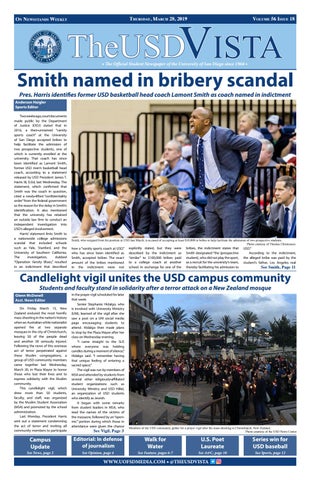
Smith, who resigned from his position at USD last March, is accused of accepting at least $10,000 in bribes to help facilitate the admission of two prospective students. Photo courtesy of Thomas Christensen
how a “varsity sports coach at USD,” who has since been identified as Smith, accepted bribes. The exact amount of the bribes mentioned in the indictment were not
explicitly stated, but they were described by the indictment as “similar” to $100,000 bribes paid to a college coach at another school. In exchange for one of the
bribes, the indictment states that Smith designated “the (prospective student), who did not play the sport, as a recruit for the university’s team, thereby facilitating his admission to
USD.” According to the indictment, the alleged bribe was paid by the student’s father, Los Angeles real
See Smith, Page 11
Candlelight vigil unites the USD campus community Students and faculty stand in solidarity after a terror attack on a New Zealand mosque
Glenn McDonell Asst. News Editor On Friday March 15, New Zealand endured the most horrific mass shooting in the nation’s history when an Australian white nationalist opened fire at two separate mosques in the city of Christchurch, leaving 50 of the people dead and another 50 seriously injured. Following the news of this overseas act of terror perpetrated against these Muslim congregations, a group of USD community members came together last Wednesday, March 20, in Plaza Mayor to honor those who lost their lives and to express solidarity with the Muslim community. This candlelight vigil, which drew more than 50 students, faculty, and staff, was organized by the Muslim Student Association (MSA) and promoted by the school administration. Last Monday, President Harris sent out a statement condemning the act of terror and inviting all community members to participate
Campus Update
See News, page 2
in the prayer vigil scheduled for later that week. Senior Stephanie Hidalgo, who is involved with University Ministry (UM), learned of the vigil after she saw a post on a UM social media page encouraging students to attend. Hidalgo then made plans to stop by the Plaza Mayor after her class on Wednesday evening. “I came straight to the SLP, where everyone was holding candles during a moment of silence,” Hidalgo said. “I remember having that unique feeling of entering a sacred space.” The vigil was run by members of MSA and attended by students from several other religiously-affiliated student organizations such as University Ministry and USD Hillel, an organization of USD students who identify as Jewish. It began with some remarks from student leaders in MSA, who read the names of the victims of the massacre, followed by an “openmic” portion during which those in attendance were given the chance
See Vigil, Page 3
Members of the USD community gather for a prayer vigil after the mass shooting in Chirstchurch, New Zealand. Photo courtesy of the USD News Center
Editorial: In defense of journalism
Walk for Water
U.S. Poet Laureate
Series win for USD baseball
See Opinion, page 4
See Feature, pages 6-7
See A&C, page 10
See Sports, page 12
WWW.UOFSDMEDIA.COM ◆ @THEUSDVISTA
2
The USD Vista
◆
March 28, 2019
NEWS
Campus Update
Associated Students
At the March 21 AS Senate meeting, voting members confirmed three individuals to leadership positions within the body. These appointments come after resignations and removals throughout the past semester. Speaker of the Senate Alexander Plummer nominated Kylee Rios as Speaker Pro Tempore, Carolina Moreno as Parliamentarian, and Rory Abraham as Student Orgs Chair. The senate also voted to re-register two preexisting student organizations. The Beta Alpha Psi accounting honors society and the Japan Club were both approved. They also voted to add two new clubs. The Public Health Club provides students within that field of interest with various speakers and networking opportunities as they look to pursue graduate degrees and future careers. Additionally, the Venture Capital Club invites students to compete with each other as they analyze and evaluate different companies. Senator Dean Lockwood then presented on a new initiative regarding electric scooters on campus. Bird and Lime scooters are increasingly popular in the San Diego area; however, according to Lockwood, USD does not currently have any policy regarding their usage. Lockwood’s plan looks to make the use of these scooters safer for USD students. Cooperating with Public Safety and the scooter companies, the initiative will establish an off-limits zone through the busiest areas of campus such as the main academic mesa. Students will also be required to end their rides in designated parking spaces placed throughout campus. Charging of these scooters in any USD facility will also be prohibited should the plan be approved. The AS Constitution is being modified for the 2019-2020 academic year. After a month of
contentious constitutional debates within AS, the body proposed the formation of a Judicial Branch. This new branch would be used to settle constitutional disputes within the body. They are also considering the potential for senators to hold multiple positions granting work service awards. Finally, members of AS provided updates on various projects and initiatives. School of Business Senator Patrick Murphy announced that the Board of Trustees and President Harris approved the decision to change the names of Serra Hall and Missions Crossroads. Additionally, it was announced that veterans will be granted priority registration in the College of Arts and Sciences, the School of Business, and the School of Engineering. This will go into effect for Fall 2019 registration next month. There are currently four vacancies within the AS Senate. These open seats include representatives for the School of Engineering, School of Business, and the Alcalá Vistas residence hall.
Campus Update by Amy Inkrott/News Editor/The USD Vista
USDtv awarded by the San Diego Press Club
The USDtv team at the start of the semester.
Photo courtesy of Melanie Yost
USDtv won second and third “Excellence in Journalism” awards for best college TV Newscast at the San Diego Press Club. This group is a professional association that all local journalists enter. Among the other winners were NBC, The San Diego Union Tribune, and ABC.
Student Media advisor Gina Lew, sophomore Izabella Salinas, and senior Melanie Yost celebrate their wins. Photo courtesy of Melanie Yost
CORRECTION: Front Page, 3/14 Issue The “USD admission bribery” article about the college admission scandal at USD inaccurately confirmed that the USD varsity coach received $110,000 in bribes. The federal indictment documents only confirm that the USD varsity coach, now known to be Lamont Smith, received, at the very least, $10,000.
The USD Vista Luke Garrett - Editor in Chief Kaia Hubbard - Associate Editor Hannah Sonberg - Managing Editor Kathryn Querner - Copy Editor Jennifer Mossuto - Assistant Copy Editor Monica Millan- Art Director Audrey Garrett - Art Assistant
Amy Inkrott - News Editor Eric Boose - Opinion Editor Catherine Silvey - Feature Editor Danielle Agnello - Arts & Culture Editor Anderson Haigler - Sports Editor Zoé Morales Martinez - Photo Editor Richard Benson - Distribution Editor
Editorial – 619.260.4584 Business – 619.260.4714 www.uofsdmedia.com @TheUSDVista Diana Percy - Social Media Manager Casey Donnelly- Social Media Assistant Elizabeth Brunelli - Finance Manager Rachel Steinheimer - Advertising Manager Gina Lew - Student Media Advisor Marie Minnick - Operations Advisor
The USD Vista publication is written and edited by USD students and funded by revenues generated by advertising and a student fee. Advertising material published is for information purposes only and is not to be construed as an expressed or implied endorsement or verification of such commercial venues by the staff or University. The USD Vista office is located on the fourth floor of the Student Life Pavilion in room 403B. All inquiries should be sent to: The USD Vista 5998 Alcala Park San Diego, CA 92110 Opinions expressed in this publication are not necessarily those of The USD Vista staff, the University of San Diego or of its student body. Letters to the Editor can be submitted to The USD Vista office. Letters should be limited to 300 words and must be signed. For identification purposes, USD identification numbers and writer’s year must be included in the letter. The USD Vista reserves the right to edit published letters. Any content sent to the editor will be considered for publication unless otherwise stated.
Volume 56 Issue 18 ◆
NEWS
◆
The USD Vista
MSA hosts candlelight vigil
3
Students and faculty from across campus reflect on the mosque shooting in Chirstchurch, New Zealand Vigil from Page 1
to reflect publicly. For Hidalgo, one of the more notable moments of the vigil was when a member of MSA read the story of a disabled man whose wife had lost her life when re-entering the mosque to save him. “When they were telling his story, they said that this man forgave the shooter and called him a brother,” Hidalgo said. “I was blown away by that. I don’t even know if I could come that far, to that level of forgiveness.” Following the reading of the names, members of MSA then recited a prayer in Arabic, which was described as a custom for Muslim people who are in mourning. Hidalgo says she appreciated the opportunity to hear prayers from a different faith practice.
a prayer or a song or a poem, was a really unique experience for me.” While Hidalgo is saddened by the circumstances which lead to the vigil, she also recognizes that these sorts of moments of tragedy have the potential to bring people together and create special moments of unity. “The fact that these sorts of shootings continue to happen breaks my heart,” Hidalgo said. “This vigil showed me that it’s possible for something beautiful to come out of it. Seeing students from different groups, who I had never seen in the same place come together was something truly beautiful. It reminded me that the only way to stop these acts of hate is to overwhelm them with love.” Sophomore Joshua Glasser is the President of USD’s Jewish Student
“Seeing how different people from different backgrounds deal with loss in their culture, whether it was a prayer or a song or a poem, was a really unique experience for me.”
-Stephanie Hidalgo
“I personally didn’t know a lot about Islam, so it was really cool to learn about this prayer and hear it recited in Arabic,” Hidalgo said. “Seeing how different people from different backgrounds deal with loss in their culture, whether it was
Union (JSU) and also a member of Hillel, a student organization which celebrates Jewish cultural life and religious practice. He was invited to come to the vigil by several friends who are in leadership for both JSU and Hillel and had made
arrangements with MSA student leaders for a prayer from the Jewish faith to be included as part of the event. “After we heard the awful news of the bloodshed in New Zealand, we were really upset so we wanted to make sure to express our support to the Muslim students at USD,” Glasser said. “Regardless of which religion or what background you come from, it’s important to show respect for one another.” Following the listing of the names and the Islamic prayer of mourning, Glasser and several other members of Hillel came up to the microphone to share about Jewish custom in the wake of tragedy and to recite a Hebrew prayer of mourning from their own faith. “Whenever someone loses a loved one, we recite what is called the mourner’s Kaddish three times a day for a whole year as a way to send condolences for that person’s death and to recognize their life,” Glasser said. “It’s actually about glorifying God, and thanking God for that person having been in this world. It’s a really important part of our religion.” The presentation of prayers from both the Islamic and the Jewish faiths turned out to be a highlight for some of those who were in attendance at the vigil. Glasser said he valued the opportunity to be a part of this
ceremony and sees this sort of interfaith support as part of the mission of Hillel. “After the event, people came up to us and expressed their appreciation for our sharing of the Kaddish,” Glasser said. “We were really grateful to go up and actually say our prayer and express our
gathering as a way to process tragedies of this scale and called upon the community to strive toward promoting greater tolerance and peace. “It’s really important to be in solidarity with our Muslim brothers and sisters at all times, but especially in a time of pain and hurt
“I’m grateful to MSA for organizing this event, and I hope they know how valued they are as members of this campus community.”
-Marc Adams
support for everyone. That’s just who we are and what we do and what we will continue to do. We try to be there for all communities.” Marc Adams works as a University Minister on campus, coordinating programs such as the Search Retreat and the East L.A. Immersion experience. Adams, who promoted the vigil within the UM community, was originally informed of the event by the president of MSA. “I’m grateful to MSA for organizing this event, and I hope they know how valued they are as members of this campus community,” Adams said. “I was heartened to see students and staff from across campus come together in solidarity.” Adams also emphasized the value of this sort of community
when they might feel targeted and excluded,” Adams said. “This was a call across faith traditions. We need to find more ways to resist this sort of culture of exclusion and violence in the future.” The USD Vista reached out to the students of MSA but was declined an interview. The act of terror perpetrated against the Muslim community of New Zealand earlier this month has brought gun control, white supremacy, and islamophobia to the public’s attention, further intensifying the debate surrounding a solution for these issues. The interfaith solidarity and cross-cultural support displayed at last week’s vigil served as a reminder that the aspects of our identities which make us different do not have to divide us.
The USD Vista
4
◆
March 28, 2019
E DI TOR IA L
In defense of journalism
The USD Vista faces misplaced disdain in the form of orchestrated silence and threats from community Luke Garrett Editor in Chief It has become abundantly clear to me that the majority of our generation, specifically our USD undergraduate community, does not know what a newspaper is, and to little fault of their own. Few students woke up to breaking news resting on their doorstep or learned how to origami a newspaper into readability. The majority of USD students, for better or for worse, find their news on social media — Facebook, Instagram, Snapchat, etc. Despite both being sources of news, the two are notably different and are too often conflated. A newspaper is not a social media platform. A newspaper is not a compilation of self narratives. A newspaper values nothing more
than accurate storytelling and the investigation of stories important to a community. A newspaper is the public record, the first draft of history, and the singular space for an entire community to learn about themselves. I begin with this because little else, to my mind, can explain why The USD Vista has been the subject of poignant acts of disdain from some members of our campus community. This disdain seems to have two tactics: the first is orchestrated silence and the other is the incitement of fear. The former tactic has, unfortunately, been made most evident by our current Associated Student President Natasha Salgado. Her monthslong denial of interviews with The USD Vista – concerning stories that cover the very government she leads – robs students, whom
she represents, of knowing what she believes and where she is leading our student body. It is a sorry fact to see the leader of USD undergraduate students take on this familiar tactic toward journalists. Although it is the latter tactic, one of inciting fear, that is far more concerning and is the very impetus of this editorial piece. Over the past month Vista staffers have been personally threatened with lawsuits for reporting on public student government meetings; papers have been stolen, vandalized, and then delivered back to the newsroom door; and, most disturbing of all, a staffer was recently informed that threats of physical violence and death were made against their person this year. Unfortunately, this too is a tactic often looming over
journalists’ heads around the world. Despite the gravity and seriousness of these happenings, I stand by my opening statement that this disdain at our campus is the result of a few students not knowing what it is we, as journalists, do and why we do it. For any other explanation of such actions would involve evil intent, as these actions do nothing more than dilute a community’s ability to know themselves, at best, or strike enough fear within student journalists to keep the truth from being written, at worst. Again, I do not believe these acts are done with the intention of malice, yet their results simply hurt our USD community. The USD Vista covers stories that no one else does. The USD Vista provides students with the
best update on their college community. We are honored to do so, we work long and hard to do so, and we will continue to do so. We are by no means perfect, but we do our best to write as close to the truth as possible. We do this because no one else does. To those who read, thank you. To those who are unsatisfied with our paper, please write a letter to the editor with your concerns or, better yet, cover a story you believe is worth writing – our pitch meeting door is always open. The tactics of silence, especially from those in power, and fear against student media do nothing of worth. These tactics only disrupt a medium of community knowledge essential for the possibility of transparency, truth, and ultimately, so help us God, peace.
Land of the free, home of the mass shooting New Zealand’s decisive action after Christchurch puts America to shame Eric Boose Opinion Editor “Kia Kaha.” In Maori, it means “be strong,” and it was the message to New Zealanders after the attack on a pair of mosques in Christchurch on Friday, March 15, which left 50 people dead and 50 more injured. As support poured in to Christchurch from across the country and around the world, Prime Minister Jacinda Ardern offered her own message: a message of unity. “Many of those who will have been directly affected by this shooting may be migrants to New Zealand; they may even be refugees here,” Ardern said. “They have chosen to make New Zealand their home, and it is their home. They are us. The person who has perpetuated this violence against us is not. They have no place in New Zealand. There is no place in New Zealand for such acts of extreme and unprecedented violence.” However, Ardern offered more than her words, thoughts, and prayers. After the shooting, Ardern promised to take swift action to ban assault weapons in New Zealand. On Thursday, March 21, “all assault rifles, high capacity
magazines, and military style semiautomatic rifles” were banned in New Zealand. Within a week of the first mass shooting in the country since 1997, New Zealand took strong, unified action to keep weapons of war off the streets. Meanwhile, it has been over six years since 27 people, 20 of them children, were murdered at Sandy Hook Elementary School in Newtown, Conn. Since that December in 2012, the types of weapons now banned in New Zealand have been used in 12 mass shootings, which have left 209 people dead. Still, assault rifles are legal and easily available in the United States. It is important to recognize that the American government significantly differs from that of New Zealand. While the United States has two houses of the legislature, New Zealand has one legislature – Parliament. Also, Prime Minister Ardern is, like all prime ministers, a member of the party that holds a majority in Parliament. These differences vastly expedite the process for Ardern’s government to create and pass legislation. In the United States, any bill to ban assault rifles would have to pass through the House of Representatives and the
Senate, which are controlled by opposing parties, before going to President Donald Trump, who would almost certainly veto the bill. However, New Zealand’s response to the Christchurch shooting shows that the United States’ failure to act is not a structural issue, but a cultural one. When Ardern announced the ban, Simon Bridges, leader of the minority New Zealand National Party, declared the party’s support for the tighter gun laws. “The terrorist attack in Christchurch last week has changed us as a nation,” Bridges said in a statement. “(The National Party) has been clear since this devastating attack that we support changes to our regime and that we will work constructively with the government.” Republicans rarely support Democratic policies, let alone one as strong as an assault weapons ban. Even if they did, it could mean the end of their political career. The gun lobby, led by the National Rifle Association, is one of the largest special-interest groups in American politics, and also one of the most dangerous. While New Zealand pro-gun group Federated Farmers has supported the ban
despite many of its members disagreeing, pro-gun groups in the United States hold that any sensible gun control legislation is a violation of American rights. At this point, it is worth noting that there is no equivalent to the Second Amendment in New Zealand. For New Zealanders, gun ownership is a privilege, not a right. It is also worth noting, however, that the Second Amendment was written at a time when the only guns available were singleshot, muzzle-loading muskets, not assault rifles with 30-round magazines. Gun lobbyists have perverted the meaning of the Second Amendment to serve the continuation of America’s gun obsession over the safety of the American people. Americans have placed such a cultural emphasis on gun ownership that any suggestion of even common-sense limitations is met with uncompromising resistance. Politicians are often more concerned with loyalty to their party’s platform than acting to protect their fellow Americans. Lobbyists pour money into fighting against any form of gun control, paying to keep weapons of war on American streets. There is a difference between
common sense gun control and the outright prohibition of firearms. The wording of New Zealand’s ban is precise and purposeful. Only “military style semi-automatic weapons,” assault rifles, and highcapacity magazines are banned. These are not weapons used for hunting, nor are they necessary for personal protection. These are weapons designed to kill a large amount of people in a short amount of time. New Zealand’s government is not trying to take away everyone’s guns, they are trying to keep their citizens safe. There is no structural reason that the United States cannot do the same as New Zealand. Clearly, Americans have been blinded by the gun culture, by the twisting of the Second Amendment, and by money and lobbyists to deny common sense. If we wanted to stop mass shootings, we would ban assault rifles, and we would do it tomorrow. The lives of children, teenagers, friends, and family should be more important than a rifle, or an endorsement, or a political party. As a nation, we cannot go on like this. If we do not take decisive action to change our culture, the United States will continue to be the home of the mass shooting.
The University of San Diego does not share the views presented within the editorial and op-ed sections. The opinions expressed in this section reflect solely the opinion of the respective writer.
Volume 56 Issue 18
◆
OPINION
◆
The USD Vista
5
E DI TOR IA L
The mirage of Fitspo health Students across the country struggle with body image, you are not alone
Audrey Garrett Asst. Art Director Striving for a fit body in 2019? Afraid you’ll gain the Freshman 15? Beware of the power of #fitspiration. It can warp your sense of self-worth, what you value in others, and your health. I know from experience. And, I’m not alone. It took one photo to ignite my motivation to “get fit” and many months to recover from my eating disorder. A big culprit? Fitspo: the adoration of fit men and women, their lifestyle, their bodies, and their strict regiments of exercise and healthy eating. #Fitspo has bombarded social media through filtered beach bods, big booties, and gym shark brand models all emphasizing the expectation of men to have muscles like Dwayne the Rock and gals to have the figure of Kayla Itsines and a booty like Kim K. Many in our generation grew up with the fears of obesity and fast food. Now, mixed with the current influence of social media and a surge of visual comparisons, many of us have latched on to
was just being human. I was just responding, adapting really. I was listening, seeing, and consuming what was around me, especially on social media. And what was around me were photos, conversations, ads, YouTube videos, and one-size stores all legitimizing the same message: your worth is in your image. Fitspiration gave me the perfect criteria of how to go about accessing image. Through Instagram calorie accounts I judged the worth of food down to a T. I internalized my dos and don’ts of exercise and gym workouts thanks to my many fit YouTube subscriptions and got my daily dose of body image perfection from VSCO and its more universal older sibling, Pinterest. It was all coming together, how to have the perfect diet, the perfect gym routine, and the perfect body. It is an initial high to find and be able to apply ideal habits to your own life. You get a sense of achievement and accomplishment and ever so gradually a higher perception of yourself in comparison to others. When you complete a full, highintensity workout all before your friends have had their morning
“The pressure to escape the ‘Freshman 15’ and maintain a certain physique plagues a lot of us at USD. We should acknowledge and talk about it to prevent further psychological damage, stress, anxiety, or depression over feeling inadequate.” the motivating cultural message to become fit. We all want to be healthier, live longer, be happier. All of those are seemingly synonymous with being active and in shape. Having the ability to move and be active has proven to relieve stress and prevent depression as exercise releases endorphins and a hefty amount of dopamine. Being active is a good thing. The only problem: society equates fitness with the overall worth of a human. All of the nutrition ads, before and after photos, and body conforming pressures on social media provide the perfect storm for poor mental health as we all ride the fear-based train to unachievable physical perfection. #SoWhat? There was a time when I equated self-worth with physical ability. I ranked others by their athletic ability, appearance, and nutritional habits. Just like nutrition labels, friend, family, and strangers became numbers, filtered by how they used their bodies and how their bodies appear; perfectly dismissing each relationship’s meaningful qualities of friendship, kindness, and compatibility. Why? Was I a narcissistic, judgemental animal? Craving any system to rate and judge others? Maybe, a little. But now, after months of self-reflection and physical recovery, I think I
coffee you can’t help but feel accomplished. Top that with the misconceived ideals of nutrition and suddenly you’re crediting yourself for having a vastly more “nutritious” breakfast then your peers; and from what you’ve learned, if you’re more nutritious, you’re probably better in general. It is mostly through the media, including #fitspo, that we are constantly reminded that we’re probably not doing enough to stay fit. We might as well be on another planet titled “perfection” and “regret your life now.” This online mentality bleeds into offline interactions habits, and thoughts. Photo comparisons become defaults in our brains. Are those in front of me living, breathing complex humans? Or, are they simply another visual I must compare myself with to maintain likability? The Perfect Storm - Freshman Year As we start college, how can we navigate this get-fit pressure in a healthy way? I am not the only one who has fallen victim to the fitness social media burden. Many are voicing their struggles on news outlets, blogs, and personal media accounts. In 2017 The Huffington Post reported on “Why ‘Fitspo’ Should Come with a Warning Label.” The report describes the experiences of 20-year-old females
plummeting into the quicksand of body comparison, nutritional elitism, and avocado toast. Men are also suffering. According to a 2017 study by Australian researchers, fitspiration imagery features men nearly as often as it features women, and men’s bodies are just as likely to be objectified. The study found female #fitspo typically adhering to a thin body ideals, while the males adhered to a muscular image. The same study found a direct correlation between negative mood and body-dissatisfaction and fitspiration exposure, especially posts depicting ideal athletic female bodies. The study also found men’s body dissatisfaction to increase after exposure to ideal muscle images and an increase in depression and fitness level dissatisfaction after exposure to male models actively engaging in sports. We are all susceptible to media influence, especially when it fuels our fears and insecurities. I’d like to pass on some hard-earned advice, as I would to a friend: you are not defined by your body. You are not constrained to your social media account. In a world where it may seem like the visuals of life are the entirety of living, it is important to remember you are just a human mind, heart, and body, in that order. So, this new year, challenge yourself to work out your mind, activate your comedy, broaden your palate of creativity. Live for yourself and not for an expectation of what you should be. Inspiration is the process of being mentally stimulated to do or feel something creative. Fitspiration can create a mockery of this gift. Skip the Calorie Counting and Acknowledge Your Social Media Intake Instead How many hours do you spend on social media? And how often are you looking at accounts, not of your family or friends, but of media “Influencers” or those with enough followers to populate a small country? I love Bella Hadid as much as the next Torero but constant exposure to anything not rooted in reality is bad for the soul. Like us, even they don’t live the life they present online. We already know this, at some level, but production is so convincing, and the images are so enticing. Acknowledge your intake. Count how many unstable personas you follow and how much attention you give them. See if it makes a difference if you temporarily unfollow them or take a vacation from all online lives in general. Maybe just for a day, or maybe a weekend. Challenge yourself and see what changes come with a life unfiltered. Change Your Motivation If your motivation to exercise and eat certain foods is to achieve a certain body type, I’m gonna
stop you right there. Gym trainers who take on clients will usually drop or redirect clients whose sole motivation is to change their body to look a certain way or to please someone else. Goals should be made for you, not for others. So, work out to show yourself what your body can do, run a faster mile or prove doing the splits or push ups or deadlifts or handstands are not out of your reach. Motivate yourself through your body’s abilities, not your insecurities, looks, or social media image. Stop the Cycle We all deal with pressure differently. San Diego is a city filled with fit beach bodies and hyperphysique consciousness. There is pressures to conform. If you see someone stuck in a destructive
mentality around fitness, exercise or nutrition, reach out. There is never any harm done to asking how someone is doing or checking in with them if you notice a possible unhealthy habit. When it comes to a person’s physical health, the fear of awkward moments should take a back seat. The pressure to escape the “Freshman 15” and maintain a certain physique plagues a lot of us at USD. We should acknowledge and talk about it to prevent further psychological damage, stress, anxiety, or depression over feeling inadequate. Reach out to others on campus talk about the pressure and relieve yourself and one another from the weight of fitspo. Need help? Call the National Eating Disorder Association hotline at 1-800-931-2237.
Editorial Cartoon
The University of San Diego does not share the views presented within the editorial and op-ed sections. The opinions expressed in this section reflect solely the opinion of the respective writer.
6
THE USD VISTA
â—†
MARCH 28, 2019
WALK FOR
WATER
On Friday, March 22, a group of students spent their sunny afternoon walking across the University of San Diego campus, much like other students on their way to class. Each of the students in the group, however, was holding a gallon jug of water. This difference, along with the collective spirit of the group, distinguished these students marching for a cause from those taking a regular stroll across campus. The Walk for Water, organized by the USD Office of Sustainability, took place on campus in solidarity with women around the world facing low water accessibility, women who on average walk roughly six miles each and every day to retrieve enough water to sustain themselves and their families.
Volume 56 Issue 18
◆
FEATURE
◆
7
THE USD VISTA
A Conversation with Megan Heidel
The Education and Events Graduate Assistant for the Office of Sustainability
“I think the visual aspect of it is good because there are people who didn’t
know it was happening but see students and faculty walking around campus with water bottles and are obviously wondering what is going on. It gets more people to pay attention, which is why we have the boards with the stories of actual people who deal with water scarcity. People get the idea of how much of a task it is physically and how much time it takes every day to even just walk with one gallon for one mile.”
“This
is the first year that we have done something like this. Other San Diego campuses have had similar events. For us at the office every year, we do monthly themes. The theme for March is water, because March 22 is World Water Day. It came from us figuring out what to do in terms of water conservation and awareness at the university. Water has been recognized by the UN as a human right.”
“I think one of the main goals is to let people know that our office on campus exists. We’re pretty small and we do have events, but this campus has a lot of events every day so it’s hard to get traction. A goal is also to remind people just how lucky we are to have access to fresh water to bring a global viewpoint to campus. You often forget that outside San Diego there is a whole different reality for people across the world. As a campus of Changemakers, we should be aware of this reality of what the issues are in the world.“ Spread by Monica Millan/ The USD Vista; Content and photo courtesy of Catherine Silvey/ The USD Vista;
8
The USD Vista
◆
March 28, 2019
F E AT U R E
Professor leaves mark on USD
85-year-old Dr. Laurence Savett, Ph.D., finishes lifelong career in education and returns home Sabrina Alterman Asst. Feature Editor From student to professor, Dr. Laurence Savett, Ph.D., comes full circle in ending his accomplished career as both a registered physician and educator. After completing his third year of teaching “The Human Side of Medicine: Learning What It’s Like to be a Patient and What It’s Like to be a Physician” at the University of San Diego, Savett returned home to St. Paul, Minn. with his wife Sue Savett. He leaves students feeling inspired and motivated to continue pursuing careers in health care. One such student is sophomore Marin Auth, who expressed the intellectual growth she experienced after taking Savett’s course. “The seminar was super interesting and insightful,” Auth said. “I think I have a better understanding of the doctor-patient relationship and what it means to navigate that relationship in both a compassionate and professional way.” Savett grew up in Utica, N.Y. with his two parents and younger sister. He attended Hamilton College, a small all-male liberal arts school in upstate New York, where he was a chemistry major and German minor. In addition, the small class sizes and
liberal arts curriculum equipped him with “transferable skills,” such as public speaking, philosophy, and writing, that benefited him in his long career in medicine. Savett vividly recalled the impact a favorite German professor had on his college experience. “I liked the professor so much I took semester after semester with him,” Savett said. Though he was an excellent student, Savett does wish he received a bit more guidance. “I wish there was someone who had sat me down and addressed the broad question, ‘Are you making an informed choice of your career?’” Savett said. In the process of pursuing his passion in his career as a physician, Savett explored the world of medical care and experienced the satisfaction of a profession centered in the care for other human beings. Seeing the direct results of his work in his patients grew Savett’s lifelong love for helping those around him. “You need the reinforcement of doing your work well and the pleasure of your work being successful,” Savett said. His desire to help others turned into a desire to teach and guide prehealth students, motivating him to recycle his experience by writing his novel entitled “The Human Side
of Medicine: Learning What It’s Like to be a Patient and What It’s Like to be a Physician.” In addition, Savett designed a college-level course aimed at encouraging students to reflect upon their future careers. “Your goal should be the career that will give you fulfillment and will also allow you to have a balanced life,” Savett said. “If you are thinking of a career, learn all that you can about it by following a person who does that. Talk about the daily life with that person.” Savett’s lectures enticed students because of his honesty and high level of respect he gave to students. Additionally, he made sure to use his position to inspire students pursuing careers in all fields, not just medical science. “I hope that regardless of what career they are headed that this is one step that helps them to make an informed decision,” Savett said. “Even if they don’t end up in a health-related career, I hope that it provides a model for them to consider whatever career they think about.” Junior Natalie Varterian noted the efficacy of his caring approach to teaching students, no matter what their prospective career path. “Dr. Savett is very enthusiastic and compassionate not only with his patients, but with his students as
Prepare for the business of
Savett’s versatility in his career reflects a lifelong dedication to helping those in need. Photo courtesy of Sue Savett
well,” Varterian said. As a testament to his humility, Savett repeatedly stated that he appreciates learning from his students. Even though he ran a successful practice for 30 years and had decades of experience under his belt, he refused to stand during lectures to demonstrate the mutual level of respect he aimed to establish, rather remaining seated at eye-level with his students. Savett also continuously thanked students
MAKING A DIFFERENCE
EARN YOUR 12-MONTH MBA AT POINT LOMA NAZARENE UNIVERSITY • Values-driven curriculum • Professional mentorship network • Hands-on classroom experience
Become the leader that others will follow. Learn more at pointloma.edu/12monthMBA
for displaying vulnerability when they shared personal experiences with health and sickness. For the final lecture, Savett was accompanied by his wife, Sue Savett, who brought cookies and refreshments for the entire class. She emphasized how thankful Savett was to be teaching students who were once just like him. His advice, mentorship, and compassion has left a lasting impression on many students.
Volume 56 Issue 18
◆
ARTS & CULTURE
◆
The USD Vista
A ART RT S & CULTURE C U LT U R E
9
Clearing the mess inside and out
USD’s Humanities Center welcomes New York Times bestselling author, Gretchen Rubin to the KIPJ stage
Rubin explores her new book, “Outer Order, Inner Calm” with the KIPJ audience filled with many middle-aged women looking to de-clutter their space to free their minds and lead healthier lives. Danielle Agnello/The USD Vista
Danielle Agnello A&C Editor With four sets of furniture in a room less than 250 square feet, living in a Maher Hall flex room could get messy pretty quickly. How do college students manage to stay organized and maintain their sanity in a tiny room jam-packed with piles of stuff that accumulates throughout the semester? Four-time New York Times bestselling author, podcaster, and speaker Gretchen Rubin seems to have all the answers. As an expert on the linked subjects of habits, happiness, and human nature, Rubin strives to convey how people can better their lives by staying organized. Her audience is extensive, as her mastery of the subjects enables her to communicate complex ideas with humor and intelligibility. Throughout her work, Rubin implements cutting-edge techniques, the wisdom of the ages, lessons from popular culture, and her personal experiences to further her pursuit of making
and Sciences, Noelle Norton, Ph.D., spoke about the college’s mission statement before she introduced Rubin to the audience. “The College of Arts and Sciences along with the Humanities Center are deeply committed to liberal arts,” Norton said. “We are deeply committed to humanities behind and beyond these walls, and we invite writers to our stage to open the world of ideas to our students.” Rubin contributed to enriching USD’s student body by furthering their understanding of human nature. In her latest book, Rubin discusses how maintaining an organized space has an outstanding influence on our mental health. “Life is easier when you can find things more easily,” Rubin said. “People spend an average of 55 minutes each day finding lost items in the clutter.” Rubin also told the audience that outer order frees people from negative emotions, unfinished projects, and our fantasy selves. “I, myself, only recently got rid of a pair of leather pants,” Rubin said.
“We are deeply committed to humanities behind and beyond these walls, and we invite writers to our stage to open the world of ideas to our students.” - Noelle Norton humankind happier, healthier, more productive, and more creative. “Freeing clutter makes us feel more engaged with the things that we do have,” Rubin said. “And by creating outer-order, we appreciate the things we own more.” Dean of The College of Arts
“I don’t know what I was thinking when I bought them. Every time I would try them on I felt ridiculous.” Rubin illuminated her own troubles, along with the lessons she has learned from past experiences. “By tackling little challenges, we
prepare ourselves to attack these greater challenges,” Rubin said. Rubin, known as “the queen of the self-help memoir,” believes that people have to want to help themselves in order for her to do her job. Rubin merely informs; maintaining outer order and an individual’s overall well-being is ultimately in the hands of the individual. She explained that it is imperative that people actualize the information they’ve absorbed from Rubin and take all that she says seriously in regard to maintaining outerorder to sustain their inner-calm. Rubin continued to discuss what helps people maintain order and how to begin the process. “Do not start by vowing you are going to get organized,” Rubin said. “If you get rid of all the file documents, you might not need to get a file cabinet.” What Rubin conveyed to her audience is the importance of decluttering before purchasing more stuff to get “organized.” Countless times, Rubin has found people don’t need organizational and storage drawers after they’ve sorted through the abundance of stuff they’ve accumulated throughout the years. A device Rubin uses when clearing out her closet and deciding whether an article of clothing needs to be tossed is the “ex-factor test.” In short, it requires the individual to imagine how they would feel running into their ex wearing the article of clothing in question. If the person would be even slightly mortified wearing the item, it
should be freed of their possession. Rubin also asked the audience to consider three questions
a button, people tend to forget about their once-full online carts, merely due to the inconvenience.
“We’ve all created a giant mess and had to dig ourselves out of it...But we have to remember that most of the time we like the memory invoked with the possession, not the actual item.” - Gretchen Rubin when deciding between keeping or purging an item. “Do you use it?” Rubin said. “Do you love it? Do you need it? If the answers to these three questions are answered yes, the item is still useful.” Rubin’s tips continued as the night went on. She shifted her focus from decluttering items already in people’s possession to ensuring individuals resist the want to purchase unnecessary items. When shopping in a store, Rubin suggested not taking a shopping cart. She claimed that when people have something to put all of their stuff in at their convenience, they will want to buy more than they need to since they have room for it all. Similarly, Rubin advised people to refrain from buying items that are not currently needed in order to keep unnecessary items from taking up space for essential ones. “Remind yourself to store it at the store,” Rubin said. This tip led her into her next one regarding impulse online shopping. She recommended deleting all accounts and to shop as a guest so that people have to fill in all of their information, which can be a hassle. Once online shopping isn’t as easy as a click of
After Rubin shared all of her helpful tips for decluttering space, she told the audience ways they can maintain their outer order. The oneminute rule and power hour are two essential methods she enforces. “The one-minute rule gets rid of the scum of clutter that accumulates on the surface,” Rubin said. “While the power hour consists of allocating one hour to complete a list of tasks that has piled up and that you have been meaning to complete.” Rubin’s personal stories, use of vivid language, and humorous tone fostered her credibility with the audience. Similarly, her speech delivery helped the audience relate and open up to her during the question and answer portion of the night. “We’ve all created a giant mess and had to dig ourselves out of it,” Rubin said. “But we have to remember that most of the time we like the memory invoked with the possession, not the actual item.” The main takeaway Rubin left the audience with was that in essence, preserving an organized space is directly linked to living a happier, healthier, more productive, and more creative life.
10
The USD Vista
◆
March 28, 2019
Smith honors World Poetry Day
Tracy K. Smith, United States Poet Laureate, speaks with great poise and grace to USD students Joe Duffy Asst. A&C Editor It was fitting that Tracy K. Smith, the current U.S. Poet Laureate, came to give a reading at USD on World Poetry Day, Thursday, March 21. The celebrated poet drew a large crowd of students, staff, and members of the general public that quickly filled up the seats of the Joan B. Kroc Institute for Peace and Justice Theatre. The reading was part of the Lindsay J. Cropper Memorial Writers Series. Professor Halina Duraj, director of the series, gave a brief introduction before Smith came to the stage to the thunderous applause of a packed theater. Smith spoke with great poise and grace, coming off as both thoughtful and approachable. She read her work patiently, allowing her words to linger in the air so that the audience could take in the staggering weight and depth of each line. Nearly all of Smith’s poems were followed by either applause or astonished gasps. As Smith’s
many people interested in poetry.” In 2017, Smith was appointed the 22nd Poet Laureate of the United States, succeeding Juan Felipe Herrera. The Poet Laureate, according to the Library of Congress website, “...seeks to raise the national consciousness to a greater appreciation of the reading and writing of poetry.” The position is appointed annually by the Librarian of Congress for a term that stretches from September to May. Former U.S. Poet Laureates have included Elizabeth Bishop, Robert Frost, and Gwendolyn Brooks. Smith holds a B.A. from Harvard University, an M.F.A. from Columbia University, and is the director of Princeton University’s creative writing program. She is the author of four books of poetry—“The Body’s Question” (2003), “Duende” (2007), “Life on Mars” (2011), and, most recently, “Wade in the Water” (2018). Her work has earned her a Pulitzer Prize for Poetry, an Academy of American Poets Fellowship, and the praise of
“It was so good, and I was really glad that such a mix of people came out. It makes me happy to see so many people interested in poetry.” - Kristen Jensen readings continued, a chorus of “wows” rang in the audience. USD senior Kristen Jensen expressed gratitude to Smith for visiting USD, as well as excitement for her having been met with such a strong audience. “It was so good, and I was really glad that such a mix of people came out,” Jensen said. “It makes me happy to see so
critics and audiences alike. “‘Wade in the Water’is scorching in both its steady cognizance of America’s original racial sins— open wounds that have had insectlike eggs repeatedly laid in them—and apprehension about history’s direction,” a reviewer in the New York Times said about Smith’s newest book. Many of Smith’s poems were
indeed politically and racially oriented, though the subject matter ranged from Smith’s father to a grocery store in New York City to the classic Stanley Kubrick film, “2001: A Space Odyssey.” One of the highlights of the night was when Smith read some of her found poems, or poems created by reworking or rearranging sections from an existing text. Among these works was “Declaration,” an erasure poem created by redacting parts of the Declaration of Independence. Some of the poems that Smith read from “Wade in the Water” borrow from letters written by black soldiers enlisted in the Civil War and depositions from the families who sought pensions for these men after the war had ended. The result is a haunting yet beautiful homage to those soldiers who were lost to history, nameless and faceless, and who continued to endure discrimination despite their wartime efforts. Smith was able to breathe life into these voices from over a century ago, so that their words still resounded through a crowded theater. The reading was followed by an audience Q&A session. The first question came from an audience member who wondered how Smith had been affected by fame since being appointed Poet Laureate in 2017. In response, Smith recalled something a colleague had told her about the role of the Poet Laureate: “This is not about you, this is about poetry.” In the course of the session, Smith also discussed her influences—among them Emily Dickinson, Seamus Heaney, and Lucille Clifton— elements of craft, and the role
The audience applauds and gasps following Smith’s readings of her poems. Photo courtesy of Carla Petticrew
of
poetry in today’s world. “More and more in the 21st century, poetry is a way of staying human in a world where we allow our life, love, and happiness to be transformed by technology in service of products,” Smith said. The reading was followed by a reception just outside the KIPJ Theatre. Copies of Smith’s books were being sold. Thomas Dolan, a USD sophomore and current editor-in-chief of “The Alcalá Review,” USD’s undergraduate literary journal, felt a renewed confidence in the popularity of the arts on USD’s campus after seeing the size of the crowd. “It was very exciting to have a poetry event be standing room only,” Dolan said. Stephanie Meraz, president of the USD chapter of Sigma Tau Delta,
an English honors society, was captivated by the reading and left the theater in awe of Smith’s work. “Smith was incredibly insightful and has a very descriptive and succinct way of looking at the world and issues within our society,” Meraz said. “The reading was great and I was captured by all of it.” The night proved that poetry is still a form capable of reaching a wide audience. The way people applauded Smith’s powerful reading makes it feel safe to say that poetry continues to be alive and well at USD. Those interested in learning more about Tracy K. Smith or poetry in general can check out “The Slowdown,” a podcast hosted by Smith that uses poetry to consider the world through different perspectives.
Smith (left) and her sister, Wanda (right) gather together after Smith’s reading, displaying their support toward each other and their respective successes.
Volume 56 Issue 18
◆
SPORTS
◆
11
The USD Vista
SP ORT S
Smith allegedly took bribes
Former coach Lamont Smith’s alleged involvement is part of nationwide college admissions scandal
Smith from Page 1
estate CEO Robert Flaxman, and was facilitated by William Rick Singer, the founder of The Edge College & Career Network, LLC, a for-profit college counseling business, and The Key Worldwide Foundation, a purported charity. The USD Vista has obtained the identity of Flaxman’s son, and confirmed that he is a current student at USD who enrolled in 2016. Because Flaxman’s son is not mentioned by name in the indictment, however, The USD Vista has decided not to publicly identify him at this time. Other than the alleged bribe, Robert Flaxman’s son is not believed to have had any involvement at any time, legitimate or illegitimate, with the USD men’s basketball team. Flaxman is not listed on any team rosters dating back to the 2016-2017 season. The federal indictment states that the former USD coach received a $10,000 bribe for “help in securing” the admission of Robert Flaxman’s daughter, although she did not elect to attend USD. According to public federal tax records retrieved by The USD Vista, Smith received a salary totaling $379,799 as USD men’s basketball head coach in 2016, the year he
Oakland International Airport on three domestic violence-related charges that occurred during the Toreros’ final road trip of the 20172018 season. According to records released by the San Francisco Sheriff’s Department, officers were dispatched to the team’s hotel after reports of a domestic violence incident. Smith’s resignation statement cited a desire to “ensure that USD and the team be able to move forward without any distractions,” and made no mention of other misconduct. The domestic violence-related charges against Smith were eventually dropped by the San Francisco District Attorney’s Office due to “insufficient evidence.” In April of 2018, Smith was hired as the top men’s basketball assistant coach at the University of Texas at El Paso (UTEP). Last Wednesday, however, UTEP athletic director Jim Senter announced in a statement that Smith had resigned, effective immediately, and that the athletic department would “have no further comment on the matter.” One day after Smith’s resignation from UTEP, The San Diego Union Tribune reported that Smith’s New York-based attorney Charles Clayman released the following statement.
Smith resigned from his position as an assistant basketball coach at UTEP last Wednesday. He held the position for less than a year. Photo courtesy of USD Athletics/Twitter
continued success in their studies and careers.” According to Clayman’s website, the attorney “specializes in white-collar criminal defense.” Smith has not yet been charged
“Lamont Smith, our former men’s head basketball coach, who left USD in March 2018, is the unnamed coach involved in the government’s investigation. We continue to have no reason to believe that any other employees, students or applicants were involved in or aware of any wrongdoing.” -Statement from USD President James T. Harris III is alleged to have taken the two bribes. Smith, 43, played basketball at USD in the late ‘90s, and graduated with a degree in Communication Studies in 1998. He served as USD men’s basketball head coach from 2015-2018 before resigning from his position in March of 2018. His resignation came after his arrest the previous month at
“Although the allegations against Mr. Smith are not relevant to his role at the school, he felt it would be in the best interest of the students, faculty and staff to take this action,” Clayman said. “Lamont is deeply grateful for the opportunity to work with the talented athletes and coaching staff at the University of Texas at El Paso and wishes his players
with any crimes in relation to the scandal. Why he was not named in the DOJ indictment like several other allegedly involved college sports coaches and whether any criminal charges are currently pending against him is unclear. University of San Diego Associate Vice President and Executive Director of Athletics Bill McGillis declined to be
interviewed or comment on Smith’s involvement in the scandal. In his statement to media and the USD community, Harris emphasized his belief that the scope of the university’s alleged involvement in the scandal is limited. “Based on our review of the information available to us to date and on what the government has told us as recently as this morning, the only USD employees, students or applicants involved in the alleged wrongdoing are the three people identified by the government: Lamont Smith and two applicants,” Harris said in the statement. “Of the two applicants, one is a current student and one declined admission. We continue to have no reason to believe that any other employees, students or applicants were involved in or aware of any wrongdoing. Certainly, if different
or new information comes to our attention, either through the results of the investigation or otherwise, we will take appropriate action to respond.” Harris declined to elaborate on his statement in an interview, citing USD’s ongoing independent investigation of the matter. The most recent allegations against Smith represent the latest of multiple scandals in the history of the men’s basketball program at the University of San Diego. In 2013, the Toreros’ second all-time leading scorer Brandon Johnson pleaded guilty and was sentenced to six months in federal prison for his part in a point-shaving scheme that occurred during the 20092010 season. In an email, Harris said that the university’s independent investigation into the scandal would not be completed for “another few weeks.”
Monica Milan/The USD Vista
12
The USD Vista
◆
March 28, 2019
Toreros win WCC weekend
USD baseball takes two of three from USF to win their first West Coast Conference series of season
The Toreros were able to cruise to a 10-3 win over WCC opponent USF last Friday behind strong performances on the mound from junior lefty Chris Murphy (not pictured) and first-year righty Jake Miller (left). Zoé Morales Martinez/The USD Vista
Henry Jones Contributor University of San Diego baseball (17-7, 3-3 WCC) came into Friday night’s action with the second-best overall record in the West Coast Conference (WCC) and showed no signs of stopping with a 10-3 victory over the University of San Francisco Dons. Despite dropping two of three games in last weekend’s homestand against Pepperdine, the Toreros bounced back and extended their early season success, as they have won eight of their last 10 games. USD’s offense broke out, and scored seven runs in the bottom of the third. Sophomore first baseman Shane McGuire spearheaded the scoring, going 4-4 with two doubles, an RBI, and a walk. The Torero’s offensive explosion was backed by yet another stellar start from junior left handed pitcher Chris Murphy, who threw six innings with nine strikeouts and only allowed 3 earned runs late in the game. The Toreros’ first game of their weekend homestand was set up to be a good one, with San Francisco giving the ball to their preseason All-WCC pitcher Riley Ornido. In five games and 34 innings pitched prior to Friday night, Ornido had an outstanding 0.79 ERA, 0.85 WHIP, and 29 Strikeouts. Coach Rich Hill gave the scouting report on Ornido. “He is one of the best pitchers in the conference,” Hill said.“ He’s got a filthy split finger (fastball) and a slider to go with a ninetymile-per-hour fastball.” USD started out strong on Friday, as Chris Murphy struck out the side in the first inning, but
it took a while before the Torero bats got going. The bottom of the first started with first-year infielder Cody Jefferis drawing a walk, followed by a single to right field by sophomore first baseman Shane McGuire, putting Toreros at first and third. Despite being in prime position to score, a strikeout by senior shortstop Jeff Houghtby and a pop out by first-year utility player Caleb Ricketts left the runners stranded. In the bottom of the second, after a single by Chris McCready and a walk by Adam Kerner, USD came up short again with strikeouts from Jefferis and
McGuire described the team’s approach at the plate, and how that approach was key in their big third inning. “I think it was just the small things,” McGuire said. “The free nineties is what really fires us up. Walks and what not. We got the bases loaded and then Ripken Reyes hit the double in the gap, which really got our offense going. We were waiting for someone to break it open, and he’s a great leader.” But despite facing a highly anticipated pitcher in Riley Ornido, Shane McGuire stated after the
“(Chris Murphy) is a Friday guy in the WCC. I think he’s got a special career ahead of him and he’s a special kid. He gives us a chance every Friday to win, and tonight was no different.” -Coach Rich Hill senior infielder Ripken Reyes. Despite two missed opportunities with runners in scoring position, however, the USD offense finally broke out in the bottom of the third by scoring seven runs. Houghtby started the Toreros’ big third inning by ripping a double down the right field line, which nearly scored McGuire. After that, Houghtby’s double was followed up by an RBI single from sophomore outfielder Tora Otsuka, Ricketts reaching on an error, and sophomore catcher Adam Kerner walking with the bases loaded, making the score 3-0 USD. The Torero lead grew even more with a crucial 3-RBI double by Reyes deep into the left-center gap, making it 6-0 USD. After an RBI single by McGuire, USD extended their lead to 7-0.
game that the key to his success against San Francisco’s ace and his big night at the plate was being selective at the plate. “Coach Ungricht and (assistant coach Ray McIntire) did a great job of breaking down what he was gonna throw to us, so we came to the plate hunting fastballs, laying off the off-speed, and seeing the ball up,” McGuire said. In the fourth inning, Kerner drove a towering fly ball down the left field line, only to fly out into left field on the preceding pitch. And after hitting a crucial double in the third, Reyes hit a line drive into the left field gap in the fifth inning, only for it to be tracked down in a miraculous diving play by USF center fielder Tyler Villaroman. Nonetheless, the Toreros kept
their comfortable lead intact behind steady pitching from Murphy. As Murphy got deeper into the ballgame, however, he noted that he experienced his “fair share of command issues.” In the sixth inning, he gave up a threerun home run to San Francisco left fielder Jonathan Allen, moving the score to 8-3, and Murphy would eventually come out of the game after completing six innings. He described his mentality on Friday night. “I actually tried to keep it in my mind as if it was a 0-0 ball game in order to get out there and keep pounding it,” Murphy said. The junior lefty also attributed part of his success to having a great defense behind him, noting acrobatic plays in the field from his shortstop Jeff Houghtby, as well as third baseman Ripken Reyes. “It minimizes innings and it gets me to the sixth inning,” Murphy said. “It gets me there and keeps my pitch count down and go as long as I can.” Hill discussed Murphy’s performance on the mound. “He got kind of tired in the sixth inning, but he fought through it,” Hill said. The veteran head coach also expressed the importance of Murphy to the team, as well as his bright future. “He’s a Friday guy in the WCC,” Hill said. “I think he’s got a special career ahead of him and he’s a special kid. He gives us a chance every Friday to win, and tonight was no different.” After Murphy left the game, the Toreros wrapped it up with lights-out pitching from redshirt sophomore righty Travis Kuhn, and first-year righty Cade Brown, along
with additional RBI from Houghtby and Otsuka. With this combination of offensive firepower plus pitching and defense, USD won the game by a score of 10-3 over the Dons. Overall, the Toreros’ Friday night win was due not only to stellar individual performances from Murphy and McGuire, but to a total team effort. In their Saturday evening matchup with the Dons, USD lost a tough, 10-4 decision. On Sunday afternoon, however, they were able to bounce back with a 6-4 comeback win that featured some late-game heroics in the form of a six-run eighth inning. Their wild Sunday victory earned them a 2-1 win of the series against USF, their first conference series win of the year. Their record now stands at 17-7 overall, and 3-3 in the WCC, good for a three-way tie for fifth place in the 10-team conference. Coming up next, the Toreros will travel to Spokane, Wash. to continue WCC play versus Gonzaga beginning on March 29. USD will return home on Tuesday, April 2 to take on UC Riverside before they square off with WCC opponent BYU starting Thursday, April 4.
UP NEXT: USD vs. UC Riverside Tuesday, April 2 6 p.m. Fowler Park