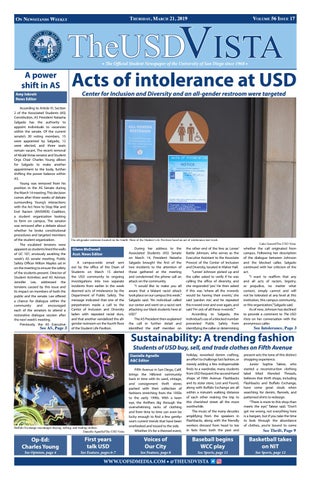
TheUSDVISTA
Volume 56 Issue 17
Thursday, March 21, 2019
On Newsstands Weekly
◆ The Official Student Newspaper of the University of San Diego since 1968 ◆
A power shift in AS Amy Inkrott News Editor According to Article VI, Section 2 of the Associated Students (AS) Constitution, AS President Natasha Salgado has the authority to appoint individuals to vacancies within the senate. Of the current senate’s 30 voting members, 15 were appointed by Salgado, 12 were elected, and three seats remain vacant. The recent removal of Alcalá Vistas senator and Student Orgs Chair Charles Young allows for Salgado to make another appointment to the body, further shifting the power balance within AS. Young was removed from his position in the AS Senate during the March 14 meeting. This decision comes after three weeks of debate surrounding Young’s interactions with the Act Now to Stop War and End Racism (ANSWER) Coalition, a student organization looking to form on campus. The senator was removed after a debate about whether he broke constitutional procedures and targeted members of the student organization. The escalated tensions were apparent as students lined the walls of UC 107, anxiously awaiting the week’s AS senate meeting. Public Safety Officer Milton Maples sat in on the meeting to ensure the safety of the students present. Director of Student Activities and AS Advisor, Jennifer Lee, addressed the tensions caused by this issue and its impact on members of both the public and the senate. Lee offered a chance for dialogue within the community and encouraged each of the senators to attend a restorative dialogue session after the next week’s meeting. Previously, the AS Executive
See AS, Page 3
Acts of intolerance at USD Center for Inclusion and Diversity and an all-gender restroom were targeted
The all-gender restroom located on the fourth floor of the Student Life Pavilion faced an act of intolerance last week.
Glenn McDonell Asst. News Editor A campus-wide email sent out by the office of the Dean of Students on March 15 alerted the USD community to ongoing investigations into two separate incidents from earlier in the week deemed acts of intolerance by the Department of Public Safety. The message indicated that one of the perpetrators made a call to the Center of Inclusion and Diversity laden with repeated racial slurs, and that another vandalized the allgender restroom on the fourth floor of the Student Life Pavilion.
During her address to the Associated Students (AS) Senate on March 14, President Natasha Salgado brought the first of the two incidents to the attention of those gathered at the meeting and condemned the phone call an attack on the community. “I would like to make you all aware that a blatant racist attack took place on our campus this week,” Salgado said. “An individual called our center and went on a racist rant attacking our black students here at USD.” The AS President then explained the call in further detail and identified the staff member on
the other end of the line as Lenee’ Battle Johnson, who serves as the Executive Assistant to the Associate Provost of the Center of Inclusion and Diversity, located in Maher Hall. “Lenee’ Johnson picked up and the caller asked to verify if he was calling the office of diversity, and she responded ‘yes.’ He then asked if this was ‘where all the n-words would be having their events,’ she said ‘pardon me,’ and he repeated the n-word over and over again, and said ‘I’m sick of all these n-words.’” According to Salgado, the individual’s use of a blocked number prevented Public Safety from identifying the caller or determining
Luke Garrett/The USD Vista
whether the call originated from campus. Following her description of the dialogue between Johnson and the blocked caller, Salgado continued with her criticism of the act. “I want to reaffirm that any and all acts of racism, bigotry, or prejudice, no matter what context, simply cannot and will not be tolerated at any level at this institution, this campus community, or this organization,” Salgado said. As of now, Johnson has declined to provide a comment to The USD Vista on her conversation with the anonymous caller.
See Intolerance, Page 3
Sustainability: A trending fashion Students of USD buy, sell, and trade clothes on Fifth Avenue
Fifth Avenue in San Diego, Calif. brings the Hillcrest community back in time with its used, vintage, and consignment thrift stores packed with their collection of fashions stretching from the 1950s to the early 1990s. With a keen eye, the thrifters dig through the overwhelming racks of clothing and from time to time can even be lucky enough to find a few gentlyworn current trends that have been overlooked and tossed to the side. Whether it’s for a themed event,
holiday, reworked denim crafting, an effort to challenge fast fashion, or merely adding a few indispensable finds to a wardrobe, many students from USD frequent the second-hand shops of Fifth Avenue. Flashbacks and its sister store, Lost and Found, along with Buffalo Exchange are all within a minute’s walking distance of each other making the trip to this cherished street all the more worthwhile. The music of the many decades amplifying from the speakers in Flashbacks, along with the friendly workers dressed from head to toe in fads from both the past and
present sets the tone of this distinct shopping experience. Junior Sophia Talese, who started a reconstruction clothing label titled Mended Threads, believes that thrift shops, including Flashbacks and Buffalo Exchange, have some great steals when searching for denim, flannels, and patterned shirts to redesign. “There is more to this shop than meets the eye,” Talese said. “Don’t get me wrong, not everything here is a bargain, but if you take the time to look through the abundance of clothes, you’re bound to come
First years talk USD
Voices of Our City
Baseball begins WCC play
Basketball takes on NIT
See Feature, pages 6-7
See Feature, page 8
See Sports, page 11
See Sports, page 12
Danielle Agnello A&C Editor
Buffalo Exchange encourages buying, selling, and trading clothes. Danielle Agnello/The USD Vista
Op-Ed: Charles Young See Opinion, page 4
WWW.UOFSDMEDIA.COM ◆ @THEUSDVISTA
See Thrift, Page 9
2
The USD Vista
◆
March 21, 2019
NEWS
Campus Update
Associated Students
Student activism
At the March 14 AS Senate meeting, senators, the executive board, and members of the public sought to inform the USD community. The student government announced that informational sessions for the upcoming AS elections are happening now through April 4 with elections planned for mid-April. Students interested in becoming involved with AS are encouraged to attend. The times and locations of these sessions are posted on the AS Instagram page. The MySanDiego Portal will be updated to make it easier for students to use. This update will allow students to add shortcuts for frequently visited pages. A search feature will also be added to provide students with quick access to information such as their grade point average (GPA). The AS Budget Committee (ASBC) requested $15,000 from the AS Senate Reserves in order to fund larger club events. The ASBC was given $90,640 at the start of the semester to fund student organizations. Currently, only $3,951 remains. The senate approved this request.
On Tuesday, students from the Act Now to Stop War and End Racism (ANSWER) Coalition met in front of the Student Life Pavilion (SLP) for their “Hands off Venezuela” march. Students walked from the SLP to the Kroc Institute for Peace and Justice (KIPJ). The group was joined by members of the off-campus groups Veterans for Peace and the Party for Socialism and Liberation (PSL). As they walked, students passed out copies of Liberation, the newspaper of the PSL. Their chants could be heard across campus as they called for an end to U.S. imperialism. They described U.S. intervention as a coup on the country. “Venezuela feeds the poor,” the group chanted. “America makes bombs for war.” Meanwhile, a group of Venezuelan students stood in between Olin and Camino Hall, offering information while holding up the country’s flag. The students described the ways in which their families and friends are impacted by the current political situation. Sophomore Gabriella Escalona, a student originally from Venezuela, believed that the ANSWER Coalition was spreading misinformation about the country. She explained that President Nicolás Maduro, while elected by 93 percent of the popular vote, was only representing the will of a small portion of the population.
Crime on campus
At 1 a.m. on March 14, the USD community was alerted to an on-campus crime. A robbery was reported at 11:23 p.m. on March 13 near the Valley Field. The Department of Public Safety explained that “the reporting party stated that an unknown suspect took property from his person.” Anyone having information regarding this incident is encouraged to contact Public Safety at (619) 260-7777.
Campus Update by Amy Inkrott/News Editor/The USD Vista
The USD Vista diversity statement The USD Vista is proud to serve a community of diverse and unique individuals on the University of San Diego campus. We strive to foster truth and transparency in the hunt for news while incorporating voices that represent a variety of political, socioeconomic, religious, and other backgrounds that compose our campus culture. Our goal in reporting is to uphold media ethics and standards to be able to provide accurate, factual, and representative information to the greater campus community.
The USD Vista awarded by the CCMA On Saturday, March 2 The USD Vista won three awards from the California College Media Association (CCMA), winning 2nd in both Best Feature Story and Best News Series as well as 3rd in Best Sports Story. The USD Vista competed with college newspapers across the state of California. The journalists and their awarded stories are listed below. 2nd Best Feature Story: “Reflecting with Lawrence” by Anderson Haigler 2nd Best News Series: Associated News Series (“Formal Warning Issued to AS President by Senate,” ”Student Cohort Critiques AS Senate,” and “AS Senate Tables Confirmation”) by Kaia Hubbard and Luke Garrett Anderson Haigler, Luke Garrett, and Kaia Hubbard received awards from the California College Media Association. Zoé Morales Martinez/The USD Vista
The USD Vista Luke Garrett - Editor in Chief Kaia Hubbard - Associate Editor Hannah Sonberg - Managing Editor Kathryn Querner - Copy Editor Jennifer Mossuto - Assistant Copy Editor Monica Millan- Art Director Audrey Garrett - Art Assistant
Amy Inkrott - News Editor Eric Boose - Opinion Editor Catherine Silvey - Feature Editor Danielle Agnello - Arts & Culture Editor Anderson Haigler - Sports Editor Zoé Morales Martinez - Photo Editor Richard Benson - Distribution Editor
3rd Best Sports Story: “Coach Lamont Smith arrested” by Anderson Haigler
Editorial – 619.260.4584 Business – 619.260.4714 www.uofsdmedia.com @TheUSDVista Diana Percy - Social Media Manager Casey Donnelly- Social Media Assistant Elizabeth Brunelli - Finance Manager Rachel Steinheimer - Advertising Manager Gina Lew - Student Media Advisor Marie Minnick - Operations Advisor
The USD Vista publication is written and edited by USD students and funded by revenues generated by advertising and a student fee. Advertising material published is for information purposes only and is not to be construed as an expressed or implied endorsement or verification of such commercial venues by the staff or University. The USD Vista office is located on the fourth floor of the Student Life Pavilion in room 403B. All inquiries should be sent to: The USD Vista 5998 Alcala Park San Diego, CA 92110 Opinions expressed in this publication are not necessarily those of The USD Vista staff, the University of San Diego or of its student body. Letters to the Editor can be submitted to The USD Vista office. Letters should be limited to 300 words and must be signed. For identification purposes, USD identification numbers and writer’s year must be included in the letter. The USD Vista reserves the right to edit published letters. Any content sent to the editor will be considered for publication unless otherwise stated.
Volume 56 Issue 17 ◆
NEWS
◆
The USD Vista
Tensions in Associated Students
3
The debate surrounding Charles Young and the ANSWER Coalition highlighted a shift of power within AS AS from Page 1
Board voted to remove Young for his recent behavior with the ANSWER Coalition. AS President Natasha Salgado emphasized that the decision to remove Young was not to win a debate within the governing body, but rather to protect the safety of the community. “Our basis for why the Executive Board is moving forward in that decision is based on how we have senators in this room, we have members in the public who do not feel comfortable or trust a student who has acted in the way that he did,” Salgado said. “Again, our decision is based on how our students and the public have not felt comfortable around this individual, and this individual has not gone out of his way to reach out to those members of the public and in this senate in order to address the mistakes that were made from both ends.” Though some had argued that the vacant Athletics Chair position invalidated the Executive Board’s vote, Salgado explained the legitimacy of the decision. She noted that this decision was based on a precedent established at the beginning of the Spring 2019 semester, a precedent Young was involved in establishing. “Charlie was fully aware that we were completing these performance reviews with vacancies in our Executive Board and he did not at
any point suggest the illegitimacy of these reviews prior to then,” Salgado said. “Charlie agreed with the legitimacy of these reviews and was opposed to this performance review simply because it is now applying to him.” Inclusion and Diversity Chair Jesse Magaña stressed the harm and emotional damage done to members of the community. “The one thing we have not talked about in the last meetings is how students impacted by the discussion have been treated and now how we have to rebuild,” Magaña said. “It was asked at
That’s what you don’t understand: that people of color have to go through this on campus every single day.” However, the motion to remove Young was not supported by everyone. Commuter senator Dean Lockwood then motioned to censure Salgado for lack of decorum and irresponsible usage of her executive powers. “It is not the job of the executive to police or control the opinions of senate members,” Lockwood said. “This usage of executive privilege is, in every single way, intended to limit Charlie’s ability to speak. It is
“The one thing we have not talked about in the last meetings is how students impacted by the discussion have been treated and now how we have to rebuild.” -Jesse Magaña the meeting if Charlie compared a group of students who are predominantly black to the KKK and he said yes. If you’re sitting in this room right now and don’t see a problem with that and you want to defend him, and you want to act like it wasn’t said, then what you are missing is an entire community of people for a whole month who have had to rebuild. Have had to seek counseling, have had panic attacks, have had to leave rooms because they don’t feel comfortable in them.
unthinkable to allow one person, that was voted in as our president, to control our entire senate.” Lockwood emphasized that his motion was not made out of support for Young, but rather to prevent an abuse of Salgado’s executive power. After a lengthy discussion surrounding the issue, the senate voted. The speaker of the senate cast a tie-breaking vote, failing the motion to censure Salgado. This was met by applause from members of the public made up mostly of
ANSWER Coalition. Junior Alanna Bledman, a member of the ANSWER Coalition, then addressed the situation. “The only reason you all are here, is because of me, and because of this person, and because of all of the students around you,” Bledman said. “I promise you, if you do not remove Charlie, all trust in everything that you all do will be completely diminished. This school is small, my voice is loud, and we will make sure that this will not continue. If I have to do it just by myself, I will make sure senate shuts down.” Sophomore Alanah Winston then further emphasized the passion and hurt of those students involved in a response to a senator’s comments asking that the discussion remain free of emotionality. “I would beg you all to stop telling me to put my emotions to the side,” Winston said. “I am a black woman. And time and time again, me, my family, my ancestors, my community, everyone I know, whether it’s when we are being shot in the street or 400 years ago when we had the actual whips on our back, we were told every day to keep working and to keep calm. Now you, after I have been in this senate for weeks, begging you to remove the one individual who makes me feel targeted, unsafe, and just unrepresented in this body
... you are still telling me to put my emotions aside. I think that is absolutely atrocious.” Ultimately Young was removed from his position as Alcalá Vistas senator and Student Orgs Chair with 18 yeas, four nays, and four abstentions. When the verdict was delivered, Young grabbed his bag and exited the room. The decision was met with a round of applause from members of the public. In an earlier interview, Young referred to the growing number of resignations and removals within this year’s senate. “We’ve come to a point where our senate is no longer representative of our student body,” Young said. However, the tensions within AS extend beyond Young. Earlier in the meeting, AS Speaker of the Senate Alexander Plummer nominated Maher senator Kylie Rios to the vacant Speaker Pro Tempore position. Some senators abstained from this vote. As a result, the nominee failed to reach a majority and was not appointed to the position. The USD Vista reached out to AS President Natasha Salgado but was declined an interview. With a restorative dialogue session planned for March 21, members of AS will be able to discuss these recent tensions.
Acts of intolerance impact students A vandalized restroom and a racist phone call affect members of the USD community
Intolerance from Page 1
The other incident from last week, which the administration’s community update labeled as vandalism in the SLP’s all-gender restroom, involved alleged damage to two of the paper towel dispensers mounted to the walls by the sinks. According to Stacey Williams, who serves as the Associate Director of Diversity and Inclusion Student Commons, the commons staff was first informed Wednesday when a student took notice of the damage and alerted those in the office, which is adjacent to the all-gender restroom. “The student saw the paper dispensers pulled off the wall and went and informed staff,” Williams
said. “They were on opposing sides and were both removed. (Facilities Management) has narrowed it down to a four-hour window from when facilities was cleaning and when it got reported.” Williams, who works with LGBTQ+ identified students in the commons, then alerted two of the student leaders of the Pee in Peace committee, a Changemaker Hub funded Social Change Corp Team which primarily aims to promote the continued construction of gender-inclusive restrooms on the USD campus. On March 18, the committee released a statement condemning the incident and calling for immediate action on the part of the
administration in identifying the perpetrator. “As a group dedicated to the eradication of baseless bigotry, this onslaught of hatred has made it clear that now, more than ever, we must embrace solidarity and take decisive action towards making all marginalized people feel welcome,” the statement read. “It is our hope that the University of San Diego administration acts quickly to determine the source of such a hateful action (if possible).” Sophomore Paulina Sierra, who collaborated with other committee members in writing the Pee in Peace statement, was one of the two students contacted by Williams in the wake of the incident. After
The Center for Inclusion and Diversity is located in Maher Hall. Last week, the center received a blatantly racist phone call. Amy Inkrott/The USD Vista
learning the details involving the paper towel dispensers, Sierra said she believes the act was meant to deliberately target gender nonconforming students. “(Williams) told us the paper towels had been knocked off the walls,” Sierra said. “While it wasn’t clear whether or not this was intentionally targeting the trans and non-binary community, the evidence felt damning.” Sierra pointed to the differences between the restroom in question and other all-gender restrooms in supporting her suspicions. “The all-gender restroom on the fourth floor of the SLP is the most open about what it is,” Sierra said. The restroom is one of seven similarly designated genderinclusive restrooms on the USD campus. It was converted in the fall of 2015 from a men’s room with two stalls and a urinal into its current form through the addition of a female symbol to the door and a supply of tampons in a basket near the sink. This restroom differs from the other all-gender restrooms on campus, which are typically single-stalled “family rooms” in less accessible parts of campus. Senior Brandon Orzolek has been advocating for the expansion of gender-inclusive restroom facilities since his first year when he and others advocated for LGBTQ+ issues in cooperation with the greater Concerned Students @ USD coalition in 2015. Orzolek views the recent damages in the fourth floor
bathroom as a sign of pushback to the Pee in Peace cause. “Seeing the vandalism of this space we’ve worked so hard to create for transgender and gender nonbinary students is disheartening to say the least,” Orzolek said. “This is an affront to all of the progress we’ve made thus far.” Despite the disillusionment associated with this incident, Orzolek says that the act has also acted to strengthened the morale of those who are working for increased LGBTQ+ inclusion. “While the acts of intolerance were a setback, we wish the perpetrator to know that these actions only served to strengthen our resolve to make a lasting change,” Orzolek said. “We will persist until USD becomes a place in which transgender and nonbinary students feel completely comfortable.” Following last Wednesday’s incident in the SLP, the office of the Dean of Students posted a notice on the restroom door detailing the definition of an “act of intolerance” for the purposes of response procedures and instructing anyone with information regarding such acts to contact the office immediately. While the motives of the acts and the identities of the perpetrators are still not clear, the dual incidents served as a reminder to the community that the identities of marginalized individuals remain susceptible to attack.
The USD Vista
4
◆
March 21, 2019
E DI TOR IA L
The real college admissions scandal The college admissions process has never been fair Eric Boose Opinion Editor Last Tuesday, 33 parents were indicted on charges of fraud and racketeering in connection with a cheating scheme to help their children gain acceptance to elite private universities, including the University of San Diego. These parents unfairly utilized their wealth to make their children’s path to higher education easier. Perhaps the worst part of this scandal is that thousands of parents utilize their wealth to make their children’s path to college easier every year, and they do so legally. Since the foundation of the first colleges and universities, the admissions process has never been fair. Those with money have always had easier access to higher education than those without it. In the early days of higher education, only white, property-owning men could attend colleges and universities. In the time since then, wealth discrimination in college admissions has not decreased, but has instead become much less overt. On Friday, The New York Times brought one of the darkest secrets in college admissions to light. “A small number of people in the 1 percent have always been able to buy a building for a
campus, and with it a spot for their child,” The New York Times’ Ron Lieber wrote. “And now we know that a few others in the lower rungs of the 1 percent might be tempted to break a law or two with a well-placed bribe to a coach or a test proctor.” However, as Lieber revealed, the wealthy have yet another, legal, advantage: the ability to pay full price. Some private colleges are more likely to admit students who are able to pay for much or all of their cost of attending out of pocket. The practice is known as “need-aware” or “need-sensitive” admissions, and it further shatters the notion that the college admissions process is based on merit alone. Nearly all of the universities that do practice needaware admissions do not publicize that they do, likely because they do not like spreading the message that wealth partially determines an applicant’s value in their eyes. Within the idea of the American Dream is the assumption that we live in a meritocracy, where people earn their success on merit alone. The message to student has been that students who get good grades, take rigorous classes, score well on tests, and participate in extracurricular activities earn their way into college. However, wealthy students have a leg up every step of the way. The system
is broken. If we truly lived in a meritocracy, the quality of a high school education would be the same, or at least of similar quality, in any two neighborhoods. However, in public school systems, schools in higher-income neighborhoods often receive more funding and attract better teachers, while schools in lowincome neighborhoods are often overlooked and underfunded. This difference creates an assumption that students at schools in those low-income areas somehow have less inherent academic merit. However, there is no reason that a student from a low-income area cannot be as academically strong as one from a higher-income neighborhood. If that argument seems like a stretch, look at the cost of standardized tests. The SAT is almost universally accepted as the measuring stick for academic talent, yet some students have the privilege to get measured multiple times. While school districts make efforts to give all students a chance to take the SAT once at no cost, second attempts cost $50, $65 with an essay component. For some students, that is more than they can afford. Students who can afford it have multiple chances to put their best foot forward, while those who cannot have one shot
to prove themselves. Of course, the SAT is not the only standardized test considered in college admissions anymore. Most schools consider the ACT in their admissions decisions along with the SAT, a benefit to students for whom the ACT’s style is more conducive to displaying their academic abilities. However, fewer school districts offer their students a free chance to take the ACT, meaning students who wish to try both tests need to pony up at least $46. The fees continue to add up for Advanced Placement (AP) tests. Each individual AP test costs $94 dollars, and it is not unusual for a high-performing student to take multiple tests in a year. Under the narrative that test scores can make or break a student’s college application, it makes sense that students would want to be as prepared as possible before they take their tests. For students who can afford it, test prep books, classes, and tutors offer opportunities to practice before the test, or at the very least to know what to expect on test day. For students who cannot afford this training, sometimes the most they can do is hope that they get lucky and that the test is kind to them. Performing at the highest possible academic level is currently not a right, but a privilege.
While this specific scandal is the story of the moment, it will fade into the history books, and the privileges that exist in the current system will still exist. In addressing this scandal and fixing a broken system, remember these things. When we talk about the college admissions scandal, remember that these parents are all wealthy. Their children had every advantage available to them, and these parents still chose to cheat to give their children a further leg up. When I talk about the advantages granted to upper class, even middle class students, I do not mean to minimize the severity of this scandal. A federal crime was committed. In some cases, these parents may have quite literally stolen admission from a more qualified student. When it comes to fixing a broken system, many of us will have to acknowledge that while we were not harmed by it, that does not make it any less of a problem. As college students, it is easy to feel that solutions to problems like this are beyond our abilities to address. If you look at the rise of student activists in recent years, you will realize that this thinking is outdated. One of the most powerful choices someone with privilege can make is to advocate for those without such privilege.
Op-Ed: The collapse of student democracy How the ANSWER controversy exposed the failings of Associated Students Charles Young Op-Ed Contributor I am the former Associated Students (AS) Chair of Student Organizations and Senator for the Alcalá Vistas. On the 28th of February, The Vista newspaper published a Campus Update highlighting my presentation to AS Senate regarding the USD ANSWER Coalition. The issue sparked a controversy which exposed the true colors of Associated Students – a government which can now only be referred to as illegitimate. The senate voted to allow the presentation of my case against the group’s registration. This was granted after the senate was informed of its content, and after the AS President urged them to not discuss this important campus concern. It was never my intention for members of the group to feel harmed and targeted by my actions. The feelings of all those involved are important;
however, I wish to ensure the facts, and my true intentions, are not overlooked. One must acknowledge what I actually said; the opinions of the national ANSWER Coalition are not necessarily representative of the USD group and its members. I am not against the group’s struggle to raise the concerns of Palestine, or to end war and racism; in fact, I encouraged groups on campus to take up those very causes during my presentation. I am against a club whose national affiliation makes our Jewish community on campus feel unsafe. Simon Wiesenthal, a survivor of the world’s most horrific act of antisemitism, said that, “For evil to flourish, it only requires good men to do nothing.” Inaction would have been irresponsible in the face of the group’s attempted registration. For standing alongside both the Jewish Student Union and the greater San Diego Jewish community, and for informing the senate of my concerns, I was
unconstitutionally deprived of office by the AS Executive Board on Feb. 28. I challenged it that day to the senate, who overruled the decision of the Acting Speaker and reaffirmed my right to vote – an honor granted to me by my constituents during the 2018 Spring AS Elections. By voting in favor of my challenge, the senate effectively confirmed that the AS Executive Board had disregarded our constitution’s explicit instructions. At the following meeting, Associated Students, with complete disdain for their governing documents, again pushed to remove me from office. They succeeded after blatantly ignoring the calls to refute their decision by senators who opposed their agenda, refusing to count my vote, rejecting the decision of the Parliamentarian – who is the ultimate authority on the constitution – and disregarding senators who read verbatim from our governing documents. This issue puts on full display
the systematic erosion of our representative government. With my removal, the senate is now overwhelmingly an appointed body. Of AS Senate’s 30 voting members, 15 seats are held by individuals who have never stood for election, 3 seats remain open to appointments, and a mere 12 members were elected by the students they serve. Effectively, the appointees of the AS President can set the agenda and approve legislation, even if every elected senator opposes it. Duly elected members have called for special elections so that students can select their own representatives, however such pleas have fallen on deaf ears. The students of this university no longer have a say in their government. Democratic representative governments are founded upon two key principles: the ability of the people to elect their representatives, and the consent of the people to be governed under a set of commonly agreed upon foundational rules. Associated
Students has broken both of these tenets. With a majority of its members being appointed, AS government has prevented the students from being able to elect their own representatives. They have clearly shown that they have no intentions of following their fundamental rules, as found in the constitution, that were approved by a vote of the university’s student body. By breaking these principles, Associated Students has displayed itself to be an illegitimate government. We entrust this body with nearly $1.5 million annually, and empower them to make some of the most important decisions facing this university, such as providing input on the core curriculum, setting the budget, and representing student concerns. Why do we look the other way as our voices are stripped from us?
In the interest of presenting multiple perspectives on this issue, The USD Vista reached out to members of the ANSWER Coalition as well as Young. At the time of publication, The USD Vista has received no response from the ANSWER Coalition. The University of San Diego does not share the views presented within the editorial and op-ed sections. The opinions expressed in this section reflect solely the opinion of the respective writer.
Volume 56 Issue 17
◆
OPINION
◆
The USD Vista
5
E DI TOR IA L
The importance of being informed End of College Readership Program starves students of information
Eric Boose Opinion Editor There is something special about a newspaper. In an increasingly digital world, nothing delivers the news quite like a physical newspaper. With our cell phones, we can choose the stories we read, we can tailor the news we receive to fit our individualized interests. Convenient as that may be, it is not how the news was meant to be consumed. Journalists are not waiters in a restaurant, serving you the stories you want, just the way you would like them prepared. Our job as journalists is to report the news and to report all of it. Where our phones allow us to pick and choose what to read, a newspaper directs us to the most important stories, issues that impact our state, our country, our world – issues that will impact our future. As college students, we have reached an age where we can no longer remain blissfully ignorant. We are the generation that will have to solve problems that exist today. In that pursuit, there is no power like knowledge. In this country’s infancy, Thomas Jefferson wrote that a well-informed electorate is key to any democracy. As such, the First Amendment guarantees a free press in this country. However, what good is a free press if people cannot read it? There is no doubt that journalism is under threat in the United States. As more people turn away from print media in favor of their cell phones, small newspapers have to downsize or shut down entirely. At USD, our Associated Students senate has unfortunately chosen to turn their backs on print media as well. USD students can access free online-only subscriptions to The
Wall Street Journal and The New York Times, but cannot access those same publications in their print form. While access to the level of journalism produced by those publications is important, many students are unaware that they have access to those subscriptions. Again, online newspapers do not provide the crucial direction unique to print journalism. Currently, The USD Vista is the only newspaper on stands across campus, but it was not always this way. As recently as last spring, The San Diego Union-Tribune, The New York Times, and USA Today joined this paper on those stands, available to students free of charge. Over the summer, with students and AS senators away from campus, a group of executive AS members made the decision to stop funding the College Readership Program (CRP), which provided those newspapers. This fall, the status of the CRP provoked a debate within AS not only about the future of the program, but about the relationship between the legislative and executive branches of AS. At this point, now the second semester without newspapers on campus, the larger debate should be set aside in favor of providing students with the power of information. No matter how many students take the time to pick up a paper and read it, the CRP provided this campus community free access to multiple journalistic perspectives. Rarely is there only one way to effectively report the news. Rarely does one journalist provide a perfect story. Rarely can opinions be fully informed by only one source. When The USD Vista, The San Diego UnionTribune, The New York Times, and USA Today all graced the same
newsstand, students had access to four journalistic approaches, four ways of reporting the news, four editorial teams deciding what stories are most important to the public. Now, only one perspective on the news sits on those same stands around campus. Worse, the executive branch of our Associated Students, the governing body meant to represent the students of USD, has decided that the opportunity to be fully informed is not an opportunity we would like to have. Not only does this decision unfairly deprive students of journalistic diversity, but it blatantly disregards the democratic process. When AS senators returned to campus this fall, they passed a resolution to vote on the future of newspapers on campus, which was immediately vetoed. Even when the senate voted to override the veto, no campus-wide vote followed. Somehow, the executive branch of AS managed to uphold a decision made without representation from students. Essentially, the readership program was stolen, and now AS has decided that we the students have to ask for something back that we never said we wanted gone. One of the issues on this spring’s Associated Students ballot will be a referendum to fund newspapers on campus for next year. Room for the newspapers already exists in the AS budget, as it has for all the years the program was actually funded. Because the room in the budget exists, bringing newspapers back to campus will not incur any extra costs to students. As easy as it is to disengage from AS elections, restoring free newspapers to stands around campus is an issue of paramount importance. If for no
other reason, vote to rebuke the executive branch overstepping its boundaries. By returning newspapers to stands around campus, the breadth of information available to students will be restored to its former strength. As Jefferson said, information is required for the survival of a democracy. The 2020 presidential campaign is already well underway, and it has the potential to be one of the most important presidential elections in the history of American democracy. That election will likely be the first time that many USD students cast a ballot. Those firsttime voters and all members of the USD campus community deserve the opportunity to gather as much information about candidates with as little difficulty as possible in order to cast a vote that truly
represents their interests. I will be voting to restore the College Readership Program in order to bring the power of knowledge back to campus and to insure a well-informed electorate has every chance to succeed at USD. There is something about a newspaper. Newspapers strive to discover the truth and reveal it to the public. Newspapers help frame the discussion around issues that impact our world every day. Newspapers present informed opinions and ask their readers to think about complex societal issues. Newspapers create the well-informed electorate Jefferson called the key to a democracy. Newspapers help us know, and as The Washington Post puts it, “Knowing empowers us. Knowing helps us decide. Knowing keeps us free.”
Hate has no place here USD campus community has moral obligation to confront hatred in all forms, especially now Eric Boose Opinion Editor Often when we hear about acts of hatred, they take place somewhere else, somewhere that, no matter the distance, seems far away. This distance helps us dissociate. Our response tends to be very abstract, denouncing hatred and declaring that it should not be present in any place. We have a great deal of practice expressing solidarity with groups affected by intolerant acts, and we have a great deal of practice denouncing intolerant acts from afar. Now, hatred has come knocking on our door. No longer is it happening somewhere else,
and no longer can our response be abstract. Last week, two hate-fueled acts defiled our campus. An unknown person called the Center for Inclusion and Diversity and bombarded them with racial slurs. This person tormented a group of people who work to make students feel at home on this campus, who make this campus community feel like a true community. Compounding the hatred, another unknown person vandalized the all-gender restroom on the fourth floor of the SLP. This person broke the sanctuary of a space for not only transgender and all genderdiverse students, but also for students with special needs, and
even students who need a private restroom to feel safe. People’s right to feel safe has been violated by these acts. People’s dignity and value have been damaged by these acts. These acts were meant to tell people that they are less than because they are different. These acts are harmful. Members of our campus community – our classmates and our friends – have been attacked by the perpetrators of these acts. It would be easy to dismiss these acts as small, isolated incidents. It would also be incredibly dangerous to do so. Our actions will always speak louder than our words, and silence
is one of the loudest actions. If we allow these acts to float silently into the past, we become complicit in them. Every time we brush off discrimination like it is not a big deal, we normalize that discrimination. Every racially charged joke, every joke about the LGBTQ+ community, every joke about people with disabilities sows the seeds of discrimination. When we tell these jokes, when we laugh at these jokes, even when we respond to these jokes with silence, we send a message. Every time we choose not to confront discriminatory rhetoric, we silently affirm it. We have a moral obligation, not only as a changemaker
campus or a Catholic university, but as human beings to confront the seeds of hatred and actions that normalize discrimination. Casting out hate is not an easy task. It does not happen simply because we want it to, it happens when we put in an unyielding effort. When we talk about love being the only thing that can drive out hate, we are not talking about a silent or passive love. The love that has the power to drive out hate is loud, spoken in every place. The love that has the power to drive out hate is active, spread at every opportunity. It is more than confronting discriminatory rhetoric, it is about actively affirming the value of all people.
The University of San Diego does not share the views presented within the editorial and op-ed sections. The opinions expressed in this section reflect solely the opinion of the respective writer.
6
◆
THE USD VISTA
MARCH 21, 2019
T h e F i r s t Ye a r Experience Despite vastly different lifestyles and identities, every individual on this campus has at least one thing in common–choosing the University of San Diego for their education and college experience. As first-year students take on their second semester at USD, they reflect on experiences both unique to themselves and their identities, and also those universal to being a student at USD.
“
Ph ot o
co u
rt es y
of
U
SD
M
ed ia
G
al le
ry
As soon as I went on a campus tour of USD, I knew that it was the school for me. Compared to other universities, the atmosphere felt much more relaxed. Knowing that USD is academically rigorous, I was surprised to see so many students relaxing in the sun while studying. This low-stress environment is what convinced me that USD would allow me to thrive both in my academic and personal life.” - Kellyn Wilde
to
o Ph y es rt
u co of yn
itl
Ka o ot Ph
d
l fie at
H y es rt
u co
“Whenever I would visit other schools, I kept thinking of USD. My heart was set.” - Kaitlyn Hatfield
of n
so
Ja ry
w Lo
◆
Volume 56 Issue 17
FEATURE
◆
7
THE USD VISTA
ag ia ho rb C k
y n
te s
ly
el
K of
ac
s te
of J
ur co
y
o ot Ph
n
“(USD) had it all: a beautiful campus near an incredible city with classes small enough that the professors could (and do) know my name after the first week. As my first year wraps up, I’m really happy that I chose to come here, because I chose right.” - Jack Chorbagian
Ph ot o
e
co ur
ild W
“It was difficult to adjust during the first few weeks because I did not have my family and friends from back home to constantly support me like I was used to. However, I found relatively quickly that every first year was going through a similar experience, so I quickly gained a new support network.” - Kellyn Wilde
“
M SD U of y rt es co u to Ph o
“I wanted a college that had great weather and a beautiful, green campus in a big city, but not IN a big city.” -Jason Lowry
ed
ia
G
al
le
ry
Ph o
to
co u
rt es y
of
U
SD
M
ed ia
G
al le
ry
I am from Long Island, NY, and the culture difference from New York to San Diego is insane. My biggest culture shock in San Diego has been when strangers are kind to me and smile (as simple as that sounds), because in New York everybody ignores everybody, and everyone’s rushing on to the next thing. The San Diegans are laid back, all enjoying every moment.” - Camryn Silber
Spread by Monica Millan/ The USD Vista; Content courtesy of Mayella Vasquez
8
The USD Vista
◆
March 14, 2019
F E AT U R E
Homeless choir performs at USD
Joint performance of USD students and members of San Diego homeless population delights audience Ian Lewenhaupt Contributor Just down the street from Petco Park, it’s not unusual to see dozens of unsheltered people lining the streets with shopping carts, tents, and sleeping bags. According to KPBS, San Diego has the fourthlargest homeless population of any city in the United States, and yet this reality of many San Diegans is one that is often unaddressed and even unknown. Despite this, the Voices of Our City Choir is determined to give hope to the homeless and combat the effects of homelessness. The Voices of Our City, a choral organization made up largely of members of the homeless population in downtown San Diego, is both literally and figuratively giving the homeless of San Diego a voice to speak their truth. Voices extends beyond just the homeless community. Stephen Jordan, a former USD Student and Assistant Artistic Director for Voices, described his journey with music which eventually led him to Voices. “I was bipolar, manic, and suicidal, checking in and out of psych wards,” Jordan said. “But the one thing I always had was music. At first it was an iPod with a bunch of random songs, then it became a radio that somehow never ran out
of batteries. These things were my therapeutic escape.” After much work and a breakthrough in his mental health, Jordan was determined to share the healing power of music. Jordan found this opportunity through working with Voices. “There is power in live music that is intended for healing,” Jordan said. “Music saved my life.” The choral component of the organization is about the communal sharing of music that is inherent in human nature and belongs to each of us. Professor of Music and Director of the Choral Scholars Emilie Amrein, Ph.D., explained the idea of community music and its presence in events put on by Voices. “The idea of community music is now a sub-discipline talking about music outside of traditional performance spaces,” Amrein said. “This is music that can be found anywhere and is often improvised and spontaneous; this is the music that lives in all of us. Exactly that is the spirit of Voices of Our City.” This empowering expression of art was showcased at USD on Feb. 25 in a joint concert of Voices and the USD Choral Scholars in Shiley Theater. This collaboration, the first of its kind for the choral scholars, was put on in the spirit of
The Voices of Our City and the USD Choral Scholars provide accompaniment to a Voices vocal soloist. Photo courtesy of the University of San Diego
changemaking. “We want to build sustainable reciprocal relationships that allow for the university to serve as an anchor in the surrounding community,” Amrein said. Sophomore Annie Flati, a member of USD’s Choral Scholars, experienced such a connection during the performance. “Music brings people together because of the vulnerability it welcomes,” Flati said. “It is so hard in
Prepare for the business of
our day-to-day lives to make room for our emotional health, but music and all art welcomes it. It’s human to be emotional.” One of the main goals of the advocacy aspect of voices is to bring people to confront the uncomfortable reality of homelessness. “Voices is putting a face and sound to what is happening in the streets,” Jordan said. “When we perform our songs about the
MAKING A DIFFERENCE
EARN YOUR 12-MONTH MBA AT POINT LOMA NAZARENE UNIVERSITY • Values-driven curriculum • Professional mentorship network • Hands-on classroom experience
Become the leader that others will follow. Learn more at pointloma.edu/12monthMBA
struggles of poverty right before the mayor gives his speech, it becomes hard for him to avoid talking about the issue. A singing choir is much more effective than waving an angry fist.” Music has been the catalyst for the organization to gain momentum and expand its platform, which makes the living status of not only its members, but also of the broader homeless community of San Diego, harder and harder to ignore.
Volume 56 Issue 17
◆
ARTS & CULTURE
◆
The USD Vista
ART S & CULTURE
9
Trending: second-hand shopping USD students head to Hillcrest’s Fifth Avenue, digging through an abundance of clothes
See Thrift Page 1
across some hidden gems.” Talese isn’t the only student at USD who finds Flashbacks and Buffalo Exchange resourceful and sustainable alternatives to the average store at Fashion Valley Mall. Sophomore Jamie Schneider often finds herself in Hillcrest searching for different garments, especially when it comes to outfits for themed events. “I needed an 80s prom dress for one of my events and after an unsuccessful trip to Fashion Valley, I was unsure of where I could find one,” Schneider said. “I then remembered one of my friends recommending Flashbacks and decided to go there. The place was flooded with everything I was looking for. Ever since, I haven’t even bothered with the mall when it comes to shopping for themes. Flashbacks has an outfit for nearly every event and they have yet to let me down.” Sophomore Zoë Knafelc also had
“I went in searching for a denim jacket to craft and Flashbacks definitely did not disappoint. I found a white Carmar premium denim jacket for a very reasonable price after only 15 minutes of looking.” - Zoë Knafelc a pleasant experience at the store. “I went in searching for a denim jacket to craft and Flashbacks definitely did not disappoint,” Knafelc said. “I found a white Carmar premium denim jacket for a very reasonable price after only 15 minutes of looking and I will definitely be back for more.” While Flashbacks and Buffalo Exchange are a huge hit for USD’s student body, Lost and Found, which is right next door is also a secret treasure. Even though not as many people are aware of this thrift shop, it follows the same concept of the student-favorite Flashbacks, filled with recycled fashions. The store buys, sells, and trades clothes
“There is more to this shop than meets the eye... Don’t get me wrong, not everything here is a bargain, but if you take the time to look through the abundance of clothes, you’re bound to come across some hidden gems.” - Sophia Talese
like Flashbacks and Buffalo Exchange. That said, Lost and Found has a wider selection of vintage designer and upscale brands. They also offer a bunch of items from Free People, Anthropologie, Urban Outfitters, Madewell, Ralph Lauren, Zara, and J Crew. The second-hand store radiates with its vibrant green and blue walls. It has the appearance of a mid to high-end clothing boutique, a very different image than its sister store. Lost and Found is not the typical thrift or consignment, having a lot to do with the fact that they present wellknown brands and clothes, nearly all in great condition, some even having the original tags displayed. Between Flashbacks’ hip vibe, Buffalo Exchanges’ quality vintage, and Lost and Found’s everyday staples, Fifth Avenue in Hillcrest is the place to go for an enjoyable, lively thrifting adventure, packed with clothing fit for a closet of all shapes and sizes.
Flashbacks emphasizes fashion being reinvented and offers various styles from the 1950s to the early 1990s. Danielle Agnello/The USD Vista
10
The USD Vista
◆
March 21, 2019
The DROELOE Bro’s take the stage Students of USD jam out to the many beats and bass drops at Hillcrest’s North Park Observatory
Danielle Agnello A&C Editor The tiered floor trembled as the crowd hit the concrete to the roaring drop of the bass when the DROELOE Brothers took the stage. On Friday, March 15, Dutch producer Vincent Rooijers and visual designer Hein Hamers, better known as DROELOE, stunned the San Diego crowd at Hillcrest’s modernday nightlife destination, North Park Observatory. The brothers’ flawless percussion-heavy sound saturated with captivating tunes
headline show we’ve ever did,” DROELOE said. “Thank you all for being a part of it. We will never forget you San Diego.” The artists’ passion beamed from the stage, and the duo undeniably cherished every opportunity they had to perform by each other’s side. The Netherlandsbased artists couldn’t help but to laugh and talk to each other throughout their performance, eager to play their next song. Sophomore Heather Sweeney attended DROELOE’s show and commended their performance. “It was clear how much they
“It was clear how much they enjoy being on stage and just the lifestyle that goes along with it all.” - Heather Sweeney and thrilling visuals charmed the electronic music scene of San Diego. Intoxicated by their performance, the audience jumped to DROELOE’s top hits, including “Sunburn” and “Lines of the Broken,” as the two artists danced behind the turntable, mixing groundbreaking beats. DROELOE’s intricate melodies livened University Avenue, home to The Observatory stage. Rooijers and Hamers vibrant installation flashed an array of warm and cool hues ranging from blues and greens to reds and yellows, igniting the many figures dancing in the crowd. The duo thanked San Diego for all of their enthusiasm throughout the night. “This is the biggest
enjoy being on stage and just the lifestyle that goes along with it all,” Sweeney said. “I love listening to electronic music and being in a sea of people who are all just happy to be there, dancing to the beats, and belting the lyrics to the songs. When ‘Sunburn’ came on the entire crowd lit up and you could literally feel the energy in the room.” Sweeney has been to a few concerts at The Observatory and mentioned how it never disappoints. “It’s a great venue for artists who are still pretty low-key,” Sweeney said. “No matter where you are in the crowd, you still have a good view of the stage. The acoustics are also insane, which is what made this performance by DROELOE so memorable.”
DROELOE’s stage-set, coupled with their electronic music, sets the upbeat tone of this sensational concert experience. Danielle Agnello/The USD Vista
With that said, Sweeney was front and center for DROELOE’s performance and wouldn’t have it any other way. “The artists made an effort to engage with the crowd, especially towards the end of their performance,” Sweeney said. “They ran off the stage and into the crowd, high-fiving everyone in the front.” DROELOE showed a great amount of love and appreciation for their fans, stepping down
from their mixing console to get closer to the crowd. Rooijers and Hamers worked the crowd, running back and forth from one side of the stage to the next. The duo eventually crossed paths in their route, meeting back up on center-stage to return to their protected mixing station in the 3-Dimensional light-up box. The crowd consisted of a wide range of people, including young high school students, as
The stage’s bright colors fill the venue, gleaming on the rowdy San Diego crowd. Opener, Kidswaste rouses up the audience, getting them excited for the headliner, DROELOE.
well as middle-aged men and women. Despite age, all of the DROELOE fans united to show their admiration for the brothers. DROELOE even ran back on stage to perform one last song as the crowd shouted, “Encore,” wanting more. The duo certainly finished their concert off strong, marking their ground at The Observatory, leaving a lasting impression to all of their passionate and loyal San Diego fans.
Danielle Agnello/The USD Vista
Volume 56 Issue 17
◆
SPORTS
◆
11
The USD Vista
SP ORT S
USD baseball begins WCC play
After promising 5-1 victory on Friday night, Toreros drop Saturday and Sunday games to Pepperdine Anderson Haigler Sports Editor Conference play could not have started at a better time for the Toreros. Winners of five straight games preceding conference play — including two impressive victories over nationally top-25ranked teams — University of San Diego baseball was red-hot heading into their first West Coast Conference (WCC) matchup of the year. Their success would continue in their Friday night contest against visiting Pepperdine University. Behind a solid outing on the mound from junior lefty Chris Murphy and a dash of power from first-year infielder Cody Jefferis, USD was able to extend their winning streak to a seasonhigh six games, and earn a 5-1 victory over the Waves. Though Murphy has posted just a 2.54 ERA in a team-high 28.1 innings pitched for the Toreros, his start last Friday did not begin smoothly. After getting a quick out on a pop fly from Pepperdine second baseman Wyatt Young, the left-hander issued a walk to shortstop Quincy McAfee — the first of four free passes he would allow in the game. A swinging strikeout later, McAfee advanced to second base on a wild pitch, setting the table for the Waves’ first baseman Billy Cook to give his team a 1-0 lead on a sharplyhit double down the third base line. After issuing another walk on a full count, Murphy would end the inning with a three-pitch strikeout, minimizing the damage from his two early bases on balls. Murphy, who has been the leader of the Toreros’ pitching staff so far this season, spoke about the early phases of his outing. “I’d say I pitched pissed-off today, maybe a little bit out of my body, which is not what I’m comfortable with,” Murphy said. As the game progressed, however, Murphy appeared to find his groove. Despite struggling with command and hitting three Pepperdine batters with pitches in addition to two more walks, the junior was able to consistently work his way out of trouble over the following four innings, holding the Waves scoreless in those frames. He was able to offset his lack of fastball command with a heavy mix of offspeed pitches, an in-game adjustment that Murphy said was intentional. “I couldn’t throw my fastball so I started flipping everything over,” Murphy said. “I had curveballs, changeups, and sliders all working. I kinda found it in the third inning, and kept it rolling.” While Murphy was battling his way through a tough, but successful start, the USD offense was quiet early on. They were held both hitless and scoreless through the first three innings of play, but got things going in the bottom of
Sophomore outfielder Tora Otsuka (right) has been among the Toreros’ most consistent hitters, batting a robust .273 with one home run and 17 RBI so far this season. Zoé Morales Martinez/The USD Vista
the fourth. Their rally began when senior infielder Ripken Reyes wore the first pitch of his at bat to lead off the inning, the ball glancing harmlessly off of his protective elbow guard. Two pitches later, sophomore first baseman Shane McGuire sent a single through the right side, advancing Reyes to second. A single up the middle from senior shortstop Jeff Houghtby in the following at bat loaded the bases, setting the stage for San Diego to do some damage. The damage would come one at bat later in the form of yet another single, this time from firstyear utility player Caleb Ricketts, evening the score at one. Next up was sophomore catcher Adam Kerner, who skied a fly ball to left field for a sacrifice fly that gave the Toreros their first lead of the day. The inning would end with the same score: 2-1 Toreros. USD would continue their scoring in the following inning. It would be Jefferis who got things started this time, slashing the first pitch he saw down the left field line for a stand-up double. McGuire would plate him one batter later on his second single of the day, extending the Toreros’ lead to 3-1. San Diego’s fifth single of the day came from Houghtby, and it scored McGuire, who had advanced to second on the throw from the previous play. 4-1 Toreros. With Murphy sitting at close to 100 pitches after five innings of work, a pitching change wouldn’t have been a surprising move for USD baseball head coach Rich Hill. But the veteran head coach elected to stick with his lefty
starter, trotting him out for the sixth inning of the game. Murphy rewarded his coach with a scoreless frame, working around a single to retire the side with two strikeouts. Hill explained his decision after the game, emphasizing a sense of trust in his starter, as well as an element of strategy. “I thought he showed a lot of heart,” Hill said. “We had a conversation after the fifth inning, and it was about being the ace of the team, on the Friday night or the first game of the series going deep into games. I think he was going to face three or four lefties in that sixth inning, and we needed him, and his brothers needed him. He just stepped up and found another gear.” Murphy would exit the game after his scoreless sixth with a 4-1 lead. His final line: 6.0 IP, 3 H, 1 R, 4 BB, 6 K. He would be replaced by firstyear right-hander Jake Miller, who threw three scoreless innings in relief, surrendering just two hits in the process. The spotless outing extended Miller’s streak of consecutive innings without surrendering a run to 20.2 innings. Even more impressive: the innings are Miller’s first in his collegiate career. Hill spoke about Miller’s outing, as well as the stellar start to the first year’s career as a Torero. “That’s 20.2 scoreless innings to start his career here at USD,” Hill said with a chuckle of perhaps incredulity at Miller’s astonishing streak. “To have a guy sitting there on a Friday night right after Murphy is a luxury.” But the perhaps most
memorable moment of the evening would happen later in the game, and it would be at the plate for the Toreros. Cody Jefferis battled his way through his fourth at bat of the game, sending a 1-2 pitch down the left field line for what was a foot away from being a well-struck, opposite-field double. Instead, a foul ball and strike two. On the following pitch, Jefferis showcased his versatile approach at the plate, turning on a fastball for a towering home run over the right field wall that padded the USD lead and made the score 5-1 in favor of the Toreros. An opportune time for Jefferis’ first career collegiate home run. Jefferis described his home run. “It felt really good,” Jefferis said. “I had two strikes on me, just looking for a good pitch to hit, get something started. I saw it, and got right to it.” Though Jefferis put a good charge into the ball, he wasn’t sure if it would be gone off the bat. “I’ve hit a couple earlier in the year where I thought they would go out and they didn’t, so that was kinda iffy, but it felt really good,” Jefferis said. The round-tripper put an exclamation point on a start to his young career that has both impressed and surprised his coach and teammates. The first year, who stands at just five-foot-eight, is among the Toreros’ top three hitters thus far, sporting a .329 batting average with 19 RBI. “He’s been (hitting to all fields) all year,” Hill said. “Just a pleasant surprise for us, really jumping up as a freshman.”
Murphy weighed in on his teammate’s stunning early performance. “That kid is one of the biggest surprises to me, but at the same time I saw it in the fall and the winter, I saw it all coming,” Murphy said. In the end, the Toreros were 5-1 victors, moving their overall record to 14-4 and their WCC record to 1-0. Though USD won their first WCC game, Jefferis emphasized that he and his teammates need to stay in the moment. “As a team we’ve just gotten so much closer,” Jefferis said. “Every guy has just realized that it’s all about the team and just trying to do everything we can to get the win. We feel really good about the win tonight, we just gotta keep it up. We can’t get comfortable.” Despite their hot start on Friday, USD lost their final two games against the Waves last weekend by scores of 8-7 and 105. After their first three games of WCC play, their record now sits at 14-6 overall (1-2 WCC). The Toreros will continue their homestand and conference play with a three-game series against the University of San Francisco starting March 22 at 6 p.m.
UP NEXT: USD vs. USF Friday, March 22 6 p.m. Fowler Park
12
The USD Vista
◆
March 21, 2019
Special season ends in Memphis USD men’s basketball falls to University of Memphis in first round of NIT after receiving at-large bid
Anderson Haigler Sports Editor Thirty-one. That’s how many teams had their names called before the University of San Diego men’s basketball team was selected to the 2019 National Invitation Tournament (NIT). The Toreros were the last team to flash across the screen to complete the bracket during the NIT Selection Show last Sunday night, but the delayed nature of USD’s firstever invitation to the NIT most definitely didn’t matter to their coach, their players, or their fans. “It got very loud in our living room,” USD men’s basketball head coach Sam Scholl said on Monday. “My wife and I had a moment of being stunned for about a second, because we were the last team announced. There was a little bit of a gasp, and kinda a make-sure moment, and then we just started going crazy. We’re extremely, extremely excited for this group, these seniors, and for our program.” The Toreros’ last-minute selection to the tournament set into motion a mad dash across the country to take on the third-seeded University of Memphis Tigers in their home venue, the 18,000+ seat FedexForum, which is also the home of the National Basketball Association’s Memphis Grizzlies. Within minutes of the conclusion of their Monday morning media availability, sixth-seeded USD left for the airport, where they would board a private jet for a five-hour flight to Memphis, Tenn. that delivered them in time for a lateevening shoot around. Scholl described San Diego’s fast-paced day leading up to the game. “You just rush,” Scholl said. “I’m sure all of us coaches probably didn’t get very much sleep, we’re going off of a lot of coffee. We were on the phone early getting our travel plans set, and then you give your guys the best info and gameplan possible and then trust their abilities, their desire to want to go out to play for each other.” The opponent awaiting the Toreros in Tennessee when they arrived was a good one. The Tigers, who were ranked 46th in the NCAA Evaluation Tool (NET) ranking compared to USD’s 97th, had recently completed a run in their conference tournament similar to the one San Diego was coming off of. Memphis knocked off Tulane and UCF in the American Athletic Conference Championship before falling to No. 11 Houston in the semifinals, 61-58, much like USD’s lengthy West Coast Conference (WCC) Tournament run last weekend that saw them also fall in the semifinals against eventual WCC Champion Saint Mary’s College. But regardless of the outcome of Tuesday night’s first-round NIT matchup, first-year head coach Scholl made one thing clear: USD’s selection to the tournament alone marked both a significant accomplishment for his current
USD’s season concluded with a 74-60 loss to Memphis this past Tuesday. The loss also marked the end of the influential USD careers of Wright, Williams, Pineiro, and Carter III. Photo courtesy of Thomas Christensen
team, and an important stepping stone for a growing and building USD men’s basketball program. “It’s really, really exciting because it’s another great step in the building of our program,” Scholl said. “Every day we tell our guys that we’re trying to build a championship-contending tradition here, not just a team. This step, coming off last year winning 20 games, to now getting an atlarge berth to the NIT is a great step in the development of our program.” True to form, the Toreros battled throughout their postseason matchup with the
on a game-long quest to reclaim the lead that would ultimately prove to be fruitless. The first half was characterized by decidedly sloppy play on both sides, with both teams laboring to settle in to a postseason game in a large venue that was packed with blueclad Memphis fans. Each team traded lengthy scoring droughts, and the Toreros allowed the Tigers to expand their lead to as large as 14 points in the first half before reeling them in to trail by seven at the half. In the final seconds of the first half, redshirt senior forward Isaiah Pineiro took a hard fall to the floor in after
“It’s really, really exciting...coming off last year winning 20 games, to now getting an at-large berth to the NIT is a great step in the development of our program.” -Coach Sam Scholl Tigers, keeping things as close as a three-point game with under a minute remaining in the first half, but ultimately couldn’t keep up with Memphis. A season-high 22 turnovers caused by constant pressure from the Tigers’ defense doomed USD to a 74-60 defeat, ending a remarkable year for the Toreros that marked the program’s most successful season in more than a decade. The game began close, with USD taking an early lead on a 3-pointer from redshirt senior guard Isaiah Wright. Minutes later, another 3-pointer from senior guard Tyler Williams would put the Toreros on top by a score of 8-6, but San Diego wouldn’t lead again. After surrendering the advantage on a 3-pointer by senior guard Jeremiah Martin, USD embarked
being accidentally kneed in the back of the head by a Memphis defender in pursuit of a loose ball. He remained on the floor as time expired and the television broadcast headed to commercial, but resumed play with his team without interruption when the second half began. According to a team official, Pineiro was determined to be uninjured during halftime. He would go on to score a season-low eight total points in the game after recording double-digit points in every other previous game this season. The second half did not fare much better for the Toreros. Their play was again plagued by turnovers, with the USD offense often collapsing under heavy, consistent pressure and a full-court press from the Memphis defense.
A rapid run of clutch 3-pointers enroute to a team-high 17 points from senior guard Olin Carter III kept the Toreros in the game late, the first of which marked Carter III’s 300th career 3-pointer as a Torero. Williams chipped in with 11 points of his own, and sophomore forward Yauhen Massalski contributed eight points, a gamehigh 11 rebounds, and two blocks, but it wouldn’t be enough. Though USD once again cut the lead to just seven points with 7:18 to play on Carter III’s final 3-pointer of his USD career to make it a 62-55 game, they would let the Tigers’ lead slip back to 12 points before Scholl checked Pineiro, Wright, Carter III, and Williams out of the game one final time. The final score: Memphis 74, USD 60. The loss moves USD’s final record for the 2018-2019 season to 21-15 (7-9 WCC). Twenty-one wins marks the most in a single season since the 2007-2008 season. Their appearance in the NIT also marks the first time in program history that the Toreros have appeared in postseason tournaments in backto-back seasons. The loss also brings to an end the careers of four of the some of the most influential players in USD men’s basketball history. Though the USD careers of Pineiro, Williams, Carter III, and Wright saw countless individual accolades for them, their legacies will likely live on in the transformative role they played in bringing Torero basketball back to relevancy after years of mediocrity in seasons past. Time and time again, Scholl has lauded the four senior players for their dedication to the program, work ethic, leadership, and, of course, tremendous basketball skills on the court.
“We’ll be forever indebted to them,” Scholl said, after the conclusion of the Toreros’ play in last week’s WCC tournament. For Scholl himself, who was hired in April of 2018, the 20182019 season marks a successful first year for him at the helm. He succeeded in bringing a sense of respect and leadership back to the USD men’s basketball head coaching position after the resignation of his predecessor last February. Perhaps more importantly, however, Scholl showed a sense of dedication to his players as he steered the team to a 21-win season in his first year in charge. His dedication to his team was never better displayed than after his team’s loss to Saint Mary’s last week, when he embraced each of his players individually as they exited the court. Though USD was a one-anddone team in the NIT this season, Scholl said that their postseason appearances in the last two years has set a precedent for the program moving forward. “After we lost our last game (of the season) to Northern Colorado last year, (assistant) Coach Rencher made a great point,” Scholl said. “He said ‘Hey, for our program, this is now the bottom line. Twenty wins and playing in the CIT or the CBI, that’s the bottom line. We’re only going up from here.’ That comment came right into my head right away when we saw our names up there, that we did take a step up and we improved.”
FINAL: MEMPHIS: 74 USD: 60