TheUSDVISTA
Volume 56 Issue 15
Thursday, February 28, 2019
On Newsstands Weekly
◆ The Official Student Newspaper of the University of San Diego since 1968 ◆
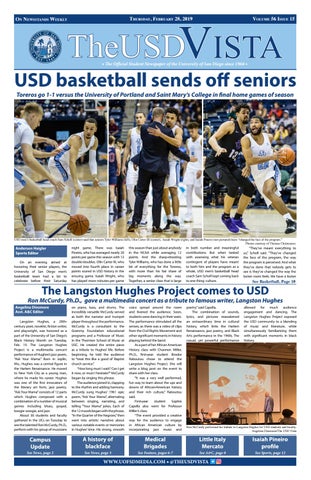
USD basketball sends off seniors Toreros go 1-1 versus the University of Portland and Saint Mary’s College in final home games of season
USD men’s basketball head coach Sam Scholl (center) said that seniors Tyler Williams (left), Olin Carter III (center), Isaiah Wright (right), and Isaiah Pineiro (not pictured) have “changed the face of the program.” Photos courtesy of Thomas Christensen
Anderson Haigler Sports Editor
On an evening aimed at honoring their senior players, the University of San Diego men’s basketball team had a lot to celebrate before their Saturday
night game. There was Isaiah Pineiro, who has averaged nearly 20 points per game this season with 13 double-doubles. Olin Carter III, who moved into fourth place in career points scored in USD history in the ensuing game. Isaiah Wright, who has played more minutes per game
this season than just about anybody in the NCAA while averaging 12 points. And the sharp-shooting Tyler Williams, who has done a little bit of everything for the Toreros, with more than his fair share of big moments along the way. Together, a senior class that is large
in both number and meaningful contributions. But when tasked with assessing what his veteran contingent of players have meant to both him and the program as a whole, USD men’s basketball head coach Sam Scholl kept coming back to one thing: culture.
“They’ve meant everything to us,” Scholl said. “They’ve changed the face of the program, the way the program is perceived. And what they’ve done that nobody gets to see is they’ve changed the way the locker room feels. We have a locker
See Basketball, Page 10
The Langston Hughes Project comes to USD
Ron McCurdy, Ph.D., gave a multimedia concert as a tribute to famous writer, Langston Hughes Angelina Dinsmore Asst. A&C Editor Langston Hughes, a 20thcentury poet, novelist, fiction writer, and playwright, was honored as a part of the University of San Diego’s Black History Month on Tuesday, Feb. 19. The Langston Hughes Project is a multimedia concert performance of Hughes’s jazz poem, “Ask Your Mama.” Born in Joplin, Mo., Hughes was a central figure in the Harlem Renaissance. He moved to New York City as a young man, where he made his career. Hughes was one of the first innovators of the literary art form, jazz poetry. “Ask Your Mama” consists of 12 parts which Hughes composed with a combination of a number of musical genres including blues, gospel, boogie woogie, and jazz. About 30 students and faculty gathered in the UCs on Tuesday to see the talented Ron McCurdy, Ph.D., perform with his group of musicians
on piano, bass, and drums. The incredibly versatile McCurdy served as both the narrator and trumpet player throughout the performance. McCurdy is a consultant to the Grammy Foundation educational programs and a Professor of Music in the Thornton School of Music at USC. He created the entire piece as a tribute to Hughes’ life. Before beginning, he told the audience to “treat this like a good ol’ Baptist church service.” “How long must I wait? Can I get it now, or must I hesitate?” McCurdy began by singing this phrase. The audience joined in, clapping to the rhythm and adding harmony. McCurdy sung Hughes’ 1961 epic poem, “Ask Your Mama”, alternating between singing, narrating, and telling “Your Mama” jokes. Each of the 12 moods began with the phrase, “In the Quarter of the Negroes,” then went into artistic narrative about various notable events or memories in Hughes’ time. His strong, smooth
voice spread around the room and livened the audience. Soon, students were dancing in their seats. The performance stimulated all the senses, as there was a video of clips from the Civil Rights Movement and other significant moments in history playing behind the band. As a part of her African American History class with Channon Miller, Ph.D., first-year student Brooke Raboutou chose to attend the Langston Hughes Project. She will write a blog post on the event to share with her class. “It was a very well performed, fun way to learn about the ups and downs of African-American history and their rich culture,” Raboutou said. First-year student Sophie Capella also went for Professor Miller’s class. “The event provided a creative way for the audience to engage in African American culture by incorporating jazz music and
poetry,” said Capella. The combination of sounds, lyrics, and pictures reawakened an extraordinary time in cultural history, which links the Harlem Renaissance, jazz poetry, and Black Arts performance in the 1960s. The casual, yet powerful performance
Campus Update
A history of blackface
Medical Brigades
Little Italy Mercato
Isaiah Pineiro profile
See News, page 3
See Feature, pages 6-7
See A&C, page 8
See Sports, page 12
See News, page 2
allowed for much audience engagement and dancing. The Langston Hughes Project exposed the USD community to a blending of music and literature, while simultaneously familiarizing them with significant moments in black history.
Ron McCurdy preformed his trubute to Langston Hughes for USD students and faculty. Angelina Dinsmore/The USD Vista
WWW.UOFSDMEDIA.COM ◆ @THEUSDVISTA
2
The USD Vista
◆
February 28, 2019
NEWS
Campus Update Associated Students
Solomon Hall buzzed on Thursday, Feb. 21, as students poured into the Associated Students (AS) Senate meeting. Every available seat was filled, and still more were added as this meeting showed the largest student attendance in recent memory. With a swift strike of the gavel, newly-appointed Speaker of the Senate Alexander Plummer called the meeting to order. Even after the sound of the gavel, students continued to flow into the room. The meeting began with the confirmation of a new senator in the College of Arts and Sciences, Rameen Javadian. Like the senators before him, Javadian stood for his oath of office, promising to promote an inclusive and engaged community on the USD campus. Next, the body was provided with information from the Torero Program Board (TPB). TPB is currently planning for OLÉ Music Fest, a concert experience specifically for USD students late in the spring semester. Afterwards, AS Finance Chair Stephanie Silvar gave an update on the AS budget. She explained that the body will receive $3,000 back from grants not used in the fall. Silvar also noted the AS contact with LYFT is still in progress. Chair of Student Organizations, sophomore Charles Young informed the senate of four different clubs looking to be registered on campus — the Alliance of Disability Advocates, Swing Dancing Club, the USD Rotaract, and the USD Coaching Corps. The senate voted to register each of these as official student organizations. In their next order of business, the senate welcomed a representative from Information Technology Services (ITS). Both the senate and the public provided feedback on the university’s mobile apps, blackboard updates, and the my.sandiego.edu portal. As the ITS representative left, Young returned to the podium. Young brought up a powerpoint presentation regarding another club looking to register as a student organization. The Student Orgs Chair expressed concerns about the Act Now to Stop War and End Racism (ANSWER) Coalition and its alleged history of anti-semitism.
The ANSWER Coalition
At the AS Senate meeting on Thursday, Feb. 21, sophomore Student Orgs Chair Charles Young raised his concerns regarding a new club, called the Act Now to Stop War and End Racism (ANSWER) Coalition, looking to register at the University of San Diego. Young referenced articles from the Anti-Defamation League (ADL) and Fox News in an attempt to show bipartisan concern over the group. The Jewish Student Union provided students with a handout from the ADL detailing the group’s association with “Antiwar Rallies and Support for Terror Organizations” between the years of 2002 and 2006. Young placed an emphasis on the group’s connection to terrorist organizations such as Hezbollah. “Either these members were recklessly ignorant about the organization’s poor history or they knowingly associated themselves with an anti-semitic group,” Young said. “It would have taken these members a mere point four seconds to discover the problematic history of ANSWER through a simple Google search.” Young explained how he had previously shared these concerns with the AS President, Speaker of the Senate, and advisors. However, Young believed that these individuals did not share in his fears. He also expressed concerns about Jesse Magaña, Inclusion and Diversity Chair, and his involvement with the ANSWER Coalition. “Dangerously indifferent, our speaker refusing to inform the body about legitimate concerns involving the nominee for the Inclusion and Diversity Chair’s ability to actually foster inclusion and diversity while interested in joining an anti-semitic hate group,” Young said. “But our AS President refusing to condemn a known, bigoted, anti-semitic hate group that supports and defends terrorist organizations, that might be a step past dangerous indifference.” The Student Orgs Chair shared his support for the club’s intention, but not for the ANSWER Coalition itself. “I openly encourage an anti-war club at USD,” Young said. “I openly encourage an antiracism club at USD. And I openly encourage a pro-Palestine club at USD. Just not this one. Just not one with baggage such as ANSWER has. We cannot allow an organization on this campus that has a demonstrated goal of being openly against any particular country. I ask this body, would it not condemn an anti-Mexico club as bigoted?” Chair for Inclusion and Diversity, Jesse Magaña, was among the first to respond to Young’s presentation. “I would like to let you know how inappropriate and uneducated it is to make an assumption that because one may or may not be pro-Palestine, that they are anti-semitic,” Magaña said. “That is inappropriate and uneducated to bring to a body like this.” Magaña’s statement was met with a chorus of snaps from the student cohort supporting ANSWER. He continued to highlight the non-partisan nature of the AS senate and their mission. However, Magaña’s main assertion focused on the ways in which this club was treated differently than others approved by the Student Orgs committee. “You didn’t allow an entire club to go through the process of being vetted through the Student Org committee,” Magaña said to Young. “You didn’t reach out to any of the students individually, you didn’t come asking us about the political ideologies that you believe that we had, nor did you allow this club to go through the process of running through the Student Org committee.” When Magaña had finished, School of Business senator and Parliamentarian Jocelyn McCoy made a motion to limit discussion on the issue to 10 minutes. Commuter Senator Dean Lockwood predicted that further discussion would not result in senate action during the meeting. “We’re not going to create any policy out of this,” Lockwood said. “ANSWER still needs to meet with Student Orgs to get approved... It’s not something that we’re actually going to do anything about during this discussion time. I welcome the discussion but we need to keep it within limits so that we can have a reasonable meeting.” But despite these suggestions, the motion to limit discussion failed, allowing the discussion time to continue. Shortly after, College of Arts and Sciences Senator Carolina
Moreno Armenta moved to table further discussion on the ANSWER Coalition in order to allow the club to continue through the Student Orgs process like all other organizations. Again, Young highlighted the organization’s connection to terrorist groups. A student, identifying himself as the president of the ANSWER Coalition defended the nature of his group. The student did not provide his name to the open forum. “We are simply anti-racism and anti-war,” the student said. “We are against the fact that Gaza has been turned into a prison city with a wall bigger than Trump could ever dream of. We are against the fact that the Palestinians have been denied national liberation. We are also against anti-semitism.” The senate then passed a motion tabling further discussion on the topic. Speaker Alexander Plummer called for any final business to be addressed. Discussion on the ANSWER Coalition resumed as members of the public continued to voice their concerns. Among these students was Joshua Glasser, president of the Jewish Student Union at USD. Glasser expressed his concerns surrounding the allegations of anti-semitism. “If ANSWER is approved as an authentic organization on campus, then we run the risk of allowing other discriminatory groups to form against other members of the USD community,” Glasser said. “This kind of organization could take all of the other minorities within our campus community and jeopardize USD’s emphasis on community and inclusiveness of all groups.” Senator Carolina Moreno Armenta countered Glasser’s concerns by highlighting the various members of the ANSWER organization. “I hear you talking about safety, well those students over there were the ones who protected our undocumented students against the presence of ICE on this campus,” Armenta said. “We had Trump supporters yelling all types of slurs to all types of people and students of the University of San Diego and we... were the ones building literal walls so they wouldn’t get to the students here on campus... ANSWER is literally trying to bring safety on campus, against white supremacy, white privilege, all types of movements that would get students of color to not reach their full potential.” AS President Natasha Salgado proceeded to justify her actions in regard to the ANSWER Coalition. “I wanted to wait and see and make sure that proper dialogue was had before any assumption of the individual students, or any individual on this campus was being smeared,” Salgado said. As public discussion progressed, students were reminded that this item had been tabled. However, students on both sides of the issue continued to share their thoughts on the subject. Senators encouraged further civil discourse between the student cohorts and an adherence to established protocol within the Student Orgs committee. After over an hour of discussion, senators moved to adjourn the meeting. After the meeting, The USD Vista reached out to the President of the ANSWER Coalition, but declined to be interviewed. Jewish Student Union president Joshua Glasser explained that he was more concerned with ANSWER’s history than the political nature of the organization. “Everyone has the right to their own opinion,” Glasser said. “I have no problem with proPalestine... We don’t believe that’s the issue here... This is an issue of whether or not prejudice against any group of people should be allowed.” The ANSWER Coalition met with the Student Orgs committee on Tuesday, Feb. 26, during dead hours. During this meeting, the committee decided to further table the registration of ANSWER. “We further decided that, at this time, we are unwilling to move forward with the registration process should the group remain affiliated with ANSWER,” Young explained. The Student Orgs committee has promised to help the students find a different organization to be filiated with or form a USD specific group.
Police dogs on campus Walking across campus on Monday, Feb. 25, students may have noticed the presence of the San Diego Police Department (SDPD). Officers were seen walking around Colachis Plaza, with their police dogs sniffing throughout the area. The SDPD was using the University of San Diego campus as a training ground for their newest K9 recruits. The dogs were being trained for counter-terrorism measures, specifically bombs hidden in backpacks. One SDPD officer explained that university campuses are the best place for this type of training as they simulate an event with lots of people. Once trained, these dogs will be used at various concerts and sporting events throughout the city.
Campus Update by Amy Inkrott/News Editor/The USD Vista
Volume 56 Issue 15 ◆
NEWS
◆
The USD Vista
Racist photo of governor surfaces
3
Picture of Virginia governor Ralph Northam in blackface found in medical school yearbook Glenn McDonell Asst. News Editor February was punctuated by a surge in news coverage surrounding the practice of blackface. Reports of past scandals have surfaced involving elected officials in the Virginia statehouse, as well as a controversial product rollout from the designer brand Gucci. The resurgence of this topic in the national dialogue came as the USD community kicked off a month of events to celebrate Black History Month. First-year student Chidi Okaru works in the Black Student Resource Center (BSRC) and played a role in planning events for Black History Month. She said that while the month is meant to be a celebration, it is also impossible to ignore the difficult topics which have defined many moments in African American
On Feb. 1, reports surfaced of a photo contained on one of the pages of Virginia Governor Ralph Northam’s 1984 medical school yearbook depicting an unidentified person in blackface and Jim Crowstyle minstrel garb. This figure was pictured standing next to another unidentified person in the familiar white hooded robe of the Ku Klux Klan. The initial release sparked a firestorm of controversy across media outlets nationwide, and led virtually the entire Democratic establishment to call for Northam to resign from office. Later that same day, Northam made a public statement apologizing for having appeared in what he called a “clearly racist” photo. Then, on the following day after the pressure for him to step down had mounted significantly, the embattled Southern Democratic governor turned his previous
“It’s annoying that these awful sorts of details are dominating the news during a time when we are trying to celebrate our history and culture, but at the same time these discussions are important.” -Chidi Okaru history. “It’s annoying that these awful sorts of details are dominating the news during a time when we are trying to celebrate our history and culture, but at the same time these discussions are important,” Okaru said. “We definitely need to be talking about it, and I believe good can come from it.”
statement around, instead insisting that neither of the individuals were in fact him. In the same press conference, Northam also admitted to having done blackface as part of a Michael Jackson Halloween costume he put together in the mid-1980s. When a reporter asked Northam if he could still “do the moonwalk,” he chuckled
and turned as if to look for the room on the stage to dance, only to be cut off by his wife who leaned into the shot and whispered, “inappropriate circumstances.” These conflicting statements combined with Northam’s defiance in the face of overwhelming resignation demands have left many confused, frustrated, and disillusioned by Virginia’s handling of the messy scandal. For Okaru, the governor’s refusal to give up his power in the wake of these revelations is unacceptable. “It’s really a problem for me that he acknowledged these mistakes but then didn’t resign,” Okaru said. “This sort of thing should really be a career killer. Our history is so tainted that if there aren’t consequences for this sort of thing, it’s only going to increase mistrust in our politicians.” Northam’s administration has postponed a Black History Month reception planned for this week, during which he was scheduled to make remarks about the progress of civil rights in the state. In the midst of all of this controversy and political strife, the USD community looked to promote a spirit of awareness and celebration through a series of events. Okaru, who is now in her first spring semester as a USD student, said she has enjoyed her time in the BSRC planning events for February and is eager to attend more of the programming. “It’s been really exciting, and this center has really been a positive space for me on campus,” Okaru
said. “It’s really great to see people celebrating blackness in different spaces on campus and showing up to the events we’ve been putting together.” Sophomore Tyler Holdsworth, who often frequents the BSRC, also considered the role of these recent controversies in shaping the public dialogue. Like Okaru, Holdsworth has mixed emotions about both
Lakers game with my dad around the time of MLK Day a little while after Obama had been elected back in 2009, and he mentioned how if it weren’t for Dr. King’s leadership, that election win never would have been possible,” Holdsworth said. “For me that’s the meaning of Black History Month. As long as we take things like this with us and extend them outwards, we can make a better
“I think it’s important to remember that this month is also a time to reflect on all of dark moments in African American history and culture.” -Tyler Holdsworth the circumstances and the timing of these controversial headlines, given the significance of the month of February. “It’s unfortunate that this horrible stuff is all over the news right now, but at the same time I think it’s important to remember that this month is also a time to reflect on all of dark moments in African American history and culture,” Holdsworth said. “We can’t be afraid to revisit the negative aspects. These moments serve as important reminders of what the African American community has been through.” For Holdsworth, the value of Black History Month isn’t just in the events and the discussions that happen within those short 28 days, but also the reminders which stay with us throughout the year. “I remember when I was at a
future in the long run.” It seems clear now that despite all of the intense pressure, Governor Northam will likely not resign from his position as the Governor of Virginia. Regardless of what happens, this news event will likely continue to serve as a reminder of the nation’s troubled racial past well beyond the end of this month.
Black Cinema Series: Moonlight Mother Rosalie Hall Warren Auditorium February 28 6 p.m. - 8:30 p.m.
A free one hour talk by Mary Alice Rose Sunday, March 10th from 3-4pm In Pacific Beach, 4602 Fanuel Street
Rose’s interest in science and technology led to a 20-year career in applied physical science, working as a meteorologist for the National Severe Storms Laboratory and a manager developing the gorund system for the Hubbel Space Telescope. In 2002, Rose transitioned from roles as a manager, engineer, and earth scientist to the full-time ministry as a Christian Science practitioner. She is an authorized teacher of this Science and a member of the Christian Science Board of Lectureship. This talk is sponsored by The Christian Science Organization at the University of San Diego For more information, please call (949) 878-8085
Va. governor Ralph Northam at a press conference after the surfacing of a racist photo. Photo courtesy of Georgia Geen/Flickr
The USD Vista
4
◆
February 28, 2019
E DI TOR IA L
National emergency a national disgrace Trump’s unnecessary emergency predicated on racism and fear Eric Boose Opinion Editor In most cases, defeat is admitted with the waving of a white flag. On Feb. 15, President Donald Trump chose to admit it by signing an executive order. At a press conference in the Rose Garden, President Trump announced his declaration of a national emergency in order to fund a border wall before immediately admitting that the nation is not, in fact, facing an emergency. “I didn’t need to do this,” Trump said. “But I’d rather do it much faster.” Trump’s admission that the national emergency he had declared minutes earlier was not a true emergency not only undercut his already minimal credibility, but also openly admitted defeat to Congress. Of course, battles with Congress are to be expected in any presidency, and there is a respectable quality about knowing when one is beaten. However, the Trump presidency is not just any presidency. It is driven by the president’s inflated ego and Trump’s belief that he should be able to bend Congress to his every whim. For Trump to find himself unable to twist Congress’ arm on an issue as personally important as a border wall would tear at the already damaged concept of Trump as this unyielding negotiator, a ruthless businessman who always makes the deal. Why, then, was Trump willing to lose face to gain his border wall? The wall was the cornerstone of Trump’s presidential campaign. It was a consistent, defined policy goal that he touted on the campaign trail: he would build a wall on the U.S.-Mexico border, and he would make Mexico pay for it. If Trump were to fail to deliver the wall, he would surely consider his presidency a failure. With that in mind, Trump has made what he must consider sacrifices in order to get his wall. In the two years since his inauguration, some of his grand promises have fallen by the wayside. Mexico will no longer be paying for the wall. The wall is no longer necessarily a concrete wall,
but instead just a physical barrier. As the layers of this proverbial onion have been peeled away, they are revealing a rotten core. The wall was never about security. The wall is the byproduct of fear and racism, fear and racism that Trump cultivated throughout his campaign. “When Mexico sends its people, they’re not sending their best…” Trump said when he declared his candidacy for president in 2015. “They’re sending people that have lots of problems, and they’re bringing those problems with us. They’re bringing drugs. They’re bringing crime. They’re rapists. And some, I assume, are good people.” In January, Trump claimed that thousands of Americans had been killed by immigrants, and implied that thousands more would die without a border wall. Trump’s hateful rhetoric is disgusting and intolerable, but what is most concerning is that his beliefs seemingly cannot be changed. At the press conference where he announced the national emergency, Trump openly
refused to believe data, some of which has been produced by his administration, that presented evidence to oppose his beliefs. For example, Trump called data indicating that a majority of drug smuggling occurs at established border crossings, where his wall would not have an effect, a “lie.” Clearly, Trump’s concept of what is happening at the border is informed by Trump, and Trump alone. With the president unwilling to be swayed by logic or reason on this issue, any fight will not be to change his mind, but to deny his action. On Presidents’ Day, 16 Democratic state attorneys general joined the list of lawsuits against Trump’s declaration. Xavier Becerra, Attorney General of California, leads the lawsuit. Trump is using the national emergency to expand his power and divert Department of Defense funding away from existing projects to raise the $8 billion he wants for the wall. The lawsuit alleges that that diversion of funding violates the separation of powers, as Congress is empowered to control
government spending. Since Trump is diverting that funding from existing projects, Becerra asserts that states are put in harm’s way. “If the president is essentially stealing money that’s been allocated to go to the various states for various purposes but no longer will, we’re being harmed,” Becerra said. “Our people are being harmed.” Unfortunately, the National Emergencies Act grants the president a great deal of power once an emergency is declared. Also, the law does not define what constitutes an emergency, instead leaving it to the president’s discretion. Equally unfortunately, much of the legal battle is out of the hands of citizens. On Tuesday, the Democrat-controlled House of Representatives passed a resolution to cancel the executive order Trump used to declare the national emergency. The resolution is the most powerful way to forcibly deny Trump’s declaration and prevent him from diverting funding to the wall.
Beyond its direct legal power, the resolution also offers some support to the lawsuit led by Becerra. By passing the resolution, the House has reasserted Congress’ power to control spending, a key piece of the logic supporting the lawsuit. The House resolution now moves on to the Republican-controlled Senate, where its passage is not guaranteed. Aside from personally calling Senators and imploring them to take action, there is little we can do to influence the federal debate on this issue. However, especially at USD, we the people have a moral obligation to act. Trump’s wall is a monument to a fear of immigrants, a fear of people who come from a different place, who look different than a majority of those in power. USD is located in one of the largest border communities in the country, and our city is inherently affected by immigration. It is therefore our moral obligation as a changemaker campus to try to change the negative perceptions of immigration and assuage the fears that lead to racism and nativism.
The University of San Diego does not share the views presented within the editorial and op-ed sections. The opinions expressed in this section reflect solely the opinion of the respective writer.
Volume 56 Issue 15
◆
FEATURE
◆
5
The USD Vista
F E AT U R E
Sunny San Diego gets rainy
Torrential rain hits San Diego, leaving students wondering if it is just a seasonal storm Emma Goodman-Fish Asst. Feature Editor Students dash from building to building, backpacks and jackets over their heads, attempting to block the blustering wind and pouring rain. This is an image you might expect to see at campuses in the Pacific Northwest, but not at the University of San Diego. Jack Cleary, a USD junior and San Diego native, echoed this sentiment. “It is very abnormal weather for San Diego,” Cleary said. “Everything from our roads to our lifestyle is designed for sunny weather.” This unusual weather was noticed by all students, especially those who have grown up in the typical San Diego climate. The excessive rain has made a clear impact not only on the roads of San Diego, but also the day-today lives of people, particularly USD commuter students. Cleary shared that his commute to school each day has been heavily impacted by the recent rain. “Not only are our roads littered with potholes, but they were not made for the rain,” Cleary said. “They do not drain properly.” This has been a big problem for commuters driving to campus each day, dealing with both floods in the
middle of the roads and now with the potholes that cause further car problems and accidents. Massive puddles also cause accidents, and create what Cleary referred to as “the worst traffic we see all year.” Rain not only causes physical damage to the roads but also creates the perfect setting for car accidents, as San Diego drivers are not used to or prepared for driving in such conditions. “On (my) drive home from work up in Scripps Ranch, there was terrible traffic on the freeway due to a car accident caused by the rain,” Cleary said. “(It) took me almost an hour to get home, (although it) usually takes me about 15 minutes.” Cleary is just one example of the commuter students who have expressed clear frustration over the difficulties they are facing when driving to school each day, as well as driving to their jobs or daily involvements. Other students note that the commute is longer because everyone is driving slower for safety since no one is conditioned for this weather. Not only has the rain impacted how to get places, it has impacted where people can go, a sentiment similarly communicated by USD junior and commuter Arby Jackob. “We’re so used to being able to go to the beach whenever and hike
and do whatever outdoor activities we wanted at any time,” Jackob said. “The rain has definitely put a damper on that.” The community as a whole and its culture have been heavily impacted by the rain in the limits it puts on activities commonly enjoyed by San Diegans. USD students are used to being able to engage in the activities that are a part of the San Diego lifestyle, yet the rain changes this culture. USD junior Erin Scott expressed disappointment in the recent rain. “I really like to run along the boardwalk but I haven’t gotten out as much since it’s been really rainy and windy,” Scott said. “I also feel like so much of the things we do here in San Diego are outside, whether it is going to farmers’ markets, the beach, Sunset Cliffs.” Not just commuter students, but all students who attend USD are impacted by the limited activities available in the rain. Many students moved to San Diego particularly for the sunshine and all the opportunities it offers, and are frustrated with the constant rain and cold. “I can’t wait for it to be warm enough to take more advantage of living down here,” Scott said. Scott, who is originally from Washington state, is used to the
When faced with pouring rain, a resourceful USD student finds a way to stay dry. Photo courtesy of Luke Garrett
rain, but admits that living in San Diego has weakened her tolerance for wet weather. “Since moving to San Diego I have become so much more of a wimp,” Scott said. “I really don’t like the rain.” Many USD students also share her feelings and dislike of rain in general. Despite widespread acknowledgment that California’s dry climate is in dire need of moisture, many believe that rain is primarily a nuisance in the lives of San Diegans. The rain is clearly not welcome
in San Diego. However, it may be here to stay. “I read a recent article which discussed how California is supposed to get hit with a nasty two-week storm that is of biblical proportions,” Cleary shared, referencing a Feb. 18 Los Angeles Times article. While the sunny weather forecast for this week certainly doesn’t indicate an apocalyptic mega-storm, the sheer amount of rain that has recently descended upon USD is undoubtedly strange and a point of campus conversation.
I CHOOSE TRANSIT. Moving to my own rhythm.
BUS & TROLLEY PASS
Unlimited rides all semester. Special student discount.
$148 USD Undergraduate On sale until March 2 at the University Center Ticket Office. Price includes a $15 University subsidy. Current, valid college student picture ID required.
sdmts.com/college
6
THE USD VISTA
◆
FEBRUARY 28, 2019
MEDICAL BRIGADES Operating under the international organization Global Brigades, Medical Brigades is a small nonprofit organization that enters and aids struggling communities worldwide, helping to both heal immediate health concerns and educate the community about personal health and hygiene. The University of San Diego Medical Brigades chapter has traveled all around the world for their mission, from Nicaragua to Ghana. They work alongside members of each unique community, fostering lifelong friendships. Although the brigade has a focus on medical care and assistance, students of all majors are encouraged to join, articulated by sophomore Jon Woodward, an avid member of Medical Brigades. “We accept all majors,” Woodward said. “The only requirement is that those who come with us have a passion to serve and help others.” This June, Medical Brigades is headed to Panama to assist their local partner communities and continue their mission of service and care.
Photo courtesy of Photo courtesy of Annika White
“
I have been a part of Medical Brigades for four semesters now and absolutely love it. So far I have only gone on one brigade to Nicaragua. There I got to travel with one of the local doctors provided to a house of a patient who was not well enough to make the walk to the clinic. The patient and his family were beyond amazing and kind and worked so cohesively together with so little that I was amazed. Additionally, the family that we worked with when building a bathroom and hygiene station was amazing. Not only did the entire family help us work to make this happen but the entire community came out and helped us lay bricks and dig trenches for the water tank. They were more excited than we even were as the house we were making it for was owned by an older woman who had lived 90 years without this. They were so excited for her to have a bathroom and shower and toilet. I absolutely love this club and would love for everyone to have the chance to experience it.” - Jon Woodward, Sophmore
Photo courtesy of Anna Delay
“
It all starts with medicine to become independent. That is the biggest emphasis. We are the first small step in a process.” - Kelsey Banta, first-year
Volume 56 Issue 15
◆
FEATURE
◆
7
THE USD VISTA
“
Photo courtesy of Anna Delay
Annika White
It is impossible to recount just one story that has touched my heart. I will say that the last brigade to Ghana was full of many magical moments. The funny thing is that when you go on these brigades you start off knowing no one, stuck in your shell. But by the end of the brigade, you are all throwing jokes, and truly know each and every individual on a deep level. The bus rides consist of individuals singing along to classics like the Spice Girls. That being said, my favorite day was the last day in-country. An orphanage came to our compound and taught us how to dance the traditional way and play the drums. This one sweet boy who was teaching me to play the drums did his best to not laugh at my lack of rhythm. I had never felt so much love, apprecciation, and happiness than I felt at that moment. I felt completely at peace.” -Anna Delay, senior and co-president of USD Medical Brigades
Photo courtesy of Anna Delay
Photo courtesy of Anna Delay
“
To empower communities, you don’t need any particular background of expertise. You just need drive and compassion.” - Anna Delay, senior and co-president of USD Medical Brigades
“
Our only prerequisite for joining Medical Brigades is that you have an honest desire to help your fellow man and make a difference in the world.” - Annika White, senior and co-president of USD Medical Brigades
Photo courtesy of Annika White Spread by Monica Millan/ The USD Vista; Content courtesy of Mayella Vasquez and Cat Silvey/ The USD Vista
8
The USD Vista
◆
February 28, 2019
ART S & CULTURE
A Saturday spent at Little Italy Mercato One of San Diego’s many farmers’ markets offers food and flowers, among other hidden treasures
Angelina Dinsmore Asst. A&C Editor Every Saturday thousands of people head to Little Italy to explore the vendors of San Diego. Over 200 tents line West Date Street, from Kettner Boulevard to Front Street. The farmers’ market takes over all of Little Italy, and the tents can be seen from every street. People of all ages are willing to face the crowds in the hopes of purchasing their favorite products, or discovering something new. Both sweet and savory scents fill the crisp morning air. Bustling crowds of people share their favorite samples from the excited vendors. It is a great place for a first date, lunch with the family, or a solo adventure. The options are endless. Little Italy’s Farmers’ Market offers all kinds of food and drink including freshly-brewed coffee, green juice, french bread, spicy salsa, and ground hummus. The Baba Foods hummus was particularly popular, as they had a consistent crowd under their tent. They offered samples of over 10 different hummus flavors with their homemade baked pita chips. People could not get enough of this all-natural snack. The Farmers’ Market offers small businesses an easy, fun way to promote their product. The Pacific Beach peanut butter was also a crowd pleaser, as it had four different flavors, both with and without sugar. Another high-demand product is the fresh fruit, as there were plenty of oranges, apples, and berries available for purchase.
The Holly Berry Honey vendor at the farmer’s market got a lot of attention from the crowd.
Once their stomachs are full, the farmers’ market goers may want to browse the various clothes, art, and jewelry stands on display. Vibrant pictures of the San Diego sunsets were available for purchase, along with handmade accessories from Mexico. Trendy jewelry of all kinds and prices attracts the fashionistas of the city. The handmade goods are great for gifts to someone special, or a well-earned treat for yourself. There is also all-natural lotion and soap that people could test before they buy. Shoppers can listen to live music that plays throughout the streets, which contributes to the pleasant ambience of the day. It is pet-friendly, so people can
make furry friends in between the lines for vendors. There is also a man, set up with a typewriter and parchment, prepared to write a poem on demand for whoever requests it. With countless things to see and do, a visit to the Little Italy Mercato makes for an excellent Saturday activity. USD sophomore Sarah Kushner visited Little Italy this past Saturday and was drawn to the atmosphere. “I felt like I was truly living a San Diego lifestyle, surrounded by the culture and people while exploring my new home,” Kushner said. Kushner is always looking for new things to do in San Diego,
as she believes it has so much to offer. She doesn’t want to waste any time in her four years here. She took advantage of the good deals and got a large bag of oranges for only $5. Sophomore Caroline Alexander, who attended the market with Kushner, enjoyed the diverse crowds she encountered. “It was so cool to see such a diverse group bond over their common love for food,” Alexander said. Alexander was one of many to love the Baba Foods hummus stand, and bought three containers of it. Snacking on hummus reminded her of going to the farmers’ market in her
Angelina Dinsmore/The USD Vista
hometown, Ladera Ranch, with her family. Little Italy Mercato brings the people of San Diego together into a tight-knit community. They are grateful to all the vendors for their contribution of spreading the love of food. Farmers’ markets offer so much to communities. They put out fresh food that is in season, at its peak of nutrition and flavor. Farmers’ markets are also easy to find all over San Diego, and they provide delicious, local, foods which might be difficult to find elsewhere. It is a rewarding way to support your local farmers and economy. Visit Little Italy Mercato on Wednesday and Saturday mornings for a taste of San Diego.
The flower stand is a huge hit every week. Angelina Dinsmore/The USD Vista
Danielle Agnello/The USD Vista
Danielle Agnello/The USD Vista
Volume 56 Issue 15
◆
ARTS & CULTURE
◆
The USD Vista
A night with Marlon James
9
Novelist Marlon James discusses topics including literature, violence, and sex
Students, faculty, and other attendees wait in line to get their books signed by James.
Joe Duffy Contributor In introducing novelist Marlon James to the Kroc theater stage last week, USD professor Brian Clack, Ph.D., quoted The Washington Post’s review of James’ new novel, “Black Leopard, Red Wolf.” “James has spun an African fantasy as vibrant, complex, and haunting as any Western mythology, and nobody who survives reading this book will ever forget it,” Clack said. Moments later, James walked out to the IPJ stage wearing a black jacket, track pants, combat boots, and a grey beanie wrapped around his thick dreadlocks. Once the applause died down, James begun his reading. “I think you can survive my book,” James said. “But if not, at least buy it first.” The night was filled with funny moments like these as James read from his new book, discussed African mythology, and fielded questions from the audience. The event was presented by the USD Humanities Center and Warwick’s, and was part of the Illume Speaker Series, a program that hosts scholars and other public figures “to advance the liberal arts on our campus and inspire lifelong learning in our surrounding communities.” The Jamaican-born author emerged as a major literary figure in 2015, when his novel “A Brief History of Seven Killings” was released to rave reviews and won the prestigious Booker Prize, making him the first Jamaican writer to ever receive the honor. “Black Leopard, Red Wolf,” his
latest work since winning the prize, is the first installment of an ambitious trilogy set in a fictional Africa. The novel follows a gifted yet morally ambiguous mercenary named Tracker, who is enlisted to find a missing boy along with a strange assortment of other fantastical characters. Together, they travel through mythic kingdoms, navigate complex political tensions, and explore an ancient world rife with danger. A copy of “Black Leopard, Red Wolf” was included with the purchase of a ticket. A book signing followed the reading and a line of people holding their copies of the book stretched past the foyer and into the hallway of the IPJ. The audience eventually left and stacks of James’ books were being packed up into boxes by event staff. James sat at a table outside of the IPJ theater, signing books and posters being handed to him by organizers. In an interview, The USD Vista asked James about his daily routine when he’s working on a novel, and he talked about keeping a fairly strict schedule. “I get to work around 11 a.m. and I sit down and I write until around 6 p.m.” James said. “And regardless of where I am that day, I’m done, I just stop.” He also discussed navigating the boundary between gratuitous violence and what he calls “edited” violence in his work. “People think I write explicitly violent novels and I actually don’t think my novels are that violent,” James said. “But, I do think the violence comes with suffering and I do think the violence reverberates and resonates and echoes and if something is reso-
nating for a while you’ll think it’s almost everywhere, but it’s not.” As far as living in the spotlight, James expressed gratitude for all of the attention he’s been receiving, but was ambivalent about the newfound fame. “It is overwhelming,” James said. “It’s overwhelming and it is kind of strange. I’ve been writing books for a while and I’ve had readings where nobody showed
up… So having had every possible outcome in this industry, having been at every possible stage, from the writer nobody’s heard of and nobody really needs to read, to somebody where a lot of people are interested, it can be surreal.” Lastly, James was asked about how his newest novel is filled with really strange but intensely sensual sex scenes. “Ooh, the key to writing a great
James smiles for the camera as he signs the cover of his novel, “Black Leopard, Red Wolf.”
Joe Duffy/The USD Vista
sex scene,” James chuckled. “The key to writing a great sex scene is being explicit without being over the top. It’s risking sentimentality. It’s remembering that people actually enjoy sex… I always say sex should be sexy. Violence should be violent, sex should be sexy.” For a full transcript of the exclusive interview with James regarding his latest novel, please visit: www.uofsdmedia.com
Joe Duffy/The USD Vista
10
The USD Vista
◆
February 28, 2019
SP ORT S
Toreros beat Pilots, fall to Gaels USD and their coaches remain optimistic as difficult conclusion to regular season approaches
LEFT: Sophomore Yauhen Massalski dribbles past Portland’s Hugh Hogland on Thursday. RIGHT: First-year guard Finn Sullivan and senior guard Olin Carter III defend against the Gaels’ Tommy Kuhse on Saturday. Photos courtesy of Thomas Christensen
Basketball from Page 1
room now with guys that love to play, that have a passion for this game that want to be the best players and the best team that they can be. And quite frankly that feeling wasn’t there four years ago before they got here. We will forever be indebted to what they’ve done and established in our culture.” But there’s something else that both Scholl and his senior players have frequently used to describe their performance this season. It’s a sense of not being able to put things together. An inability, at times, to set forth a complete performance in all phases of the game for the entire 40 minutes of the contest. Time and time again, they have emphasized that they feel they are close to putting it all together, that they have the talent, experience, and skills necessary to close their season on a high note. And it’s not hard to see why they are so firm in their faith in
as well as a similar last-second loss at Pepperdine earlier this month. “We do have good talent, we have great character, great teammates, guys who want to play for each other,” Scholl said. “We have the tools. So now it’s just about having the consistency with the things you need to do to win basketball games.” This past weekend, both of the aforementioned strengths and weaknesses of the Toreros were on display as they competed in their final two regular-season home games of the season. They got things started on Thursday night with a matchup against the lowly University of Portland Pilots, who came into the contest without a win this season in the West Coast Conference (WCC), as well as a 13-game losing streak. Their play, however, belied their dismal record, and gave USD as much trouble as any team has this season. “We talked about it before
“(The seniors) have meant everything to us. They’ve changed the face of the program...We will forever be indebted to what they’ve done and established in our culture.” -Coach Sam Scholl themselves. There’s been flashes of brilliance: an electric first half against now-No. 1 Gonzaga. A stunning comeback against thirdplace USF. And an impressive 11-4 non-conference record against as tough of a schedule as USD has seen in years. But for each of the highs, there’s been perhaps an equal low. Tough defeats include a second-half collapse to secondplace Brigham Young University after leading for most of the game,
the game, probably their greatest strength was that they hadn’t won a game,” Scholl said. “So they came out and played aggressive. What do they have to lose? Another game? Credit to Coach Porter in the way they kept playing and how they presented some problems for us.” Like Scholl said, the Pilots opened the game with an aggressive style of play, leading to a first half that saw USD trail
multiple times. After an ugly turnover and foul-plagued first 10 minutes from both sides to start the game, Portland led by five. When the Toreros did eventually figure things out offensively, they did so from the perimeter, doing most of their damage from 3-point range. Carter III led the way for USD in this regard, shooting 4-6 from the field, and 2-4 for three in the first half. Pineiro chipped in with 13 first-half points of his own, but the Toreros still were unable to create any semblance of a comfortable lead over the WCC’s worst team. After trailing by a score of 29-28 with 4:05 to go in the half, a Joey Calcaterra jumper gave USD a slim, 31-28 advantage over the Pilots before two more successful jumpers from both Pineiro and first-year guard Finn Sullivan extended it to 35-30. USD would lead by the same score at the half. Pineiro, who scored a game-high 22 points, described the first half of play. “They were making some tough shots but their defense was really good,” Pineiro said. “They slowed us down, and we weren’t in a groove offensively, but defensively we couldn’t get stops either.” When the second half began, the Toreros’ struggles to create a significant lead continued. Their advantage dwindled down to just one point with 17 minutes remaining in the game before the Pilots took a 41-40 lead on a short jumper from sophomore guard JoJo Walker. Though USD was able to hold Portland to just 25 percent shooting from the field in the second half, the two teams would trade the lead back and forth five more times before the Toreros finally figured things
out. With under two minutes left in the game, and a narrow 5452 lead, Tyler Williams tossed in a layup in the paint that would signal the beginning of the end for the Portland’s hopes of a WCC upset. Punctuated by a signature deep, highly contested 3-pointer from Carter III with just 40 seconds remaining that marked the last of his 16 points in the game, the Toreros went on a 9-0 scoring run to conclude the contest that
had plenty of chances to score, but was unable to convert many of their opportunities, shooting a troubling 29 percent from the field in 52 attempts. Pineiro discussed the Toreros’ offensive woes. “Their big man was really holding down the paint,” Pineiro said. “We just couldn’t get shots. We had some open looks and they just weren’t falling.” Senior guard Isaiah Wright, who recorded 10 points on the
“It’s frustrating, all of us are disappointed. But we’ve got a lot of basketball left. I’m not too worried about where we’re at right now...We’re gonna figure out a way.” -Isaiah Wright stretched their lead to a gamehigh 11 points and secured them a 63-52 victory. Scholl spoke about his team’s late-game offensive surge. “We were just getting stops on one end, challenging shots, rebounding, (Portland) was getting no second efforts,” Scholl said. “And then (the Toreros) were coming down here and executing and attacking. The ball kept moving, and we found open shooters. Olin made a really big shot, and some guys stepped up and made some really big plays.” Saturday’s night’s matchup against the Saint Mary’s College Gaels did not fare nearly as well for USD. After the pregame celebration for the senior class concluded and the game began, the Toreros once again struggled to get their shots to fall on offense, and saw several of their layups swatted down in the paint by the Gaels’ 6-foot-10 center Jordan Ford, who finished with four blocks on the night. USD
night, offered his take on his team’s lack of success offensively. “(Saint Mary’s) did a good job, but we just gotta make our shots,” Wright said. “We gotta step up to the plate and make shots. I thought we had a lot of possessions that we could’ve scored on but we left it off the board and that hurt us.” By halftime, they trailed by a score of 29-20, a sizable deficit that was prevented from increasing by tough defense on USD’s end that saw them hold Saint Mary’s to eight points below their average total in the game. “Overall I was pleased with our defense,” Pineiro said. “I think they had 11 offensive rebounds so that hurts, but if we cut that in half, our defensive numbers are even better. We had some undisciplined plays that led to some easy baskets but overall I think defensively we did pretty good.” The Toreros’ troubles continued in the second period.
See Basketball, Page 11
Volume 56 Issue 15
◆
SPORTS
◆
11
The USD Vista
USD determined to finish strong Influential group of seniors’ home finale soured by tough 66-46 loss to Saint Mary’s College
Basketball from Page 11
After compensating for their lack of scoring with hard-nosed defense all first half, they appeared to grow weary on both ends of the floor in the second period. They were unable to either close the gap or find an answer for the Gaels’ crafty guard Jordan Ford, who scored a game-high 21 points behind a 7-12 night shooting in which he made five of his eight 3-point attempts. Perhaps the only positive on offense was Pineiro notching his 13th double-double of the season with 13 points and 14 rebounds. As the game wound to a close, the Saint Mary’s lead continued to swell, ultimately dealing USD a 20-point, 66-46 loss to the second-place Gaels on Senior Night. Scholl assessed his team’s effort in their final regularseason home game. “I thought we fought like crazy to try to dictate our defensive identity and our pillars,” Scholl said. “And I felt like we did for a long time through the challenge of not scoring on the other end — that’s hard to do, to continue to get stops when you’re not scoring. Your offense affects your defense just like your defense affects your offense.” The defeat marks the Toreros’ fourth loss in their last seven games. It moved their record to 17-12 overall (6-8 WCC), and spoiled an otherwise special night
Olin Carter III, Tyler Williams, Isaiah Pineiro, Isaiah Wright, Mitch Schafer, and Devin Moss were celebrated before Saturday night’s game versus the Gaels. Photo courtesy of Thomas Christensen
for their graduating class. Pineiro described his and his teammates’ emotions regarding the loss. “It sucks to play like that on Senior Night, potentially our last game here,” Pineiro said. “But it sucks like that to play in any game.” USD has just two regularseason games remaining: road matchups with the University of San Francisco and Brigham Young University. If they are to take any sort of positive momentum into
the WCC Tournament early next month, they will need to quickly start winning. Though he is keenly aware that time is running out for the Toreros to turn things around, Wright said that he is not worried about his team down the stretch. “It’s frustrating, all of us are disappointed,” Wright said. “But we’ve got a lot of basketball left. We can’t just get down on this one game cause it’s our last home game. This team can turn around
Prepare for the business of
in an instant, we can click just like that. We just gotta keep on working and keep on believing in one another. I’m not too worried about where we’re at right now, I’m really not. We’re gonna figure out a way.” Scholl agreed with Wright’s sentiment. “I just told the guys — our coaching staff chooses nothing else other than to believe that if this season is a drama, these are
MAKING A DIFFERENCE
EARN YOUR 12-MONTH MBA AT POINT LOMA NAZARENE UNIVERSITY • Values-driven curriculum • Professional mentorship network • Hands-on classroom experience
Become the leader that others will follow. Learn more at pointloma.edu/12monthMBA
like the evil chapters,” Scholl said. ”We choose to believe nothing else other that this is going to be a storybook ending. That’s how we’re going to move forward… we’re gonna have a really special finish to the year.” The Toreros’ next game is against USF in San Francisco on Thursday, Feb. 28 at 7 p.m. It will be streamed online on theW.tv and broadcast on the 1090 AM app.
12
The USD Vista
◆
February 28, 2019
Pineiro powering Toreros
Redshirt senior forward Isaiah Pineiro is a leader both on and off the court for USD men’s basketball
Redshirt senior forward Isaiah Pineiro leads the Toreros with an average of 19.2 points and 9.4 rebounds per game, with 13 double-doubles to his credit.
Anderson Haigler Sports Editor Standing at 6-foot-7 and 215 pounds, Isaiah Pineiro is an imposing presence on the court for USD basketball. But the redshirt senior forward has impressed with more than just his stature this season. Pineiro is averaging nearly 20 points and 10 rebounds per game, notching 13 doubledoubles along the way. A pattern of consistent success that has not gone unnoticed by his coaches and teammates. “It’s a great, great luxury for any team and any coach to have a player who’s capable of getting 20 points and 10 rebounds,” USD men’s basketball head coach Sam
pressure is highest and the lights are brightest, posting team-high totals in points in both meetings against top-five-ranked Gonzaga University, with a number of clutch late-game shots to his credit in other games as well. As a fifth-year player, though, he is unfazed by the pressure. “At the end of the day it’s just another shot,” Pineiro said. Scholl weighed in on the perhaps “clutch” nature of his star forward’s skills. “I just think he’s prepared himself to be ready for those moments,” Scholl said. “He’s put in a lot of reps, and he trusts those reps so when a moment comes, he’s ready to perform and to make plays. I think that those type of
“Just being confident. You have to trust your reps. I’ve taken thousands upon thousands of shots in the summer, the spring, and the fall, and at the of the day it’s just another shot.” -Isaiah Pineiro Scholl said. “He works extremely hard to prepare himself to be able to have those types of performances each game.” Like his coach, Pineiro attributes his success this season to hard work and confidence. “Just being confident,” Pineiro said. “You have to trust your reps. I’ve taken thousands upon thousands of shots in the summer, the spring, and the fall.” Pineiro’s big season has not been without its big moments. Time and time again, he has risen to the occasion when the
performances go along with the tremendous work ethic that he has.” But it’s not just the scoring that has been dynamic for Pineiro this season. It’s his rebounding, defense, and performance at the free-throw line paired with his dominant scoring — being a well-rounded player — that has elevated his game to be amongst the best in the West Coast Conference. Pineiro prides himself on this diverse set of skills. “I try to be a hard guard on defense, and just help my team
any way I can,” Pineiro said. Though he quickly found success at the University of San Diego, Pineiro’s college basketball journey did not begin as a Torero. The native of Auburn, Calif. attended Sierra Junior College and Portland State before San Diego, where he averaged 15.4 and 12.0 points per game at each school, respectively. After transferring to USD, he sat out the 2016-2017 season as a redshirt. It’s an aspect of his career that Pineiro says has made him a better player in the long run. “It’s just helped with a lot,” Pineiro said. “I’m an older player, so I’ve seen a lot of basketball, just being around different coaches and different players has really just helped with my overall experience, and my basketball IQ.” Since he began his collegiate career in 2014, he has seen steady improvement in all facets of his game. “My skill levels have definitely increased,” Pineiro said. “And then my basketball IQ. I think those, hand-in-hand make you a better player overall.” Scholl described Pineiro’s development as a player in the three seasons that he has coached him. “I think the biggest thing from last year to this year is that he’s improved his rebounding,” Scholl said. “Last year he had six rebounds a game and this year it’s close to 10, which is a dramatic improvement. It’s going to provide him with great opportunities for beyond USD. And he’s improved as a 3-point shooter. He’s made more,
he shoots more, he has a better percentage.” There’s more to Pineiro’s game beyond the tangible, quantifiable contributions he makes on the court, however. A leader by example, he has drawn high praise for the impact he has on his teammates, particularly the younger players. “IP very much leads by example,” Scholl said. “He’s our hardest worker in the weight room, he’s our hardest worker
Photos courtesy of Thomas Christensen
when the coaches are saying stuff that I don’t really understand.” Fellow senior Olin Carter III shared Sullivan’s sentiment. “He’s been a good role model for our team,” Carter III said. “Him and Isaiah Wright have really done a good job in helping us turn this program around. Before they came here, we weren’t that good, with the addition of them two it really helped turn this program into having the standard of where we’re trying to be in the top of the
“IP very much leads by example. He’s our hardest worker in the weight room, he’s our hardest worker on the floor...those type of performances go along with the tremendous work ethic that he has.” -Coach Sam Scholl on the floor. He puts in the most shots, he stretches the most, he takes care of his body the best. So he’s a great, great leader by example for others to see what it really takes to be successful.” In a season in which three of the Toreros’ usual starting five have missed time at some point due to injuries, Pineiro’s high level of play has been a constant, something that first-year guard Finn Sullivan says has been a stabilizing presence both for himself and the team as a whole. “Being a freshman, it’s a big learning curve,” Sullivan said. “He’s been playing for so long, and he knows so much about the game. Just getting his perspective on ways to score, where to be on defense is really helpful. Especially
league every year.” As Pineiro’s final season as a Torero winds to a close, he says that it will be the friendships with his teammates that he will miss the most. “Just the team,” Pineiro said after the team’s final regular season home game last week. “Playing with this group of guys and coaches. Just the love that we have for each other and all the hard work that we’ve put in in this gym. I’ll never forget it.” Pineiro and his teammates will continue their season with a road game versus the University of San Francisco on Thursday, Feb. 28 at 7 p.m. The game will be streamed online on theW.tv and broadcast on the 1090 AM app.