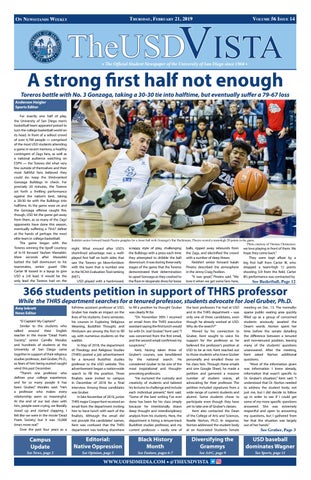
TheUSDVISTA
Volume 56 Issue 14
Thursday, February 21, 2019
On Newsstands Weekly
◆ The Official Student Newspaper of the University of San Diego since 1968 ◆
A strong first half not enough
Toreros battle with No. 3 Gonzaga, taking a 30-30 tie into halftime, but eventually suffer a 79-67 loss Anderson Haigler Sports Editor For exactly one half of play, the University of San Diego men’s basketball team appeared poised to turn the college basketball world on its head. In front of a sellout crowd of over 4,700 people — comprised of the most USD students attending a game in recent memory, a healthy contingent of Zags fans, as well as a national audience watching on ESPN — the Toreros did what very few outside of themselves and their most faithful fans believed they could do: keep the third-ranked Gonzaga Bulldogs in check. For precisely 20 minutes, the Toreros set forth a thrilling performance against the nation’s best, taking a 30-30 tie with the Bulldogs into halftime. As the game wore on and the Gonzaga offense caught fire, though, USD let the game get away from them, as so many of the Zags’ opponents have done this season, eventually suffering a 79-67 defeat at the hands of perhaps the most elite team in college basketball. The game began with the Toreros winning the tipoff courtesy of 6-10 forward Yauhen Massalski. Mere seconds after Massalski batted the ball downcourt to his teammates, senior guard Olin Carter III tossed in a layup to give USD a 2-0 lead. It would be the only lead the Toreros had on the
Redshirt senior forward Isaiah Pineiro grapples for a loose ball with Gonzaga’s Rui Hachimura. Pineiro scored a team-high 20 points in the game. Photo courtesy of Thomas Christensen
night. What ensued after USD’s short-lived advantage was a wellplayed first half on both sides that saw the Toreros go blow-for-blow with the team that is number one in the NCAA Evaluation Tool ranking (NET). USD played with a hard-nosed,
scrappy style of play, challenging the Bulldogs with a press each time they attempted to dribble the ball downcourt. It was during these early stages of the game that the Toreros demonstrated their determination to upset Gonzaga as they crashed to the floor in desperate dives for loose
balls, ripped away rebounds from the Zags, and electrified the crowd with a number of deep threes. Redshirt senior forward Isaiah Pineiro described the atmosphere in the Jenny Craig Pavilion. “It was great,” Pineiro said. “We love it when we get some fans here,
we love playing in front of them. We hope they come back.” They were kept afloat by a big first half from Carter III, who dropped a team-high 12 points shooting 5-9 from the field. Carter III’s performance was contrasted by
See Basketball, Page 12
366 students petition in support of THRS professor
While the THRS department searches for a tenured professor, students advocate for Joel Gruber, Ph.D. “O Captain! My Captain!” Similar to the students who rallied around their English teacher in the movie “Dead Poets Society,” senior Camille Morales and hundreds of students at the University of San Diego came together in support of their religious studies professor, Joel Gruber, Ph.D., as fears of him being ousted caught wind this past December. “There’s one professor who defines your college experience, and for so many people it has been Gruber,” Morales said. “He’s a professor who makes every relationship seem so meaningful. At the end of our last class with him, people were crying, we literally stood up and started clapping. I felt like we were in the movie ‘Dead Poets Society,’ but it was 10,000 times more real.” Over the past four years as a
full-time assistant professor at USD, Gruber has made an impact on the lives of his students. Every semester, his courses in Exploring Religious Meaning, Buddhist Thought, and Hinduism are among the first to fill up, with numerous students on the waitlist. In May of 2018, the department of Theology and Religious Studies (THRS) posted a job advertisement for a tenured Buddhist studies professor to the USD website. This advertisement began a nation-wide search to fill the position. Three finalists were invited to campus in December of 2018 for a final interview. Among these candidates was Gruber. In late November of 2018, junior THRS major Cooper Kent received an email from the department inviting him to have lunch with each of the finalists. Although the email did not provide the candidates’ names, Kent was confused that the THRS department was looking elsewhere
to fill a position he thought Gruber was clearly fit for. “On November 30th I received an email from the THRS executive assistant saying the first lunch would be with Dr. Joel Gruber,” Kent said. “I was concerned from the first email, and the second email confirmed my suspicions.” Kent, having taken three of Gruber’s courses, was bewildered by the national search. He considered Gruber to be one of the most inspirational and thoughtprovoking professors. “He nurtured the curiosity and creativity of students and tailored his lectures to challenge and include each individual present,” Kent said. “Some of the best writing I’ve ever done has been for his class simply because he intentionally draws deep thought and interdisciplinary analysis from his students. Here, the department is hiring a tenure-track Buddhist studies professor, and my current professor – easily one of
the best professors I’ve had at USD and in the THRS department – was only one of three candidates, even though he already worked at USD. Why do the search?” Moved by his connection to Gruber, Kent sought to voice his support for the professor as he believed the professor’s position at USD to be at risk. Kent reached out to those students who knew Gruber personally and emailed those on his class lists. Through these emails and one Google Sheet, he made a petition and garnered a massive number of student voices, all advocating for their professor. The petition included signatures from a wide range of current students and alumni. Some students chose to participate even though they have yet to take one of Gruber’s classes. Kent also contacted the Dean of the College of Arts and Sciences, Noelle Norton, Ph.D. In response, Norton addressed the student body at an Associated Students Senate
meeting on Dec. 13. The normallysparse public seating area quickly filled up as a group of concerned students anxiously awaited the Dean’s words. Norton spent her time before the senate detailing the difference between a tenured and non-tenured position, leaving many of the students’ questions unanswered. After the meeting, Kent asked Norton additional questions. “Most of the information given was information I knew already, information that wasn’t specific to Dr. Gruber’s situation,” Kent said. “I understood that Dr. Norton needed to address the student body, not just me, but I did decide to follow up in order to see if I could get some of my more specific questions answered. She was extremely respectful and open to answering my questions, but I gathered from her that the situation was largely out of her hands.”
Campus Update
Editorial: Native Oppression
Black History Month
Diversifying the Grammys
USD baseball dominates Wagner
See Opinion, page 5
See Feature, pages 6-7
See A&C, page 9
See Sports, page 11
Amy Inkrott News Editor
See News, page 2
WWW.UOFSDMEDIA.COM ◆ @THEUSDVISTA
See Gruber, Page 3
2
The USD Vista
◆
February 21, 2019
NEWS
Campus Update Associated Students On Thursday, Feb. 14, voices echoed through Solomon Hall as the Associated Students Senate prepared for their weekly meeting. Six newly-appointed senators — Maya De La Torre, Tatiana Zamora, Patrick Murphy, Deja Butler, and Alexa Withrow — sat among the governing body as they prepared to be sworn in. As the meeting was called to order, the new senators were asked to stand for their oath of office. Together, the senators promised to be ethical and fair in their efforts to enhance the experience of USD students. In their first act as AS senators, these students looked to approve the budget for the Spring 2019 semester. This budget projected over $343,000 for various centers around campus, as well as the Associated Students Budget Committee (ASBC) and Torero Program Board (TPB). On-campus student events were prioritized as the budget allocated $191,000 to TPB and $90,600 to the ASBC. The budget reflects a number of spending cuts in AS initiatives. This semester, the budget is smaller than in the past. In an email to leaders of student organizations, AS Finance Chair Stephanie Silvar provided insight into these cuts. “Due to limited resources we will not be funding conferences, conventions, and retreats for the spring semester,” Silvar said. “ASBC’s goal is to fund all your events; however, these types of events are often costly and only serve a small portion of the student population.” AS President Natasha Salgado suggested that additional cuts could be made in order to restore the budget. She expected some of the previously allocated money would be returned, altering the projected numbers. “We are in a contract with LYFT,” Salgado said. “Potentially, we could lower the amount we are set to pay for the spring semester as it was not as heavily used in the fall. We may be getting some funding back when we cut the LYFT initiative. We are also in a place where we have certain deadlines that are supposed to be met tomorrow in terms of grants. Some of that funding is often not used and returned to the general pool.” However, the AS allocations are not expected to cover all of the anticipated expenses. The AS Senate has a reserve of over $32,000 with which they are able to fund programs and initiatives outside of the approved budget. But because of the limited nature of these funds, the senate may choose to use them sparingly.
As their last order of business, the senate nominated new leadership within the governing body. Alexander Plummer was chosen to be the new Speaker of the Senate. Camden Engstrom was nominated as the Chair of Academics. Finally, Jesse Magana became Chair of Inclusion and Diversity.
New AS leadership College of Arts & Sciences Senator: Carolina Moreno Armenta College of Arts & Sciences Senator: Maya de la Torre College of Arts & Sciences Senator: Tatiana Zamora School of Business Senator: Patrick Murphy Commuter Senator: Alexa Withrow San Buenaventura Senator: Deja Butler AS Speaker of the Senate: Alexander Plummer Chair of Inclusion & Diversity Committee: Jesse Magaña Chair of Academics Committee: Camden Engstrom
Crime in Aromas That same morning, the USD community was alerted to another on-campus crime. Between 11 p.m. on Feb. 12 and 5:05 a.m. on Feb. 13, a robbery occurred in the Aromas coffee shop in Maher Hall. The Department of Public Safety described the incident as a “petty theft.” They explained that the individual did not enter by means of force. There are no security cameras in Aromas, making it difficult to identify a suspect. Anyone having information regarding this incident is encouraged to contact Public Safety at (619) 260-7777.
I CHOOSE TRANSIT. How I get there defines me.
BUS & TROLLEY PASS
Unlimited rides all semester. Special student discount.
$148 USD Undergraduate On sale until March 2 at the University Center Ticket Office. Price includes a $15 University subsidy. Current, valid college student picture ID required.
sdmts.com/college
Volume 56 Issue 14 ◆
NEWS
◆
3
The USD Vista
The trouble with tenure
Students react to a national search for a tenured Buddhist studies professor in the THRS department
USD students Natalie Tasca, Camille Morales, Maya McAuliffe, Cooper Kent, Cyrus Lange, and Shelby Little stand with Professor Gruber at a conference. Each of these students participated in the petition. Photo courtesy of Maya McAuliffe
Gruber from Page 1
Meanwhile, more students chose to participate in Kent’s petition. Over the course of nine days, 363 students and alumni added their name to the document, and many included stories of their own personal experiences with Gruber. Senior Grant Sampson didn’t hesitate to participate in the petition. “It was a no-brainer,” Sampson said. “You don’t save your kind words for a eulogy when those same words could save that same person now. It also takes a very specific professor to make you look forward to a threehour class. His class was a way for me to examine big philosophical topics like existence and my purpose in a way I’ve never been able to delve into my other classes.” The complex topics discussed in Gruber’s classes encouraged
make me happy.” Sampson also highlighted the ways in which Gruber challenged him to be a changemaker on campus and in the Linda Vista community. Gruber helped Sampson in his efforts to start a non-profit organization, the Locus Initiative, focused on community action. According to Sampson and senior Maya McAuliffe, Gruber has consistently looked to help his students achieve their goals. McAuliffe signed the petition due to the influence of Gruber’s Hinduism class on her journey with ADHD. “For a really long time I was taking stimulants for my ADHD,” McAuliffe said. “I got to the point where I didn’t want to take them anymore. But if I stopped taking them I couldn’t focus or do my work. (Gruber) really encouraged our class
“You don’t save your kind words for a eulogy when those same words could save that same person now.” -Grant Sampson Sampson to look beyond his plans for the future and consider a greater meaning for his life. “For most of my time at USD, I have been really focused on getting good grades, going to graduate school, getting my Ph.D., and eventually curing cancer,” Sampson said. “It made me think about what more is out there, and how restrictive that tunnel vision can be. After I moved away from that singular focus, I have been doing so many more things that actually
to meditate. Through doing that, I realized I didn’t need to take the medication anymore.” Gruber insisted that he did not instigate the formation of this petition. Upon reading through the petition, Gruber was greatly moved by the outpouring of student support. “The fact that so many students took the time during their finalsweek schedule was really touching,” Gruber said. “I go back and read it and it still brings tears to my eyes. It
was so humbling. There were times when I wanted to quit and not come back. It was too much to deal with psychologically. This petition is what I read when I want to walk away from it all. It’s the most meaningful experience of my life.” Shortly after the petition was made public, Gruber was questioned by THRS department chair, Emily Reimer-Barry, Ph.D., about his involvement with the petition. In this meeting, it was made known that these additional student voices would not be considered in the tenure process. In an interview with The USD Vista, Reimer-Barry placed an emphasis on the procedures involved with the tenure-search process. “We have a policy of giving all candidates equal consideration,” Reimer-Barry said. “Part of our process also has the importance of confidentiality. Any violation of our procedures with regard to confidentiality is a really big concern. Student voices are considered when the candidates come to teach and when the majors are asked to have lunch. We can’t take into consideration anything that is not written down. The rules that we placed on this search may have seemed restrictive to some people, but it really is important for us to follow our own internal policies.” Reimer-Barry expressed her concerns regarding this outpouring of student voices. She pondered the ways in which this could impact future departmental issues. “We’re trying to figure out if a new wave of student activism
The USD Vista Luke Garrett - Editor in Chief Kaia Hubbard - Associate Editor Hannah Sonberg - Managing Editor Kathryn Querner - Copy Editor Jennifer Mossuto - Assistant Copy Editor Monica Millan- Art Director Amy Inkrott - News Editor
Eric Boose - Opinion Editor Catherine Silvey - Feature Editor Danielle Agnello - Arts & Culture Editor Anderson Haigler - Sports Editor Zoé Morales - Photo Assistant Richard Benson - Distribution Editor Diana Percy - Social Media Manager
and engagement on issues means that we as a faculty need to include or exclude students from conversations in the future,” ReimerBarry said. Many students were concerned that Gruber would lose his position at the university should he not be offered the tenure-track position. However, Reimer-Barry was confident that this was not the case. “Dr. Gruber continues to have a benefits-based renewable contract for a full-time teaching position in our department,” Reimer-Barry said. On Dec. 17, 2018, Gruber received an email explaining that the search for a tenured Buddhist
share is that the university strives to ensure that every hiring process is conducted in a fair and inclusive manner. Based on information the Dean and I received, we decided it would be best to discontinue the search until a later time so we can ensure it meets our standards.” Some of the students who participated in the petition were deeply frustrated by the decision to cancel the search. Camille Morales sees this decision as disrespectful to the students. “It shows the phoniness of the university,” Morales said. “They claim to care about students but it seems like our voices don’t matter.
“This petition is what I read when I want to walk away from it all. It’s the most meaningful experience of my life.” -Joel Gruber, Ph.D. studies professor was canceled due to “internal reasons.” The reasoning behind the search being canceled has not been given further explanation. Reimer-Barry noted that the decision to cancel the search was made by the Office of the Provost and not within the THRS department. The USD Vista reached out to the Office of the Provost, but was unable to schedule an interview in time for publication. However, Provost Gail Baker, Ph.D., echoed the need for impartiality in the search process. “Because search processes involve personnel matters, I am limited in the information I can provide,” Baker said. “What I can
Editorial – 619.260.4584 Business – 619.260.4714 www.uofsdmedia.com @TheUSDVista Casey Donnelly- Social Media Assistant Elizabeth Brunelli - Finance Manager Rachel Steinheimer - Advertising Manager Gina Lew - Student Media Advisor Marie Minnick - Operations Advisor
It’s condescending and hurtful especially when we’re the ones affected by this.” Currently, the THRS department is hosting a search for a tenured Indigenous Studies and Religion professor. The department of human resources is investigating the failed Buddhist studies search. Despite the results of the tenure search, many students have continued to support Gruber in his position at USD. Some of the students who participated in the petition continue to look forward to taking their first class with Gruber, having seen the impact he has made on the lives of so many of their peers.
The USD Vista publication is written and edited by USD students and funded by revenues generated by advertising and a student fee. Advertising material published is for information purposes only and is not to be construed as an expressed or implied endorsement or verification of such commercial venues by the staff or University. The USD Vista office is located on the fourth floor of the Student Life Pavilion in room 403B. All inquiries should be sent to: The USD Vista 5998 Alcala Park San Diego, CA 92110 Opinions expressed in this publication are not necessarily those of The USD Vista staff, the University of San Diego or of its student body. Letters to the Editor can be submitted to The USD Vista office. Letters should be limited to 300 words and must be signed. For identification purposes, USD identification numbers and writer’s year must be included in the letter. The USD Vista reserves the right to edit published letters. Any content sent to the editor will be considered for publication unless otherwise stated.
The USD Vista
4
◆
February 21, 2019
E DI TOR IA L
A beautiful but broken city Understanding the problem of homelessness in San Diego
Amy Inkrott News Editor At first glance, the city of San Diego appears to be the perfect paradise. Every morning, the sun rises over our city, providing us with warm temperatures and abundant rays of sunshine. At the beaches, cool waves tumble across the sandy shorelines. Pristine views of the horizon are cut only by the towering skyscrapers that define the San Diego skyline. Even our own University of San Diego reflects the city’s magnificence. As students, we are constantly surrounded by beautiful architecture and perfectly manicured landscapes. But hidden in the shadows of downtown, lives a community often ignored by the rest of our society. A seemingly endless number of tents line the city sidewalks and freeway overpasses. The stench of urine cuts through the ocean air. Scraps of trash are left abandoned in piles on the side
of the road. San Diego was recently ranked fourth among cities with the most homeless citizens. There are more than 8,500 people scattered across the city, living in cars, tents, or simply unsheltered on sidewalk. And although the city offers a multitude of different resources to these individuals, many are still not receiving the help that they need. The lack of affordable housing and overcrowded shelters make it difficult for people to find a place to stay. Despite this being such a prevalent issue in our own city, many of us fail to truly acknowledge those individuals in need. Often times when people see a homeless person standing on a street corner, they avert their eyes and avoid any possible interaction. It is our society’s tendency to ignore these individuals and act as if they do not exist. I have often found myself doing this as well. I turned a blind eye to the man holding a cardboard sign, asking for any
amount of spare change. While walking down the sidewalk in Old Town, I hurried past the woman huddled in a blanket begging for food, only offering her a muttered apology. As a society, we are so quick to disregard these individuals because of the stigma that surrounds the problem of homelessness. We mistakenly believe that these people are to blame for their situation, and that better life decisions could have helped them to avoid their plight. The homeless population is often associated with a variety of mental illnesses. Other stereotypes lead us to think these individuals are lazy and unwilling to go into the workforce. But perhaps most frequently, we assume these individuals are consumed by their drug and alcohol addictions. Because of these stereotypes, we tend to reject the pleas of the homeless community and treat them as almost subhuman creatures.
While some people do struggle with the stereotypical causes, there are many factors that contribute to the problem of homelessness. Issues such as a lack of affordable housing, health problems, and cases of domestic violence all contribute to the increasing number of homeless individuals in our city. Because of this, a wide variety of people experience homelessness. Over intersession, I was given the opportunity to spend some time with the homeless community in downtown San Diego. During this time, I met a number of men, women, teenagers, and children faced with living on the streets or in shelters. Each of these individuals had their own story and no two people had the same experience. I spoke with veterans who risked their lives in service of our country, now faced with a shortage of available housing. I ate dinner with a woman who had received a master’s degree from a prestigious university. I served
breakfast to a single father and his three children. All of these people had a unique past, and yet were all faced with the same challenge. None of these individuals were drug addicts, and I wouldn’t dare to think of them as lazy. Rather, I see them as a group of people who have fallen on hard times and are in need of our help. But with homelessness being such a vast and complex issue, it is hard to imagine a way in which we can make any kind of significant impact. However, it is gestures of kindness and compassion that can make a difference. When I said “good morning” to a man on the street, he thanked me, explaining how most people looked away when they saw him. Many of the people I met explained homelessness as being a truly traumatic and lonely situation. Simple acts of acknowledgement can mean the world to these people. Instead of buying into stereotypes, look at the homeless for who they are: human beings.
The University of San Diego does not share the views presented within the editorial and op-ed sections. The opinions expressed in this section reflect solely the opinion of the respective writer.
Volume 56 Issue 14
◆
OPINION
◆
The USD Vista
5
E DI TOR IA L
Native Americans still oppressed Legacies of colonialism and westward expansion remain unaddressed in modern United States
Eric Boose Opinion Editor The United States’ cultural memory is by no means exhaustive. It is self-glorifying and a near-textbook example of the idea that history books are written by the victors. From the time that Europeans set foot in the Americas, native peoples have been systematically oppressed and native cultures systematically put down. It is one of the darkest blots on American history, and one that can never be fully erased. Worse, the United States has not taken unified, national action to repair the damage done in the past. The historical atrocities committed against Native Americans are extensive and well documented, tracing back to the arrival of Spanish Conquistadors in South America in the 1500s. From that point on, the movement of European settlers through North and South America often coincided with the killing or forced removal of Native Americans, most notably the forced relocation of native tribes on the Trail of Tears, authorized by President Andrew Jackson’s signing of the Indian Removal Act on May 28, 1830. Since then, native tribes have been confined to reservations,
often miles from their ancestral homeland. Historically, the interaction between Europeans or Americans with Native Americans has been dominated by guns, germs, and steel. Worse, mainstream American culture mostly ignores this history. While Native American History Month has been celebrated by many states each November since 1994, it is much less prominent than Black History Month. When it comes to the historical struggle of Native Americans, the United States is generally ignorant. However, perhaps an even greater offense is that modern Americans still engage in the oppression of native peoples and the erasure of native culture. For an example, look no further than the Standing Rock Indian Reservation, which became ground zero for protests against the controversial Dakota Access Pipeline in 2016. During the peaceful protests, North Dakota National Guard forces were called to the site to back up the police forces already there. Reports emerged of police and National Guard forces using rubber bullets, water cannons, and dogs against the mostly Native American protestors. The oppression of Native Americans is not just physical, nor does it only occur on certain occasions.
Monuments to people who committed some of the most infamous atrocities against Native Americans still stand today. Sports teams in Cleveland, Atlanta, and Washington D.C. feature racist caricatures of Native Americans in their branding. Missionaries who abused Native Americans throughout Spanish colonies and the expanding United States are granted statues on university campuses. Native Americans have had to fight for their cultural survival since before the United States was a country, and the United States has yet to make their fight any easier. It should not be this way. There is no reason things have to be this way. Even the slightest glance at New Zealand’s efforts makes the American approach to native cultures look archaic and barbaric. Like much of the United States, New Zealand was colonized by the British, and like the United States, the British colonists in New Zealand clashed with and oppressed the native people, the Maori. In 1840, British settlers drafted the Treaty of Waitangi as part of their attempt to establish New Zealand as a British colony. The treaty was written in English and then translated to Maori, resulting in differing meanings between the
two drafts. Around 500 Maori chiefs signed the treaty, which shortly led to the British declaration of sovereignty over the whole of New Zealand. Through the rest of the 19th century, the protections given to the Maori in the treaty were almost wholly ignored, and by 1864, there was no undisputed Maori land on the South Island. White New Zealanders continued to steal Maori land on the North Island until 1939. However, soon after the land grabs stopped, an assault on the Maori language began. While a majority of Maori people spoke Maori as their first language in the 1940s, by 1980 only 20 percent of the Maori population spoke the language fluently enough to be classified native speakers. While an increasing urbanization disconnected younger generations from their elders, who would have taught them the language, Maori was prohibited in schools. Unlike in the United States, the government in New Zealand has taken steps to preserve the Maori culture and language, as well as right the wrongs committed by past generations. In 1975, the government of New Zealand established te wiki o te reo Maori – Maori language week – intended to build support for and knowledge about the Maori language among
non-Maori New Zealanders. In 1987, the government passed the Maori Language Act, which made Te Reo Maori an official language of New Zealand and established the Maori Language Commission to further protect and promote the Maori language. Also in 1975, thousands of Maori marched the length of the North Island, from the northern tip to the capital, Wellington, in protest of the continued loss of Maori land. In response, the government created the Waitangi Tribunal, a council to hear grievances about potential violations of the Treaty of Waitangi. In 1985, the tribunal was empowered to investigate violations dating back to the year the treaty was signed, and in 1992 multiple major land claims were settled. The actions taken by the New Zealand government are by no means perfect, but they indicate a desire to make things right that the United States lacks. To suggest that the United States could simply copy New Zealand and make everything right is plainly naïve. However, the United States takes only minimal action. To believe that inaction is acceptable and to allow such inaction to continue into the future is to willingly support and continue the oppression of native cultures.
Yo u r n e w s i n yo u r h a n d s
@ u s dv i s ta @ t h e u s dv i s ta
The University of San Diego does not share the views presented within the editorial and op-ed sections. The opinions expressed in this section reflect solely the opinion of the respective writer.
6
THE USD VISTA
â—†
FEBRUARY 21, 2019
B L A C K H I S T O RY M O N T H Since 1976, Black History Month has been celebrated during the month of February. The event originated in the 1920s as a week of remembrance rather than a month, as black historian Dr. Carter G. Woodson sought a way to commemorate the long and discordant history between the United States and its black citizens. This tradition grew into Black History Month, eventually leading to its nationwide establishment half a century later. The University of San Diego celebrates Black History Month through a series of events spanning throughout the month of February. Ultimately, Black History Month serves as a period of reflection on the unique and complex experiences of black individuals throughout our history as a nation, as well as in the history of our world.
Upcoming B.H.M. Events at USD B.A.E: Black Art Exhibit Night 4 p.m. - 6 p.m. SLP 410
Thursday, Feb. 21
BLACK CINEMA SERIES: Do the Right Thing 6 p.m. - 8 p.m. Mother Rosalie Hall 116
Friday, Feb. 22
Jesus vs. America: The Effects of White Religion 2 p.m. - 3 p.m. SLP 410
Monday, Feb. 25
Pushout: The Criminalization of Black Girls in Schools 7 p.m. - 9 p.m. Copley Library - Mother Rosalie Reading Room
Tuesday, Feb. 26
BSU: History of Black Hair 12:30 p.m. - 2 p.m. SLP 410
BLACK CINEMA SERIES: Moonlight 6 p.m. - 8 p.m. Mother Rosalie Hall 116
Thursday, Feb. 28
STUDENT ORGANIZATIONS
African Student Union Tuesdays 7 p.m. SLP 310
Photo courtesy of USD Website
Black Student Union Mondays 7 p.m. SLP 412
Photo courtesy of USD Website
National Society of Black Engineers
Photo courtesy of USD Website
Volume 56 Issue 14
◆
FEATURE
◆
THE USD VISTA
7
A STATEMENT FROM CHANNON MILLER, Ph.D. ON BLACK HISTORY
“Black History Month is a celebration of black history globally, tied to both black Americans and black peoples around the globe. It was founded by Carter G. Woodson, a black historian, and paved the way for what I do here at the University of San Diego. At the time, not only had black history not been taught or grappled with, it was misunderstood. There were many misrepresentations. This month not only recognizes black history, but is about centering black voices and reflecting on who they are, how they view the world—their culture, their art, their experience. It means something when the history of a community is told by people from the community. It’s been great to see the field expand, and see black historians representing the history. History has been told inaccurately in not featuring the voices of black peoples—their perspective has been lost. Our goal is to provide a counternarrative to challenge the master narrative of history. We will never know the fullness and the layers of history if we don’t listen to all the voices involved. It’s important for those who engage in Black History Month to know that black history can be celebrated, honored, and recognized throughout the whole year. You don’t have to stop in February—you can engage throughout the year. Black history is American history—there is no understanding of American and world history without black contribution and experience.”
Spread by Mónica Millán/ The USD Vista; Content by Catherine Silvey/ The USD Vista
Volume 56 Issue 14
◆
ARTS & CULTURE
◆
The USD Vista
ART S & CULTURE
9
The 61st Annual Grammy Awards Some others protest and others participate, both in the name of diversity
A look inside the Staples Center in Los Angeles during the 61st Annual Grammys.
Danielle Agnello A&C Editor The 61st Annual Grammy Awards show astonished its viewers with an opening performance from Cuban-American singer and songwriter, Camila Cabello. The Latin-Pop artist belted her topcharting song “Havana” during an extravagant performance that included appearances from J Balvin, Ricky Martin, Young Thug, and renowned Cuban-American jazz trumpeter Arturo Sandoval. What better way to kick-off the Grammys than with a vibrant ornate set, taking its nearly 20 million viewers to an authentic Cuban street as Cabello danced her way down a fire escape onto the stage. Cabello joined Thug, Martin, and Sandoval in the street jam of liberated dancers stepping swiftly to the movements of the traditional Salsa. Sandoval’s stellar solo effortlessly led the audience to Balvin’s
Grammy Awards and had a lot to say about this year’s performances and award winners. “I was so happy to see that the opening act at the Grammys featured Latinx artists, as I feel that this group is often underrepresented in the music world,” Azarloza said. “This year’s Grammy Awards were big for Latinx artists and hip-hop, which I thought was a breath of fresh air.” The opening performance of this year’s Grammy Awards, televised on Sunday, Feb. 10, took a small step in a monumental effort to acknowledge Latinx in the American market and music industry. Despite the Recording Academy’s attempt to diversify the annual celebration of musical talent, rap artists including Drake, Kendrick Lamar, and Childish Gambino still refused to perform at the ceremony due to the Grammy’s previous lack of recognition for the hip-hop community. In another vigorous effort to modernize the face of the Gram-
“I was so happy to see that the opening act at the Grammys featured Latinx artists as I feel that this group is often underrepresented in the music world.” - Adriana Azarloza “Mi Gente.” Colombian Singer, J Balvin opened with a bang along with a roaring political stance as he seemingly read a paper with the cutting headline “Build Bridges Not Walls” prior to bursting into song. Sophomore Adriana Azarloza watched the 61st Annual
mys, the Recording Academy appointed Alicia Keys as host of the 2019 awards ceremony. At the well-known Staples Center in Los Angeles, Keys set the tone of female empowerment as she invited artists Lady Gaga and Jennifer Lopez, actress Jada Pinkett Smith, and former first lady Michelle Obama to share
the stage with her. Key’s opening monologue acknowledged all the brilliant women who continually embody a unifying source as she discussed the power of music. “It is so exciting to be here because music is what we all love,” Keys said. “Music is what it’s all
“Music is what it’s all about.” about. You know, everybody is out here shining and I’m so proud to bring us together, to honor this moment. Because music is what we cry to. It’s what we march to. It’s what we rock to. It’s what we make love to. It’s our shared global language, and when you really want to say something, you say it with a song, am I right? Or am I right?” Music’s biggest night celebrated the talent of all those who contribute to the industry, especially those who persistently share their stories through their distinct voice. “Back in the Bronx, music gave me a reason to dance,” Lopez said. “From hip-hop to freestyle, pop, soul, and Salsa. And it kept me moving and it kept me moving from the block to the big stages and even bigger screens. It reminds me where I come from, but it also reminds me of all the places I can go. Music has always been the one place we can all feel truly free.” After each of the women shared their understanding of music and its specific purpose in their life, Keys fired up the audience to embark on the 61st
Photo courtesy of David Jones/Flickr
Annual Grammy Awards ceremony. “Tonight we celebrate the greatness of each other, all of us, through music!” Keys said. “Thank you so much, ladies, for your light, your message, your love, your sisterhood. I love you so much.” The year of 2019 is the year
- Alicia Keys
the Academy finally decided to reform and restructure their presentation of the award-winners in some notable way. Evidently, the Academy focused on reaching out to a more extensive audience than they have in previous years considering their awareness of current social and political issues. Bearing in mind that the modern music business is dominated by hip-hop, this year’s Grammy awards tailored its ceremony with respect to this reality. More hip-hop and R&B awards were announced during the main telecast of this year’s Grammys than ever before. Drake took the stage to accept his trophy for best rap song for his sensational “God’s Plan” on the live telecast. His shocking appearance was topped by his undermining of the Recording Academy. “This is a business where sometimes it’s up to a bunch of people who might not understand what a mixed-race kid from Canada has to say or a fly Spanish girl from New York or anybody else, or a brother from Houston right there, my brother Travis (Scott),”
Drake said. “But my point is you’ve already won if you have people singing your songs word for word, if you’re a hero in your hometown. Look, if there’s people who have regular jobs who are coming out in the rain, in the snow, spending their hard-earned money to buy tickets to come to your shows, you don’t need this right here. I promise you, you already won.” Drake’s speech came to an abrupt end when he was cut off while taking a stand against the Recording Academy. “I loved what Drake had to say in his acceptance speech for his hit song, ‘God’s Plan,’” Azarloza said. “In essence, he said that even though winning a Grammy is an honor, it’s not necessary to make good music that impacts the community around you. I thought his words served as motivation to so many artists that do not get recognized by record companies, yet possess real and raw talent.” Many other artists, including Beyoncé and Rihanna, didn’t even attend the ceremony. Whether their absence was due to their conflicting schedules or their revolt against the Grammy Awards remains a mystery. Hopefully the Recording Academy received the message loud and clear regarding what their audience would like to see in next year’s show. The viewers will certainly be expecting the Academy to turn the small steps it took in this past ceremony into sweeping strides toward a more accurate representation of the music industry.
10
The USD Vista
◆
February 21, 2019
Fans rally to #Free21Savage 21 Savage released from ICE custody after being arrested regarding citizenship
Joe Duffy Contributor Rapper 21 Savage, legally named She’yaa Bin AbrahamJoseph, was released from an Immigration and Customs Enforcement (ICE) detention facility on bond Wednesday, Feb. 13. Authorities had arrested him Sunday, Feb. 3 in Atlanta, claiming that his presence in the U.S. became unlawful when his visa expired in 2006. ICE revealed that AbrahamJoseph is a British-born citizen, a revelation that prompted widespread confusion amongst his fans. This is because both the style and lyrical content of the rapper’s music are so closely tied to Atlanta, a city with a booming hiphop scene. In an interview with the hip-hop magazine XXL from 2016, the rapper says he is from Decatur, Ga. and in his music he recounts a troubled upbringing plagued with drugs, guns, violence, and poverty. However, Abraham-Joseph’s lawyers tell a story in which he is the hapless victim of a flawed system. “Mr. Abraham-Joseph, like almost two million of his immigrant child peers, was left without immigration status as a young child with no way to fix his immigration status,” his lawyers said in a statement. They claim that he came to the United States with his family at the age of seven and lost his legal status “through no fault of his own.”
Abraham-Joseph’s case sparked outrage. Many fans online sent messages of support and called for the rapper’s release. #Free21Savage went viral on social media platforms. Black Lives Matter began a petition to stop the rapper’s deportation that has gathered over 500,000 signatures. Some were suspicious of the circumstances surrounding his arrest. Abraham-Joseph was detained in the days following his performance of the song “a lot” on “The Tonight Show Starring Jimmy Fallon,” where he rapped: “Been through some things but I can’t imagine my kids stuck at the border.” His lawyers maintain that the rapper was targeted in large part because of his celebrity status and his criticism of ICE. The rapper’s arrest brought much attention to the current administration’s aggressive immigration policies. ICE has faced widespread scrutiny since President Trump signed an executive order in January 2017 increasing the agency’s staffing and expanding its immigration enforcement powers. Some have
21 Savage taking the stage and performing to his audience. Photo courtesy of Dan Garcia/Flickr
Among those averse to ICE’s arrest is senior Dominic Trento. “I was pretty upset about 21 Savage’s arrest,” Trento said. “It is absolutely a targeting by ICE and the deportation regime
“It is absolutely a targeting by ICE and the deportation regime to intimidate people by using a public figure who is active in building his community.” -Trento criticized the agency’s tactics and pushed to have it dissolved entirely.
to intimidate people by using a public figure who is active
in building up his community.” Abraham-Joseph’s lawyers and other supporters point to a variety of factors that they hope will prevent his deportation. A felony drug conviction from 2014 that ICE initially used as the grounds for his deportation was expunged, his lawyers say, and he has three young children who are all U.S. citizens. In addition, he has hosted back-to-school drives in Atlanta and helped to establish the “21 Savage Bank Account” campaign, a financial literacy program aimed toward
servicing underprivileged teens. In his first interview since his release, Abraham- Joseph’s had a lot to say on “Good Morning America.” “I’ve been here 20 years, 19 years, this is all I know, you know what I’m saying?” Abraham -Joseph’s said. “I don’t feel like you should be arrested and put in a place where a murderer would be just for being in the country for too long.” The 26-year-old Grammy nominee has a long road ahead of him as his visa application hangs in limbo
Volume 56 Issue 14
◆
SPORTS
◆
11
The USD Vista
SP ORT S
USD sweeps opening weekend Torero baseball dominates in their first three games of the season versus Wagner College
Anderson Haigler Sports Editor It’s hard to imagine a better opening night than the one the University of San Diego baseball team enjoyed last Friday. On an evening where first pitch was moved up to 4 p.m. from 6 p.m. due to impending rain in San Diego, everything seemed to work out for the Toreros. The rain held off, USD’s pitching was lights-out, and the Toreros were dominant at the plate. A recipe for a pictureperfect first game of the season at Fowler Park that saw USD take down visiting Wagner College 14-0 while holding the Seahawks to just one hit. The Toreros’ barrage of scoring began early, getting things started in the bottom of the second inning when junior third baseman Adam Lopez was hit by a pitch. After strikeouts from sophomore first baseman Shane McGuire and redshirt senior designated hitter Stephen Dubb, Lopez advanced to second on a wild pitch, then advanced again on a wild ball four to senior outfielder Kevin Collard. The following pitch would prove to be yet another mistake for Wagner starting pitcher Neil Abbatiello, as Ripken Reyes, an infielder who transferred to USD for his senior season from UC Berkeley, hammered a triple over the center fielder’s head, scoring both Lopez and Collard. After working the count to 3-1 in the subsequent at bat, redshirt senior outfielder Chris McCready completed the rally by plating Reyes on a single through the right side of the infield. Following just two innings of play, the Toreros led by a score of 3-0. USD didn’t stop the scoring there, however. In the bottom of the fifth inning, they added to their lead behind three singles, two doubles, a walk, and a fielder’s choice. USD 6, Wagner 0. In the sixth, they added another four runs on the backs of two singles (one of the infield variety), a
double, two wild pitches, two walks, a hit by pitch, and an error. This long, ugly frame culminated in a 10-0 advantage for the Toreros. By game’s late stages, USD had stretched their lead to a comfortable 14-0, an advantage that was primarily powered by contributions from their first-year and new transfer students. First-year utility player Cody Jefferis was a big part of the aforementioned contributions from USD’s fresh faces, showing no signs of nervousness in his college debut as he went 3-5 with an RBI and two runs scored. He spoke about his team’s offensive explosion after the game. “It’s exciting, it’s exciting to see,” Jefferis said. “Especially for the first game to come out here and put up 14 runs with 16 hits, it was pretty cool. We’ve known that we can hit as a team, and if we do that every game we’re gonna be pretty successful.” Perhaps equally as impressive as the Toreros’ deluge of runs scored was their pitchers’ performances on the mound. Junior left-hander Chris Murphy started on the hill for USD, and turned in a terrific performance, throwing five scoreless innings with six strikeouts, five walks, and just one hit allowed. Murphy discussed his outing. “I felt like there was a huge adrenaline rush, the first time facing a team in a long time,” Murphy said. “It was my first opening night start here as a Torero, so it was pretty fun to get out there.” USD baseball head coach Rich Hill weighed in on Murphy’s start. “In that first inning when he’s touching 95 miles an hour, and when he’s downhill and he’s pitching at the kneecaps, he’s a big league pitcher,” Hill said. “ When he runs into the desert a little bit and loses his command and walks guys on four pitches he becomes very average. He’s just still finding the answers to the test. But that was a very encouraging outing.”
Sophomore outfielder Tora Otsuka went 6-12 with four RBI, two runs scored, and a home run on the weekend. Photo courtesy of David Bernal/USD Athletics
After Murphy exited the game in the sixth inning with a 6-0 lead, his teammates were able to continue the Toreros’ game-long trend of dominance on the mound. First- year righty Jake Miller tossed two scoreless frames, working his way around a leadoff walk to his first batter with a pair of strikeouts. Up next was fellow first-year right-hander Cade Brown, who turned in a scoreless inning of his own before passing the baton to redshirt junior Nikolai Mislinski to close things out with a scoreless ninth inning. The combination of Miller, Brown, and Mislinski did not surrender a single hit over their combined four scoreless innings of relief. A strong outing for USD pitching, to say the least. Murphy described his teammates’ pitching performances after he left the game. “A lot of strikes, a lot of aggressive pitching,” Murphy said. “I mean we could bring our walk numbers down — me included being a big part of that — but I’m really impressed with how the
freshman did on their first stage as pitchers here.” When the dust settled on a comprehensive tour de force for USD baseball, the Toreros were 14-0 victors of their first game of 2019. Hill assessed his team’s overall performance after the last out. “I thought we were really ready to play,” Hill said. “It was a good vibe within the team, just felt extremely relaxed and confident and prepared going into the thing, so it can’t get much better than that.” Hill mentioned that he was impressed by and pleased with the contributions of his first-year players, adding that if the Toreros are to be successful this season, he will need to see consistent contribution from his younger players. “It was really nice to see the freshman debut guys,” Hill said. “That’s Cody Jefferis, Max JungGoldberg, Jake Miller, Cade Brown, Caleb Ricketts — those guys just contributed to the win tonight,
which is great.” After their spectacular Fridaynight win, USD went on to sweep the Seahawks in a Saturday doubleheader that saw them put up an additional combined 18 runs in their two wins, prevailing by scores of 15-9 and 3-1. The weekend sweep moves the Toreros’ record to 3-0 on the season. USD will return home to Fowler Park to begin play in the 10-team, 12-day Tony Gwynn Legacy Tournament against the Oklahoma University Sooners next Friday, Feb. 23 at 6 p.m.
UP NEXT: USD vs. Oklahoma Friday, Feb. 23 6 p.m. Fowler Park
PREPARE
CONFIDENTLY PREPARE FOR THE CPA EXAM at a top ranked school. GMAT waivers available. Earn your MS in Accounting in as few as 10 months in Orange County. CHAPMAN.EDU/MSA
Junior left-hander Chris Murphy pitched five shutout innings Friday night and surrendered only one hit. Photo courtesy of David Bernal/USD Athletics
12
The USD Vista
◆
February 21, 2019
USD comes up short versus Zags Despite taking a 30-30 tie with No. 3 Gonzaga into halftime, USD can’t keep up with the Bulldogs late
Basketball From Page 1
an uncharacteristically quiet one from the Toreros’ leading scorer Isaiah Pineiro, who found himself sitting early on after picking up a quick three fouls. Even without Pineiro, who played just 11 minutes in the first half, USD managed to keep up with the Zags, answering their scoring runs each and every time, rallying from a deficit that was as large as seven at one point. The most decisive score of the night for the Toreros came with just under a minute to play in the first half, when Carter III did what he has done countless times in his four-year career as a Torero: sink a clutch 3-pointer. His deep three knotted the score at 30-30, and brought the entirety of the USD Bull Pit to their feet as they cheered boisterously. USD head coach Sam Scholl discussed Carter III’s early effort. “He’s a guy that can score from a lot of areas,” Scholl said. “He can make big shots, make big plays, and compete defensively. He means everything to us.” Carter III’s last-minute score was nearly outdone by a desperate jumper from redshirt first year Joey Calcaterra in the half’s final seconds that spun, bounced, and eventually rattled its way out of the rim before the final buzzer sounded. After one half of play, the Toreros found themselves mere inches away from a 32-30 lead over the number three team in the country. Instead, they headed to the break with a 30-30 tie with the Zags. Scholl spoke about his team’s stellar first-half performance. “We showed great resilience, and we had a great defensive identity,” Scholl said. “We put some stops together, we had a great fight in the paint, and then some great execution offensively and guys were able to knock down some shots.” When the second half began, however, both USD’s success on offense and effectiveness on defense appeared to be gone. The Bulldogs came out of the
intermission making 10 of their first 12 shots, good for a nine-point lead, their largest of the night at that point. Their advantage would eventually swell to be 15 points, largely fueled by a monster second half from junior forward Rui Hachimura, who scored a game-high 22. As the second half progressed, USD quickly ran out of answers for the Zags on defense, allowing them to shoot 69 percent from the field in the second period enroute to a 58 percent shooting night overall. Scholl described Gonzaga’s late-game offensive surge, referring to Hachimura and forward Brandon Clarke. “They were just going to the paint, going to the lottery pick, going to the first-round pick, giving them some space and some areas to work with,” Scholl said. “Coach Few does an unbelievable job of that, just spacing offensively. It’s very, very hard to find areas where you can attack from somewhere or give strong help, because if you do, you have a long, long closeout to somebody who can really make a shot.” Pineiro weighed in on the Toreros’ defensive struggles in the second half. “We just couldn’t get stops,” Pineiro said. “In the second half I think they shot 69 percent from the field and you can’t win games like that. Especially against them.” Adding to USD’s woes on defense was a flurry of foul calls against them, none of which appeared to sit particularly well
Senior guard Olin Carter III led the way for the Toreros in the first half, scoring 12 of USD’s 30 total first-half points. Photo courtesy of Thomas Christensen
But even with an 18-point second-half performance from Pineiro, who was finally able to
“We had a lot of momentum, but unfortunately a team that’s going to have every opportunity to win a national championship came out and showed all the reasons why.” -Coach Sam Scholl with the Toreros. Warranted or not, the referees’ whistles had a profound effect on the early stages of the second half on both sides, leading to a far slower and more fragmented pace of play compared to the opening period.
make an impact once the second half began, USD simply couldn’t keep up with the Bulldogs. Gonzaga did what top-five teams often do: force their opponent to make mistakes on offense, and take advantage of mistakes on
Saturday’s game was a sellout, with a crowd of over 4,700 in the JCP. The USD Bull Pit boasted its largest turnout in recent memory. Photo courtesy of Thomas Christensen
defense. After seeing the Bulldogs pull away a bit in the middle of the second half, USD was able to tighten things up a bit in the game’s final minute, cutting the Zags’ lead to just eight with one minute left after an Isaiah Pineiro jumper made the score 73-65. After successfully forcing a 10second violation while Gonzaga was attempting to inbound the ball, however, senior guard Tyler Williams was called for a technical foul after attempting to call a timeout that the Toreros didn’t have, allowing Gonzaga to add two points to their already perilouslylarge lead. A pair of successful free throws from Pineiro seconds later again cut the Gonzaga advantage to just eight points, but it would be too little, too late. Forced to try to stop the Bulldogs from running down the clock on their ensuing possession by fouling, the Zags took full advantage, making their final four free throws to seal a 12-point, 79-67 victory over USD. The loss marked a slight improvement from the Toreros’ 16-point defeat on the road to the Zags at the beginning of February, but it marked a loss nonetheless. Scholl assessed his team’s overall effort. “We had a lot of momentum (going into the second half ), but unfortunately a team that’s going to have every opportunity to win a national championship came out and showed all the reasons why,” Scholl said. “They got us on our heels and came with a full-fledged attack that our defensive identity wasn’t ready for.”
Despite the defeat, Scholl said that he did identify some positive aspects of his team’s performance. “It gives us great confidence to know that we have the parts, we have the tools, we have the elements to go make a run,” Scholl said. “We just have to put it together, we have to have that buy in to all of those things, those details. Taking care of the ball. Battling in the paint. Battling for every loose ball. All those little plays that (the Bulldogs) do a tremendous job of, playing with great confidence. We’ve gotta execute those things each game.” The Toreros’ loss is their third consecutive defeat, their first string of such games since February of 2017. It moves their overall record to 16-11, and 5-7 in West Coast Conference (WCC) play. Ahead of the Toreros is a critical pair of final regular-season WCC home games, the first of which being a matchup with the Portland Pilots. With the end of WCC play, and their regular season rapidly approaching, the Toreros must put together a series of wins if they are to head into the conference tournament in Las Vegas, Nev. on a high note. “We have to win,” Pineiro said. “Our back’s up against the wall right now, and we have to fight for our season, and we have to fight like this every game, these next four games. And then carry that into the conference tournament.” The Toreros continue their homestand with a West Coast Conference game against the University of Portland Pilots on Thursday, Feb. 21 at 7 p.m. in the Jenny Craig Pavilion.