TheUSDVISTA
Volume 56 Issue 12
Thursday, February 7, 2019
On Newsstands Weekly
◆ The Official Student Newspaper of the University of San Diego since 1968 ◆
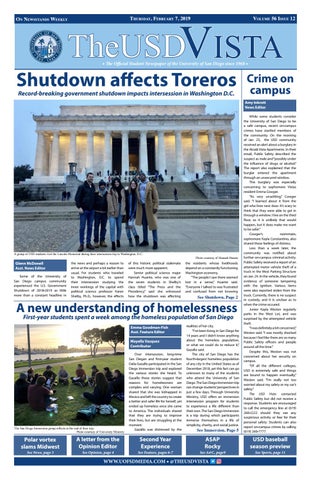
Shutdown affects Toreros Record-breaking government shutdown impacts intersession in Washington D.C.
Crime on campus
Amy Inkrott News Editor
A group of USD students visit the Lincoln Memorial during their intersession trip to Washington, D.C.
Glenn McDonell Asst. News Editor Some of the University of San Diego campus community experienced the U.S. Government Shutdown of 2018-2019 as little more than a constant headline in
the news and perhaps a reason to arrive at the airport a bit earlier than usual. For students who traveled to Washington, D.C. to spend their intersession studying the inner workings of the capital with political science professor Karen Shelby, Ph.D., however, the effects
of this historic political stalemate were much more apparent. Senior political science major Hannah Huante, who was one of the seven students in Shelby’s class titled “The Press and the Presidency,” said she witnessed how the shutdown was affecting
Photo courtesy of Hannah Huante
the residents whose livelihoods depend on a constantly functioning Washington economy. “The people I saw there seemed lost in a sense,” Huante said. “Everyone I talked to was frustrated and confused from not knowing
See Shutdown, Page 2
A new understanding of homelessness First-year students spent a week among the homeless population of San Diego Emma Goodman-Fish Asst. Feature Editor Mayella Vasquez Contributor
The San Diego Immersion group reflects at the end of their trip. Photo courtesy of University Ministry
Polar vortex slams Midwest See News, page 3
Over intersession, long-time San Diegan and first-year student Dalia Gazallo participated in the San Diego Immersion trip and explored the various stories she heard. To Gazallo these stories suggest that reasons for homelessness are complex and varying. One woman shared that she was kidnapped in Mexico and left the country to create a better and safer life for herself, yet ended up homeless once she came to America. The individuals shared that they are trying to improve their lives, but are struggling at the moment. Gazallo was distressed by the
realities of her city. “I’ve been living in San Diego for 14 years and I didn’t know anything about the homeless population, or what we could do to reduce it,” Gazallo said. The city of San Diego has the fourth-largest homeless population of any city in the United States as of December 2018, yet this fact can go unknown to many of the students who attend the University of San Diego. The San Diego Immersion trip can change students’ perspectives in just a few days. Through University Ministry, USD offers an immersion intersession program for students to experience a life different than their own. The San Diego Immersion is a trip during which participants immerse themselves in a life of simplicity, charity, and social justice.
See Immersion, Page 5
While some students consider the University of San Diego to be a safe campus, recent on-campus crimes have startled members of the community. On the morning of Jan. 23, the USD community received an alert about a burglary in the Alcalá Vista Apartments. In their email, Public Safety described the suspect as male and “possibly under the influence of drugs or alcohol.” The report also explained that the burglar entered the apartment through an unsecured window. This burglary was especially concerning to sophomore Vistas resident Emma Cowger. “Its very unsettling,” Cowger said. “I learned about it from the girl who lives next door. It’s scary to think that they were able to get in through a window. I live on the third floor, so it is unlikely that would happen, but it does make me want to be safer.” Cowger’s roommate, sophomore Kayla Constantino, also shared these feelings of distress. Less than a week later, the community was notified about further on-campus criminal activity. Public Safety received a report of an attempted motor vehicle theft of a truck in the West Parking Structure on Jan. 29. In the vehicle, they found evidence of someone tampering with the ignition. Various items were also reported stolen from the truck. Currently, there is no suspect in custody, and it is unclear as to when the crime occured. Junior Kayla Weston regularly parks in the West Lot, and was surprised by the attempted vehicle theft. “I was definitely a bit concerned,” Weston said. “I was mostly shocked because I feel like there are so many Public Safety officers and people around all the time.” Despite this, Weston was not concerned about her security on campus. “Of all the different colleges, USD is extremely safe and things are bound to happen eventually,” Weston said. “I’m really not too worried about my safety or my car’s safety.” The USD Vista contacted Public Safety but did not receive a response. Students are encouraged to call the emergency line at (619) 260-2222 should they see any suspicious activity or fear for their personal safety. Students can also report on-campus crimes by calling (619) 260-7777.
A letter from the Opinion Editor
Second Year Experience
A$AP Rocky
USD baseball season preview
See Opinion, page 4
See Feature, pages 6-7
See A&C, page9
See Sports, page 11
WWW.UOFSDMEDIA.COM ◆ @THEUSDVISTA
2
The USD Vista
◆
February 7, 2019
NEWS
Shutdown into the new year
The government shutdown brought Washington, D.C. to a standstill, impacting USD students
The United States Capitol is home to both houses of Congress. In December of 2018, the government was shut down for 35 days, impacting the lives of thousands of Americans.
Shutdown from Page 1
when the city was going to start back up again. It was just sad.” While in an Uber from her dorm to downtown, Huante said she and her driver discussed the sort of hardships he and others were enduring as a result of the downturn in spending caused by the hold on federal workers’ paychecks. “I mentioned how a girl on our program had actually been robbed at gunpoint while walking back to her dorm, and he said that he wasn’t all that surprised because the shutdown was causing people to do things they normally wouldn’t do,”
Huante said. “It was crazy for me to think about how a disagreement in government could lead to that kind of desperation. It made me rethink how many people were actually being affected.” According to The Washington Post, more than 9,000 furloughed federal employees in the district’s Metro Area applied for unemployment claims. However, those considered “essential” to government functions were required to come into work without pay and were not eligible to apply for the same benefits. While existing legislation guarantees back-pay for
Federal employees protested the government shutdown after weeks without pay. Photo courtesy of Victoria Pickering/Flickr
these individuals at the conclusion of a shutdown, research conducted by The New York Times indicates that only one-third of federal employees can afford to miss two weeks worth of paychecks. This pinch on the pocketbooks of those who typically frequent the neighborhoods surrounding federal buildings caused many of the local small businesses to shorten business hours or close altogether. Huante says this made it somewhat challenging for her and the other students to find a place to eat or grab a cup of coffee during their stay. “Once or twice we would make a trip to a restaurant only to find out it was closed just because it was too expensive for them to stay open without enough people coming in,” Huante said. “It felt really empty at some of the places we went, like a ghost town. It really gave us a different perspective on D.C.” The impacts of the shutdown caused Huante and the others to have to miss out on some of the activities they had been looking forward to planning their time in the district. “The shutdown definitely put a strain on our whole trip because we couldn’t do a lot of the things we wanted to,” Huante said. “We were able to see the monuments and the White House and all that but I think it would have been a much better experience if we were able to see all the museums. I really wanted to go to the ones I hadn’t been to, like the Smithsonian and the Museum of African American History.” While Huante was disappointed that the shutdown forced her to have to change her plans, she also recognizes the impact that it had on
working people in the district and wishes the seminar lecturers would have focused more on this aspect of the deadlock on Capitol Hill. “I feel like at some point it’s important to discuss the reality of the way that it’s hurting people,” Huante said. “Whenever one of our guest speakers brought up the shutdown, I felt like they would always talk about it in a way that avoided the
Photo courtesy of Wikimedia Commons
how the parties can work together, but it also sounded like they were cautiously optimistic.” Following the daily visits from both former and current officials, advisors, and other district professionals, Shelby and her students would then discuss the content of the presentations in the context of the press and its role in political messaging, the focus of
“It felt really empty at some of the places we went, like a ghost town. It really gave us a different perspective on D.C.” -Hannah Huante human aspect and instead focused on the ridiculousness of the political aspects. It was all about the political issues with very little mention of the big question of how all those workers are going to pay their rent and feed their families.” Karen Shelby is a professor of political science at USD and Assistant Director of the Institute for Civil Civic Engagement, a multiuniversity organization which hosts discussions and promotes initiatives designed to combat hostility and divisiveness in public discourse. She served as USD’s faculty liaison for the cohort of students who attended The Washington Center’s winter seminar session, allowing her the chance to listen to the same speakers as Huante and her fellow students. “The speakers were a mixture of White House and Capitol Hill insiders who really ran the gamut in terms of where they sit on the political spectrum,” Shelby said. “A lot of their emphasis was on bipartisanship and
the course. One of the big topics covered was the “game” quality of how political developments are sometimes expressed in popular media, a dynamic Shelby considers problematic. “The games rhetoric does all of us a disservice because it shifts the content of what media is presenting to who’s losing the game and who’s winning instead of being about the substantive policy matters,” Shelby said. “These issues are far more complex– we can’t just scan a headline in a blink and make a snap decision; we need to engage.” During their two-week immersion as Washington insiders, the group of seven USD students were encouraged to do just that. The context of the longest shutdown in U.S. history, while inconvenient, provided these students with a unique chance to reflect on the importance of functioning government while witnessing the fallout caused by its absence from within.
Volume 56 Issue 12
◆
NEWS
◆
3
The USD Vista
Polar vortex freezes the Midwest
Polar vortex fills headlines across the United States yet few understand this atmospheric phenomenon Luke Garrett Editor in Chief As the polar vortex swept across the Midwest, media headlines, and political banter this past week, many questions are still left unanswered about this atmospheric phenomena between the record-breaking negative-30-degree temperatures, Trump’s tweets, and this frigid event’s ominous yet intriguing name. What is a polar vortex? Is it the result of climate change? How is it that close to 68 million Americans experienced arctic temperatures? What are frost quakes and sea smoke? To understand such an occurrence, the scientific method comes in handy and goes as such. Observation: the tangible effects Midwesterners weren’t the only ones left affected by some of the lowest-recorded temperatures with schools and universities closing, public transportation schedules being altered, and beer delivery in Wisconsin being stopped. The earth, too, felt its wrath. Great plumes of sea smoke rose from the great lakes as if from a chimney, as the frigid air swept over the relatively tepid bodies of water that held above it a thin layer of warm air. This warm air contained evaporated water that was quickly condensed into fog. With the polar vortex moving low temperature over the Midwest’s relatively warm waters, sea smoke abounded last week as its creation is proportional to this difference in temperature. The land
was not safe from the polar vortex either, as it induced mini-seismic events through the Middle 48. Frost quakes woke and disturbed Midwesterners with great booming and cracking sounds. Water within the ground froze and therefore expanded, creating stress within the land leading to explosive reliefs of pressure – called cryoseisms. Theoretical context Despite the otherworldly effects of the polar vortex, it is a familiar and known occurrence to atmospheric scientists. The existence of these circumpolar westerlies has been known since the 1940s along with its cause: the temperature gradient between the poles and lower latitude. And yes, “these” is the correct pronoun in referring to the polar vortex, as it is in reality made up of two distinct circumpolar westerlies: the stratospheric vortex and the tropospheric vortex. The former is seasonal and occurs once the last sun of autumn sets and exists until the first sunrise of spring. It rests solidly in the tropospheric level from zero to 60 degree latitude and seldom affects its lower cousin, the troposphere vortex, as within the stratosphere there is little to impede its violently cold circumpolar winds. The latter rests below the former all year round, and covers a wider girth around the northern hemisphere, being bounded by 50-40 degree latitude. The troposphere vortex, unlike its seasonal sibling, has a more volatile
path as the water and land mass below often disturb this circumpolar winds path. In regards to extreme weather, the troposphere vortex is the main actor, although the stratospheric vortex also has potential to play a supporting role. Questions still unanswered Weather is a highly unpredictable phenomenon, and by extension the polar vortex, as experienced by Midwesterners last week, is difficult to link to direct causes. Debate over whether climate change played a role has risen as the leading question after last week’s cold spout and a conclusion has not yet been reached. The potential for the boundaries of the troposphere vortex to move equatorward, as was also the case in 2014, is often attributed to localized and shortlived boundary displacements and seen by atmospheric scientists as a normal climatology event. Although, some scientists across the world are looking deeper into the potential role of climate change as extreme weather conditions are on the rise. A recent study claims that the warming of the arctic weakens the winterly temperature gradient, thus creating a more chaotic stratosphere vortex. To do this, scientists took circumpolar data compiled over the past 37 years tracking the strength of the stratosphere vortex, anf found that the trend of the weakening stratosphere vortex matched that of the warming trend of the arctic. This is of importance as a
The polar vortex is made up of a stratospheric and tropospheric vortex. Photo courtesy of Audrey Garrett
weak stratospheric vortex is more susceptible to affect its lower siblings and create extreme weather conditions. Torero caught in the freeze To Ben Freidl, a recent USD graduate and current Master’s student at Northwestern, little else mattered about the polar vortex than staying warm in his studio apartment in Chicago. “All I know was that is was negative 20 outside and that was all I needed to know that this was a polar vortex,” Freidl said. ”Northwestern actually canceled classes entirely out of fear as there were reports that you would get frostbite if you were out for longer that 10 minutes. I couldn’t leave my place and I had my heat on, but even then there was ice forming on the inside of the windows.”
As a native San Diegan, this weather was like nothing Freidl had ever experienced, with the daily low rising to only minus 10 degrees on Wednesday, Jan. 30. “You are talking to a guy who grew up in San Diego so this is next level stuff,” Friedl said. “It is indescribable. It is painful when you walked outside. It hits your nose, then you start tearing up and your tears freeze, then your eyelashes freeze, then everything is frozen all around you.” Despite having an unexpectedly productive few days off school and a hint of cabin fever, Friedl’s most enduring sentiment concerning last week’s polar vortex were amazement and warning. “My message to San Diegans is stay the hell where you are,” Friedl said. “You are in a good spot.”
Help People Thrive with a Master’s in Social Work or Psychology Advance your skills as a professional social worker or counselor with Azusa Pacific’s Master of Social Work (MSW) or M.A. in Clinical Psychology: Marriage and Family Therapy (MFT) programs and graduate equipped to empower others with tools to thrive.
Master of Social Work
M.A. in Clinical Psychology: Marriage and Family Therapy
Prepare to help others through professional counseling, community-based interventions, and nonprofit leadership. California prelicensure courses are available.
Help couples and families restore relationships through this program that meets current California licensure requirements.
Full-time, part-time, and Advanced Standing options I 60 units
apu.edu/mft
apu.edu/msw
GET STARTED TODAY!
2-4 year program options I 67-86 units
Call (626) 815-4570 or email gpadmissions@apu.edu. 22972
4
The USD Vista
◆
February 7, 2019
OP I N ION A Letter from the Opinion Editor As The Washington Post put it in their Super Bowl ad, “Knowing empowers us. Knowing helps us decide. Knowing keeps us free.” Knowing has done all of these things since Thomas Jefferson’s idea of a well-informed electorate being crucial to any democracy. As journalists, we not only want people to pay attention to what is happening around them, but we value people forming an opinion and joining civil discourse. It is the purpose of any opinion section, whether it be The Washington Post or The USD Vista, to offer readers informed opinions about the world around them. Starting this semester, we are changing this opinion section to try to better fulfill that purpose. Our ultimate goal is to create an opinion section that provides the USD community with informed opinions about issues impacting this campus, this city, and the people who work, study, and live here. It is not something that will happen overnight, and it will not be a one-step solution. The first step in the renovation of this opinion section is involving the entire campus community in our journalistic process. It is our responsibility as journalists to serve the whole USD campus community, something we cannot accomplish if we do not pay attention to the many groups which come together at this university. We want to present a thorough cross-section of opinions, something we simply cannot do for a campus of over 5,000 students, let alone the faculty and staff, by ourselves. In order to appropriately serve this campus community, we welcome and strongly encourage contributions from outside our newsroom. Each week we hope to print a collection of stories that USD students think are the most important of the week, showcasing the breadth of issues that may impact both students and staff on this campus. These stories will be told by the people, we will only act as curators, ensuring that their opinion is presented in the best possible manner. Each week, we will also print letters to the editor written by students, faculty, staff, and sometimes other USD Vista editors. It is our hope that if people disagree with the opinions we publish, they will write a response and send it to us, as we will not shy away from publishing appropriate, respectful responses. We view a great deal of our role in creating this opinion section to be facilitating debates about issues which our generation will likely be tasked with solving. As part of that facilitative role, we will review all letters to the editor. However, everything published in this section, whether written by students, staff, or faculty, will always reflect solely the opinion of the writer. The USD Vista is essentially a small local newspaper, where USD is the area that we serve. With that in mind, our ambition is to work with our community to make an opinion section that fulfills its purpose. A section that offers informed opinions on issues affecting our world. A section that helps us know. Because there is no power like knowing. Sincerely, The USD Vista Opinion Staff
The USD Vista Luke Garrett - Editor in Chief Kaia Hubbard - Associate Editor Hannah Sonberg - Managing Editor Kathryn Querner - Copy Editor Monica Millan- Art Director Amy Inkrott - News Editor Eric Boose - Opinion Editor
Catherine Silvey - Feature Editor Danielle Agnello - Arts & Culture Editor Anderson Haigler - Sports Editor Zoé Morales - Photo Assistant Richard Benson - Distribution Editor Diana Percy - Social Media Manager Casey Donnelly- Social Media Assistant
Editorial – 619.260.4584 Business – 619.260.4714 www.uofsdmedia.com @TheUSDVista Elizabeth Brunelli - Finance Manager Rachel Steinheimer - Advertising Manager Gina Lew - Student Media Advisor Marie Minnick - Operations Advisor
The USD Vista publication is written and edited by USD students and funded by revenues generated by advertising and a student fee. Advertising material published is for information purposes only and is not to be construed as an expressed or implied endorsement or verification of such commercial venues by the staff or University. The USD Vista office is located on the fourth floor of the Student Life Pavilion in room 403B. All inquiries should be sent to: The USD Vista 5998 Alcala Park San Diego, CA 92110 Opinions expressed in this publication are not necessarily those of The USD Vista staff, the University of San Diego or of its student body. Letters to the Editor can be submitted to The USD Vista office. Letters should be limited to 300 words and must be signed. For identification purposes, USD identification numbers and writer’s year must be included in the letter. The USD Vista reserves the right to edit published letters. Any content sent to the editor will be considered for publication unless otherwise stated.
Volume 56 Issue 12
◆
FEATURE
◆
5
THE USD VISTA
F E AT U R E
Students serve those in need University Ministry students immerse themselves in the downtown homeless community
Immersion from Page 1 This year, the program took place over four days, from Jan. 14 to Jan. 18, and 10 first-year students participated. Students stayed in a space next to Our Lady of Guadalupe Church, outside of downtown San Diego, which resembles an indoor airplane hangar. Here, they slept on the floor with no phones or showers. First-year student Marlene Putros used this experience to reevaluate her own life. “It got me to reflect on myself,” Putros said. “I take things for granted while you see people who have almost nothing are sparked with joy and filled with faith.” Students like Putros found a renewed sense of gratitude after participating in the trip. Each day, the students spoke to people experiencing homelessness, trying to help in any way possible. Students reported that often homeless people exhibited positivity, and that many possessed a faith in God that created a sense of optimism and hope for the future. Through this experience, students may have attempted to live in conditions similar to those who are homeless. However, through the conversations they had, the participants realized their experiences during the short trip
could never fully replicate the daily toll extreme poverty takes on an individual. “One cannot feel the psychological and emotional burdens that come with homelessness,” Putros said. While placed in similar situations to the homeless, the students acknowledged that their experience was merely a simulation, and that they spent it knowing that they would all return to their safe, privileged lifestyles when immersion was over. Homeless people do not possess this luxury of certainty. Awareness of the difficulty to combat both the mental distress and day-to-day struggles of homelessness was noted by students, further encouraging them to gain an understanding of these individuals. In their attempts to connect with people, the students reached out to the community by walking or by using public transportation to navigate around locations homeless people commonly visit for support and resources. A few of these places included Chicano Park, Rachel’s Night Shelter, and Father Joe’s Village, all of which provide assistance to help people rebuild their lives. It was in visiting these places
USD students prepare a meal to serve to the local homeless population in downtown San Diego. Photo courtesy of University Ministry
that students heard the unique stories that allowed them to expand their knowledge and compassion. To some students, it became clear that the reasons behind the living situation of these individuals were different for each person. First-year Dalia Gazallo shared the story of a family to whom she served food. “The saddest part for me was seeing the children, toddlers, and babies that don’t even know they are facing homelessness,” Gazallo said, referring especially to a little girl she served. “She doesn’t know the life she is living is a life she
doesn’t deserve.” To Gazallo, this toddler is an example of how homelessness can impact anyone, and that the reasons are out of many individuals’ control in certain situations. First year Steven Dang echoed this sentiment. “They didn’t mess up–life messed them up,” Dang said. “To just get a job is not a simple solution. They feel excluded, and people look at them differently.” While students can learn in a classroom the statistics of the homeless population in San Diego and the reasons behind homelessness, these students
have shared that true empathy and understanding are difficult to attain without experience. For the students who attended the San Diego Immersion, their outof-classroom learning opportunity not only taught them invaluable understanding but also connected them with individuals who are often excluded from society. In this program, USD’s Changemaker mission is taken to heart, connecting the university with the surrounding community and attempting to change the world for the better by gaining compassion for what may not always be understood.
6
THE USD VISTA
◆
FEBRUARY 7, 2019
S Y E : A H O L I D AY ABROAD How unfamiliar territory can be the perfect setting for unexpected friendship
MEL VETTI F L O R E N C E
Sophomore
“My favorite memory was
climbing the 463 stairs to the top of the Duomo! The views at the top were incredible and it was so cool to see Florence from a different perspective.”
Photo courtesy of Mel Vetti
Photo courtesy of Michael Hanna
MICHAEL HANNA Sophomore
“My favorite part of the trip was
walking around the city with the other students and seeing the amazing sights that Florence had to offer. It also worked out perfectly because walking so much everyday made me feel better about all the pasta I was eating!”
Photo courtesy of Raffaella Armeni
RAFFAELLA ARMENI Sophomore
“
My favorite SYE memory was going on a class field trip to the Gucci Gardens and being the first people to see their newest art installation!”
Volume 56 Issue 12
◆
FEATURE
◆
7
THE USD VISTA
While some have traveled far from their respective hometowns to attend the University of San Diego, fewer know what it’s like to study in a completely different country upon entering college. Second Year Experience (SYE) gives students the opportunity not only to embark on an adventure to a far-away destination of rich culture and history, but also to learn in a new and exciting setting alongside their peers.
CHELSEA DALGADO Sophomore
“My favorite SYE memory was when
me and seven of my friends drove out to a stranded beach and had a beach day for five hours. The waves were insane and it was a beautiful day. We spent the day reading, talking, exploring, and going to a waterfall. That day, along with the whole rest of SYE, allowed me to create lasting relationships with amazing people.”
N E W Z E A L A N D
This winter, USD sophomores were given the choice to study in either Florence, Italy or Auckland, New Zealand. While students who traveled to Florence were greeted with ancient architecture and farm-fresh Italian cuisine, those who journeyed to Auckland spent their days surrounded by lush greenery, bright blue skies, and a sparkling oceanic horizon.
Photo courtesy of Chelsea Dalgado
Photo courtesy of Connor Gaffney
CONNOR GAFFNEY Sophomore
“My favorite parts were definitely going Photo courtesy of Leslie Martinez
LESLIE MARTINEZ Sophomore
“New Zealand exceeded all of my
skydiving over Auckland and learning to do the haka. I also liked visiting all the beaches especially since it was summer in the Southern Hemisphere”
expectations and is the most beautiful country I have traveled to. While in New Zealand I challenged myself to face my fear of heights and bungee jumped off the Auckland Bridge and ziplined through the Waiheke vineyards.” Spread by Monica Millan/ The USD Vista; Content by Catherine Silvey/ The USD Vista
8
The USD Vista
February 7, 2019
◆
Satire: Curse from 2007 chain mail finally lifted
Noah Staninger Satire Columnist You’ve just come home from a long day of fourth grade. Spending a whole afternoon doing long division can be taxing on a young mind, so you just want to relax. What is there to do? “Drake and Josh” is on, but it’s a rerun. You check the freezer but you’re all out of hot pockets. Mom took away your DS. Alec can’t come over because he called you a “a**butt”. Your Tamagotchi is still alive so you can check that off. You already bumped The Jonas Brothers on your iPod Nano, and you’ve already watched all the
cursed with bad luck for 12 years. But you’re much too smart for that – after all, how can an email cause bad luck? You forget about it and move on. Your childish carelessness will be your downfall. You didn’t notice anything at first. The bad luck wasn’t immediate and dramatic, instead it was deliberate and subtle. That same evening you go to Blockbuster to return the rentals but there’s a sign on the door. It’s going out of business. Months go by. You graduate elementary school and go on to middle school. It’s terrible. You make some regrettable fashion choices, childhood friendships unravel,
“Your Tamagotchi has died a long time ago. Your childhood pet is now also dead.”
Blockbuster rentals. With your and just when you thought it
worse, you hit options limited, you decide to go couldn’t get any on the computer, and after a few puberty. Acne, voice cracks, hair
short minutes, Internet Explorer is in new places. Then, some good finally up and running. You go to news. You hear that the world this cool new site called YouTube, is supposed to end in 2012. The
annihilation will where a grown man tells you to sweet release of leave Brittany Spears alone. You go finally save you from yourself. But
on Club Penguin for a while. You’d your bad luck prevails because check your MySpace but mom nothing happens,
and the year is said you’re not allowed to have now 2013. one. But what she doesn’t know You’re in high school. It’s is that you have your very own nothing at all like high school Hotmail account. The only new musical. No one is singing and message comes with the subject dancing. Your Tamagotchi has line “FORWARD THIS FOR GOOD died a long time ago. Your LUCK.” You read it and it says that if childhood pet is also now dead. you don’t forward this to 10 other Kanye got weird,
“The Office” people in the next hour you’ll be ended, The Jonas Brothers broke
up, and you can’t find a date to homecoming. What’s worse is that your still going through puberty, even though it’s been a few years now with absolutely no signs of slowing. How did you end up
can’t get any worse, but you were wrong about that email, and you’re a damnable fool if you think it won’t get worse. The years that follow continue to demonstrate how the ignorance
“The Jonas Brothers break up and you can’t find a date to homecoming.” playing the tuba? The promises of a bright future slips through your fingers as you see the world capris crumble around you into some twisted perversion of what should have been. You think your luck
are is
of youth would orchestrate your doom. You find yourself in college, but are you studying something useful like law, business, or medicine? No, you’re majoring in the humanities. You’re not
going through puberty anymore but you’re still awkward as ever. You’ve gained weight. You have no money. The hair on your scalp relocates with reckless abandon to other strange locations. Fascism is on the rise, climate change has gone from distant prophecy to tangible reality, and you still don’t have any hot pockets in the freezer. Existence is pain. If only you’d forwarded that email from 2007. But then you realize something. It’s 2019. It’s been 12 long years. Could it all finally be over?
oi
t
ii Eihr tfFahFT U
notennHEffnettitiitttiti is.i o
i
gp Tht
frittifies I
Audrey Garrett/The USD Vista
Volume 56 Issue 12
◆
ARTS & CULTURE
◆
The USD Vista
ART S & CULTURE
9
A$AP Rocky “Tests” his audience A$AP Rocky’s Injured Generation Tour Takes on S.D.
A$AP Rocky performs “Gunz N Butter” at Pechanga Arena for a dynamic crowd in San Diego, Calif.
Danielle Agnello A&C Editor On Wednesday, Jan. 30, the chart-topping Harlem rapper A$AP Rocky came to San Diego to perform at Pechanga Arena. The artist’s Injured Generation Tour included songs from his latest album, “Testing,” as well as hits from “AT.LONG. LAST.A$AP,” released in 2015. That being said, A$AP Rocky kicked off the concert with a test for his audience, creating an interactive experience for the energetic crowd, while ensuring the audience was all on the same page – as they are one generation. The crowd immediately turned their attention to the massive screen directing the test. “Next, we will demonstrate ‘mosh pit,’ ‘smile,’ ‘frown,’ ‘applaud,’” the screen demanded. “Now that you understand the rules, let’s begin.” Opening with “A$AP Forever,” Rocky pumped up the crowd as he passionately sung the lyrics and jumped around stage with his face wrapped in a ski mask. Half-way through the concert, Rocky finally took off the mask, initially exposing his identity, his race, and his color. Despite all of these factors which diversify a generation, Rocky emphasized that we are all one. Rocky exuded energy not only on the stage, but on a car descending from the ceiling as he belted “Gunz N Butter.” Rocky’s distinct sound coupled with the extravagant special effects and elaborate stage design showed the audience that society is even greater than his dedication to creating a unique hip-hop sound, which yields no limits. His setlist was interrupted by these tests, and intermittent
sermons from Rocky on his belief that we are an injured generation, creating a sense of community with the crowd, generating unbelievable jubilation and cooperation from the audience. The crowd listened in awe to his instructions. “Make some noise if you know how to mosh pit out here,” Rocky said. “Pay attention to your boy Pretty Flacko one time, the way that you mosh pit is you open up a circle and run in a circle, you don’t crash and collide, you run in a circle, when you open up a circle. Everybody go to the back. We want one mosh pit.” Rocky consistently stated how there is no fighting, only love because we are one. This constant theme throughout his performance further explained the purpose of “Testing” and his understanding of the world as an accepting place for all people. Shortly after creating one large mosh pit, Rocky invited two young men, one black and one white, onto the stage to join him for his next song, “Wild for the Night.” Rocky gave the two a pep talk on stage. “Listen, when you come to the Injured Generation Tour, we’re not black, we’re not Spanish, we’re not white,” Rocky said. “We are one generation, we are purple people, so technically you guys are brothers at the end of the day.” Another test then interrupted the performance and explained detailed instructions how to properly “mosh” on the big screen. The crowd’s unity and support for each other further exhibited the A$AP Mob frontman’s powerful presence and ability to successfully guide a mass amount of people. Rocky also handed out water bottles to the crowd on the floor,
particularly those who cooperated with his instructions to create a mosh pit. Further prompting the crowd to buy into his belief of society as one whole, Rocky insisted that the audience did not fight over the water bottles. Rather than fighting for the water, he commanded everyone to share. Rocky sought support from his audience throughout the duration of his performance in hopes of successfully communicating his message to spread love among each other. While Rocky encouraged his
audience to love and support each other, he also expressed his appreciation and respect for other artists of the hip-hop genre when he sang “Plain Jane” by A$AP Ferg, claiming it’s his pump-up song. Rocky manifested an unconditional admiration and recognition for other members of A$AP Mob, the American hip-hop collective of which Rocky is a part. Closing his performance with the song, “L$D” the first track off his first album, Rocky communicated his immense gratitude for the entirety of the crowd’s love and
A$AP Rocky keeps the crowd wanting more as his performance comes to a close
Danielle Agnello/The USD Vista
for joining him along his journey with the Injured Generation Tour. Overall, Rocky showed his audience the beauty of acting as one generation, one powerful entity uniting to listen and to interpret his perception of the world through his creation of “Testing.” Rocky’s music amplifying from the speakers was the initial expectation, but beyond his memorable performance, Rocky constructed a strong sense of community, succeeding in his pursuit to revolutionize the minds of the injured generation.
Danielle Agnello/The USD Vista
10
The USD Vista
◆
February 7, 2018
Stibbon and “the innocent eye” Campus community provides space for remembrance and celebration
AJ Dinsmore Asst. A&C Editor On Wednesday, Jan. 30, students and faculty of the USD community gathered in the Humanities Center to hear artist Emma Stibbon speak about her dynamic paintings. Stibbon is a painter and printmaker from Munster, Germany whose landscape-based artwork takes on extreme ecologies like icebergs and deserts. In 2013, Stibbon received the prestigious honor of being elected to the Royal Academy of Arts in London. Her work has been showcased throughout the world, and her large-scale color woodcut, “Aqueduct, Rome” (2011) is on display in USD’s Humanities Center. As the Humanities Center prepares to celebrate the upcoming 200th anniversary of John Ruskin’s birth, Stibbon’s presentation could not have come at a better time. John Ruskin was a controversial Victorian artist whose work has influenced a variety of figures such as Marcel Proust, Mahatma Gandhi, and Jeremy Corbyn. Ruskin coined the phrase “the innocent eye,” as he insisted art students must have a childlike perception of the things they encounter before they draw them. He suggests that artists should take nature for what it is, rather than letting it become obscured by preconceived notions. Stibbon has always admired Ruskin’s work, saying it was about time he was recognized. She is interested in
how its contemporary fashion gives it a type of “unfinished” look. Stibbon is especially inspired by Ruskin’s landscape paintings, and she went on to make her own renditions of them. Stibbons has traveled to Mont Blanc in order to find the same location of Ruskin’s “Mont Blanc” (1856) and “Glacier de Bossons, Chamonix 1849.” Stibbon mainly focuses on landscapes and cities and the accuracy of her paintings are proof of her extreme travels. Stibbon’s approach to her artwork is not one with shortcuts. She is interested in nature’s states of flux and change and seeks to be in the nature of the subject she is sketching. Before traveling to the site, she likes to make contact with an expert or scientist who can tell her about the landscape’s terrain. If the law allows, Stibbon prefers to explore the terrain by walking on and touching the earth so she can get a better idea of its texture and quality. She even shared a photo of her holding a sketchbook on a boat, surrounded by glaciers and rainfall. She initially goes to the site to gather materials and form a rough draft before she finishes her work in the studio. When looking back at her sketchbook, Stibbon said she has a better memory of the weather and what she was thinking when she uses her own sketches, than of just taking a photo. When learning about Stibbon’s techniques, the audience
Artist Emma Stibbon, whose nature-related art is displayed in the Humanities Center in Serra Hall. Photo courtesy of Royal Academy of Art, London
appeared to be most interested in her use of the ashes. Stibbon traveled to Hawaii to visit Mauna Loa, one of the largest and most active volcanoes in the world. She likes to collect ashes from the volcanoes in order to get the correct texture and color for her paintings. She shared a picture of many different collections of ash from various volcanoes. In some of her exhibitions, Stibbon has ash and stone on display under her painting because she wants
Prepare for the business of
to viscerally prove that she has been there, while also making the painting come alive. In this vein, she shared a painting that exhibited the neon glow of the lava at night among the dark ashes. Stibbon has always been fascinated by volcanoes because they show the “primordiality of nature” and was impressed by the people in Hawaii who still lived so close to the volcano. “We are always in an inevitable period of change,” Stibbon said, and
MAKING A DIFFERENCE
EARN YOUR 12-MONTH MBA AT POINT LOMA NAZARENE UNIVERSITY • Values-driven curriculum • Professional mentorship network • Hands-on classroom experience
Become the leader that others will follow. Learn more at pointloma.edu/12monthMBA
was inspired that the Hawaiians have fearlessly accepted that. Stibbon creates her art with a curious approach, as she explores the terrain and finds natural souvenirs. Stibbon showed her audience the beauty the natural world has to offer which was a great contribution as USD kicks off Ruskin’s 200th birthday celebration. His birthday celebration will be held on Friday, Feb. 8 in the Humanities Center Gallery.
Volume 56 Issue 12
◆
SPORTS
◆
11
The USD Vista
SP ORT S
Looking ahead to USD baseball After a subpar 23-32 season last year, the Toreros are prepared to turn things around in 2019
Anderson Haigler Sports Editor On a miserable February afternoon that featured heavy rain and gusty winds, the University of San Diego baseball team didn’t cancel practice. The tarp was on the infield, but so were the Toreros, taking batting practice in the rain with waterlogged tennis balls. An unconventional approach, no doubt, but a serious and focused effort nonetheless, with USD baseball head coach Rich Hill throwing to his players and offering the same coaching he would if it were a more typical sunny San Diego Saturday. With the first pitch of their 2019 season under two weeks away, USD was determined to get their work in one way or another. A testament, perhaps, to the sense of determination the Toreros possess to turn things around following a disappointing 23-32 finish last season. “We have a saying here, it’s three words: adapt, improvise, and overcome,” Hill said. “We only have so many days to practice before the opener, and there’s always something you can do, there’s so much to work on.” Hill’s team has been working to turn things around with the help of two new assistants: pitching coach Matthew Florer and hitting coach Brock Ungricht, both of whom were hired last June. According to both Hill and his players, the transition process with the two new coaches has been nearly seamless. “With the new coaches, it feels like they’ve been around for years,” infielder Paul Kunst said. “They’re high energy, they’re a younger group than what we’ve had, so they understand where we’re at.” Though USD gained two new coaches in the offseason, they also lost several talented players to Major League Baseball (MLB)’s
USD baseball head coach Rich Hill (right) said that his team is motivated and well-prepared to bounce back from their at-times disappointing 2018 campaign. Photo courtesy of Thomas Christensen
draft. Utility player Jay Schuyler, outfielder Brhet Bewley, and pitchers Nick Sprengel and Paul Richan had their names called by the Cincinnati Reds, the Kansas City Royals, Tampa Bay Rays, and the Chicago Cubs, respectively. As a result, the Toreros will have some significant gaps to fill in their lineup. However, Hill believes that USD will be well-equipped to succeed in their absence. “It’s the same old story with USD baseball,” Hill said. “We’ve sent more guys into the pros than anyone, certainly in our
conference. We expected to lose those guys, so it wasn’t a real shock. We’re like emergency room doctors here — we get these guys for 36 months and we gotta make them as good as we can possibly make them, then send them on their way. So, we’re ready.” Without Schuyler, Bewley, Sprengel, and Richan, the Toreros’ roster will feature a diverse mix of talent, with 13 first years and nine seniors on the team, a combination that Hill hopes will lead to success. “It’s a very eclectic mix,” Hill said. “The older guys really haven’t
Shane McGuire, Adam Kerner, and Jeff Houghtby will all return for USD, and are expected to be significant contributors. Photo courtesy of Thomas Christensen
played a lot, or had a ton of success, and that’s why they’re still here as seniors. We’re anticipating that this is the time for them to break
back end of games.” In addition to Murphy, several fresh faces for the Toreros will also contribute on the mound.
“We’ve had a lot of people step up this year in the fall ... It’s a new year and we plan on having a good season this year.” -Paul Kunst out. We have some very talented younger guys, but they’re just inexperienced and unproven. The talent level is there, but the fact that they haven’t proved anything is also there.” This lack of proven talent leaves multiple question marks for the Toreros, most notably on the pitching side of things. “I think the number one thing we need to improve on is pitching,” Hill said. “We’ve made some strides, it is still a work in progress. We’re still trying to determine roles, and go from there.” Coming off of a 2018 season in which his pitching staff posted a West Coast Conference (WCC)worst ERA of nearly 6.00, Hill stated that he will look to junior lefty Chris Murphy to lead the way. “I think Chris Murphy has earned that distinction right away early in the season,” Hill said. “Anthony Donatella has been very steady, if not spectacular on some days. Travis Kuhn is kind of a high-energy, one inning guy, he’s been up to 95 miles-per-hour in scrimmages. If he can harness that, he has a chance to be good at the
“We really like Josh Hendrickson, the Aussie, who was drafted last summer out of junior college,” Hill said. “And we like Grady Miller, who was a Friday night guy at Portland two years ago.” Hill also noted that he expects high profile recruits and that first years Jake Miller, Noah Owen, Cade Brown, and Jack Dolak have a chance to compete for innings. Offensively, the Toreros will have a bit more proven experience, returning several players from their starting nine that was among the WCC’s best in batting average, runs batted in, and extra base hits last season. “We have three freshman All-Americans returning in Tora Otsuka, Shane Mcguire, and Adam Kerner, and I really love those guys, I love their approach, the way they work, and their skill set,” Hill said. “Paul Kunst has arguably been our best guy for the last two years, and he’s back as well.” With this varied roster, USD will begin their 2019 season
See Baseball, Page 12
12
The USD Vista
◆
February 7, 2019
First pitch approaching for USD Toreros will face formidable competition both in and out of the West Coast Conference this season
Junior utility player Paul Kunst batted .299 with 11 doubles last season. Hill described him as being “arguably our best guy for the last two years” at the plate. Photo courtesy of Thomas Christensen
Baseball From Page 11
with a formidable slate of nonconference games that includes match-ups against Cal State Fullerton, Oklahoma, Texas Christian University (TCU), and Coastal Carolina University, as well as games in the Seattle Baseball Showcase, which is set to be played in T-Mobile Park, the home of MLB’s Seattle Mariners. A challenging non-conference
even tougher. Finishing eighth out of 10 WCC teams last year with a 12-15 record in conference, the Toreros certainly have some work to do, and it won’t be an easy road back to contention. “I’d rather play anybody in the country non-conference than anybody in conference,” Hill said. “That’s how much respect I have for the conference.” More specifically speaking, Hill
“I think that we’ve got the best offense and defense top to bottom in the conference. I don’t think anyone can compete with the middle of our field.” -Coach Rich Hill schedule is nothing new for the Toreros, however. A quick look back at the early part of USD’s 2018 schedule shows that for better or for worse, the Toreros are accustomed to playing a rigorous set of games outside the WCC. “Nothing can be like last year because that was the number one ranked non-conference schedule in the country,” Hill said. “Whoever made that schedule, I don’t know how smart they were — that being me. This year, it’s along those lines with the likes of TCU at home, Oklahoma at home, on the road for the Seattle Classic. It’s daunting as usual.” A daunting early season schedule, indeed. Though his team went just 11-17 in non-conference play last year, Hill said that his team will be better prepared to succeed through their non-WCC slate in 2019. “I think our pitching staff is deeper this year to be able to handle the rigors of that,” Hill said. As challenging as the Toreros’ first 21 games may be, their conference competition may be
identified USD’s main challenges in the WCC to come in the form of Gonzaga University, Saint Mary’s University, Pepperdine University, and Loyola Marymount University. “Gonzaga’s pitching top to bottom is as good as I’ve ever seen it, and I’ve been in here for 26 years,” Hill said. “Saint Mary’s, same thing. Pepperdine is picked to finish third, and they won it last year, and they have everybody back. Loyola is kind of a sleeper to me because they have some young pitchers that have really blossomed.” Despite this plethora of pitching in the WCC, Hill said that he is confident in how his team will stack up. “I think that we’ve got the best offense and defense top to bottom in the conference again,” Hill said. “I don’t think anyone can compete with the middle of our field — catcher, second base, shortstop, and center field. But some of the other teams have better depth at pitching.” Regardless of the competition ahead of them, the Toreros are
determined to see better results than they did in their at-times disappointing 2018 season. The Toreros’ contingent of older, more experienced players will lead the way in this effort. Kunst explained how the team’s veteran leadership has taken charge in the offseason. “We’ve had a lot of people step up this year in the fall,” Kunst said. “We have a bunch of older guys, a bunch of people that have been around here a long time who know what we did bad last year, know what we need to work on. Everyone’s keeping each other accountable, whether you’re young or old, everyone’s on the same wavelength on working together and working hard. And kind of knowing what we did in the past, but flushing it. It’s a new year and we plan on having a good season this year.” Left-handed pitcher Chris Murphy added that the team will
place an emphasis on their mental game, especially with staying positive. “I think our culture has changed since last year,” Murphy said. “Last year it got kind of negative towards the end, and there’s some things we can agree on that we want to change, and hopefully we’ve done that. Keeping a positive outlook even when you lose a ballgame, I think rolling off of that will be important.” As he reflected on a busy offseason for the Toreros, Hill agreed with his players’ sentiments. “The leadership within the team has really stepped up,” Hill said. “Guys weren’t happy with the way things went (last season) and they’re really motivated for this year.” The Toreros open their 2019 season on Friday, Feb. 15 at 6 p.m. versus the Wagner University
Seahawks. Friday’s game will be the first of a three-game series against the Seahawks, with afternoon games on both Saturday and Sunday as well. Tickets are free of charge for all USD students with a valid Torero ID card.
USD BASEBALL OPENING WEEKEND: USD vs. Wagner University: Friday, Feb. 15 @ 6 p.m. Fowler Park Saturday, Feb. 16 @ 1 p.m. Fowler Park Sunday, Feb. 17 @ 1 p.m. Fowler Park
Multiple players cited an emphasis on accountability, as well as a change in team attitude as their main adjustments this offseason. Photo courtesy of Thomas Christensen