TheUSDVISTA
VOLUME 55 ISSUE 1
THURSDAY, SEPTEMBER 14, 2017
ON NEWSSTANDS WEEKLY
◆ The Official Student Newspaper of the University of San Diego since 1968 ◆
IN THIS ISSUE DACA Dreamers in danger See NEWS, page 1
Homelessness on the rise See NEWS, page 1
Toreros talk on campus dining See OPINION, page 3
Students enjoy Paseo de Colachis See OPINION, page 4
First years living in flex rooms See FEATURE, page 5
Helping out hurricane victims See FEATURE, page 6
Students attend summer festivals See ARTS & CULTURE, page 8
Day N Night performaces shine See ARTS & CULTURE, page 8
Volleyball earning early success See SPORTS, page 10
Tough tests for USD football season See SPORTS, page 12
Future of DACA in danger President Trump leaves the DACA program in the hands of Congress
Lilyana Espinoza News Editor On Sept. 5, President Donald Trump announced that the Deferred Action for Childhood Arrivals (DACA) program will no longer be accepting applications. The DACA program was a way to extend work permits to undocumented immigrants who came to the US when they were minors. The program was established in 2012 by President Barack Obama. About 800,000 immigrants between the current ages of 15-36 were granted work permits, social security numbers, and federal benefits. President Trump argued that President Obama bypassed Congress in order to provide these work permits and it is now up to Congress to find another way to create a pathway to US citizenship for these young immigrants. “I believe that real and positive immigration reform is possible, as long as we focus on the following goals — to improve jobs and wages for Americans; to strengthen our nation’s security; and to restore respect for our laws,” Trump said. According to the US Citizenship and Immigration Services, DACA will not be accepting new requests. However, they will be adjudicating initial requests that were accepted by Sept. 5. They will also no longer approve advance parole requests and only adjudicate renewal DACA requests received by Oct. 5, 2017. DACA recipients came to America as children and many of
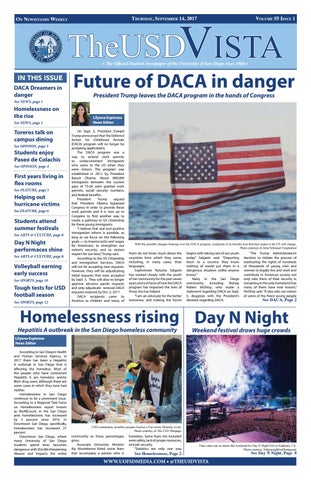
With the possible changes looming over the DACA program, recipients of its benefits fear that their status in the US will change. Photo courtesy of John Silliman/ Unsplashed
them do not know much about the countries from which they came, including, in many cases, their languages. Sophomore Natasha Salgado has worked closely with the youth of her community for the past seven years and is in favor of how the DACA program has impacted the lives of those she has helped. “I am an advocate for the better tomorrow, and making the future
begins with taking care of our youth today,” Salgado said. “Deporting them to a country they know nothing of would put them in a dangerous situation unlike anyone knows.” Many in the San Diego community, including Bishop Robert McElroy, who made a statement regarding DACA on Sept. 5, disagrees with the President’s decision regarding DACA.
“The Trump Administration’s decision to initiate the process of eradicating the rights of hundreds of thousands of young men and women to legally live and work and contribute in American society not only robs them of their security in remaining in the only homeland that many of them have ever known,” McElroy said. “It also robs our nation of some of the finest young people
See DACA, Page 2
Homelessness rising Day N Night
Hepatitis A outbreak in the San Diego homeless community
Weekend festival draws huge crowds
Lilyana Espinoza News Editor According to San Diego’s Health and Human Services Agency, in 2017 there has been a Hepatitis A outbreak in San Diego that is affecting the homeless. Most of the people who have contracted Hepatitis A are homeless and/or illicit drug users, although there are some cases in which they have had neither. Homelessness in San Diego continues to be a prominent issue. According to a Regional Task Force on Homelessness report known as WeAllCount, in the San Diego area homelessness has increased by 5 percent since 2016. In Downtown San Diego, specifically, homelessness has increased 27 percent. Downtown San Diego, where many University of San Diego students spend time, becomes dangerous with this life-threatening disease and impacts the entire
USD community members prepare food at a University Ministry event. Photo courtesy of The USD Webpage
community as these percentages grow. Associate University Minister Aly Monteleone listed some fears that accompany a person who is
homeless. Some fears she included were safety, lack of proper resources, and job security. “Statistics are only one way
See Homelessness, Page 2
Fans came out en masse this weekend for Day N Night Fest in Anaheim, CA. Photo courtesy @daynnightfest/Instagram
WWW.UOFSDMEDIA.COM ◆ @THEUSDVISTA
See Day N Night, Page 8
2
The USD Vista
◆
September 14, 2017
NEWS
“Dreamers” face uncertainty Congress will have the next six months to reform the DACA program
DACA from Page 1 who seek to build up our country for the next generation.” USD President James T. Harris III sent out a campus-wide email of his thoughts on the elimination of the DACA program. “This action strikes at the very heart of our values as a Catholic university by demonstrating a lack of compassion for our fellow Toreros who are working hard to earn a degree and find a legal path to U.S. citizenship,” Harris said. “As a university community, we stand in solidarity with those impacted by this order and encourage Congress to take action to remedy this situation.” Chair of the Presidential Task Force on National Immigration Dean Stephen C. Ferruolo reported that to the best of the Task Force’s knowledge there are currently five DACA students attending USD. According to Trump’s statement, the program will not be immediately eliminated as of now, since President Trump is giving Congress a six-month period to act. “This is a gradual process, not a sudden phase-out,” Trump said.
“Permits will not begin to expire for another six months, and will remain active for up to 24 months. Thus, in effect, I am not going to just cut DACA off, but rather provide a window of opportunity for Congress to finally act.” Ferruolo was able to look at the situation from a legal standpoint. “If the result of this is to clarify and to make permanent the legal status of DACA students and to give them a path to citizenship, I think that is a good thing,” Ferruolo said. “As a lawyer, law professor, and law dean I can certainly understand questions about the legality and constitutionality of what President Obama did because it was done by executive action rather than an act of Congress. The legality of what President Obama did is questionable. But I don’t question, nor do I think most Americans question, the morality of what he did.” Vice President for Student Affairs Carmen Vazquez suggested community involvement during this time. “Write, call or visit your local Congress representative,” Vazquez said. “This is a critical time to raise
DACA recipients hold on the hope that in the next six months Congress will pass a reformed DACA program. Photo courtesy of Zoltan Kovacs/ Unsplashed
our voices.” The San Diego UnionTribune/10News conducted a poll survey of 500 San Diego County residents about their thoughts on Trump’s action toward the DACA program. When asked if they thought Congress should pass legislation to continue a version of DACA, 63 percent reported should, 17 percent
reported should not, and 20 percent reported not sure. 29 percent said Congress will pass legislation to continue a version of DACA, 30 percent said will not, and 42 percent were unsure. During the next six months, DACA is in the hands of Congress to decide the fate of these immigrants. The USD School of Law Immigration Clinic provides services and legal
advice to the community on immigration matters. “In this critical period, priority is given to addressing any known DACA students and employees of the university,” Ferruolo said. Support for DACA students and employees are available in multiple offices across campus. For more information, visit the USD Inclusion and Diversity webpage.
Humanizing the homeless USD offers resources to combat homelessness in the San Diego community Homelessnes from Page 1
View of the local San Diego communities that surround the university’s campus. Photo courtesy of USD Law Webpage
The USD Vista Tayler Reviere Verninas - Editor in Chief Elisabeth Smith - Associate Editor Kelly Kennedy - Managing Editor James Douglas - Copy Editor Kaia Hubbard - Assistant Copy Editor Rita Srekais - Art Director Max Escutia - Assistant Art Director Lilyana Espinoza - News Editor
of measuring who is affected by homelessness,” Monteleone said. “I do think there’s a danger in lumping so many unique individuals into very basic categories. But, I also believe that having semi-concrete numbers allows us to ask better questions about the sources of systemic issues.” On Sept. 4, USD’s University Ministry hosted Local Changemaking, an event extending dignity to those experiencing homeless in SD. The event was sponsored by the Changemaker Hub and aimed to inform the USD community about homelessness and the importance of treating all people with dignity. Sophomore Eric Hanson, who is involved in University Ministry, shared his thoughts on how important dignity is when it comes to the homeless. “Recognizing that everyone has their own humanity is very important,” Hanson said. “When a person becomes homeless, from my experience with talking to them, there is a lot of fear that comes with being homeless. That fear sometimes manifests itself into that person’s social interactions, but it is
important to remember that they are still people.” Monteleone explains what the USD community can do to make a difference regarding this issue. “Changemaking first begins within yourself,“ Monteleone said. “Many people assume Changemaking to be something momentous, like altering a public policy or traveling to the edges of the world to engage in service. Those are both important possibilities. But, the true desire to make change — to learn from an encounter — must begin within oneself.” There are many different ways the community can become active in the issue of homelessness one of which is to donate. Instead of throwing away old clothes USD community members can donate them. The Mulvaney Center for Community, Awareness, and Social Action also offers programs that deal with realities and social issues of the San Diego Community to keep the community involved and aware. USD partners with Rachel’s Women’s Center, which provides a safe space for homeless and lowincome women. Students have the opportunity to make dinner for the
Editorial – 619.260.4584 Business – 619.260.4714 www.uofsdmedia.com ◆ @TheUSDVista
Nicole Kuhn - Assistant News Editor Taryn Beaufort - Opinion Editor Victoria Zielinski- Assistant Opinion Editor Abigail Gentry - Feature Editor Anderson Haigler - Arts & Culture Editor Noah Hilton - Sports Editor Jake Ellis - Assistant Sports Editor Walker Chuppe - Photography Editor
Cyrus Lange - Photo Assistant Ana Contreras Orozco - Photo Assistant Alex Worden - Distribution Editor Bailey Marie Donnelly - Finance Director Jacquelyn VanDenburg - Advertising Director Gina Lew - Student Media Advisor Marie Minnick - Operations Advisor
women as well as converse with them and hear their stories. The first day that students can go to help the center is Sept. 21. Monteleone speaks to the importance of listening to the stories of those who are homeless and respecting them as people. “It’s very important to ask for and actively listen to others’ stories,” Monteleone said. “Doing so breaks down stereotypes. Once you’re invited to share in another person’s realities, you realize that individual is someone’s son, daughter, father, mother, or friend. They are loved by and love other human beings. They are always a beloved child of God. It’s also important not to approach those experiencing homelessness strictly from a deficit point of view; instead of just asking what their needs are, or how they are suffering, we should also ask what their gifts and contributions are.” Homelessness affects the community, but the Hepatitis A outbreak also highlights homelessness as an issue that can potentially have an impact on everyone. For more information visit University Ministry in the University Center.
The USD Vista publication is written and edited by USD students and funded by revenues generated by advertising and a student fee. Advertising material published is for information purposes only and is not to be construed as an expressed or implied endorsement or verification of such commercial venues by the staff or University. The USD Vista office is located on the fourth floor of the Student Life Pavilion in room 403B. All inquiries should be sent to: The USD Vista 5998 Alcala Park San Diego, CA 92110 The first copies of the newspaper are complimentary, all copies thereafter are a 25 cents charge. Opinions expressed in this publication are not necessarily those of The USD Vista staff, the University of San Diego or of its student body. Letters to the Editor can be submitted to The USD Vista office. Letters should be limited to 300 words and must be signed. For identification purposes, USD identification numbers and writer’s year must be included in the letter. The USD Vista reserves the right to edit published letters. Any content sent to the editor will be considered for publication unless otherwise stated.
Volume 55 Issue 1
◆
OPINION
◆
The USD Vista
3
OP I N ION
Diverse dining found on campus Students share their favorite on-campus eating spots
After undergoing extensive renovations, Aromas has become a more popular place for students to study, socialize, and snack. Other on campus dining options, including La Paloma and Tu Mercado, are also popular. Ana Contreras Orozco/The USD Vista
Taryn Beaufort Opinion Editor Of all the concerns students have regarding college, food can be one of the biggest. Most students go home to concerned family members who worry that their college student isn’t getting enough to eat. At the University of San Diego, students are at no shortage of options with over five dining locations from which to choose.
options diners can choose from; from classic American burgers to Vietnamese Pho, the choices are not limited. At the SLP, there is an array of 11 different stations to choose from for lunch. The Mu Shu counter offers authentic Chinese food such as orange chicken, Mongolian beef, and chow mein. The Clean Earth Kitchen offers a plant-based menu using clean ingredients to create vegan dishes to order. Heirloom Cucina serves woodfired pizza, piadine, and Italian casseroles, just to name a few. Sanchez is a big advocate of the large variety of choices the SLP
“Returning students will be surprised at the new additions this semester. Students can create hundreds of combinations with available menu items.” -Heather Lang Meal plan Dining Dollars may be used to purchase food at several different on-campus locations — Pavilion Dining, Aromas, Bert’s Bistro, Blue Spoon, La Paloma, Torero Tu Go (food truck), and L’atelier (inside Tu Mercado). Junior Sofia Sanchez takes advantage of the Dining Dollars that accompany her meal plan. “Anywhere I can spend my Dining Dollars is where you’ll find me,” Sanchez said. “All the food is pretty good on campus; you can’t really go wrong. It’s just a matter of what you are in the mood for.” The dining option that offers the most variety is the Student Life Pavilion (SLP). There are plenty of
provides. “The options are pretty much endless,” Sanchez said. “I find myself eating at the SLP more often than not, because there’s so many different options of what you can eat.” Despite having unlimited options to choose from, Sanchez can be frequently seen ordering from the same station every time. “My go-to meal is probably sushi,” Sanchez said. “You wouldn’t think that sushi at school is good, but it’s actually delicious and they have so many different rolls to choose from. I feel like I’m at an actual sushi restaurant.” On the contrary, junior Jake
A chicken wrap with a side of pita chips and hummus ordered from Tapenade. Walker Chuppe/The USD Vista
Bauman acknowledged the lack of options present at SLP dinner. “The SLP is probably my favorite for dinner, but I still get sick of it,” Bauman said. “They just have five stations [that are open for dinner] and it’s all the same every night.” Loryn Johnson, Director of Marketing, Auxiliary Services, spoke out on behalf of the Pavilion Dining. “More stations are actually open for dinner than lunch,” Johnson said. There are even additional stations open at dinner time — Embers BBQ, a pasta bar adjacent to Tapenade, and Clean Eath Kitchen [a vegan station]. Bauman suggested it would be more appealing if there were one station that offered a new cuisine every night in order to add variety. Heather Lang, Chef Manager of Pavilion Dining, offered a different perspective to SLP dining. “I think returning students will be very surprised at the new additions,” Lang said. “Students can create hundreds of combinations with the menu items available this
“The SLP is great because you see all your friends here, especially at dinner time,” Bauman said. “I have random conversations with four or five different people — I never get out of there.” Some students such as
“I always run into all my friends at the SLP. I have random conversations with people — I never get out of there.” -Jake Bauman Bauman believe that the prices of dining on campus aren’t very accommodating to those on a budget. “Everywhere on campus is ridiculously priced,” Bauman said. “In the morning I go to Tu Mercado to get coffee for $2.75 which is pretty expensive. You can go to Starbucks and pretty much pay the same thing and it’s better quality.” Students should not be deterred; it is still possible to eat a quality meal without having to bust open their wallet. “I’ve gotten away with getting a lot of food for only $4 at the salad bar [located in the SLP],” Bauman
“I find myself eating at the SLP more often than not, because there’s so many different options of what you can eat.” -Sofia Sanchez semester.” While the cuisine diversity may be slacking at the SLP for Bauman, he noted that the company is never lacking.
their expenses on food, there are other ways to skirt high prices. Students can bring snacks from home to help get them through their day; then they only have to worry about paying for one meal. Senior Mallery Keifus tends
said. “Tu Mercado has sandwiches for $6.50 and you get a side of salad, chips, or fruit — it’s pretty filling for that price.” For students trying to limit
to favor some of the healthier options offered on campus. “Once Aromas reopened, I found my new go-to place,” Kiefus said. “They have a great variety of options for both breakfast and lunch.” Kiefus will often order avocado toast with egg to accompany her morning coffee before she heads to class. For this order it costs $1 for the toast, $3 to add avocado, and $1.50 to add an egg, totaling $5.50. Students can order a similar meal for around the same price and have the option to pick and choose what toppings to add to their toast, with each topping varying in price. USD offers a bit of everything to all customers in search of food. Most students probably don’t attend USD for the quality of the on-campus food, but that’s not to say it isn’t a nice addition. There is something to satisfy the healthconscious eaters, the budgetconscious eaters, and those who are searching for a delicious meal.
The SLP salad bar offers a wide range of toppings available to choose from. Ana Contreras Orozco/The USD Vista
Have an opinion? Write a Letter to the Editor to be considered for publication in The USD Vista. Contact vistaeditor@sandiego.edu for more information. The views expressed in the Opinion section are not necessarily those of The USD Vista staff, the University of San Diego, or its student body.
4
The USD Vista
◆
September 14, 2017
New social hotspot takes over Toreros experience a hub for increased interaction inbetween classes
Taryn Beaufort Opinion Editor The start of the 2017-2018 school year was the first time students were able to see and utilize the Paseo de Colachis project. After students and faculty spent the second half of last year navigating closed sidewalks and loud noises, the University of San Diego finally welcomed the newlyrenovated plaza. After months of construction and pedestrian detours, it is no surprise that the campus community welcomed the finished plaza with open arms. Senior Madison Samuels could not believe the day had finally arrived when the construction was completed. “I think it’s very beneficial for the campus because it is more of a community now,” Samuels said. “It reminds me of a bigger university, like UCLA, just to have that common meeting space.” The university added an abundance of tables and chairs throughout the plaza for students to have more interactive spaces in between and during classes.“Last year, it was tough to find places on campus to do my homework
besides the library,” Samuels said. “It’s great they added a bunch of new tables to the area, allowing people to do their homework. All I want is to be able to sit outside and enjoy the sunny San Diego weather.” Samuels also noted that her favorite addition was the grass lawn. “You will definitely be able to find me sitting out on the grass,” Samuels said. “I’ll bring a little blanket and sit down to do some homework and people watching. This is why I am paying so much money; it’s because I have the green grass here.” What most don’t realize is that the Paseo de Colachis project can potentially change the social scene of USD’s campus. “I could definitely see it becoming the new social hotspot of campus,” Samuels said. “I’ve already seen organizations with tables in the new space and people playing out on the grass.” The south end of campus is a busy location with the majority of business classes held in Olin Hall, communication classes held in Camino Hall, and students frequently visiting Copley Library. In the past students had no place
A group of students play a friendly game of Spikeball on the new lawn. Walker Chuppe/The USD Vista
The new tables and umbrellas provide an additional relaxing location for passersby to enjoy while on USD’s campus. Walker Chuppe/The USD Vista
to congregate before or after classes. Now, Olin Hall, Camino Hall, and Copley Library all feed directly into the new pedestrian mall, naturally creating a common meeting ground for all. “Before if you wanted to stand and talk you would either be blocking the sidewalk or in the way of cars,” Samuels said. “It’s nice to have the option to walk out from class and be able to pause and continue that conversation without worrying about being in the way.” Junior Zaharias Kern did not hesitate to explain why she is already so fond of the new Paseo de Colachis. “It makes it feel more like a college versus a community college,” Zaharias Kern said. “Coming from another school that had a lot of grass and open space on campus it was nice to get that this year, because last year I missed that.” While the new pedestrian mall makes maneuvering around
campus a bit easier, it is not without some downfalls. “I think that it’s more accessible for pedestrian traffic, but makes it more difficult for vehicular traffic,” Zaharias Kern said. “It would be difficult living in Camino or Founders since you wouldn’t be able to have direct access from your car to your dorm.” Residents of Camino and Founders halls were able to have cars pull up in front of the dorms to make unloading and getting picked up very easy. The opening of Paseo de Colachis replaced the Marian Way road that allowed cars to drive from the south end of campus to the Immaculata. Junior Tia Phillipart commented on how the decreased accessibility for vehicular traffic could have a positive impact on the university’s environment. “Although the accessibility of cars has decreased, it has forced students to walk more,” Phillipart said. “I used to rely on the shuttle to take me from Serra down toward
the KIPJ, but now that I don’t have that option I find myself walking more.” Phillipart is not alone; almost all students now have to travel by foot if they want to go from one end of campus to the other. “It’s great that everyone has to take the same walkway to get around now,” Phillipart said. “I am always running into familiar faces and catching up in between classes, it breaks up the monotony of my class schedule.” There is more opportunity for students to connect with classmates without a road dividing them. Pros and cons aside, it is undeniable that the Paseo de Colachis project has brought a new vibe to USD’s campus. The scenic view of fountains and lush grass is preferable to the loud and inconvenient construction from last semester. The new pedestrian mall provides all who walk onto campus a front-row seat to the campus lifestyle.
DO YOU NEED TO R AISE MONEY FOR YOUR USD -REL ATED PROJEC T? Don’t use sites like GoFundMe, use Changefunding — USD’s own crowdfunding platform y 100% of the money you raise will go towards your initiative y No setup or monthly maintenance fees y Fundraising support from USD’s Annual Giving Office
TELL US ABOUT YOUR PROJEC T TODAY! sandiego.edu/changefunding Have an opinion? Write a Letter to the Editor to be considered for publication in The USD Vista. Contact vistaeditor@sandiego.edu for more information. The views expressed in the Opinion section are not necessarily those of The USD Vista staff, the University of San Diego, or its student body.
Volume 55 Issue 1
◆
FEATURE
◆
5
The USD Vista
F E AT U R E
First-year class closer than ever Incoming class grows in size, requiring some students into flex rooms
Elisabeth Smith Associate Editor Preparing to move into college is a stressful process, but finding out you’ve been placed in a dorm made for two people with furniture for three can throw off any first-year student. With an unusually large class of first-year students, Residential Life at the University of San Diego faced new challenges this summer when figuring out how to house all the incoming students. While traditionally first-year students overflowed into the San Antonio de Padua Apartments, this year the number of students was so great that Residential Life had to come up with a new solution: flex rooms. Flex rooms are rooms in firstyear housing halls where an extra set of furniture was added to a room. Rooms that were originally doubles became triples, and some triples became quadruples. These new spaces affected about 90-100 new students in 35 dorm rooms. First year Stephanie Maeda found out she had two roommates over the summer, but realized she was in a flex room in Founders when she moved into the room. Maeda and her roommates were assigned to a double which was converted into a triple. “It’s been homey,” Maeda said. “We do the best we can with what we have, but we’re kinda cluttered. We had to buy a lot of drawers to put under [my roommate’s] bed and my bed. It’s also tight sharing two closets for two people. And it also gets tight with the [two sets
First-year student Stephanie Maeda’s dorm in Founders Hall was converted from a double room to a triple, adding an extra bed and furniture to the already small room. Walker Chuppe/The USD Vista
20,” Tran said. “At first, I didn’t really know what it would mean and what size the room would be, so I was indifferent to it.” Tran explained that while move-in was chaotic, she has had a positive experience in the flex room. “The first week has been kind of hectic, but still really good,” Tran
“We do the best we can with what we have, but we’re kinda cluttered. We had to buy a lot of drawers to put under [my roommates] bed and my bed.” -Stephanie Maeda of ] desks and drawers.” Maeda said that Residential Life has not reached out to her and her roommates to accommodate their situation. “So [my roommate] put in a request to get her bed lifted on the first day we moved in, and I don’t think we’ve even heard back yet,” Maeda said. “They haven’t really reached out to us. But, besides the bed we haven’t really reached out for anything else.” Additionally, Maeda said that some of their furniture is falling apart while other pieces are missing all together. “My roommate’s desk is falling apart,” Maeda said. “Every time she bumps into [her desk] a piece of it pops off. Also, we don’t have a ladder so she’s been climbing up the back of the bed to get onto the top bunk.” Jordaine Tran is a first-year student living in a Maher flex room. Tran’s room is meant for three students, but has an added bed to accommodate four residents. Since she hasn’t lived in a dorm before, Tran said the news of living in a flex room did not affect her. “I found out my roommates in late July or early August, but I found out I was in a flex on August
said. “There’s a lot of activities on campus, and I’ve never shared a room with anybody before, so I’m getting used to sharing a room and other things. I’ve definitely felt accommodated by Residential Life. My RA and SA are really nice, and are really responsive to all of the questions that I have.” Dayanne Izmirian, the Assistant Dean of Residential Life, explained how the university tackled the challenge of having a larger incoming class. “I think USD did a good job of planning for this and thinking about what it meant [for the rest of campus],” Izmirian said. “We knew early on enough that we were going to have a larger class which is very exciting. And we were able to plan and think ahead how best to get students into the LLC program and comfortably placed. We worked very collaboratively and closely with our LLC partners, which are our Living-Learning Community partners to make sure that class sizes [for preceptorial classes] weren’t impacted, and we started that process early in the summer.” Assistant Vice President and Dean of Students, Donald Godwin, weighed in on the flex spaces.
“We met this challenge [of a larger class] by being creative and installing loft-style furniture in our increased occupancy rooms, also known as ‘flex rooms,’” Godwin said. “As I visited many of these students in their flex room during move-in day, most were pleased with the accommodations and appreciated the efforts made by the university to make students as comfortable as possible.” Godwin explained that the first-year residential class grew from 1071 students to 1153 students in the last year. To ease the transition for the students in flex rooms, Izmirian explained how Residential Life prepared for the incoming students. “[We know] that it’s not ideal, but at least we’re trying to make the best of it for people that we can,” Izmirian said. “Instead of just putting another bed in there, we tried to do some creative things to offset and I think it makes an
rooms. As an added bonus, Residential Life partnered with the IT Department and selected the flexroom students to participate in a pilot program for USD Voice. USD Voice is an application available on Amazon Echo where users can ask Alexa, which is the automated voice feature of the Echo, about campus hours, upcoming events, and more. “We decided this year that we were going to do a pilot program because Information Technology Services is working through these voice options of having an Amazon Echo which is set up with some USD services,” Izmirian said. “We were going to pilot it in approximately 30-40 rooms, so we were thinking of doing it with a couple RAs. Instead, we did decide to pilot it in the flex rooms as a way to just give an added amenity to the space and something fun.” In addition to furniture accommodations, Residential Life
“[We know] that it’s not ideal, but at least we’re trying to make the best of it, for people, that we can. Instead of just putting another bed in there, we tried to do some creative things to offset and I think it makes an impact.” -Dayanne Izmirian impact. We invested in some lofting units so that you can have a self-contained space, and we also are being very open to whatever furniture they want to have removed from their units.” In the past, Residential Life has prohibited students from removing furniture from their dorms or apartments because the university does not have space to store it. But to help the flex-room students, the department created storage units to store any furniture that residents did not want in their
reduced the cost of the flex rooms and are giving those students priority to move if space opens up in other units. Godwin said that the rates were reduced by 25 and 33 percent, depending on whether the flex room was being shared by an additional third or fourth person. “We also offered a break in the rate just as a way to make it more palatable,” Izmirian said. “Especially because they are impacted, the idea was not to generate more revenue off that,
per se, but to break even and be responsible stewards of the university’s resources still.” Izmirian noted that Residential Life made sure to communicate with the campus community early and often about the impact of the larger student class. They also put together off-campus resources with the Graduate Student Life Office to offset the impact. Izmirian said that the incoming class did not affect housing for returning students who were required to live on campus, but may have affected transfer students and upperclassmen who were not required to live on campus. “There was definitely an impact on our non-required transfer students who might have chosen to live on campus, but we did, by the end of the summer, at least get to offer [housing] to our entire waitlist,” Izmirian said. “But, you know, probably a few of them who would have wanted to live on campus moved off campus because we didn’t have space when they were looking.” Izmirian said that she did not notice that the larger, incoming class caused any negative effects over Olé weekend. “When I interacted with the class over Olé weekend, I have been really impressed with the spirit, the tenor, the positivity,” Izmirian said. “It seems like a really great class. But I always think that about every freshmen class. I just love working here and I love our students.” According to Godwin, this year’s large class is an anomaly, and the flex-rooms are only temporary. As first-year students adjust to their new housing and life on campus, time will tell if the residents’ attitudes toward flex rooms remain positive.
6
THE USD VISTA
◆
Volume 55 Issue 1
SEPTEMBER 14, 2017
◆
FEATURE
◆
7
THE USD VISTA
HOW TOREROS CAN HELP RELIEVE THE HURRICANE HURT Graphics by Rita Srekais/The USD Vista, Content by Abby Gentry/The USD Vista
Donate to the American Red Cross
With San Diego weather rarely deviating from 75 and sunny, it is easy to forget the devastation storms can create within a community. Most recently, Hurricane Harvey hit the southeast Texas coastal region. Hurricane Irma has now reached both the Caribbean Islands and the Miami, Florida area. Although the distance between San Diego and these areas seems vast, we are never too far to lend a hand. Here are some ways to help those who have been hurt by the recent destruction.
One of the quickest ways to help out is by making a financial donation through the Red Cross organization. You can do this by texting HARVEY or IRMA to 90999 for a $10 donation. Reaching beyond financial assistance, it is possible to help through the Red Cross by becoming a volunteer and heading to Texas or donating blood.
Order on Amazon
Amazon has established a Hurricane Harvey Community Relief Effort page where you may purchase goods from a list of supplies provided by Amazon. Each of item will be directly sent to the victims of Hurricane Harvey. With items ranging from the four dollar to $200 price range, there are options for every college student on a budget.
Donation Tips:
- Financial donations are preferred to material goods - Any contribution, big or small, is appreciated - Beware of scams and unofficial organizations asking for donations - Donate to well known organizations with a history of charity
The Roman Catholic Diocese of San Diego
The Catholic community in San Diego is working together to gather donations for the victims of Hurricane Harvey. All of the proceeds will go toward Catholic Charities USA and help out the damaged Catholic churches in the area. Donations may be paid at www.sdcatholic.org. Additionally, www.catholiccharities.org, a national Catholic non-profit organization, is collecting donations as well.
GoFundMe
Another quick and easy way to make a financial donation is through the website gofundme.com. Donors may select which individual or group they wish to donate to by reading a small bio about those in need. Each donation supports individuals with verified campaigns established through the website. This is the most direct way to see who your donation will help.
Purchase a pup
Donate to the Salvation Army
Similarly to the American Red Cross, the Salvation Army takes financial contributions to assist relief efforts. These donations will go toward stocking food trucks, setting up shelters, and supporting the disaster relief teams working in Texas and Florida. These donations may be paid at give. salvationarmyusa.org/site/Donation or by texting STORM to 51555.
Southwest Airlines flew about 80 rescue animals from the Houston, Texas area to find a temporary home in the Helen Woodward Animal Shelter in San Diego. Before this opportunity, these animals were close to being euthanized as their owners were displaced by the trauma of the storm. Those interested in adopting a pet must fill out an application and pay a visit to the adoption center. Many animals have also been brought to the Gaines Street Humane Society right by campus.
Tacos for Texas
Tacos Libertad, located in Hillcrest, has decided to donate proceeds from the month of September to help victims of Hurricane Harvey. Tacos Libertad is the only restaurant-for-charity in the area and usually donates proceeds to local programs, but in the wake of current events has decided to reach out beyond the San Diego community. Prices range from $3.50 to about $7.00 making this a cheaper option to contribute to the cause.
8
The USD Vista
◆
September 14, 2017
A RT S & C U LT U R E
USD takes on summer festivals Toreros make the most of summer while attending festivals across Calfornia
Anderson Haigler A & C Editor Summertime is ripe with music festivals, and University of San Diego students made sure to take advantage of that by attending festivals across California. Popular events included festivals such as FYF Fest, Hard Summer, and Outside Lands. FYF Fest, a three-day weekend festival, is held at Exposition Park in Los Angeles in late July. Exposition Park is a public park located in South Los Angeles, near the University of Southern
Toreros was Hard Summer Festival which was held at Glen Helen Amphitheater and Regional Park in San Bernardino. The festival, which ran in August, featured artists such as DJ Snake, Rae Sremmurd, and Migos. Senior Tiffany Tran went, and explained her perspective. “It’s not your stereotypical rave, it’s not as crazy as Electric Daisy Carnival, for example,” Tran said. “People go just for the music, and they always have a really good lineup. They had huge headliners like DJ Snake, but I really liked seeing two lesser-known artists, DJ Malaa and Tchami. It’s been at a different venue each year, but the Glen Helen Amphitheater definitely worked out.”
“Listening to artists like Snoop Dogg, Rae Sremmurd, and DJ Snake live was awesome. The audience was so energetic and fun to be around.” -Michael Gomez California campus. Headliners for the festival included Missy Elliott, Frank Ocean, and Nine Inch Nails. The festival has run annually since 2004. Senior Will Knopka attended the festival and shared which performances he experienced. “My main priority was seeing Frank Ocean,” Knopka said. “While waiting to see Frank I got to see MGMT and A Tribe Called Quest. They were alright, but nothing compared to Frank. His voice was incredible live, and he played most of his album “Blonde,” as well as his recent singles. He also brought out Brad Pitt. It was definitely one of the best performances I’ve been to.” Another popular festival for
Junior Michael Gomez also shared similar sentiments toward Hard Summer. “Listening to artists like Snoop Dogg, Rae Sremmurd, and DJ Snake live was awesome,” Gomez said. “The audience was so energetic and fun to be around.” Outside Lands, a three-day festival held in Golden Gate Park in San Francisco, was also popular among USD students this summer. Tiffany Tran also attended Outside Lands and enjoyed her experience. “The venue was crazy; it feels like you’re hiking through the woods the entire time,” Tran said. “There was a lot of indie music this year, with EDM music at night. I saw Cage The Elephant, and I
Toreros take a break during Outside Lands after enjoying the festival grounds and a variety of performances. Photo courtesy of Tiffany Tran
loved them. They’re known for their super lively performances, their singer was running all across the stage with his shirt off, and it was very retro.” Tran also enjoyed how the festival ended early. “You didn’t feel like you had to keep on pushing yourself to your limit. It was really an outdoorsy experience, you felt like you were going to summer camp, to be
honest. Everybody was wearing really fun clothes and there was a lot of fashion. You definitely had to dress appropriately with the cold weather, and everybody was on trend.” Senior Keegan Mulcahy also enjoyed the performances at Outside Lands. “It’s in Golden Gate Park, which is cool,” Mulcahy said. “I saw Louis the Child and he was definitely one
of my favorites. The Who was great to see live as well. What separated it from other festivals for me is that it’s not that big, and you can walk from each stage pretty quickly, and they had a lot of good food options, as well as art.” This summer proved to be a fun one for Toreros attending festivals across California, and the trend is sure to continue as the KAABOO and EDC festivals approach.
Stars come out for Day N Night Lil Uzi Vert’s and Chance the Rapper’s performances shine in Anaheim Anderson Haigler A & C Editor Angel Stadium usually hosts Major League Baseball games, but this weekend it played host to some of the biggest names in rap as Day N Night Fest came to Anaheim. Early Saturday, Day N Night began with a diverse lineup of up-and-coming artists as soon as the gates opened. But the festivities seemed to truly begin with Playboi Carti’s late afternoon set. Performing rousing renditions of his hit songs “Magnolia” and “wokeuplikethis*,” Carti set the table for singer SZA to take over on the Postmates Stage, the largest of three stages at the festival. SZA entered the stage to face what was the largest crowd of the day up to that point, a young group of festival-goers who seemed to be a mix between die-hard SZA fans and people pre-positioning themselves for a good vantage point of the next artist, Post Malone. SZA went on to perform a low-key, laid-back set that entertained the crowd. She
capped off a selection of songs from her new album “Ctrl” with a performance of fan favorite “Love Galore.” As SZA gave way to Post Malone, the energy of the crowd shifted. For the first time on Saturday, the crowd appeared to be fully engaged with the artist on stage, and Malone did not disappoint. Leading off with an emotional performance of “Too Young,” he went on to perform hits like “Go Flex” and “Candy Paint,” finishing with his smash hit “Congratulations,” much to the delight of fans. As the sky above Angel Stadium grew darker, so did the vibe onstage. Lil Uzi Vert set the tone for his performance with sinister visuals that included burning crosses pictured on screen. Vert began his performance with newer tracks like “Sauce It Up,” and “The Way Life Goes,” and the energy in the crowd was tangible. As his set progressed, Lil Uzi Vert electrified with performances of his early hits, including “Money Longer” and “You Was Right.” During his performance of “P’s &
Q’s,” Vert executed an extended stage dive, working his way to the middle of the crowd while the track played and bringing the excitement to an all-time high. The crown jewel of Lil Uzi Vert’s set, however, was his performance of his grungy anthem, “XO TOUR Llif3.” He fervidly performed the song as the audience sang along in a crazed fashion not yet matched that day. Following the song’s conclusion, Lil Uzi Vert proceeded to throw his microphone into the backstage area and demand the track be played again, this time for only the fans to sing along as he watched microphone-less. The audience reacted enthusiastically, as they sang perhaps louder than before and demonstrated the sheer popularity of Lil Uzi Vert and his hit song. True to its name, Day N Night Fest stretched into the late hours of Saturday. Chance The Rapper’s set did not begin until around 9:20 p.m., more than 40 minutes after Lil Uzi Vert left the stage. If Lil Uzi Vert brought a dark vibe to the stage, Chance The Rapper was
Fans excitedly awaited artists such as Playboi Carti and SZA to take the stage. Photo courtesy of Taylor Gonzalez
a beacon of hope. Leading with bright visuals for a performance of “Angels,” Chance went on to run through an impressive
tracklist: he covered almost all of his hits from his newest mixtape, “Coloring Book”, performing
See Day N Night, page 9
Volume 55 Issue 1 Day N Night from Page 8
songs like “Juke Jam,” “All We Got,” “Mixtape,” and “No Problem.” Chance then performed his parts of songs from Kanye West’s “The Life of Pablo”, providing emotional performances of “Ultralight Beam” and “Father Stretch My Hands Pt. 1.” Both songs were set to visuals of the two rappers performing together, though West did not make an appearance. Chance also sang hits from his second mixtape, “Acid Rap,” performing
songs like “Cocoa Butter Kisses” before closing with an extended performance of “Blessings.” At this moment, he engaged the crowd heavily during the gospel-like hit before taking a bow and leaving the stage. However, Chance wasn’t done yet, and the crowd seemed to know it. Amid chants of “one more song,” he returned to the stage for a sit-down, acoustic performance of “Same Drugs” before closing out his set for good. His set at
◆
ARTS & CULTURE times resembled a church sermon, featuring hands held high and heavy references to his faith, which was a stark departure from the woozy, drug-fueled sets of Post Malone and Lil Uzi Vert. This, however, did not stop him from performing the most captivating set of the night. Chance brought the audience together by taking suggestions and it seemed that no other artist from Saturday had everyone singing along like he did. His performance was captivating,
Left: Singer SZA takes the Postmates Stage Saturday afternoon, performing songs from her new album “Ctrl.” Anderson Haigler/The USD Vista
◆
9
The USD Vista
from his live band and his backup singers to his unmistakably raspy voice. Almost everyone seemed to leave with smiles on their faces. Chance provided an exciting end to what proved to be a starstudded day in Anaheim. From
Playboi Carti to Post Malone, Day N Night Fest brought out the stars, and judging by the crowds, it is safe to say they were well-received and their iconic performances should keep fans satisfied until next year’s Day N Night Fest.
Right: Lil Uzi Vert raps among the crowd following his signature stage dive. Anderson Haigler/The USD Vista
H
10
The USD Vista
◆
September 14, 2017
SP ORT S
Volleyball earning early success Toreros setting the stage for another run at the West Coast Conference title said. “That stadium was buzzing when we walked out onto that court. We were fired up and ready to play in front of the home crowd. We hosted the tournament, and wanted to bring that trophy with us.” While the Toreros ultimately fell to the Longhorns in four sets, the team used the loss as motivation as they flew to Utah for the Utah Classic last weekend, a showing that included sweeps of both Missouri and Green Bay. The successful start to the season has elevated the Toreros to number 17 in the nation, as one of the top programs on the West Coast continues to turn heads. After the first nine games Coach Petrie is very impressed with how her athletes have played so far. “Roxie Wiblin, who is our starting outside hitter, is producing a lot in just her first year on campus,” Petrie said. “Jayden Kennedy was recently named the conference player of the week, so I would love to see her keep up that production.” Kennedy, one of the team’s senior leaders, agreed that her teammates have played very well so far. However, she notes that there is still room for improvement. “I want to see the team continue to become stronger as the season progresses,” Kennedy
Jake Ellis Asst. Sports Editor The women’s volleyball team is consistently one of the strongest athletic programs at the University of San Diego. This year the team is off to a strong start, opening the season with six wins and three losses. According to head coach Jennifer Petrie, the team goal has always been the same. “We want to win the West Coast Conference,” Petrie said. “One of our goals, year in and year out, is to host the first and second rounds of the NCAA tournament.” The Toreros began their season in early August in a tournament across the Pacific Ocean, one in which they topped home team and nationally-ranked Hawaii in straight sets. Afterward, the Toreros returned home to host the San Diego Invitational, a tournament that included teams from across the country such as the Texas Longhorns, ranked fourth in the nation at the time. All tournament, Coach Petrie thought the atmosphere in the friendly confines of the Jenny Craig Pavilion could not have been better. “Especially for the Texas game, the atmosphere in the JCP was absolutely tremendous,” Petrie
said. “I want our girls to unlock our true potential.” The senior opposite hitter added that she’d like to see the team continue to aim high as well. “Our primary goal as a team is to win the West Coast Conference, but I want to see our team shoot even higher,” Kennedy said. “For me, there would be no better goal than to bring a national championship trophy back with us to San Diego.” Alongside those team goals, Kennedy noted that she has a few personal motivators as well as she begins her last season as a Torero. “My own personal goal is to be an All-American,” said Kennedy. “I would also like to be the Offensive Player of the Year for the West Coast Conference and make the All-WCC team.” Coach Petrie believes that along with Kennedy, the senior class will continue to be the driving force behind the team. “Kristen Gengenbacher, our starting setter, and Lizzy Tardieu, our starting libero, have really taken over our leadership responsibility,” Petrie said. “They are always the first ones to whip us back into shape.” Even though Coach Petrie has been impressed with her team’s performance so far, there are still some things she wants the team to improve upon. “I want to try
Senior setter Kristen Gengenbacher in action against the University of Hawaii. Photo courtesy of USD Athletics
to improve our blocking game,” Petrie said. “I believe that we can become a bigger force at the net. Our offense has been looking really good right now, so I want to keep balancing our distribution and our attack.” Even with those areas for improvement in mind, the team’s
strong start to the 2017 season has set them up well for continued success. With WCC play set to open for the Toreros next weekend, the team appears primed to climb to the top of the conference ladder once again and aim for an eighth consecutive trip to the NCAA tournament.
PLAY THE GAME THAT WILL CHANGE YOUR LIFE...
LASER TAG!
“COLLEGE COLLEGE NIGHT”
LATE NIGHT at the ZONE
GROUP EVENTS
Thursday — 3rd Game FREE
Friday & Saturday — Midnight to 2am
Huge Party Area to 150+ Guests
Wanna Hook Up? ...Uh, with sic deals that is. Visit www.ultrazonesandiego.com!
USD Greeks / Student Orgs:
20% OFF your event!
Contact a Group Events Coordinator at lasertag@ultrazonesandiego.com
FALL 2017 SEMESTER
TRANSIT PASS Exclusive student discount. Unlimited rides all semester.
$148 USD Undergraduate • $162 USD Law On sale until October 6 at the University Center Ticket Office.
ULTRAZONE • www.ultrazonesandiego.com • #ultrazonesd ultrazonesd 3146 Sports Arena Blvd. • San Diego, CA 92110
619.221.0100
Price includes a $15 University subsidy. Current, valid college student picture ID required. No replacements for lost, voided or stolen stickers.
sdmts.com/college
Volume 55 Issue 1
◆
SPORTS
◆
The USD Vista
NFL’s 98 season kicks off th
11
Football fans have plenty to watch for in the National Football League this fall
In the season’s opening game and a primetime matchup against the defending champion New England Patriots, rookie running back Kareem Hunt (27) put up big numbers for the Kansas City Chiefs. Photo courtesy of Sports Illustrated/Twitter
Sunit Bhakta Contributor It’s that time of year again, when Sunday becomes an unofficial holiday for 17 straight weeks for millions across the country. This past weekend, the National Football League (NFL) kicked off its 98th professional season. With a new season comes new hope, excitement, surprises, disappointments, and storylines for football fans to follow throughout the fall. After his Super Bowl win last February, one of the biggest things for fans to keep an eye on is whether New England Patriots quarterback Tom Brady can continue to outrun Father Time. Brady is coming off a season in which he looked much younger than his 40-year-old body should — a remarkable feat considering the grind of an NFL season and his availability throughout his career. After arguably the best Super Bowl performance ever, Brady is looking to continue his dominance of the league and add a sixth championship ring to his collection. However, it’s only a matter of time before his eventual regression comes. No great quarterback has continued to play at their usual elite level once he passed the 40-year mark. Two years ago, Brady was quoted as saying that he’d love to play close to 10 more years. He may be the greatest quarterback ever in terms of resume and accomplishments, and has developed a reputation for doing things no one else has done before, but many fans are anxious to see if he can defy expectations
again. While on the topic of elite quarterbacks, one might also wonder if Green Bay Packers quarterback Aaron Rodgers will ever get an elusive second championship ring. While Tom Brady may be the “greatest of all time,” there is no doubt that Rodgers is the “best” quarterback in the league today — and arguably the greatest ever — when it comes to pure talent and statistical production. A mix of some of the best qualities from the greatest quarterbacks in league history — Peyton Manning’s brain, Dan Marino’s arm, Joe Montana’s pocket presence, and John Elway’s legs — Rodgers’ talent should be expected to lead to more than a few championship banners. Unfortunately, the Green Bay Packers have failed to surround him with the talent needed to compete for championships consistently. Without Rodgers, it could be argued that the Packers’ roster would finish in the bottom half of the league, putting pressure on the Berkeley product to carry the franchise as long as he wears Green Bay green and gold. As a result, Rodgers hasn’t been back to the Super Bowl since he last won it in 2011, suffering heartbreaking losses seemingly every year. 2017 could be the year he overcomes the Packers’ poor defensive showings and makes his return to February football. Speaking of teams with questions on defense, fans should also have an eye on the Oakland Raiders as they look to improve on a surprising 2016 season. Led by MVP candidate Derek Carr, who quarterbacked a potent offense
before injuring his leg in the team’s next-to-last game, the Raiders beat preseason expectations last year, finishing 12-4 and making the playoffs as a wild card team. However, a closer look at the numbers shows that they also finished with a measly +31 point differential, a difference of just 1.9 points per game. To put that into perspective, last year’s two Super Bowl teams, the Patriots and the Atlanta Falcons, finished at +191 and +134, respectively. Point differential is an effective way to gauge the dominance of a team, and shows a simple point in this case: the Raiders may not be the title-caliber team some are expecting them to be this season. The team is young, so they are due to take the next step in their development, but their 12-4 record from last year seems to be at least partially a fluke, and expecting the same record this season may be a little too hopeful. Did they make enough quality moves on defense to help compliment an explosive offense? If not, they’ll be closer to middle-of-the-road than they were in 2016. Local fans, meanwhile, will spend 2017 without a team after the hometown Chargers moved north to Los Angeles in January. The relocation ended a 56-year run for the team in San Diego. With that much history thrown aside, the move angered more than a few fans in America’s Finest City, with some going so far as to purchase billboards in the Los Angeles area to voice their displeasure. The Chargers disappointed again in 2016, finishing a frustrating 5-11 despite possessing obvious talent on both sides of the ball. Longtime quarterback Philip
Rivers continued his run toward a potential Hall of Fame induction, and running back Melvin Gordon quieted doubters with a near1,000 yard season on the ground. Meanwhile, defensive end Joey Bosa, now in his second year in the league, showed the talent that made him a top-five pick in the 2016 draft. With a new head coach leading the way in Anthony Lynn, and in
a fight for fans alongside the Los Angeles Rams, can the Chargers finally get back to their formerlywinning ways? Perhaps only time will tell. Ultimately, football fans will have plenty to follow over the course of the 2017 NFL season, creating excitement and anticipation as the NFL begins another iteration in the American sports spotlight.
The Chargers and quarterback Philip Rivers will play in Los Angeles in 2017. Photo courtesy of National Football League/Instagram
12
The USD Vista
◆
September 14, 2017
Football facing tough early tests Toreros open with challenging slate against Western New Mexico and UC Davis
Noah Hilton Sports Editor For sports fans, September means just one thing: football is back. From Pop Warner to the professional ranks, the game dominates the national sports landscape every fall, grabbing the attention of fans with its acrobatic catches, pad-rattling hits, and late-game heroics. Here on the campus of the University of San Diego, it is no different, as the home team opens another season in Torero Stadium. This year’s team will look to build on arguably the best season in school history, as the 2016 Toreros won their eighth league title in the past 12 seasons and finished at number 19 in national polls. The team would go on to advance to the second round of the NCAA playoffs with a win over Cal Poly, the first playoff win in Football Championship Subdivision (FCS) history by a non-scholarship school against a scholarship program. In addition to the Toreros’ group success last season, members of the team garnered individual accolades as well. The program graduated a player to the National Football League ranks in Detroit Lions defensive back Jamal Agnew, while running back Jonah Hodges, wide receiver Brian Riley, and defensive end
Jonathan Petersen all garnered end-of-season recognitions. In 2017, the Toreros appear primed to repeat that success, and early results paint a promising picture. The team opened their season on Sept. 2 at home against Western New Mexico. Despite a tough opening quarter that saw the visiting Mustangs pull out to an early 13-0 lead, the Toreros maintained their composure and managed to battle back for a 34-20 win in front of a crowd of more than two thousand blue-clad fans. The difference maker was a USD defense that created five turnovers, providing the Toreros with short fields and easy opportunities for points. Junior linebacker Kim Mahoney forced two fumbles and recovered another, while sophomore cornerback David Tolbert and senior safety Ray Clark each had nine tackles. The offense, meanwhile, was paced by near-hundred yard games by running back Emilio Martinez and wide receiver Justin Priest. Despite being outgained by Western New Mexico by almost 200 yards, USD showed grit and determination in pulling out the win. Unfortunately, the same could not be said for this past weekend, which saw the Toreros visit UC Davis. USD appeared largely overmatched by the Aggies, who gain a distinct advantage with their ability to offer scholarships
to
Junior running back Emilio Martinez, who had 140 total yards in his season debut, charges up field against Western New Mexico. Photo courtesy of USD Football/Twitter
incoming recruits. Despite keeping it close early, UC Davis pulled away the rest of the game, handing the visiting Toreros a 35-7 loss that dropped their record to 1-1 on the year. While the Toreros have shown that they have the talent to compete for the top spot in the Pioneer League again this year, the season’s opening games have exposed a handful of question marks that will need to be answered soon in order for that to happen. The first is the play of the defensive secondary, which has struggled mightily through two games, giving up passing totals
of 464 yards and 369 yards, respectively, against Western New Mexico and UC Davis. “It’s just these gash plays,” head coach Dale Lindsey said in a postgame interview with the San Diego Union-Tribune. “We’ve got to find an answer for those. We’ve got to find a way to stop the big play.” The second is the disappointing play so far of quarterback Anthony Lawrence, looked to as one of the offensive leaders on the team after the graduation of Riley and Hodges. Named to the preseason watch list for the Walter Payton award, the most prestigious
individual award given out by the FCS, Lawrence has failed to throw for more than 200 yards in back-to-back games while completing just 56 percent of his passes. “In two games, he hasn’t looked anywhere near as sharp as in the past,” Lindsey said of the quarterback. “He’s got to improve his play.” The team will now look ahead to an East Coast matchup this Saturday against 2016 Ivy League front-runner Princeton. The Toreros last faced Princeton in 2014 in San Diego, coming away with a 39-29 victory, and will look to replicate that success this weekend.
Senior offensive lineman Miles McArdle (55) and senior defensive end Jonathan Petersen (95) talk with a referee prior to the Toreros’ game against the UC Davis Aggies last Saturday. USD would go on to lose, 35-7. Photo courtesy of USD Football/Twitter