TheUSDVISTA
Volume 55 Issue 12
Thursday, February 8, 2018
On Newsstands Weekly
◆ The Official Student Newspaper of the University of San Diego since 1968 ◆
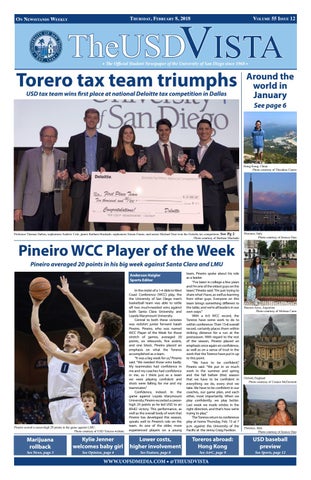
Torero tax team triumphs USD tax team wins first place at national Deloitte tax competition in Dallas
Around the world in January See page 6
Hong Kong, China Photo courtesy of Theodore Castro
Professor Thomas Dalton, sophomore Andrew Cole, junior Barbara Machado, sophomore Simon Finnie, and senior Michael Diaz won the Deloitte tax competition. See Pg 2 Photo courtesy of Barbara Machado
Florence, Italy Photo courtesy of Jessica Diaz
Pineiro WCC Player of the Week Pineiro averaged 20 points in his big week against Santa Clara and LMU
In the midst of a 1-4 slide in West Coast Conference (WCC) play, the the University of San Diego men’s basketball team was able to rattle off two much-needed wins against both Santa Clara University and Loyola Marymount University. Central to both these victories was redshirt junior forward Isaiah Pineiro. Pineiro, who was named WCC Player of the Week for those stretch of games, averaged 20 points, six rebounds, five assists, and one block. Pineiro placed an emphasis on what the Toreros accomplished as a team. “It was a big week for us,” Pineiro said. “We needed those wins badly. My teammates had confidence in me and my coaches had confidence in me, so I think just as a team we were playing confident and shots were falling for me and my teammates.” Confidence, indeed. In the game against Loyola Marymount University, Pineiro recorded a careerhigh 29 points as he led USD to an 89-82 victory. This performance, as well as the overall body of work that Pineiro has developed this season, speaks well to Pineiro’s role on the team. As one of the older, more experienced players on a young
team, Pineiro spoke about his role as a leader. “I’ve been in college a few years and I’m one of the oldest guys on the team,” Pineiro said. “I’m just trying to share what I have, as well as learning from other guys. Everyone on this team brings something different to the table, and we’re all leaders in our own ways.” With a 6-5 WCC record, the Toreros have some work to do to within conference. Their 15-8 overall record, certainly places them within striking distance for a run at the postseason. With regard to the rest of the season, Pineiro placed an emphasis once again on confidence, as well as on a sense of trust in the work that the Toreros have put in up to this point. “We have to be confident,” Pineiro said. “We put in so much work in the summer and spring and the fall before (the) season that we have to be confident in everything we do, every shot we take. We have to be confident in our coaches, our game plan, and each other, most importantly. When we play confidently, we play better. Last week we made strides in the right direction, and that’s how we’re trying to play.” The Toreros return to conference play at home Thursday, Feb. 15 at 7 p.m. against the University of the Pacific at the Jenny Craig Pavilion.
Kylie Jenner welcomes baby girl
Lower costs, higher involvement
Toreros abroad: Hong Kong
USD baseball preview
See Opinion, page 4
See Feature, page 8
See A&C, page 9
See Sports, page 12
Anderson Haigler Sports Editor
Pineiro scored a career-high 29 points in the game against LMU. Photo courtesy of USD Toreros website
Marijuana rollback See News, page 3
WWW.UOFSDMEDIA.COM ◆ @THEUSDVISTA
Buenos Aires, Argentina Photo courtesy of Melissa Carin
Oxford, England Photo courtesy of Connor McDermott
Florence, Italy Photo courtesy of Jessica Diaz
2
The USD Vista
◆
February 8, 2018
NEWS
USD takes Deloitte by storm Four Toreros on the tax team received a $10,000 institutional award
Andrew Cole, Barbara Machado, Simon Finnie, and Michael Diaz stand triumphant after the announcement of their victory.
Lilyana Espinoza News Editor Around this time last year, Accounting Professor Thomas Dalton began recruiting in hopes of finding five driven Toreros to compete in the 17th annual Deloitte FanTAXtic case study competition. This January, those recruited students finished first out of nine schools, claiming $2,000 for each participant and $10,000 for the University of San Diego. The money earned for USD will be put into the Accounting Development Fund, which will help the accounting department as well as current and future students at USD. Senior Michael Diaz, sophomore Andrew Cole, sophomore Simon Finnie, and junior Barbara Machado
who show potential in a world of taxes and business. The competition is composed of elements that professional accountants would face. For example: helping a company determine whether it should be a corporation or a partnership. The students need to be able to present information to a business in order to inform the company. They have to explain what decisions should be made from an accounting perspective based on the analyzed facts of the company. Cole found this opportunity as a way to provide insight on what accounting would be like in the workplace. “This competition is a great chance to get a feel for what you could be doing on a day-to-day basis in the tax field,” Cole said. “It can never hurt to meet and
“It was interesting because there were certain facts that someone would pick up on and others wouldn’t, which is the greatest thing about working as a team.” -Michael Diaz traveled to Deloitte University in Texas to compete in a two-day simulation after winning their regional competition this past November. Junior Siobhan Baloochi was also a part of USD’s tax team and contributed to the team’s victory in their region. However, due to family matters she was unable to compete with the team in Texas. Deloitte, one of the “Big Four” accounting firms, uses the competition to find young students
interact with the people who you’ll eventually be talking to for jobs, as well as networking with people from across the country.” Cole also found that this competition guided him toward what he wants to do after graduation. “After I graduate, I plan on going into public accounting,” Cole said. “I’m not sure whether or not I want to go into tax or audit; yet after the competition, I’m leaning
The USD Vista Tayler Reviere Verninas - Editor in Chief Elisabeth Smith - Associate Editor James Douglas - Managing Editor Kaia Hubbard - Copy Editor Rita Srekais - Art Director Max Escutia - Assistant Art Director Lilyana Espinoza - News Editor
Taryn Beaufort - Opinion Editor Celina Tebor - Feature Editor Nicole Kuhn - Arts & Culture Editor Anderson Haigler - Sports Editor Cyrus Lange - Photography Editor Vayunamu Bawa- Photo Assistant Cameron Fruehe - Photo Assistant
more towards going into tax. I feel like the competition prepared me for what to expect in a real working environment, which only makes me more excited to see what the future holds.” This team’s practices took the form of a three-unit class at USD. The team met Tuesdays and Thursdays during the fall semester for two hours each day. Their regional competition involved three weeks of practice with the case ahead of time. On the other hand, the national competition case was given to the students when they arrived in Dallas. The entire team had to hit the ground running as soon as their plane landed that Friday of the competition. Diaz, a veteran of the Marines, appreciated the team dynamic where everyone was able to contribute their individual part. “It was interesting because there were certain facts that someone would pick up on and others wouldn’t, which is the greatest thing about working as a team,” Diaz said. “We all know the mantra with a team where one person does all the work, but that wasn’t the case here. With the memo (that had to be completed by the first night) if one person was trying to do it all you wouldn’t have been able to do it.” A misconception for those unfamiliar with the competition is that it is simply calculating numbers. Dalton, who was the faculty advisor of the team, clarified that calculating numbers is just the tip of the iceberg in this competition. “Finding the numbers is not that bad,” Dalton said. “But once
Photo courtesy of Barbara Machado
you get the answers you have to explain (what the numbers mean) to (judges) who are playing nonaccountants as if they don’t know anything about tax, and that is the biggest challenge. That is what all of
gone beyond financial accounting until he began practicing for this competition. “For him to tell us, a bunch of college students, that he would send us to clients the next day was
“One of the partners started off and the first thing he said was, ‘You know you guys were really good. I would have no qualms about sending you out to any of my clients tomorrow.’ I heard that and I almost fell off my chair.” -Thomas Dalton the accounting firms are looking for. They are looking for people who can do the technical part. But the real important part is can you explain it to other people? Can you guide someone through their individual, personal situation effectively so they trust you, believe you, and follow your recommendation?” The USD team did just that during their presentation in Texas, and one of the judges’ comments affirmed it after their presentation was complete. “One of the partners started off and the first thing he said was, ‘You know you guys were really good. I would have no qualms about sending you out to any of my clients tomorrow’,” Dalton said. “I heard that and I almost fell off my chair.” Finnie was a first-year student when he decided to join the tax team. He found the judge’s comment remarkable given that his education in accounting hadn’t
Editorial – 619.260.4584 Business – 619.260.4714 www.uofsdmedia.com ◆ @TheUSDVista Alex Worden - Distribution Editor Bailey Marie Donnelly - Finance Manager Adnan Hassan Nouh - Advertising Manager Gina Lew - Student Media Advisor Marie Minnick - Operations Advisor
a huge compliment because that is not something that they take lightly,” Finnie said. Recruitment for members to compete in next year’s competition starts this spring and Machado wanted young Toreros to know the benefits of this opportunity. “I would definitely recommend this competition because it was a huge learning experience and was also very unique,” Machado said. “Only five of us get to do it every year so I would 100 percent recommend this. Even outside of accounting, you learn how to work with a group of people. How to quickly learn information and then be able to process it enough to present it in a conversational manner is a huge skillset to have.” These students left their impression on Deloitte, and Dalton hopes to find new, young students who are willing to put in the work to be just as successful next year.
The USD Vista publication is written and edited by USD students and funded by revenues generated by advertising and a student fee. Advertising material published is for information purposes only and is not to be construed as an expressed or implied endorsement or verification of such commercial venues by the staff or University. The USD Vista office is located on the fourth floor of the Student Life Pavilion in room 403B. All inquiries should be sent to: The USD Vista 5998 Alcala Park San Diego, CA 92110 The first copies of the newspaper are complimentary, all copies thereafter are a 25 cents charge. Opinions expressed in this publication are not necessarily those of The USD Vista staff, the University of San Diego or of its student body. Letters to the Editor can be submitted to The USD Vista office. Letters should be limited to 300 words and must be signed. For identification purposes, USD identification numbers and writer’s year must be included in the letter. The USD Vista reserves the right to edit published letters. Any content sent to the editor will be considered for publication unless otherwise stated.
◆
Volume 55 Issue 12
NEWS
◆
The USD Vista
Marijuana legalization rolls out
3
USD and the San Diego community grapple with recent policy changes regarding marijuana
Glenn McDonell Contributor This past week, many USD students stepped foot onto campus for the first time in the new year and returned to the familiar routines of campus life just as they were last December. Off campus, however, significant changes have occurred in the surrounding community which have catapulted the City of San Diego into completely unfamiliar territory. On election day in November of 2016, while many USD students were gathered in Frank’s Lounge to follow the presidential election, California citizens voted in support of a landmark ballot initiative which has since changed the course of an emerging industry. California Proposition 64, also known as the Adult Use of Marijuana Act, allows the possession, cultivation, and sale of marijuana for recreational use for those over the age of 21. The law allows legally licensed retailers to sell one ounce of cannabis, six ounces of THC concentrate, or six immature plants to customers. The passing of this legislation has come in spite of the fact that the federal government has done nothing to change marijuana’s status as a Schedule I substance or to reduce the criminal penalties associated with its consumption and sale. Earlier this year, CNN reported that the current Attorney General Jeff Sessions moved to rescind the Cole Memorandum, a memorandum which essentially made official the
Obama administration’s passive enforcement stance on the issue. If nothing else, this move by the Justice Department has created conditions of uncertainty and confusion in the states where marijuana has been legalized. A congressional amendment blocks the justice department from interfering with medical marijuana programs in states where it is allowed. However, according to the Associated Press, several justice officials have said on record that they would follow this law, but would not preclude the possibility of federal prosecution. This hovering threat has prevented several colleges and universities, which receive federal funding, from relaxing their internal policies. On Jan. 26, the Chief of Public Safety James Miyashiro released a statement to the community regarding the recent policy changes with a clarification of the department’s stance on marijuana. The announcement, which was sent by email to the whole community, stated that marijuana is still illegal under federal law and is prohibited under the Drug-Free Schools and Communities Act. This act requires the prohibition of marijuana at any university receiving federal funding, and USD is no exception. Junior Norah Beglane agreed with campus safety concerns but also believed that something needs to change at the federal level. “I’m not really sure how USD is going to react to this but regardless of how you feel about legalization, one has to admit that the rates of incarceration are both appalling
and absurd,” she said. “The fact that something which is becoming normalized in some communities can still land you in jail just seems off.” College administrators aren’t the only ones grappling with how to react to the recent changes. All throughout 2017, city and county governments wrestled with whether and how to allow the integration of these new firms into their local economies. More than 70 percent of these authorities opted out of the state rollout program, according to the San Diego UnionTribune. Last September, the City Council of San Diego defied this statewide majority and all other city governments in the county by voting 6-3 to legalize the local cultivation, manufacturing, and testing of marijuana products, as stated by the Los Angeles Times. Without these three elements in place, the current medical dispensaries looking to take advantage of legalization would be forced to either truck it in from elsewhere, or operate their supply chain illegally within the county. According to the same report from the LA Times, the council majority defended their position based on the notion that “creating a local supply chain for the city’s dispensaries would boost the economy, create jobs and improve the quality and safety of local marijuana.” San Diego Police Chief Shelley Zimmerman took a different position on how legalization affect community. According to a report from the
San Diego Union-Tribune, Chief Zimmerman cited public health and safety issues as the department’s main concern. She has argued that the potential benefits which will be created through tax revenue will not outweigh these supposed threats to the community. As part of the initiative which passed with the November 2016 vote, a five percent tax has been included as part of all marijuana purchases at all of San Diego’s seven licensed dispensaries. This tax, which according to the San Diego Union Tribune could rise as high as 15 percent with council approval, is being used to support the local community through initiatives for everything from infrastructure to college funding for underprivileged youth. Whether the addition of tax revenue and jobs into San Diego’s
economy outweighs the types of risks alleged by the police department remains to be seen. Junior Josh Rementeria finds that the struggle between those in favor of the new industry and those opposed has less to do with public health and more to do with money. “I’m convinced that the disconnect between federal policy and state policy on marijuana must have something to do with the efforts of lobbyists working for pharmaceutical companies,” Rementeria said. “As with most things in life, you gotta follow the money.” As local firms, legislators, and the USD community navigate the new California with this new policy, these debates over public health, the new tax base, and medicinal use will likely continue within the San Diego community.
As of Jan 1, local cannabis dispensaries provide cannabis to anyone 21 and older. Tayler Reviere Verninas/The USD Vista
Empower Others Through Psychology Various fields within psychology are quickly growing and call for dedicated professionals ready to make a difference in the lives of others. Prepare for these opportunities and advance your career with a master’s degree from Azusa Pacific. Benefit from a blend of classroom learning and practical application led by experienced faculty-mentors who integrate a Christian perspective in the field.
M.S. in Child Life Prepare to become a qualified, compassionate child health care professional and help support children and their families facing challenging experiences, particularly traumatic medical situations.
M.S. in Research Psychology and Data Analytics Cultivate advanced knowledge of social, behavioral, and psychological processes to prepare for the growing field of research and data analysis, and complete your degree in just one year.
Learn more: apu.edu/childlife
Learn more: apu.edu/researchpsych
GET STARTED TODAY!
Call (626) 815-4570 or email gpadmissions@apu.edu.
4
The USD Vista
◆
February 8, 2018
OP I N ION
Kylie Jenner welcomes Stormi After months of speculation of a pregnancy, Kylie Jenner has given birth to a baby girl
Taryn Beaufort Opinion Editor The rumors have finally been confirmed — Kylie Jenner is officially a mom. For the past several months the conversation surrounding Kylie Jenner’s supposed pregnancy has dominated tabloid headlines and gossip sites. Nobody has been able to say for certain whether the rumors are true — until recently. After months of playing the guessing game many people, including University of San Diego Toreros, have had their questions answered. In mid-September, news broke that Jenner could be expecting a baby with her new boyfriend, rapper Travis Scott. As the topic gained more traction, no comments were heard from Jenner or the rest of the ‘KarJenner clan.’ She has been relatively inactive on social media, which is very uncharacteristic for the Snapchat queen. She resumed her activity on social media on Feb. 4, posting a mini-film documenting her pregnancy. After months of rumors being neither confirmed nor denied, junior Victoria Zielinski started to doubt whether Jenner was truly pregnant. “I was very shocked when I first heard about Kylie’s birth,” Zielinski said. “It has gone on for so long that I wasn’t really sure what to believe any more. I am surprised that her friends and family were able to keep it under wraps for so long.” As an avid fan of everything Kardashian, Zielinski has followed along with the news and even crafted her own theory for all the secrecy. “The whole thing has snowballed into a giant, complicated publicity stunt,” Zielinski said. “The Kardashian
family is purposely keeping it a secret and milking it for the publicity. The Kardashians are famous for being famous and this is a perfect example of them cleverly using the media to their advantage.” Although Jenner has remained fairly inactive on her social media platforms since the headlines started to break, her followers have increased a significant amount on Instagram, making her one of the top-followed public figures. “That’s because people are waiting to hear the baby news,” Zielinski said. “People are hyped for it and it’s making her much more popular in the process.” Jenner has grown up in the public eye with cameras and social media documenting her life. To some, her recent radio silence may seem strange because it is uncharacteristic of the new mother. “I understand her decisions to keep it private,” Zielinski said. “We don’t know what it’s like to be famous and have people following and obsessing over our every move. The pressure is most likely intense and being a young mom Kylie probably didn’t want any drama in addition to being pregnant. I think people were more surprised than anything because she’s normally so active on social media.” The youngest Jenner’s pregnancy broke the precedent for all other Kardashian pregnancies. In the past, all of Jenner’s older sisters (Kourtney, Kim, and Khloe) have used their hit reality show as a platform to announce their big news. Some may wonder why she decided to deviate from the norm. Senior Marissa Millender has her own beliefs as to why the public has not seen or heard much from Jenner. “This may be part of her plan in the first place,” Millender said. “Maybe she isn’t following the
On Feb. 4, Kylie Jenner released a video documenting her pregnancy of the past nine months.
pattern like her sisters because she is so young and maybe she wants to keep her family life private and have her followers be informed only about her business-related things like her makeup line.” Millender empathized with Jenner on why she decided not to share the news with all her fans. “If I were a highly scrutinized young celebrity who just became pregnant I would want to stay out of the limelight too,” Millender said. “Maybe she didn’t plan on having a baby so young, so maybe she is coping with the fact that she is pregnant herself.” Junior Tia Phillipart agreed with Zielinski and Millender that the refusal to acknowledge the pregnancy is nothing more than a publicity scheme. This past summer, Kylie Jenner debuted her own reality show, “The Life of Kylie,” which focused solely on her. Unlike the other spin-off shows that have come from the Kardashian franchise,
Jenner’s show didn’t receive as high of ratings. “I believe she is using her pregnancy as a marketing ploy and going to save her announcement for the show,” Phillipart said. “They may have been losing viewers on the show so this is a way to gain viewers back.” Phillipart mentioned the amount of attention the whole scandal has received. “It has been months since the first headline has broke and people are still talking, if not even more so,” Phillipart said. “What’s crazy is that people are now saying Kylie was actually Kim’s surrogate or think Kylie has already given birth. I think it’s time for one of the family members to speak up.” Unlike the aforementioned students, junior Alexa Perera can’t comprehend the amount of time that has been spent on the gossip. “I don’t understand why a Jenner pregnancy is the main issue in the news right now,” Perera said.
TMZ reports Jenner Jenner does not appear bought $70,000 worth in 25 Days of Christmas of baby items and Kardashian/Jenner Jenner is photographed family photos. in baggy clothing.
Cameron Fruehe/The USD Vista
“Coming back from study abroad and seeing different worldly issues in 10 countries, I especially don’t care about the pregnancy because there are more important issues to be knowledgeable about.” Junior Reid Arno offered his perspective on Jenner’s pregnancy. “To be honest I was unaware of any news concerning Kylie Jenner’s pregnancy until now,” Arno said. “It’s not exactly a field of interest for a 20-year-old male. But, if there’s enough news to warrant an interview, it must be a pretty big deal.” After months of speculation and no word from the ‘KarJenner clan’, the world finally knows the truth about Jenner’s pregnancy. For some Toreros this news is earth-shattering, but for others it’s just another headline. It is hard to say whether Jenner will revert back to her old social media habits or if the mom lifestyle will change her ways.
Jenner gives birth to a baby girl.
O
D
F
October
December
February
September
November
January
S
N
J
More shots of Jenner in News first breaks that Jenner calls out Kylie Jenner is paparazzi on photos baggy clothing are that were edited to released, but with the reportedly pregnant with Travis Scott’s baby. make her look pregnant. appearance of a bump. Max Escutia/The USD Vista Have an opinion? Write a Letter to the Editor to be considered for publication in The USD Vista. Contact vistaeditor@sandiego.edu for more information. The views expressed in the Opinion section are not necessarily those of The USD Vista staff, the University of San Diego, or its student body.
Volume 55 Issue 12
◆
OPINION
5
The USD Vista
◆
Inside USD’s intersession Students share their insight on the intersession lifestyles
USD offers many resources for students to learn about intersession.
Taryn Beaufort Opinion Editor One thing that sets University of San Diego apart from other universities is its unusually long winter break. Students have a total of five weeks off from school to enjoy whatever holiday festivities they have planned. Some students may take this opportunity to travel or catch up on rest, while other students enroll themselves in an intersession class. USD offers three-week long intersession classes for students, either on campus or abroad. The reasons for taking an intersession class vary among Toreros. Senior Madison Samuels enrolled in a second-semester Spanish intersession class in order to make up for the amount of units she needs. “I wanted to graduate on time and I wanted to make sure I was only taking five classes a semester,” Samuels said. “So I mapped it out with my counselor and I needed to take either an intersession or summer class. I chose intersession because I didn’t want to worry about having to take one more class after all my friends had graduated.” Although Samuels was not initially looking forward to having to spend three weeks of her break taking a course, she was pleasantly surprised. “I liked it because there was no fluff,” Samuels said. “Every day we were working on something and each class was productive. You learn something one day and then you come the second day and you have a quiz on it so you’re not forgetting the information.” The prospect of earning three units of course credit in just a few weeks was appealing to junior Sarah Kramer. “I know it’s not exactly what students have in mind on how they want to spend their break,” Kramer said. “But if they focus on how much they are accomplishing in just those three weeks it’s worth it. I think you just have to remember to think about how much it’ll lighten your course load for the next semester.” This past intersession Kramer
Cameron Fruehe/The USD Vista
took a marketing strategy class, which is structured differently than a typical class. “What was great about the course I took was that it was only one week long from 9 a.m. - 5 p.m. instead of a normal three-week intersession period,” Kramer said. “This was great for me because I was able to get my course completed, but could still enjoy two additional weeks of break.” Kramer noted some of the benefits of taking an intersession course rather than picking up an extra class to take during the semester. “I think it is beneficial to take an intersession because it is the only class you have to focus on,” Kramer said. “At least in my case, I know there are some people who take two. But still, you are only having to balance the material of one or two classes opposed to the usual five.” Senior Jazmin Gonzales took an intersession class for the first time and wasn’t sure what to expect. “I’ve never taken one (an intersession class) before so I thought taking an elective would be more interesting than a GE (general education) over break,” Gonzales said. “I was worried I would be sitting in the classroom just counting time for the entire class meeting.” While more Toreros take intersession courses, Gonzales noted the campus was less inhabited during this time. “There is not a lot of people on campus, so it’s not as crowded and there are also smaller class sizes,” Gonzales said. “I really enjoyed this version of the campus, because I saw the same people everyday and it just felt as if we were able to get to know each other more. I mean we are stuck in a classroom everyday for four hours.” Intersession brings a different feel to what is usually a vibrant campus filled with students lounging in Paseo de Colachis plaza or gathering in the oncampus eateries to fill their free time. During intersession USD’s campus could be compared to a ghost town. In addition to there being fewer people on campus, there are plenty of open parking
Students have the opportunity to enjoy excursions during their intersession in places such as New Zealand. Cameron Fruehe/The USD Vista
spaces available, but only few food places open on campus. However, some students may choose to spend their intersession in a new
up never needing to refer maps anymore.” Greene’s intersession class allowed her to get a taste of what
“Three weeks is a perfect amount of time to get acclimated and see how you like a city, so it was kind of my way of dipping my toes in the water of going abroad.” -Katie Greene location abroad. Sophomore Katie Greene took advantage of this opportunity to embark in the Second Year experience [SYE] abroad in Florence, Italy. “I can’t think of anything more fun than going abroad with your best friends,” Greene said. “You really get to immerse yourself in a culture and get to feel like a local. My favorite part was when I got so used to the city that I ended
studying abroad for a semester would be like since one of the main reasons she decided to attend USD was for the study abroad programs. “I wanted to see how I’d like being abroad for a whole semester,” Greene said. “Three weeks is a perfect amount of time to get acclimated and see how you like a city, so it was kind of my way of dipping my toes in the water of going abroad in fall.”
USD
Yet, students might be tempted to push school responsibilities to the backseat while abroad. “It wasn’t too bad,” Greene said. “The professors know that being abroad is so special and you’re only there for a limited amount of time, so the homework, assignments, and reading wasn’t too much to handle. USD also gives us free days, too, so we got to do basically all the things we wanted to do.” While coming back to school three weeks early to take a class may not be the ideal way for some Toreros to spend their holiday break, it can have some advantages. An intersession class could mean a less hectic semester schedule, an early graduation, or the opportunity to travel abroad. Whatever a student’s reasons might be, intersession could mean an unforgettable experience.
Intersession
January 2018 S
M
T
W
T
F
S
1
2
3
4
5
6
7
8
9
10
11
12
13
14
15
16
17
18
19
20
21
22
23
24
25
26
27
30
31
28
29
Have an opinion? Write a Letter to the Editor to be considered for publication in The USD Vista. Contact vistaeditor@sandiego.edu for more information. The views expressed in the Opinion section are not necessarily those of The USD Vista staff, the University of San Diego, or its student body.
Intersession Max Escutia/The USD Vista
6
◆
THE USD VISTA Photo Courtesy
◆
Volume 55 Issue 12
FEBRUARY 8, 2018
FEATURE
◆
7
THE USD VISTA
of Melissa Carin
Intersession Abroad: An Overview
Melissa Carin, sophomore Where she studied: Buenos Aires, Argentina Photo
Court e
sy of
Melis
sa Ca
rin
Photo Courtesy of Theodore Castro
What she studied: “I took Liberation Theology. It taught us about liberation theology in different parts of the world, and taking it in Latin America made it more real. And supplemental to learning about the theology, we also learned about the history of Argentina which I found really interesting.” What she liked most about the trip: “Learning about Argentinian history. A lot of things happened so recently, within the past 70 years, and it was cool to see where these things actually happened. A lot of people live in Buenos Aires, and it was interesting to see history unfold there.”
Where he studied: Hong Kong,
Photo Courtesy of Theodore Castro
The People’s Republic of China
Photo Courtesy of Theodore Castro
Why he likes taking classes abroad: “We were able to see firsthand the things we were talking about in class, such as Hong Kong being taken over by mainland China regarding its qualities as a country.” Why he recommends the trip: “I think it stays true to the culture of study abroad, which pushes students outside their comfort zone and helps them experience the other.” r Want to explore anothe ng student’s adventure in Ho See Kong over intersession? 9. Toreros Abroad on page
t
Photo C o
urtesy o
f Conno
r McDe
rmott
Connor McDermott, first-year Where he studied: London, England His favorite thing about London: “A lot of the food was very good. A lot of people told me that London food wasn’t very good, but it was good. The foreign food was very good.” What he loved most about studying abroad over intersession: “I think just being independent and getting to go where you want, when you want. And, just getting to see everything on your own time scale.”
Photo Courtesy of Connor McDermott
Clayton Hurford, sophomore Where he studied: Auckland, New Zealand
Photo Courtesy of Clayton Hurford
Theodore Castro, senior
Connor McDermot
arin Melissa C
Photo Courtesy of
urtesy of Photo Co
While some Toreros went home to spend time with family and friends and others stayed at USD to take classes, some traveled across the world to take a class in a different country. From Argentina to New Zealand, students could be found all around the globe. No matter where they went, the Toreros had unique and unforgettable experiences from their travels abroad in various cities, gaining a better understanding of different cultures and lifestyles.
How class in New Zealand affected his learning: “I took Intro to World Religions. We got to see a lot of things that we didn’t really get to shine a light on in San Diego. It was really cool to see the Fo Guang Shan Temple, which is one of the biggest Buddhist temples in the Southern Hemisphere. It was really cool just being able to see how our ideas of religion here have been influenced by the indigenous people that are there, and seeing how those mixed together was pretty cool.” His favorite experience of the trip: “I went down to the South Island on one of the day trips and went cage diving. I’ve always really wanted to dive with white sharks, so I went and was actually able to get down there and dive with great whites. So that was really cool and it was a really fun experience.”
Photo Courtesy of Clayton Hurford
Jessica Diaz, sophomore Where she studied: Florence, Italy How class abroad during intersession was different from class at USD: “The SYE teachers want to vacation just as much as we do, and know we’re not going to be in our rooms studying on end, so they tailor the class to incorporate that. SYE felt more like a vacation, and you study on the side, rather than just a normal class abroad.” How learning in Florence affected the class: “The cool thing about my class is that it was inspired by Florence, so we got to do a lot of field trips in the city. We went out every single day, and we got to see buildings that would have been around during Dante’s times, which was hundreds of years ago.” sica Diaz
Jes urtesy of Photo Co
Photo Co u
sica Diaz
rtesy of J es
sy of Jes
sica Diaz
ourte Photo C
Spread by Rita Srekais; Content by Celina Tebor
8
The USD Vista
◆
February 8, 2018
F E AT U R E
AS seeks to fix low involvement Associated Students wants to solve cost problems with the university that limit students’ involvement Celina Tebor Feature Editor Associated Students hopes it can reduce costs that limit students’ involvement in order to create a more developed and united community at USD. The University of San Diego is covered in sunlight, palm trees, and beautiful buildings across campus. It is also covered in money — a lot of it. The small classroom sizes and sunny location come at a cost, and for some students, that cost can prevent them from living the college experience. Associated Students President Will Tate commented that Associated Students tries to help every student be involved in the USD community, but realized that some students may not have a choice whether they can be as involved as they want to. “There are some students who have no financial aid at all, and we’re forcing students to have a meal plan and live on campus their first and second year,” Tate said. “The university is trying to raise money for all these scholarships, but (is) the cause of all these expenses.” In order to achieve his goal to increase involvement, Tate wants more Toreros to personally reach out to Associated Students to discuss their struggles. “I want to hold a forum where students can tell their stories of ‘I want to be involved on campus, but I’m working two to three jobs,’” Tate said. “I kind of just want more students to share their experiences to administrators because that’s really impactful.”
Sophomore Danielle Amano works a total of 25 hours a week split between two jobs, takes 17 credit hours, and maintains a 3.0 GPA in order to maintain her scholarship. While she admits to generally handling her time well and is able to be involved on campus, she believes that her busy work schedule limits her involvement. “A lot of times I feel like (working a lot) does hold me back because it heavily limits my amount of free time and eats up the majority of my days,” Amano said. “When I am not in class, more often than not, I’ll be working. I am not able to attend a lot of on-campus events during dead hours, and I don’t have time to join many social or academic clubs and organizations due to the time conflicts.” To help students who work too much to be involved as they would like to be, Tate has incorporated a ‘Get Involved’ fund into the budget. “For any individual who can’t get involved on campus, they may be able to receive funds,” Tate said. On the contrary, senior Jared Green works 15-18 hours a week at ITS, but finds that having a job actually helps his time management. “When you have a job it really helps fill out your schedule and makes you more likely to do your homework, because you won’t have time later,” Green said. “So for me, it balances my schedule. The job, if anything, has helped me plan my schedule out, because I’m forced to.” Additionally, Green believes having a job at Information Technology Services (ITS) improves his involvement at USD. “There’s a lot of people in IT similar to me, which really helps me,”
Green said. “And from that, I found other activities and groups that I can work with.” Many USD students work to be able to afford school costs — something Tate did not realize could severely damage their funds until he experienced it himself. “Even though I’m super blessed to be in the position I’m in, over intersession I was taking a class and the books were $300 combined,” Tate said. “I was thinking, ‘This is a three-week class, I know I’m not going to get through this whole book,’ and I didn’t want to buy that book. And I didn’t do as well as I wanted to in that class, so I got a small glimpse at those students who can’t afford the book and may have to go through that class.” Textbooks can cost upward of $300, and even though renting or buying used textbooks is an option for many students, the costs can still negatively affect a student’s bank account. In order to combat this issue, Associated Students incorporated a textbook reserve in which any textbook that costs over $100 and is used by more than two class sections can be put on hold in the Copley Library for two hours. The academics, however, are not the only expensive aspect of life at USD. Meals can also be pricey and with eight dollar sandwiches at La Paloma, money disappears quickly. Associated Students developed an ad hoc committee called USD Eats last semester in order to solve issues concerning expensive oncampus dining. Speaker of the Senate Tyler Warren found that oncampus food prices were one of the biggest issues about which students were concerned.
“The vote was made to form an ad hoc committee on USD Eats following a Student Life tabling that took place in the plaza,” Warren said. “They found out that one of the main problems that people wanted us to look at was food prices, the quality of the meal plans, the way you can distribute your dining dollars, and meal swipes.” After taking a random sample of prices from Tu Mercado and comparing them to Walmart prices, Warren found that on average the Tu Mercado prices were 175 percent higher. Tate was shocked by the findings. As a result of the program, Associated Students has sought to lower the costs of Tu Mercado groceries to be below those of a normal grocery store. The ad hoc committee has not taken action to achieve the goal, but Associated Students plans on trying to work on an arrangement with Dining Services. Carol Norman, Director of Dining and Auxiliary Services, responded to Associated Students’ claim. “We can’t compare ourselves to Walmart,” Norman said. “We don’t move as much volume.” Norman explained that because stores like Walmart or Trader Joe’s buy food in large volumes and sell to a large consumer base, their buying price is lower. However, Tu Mercado only sells to the USD community and because of that, USD cannot buy food in the same volume as regular grocery stores. Norman noted that students would find prices at SDSU and UCSD to be similar to those at USD. Other USD on-campus dining can be expensive as well. An SLP
meal swipe equates to $14.25, and unused swipes do not roll over to the next semester, unlike dining dollars. Amano is one of many students who have unused swipes at the end of the semester. “Spending around $3,000 a year of my hard-earned money on a meal plan where the majority of that money goes to waste is a heartbreaking thought,” Amano said. “I often don’t have enough time to utilize all of my meal swipes, so all of that money is just lost.” Tate wants more personal input from students in order to help the USD community members facing financial struggles. “I want AS to be perceived as invitational to students if they’re struggling with anything,” Tate said. “I want folks to hold us accountable. If folks come into Senate and say, ‘Hey, we don’t like this,’ we want that. We welcome that. We don’t get a lot of students coming in and rejecting something.” While Amano has enjoyed her time at USD and is able to participate in a variety of oncampus organizations, occasionally she has to make sacrifices in order to afford her meal plan. “This school is not a cheap institution, but I love going to school here,” Amano said. “And honestly feel like I am getting the best education I can here — both in class and at work, but at the expense of my social life.” Depending on the student, costs can range from a mere inconvenience to an inability to be involved in the campus community. As a result, Associated Students hopes to increase involvement while also decreasing prices.
Volume 55 Issue 12
◆
Arts & Culture
◆
The USD Vista
A RT S & C U LT U R E
9
Toreros Abroad: Hong Kong Senior Madison Lamb shares her travel experience from intersession 2018
Nicole Kuhn Arts & Culture Editor Every year some Toreros decide to take the extra-long break to venture abroad for intersession. With a variety of programs to choose from, senior Madison Lamb traveled to Hong Kong, China. During these weeks, Lamb took an intercultural communication class while also exploring the city and learning more about the culture alongside her classmates and Professor Leeva Chung. As a lively city Hong Kong is an experience that leaves students buzzing from the nightlife to the surrounding islands. Lamb was one of those students who couldn’t get enough of the culture. “Hong Kong was a life-changer,” Lamb said. “That may seem dramatic, but it really forced me to break out of my shell and do something I never thought I would do. I have traveled quite a lot in my lifetime, but going to a city I knew nothing about, with people I had never met, was a bit of a jump for me. It was amazing though.” Lamb said it was fun meeting different students from USD and connecting with different people. “It felt like a little family and it was awesome because we were all housed together and did stuff together,” Lamb said. “When I went abroad for a semester (in Prague),
there wasn’t as much of a sense of togetherness because everyone kind of did their own thing.” With three-hour classes Monday through Friday, students spent the rest of the time exploring the city and culture of Hong Kong, which is known for its international restaurants, markets, and nightlife. “We didn’t have much free time with our busy class schedule and activities, but when I did have free time I would explore the various districts of Hong Kong (Central, TST, and Kennedy Town),” Lamb said. “I also loved going to Mong Kok market at night. It’s a huge swap meet-like night market and they have everything you would ever dream of buying: trinkets, knock-off clothing, teapots, jewelry, shoes. It literally has everything and is super vibrant and busy. My second favorite part of Hong Kong was the nightlife. Not just the clubs, but the city in general. At night there is a certain exciting energy and it makes even just taking a walk an adventure.” To take a break and relax from the busy city, Lamb adventured to the islands located off the coast of the city. “Not many people know there are various islands right off the coast of Hong Kong,” Lamb said. “All you have to do to get there is take a short 30-minute ferry ride that leaves central port every 15 minutes. The islands had a cool Bohemian vibe, which was nice because it
allows people to get away from the busy hustle and bustle of mainland Hong Kong. The only islands I went to were Cheng Chau and Lama.” Lamb said it wouldn’t have been the same without Professor Leeva Chung – the communication studies professor who leads the program. “My favorite part of Hong Kong was the opportunity to do it with Dr. Chung as our professor,” Lamb said. “I feel bad for everyone that couldn’t experience Hong Kong with her ‘cause she made it the best. She had every insight we needed, taught us how to be true Hong Kongians, and the trip definitely wouldn’t have been the same without her. She put up with our group and kept us grounded. This is my shout out to Dr. Chung because she was always there for us and willing to help us with whatever.” But with some types of traveling, there can also be some challenges, such as being homesick to struggling with language barriers to experiencing culture shock. With Hong Kong being her second time traveling abroad, Lamb learned more about traveling and what to expect. “My advice to Toreros studying abroad is to be open and to let go of the screens,” Lamb said. “I spent my first abroad experience attached to my phone and things happening at home and it wasn’t the same. You’re in a new city for however long you’re staying and I suggest
Professor Leeva Chung and her class in Hong Kong over intersession 2018. Photo courtesy of Madison Lamb
you soak it up as best as possible. My other piece of advice would be to be respectful. Every country, city, and town have different norms, and being respectful and understanding to those norms and values is what will make your time easier and more enjoyable.” Going with classmates from USD and having a professor along the journey can make the experience less scary than if one were to travel alone. “Would I do it again? Yes,” Lamb said. “But it wouldn’t be the same without Chung and the rest of the program. Hong Kong was easily one of the best trips of my life and our professor and the other students
that went made it that much better. We will all hopefully have the opportunity to travel one day, but to go abroad to a place like Hong Kong with other students is awesome. The food, the city, the field trips, and the togetherness— we felt like a little family and had so much fun exploring the city. I hope to one day return to Hong Kong but I don’t think anything will ever beat the Hong Kong intersession program.” Every year students decide whether to go abroad. With various programs from Europe to Asia there are lots of abroad options to choose from. Toreros also have the option to choose the length of time for which they can study.
Empower Others to Thrive Complete a Master’s Degree in Social Work or Marriage and Family Therapy Become a skilled, professional social worker or counselor with Azusa Pacific’s Master of Social Work (MSW) or M.A. in Clinical Psychology: Marriage and Family Therapy (MFT) programs and graduate equipped to empower others with tools to thrive.
MSW
MFT
Prepare to help others through professional counseling, community-based interventions, and nonprofit leadership. California prelicensure courses are available.
Help couples and families restore relationships through this program that meets current California licensure requirements.
Full-time, part-time, and Advanced Standing options I 60 units
Learn more: apu.edu/mft
Learn more: apu.edu/msw
GET STARTED TODAY!
Call (626) 815-4570 or email gpadmissions@apu.edu.
2-4 year program options I 66-69 units
10
The USD Vista
◆
February 8, 2018
New hot spots in Pacific Beach Up-and-coming restaurants and coffee bars pop up in the local beach community
Still close to the beach and school, some students have made the move from South Mission to Pacific Beach (PB). Not only are there great spots to live, but also a diverse food scene that is perfect for Sunday brunch or a quick coffee stop before class. Waterbar 4325 Ocean Blvd.
Maverick’s Beach Club (Coming soon!) 860 Garnet Ave.
Photo courtesy of Heartwork Hill/ San Diego Eater
Photo courtesy of San Diego Food Finds Blog
Move over Beachcomber, USD has a new hot spot for seafood and drinks (if you’re 21 of course). A lot of Toreros are coming in to see what this new restaurant and bar scene is all about. The space is a step up from its neighbor, PB Shore Club, with wide windows giving a perfect view of the ocean, two fully stocked bars with craft cocktails and brews, and plenty of TV screens perfect for sporting events. The scenery offers an all-around San Diego experience with good food, drinks, and a great view. What to try on the menu: Fish Street Tacos ($9.95), Shrimp Po Boy ($14.95), Whitefish Ceviche ($12.95).
Toreros might have seen the construction next to Backyard, but this 15,000 square foot bar and restaurant is likely to be the newest hotspot of PB. According to the Eater Magazine, the restaurant will serve Baja-style lunch and dinner, with dancing and drinks after the sun goes down. The open atmosphere of the restaurant/bar also offers variety, from outdoor games to live entertainment.
Second Nature 5026 Cass St.
Grounds Bean Bar 1571 La Playa Ave.
Vegan Poke Bowl pictured. Photo courtesy of Second Nature/ Instagram
Photo courtesy of Imgaddict
For all the north PB folks, Second Nature is brand new to the neighborhood. It offers coffee with a full espresso bar, drafts, vino, and an all-vegetarian menu. From their Second Nature Burger to the Yard Bird with garden chicken breast, it is all vegetarian. This is the perfect place for a quick lunch before school or an all-day study spot with its spacious atmosphere. And yes – there are plenty of outlets for charging. What to try on the menu: The Yard Bird Chicken Sandwich ($10), Honey Latte ($4 & up), Vegan Poke Bowl ($12), Yogi Avocado Smash ($8.50).
Nestled in the neighborhood of Crown Point, Grounds Coffee Bar offers local coffee roasters such as James Coffee Co. and Make Good Coffee Co. Not only does Grounds provide delicious coffee but they also have kombucha on tap and a variety of toasts, from lox to prosciutto. With floral wallpaper, funky lights, and plenty of plants, the coffee shop offers a Southern Californian experience while indulging in coffee and avocado toast. Plus, it’s dog friendly for pet owners. What to try on the menu: Turmeric Latte ($4 & up), Bombon ($4 & up), Lox Toast ($9).
Afters Ice Cream 855 Garnet Ave.
Breakfast Republic - PB 4465 Mission Blvd.
Milky Bun pictured. Photo courtesy of Afters Ice Cream/ Instagram
Photo courtesy of Eater San Diego
Afters is the perfect spot for those craving something sweet. Afters offers handcrafted ice cream with signature flavors, from açai blueberry to peanut butter s’mores. Customers can also indulge by making an ice cream sandwich with donuts! Plus they offer dairy-free options. And if students are really craving this ice cream it is open until midnight every single day. What to try on the menu: Red Velvet flavor on a Milky Bun, Cookie Monster.
Searching for the perfect brunch spot? Look no further. With a diverse menu, Breakfast Republic serves scrambles to benedicts to pancakes. Toreros might have no trouble choosing from the delicious menu. Anything ordered is worthwhile, from the Mushroom ‘n Pesto eggs benedict to the stacking proportions of s’more french toast. There are also more locations in Ocean Beach, North Park, and Point Loma. What to try on the menu: California Breakfast Burrito ($13.50), Two Veggie Breakfast Tostadas ($10), S’mores French toast ($12).
Volume 55 Issue 12
◆
SPORTS
◆
The USD Vista
11
Pro soccer teams face off at USD Toronto FC takes down Club Tijuana with a final score of 3-2
Eric Boose Contributor Torero Stadium became the focal point of soccer in San Diego last week, as Mexican professional soccer team Club Tijuana faced MLS Champions Toronto FC. The match, a 3-2 victory for Toronto FC, suggested a bright future for soccer in America’s Finest City. The atmosphere inside Torero Stadium was something unfamiliar to the venue. Club Tijuana fans behind the east goal chanted for the entire 90-minute match, creating an authentic soccer atmosphere for USD students in attendance. First-year student Jack Martin said he enjoyed the festive atmosphere. “Once that hype section started going, that constant background cheering really got me more excited,” Martin said. “Having them cheering the different chants gave the game a brighter atmosphere. It made it a lot more fun to be there.” Despite USD hosting the match, the Torero presence appeared minimal. Multiple students cited a lack of advertisement of the match by the university, as well as misunderstandings about the prices of tickets. General admission seating, priced at $20 a ticket, sold out before the semester began and forced students who had not pre-ordered tickets to pay upward of $40 for a seat. Even the $20 tickets were unusual for students who are accustomed to free admission to USD games at Torero Stadium and the Jenny Craig
Pavilion. George Skalecki, a firstyear who paid $45 for a ticket to the game, stated that the match could’ve been advertised better. “(The game) was not advertised enough by the University for me to know that I needed to pay for general admission seating,” Skalecki said. “I got my money’s worth though.” Along with the crowds of fans were all three major organizations tied to professional soccer in San Diego, with Club Tijuana, 1904 FC, and Soccer City SD all having a presence. The Xoloitzcuintles, or Xolos for short, of Club Tijuana used to be the only professional soccer team in the region after their creation in 2011. At halftime, the club recognized the achievements of multiple Tijuana youth teams competing in both Tijuana and San Diego. However, the hosts from south
Stadium, after majority owner Demba Ba helped recognize USD Men’s Soccer head coach Seamus McFadden in the fall. The match served as a tryout for Torero Stadium, as 1904 FC are set to play their home matches at Torero Stadium when the NASL begins competition in August. Finally, Soccer City SD, an organization pushing for San Diego to receive a Major League Soccer (MLS) expansion team, had a booth advertising itself. This game was the first time that all three organizations were in the same place. With soccer’s spotlight pointed directly at Torero Stadium, the two teams treated fans to an entertaining match. Toronto FC, the defending MLS champions, began their preseason with the match, but still fielded a lineup of MLS mainstays to kickoff the game.
“(The game) was not advertised enough by the university for me to know that I needed to pay for general admission seating. I got my money’s worth though.” - George Skalecki of the border and the visitors from Canada were not the only professional teams at Torero Stadium. 1904 FC, a newly founded professional team competing in the third-division North American Soccer League (NASL), had a booth set up just outside the stadium with merchandise and games. Last Wednesday was 1904 FC’s second appearance at Torero
Tijuana, in the middle of their winter “Clausura” season, fielded a team of players who normally play in the club’s youth academy team, not the professional team. The Xolos complemented their academy players with players who normally ride the bench on the professional team, including San Diegan Alejandro Guido. Guido, born in Chula Vista, had
The game featured a lively crowd on both sides, including these Club Tijuana fans. Photo courtesy of @FabioBrazeiro_/Twitter
the distinct honor of wearing the captain’s armband for the Xolos in his return to San Diego. Miller Bolanos provided both Club Tijuana goals, the first which came two minutes into the match and the second which came moments before halftime. The hosts were able to hang with Toronto despite Toronto’s U.S. National Team regulars Jozy Altidore and Michael Bradley, as well as former MLS MVP Sebastian Giovinco. Giovinco dazzled the crowd with a perfect free-kick goal in the 19th minute, and added Toronto’s third goal just a minute into the second half. Tijuana had a chance to tie the game late, as Toronto goalkeeper Alex Bono was sent off for handling the ball outside the penalty area. However,
Toronto defender Nick Hagglund stepped into the goalkeeper role and saved the resulting free kick, sealing the win for Toronto. Though they lost the match, Tijuana’s young players put on an impressive showing against the defending MLS champions, a performance paralleling the bright future for soccer in San Diego. For USD, the match provided a memorable experience for students as well as a showcase of Torero Stadium’s ability to host professional soccer. Martin and Skalecki both agree that if Club Tijuana hosted another match in Torero Stadium, they would attend. With this match at Torero Stadium, America’s Finest City seems to be well on its way to becoming a soccer city.
SPRING 2018 SEMESTER
TRANSIT PASS Exclusive student discount. Unlimited rides all semester. $159 USD Undergraduate On sale until March 16
$172 USD Law
On sale until March 9
Available at the University Center Ticket Office. Price includes a $15 University subsidy. Current, valid college student picture ID required. No replacements for lost, voided or stolen stickers.
sdmts.com/college
12
The USD Vista
◆
February 8, 2018
A look ahead at USD Baseball Young talent and a tough non-conference schedule headlines the Toreros’ 2018 season
Junior right-hander Paul Richan posted a 3.05 ERA last season. Photo courtesy of USD Toreros website
Anderson Haigler Sports Editor As the beginning of the college baseball season approaches, University of San Diego head baseball coach Rich Hill remains firm in his team’s goal for the season. “Our goal is reaching the College World Series and winning a national championship,” Hill said. The Toreros’ pursuit of that goal begins with a challenging slate of non-conference games against the likes of the University of Cincinnati, the University of Michigan, the University of Arizona, and Indiana University. While opening the season against opponents from power five conferences may seem like a tall order, Coach Hill said it’s all by design. “The first thing that it does is really prepare our guys for WCC (West Coast Conference) play,” Hill said. “We’re playing the best teams in the country every weekend, and that will prepare us for a very tough WCC schedule.” According to Hill, this tough early-season schedule goes beyond preparing his team. College baseball’s national rankings are determined by a mathematical formula known as Rating Percentage Index (RPI), and Hill said USD’s rigorous schedule will help them bolster their ranking. “We schedule specifically for
the RPI,” Hill said. “We want to have an RPI between 35 and 45, and we play a lot of different schools. For example, we have games against the University of Cincinnati, we play Indiana for four games, we play at the University of Houston, and we have Michigan coming in. It’s a non-conference schedule built around schools from power five conferences. We want to be relevant on the national stage.” Closer to home, however, the Toreros will also contend with a formidable group of West Coast Conference teams. With a record of 18-9 in 2017, USD missed the playoffs by just two games last year, leaving them in position to potentially rebound and compete for a conference title. However, with defending WCC champion Brigham Young University looming at the top, the Toreros might have some work to do. “I think it starts with me,” Hill said. “I have to do a better job of preparing our guys for battle. We also want to improve in every area. I really think that having quality, disciplined, tough at bats throughout the lineup one through nine are important.” For Hill, two teams stand out atop the WCC as teams to beat. “BYU has the best lineup one through nine that I can remember in college baseball, and it all came together for them,” Hill said. “They’re all older, really physical
Utility-man Jay Schuyler led the Toreros with a .354 batting average in 2017.
righties, lefties. Playing at that altitude they’re extremely scary one through nine. Saint Mary’s has as deep of a pitching staff and an excellent head coach that really prides himself on being tough. Those two teams, I think, have separated themselves from the rest of the pack.” On the field, the Toreros will lose seniors Hunter MercadoHood and Roman Garcia, as well as Toronto Blue Jays draftee Riley Adams. While these players were significant run-producers for the team, Hill is confident that this year’s squad will be able to keep up. “It’s kinda like that ‘next man up,’ like Alabama Football,” Hill said. “We have some good young players where, you know, they kind of step forward, and the spotlight is on them. We don’t have, you know, Roman Garcia and Riley Adams with all of their home runs, but we also don’t have all of their strikeouts.” Players such as junior utilityman Jay Schuyler, as well as junior shortstop Jeff Houghtby, will bolster the Toreros at the plate. Schuyler led the team with a .352 batting average last year, and Houghtby batted .263 in 2017, and played in all 54 games. In regard to pitching, USD will likely lean on junior left-hander Nick Sprengel as the anchor of their rotation. Sprengel was a firstteam All-WCC selection last year
Junior shortstop Jeff Houghtby batted .263 last season and played in all of the Toreros’ games. Photo courtesy of USD Toreros website
after posting a 9-1 record with a 3.29 Earned Run Average (ERA). According to Coach Hill, however, the depth in the Toreros pitching rotation doesn’t stop there. “Paul Richan has really emerged this fall, he took the summer off and was in the weight room with Coach Couch, and he’s really blossoming into a front-line kind of everyday guy,” Hill said. Richan, a junior righthander, appeared in 18 games last season with a 3.05 ERA. In addition, Hill mentioned that sophomore righty Chris Murphy could be a factor for the Toreros in 2018. “Chris Murphy I think is really ready to step forward,” Hill said. “He’s a year older and stronger. He’s very good at the mental game.” Murphy posted a ERA of 4.17 in his freshman season last year. Instead of focusing on specific expectations for the team’s performance, Coach Hill emphasized staying in the moment. “I’m locked in on the moment,” Hill said. “It’s easy to start looking ahead. It all kind of comes back to being great today. You try to bring right back to the present moment and try to be great today, and take it a week at a time — what we need to do in terms of all of our defense, our offense, our baserunning, our pitching, and winning the ‘dugout war.’ And then it goes into physical conditioning and mental
Photo courtesy of USD Toreros website
conditioning, so there’s like seven things we have to be great at.” Come mid-February, Fowler Park will be abuzz as the Toreros take the field in game action for the first time since last spring. According to Coach Hill, the Toreros are looking forward to it. “We built Fowler Park for a reason,” Hill said. “The energy, the excitement, the atmosphere is so cool when, you know, the University of Arkansas comes in here on a Sunday, or the University of Michigan comes in here on a Friday night, opening night versus Cincinnati. Those are fun games for our students and for our fans to come to. The energy is very electric here at Fowler Park, and as a team we really enjoy that.” The Toreros open their 2018 season at home on Friday, Feb. 16 at 6 p.m. against the University of Cincinnati.
Upcoming games for the Toreros: USD vs. Cincinnati Friday, Feb. 16, 6 p.m. USD vs. Cal Saturday, Feb. 17, 6 p.m. USD vs. Cincinnati Sunday, Feb. 18, 12 p.m.
Sophomore Chris Murphy appeared in 17 games last season with an ERA of 4.17. Photo courtesy of USD Toreros website