EST. 1968 WWW.UOFSDMEDIA.COM
VOLUME 54 ISSUE 15 THURSDAY, FEBRUARY 23, 2017
THE USD VISTA
INSIDE
NEWS 1-4
2 5 8 12 16
Where is the love?
New grad program for changemakers
Students start march to promote love on campus and solidarity with all marginalized people ARTS/CULTURE 5-7
Bachelorette takes diverse step For the first time in the show’s history, the Bachelorette is black FEATURE 8-11
Sorority and fraternity recruitment: what’s the difference?
An examination of the structure of USD’s sorority and fraternity recruitment events OPINION 12-13
Academy Award predictions
USD students share their opinions on the Oscars SPORTS 14-16
Men’s basketball prepares for No. 1 Gonzaga
Toreros welcome nation’s top team to the JCP
Want to write for The USD Vista? Join us every Tuesday 12:30pm SLP403B
Photo courtesy of Kroc Institute of Peace and Justice
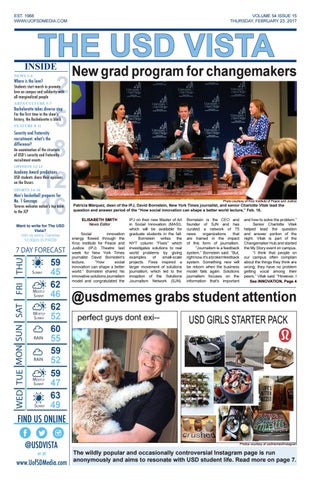
Patricia Márquez, dean of the IPJ, David Bornstein, New York Times journalist, and senior Charlotte Vitak lead the question and answer period of the “How social innovation can shape a better world lecture,” Feb. 16. ELISABETH SMITH News Editor Social innovation energy flowed through the Kroc Institute for Peace and Justice (IPJ) Theatre last week for New York Times journalist David Bornstein’s lecture, “How social innovation can shape a better world.” Bornstein shared his innovative solutions journalism model and congratulated the
IPJ on their new Master of Art in Social Innovation (MASI), which will be available for graduate students in the fall. Bornstein writes the NYT column “Fixes” which investigates solutions to real world problems by giving examples of small-scale projects. Fixes inspired a larger movement of solutions journalism, which led to the inception of the Solutions Journalism Network (SJN).
Bornstein is the CEO and founder of SJN and has curated a network of 75 news organizations that are trained in the impact of this form of journalism. “Journalism is a feedback system,” Bornstein said. “But, right now, it’s a broken feedback system. Something new will be reborn when the business model fails again. Solutions journalism focuses on the information that’s important
and how to solve the problem.” Senior Charlotte Vitak helped lead the question and answer portion of the night. Vitak is part of the Changemaker Hub and started the My Story event on campus. “I think that people on our campus often complain about the things they think are wrong; they have no problem getting vocal among their peers,” Vitak said. “However, I See INNOVATION, Page 4
@usdmemes grabs student attention
Photos courtesy of usdmemes/Instagram
The wildly popular and occasionally controversial Instagram page is run anonymously and aims to resonate with USD student life. Read more on page 7.
2T
he
USD Vista
NEWS
February 23, 2017
NEWS
NEWS EDITOR ELISABETH SMITH @elisabethsmith0
Asst. NEWS EDITOR TAYLER REVIERE VERNINAS
Students stand in solidarity at Where is the Love March and Vigil TAYLER REVIERE VERNINAS Asst. News Editor Last week, University of San Diego students and faculty gathered to walk, march, and pray in solidarity at the Where is the Love March and Vigil. Those who joined the event marched from the Student Life Pavilion (SLP) to the courtyard adjacent to Founders Chapel and concluded with the weekly Mass For Peace. The march was organized by sophomore students Stephen Jordan and Luke Garrett who were inspired to spread love throughout the USD community in response to the most recent Executive Orders. Garrett explained the importance of student action in attending oncampus events such as this. “The reason for creating this march was to give voice and action to our university’s commitment to show love and
that students attend this event because community is defined by the student body. With students attending this event, hopefully, that will give our community a more welcoming essence so refugees can feel comfortable here to express themselves, share, and trust.” The march began with student speakers outside the SLP who gave testimonies of different immigrants’ stories and struggles. The United Front Multicultural Center (UFMC) set up a booth with posters and postcards set out for those in attendance to fill out and send to their congressional leaders. Sophomore Bayunamu Bawa explained the purpose of the postcard writing. “It was an initiative started by the UFMC and the Women’s Center and some other organizations to get people to actually take action by writing what they care about and mailing it to their home senators,” Bawa said.
about issues that do not always affect you. “Change can really be made when people care about stuff that doesn’t affect them,” Bawa said. “Because it is mostly marginalized groups and when dominant groups don’t care, nothing will change. But when people in majority groups realize these things are not cool, obviously people with the larger number can do something.” After the introduction, there was a moment of silence in which members of the USD community stood together holding hands. The march started inside the SLP as the chant “stand tall, love all” rang throughout the walls of the pavilion. Freshman Patrick Bonner said that this was the most memorable part of the march. “[The march through the SLP] was memorable because we were walking around while everyone was at dinner, and it was spontaneous, and no one
“Life is love, and joy is spread faster through a communal effort, rather than an individual.” - Stephen Jordan welcome all of the refugees and immigrants on our campus and in our community in the greater San Diego area,” Garrett said. “We just felt that student action was really needed. It’s important
“It is important because it is taking action. We can have many marches, but we, as constituents of our senators, they need to know how we feel.” Bawa believes that solidarity means caring
Tayler Reviere Verninas/The USD Vista
Members of the USD community stood together with candles and posters to spread their love on campus.
saw it coming,” Bonner said. The march continued through Torero Way to outside Founders Chapel, where speakers explained the importance of solidarity as everyone held candles and gathered for the vigil. Chair and Associate Professor for Theology and Religious Studies Emily Reimer-Barry was the first of two speakers that night. “I am here today to show solidarity with students,” Reimer-Barry said. “I am especially concerned about students who felt that the Executive Orders are discriminatory and make them feel unsafe. I want to show that I am here to support them and that the people in my department are really concerned about the safety of immigrants, refugees, and all students of color. We just want to show our support.” Reimer-Barry commented on the march attendance from the USD community. “I think it is great for students and faculty to do stuff like this collaboratively,” Reimer-Barry said. “I think there is a lot of common ground. It is fun to see the joint activism, and if there are areas of disagreement, then it is an opportunity for dialogue.” She explained that her
Tayler Reviere Verninas/The USD Vista
Members of the USD community stood together with candles and posters to spread their love on campus. speech was a theological reflection on what it means to be a Christian changemaker in the context of a Trump administration. “Solidarity to me means not just a feeling of empathy for someone, but actually striving to make the world a better place,” Reimer-Barry said. “So thinking about your actions everyday and what you are doing to make the world a better place.” Sophomore Kiana Lindsay was the student speaker for one of the testimonies at the beginning of the march. Lindsay explained what it meant for her to speak on behalf of another’s story. “I am a person who has a lot of privilege and part of that is using your privilege to help people and build up others who don’t have the same level of privilege that you do,” Lindsay said. “I personally have not been affected in my own life, but, as a Tijuana day trip leader, I get to see first-hand the crushing effects of immigration and how it can tear people’s worlds and families apart. It is very real to me and something that I see all the time. You feel really helpless when you see that and so you try to do everything you can possibly do to not just be passive.” After the second speech was given by Marc Adams of University Ministry, the Mass for Peace concluded the evening’s gathering. The homily was shared by Associate Provost for Inclusion and Diversity and Associate Professor of Communication Studies Esteban del Río, PhD, who brought forth the idea of institutional
sin
within our society. Co-organizer of the march and vigil Stephen Jordan stated that this event was definitely a marathon and not a sprint. “The story of the moment of silence at the airport transferred to the moment of silence at the SLP,” Jordan said. “It was cool to see everybody holding hands and [being] in peace. It was beautiful marching with everybody, especially in the SLP. People were talking about it afterward and the fact that it was not a protest of hate and emotion. It was more about celebrating love. We really want love to be poured out in a lot of different places in this community at USD.” Jordan explained that he believes solidarity is about meeting people where they are at. “Leading this march, Luke and I, as two white, privileged males, do not want to be the face of this,” Jordan said. “We want the people who have been working on this for a long time to be the face, but for us to be holding hands with them and standing side-by-side in solidarity.” Jordan shared that he hopes this will be a great opportunity for USD members to experience solidarity with those outside of the community. “Life is love, and joy is spread faster through a communal effort, rather than an individual,” Jordan said. In an effort to spread these positive messages throughout communities both on and off campus, the Where is the Love March and Vigil was the first step of many to encourage students to practice peace, solidarity, and love.
The USD Vista
NEWS
Volume 54 Issue 15
Deepak Chopra speaks at USD
ELISABETH SMITH News Editor
Author Deepak Chopra, MD, FACP, spoke at the University of San Diego’s Shiley Theatre last Monday. Chopra spoke about his latest book, “You Are the Universe,” which is co-authored by physicist Menas Kafatos, PhD. Chopra’s lecture was part of the Humanities Center’s Illume Speaker Series. He spoke about the origins of consciousness, the universe, and different philosophers’ world views. Chopra concluded that consciousness
and the universe are human constructs, therefore, humans are the universe. After the sold-out lecture, audience members shared how they were mystified by Chopra’s speech. Marine Science graduate student Joy Shapiro came to the lecture after receiving an email about the opportunity. “I feel like my mind was blown,” Shapiro said. “It was very inspiring and enlightening. I feel like I’m in another universe right now.” First year Caroline Gibbons said she felt content after listening to Chopra’s lecture.
“I loved how he talked about how the only thing that matters is your awareness,” Gibbons said. “He was very existential.” Sophomore Valentin Huetra said he attended the event because he loves Deepak Chopra. He also came to get Chopra’s new book signed for his mother, who is a Chopra fan as well. “I feel mind-blown,” Huerta said. “I underestimated [Chopra]. It surprised me to see how intellectual he is, and how he used stats. He’s just amazing. I love Deepak. I love USD for doing this.”
Brooklyn Dippo/The USD Vista
Deepak Chopra spoke at USD on Monday. Chopra shared his new book, “You Are the Universe,” which he co-wrote with physicist Menas Kafatos. Attendees received a copy of Chopra’s book with the price of admission, and Chopra had a signing after the lecture.
Local news update: San Diego
ELISABETH SMITH, News Editor
San Diego City Council votes to join the lawsuit against Executive Order On Tuesday, Feb. 14, the San Diego City Council voted to join the lawsuit against President Donald Trump’s immigration Executive Order. In the vote, the City Council voted that the City Attorney will advise the Council on participating in the lawsuit as amicus curiae, an impartial adviser,
and supporting the State of Washington in the litigation. According to a San Diego Union-Tribune article, San Diego was approached by the City of Chicago to join the amicus curiae brief. The matter was brought to the City Council by San Diego Attorney Mara Elliot, and it was
approved 8-1. San Diego Mayor Kevin Faulconer issued a statement in the Union-Tribune. “Americans deserve an immigration policy that keeps us safe without needlessly separating families and shutting our doors on innocent people seeking the American
Dream,” Faulconer said. “Legal immigration contributes greatly to San Diego’s economy and culture, and our region has taken in more refugees than any other in California. This executive order has a direct effect on San Diegans, and I believe it is appropriate in this case for our city to weigh in.”
Pollution warnings post-flooding in San Diego The San Diego County Department of Environmental Health issued a General Rain advisory this weekend, warning residents of possible contamination in the waters due to urban runoff from the rain. “Swimmers, surfers, and other ocean users are warned that levels of bacteria can rise
significantly in ocean waters, especially near storm drains, creeks, rivers, and lagoon outlets that discharge urban runoff,” the advisory stated. “Activities such as swimming, surfing and diving should be avoided for 72 hours following rain. The most recent significant rain occurred on February 19,
2017.” The advisory applies to beaches up and down San Diego County, including Mission Bay and San Diego Bay. “General (rain) advisories are issued when rainfall equal to or greater than 0.2 inches received in coastal or valley areas of San Diego County,” the
Department of Environmental Health website stated. “This can lead to elevated bacterial levels in ocean and bay water, especially those located adjacent to storm drains, creeks, rivers, and lagoon outlets,” according to the Department of Environmental Health warning.
3
4T
he
USD Vista
February 23, 2017
NEWS
Bornstein shows social innovation through journalism INNOVATION continued from Front Page think that people on this campus need to recognize the power of their student voice.” Vitak encouraged students to take action if they see problems on campus. “If you think there is a problem, talk to someone in a position of power, start an initiative to change the issue, talk to your [Associated Students] senator, attend a planning event, even just reading your emails to know what is happening on campus is helpful,” Vitak said. “I think students need to be more active in creating a space that they want to see rather than complaining to their friends.” During the question and answer period, Vitak asked Bornstein about intrapreneurship and how it can affect social innovation. Bornstein explained how intrapreneurship is an effective mode of social innovation because it takes existing structures of businesses or colleges and works from the inside to create change. “Intrapreneurship is working within an organization or business,” Bornstein said. “You have to make others look good while being quiet and letting other people take credit for your work. MASI is a great example of intrapreneurship.” Bornstein elaborated that MASI will create opportunities for social innovation because it will teach students how to approach problems and create solutions. Vitak learned about intrapreneurship through her own interests in changemaking. “I am fascinated by social innovation and the types of stories that David’s network tells,” Vitak said. “By being
interested and attentive to these types of stories, I bumped into the concept somewhere along the way. I love that it takes a top-down approach to systems change and the way in which large changes can be made to companies or even industries with such simple and intelligent ideas.” Patricia Márquez, the Dean of the Kroc School, explained how MASI came to be at USD. “The Master of Arts in Social Innovation (MASI) offers knowledge and capabilities to develop new approaches to existing social and environmental challenges,” Márquez said. “At the Kroc School, we recognize students are passionate about different issues. For example, one student might be interested in issues of human trafficking, while another one wants to address homelessness. We also recognize that students seeking to create transformative change come with different educational backgrounds and sets of skills. MASI is designed to nurture individual passion and strengths, while preparing people for innovation and the practice of changemaking.” Márquez also explained how MASI would affect changemaking at USD. “MASI is the first graduate program at USD developed for people who want to be social innovators within existing institutional settings or by starting their own ventures,” Márquez said. “Any undergraduate student at USD or any institution around the world, who wants to create the change they want to see in the world, can acquire the knowledge and skills to be even more effective
THE USD VISTA Editorial – 619.260.4584 Business – 619.260.4714 www.uofsdmedia.com @USDVista Brooklyn Dippo- Editor in Chief Matlyuba Nurova - Finance Director Courtney Wong - Advertising Director Sarah Brewington - Associate Editor Diego Luna - Managing Editor Gianna Caravetta - Copy Editor Nora Brewington - Art Director Elisabeth Smith - News Editor Tayler Reviere Verninas - Asst. News Editor Dani Devries - Opinion Editor Kelly Kennedy - Feature Editor Jennifer Givens - Asst. Feature Editor Walker Chuppe - Arts & Culture Editor Matthew Roberson - Sports Editor Noah Hilton - Asst. Sports Editor Dray Wilson - Photography Editor Gina Lew - Student Media Advisor Marie Minnick - Operations Advisor
Photo courtesy of Kroc Institute for Peace and Justice
David Bornstein, New York Times journalist, spoke about his Solutions Journalism Network and social innovation on Feb. 16 in the IPJ Theatre. as
an agent of change.” MASI provides an opportunity for students to learn design thinking, innovation, and social entrepreneurship, which are areas closely linked to the practice of changemaking. Márquez stated that Bornstein’s solutions journalism was a good example of social innovation. “It offers a new approach to media content,” Márquez said. “Instead of having mostly news about problems, solutions journalism is a network of journalists writing stories about solutions to those problems. Students can learn from all the stories and they can also learn about how David has developed
The USD Vista publication is written and edited by USD students and funded by revenues generated by advertising and a student fee. Advertising material published is for information purposes only and is not to be construed as an expressed or implied endorsement or verification of such commercial venues by the staff or University. The USD Vista office is located on the fourth floor of the Student Life Pavilion in room 403B. All inquiries should be sent to: The USD Vista 5998 Alcala Park San Diego, CA 92110 The first copies of the newspaper are complimentary, all copies thereafter are a 25 cents charge. Opinions expressed in this publication are not necessarily those of The USD Vista staff, the University of San Diego or of its student body. Letters to the Editor can be submitted to The USD Vista office. Letters should be limited to 300 words and must be signed. For identification purposes, USD identification numbers and writer’s year must be included in the letter. The USD Vista reserves the right to edit published letters. Any content sent to the editor will be considered for publication unless otherwise stated.
the organization: how does it work? How is it sustained? What is its impact?” In his speech, Bornstein emphasized the importance of solutions journalism focusing on the counter-narrative. For example, a news organization in the SJN did an in-depth article about the improvement of police relations with black members of the community in Milwaukee. He explained that telling the stories of these solutions in communities can serve as an examples for other communities with the same issues. “There’s something about the science of improvement,” Bornstein said. “Solutions journalism covers big problems. It puts healthy,
aspirational pressure on the system to encourage change.” During his lecture, Bornstein posed the question of how to teach social innovation that grounds students in real world contexts. “A combination of a critical eye and hopeful heart [is necessary],” Bornstein said. “We want to teach people to be critical thinkers and understand pieces that could be put together to create change. MASI has wonderful potential to do that.” Many students on USD’s changemaker campus hope to learn from Bornstein’s journalism and use solutions journalism as real-world examples of change in class and in the community.
Retraction: In the article entitled “USD international student affected by immigration ban” in the last issue of The USD Vista, the word “imprisoned” was used to refer to the experience of the source. The source clarified that she faced consequences. The USD Vista sincerely apologizes for this mistake.
The USD Vista
ARTS AND CULTURE
February 23, 2017
5
A&C EDITOR WALKER CHUPPE
ARTS & CULTURE
@lord.walker
Next season: the first black Bachelorette JENNIFER GIVENS Assistant Feature Editor After 21 seasons, hundreds of tears, hours of drama, and nearly 200 dozen red roses, The Bachelor franchise broke with tradition when announcing the new Bachelorette. On Feb. 22, long time Bachelor host Chris Harrison went on Jimmy Kimmel Live! to announce the show cast its first black Bachelorette. In true Bachelor fashion, Harrison handed Kimmel the iconic red rose, showed pictures and clips from the prior season’s contestants, and added the long, unnecessary pauses. Finally, Harrison disappeared into the back of the set and out came Rachel Lindsay, 31, from Dallas, Texas. Lindsay will be the first black Bachelorette in
Rachel Lindsay featured on Jimmy Kimmel Live!
unconventional for the show, since Lindsay is still on the current season of The Bachelor. She was popular from the beginning, receiving
Photo courtesy of @therachlindsay/Instagram Rachel Lindsay on this season of The Bachelor.
the show’s franchise history. The timing of the announcement seems very
the first impression rose from the Bachelor and two one-onone dates. Lindsay also won over the hearts of the fans
Photo courtesy of @therachlindsay/Instagram
with her wit, intelligence, and confidence. It is no wonder producers chose Lindsay to become the next Bachelorette. Lindsay is one of four women left on Nick Vail’s season of The Bachelor and has yet to be eliminated. Fans now know that Monday’s episode could be the end for Lindsay. For many Bachelor Nation fans, this is an unprecedented announcement and a bit of a spoiler. For the past 21 seasons, the next contestant is announced after the finale of the prior season, a segment of the show called “After the Final Rose.” Historically, the next Bachelor or Bachelorette is chosen from a prior season and is usually one of the final four contestants. This person is typically a fan favorite or controversial character from the previous season. Longtime fan of The Bachelor franchise and USD
Photo courtesy of @therachlindsay/Instagram Rachel Lindsay and Bachelor Nick Viall walk into the show’s one-on-one date segment.
senior Stephanie Mazzuca watches the show with her mom regularly. She was shocked by the early announcement.
the show for a second season, but 59 percent of black participants were eliminated after the second week. The lack of diversity in the show received much criticism from fans, which eventually led to a class action lawsuit in 2012. The suit was brought on by two black men who had auditioned for The Bachelor and alleged that they were not chosen due to racial discrimination. According to NPR, the case was dismissed on the grounds of the show’s creative nature and its First Amendment right. “The judge decided that, in general, casting is protected by the First Amendment, and that means that, even if the plaintiffs were right that the show was in fact outright refusing to cast people of color, in part to avoid ‘controversy’ over interracial dating, its right
“My little sister, who is also a big fan of the show, literally cried when she heard the news. Tears of joy for sure. This is such a historical event not just for Bachelor Nation, but for the world of reality television and broadcast media as a whole.” -Dominique Rougeau “I thought it was unusual because they keep [the next contestant] tightly under wraps and a well-guarded secret, but now they are spoiling it before she is even eliminated,” Mazzuca said. Over the past 21 seasons, The Bachelor franchise has not had much diversity. Season 18 Bachelor Juan Pablo Galavis, who is Venezuelan-American, was the first non-white Bachelor. The most diverse Bachelorette was Kaitlyn Bristowe, who is from Canada, but, raciallyspeaking, all the Bachelorettes have been white. Since the first episode of the show, there has been some diversity regarding the contestants who are competing for the season’s Bachelor or Bachelorette. However, most non-white contestants do not make it past the first few weeks. Molly Fitzpatrick wrote about this on Fusion, a pop culture website, in an article entitled, “A history of black contestants on the Bachelor and Bachelorette.” She researched the lack of diversity in the franchise from the first season to season 20, Bachelor Ben Higgins’ season. Fitzpatrick found there have been a total of 36 black contestants who’ve competed in both The Bachelor and The Bachelorette. There was one contestant who returned to
to do that would be protected from interference,” NPR said. Since the dismissal, fans have continued to voice their dismay with the lack of diversity with leading contestants. Dominique Rougeau has been watching the show for several years. As a black woman, Rougeau said she is especially enthusiastic that the show chose Lindsay as the new Bachelorette. “I am super excited that ABC has chosen Rachel to be the next Bachelorette,” Rougeau said. “I am a big fan of the show. I enjoy the plot of the show and the drama that comes along every season, but I’ve always hoped that the show would grow in diversity. So the fact that The Bachelor franchise will now have their first black Bachelorette (a black female lead) is a dream come true for me. My little sister, who is also a big fan of the show, literally cried when she heard the news. Tears of joy for sure. This is such a historical event not just for Bachelor Nation, but for the world of reality television and broadcast media as a whole.” While fans wait and watch the last few episodes of season 21, filming for Lindsay’s season is about to begin. The show is set to air on ABC on May 22. Bachelor Nation will be waiting to see if Lindsay will get a second chance at love.
6T
he
February 23, 2017
ARTS AND CULTURE
USD Vista
The Oscar for Best Picture 2017 WALKER CHUPPE Arts & Culture Editor @lord.walker The 89th Annual Academy Awards will take place on Feb. 26, 2017, at the Dolby Theatre in Hollywood, Calif. The biggest stars in the entertainment industry flock to the ceremony for what is arguably the most prestigious and widelyviewed awards show for the big screen. Every year comes with its own surprises, and it is always interesting to see what the Academy decides as the best films, actors, actresses, directors, and everything in between for the past calendar year. The best picture nominees list from 2016 features some outstanding films—some of which have become more well-known than others. All of them, however, have been deemed good enough to make the cut for the final decision by the Academy. Without further ado, here are the 89th Annual Academy Awards nominees for best picture. “Hell or High Water” Directed by David Mackenzie and starring Jeff Bridges, Chris Pine, and Ben Foster, the film takes place in western Texas and is the story of two brothers who commit a series of bank robberies to save their family’s ranch. The film borrows elements from classic westerns but hopes to refresh the genre. The film received high critical-acclaim, reaching a 98 percent approval rating on Rotten Tomatoes. Action-packed and American to its roots, “Hell or High Water” is for anyone fond of westerns or gun-slinging action. “Arrival” A science-fiction drama directed by Denis Villeneuve and starring Jeremy Renner, Amy Adams, and Forest Whitaker, “Arrival” is a film adaptation of the 1998 novela
“Story of Your Life” by Ted Chiang. The film follows expert linguist Louise Banks as she and her team attempt to gain information about mysterious spacecrafts that touch down on Earth—before it becomes too late for humanity. The scifi film should feature thrilling moments that will have you on the edge of your seat. “Lion” A drama directed by Garth Davis in his featurefilm debut, the film stars Dev Patel, Rooney Mara, David Wenham, and Nicole Kidman. “Lion” is based on the nonfiction book by Saroo Brierley titled “A Long Way Home.” The film chronicles the life of the young boy, Saroo, who becomes lost on a train which takes him thousands of miles across India. He is forced to survive alone in Kolkata until an Australian couple adopts him. Later in
Screenshot courtesy of Lionsgate Movies/YouTube Ryan Gosling and Emma Stone in the trailer for “La La Land” (2016).
musical is the story of Mia, an aspiring actress, and Sebastian, a pianist who is completely devoted to the
Screenshot courtesy of MovieClips Trailers/YouTube Oscar-nominated film “Lion” (2016) features Dev Patel.
life, he attempts to use modern technologies, such as Google Earth, to find the family he left behind. “Lion” is a gripping tale of growth and discovery. “La La Land” One of the most popular films of the year, “La La Land” is directed by Damien Chazelle and stars Emma Stone and Ryan Gosling. The romantic-comedy-drama-
dying art of “real jazz.” Set in modern Los Angeles, the film illuminates the struggle of pursuing dreams and how love can both complicate important decisions and color our lives. “Hidden Figures” A biographical drama based on the nonfiction book of the same name written by Margot Lee Shetterly, the film stars Taraji P. Henson,
Screenshot courtesy A24/YouTube “Moonlight” (2016) grossed $22 million at the box office, much less than some of the other films.
Katherine G. Johnson, Octavia Spencer, Janelle Monae, Kevin Costner, Kirsten Dunst, and Jim Parsons. The film presents the story of Katherine G. Johnson and two of her colleagues, Dorothy Vaughan and Mary Jackson, three black women working at NASA who were a large part of sending astronaut John Glenn into space. The women broke barriers of both gender and race in a previously untold story—the primary premise of the film. “Moonlight” A drama directed by Barry Jenkins, based on the play “In Moonlight Black Boys Look Blue” by Tarell Alvin McCraney, the film features Trevante Rhodes, Andre Holland, and Janelle Monae. “Moonlight” is an up-closeand-personal look into black life and culture, with themes of identity, family, friendship, and the search for universal truths. While critically-acclaimed, the film grossed substantially less than some of the others on this list, at only $22 million globally. It will be interesting to see how it holds up at the Oscars compared to box office giants like “La La Land,” which grossed $294 million at the box office. Moonlight might be considered one of the favorites to win, as it won best picture at the Golden Globe Awards this year. “Fences” Directed by Denzel Washington and written by the late August Wilson, “Fences” is based on Wilson’s Pulitzer Prize-winning play of the same name. The film stars Washington himself, as well as Viola Davis and Stephen Henderson. The story follows Troy Maxson, a sanitation worker in 1950s Pittsburgh, who once had dreams of becoming a professional baseball player but was too old by the time the major leagues allowed black players to join in on America’s pastime. Maxson’s lost dream
threatens his relationship with his family, and he struggles to be a good husband and father despite his best efforts. “Manchester by the Sea” Written and directed by Kenneth Lonergan, the film stars Casey Affleck, Michelle Williams, Kyle Chandler, and Lucas Hedges. “Manchester by the Sea” is the story of Lee Chandler, a man who works as a handyman in Boston who must take care of his 16-yearold nephew after his brother unexpectedly passes away. Chandler is forced to deal with his own grief, but also with the struggle of raising a teenager, all while attempting to sort out personal issues he has dealt with for most of his life. “Hacksaw Ridge” A biographical drama directed by Mel Gibson and starring Andrew Garfield, Sam Worthington, and Luke Bracey, “Hacksaw Ridge” is the story of Desmond Doss, an American soldier during World War II. Doss was a Seventhday Adventist Christian, and was a pacifist combat medic who refused to use firearms or weapons of any kind. Doss saved 75 men in the Battle of Okinawa—one of the bloodiest in WWII—all while serving on the front lines without a weapon. Doss also became the first conscientious objector to win the Congressional Medal of Honor for his actions above and beyond the call of duty. “Hacksaw Ridge” is action-packed and tells a unique story in a genre that is often overcrowded with new releases. This year’s nominees for the Academy Awards’ best picture come from many different genres and tell vastly different stories. Some were bigger box office hits than others, but all of them possess the criteria that the Academy desires in selecting the finalists for the award. All that’s left is to see is if your favorite film of the bunch takes home the prize.
Volume 54 Issue 15
ARTS AND CULTURE
The USD Vista
7
USD memes create buzz on campus WALKER CHUPPE Arts & Culture Editor @lord.walker Born on Jan. 15, 2017, the University of San Diego-inspired Instagram account @usdmemes has over 2,000 followers, which it has amassed in a little less than a month. The Instagram page, which borrows inspiration from popular accounts and meme-posters like @mytherapistsays, @tank.sinatra, @daquan, and @beigecardigan, posts USD-themed memes. Memes are cultural references, often satirical in nature, that are shared from person to person, typically in the form of humorous images, text, and GIFs. So far, the page includes both USD girls and guys “starter packs,” a hunky President Harris holding a puppy, and their own versions of the “confused Nick Young” and “cash me outside” memes. The person behind the page remains a mystery, though many students have their speculations. Non-sanctioned campus social media pages have occasionally come under fire for posting offensive, or at least insensitive, content at other universities. As of now, it does not seem as though @usdmemes has sparked outrage among the community. In fact, the Instagram page has become quite a hit among USD students and has caused a good-natured buzz on campus since its creation. Freshman Nicolo Amari shared that he sees the memes as lighthearted fun for the campus community. “I think that the memes are relevant and relatable which makes them funny,” Amari said. “I think it solidifies the USD community because we get to laugh at inside jokes that only USD students will be able to understand.” Sophomore Anas Salah recently discovered the account and found it to be entertaining. “I only found out about [@usdmemes] last weekend, and I
think it’s a pretty cool account because we, as USD students, can relate to it more than anyone else,” Salah said. “I basically just check it out for the laughs.” Sophomore Alexa Perera explained that she thinks of @usdmemes as a way for the campus to joke with each other about things we see around school from day-to-day. “I think that @usdmemes is a really cool way to make people laugh with their friends,” Perera said. “We all joke about the culture at USD on a daily basis, and that’s what makes it fun.” In addition to student perspectives, Cynthia M. Avery, Vice President of Student Affairs, shared from her administrative standpoint. Avery was asked if the administration at USD is planning on taking action against the @usdmemes page. “Not that I am aware of,” Avery said. “The university has not taken down or moderated any social media sites, but rather has called our community members to reflect on our values. As it pertains to social media the values that come to mind are those related to both community and ethical conduct.” Avery also shared her perspective on the impact memes can have on the USD community. “Memes are developed as a form of satire,” Avery said. “Most are humorous, and some encourage a reflection on a cause, movement, etc. I would strongly encourage those who run this site to consider how peers or other community members might inadvertently be affected by memes picturing them or referring to them directly or indirectly.” USD students have been sharing laughs over @usdmemes, whether reminiscing about Comber last Friday, or griping about those $50 parking tickets we all seem to get once or twice a semester. What began as a few posts last month is growing into a viral presence on campus, and as they say, “it’s lit.”
Photo courtesy of @usdmemes/Instagram A meme about spontaneous applause at the SLP when a student drops a plate.
Ride together.
Spring 2017 Semester
TRANSIT PASS Exclusive student discount. Unlimited rides all semester.
$165
(Price includes a $15 USD subsidy)
On sale until March 17 at the University Center Ticket Office Photo courtesy of @usdmemes/Instagram A “starter pack” is a variety of items that seem to identify a group of people.
sdmts.com/college Current, valid college student picture ID required. No replacements for lost, voided or stolen stickers.
8
THE USD VISTA
FEATURE
FEBRUARY 23, 2016
Sorority and fraternity recruitment:
? ? e e c c n n e e r r e e iff iff d d e e h h t t ’s ’s t t W Whhaa
By Cynthia Yantz
Recruitment of new members is the lifeblood of fraternity and sorority life at the University of San Diego. While sorority formal recruitment is highly regulated by Panhellenic, the governing body of all sorority chapters on campus, some fraternities have gone surfing at Wave House, hosted beach barbecues, and even smashed an old car on campus to get to know potential new members (PNMs). The image of USD sorority sisters gathered in a parking lot beating an old car is far from the reality of formal sorority recruitment. There are a number of differences between the recruitment processes for fraternities and sororities within their chapters. There are discrepancies between the severity of their rules, where and what types of events can be held, and possible fines—or lack thereof—for violating rules during recruitment. The differences between the two are almost polar, so the question remains: why there is such a huge discrepancy between the sorority and fraternity recruitment processes?
Sorority and fraternity recruitment process
Day one is “Values Day,” day two is “Philanthropy Day,” day three is “Sisterhood Day,” day four is the “Preference Ceremony,” and day five is “Bid Day.”
Emily McCue went through recruitment as a freshman and has recruited for her chapter twice. McCue now sits on the Panhellenic Council as Vice President of Recruitment Operations. She is in charge of planning formal recruitment and working with the recruitment chairs from each sorority. According to McCue, the sorority recruitment process has several steps. Each chapter elects a member as its chairwoman, the woman who will represent her chapter from springtime until fall while they plan recruitment. PNMs register for recruitment during the fall semester. During this time, Panhellenic hosts several Sorority Recruitment Informationals where students are free to browse each chapter to get to know them. The week before spring classes resume, active sorority members return to campus for Polish/Camp week. During this week, ladies practice songs and chants, learn how to have value- and character-based conversations with PNMs, and participate in sisterhood bonding activities. Once formal recruitment starts there are four days of recruitment. In comparison, Josh Kracoff, Vice President of Programming for Interfraternity Council (IFC), described that the fraternity recruitment process works very differently. “The great thing about fraternity recruitment is that the process is fairly laid back, and the conversations are pretty relaxed and genuine,” Kracoff said. Men’s recruitment usually begins on a Sunday where PNMs are allowed to casually approach the fraternities they are interested in and talk to active members at scheduled, on campus events. The following days are designated for individual chapter rush events for each fraternity, typically with three events throughout the week. The final few days are dedicated to “Preference Events,” where chapters invite PNMs of their choice to more formal events. Fraternities then vote on the PNMs that they would like to keep and give bids to. Traditionally, the following Tuesday is “Bid Day,” where PNMs receive their bid card which lets them know which chapters have extended bids to them. Kracoff explained the significance of fraternity “Bid Day.” “The PNM will sign off on the bid card of the fraternity that he wishes to join, and [he] runs into the arms of the fraternity members that he has chosen and officially becomes a member of that fraternity,” Kracoff said.
Rules and fines At the end of each sorority recruitment cycle, the Panhellenic Vice President of Membership meets with each chapter to discuss how the process went. During these meetings, they review the rules used for the last recruitment and revise and vote on any additional rules that may be needed. “There are 16 sections in the Panhellenic Recruitment Rules, as well as an appendix,” McCue said. “These rules are constructed to maintain a fair and values-based recruitment. The most common punishment for not following rules comes as a fine. There are fines for many different violations of the stated rules. There are also punishments that can be assigned from within the chapter. These are typically fines for being late or missing recruitment events.” The most common fine is the “social media post violation,” a $25 fee that occurs when women do not deactivate their Facebook accounts during recruitment week and are seen having an active account. Each chapter can also be fined up to $100 a day if their recruitment budgets are not turned in on time or if recruitment events run late or are missed. Chapters may also be fined if PNMs leave recruitment rooms with any object or item, including water cups. “PNMs are offered water during events, but no food,” McCue said. Sorority recruitment is also a mandated dry period. This means that any active sorority member documented using any type of alcohol or drug will be fined. There can also be fines for checking out late for the day from the chapter’s assigned recruitment room or leaving the room dirty. These are general rules for sorority chapters during the recruitment process only. McCue explained that if there is a serious rule violation, an infraction is documented and representatives from that individual chapter are called to a meeting. “Representatives from the chapter are required to attend a standards board hearing to discuss repercussions for their actions,” McCue said. Rules for fraternities work a little differently. Kracoff said that there are only a few rules to follow for chapter members during recruitment.
VOLUME 54 ISSUE 15
FEATURE
“A few general rules to follow are to not talk negatively about another fraternity and to not hang out with any of the PNMs outside of the individual events,” Kracoff said. “This is known as ‘dirty rushing.’” Kracoff explained that he was not aware of any consequences for rule violations during fraternity recruitment. “[I’m] not sure,” Kracoff said. “Nothing I’ve experienced so far has resulted in a fine.” However, in the case of “dirty rushing,” Kracoff shared that, if a chapter is caught using such tactics, the fraternity will probably be disqualified from receiving any new members for that semester.
Events In regards to sorority recruitment events, McCue described the usual sorority event as structured and conversation-based. “Typically, an event just consists of conversation, but we have had chapters do some sort of activity on Philanthropy day,” McCue said. All sorority recruitment events must be hosted on USD’s campus and they are all conversation-based. Sorority women speak to PNMs about different aspects of their chapter on each day. Conversation topics include personal values, chapter’s philanthropy events, sisterhood events, and are meant to cover meaningful subjects. Some chapters have PNMs pin ribbons of solidarity onto decor or sign their name on a card in support of the chapter’s philanthropy. Any interaction between PNMs and active sorority members is strictly prohibited outside official events. McCue explained why sorority recruitment events are so highly structured. “The process is called Spring Formal Sorority Recruitment, so it is a formal process,” McCue said. “The experience is very tightly scheduled and organized to a tee. The reasoning
“[Spring Formal Sorority Recruitment] is very tightly scheduled and organized to a tee. The reasoning for this is to ensure a fair experience for all chapters who are recruiting and to give the PNMs the most unbiased and positive experience possible.” - Emily McCue
“Overall, the fraternity recruitment process is pretty informal compared to sorority recruitment, but the VP of Recruitment for IFC works tirelessly to ensure that the entire process runs smoothly. Overall, the guys who come out to rush are just looking to have great conversations and meet new people.” - Josh Kracoff
for this is to ensure a fair experience for all chapters who are recruiting and to give the PNMs the most unbiased and positive experience possible.” For fraternities, however, there are a wide variety of recruitment events available for each chapter to plan, both on and off campus. During his recruitment, Kracoff said that the fraternities planned beach barbecues, trips to the driving ranges, batting cages, and played basketball at the Sports Center. The only stipulation for these events is approval by higher-ups. “Each event must be first cleared by administration, so obviously nothing that puts any of the participants at serious risk [can be planned],” Kracoff said. Kracoff admitted that fraternity recruitment is much less formal than sorority recruitment. “Overall, the fraternity recruitment process is pretty informal compared to sorority recruitment, but the Vice President of Recruitment for IFC works tirelessly to ensure that the entire process runs smoothly,” Kracoff said. “Overall, the guys who come out to rush are just looking to have great conversations and meet new people.”
Sorority recruitment
Fraternity recruitment
- On campus events only - No food offered to PNMs - 16-section rulebook - Fines for rule violations
- On & off campus events - Food usually offered to PNMs - Honor code - Fines uncommon
THE USD VISTA
9
Actives weigh in Junior transfer student Elizabeth Rivette, an active sorority member, commented on her experience recruiting for her sorority. Though Rivette joined a sorority at the first university she attended, she transferred to USD’s chapter when she changed schools. Rivette commented on the similarity of recruitment events within sorority recruitment. “As for recruitment, each day is the same for each sorority,” Rivette said. “The days are fairly uniform from one sorority to another, with the difference being the individual values, philanthropy, and sisterhood.” Rivette also mentioned that sorority members must be extremely careful to make sure that PNMs do not feel that they are being “bid promised” during events. This means the active member must not allude to the PNM that she will receive a bid. “As I understand it, the repercussions [for bid promising] may depend on the sorority,” Rivette said. “Generally, it involves being called into standards and then having a discussion to explain your side of the situation.” Overall, Rivette acknowledged that recruiting for a sorority is difficult, but she said the outcome is rewarding. Though receiving new members is exciting, Rivette also stated that sororities are aware of the discrepancy between men’s and women’s recruitments. “It’s hard for both parties, but it’s entirely worth it,” Rivette said. “The difficult moments are understandable for any process that’s worth it. It’s not about the process anyway; it’s about the destination. I think it’s pretty clear that the sororities have a more structured formal recruitment process.” Senior Ian Lituchy, active member of Beta Theta Pi, discussed his recruitment experience as a PNM. In the spring of 2014, he attended events hosted on the Mission Field at the Sports Center. “I attended a rush event at the Wave House which was really cool,” Lituchy said. “On Friday, all the fraternities do beach barbecues which was definitely my favorite.” Lituchy noted that fraternity recruitment is an informal process. “I definitely think it was an informal experience, in relativity to sorority rush and fraternity rush at most universities,” Lituchy said. “I guess if I went back, I wouldn’t necessarily try to make it more fun, but maybe a bit more formal. It’s confusing as a freshman just exactly what events you need to attend.”
Nora Brewington/The USD Vista
10 T
FEBRUARY 23, 2017
FEATURE
USD VISTA
FEATURE HE
FEATURE EDITOR KELLY KENNEDY
ASST. FEATURE EDITOR JENNIFER GIVENS
Debut of “Another Path Found” Visual Art major thesis exhibitions open with senior Emma Angold’s work
KELLY KENNEDY Feature Editor
Each spring semester, graduating Visual Arts majors exhibit their thesis projects, bodies of work that often take from three to nine months to curate. Each student holds an exhibition, which includes an oral thesis defense that is open to the public. Senior Emma Angold is hosting the first exhibition, showcasing her project titled “Another Path Found.” What influences her art: “Art is what leads me through life,” Angold said. “It’s my path and journey, hence the title of my work. As I wander this path, I pick things out, objects or buildings that peak my interest, and I’m compelled to photograph them and lock them in my mind. I carry them with me through my journey and keep them in my mind, always thinking about them.” On her subject matter: “I personify them and think of where they’ve been, where they’re going, and what brought them to my path. These are intimate staple items in people’s homes that have been abandoned into alleyways to be taken away. They get destroyed, forgotten, and they face the elements constantly. On the significance of her work: “I’m trying to embrace the particular typology of regret that [these items] have within them. I photograph them to give them significance. They wouldn’t necessarily be considered something important if I wasn’t photographing them, which is one of the things that I find important about this project. I’ve been told multiple times by strangers that they would have never seen these items had I not been standing there photographing them.”
Angold’s thesis exhibition is open through Feb. 28, 9:00-5:00 p.m. daily, Sacred Heart Gallery Thesis defense: Feb. 23 at 12:30 p.m.
Kelly Kennedy/The USD Vista Angold will orally defend her thesis in front of Art Department faculty.
11
FEATURE
Volume 54 Issue 15
The USD Vista
Watch movies like it’s the 1950s Santee Drive-In Theater is a retro way to see newly released films
JENNIFER GIVENS Asst. Feature Editor Imagine sitting under the stars, your radio turned up, and your favorite movie playing on the big screen. No side conversations during the movie, no one kicking the back of your seat, and no heads blocking the screen. That is the experience available to San Diegans at the Santee Drive-In Theater, a throwback akin to a scene from a 1950s movie. There is just something about being
the price of one when there is a double feature. The theater accepts cash only and does not offer discounts. The theater plays all the newest releases, and the quality of the picture is similar to that of conventional theaters. With two screens, the drive-in can play two different new releases. A modern update to the drive-in is the audio. In the past, a speaker was attached to a poll and that hooked onto your vehicle. Now, the audio works through your car’s FM radio,
Now showing:
Theatre 1: Feature: The LEGO Batman Movie (PG) Showtimes: 7:30 p.m. & 11:55 p.m. Co-Feature: Fantastic Beasts and Where to Find Them (PG) Showtime: 9:30 p.m. Theatre 2: Feature: The Great Wall (PG-13) Showtimes: 7:30 p.m. & 11:35 p.m. Co-Feature: Split (PG-13) Showtime: 9:30 p.m. outside under the stars in the privacy of your own car that really sets the mood. If you’re looking for a unique date night, or just a fun night out, check out a movie at the Santee Drive-In Theater. The drive-in has been around since 1958 when it started as a one screen theater. It wasn’t until 1964 that the theater added a second screen. The theater can hold 700 cars and is open seven days a week, year-round. The price is not much different from a regular theater at $9 for adults and $4 for kids 12 and under. You can also catch two movies for
so the sound varies depending on your car’s speaker system. One of the benefits of a drive-in is the ability to bring your own food. You do not have to sneak in snacks and drinks under your coat, or beg your partner to bring a big purse. You can bring a whole pizza, fast food, and drinks, or you can fill up an ice chest and no one will make you throw it away. If you like movie theater popcorn and candy, there is a snack bar in the center of both screens, along with clean bathrooms and an ATM. Historically, drive-ins were known as movie theaters without all the rules. For
many that grew up with driveins in the 1950s to 1960s, the conventional challenge was to see how many people one could sneak in. Going to a drive-in is a bit different than a theater. There are some things that will make the experience more enjoyable. Make sure the car you bring is comfortable. It gets chilly at night, so bring a blanket if you decide to watch the movie in the back of a truck or in the trunk of your car. You and your loved ones will be that much more comfortable. It also gives you an excuse to get closer to your date or snuggle with a friend. If watching the movie inside the car is not desirable, folding chairs are permitted. Sitting on the vehicle, however, is not. According to Santee Drive-In’s website, larger vehicles have designated spaces to make sure everyone has prime viewing. Tall vehicles like trucks, SUVs, hatchbacks, or motorhomes taller than 65 feet are required to park in the designated yellow lines located in the back half of the theater. The rolling hills design of the parking lot gives every spot a clear view of the screen. The varying heights
Photos courtesy of Terry Moore/Flickr The Santee Drive-In Theater is a San Diego staple.
Dos and dont’s of the drive-in:
Do: - Arrive early - Bring cash - Pack an FM radio if your car doesn’t have one - Pick up some snacks and refreshments - Carpool with friends - Dress warmly or bring a blanket - Bring folding chairs Don’t: - Sit on top of your vehicle - Take barbecues, skateboards, rollerblades, or scooters - Bring pets along of each lane and the height of the screen assures you will not be looking at the top of or in someone else’s car. Some items that are not allowed are barbecues, skateboards, rollerblades, or scooters. Dogs and other pets are also not permitted at the drive-in. To make the experience even better, plan ahead. The
Open 365 days a year Adults $9.00 Children (ages 12 and under) $4.00
theater opens at 7 p.m., and movies start at 7:30 p.m. Make sure to get in line early, as traffic can be heavy on weekends and holidays. The theater is about thirty minutes east of campus. Be sure to come prepared with cash. For a more authentic experience, you can rent a radio from the snack bar. If you use your car and the battery dies, the snack bar staff has jumper cables. Santee Drive-In Theater is a must in summer time. So grab some friends or a special someone and experience the movies as if it was the 1950s.
Photos courtesy of Terry Moore/Flickr Movie goers can enjoy an authentic drive-in experience.
12
The USD Vista
OPINION
Volume 54 Issue 15
OPINION
OPINION EDITOR DANI DEVRIES opinion@usdvista.com
The views expressed in the Opinion section are not necessarily those of The USD Vista staff, the University of San Diego, or its student body.
OPINION
Volume 54 Issue 15
The USD Vista
13
Debunking the differences: fraternity vs. sorority recruitment TARYN BEAUFORT Contributor
Recruitment? Rush? Think it’s all the same? Think twice. At the University of San Diego, recruitment and rush are processes of mutual selection for Greek life membership. In these processes, potential new members (PNMs) determine which chapter they fit into best, and the chapters decide which PNMs would fit best as a member. Despite the same goal, there are large discrepancies between the two when recruiting new members for their chapters. The most noticeable difference between the two, at first glance, is the names. While both fraternity rush and sorority recruitment mean the same thing, sororities seem to have changed the rhetoric to reflect a more respectful process. Often times, the term “rush,” and referring to new members as “pledges,” is negatively associated with hazing. One of the major points of contention among sororities and fraternities at USD is the time frame. Two weeks before classes resume for the spring semester, female students involved in Greek life are required to return to campus for sorority recruitment. One week is spent preparing for recruitment events, while the second week is spent actively recruiting. These days are long, and women face penalties for missing them, including fines and privileges being taken away. Male students, on the other hand, wait until school is in session to go through fraternity rush. Some sorority members explained that they think that it is unfair to have to cut their breaks short, while fraternity members are able to continue to enjoy their time away from school. Senior Ashley Joshi mentioned that coming back early from break is certainly bothersome. However, she added it does give the girls more time to get to know PNMs and form more authentic relationships. “I honestly don’t think it’s very fair that girls in a sorority need to come back two weeks before classes start in order to participate in recruitment when guys are able to balance their recruitment events during the semester,” Joshi said. “It makes me curious how they are able to develop the same relationships you find in a sorority, and how the guys are able to create a brotherhood with such little time.” Panhellenic Vice President of Membership Emily McCue explained that sororities choose to operate recruitment during winter break to allow the women to devote
all their focus to the process. “To me, the main reason for the sorority women coming back two weeks early is convenience,” McCue said. “In the last four years alone, formal sorority recruitment at USD has attracted over 350 PNMs which is significantly larger than the typical 200 men who participate in spring fraternity recruitment. There are also more active sorority women on campus than fraternity men. It is easier to coordinate such a large group if the Panhellenic recruitment team knows that they are all in the same places at the same time.” Sorority recruitment is often times a stressful, highlyregulated process for both PNMs and sorority members. Recruitment lasts for five days, with each day focusing on some aspect of sorority life, for instance sisterhood. PNMs visit several different chapters each day until they are left with their final choice.
during the recruitment week. If these rules aren’t followed, members receive fines. Chapters force the
“I admire [the fraternities’] laid-back approach and letting the introductions and conversation occur naturally. -Nikki Barden offending member to pay them out of pocket. These fines are on top of the hundreds of dollars of dues chapters pay per semester. Another seemingly unfair rule comes at the very end of the process. On the last day of recruitment, women must narrow it down to one top choice and hope that they receive a bid to join that chapter. Alternatively, men can receive multiple bids and choose which chapter they want to join after seeing and weighing all their options. In a process that starkly
Photo courtesy of Owen Lewis Sophomore Phil Lewis accepts his bid from FIJI.
Junior Meagan Wilkinson mentioned that, although many women try to remain positive, the process is physically and mentally draining. “Recruitment is a pretty exhausting week due to the long hours of straight conversation,” Wilkinson said. “Many members try to keep a positive attitude, but it can also be stressful contemplating whether you are doing your best in each conversation, even the ones at the end of the day. It can be a bit of an emotional roller coaster because you never know what kind of conversation you might step into when you are learning about each other’s values.” To add to this stress during the recruitment process, both sororities and PNMs must adhere to a set of guidelines administered by Panhellenic. Examples of these rules include guidelines about the conversations members hold with PNMs, mandating that active members deactivate their social media accounts, and rules about the color of nail polish girls are allowed to wear
getting to know the boys who are already in the chapter.” Sophomore CJ Garza agreed that rush week is a
contrasts that of sorority recruitment, a typical fraternity rush consists of casual preliminary events to introduce the PNMs to Greek life. Rush week starts with events open to all, and it isn’t until the last night, preference night, that men have to be invited back to a chapter. Sorority women, however, must be invited back each day to attend events. Junior James Douglas, who recently rushed a fraternity, noted that the events during rush were generally fun. “Rush was filled with new faces and people to meet,” Douglas said. “It’s a lot of names to remember, a lot of man-flirting. I think the rules that we had to follow were just to go to all of the events and to the informational. I didn’t even know that the sorority recruitment was so much more formal than fraternity rush. At the rush events, though, we just hung out and talked to all the active boys. One night, we went to a driving range, another, we hung at the beach and played Spikeball. [Rush is] really just socializing,
light-hearted and entertaining process. Garza pointed out the stark contrast between sorority recruitment and fraternity rush. “I wouldn’t hesitate to rush a fraternity because it seems a lot more fun,” Garza said “Sorority recruitment seems like a lot of work [because] it is really formal and professional. That’s just not a good environment to recruit in. When you have it so formal, you have people putting on a face, trying to sell themselves into a sorority, and you don’t get to see who they really are. That is why we do more casual events, like the car bash, so that PNMs can see we are also a bunch of degenerates, so they can relate.” The Interfraternity Council (IFC) establishes a few guidelines to be followed by each fraternity during rush. Garza noted that most of the rules surrounding fraternity rush are understandable. “The rules for rush are pretty black and white, [with] the biggest being no alcohol present at a rush event,” Garza said. The lack of stricter guidelines for fraternities is a source of frustration for sorority women, one of whom served as Recruitment Chair for her chapter and prefers to remain anonymous for fear of repercussion from her chapter or panhellenic, noted. “Fraternity recruitment is not regulated whatsoever,” the woman said. “They plan their events last-minute, don’t have IFC to monitor their every move, and hold whatever kind of events they want. Sorority recruitment has rules that need to be followed to the tee
confirmed this is the case. These seem particularly unfair when you think about all the effort put in by the chapters to adhere by policies that fraternities are not subjected to. It begs the question of why the university allows men to get away with more than women. Junior Nicole Barden said she thinks that this less regulated environment means that the fraternities can more authentically get to know their PNMs. “I think sorority recruitment at USD is definitely less intense than a lot of universities, and I appreciate the shift Panhellenic made this year in regards to focusing on values,” Barden said. “However, this was the first year I was ‘on the other side’ for recruitment, and I was blown away by the amount of time and effort sororities have to go through to prepare. There is so much pressure to be flawless that it creates a stressful and tense environment. Barden explained that the differences between rush and recruitment are polarizing. “When I talk to my guy friends about their recruitment process, I can’t believe the informality of their events. I admire their laid-back approach and letting the introductions and conversation occur naturally.“ Because the women have to behave a certain way, PNMs might not be able to truly get a feel for how the chapters behave on a regular basis. This means women are choosing to join an organization that they will be in for four years based on five days of highlyregulated conversation, while fraternity men can get a glimpse into what being in the chapter would be like. It is hard to see all the minute differences between sorority and fraternity recruitment, but the changes seem to be blatant enough for students to notice. That being said, Panhellenic and IFC are working to make several changes to ensure
“Sorority recruitment seems like a lot of work [because] it is really formal and professional. That’s just not a good environment to recruit in. -CJ Garza or else fines will result. When I planned recruitment, we spent four months creating [the] Panhellenic Recruitment Rules document, that was 16 pages long and full of restrictions. We also started planning our events in February for the following January. We held several preparation workshops, full of instructions on what we’re allowed to do, say, wear, and decorate with, and what we’re not.” The USD Vista checked with other officers and executive members of sororities who
the processes are more fair. One of these efforts is to change the rhetoric surrounding the process, so that everyone uses the word recruitment instead of rush. Both governing boards are also trying to move toward a more value-based recruitment, focusing on each PNM finding his or her best fit. While these changes seem to be a step in the right direction, until men and women are subjected to the same regulations during recruitment, the process can still be improved.
The views expressed in the Opinion section are not necessarily those of The USD Vista staff, the University of San Diego, or its student body.
14 T
USD Vista
SPORTS he
February 23, 2017
SPORTS
SPORTS EDITOR MATTHEW ROBERSON @mroberson22
ASST. SPORTS EDITOR
NOAH HILTON @thebackseatlamp
Agnew gathers accolades and attention from NFL NOAH HILTON Asst. Sports Editor The ball is snapped, and suddenly everything is a blur of motion. Bodies battle for position along the line of scrimmage. Receivers streak and spiral down the field as the quarterback scans for the open man. The ball is in the air, headed your direction, and you jostle for position as both sidelines tense in anticipation. You leave your feet, stretching your arms skyward, and the ball settles against your fingertips as you crash back to Earth. 80,000 fans rise to their feet to celebrate the game-clinching interception, and chants of your name rain down on the stadium grass.
about his football journey. “Nothing can compare to it,” Agnew said. “I was recruited by Cal Poly-San Luis Obispo as well coming out of high school, and it came down to deciding between there and [USD]. Having the chance to get a great education in my hometown and to play in front of my family and friends every weekend was something I couldn’t pass up though.” Agnew was the Toreros’ Defensive MVP last season and will graduate as the school’s career leader in passes defensed. Despite the individual success that has come during his time in Alcalá Park, Agnew says the best moment of college for him was winning the team’s playoff game against Cal Poly
“Having the chance to get a great education in my hometown and to play in front of my family and friends every weekend was something I couldn’t pass up.” - Jamal Agnew
Photo courtesy of USD Football/Twitter
Jamal Agnew participates in a practice leading up to the NFLPA Collegiate Bowl. an invite to the NFL Players the hometown kid’s regard get in front of scouts again.” Armstrong and Agnew Association (NFLPA) among NFL scouts, especially Collegiate Bowl in January, those who may struggle to will be joined at the March allowing him to showcase his look past the small school 23 pro day by a handful of seniors, including skills against other top talents. reputation of San Diego. fellow “Right now, I’m probably running back Jonah Hodges, “That was a great looking at getting picked wideout Brian Riley, and toward the end of the draft cornerback Devyn Bryant. For that opportunity or signing as a priority free agent,” Agnew said. “Some and many others that have coaches said my performance come during his time as a in the NFLPA Bowl helped Torero, Agnew has one man that though. Scouts are there to thank: his head coach. “Coach Lindsay has every day of practice, seeing how you compete and move definitely been the most and learn. Those practices are impactful person for my where players like [me] need to career,” Agnew said. “I’ve make our money. Fortunately, leaned on him a lot these past I played well there and that four years, just relying on all of showed out in the game.” his wisdom and experience. While Agnew did not Hearing stories like how his receive an invitation to next locker used to be right next to week’s official NFL combine in [Hall of Famer] Jim Brown’s has Indianapolis, the NFLPA bowl really motivated me to chase a will be far from the last time chance to have stories like that Agnew gets to show talent too when I’m older and to be evaluators what he’s got. one of those guys someday.” By the night of the NFL “Me and Jereke Photo courtesy of Bobby Jay/Twitter draft this April, Alcalá Park’s [Armstrong] are the only ones Agnew’s defensive ability has been evident against even the toughest competition. training here on campus, and Jamal Agnew could be on his “That was an unbelievable experience,” said Agnew. the school’s really helping both way to a great story of his of playing professionally. Even fewer are able to do so feeling,” Agnew said. “Going “There were a lot of kids after graduating from a non- into that game, we had no there who were on full-ride scholarship program that plays doubt that we could win, but scholarships at schools like “Once we got on the field [with players from in front of fewer than a thousand the odds were stacked against Wisconsin and Louisiana Wisconsin and LSU] , the competition wasn’t fans on most Saturdays. us and a lot of people counted State. Despite that, though, The University of San us out. Seeing Cal Poly once we got on the field, the really any different. They strap up their pads wasn’t really and tie their cleats the same way I do.” Diego’s Jamal Agnew is a celebrate when they found out competition worthy exception to the rule. they would get to play us really any different. They strap Born and raised in San got us thinking that there was up their pads and tie their Diego, Agnew has parlayed a no way we would lose to them.” cleats the same way I do.” That attitude allowed of us get ready for the draft,” own, joining the select group The Toreros’ season came standout preparatory career at nearby Point Loma High to an end the next weekend Agnew to put his talent on Agnew said. “We get to lift of Torero alumni to pursue an School into a record-setting against a powerhouse North full display the week of the with Coach [Mark] Lamb for NFL career. More than that, the State University game, playing well in practice free, and he really knows his cornerback’s sights could be run as a Torero. Agnew is Dakota on the brink of joining the squad. Agnew’s journey to sessions before coming down stuff and has coached people firmly set on the fulfillment of a NFL ranks this spring. In a the pros, however, appeared with an interception during in the league before. The dream that’s been developing recent interview with The to just be getting under way. the game. The impressive school’s also hosting a pro since his Pop Warner days cornerback received performance should help boost day for us in March to let us here in America’s Finest City. USD Vista, Agnew spoke The For every young football player, the above depicts a childhood dream that will forever remain that — just a dream. Very few athletes actually have the chance to chase such lofty aspirations
this past fall. The win was the first postseason victory in school history, as well as the first playoff win by a nonscholarship school over a scholarship program in Football Championship Series history.
- Jamal Agnew
SPORTS
Volume 54 Issue 15
The USD Vista
15
Women’s basketball celebrates senior day JAKE ELLIS Contributor On Friday, Feb.18, the University of San Diego Toreros women’s basketball team won a thriller over the Santa Clara University Broncos 60-58. It was senior day, and it seemed fitting that a senior would be the one who would carry the team to victory. Senior guard Katherine Hamilton scored the final bucket with three seconds left to seal the victory for the Toreros. This game was scintillating up until the final buzzer, with 12 lead changes and no team ever having a lead larger than five points. The Toreros honored three seniors before the game: Edi Utibe, Katherine Hamilton, and Cori Woodward. While Hamilton scored the game winner, her fellow senior teammate Woodward scored nine of her teamhigh 16 points in the final five minutes and hit a huge three pointer with only 37 seconds left to take the lead. The Toreros were on fire to start the game but were afflicted by their own mistakes. They made five of their first six shots, but turned the ball over eight times in the first quarter. After the Broncos made three of their first four shots, the Torero defense tightened up, forced six turnovers, and
Photo courtesy of USD Athletics
Senior guard Katherine Hamilton is joined by her family and head coach Cindy Fisher on senior day at the JCP. came to play. Woodward scored or assisted on 13 of the final 15 Torero points. Down by two with less than a minute remaining, Woodward hit a clutch three from the wing with 37 seconds left on an assist from Hamilton. The Broncos’ Kyla Martin then knotted it back up with six
behind the three point line. USD dominated, pulling down 34 rebounds to the Broncos’ 24. Caroline Buhr’s 10 rebounds led the way for USD. The Toreros had four players score at least nine points, led by Woodward’s 16. Hamilton had 11, Sydney Williams had 10, and Aubrey
Women’s basketball statistical leaders
Points per game:
Maya Hood (18.1) Aubrey Ward-El (10.4) Sydney Williams (10.0) Rebounds per game:
Maya Hood (8.1) Caroline Buhr (5.7) Patricia Brossman (4.9) Assists per game:
Cori Woodward (4.5)
Katherine Hamilton (2.5) Aubrey Ward-El (2.0)
Field goal percentage: Maya Hood (57.5) Caroline Buhr (47.5) Patricia Brossman (47.1) Three point percentage: Cori Woodward (35.7) Sydney Shepard (33.3) Ana Ramos (27.8) Photo courtesy of USD Athletics
Senior guard Cori Woodward holds a bouquet of flowers as she takes the court. held Santa Clara to just one field goal in the first quarter. With the score knotted up at 12 starting the second quarter, each team struggled to score. Both teams combined for five field goals in the second quarter. The Toreros were owning the boards with a 20-9 rebounding advantage in the first half and brought a 25-23 lead into the locker room at half. After being careless with the ball in the first half, the Toreros had six turnovers the rest of the way. The Broncos took a 50-45 lead, their largest of the day, with only five minutes remaining. That is when the USD seniors
seconds remaining. The Jenny Craig Pavilion went quiet and head coach Cindy Fisher called a timeout. She knew she wanted to get the ball into the hands of one of her seniors. From the sideline, Woodward inbounded the ball to a cutting Hamilton who finished the tough shot with only three seconds remaining. Kyla Martin sprinted down the court hoping for a miracle, but her attempt came up short. The Toreros shot 46 percent from the field (19-41) and assisted on 15 of their 19 made shots. The Broncos shot 42 percent (22-52) and shot a measly 6 for 20 from
Ward-El came up huge with nine points and five assists. Marie Bertholdt led the Broncos with 18, followed by Emily Wolph and Kyla Martin, with each of them dropping 13. The Toreros face a daunting test next week as they head up to the Pacific Northwest. They first take on the conference leading Gonzaga Bulldogs on Thursday at 6 p.m. Then, they will head to Portland to take on the Pilots on Saturday at 2 p.m. These may be tough tasks, but, as our seniors showed on Friday night, the veterans are great at finding a way to carry our Toreros to victory.
Photo courtesy of USD Athletics
Senior center Edi Utibe poses for a picture.
16 T
he
February 23, 2017
SPORTS
USD Vista
Men’s basketball prepares for No. 1 Gonzaga
Photo courtesy of USD Athletics
Olin Carter III shoots over Przemek Karnowski in the Jan. 26 matchup vs. Gonzaga. MATTHEW ROBERSON Sports Editor As they do every year, the Gonzaga Bulldogs men’s basketball team will make its trip to the Jenny Craig Pavilion (JCP) to take on the University of San Diego Toreros. While the sight of Gonzaga’s red and blue uniforms will be a familiar one for USD fans and alumni, this year’s installment of the highly-anticipated matchup features something new. When the game tips off at 7 p.m. on Thursday, Feb. 23, it will be the first time that the Bulldogs step onto the JCP hardwood as the No. 1 team in the country. If USD is to pull off this upset and put an end to Gonzaga’s storybook season, it will take a sharp game plan and even sharper execution. Gonzaga has sat atop
the West Coast Conference (WCC) schedule, winning all 16 of their conference clashes by an average of 26 points. Only twice this year have the Bulldogs won a WCC game by 10 points or less. They have more conference wins by 30 points or more (eight) than they do wins by 20 points or less (five). A win against USD would give Gonzaga the fifth-best record to begin a season in the last 40 years of NCAA men’s basketball. Despite the national recognition that their opponent is getting, the Toreros remain a focused group with one common goal: getting a win. Sophomore guard Olin Carter spoke about his team’s preparation for facing the best team in college basketball. “Our preparation hasn’t changed,” Carter said. “We’ve prepared the same for every
“Our preparation hasn’t changed. We’ve prepared the same for every team this year. The coaches give us the game plan, and we try our best to execute it.” - Olin Carter III the nation’s rankings once before, in the closing weeks of the 2012-13 season, but has never played the Toreros while holding down the top spot. Aside from the high ranking, Gonzaga also arrives in San Diego with an undefeated record. Head coach Mark Few has guided the Bulldogs to a 28-0 record to begin the season. His team has breezed through
Overall record Conference record Leading scorer Leading rebounder Points per game
team this year. The coaches give us the game plan, and we try our best to execute it.” The last team to beat Gonzaga was the Syracuse Orange, who knocked them off 63-60 in the Sweet 16 of last year’s NCAA Tournament. No USD squad has been able to defeat Gonzaga since Feb. 23, 2014, when a team led by Johnny Dee and Duda Sanadze handed
the Bulldogs a 69-66 loss. For the Toreros to recapture the magic from that night and pull off the upset, against a Gonzaga team that is significantly better than the 2014 version, they will have to play a nearly perfect game. Known primarily for their offensive mastery, this year’s Bulldogs have come together to form one of the best defensive teams in the country. They rank second in all of college basketball in adjusted defensive efficiency, a statistic that measures how many points a team allows per 100 defensive possessions. The Bulldogs’ number currently sits at 88.4, only a tick behind the Virginia Cavaliers, a program that has become synonymous with defensive stinginess in recent years. In addition to their newfound defensive prowess, the team affectionately known as the Zags also possesses the offensive firepower that has been the hallmark of their team for the last 15 years. Led by junior point guard Nigel Williams-Goss (16.3 points per game) and senior center Przemek Karnowski (12.8 points per game), the WCC leaders have one of college basketball’s five most efficient offenses to go along with their elite defense. Gonzaga ranks fifth in adjusted offensive efficiency, scoring 122.6 points per 100 possessions. The last three teams to finish a season in the top five of both categories—the 2008 Kansas Jayhawks, 2010 Duke Blue Devils, and 2016 Villanova
USD
12-16 5-11 (7th in WCC) Brett Bailey (15.9 ppg) Brett Bailey (7.0 rpg) 66.0 (326th in NCAA)
Wildcats—all went on to win the national championship. Apart from Williams-Goss and Karnowski, the Zags’ deep roster also includes sevenfoot freshman Zach Collins. Scoring an average of 10.6 points per game and canning just above 65 percent of his shots, Collins is considered by many to be a potential lottery pick in the upcoming 2017 NBA Draft. Transfers Jordan Mathews, who came to Gonzaga from Cal Berkeley, and Johnathan Williams from the University of Missouri give the Bulldogs two more veteran players averaging north of nine points per game. Carter understands better than most that beating the top-ranked team in the land will take a heroic defensive performance from the Toreros, a challenge that he feels his team is up for. “They have a lot of size and score a lot of points in
size of Gonzaga’s big men. Look for 6’8” freshman forward Juwan Gray, who has started the last 19 games for the Toreros, to also figure heavily in the outcome of this game. Gray could provide an interesting matchup for Williams, who is shooting a career best 44 percent on three pointers and 60 percent on all field goals. Regardless of the outcome of Thursday’s game, playing Gonzaga will provide an opportunity for the Toreros to go toe to toe with some of the sport’s premiere players and coaches. Carter shared that he’s excited about the direction that the West Coast Conference is heading given the recent success of Gonzaga as well as Saint Mary’s. “I think it’s a special thing for our conference to have two ranked teams in Gonzaga and Saint Mary’s,” Carter said. “Most conferences don’t even have one ranked team so to
Photo courtesy of USD Athletics
Brett Bailey attempts a layup vs. Gonzaga on Jan. 26. the paint,” Carter said. “We need to do a good job of making them play on the perimeter and hit jumpers.” When looking at potential matchups for this game, the Toreros biggest weakness appears to be in the paint. Gonzaga has started Karnowski and Williams together for every game this season. Both players stand 6’9” or taller, which gives them both at least two inches on USD’s frontcourt pairing of Brett Bailey and Cameron Neubauer. Freshmen Jose Martinez and Frank Ryder, both of whom measure in at 6’10”, could be used heavily off the bench to deal with the overwhelming
have two shows the talent that is present in this conference.” Not only will the game be an important and welltimed tune up for the WCC Tournament, it can also serve as a fantastic learning experience for the younger players on head coach Lamont Smith’s roster. Whether it’s sophomore Carter, who stands to take over as the face of the program next year, or freshmen Gray, Martinez, and Ryder, doing battle with the best team in the conference, and in some people’s opinions the entire country, will be a valuable experience that can elevate the team’s confidence for future seasons.
Gonzaga
28-0 16-0 (1st in WCC) Nigel Williams-Goss (16.3 ppg) Zach Collins (5.9 rpg) 85.4 (8th in NCAA)