TheUSDVISTA
Volume 57 Issue 11
Thursday, December 5, 2019
On Newsstands Weekly
◆ The Official Student Newspaper of the University of San Diego since 1968 ◆
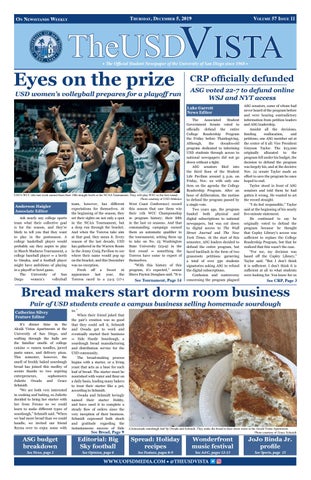
Eyes on the prize
USD women’s volleyball prepares for a playoff run
CRP officially defunded ASG voted 22-7 to defund online WSJ and NYT access
Luke Garrett News Editor
USD’s WCC title last week earned them their 10th straight berth in the NCAA Tournament. They will play WSU in the first round. Photo courtesy of USD Athletics
Anderson Haigler Associate Editor Ask nearly any college sports team what their collective goal is for the season, and they’re likely to tell you that they want to play in the postseason. A college basketball player would probably say they aspire to play in March Madness Tournament, a college baseball player — a berth to Omaha, and a football player might have ambitions of playing in a playoff or bowl game. The University of San Diego women’s volleyball
team, however, has different expectations for themselves. At the beginning of the season, they set their sights on not only a spot in the NCAA Tournament, but a deep run through the bracket. And when the Toreros take aim at that goal, they mean it. Every season of the last decade, USD has gathered in the Warren Room in the Jenny Craig Pavilion to see where their name would pop up on the bracket, and this December was no exception. Fresh off a Sweet 16 appearance last year, the Toreros raced to a 24-5 (17-1
West Coast Conference) record this season that saw them win their 11th WCC Championship in program history; their fifth in the last 10 seasons. And that commanding campaign earned them an automatic qualifier to the tournament, setting them up to take on No. 25 Washington State University (23-9) in the first round — something the Toreros have come to expect of themselves. “With this history of this program, it’s expected,” senior libero Payton Douglass said. “It is
See Tournament, Page 14
The Associated Student Government Senate voted to officially defund the entire College Readership Program the Friday before Thanksgiving. Although, the decades-old program dedicated to informing USD students through access to national newspapers did not go down without a fight. ASG senators filed into the third floor of the Student Life Pavilion around 5 p.m. on Friday, Nov. 22 with only one item on the agenda: the College Readership Program. After an hour of deliberation, the motion to defund the program passed by a single vote. Two years ago, the program funded both physical and digital subscriptions to national newspapers, but was cut down to digital access to The Wall Street Journal and The New York Times. At the start of this semester, ASG leaders decided to defund the entire program, but faced backlash in the form of two grassroots petitions garnering a total of over 350 students signatories asking ASG to refund the digital subscriptions. Confusion and controversy concerning the program plagued
ASG senators, some of whom had never heard of the program before and were hearing contradictory information from petition leaders and ASG leadership. Amidst all the decisions, funding reallocation, and petitions, one ASG member sat at the center of it all: Vice President Greyson Taylor. The $13,000 originally allocated to the program fell under his budget, the decision to defund the program was largely his, and at the decisive Nov. 22 senate Taylor made an effort to save the program he once hoped to end. Taylor stood in front of ASG senators and told them he had gotten it wrong. He wanted to set the record straight. “I do feel responsible,” Taylor said at the beginning of his nearly five-minute statement. He continued to say he originally voted to defund the program because he thought that Copley Library’s access was sufficient to replace the College Readership Program, but that he realized that this wasn’t the case. “For me, my decision was based off the Copley Library,” Taylor said. “But I don’t think it is sufficient. I don’t think it is sufficient at all to what students were looking for. You know for us
See CRP, Page 3
Bread makers start dorm room business Pair of USD students create a campus business selling homemade sourdough
It’s dinner time in the Alcalá Vistas Apartments at the University of San Diego, and wafting through the halls are the familiar smells of college cuisine — ramen noodles, jarred pasta sauce, and delivery pizza. This semester, however, the smell of freshly baked sourdough bread has joined this medley of scents thanks to two aspiring entrepreneurs, sophomores Juliette Owada and Grace Schmidt. “We are both very interested in cooking and baking, so Juliette decided to bring her starter with her from Fresno so we could learn to make different types of sourdough,” Schmidt said. “When we had more bread than we could handle, we invited our friend Reyna over to enjoy some with
us.” When their friend joked that the pair’s creation was so good that they could sell it, Schmidt and Owada got to work and eventually started their business — Side Hustle Sourdough, a sourdough bread manufacturing and distribution service for the USD community. The bread-making process begins with a starter, or a living yeast that acts as a base for each loaf of bread. The starter must be nourished with water and flour on a daily basis, leading many bakers to treat their starter like a pet, according to Schmidt. Owada and Schmidt lovingly named their starter Dobby, and have used it to complete a steady flow of orders since the very inception of their business. Schmidt expressed both shock and gratitude regarding the instantaneous success of Side
ASG budget breakdown
Editorial: Big Sky football
Catherine Silvey Feature Editor
See News, page 2
See Bread, Page 9
See Opinion, page 6
A homemade sourdough loaf by Owada and Schmidt. They make the bread in their dorm room in the Alcalá Vistas Apartments. Photo courtesy of Grace Schmidt
Spread: Holiday recipes See Feature, pages 8-9
Wonderfront music festival See A&C, pages 12-13
WWW.UOFSDMEDIA.COM ◆ @THEUSDVISTA
JoJo Binda Jr. profile See Sports, page 15
2
The USD Vista
◆
December 5, 2019
NEWS
How ASG spends student fee Each year Associated Student Government receives around $1.2 million from the student activity fee. Here is how the funds were divvied up this semester: Centers, Torero Program Board, and Associated Student Government Executive allocations
Figue 1: A pie chart of the $915,659 allocated to Associated Student Government.
Luke Garrett/The USD Vista
Associated Students Government Executive allocations
Figure 2: A pie chart of the $491,770 allocated to the Associated Student Government Executive.
Luke Garrett/The USD Vista
Luke Garrett News Editor Senior Tyler Arden began asking for greater transparency within Associated Student Government (ASG) in September. Arden then attended numerous ASG Senate meetings and each time requested that the student government make their budget public in an act of good faith and transparency. In response to Arden’s request, senator Rhonda Papp claimed students wouldn’t understand the budget and Speaker of the Senate Carolina Moreno Armenta questioned why Arden wanted to see the budget in the first place. He, in turn, restated his belief that those who pay for the budget should have the right to see it — a right not granted by ASG. In the weeks following, Finance Committee voted to make the budget public, but as of Dec. 3, no ASG budget has been made available to students. Howeve, the ASG budget was leaked to The USD Vista. The budget obtained by The USD Vista was later confirmed as accurate, according to ASG Finance Chair George Saunderson. A review of Fall allocations and senate spending: ASG oversees around $1.2 million per year, all of which is paid for by undergraduate students — $242 each per year, according to Saunderson. At the start of each semester, this lump sum is then divvied up by the Finance Committee between the three main parties of ASG: Torero Program Board (TPB), Centers, and ASG Executives (as seen in Figure 1). After senate approval, each party receives their allocations. This fall, $915,659 was allocated between the three ASG parties. ASG Executives received the majority of funds with over 50% of the total allocations. TPB followed with close to a third of the total allocations. Fifteen percent was given to the Centers — which
Funds spent by Senate
Figure 3: A pie chart of the money spent by the ASG Senate this fall.
includes organizations such as the Black Student Resource Center, Veteran’s Center, and Outdoor Adventures, among others. Each party then divides their allocations into various position holders. The USD Vista also obtained how ASG Executive has allocated their $491,770 (as seen in Figure 2). The close to half a million dollars allocated to the ASG Executives was dispersed across a number of position-holders as well as recurring expenditures. ASG President Marion Chavarria Rivera, for example, oversaw $80,000 in allocation this fall and ASG Senate controlled $21,000. The money allotted to each position-holder is approved by ASG Senate. These funds consist of both discretionary and request-based funding. Meaning a portion of the money must be used toward spending previously requested for and approved, and the rest can be spent based on the positionholders discretion. Only the ASG Senate spending was made available to The USD Vista (as seen in Figure 3). This fall, ASG Senate spent $14,816 of the $21,000 allocated to the governing body. The majority of the senate’s funds went toward the USD Food Pantry and Torero Closet, which provides free food and school supplies, among other items, to students in need. The Senate’s spending indicates that not all of the money allocated is spent. Sauderson noted that only half of the money allocated to ASG this fall will be spent — meaning only $400,000 to $500,000 will be spent this semester of the $915,659 allocated. The excess funds will carry onto next semester. ASG Senate will vote to confirm next semester’s allocations on Thursday, Dec. 12 in Solomon Hall. The meeting is open to the public and attendees will be able to view all that is set to be allocated in the Spring semester.
Luke Garrett/The USD Vista
Volume 57 Issue 11
◆
NEWS
The USD Vista
◆
$13k sits unused until spring
3
Debate over extent of CRP use by students leads ASG to vote against the program
CRP from Page 1
to say that it is good enough, no it is not. It’s not good enough. It is just a different resource. It is like we are comparing apples and oranges. They are both fruits, they are not the same.” Taylor had never publicly supported the program until this statement. He continued to explain the reality of ASG’s funding and asked the Senate to fund the College Readership Program, as there is currently no other planned initiative to spend USD students’ $13,000 on. “Where can we use this for money better spent?” Taylor asked those senators who wanted to use the program’s funding for another initiative. “We were not able to come up with any alternative options. That is because to find something that is worth that $13,000, that takes time, that takes effort, thought. You can’t do that in two weeks.” He also noted that even if some of the initiatives come to fruition, ASG has the money to pay for both the College Readership Program and new initiatives. “We could do them all,” Taylor said. “Funding the College Readership Program and funding every other initiative that has been brought up is not mutually exclusive. We can do both. That is why I voted for it in finance committee.” Taylor ended by defending his newly shared opinion, and also alluded to a possible reason why many in ASG don’t want the program funded. “Students want it,” Taylor said. “I am here to serve the people. Granted it is a certain group or demographic that some individuals might not love. Are we just going to cater to them because that is what the school has historically done? I mean, what is the alternative?”
Taylor alluded to a perception addressed by one of the petitioners, namely that some ASG members dislike the College Readership Program because it is solely used and petitioned for by students in the school of business. “Good luck with your
person who read The Wall Street Journal, but this person thought the $13,000 could be used better. The ASG president then read a number of initiatives that this unnamed person wrote down. “Even students who actively use it are actively trying to think
to discount those who petitioned to keep the College Readership Program. Commuter senator Nadia AlFaraje argued that the petitioners represent a very small portion of the student body and that they are most likely uneducated about the
ASG Senate votes to defund the College Readership Program; 22 voted against the program and seven voted in favor. Luke Garrett/The USD Vista
decision,” Taylor concluded. President Marion Chavarria Rivera continued her opposition to the program. Chavarria Rivera told senators that she knew an unnamed
of ways to reallocate that money because they feel as though it could be used better somewhere else,” Chavarria Rivera said. Some senators who agreed with the ASG President went on
process. “So keep in mind that the people signing the petition, probably a lot of them don’t even know the situation,” Al-Faraje said. “They might not know
Votes against CRP Nadia Al-Faraje Krystal Alvarez Fanisee Bias Kwamena Awotwi Antonio Cardenas Alana De La Torre Maya De La Torre Max Donahoe
Andrew Duhovic Eliza Giroux Valerie Jaimes Yashve Kalati Jesse Magaña Chidiebele Okaru Rhonda Papp Eniya Pendleton
The USD Vista Kaia Hubbard - Editor in Chief Anderson Haigler - Associate Editor Celina Tebor - Managing Editor Amy Inkrott - Copy Editor Alee Pingol - Art Director Luke Garrett - News Editor Eric Boose - Opinion Editor
Catherine Silvey - Feature Editor Lizzy Jennings - Arts & Culture Editor Chris Spiering - Sports Editor Zoé Morales Martinez - Photo Editor Connor Buckley - Distribution Manager Molly Feeney - Social Media Manager Jake Schmid - Finance Manager
anything about the situation. It is a really small amount of people.” Not all senators agreed. Alcalá Vistas senator Mary-Logan Miske believed it was the senate’s duty to respond to the petitioners’ request. “This is what our students want,” Miske said. “And I feel like we are fighting against what our student body wants. This is our time to make a decision. Students keep bringing it up.” As Miske spoke, senator Angelo Tharp broke order and said “they totally don’t” under his breath. He gained a number of laughs from the senate. Tharp then quickly moved to limit the discussion to five minutes, and thereafter a roll call vote was made. Seven senators voted to fund the College Readership Program and 22 voted to defund the program, which placed the $13,000 into a pool of excess funds that will not be used until the spring semester, if at all, according to Finance Chair George Saunderson. To sophomore Jordan Ritchie, the sole member of the public attending the meeting, the decision to defund the program was a disappointment. “I don’t think they should have put the money in the pool unless someone with a significant plan is ready to take action,” Ritchie said. “With only a semester left in the year, I don’t believe that anything with the money will get done this term.” Ritchie was also unenthused by the idea that she now can only access The Wall Street Journal and The New York Times through Copley Library. “I want to be informed as a citizen on a daily basis of what is going on.” Ritchie said. “I am not going to a database to do this.”
Votes for CRP Maya Ramirez Andrew Schneider Angelo Tharp Analleli Villegas Barrera Justice Zoto Vida Vousoghian
Editorial – 619.260.4584 Business – 619.260.4714 www.uofsdmedia.com / @TheUSDVista Razann Rizk - Advertising Manager Gina Lew - Student Media Advisor Marie Minnick - Operations Advisor
Catalina Carbajal Holly Carbine Justin Daus Mary-Logan Miske Simon Mizrahi Bryanna Rivas Daniella Walter
The USD Vista publication is written and edited by USD students and funded by revenues generated by advertising and a student fee. Advertising material published is for information purposes only and is not to be construed as an expressed or implied endorsement or verification of such commercial venues by the staff or University. The USD Vista office is located on the fourth floor of the Student Life Pavilion in room 403B. All inquiries should be sent to: The USD Vista 5998 Alcala Park San Diego, CA 92110 Opinions expressed in this publication are not necessarily those of The USD Vista staff, the University of San Diego or of its student body. Letters to the Editor can be submitted to The USD Vista office. Letters should be limited to 300 words and must be signed. For identification purposes, USD identification numbers and writer’s year must be included in the letter. The USD Vista reserves the right to edit published letters. Any content sent to the editor will be considered for publication unless otherwise stated.
4
The USD Vista
◆
December 5, 2019
A NA LYSI S
Are ASG’s struggles unique?
As USD cuts newspapers and conceals budget, LMU and Chapman do the opposite Upon first glance, it is easy to see the similarities between Loyola Marymount University and the University of San Diego. Both are located in Southern California with pristine, palm tree-filled campuses near the Pacific Ocean. Both are private Catholic institutions with undergraduate student bodies of 6,700 and 5,900, respectively. The two schools compete against
ASLMU held steady — continuing to fund their constituents’ New York Times access. A comparison of any two organizations, no matter how similar they are to each other, is likely to be flawed in one way or another. But a look at the way that ASLMU has handled similar problems to those that USD has encountered over the last year does not cast a flattering light on San Diego’s ASG. The current controversy regarding USD’s ASG began
each other in athletics in the West Coast Conference. Some students who attend USD also applied to LMU, and vice versa. And, of course, they both feature extravagantly high tuition per year — $71,040 for LMU, and $67,211 for USD. Take one look at each of the universities’ student governments, however, and the similarities seem to fade. While USD’s Associated Student Government (ASG) has been mired in more than a year’s worth of controversy and student
more than a year ago, when then-President Natasha Salgado attempted to cut the College Readership Program, which had historically provided Toreros with access to several national and local newspapers. Salgado’s abrupt decision to do away with the subscriptions, which she justified with an Instagram poll that reportedly had less than 100 respondents, was met with confusion and dissent. The senate voted unanimously to put the decision instead to
Anderson Haigler Associate Editor
that was more than triple the amount who responded to the Instagram poll. Students showed up at ASG meetings to voice their opinions but were often not given time to speak. After Finance Chair George Saunderson released data that showed that more than onefifth of USD students had activated their subscriptions, some Toreros implored their government to renew the newspaper access. In the end, even after Vice President Greyson Taylor recommended that the digital subscriptions be refunded following a four-hour emergency deliberation, even after Taylor admitted that he had changed his mind and was in support of the program, the Senate voted to remove funding from the newspapers, leaving students without easy access to high-quality journalism for the first time in more than a decade. Throughout the entire process, neither Salgado nor Chavarria Rivera agreed to any interview with The USD Vista. One hundred and twentythree miles up the California coast, Loyola Marymount had a similar debate regarding funding of newspaper subscriptions. Only their discussion was quick and clean. No controversy. No petitions. No student backlash. Discussion sparked a campuswide referendum, which led to a decision being made — a conclusion that was likely representative of the student body’s wishes. “The (NYT access) has been here the whole time I’ve been at LMU,” ASLMU Vice President Emily Sinsky said. “It was something that we had a big
“I think it’s pretty suspicious that USD’s ASG doesn’t (make the budget public). I would feel pretty shady if I wasn’t being transparent. If you have something to hide on your budget, you’re doing it wrong.” -Emily Sinsky, ASLMU Vice President concerns regarding their financial transparency and defunding of free newspaper access for students, LMU may not have had to weather similar issues. As USD students’ requests for ASG’s budget to be made public were rebuffed by senate leadership, LMU’s Associated Students (ASLMU) featured their budget prominently on their website. As Toreros watched their student leaders defund their access to high-quality journalism,
a campus-wide referendum, a motion which Salgado vetoed. The veto kicked off more than a year of controversy regarding the Program that has now stretched into current president Marion Chavarria Rivera’s tenure. In the year that followed the initial attempt at defunding, students’ access to newspapers gradually decreased. In response, Toreros created petitions in support of the subscriptions, receiving an amount of signatories
discussion over, because it is so much money — it ended up being $17,000.” Sinsky described how the high cost of the subscriptions led to an extensive discussion between the executive members of the student government on the merits of the program during their leadership team retreat. Initially, renewing the funding didn’t seem likely. “We kind of went into it saying ‘I don’t think students need it, I think we can allocate this funding
elsewhere,’” Sinsky, an LMU senior, said. After lengthy deliberation, Sinsky and her colleagues came to the opposite conclusion of USD’s ASG, doing so without a year-long controversy. “We sat there for hours outlining everything … and that’s when we decided that we wanted to maintain the precedent of having (the subscriptions), and giving that access to students. Since we had the money, we wanted to uphold that.” ASLMU’s rationale for maintaining the funding touched on a similar concern that both USD students and faculty members shared regarding the potential loss of newspaper subscriptions — the risk of students becoming less politically informed in the publications’ absences. Though this issue did not appear to resonate with USD’s ASG, it did with their colleagues to the north at LMU. “We decided that especially with the nature of our political climate right now, it’s something
institution to USD. The campus, which is home to 8,300 students, is 15 miles from the beach, and tuition clocks in at roughly $55,000 per year. Amid’s constituents — Chapman Panthers — have enjoyed access to the NYT through funding from SGA for the last four years. Though Amid and her colleagues reevaluate all initiatives that they fund annually, the newspaper access has remained, largely due to SGA’s belief in the importance of the program, and that many students utilize the subscriptions. “A primary reason is making sure our students are well educated and well rounded and have access to quality journalism,” Amid said. The contrast between ASLMU, Chapman’s SGA, and USD’s ASG becomes even more stark when considering each organization’s treatment of their respective budgets. The eventual defunding of newspaper access on USD’s campus sparked calls for ASG’s budget to be made public,
that’s important for students to have,” Sinsky added. Like USD’s ASG, ASLMU was concerned with usage of the digital subscriptions on their campus. So they sent out a survey to all undergraduates regarding the program, which Sinsky estimates got over 2,000 responses. “The majority was in favor of the program,” Sinsky said. “Most people said that they wanted to keep the New York Times subscriptions.” And so, the subscriptions stayed. A small level of concern did remain at LMU regarding getting the most out of the initiative, as ASLMU’s survey found that some students either did not know that the program existed, or were confused as to how to activate their subscriptions — perhaps similar to the issues with the program at USD. ASLMU viewed that as a shortcoming to address, not grounds to cancel the access. “The overwhelming response was people wanted to use it, they just didn’t know about it, or didn’t know how to use it,” Sinsky said. “So we decided that if we’re going to fund it, we have to publicize it well, and make sure that students know about it and know how to use it.” Saba Amid is the president of the Student Government Association (SGA) at Chapman University, another similar
with senior Tyler Arden speaking multiple times at senate meetings regarding this issue. His desire for transparency was met with skepticism and pushback. One senator asked him why he needed to see the budget. Another told him that USD students might not be capable of understanding it. Finance Chair Saunderson told Arden that at best he would receive the total sum of the budget — around $1.2 million. In the weeks since Arden’s request for a public budget, the Finance Committee has recommended that the budget becomes public in some shape or form — exactly how much will be disclosed to students remains unclear. But the Senate has yet to vote on the recommendation, meaning that as the first semester of this academic year winds down, Toreros are still without any details as to how their $242 fee is being spent. Students at LMU or Chapman have had to voice no such concerns. Nobody showed up at ASLMU’s or SGA’s meetings to ask for their budgets to be made public. They already are, and have been for at least the last three years. Two clicks on ASLMU’s website allows anybody to download their impressively detailed budget — everything from the President’s salary to the cost of apparel for ASLMU to the total cost of LMU’s
Volume 57 Issue 11 annual concert. At Chapman, a sift through SGA’s website reveals all of their financial documents, and any student wanting a copy of the budget can have it emailed to them directly. “(Transparency) is one of the most important parts of being in student government,” Amid said. “ … we want to make sure we are spending it accurately and wisely. If somebody needed (the budget), we could totally send it to them.” At LMU, Sinsky admitted that it is not the most comfortable thing to have all of her organization’s expenditures out in the open,
◆
ANALYSIS
◆
5
The USD Vista
budget public),” Sinsky said. “I would feel pretty shady if I wasn’t being transparent. If you have something to hide on your budget, you’re doing it wrong.” ASLMU spends a solid amount on things that only benefit those in the student government — things that Sinsky stated are not flattering to disclose, but necessary to operate the organization. “We definitely spend money on things for ourselves that maybe somebody would disagree with in the public, but we have it open for people to see, because it’s
“A primary reason (to fund the NYT subscriptions) is making sure our students are well educated and well-rounded and have access to quality journalism.” -Saba Amid, Chapman SGA President but shared Amid’s belief that transparency and honesty with her constituents is key. “The budget has always been public, but not as visible (as it is now),” Sinsky said. “And that was something that (ASLMU President Ken Cavanaugh) and I decided to promote and publish for people to look at. For me, that was something that we wanted to be transparent about, because we represent all of the students at the university.” When asked about the situation at USD, she expressed concern at ASG’s lack of transparency thus far. “I think it’s pretty suspicious that USD’s ASG doesn’t (make the
something that we want to have a conversation about, and we don’t want to like, hide things.” But until the ASG budget is made public, there will be no such conversations at USD. And unlike LMU and Chapman students, Toreros will be without access to high-quality journalism from here on out. That is where the similarities between the three schools begin to fray. Toreros, Chapman Panthers, and LMU Lions may share favorable weather on a beautiful campus, small classes, and sky-high tuition, but there’s one thing that they seemingly do not have in common — a student government organization that is transparent
With the College Readership Program gone, Toreros are without free access to newspapers for the first time in more than 10 years. Photo courtesy of Tayler Reviere Verninas
with its constituents. “I don’t think (USD ASG) is evil, and wants to take things away,” Sinsky said, emphasizing
that she is not trying to demonize her student government colleagues in San Diego. “It’s probably a funding issue. But
I would say that if there were 1,300 students (using the free newspapers) … I would say that that’s worth it, and not cancel it.”
pointloma.edu/12monthMBA
6
The USD Vista
◆
December 5, 2019
OP I N ION
Big Sky dreams for football Toreros’ perennial dominance raises questions about a change of conference
Eric Boose Opinion Editor When the University of San Diego football team took the field against the University of Northern Iowa on Saturday, it marked the Toreros’ fourth consecutive postseason appearance, and their fifth in the last six years. A week earlier, USD won their 37th consecutive Pioneer Football League (PFL) game, defeating the Jacksonville University Dolphins 47-28. The Toreros have not lost against a PFL opponent in the last four seasons, and have won the conference title for the last six, winning it outright every year except for 2015, when they shared the title with Dayton University. San Diego is undoubtedly the king of the PFL, and they frequently are in the top 10 best offenses in the entire Football Championship Subdivision (FCS). Quarterback Reid Sinnett ranks 9th in the nation in passing yards this season, and fourth in passing touchdowns. Sinnett is third in completion percentage, and second in quarterback rating. Receiver Michael Bandy is seventh in FCS in receiving yards, and eighth in receiving touchdowns. As a team, USD had the third-best scoring offense this season, averaging just under 42 points per game. The Toreros dispatched each of their PFL opponents with ease, winning conference games by an average of 27.25 points this season. In some ways, Torero football is like Gonzaga University’s men’s basketball team. Both teams cruise past their conference opponents while putting multiple players at the top of national statistics charts. In 2017, the Zags considered leaving the West Coast Conference for more competitive regular-season games in the Mountain West Conference. And though the Bulldogs elected to remain in the WCC, it might be time for USD’s football team to consider a similar move, leaving the Pioneer League for the Big Sky Conference. A move to the Big Sky would certainly bring, among other things, tougher regular-season competition. At season’s end, four of the top 10 FCS teams in the nation played in the Big Sky, with three of them making the top five. On Sept. 7, USD hosted the then fourth-ranked UC Davis Aggies, who finished eighth in the Big Sky. In that game and others, the Toreros proved to be up for the challenge. San Diego came within one yard of upsetting the Aggies, losing 3835. The Toreros held this year’s playoff opponent, the sixth-
Former Torero wide receiver Justin Priest makes a spectacular catch in USD’s 41-10 win over Northern Arizona from 2017, the team’s last victory against a Big Sky school. Photo courtesy of Anna Bradley/USD Athletics
ranked Northern Iowa Panthers, to only 17 points in Cedar Falls on Saturday. The Toreros are also no strangers to Big Sky opposition. The Toreros’ only playoff wins both came against Big Sky opponents, San Diego beating Cal Poly in San Luis Obispo in 2016 and Northern Arizona in Flagstaff in 2017. Over the past six years, San Diego has played a total of 10 games against teams from the Big Sky conference, with eight of those games being against regional opponents Cal Poly and UC Davis. Proximity is another benefit that a move to the Big Sky would bring USD. No FCS team currently travels further during a season than the Toreros, who made two trips across the country to Florida this year, plus trips to Ohio and North Carolina. The furthest the team would have to travel to play a Big Sky opponent would be to Eastern Montana to play Montana State. With the proximity to conference opponents would also come some smaller, tangential benefits. There are four teams in the Big Sky which could qualify as regional rivals for the Toreros: Cal Poly, UC Davis, Sacramento State, and Northern Arizona. A local conference rival is something San Diego football is currently missing, with the closest PFL team being Drake, located in Des Moines, Iowa. However, the decision to change conferences comes with some serious obstacles. For what it is worth, Gonzaga still plays its basketball in the WCC, not the
Mountain West. For San Diego football, a change in conference would bring a lot more losing. San Diego has not beaten a Big Sky team at Torero Stadium in over a decade, cruising past Northern Colorado in 2007 and beating UC Davis in 2008. USD has not improved in recent years. The Toreros are 2-8 against Big Sky Conference teams over the last six years, and those two wins both came on the road. Even then, the teams the Toreros beat finished in the middle of the pack in their conference standings. The same Cal Poly team that walloped the Toreros 52-34 in the season opener finished last in the Big Sky this season. While the Toreros may breeze through their current conference, there is no overwhelming evidence that they would even be competitive following a move to the Big Sky Conference. However, any potential onfield thumpings are by no means the biggest obstacle to a change in conference for the Toreros. That would be scholarships. Currently, USD does not offer scholarships for football — no school in the PFL does. For USD to start offering football scholarships would open a can of worms that the school has so far kept closed. Of course, San Diego would not be required to offer scholarships in order to change conference, but they would almost certainly be left well behind their new opposition if they did not. Scholarships are essential for recruiting
players of the highest ability — players who could help the Toreros compete in one of the best football conferences in the country. Essentially, if USD joined the Big Sky while not offering scholarships, they would be condemned to the bottom of the standings for the foreseeable future. Preventing that fate is not as simple as just finding room in the budget for football scholarships, but even that would be a feat in itself. If USD were to hand out scholarships which only covered tuition, each scholarship would cost the school $50,450. Under FCS rules, USD could hand out 63 of those scholarships, or almost $3.2 million — more than the school currently spends on its football program as a whole. Even if room was made in the budget to pay for scholarships, there would still be the issue of complying with Title IX restrictions. Generally, Title IX serves to ensure equity between men’s and women’s college athletics. Among the rules created by Title IX to serve that purpose is the rule that schools’ scholarship spending must be the same proportional to participation. That means if a school gives out $200,000 in athletic scholarships, and the school’s athletes are 50% men and 50% women, $100,000 must be awarded to women and $100,000 to men. Currently, USD pays $7.75 million in athletic financial aid and, thanks to football not receiving scholarships, 40% of that aid
goes to male student athletes. However, if Torero football players became eligible for scholarships, then that breakdown would almost entirely be reversed, with men representing 56% of scholarshipeligible athletes. The addition of football scholarships at USD could, at the very least, mean less financial aid for female student athletes. It could also mean that more of the financial aid money for male student athletes is funneled into football and less into other sports. Granted, these are hypothetical, but what is guaranteed is that USD would have to make tough decisions about how to handle the inflated cost of being competitive in the Big Sky Conference. Those tough questions are certainly worth asking, and may be worth answering. A move to the Big Sky would put San Diego in a conference with some of the strongest football schools in the West, setting up tough games and rivalries with regional opponents. In the long run, the move could set the Toreros on a course to be a national powerhouse, not just a predictable conference-topper. There may not be a clearly right answer, and there are benefits to both staying and moving. At this point, the only wrong choice would be to not consider the move at all. The Toreros are scheduled to visit Montana State in 2021, and will play Cal Poly in each of their next four seasons. Perhaps by 2023, the showdown with the Mustangs will be a conference game.
The views expressed in the editorial and op-ed sections are not necessarily those of The USD Vista staff, the University of San Diego, or its student body.
Volume 57 Issue 11
◆
FEATURE
◆
7
The USD Vista
FEATURE AR TS &
Turning passion into dough
Two student bakers produce and distribute homemade sourdough bread across USD
Bread from Page 1
Hustle Sourdough. “Within the first week of announcing our business we got approximately 50 orders, and this showed us that our idea had very strong potential for success,” Schmidt said. “The abundance of support and the rapid growth made us so hopeful for the future of our business.” While balancing such a large amount of orders with academics and extracurriculars may sound like an impossible feat, Schmidt explained that developing time management skills prevented her and Owada from becoming overwhelmed. “It may seem like a big time commitment,” Schmidt said. “Lucky for us, making each loaf of sourdough is a 24-hour process with a lot of idle time while the bread proofs, rises, and bakes, which helps incorporate air and make it so fluffy. This gives us plenty of time to get our school work done and participate in extracurriculars while the bread gains its recognizable sourdough taste and texture.” Owada added that her and Schmidt’s efficiency as a team
and love for baking smooth out potentially stressful moments. “You would think that running a business out of a dorm would create a stressful environment,” Owada said. “However, we are very passionate about what we do which makes it a very stress-relieving process and helps add structure to our day. We move as one unit, Grace and I never hit roadblocks with our business ideologies.” Despite preparation, stressful moments still emerge from time to time for the two bakers, especially when their business and academic schedules collide. Owada explained that late nights are inevitable, though they have become more manageable with time and experience. “Juggling school, athletics, extracurriculars, and a business can sometimes lead to some very late nights,” Owada said. “We also have to make sure we are always being very considerate of our roommates and keep the kitchen very clean and tidy because we don’t want to create any conflict that may make our home or work environment more stressful.” As the end of the semester
nears, it has become more and more clear to Owada and Schmidt that their hard work has paid off. The pair has amassed a loyal fan base and continue to receive a steady flow of orders. As a result, Schmidt revealed that she and Owada have plans to expand, exploring business opportunities beyond the USD community. “We are going to continue our business throughout the next semester and work to save money to trademark our company name, Side Hustle Sourdough,” Schmidt said. “We are also working on creating a website where our customers can order and browse our full menu. In the future, we are hoping to open up a storefront in San Diego and expand even more by incorporating more sourdough-based baked goods like crackers and rolls.” Owada and Schmidt take great pride in the growth of Side Hustle Sourdough. Schmidt ultimately credits the pair’s organization for the continued success of the business. “You have to make sure to really plan things out or else a lack of structure could be the downfall of a growing
The business produces seven classic flavors and five special flavors each season. Photo courtesy of Grace Schmidt
business,” Schmidt said. “We operate like clockwork to make sure we get everything done in time and have enough time for academics and extracurriculars as college students.” Owada added that the pair’s unwavering dedication to Side Hustle Sourdough has greatly contributed to the business. “You have to be passionate
about what you’re doing,” Owada said. “We eat, sleep, and breathe for our business and the satisfaction of our customers. If you care about what you’re doing it will find a way to work out.” Interested students can visit @sidehustlesourdough on Instagram to learn more about the company’s products and place orders.
8
The USD Vista
◆
December 5, 2019
(Photo courtesy of Shelby Todd)
APPLE CRUMBLE PIE (Recipe courtesy of Shelby Todd)
There’s nothing quite as American as apple pie, which is why it is typically present at holiday celebrations, but apple pie’s roots actually come from Europe. European settlers were the first to bring apple seeds to America, and they were the first to introduce the idea of eating pies at special occasions and holidays. Thanks to these settlers and Johnny Appleseed, apple varieties were spread throughout the nation, allowing for apple pie to be introduced to the United States. The first recipe for apple pie in the U.S. was seen in 1796, in Amelia Simmons’ “American Cookery,” the earliest known published cookbook in America. Since apple pie was introduced, it’s become a go-to dessert, especially since it can be enjoyed year round. The sweet and tart nature of apples, complete with warm spices, makes apple pie the perfect holiday dessert, and with the recipe below, you can be sure to have this delicious American staple on your holiday table this year.
Ingredients
Crust: 1 ½ cups flour 1 tbsp sugar ½ tsp salt 8 tbsp cold butter cut into pieces 6-8 tablespoons of ice water
Directions For the crust: Combine flour, salt, and sugar in a mixing bowl. Add in cold butter pieces and using a pastry cutter (or fork) combine butter with dry ingredients until the mixture contains pieces of butter that are varied in size, with none larger than a pea. Then, sprinkle 1 tbsp of ice water to the mixture at a time and use a fork to mix it in. Once the dough starts to form clumps test it by picking up a chunk. If it sticks together without being too crumbly, you have added enough water. When making this recipe, I added 7 tablespoons before the dough was able to stick together. When the dough gets to this point, pack it into a ball, rolling it in the bowl to pick up the drier crumbs. Once was in a ball, I patted it into a disk shape so it would be easier to roll into a circle. Then, wrap it in cling wrap and let the dough chill for at least a few hours or overnight. For the filling: In a bowl, mix together sugar, flour, cinnamon, nutmeg, and salt. In a larger bowl, drizzle the lemon juice over the sliced apples and mix to coat. Add ½ of the dry mixture into the apples and mix to coat. Then add the rest of the mixture and stir until all of the apples are coated. For the crumble: In a bowl, combine flour, sugar, cinnamon, and salt. Whisk together with a fork, and then add in the butter. Using a pastry cutter or fork, incorporate the butter until it becomes crumbly. After I used the pastry cutter to break down big chunks of butter, I used my hands to get it to a desired crumbly texture.
Filling: 7-8 apples - peeled, cored, and thinly sliced 1 tbsp lemon juice ½ cup sugar 3 tbsp flour 1 ½ tsp cinnamon ½ tsp nutmeg
Crumble Topping: ⅓ cup flour ¾ cup sugar 6 tbsp softened butter cut into pieces ½ tsp cinnamon ¼ tsp salt
1. Preheat your oven to 350º F 2. Once the pie crust has been chilled, take it out and let it sit until it is soft enough to be rolled out. Lay two sheets of overlapping cling wrap on the counter. Place the dough on top of these sheets, then cover with two more sheets. This will allow for easier rolling with less mess. 3. Using a rolling pin, roll the crust out starting from the middle out to all directions of the circle. Once the crust has been rolled out to about 12 inches in diameter, and about ¼ inch thick, fold over the ends of the cling wrap and place in the refrigerator to let it chill for about 10 mins. 4. Once chilled, take the crust out, remove one side of the cling wrap, and set it into a pie dish. Press it gently into the dish and then remove the other side of cling wrap. 5. Pour your filling mixture into the crust. You can arrange the apples however you like, but fill the crust to the top. 6. Sprinkle the crumble mixture on top of the apples, creating a thick, even layer. 7. Wrap the edges of the pie crust with aluminum foil to create a barrier to prevent the crust from burning. 8. Bake the pie for 45-60 minutes, removing the aluminum shield for 15 minutes at the end to allow the crust to brown. Once the crumble has crisped and the filling begins to bubble, the pie is ready. Take the pie out and let it cool. Serve it warm or let it cool completely before covering and placing it into the fridge.
Volume 57 Issue 11
◆
FEATURE
◆
9
The USD Vista
ALMOND ROCA (Recipe courtesy of Megan Manke) Almond Roca has been a popular holiday treat in Washington for decades. Many families make big batches of the candy to send out to family and friends every holiday season. The chocolate- and almond-covered toffee confection was created by confectioner Harry Brown in Tacoma, Washington in 1923. The candy became a best seller for Brown’s candy company Brown & Haley and during the sugar rationing of World War II, their Almond Roca was shipped in bulk overseas to be given to soldiers fighting in the war. This sweet, crunchy candy is simple to make and heavily addictive. If you want to make a unique and tasty treat this holiday season, use the recipe below, but be prepared to be craving it for the rest of the year. Ingredients 2 sticks butter 3 tbsp water 1 tbsp corn syrup 1 ⅓ cups sugar 1 cup chocolate chips 2 cups almonds Will need Candy thermometer
Directions 1. In a large saucepan melt butter, water, corn syrup, and sugar. Stir until the temperature reaches 300ºF or “Hard Crack” on the candy thermometer. Make sure you have a big enough saucepan, unlike I did, as the mixture will expand and can overflow. It also takes a while for the mixture to reach 300º F, but just keep stirring and eventually, I promise it will get there. 2. Remove the mixture from heat and stir in 1 cup of coarsely chopped almonds and then spread it out onto a metal cookie sheet. 3. Sprinkle the chocolate chips over the mixture. If you want it extra chocolatey like me, feel free to add more than 1 cup of chocolate chips. Once the chocolate melts, spread it evenly on top of mixture and cover with the rest of your chopped almonds. Be sure to press the almonds down slightly to make sure they stick. 4. Cover it with foil and refrigerate until hard (a few hours). Once it’s hard, flip the bar out of the pan. Then, take a knife, kitchen mallet, or some sort of tool to break the bar into smaller pieces. Once pieces have been broken into your desired size, serve them up or package them to give to friends and family.
(Photo courtesy of Shelby Todd) Spread by Alee Pingol/The USD Vista; Content by Shelby Todd/The USD Vista; Illustrations by Audrey Garrett/The USD Vista
10
The USD Vista
◆
December 5, 2019
Sister Rodee’s journey at USD Alumna nun shares her memories of USD from the earliest years of the college
Mayella Vasquez Asst. Feature Editor It was the 1950s. The United States had the strongest military in the world, families were growing, and the economy was booming. Women were encouraged to stay within the confines of the home. Popular magazine articles like “Don’t Be Afraid to Marry Young,” “Cooking To Me Is Poetry,” and “Femininity Begins At Home” urged women to leave the workplace and focus on bearing children. During the same era, however, the recently-opened San Diego College for Women, which would later become the University of San Diego, offered women different opportunities. Sister Virginia Rodee is an alumna from the class of 1957 and works today on special projects for the campus such as giving tours of Founders Hall. She graduated with a bachelor’s degree in music, and later received a Master of English and a Master of Theology. Rodee attended a much different USD than the one in operation today, one that was still growing and finding its identity. “At first we had trouble filling Founders, and very few people had cars,” Rodee said. “There were no parking fees in those days. Young Sisters of the Society of the Sacred Heart were our RAs, and we had one night watchman who would make
their rounds. I have no doubt that I received a great education and we also had a lot of fun.” Attending such a new college presented some challenges, as the institution itself was still in development. Rodee continued by describing the struggles of the young college. “It was just Camino and Founders, and every cent went toward paying the buildings off,” Rodee said. “You would see your professor, only religious women at the time, watering their allotted portion of the patio after class or cleaning the classrooms.” Despite these challenges, the college’s founder, Mother Rosalie Clifton Hill, insisted on bringing the best women to teach. Alumni from Stanford University, UC Berkeley, The Catholic University of America, and the University of Notre Dame were brought to the college as instructors. This was unusual since, according to a government census, in the 1950s less than 5% of women in the U.S. pursued higher education, much less a doctorate degree. Rodee remembers being taught by these exceptional women. “Mother Agnes Murphy was one of the wisest professors at the college,” Rodee said. “She had a Ph.D. in History from the University of Chicago and, when the school needed a philosophy professor, she went back to school and got another Ph.D.”
Rodee regarded Hill in the same light. “She was an intelligent woman, quiet and ambitious,” Rodee said. “She loved architecture and engineering. As a child, instead of playing with other toys, she made designs out of small paper squares.” After graduating from the San Diego College for Women, Rodee followed in the path of the female role models in her life, becoming a sister in the Society of the Sacred Heart. Soon after, Rodee decided to take her mission of service far beyond her local community. “In 1968, after joining the Society of the Sacred Heart, I asked to be sent to Korea,” Rodee said. “I stayed for 23 years teaching English at our regular school and university.” Rodee recalled that the communities she served in Korea were deeply scarred from war, left impoverished and struggling to survive. “The U.S. military had given us some tents, and we taught in these ‘tent’ schools, and on our campuses,” Rodee said. “At the time there were no heaters, so we would use coal to stay warm. People lived out of their shops, and children were hungry.” During her time in Korea, Rodee spent nine semesters learning Korean and eventually became fluent. Later, she became the director of the Catholic University of Korea’s Foreign Language Education
Rodee described SDCW as a campus full of promise and change. Photo courtesy of the USD website
Institute. Today, the university is consistently ranked as one of the leading collegiate institutions in South Korea and is internationally recognized for its excellence. Before returning to USD in 1997, she traveled around the world, from Taiwan to Spain to Canada. When she returned, she went on to be honored as a “Coronado Legend” in 2007. In 2009, she received the Woman of Conscience Award from the Associated Alumnae of the Sacred Heart and, in 2016, the Academy of Our Lady of Peace (OLP) named her the Alumna of the Year. In 2018, Rodee received the Mother Rosalie Clifton Hill Service Award. These days, Rodee can be
Yo u r n e w s i n yo u r h a n d s
@ u s dv i s ta @ t h e u s dv i s ta
found in Founders Chapel. She is in charge of special projects, such as giving campus tours. She greets everyone with a smile, and is a positive presence on campus. USD started with two buildings, less than a hundred students, and professors committed to making the institution the best it could be. Today, USD’s 180-acre campus is a nationally ranked Catholic institution with more than 800 faculty members, 7,800 students, and eight academic divisions. Despite all of the changes and growth that have occurred throughout its lifetime, the college’s roots of changemaking and leadership remain steadfast and unmoved.
Volume 57 Issue 11
◆
ARTS & CULTURE
◆
The USD Vista
A RT S & C U LT U R E
11
Rising student DJ spotlight
Sophomore Javi Lozano shares the highlights of his career and his hopes for the future
Catherine Silvey Feature Editor Many wonder about the artistry behind the live mixing of electronic music. As worldrenowned DJs such as Daft Punk and David Guetta consistently top charts with their infectious beats, fans can only dream of how they do it. University of San Diego sophomore Javi Lozano aspires to reach such levels of fame and success one day, and seems to be well on his way. He shared with The USD Vista just how his journey began. From booking clubs and festivals in both Mexico and the U.S., to getting his first club residency at the age of 16, to signing into contracts with record labels such as CLUTCH Records, 19-year-old Lozano has worked hard to make a name for himself in the electronic music industry. “Currently, I’ve been working nonstop on touring and music because I love making music and playing it live,” Lozano said. “If I were to guess where my career is going, I would say it’s going somewhere big and I know that I’ll be happy
because I love what I do.” Lozano’s passion for mixing music developed at a young age by coincidence, when a music teacher asked him to perform at a middle school carnival in place of the hired professional, who was stuck in traffic. Lozano’s proficiency in playing piano, guitar, and bass guitar all informed his performance, and resulted in a highly successful first attempt at mixing. “I lowkey knew basic stuff and was familiarized with what DJs did,” Lozano said. “The doors opened and I mixed for about 30 minutes, and the crowd’s reaction was nothing but positive. Everybody was dancing and jumping, even the upperclassmen. As a little 12-year-old, I was really excited and that’s when I knew I could make something out of this experience.” Years after his improvised performance, Lozano cites preparation before gigs as one of the keys to his success, tailoring playlists to the audience he anticipates. “I pick out songs that I produce, songs that I like, songs
that are popular, and classics,” Lozano said. “Most of the time I prepare myself for any scenario, so I would say the songs I play depend on the time slot, place, and crowd. A good DJ must know how to read a crowd.” The combination of long performances and the emotional connection to an audience necessary for a good performance tends to take a toll on DJs when unmanaged. Lozano expressed that combating exhaustion was a significant struggle early in his career. “When I first started, not getting sleep was hard,” Lozano said. “Since most of my shows were during the night and backto-back, I wouldn’t get much sleep. From these experiences, I learned how to adapt my body by taking naps throughout the day before a show or naps to fix my sleeping schedule.” Though exhausting, Lozano ultimately finds great fulfillment in the emotional aspect of his profession, acknowledging that connecting with and spiritually stimulating his audience is crucial to his success. “For me, a DJ’s job is to
perfectly mix energy with emotion, creating a state of euphoria and allowing the audience to digest the music and interpret it using their bodies, hearts, and minds,” Lozano said. “For me, this is my own interpretation of what I do or my ‘job description’ as I like to call it.” Each one of Lozano’s performances is vastly different from the next, as every venue provides a unique space, audience, and dynamic. As a result, Lozano finds it hard to pick a favorite moment of his career. “Most of my performances have been highlights,” Lozano said. “I don’t think I have a favorite memory of a show because every show is so different. The music I choose is different, the crowds are different, the setting is different. There are just so many variables that are different every time and I think that if I focus on one particular memory, I wouldn’t be able to appreciate the rest of my experiences.” From humble beginnings, Lozano has grown within the music industry and is starting to catch international attention.
“So far, my biggest accomplishment has been being able to perform and be wellknown internationally,” Lozano said. “People from all around the world know who Javi Lozano is and that is probably my greatest accomplishment. Little by little, more and more, people will know me because I don’t plan on stopping and I strive to continue to make more music, create memorable experiences, and keep moving forward.” Lozano credits his profession with changing his outlook on life, giving him a new perspective of the people and the world around him. “Being a DJ has definitely changed how I see life,” Lozano said. “I’ve become more grateful for what I have, the opportunities I’ve been presented with, and the contacts and relationships that I’ve made.” In the meantime, Lozano can be found balancing his time between studying in Olin Hall and performing at local clubs such as Bassmnt in downtown San Diego. Keep an eye out for his future local performances to support our fellow Torero.
Lozano has performed at multiple popular venues in both the U.S. and Mexico, securing his first residency at just 16 years old. Toreros may be familar with Bassmnt, an 18+ club where Lozano has performed before. Photos courtesy of Javi Lozano
12
The USD Vista
◆
December 5, 2019
Wonderfront’s first festival
USD Toreros get a glance at the future of this exciting and expansive festival Lizzy Jennings A&C Editor
The Flatbush Zombie trio utilized the whole stage, engaging every part of the crowd. Lizzy Jennings/The USD Vista
On the weekend of Nov. 22-24, the music festival Wonderfront opened its gates to the public for the very first time. Hosted along the San Diego waterfront, the festival boasted beautiful views and an abundance of attractions for all kinds of visitors. Leaning on its location and on the natural beauty of San Diego, the festival was able to provide an experience for attendees that was unlike any other music festival in existence. Crowds entered the festival grounds for the first time ever on Friday, and many were shocked by how expansive Wonderfront really was. With four separate parks, the festival took over almost every major aspect of the San Diego waterfront area, spanning from Embarcadero South all the way to the Broadway Port Pier. Seaport Village, though open for business all weekend long, was surrounded by stages and booths. The close integration into the city of San Diego made the festival feel more cohesive with the location, rather than like an event that was just thrown wherever there was space. Additionally, the Wonderfront team emphasized interacting with the waterfront throughout the festival experience. There were water taxis that carried festivalgoers to stages, and attendees could listen to the music from boats that cruised up and down the
expanse of the various parks. Beyond that, there were even attendees who rented paddle boards or kayaks during their time at the festival. Friday’s festival activities got started later in the afternoon, with gates opening around 3:30 p.m. With this later start time, and with the sun setting so early, some festivalgoers felt that it was hard to get a handle on the park grounds. Senior Maddie Bailey was pleased with the event overall, but expressed that the venue was a little confusing. “For their first year, Wonderfront is a great festival with amazing sound production and a strong lineup, but logistically it is a challenge to navigate,” Bailey said. Many chose to shuttle between the two most accessible sections of the festival, which were the Embarcadero North and the Seaport Village parks. These two sections, home to two stages each as well as food trucks and attractions, were just walking distance from one another and had some of the more well-known acts. Saturday the festival went into full swing, with an impressive lineup, and an even more impressive crowd. Gates opened at 11:30 a.m. on this day so attendees were able to get the lay of the land well before the sun set. For many, the day kicked off with The Knocks, or Big Gigantic, both mostly electronic acts. Impressive graphics and energetic crowds characterized the day’s early
sets, as the younger crowds gravitated toward acts like Bryce Vine and Vince Staples. If the name Bryce Vine seems familiar, that is likely because he was just here performing for University of San Diego students during TPB’s Big Blue Bash. A somewhat surprisingly popular act among many of the USD students attending Wonderfront Festival was the group of rappers called Flatbush Zombies. Known for their aggressive audiences and insane shows, this act drew in many students who had been looking for the chance to see the wellknown trio in person. Senior Wyatt Warren, of “Two Men, One Slice” fame, had a hot take on the very eventful Flatbush set. “If you like sweaty mosh pits and stolen phones, I have just the place for you,” said Warren. “Flatbush Zombies’ set consisted of shoving some of your best friends into strangers while losing all of your possessions. Overall a great experience though.” Though the Flatbush Zombies’ San Diego set was a little more toned down than usual, with no broken bones or bloody noses, students who saw the act were still satisfied with the rambunctious performance. Finally Saturday came to a close with MGMT and Migos, playing at the same time across the festival. What was most interesting about this festival, and what became very obvious during this split of sets, was the demographic of this festival.
The C3 Bank stage was located in the Embarcadero North part of the festival, and was framed by palm trees and stunning views of the San Diego waterfront. Festivalgoers could watch the sets from a grassy hill. Lizzy Jennings/The USD Vista
Volume 57 Issue 11
◆
ARTS & CULTURE
◆
The USD Vista
13
Reviewing the inaugural event Recounting all the highlights from Wonderfront’s debut to the SoCal festival scene
Unlike another San Diego festival, CRSSD, which has a very clear genre focus and strict 21+ policy, Wonderfront hosted artists that covered an impressive range of styles. This all-age policy then brought in a range of crowds, and though there was a great span of ages represented at the festival, crowds were mostly split by the performer. For example, the crowd at MGMT, which was slightly older and noticeably laid back, was very different from the young and highenergy Flatbush Zombie fans. Additionally, it is important to note that there was more to do at Wonderfront than just watch music. The grounds were filled with food tents offering fair like lobster mac n’ cheese and churros. Vendors sold handmade goods, and there were tents for activities like henna body art. Tony Hawk had his own stage with a skate ramp, where skaters performed tricks and routines a few times during the day. Some festivalgoers were even lucky enough to meet the legend himself, as he walked around the festival grounds freely. Sunday brought more of the same, with slightly better weather. Fifteen-year-old Grace Vaanderwhal played a set that showed maturity well beyond her age, and played off the crowd with the confidence of a seasoned performer. The popular indie band HippoCampus played a sunset set on a waterfront stage, and crowds lay out on blankets across a grassy hill overlooking the stage. For many, it was
moments like this that were the highlight of the festival. “The location of the festival, with stages that looked out onto the water, made the experience almost relaxing at times,” said senior Cameron Fruehe, who has high hopes for the future of this festival. “Sitting in the grass at sunset, looking out over the San Diego waterfront, listening to great music with good friends, it was pretty ideal.” From there crowds split, with some staying for the reggae band Tribal Seeds while others made their way over to popular performer Big Wild. Big Wild’s set was one of the most impressive of the weekend, with insane graphics and beautiful sound. Main man Jackson Stell balanced his performance with live vocals from both himself and a female back-up group, alongside his classic electronic remixes. Most impressive of all were his whistling skills, which he performed live to the shock of many. Another EDM favorite was 3LAU, who kept the younger crowd dancing with his high-energy set. Two of the biggest names of the weekend played next, with Walk the Moon on one stage and Tyga on the other. Though they were two of the most different performances of the weekend, both acts did a great job engaging their target audiences. Walk the Moon focused on great vocals and encouraging the crowd to sing along, while Tyga focused on playing his newest music and entertaining the audience with the help of four strippers.
Representing a very different realm of the rap genre was Busta Rhymes, who, despite his age, is one of the fastest rappers performing to this day. He brought the crowds back to the nineties with some of his classic hits, and reminded the audience that they should expect the performers they pay to see to perform live, and give their shows their all. Overall, Busta Rhymes was shockingly very inspirational and wholesome, and very different from younger rapper Tyga’s stage presence. Finally, to end the wonderful weekend, DJ of the Year Dimitri Vegas & Like Mike took the stage to finish the weekend with a bang. Though crowds were weary, the performer kept morale high and the audience excited. Festivalgoers seemed satisfied as they streamed out of the grounds, buzzing about everything they had seen and done during the weekend. Overall, it seems easy to say that Wonderfront was a success. Some festivalgoers felt the lack of security and expansive grounds were a hinderance to the overall experience. However, though there were certain aspects that need work, like the confusing layout of the grounds and the abundance of attractions and acts, Wonderfront was still strong in its inaugural year. Hopefully, for the sake of younger students, Wonderfront will become an annual tradition for Toreros who can easily access the festival from campus and were given student discounts for tickets.
Big Wild had one of the most exciting sets of the festival with exceptional sound. Lizzy Jennings/The USD Vista
One of the largest stages of the festival, Uncle Ed’s D*mn Good Vodka stage in the Embarcadero North park, hosted some of the festival’s biggest names like Walk the Moon and MGMT. Lizzy Jennings/The USD Vista
14
Volume 57 Issue 11
◆
SPORTS
◆
The USD Vista
SP ORT S
NCAA Tournament preview No. 20 USD will travel to Honolulu, Hawaii to take on No. 25 WSU in the first round
Tournament From Page 1
exciting…but we never expect our season to come to a halt after conference.” That’s not to say the significance of making the tournament in itself is lost on USD, however. “It’s always a great point in the season,” USD volleyball head coach Jennifer Petrie said on Monday. “It’s certainly one of our longstanding goals, and whenever you achieve that, it’s pretty exhilarating. There’s a lot of anticipation to see where you’re going to get sent, and this was no different.” But in talking about the tournament, it wasn’t the excitement, or hype, or pomp and circumstance of the selection show or postseason that the Toreros focused on. Rather, San Diego emphasized how they feel that this season, they are better equipped to make a splash in the tournament than they have in a long time. “We always plan to have a long journey through the NCAA tournament,” Douglass said. “Just like every other year, we’re expecting to go further than we ever have in program history.” Senior outside hitter Thana Fayad, who leads the Toreros with 280 kills so far this season, elaborated on Douglass’
sentiment. “It’s exciting to see our potential as a team this year specifically,” Fayad said. “Last year we made it to the Sweet 16. (This year) we anticipate to be able to go further, and to work hard enough to go further.” It’s easy to see why they
was named Setter of the Year. Opposite Grace Frohling was named Freshman of the Year. Jennifer Petrie took home Coach of the Year. All of this alongside Newsome, Frohling, Fayad and senior middle blocker Megan Jacobsen earning All-WCC firstteam selections. The wealth of
“(The Toreros) have an axe to grind. They want to get out there and take care of business, make history for this program, a new legacy.” -Coach Jennifer Petrie have so much confidence in themselves. The regular-season effort that preceded the Toreros’ postseason selection was an impressive one, seeing them win the outright WCC title for the first time since 2013, and finish the year ranked No. 20 nationally. After avenging last year’s loss to then No. 20 USC in non conference, they breezed through conference play, falling only to Pepperdine and beating top-ten ranked BYU both on the road and at home, the latter of which being an electric win in the Jenny Craig Pavilion. This dominant campaign culminated in a flurry of awards on Monday afternoon as the WCC announced their regular-season honors. Senior Anna Newsome
accolades the Toreros earned point not only to the pure talent on their roster, but their ability to play cohesively as a team. Blending both youth in firstyear standout Frohling and experience in senior players like Newsome, Jacobsen, Fayad, and Douglass, USD has clicked at the right time, hitting their collective strides late in the season. “I feel like they’ve just gotten better and better as the season has progressed,” Petrie said. “A lot more confident, it’s a very well-rounded team.” Fayad agreed with her coach’s assessment. “We don’t just rely on seniors,” Fayad said. “We rely on everybody on the court, and everybody on the sideline.”
And now, with all of this under their belts, the Toreros will begin the postseason where they started this year: at the Stan Sheriff Center at the University of Hawaii, a 10,300-seat venue where USD went 1-2 in the Hawaiian Airlines Rainbow Wahine Classic this August. San Diego fell to Hawaii (2-3) and No. 13 Washington (1-3) before sweeping St. John’s (3-0) in the round-robin tournament. “I love that gym,” Fayad said. “It’s awesome — even if the crowd is cheering for Hawaii. In this case we probably won’t have as big of a crowd because it’s Washington and USD, but it’s exciting to play on that court.” “They love volleyball,” Douglass added, regarding the fans in Hawaii. The opponent awaiting the Toreros on the island, however, won’t be nearly as familiar. USD hasn’t played the WSU Cougars since 2008, and are 0-3 against them all time. “(They have) strong middles,” Petrie said of her team’s upcoming opponent. “They’re very young, a lot of freshmen on the team, a freshman setter. Obviously they play in a tough conference and have played a lot of good teams. But I think that it’s a good opening-round match for us.”
Either way, San Diego will come into the match focused, and ready to go. “(The Toreros) have an axe to grind,” Petrie said. “They want to get out there and take care of business, make history for this program, a new legacy.” Though the Toreros’ firstround matchup will take place in the sunny, tropical destination of Honolulu, a location perhaps much more favorable or desirable than other places within the bracket, USD doesn’t figure to get in too much time on the beach, nor do they see it as much of a vacation. “No beach days,” Fayad said. “It’s a business trip,” Douglass added.
UP NEXT: NCAA WOMEN’S VOLLEYBALL TOURNAMENT: FIRST ROUND No. 20 USD (24-5) vs. No. 25 WSU (23-9) FRIDAY, DEC. 6 6:30 p.m. PT WATCH: USDTOREROS.COM
USD women’s volleyball’s WCC Championship last week marked their first since 2013, but their fifth in the last 10 years. Anna Newsome, Grace Frohling, and Coach Jennifer Petrie all earned major WCC awards. Photo courtesy of Brian Mackie/USD Athletics
Volume 57 Issue 11
◆
SPORTS
◆
The USD Vista
Binda Jr. shows patience
15
Redshirt-senior running back JoJo Binda Jr. explains what led him to play at USD Chris Spiering Sports Editor As a kid growing up in Providence, Rhode Island, JoJo Binda Jr. looked to football as his escape from reality. According to Binda Jr., not very many people make it out of Rhode Island. Binda Jr. knew that football was going to be his passion and his ticket out, from an early age. “Growing up, that is what all my friends did,” Binda Jr. said. “There really isn’t much to do and there is a lot of hard things going on, but the outlet was football for the youth. I really just ended up loving it, I fell in love with the game early and it was a way to keep me out of trouble because of all the hectic stuff going on.” Binda Jr. has traveled to and lived on both coasts of the U.S. Growing up on the East Coast, Providence is where Binda Jr. calls home. But when high school came around, he decided to move to Seattle to live with his father. There were a lot of reasons that led to the change, but all of them had one thing in common — JoJo wanted to play football. Binda Jr. saw the differences between Providence and Seattle right away. “I stayed with my dad,” Binda Jr. said. “He was alone at the time, and he had the chance to take me in, and I was going to see a different atmosphere in life. I went from a really poor environment to a very wealthy environment with switching schools.” Switching schools can come with unexpected difficulties, like adjusting or fitting in. For Binda Jr., the move to Seattle wasn’t about trying to fit in, it was about getting new exposure to showcase his football skills. “It just created more opportunity for me,” Binda Jr. said. “Opportunities I didn’t have and there really isn’t any exposure coming out of Rhode Island. Going to Seattle, it was just the best thing for me, even at the time I didn’t think it was because I was so mad that I was leaving home.” Binda Jr. transferred
to Kamiak High School in Washington, where he finished his high school football career. Playing football there helped him earn an opportunity to play college football, but not at a four-year university. Less than a week after graduating — and not receiving the offers from schools that Binda Jr. desired — he decided to come down the coast to Saddleback Community College in Mission Viejo, California. Saddleback was where he decided he wanted to play football, but being far from home and playing in California had an effect on Binda Jr.’s decision. “That was a transition where it turned me from a boy to a man real fast,” Binda Jr. said. “Just figuring out ‘adult’ stuff in different situations. Really understanding the goal in mind, because there aren’t any junior colleges in Washington that have the exposure that California Junior colleges do. I said to myself that I am going to go and see how far this takes me.” After an impressive first season, Binda Jr. came into his sophomore season confident that he would be able to play at the next level. But after his sophomore season ended, the recruitment process fell short of Binda Jr.’s expectations. Late in the recruiting process, Binda Jr. got a call from Tyler Sutton, the running back’s coach at the University of San Diego. Binda Jr. accepted the offer right away and came down to San Diego
Binda Jr. had a career-long 71-yard rush for a touchdown against Stetson University on Nov. 9.
backs, so that forces some of the back-ups to remain patient. Every player wants to play and be the star, but football is a team sport first and foremost. Every player has their role and sometimes it’s not the role they want, and Binda Jr. knows that. Binda Jr. is now a senior here in San Diego and his experience here has been full of ups and downs. Whether it was struggling in class, or making memories on the football field, Binda Jr. will remember it all. “I think what I remember the most is how many times I fell,” Binda Jr. said. “I
“Every time I feel like I’m going through a hard time with classes or even a hard time on the field, I reflect back on the day and say that I know there is a better version of me.” - JoJo Binda Jr. for a visit. A few months later, training camp started and Binda Jr. was looking to make his mark. Binda Jr.’s first few seasons at USD didn’t live up to what he had hoped, but that didn’t shut him down. Instead, it only motivated him to keep grinding. Most college football teams carry four or five running
stumbled so many times at this school, but every time I did, I learned from it. I always asked myself how I could improve, and the thing about USD is, if you really take your time and appreciate it, it builds you and really turns you into a man.” Both on and off the field, Binda Jr. is determined
Binda Jr. ran the ball 101 times and rushed for 768 total yards on the season while adding 10 touchdowns. Photo courtesy of USD Athletics
to prove people wrong by showing how hard he works. “I’m probably not the smartest, fastest, or the quickest, but I’m a hard worker,” Binda Jr. said. “Every time I feel like I’m going through a hard time with classes or even a hard time on the field, I reflect back on the day and say that I know there is a better version of me.” USD head football coach Dale Lindsey has a saying that motivates Binda Jr. and helps him get through the day. “I always ask myself how I can chip away and get better,” Binda Jr. said. “What Coach Lindsey says is ‘one percent better each day’ and if I can do that then I can reach that peak of my goal.” Binda Jr.’s love for the game of football goes beyond running the ball and scoring touchdowns. He knows that there are multiple ways of making an impact on this football team. Some games will be different than others, and some games force players to have different roles. For Binda Jr., it’s about being the best version of himself while helping this team win football games. Binda Jr. is ready for whatever role he is assigned that can have an effect on the rest of the team. “At the end of the day, it’s a team game,” Binda Jr. said. “If I can’t show the coaches that I am trustworthy and I’m not getting the job done, then I have to be effective in other ways. Whether it’s helping the young guys understand the plays like I do, listening to the coaches, and knowing I can learn more, that helps the process of being patient.” That kind of leadership has helped Binda Jr. in his recent success as the Toreros continued to defeat Pioneer Football League (PFL) opponents. It wasn’t until the second half of the season when Binda Jr. got the opportunities to contribute regularly. Almost every week, he did something different to help his team win. Binda Jr. had a careerhigh three rushing touchdowns against Drake University on
Photo courtesy of USD Athletics
Nov. 2, when the Bulldogs came into town. On Nov. 9, USD traveled to Stetson University, where Binda Jr. had a careerhigh rushing performance. He didn’t have a great first half, but in the second half of the game he ran for 225 of his 227 total rushing yards and a touchdown. That is the most rushing yards in a game for a running back since 2016 for the Toreros. Binda Jr. was awarded the PFL Offensive Player of the Week honor after the 51-7 victory. He was also an honorable mention for the STATS Football Championship Subdivision (FCS) National Offensive Player of the Week honor as well. That wasn’t all — he added 121 yards and two rushing touchdowns against Morehead State University on Nov. 16. Again in week 13, when the Toreros traveled to the University of Jacksonville, he extended his career high with four rushing touchdowns to tie the school record. He added 147 rushing yards to help him earn the honor of PFL Offensive Player of the Week for the second time this season. Binda Jr. credits his success to the team as a whole. “I’m just one of 11 guys,” Binda Jr. said. “So that success goes out to the whole team, not just one guy.” Though Binda Jr. credits the whole team for his recent success, he is still joyful that he is being recognized for all his hard work. “I think what (these honors) mean to me is definitely seeing the fruits of my labor but also realizing that the job is not done yet,” Binda Jr. said. “Those are some accolades that I can cherish but I sweep them under the rug until it’s time for the next one. As Tom Brady always says: ‘My favorite win is the next one.’” As Binda Jr. finishes up his senior year he always reminds himself who he is doing this for. “Everything that I am doing is for God first,” Binda Jr. said. “Secondly my family, and for every lost one that I had in my life that is not with me anymore.”
16
The USD Vista
◆
December 5, 2019
Aztecs defeat Toreros
San Diego State University outmatches USD in potential final matchup between rivals Chris Spiering Sports Editor The Jenny Craig Pavilion was packed Wednesday, Nov. 20 as the University of San Diego Toreros were looking to defeat the San Diego State University Aztecs in consecutive seasons for the first time since 2001. This was the 51st meeting between the two rivals, but for now, this was the last matchup as both schools decided not to renew the contract that allows them to keep playing each other season after season. SDSU has the advantage in all-time wins between the two schools, (3119) but USD got the win last season, with a score of 73-61. USD men’s basketball head coach Sam Scholl reflected on the possibility of this being the final game between the two schools. “For us, it’s an opportunity to play against a really good nonconference program,” Scholl said. “A program that has a long history and a long tradition of winning championships, so for us, it’s a great game to see where we are at. So that will be the disappointing part, is not having that opportunity to have that challenge to get ready for WCC play.” The intensity from the crowd was huge on both sides as SDSU’s fan base traveled the short 9.8 miles from campus to cheer on the Aztecs. The USD Bull Pit brought a ton of energy to the arena early on in the game, but it was no match for a healthy crowd of Aztec fans chanting “A-Z-T-E-C-S” during the duration of the game. The game started out slow for the Toreros as the shots just weren’t falling early on. The intensity from the crowd affected both teams, as they seemed anxious to impress the fans. USD has a young team, so a lot of those players were experiencing that kind of atmosphere for the first time. USD didn’t score their first
The USD Bull Pit packed the Jenny Craig Pavilion as they came to cheer on the Toreros against the SDSU Aztecs.
points until after about two and a half minutes into the game when redshirt senior Alex Floresca hit a jump shot from just outside the basket. USD just couldn’t score more than four points in nearly the first 10 minutes of the game as the Aztecs’ defense came to play. After an early timeout by the Toreros, they finally started to get into rhythm as some shots started to fall by redshirt firstyear guard Marion Humphrey and redshirt-sophomore forward Jared Rodriguez. USD got into foul trouble early as Floresca was hit with his second foul. The Toreros were already missing their starting center, Yauhen Massalski, who was out due to an injury. With injuries and foul trouble early on for the Toreros, senior forward Yanni Wetzell took advantage of that for the Aztecs. Wetzell was controlling rebounds and seemed to always have a good shot attempt. The
Torero defense couldn’t find a way to stop him in the first half. With just under 10 minutes to go in the first half, USD started to go on a run as they scored 10 points to the Aztecs’ two. Firstyear guard Noel Coleman was a huge spark off the bench for the Toreros. He left those jitters on the bench as he seemed comfortable making slick passes and even playing great defense with a steal that led to a layup. Entering the game, Coleman was averaging 4.6 points per game. With just seven minutes to play in the first half, Rodriguez hit a three-pointer to make the score 19-17. But that two-point deficit was the closest the Toreros would get to the Aztecs. The Aztecs then went on a run of their own to close out the first half. It was a low-scoring game in the first half as the Aztecs had the advantage 34-26. Wetzell had a game-high nine points and eight rebounds in the first half for the
The Toreros provided 19 points off the bench to the Aztecs’ 12 while also scoring 16 points off second chances.
Aztecs. Coleman had a teamhigh seven points to lead USD. The second half started out similar to the first half as both defenses came out strong. But Wetzell was in control as he had an early five points for the Aztecs to bump their lead up to 39-26. Redshirt-sophomore guard Joey Calcaterra, however, wouldn’t go out without a fight. He tried to keep the Toreros in the game as he hit a couple shots early on in the second half. After a 3-pointer by Coleman made the score 43-32, the Aztecs took complete control. SDSU went on a 10-0 run to make the score 53-32, and that 19-point deficit would be insurmountable for USD. The Aztecs were bigger and more physical than the Toreros this time around, and it showed. SDSU is averaging around 10 3-pointers a game, which can be difficult when trying to figure out how to defend them.
Photo courtesy of Thomas Christensen
Photo courtesy of Thomas Christensen
Scholl described his gameplan to try and defend them. “We feel like threes break the game open,” Scholl said. “They are making 10 (3-pointers) a game going in, so it’s a long standing thing defending two point shots. But I felt like our guys could challenge and go double them. We didn’t want them to beat us with threes.” Even though the score was one-sided, the Toreros never quit. They continued to fight until the time ran out as they kept trying to get back into the game. For USD, Coleman finished the game with 10 points and three rebounds while Floresca finished with eight points and three rebounds. Junior forward James Jean-Marie had a teamhigh 10 rebounds and scored 10 points to give him a doubledouble. For the Aztecs, Wetzell finished with 20 points, and 12 rebounds to cap off his incredible game. Wetzell shot 9-11 as he only missed two shots all night. USD as a team shot only 35% from the field, as the Aztecs shot 47.5% from the field. The Toreros turned the ball over 20 times to the Aztecs 10, and that had a huge impact on the game. “Tonight wasn’t about our defense,” Scholl said. “It was about turning the ball over 20 times, shooting an abysmal percentage of shots, and not being able to get into any kind of offensive flow.” The Aztecs improved to 4-0 on the season as they defeated USD 66-49. The Toreros’ record stands at 3-7 currently, as USD went on to lose at No. 25 Washington (88-69) on Nov. 24 and then defeated Hofstra University (79-69) on the 27th of November. The next home game for USD is against UC Davis on Saturday, Dec. 14 at 7 p.m. in the JCP.